




NCERT Exemplar Solutions for Class 11 Physics Chapter 3 Motion in a Plane work through all 35 questions in the Exemplar book. Every MCQ, Very Short Answer, Short Answer and Long Answer problem is solved step by step. The free PDF runs to 54 pages and follows the 2026-27 syllabus.
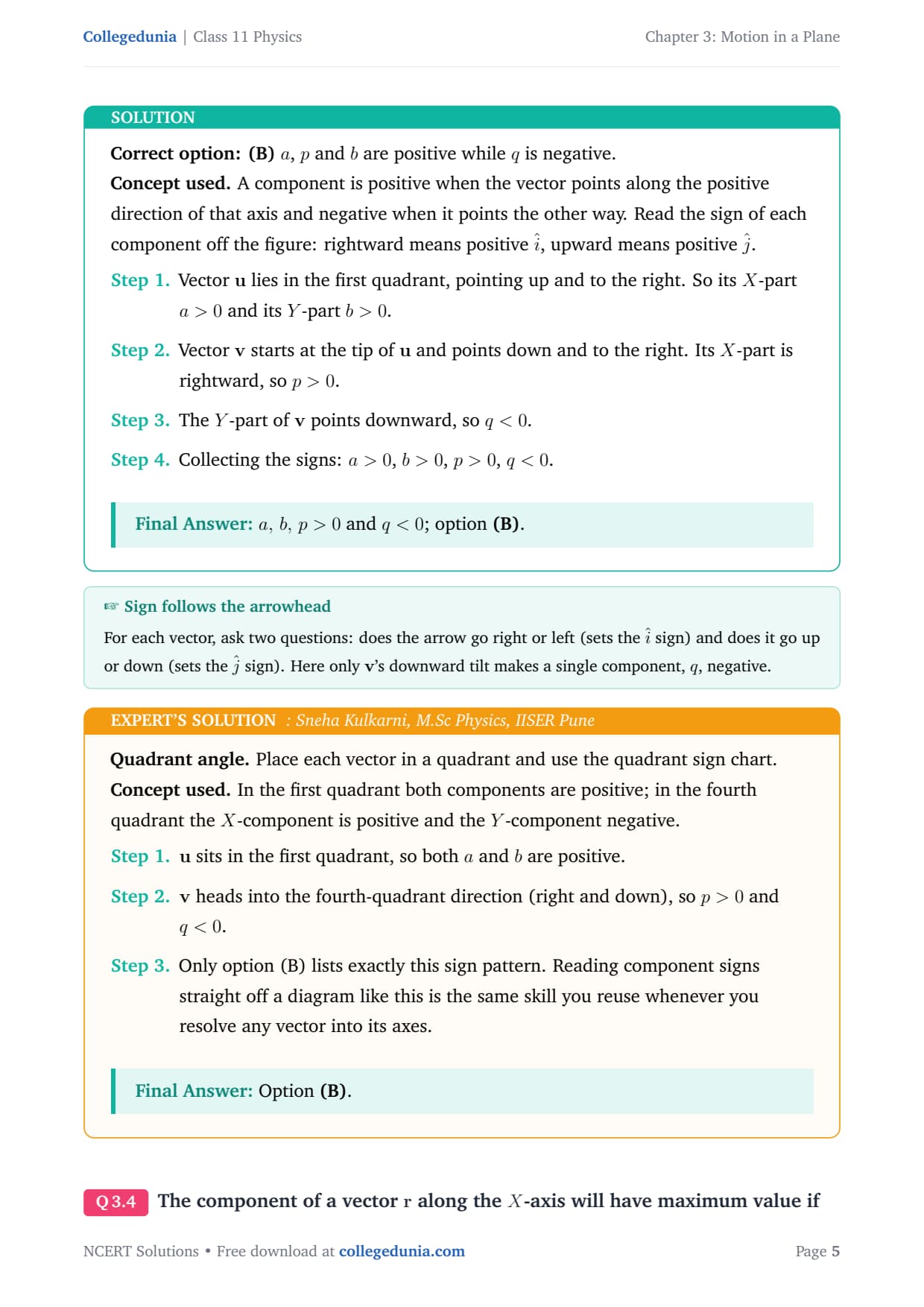
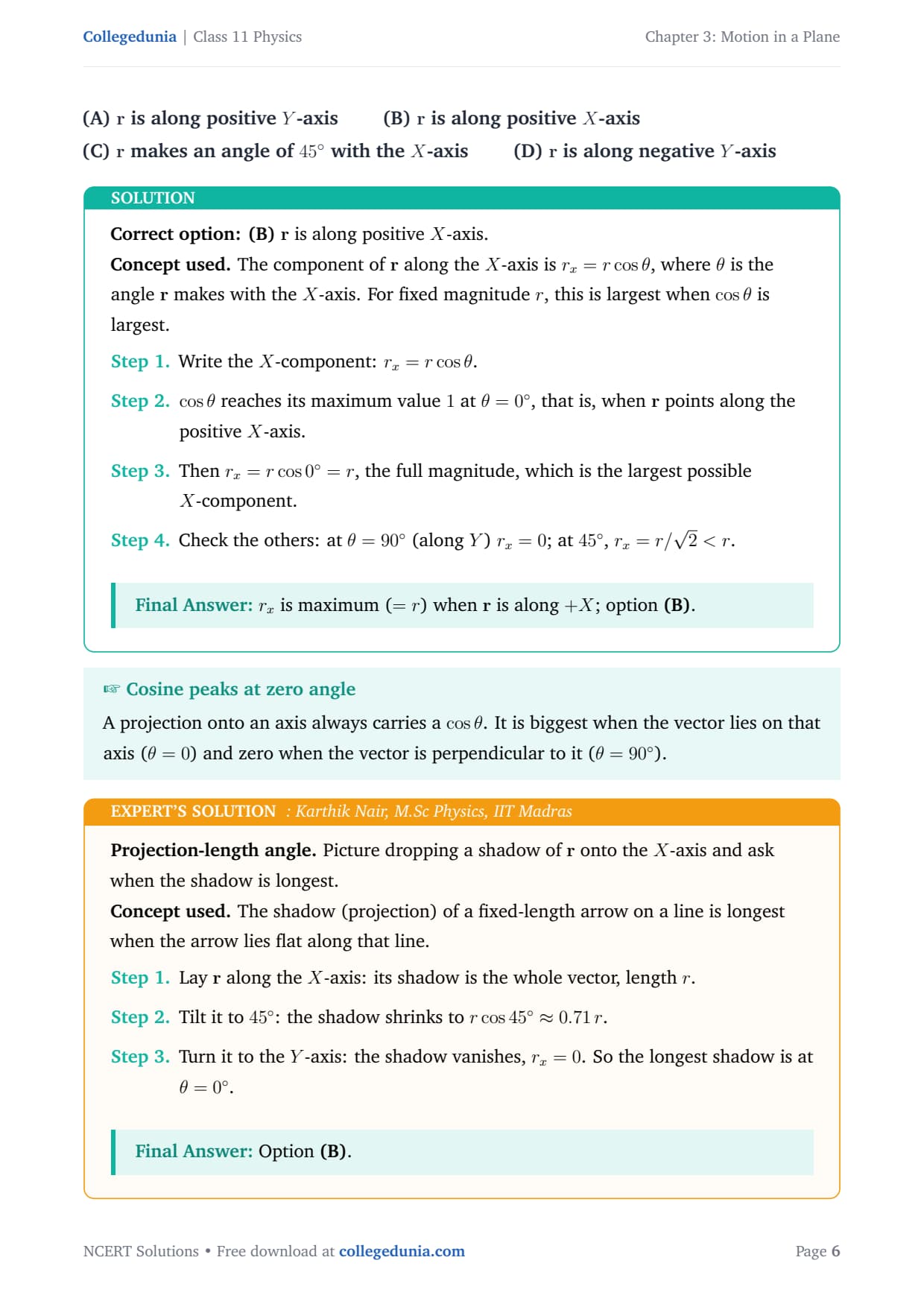
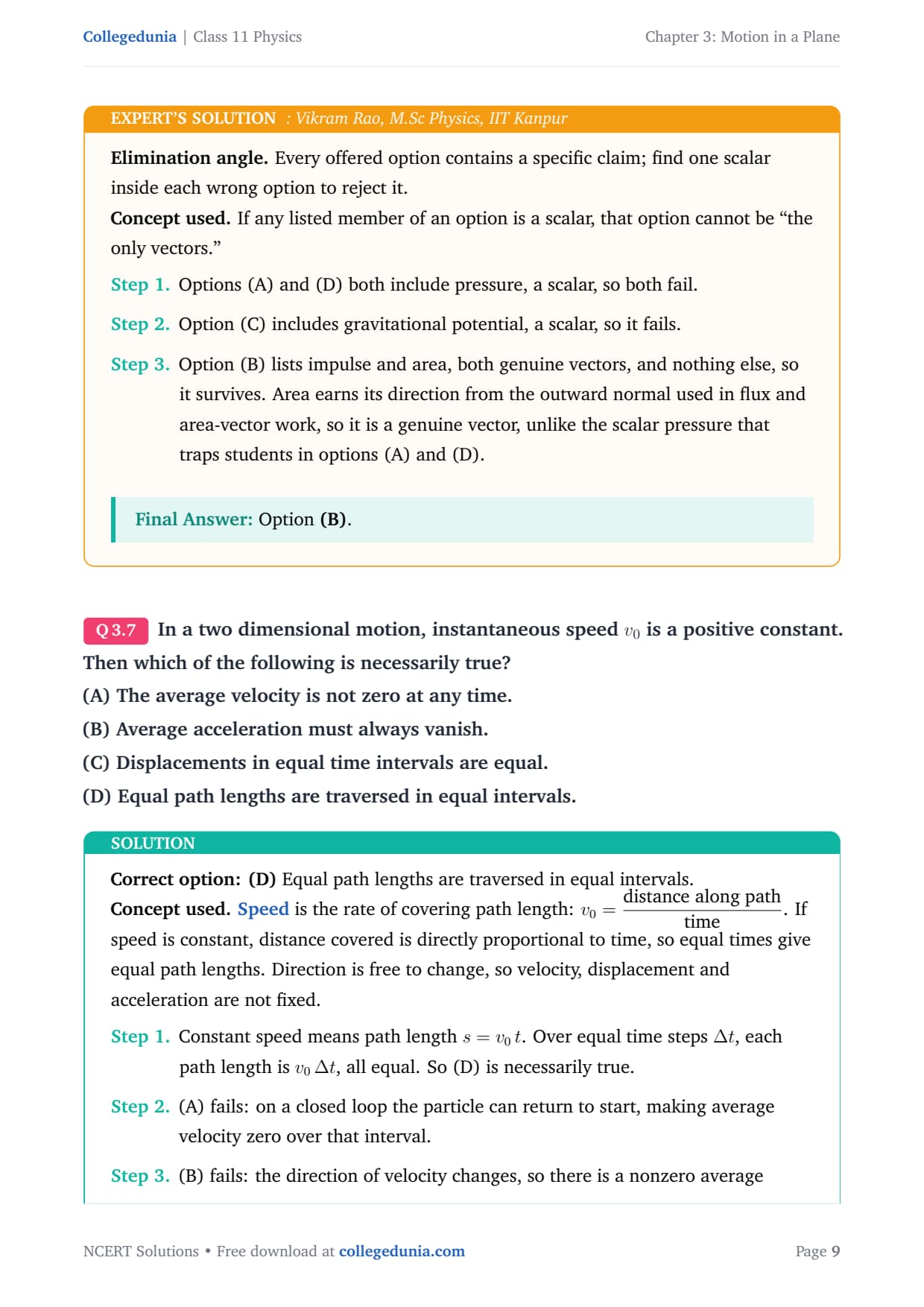
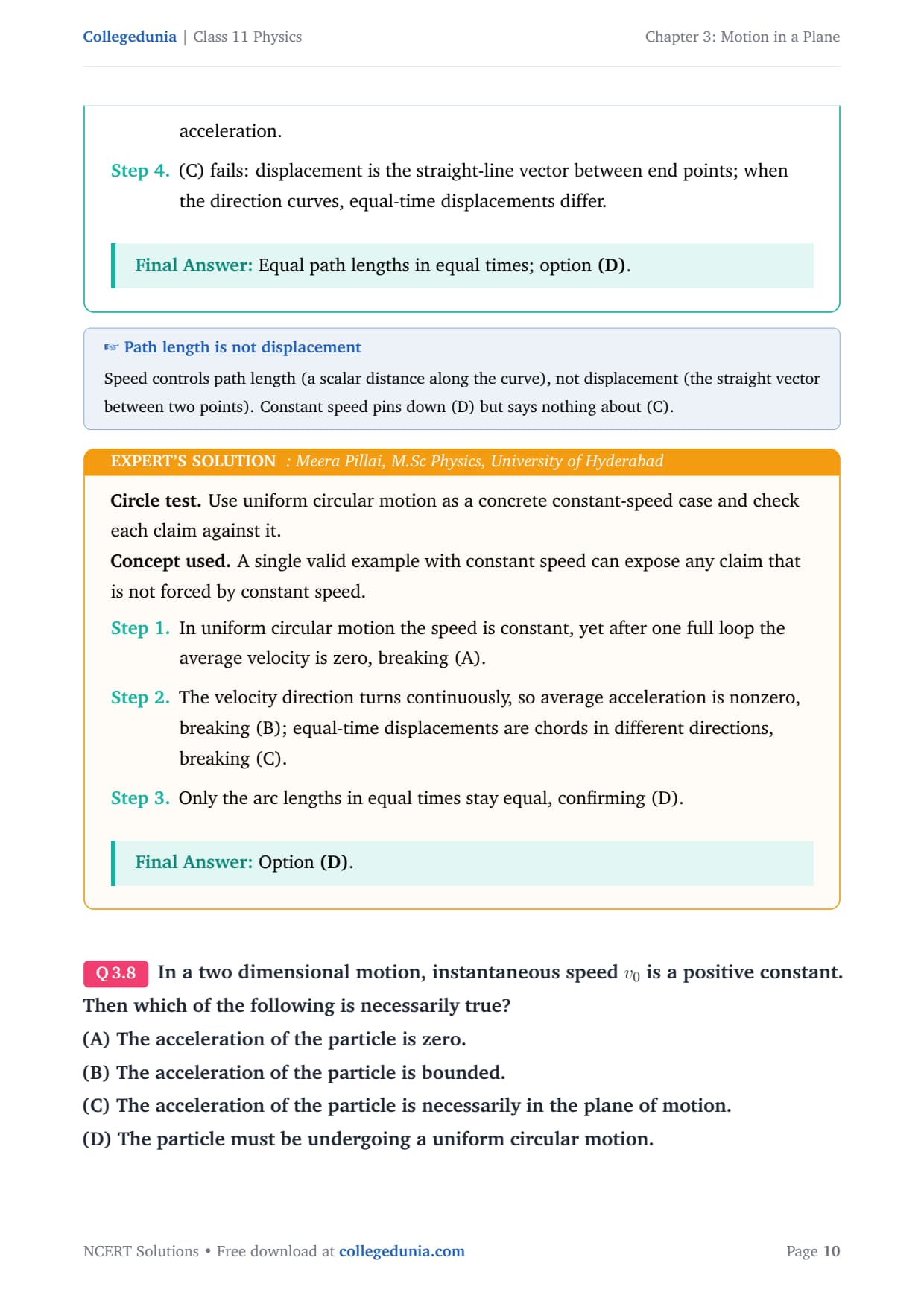
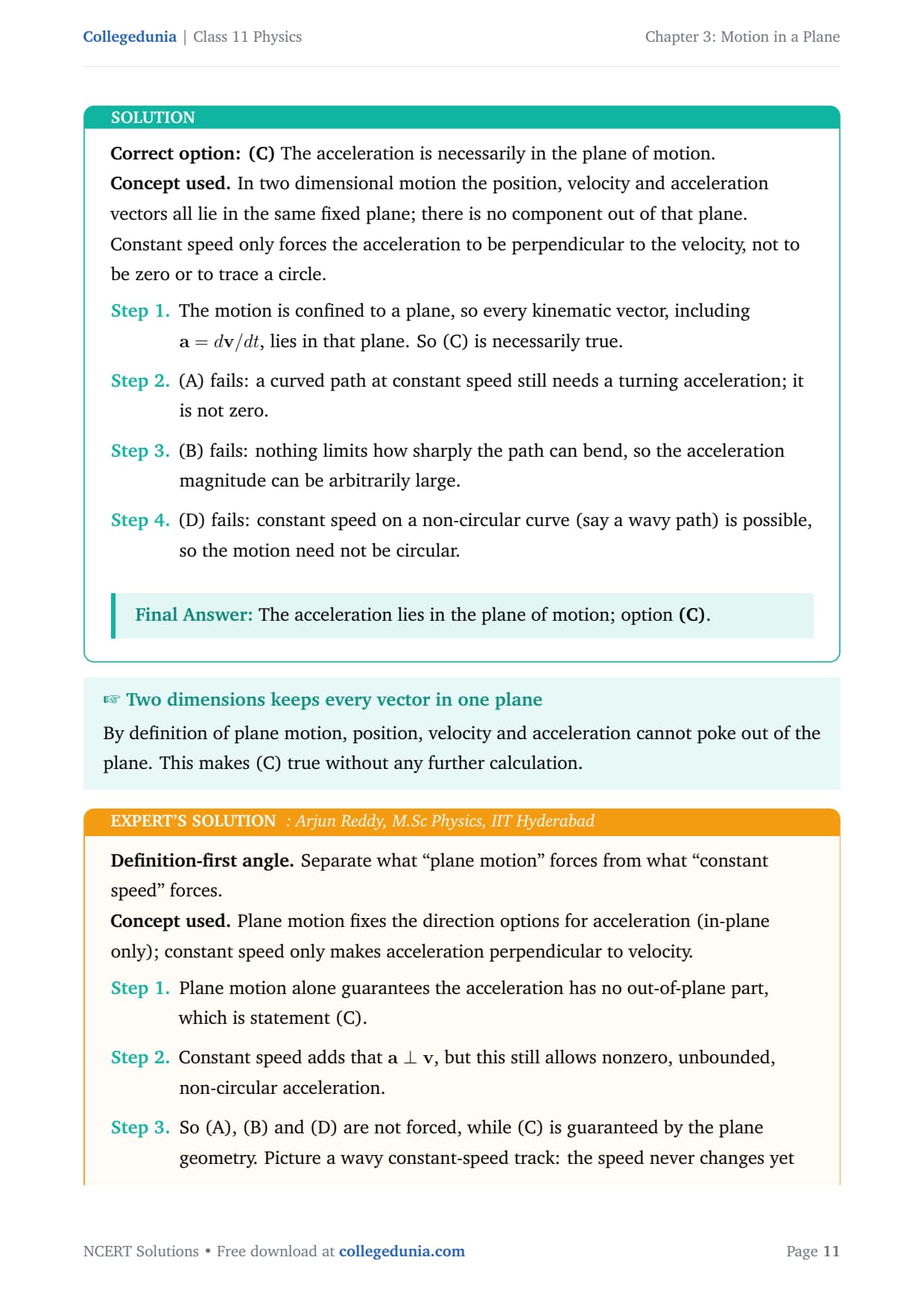
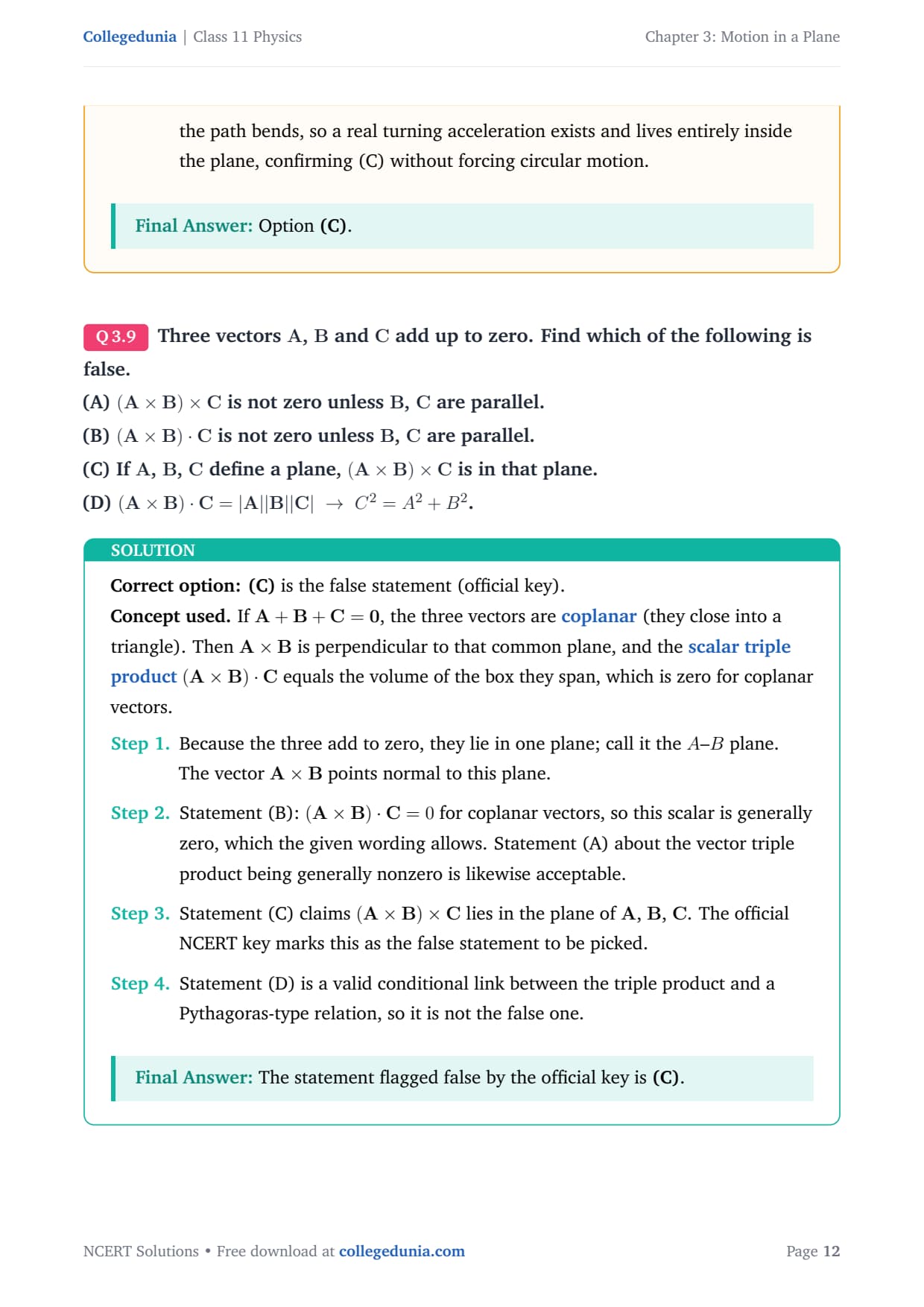
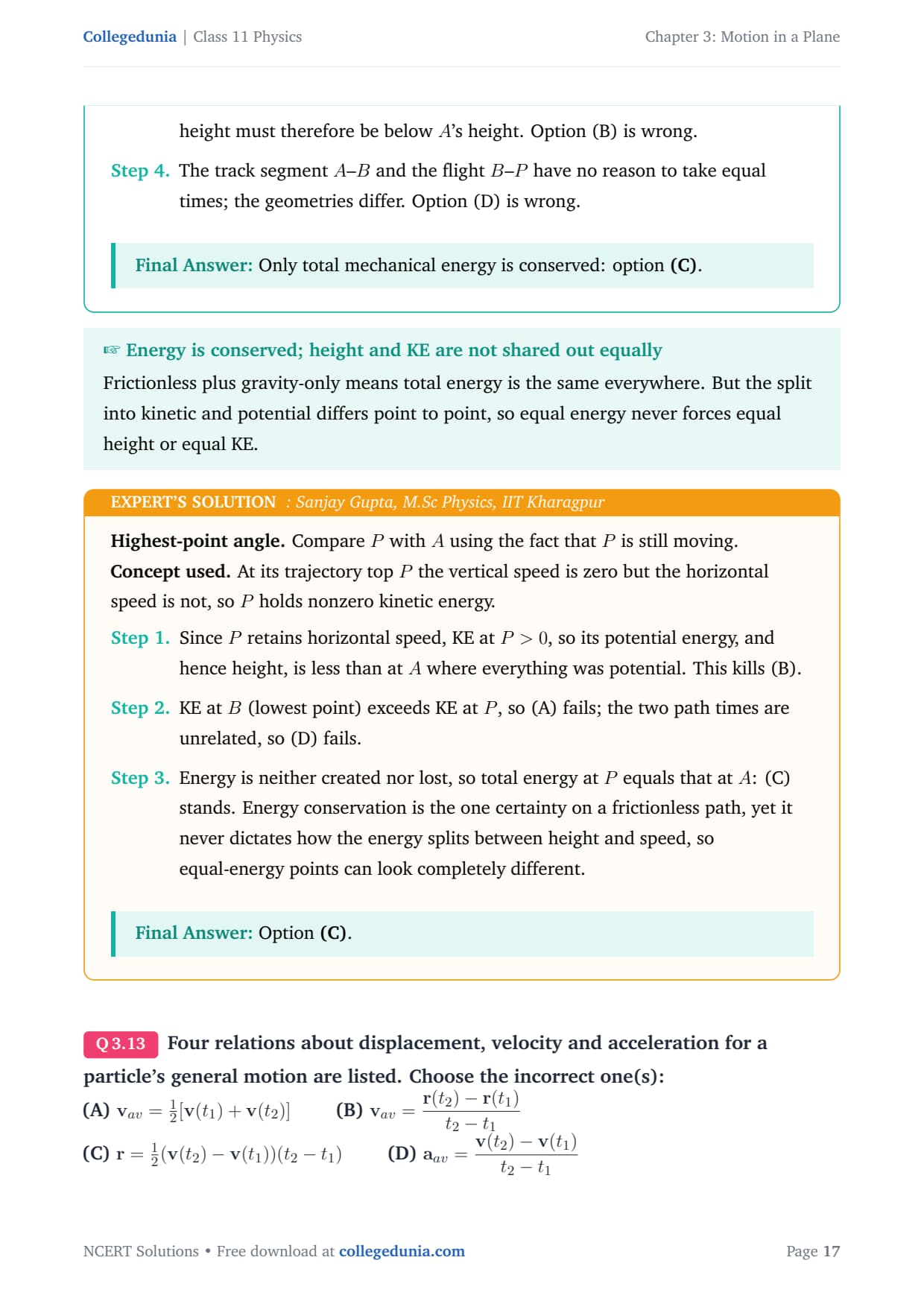
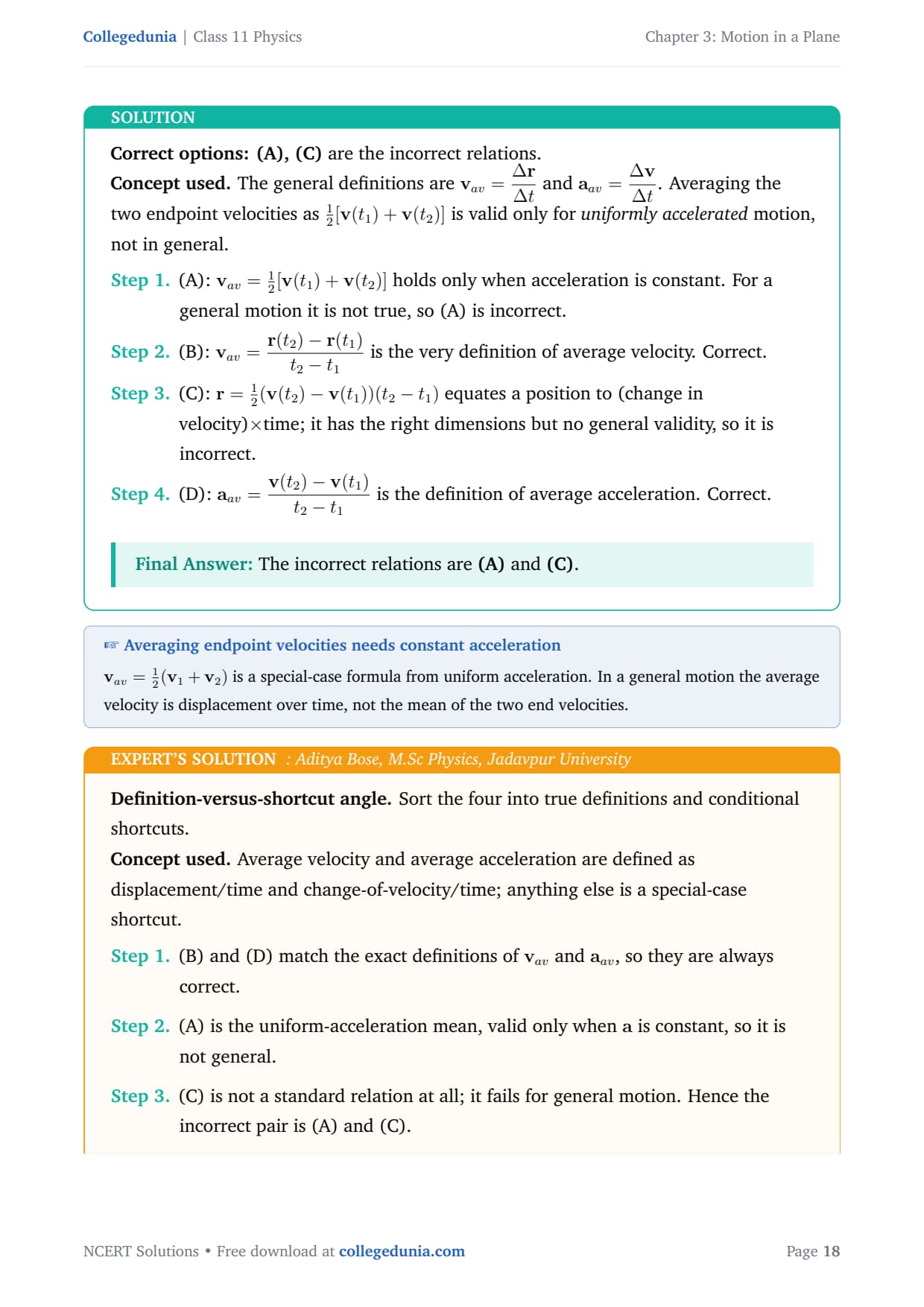
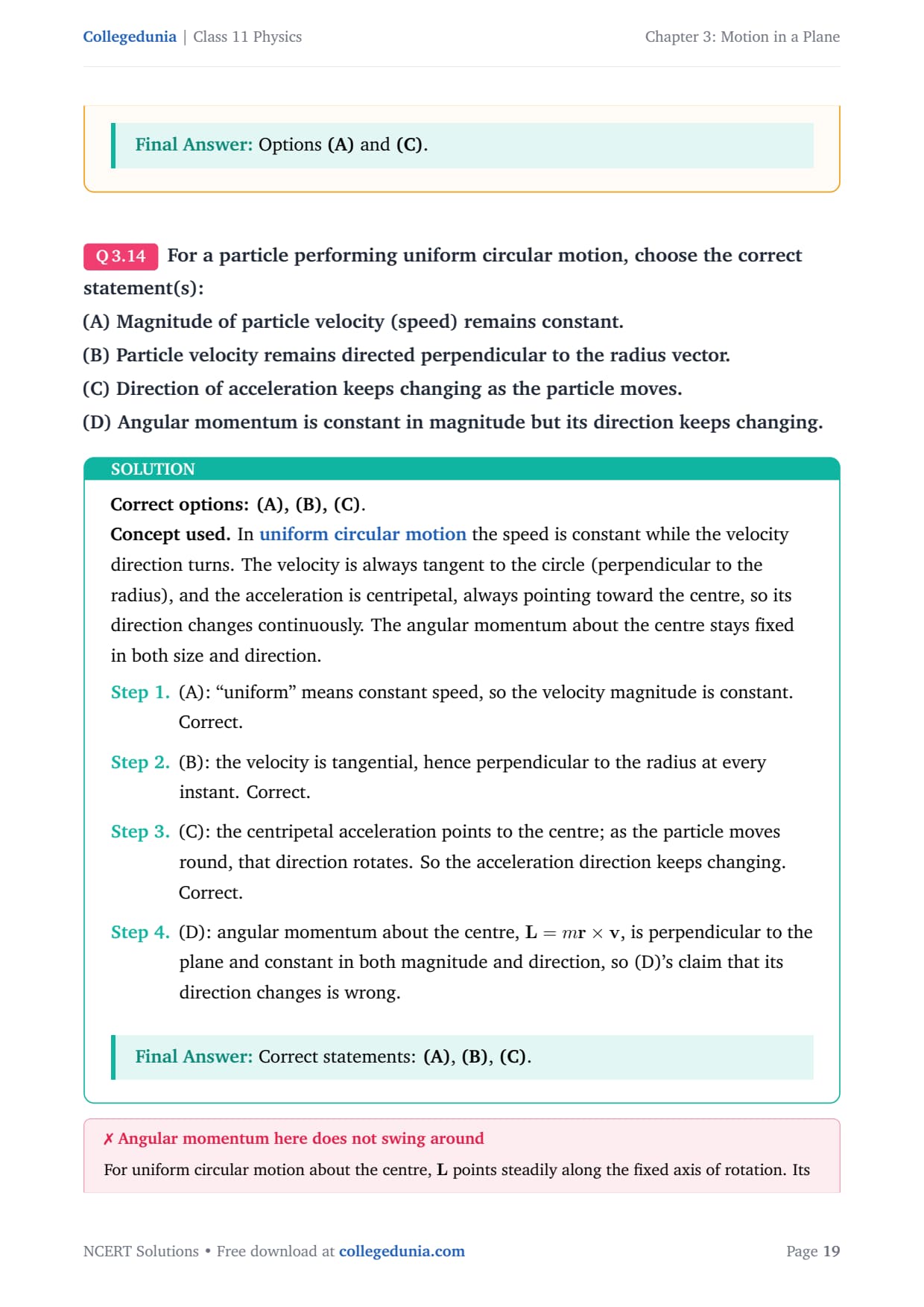
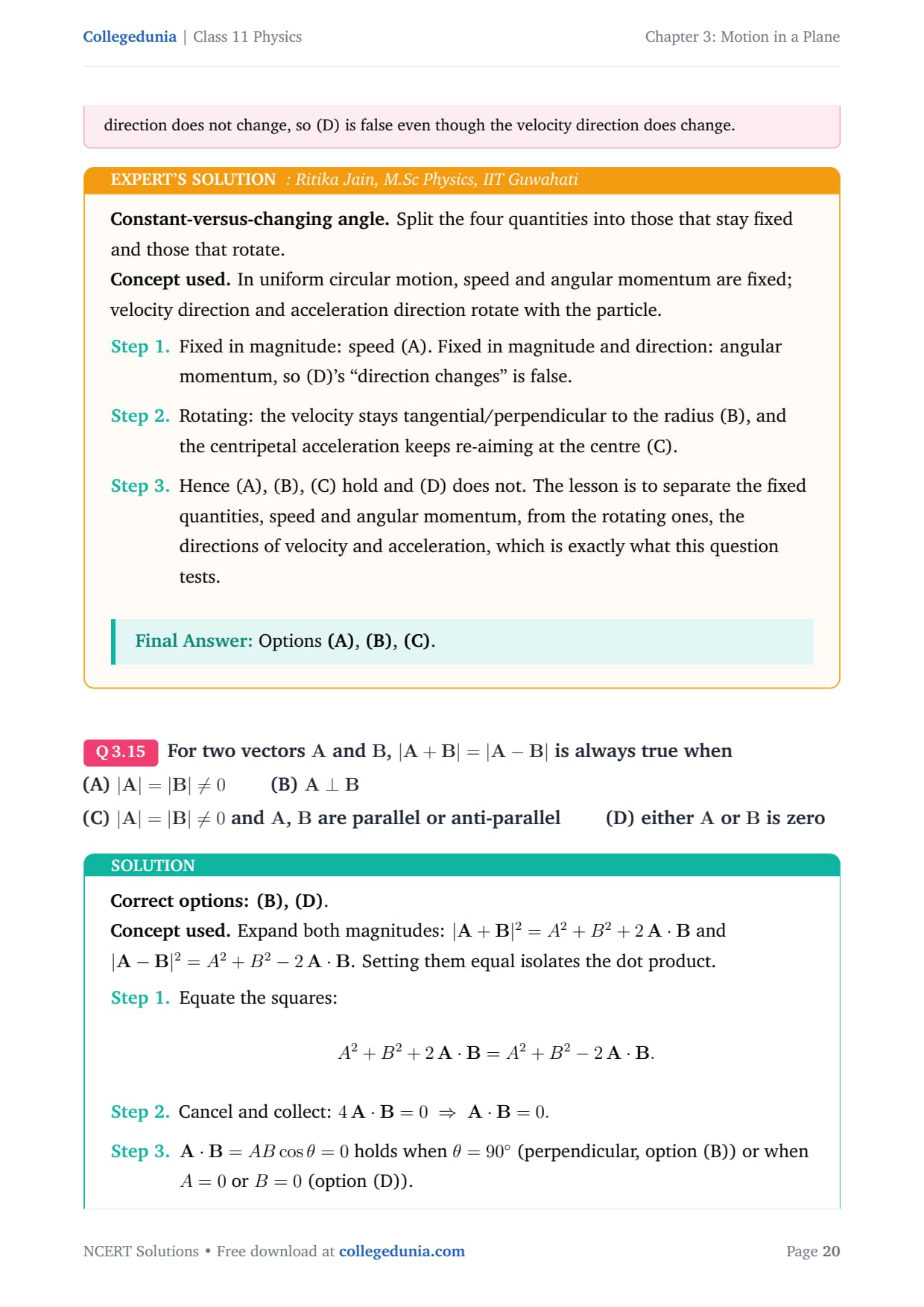
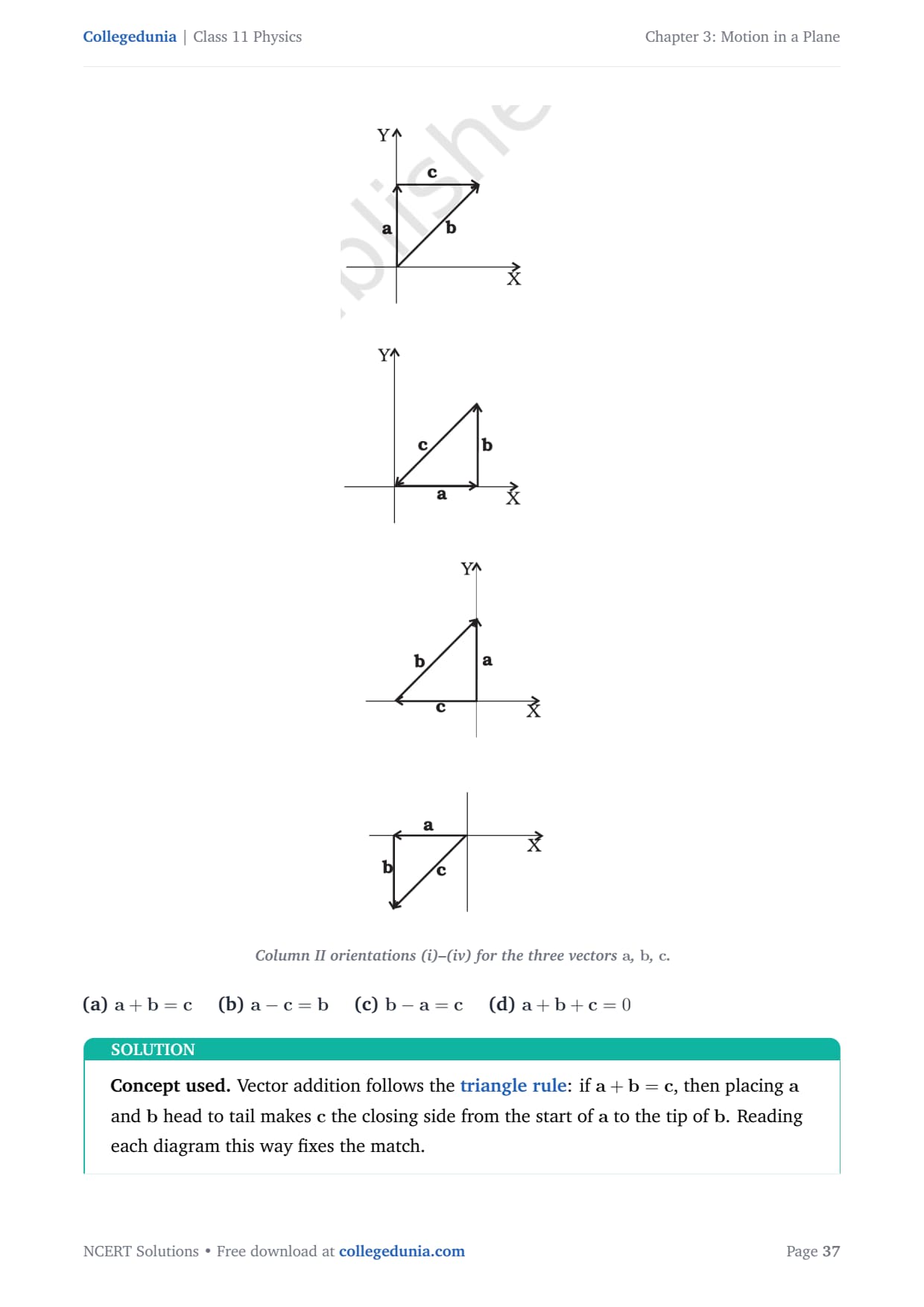
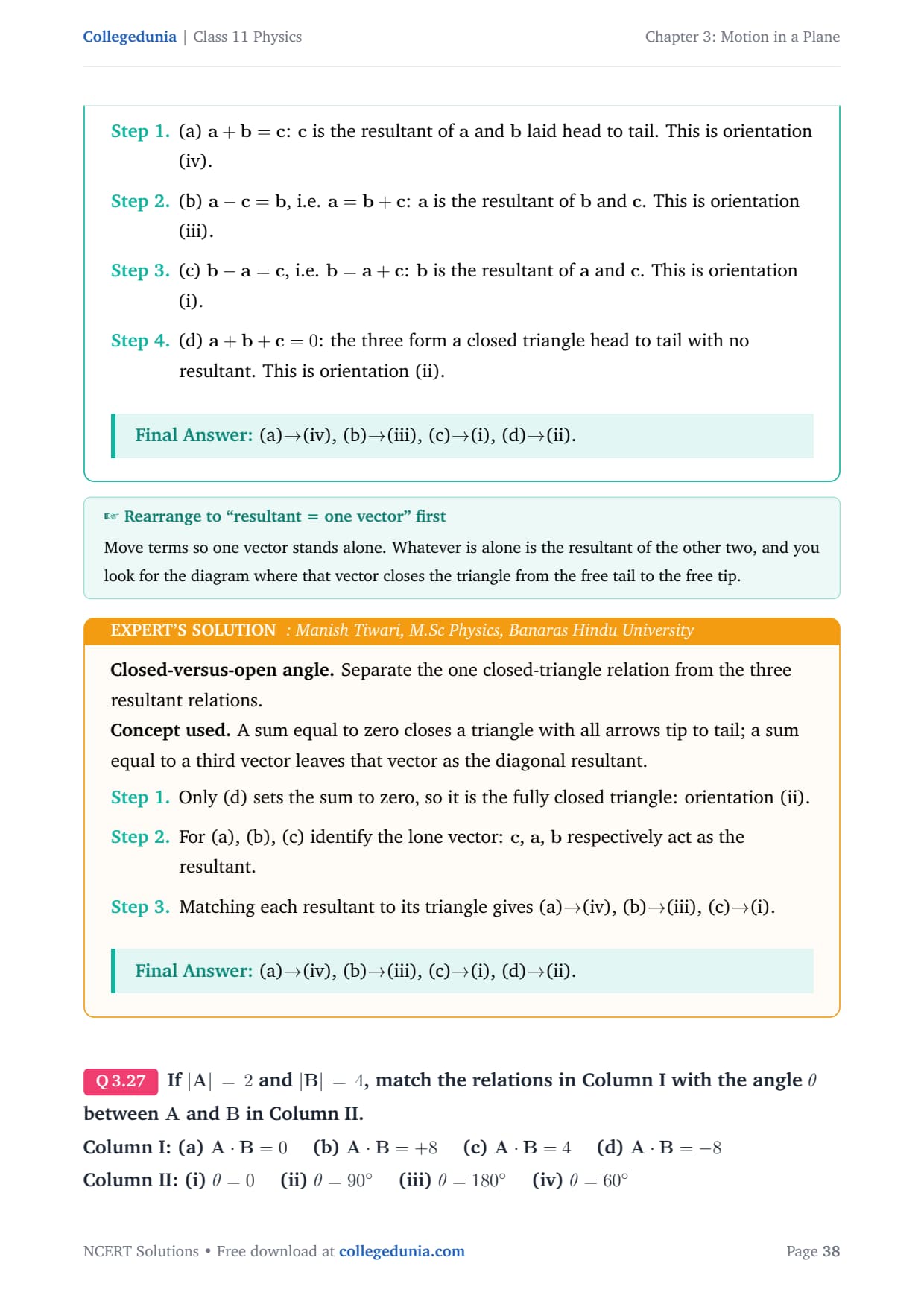
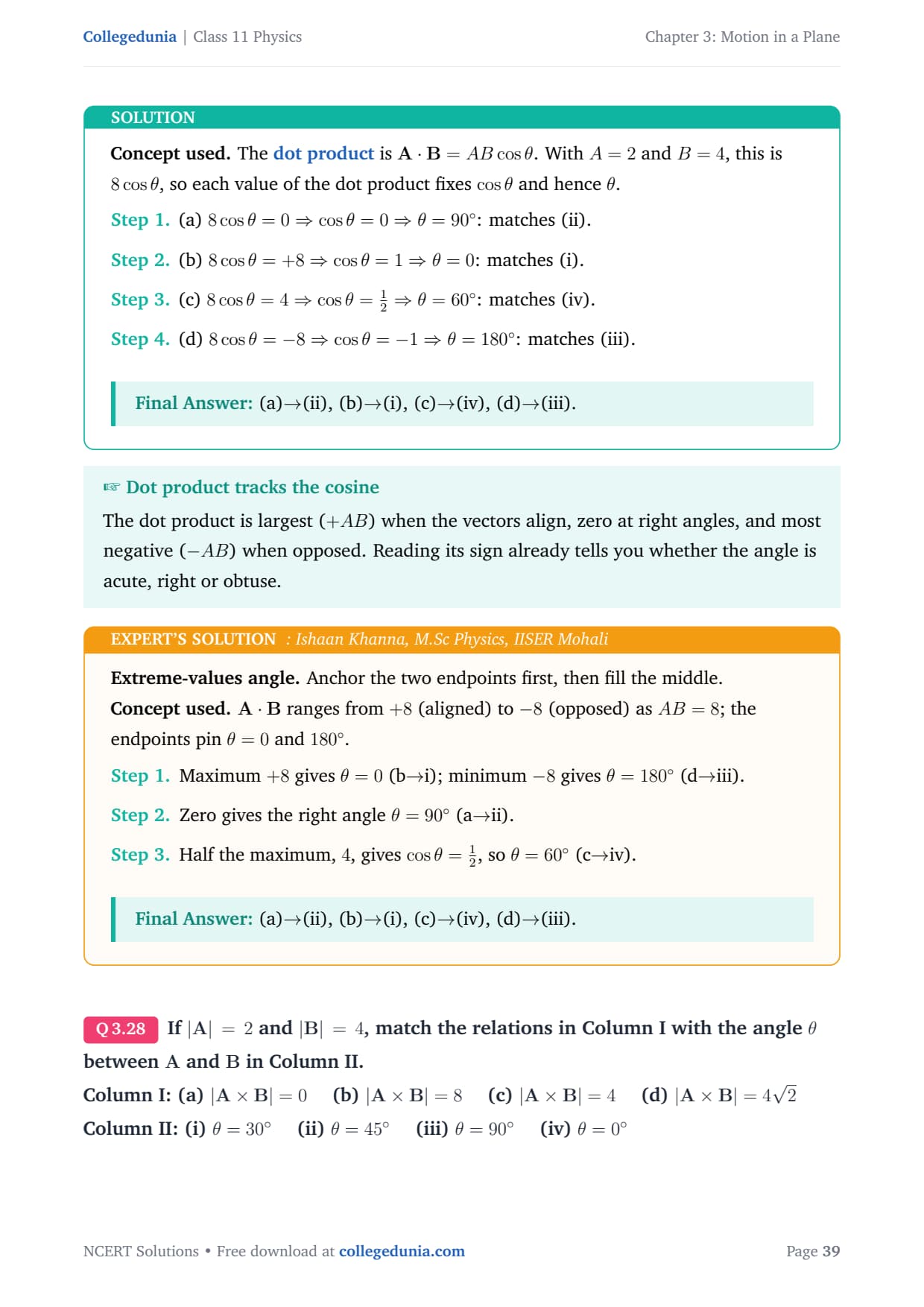
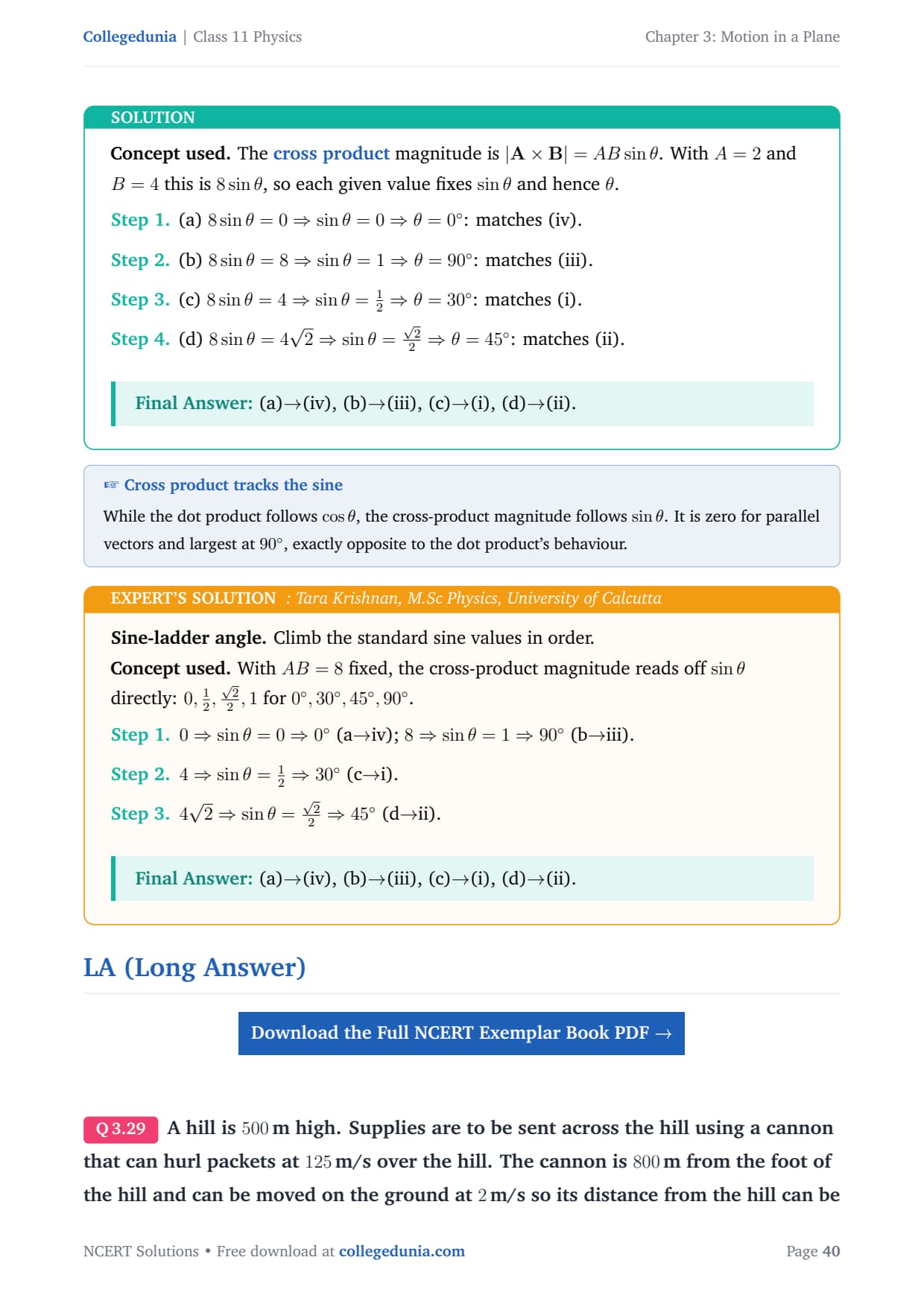
This chapter is where one-dimensional motion breaks open into two. Vectors, projectiles, circular motion and relative velocity arrive together, and each carries into Laws of Motion next. The Exemplar tests them far more sharply than the textbook does.
- CBSE Weightage: 6 to 8 marks, usually one projectile numerical plus a vector or relative-velocity question
- JEE Main Weightage: 2 to 3 questions per year, most often projectile range and relative motion
- NEET Weightage: 2 questions per year from projectiles and uniform circular motion
Every answer is checked against the official NCERT Exemplar key (keep316), and the two questions where that key is wrong are worked out in full.
Topics Covered in the Class 11 Physics Motion in a Plane Exemplar
The Exemplar builds this chapter on four blocks. Later questions combine two at once.
- Vector algebra: the triangle rule, dot and cross products, and the scalar triple product
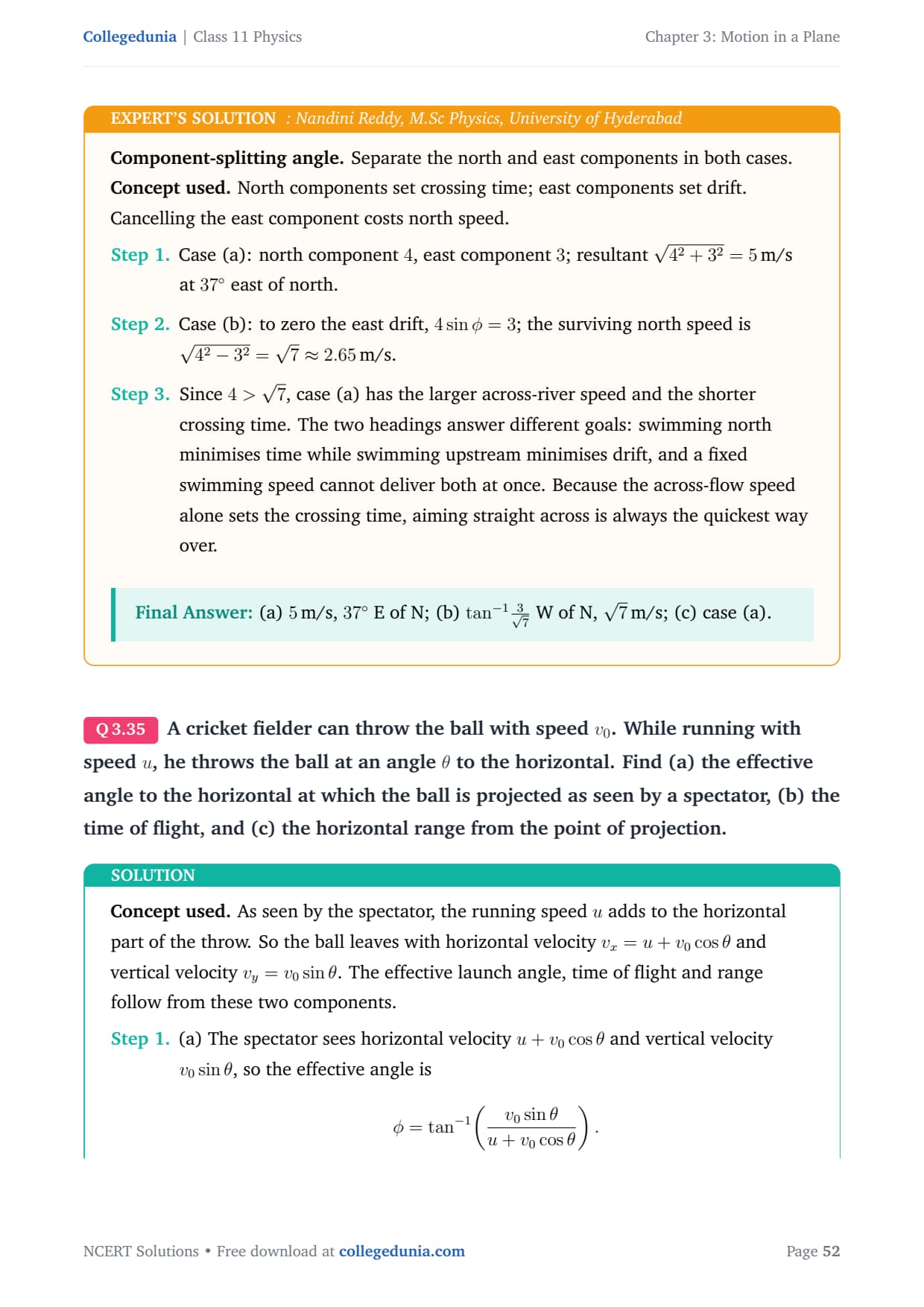
- Projectile motion: range, time of flight, maximum height, and launches onto inclines
- Uniform circular motion: centripetal acceleration as v2/R, and why constant speed is not constant velocity
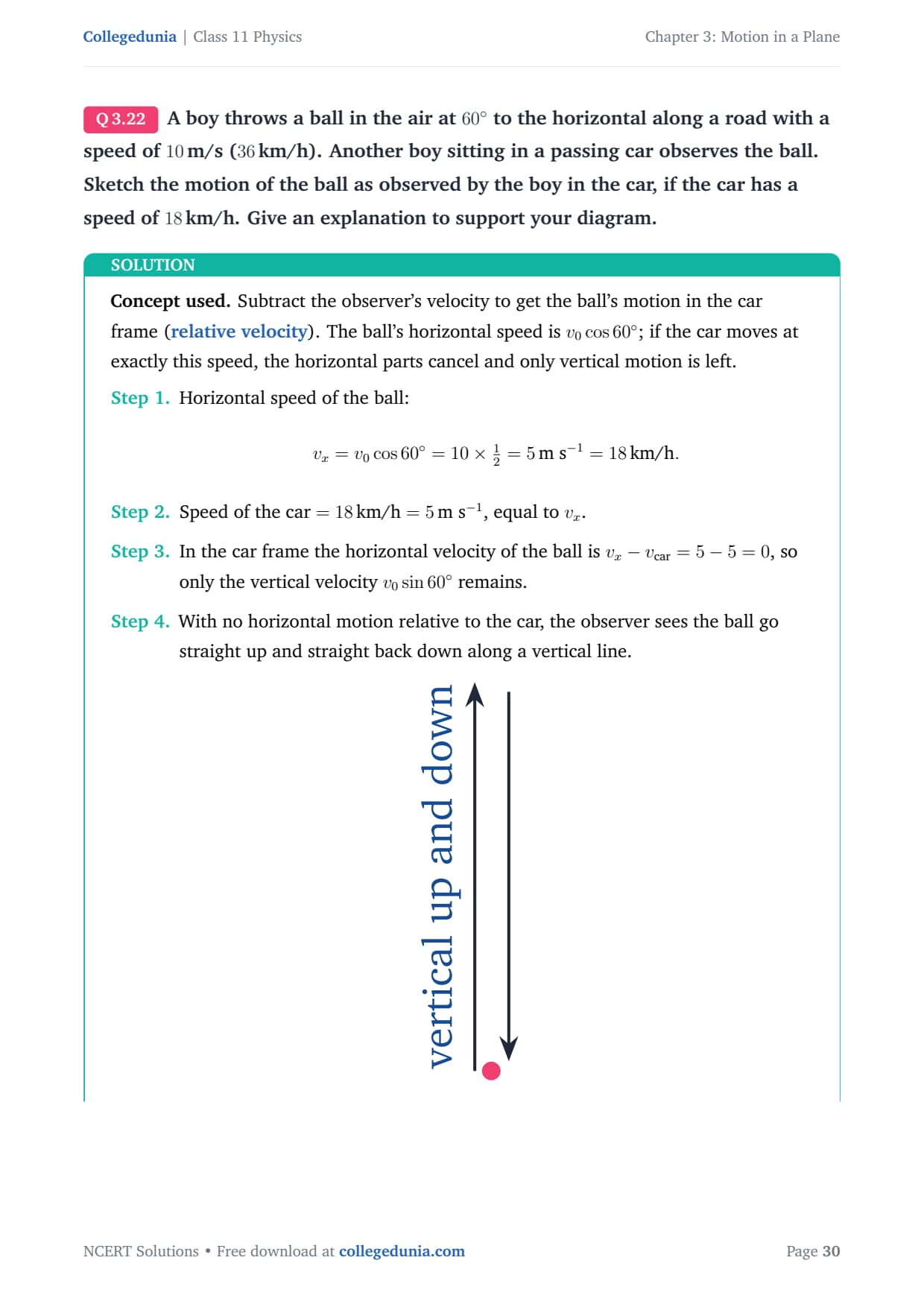
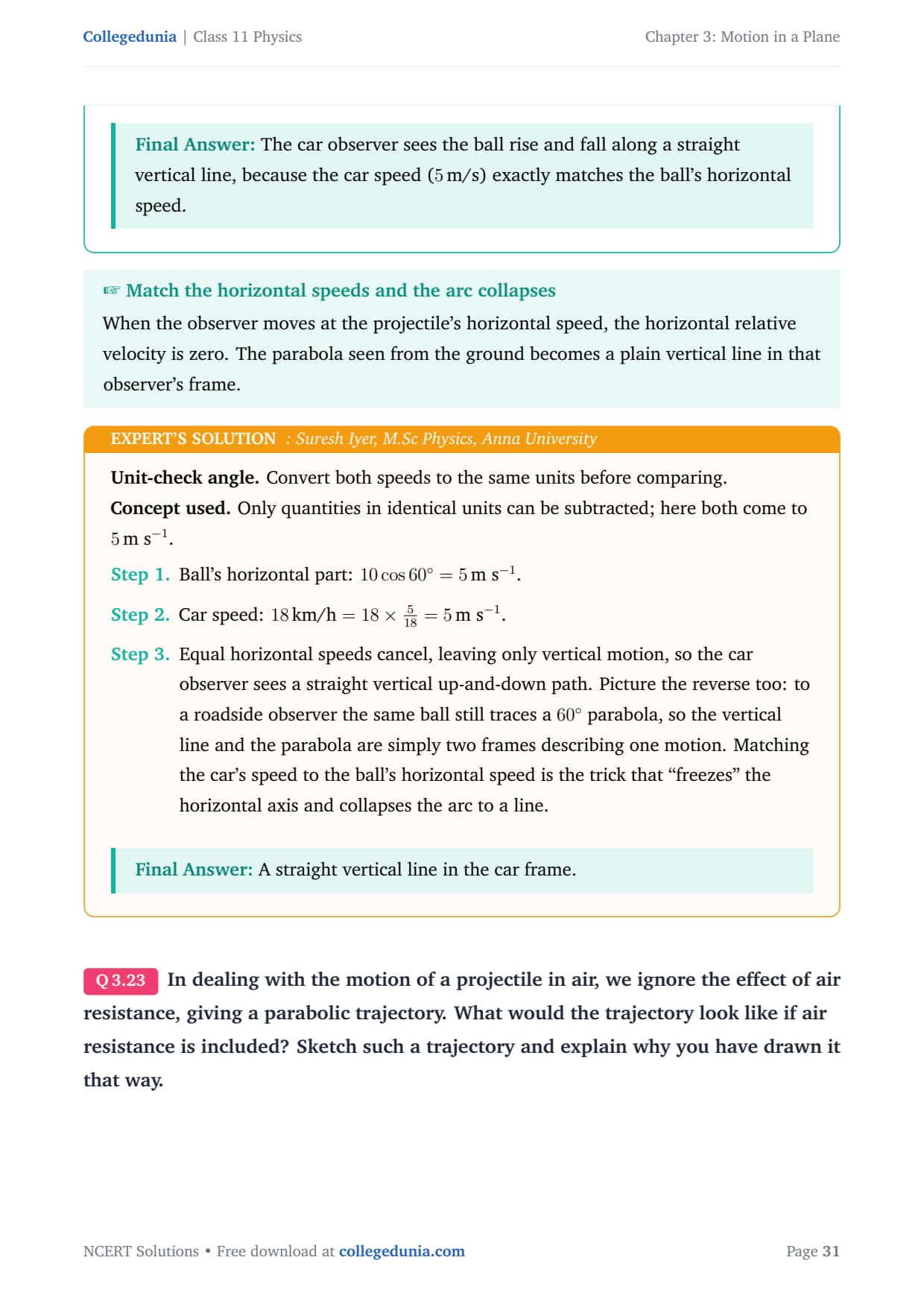
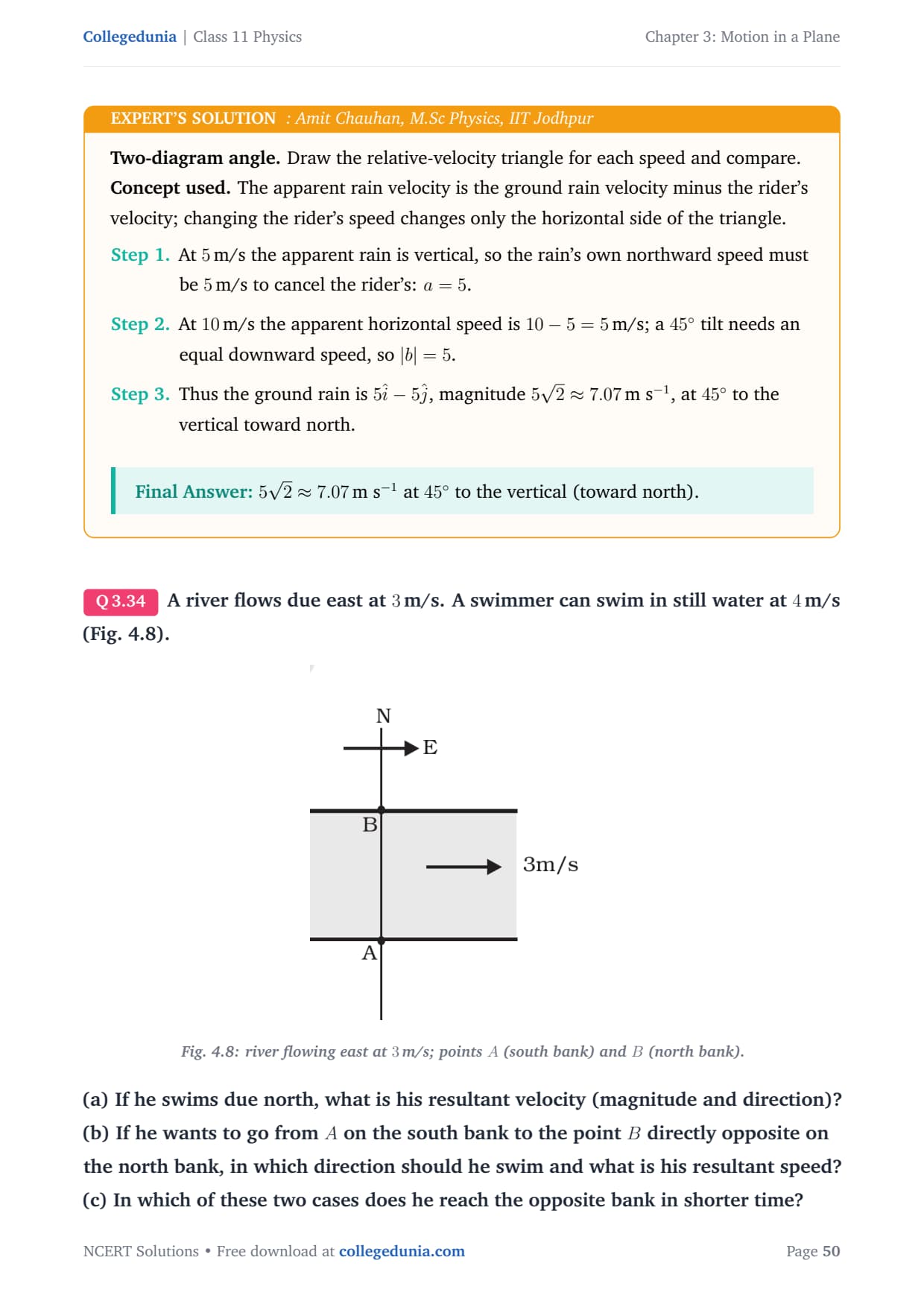
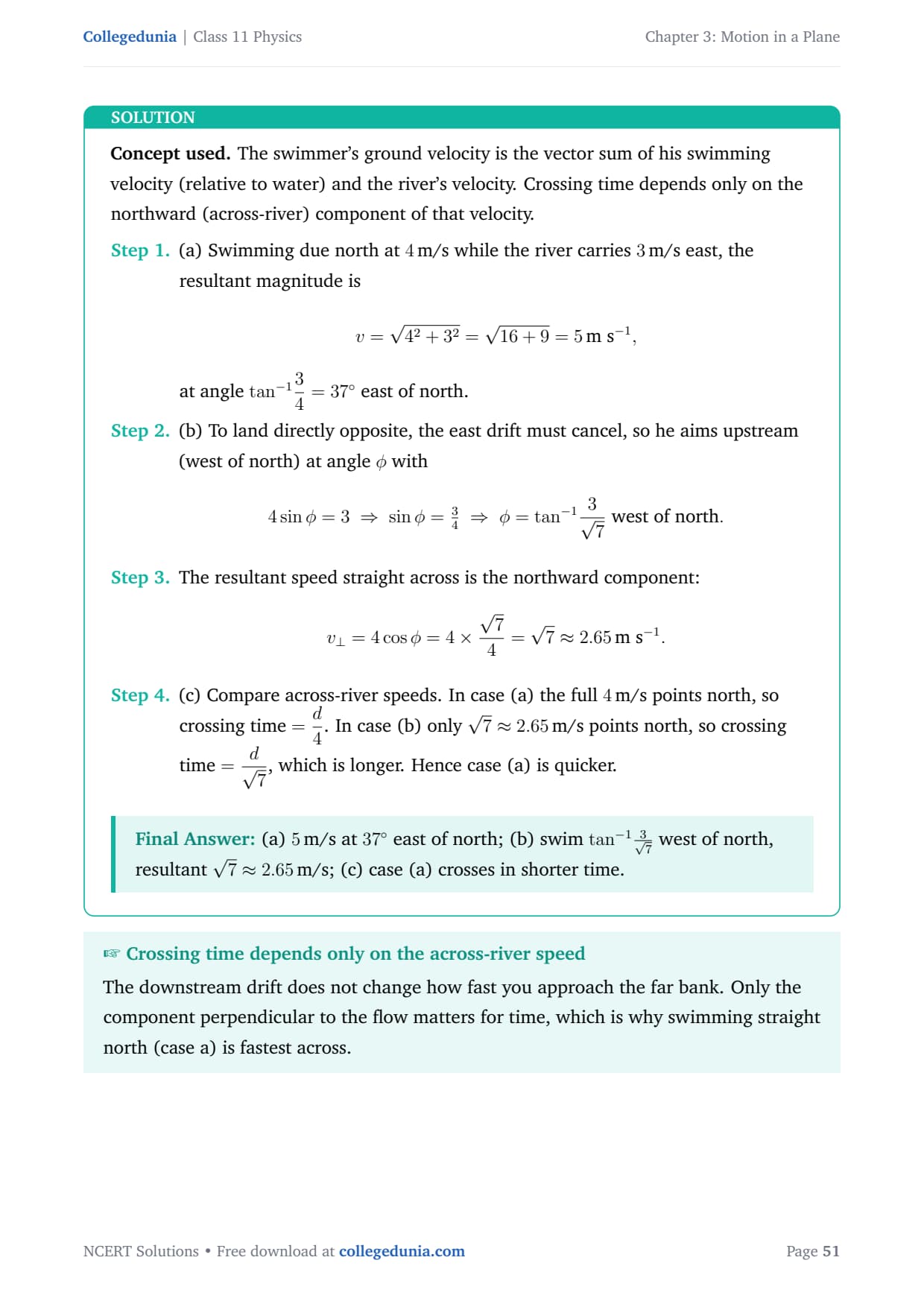
- Relative velocity: rain and bicycle problems, river crossings, and moving-observer sketches
One numbering point trips students up. This is Chapter 3 in the new textbook, but the Exemplar book still prints it as Chapter 4.
Question Types in the Motion in a Plane NCERT Exemplar
The 35 questions split across five types, weighted to the longer end. The 7 Long Answer questions hold most of the 7 book figures.
| Question Type | Count | What It Tests |
|---|---|---|
| MCQ I (single correct) | 10 | Vector definitions, scalar sorting, and the range formula |
| MCQ II (one or more correct) | 5 | Rejecting every wrong option, since partial answers score nothing |
| VSA (Very Short Answer) | 5 | One-line reasoning on acceleration direction and vector products |
| SA (Short Answer) | 8 | Sketch-and-explain relative motion, plus matching columns |
| LA (Long Answer) | 7 | Projectile derivations on inclines and elastic rebound |
Two Places the Official NCERT Answer Key Goes Wrong
Most chapters have a clean key. This one has two where the printed answer does not survive a check.
Question 4.10 states that |A + B| = |A| and asks what this implies. Squaring gives A·B = −B2/2, which is at most zero. That is option (D). The official key prints (B), antiparallel, which is only one special case of the obtuse condition the algebra gives. Write (B) in the exam, since the marking scheme follows the key, but the real condition is A·B ≤ 0.
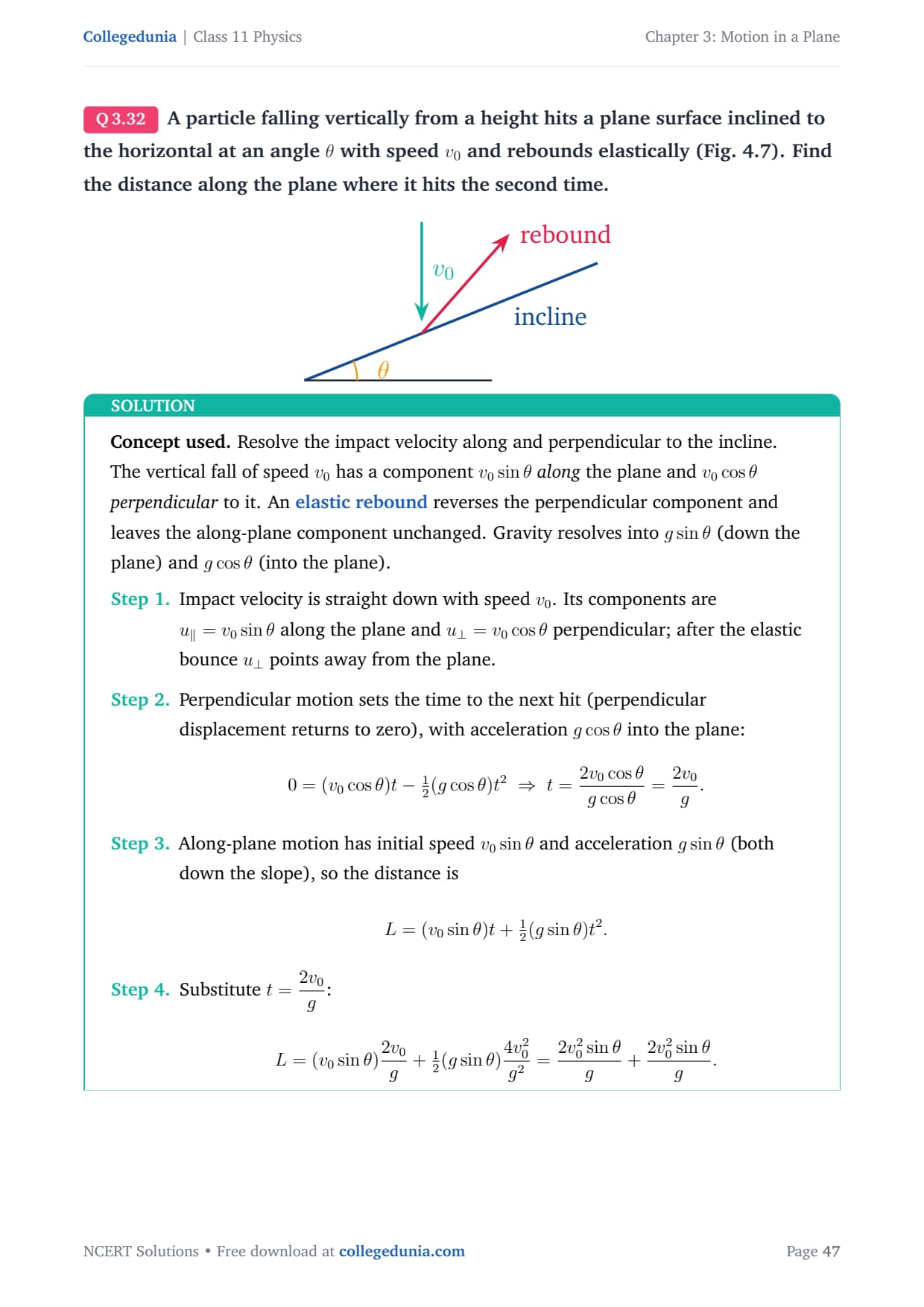
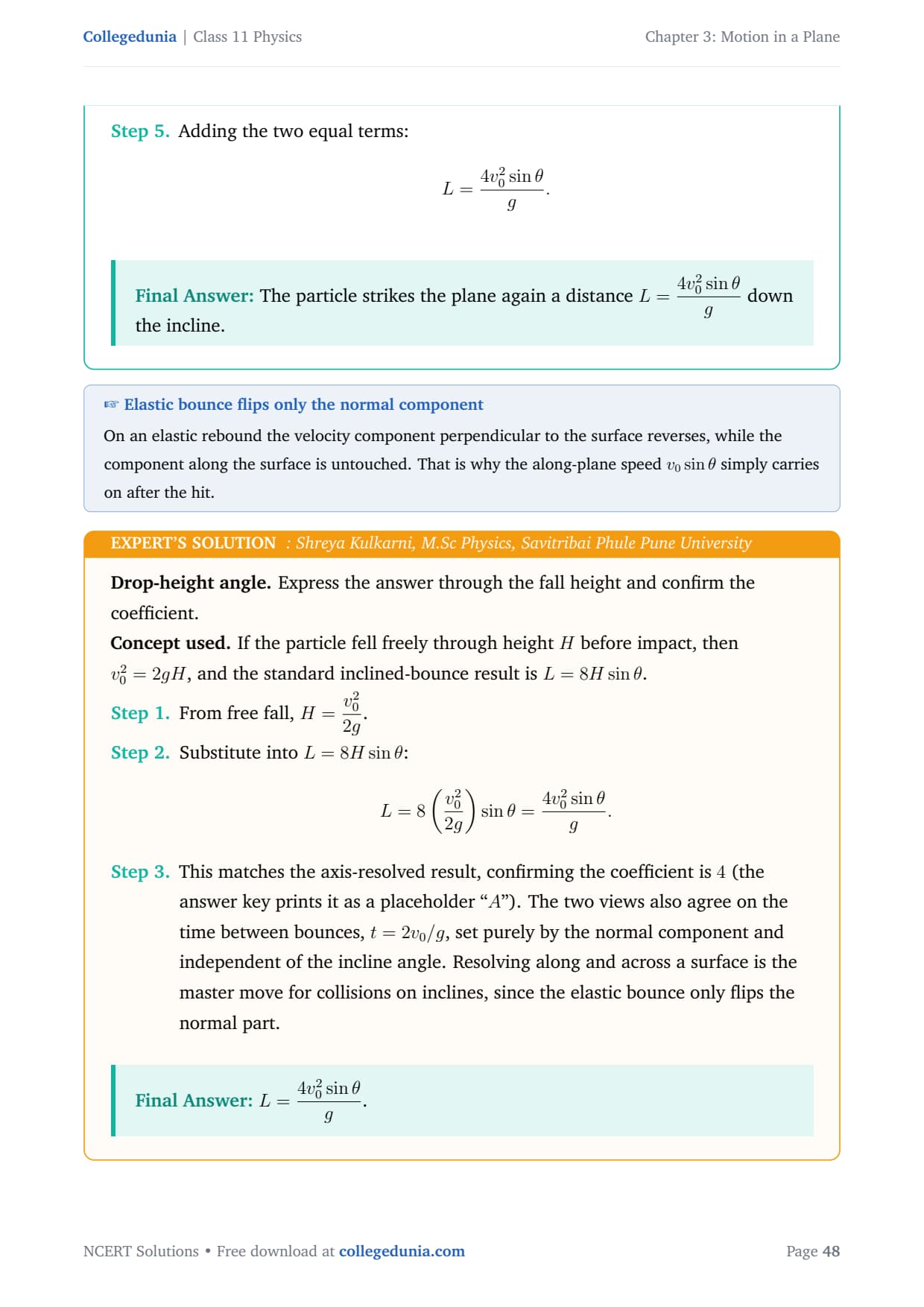
Question 4.32 asks where a particle rebounding elastically off an incline lands the second time. The correct distance is L = 4v02 sinθ/g, but the published key prints the coefficient as the letter "A" rather than the digit 4, a typographical slip. Our solution derives the 4 and cross-checks it against L = 8h sinθ.
Key Formulas Used Across the Motion in a Plane Exemplar
Nearly every numerical here reduces to one of the relations below. The PDF names each formula before substituting.
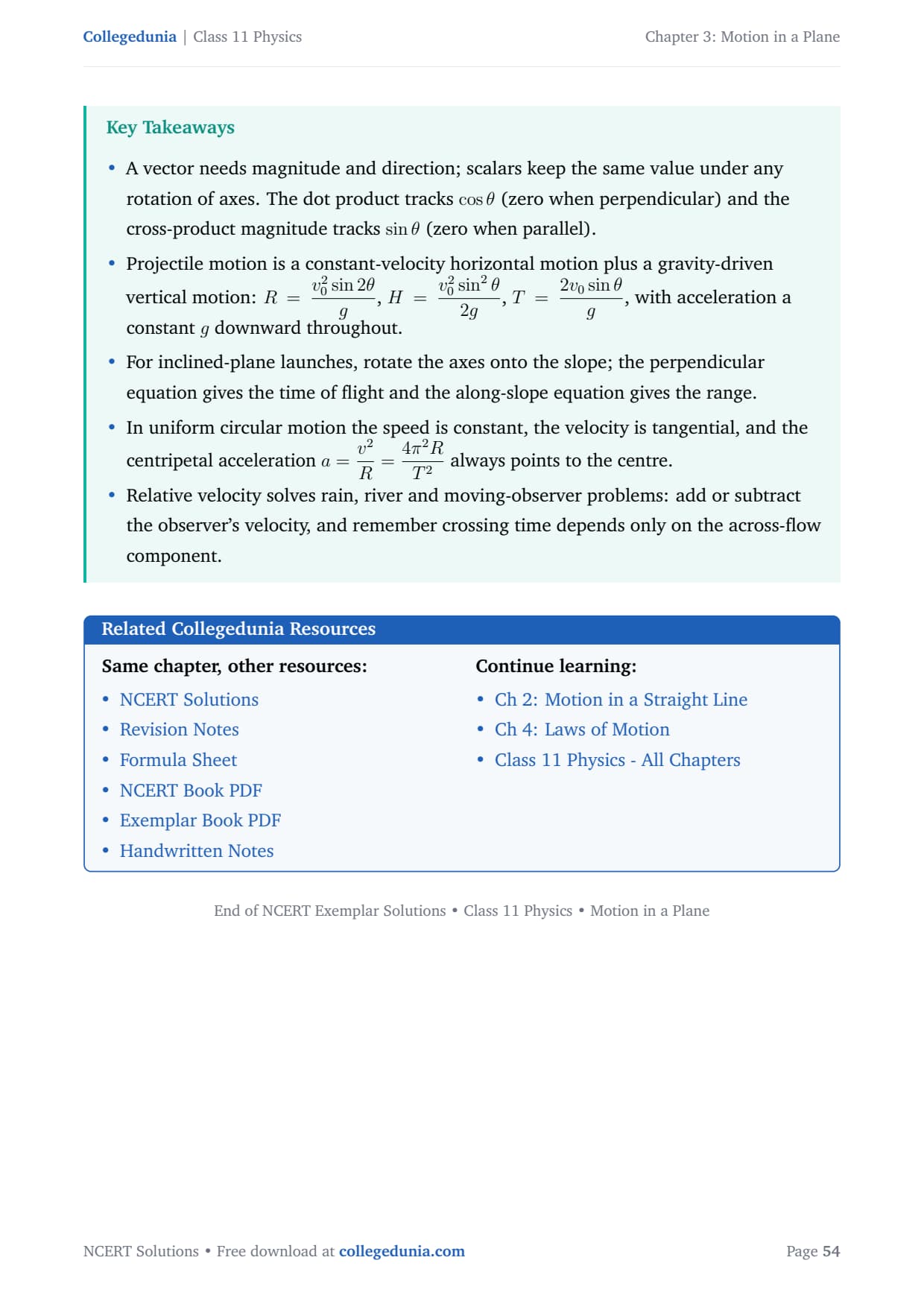
- Horizontal range: R = v02 sin 2θ/g, which peaks at θ = 45°
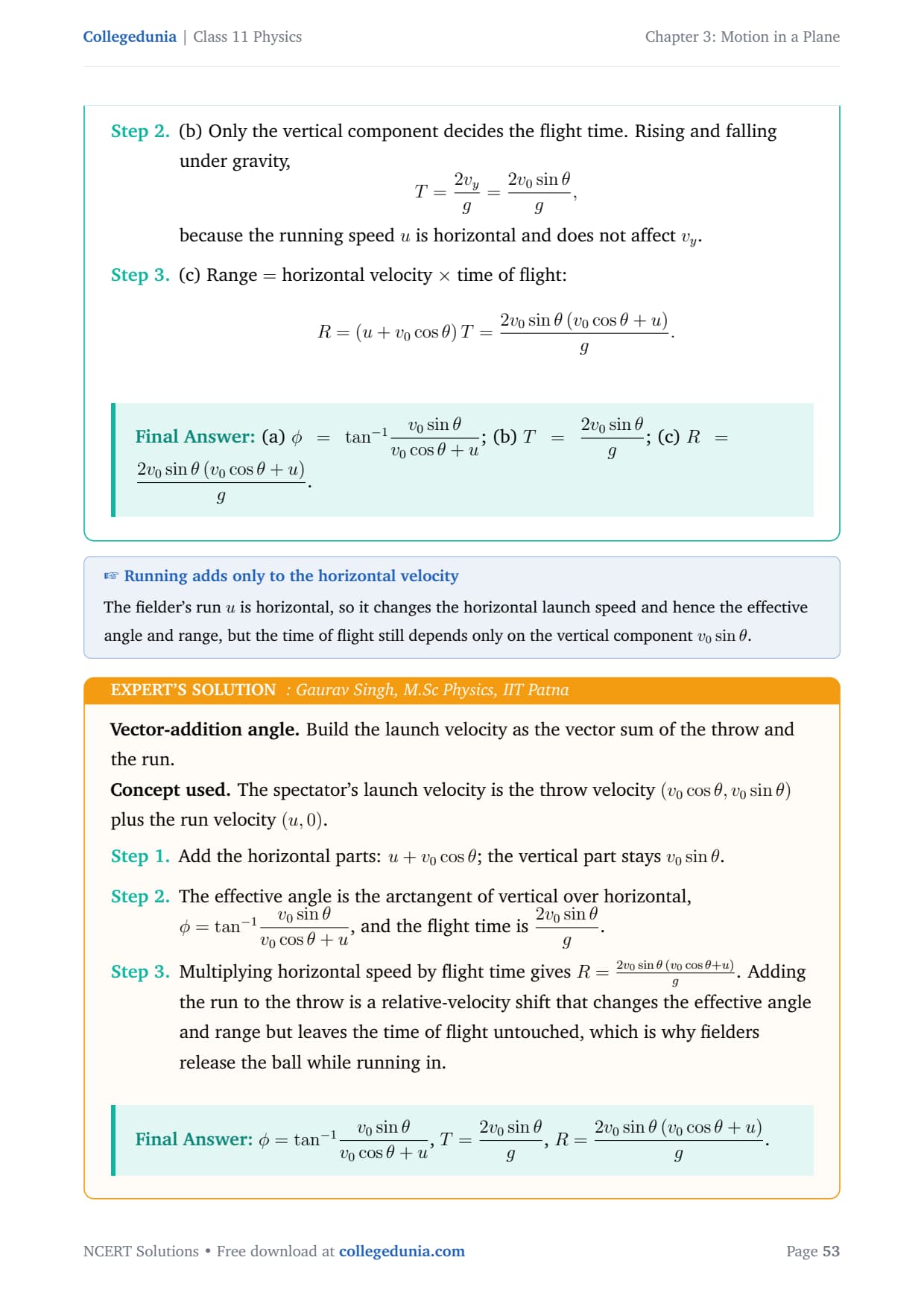
- Time of flight: T = 2v0 sinθ/g, set by the vertical component alone
- Centripetal acceleration: a = v2/R = 4π2R/T2, always pointing at the centre
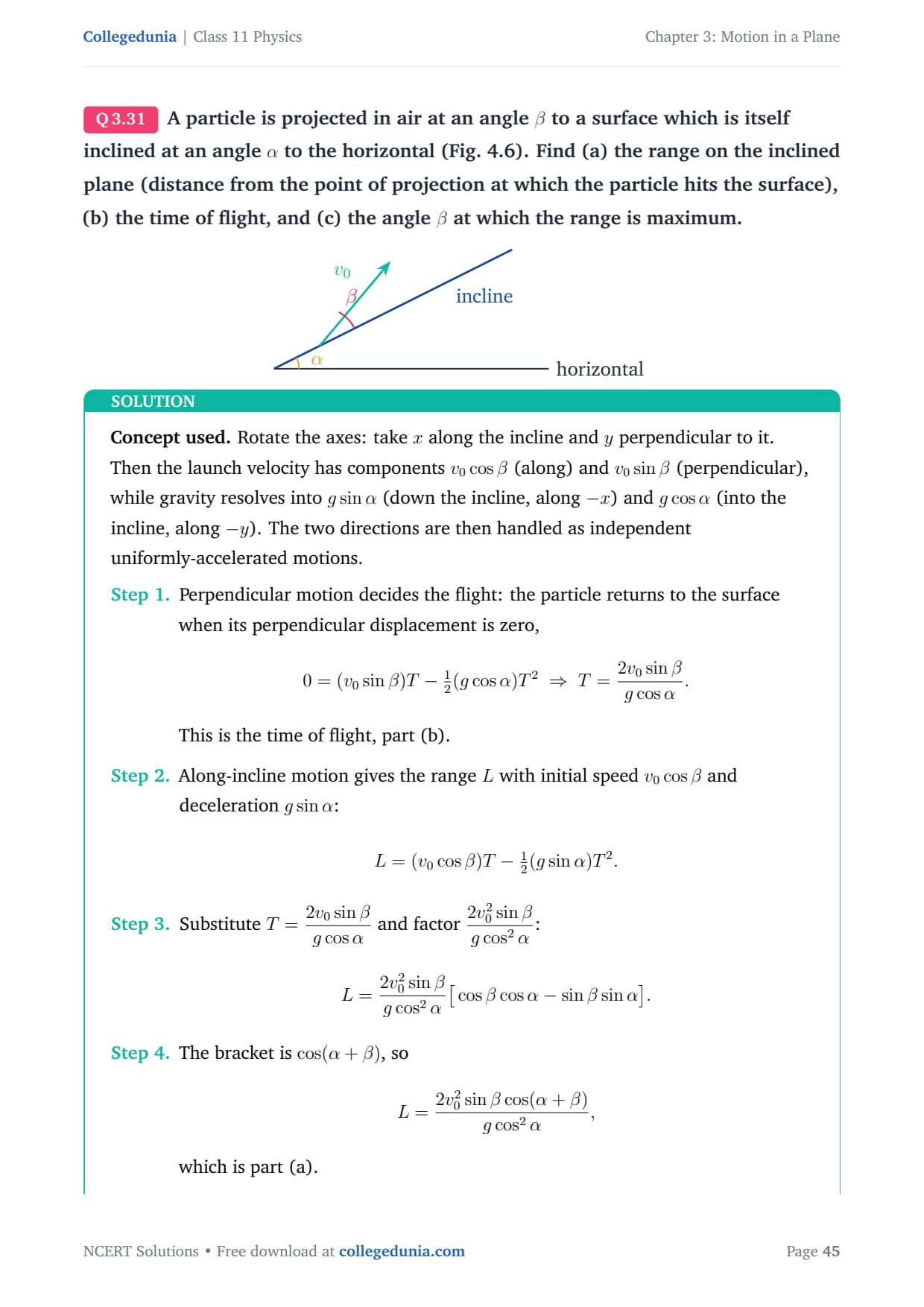
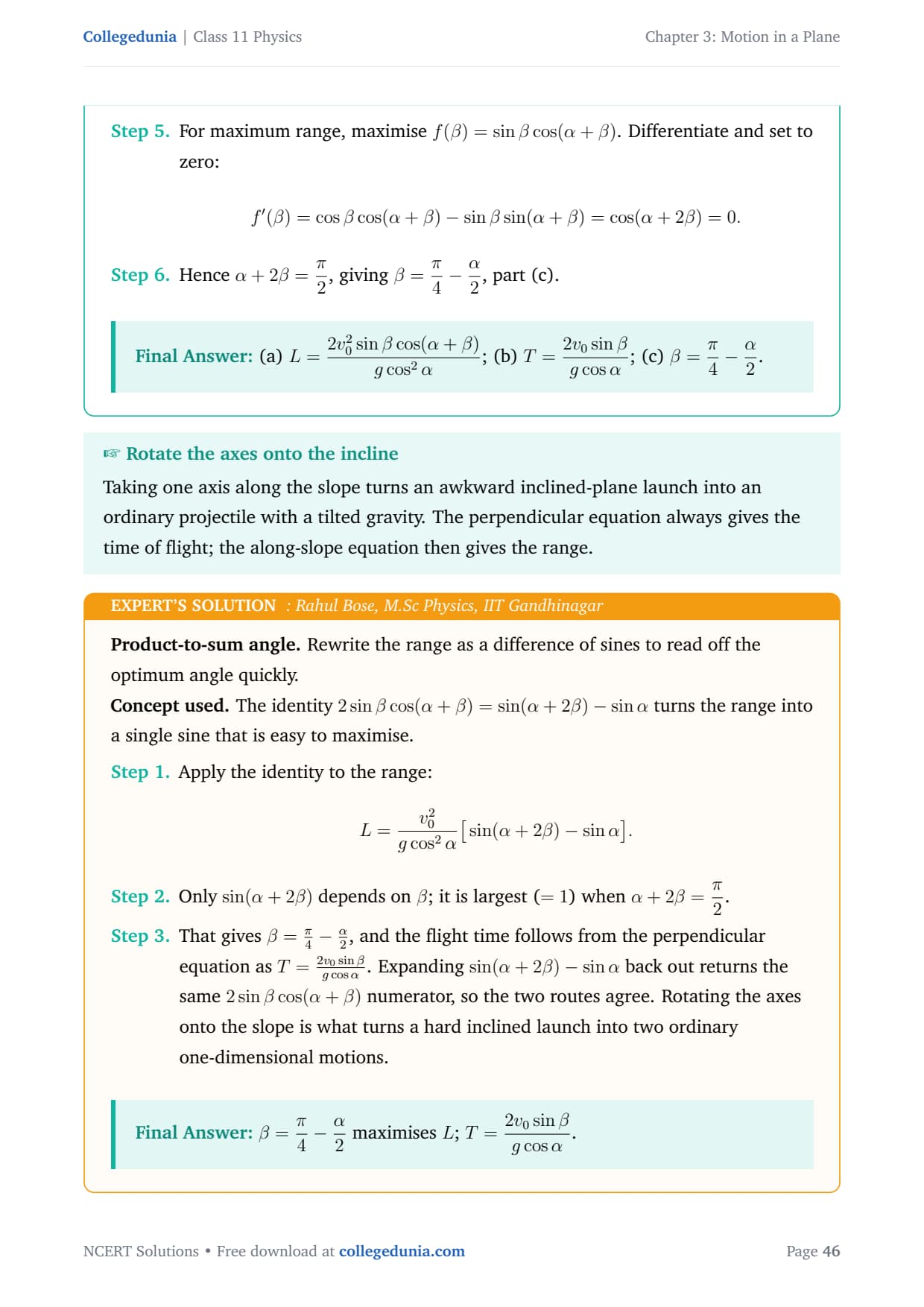
- Range on an incline: L = 2v02 sinβ cos(α + β)/(g cos2α), maximum at β = π/4 − α/2
- Relative velocity: vAB = vA − vB, applied as a vector subtraction, never a scalar one
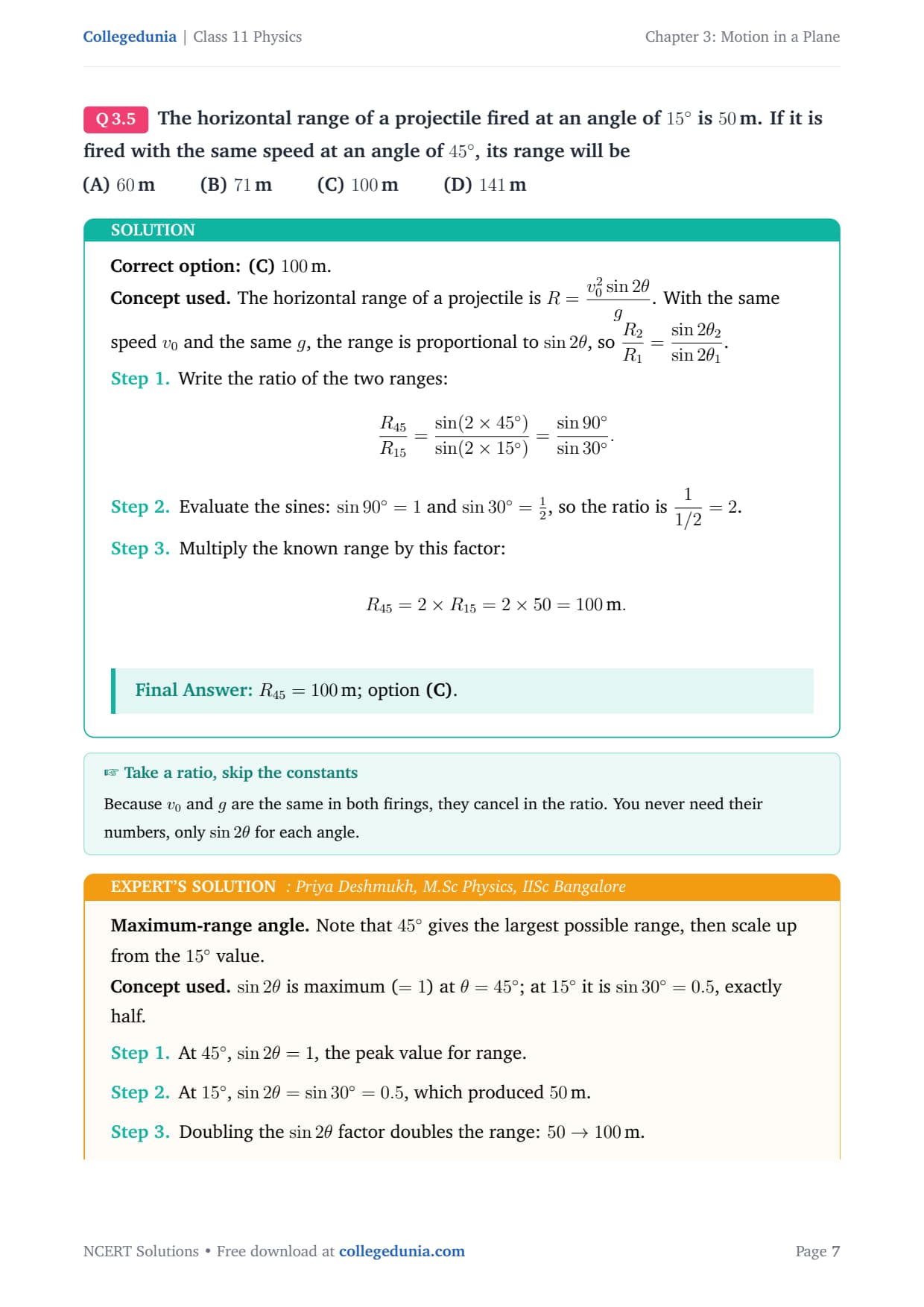
Question 4.5 shows how little arithmetic these need. A projectile fired at 15° ranges 50 m, so the same speed at 45° doubles sin 2θ and gives 100 m.
Common Mistakes Students Make in Motion in a Plane
The Exemplar sets its traps deliberately. These four catch the most students, and each is flagged in the PDF.
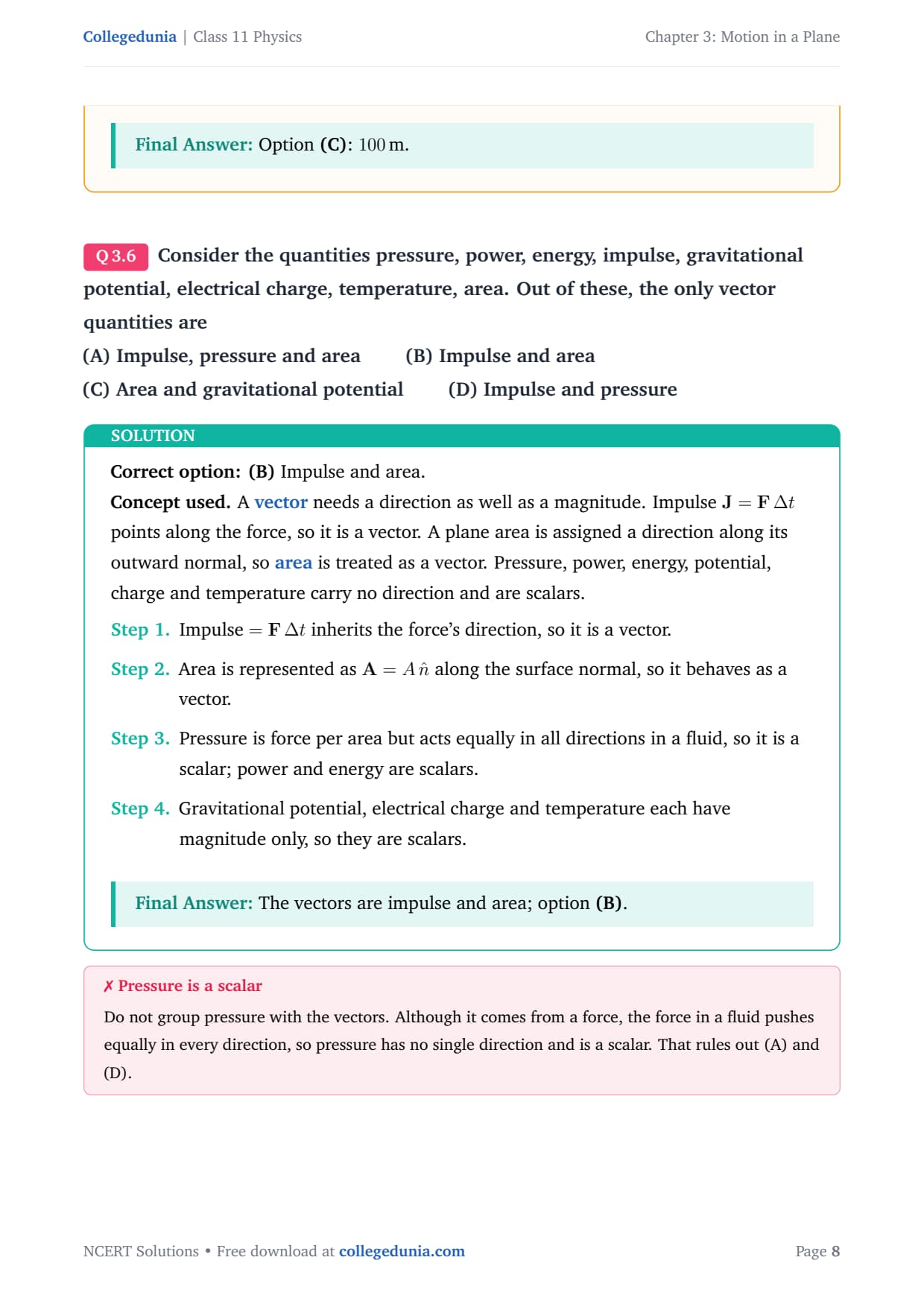
- Treating pressure as a vector: in Question 4.6 it comes from a force, but a fluid pushes equally in all directions, so pressure stays a scalar
- Confusing conserved with scalar: momentum is conserved yet is a vector, while temperature is a scalar that is not conserved
- Assuming range grows with angle: R varies as sin 2θ, so it turns over at 45°. In Question 4.11 the higher-flying particle can land shorter
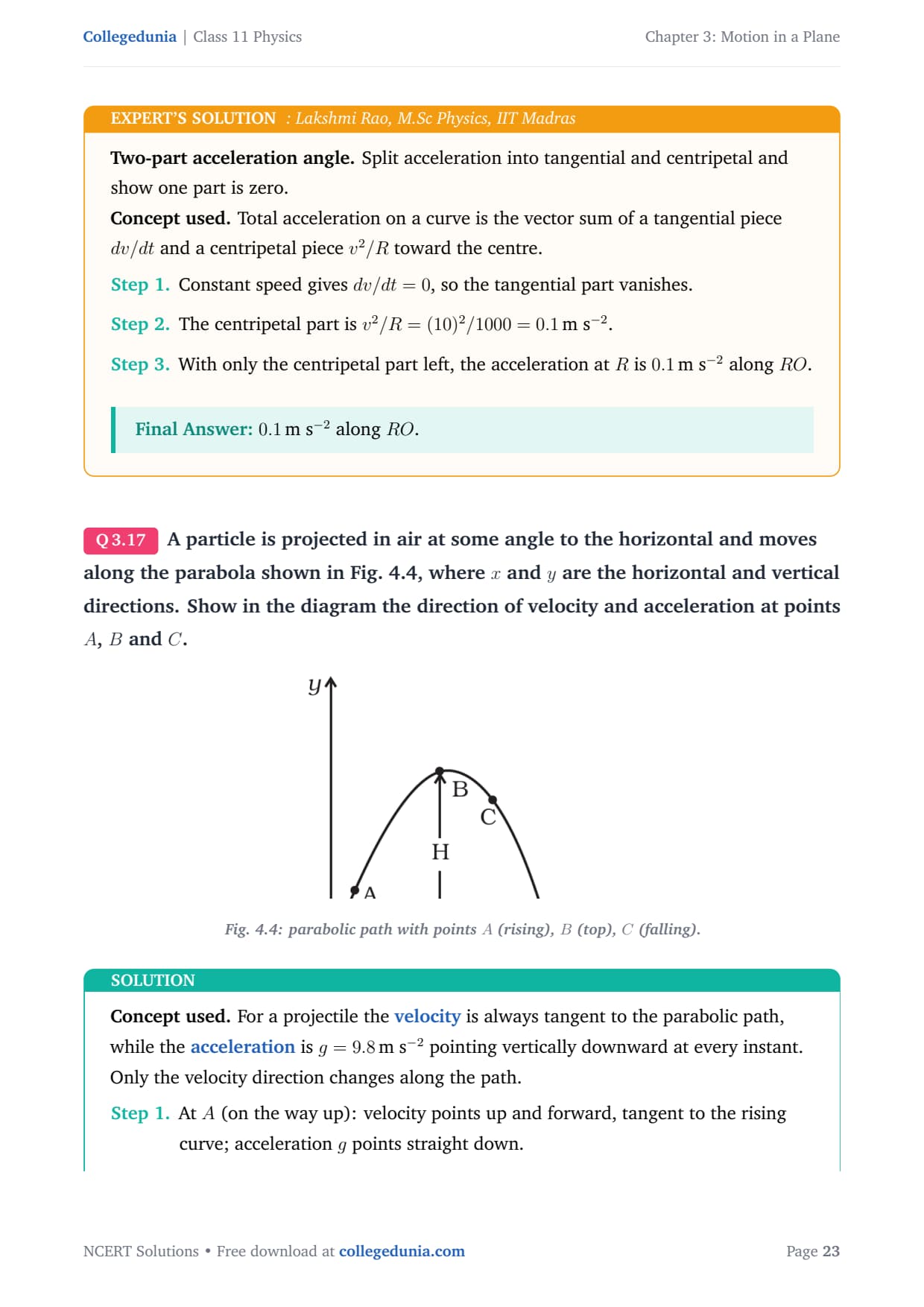
- Hunting for peak acceleration: in Question 4.18 acceleration is a constant g downward, identical at launch, at the top and at impact
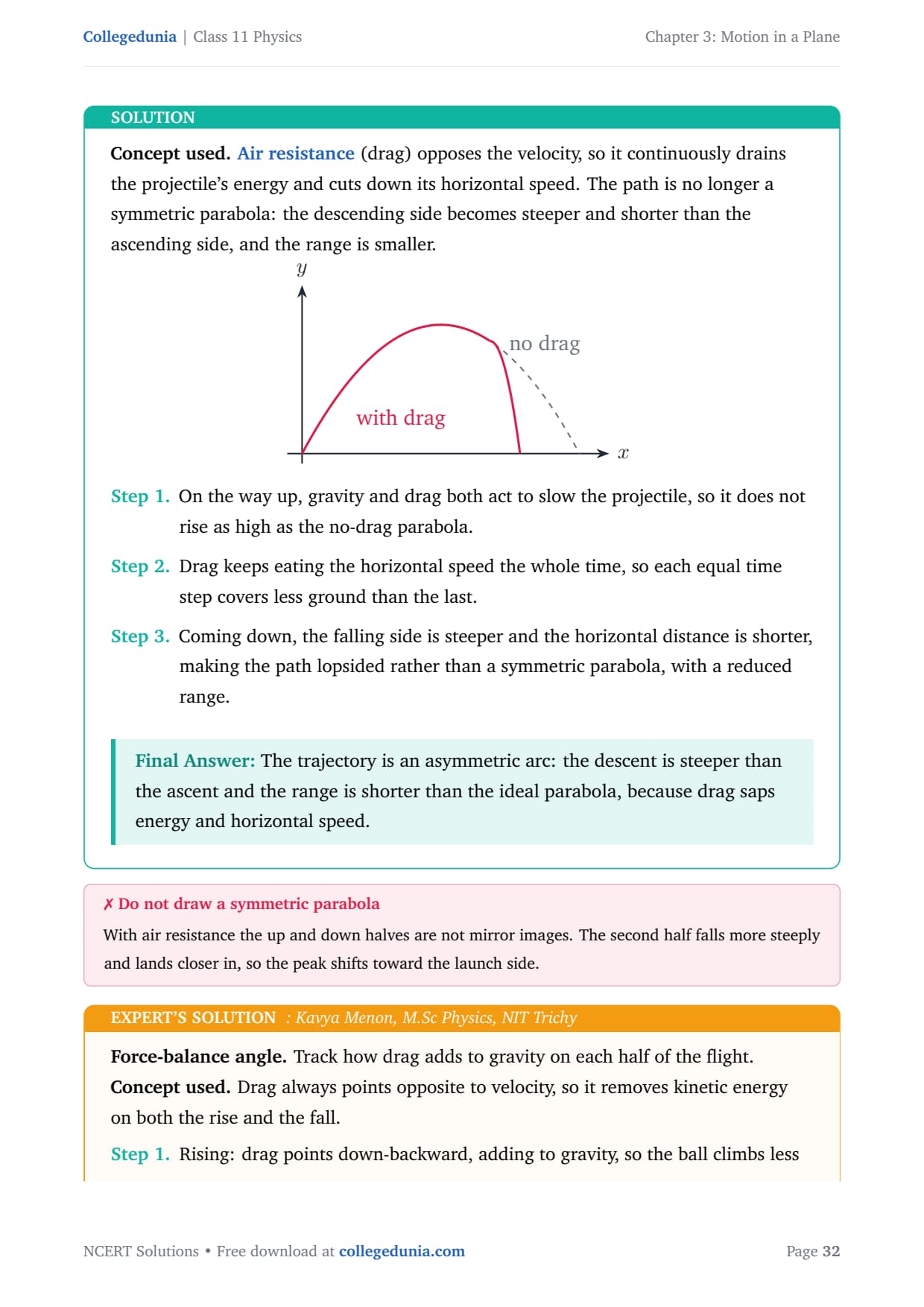
Two more are worth naming. In uniform circular motion the angular momentum about the centre keeps a fixed direction along the rotation axis, even though velocity turns. And with air resistance the path is not a symmetric parabola, since the descent is steeper than the climb.
How to Use These NCERT Exemplar Solutions for Boards, JEE and NEET
Attempt each question before opening the solution. Sketch the vectors first, since most errors here are drawing errors.
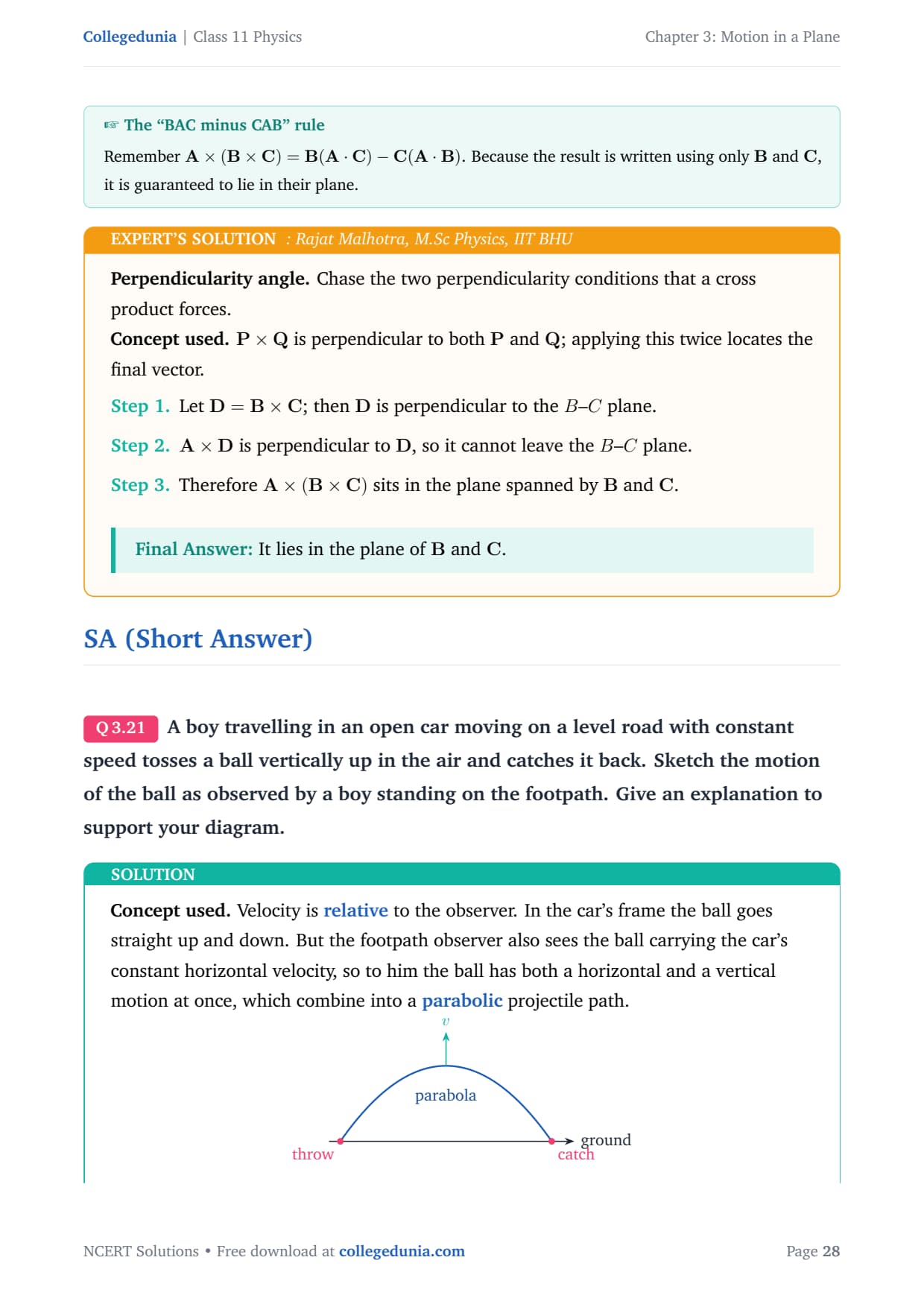
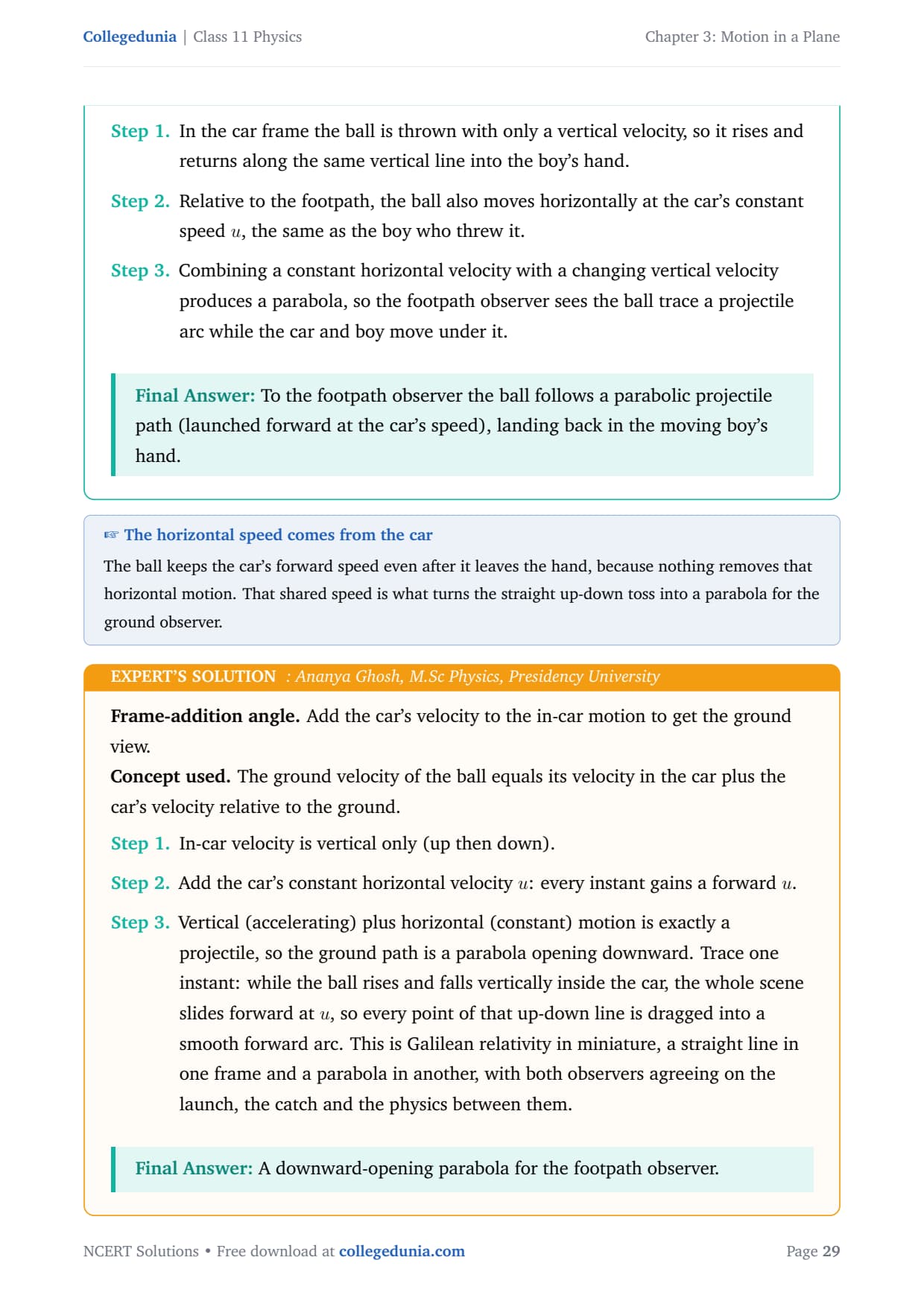
- Boards: the SA sketch-and-explain questions, such as the ball tossed from a moving car, match the 3 mark pattern
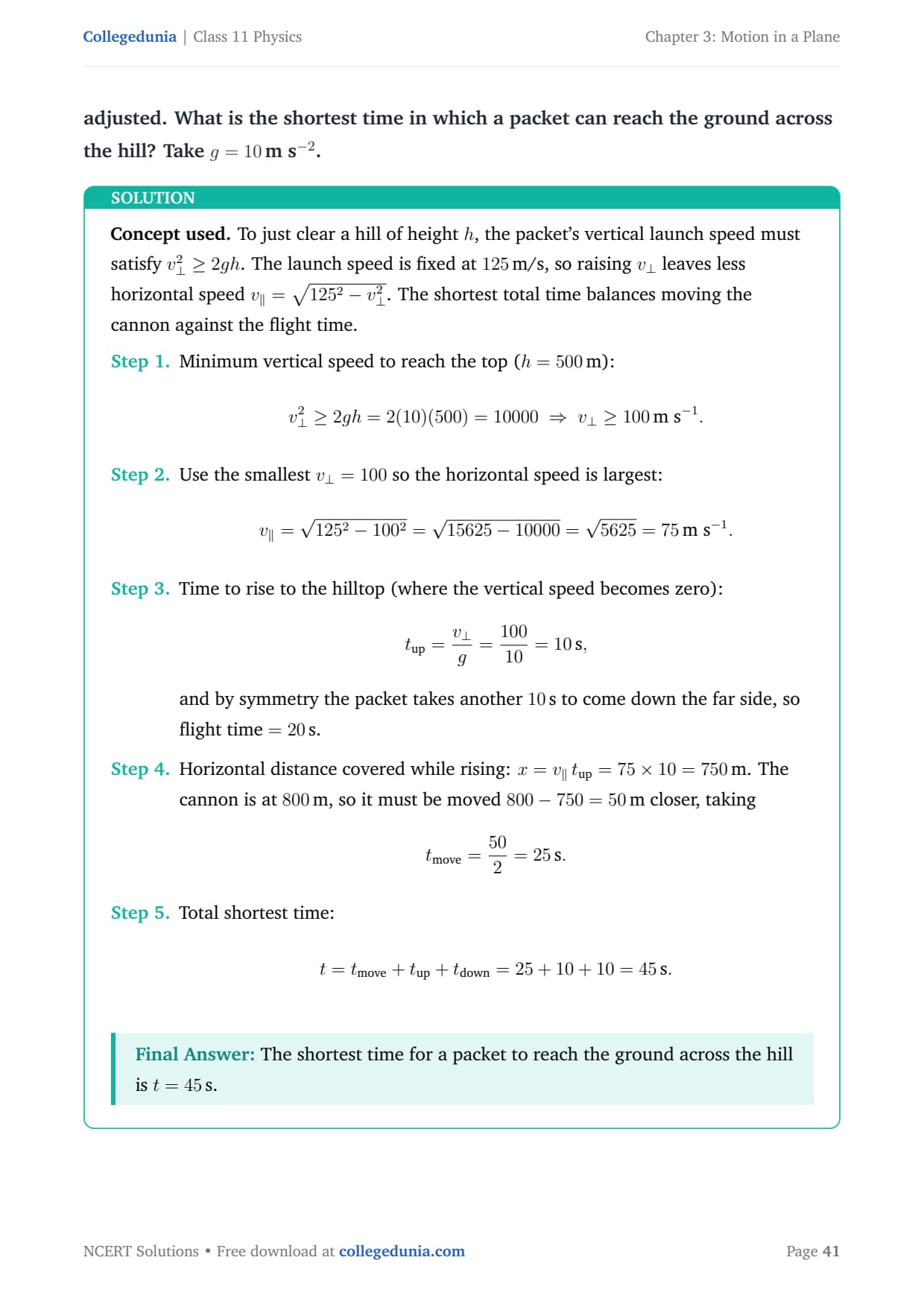
- JEE Main: start with the incline projectile in Question 4.31 and the cannon-over-the-hill timing in Question 4.29, which answers 45 s
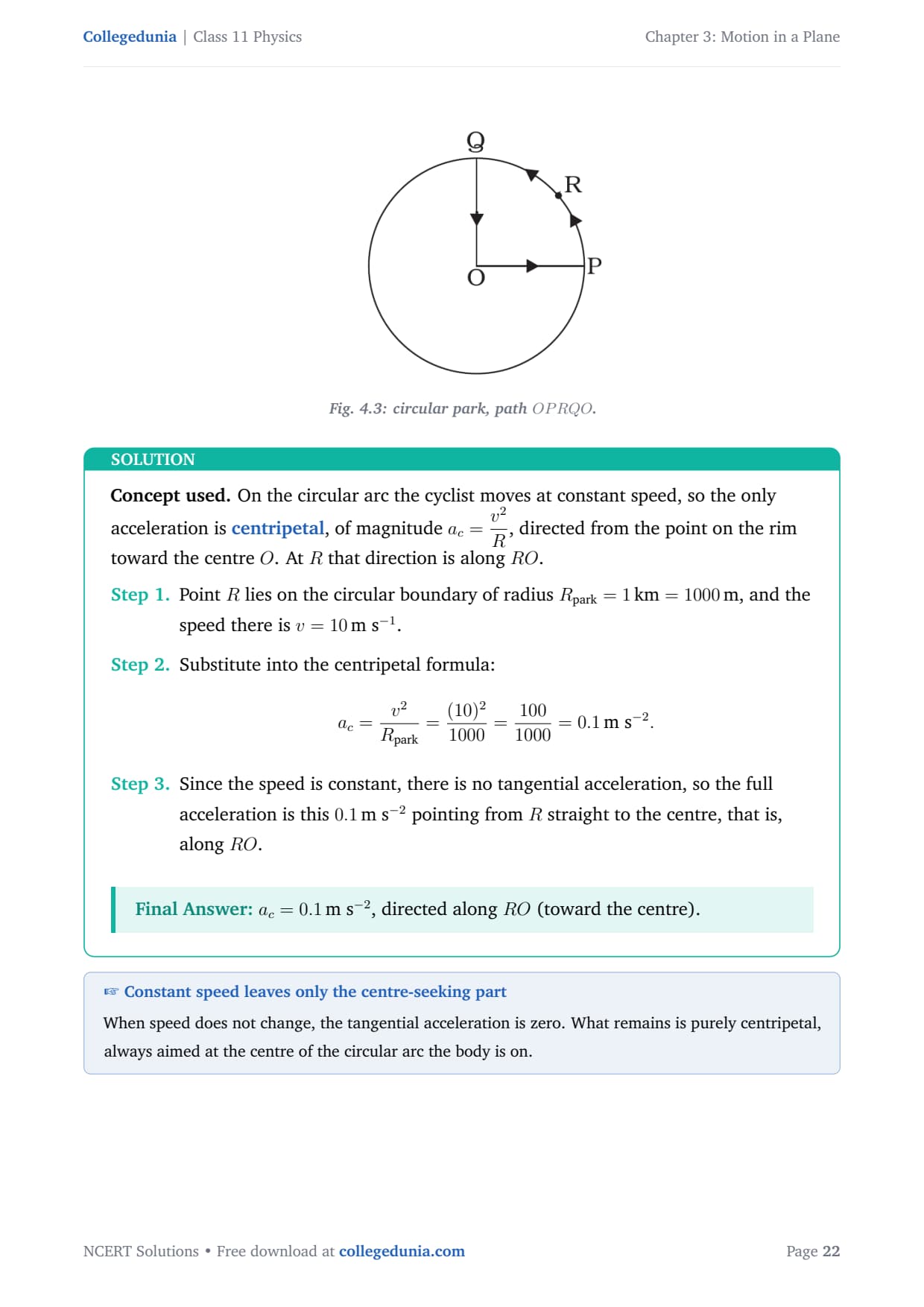
- NEET: the MCQ I set plus the cyclist question, where a 1 km park at 10 m/s gives 0.1 m/s2 toward the centre
Student Feedback
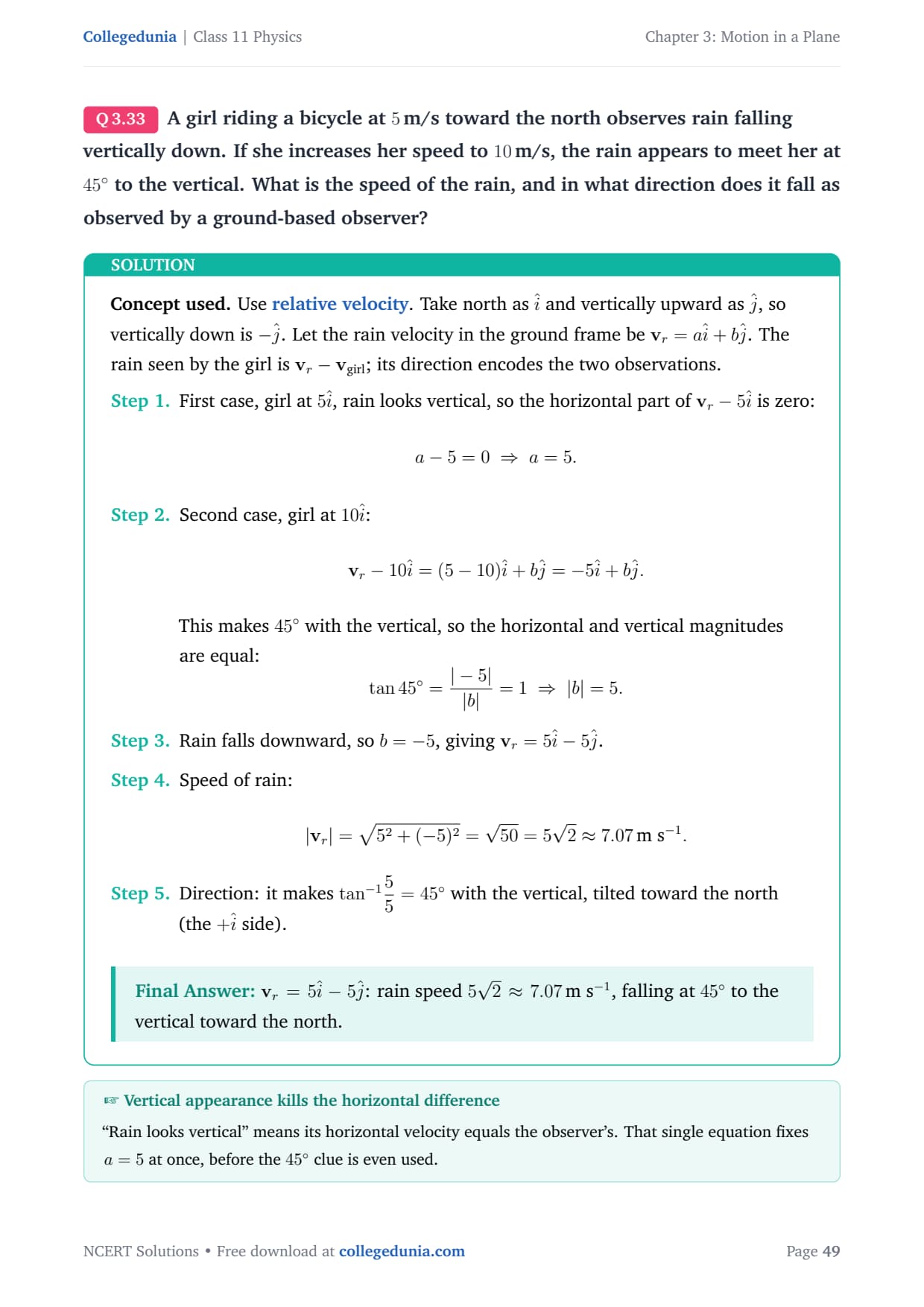
Students using Collegedunia's Class 11 Physics Exemplar Solutions told us relative velocity was the hardest block here. Around 7 in 10 said the labelled diagrams helped most on the rain-and-bicycle question, where the answer of 5√2 m/s only lands once the vector triangle is drawn right.
Other Resources for Class 11 Physics Motion in a Plane
Collegedunia carries the full study set for this chapter. Read the Notes first, then practise with the Exemplar.
Also Check:
- NCERT Solutions for Class 11 Physics Chapter 3
- Class 11 Physics Chapter 3 Notes
- Class 11 Physics Chapter 3 Handwritten Notes
- Class 11 Physics Chapter 3 NCERT Book PDF
- Class 11 Physics Chapter 3 Exemplar Questions with Solutions
NCERT Exemplar Solutions for Other Class 11 Physics Chapters
Every chapter below has the same step-by-step treatment and a free PDF.
Motion in a Plane Class 11 Physics NCERT Exemplar Solutions FAQs
Ques. How many questions are there in the Class 11 Physics Motion in a Plane Exemplar?
Ans. Chapter 3 has 35 questions. They split into 10 MCQ I, 5 MCQ II, 5 Very Short Answer, 8 Short Answer and 7 Long Answer questions. All 35 are solved in the free 54 page PDF on this page.
Ques. Why does the answer key say antiparallel for Question 4.10 when the algebra gives A·B ≤ 0?
Ans. Squaring |A + B| = |A| gives A·B = −B2/2, which is at most zero, so option (D) is what the algebra supports. The official key records (B), antiparallel, which is only the special case of that obtuse condition. Write (B) in the exam, since the marking scheme follows the key, but our PDF shows the full derivation.
Ques. Is there a misprint in the Exemplar answer for Question 4.32?
Ans. Yes. The correct distance along the incline is L = 4v02 sinθ/g, but the printed key shows the coefficient as the letter "A" instead of the digit 4. Our solution derives the 4 and confirms it against L = 8h sinθ.
Ques. Why is this Chapter 3 in the textbook but Chapter 4 in the Exemplar book?
Ans. The new edition of the textbook dropped a chapter and renumbered what followed, while the Exemplar book kept its older numbering. So Question 4.10 of the Exemplar belongs to Chapter 3 of your textbook. The physics and the answer key are unchanged.
Ques. If a projectile fired at 15 degrees has a range of 50 m, what is its range at 45 degrees?
Ans. 100 m. Range varies as sin 2θ at fixed speed, so going from 15° to 45° raises sin 2θ from sin 30° = 1/2 to sin 90° = 1. That doubles the range from 50 m to 100 m. This is Question 4.5 in the Exemplar.



Comments