




NCERT Exemplar Solutions for Class 11 Physics Chapter 2 Motion in a Straight Line solve all 26 questions from the Exemplar book. Every MCQ, Very Short Answer, Short Answer and Long Answer problem is worked out step by step. The free PDF runs to 47 pages and follows the 2026-27 syllabus.
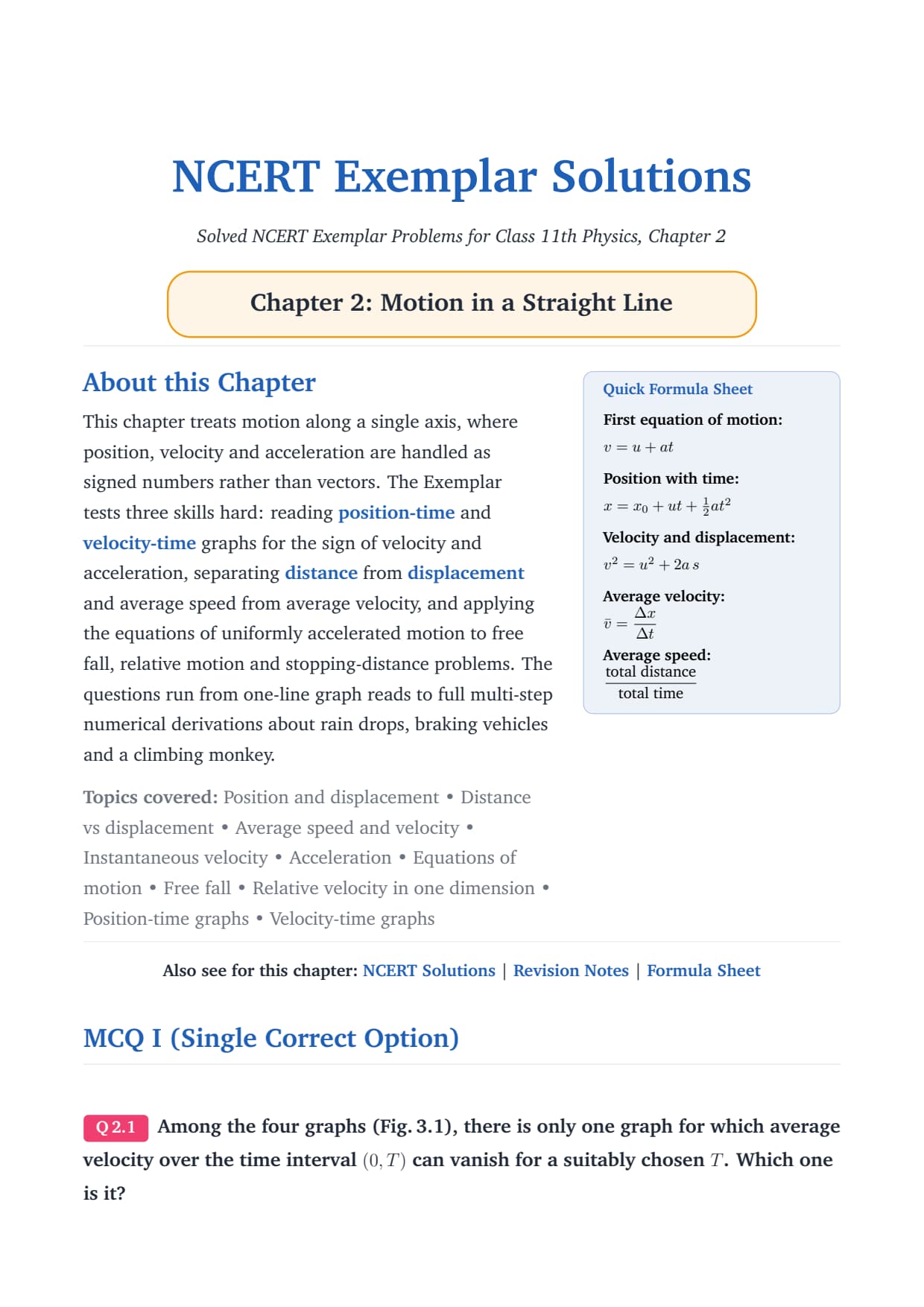
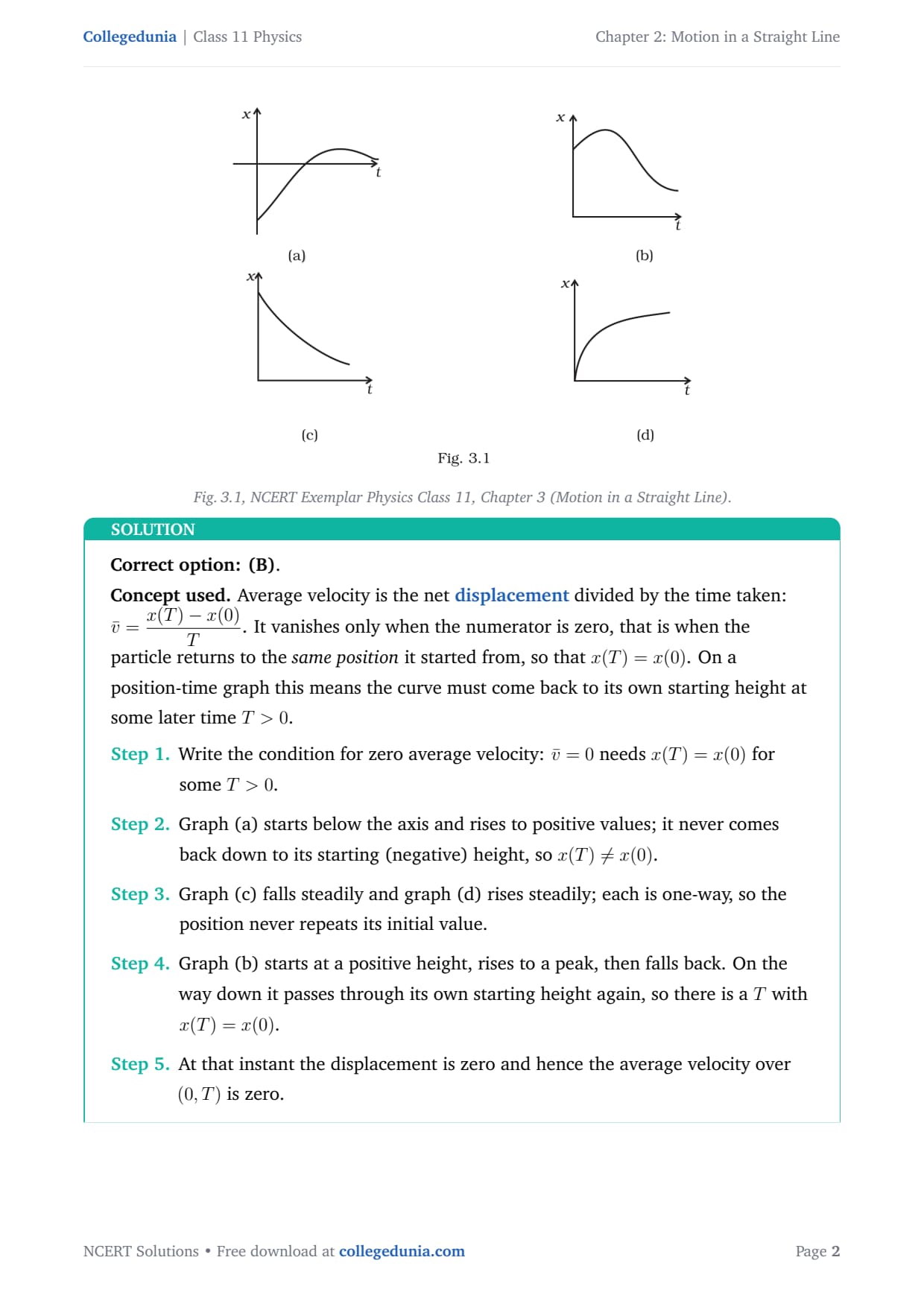
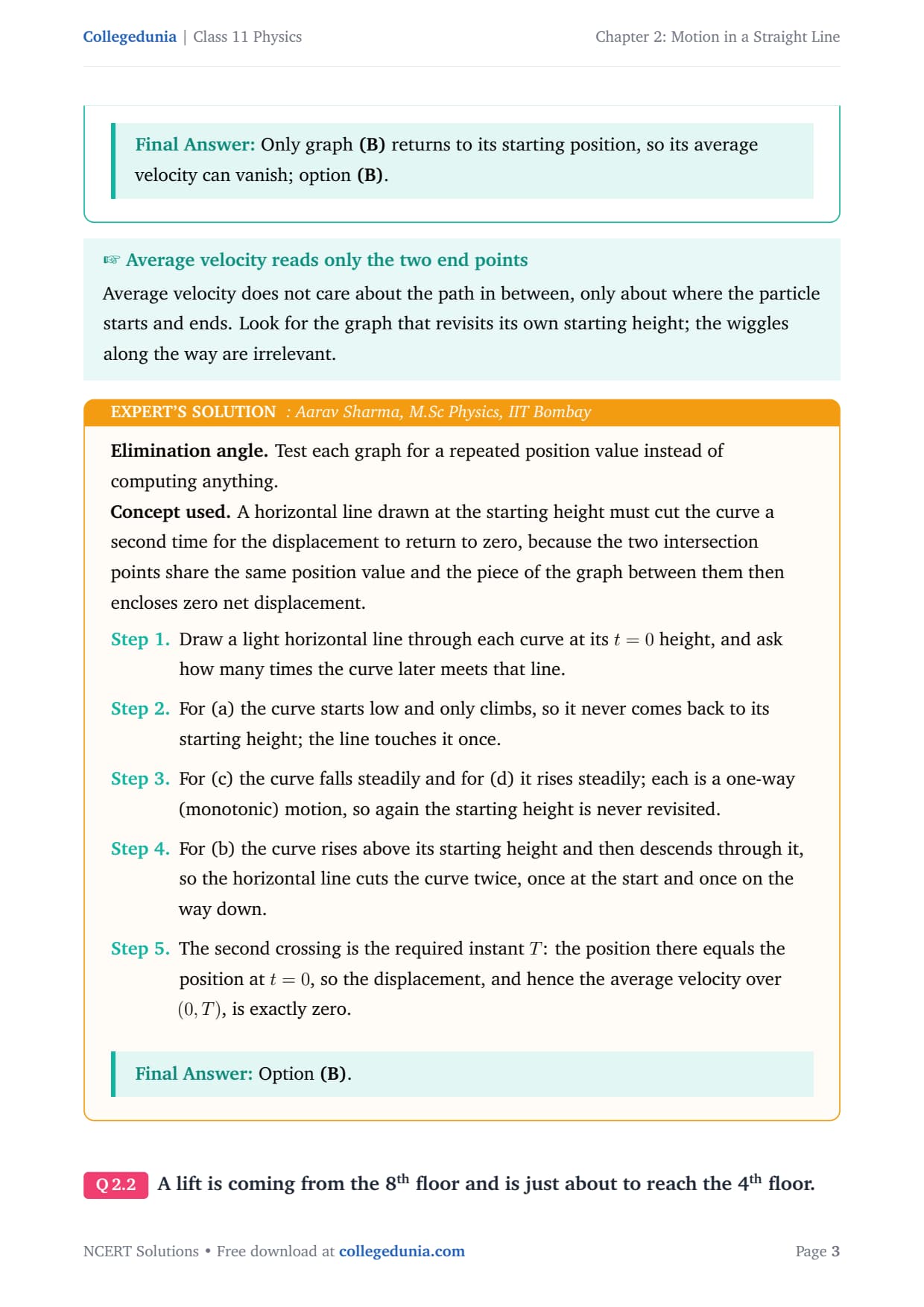
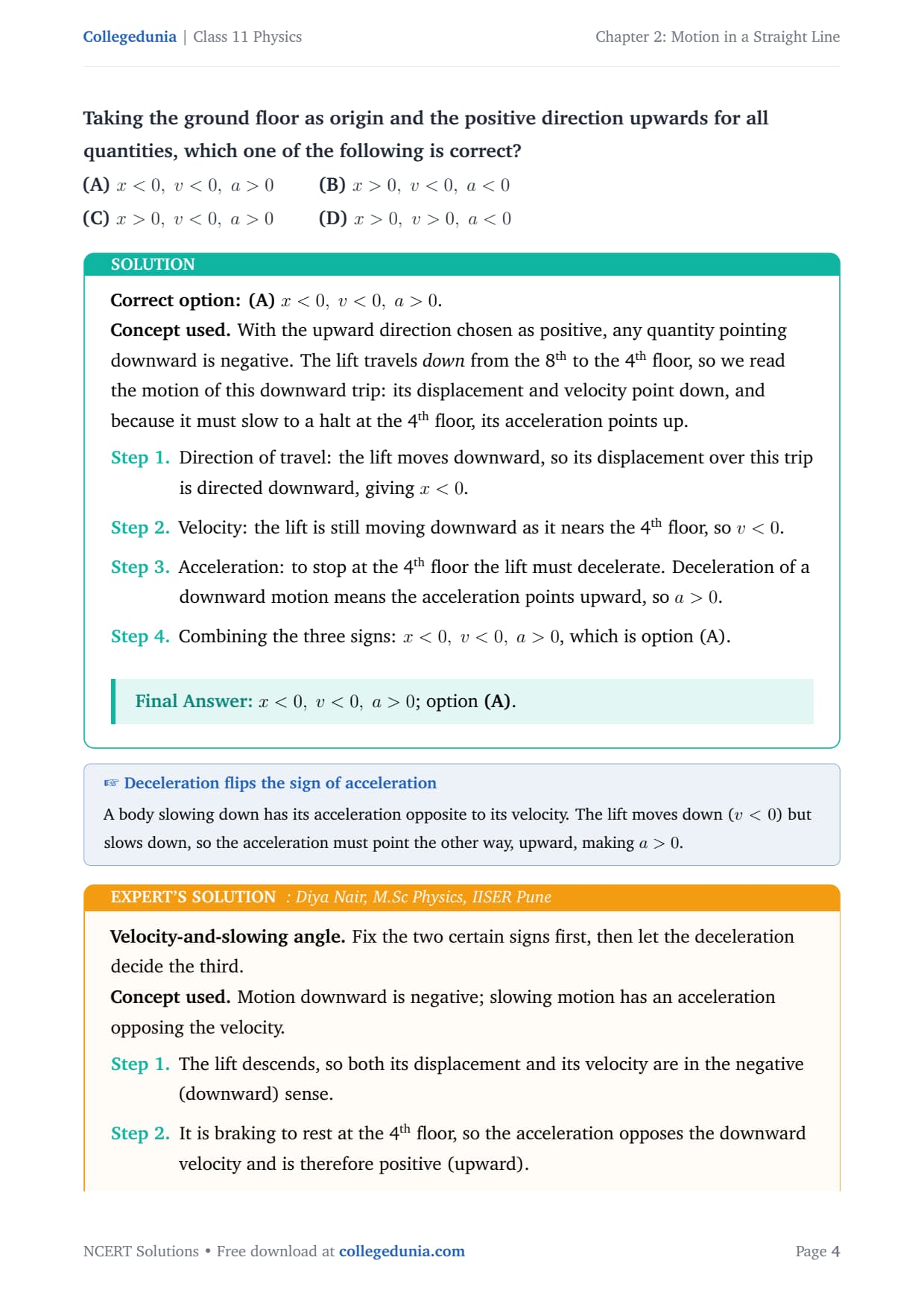
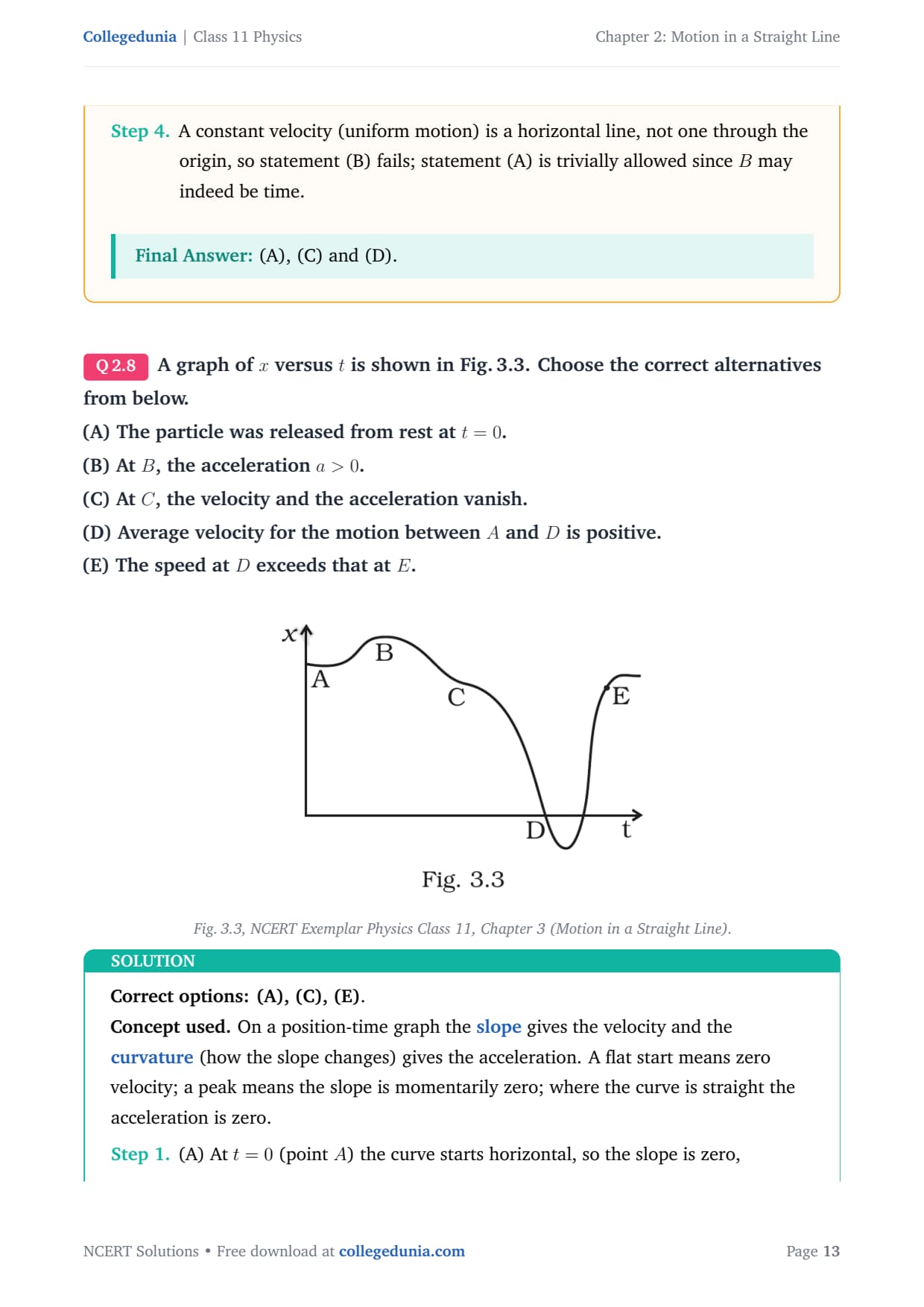
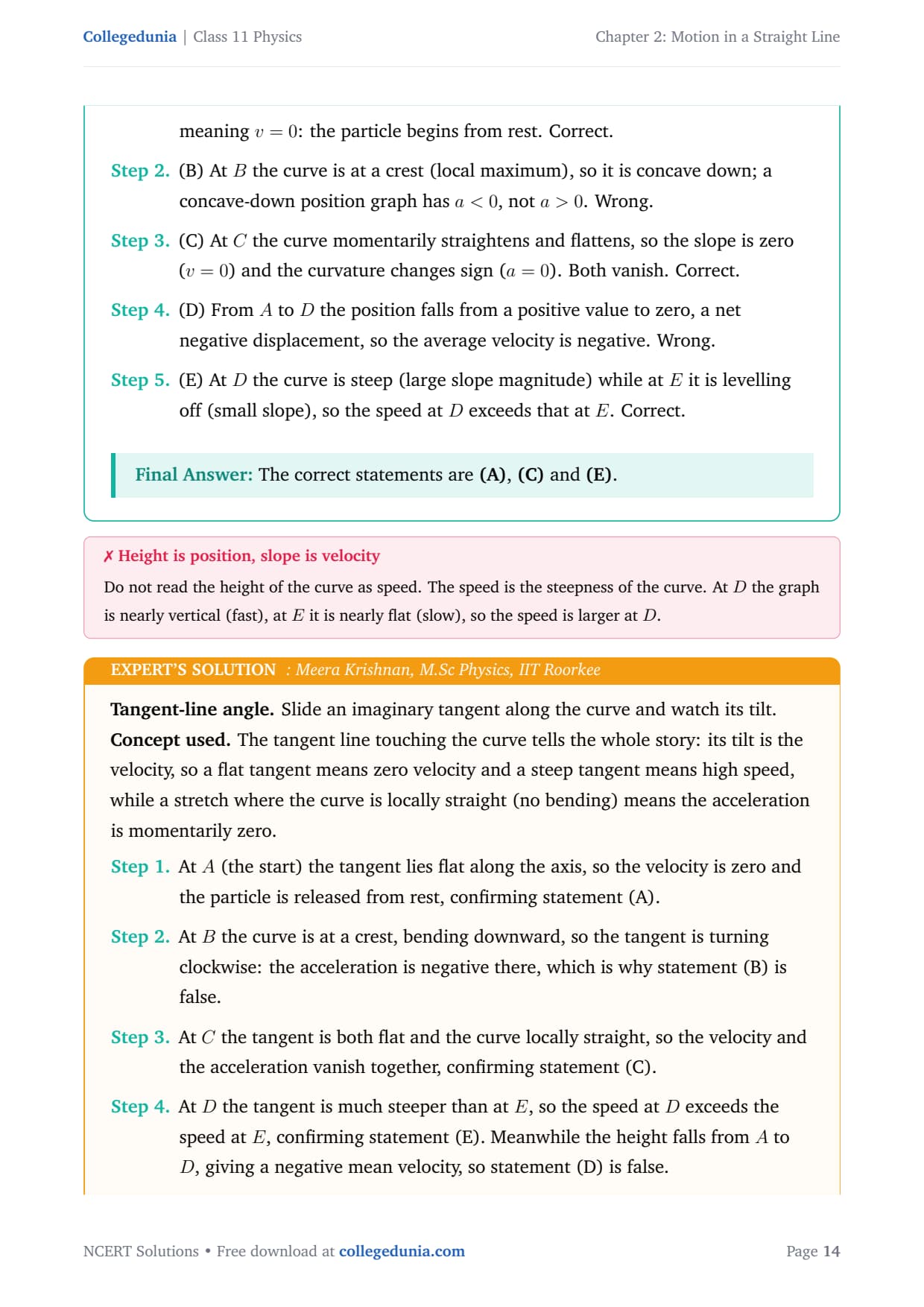
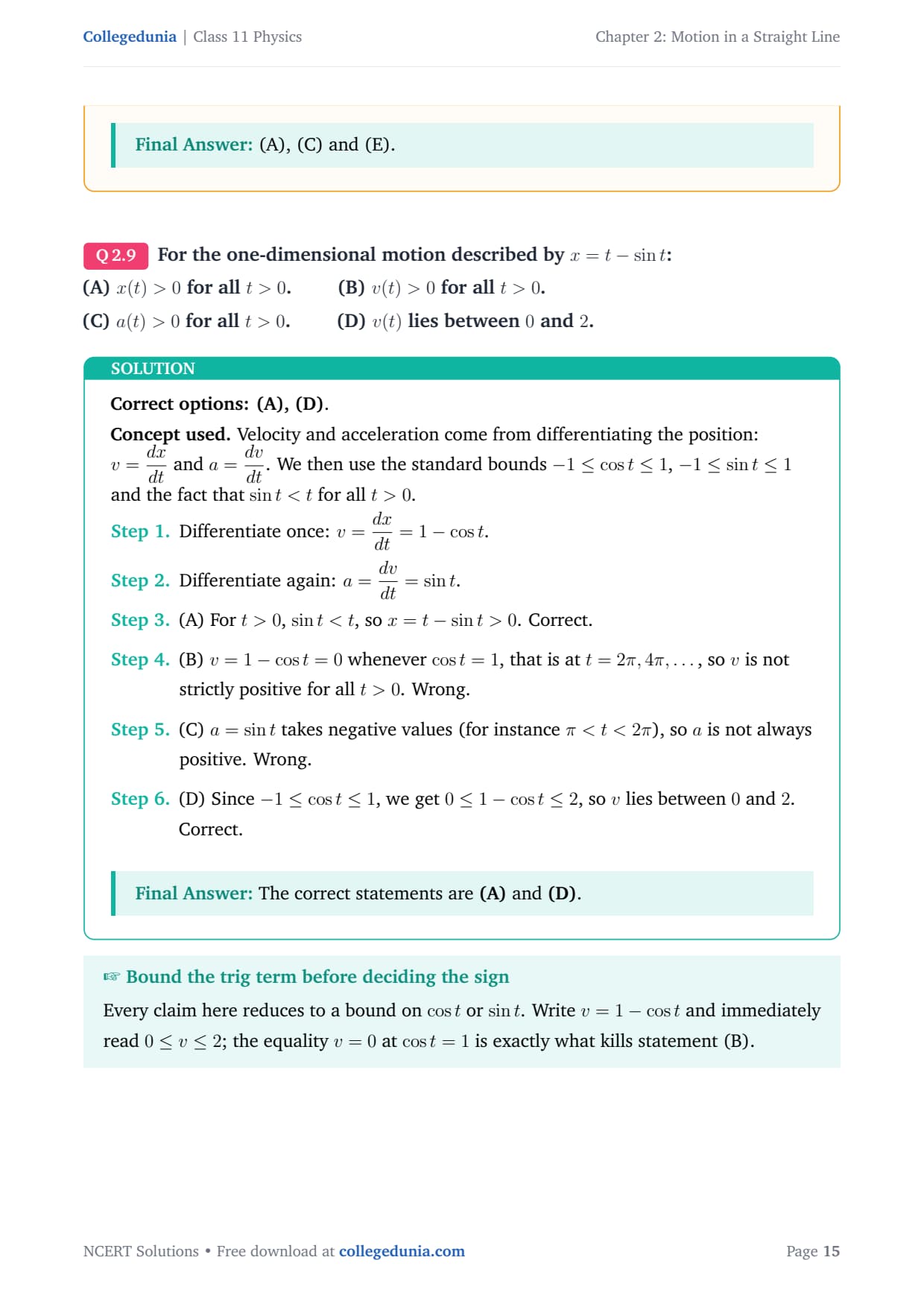
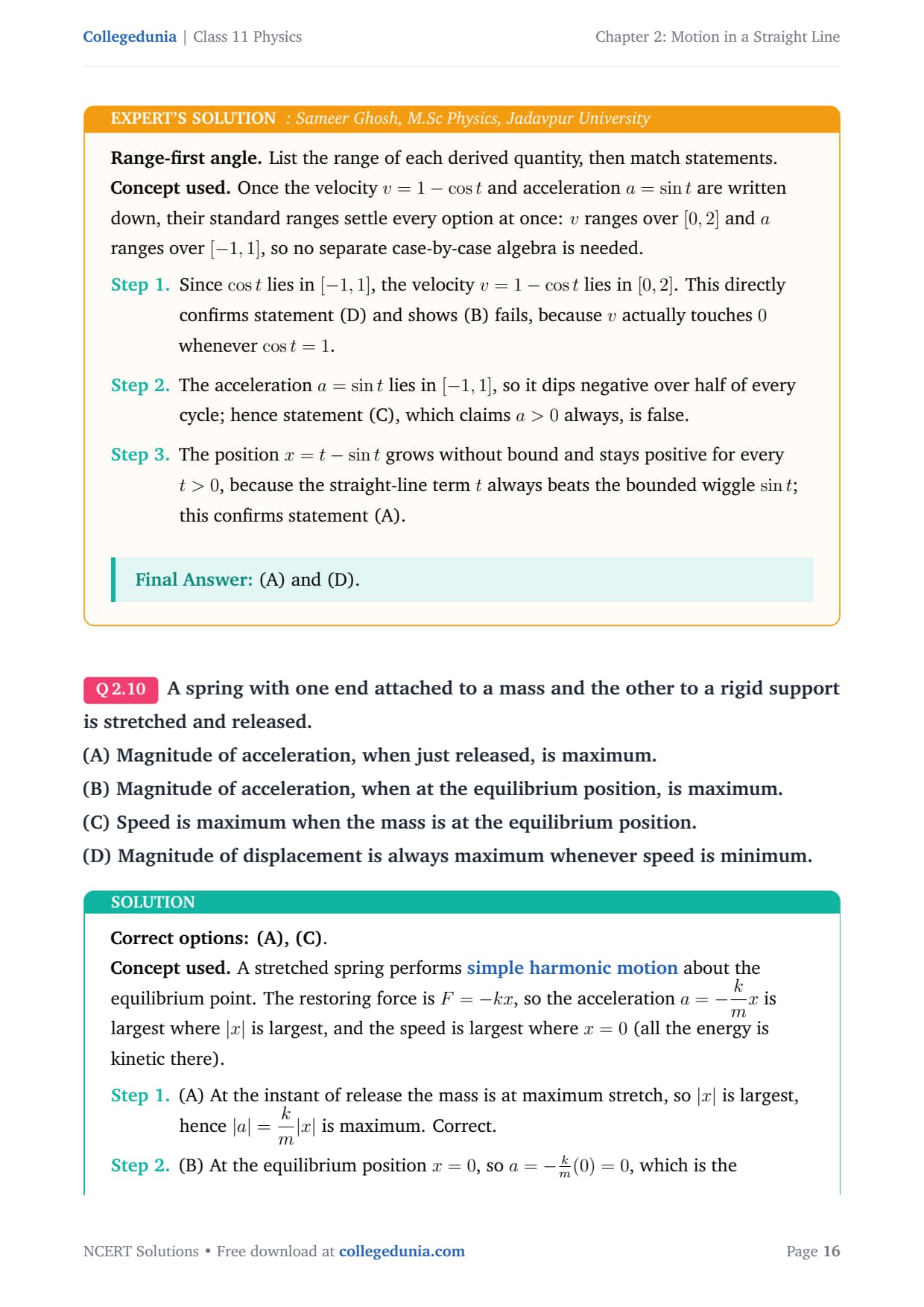
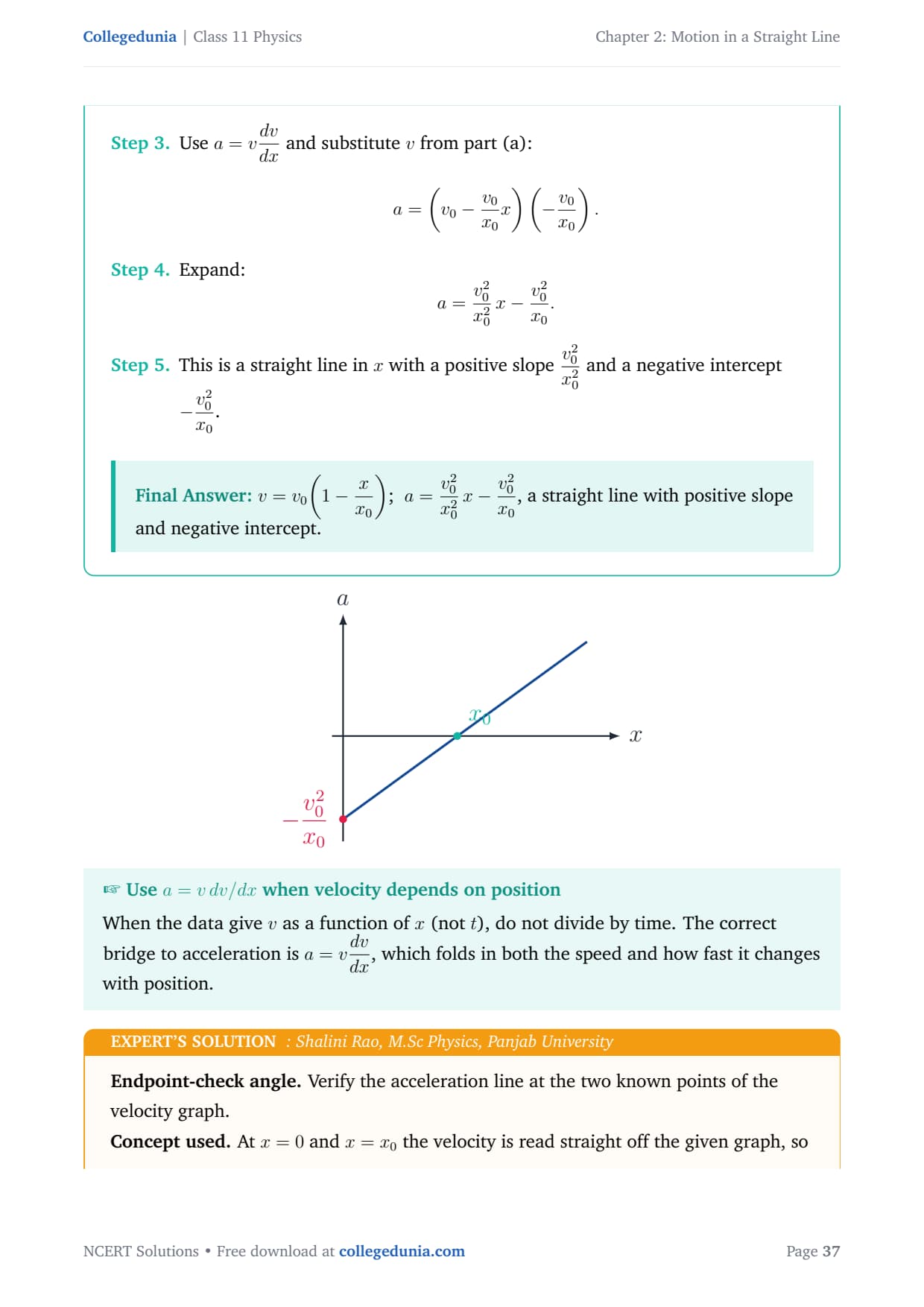
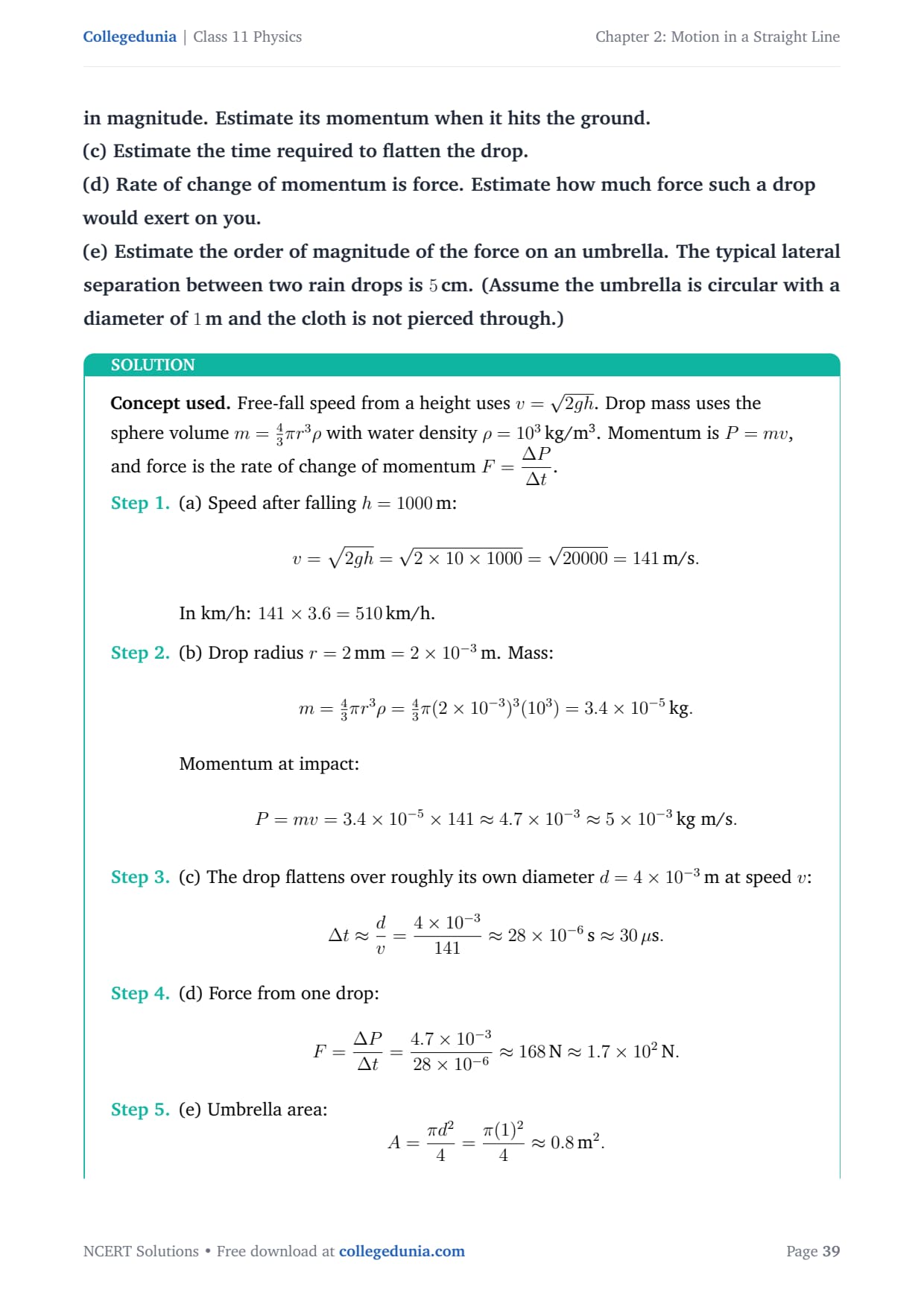
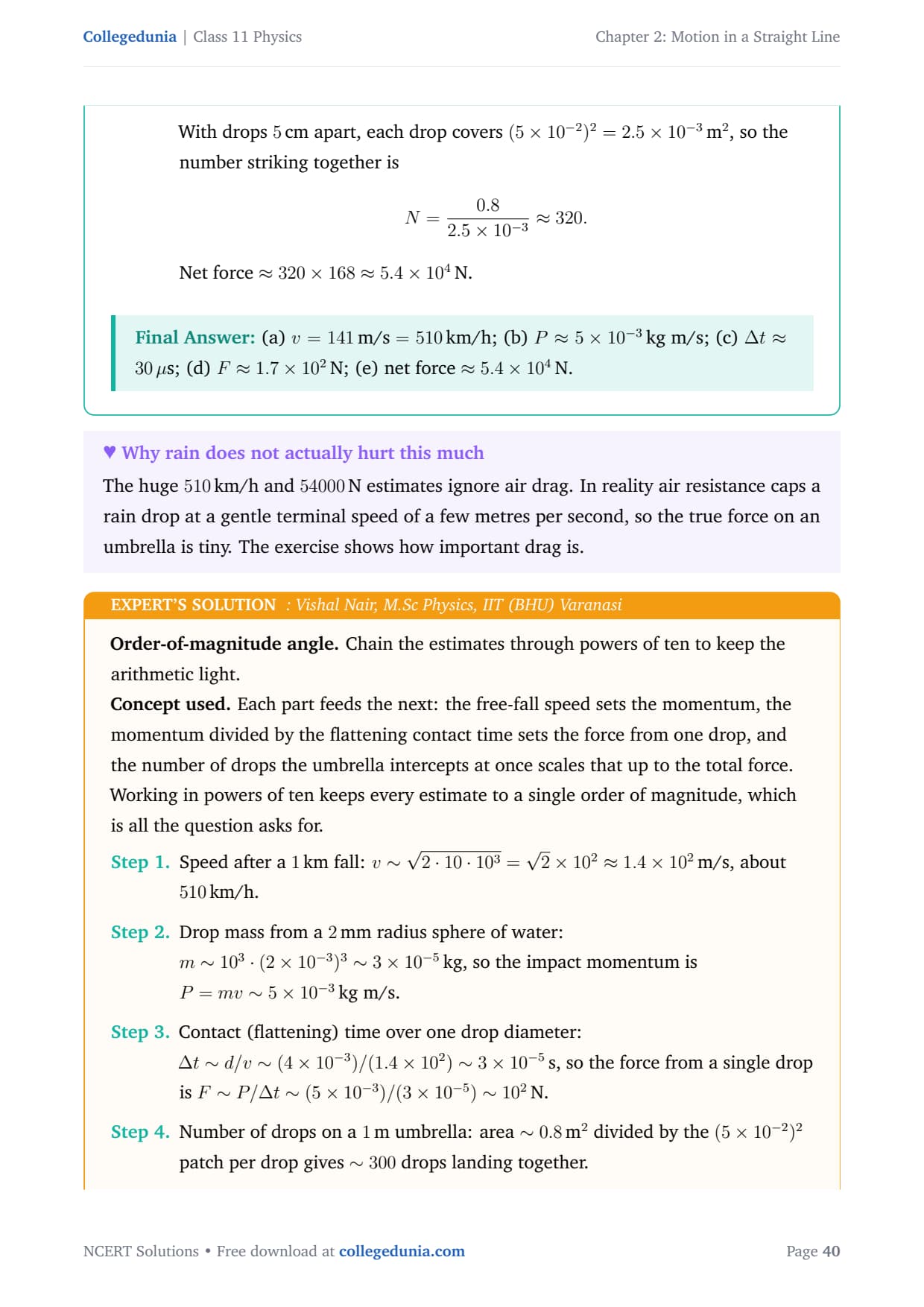
This is where kinematics begins, and the Exemplar treats it as a graph-reading chapter more than a formula chapter. Six figures from the official book are reproduced inside the solutions. Most questions ask you to justify a sign, not to plug in numbers.
- CBSE Weightage: 4 to 5 marks, usually a graph question plus a relative-motion numerical
- JEE Main Weightage: 1 to 2 questions per year, often on velocity-time graphs or drag
- NEET Weightage: 1 question per year, typically average speed or a dropped-body numerical
Solutions checked against the official NCERT Exemplar answer key, with every disputed answer worked out in full.
Topics Covered in the Class 11 Physics Motion in a Straight Line Exemplar
The Exemplar builds on four ideas here. Each returns in Motion in a Plane and again in Laws of Motion.
- Distance and displacement: one is a path length, the other a signed change of position
- Position-time and velocity-time graphs: slope as velocity, area as displacement
- Uniform acceleration: the three kinematic equations, and when they stop being valid
- Relative velocity: two bodies in one line, including the dropped-ball problems
Question Types in the Motion in a Straight Line NCERT Exemplar
The 26 questions split across five types. The MCQ II set is where students lose marks: more than one option can be correct, and a partial answer scores nothing.
| Question Type | Count | What It Tests |
|---|---|---|
| MCQ I (single correct) | 6 | Signs of velocity and acceleration, plus average speed |
| MCQ II (one or more correct) | 5 | Ruling out every wrong option, not just spotting one right one |
| VSA (Very Short Answer) | 5 | One-line reasoning, often an example of a stated motion |
| SA (Short Answer) | 6 | Graph sketching and numerical work on falling bodies |
| LA (Long Answer) | 4 | Multi-part 5 mark problems, including estimation |
Key Rules and Graph Skills Used in the Motion in a Straight Line Exemplar
Nearly every question comes back to a rule below. The PDF names the rule before applying it, so you see which idea does the work.
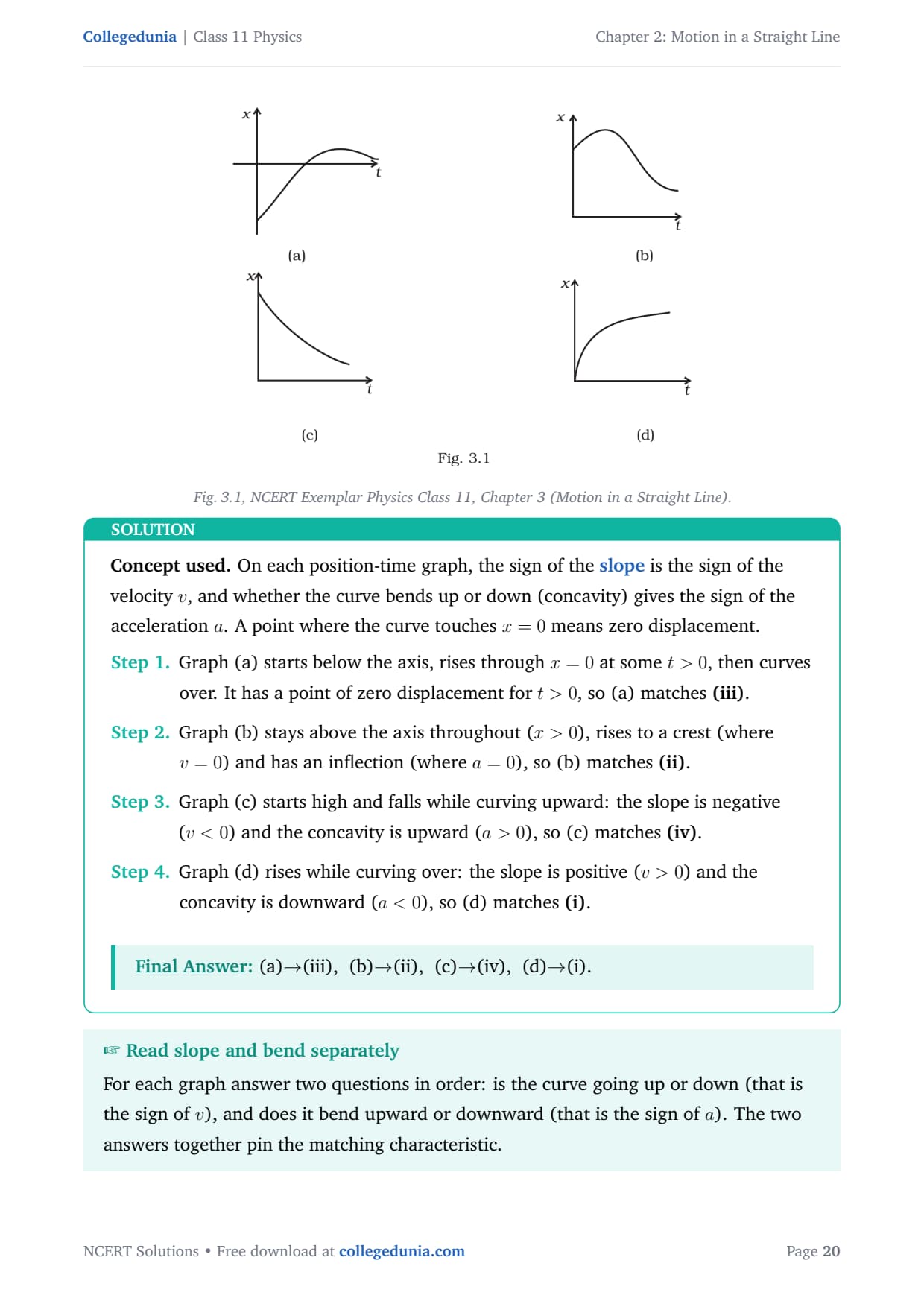
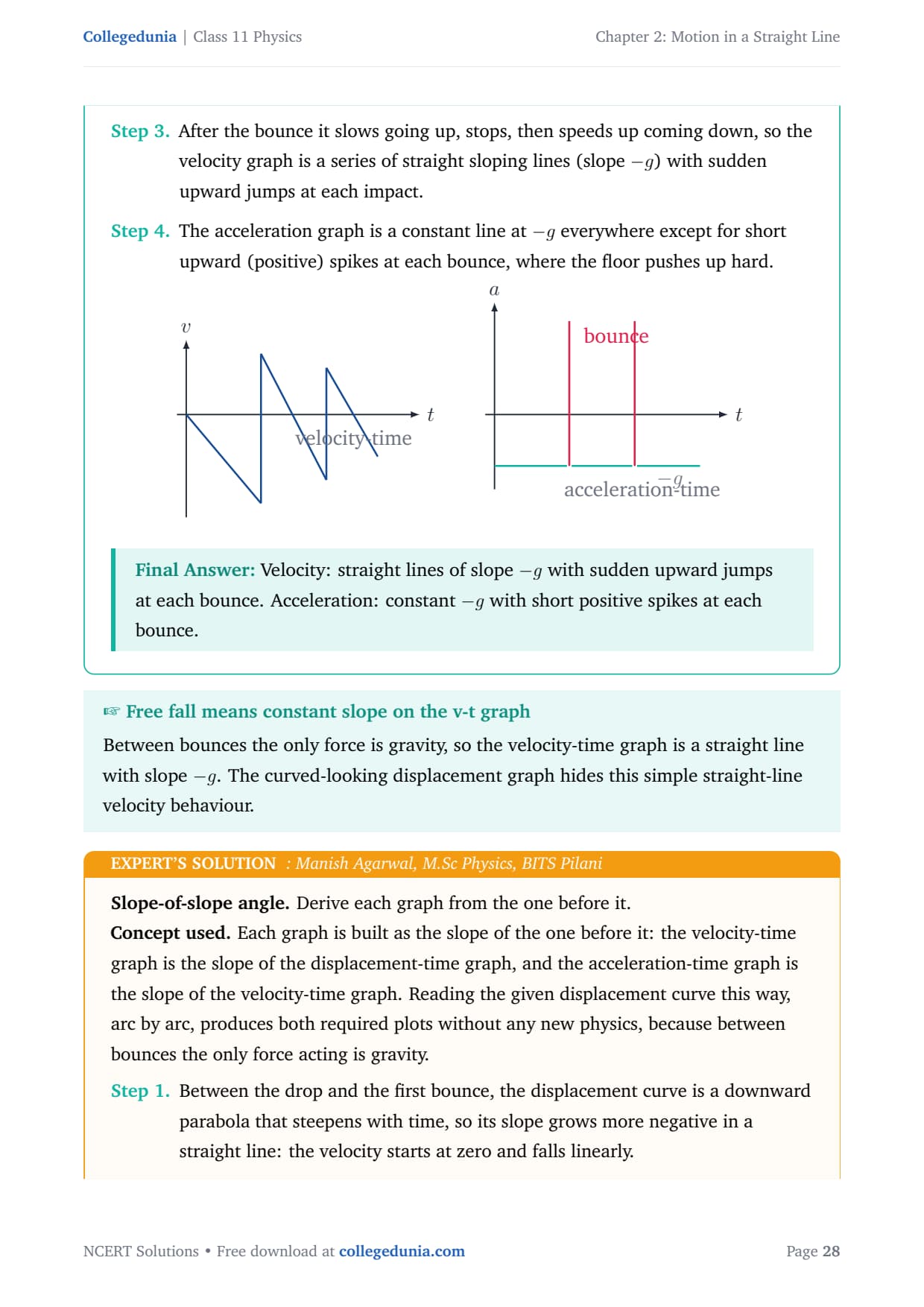
- Slope of a position-time graph gives velocity; the slope of a velocity-time graph gives acceleration
- Area under a velocity-time graph gives displacement, counting area below the axis as negative
- Distance needs the turning points: add outbound and return path lengths separately
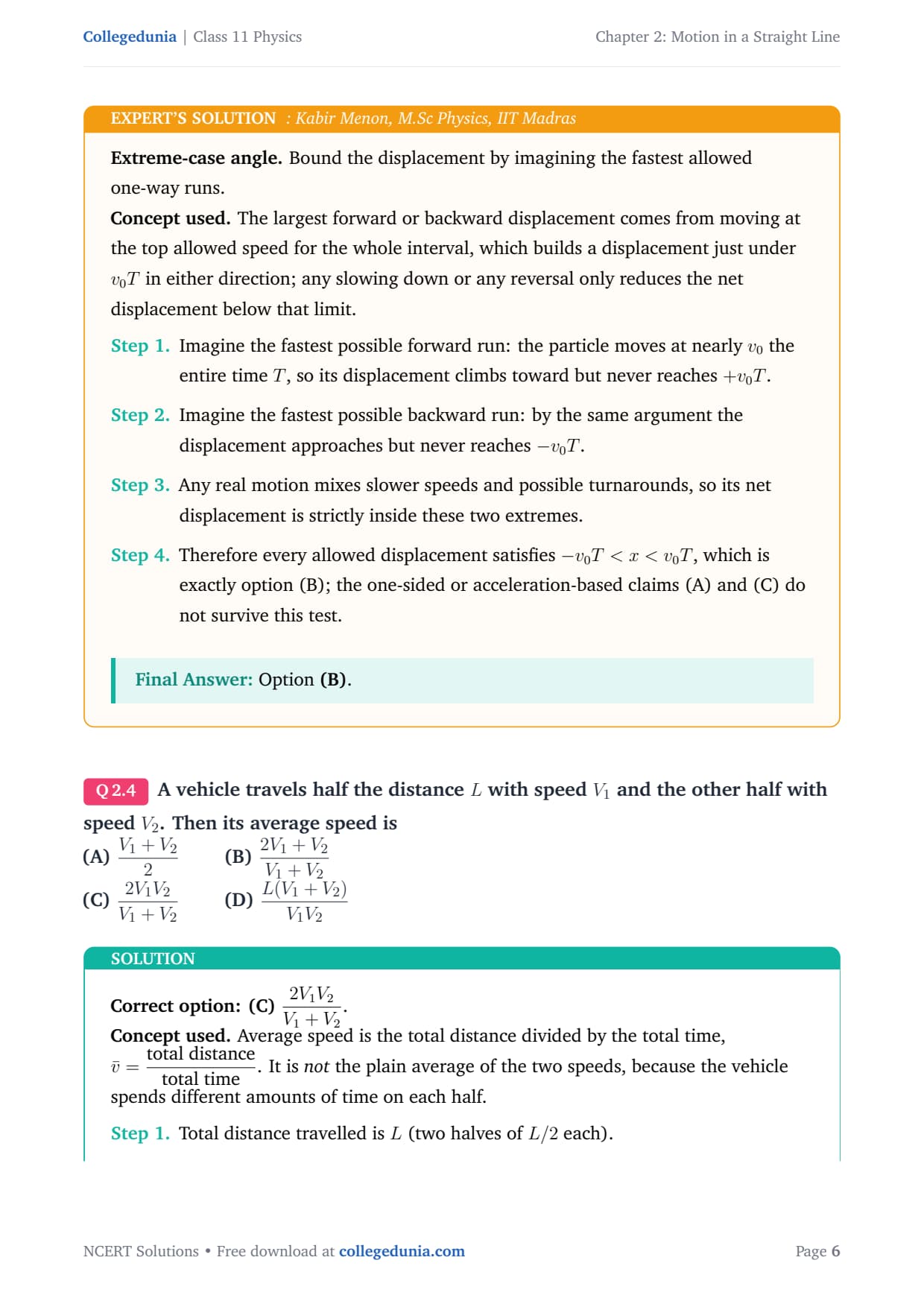
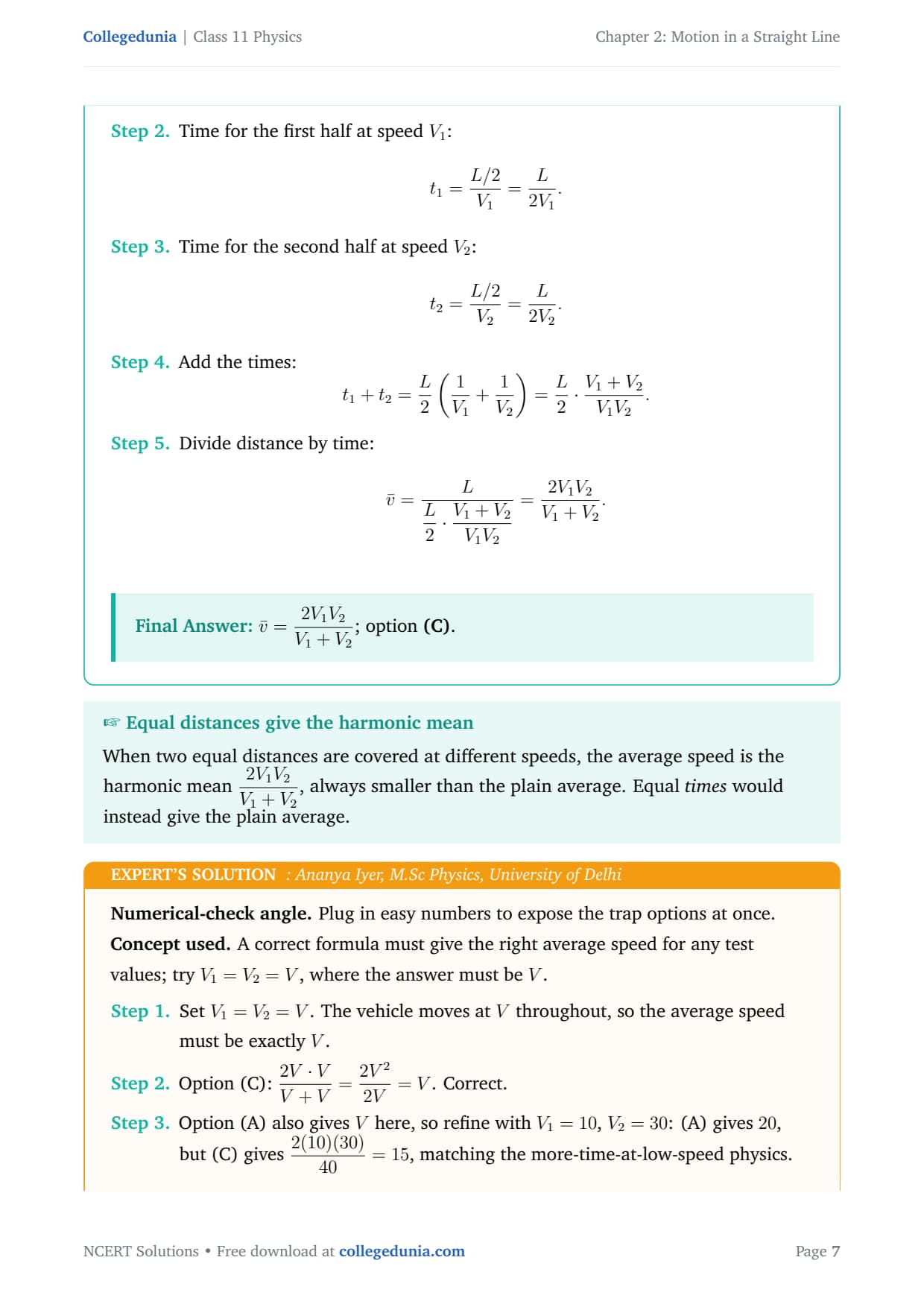
- Average speed is total distance over total time, not the mean of two speeds
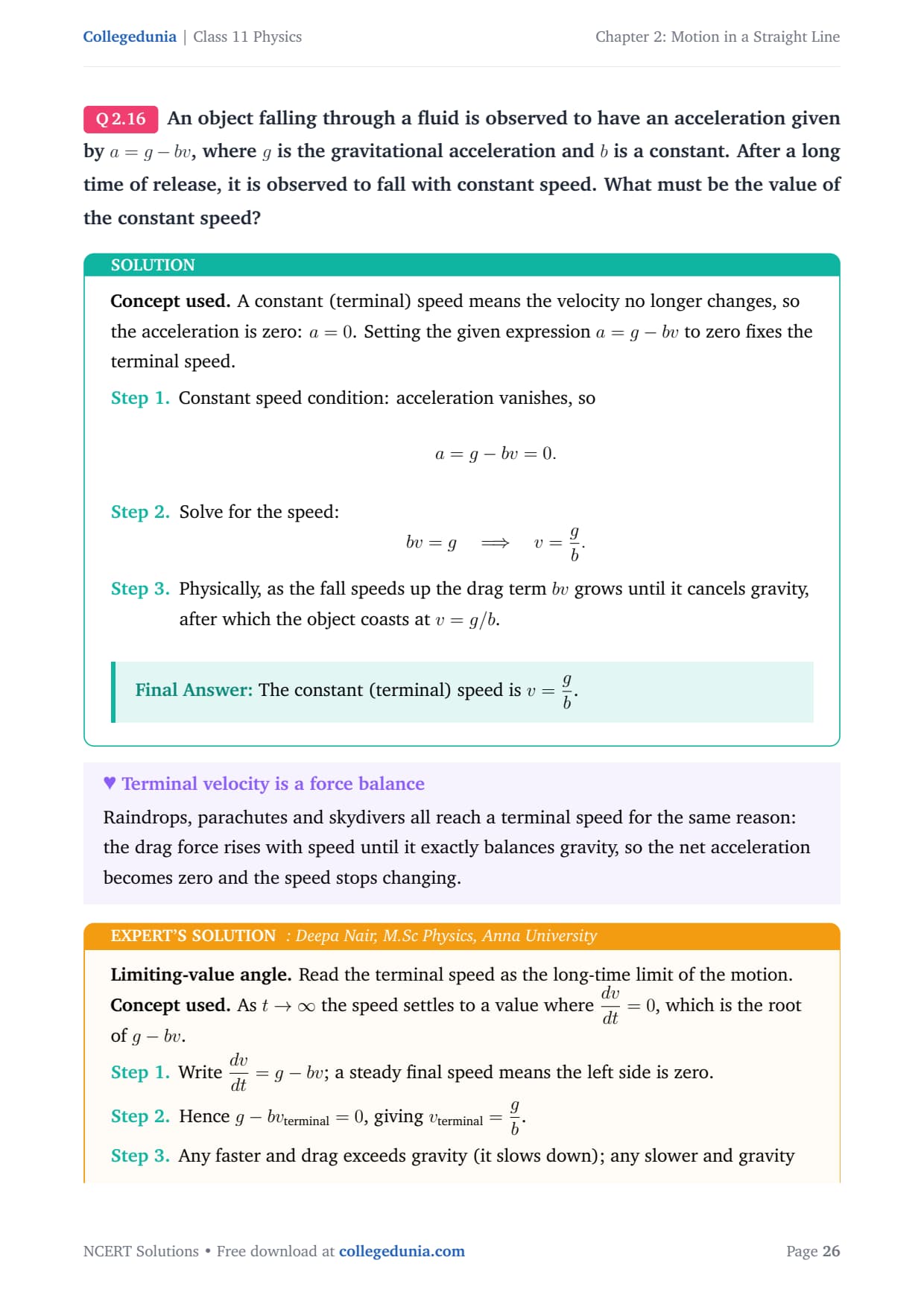
- Terminal speed arrives when acceleration hits zero, so a = g − bv gives v = g/b
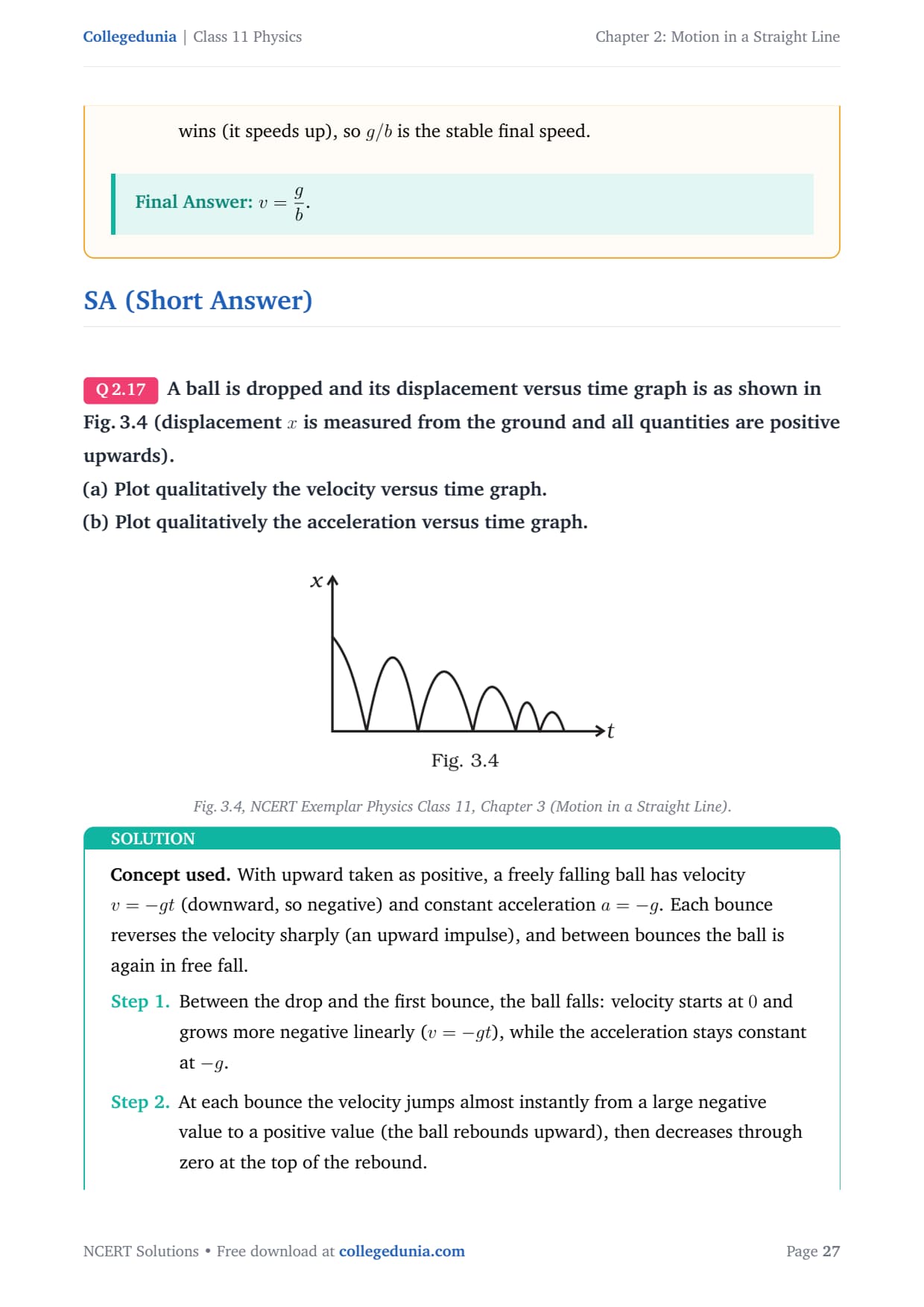
The height of a curve is position, not speed. Speed is the steepness. Question 8 is built on this confusion, comparing speeds where the flatter point sits higher.
Common Mistakes Students Make in Motion in a Straight Line
The Exemplar sets traps on purpose. These four catch most students, and each is flagged in the PDF where it bites.
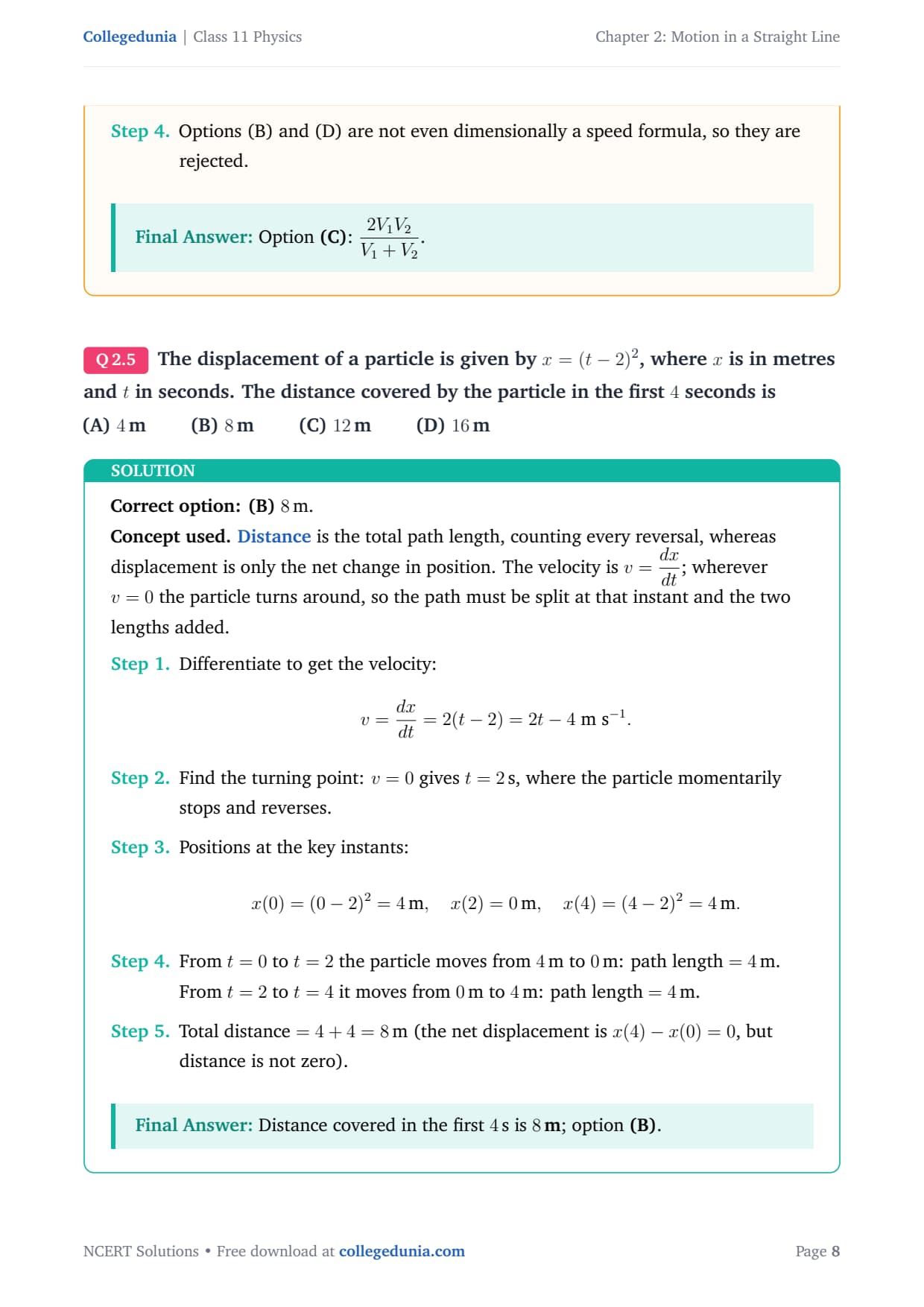
- Subtracting instead of tracing the path: for x = (t − 2)2, x(4) − x(0) is zero. The particle reverses at t = 2 s, so the distance in 4 seconds is 8 m.
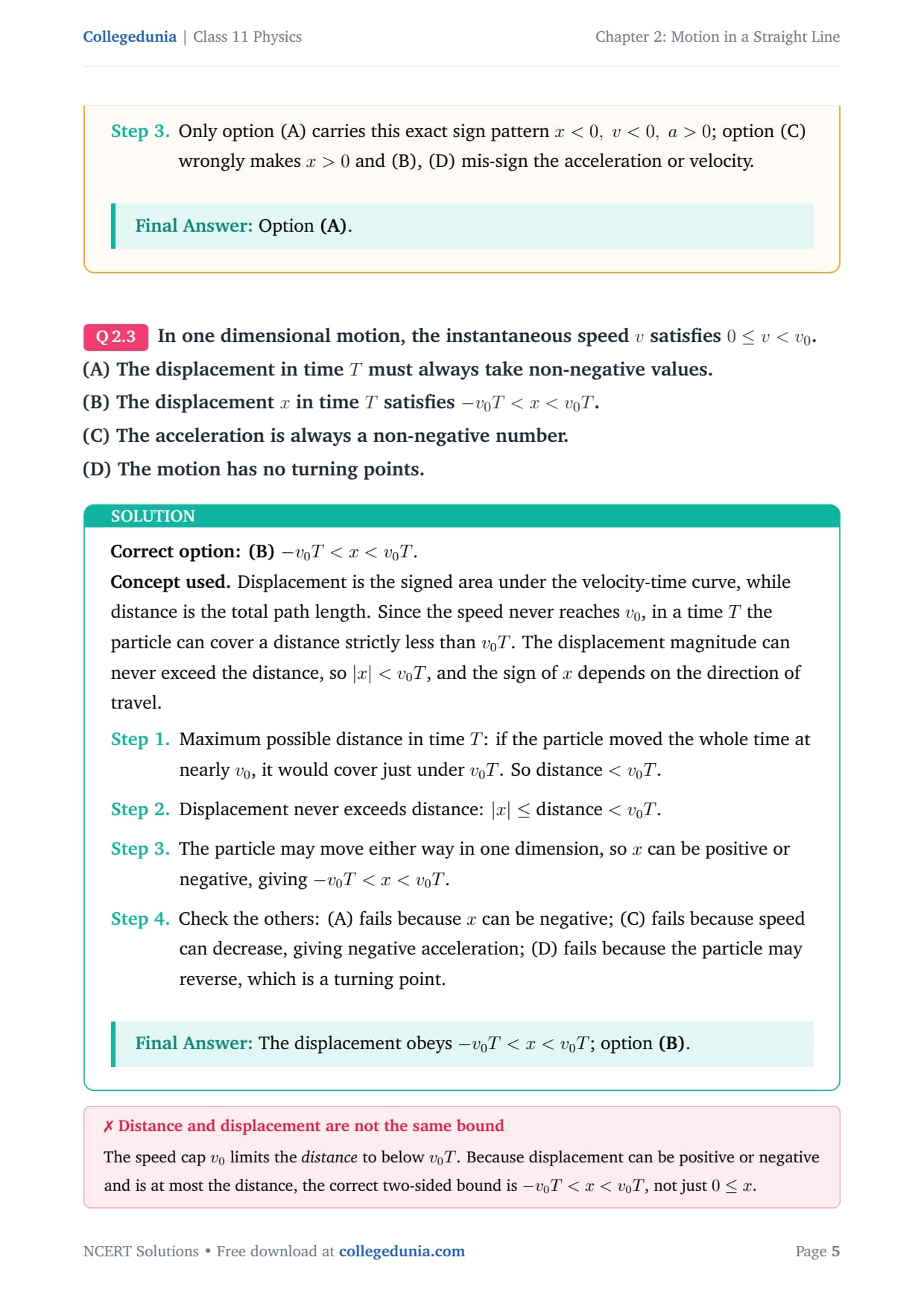
- Forgetting displacement can be negative: if 0 ≤ v < v0, the bound is −v0T < x < v0T, not 0 ≤ x.
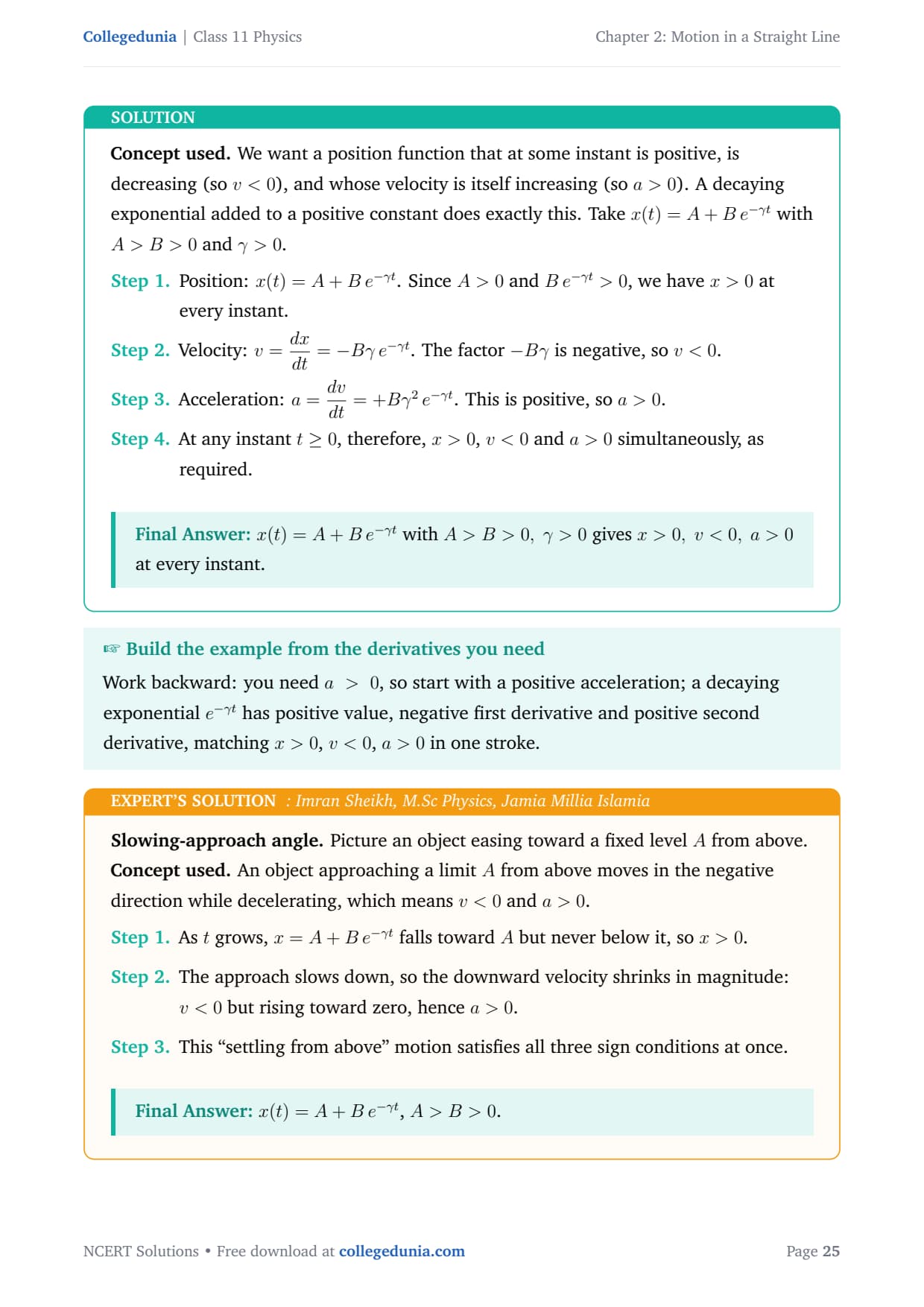
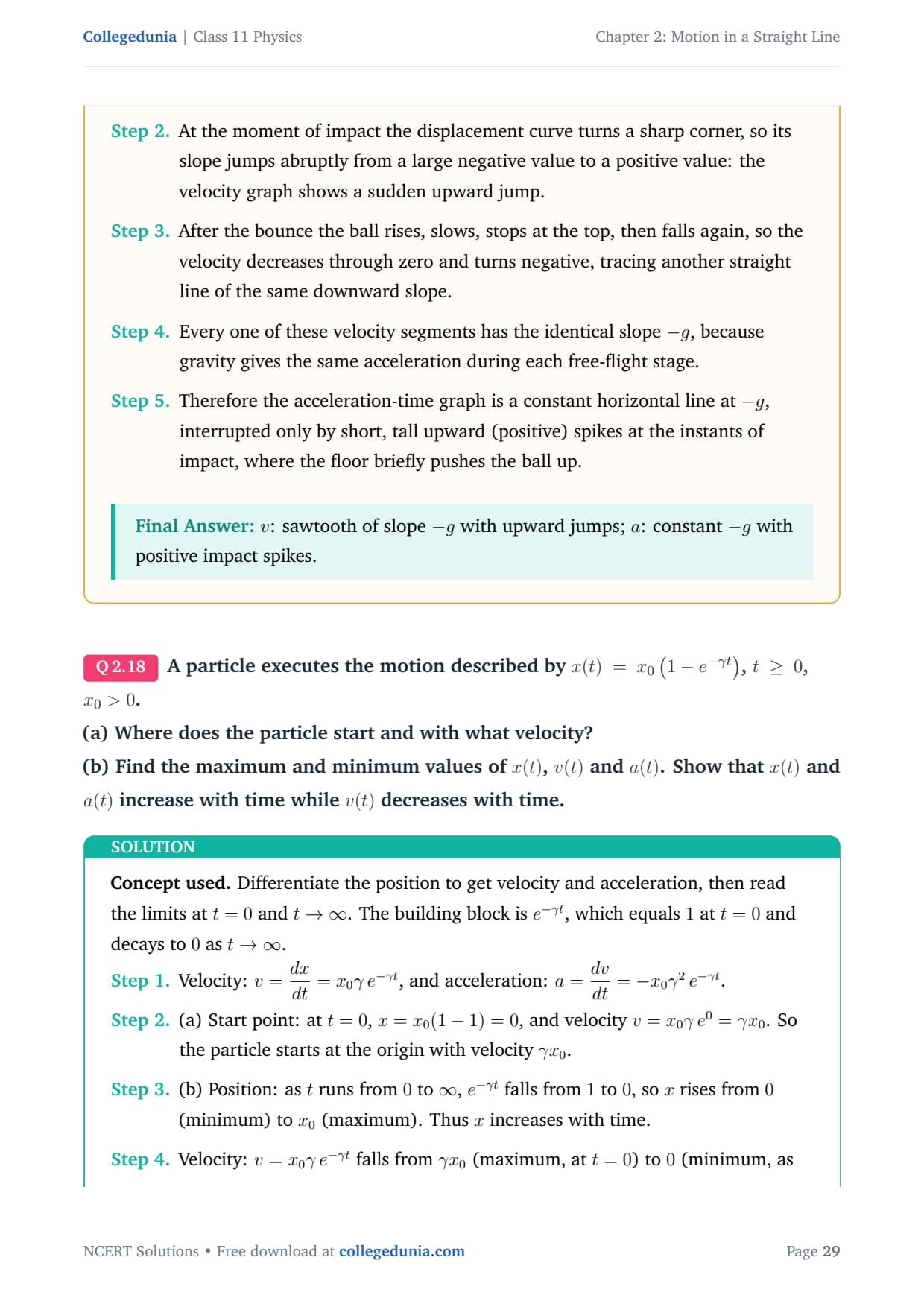
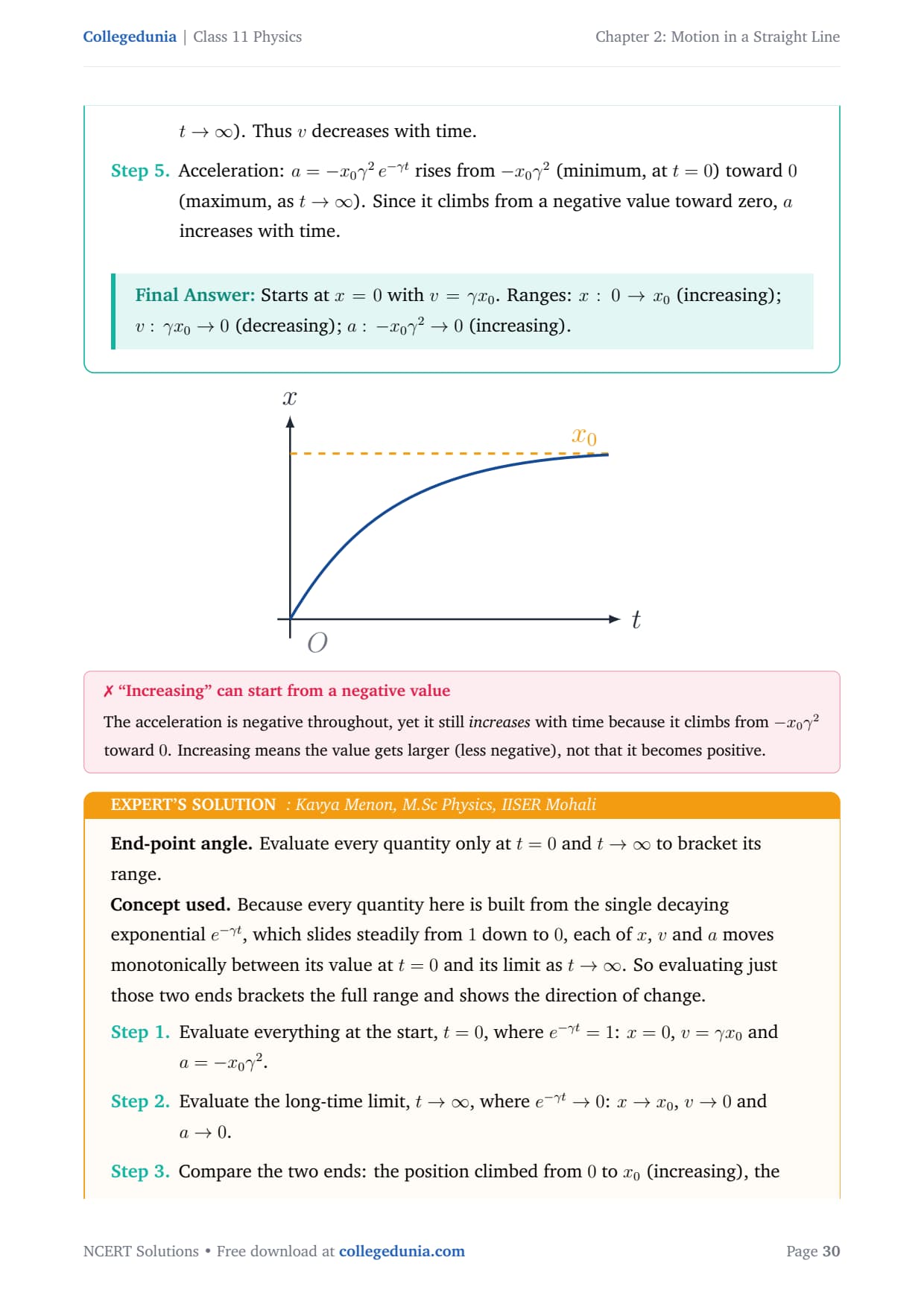
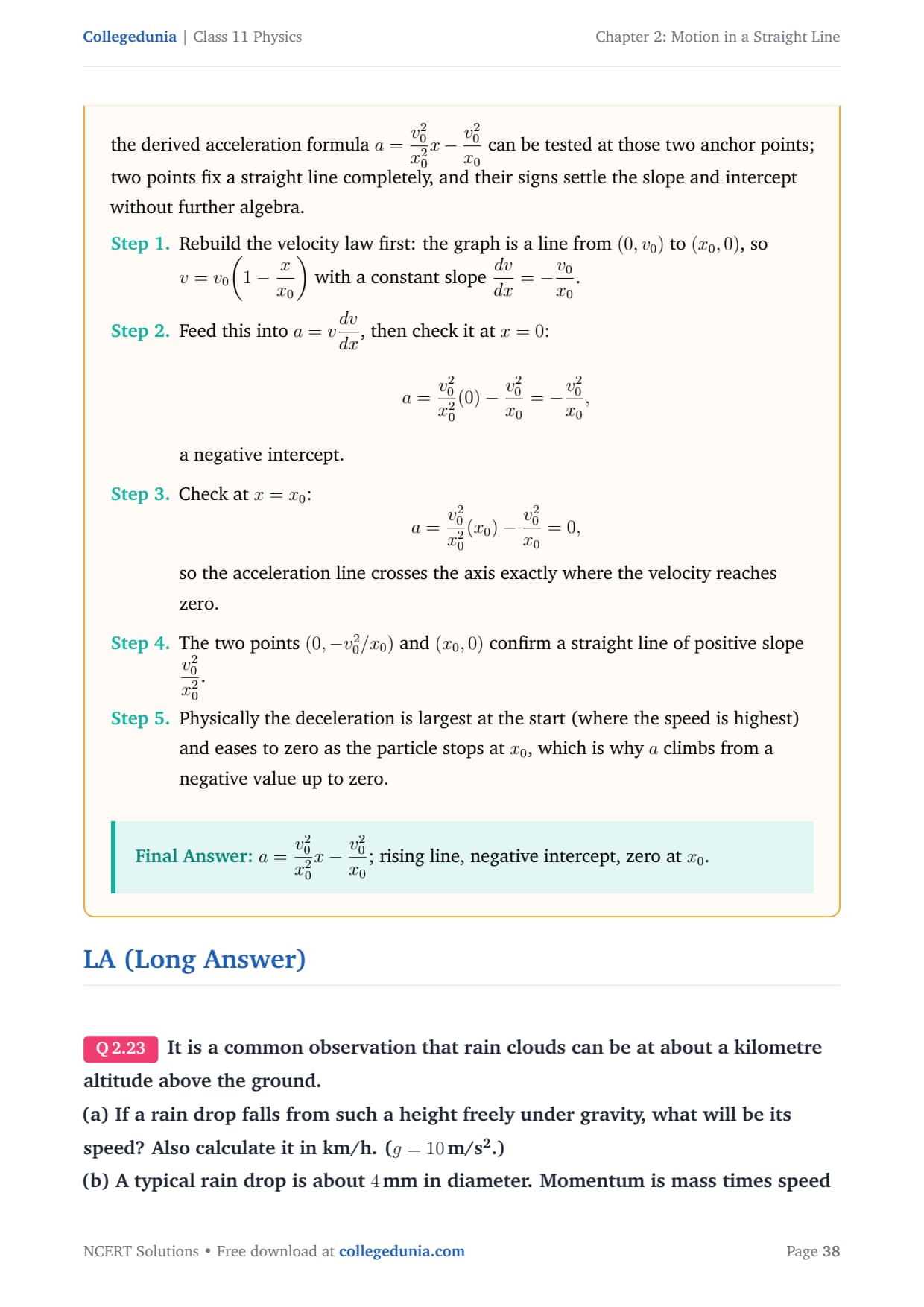
- Reading "increasing" as "positive": in Question 18 acceleration stays negative yet increases, climbing from −γ2x0 toward zero.
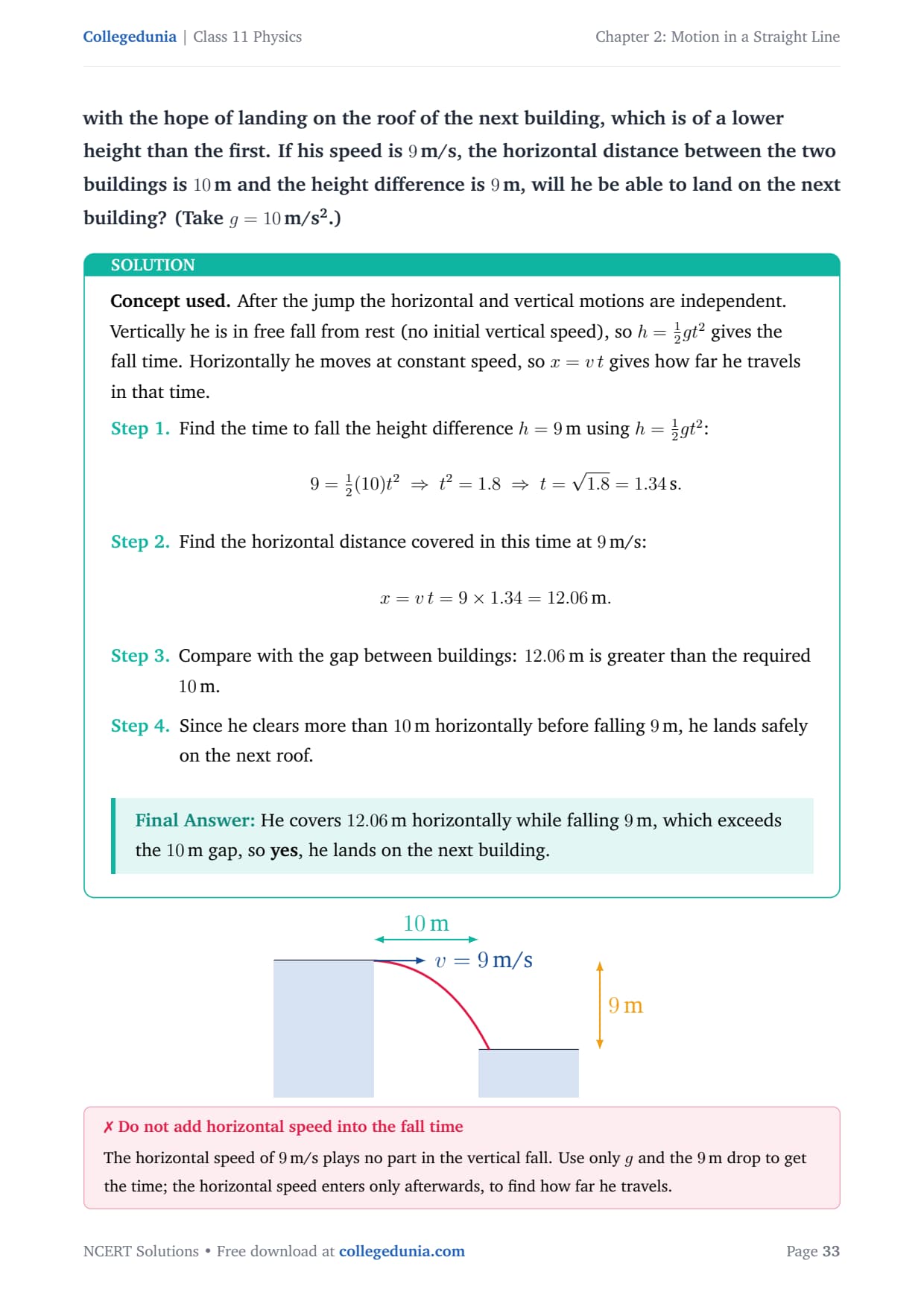
- Mixing horizontal speed into a fall time: in the roof-jump question the 9 m/s plays no part in the drop. Only g and the 9 m height set it.
The Answer Key Error in Question 25 and What We Print Instead
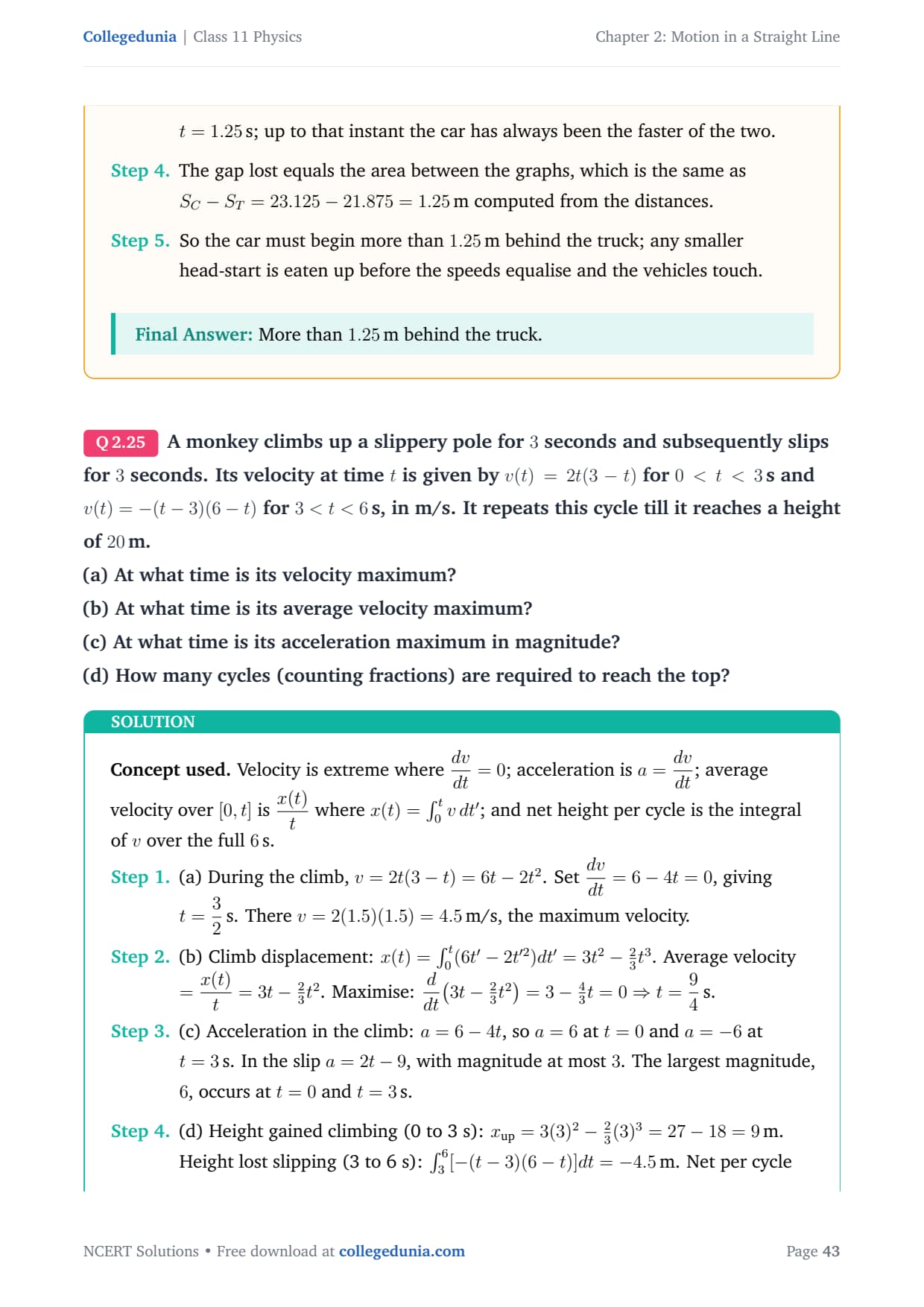
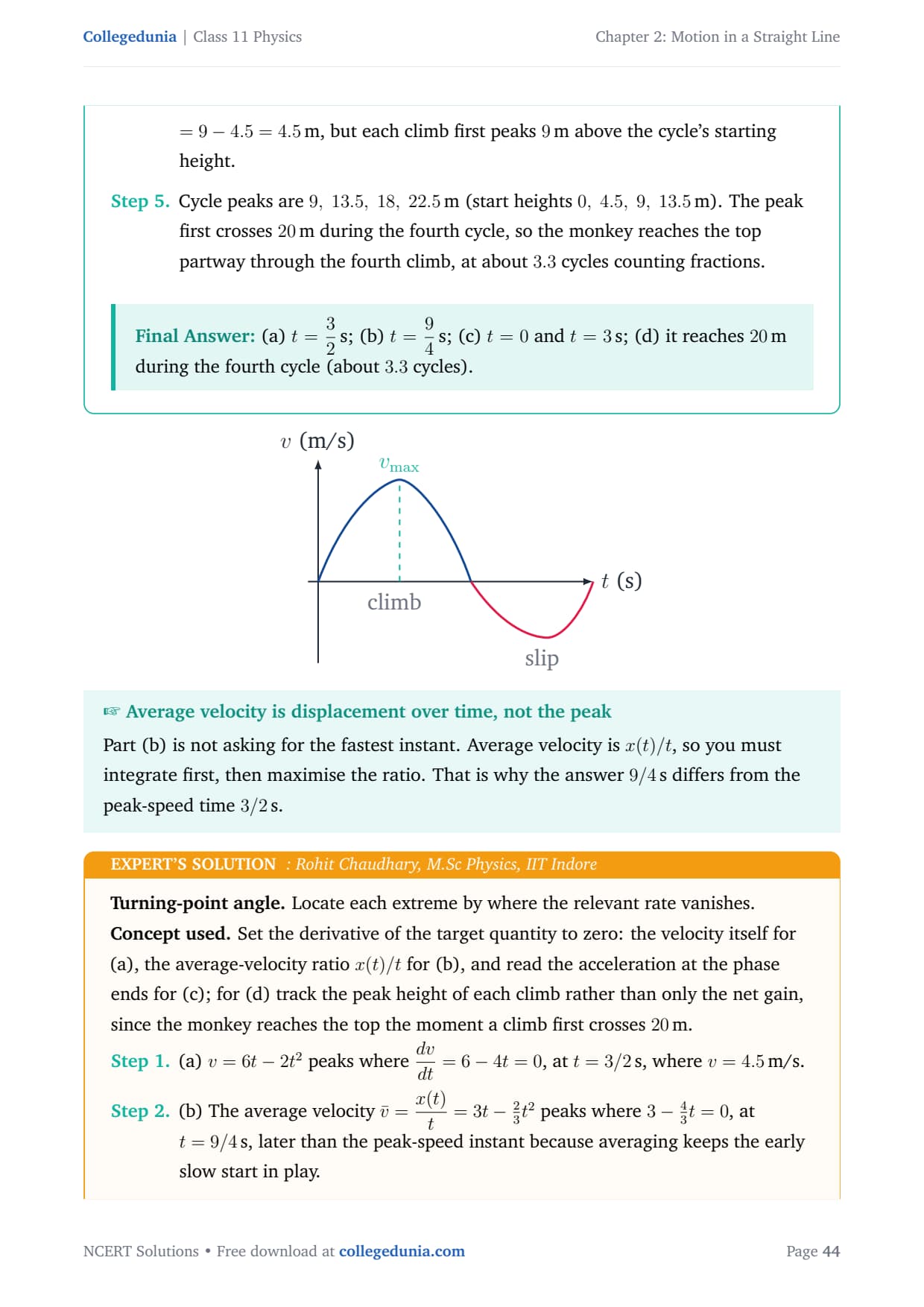
Question 25 is the monkey on a slippery pole. It climbs for 3 seconds, slips for 3 seconds, and repeats until it reaches 20 m. Part (d) asks how many cycles that needs, counting fractions.
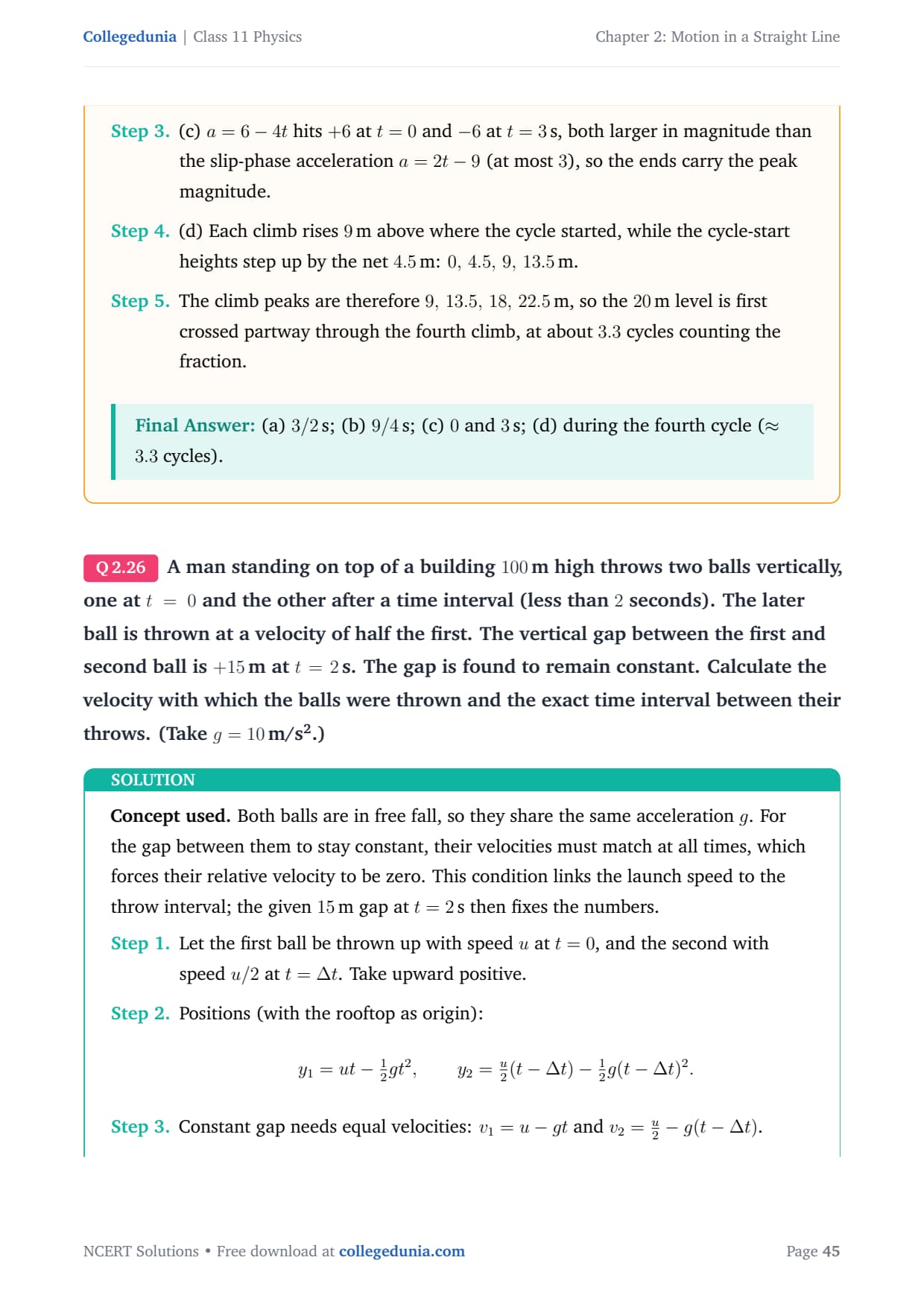
Each climb rises 9 m and each slip loses 4.5 m, so cycle-start heights step up as 0, 4.5, 9 and 13.5 m. That puts the climb peaks at 9, 13.5, 18 and 22.5 m. The 20 m top is first crossed partway through the fourth climb, at about 3.3 cycles. The official NCERT key prints "6 cycles", which is widely regarded as anomalous. Our PDF tracks the peaks height by height, so students can defend the working if a teacher quotes the key.
How the Exemplar Steps Up from the Class 11 Physics Textbook
The textbook hands you a rule to apply. The Exemplar asks you to choose it, and to explain why the tempting one does not apply.
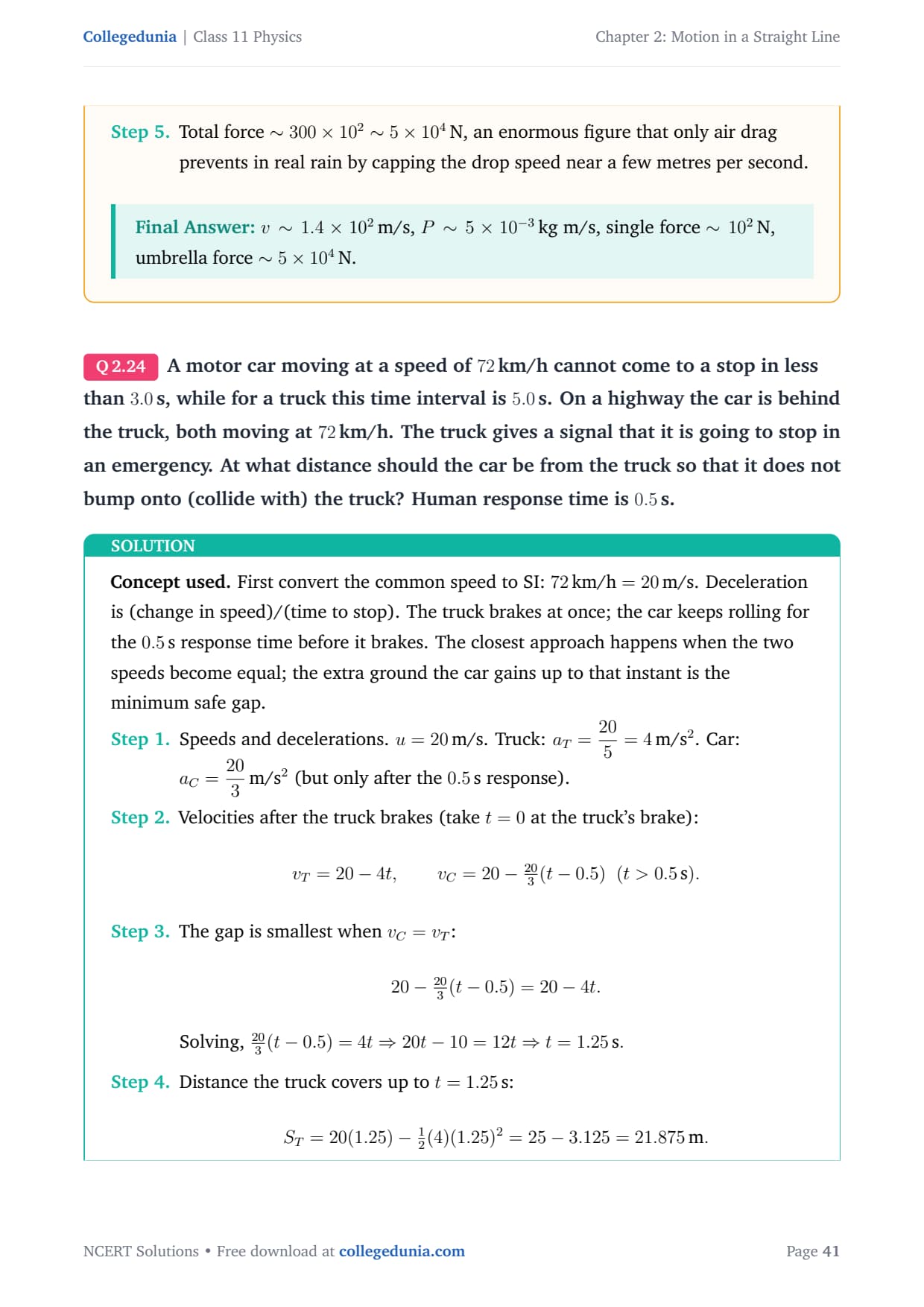
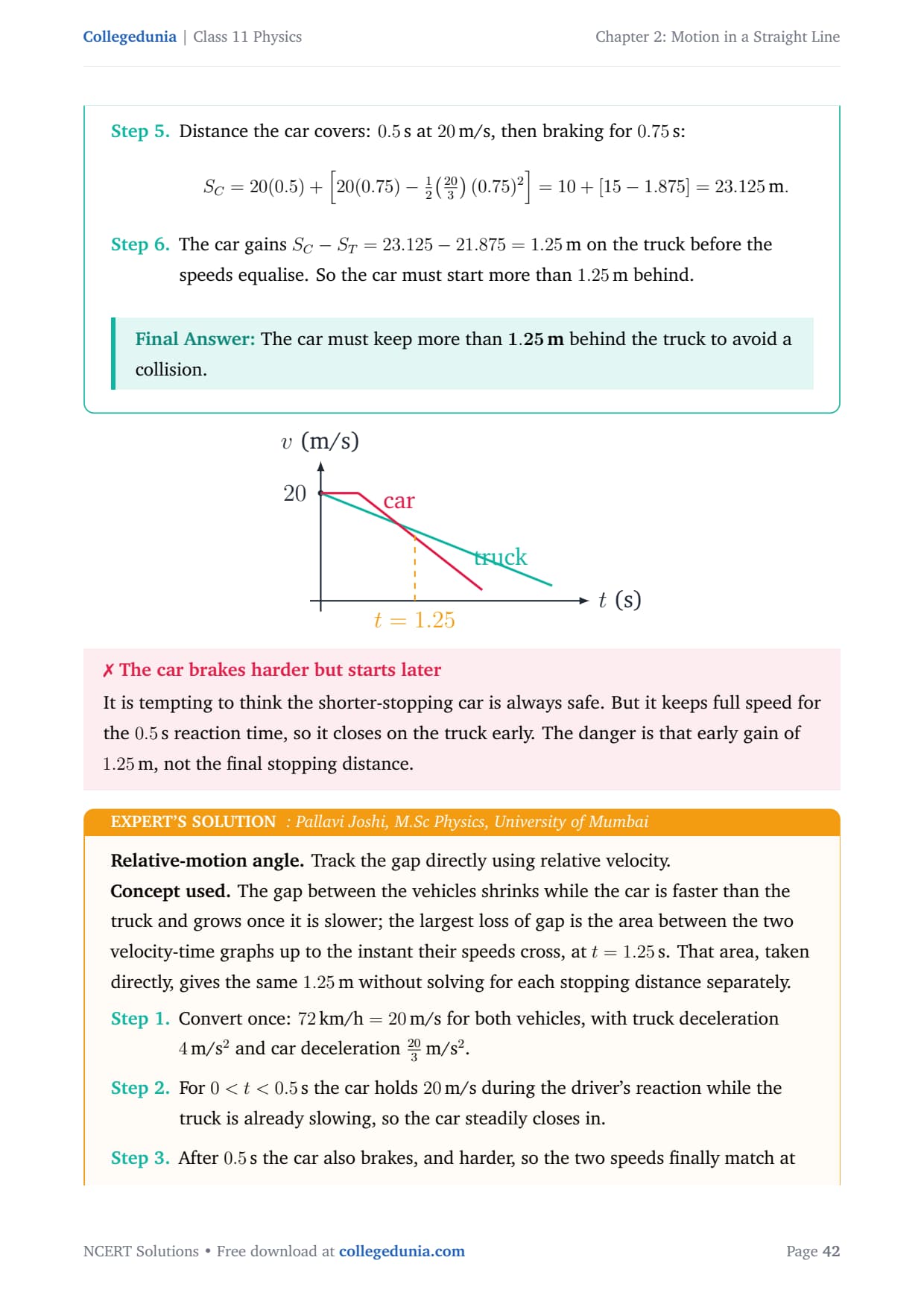
Question 24 shows the gap. A car and a truck both move at 72 km/h, and the car stops in 3.0 s against the truck's 5.0 s. The car brakes harder, so it looks safe. But it holds full speed through the 0.5 s reaction time and gains 1.25 m early, so it must stay more than 1.25 m behind. Collegedunia's solution plots both motions rather than quoting a formula.
How to Use These NCERT Exemplar Solutions for Boards, JEE and NEET
Attempt each question before opening the solution. This chapter rewards a wrong attempt more than a clean read.
- Boards: the VSA and SA questions match the 2 and 3 mark graph-sketching pattern
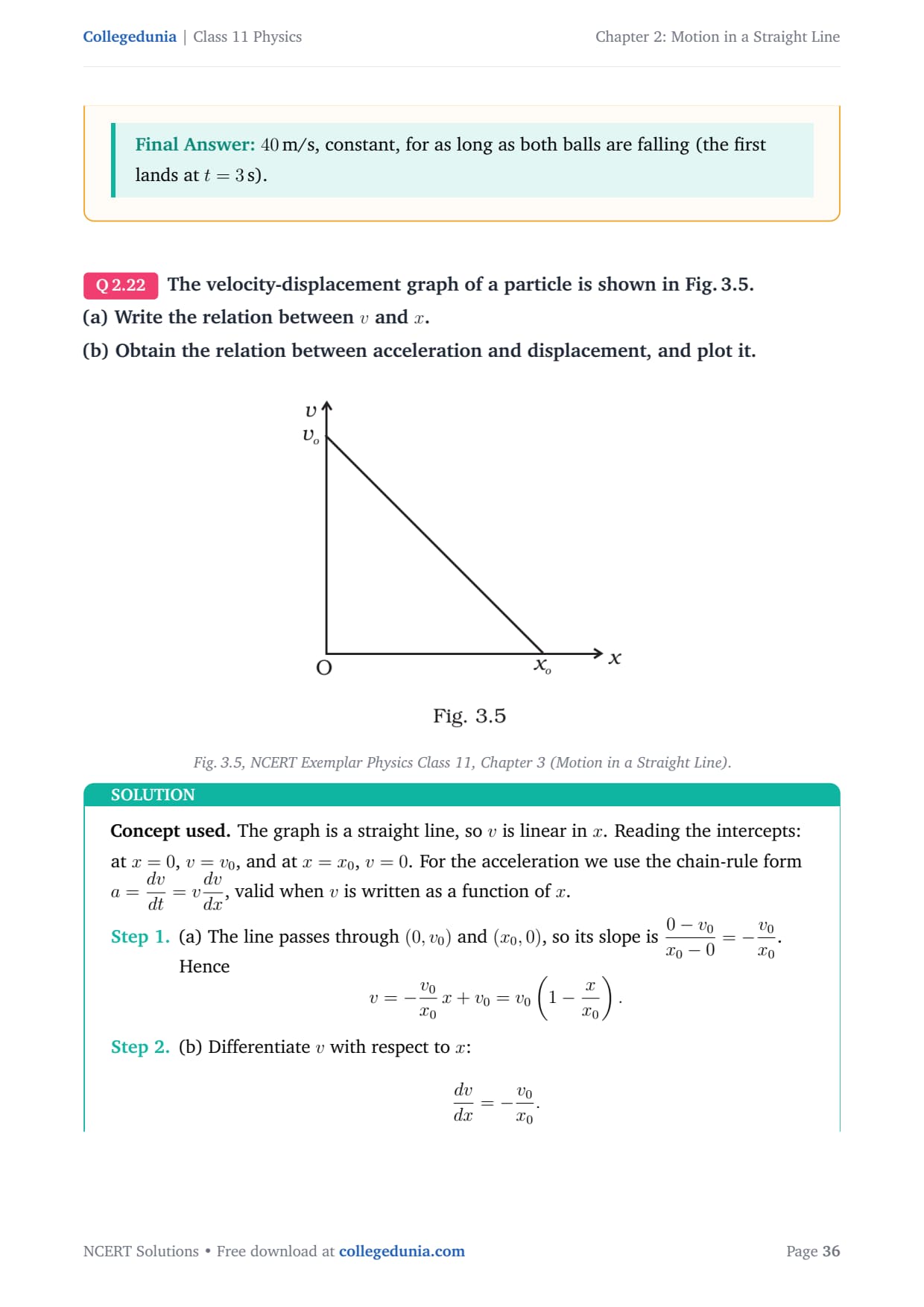
- JEE Main: start with the MCQ II set and Question 22, since velocity-displacement graphs repeat
- NEET: the MCQ I set covers the average speed and lift-motion recall NEET reuses
Student Feedback
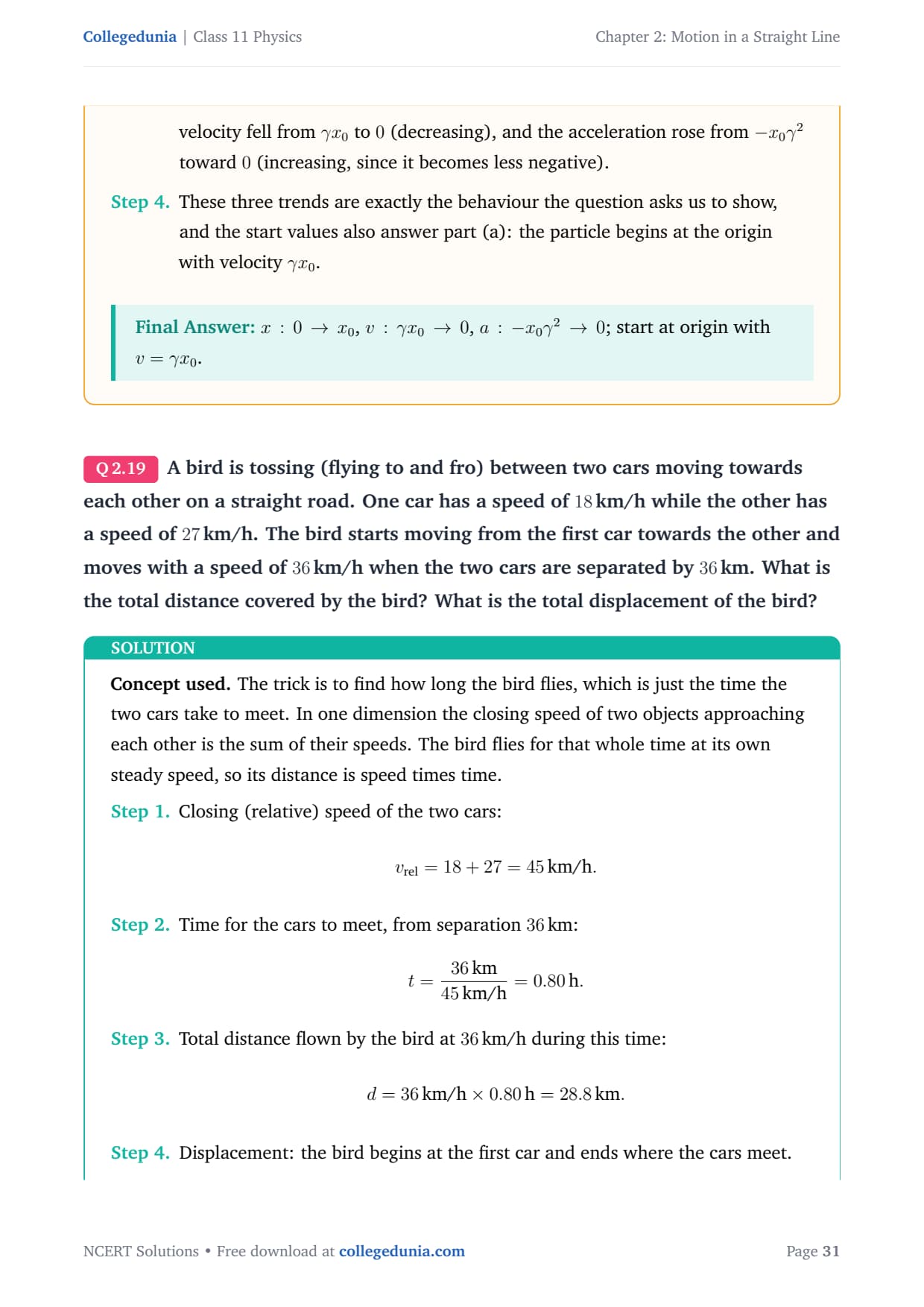
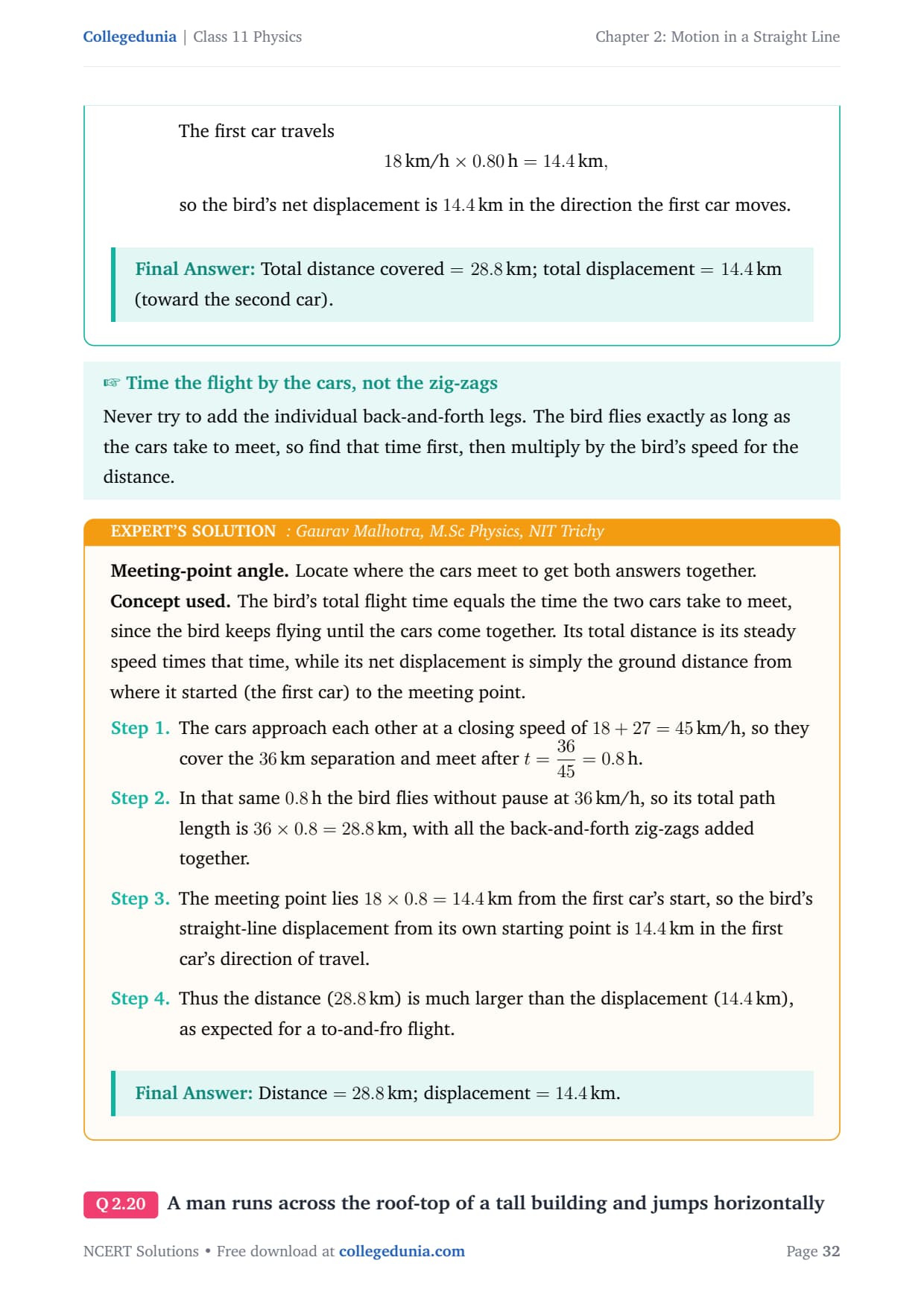
Students who used Collegedunia's Class 11 Physics Exemplar Solutions told us the graph questions were hardest here. Around 7 in 10 said the step-by-step format helped most on Question 19, the bird tossing between two approaching cars, where the answer is 28.8 km of distance but 14.4 km of displacement.
Other Resources for Class 11 Physics Motion in a Straight Line
Collegedunia has the full study material for this chapter. Use the Notes first, then the Exemplar once graph basics are steady.
Also Check:
- NCERT Solutions for Class 11 Physics Chapter 2
- Class 11 Physics Chapter 2 Notes
- Class 11 Physics Chapter 2 Handwritten Notes
- Class 11 Physics Chapter 2 NCERT Book PDF
- Class 11 Physics Chapter 2 Exemplar Questions with Solutions
NCERT Exemplar Solutions for Other Class 11 Physics Chapters
Every chapter below has the same step-by-step treatment and a free PDF.
Motion in a Straight Line Class 11 Physics NCERT Exemplar Solutions FAQs
Ques. How many questions are there in the Class 11 Physics Motion in a Straight Line Exemplar?
Ans. Chapter 2 has 26 questions. They are split into 6 MCQ I, 5 MCQ II, 5 Very Short Answer, 6 Short Answer and 4 Long Answer questions. All 26 are solved in the free 47-page PDF on this page.
Ques. Why does the Exemplar key say 6 cycles for the monkey on the pole in Question 25?
Ans. The printed key gives 6 cycles, but the working does not support it. Each climb gains 9 m and each slip loses 4.5 m, so the climb peaks fall at 9, 13.5, 18 and 22.5 m. The monkey passes 20 m during the fourth climb, at about 3.3 cycles. Our PDF shows the full height-by-height track.
Ques. What is the distance covered in the first 4 seconds if x = (t − 2)2?
Ans. It is 8 m. The particle moves 4 m toward the origin, stops at t = 2 s, then moves 4 m back out. Simply computing x(4) − x(0) gives zero, which is the displacement, not the distance. You must add the two path lengths separately.
Ques. Is the NCERT Exemplar enough for JEE Main kinematics questions?
Ans. For this chapter it covers the graph-based questions well. JEE Main asks one or two questions a year from straight-line motion, and the Exemplar MCQ II set matches that level. Work Question 22 on the velocity-displacement graph before moving to a coaching module.
Ques. What is the terminal speed of an object falling with a = g − bv?
Ans. It is v = g/b. After a long time the object stops speeding up, so its acceleration becomes zero. Setting g − bv = 0 gives the constant speed directly. This is Question 16 in the Exemplar.



Comments