



NCERT Exemplar Solutions for Class 11 Physics Chapter 14 Waves solve all 36 questions from the Exemplar book. Every MCQ, Very Short Answer, Short Answer and Long Answer problem is worked out step by step. The free PDF on this page runs to 60 pages and follows the 2026-27 syllabus.
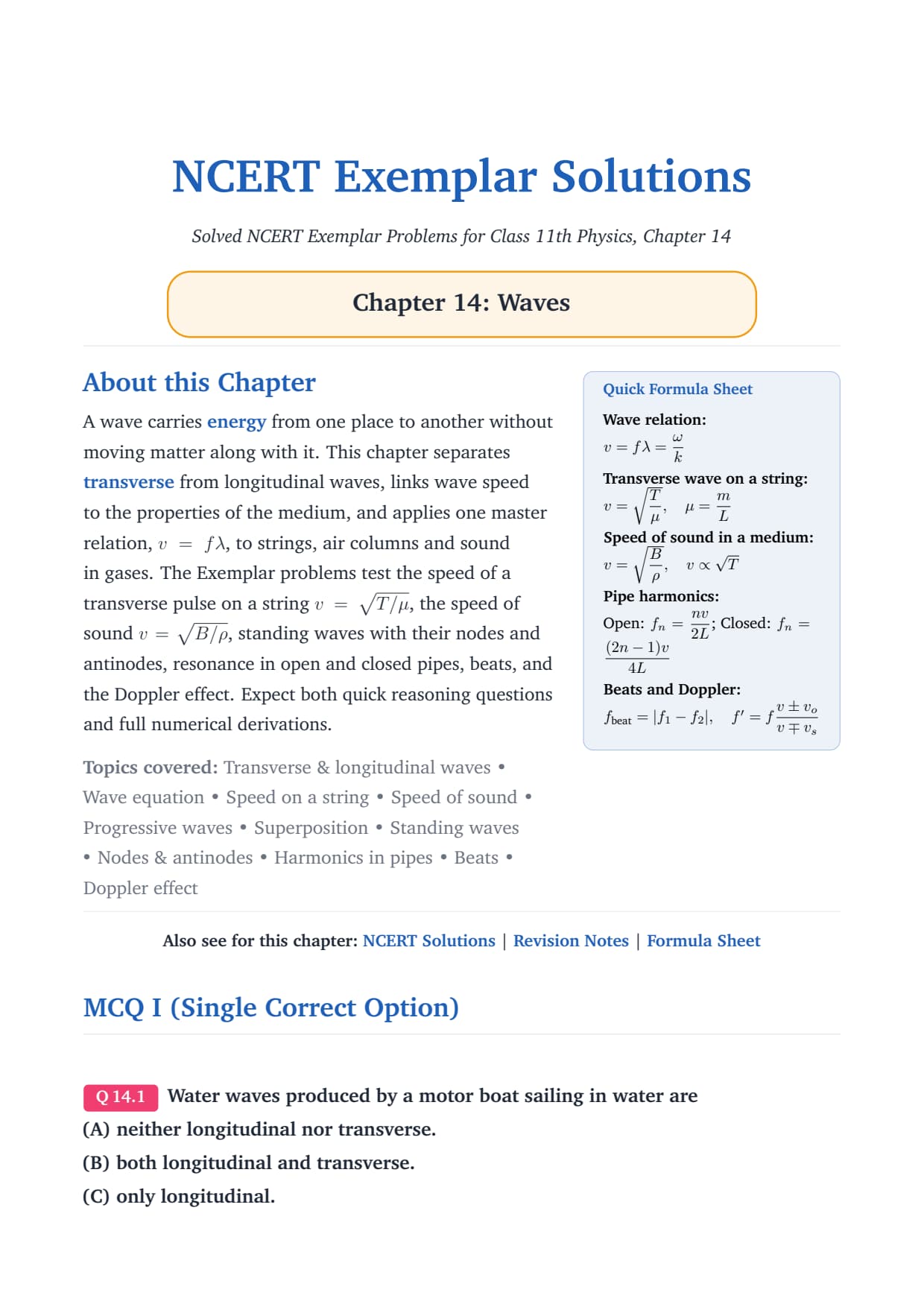
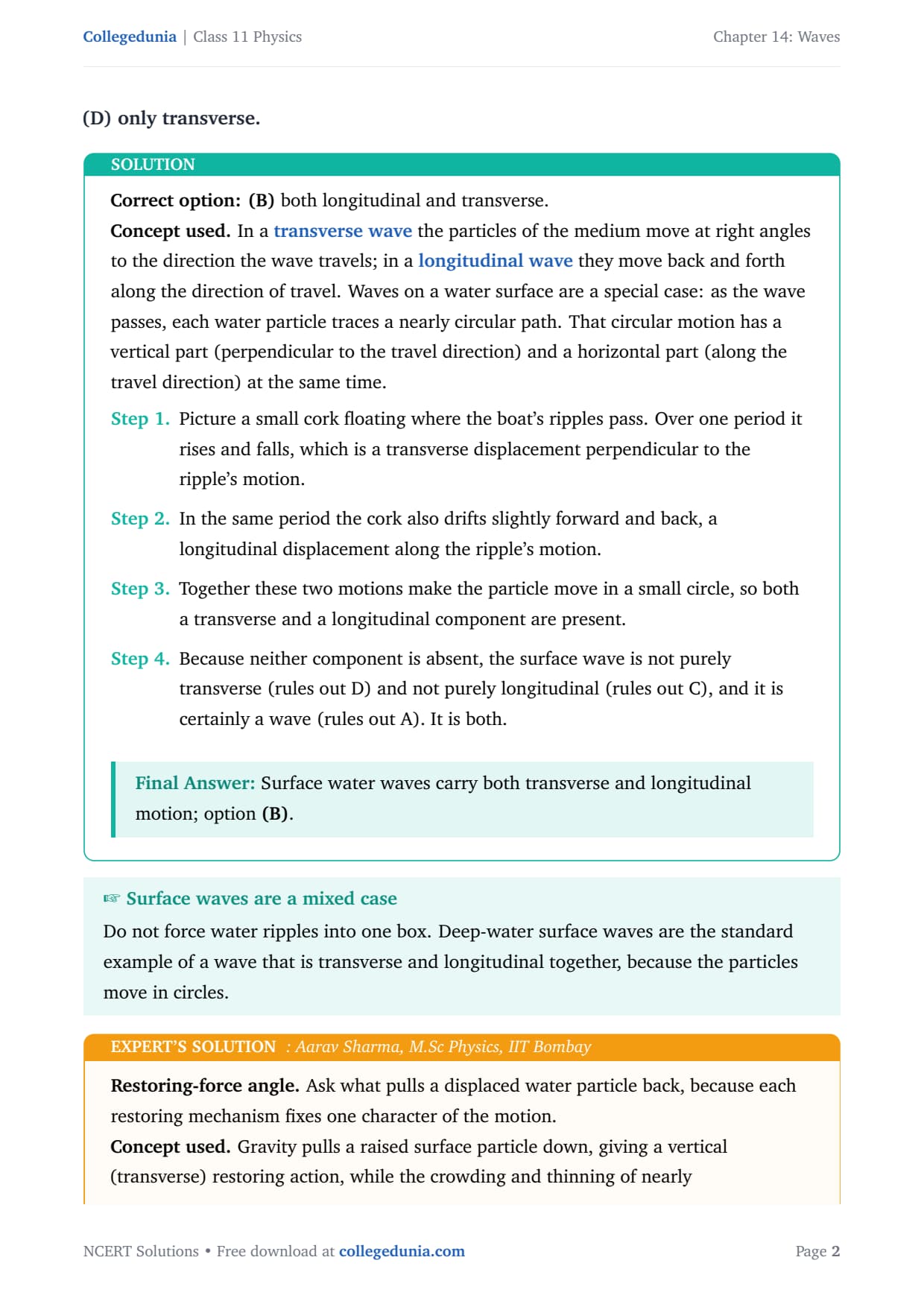
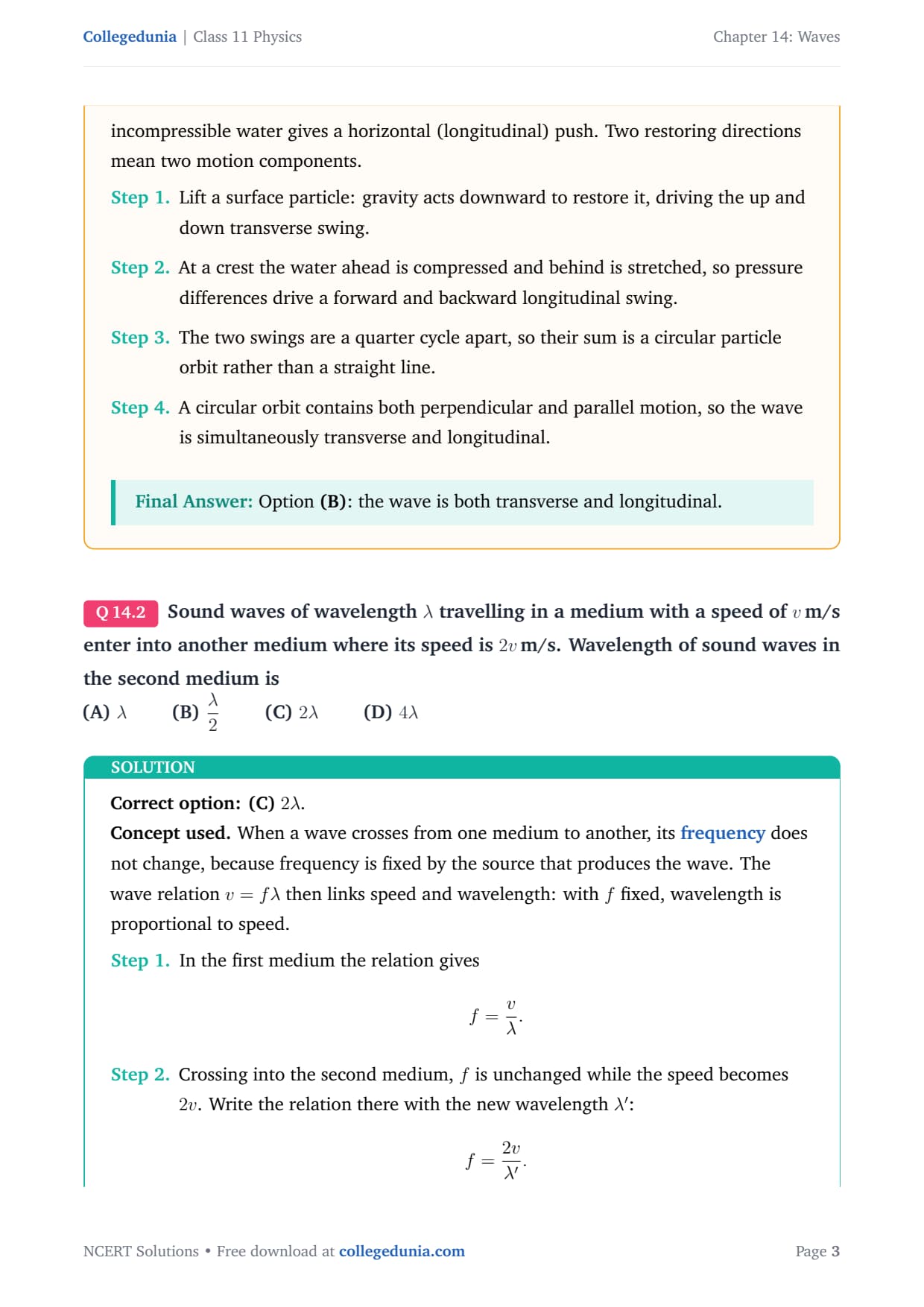
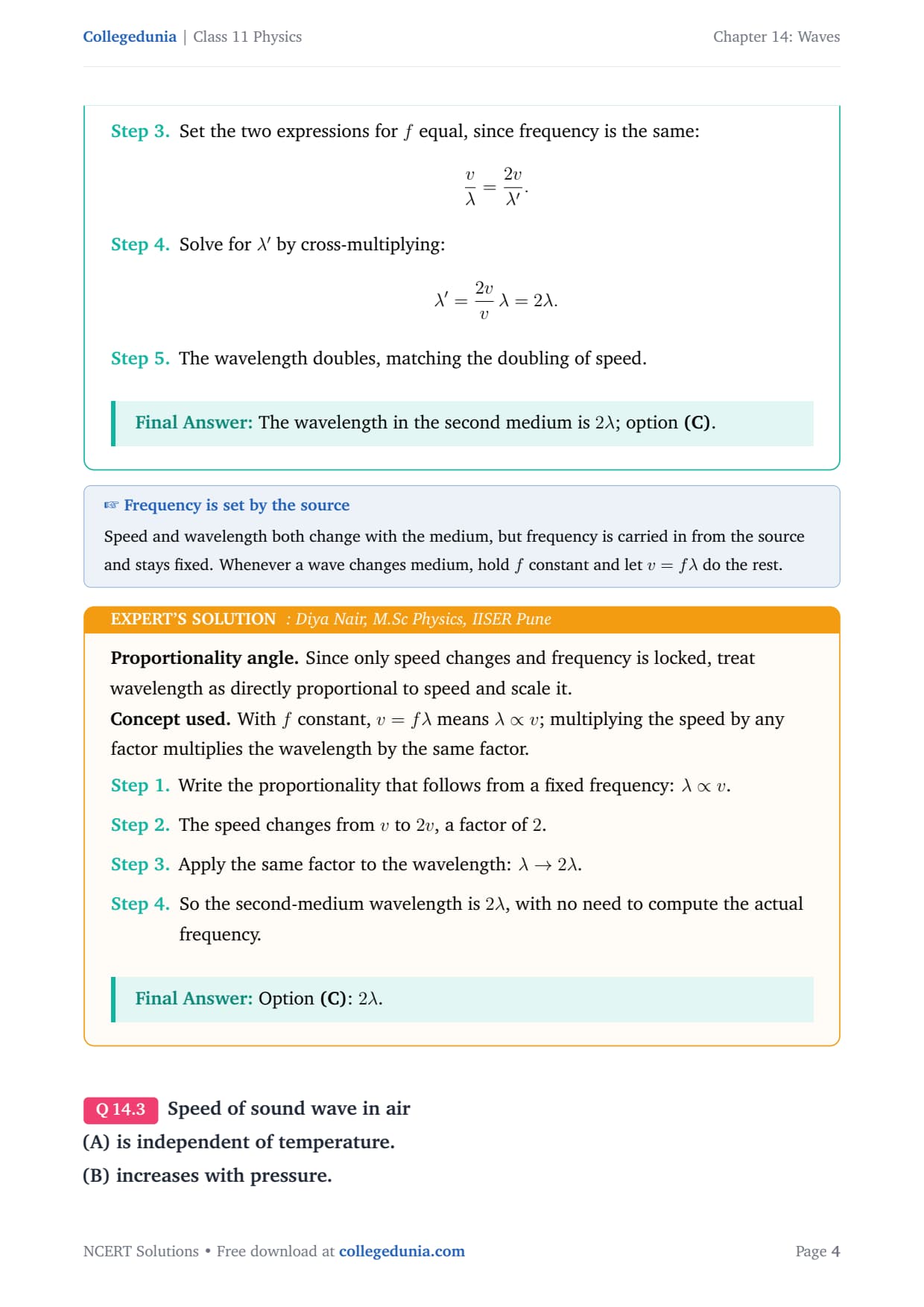
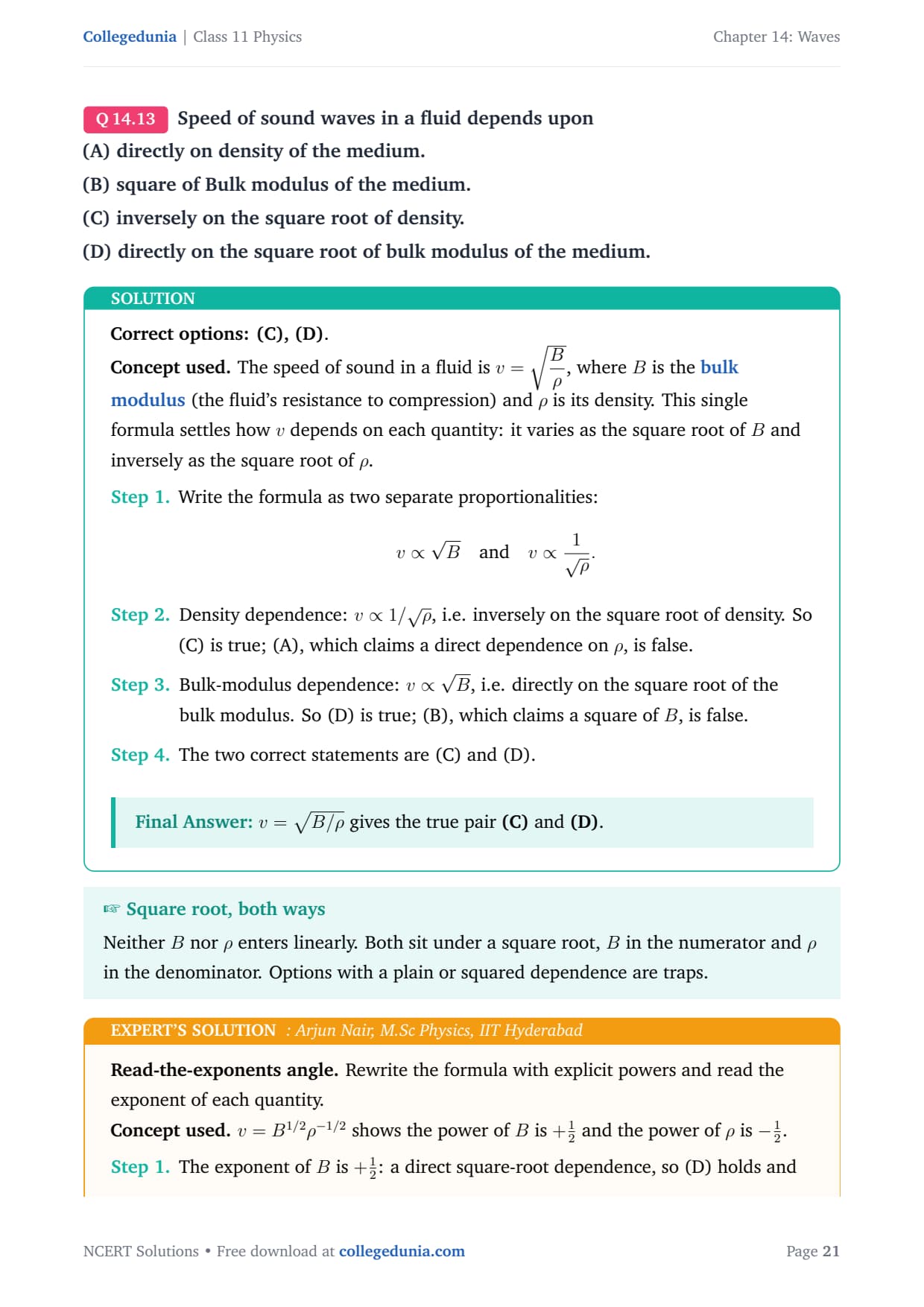
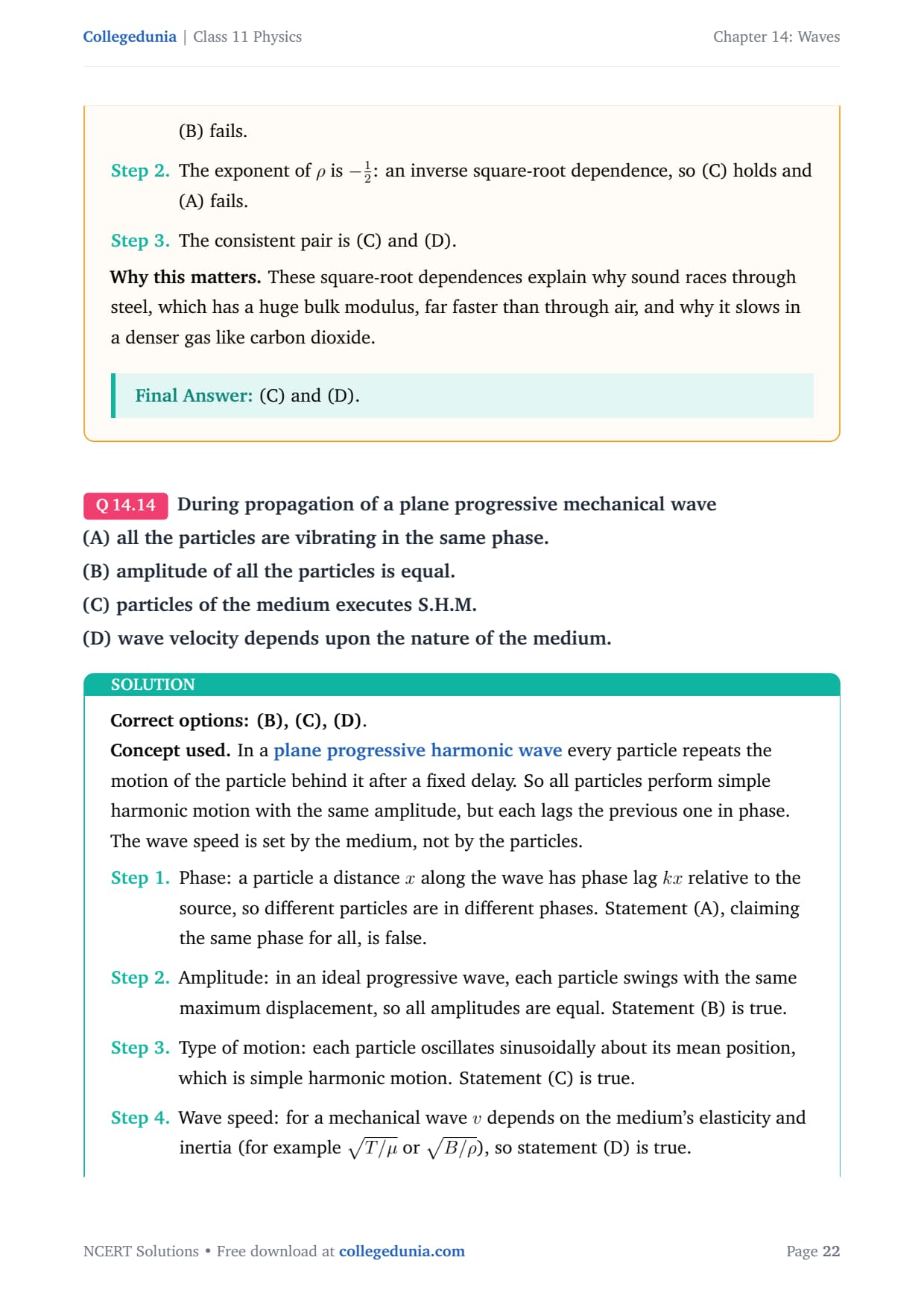
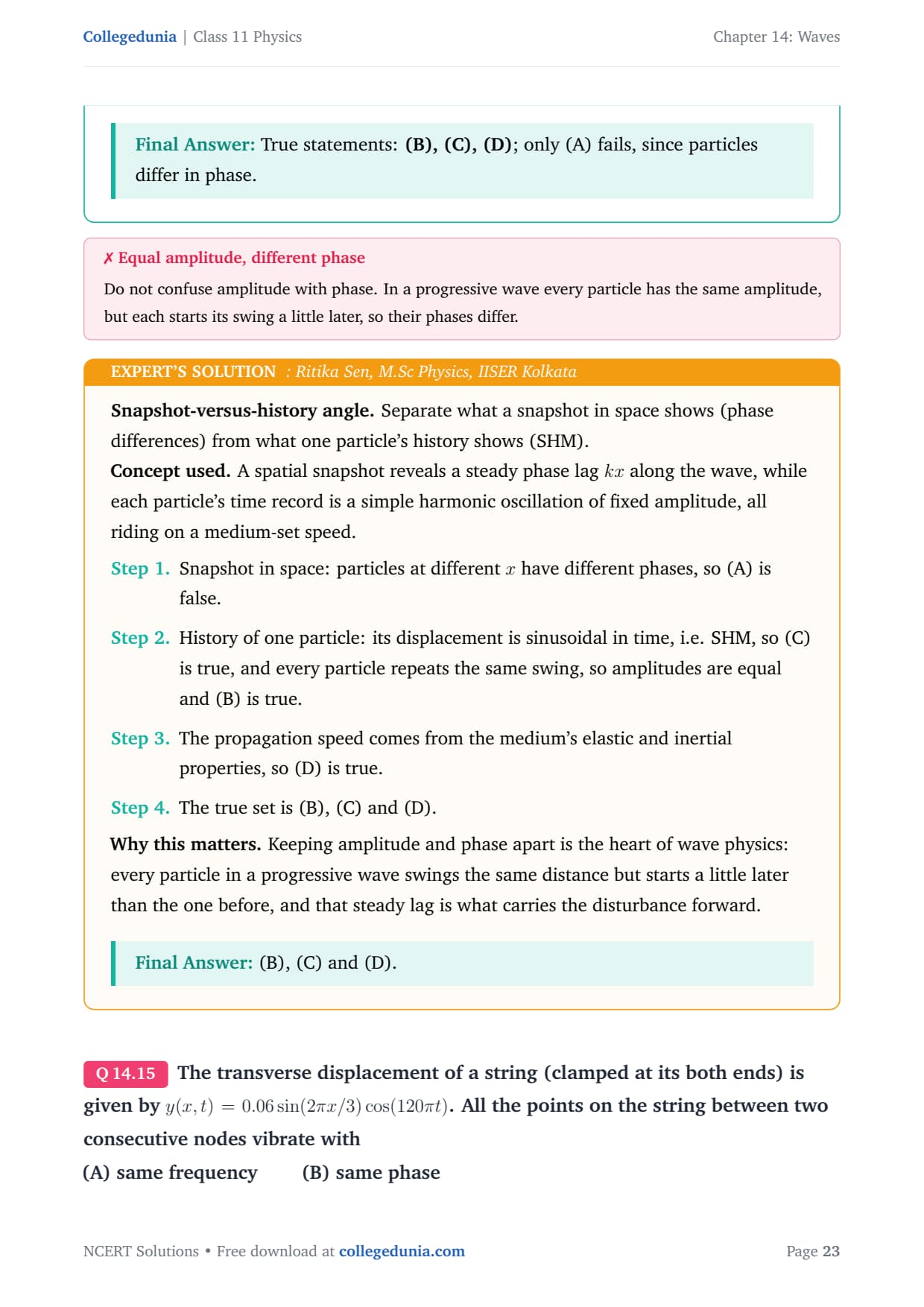
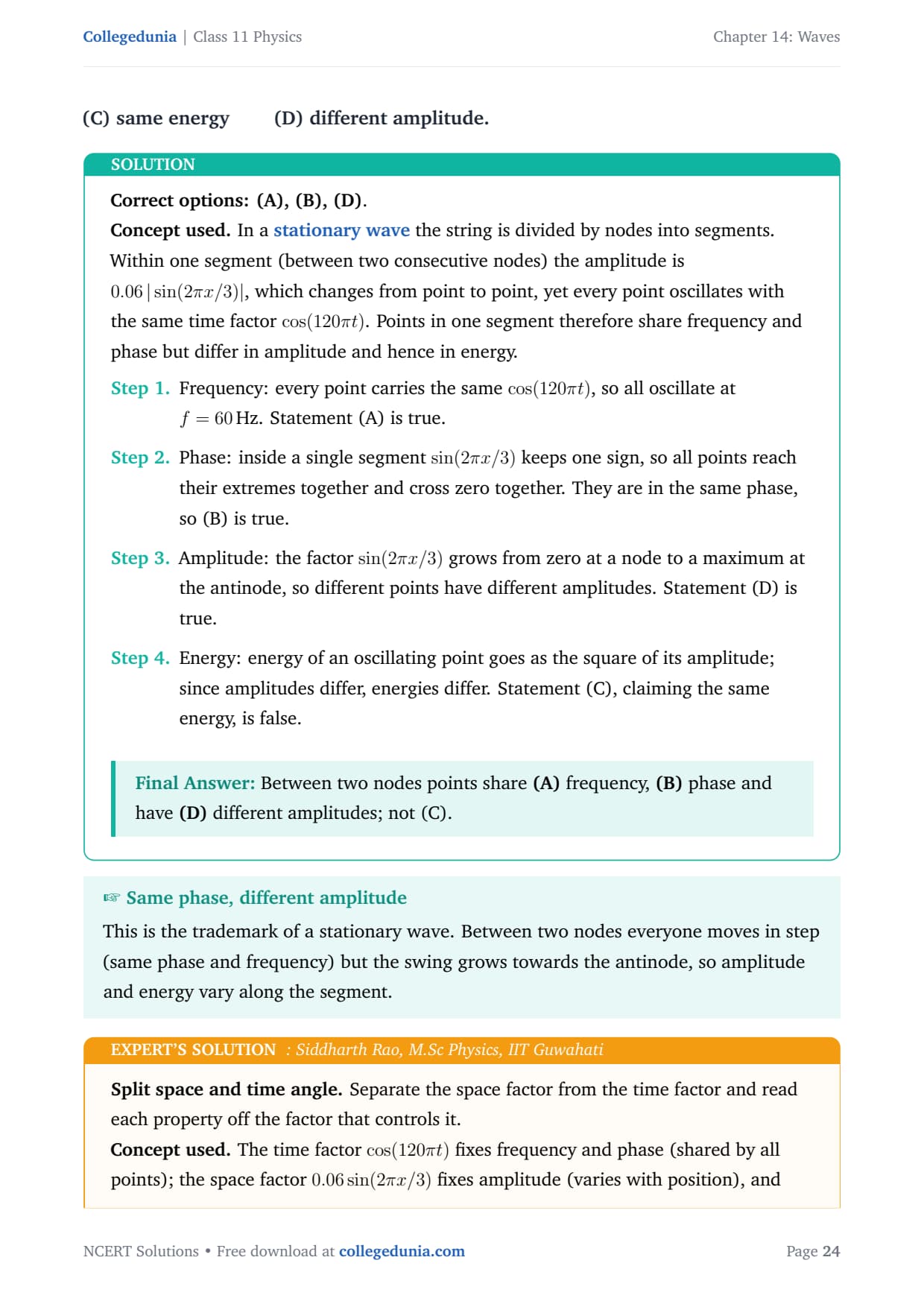
Waves is the last chapter of Class 11 Physics, and it closes the mechanics half of the course. Strings, air columns, beats and the Doppler effect all run on one relation, v = fλ. The Exemplar tests it far harder than the textbook does.
- CBSE Weightage: 4 to 5 marks, usually a numerical on standing waves, pipes or the Doppler effect
- JEE Main Weightage: 1 to 2 questions per year, most often on standing waves or beats
- NEET Weightage: 2 questions per year from wave speed, harmonics and the Doppler effect
Solutions checked question by question against the official NCERT Exemplar answer key, with every numerical worked out in full.
Why the Exemplar Prints Waves as Chapter 15
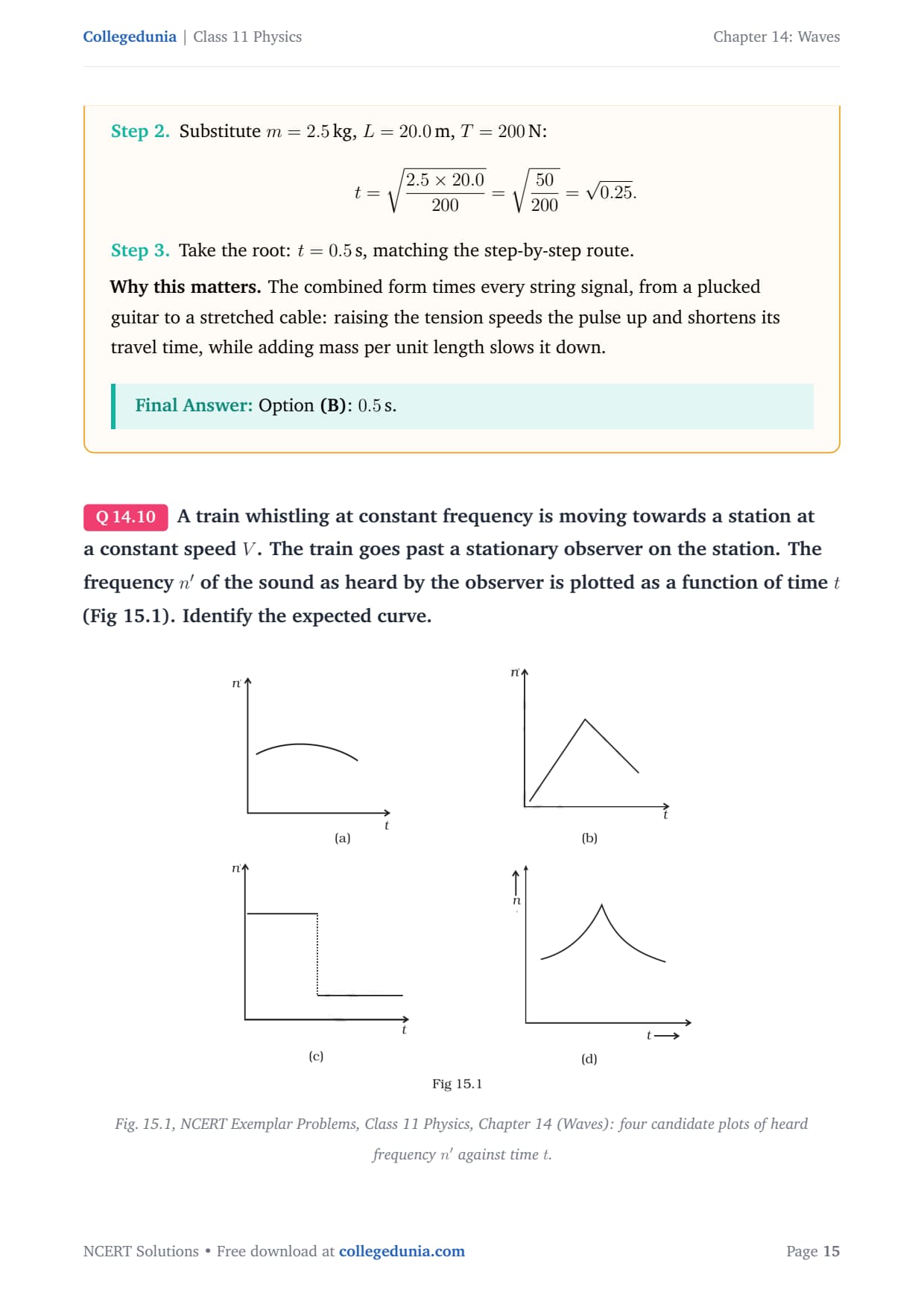
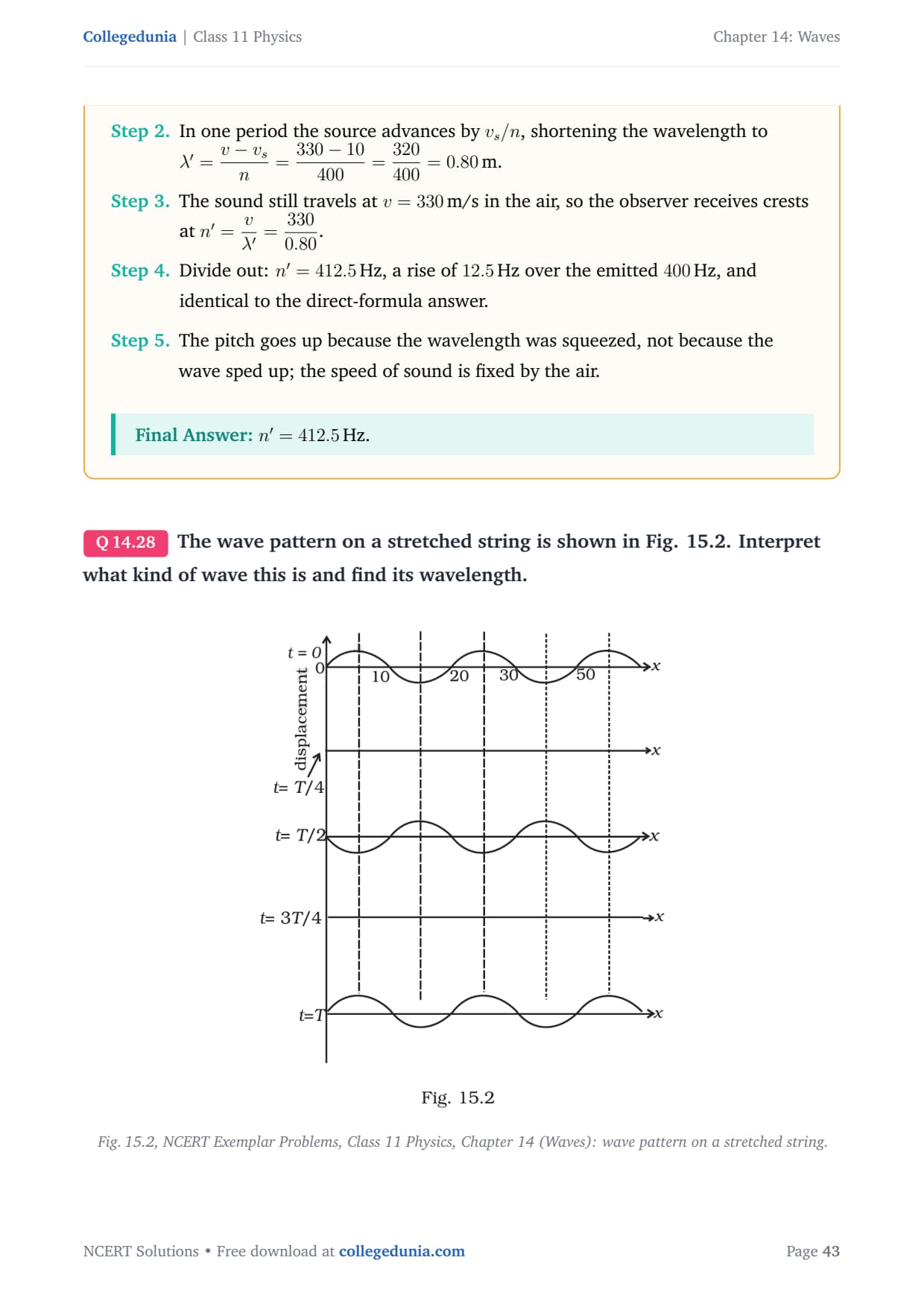
Students often think they have the wrong file here. The Exemplar book still carries this chapter under its older number, so the questions are labelled 15.1 to 15.36 and the diagrams Fig. 15.1 to Fig. 15.4.
The textbook calls it Chapter 14, the Exemplar calls it Chapter Fifteen, and the content is identical. Our PDF keeps the book's own figure captions so you can match each diagram against your copy.
Topics Covered in the Class 11 Physics Waves Exemplar
The Exemplar for this chapter is built on five ideas. Each returns in Class 12 optics, so the effort here carries forward.
- Wave types: transverse against longitudinal, and which media carry each one
- Wave speed: v = √(T/μ) on a string and v = √(B/ρ) for sound
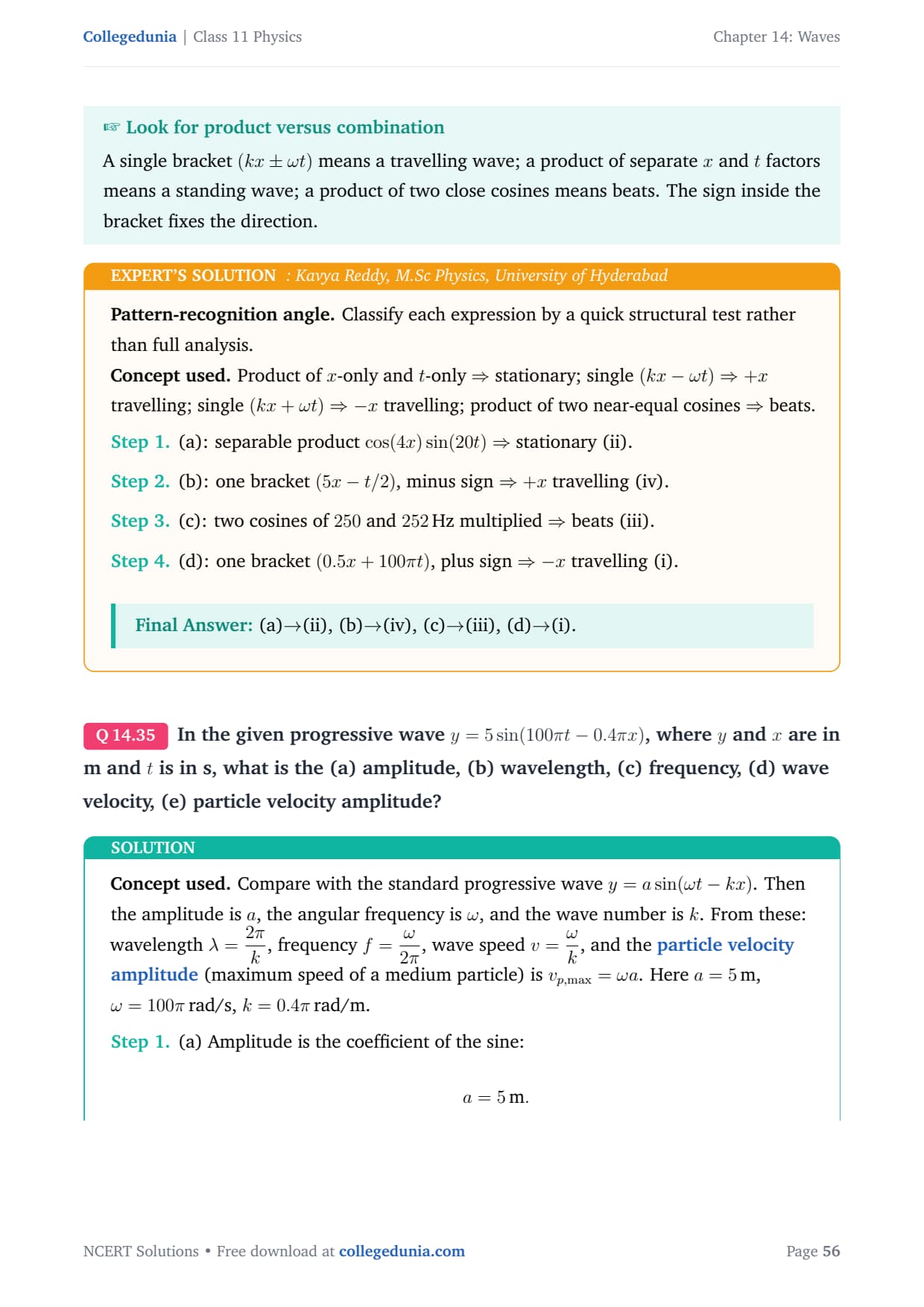
- Progressive waves: reading amplitude, ω, k and direction off the equation
- Standing waves: nodes, antinodes and the harmonics of open and closed pipes
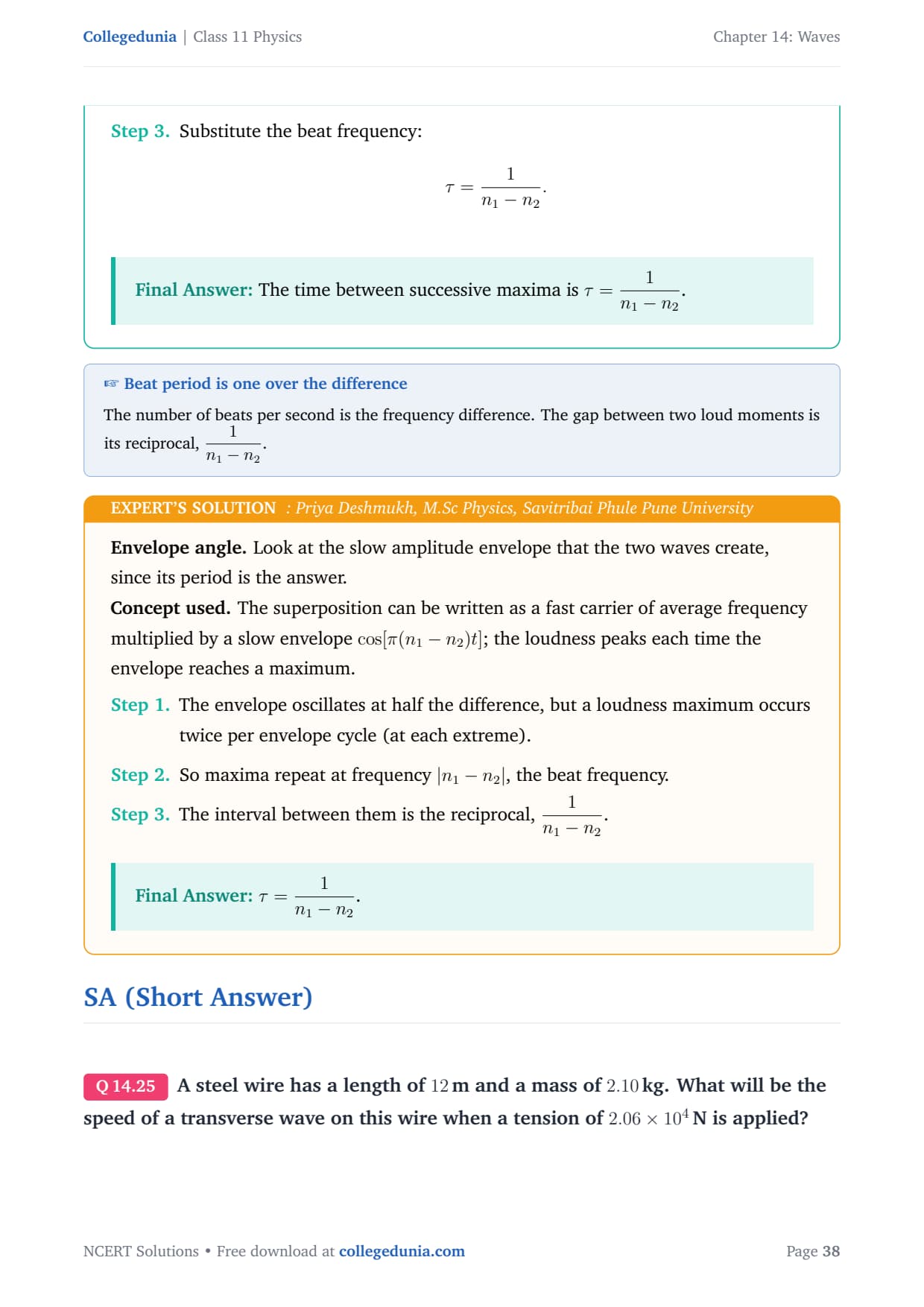
- Beats and Doppler: fbeat = |f1 − f2|, and the pitch shift from real motion
Question Types in the Waves NCERT Exemplar
The 36 questions split across five types. The MCQ II set is where most marks are lost, since more than one option is correct and a partial answer scores nothing.
| Question Type | Count | What It Tests |
|---|---|---|
| MCQ I (single correct) | 10 | Recall of wave types, wave speed and what a wave actually transports |
| MCQ II (one or more correct) | 7 | Whether you can rule out every wrong option, not just spot one right one |
| VSA (Very Short Answer) | 7 | One-line reasoning on resonance, beats and harmonics |
| SA (Short Answer) | 7 | Short numericals on wave speed, pipes and the Doppler effect |
| LA (Long Answer) | 5 | Full derivations and multi-step problems worth 5 marks |
Key Formulas Used in the Waves Exemplar
Nearly every question reduces to one of the relations below. The PDF states the formula before substituting, so you see which one is doing the work.
- Wave relation: v = fλ = ω/k, the equation behind most of the chapter
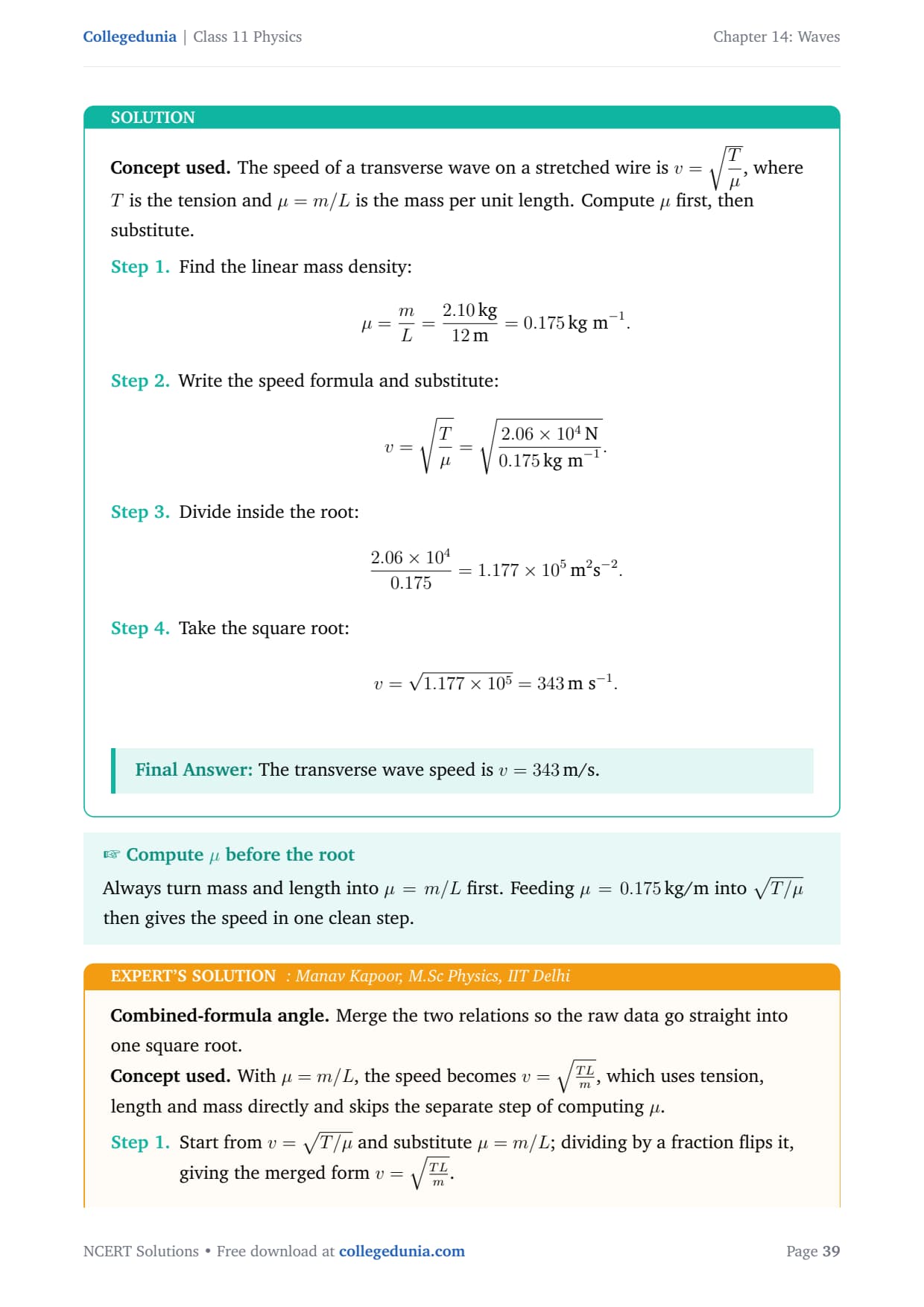
- String: v = √(T/μ), where μ = m/L is the mass per unit length
- Sound in a gas: v = √(B/ρ), giving v ∝ √T on the kelvin scale
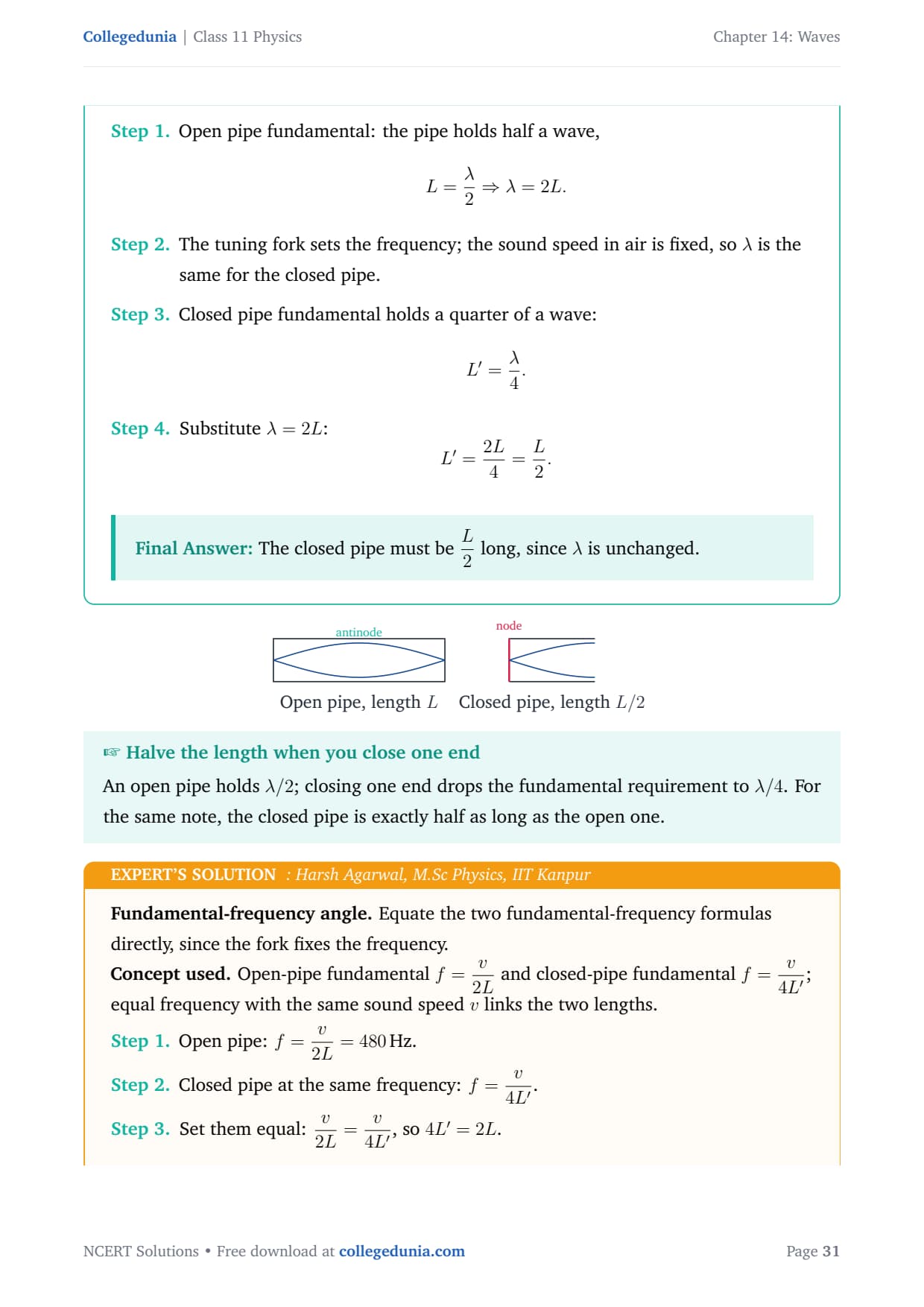
- Pipes: open fn = nv/2L; closed fn = (2n − 1)v/4L
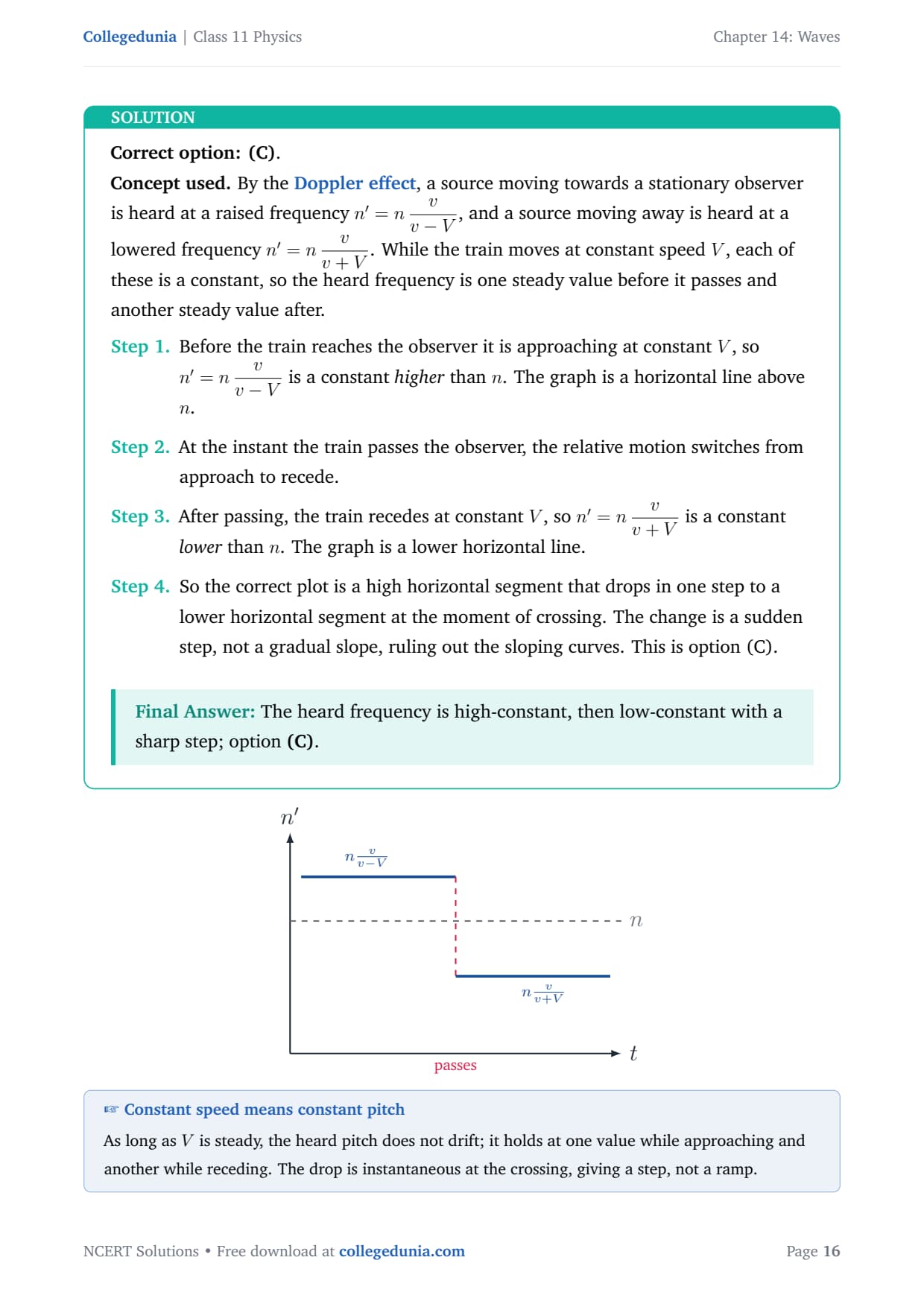
- Doppler effect: f′ = f(v ± vo)/(v ∓ vs), signs set by the direction of motion
Common Mistakes Students Make in Waves
The Exemplar sets its traps deliberately. These four catch most students, and each is flagged in the PDF at the question where it bites.
- Wind is not a Doppler source: Question 16 blows a 10 m/s wind past a standing train whistling at 400 Hz. The wind raises the speed of sound and stretches the wavelength together, so f = v/λ is unchanged.
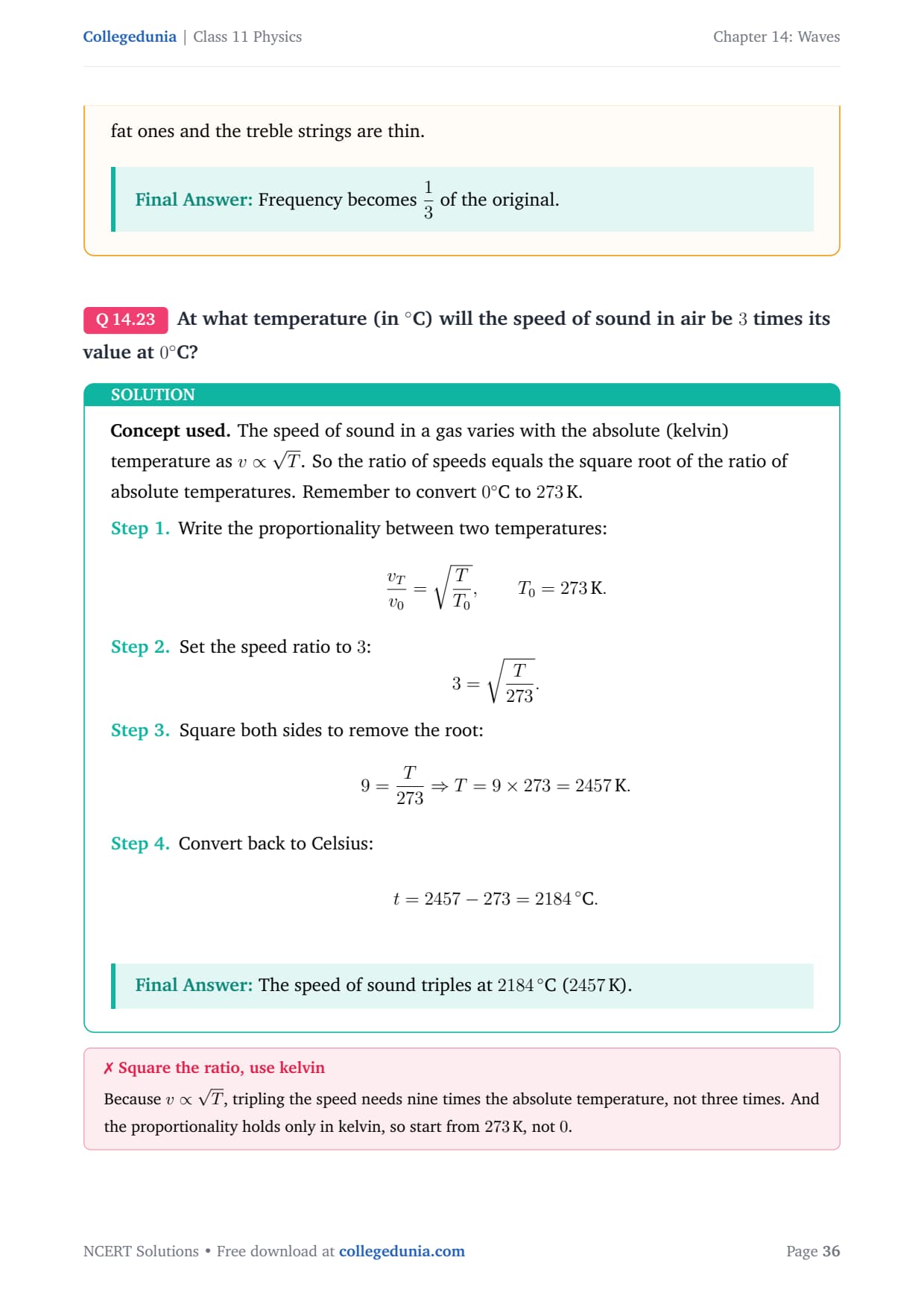
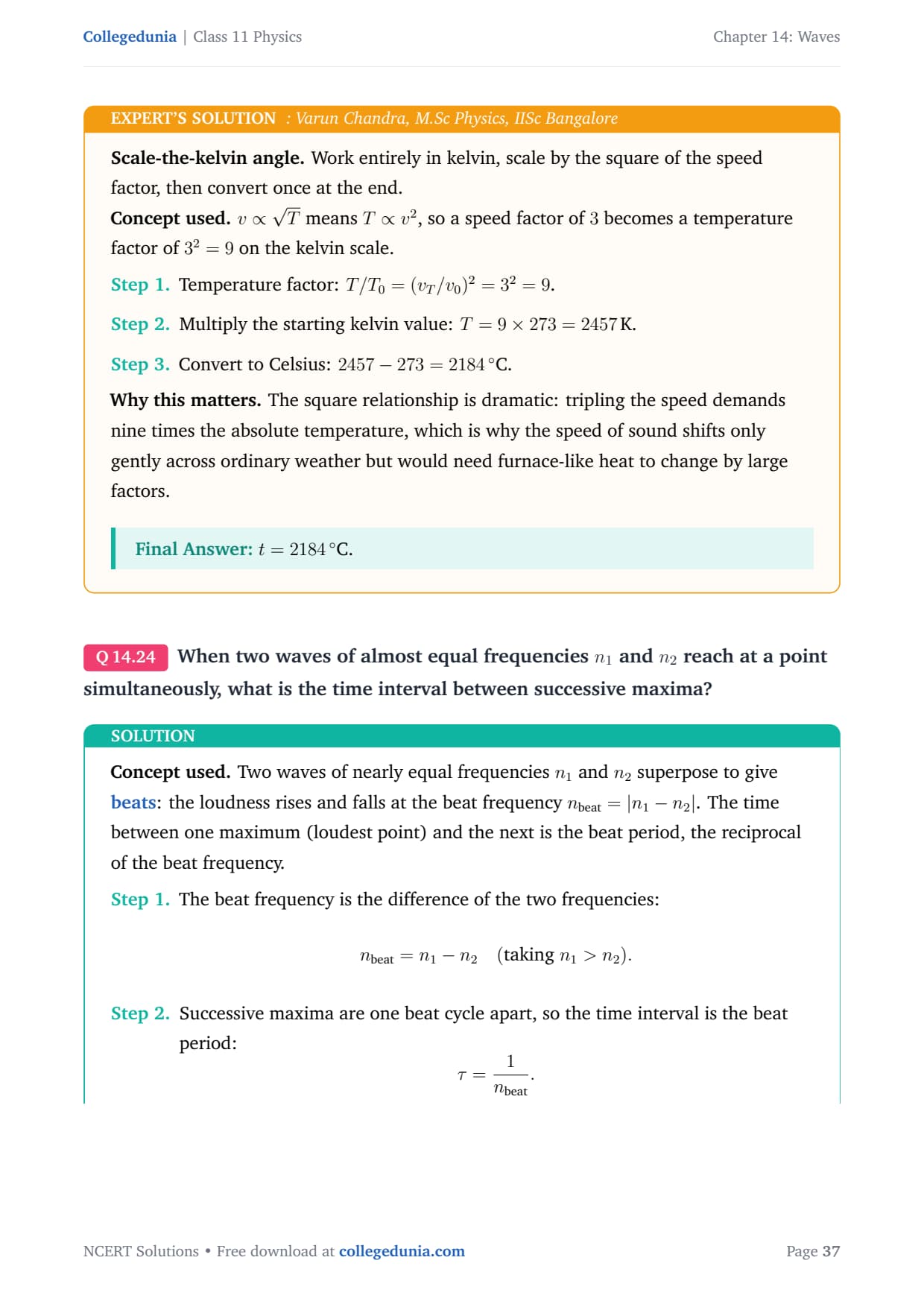
- Forgetting kelvin, forgetting the square: Question 23 asks when sound travels 3 times its speed at 0°C. Since v ∝ √T, you need 9 times the absolute temperature, so 9 × 273 K = 2457 K, which is 2184°C, not 819°C.
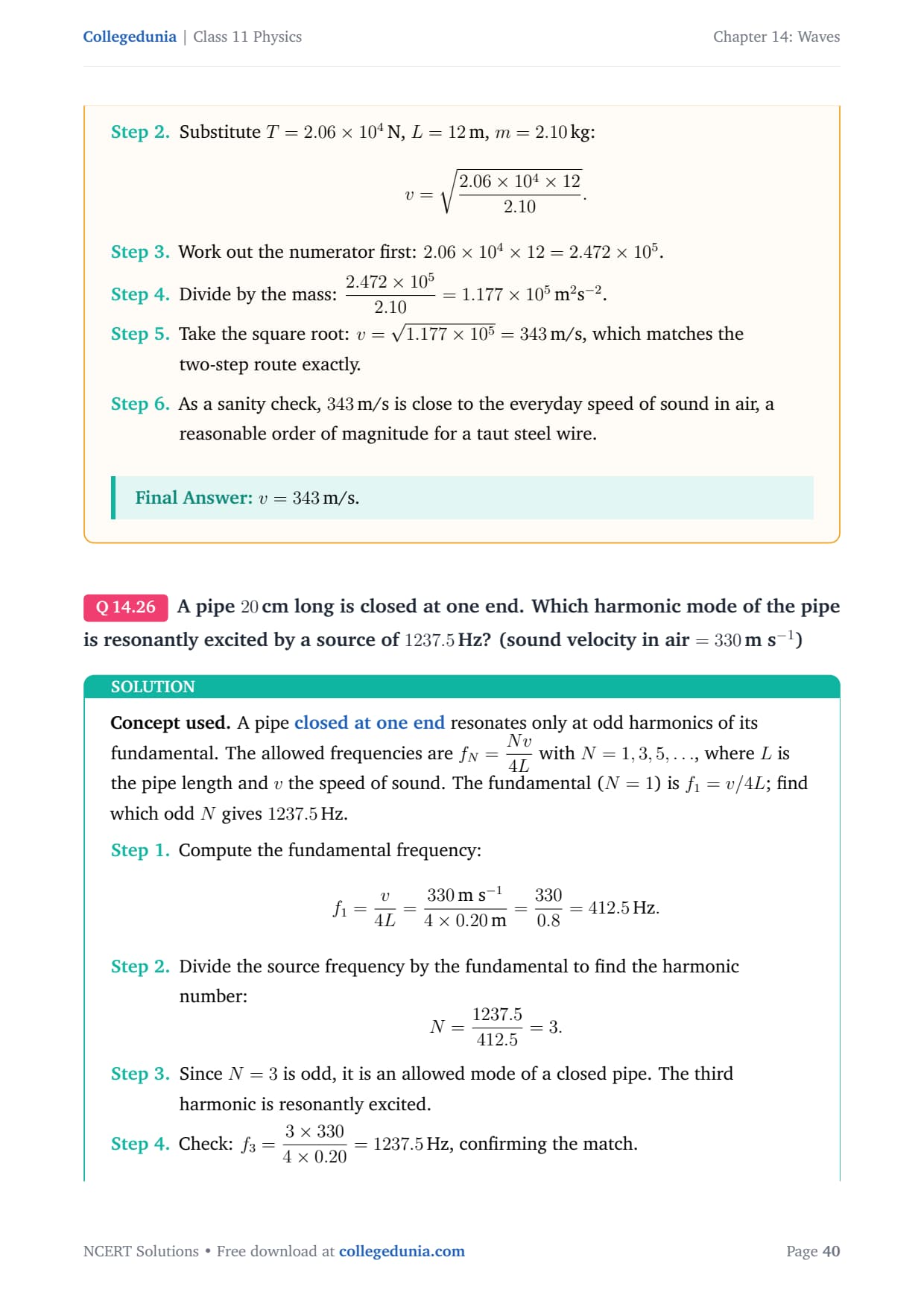
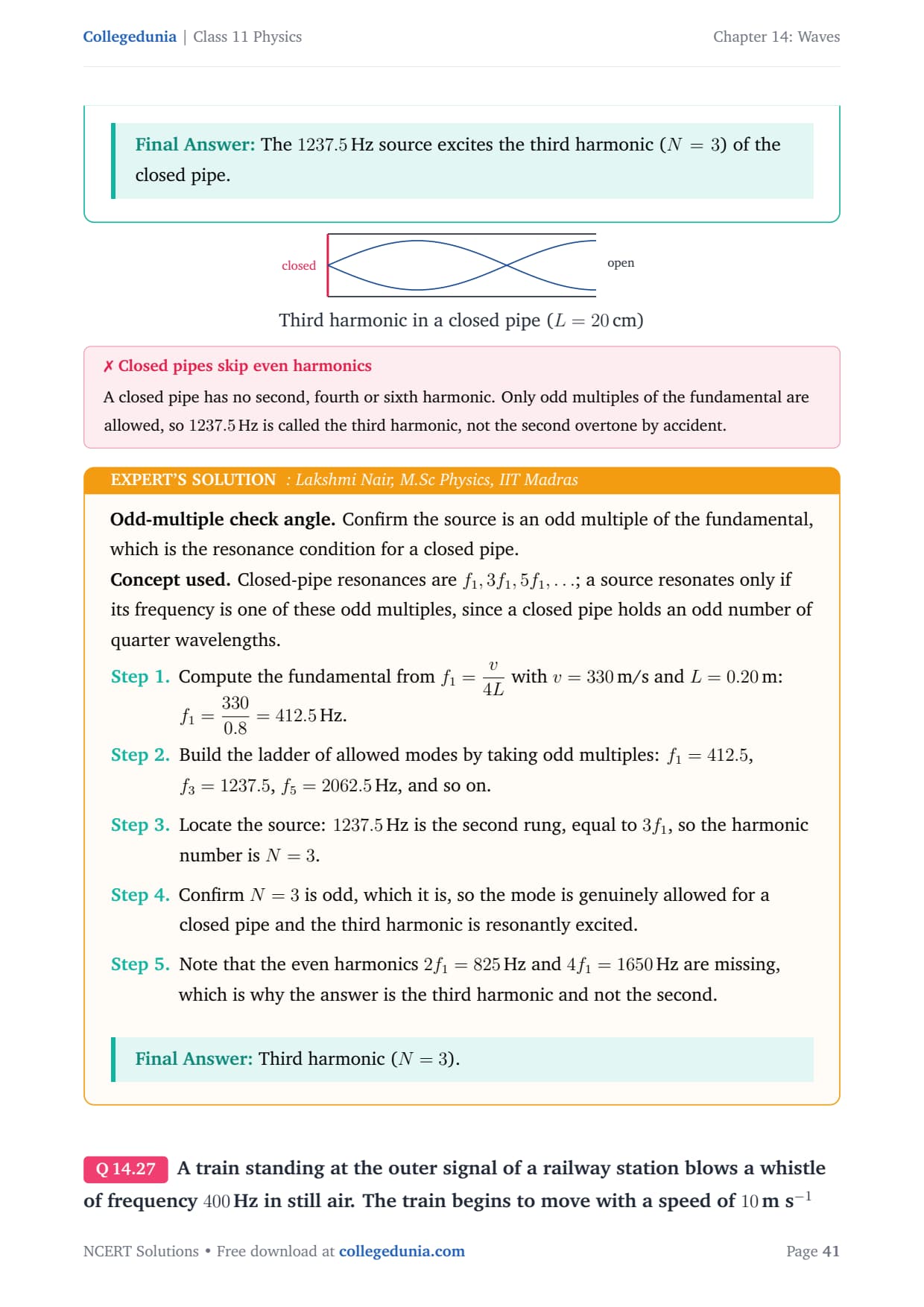
- Closed pipes skip even harmonics: a closed pipe resonates only at odd multiples of its fundamental. Question 26 answers third harmonic, with no second harmonic on offer.
- Reflection changes two things: Question 8 reflects a wave off a denser medium. Reverse the sign of x and multiply by −1 for the π phase shift. Miss either and a distractor is waiting.
One more trap deserves naming. Transverse mechanical waves need a shear modulus, which only solids have, so they die in still air or deep water. Question 6 is built on that.
How the Exemplar Steps Up from the Class 11 Physics Textbook
The textbook hands you a rule and asks you to apply it. The Exemplar makes you choose the rule yourself, and explain why the tempting rule does not apply.
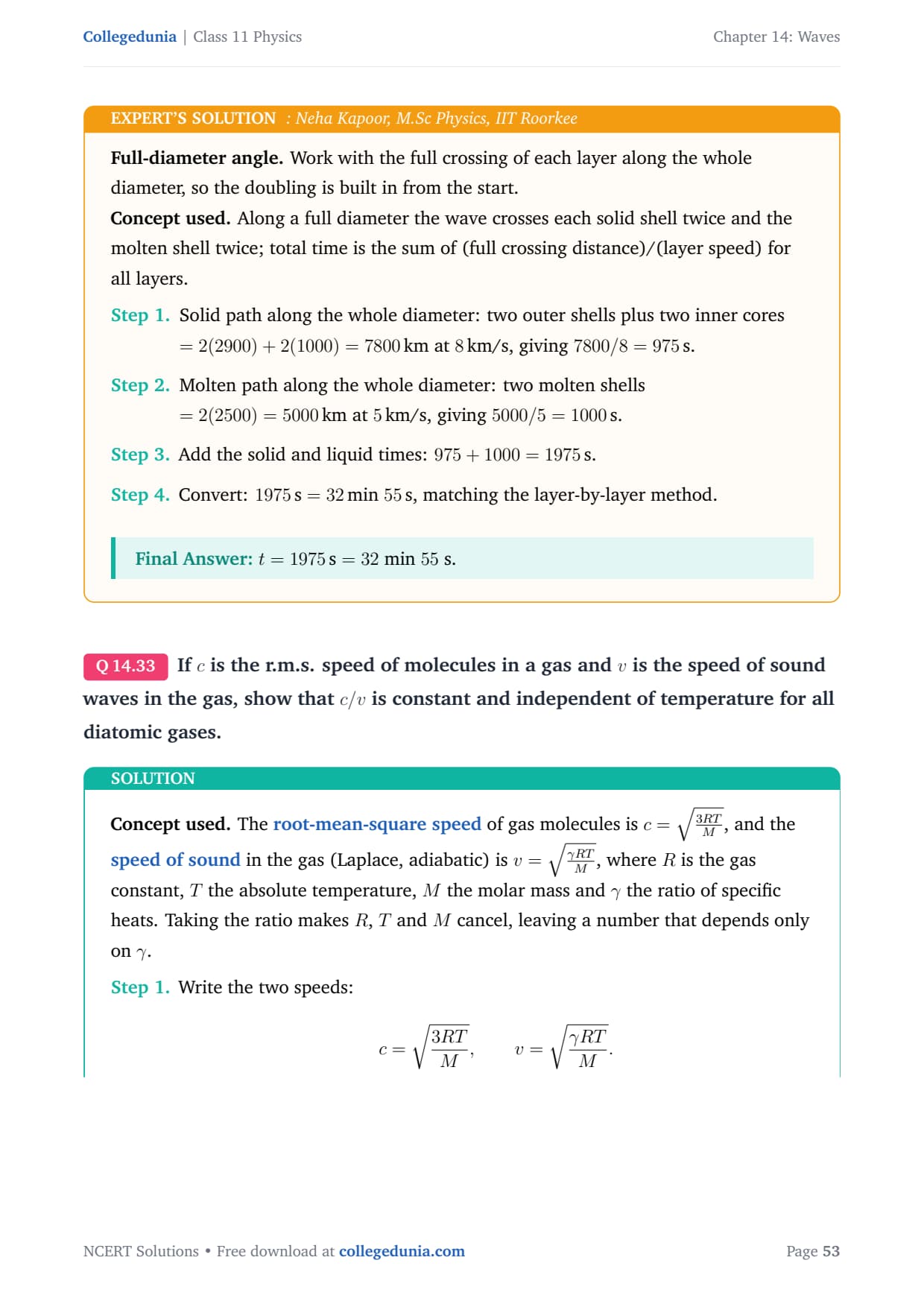
Question 32 shows the gap well. An earthquake sends a P-wave along the earth's diameter, through a solid shell at 8 km/s, a molten layer at 5 km/s, then the solid inner core. You must time each layer separately and add, which gives 1975 s, or 32 minutes 55 seconds. A single average speed gives the wrong answer.
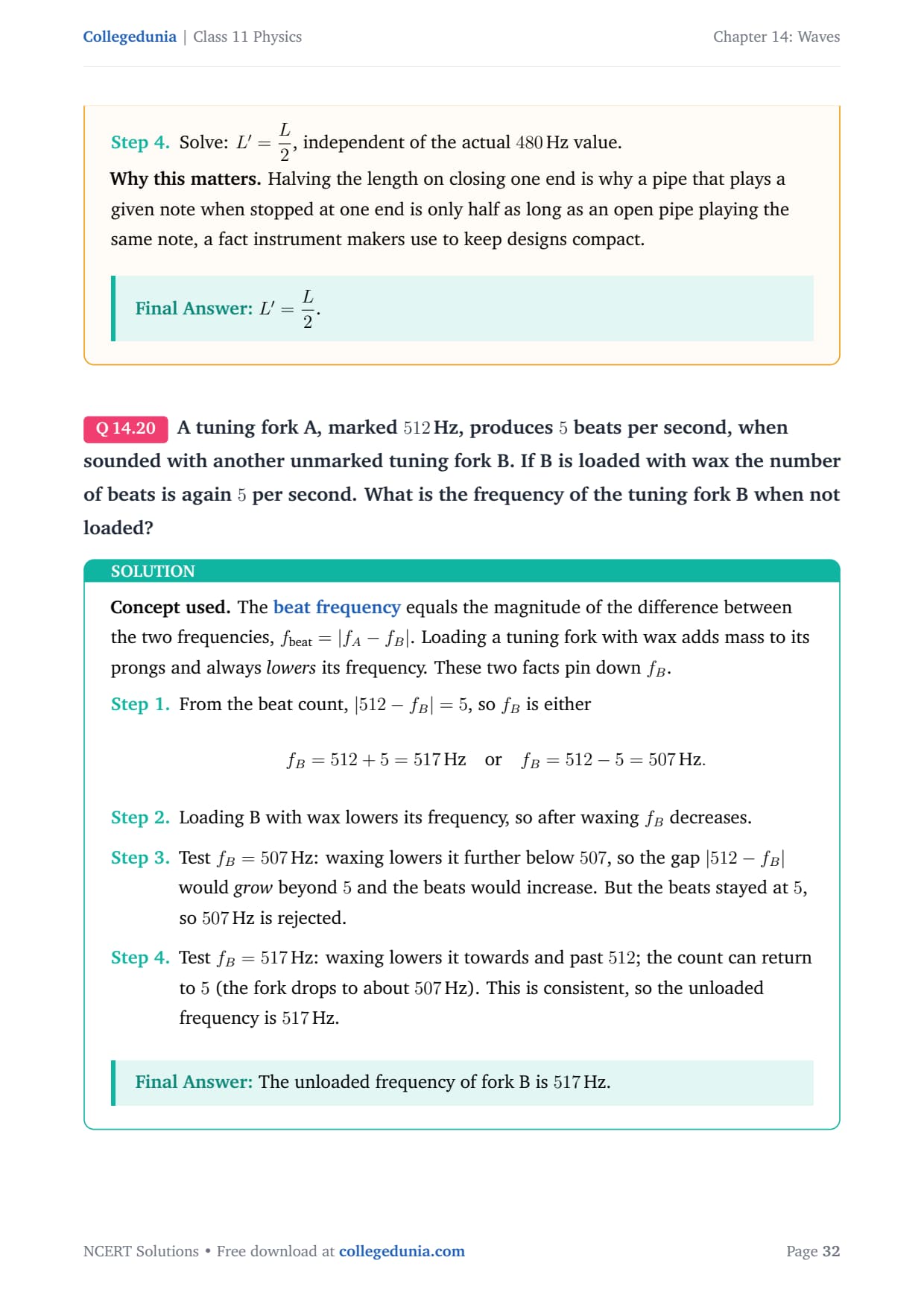
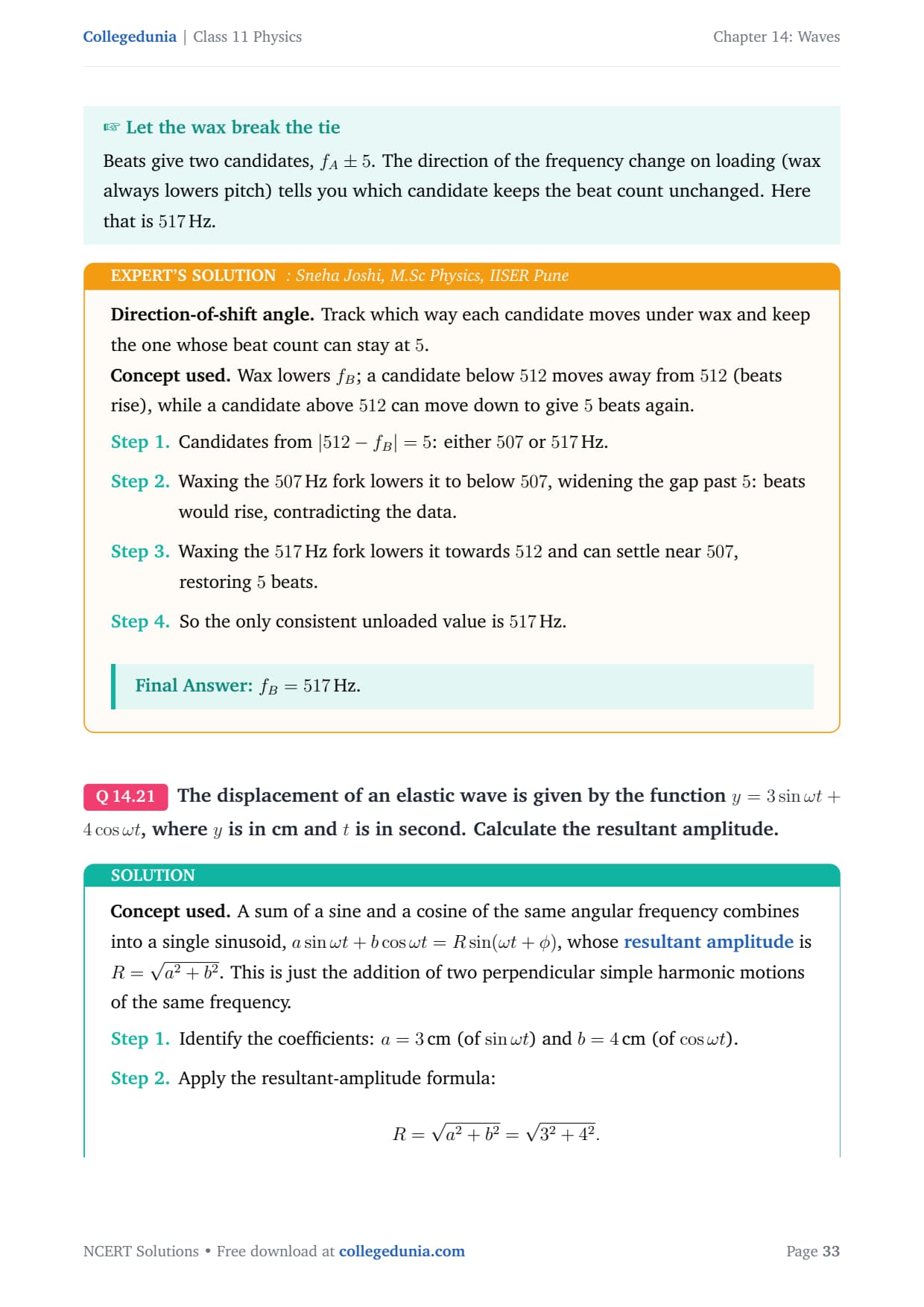
Question 20 is smaller but just as sharp. Fork A at 512 Hz gives 5 beats with fork B, and loading B with wax still gives 5 beats. Only 517 Hz fits both conditions.
How to Use These NCERT Exemplar Solutions for Boards, JEE and NEET
Attempt each question before you open the solution. The Exemplar rewards the attempt far more than the reading.
- Boards: the VSA and SA sets match the 2 and 3 mark board pattern closely
- JEE Main: start with the MCQ II set, since JEE probes standing waves the same way
- NEET: the MCQ I set covers the recall questions NEET repeats yearly
Student Feedback
Students who used Collegedunia's Class 11 Physics Exemplar Solutions told us the Doppler and beats questions were the hardest part. Around 7 in 10 said the step-by-step format helped most on the Long Answer problems, where the textbook offers no comparable practice.
Other Resources for Class 11 Physics Waves
Collegedunia has the full study material set for this chapter. Read the Notes first, then use the Exemplar once the basics are steady.
Also Check:
- NCERT Solutions for Class 11 Physics Chapter 14
- Class 11 Physics Chapter 14 Notes
- Class 11 Physics Chapter 14 Handwritten Notes
- Class 11 Physics Chapter 14 NCERT Book PDF
- Class 11 Physics Chapter 14 Exemplar Questions with Solutions
NCERT Exemplar Solutions for Other Class 11 Physics Chapters
Every chapter below has the same step-by-step treatment and a free PDF.
Waves Class 11 Physics NCERT Exemplar Solutions FAQs
Ques. How many questions are there in the Class 11 Physics Waves Exemplar?
Ans. Chapter 14 has 36 questions. They split into 10 MCQ I, 7 MCQ II, 7 Very Short Answer, 7 Short Answer and 5 Long Answer questions. All 36 are solved in the free PDF on this page.
Ques. Why does the Exemplar book number Waves as Chapter 15?
Ans. The NCERT Exemplar Problems book still uses the older chapter order, so it prints Waves as Chapter Fifteen with questions numbered 15.1 to 15.36 and figures captioned Fig. 15.1 to Fig. 15.4. The current textbook lists it as Chapter 14. The questions are the same in both, so nothing changes for your exam.
Ques. At what temperature is the speed of sound 3 times its value at 0°C?
Ans. 2184°C. Because v is proportional to the square root of the absolute temperature, tripling the speed needs 9 times the kelvin temperature. That is 9 × 273 K = 2457 K, which converts to 2184°C. Working in Celsius throughout is the usual error here.
Ques. Does wind change the pitch of a whistle you hear?
Ans. No, not when the source and the listener both stay still. A steady wind raises the speed of sound and stretches the wavelength by the same factor, so the frequency f = v/λ comes out unchanged. The Doppler effect needs the source or the observer to actually move.
Ques. Why does a pipe closed at one end have no second harmonic?
Ans. A closed pipe must hold a node at the closed end and an antinode at the open end, which fits only an odd number of quarter wavelengths. That allows f, 3f, 5f and so on. Even multiples cannot satisfy the boundary conditions, so they never appear.



Comments