




NCERT Exemplar Solutions for Class 11 Physics Chapter 13 Oscillations solve all 40 questions from the Exemplar book. Every MCQ, Very Short Answer, Short Answer and Long Answer problem is worked step by step. The free PDF on this page runs to 60 pages and follows the 2026-27 syllabus.
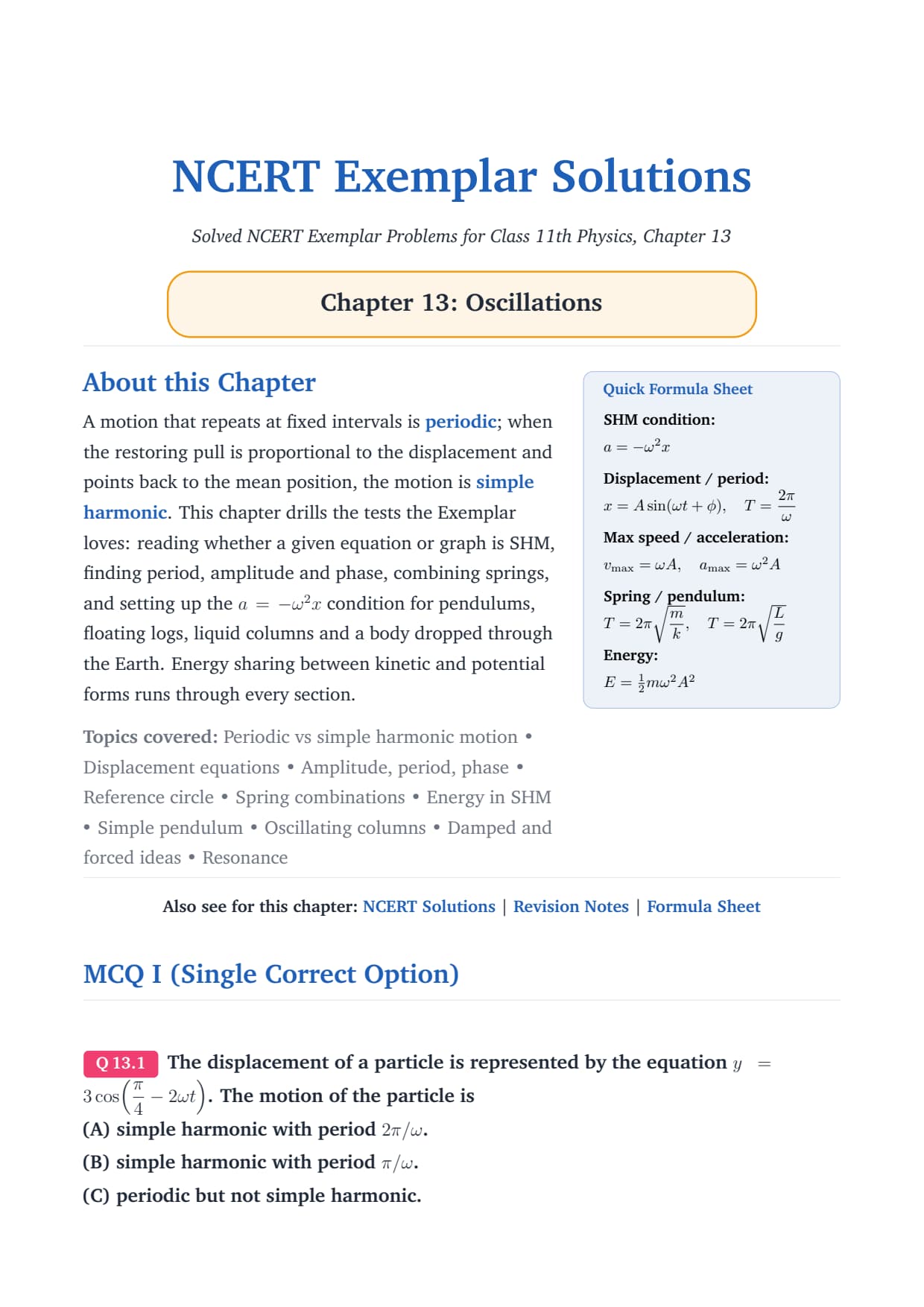
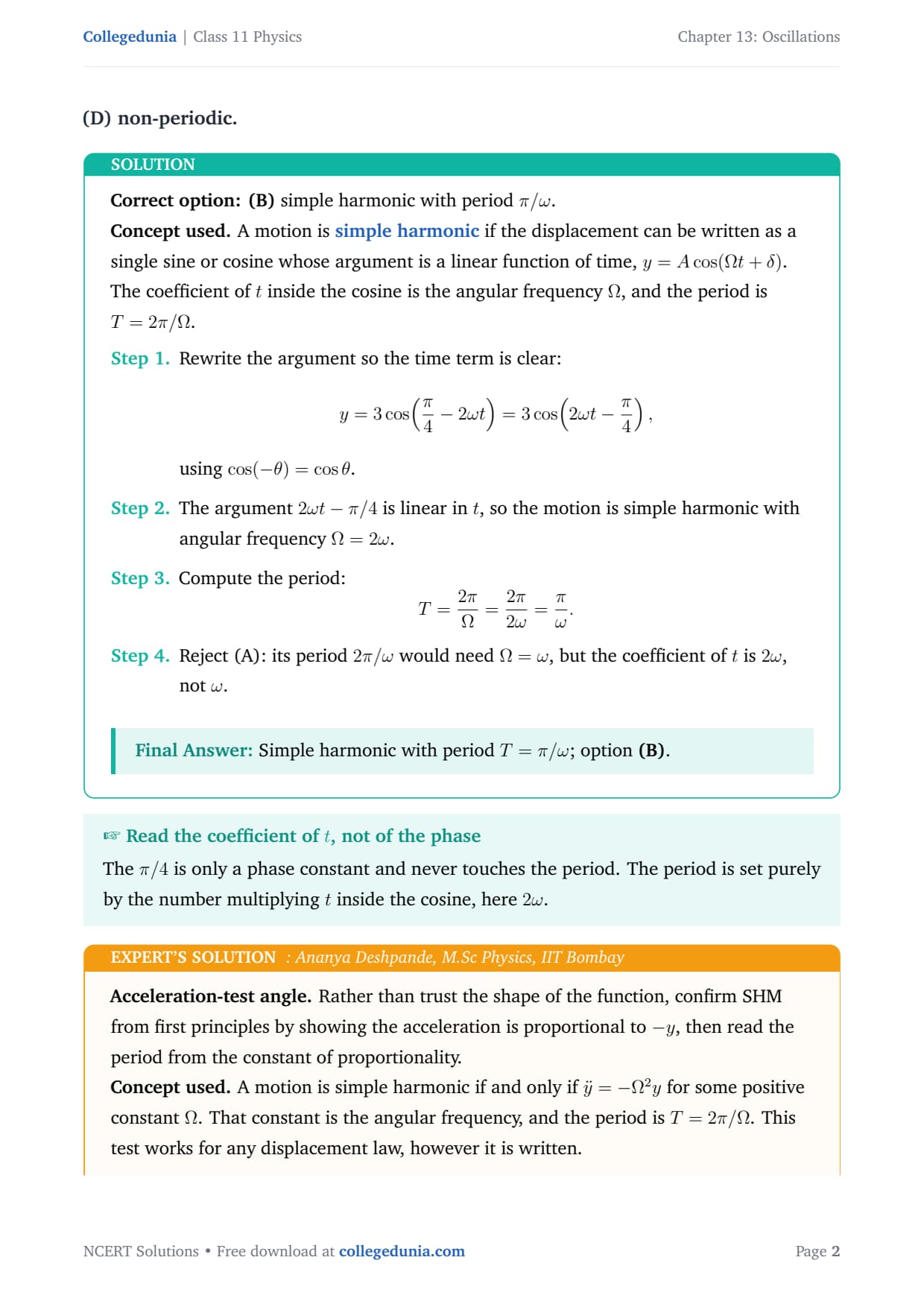
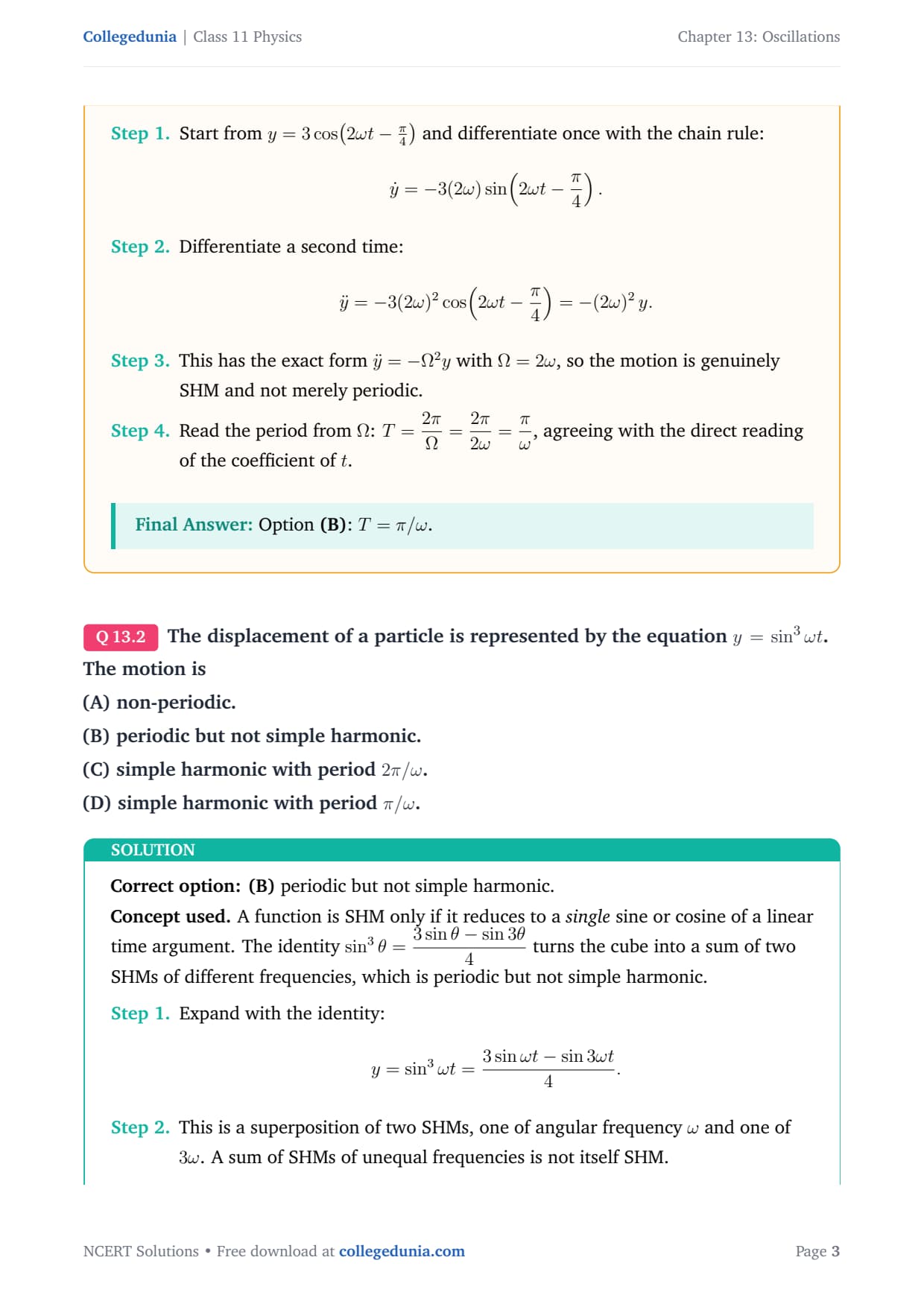
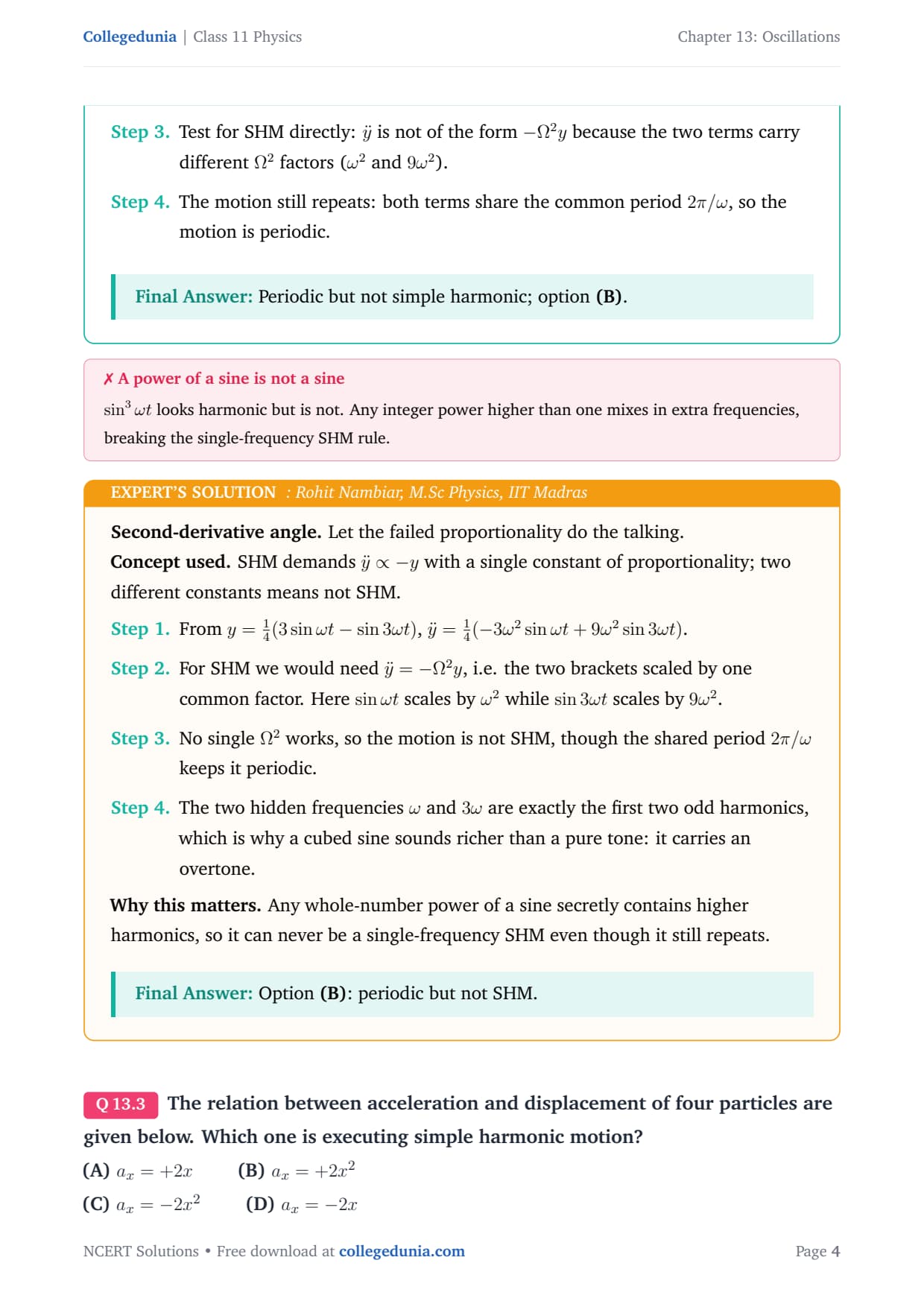
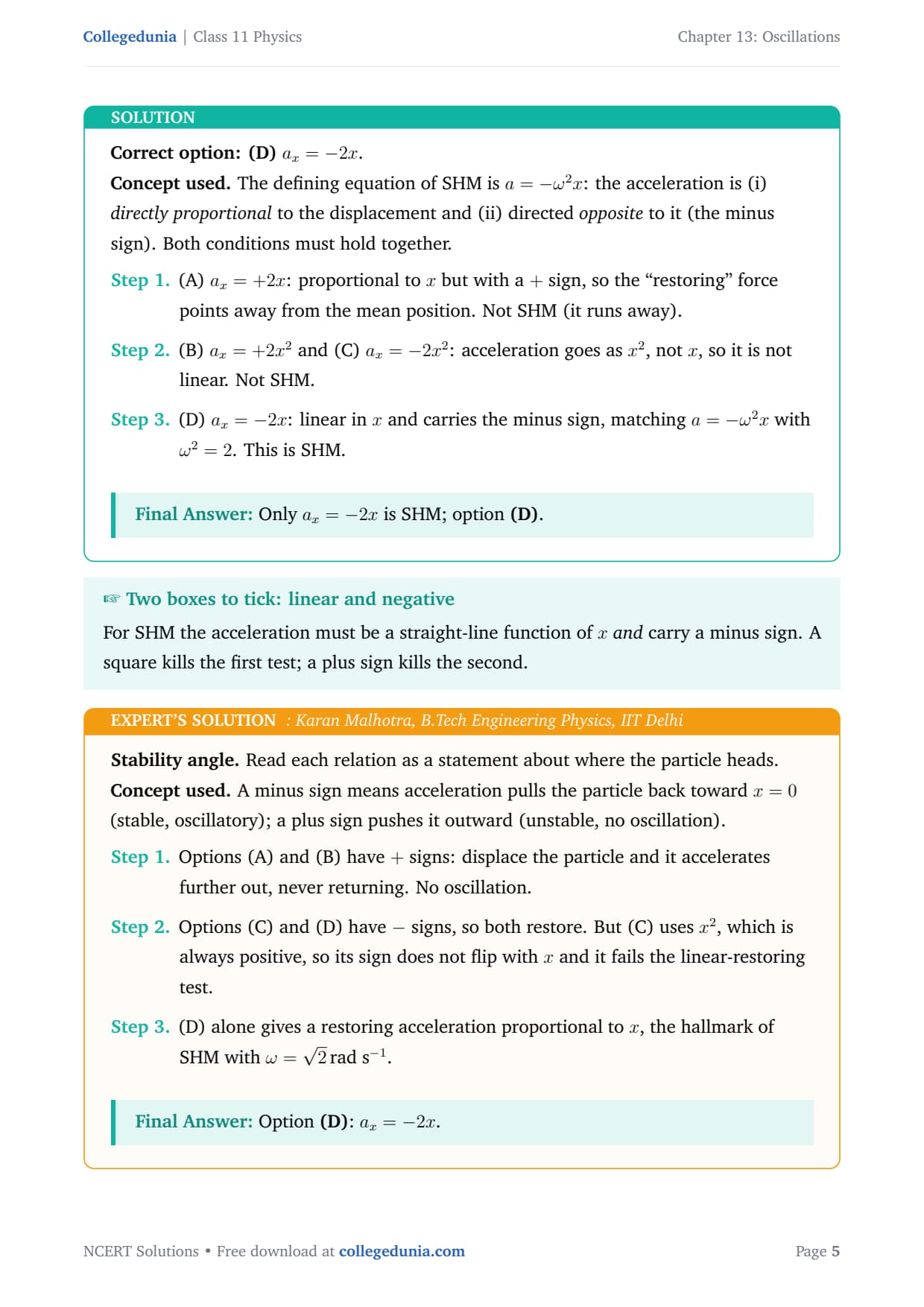
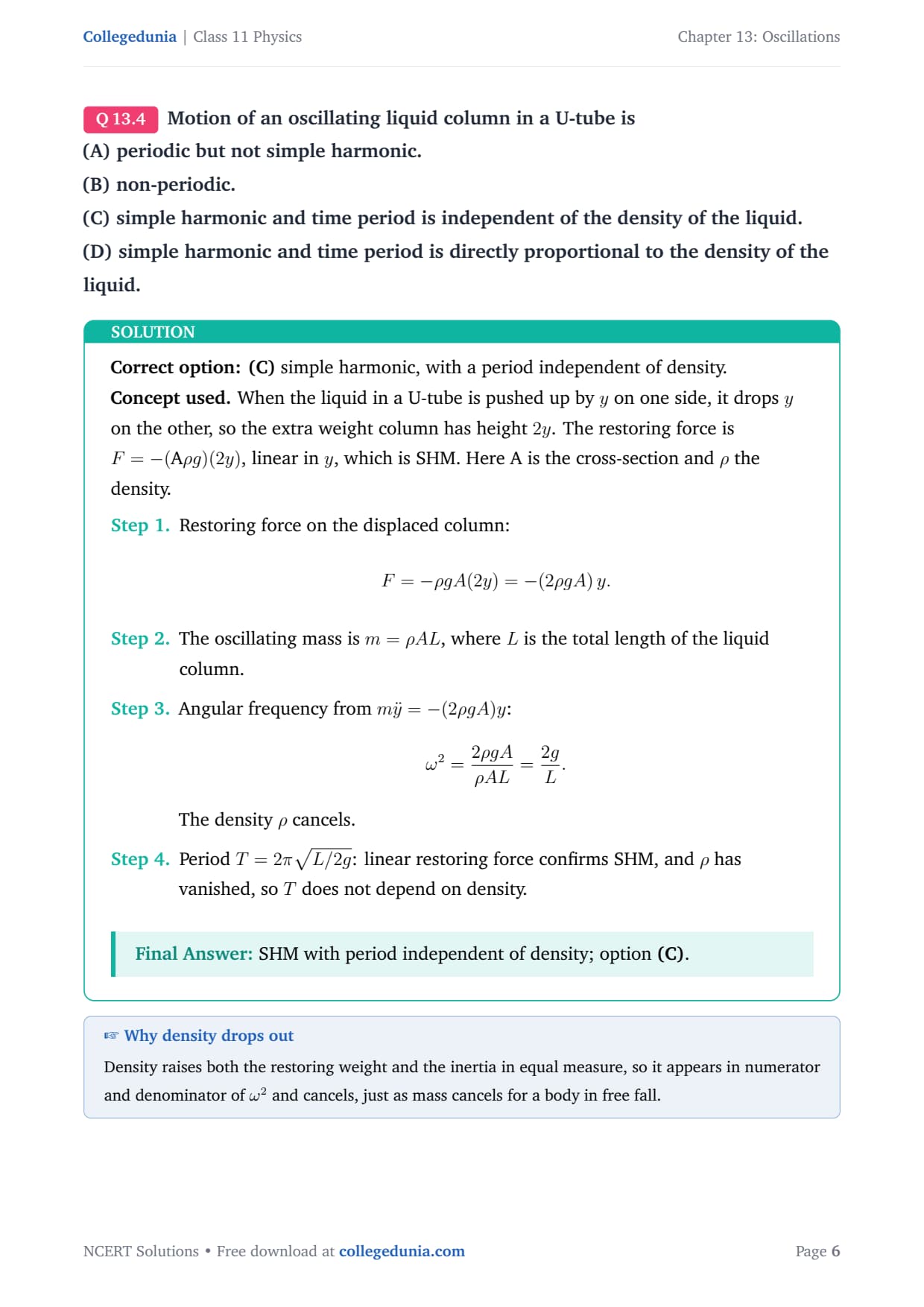
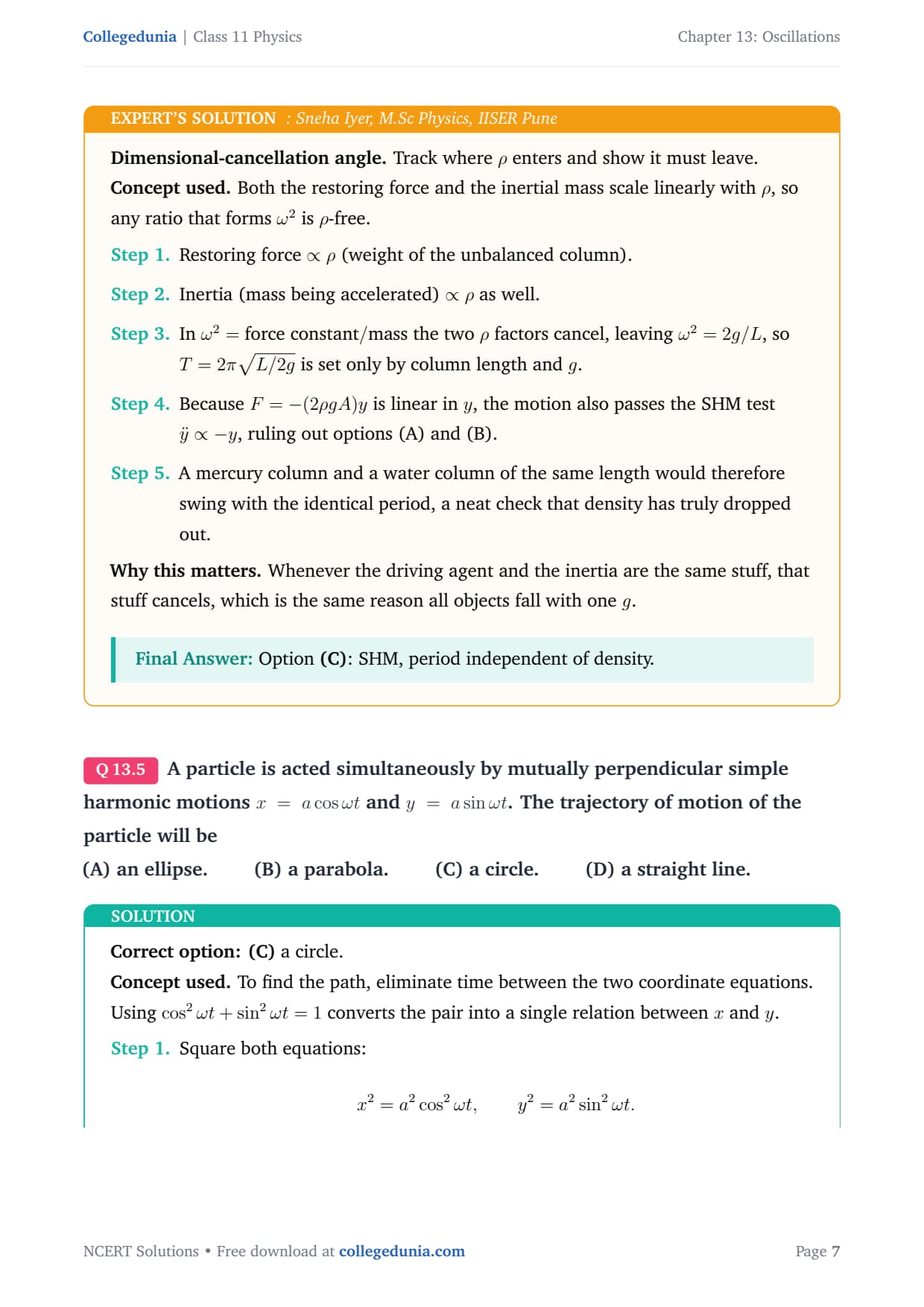
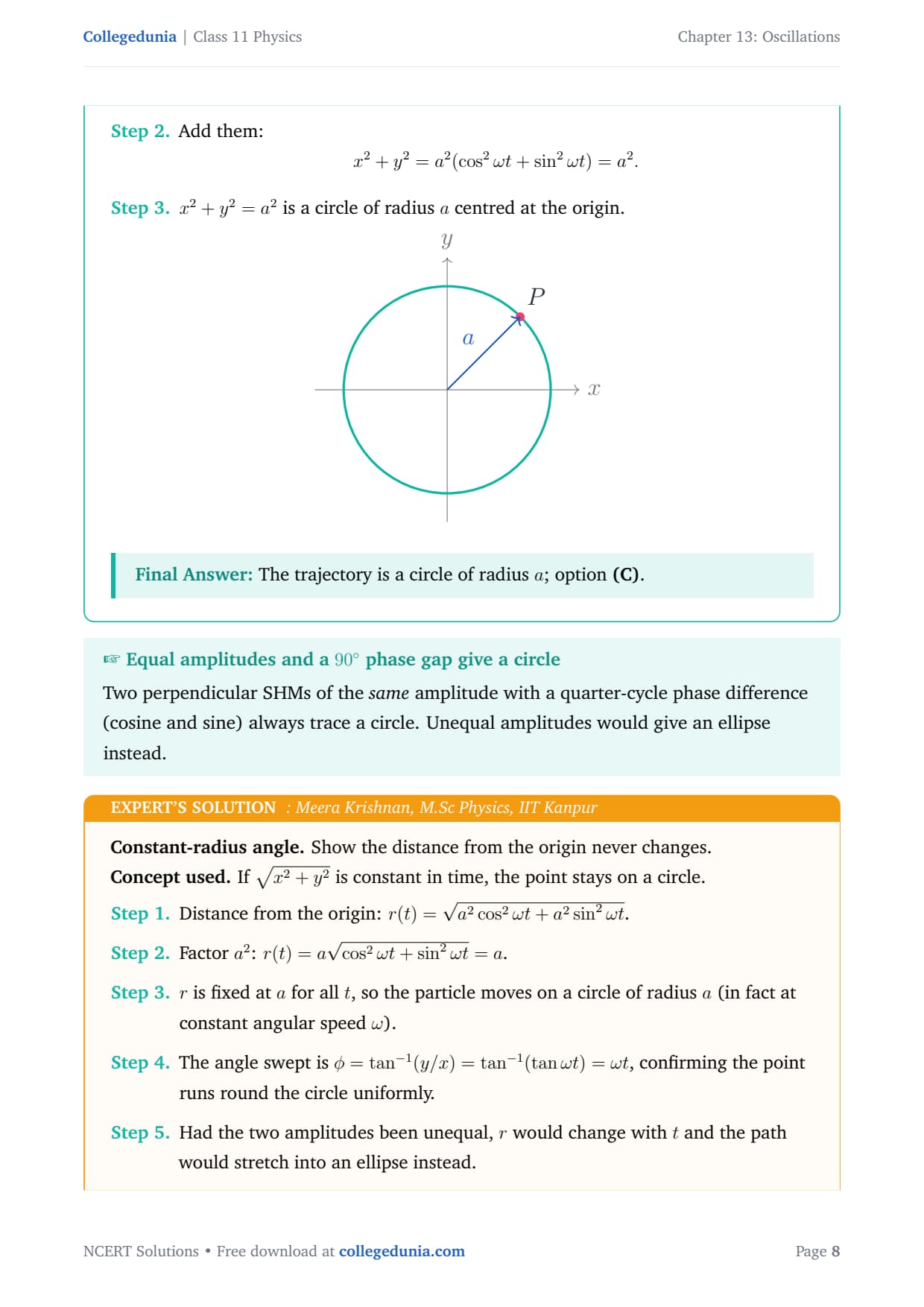
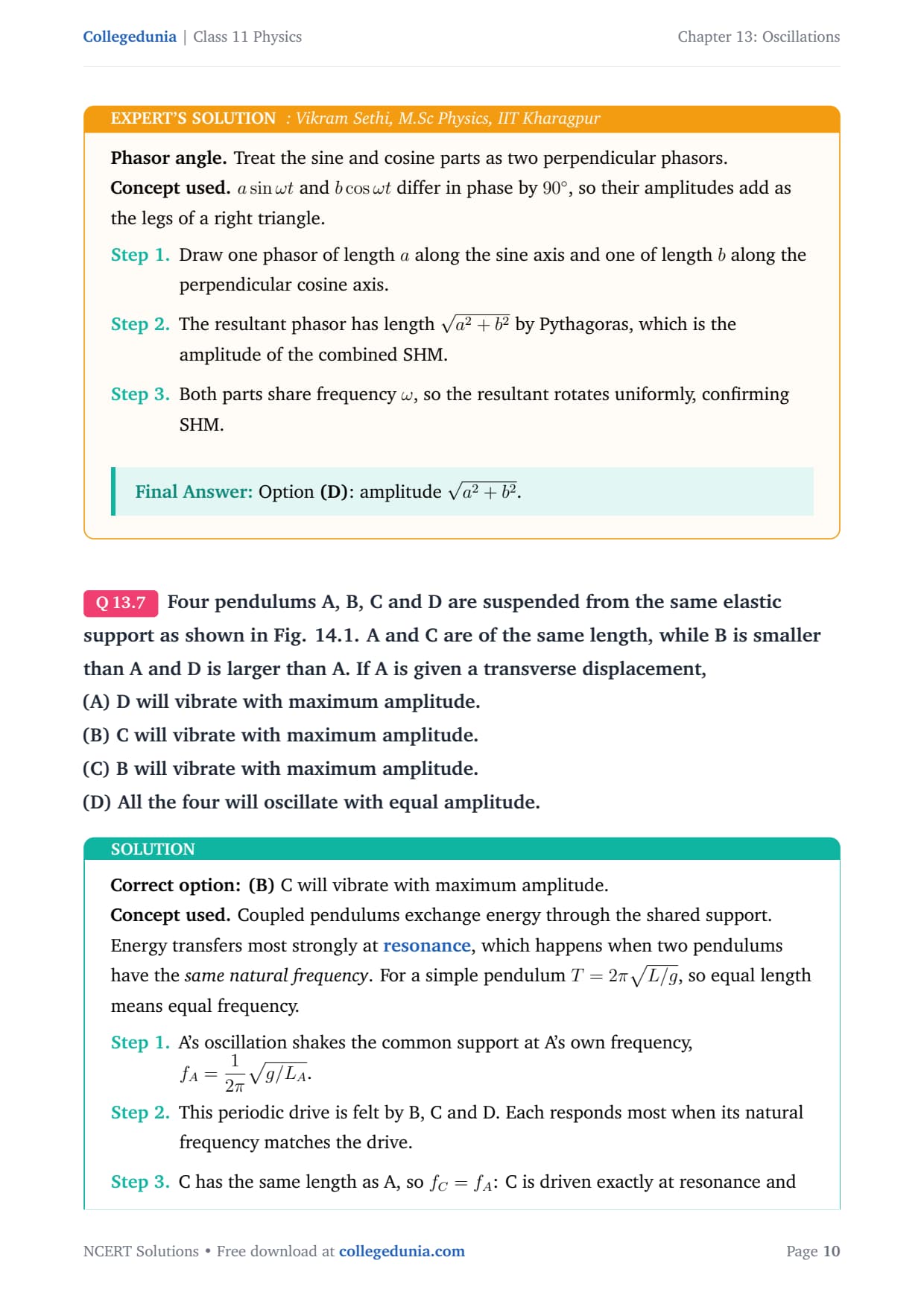
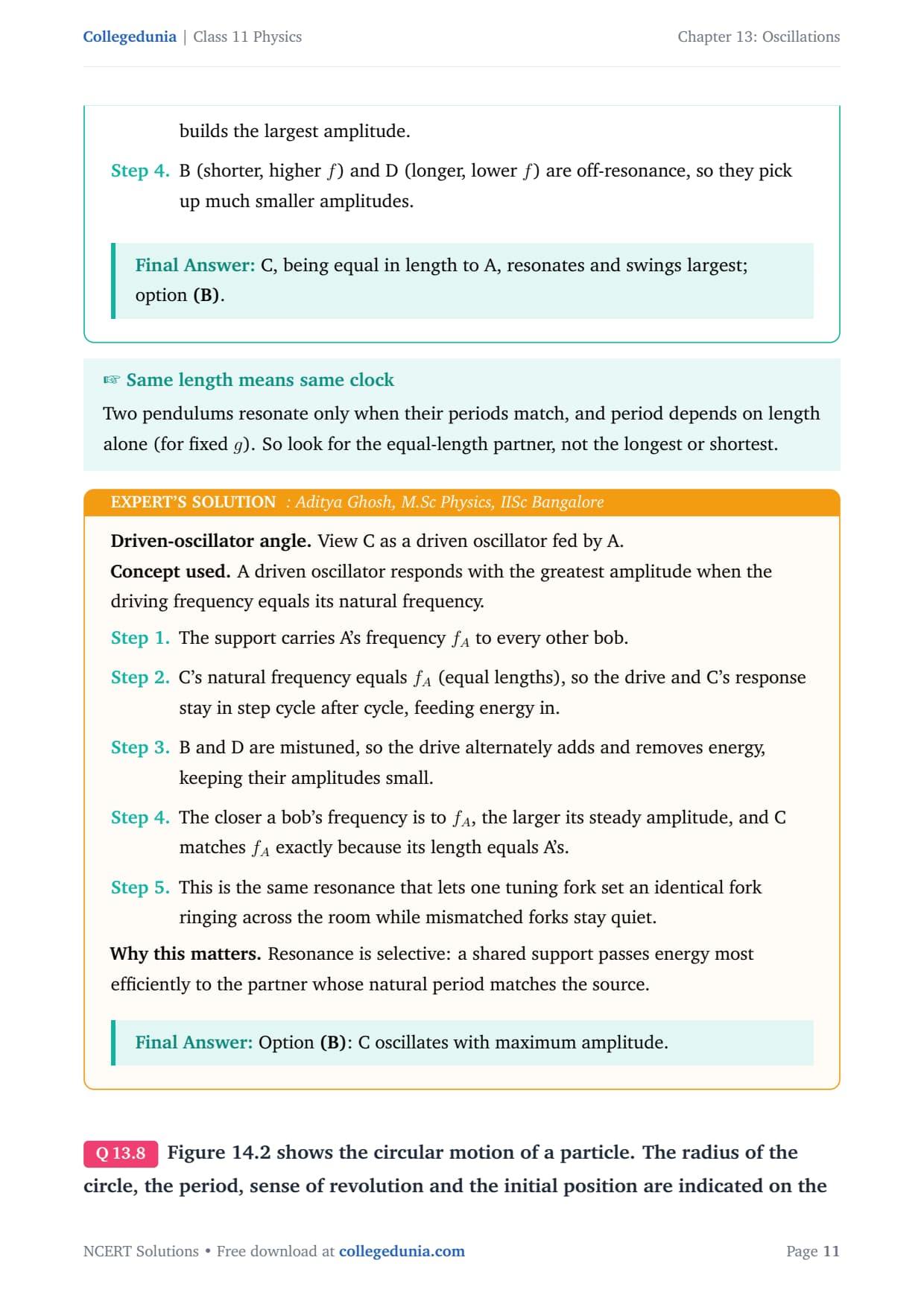
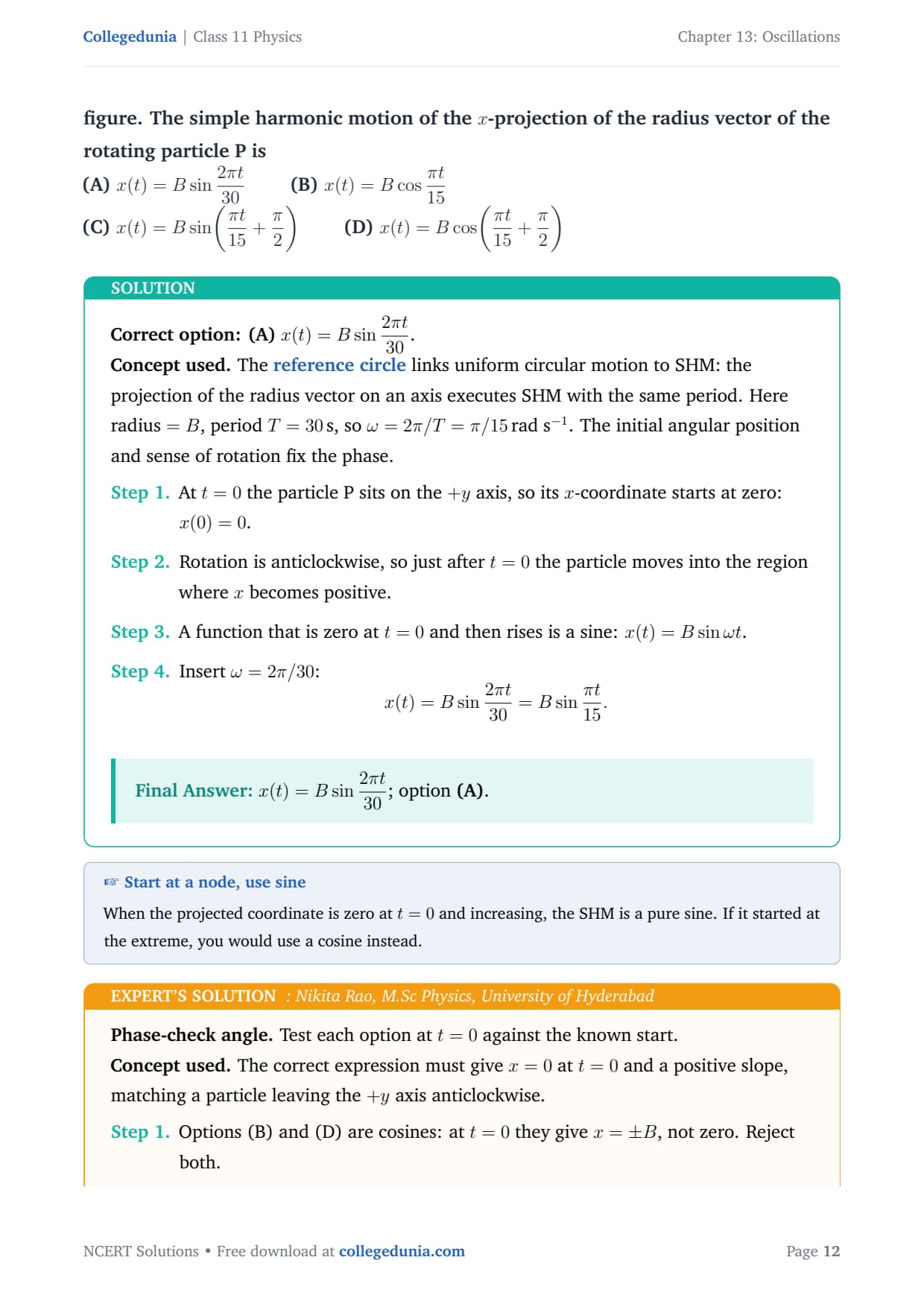
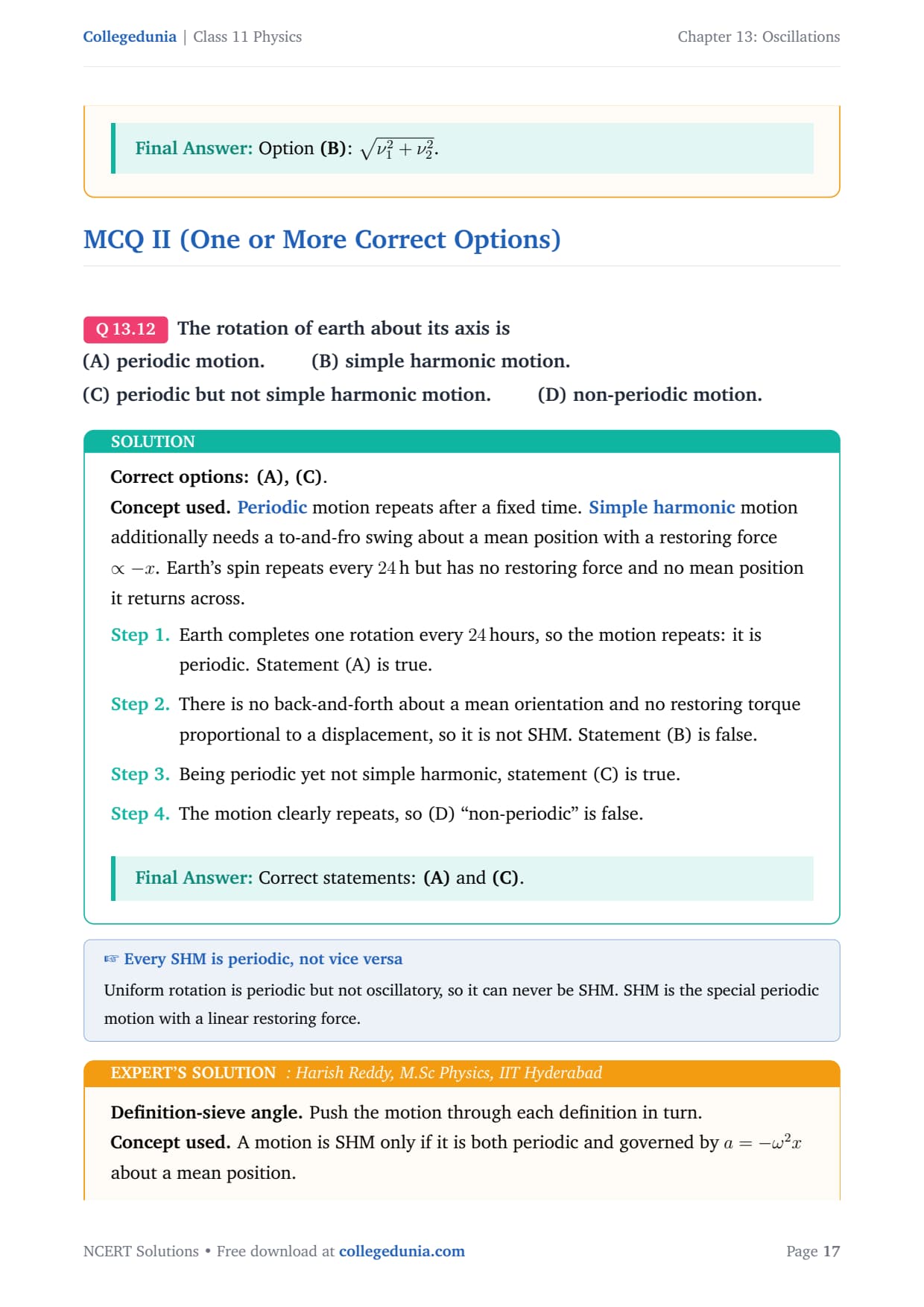
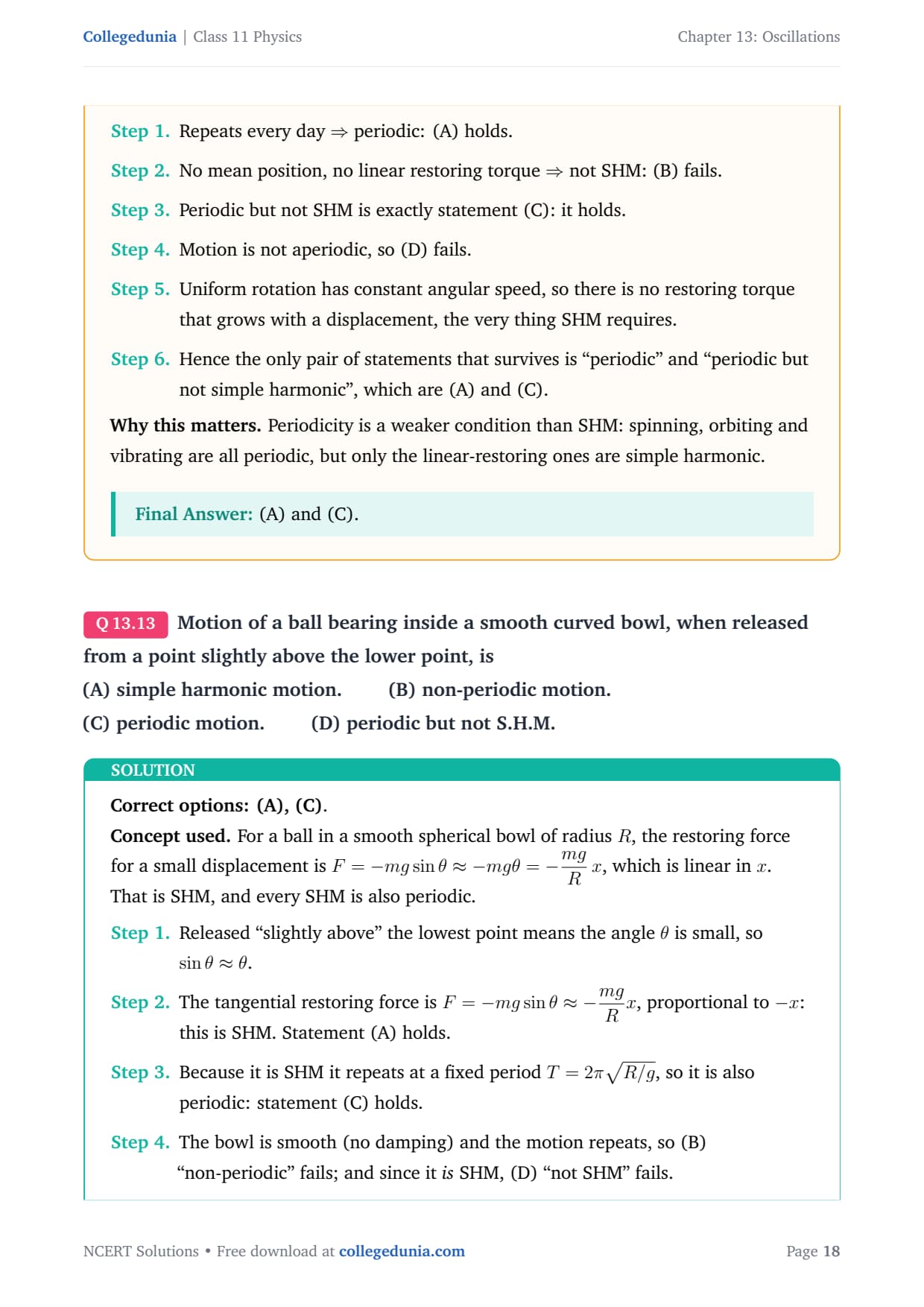
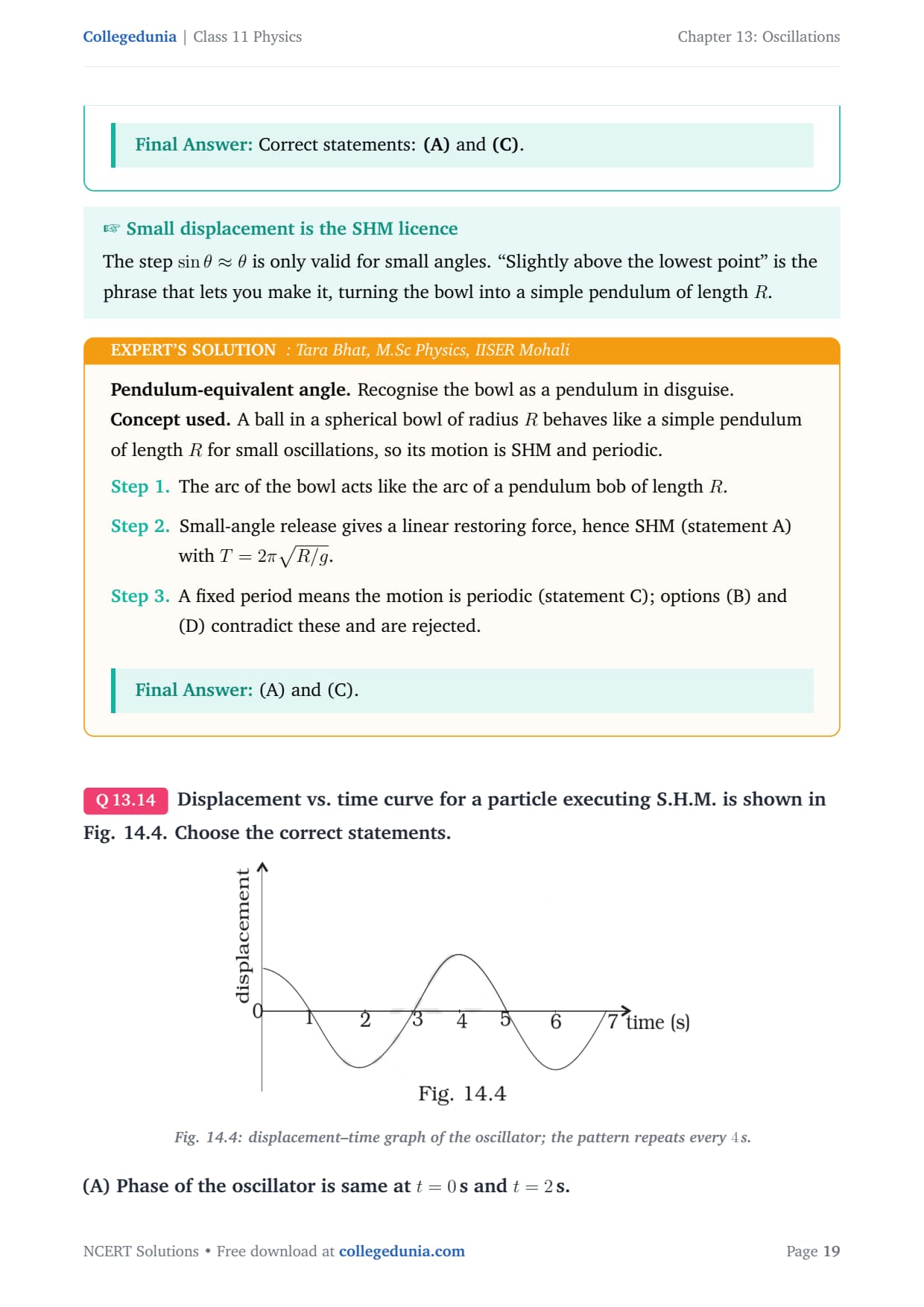
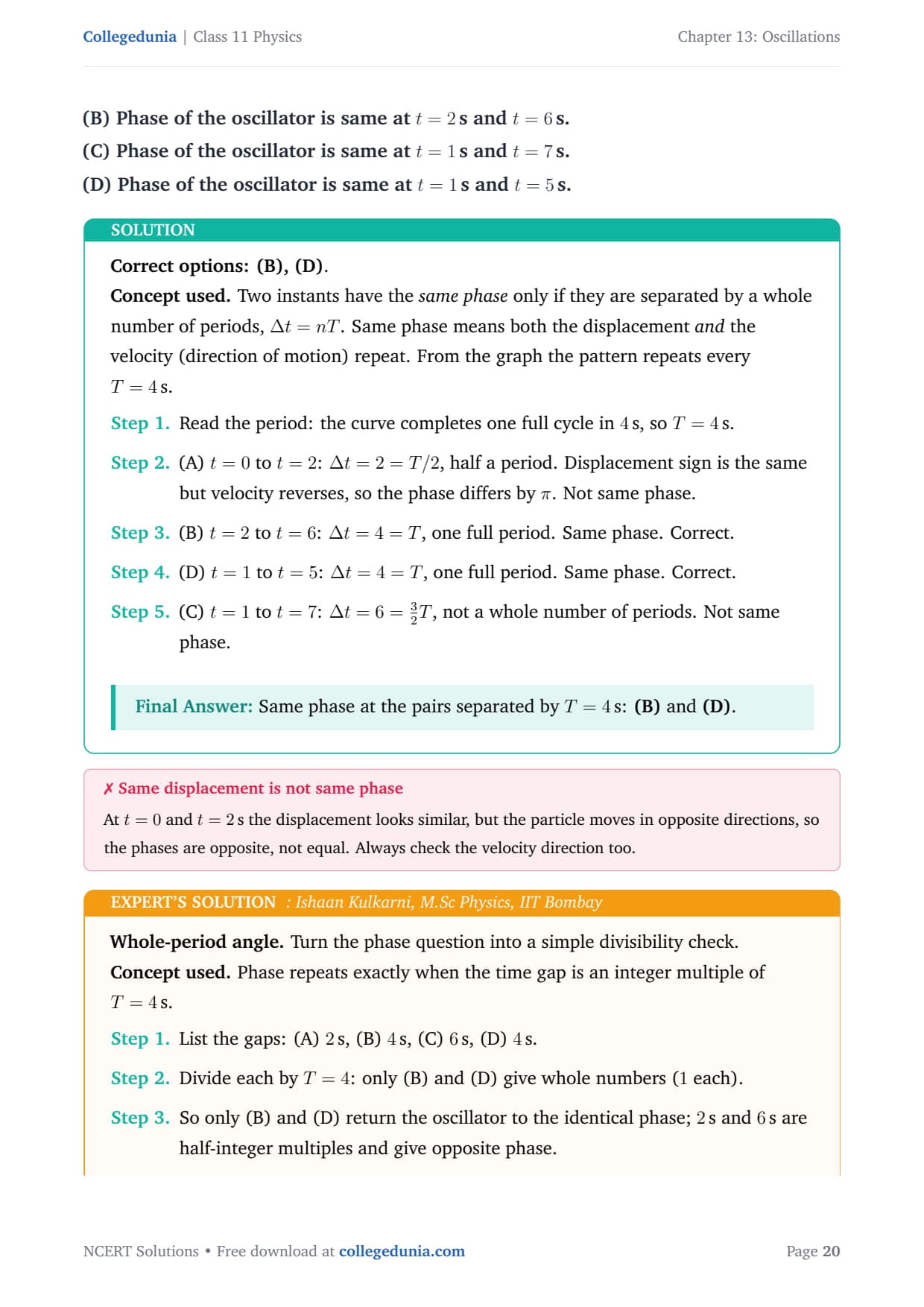
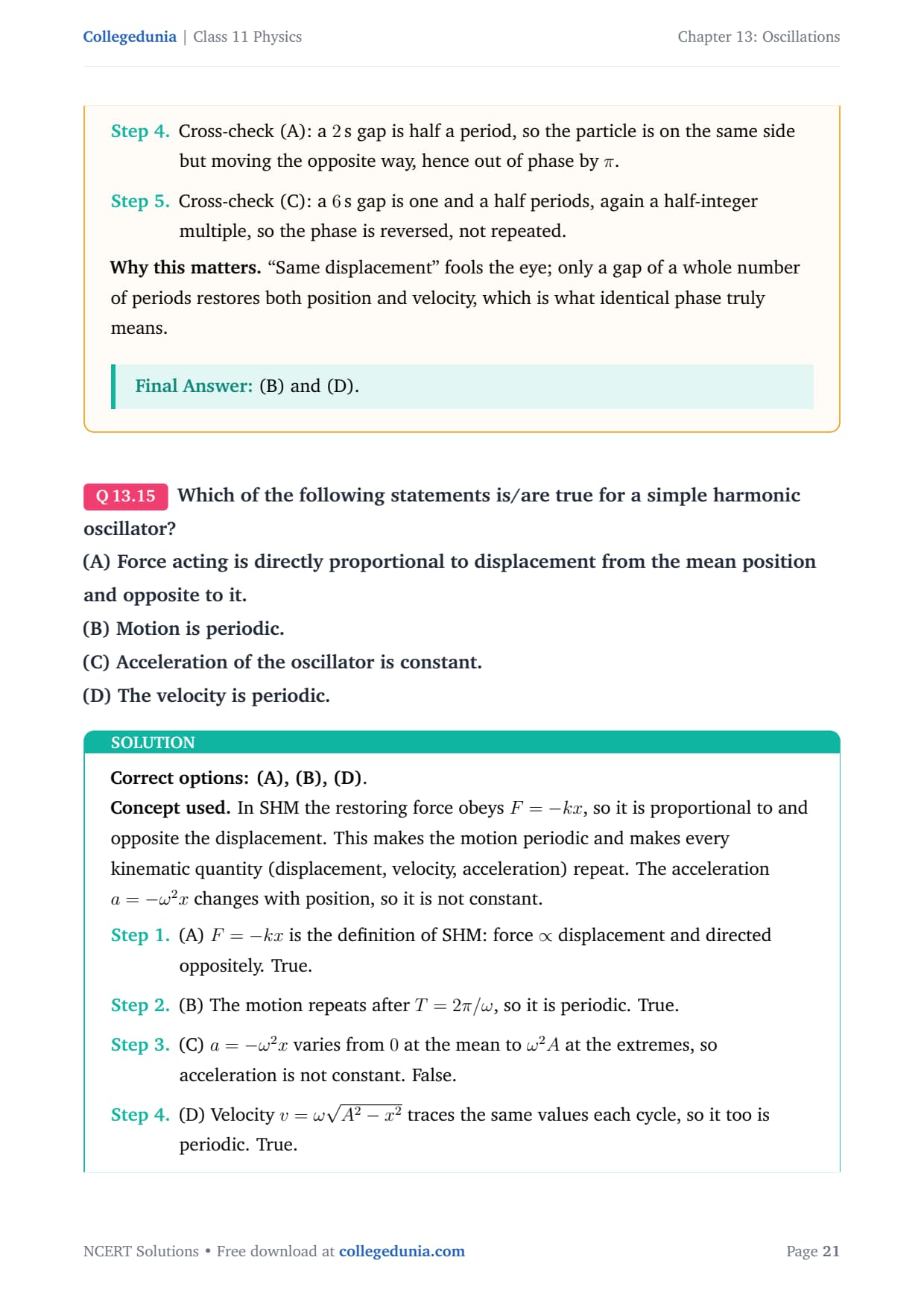
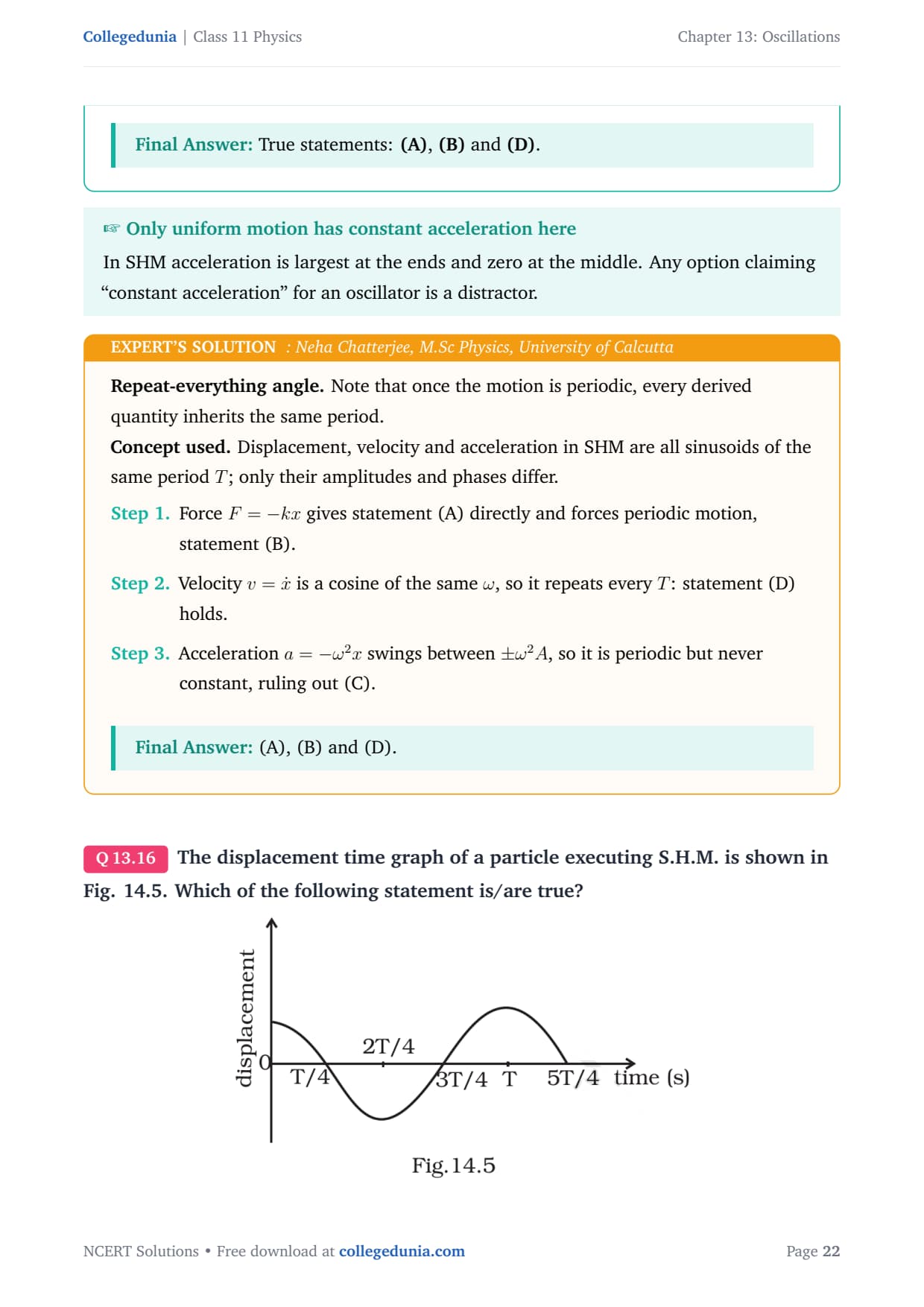
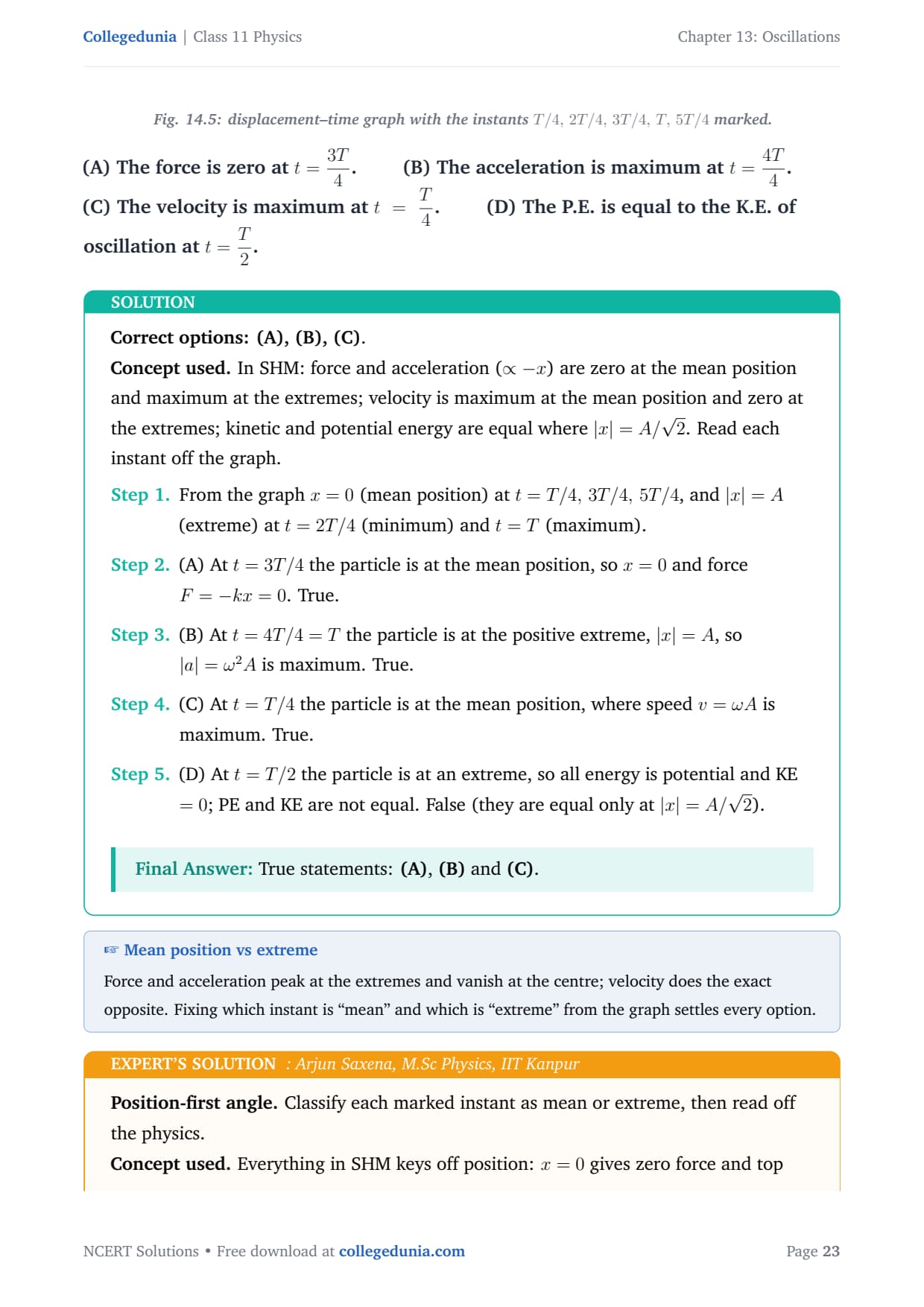
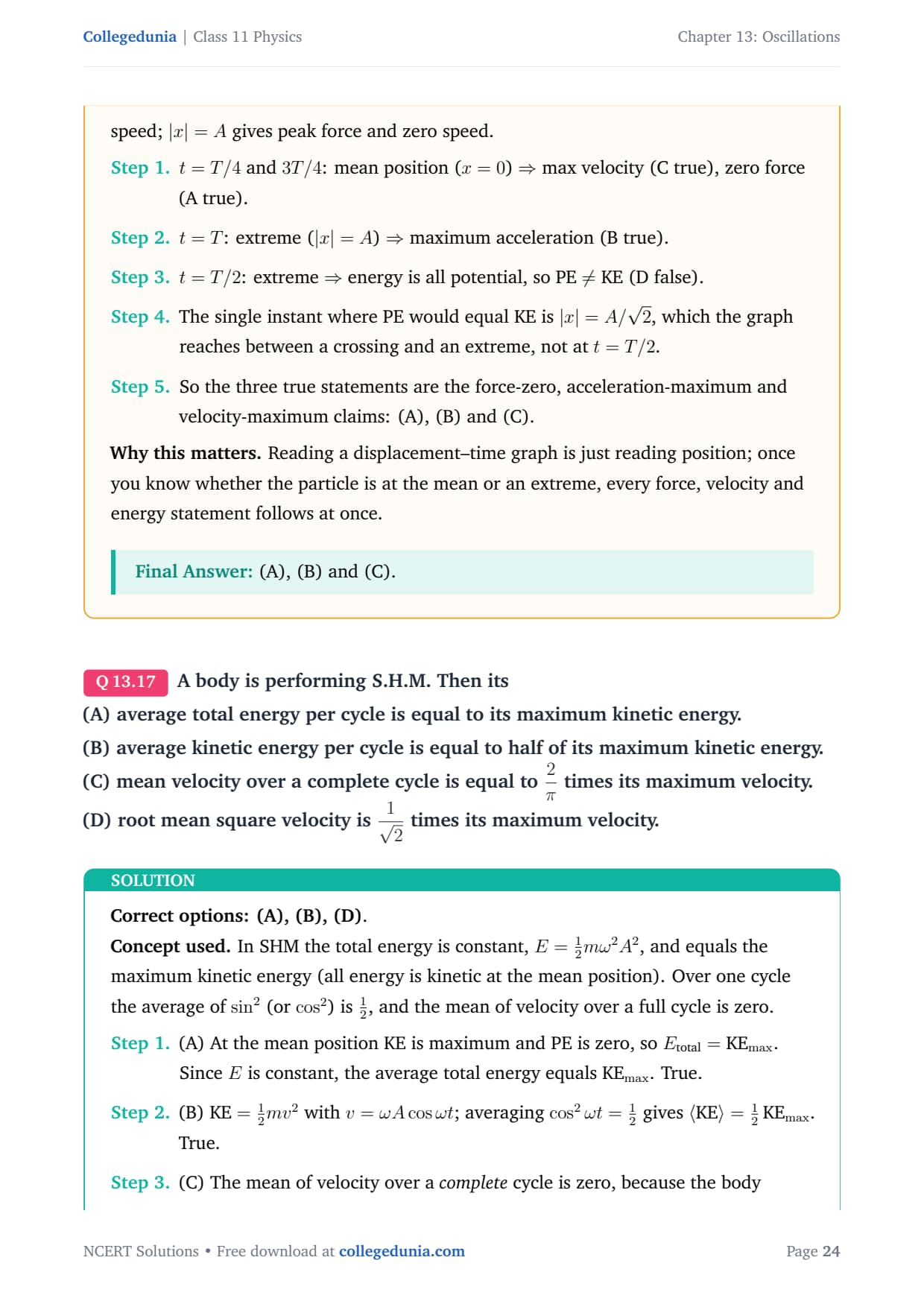

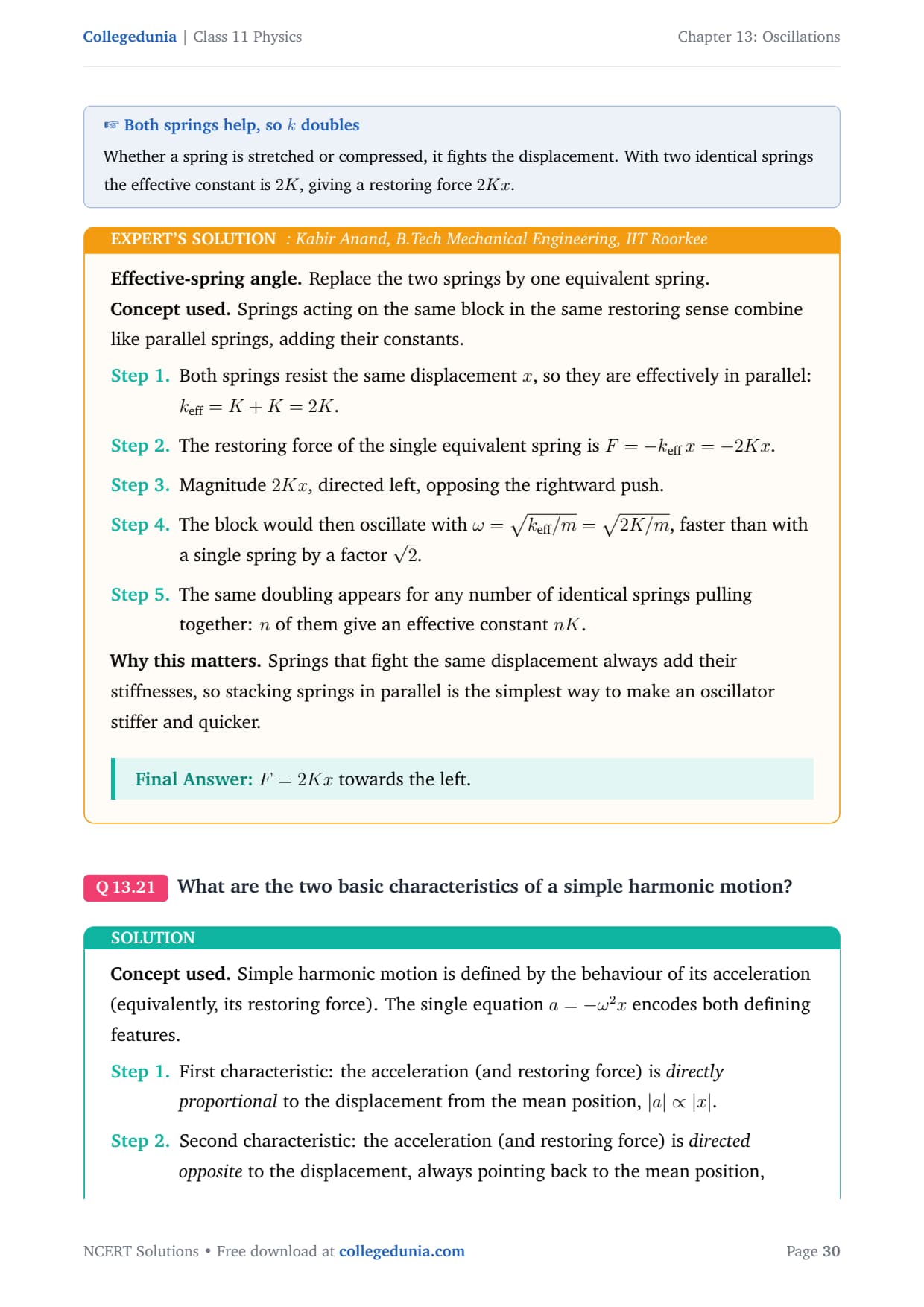
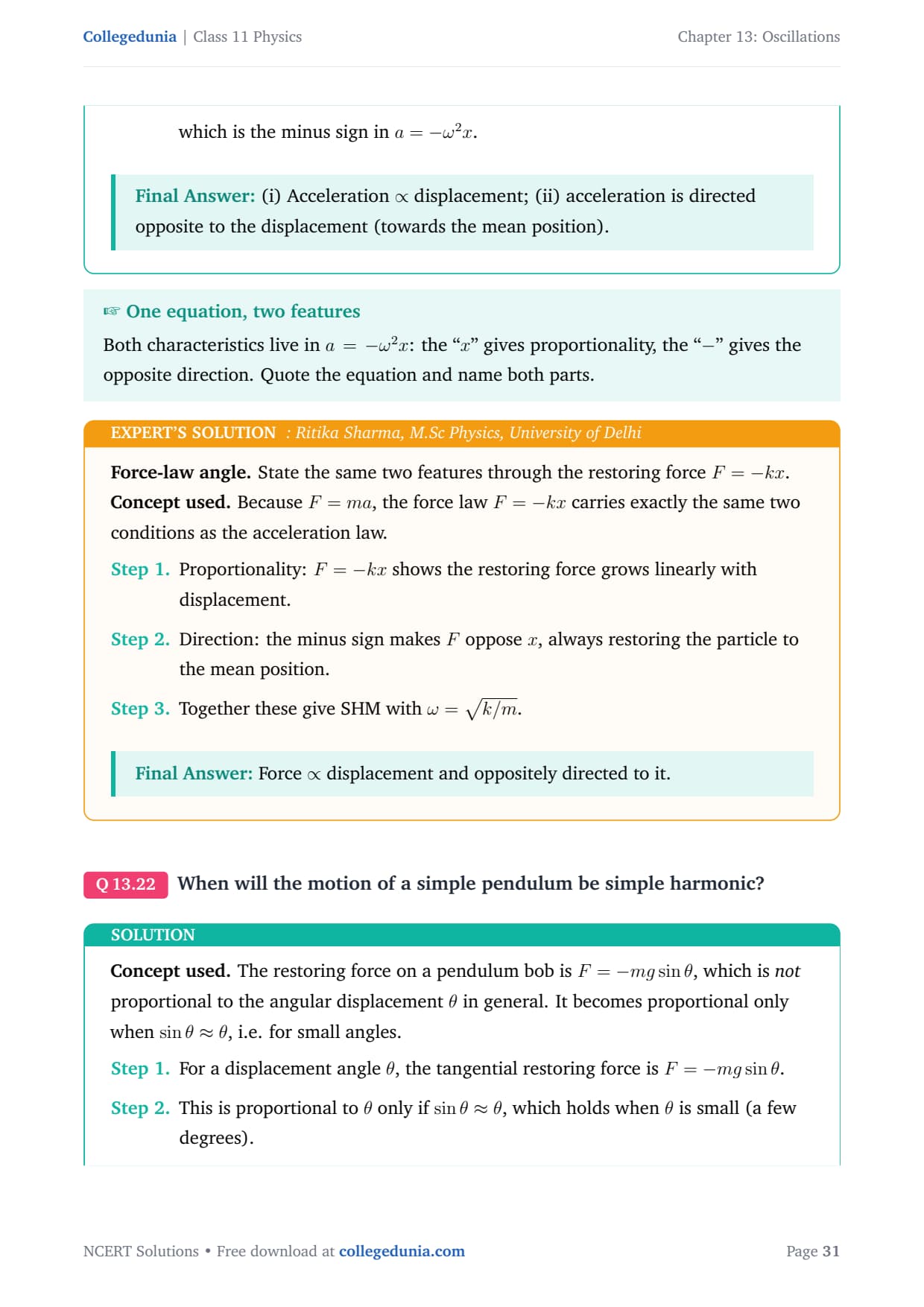
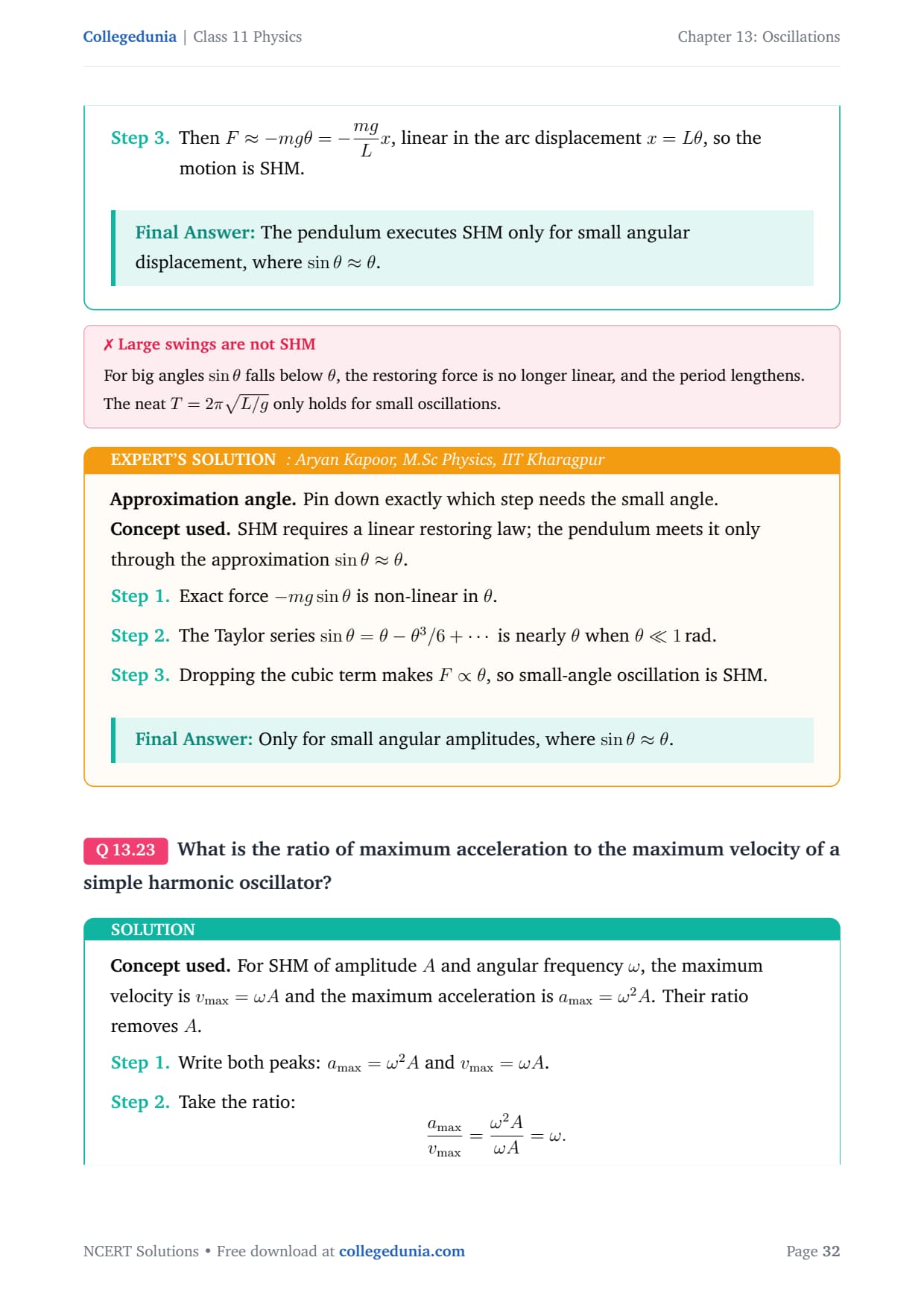
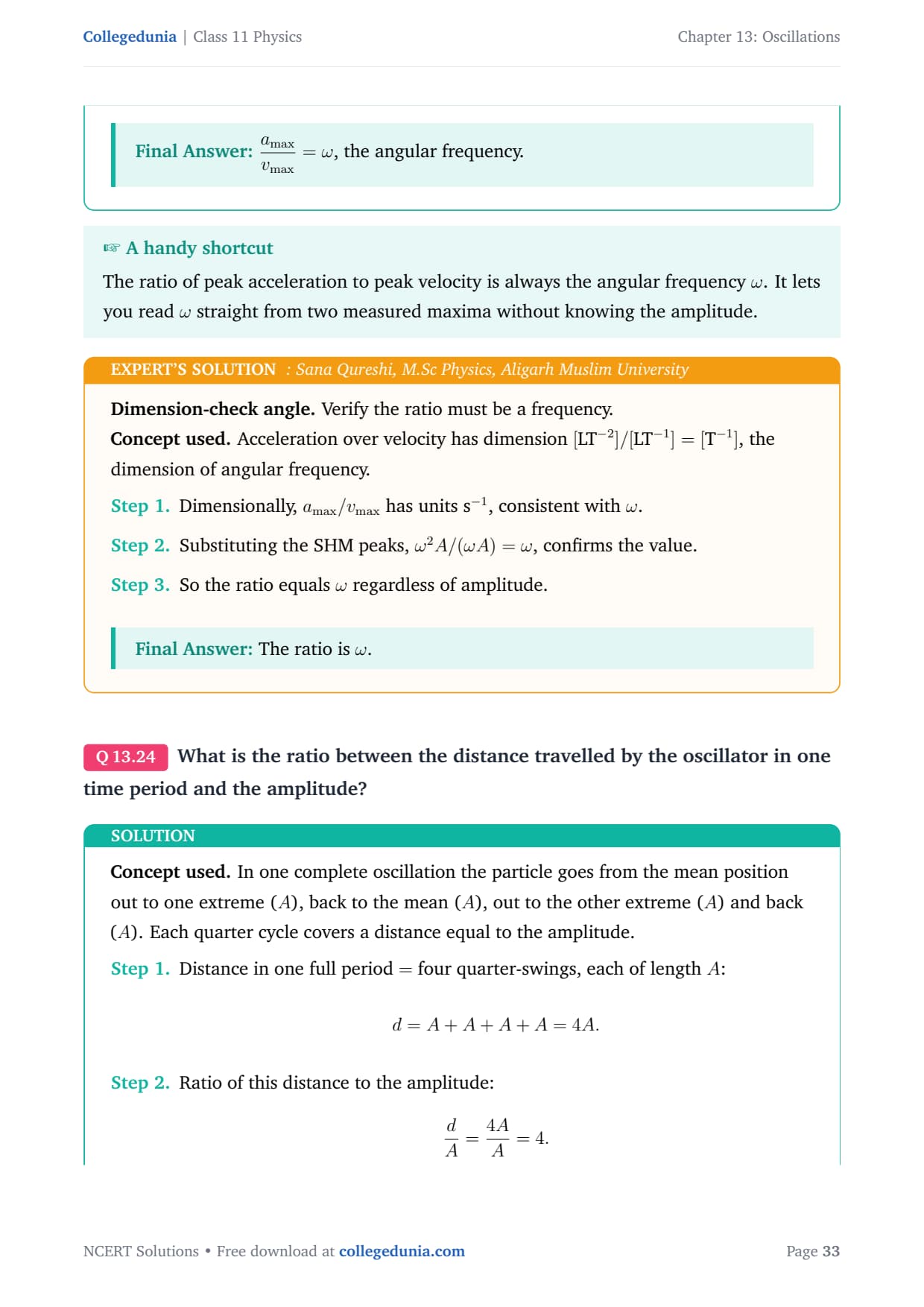
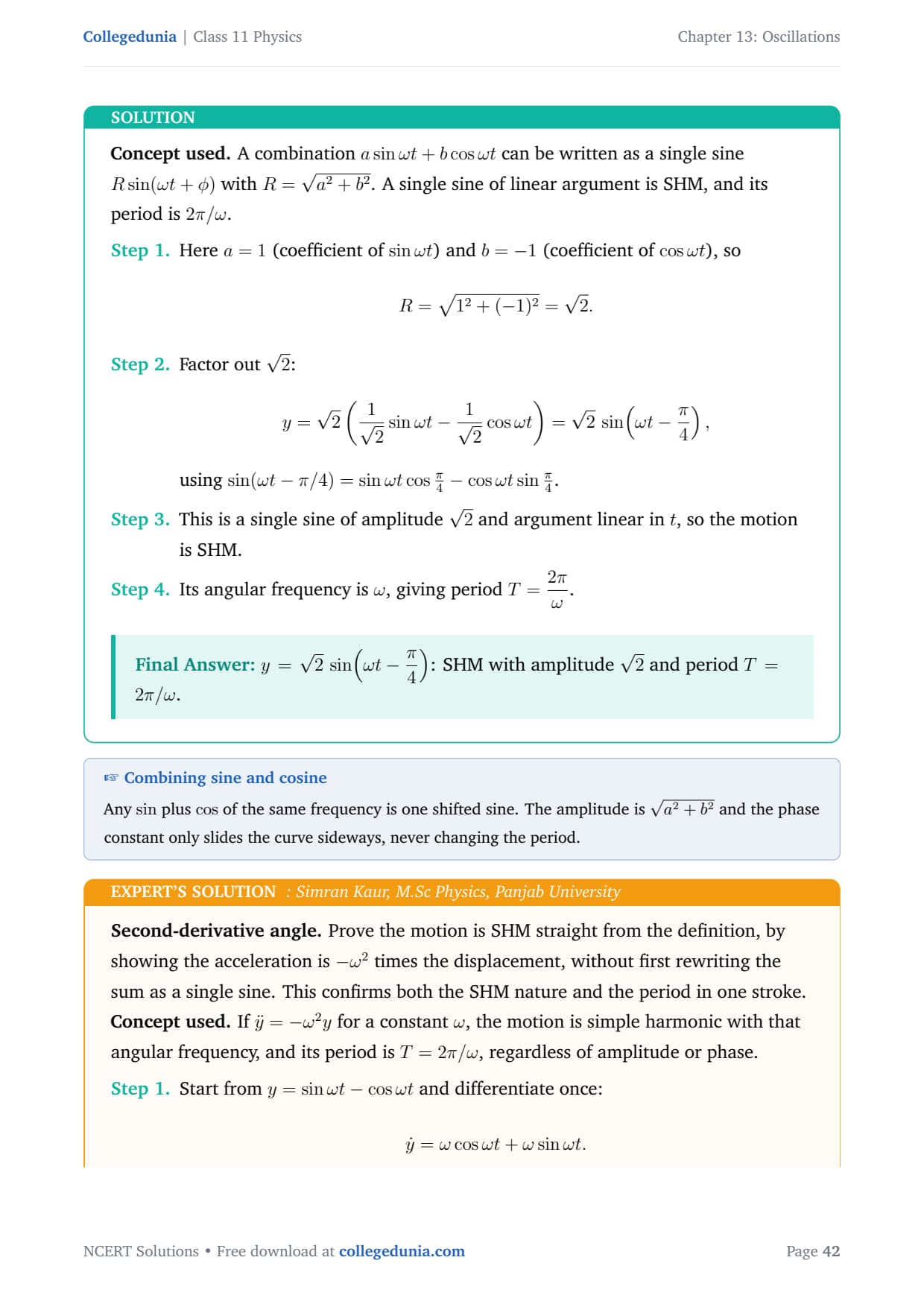
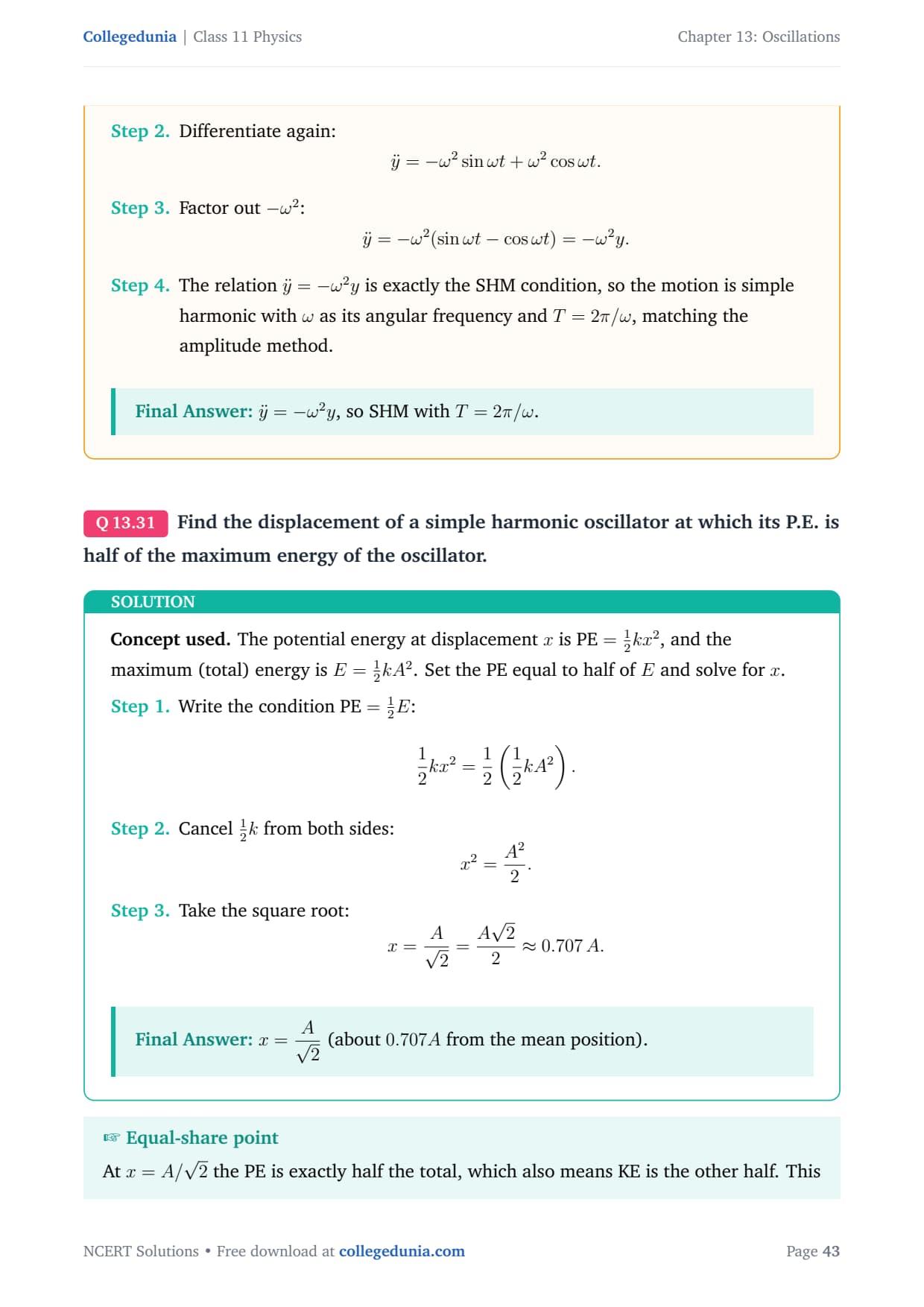
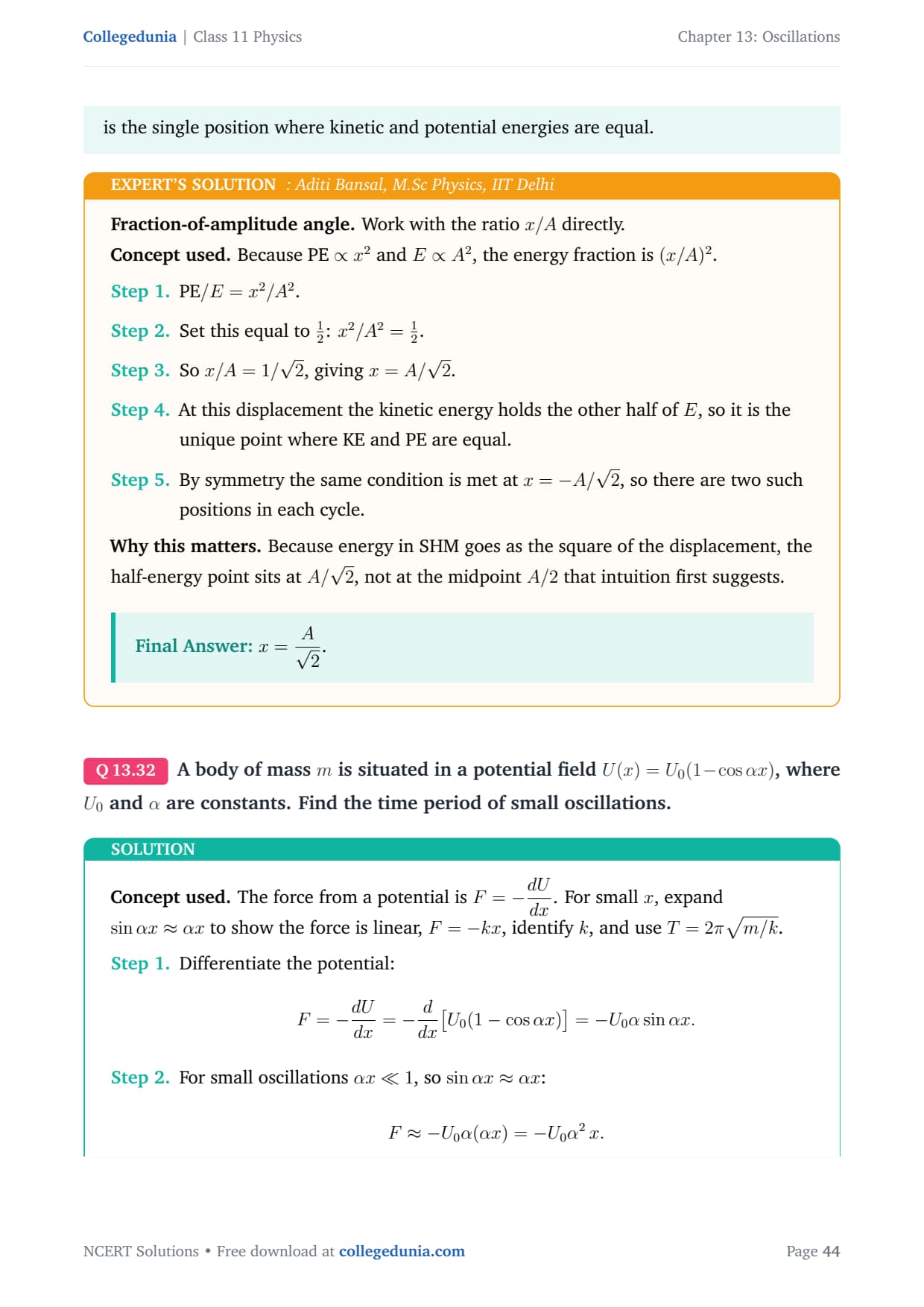
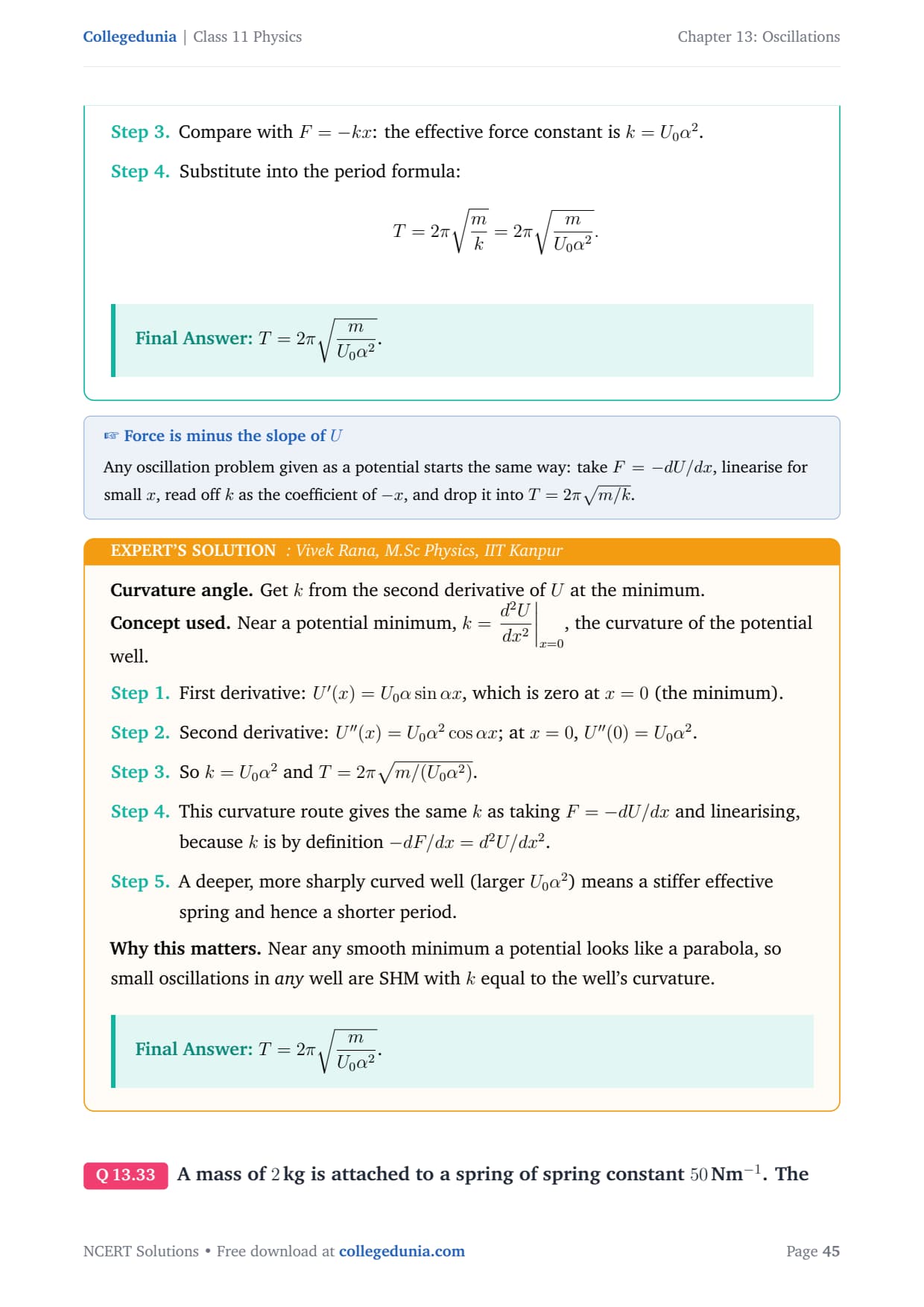
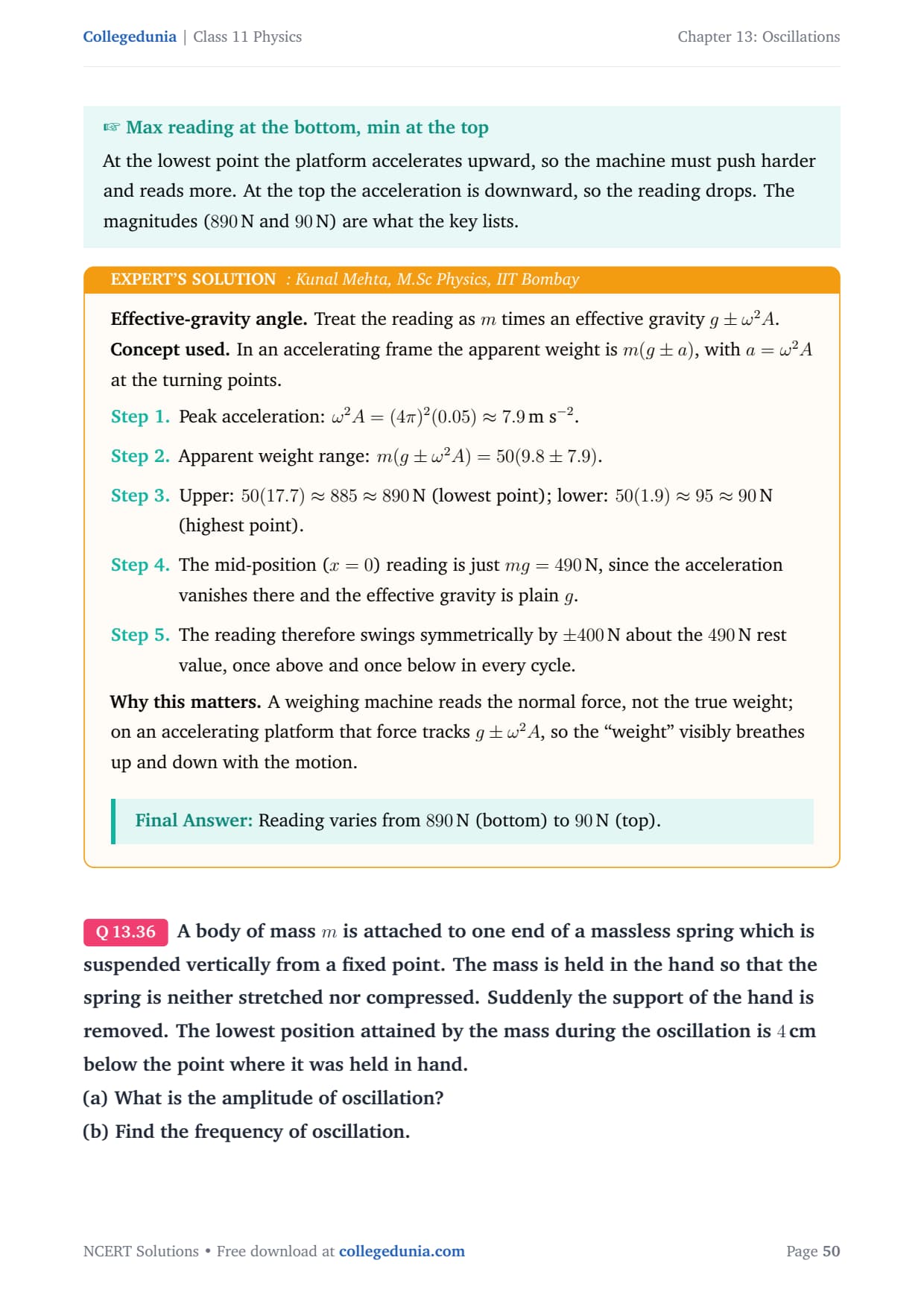
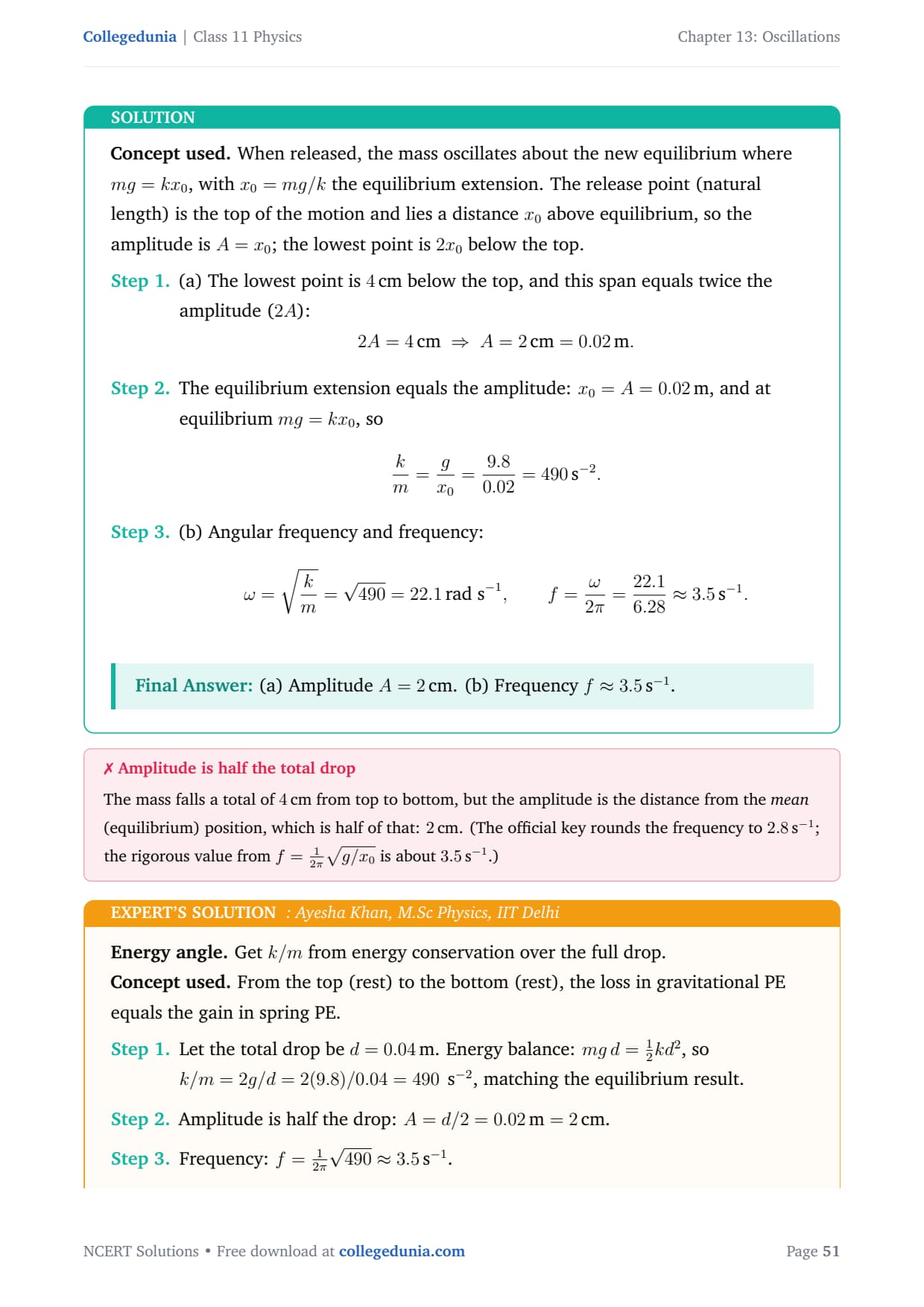
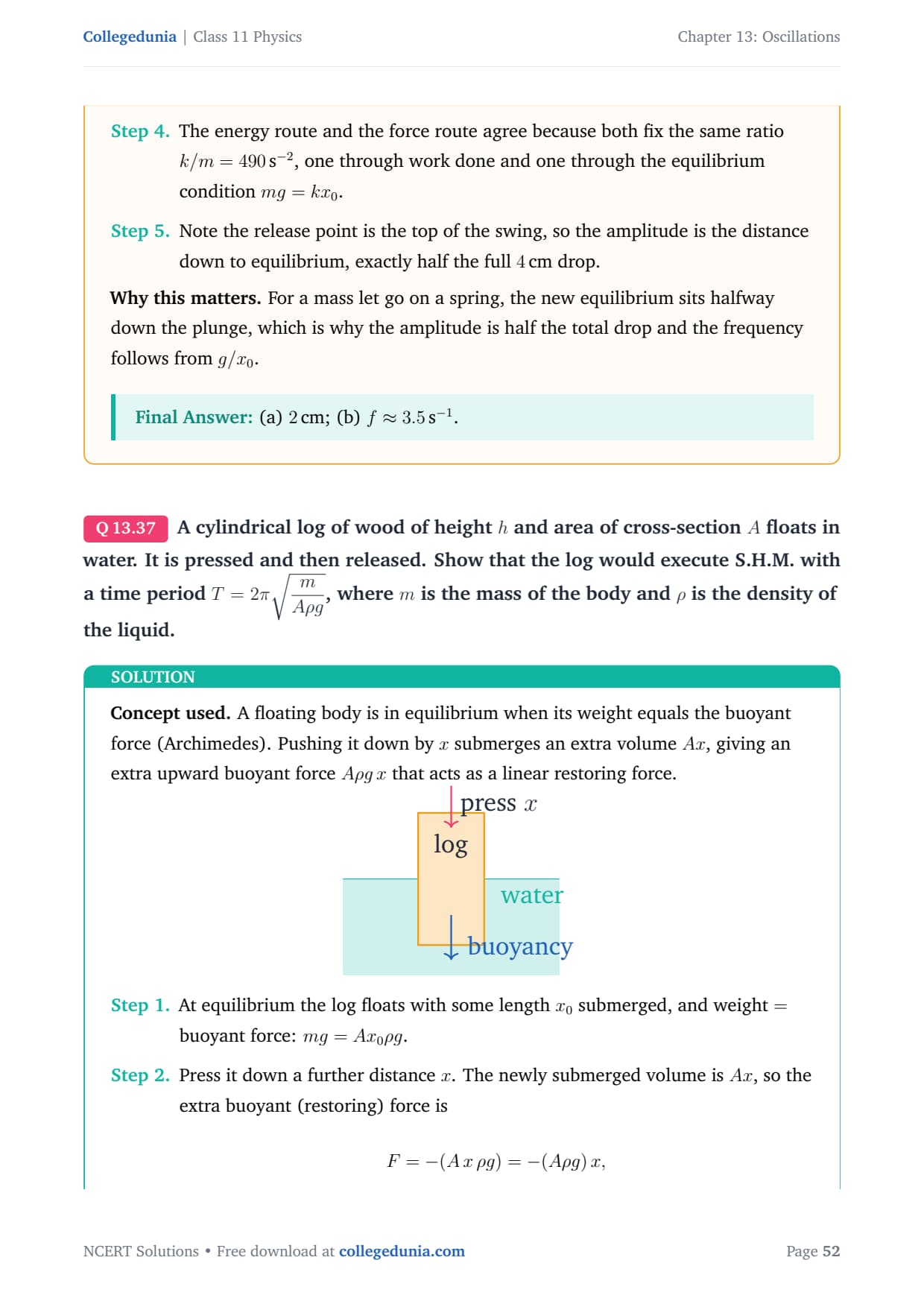
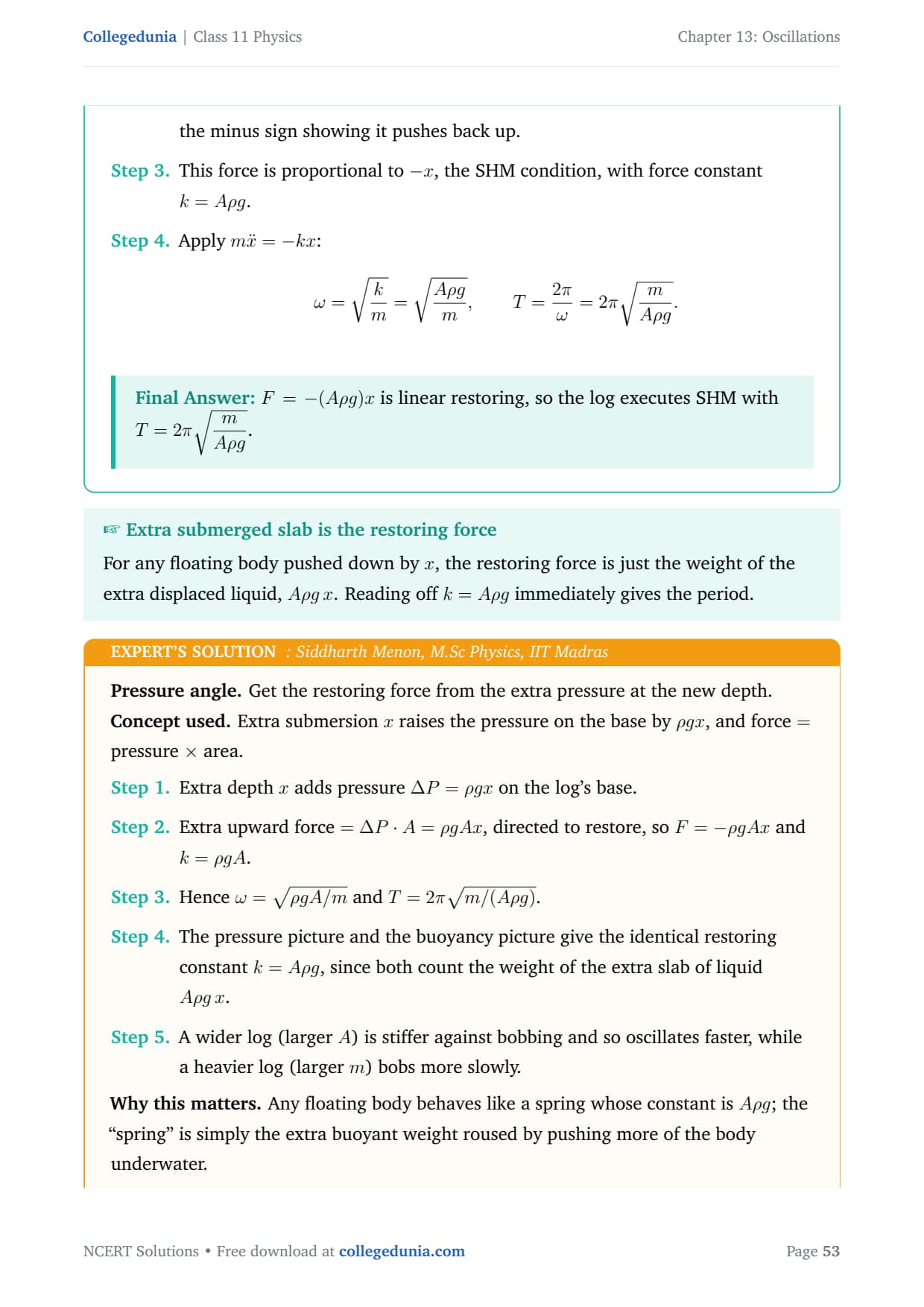
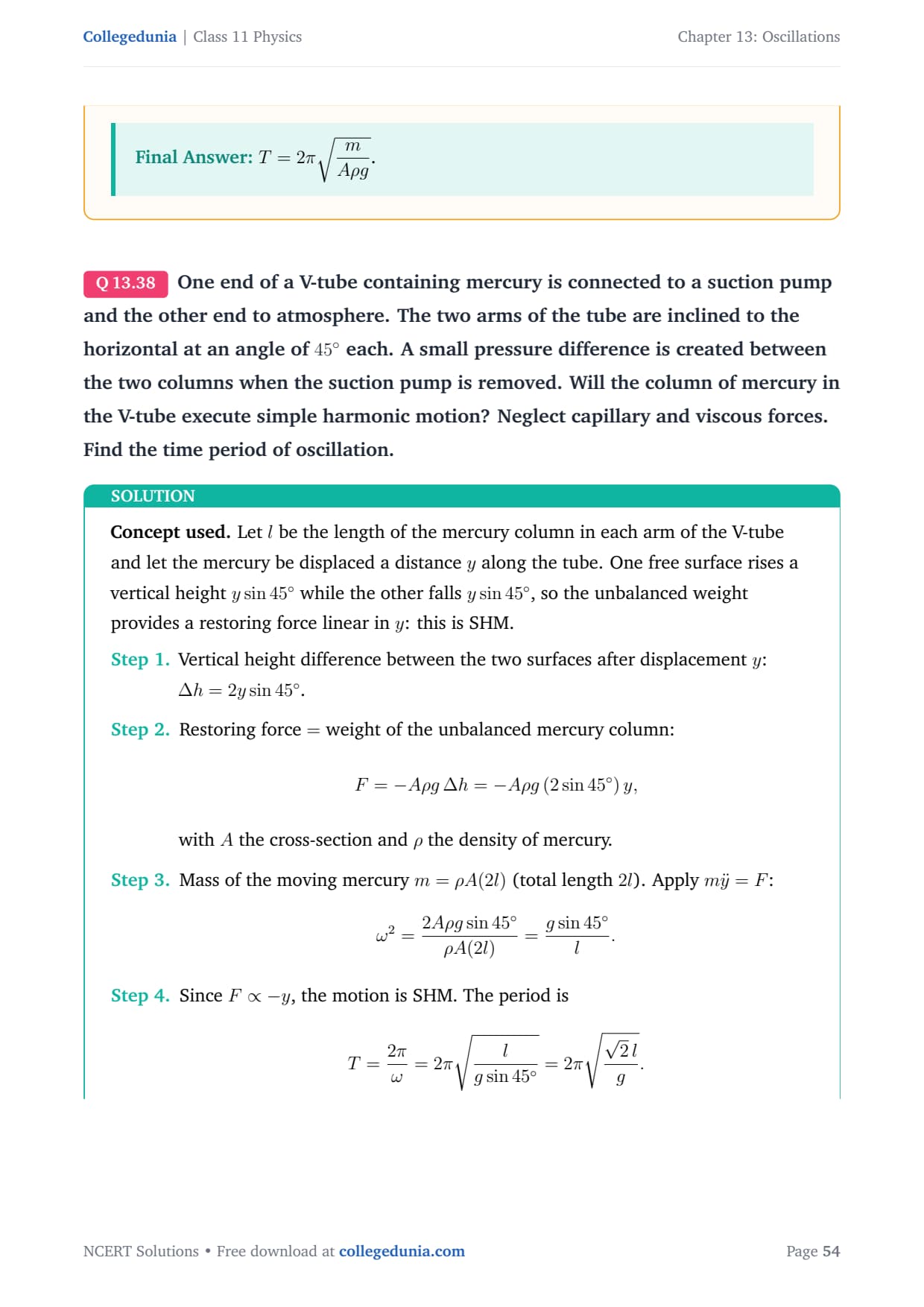
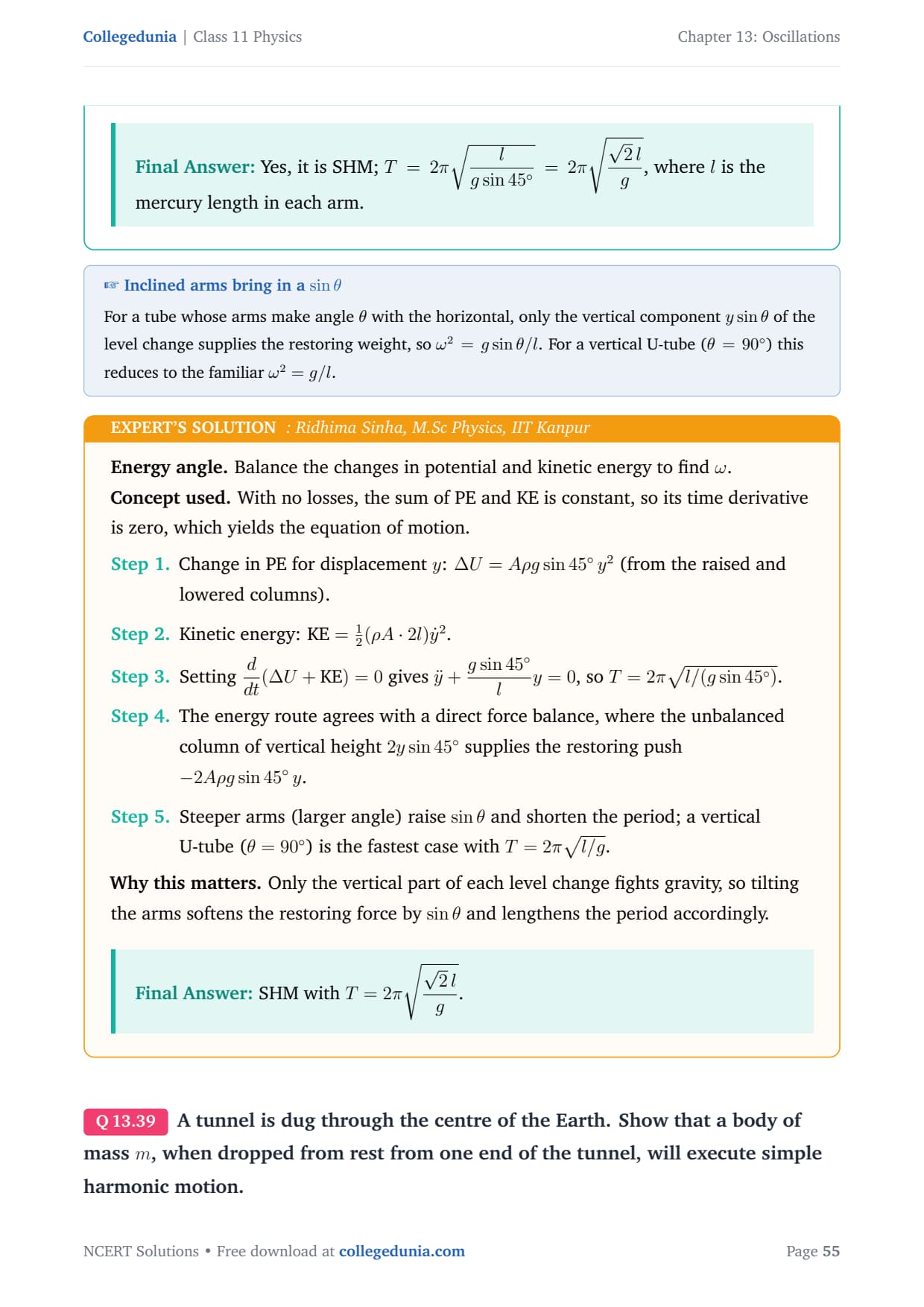
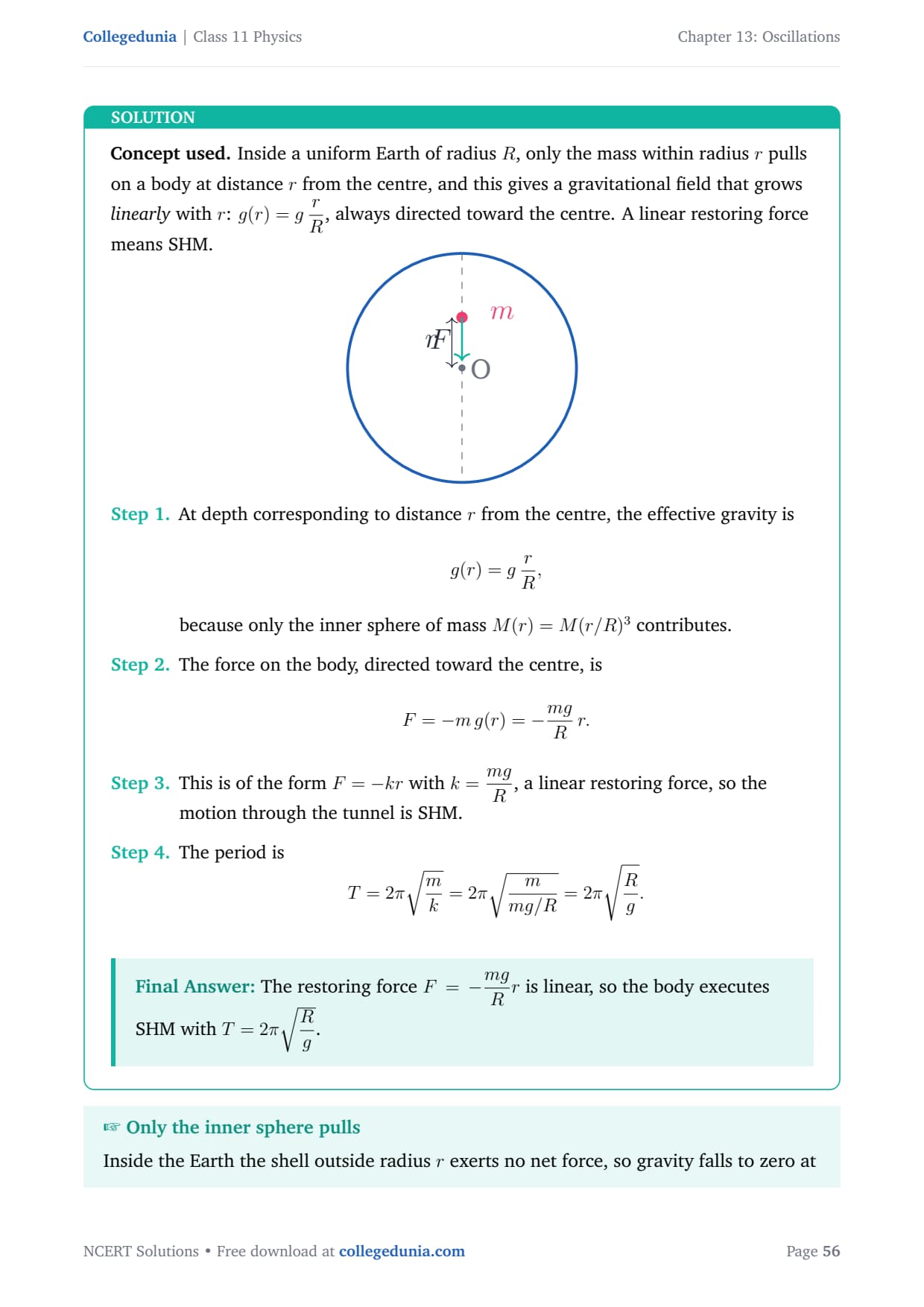
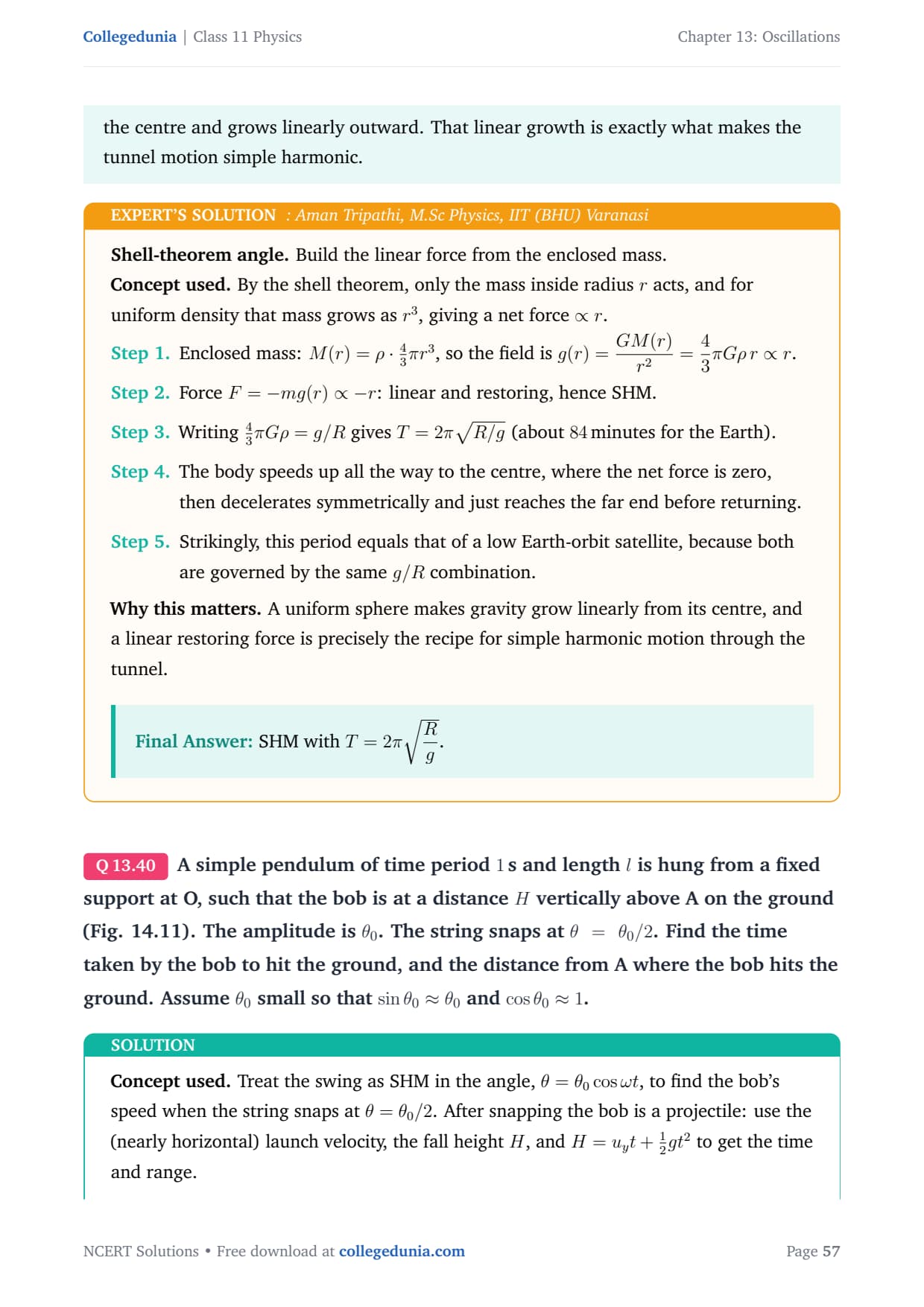
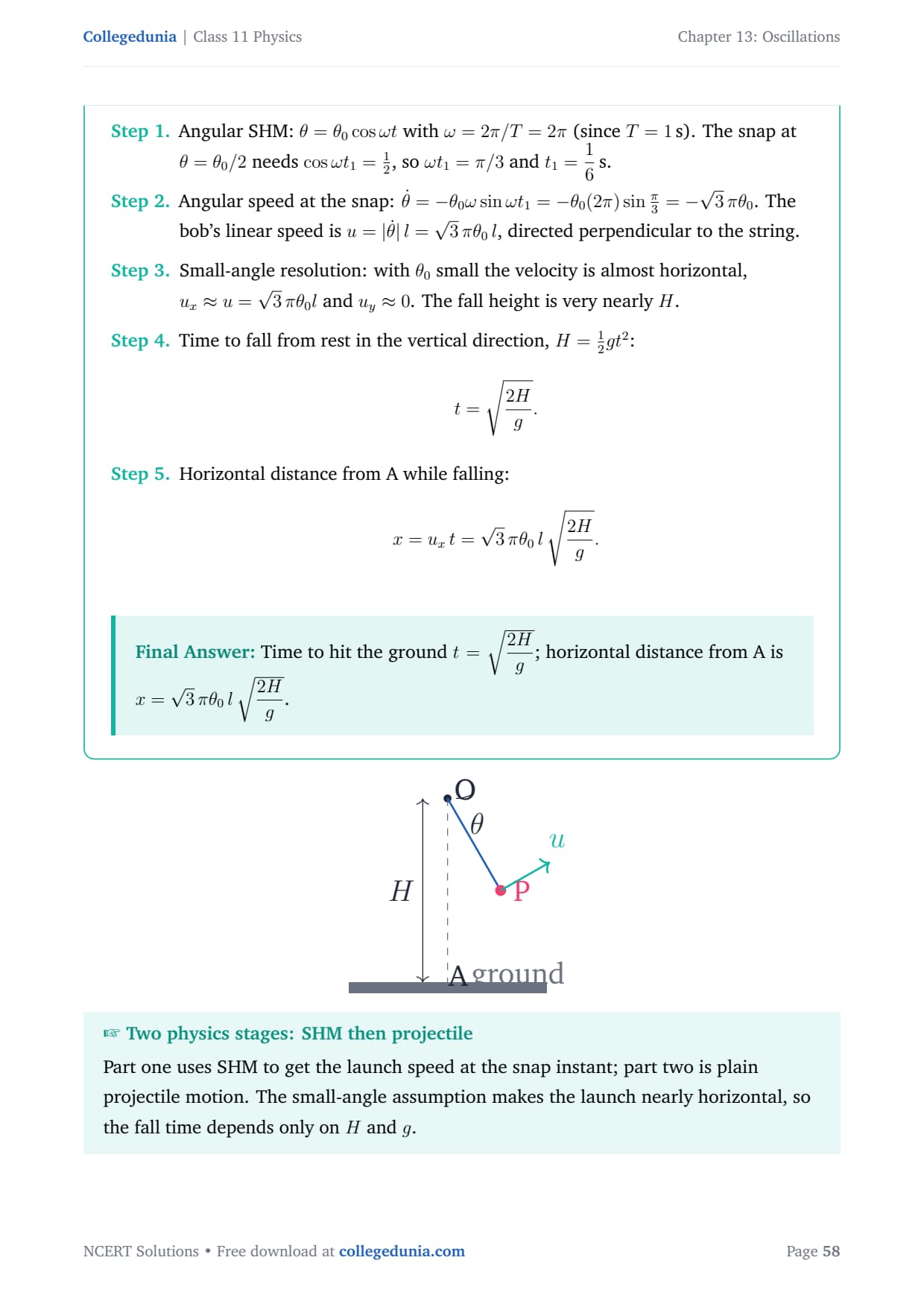
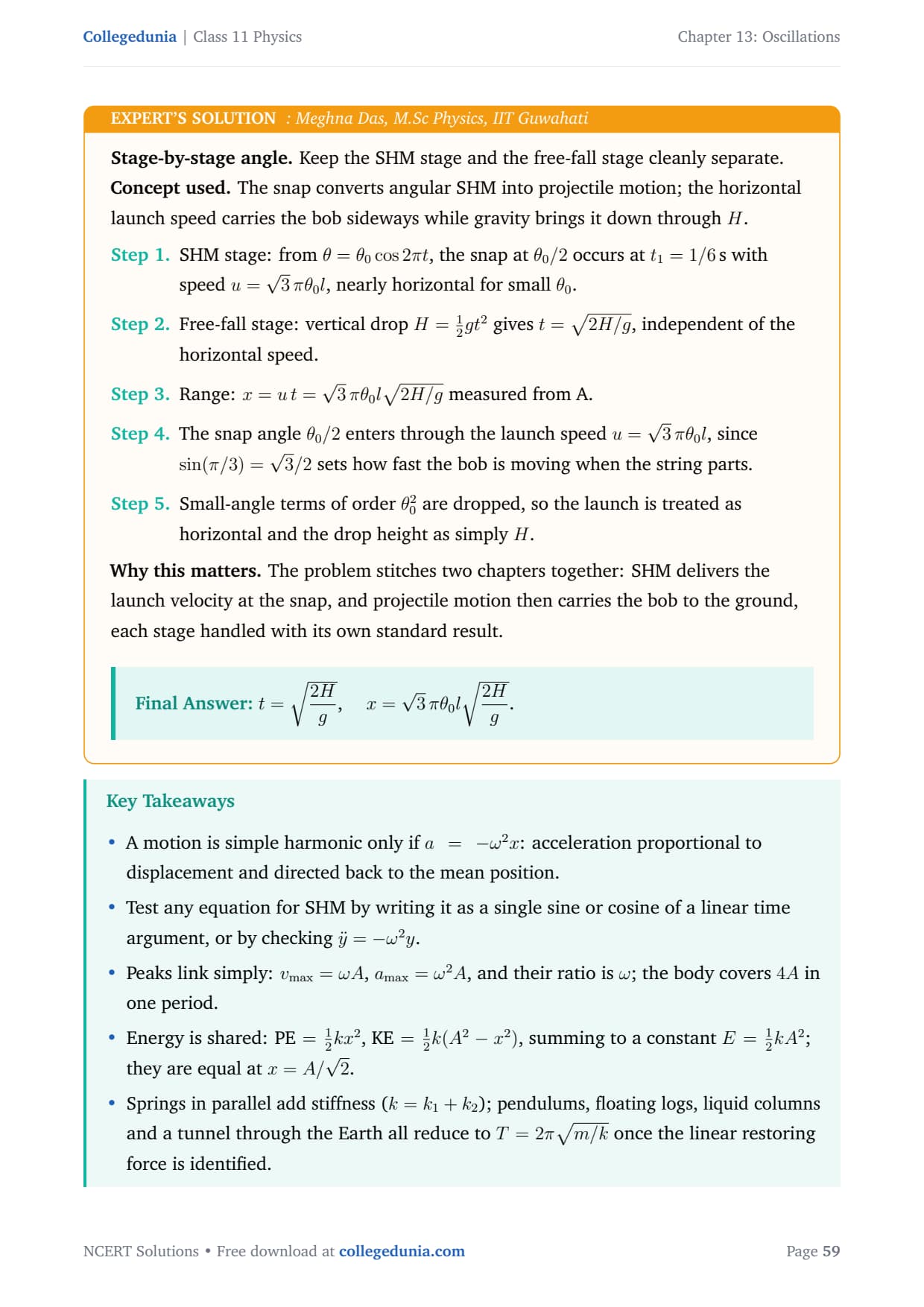
Oscillations is the chapter where simple harmonic motion stops being a formula and starts being a test. The Exemplar keeps asking one question in different costumes: is this motion actually SHM, or does it only look like it? Springs, pendulums, mercury columns and a tunnel through the Earth all appear.
- CBSE Weightage: 4 to 5 marks, usually one short answer on time period plus an MCQ on SHM conditions
- JEE Main Weightage: 1 to 2 questions per year, most often on spring combinations or phase
- NEET Weightage: 1 to 2 questions per year from SHM equations, pendulums and energy
Solutions checked against the official NCERT Exemplar answer key (keep316), with every disputed answer worked out in full.
Why This Chapter Is Printed as Chapter 14 in the Exemplar Book
Students often open the Exemplar and think they have the wrong chapter. The book still prints Oscillations under the older numbering, so its heading reads Chapter Fourteen and its figures run from Fig. 14.1 to Fig. 14.11.
Your textbook and your board syllabus call it Chapter 13. The content is identical, only the number on the page is old. Our solutions keep the book's original figure labels, so you can match each diagram to the printed page without hunting.
Question Types in the Oscillations NCERT Exemplar
The 40 questions split across five types. The Very Short Answer set is unusually large here, and those one-line questions carry some of the sharpest reasoning in the chapter.
| Question Type | Count | What It Tests |
|---|---|---|
| MCQ I (single correct) | 11 | Classifying a given equation or graph as periodic, oscillatory or SHM |
| MCQ II (one or more correct) | 7 | Reading displacement-time graphs where several options are partly true |
| VSA (Very Short Answer) | 10 | One-line reasoning on phase, amplitude, restoring force and sign of velocity |
| SA (Short Answer) | 6 | Setting up ω and phase from stated starting conditions |
| LA (Long Answer) | 6 | Full derivations proving a system executes SHM and finding its period |
Key Formulas Used in the Class 11 Physics Oscillations Exemplar
Nearly every question here reduces to one of the relations below. The PDF states the relation before applying it, so you can see which one carries each solution.
- The SHM test: acceleration a = −ω2x, meaning the restoring pull is proportional to displacement and points back to the mean position
- Displacement: x = A cos(ωt + φ), where the starting conditions fix φ
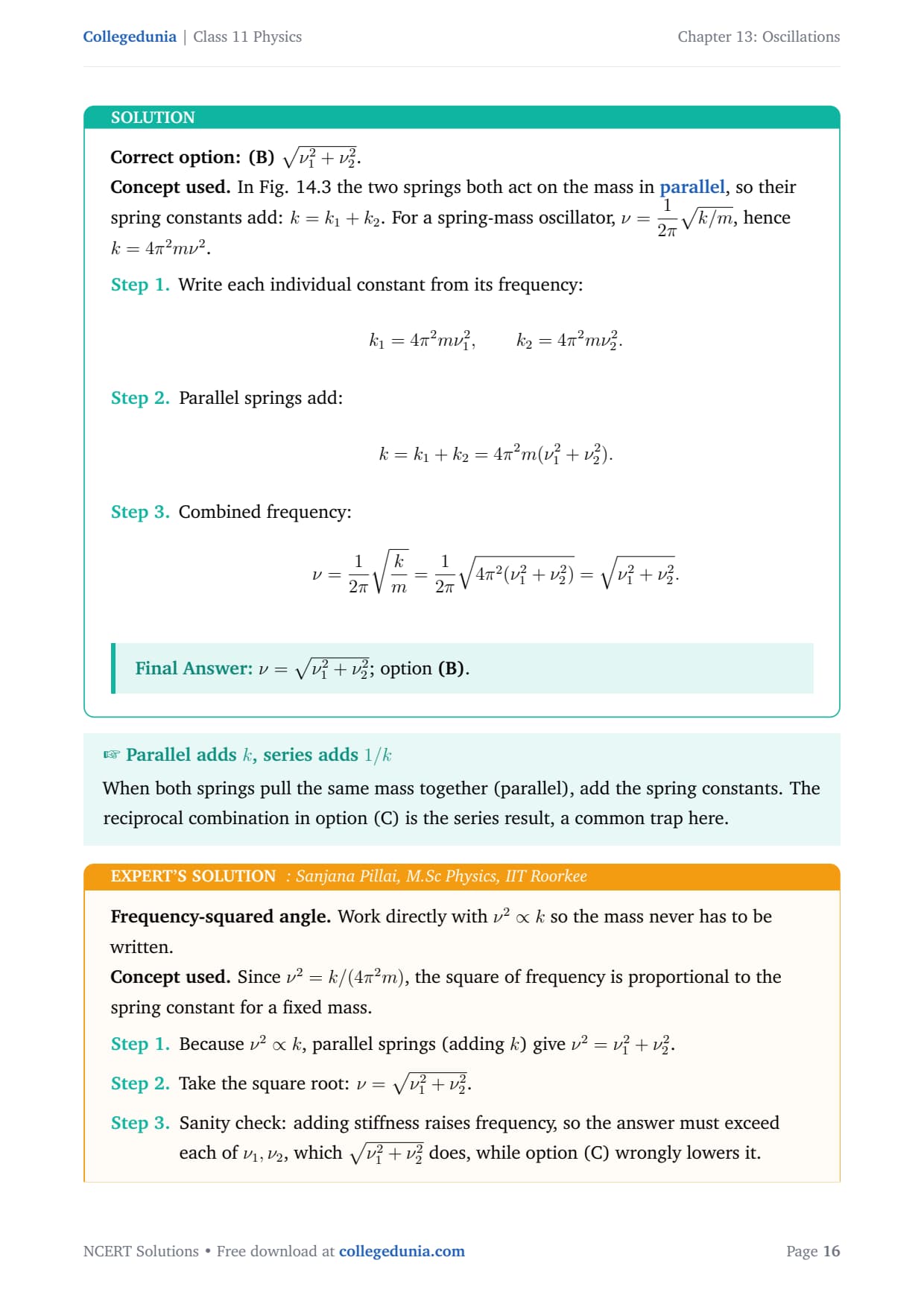
- Spring-mass period: T = 2π times the square root of m/k
- Simple pendulum: T = 2π times the square root of l/g, valid only for small angles
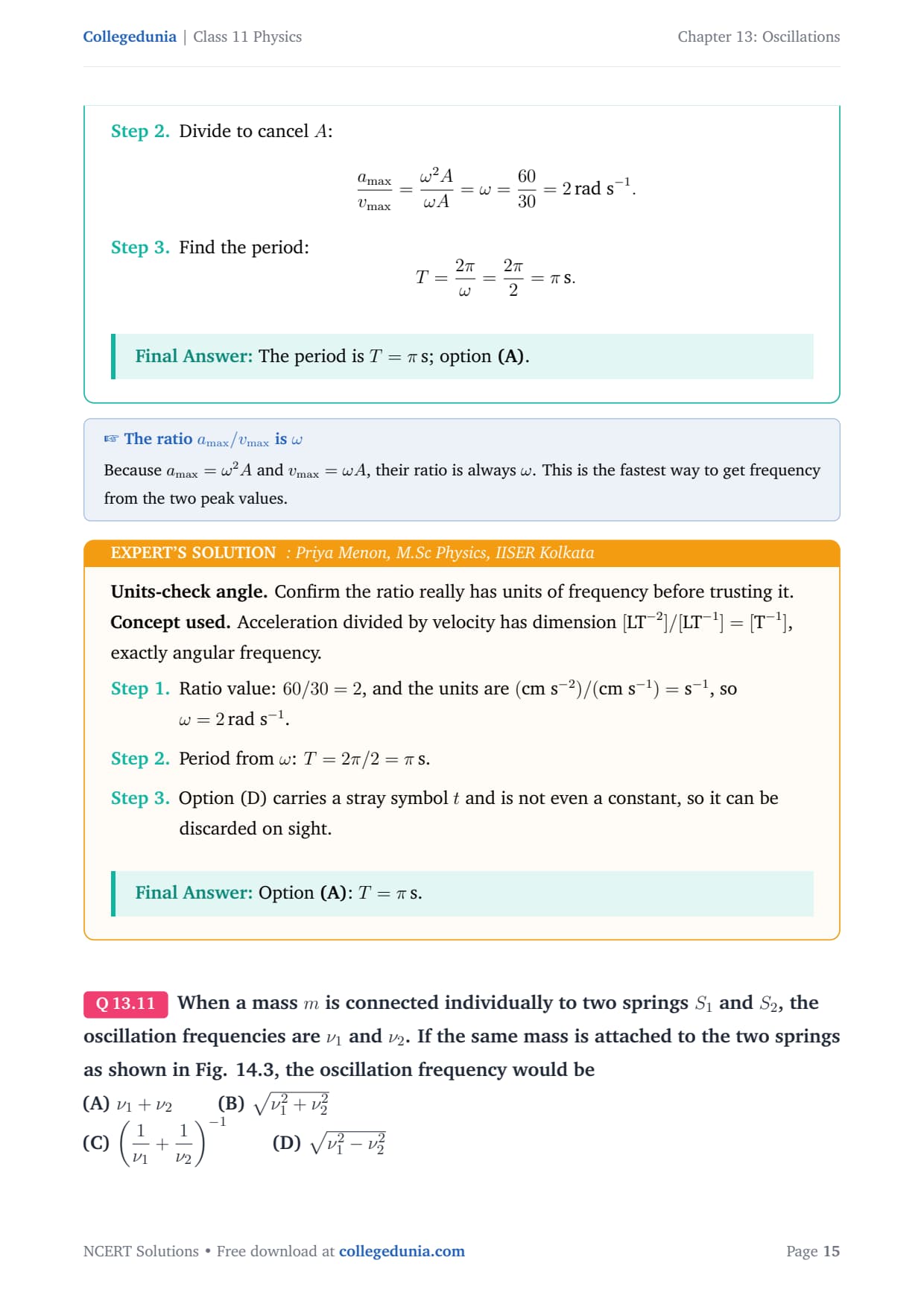
- Speed at displacement x: v = ω times the square root of (A2 − x2)
Answer Key Errors in the Oscillations Exemplar
This chapter carries two genuine errors in the official answer key. Both are flagged in our PDF, with the printed answer and the correct one side by side.
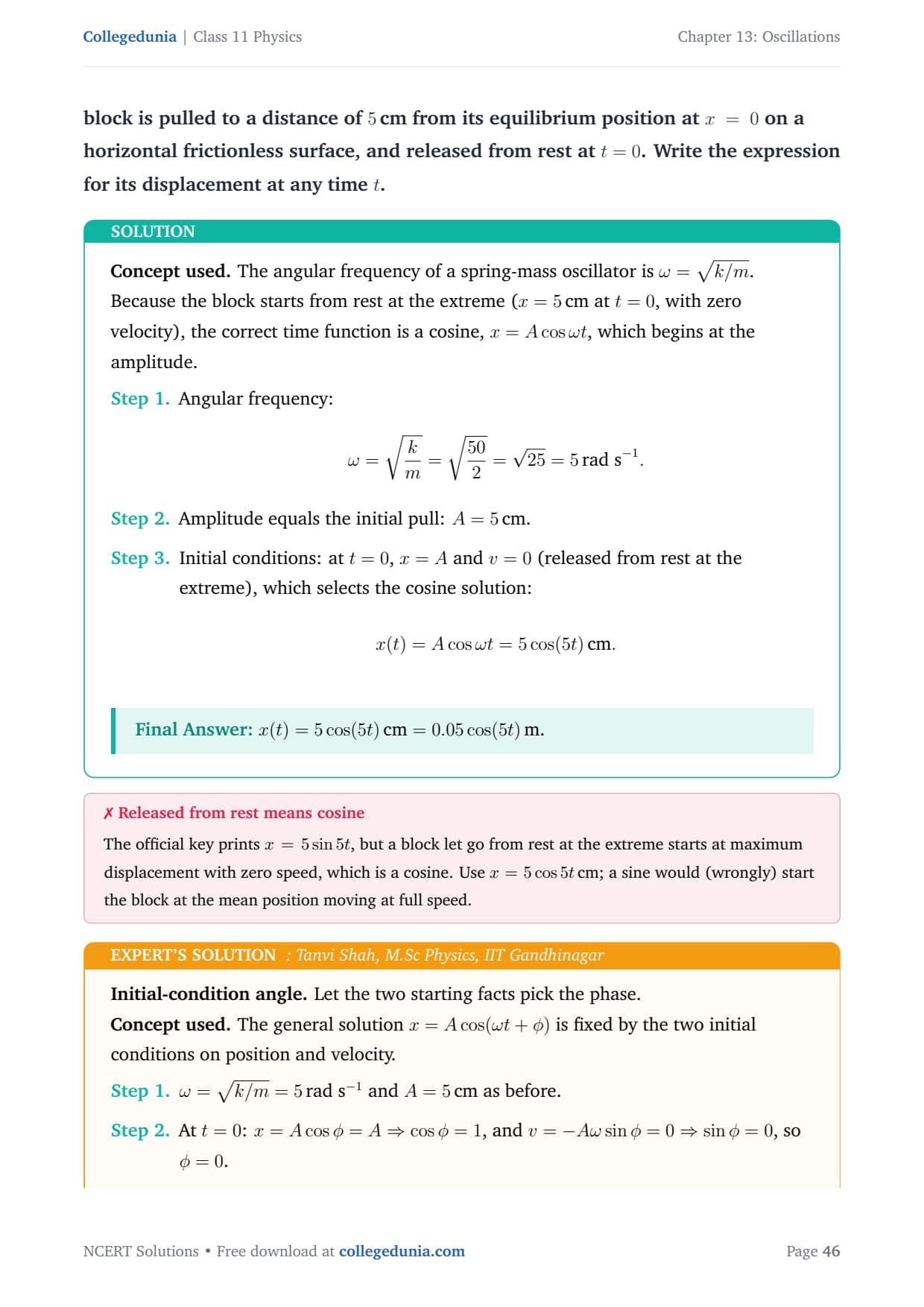
Question 33. A 2 kg mass on a spring of constant 50 Nm-1 is pulled 5 cm from equilibrium and released from rest at t = 0. The key prints x = 5 sin 5t. A block let go from rest at the extreme starts at maximum displacement with zero speed, and that is a cosine. The correct answer is x = 5 cos 5t cm. A sine would start the block at the mean position moving at full speed, which contradicts the question.
Question 36. A mass hangs from a spring at natural length, the hand is removed, and the lowest point reached is 4 cm below the start. The amplitude is 2 cm, which the key gets right. For the frequency it prints 2.8 s-1. Working f from the equilibrium extension gives ω = 22.1 rad s-1 and f close to 3.5 s-1.
Common Mistakes Students Make in Oscillations
The Exemplar builds traps deliberately, and the same few catch most students. Each is marked in the PDF at the question that sets it.
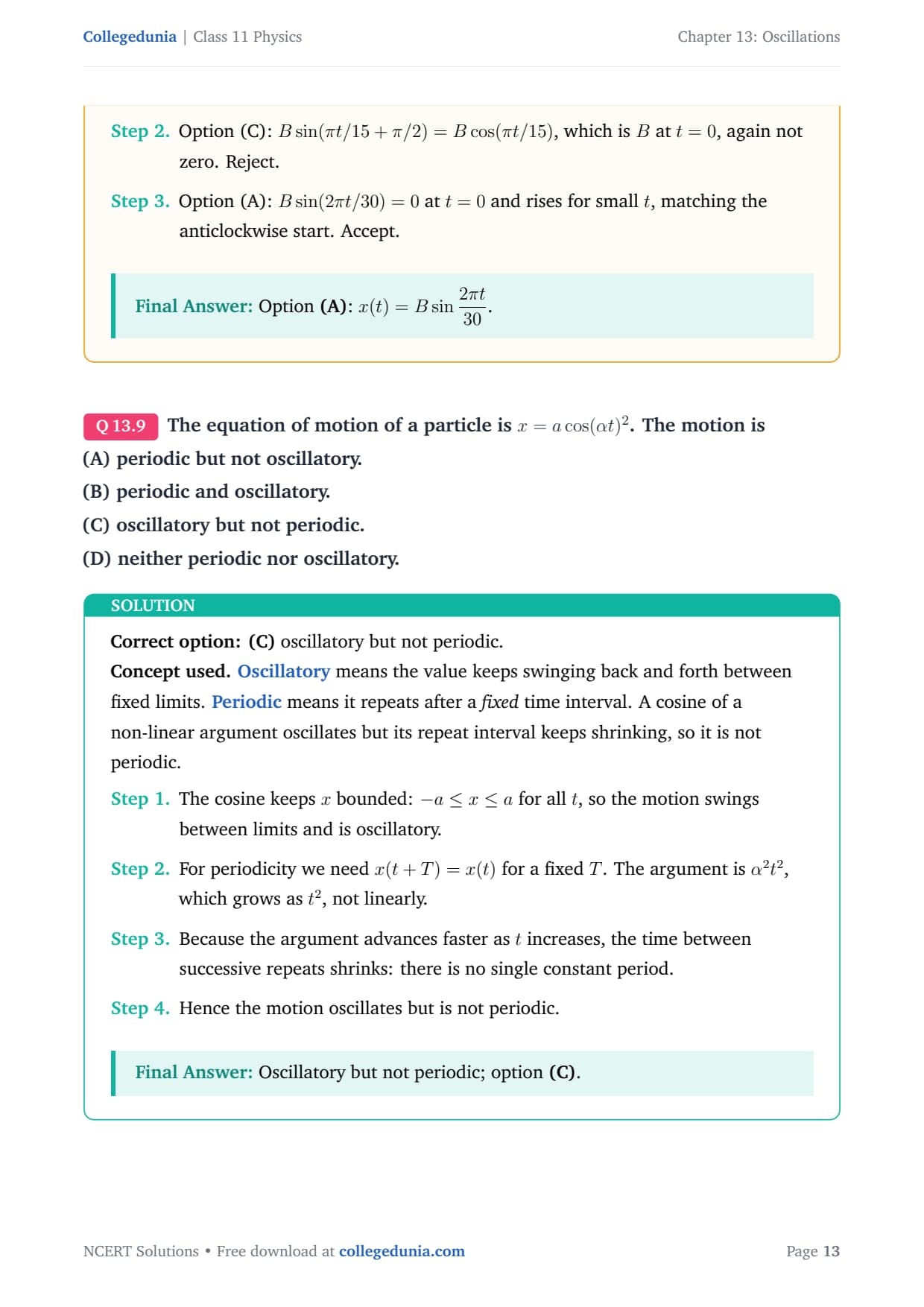
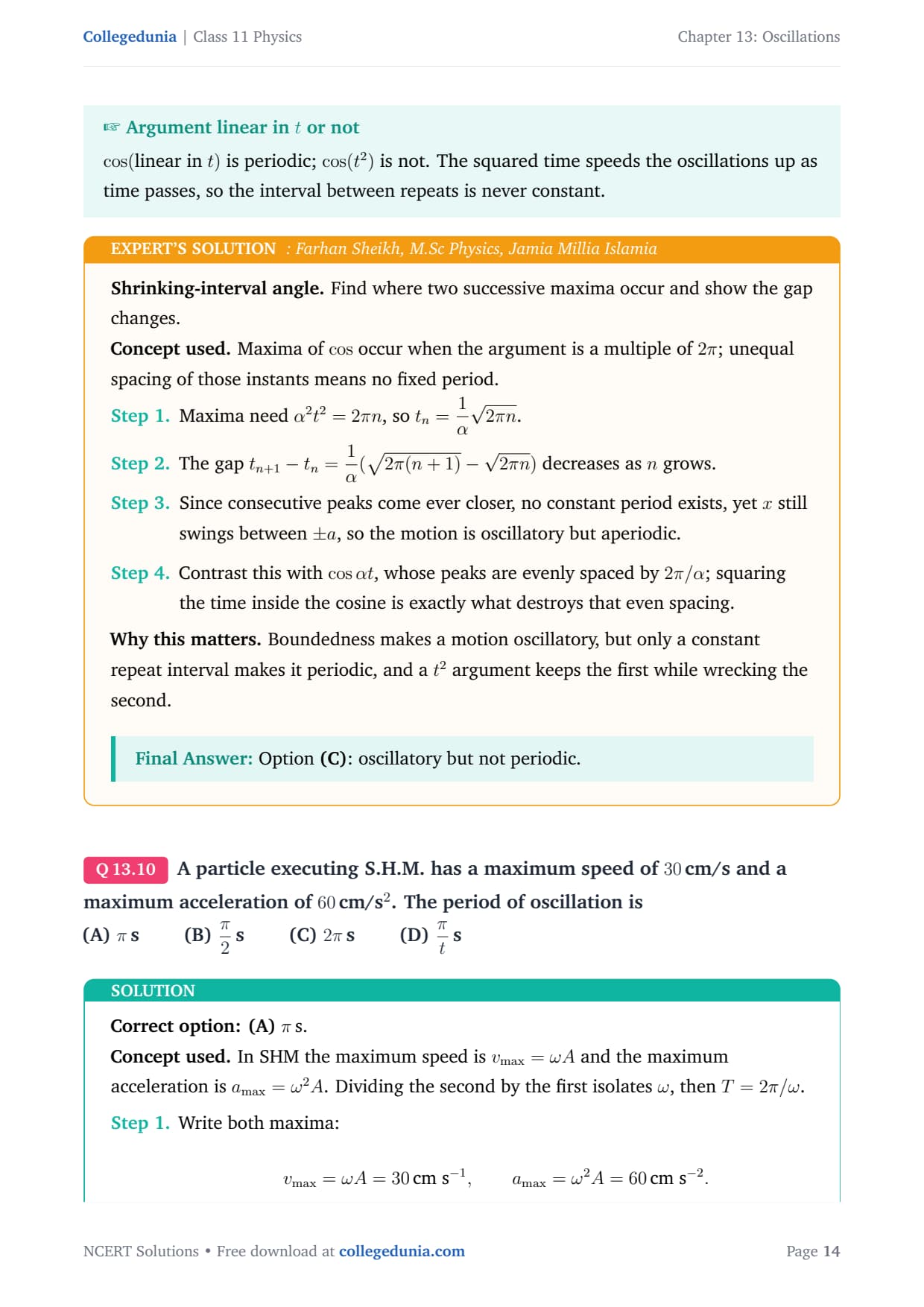
- A power of a sine is not a sine: Question 9 gives x = a cos(αt)2. It is oscillatory but not periodic, because squaring the argument stretches the intervals
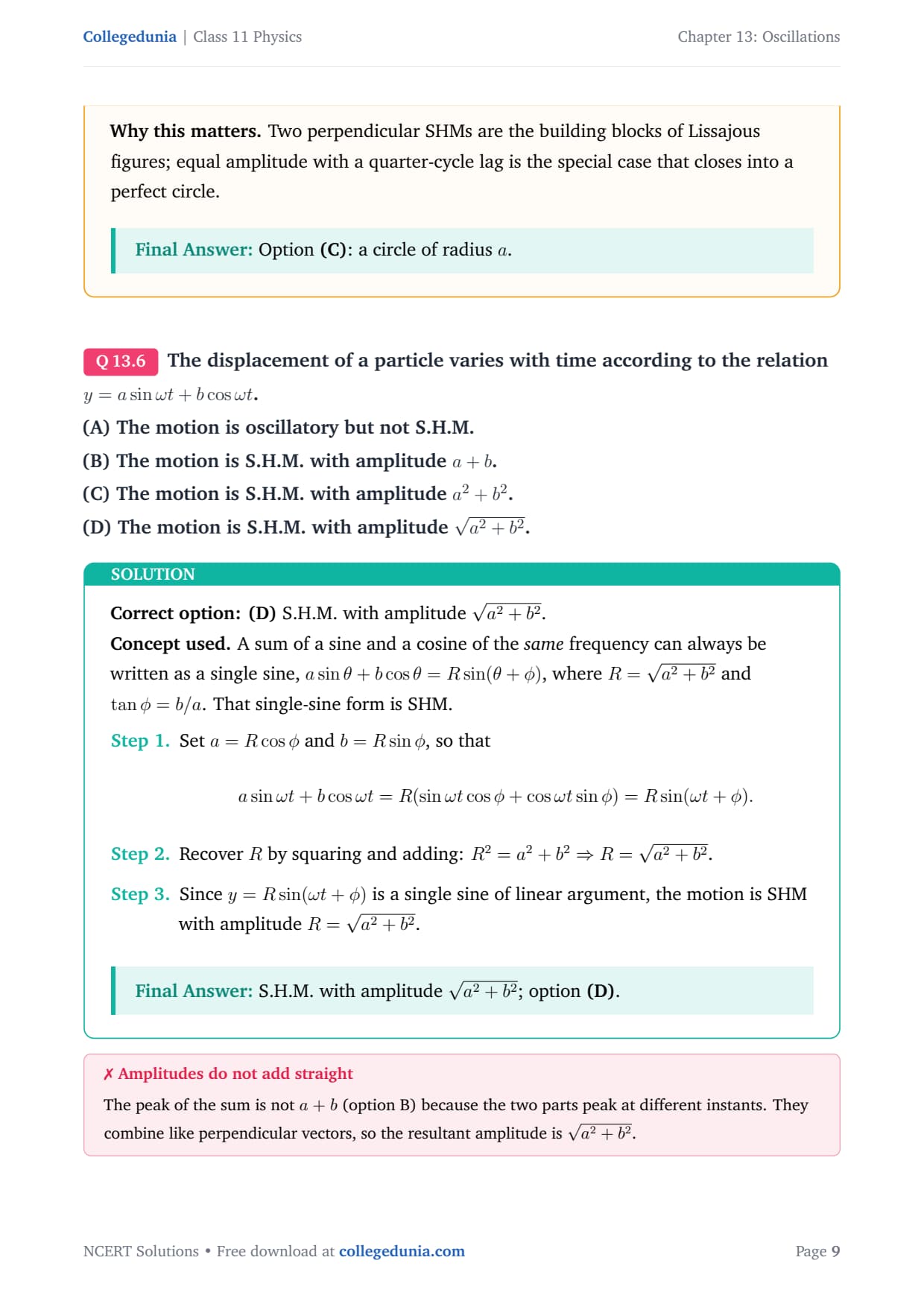
- Amplitudes do not add straight: combining two perpendicular SHMs of amplitude a and b gives the square root of (a2 + b2), not a + b
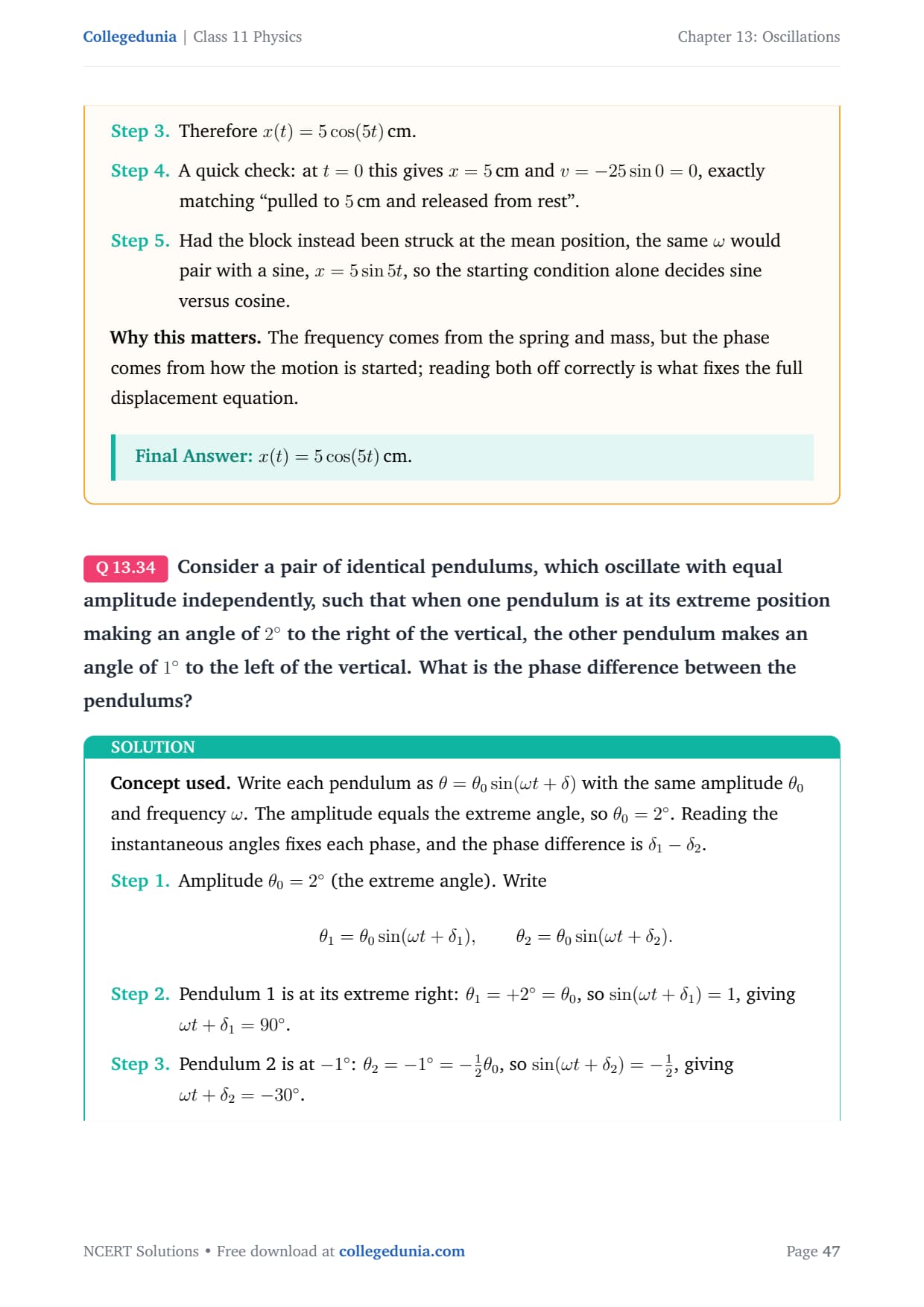
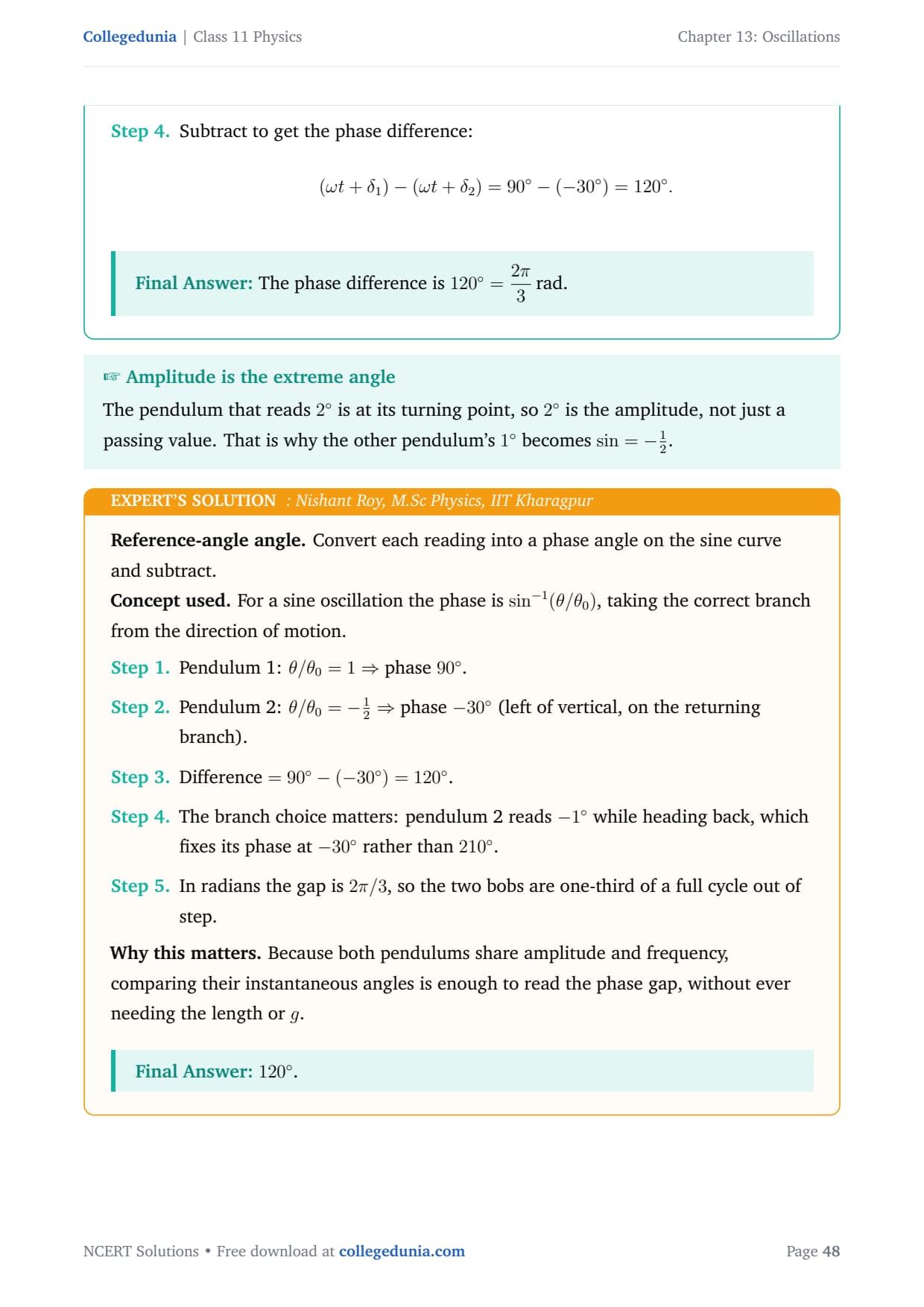
- Same displacement is not same phase: two pendulums at 2° right and 1° left differ by 120°, which Question 34 asks for directly
- Acceleration always points to O: it points at the mean position from either side, so its sign flips with position, not with velocity
- Large swings are not SHM: the pendulum formula holds only while sinθ is close to θ
How the Exemplar Steps Up from the Class 11 Physics Textbook
The textbook hands you a system and asks for its period. The Exemplar hands you a system and asks whether it oscillates harmonically at all, then makes you prove it.
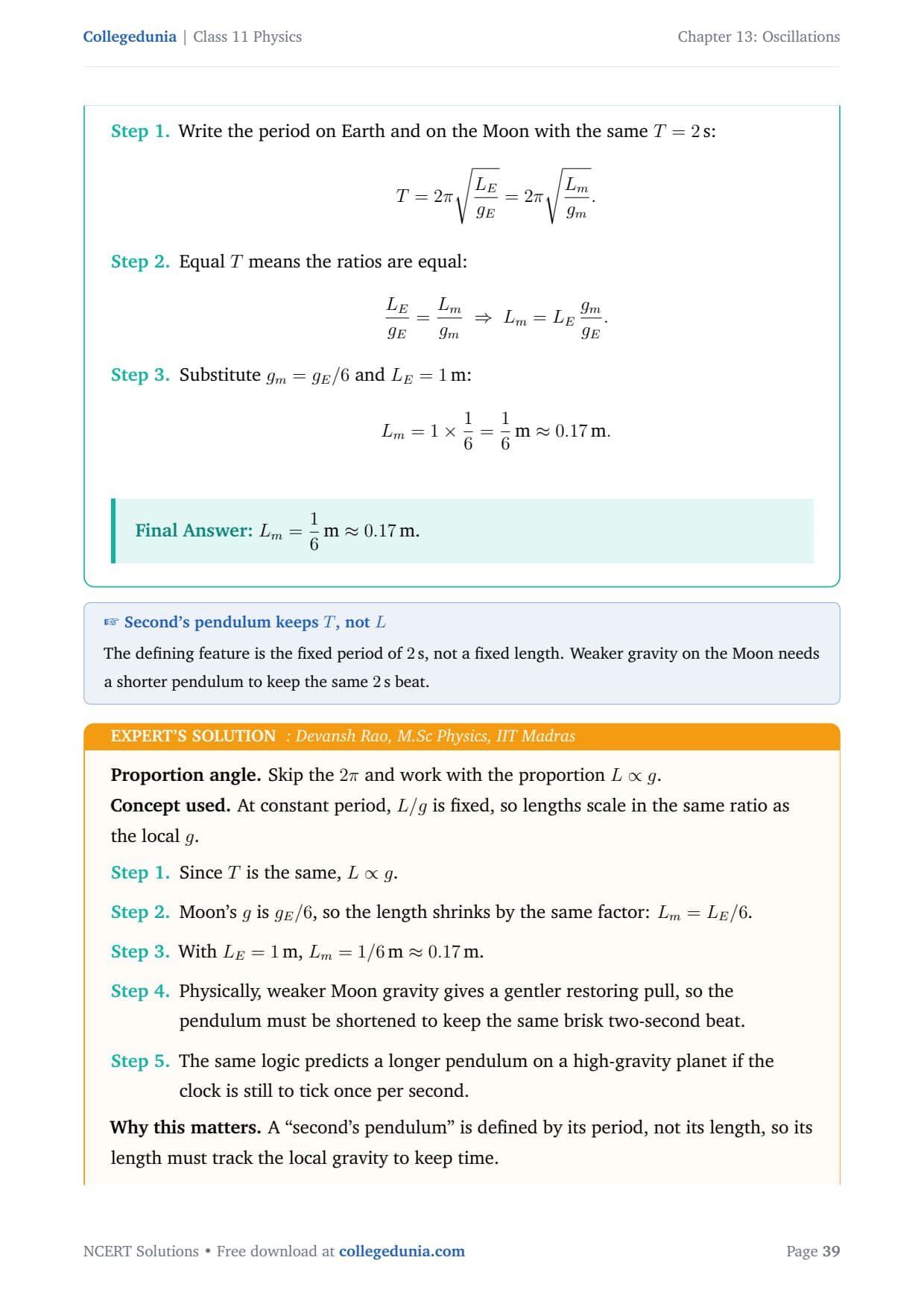
Question 39 is the clearest case. It digs a tunnel through the centre of the Earth and asks you to show a dropped body executes SHM. You need the shell result that only the mass inside radius r pulls on the body, which gives the period 2π times the square root of R/g. Question 28 is shorter but just as sharp: a second's pendulum is 1 m on Earth, so on the moon it is 1/6 m.
Student Feedback
Students who used Collegedunia's Class 11 Physics Exemplar Solutions told us the sine-versus-cosine decision caused the most lost marks. Around 7 in 10 said the flagged answer key errors saved them from memorising a wrong result before the board exam.
Other Resources for Class 11 Physics Oscillations
Collegedunia has the full study set for this chapter. Start with the Notes, then use the Exemplar once the SHM condition is comfortable.
Also Check:
- NCERT Solutions for Class 11 Physics Chapter 13
- Class 11 Physics Chapter 13 Notes
- Class 11 Physics Chapter 13 Handwritten Notes
- Class 11 Physics Chapter 13 NCERT Book PDF
- Class 11 Physics Chapter 13 Exemplar Questions with Solutions
NCERT Exemplar Solutions for Other Class 11 Physics Chapters
Every chapter below has the same step-by-step treatment and a free PDF.
Oscillations Class 11 Physics NCERT Exemplar Solutions FAQs
Ques. How many questions are there in the Class 11 Physics Oscillations Exemplar?
Ans. Chapter 13 has 40 questions. They are split into 11 MCQ I, 7 MCQ II, 10 Very Short Answer, 6 Short Answer and 6 Long Answer questions. All 40 are solved in the free 60-page PDF on this page.
Ques. Why is Oscillations numbered Chapter 14 in my NCERT Exemplar book?
Ans. The Exemplar book still uses the older chapter order, so it prints Oscillations as Chapter Fourteen and labels its diagrams Fig. 14.1 to Fig. 14.11. Your textbook and syllabus call it Chapter 13. The questions are the same, so use the figure labels to match the printed page.
Ques. Is the answer x = 5 sin 5t in Question 33 correct?
Ans. No, the official key has an error here. The block is pulled 5 cm and released from rest at the extreme, so at t = 0 it sits at maximum displacement with zero velocity. That fixes the phase at zero and gives x = 5 cos 5t cm. A sine would place the block at the mean position at full speed, which the question rules out.
Ques. What is the correct frequency in Question 36 of the Oscillations Exemplar?
Ans. About 3.5 s-1. The lowest point is 4 cm below the release point, so the amplitude is 2 cm and the equilibrium extension is also 2 cm. That gives k/m = g/0.02 = 490, so ω = 22.1 rad s-1 and f = 3.5 s-1. The official key prints 2.8 s-1.
Ques. How do I tell whether a motion is SHM in the Exemplar MCQs?
Ans. Apply one test: write the acceleration and check whether it equals −ω2x. If the restoring quantity is proportional to displacement and points at the mean position, it is SHM. If the motion repeats but fails that test, it is periodic only. If it never repeats at fixed intervals, it is oscillatory but not periodic.



Comments