




NCERT Exemplar Solutions for Class 11 Physics Chapter 10 Thermal Properties of Matter solve all 27 questions from the Exemplar book. Every MCQ, Very Short Answer, Short Answer and Long Answer problem is worked step by step. The free PDF on this page runs to 49 pages and follows the 2026-27 syllabus.
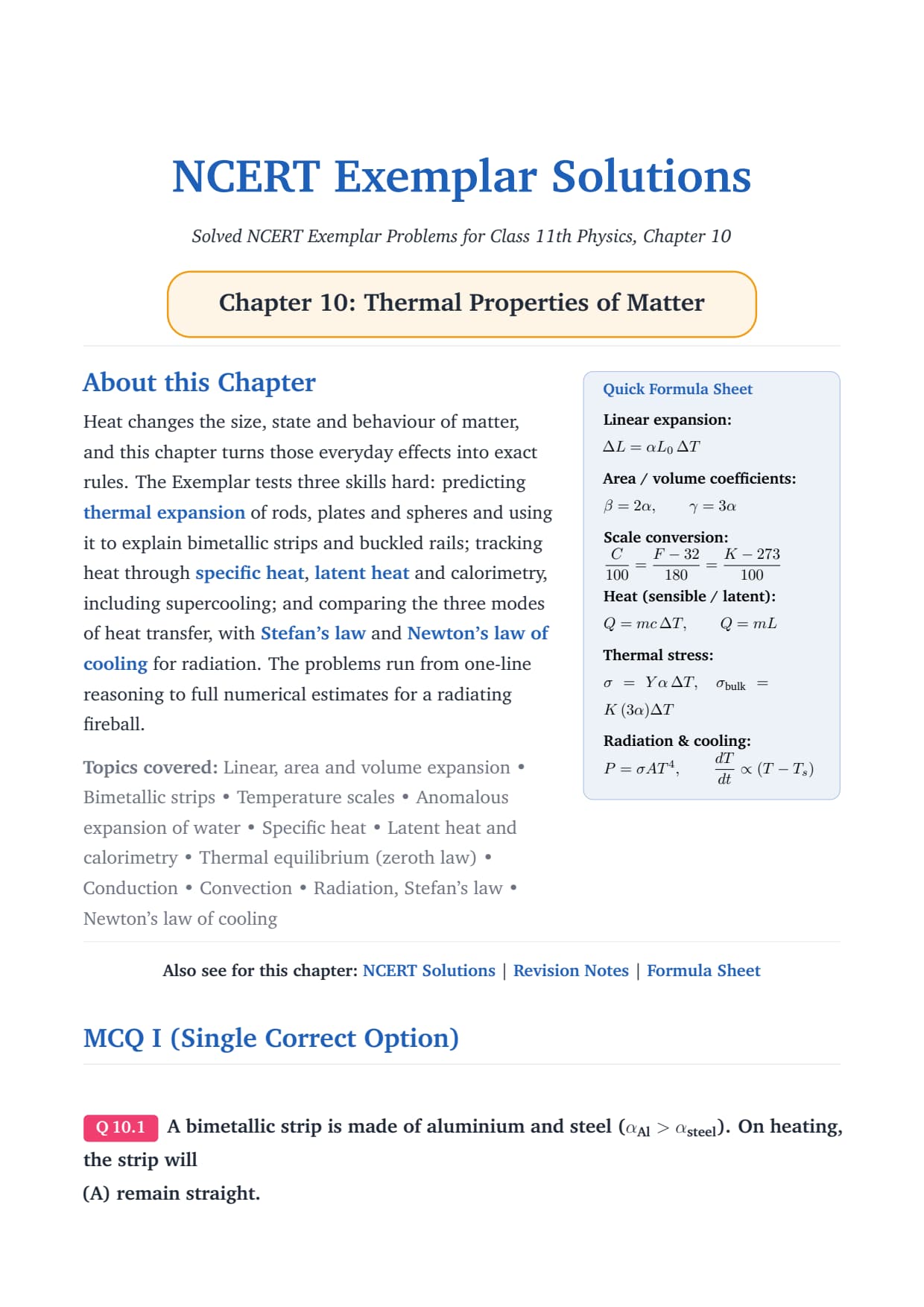
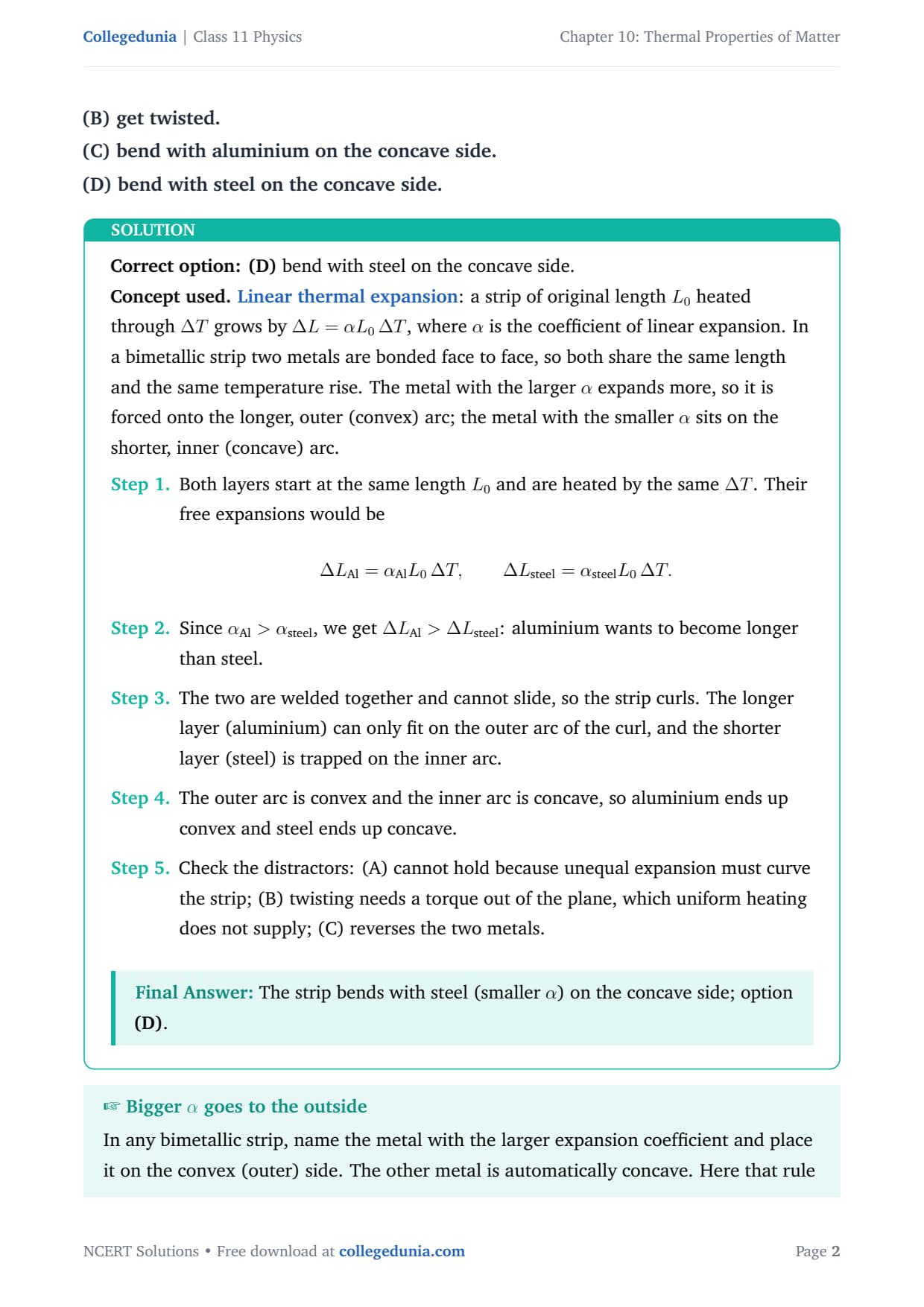
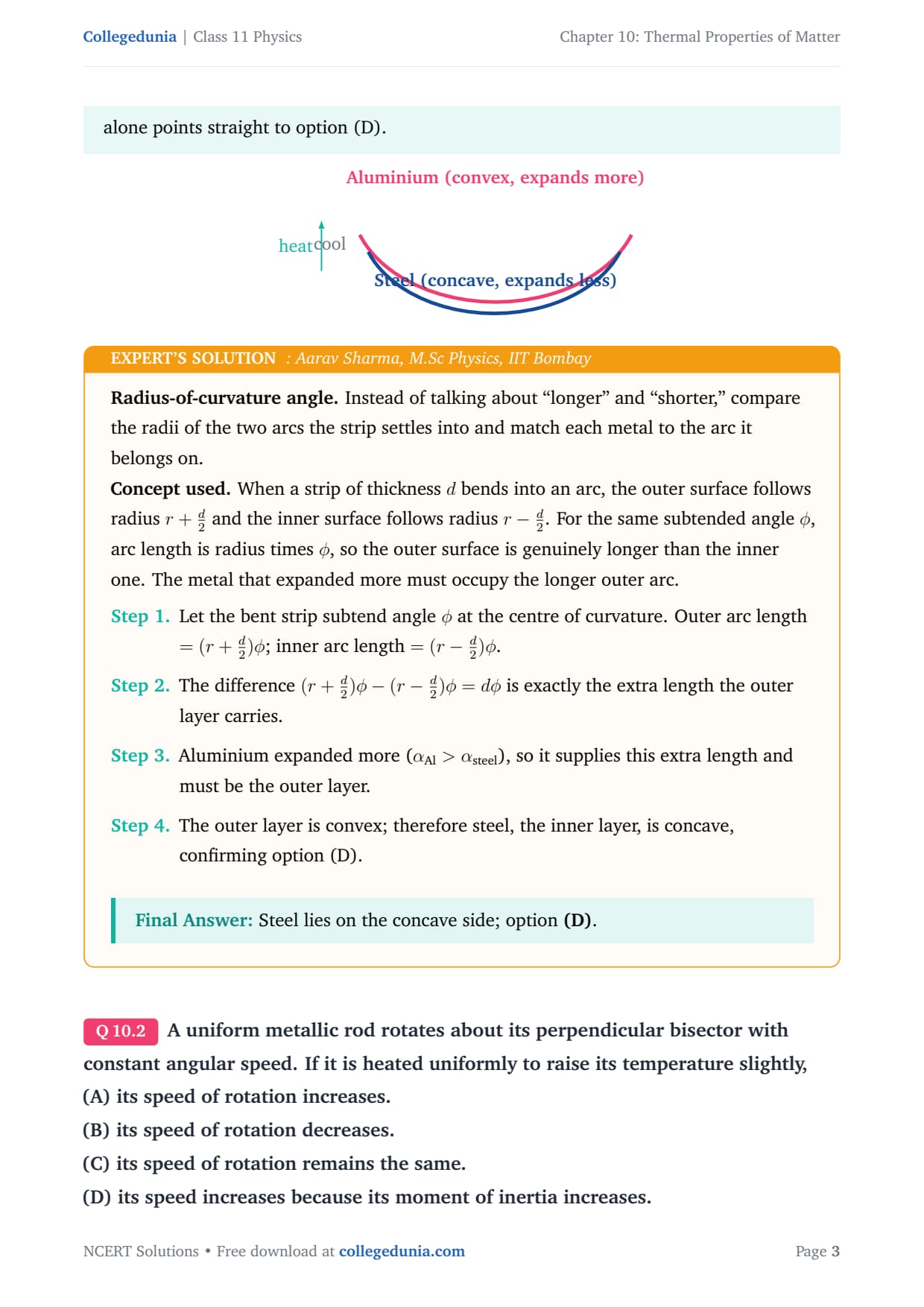
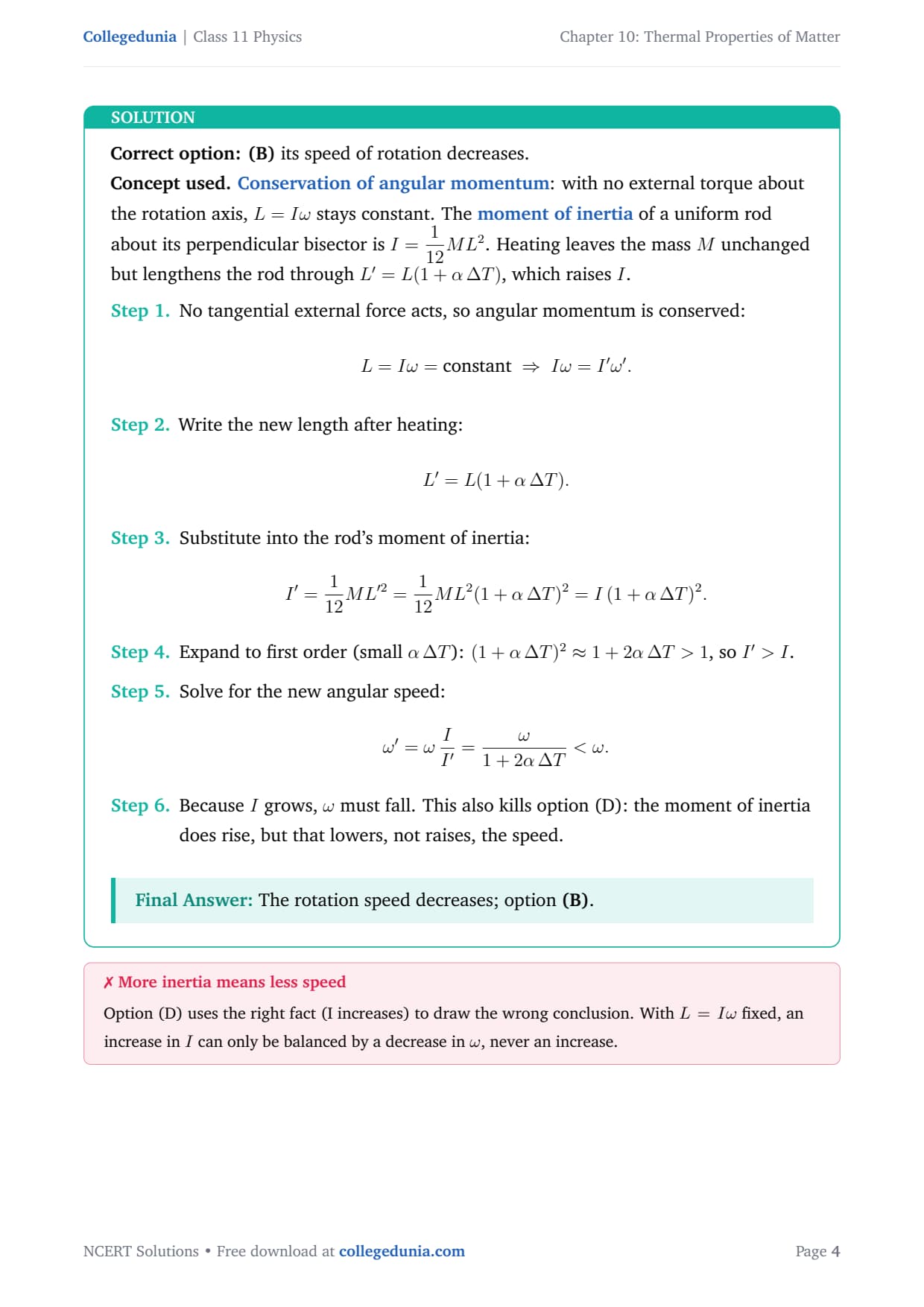
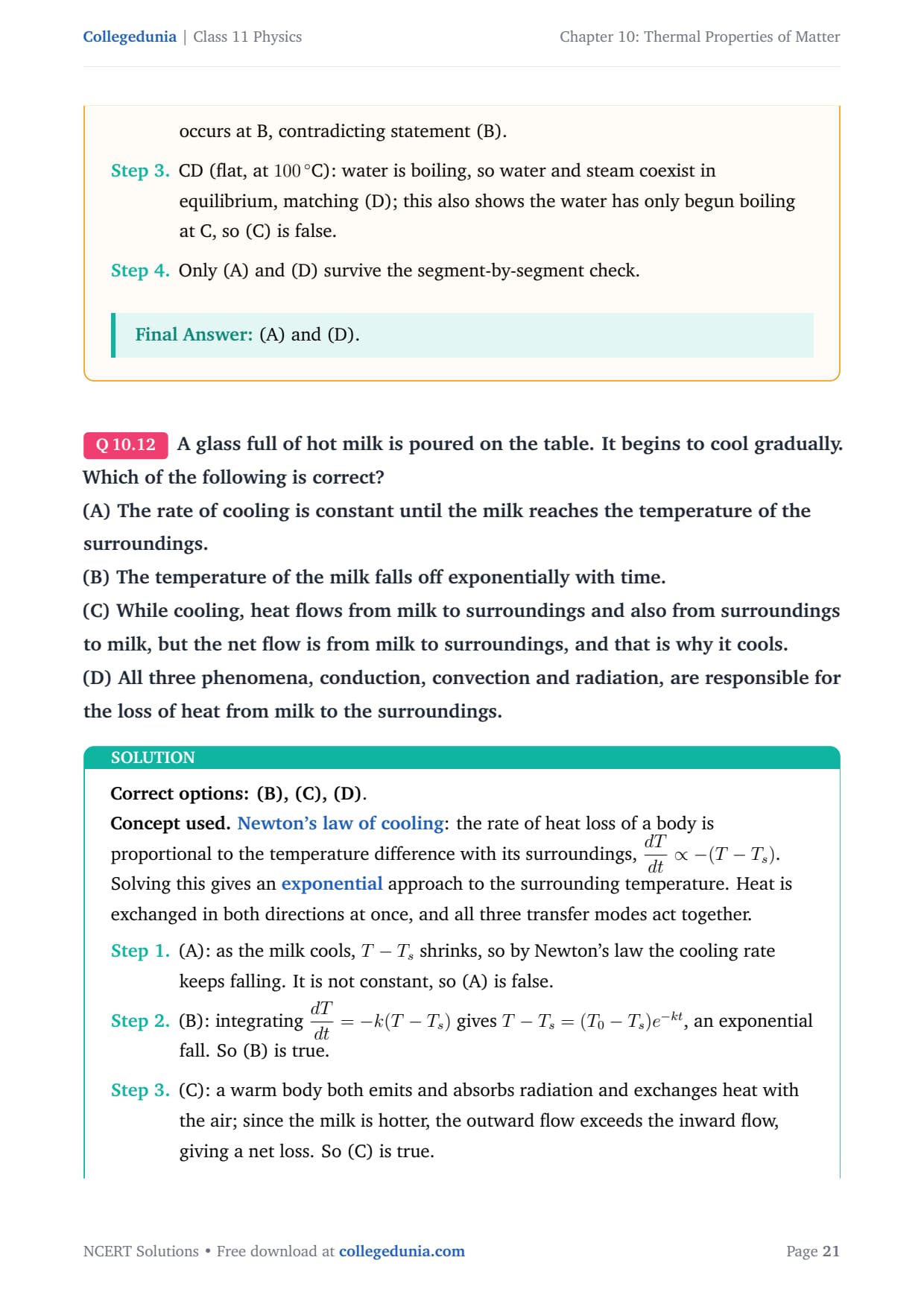
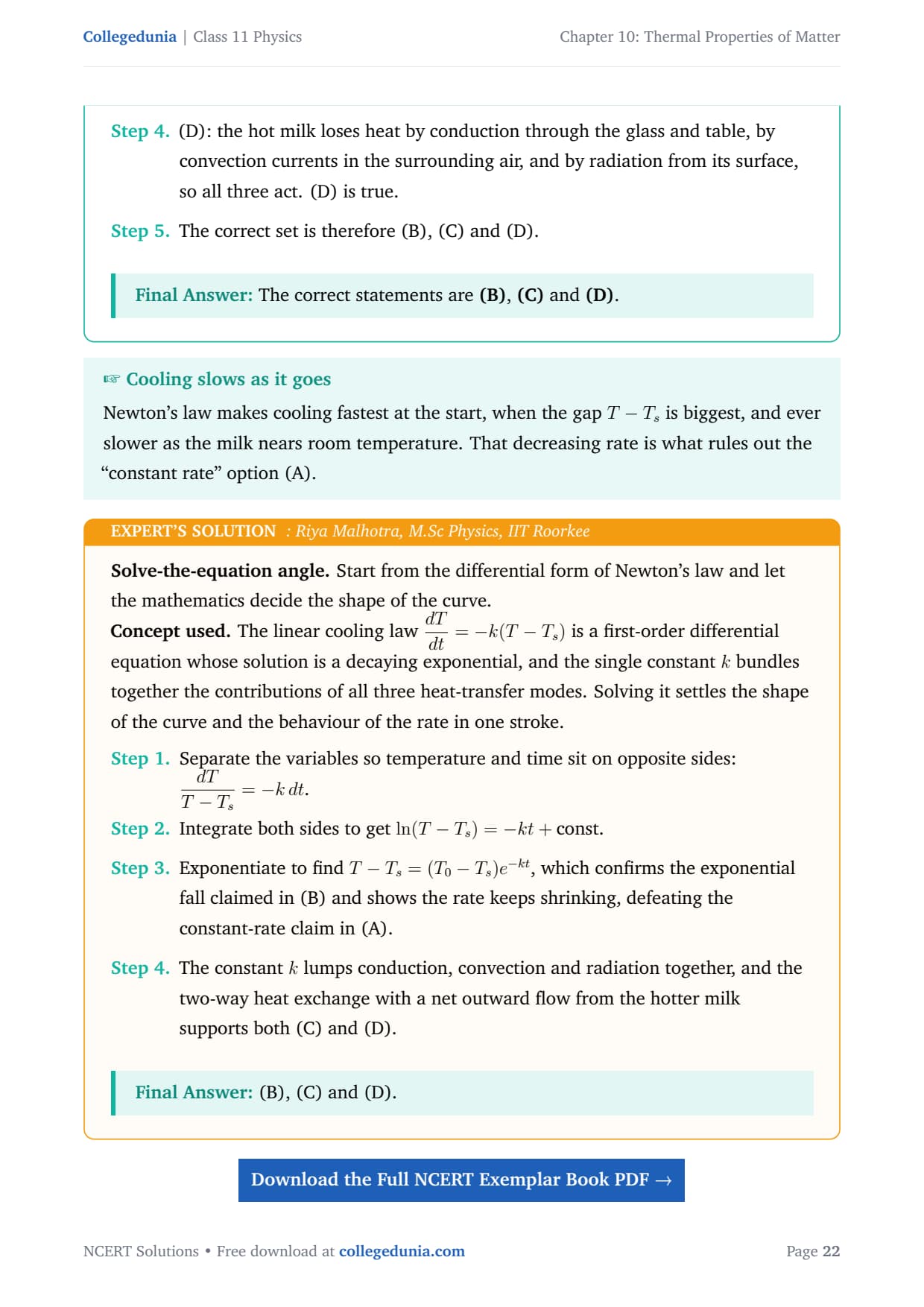
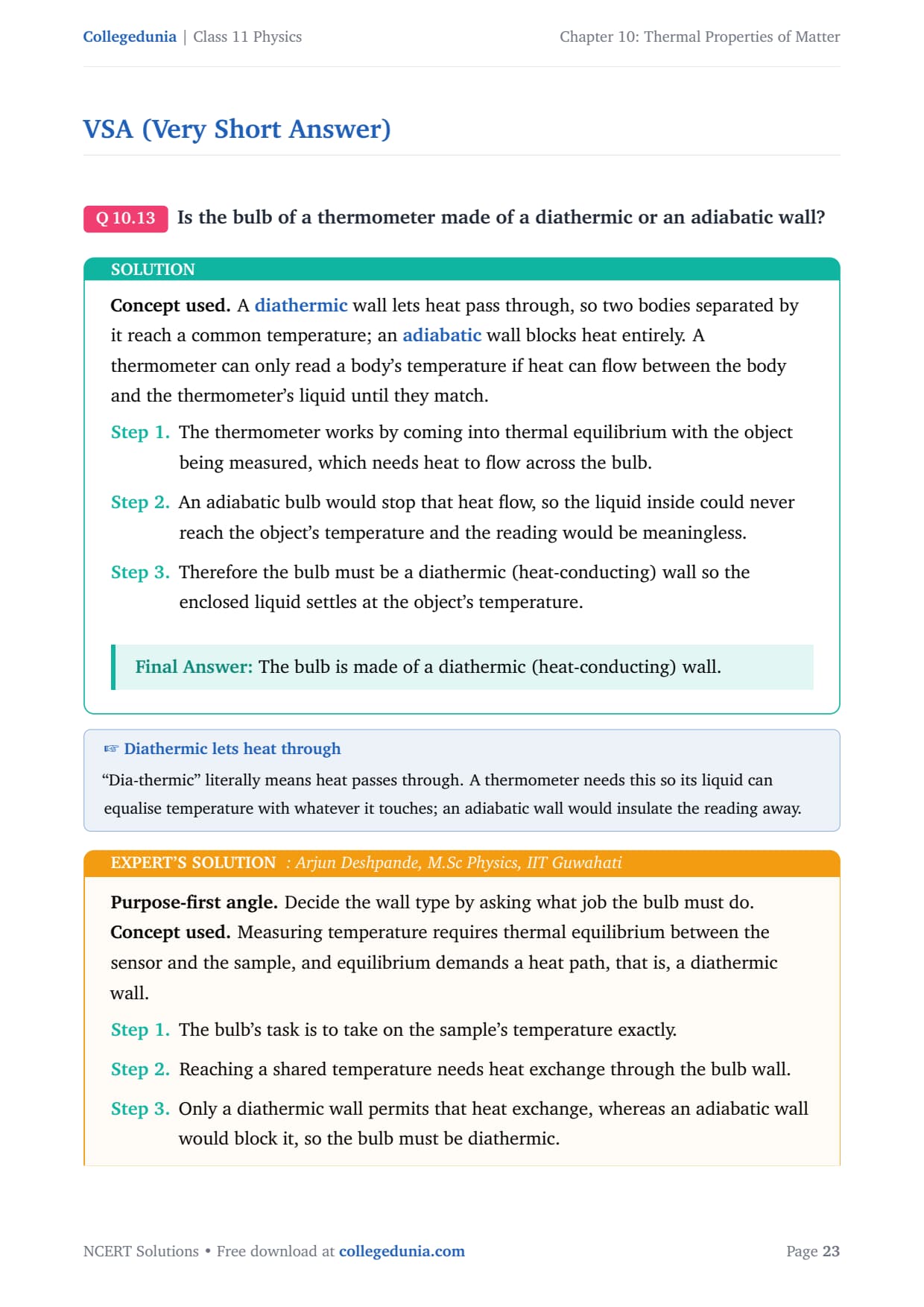
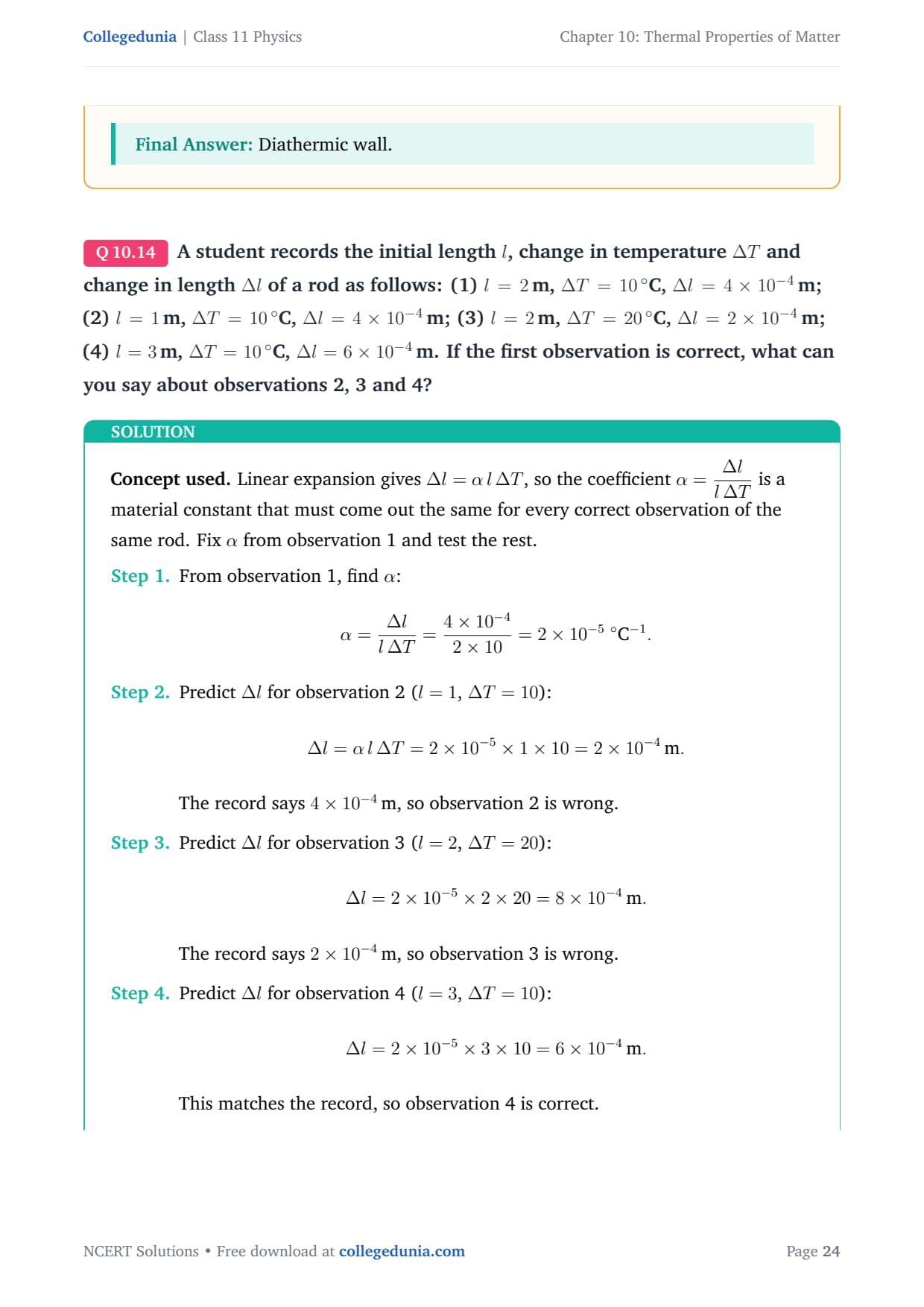
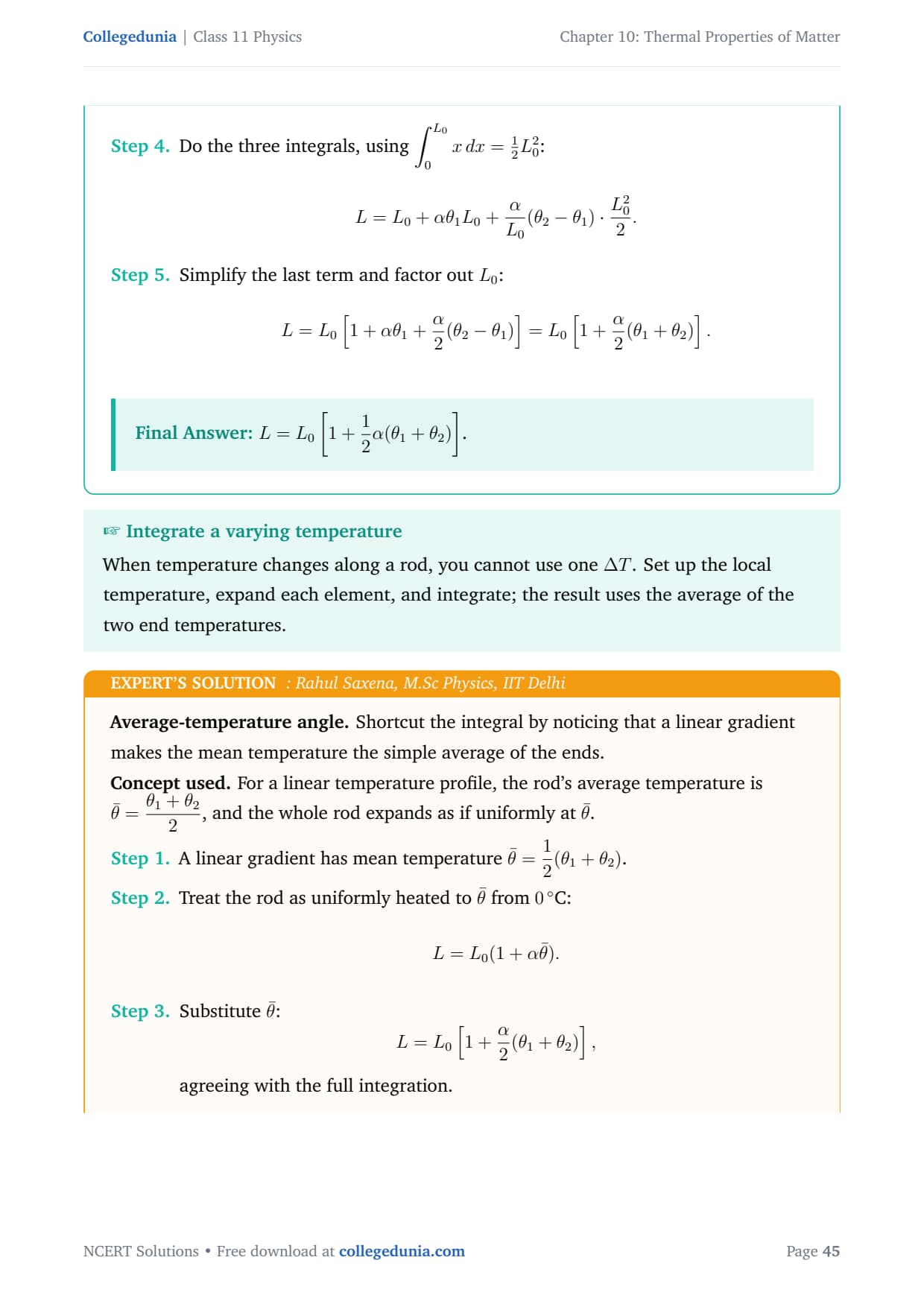
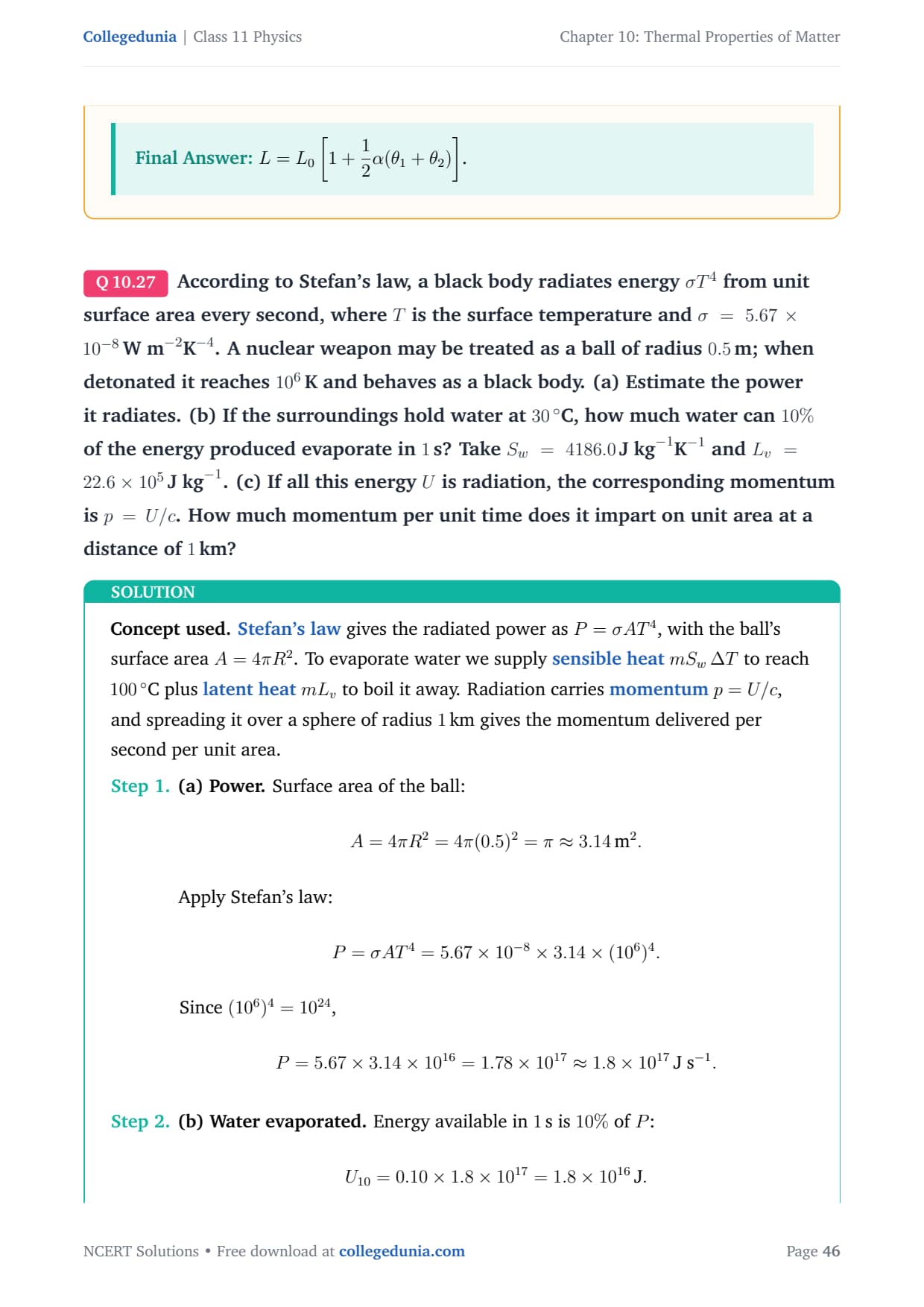
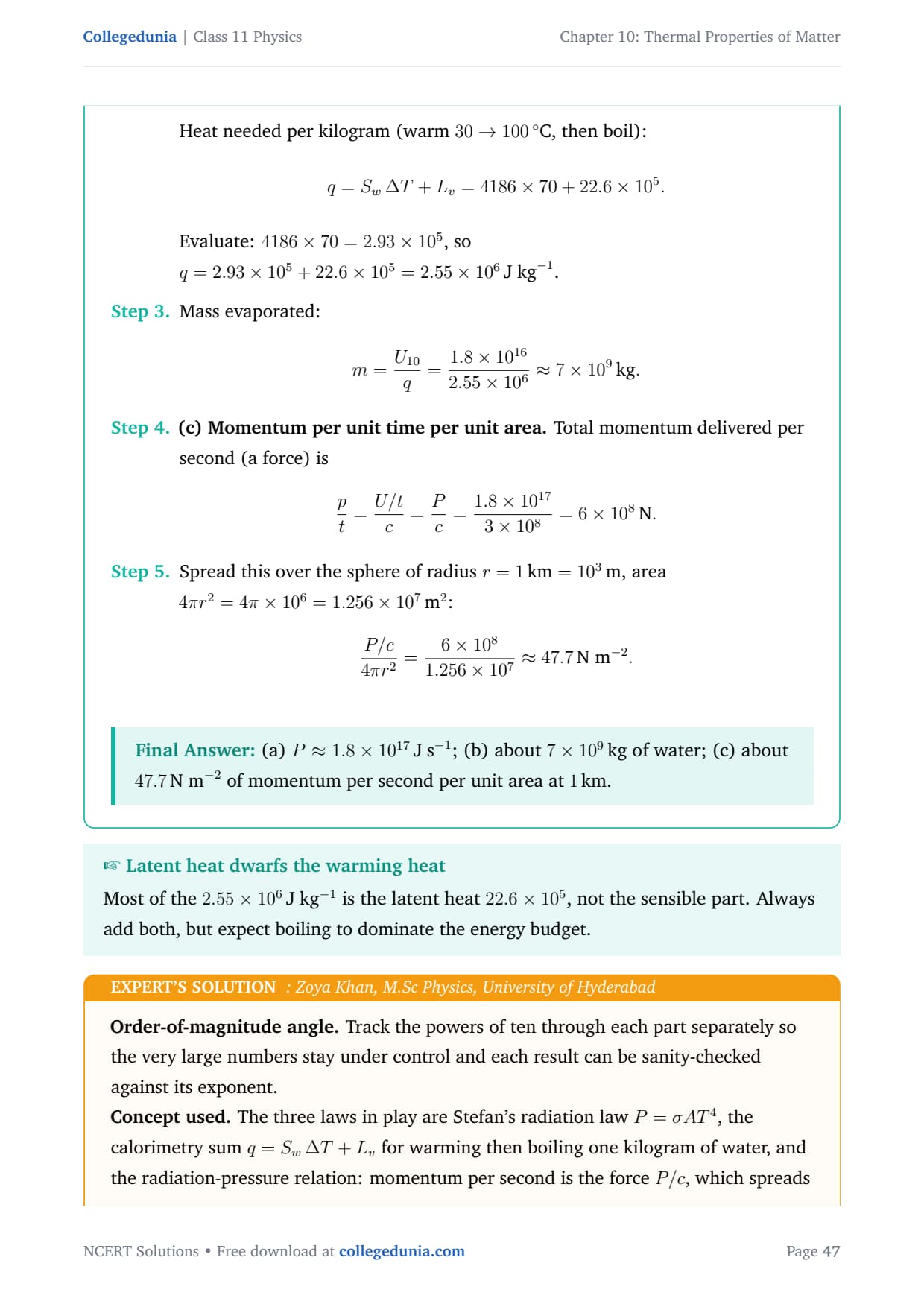
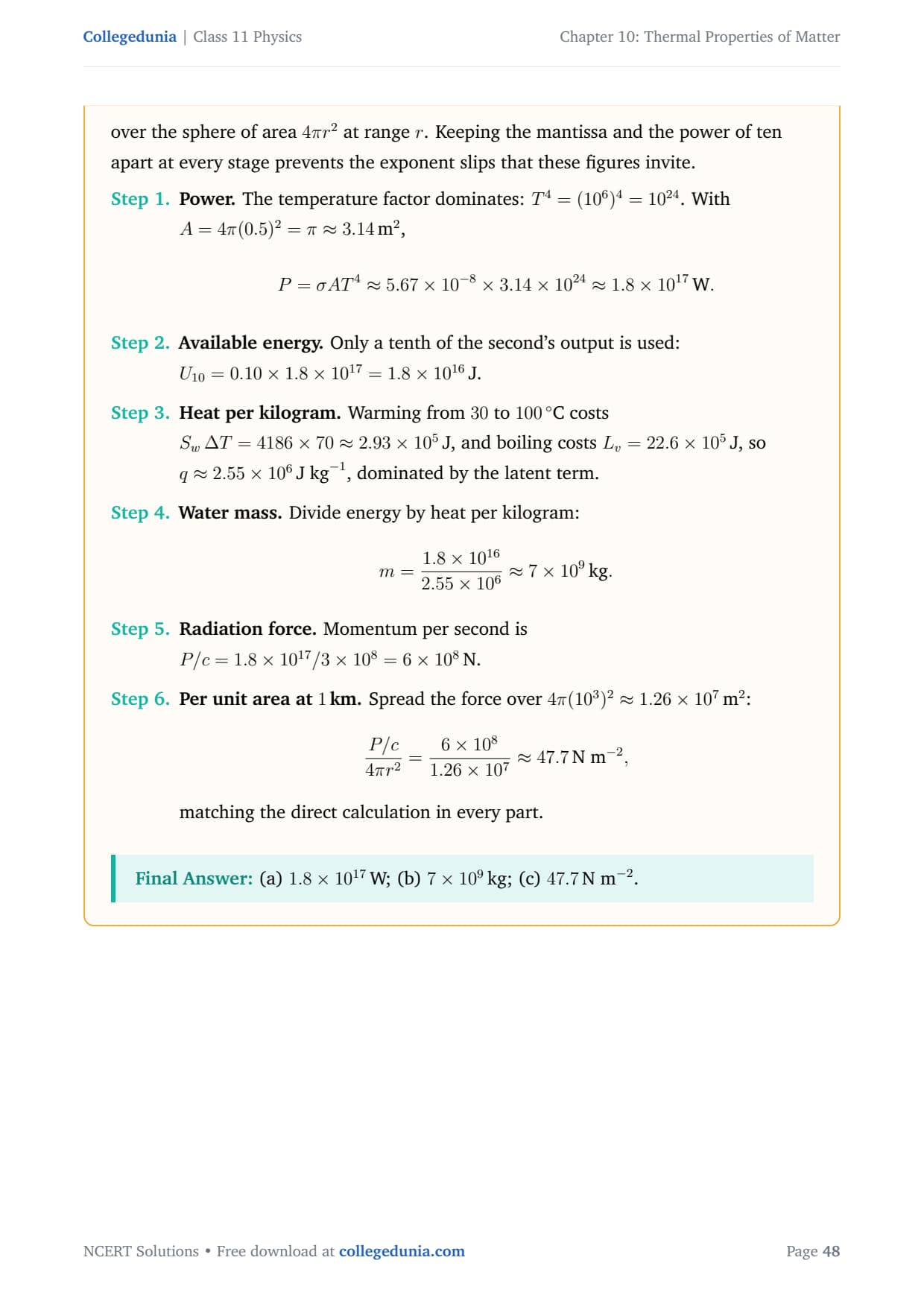
This chapter ties temperature, expansion, heat and radiation into one story. The textbook keeps each idea separate, but the Exemplar mixes them. A single question can expand a rod, then ask how its moment of inertia shifts.
- CBSE Weightage: 4 to 5 marks, usually one numerical on thermal expansion or calorimetry
- JEE Main Weightage: 1 to 2 questions per year on expansion, conduction or Newton's law of cooling
- NEET Weightage: 1 to 2 questions per year, most often on calorimetry and Stefan's law
Every answer is checked against the official NCERT Exemplar answer key, with the reasoning shown in full for each option.
Topics Covered in the Class 11 Physics Thermal Properties of Matter Exemplar
Four groups of ideas carry the chapter. The Exemplar returns to them in different disguises, so recognising the group is half the work.
- Temperature scales: fixed points, conversion between Celsius, Fahrenheit and any invented scale
- Thermal expansion: linear, areal and volume expansion, plus the thermal stress that appears when expansion is blocked
- Calorimetry: specific heat, latent heat, and reading phase changes off a temperature-time graph
- Heat transfer: conduction, Stefan's law of radiation, and Newton's law of cooling
Question Types in the Thermal Properties of Matter NCERT Exemplar
The 27 questions are spread across five types. The Long Answer set is the heaviest here, with six questions that each need two or three separate physics ideas.
| Question Type | Count | What It Tests |
|---|---|---|
| MCQ I (single correct) | 8 | Direct reasoning on expansion, cooling rates and what heat actually is |
| MCQ II (one or more correct) | 4 | Ruling out every wrong option, since partial answers score nothing |
| VSA (Very Short Answer) | 5 | One-line explanations, such as why metal feels colder than wood |
| SA (Short Answer) | 4 | Calorimetry and expansion numericals with a short setup |
| LA (Long Answer) | 6 | Multi-step problems on thermal stress, rail buckling and radiation |
Key Formulas Used in the Thermal Properties of Matter Exemplar
Nearly every solution starts from one of these relations. Our PDF states the formula first and substitutes afterwards, so you can see which rule is doing the work.
- Linear expansion: L' = L(1 + αΔT), the base result behind most of the chapter
- Volume expansion: ΔV = γVΔT, with γ = 3α for an isotropic solid
- Calorimetry: heat gained equals heat lost, using mSΔT for warming and mL for a phase change
- Stefan's law: a black body radiates σT4 per unit area per second, with σ = 5.67 × 10⁻⁸ W m-2 K-4
- Newton's law of cooling: the rate of heat loss is proportional to the temperature gap with the surroundings
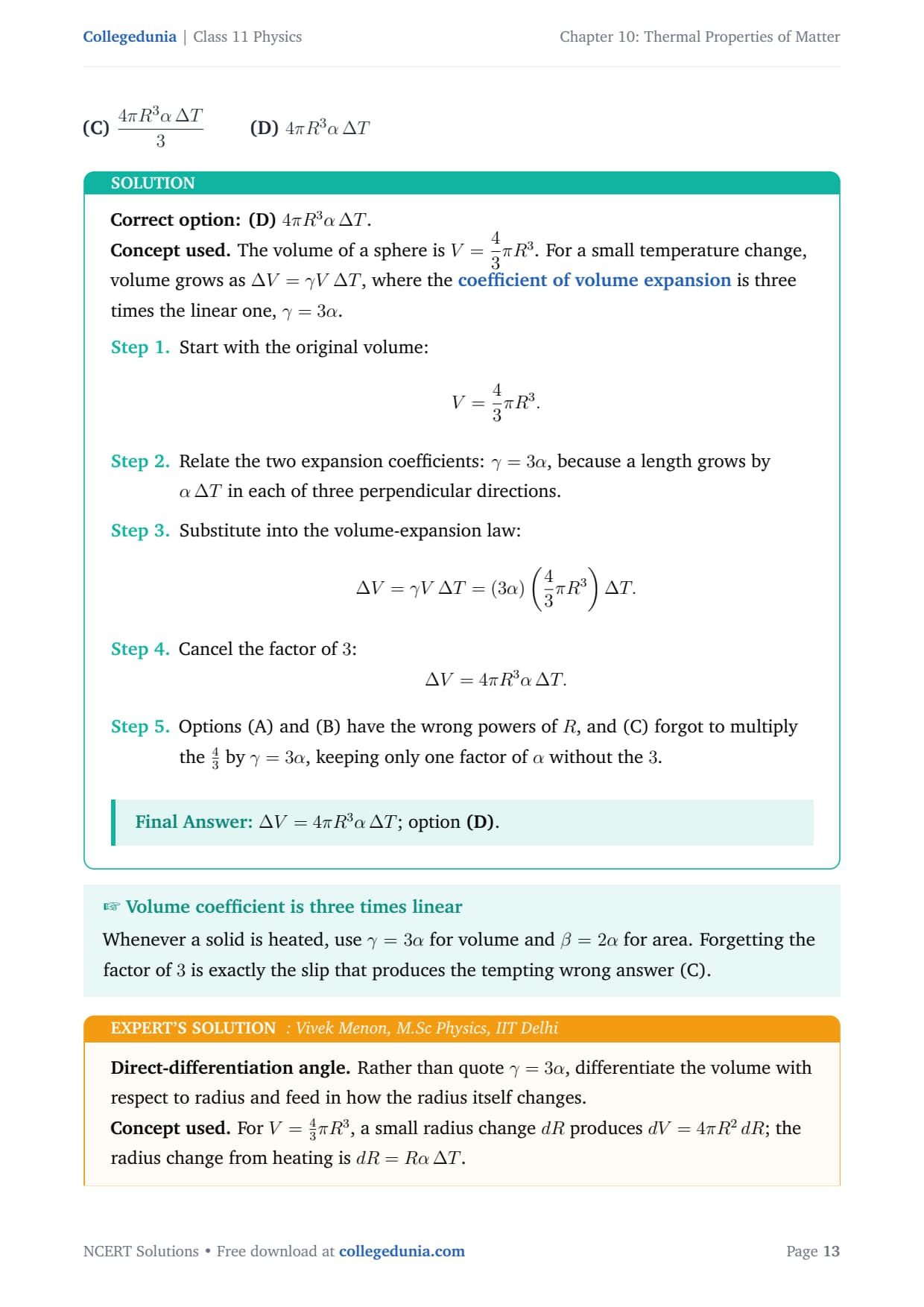
The factor γ = 3α is the single most useful line in this chapter. Question 7 uses it directly: a sphere of radius R heated by ΔT gains a volume of 4πR3αΔT, not 4πR3γΔT as students often write.
Common Mistakes Students Make in Thermal Properties of Matter
The Exemplar builds its options around predictable slips. These four appear again and again, and each is flagged in the PDF at the question where it bites.
- Right fact, wrong conclusion: in Question 2 a rotating rod is heated, so its moment of inertia rises. Since L = Iω is fixed, ω must fall. One option uses the correct fact to claim the speed rises.
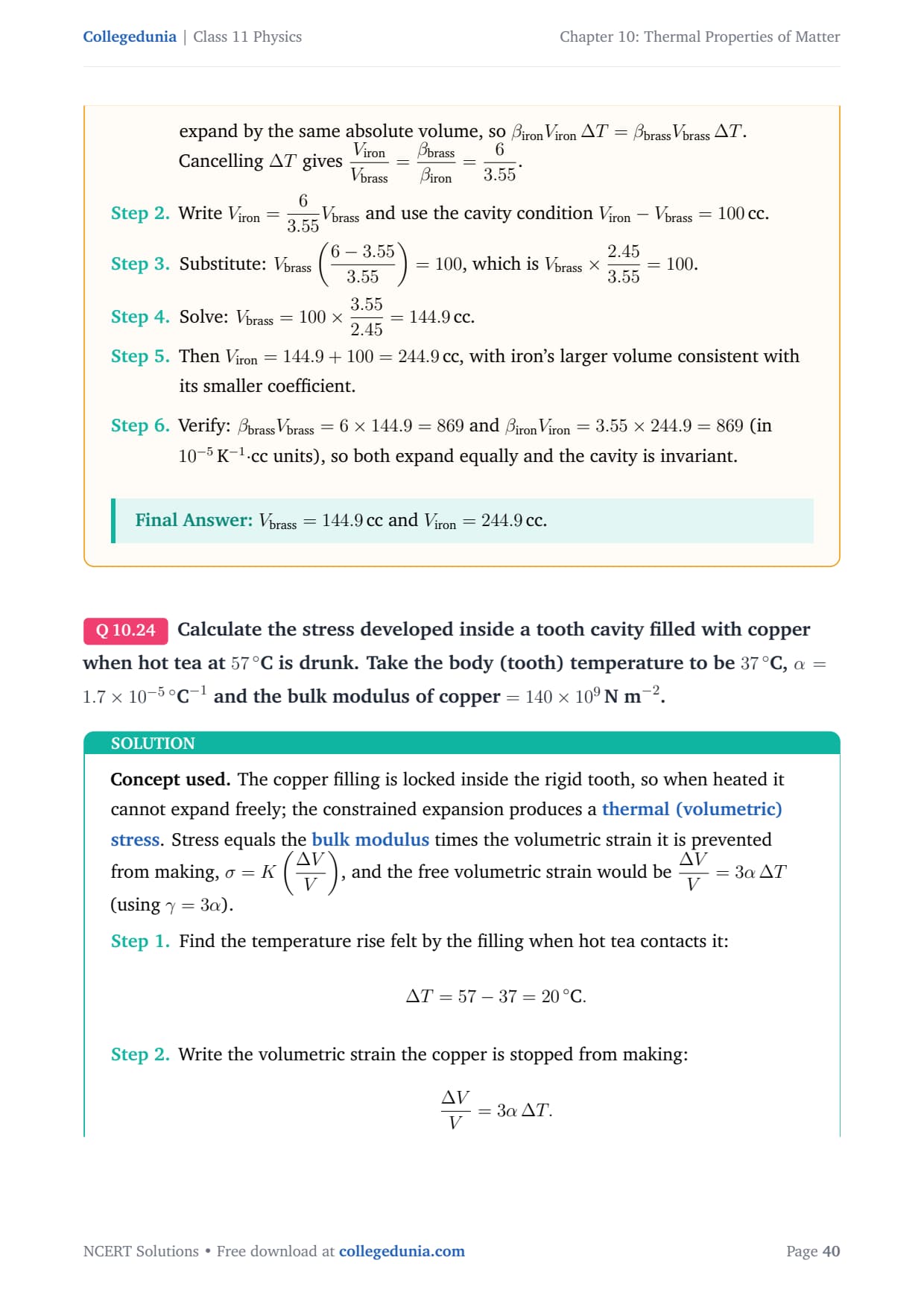
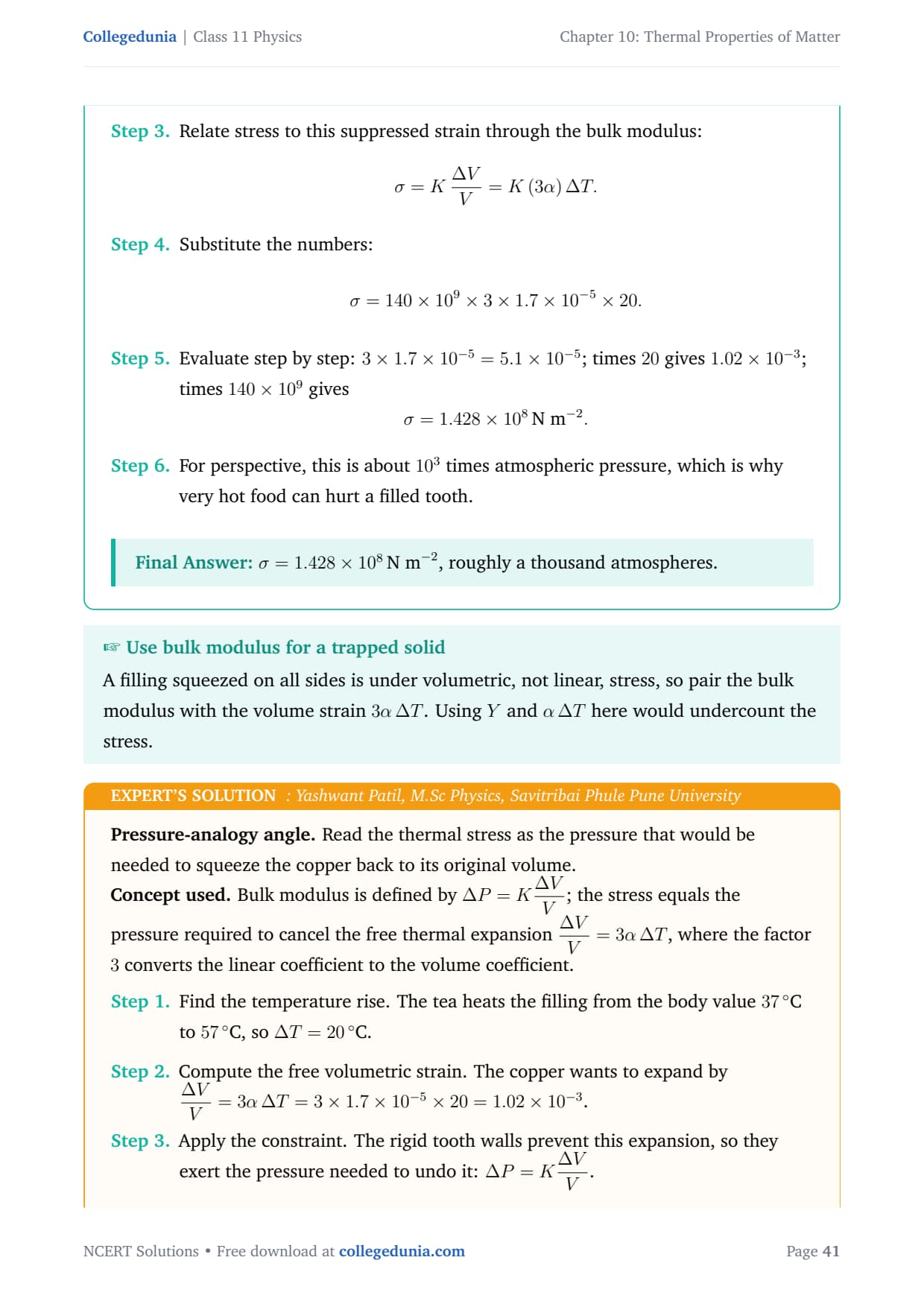
- Forgetting the factor of three: volume strain is 3αΔT, not αΔT. Question 24 needs this to get the tooth-filling stress right.
- Bulk modulus versus Young's modulus: a solid squeezed from every side is under volumetric stress. Using Y here undercounts the answer badly.
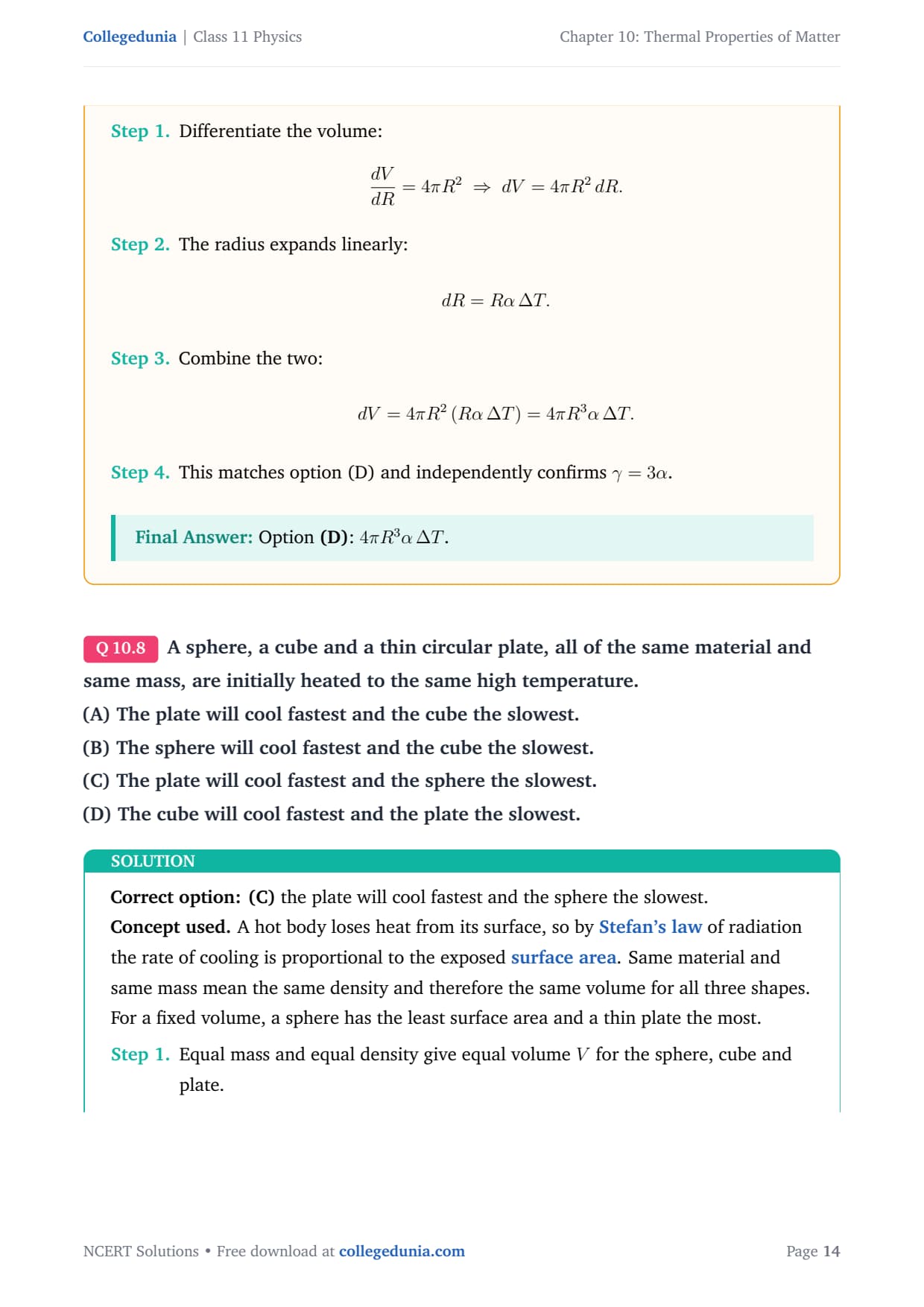
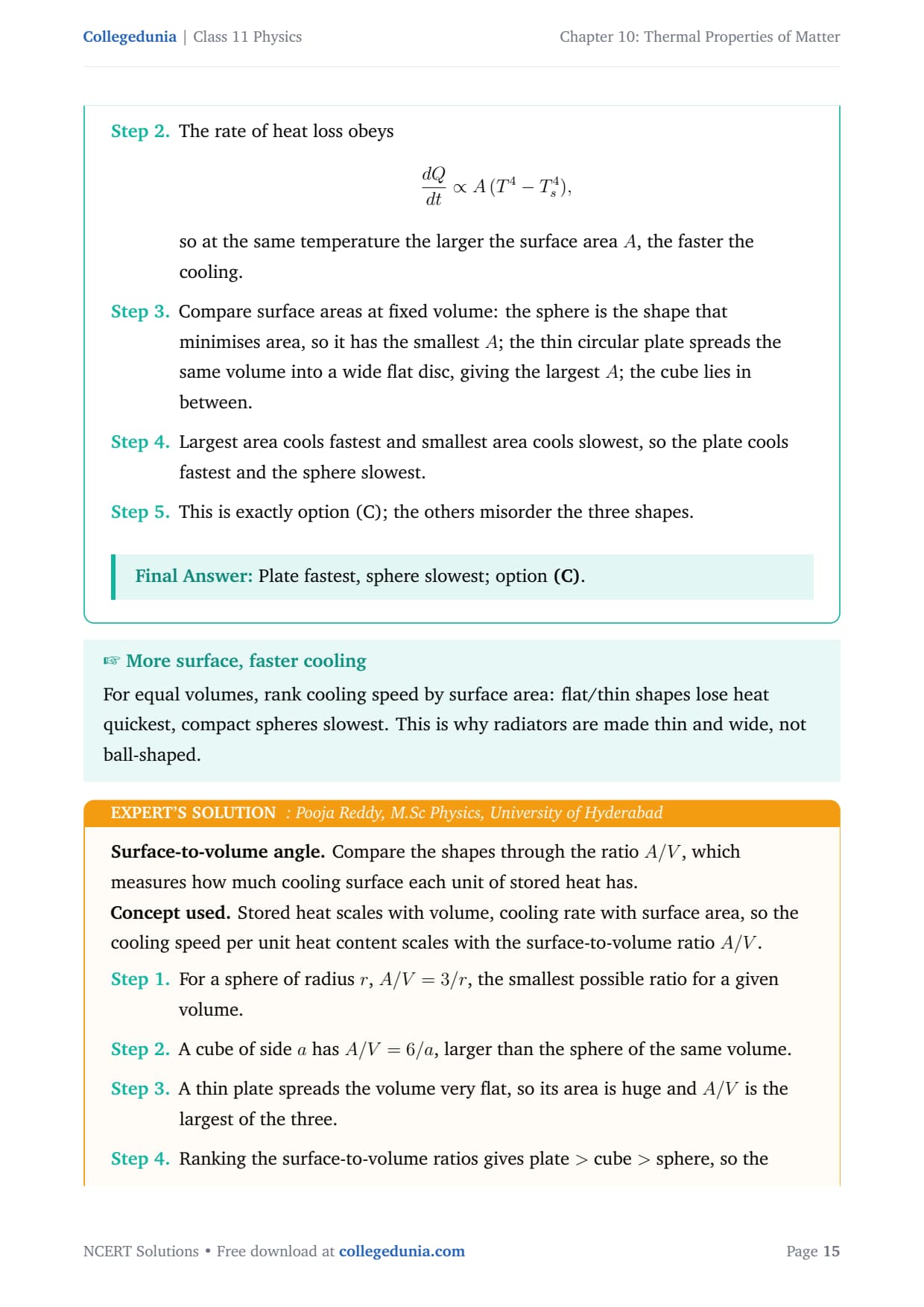
- Cooling rate depends on area, not mass: in Question 8 a sphere, cube and plate share the same mass and material. The plate has the most surface, so it cools fastest.
One more slip is worth naming. Students assume a bigger body always heats slower, but Question 10 shows that only holds for spheres. Doubling a disc's radius leaves its surface-to-volume ratio untouched, since thickness sets it.
How the Exemplar Steps Up from the Class 11 Physics Textbook
The textbook hands you a formula and asks you to substitute. The Exemplar hides which formula applies, and often makes you design something instead of measuring it.
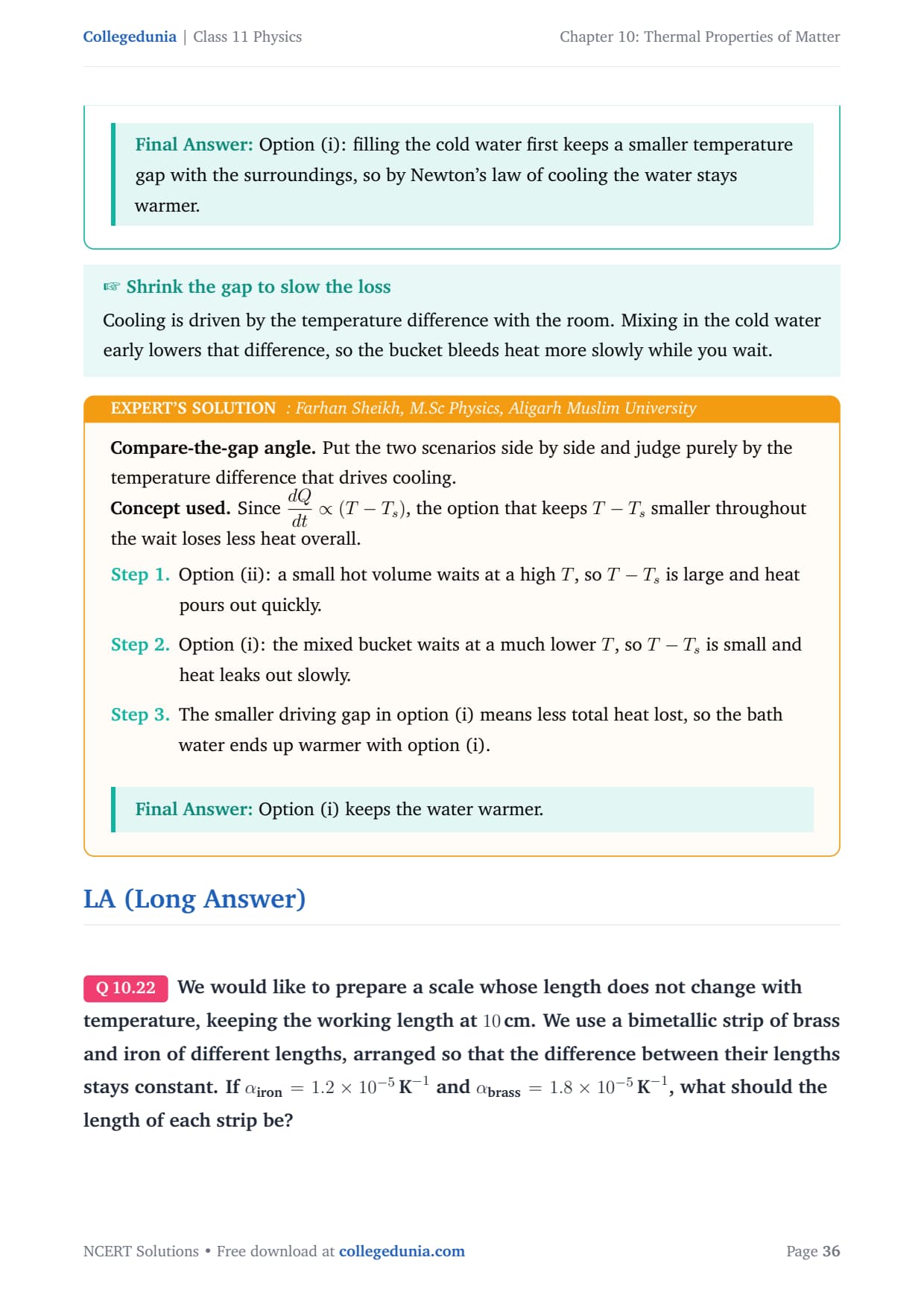
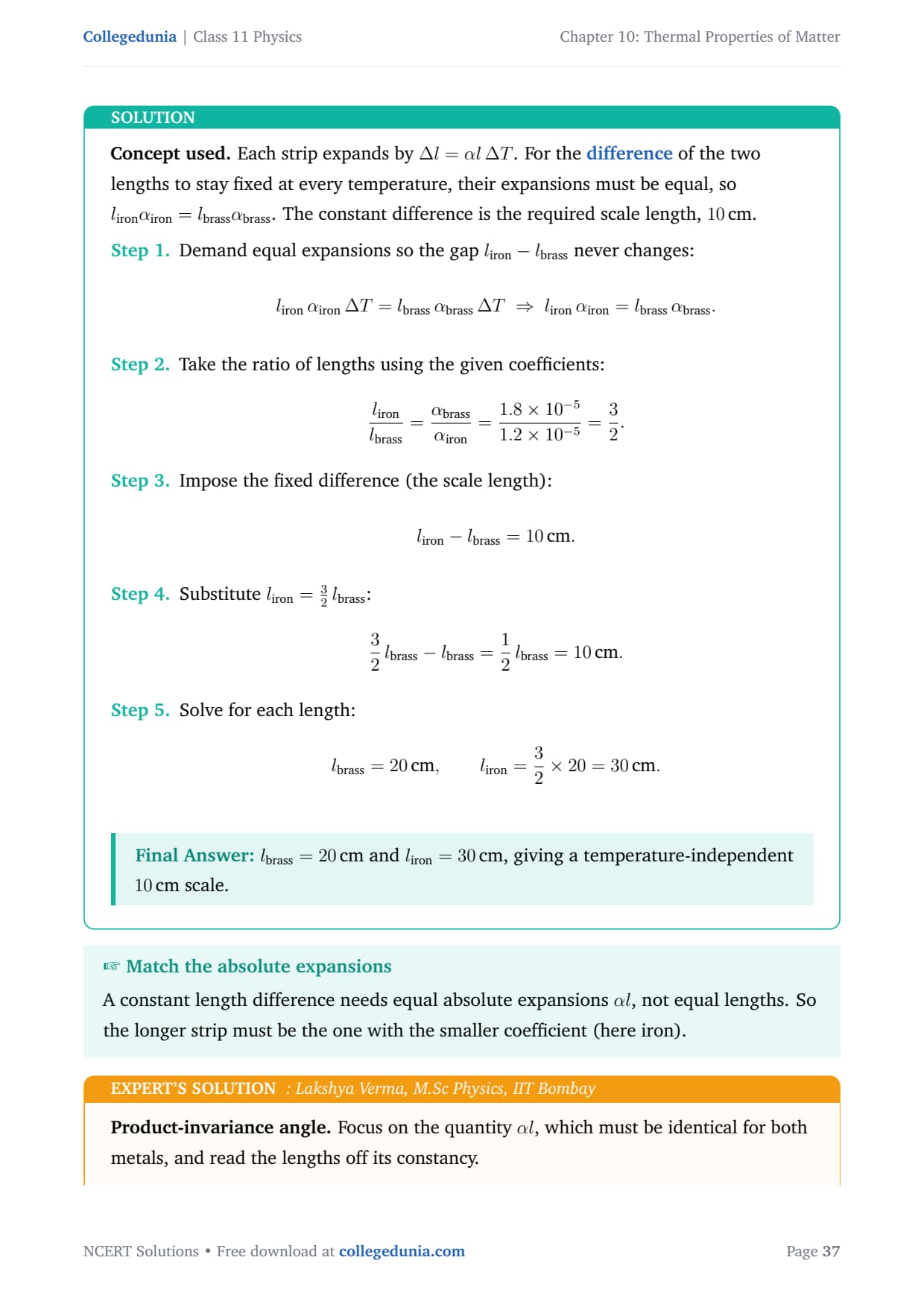
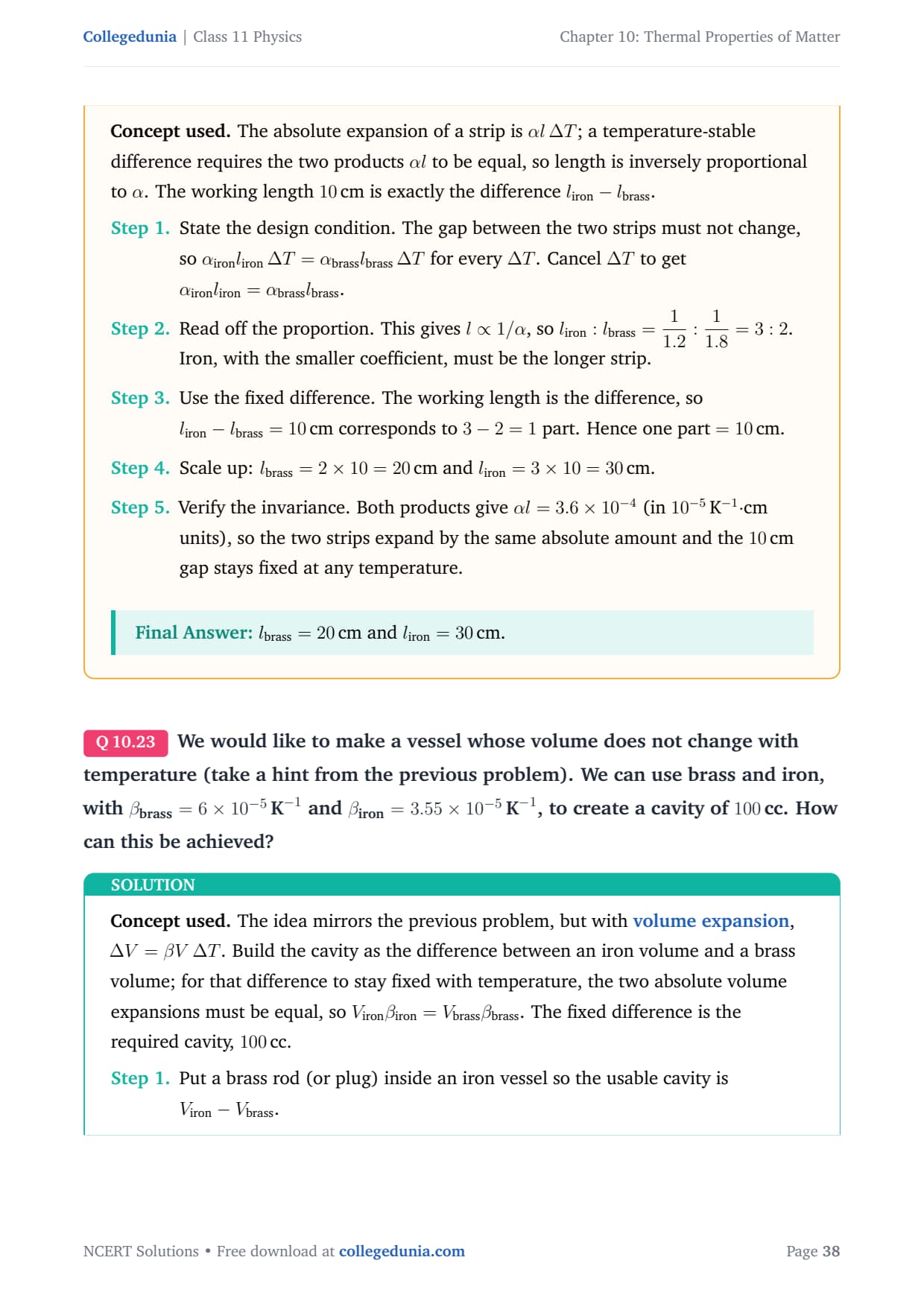
Question 22 is a clear example. It asks you to build a 10 cm scale whose length never changes with temperature, using brass and iron strips with α = 1.8 × 10⁻⁵ K-1 and 1.2 × 10⁻⁵ K-1. The answer, 20 cm of brass and 30 cm of iron, comes from matching the absolute expansions rather than the lengths.
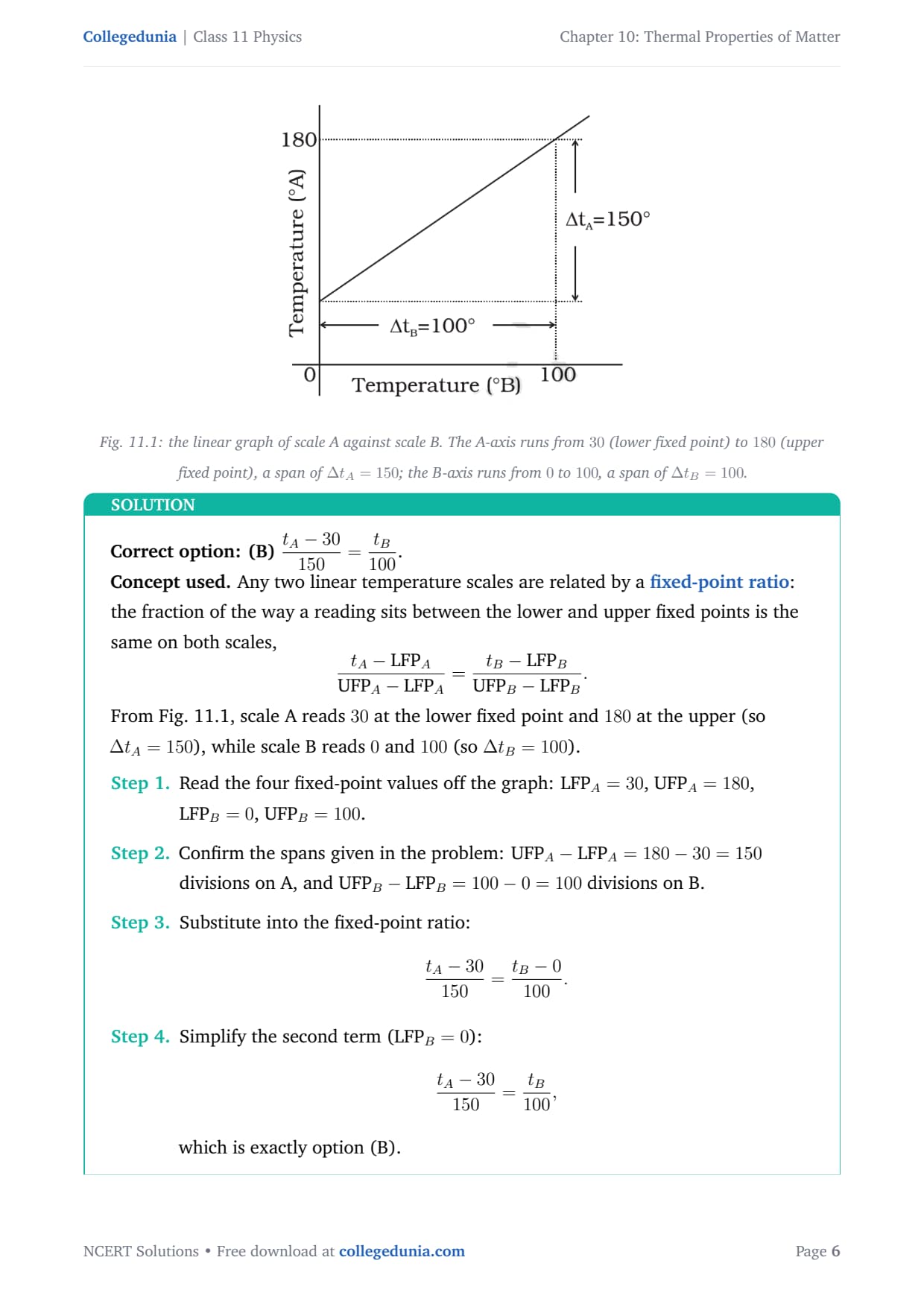
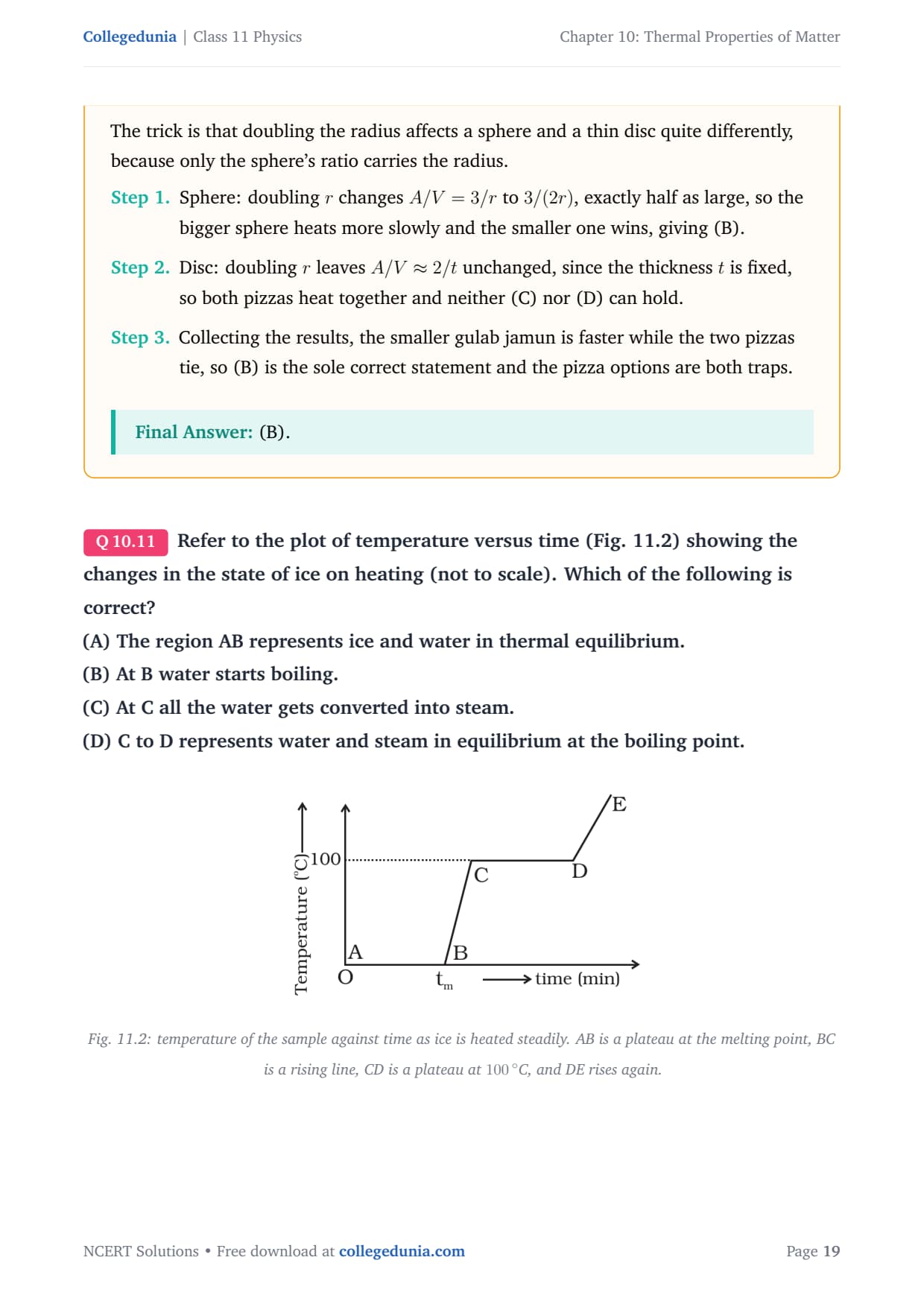
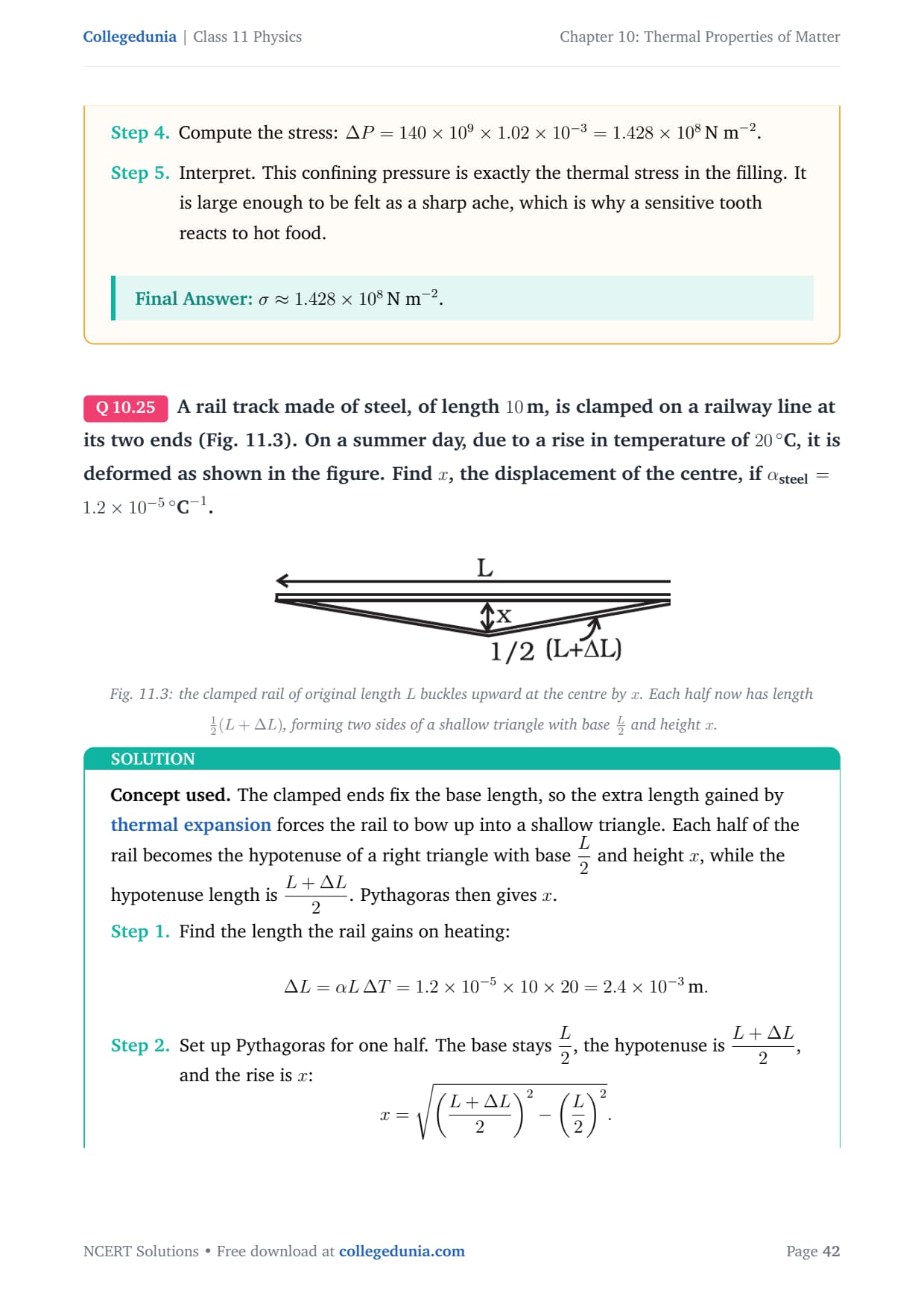
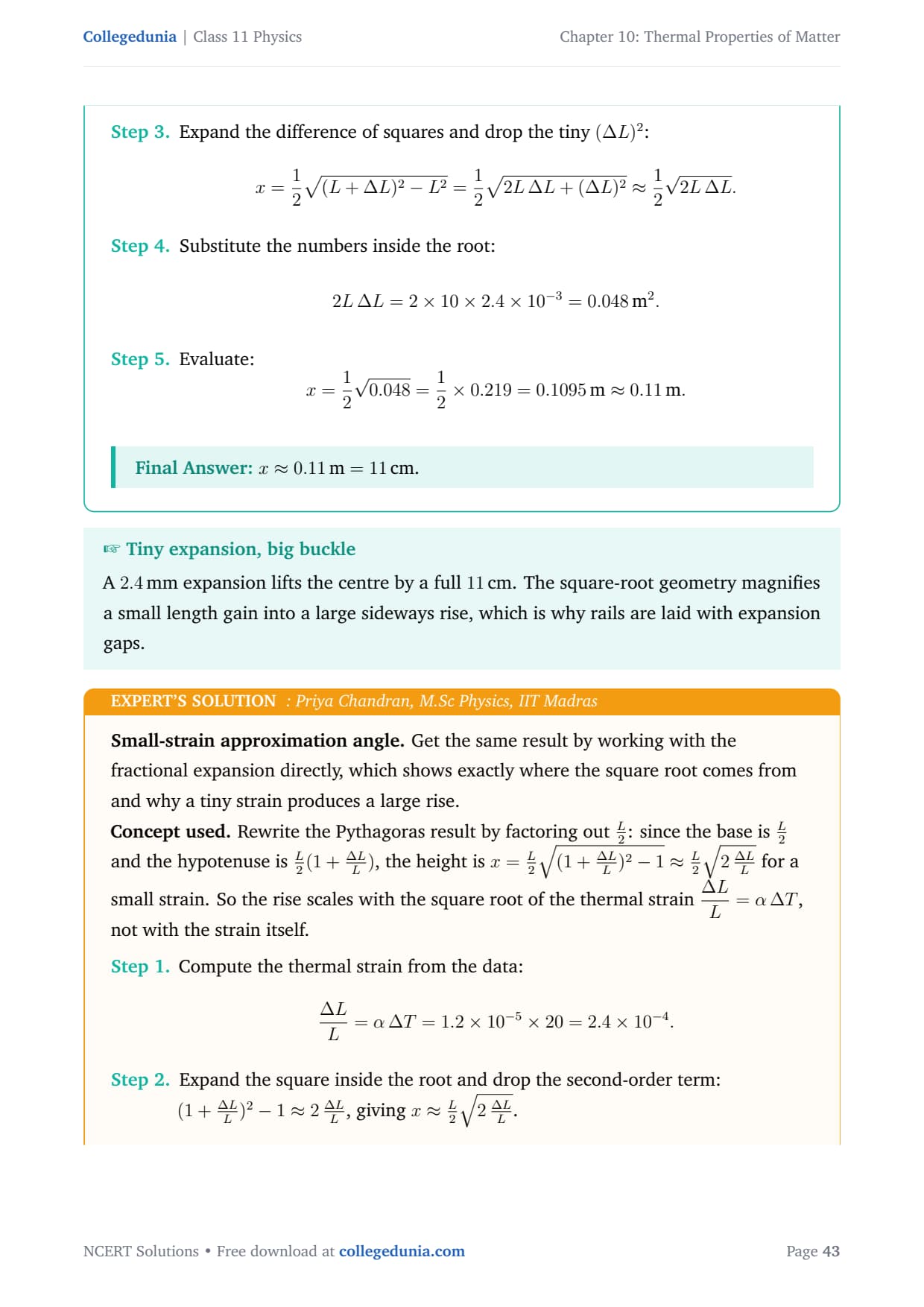
Three questions quote a figure from the Exemplar book, and all three sit beside the solution in our PDF. Figure 11.1 is the two-scale conversion graph, Figure 11.2 the temperature-time plot for melting ice, and Figure 11.3 the buckled rail track. You cannot answer these without the diagram in front of you.
How to Use These NCERT Exemplar Solutions for Boards, JEE and NEET
Attempt every question before opening the solution. The Exemplar rewards the struggle more than the reading.
- Boards: Question 16 and Question 20 match the board pattern exactly, one on the −40° scale coincidence and one on supercooled water
- JEE Main: start with the Long Answer set, since Question 24 and Question 25 mirror how JEE tests thermal stress
- NEET: the MCQ I questions on cooling rates and Stefan's law repeat almost every year
Student Feedback
Students who used Collegedunia's Class 11 Physics Exemplar Solutions told us the constant-length scale problems were the hardest in this chapter. Around 7 in 10 said the step-by-step layout helped most on Question 27, the Stefan's law estimation that runs to three separate parts.
Other Resources for Class 11 Physics Thermal Properties of Matter
Collegedunia carries the complete study set for this chapter. Read the Notes first, then use the Exemplar once the formulas feel familiar.
Also Check:
- NCERT Solutions for Class 11 Physics Chapter 10
- Class 11 Physics Chapter 10 Notes
- Class 11 Physics Chapter 10 Handwritten Notes
- Class 11 Physics Chapter 10 NCERT Book PDF
- Class 11 Physics Chapter 10 Exemplar Questions with Solutions
NCERT Exemplar Solutions for Other Class 11 Physics Chapters
Every chapter below gets the same step-by-step treatment and a free PDF.
Thermal Properties of Matter Class 11 Physics NCERT Exemplar Solutions FAQs
Ques. How many questions are there in the Class 11 Physics Thermal Properties of Matter Exemplar?
Ans. Chapter 10 has 27 questions. They are split into 8 MCQ I, 4 MCQ II, 5 Very Short Answer, 4 Short Answer and 6 Long Answer questions. All 27 are solved in the free PDF on this page.
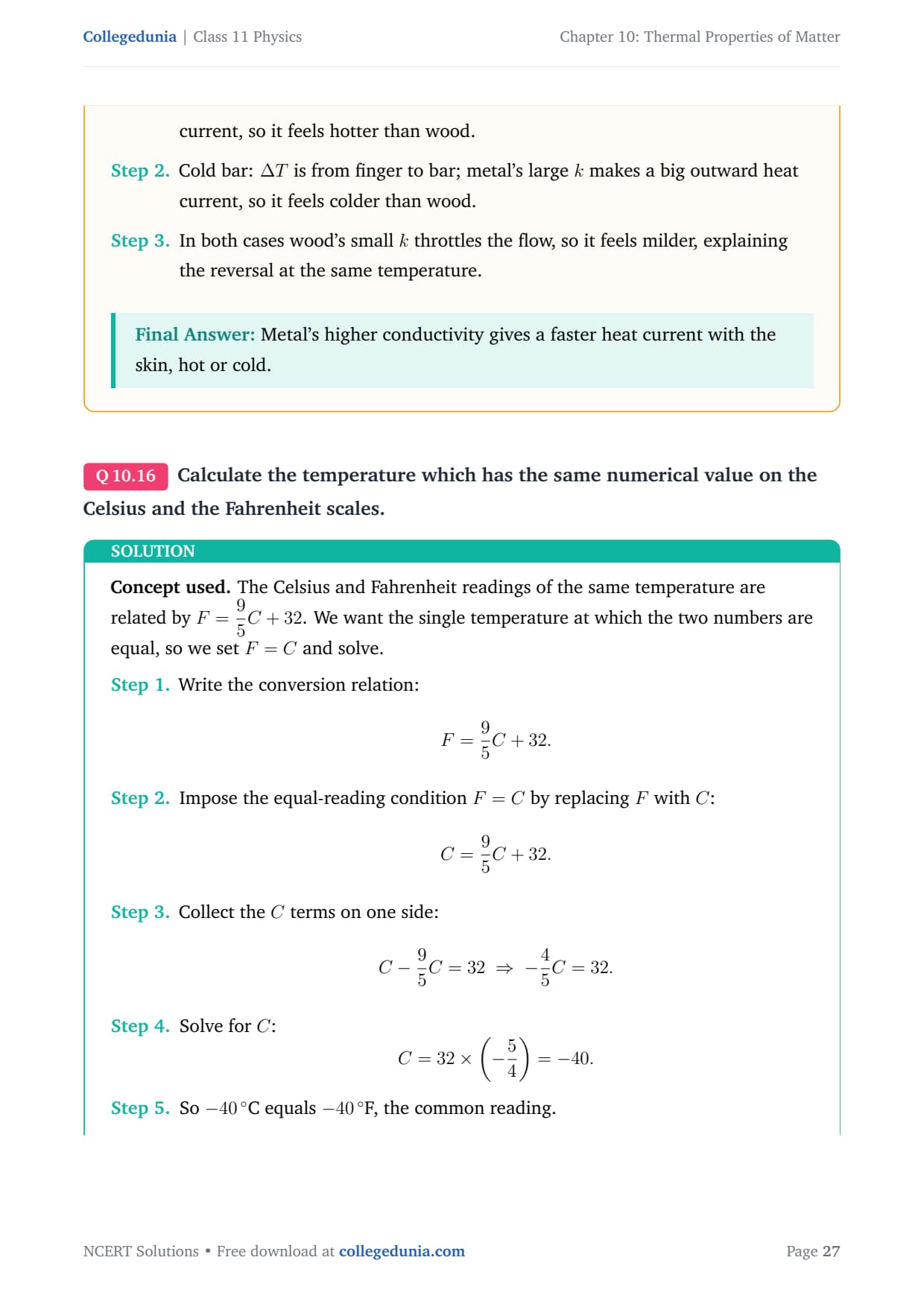
Ques. At what temperature do the Celsius and Fahrenheit scales read the same number?
Ans. At −40°. This is Question 16 of the Exemplar. Set the two readings equal in the conversion relation and solve, and both scales land on −40 at the same physical temperature.
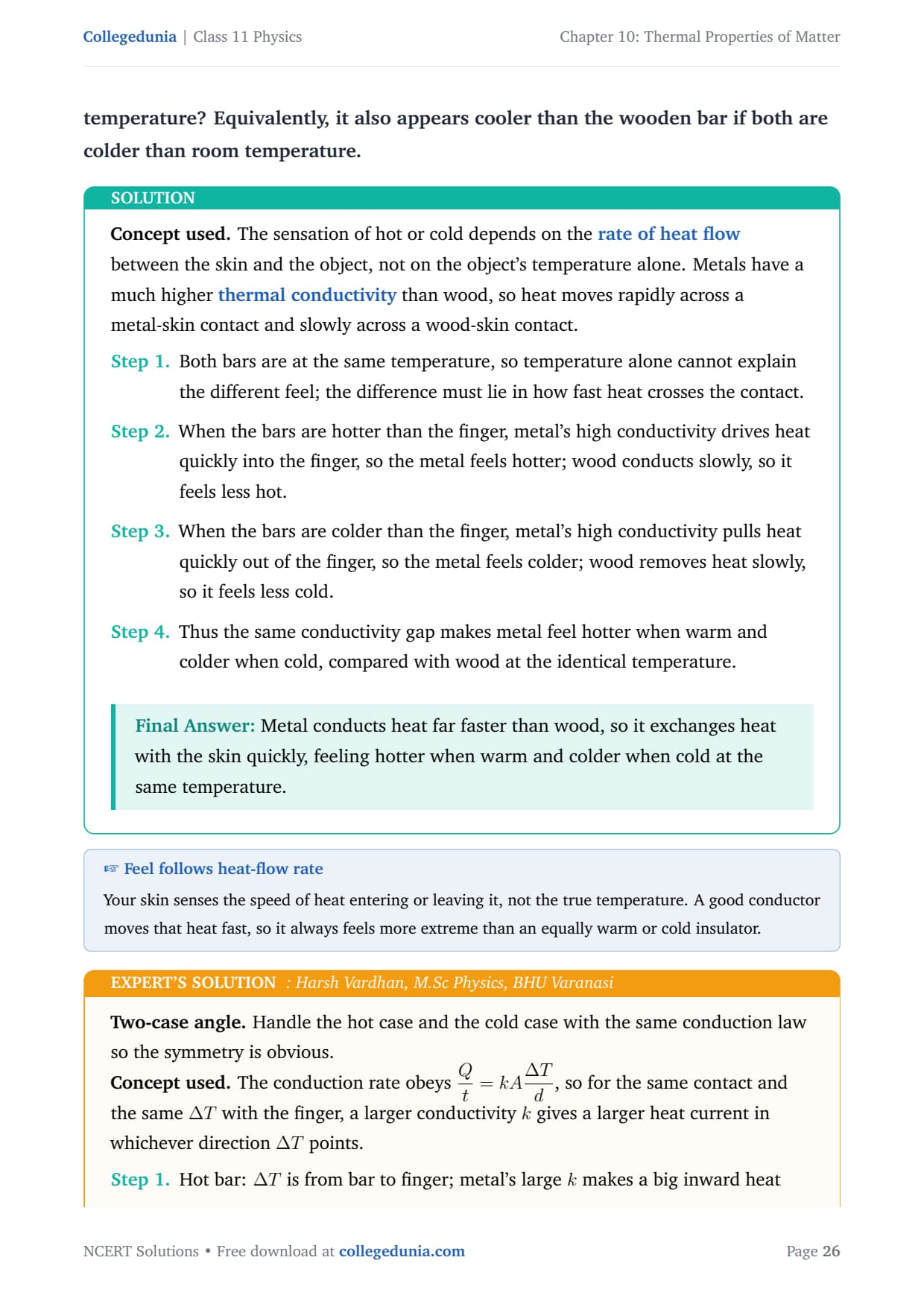
Ques. Why does a metal bar feel hotter than a wooden bar at the same temperature?
Ans. Your skin senses the rate of heat flow, not the temperature itself. Metal has a far higher thermal conductivity than wood, so it moves heat into your hand much faster. The same effect makes a cold metal bar feel colder than cold wood.
Ques. What happens when 100 g of water supercooled to −10°C suddenly freezes?
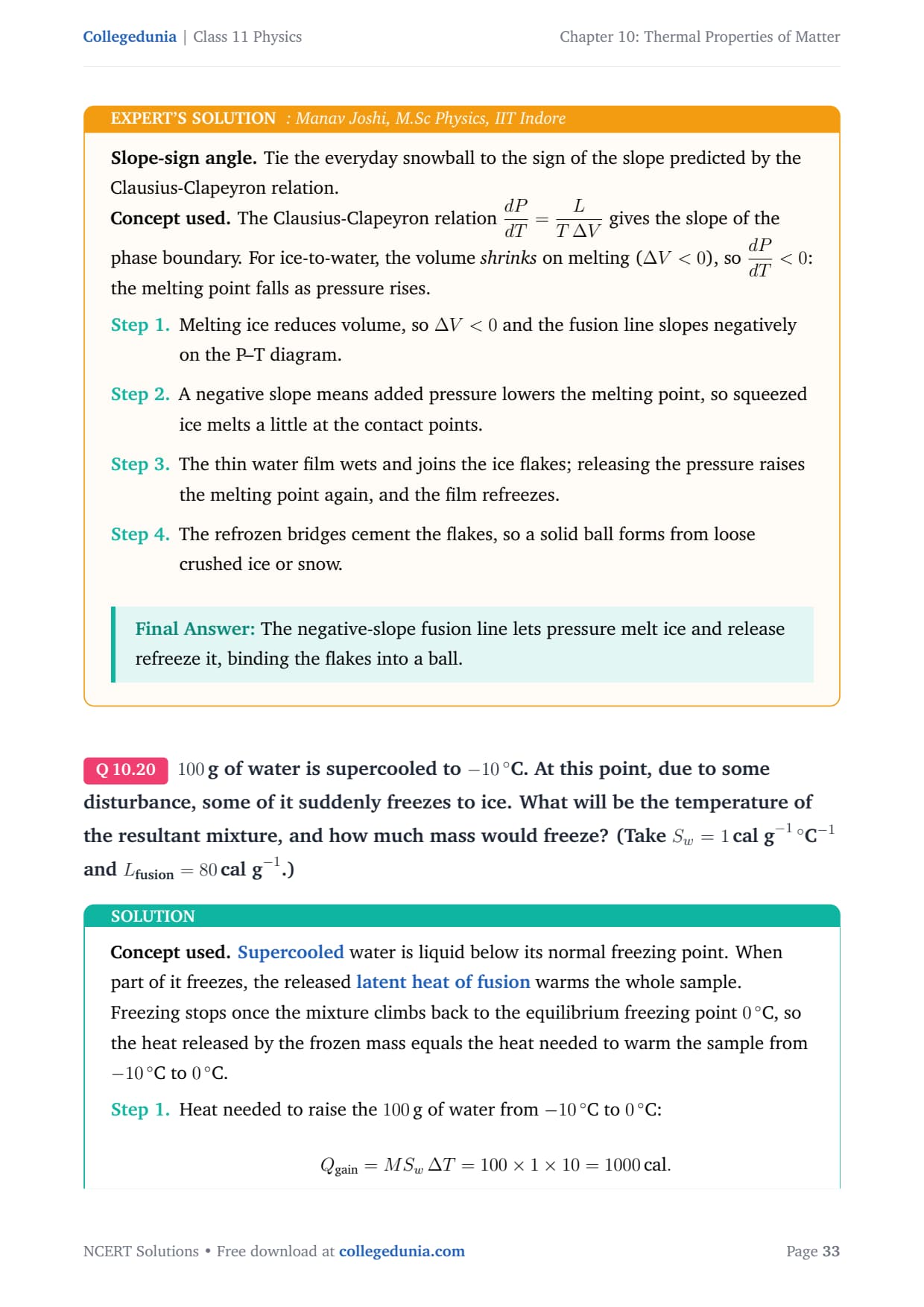
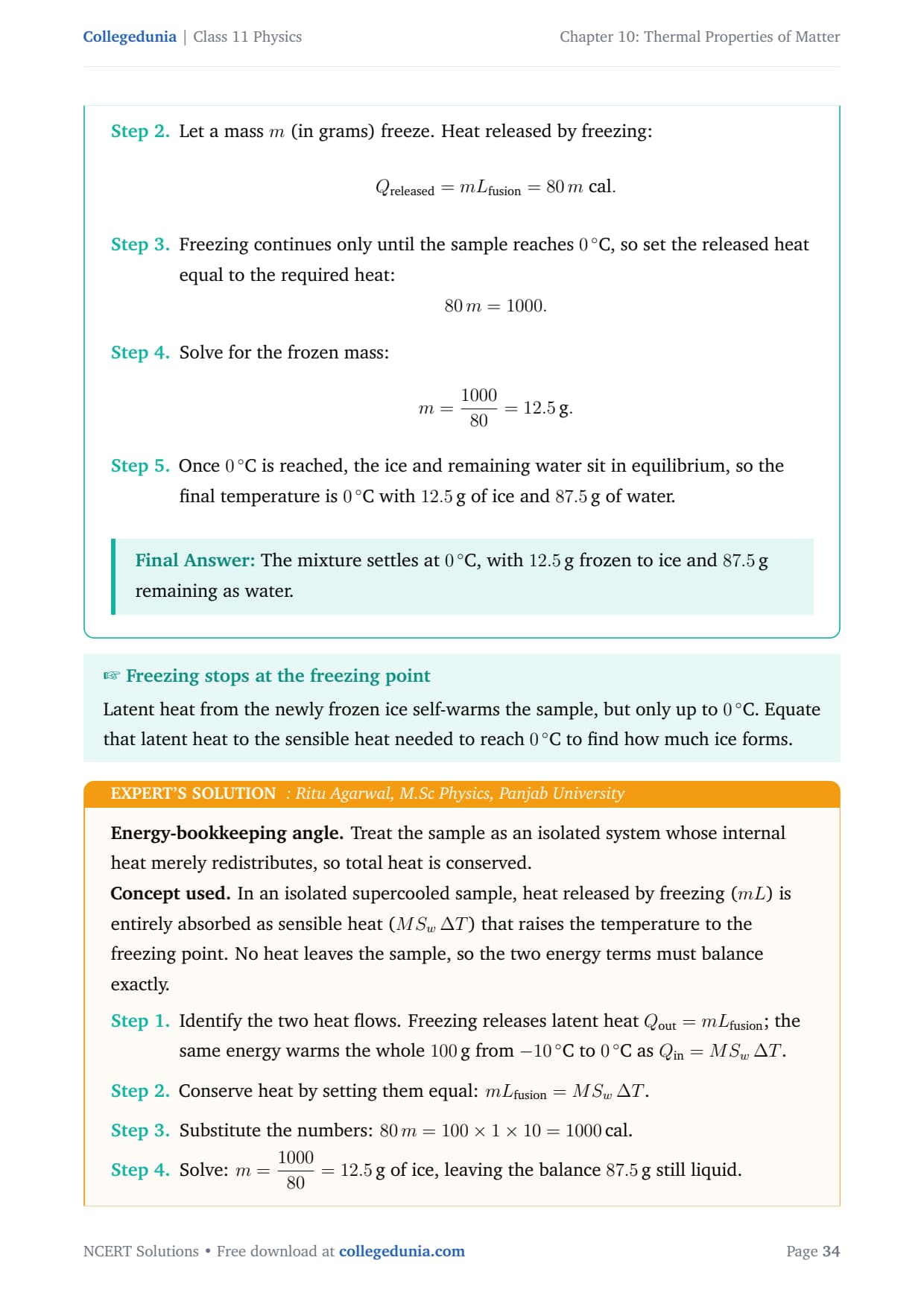
Ans. Only part of it freezes. The latent heat released warms the rest back to 0°C, where freezing stops. Balancing the heat gives 12.5 g of ice in a mixture sitting at 0°C. This is Question 20 of the Exemplar.
Ques. Which cools fastest among a sphere, a cube and a plate of the same mass?
Ans. The thin circular plate, and the sphere is slowest. By Stefan's law the rate of cooling follows the exposed surface area. Equal mass and material fix the volume, so the shape with the largest surface loses heat quickest.



Comments