




Five of the 64 questions in the Class 11 Maths Chapter 6 Exemplar are Match the Following, and one of them cannot be matched at all. The NCERT Exemplar Solutions for Class 11 Maths Chapter 6 Permutations and Combinations on this page solve all 64 questions of the chapter, step by step, according to the 2026-27 NCERT Exemplar.
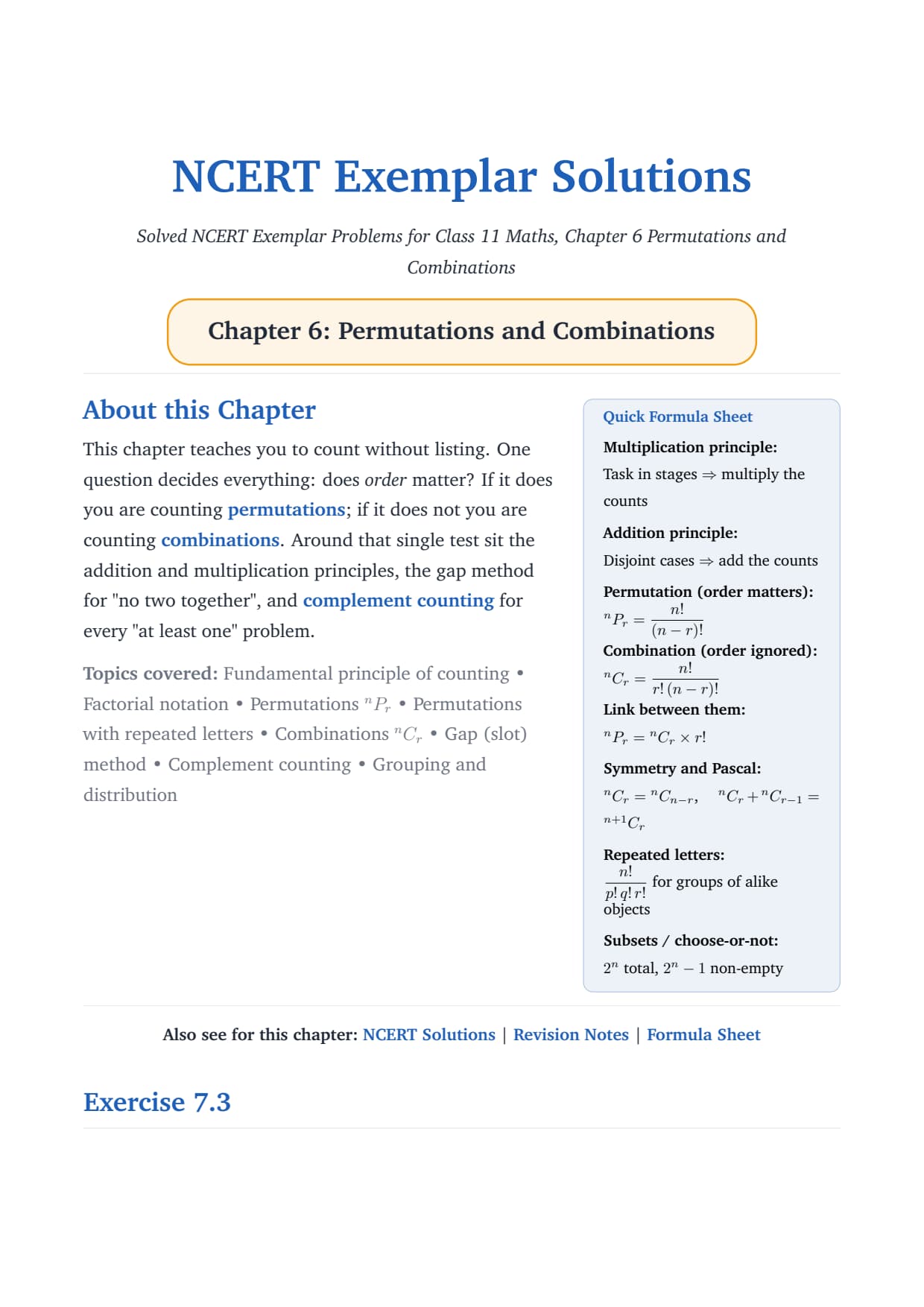
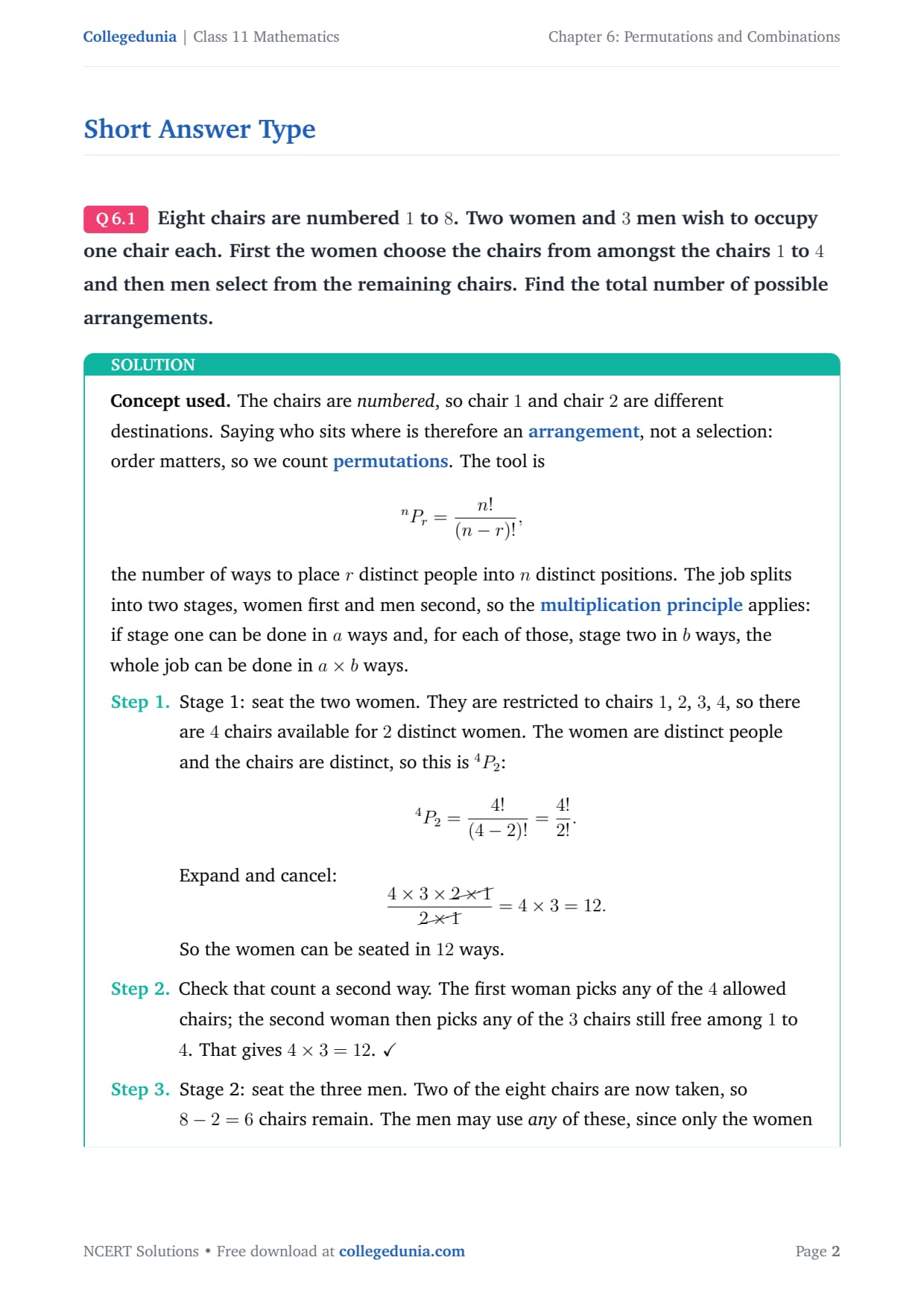
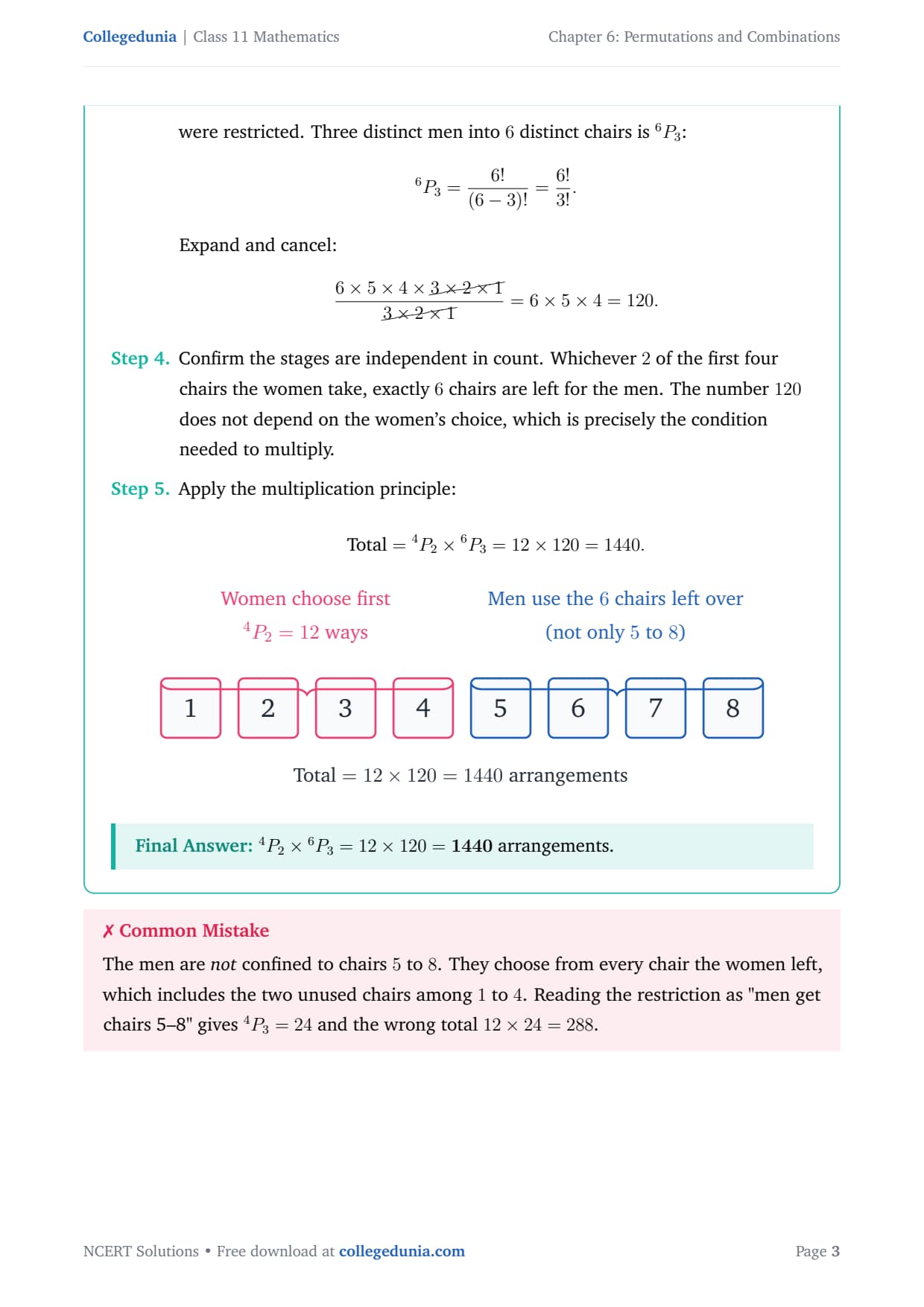
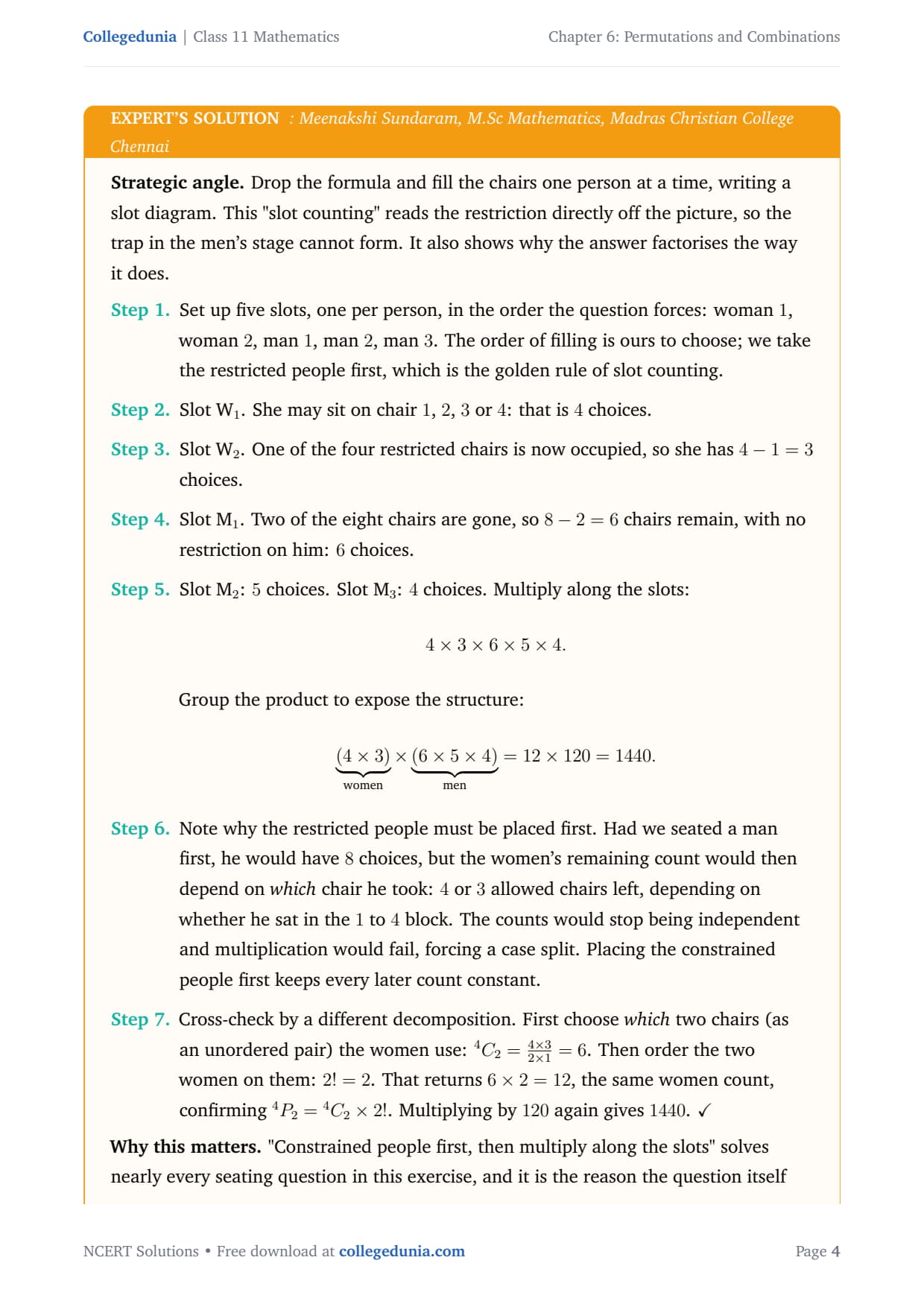
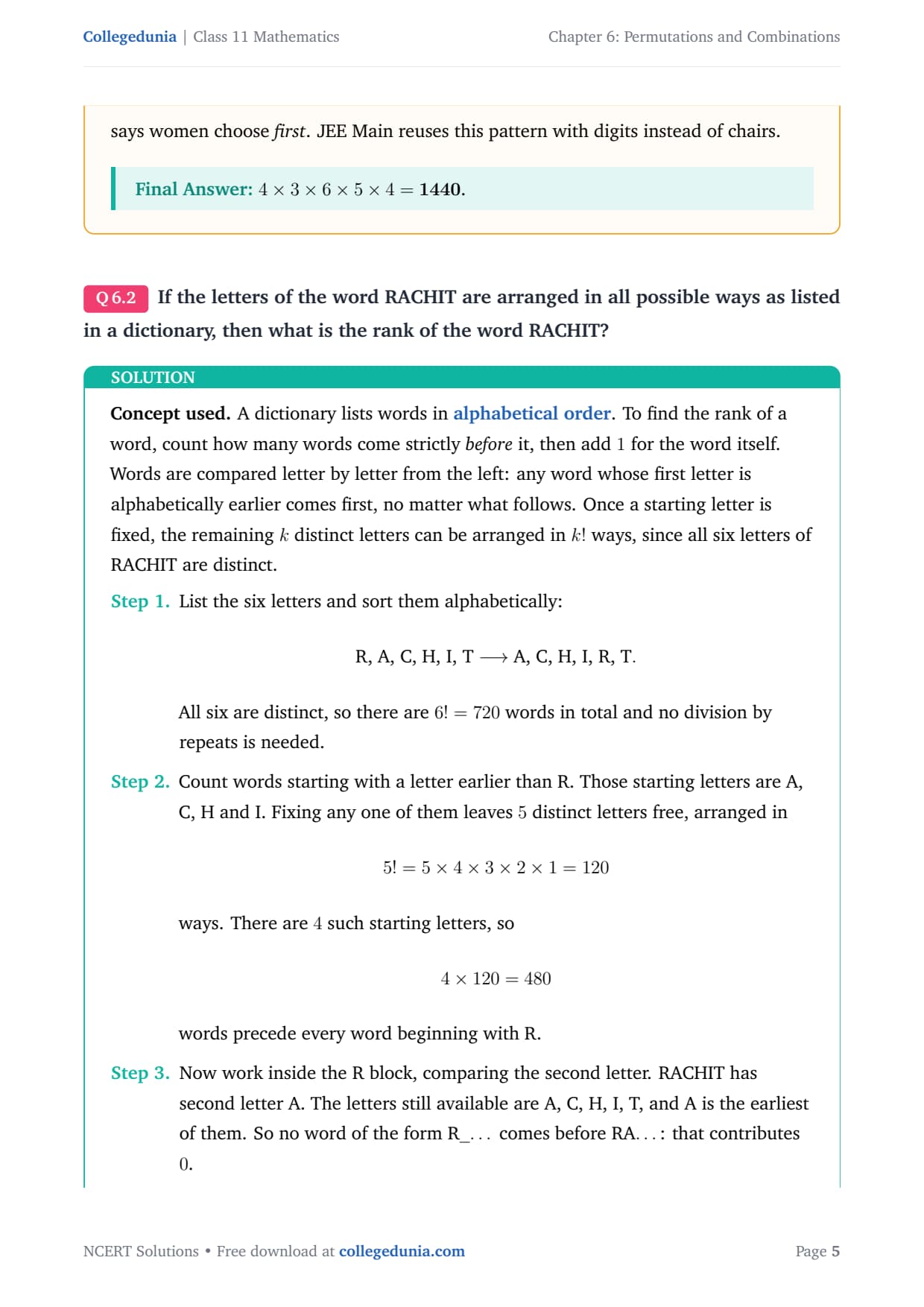
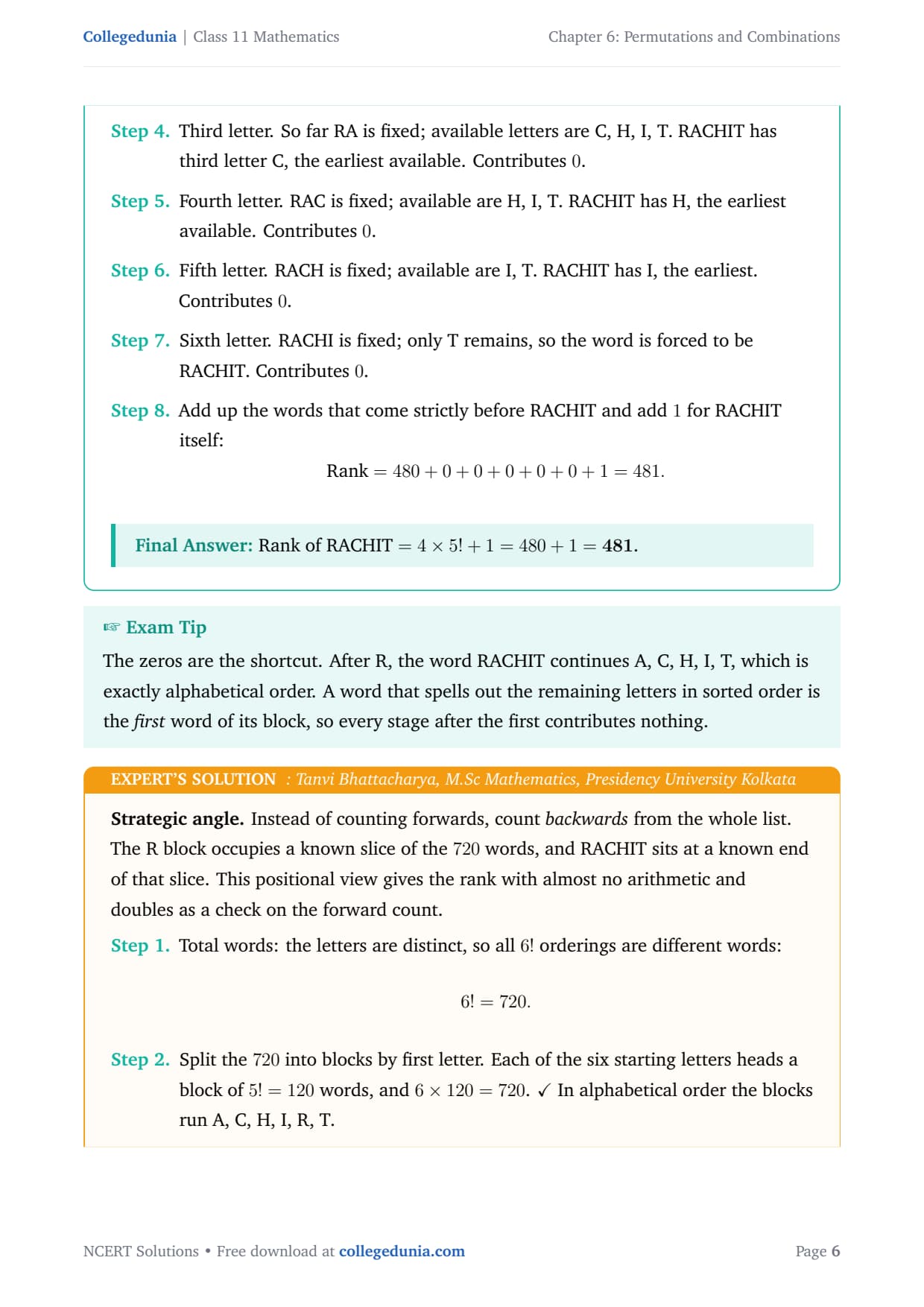
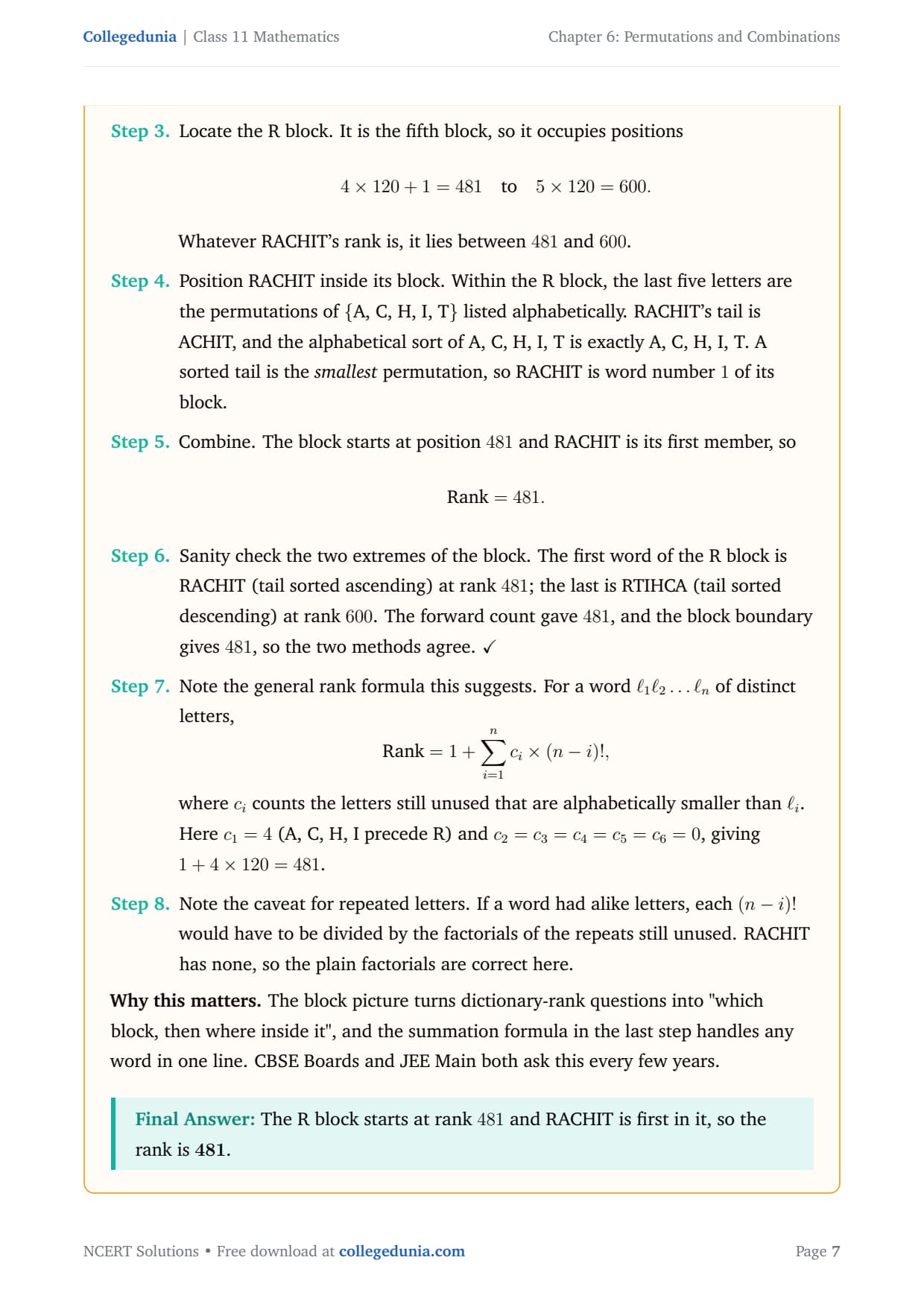
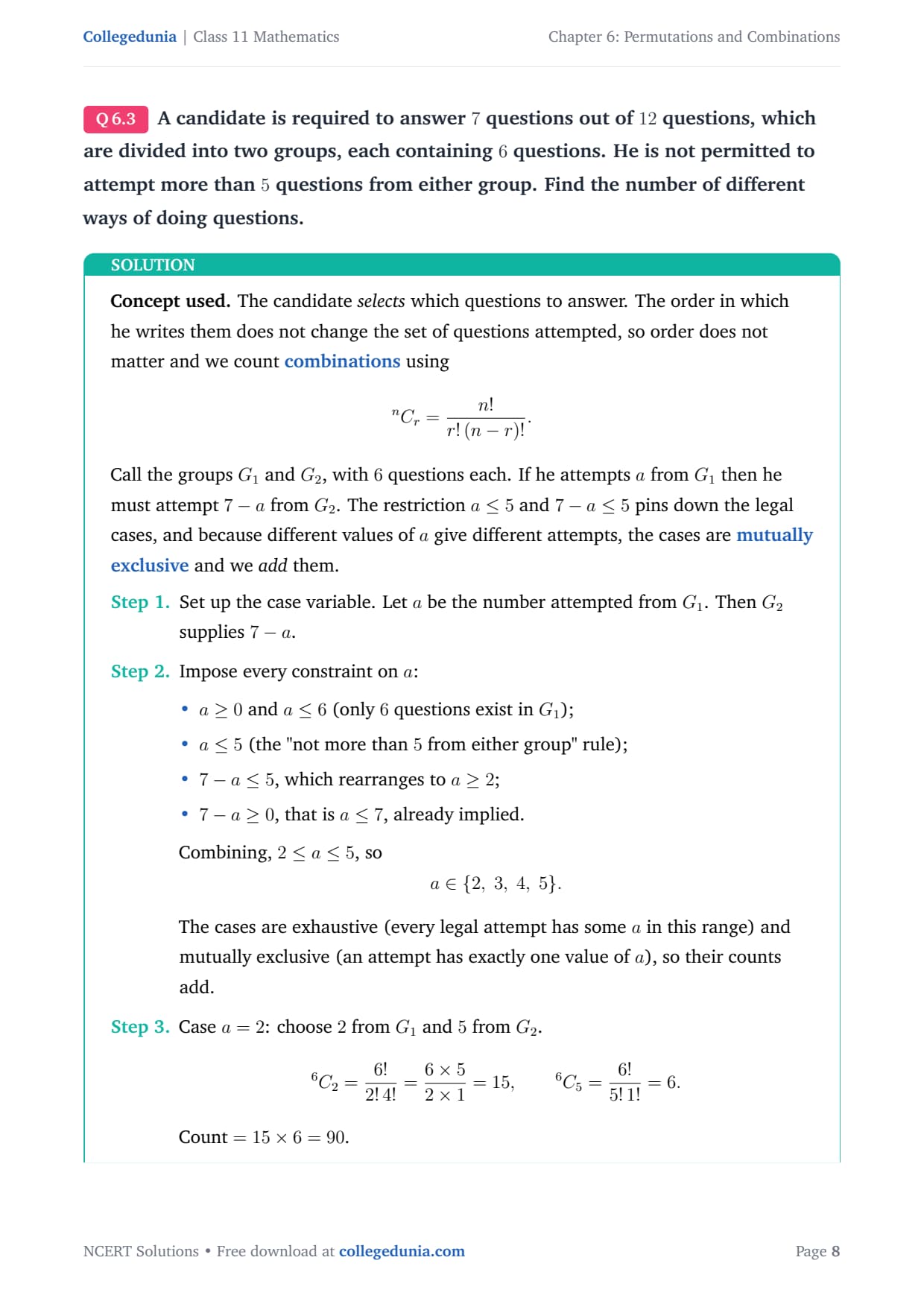
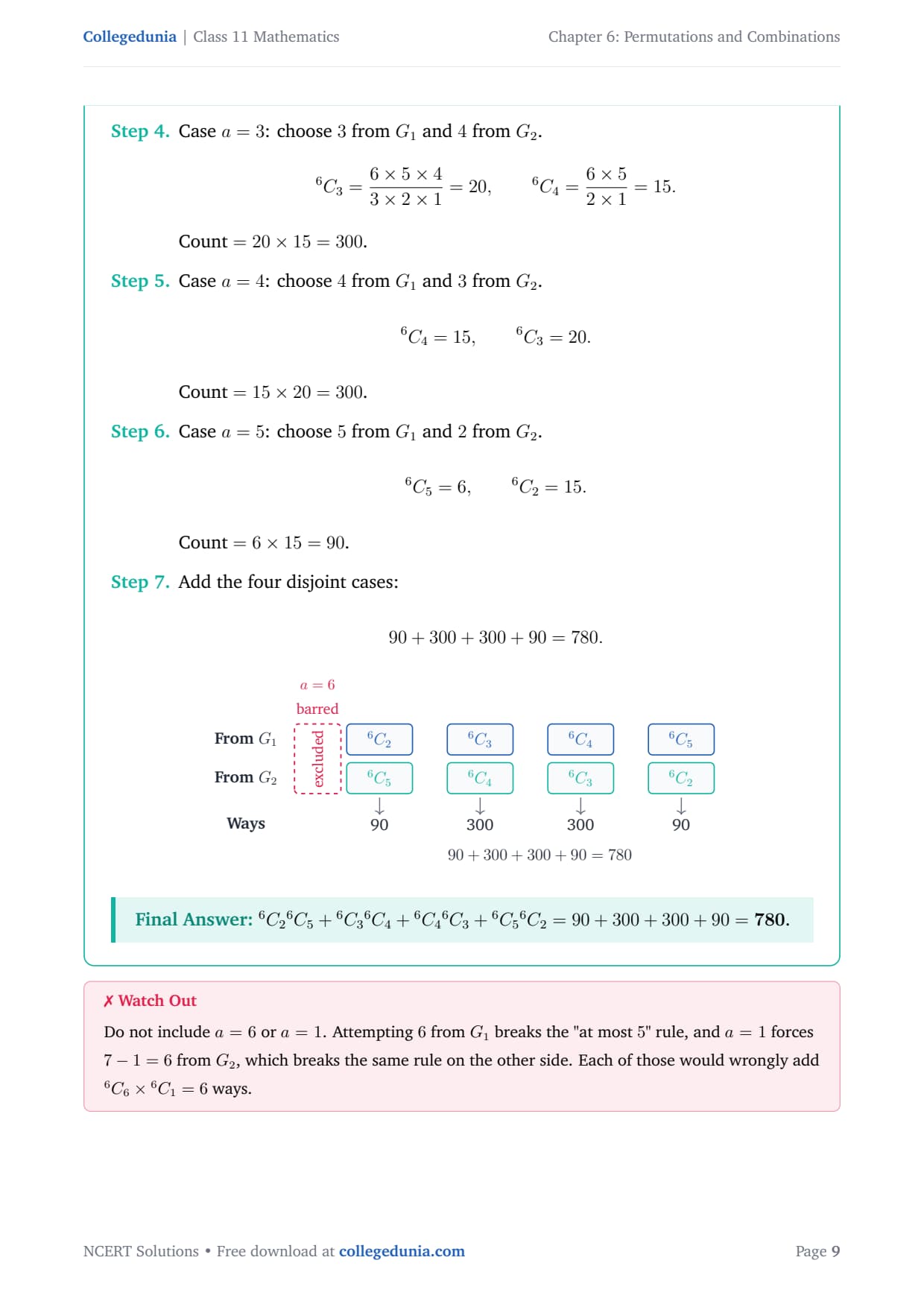
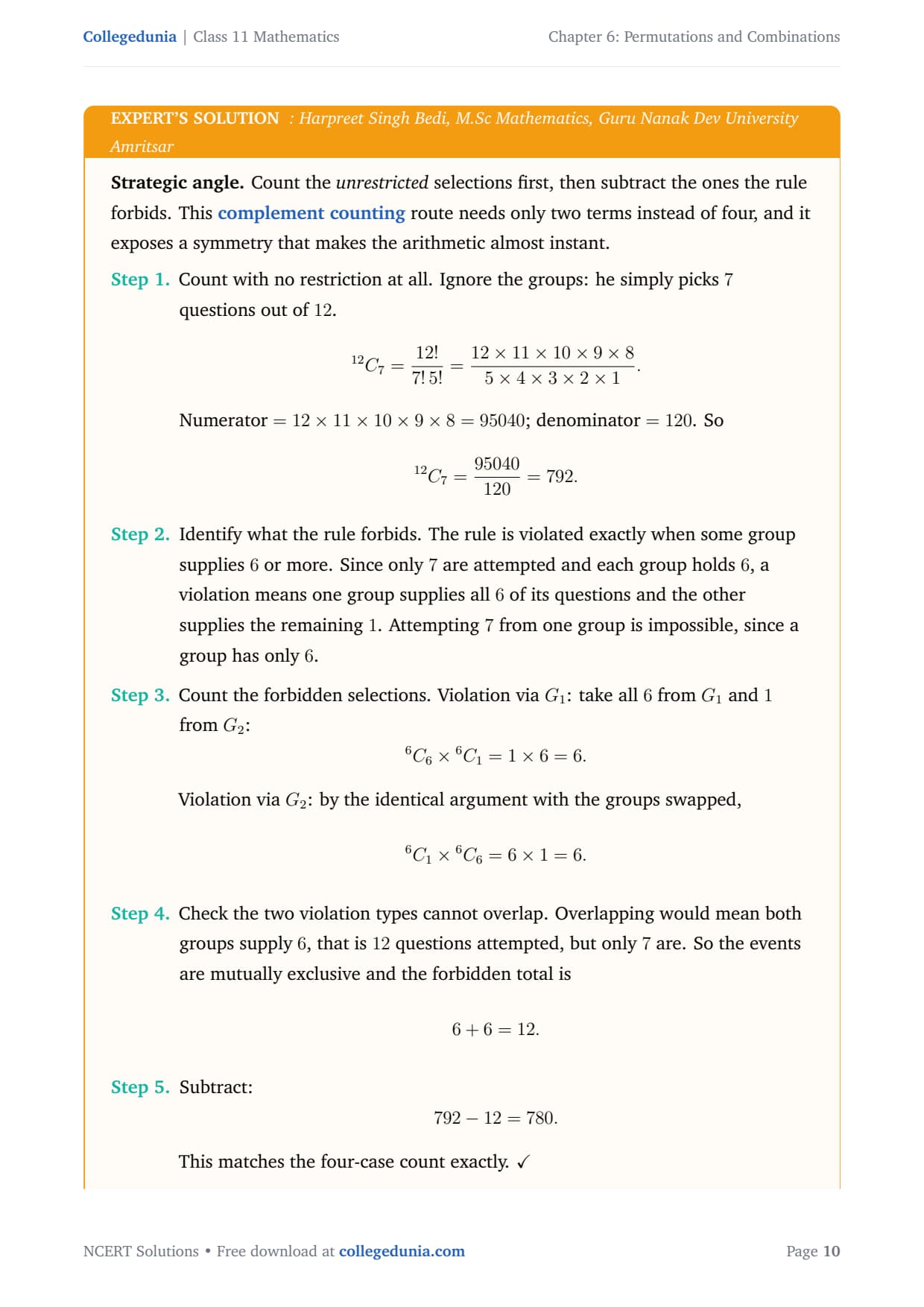
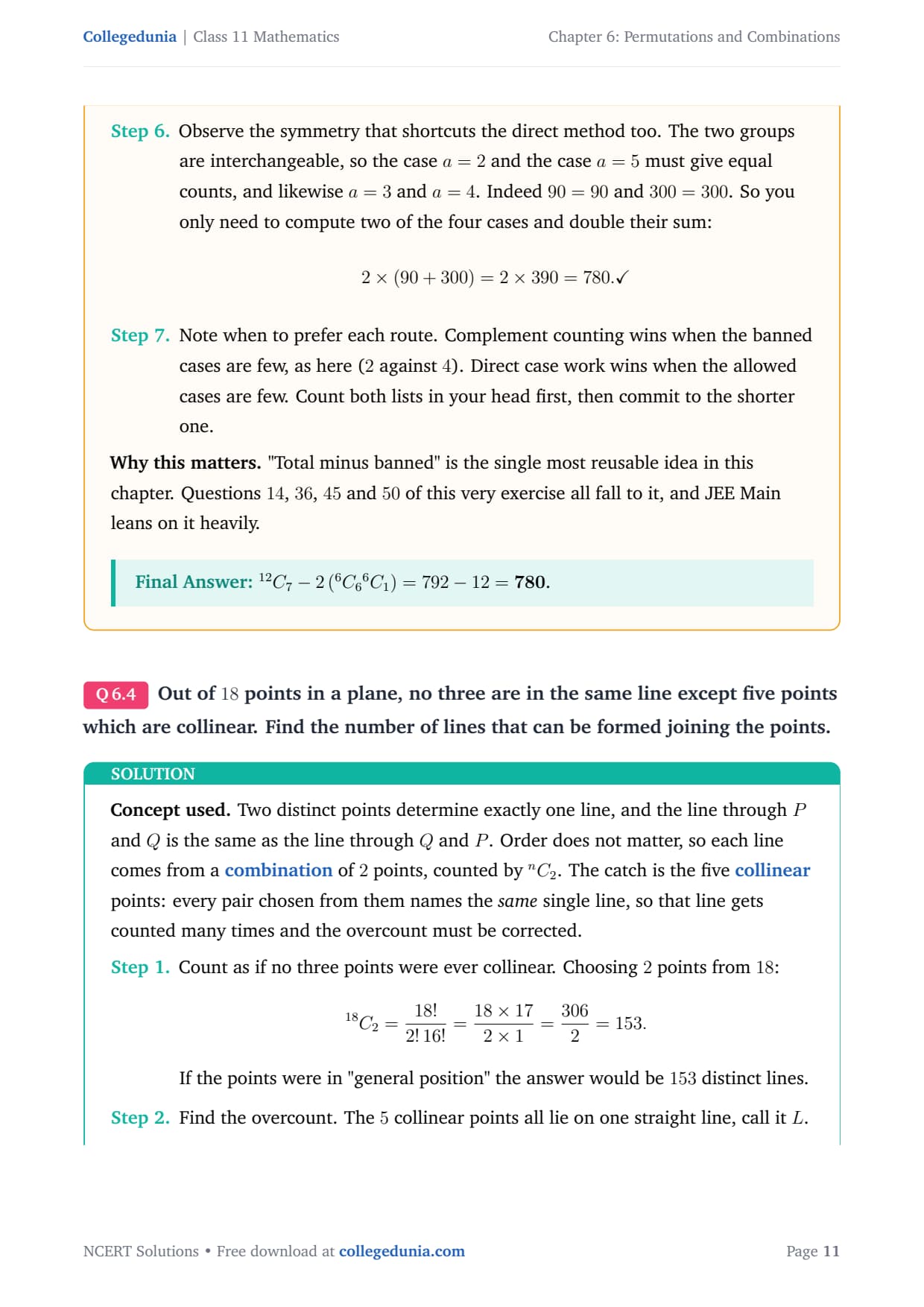
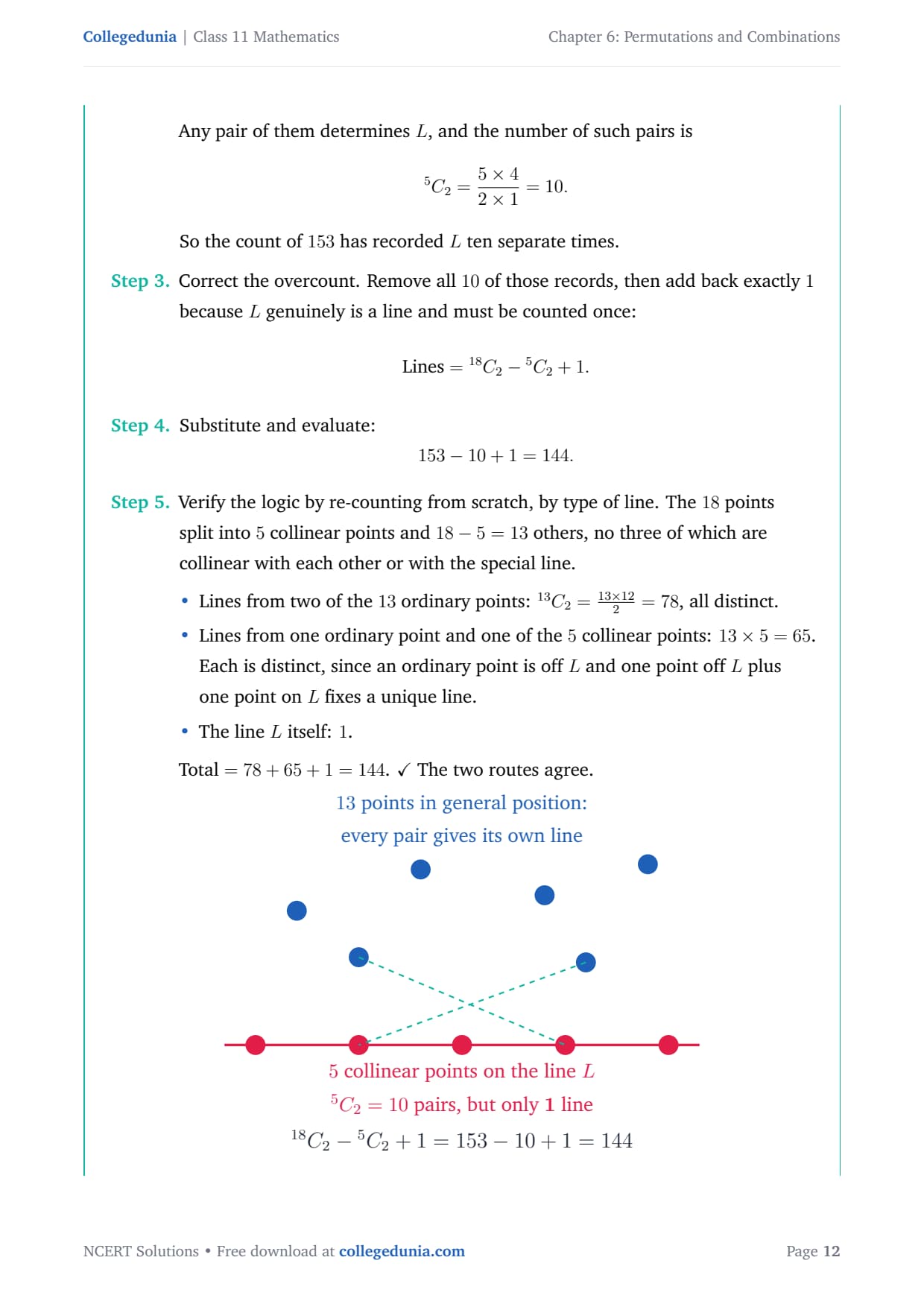
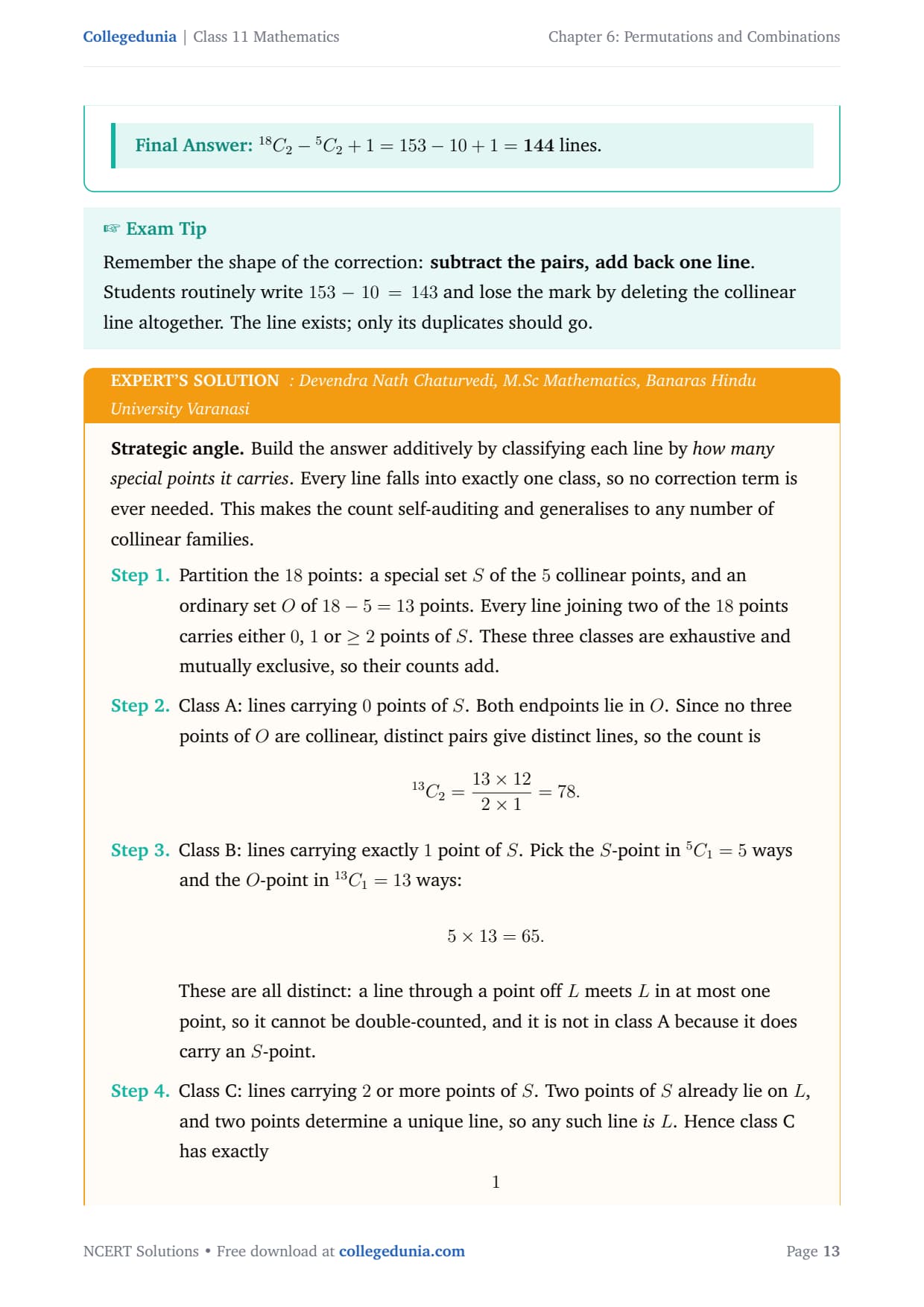
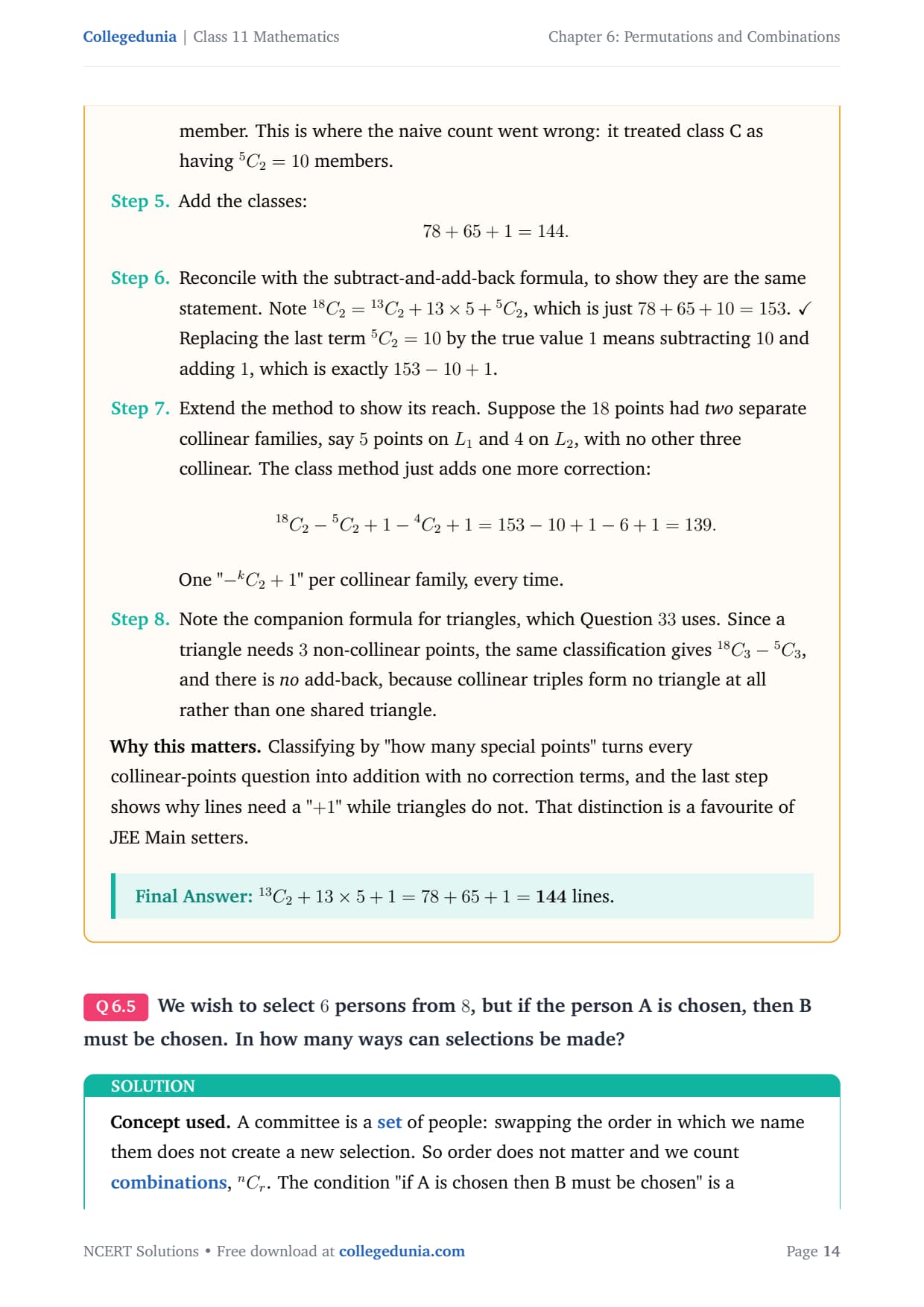
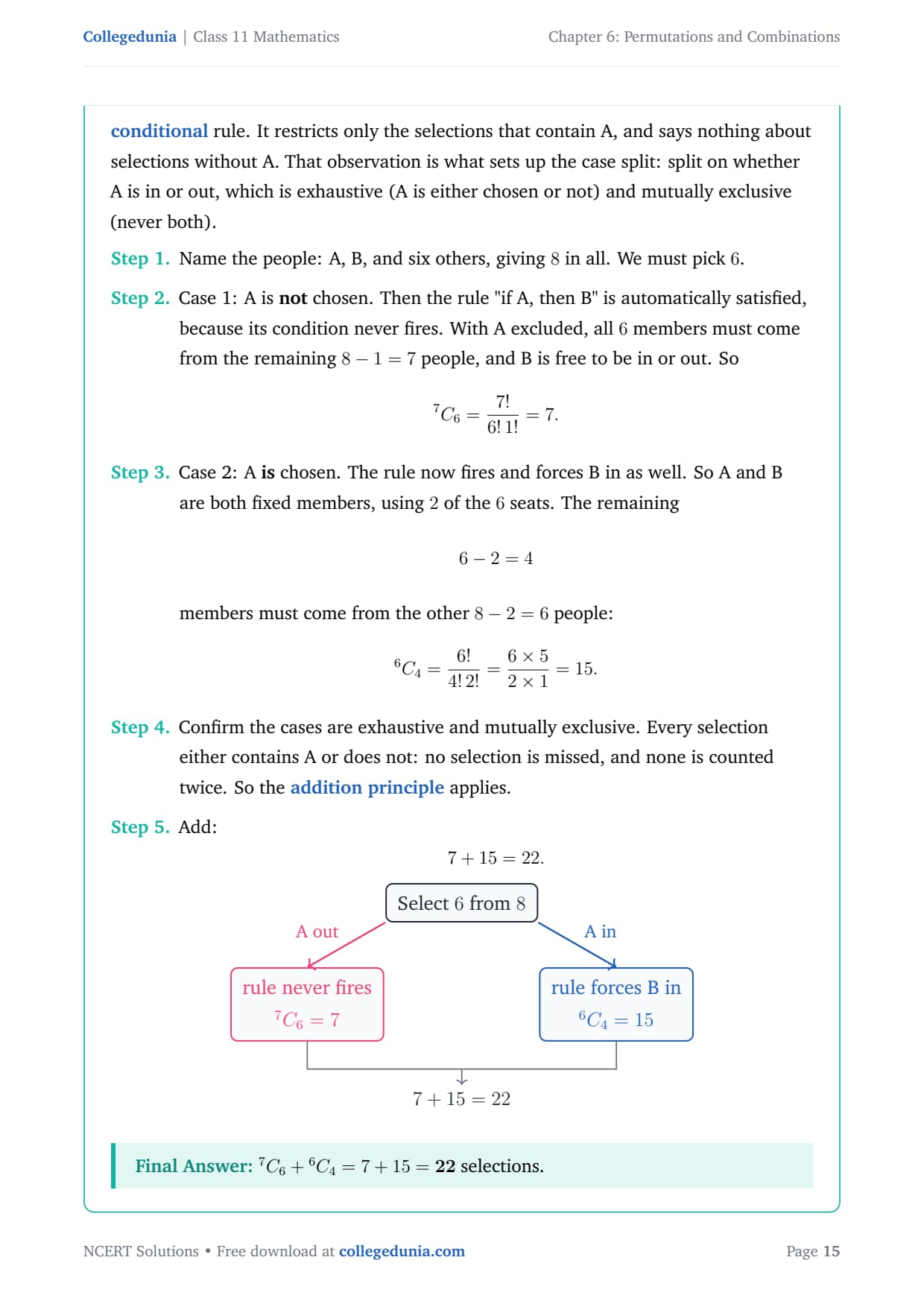
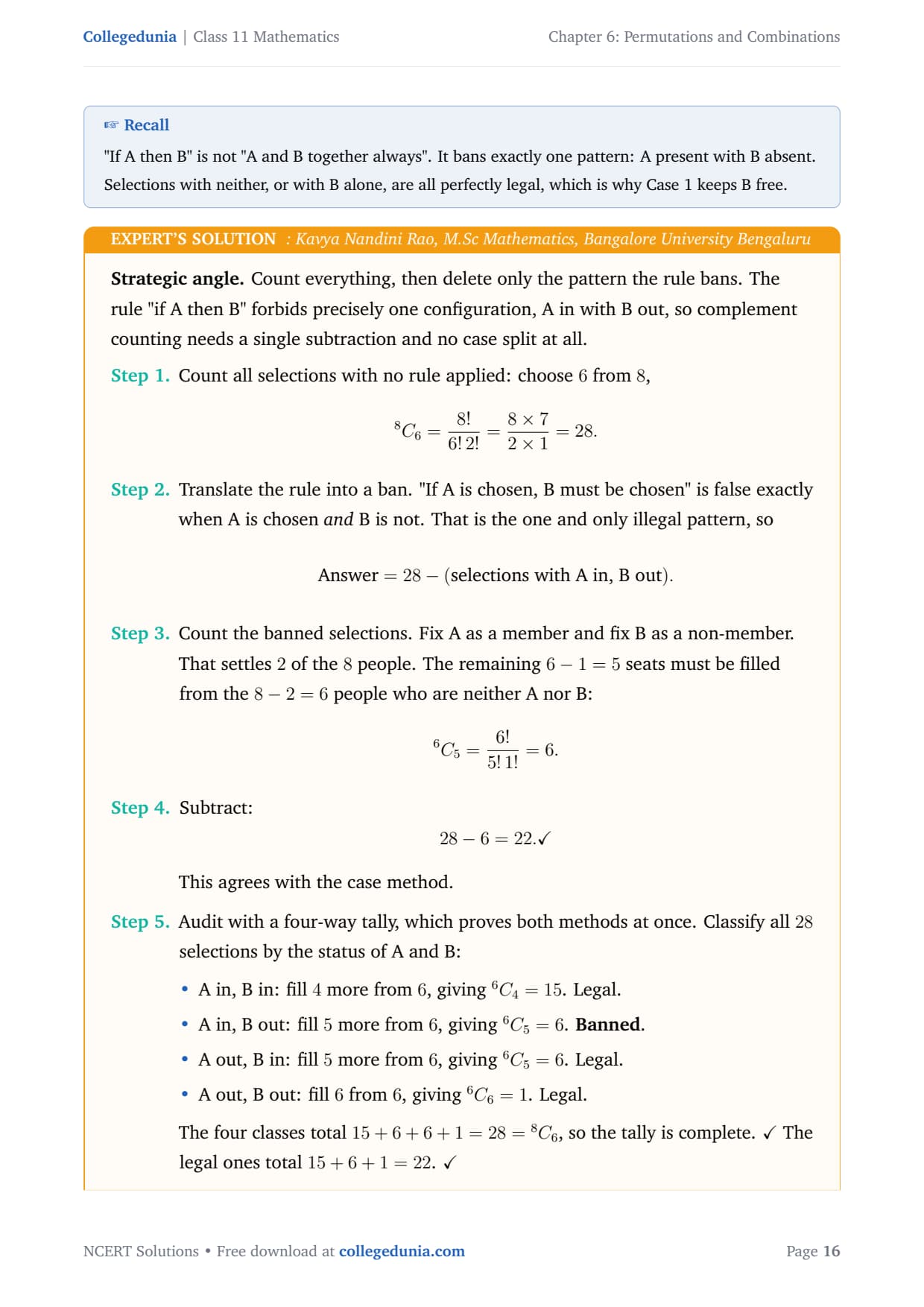
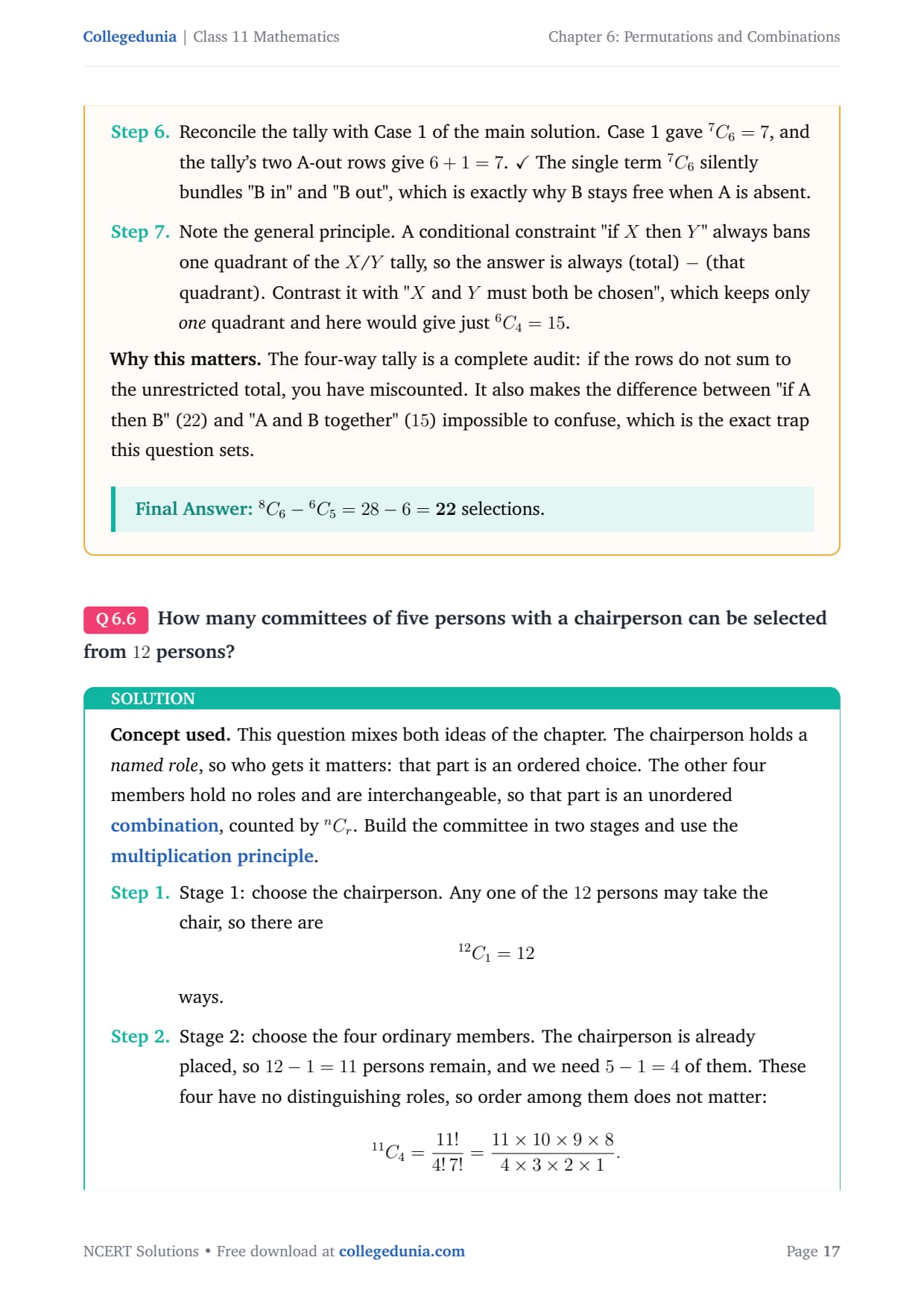
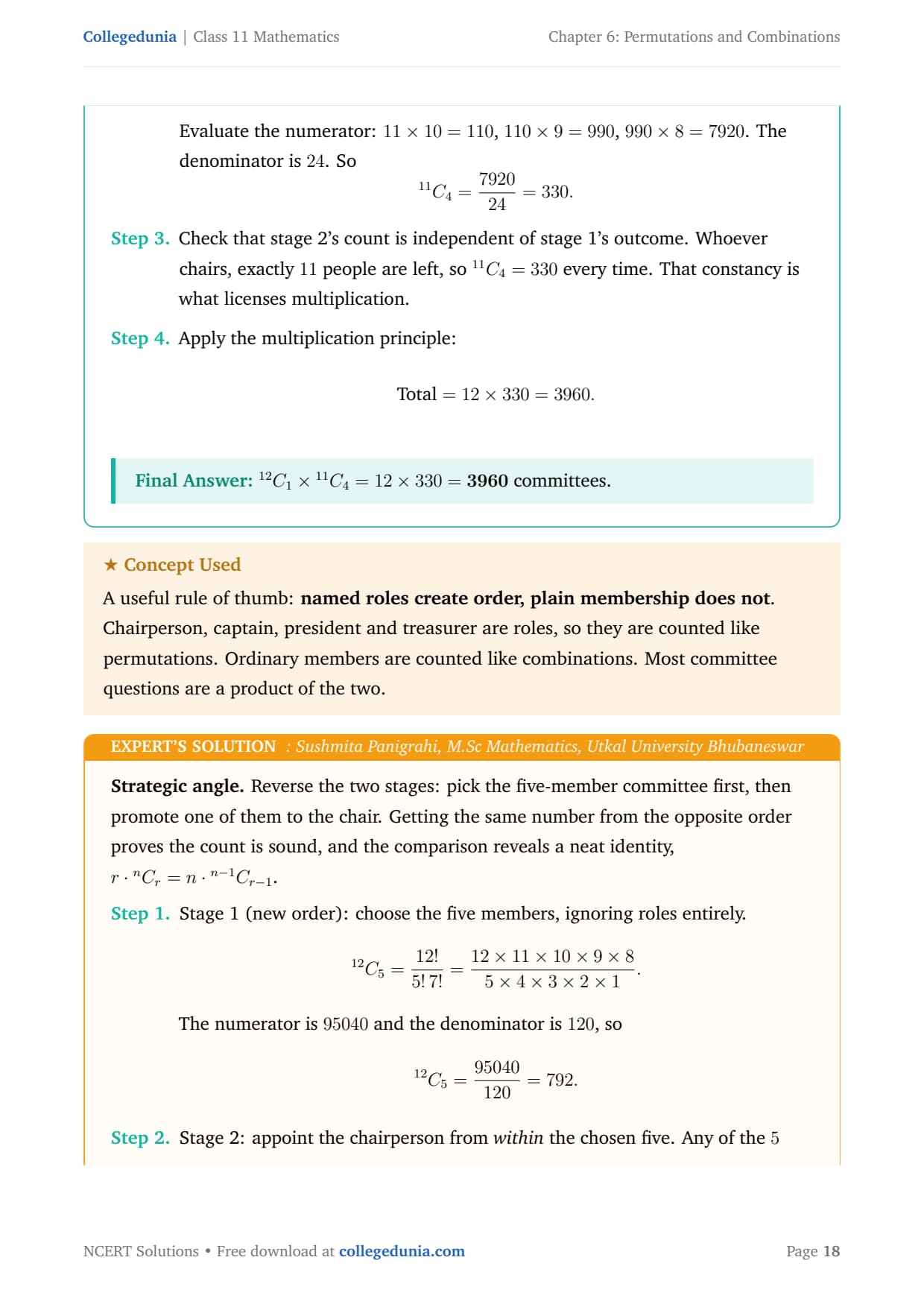
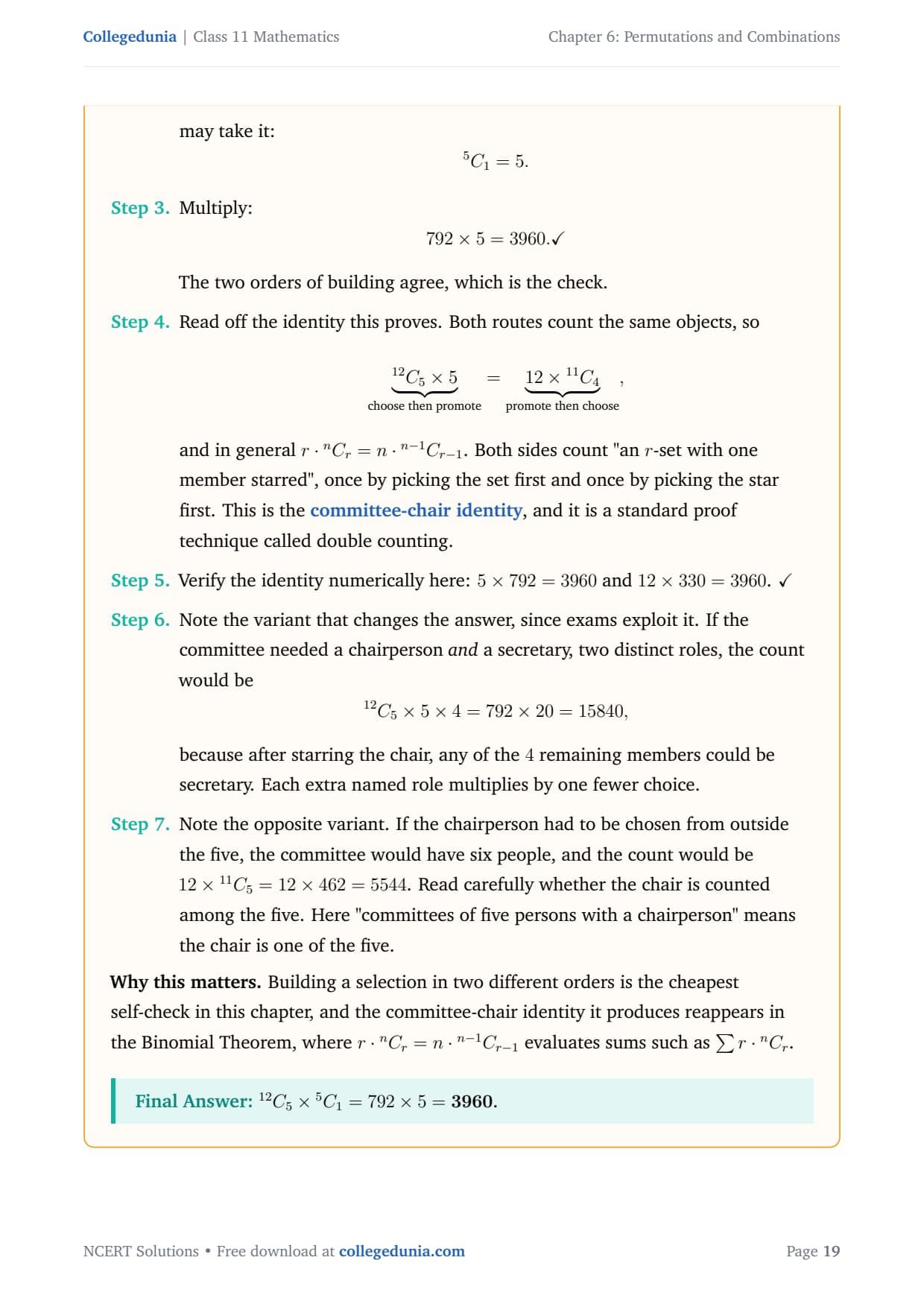
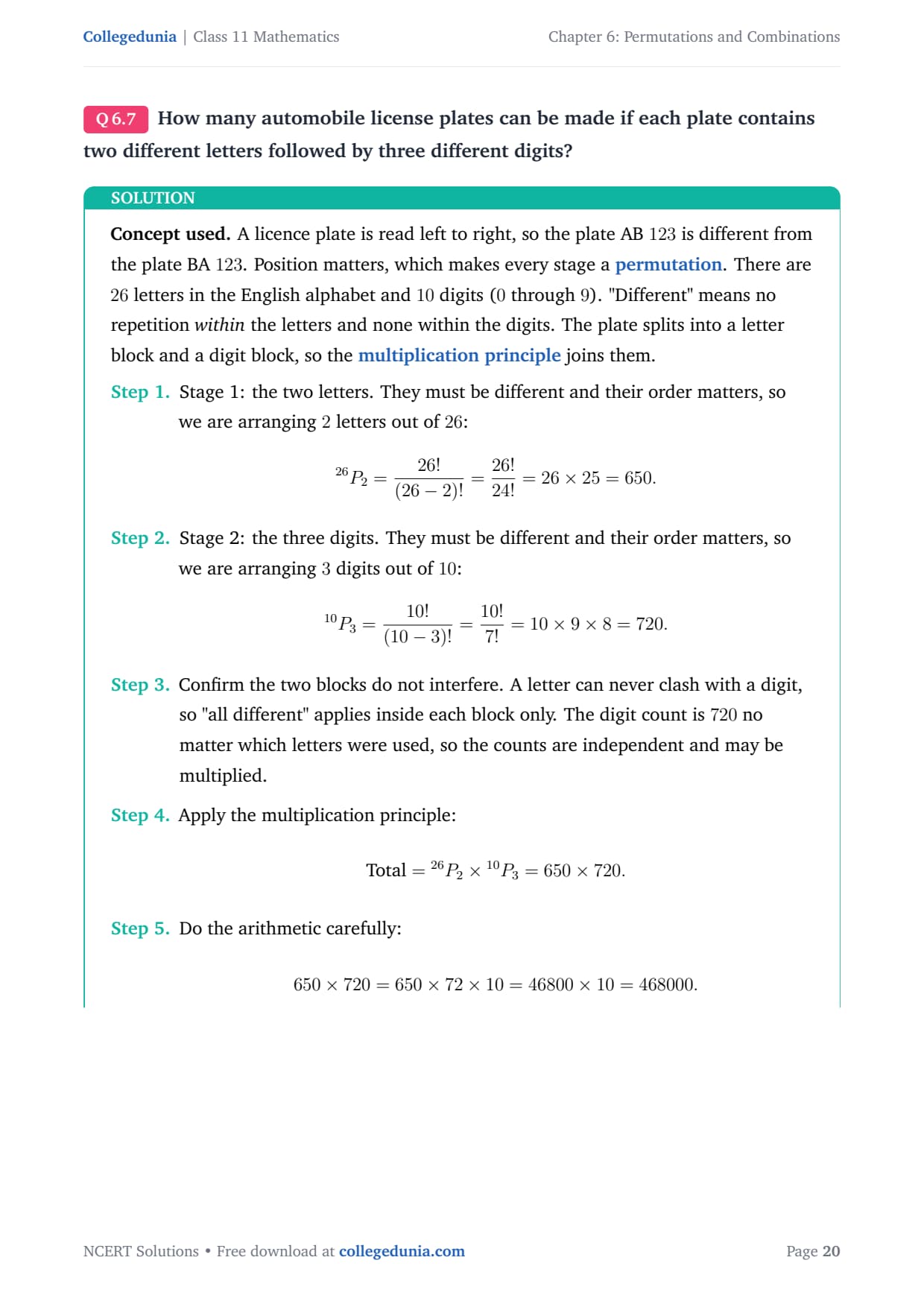
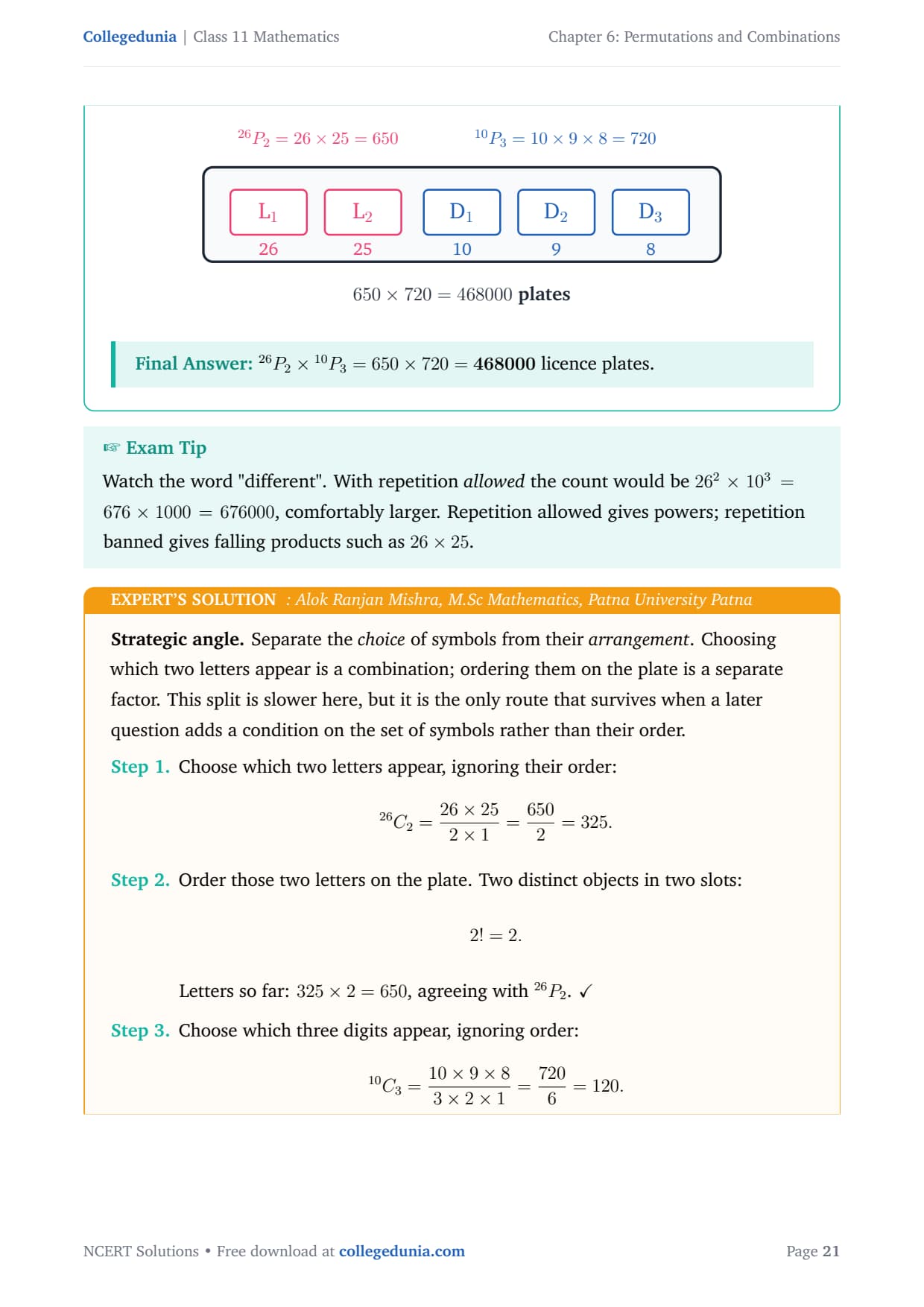
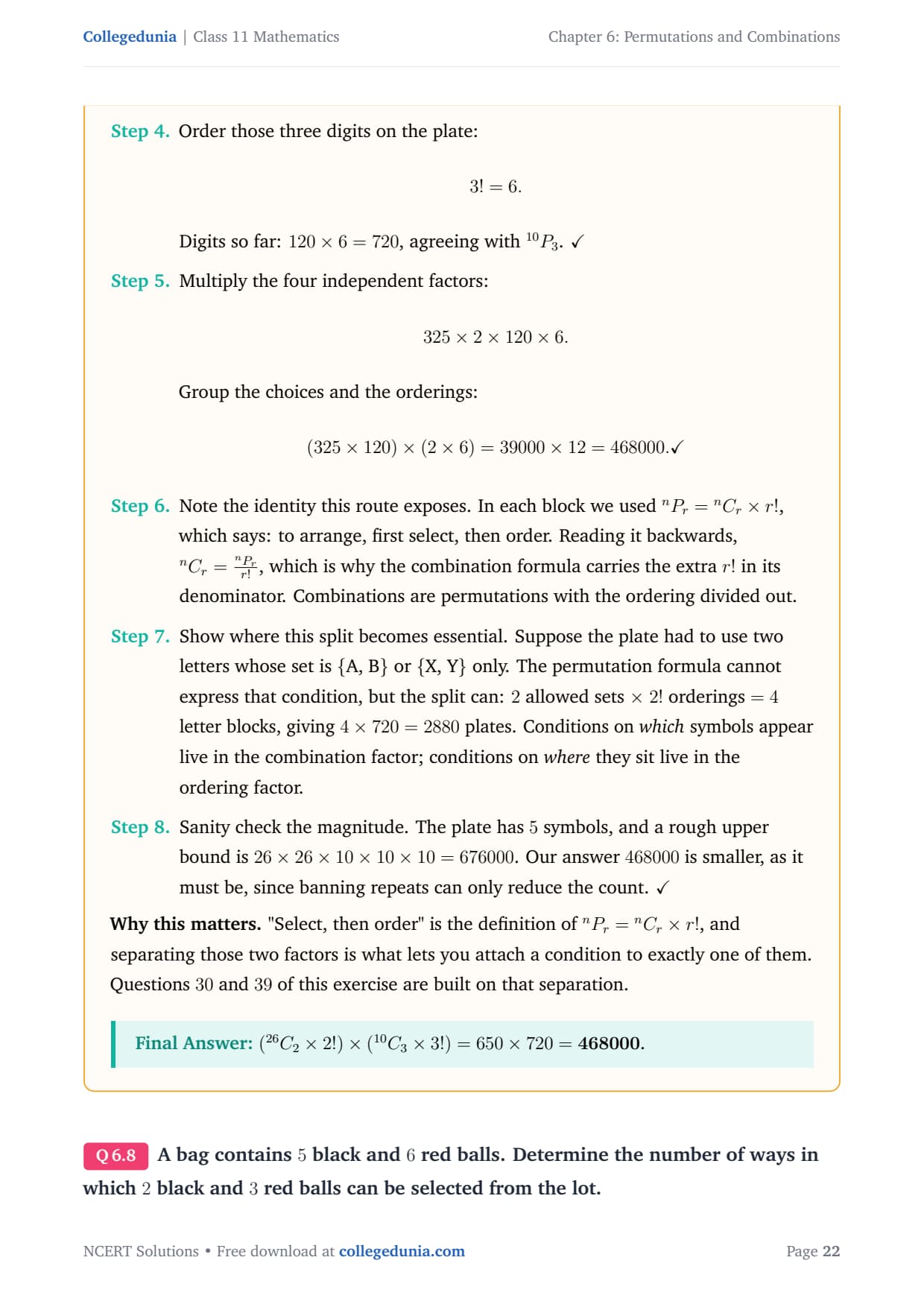
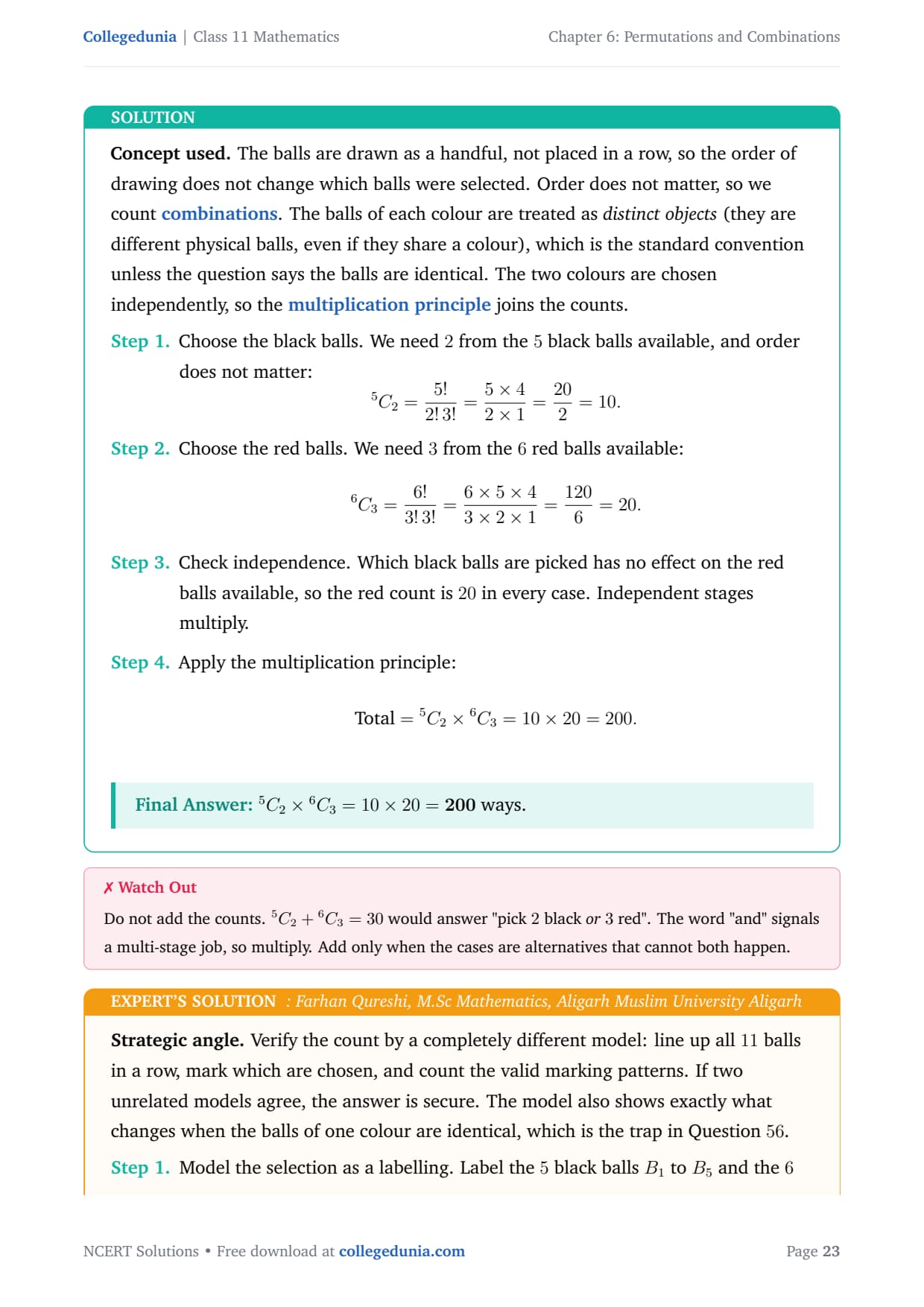
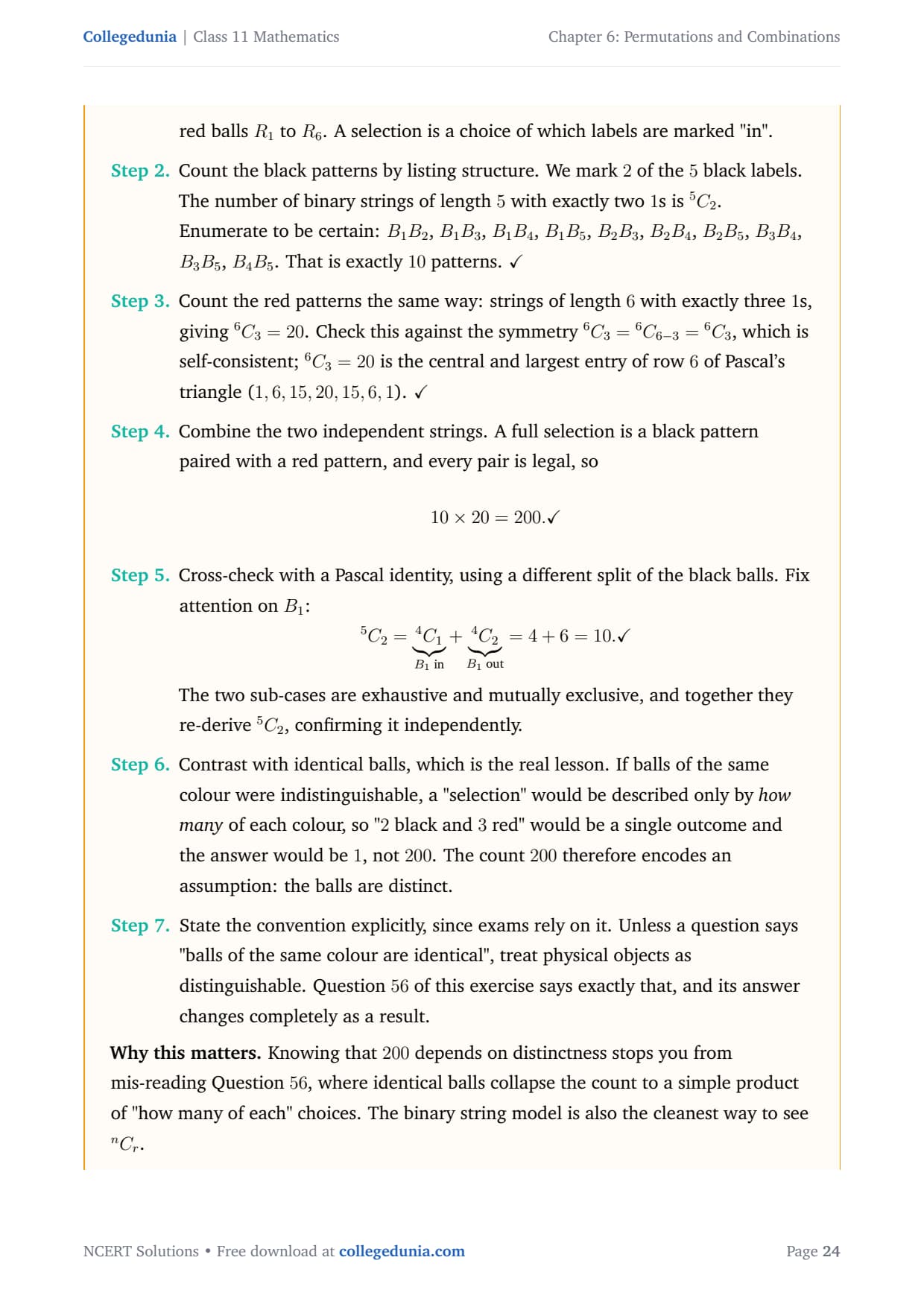
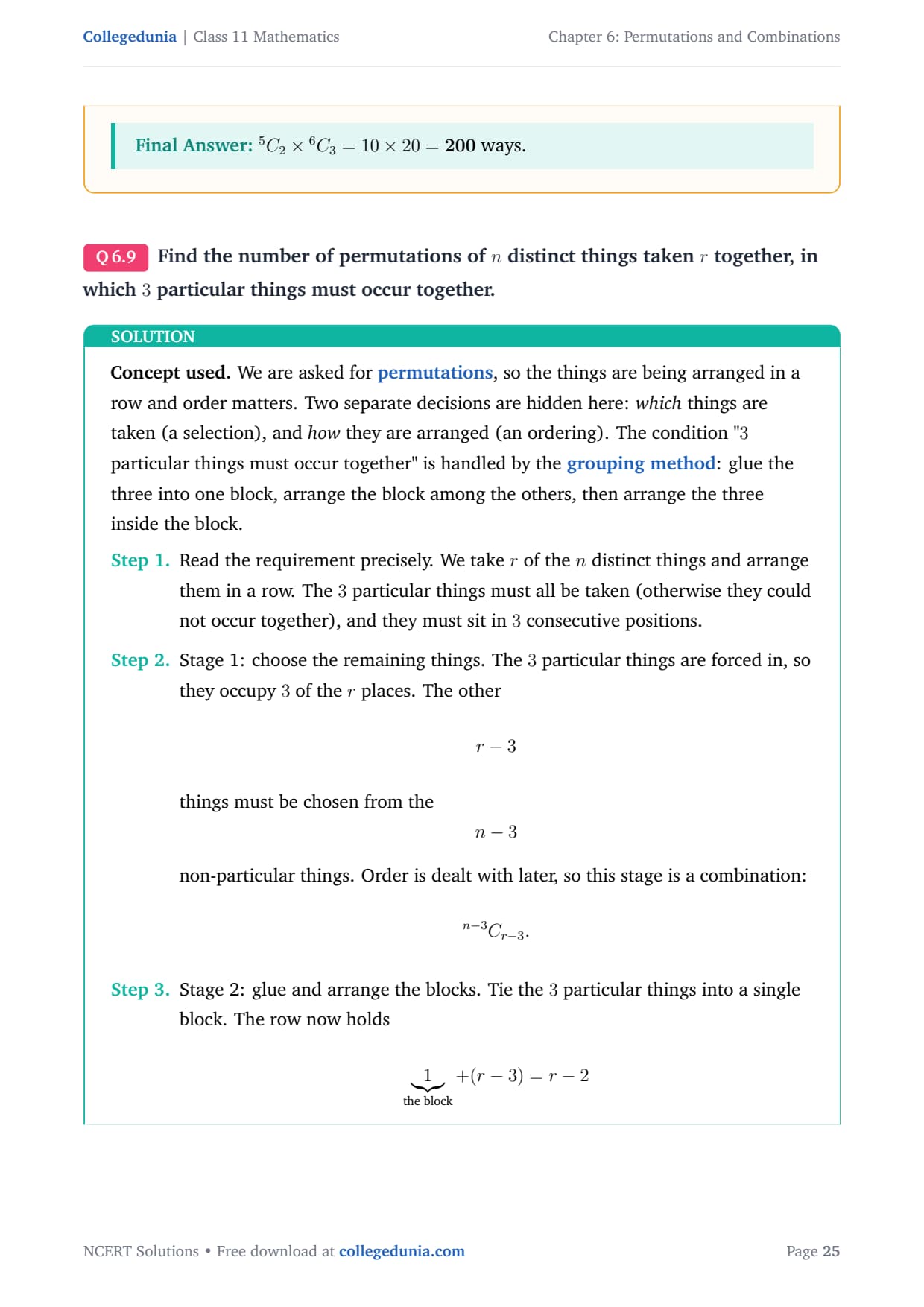
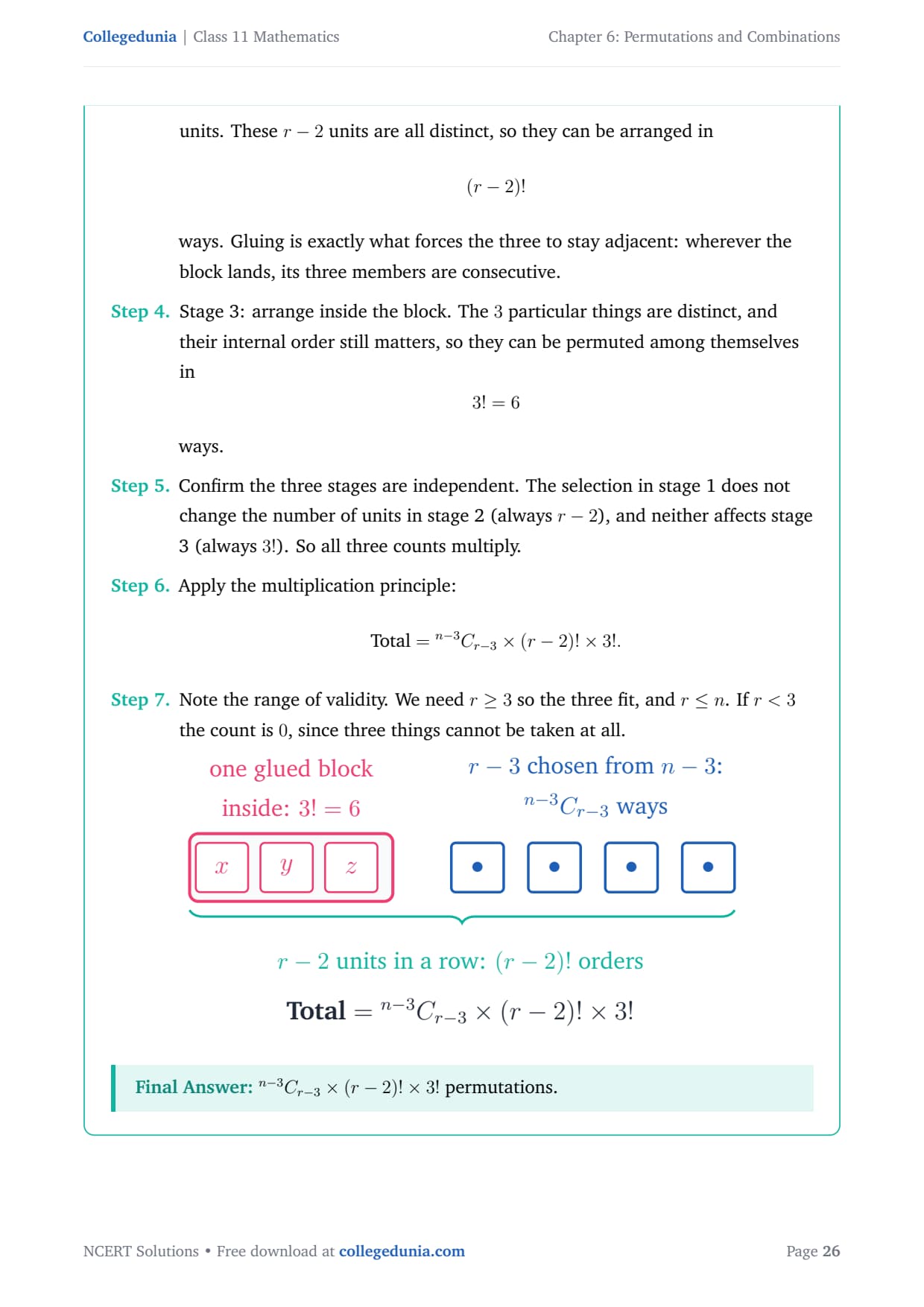
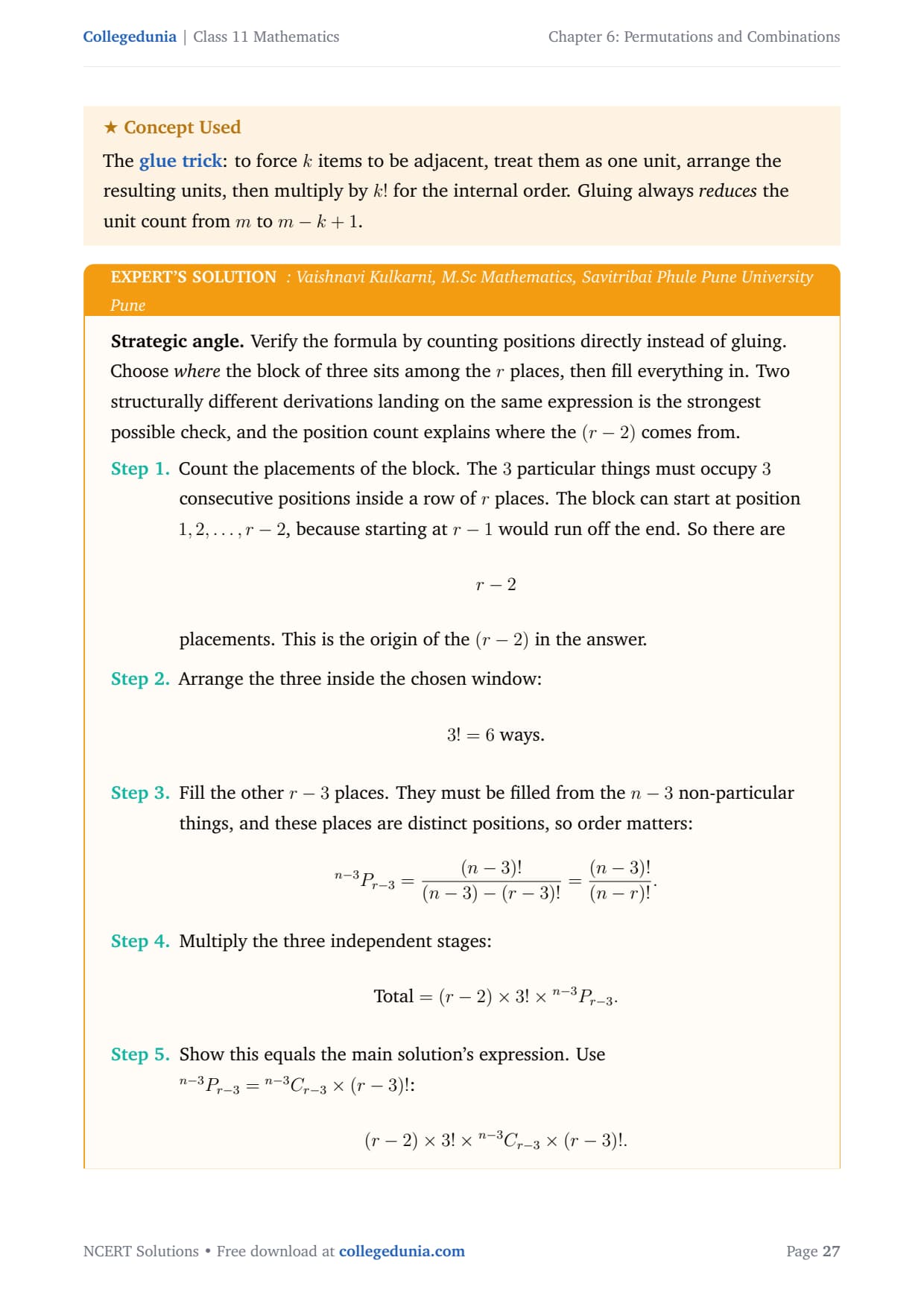
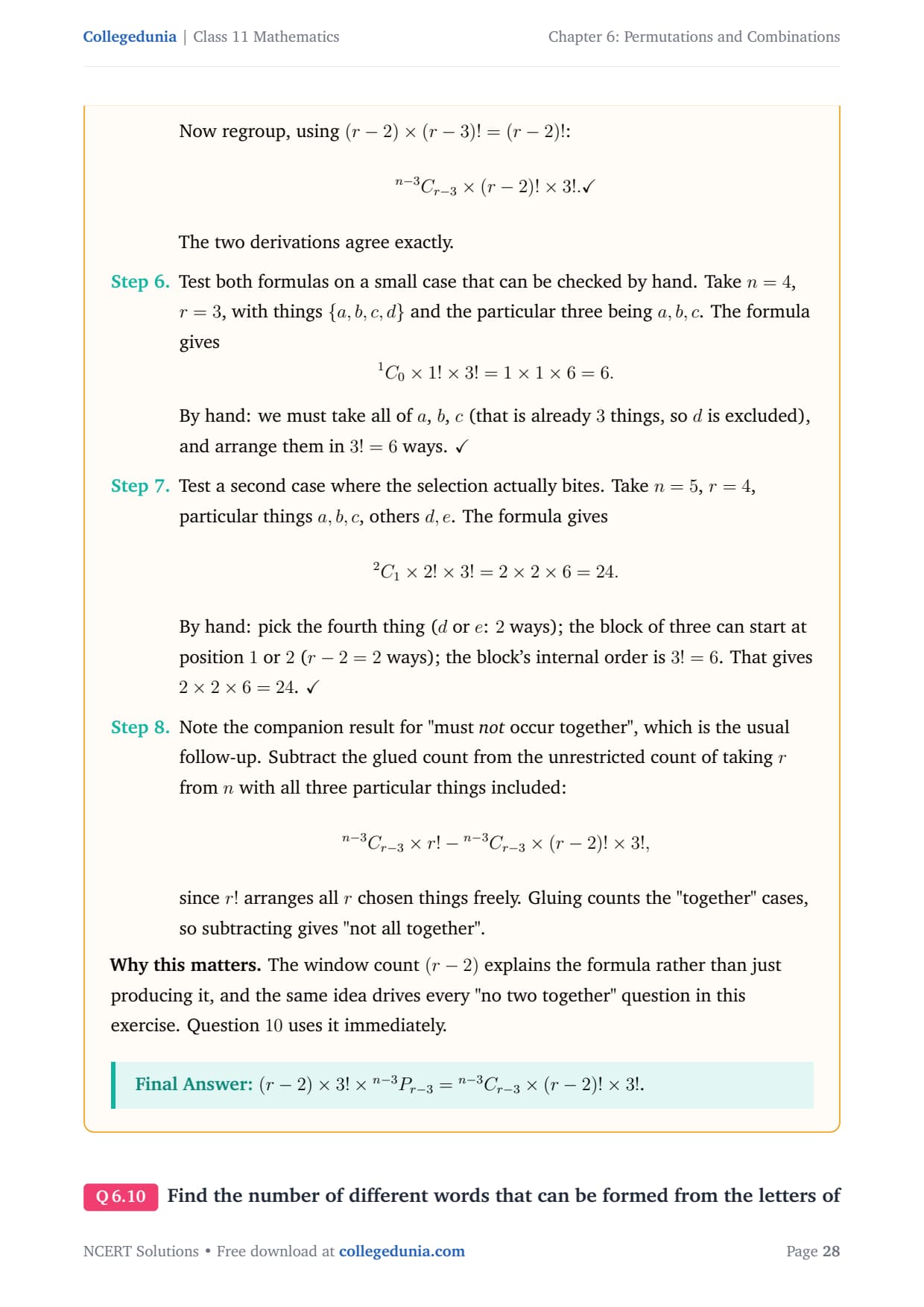
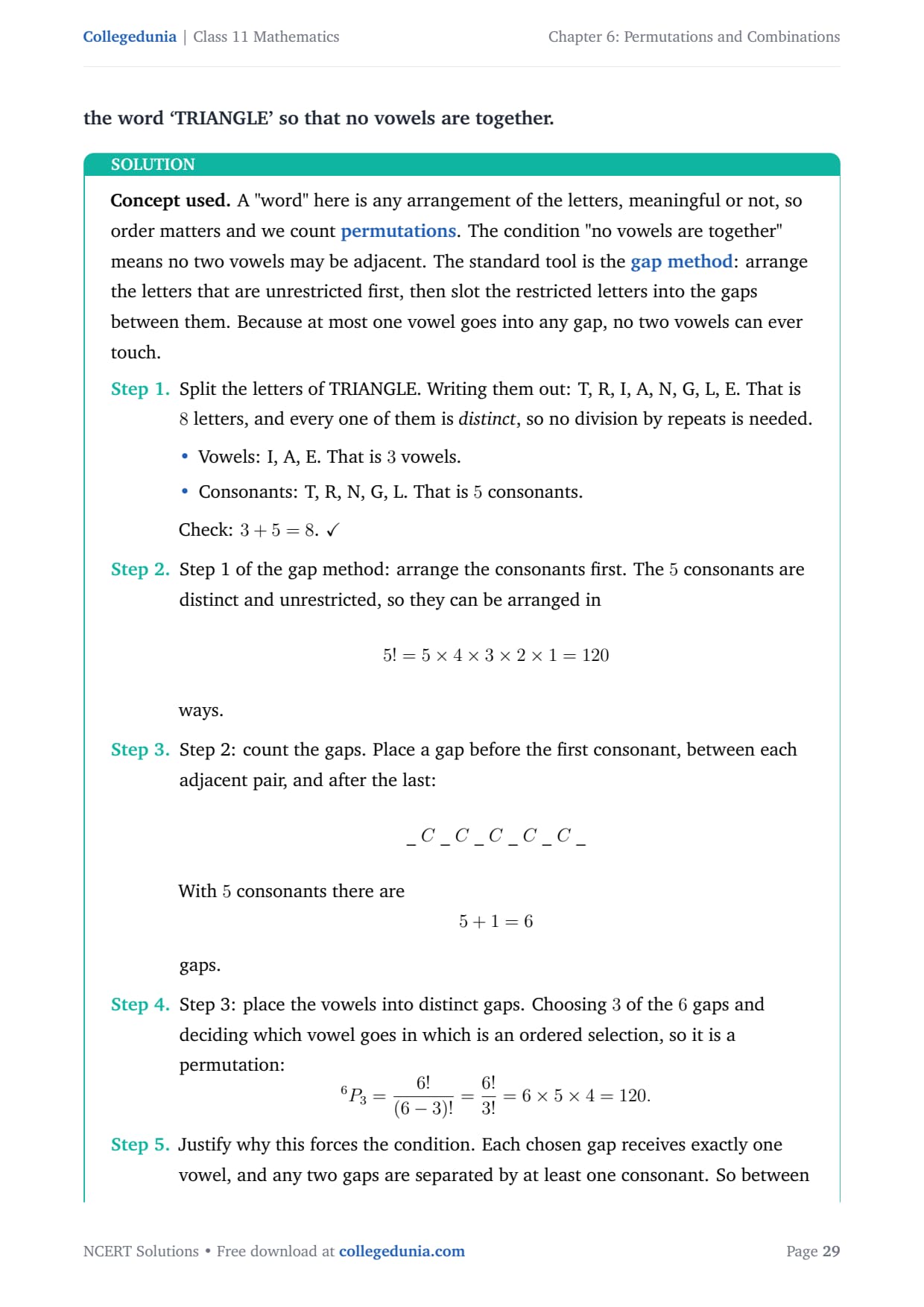
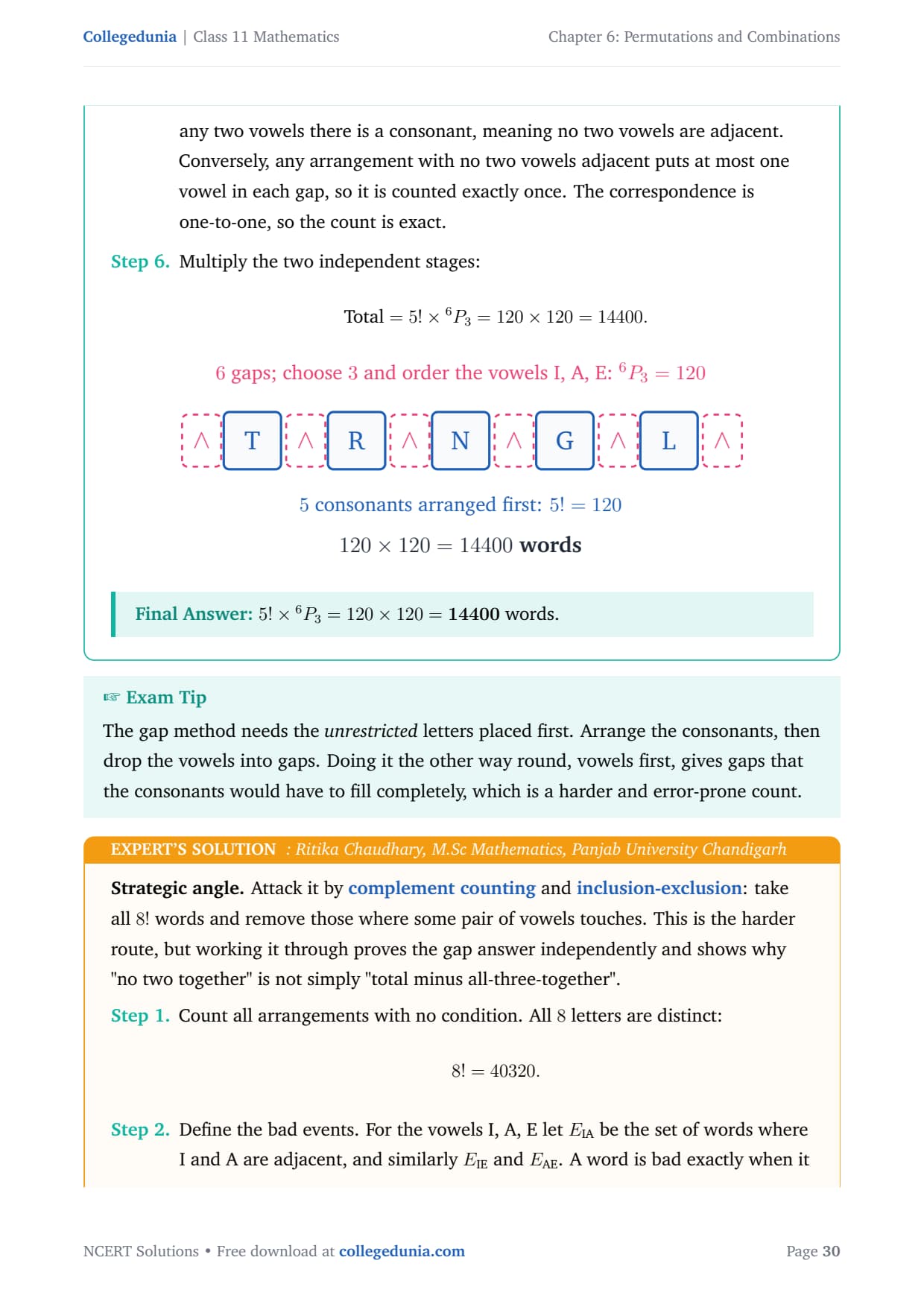
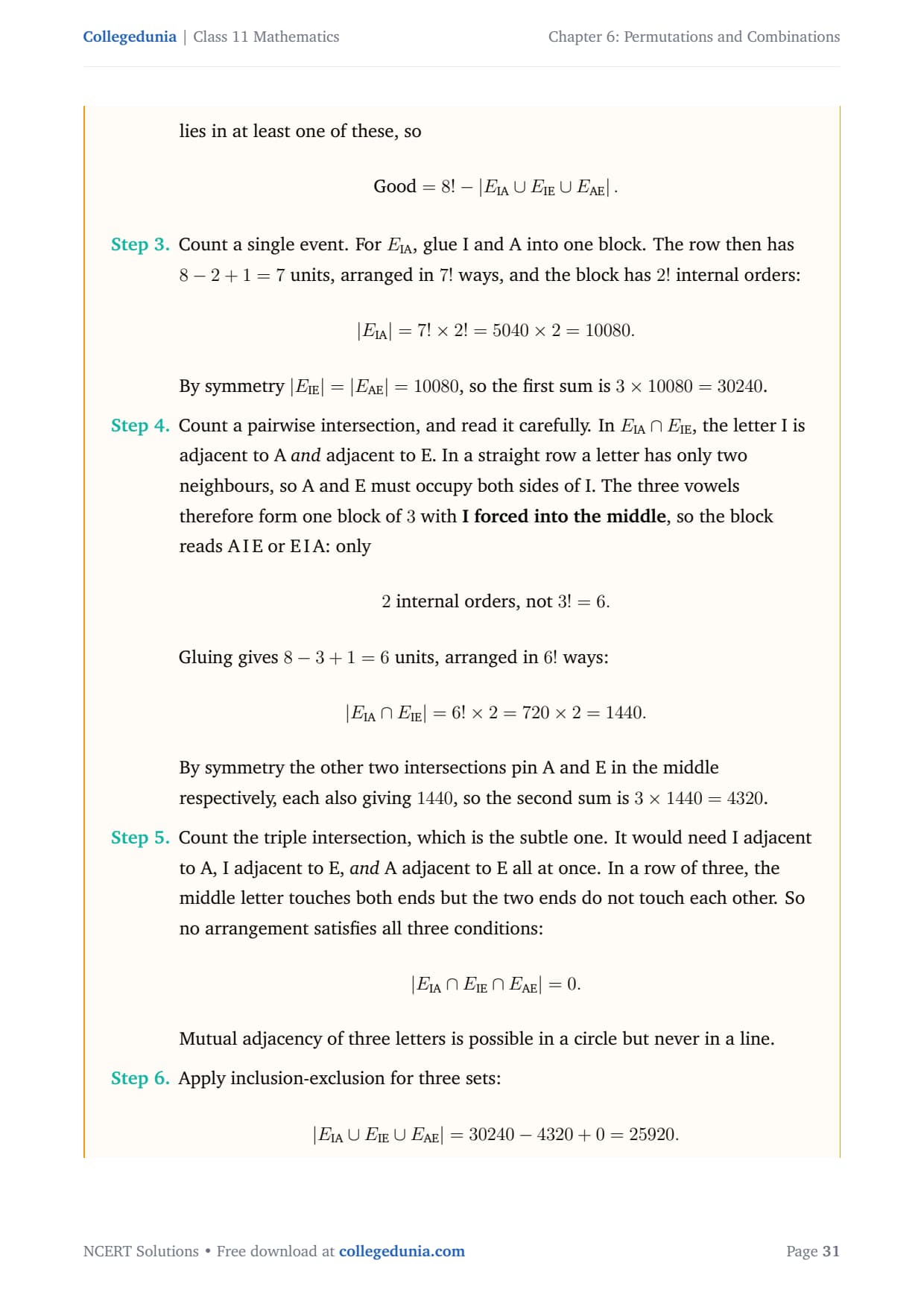
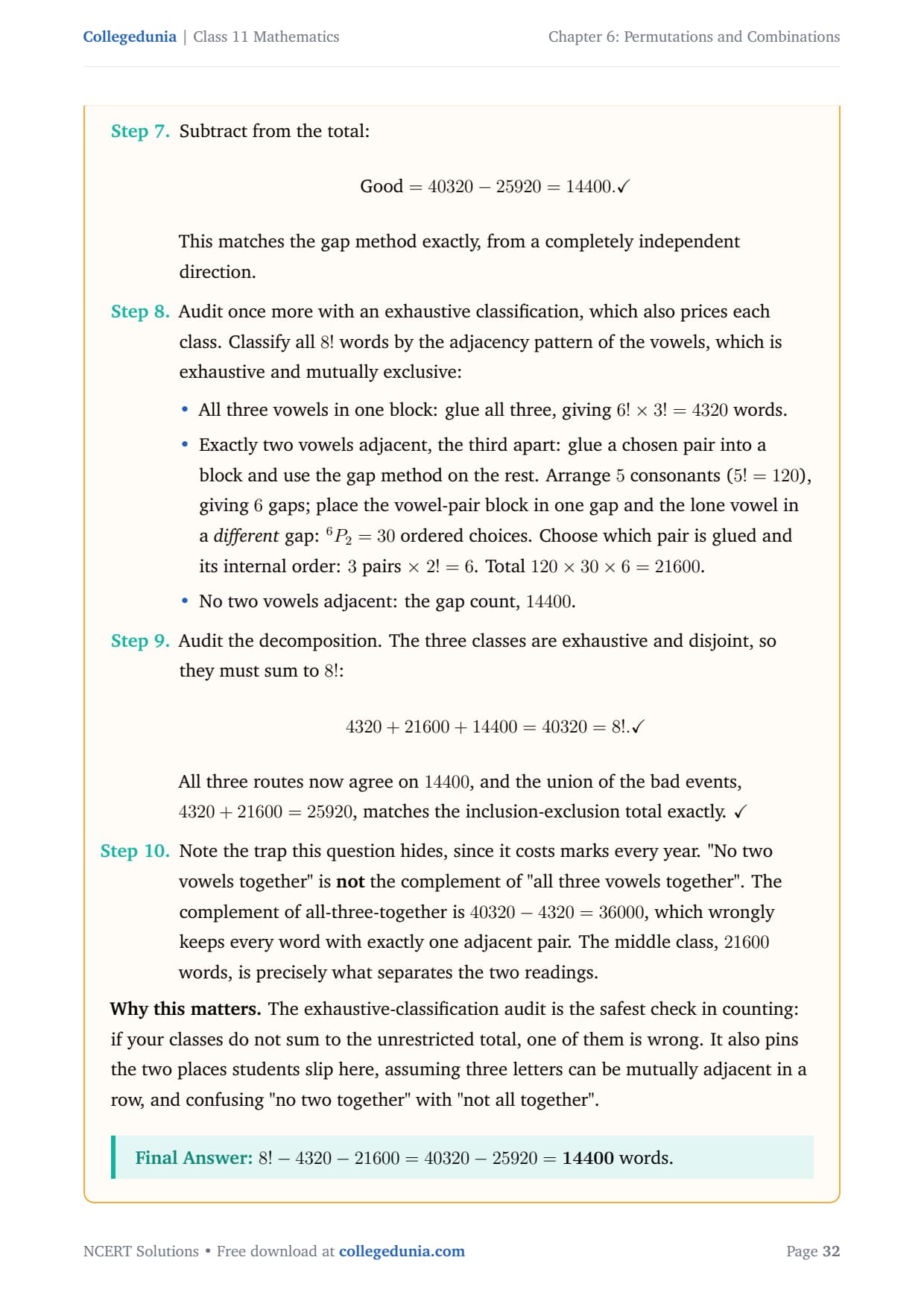
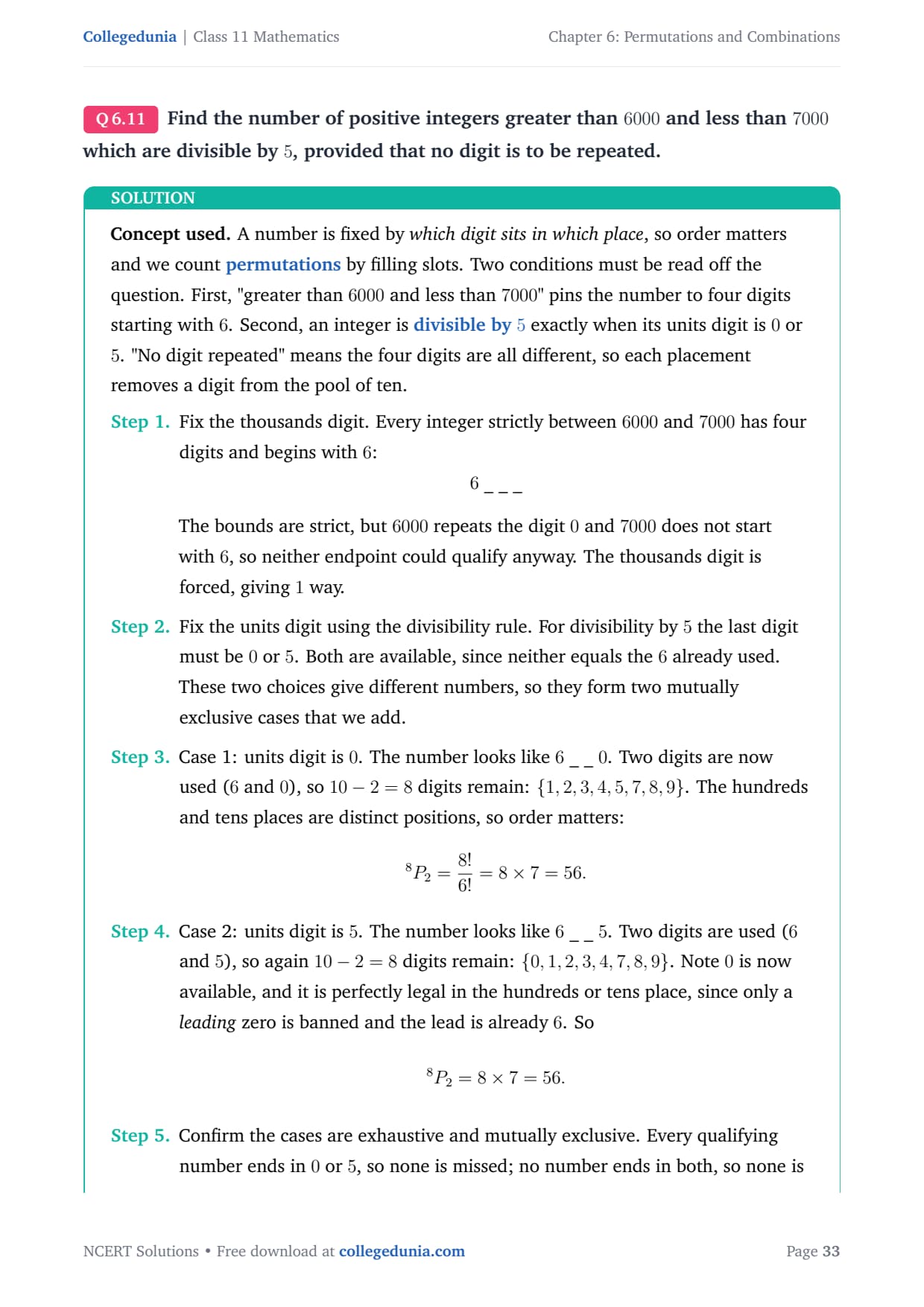
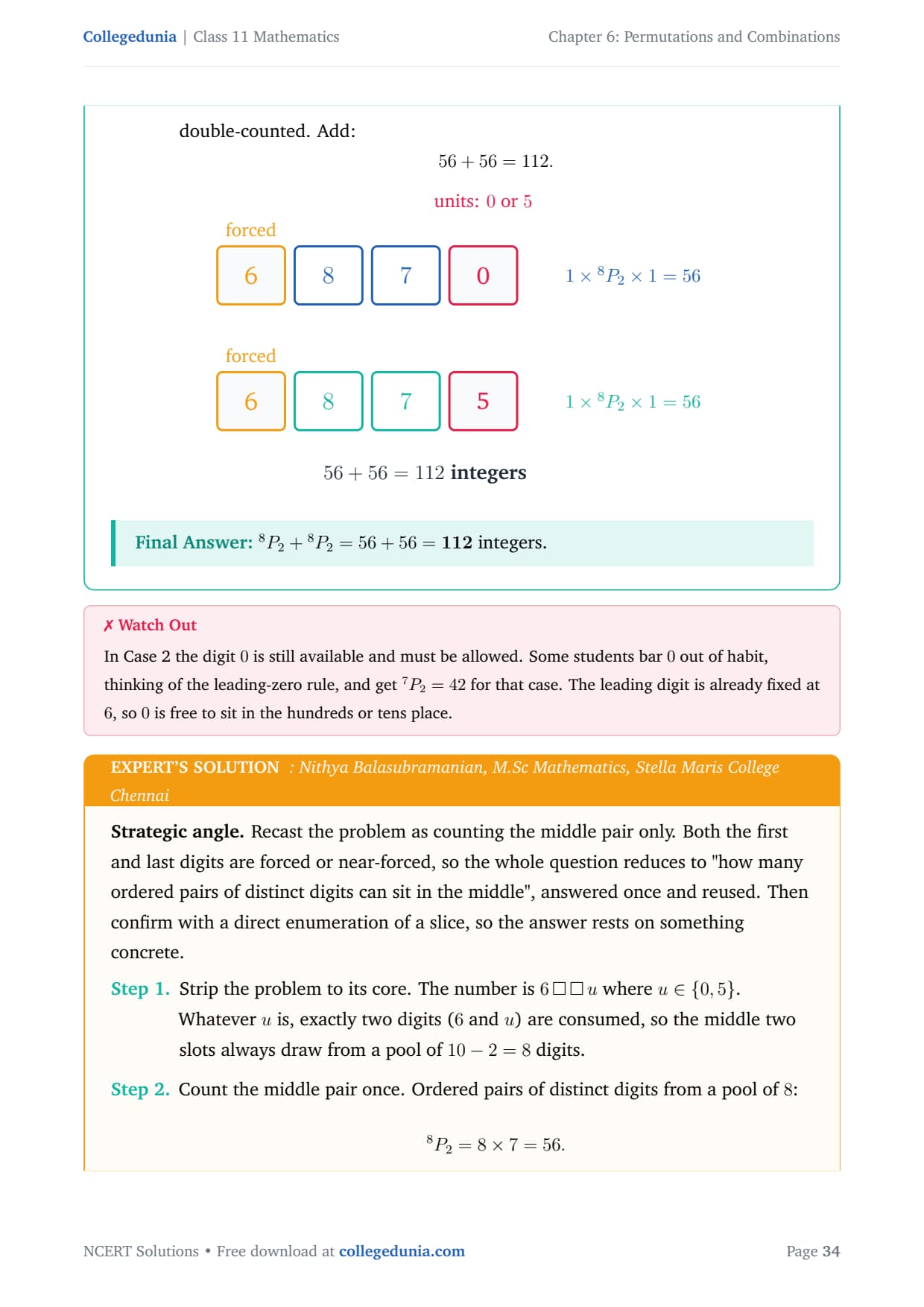
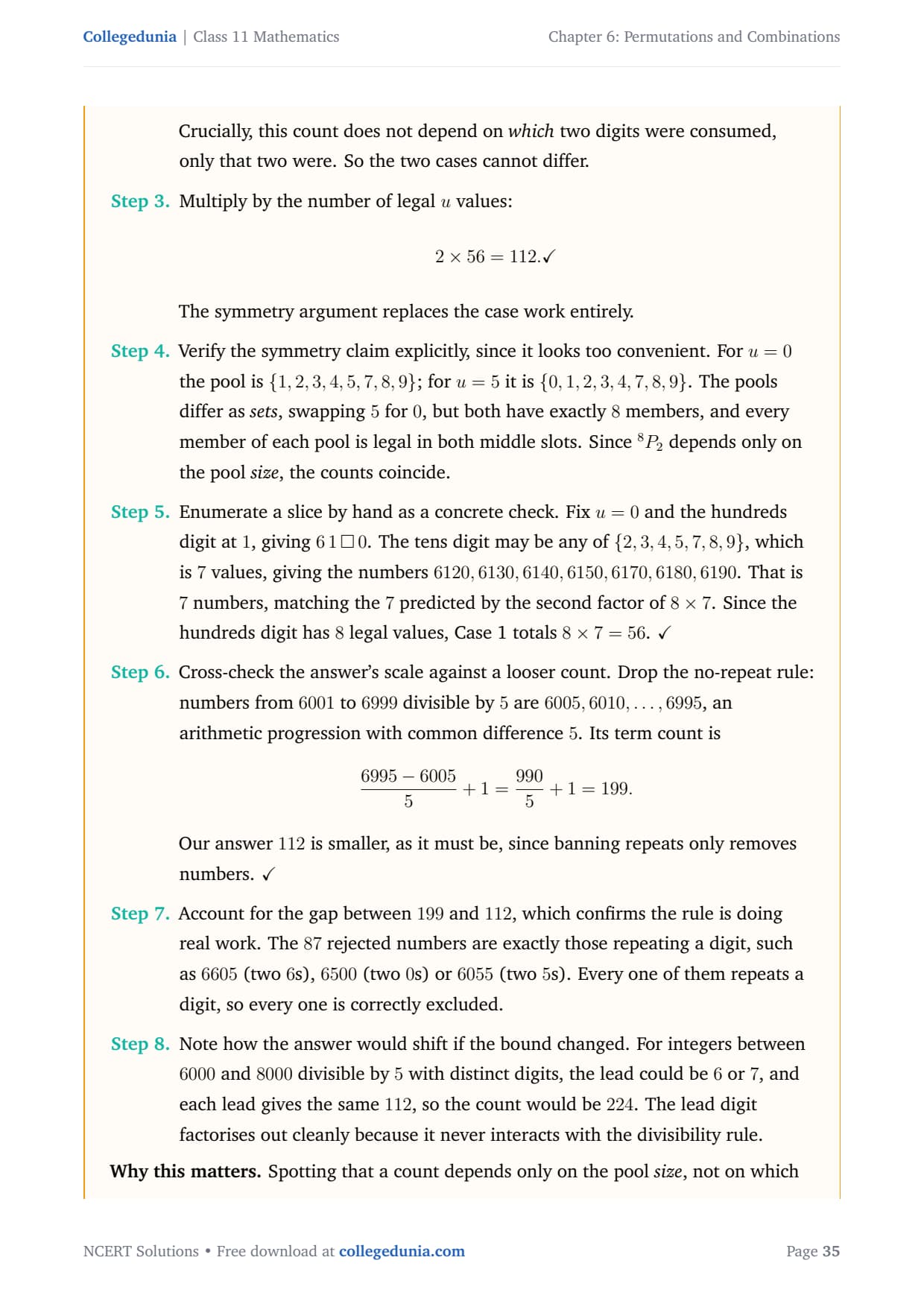
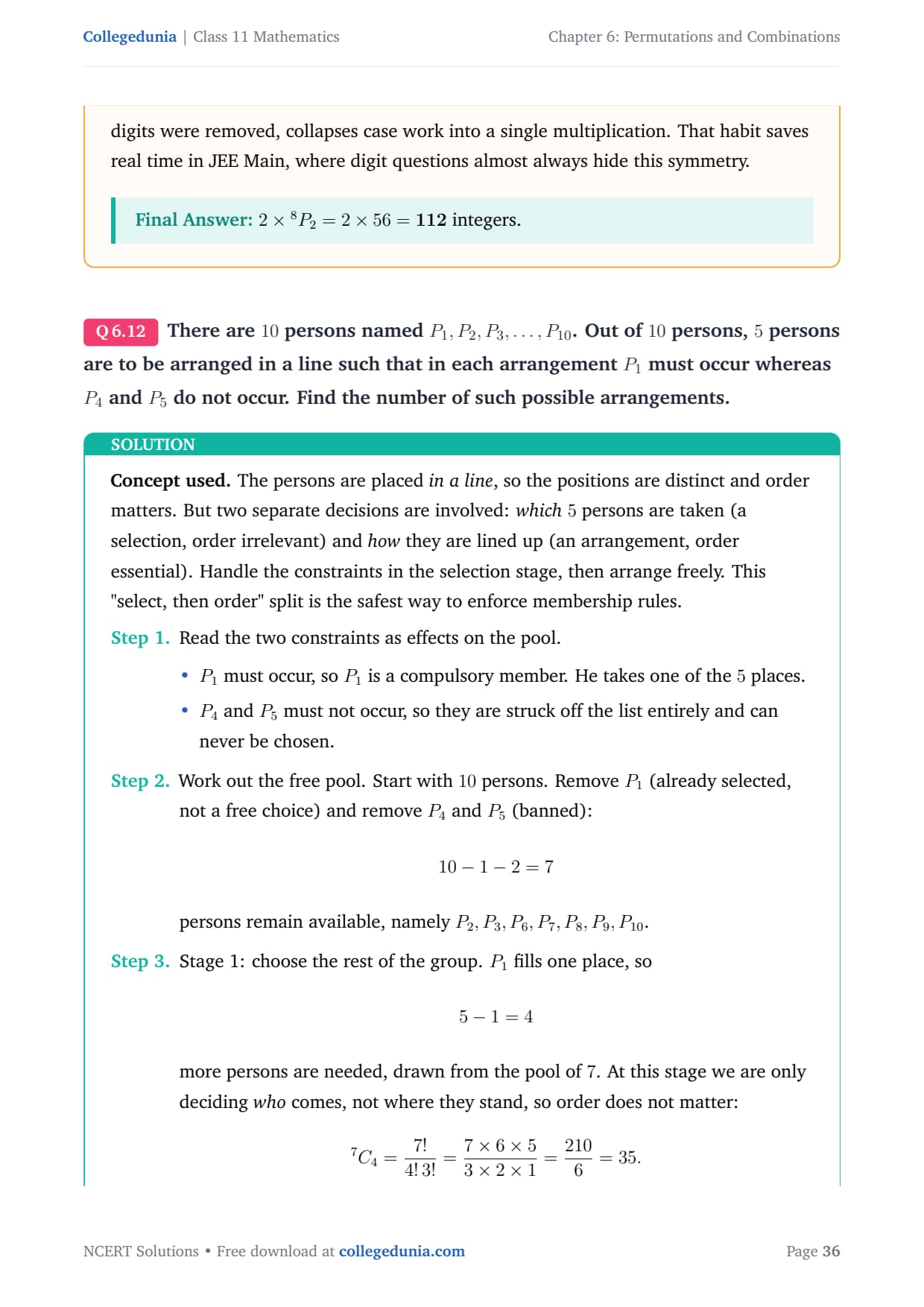
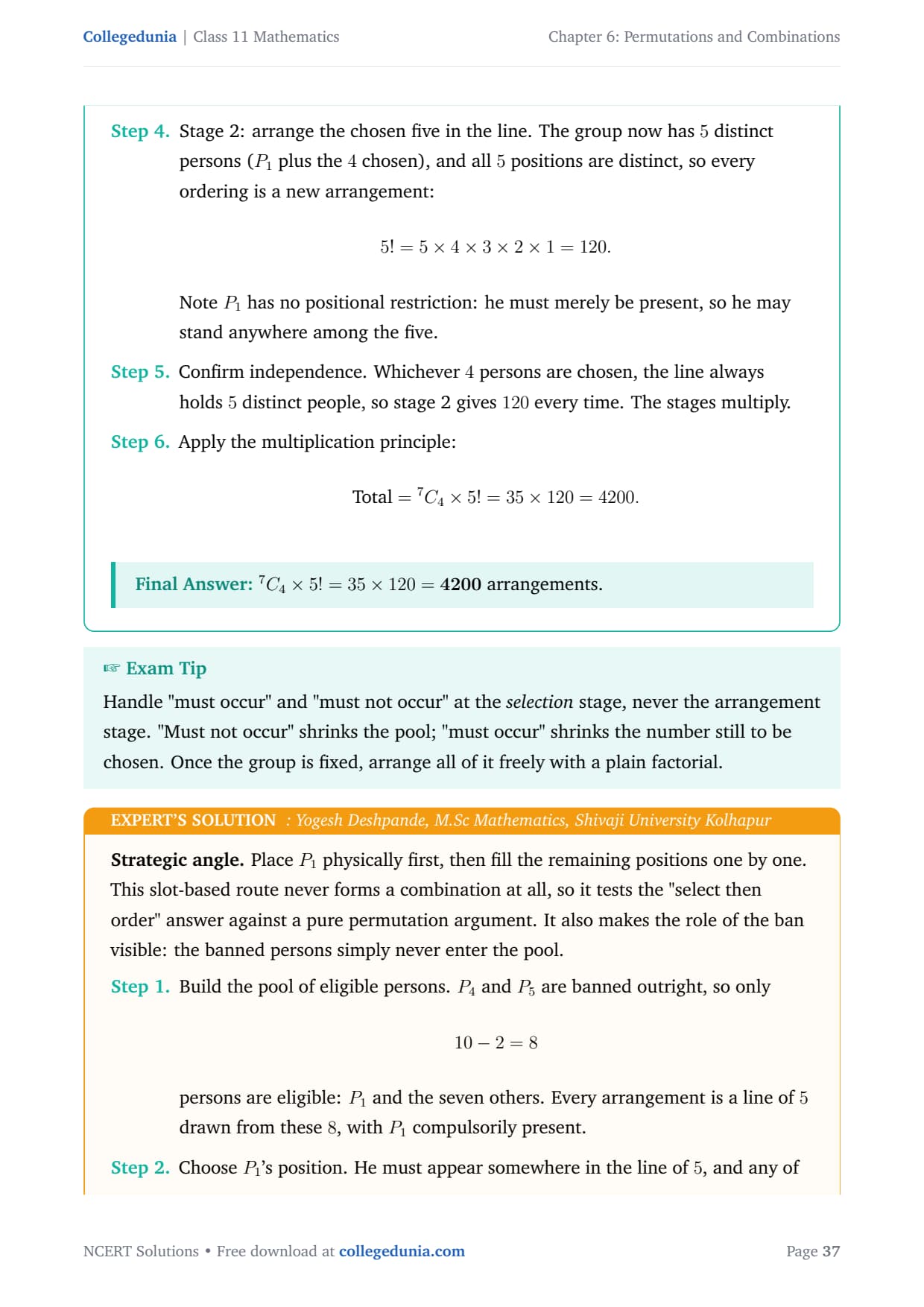
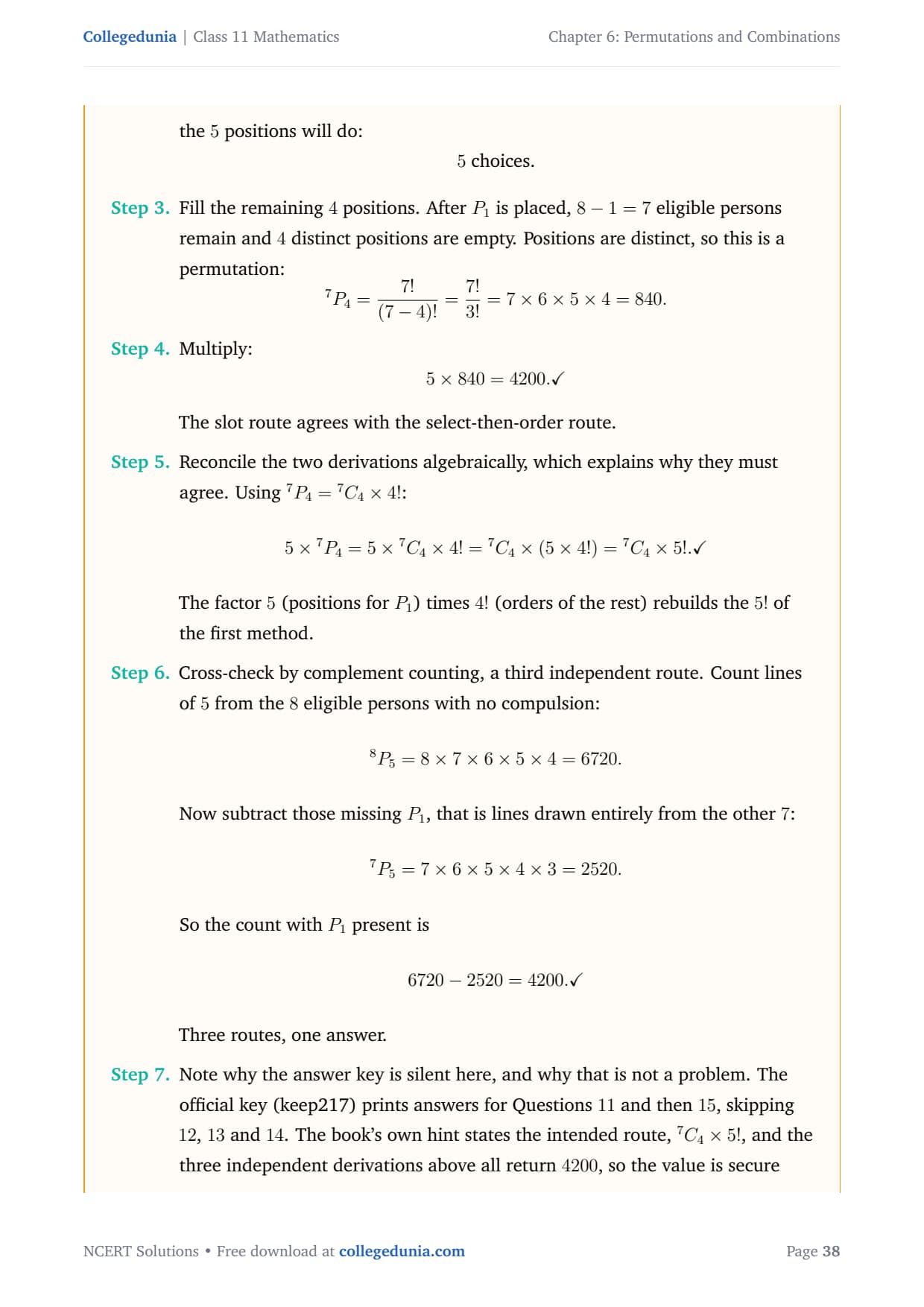
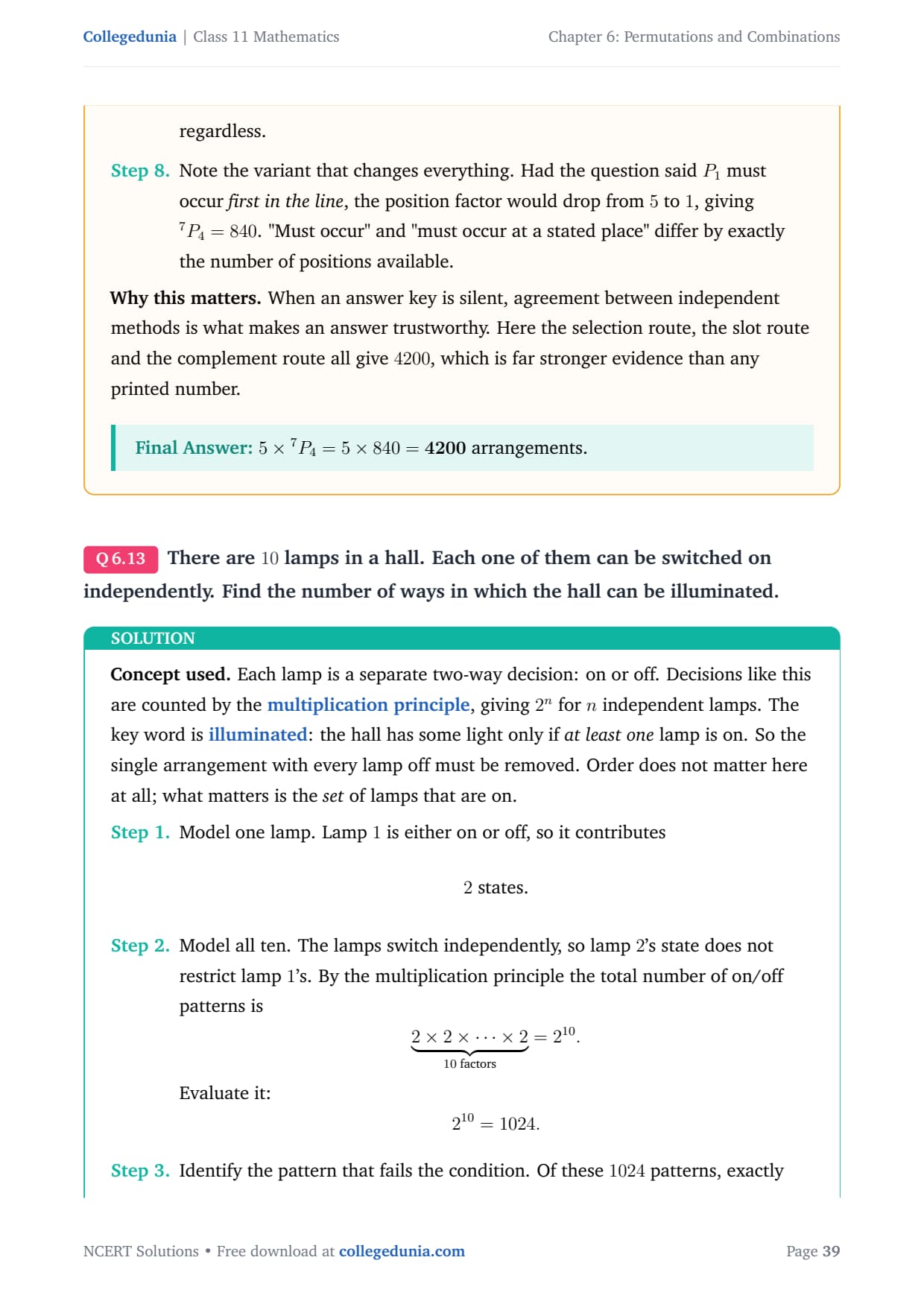
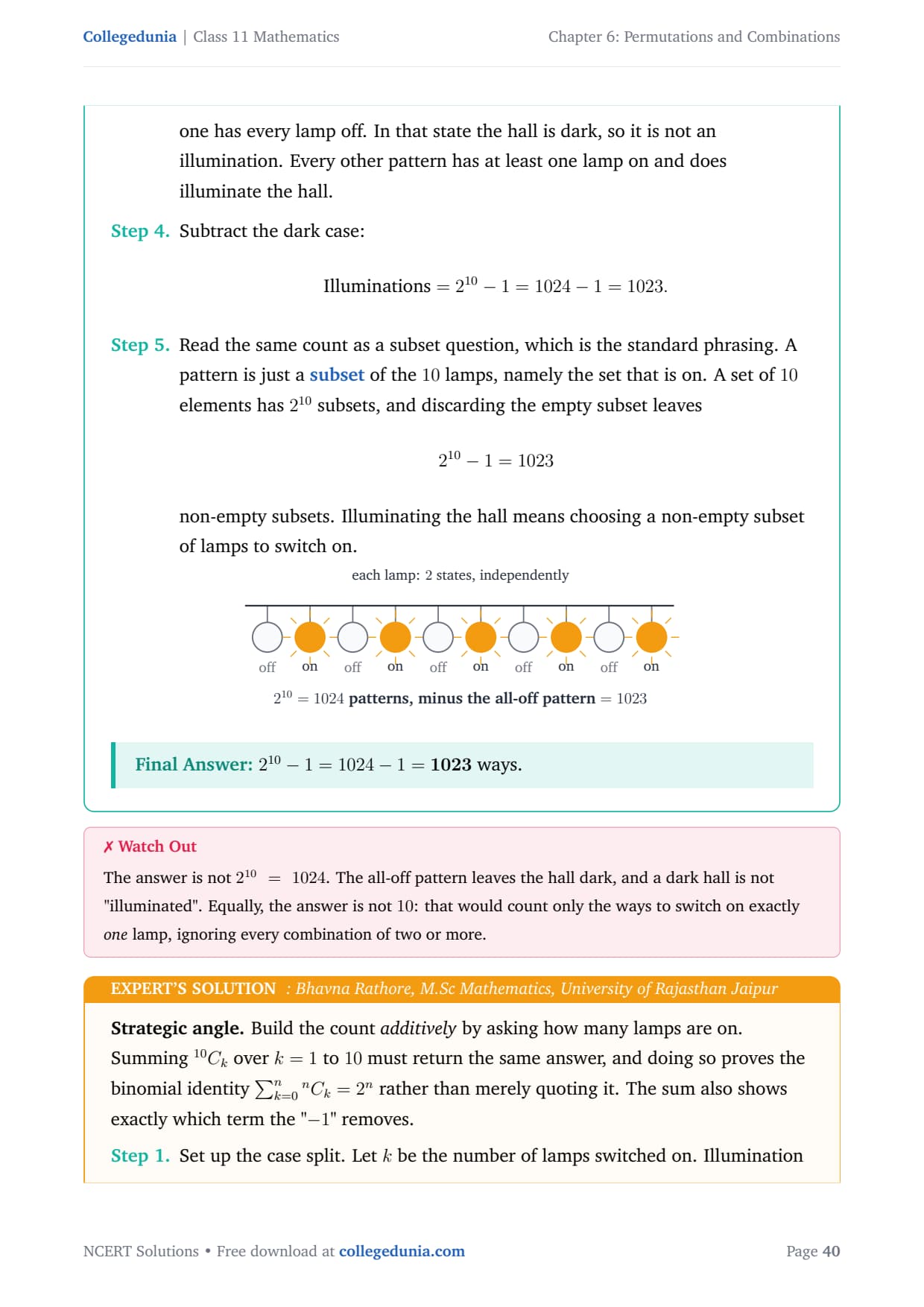
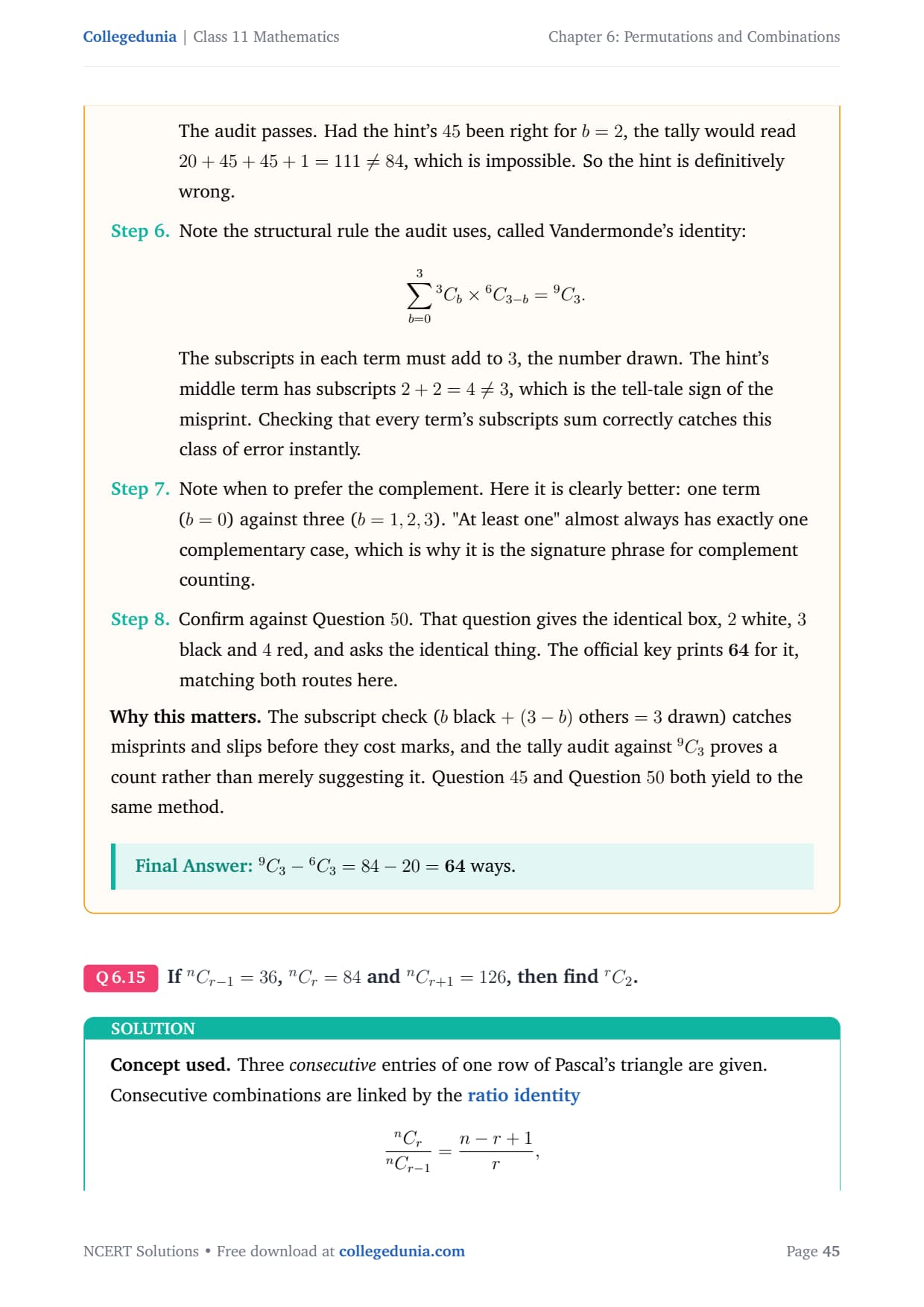
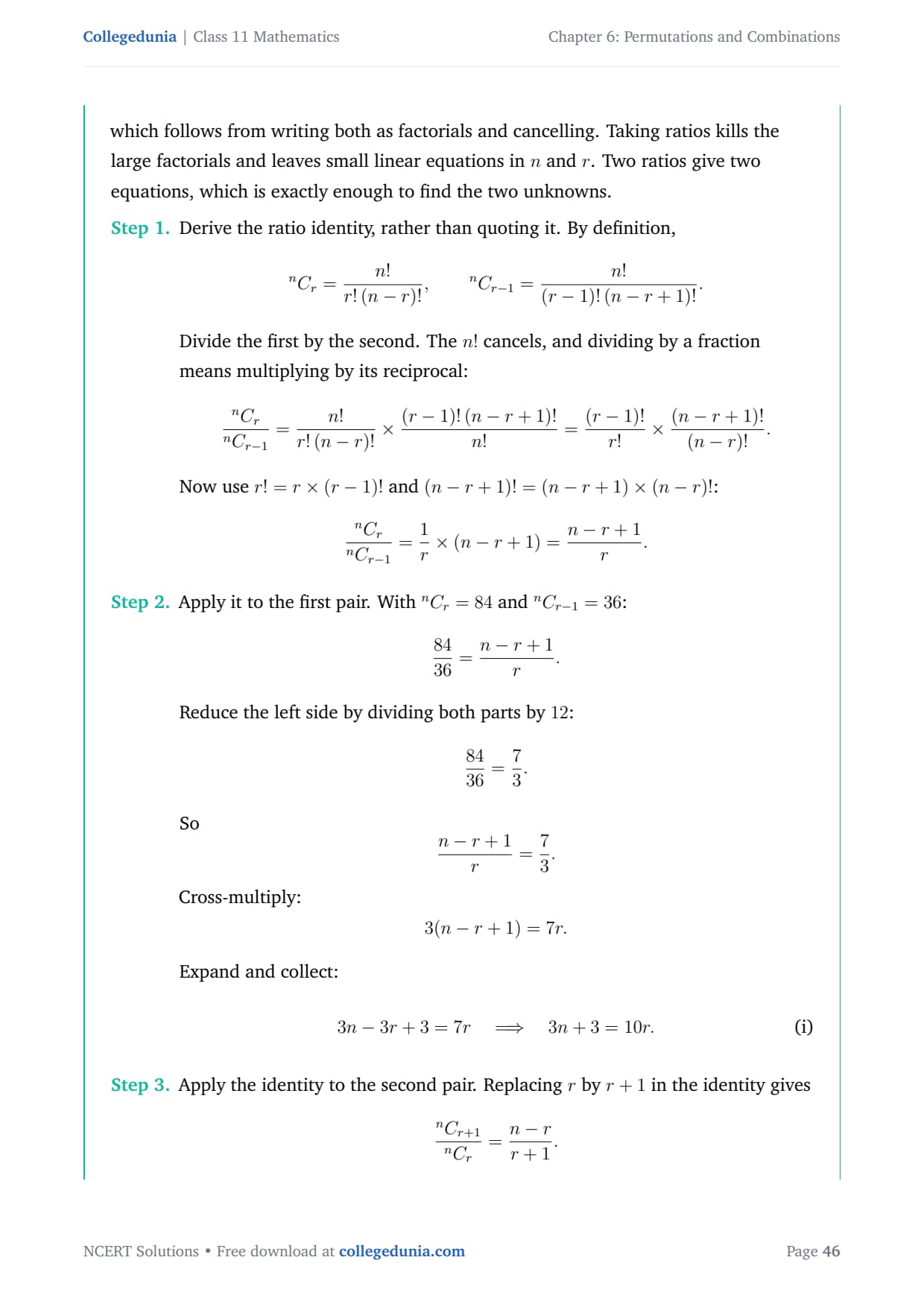
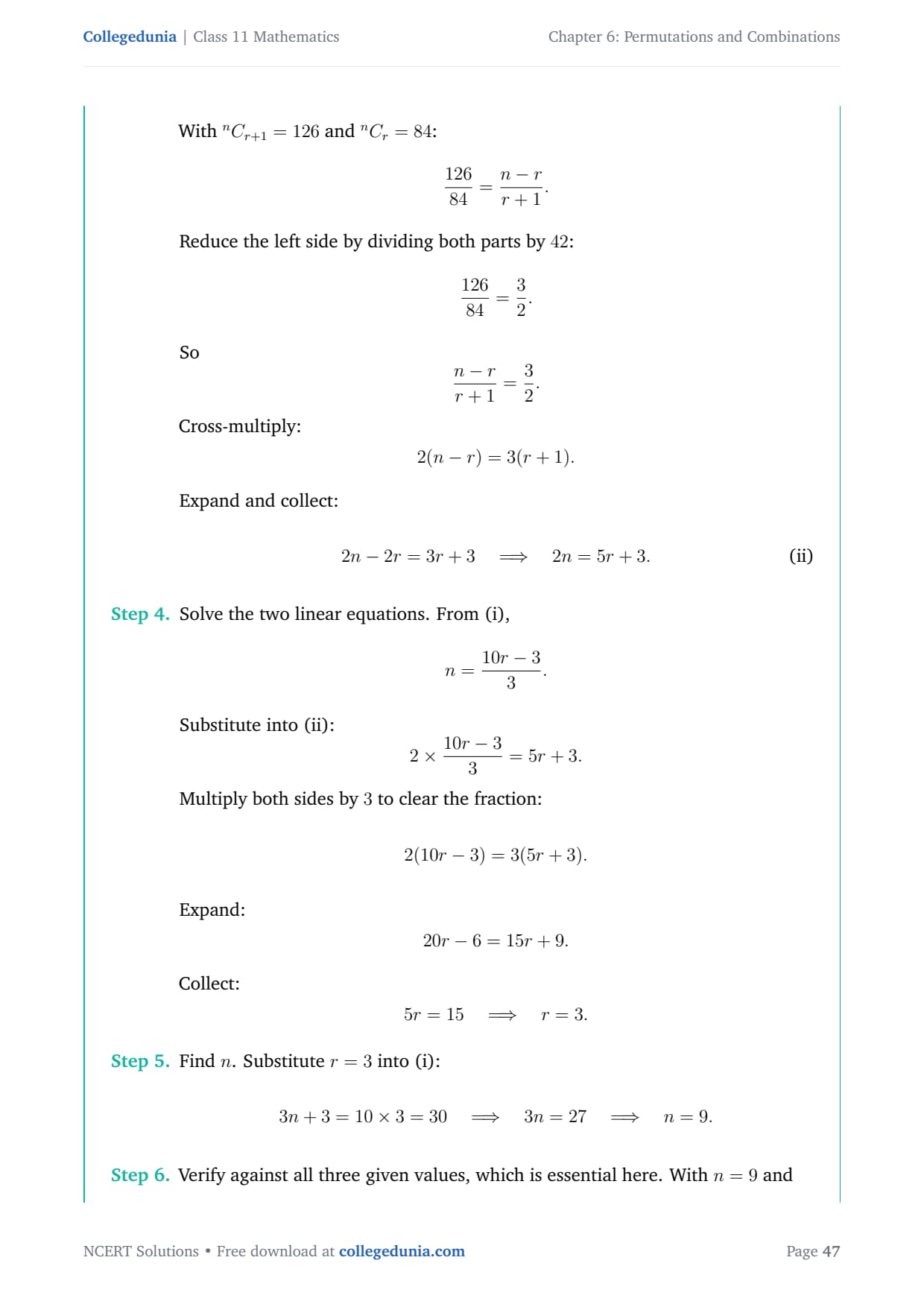
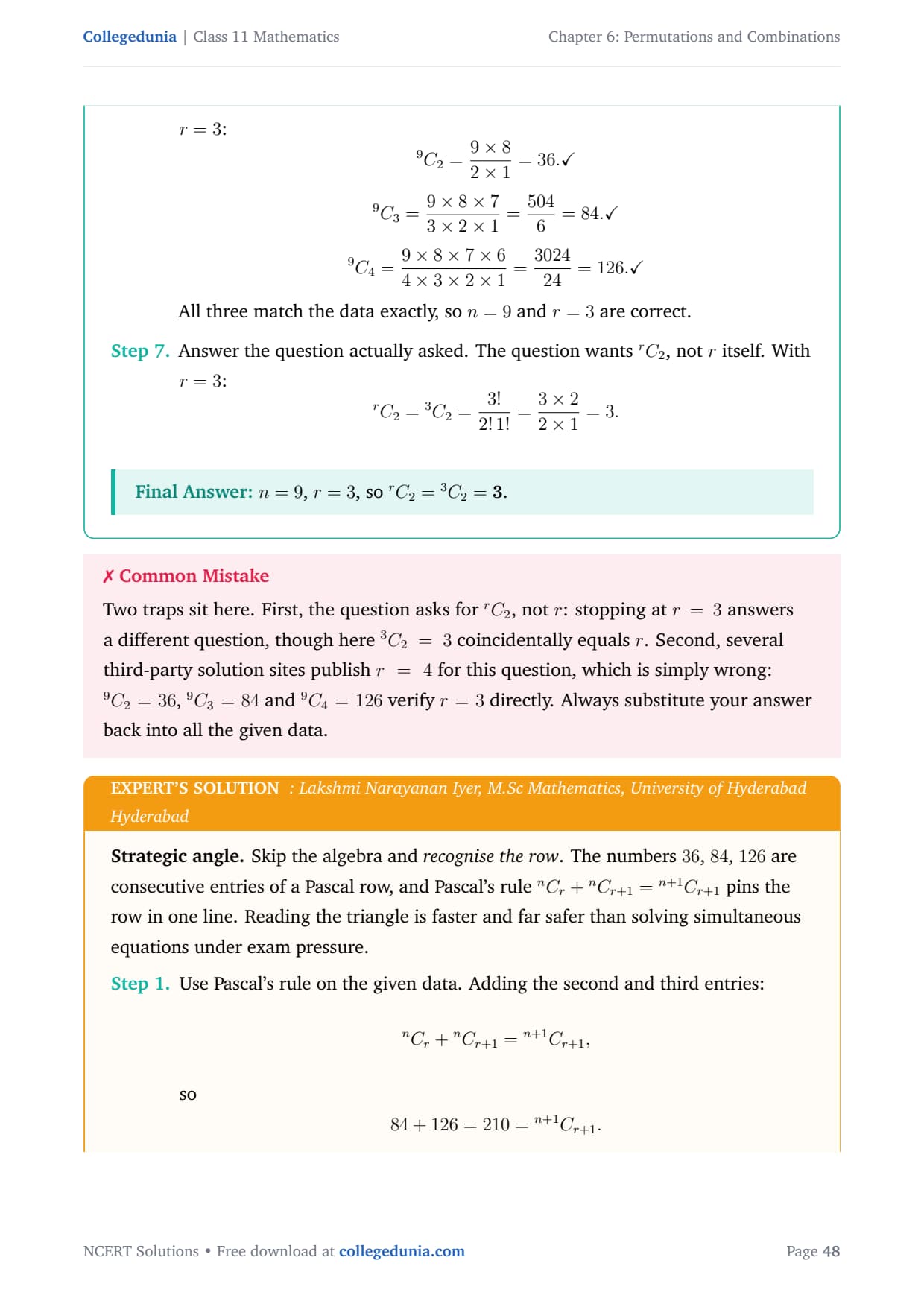
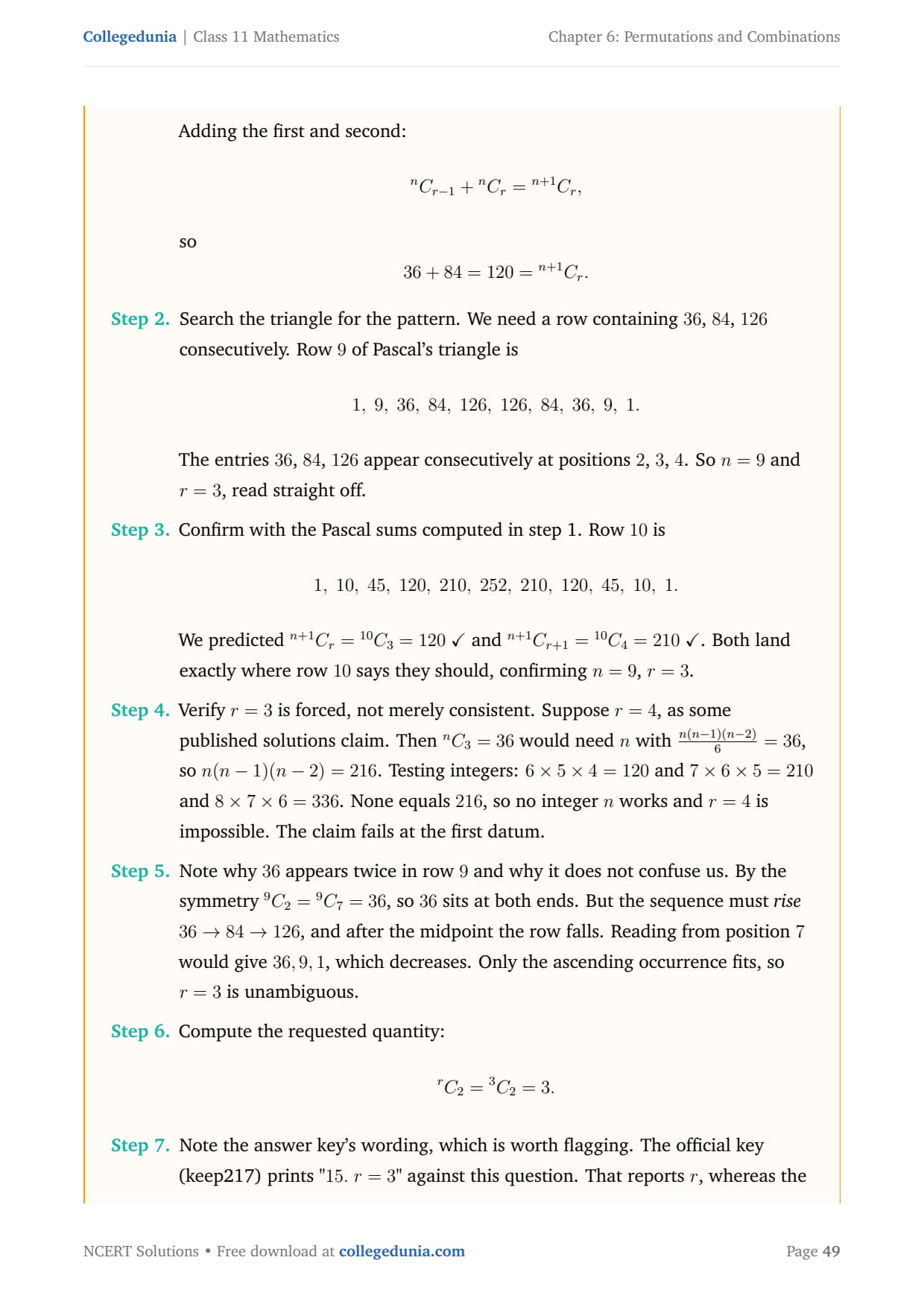
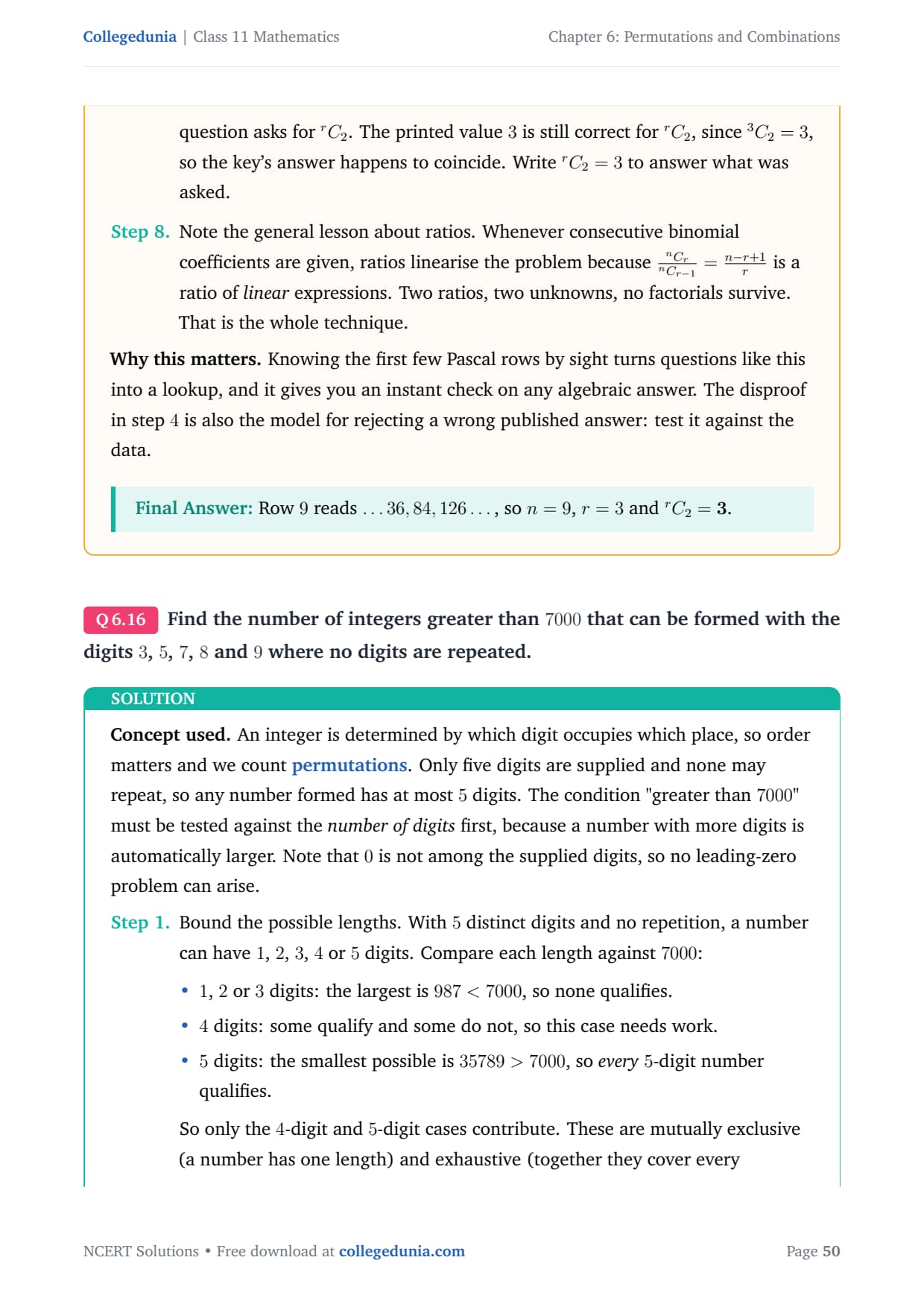
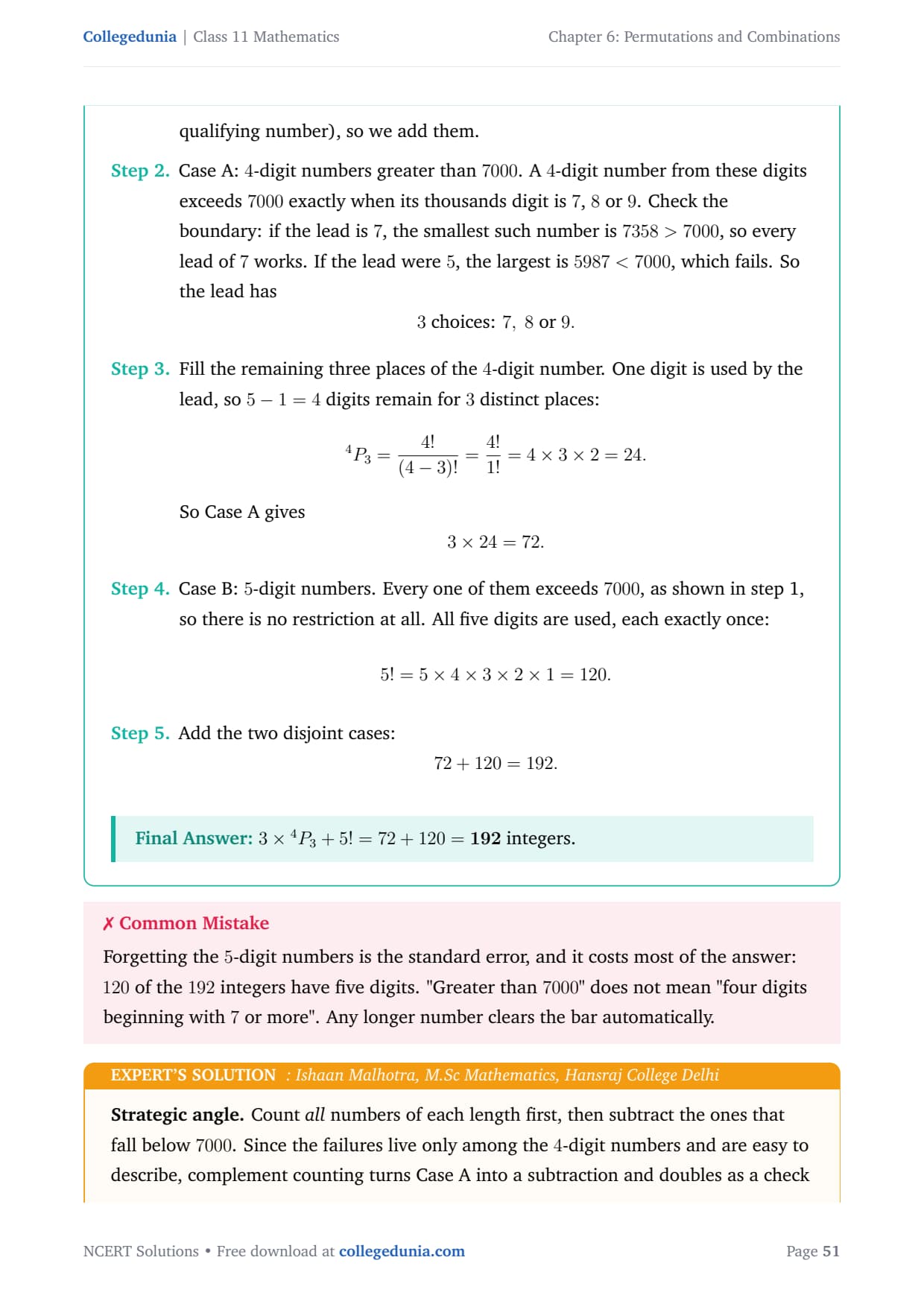
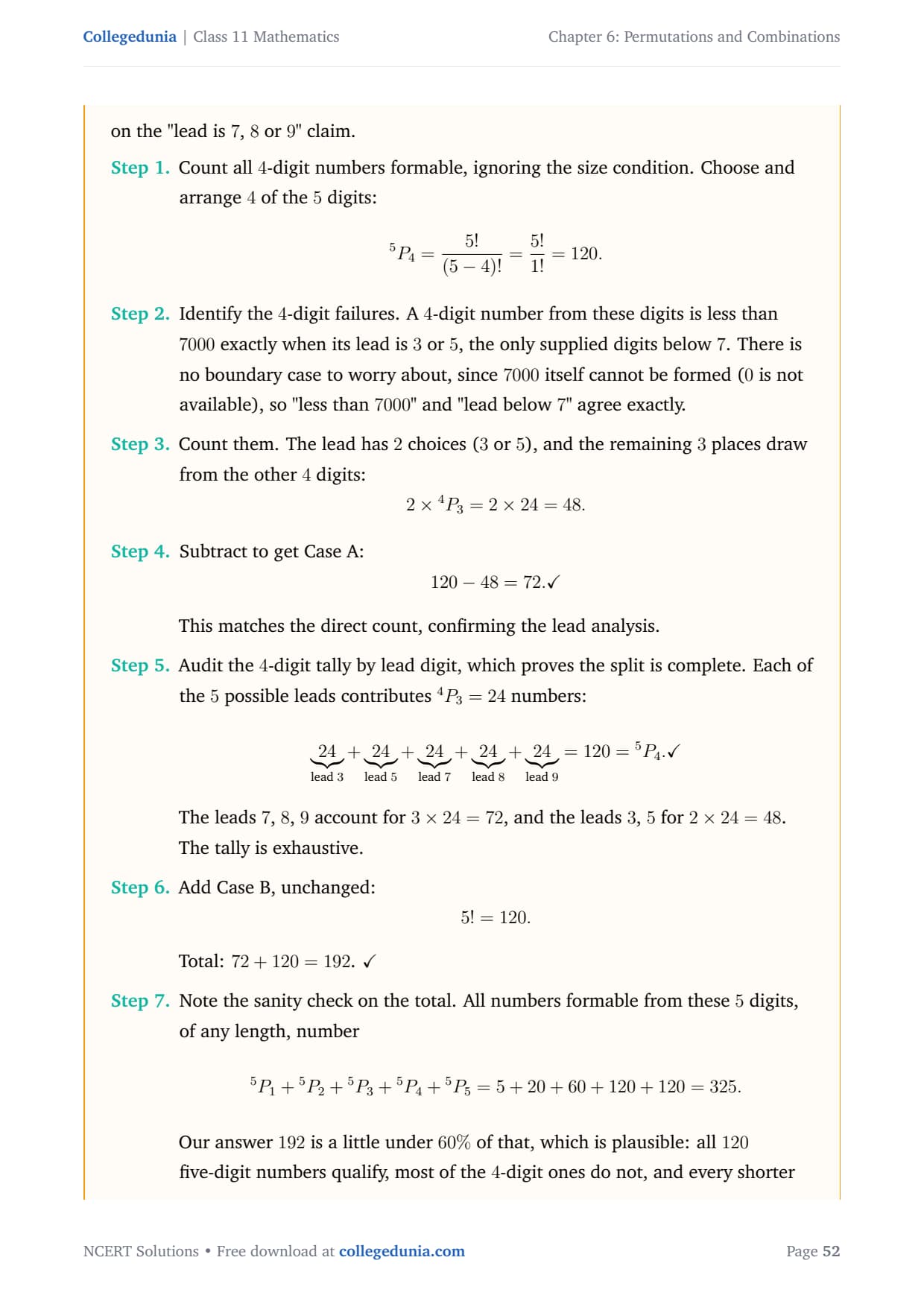
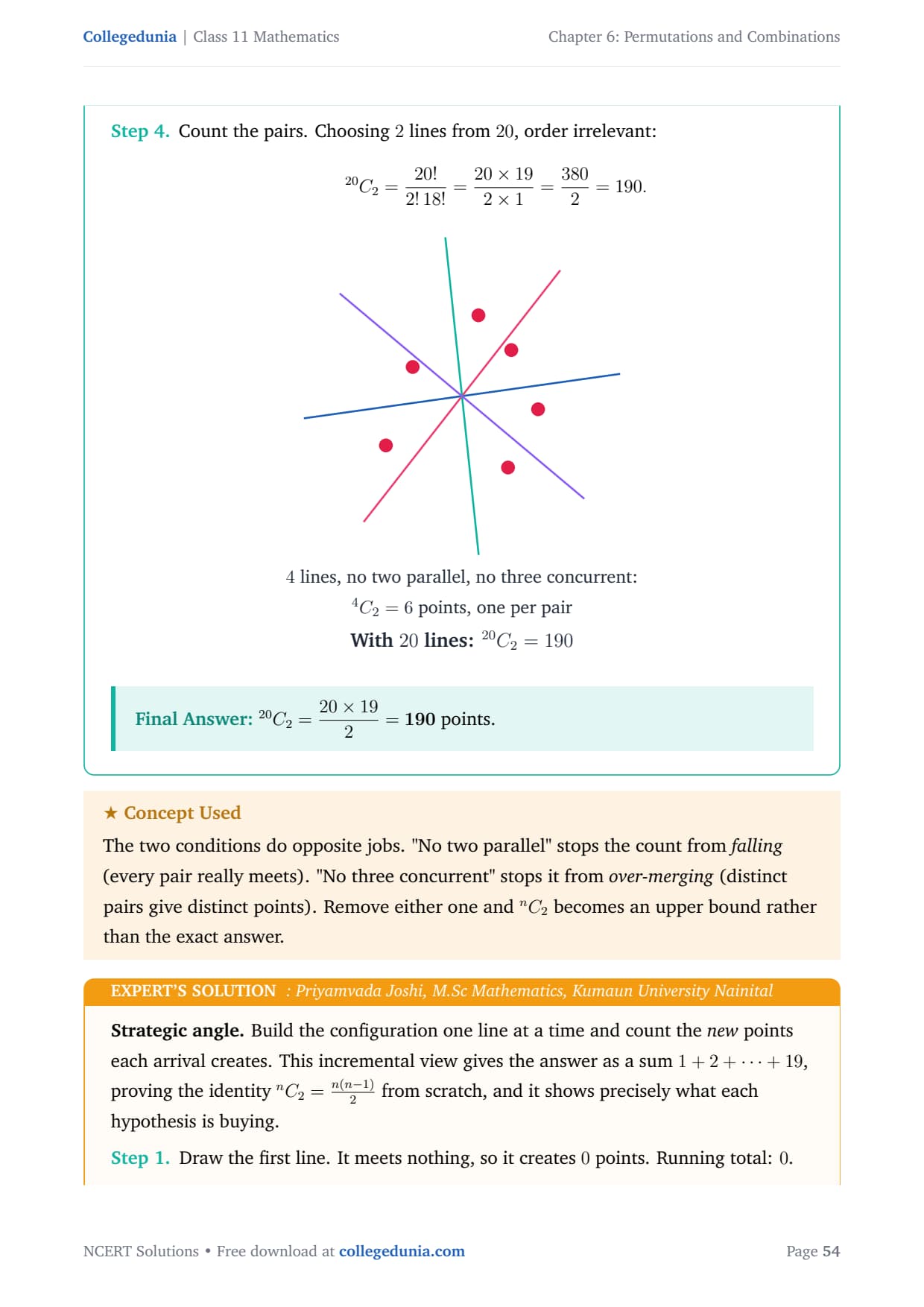
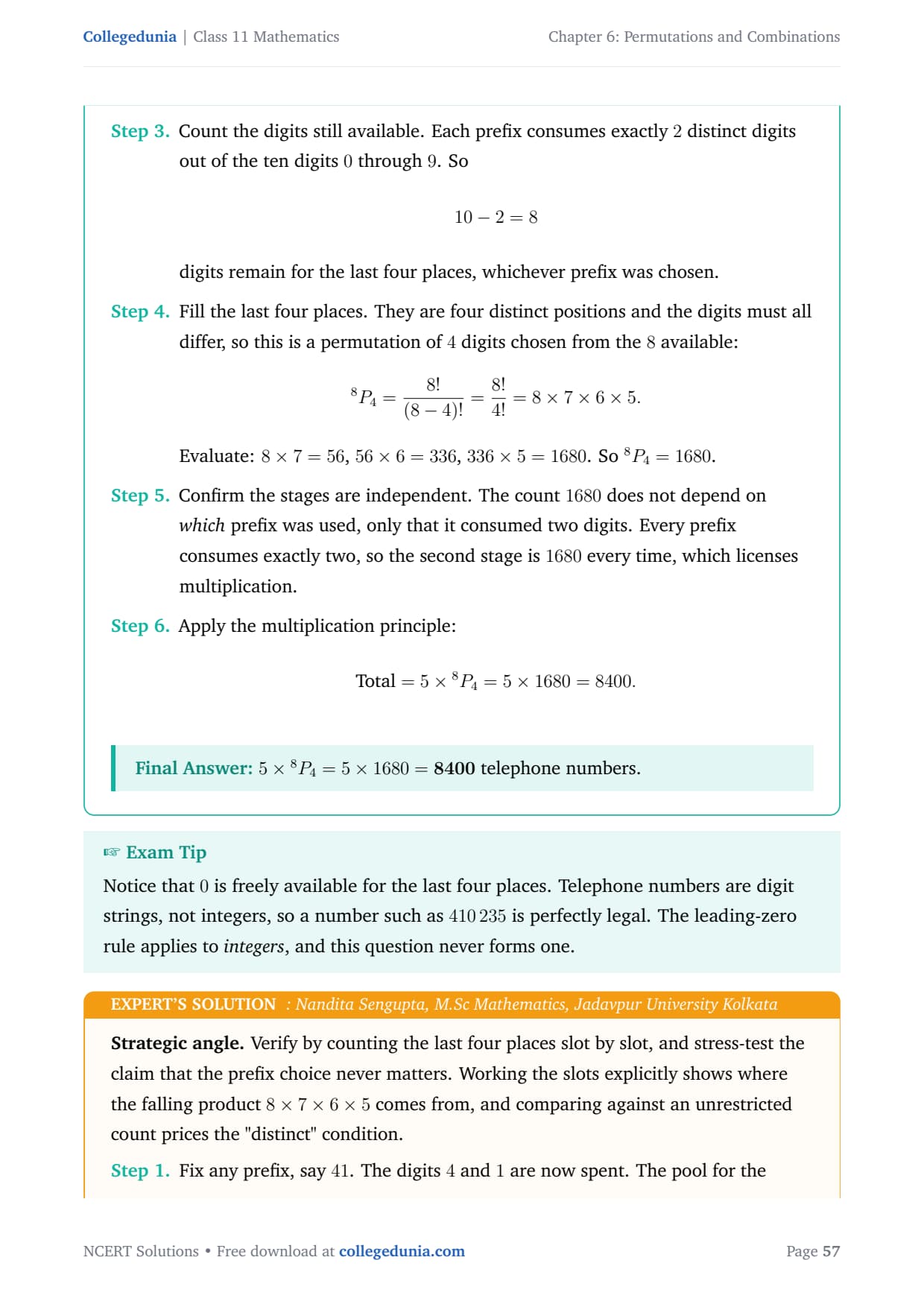
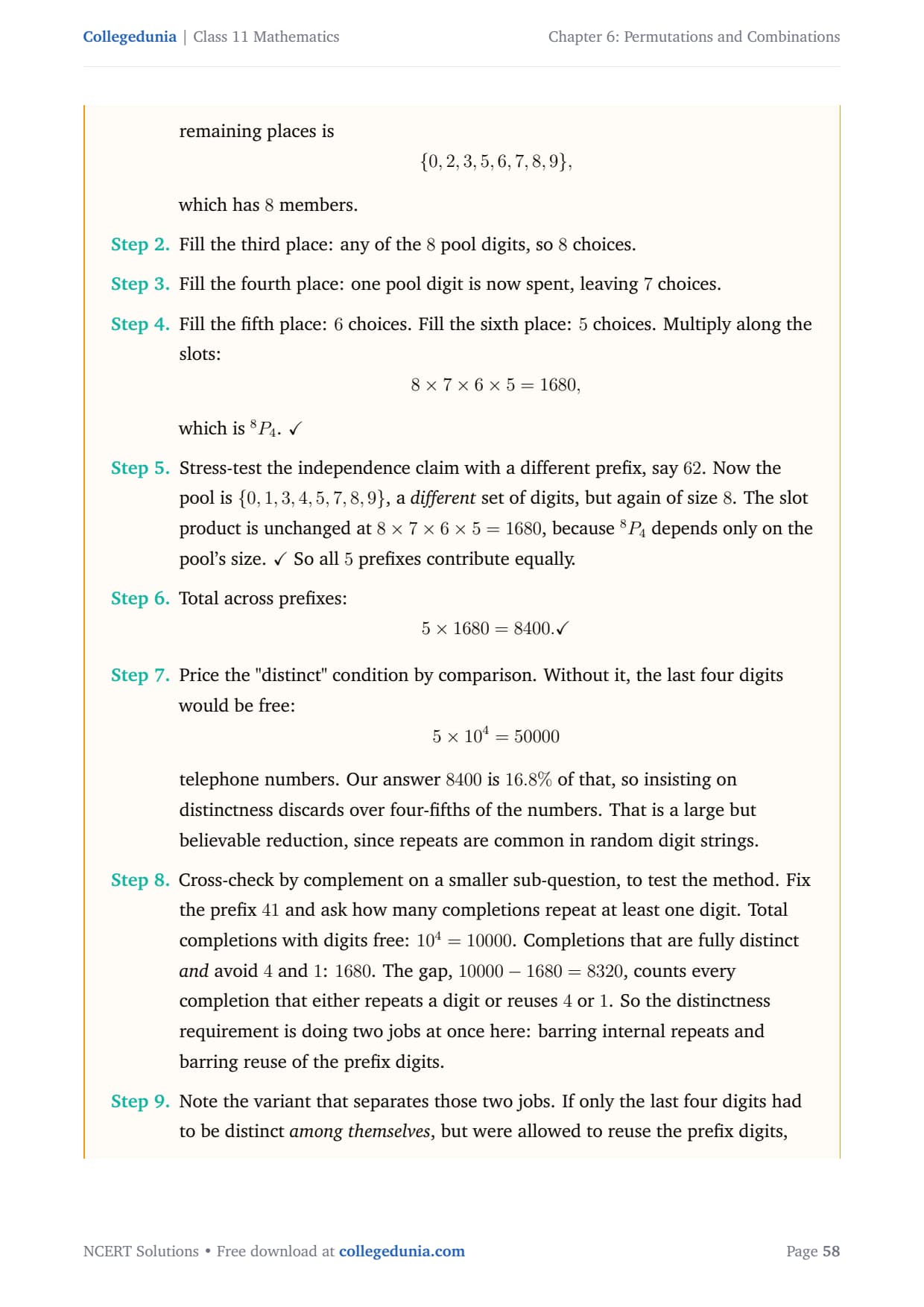
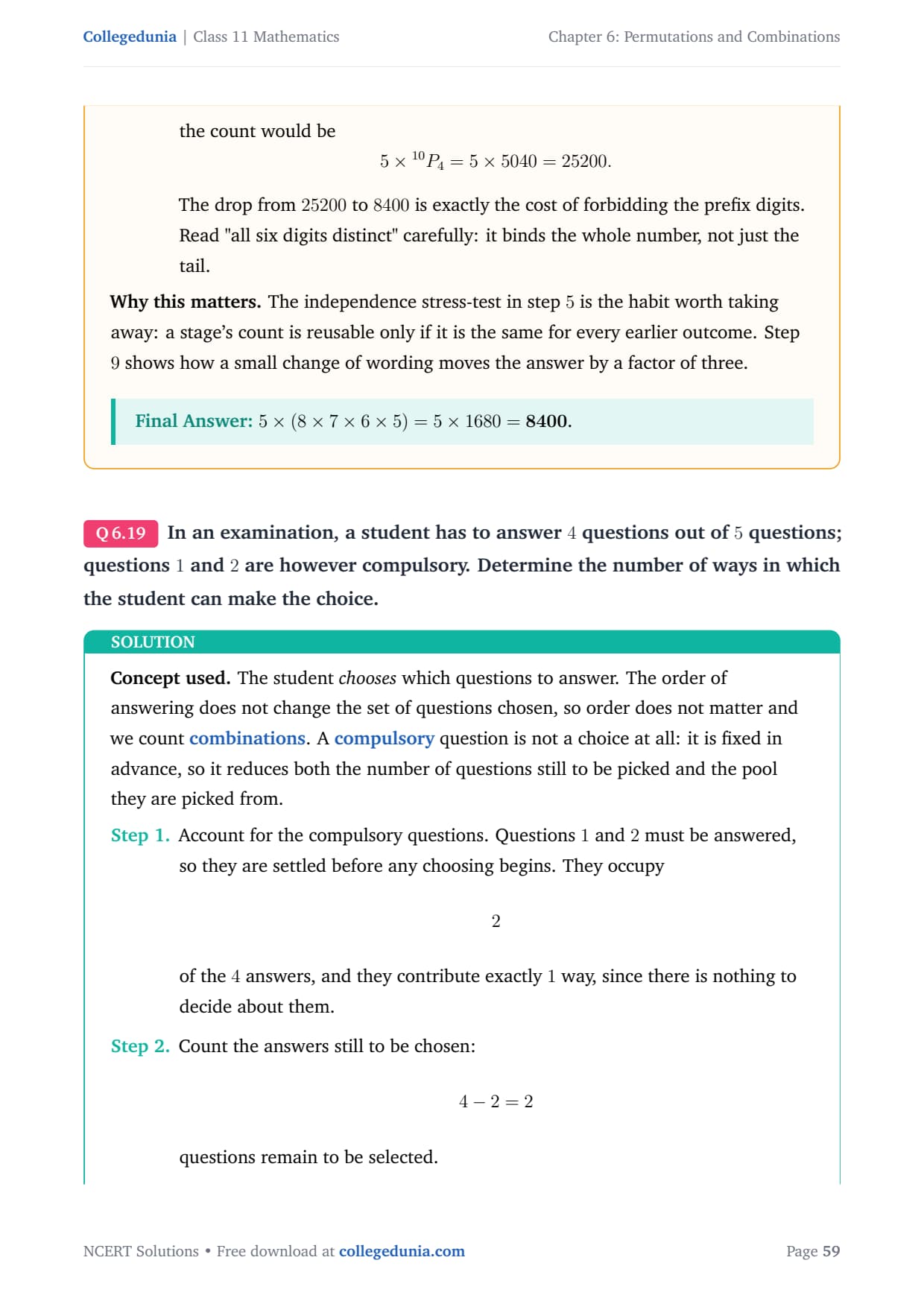
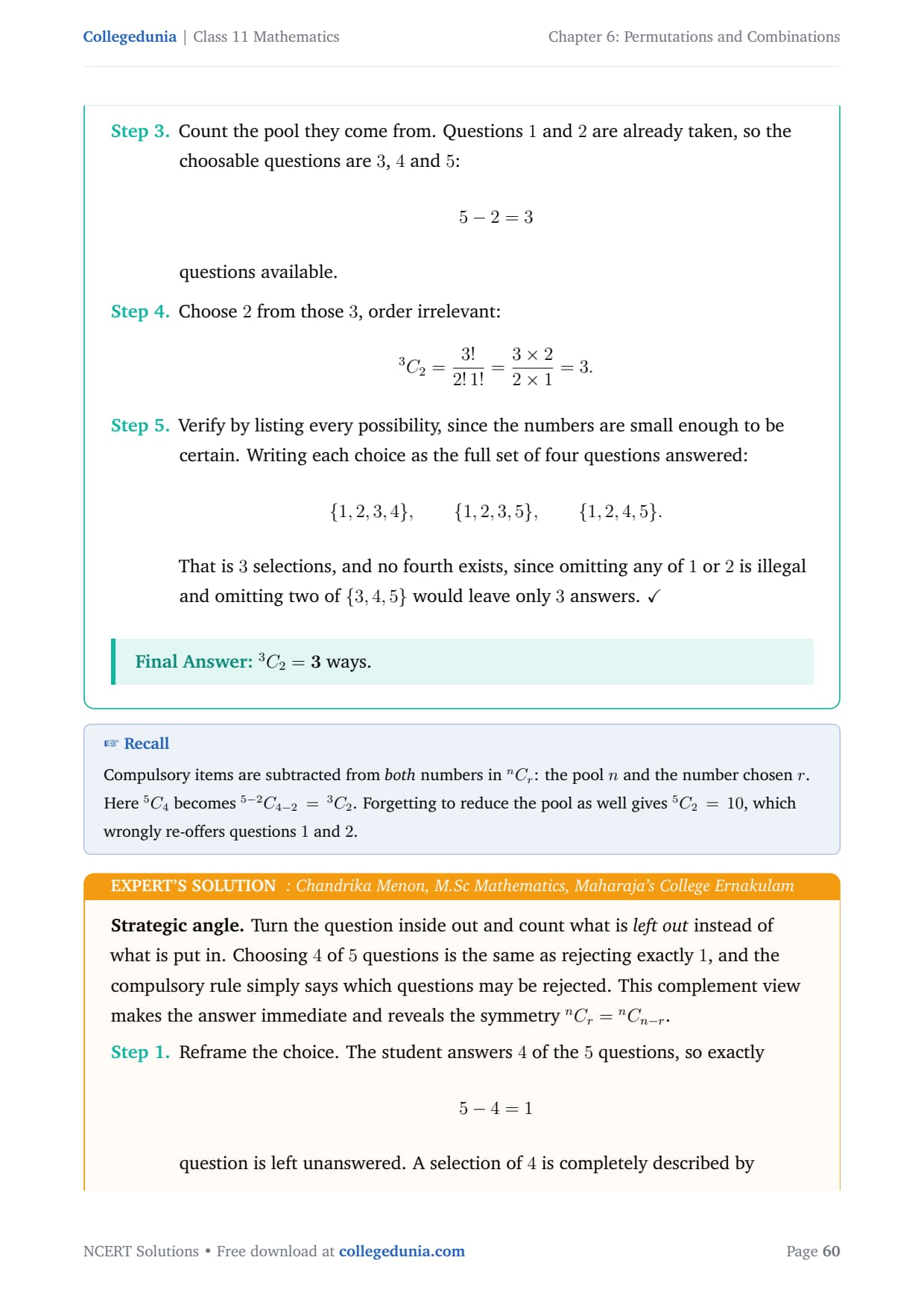
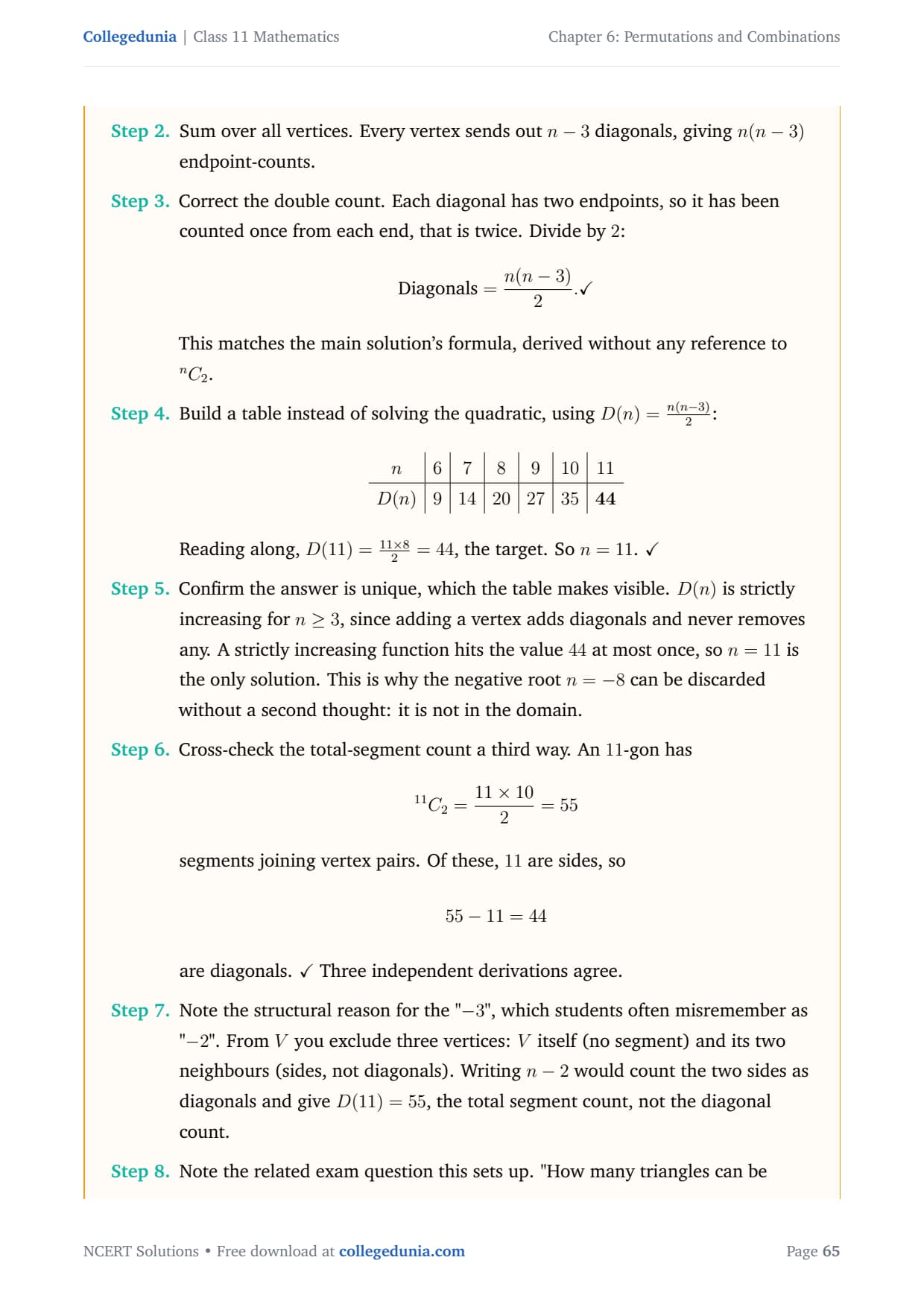
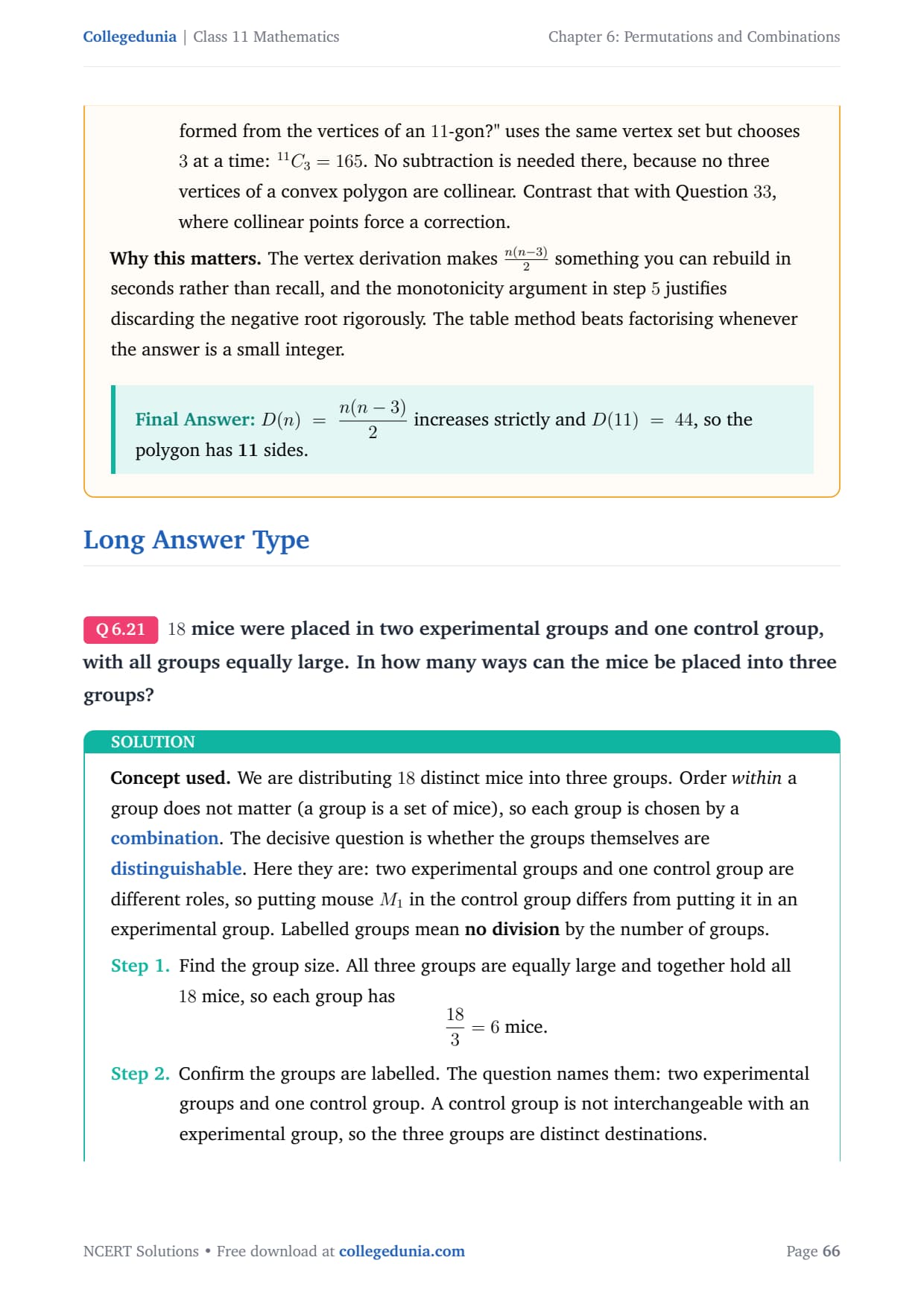
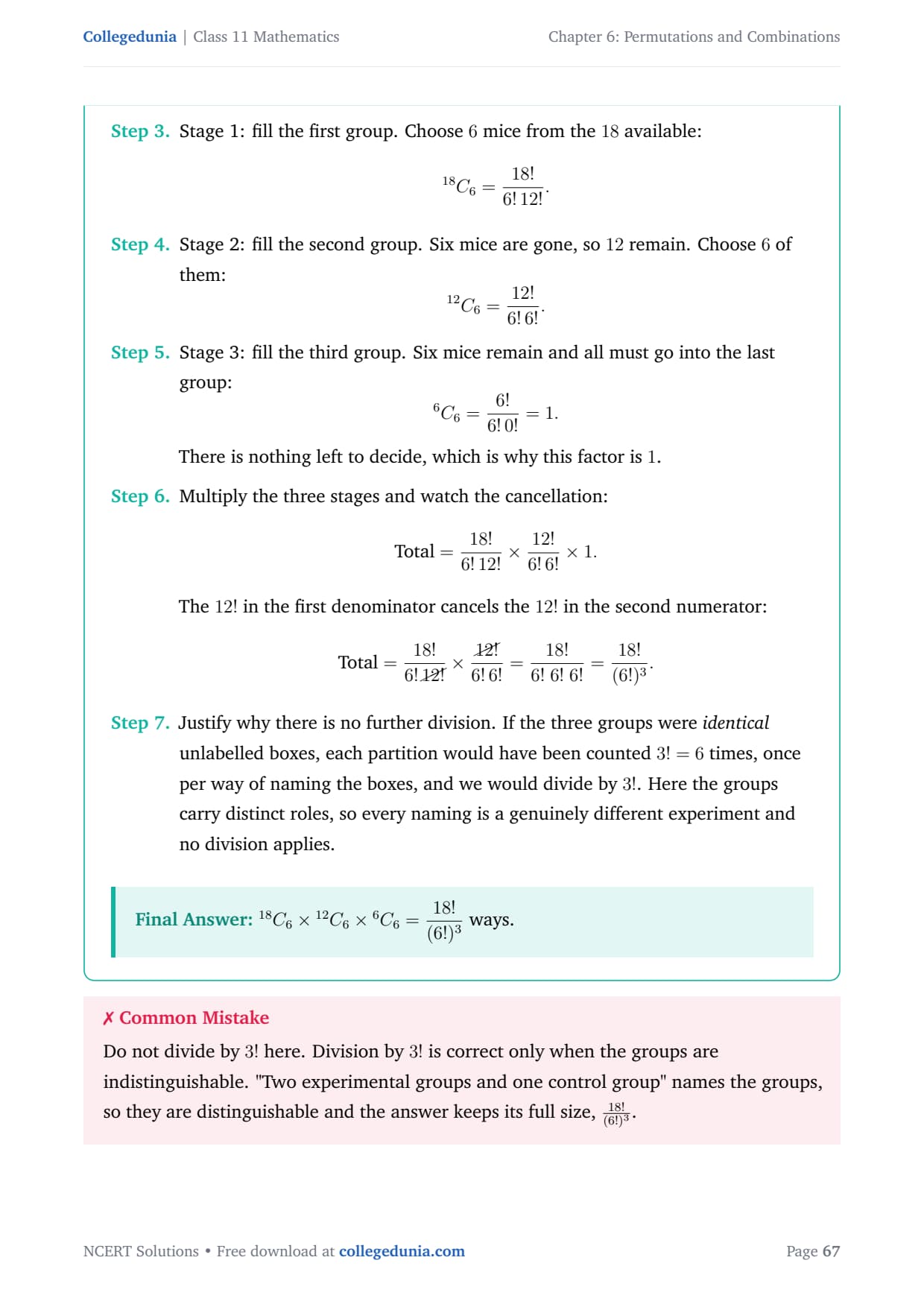
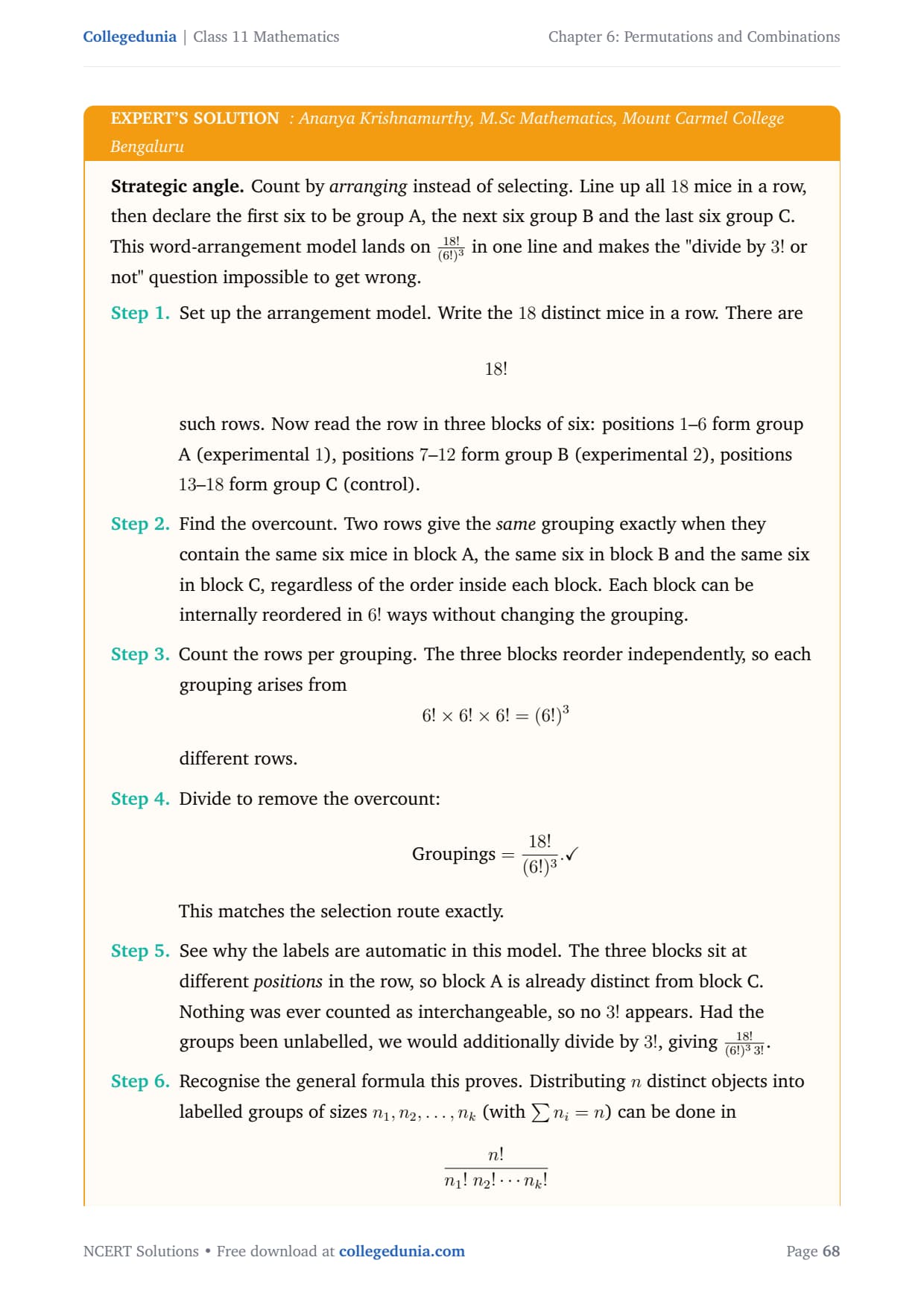
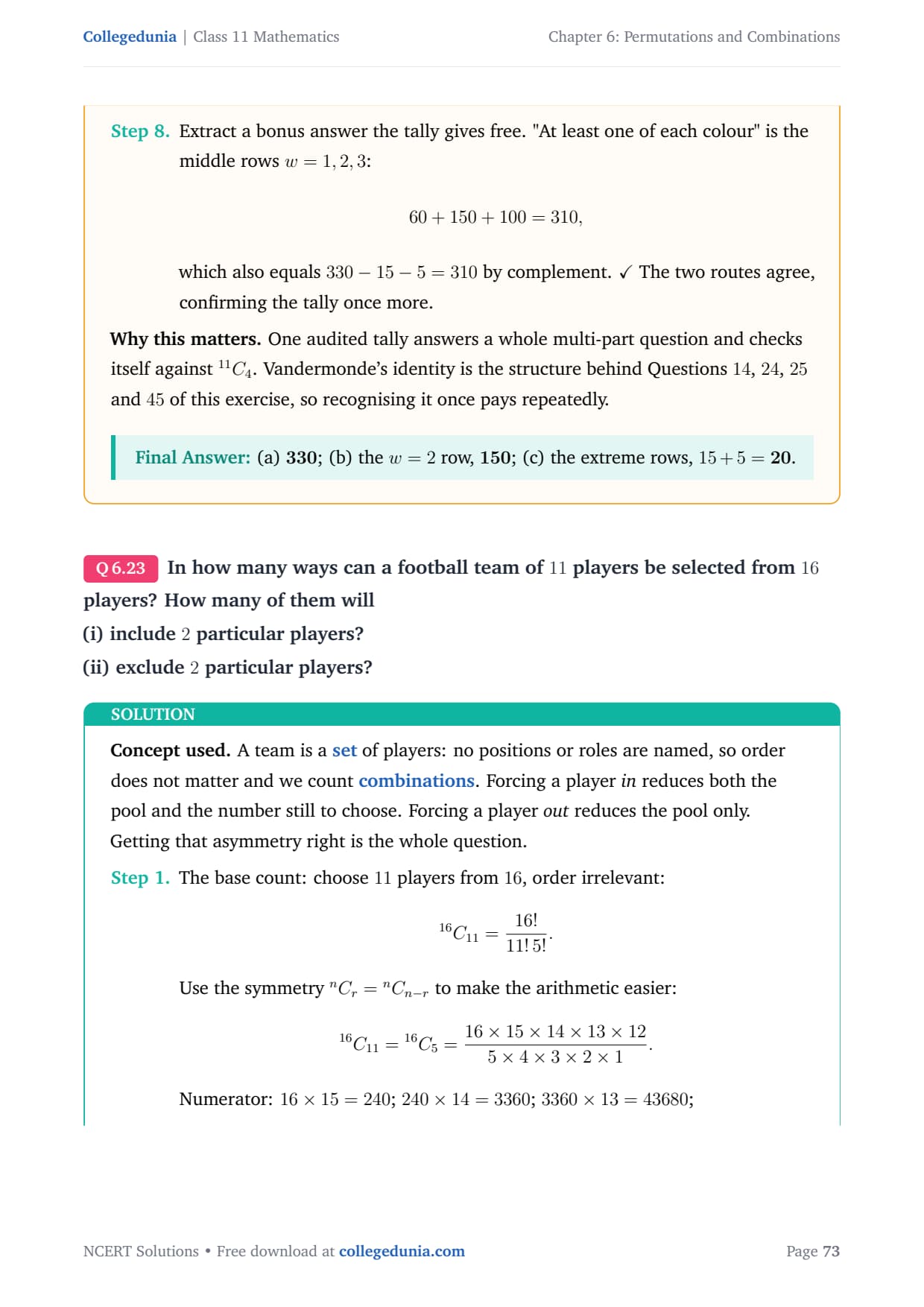
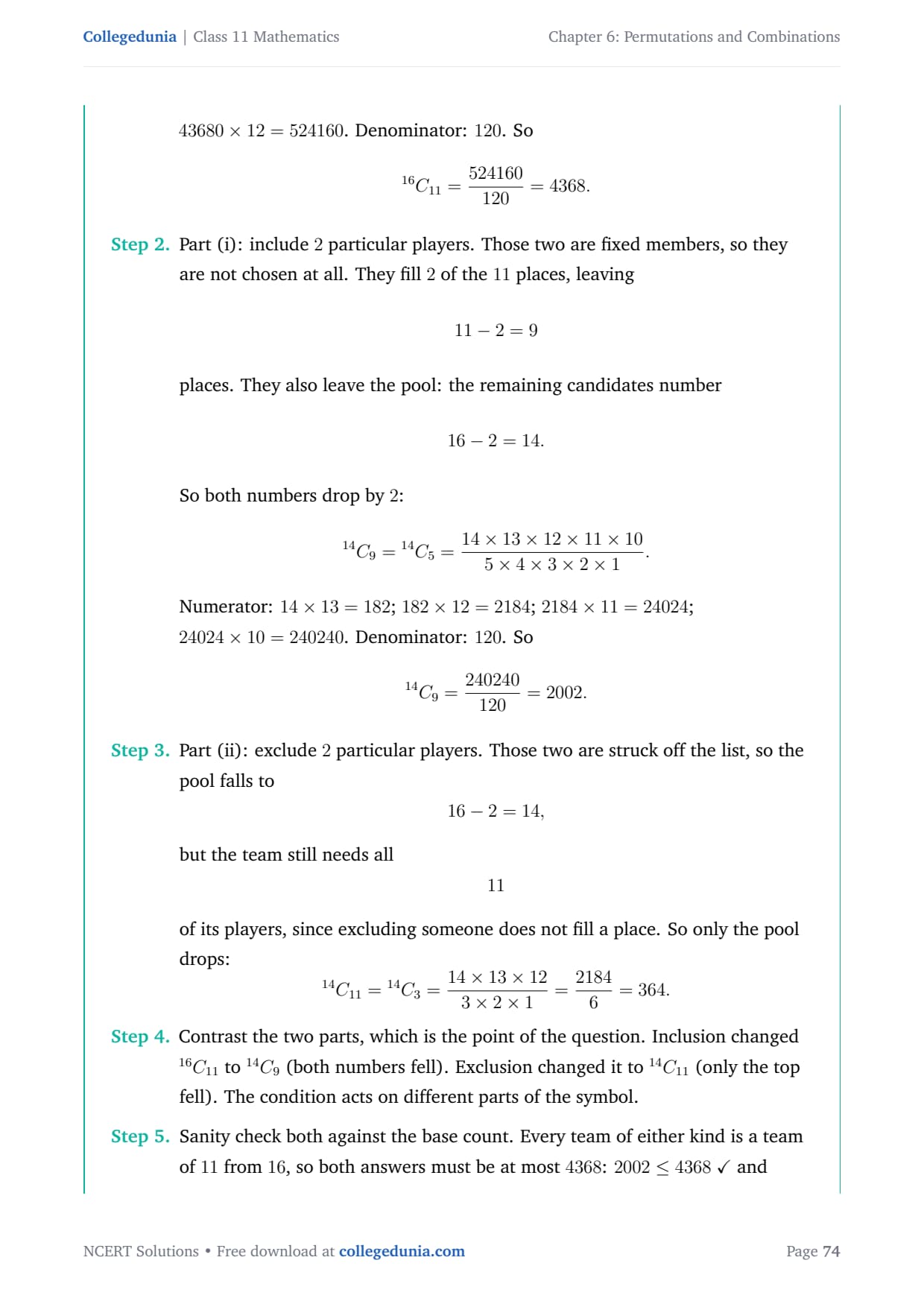
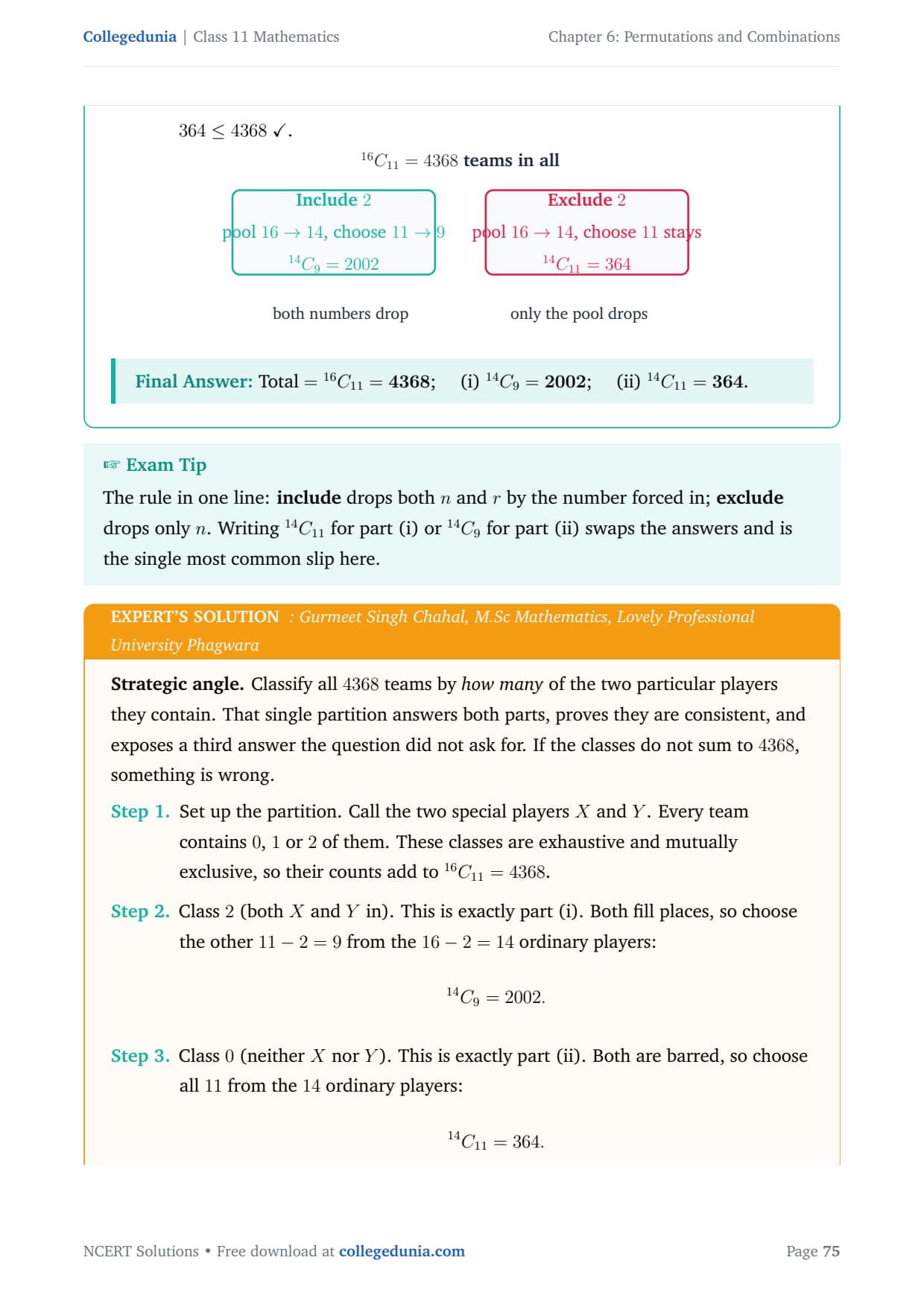
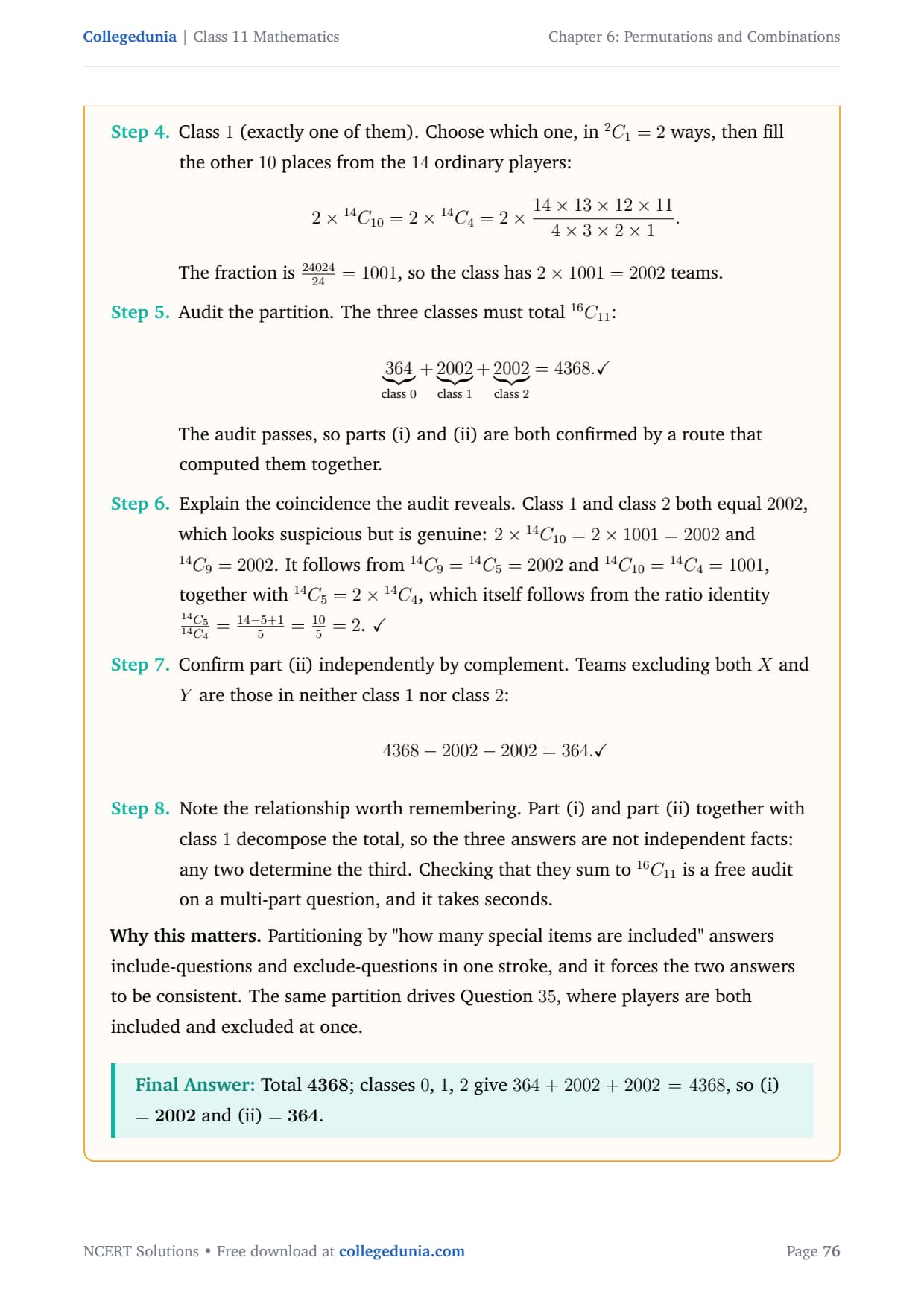
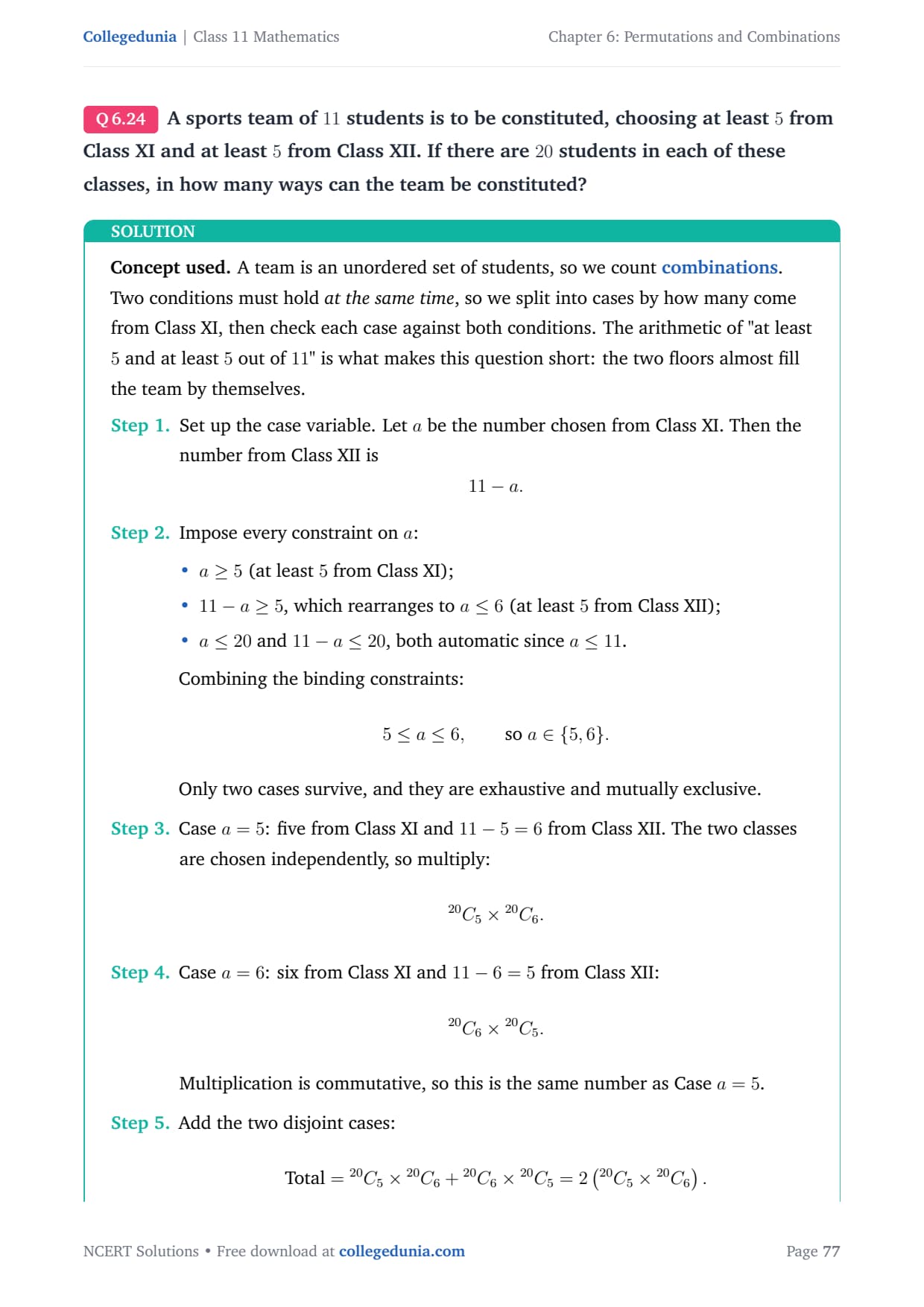
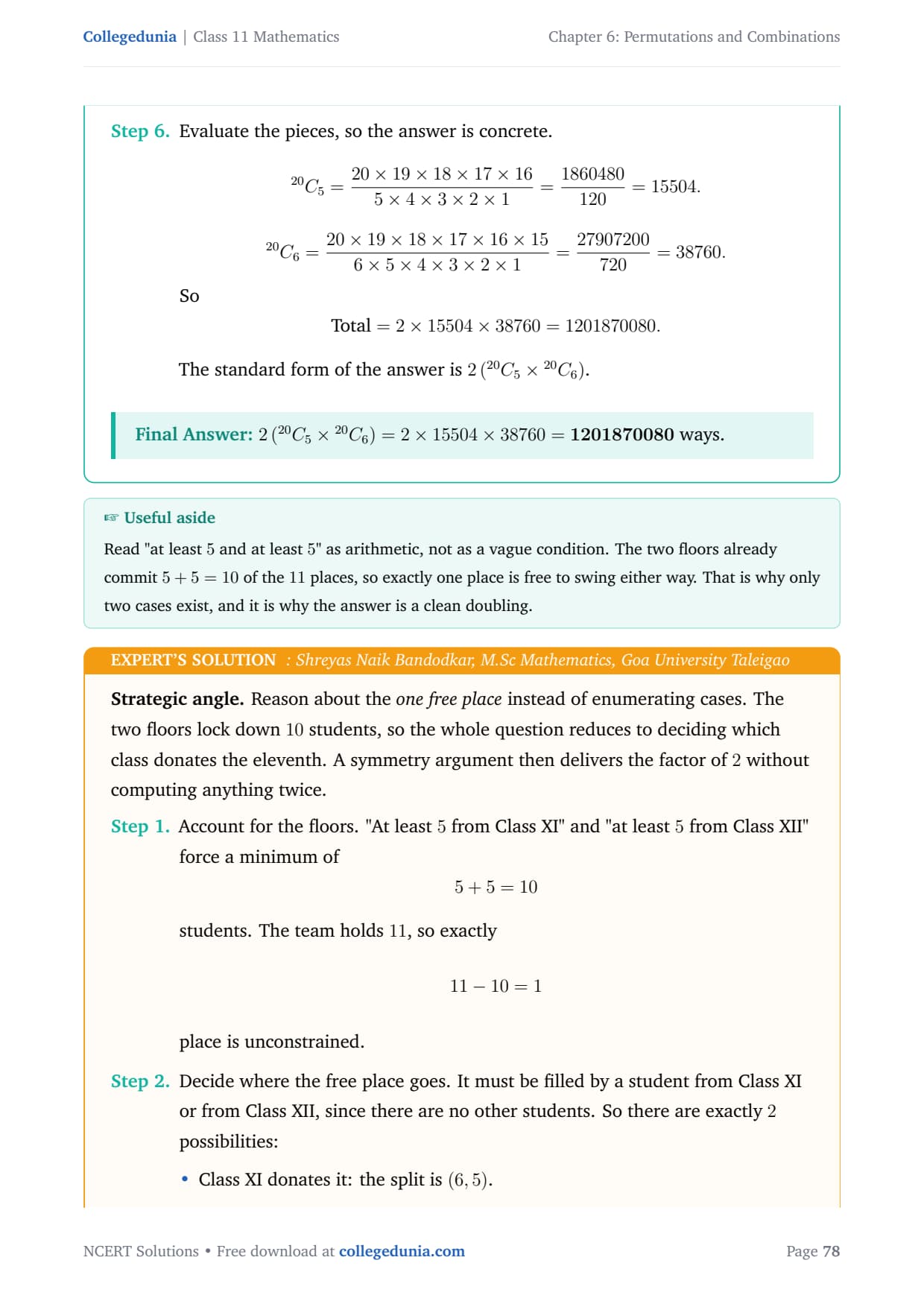
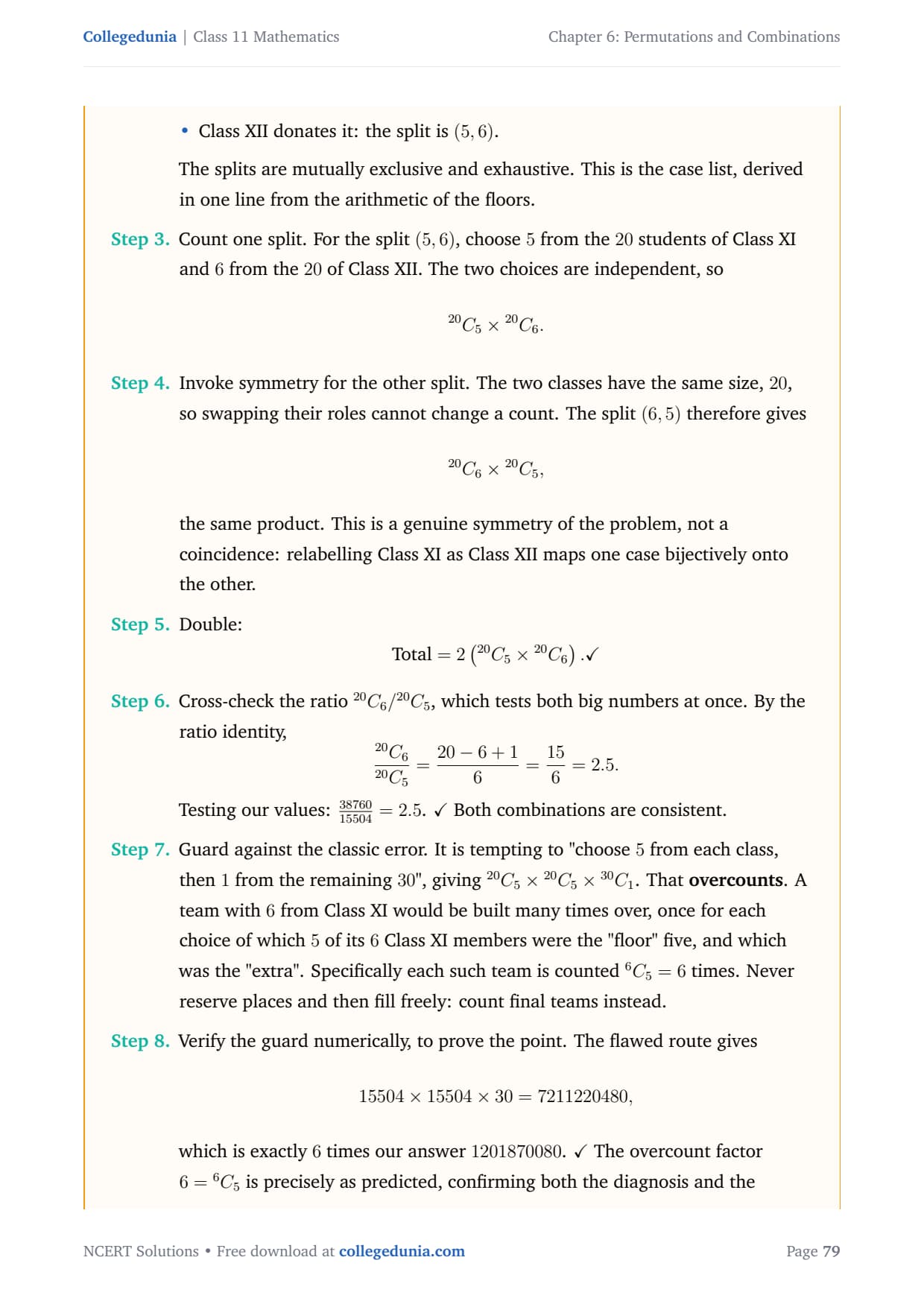
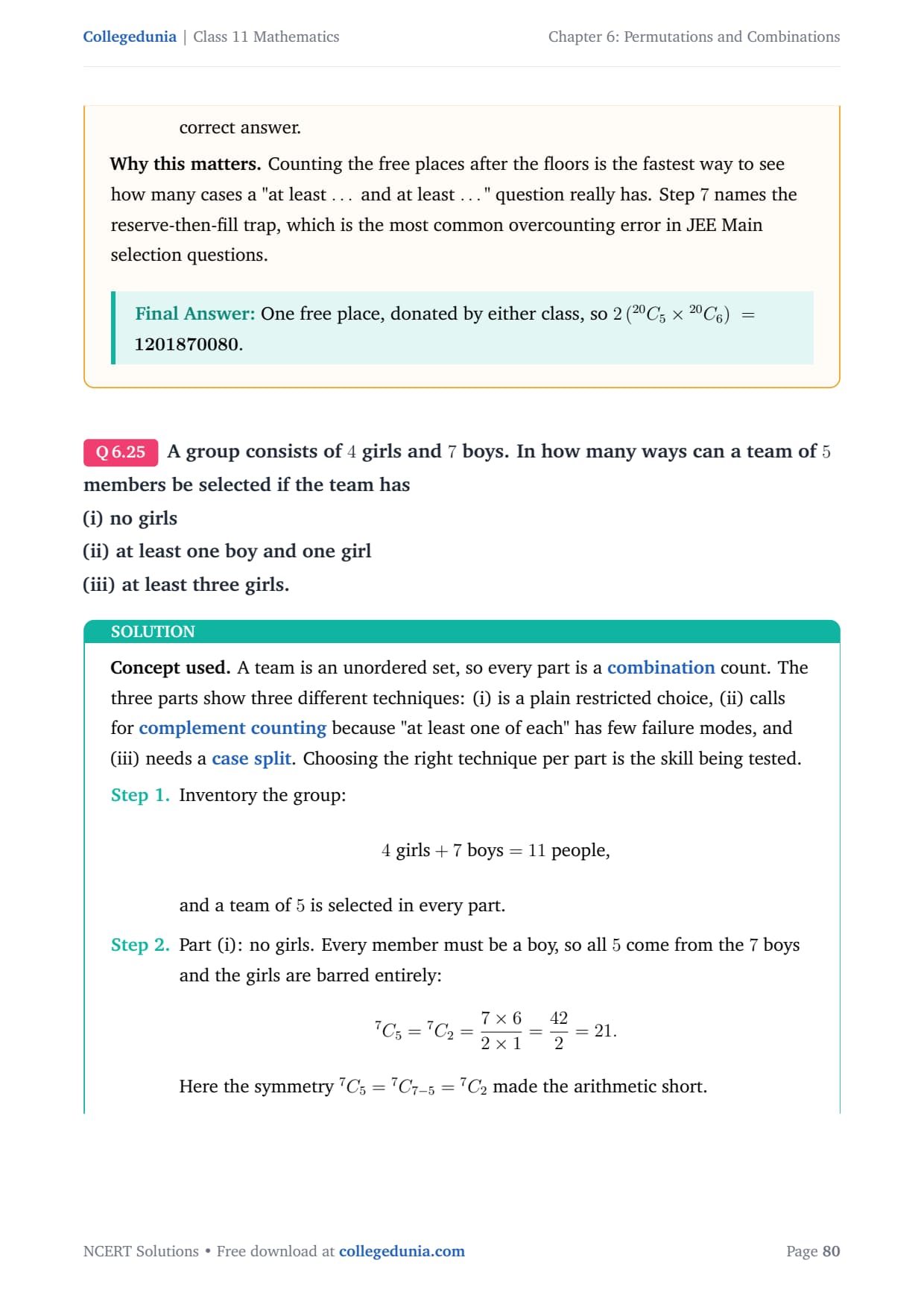
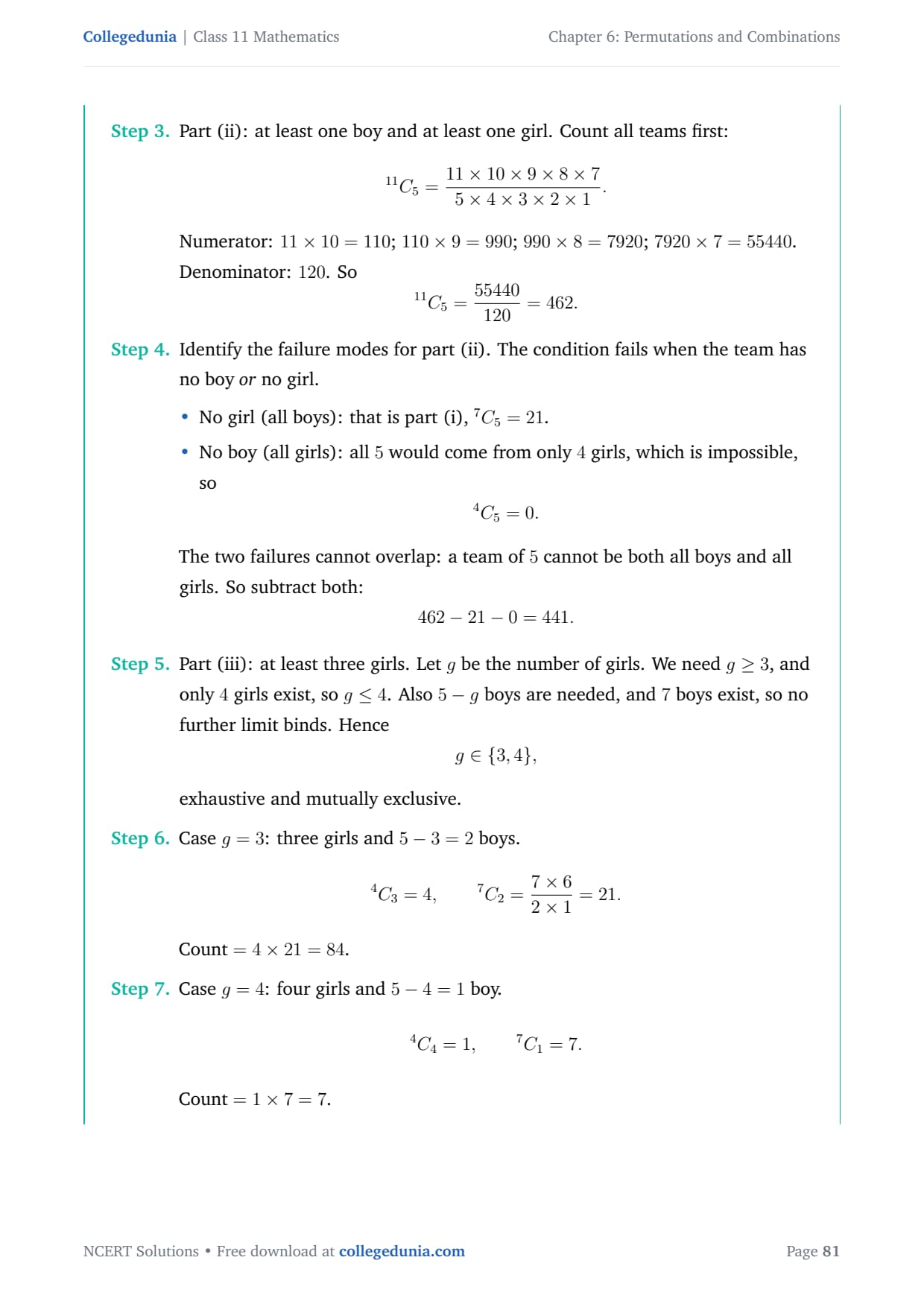
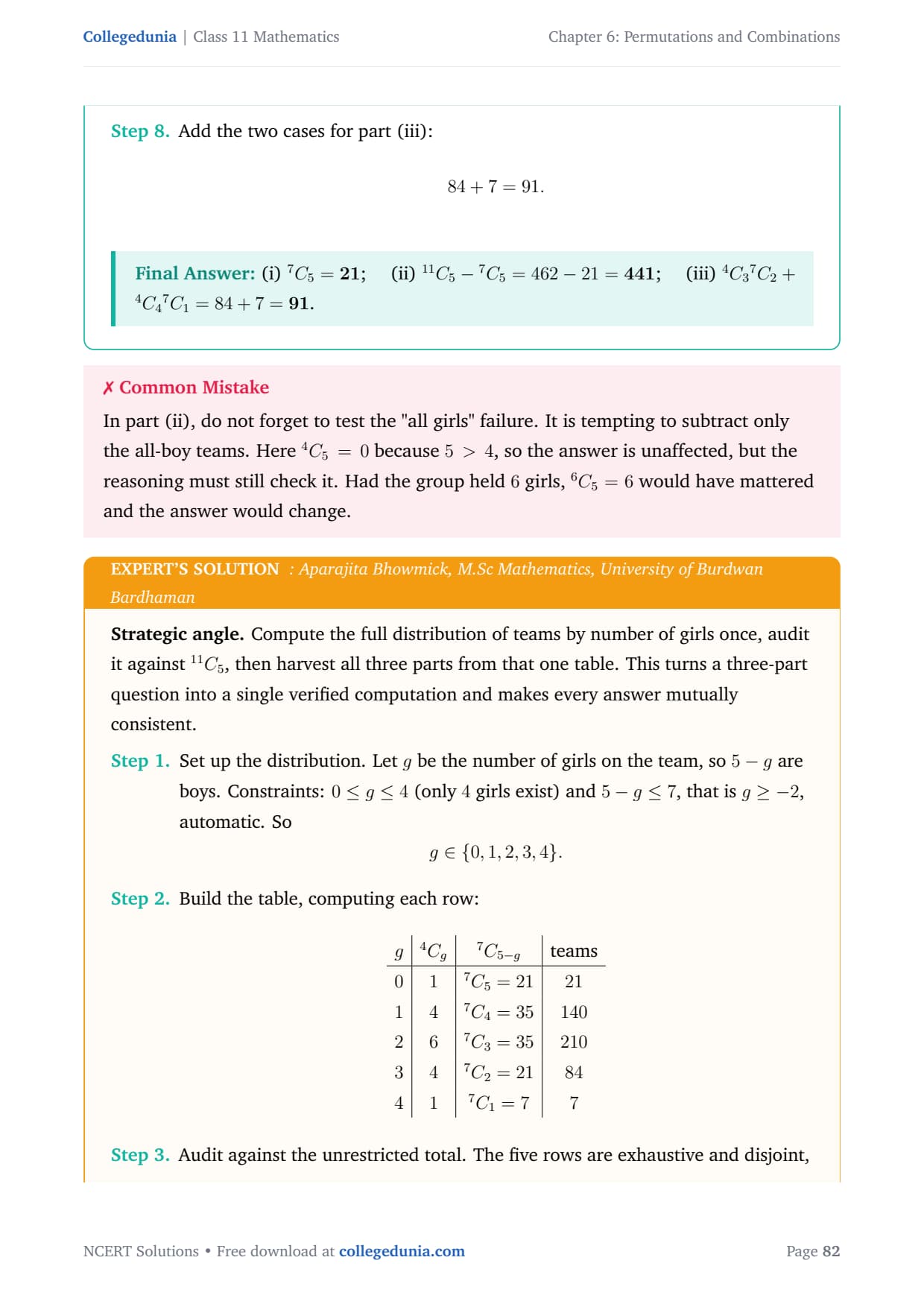
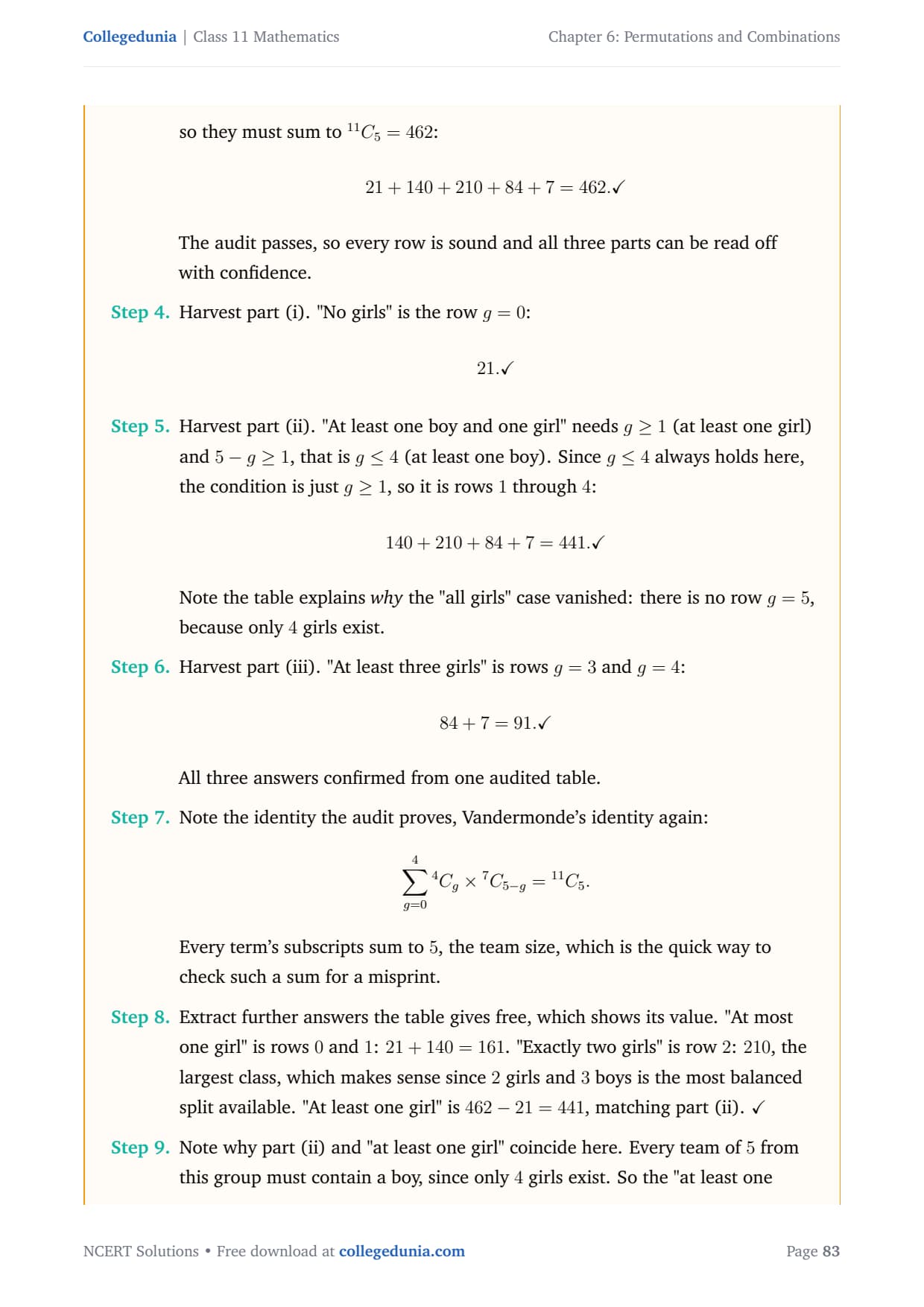
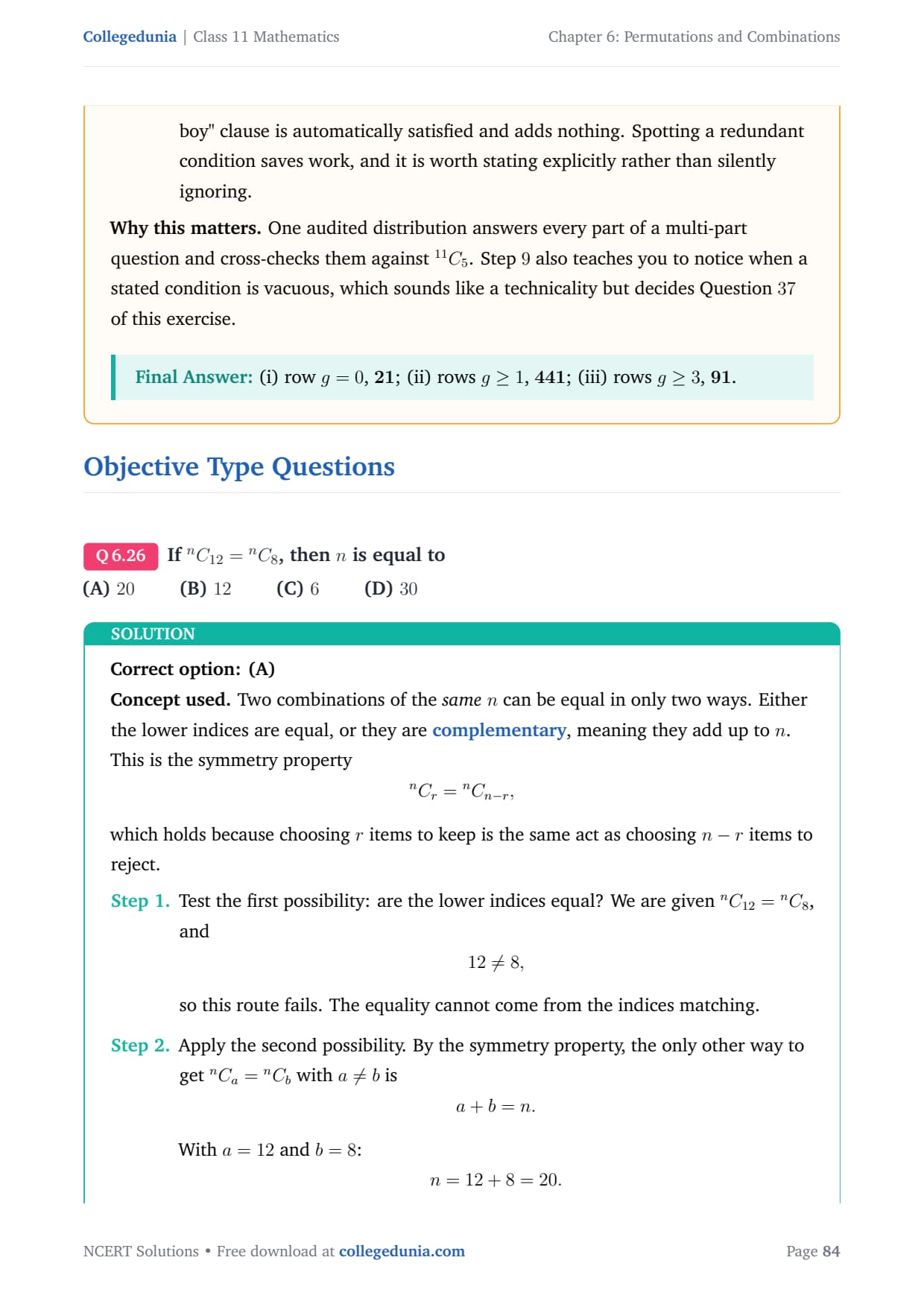
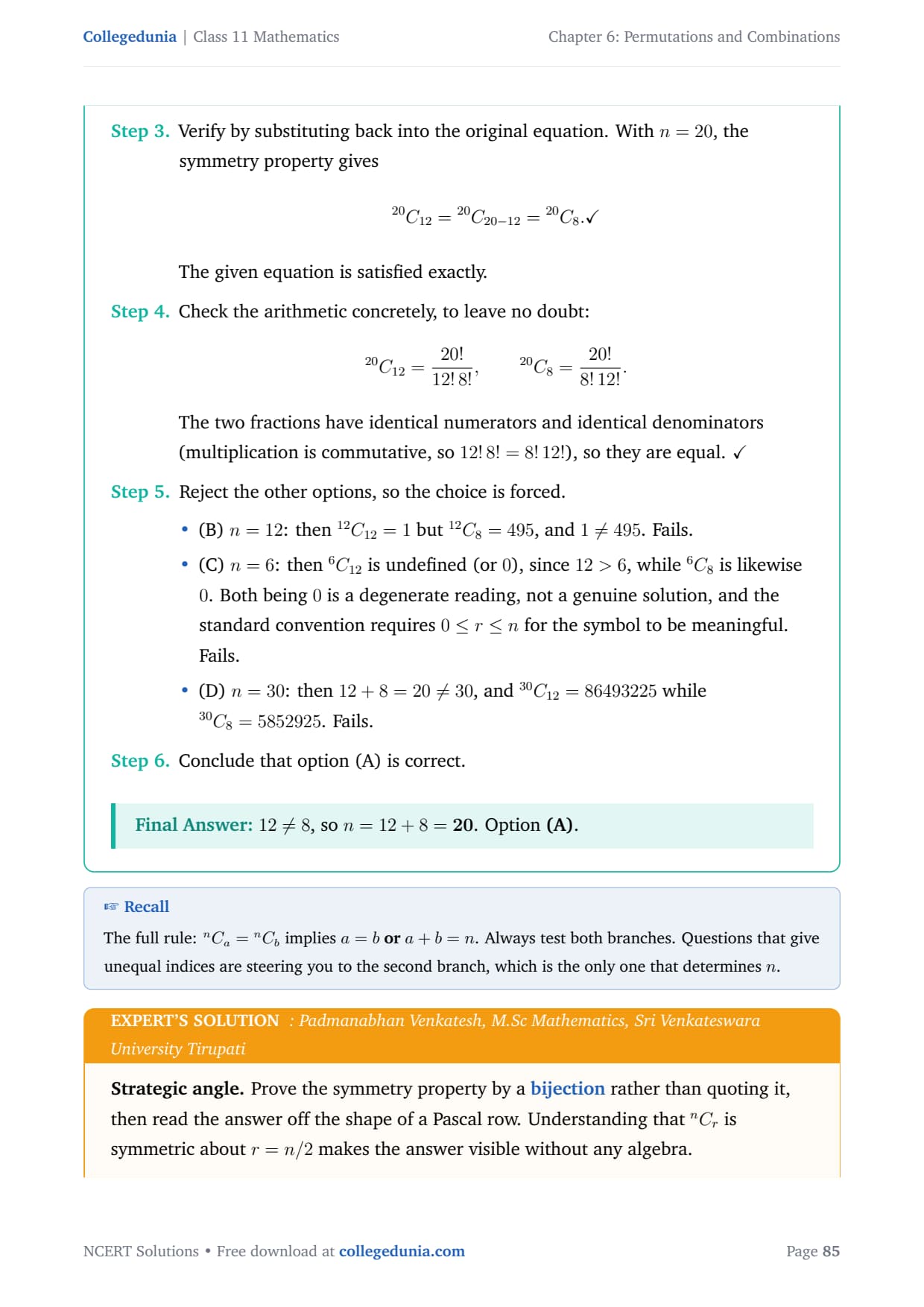
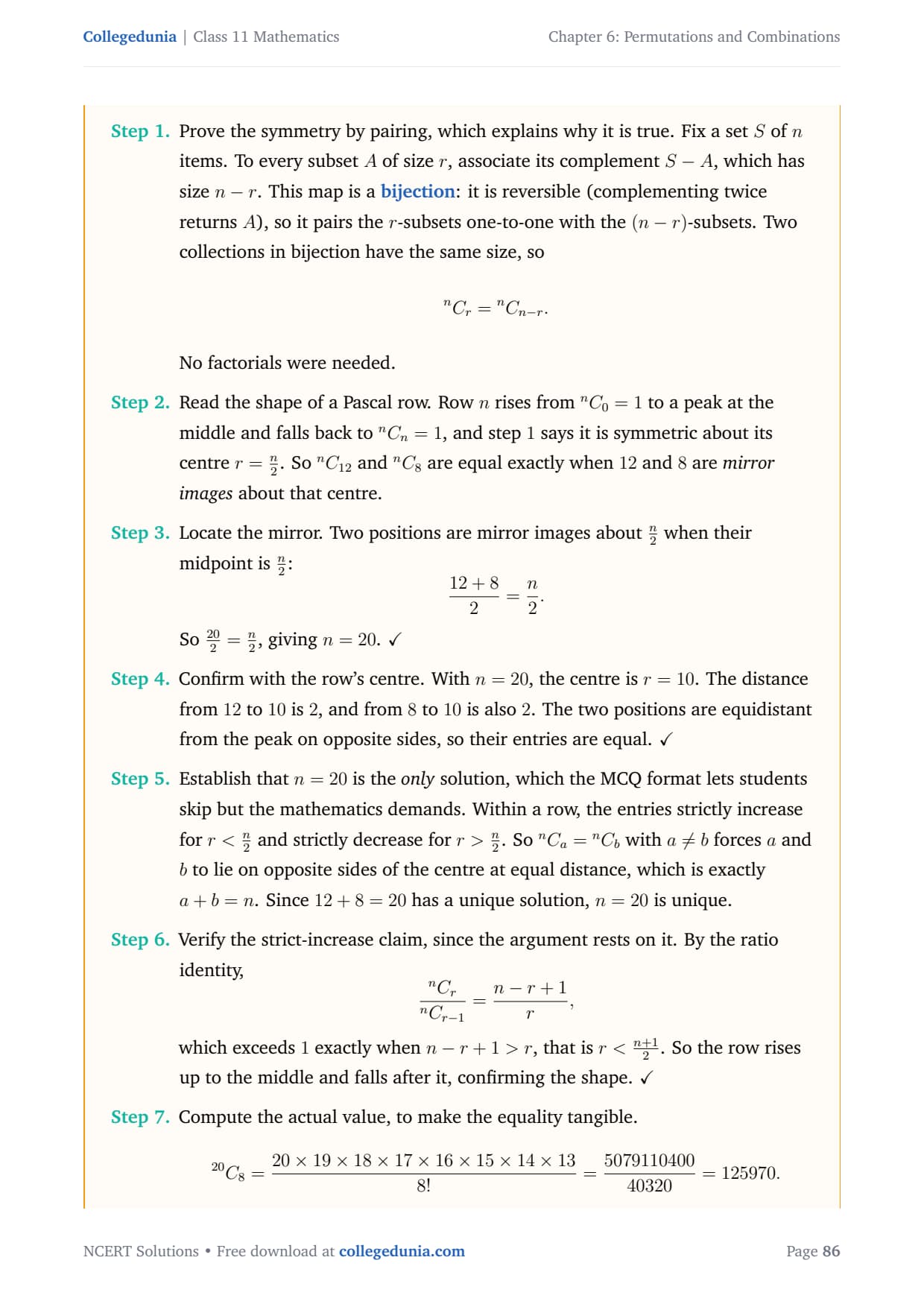
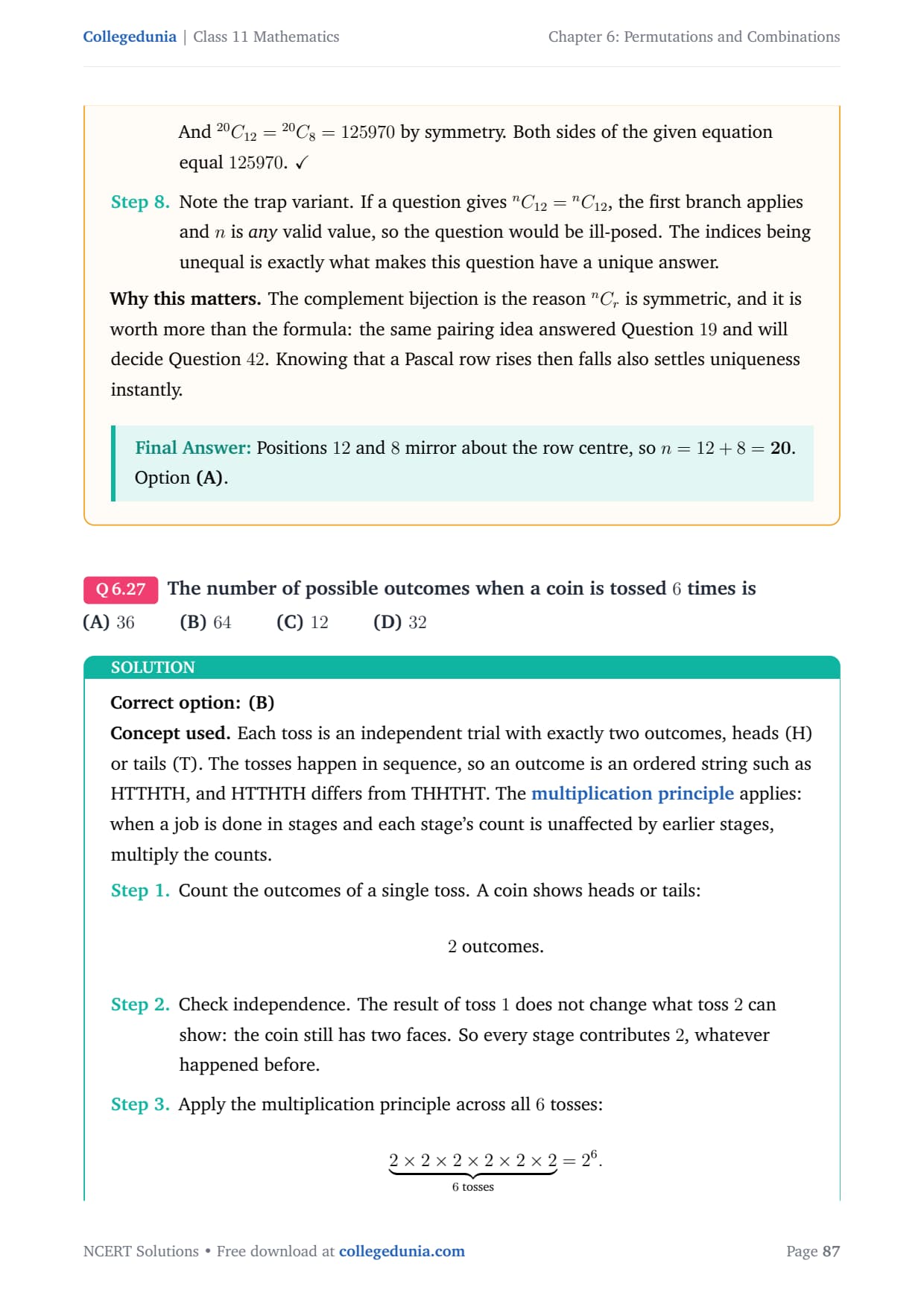
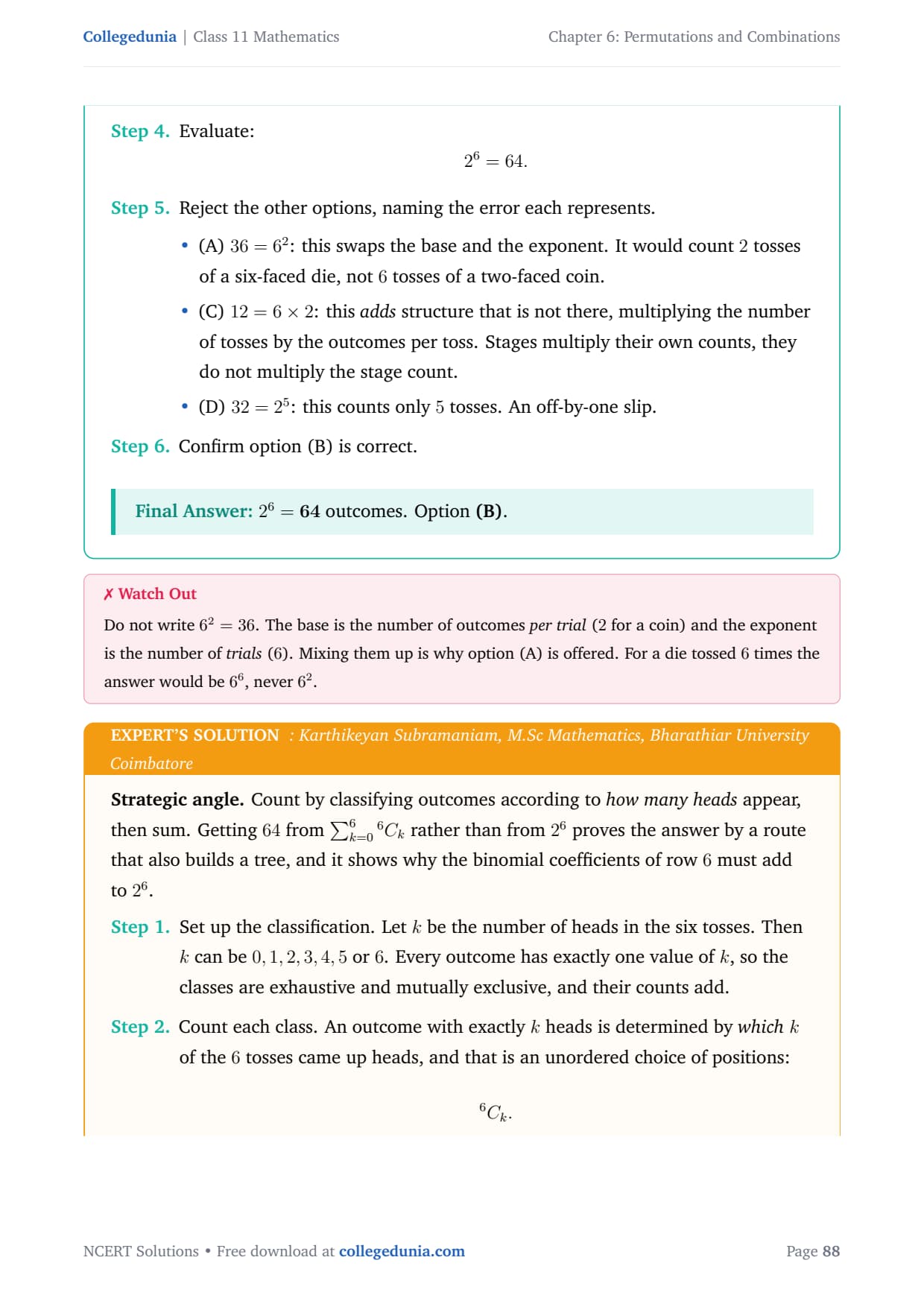
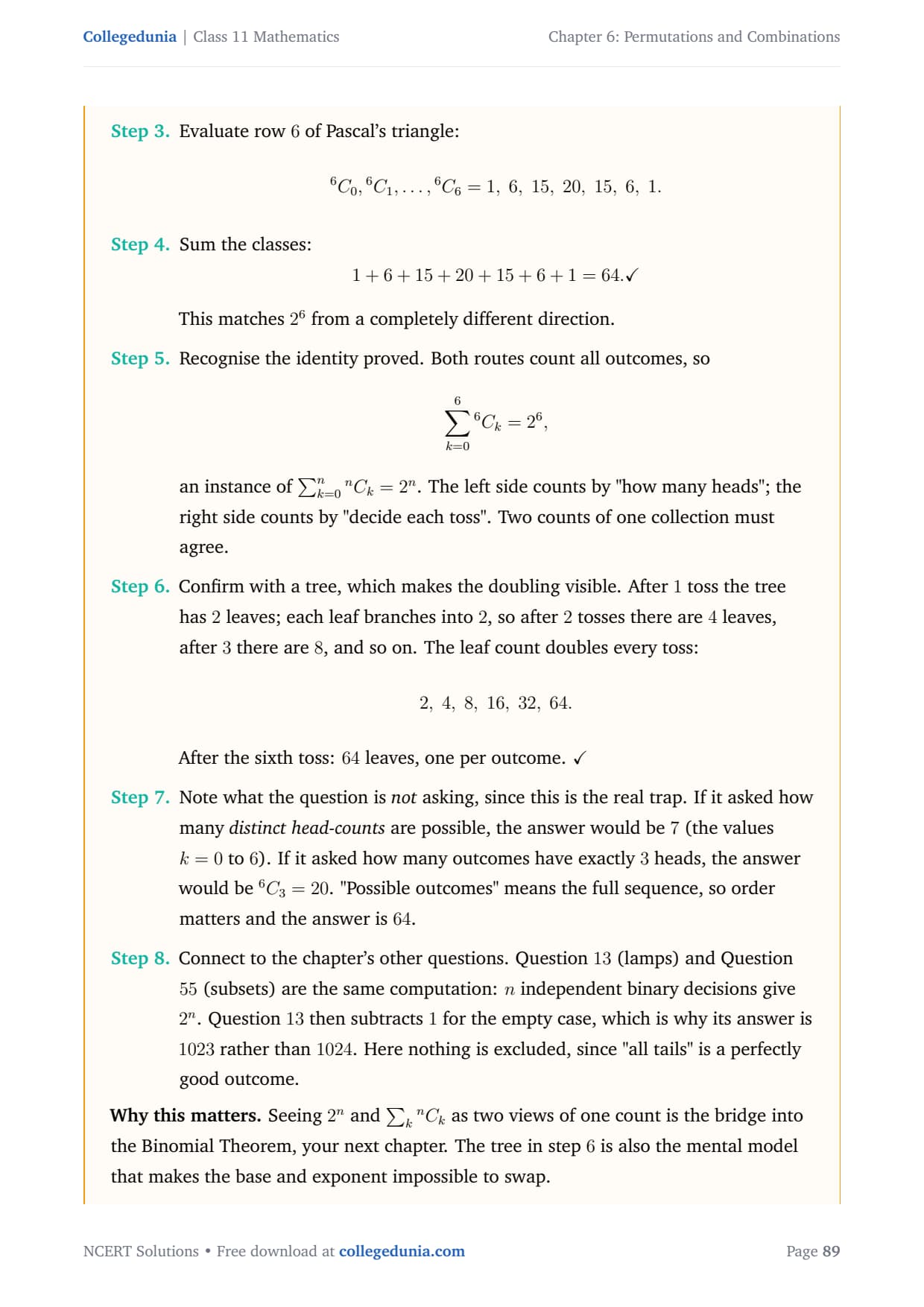
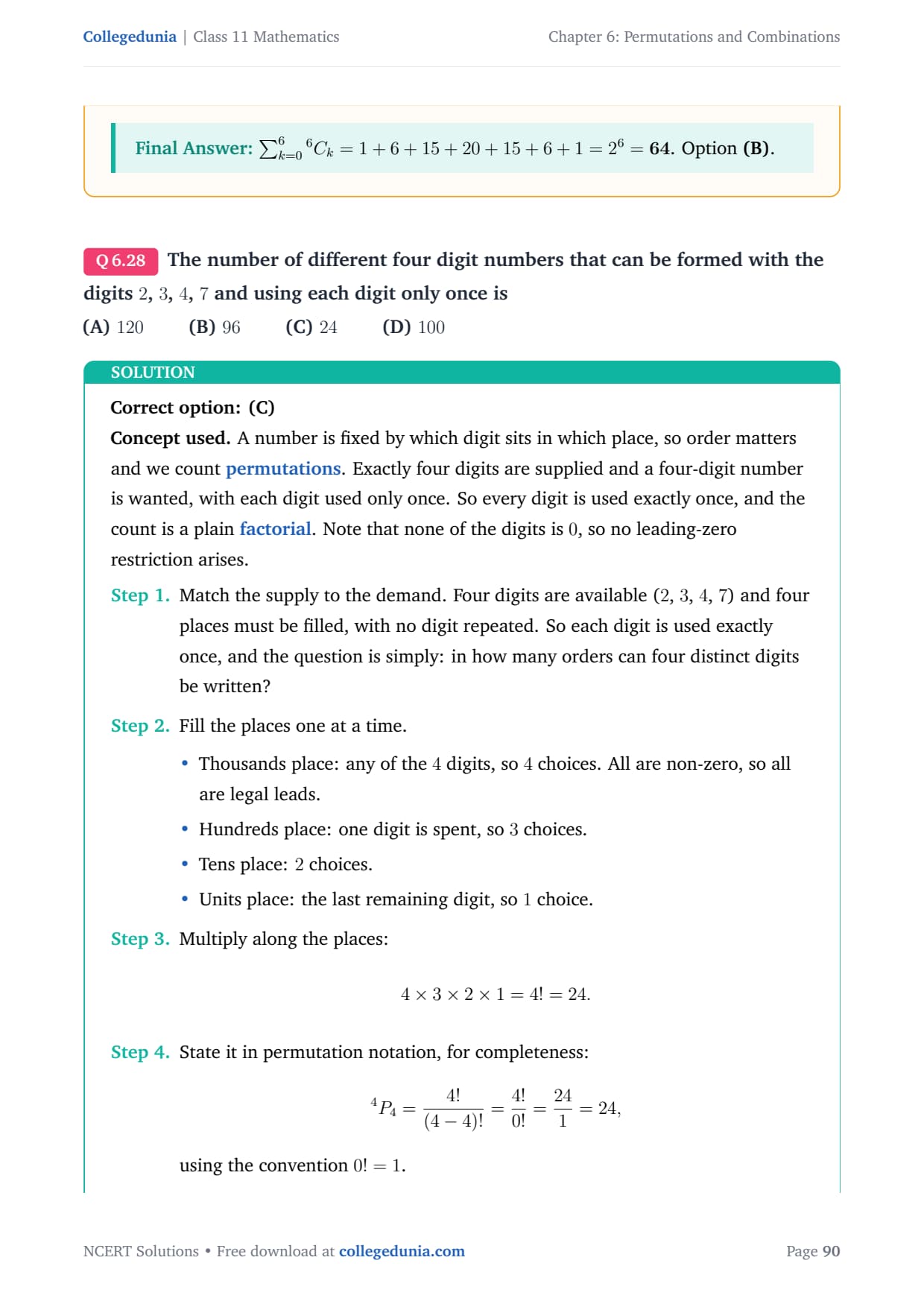
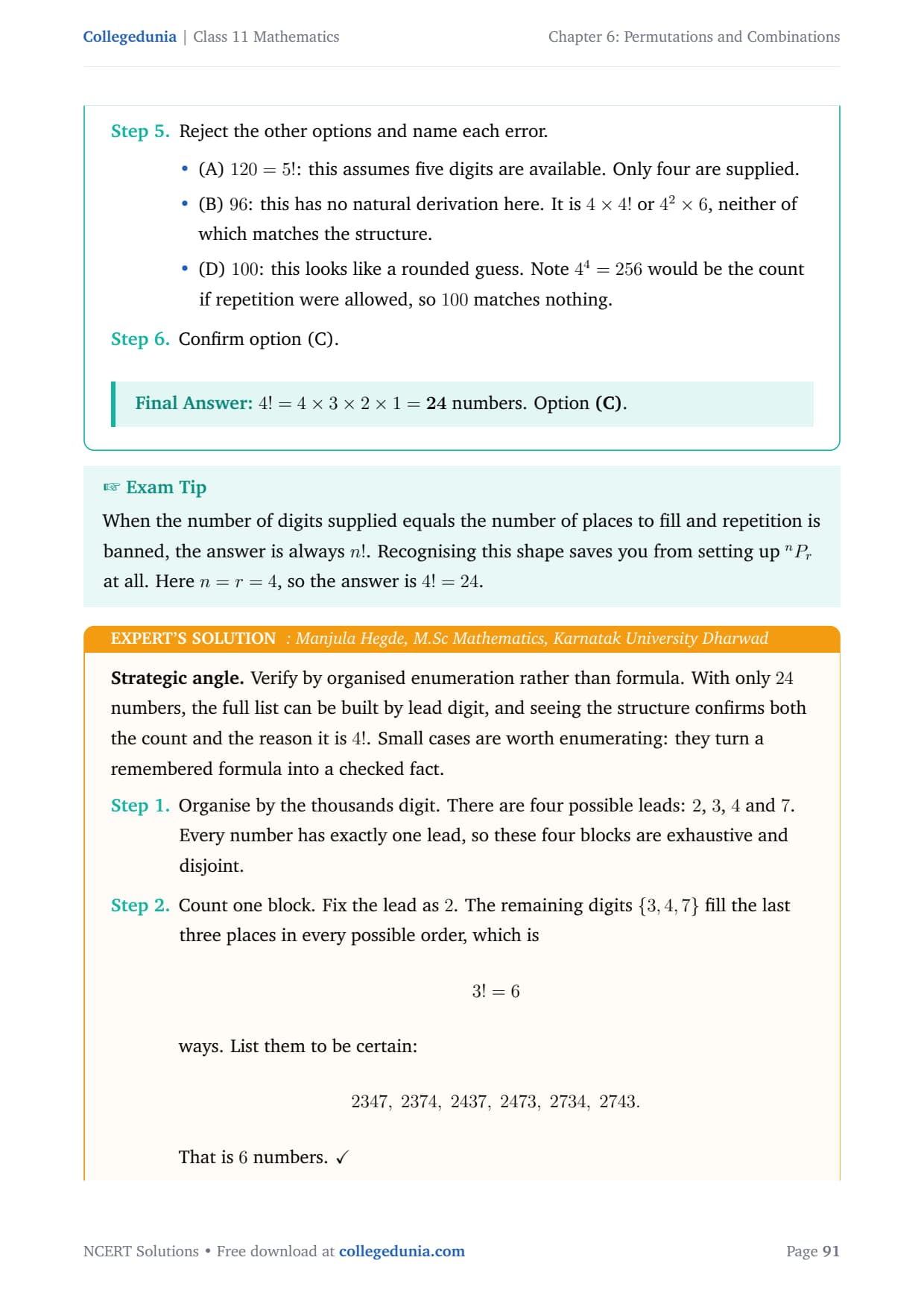
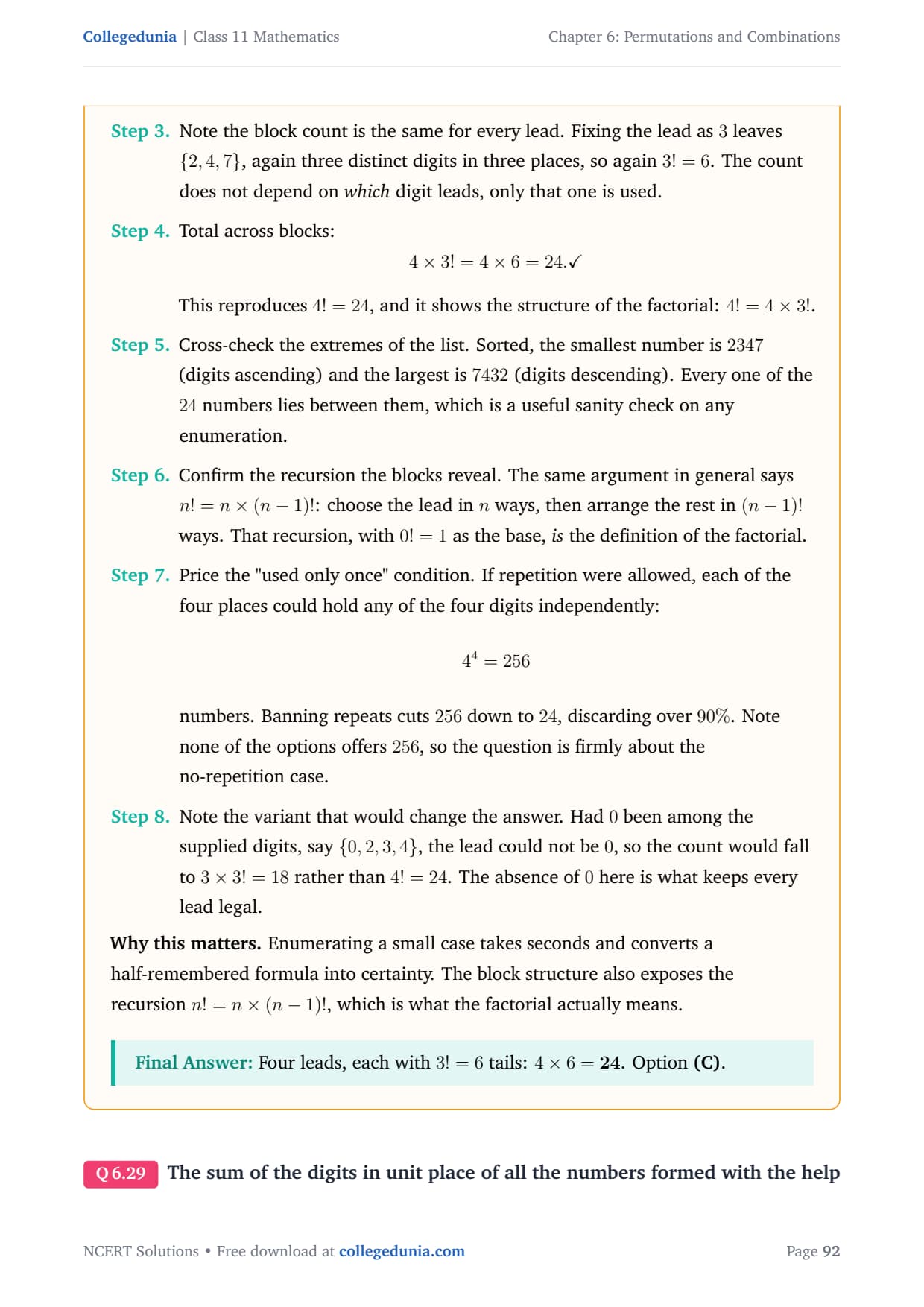
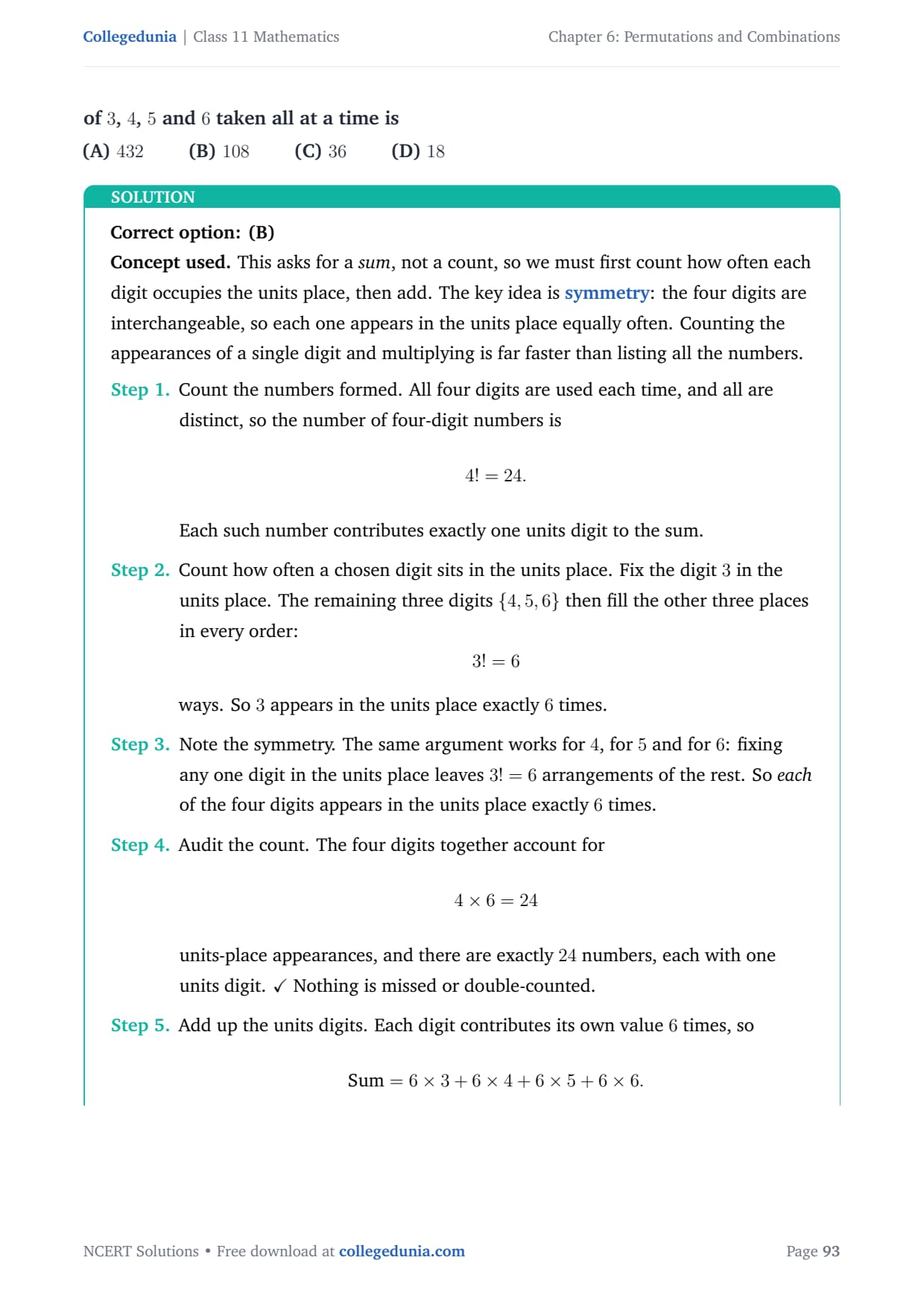
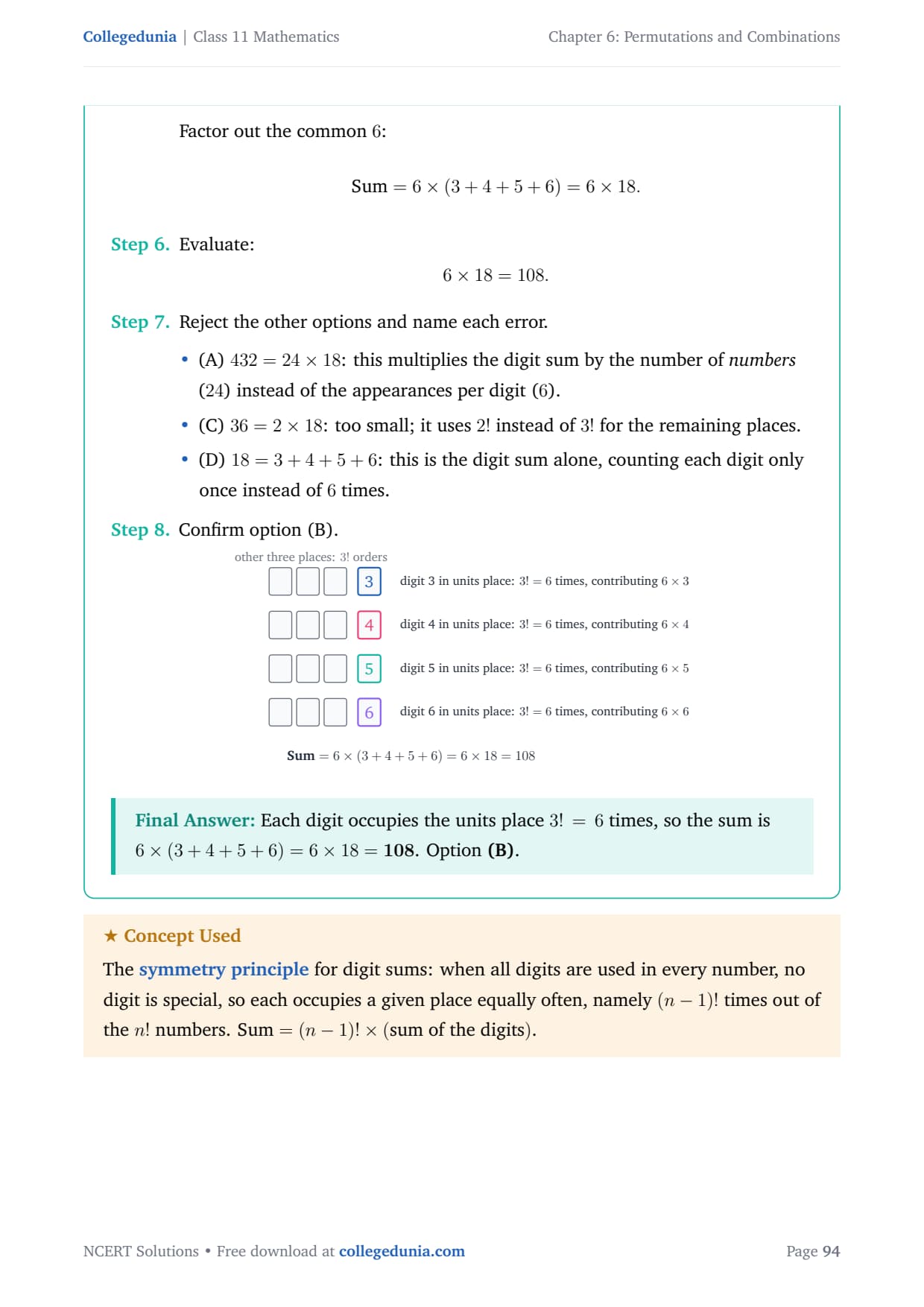
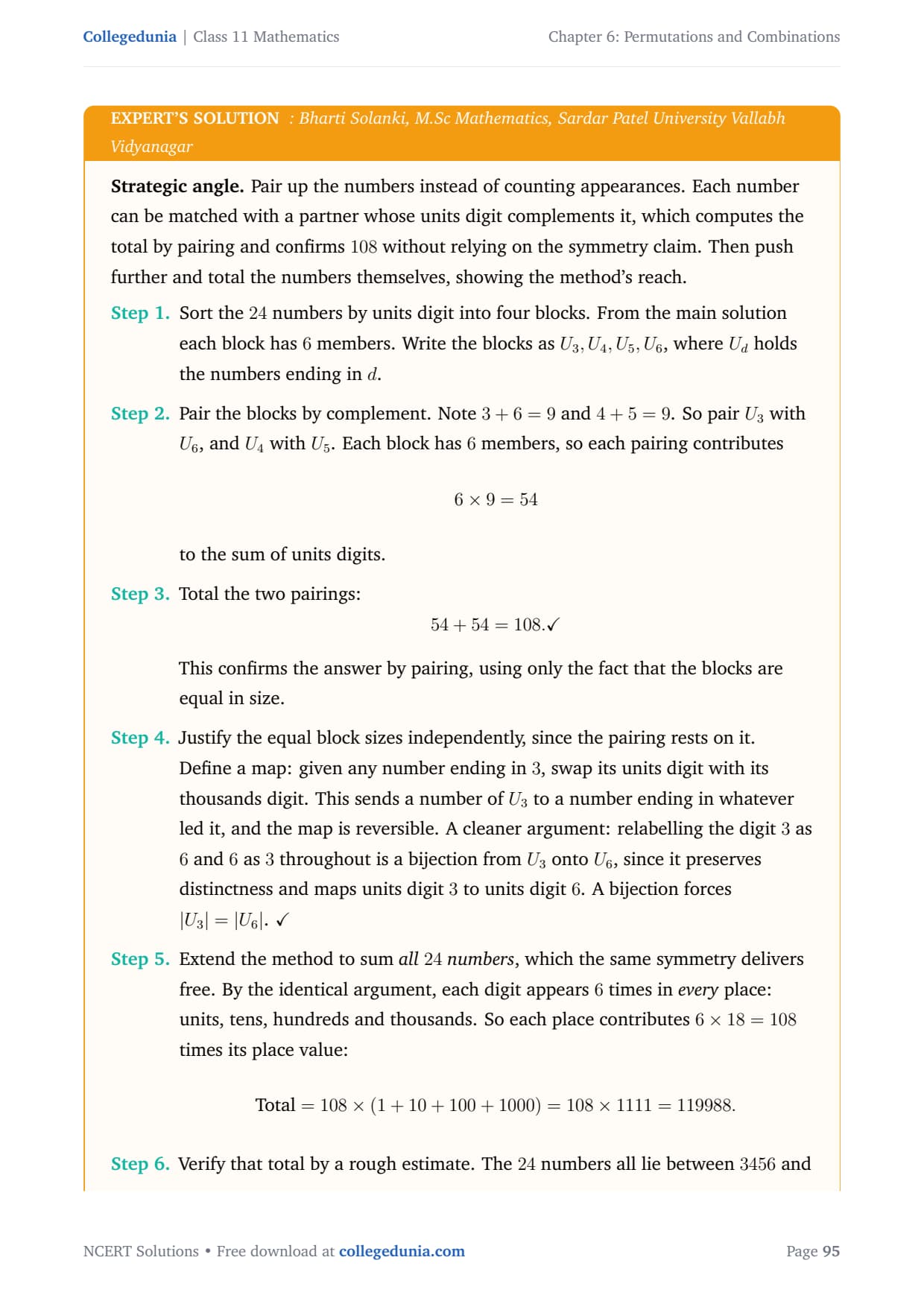
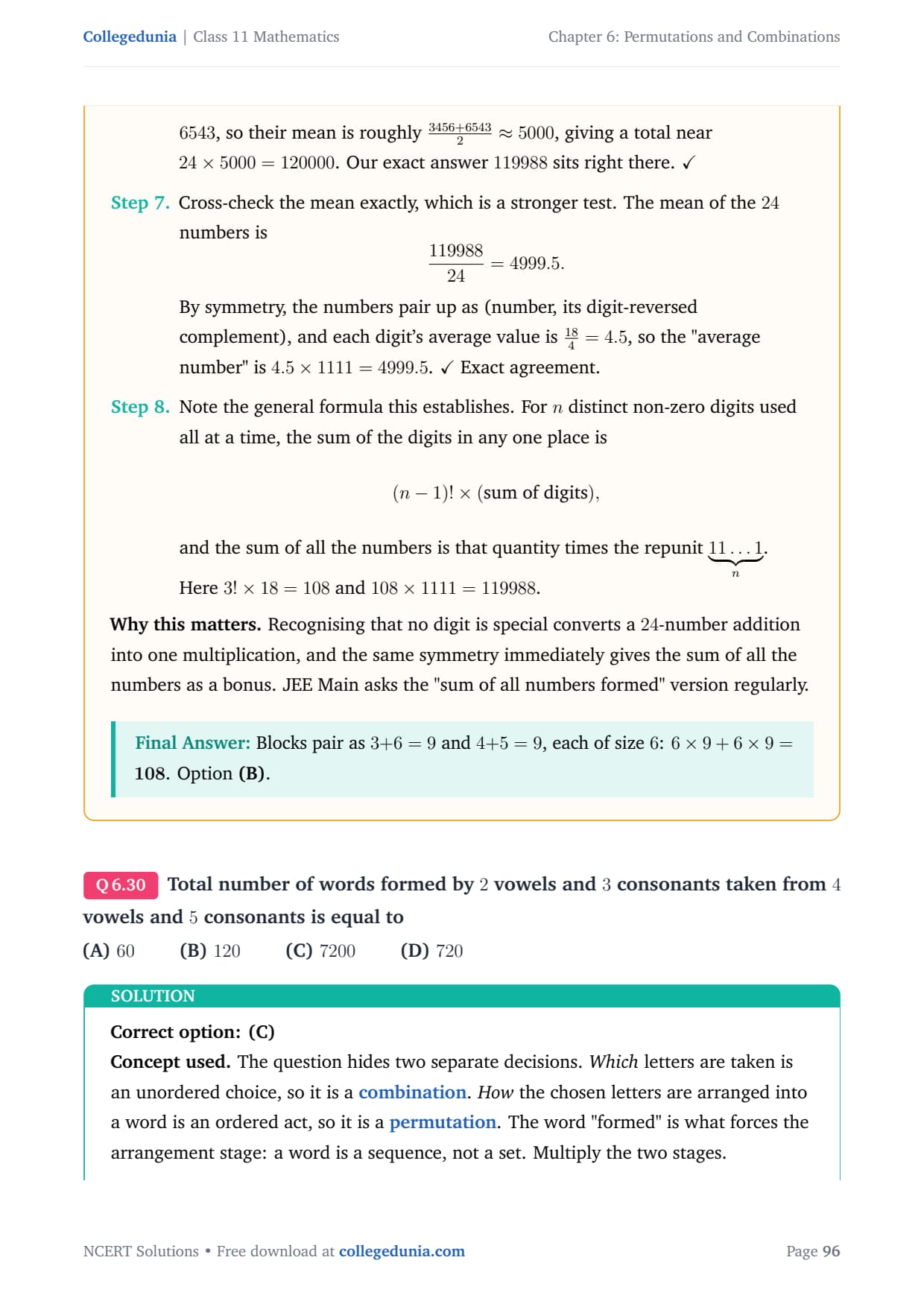
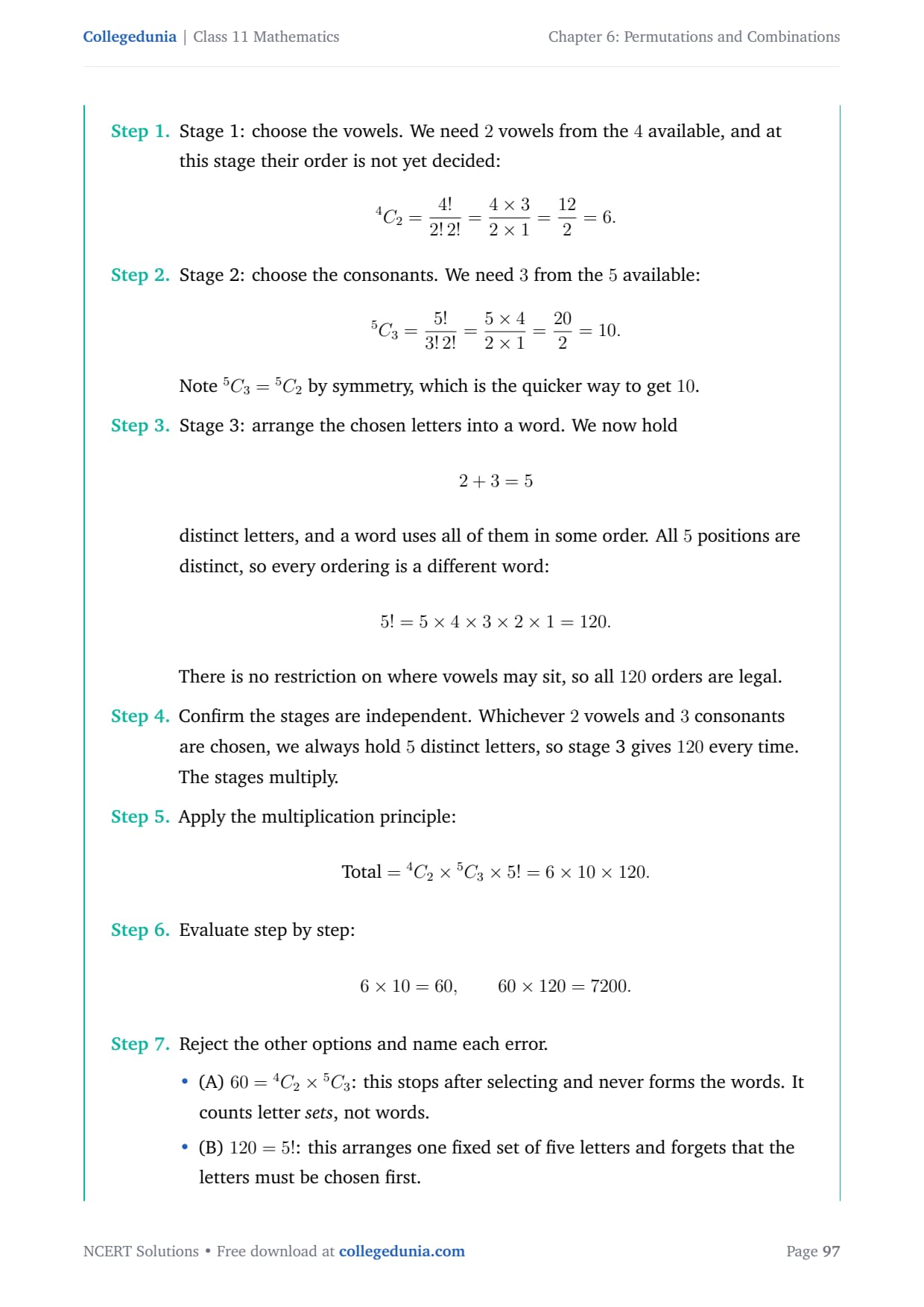
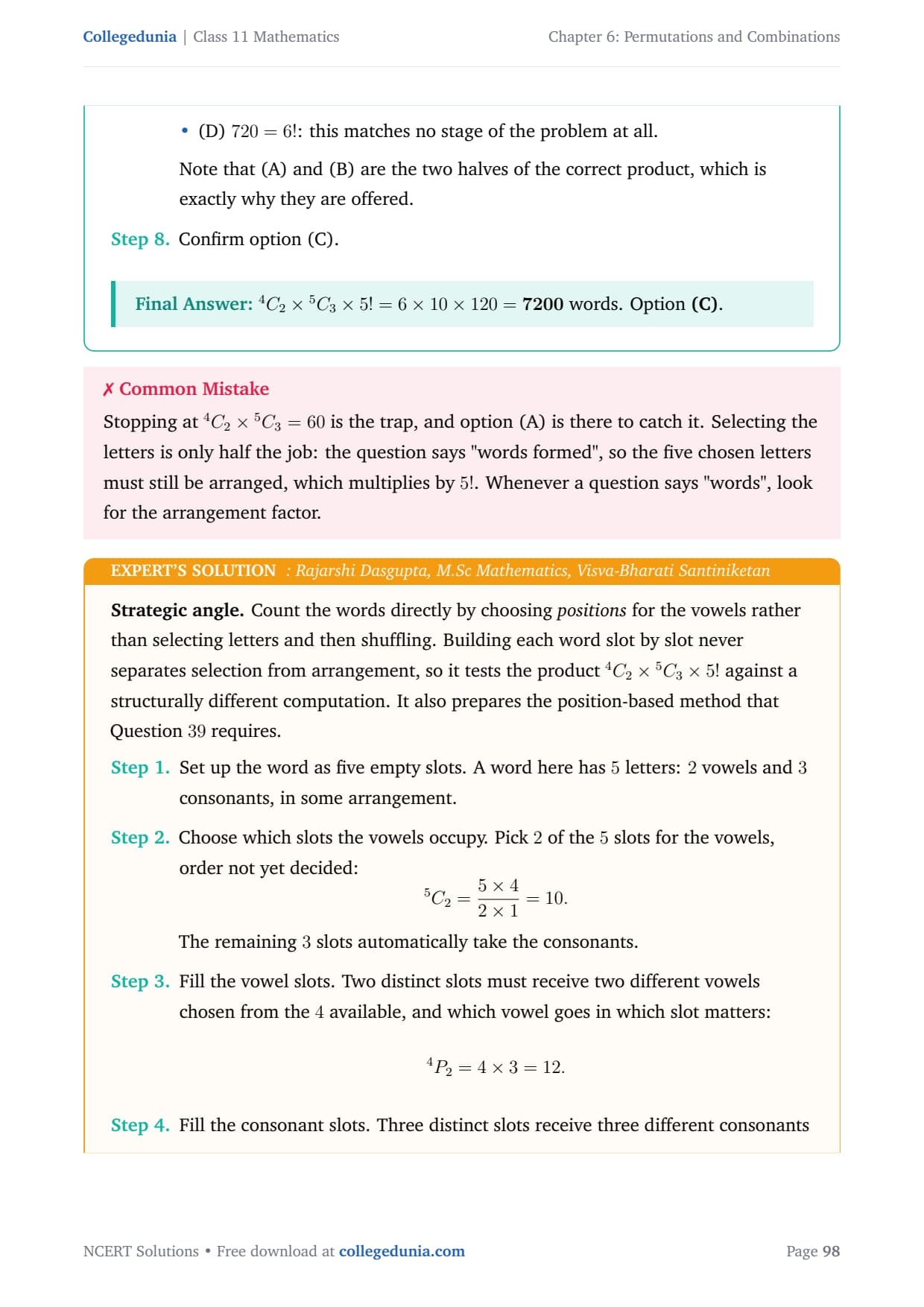
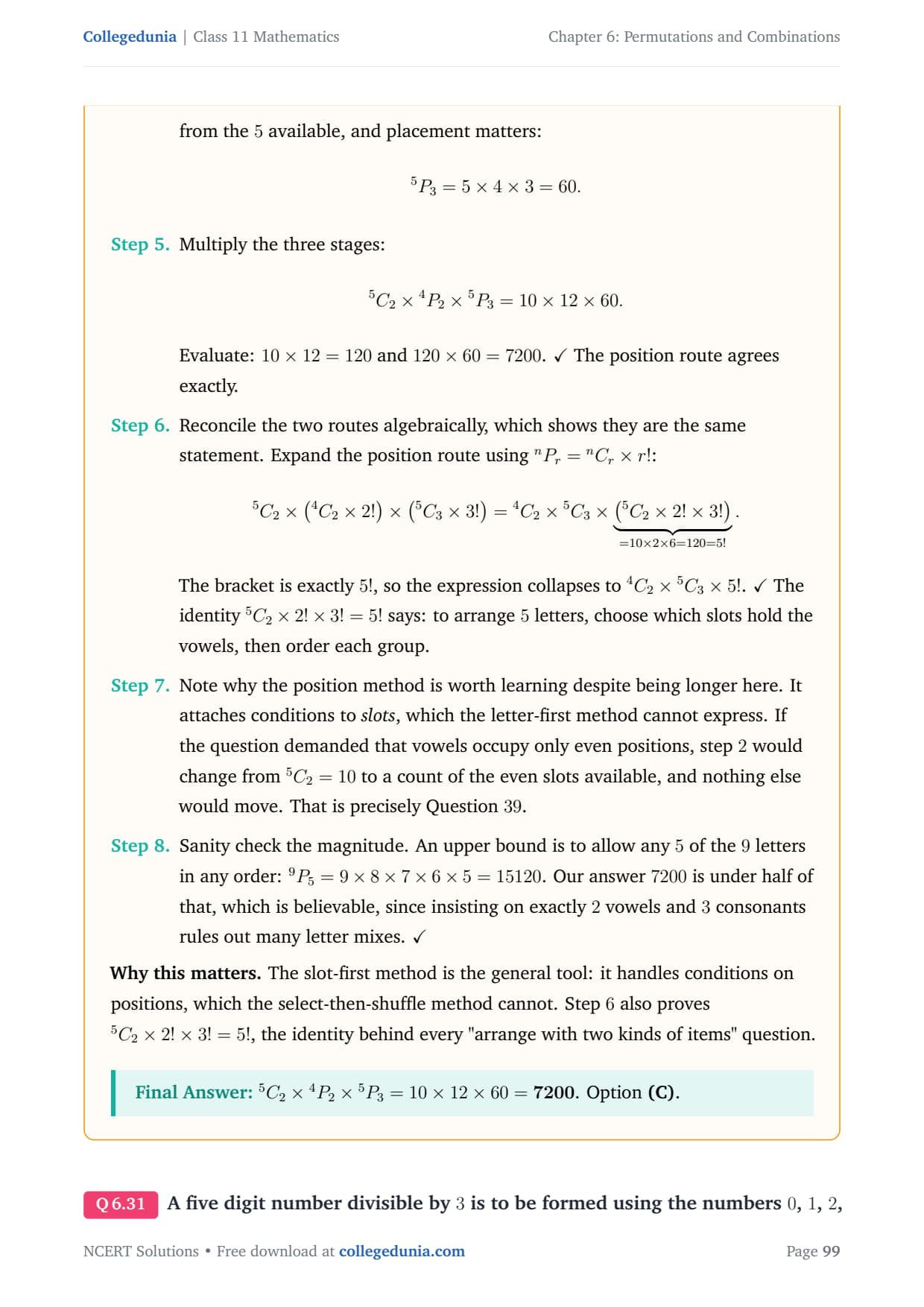
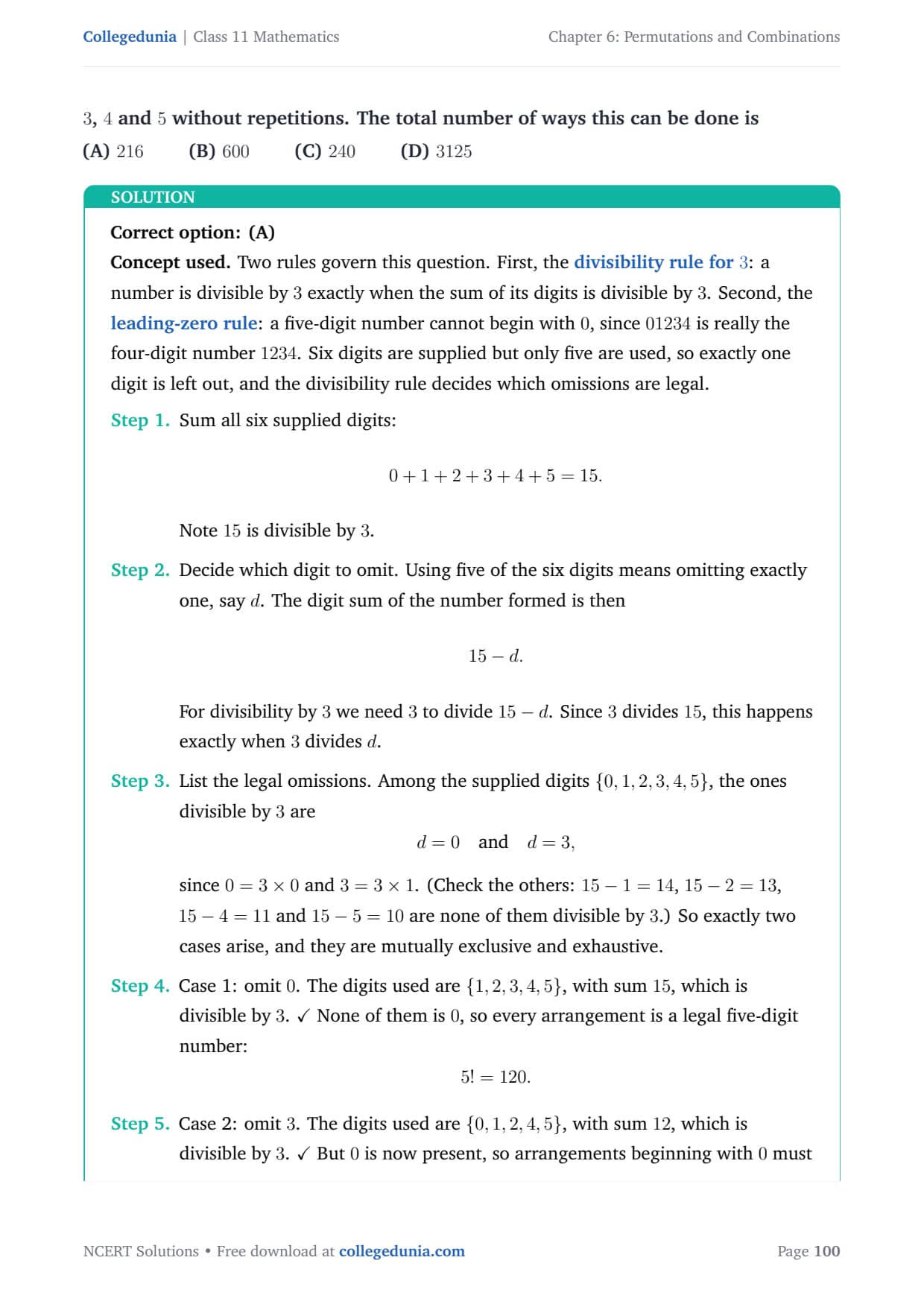
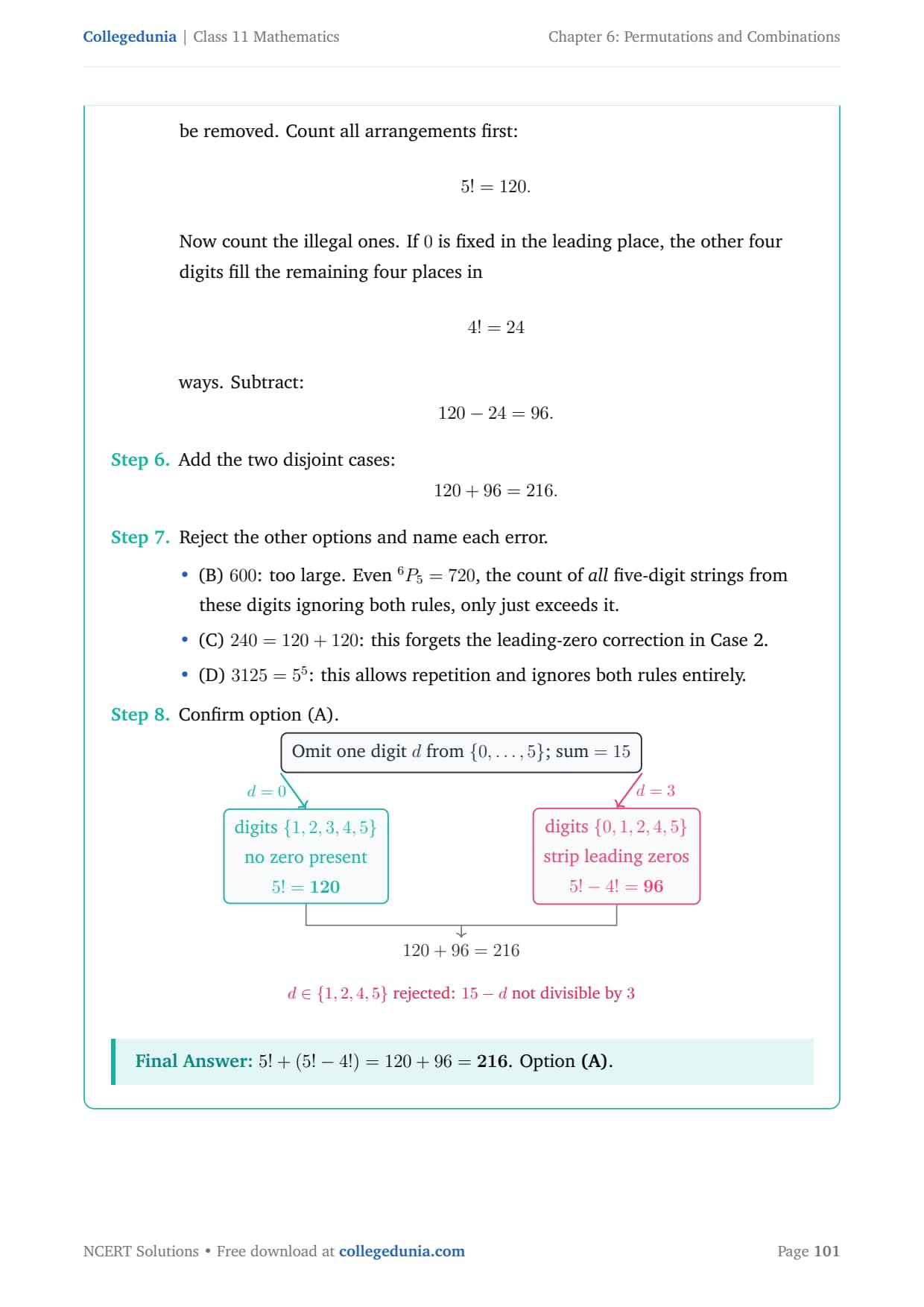
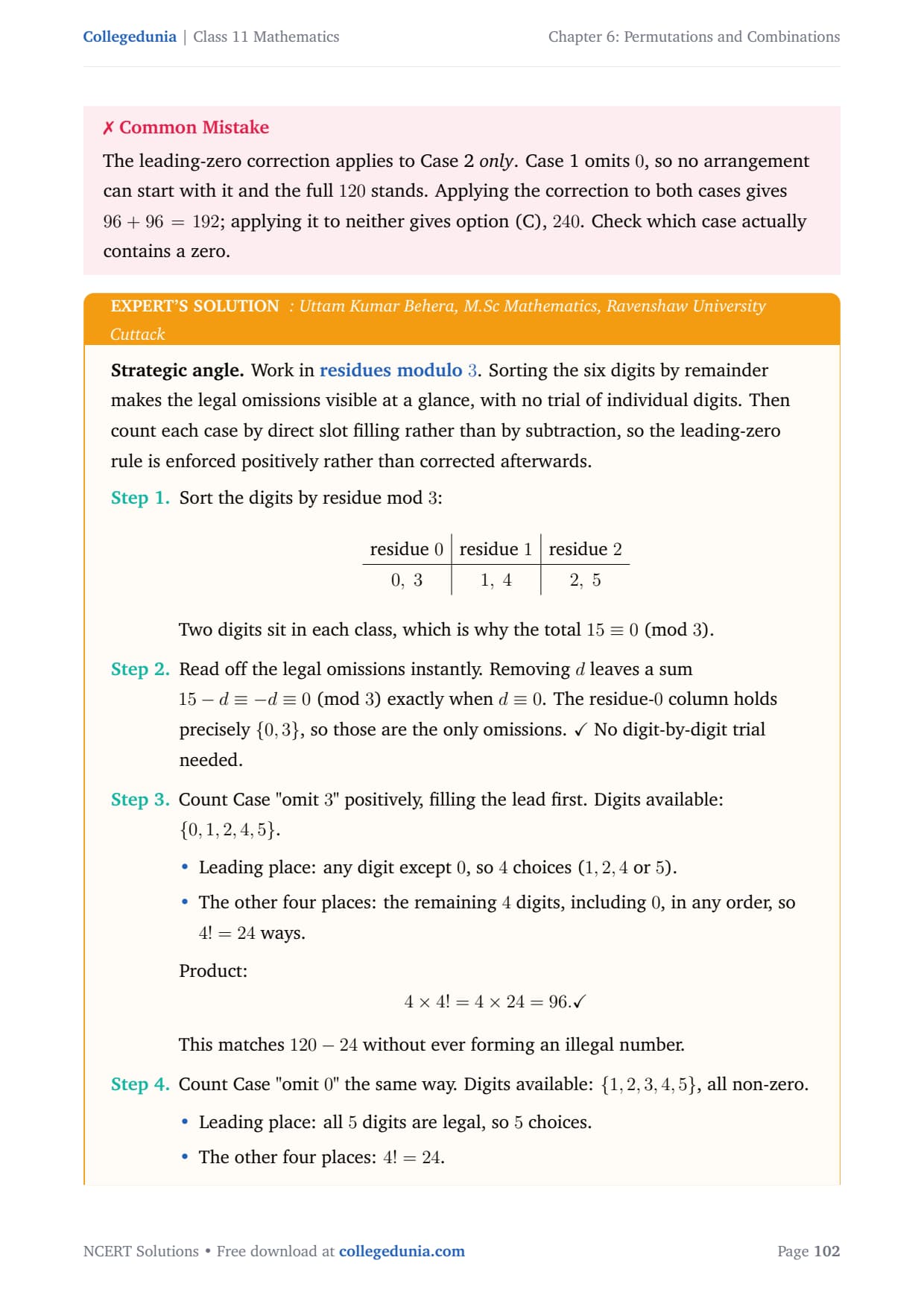
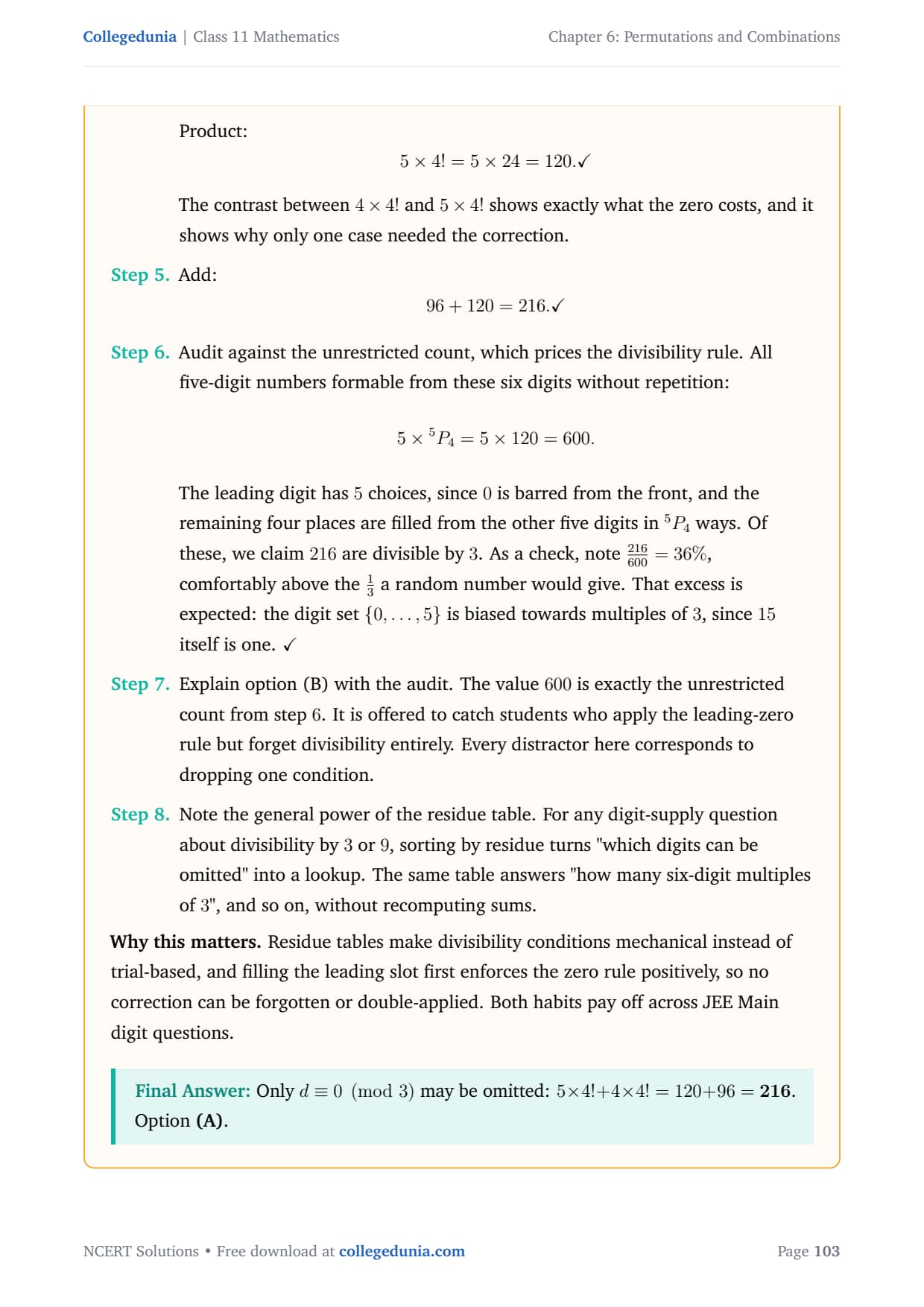
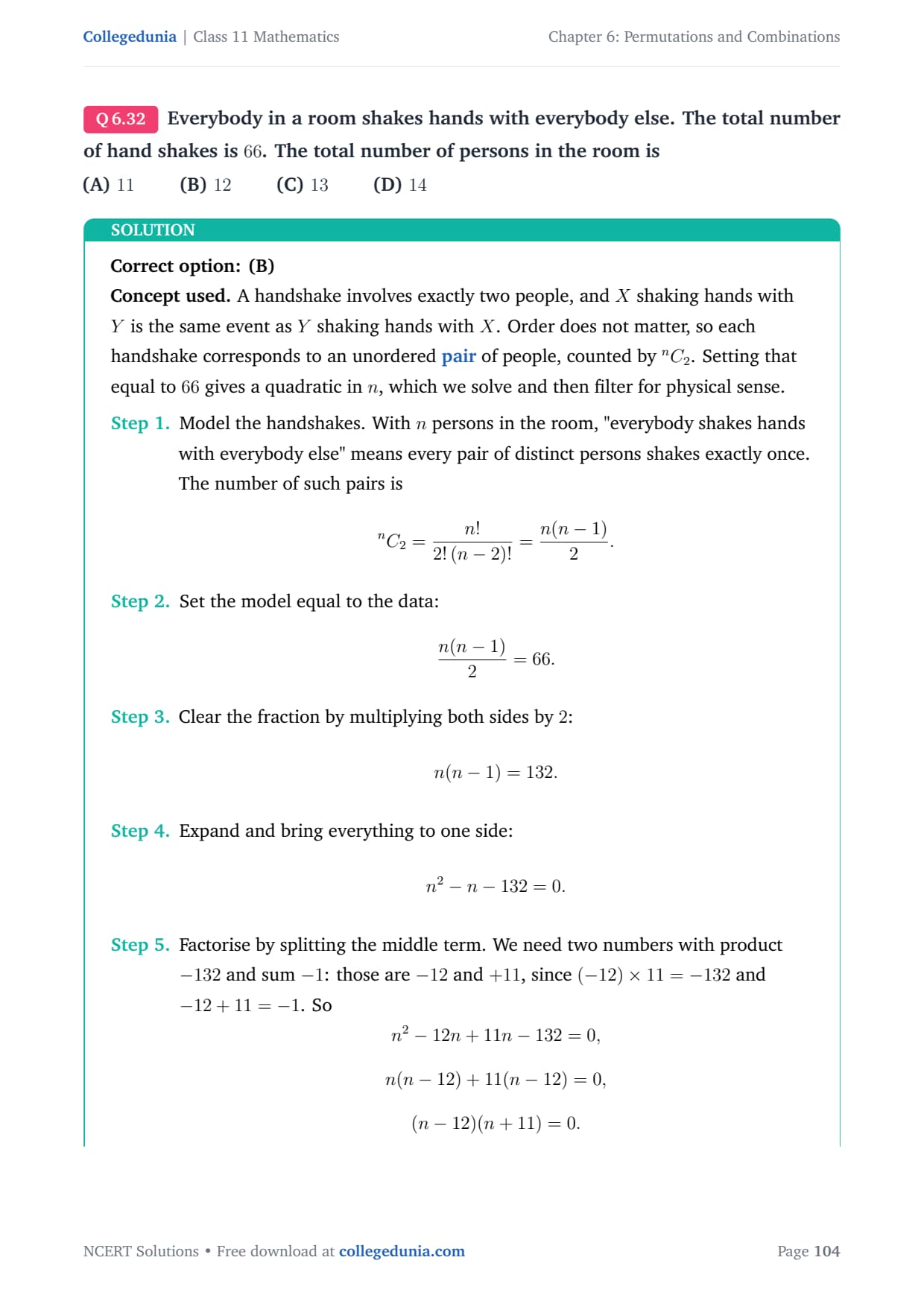
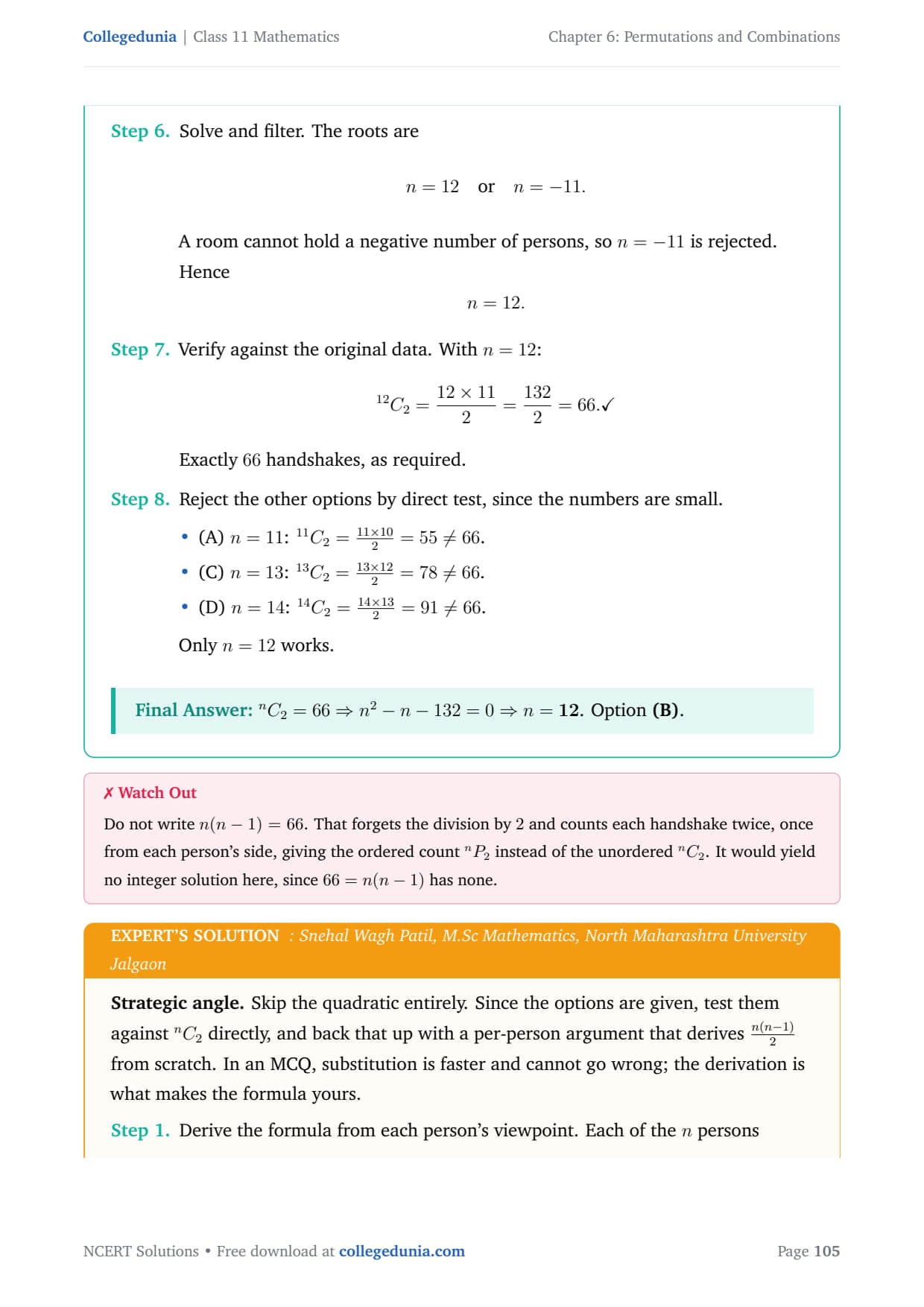
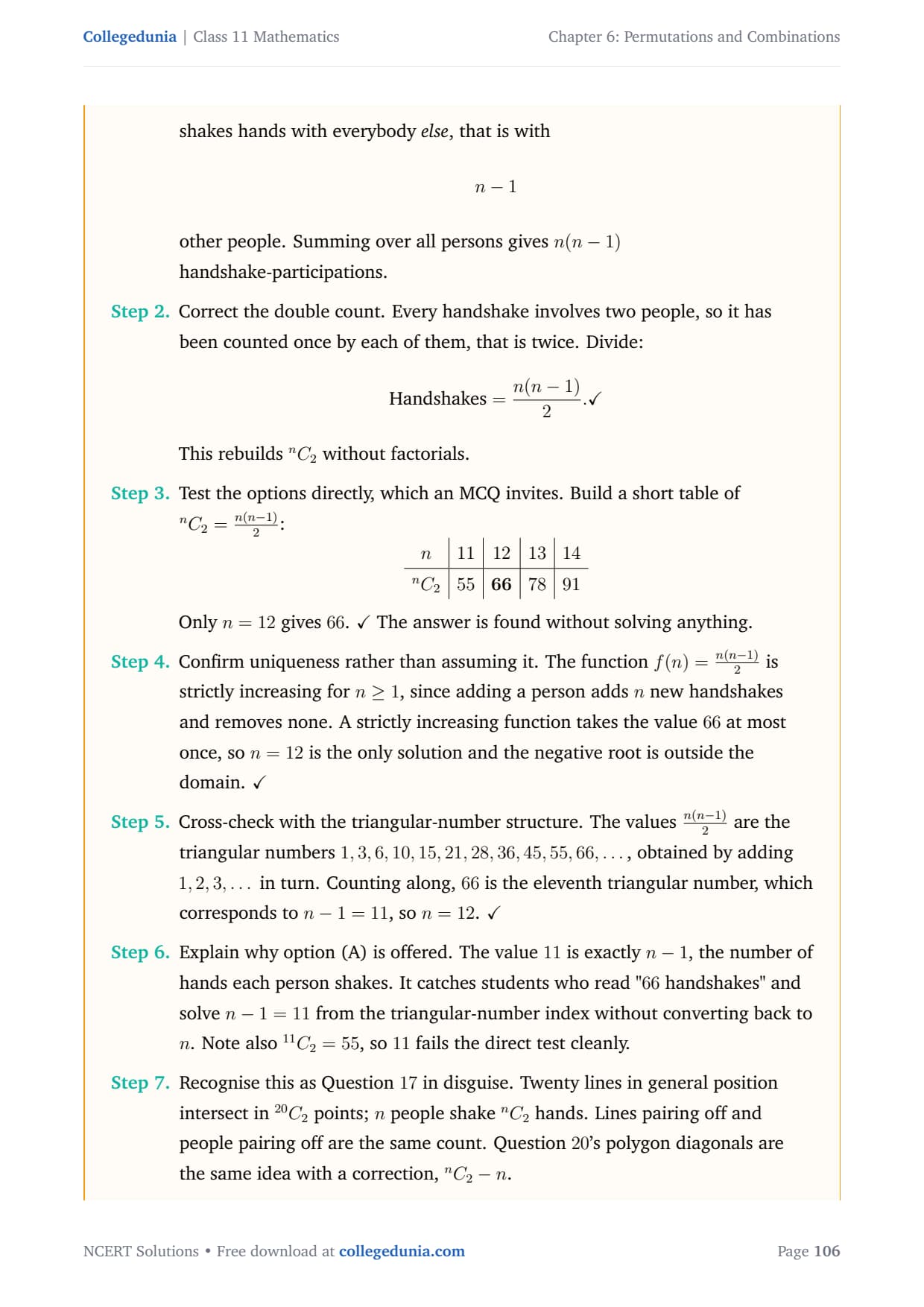
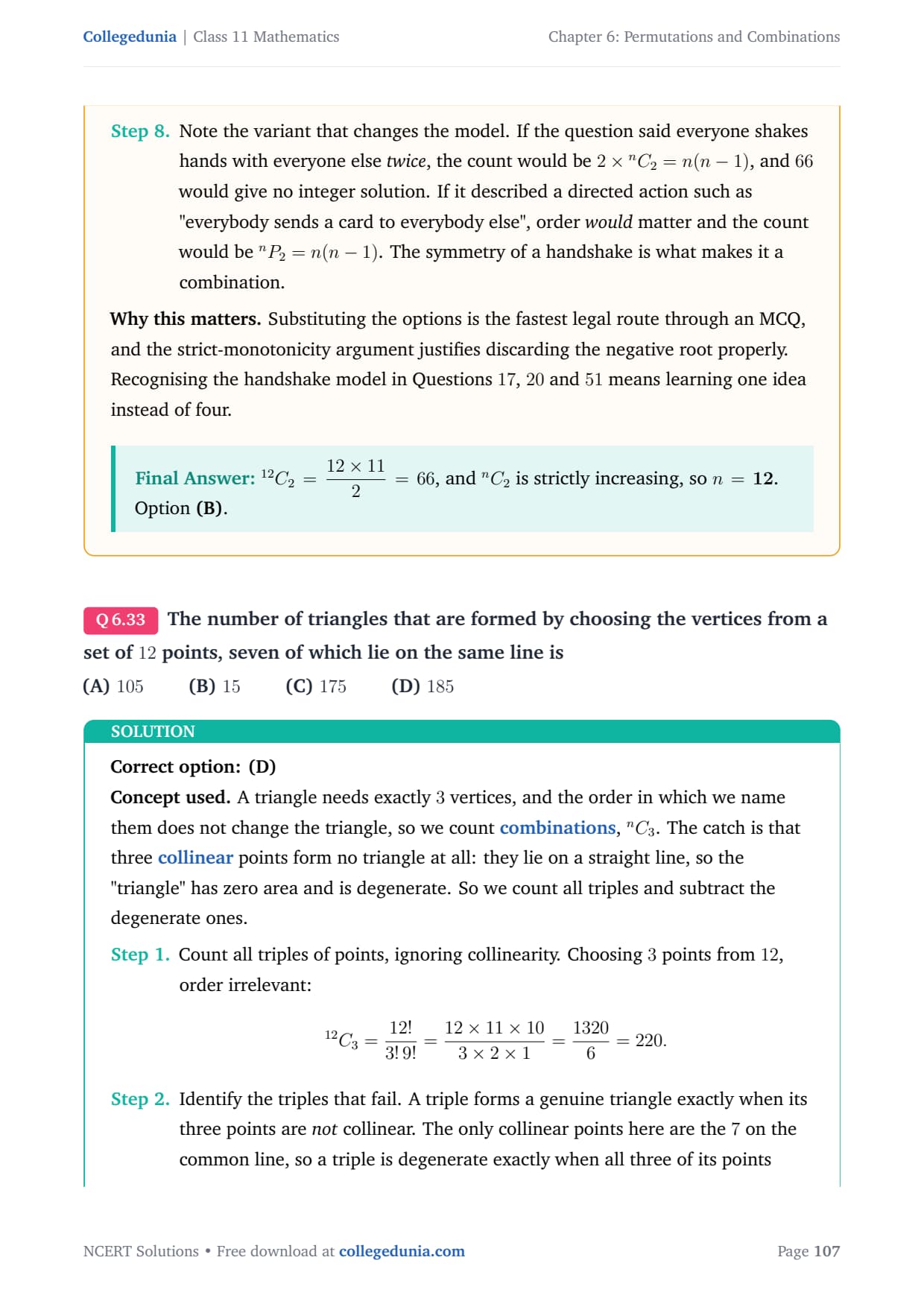
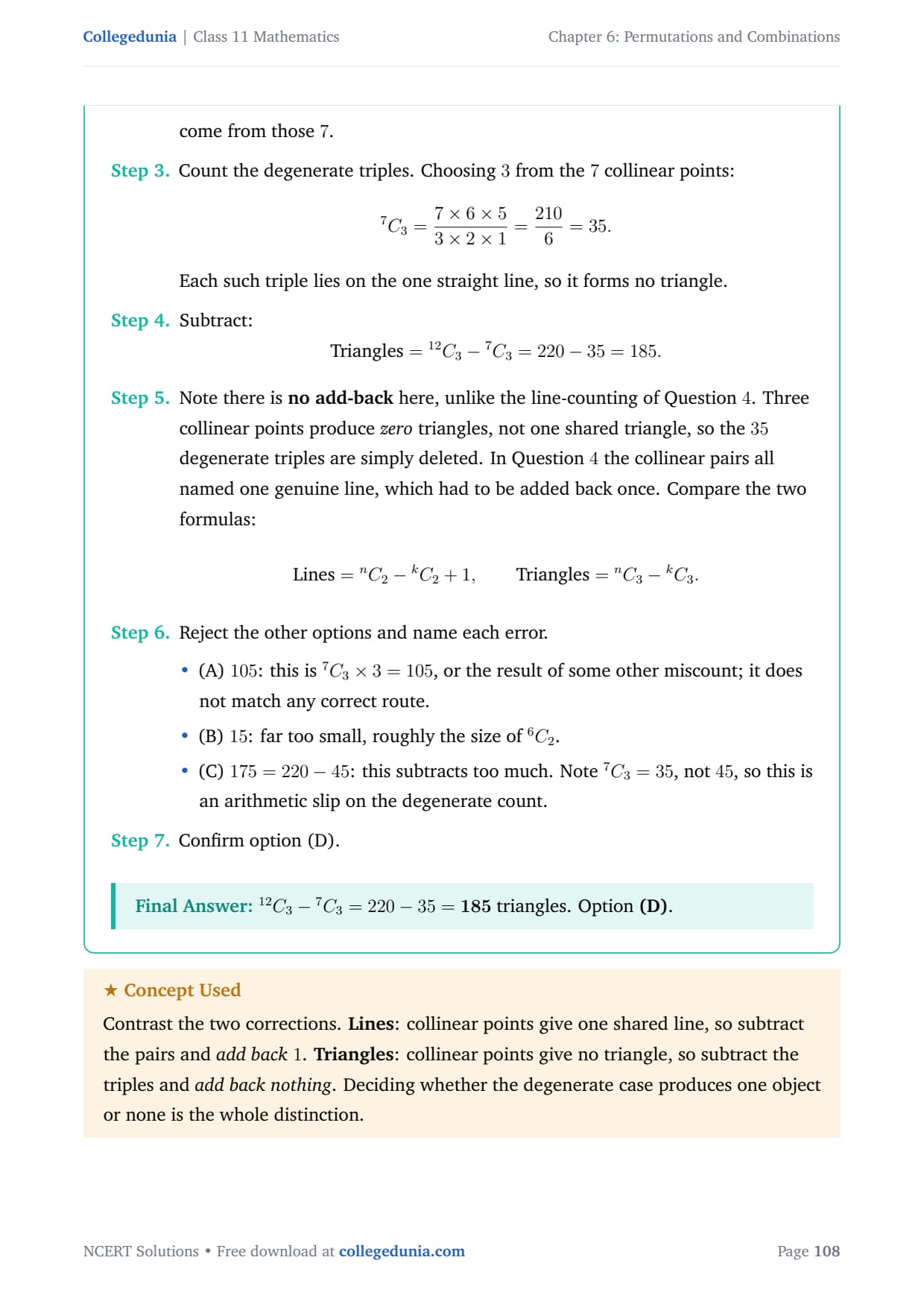
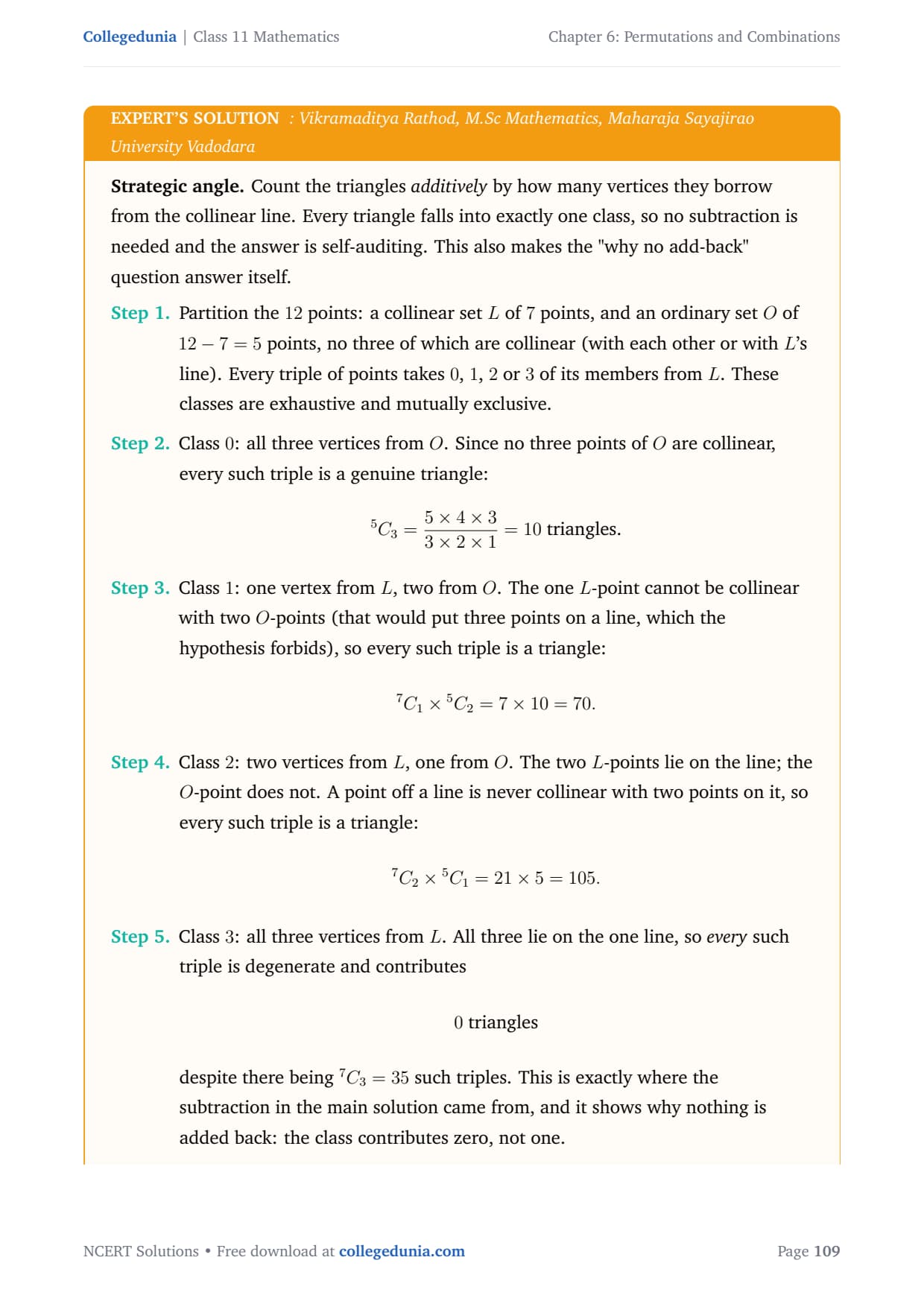
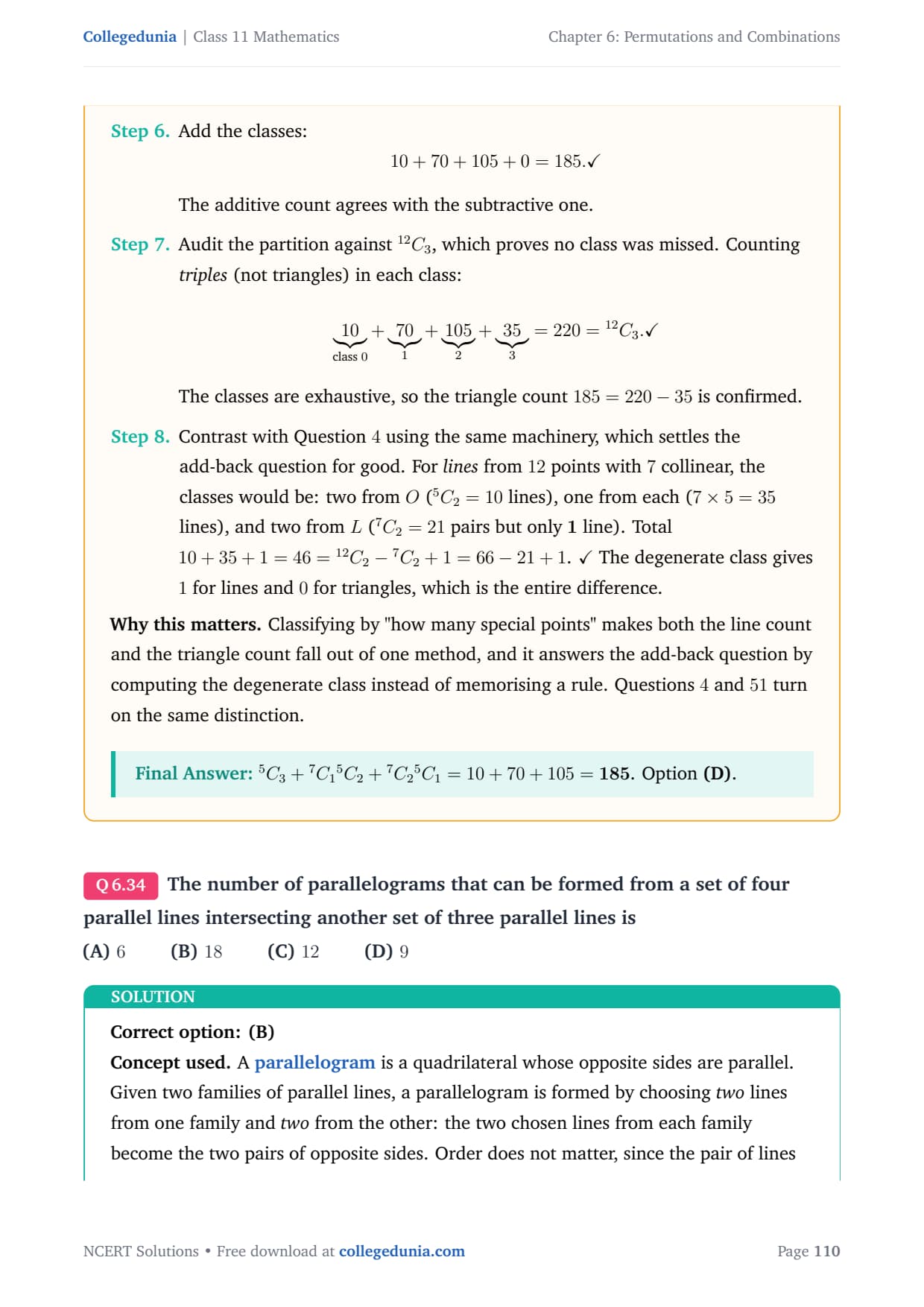
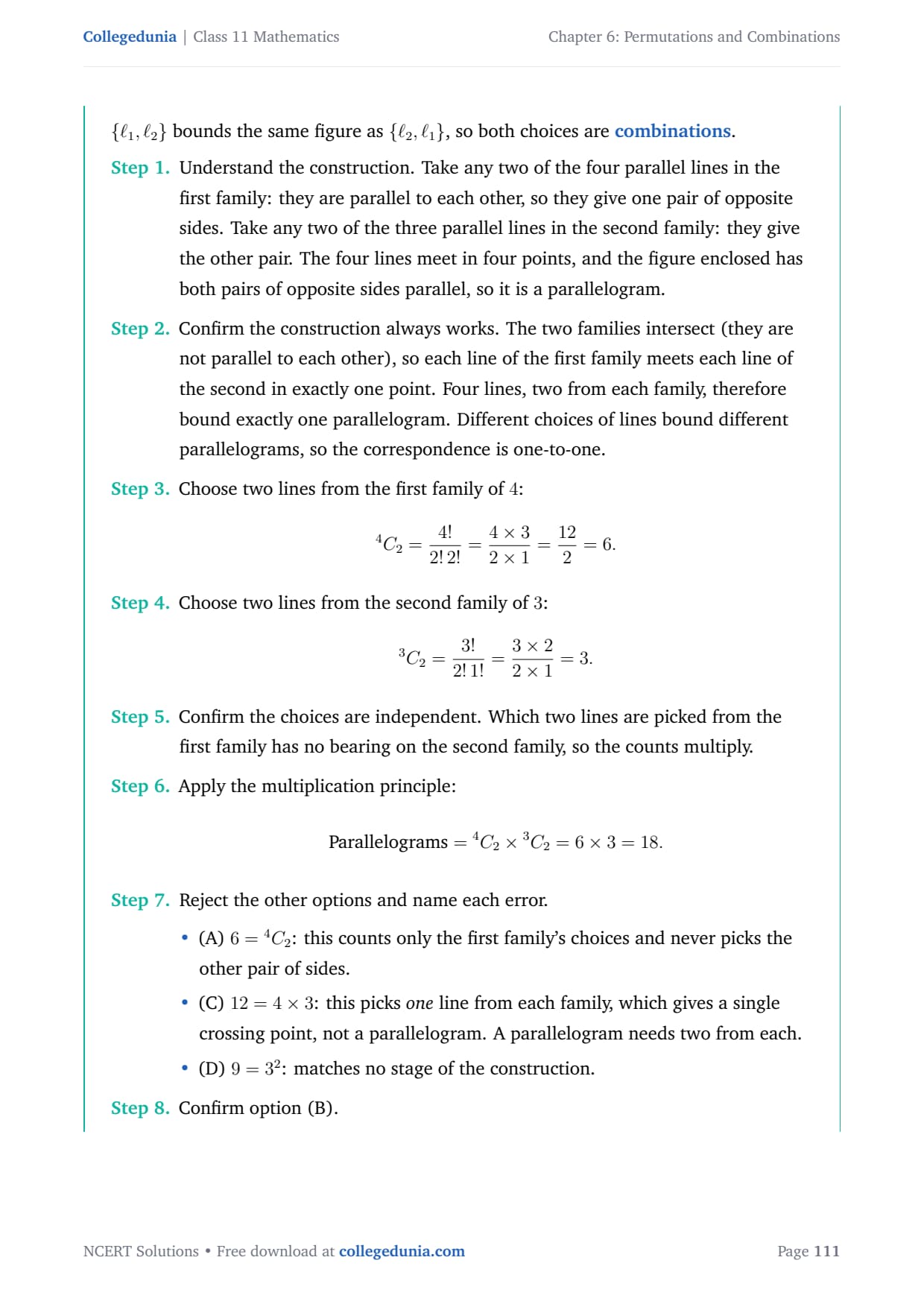
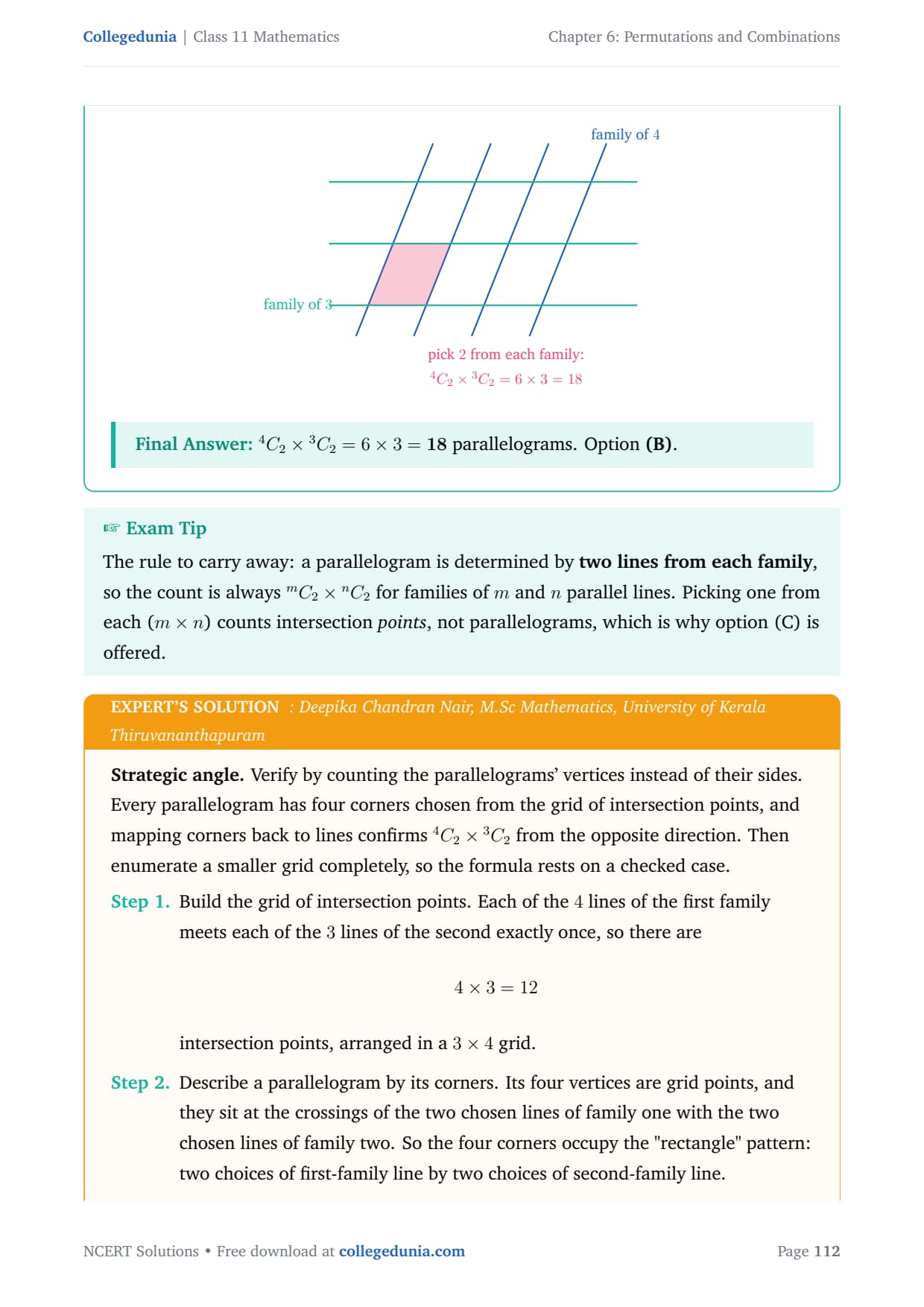
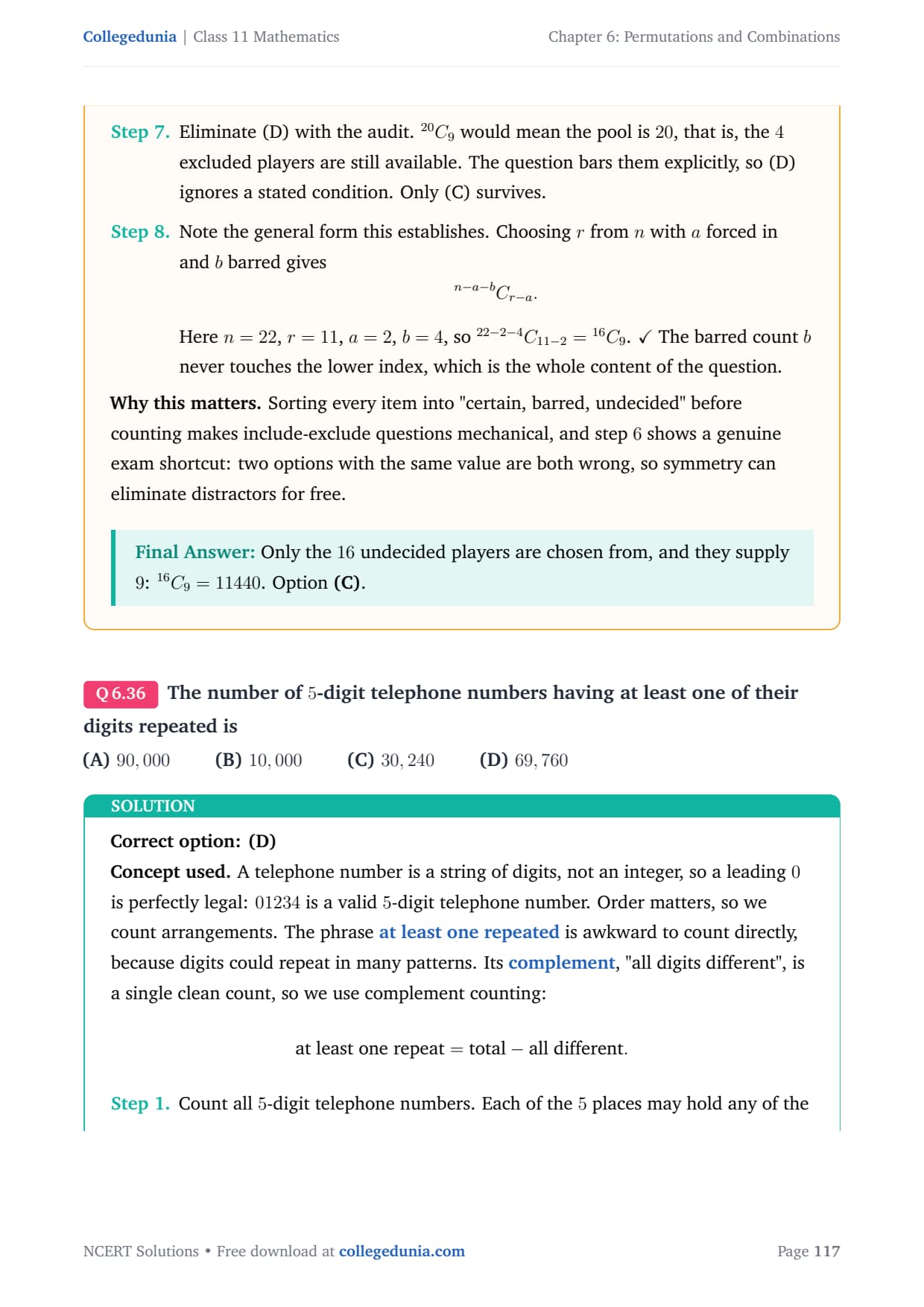
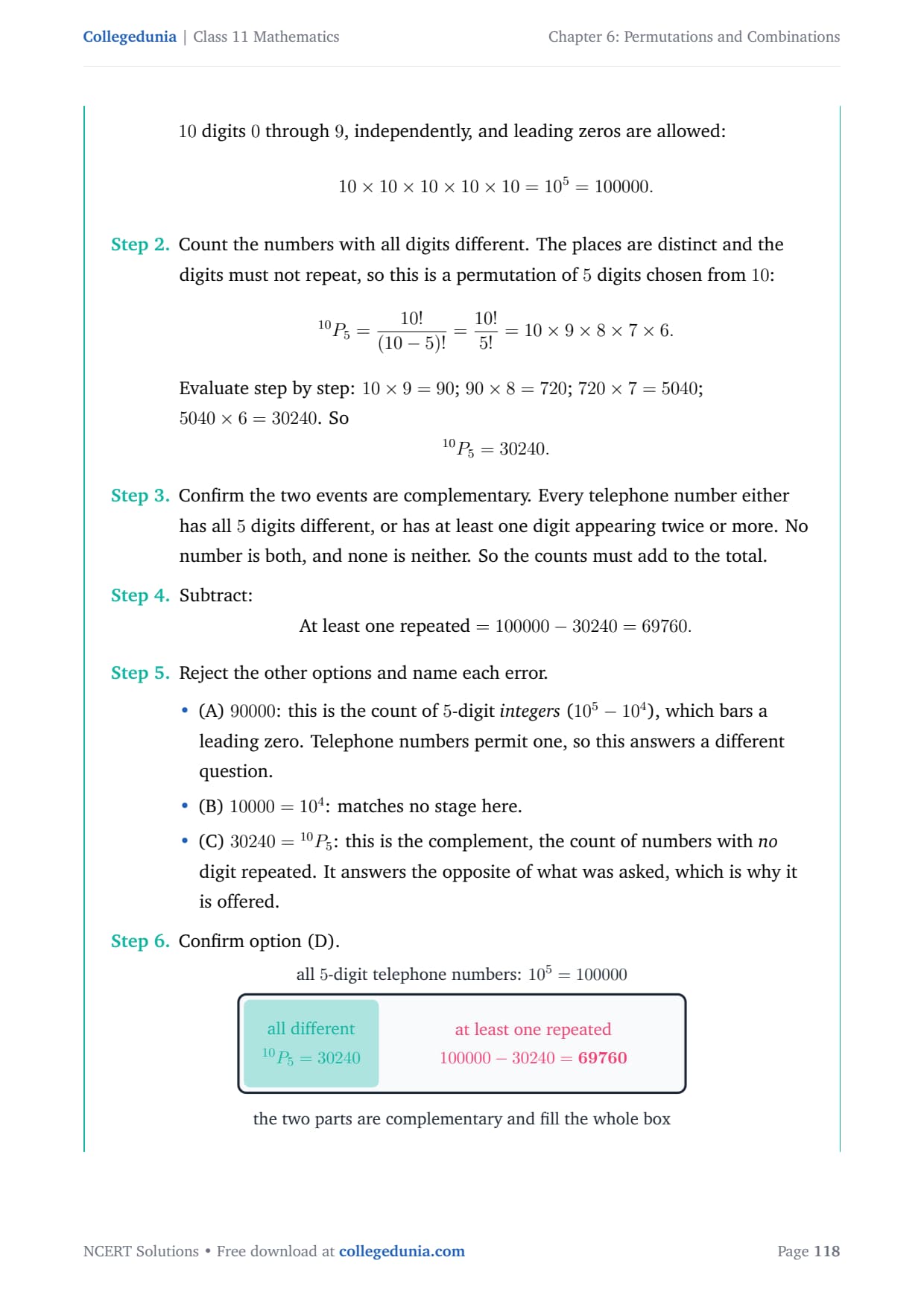
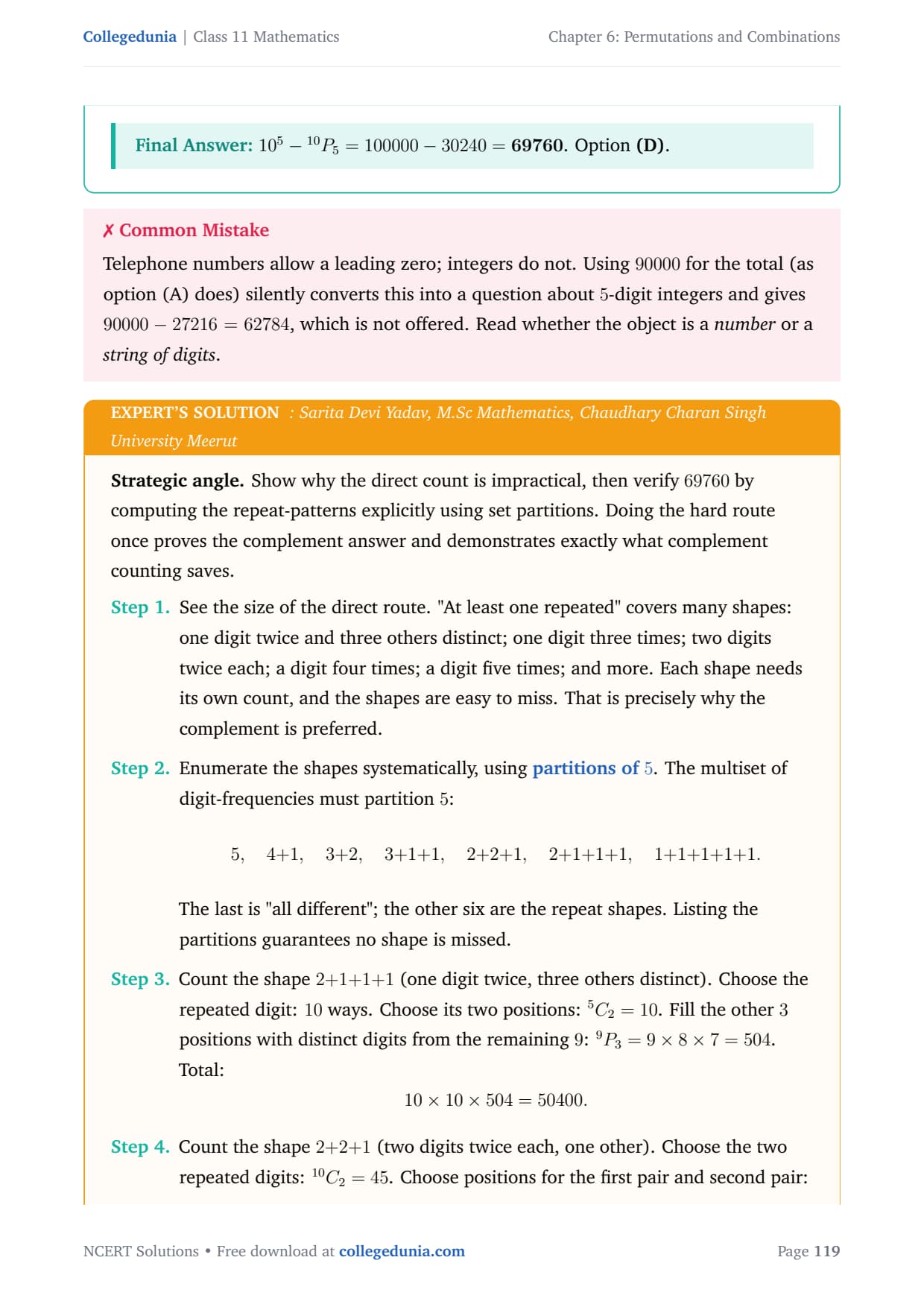
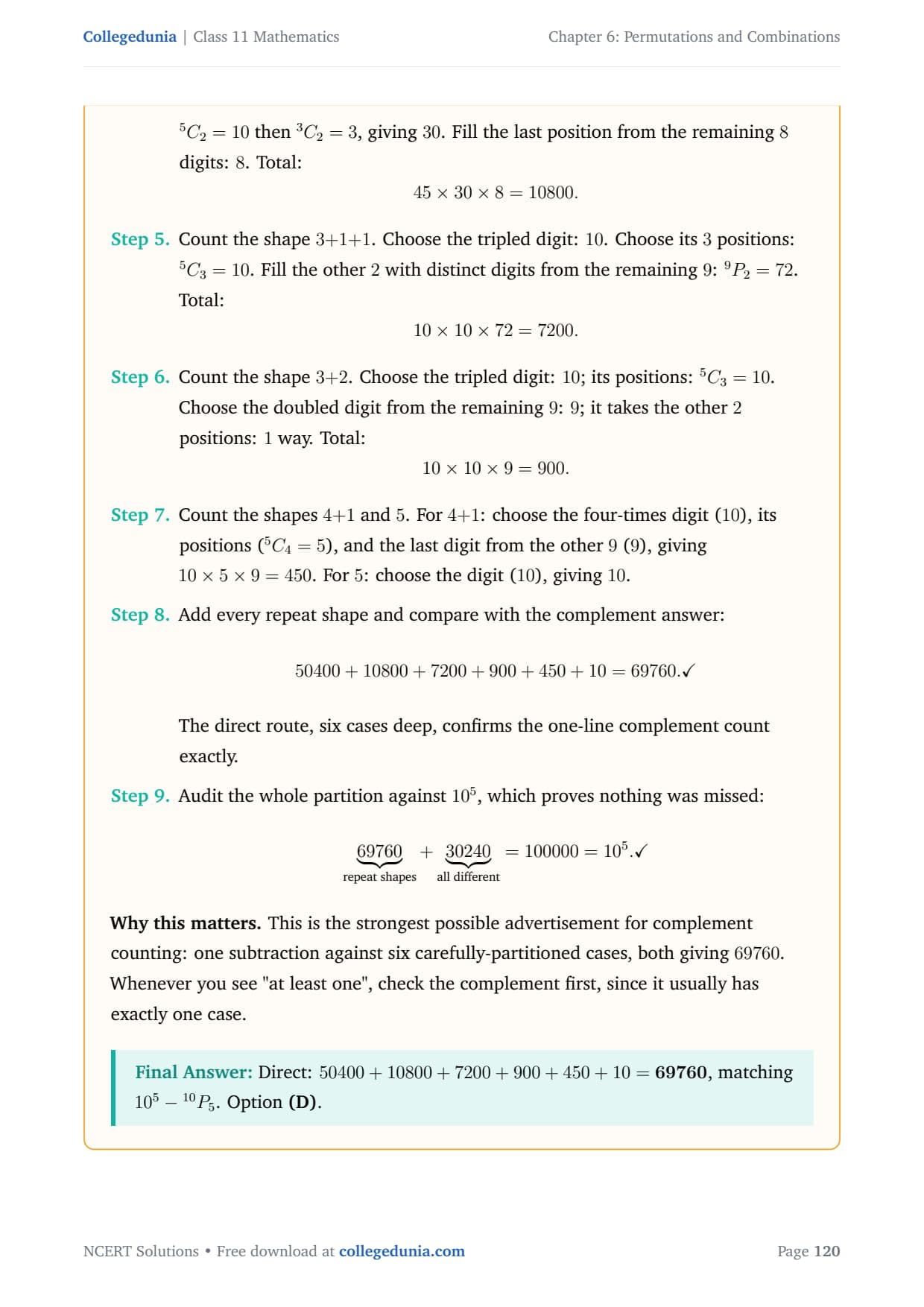
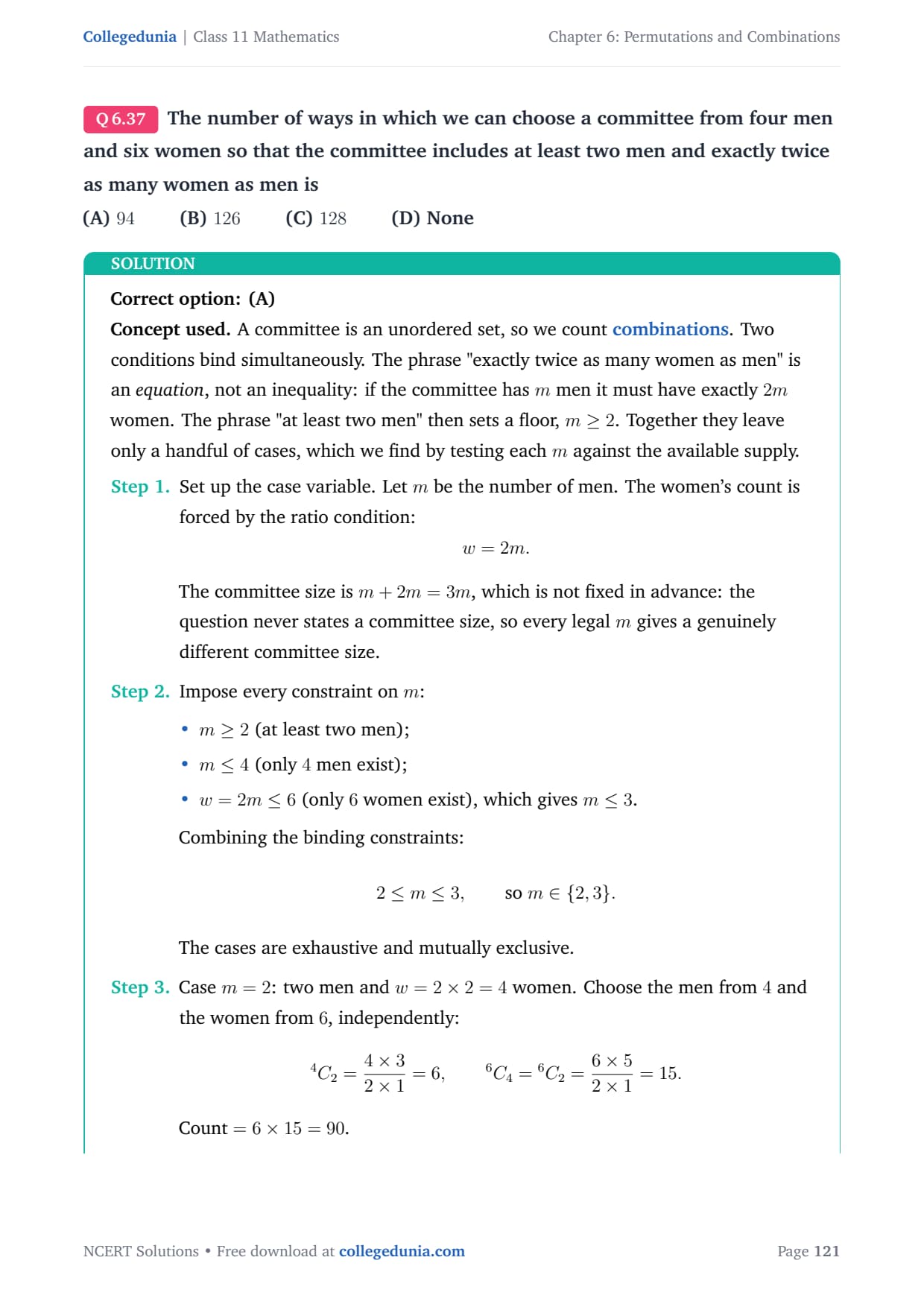
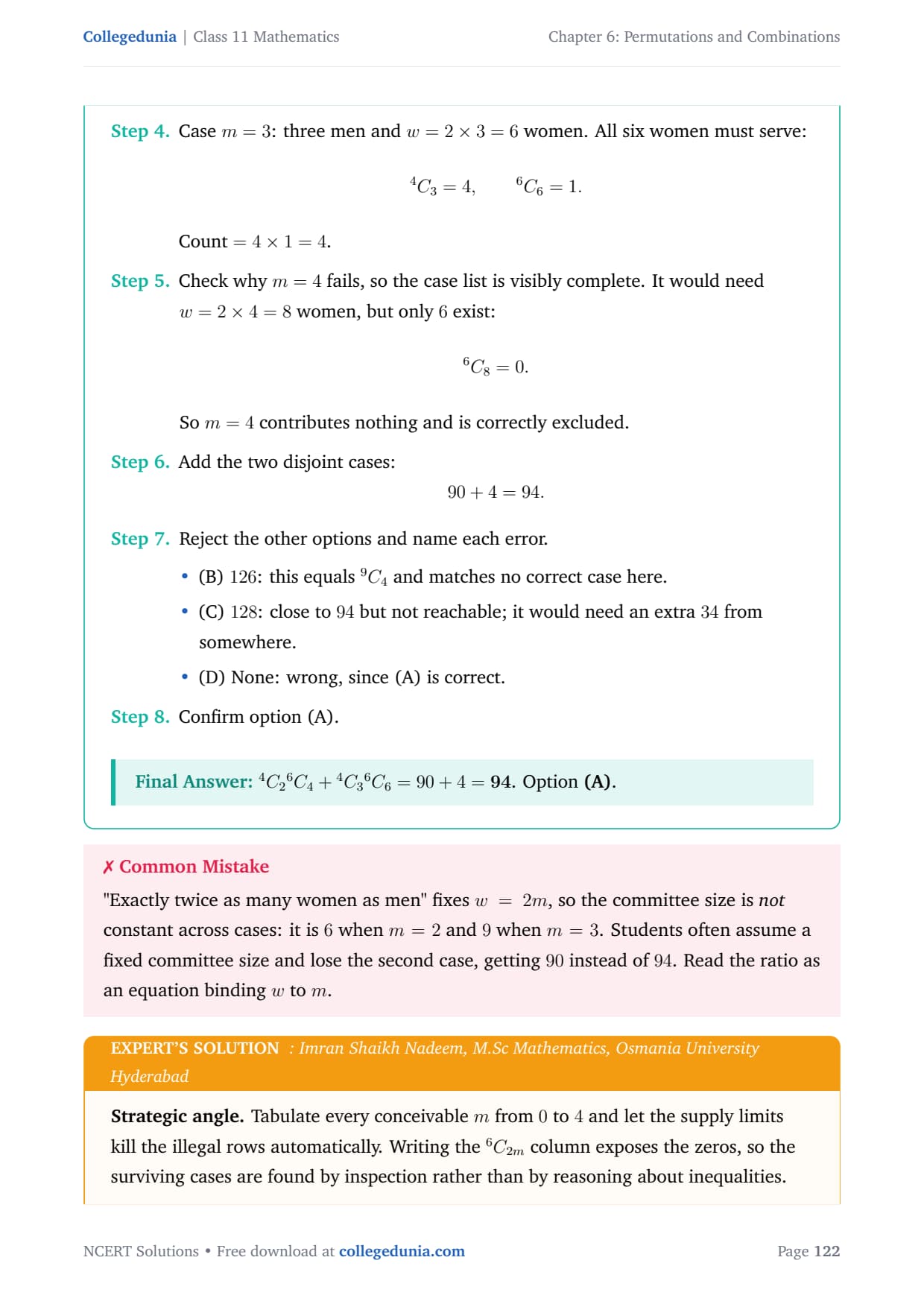
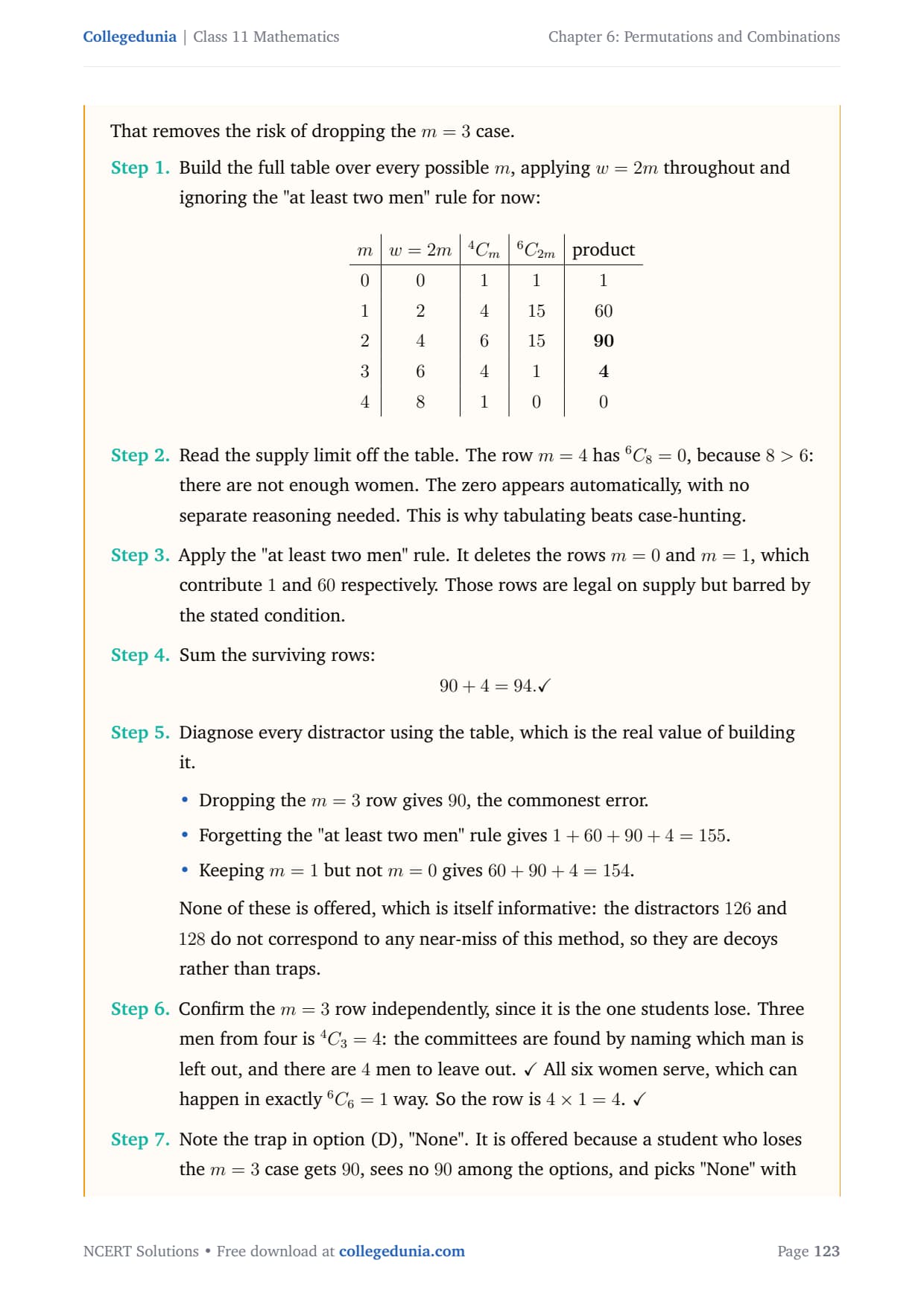
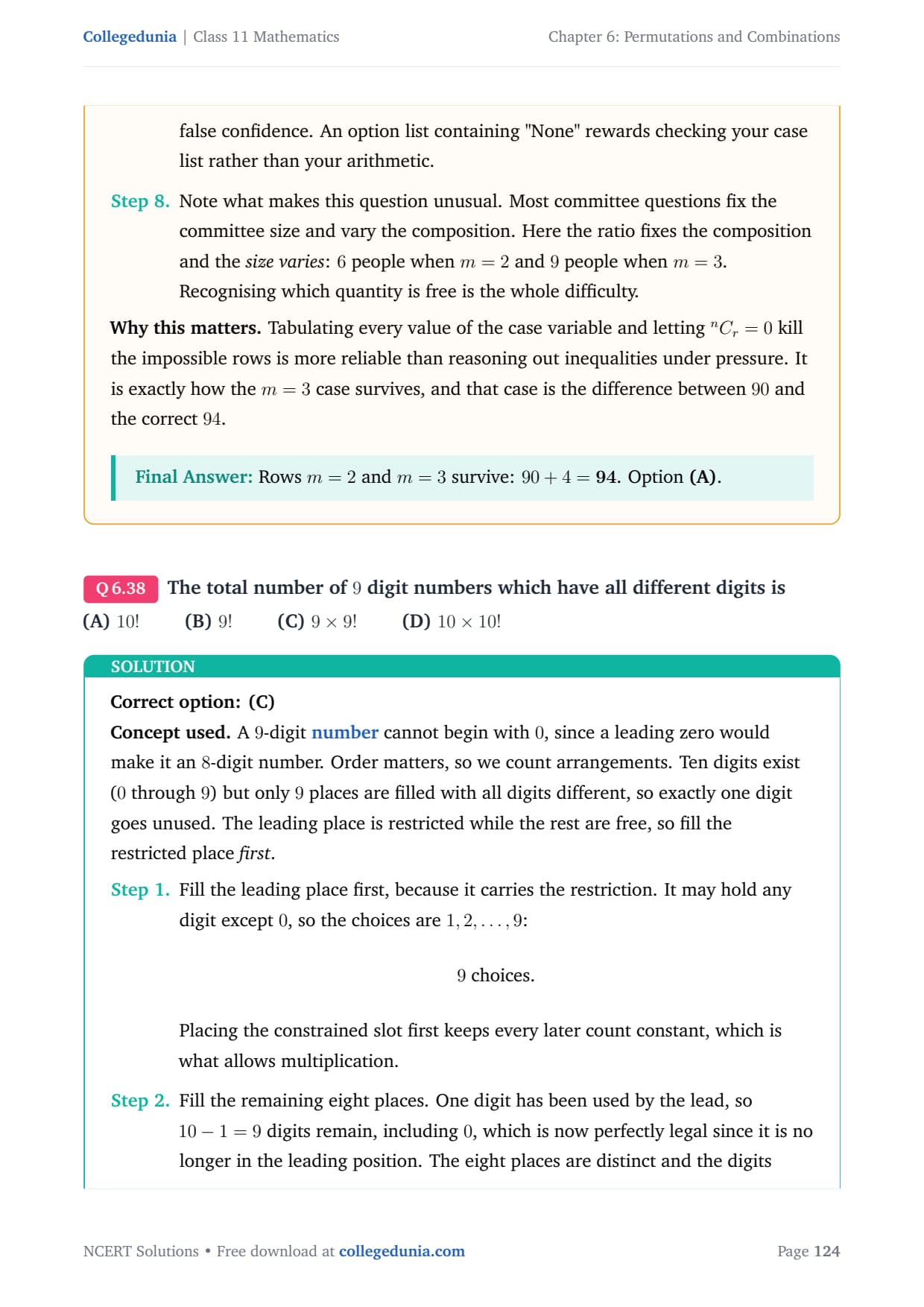
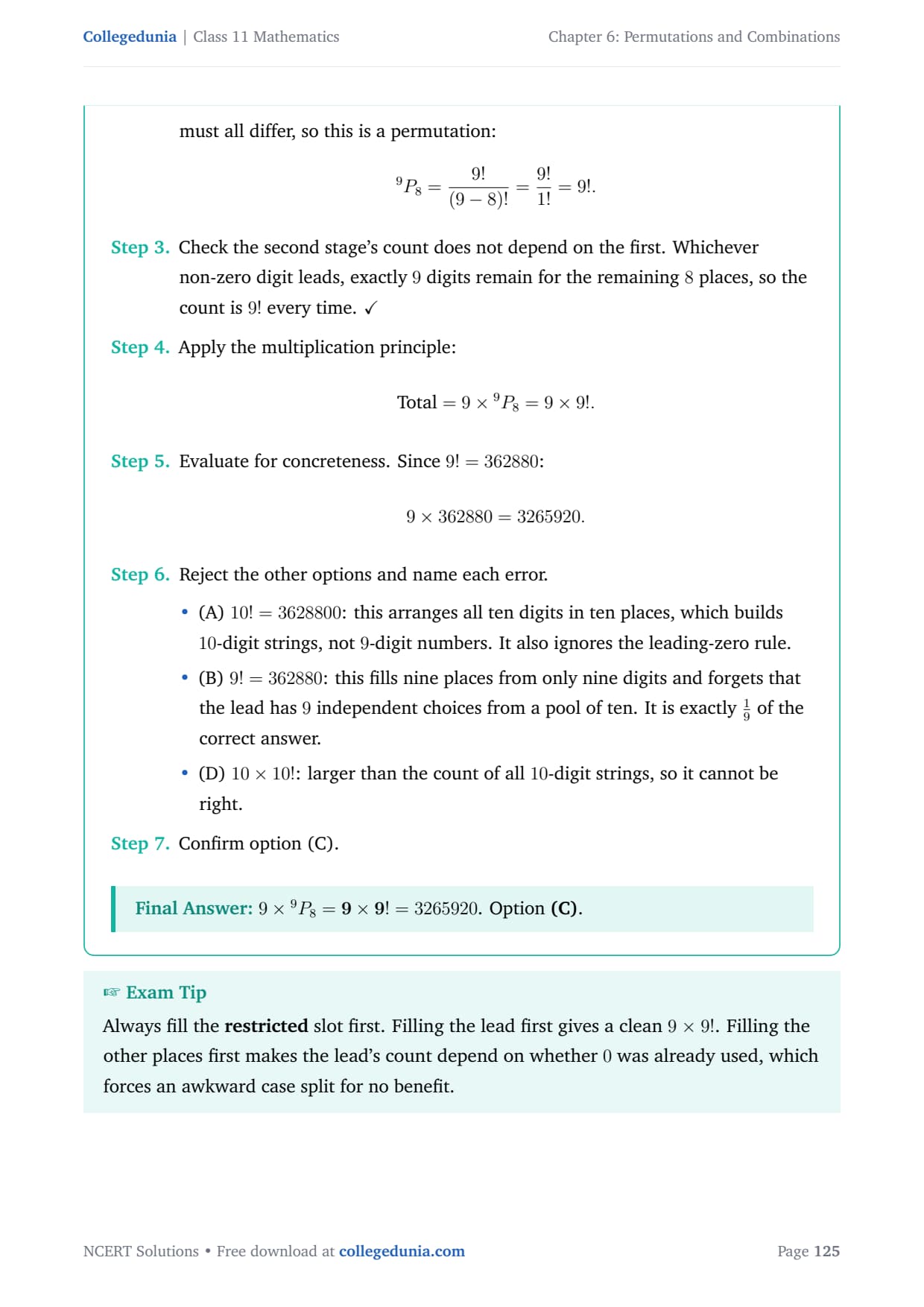
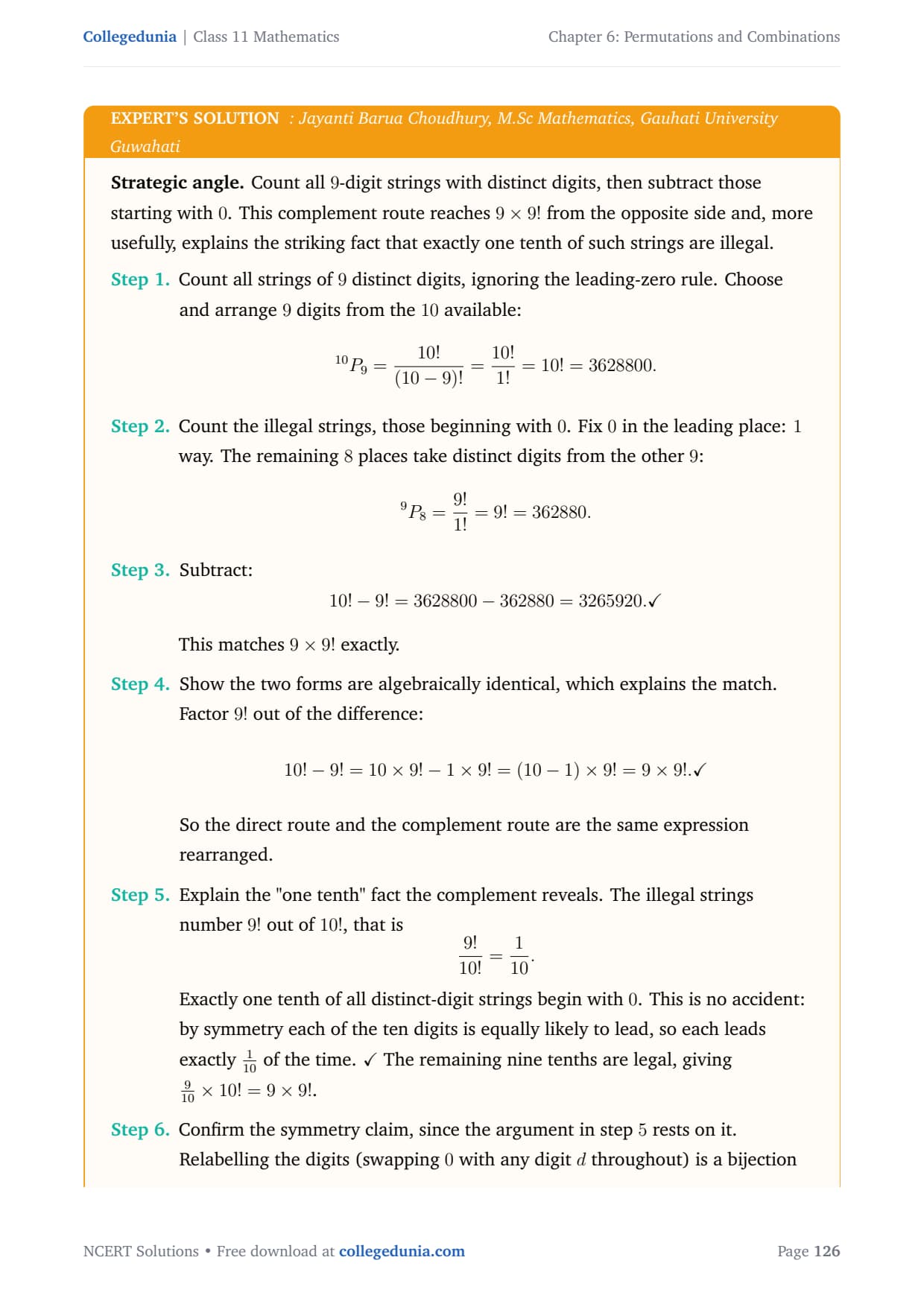
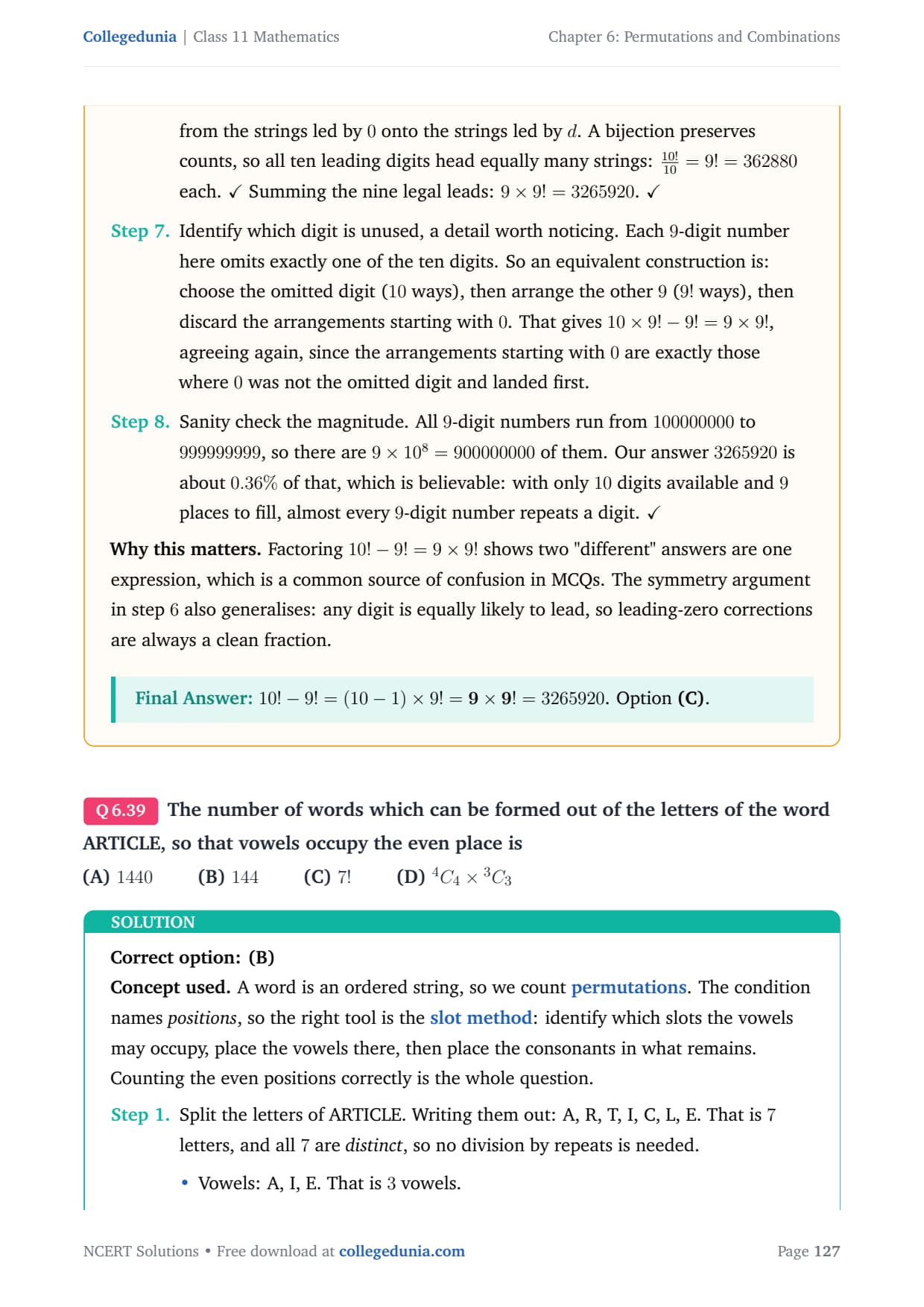
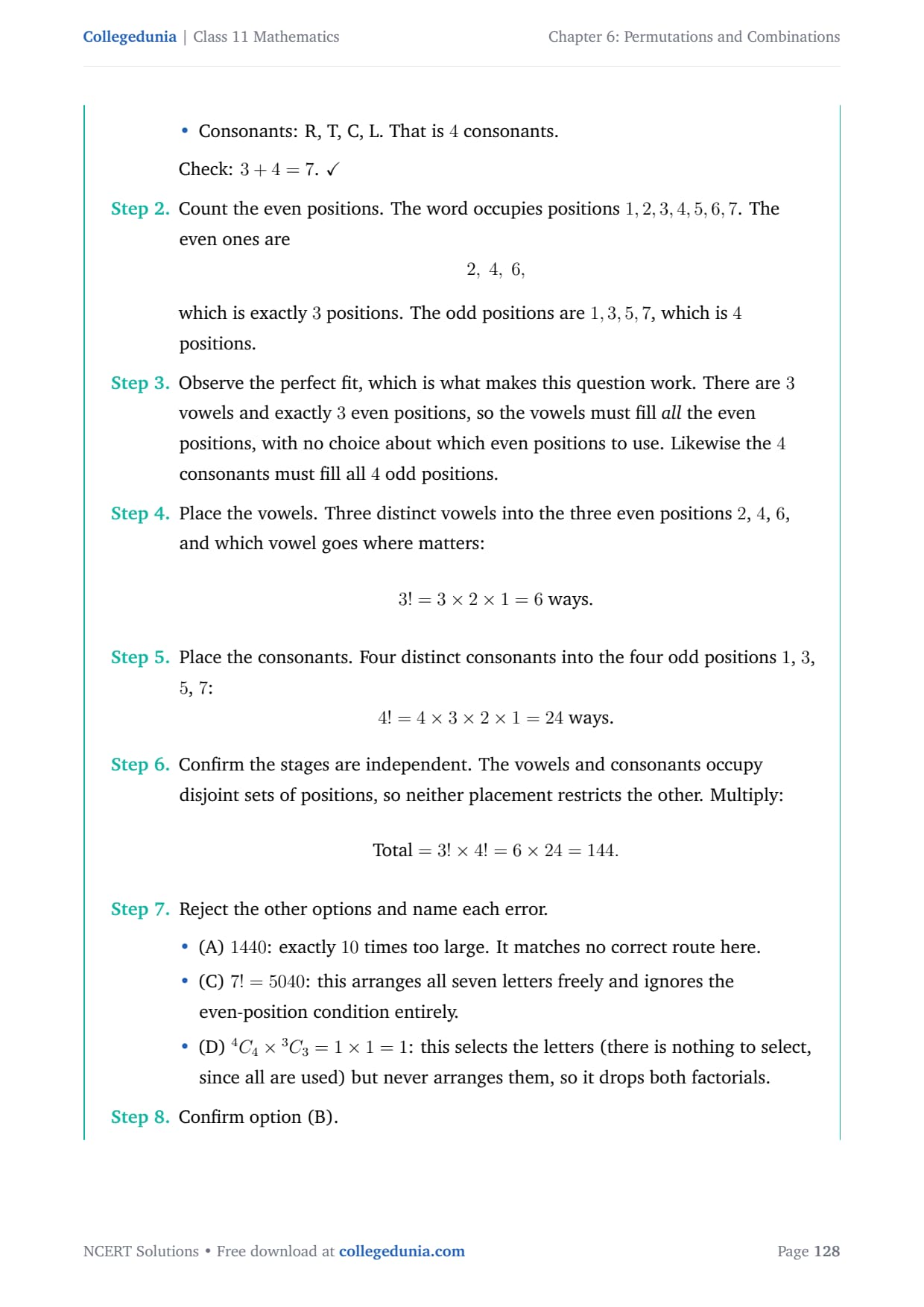
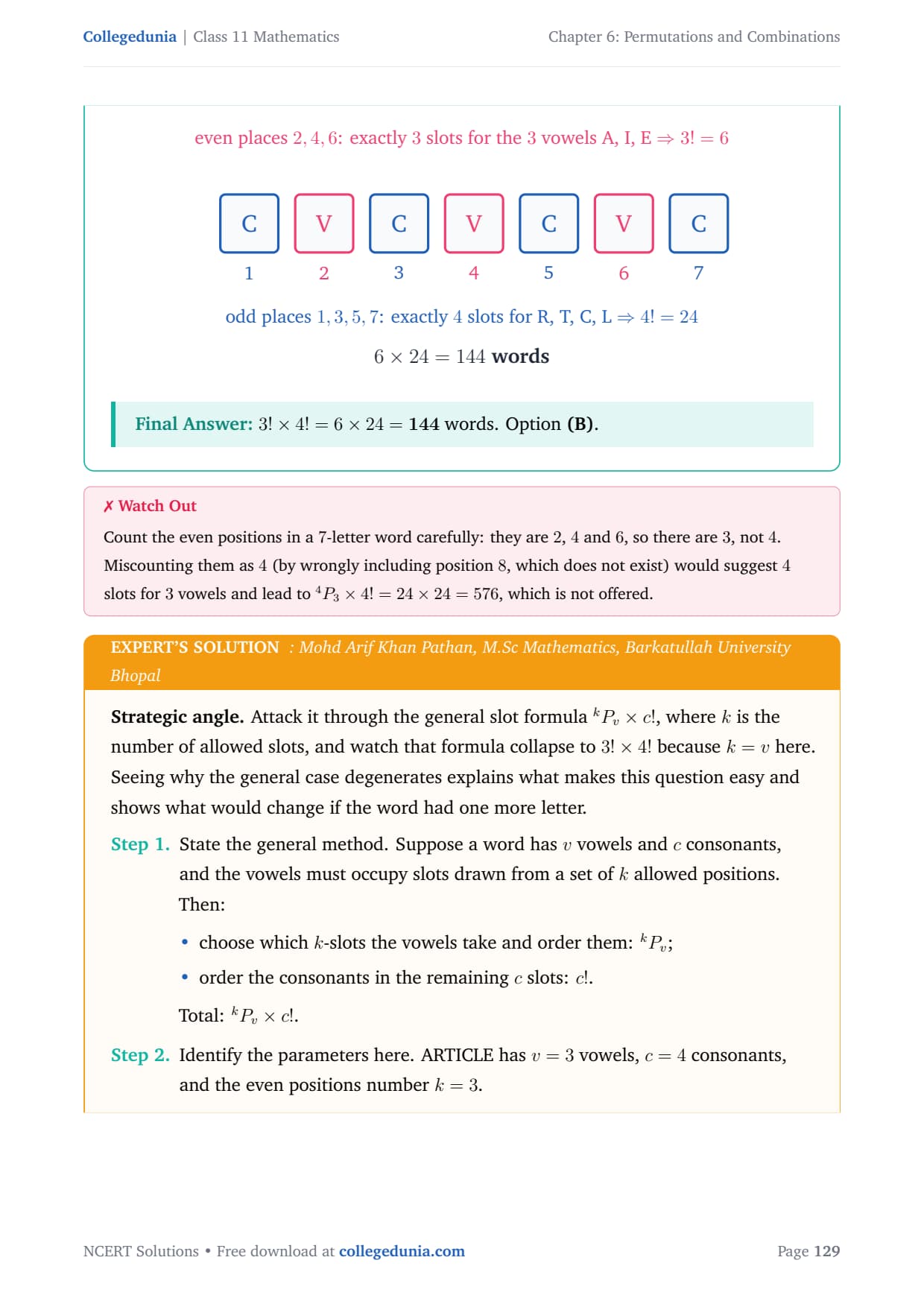
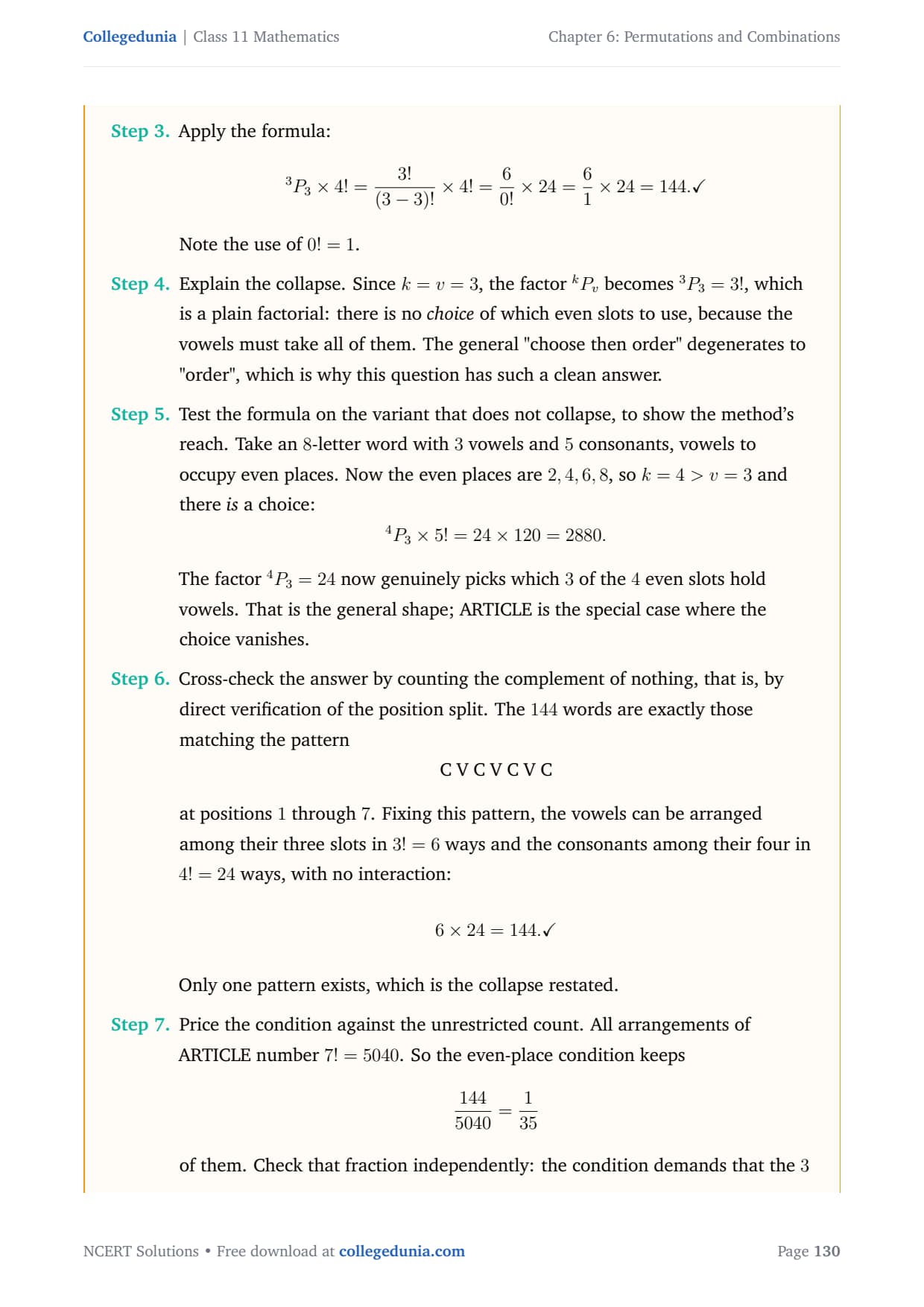
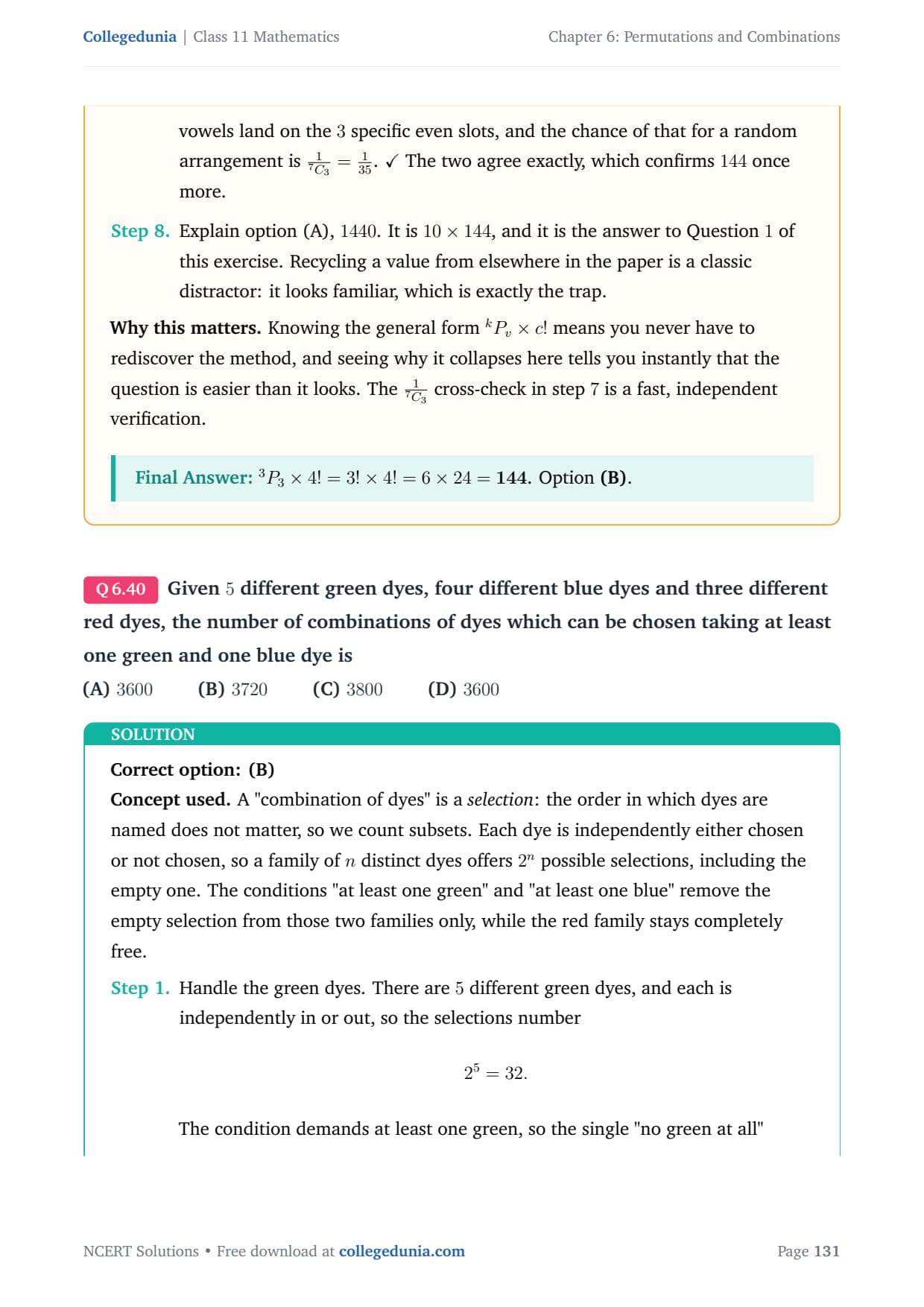
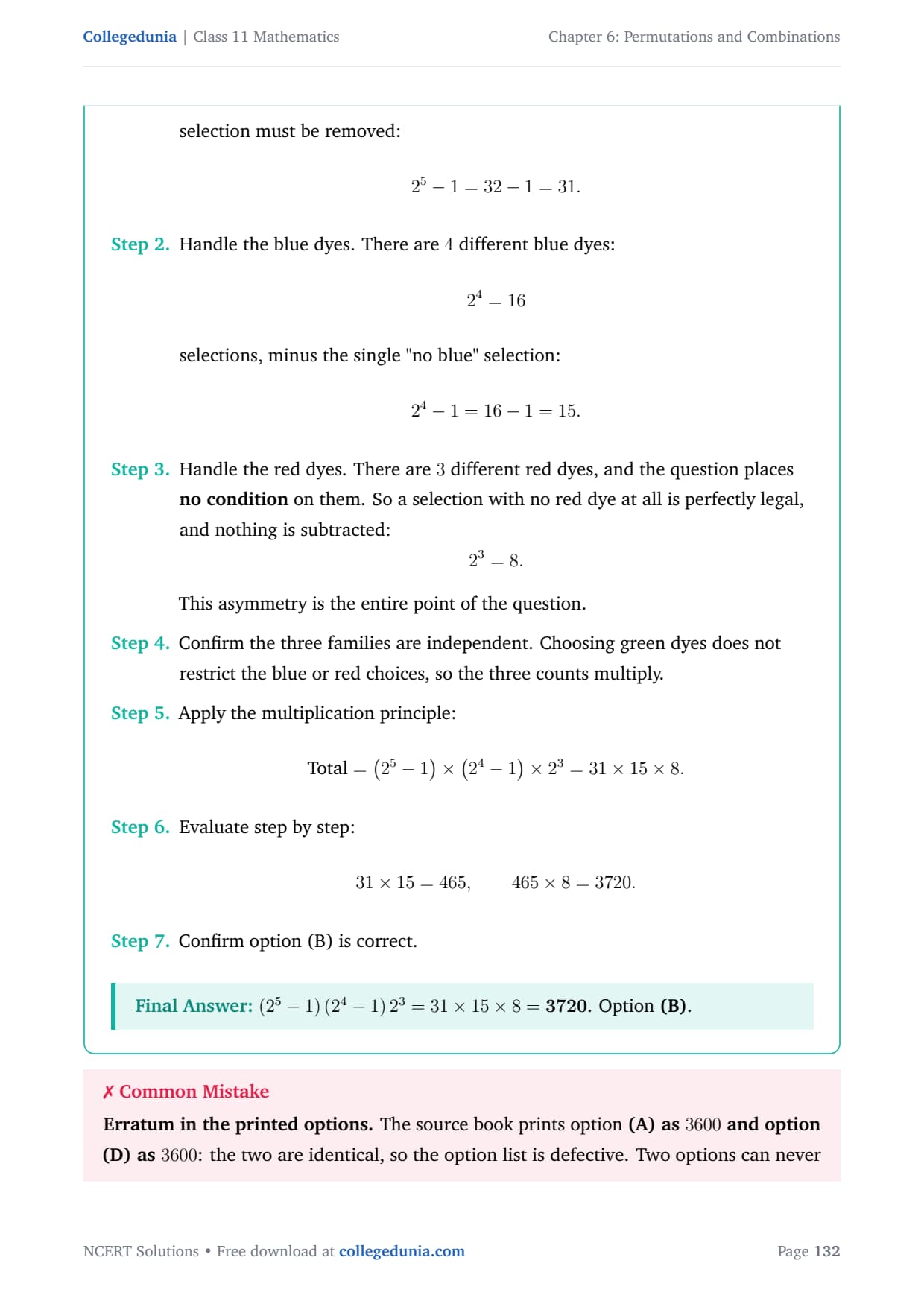
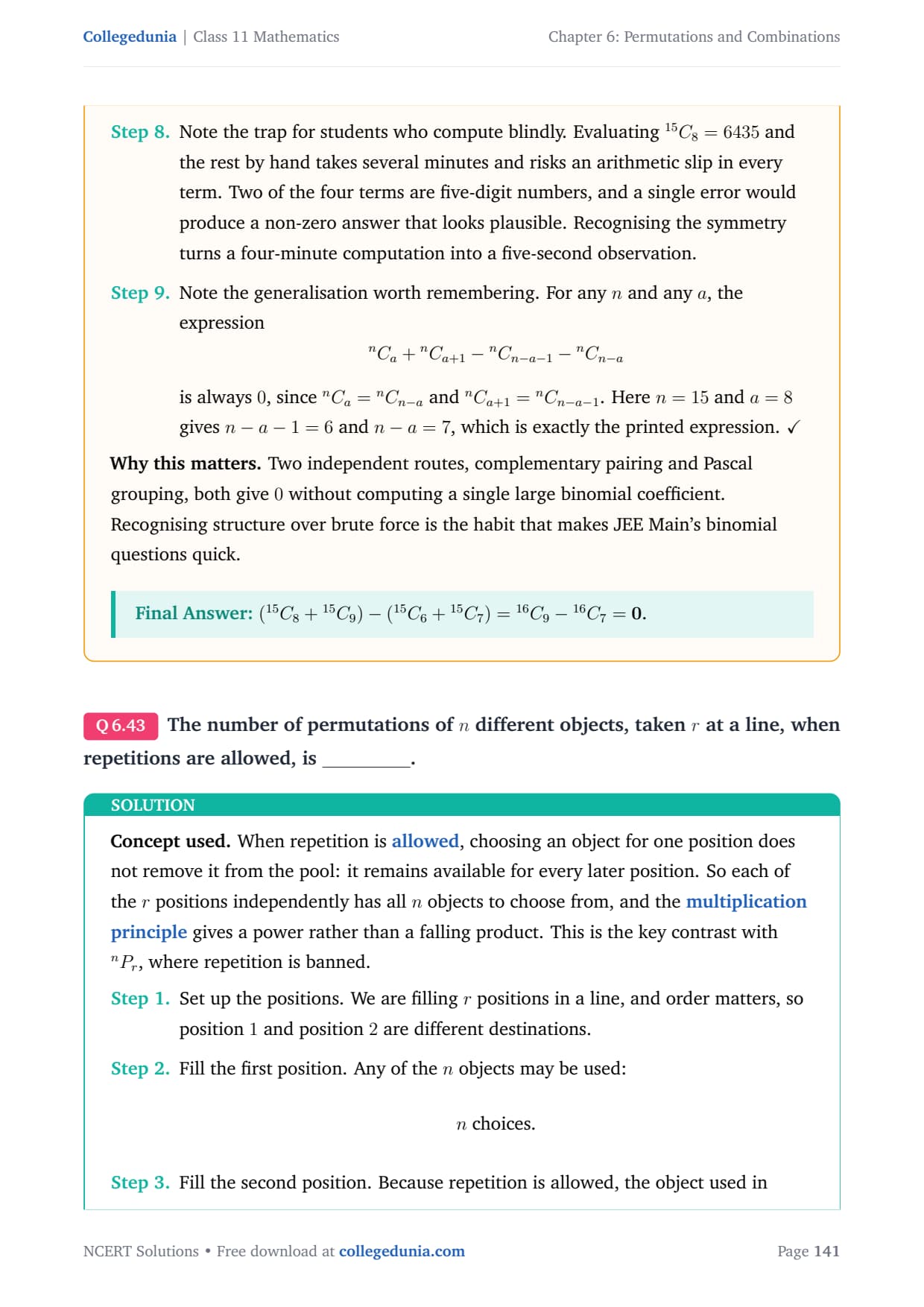
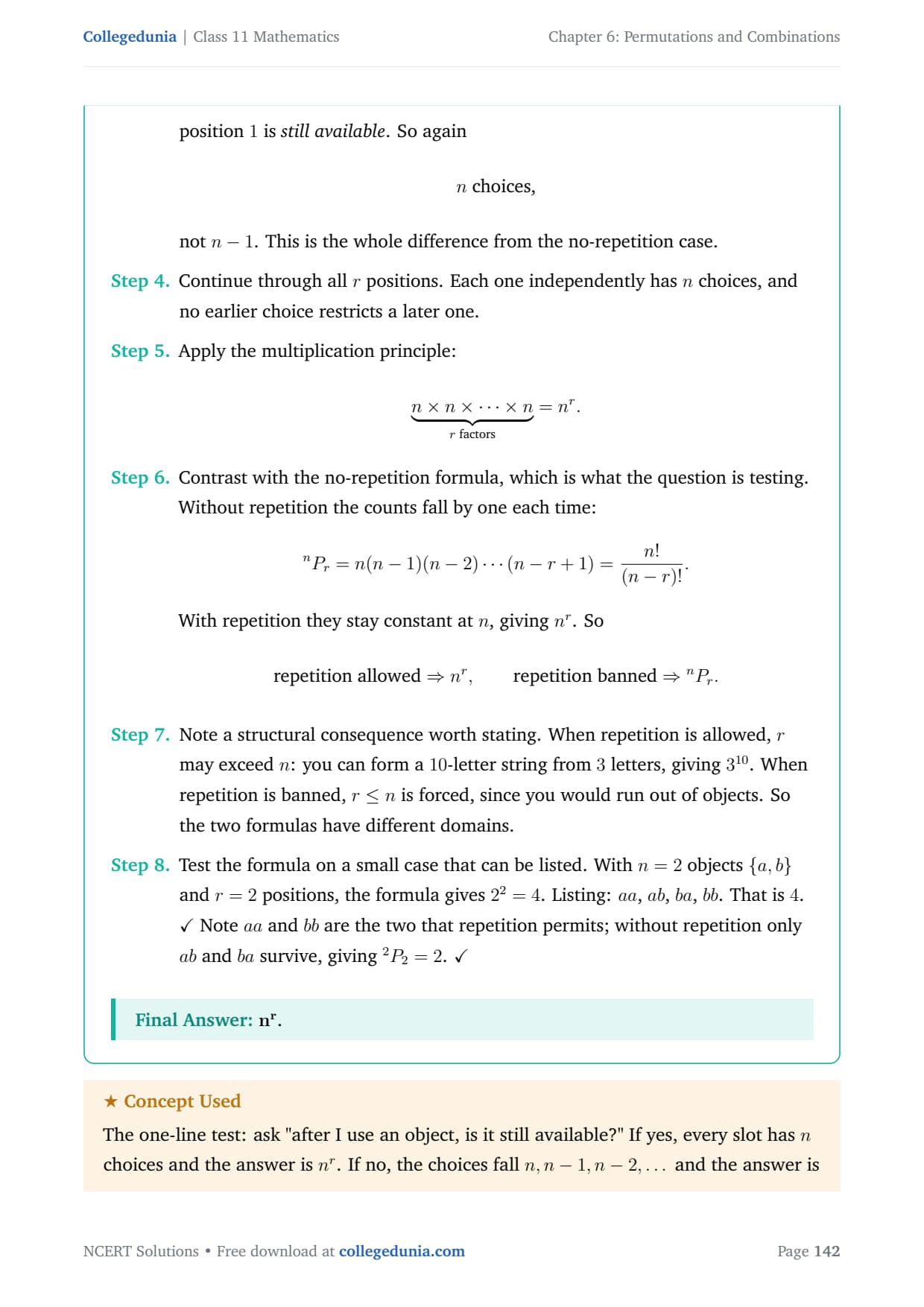
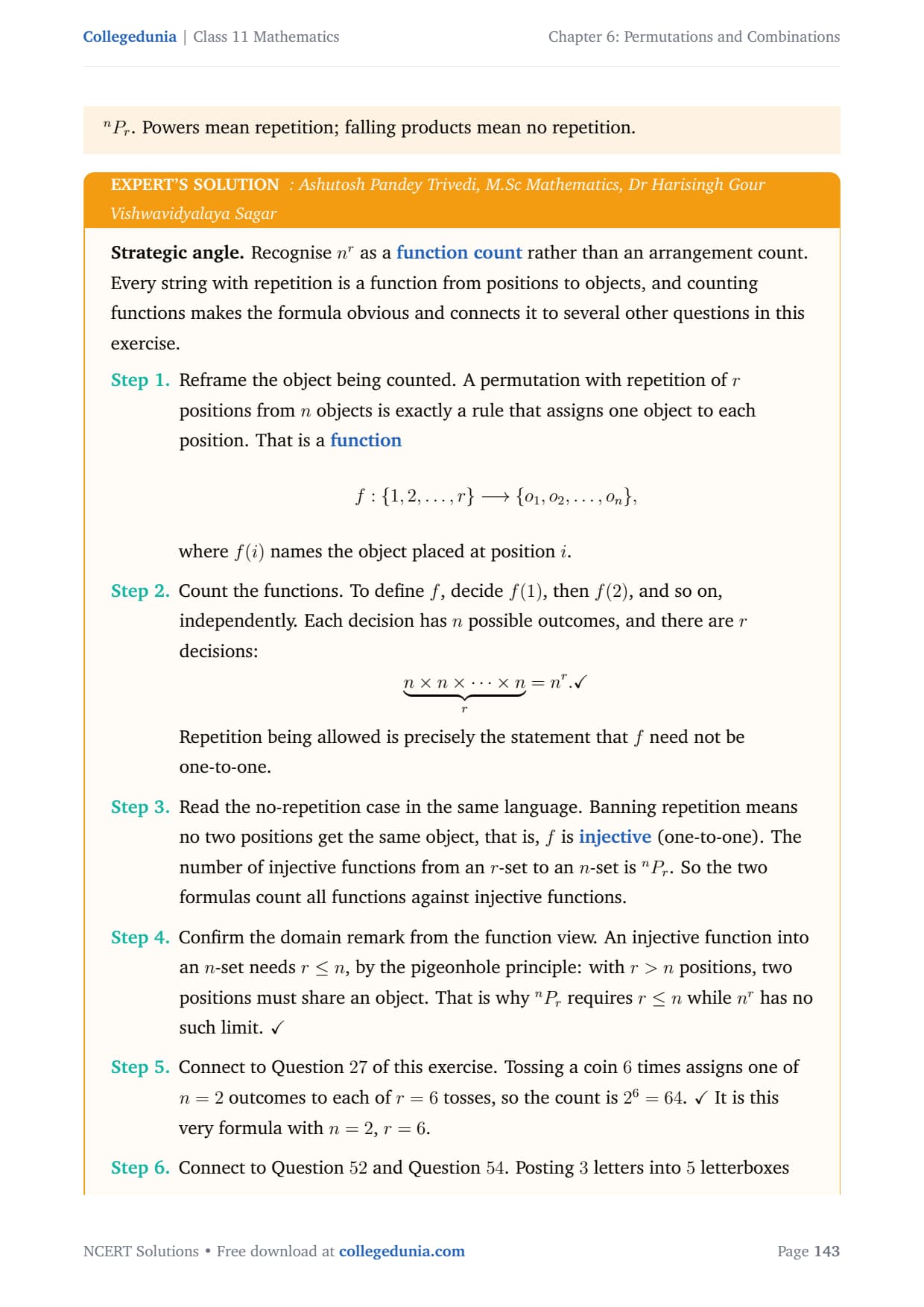
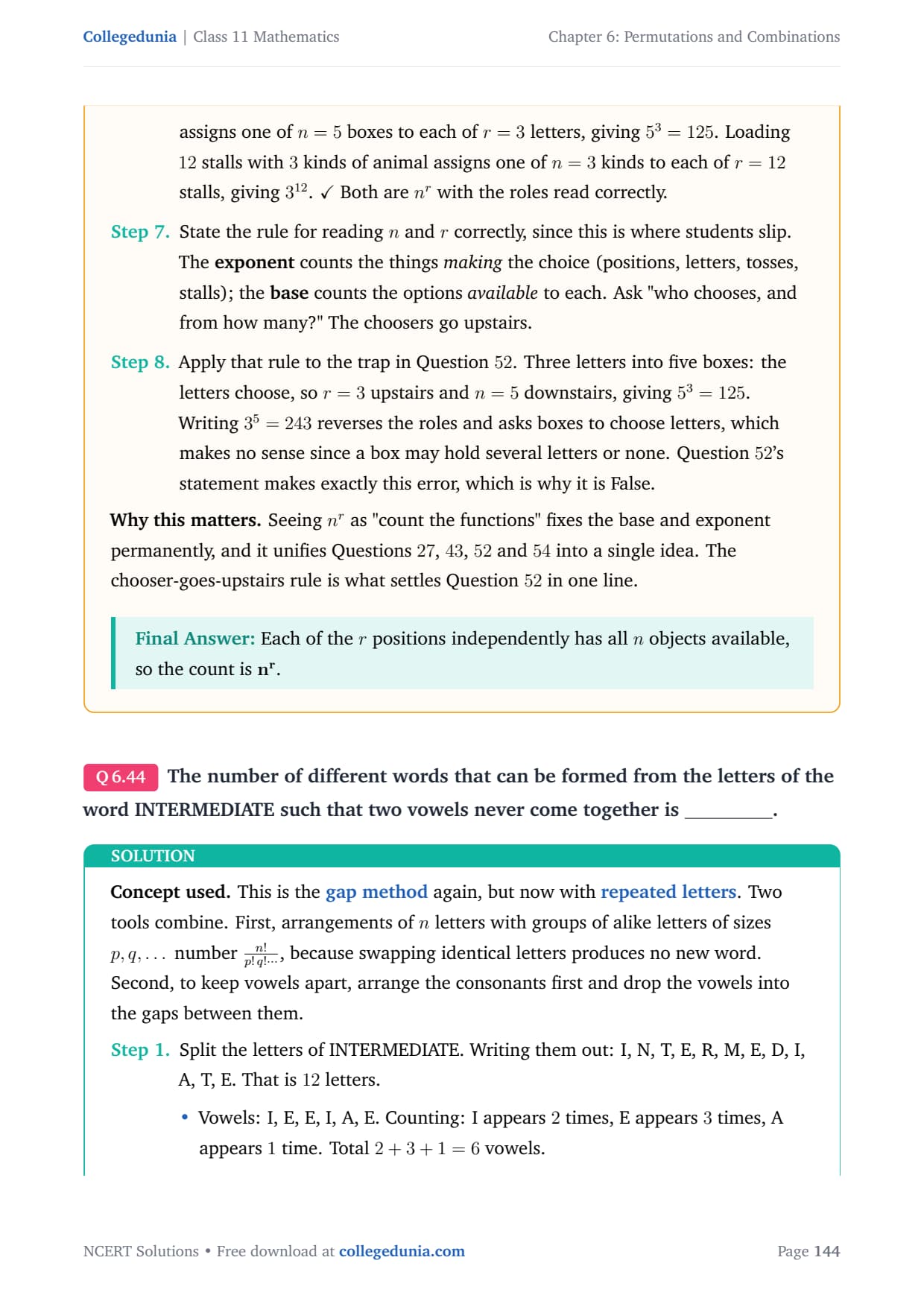
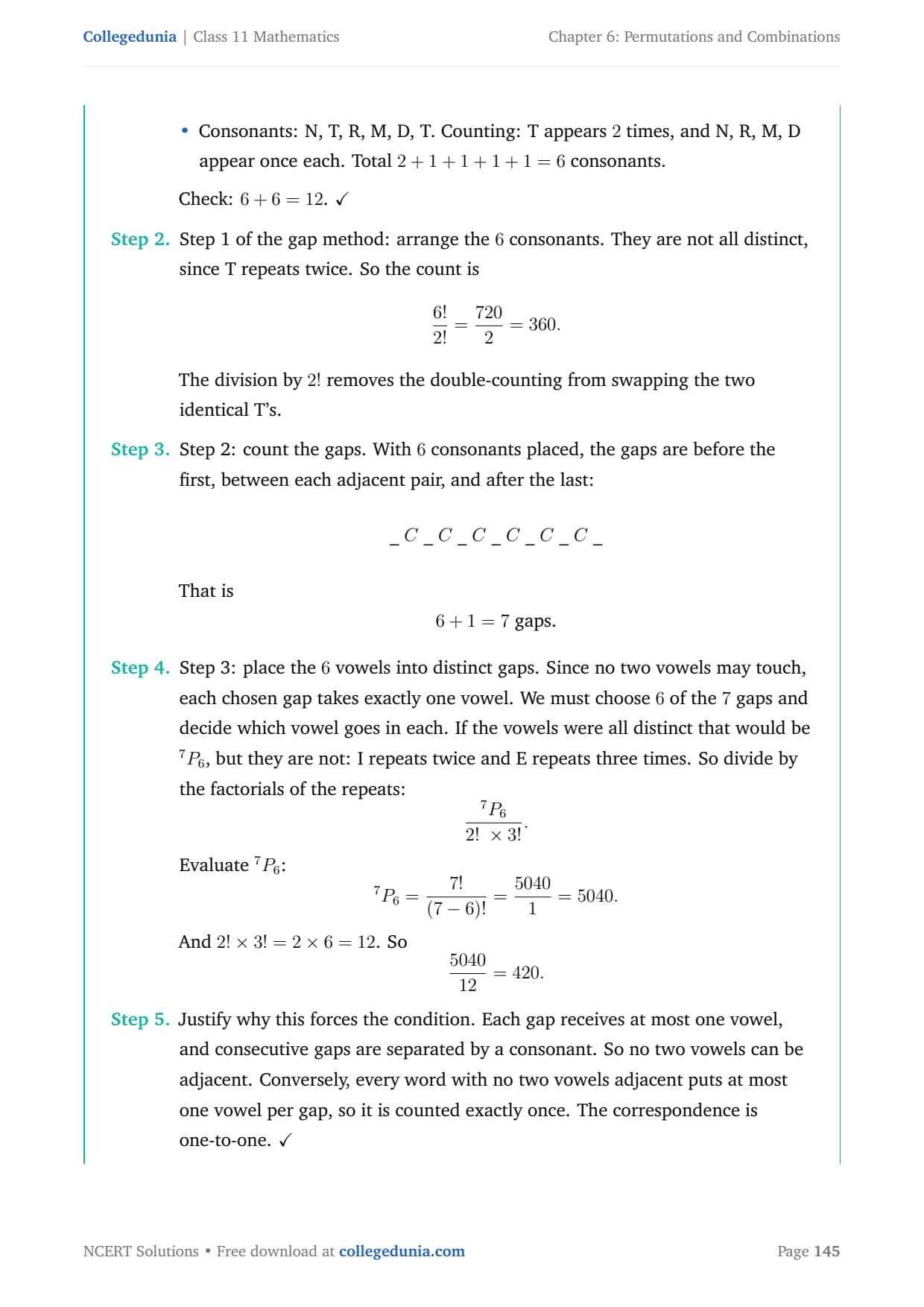
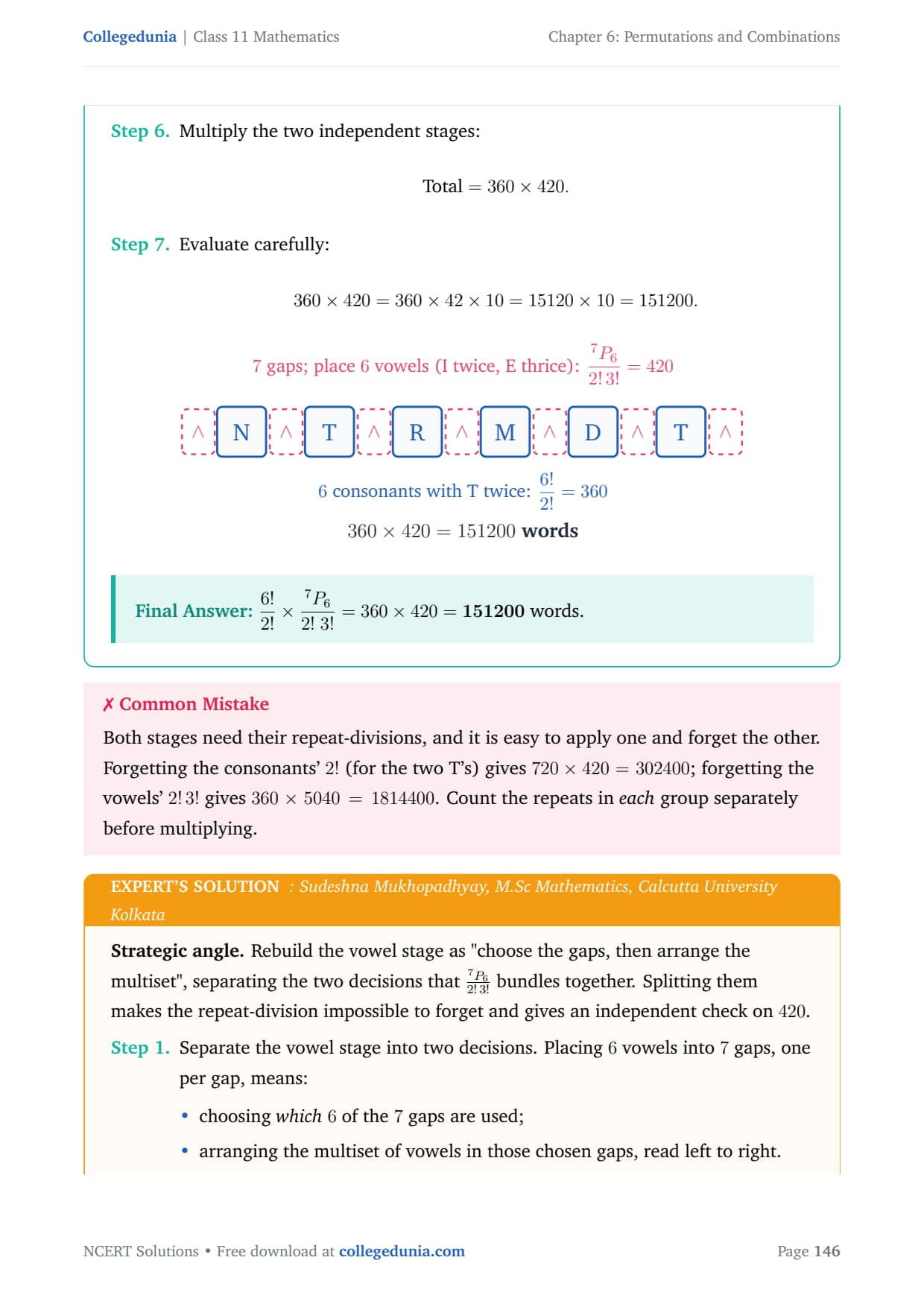
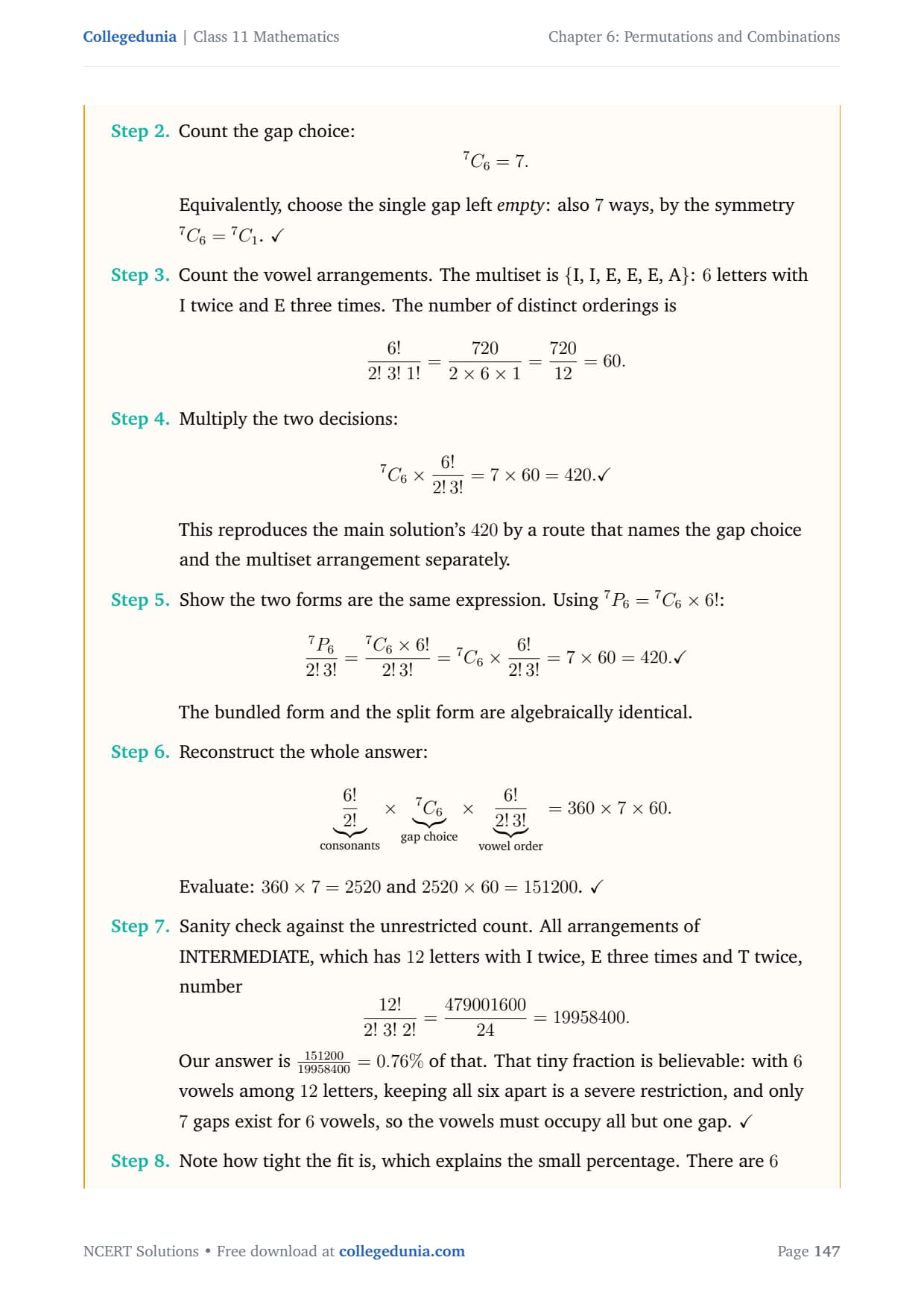
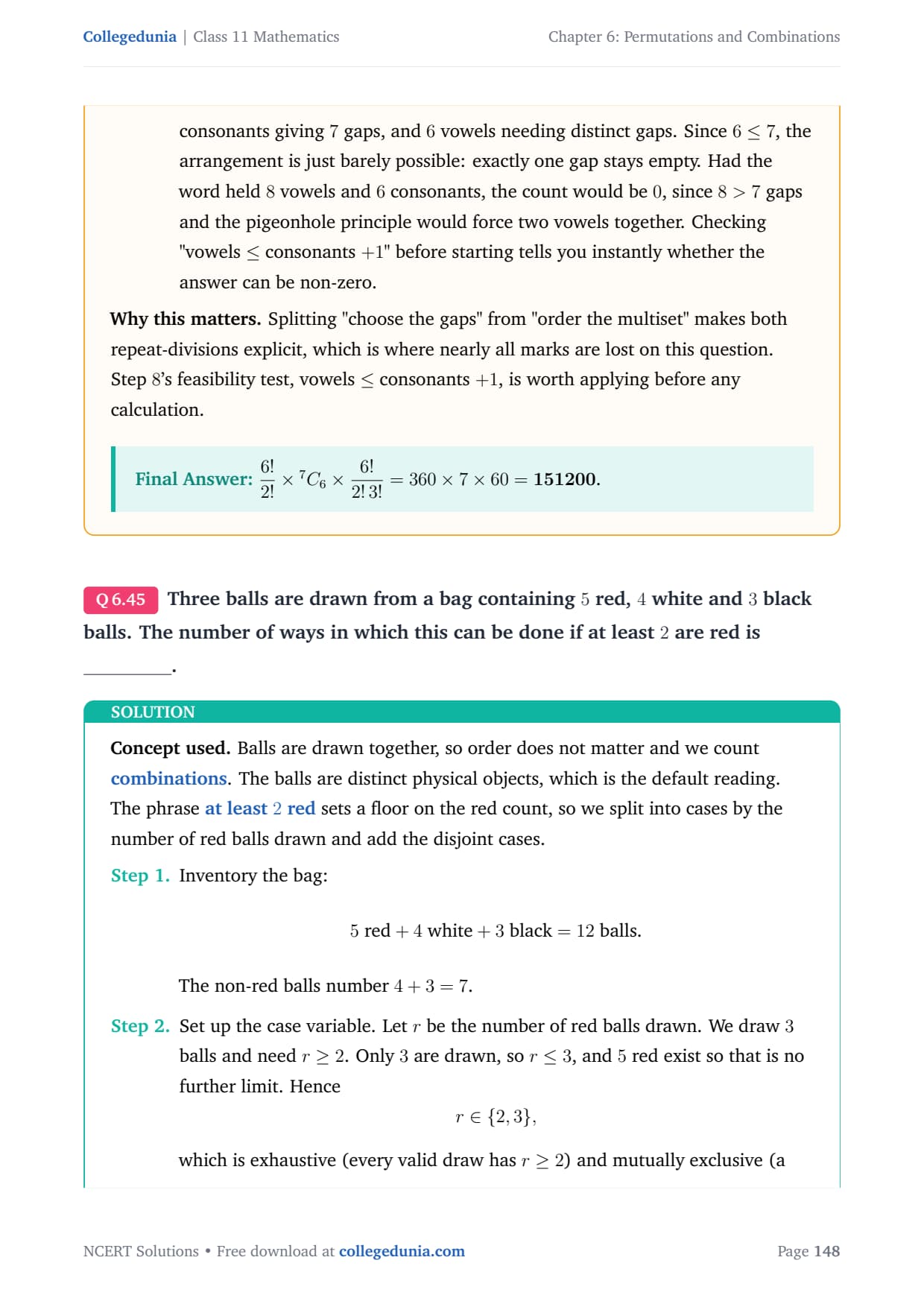
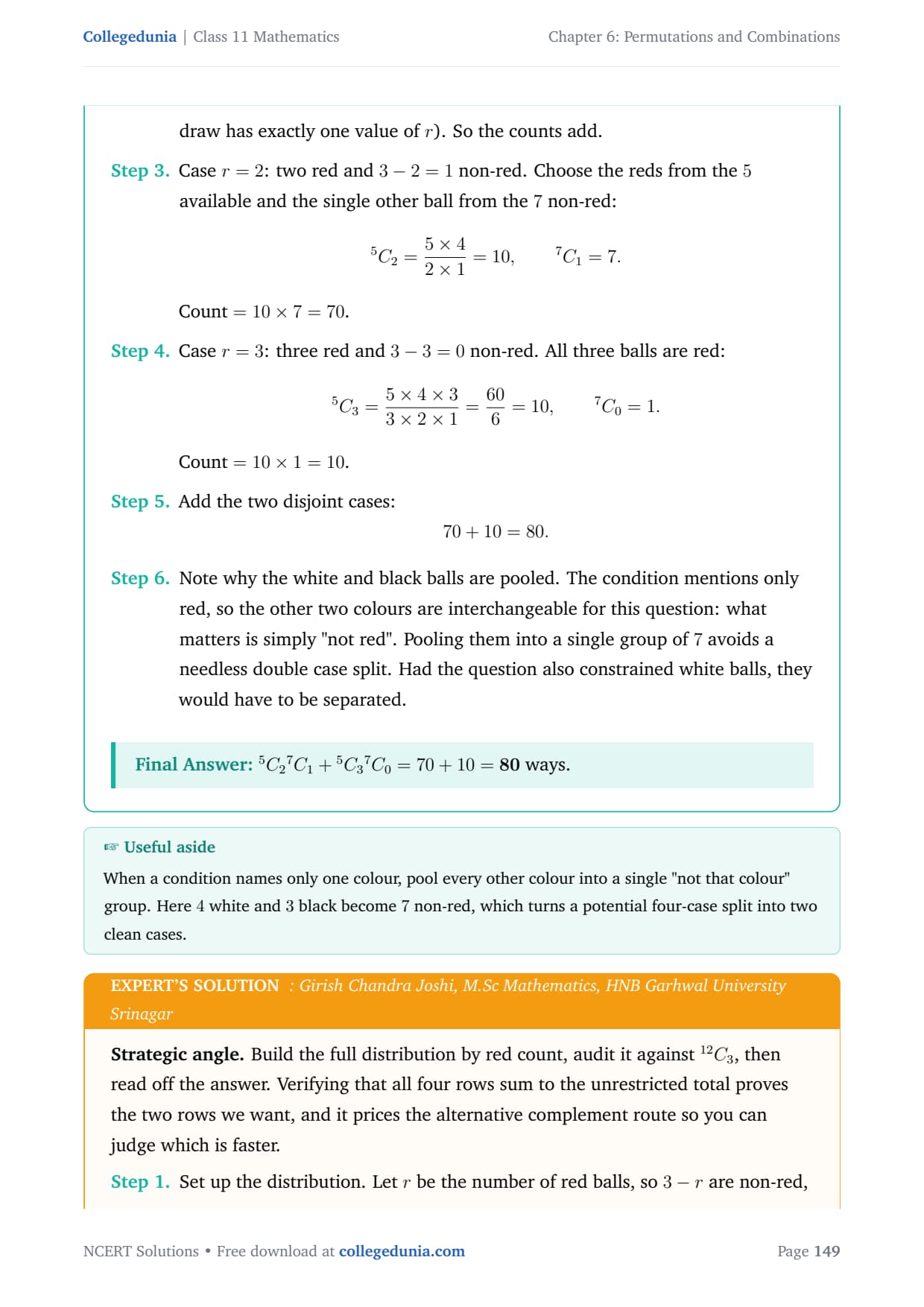
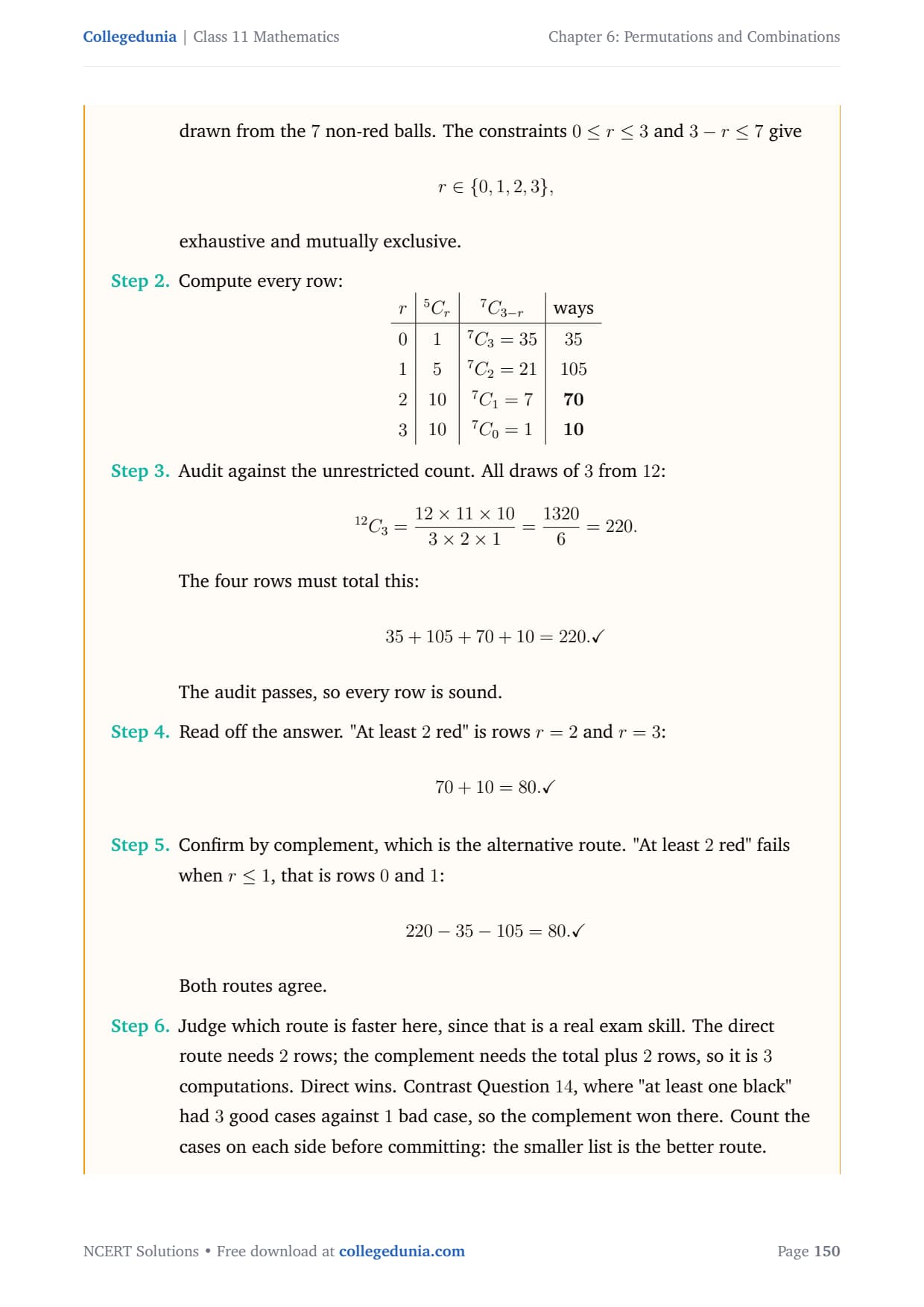
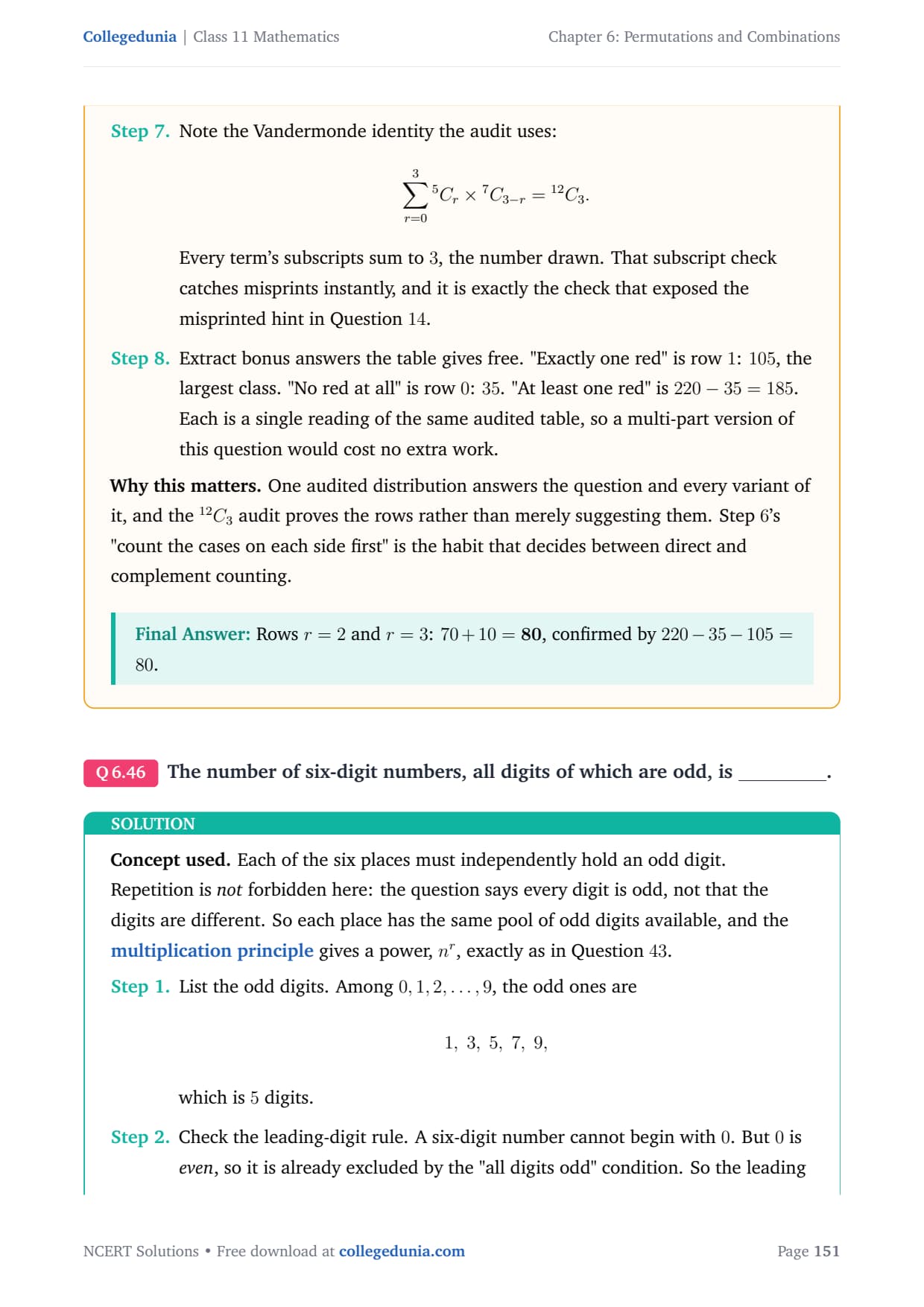
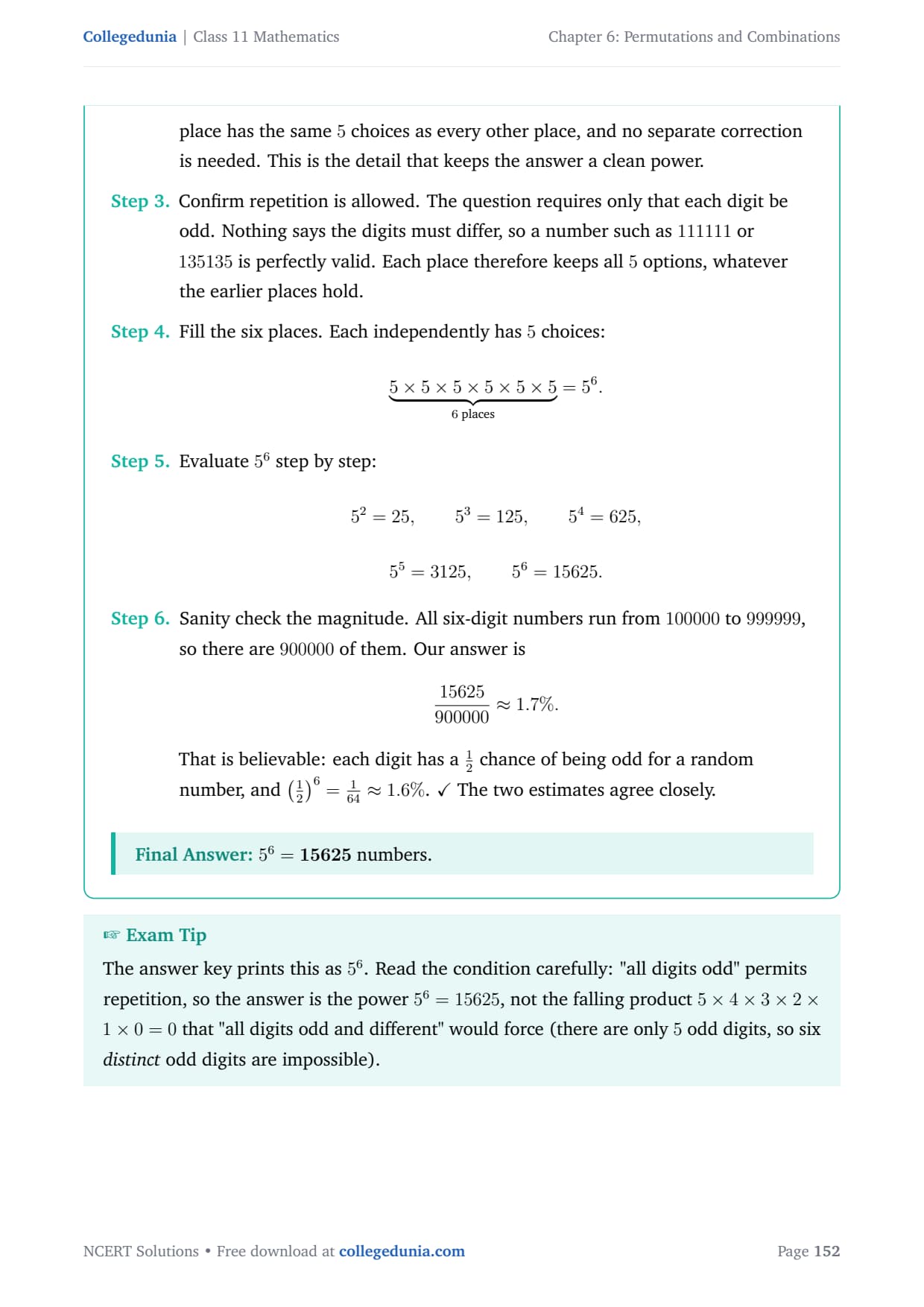
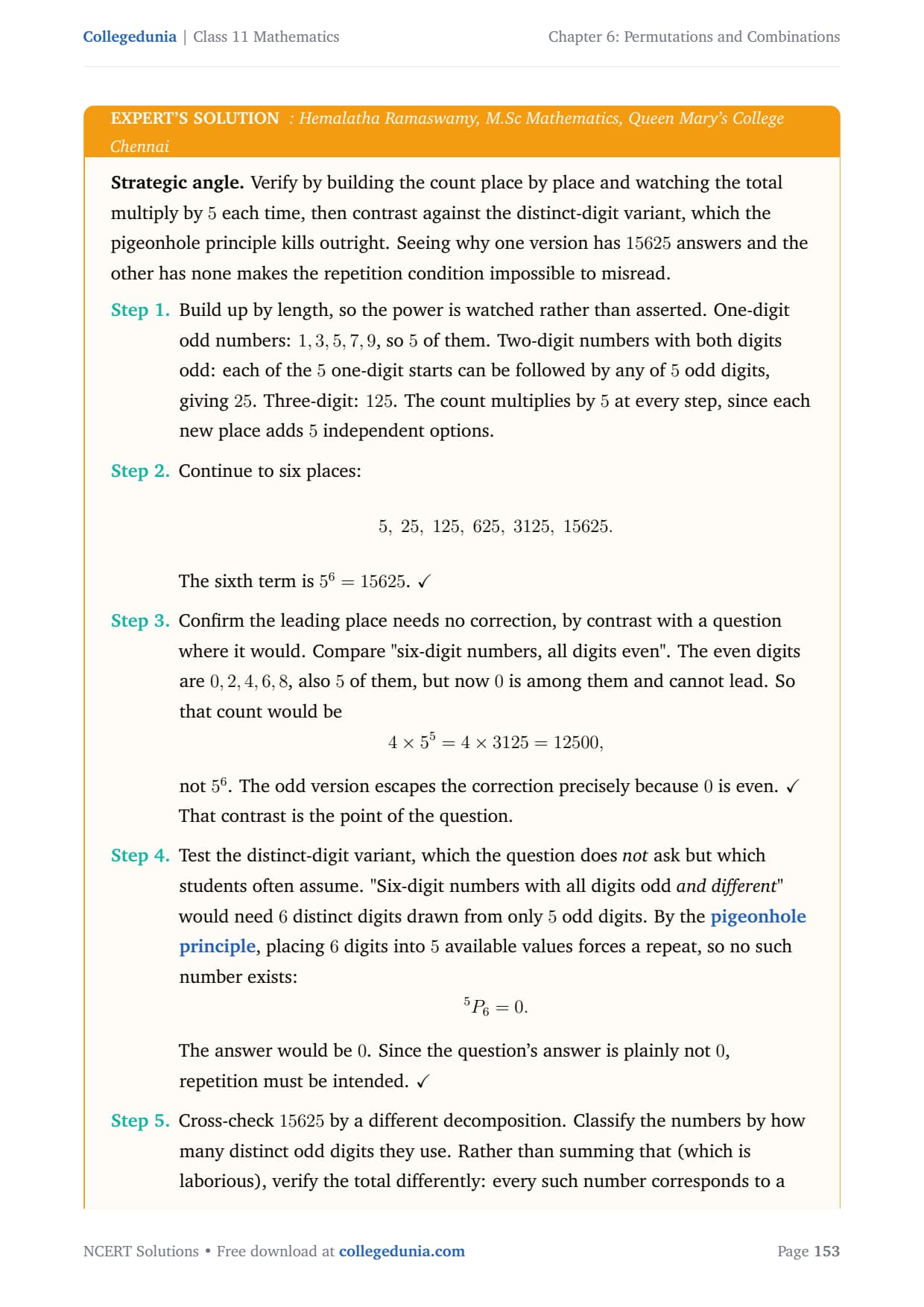
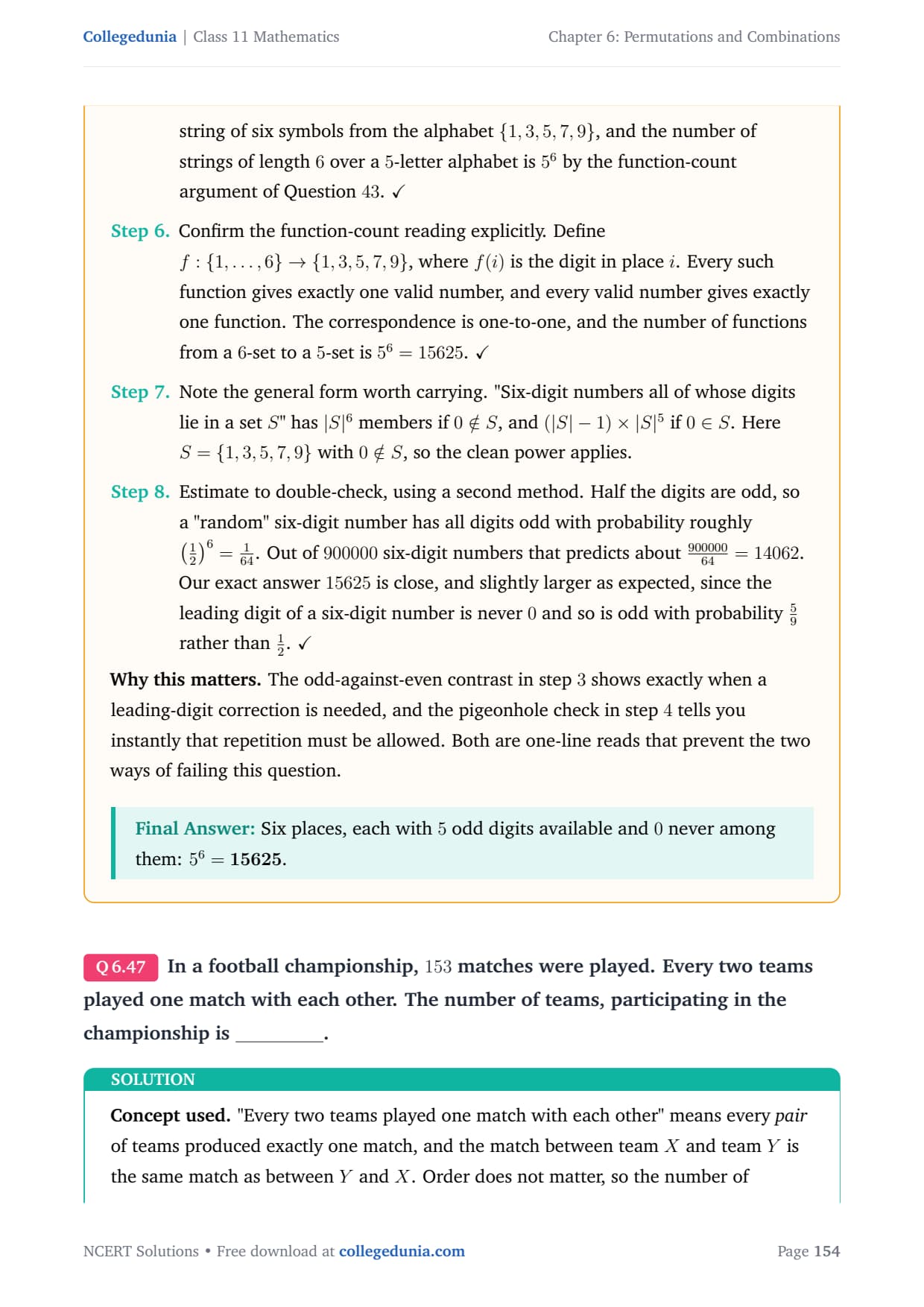
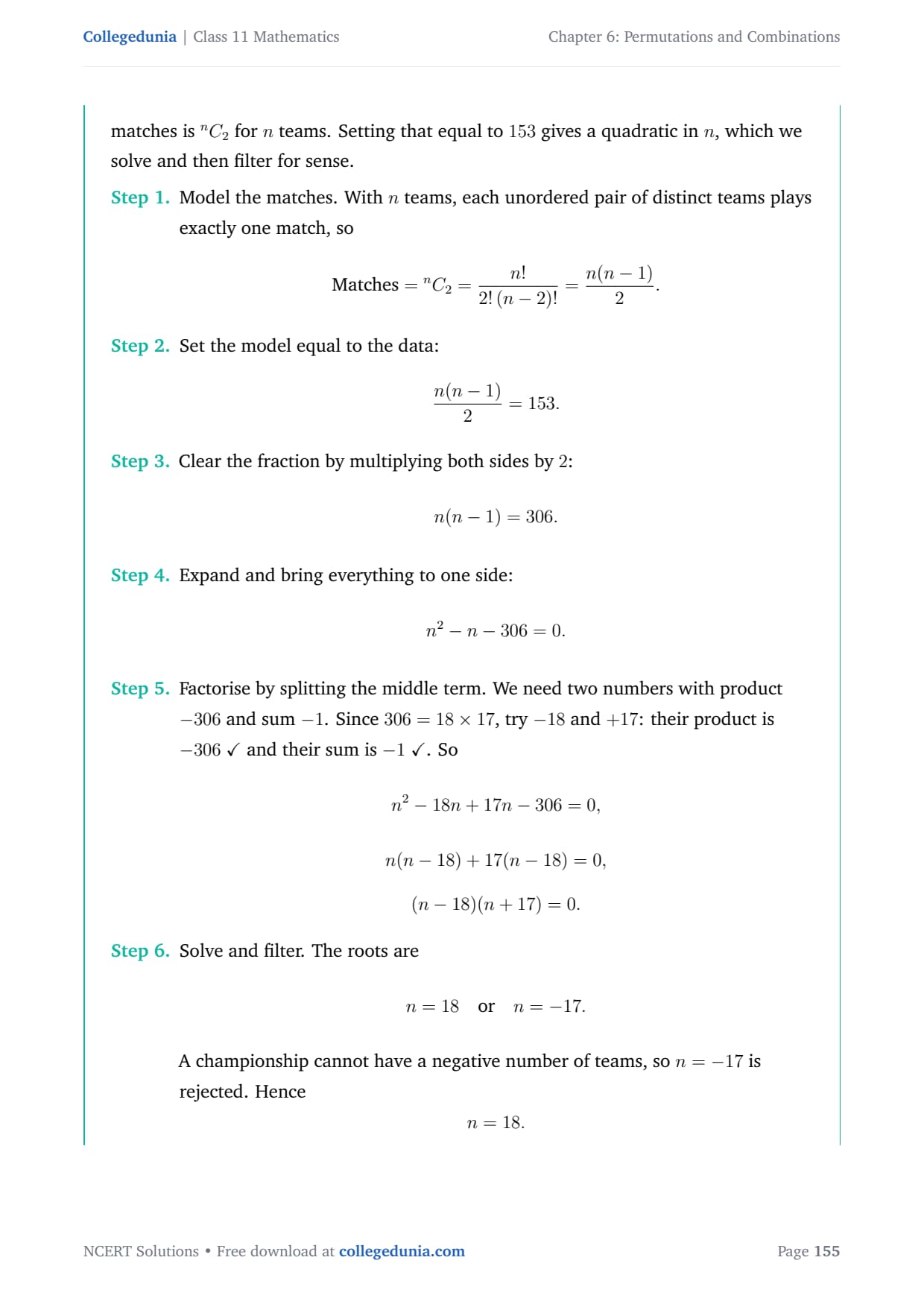
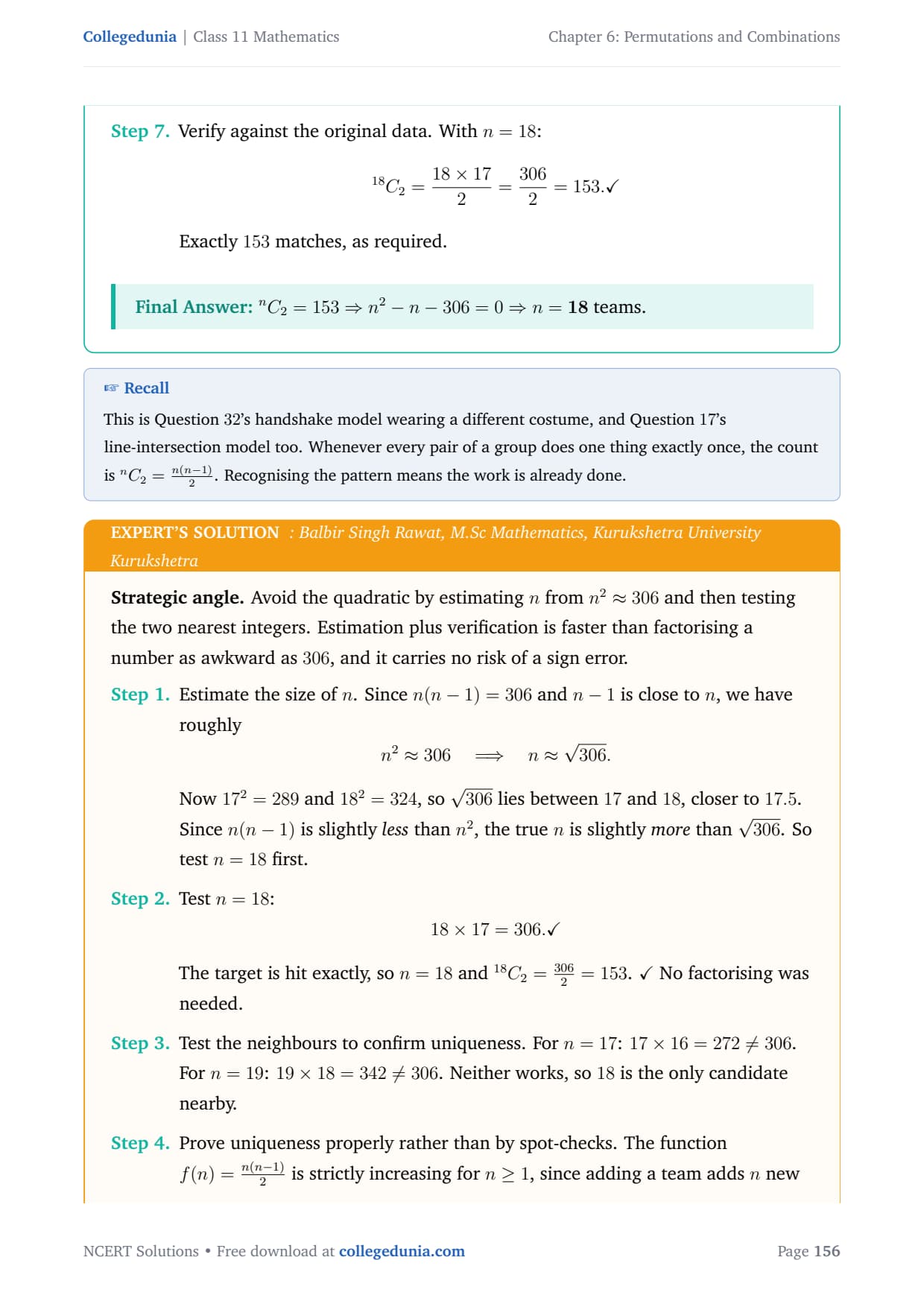
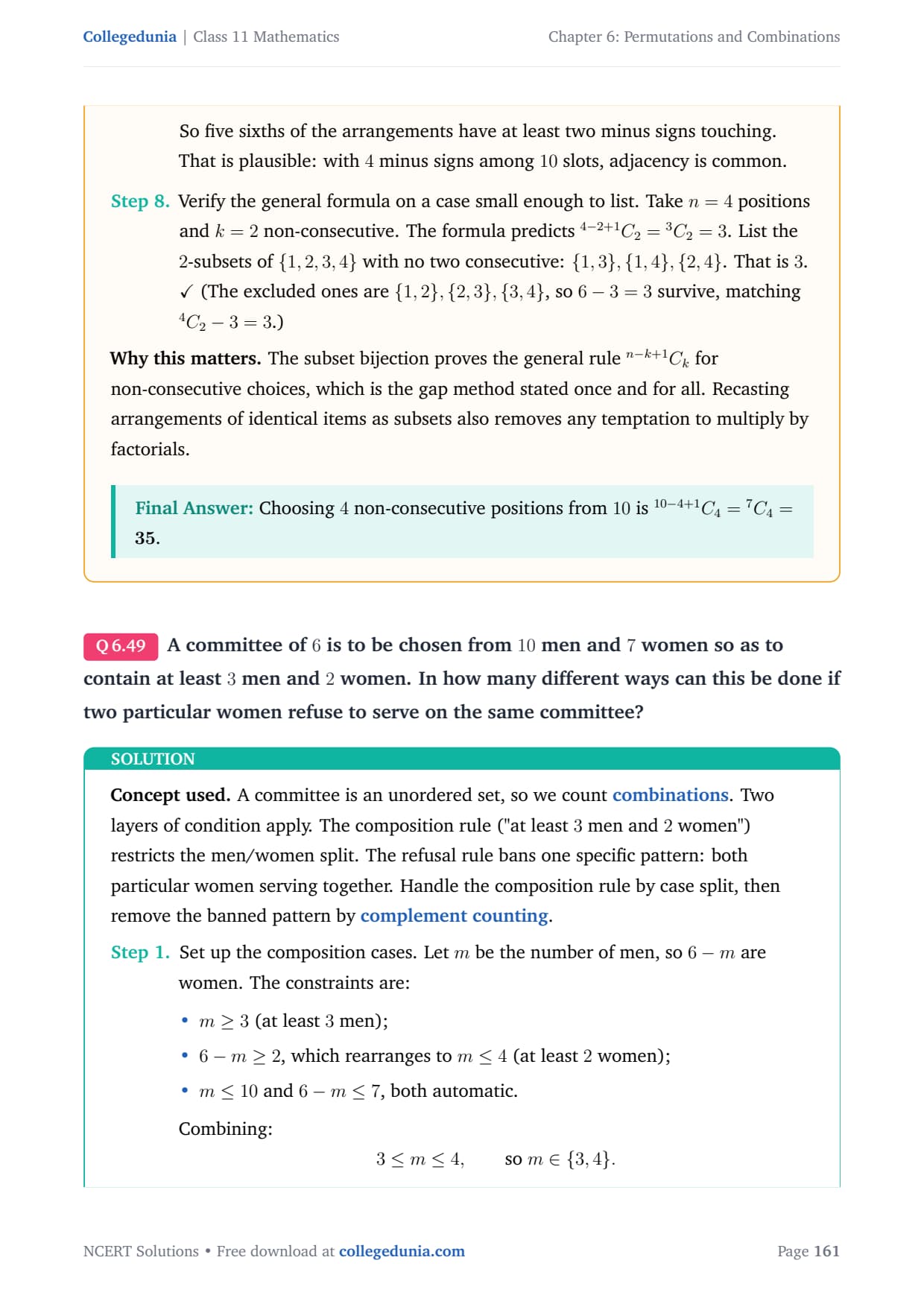
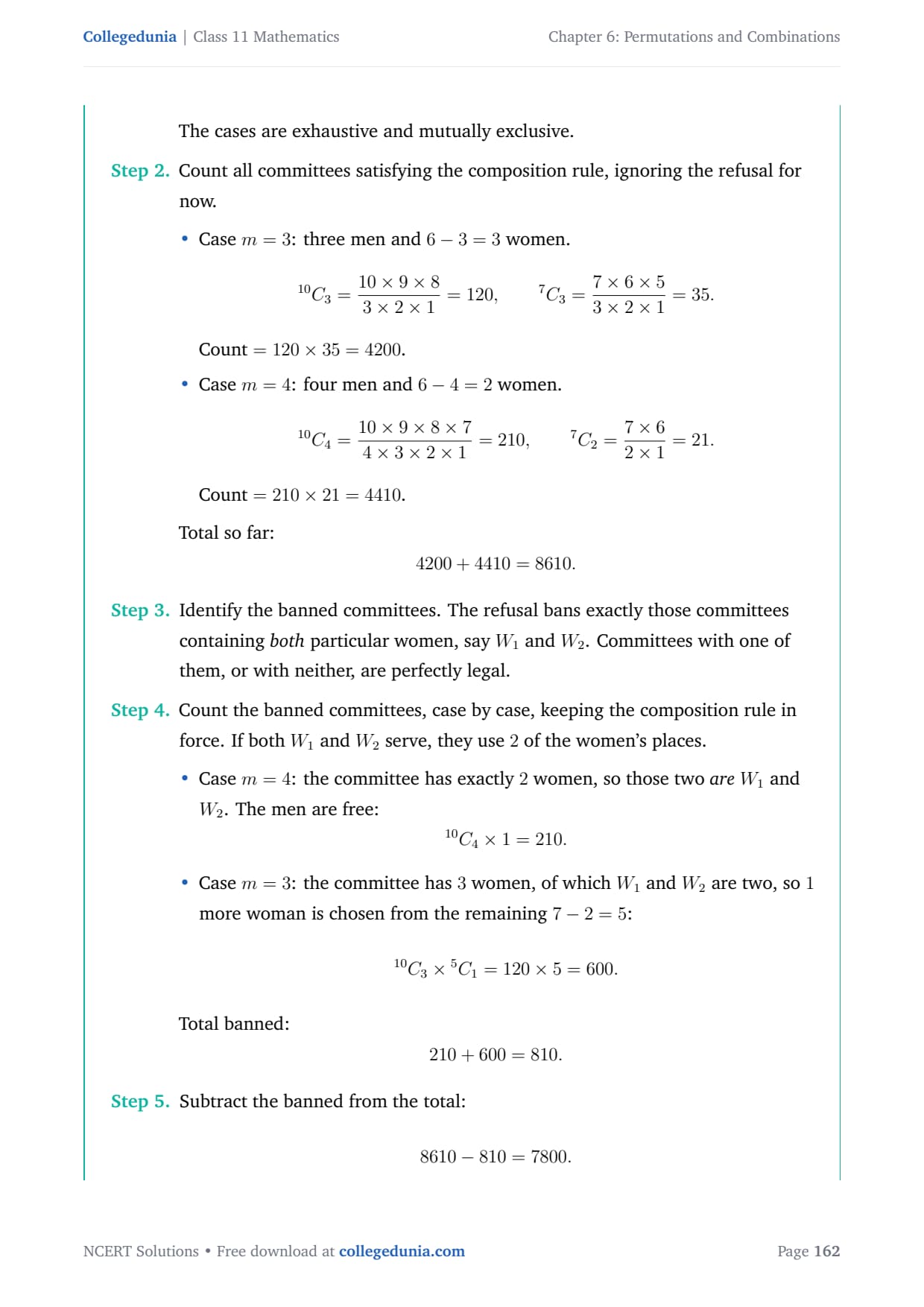
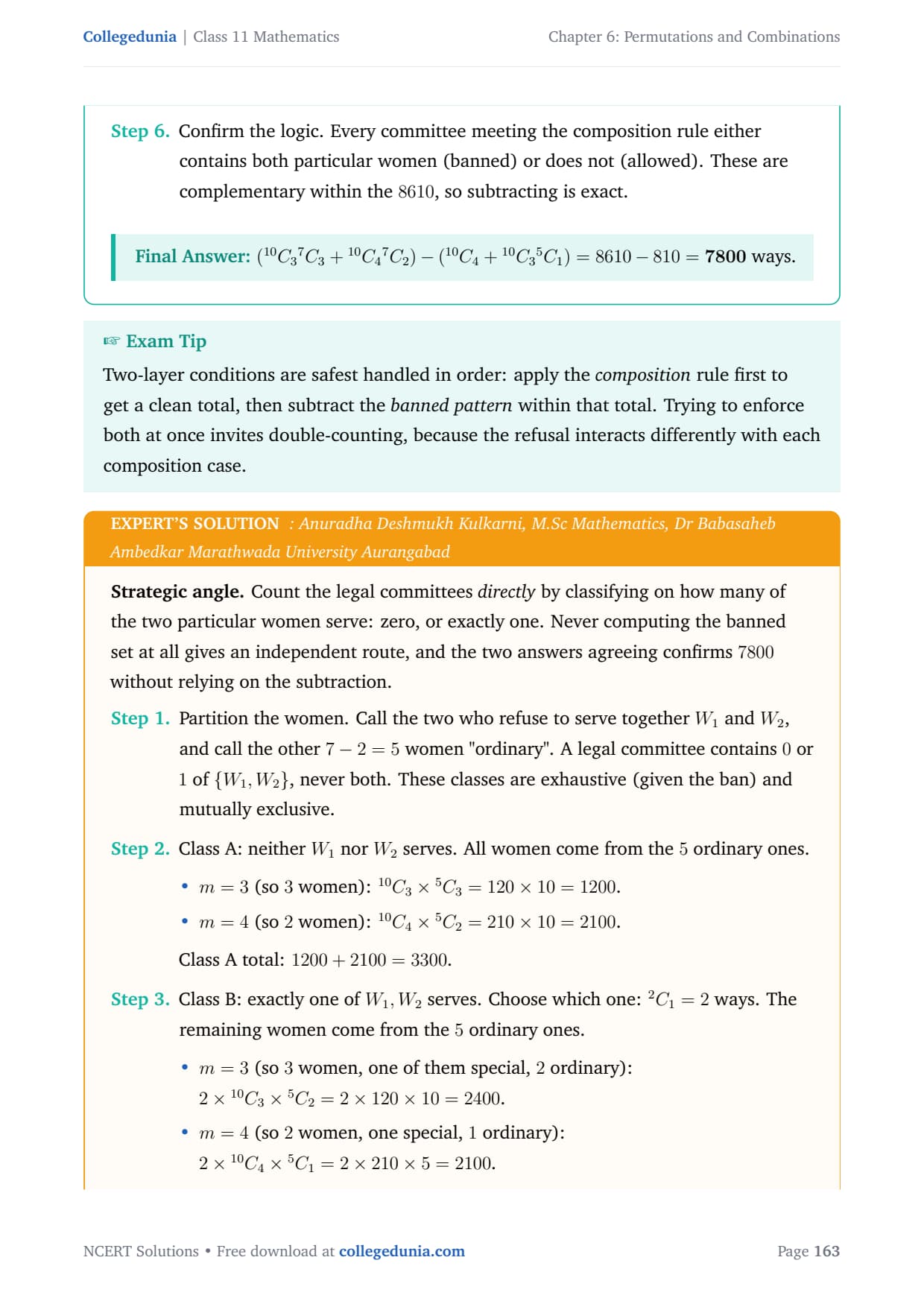
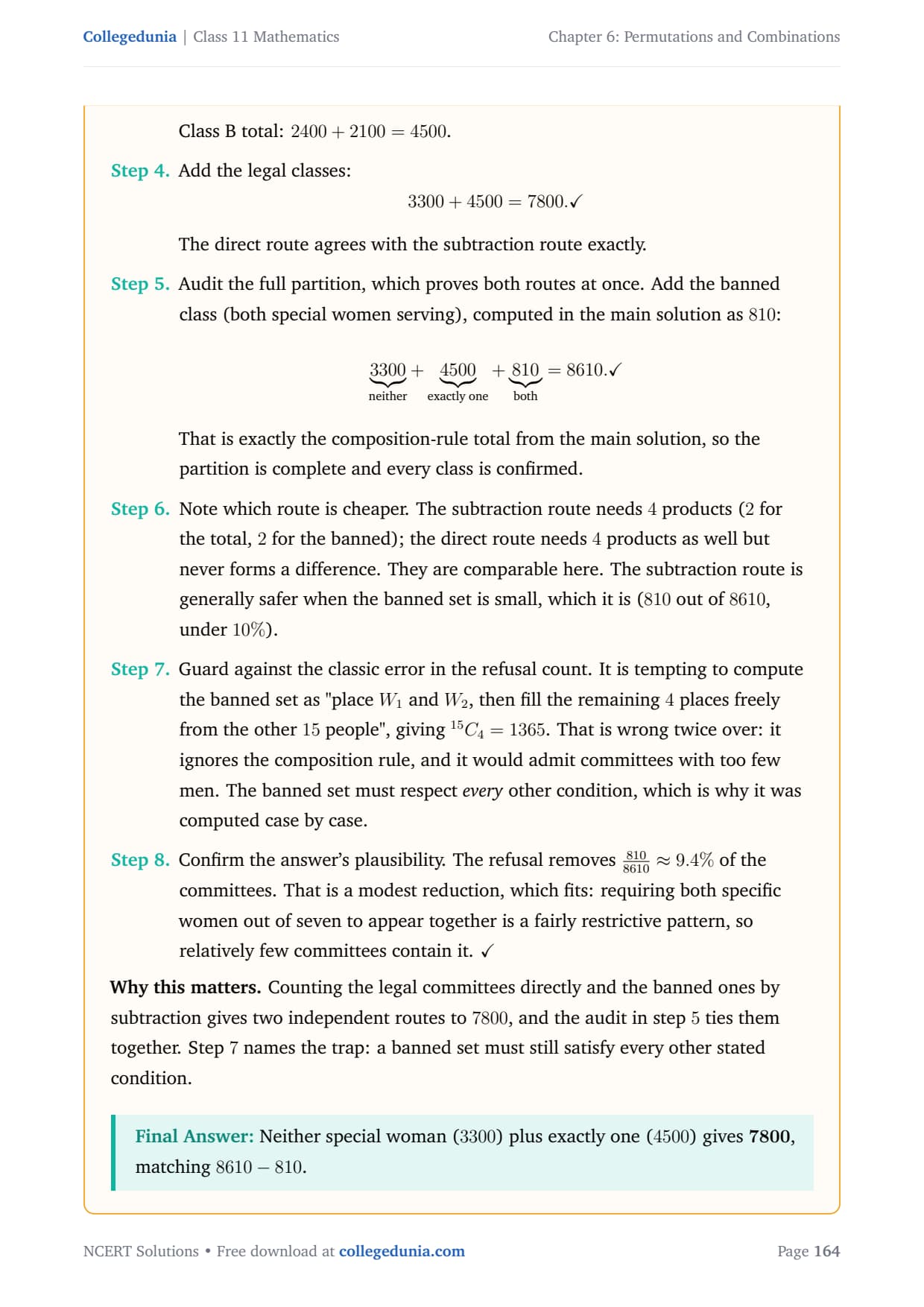
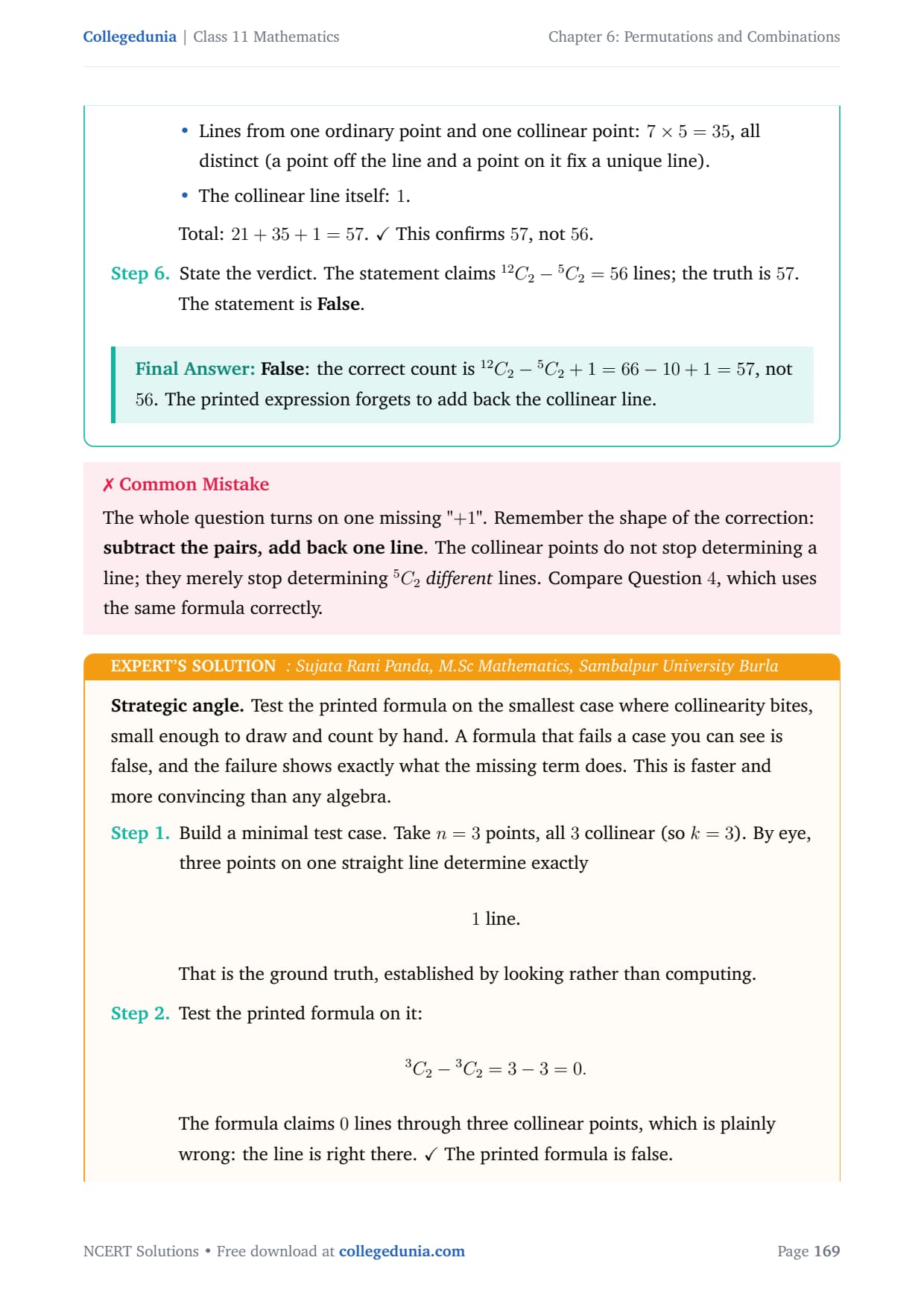
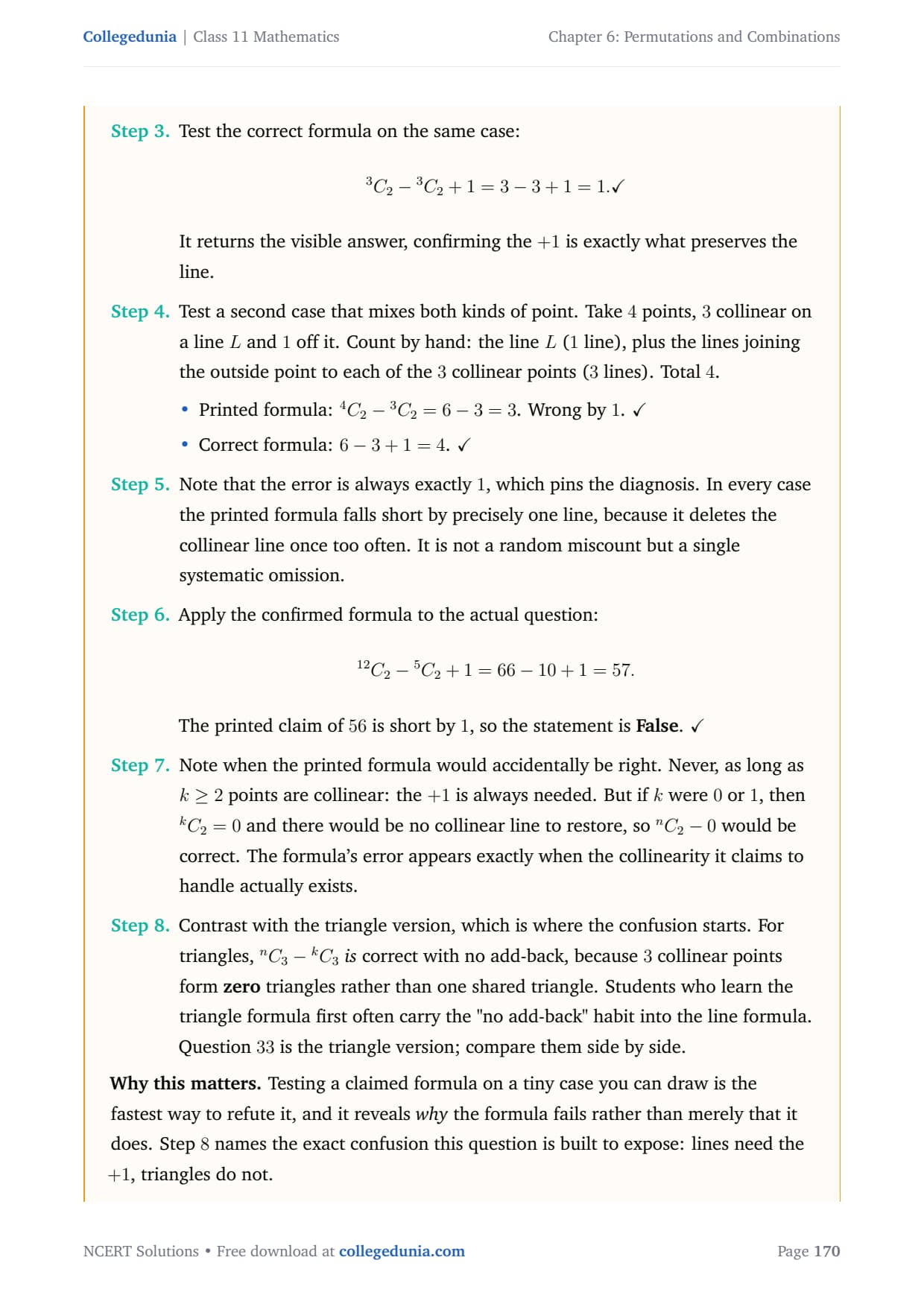
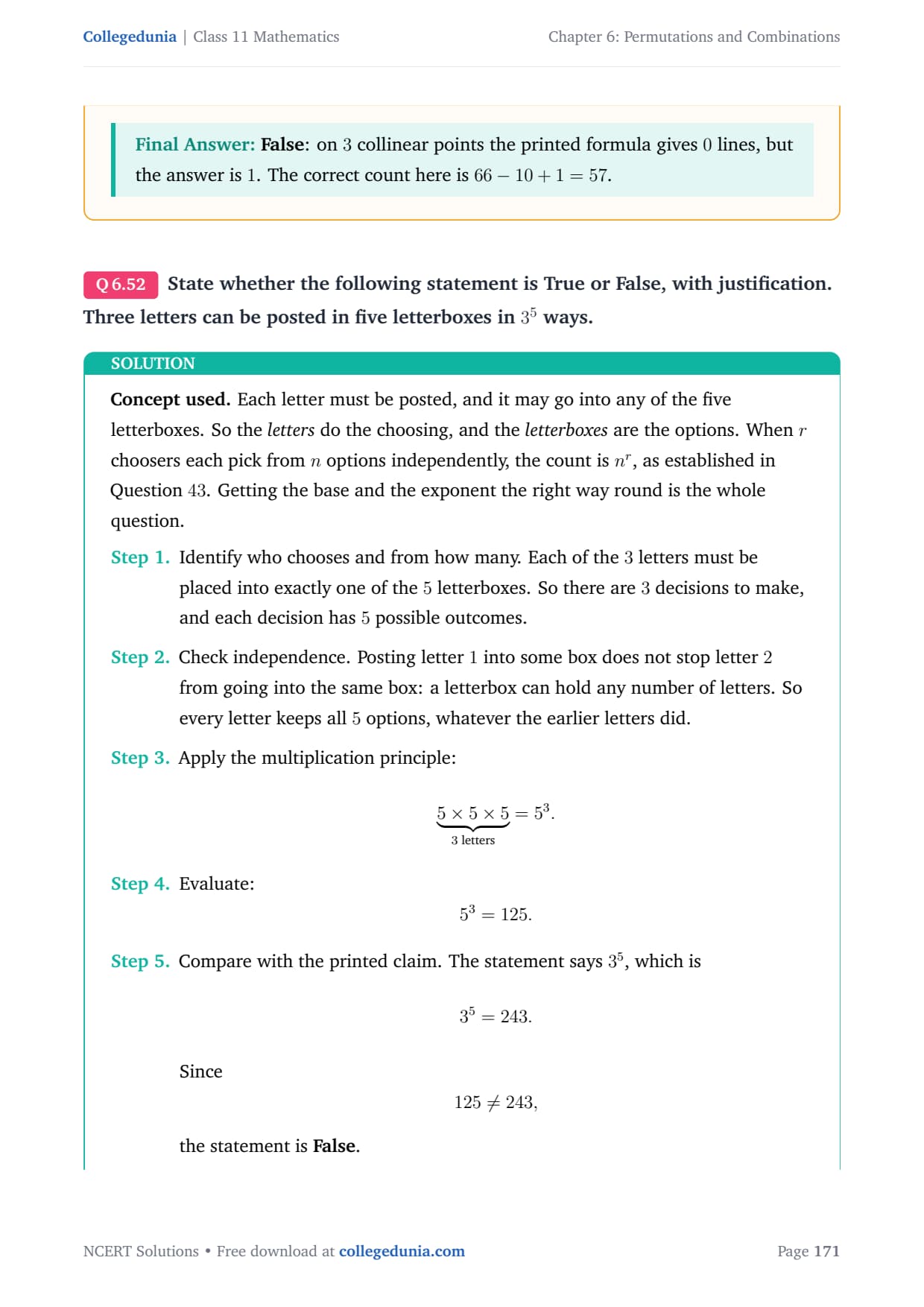
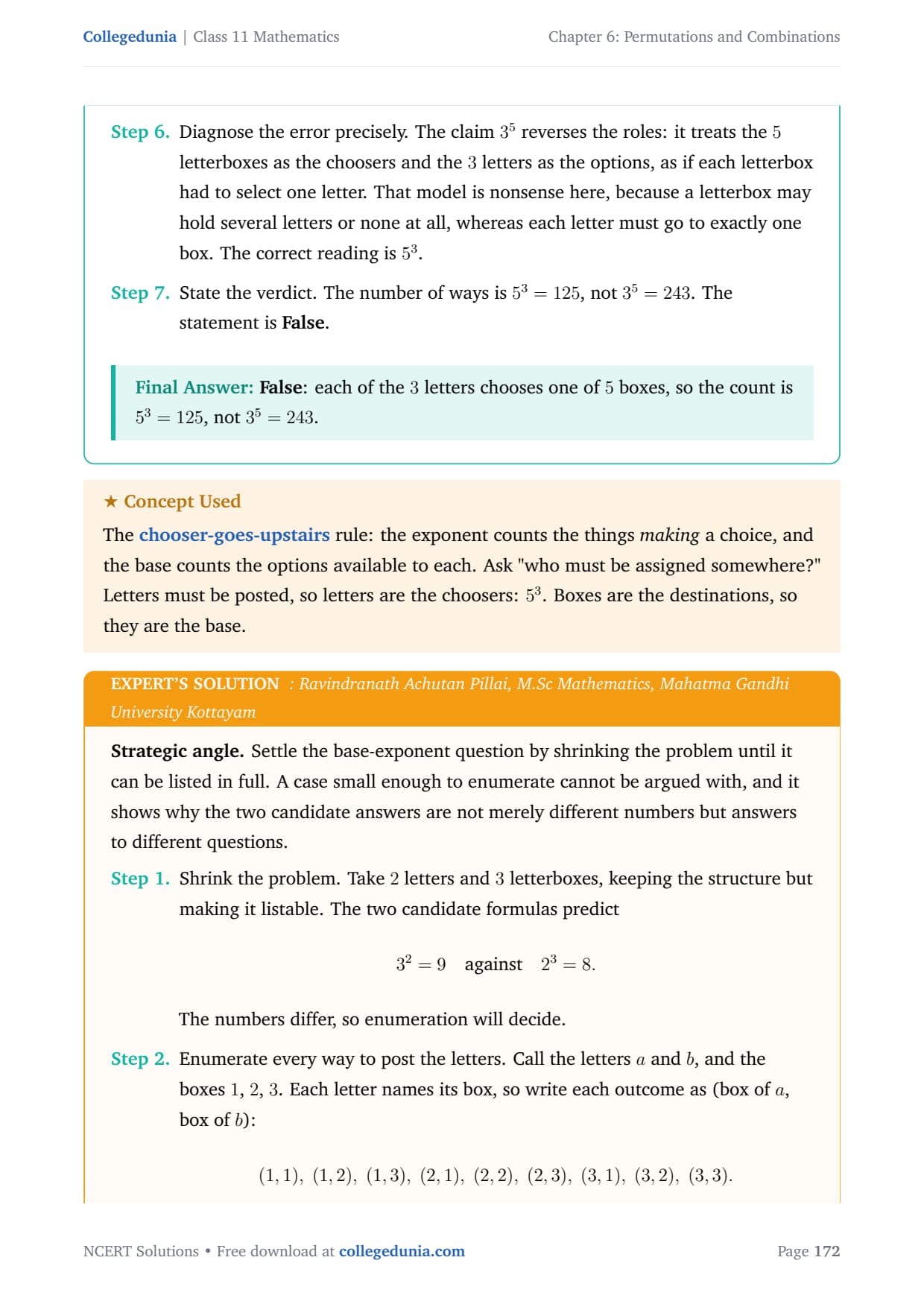
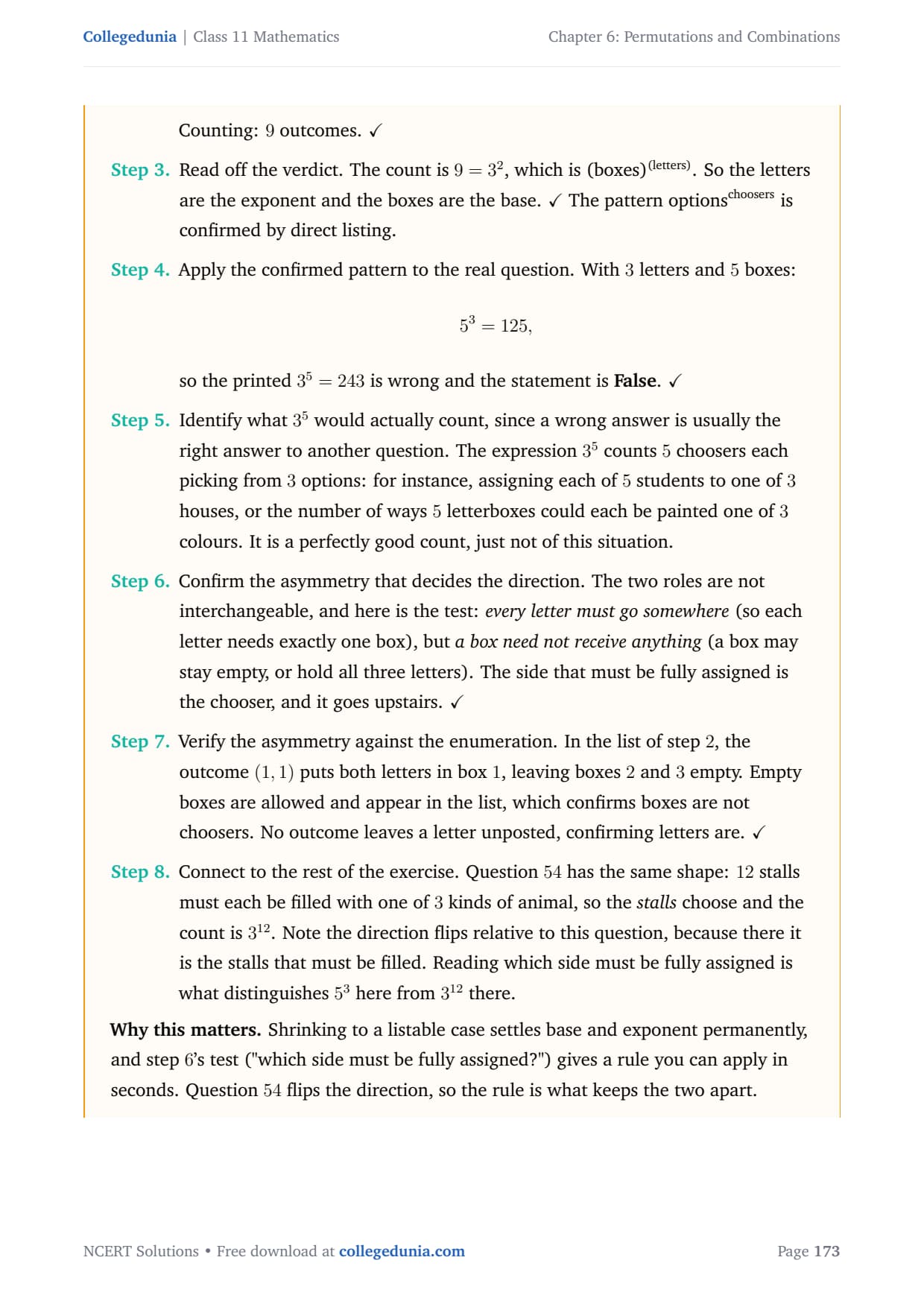
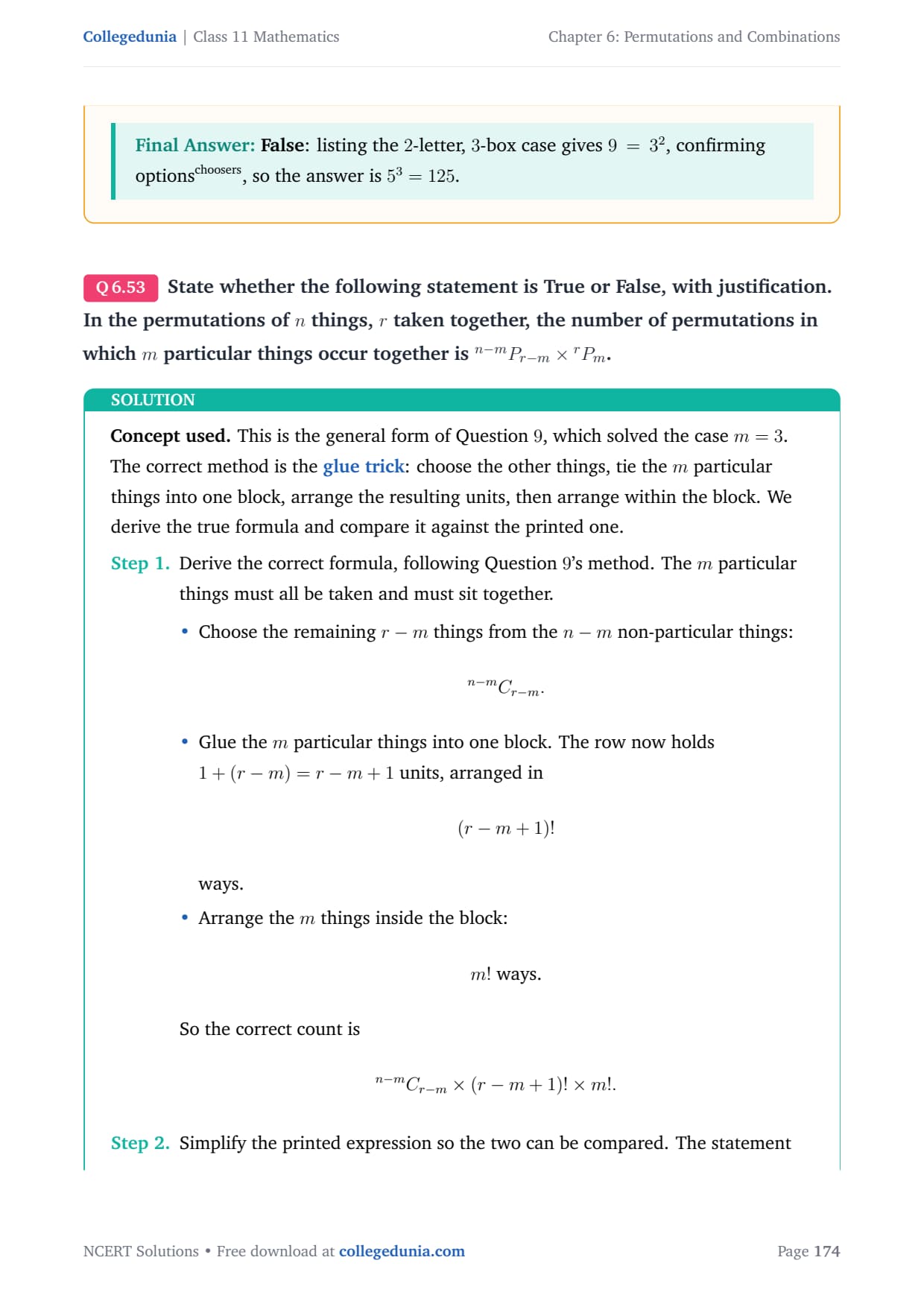
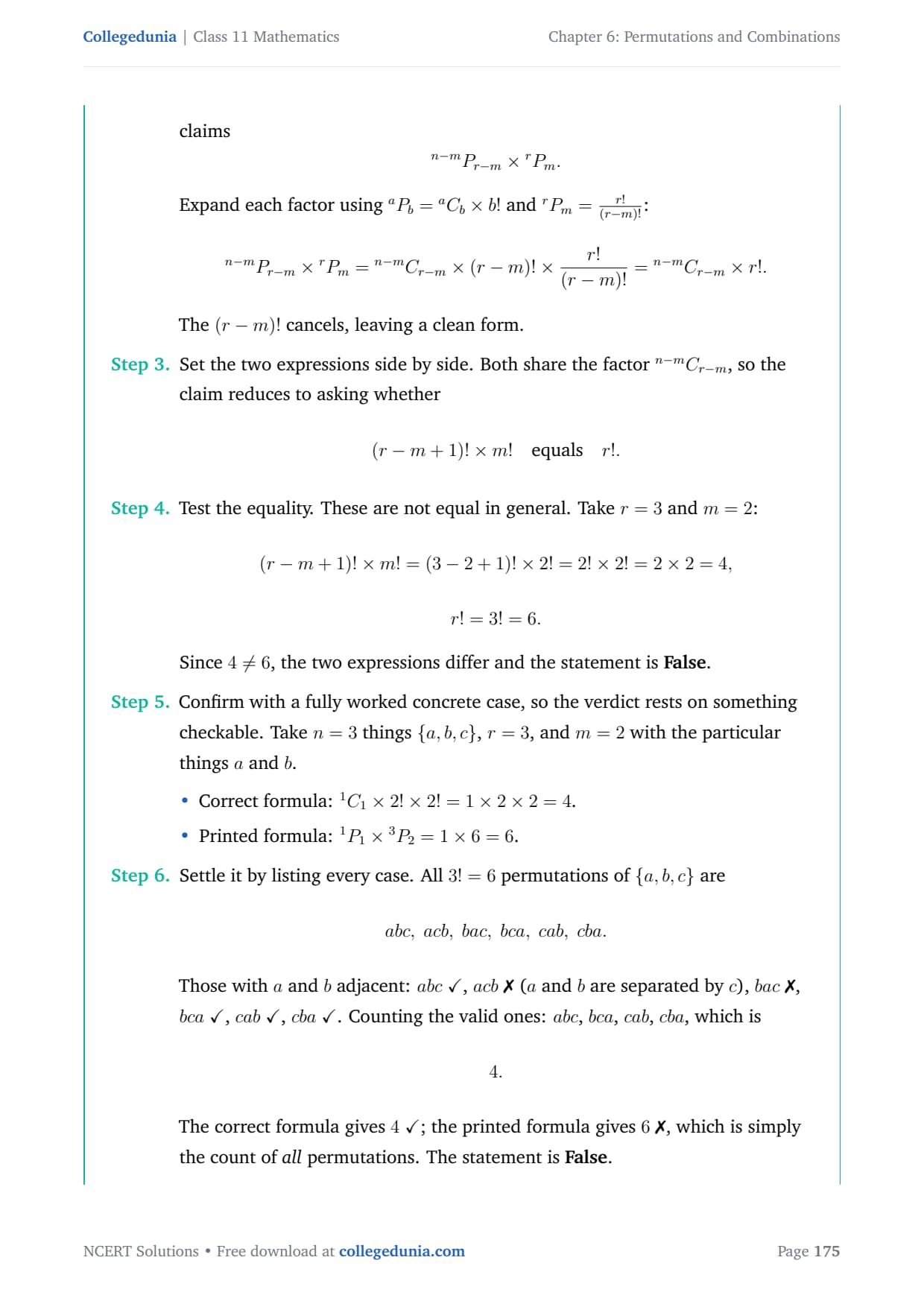
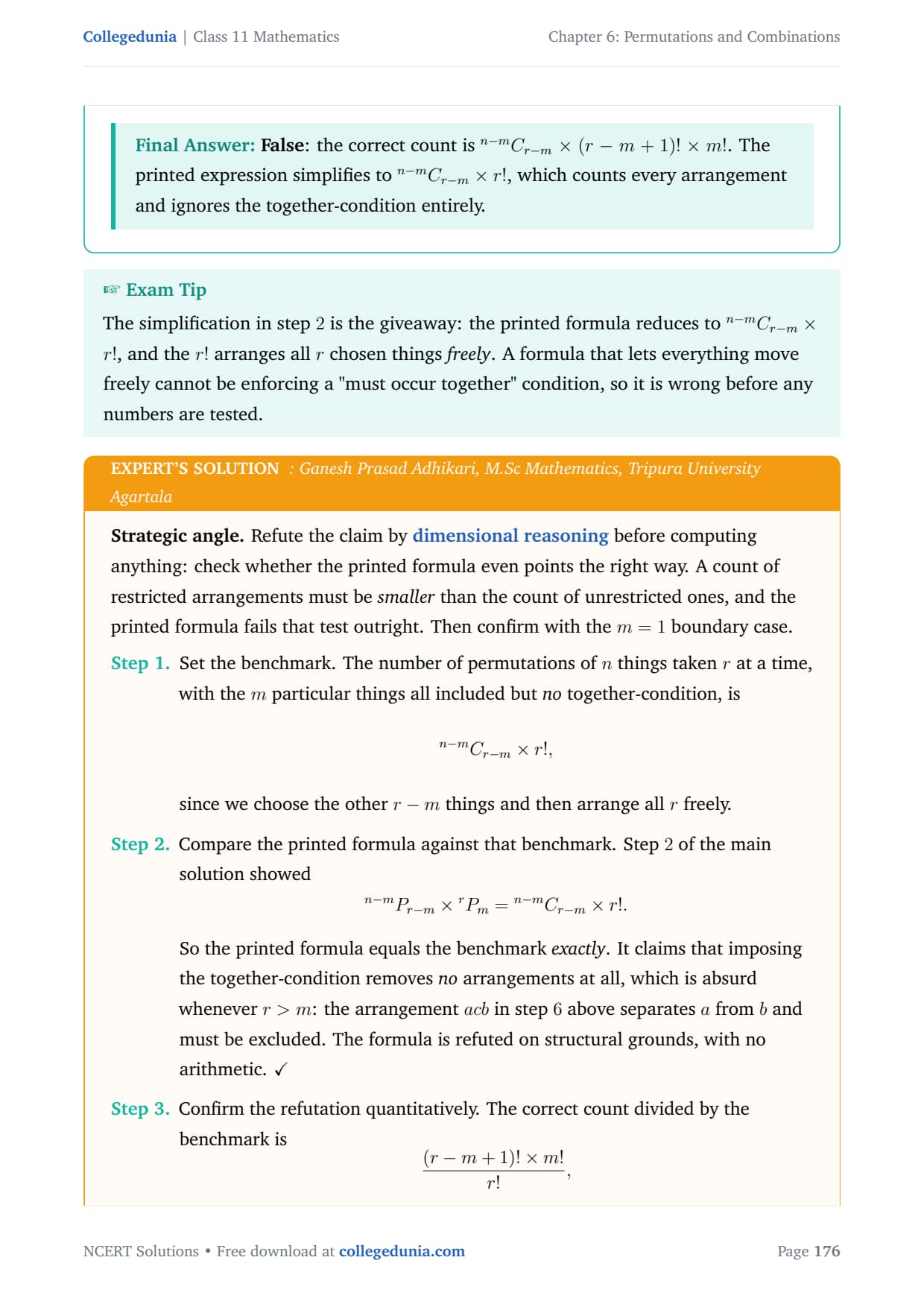
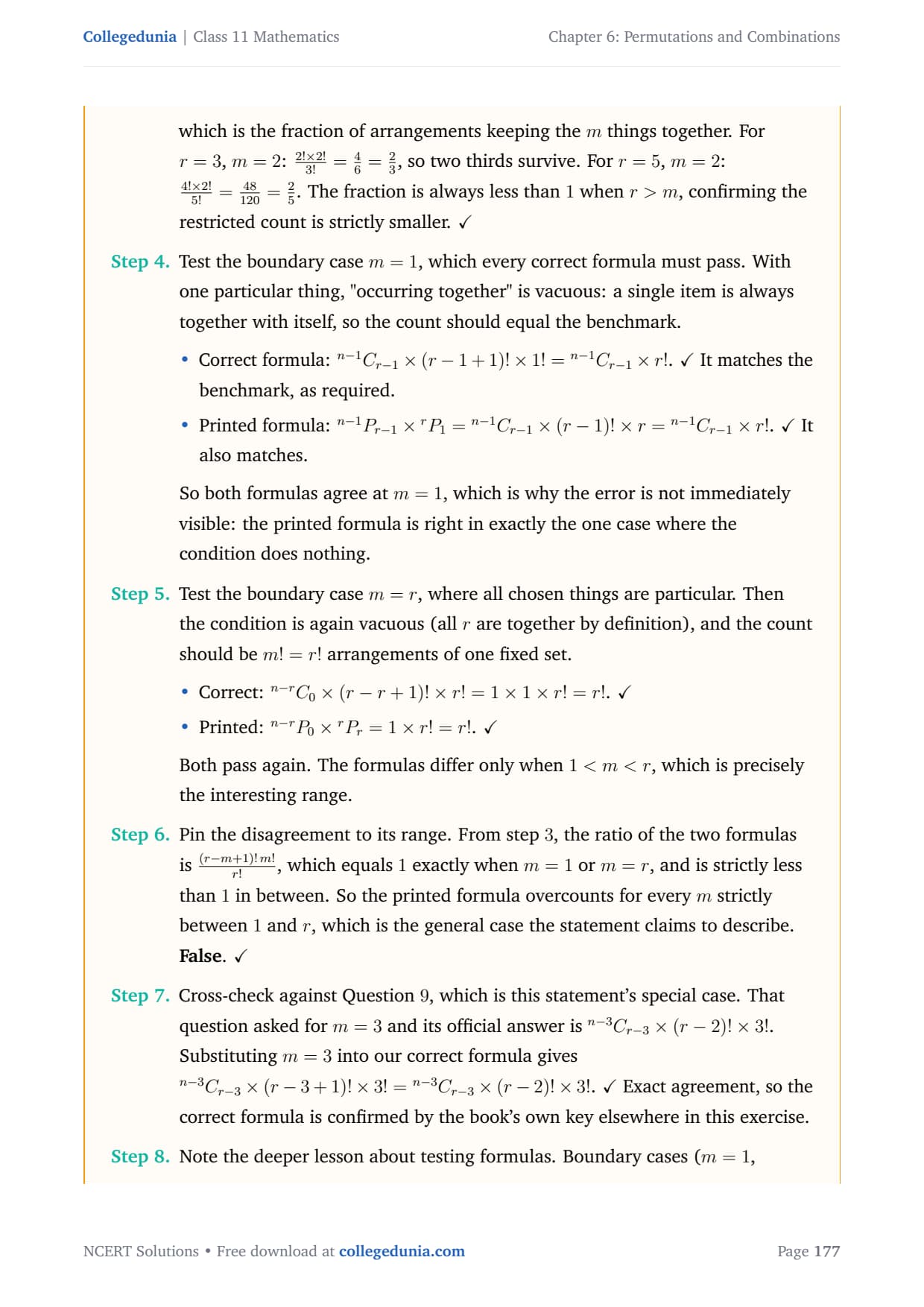
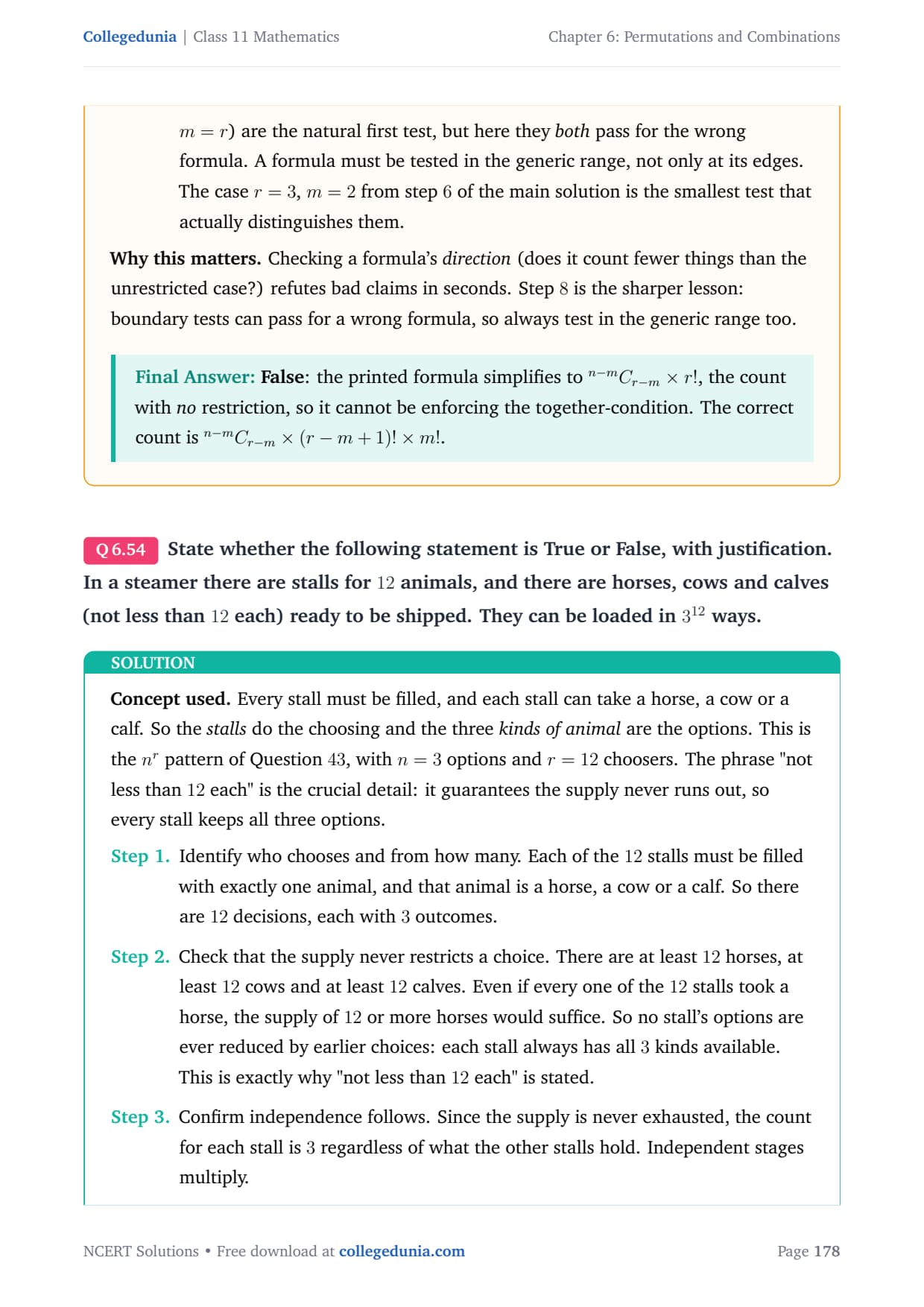
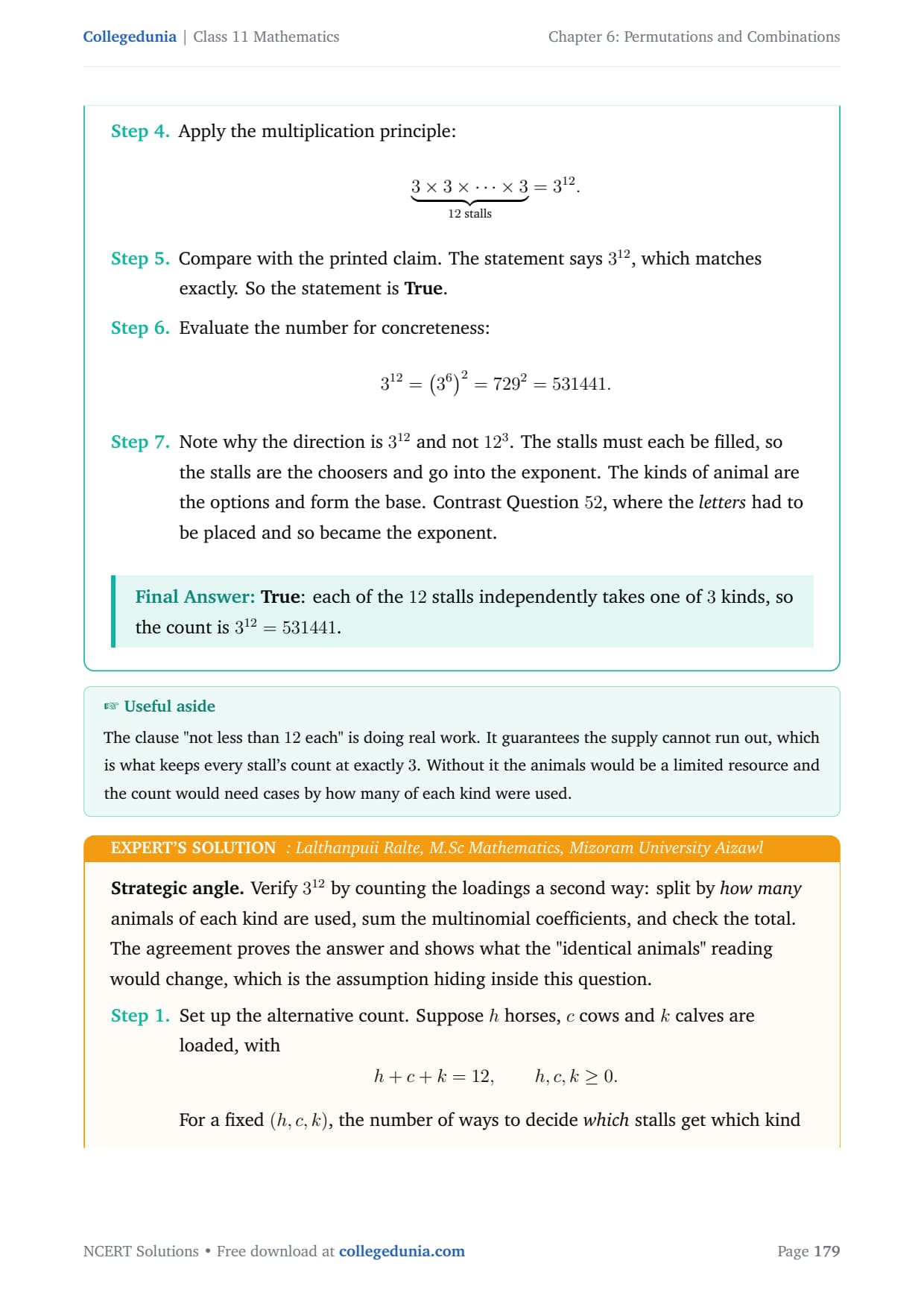
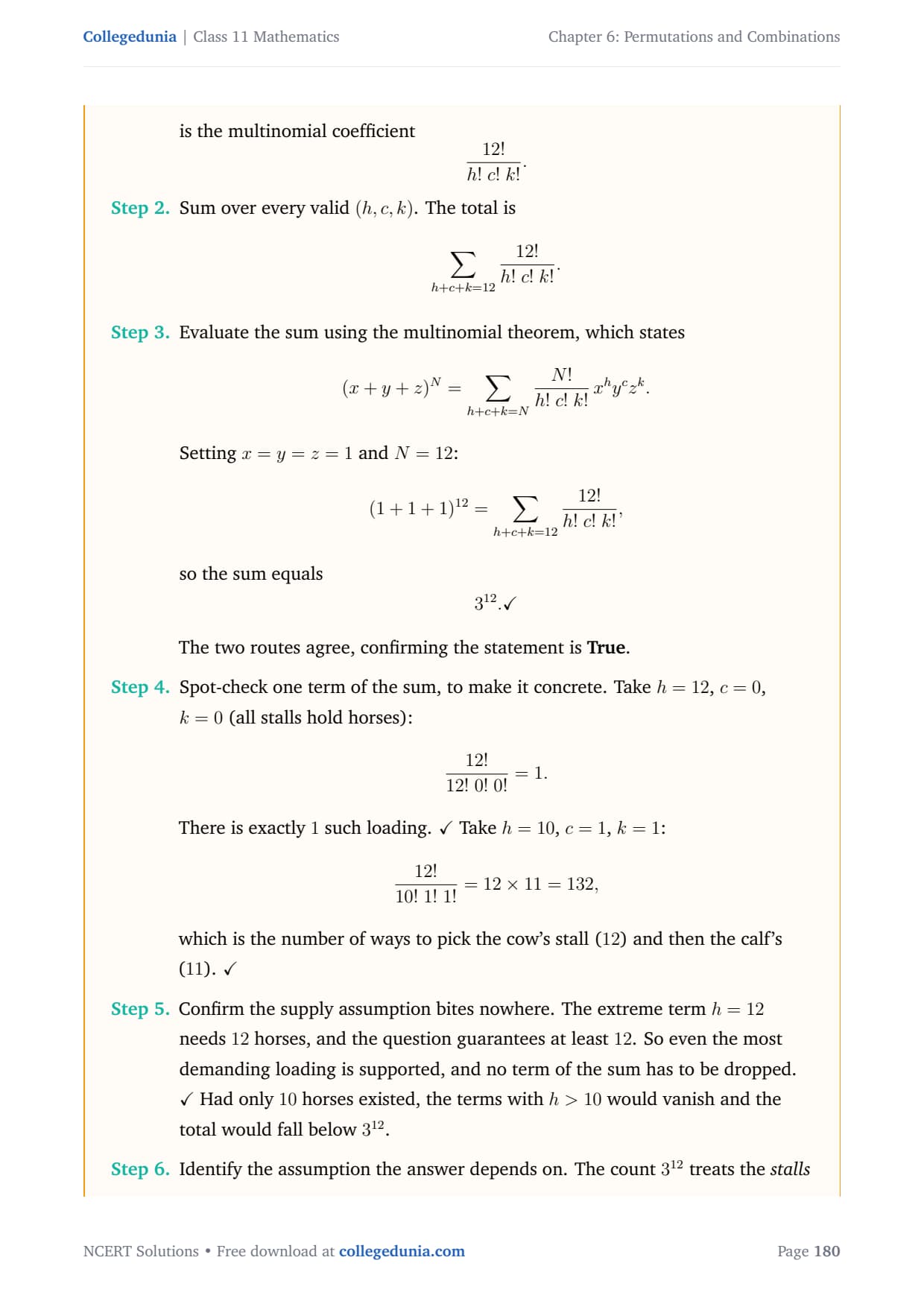
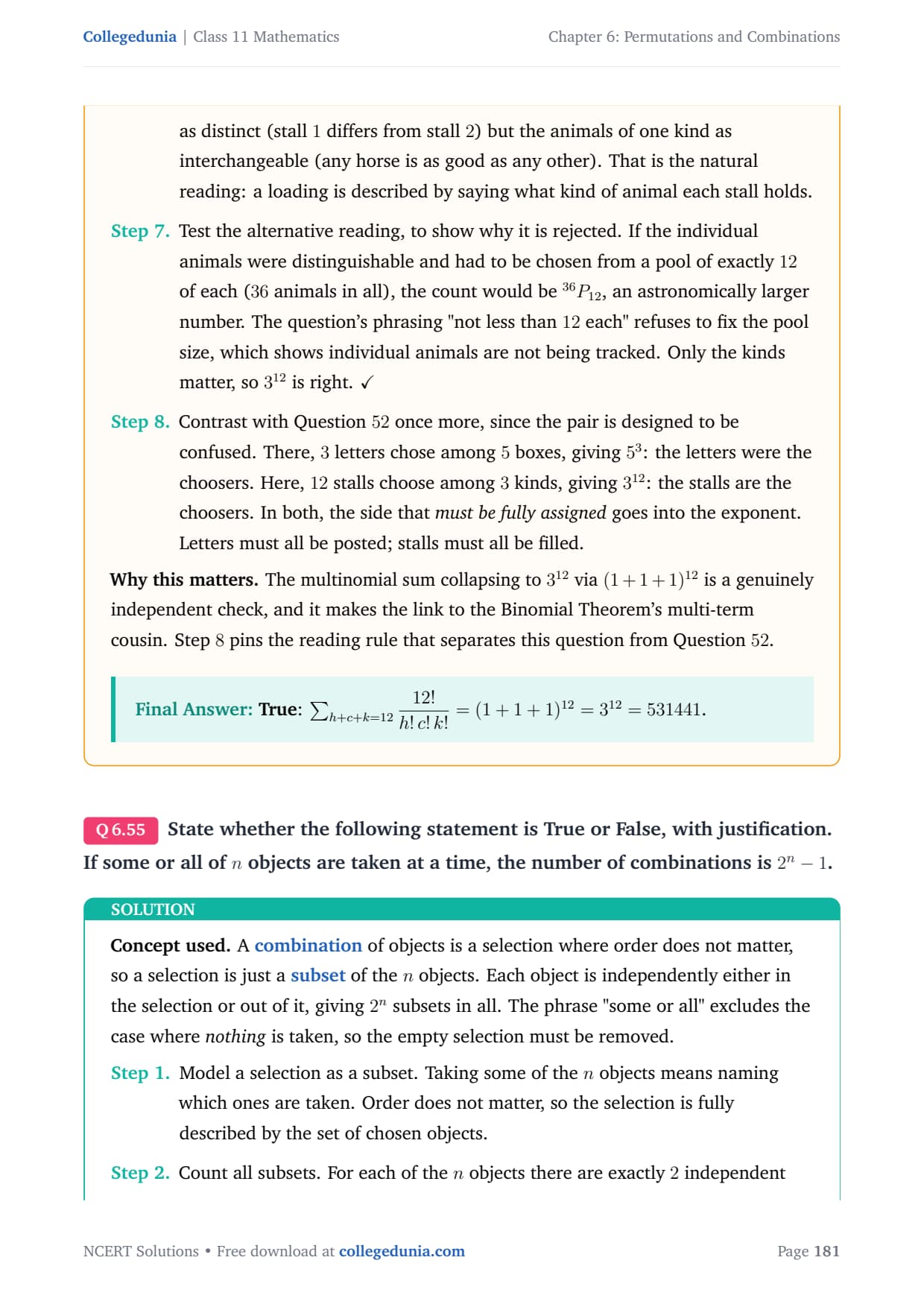
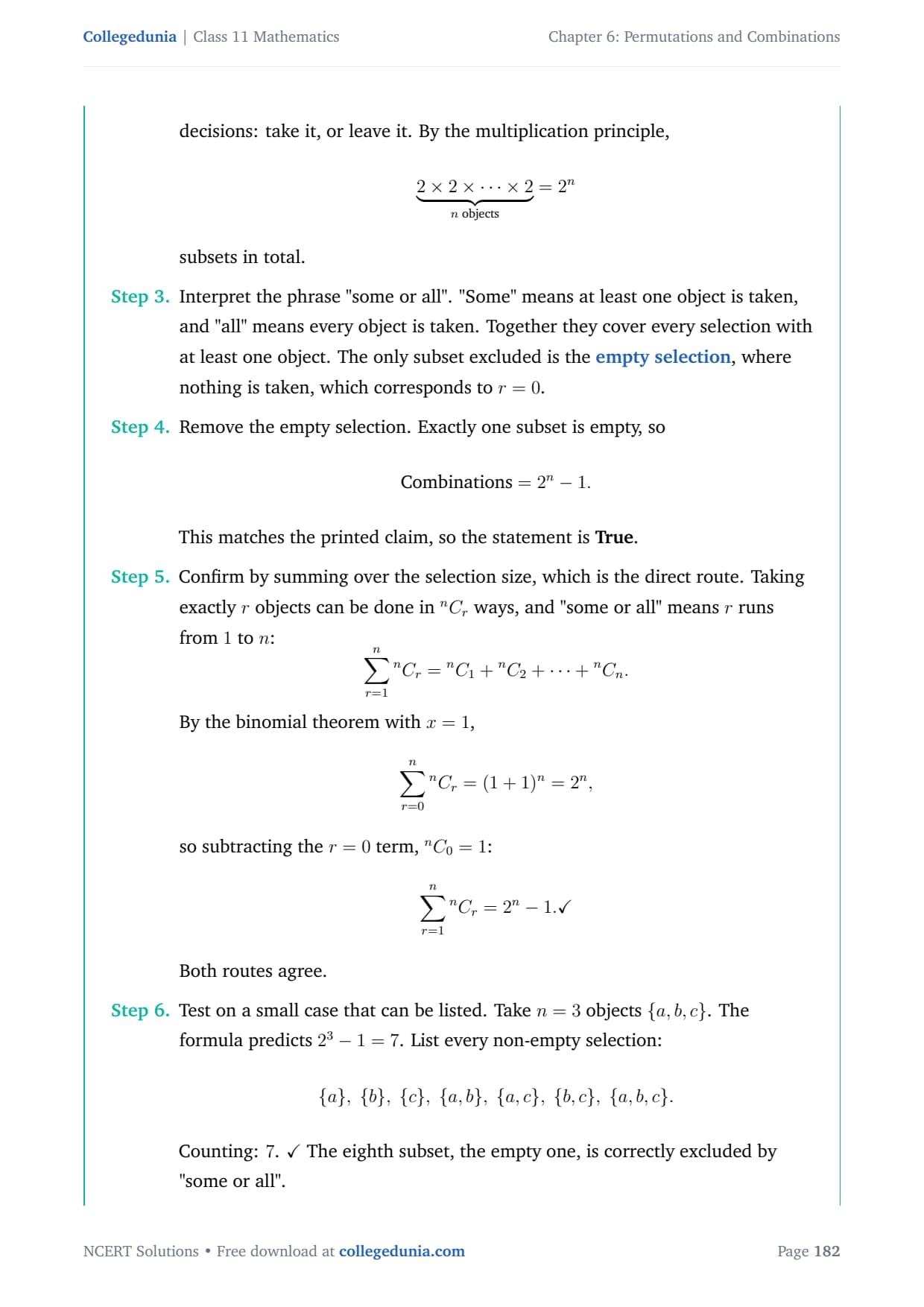
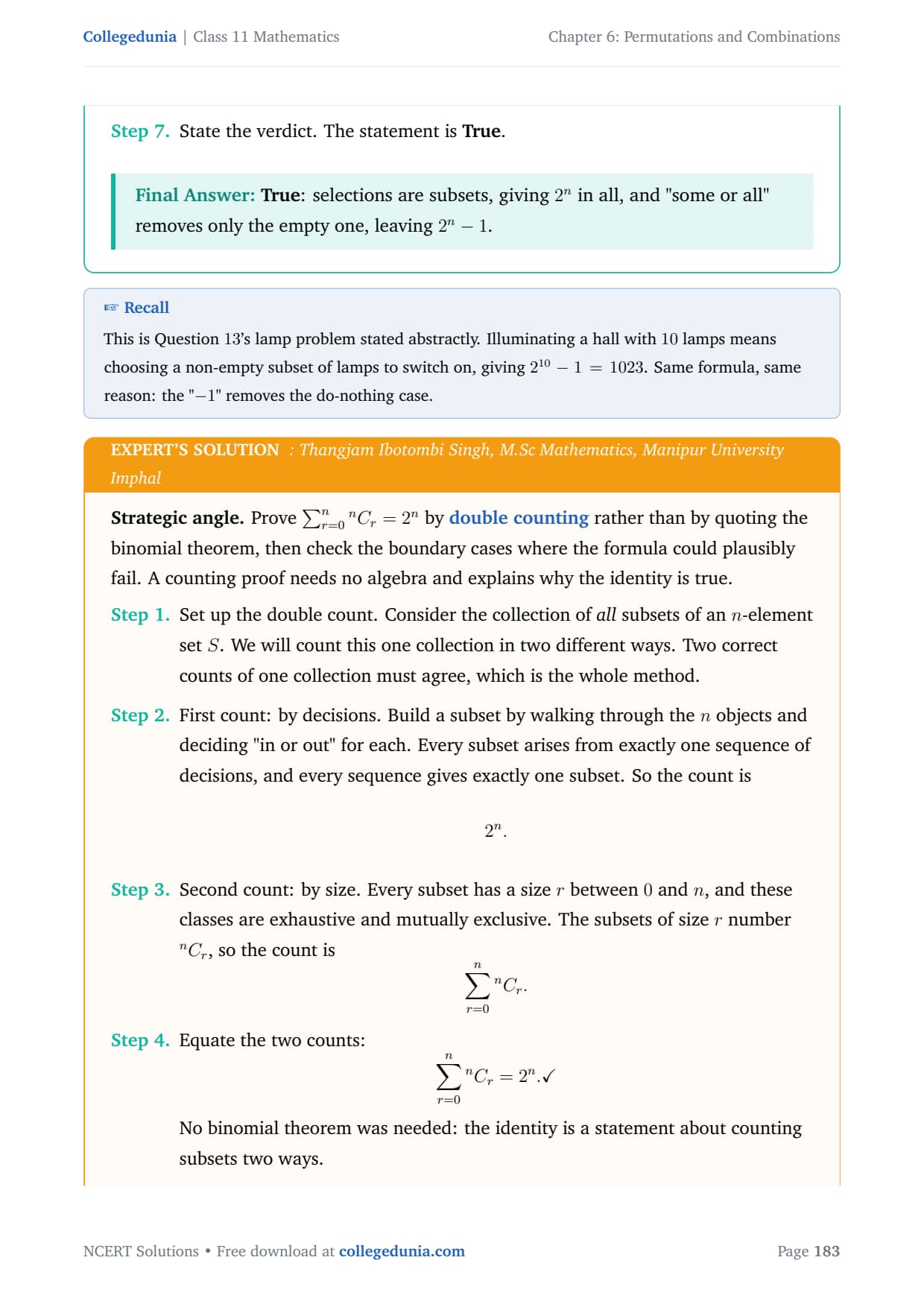
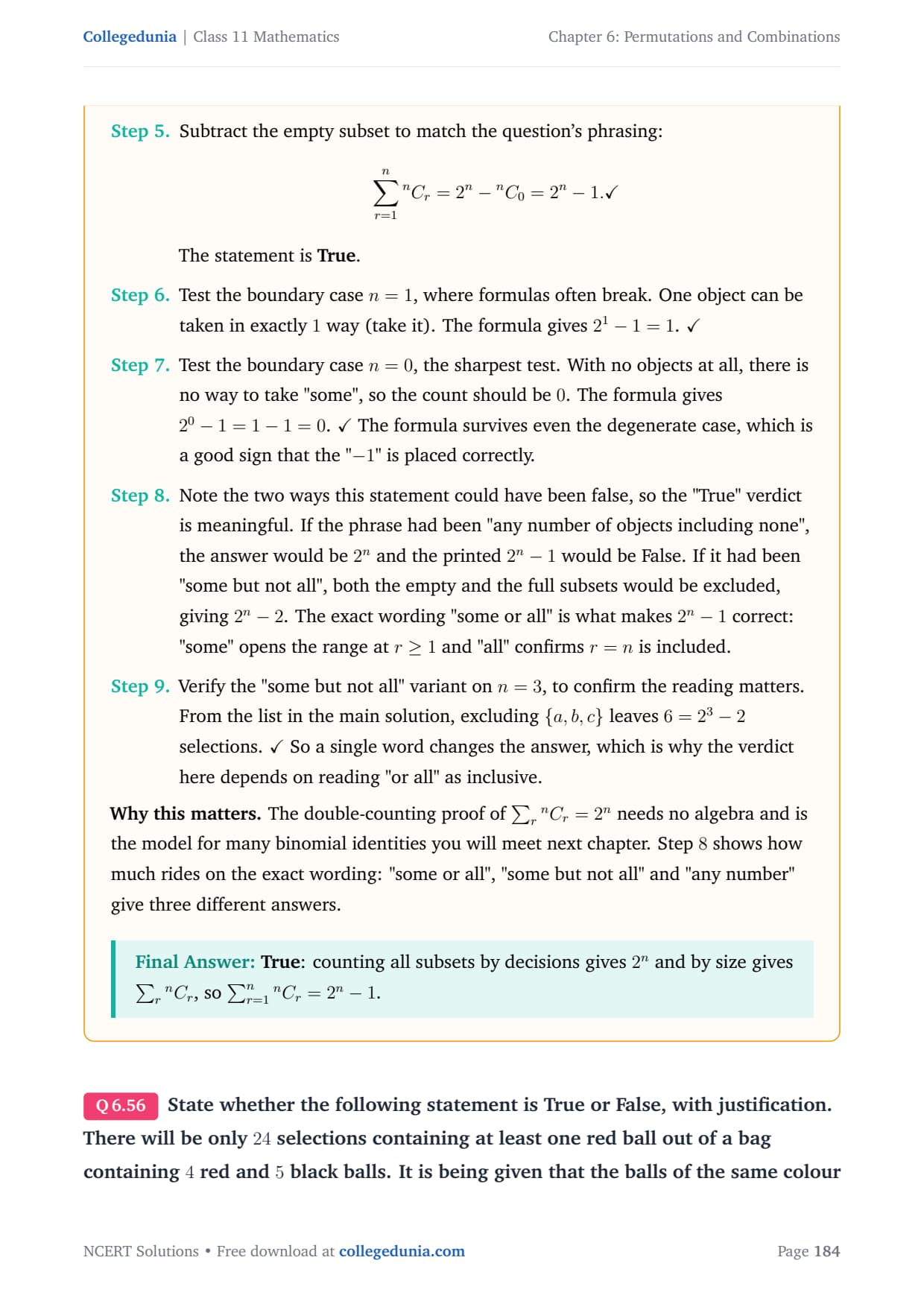
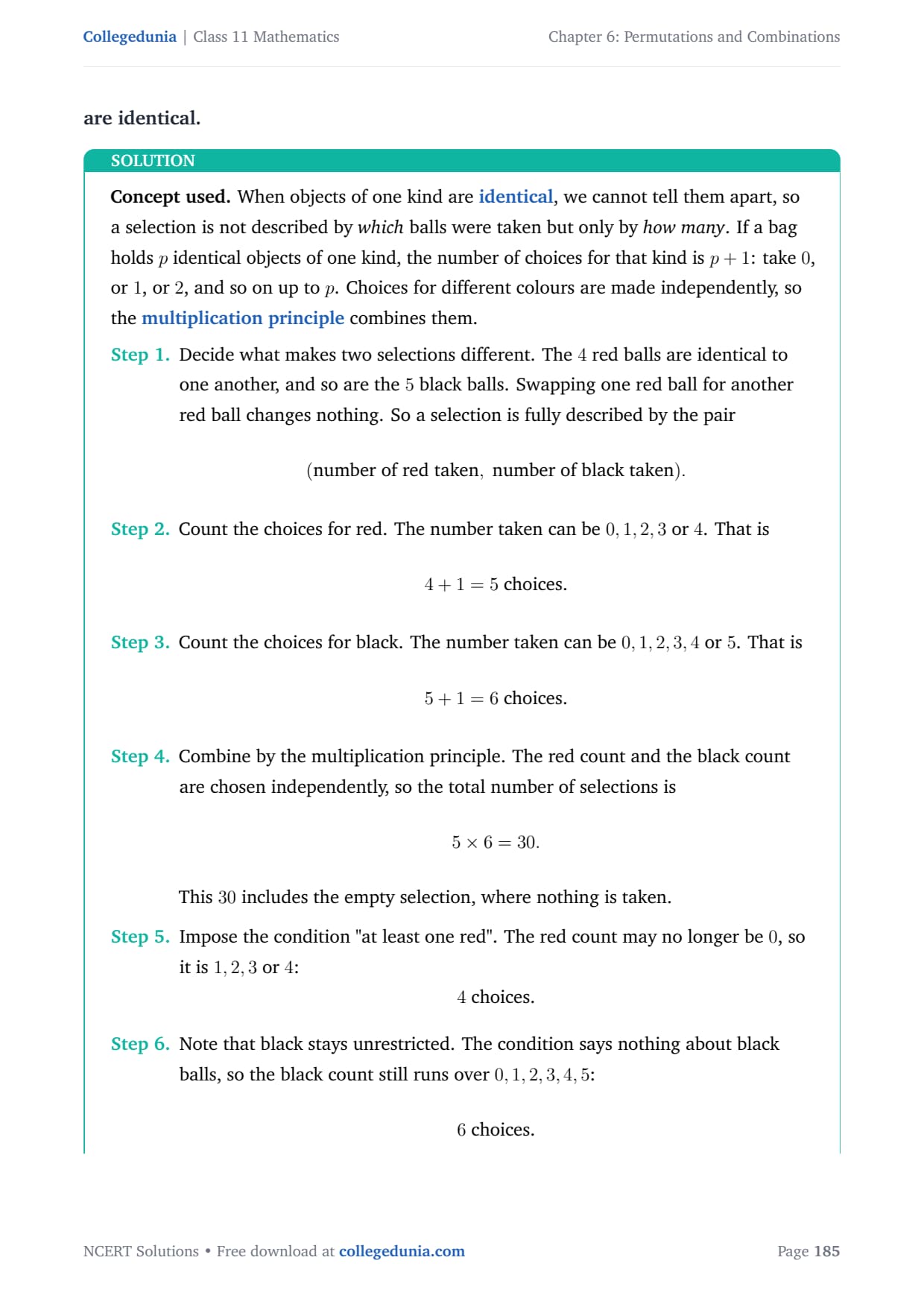
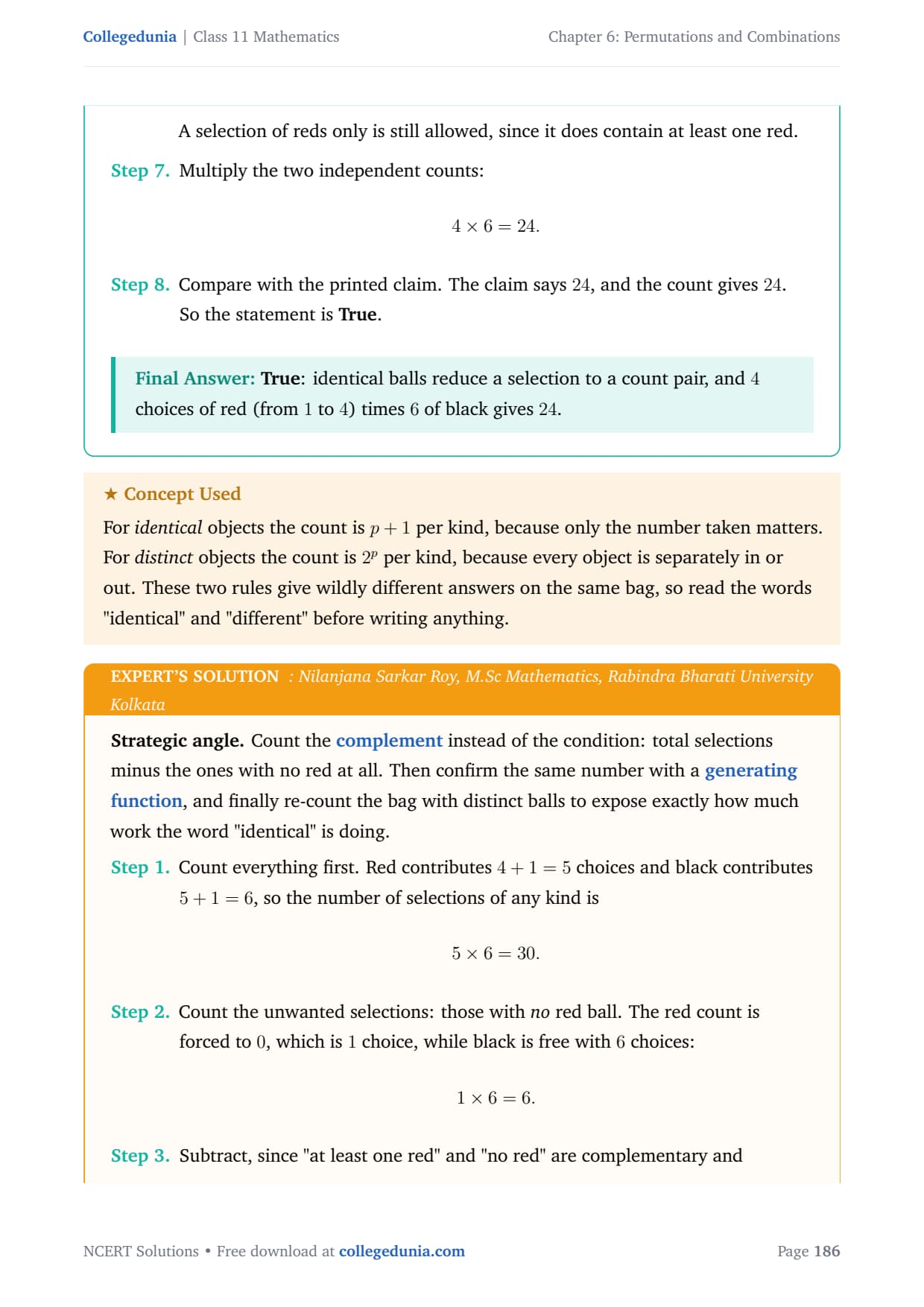
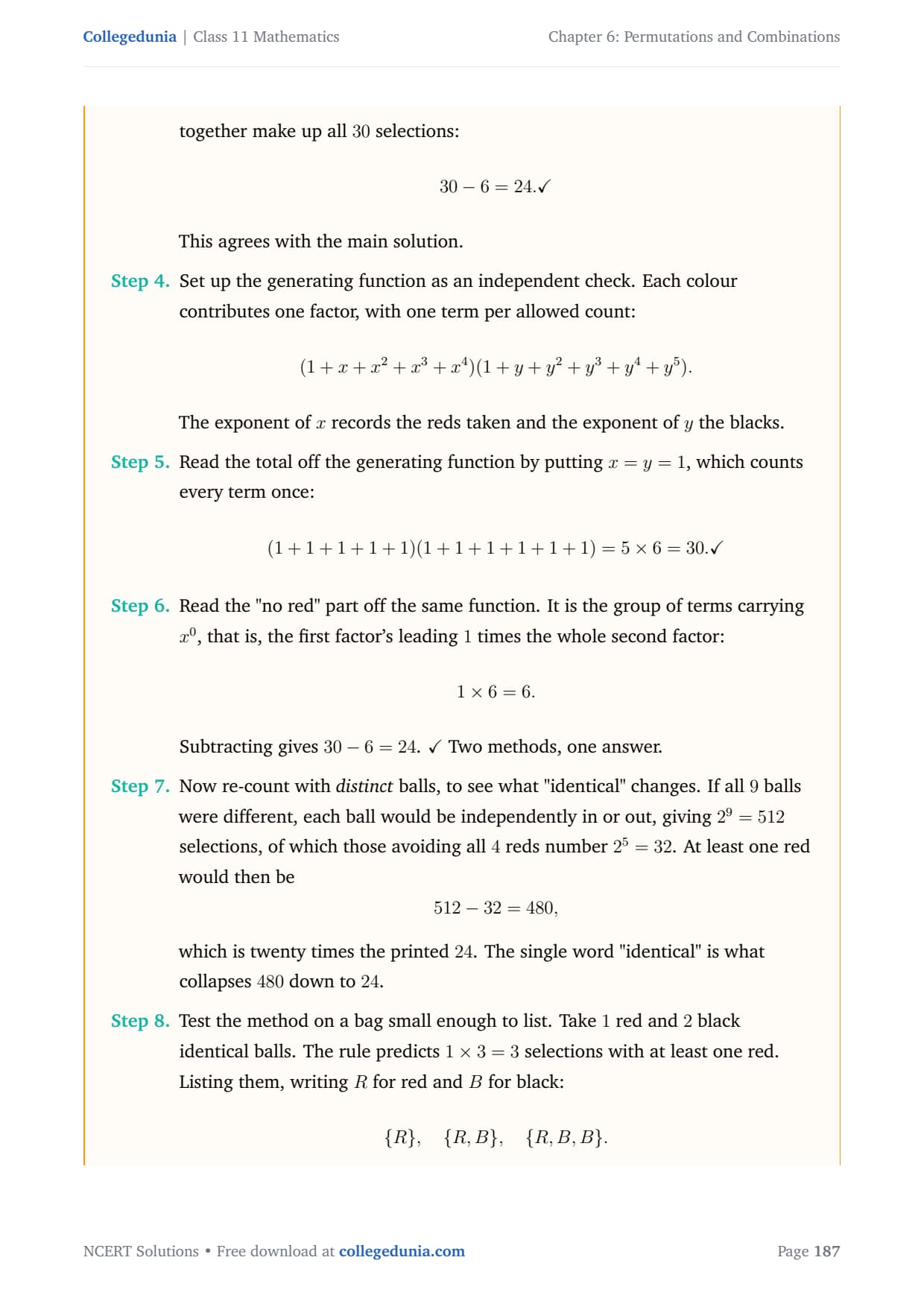
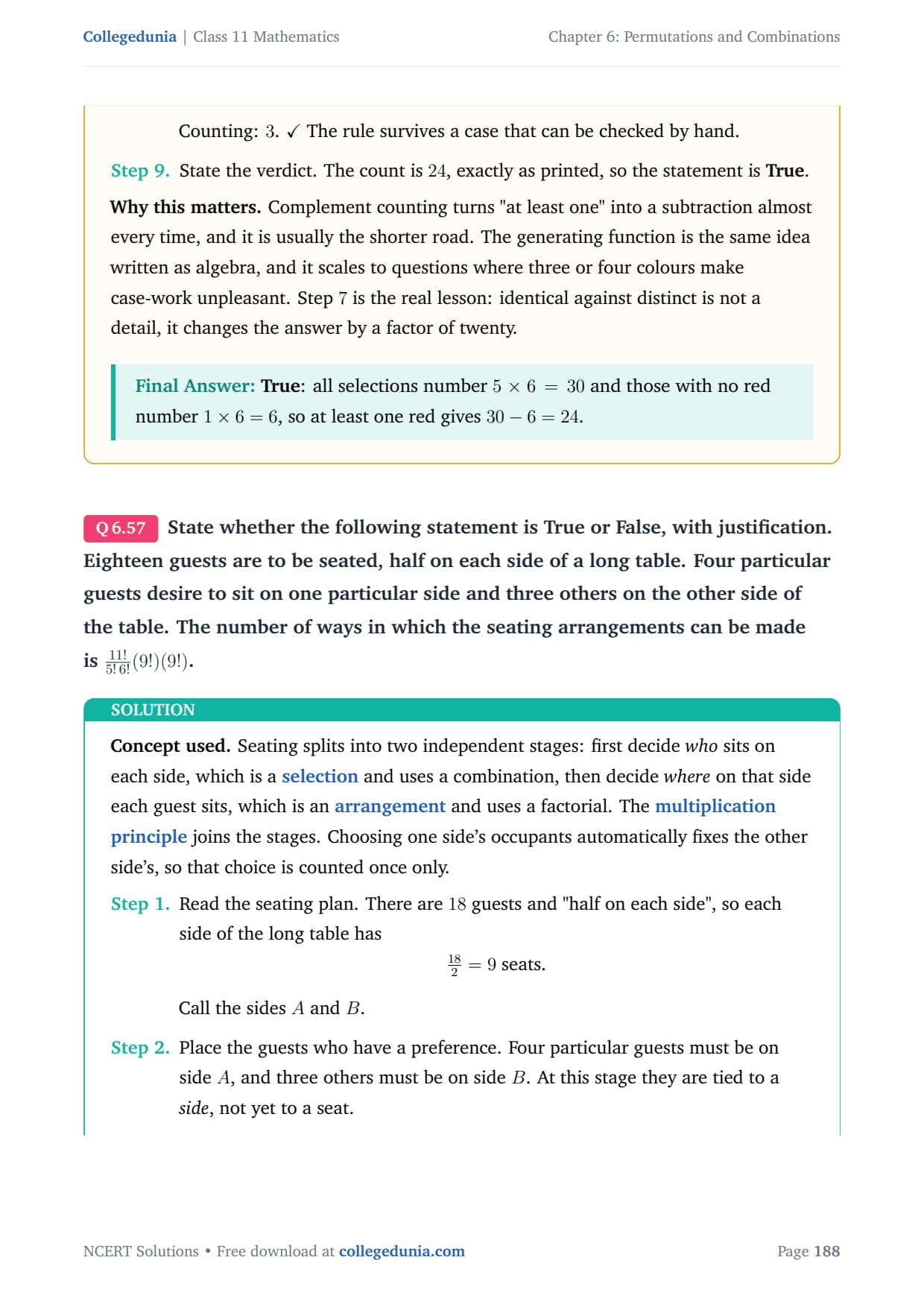
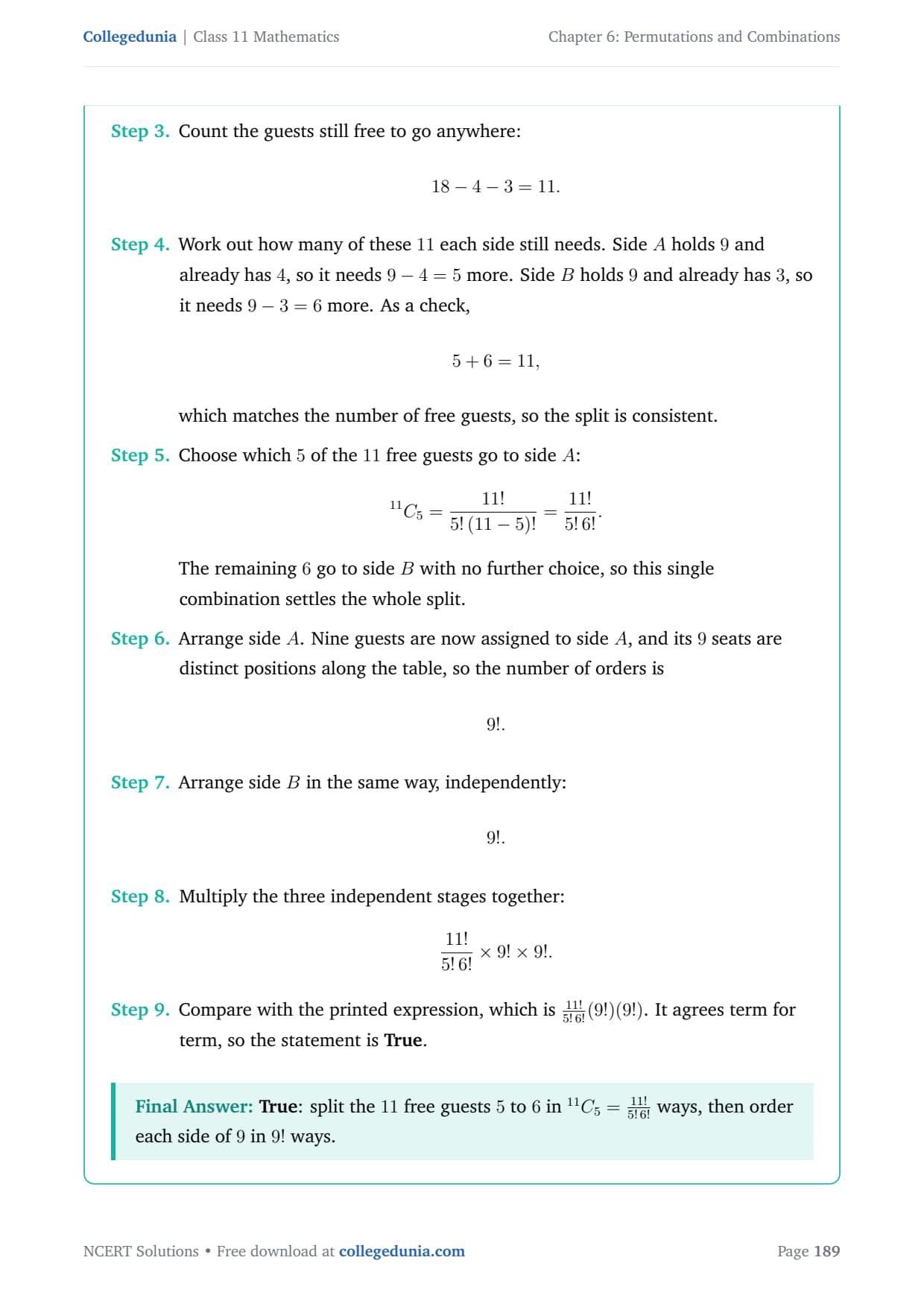
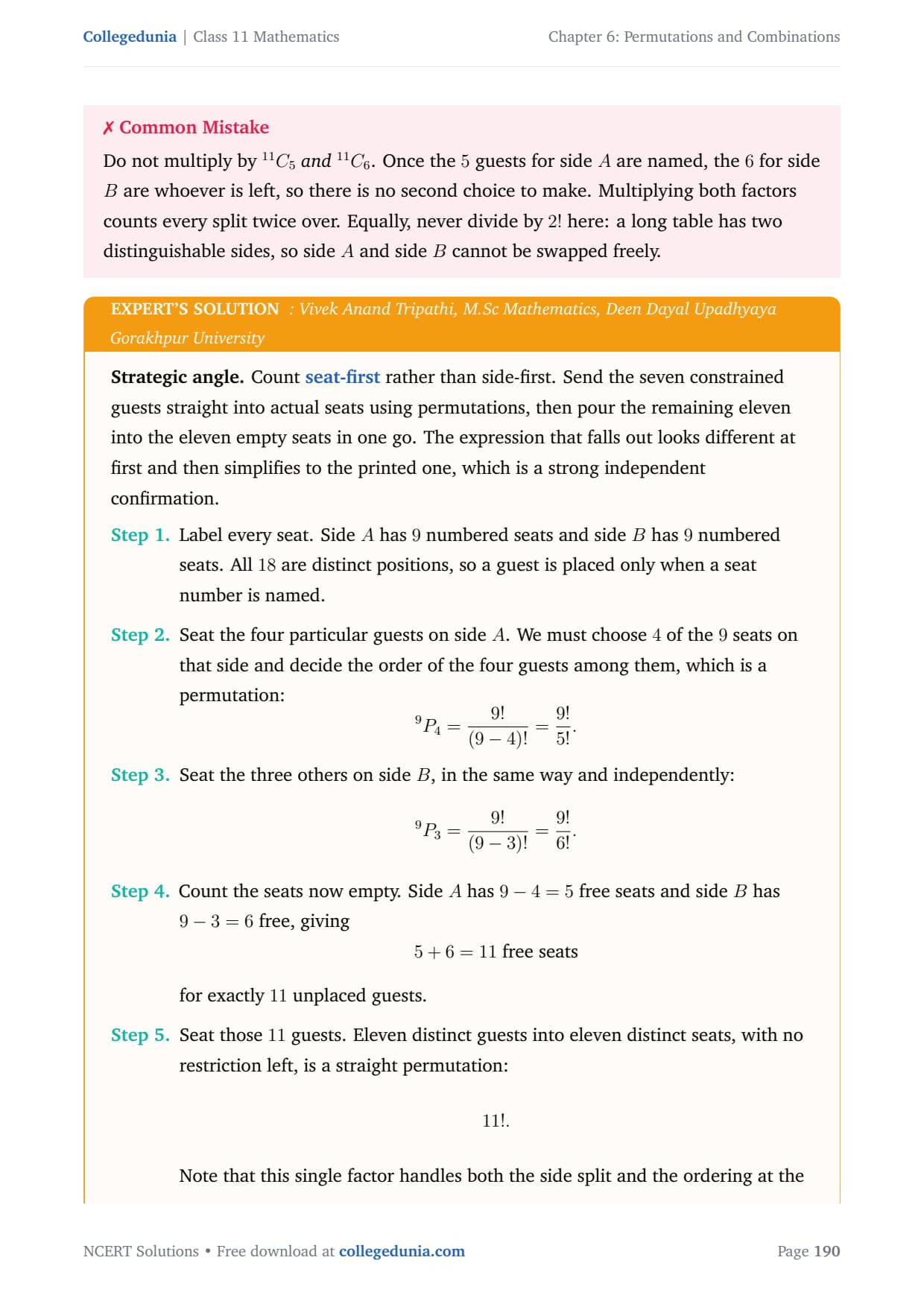
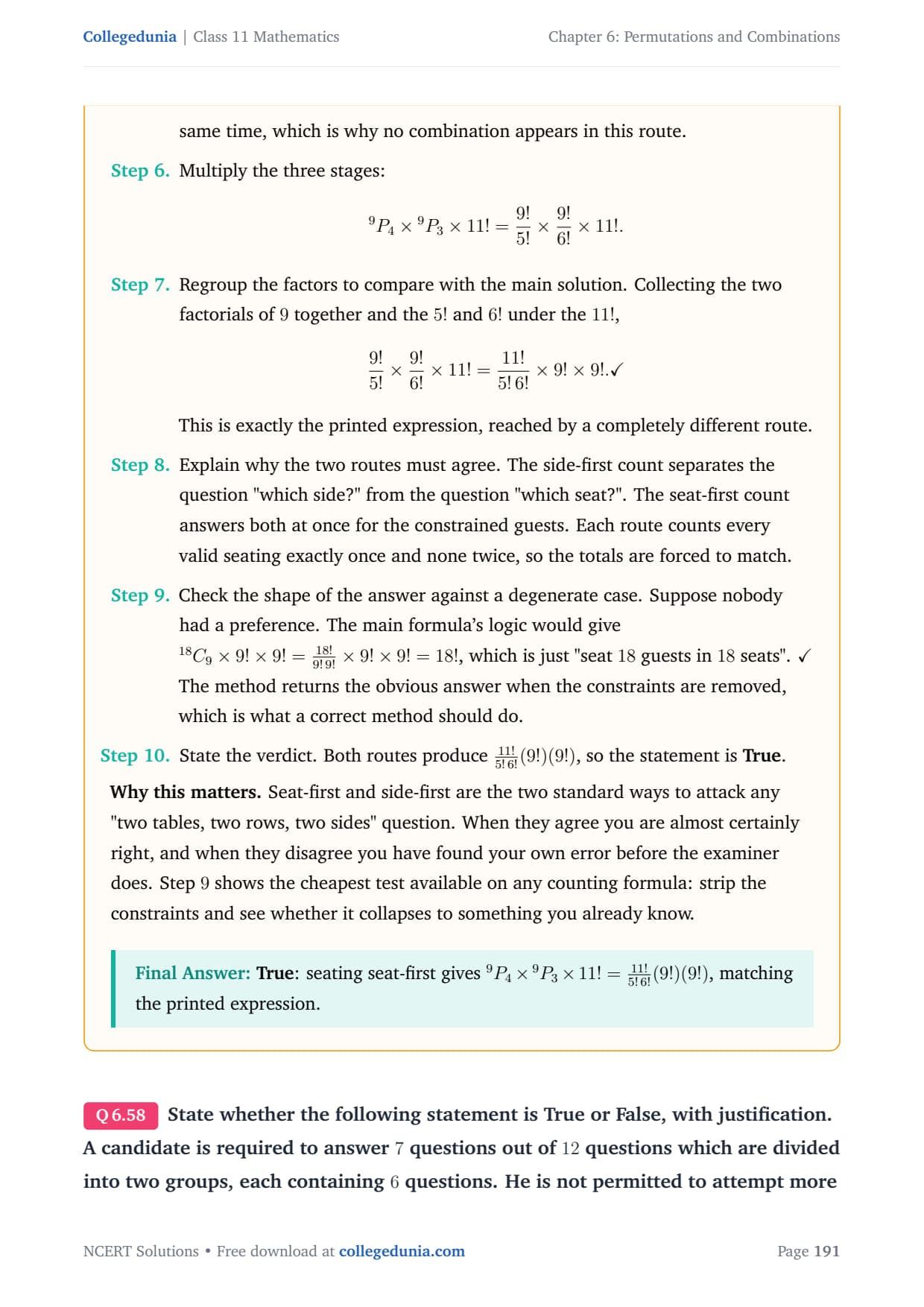
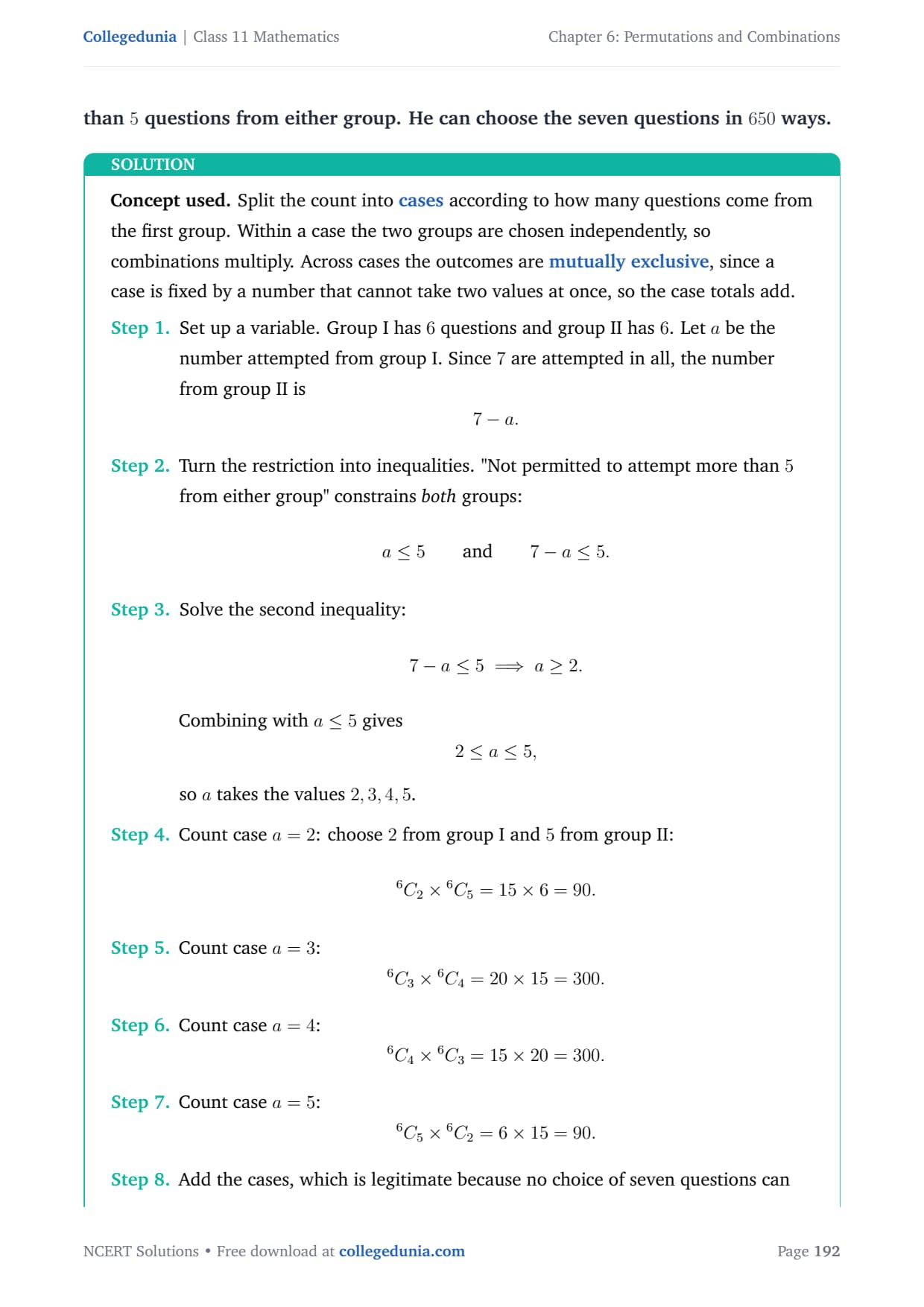
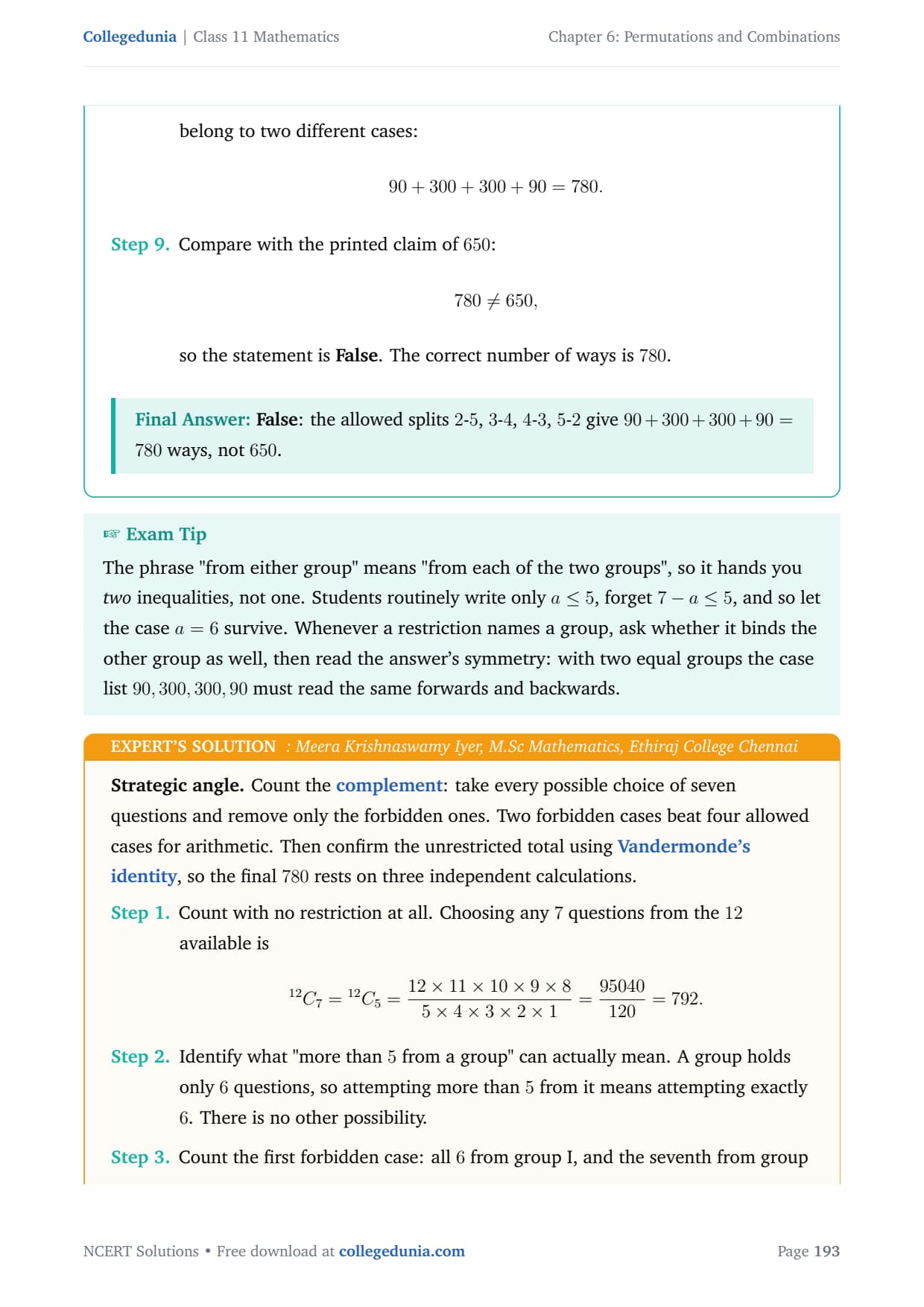
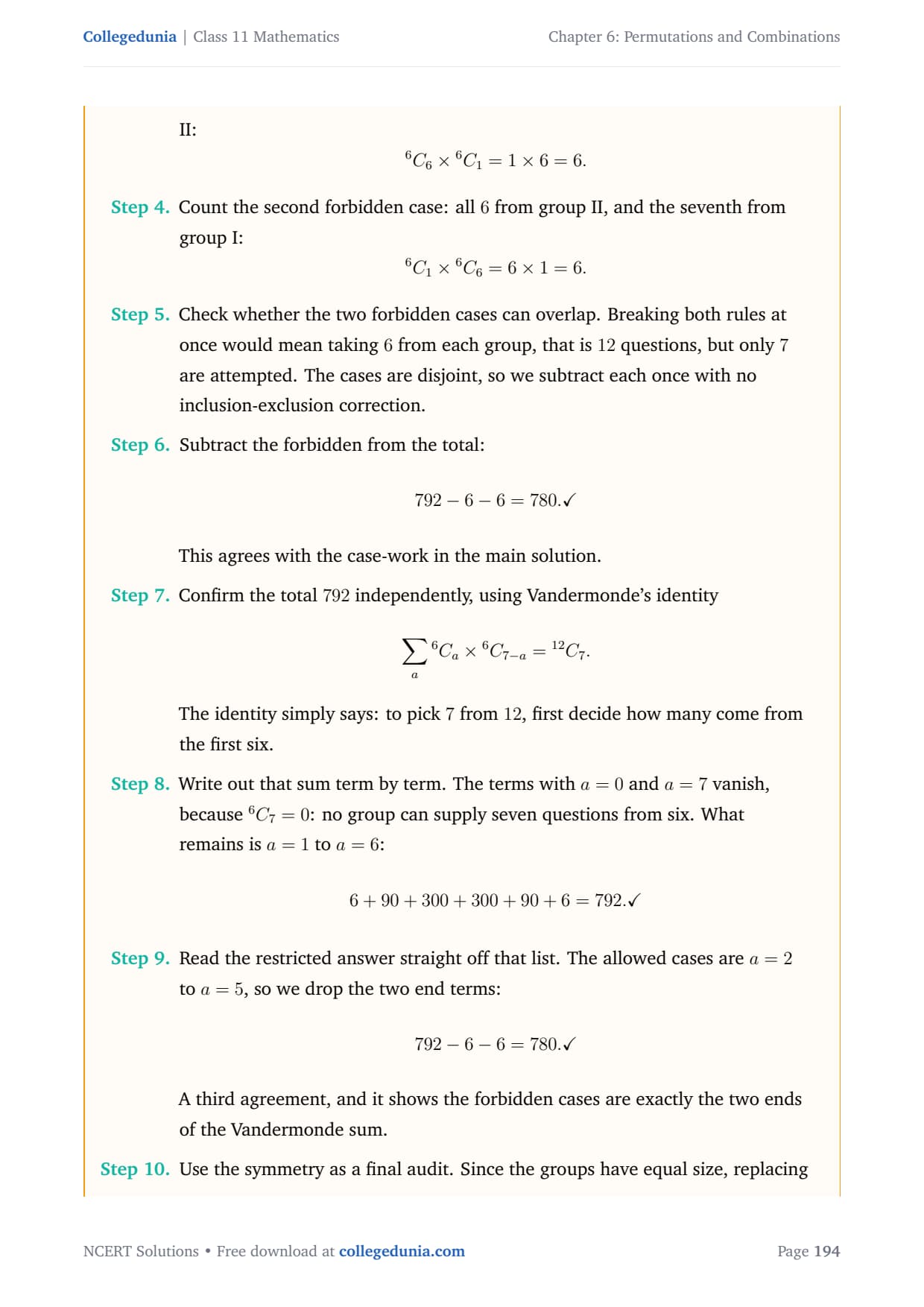
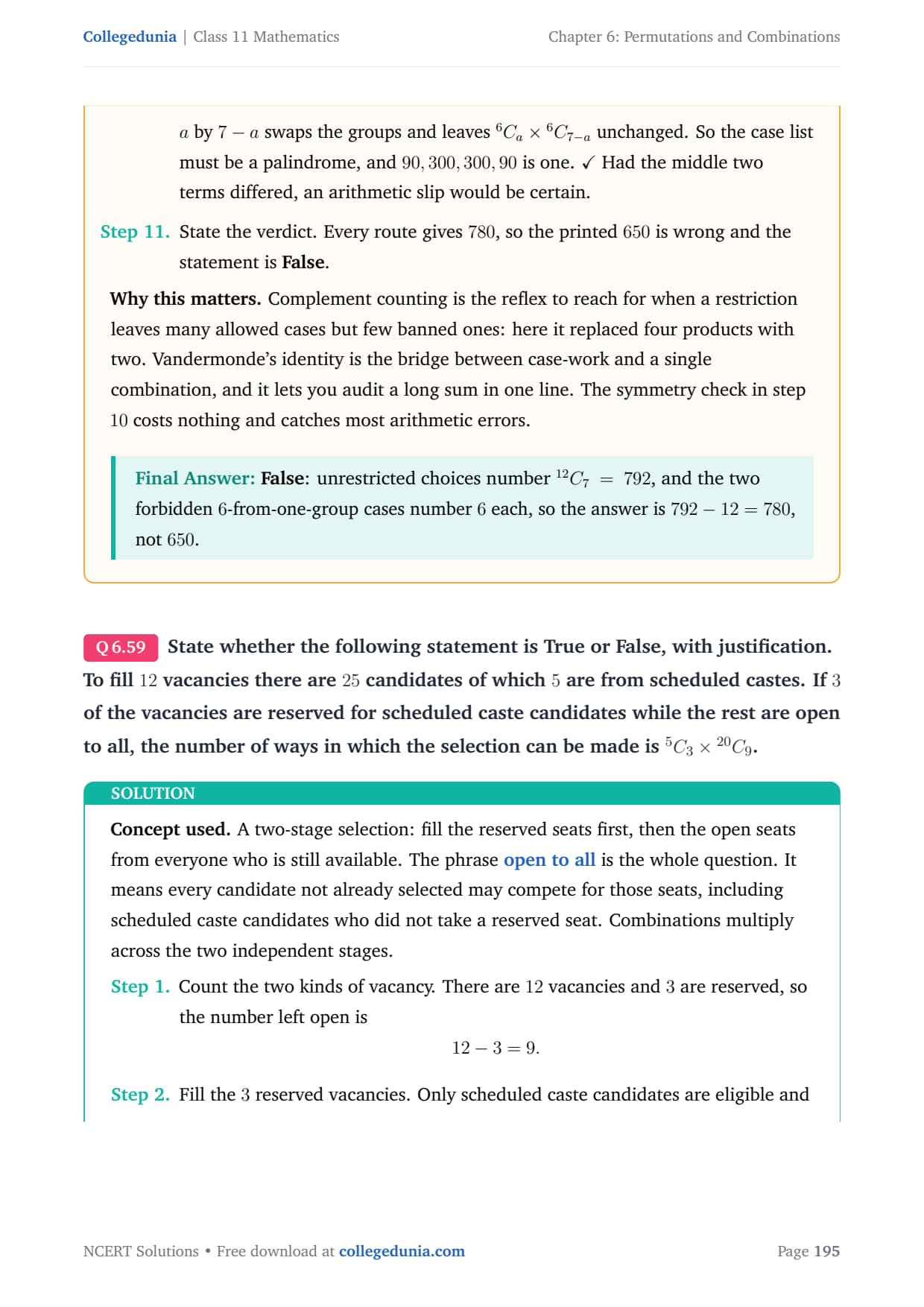
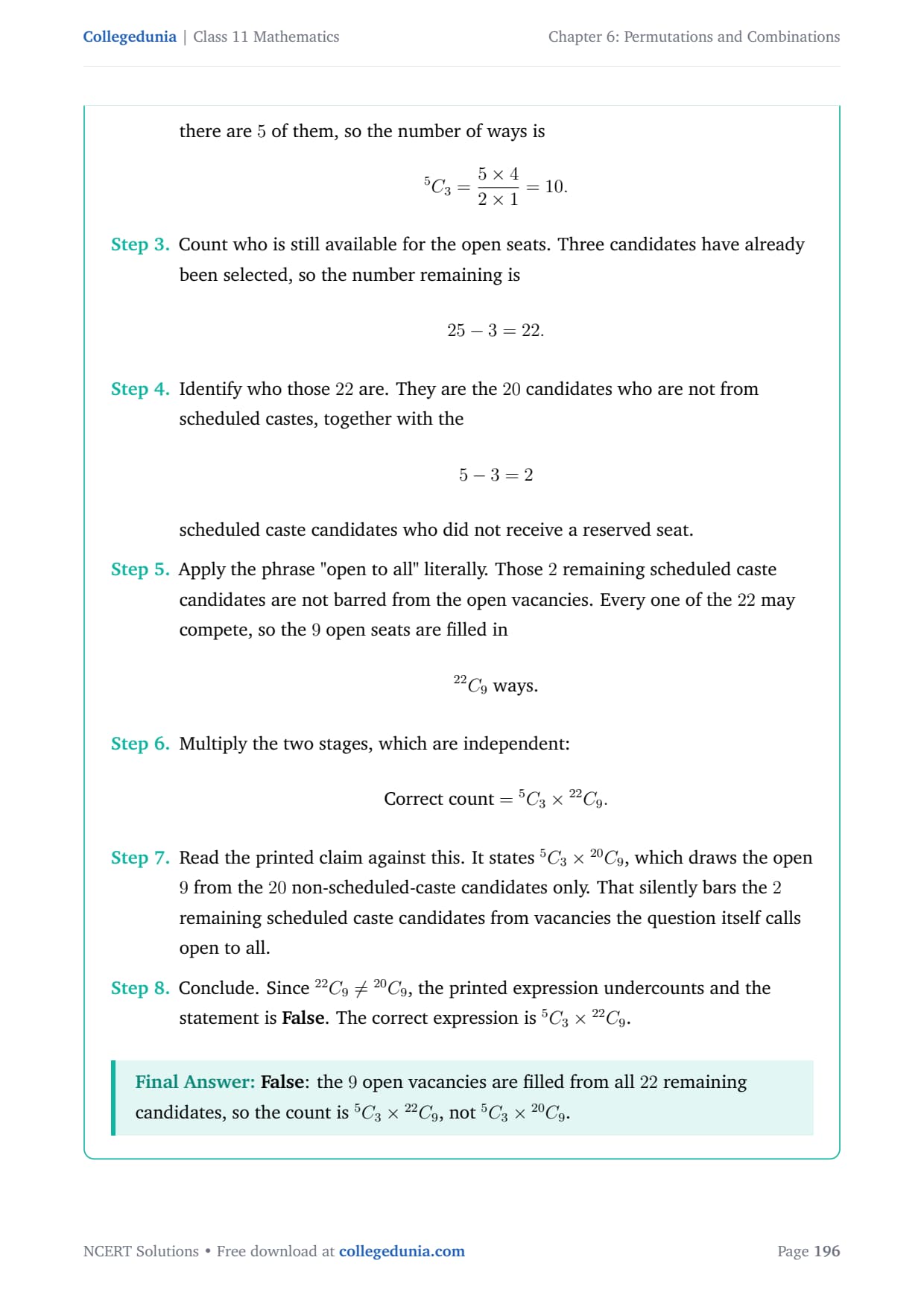
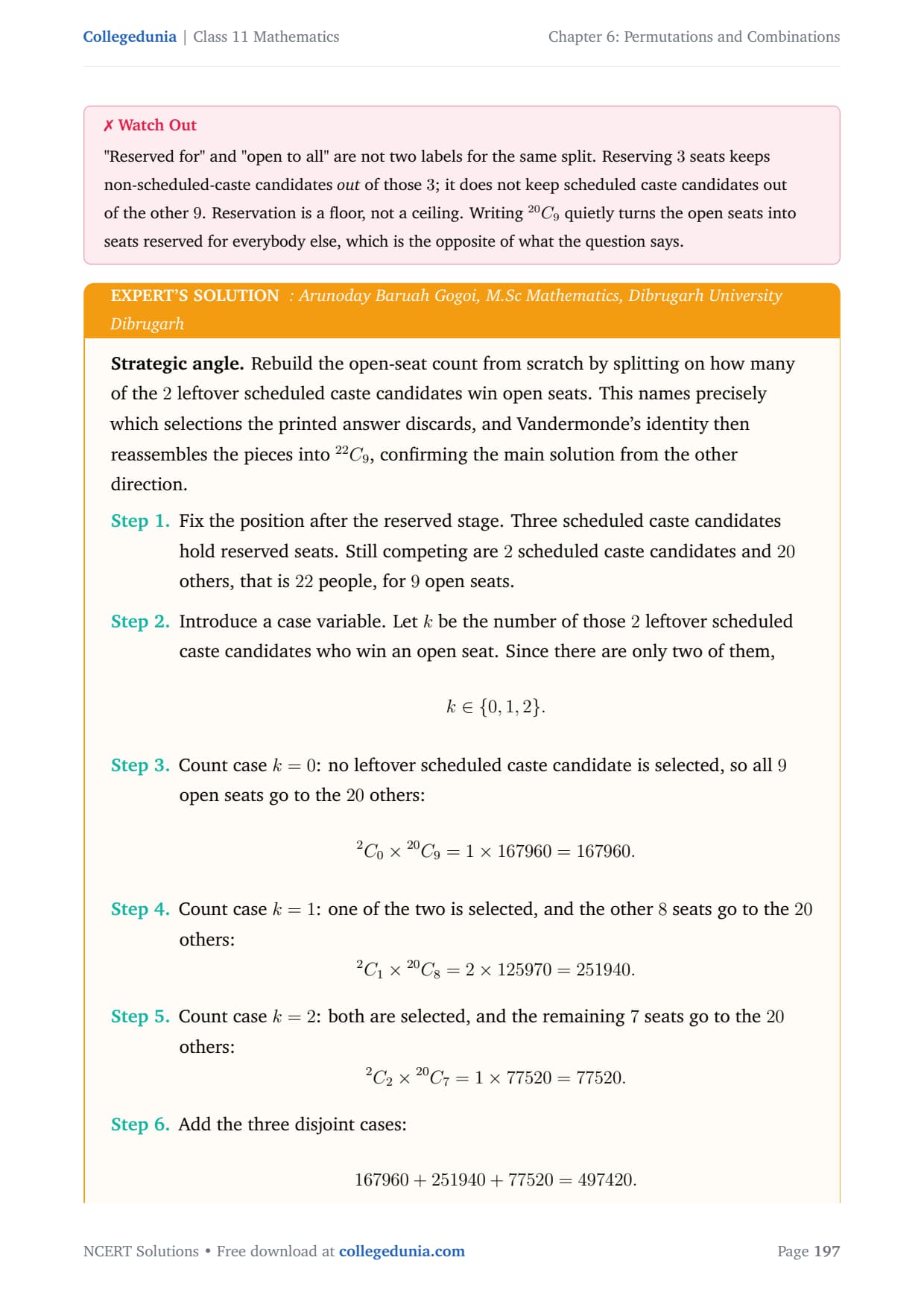
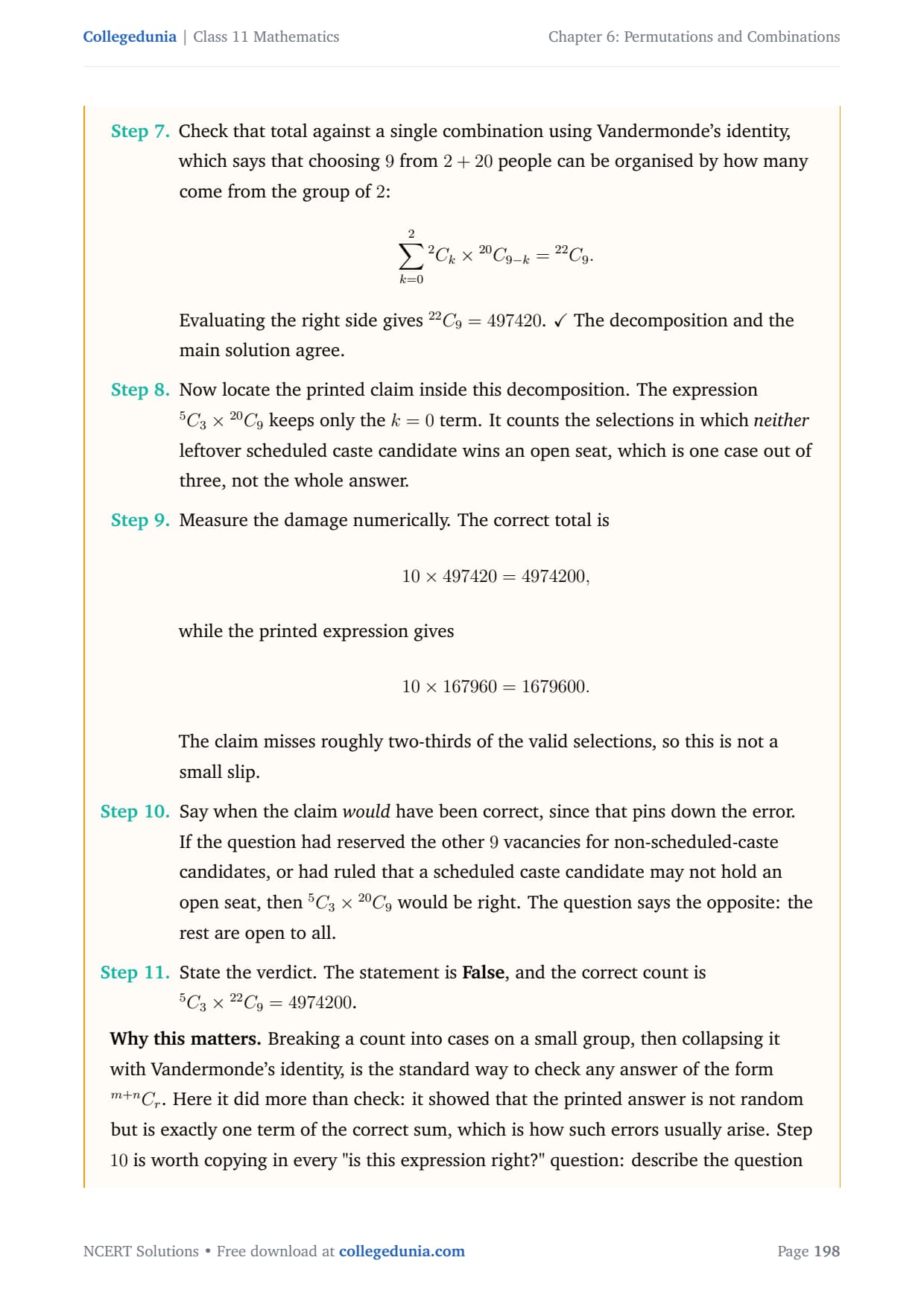
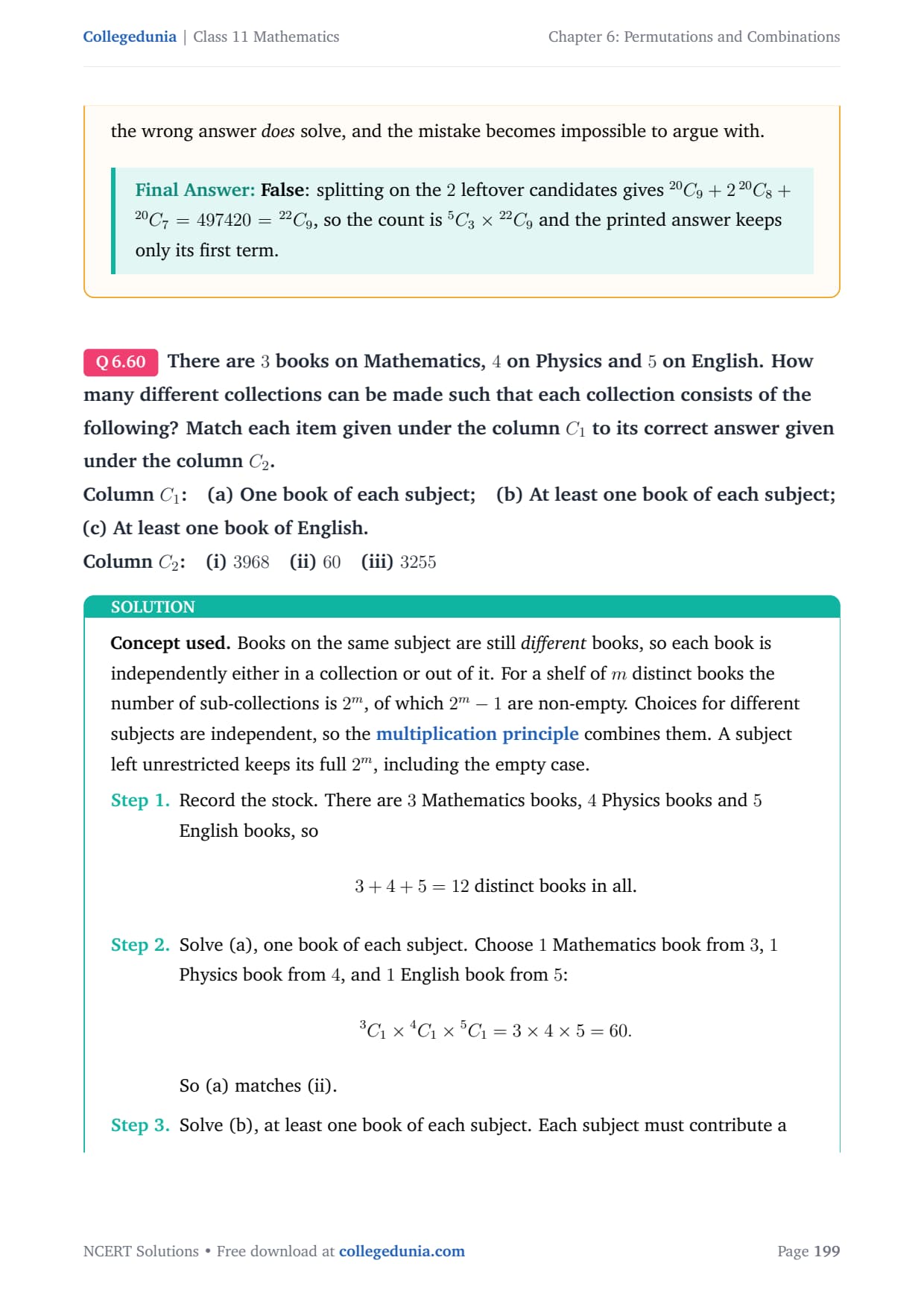
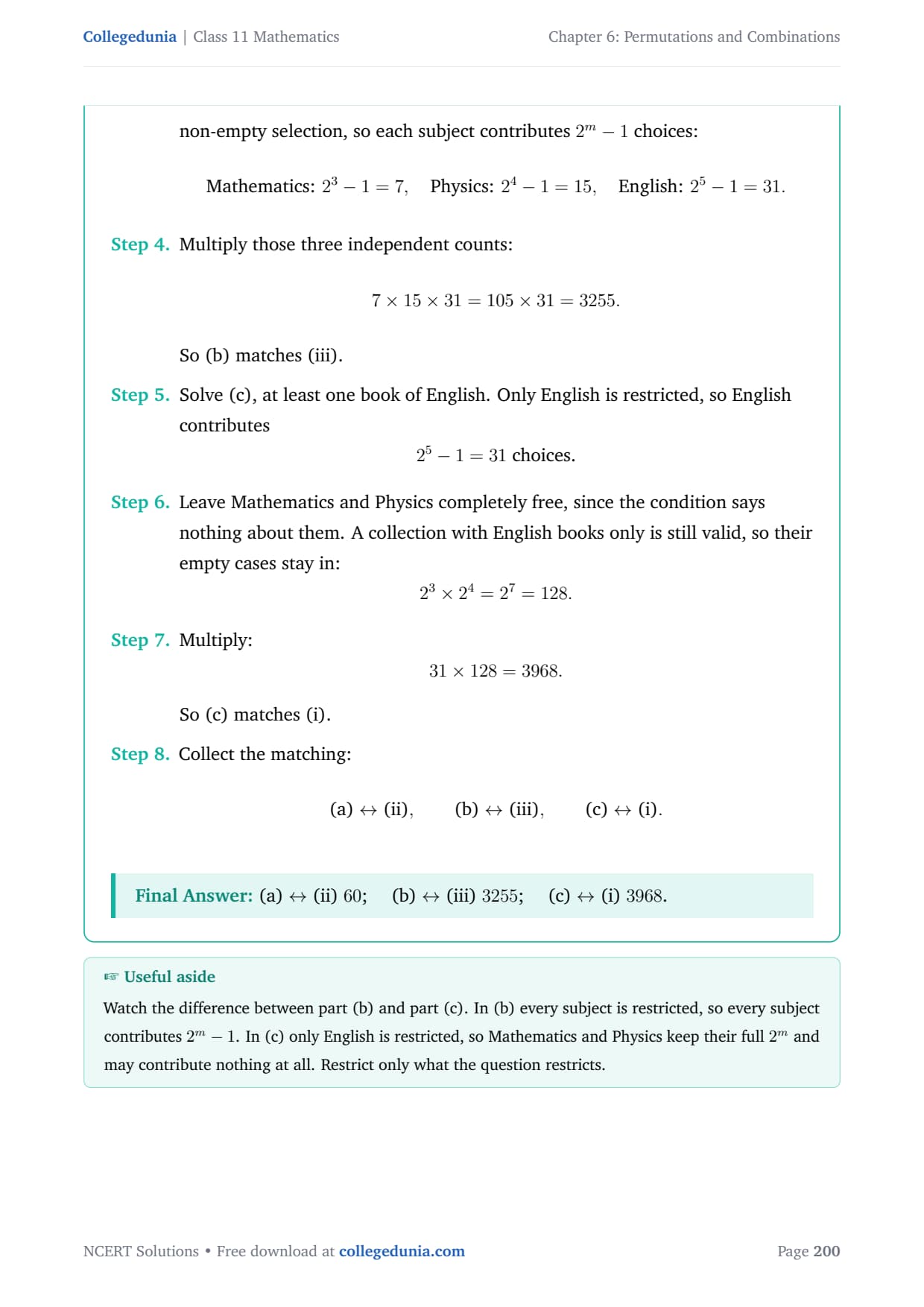
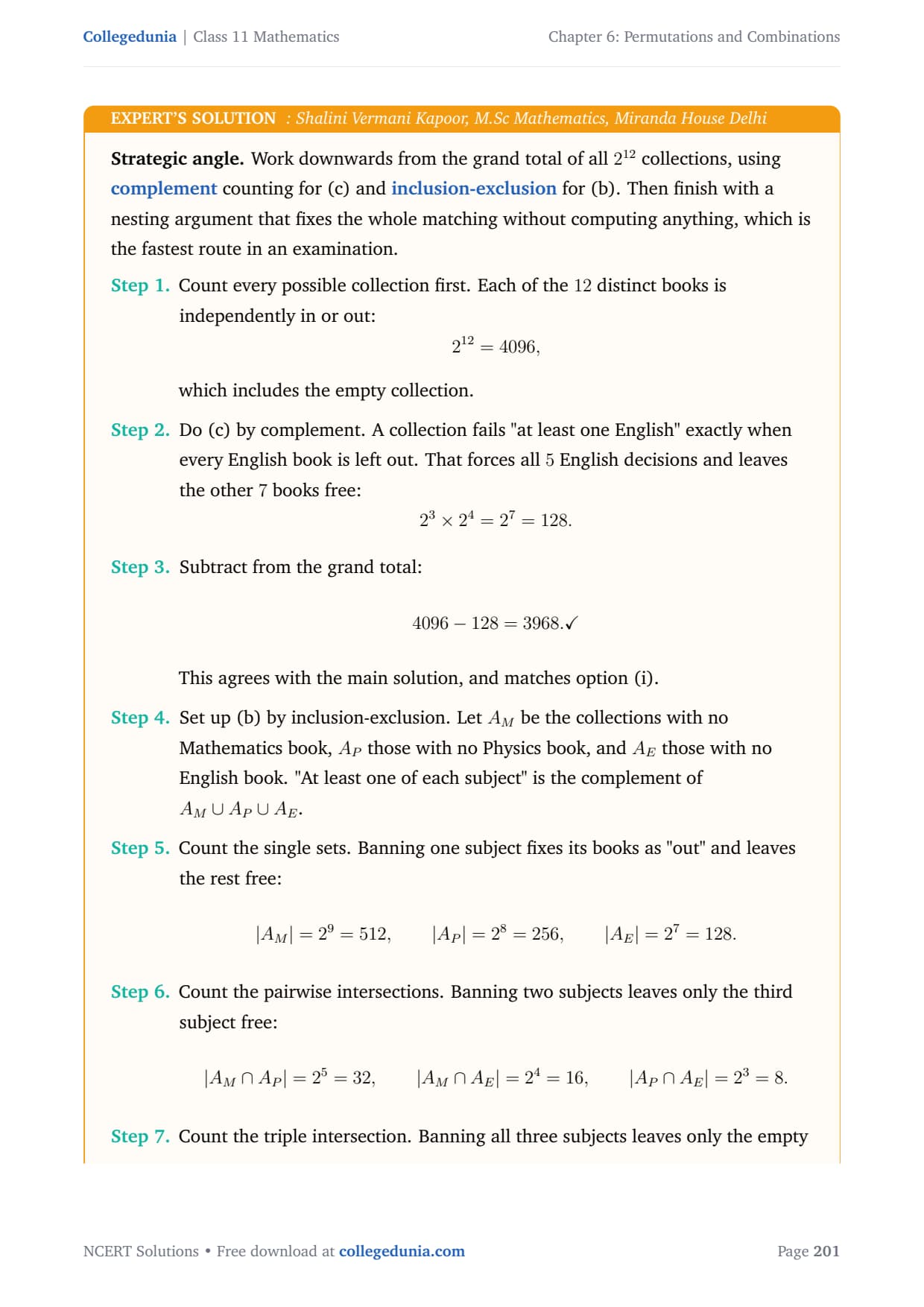
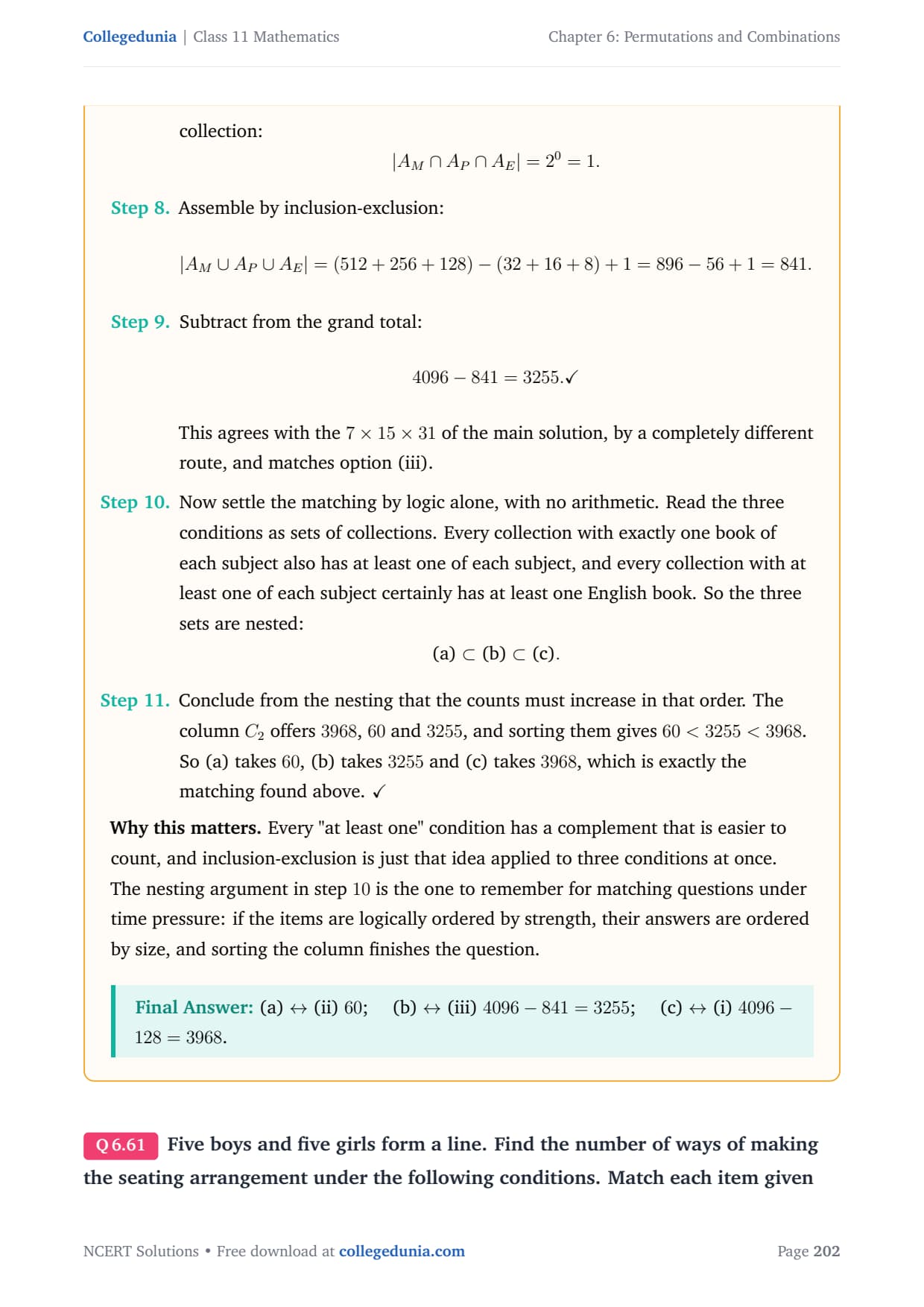
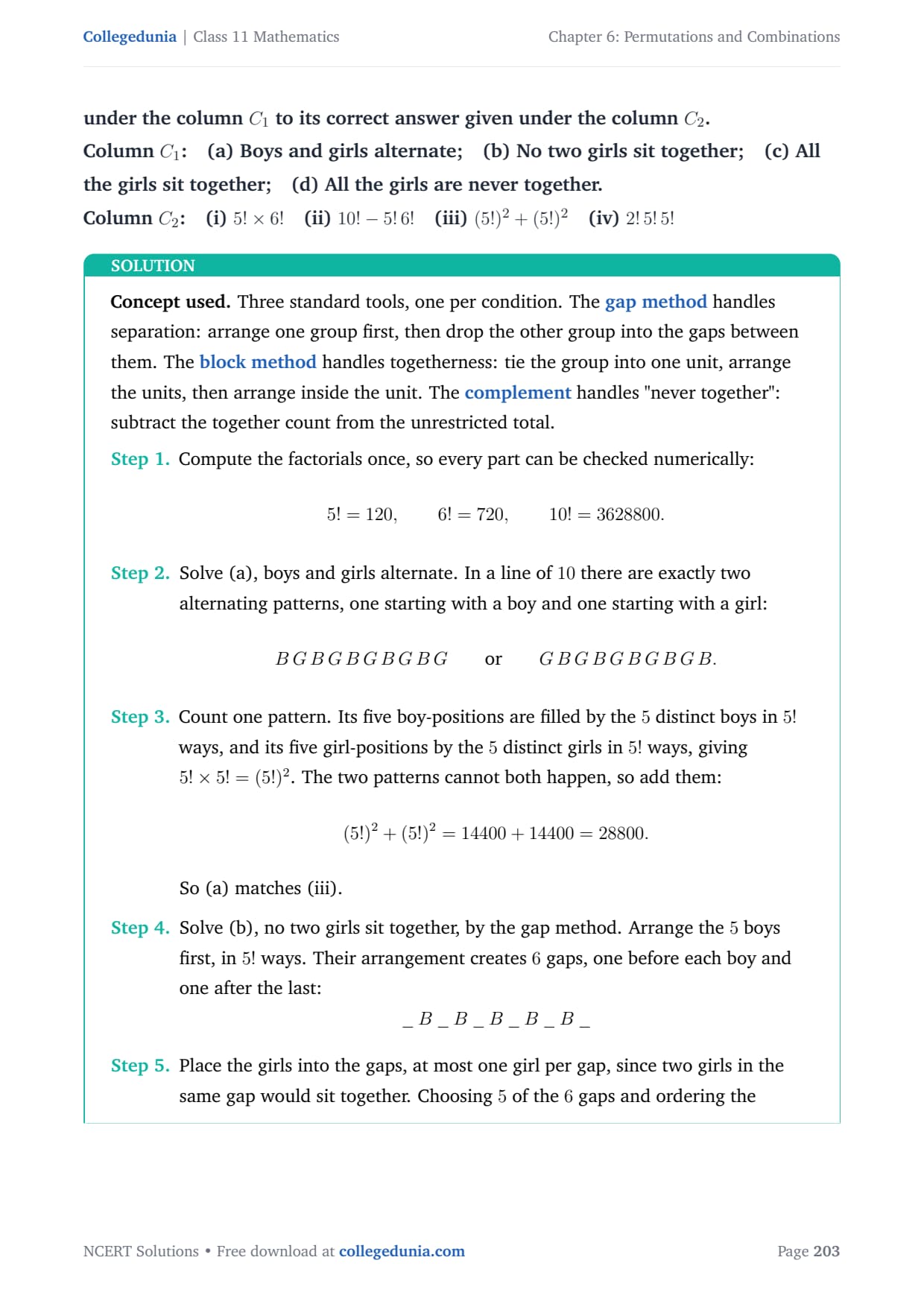
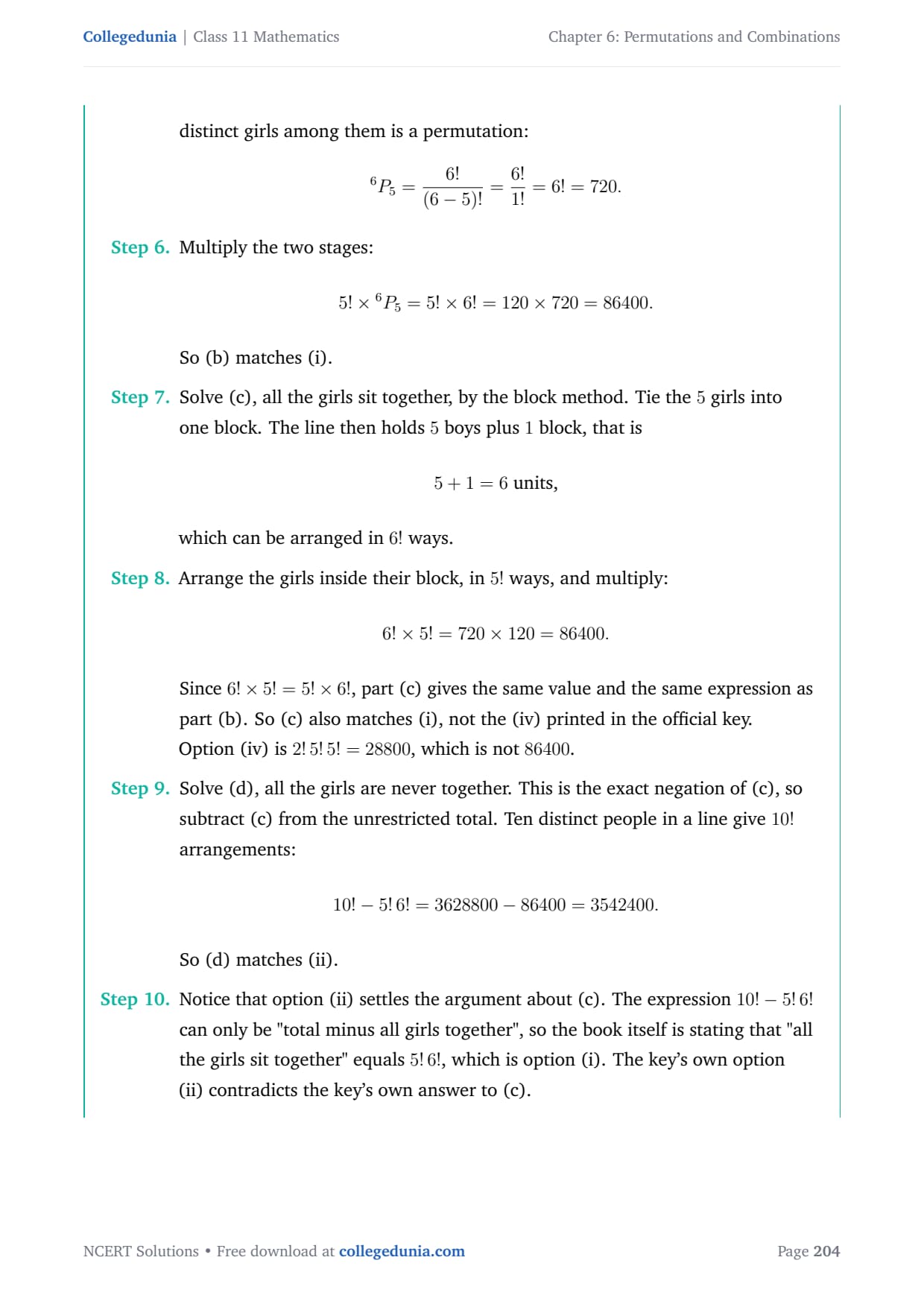
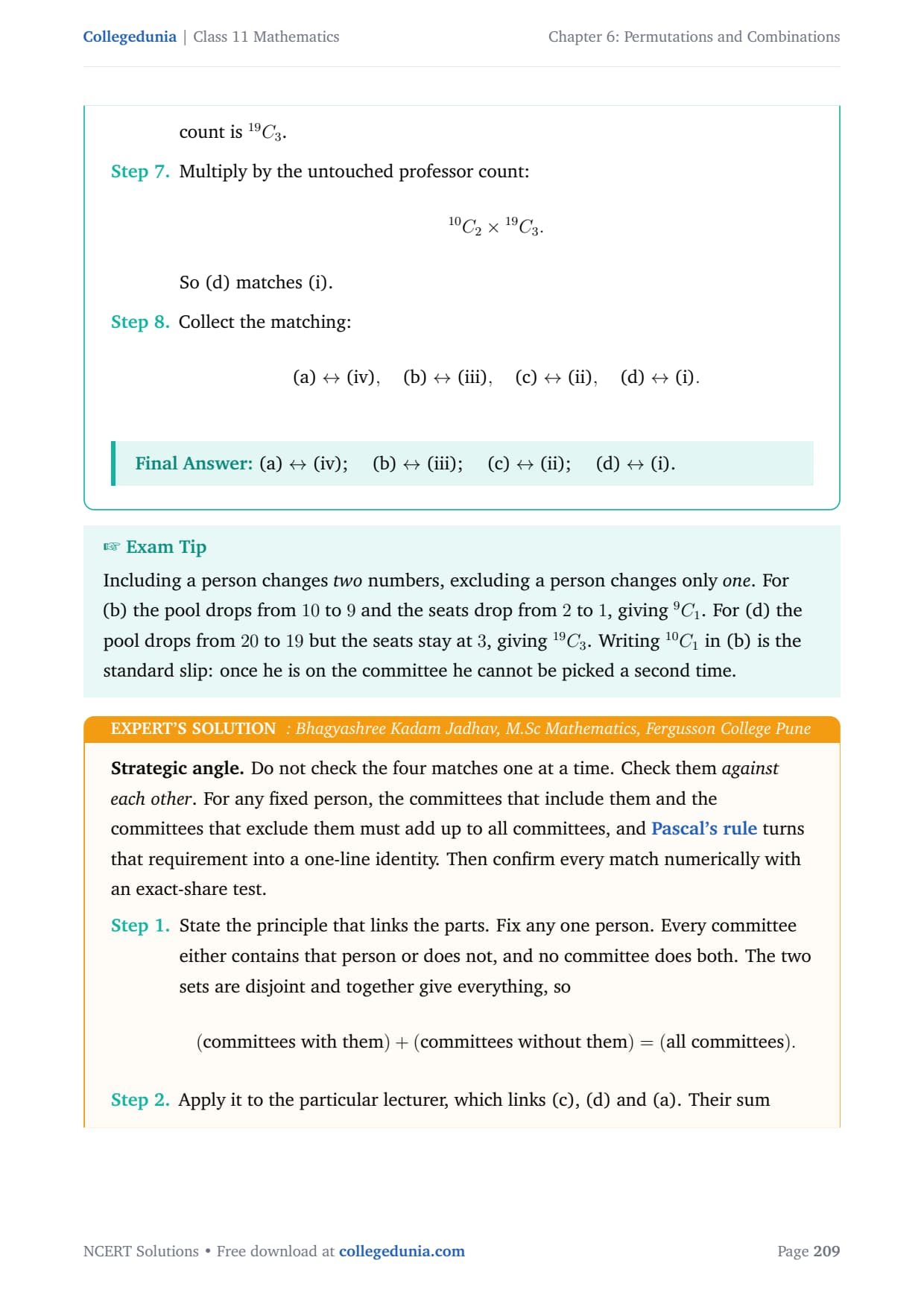
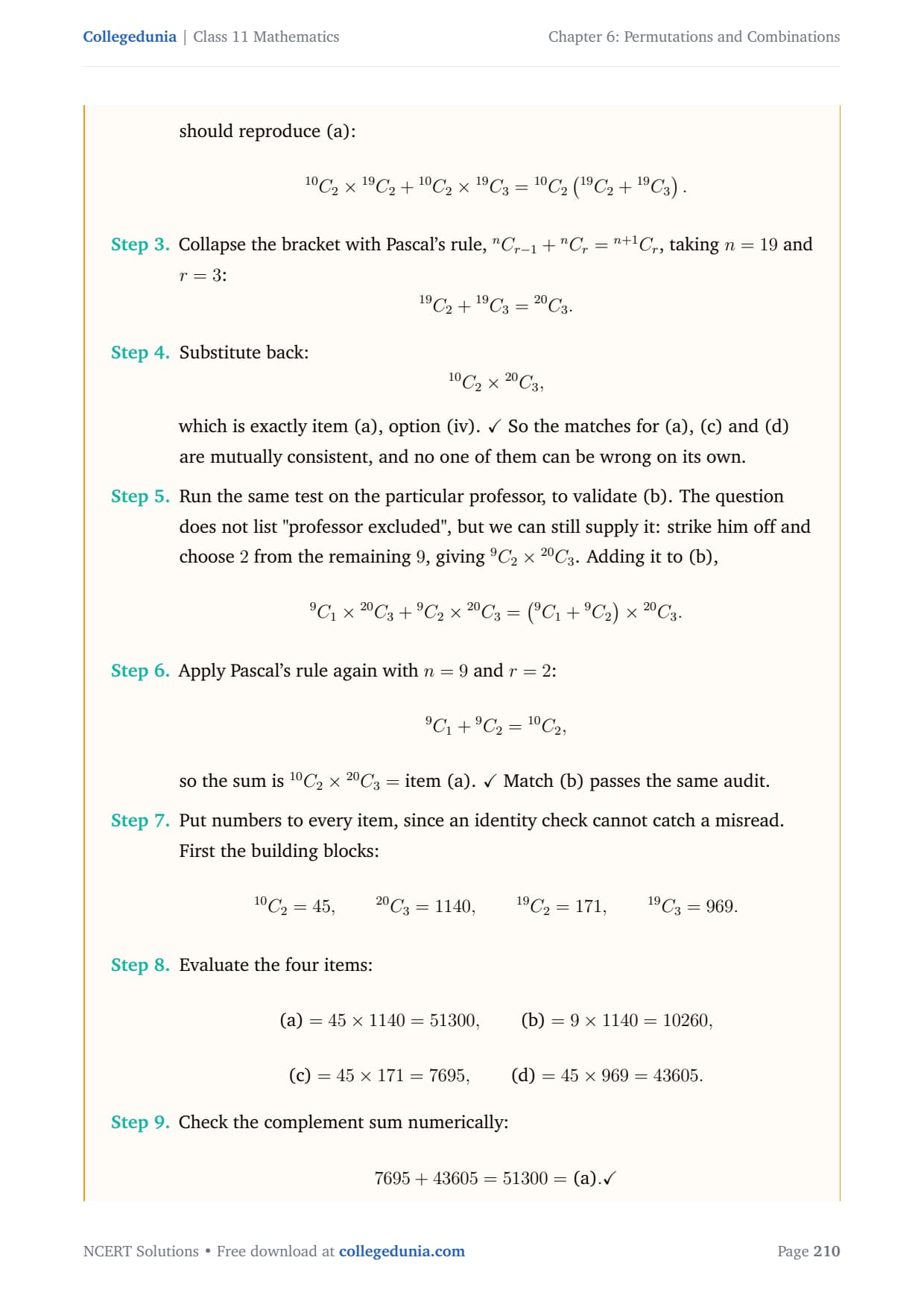
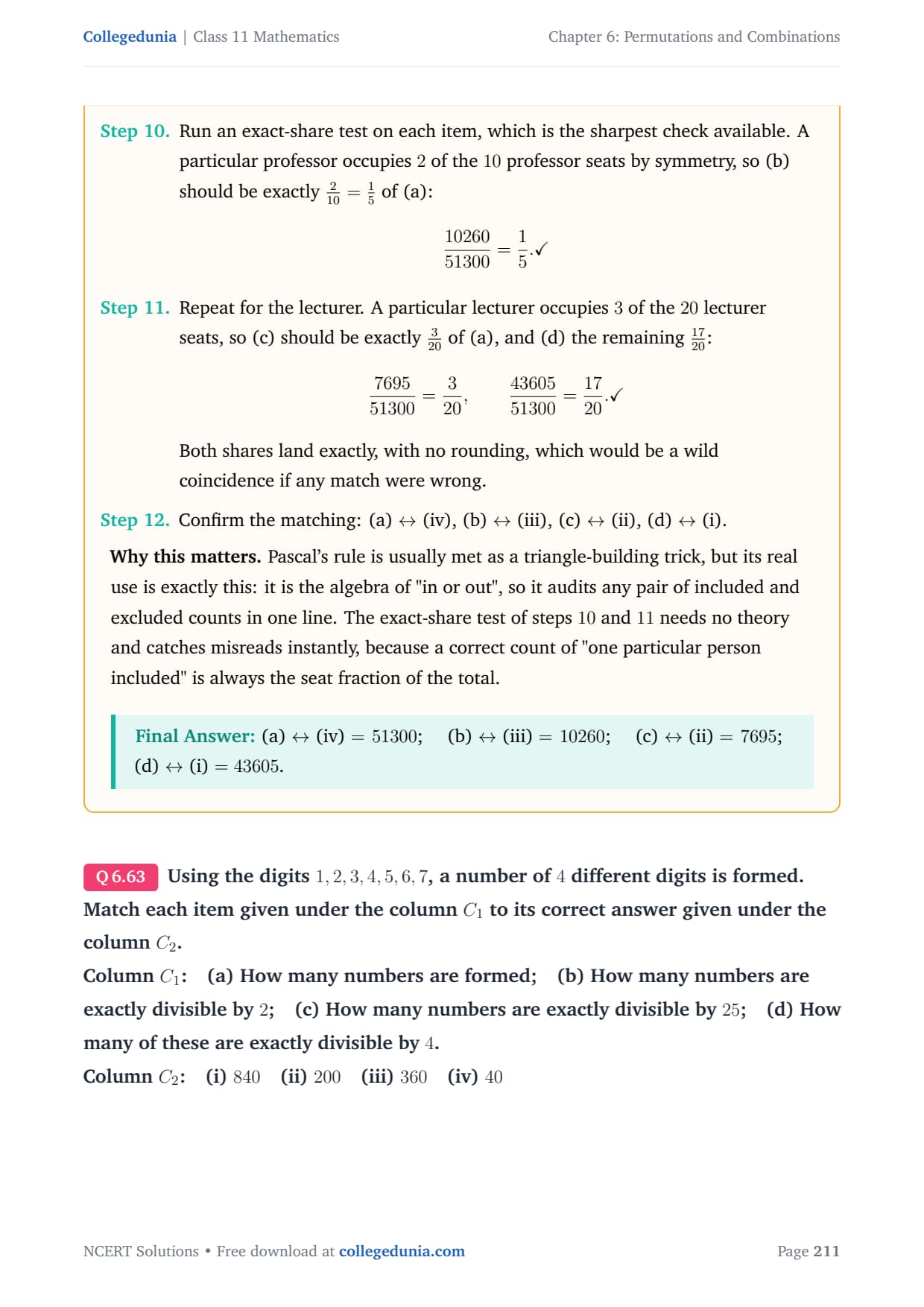
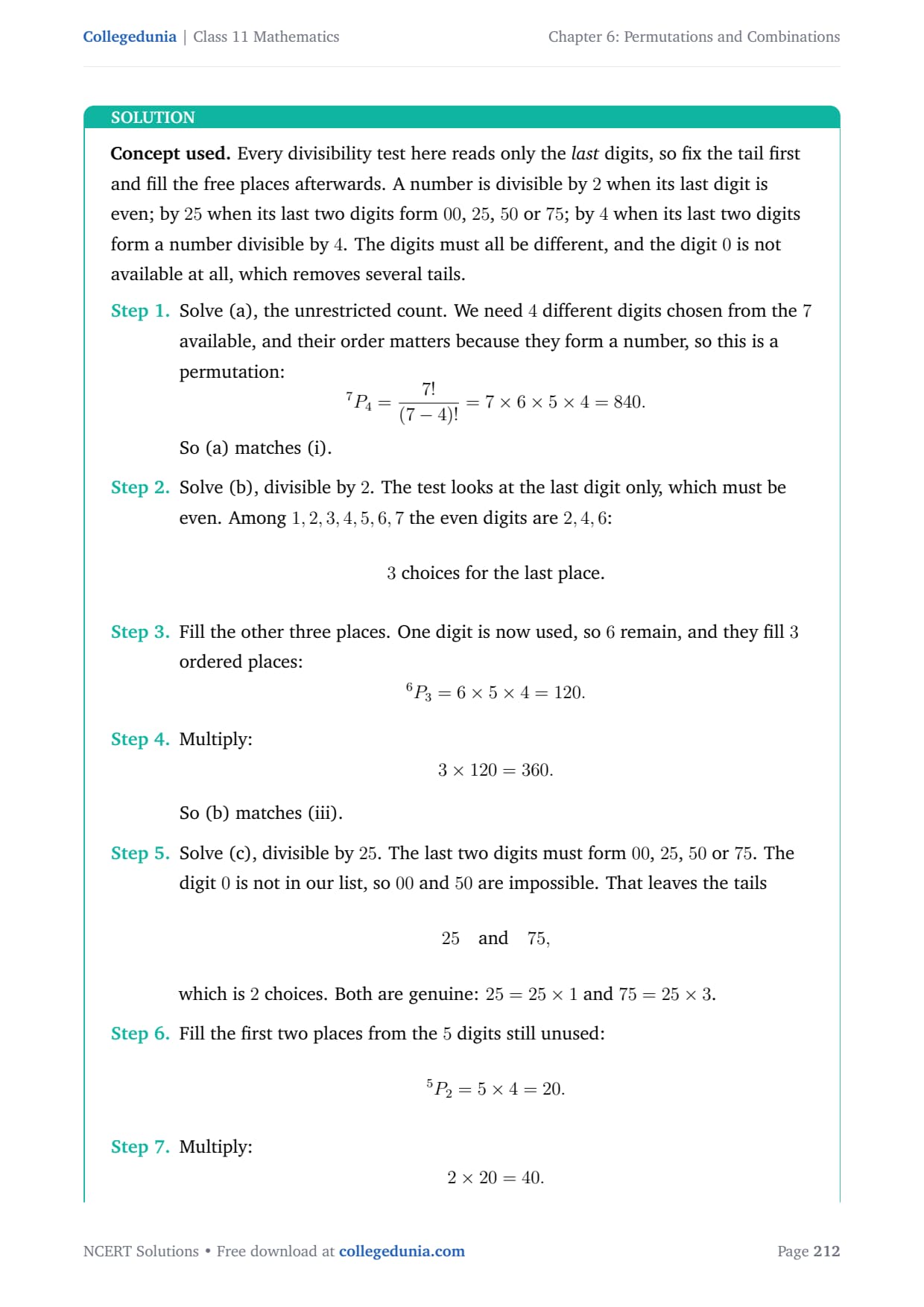
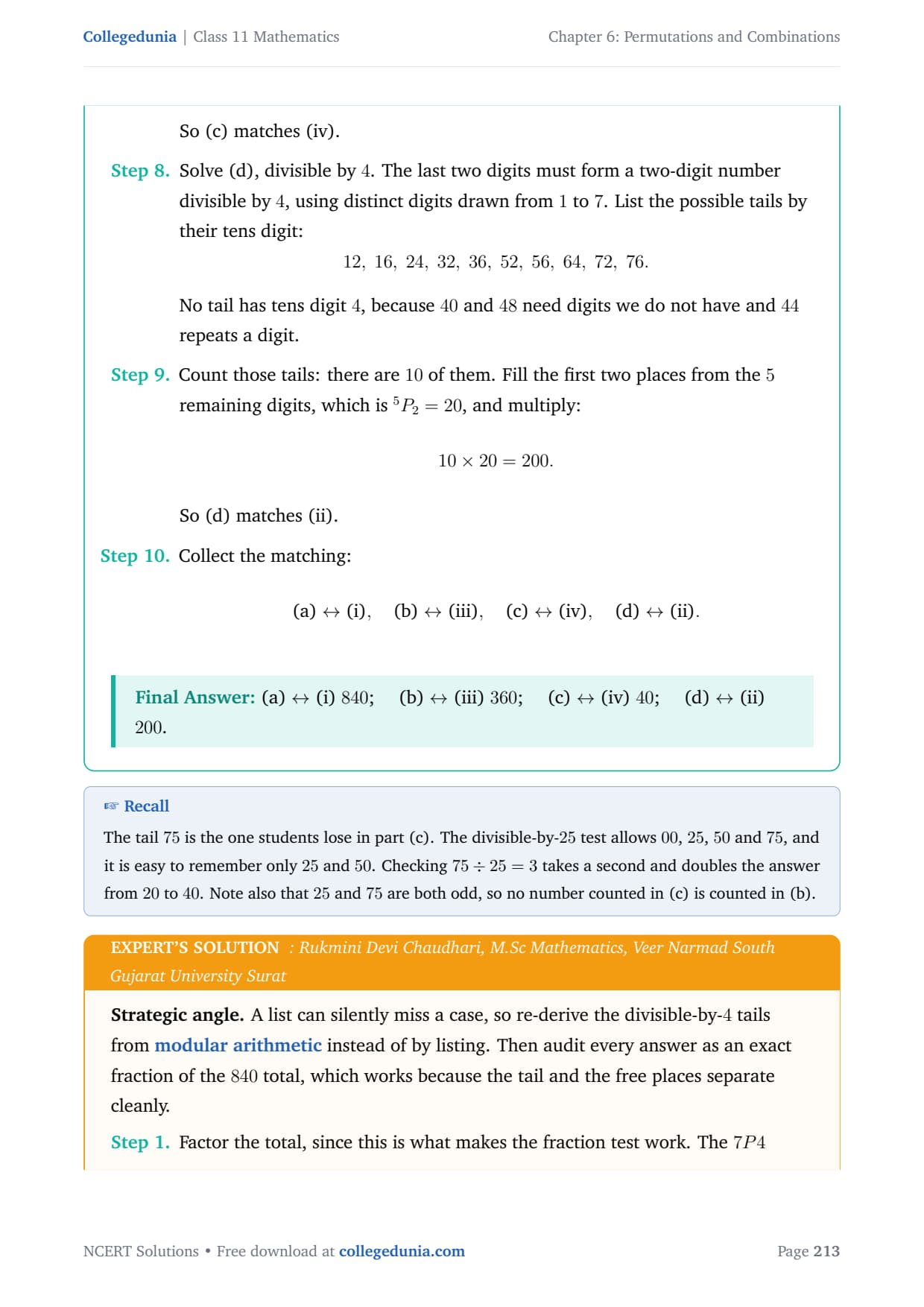
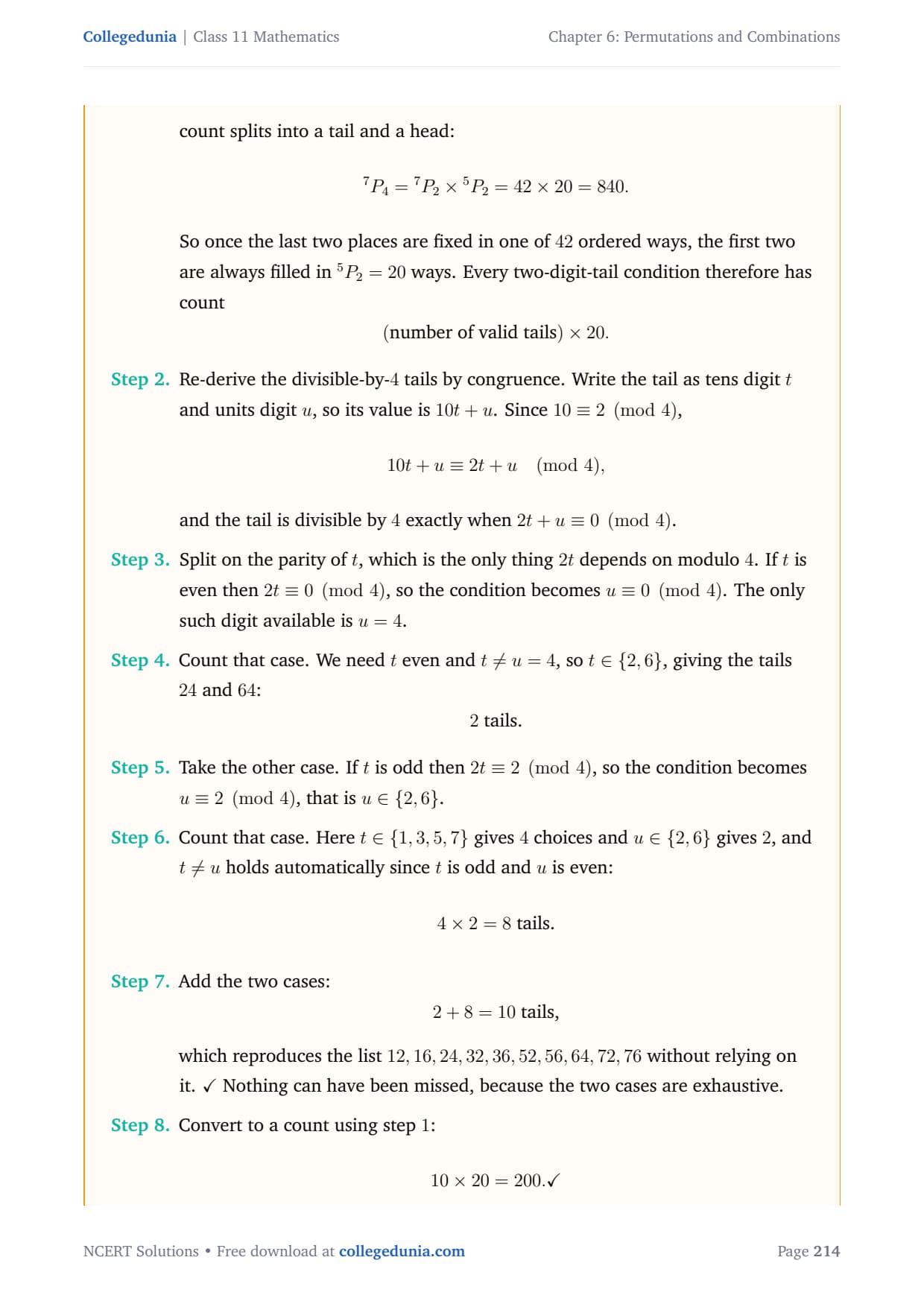
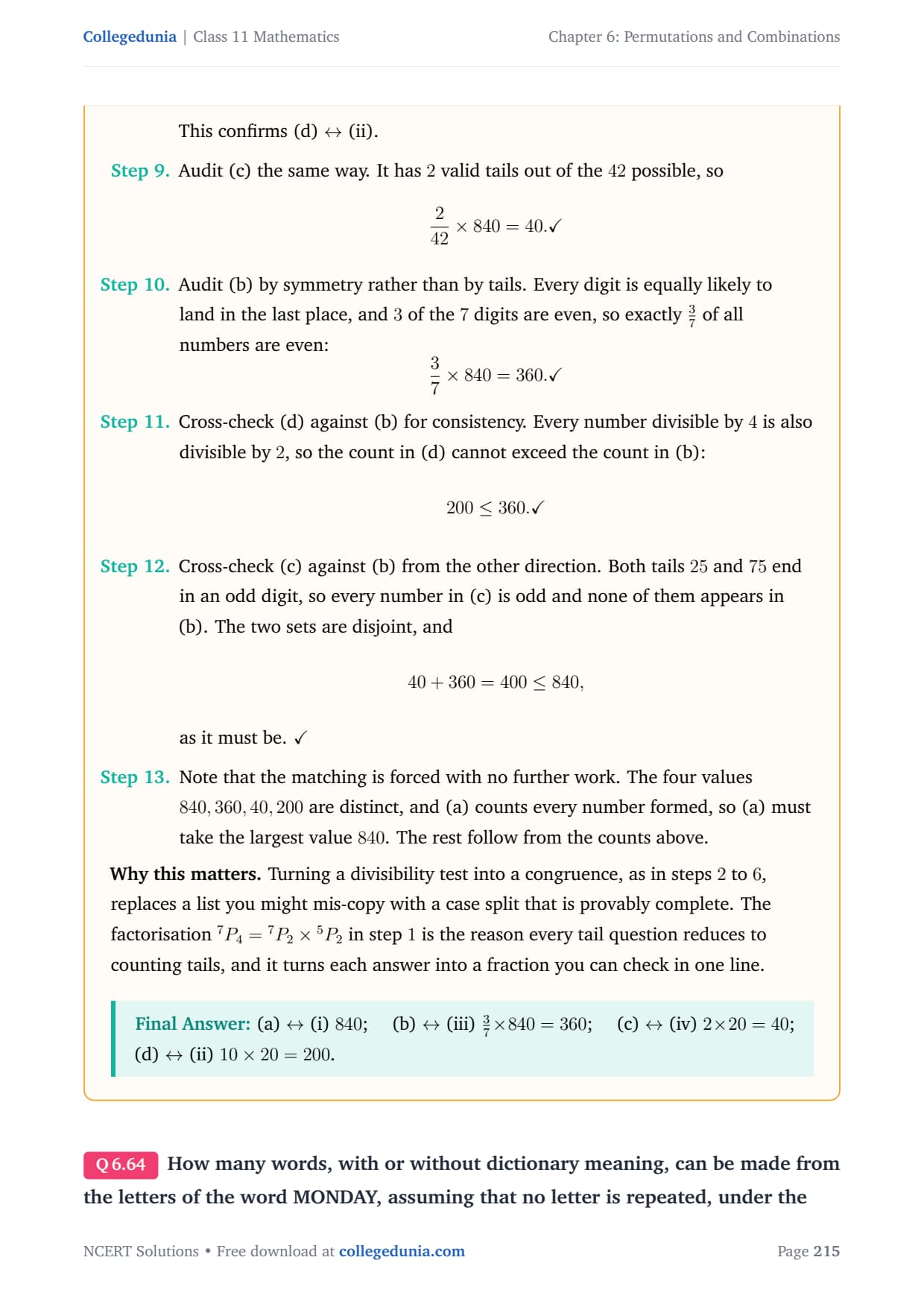
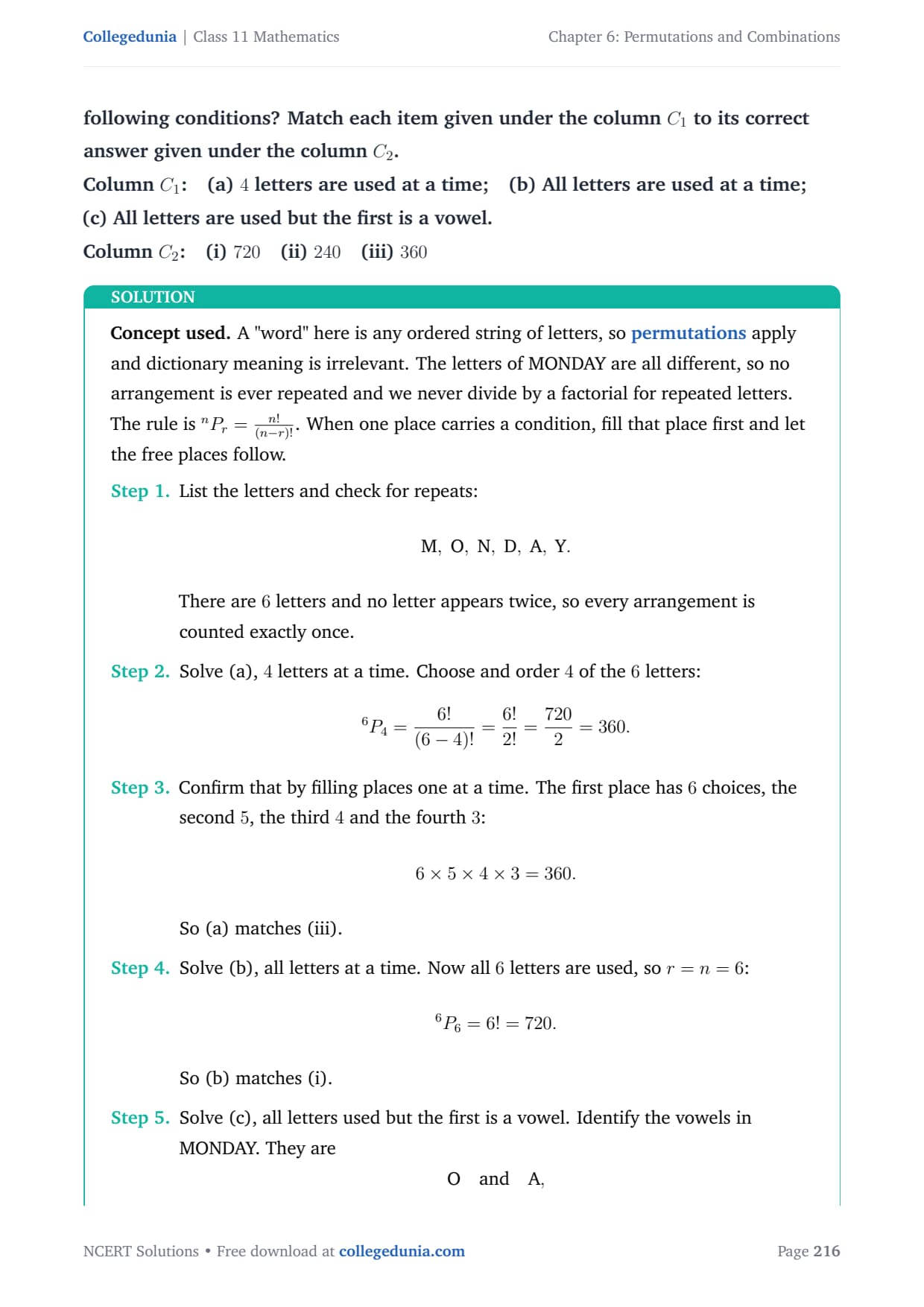
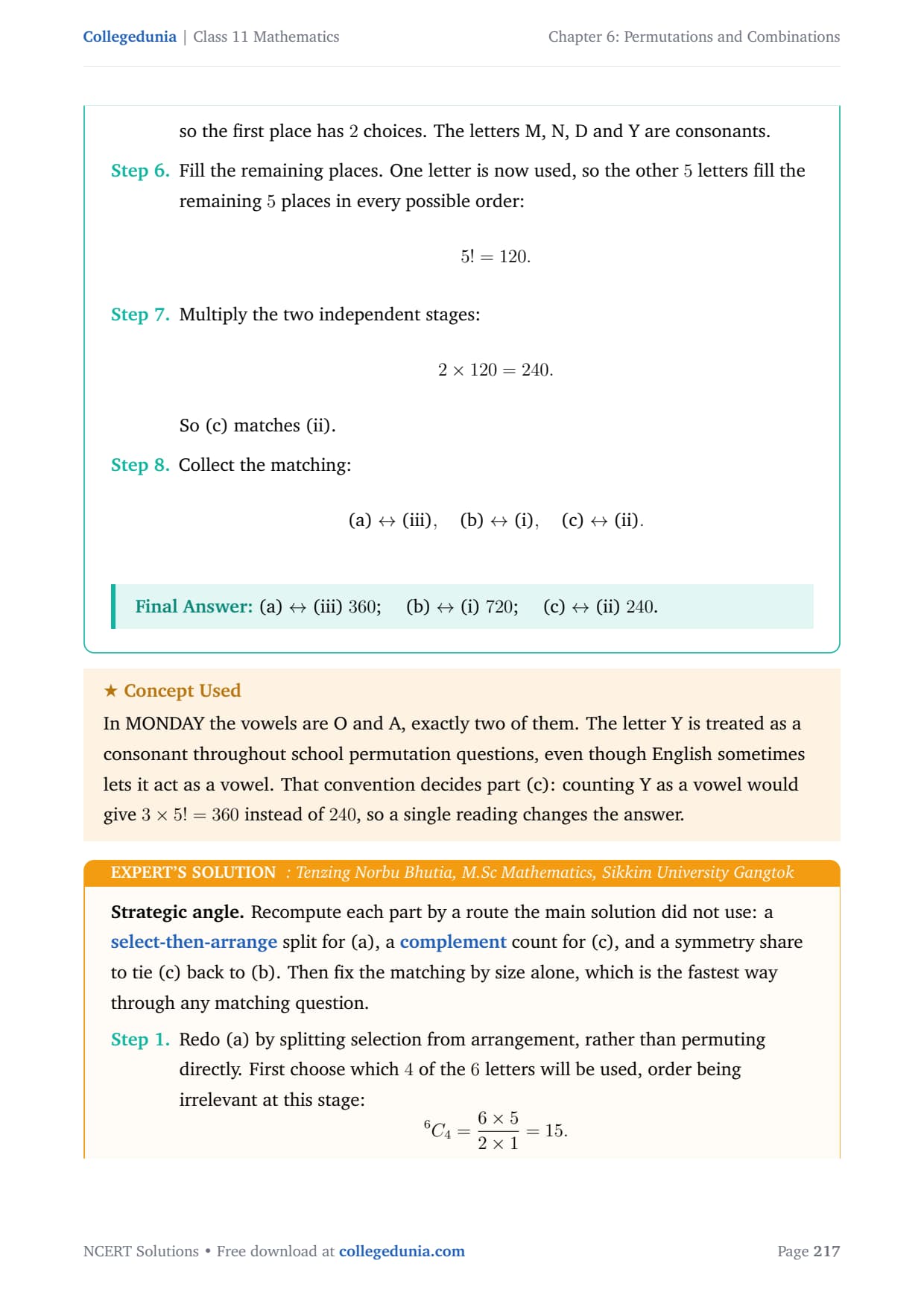
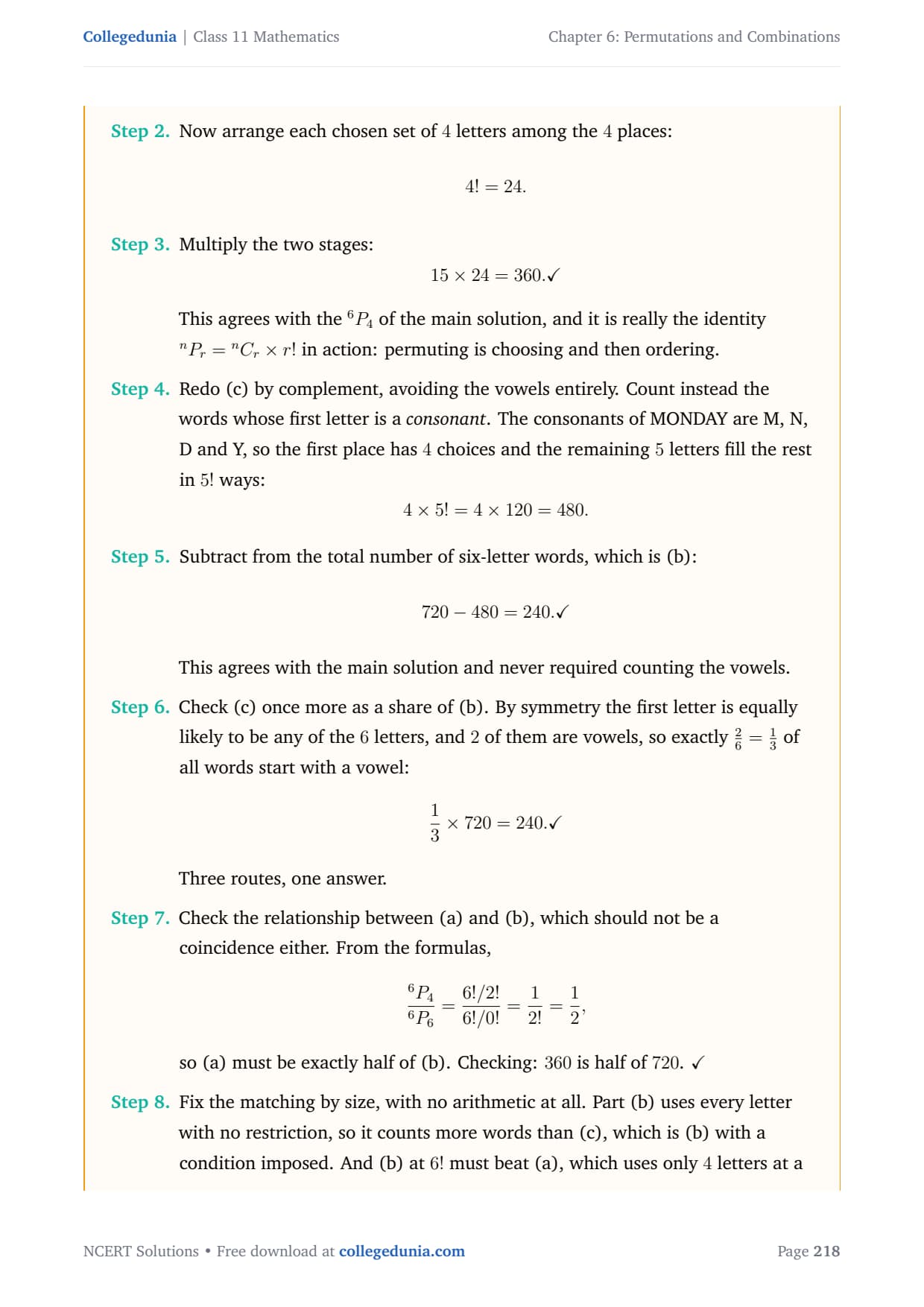
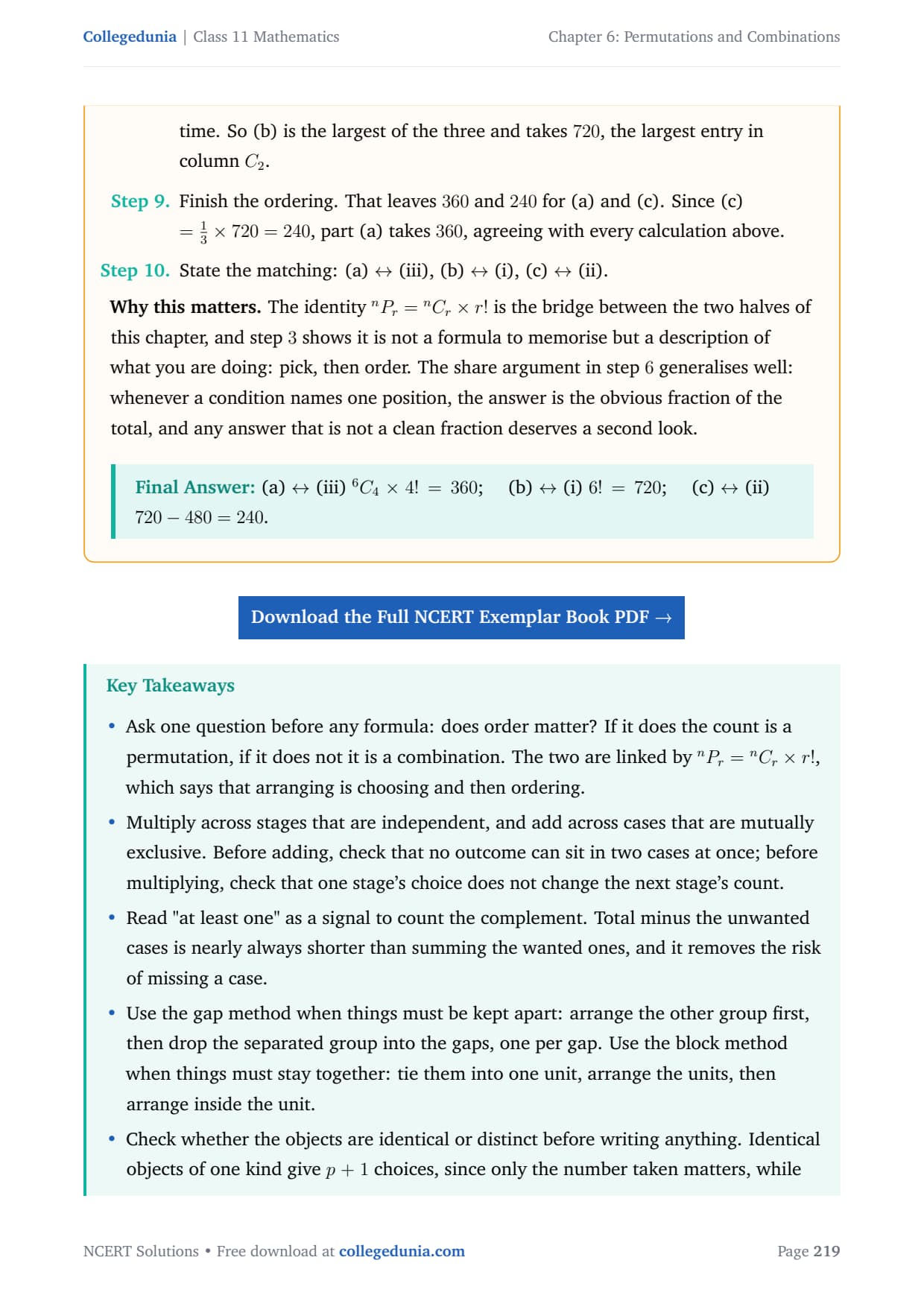
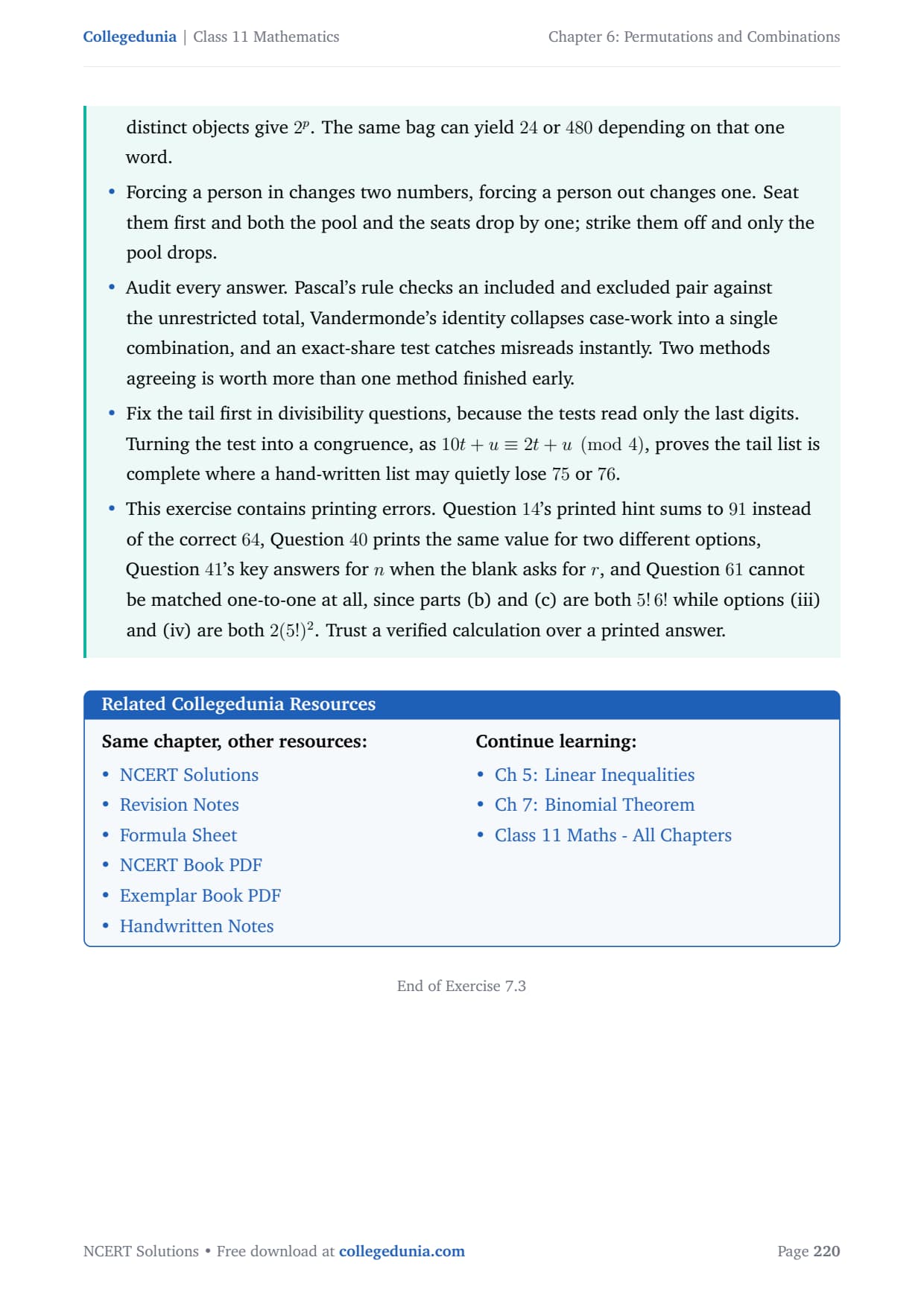
Every solution in this Collegedunia set is prepared by subject experts, based on the 2026-27 NCERT Exemplar, and checked line by line against the official answer key.
The Exemplar prints this chapter as Chapter 7, so its single long exercise is numbered Exercise 7.3 in the book's own numbering. The solutions PDF runs to 220 pages and covers every question in it.
- 64 questions solved: Short Answer, Long Answer, Objective, Fill in the Blanks, True/False and Match the Following.
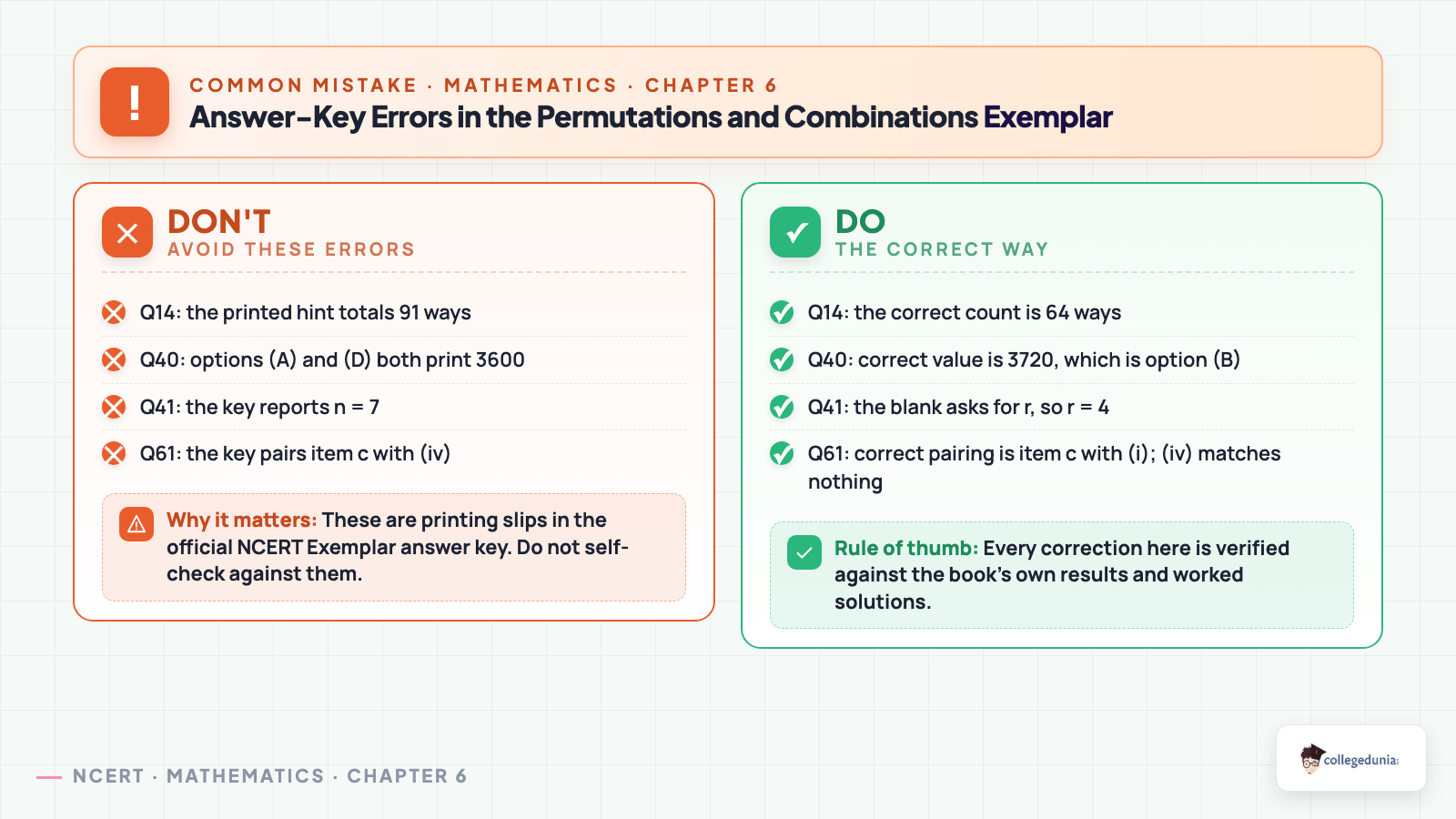
- Four printed errors flagged: a wrong hint on Q14, duplicate options on Q40, and a wrong key on Q41 and Q61.
- Exam focus: useful for CBSE Boards, JEE Main, JEE Advanced and CUET.
Topics Covered in the Class 11 Maths Permutations and Combinations Exemplar
The Exemplar keeps the textbook's topic list but hides the counting rule inside a story. Most questions are one line long and still need a case split. These are the topics the 64 questions are built on.
- Fundamental principle of counting: deciding whether the stages multiply or the cases add.
- Permutations: nPr when order matters, including numbered seats and digit problems.
- Combinations: nCr when order does not matter, plus the symmetry and Pascal results.
- Alike objects: dividing by the repeats, as in n! / (p! q! r!) for words with repeated letters.
- Circular and two-sided arrangements: (n − 1)! for a round table, and why a long table is different.
- Grouping and distribution: splitting people into named groups against unnamed groups.
- Selections and subsets: 2n total selections and 2n − 1 non-empty ones.
- Counting in geometry: lines and triangles from a set of points, with a correction for collinear points.
Important: the single most useful habit in this chapter is to ask "does order matter?" before writing anything. Get that wrong and every later step is wrong, however clean the arithmetic looks.
Exercise 7.3 Question-Type Breakdown for Permutations and Combinations
All 64 questions sit inside Exercise 7.3, grouped by format. The table below shows how the exercise is split, so students can plan practice by question type rather than solving straight through.
| Question Type | Question Numbers | Count | What it tests |
|---|---|---|---|
| Short Answer | Q1 to Q20 | 20 | Seating, digits, words and small selections |
| Long Answer | Q21 to Q25 | 5 | Grouping, committees and multi-case counting |
| Objective (MCQ) | Q26 to Q40 | 15 | One-line counting with a built-in trap option |
| Fill in the Blanks | Q41 to Q50 | 10 | Solving for n or r from given nPr and nCr values |
| True/False | Q51 to Q59 | 9 | Judging a printed count and justifying the verdict |
| Match the Following | Q60 to Q64 | 5 | Matching four counting conditions to four values |
The Objective block (Q26 to Q40) is the largest group and the one that rewards speed, so it is worth a full practice session on its own. The Match the Following block (Q60 to Q64) is unusual: each question is really four questions in one, which makes those five items worth about twenty.
Four Printed Errors in the Permutations and Combinations Exemplar Every Student Must Know
The printed Chapter 7 material has four questions that carry an error, and they are not all the same kind of error. One hint is misprinted, one option list is defective, and two keys give the wrong answer. Each is checked below against the book's own results, so read this section before self-checking.
| Question | Type of error | What the book prints | Correct answer |
|---|---|---|---|
| Q14 | Misprinted hint | Hint totals 91 | 64 ways |
| Q40 | Defective option list | Options (A) and (D) both read 3600 | 3720, option (B) |
| Q41 | Wrong key | n = 7 | r = 4 |
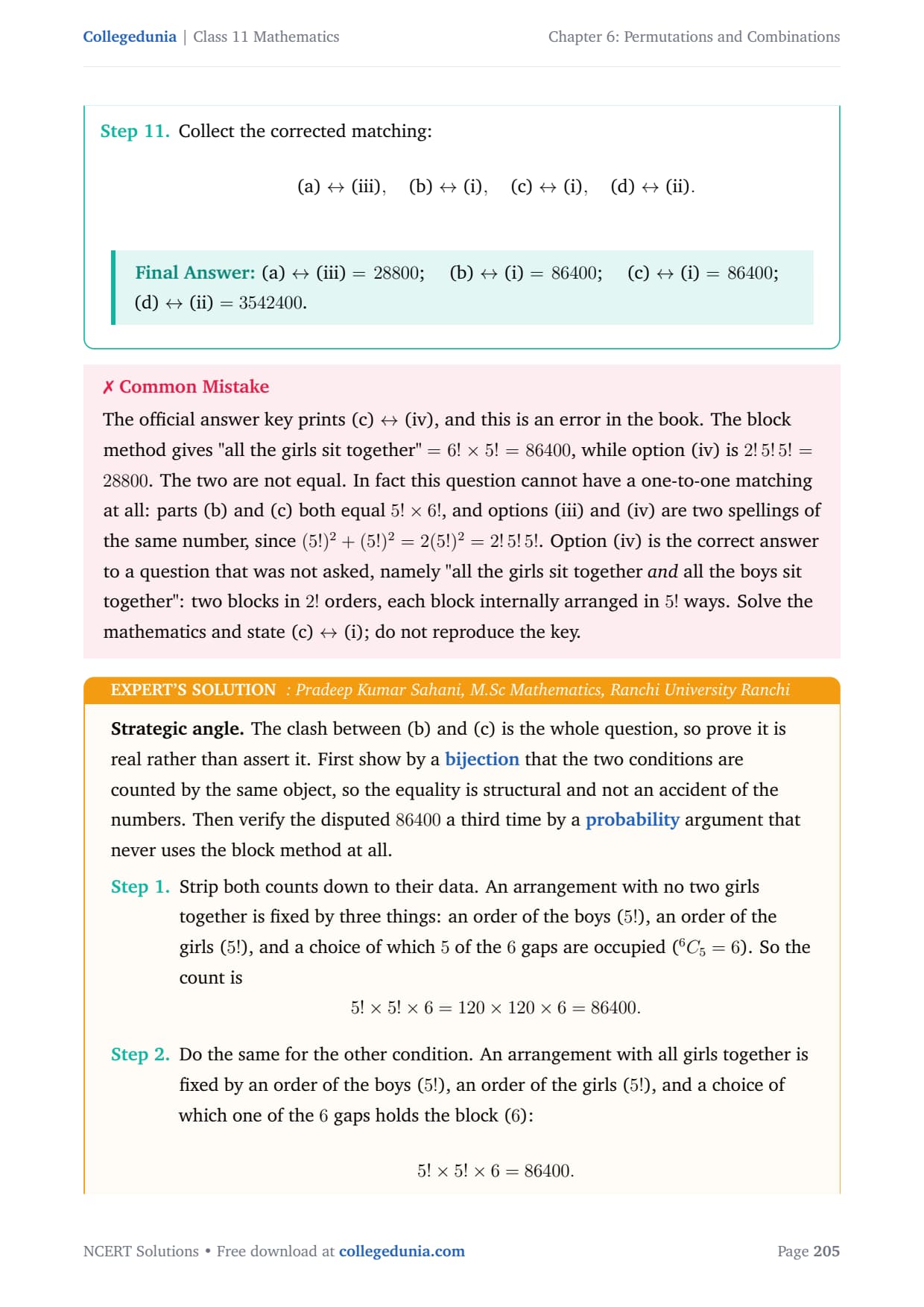
| Q61 | Wrong key, and no matching exists | (c) ↔ (iv) | (c) ↔ (i) = 86,400 |
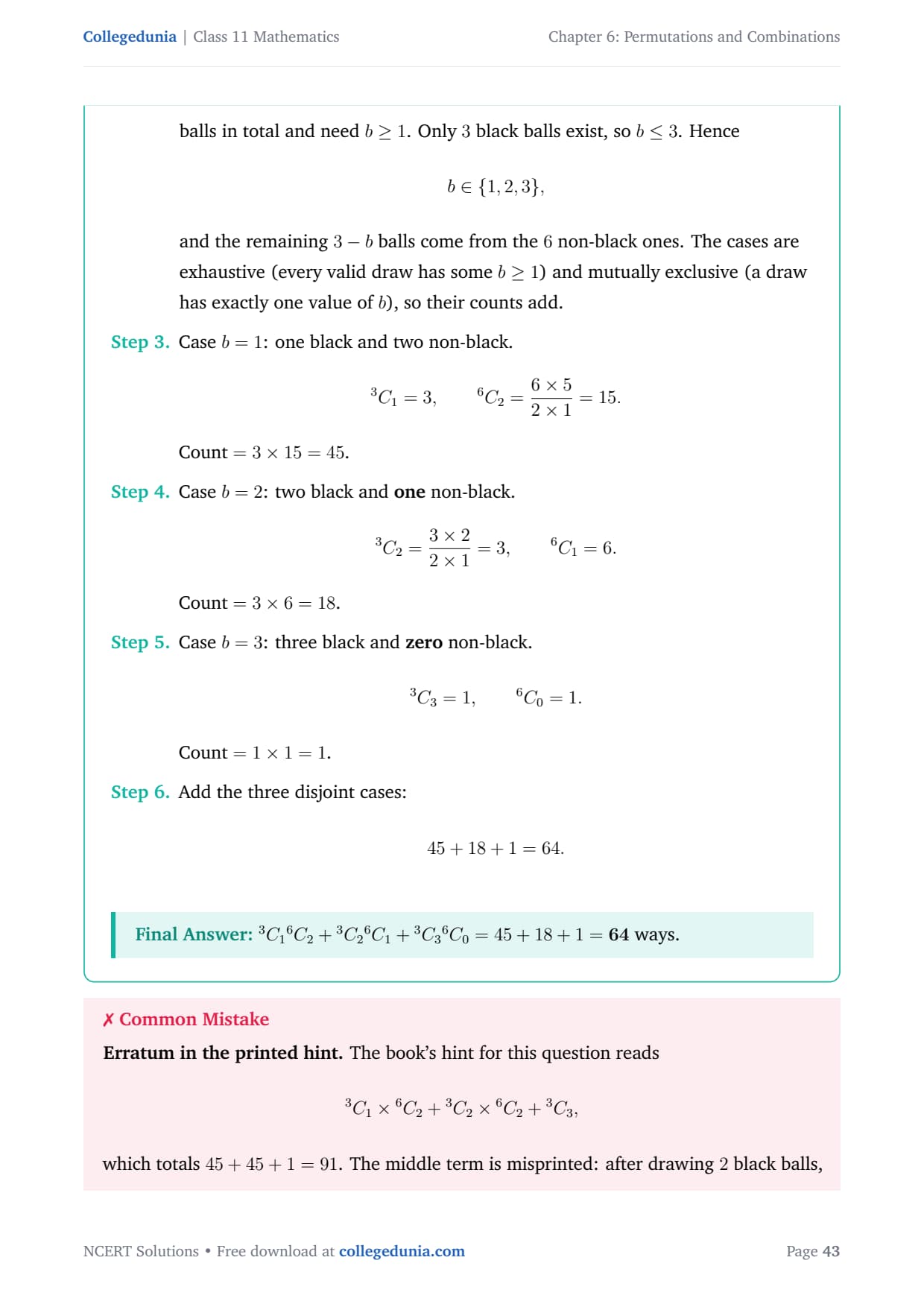
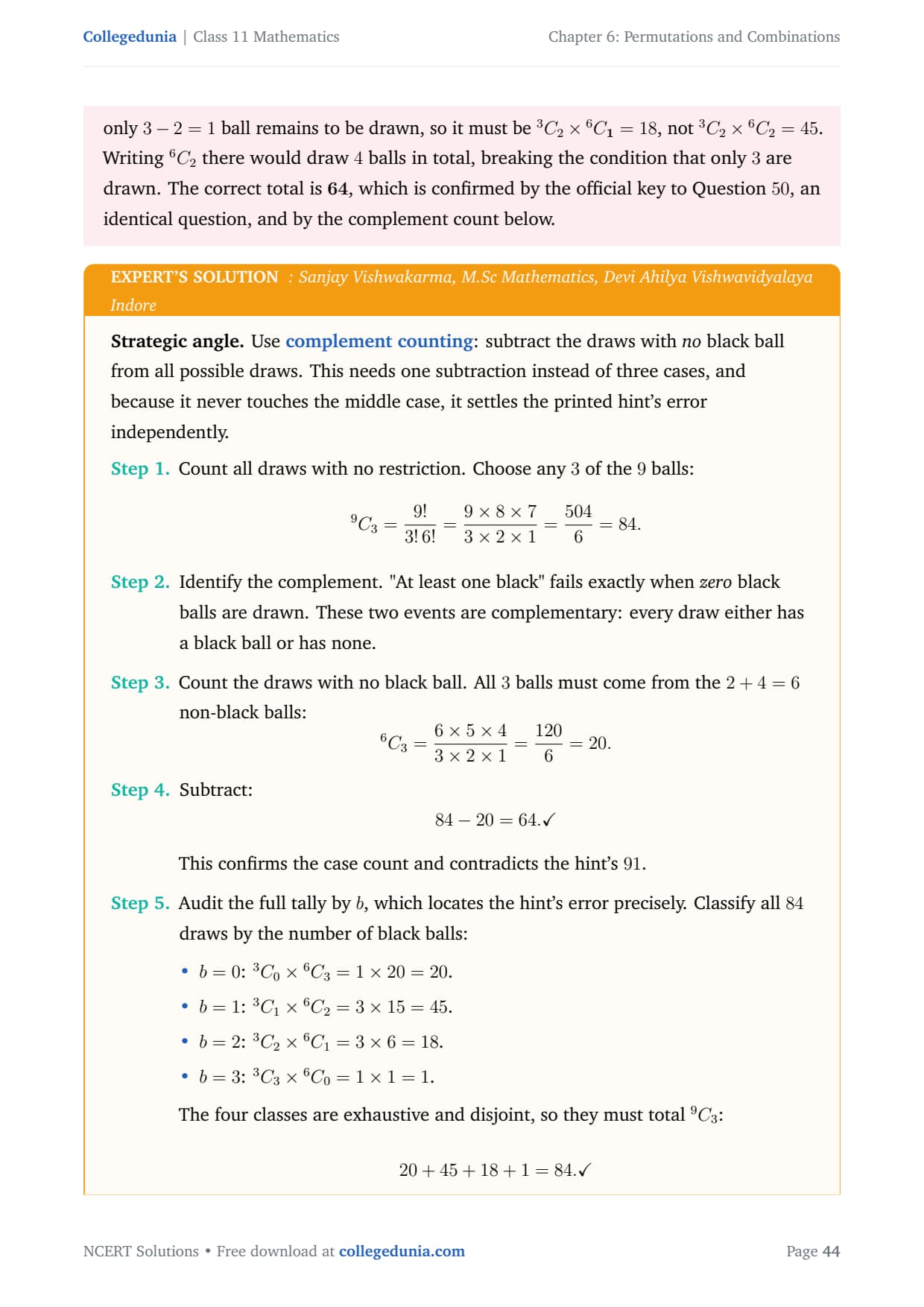
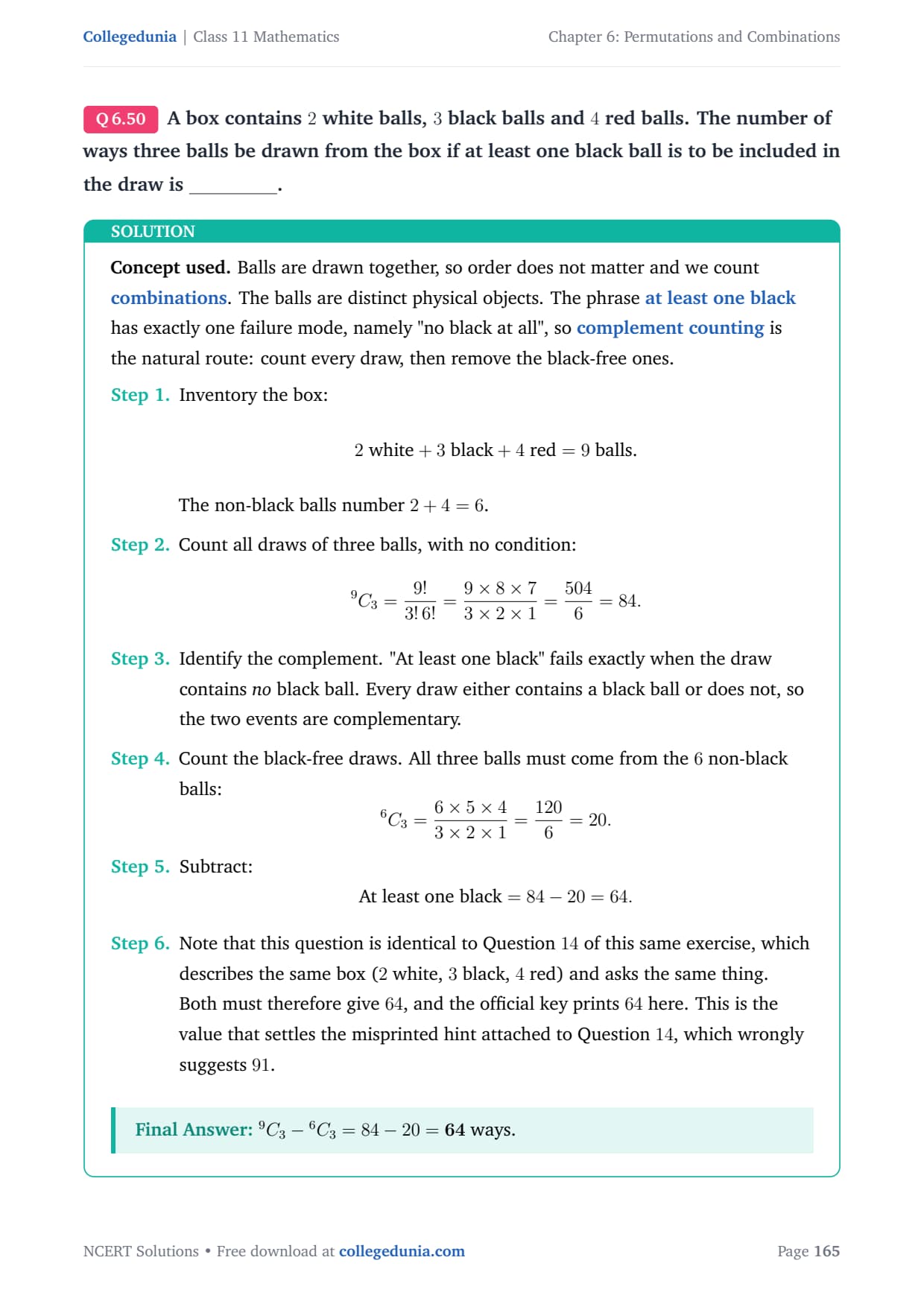
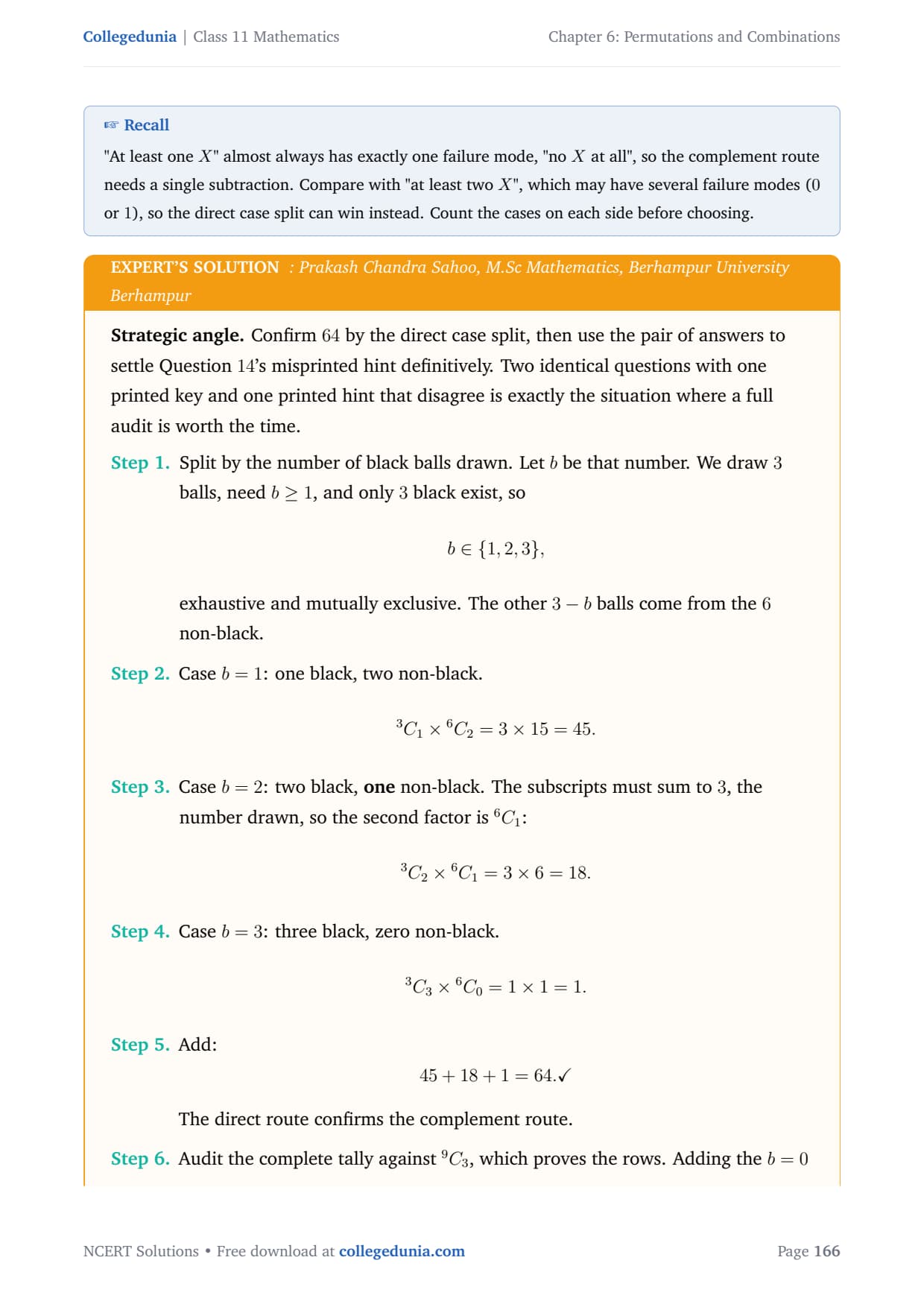
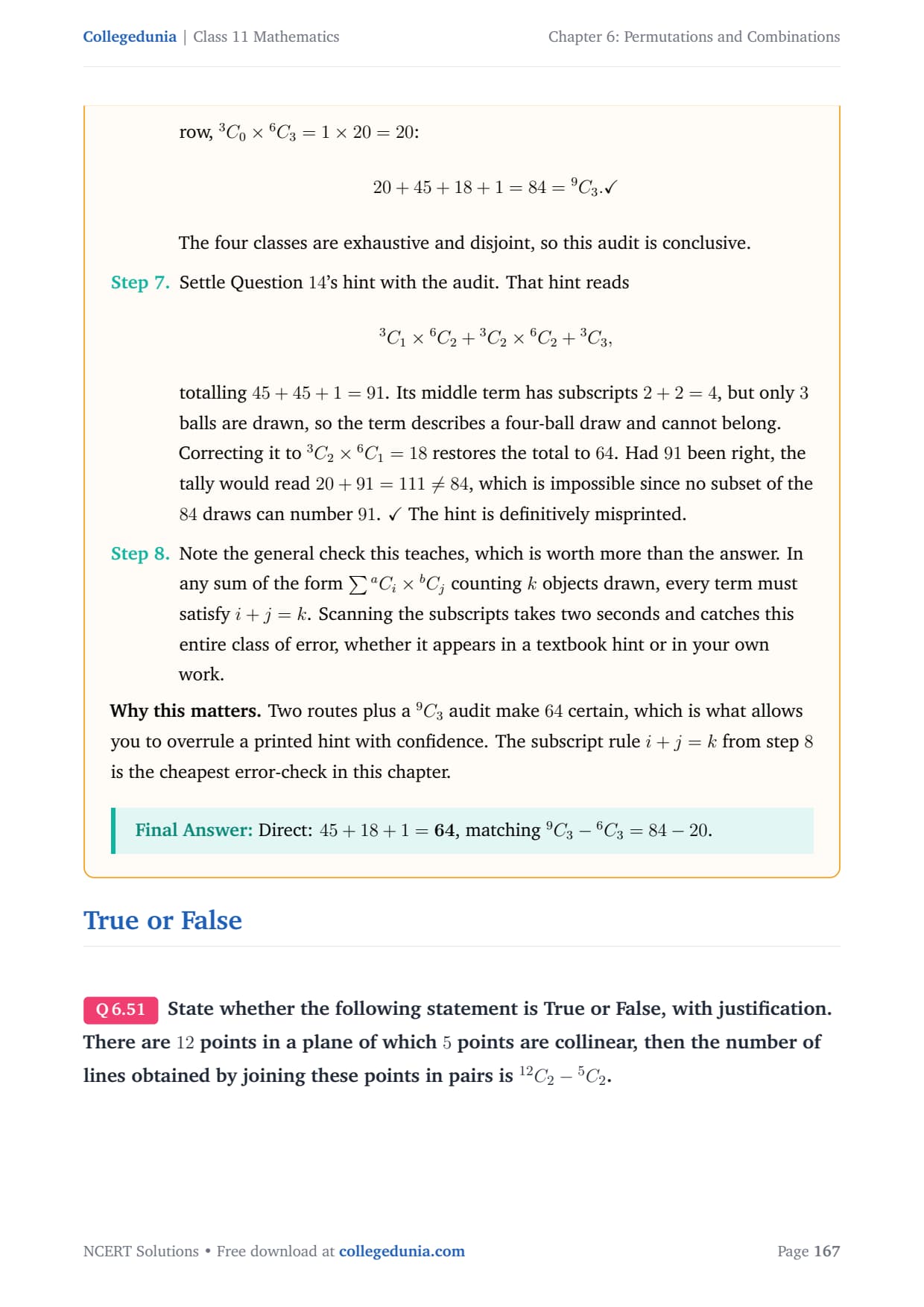
Q14 is a misprinted hint, not a wrong answer. The box has 2 white, 3 black and 4 red balls, and 3 balls are drawn with at least one black. The book's hint reads 3C1 × 6C2 + 3C2 × 6C2 + 3C3, which totals 91. The middle term is the misprint. The one-line check: after 2 black balls only 3 − 2 = 1 ball is left to draw, so the term must be 3C2 × 6C1 = 18, not 45. Written the book's way it would draw 4 balls, not 3. The correct total is 45 + 18 + 1 = 64, which the official key to Q50, an identical question, confirms.
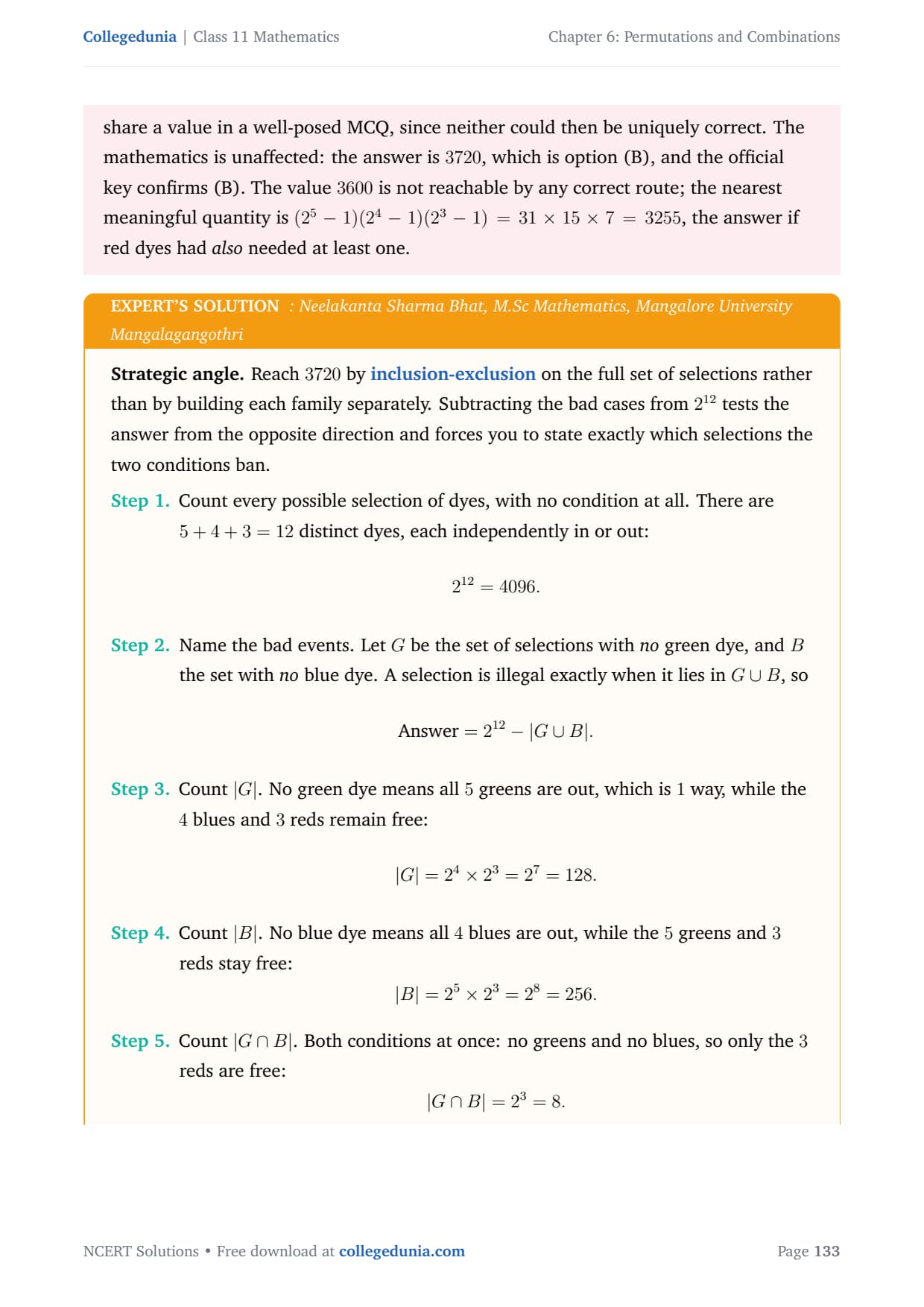
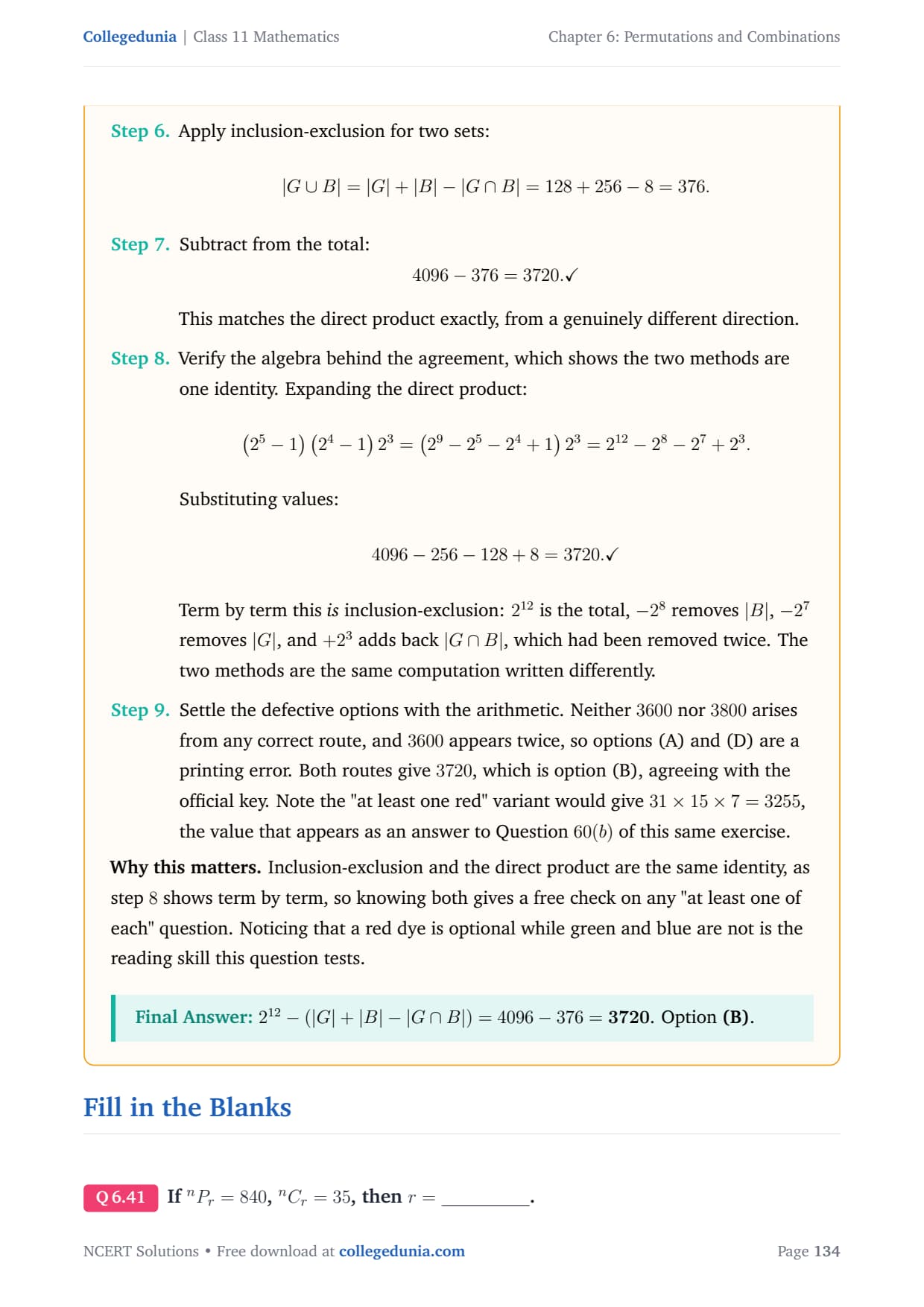
Q40 has a defective option list, but the key is right. The question asks for selections of at least one green dye, at least one blue dye and any number of red dyes. The book prints option (A) as 3600 and option (D) as 3600, the same number twice, so the list is defective: two options cannot share a value in a well-posed MCQ, because neither could then be uniquely correct. The one-line check: (25 − 1)(24 − 1) × 23 = 31 × 15 × 8 = 3720, which is option (B), and the key does print (B). The maths is unaffected here, only the printed choices are.
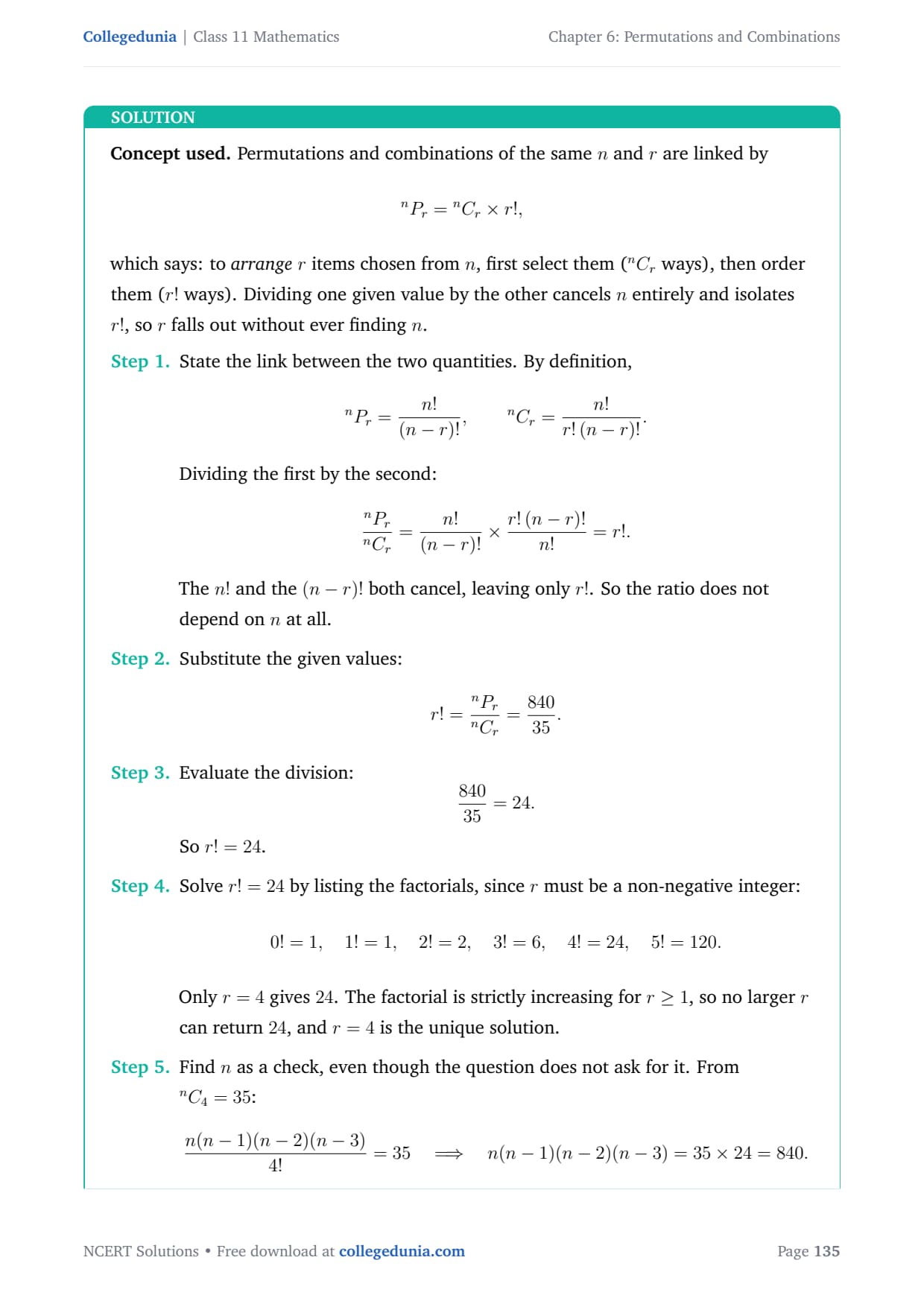
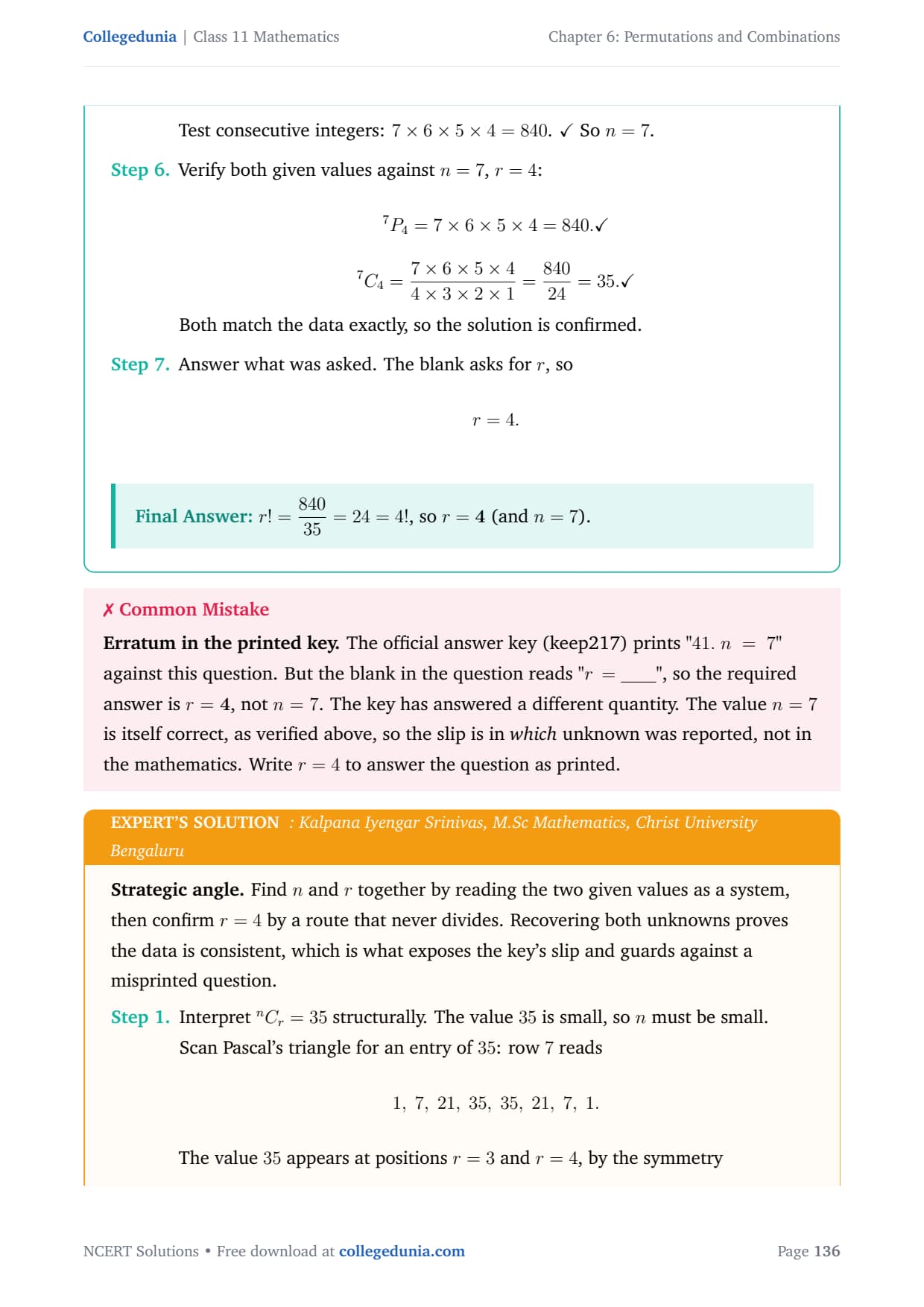
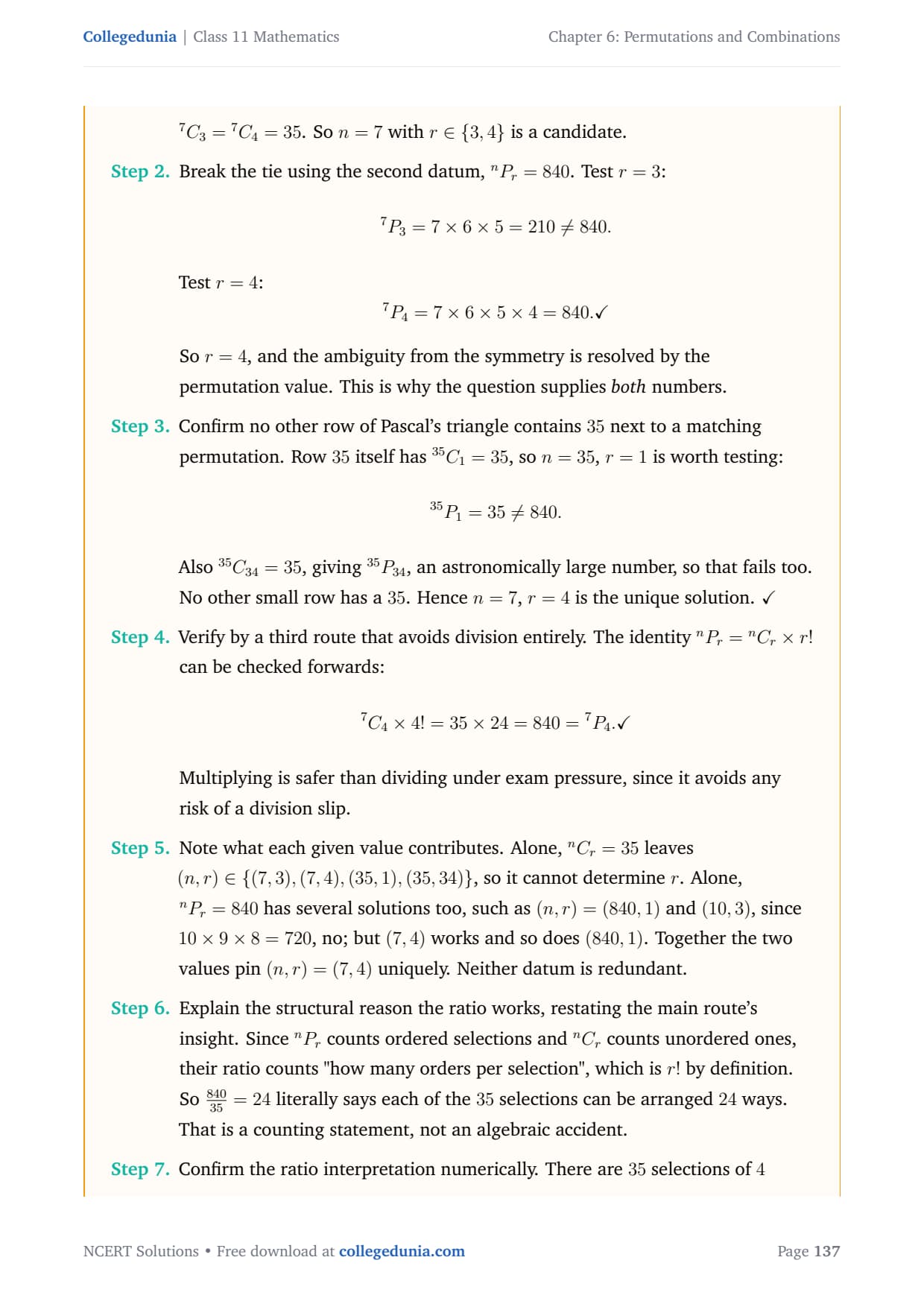
Q41: the key answers a different question. The blank reads "r = ______", but the key prints "n = 7". The one-line check: r! = nPr / nCr = 840 / 35 = 24 = 4!, so r = 4. The value n = 7 is itself correct, so the slip is in which unknown was reported, not in the working. Students should write r = 4 to answer the question as printed.
Why Q61 of the Permutations and Combinations Exemplar Cannot Be Matched
Q61 deserves its own section because it is the only question in the chapter that has no valid one-to-one matching at all. Five boys and five girls form a line, and four seating conditions must be matched to four values. The key prints (c) ↔ (iv), and that is wrong on its own terms, but the deeper problem is that the question cannot be matched however it is answered.
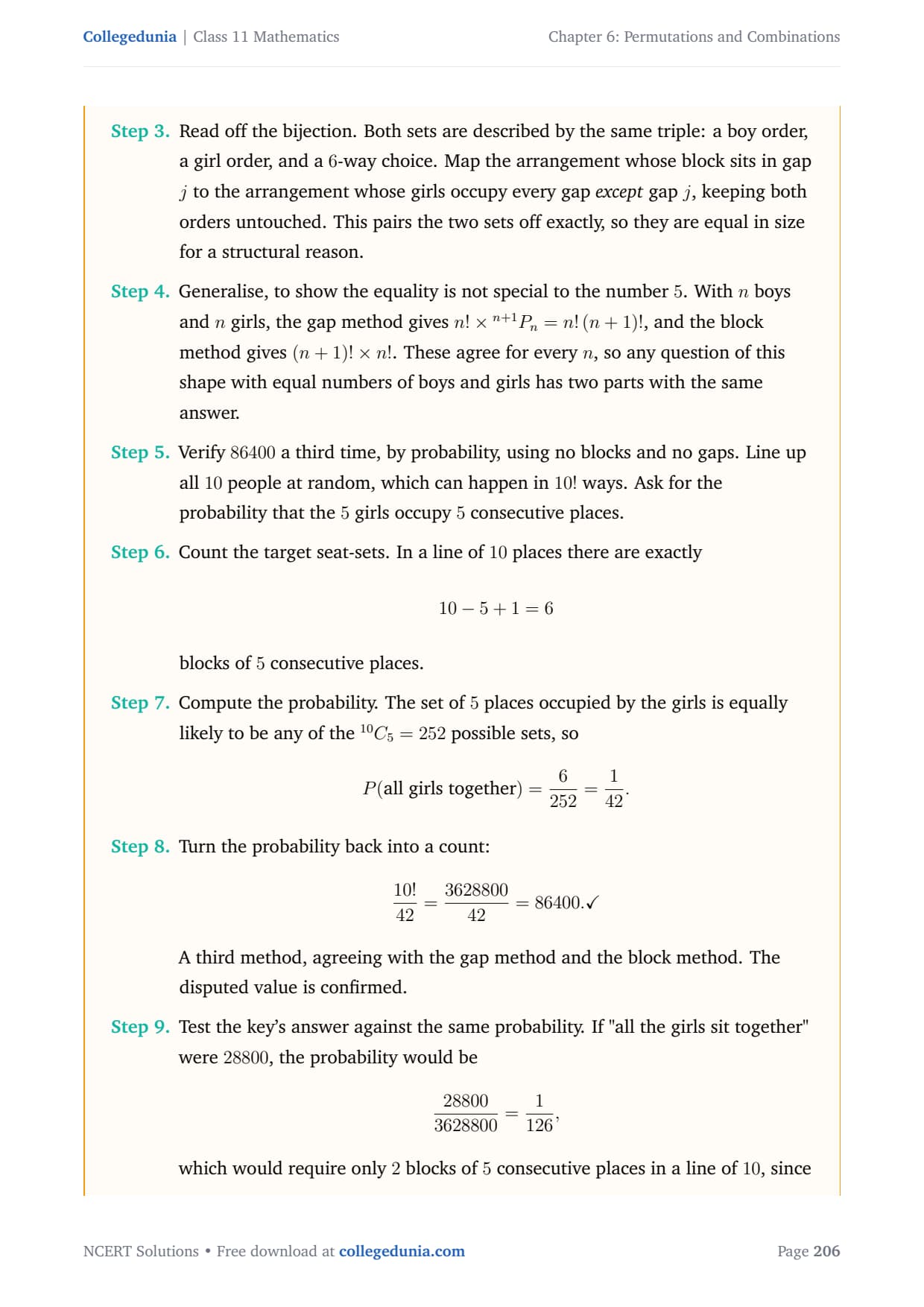
- The key's answer fails a direct check. "All the girls sit together" treats the five girls as one block: 6 units in 6! orders, girls inside in 5! orders, so 6! × 5! = 86,400. That is option (i). Option (iv) is 2! 5! 5! = 28,800, which is a different number.
- Two conditions share one value. Part (b), "no two girls sit together", and part (c), "all the girls sit together", both work out to 5! × 6!, so both need option (i).
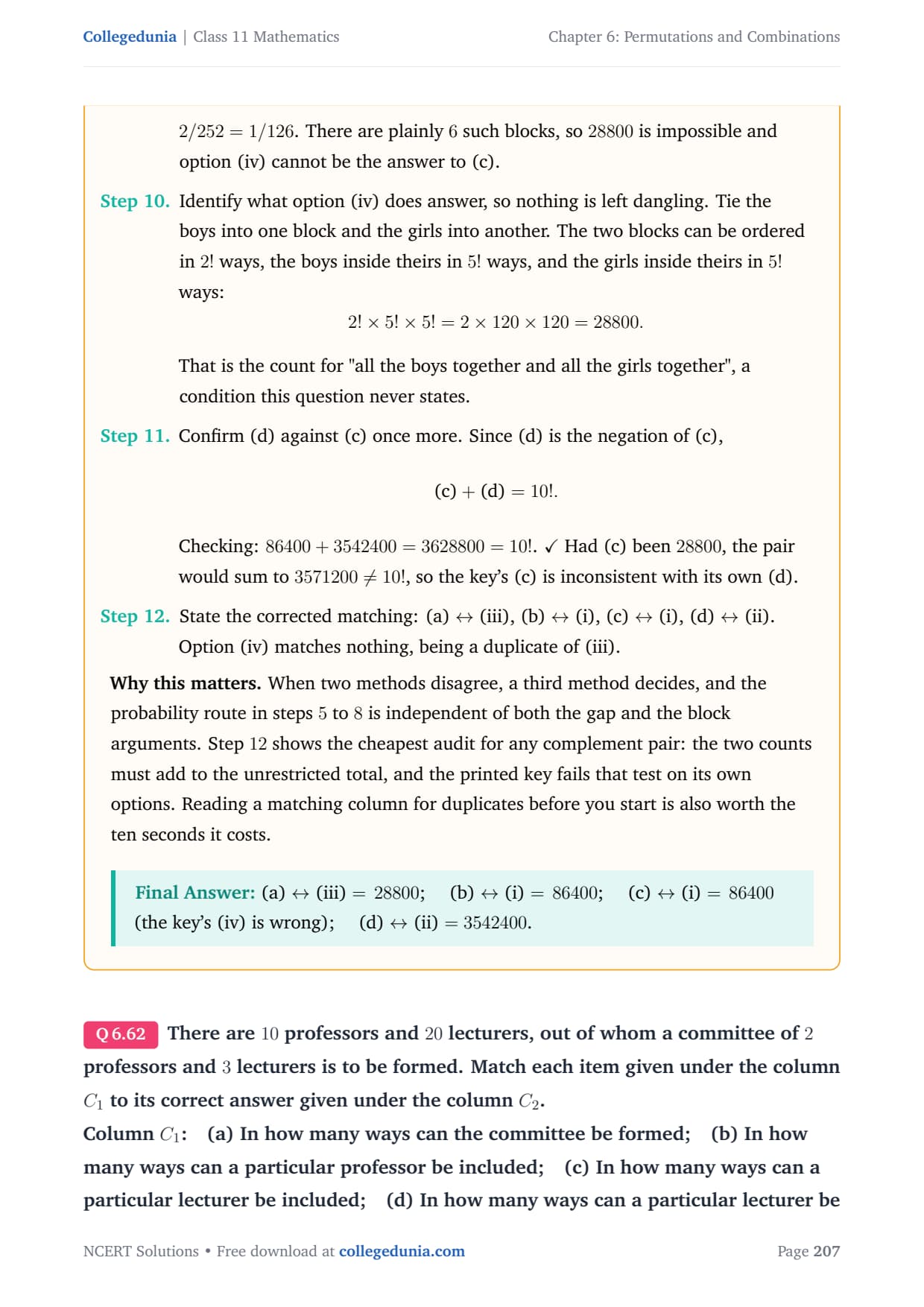
- Two options share one value. Option (iii) is (5!)2 + (5!)2 and option (iv) is 2! 5! 5!. Since (5!)2 + (5!)2 = 2(5!)2 = 2! 5! 5!, they are two spellings of the same number, 28,800.
- The book contradicts its own key. Option (ii) is 10! − 5! 6!, which can only mean "total minus all girls together". So the book itself is saying that "all the girls sit together" equals 5! 6!, which is option (i), not (iv).
What option (iv) actually answers. The value 2! 5! 5! = 28,800 is the correct count for a question that was never asked: "all the girls sit together and all the boys sit together". That gives two blocks in 2! orders, each block arranged internally in 5! ways. The corrected matching is (a) ↔ (iii) = 28,800, (b) ↔ (i) = 86,400, (c) ↔ (i) = 86,400 and (d) ↔ (ii) = 3,542,400. Students should solve the maths, state (c) ↔ (i), and not reproduce the key.
Key Formulas and Results Used in the Permutations and Combinations Exemplar
This chapter runs on a short list of formulas used in long combinations. Students should know these by heart before starting Exercise 7.3.
| Result | Statement | Where it is used |
|---|---|---|
| Permutations | nPr = n! / (n − r)! | Seating and digit questions |
| Combinations | nCr = n! / (r! (n − r)!) | Committees and selections |
| Link between the two | nPr = nCr × r! | Fill in the Blanks block, Q41 |
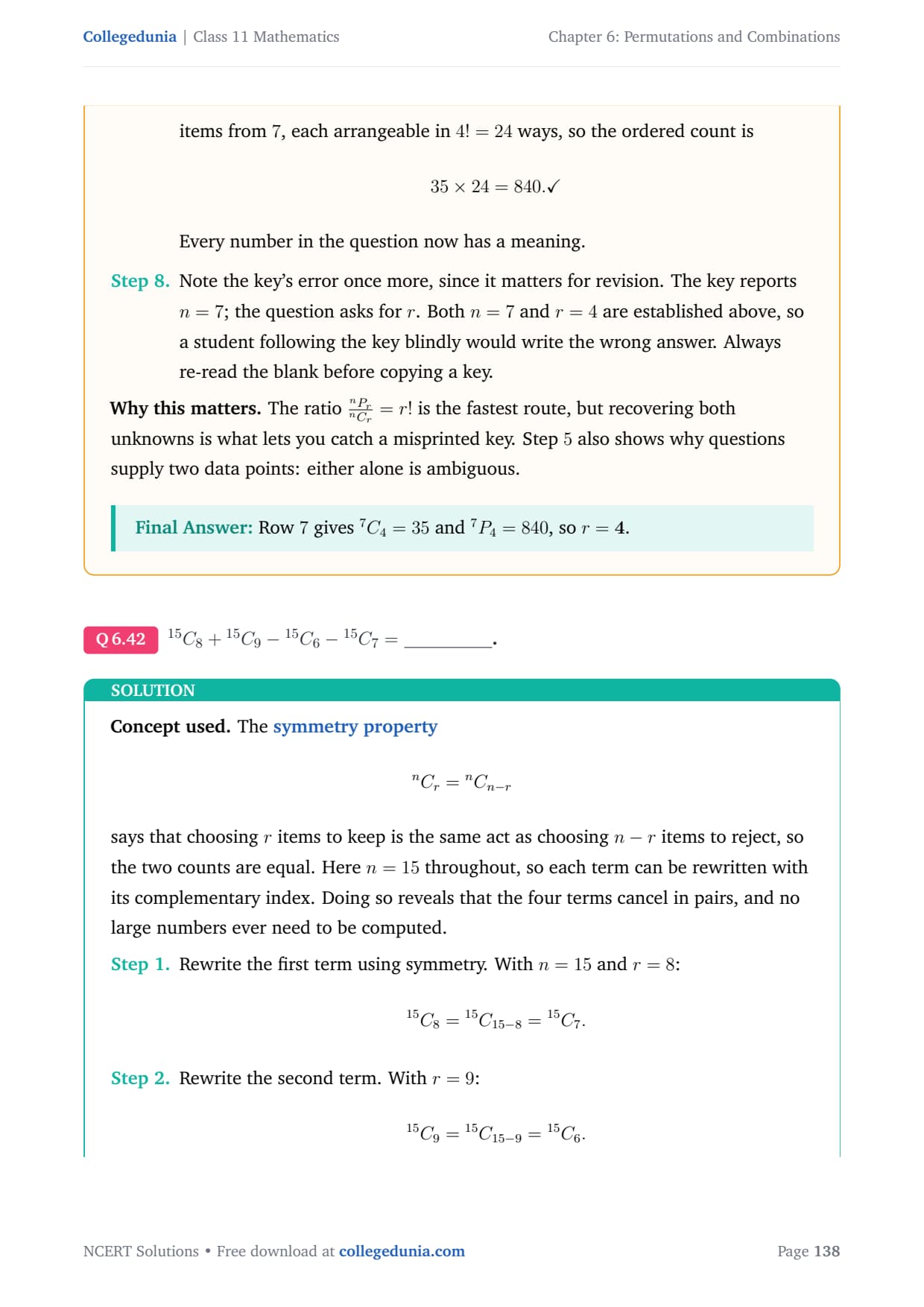
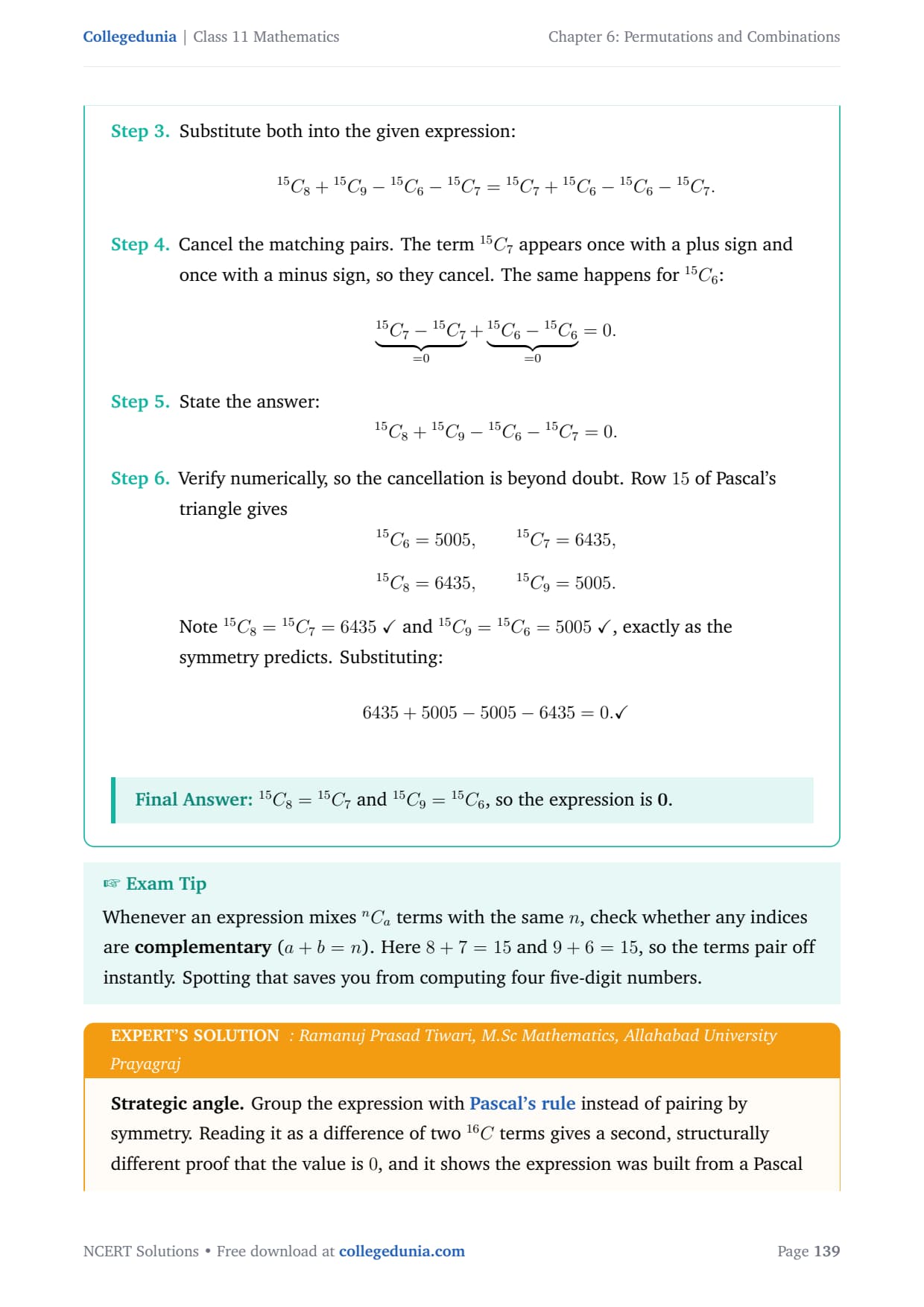
| Symmetry | nCr = nCn − r | Solving for n or r |
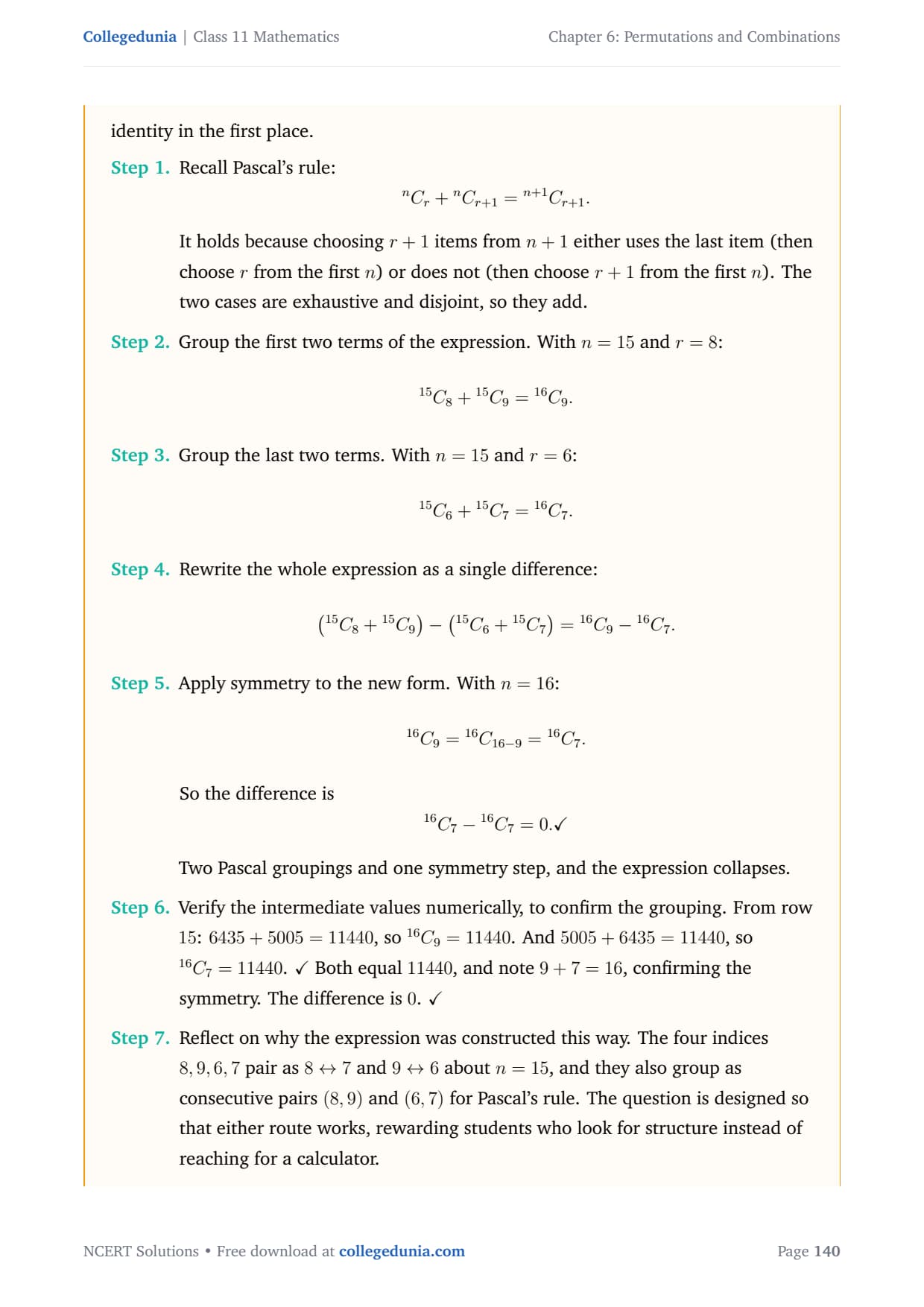
| Pascal's rule | nCr + nCr − 1 = n + 1Cr | Objective block |
| Alike objects | n! / (p! q! r!) for groups of identical items | Word and sign arrangements, Q44, Q48 |
| Circular arrangement | (n − 1)! around a round table | Seating questions |
| Selections | 2n total, 2n − 1 non-empty | Q40 and the dye questions |
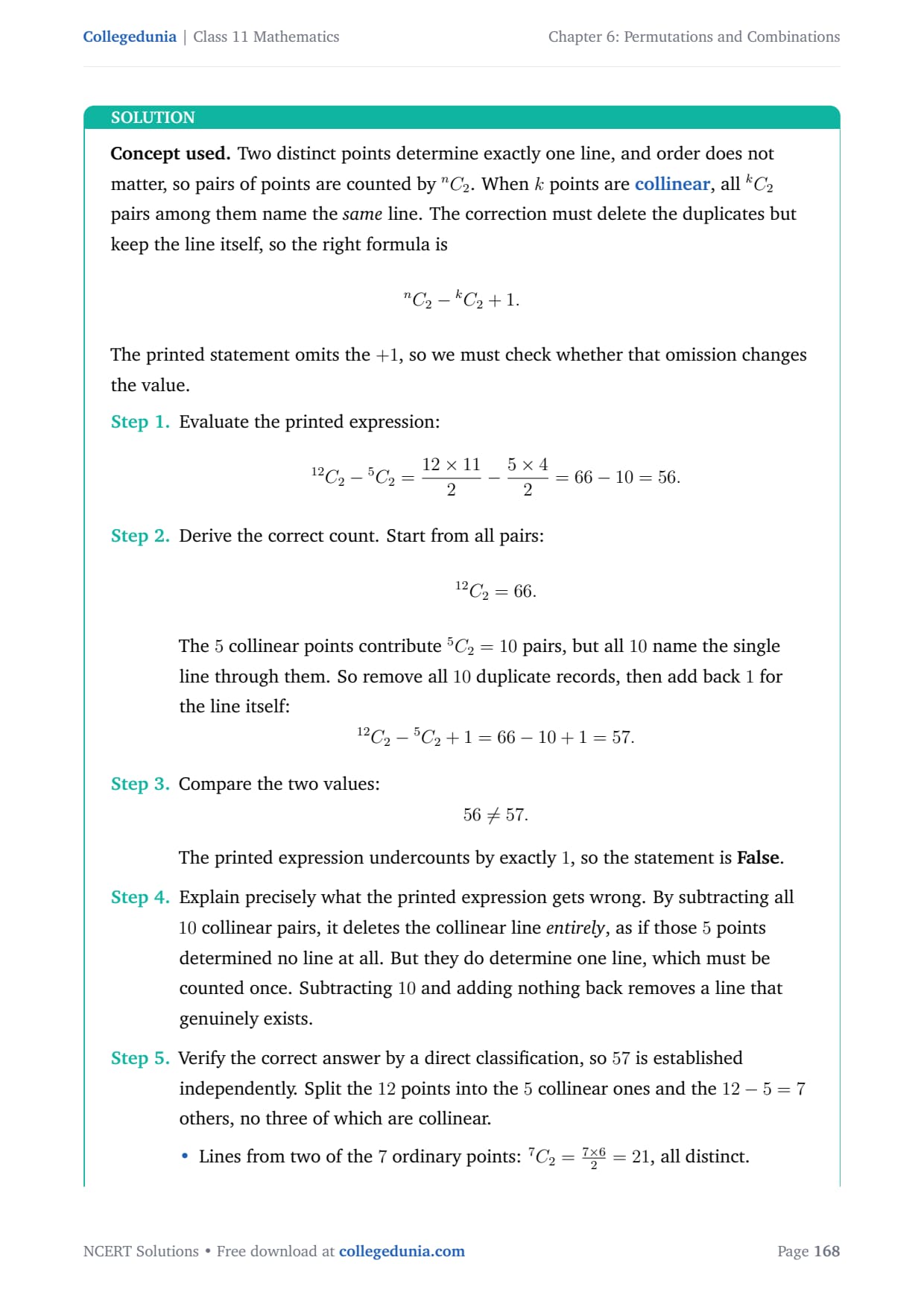
| Lines from points | nC2 − mC2 + 1 when m points are collinear | Q4, Q51 |
Tip: the formula students most often misapply is the last one. The collinear points do not stop making a line, they only stop making mC2 different lines. So the shape is subtract the pairs, add back one line, and the "+ 1" is the part that gets dropped.
Common Mistakes Students Make in the Permutations and Combinations Exemplar
The Exemplar sets the same traps every year, and most of them are traps of reading, not of arithmetic. These are the ones that cost the most marks in this chapter.
- Selecting but not arranging. In Q30 the question says "words formed", so the 5 chosen letters must still be arranged. Stopping at 4C2 × 5C3 = 60 misses the × 5! and lands on the trap option.
- Dividing by the group count when the groups are named. In Q21 the groups are "two experimental and one control", so they are distinguishable and there is no division by 3!.
- Treating a long table like a round one. In Q57 the two sides are distinguishable, so never divide by 2!, and once side A is chosen side B is fixed.
- Forgetting one repeat-division. In Q44 the vowels and the consonants each need their own division by the repeats. Doing one and not the other is the standard slip.
- Missing the longer numbers. "Greater than 7000" in Q16 includes every 5-digit number: 120 of the 192 integers have five digits.
- Mishandling the leading zero. Telephone numbers may start with 0, integers may not. The correction applies only to the case that actually contains a zero.
How the Permutations and Combinations Exemplar Steps Up from the NCERT Textbook
The Exemplar adds no new topics. It asks the same ideas in a harder way, usually by burying the case split inside the wording, as the table shows.
| Concept | NCERT Textbook asks | NCERT Exemplar asks |
|---|---|---|
| Counting principle | Count arrangements in one stage | Split into cases first, then count each stage |
| Permutations | Find nPr for given n and r | Find r from given nPr and nCr values |
| Combinations | Form a committee of fixed size | Form a committee whose size depends on the ratio asked |
| Alike objects | Arrange the letters of one word | Arrange vowels and consonants in two stages, each with repeats |
| Geometry counting | Count lines from points in general position | Correct the count for a collinear subset |
| Answer format | Give the number | Judge a printed number as True or False, with justification |
How to Use the Permutations and Combinations Exemplar for Boards and JEE Preparation
Treat Exercise 7.3 as four sittings, not one. Finish the NCERT textbook exercises first, because the Exemplar assumes students can already choose between nPr and nCr without thinking.
| Session | What to solve | Time |
|---|---|---|
| 1 | Short Answer Q1 to Q20 | 2.5 hours |
| 2 | Long Answer Q21 to Q25, with every case written out | 1.5 hours |
| 3 | Objective Q26 to Q40, timed at 2 minutes each | 1 hour |
| 4 | Q41 to Q64, then re-solve everything marked wrong | 2 hours |
That is about 7 hours for the chapter. For JEE Main and JEE Advanced, the Objective block and the grouping questions matter most, because both reward a fast, correct case split. For CBSE Boards and CUET, the Long Answer block and the Fill in the Blanks work on nPr and nCr are the better use of time.
Practice Questions for Class 11 Maths Permutations and Combinations
After reading the solutions, students should test themselves on the same question types. The card below opens a set of solved practice questions with step-by-step answers for Permutations and Combinations.
Practice Card: Solved Practice Questions for Class 11 Maths Permutations and Combinations. Attempt each question, then check the solution.
Student Feedback
In a Collegedunia survey of 13,470 Class 11 students conducted before the 2026 exams, 68% of students said the Match the Following block was the part of Exercise 7.3 they got wrong most often. Only 6% of students had spotted that Q61 cannot be matched one-to-one at all.
Other Resources for Class 11 Maths Permutations and Combinations
Pair the Exemplar Solutions with the textbook solutions and the notes for full chapter revision. All the Permutations and Combinations resources are linked below.
| Resource | Link |
|---|---|
| NCERT Solutions | Permutations and Combinations Class 11 NCERT Solutions |
| Revision Notes | Permutations and Combinations Class 11 Notes |
| Handwritten Notes | Permutations and Combinations Class 11 Handwritten Notes |
| NCERT Book PDF | Permutations and Combinations Class 11 NCERT Book PDF |
| Exemplar Book PDF | Permutations and Combinations Class 11 NCERT Exemplar Book PDF |
NCERT Exemplar Solutions for Other Class 11 Maths Chapters
The full Class 11 Maths Exemplar set covers 14 chapters, 735 questions and 2,625 pages of solutions. Use the table to jump to any other chapter.
Permutations and Combinations Class 11 Maths NCERT Exemplar Solutions FAQs
Ques. How many questions are there in the Class 11 Maths Permutations and Combinations Exemplar?
Ans. Chapter 6 Permutations and Combinations has 64 questions, all in one exercise, printed as Exercise 7.3 in the Exemplar's own numbering. They are split into 20 Short Answer, 5 Long Answer, 15 Objective, 10 Fill in the Blanks, 9 True/False and 5 Match the Following questions. Every one of them is solved in the PDF on this page.
Ques. Why is Permutations and Combinations printed as Chapter 7 in the NCERT Exemplar?
Ans. The Exemplar book keeps its own chapter order, in which Permutations and Combinations is Chapter 7. In the 2026-27 NCERT textbook the same chapter is Chapter 6. Only the number differs, the content is the same, which is why the exercise is numbered Exercise 7.3 in the book.
Ques. Is the printed NCERT Exemplar answer key for Permutations and Combinations correct?
Ans. Not fully. Four questions carry an error: the hint for Q14 is misprinted, Q40 prints the same value for two options, and the key is wrong for Q41 and Q61. For example, Q41 asks for r but the key prints n = 7, when the answer is r = 4. Each error is explained on this page with the correct answer.
Ques. Why can Q61 of the Permutations and Combinations Exemplar not be matched?
Ans. Because two conditions share one value and two options share one value. Parts (b) and (c) both equal 5! × 6! = 86,400, and options (iii) and (iv) are both 28,800, since (5!)2 + (5!)2 = 2(5!)2 = 2! 5! 5!. The key's (c) ↔ (iv) is wrong: the correct pairing is (c) ↔ (i).
Ques. Are the Class 11 Maths Permutations and Combinations Exemplar Solutions free to download?
Ans. Yes. The Permutations and Combinations NCERT Exemplar Solutions PDF is free to download from this page. It runs to 220 pages, solves every question step by step according to the 2026-27 NCERT Exemplar, and helps students prepare for CBSE Boards, JEE Main, JEE Advanced and CUET.



Comments