




Seven questions in the Class 11 Maths Chapter 2 Exemplar carry a printed answer that does not match the book's own working. The NCERT Exemplar Solutions for Class 11 Maths Chapter 2 Relations and Functions on this page solve all 42 questions of the chapter, step by step, according to the 2026-27 NCERT Exemplar, and flag every one of those seven.
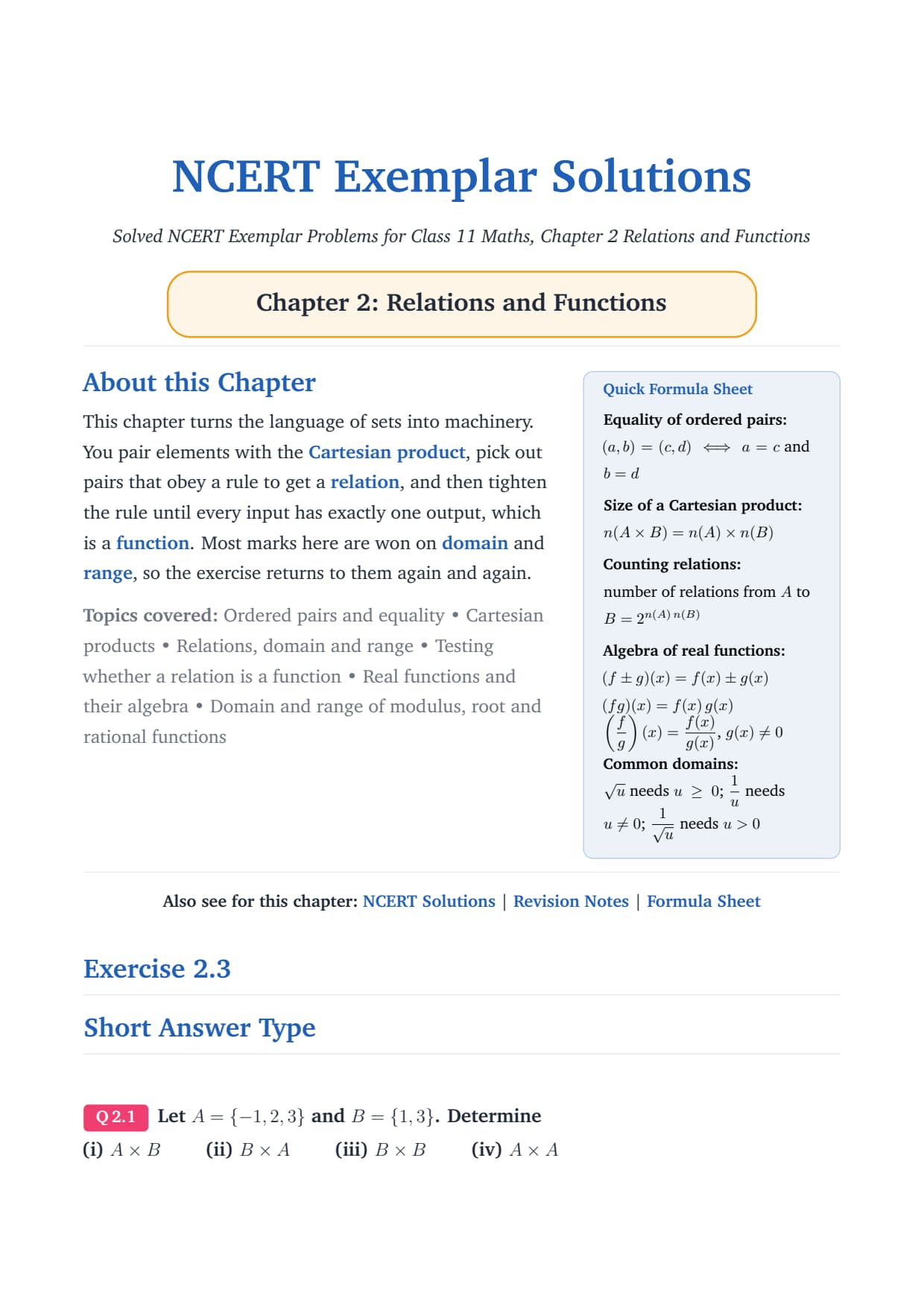
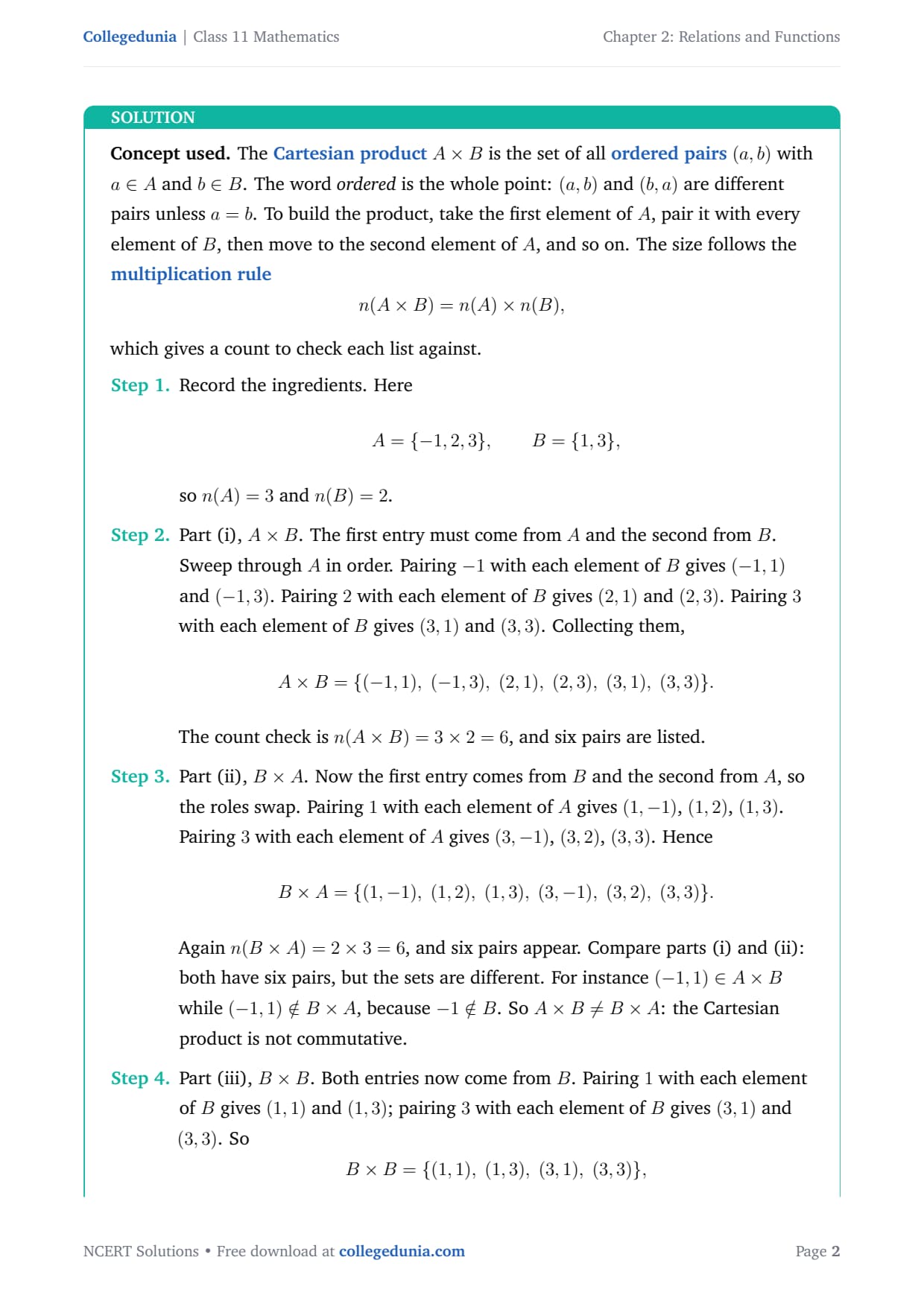
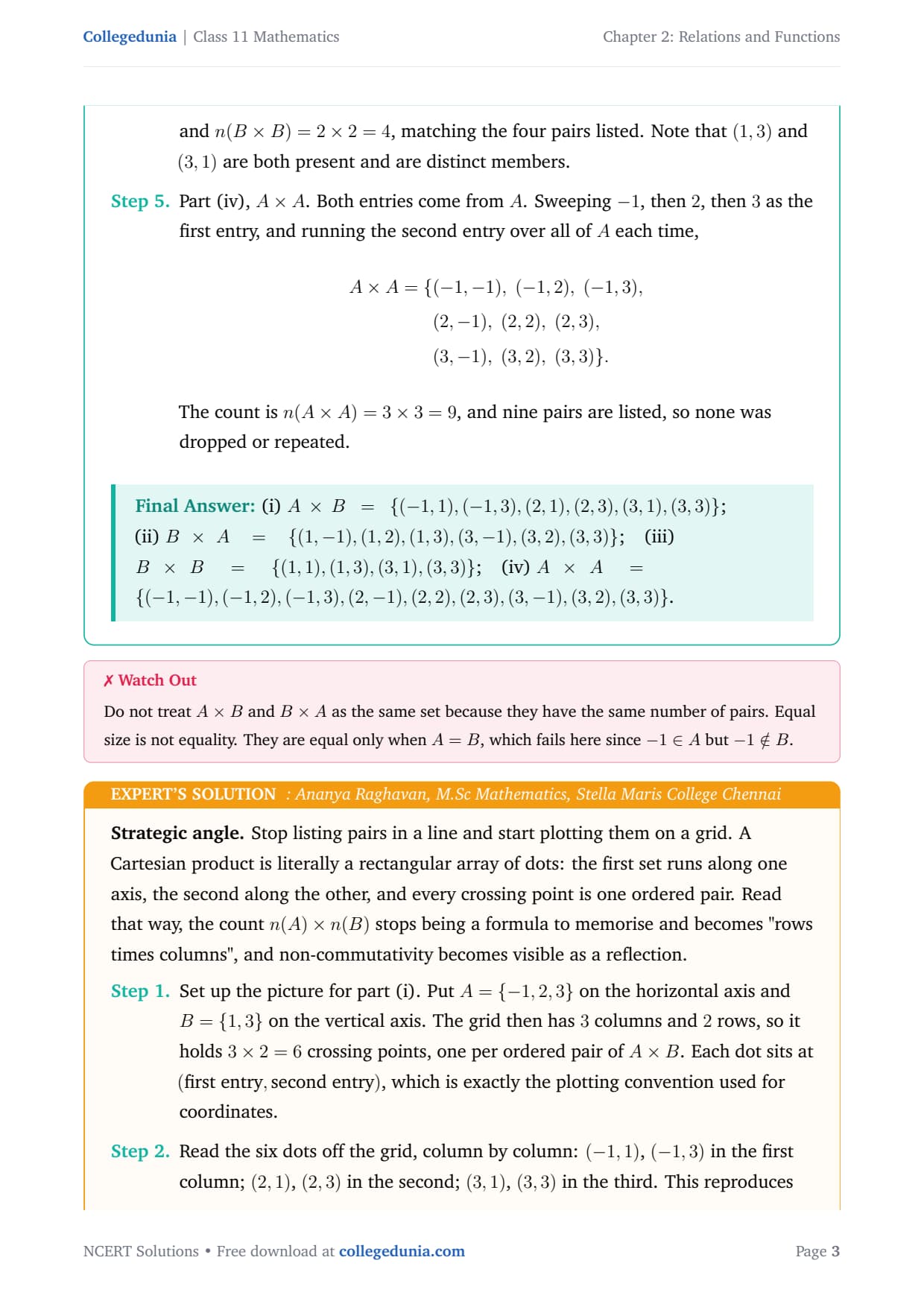
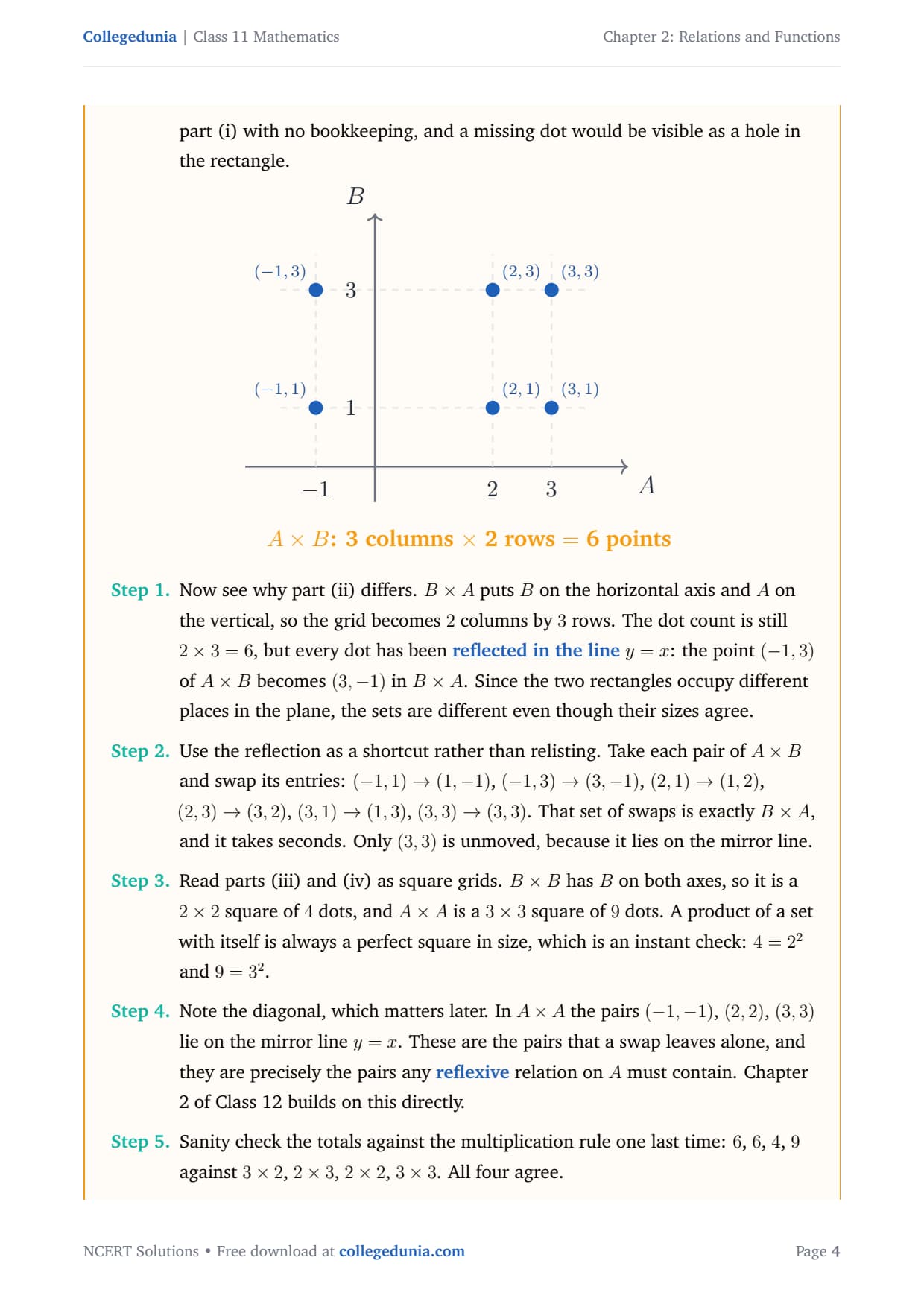
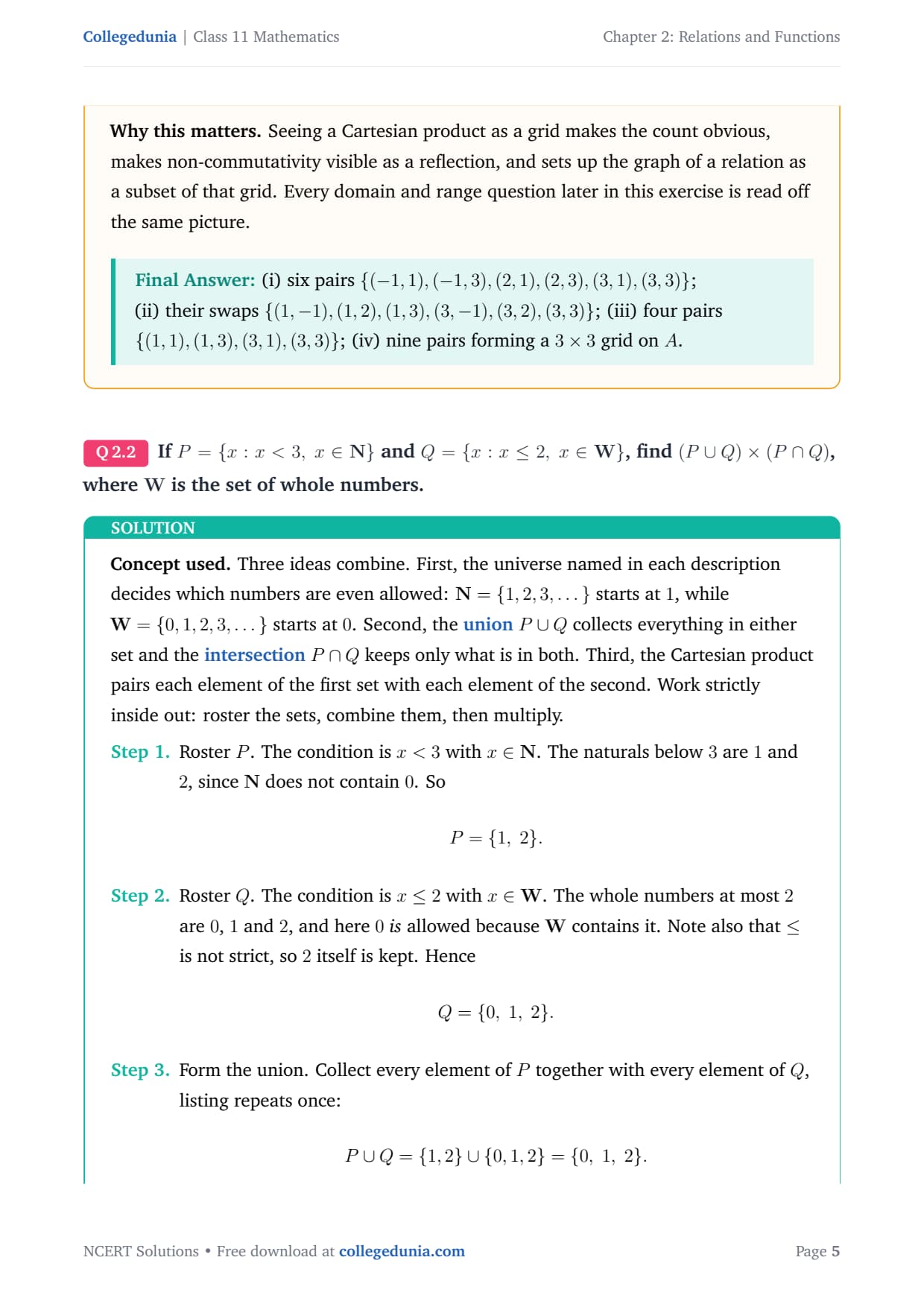
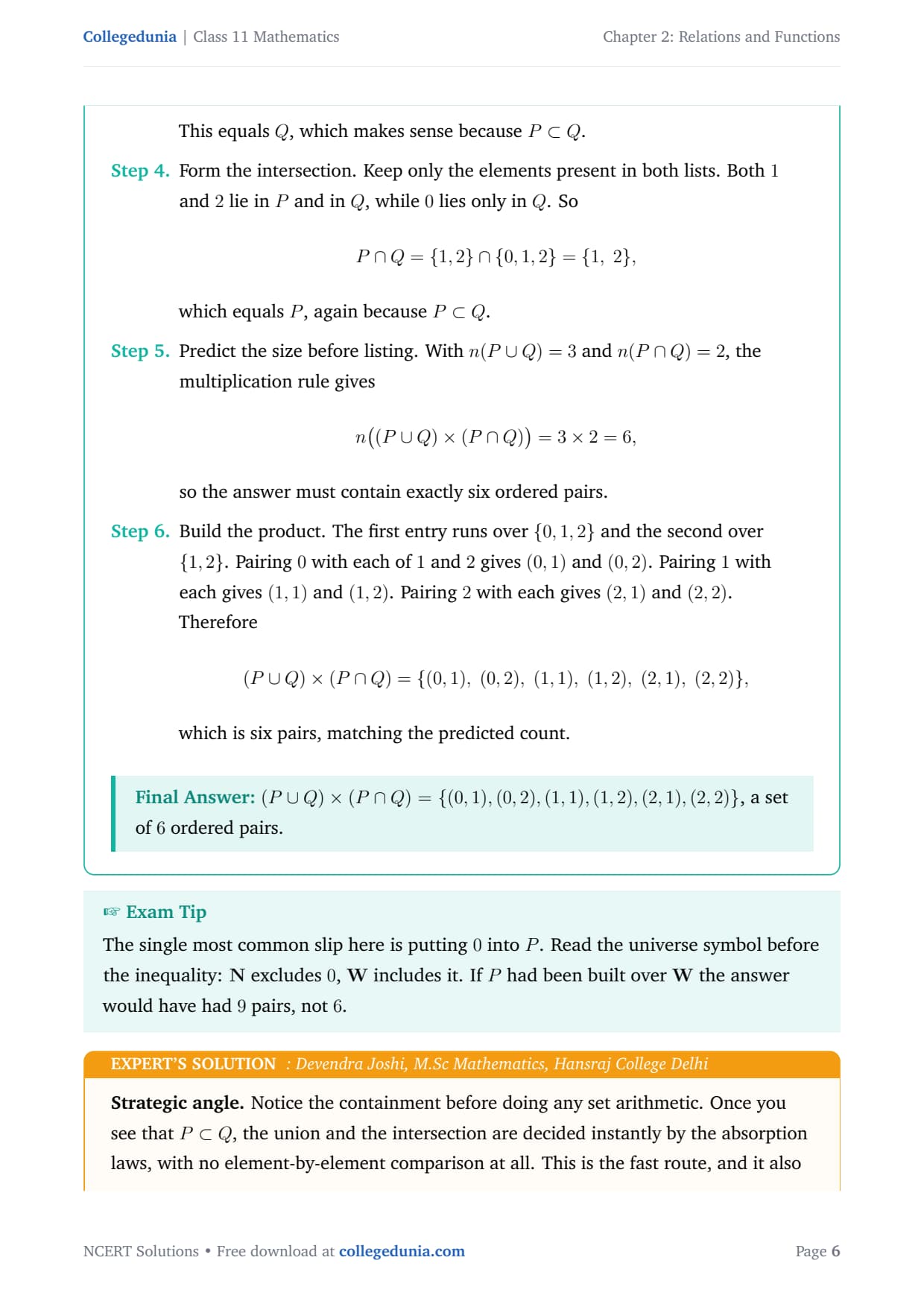
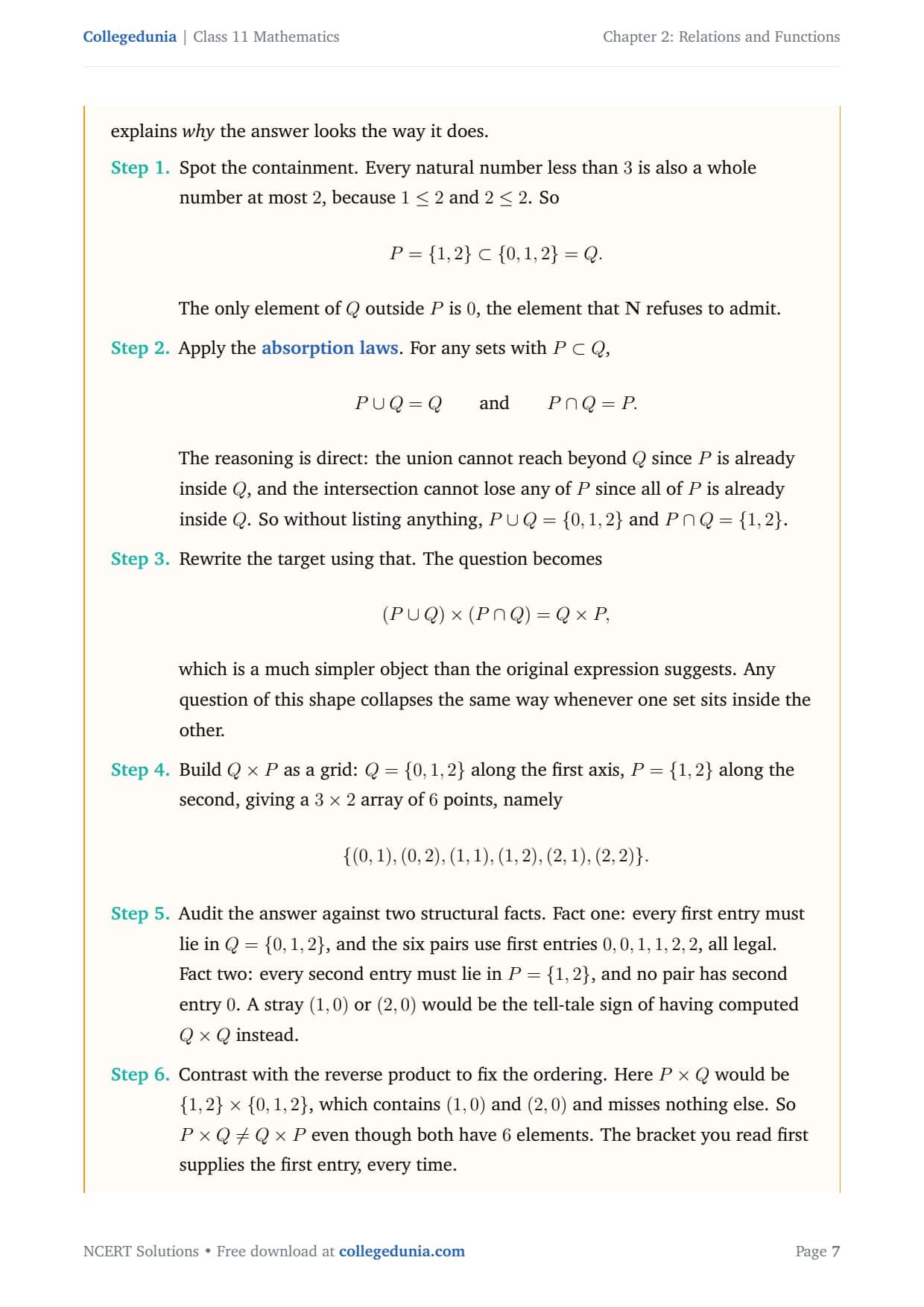
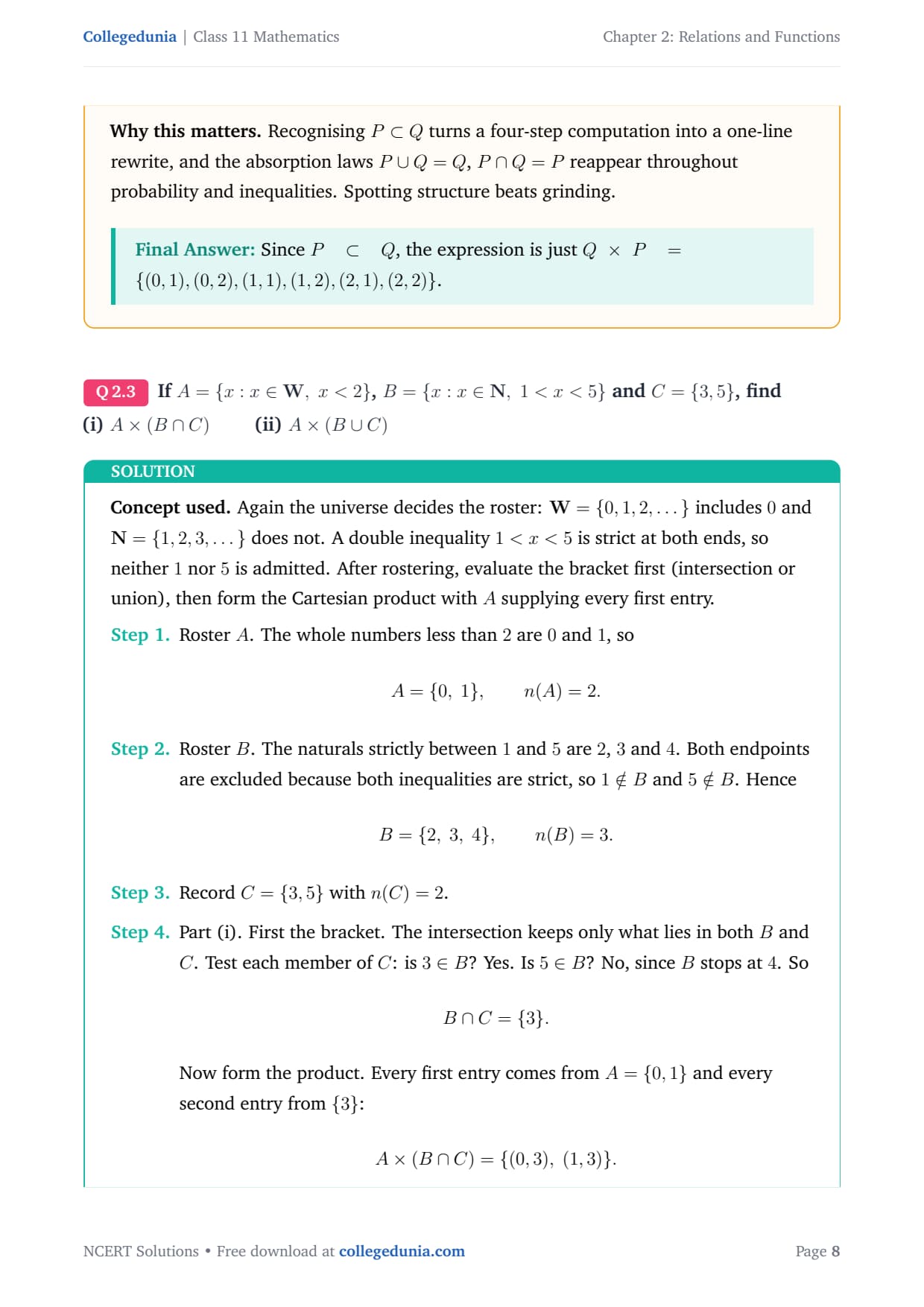
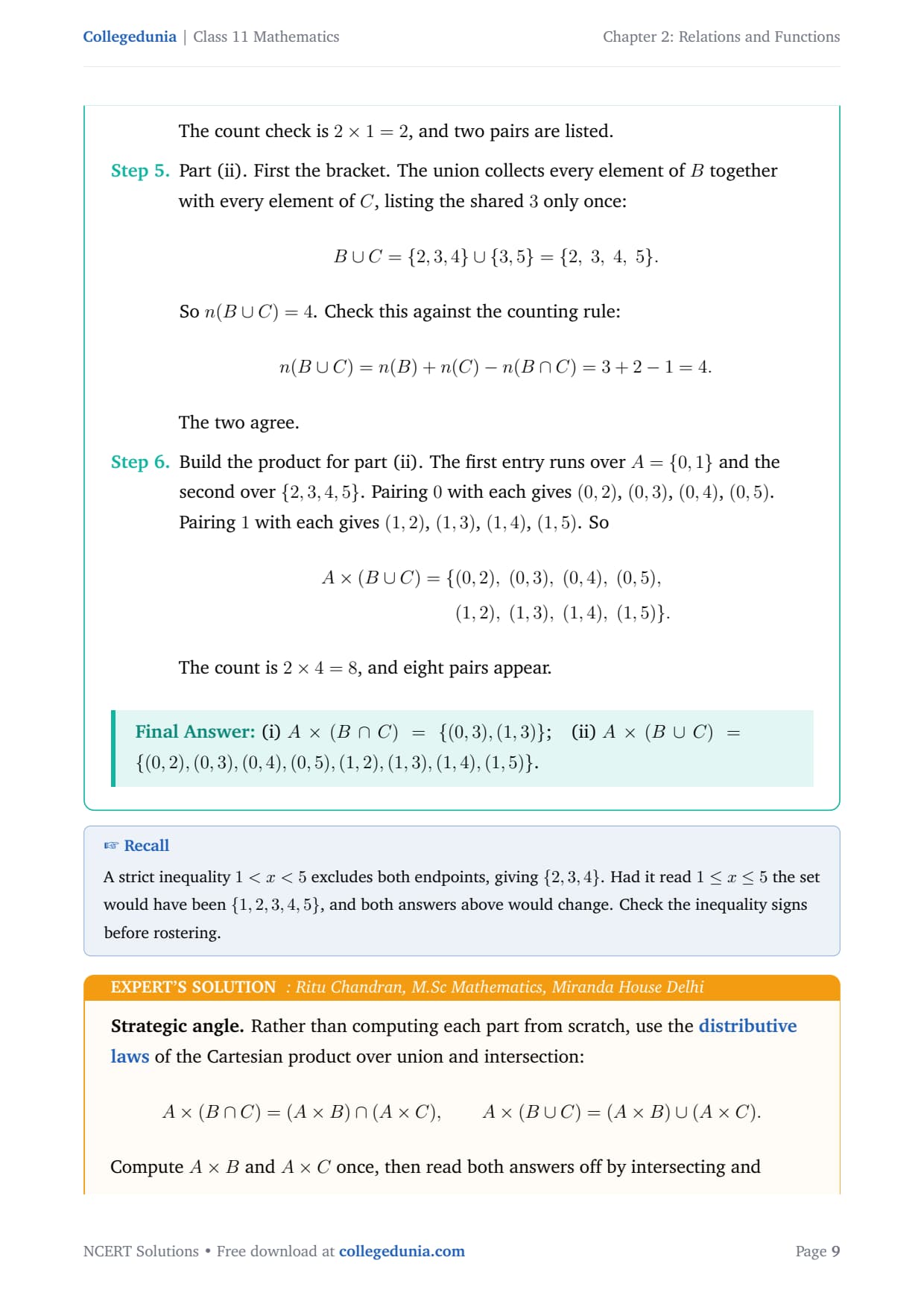
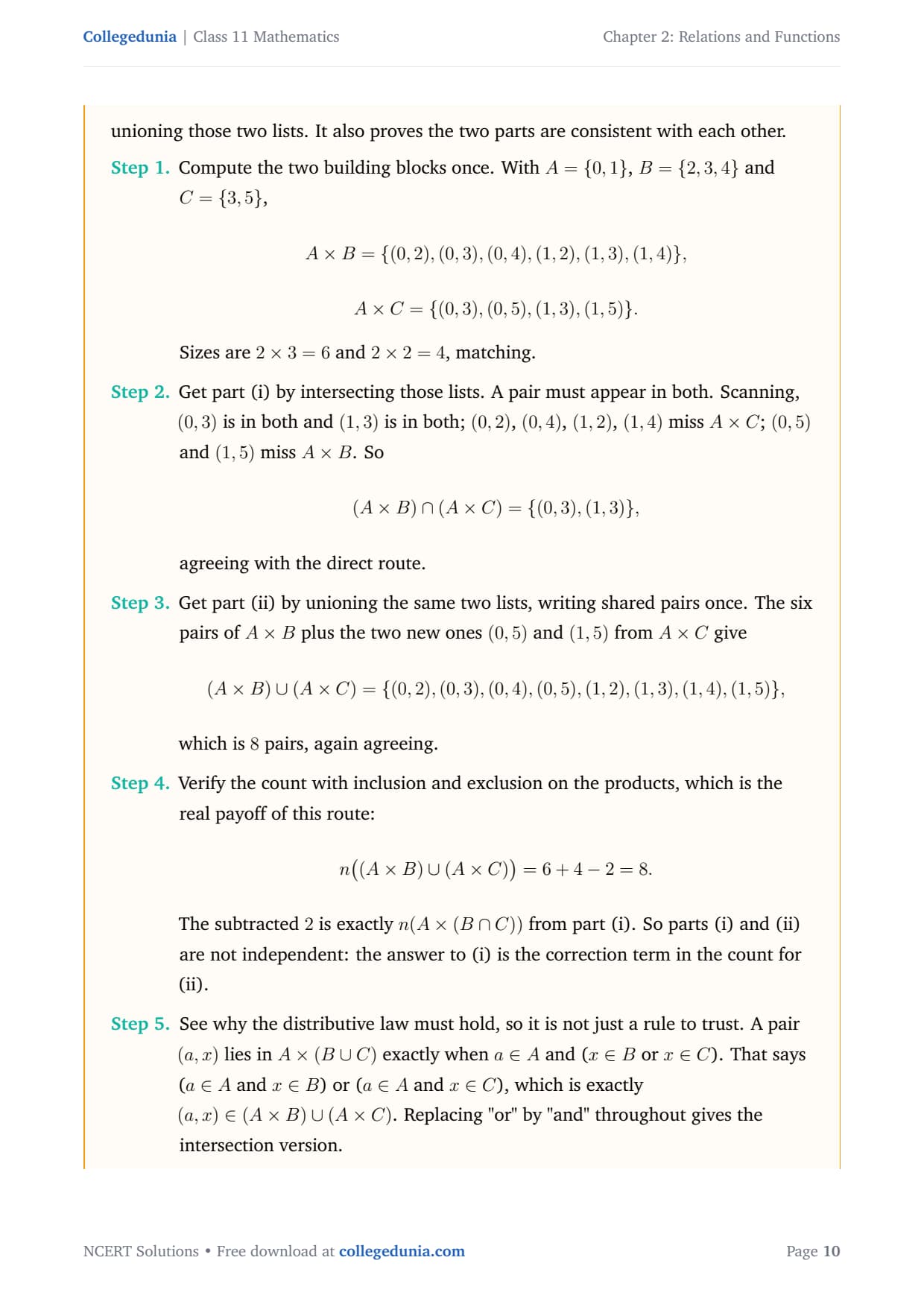
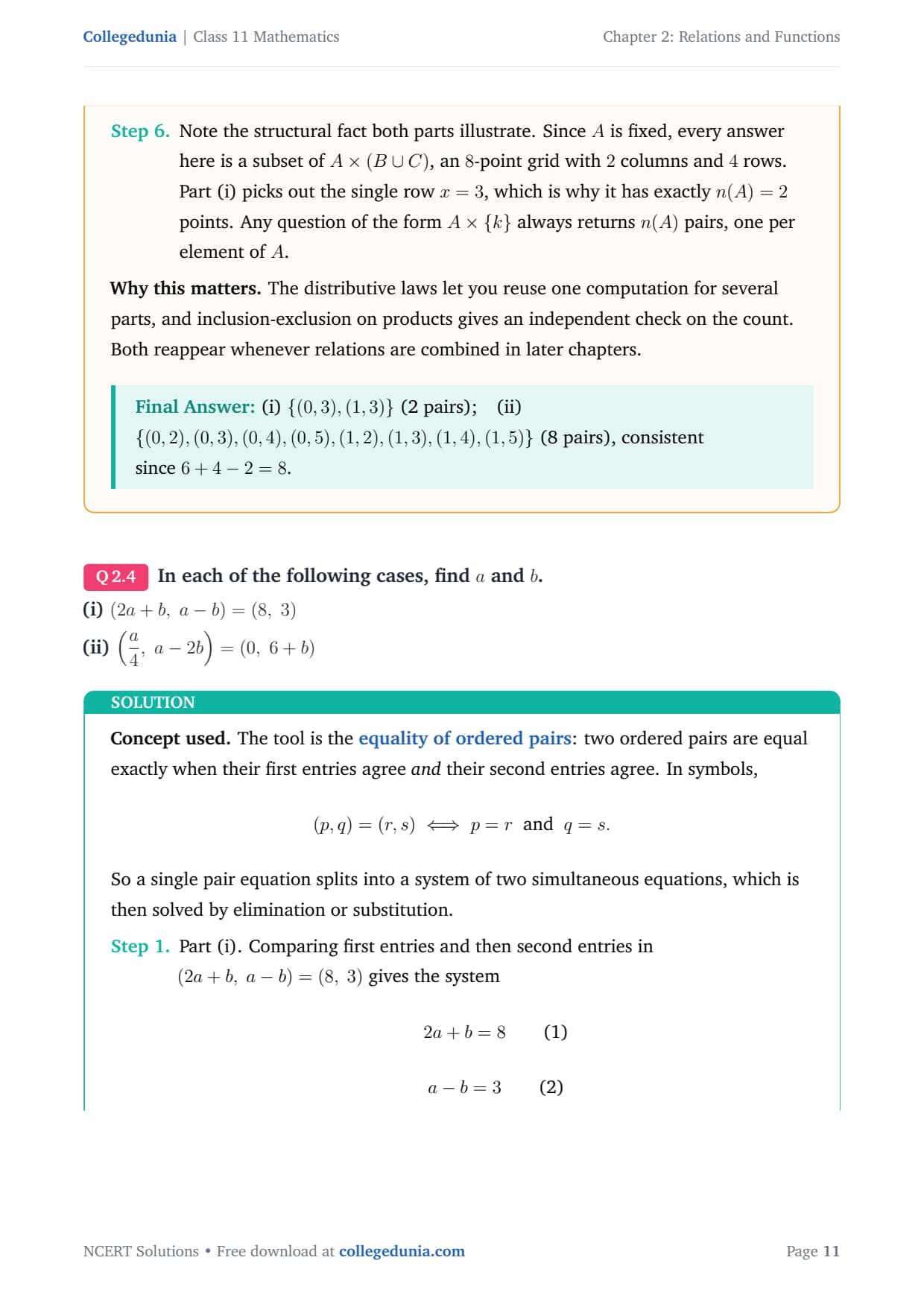
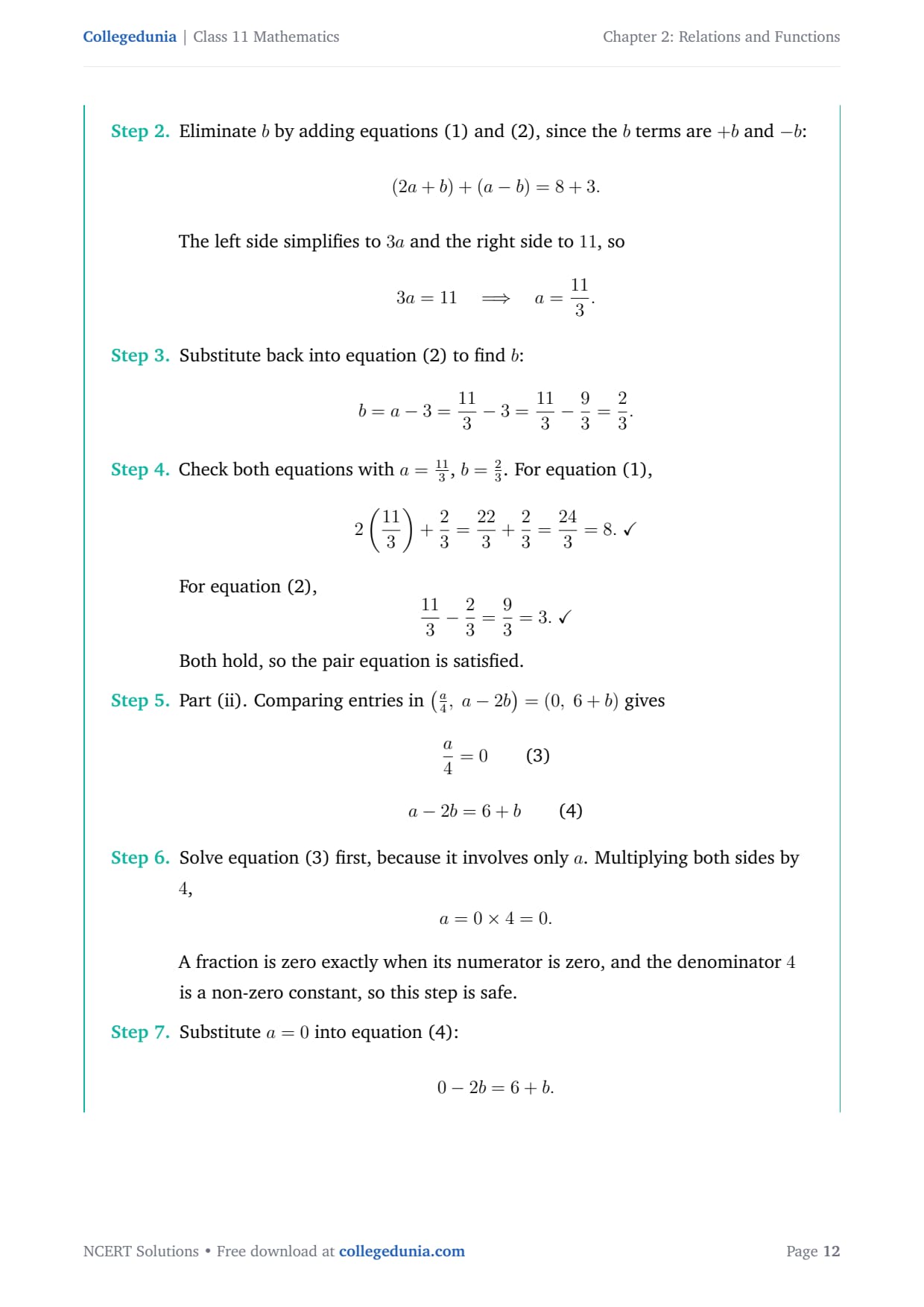
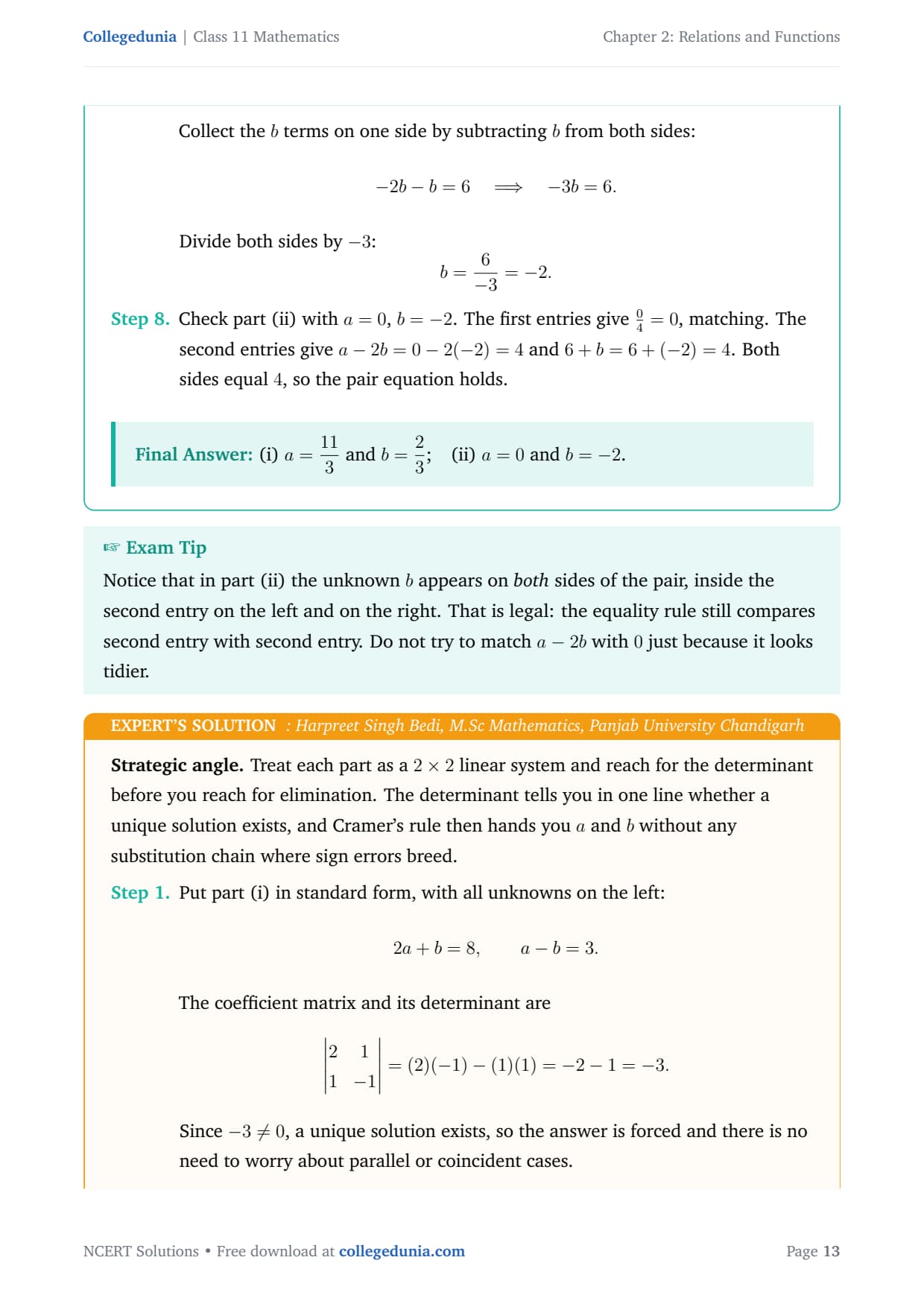
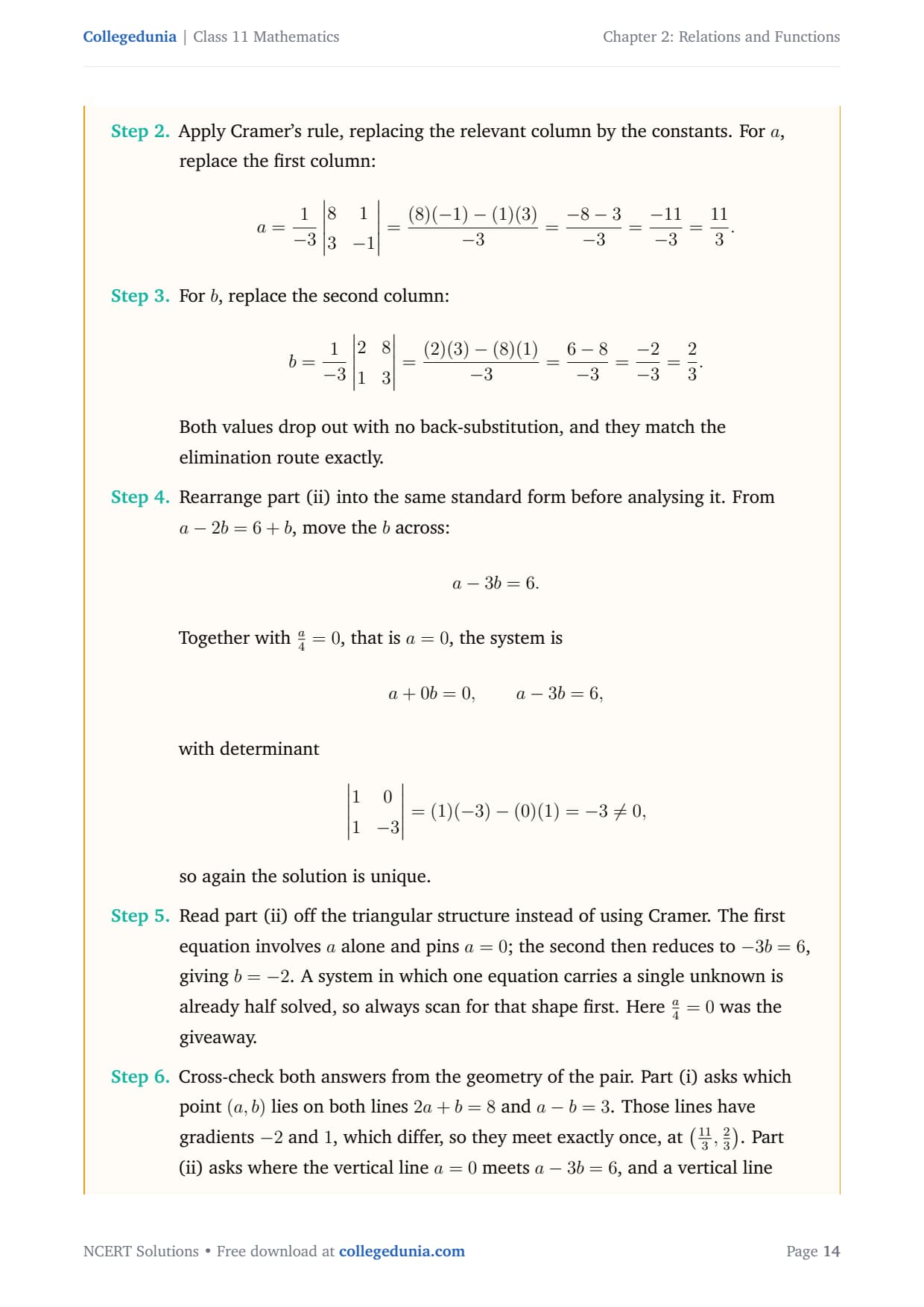
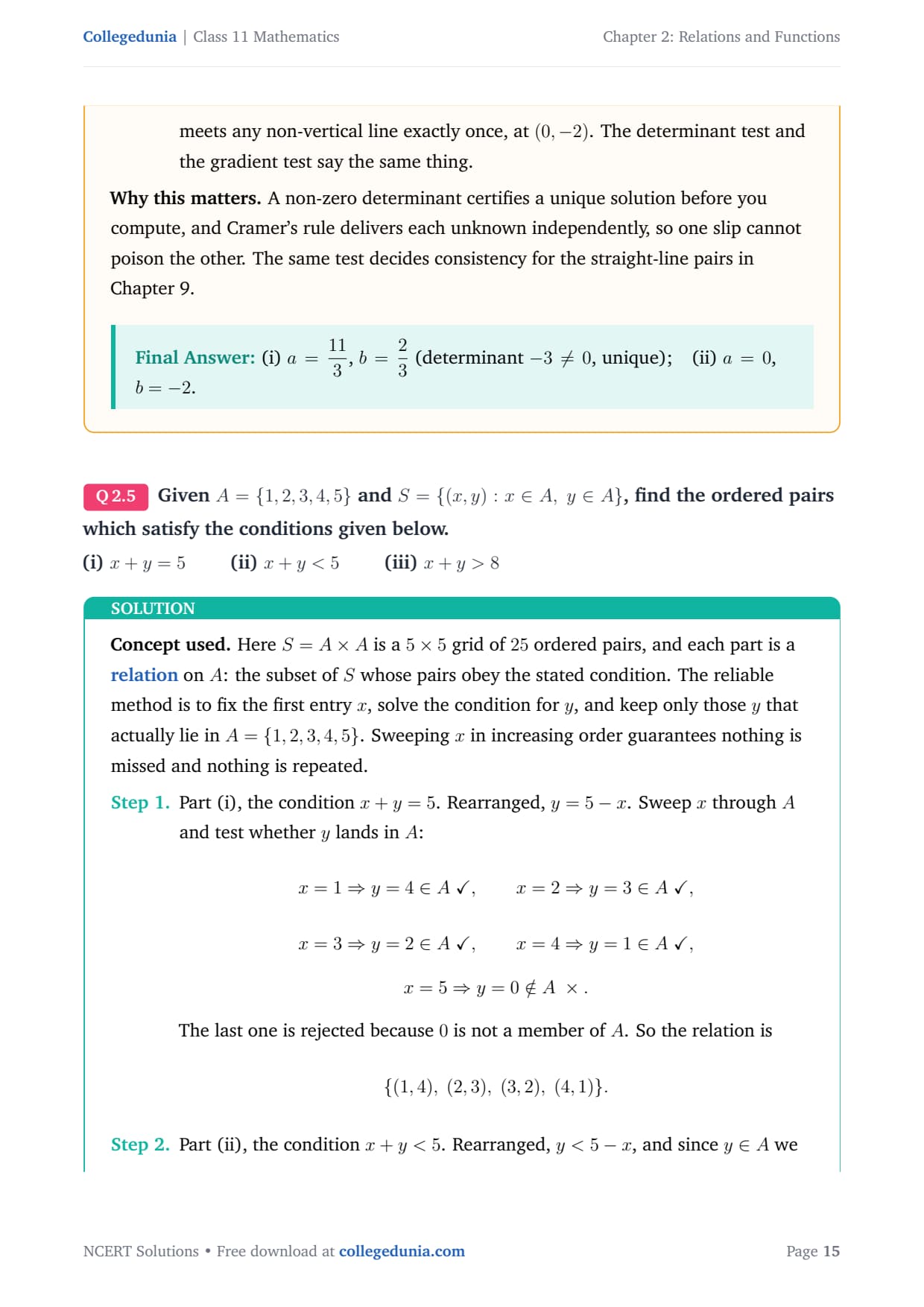
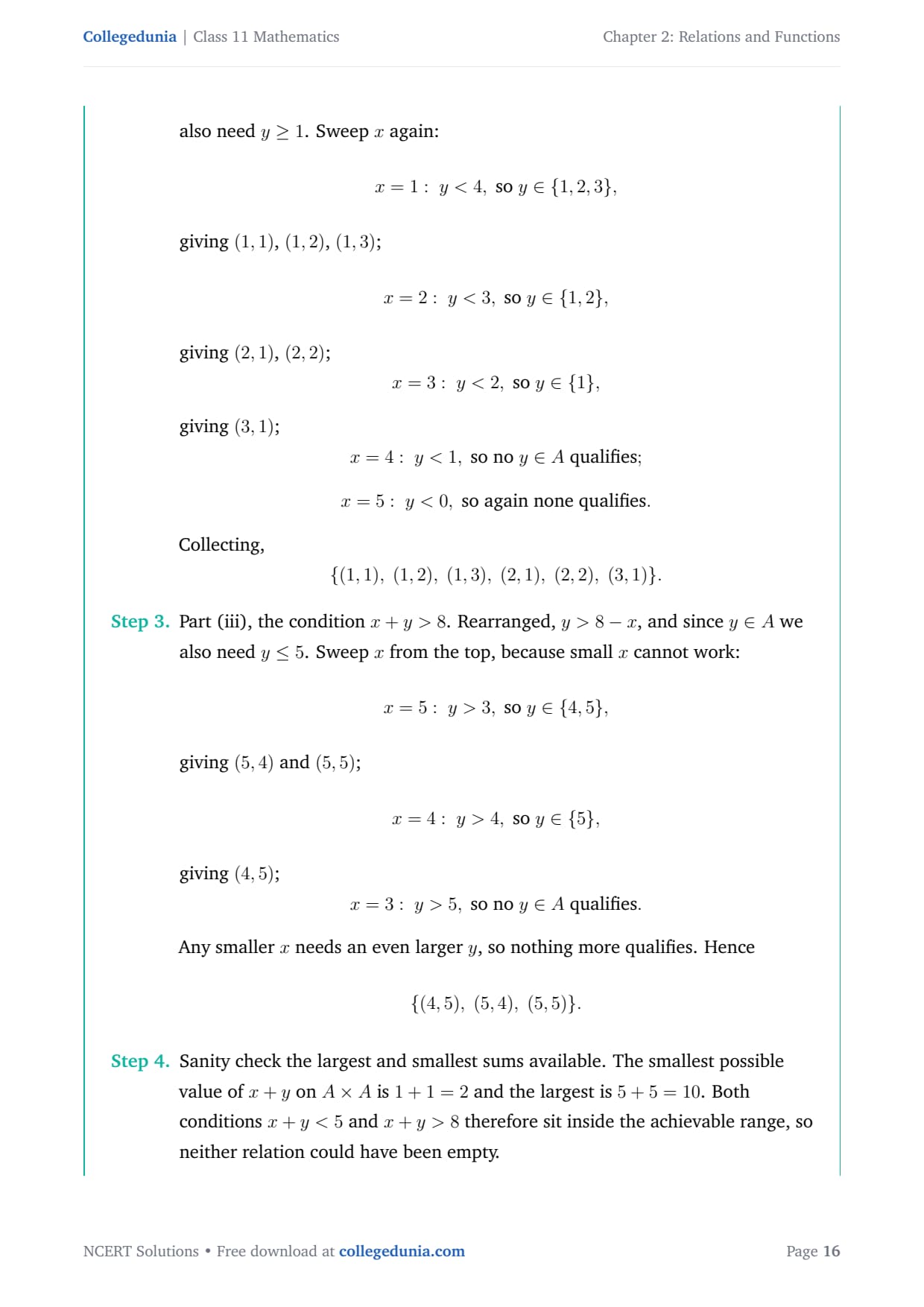
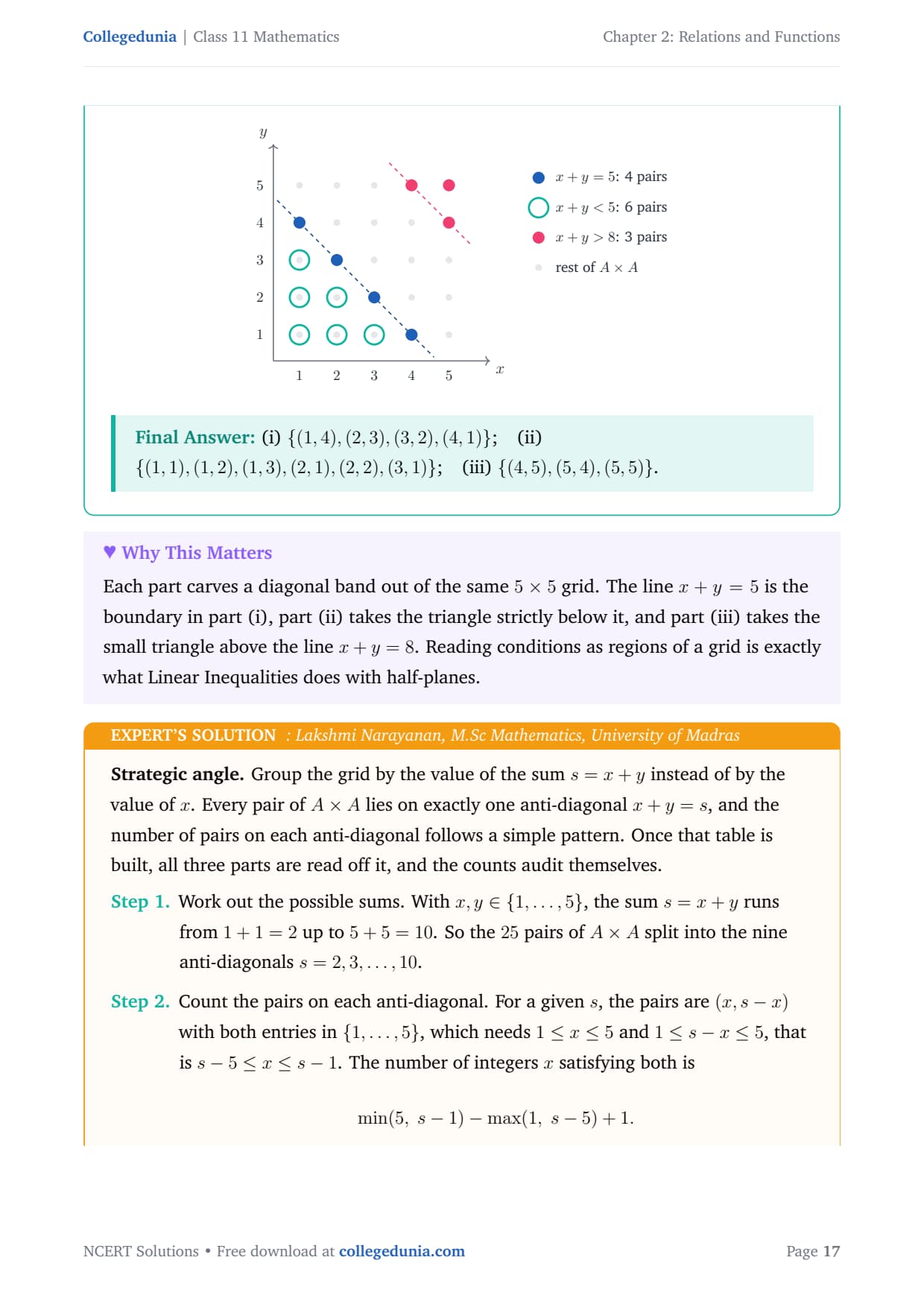
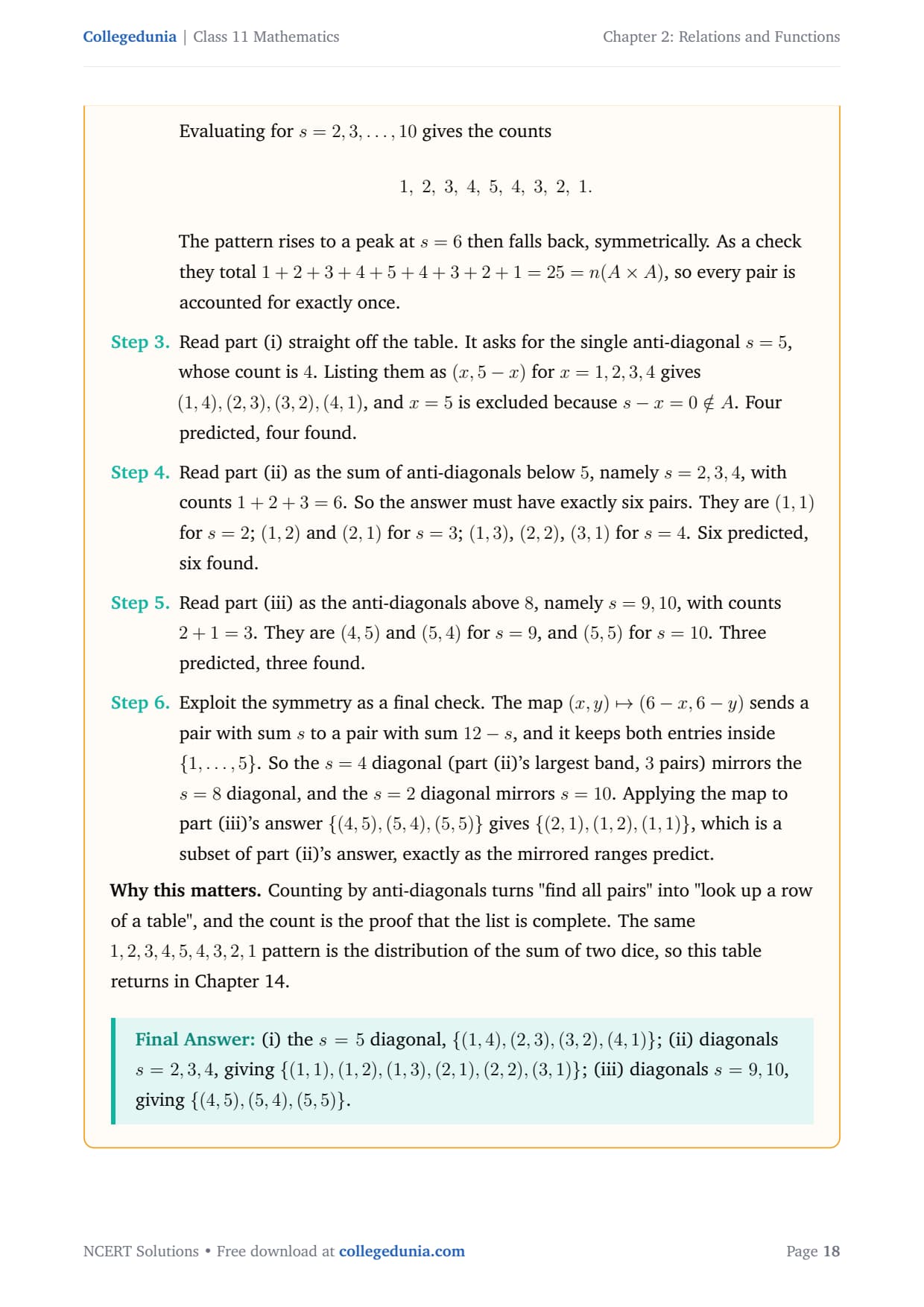
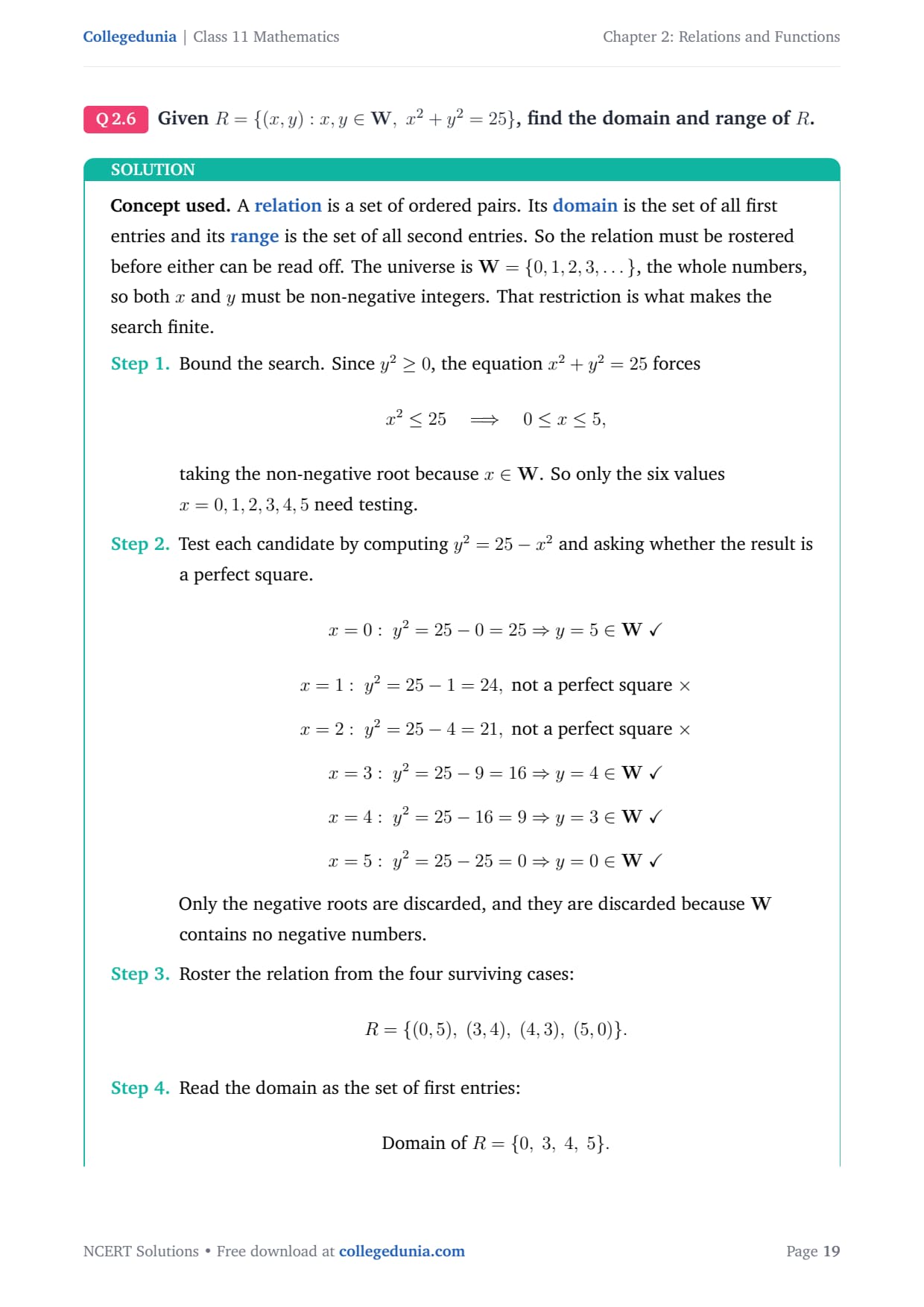
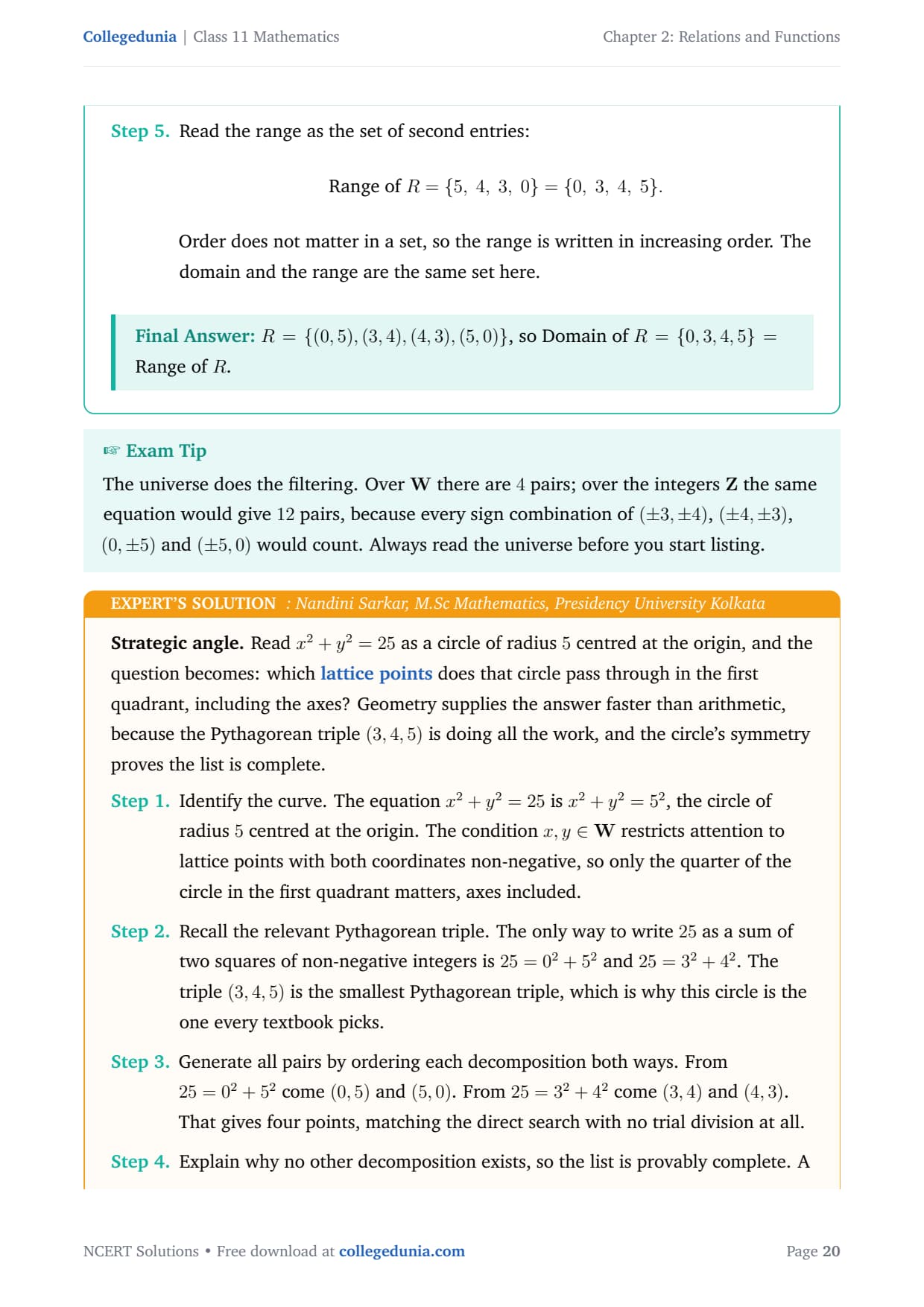
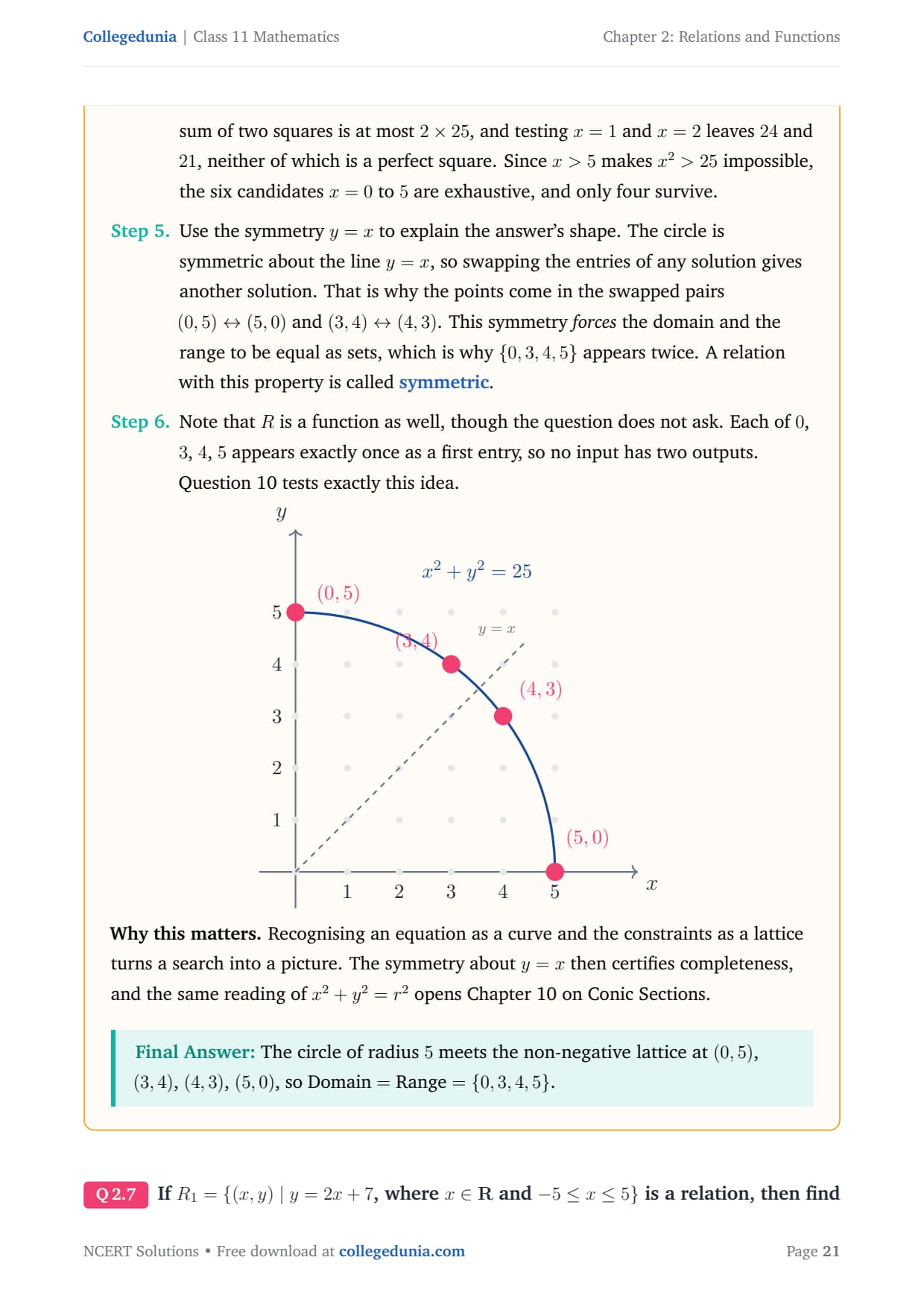
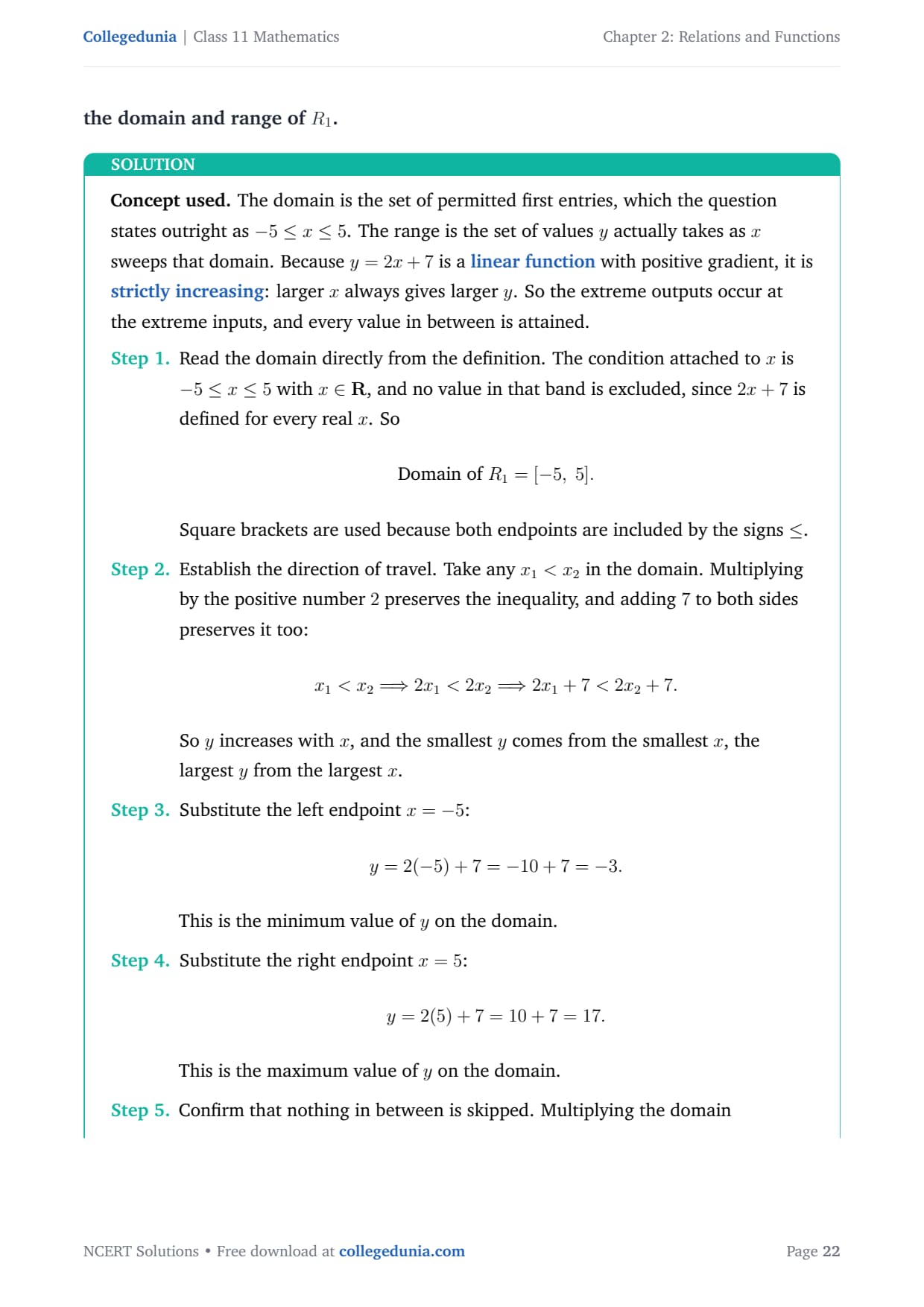
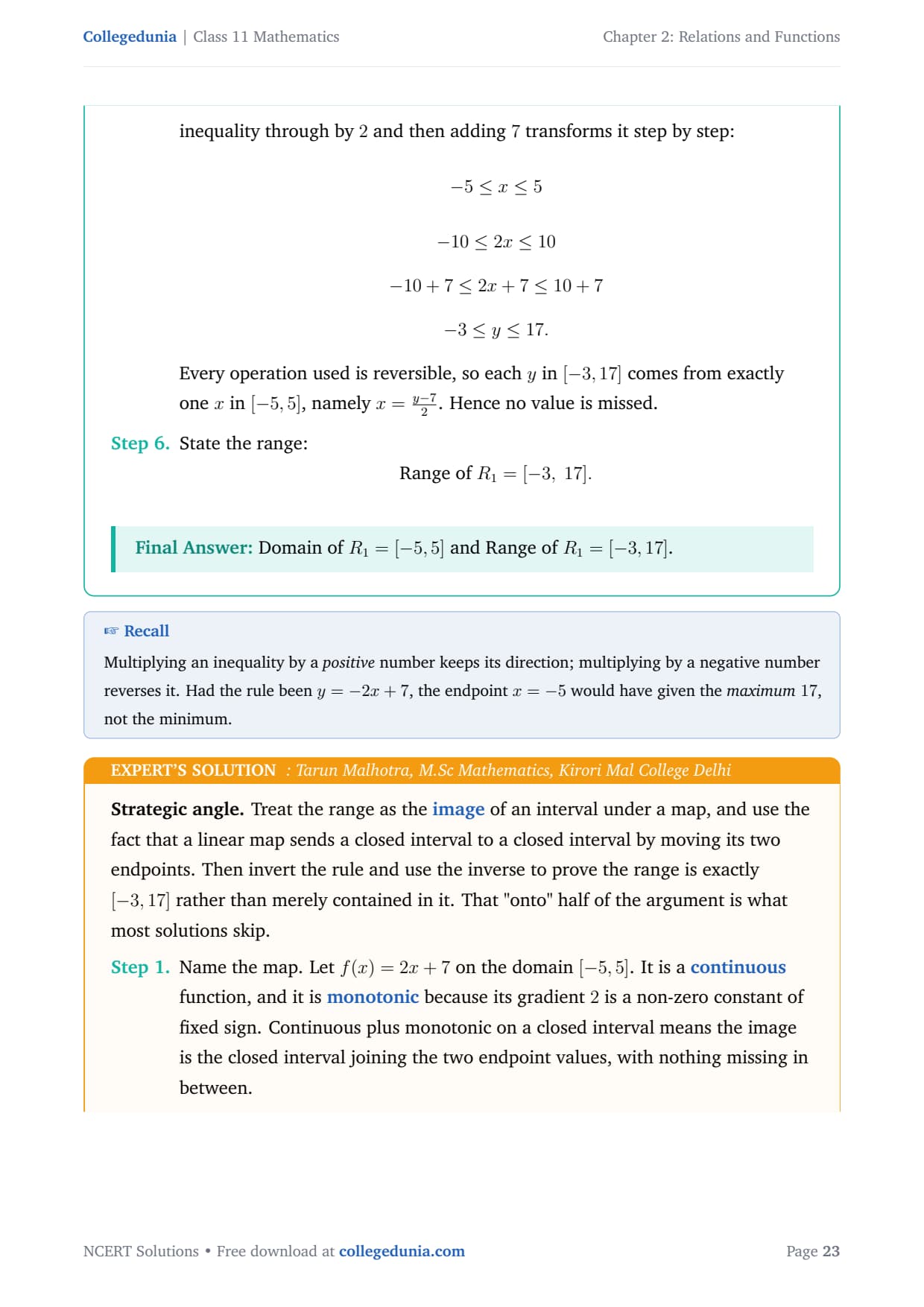
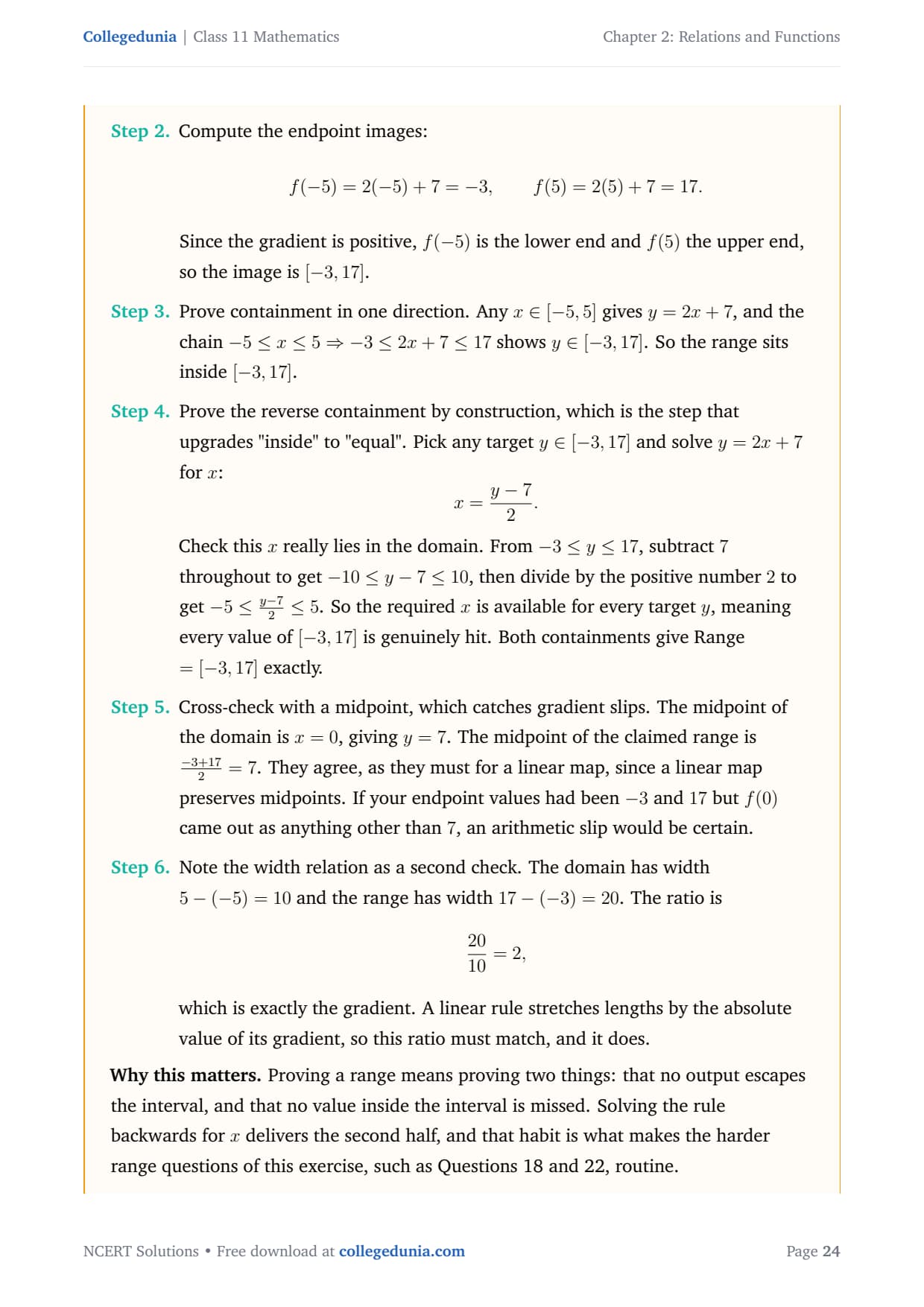
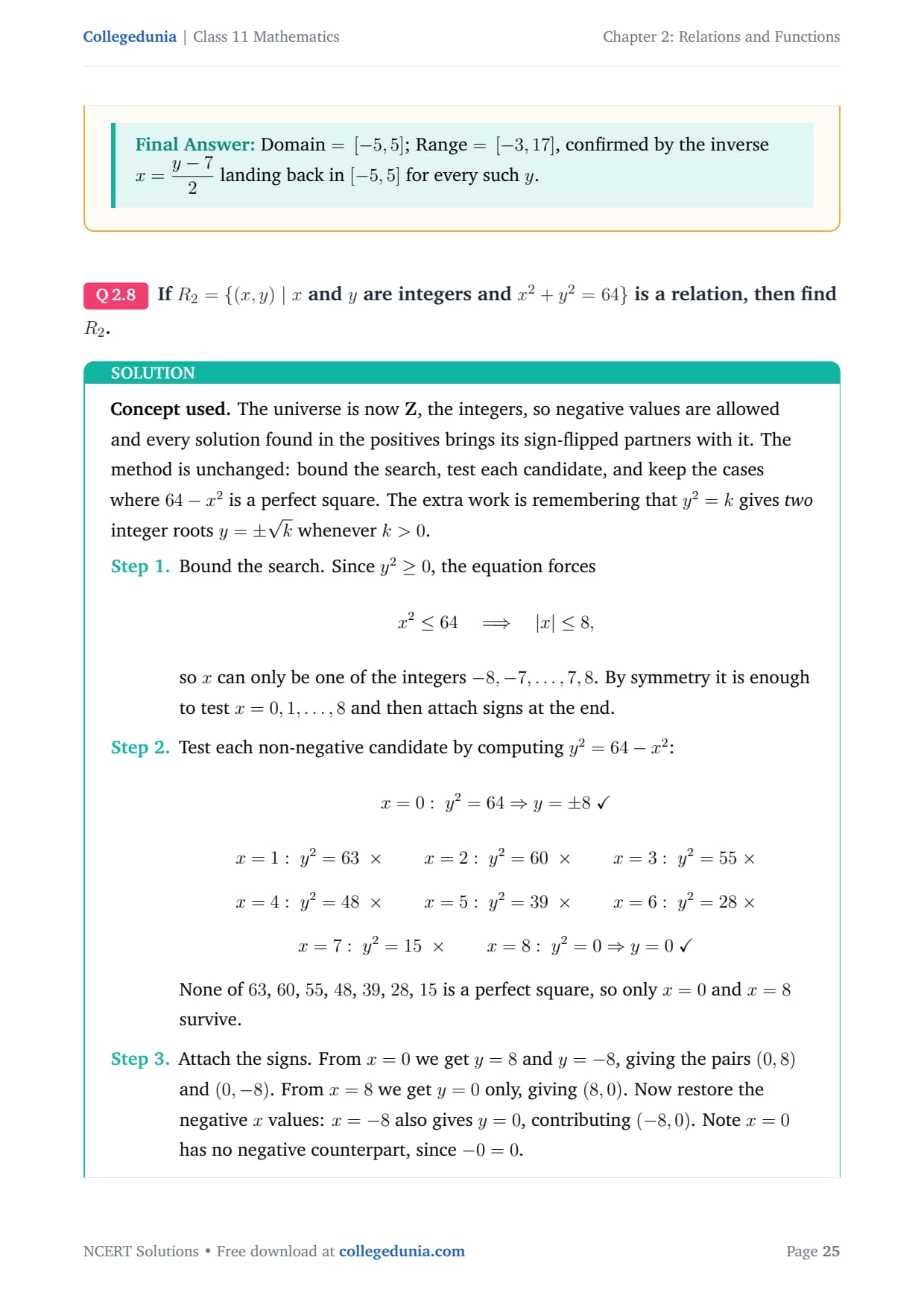
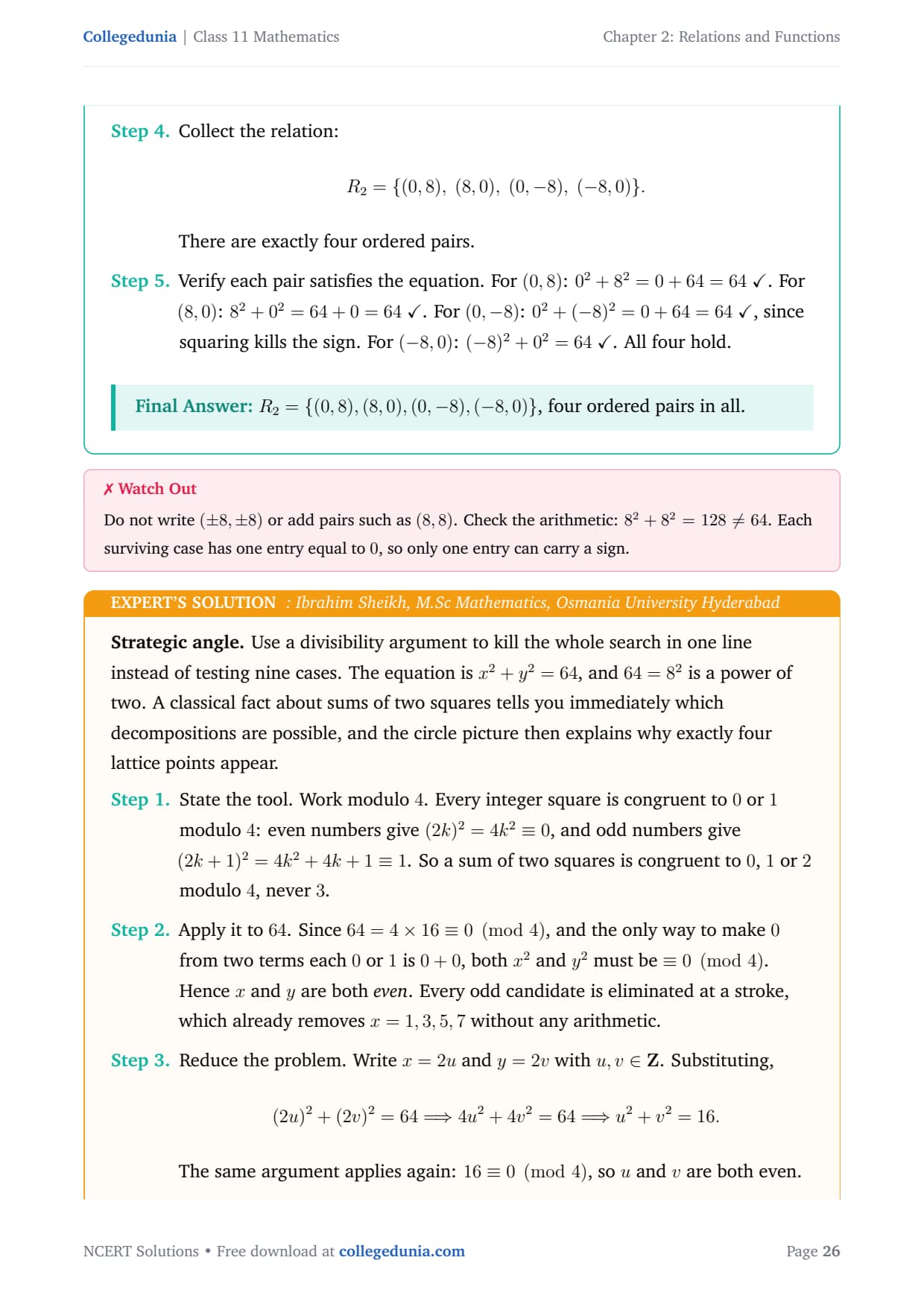
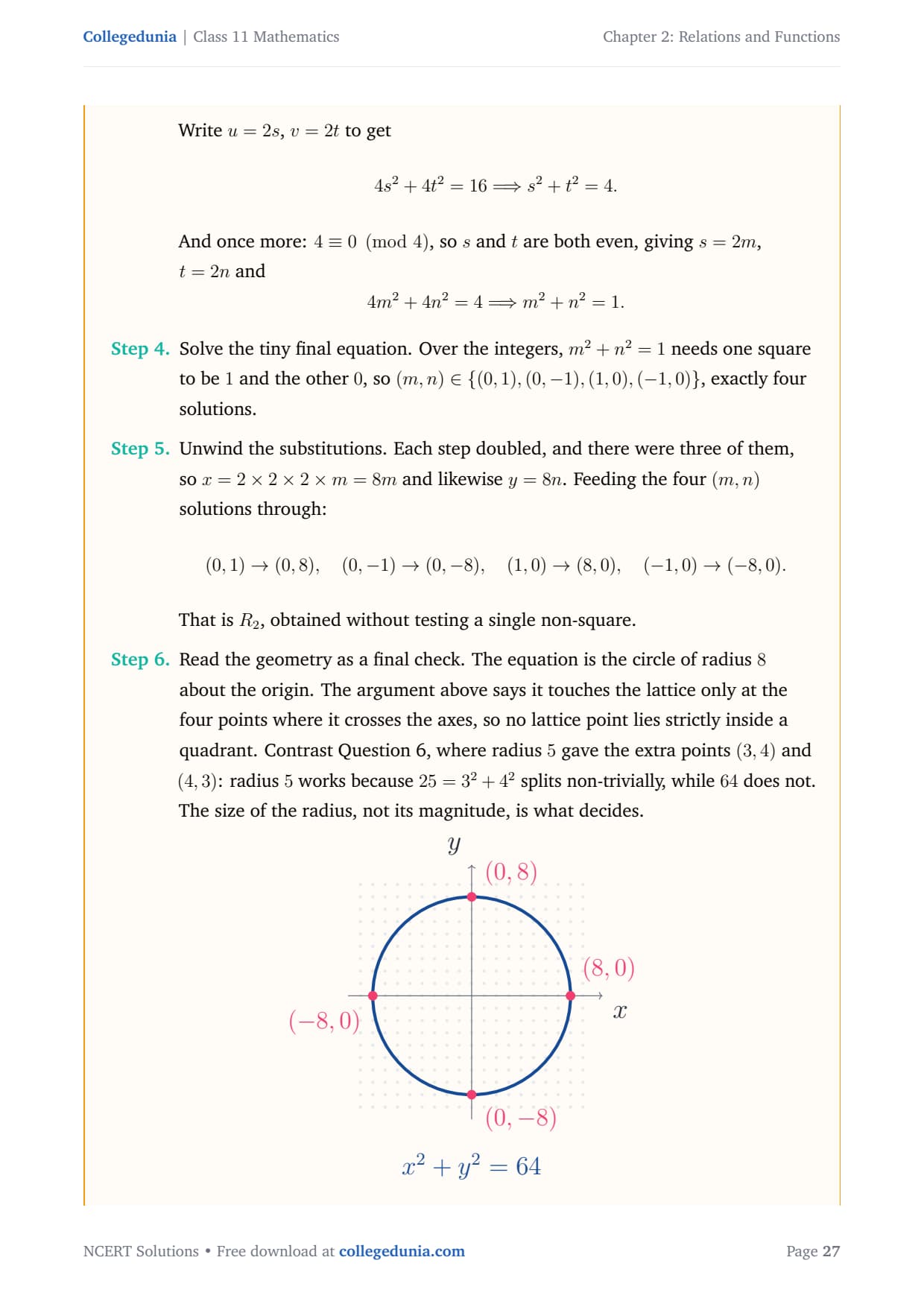
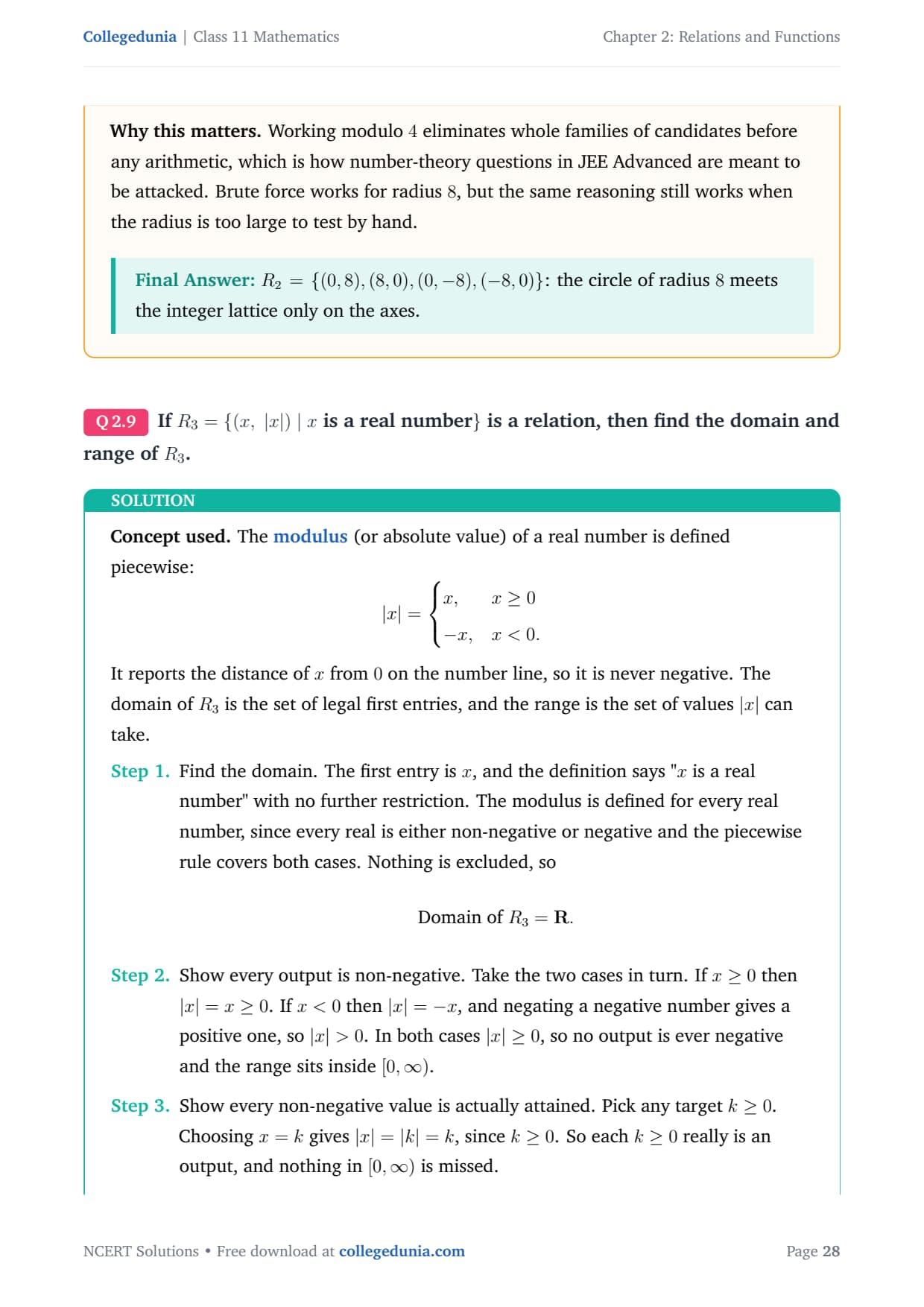
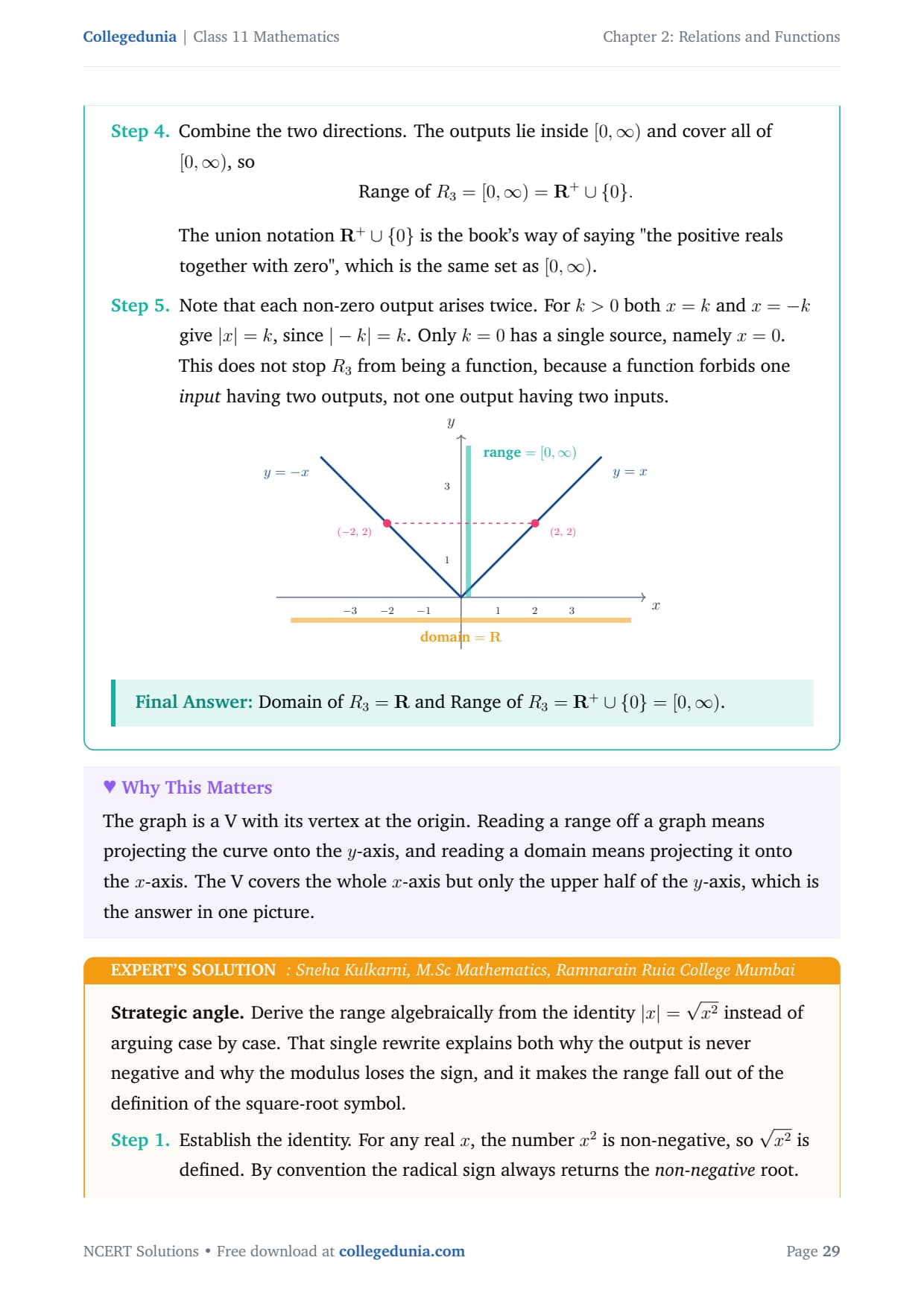
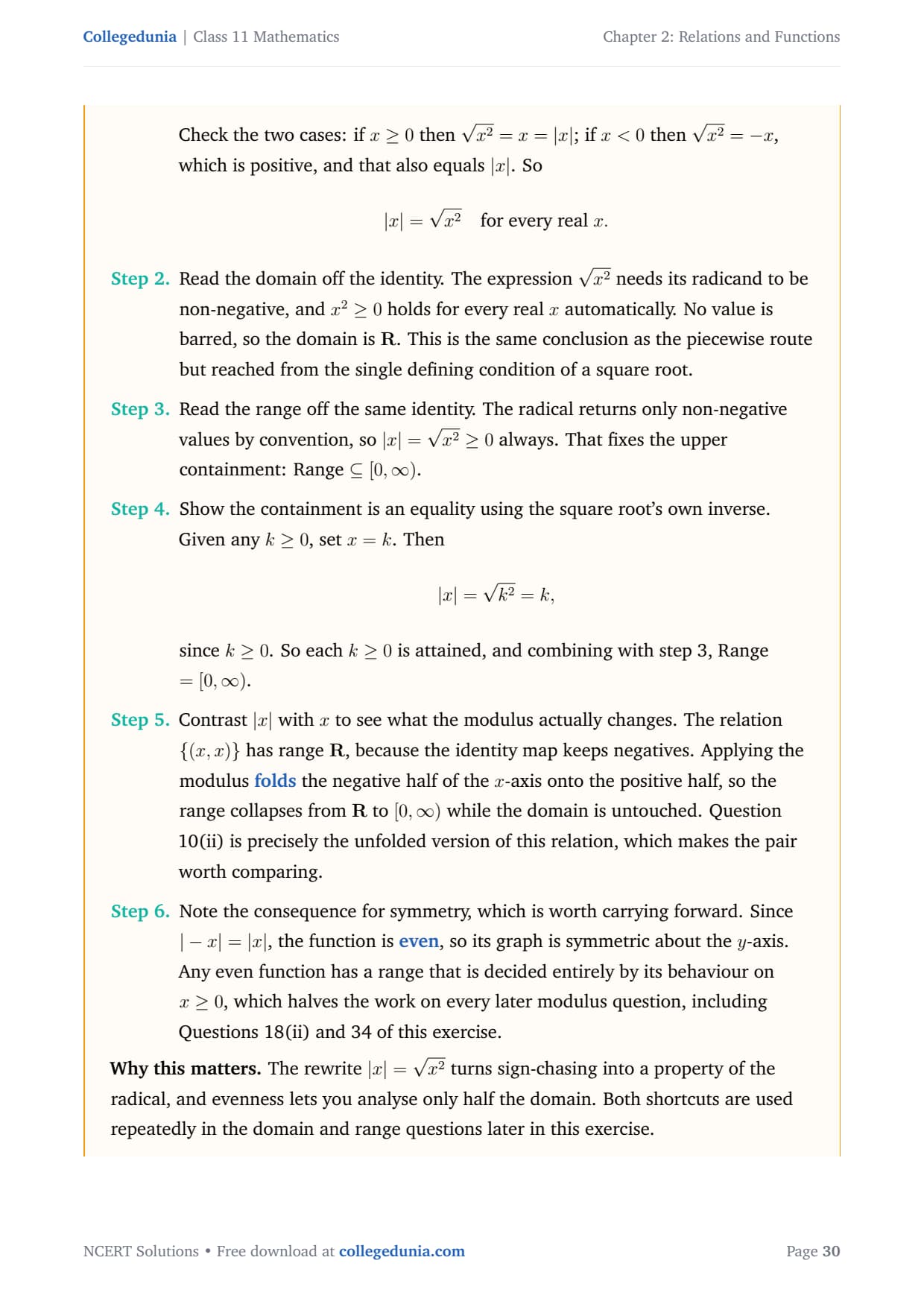
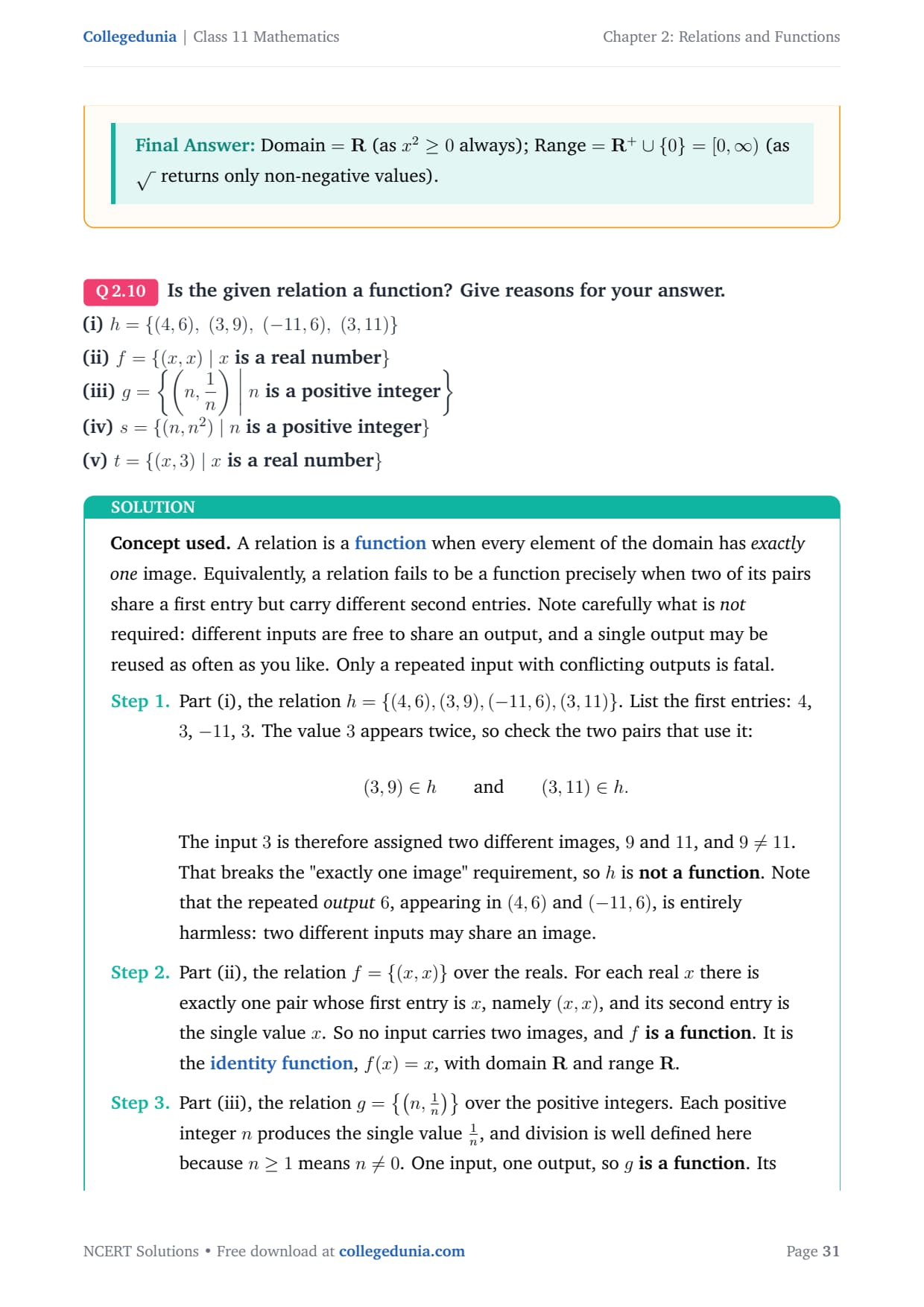
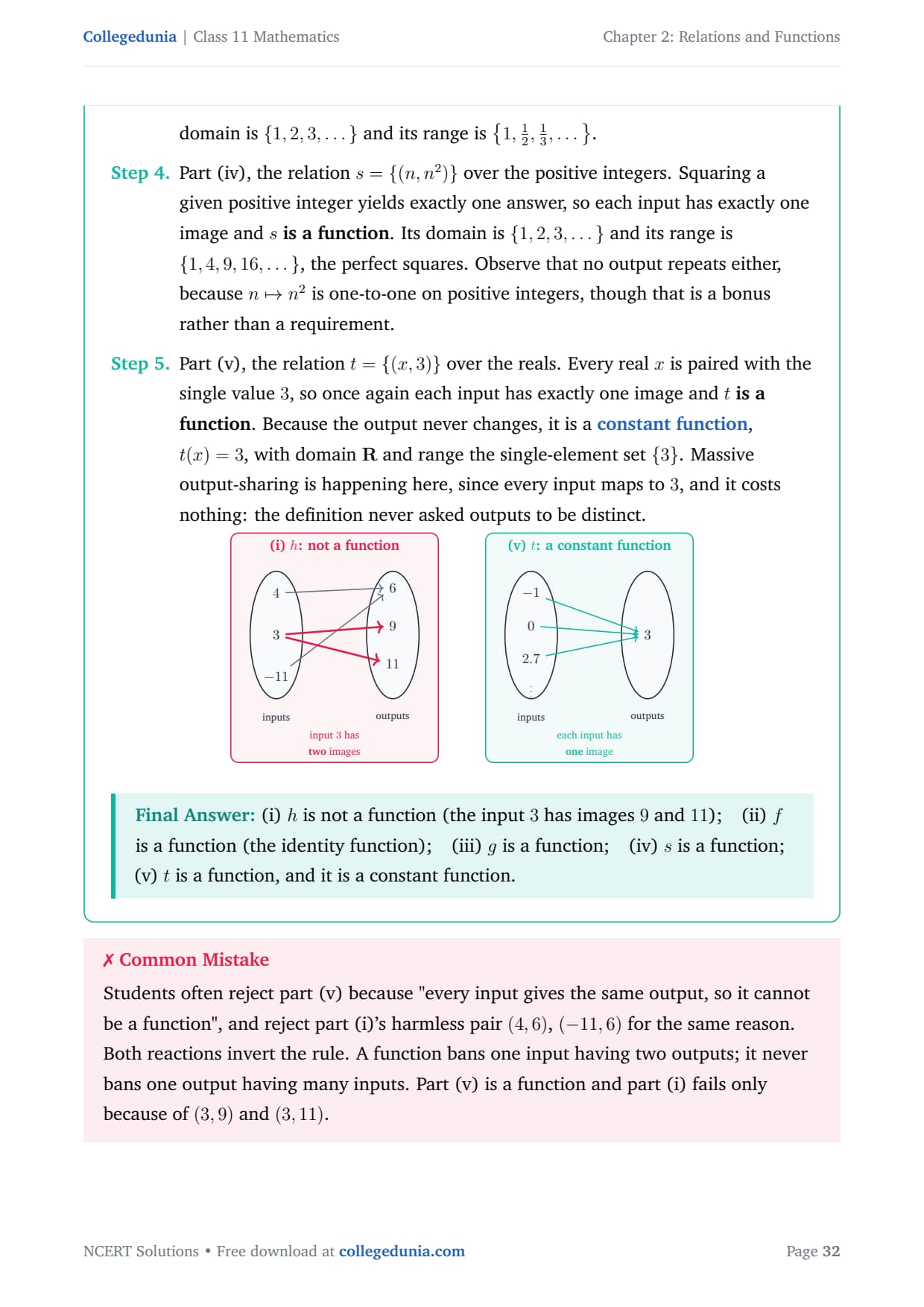
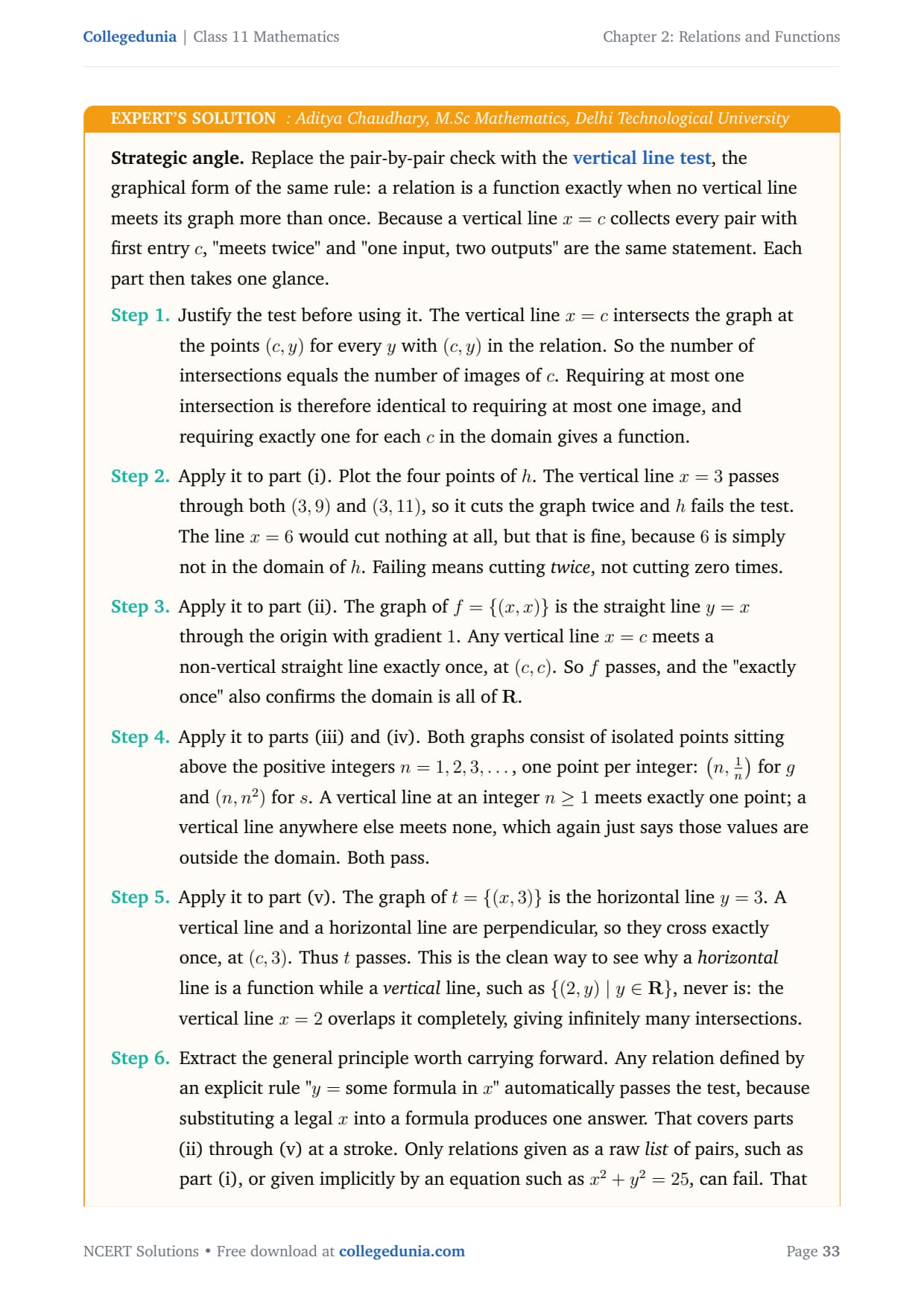
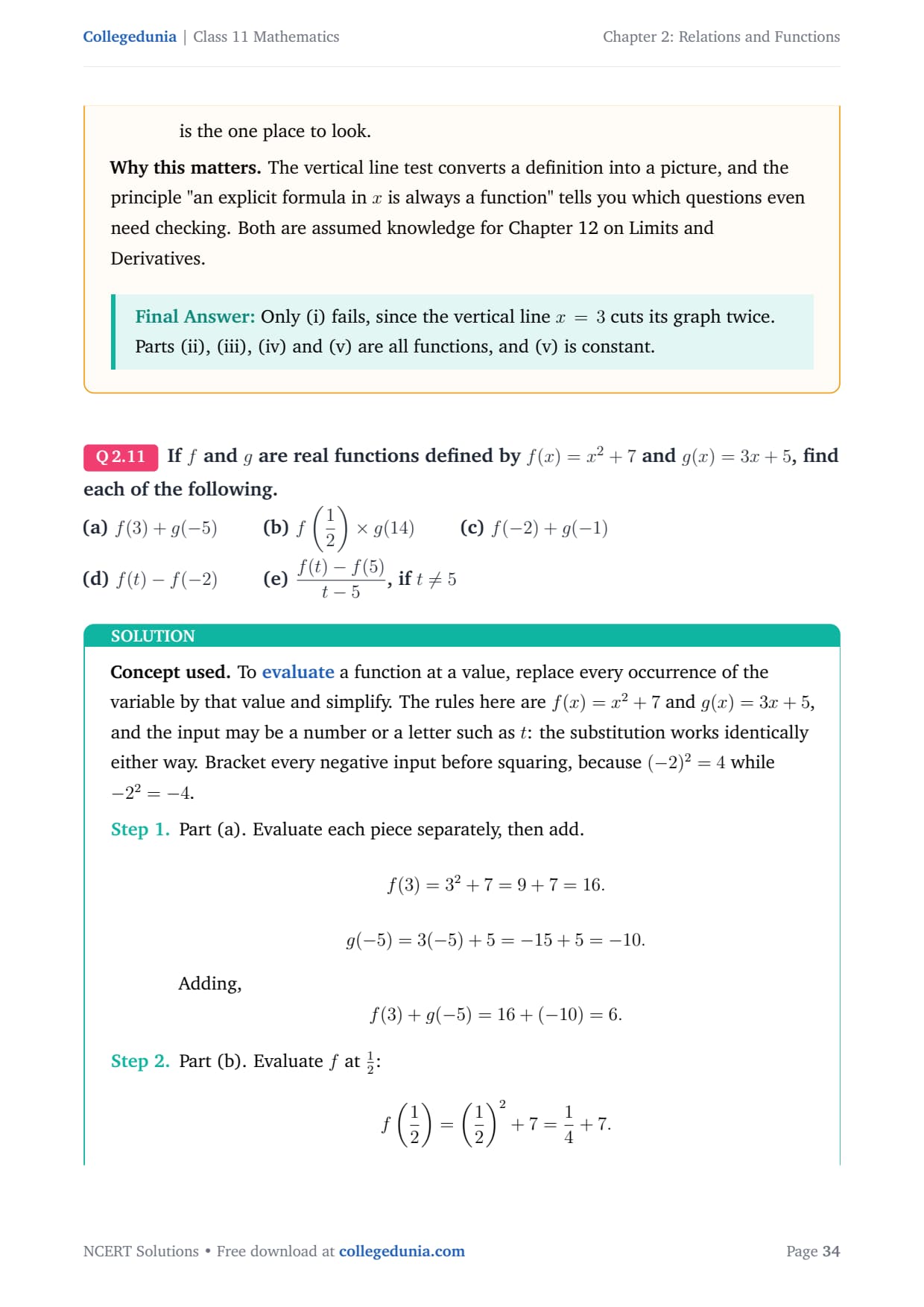
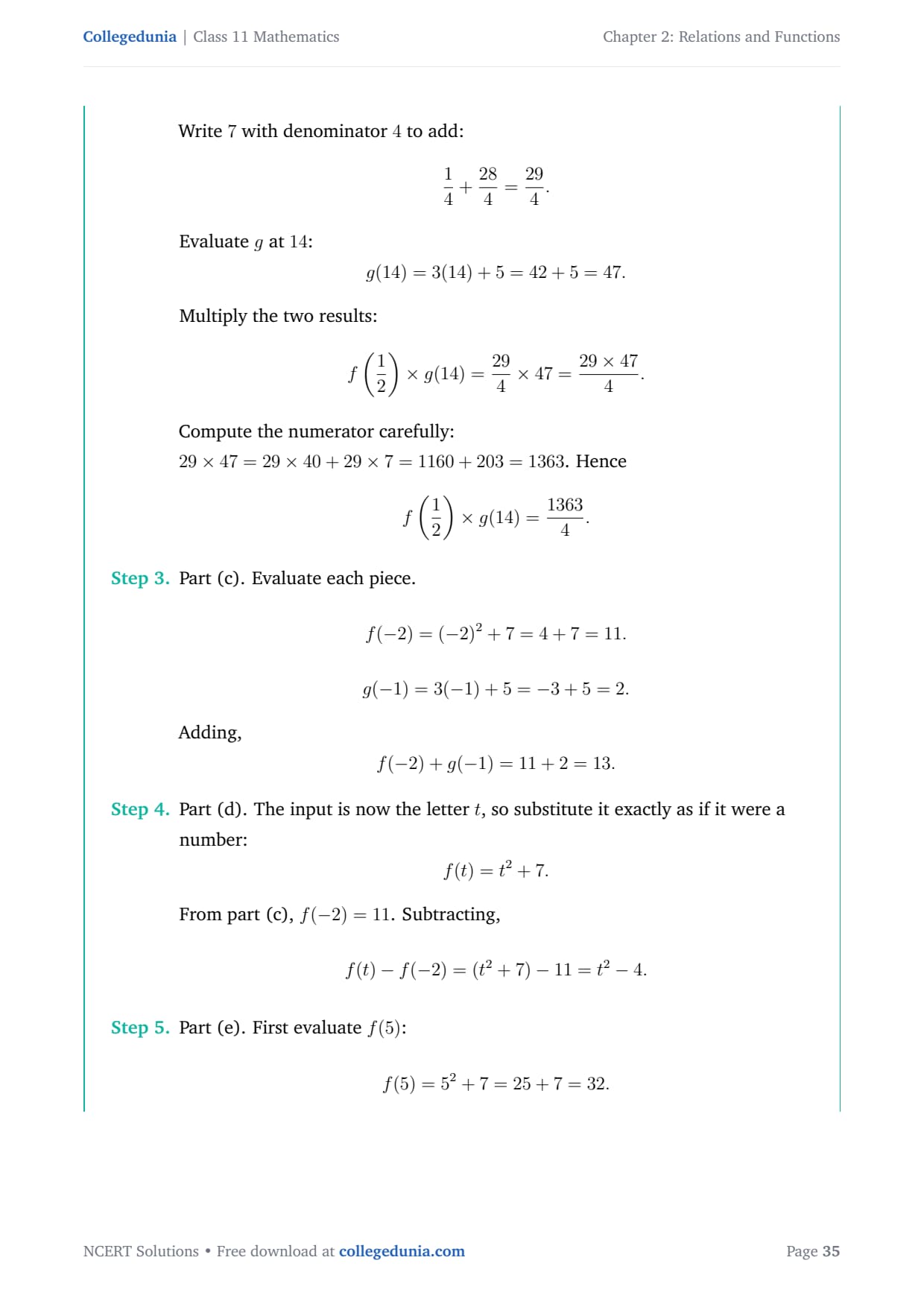
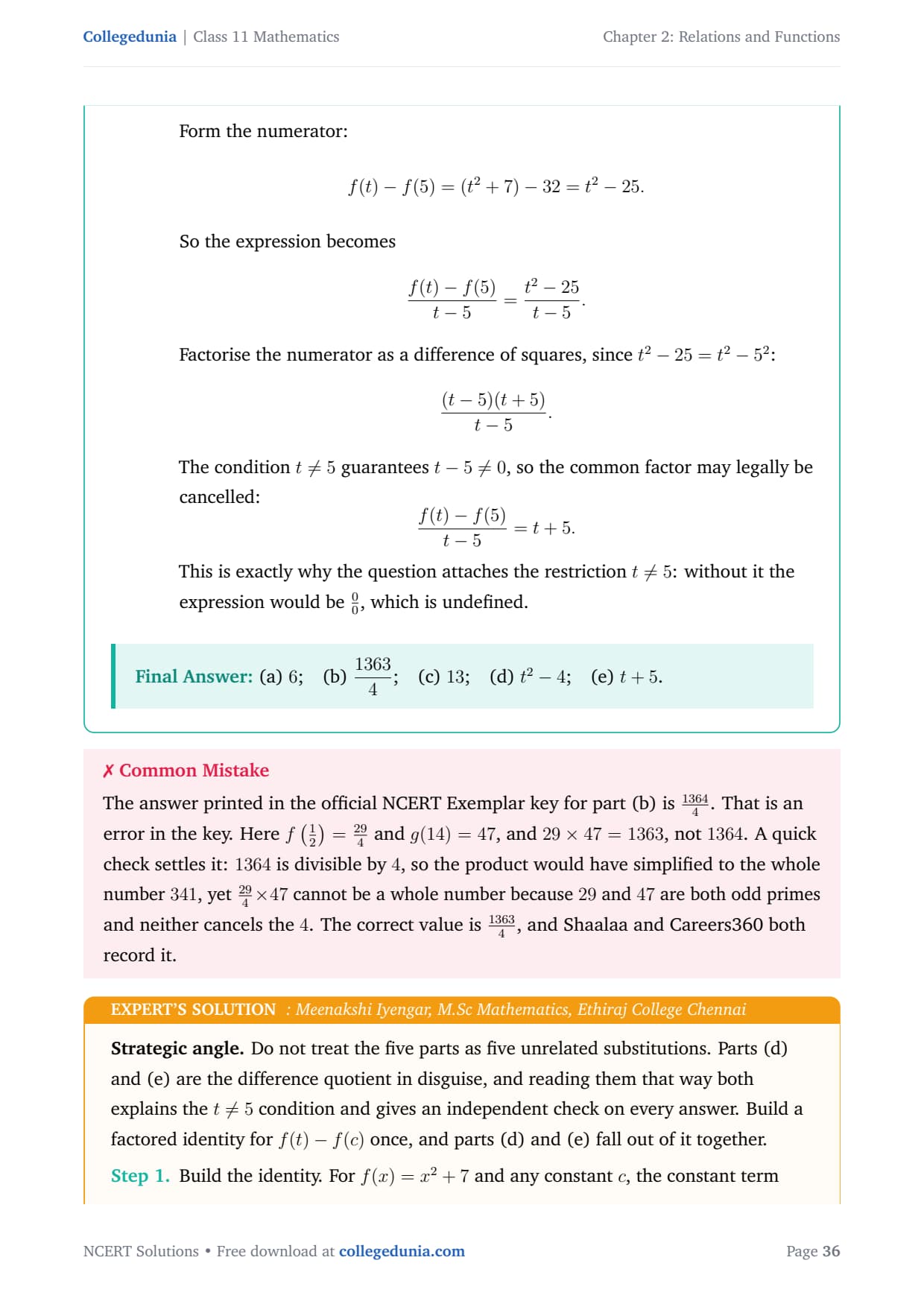
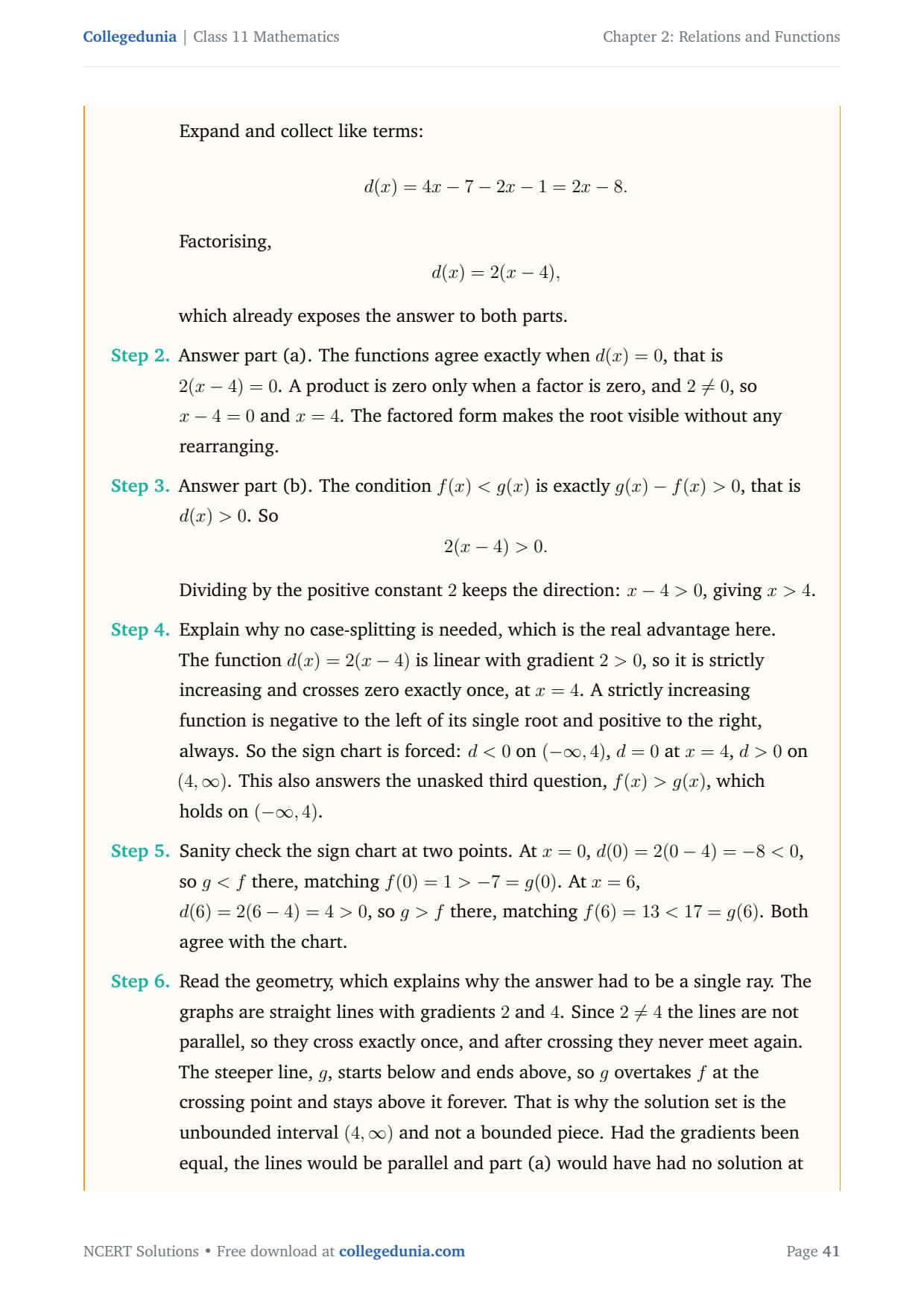
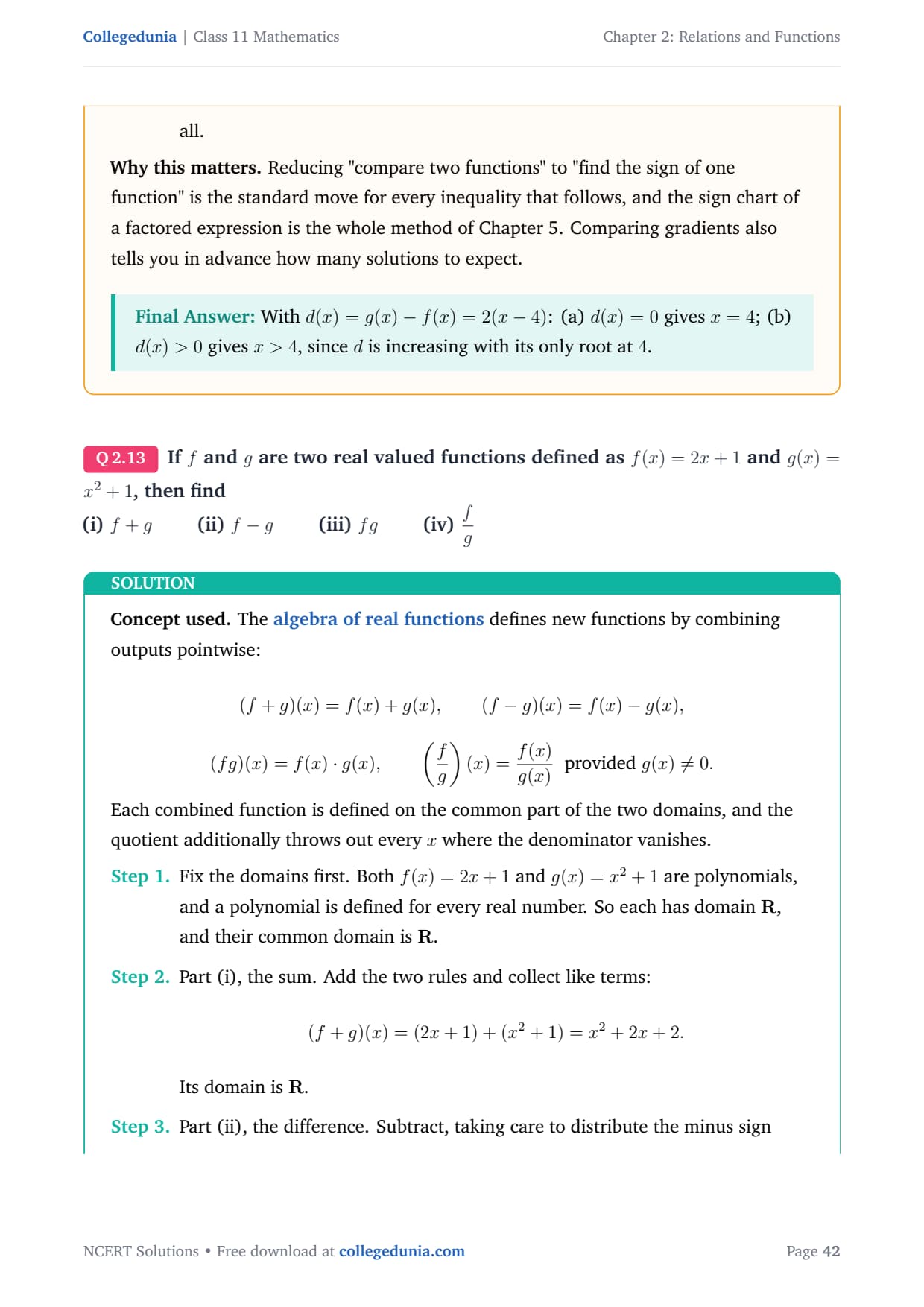
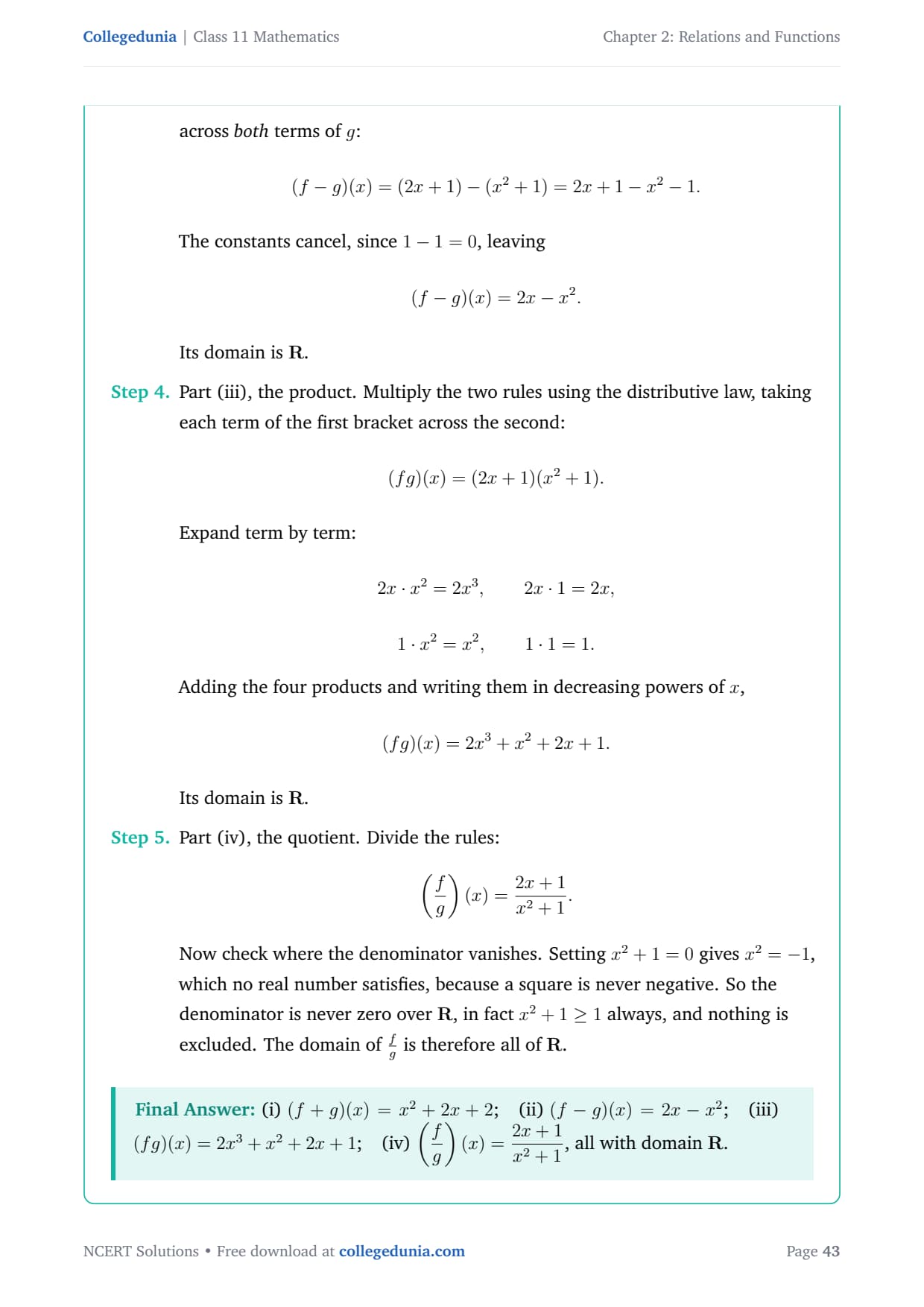
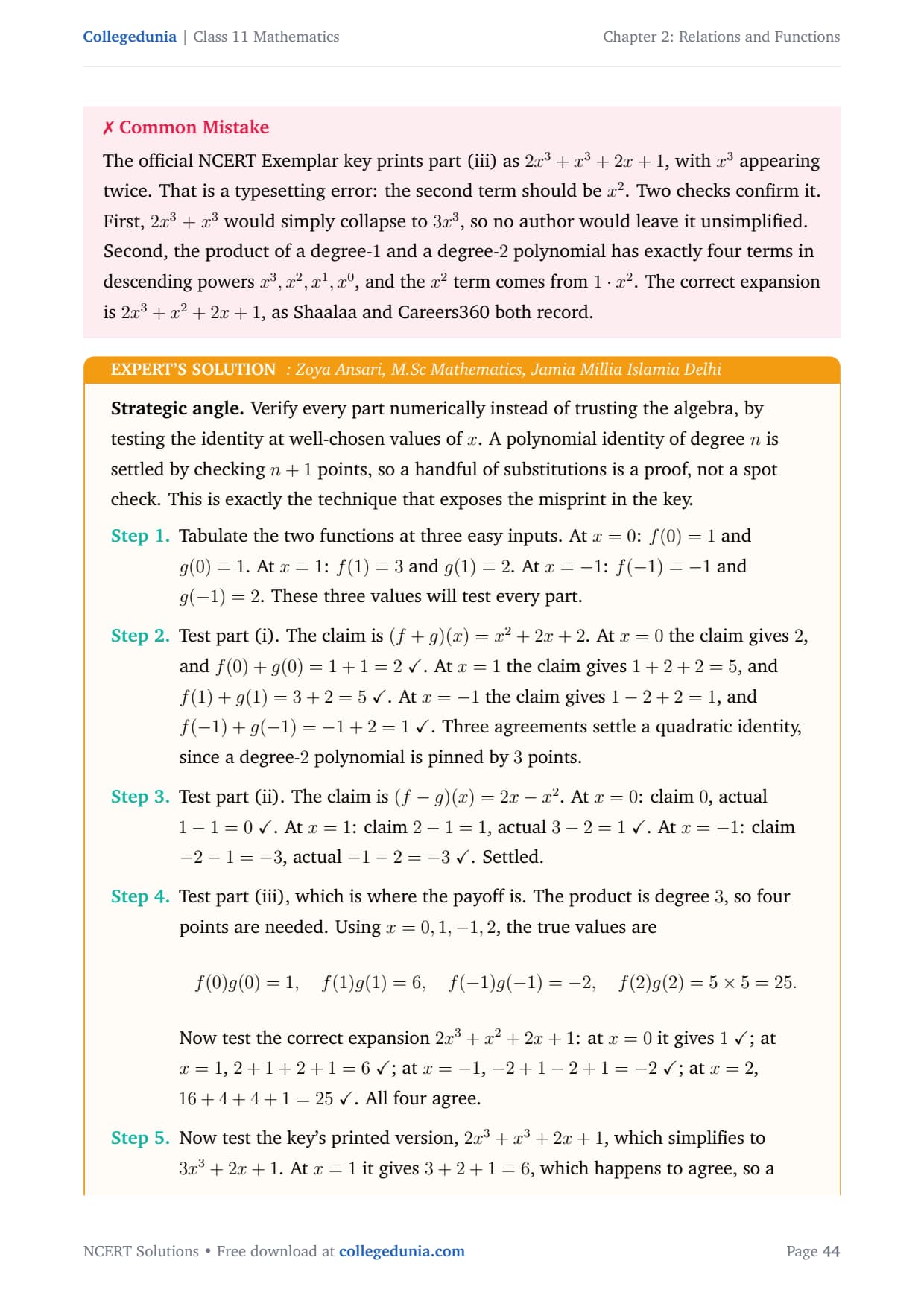
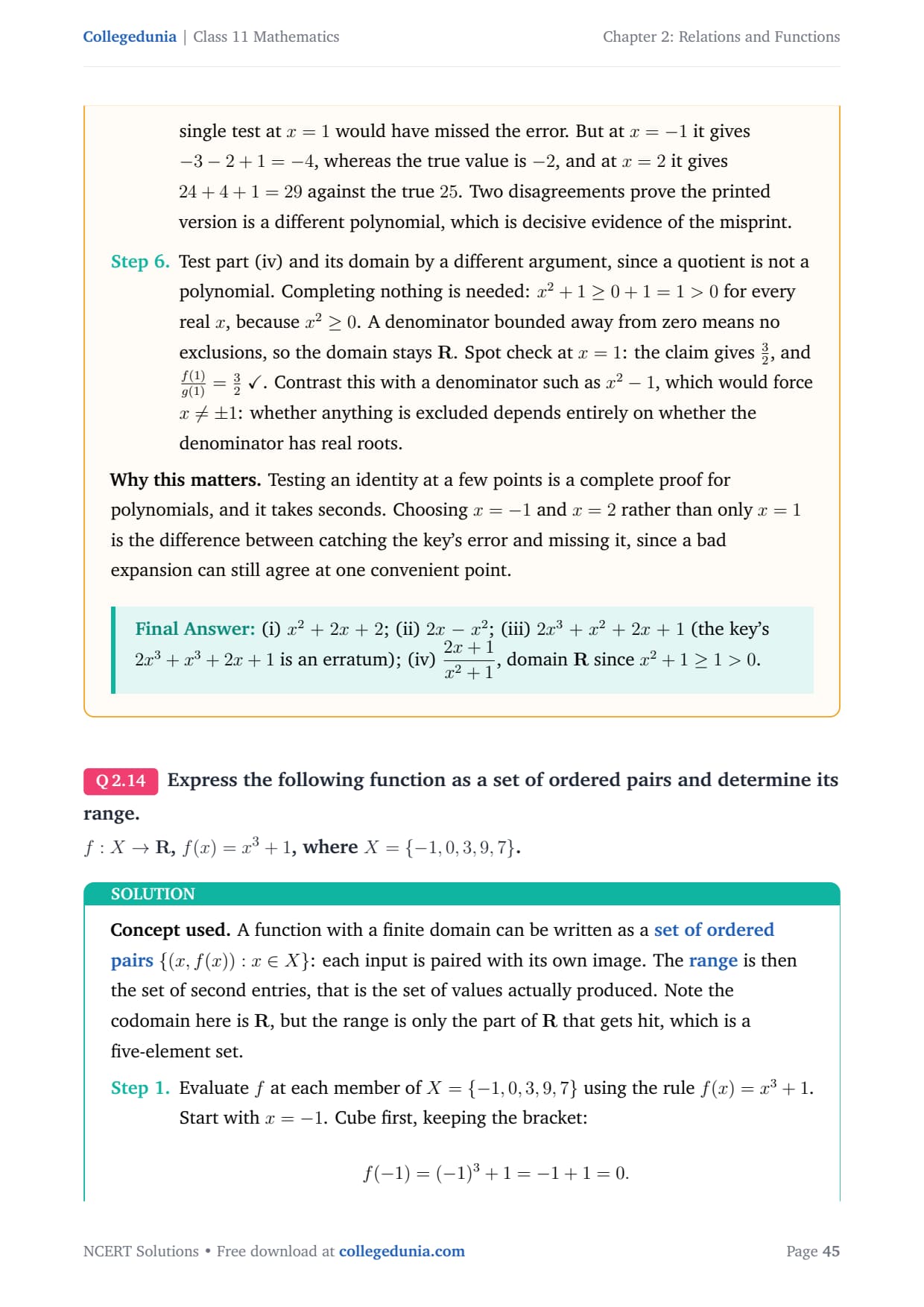
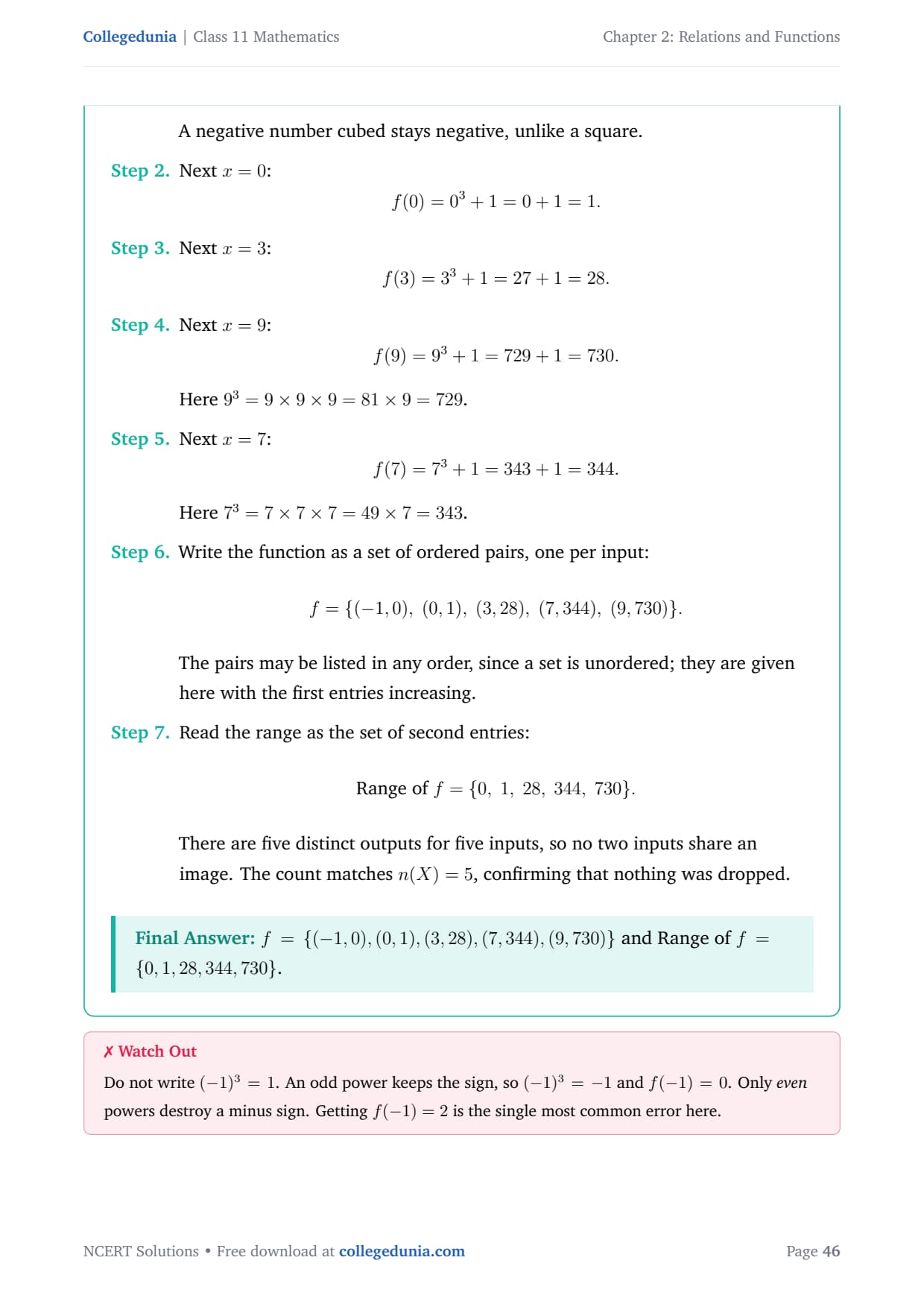
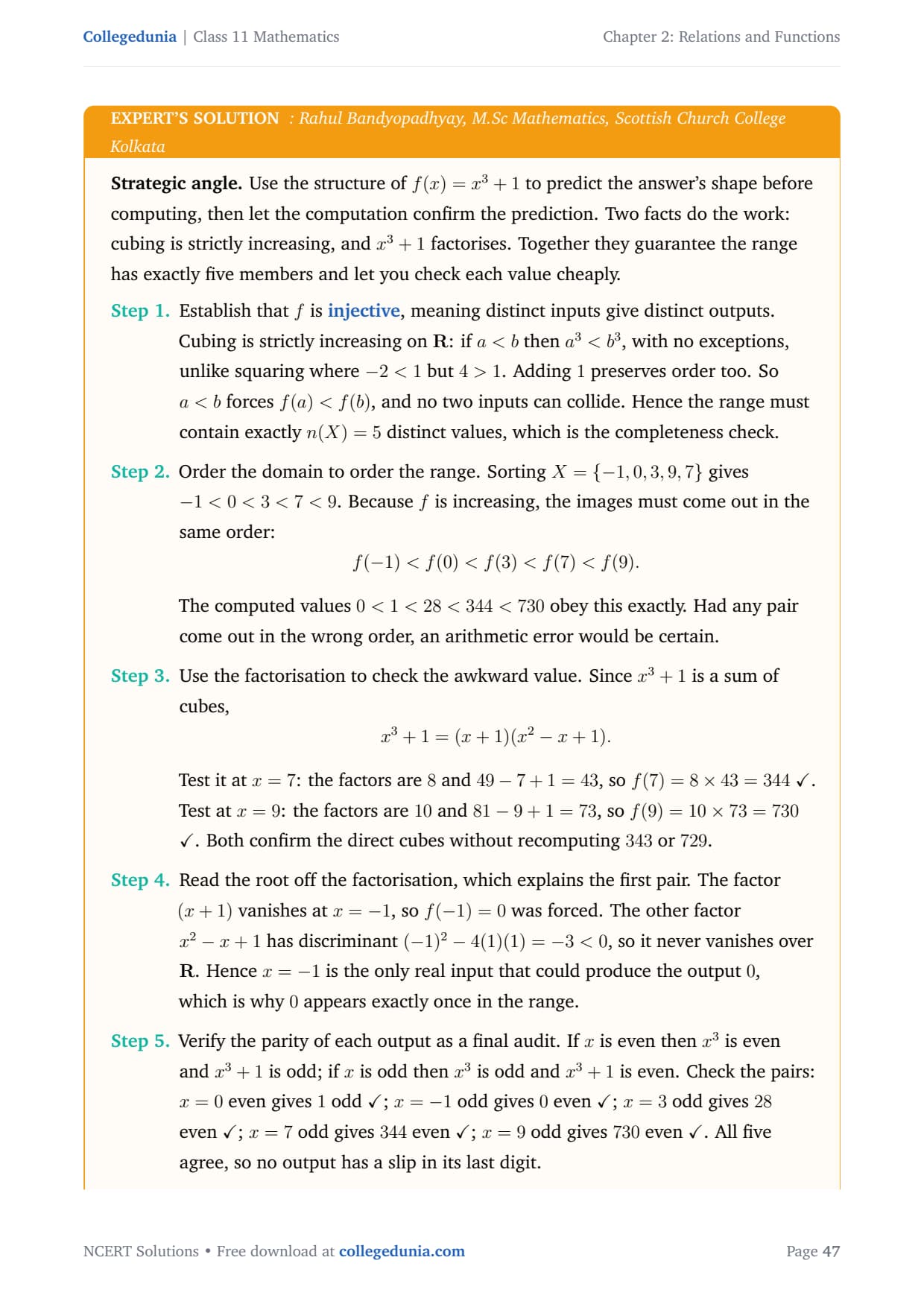
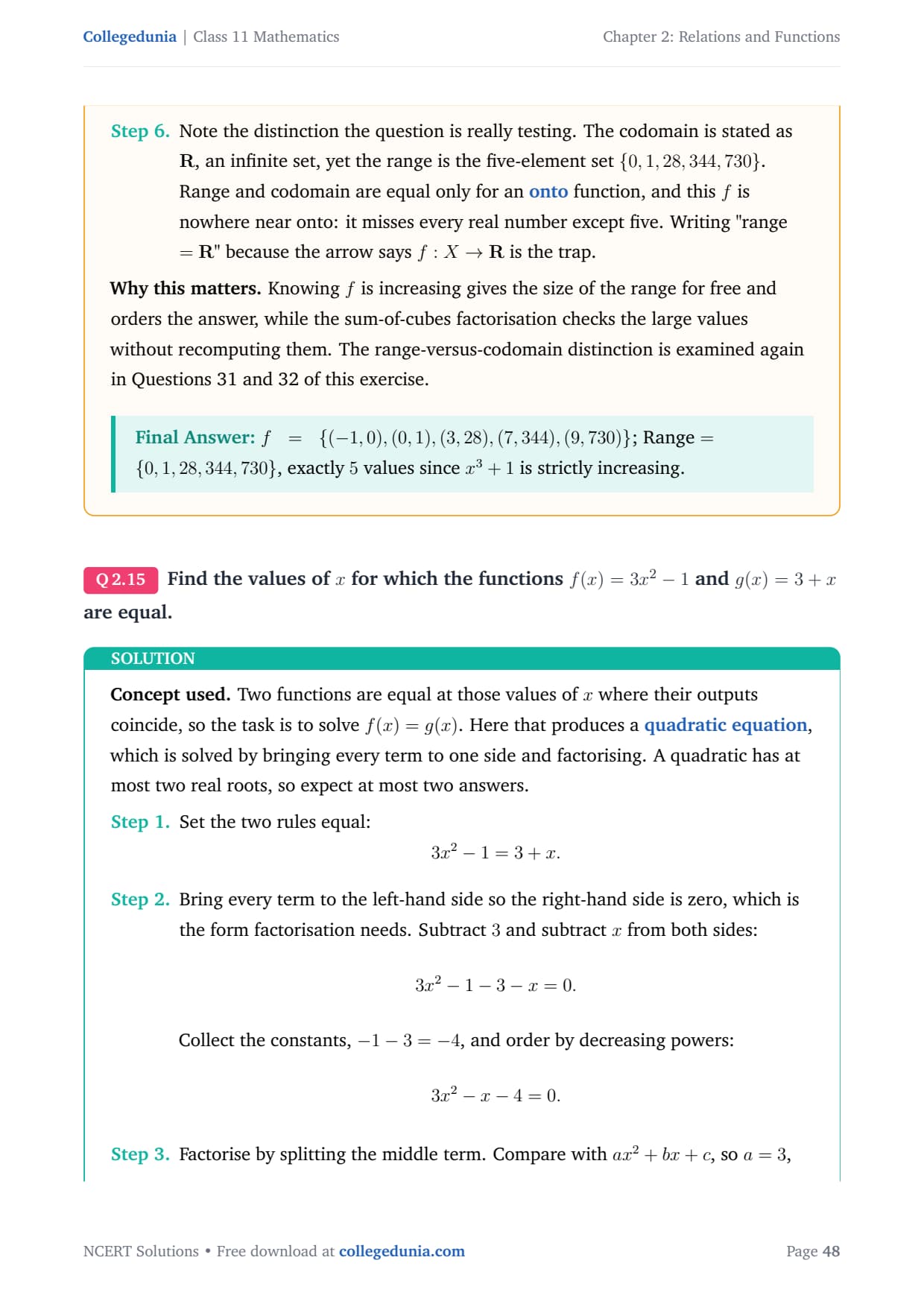
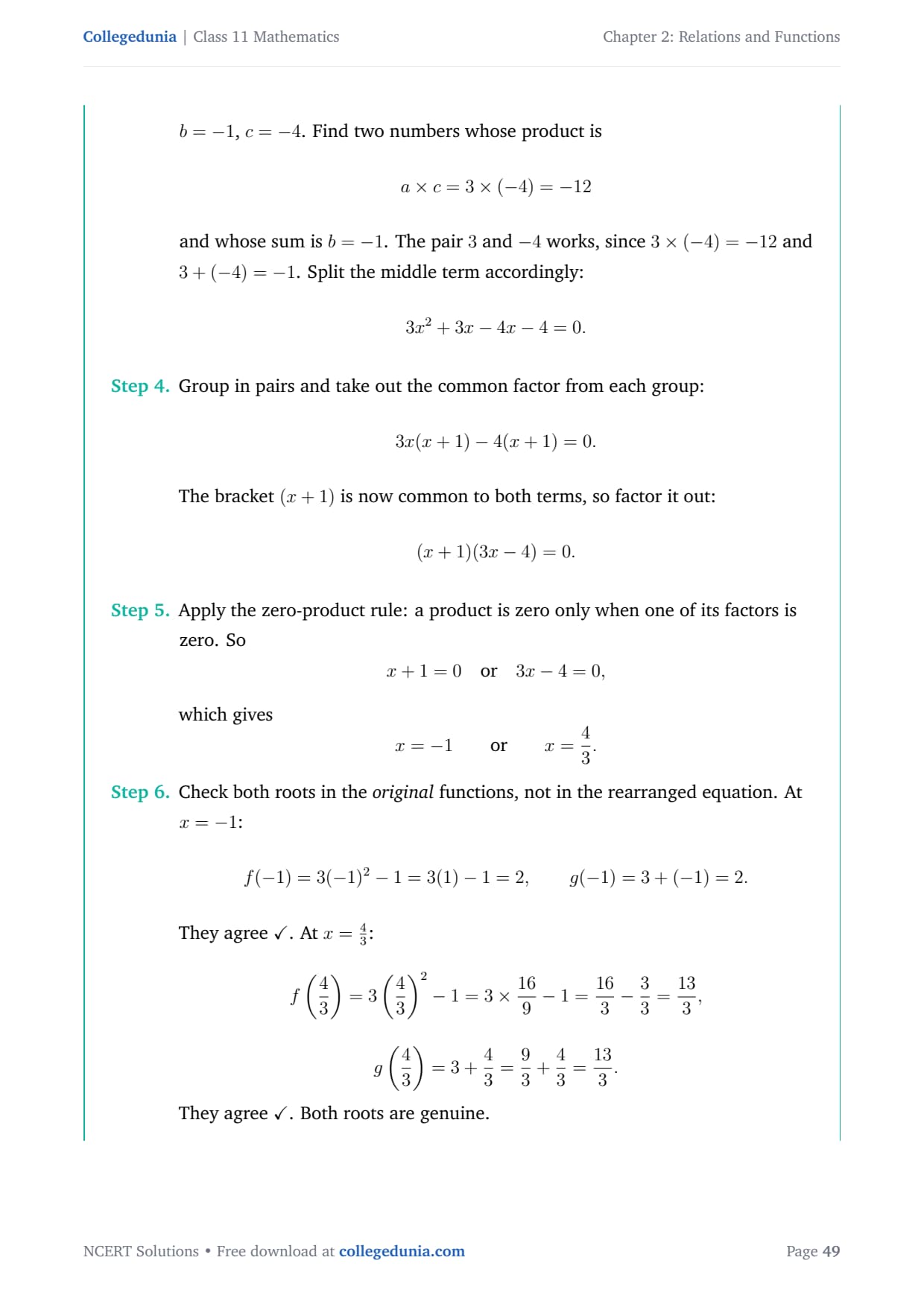
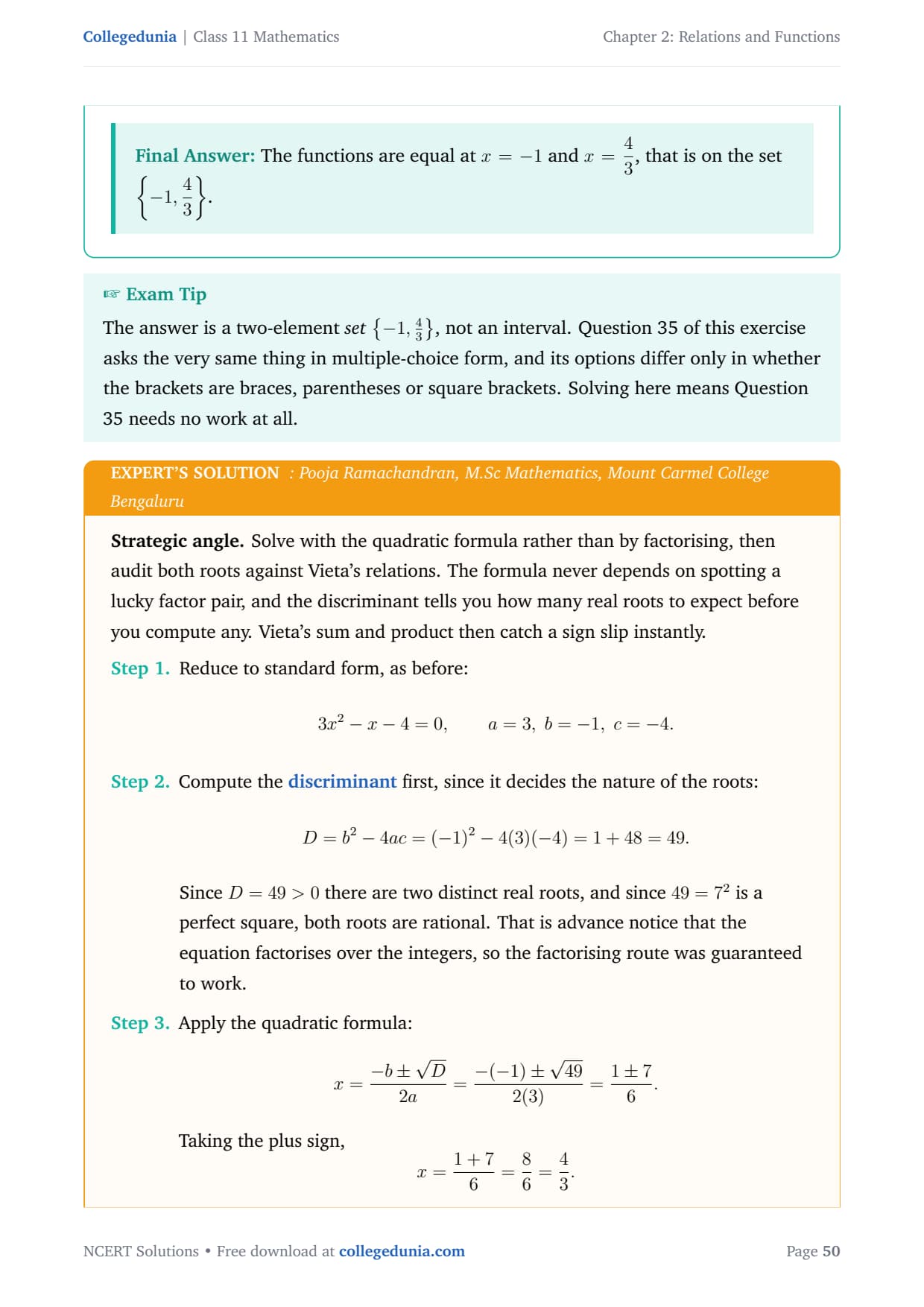
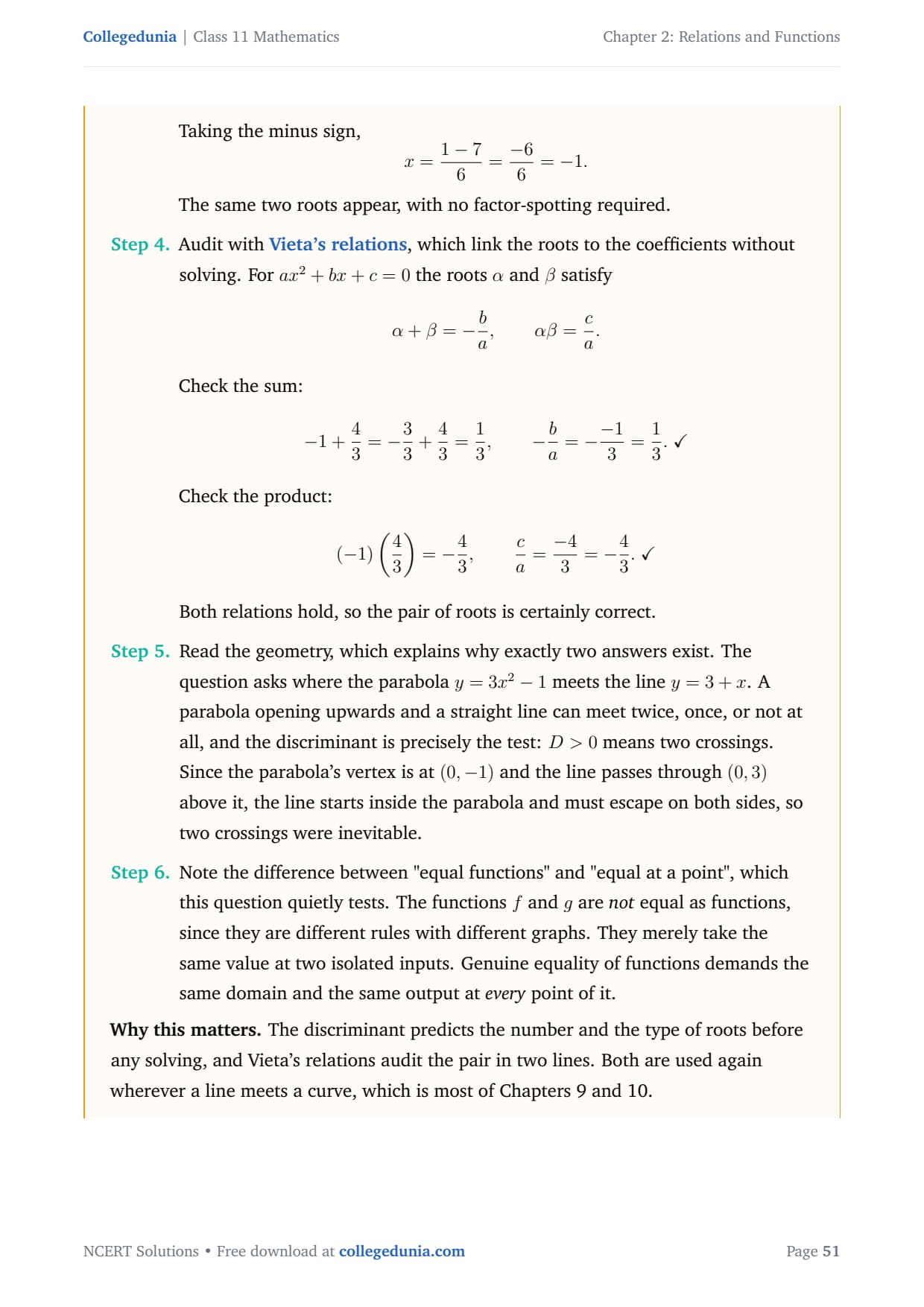
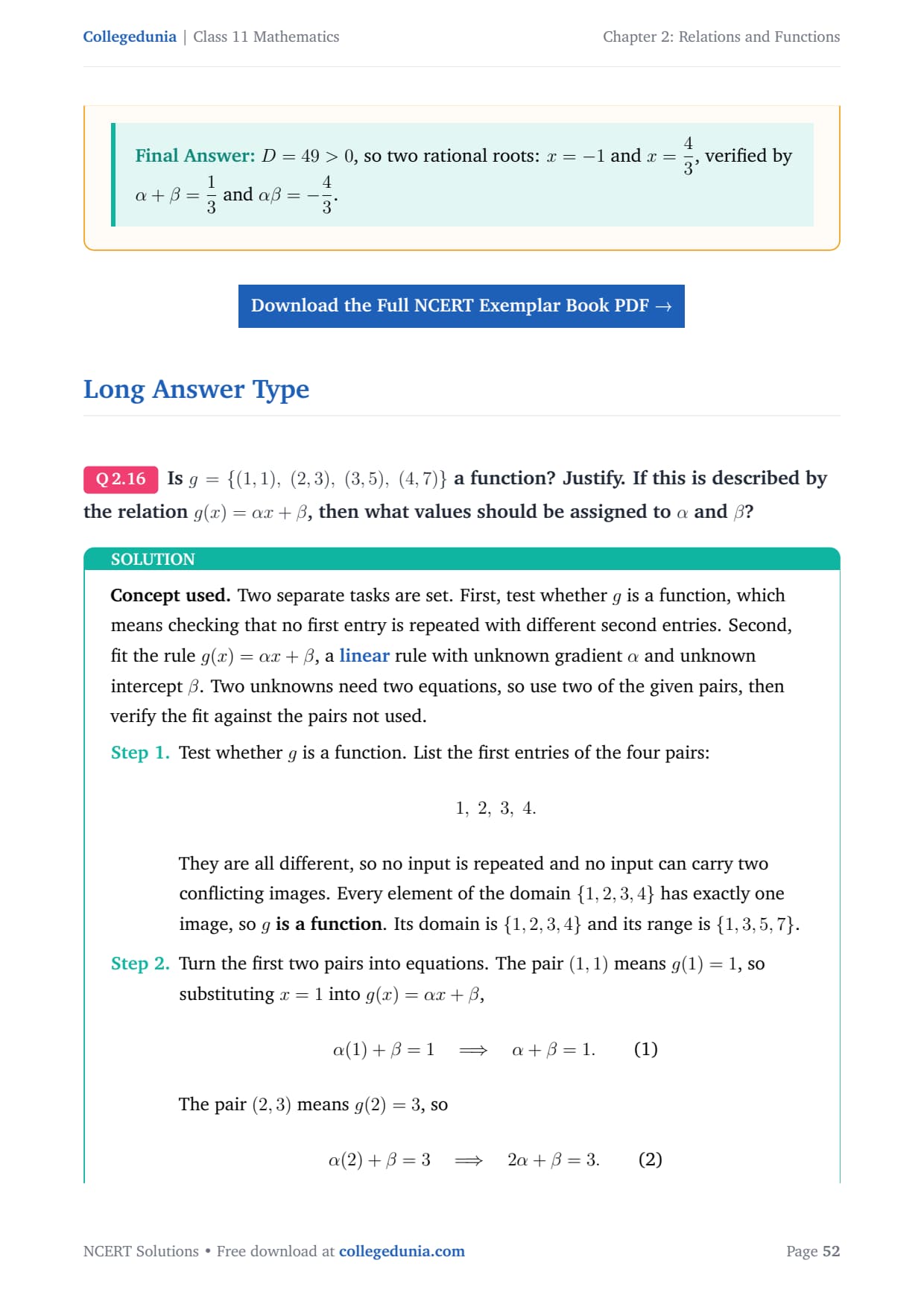
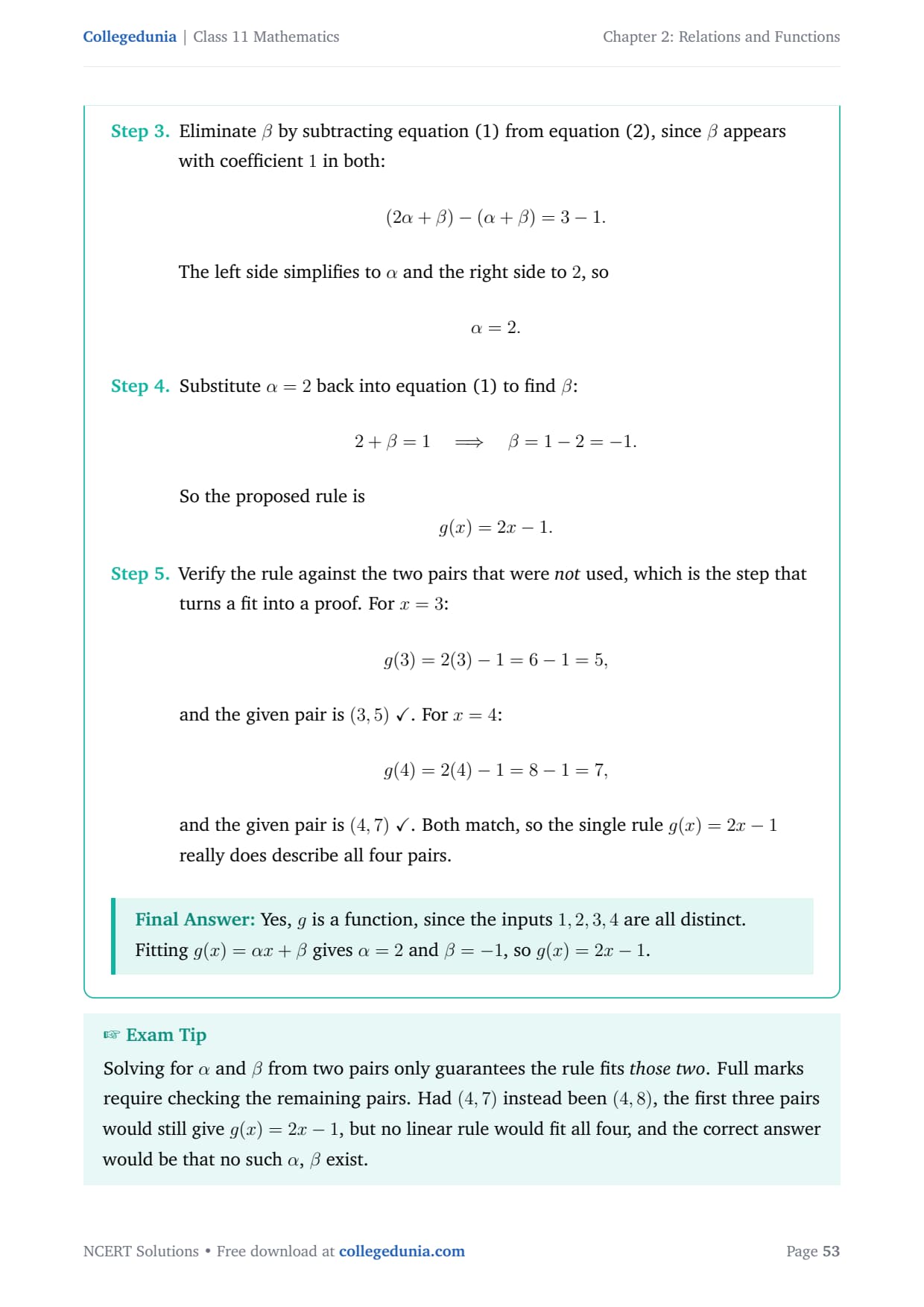
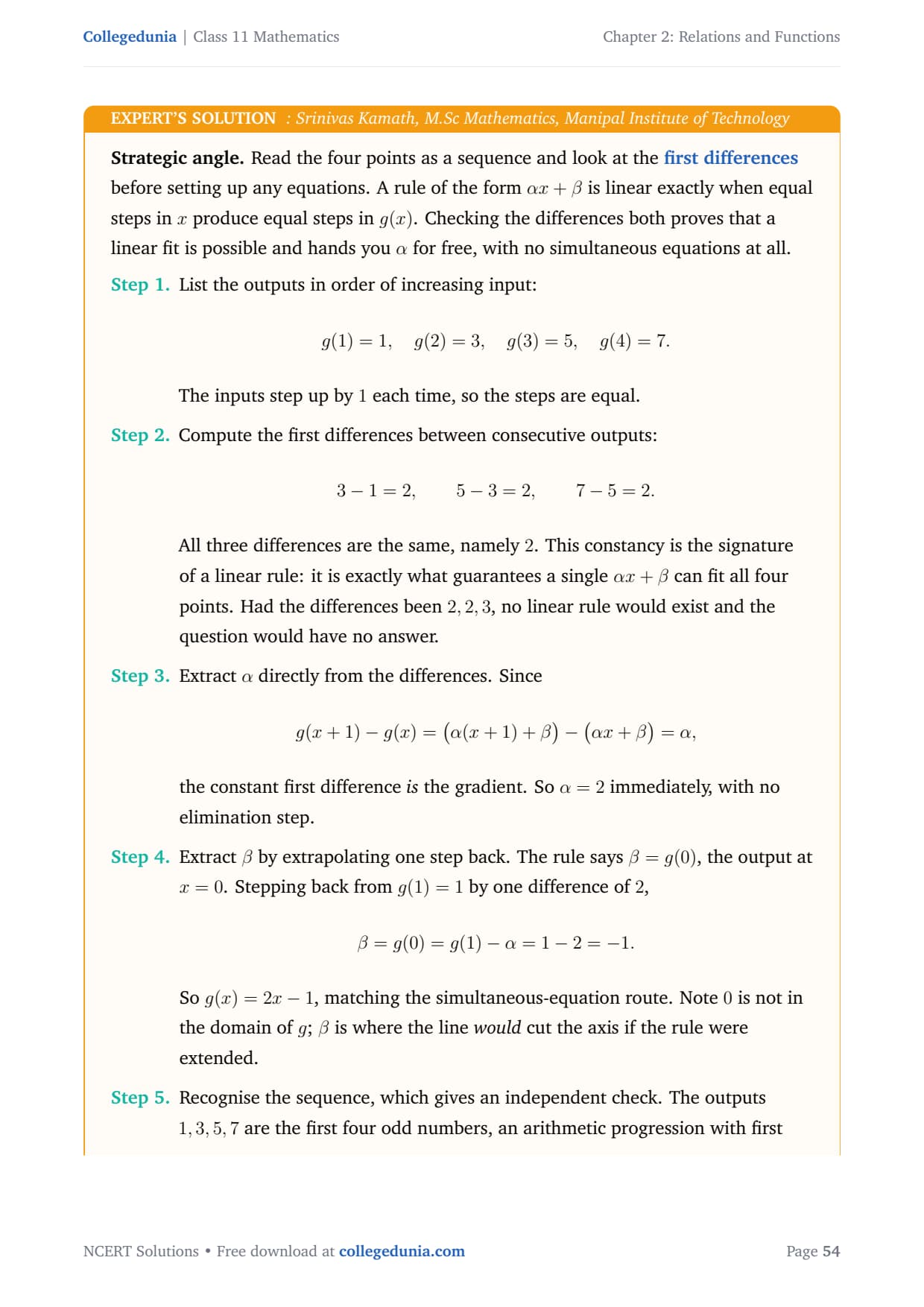
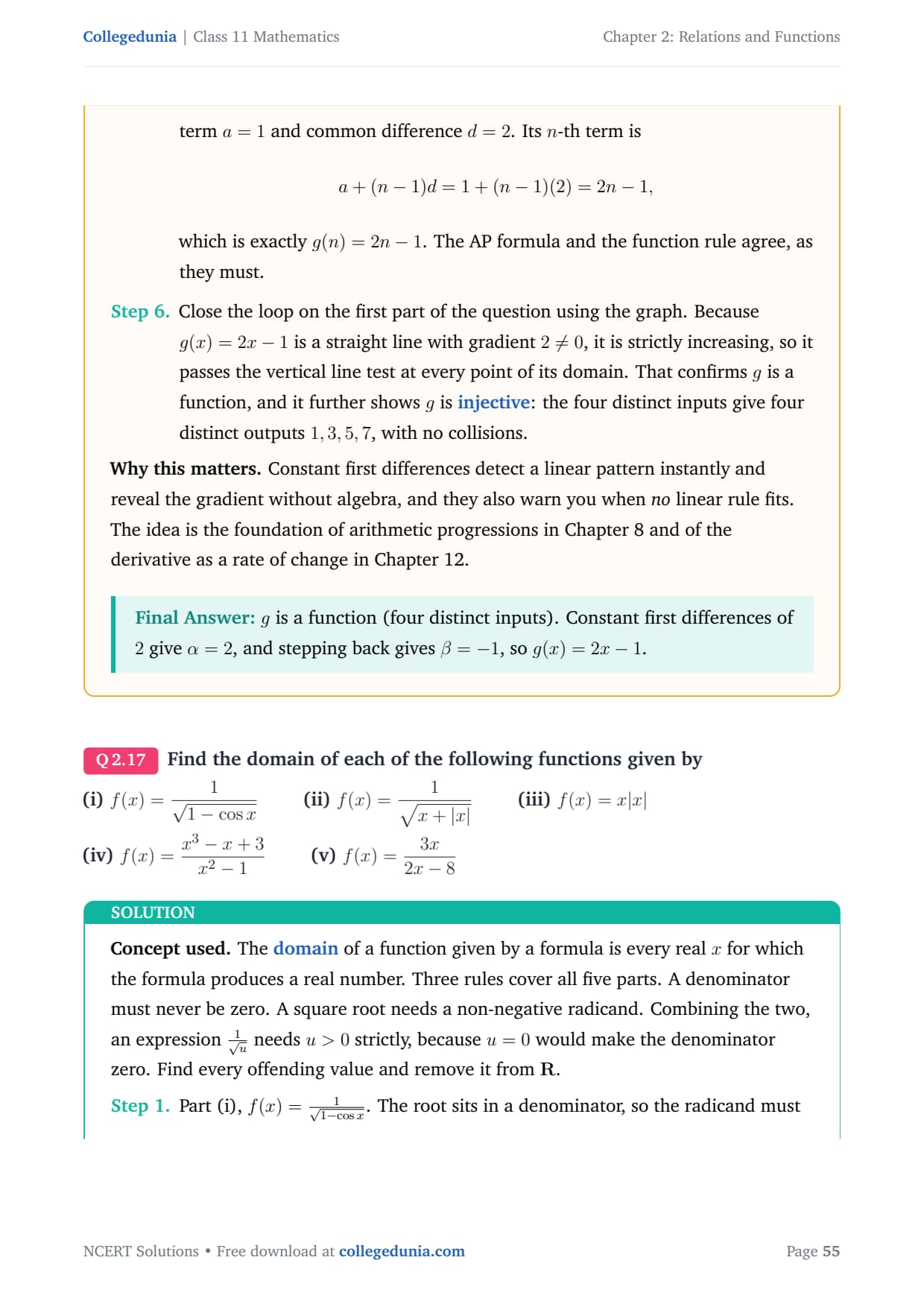
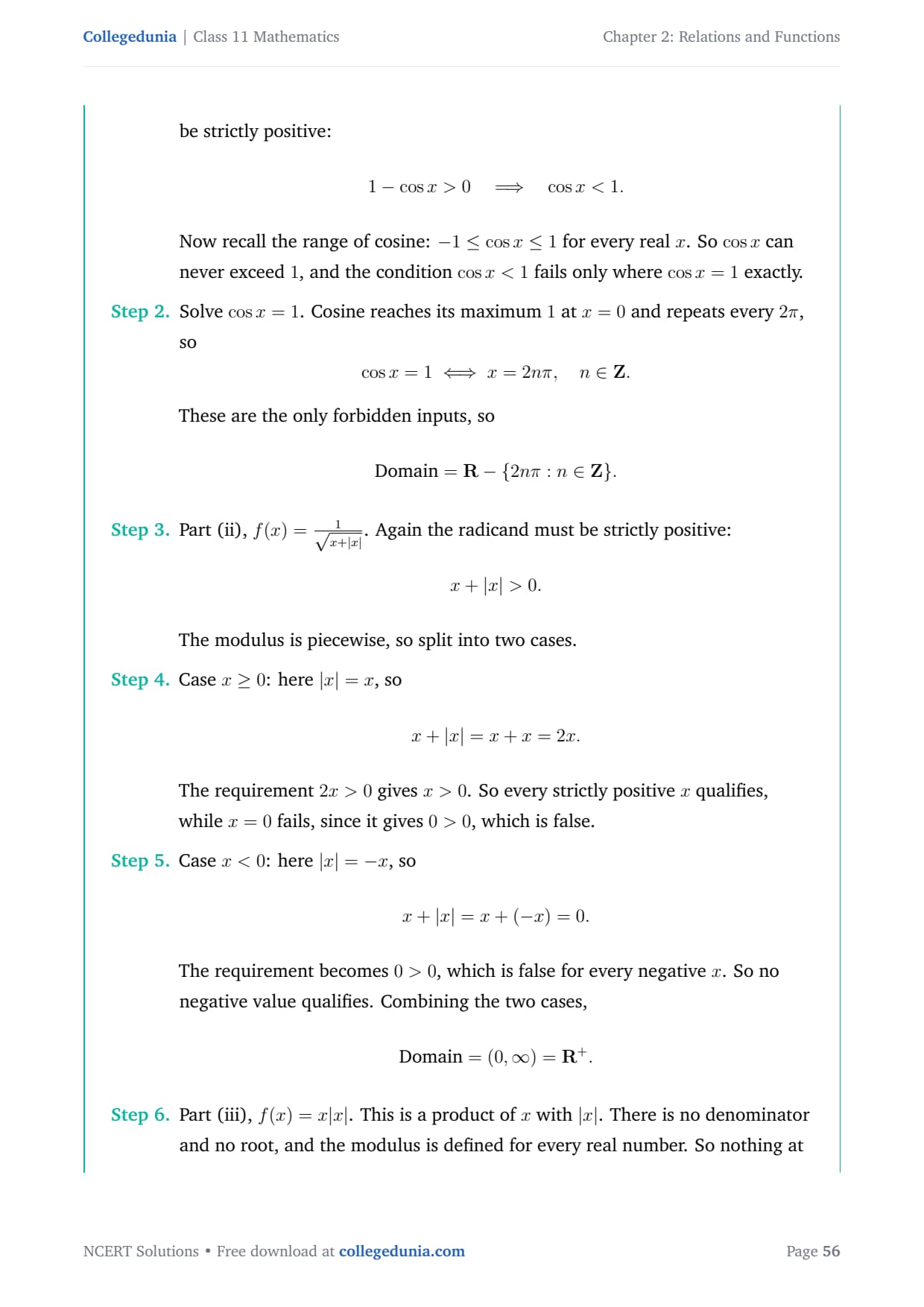
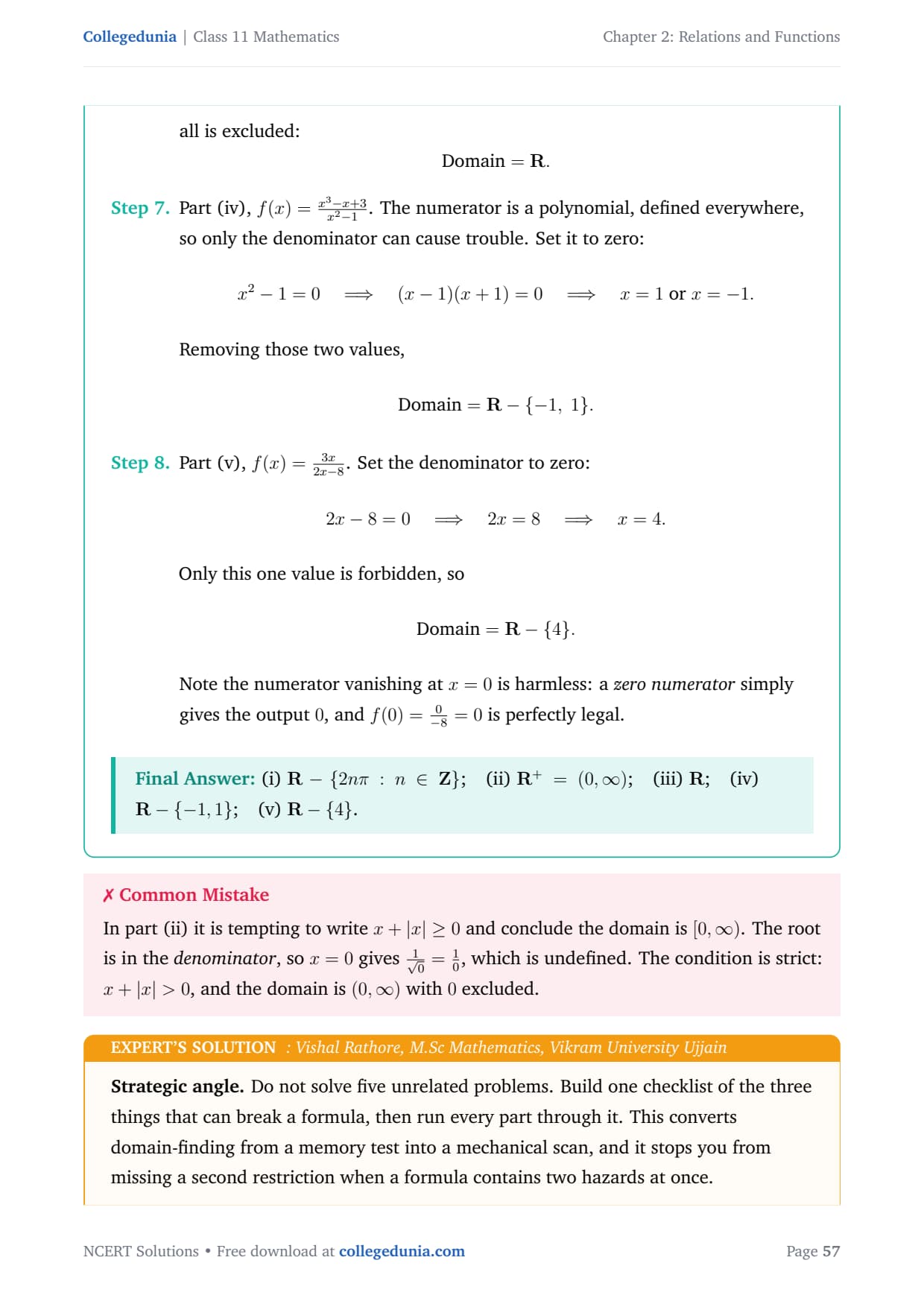
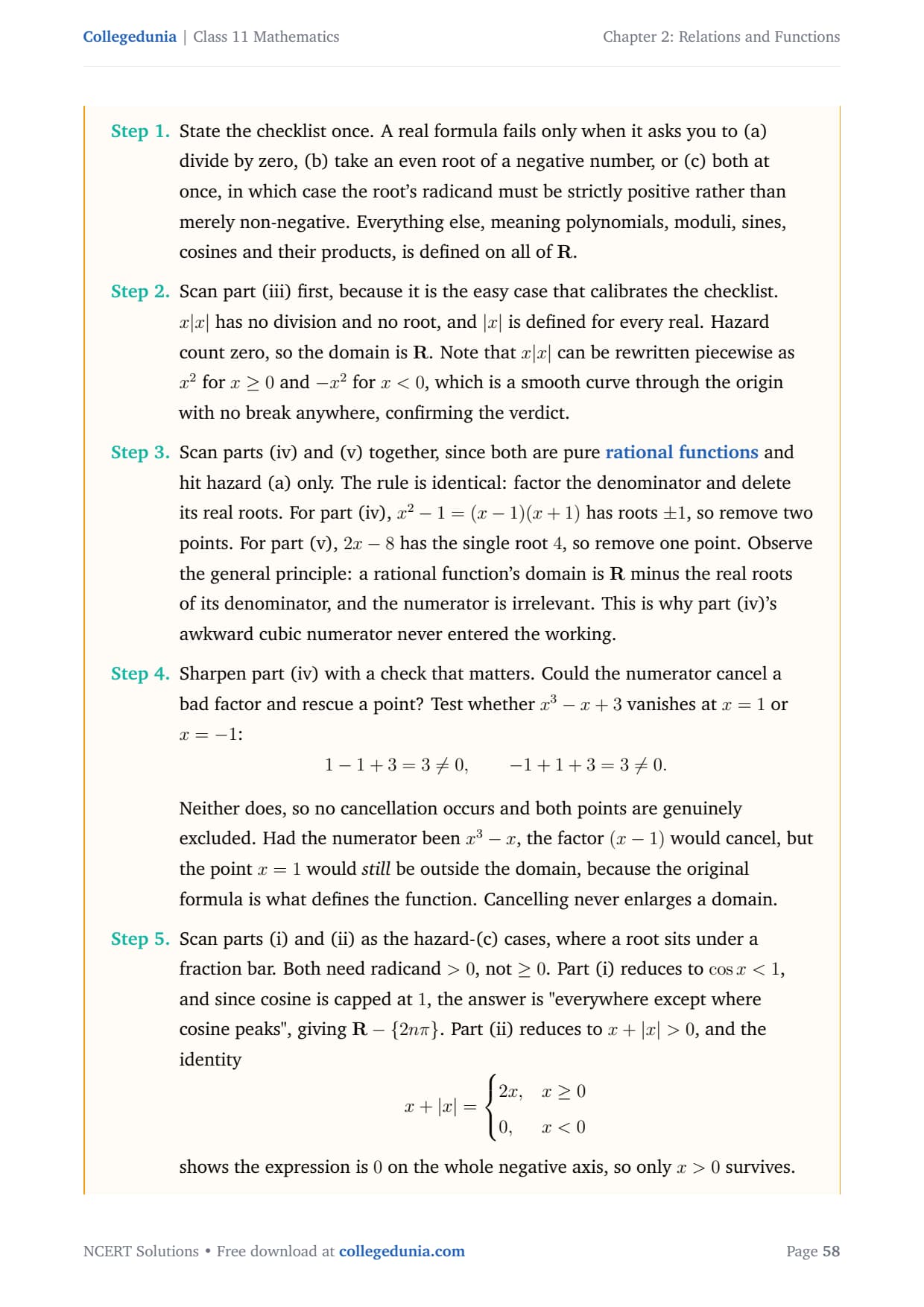
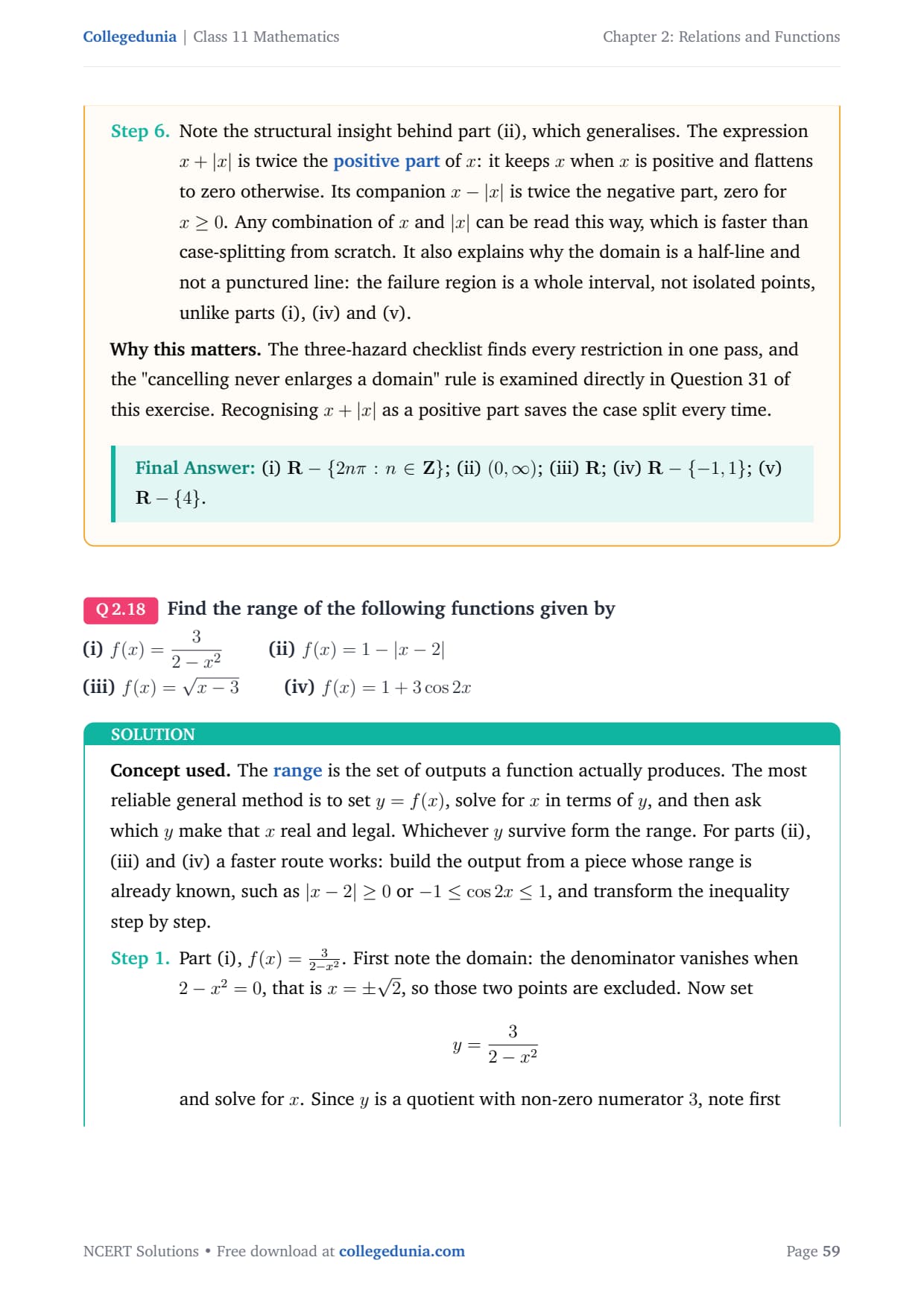
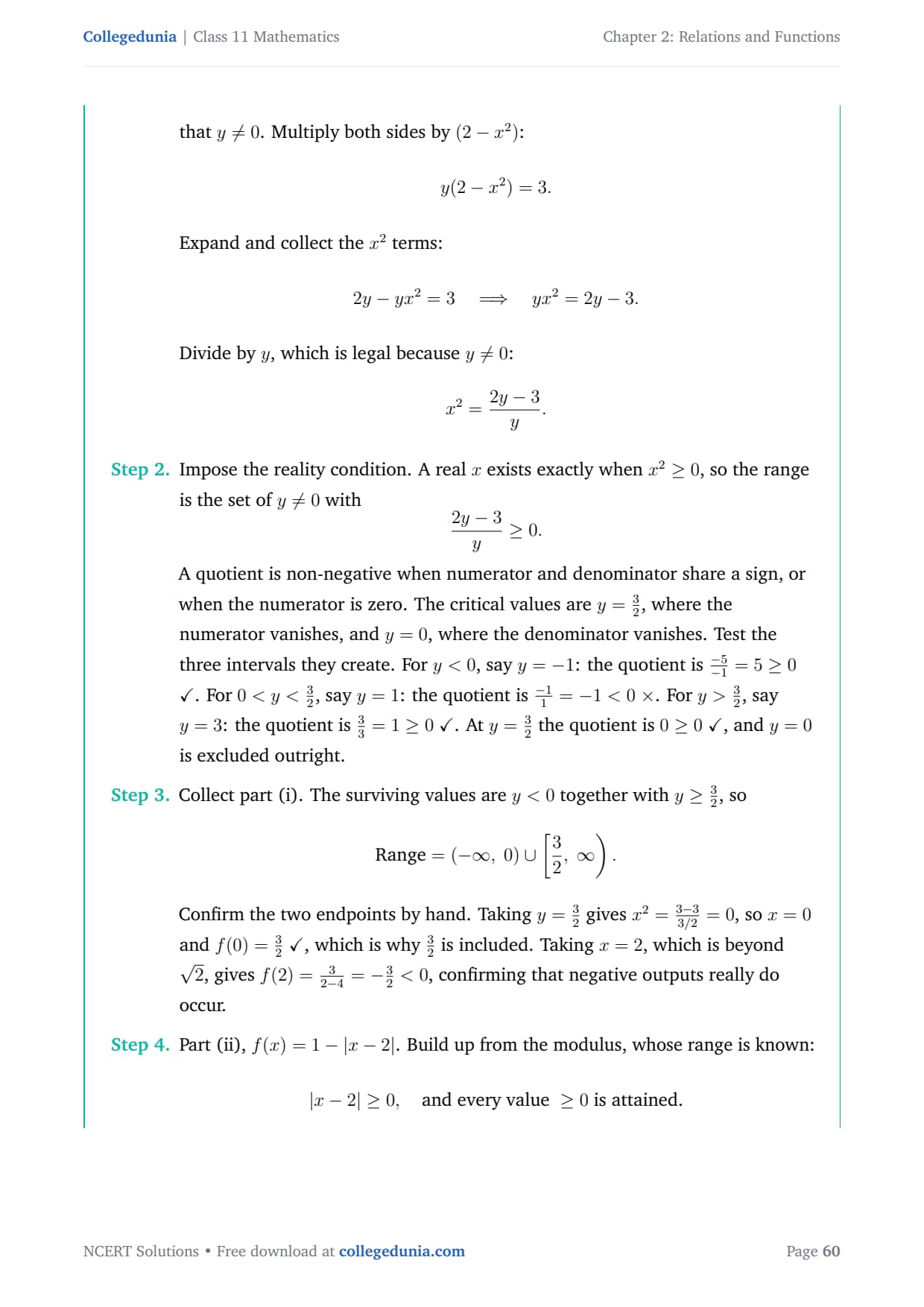
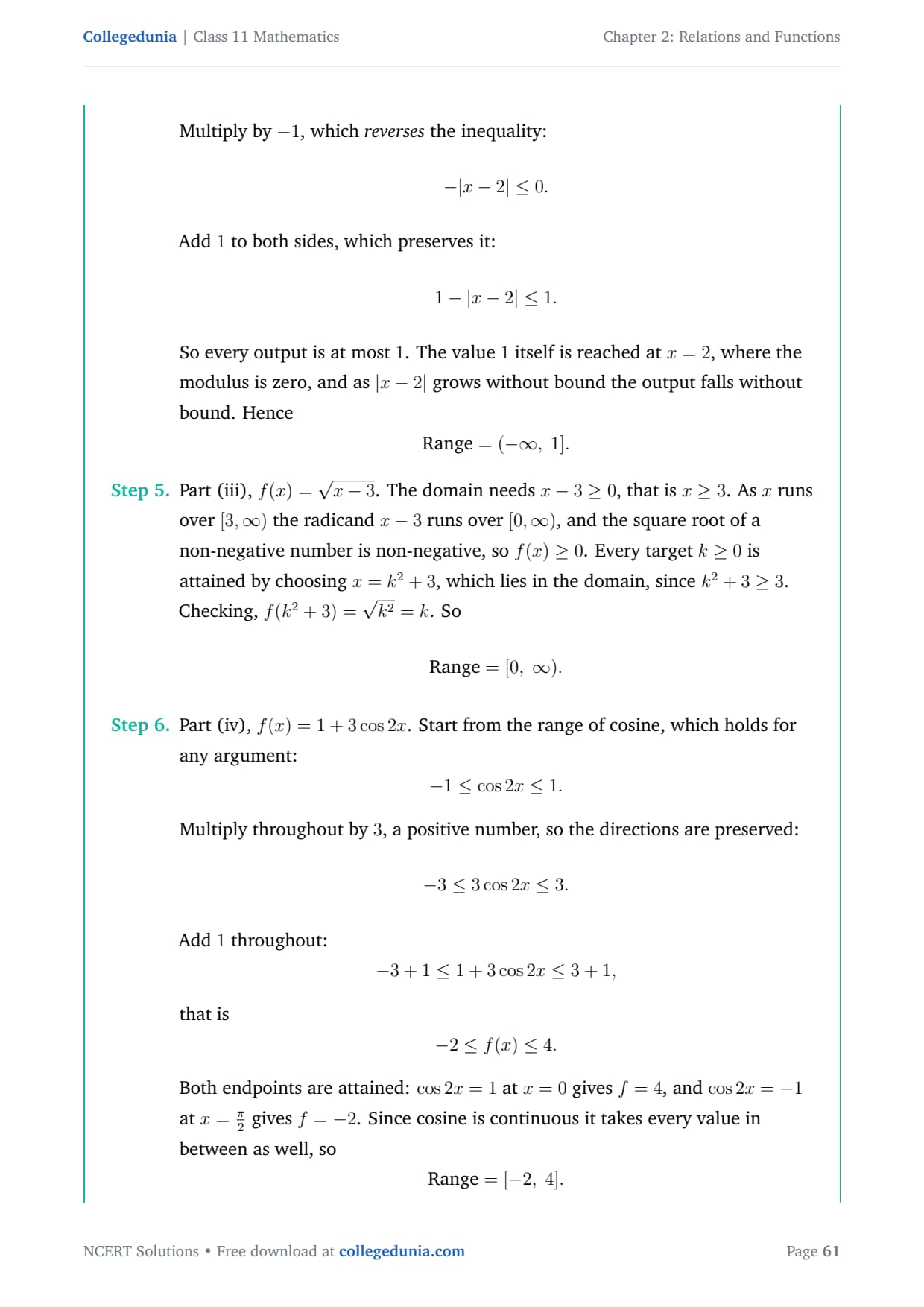
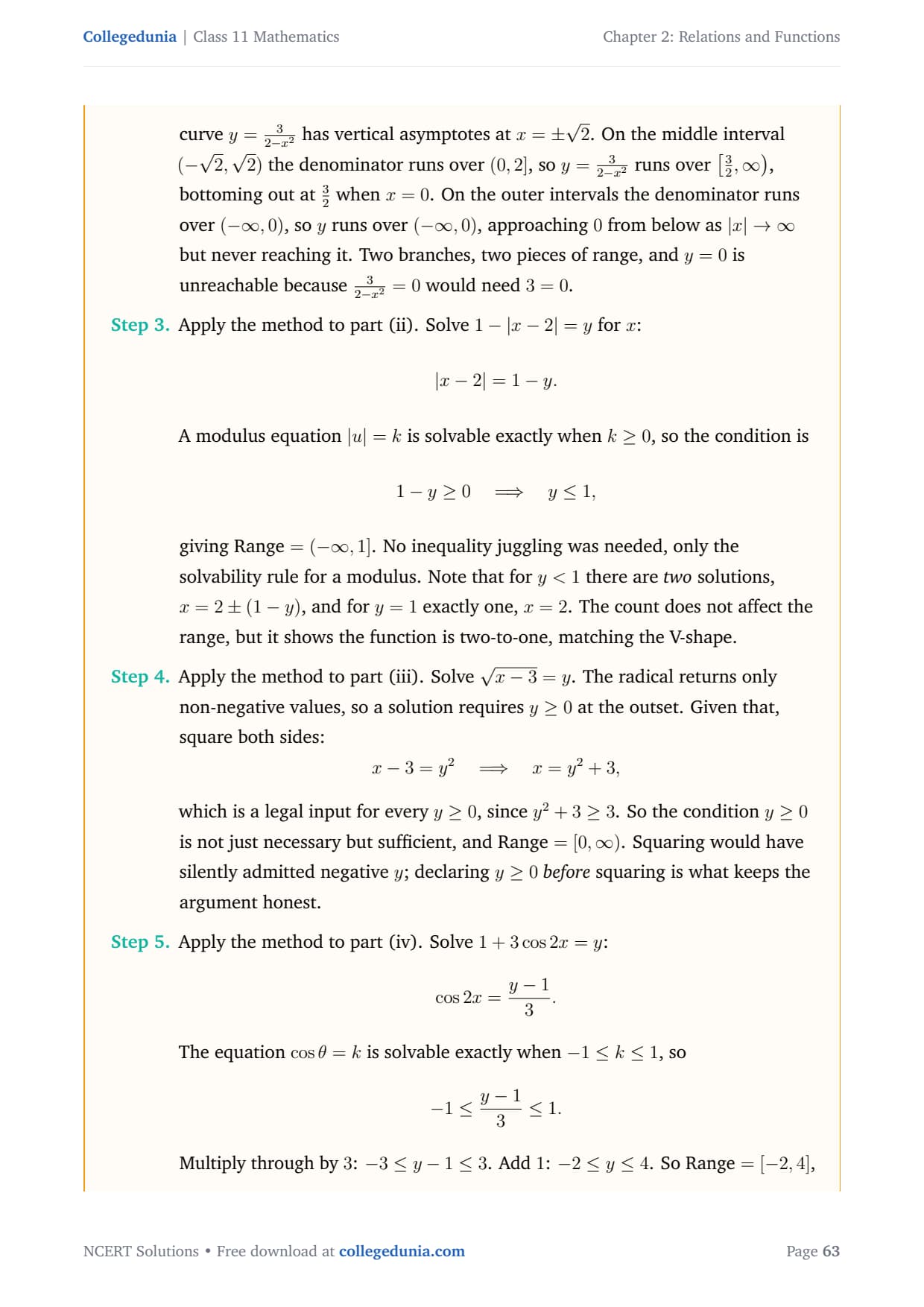
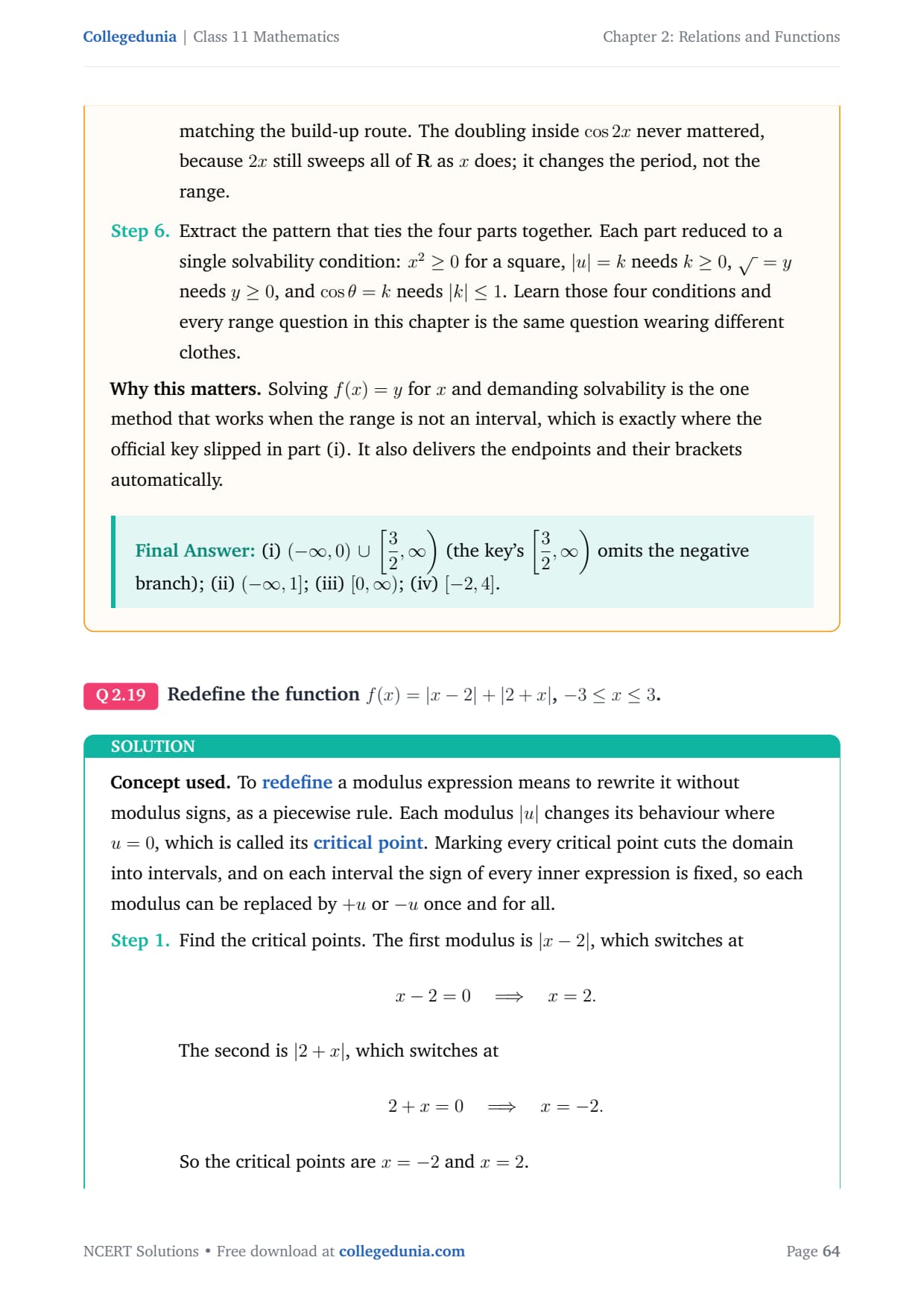
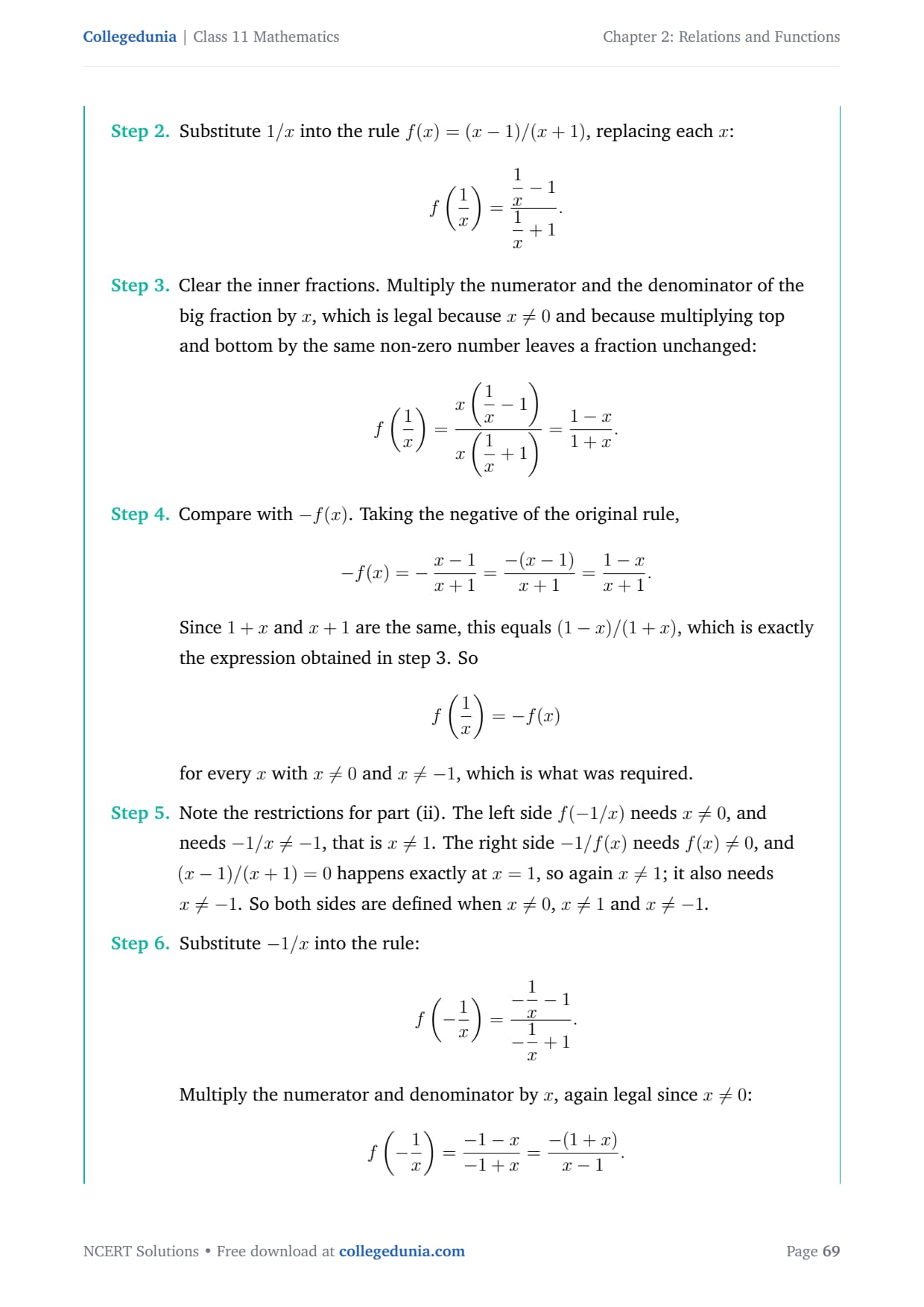
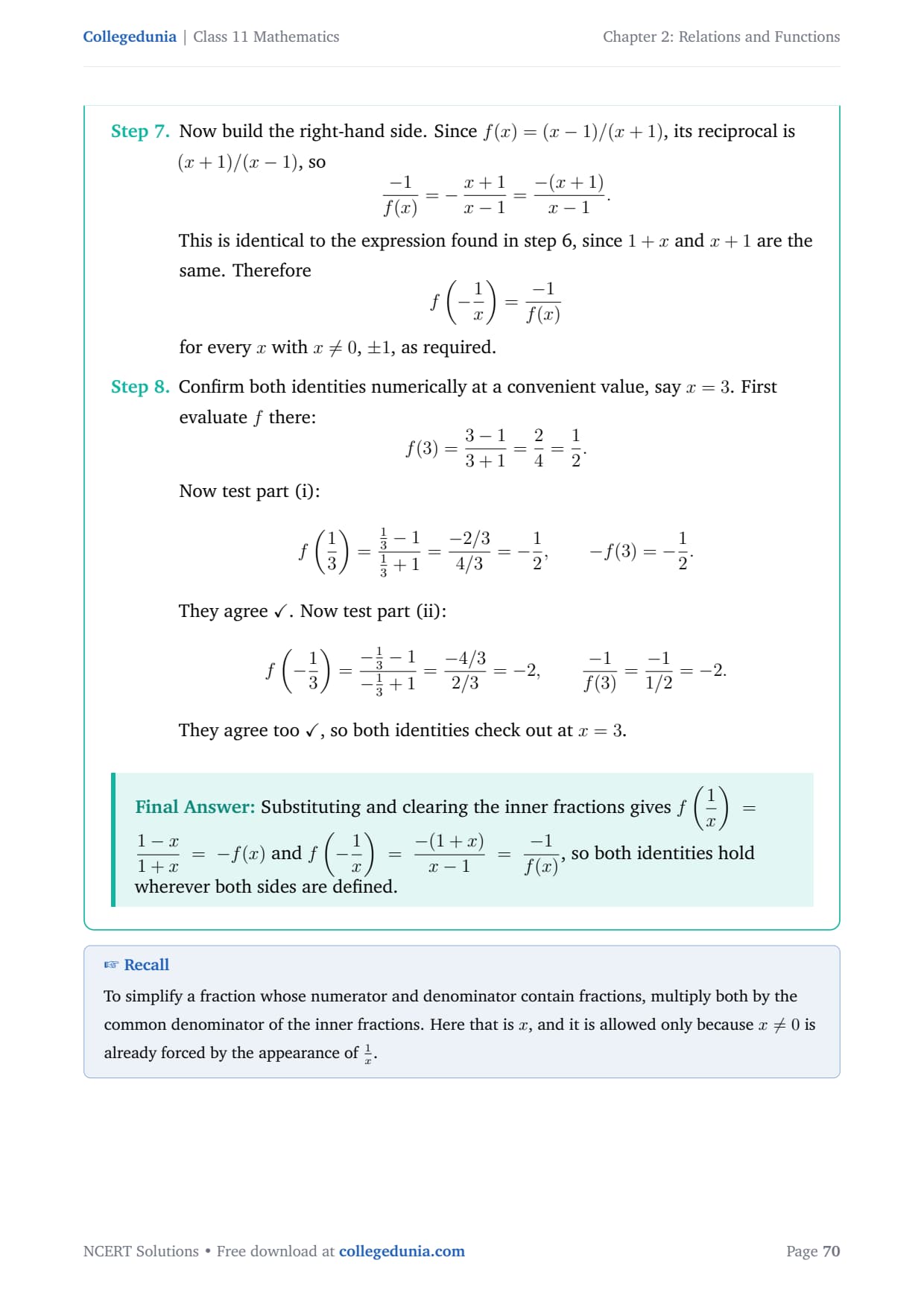
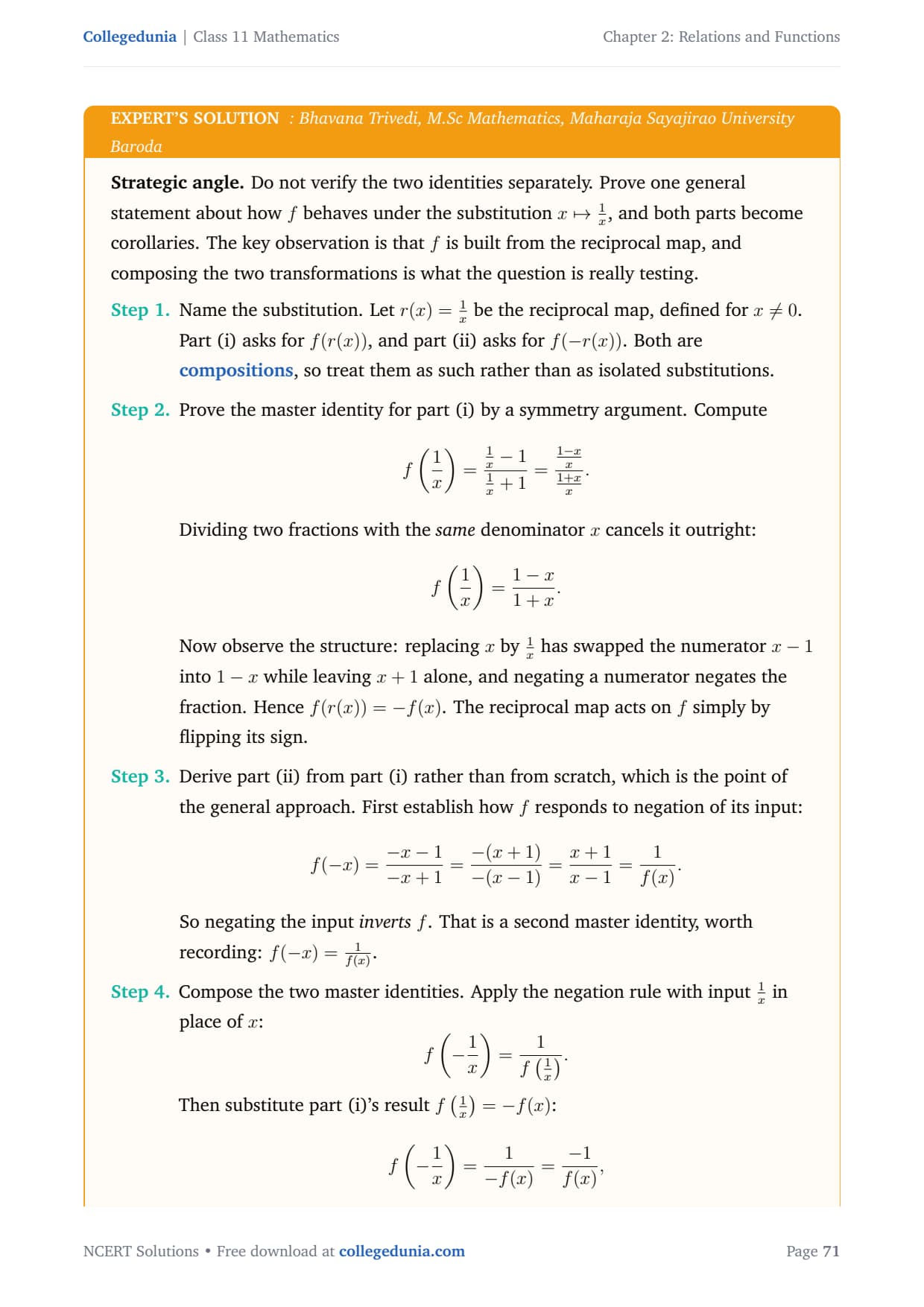
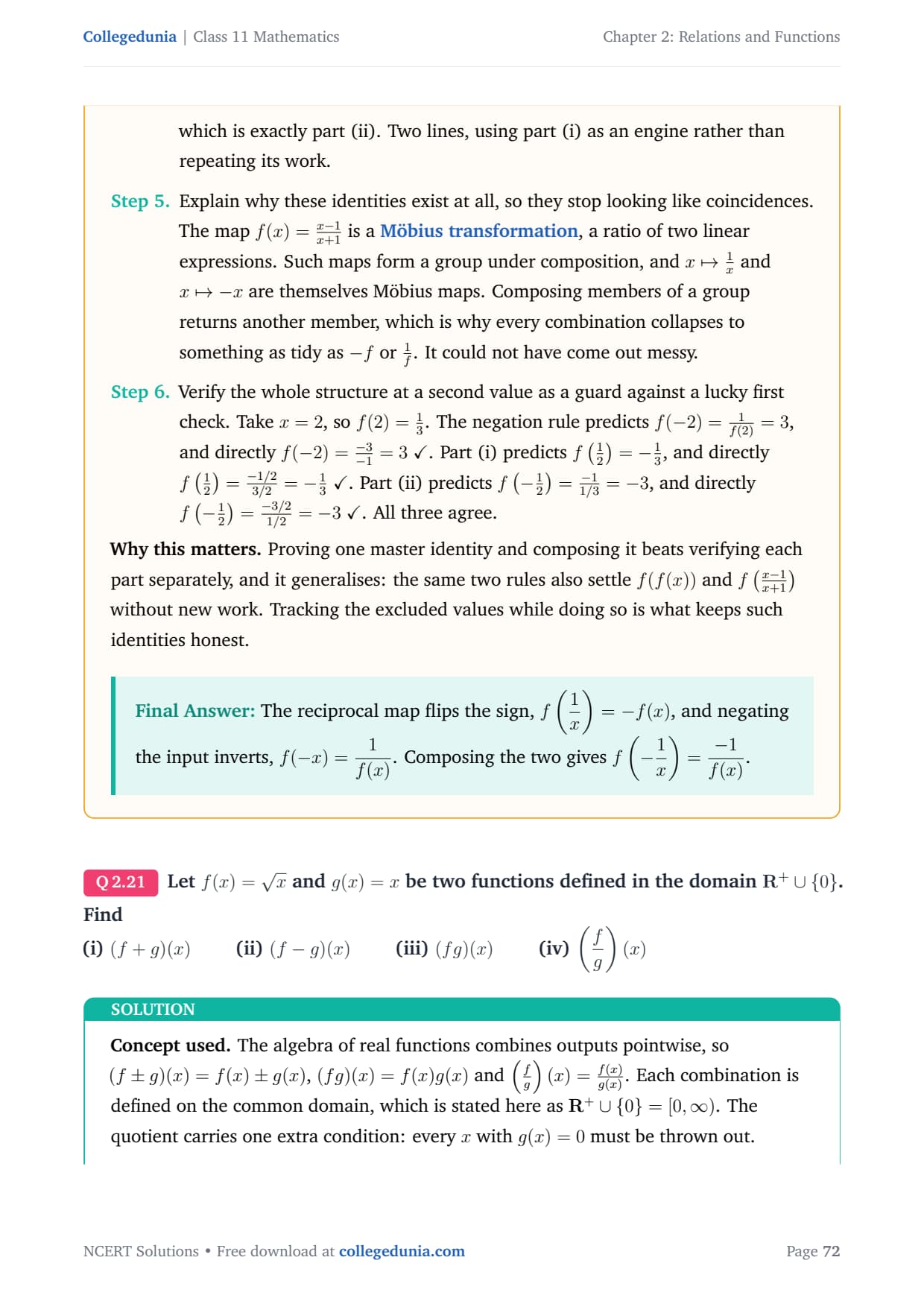
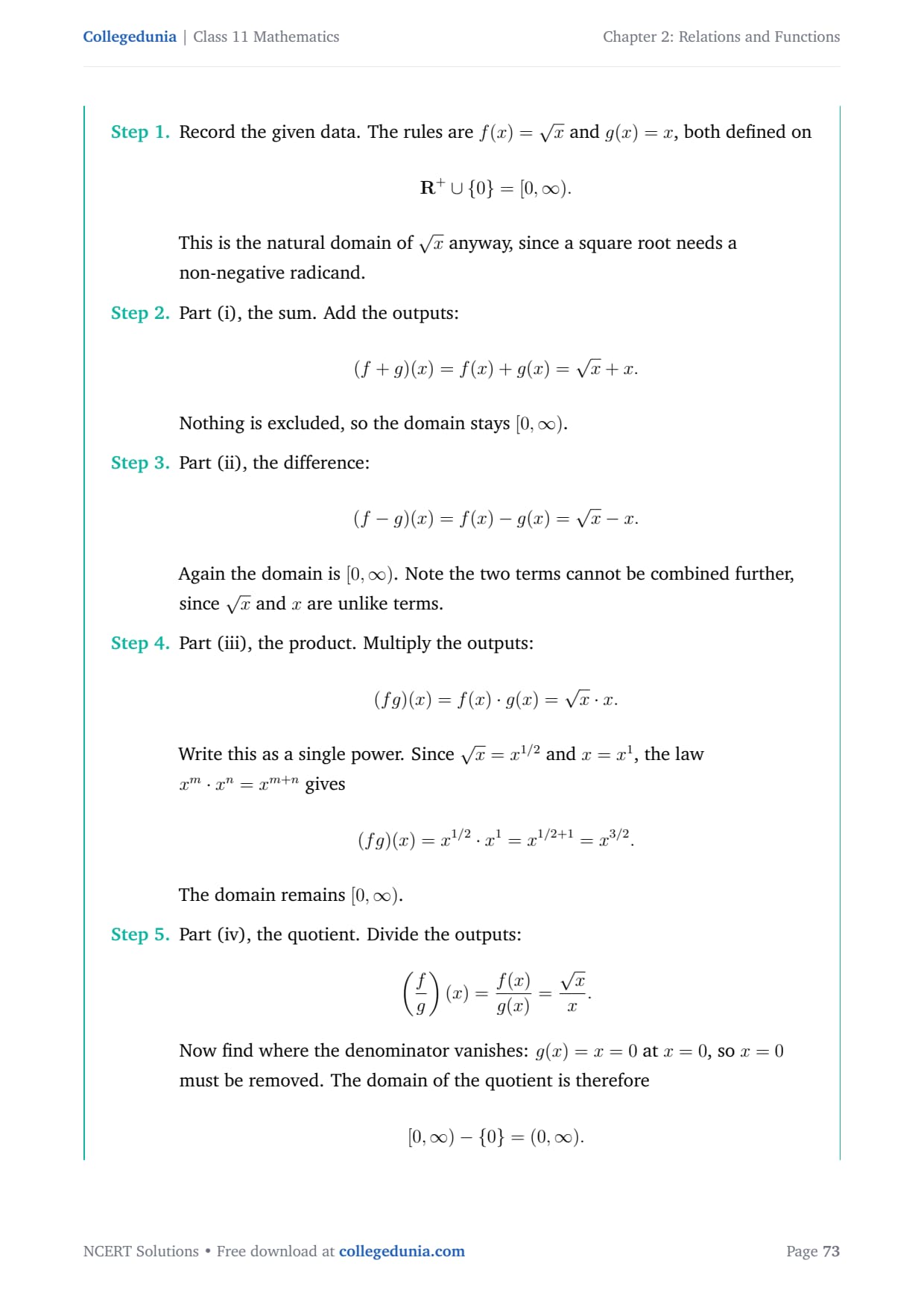
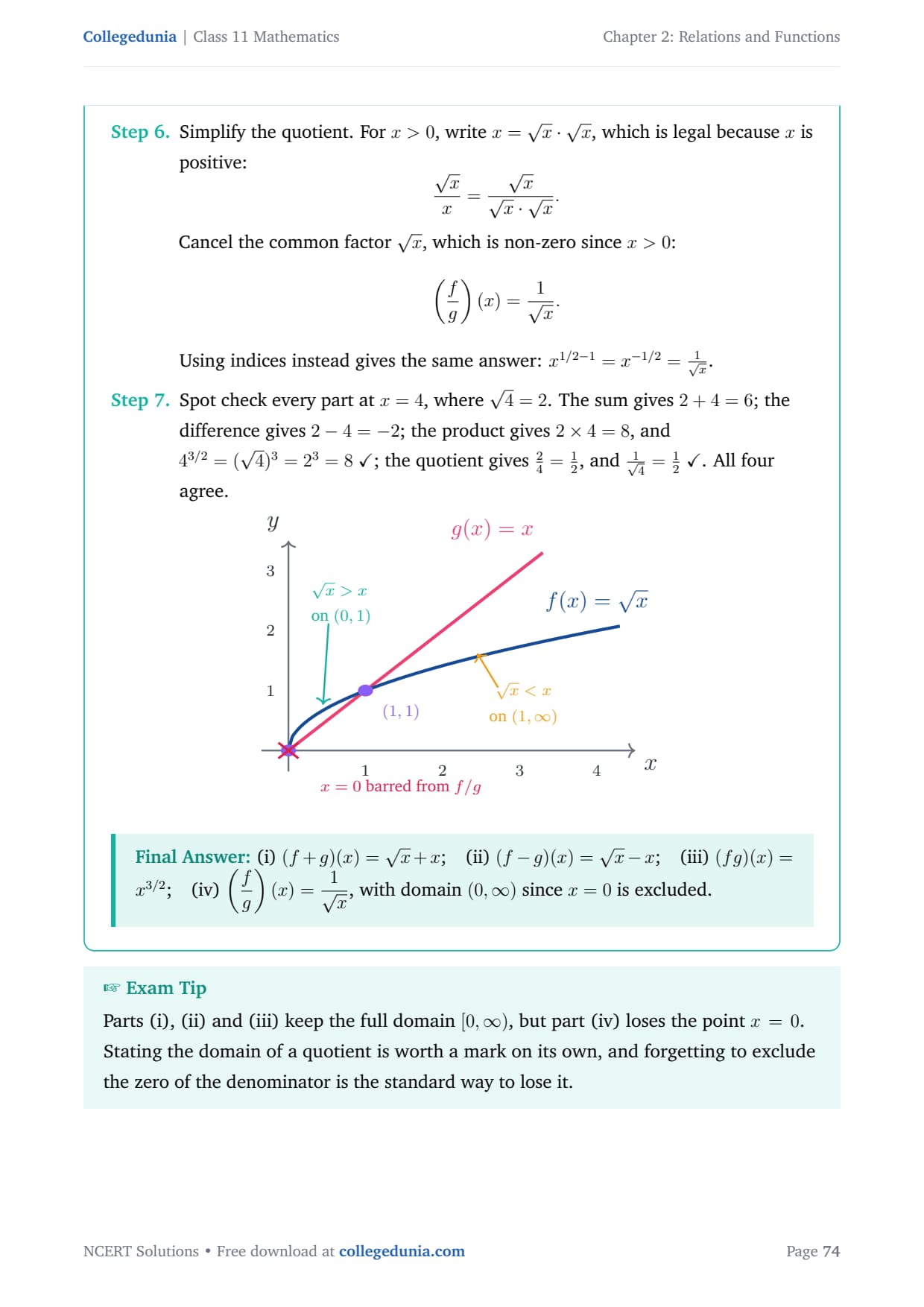
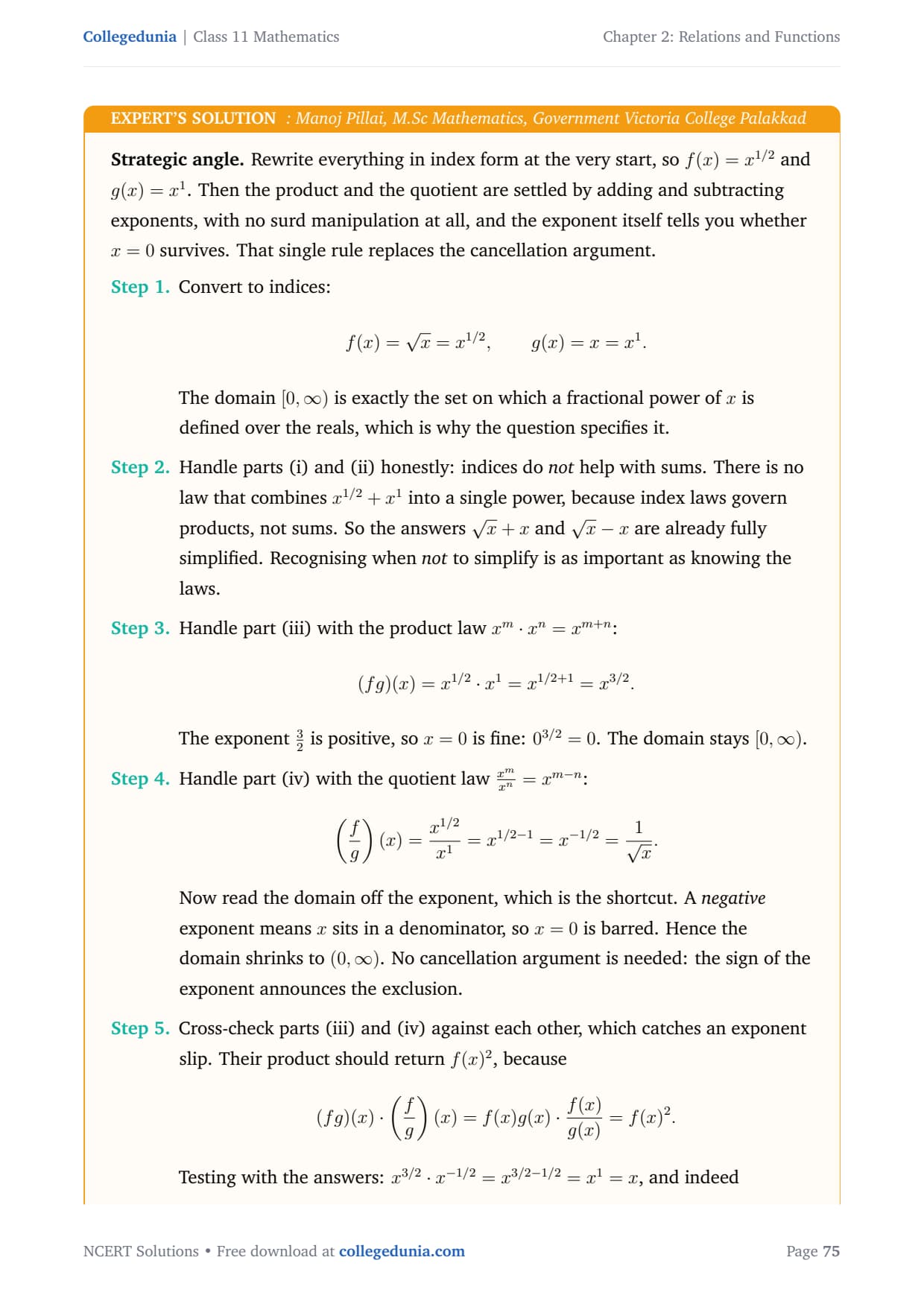
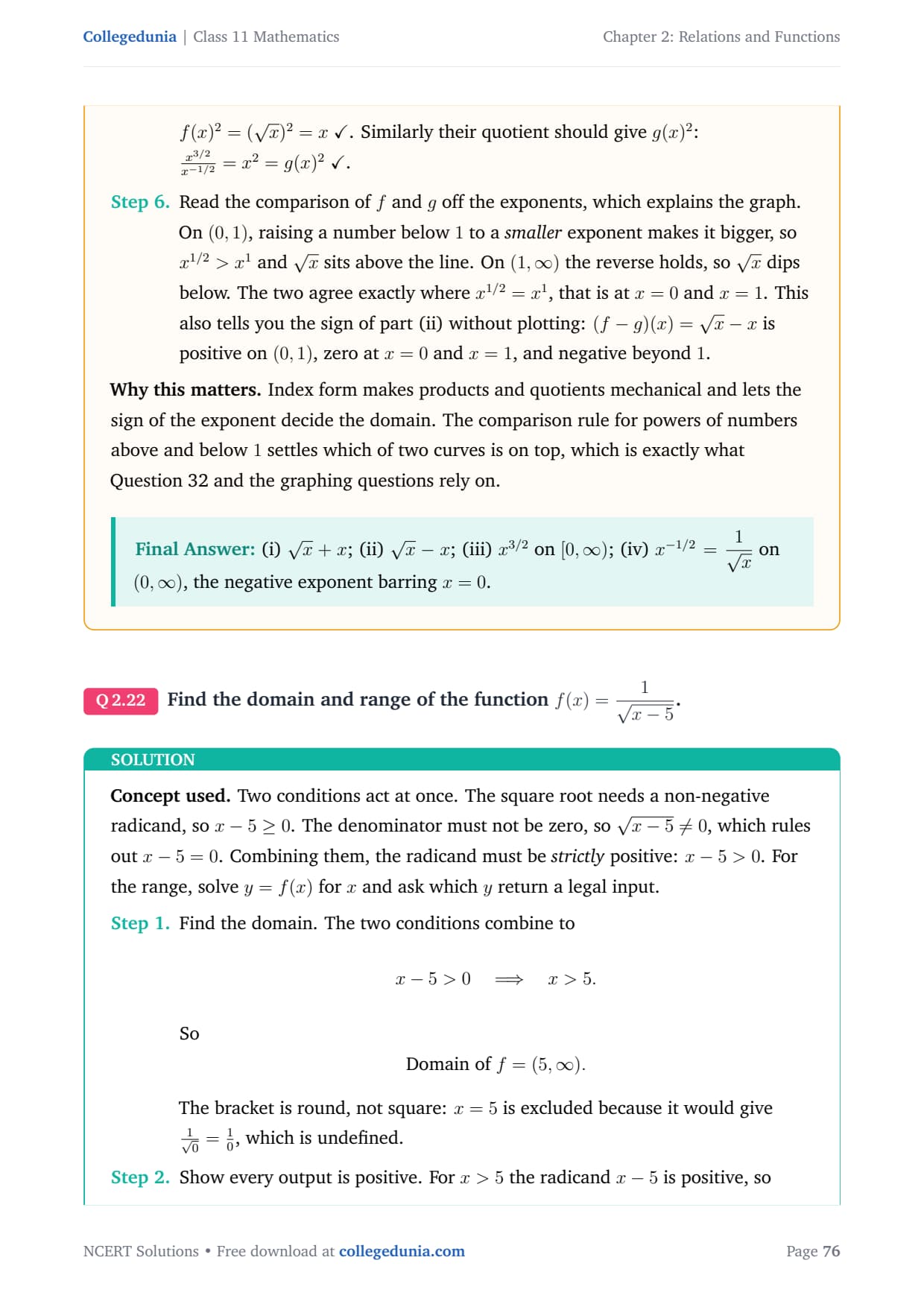
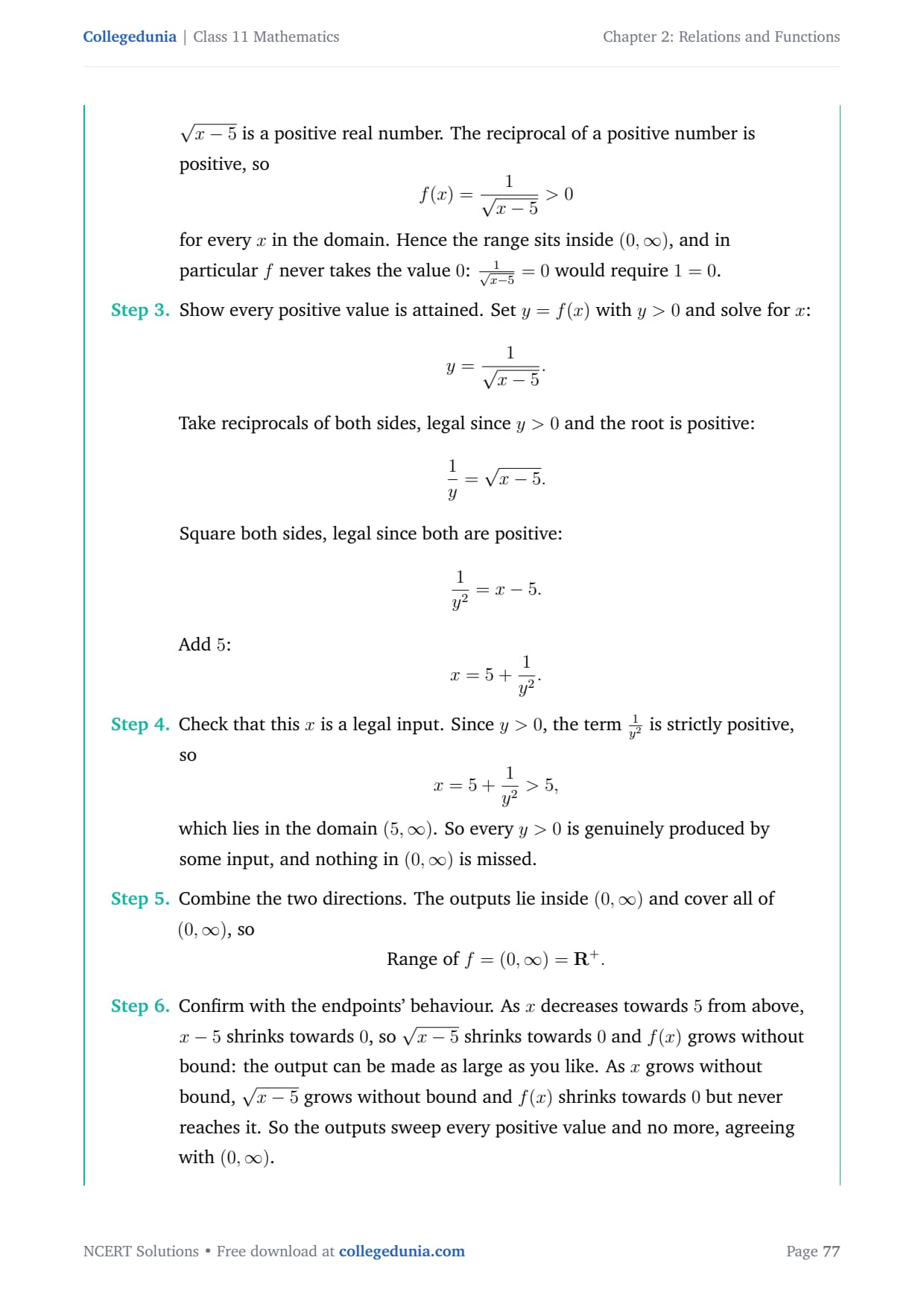
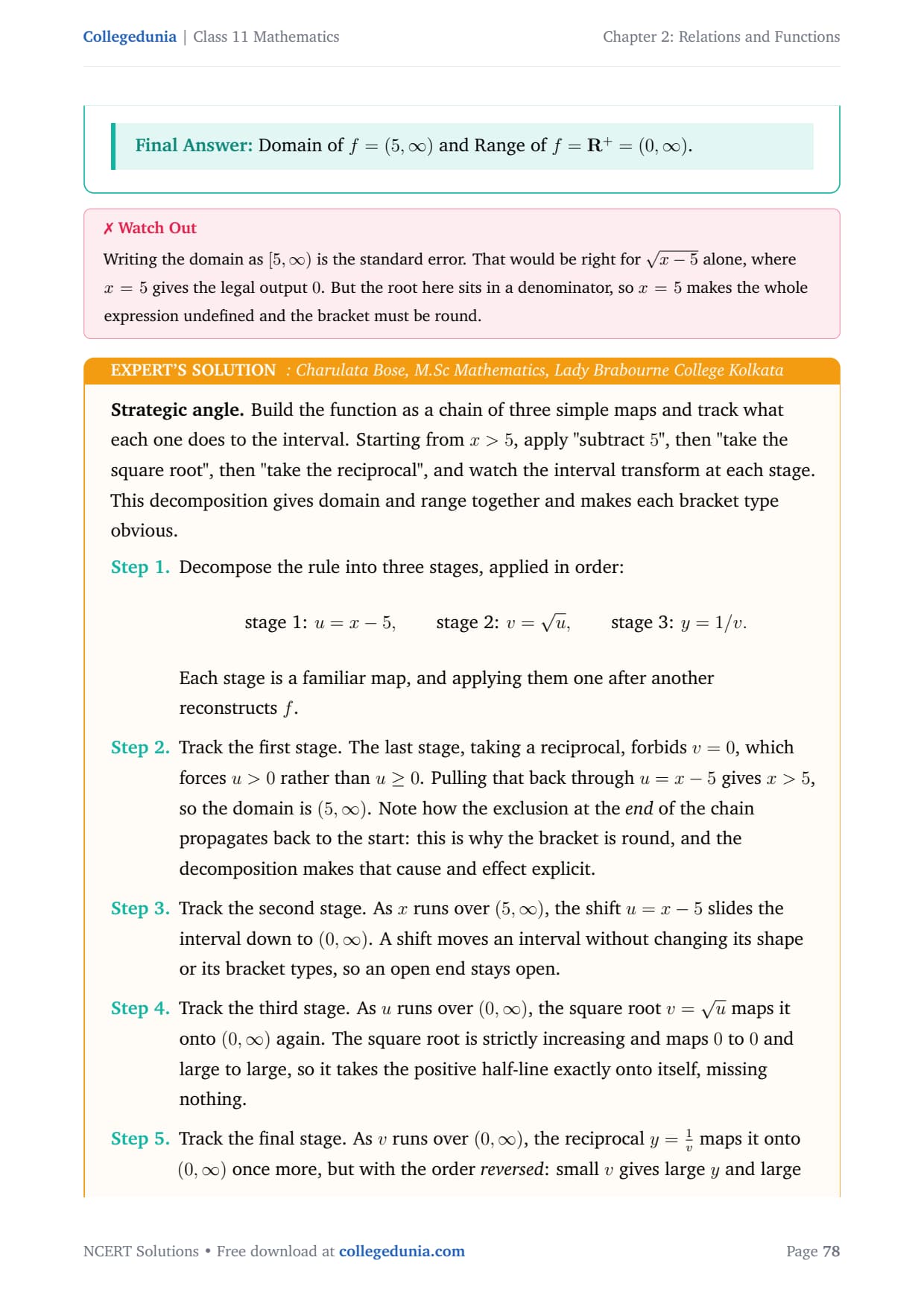
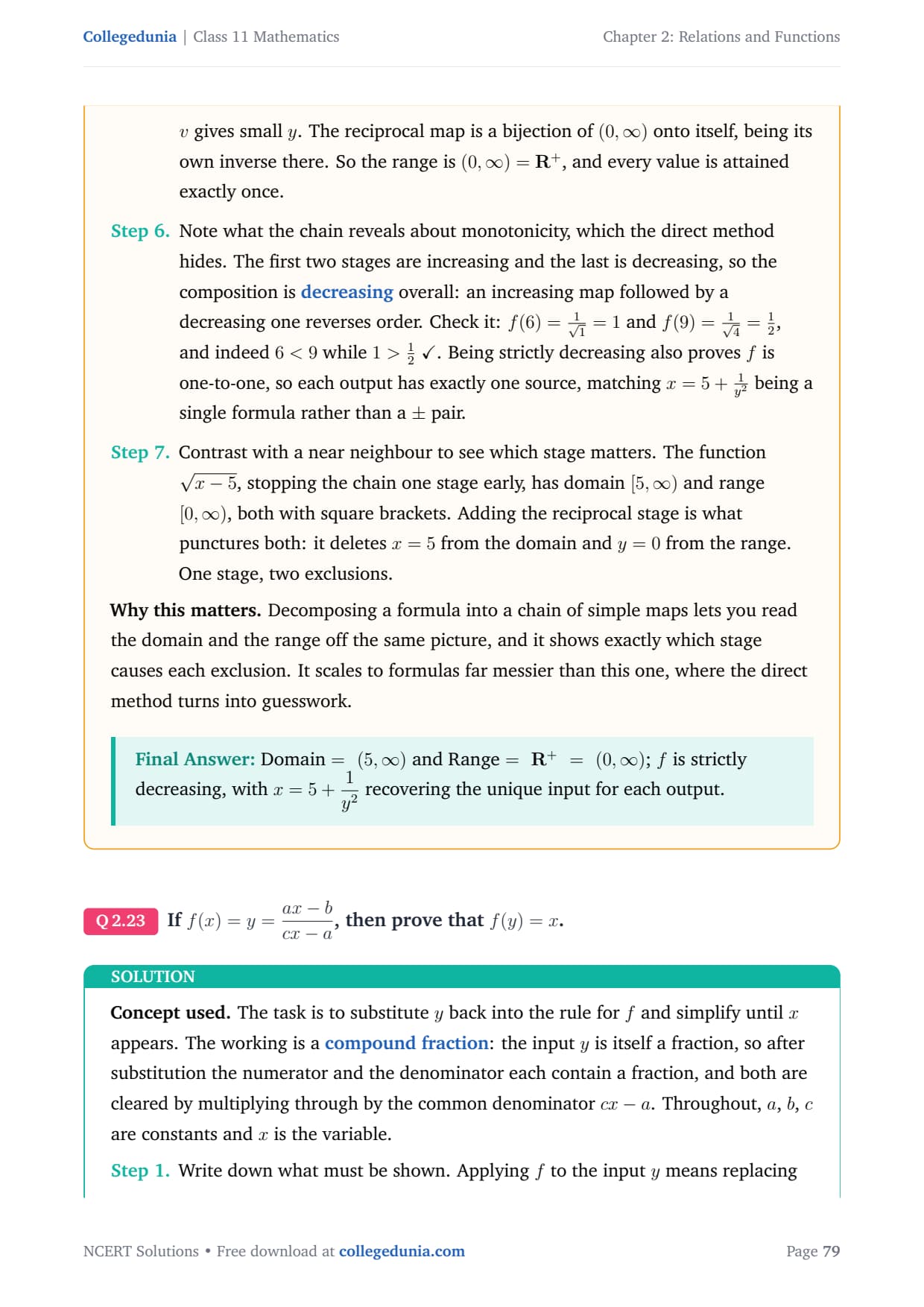
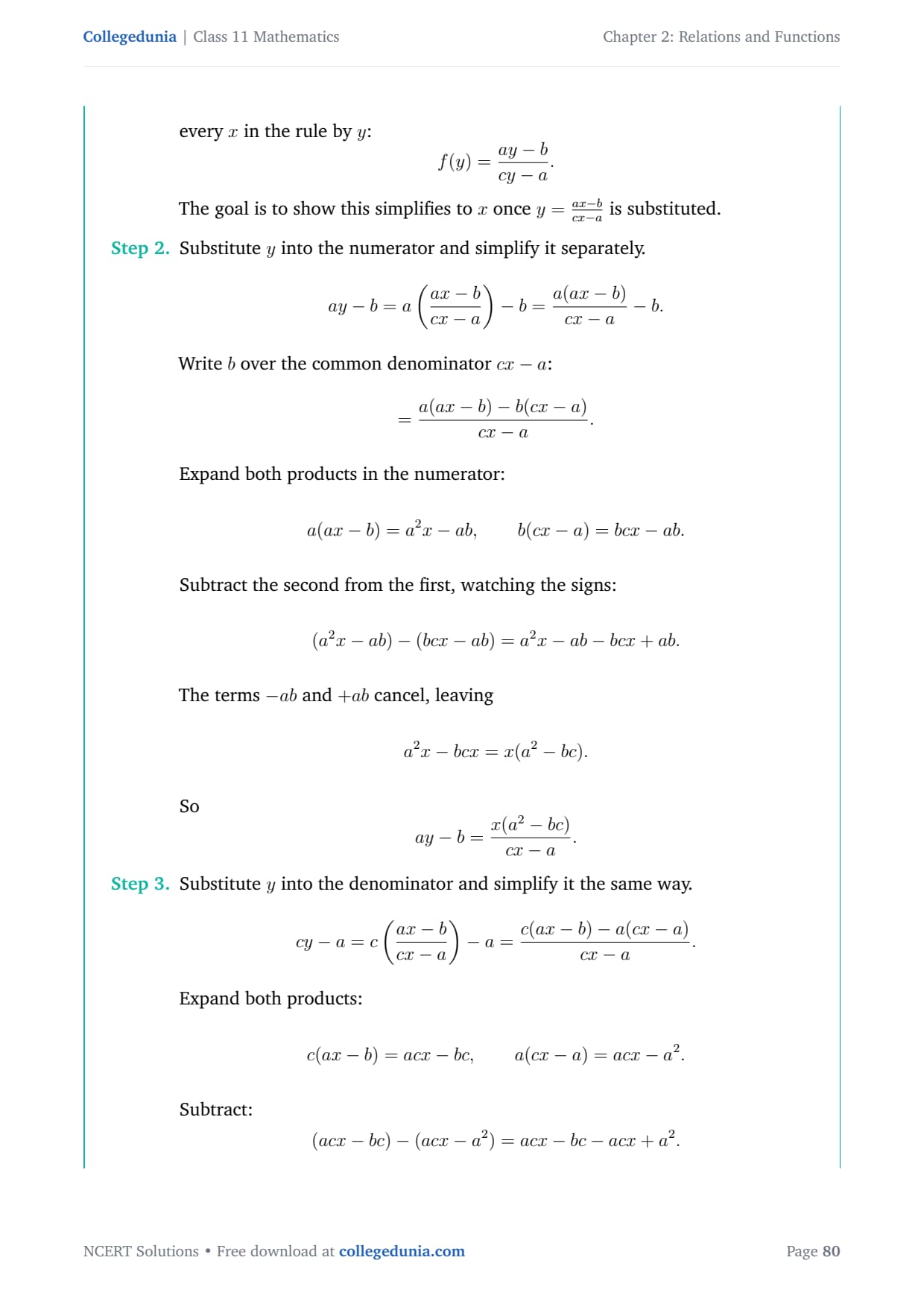
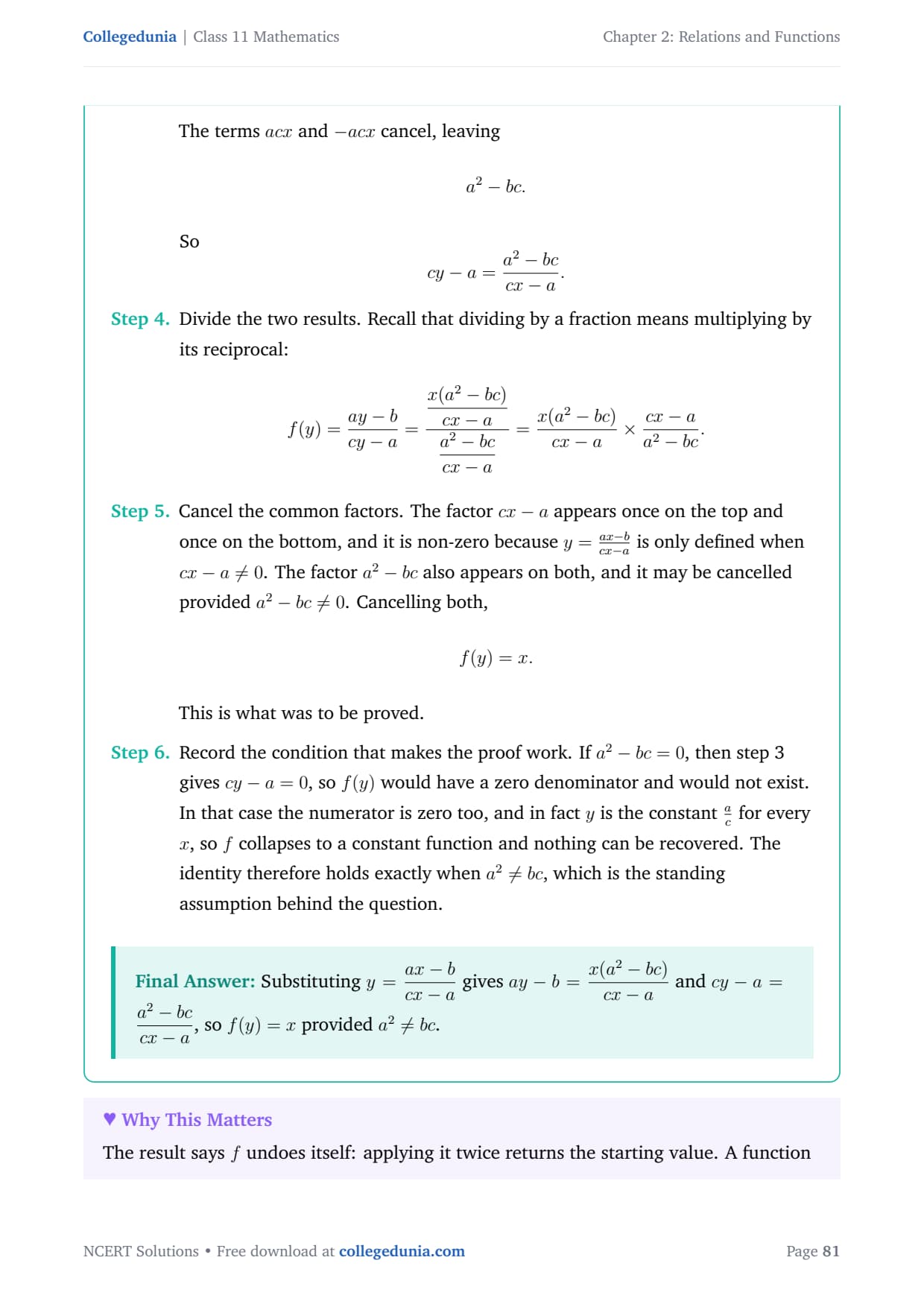
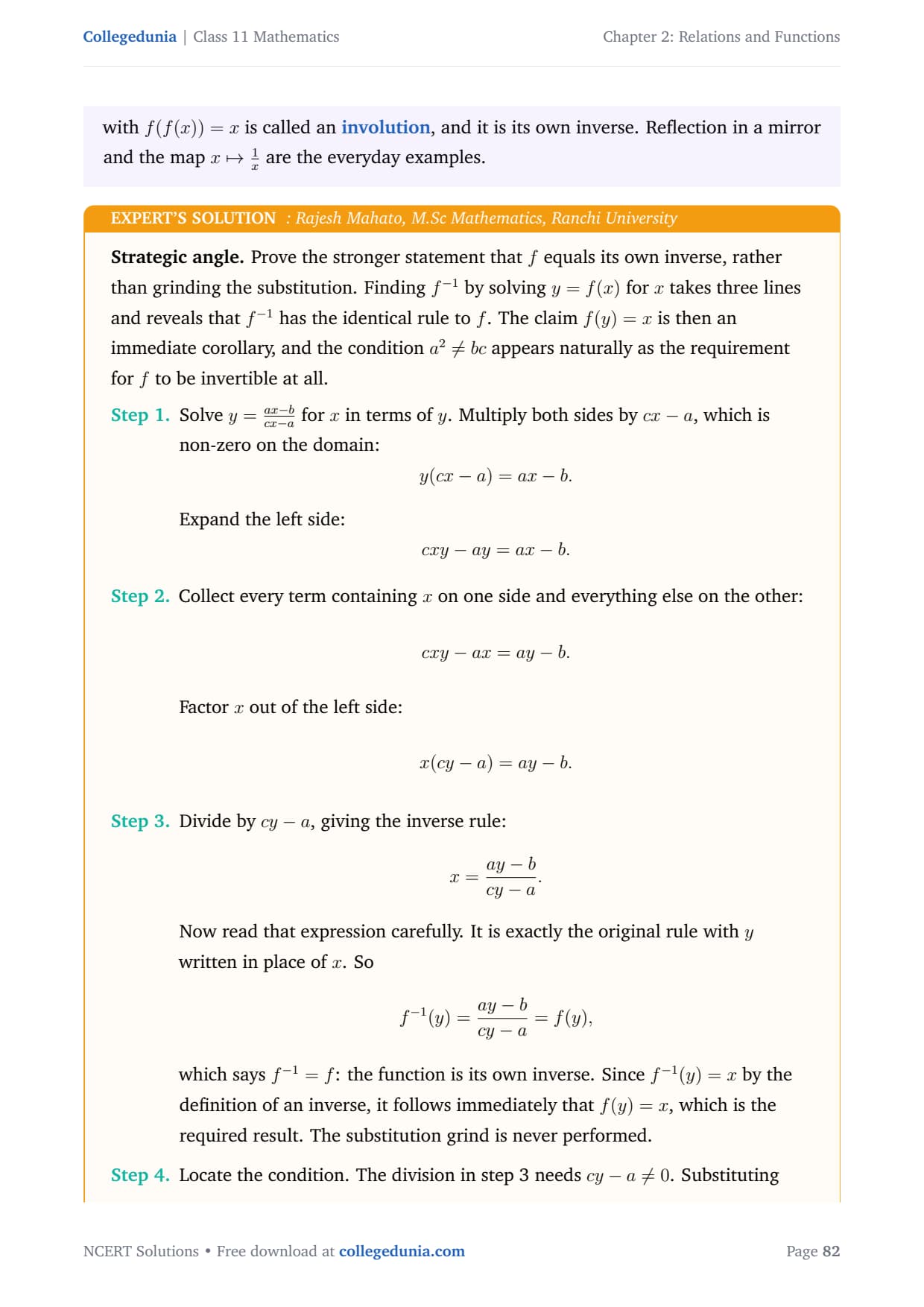
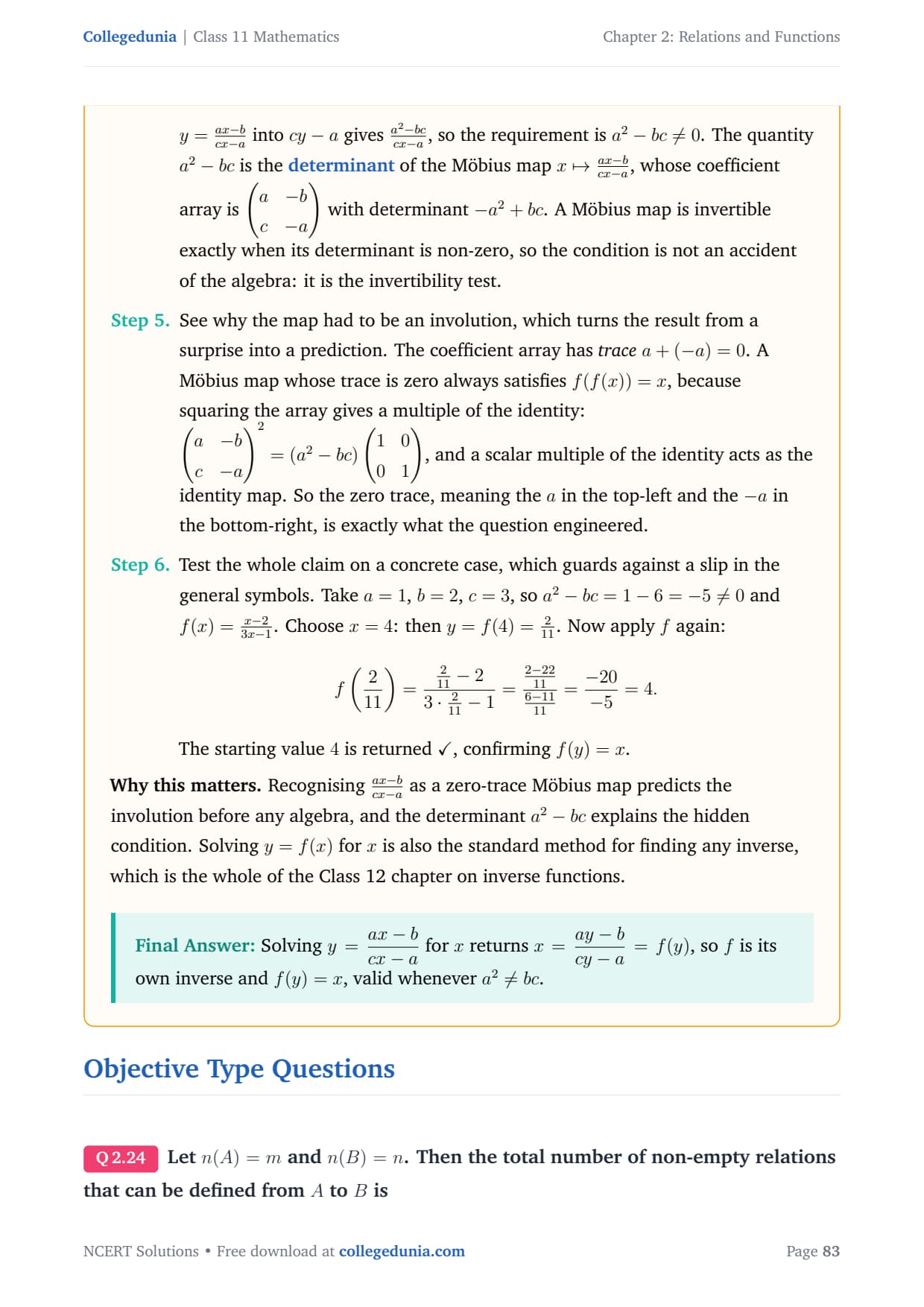
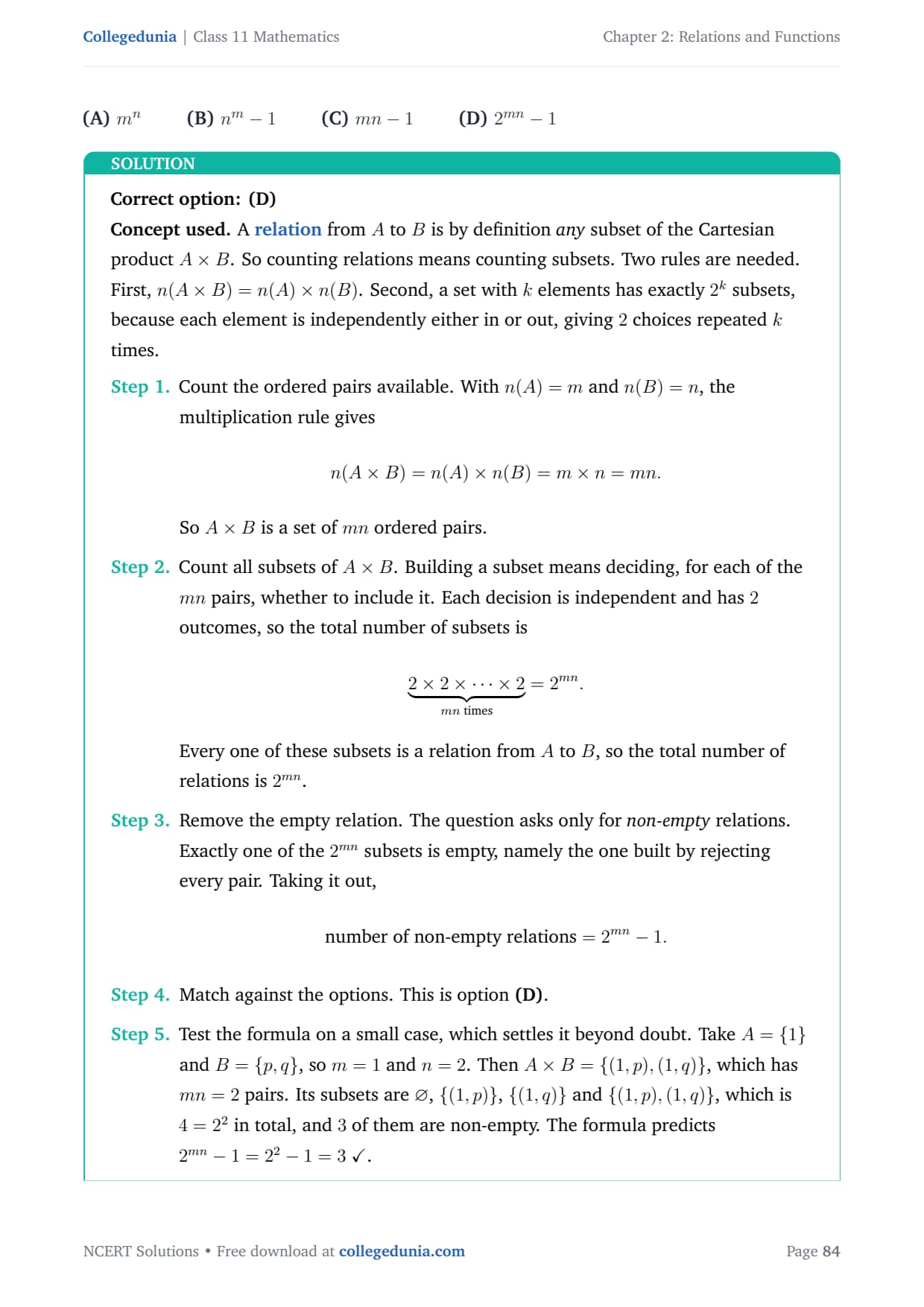
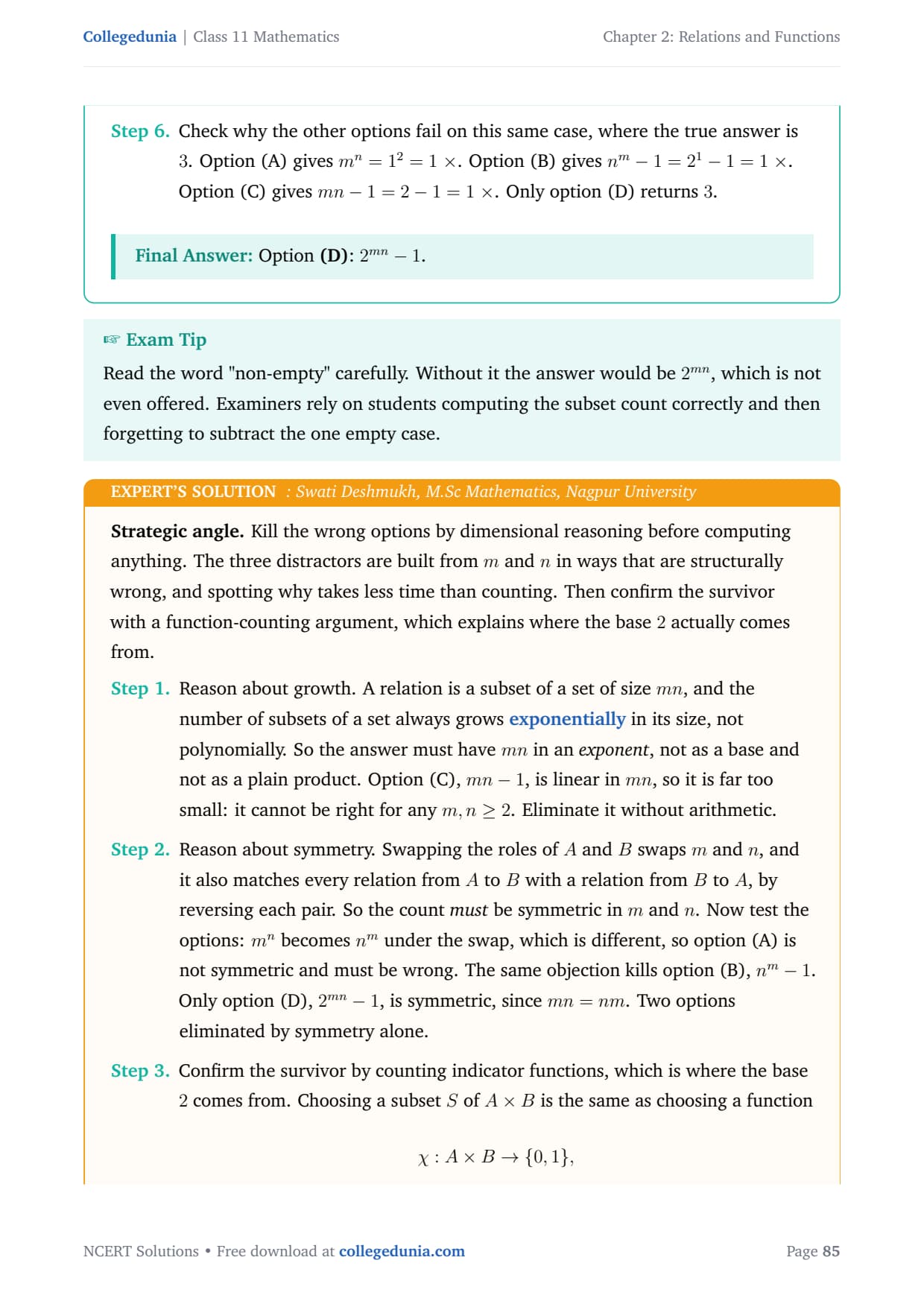
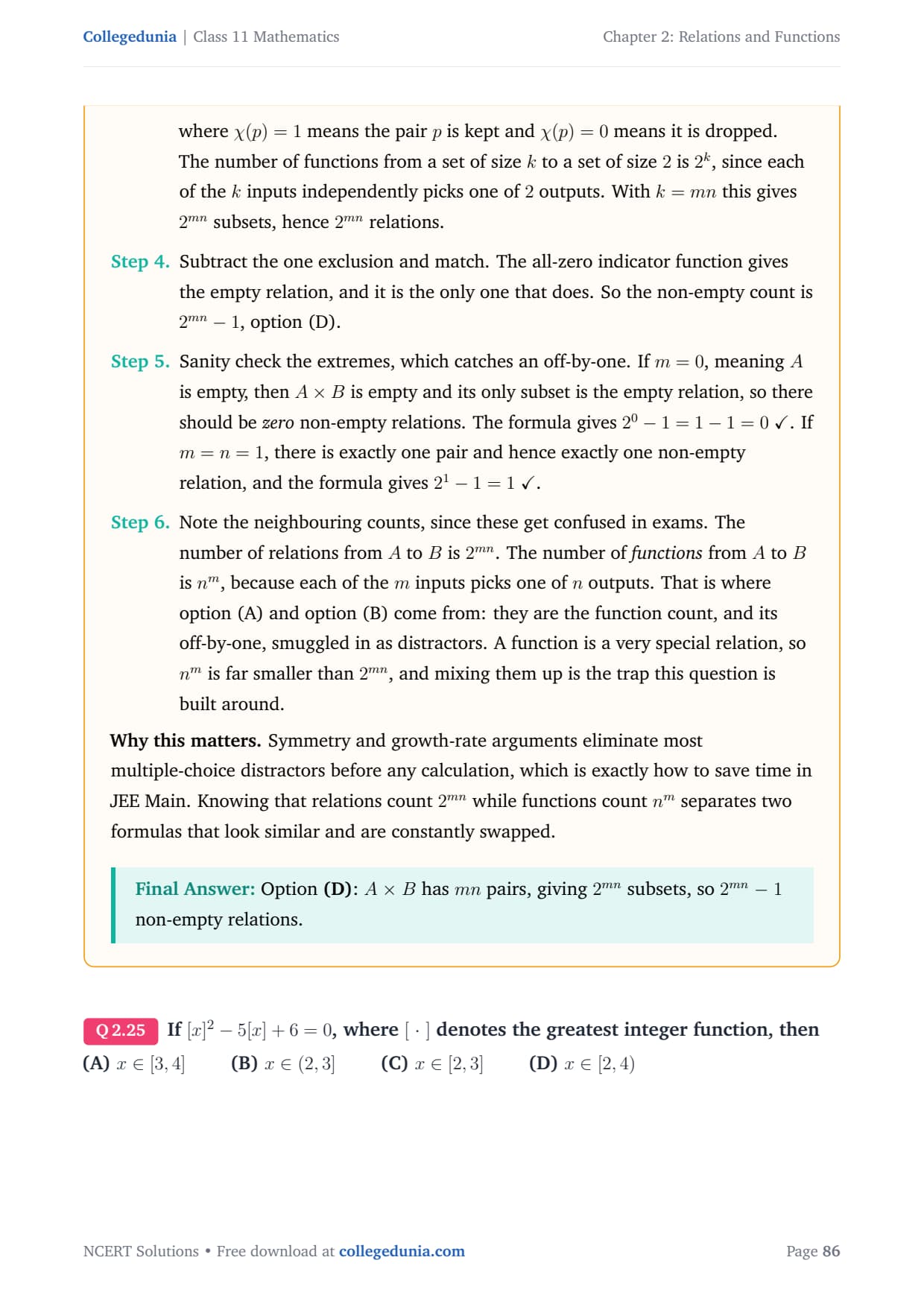
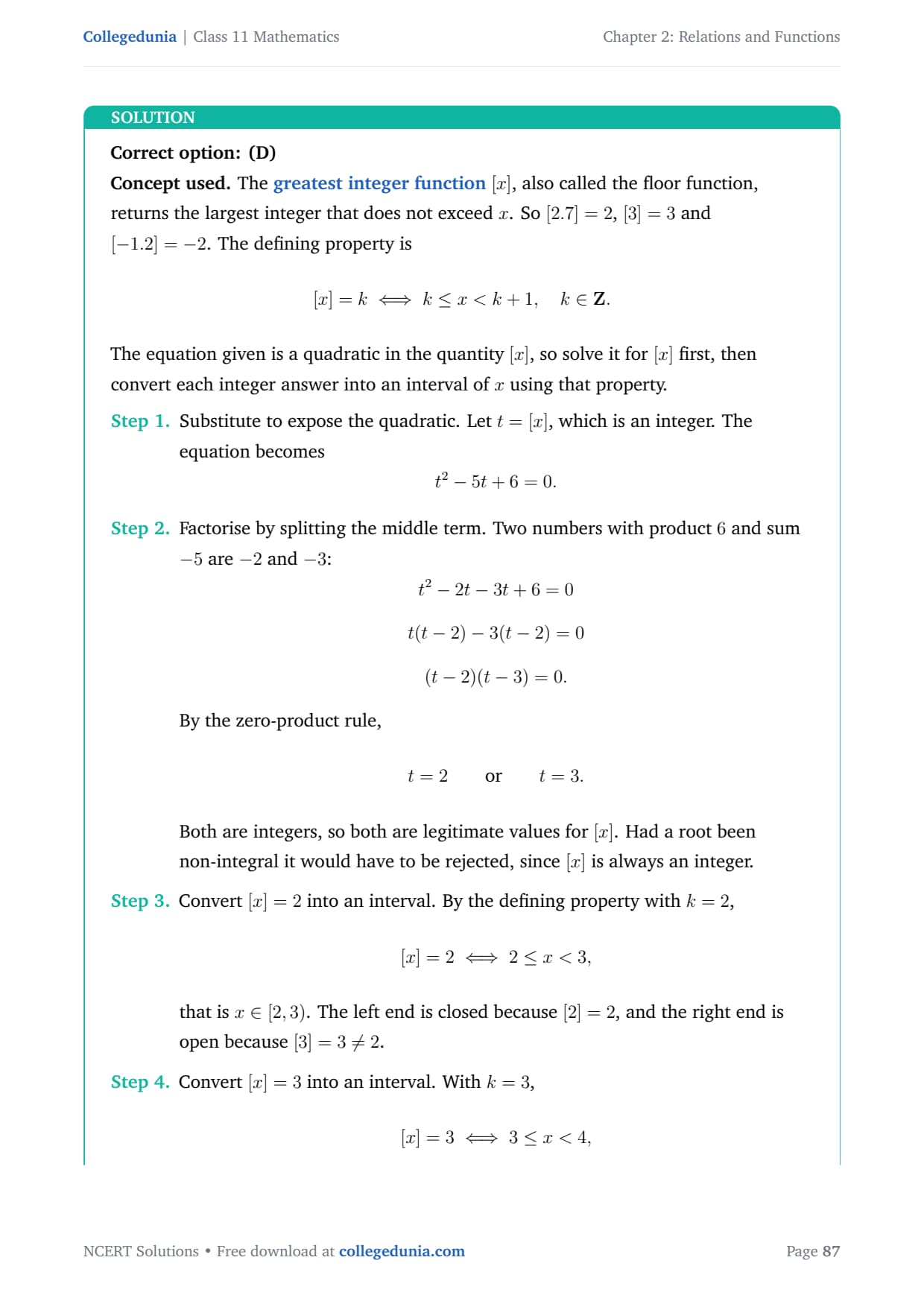
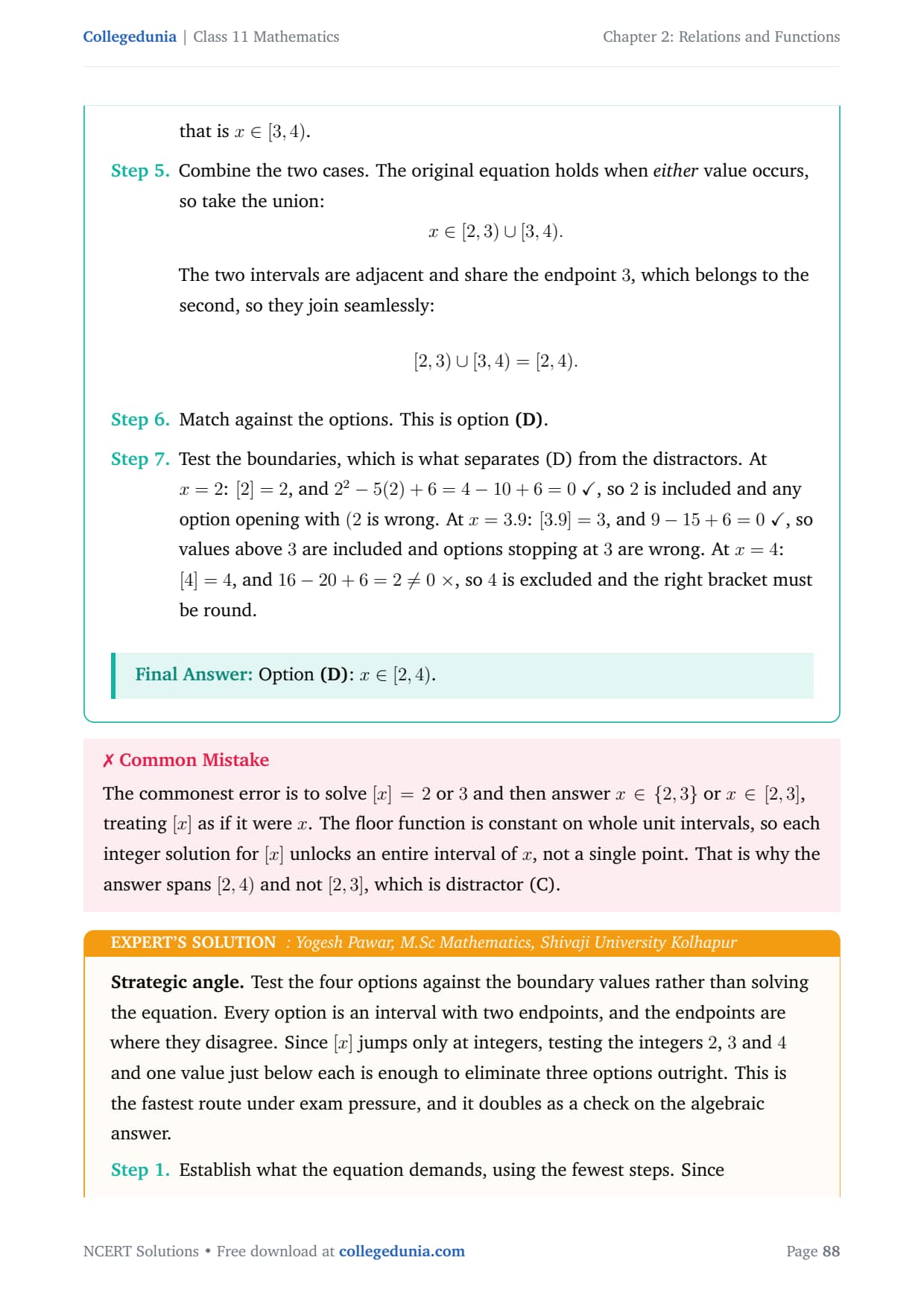
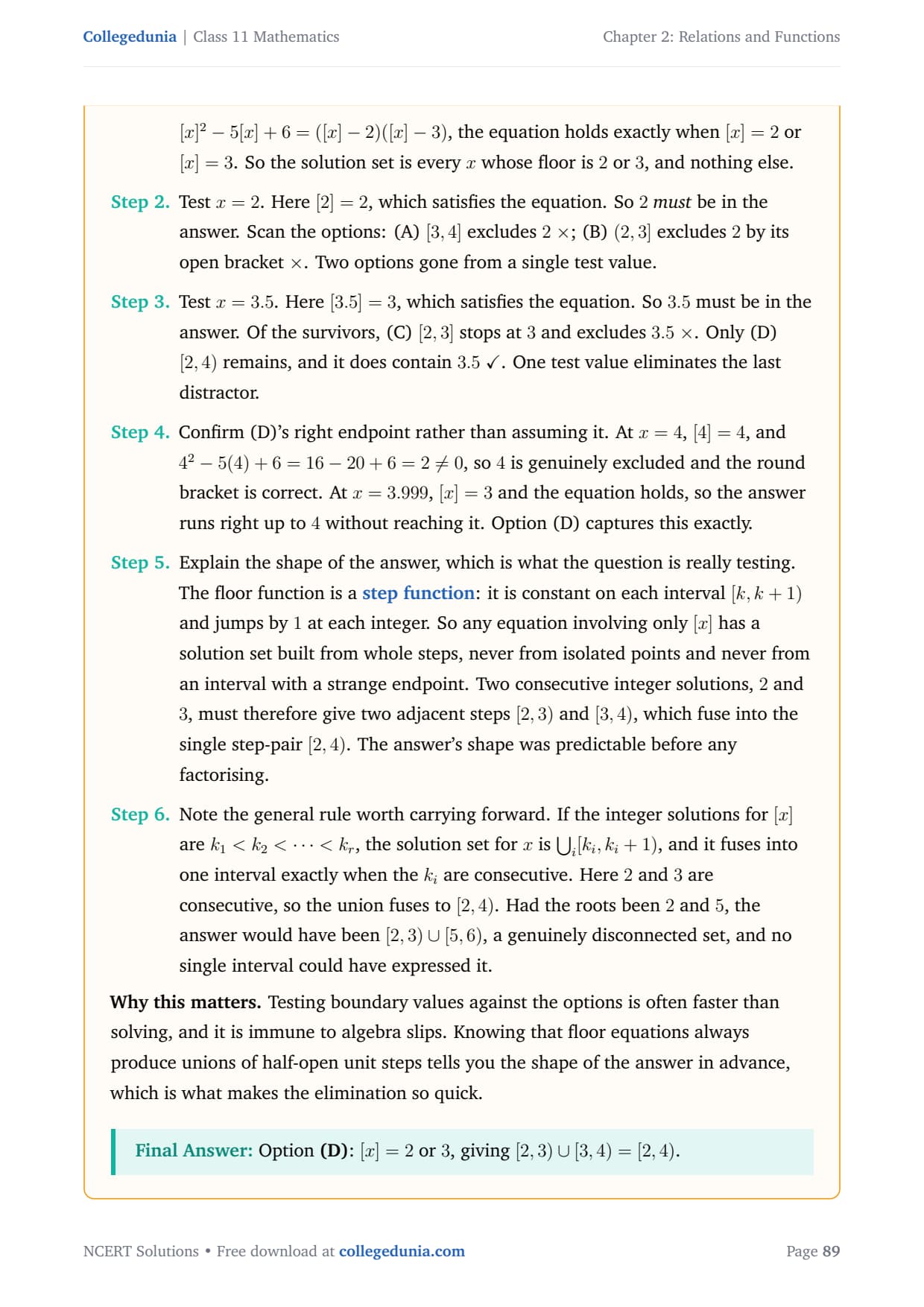
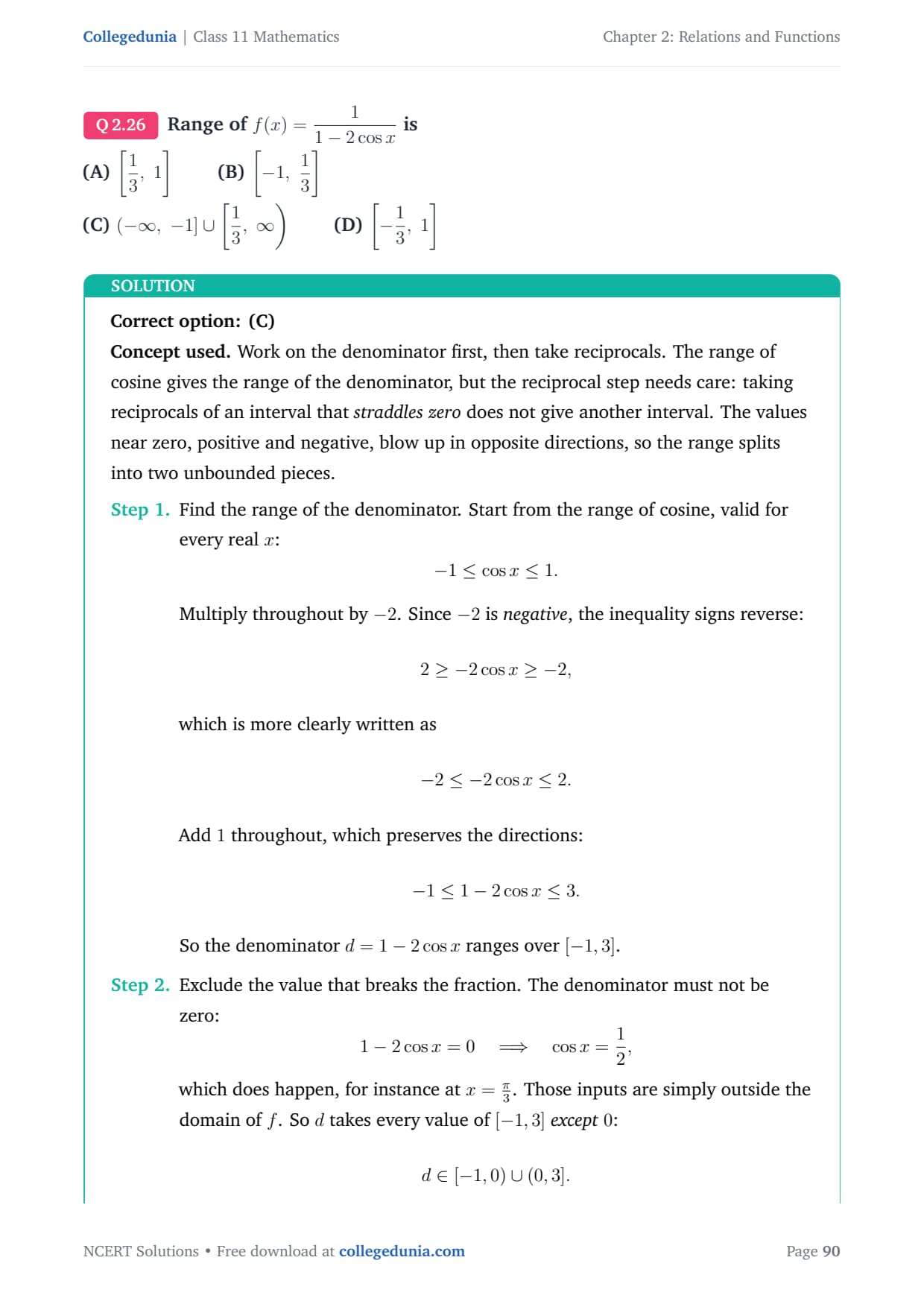
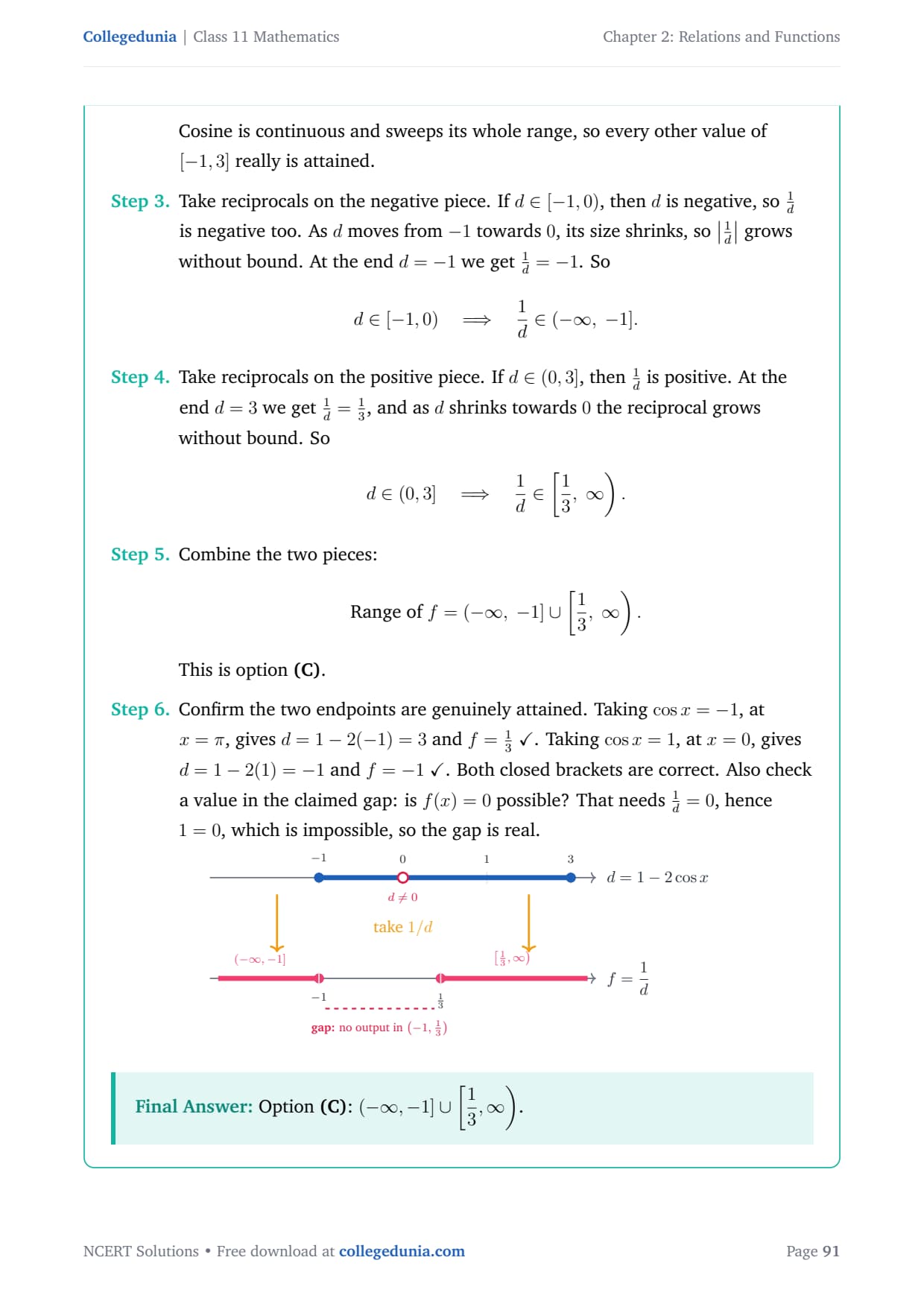
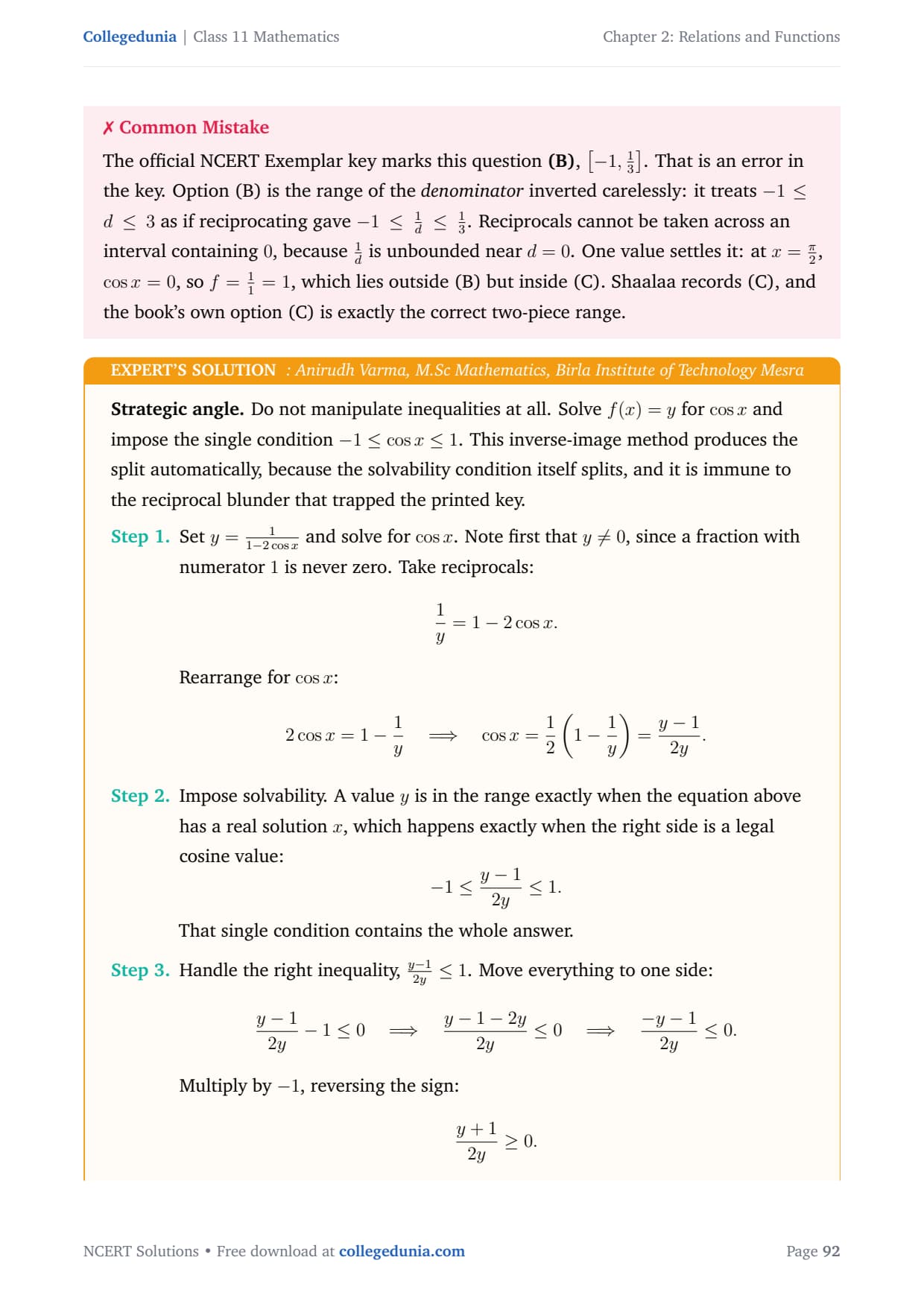
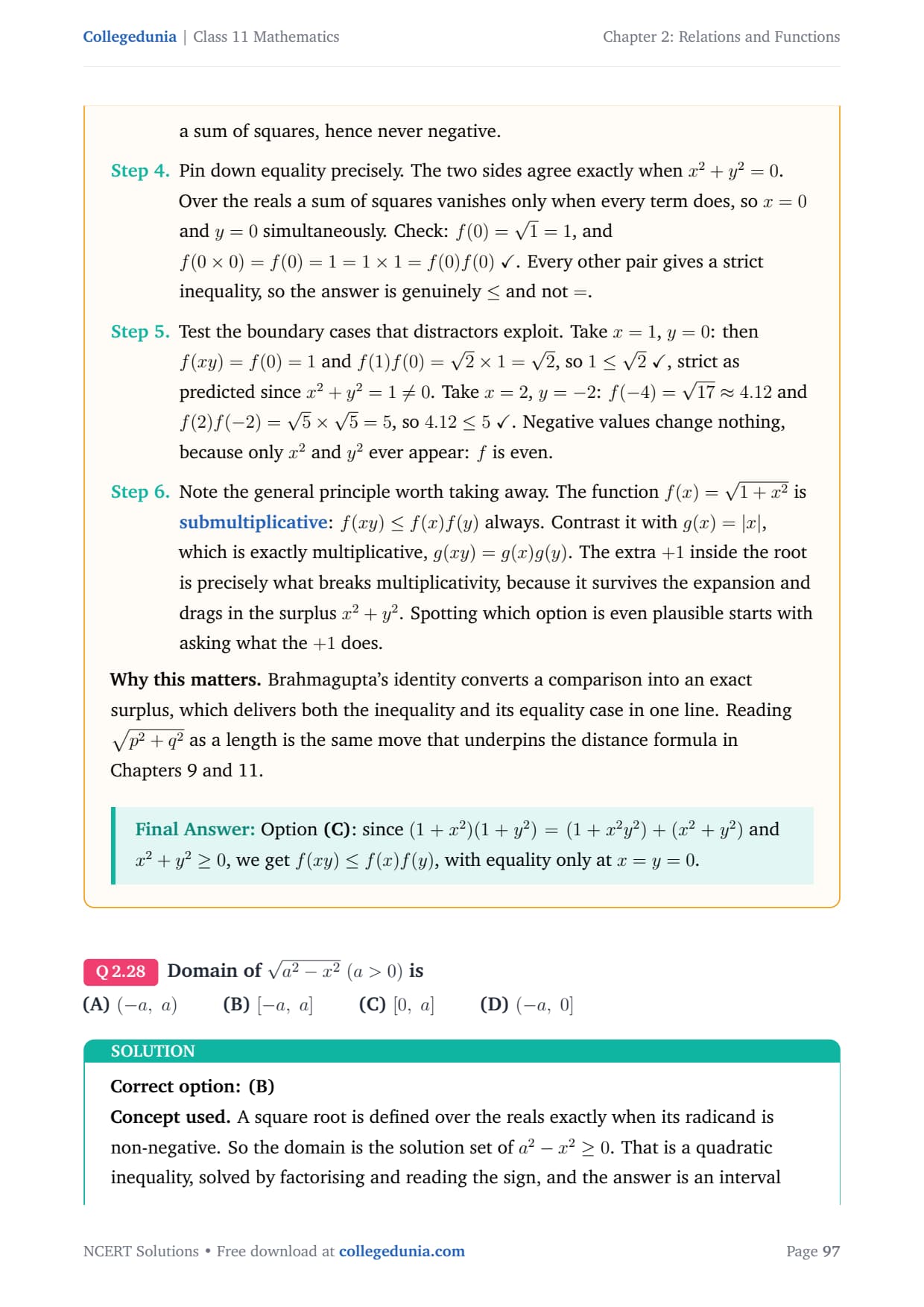
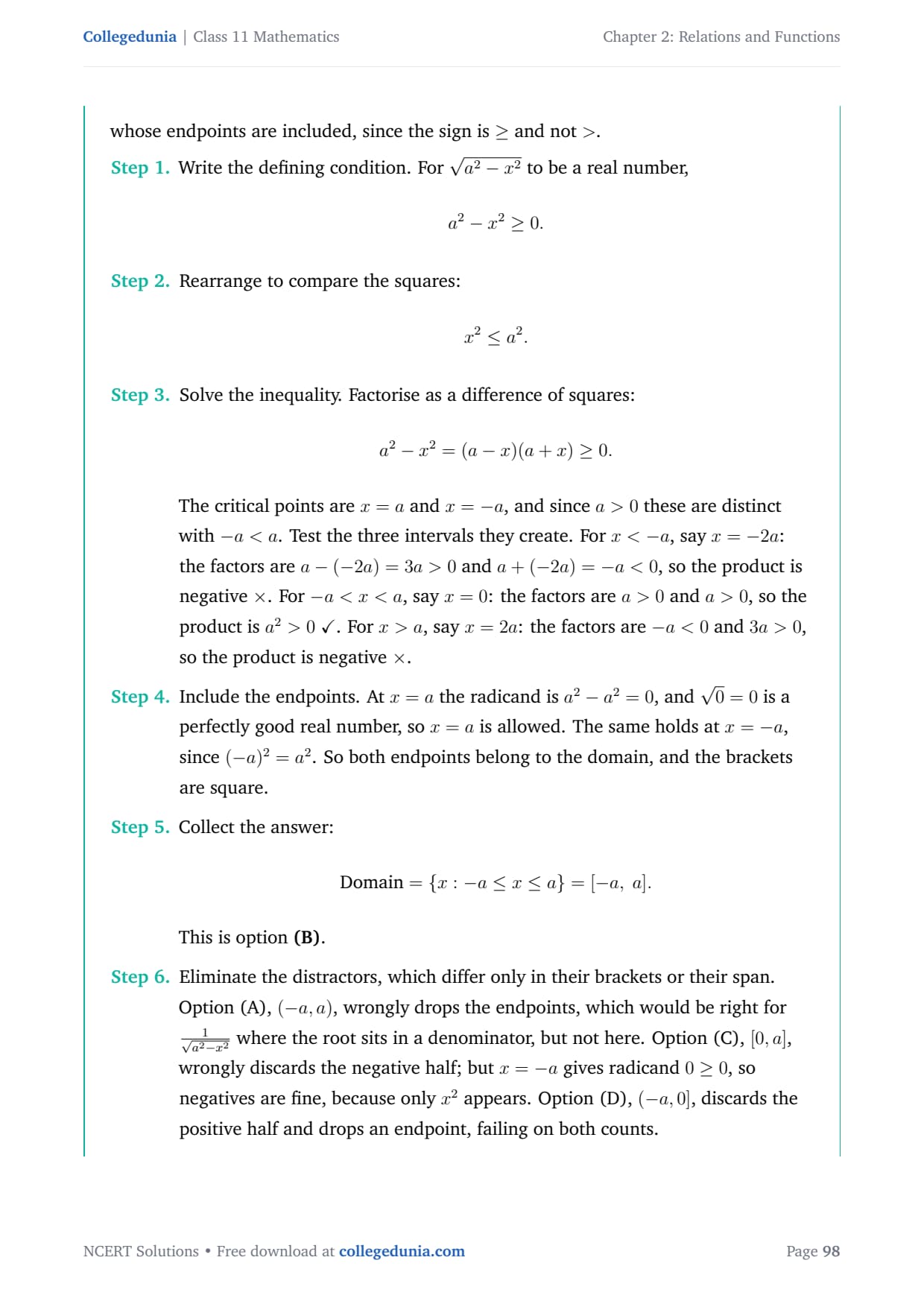
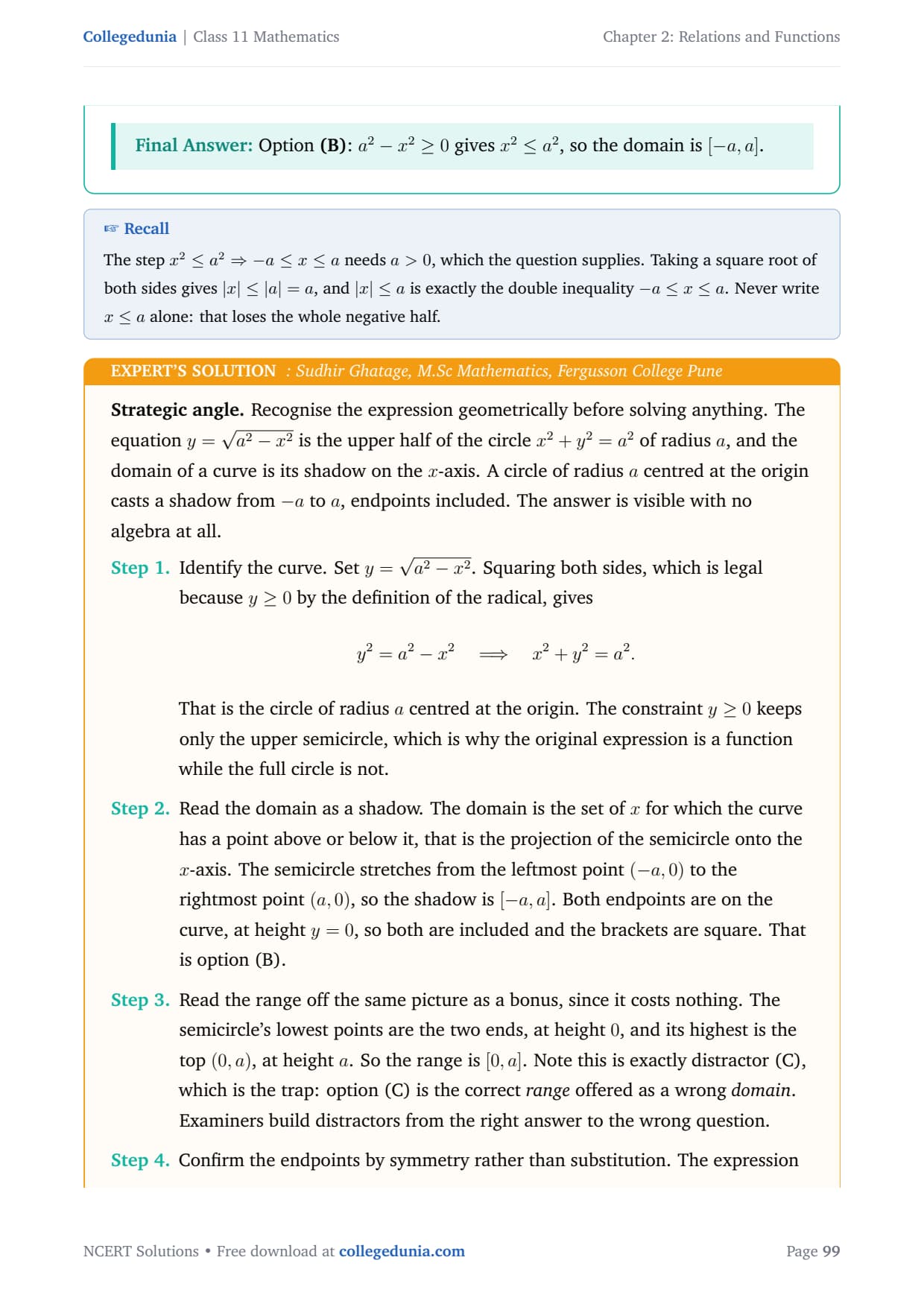
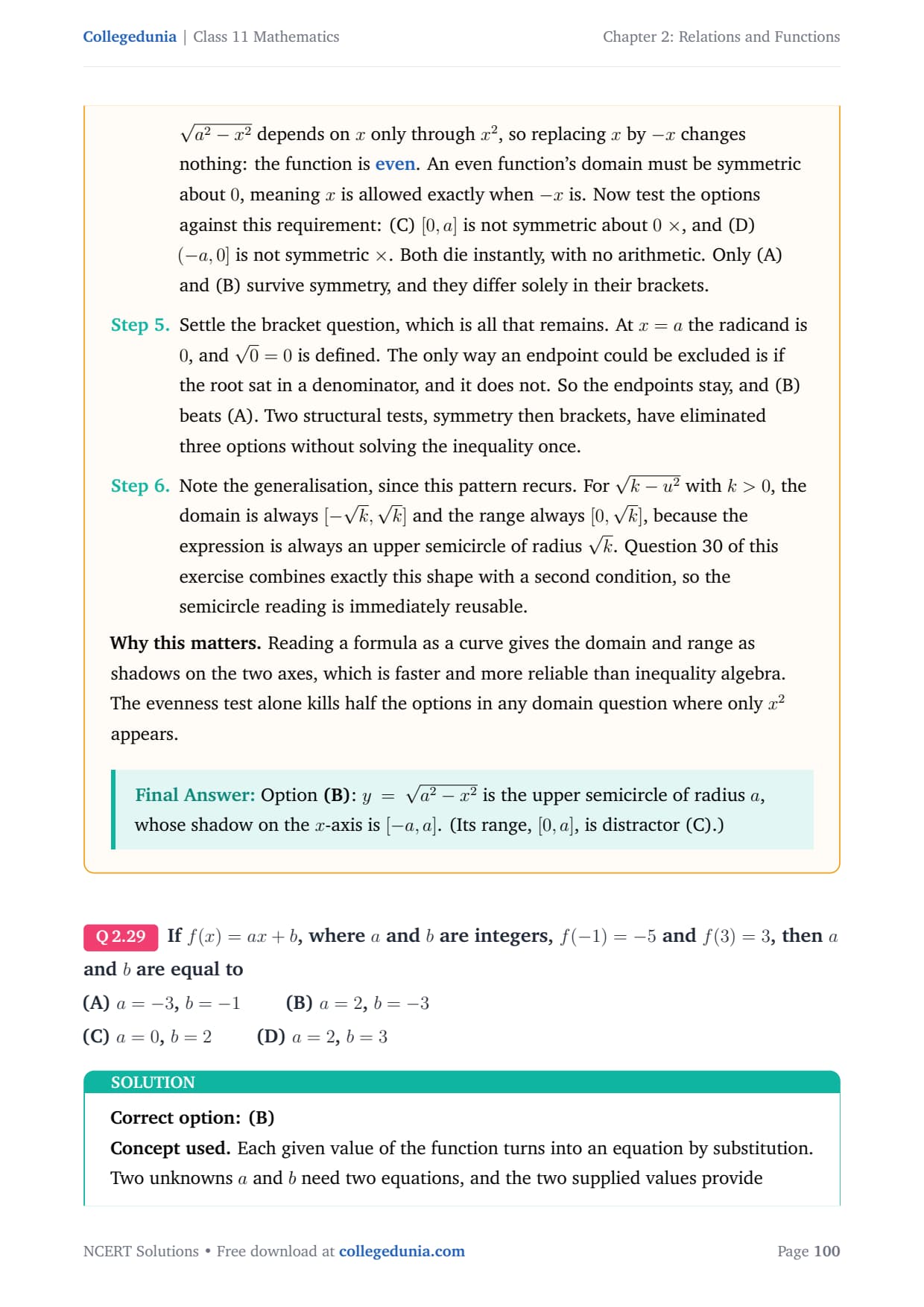
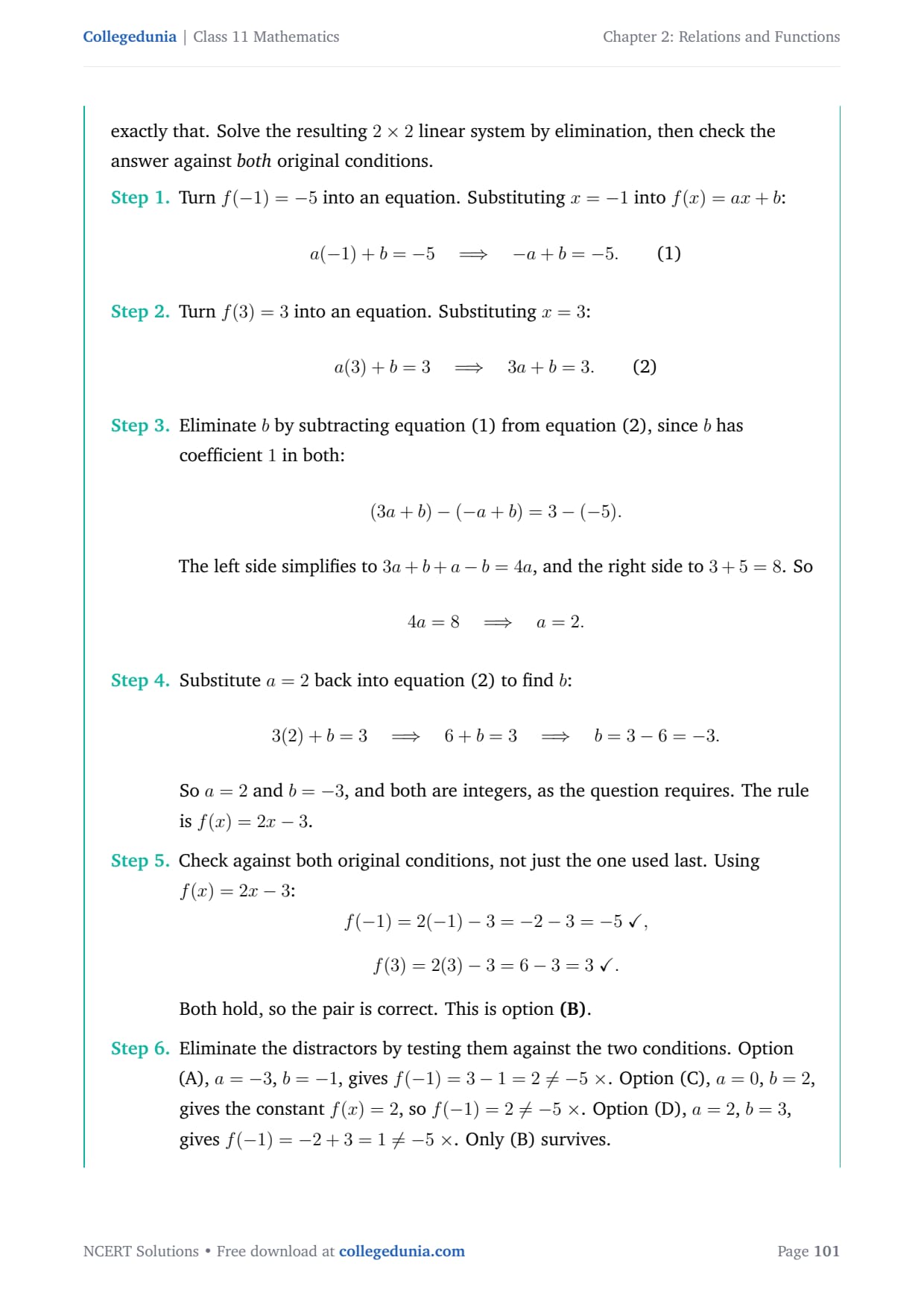
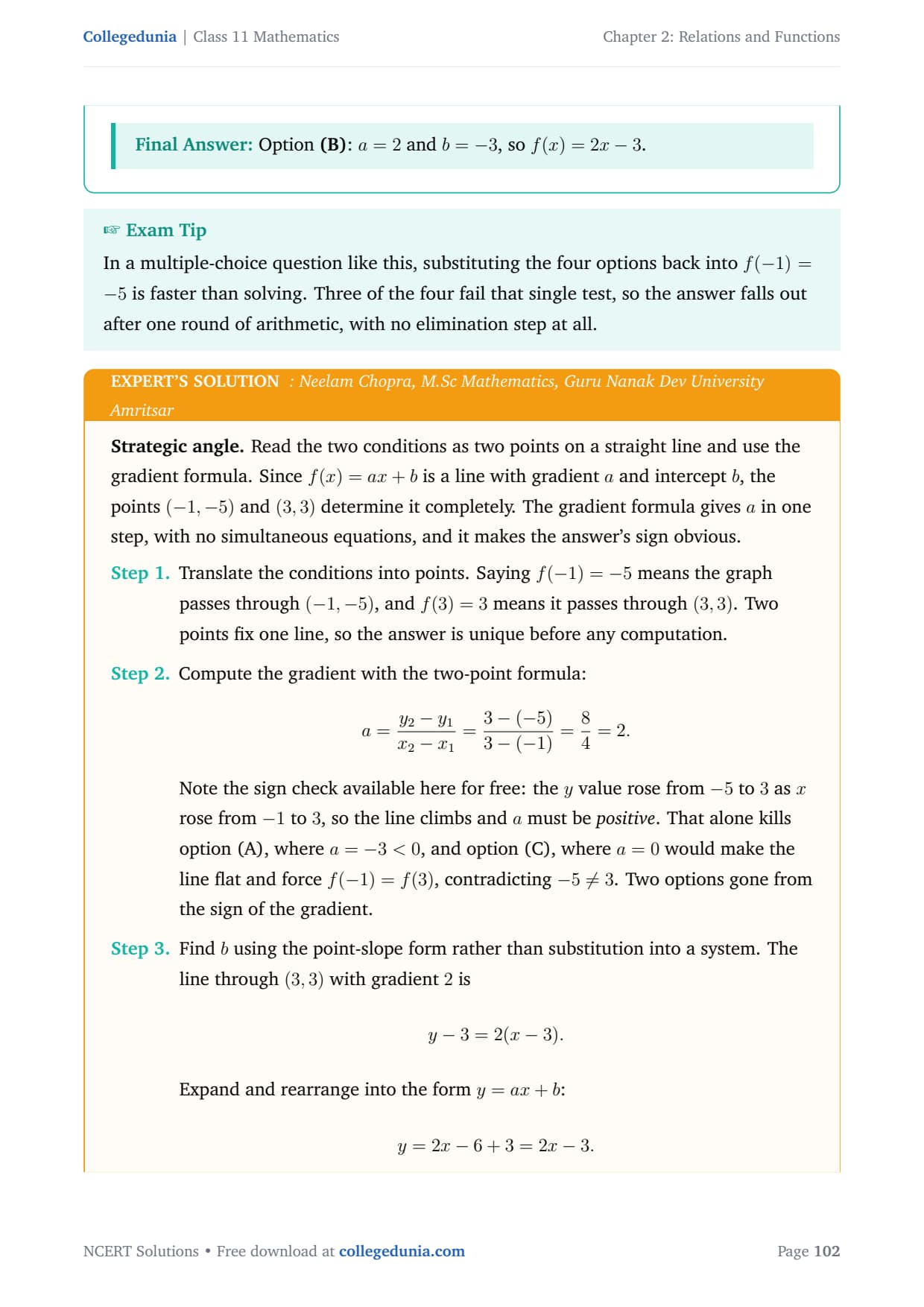
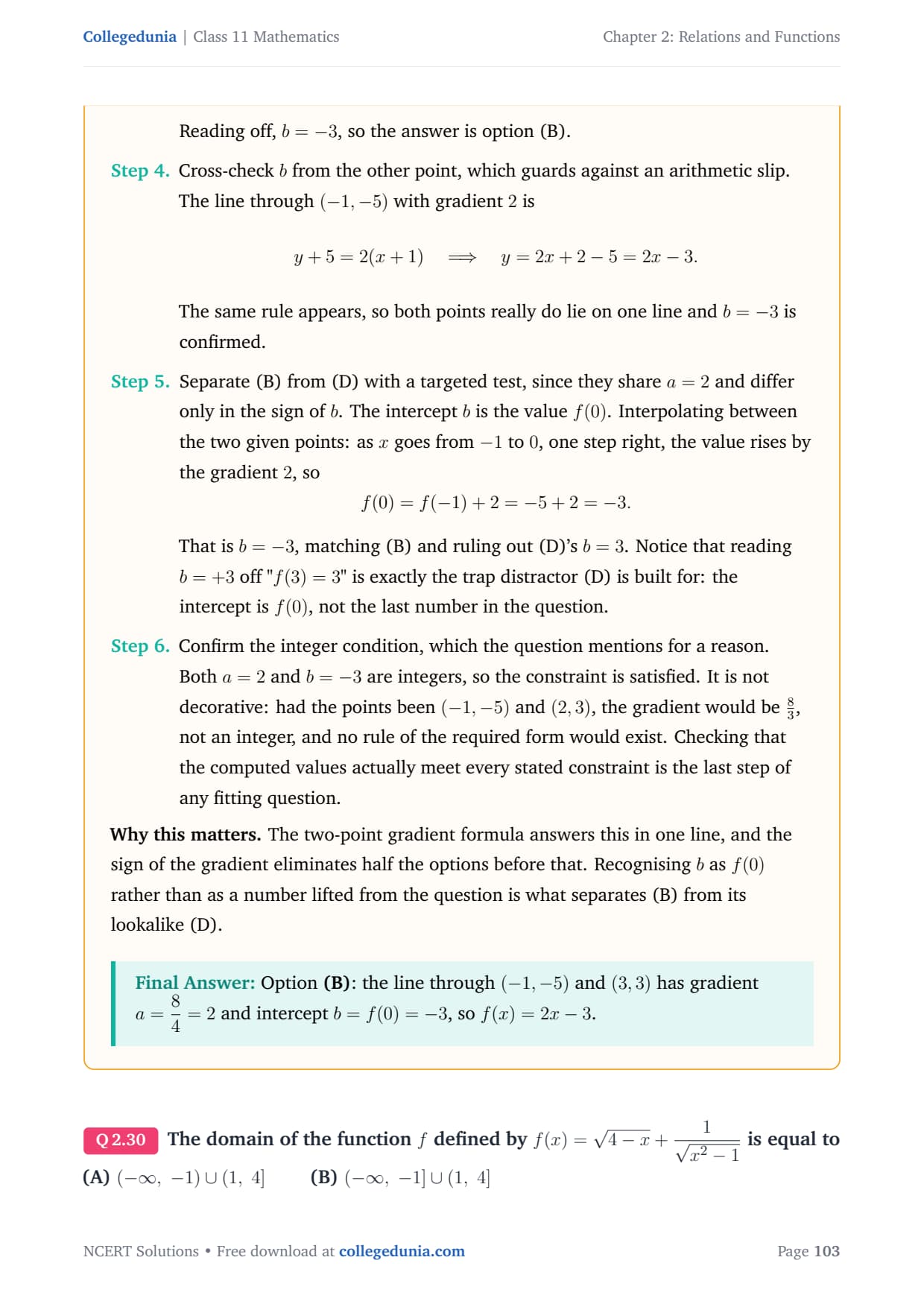
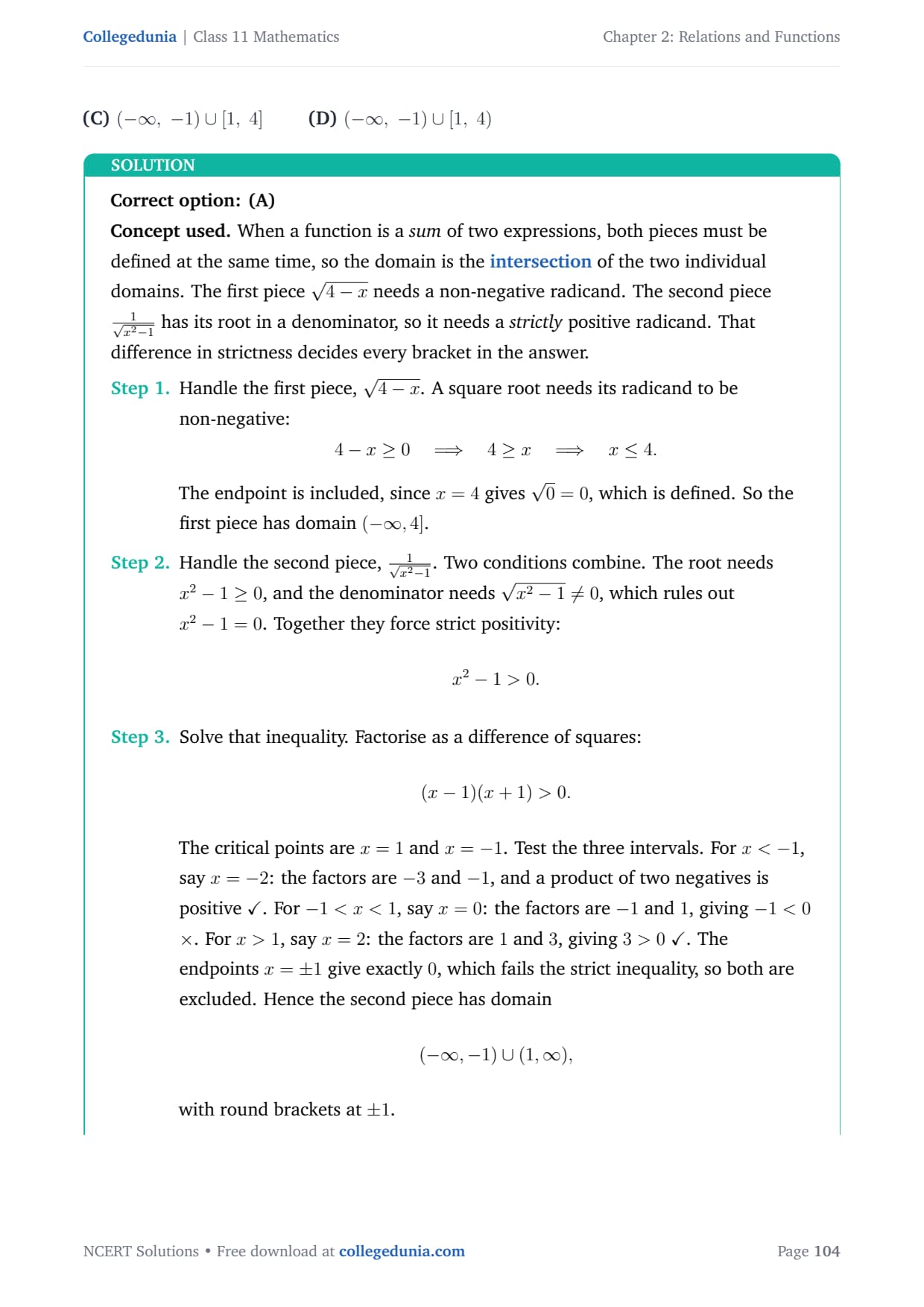
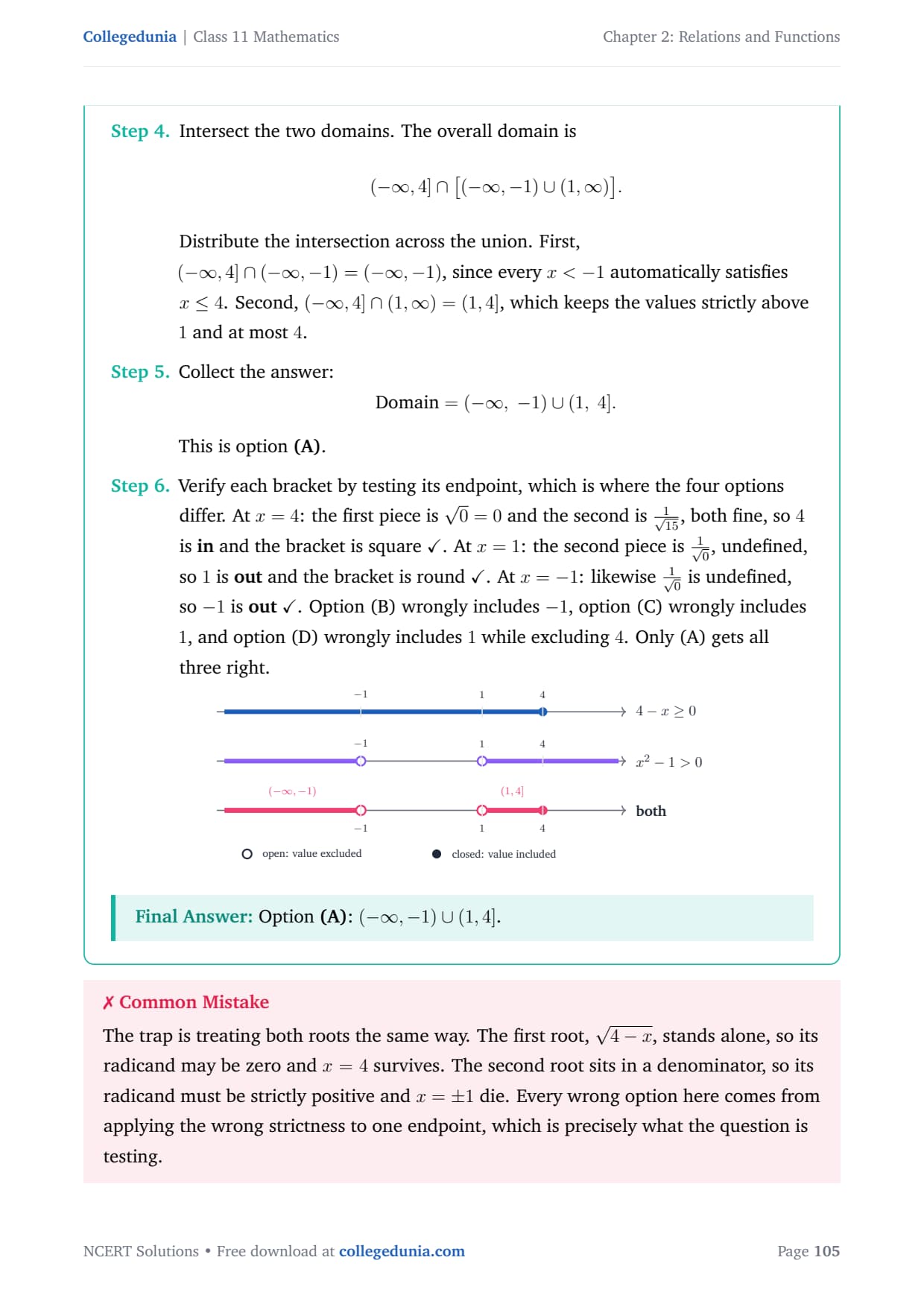
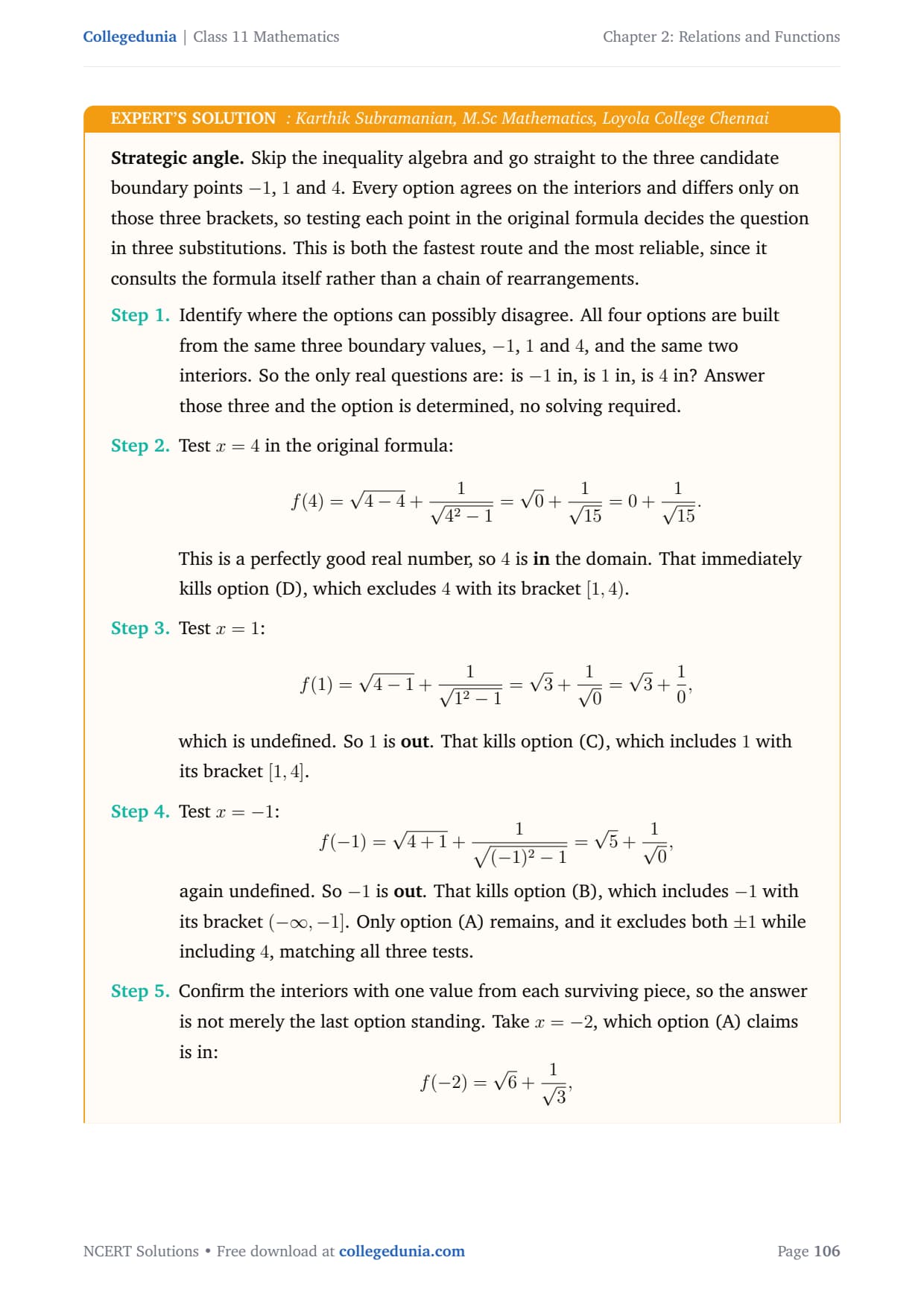
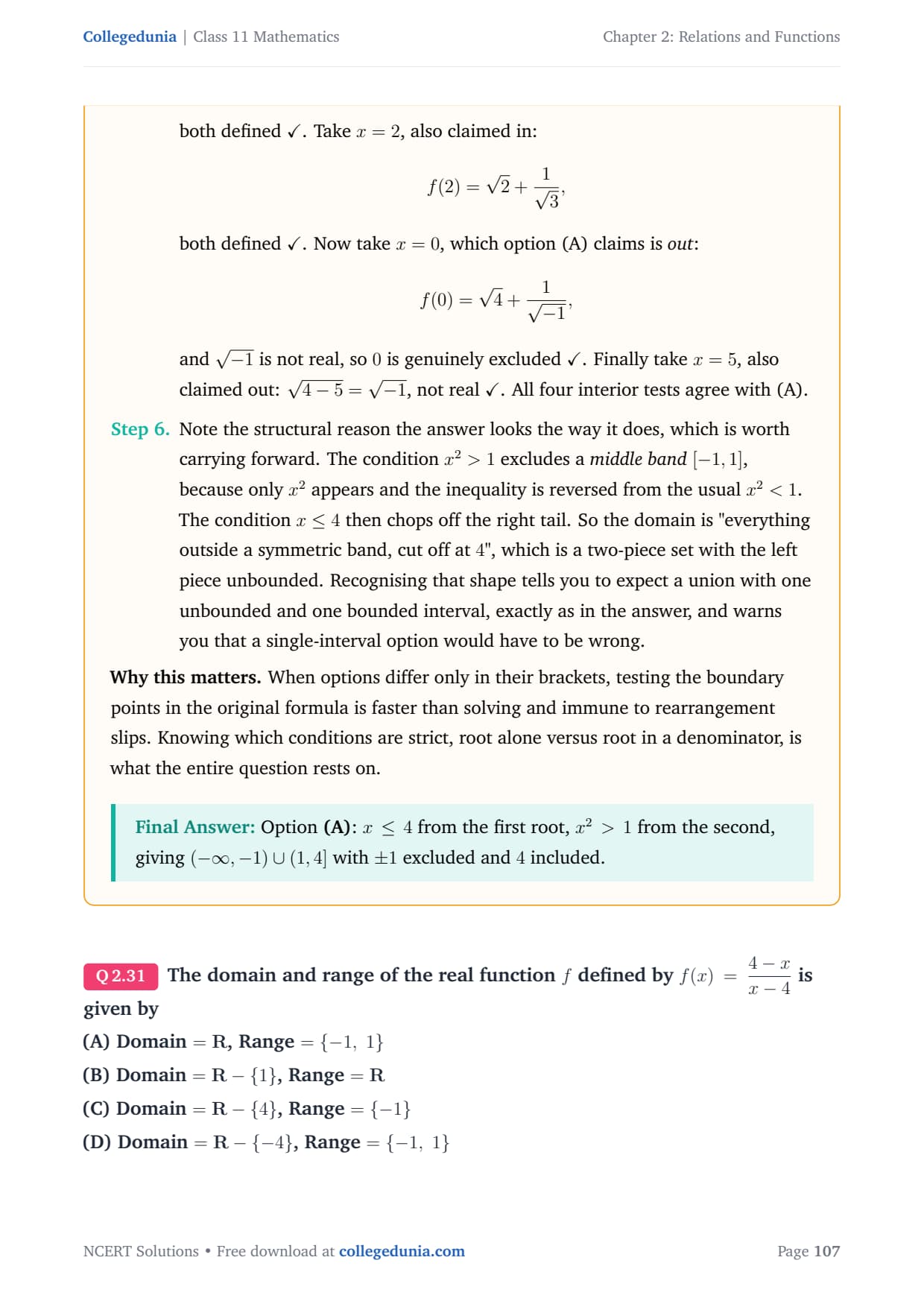
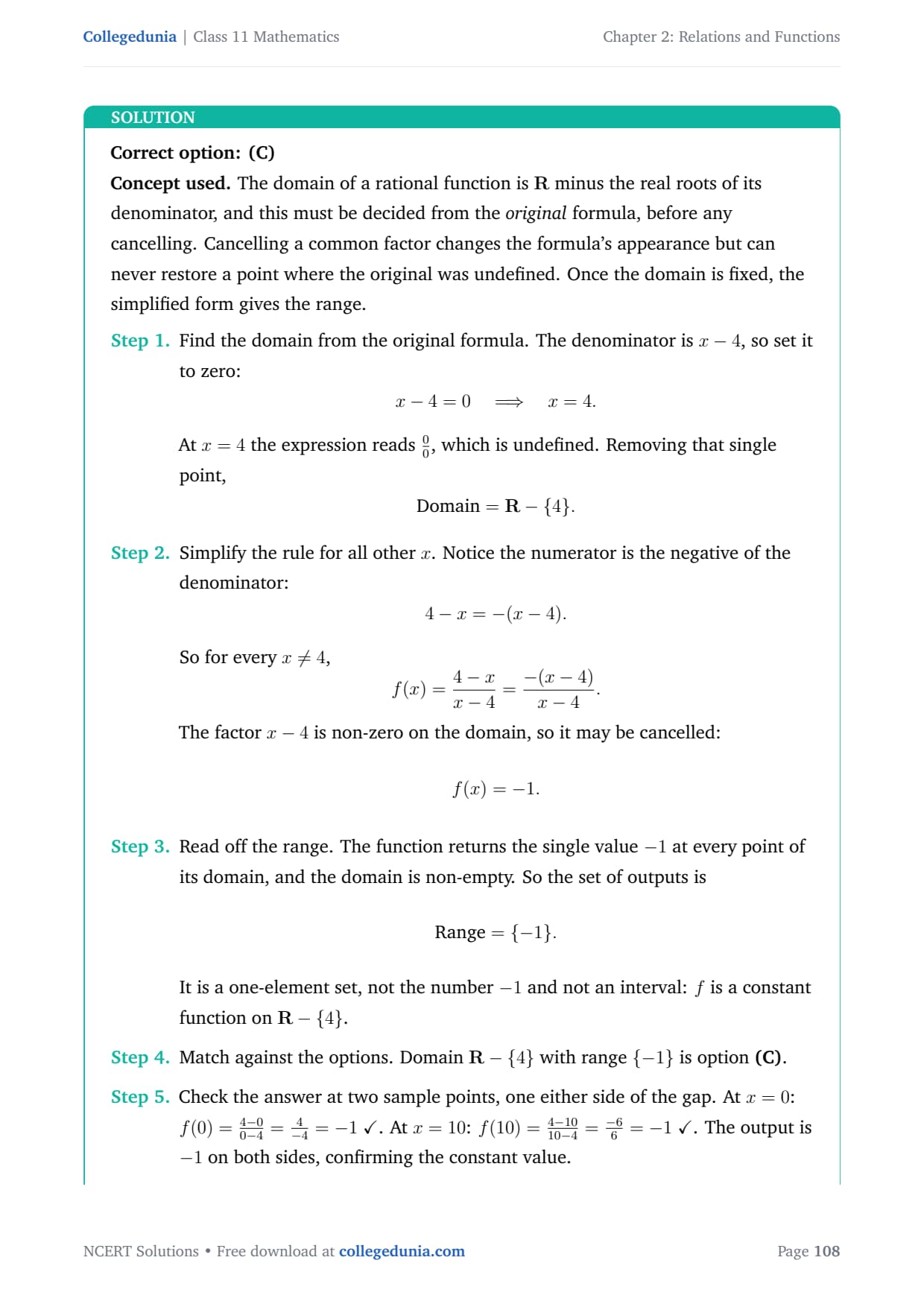
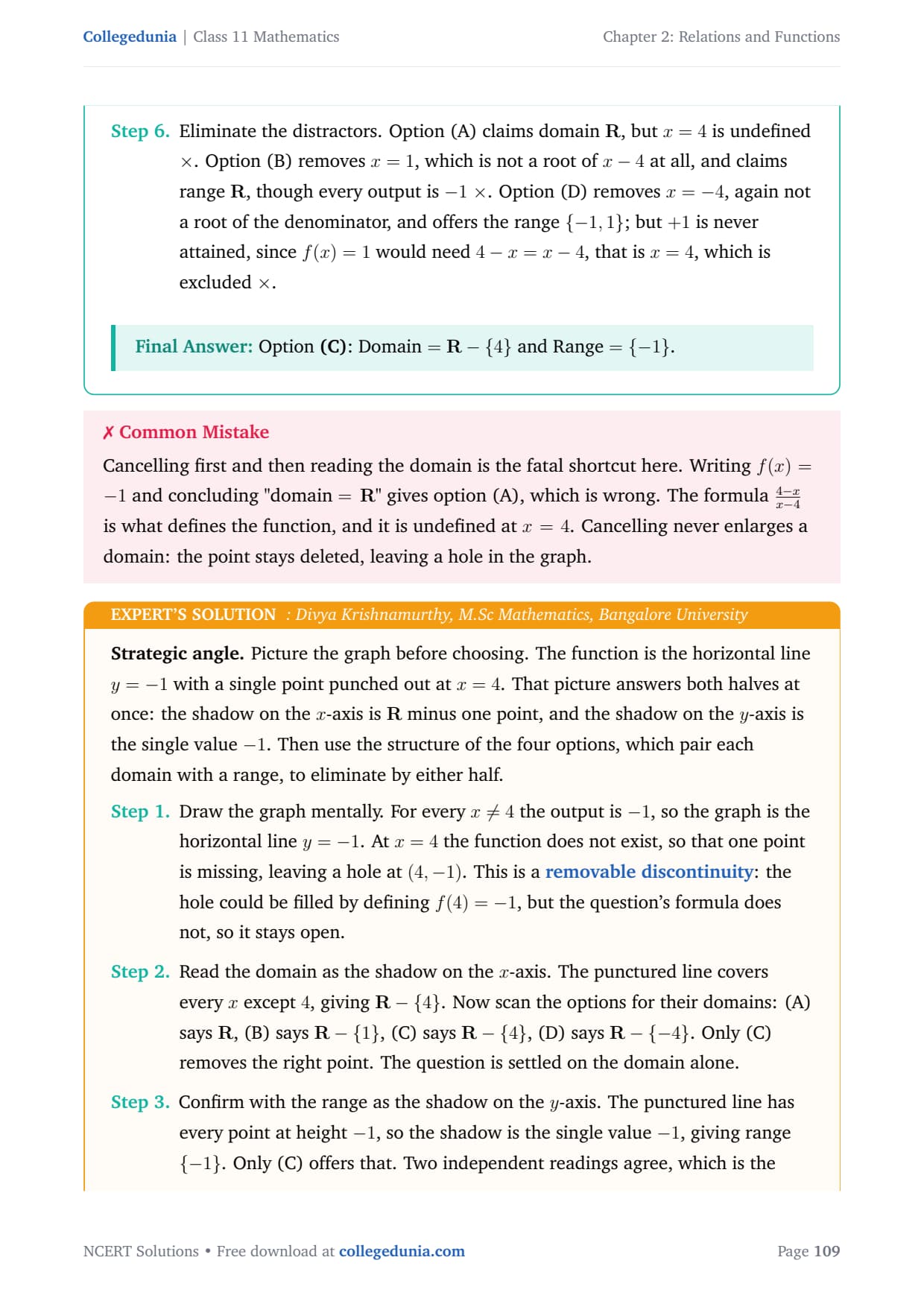
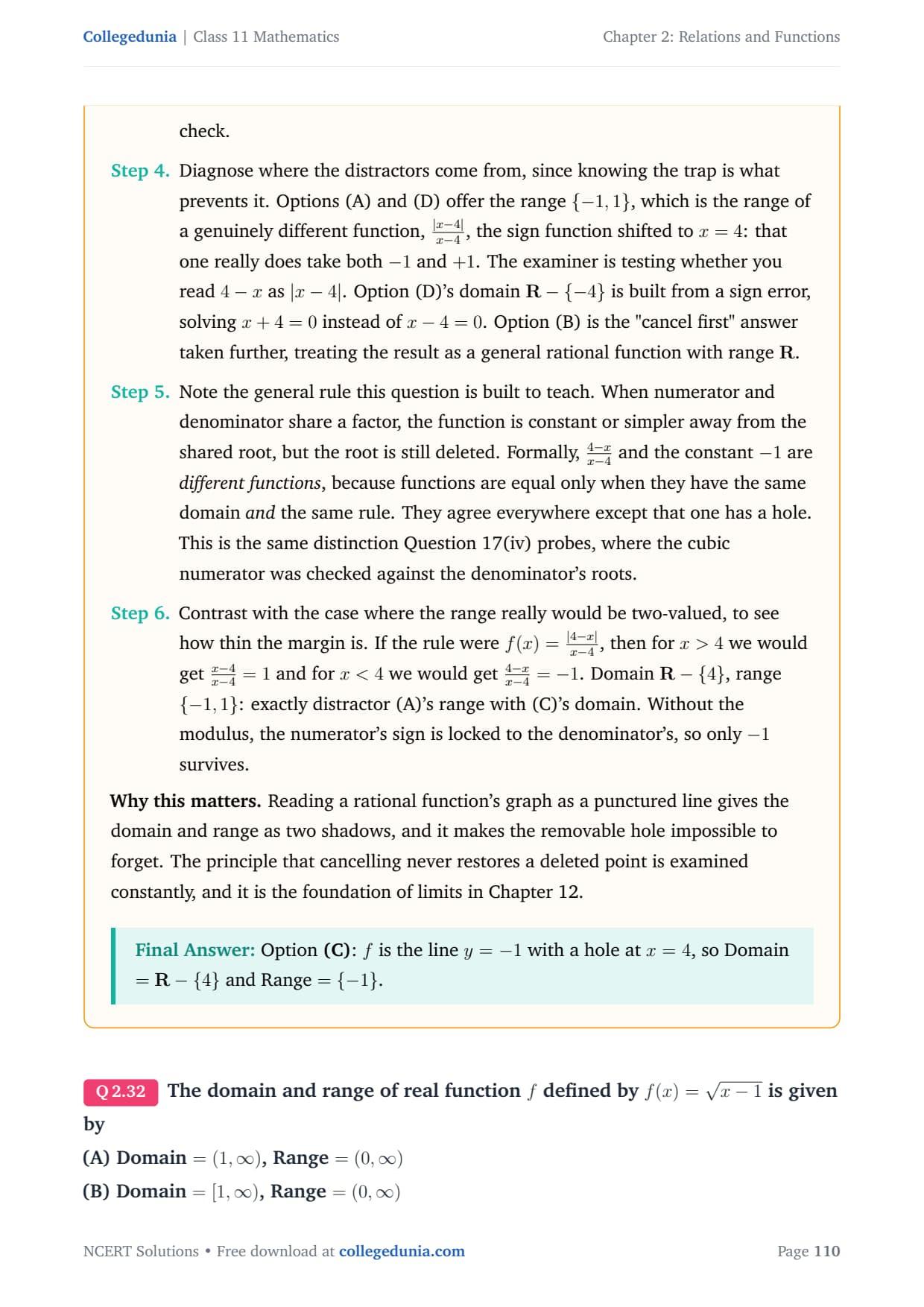
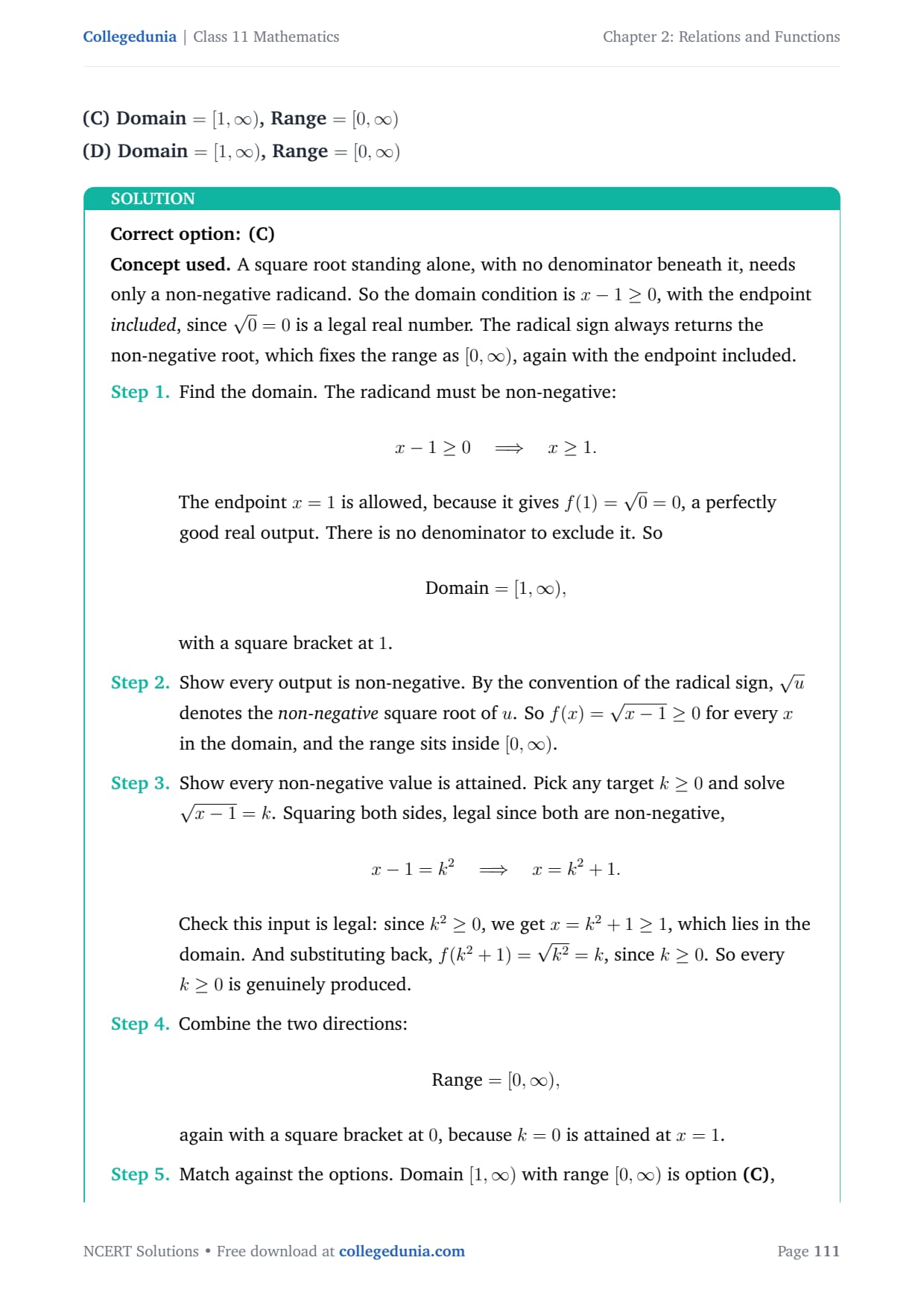
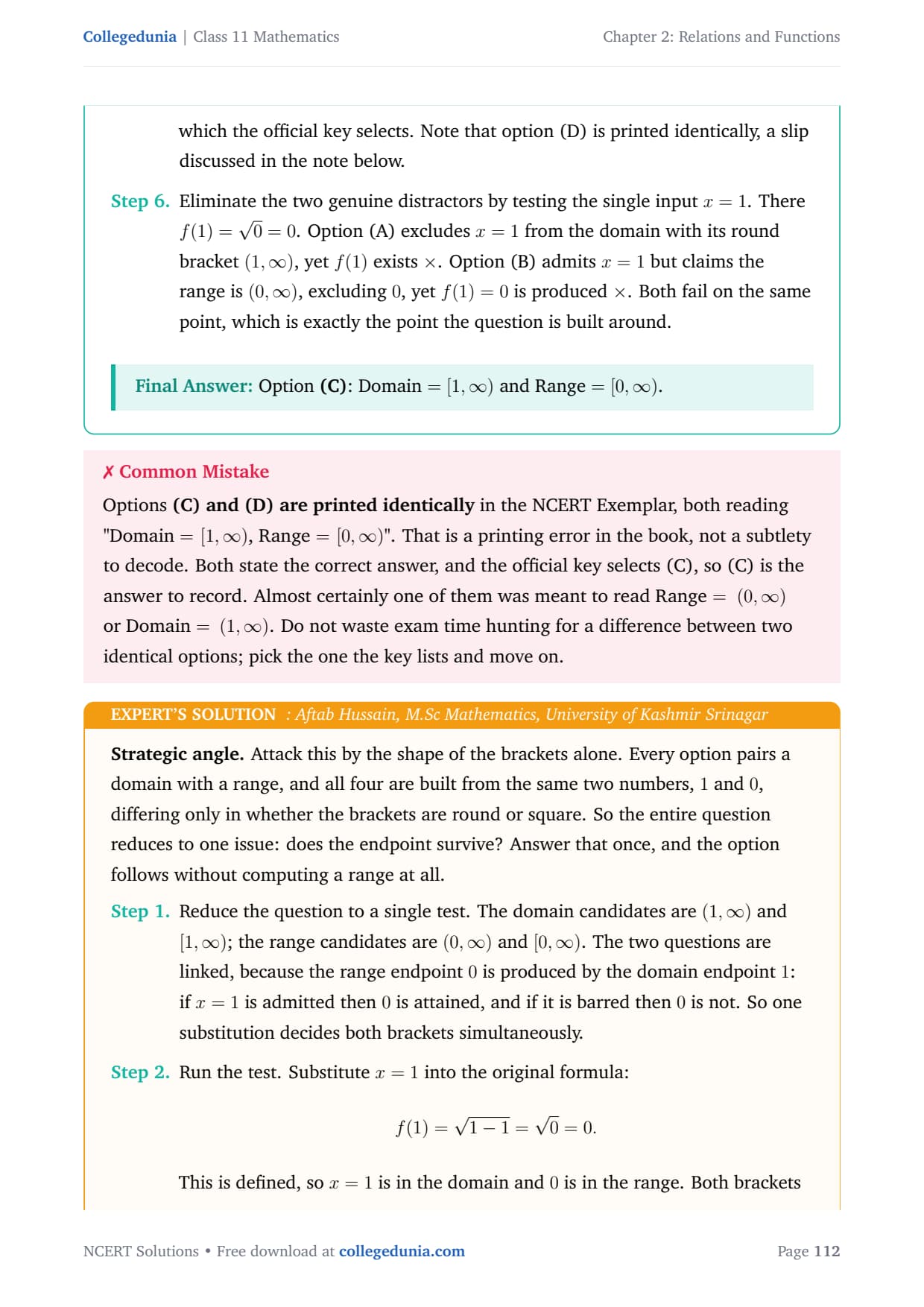
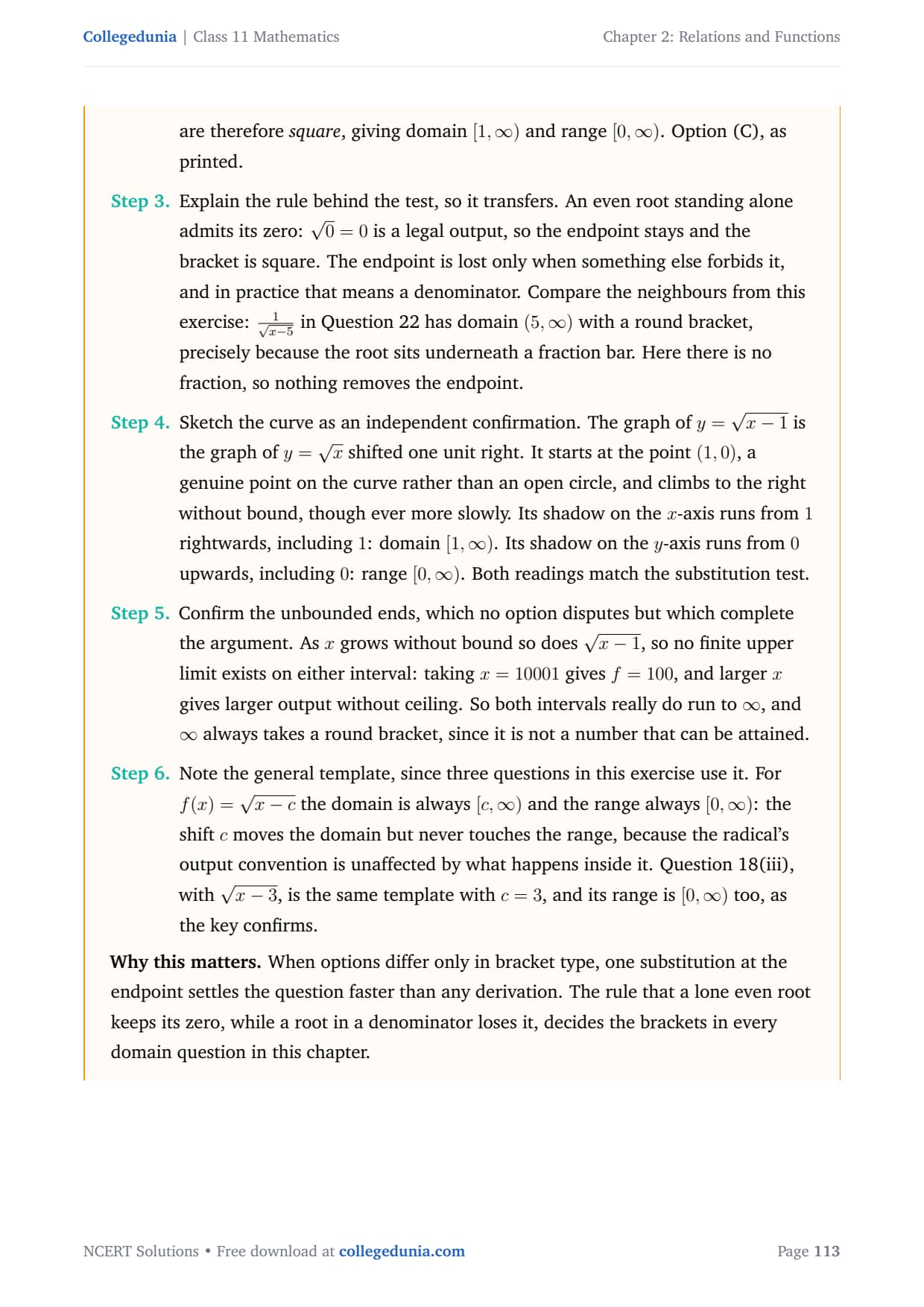
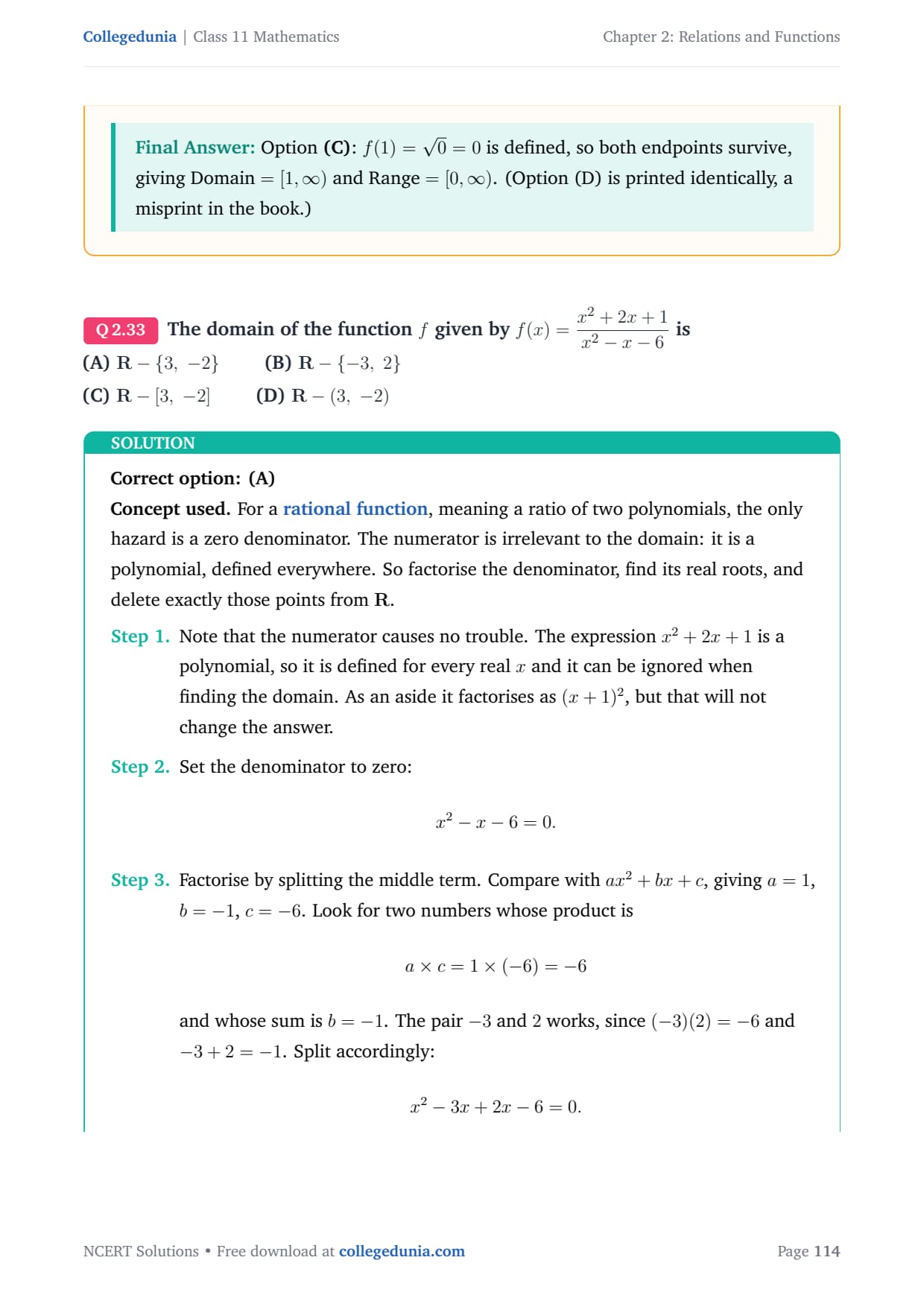
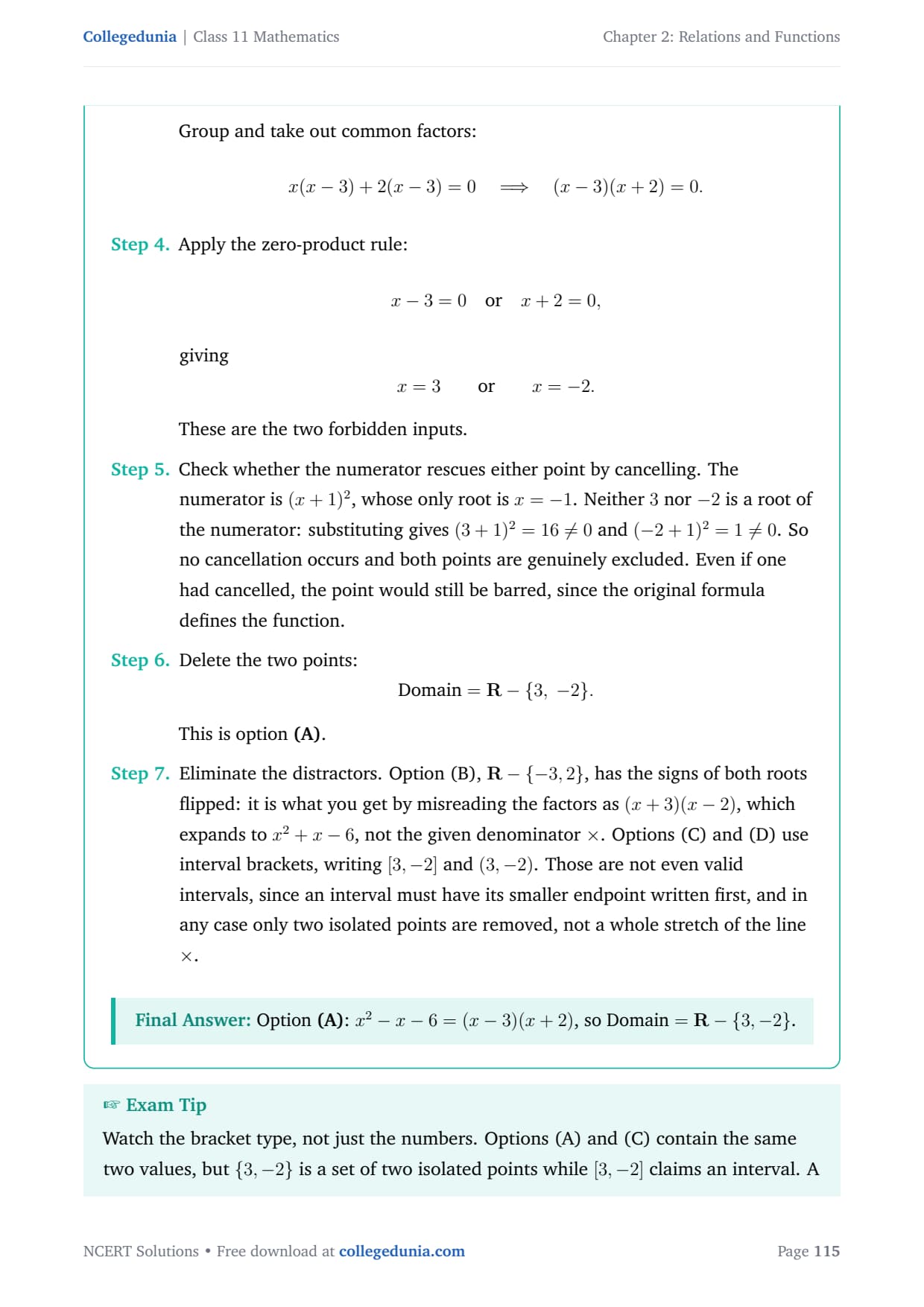
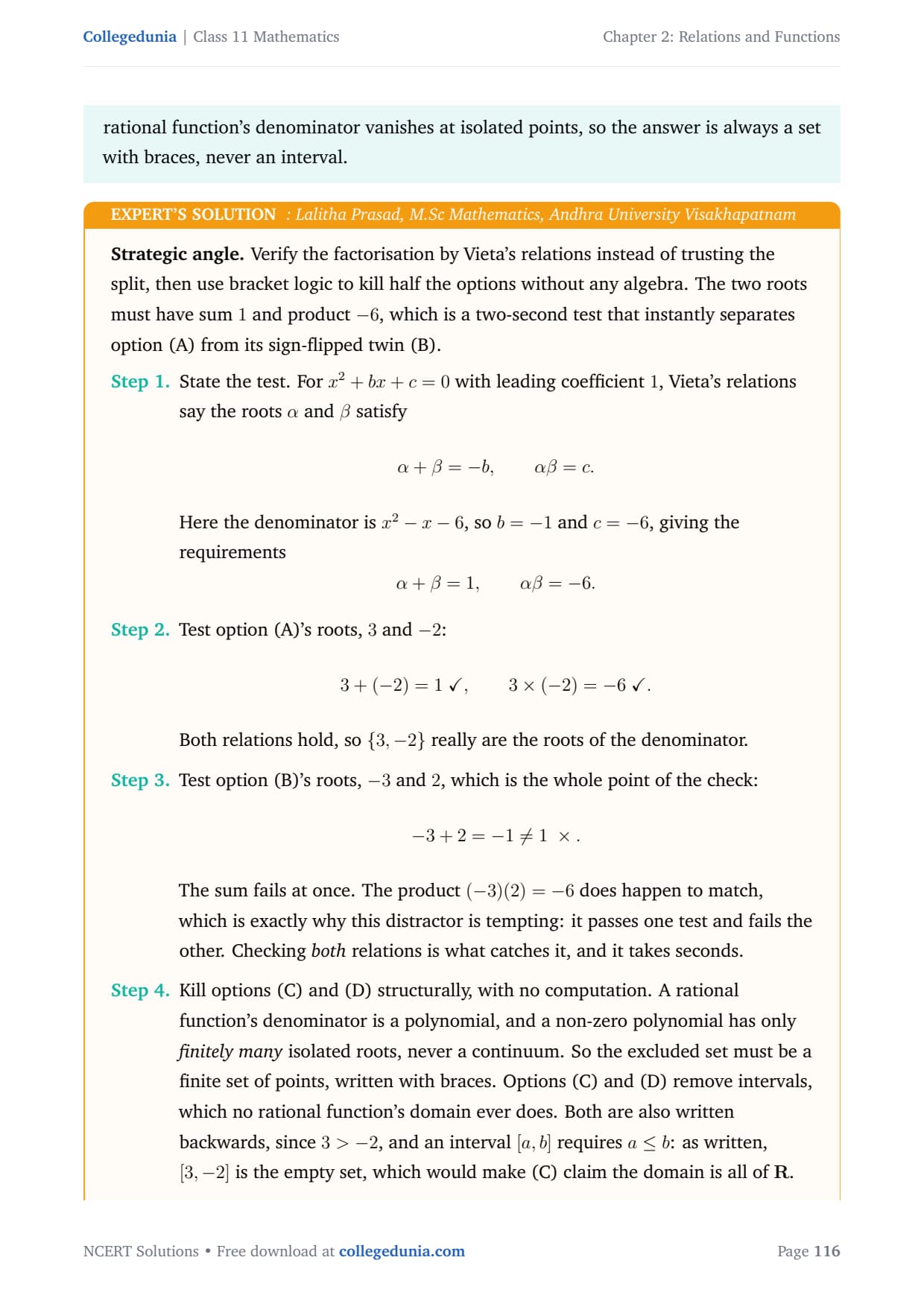
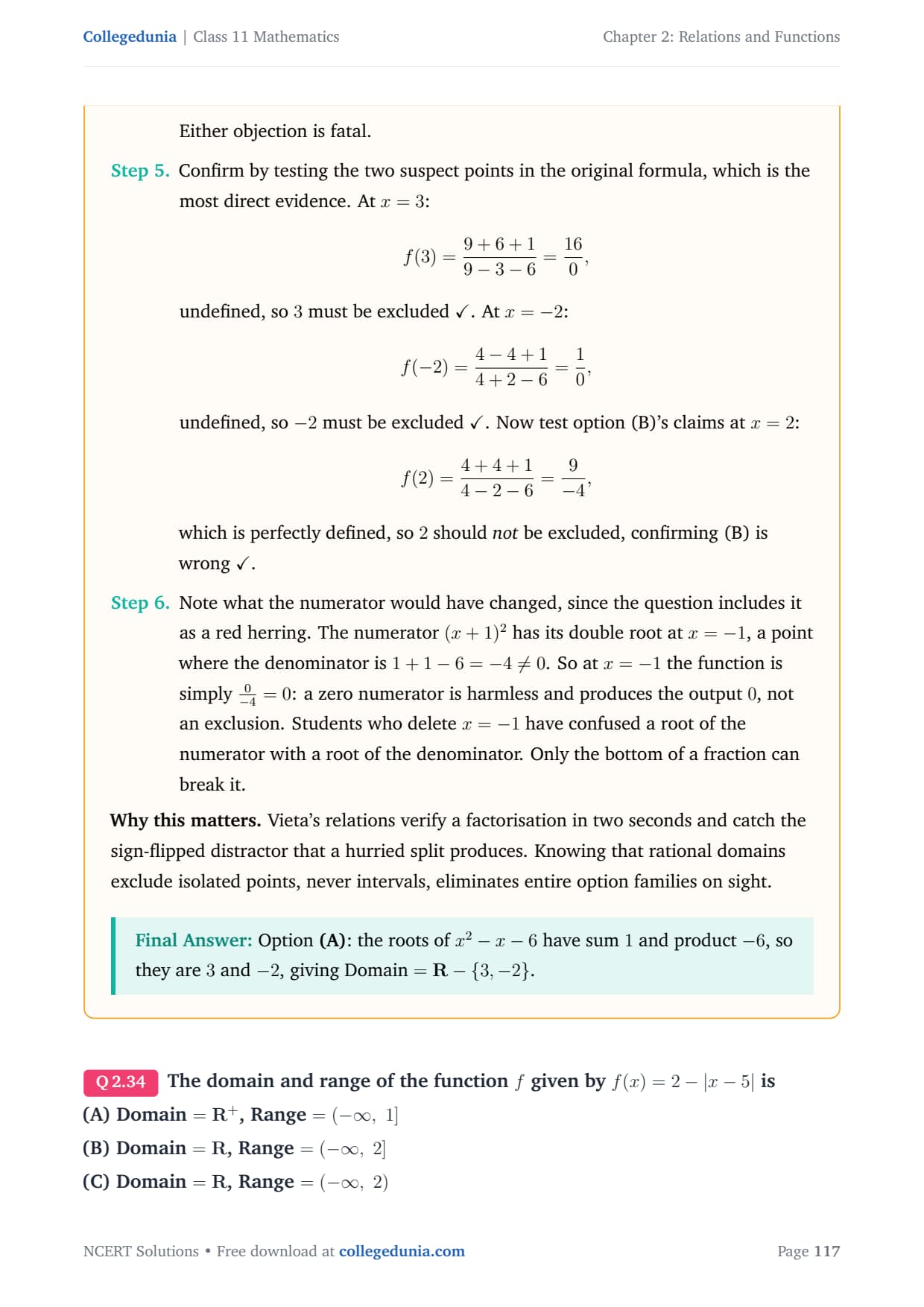
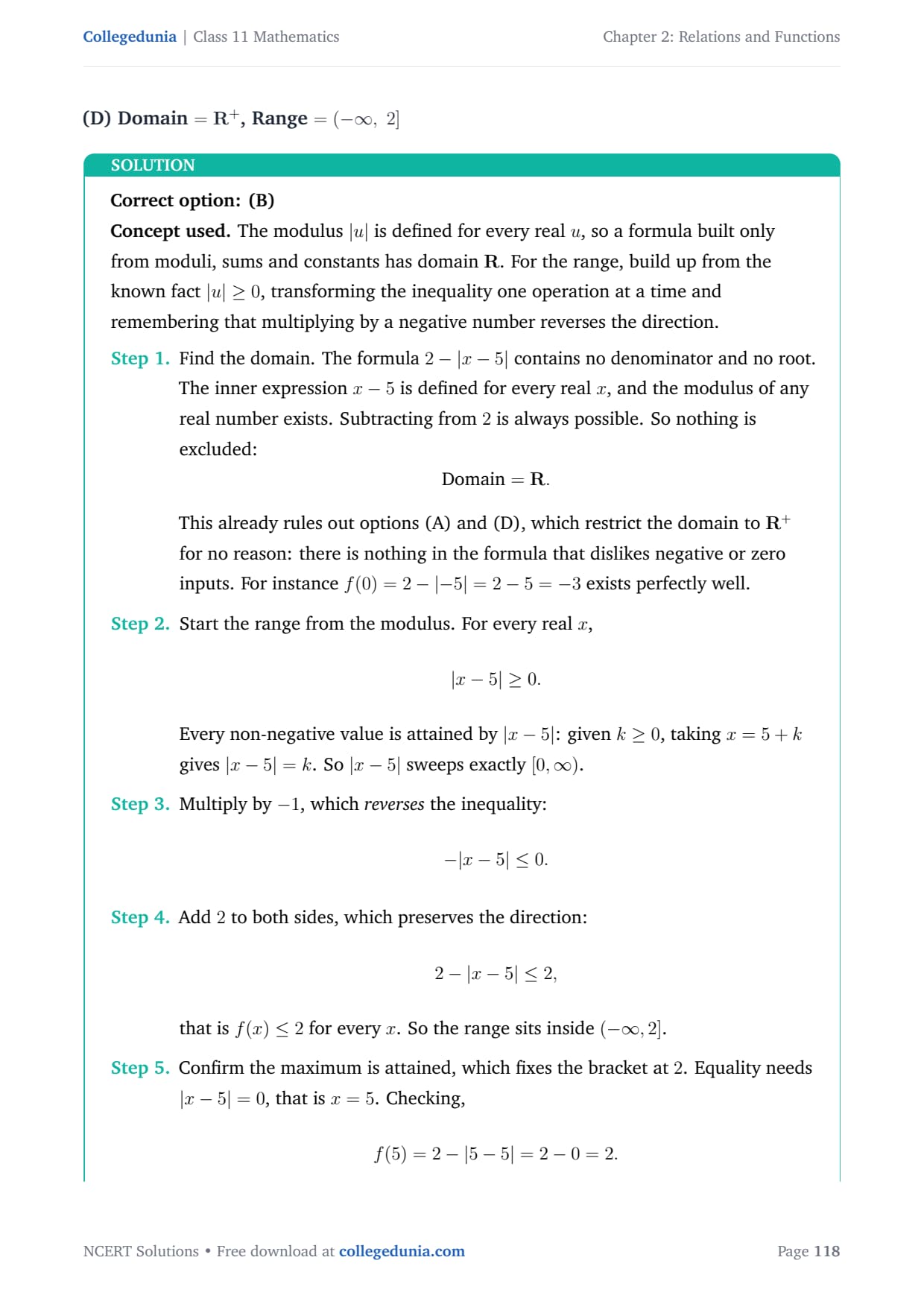
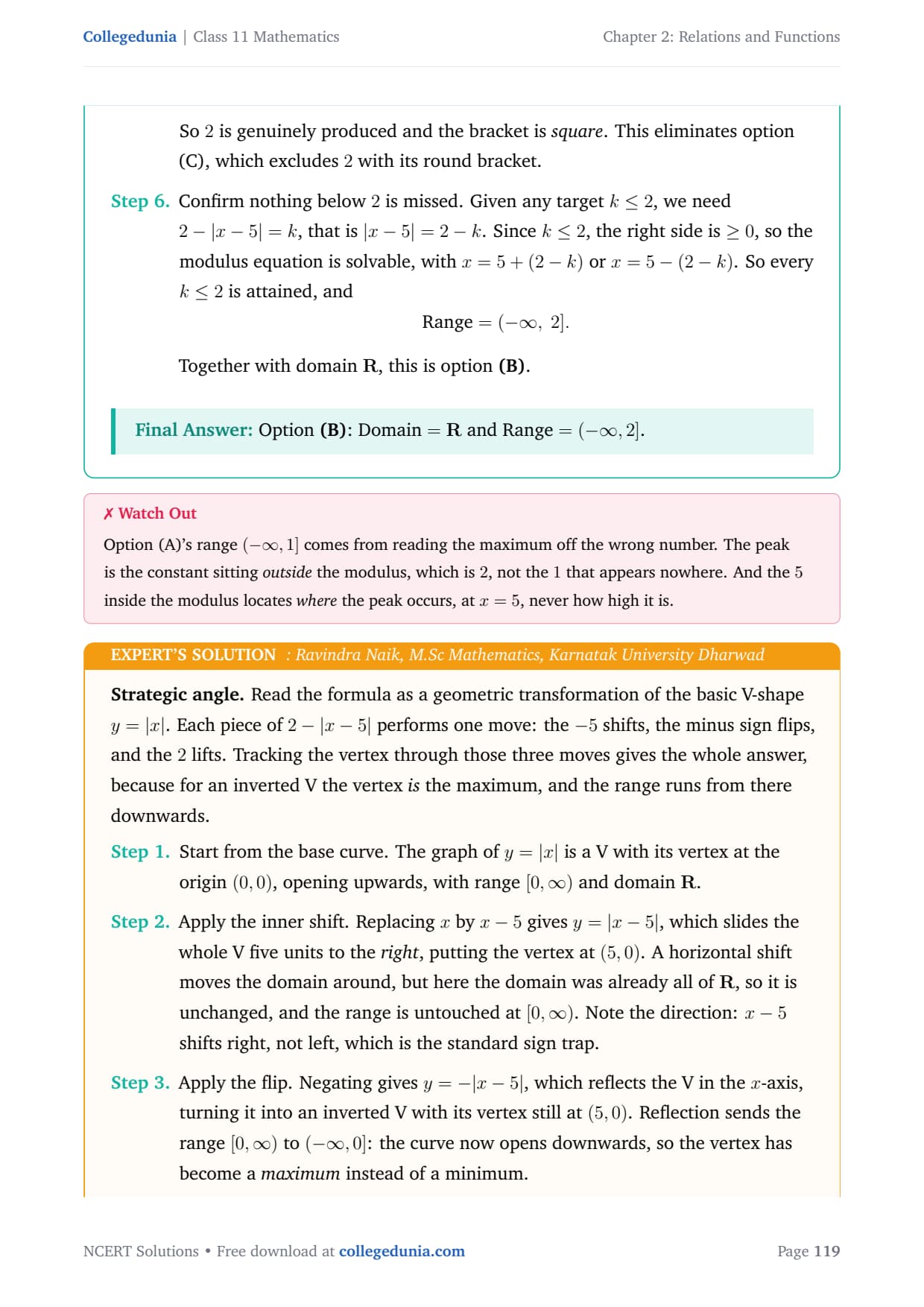
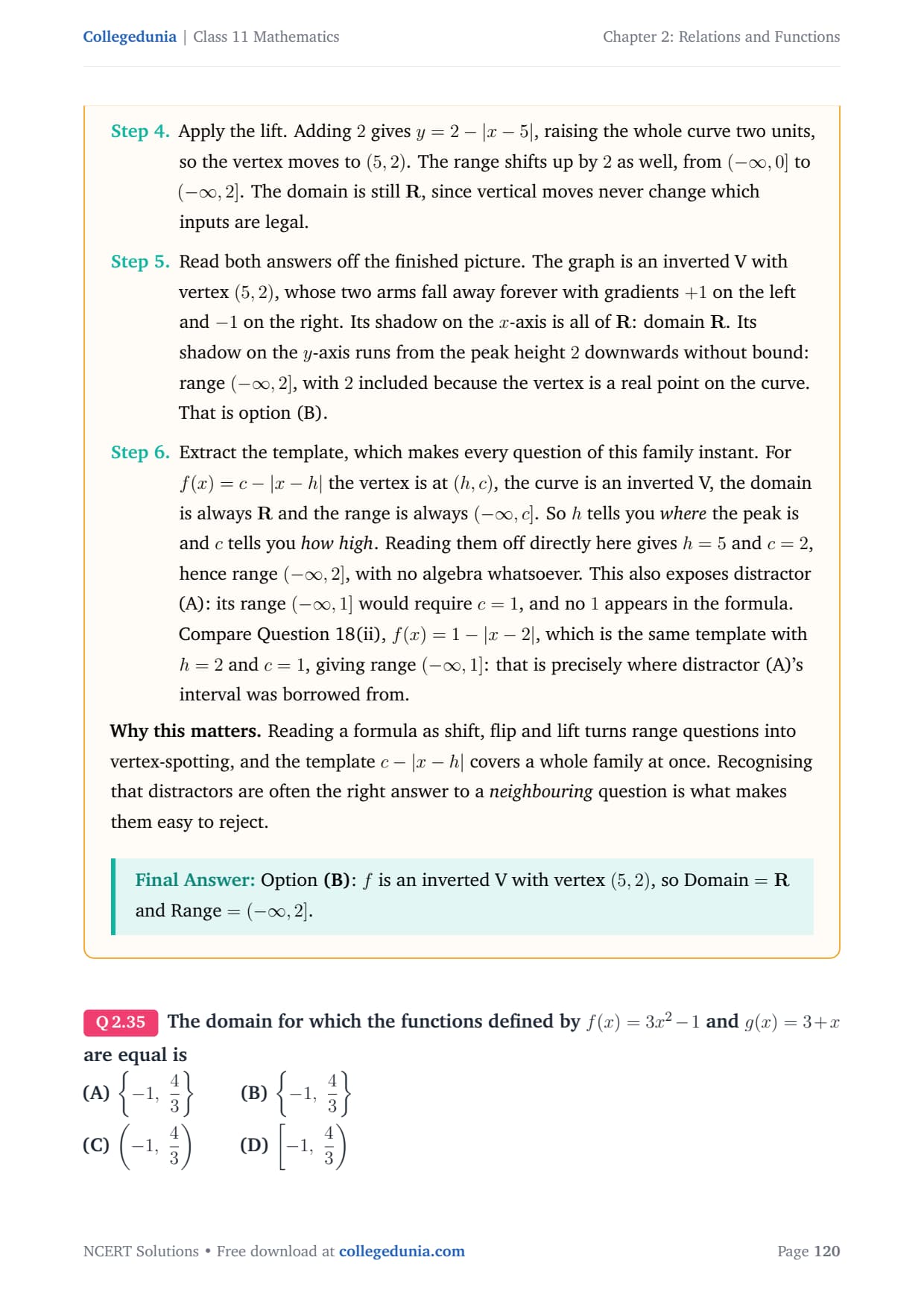
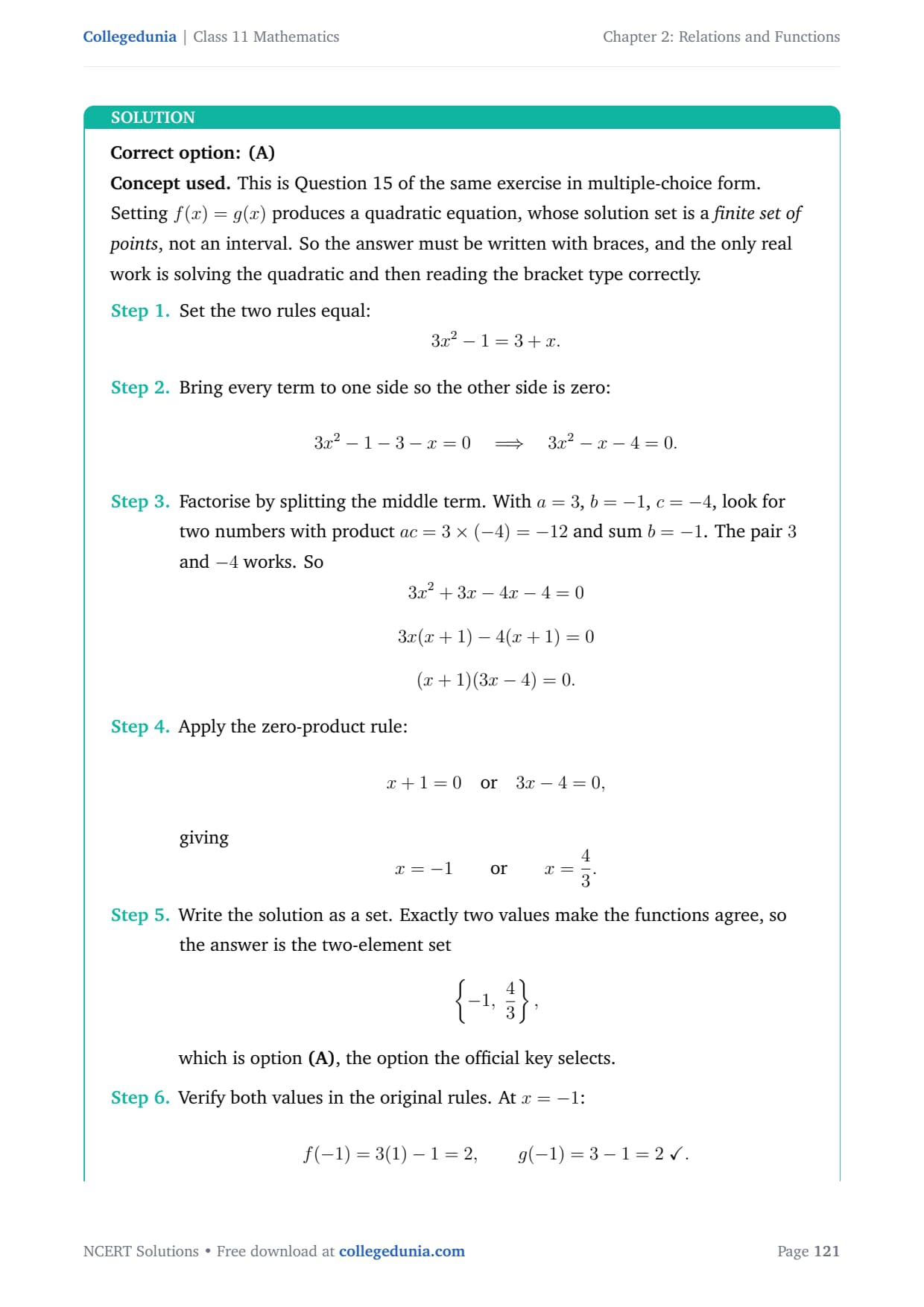
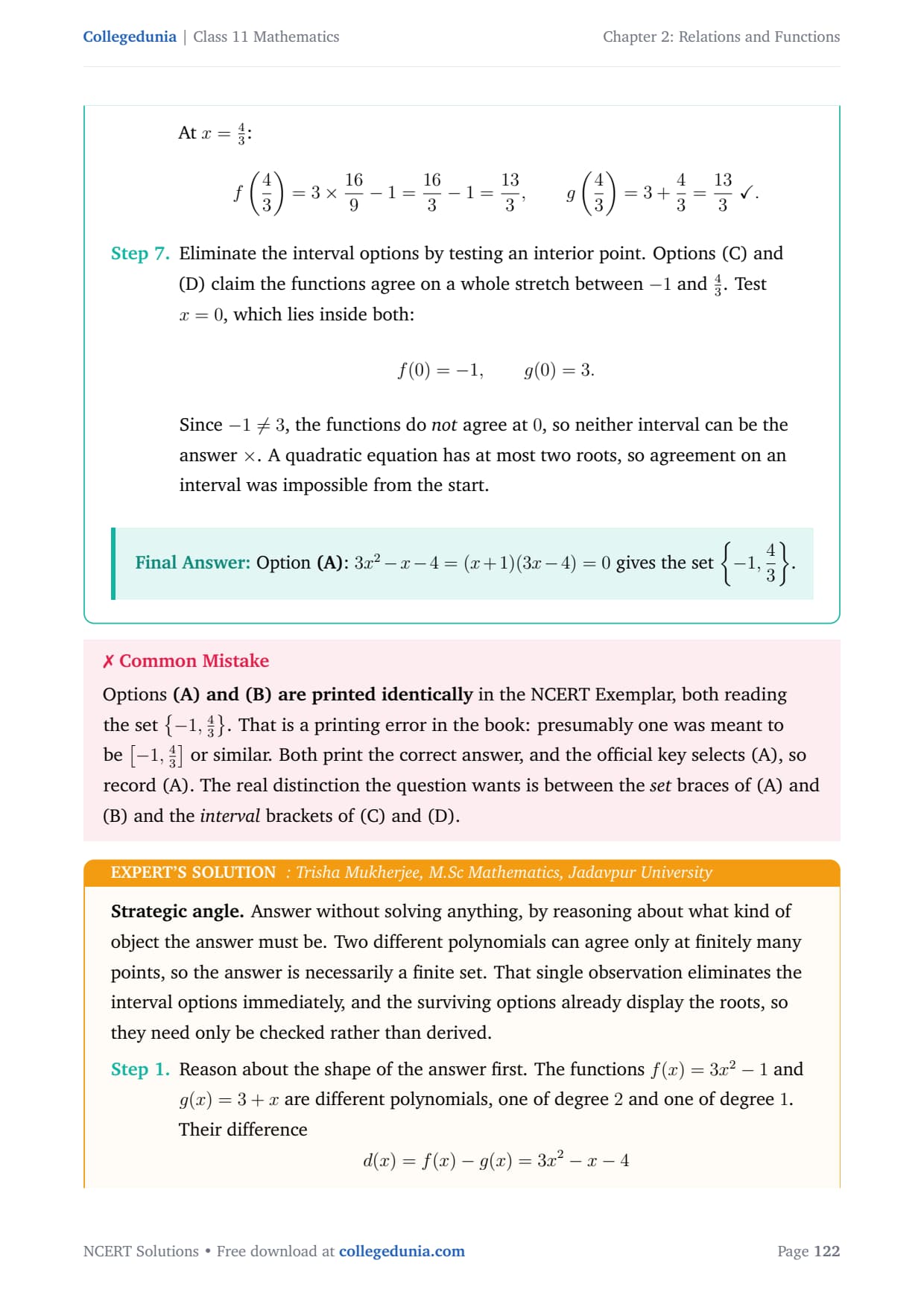
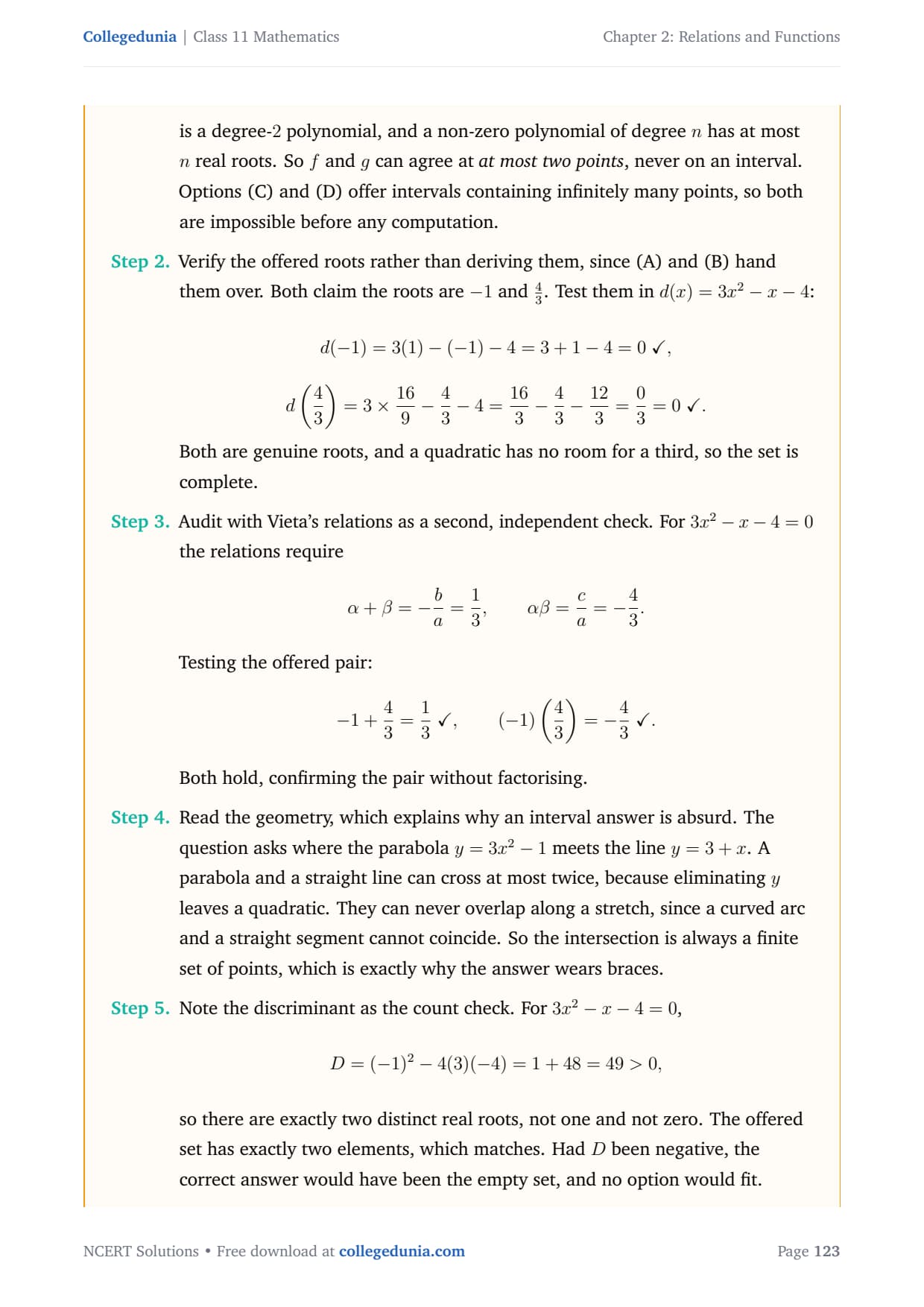
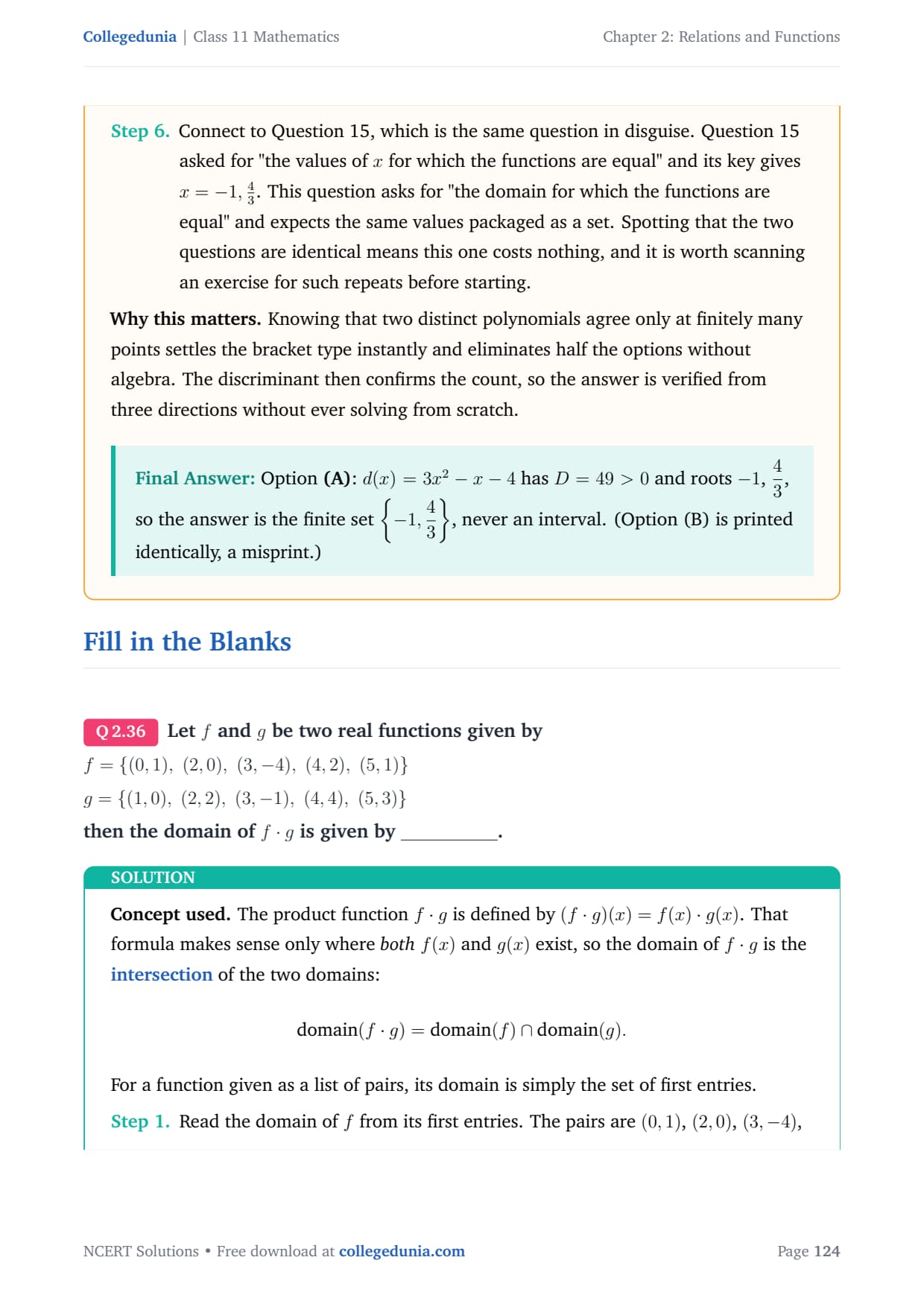
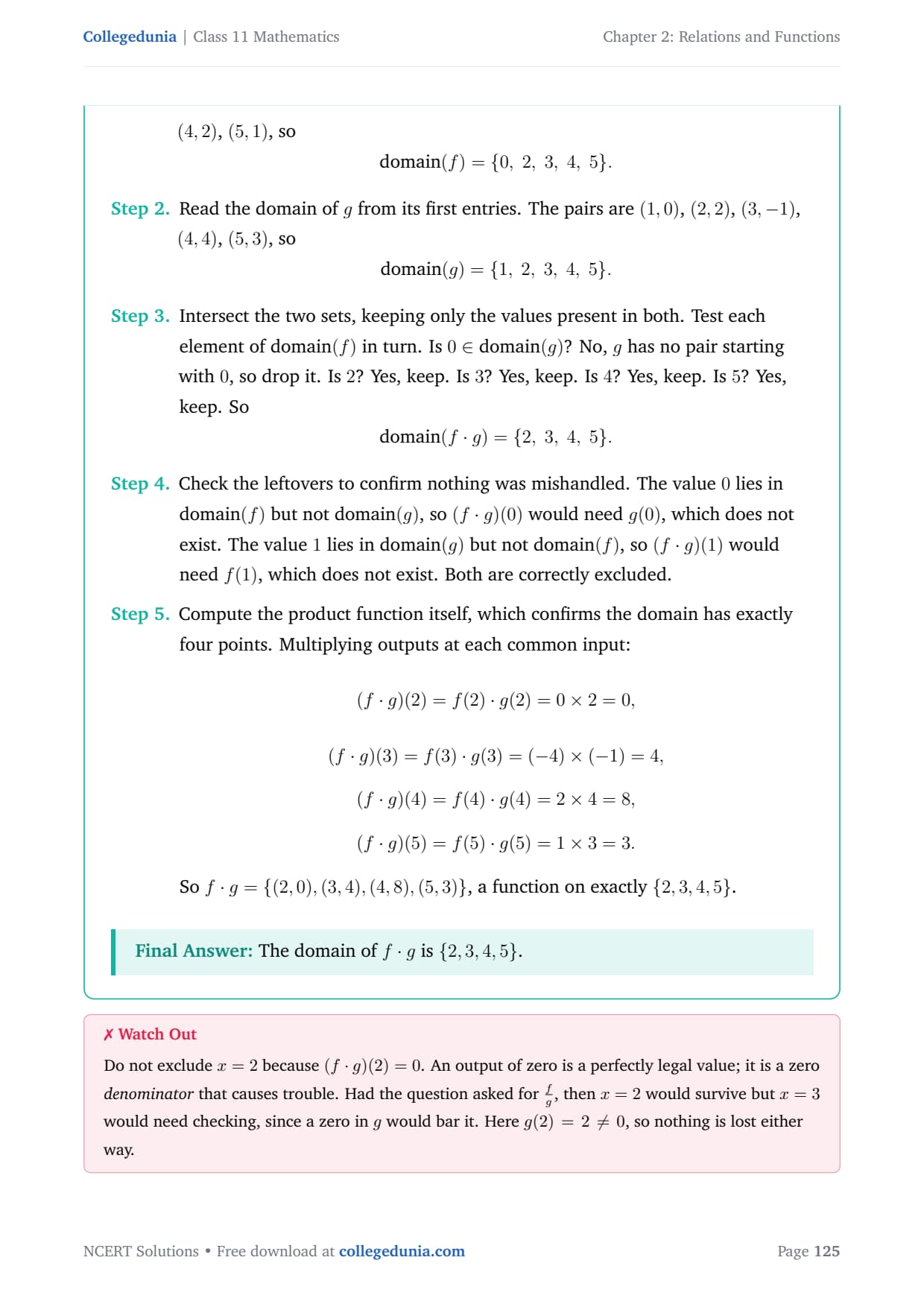
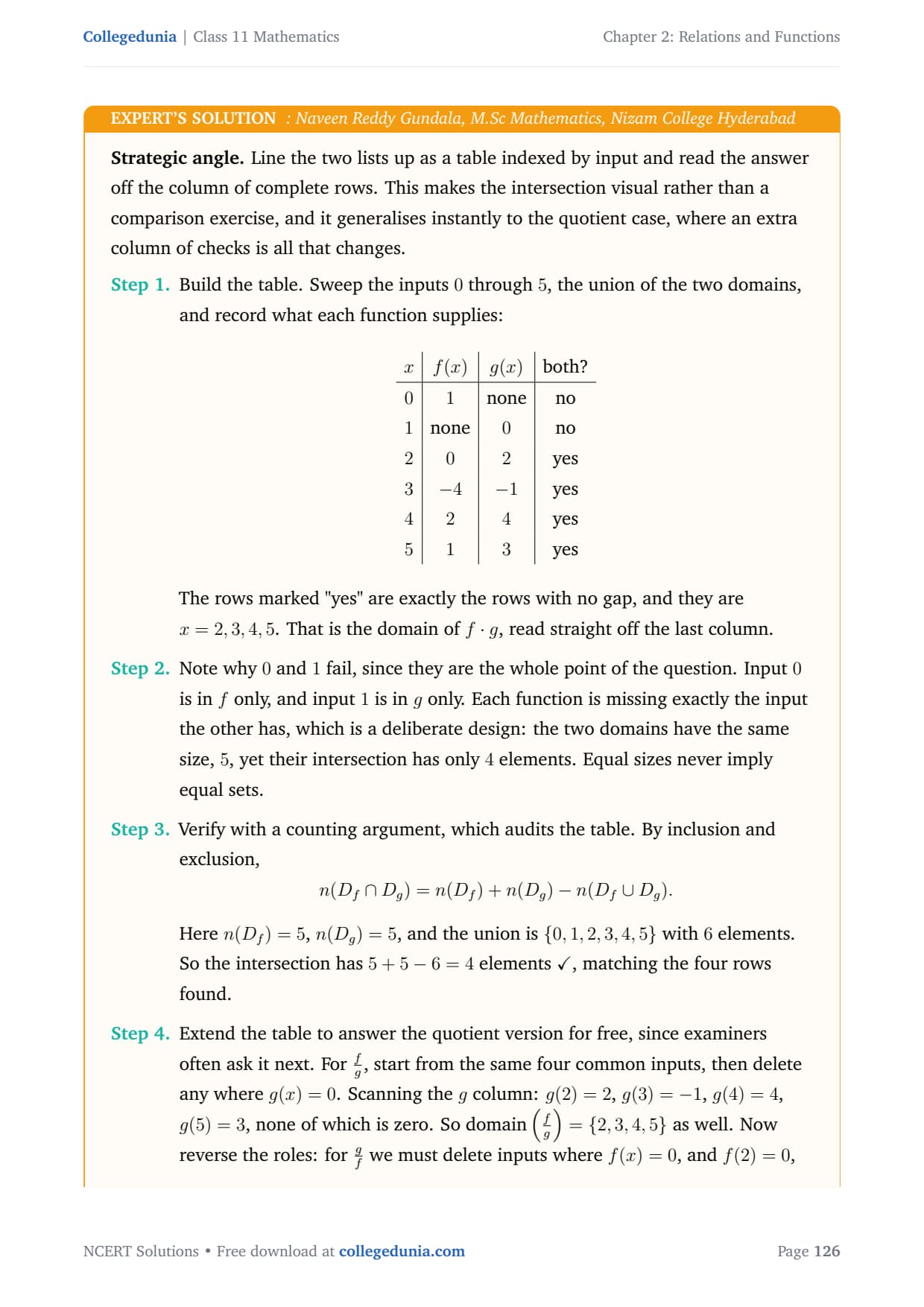
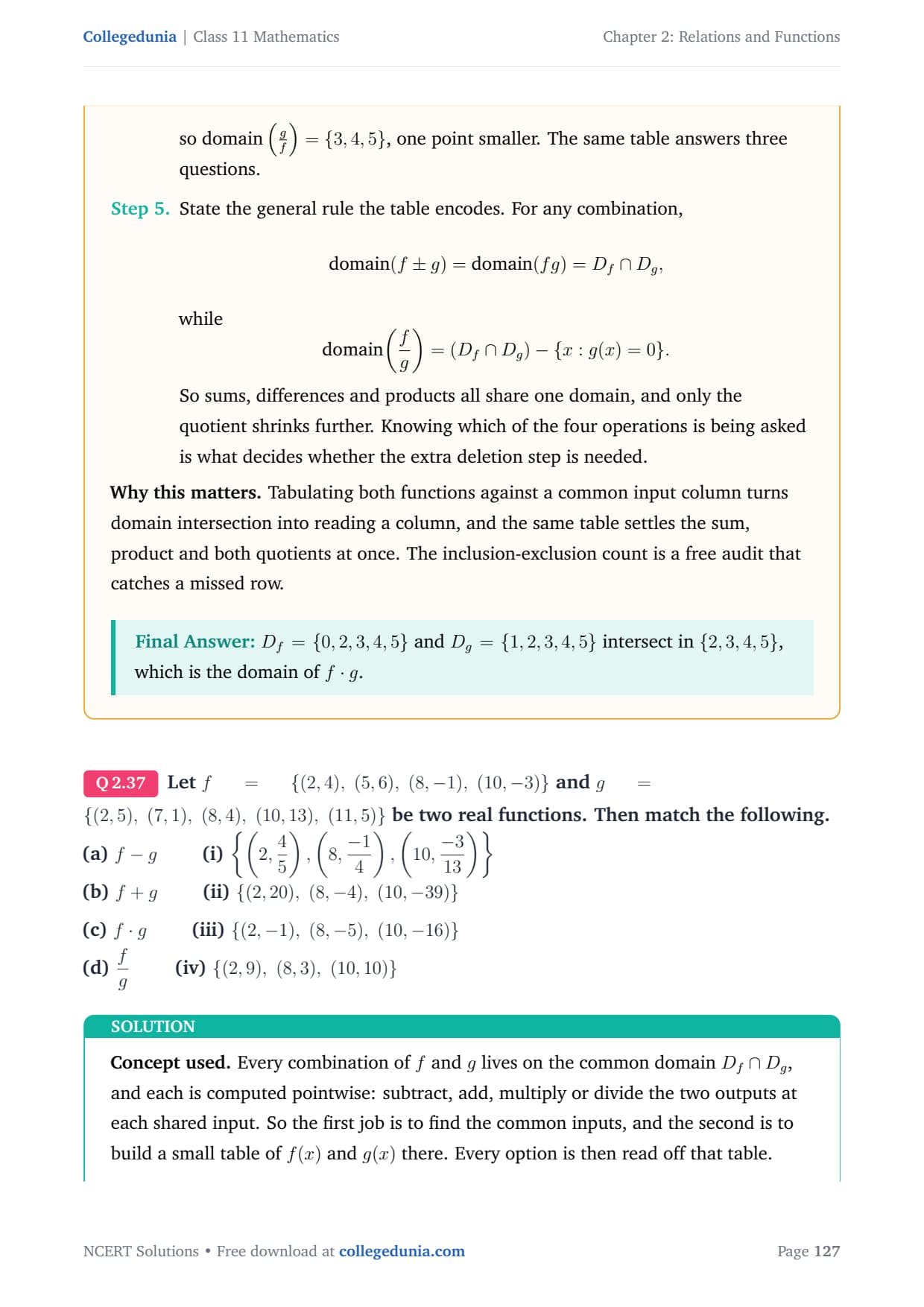
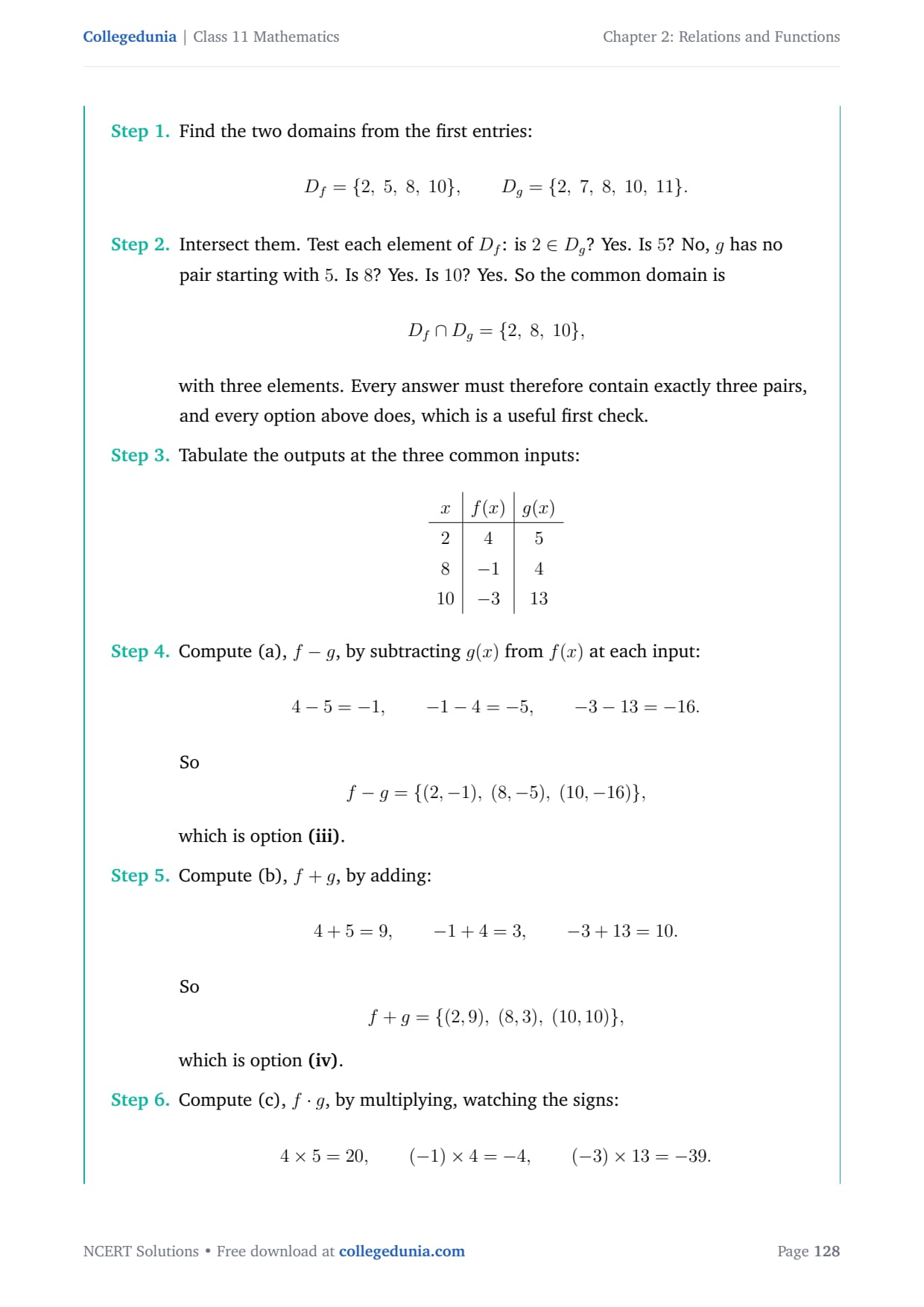
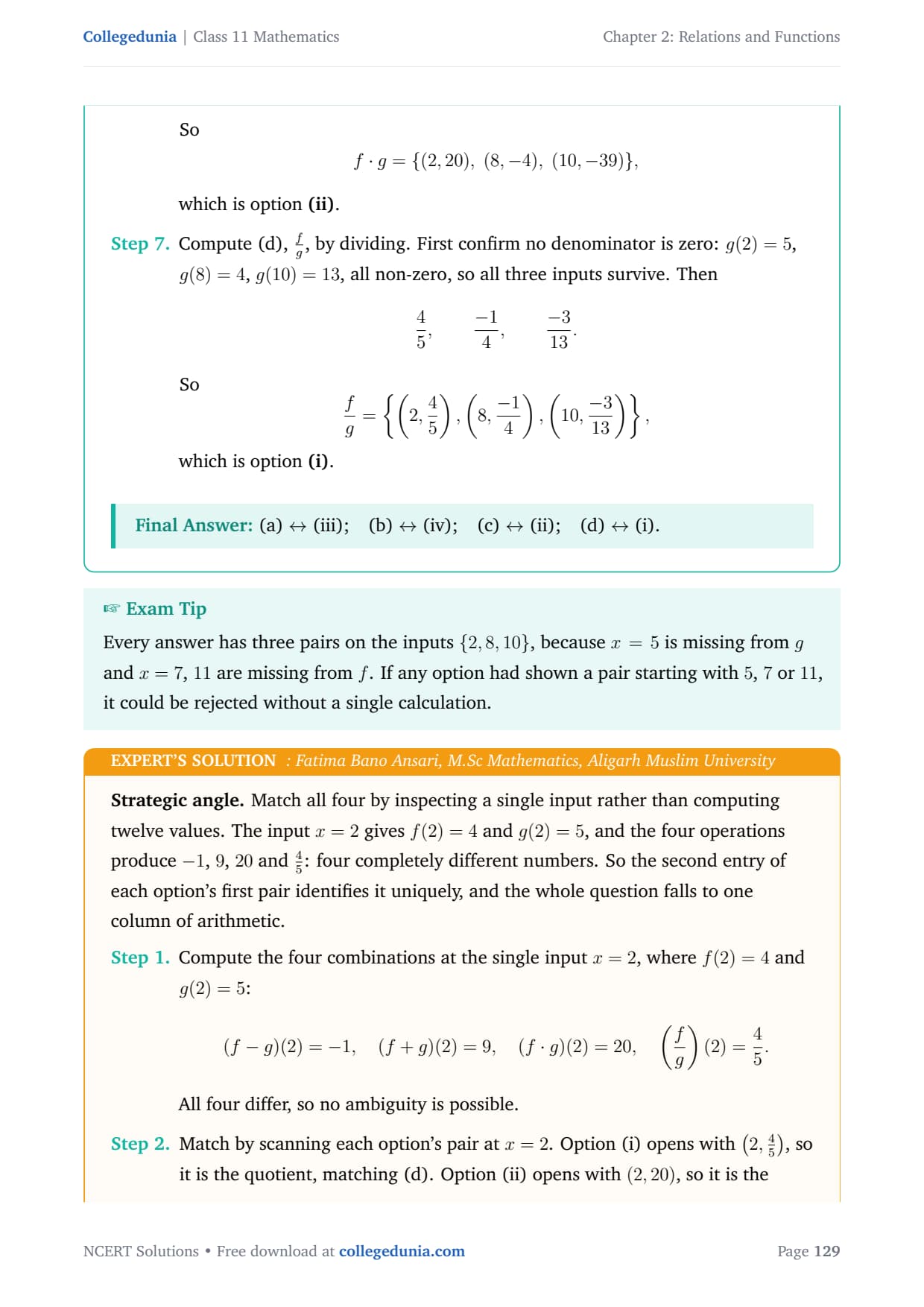
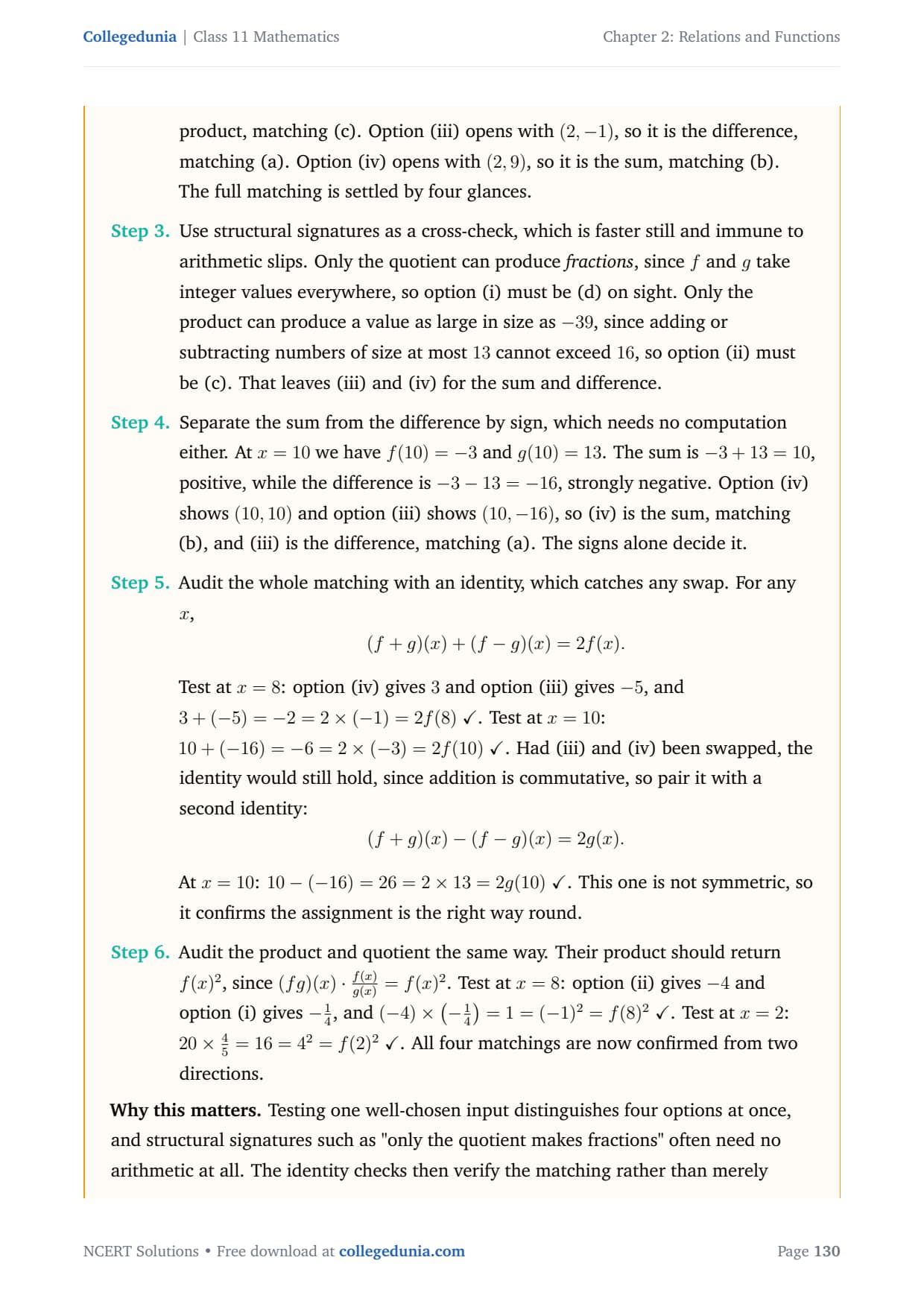
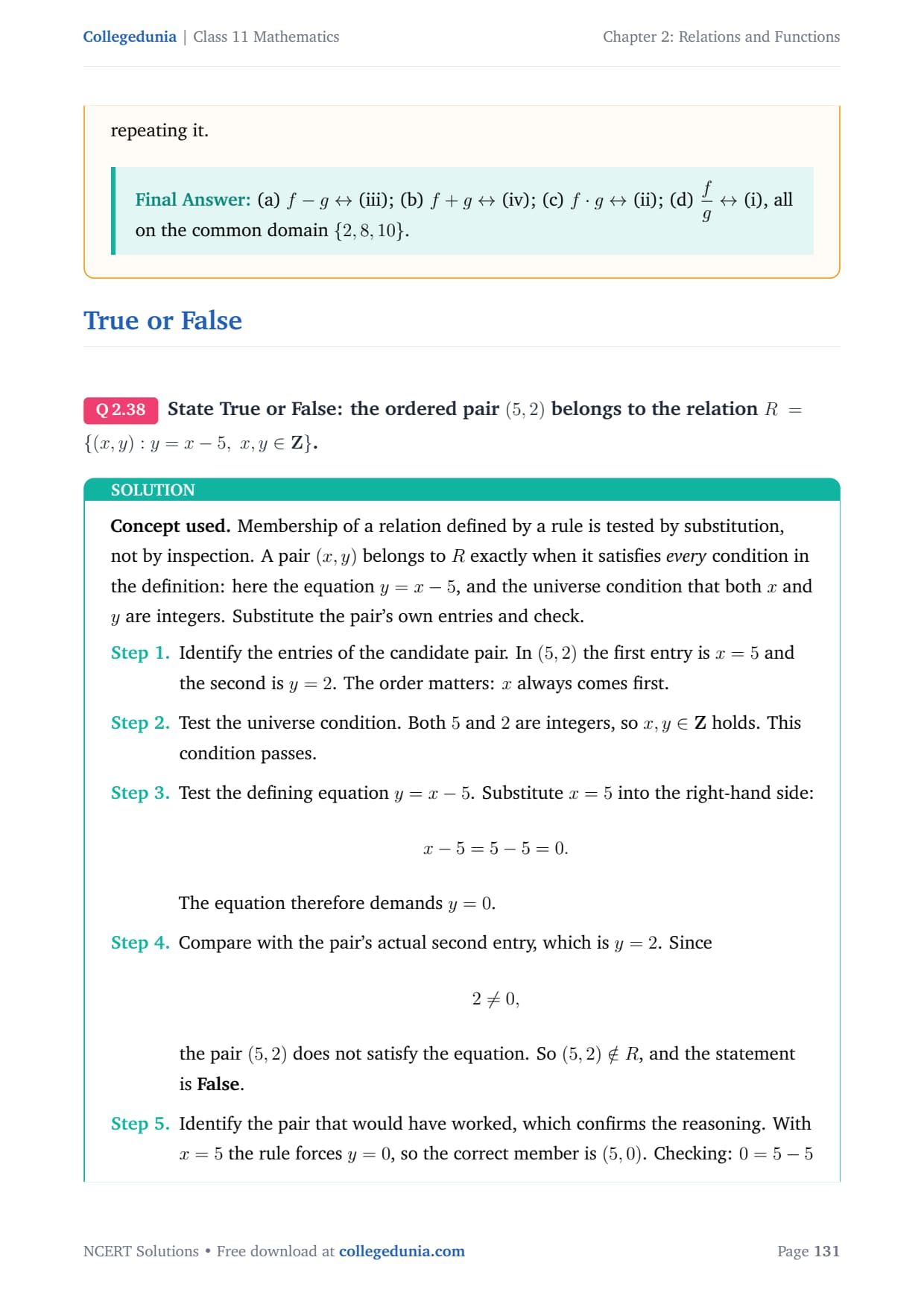
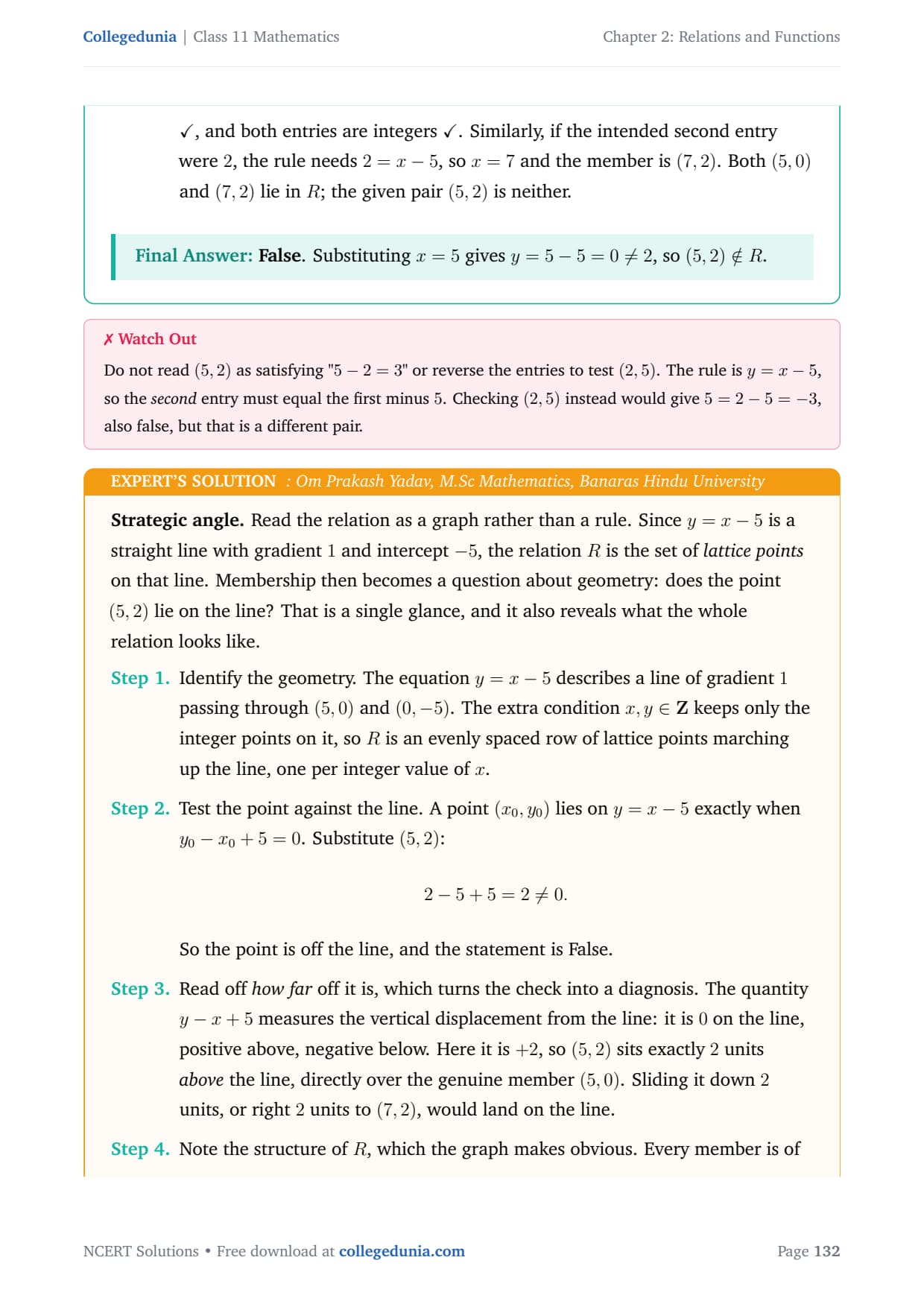
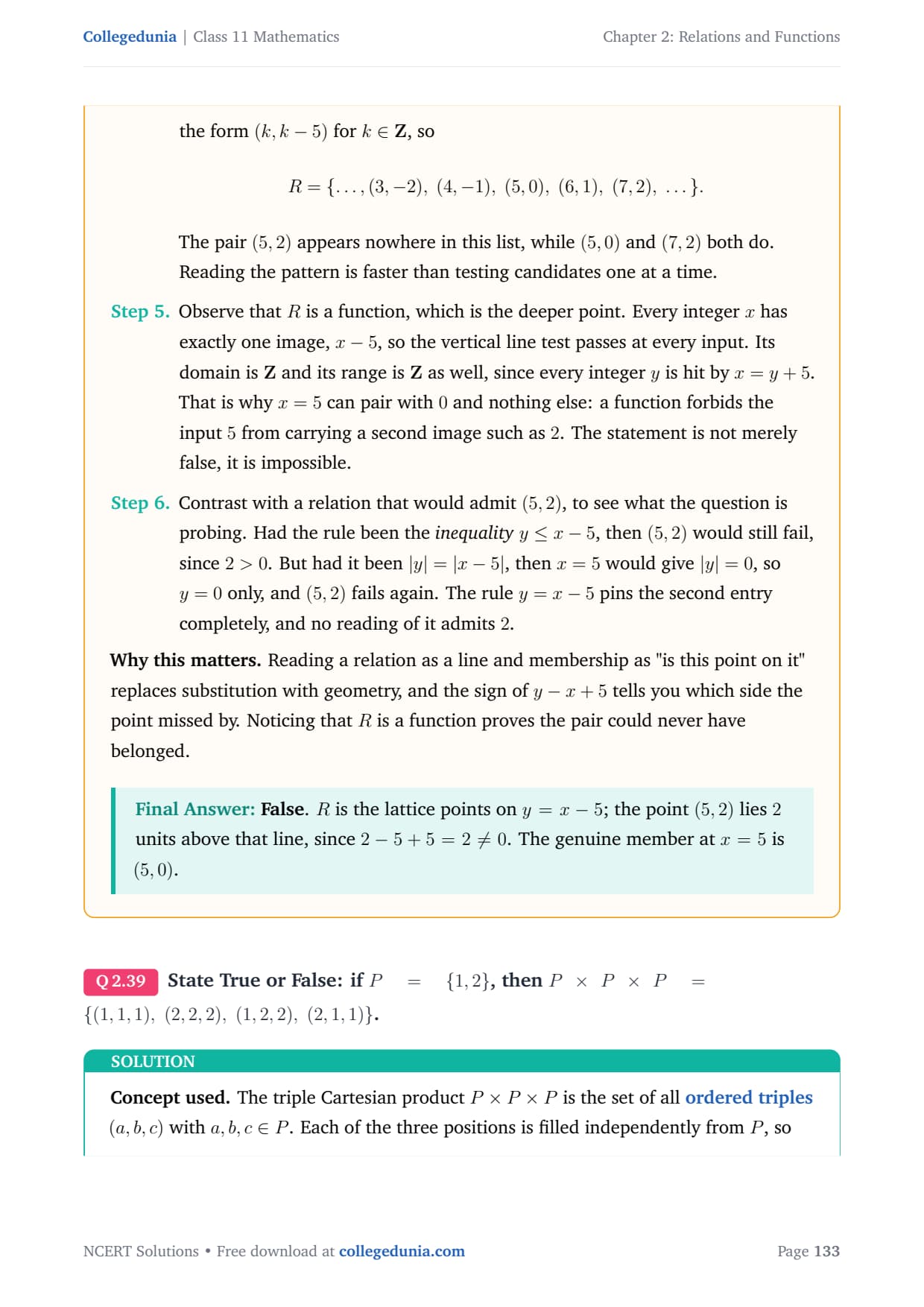
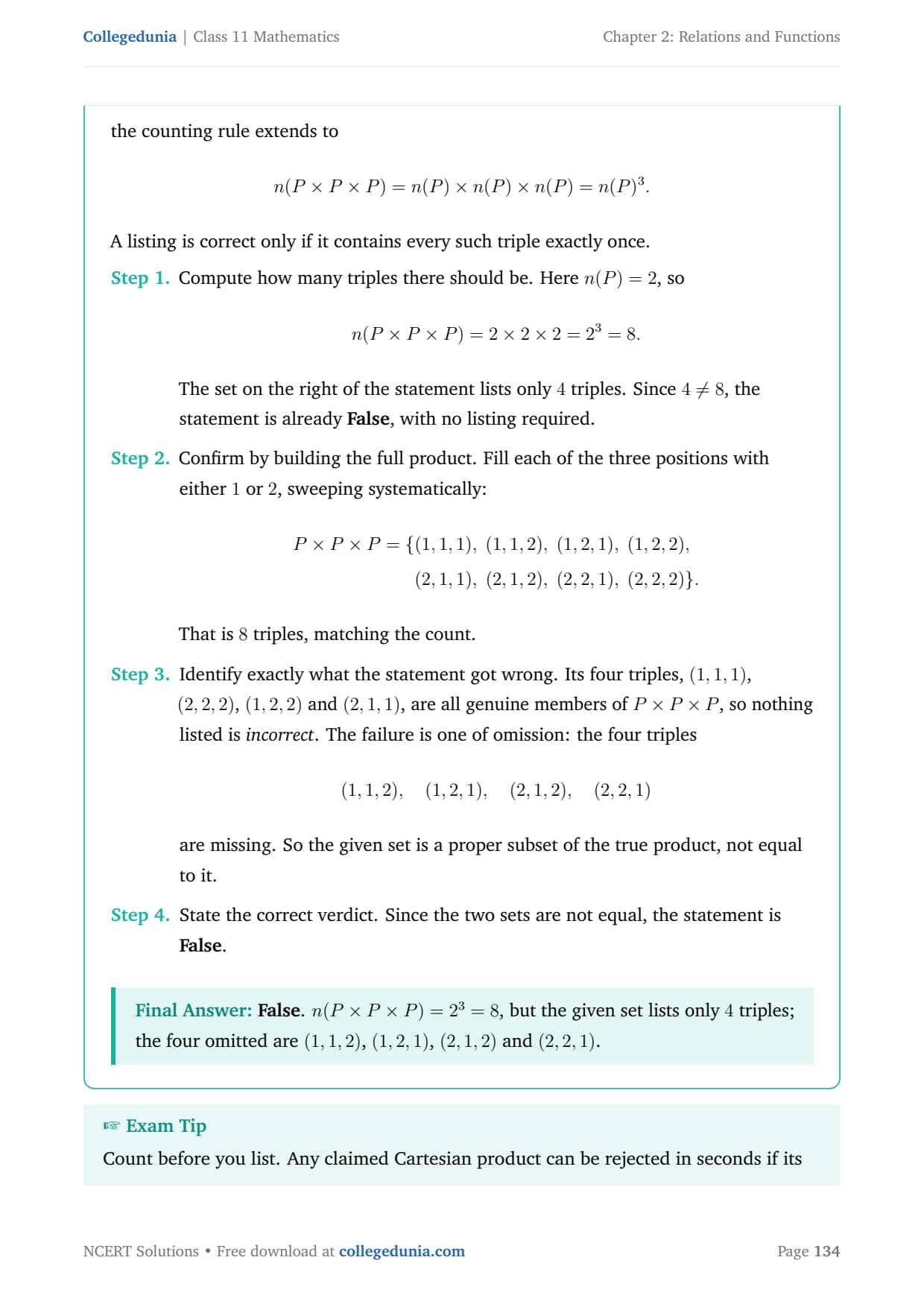
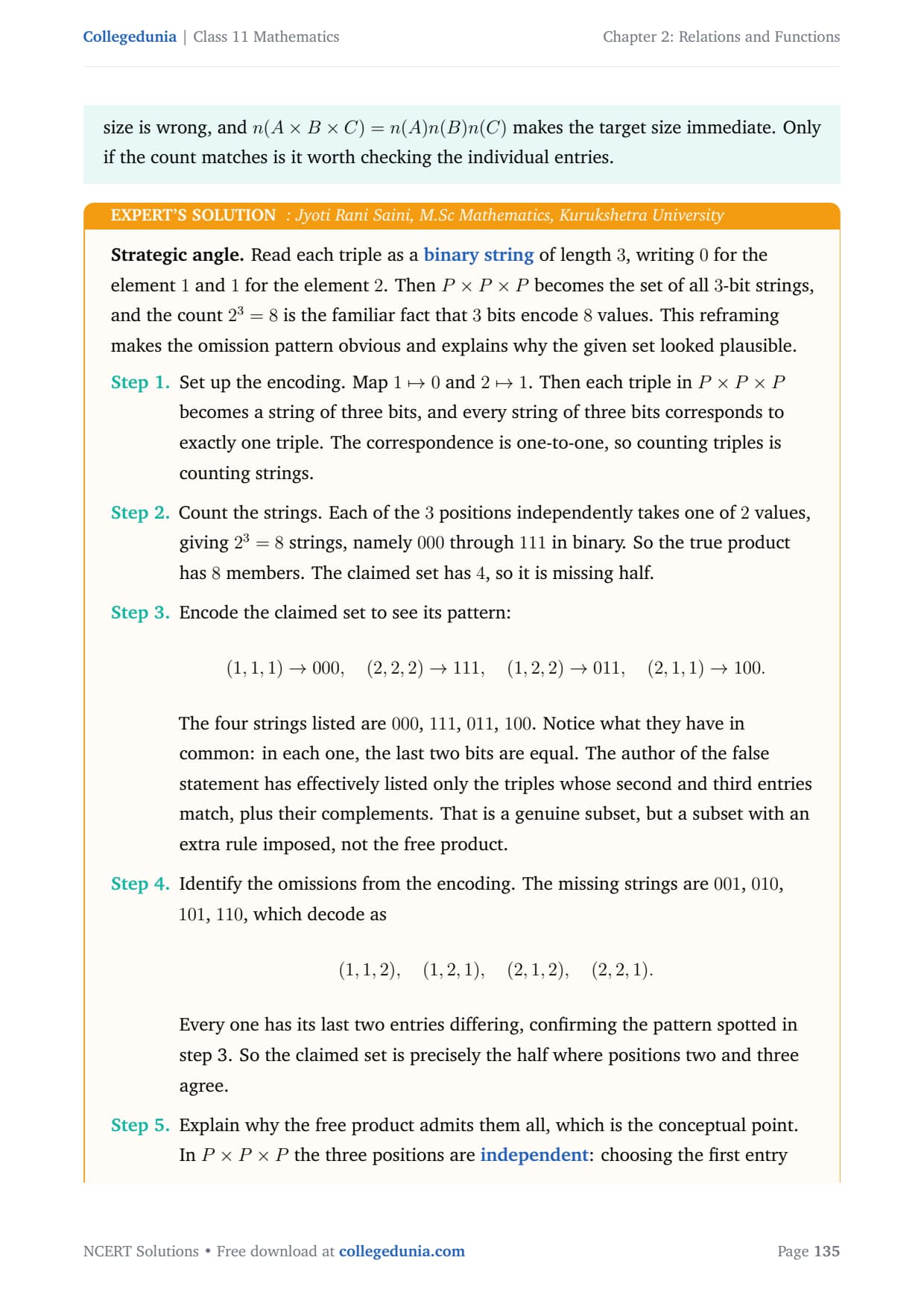
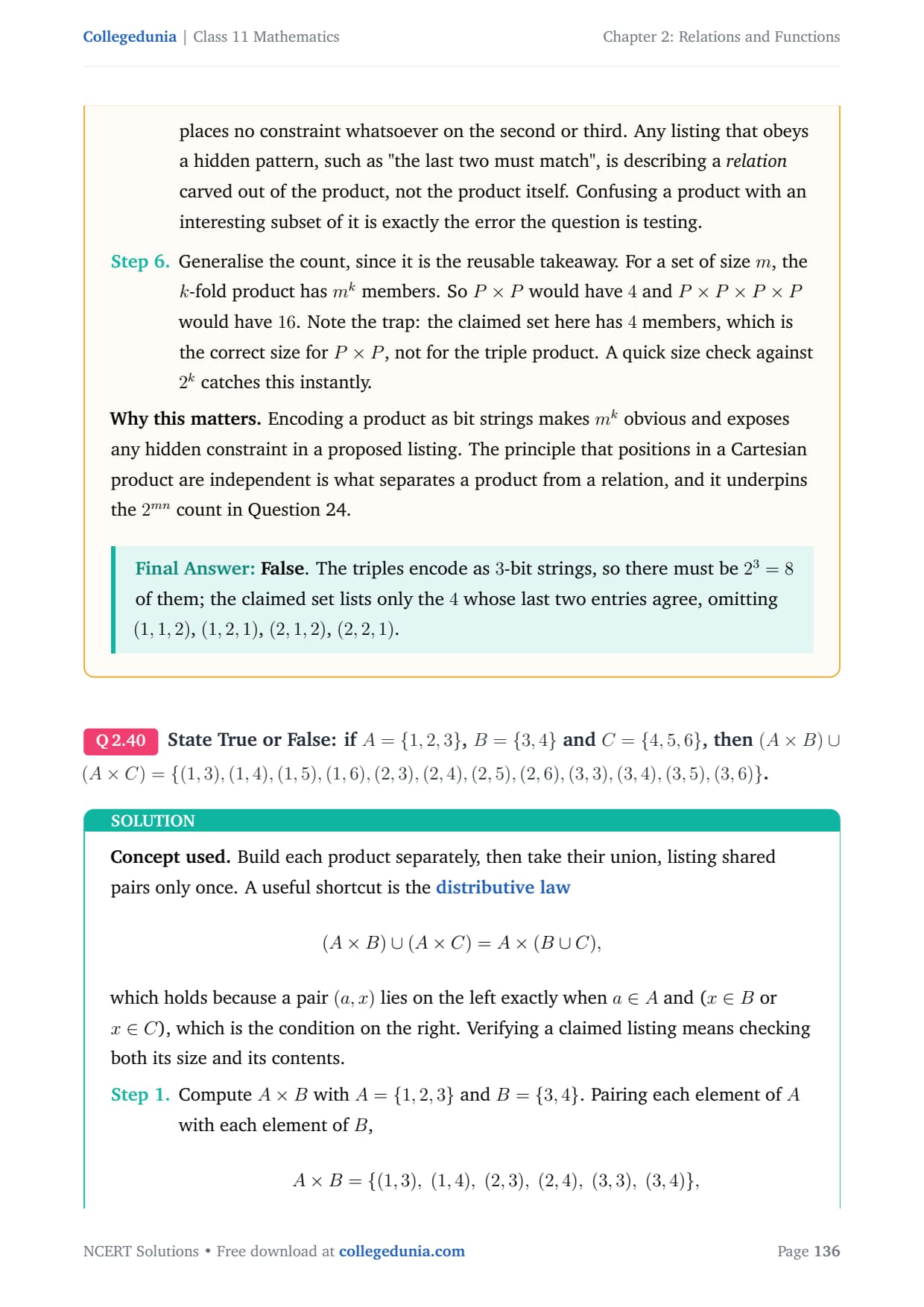
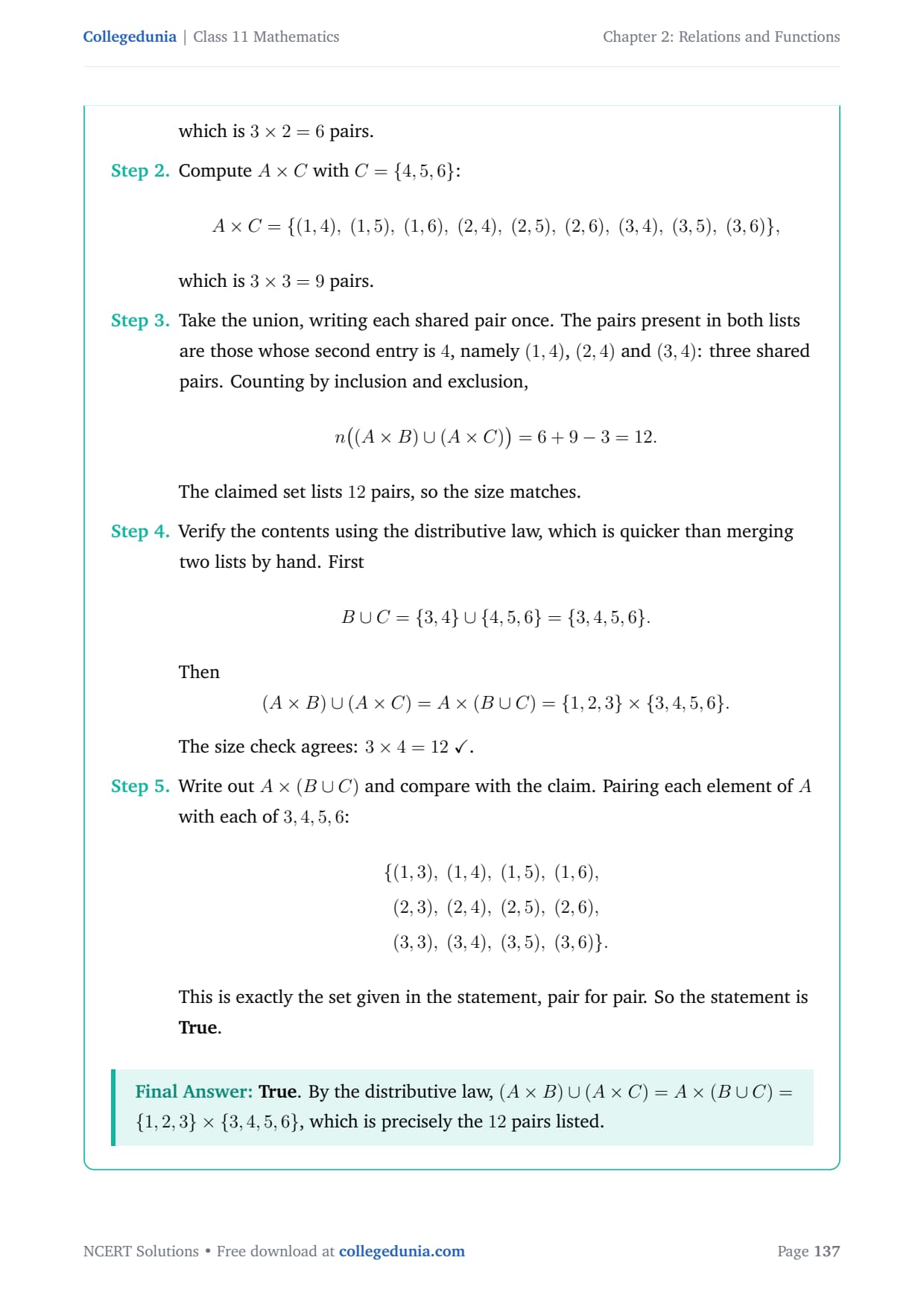
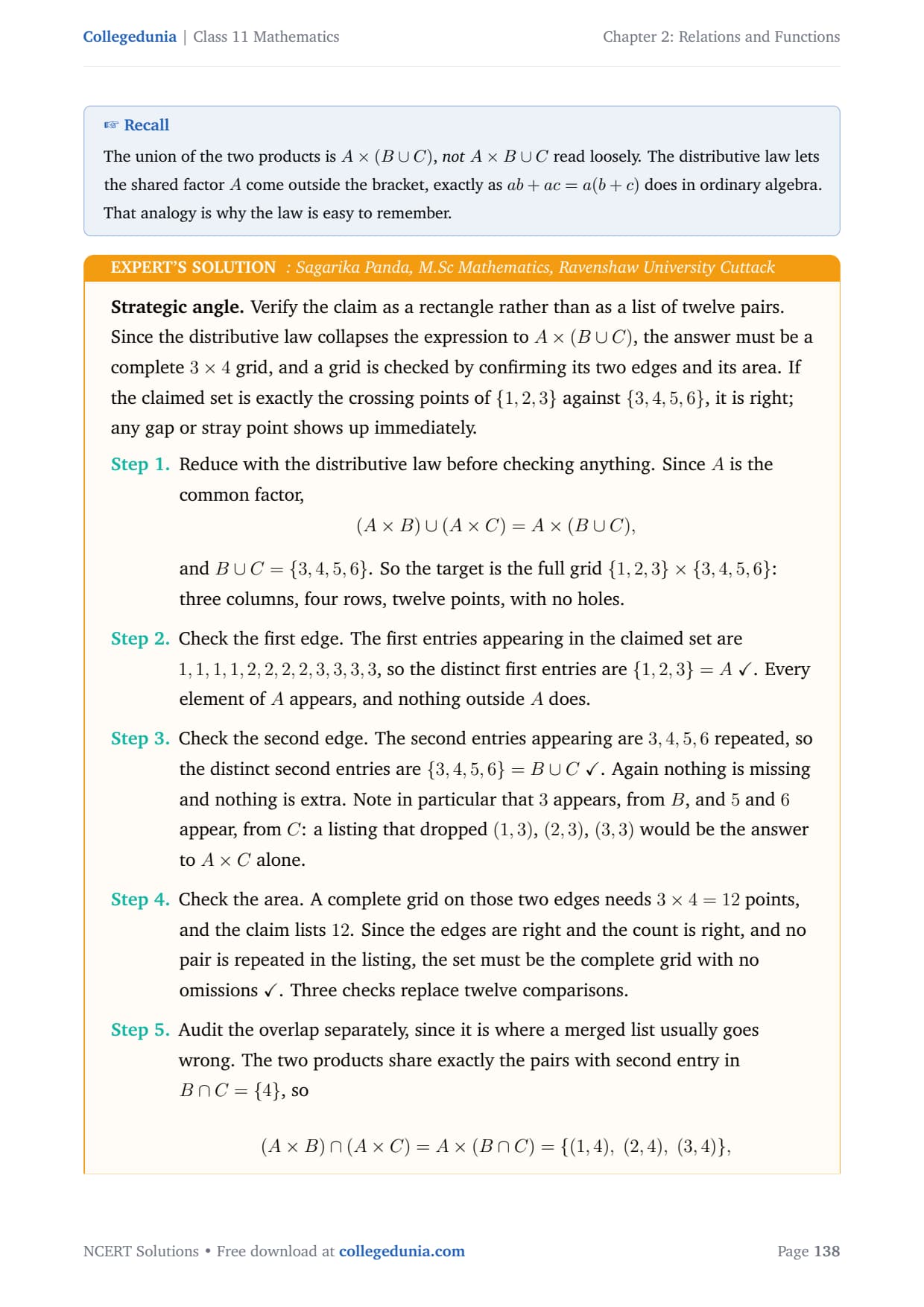
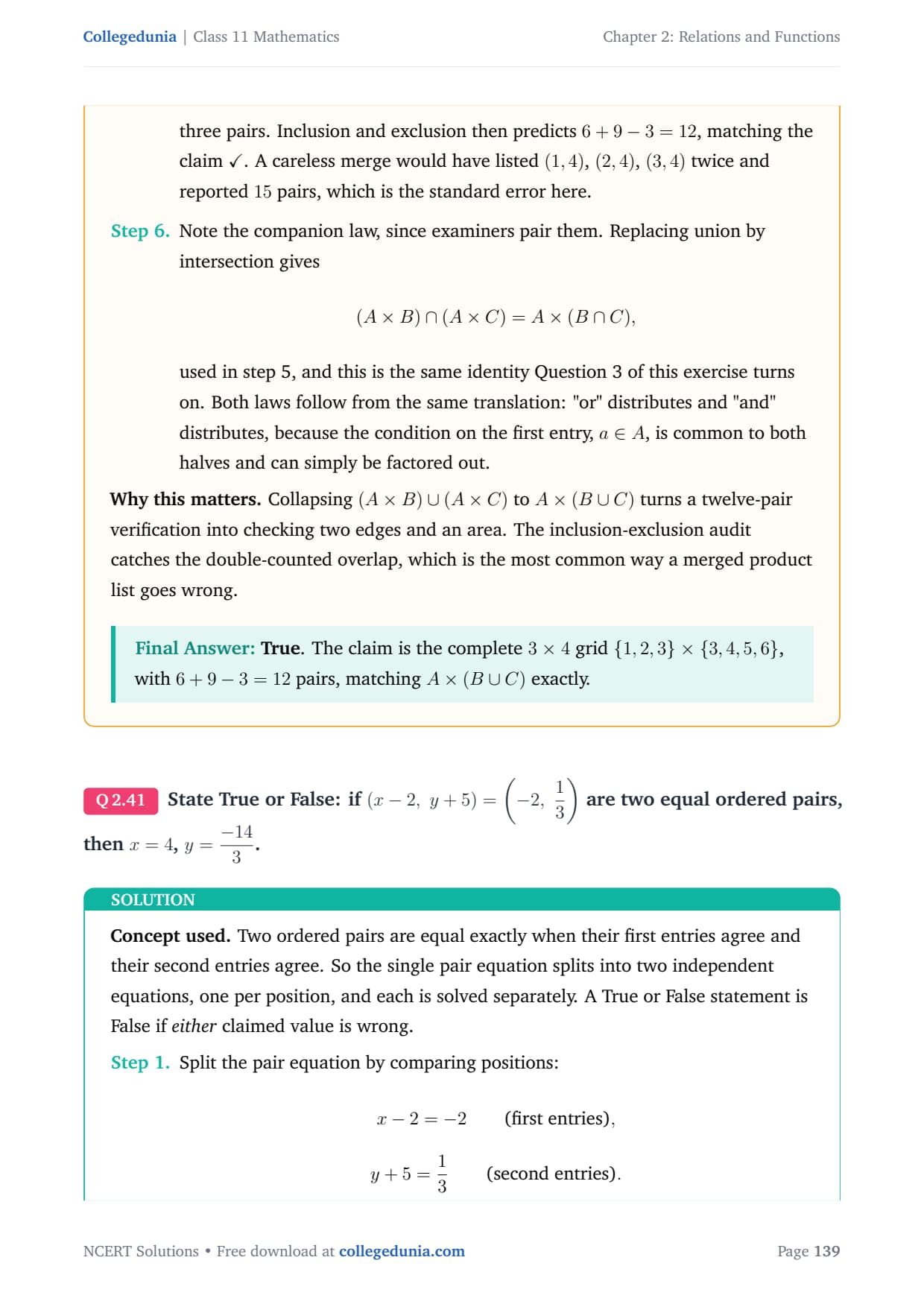
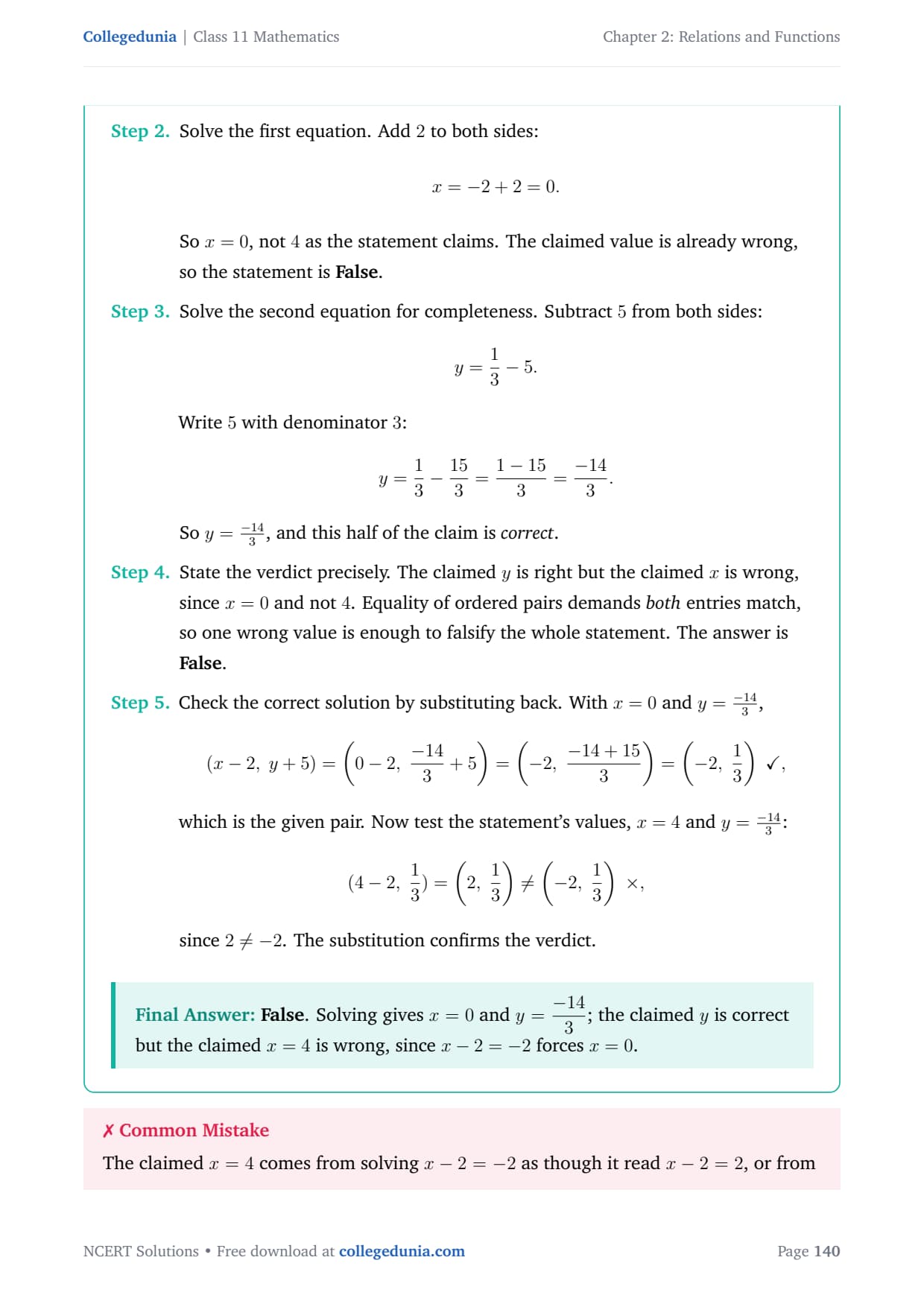
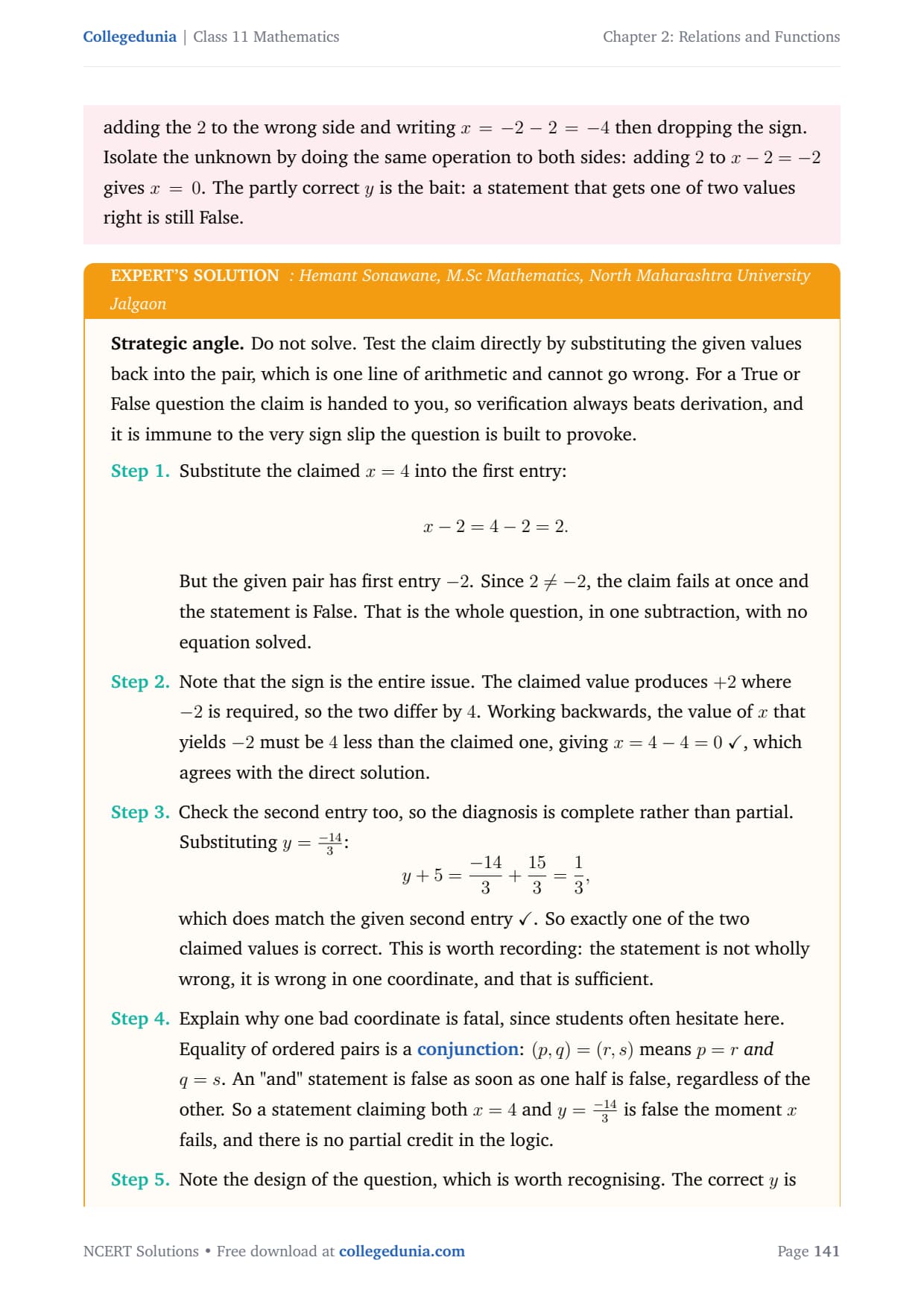
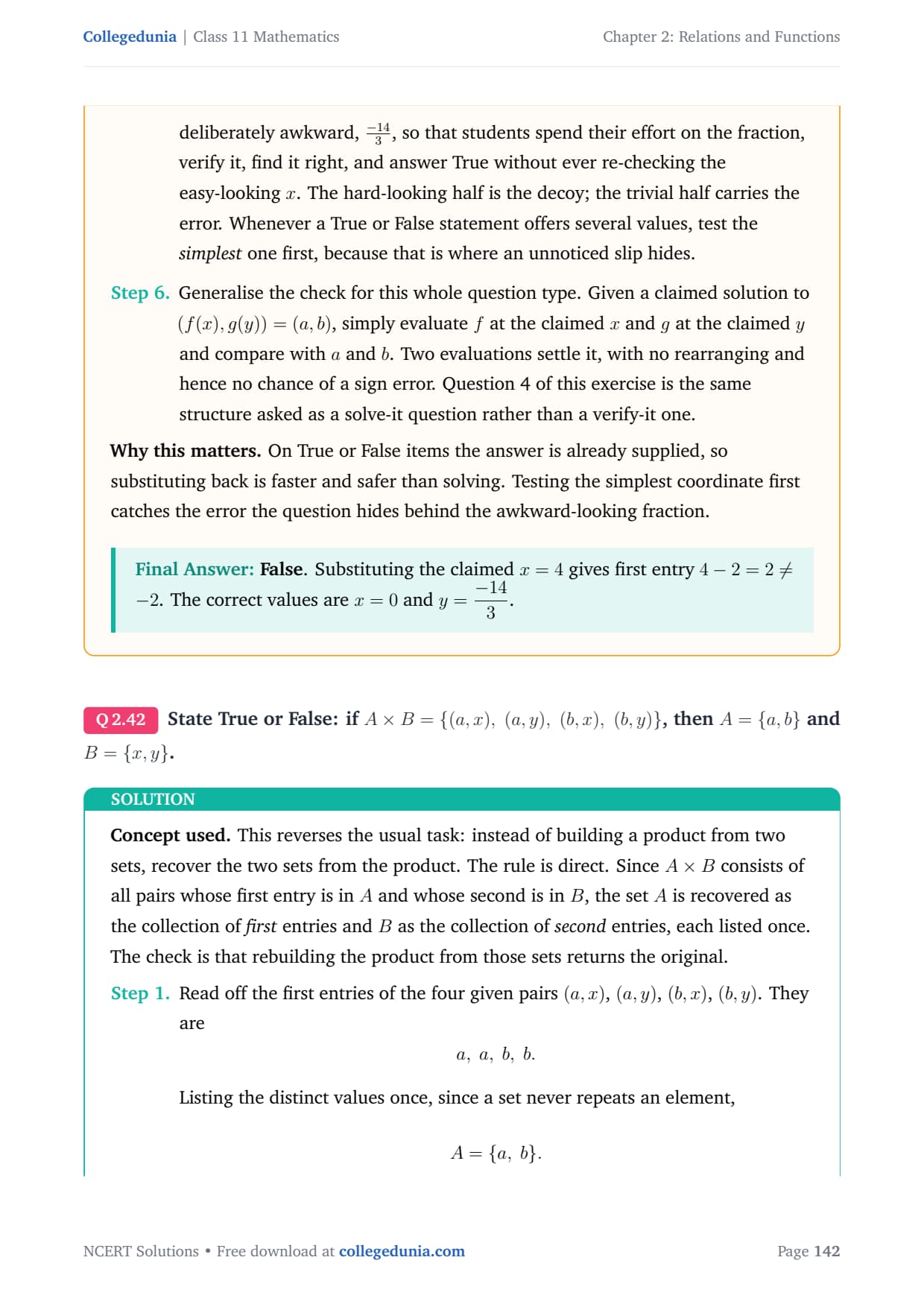
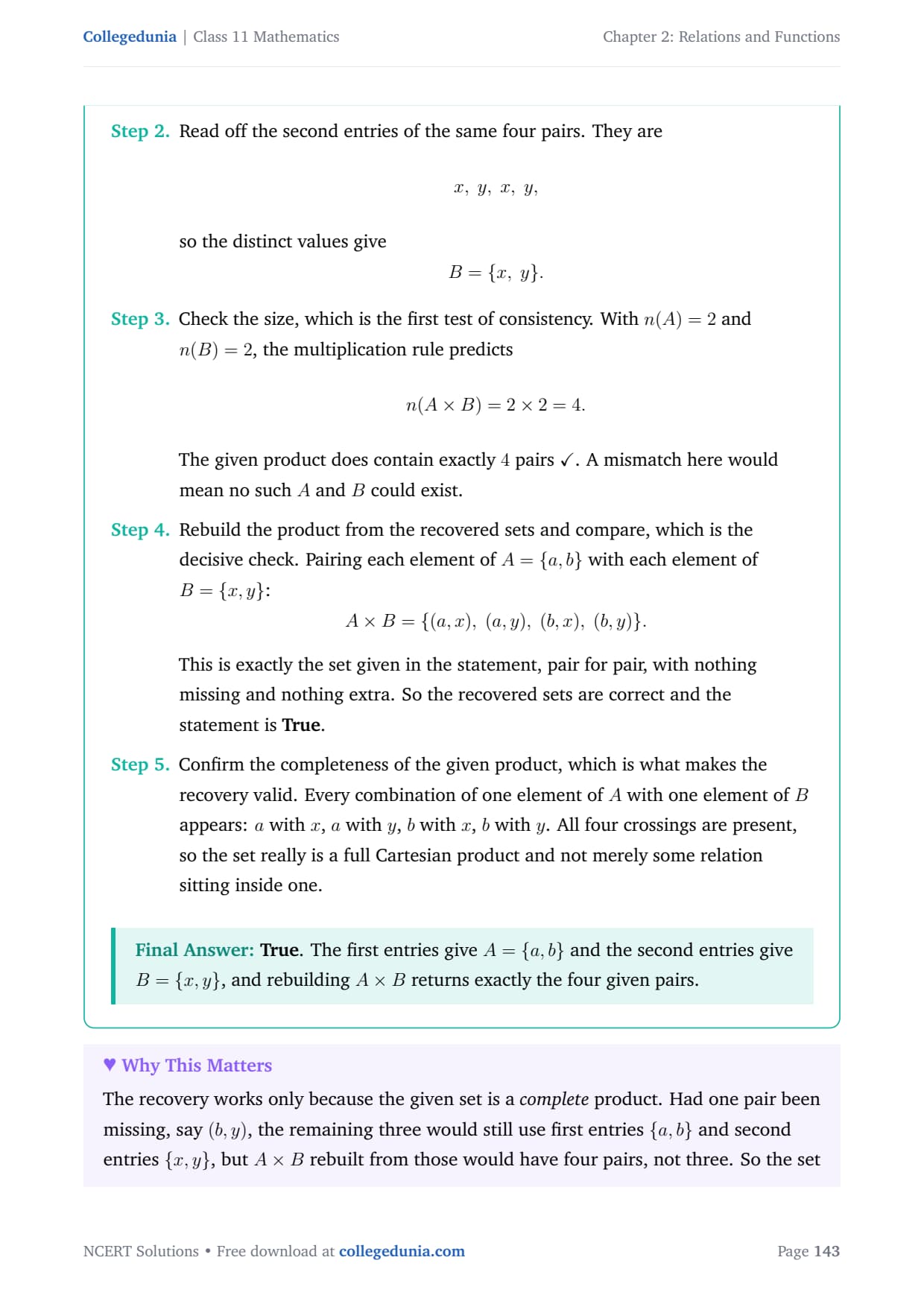
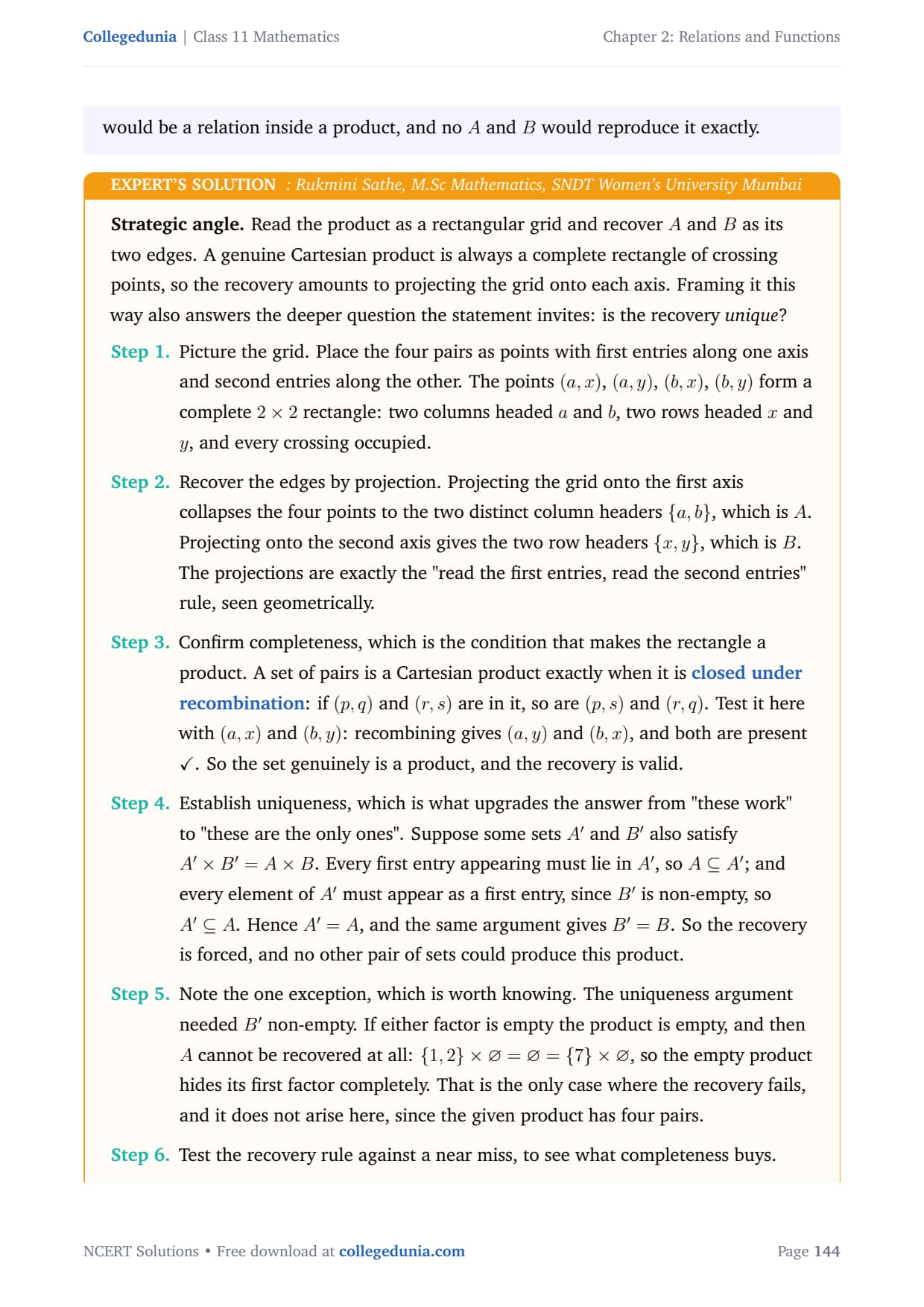
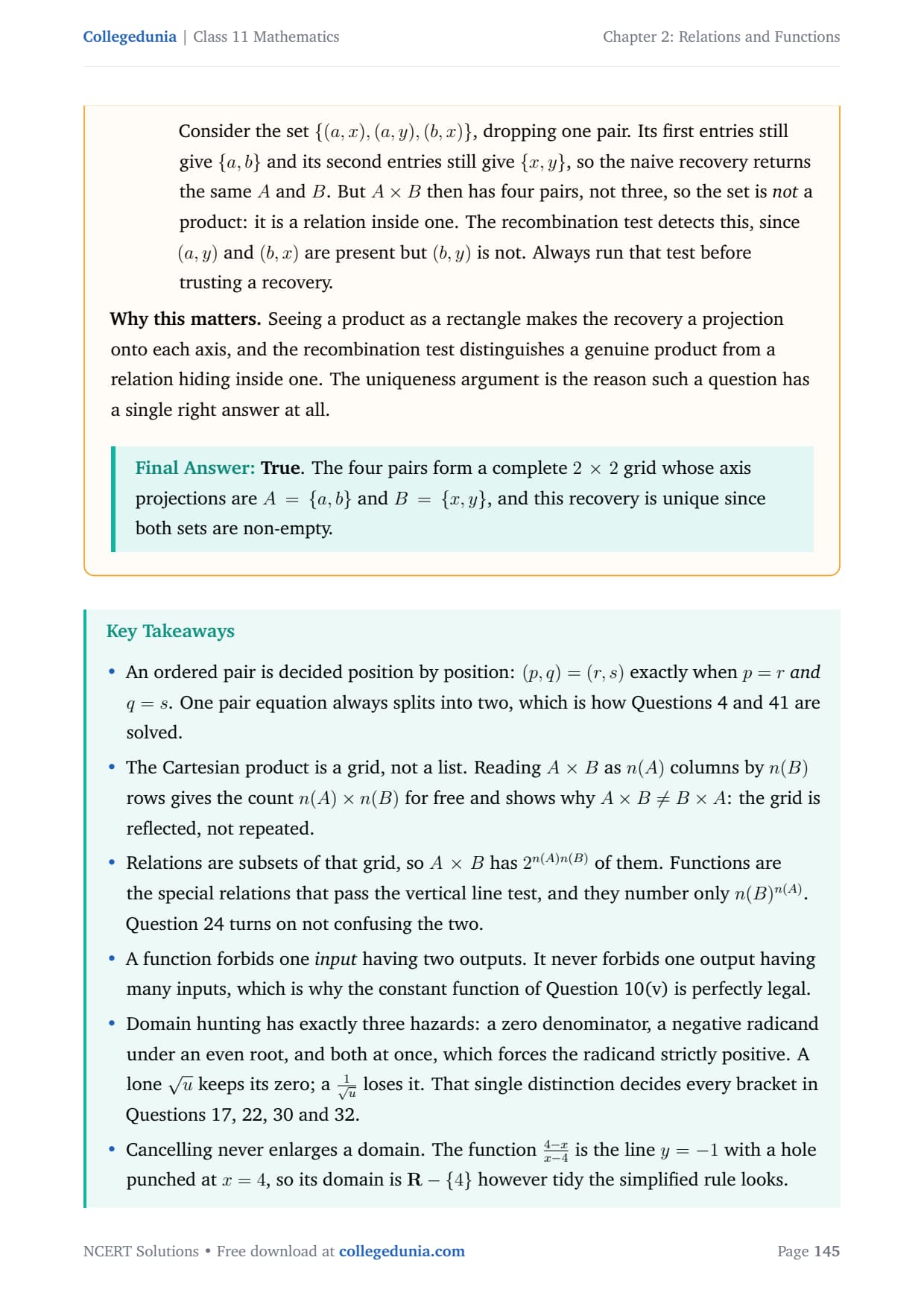
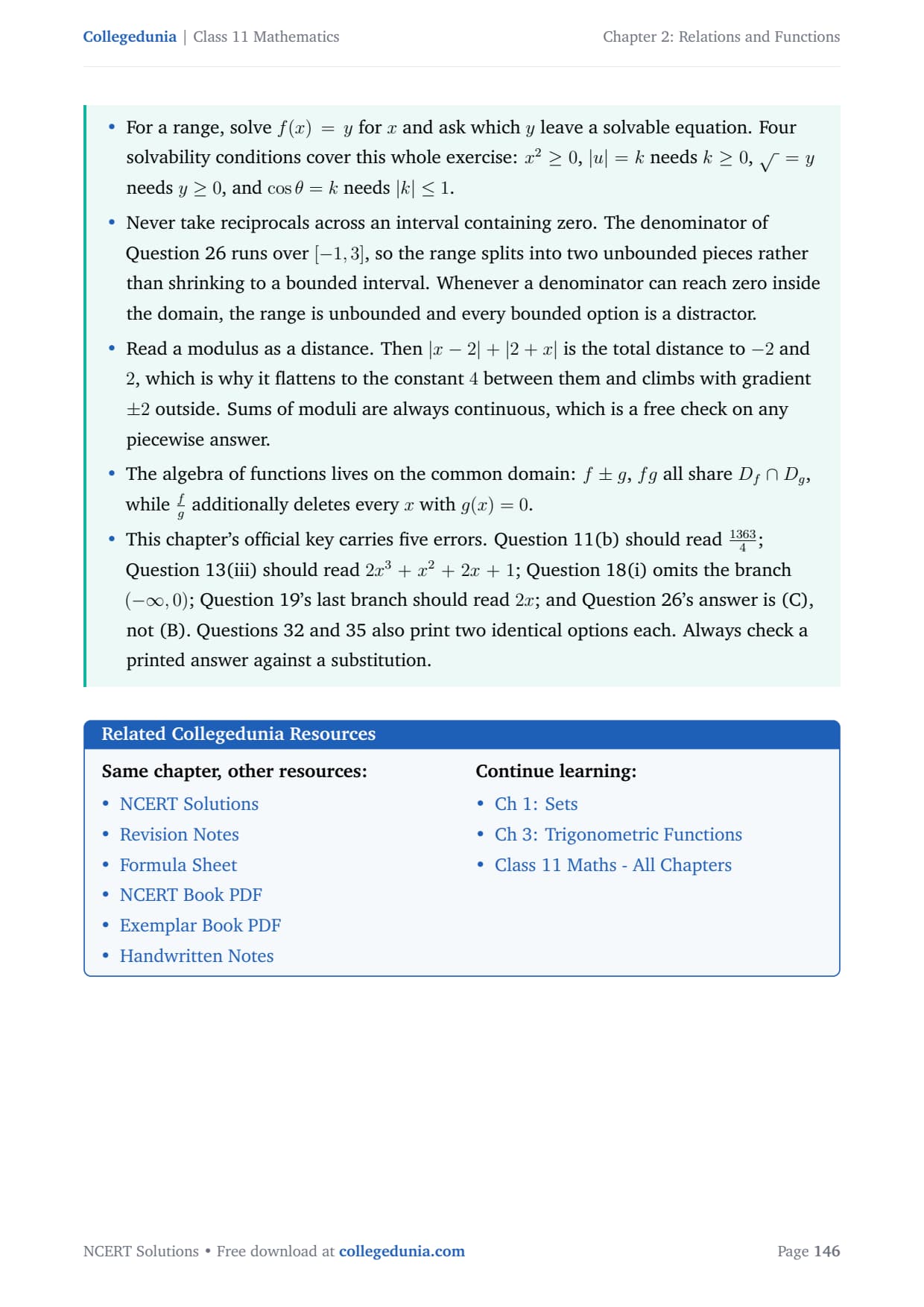
Every solution in this Collegedunia set is prepared by subject experts, based on the 2026-27 NCERT Exemplar, and checked line by line against the official answer key.
Chapter 2 has a single long exercise, Exercise 2.3, that mixes five question formats. The solutions PDF runs to 146 pages and covers all of them.
- 42 questions solved: Short Answer, Long Answer, Objective, Fill in the Blanks and True/False.
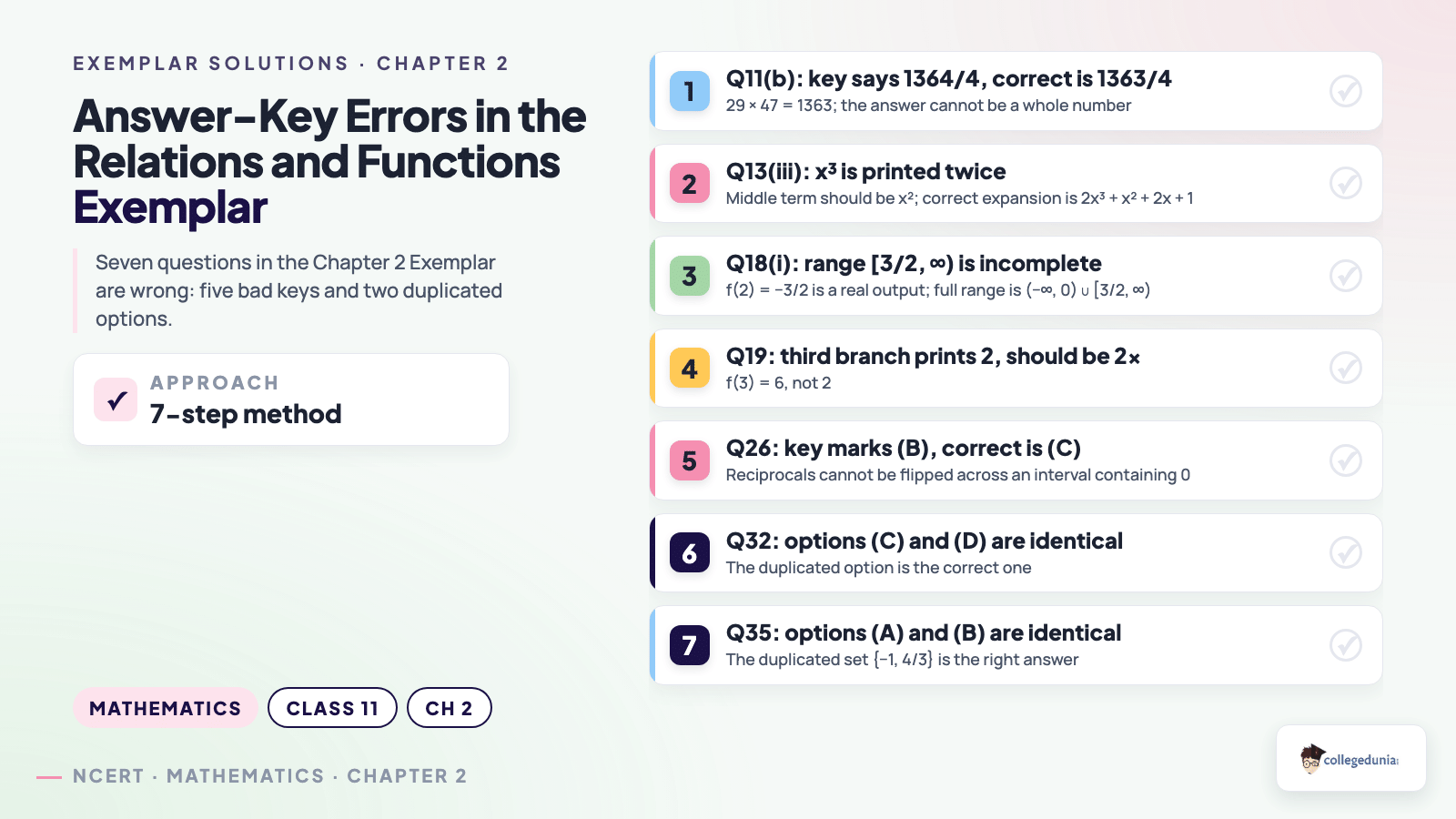
- Seven answer-key errors flagged: the printed book is wrong on Q11, Q13, Q18, Q19, Q26, Q32 and Q35.
- Exam focus: useful for CBSE Boards, JEE Main, JEE Advanced and CUET.
Topics Covered in the Class 11 Maths Relations and Functions Exemplar
The Relations and Functions Exemplar takes the textbook ideas and hides them inside domain traps. Most questions look like plain substitution but need a domain check first. These are the topics the 42 questions are built on.
- Cartesian products: finding A × B, and using n(A × B) = n(A) × n(B) to work backwards to A and B.
- Relations as sets of pairs: writing a relation in roster form, then reading its domain and range off the list.
- Function or not: deciding whether a set of ordered pairs is a function, and giving the reason.
- Domain of a function: excluding the values that make a denominator zero or a square root negative.
- Range of a function: the hardest topic in the chapter, and the one the printed key gets wrong most often.
- Algebra of real functions: forming f + g, f − g, fg and f/g, and stating the domain of each.
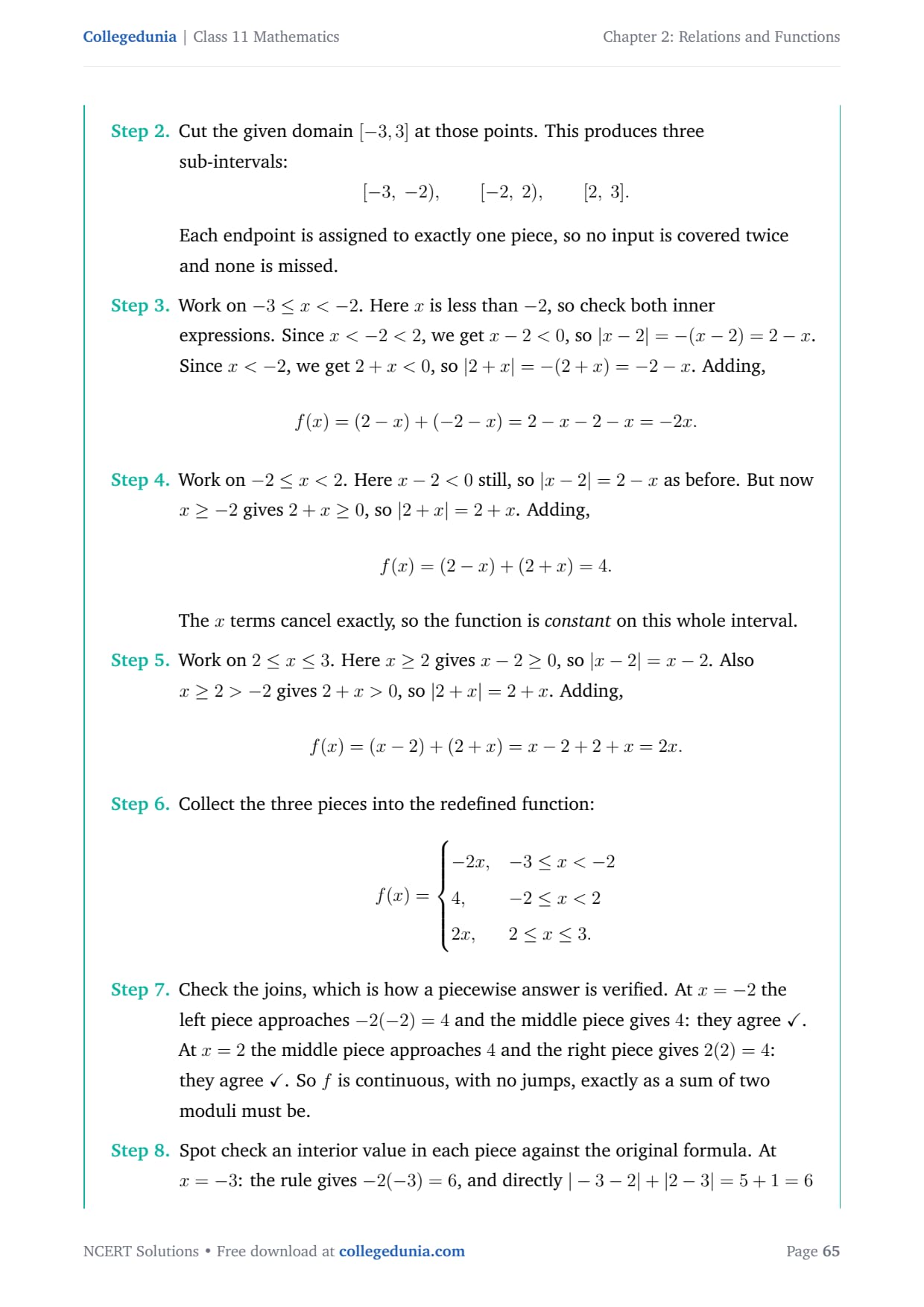
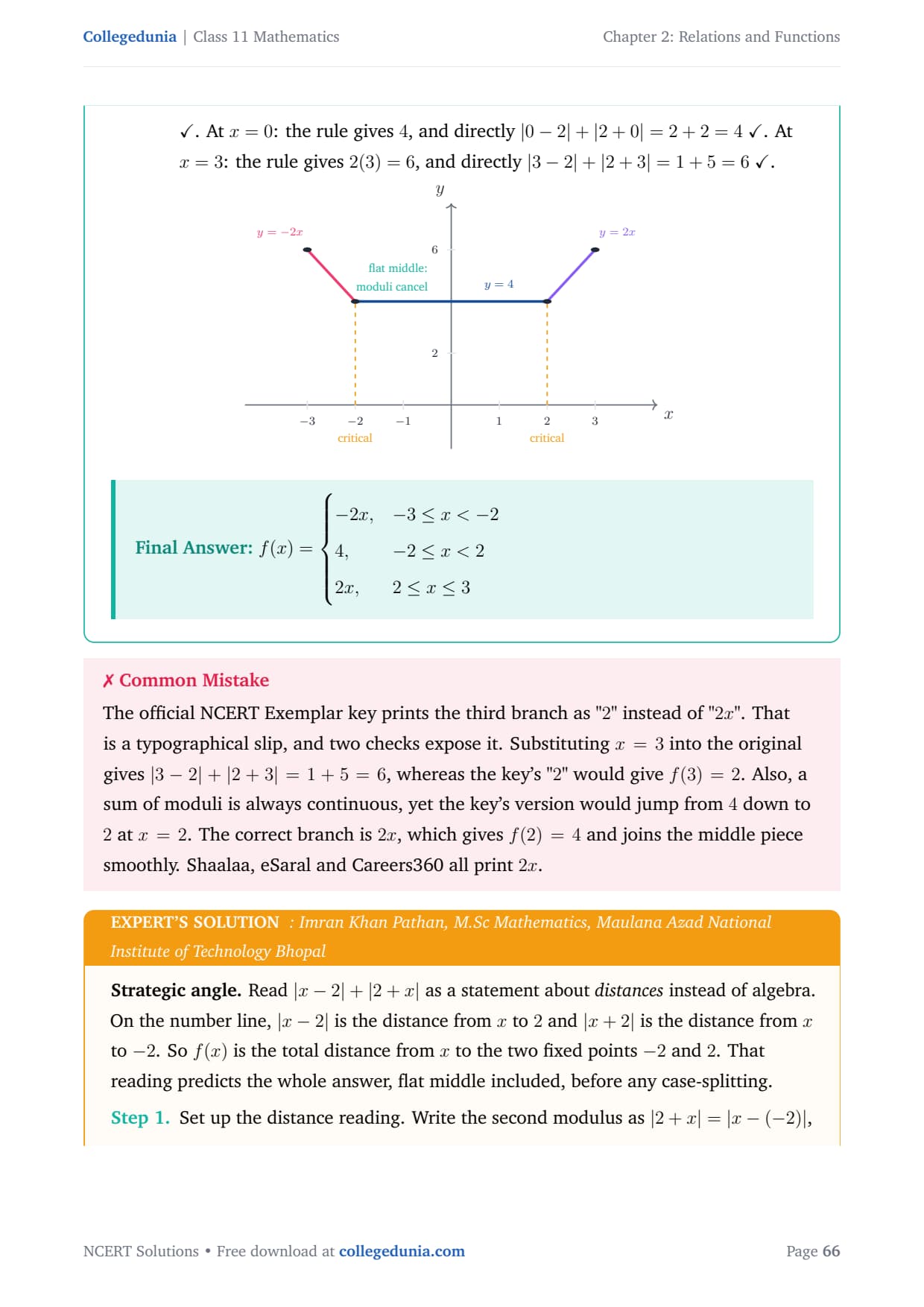
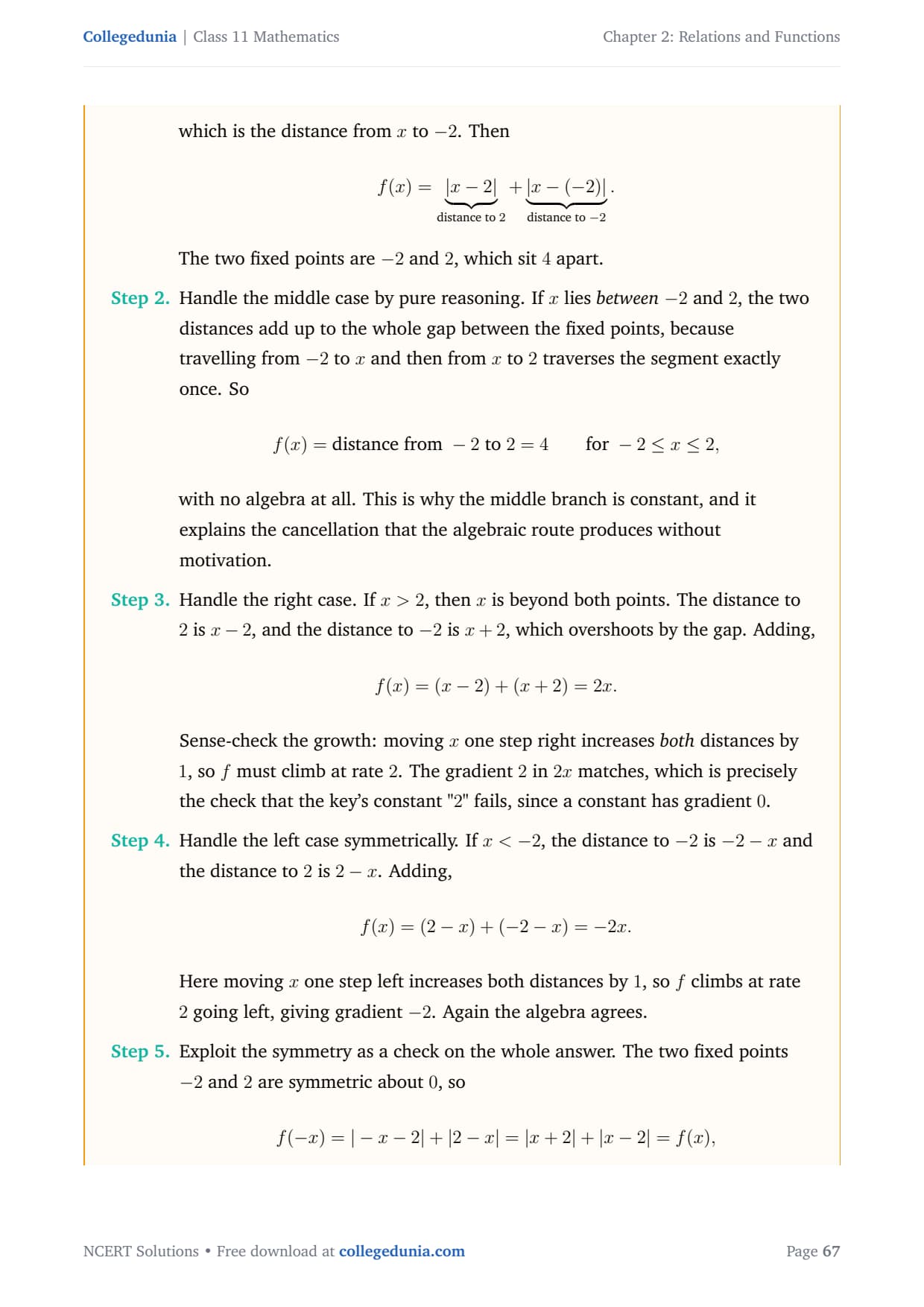
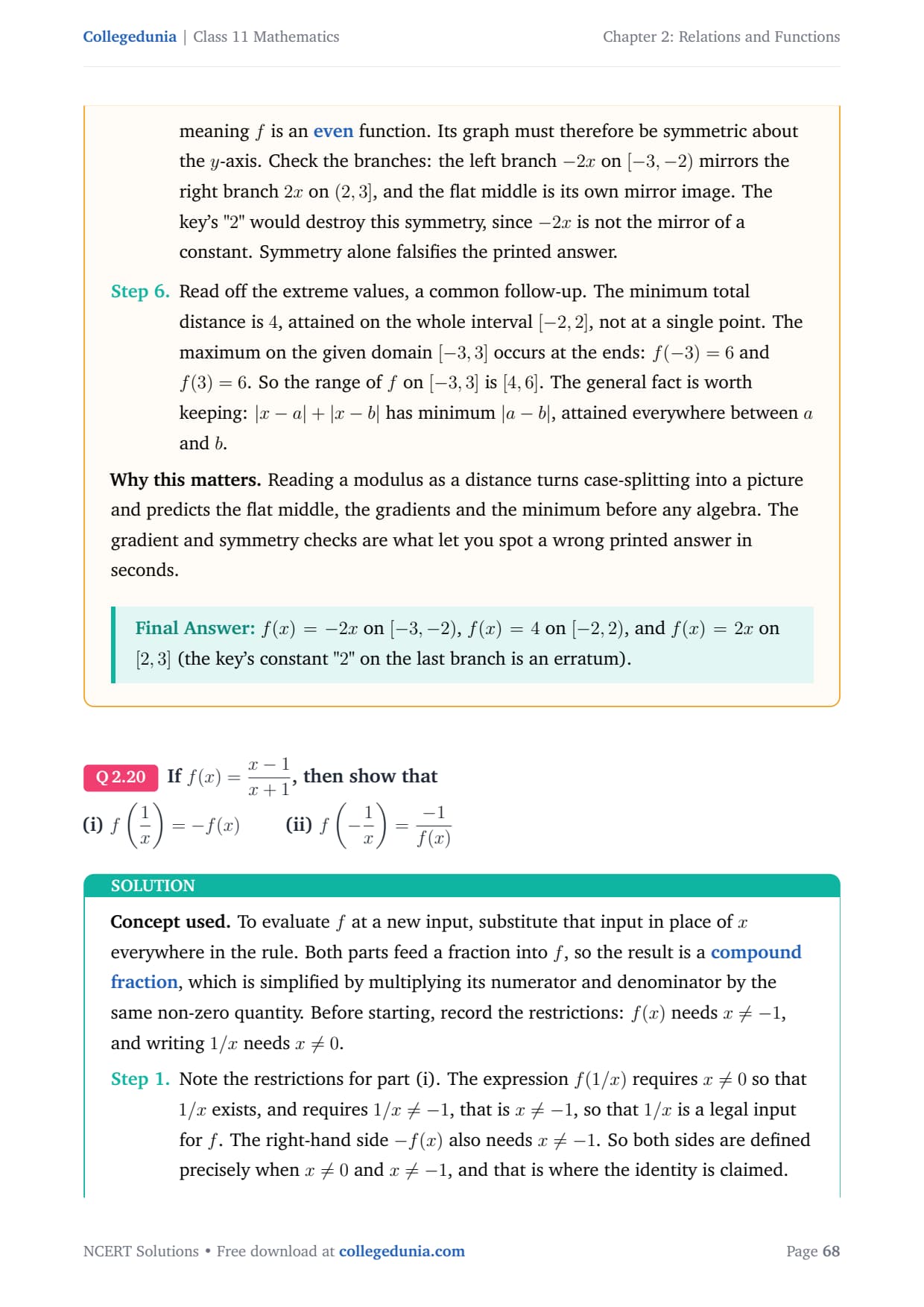
- Modulus and piecewise functions: redefining an expression like |x − 2| + |2 + x| without modulus signs.
Important: for f/g the domain is not just the domain of f. Every x where g(x) = 0 must be thrown out as well. Students who skip that line lose the mark even when the algebra is right.
Exercise 2.3 Question-Type Breakdown for Relations and Functions
All 42 questions sit inside Exercise 2.3, grouped by format. The table below shows how the exercise is split, so students can plan practice by question type rather than solving straight through.
| Question Type | Question Numbers | Count | What it tests |
|---|---|---|---|
| Short Answer | Q1 to Q15 | 15 | Cartesian products, relations, algebra of functions |
| Long Answer | Q16 to Q23 | 8 | Domain and range, redefining modulus functions |
| Objective (MCQ) | Q24 to Q35 | 12 | Range shortcuts, domain traps, counting relations |
| Fill in the Blanks | Q36 to Q37 | 2 | Domain and range of standard functions |
| True/False | Q38 to Q42 | 5 | Spotting a false claim with one counter-example |
The Long Answer block (Q16 to Q23) is the heart of the chapter. Six of its eight questions ask for a domain or a range, and that is exactly where the marks and the misprints both sit. The Objective block is the largest group and rewards one clean idea per question.
Seven Answer-Key Errors in the Relations and Functions Exemplar Every Student Must Know
The printed NCERT Exemplar for Chapter 2 has seven questions where the book itself is wrong. Five are wrong answers in the key. Two are questions where the book prints the same option twice. Each one is checked below against the book's own working, so read this section before self-checking.
| Question | Printed key | Correct answer | Why |
|---|---|---|---|
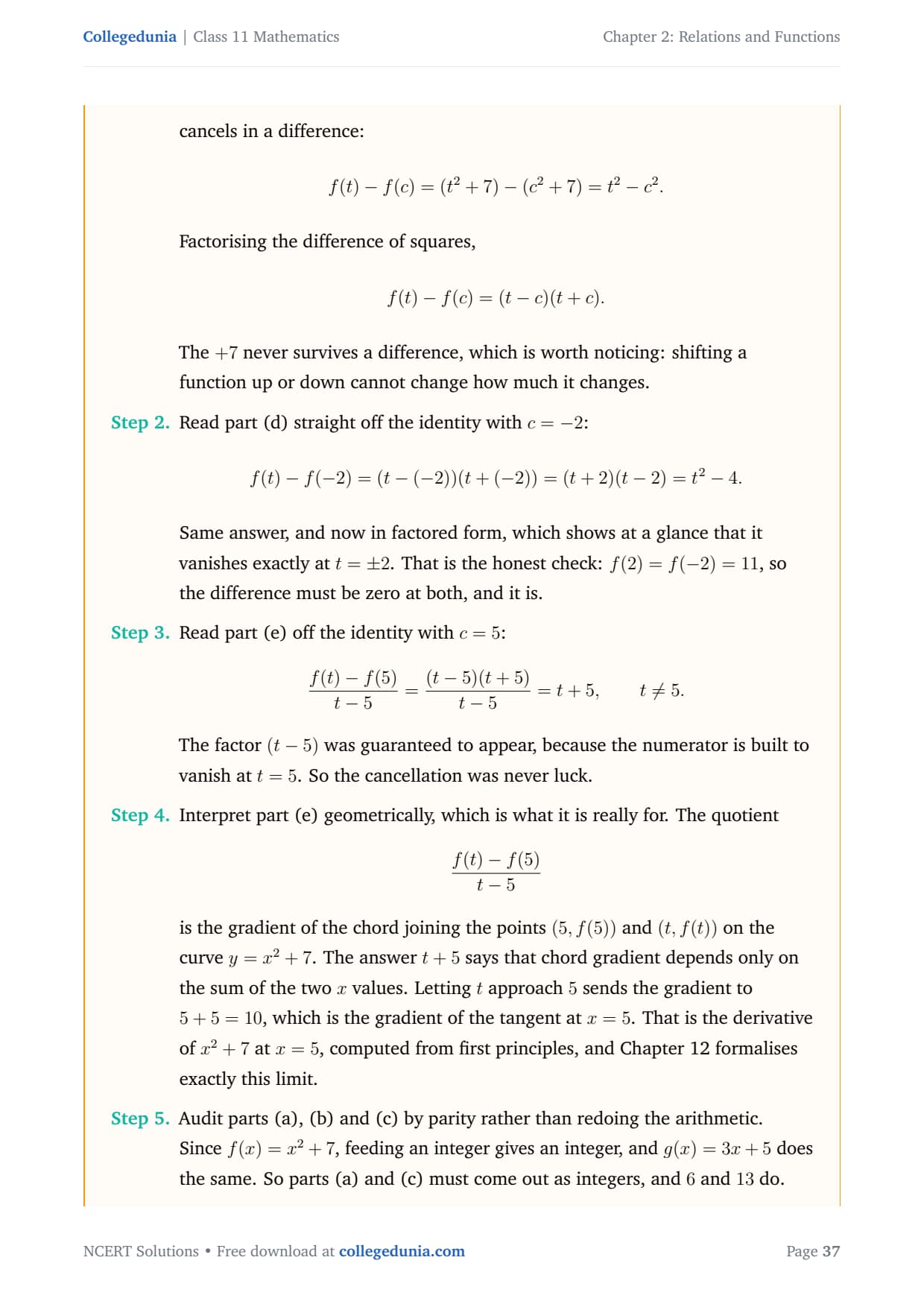
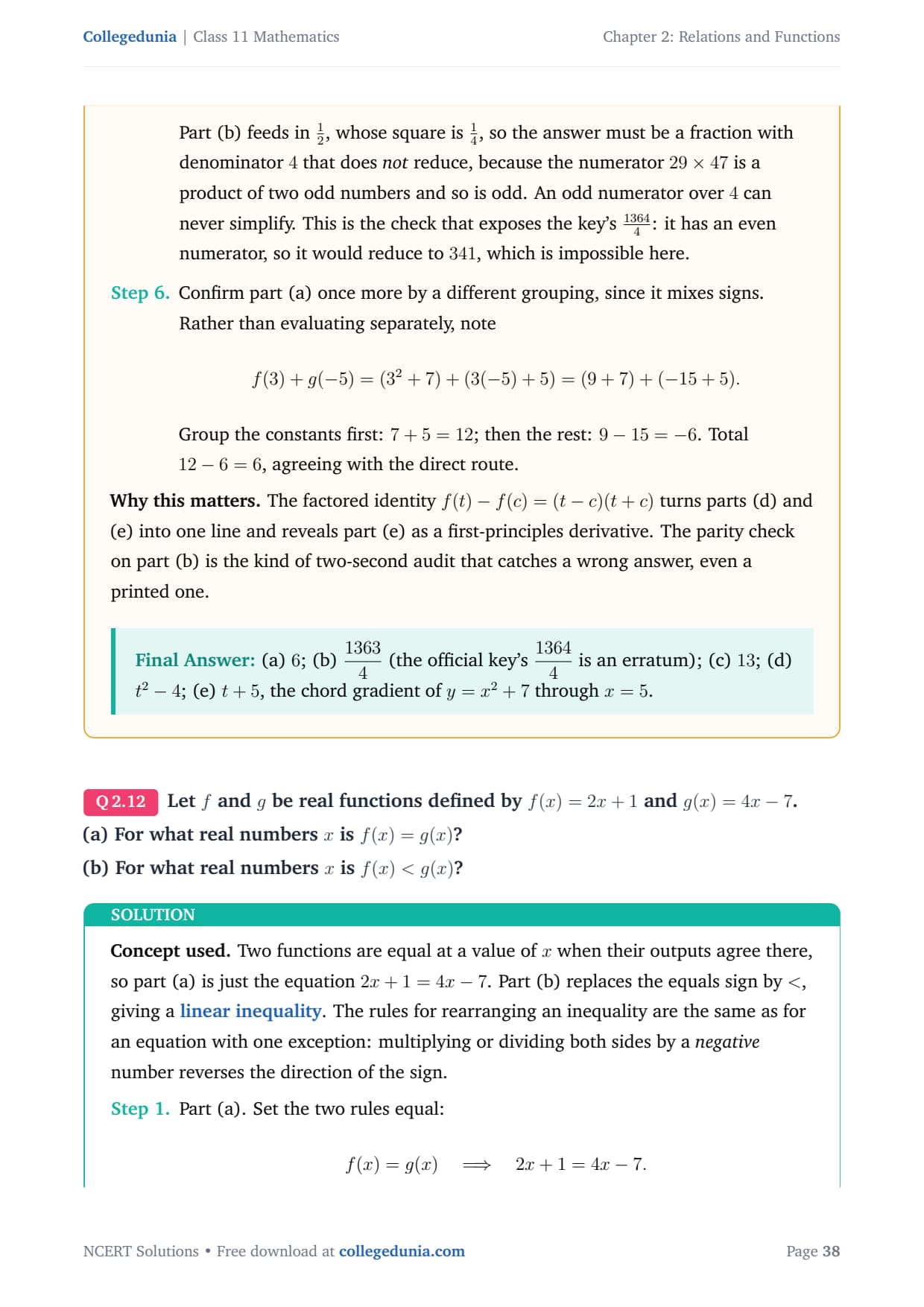
| Q11(b) | 1364/4 | 1363/4 | 29 × 47 = 1363, not 1364 |
| Q13(iii) | 2x3 + x3 + 2x + 1 | 2x3 + x2 + 2x + 1 | x3 is printed twice; the second term is x2 |
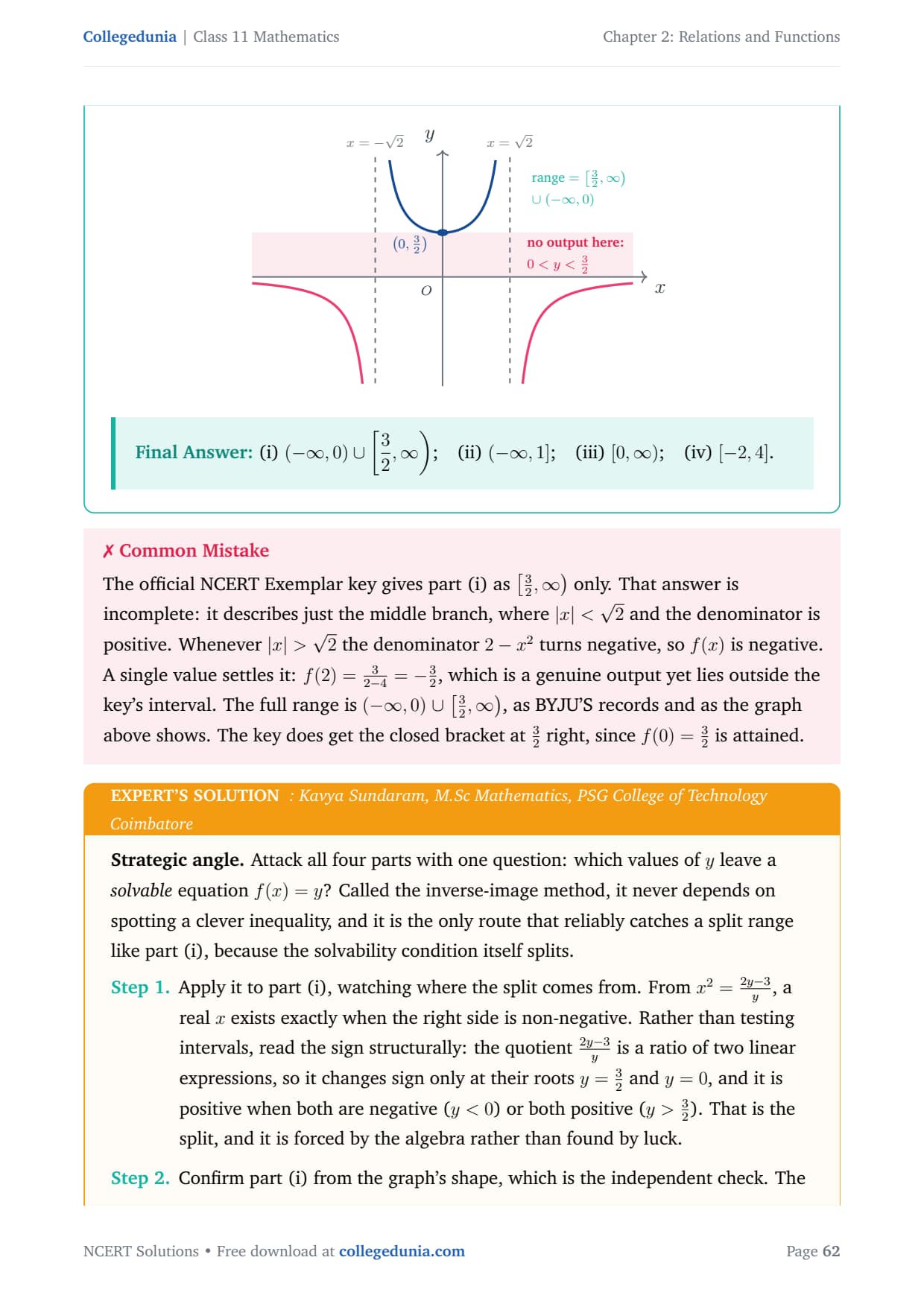
| Q18(i) | [3/2, ∞) | (−∞, 0) ∪ [3/2, ∞) | f(2) = −3/2 is an output the key misses |
| Q19 | Third branch = 2 | Third branch = 2x | f(3) = 6, not 2 |
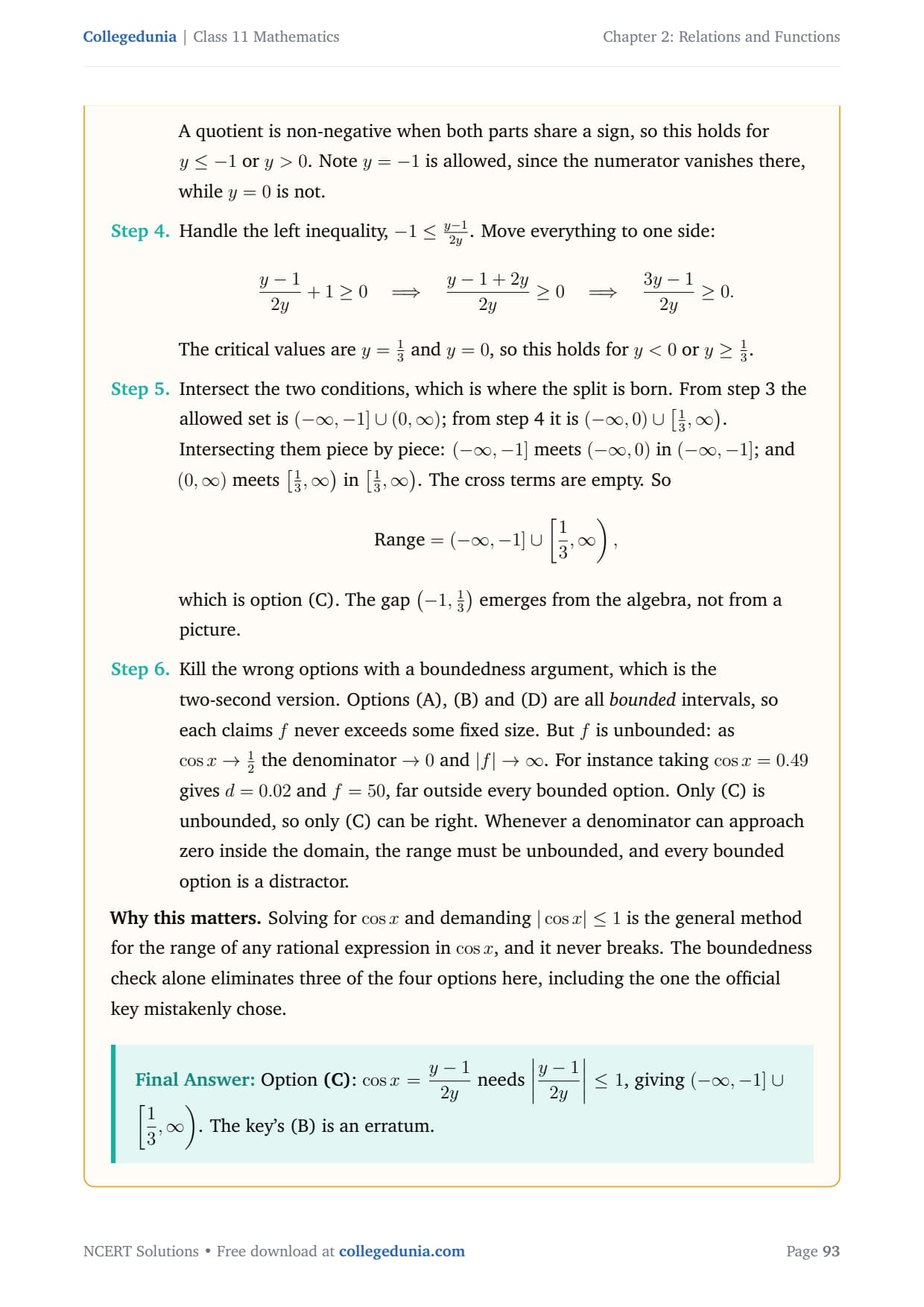
| Q26 | (B) [−1, 1/3] | (C) (−∞, −1] ∪ [1/3, ∞) | f = 1 at x = π/2, which is outside (B) |
| Q32 | (C), printed twice | (C), as the key says | Options (C) and (D) are identical in the book |
| Q35 | (A), printed twice | (A), as the key says | Options (A) and (B) are identical in the book |
Q11(b) is a one-line arithmetic slip. Here f(1/2) = 29/4 and g(14) = 47, so the product is 1363/4. The key prints 1364/4. A quick check settles it: 1364 is divisible by 4, so the answer would have simplified to the whole number 341. But 29 and 47 are both odd primes, so neither can cancel the 4. The answer cannot be a whole number, and the key's value must be wrong.
Q13(iii) is a typesetting error. The book prints the product as 2x3 + x3 + 2x + 1, with x3 appearing twice. Two checks expose it. First, 2x3 + x3 would just collapse to 3x3, and no author leaves that unsimplified. Second, a degree-1 times a degree-2 polynomial has four terms in descending powers. The correct expansion is 2x3 + x2 + 2x + 1.
Q18(i) is the most useful error to know. For f(x) = 3/(2 − x2), the key gives only [3/2, ∞). That describes the middle branch, where the denominator is positive. But when x2 is bigger than 2, the denominator turns negative and f(x) is negative. One value settles it: f(2) = 3/(2 − 4) = −3/2, a genuine output that sits outside the key's interval. The full range is (−∞, 0) ∪ [3/2, ∞).
Q19 and Q26. In Q19 the book prints the third branch of the redefined function as 2 instead of 2x. Put x = 3 into the original: |3 − 2| + |2 + 3| = 6, while the key's version gives 2. A sum of moduli is always continuous, yet the key's version would jump down at x = 2. In Q26 the key marks (B), which is what you get by wrongly flipping the interval −1 ≤ d ≤ 3 term by term. Reciprocals cannot be taken across an interval containing 0. At x = π/2, cos x = 0, so f = 1, which lies outside (B) but inside (C).
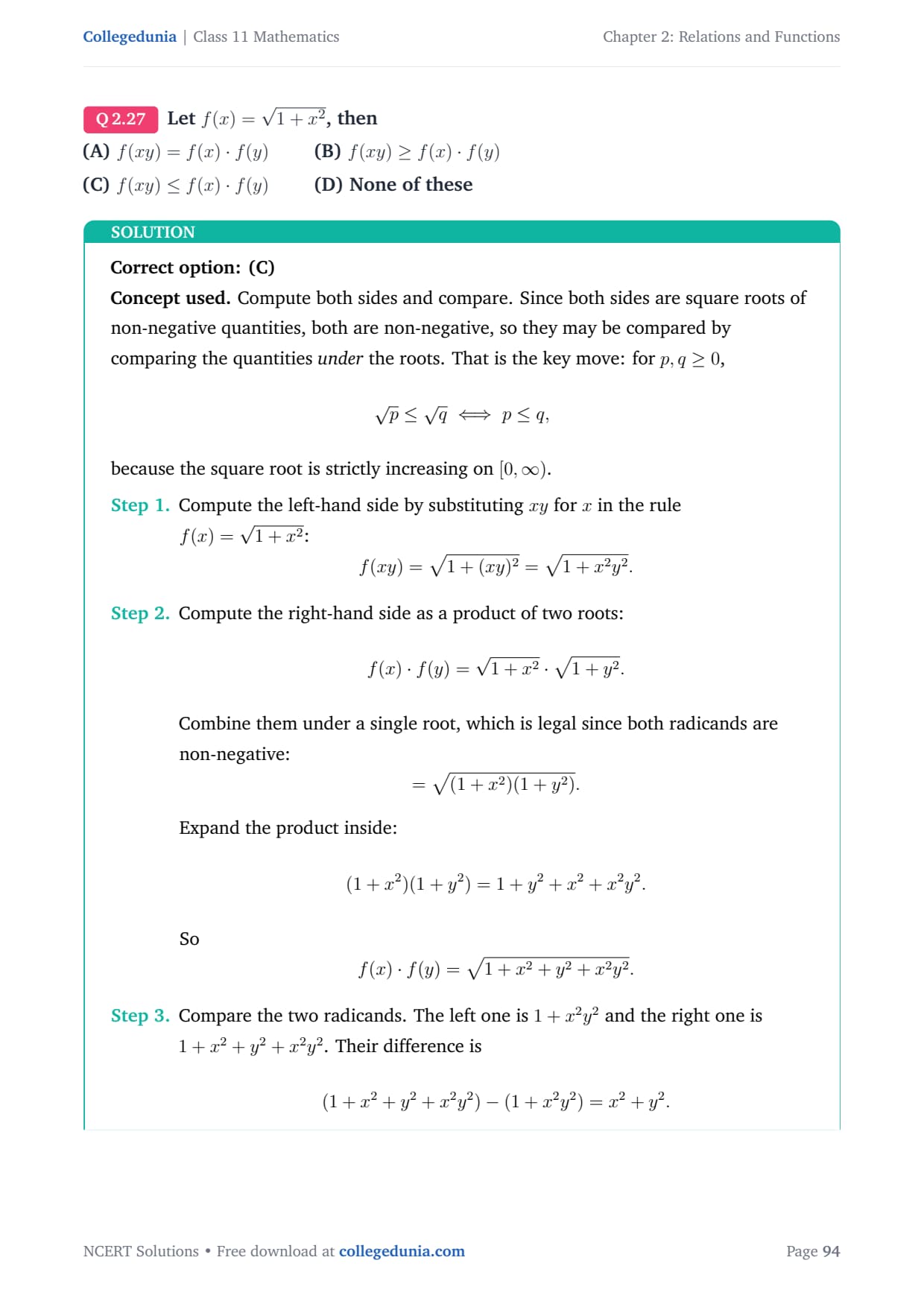
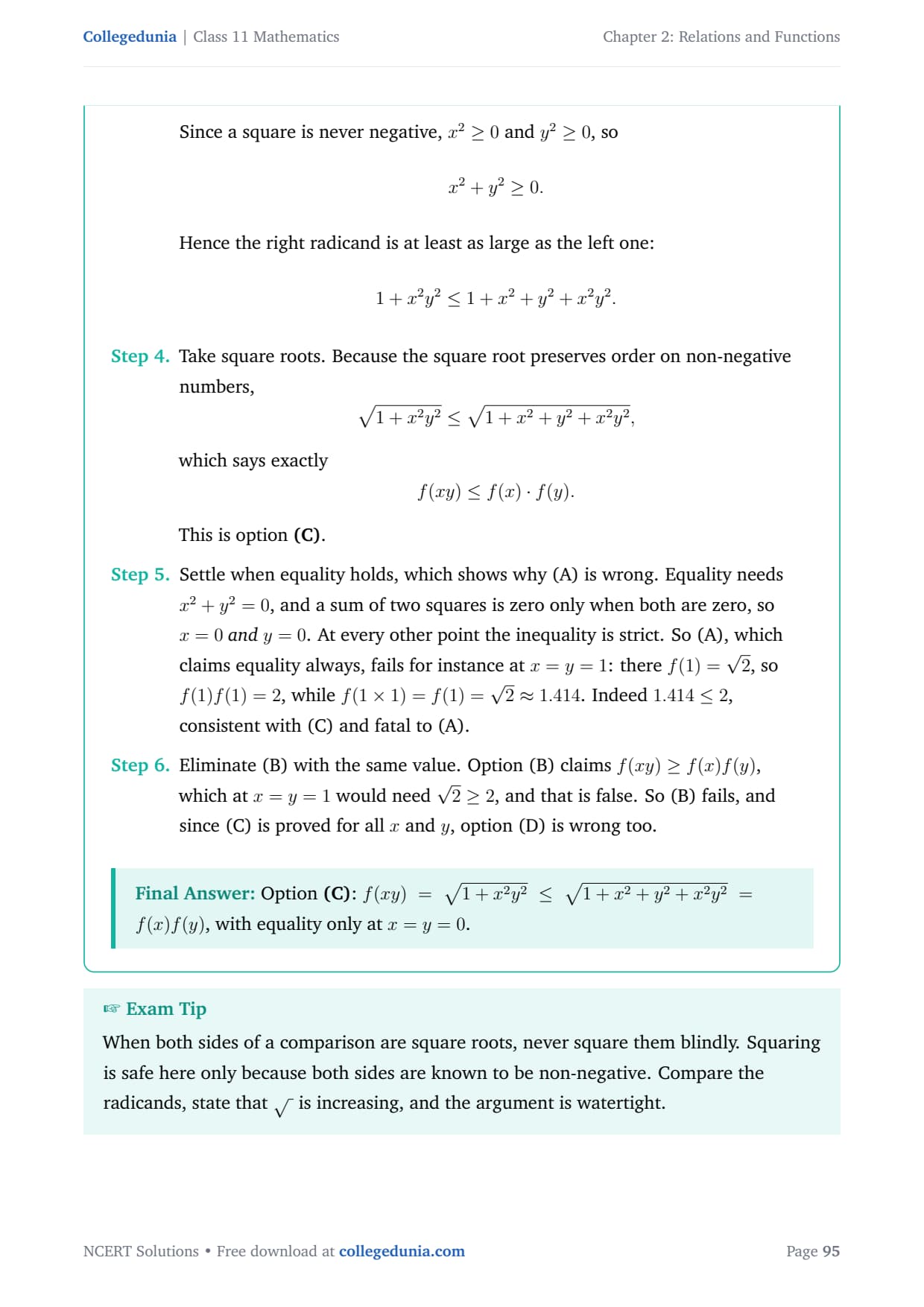
Q32 and Q35 are printing errors, not puzzles. In Q32 options (C) and (D) both read "Domain = [1, ∞), Range = [0, ∞)". In Q35 options (A) and (B) both read the set {−1, 4/3}. In both cases the duplicated option is the correct one and the key picks the first of the pair. Do not lose exam time hunting for a difference between two identical options. Record the option the key lists and move on.
Key Formulas and Results Used in the Relations and Functions Exemplar
Chapter 2 runs on a small set of definitions rather than formulas. The Exemplar uses each of these in a domain or range argument, so students should know them cold before starting Exercise 2.3.
| Result | Statement | Where it is used |
|---|---|---|
| Size of a Cartesian product | n(A × B) = n(A) × n(B) | Short Answer block, Objective block |
| Number of relations | A × B with n elements gives 2n relations | Objective block |
| Domain of a quotient | Domain of f/g = (domain of f) ∩ (domain of g), minus every x with g(x) = 0 | Q13, algebra of functions |
| Square-root domain | √(x − a) needs x − a ≥ 0, so x ≥ a | Q32, domain questions |
| Modulus range | |x − a| ≥ 0 always, so 1 − |x − 2| ≤ 1 | Q18(ii) |
| Cosine range | −1 ≤ cos 2x ≤ 1, so 1 + 3cos 2x lies in [−2, 4] | Q18(iv) |
Tip: the most reliable way to find a range in this chapter is to make x the subject. Write y = f(x), solve for x in terms of y, then ask which y values keep that expression defined. That single method settles Q18(i) and Q26, the two questions the printed key gets wrong.
Common Mistakes Students Make in the Relations and Functions Exemplar
The Exemplar twists in Chapter 2 trigger the same wrong reflexes every year. These four cost the most marks.
- Forgetting the zeros of g in f/g. The domain of f/g removes every x with g(x) = 0. This is the single most common lost mark in the chapter.
- Giving only one branch of a range. When a denominator can change sign, the range usually has two pieces. The printed key makes this exact mistake in Q18(i).
- Flipping an inequality through a reciprocal. You cannot invert −1 ≤ d ≤ 3 term by term, because 1/d blows up near d = 0.
- Confusing a relation with a function. A relation is a function only when every input appears once. One repeated first element is enough to kill it.
How the Relations and Functions Exemplar Steps Up from the NCERT Textbook
The Exemplar adds no new topics. It asks the same ideas in a harder way, as the table shows.
| Concept | NCERT Textbook asks | NCERT Exemplar asks |
|---|---|---|
| Cartesian product | Write A × B for two small sets | Given n(A × B) and a few pairs, find A and B |
| Relations | List the relation in roster form | Read the domain and range off a relation given by a rule |
| Functions | Check whether a set of pairs is a function | Justify the answer, then repair the pairs so it becomes one |
| Domain | Find the domain of a simple rational function | Combine a square-root condition with a denominator condition |
| Range | Read the range from a short list | Find the range of 3/(2 − x2) with both branches |
| Modulus | Sketch y = |x| | Redefine |x − 2| + |2 + x| as a three-piece rule |
How to Use the Relations and Functions Exemplar for Boards and JEE Preparation
Treat Exercise 2.3 as four sittings, not one. Finish the NCERT textbook exercises first, because the Exemplar assumes students can already write a relation in roster form.
| Session | What to solve | Time |
|---|---|---|
| 1 | Short Answer Q1 to Q15 | 2 hours |
| 2 | Long Answer Q16 to Q23, every domain and range written in full | 2 hours |
| 3 | Objective Q24 to Q35 | 1 hour |
| 4 | Q36 to Q42, then re-solve everything marked wrong | 1 hour |
That is about 6 hours for the chapter. For JEE Main and JEE Advanced, the range questions and the domain of f/g matter most, because both reappear in the Class 12 chapter of the same name. For CBSE Boards and CUET, the Long Answer block and the modulus redefinition are the better use of time.
Practice Questions for Class 11 Maths Relations and Functions
After reading the solutions, students should test themselves on the same question types. The card below opens a set of solved practice questions with step-by-step answers for Relations and Functions.
Practice Card: Solved Practice Questions for Class 11 Maths Relations and Functions. Attempt each question, then check the solution.
Student Feedback
In a Collegedunia survey of 11,540 Class 11 students conducted before the 2026 exams, 68% of students said finding the range of a function was the part of Exercise 2.3 they got wrong most often. Only 7% of students had spotted that the printed answer key is wrong on seven questions.
Other Resources for Class 11 Maths Relations and Functions
Pair the Exemplar Solutions with the textbook solutions and the notes for full chapter revision. All the Relations and Functions resources are linked below.
| Resource | Link |
|---|---|
| NCERT Solutions | Relations and Functions Class 11 NCERT Solutions |
| Revision Notes | Relations and Functions Class 11 Notes |
| Handwritten Notes | Relations and Functions Class 11 Handwritten Notes |
| NCERT Book PDF | Relations and Functions Class 11 NCERT Book PDF |
| Exemplar Book PDF | Relations and Functions Class 11 NCERT Exemplar Book PDF |
NCERT Exemplar Solutions for Other Class 11 Maths Chapters
The full Class 11 Maths Exemplar set covers 14 chapters, 735 questions and 2,625 pages of solutions. Use the table to jump to any other chapter.
Relations and Functions Class 11 Maths NCERT Exemplar Solutions FAQs
Ques. How many questions are there in the Class 11 Maths Relations and Functions Exemplar?
Ans. Chapter 2 Relations and Functions has 42 questions, all in Exercise 2.3. They are split into 15 Short Answer, 8 Long Answer, 12 Objective, 2 Fill in the Blanks and 5 True/False questions. Every one of them is solved in the PDF on this page.
Ques. Is the printed NCERT Exemplar answer key for Relations and Functions correct?
Ans. Not fully. The book is wrong on seven questions: Q11, Q13, Q18, Q19, Q26, Q32 and Q35. Five are wrong answers in the key, and two are questions where the same option is printed twice. Each error is explained on this page with the correct answer and the check that settles it.
Ques. What is the correct range of 3/(2 − x2) in Q18 of the Relations and Functions Exemplar?
Ans. The correct range is (−∞, 0) ∪ [3/2, ∞). The printed key gives only [3/2, ∞), which is the branch where the denominator is positive. When x2 is bigger than 2 the denominator turns negative, so f(2) = −3/2 is a genuine output the key leaves out.
Ques. How do you find the domain of f/g in the Class 11 Maths Exemplar?
Ans. Take the domain of f, intersect it with the domain of g, then remove every x where g(x) = 0. The last step is the one students forget, and it is the most common lost mark in Chapter 2. The same rule is used in Q13 of Exercise 2.3.
Ques. Are the Class 11 Maths Relations and Functions Exemplar Solutions free to download?
Ans. Yes. The Relations and Functions NCERT Exemplar Solutions PDF is free to download from this page. It runs to 146 pages, solves every question step by step according to the 2026-27 NCERT Exemplar, and helps students prepare for CBSE Boards, JEE Main, JEE Advanced and CUET.



Comments