




Probability is the chapter where most lost marks come from applying a correct formula whose condition has quietly failed. The NCERT Exemplar Solutions for Class 11 Maths Chapter 14 Probability on this page solve all 43 questions of the chapter, step by step, according to the 2026-27 NCERT Exemplar.
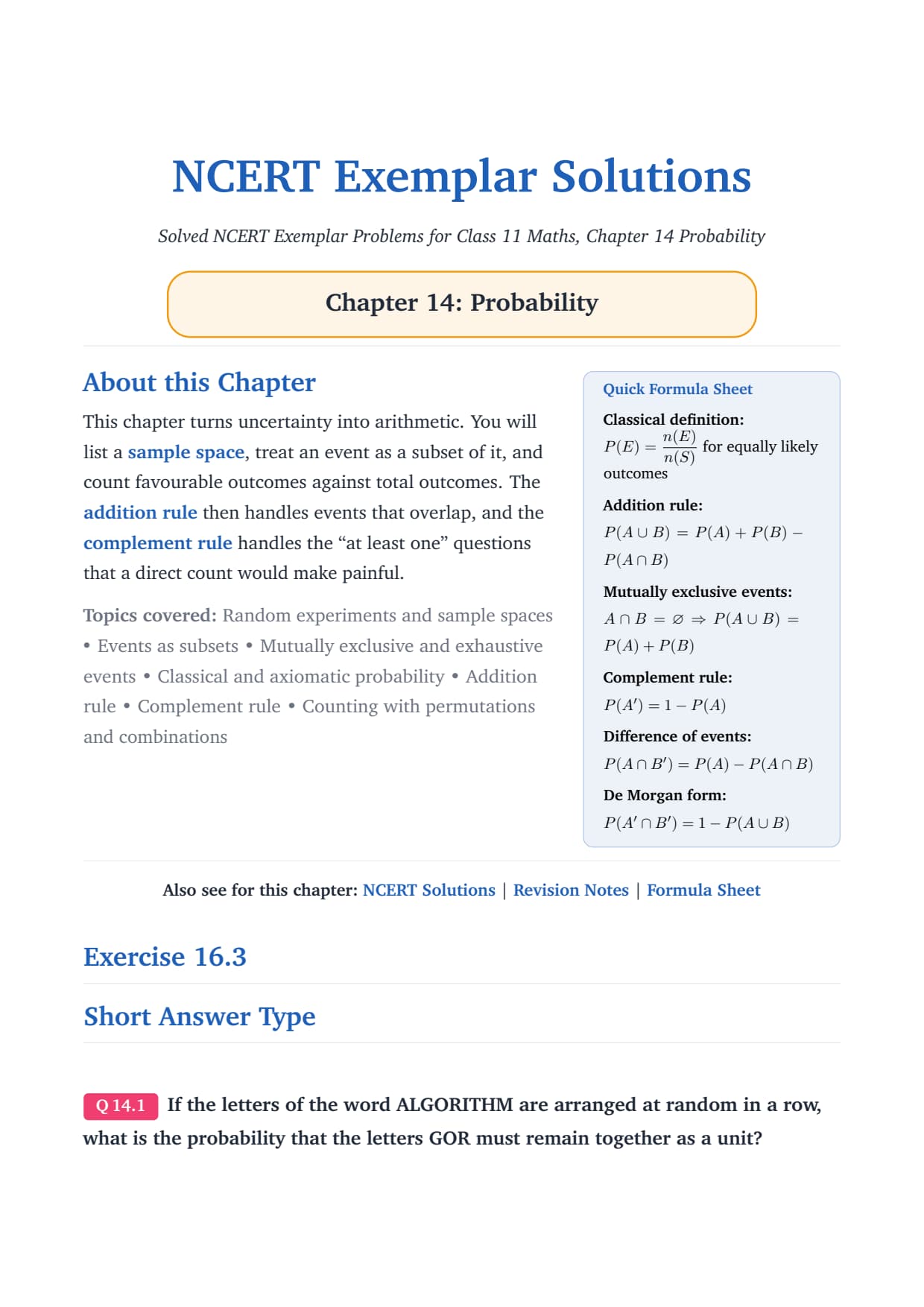
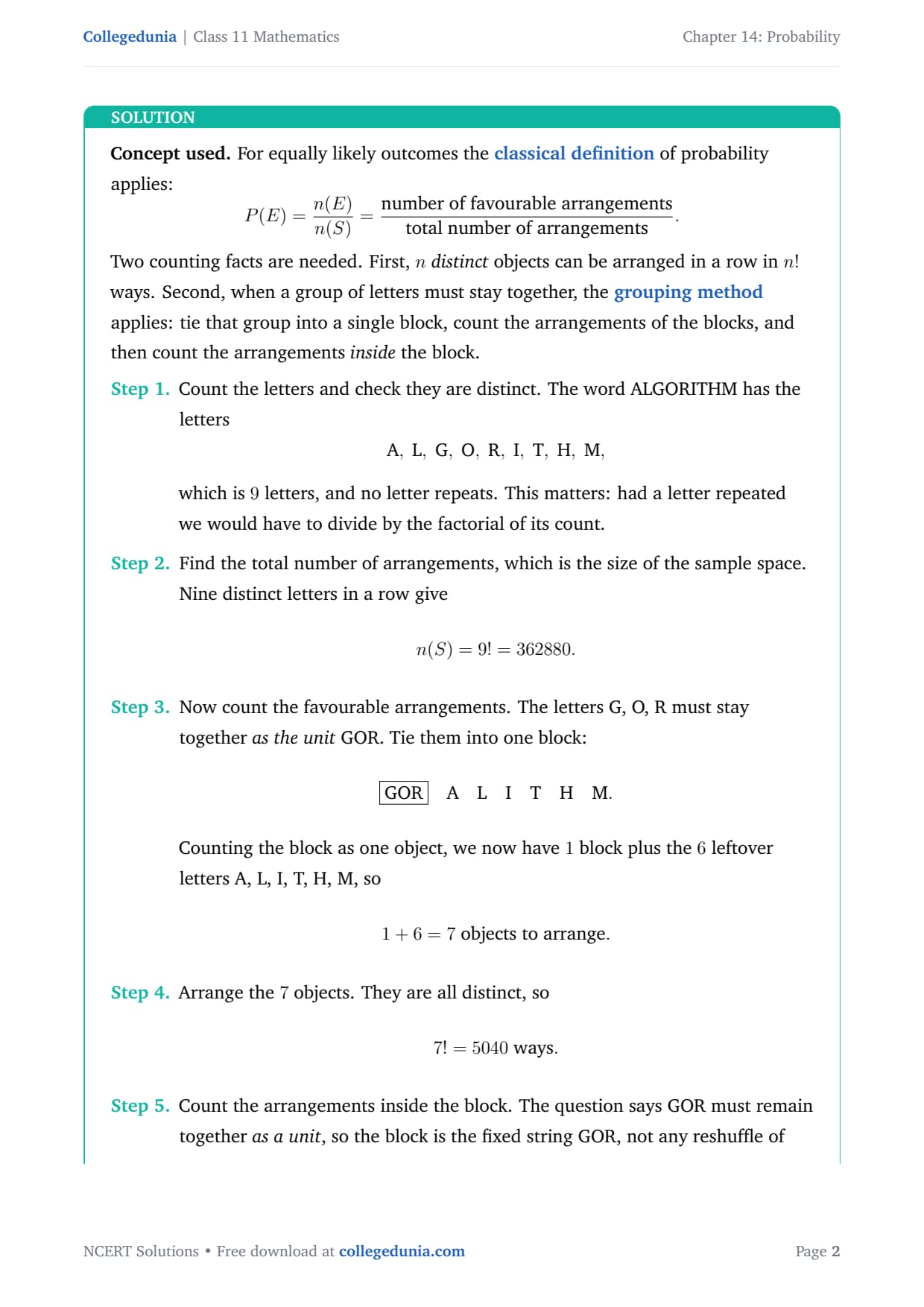
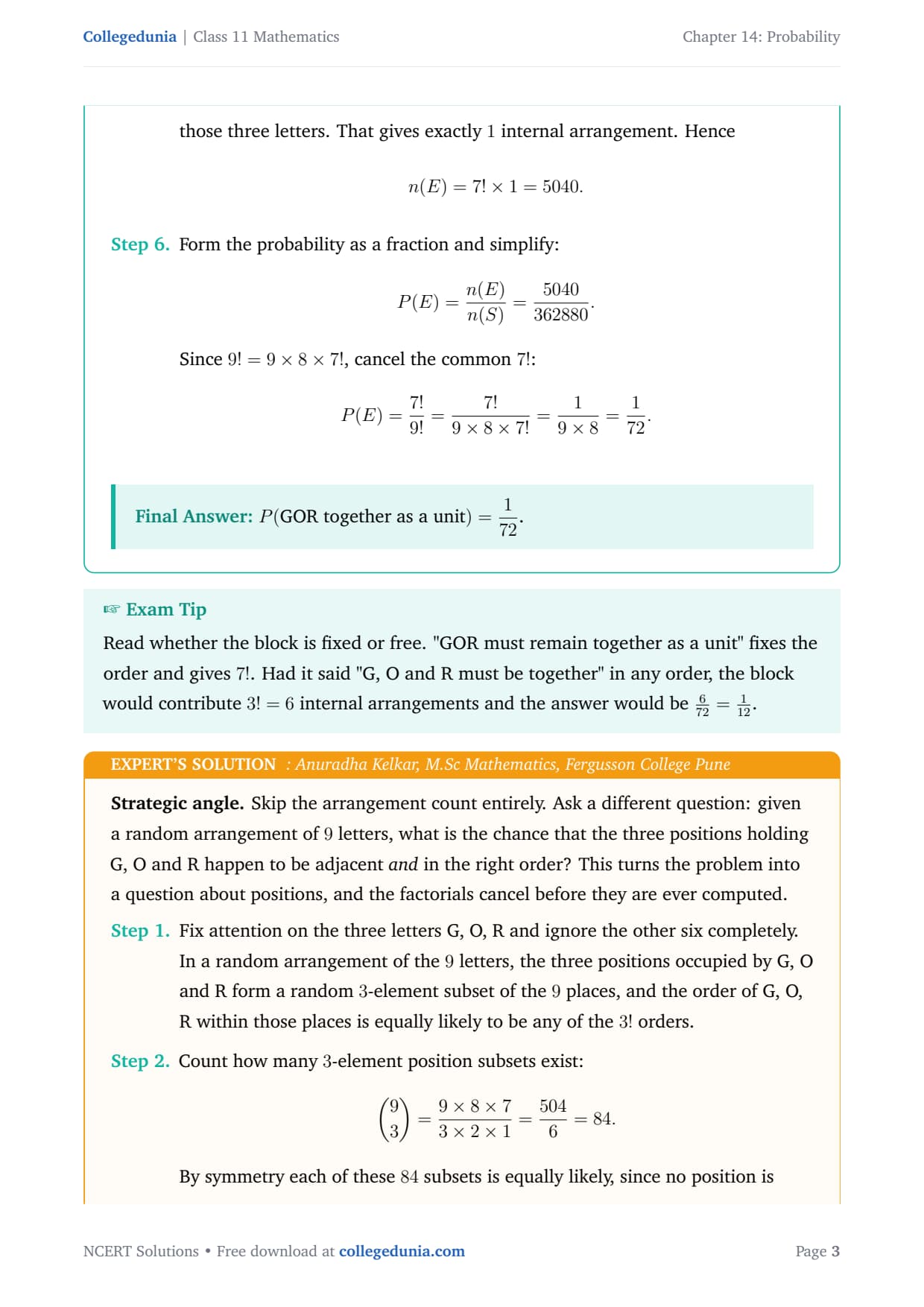
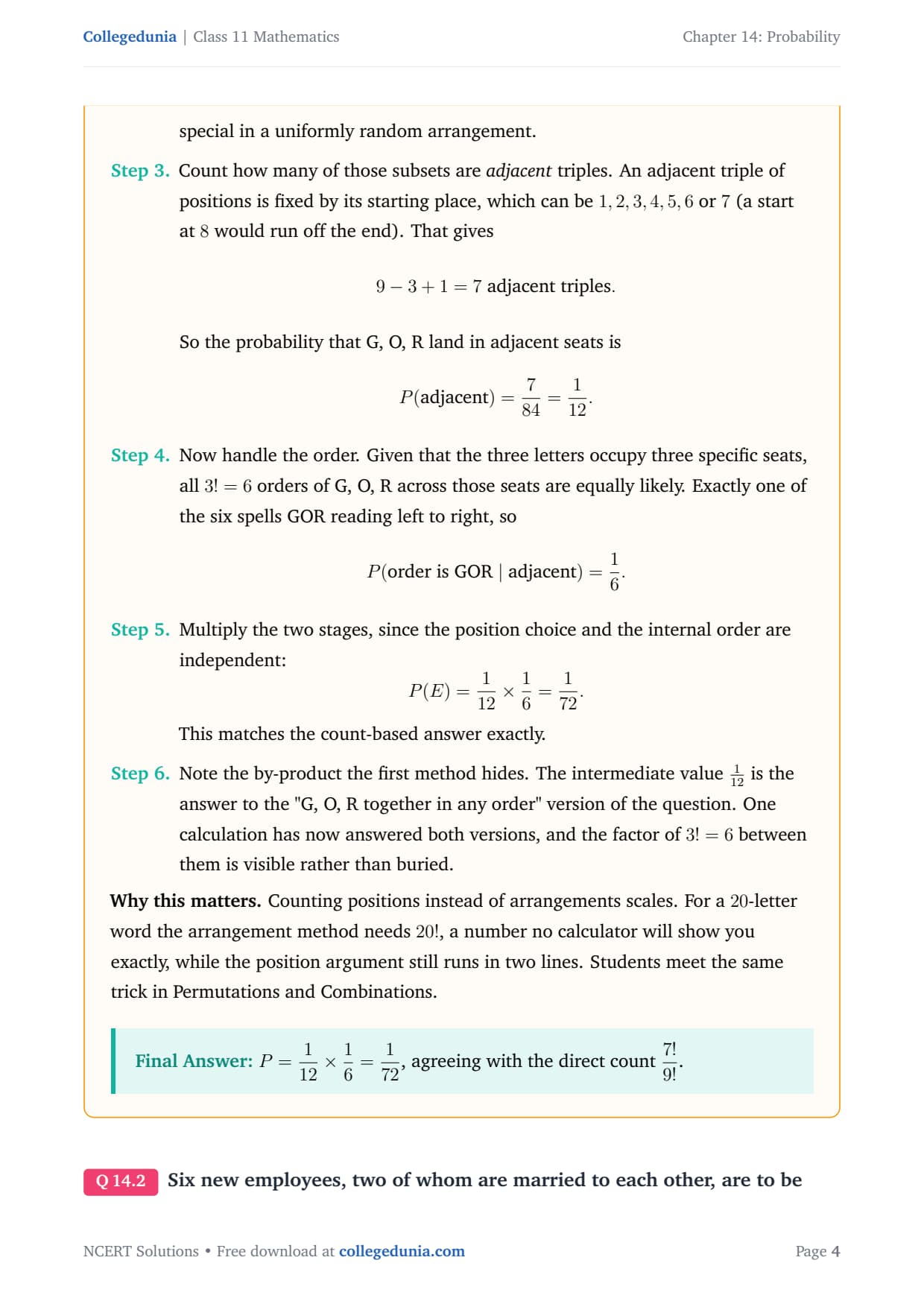
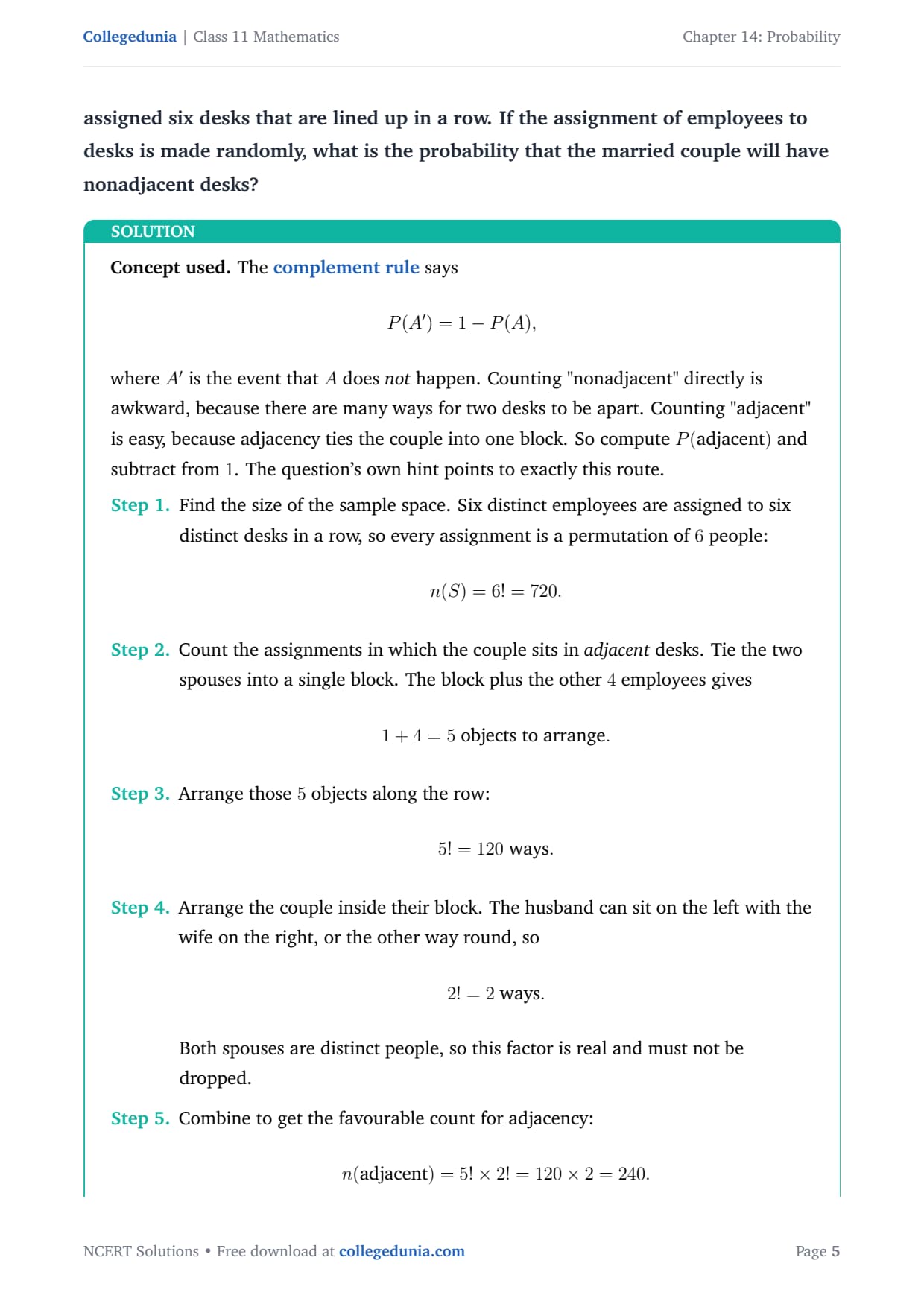
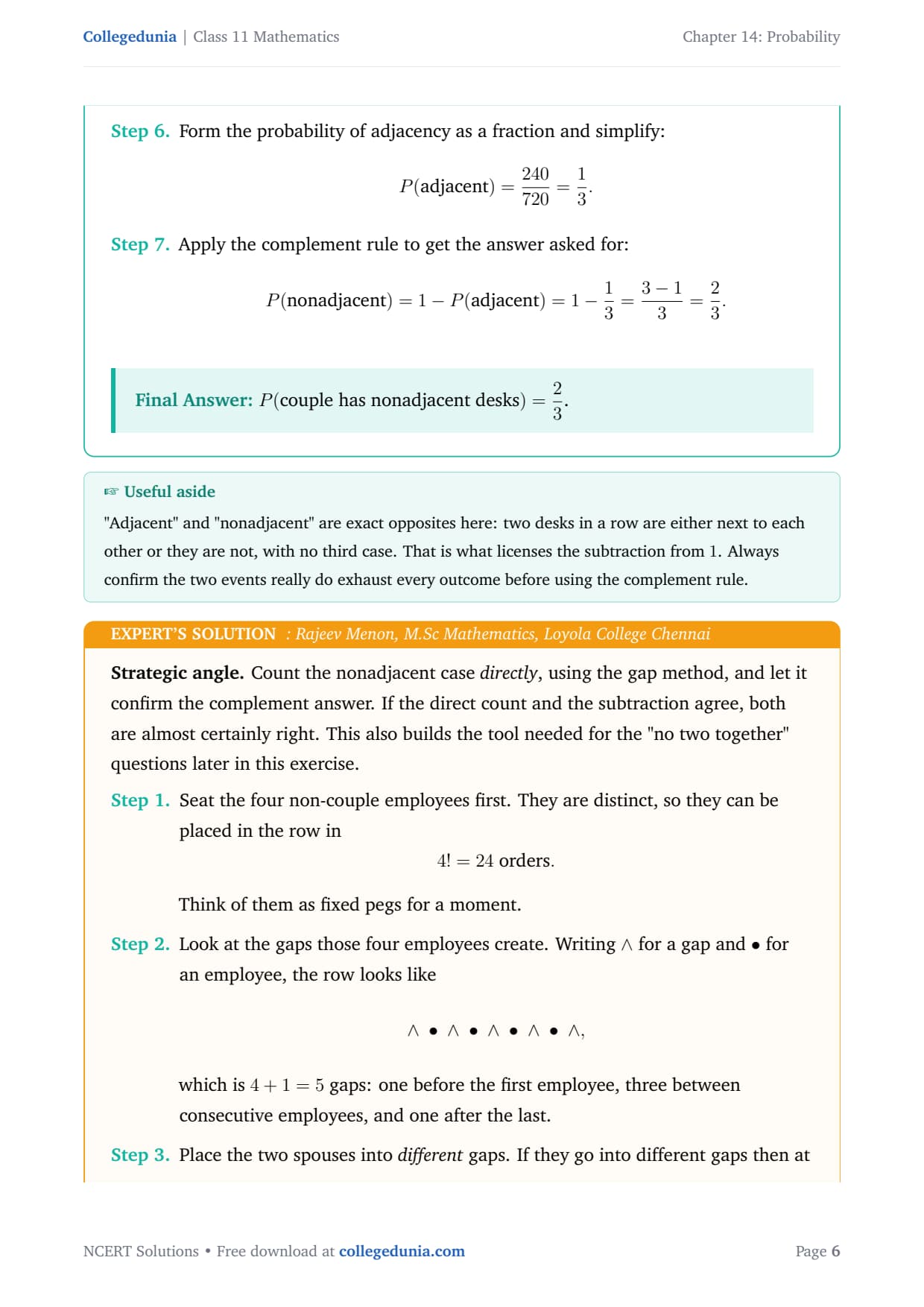
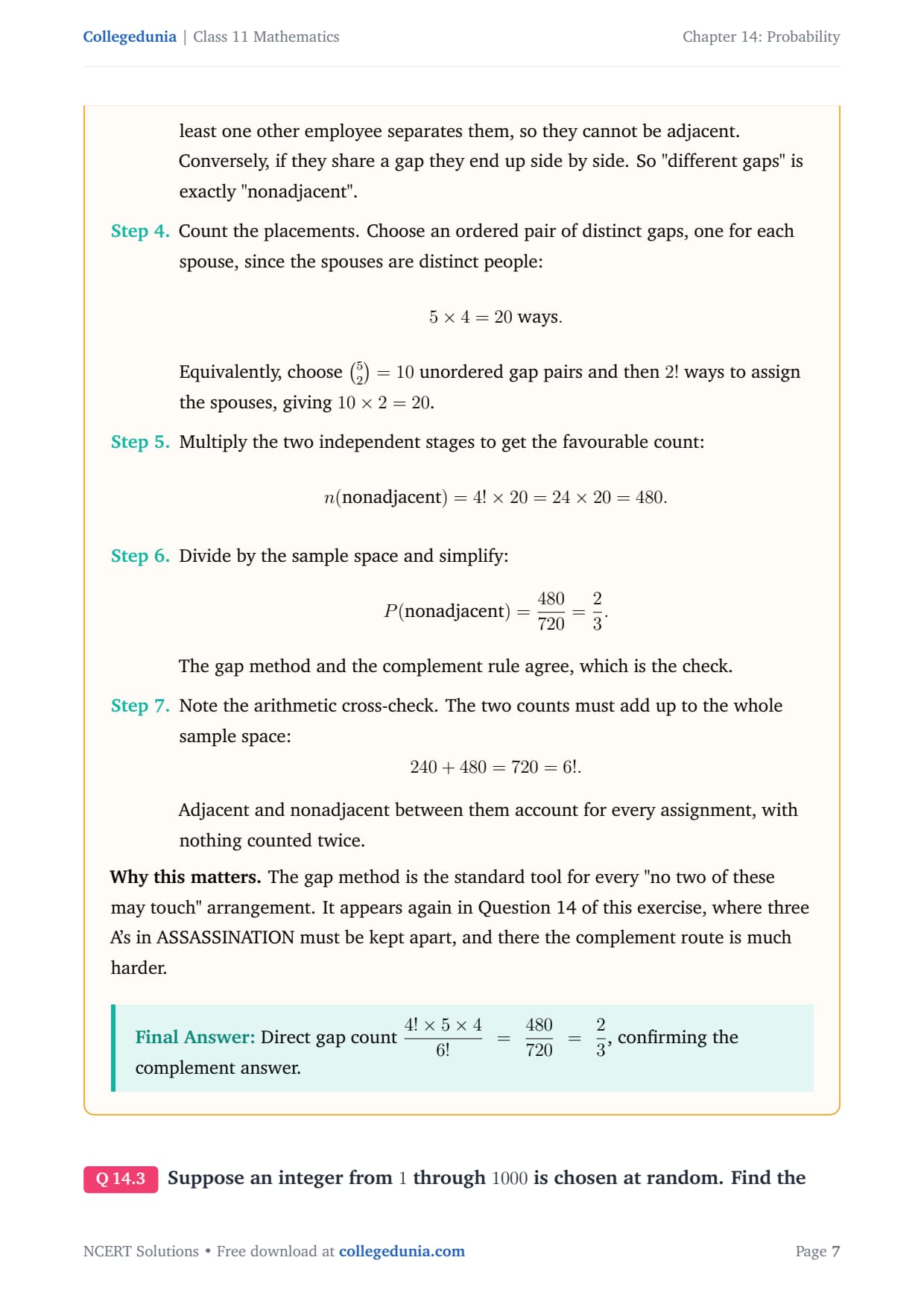
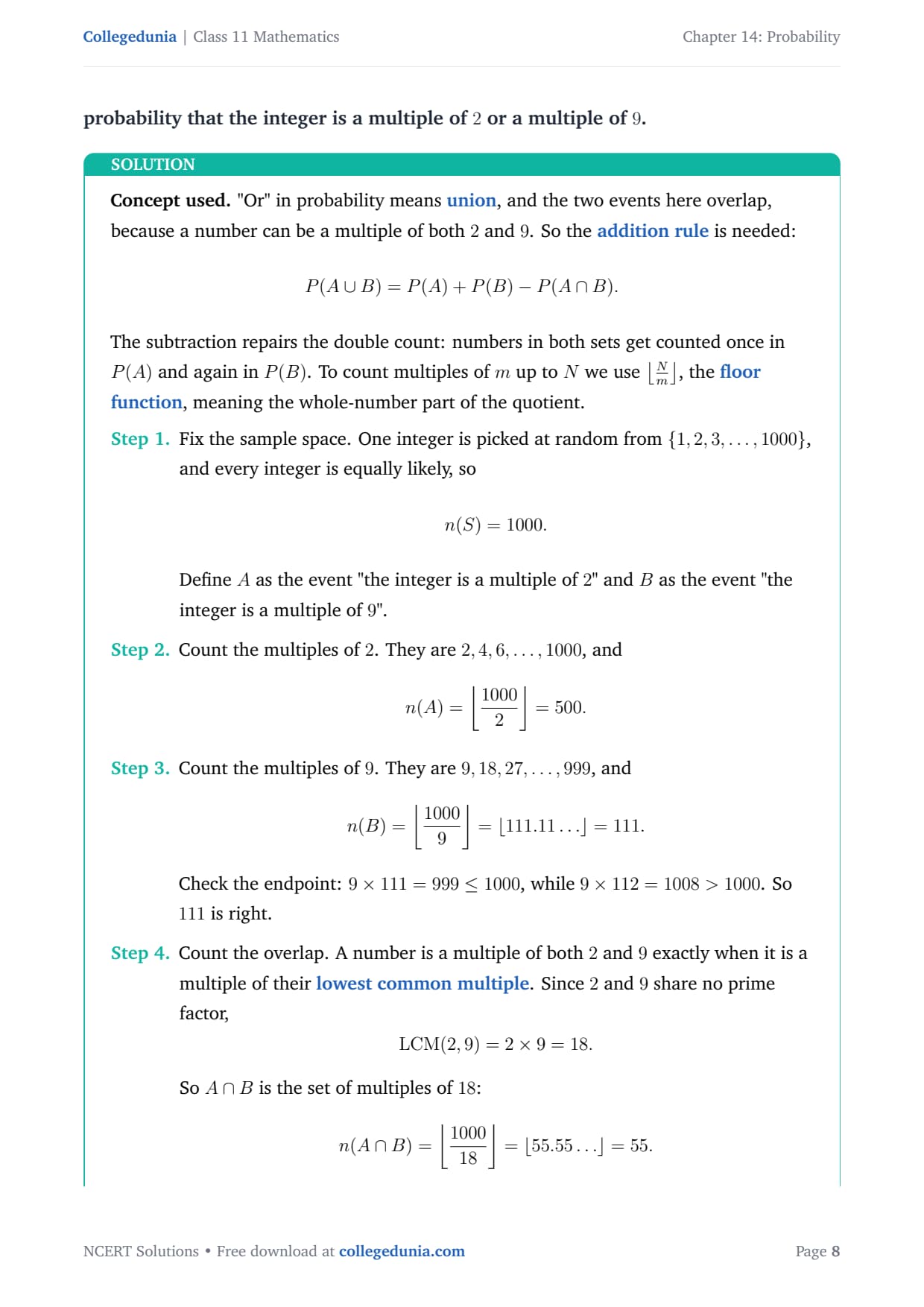
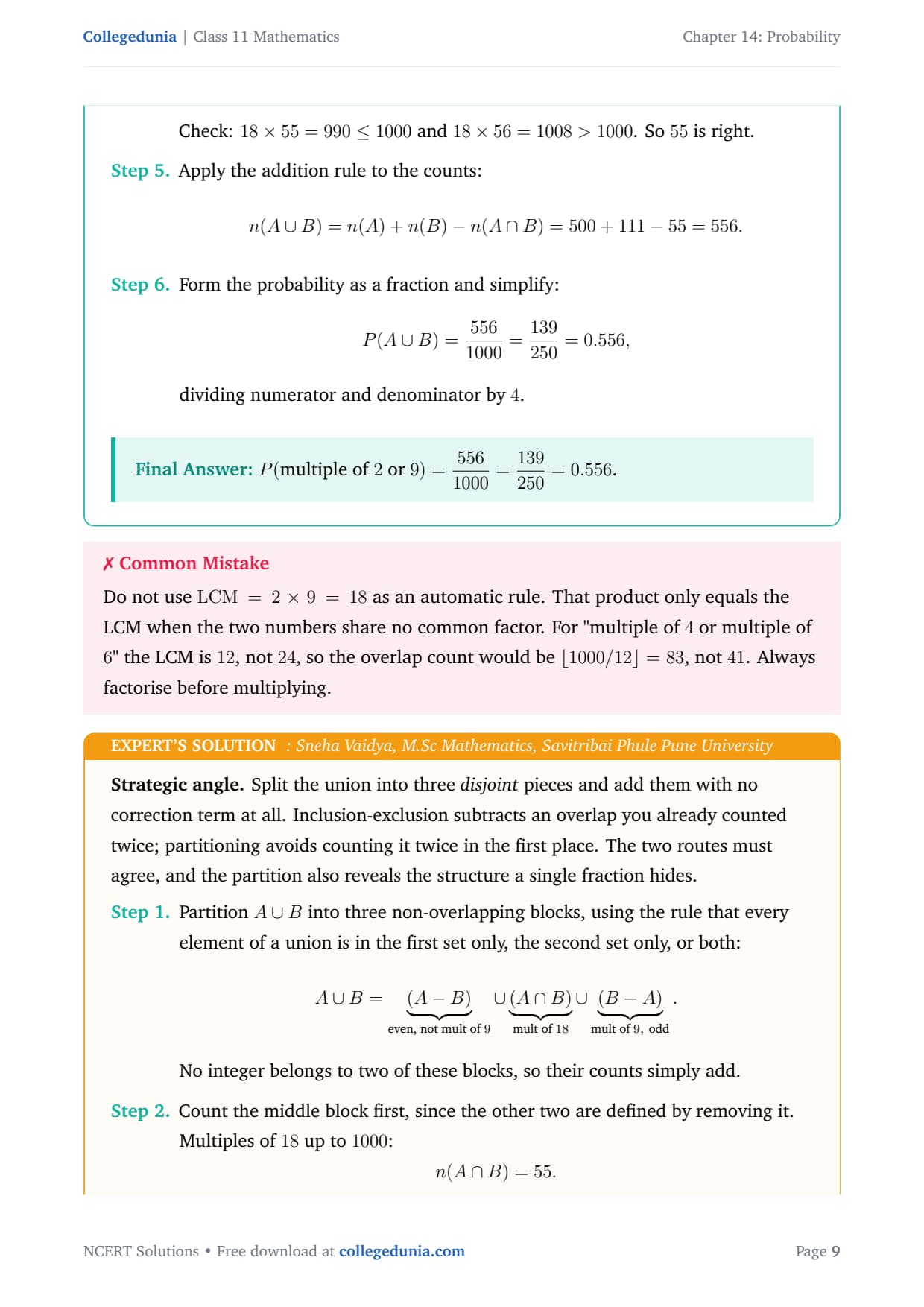
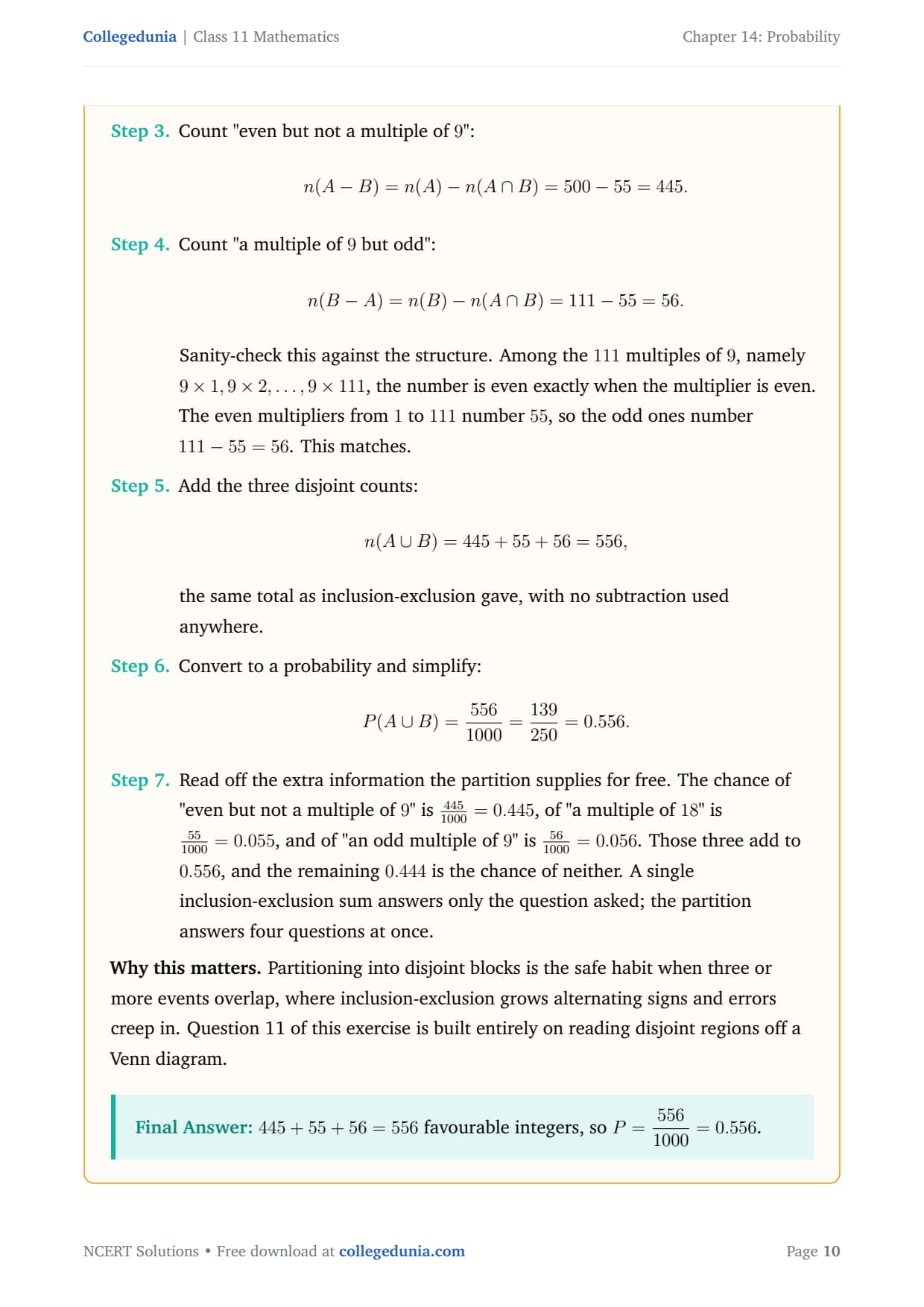
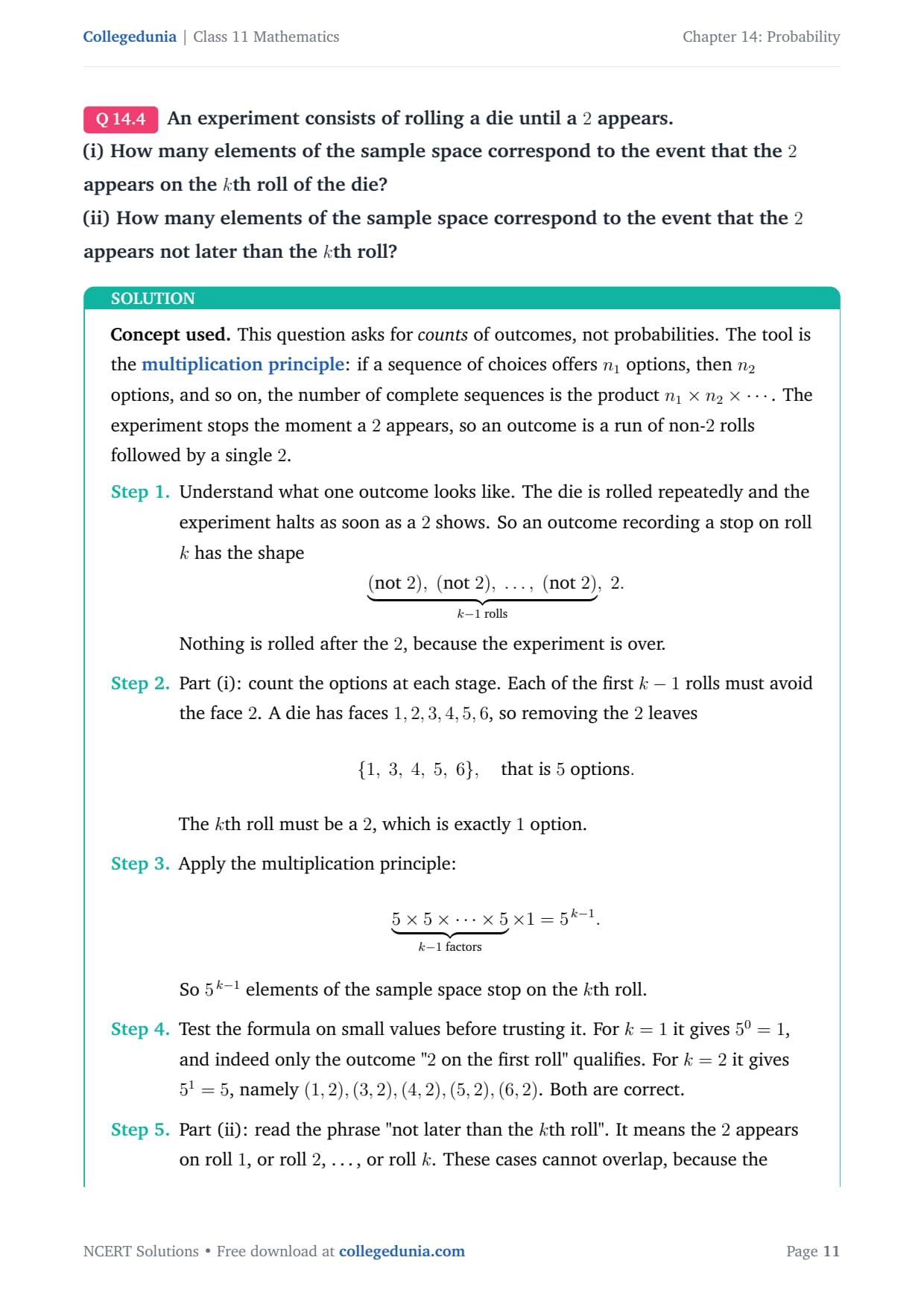
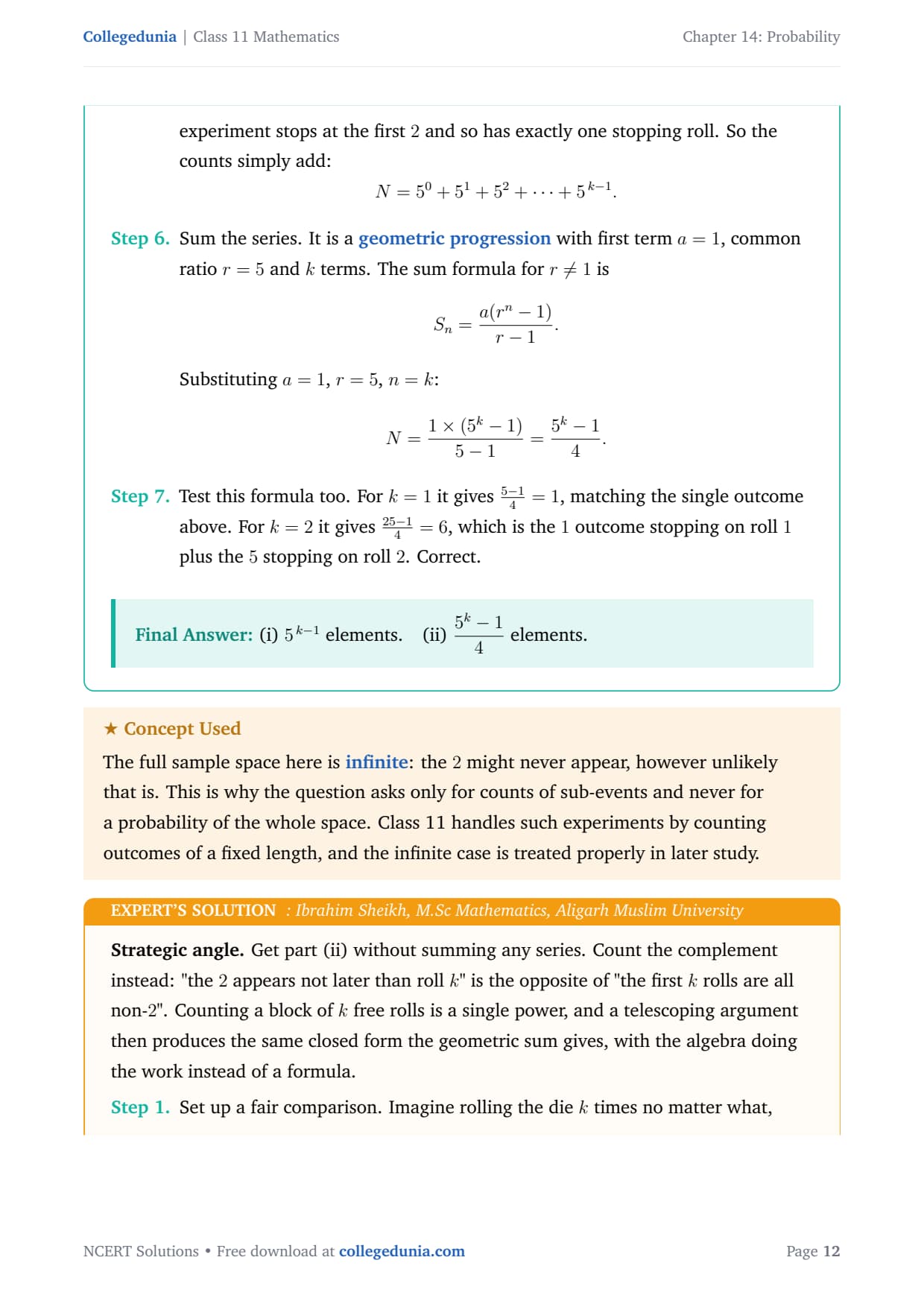
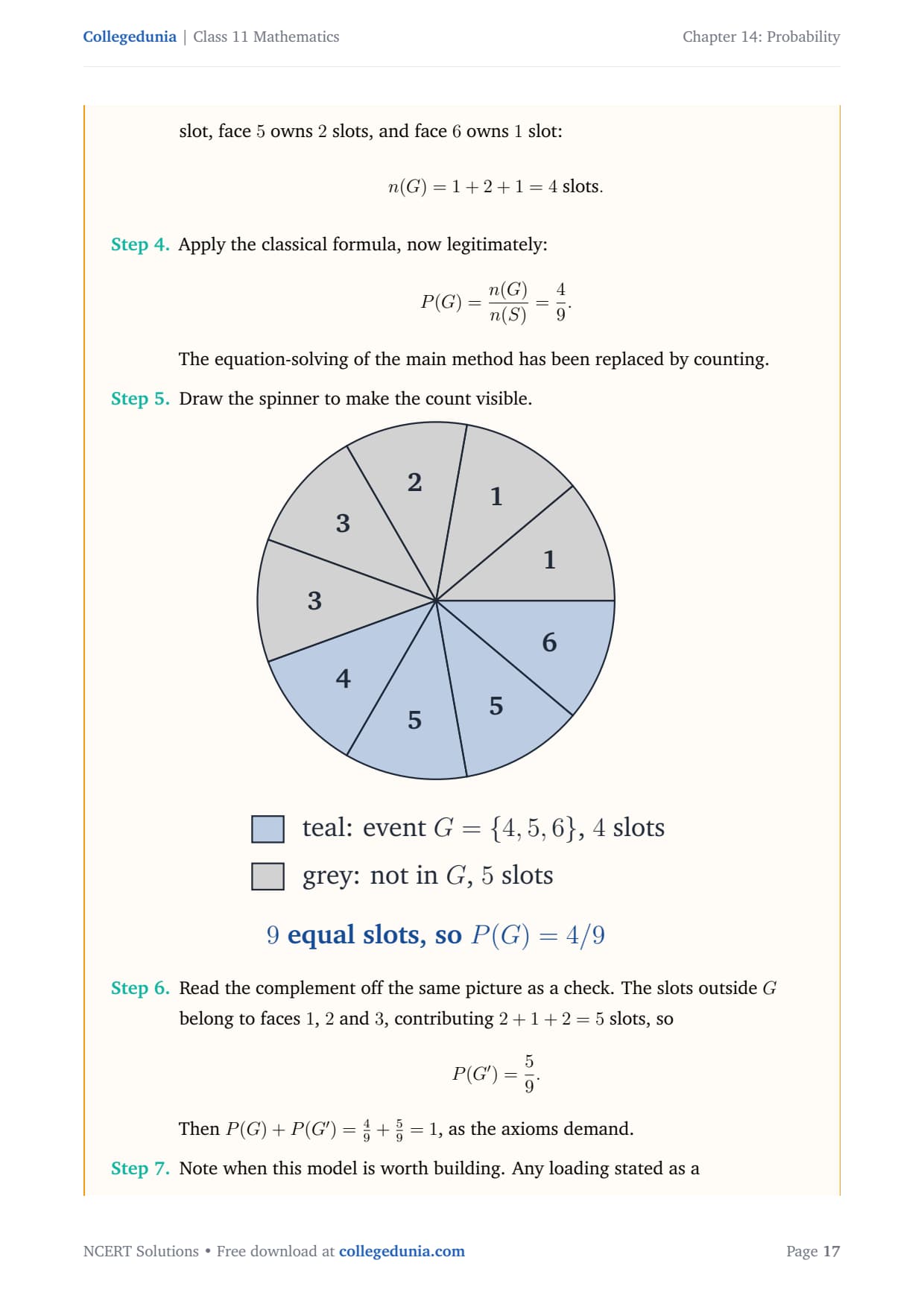
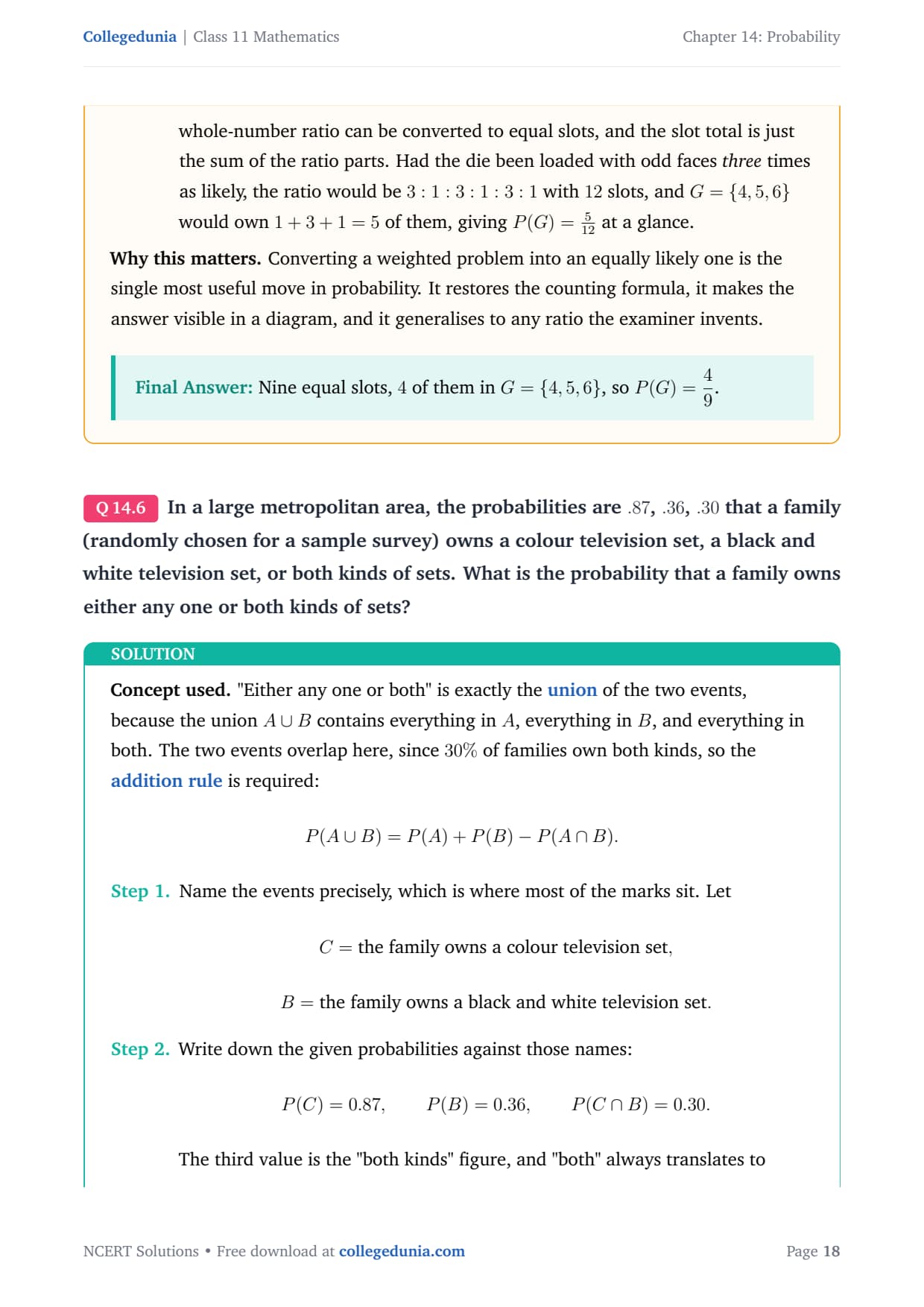
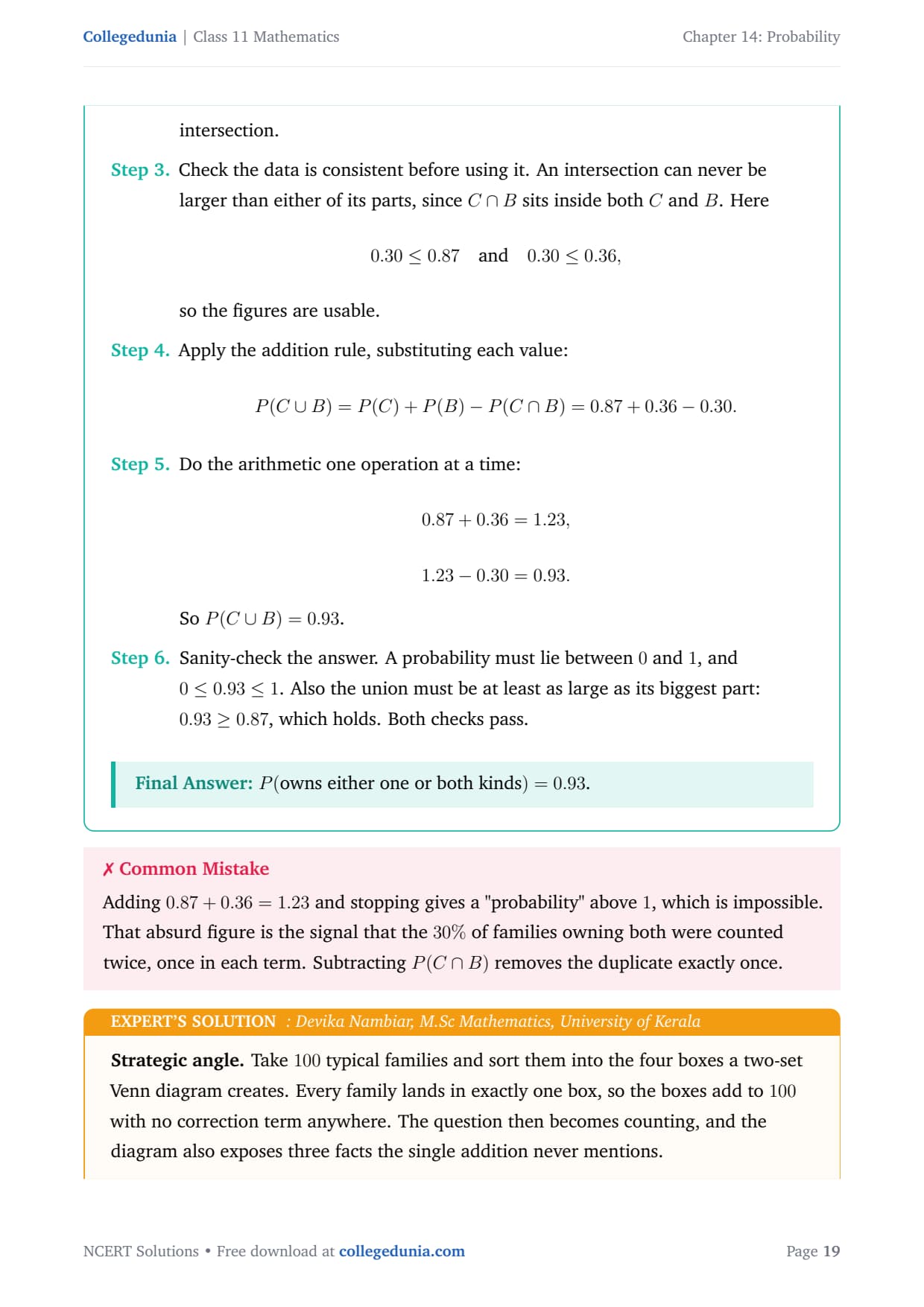
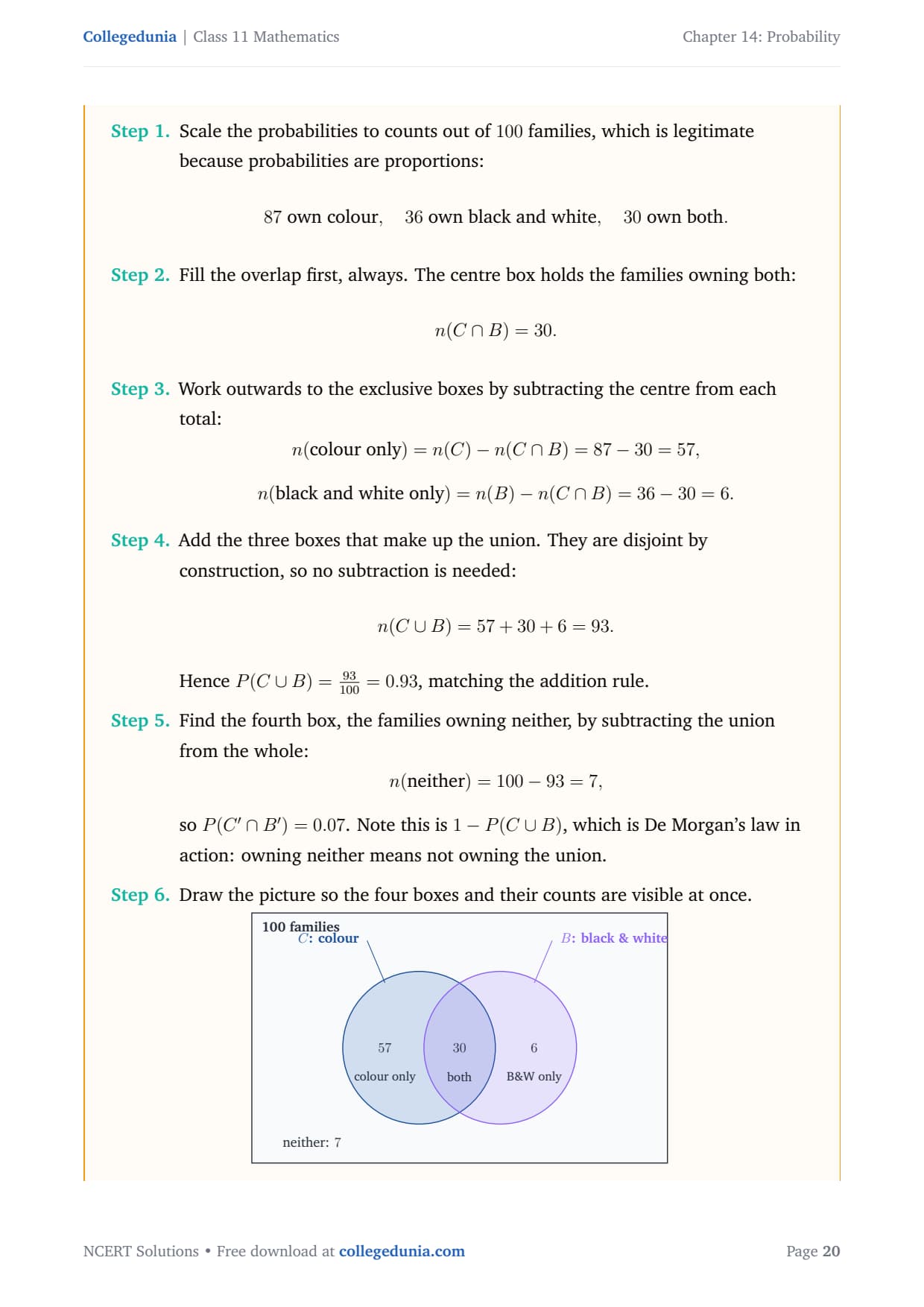
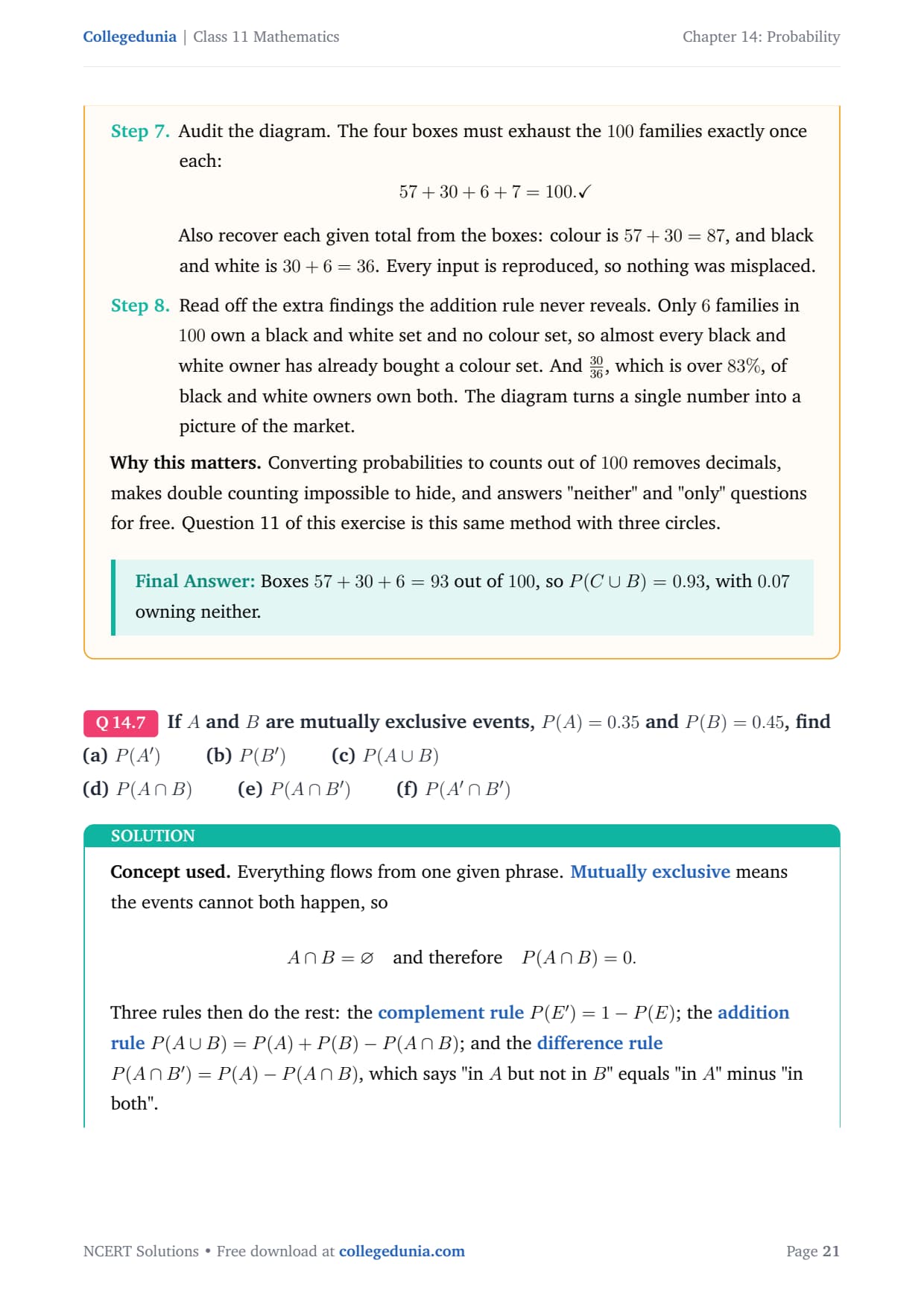
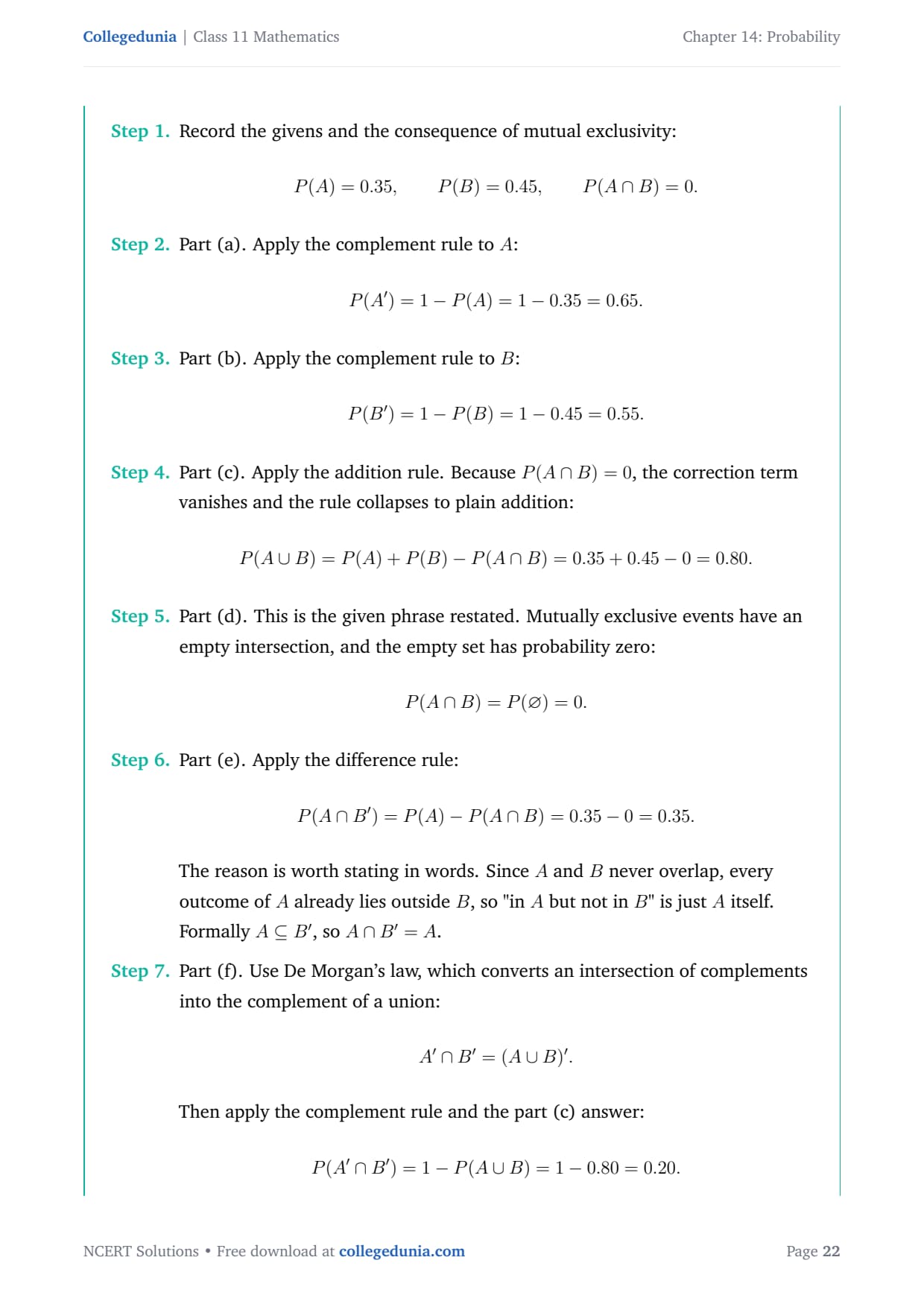
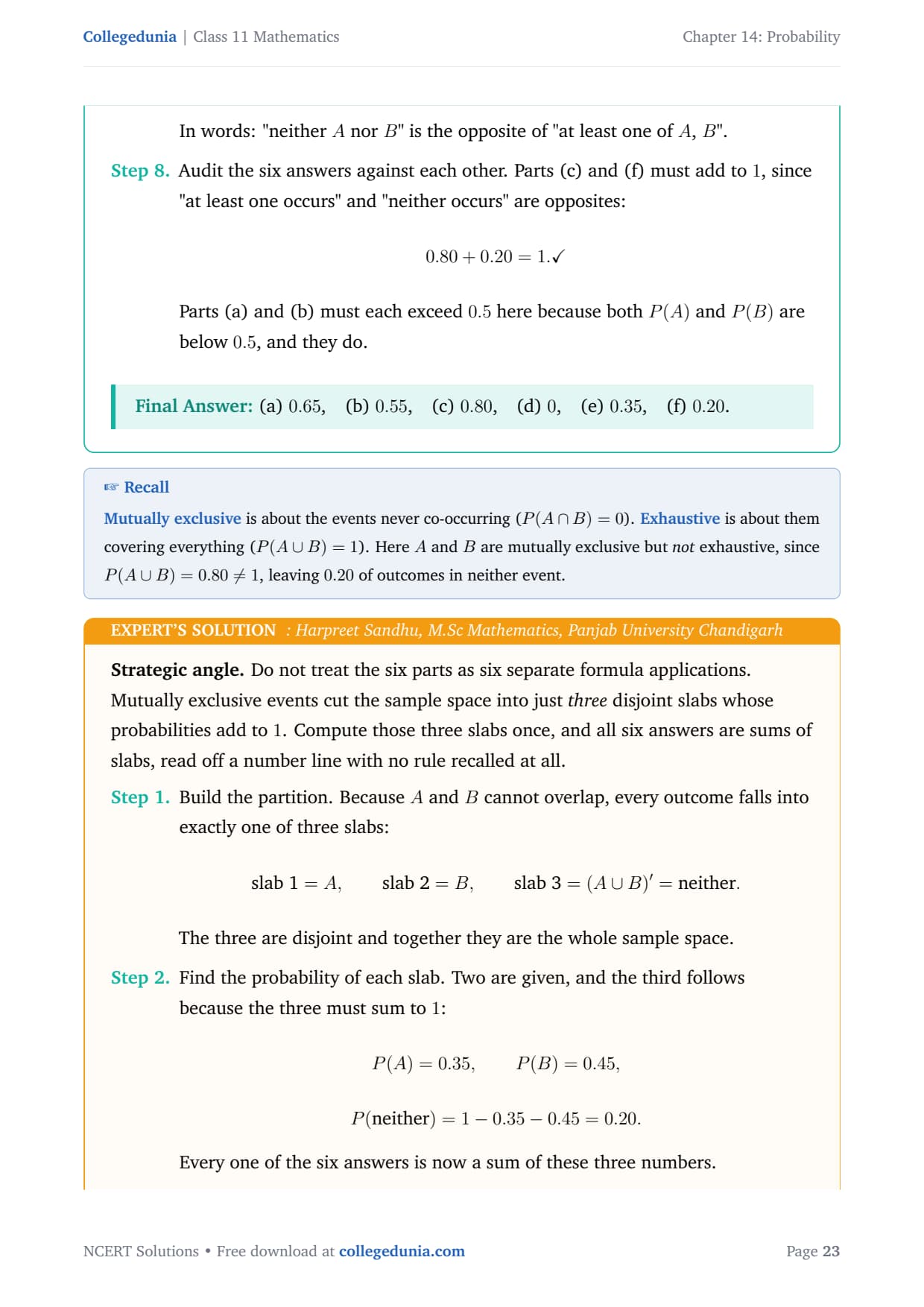
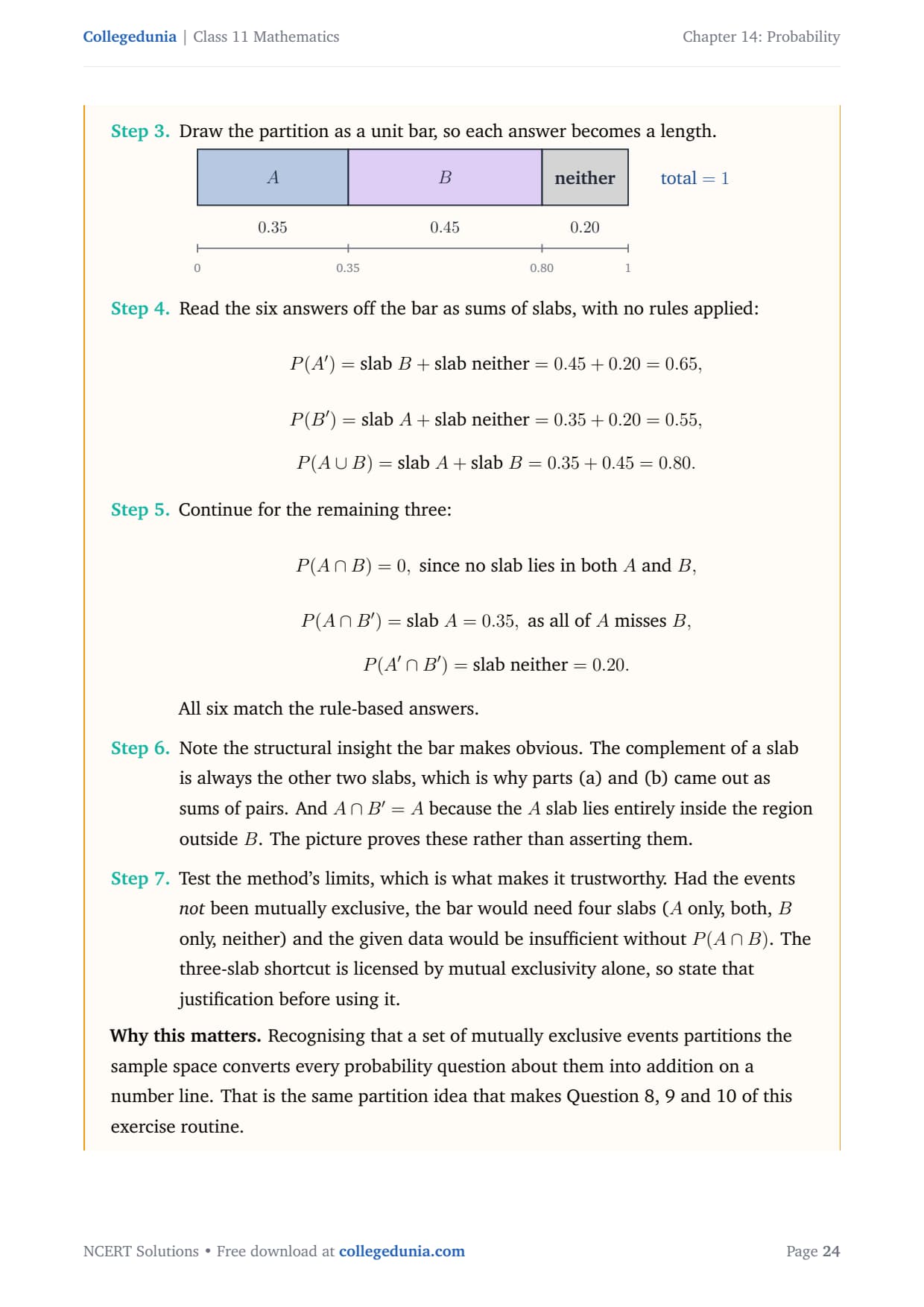
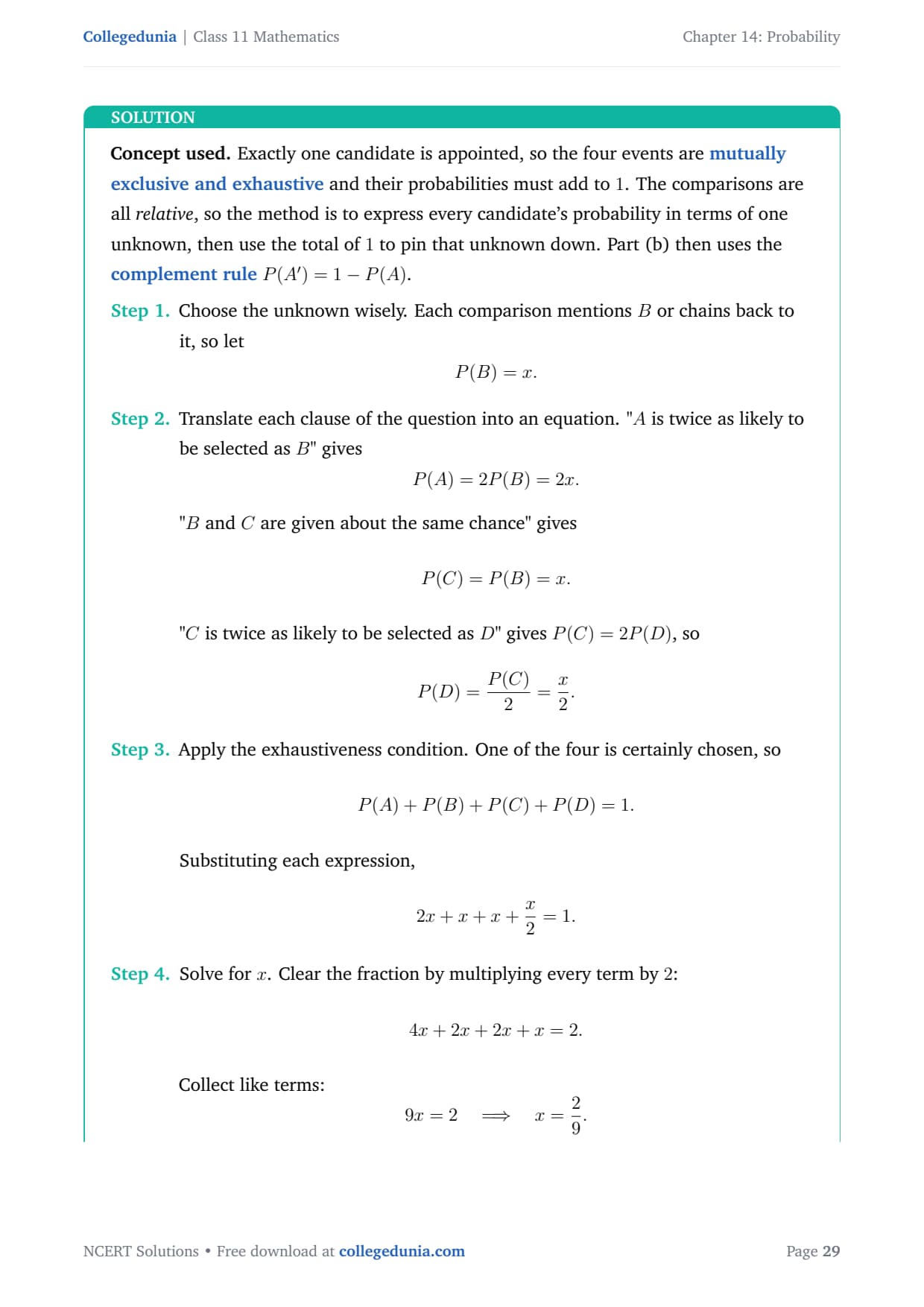
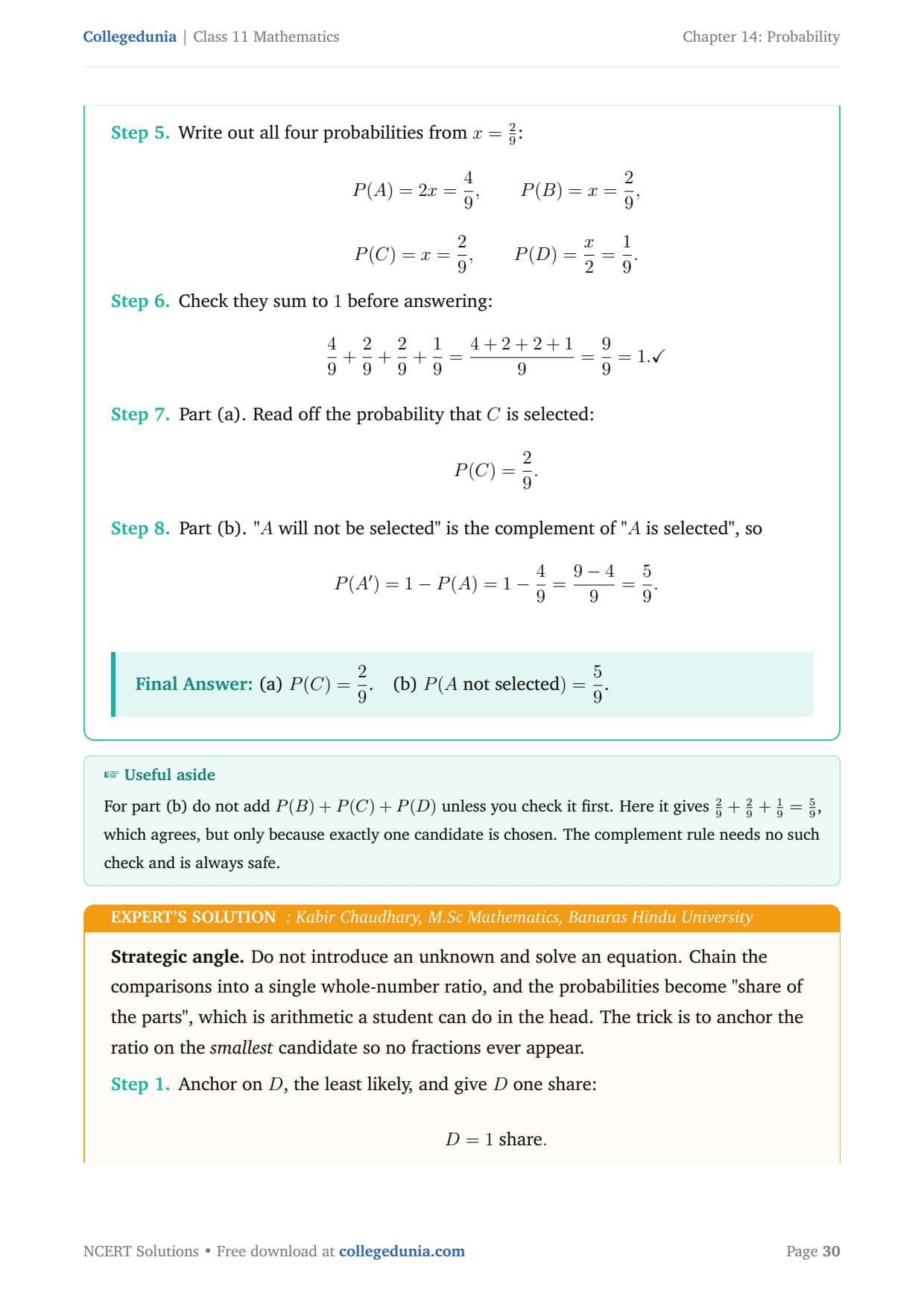
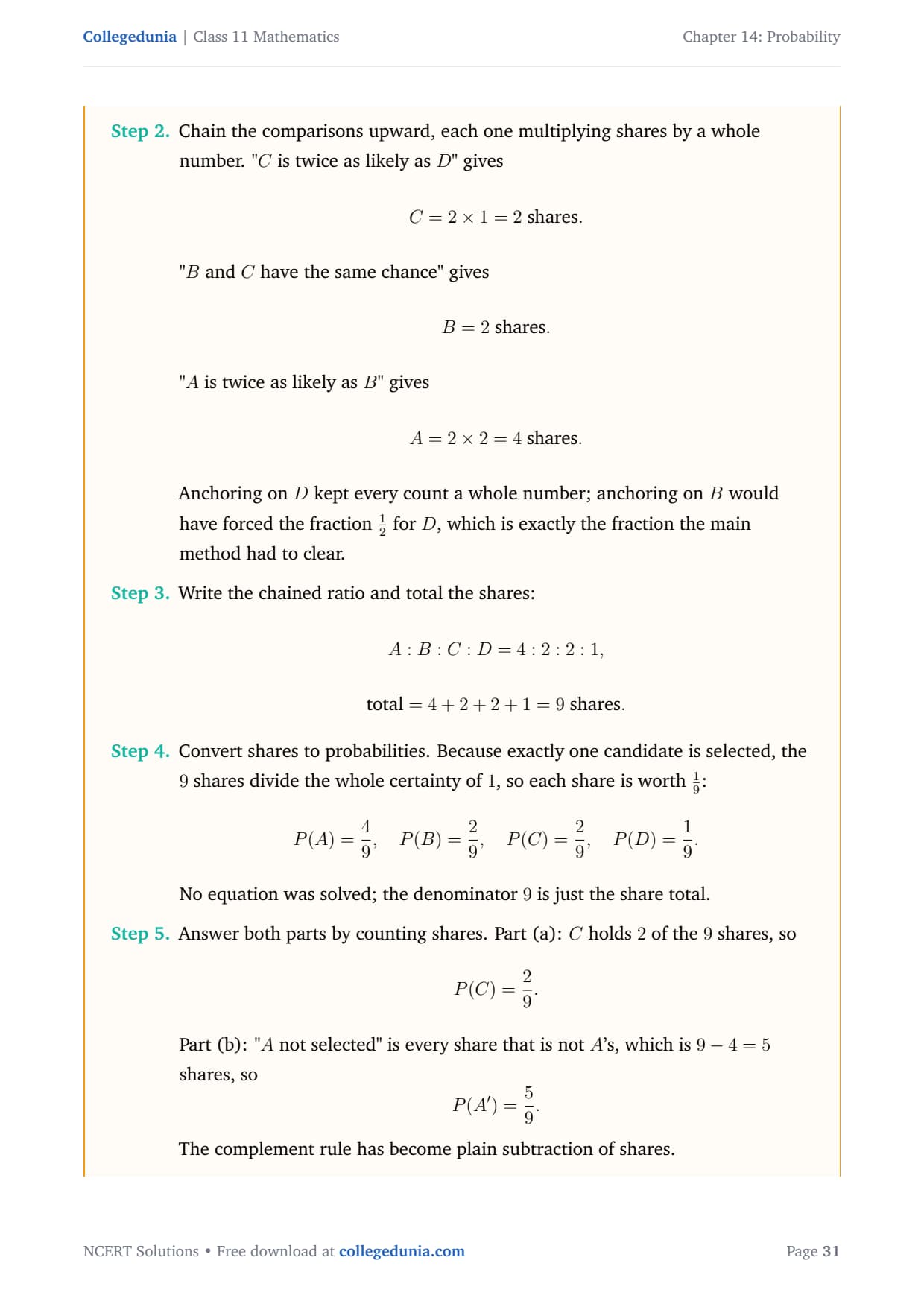
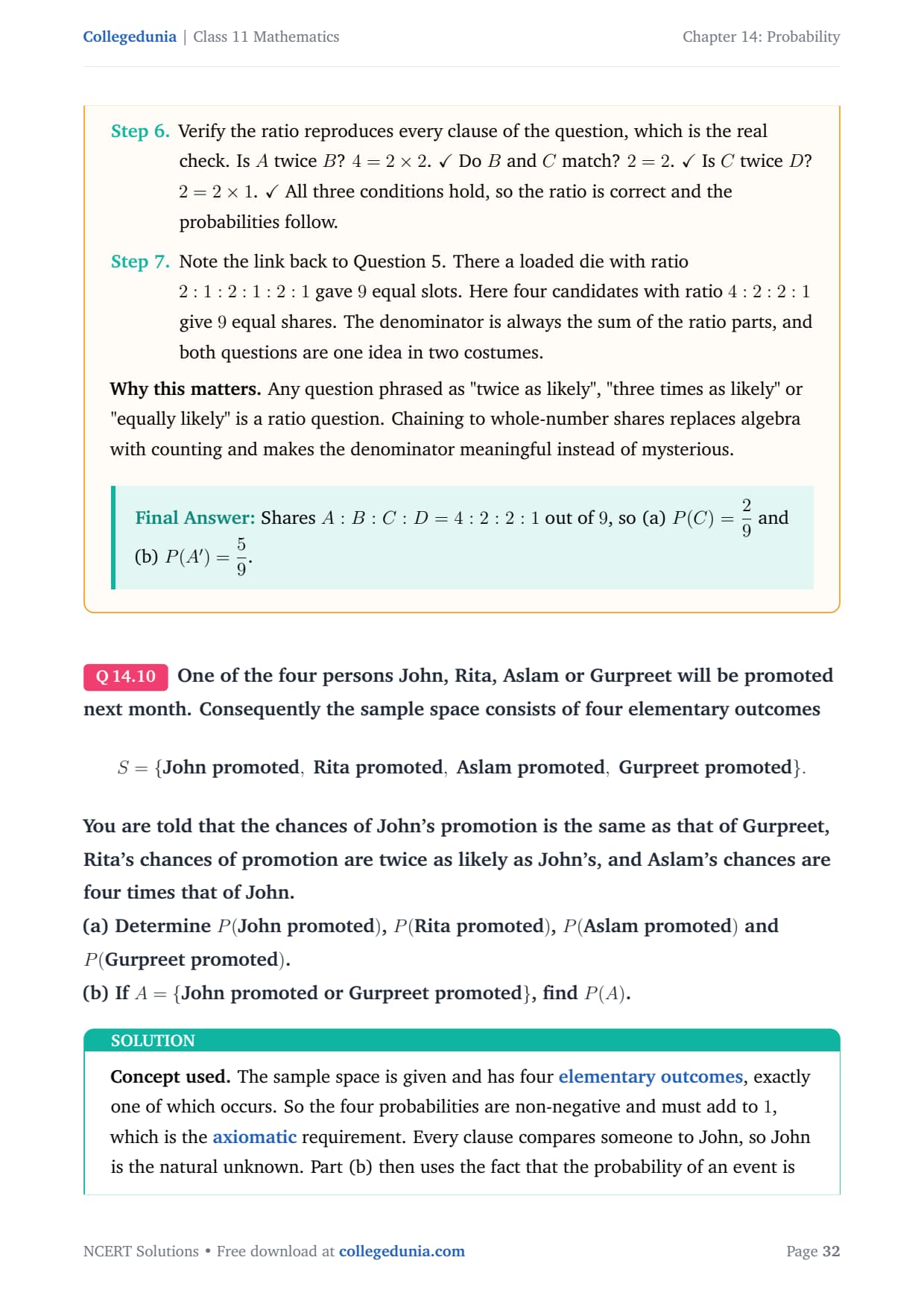
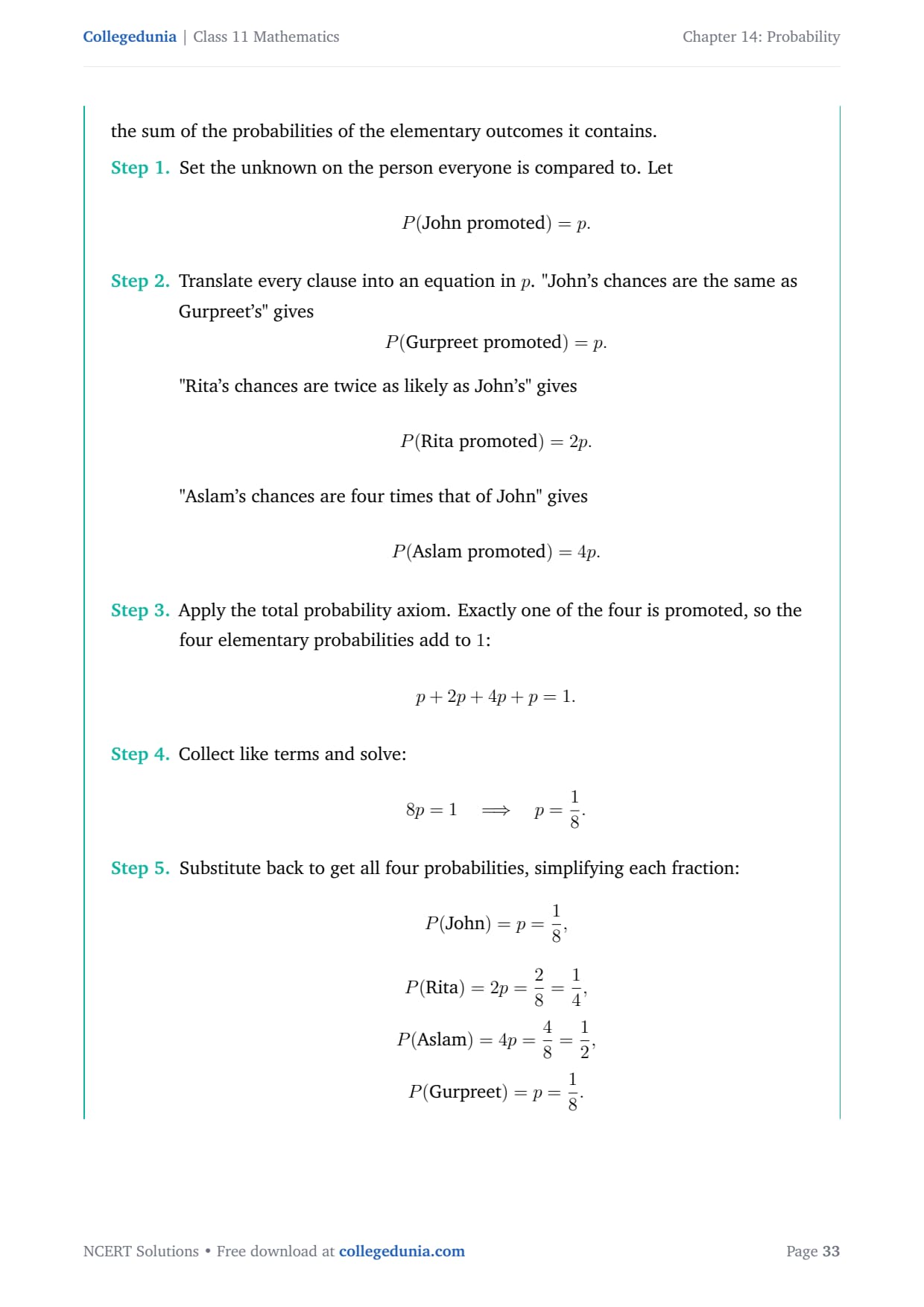
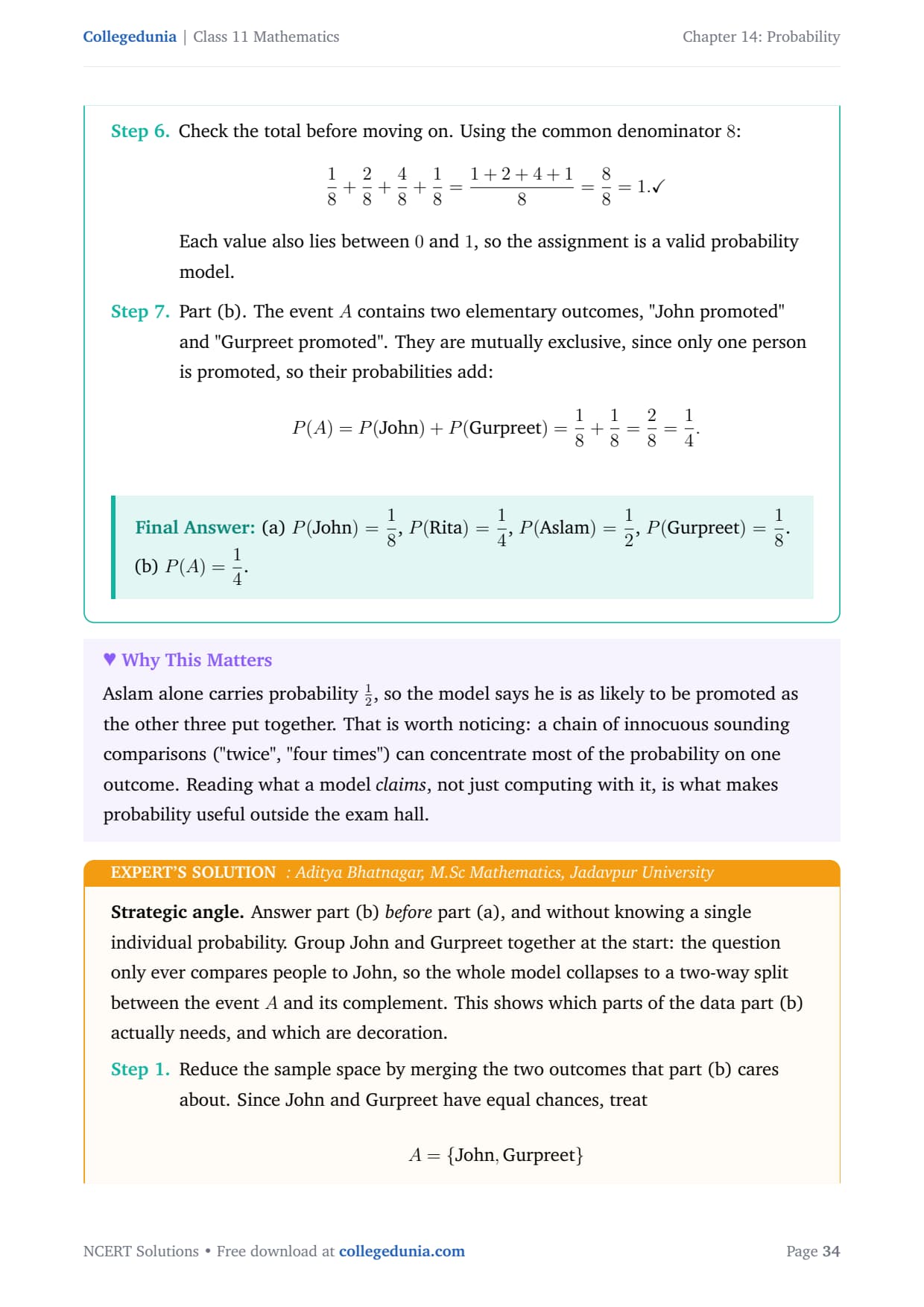
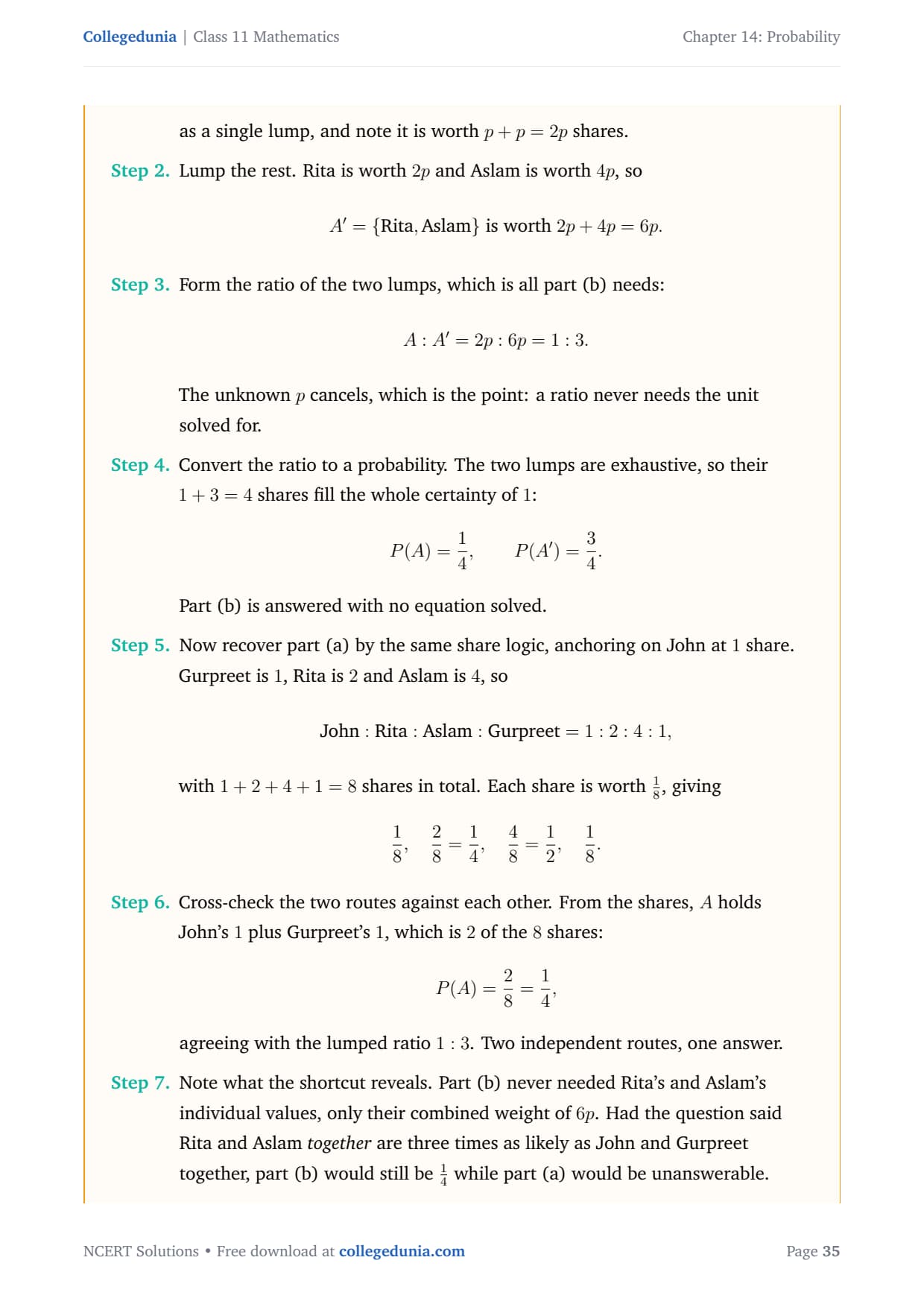
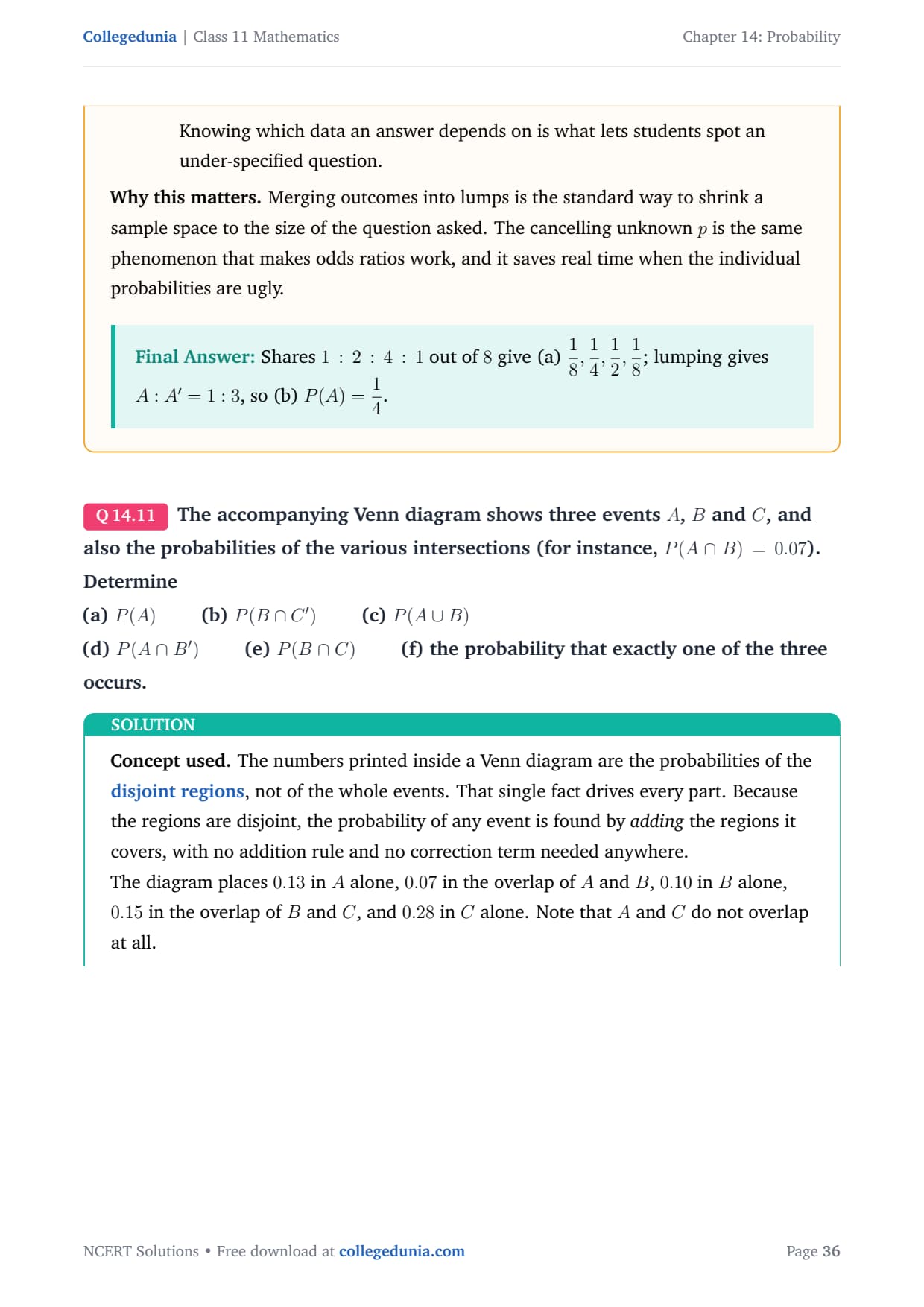
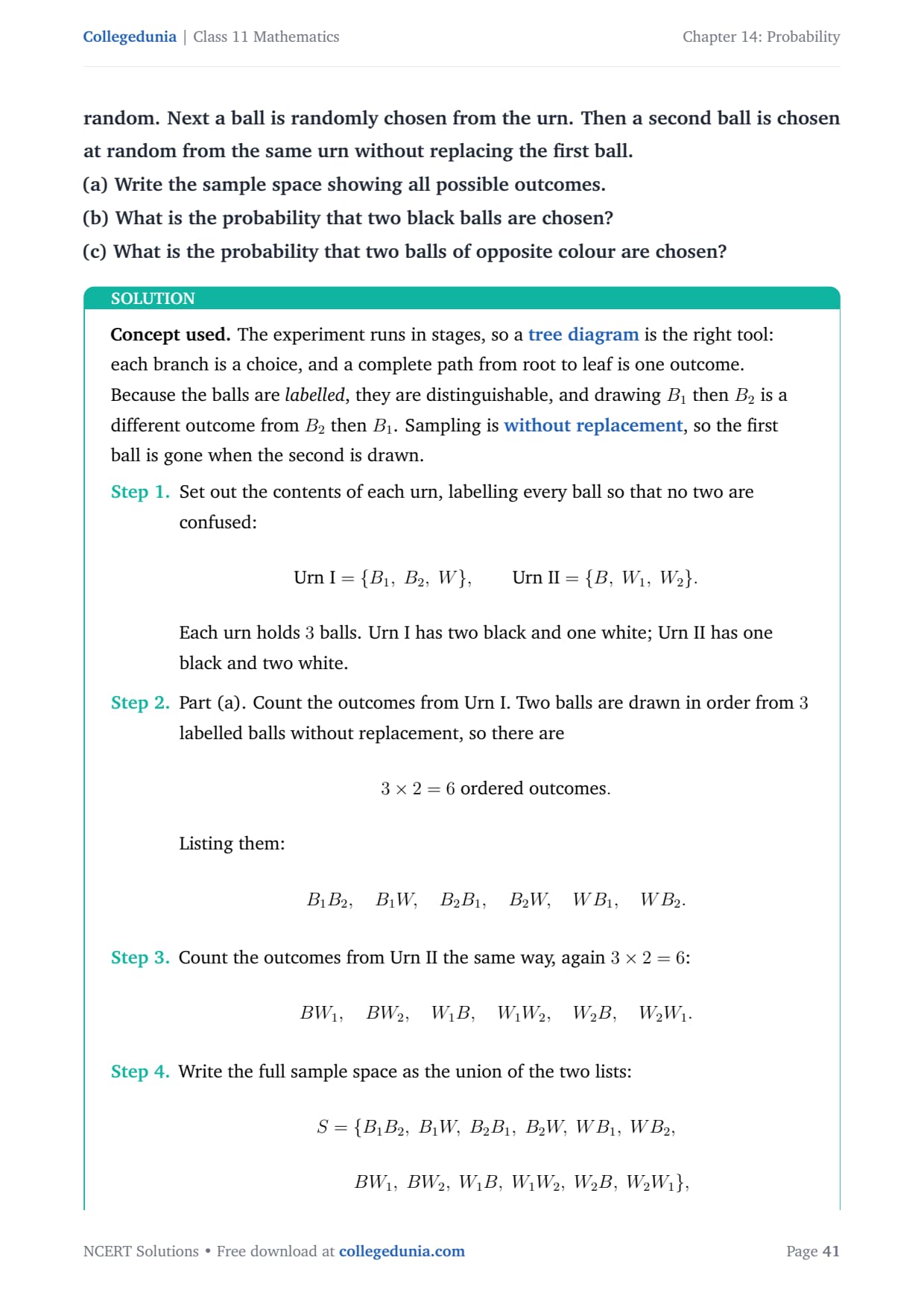
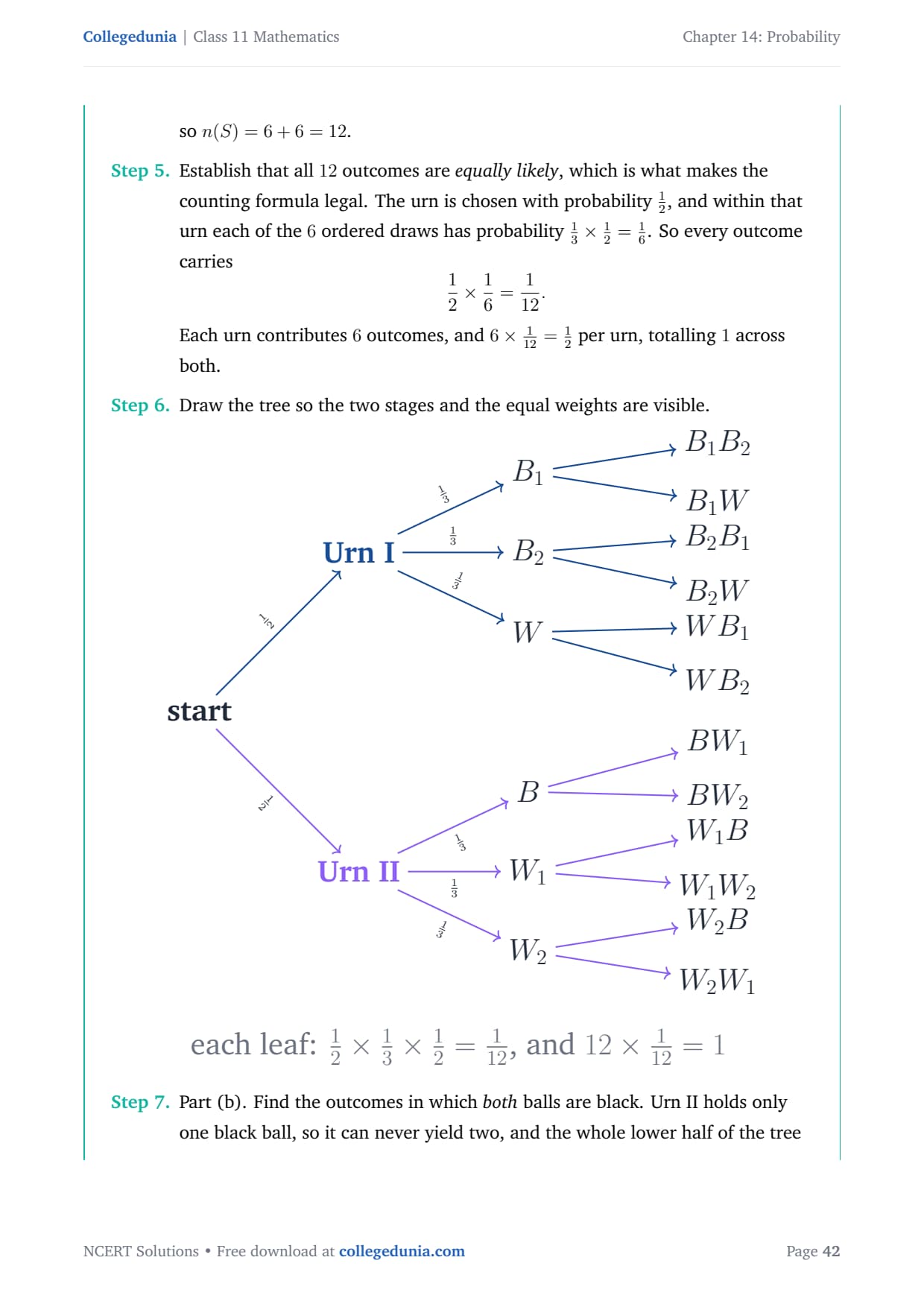
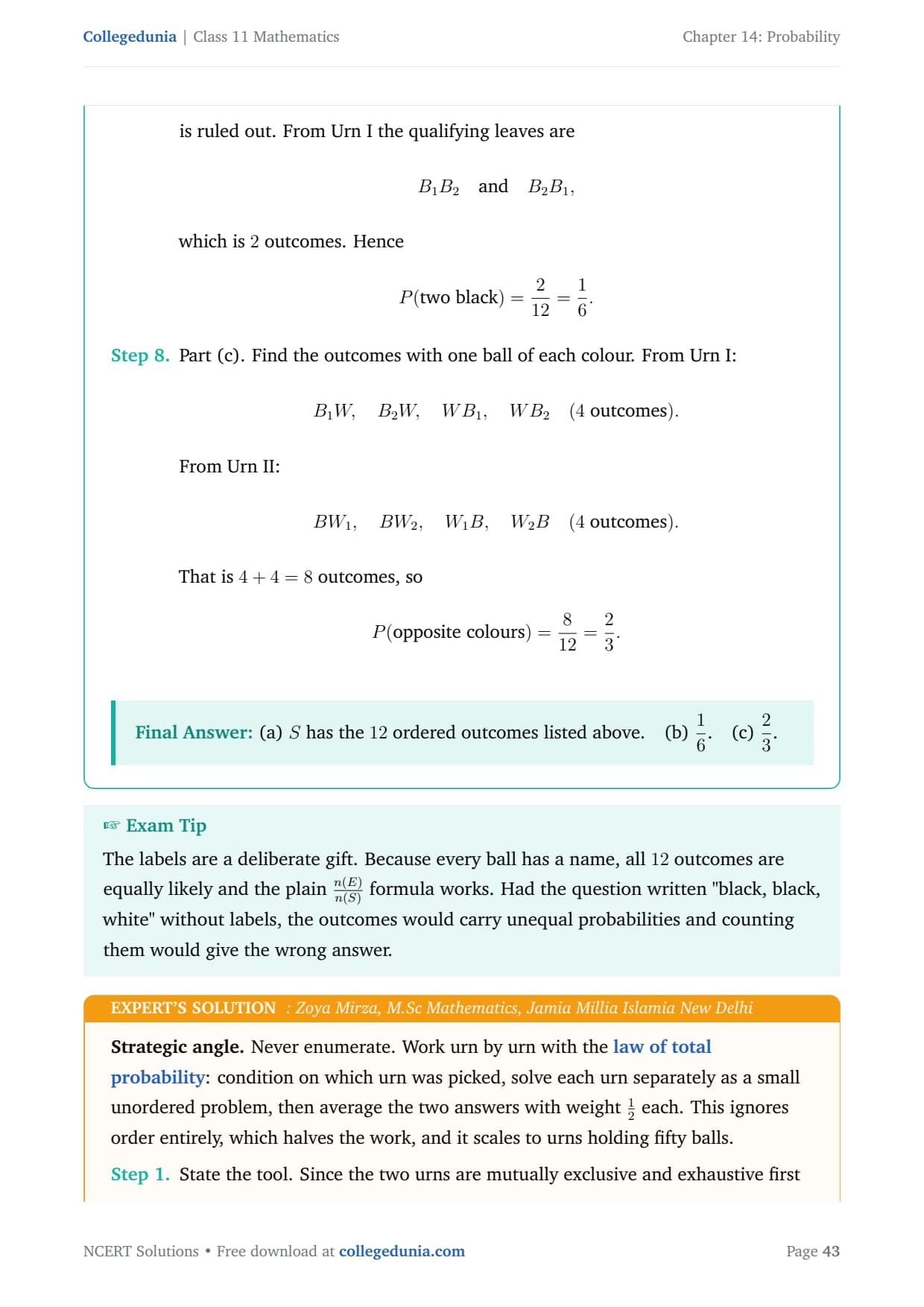
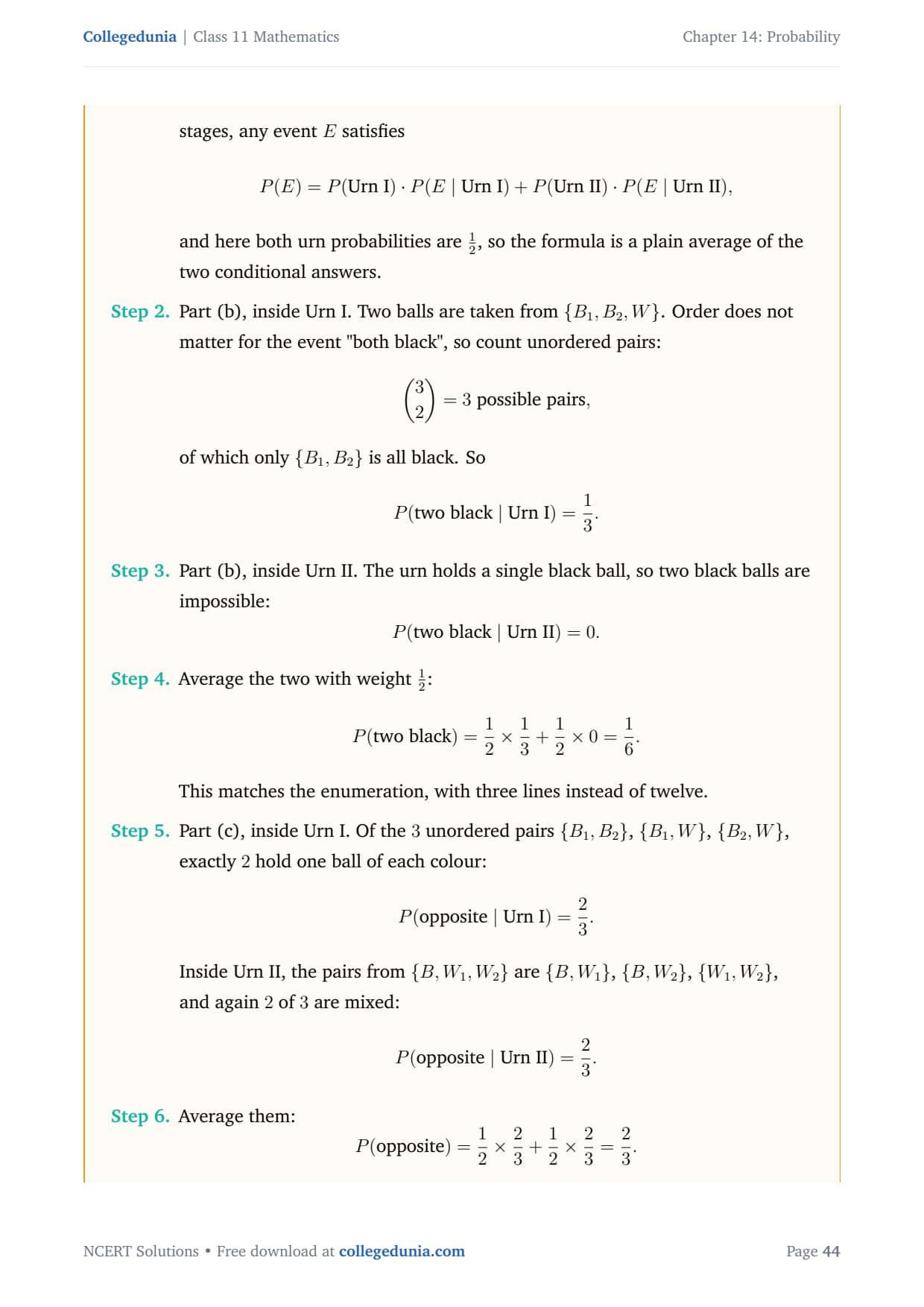
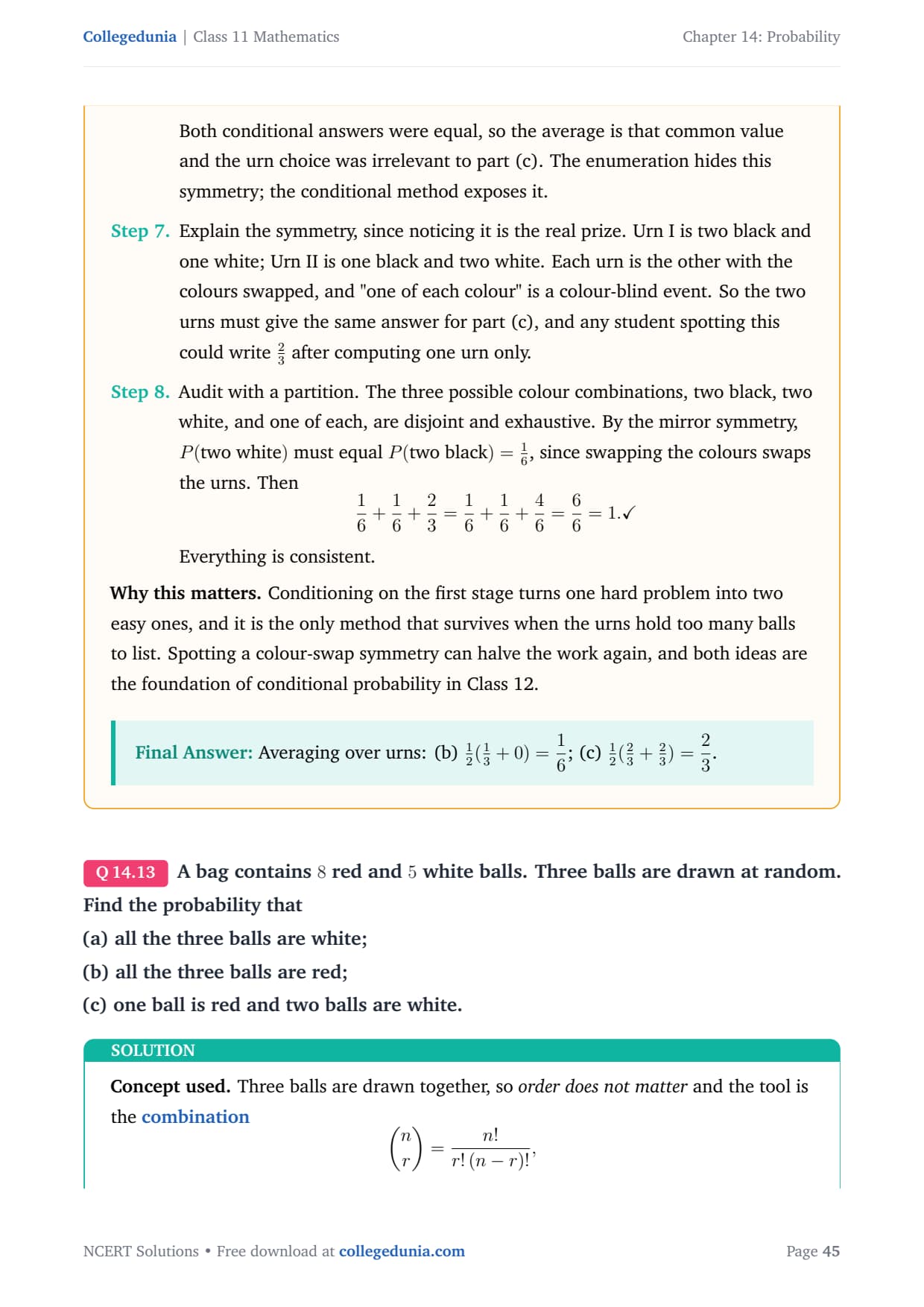
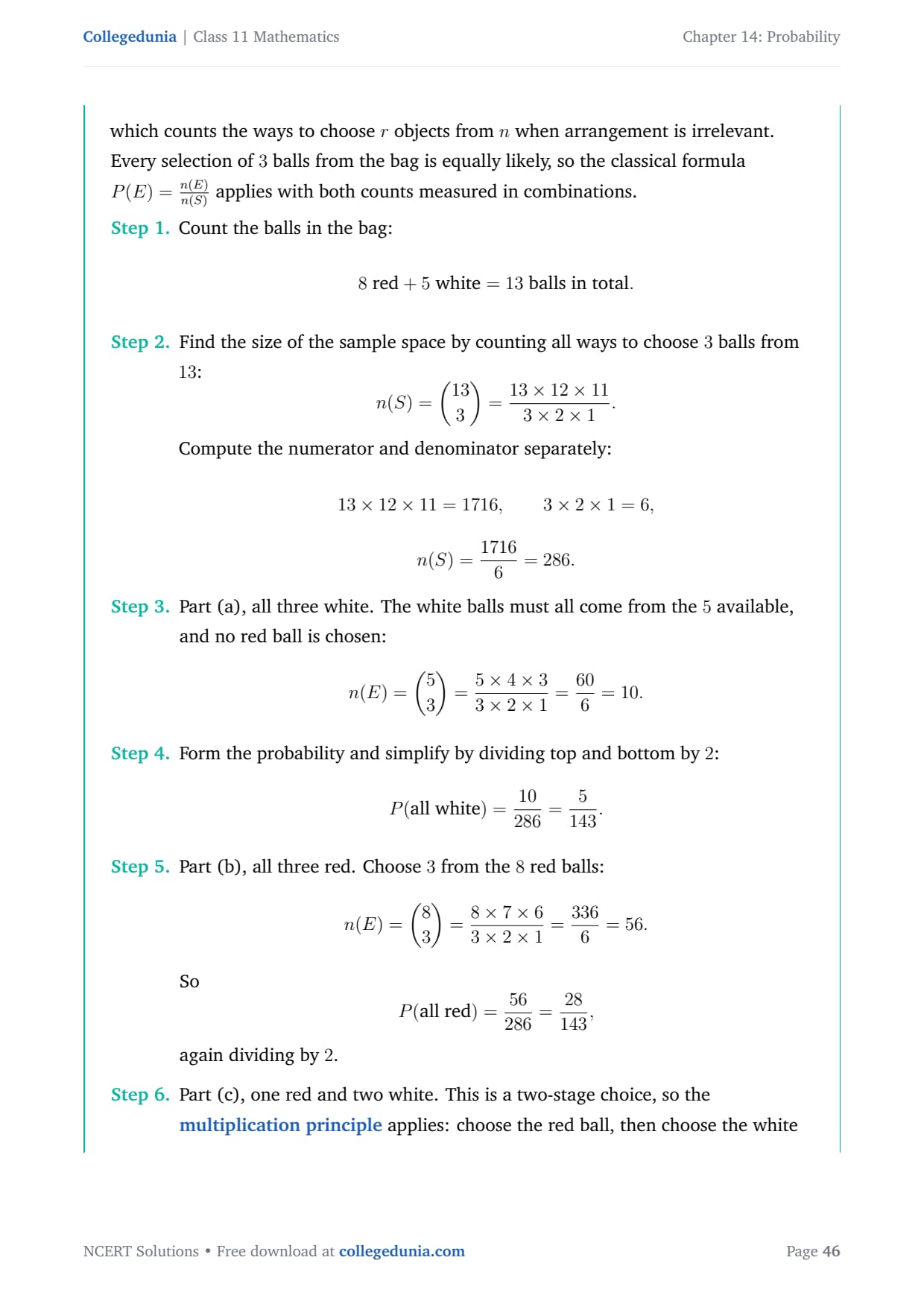
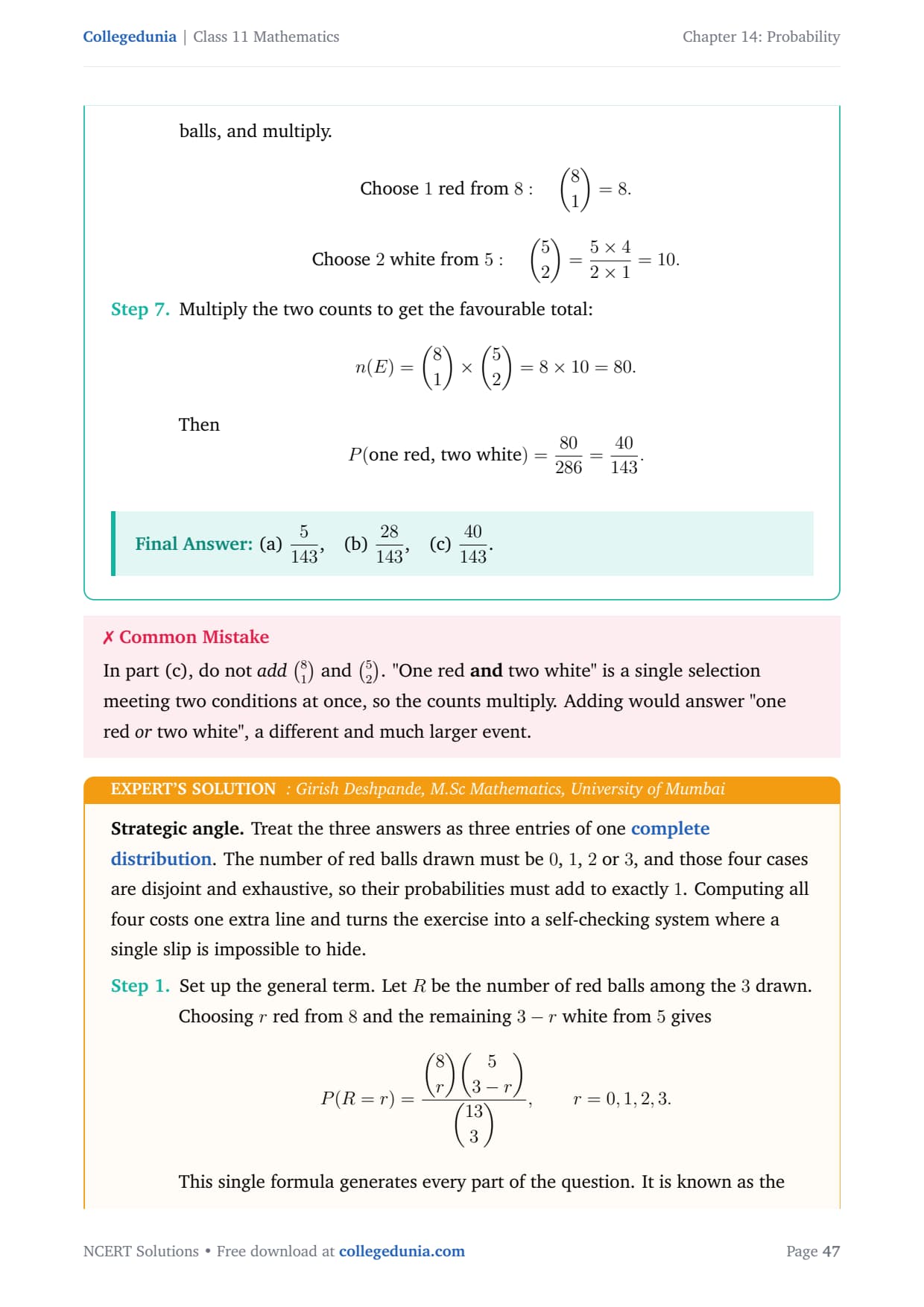
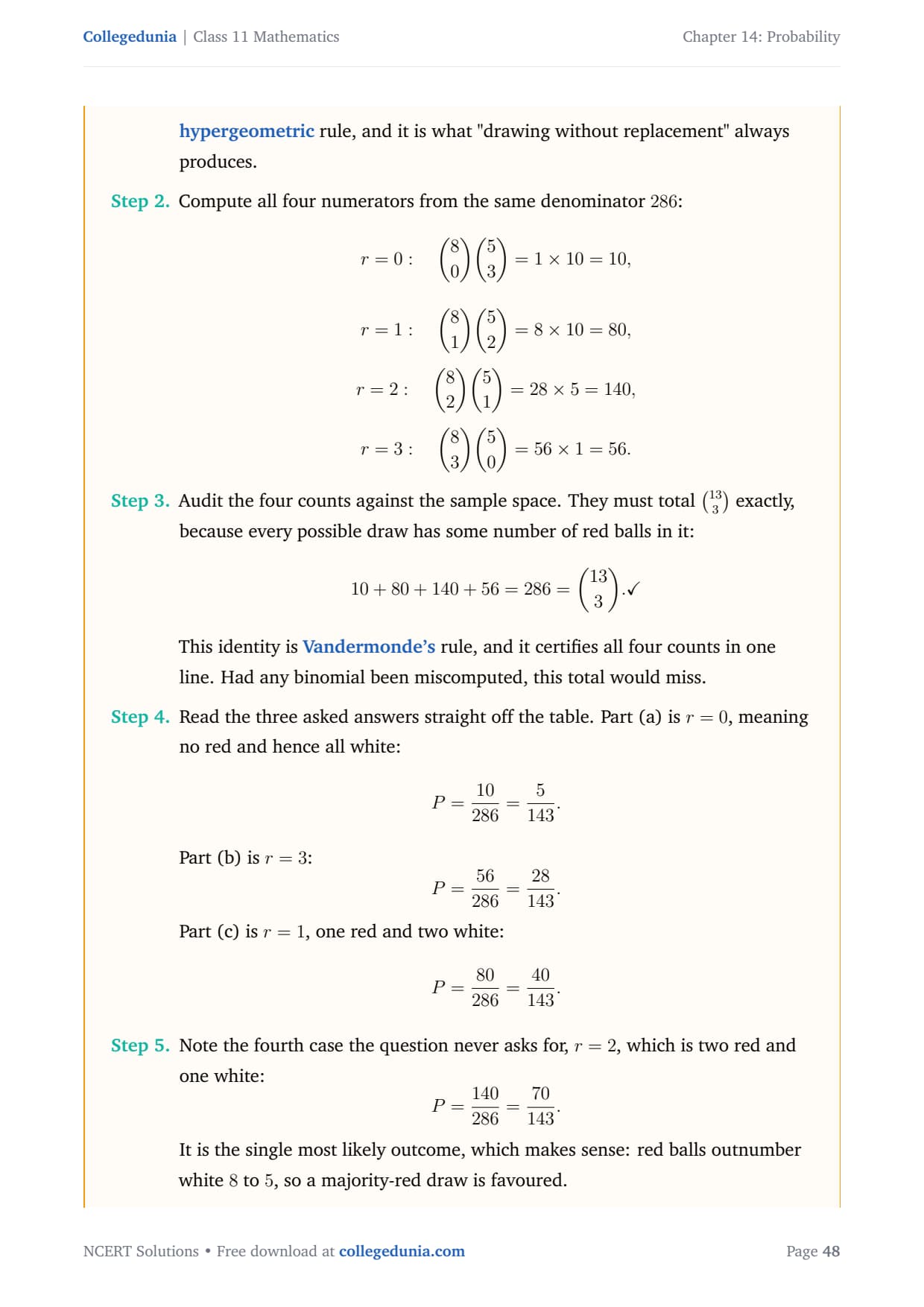
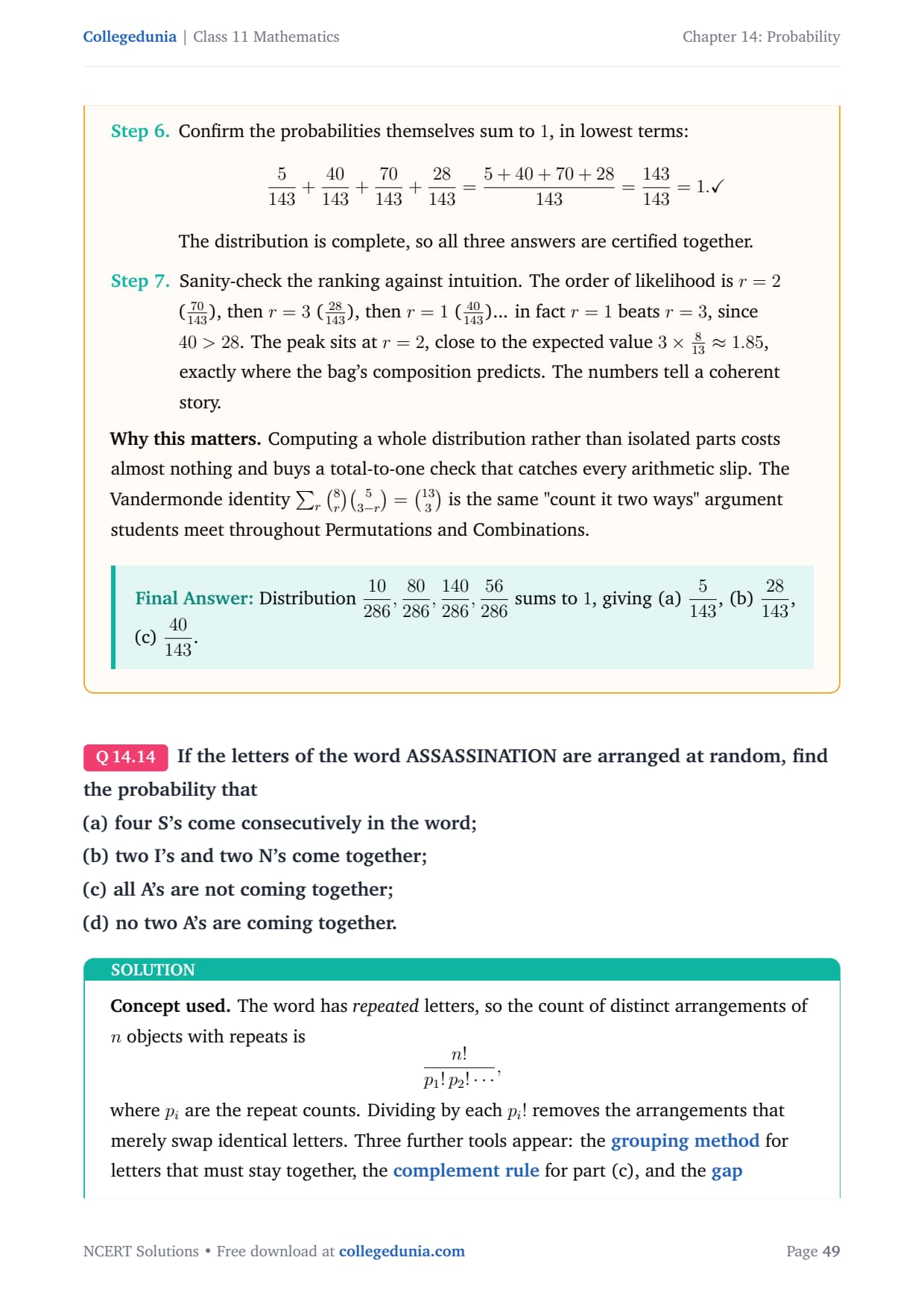
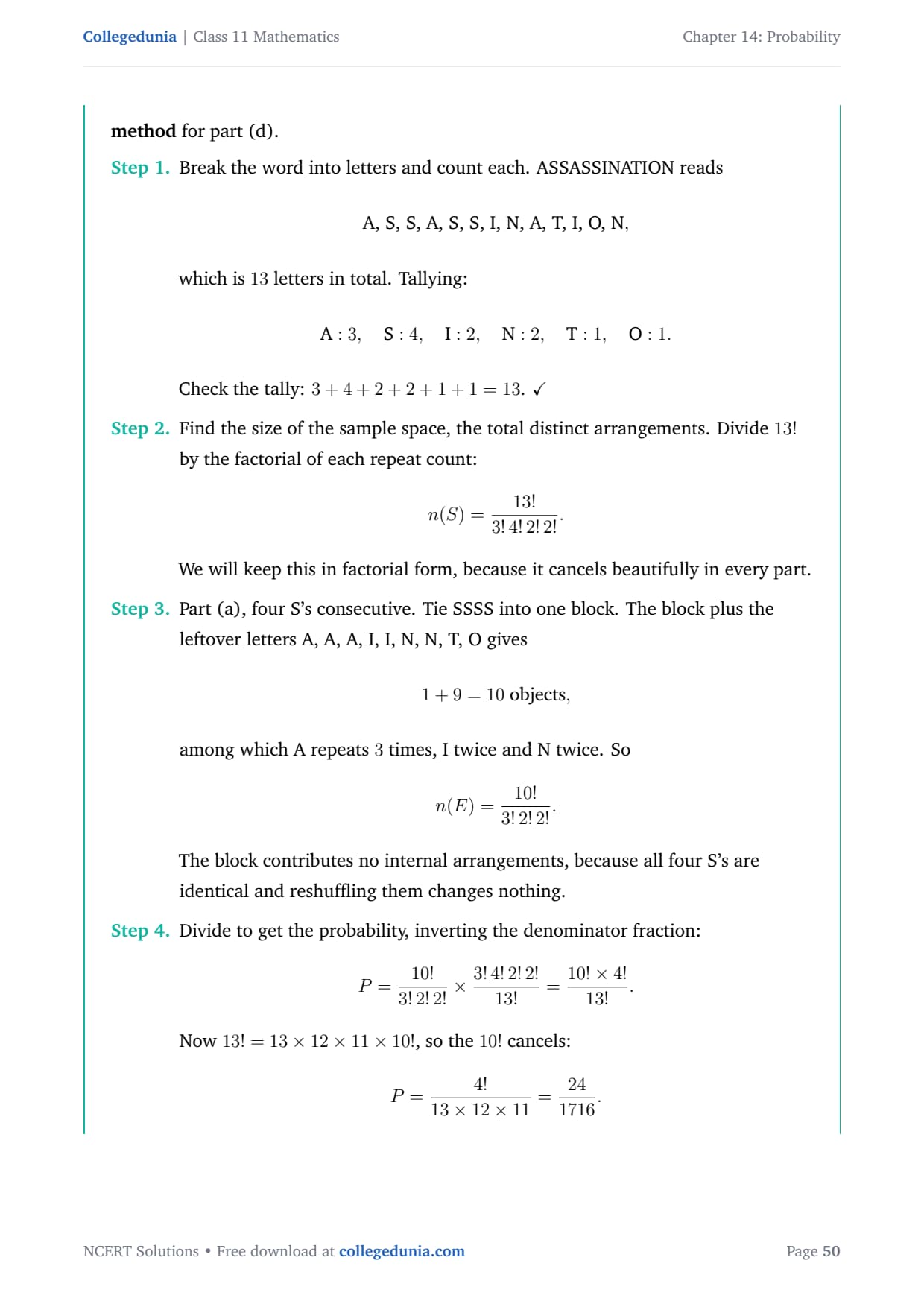
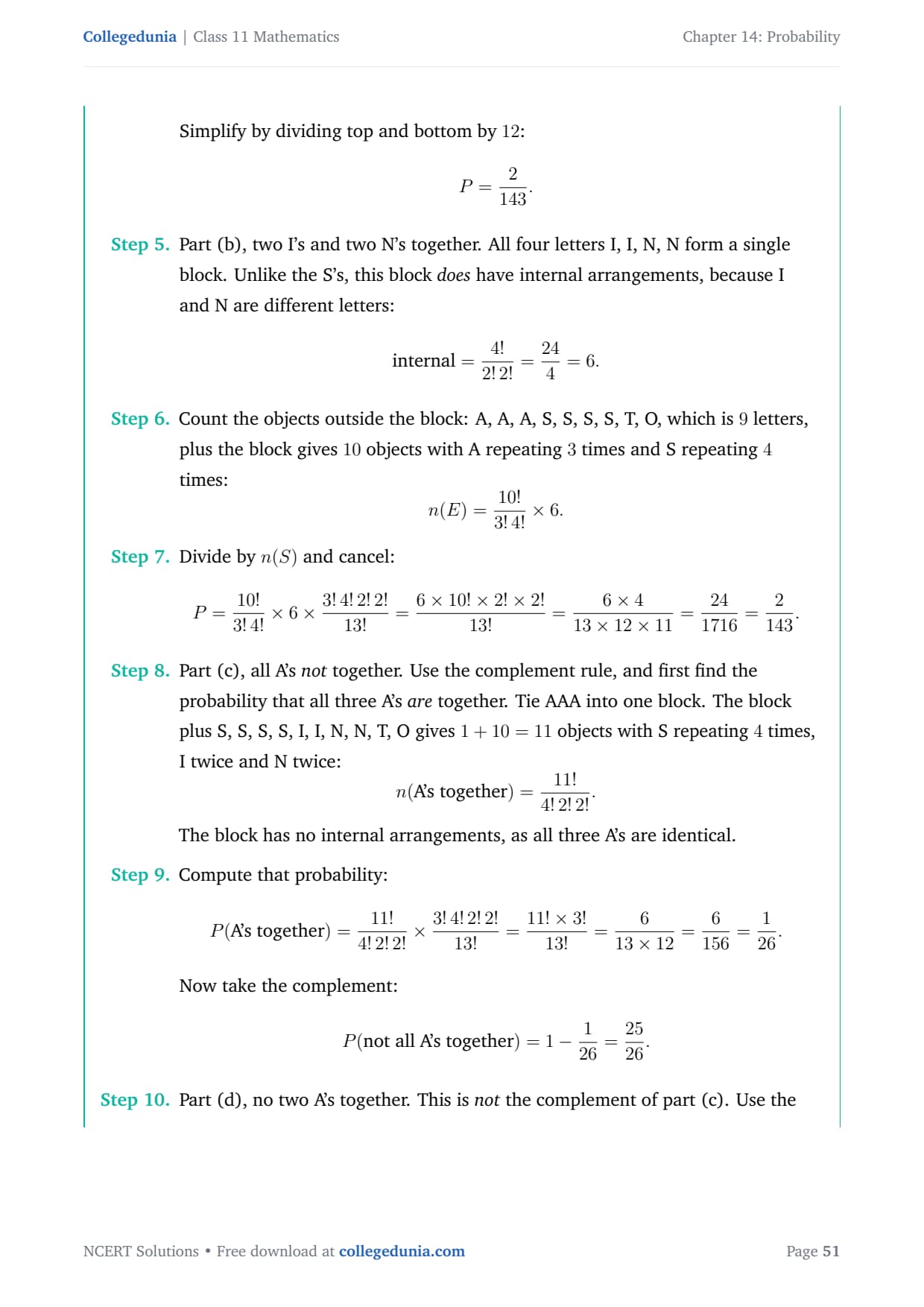
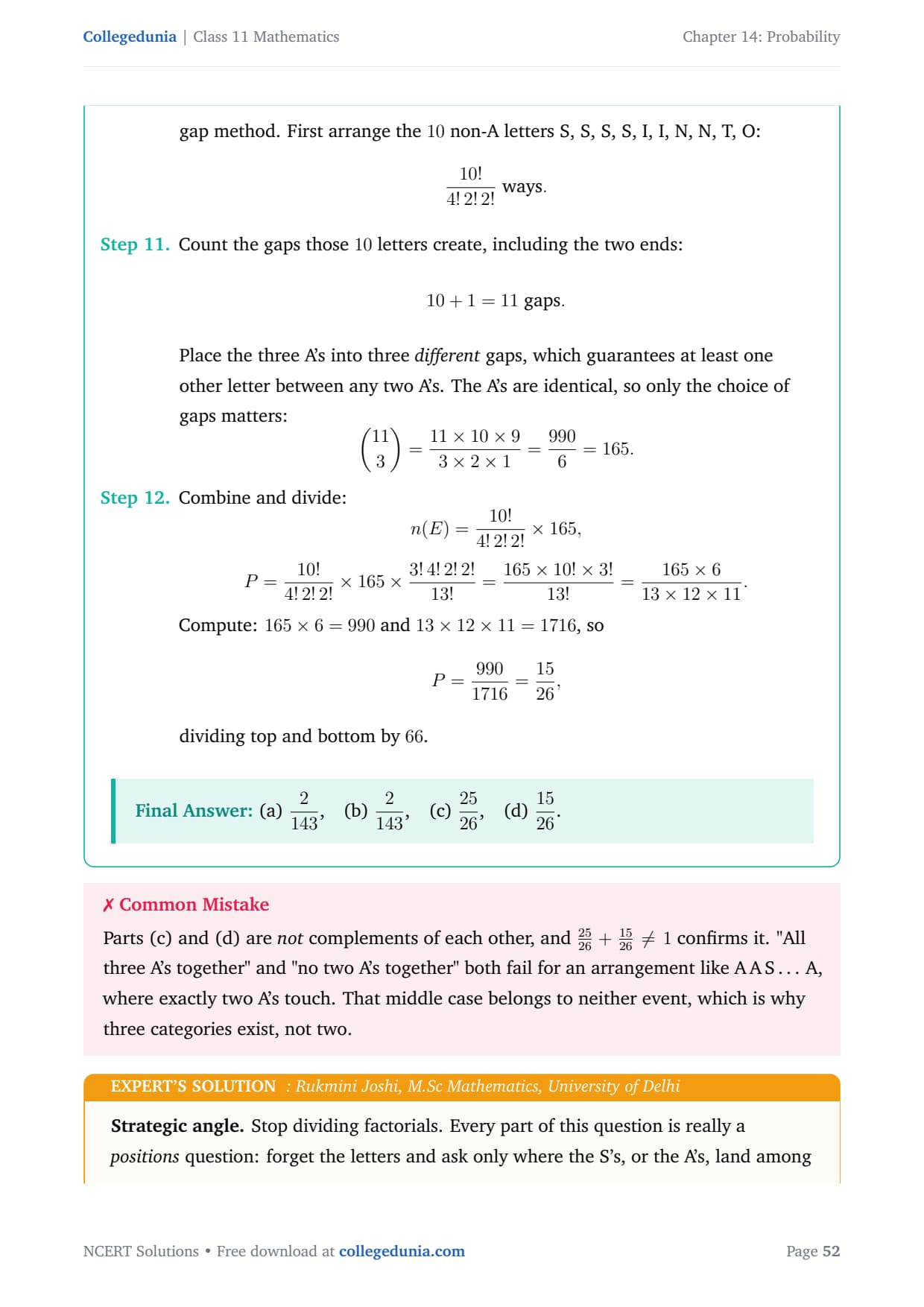
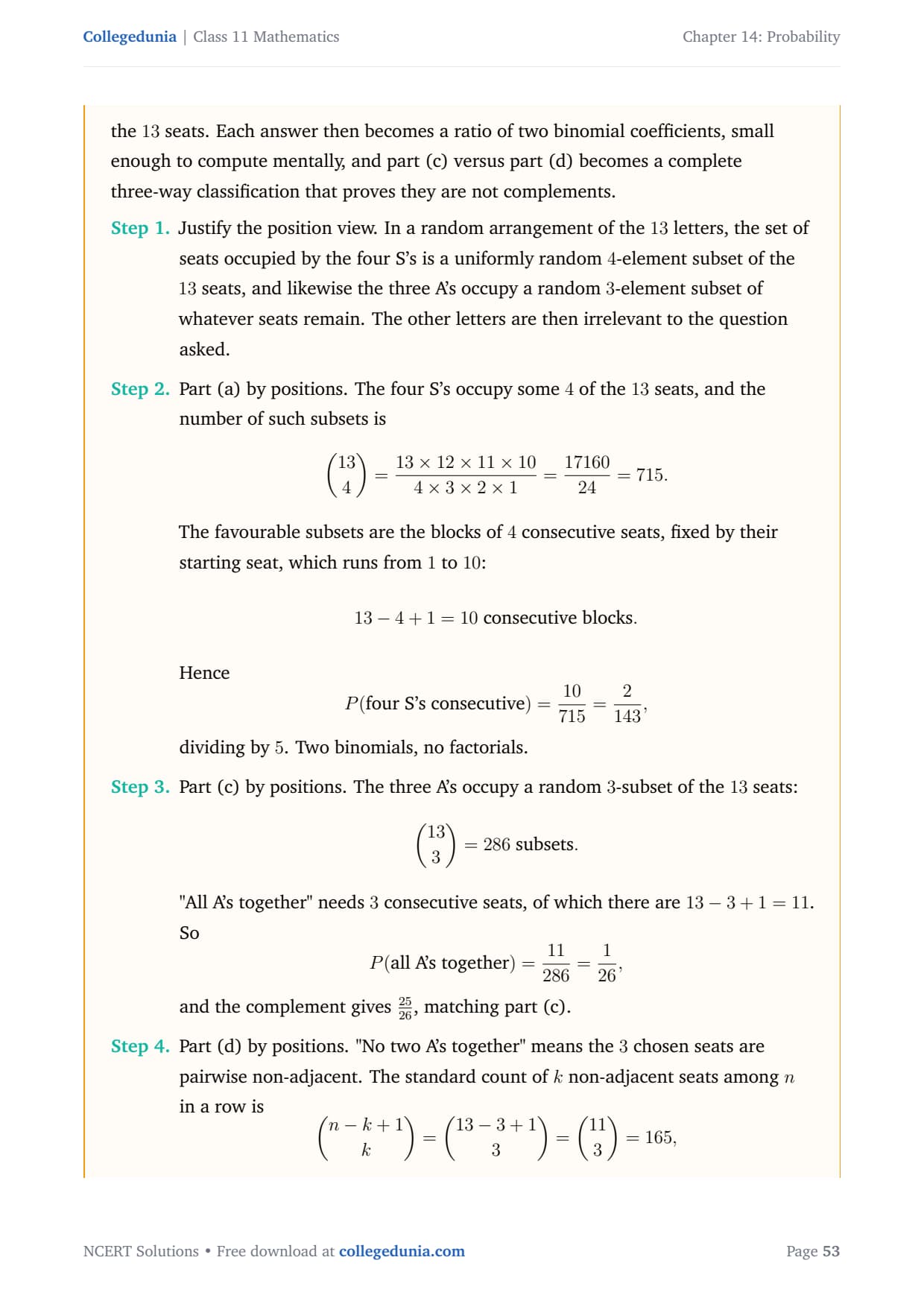
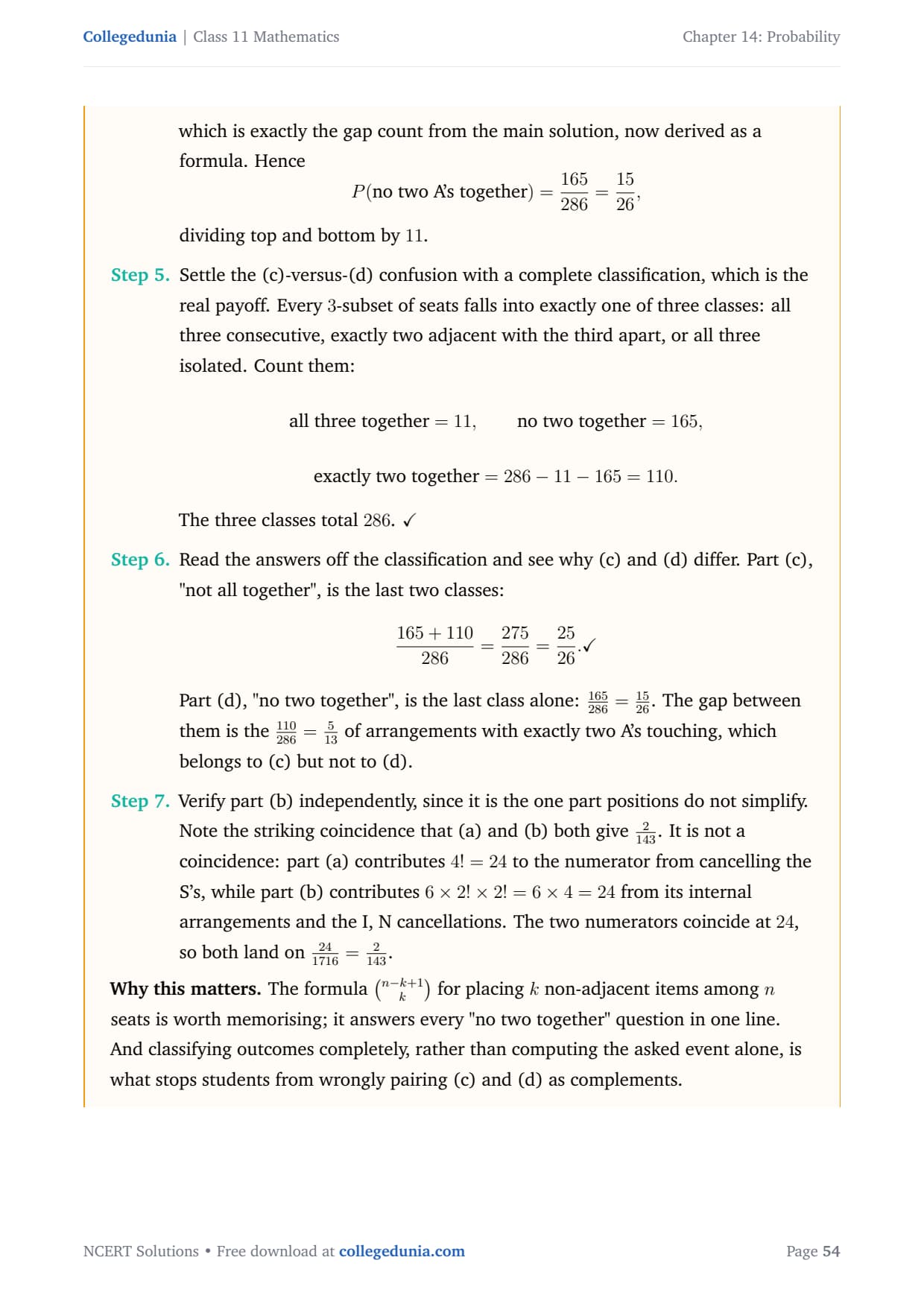
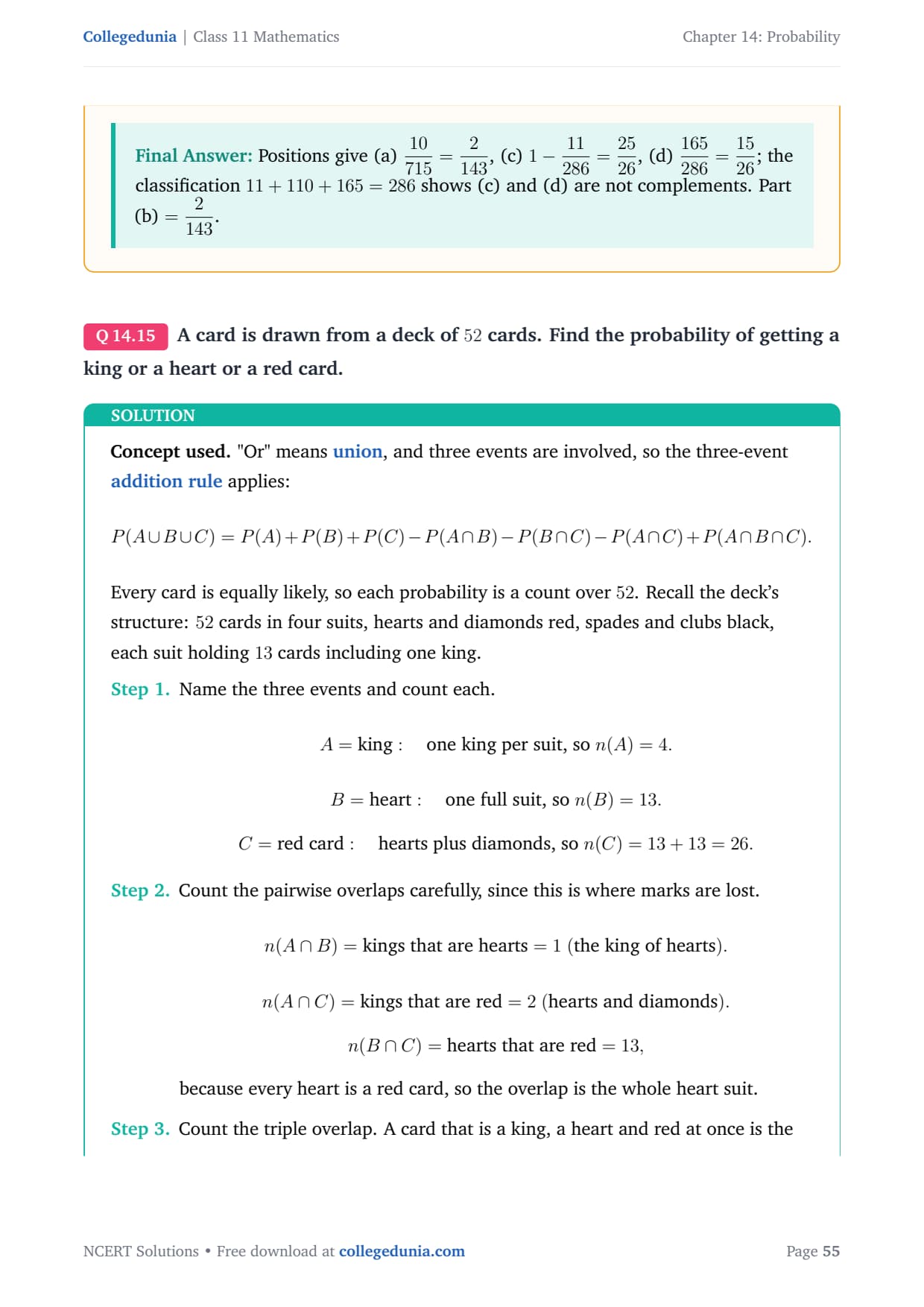
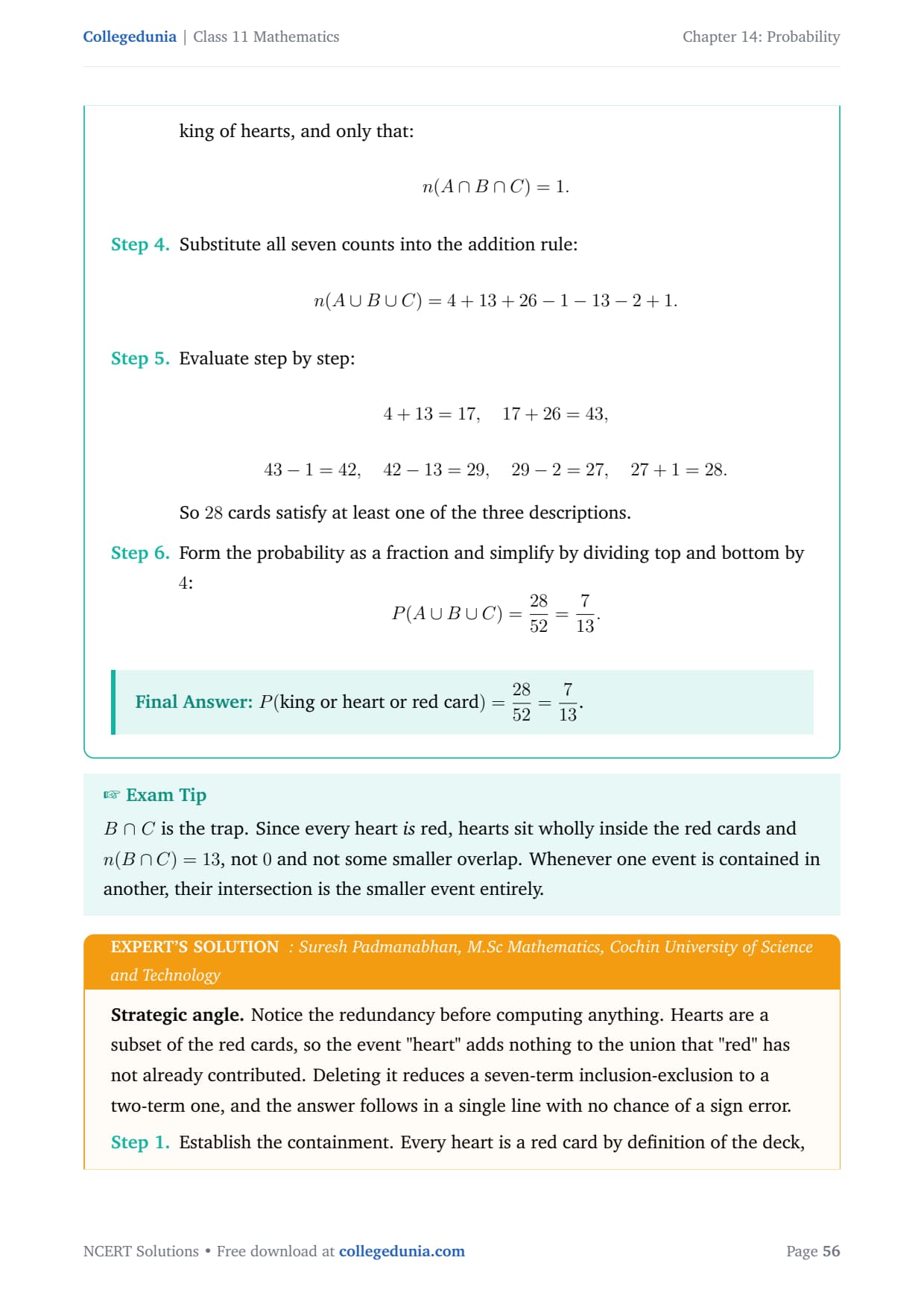
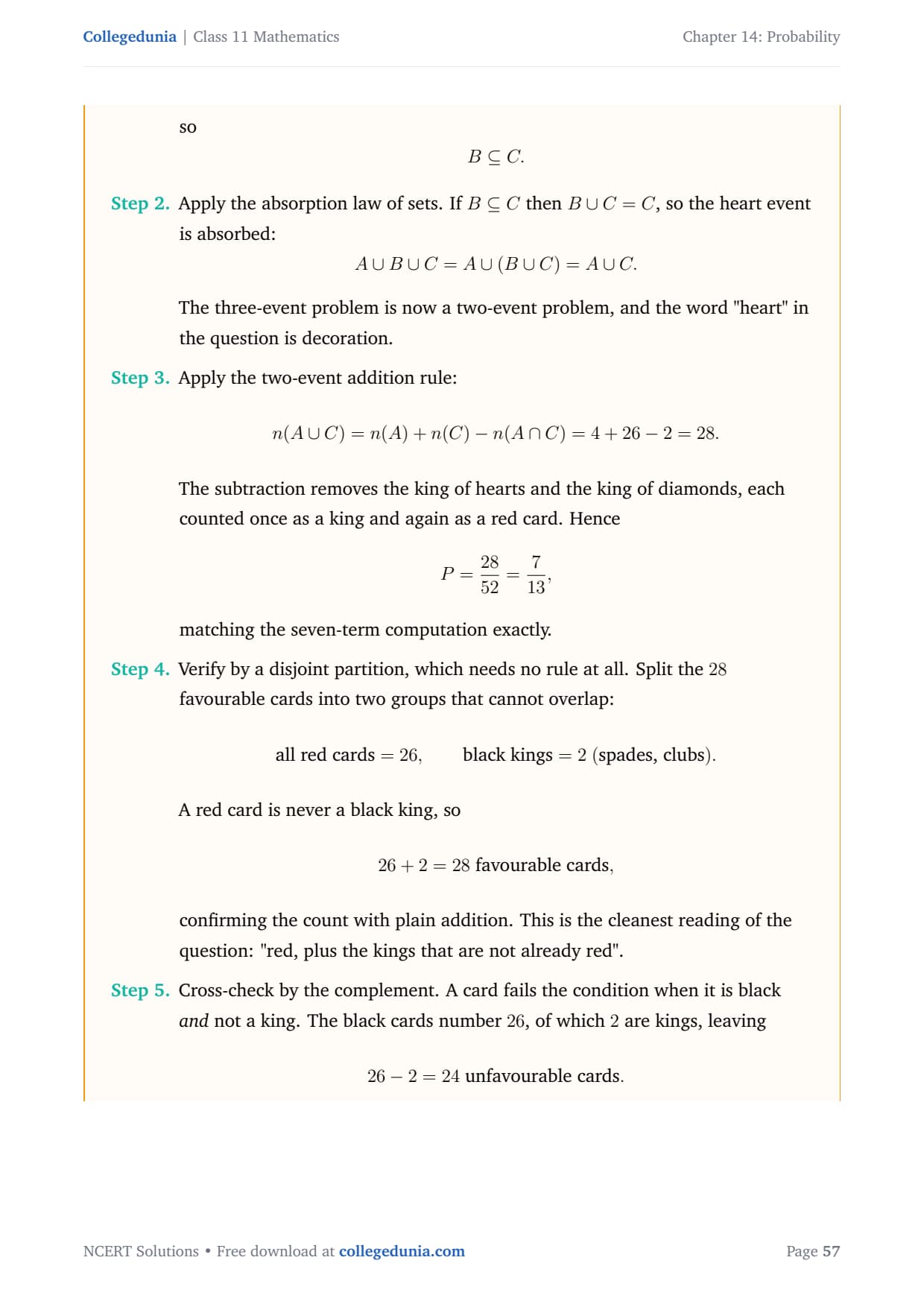
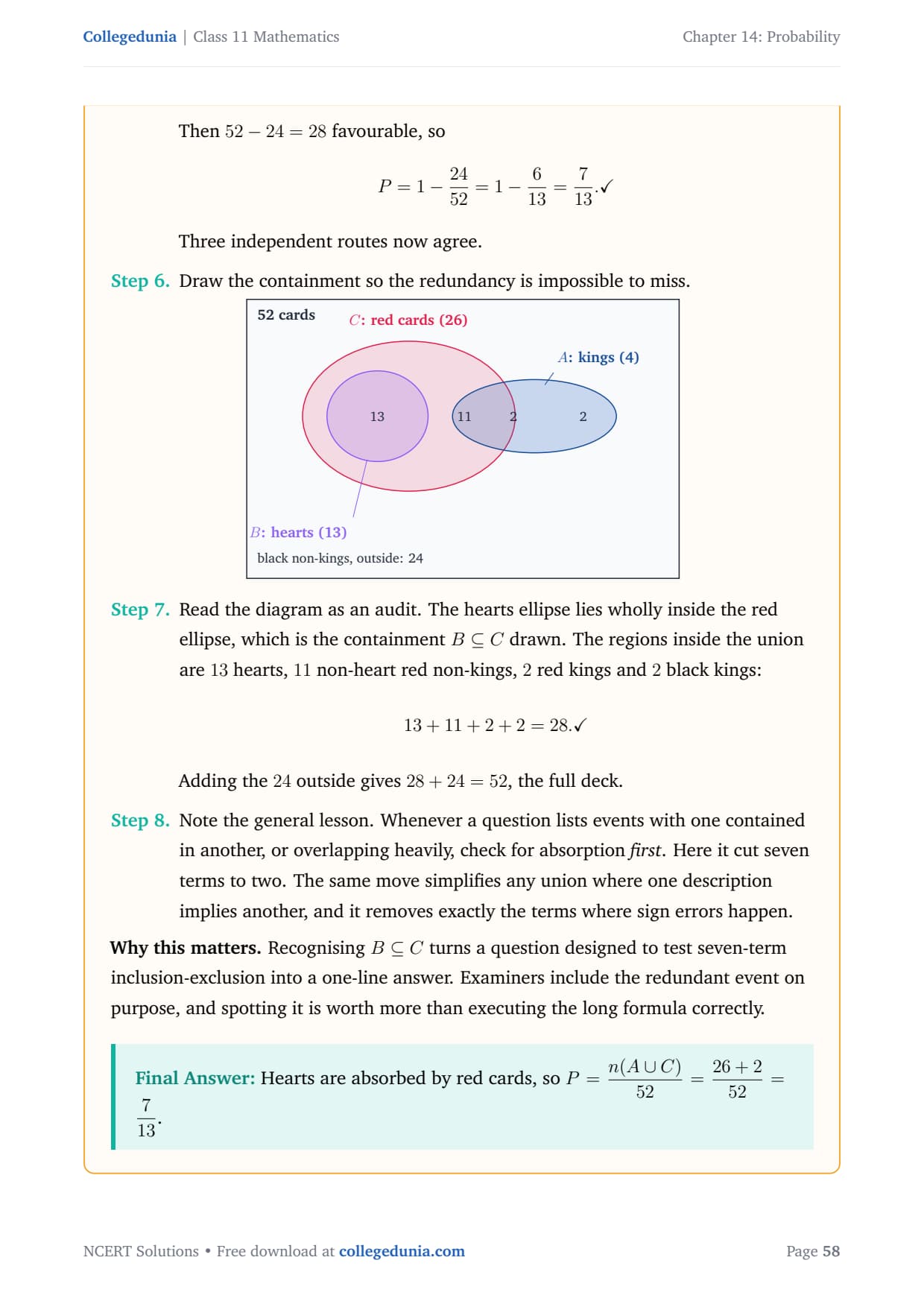
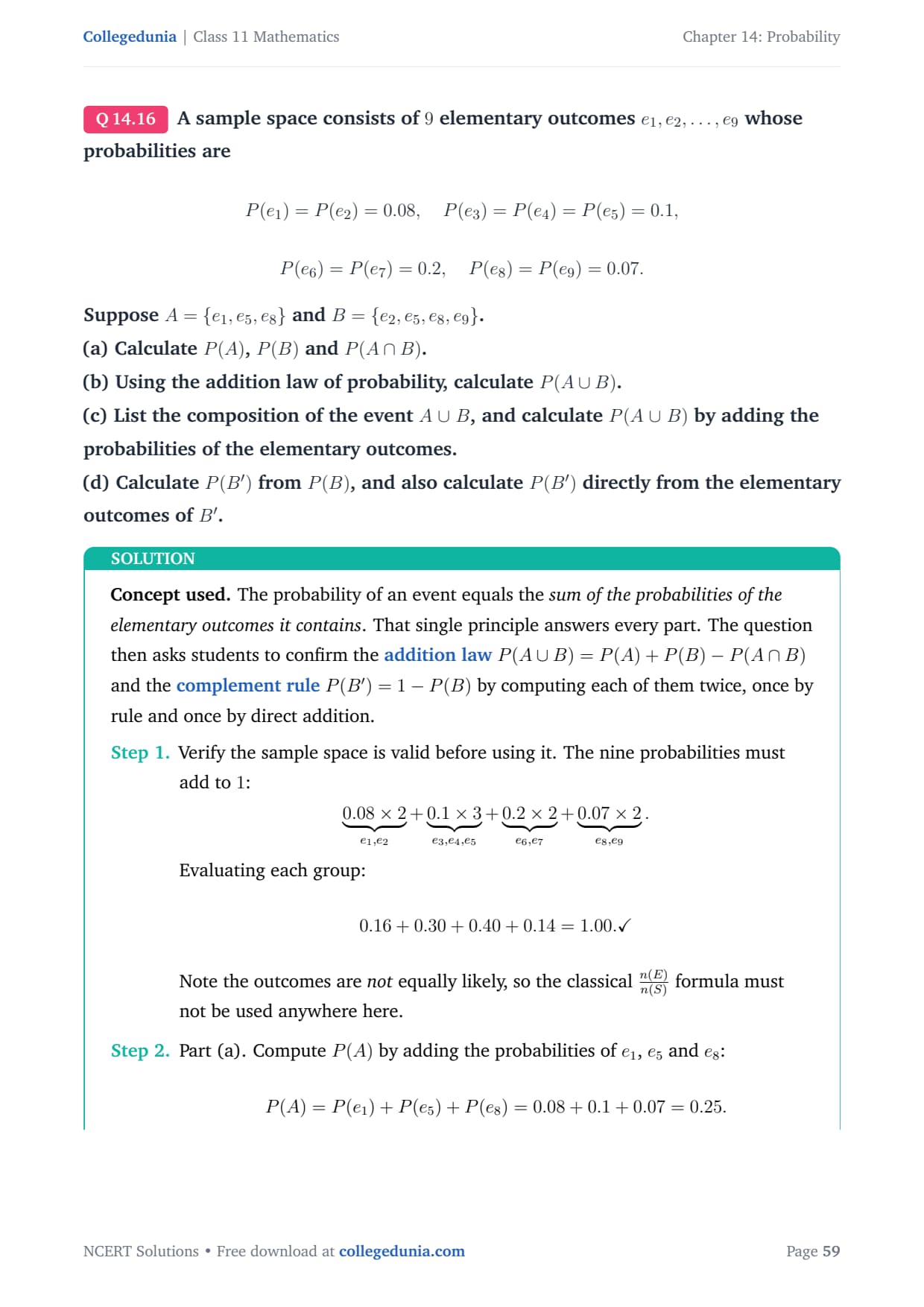
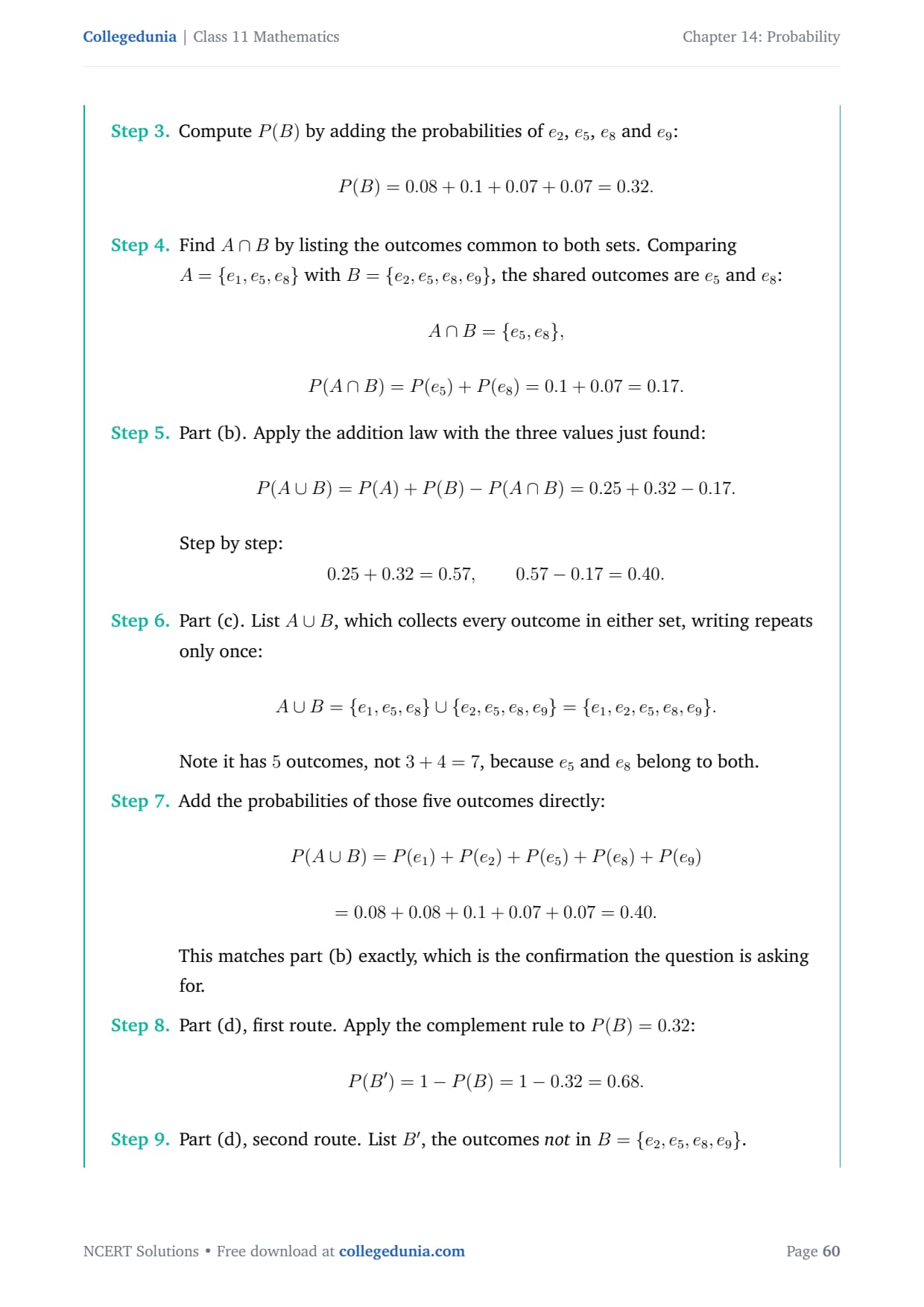
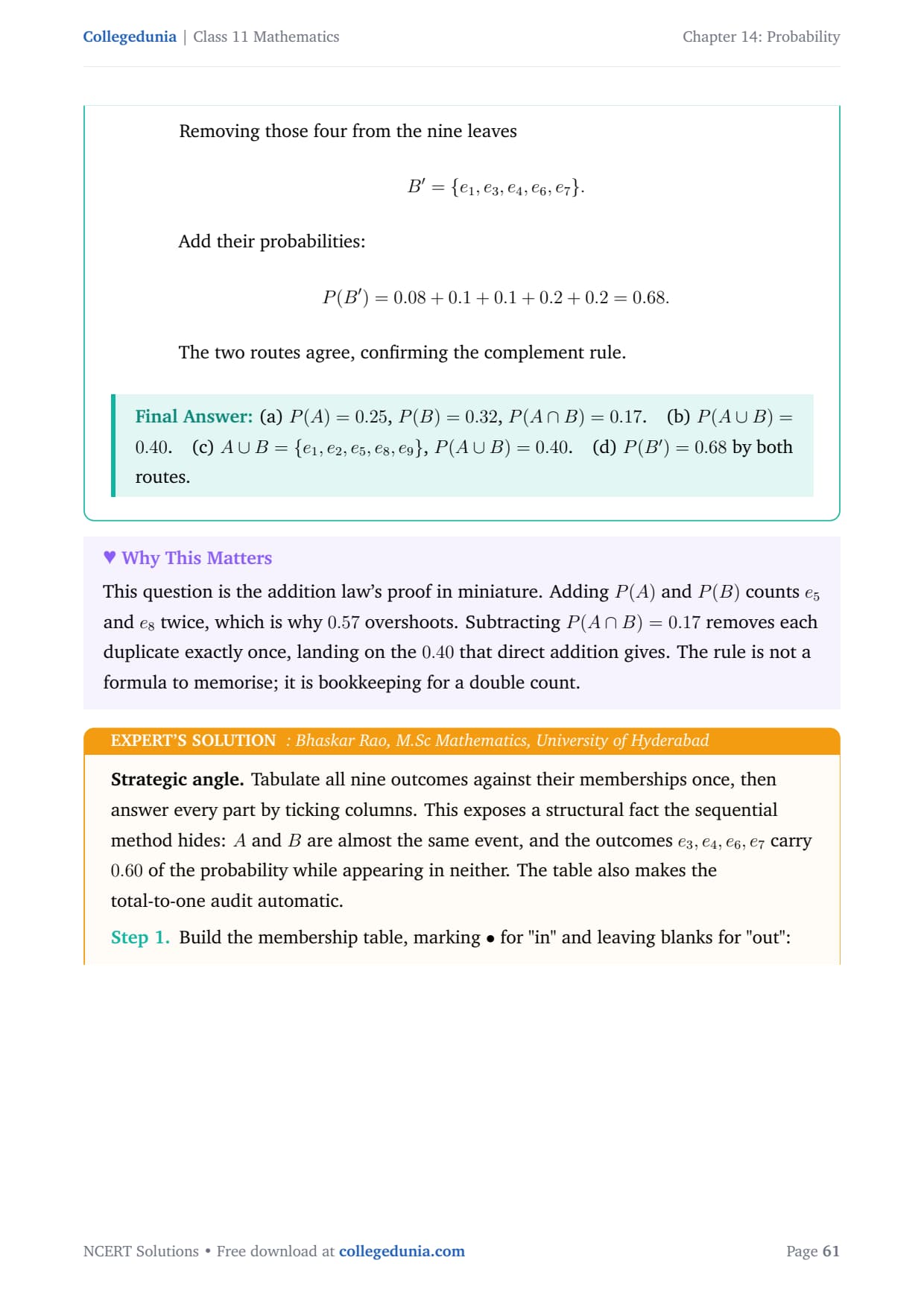
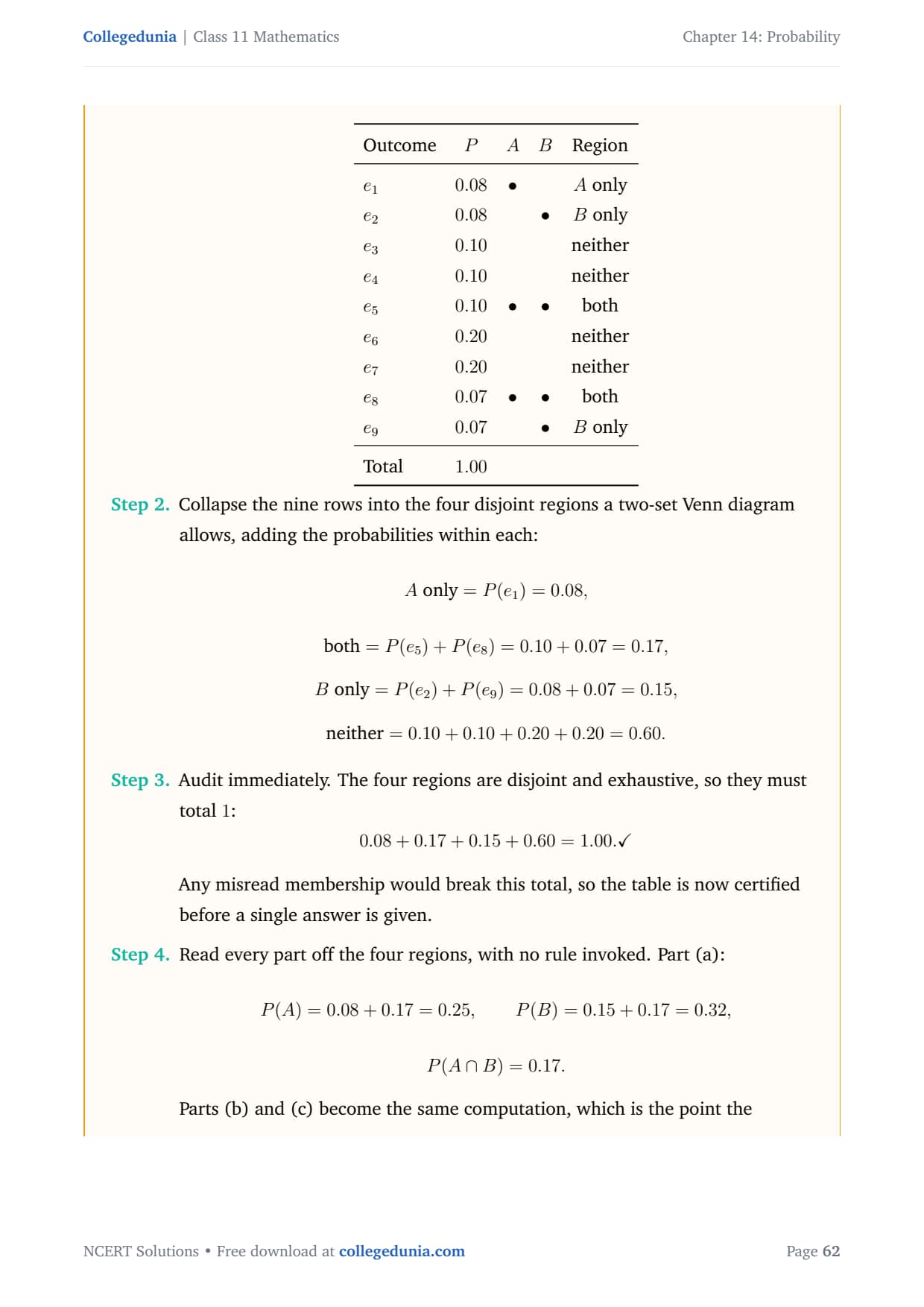
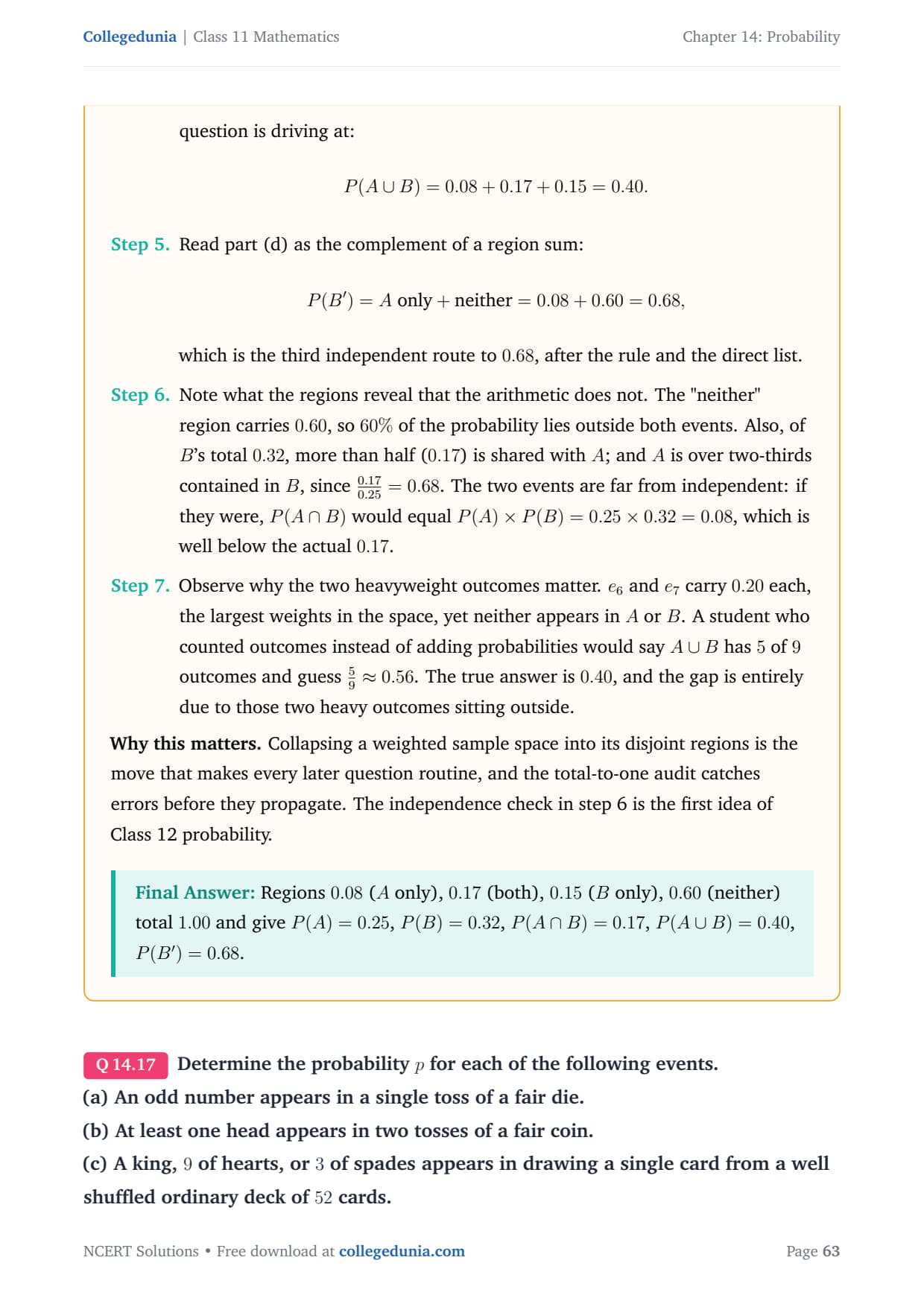
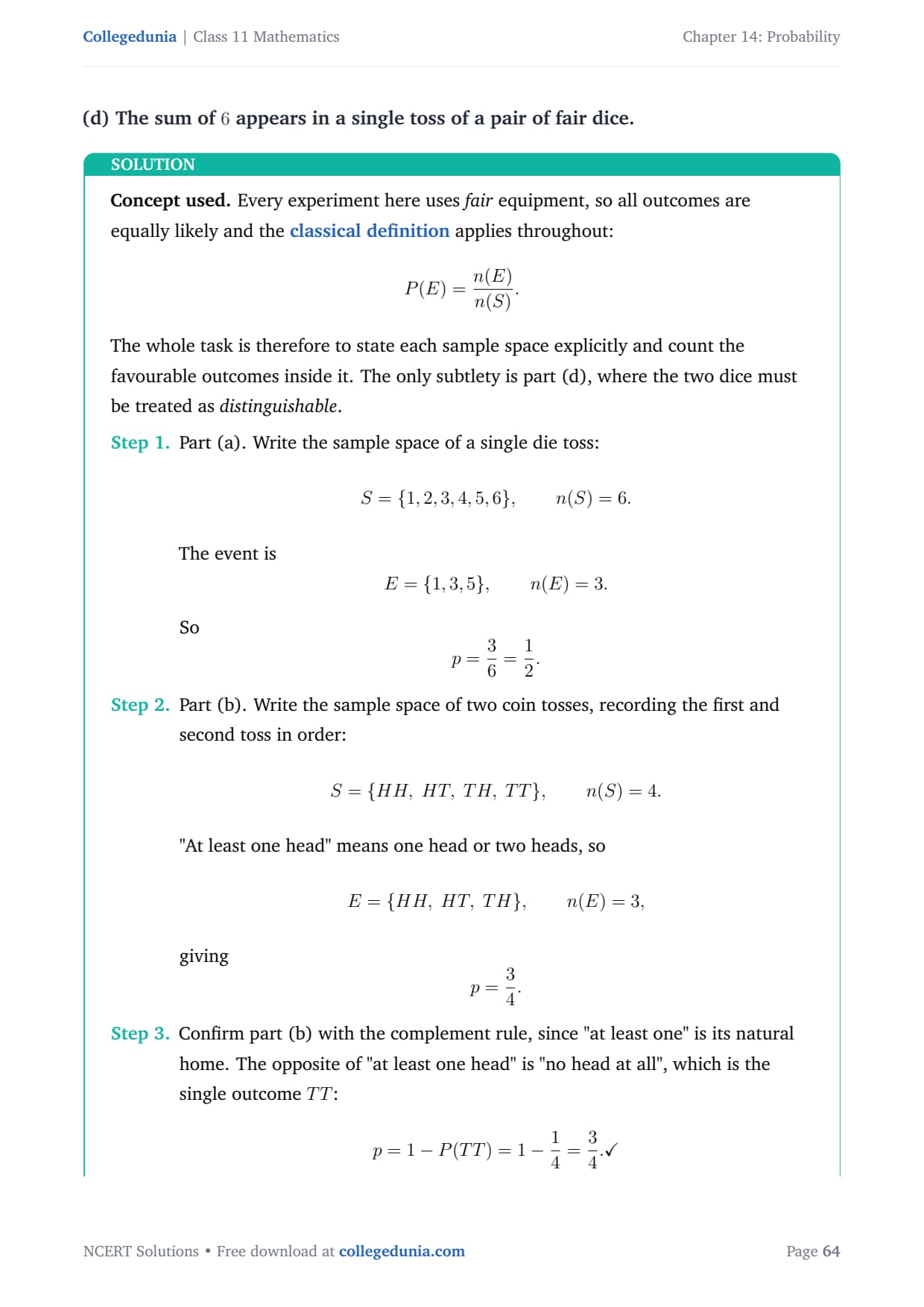
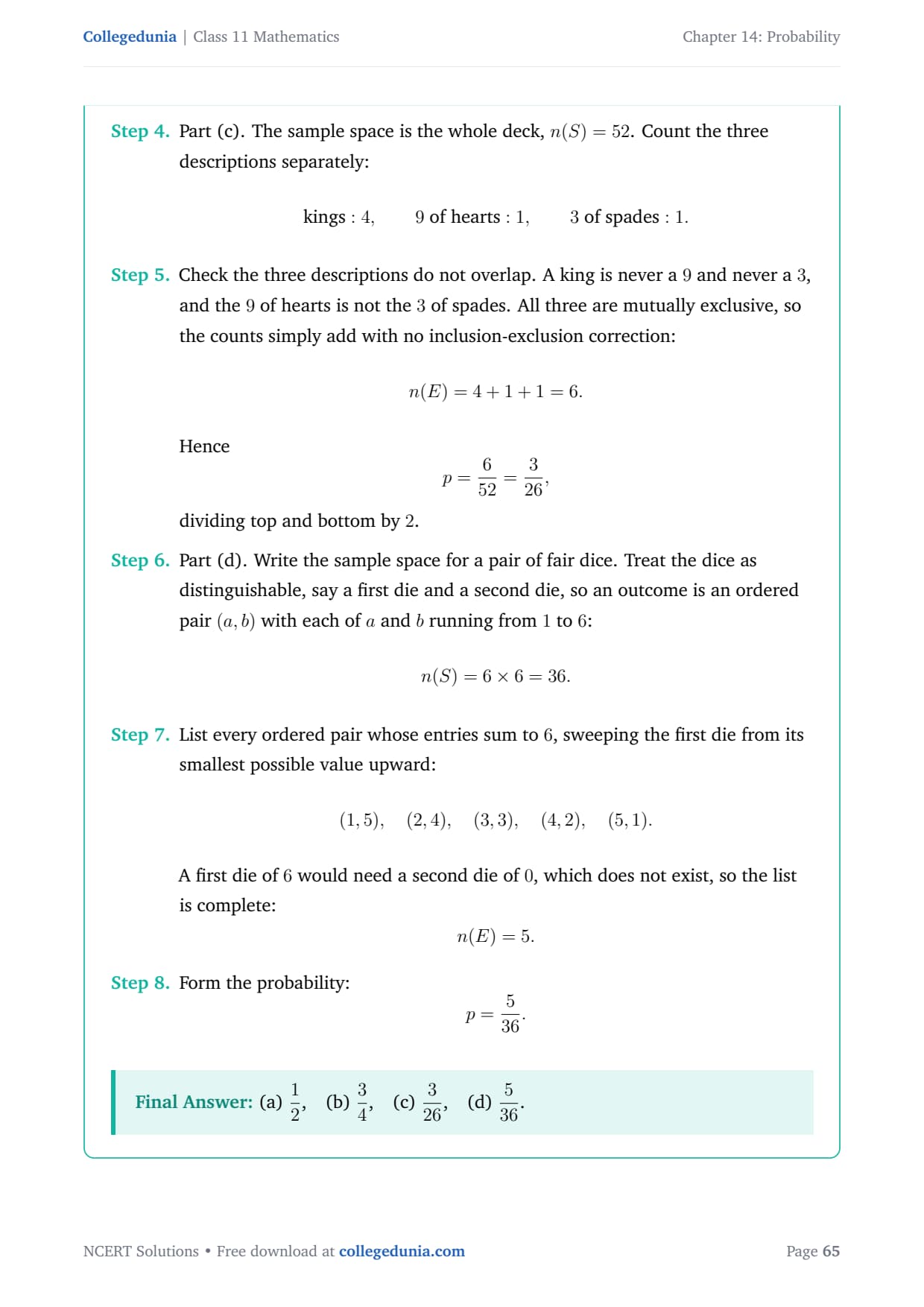
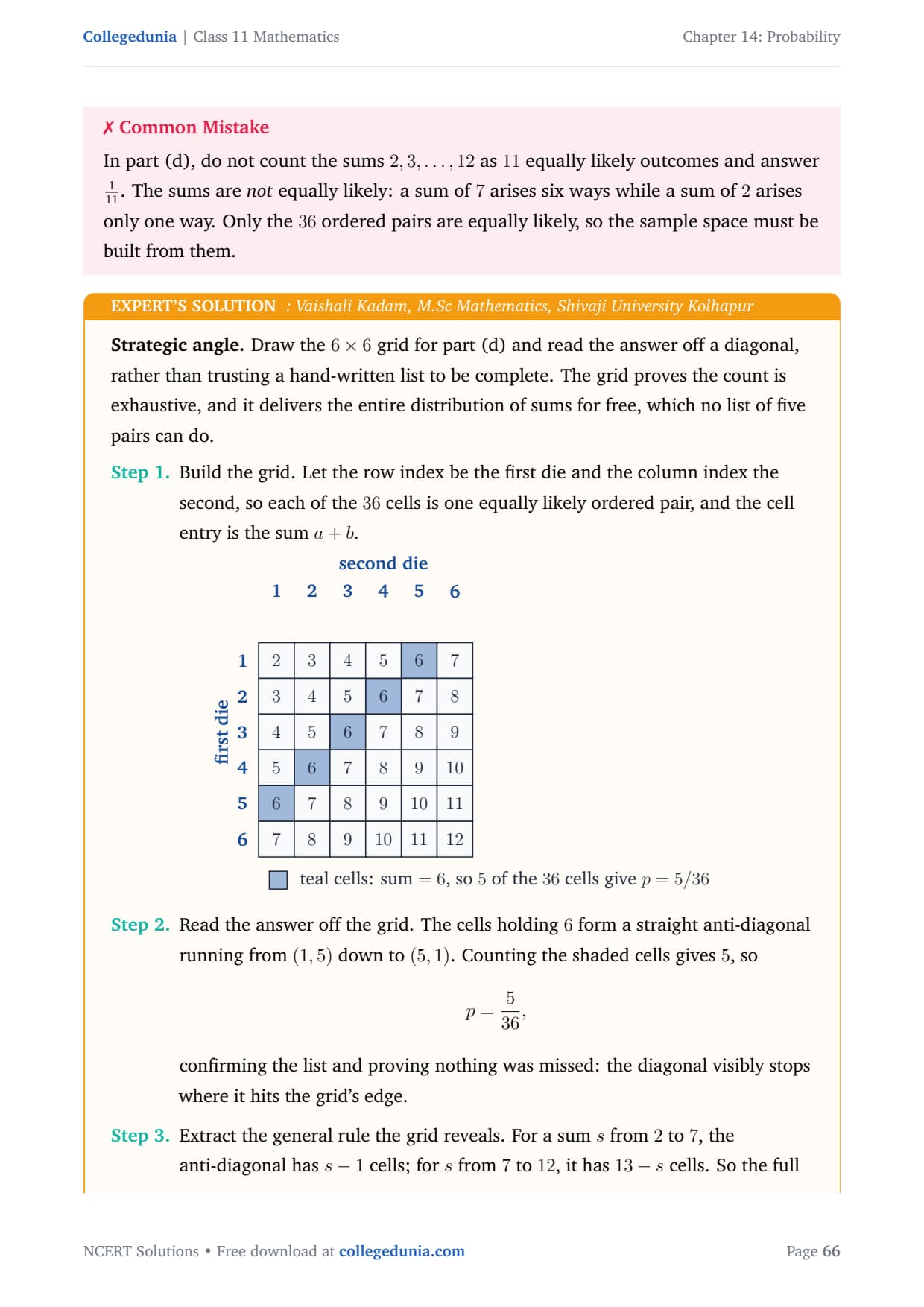
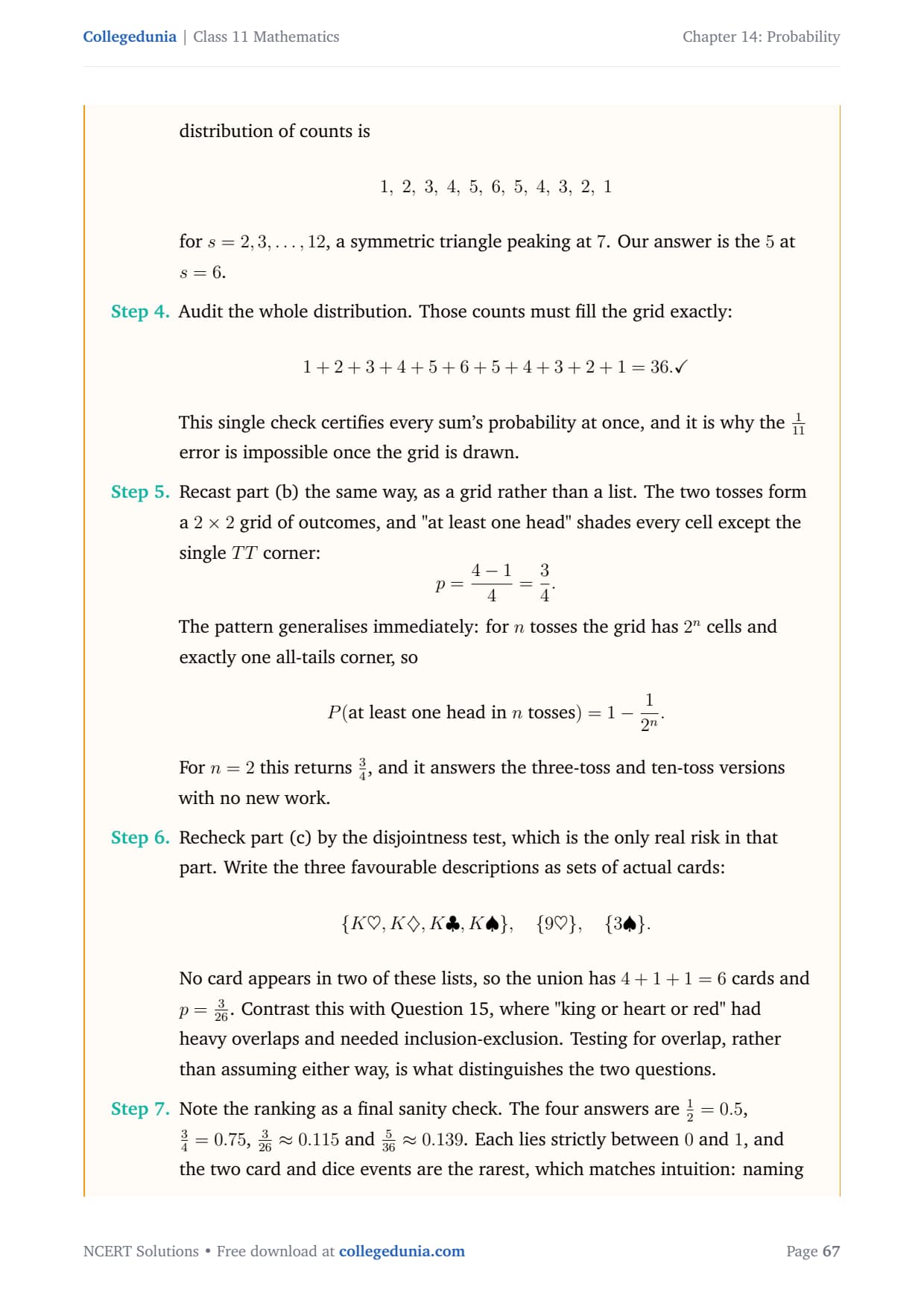
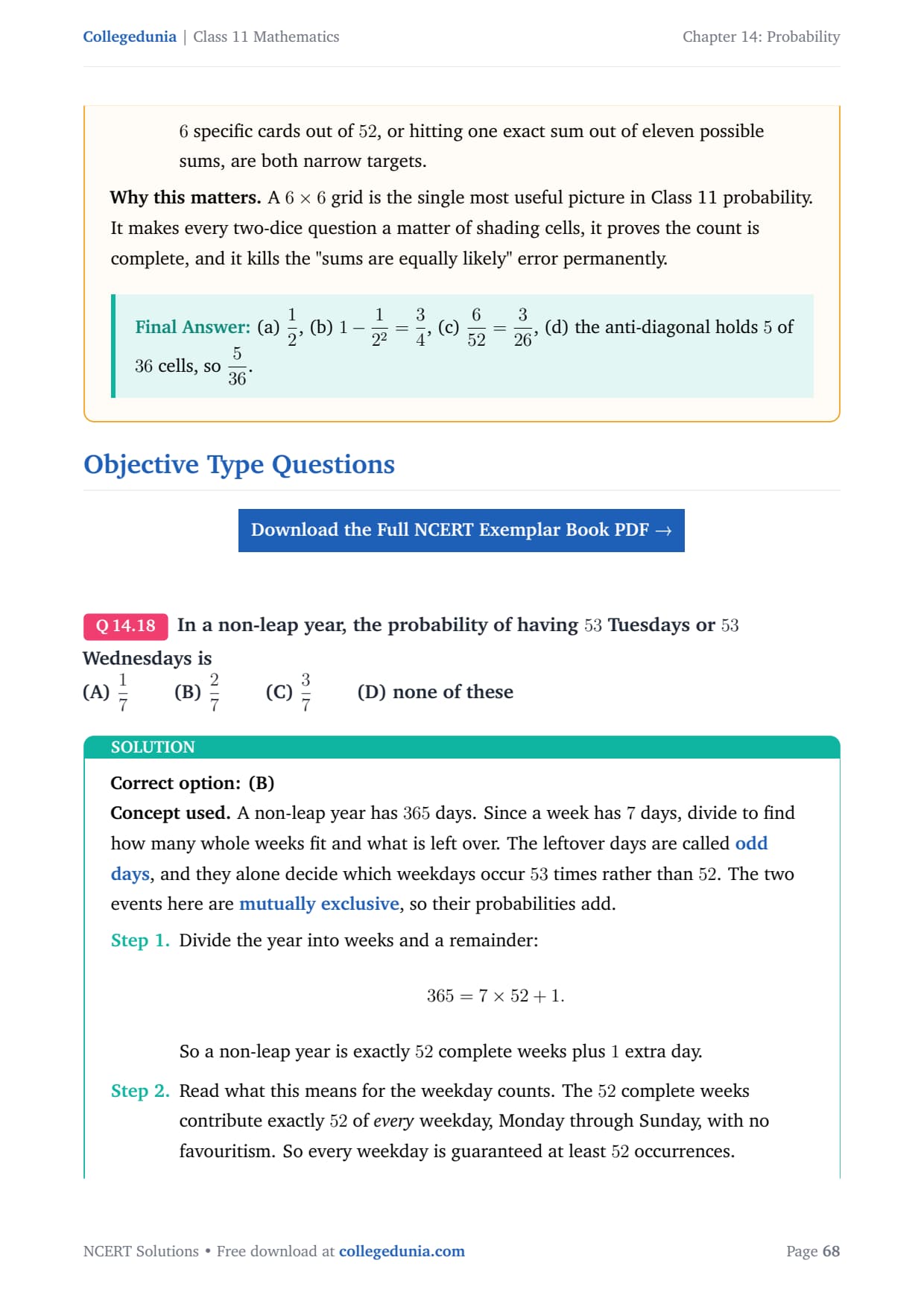
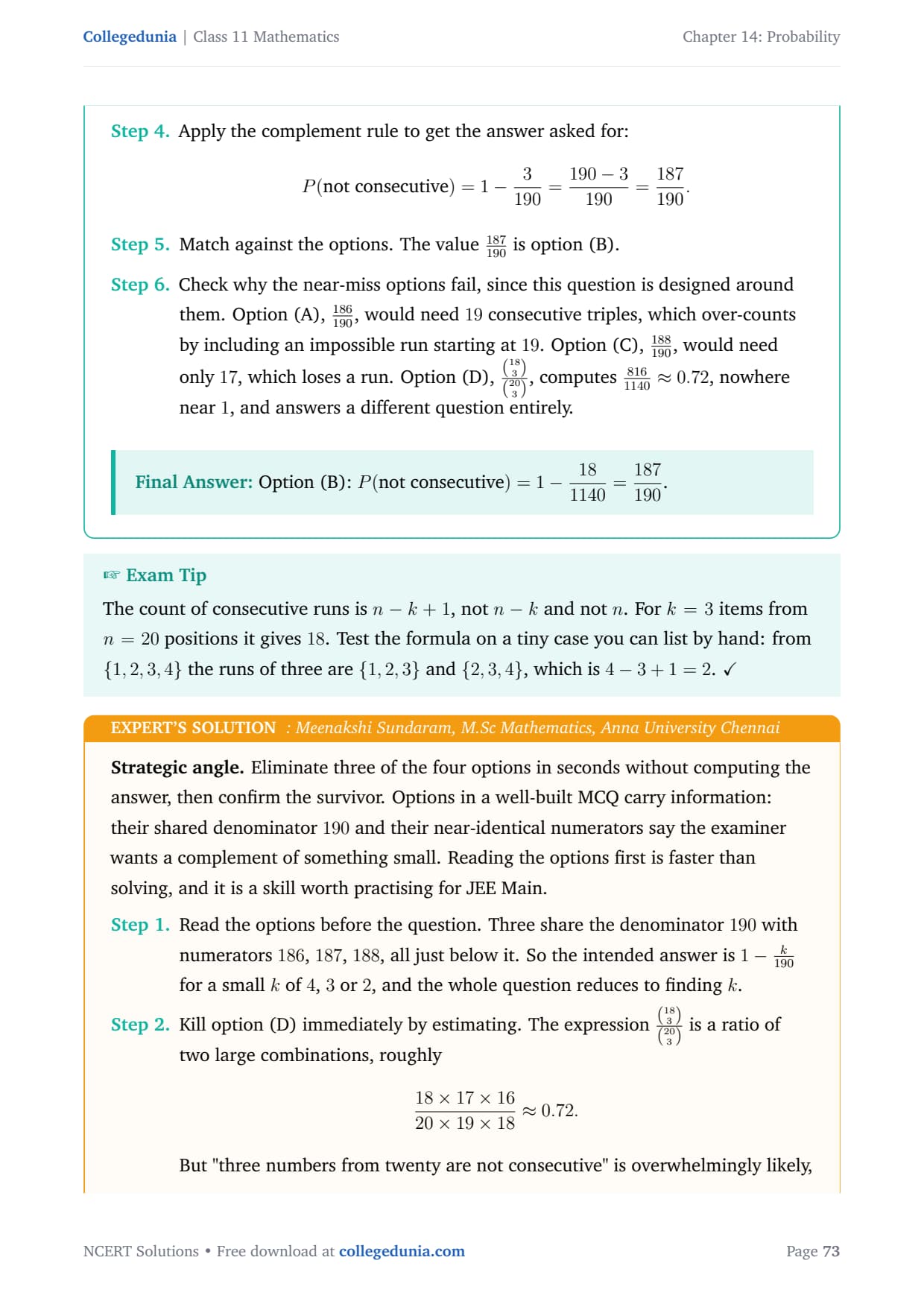
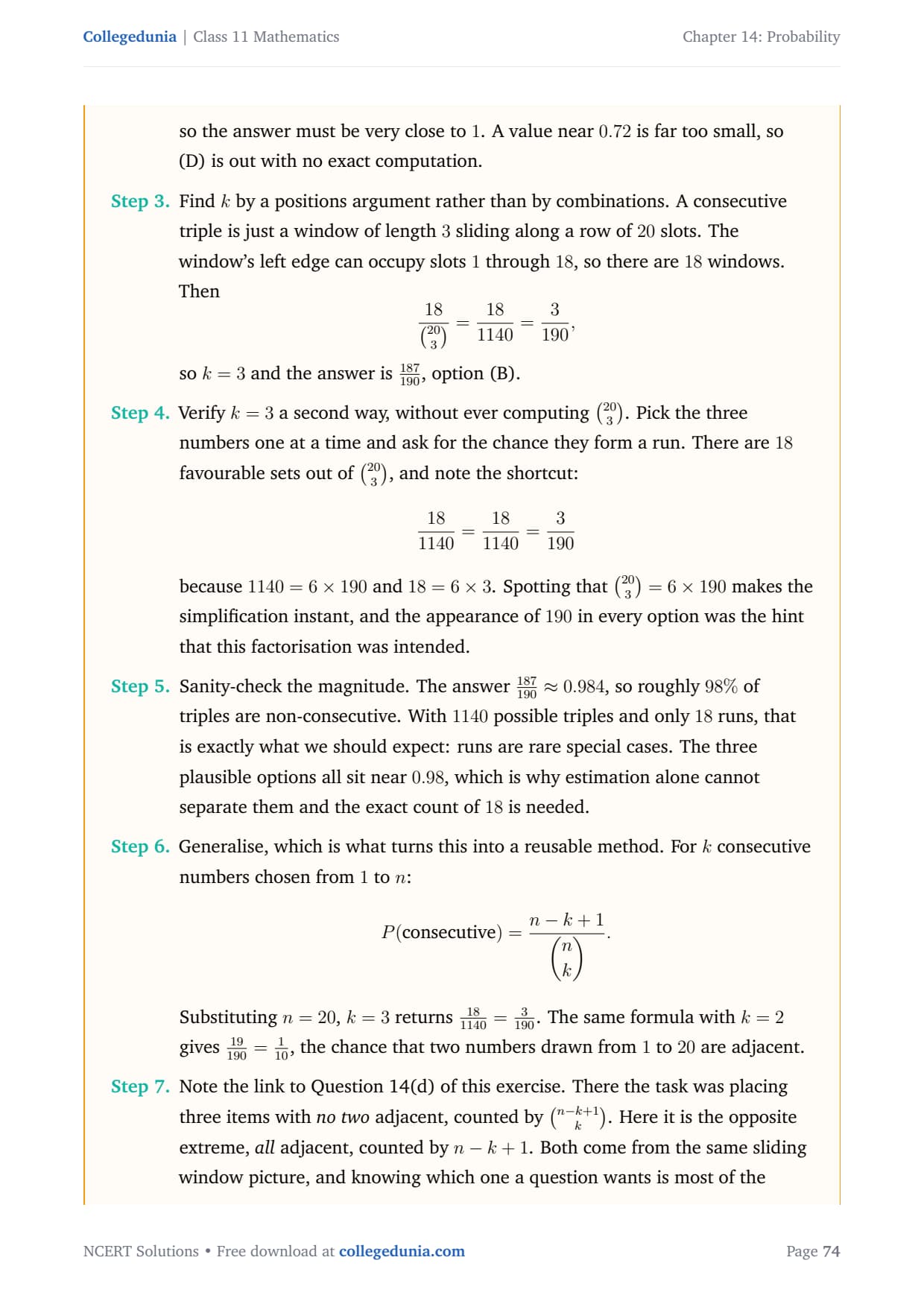
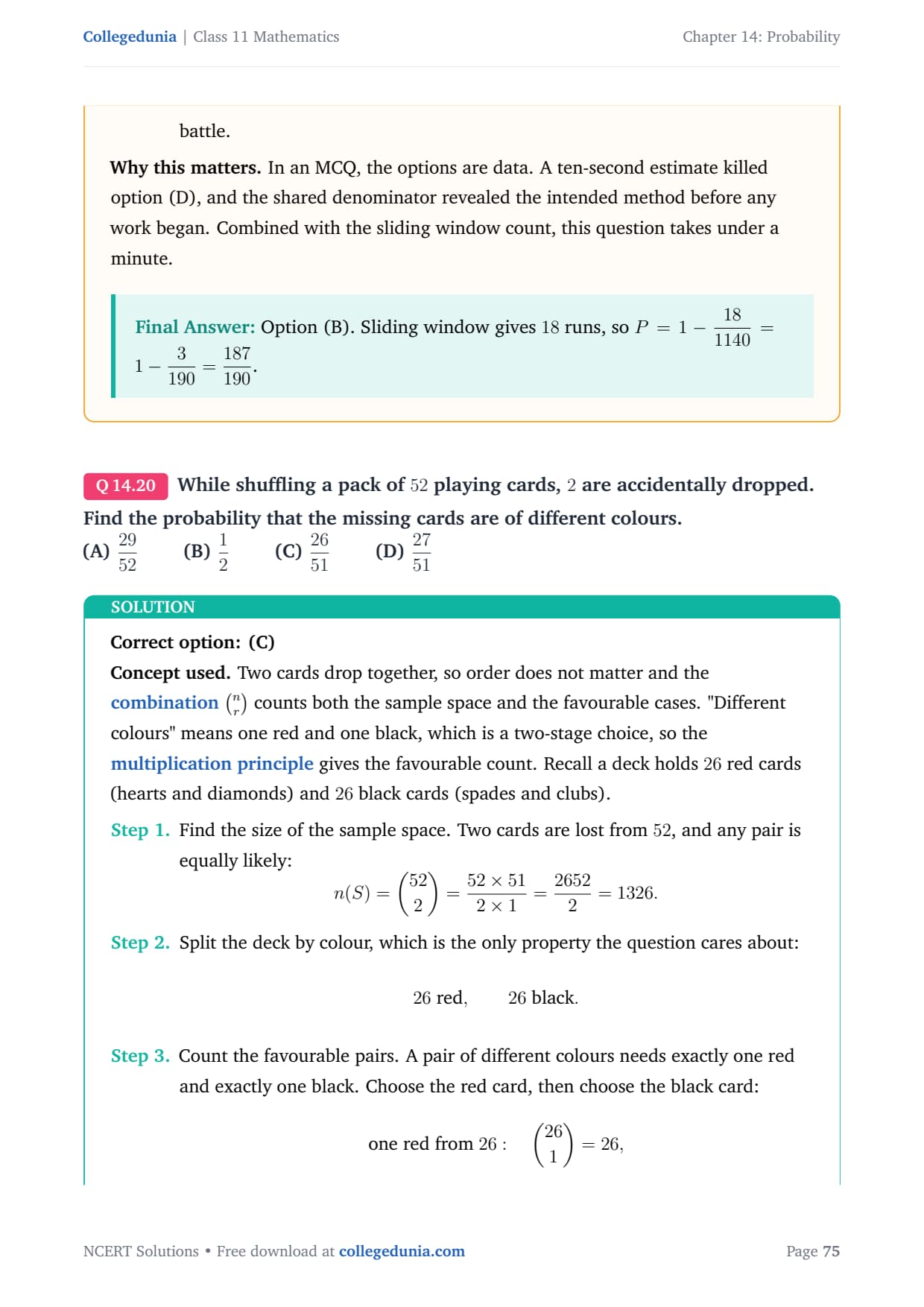
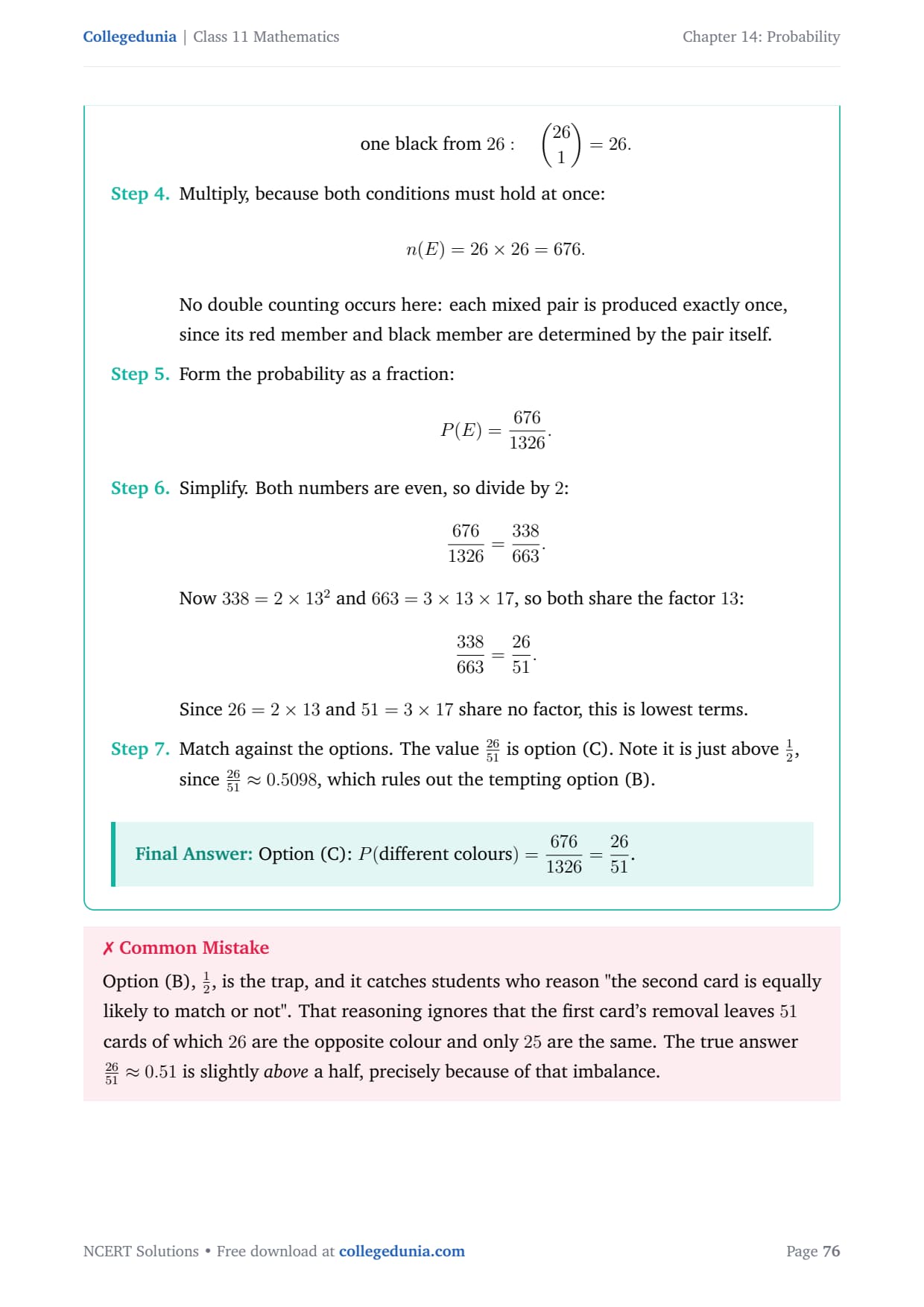
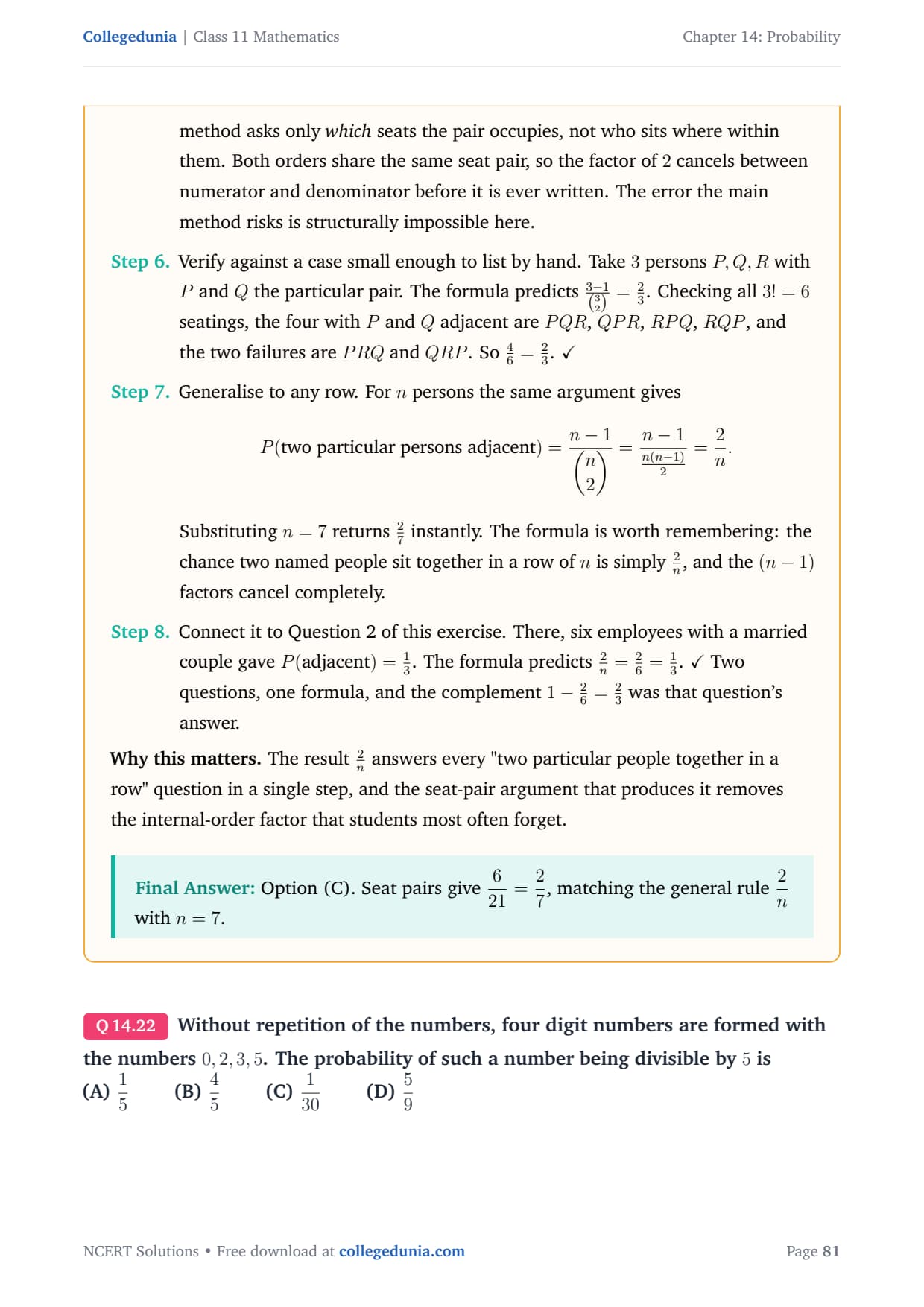
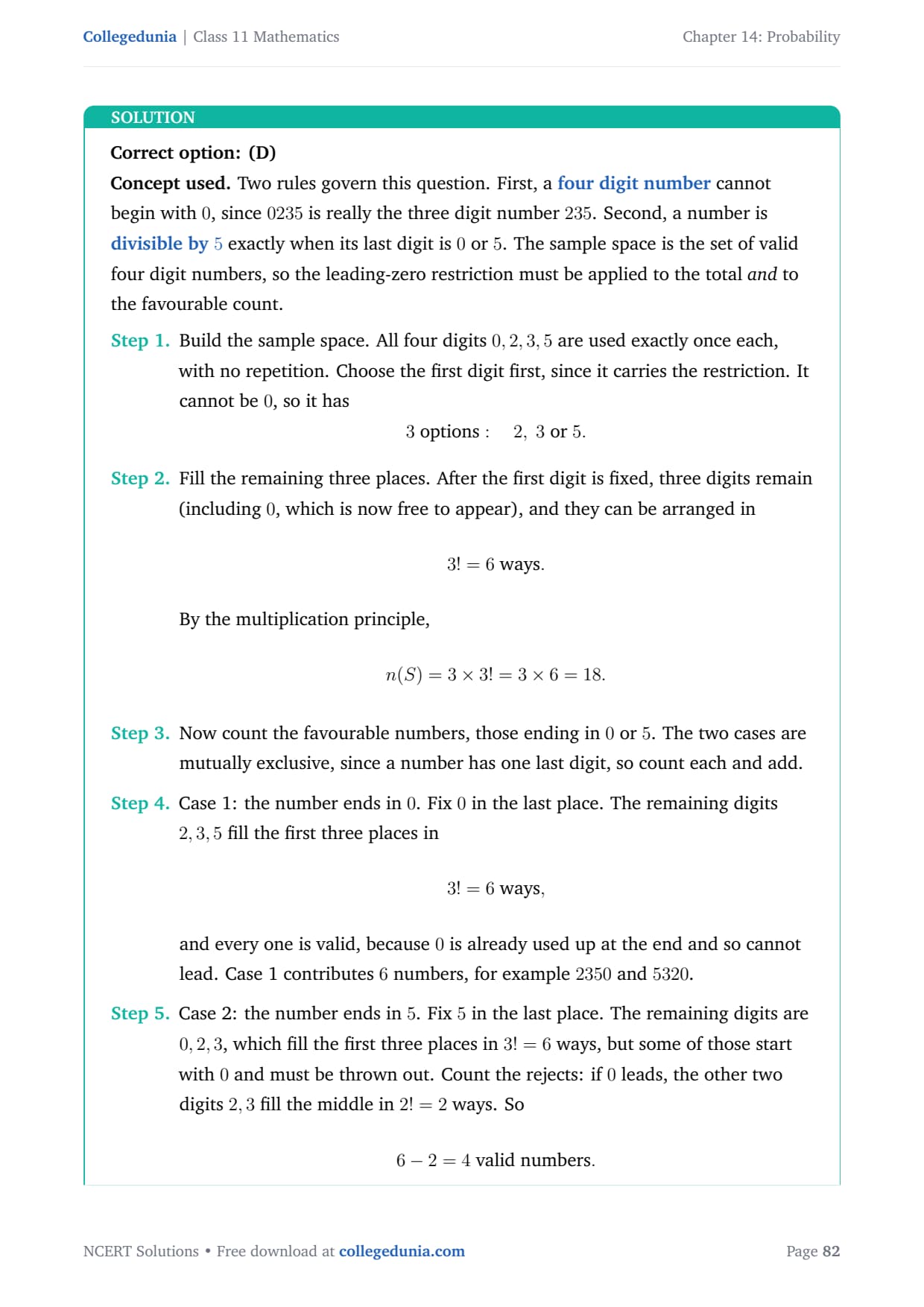
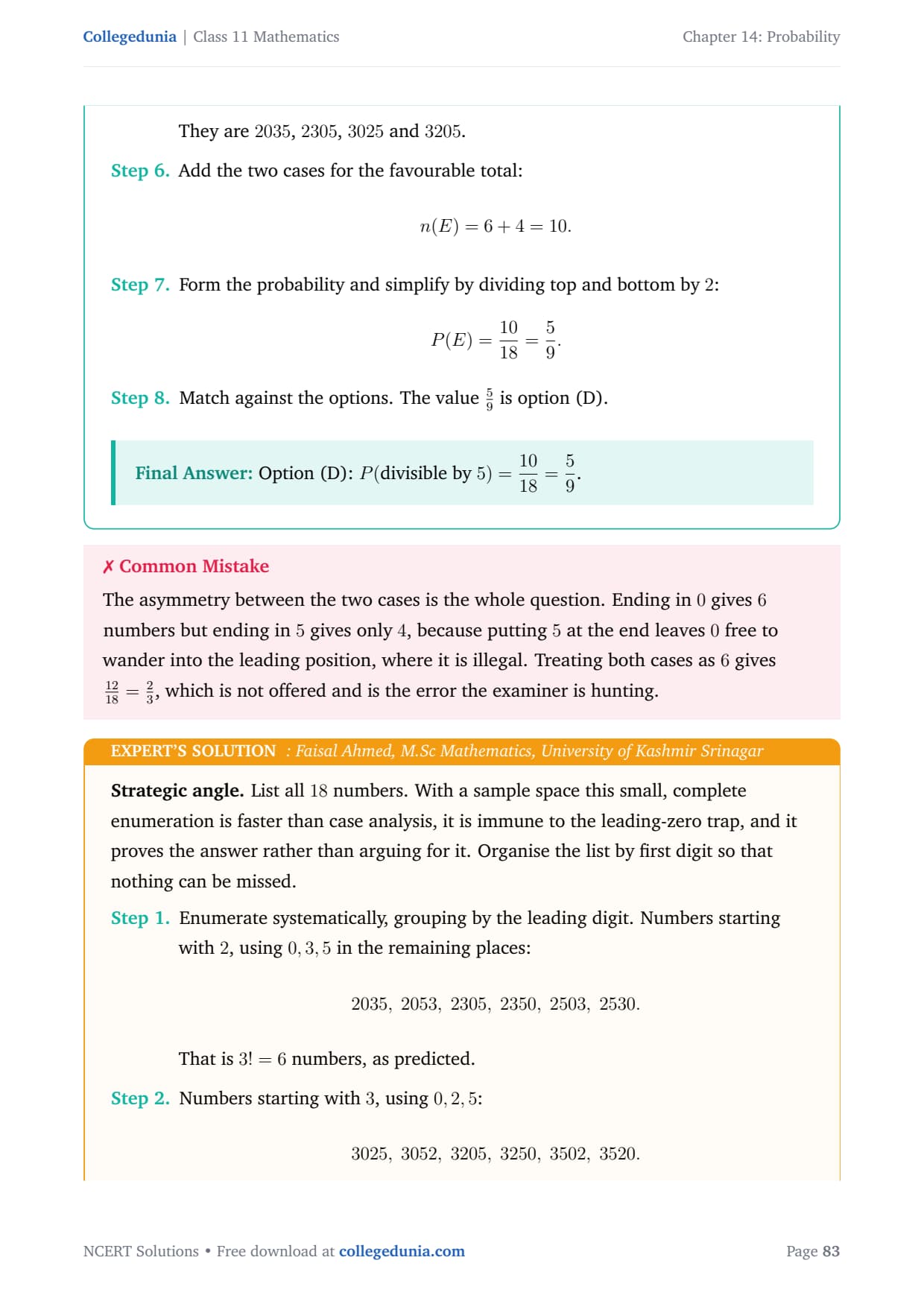
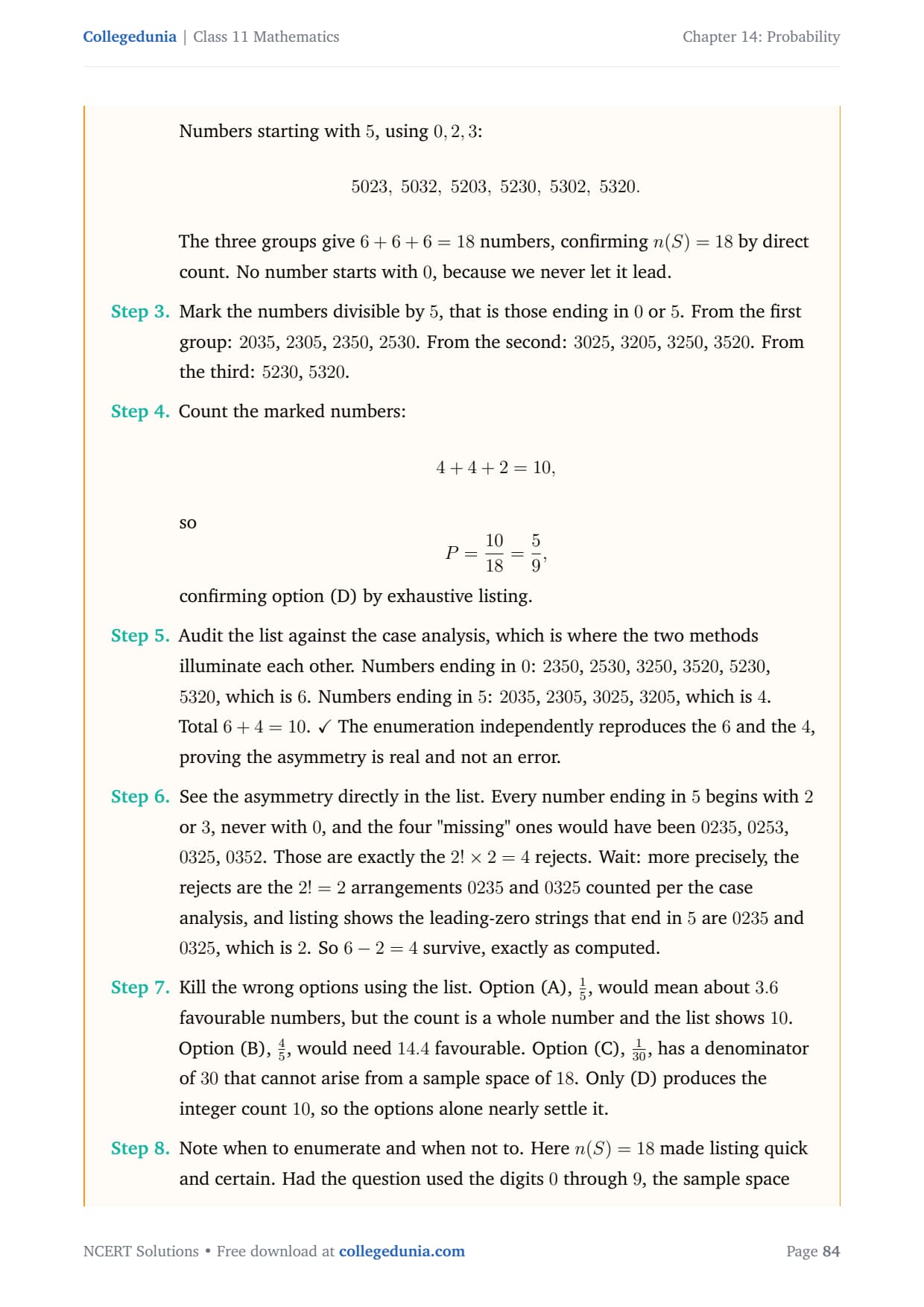
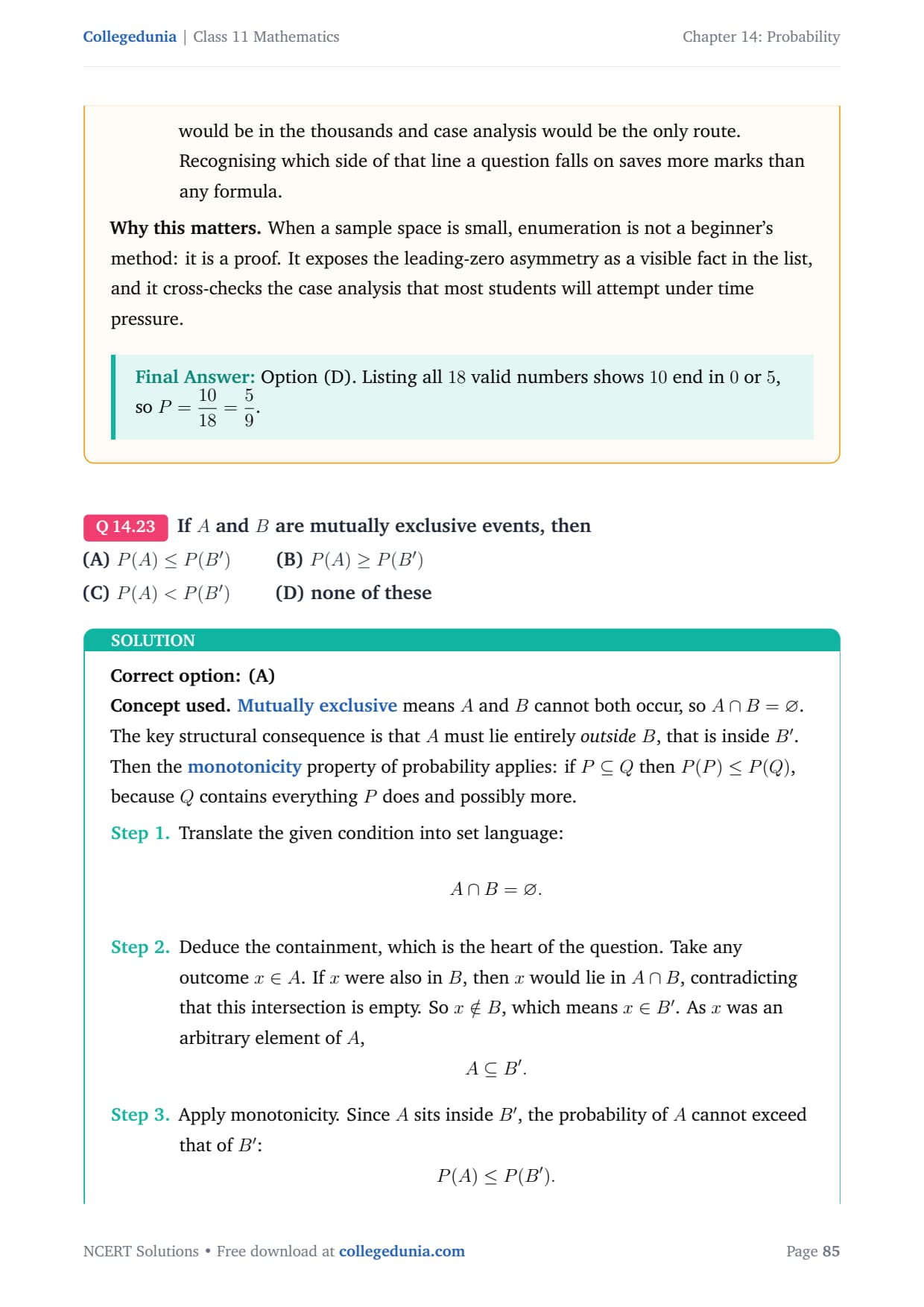
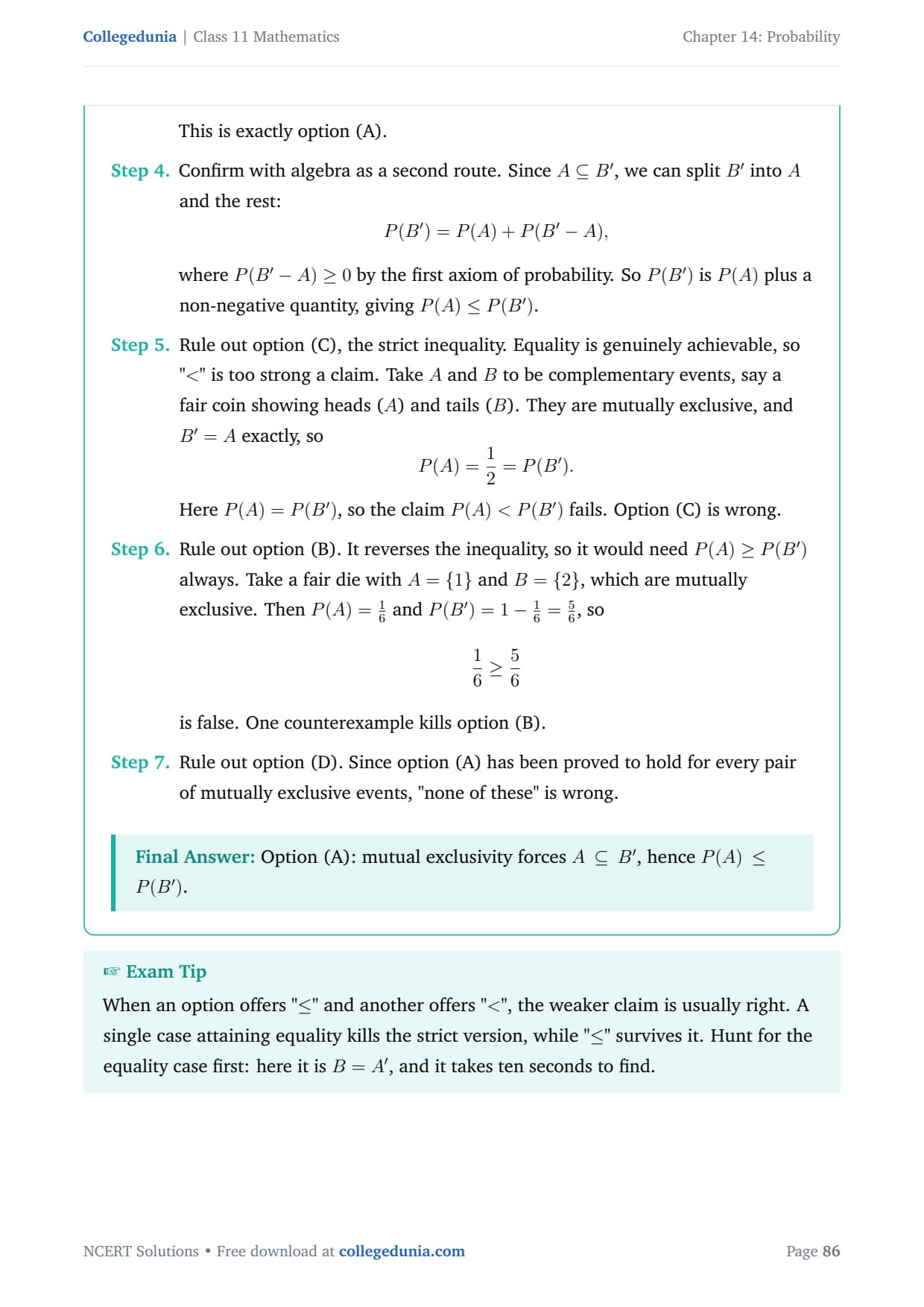
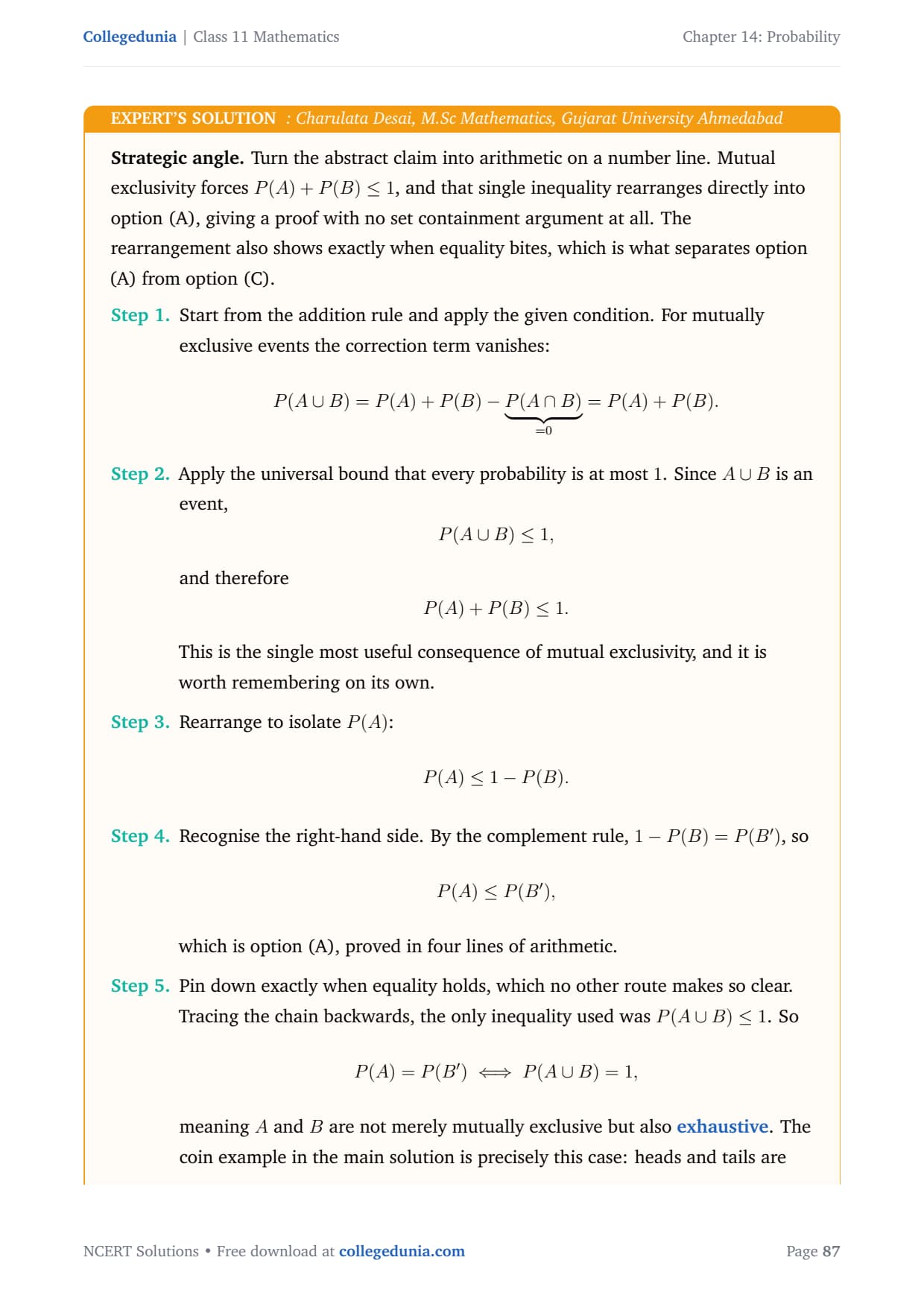
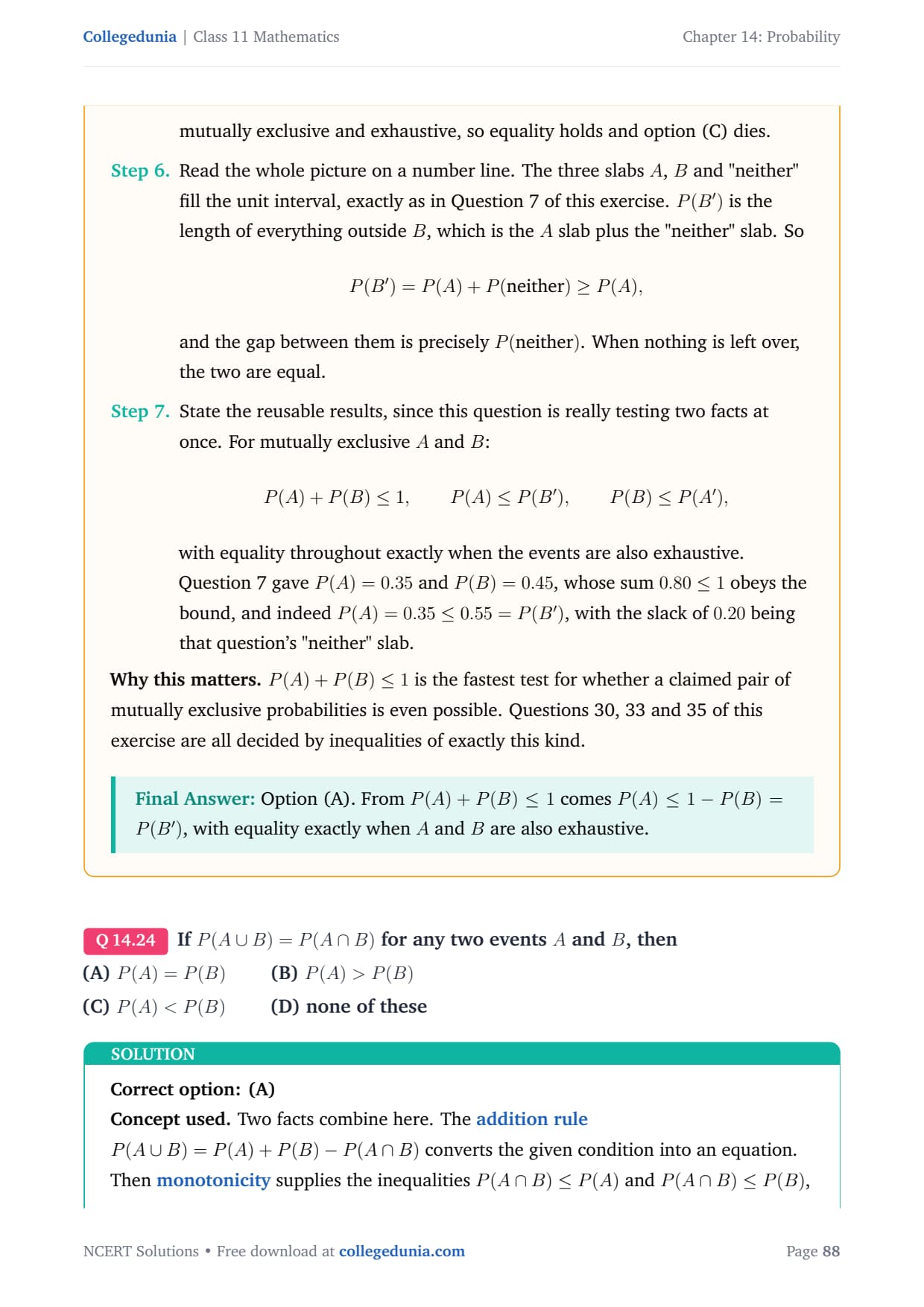
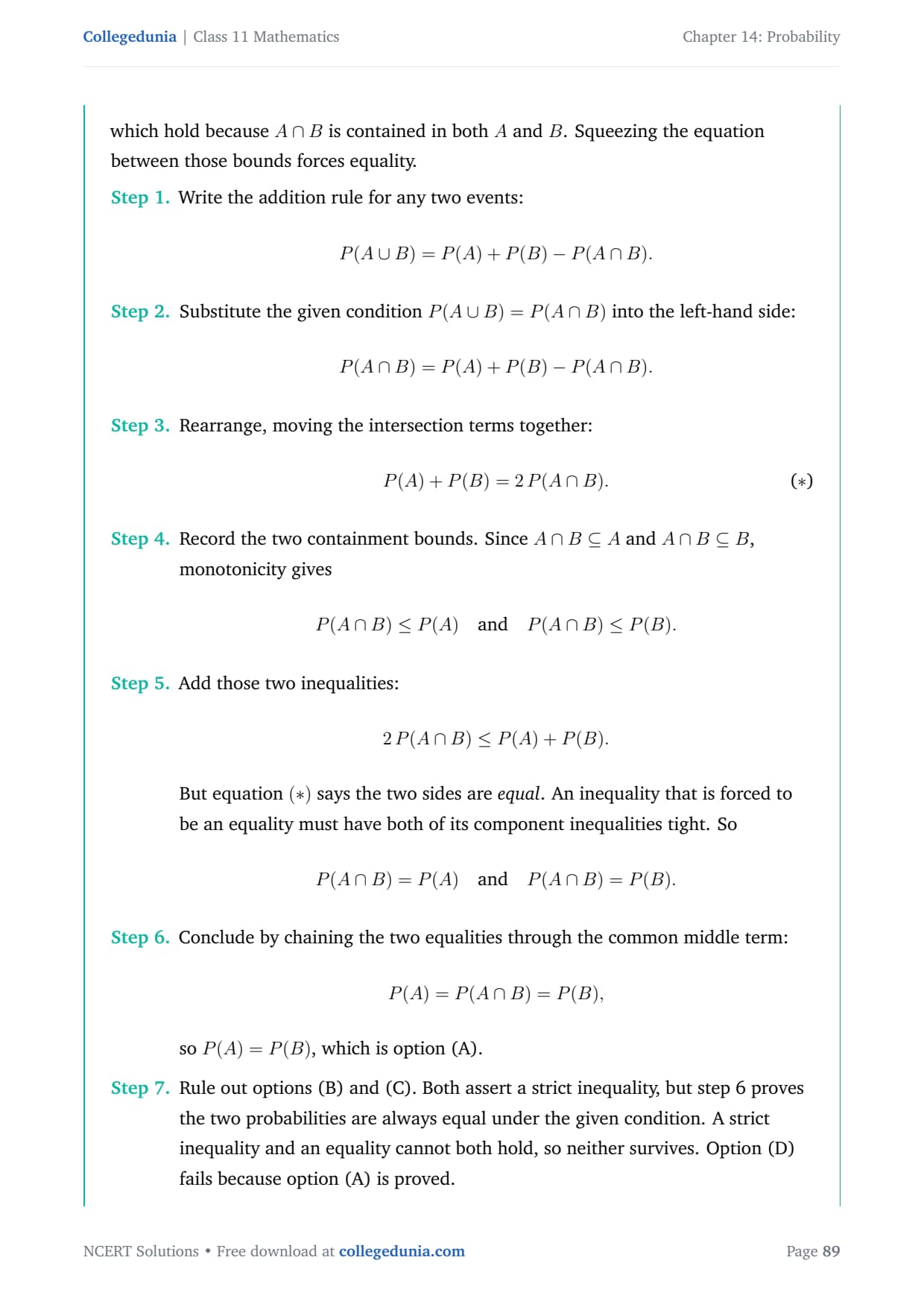
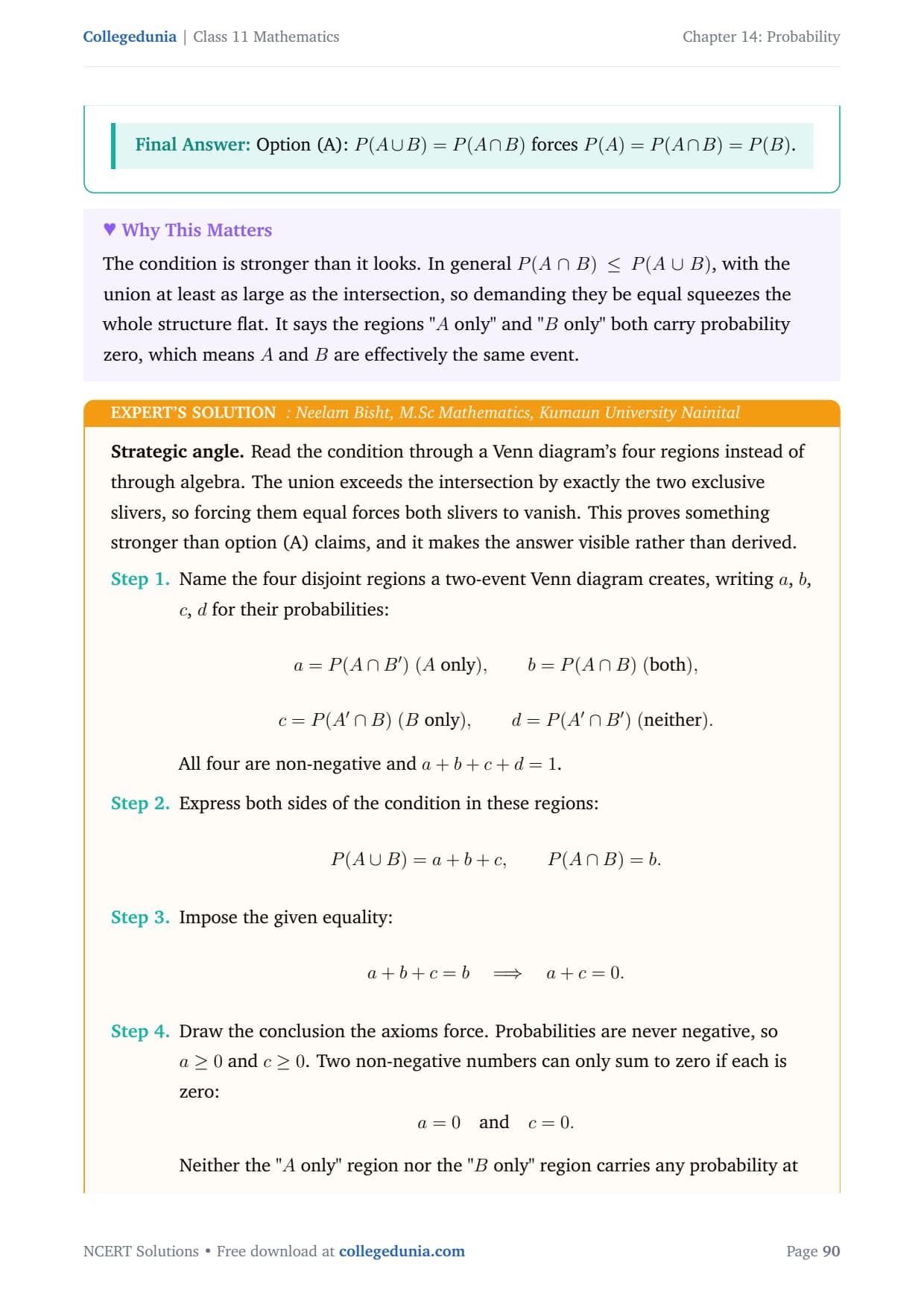
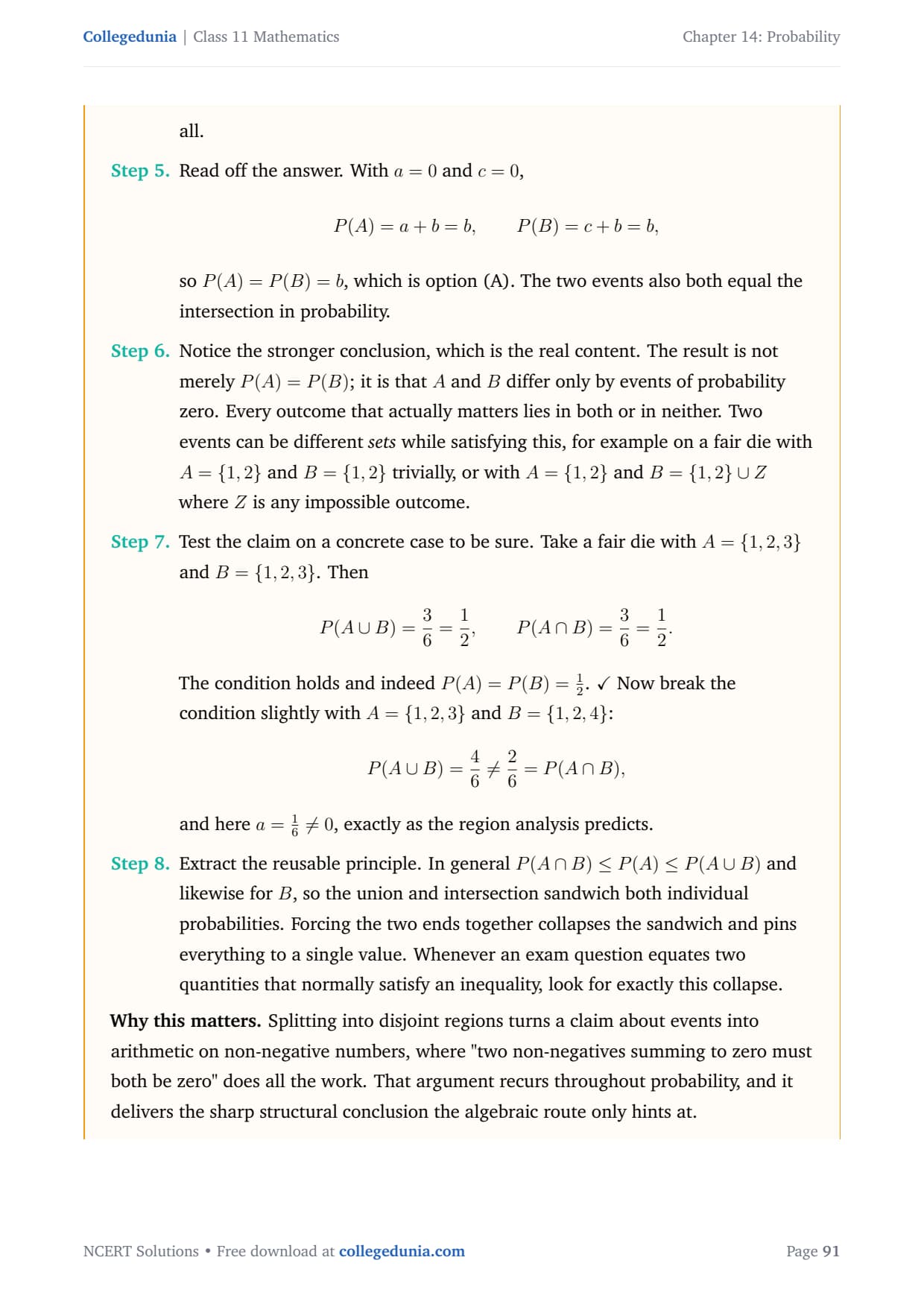
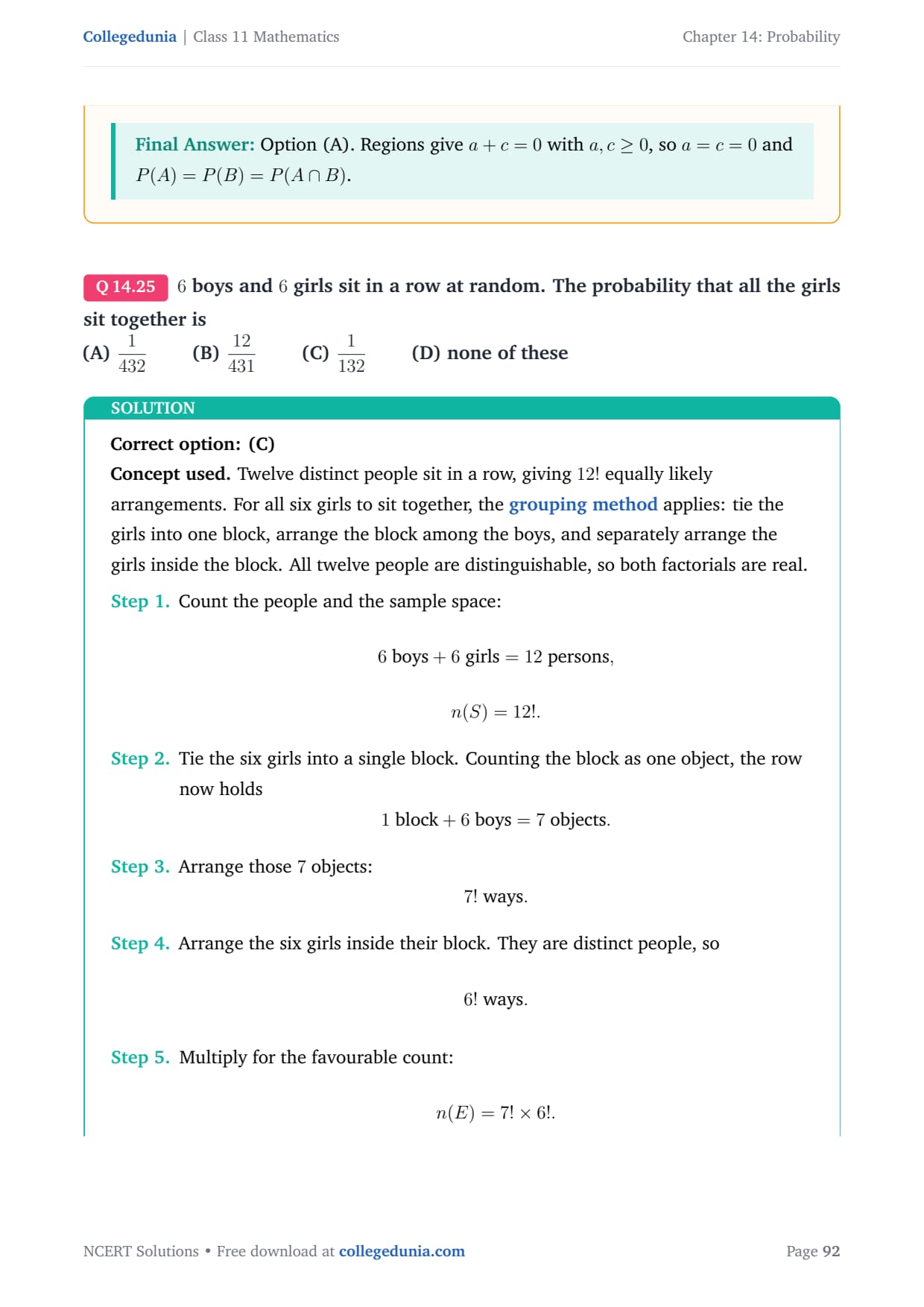
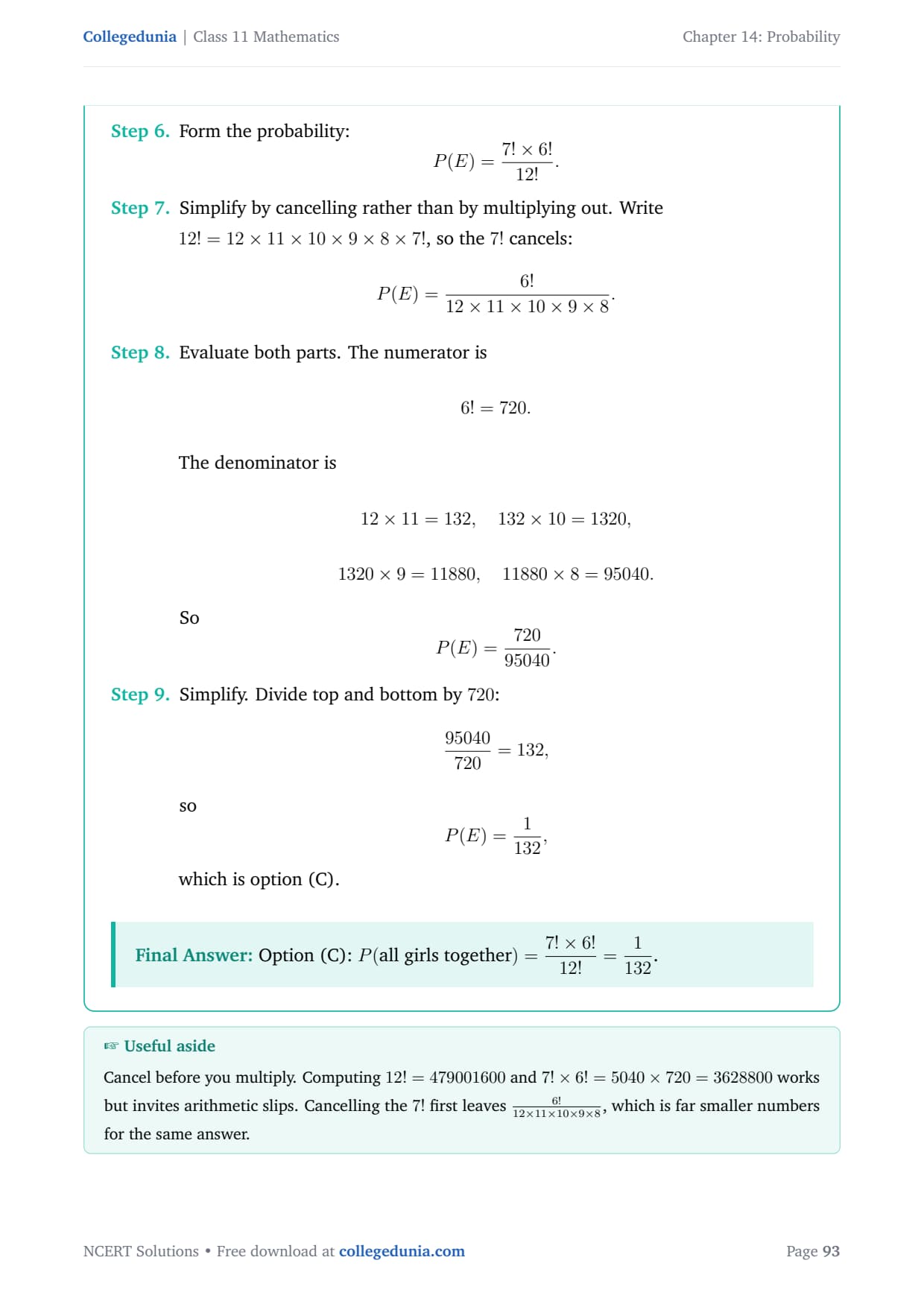
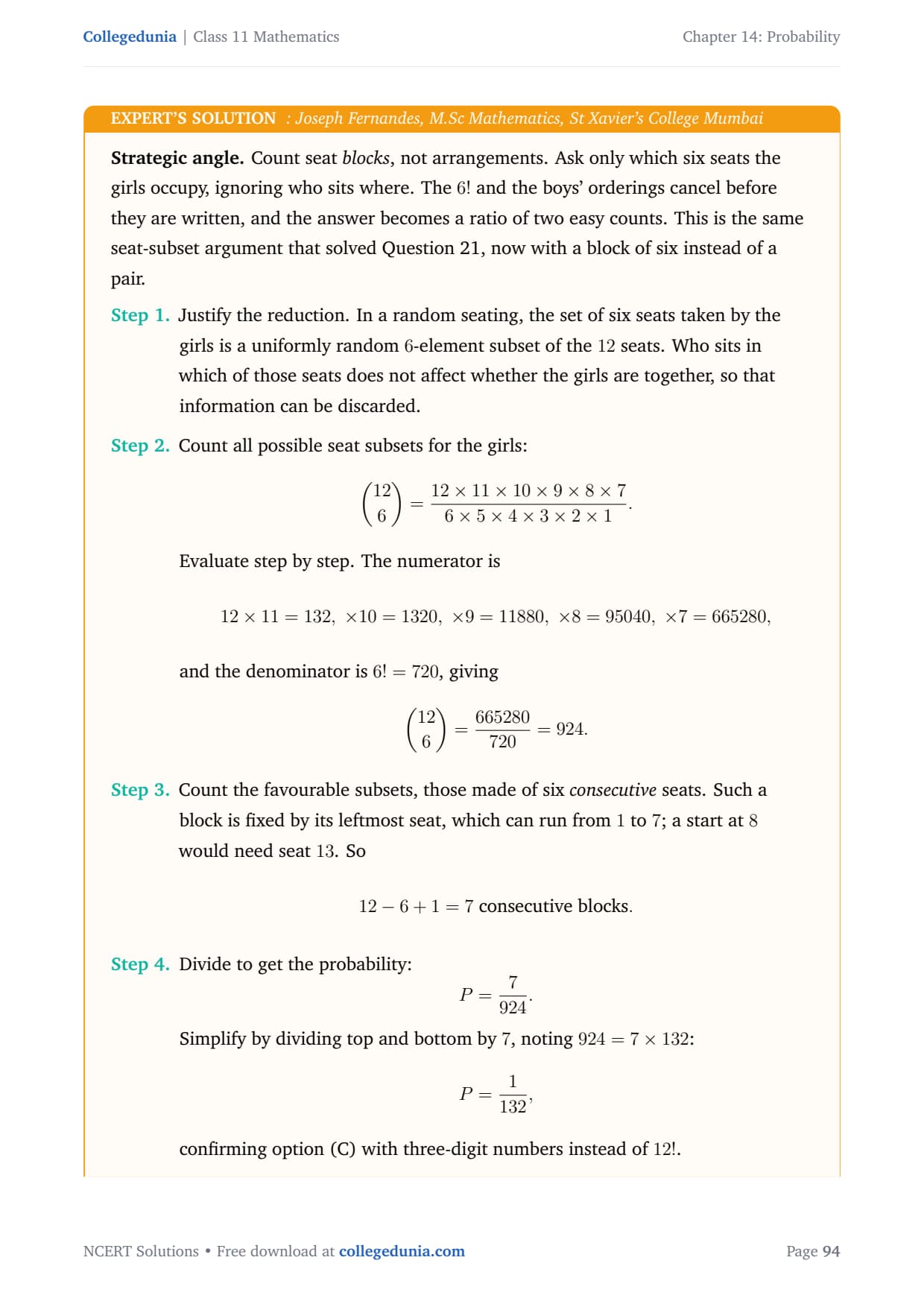
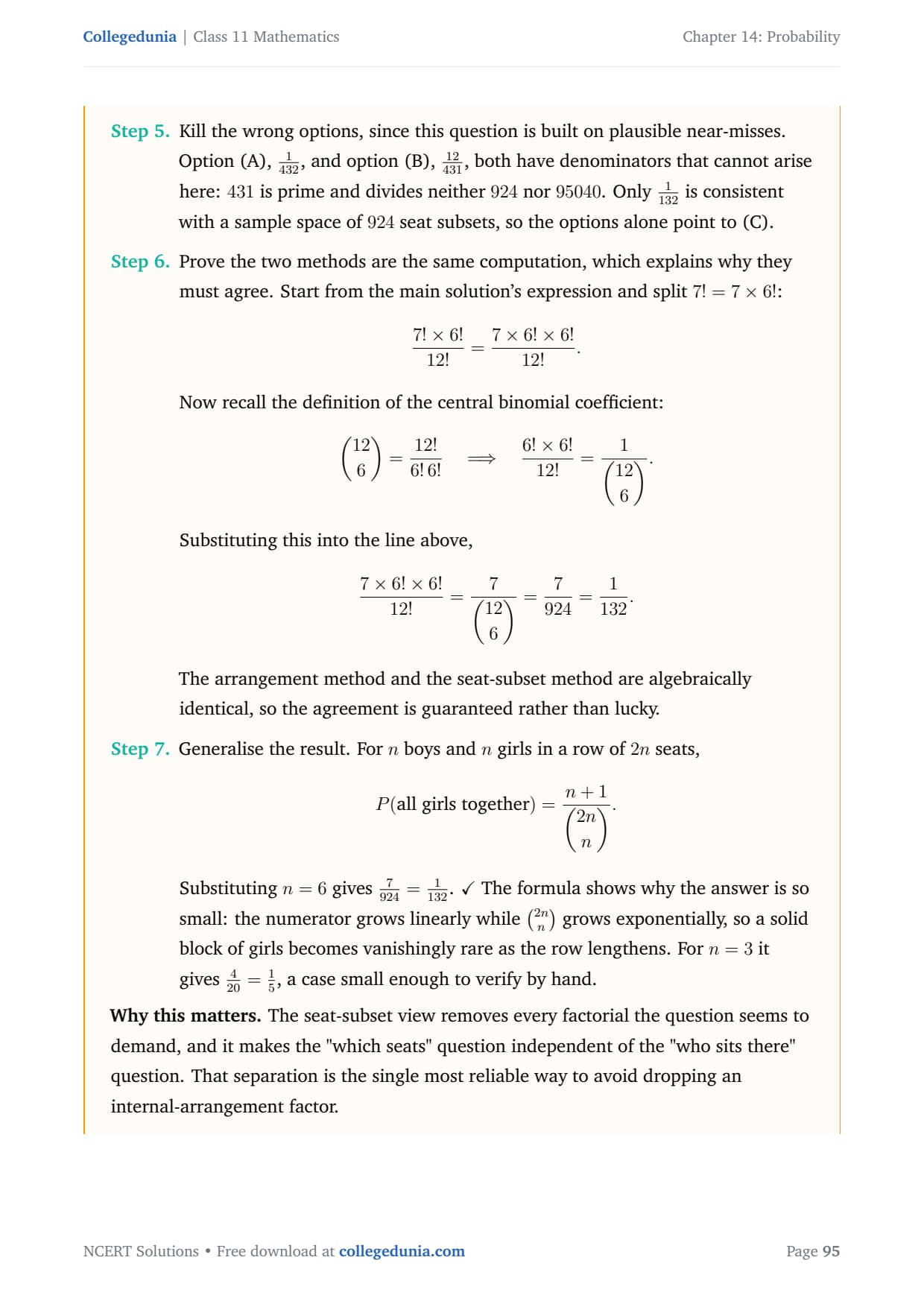
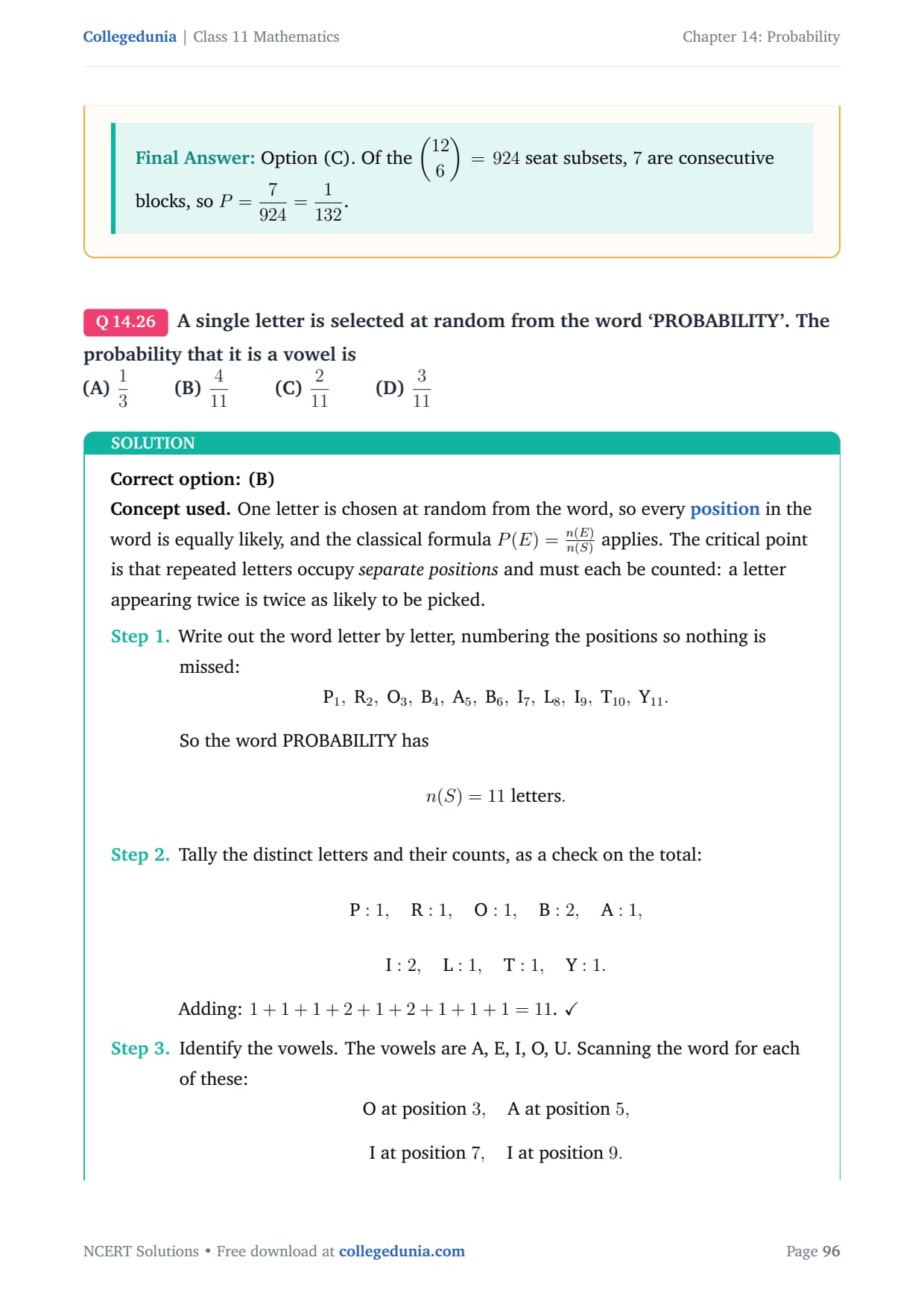
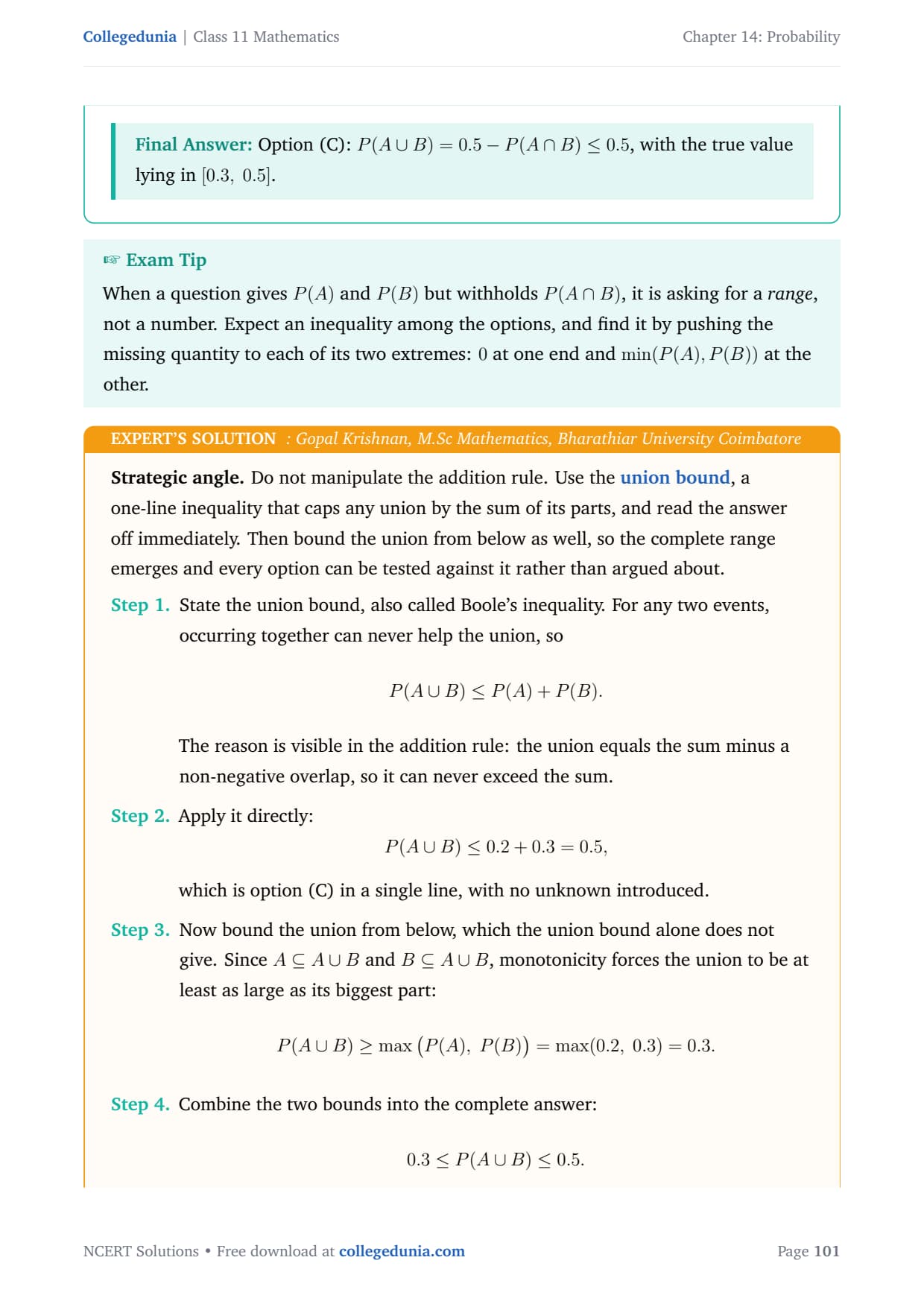
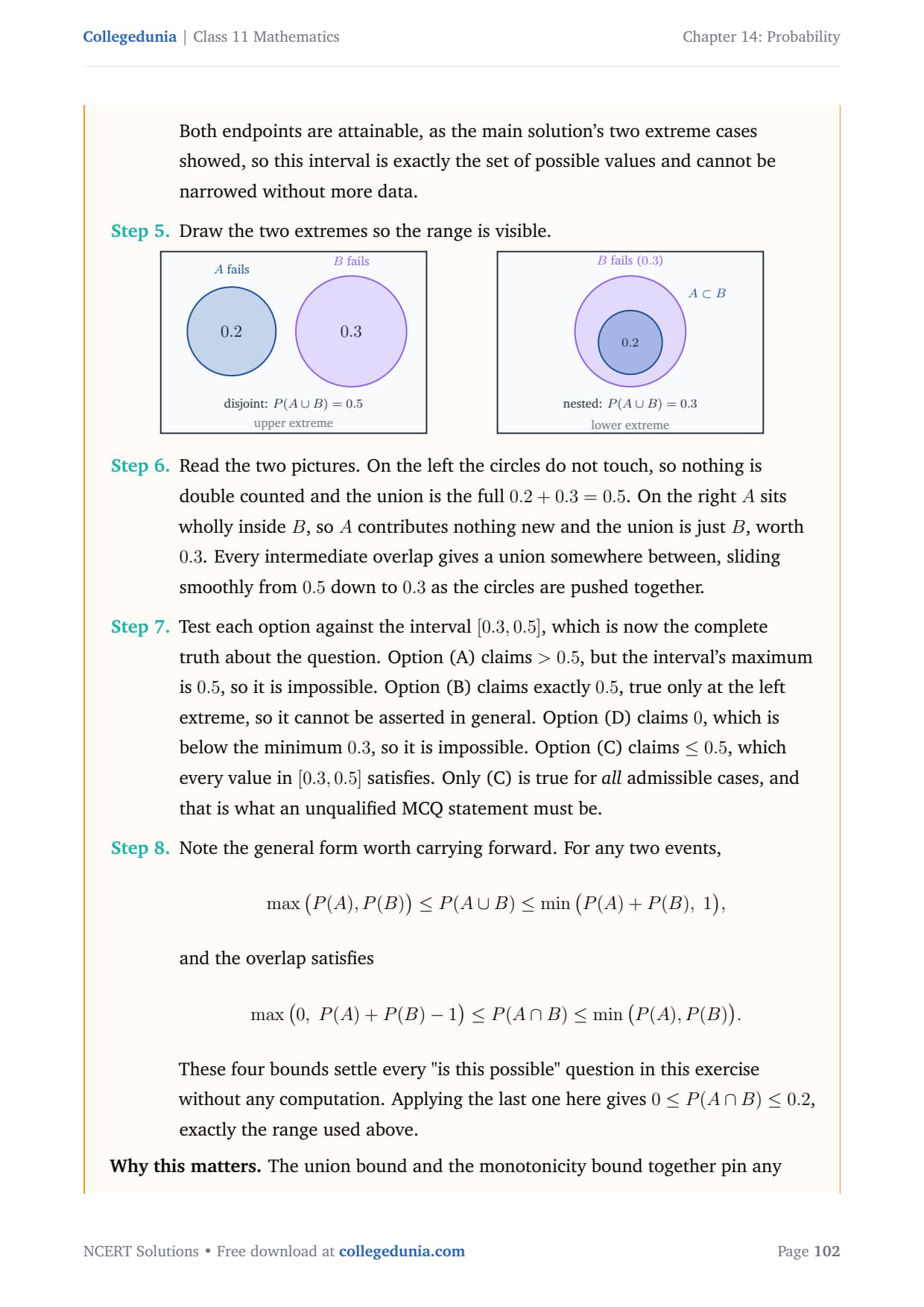
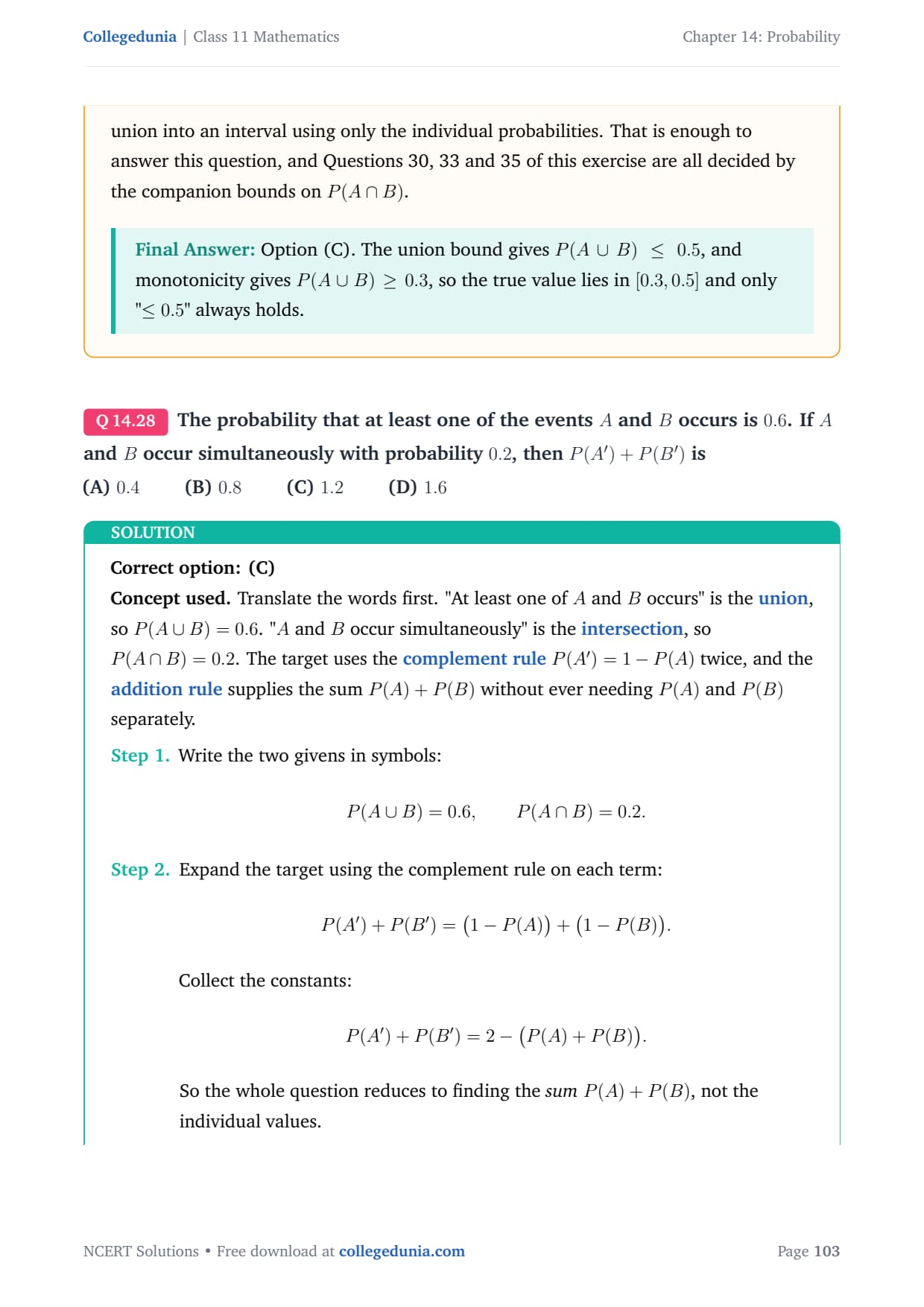
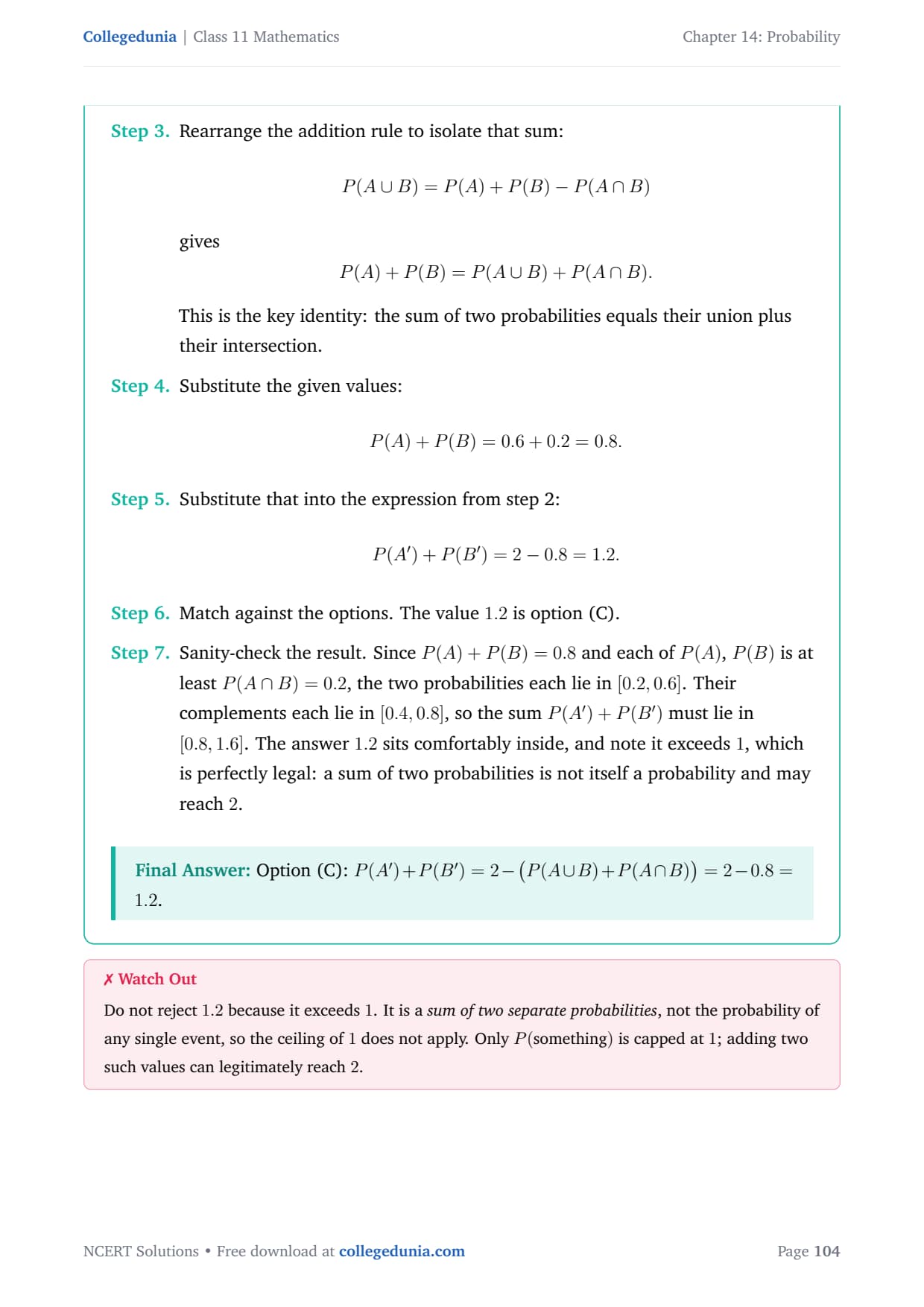
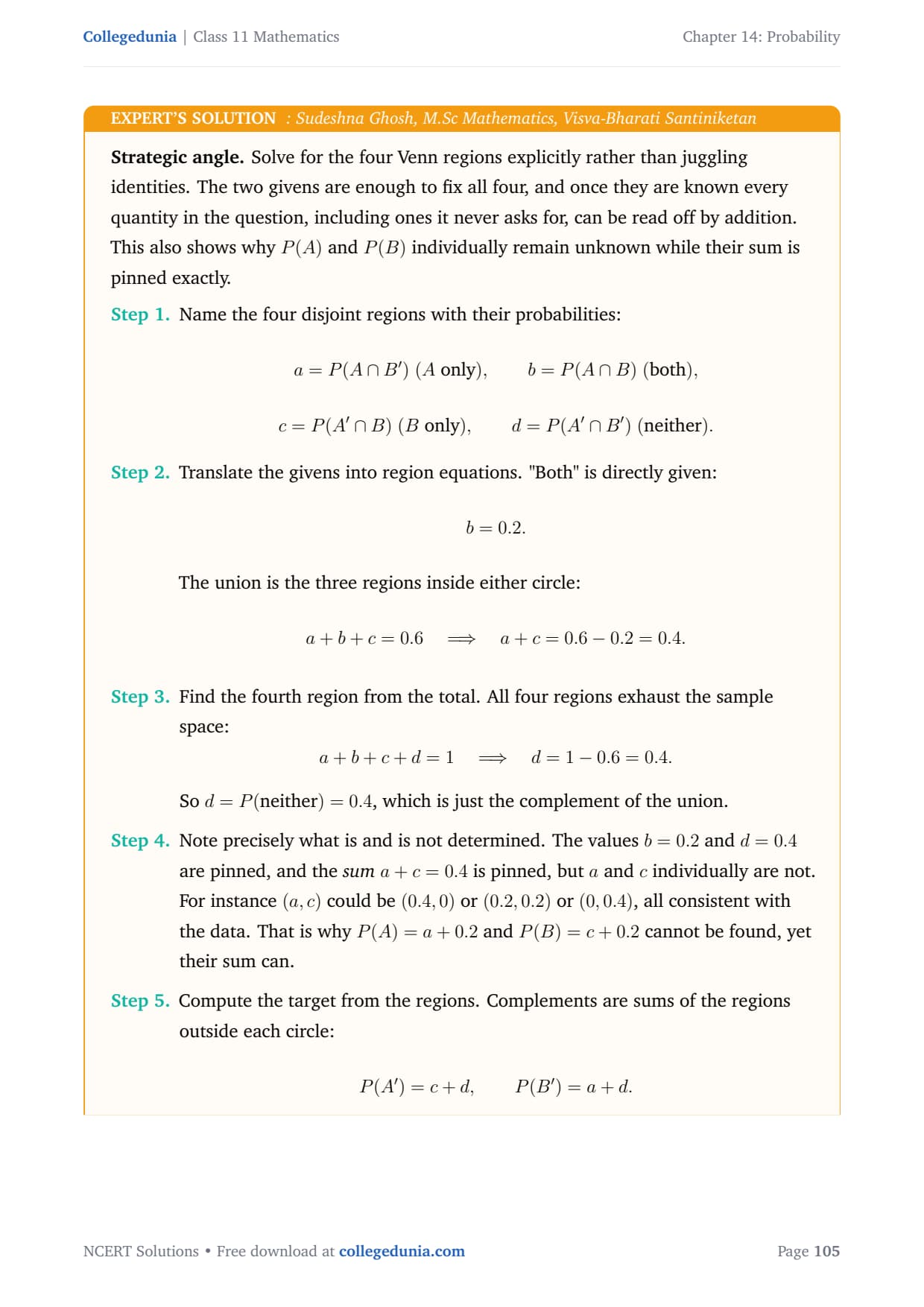
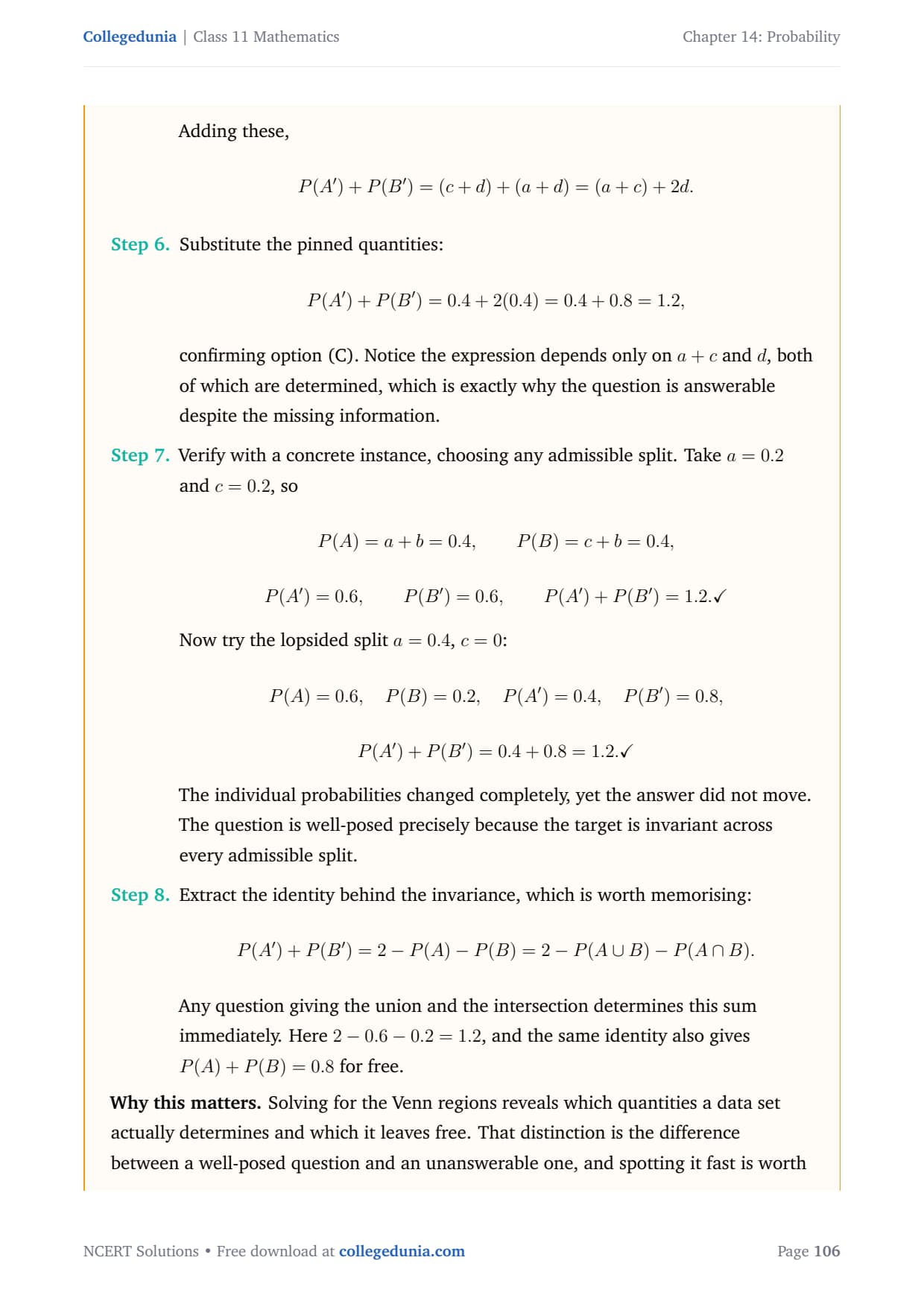
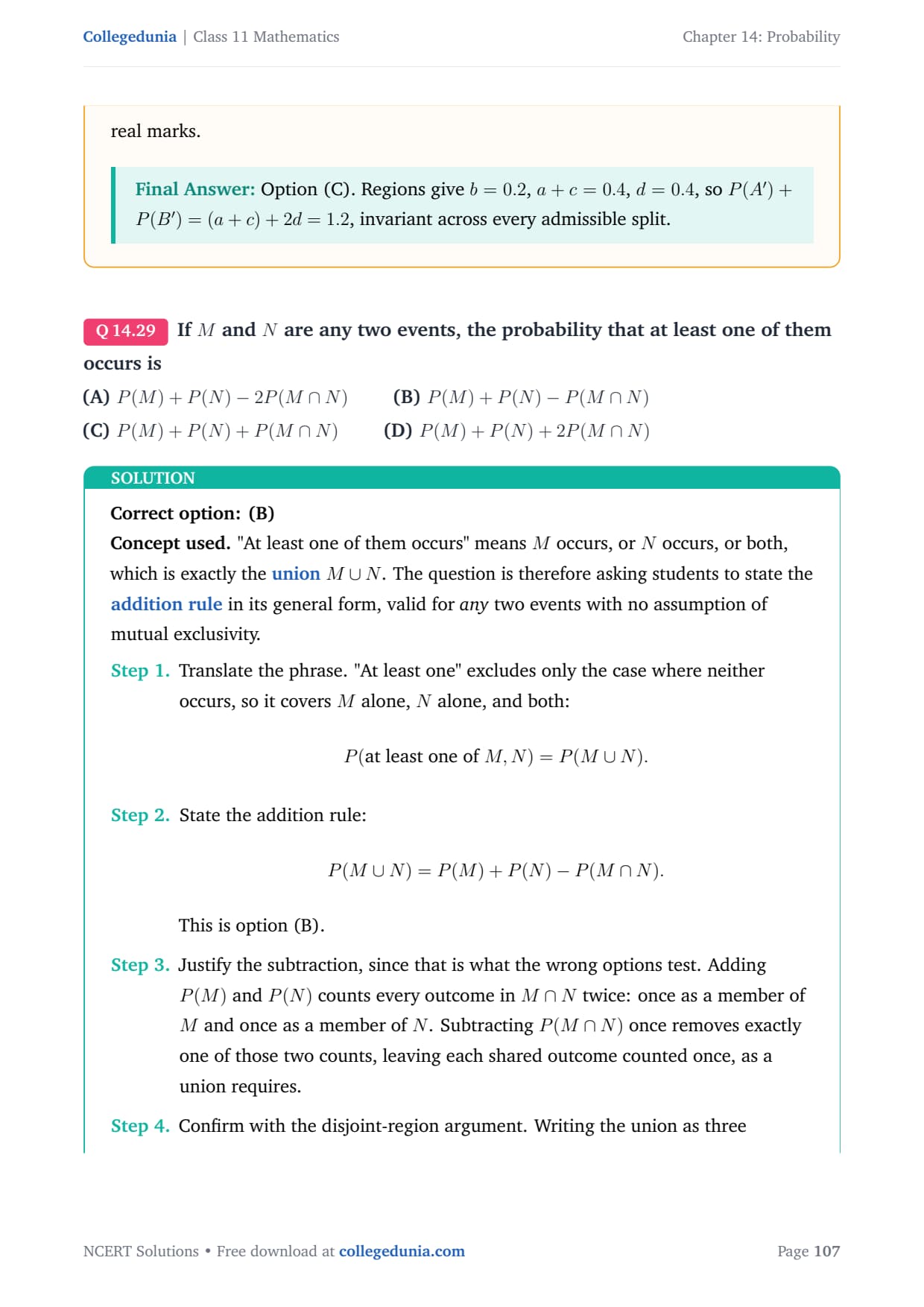
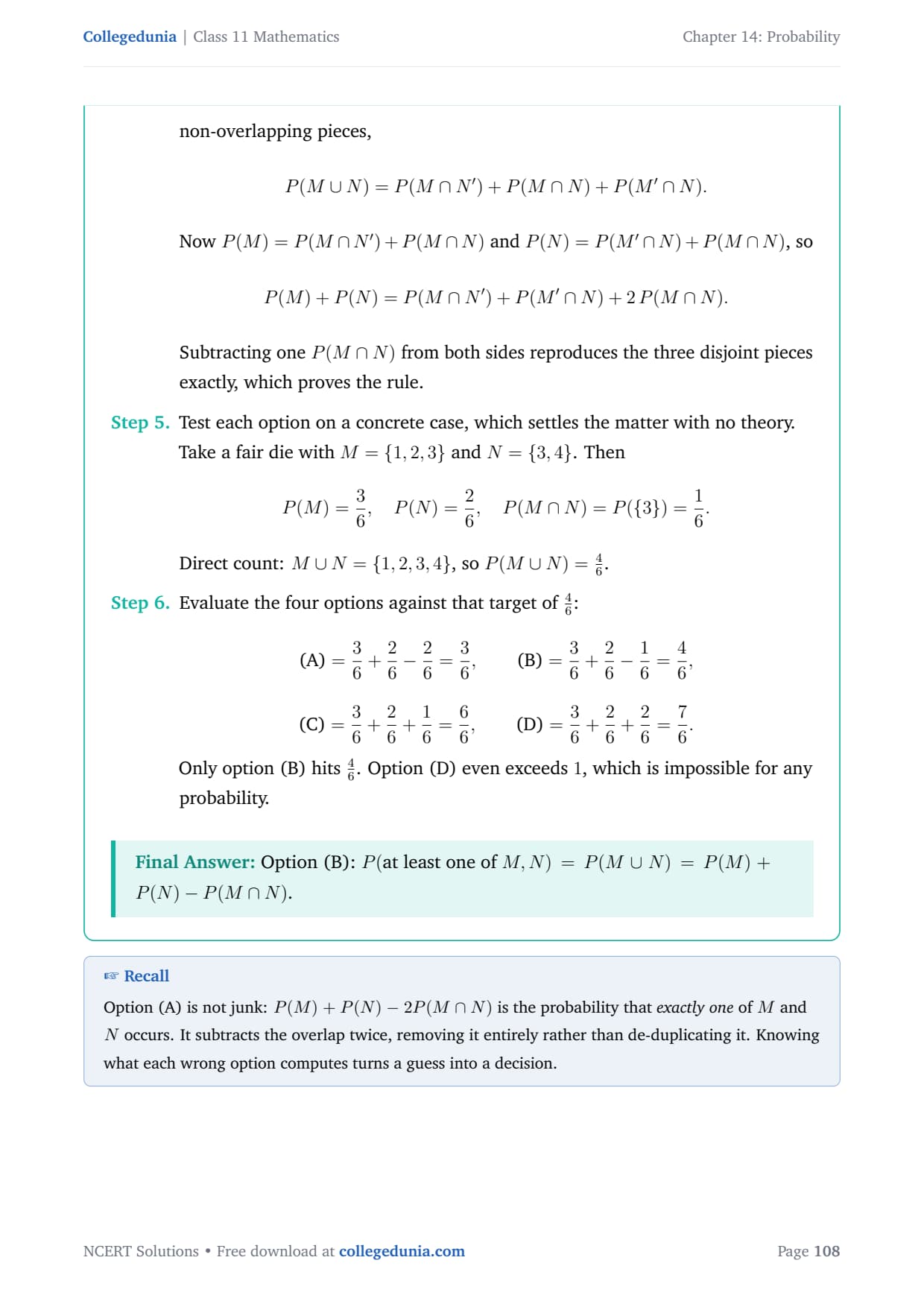
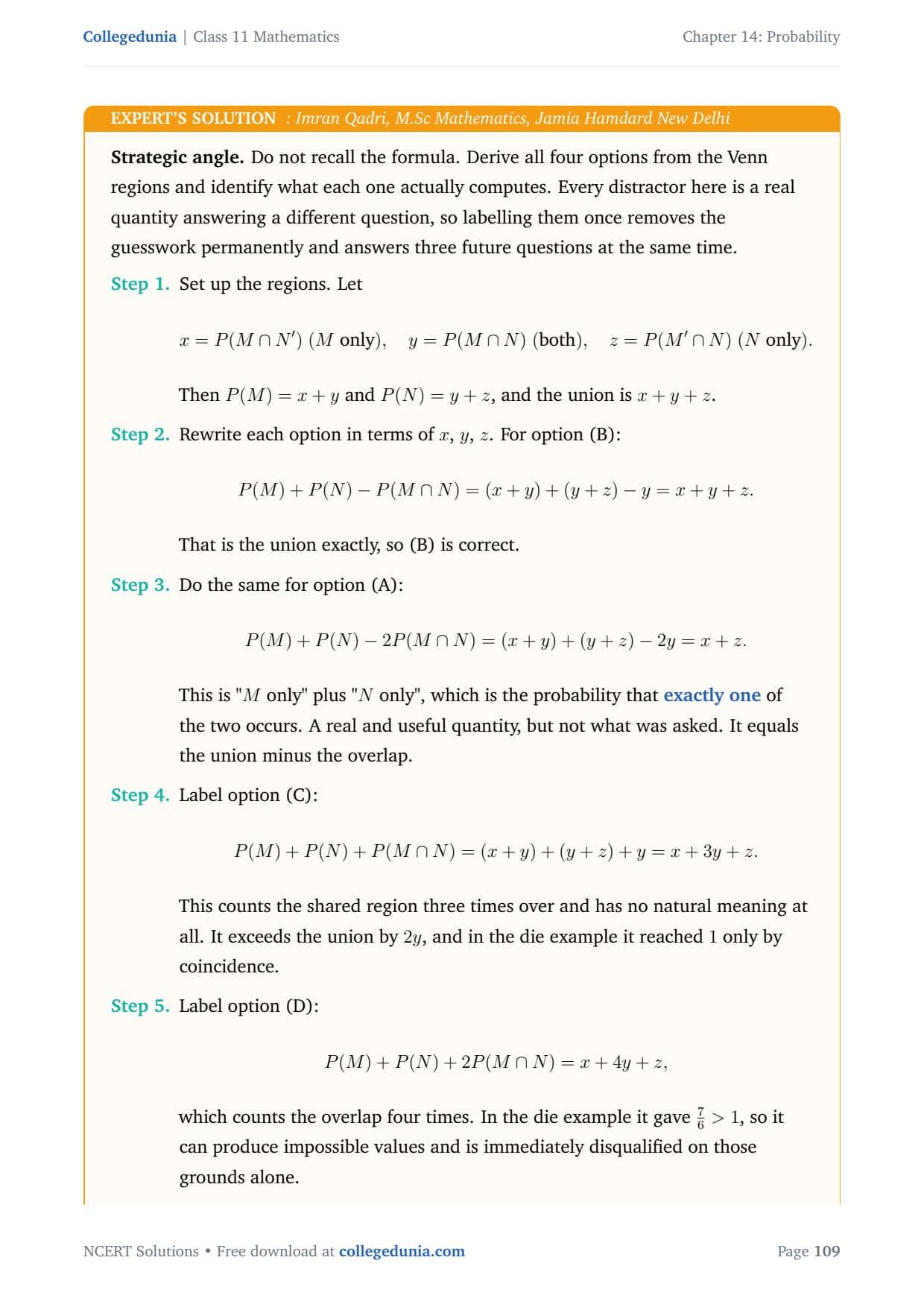
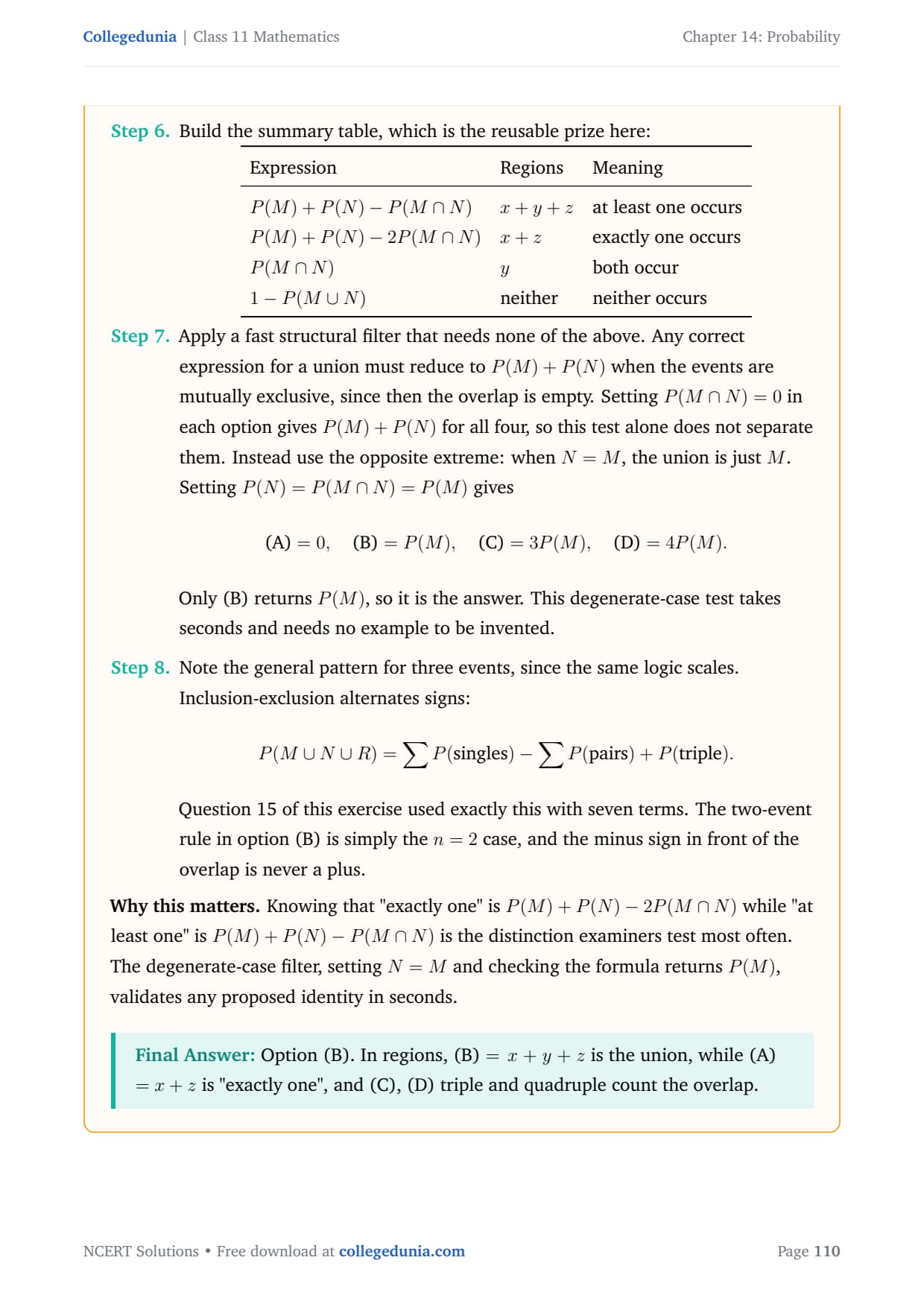
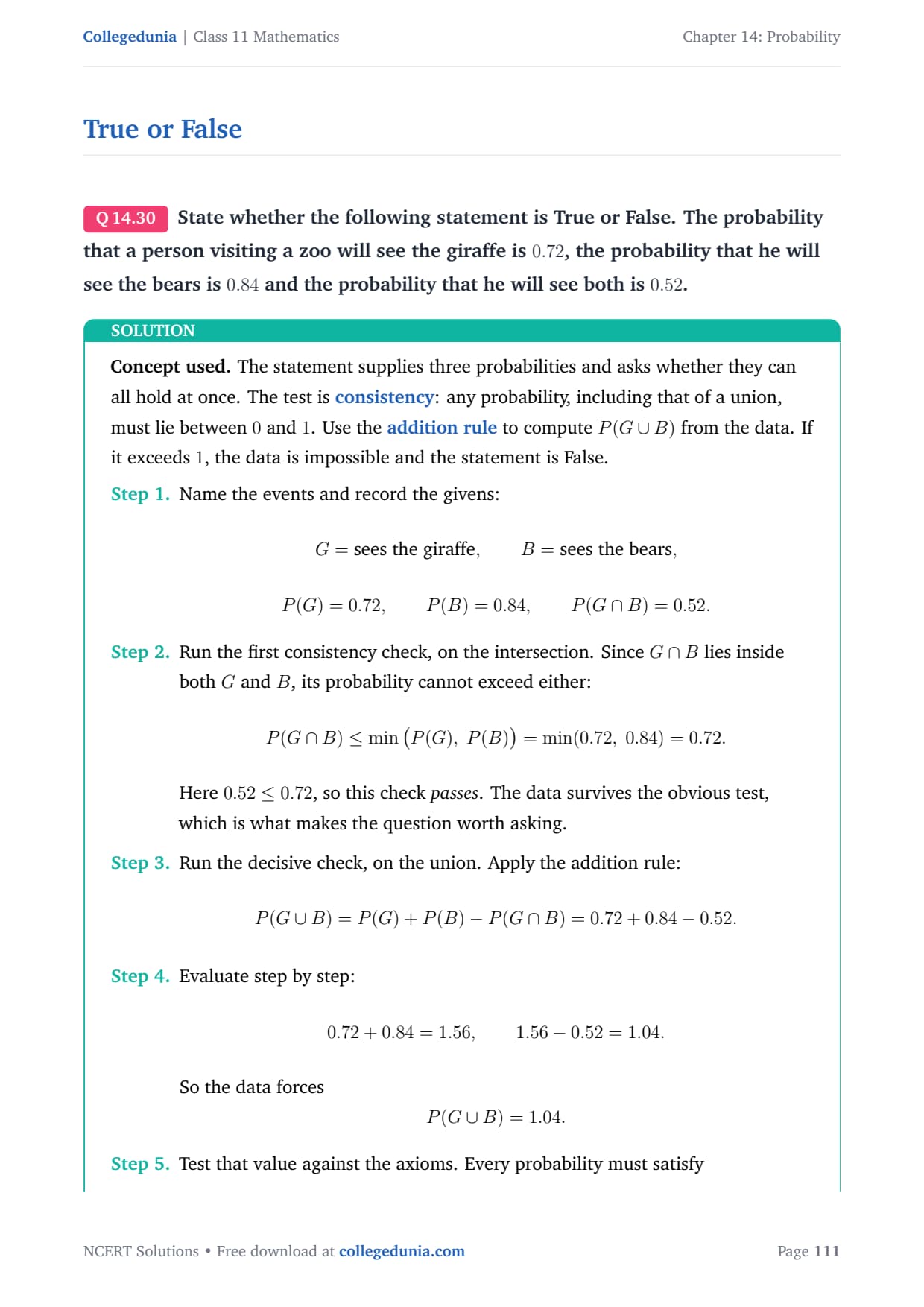
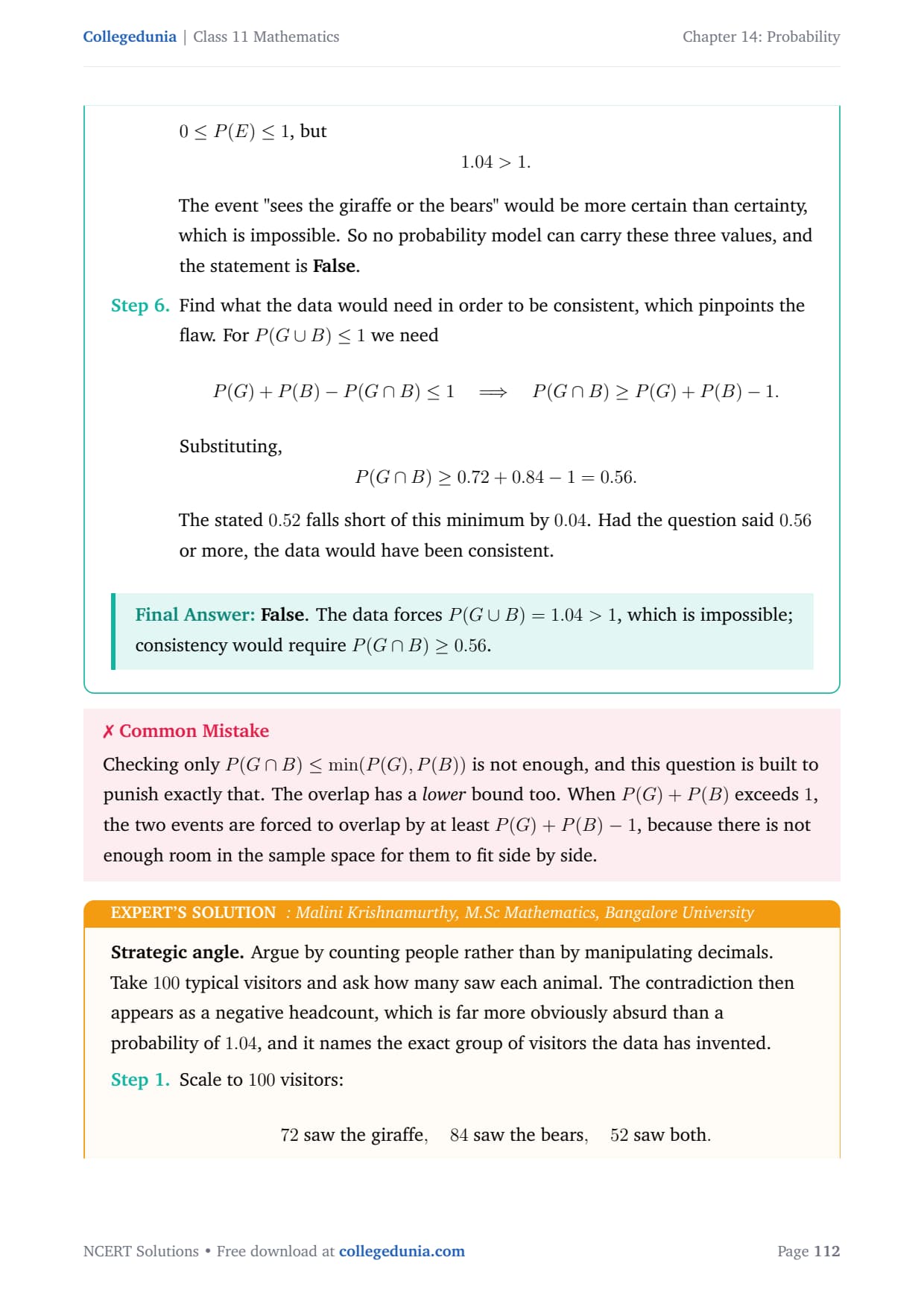
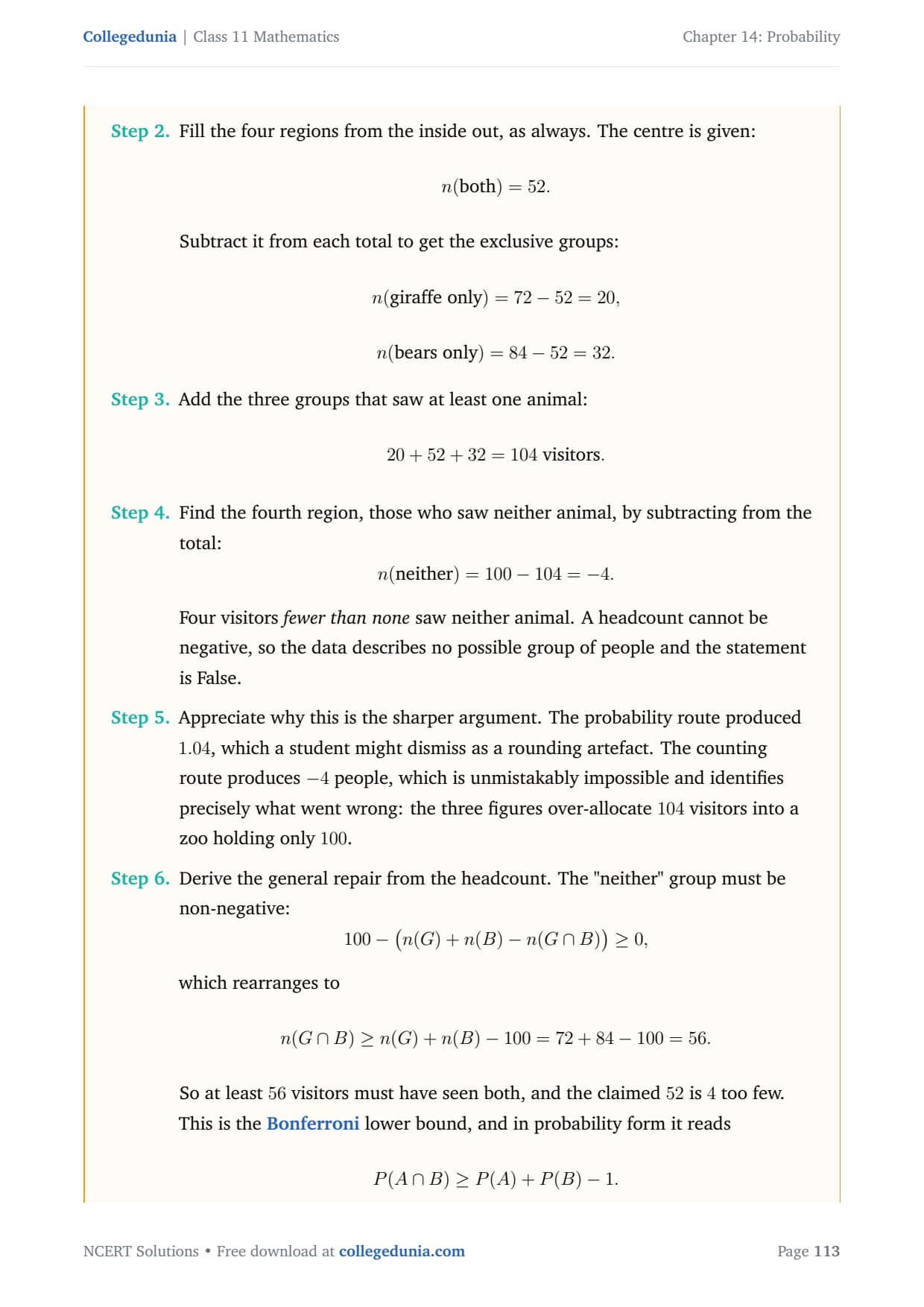
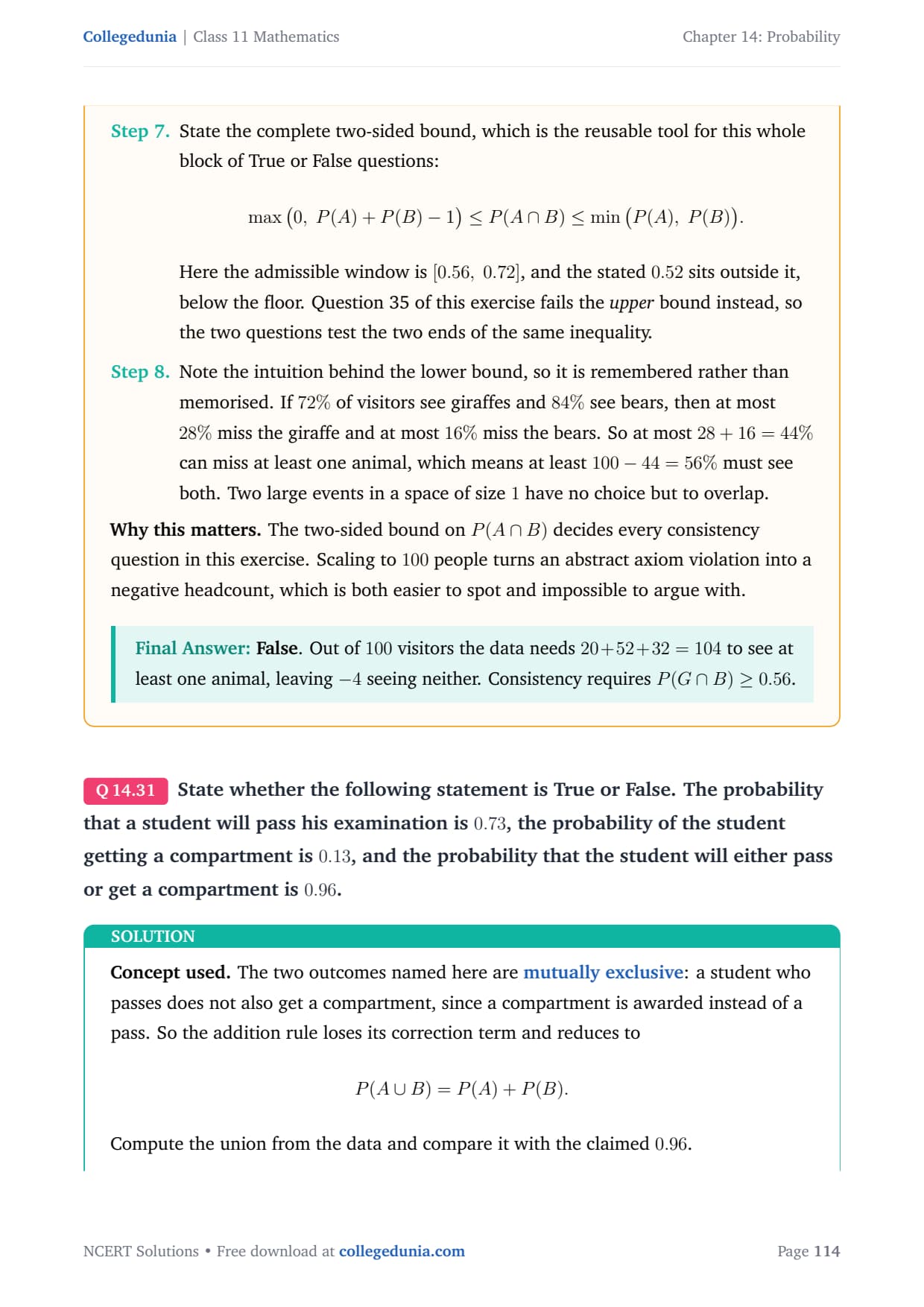
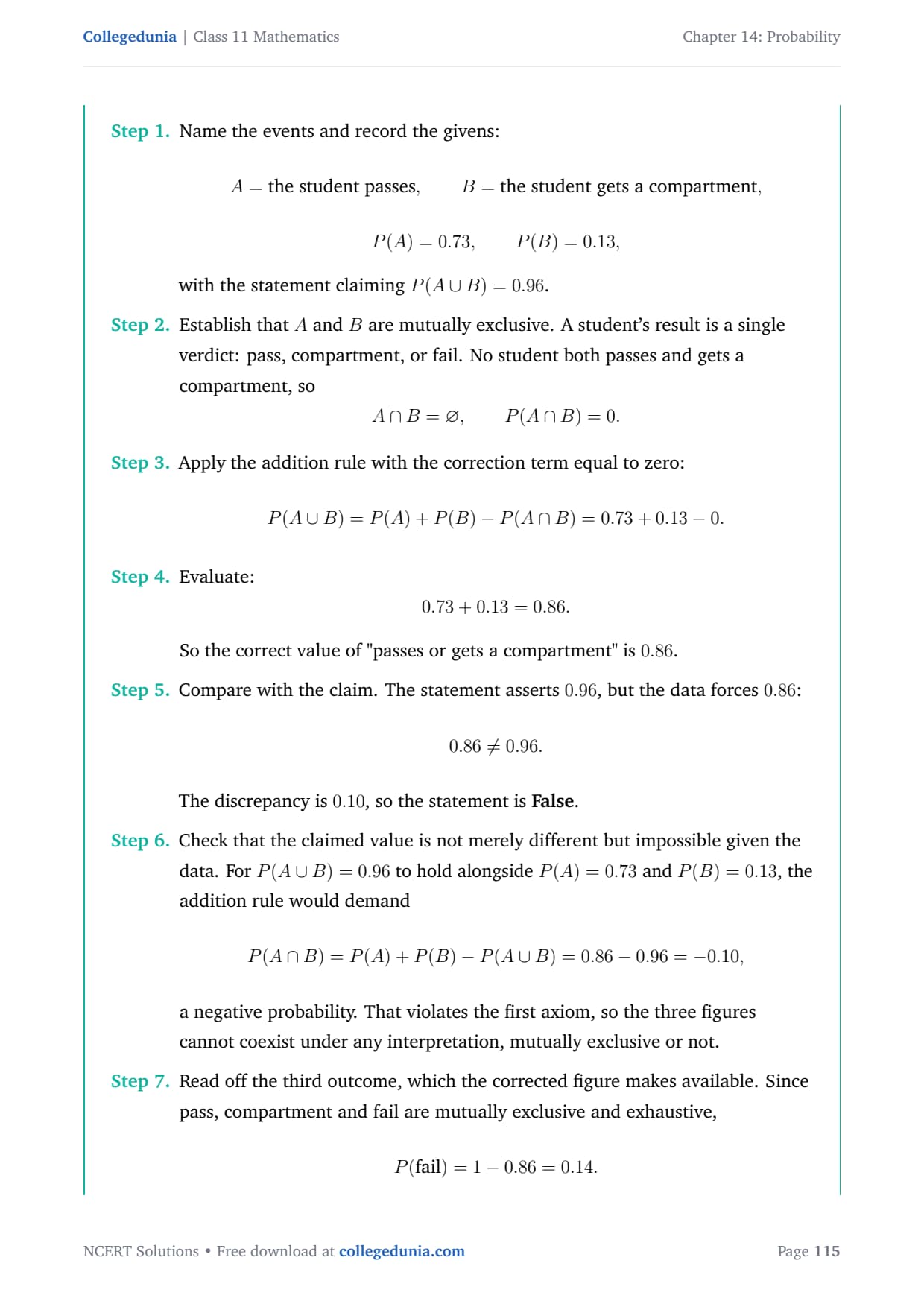
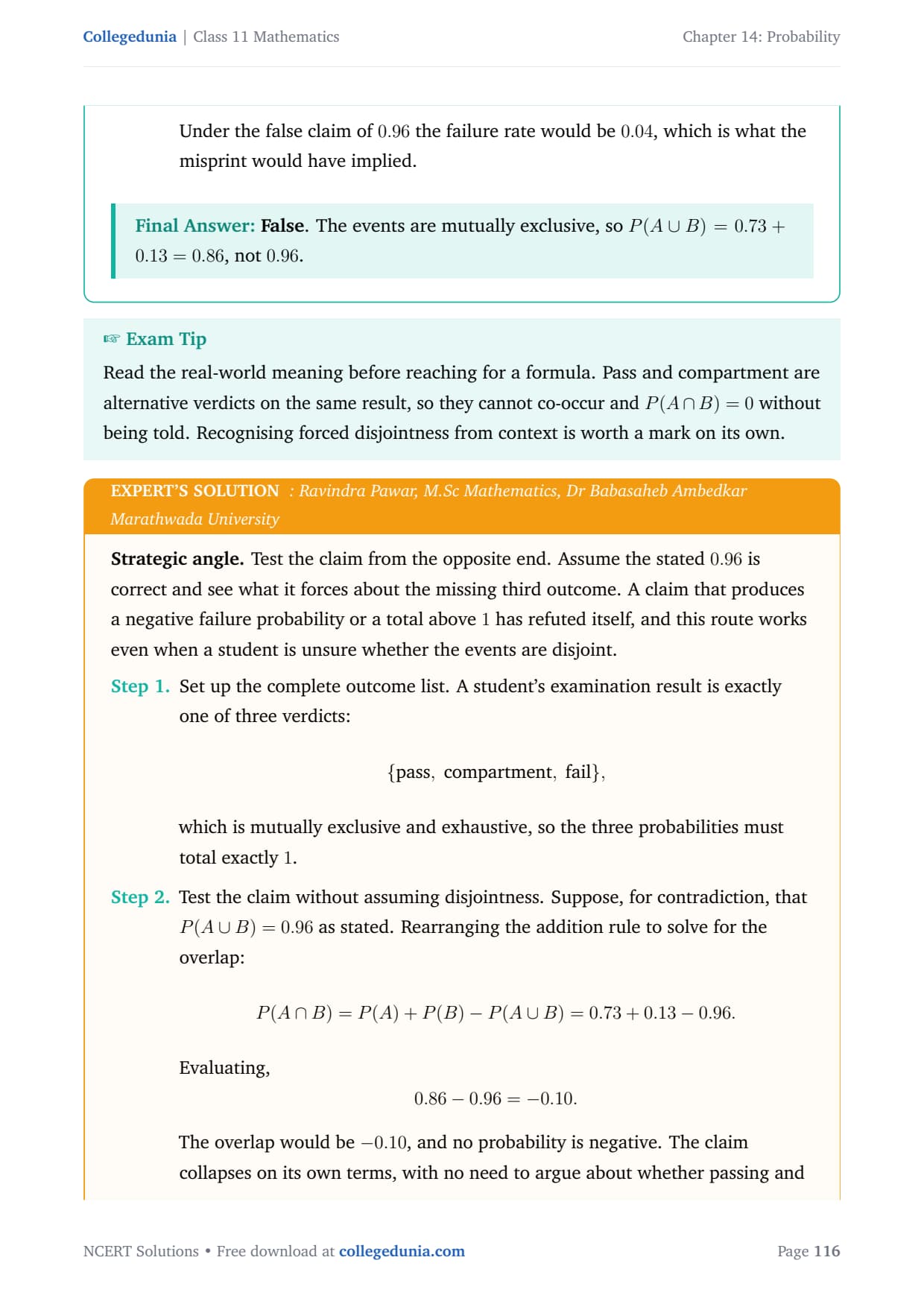
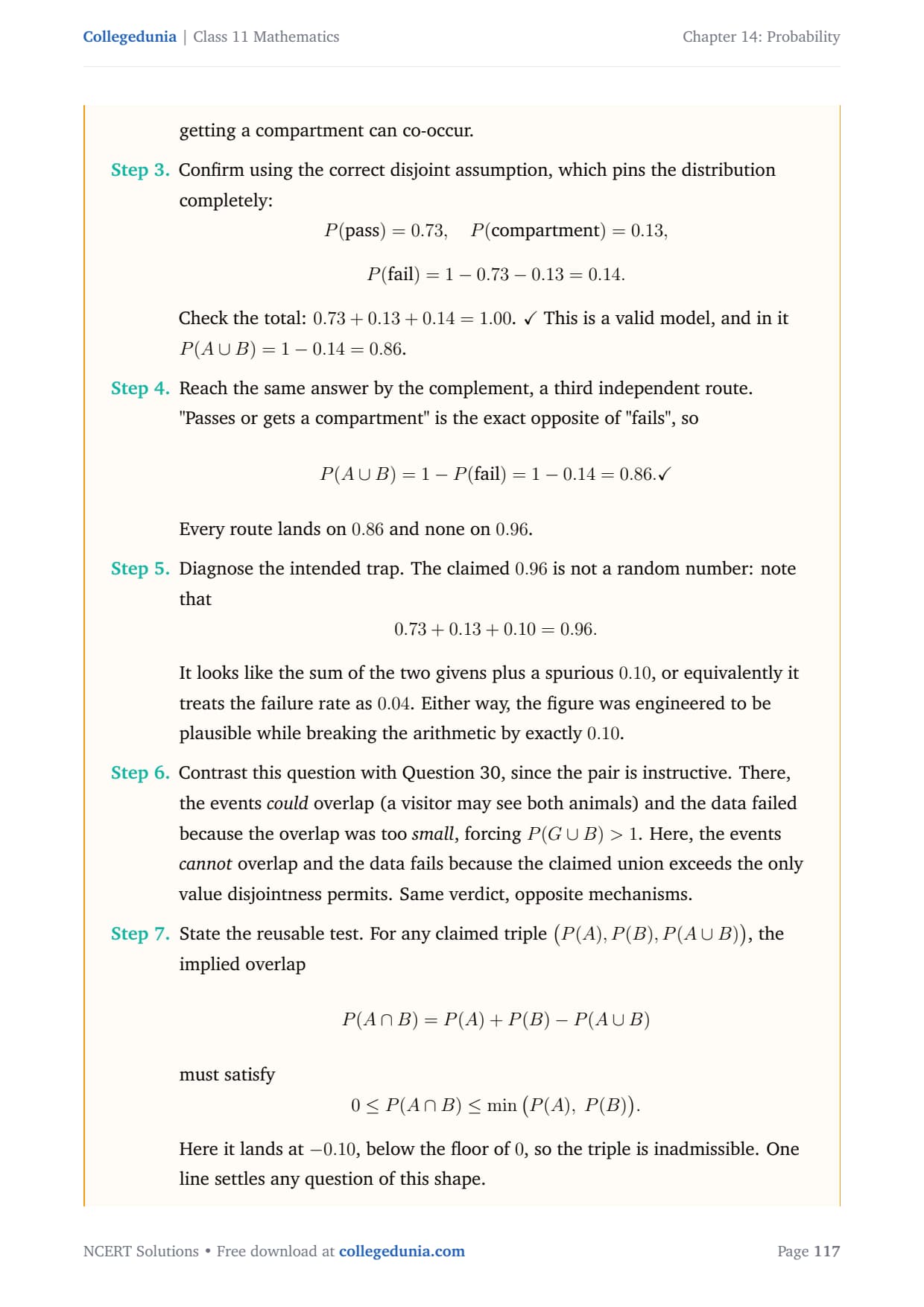
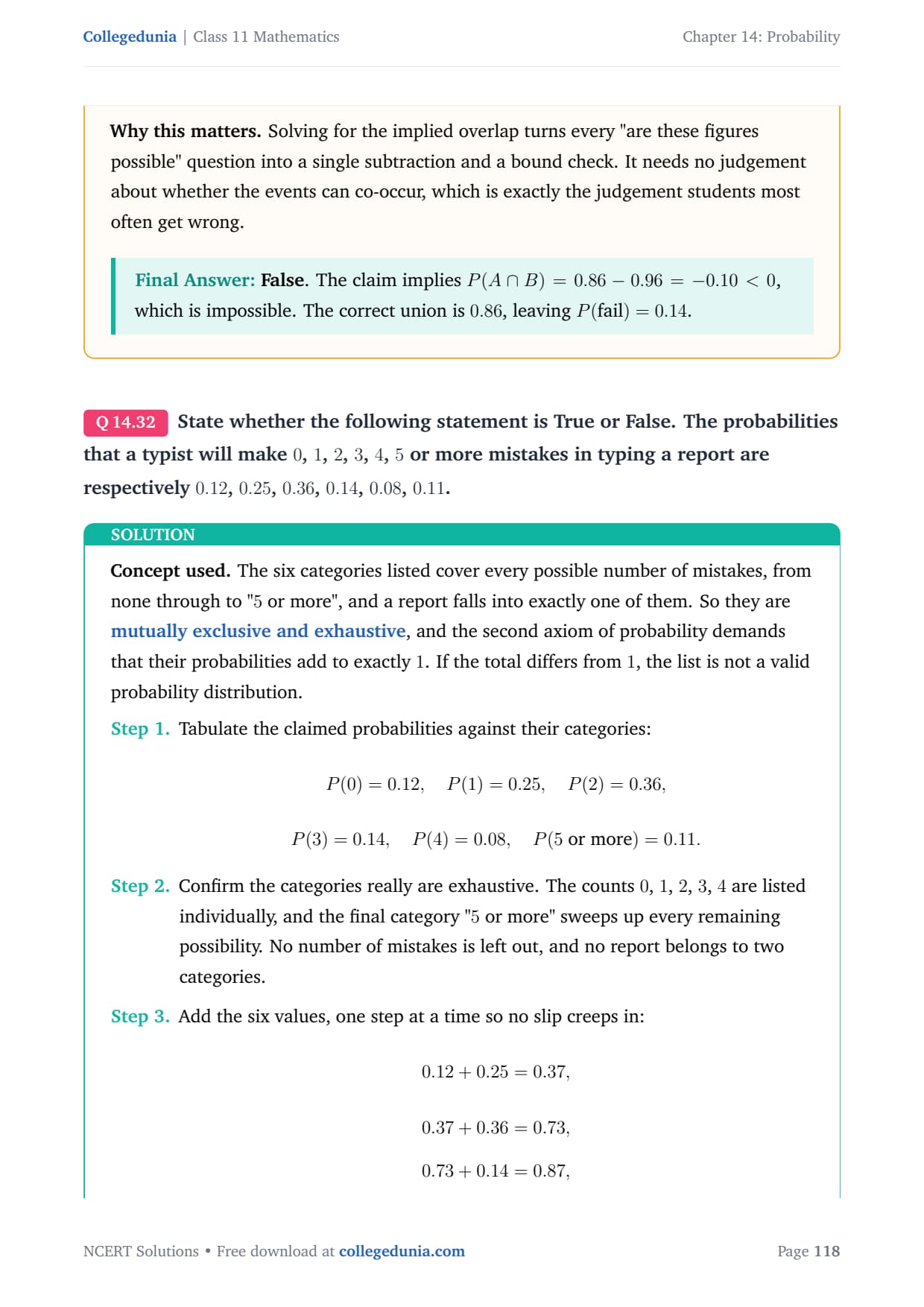
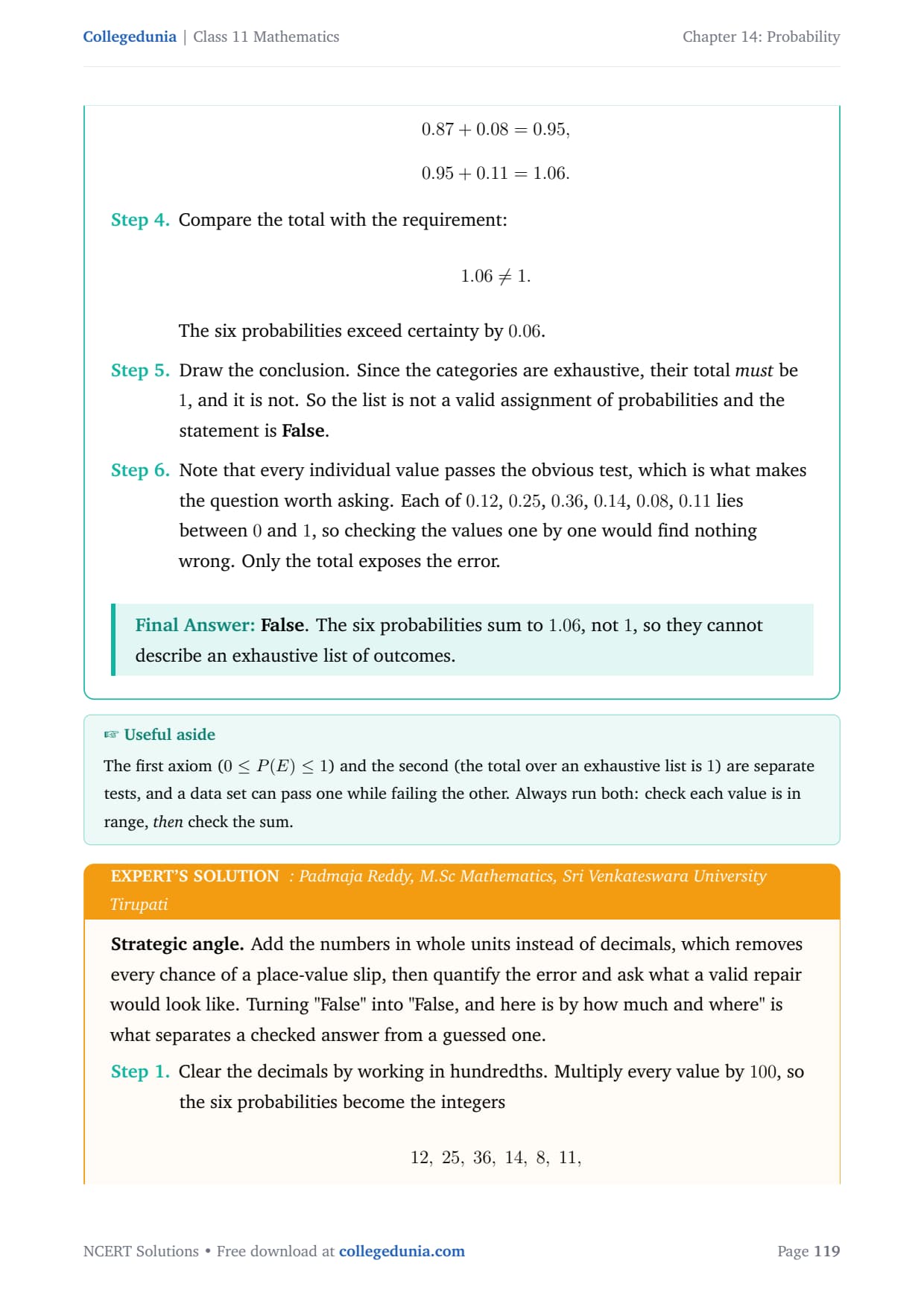
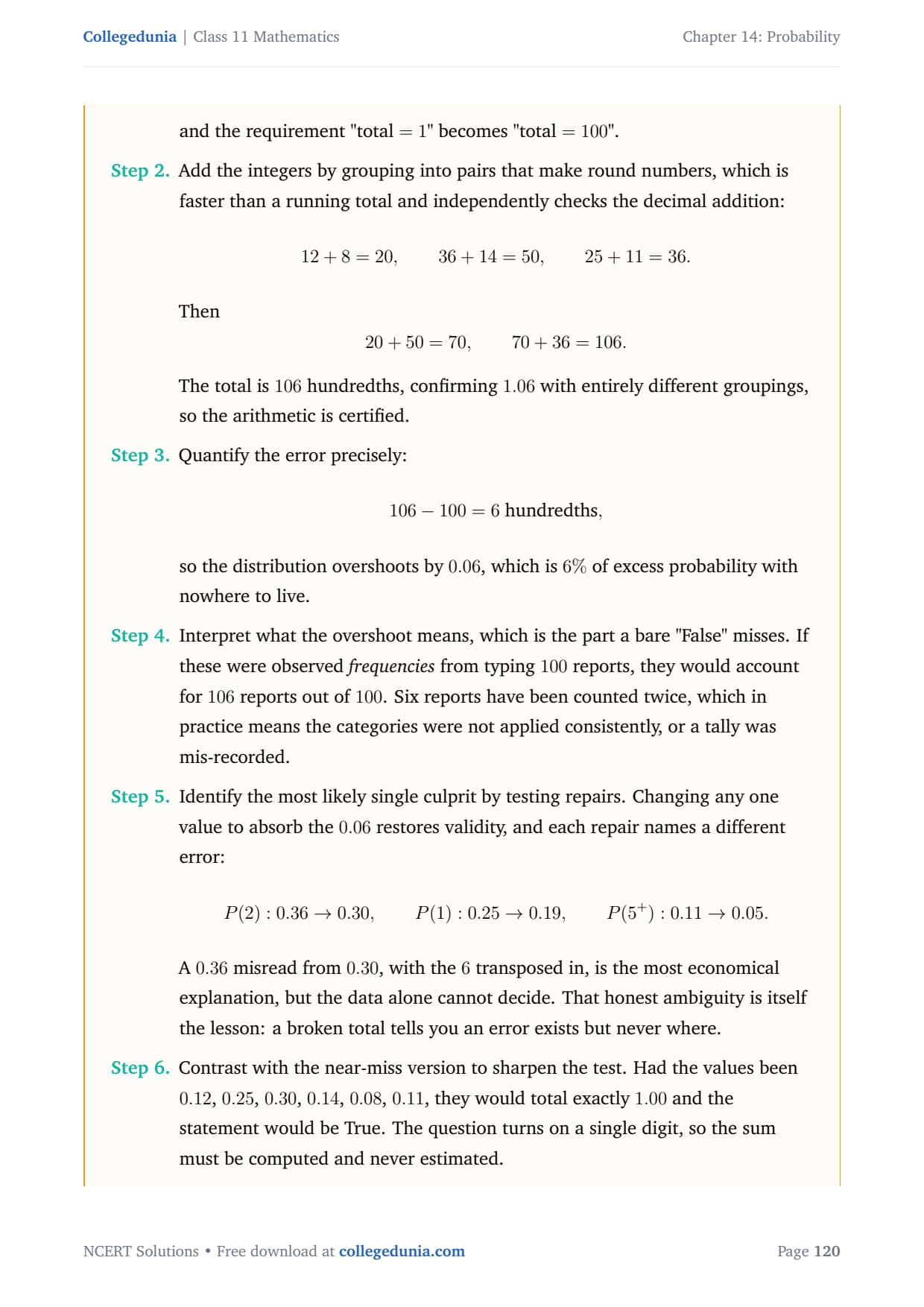
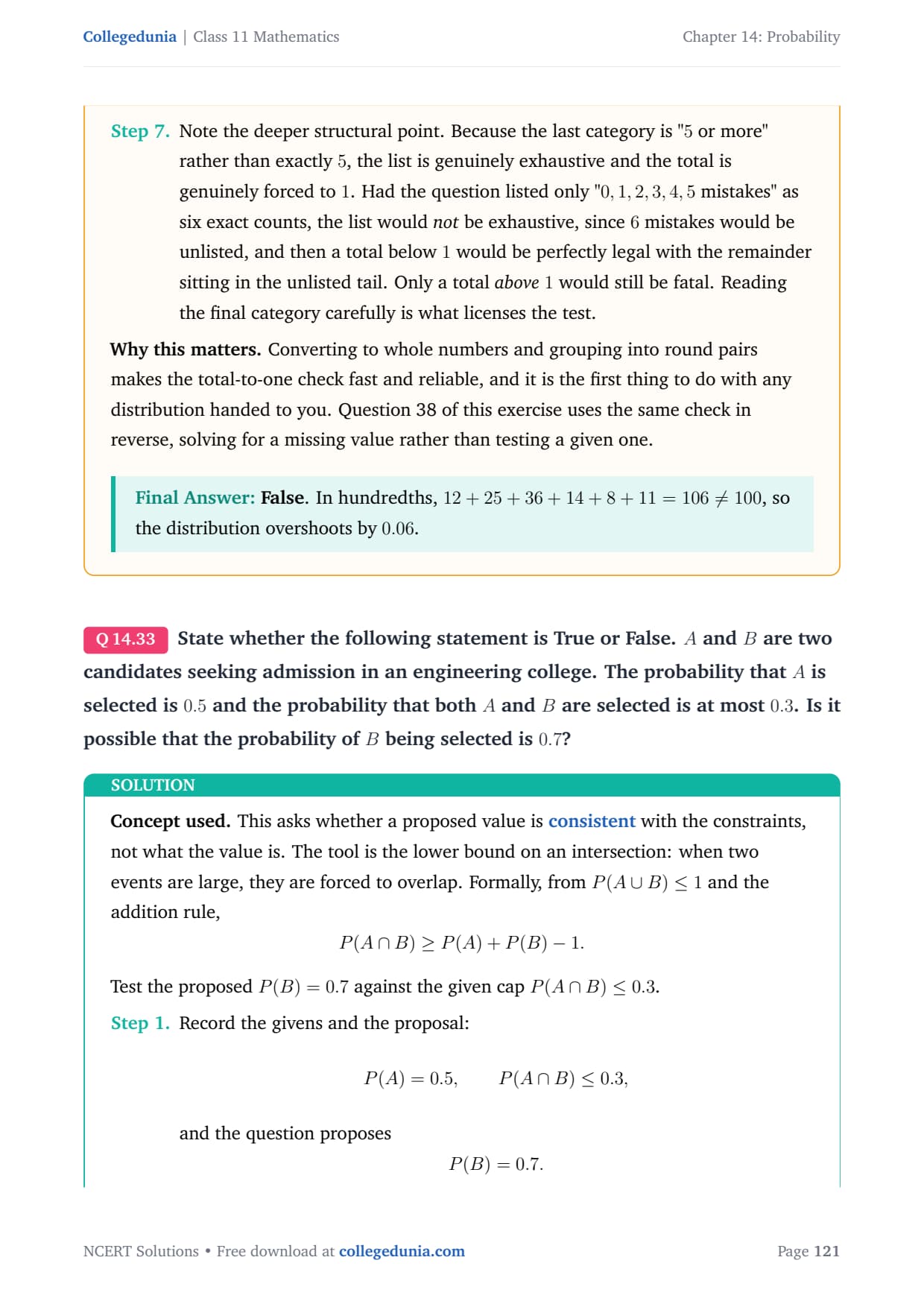
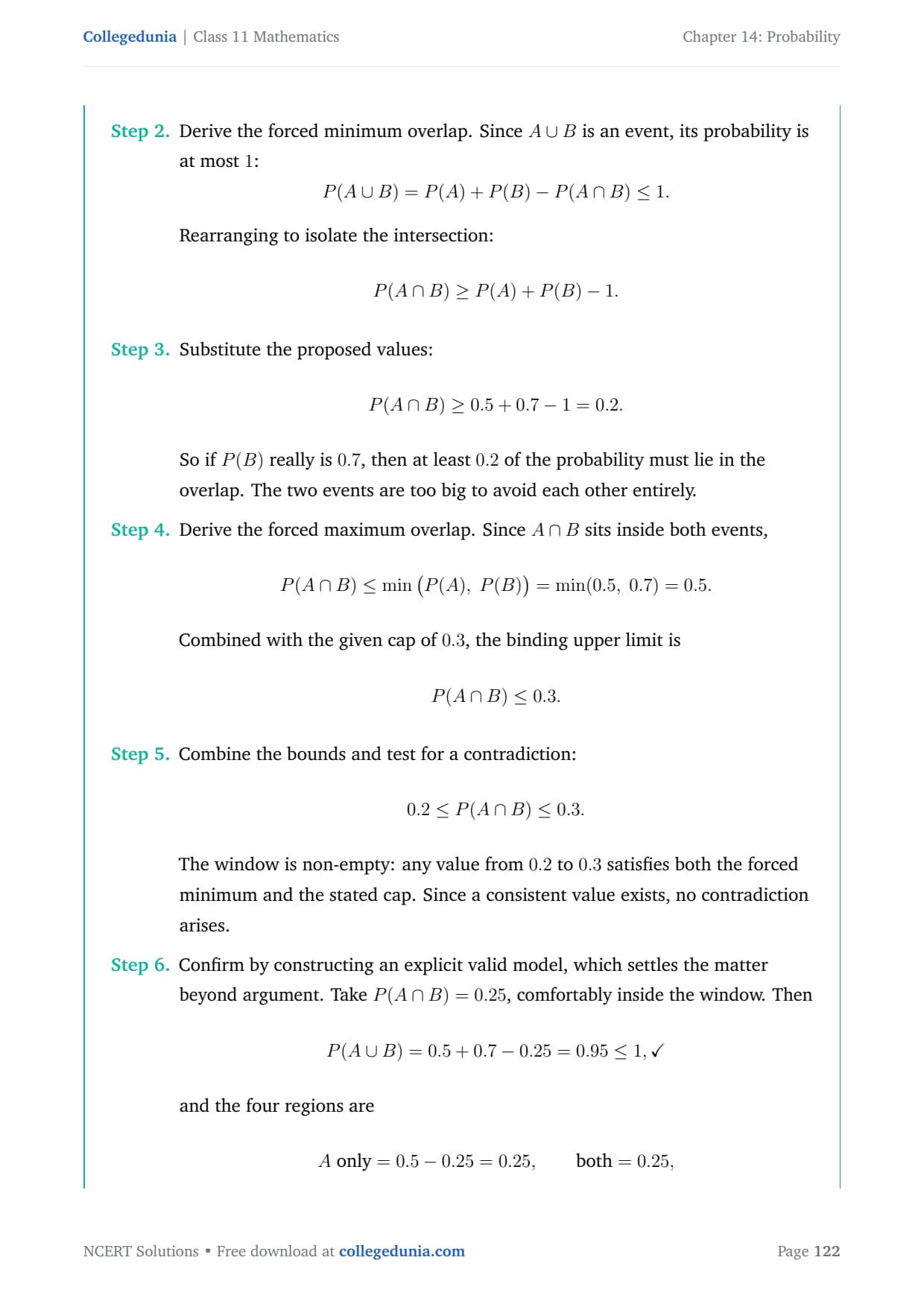
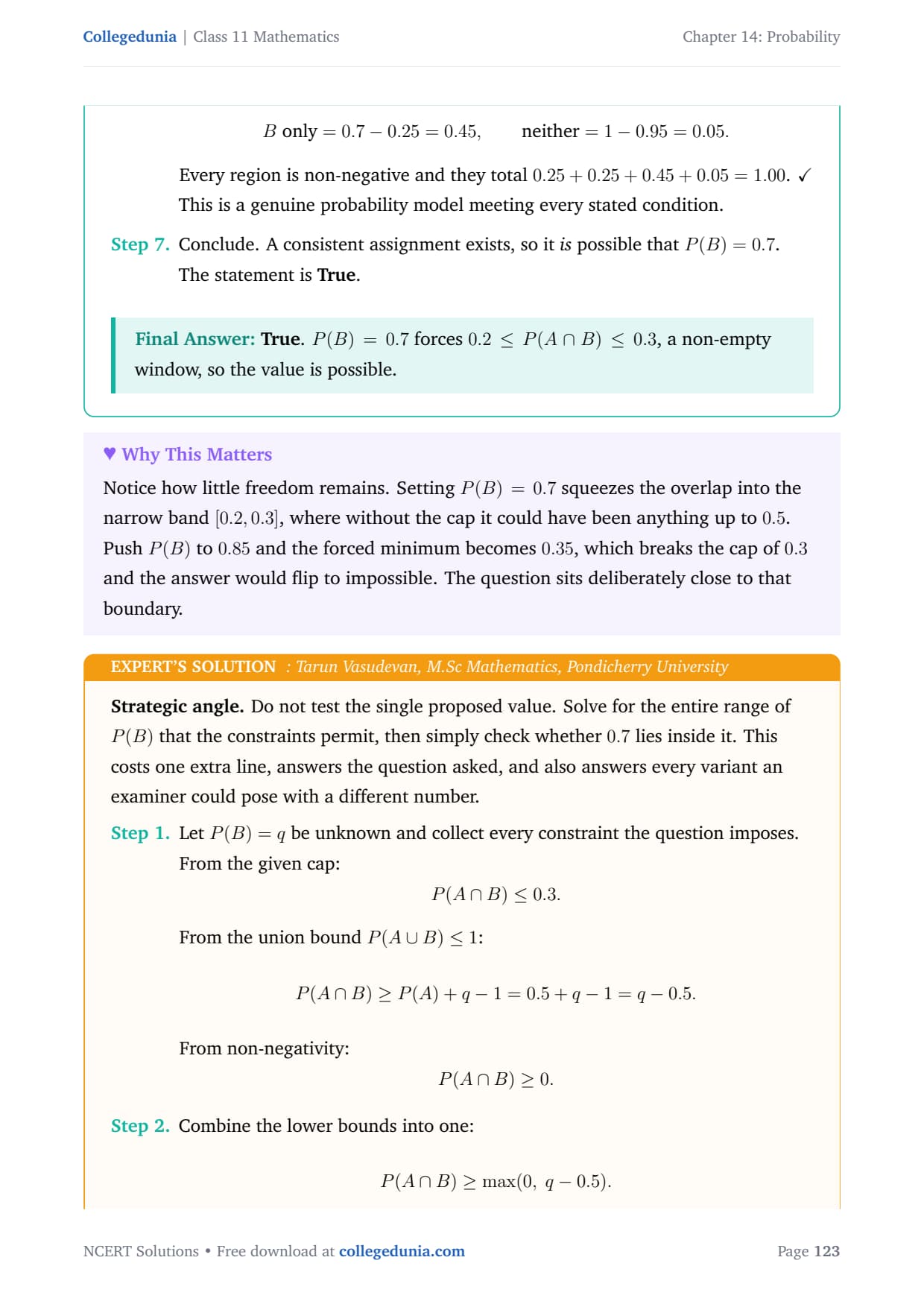
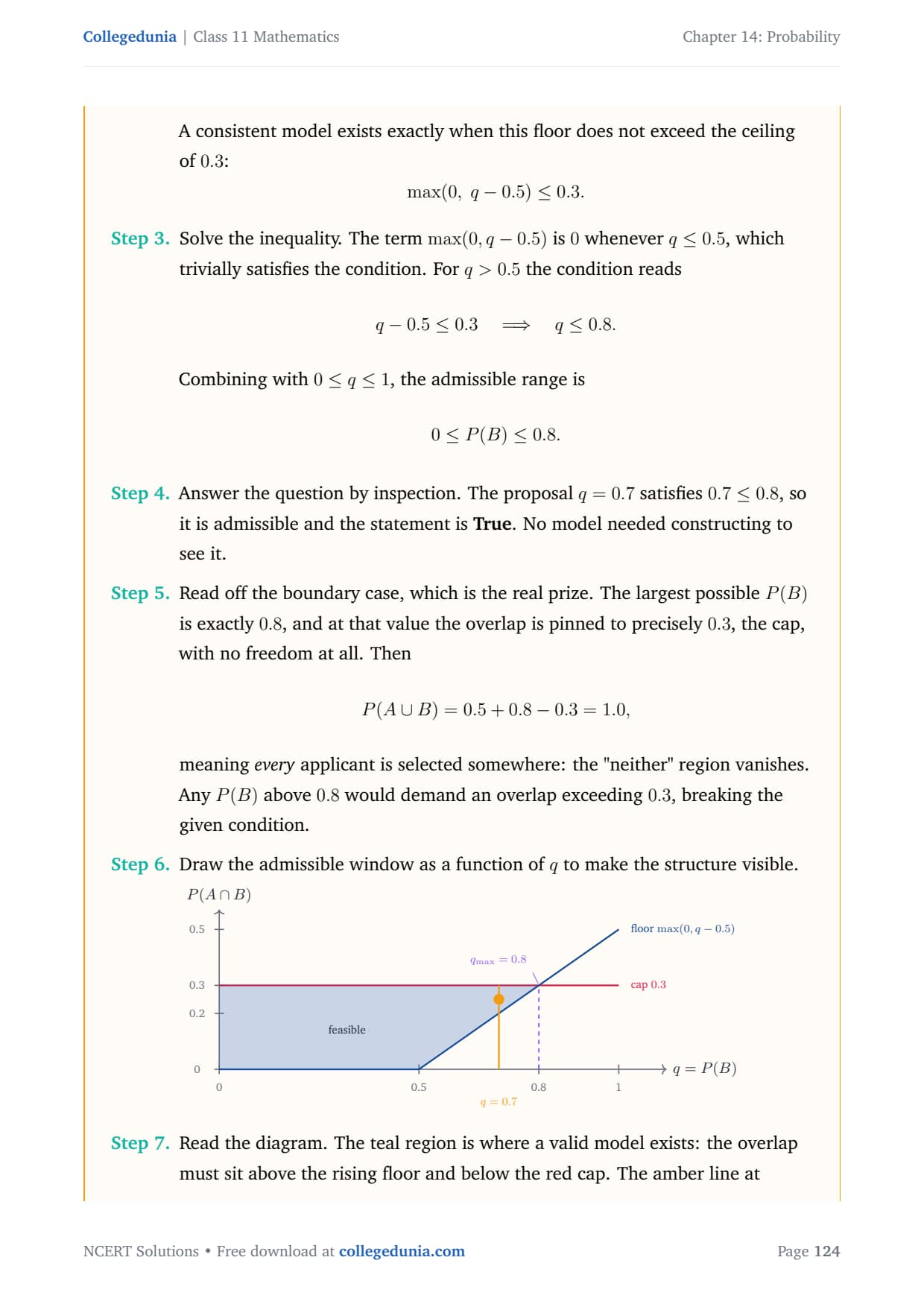
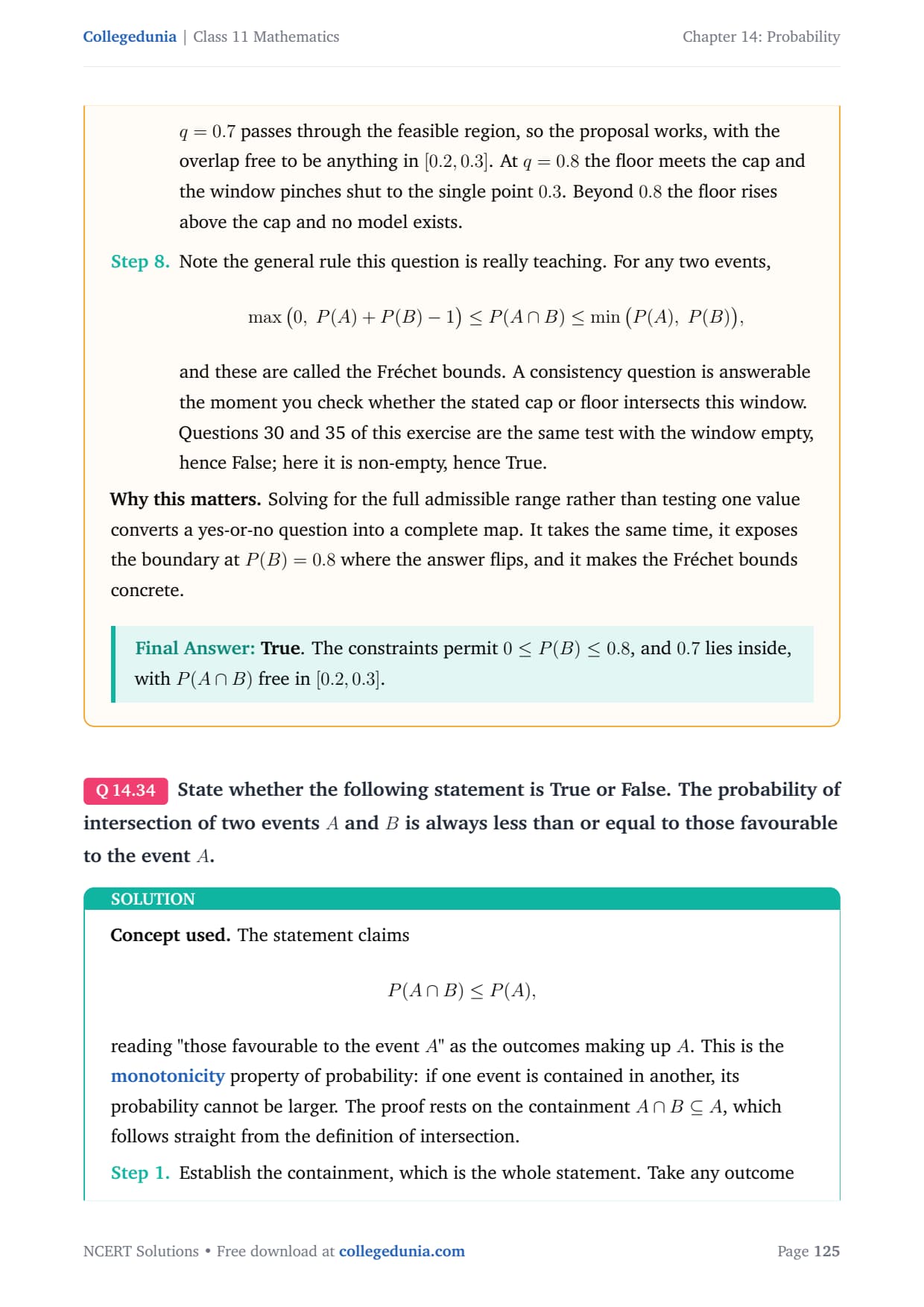
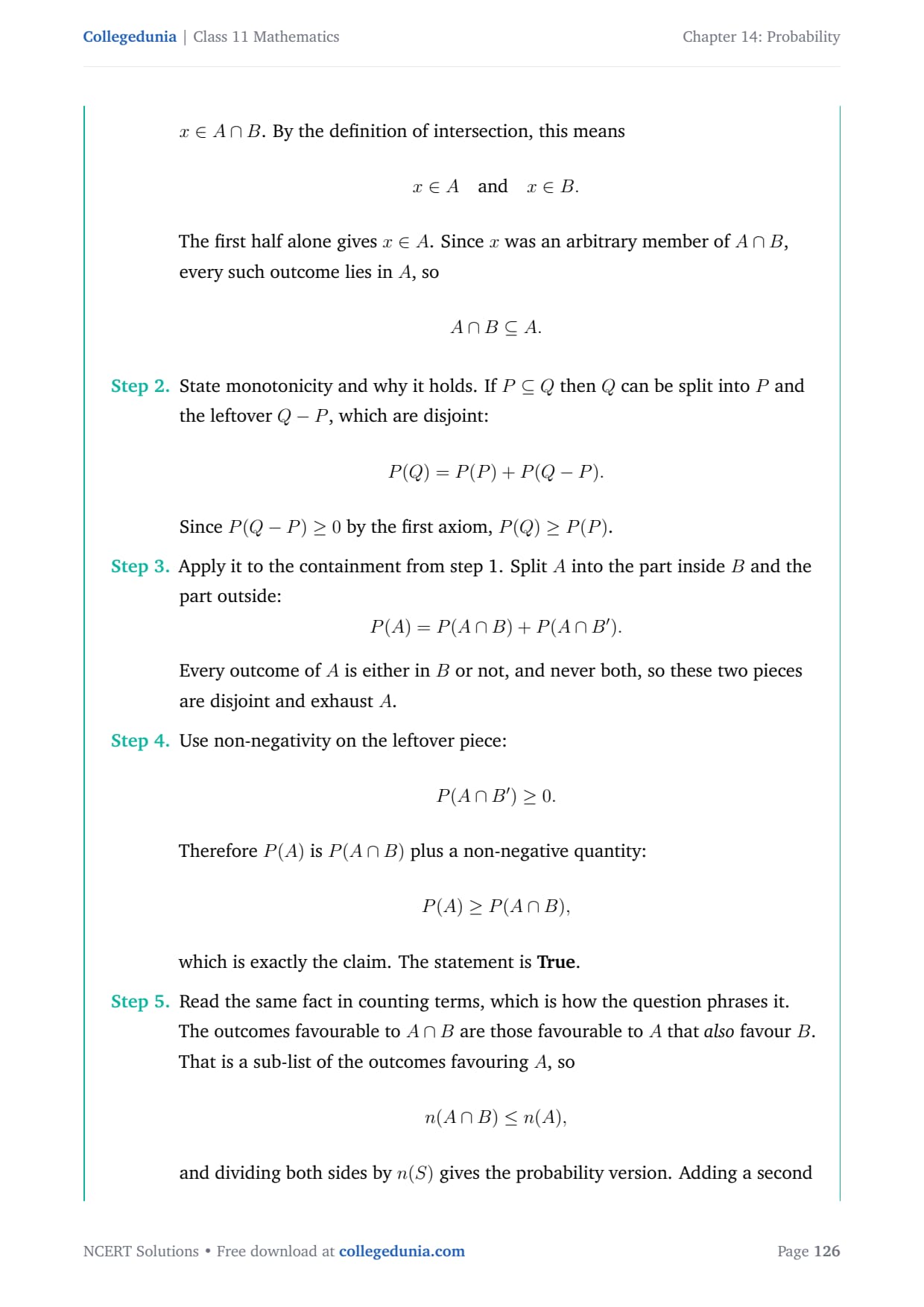
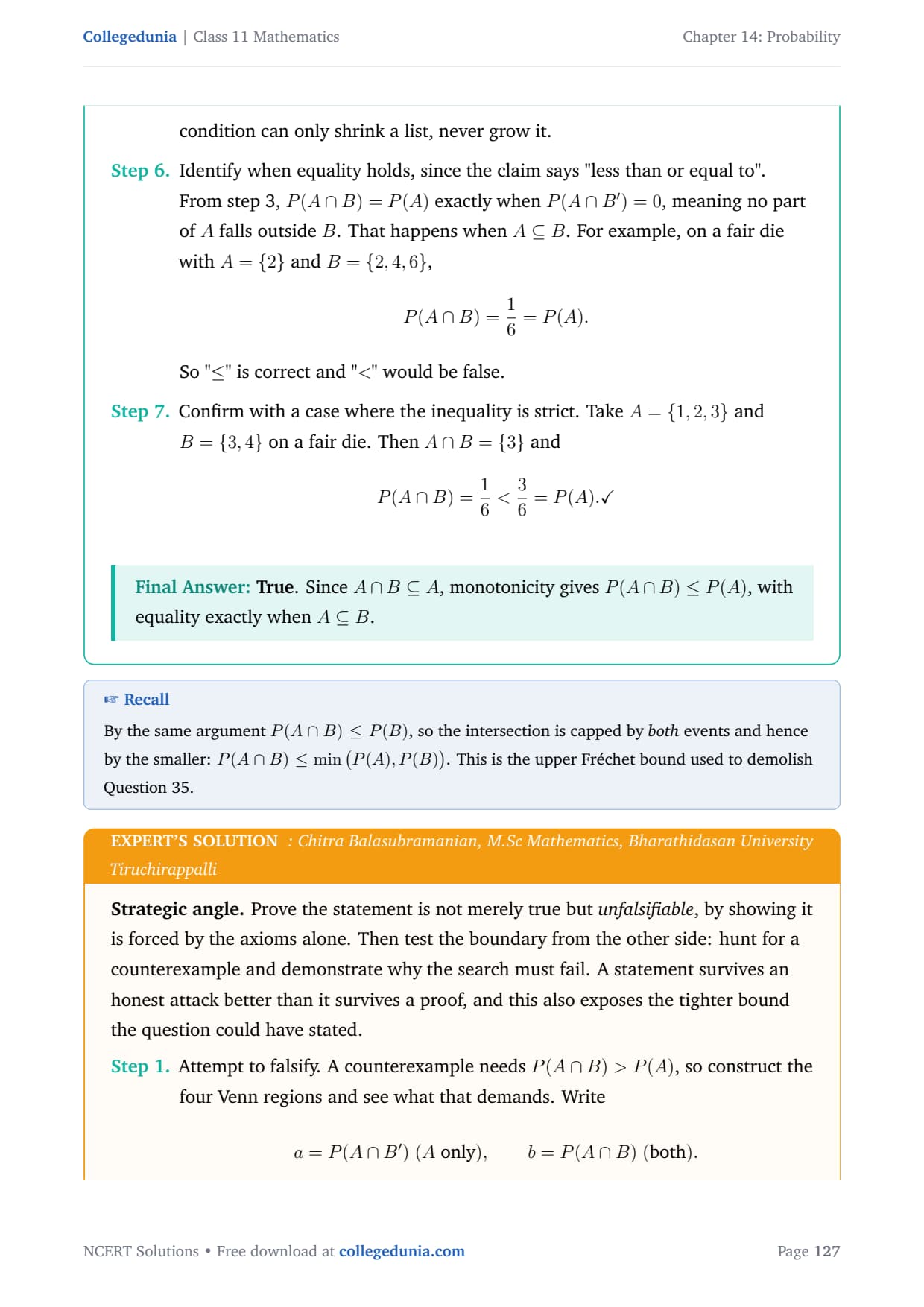
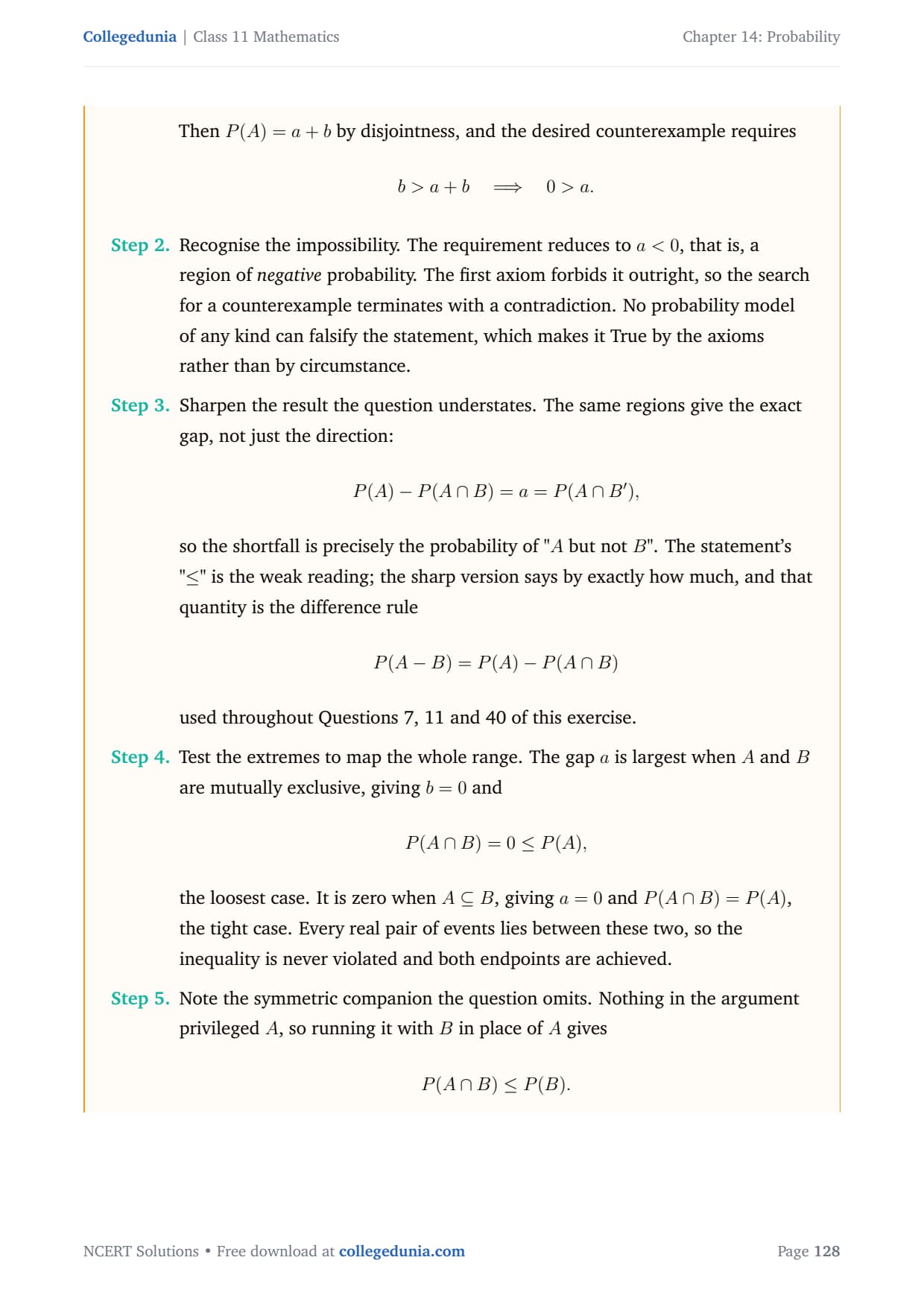
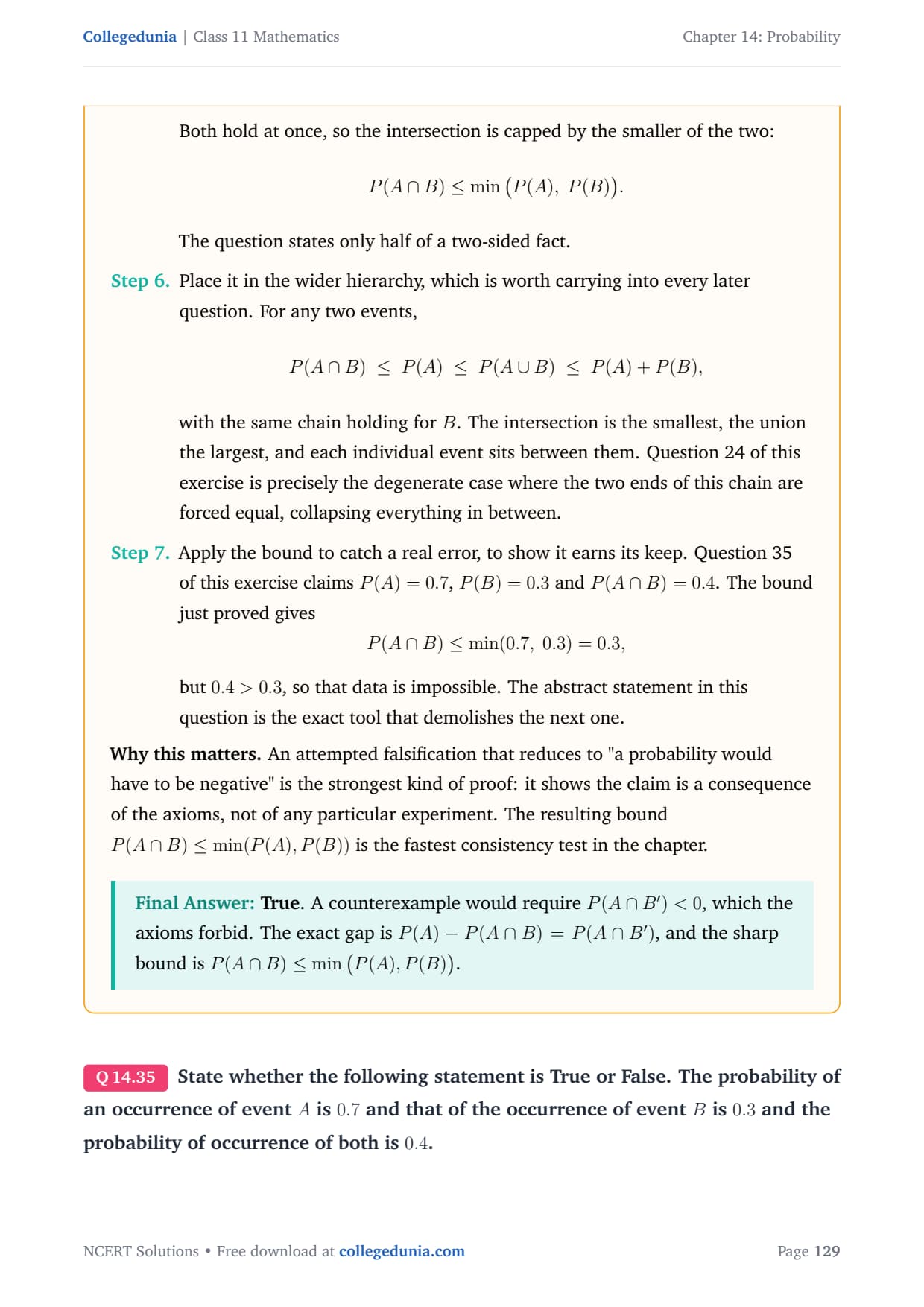
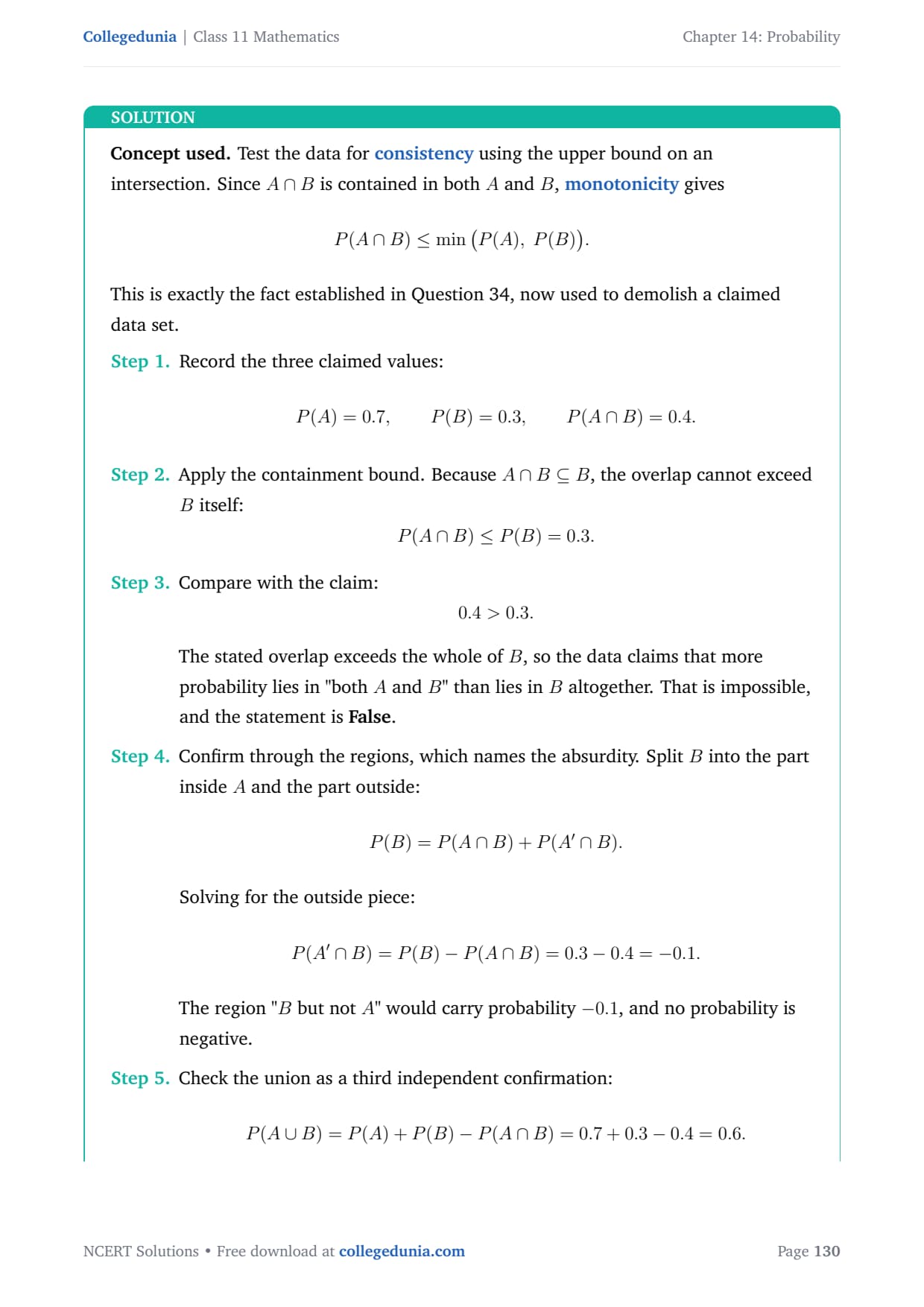
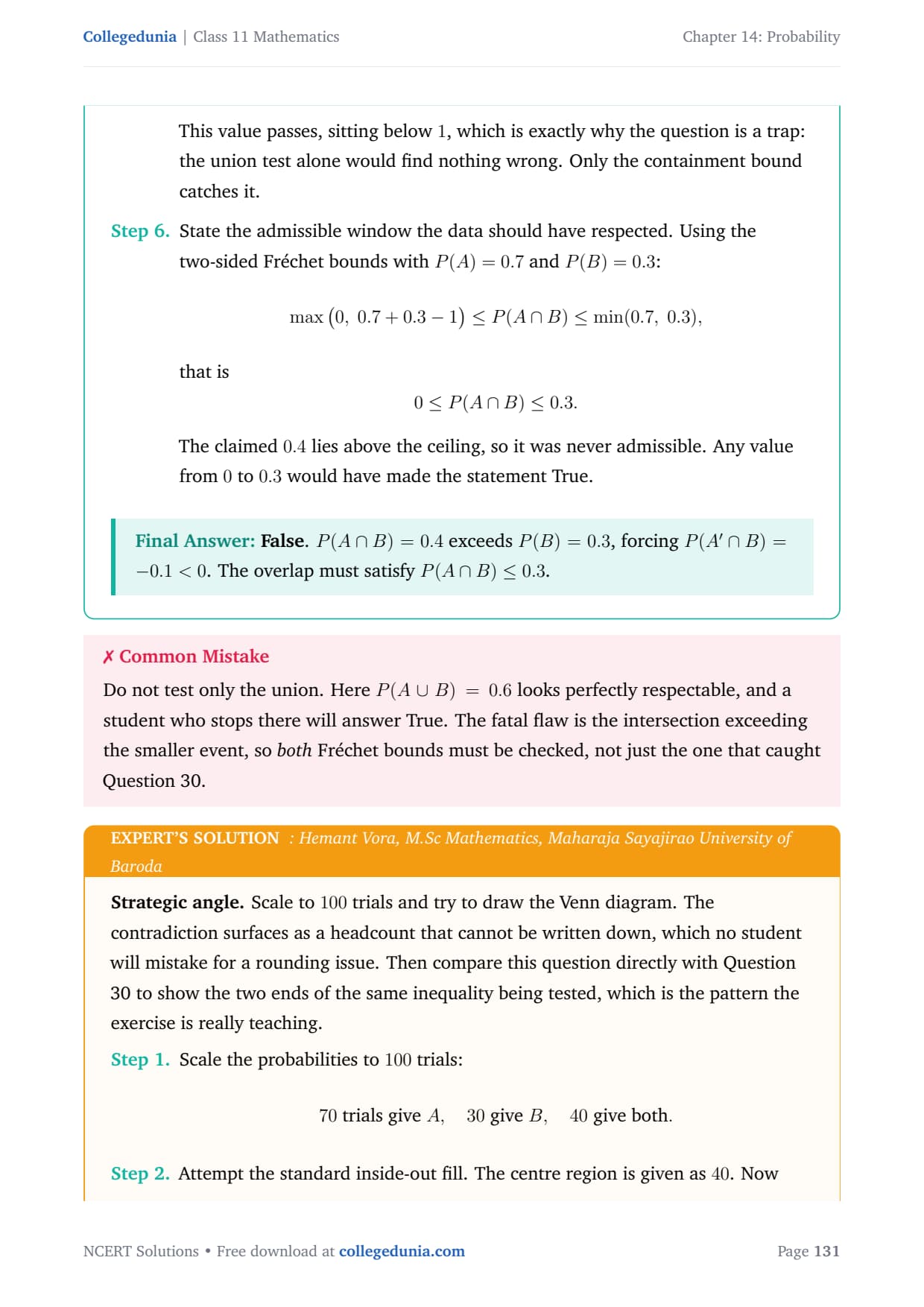
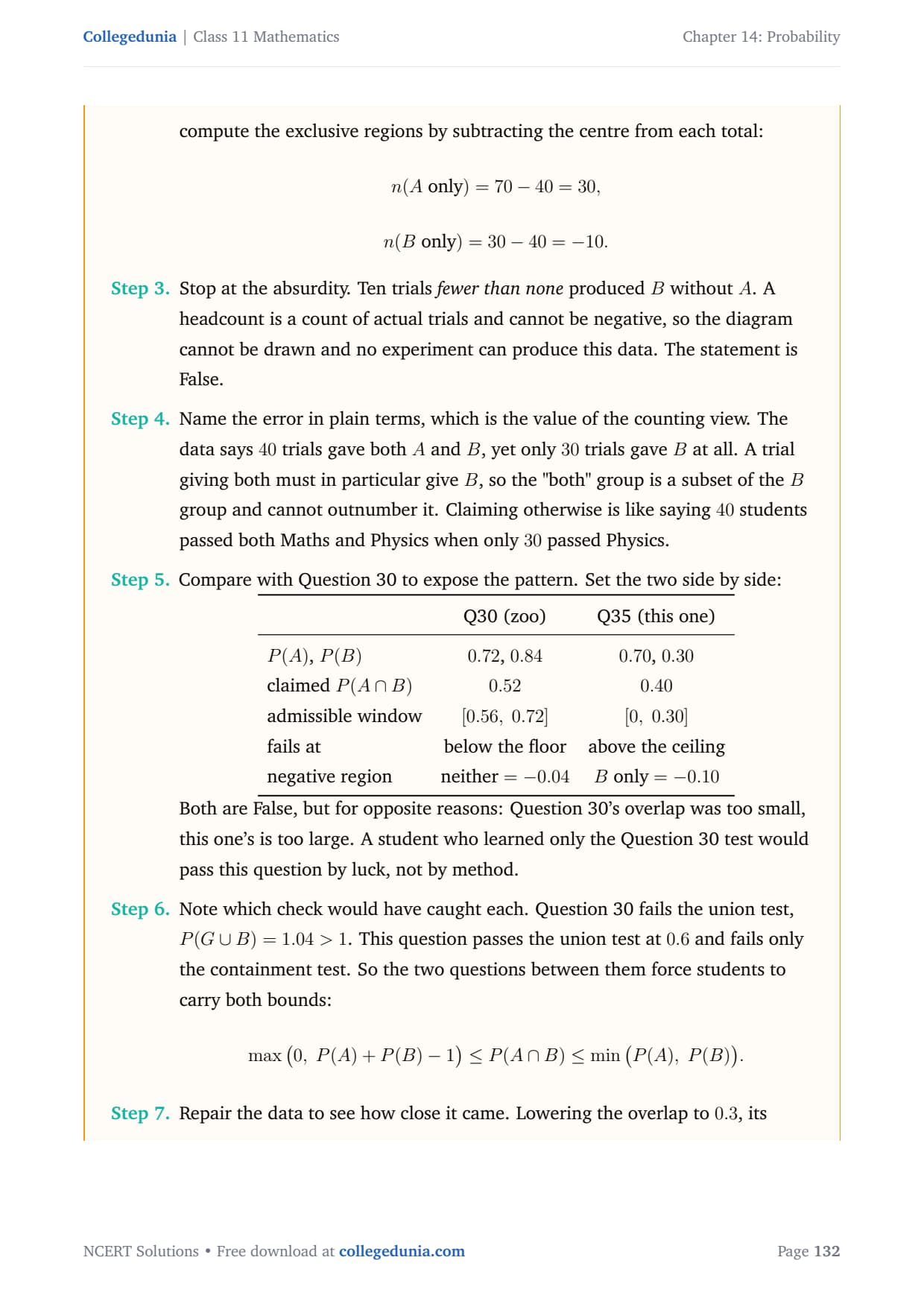
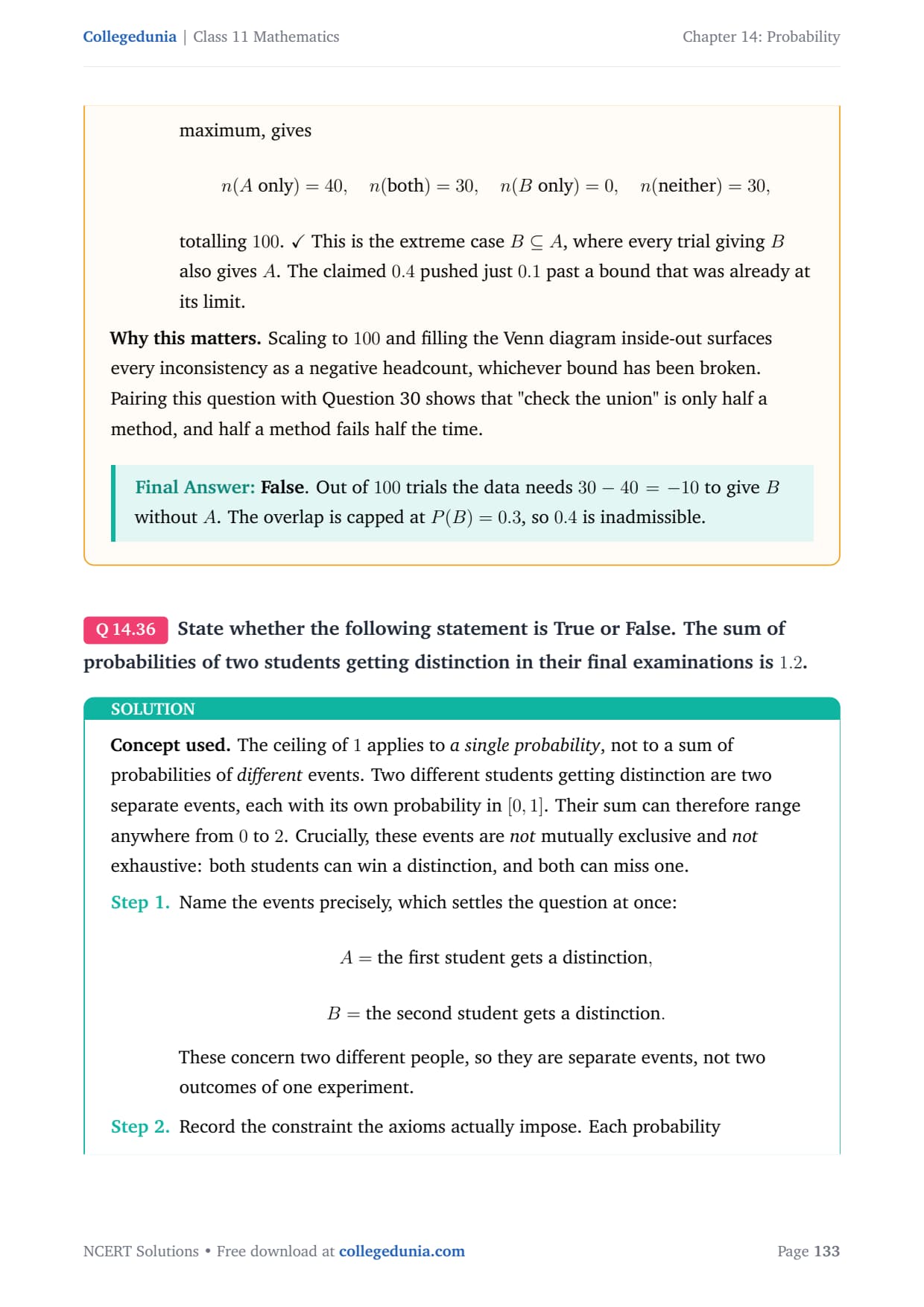
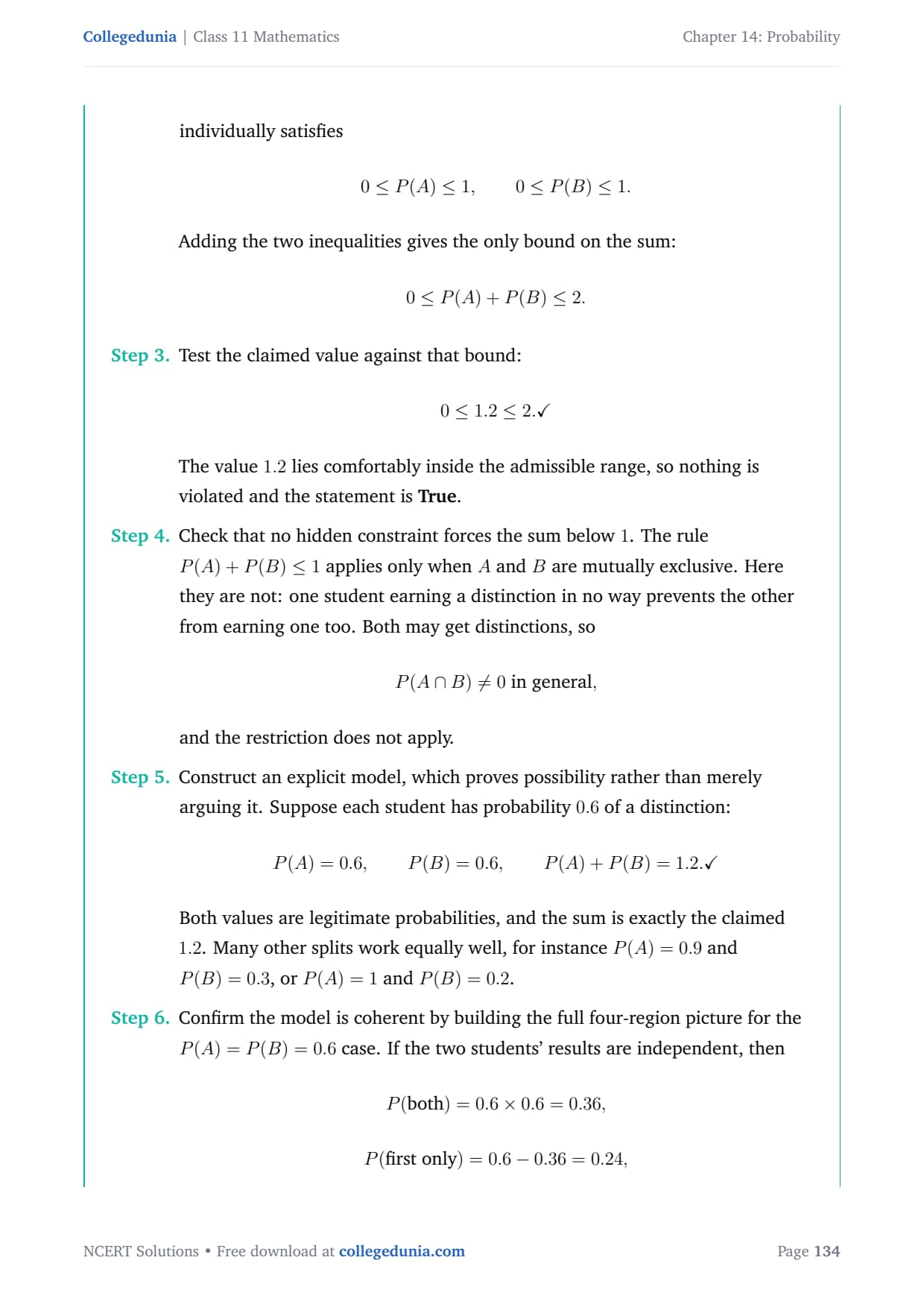
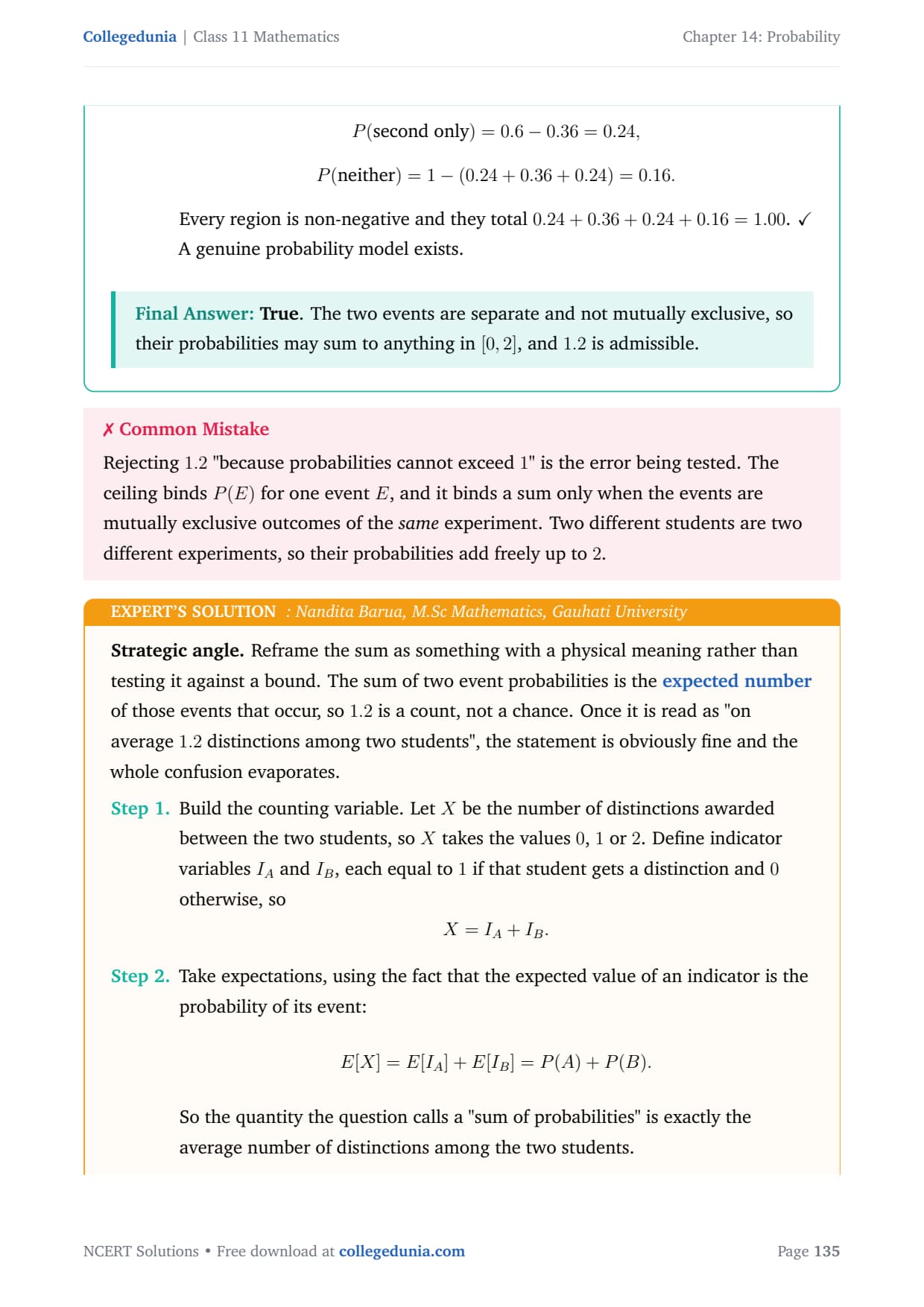
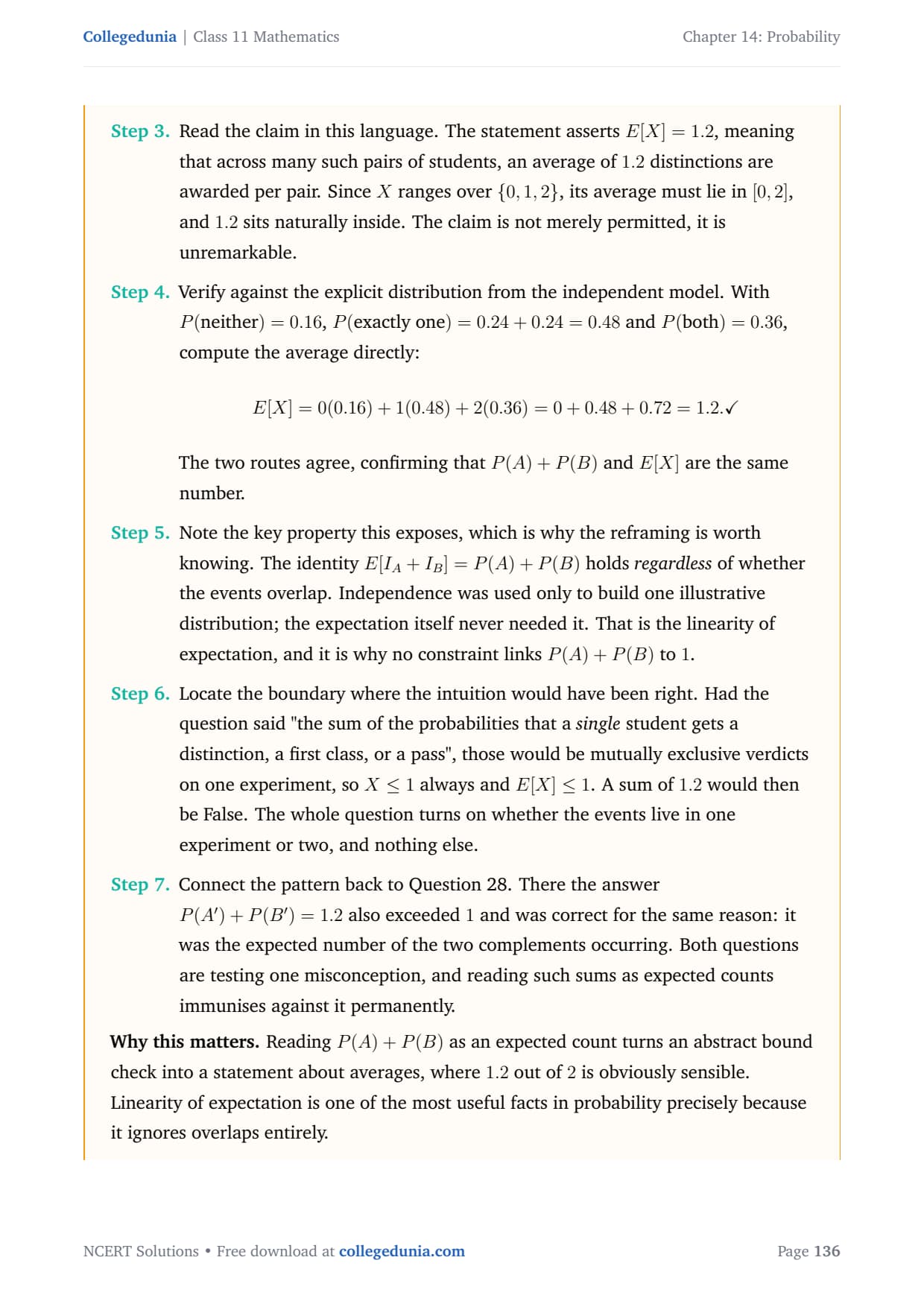
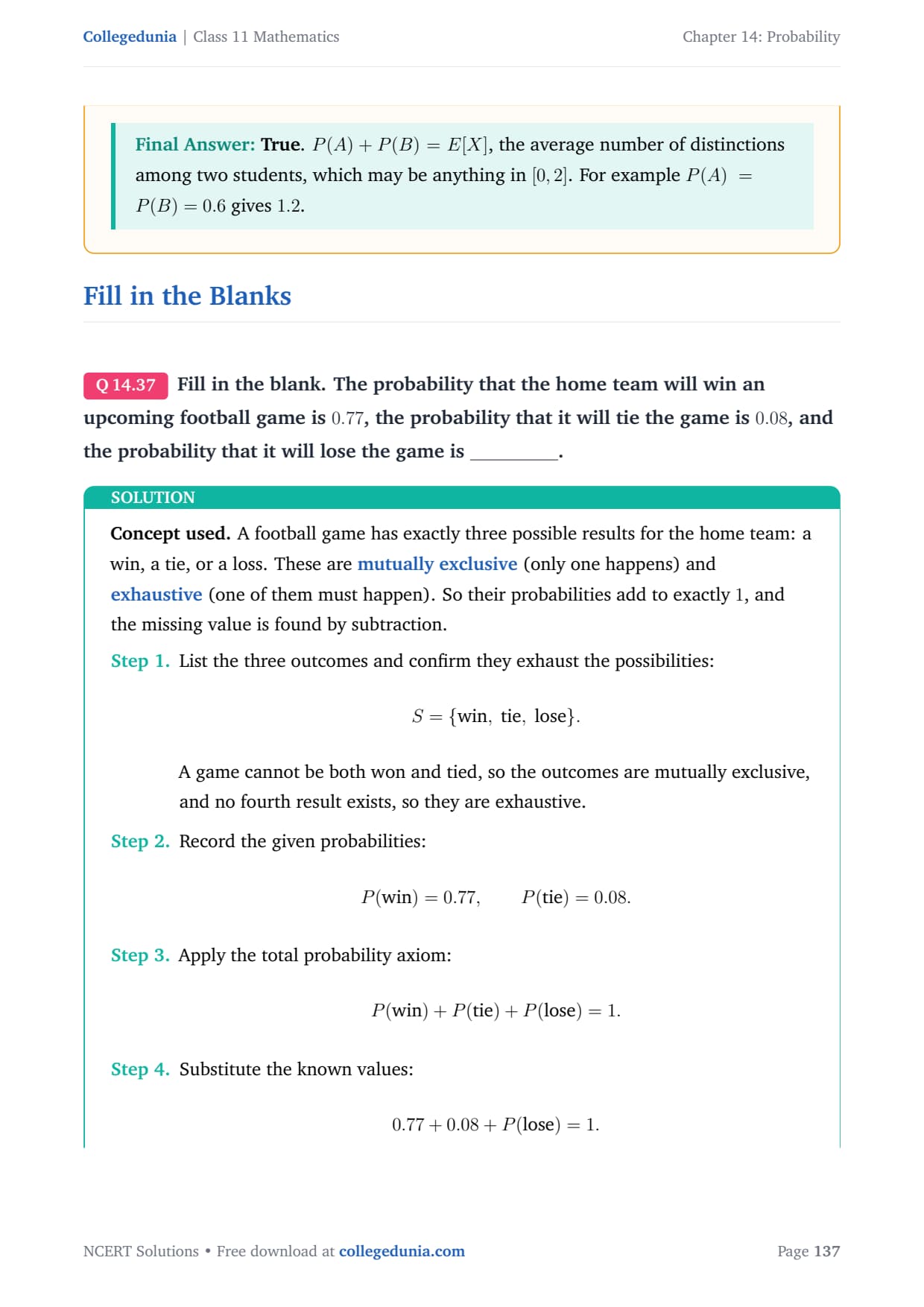
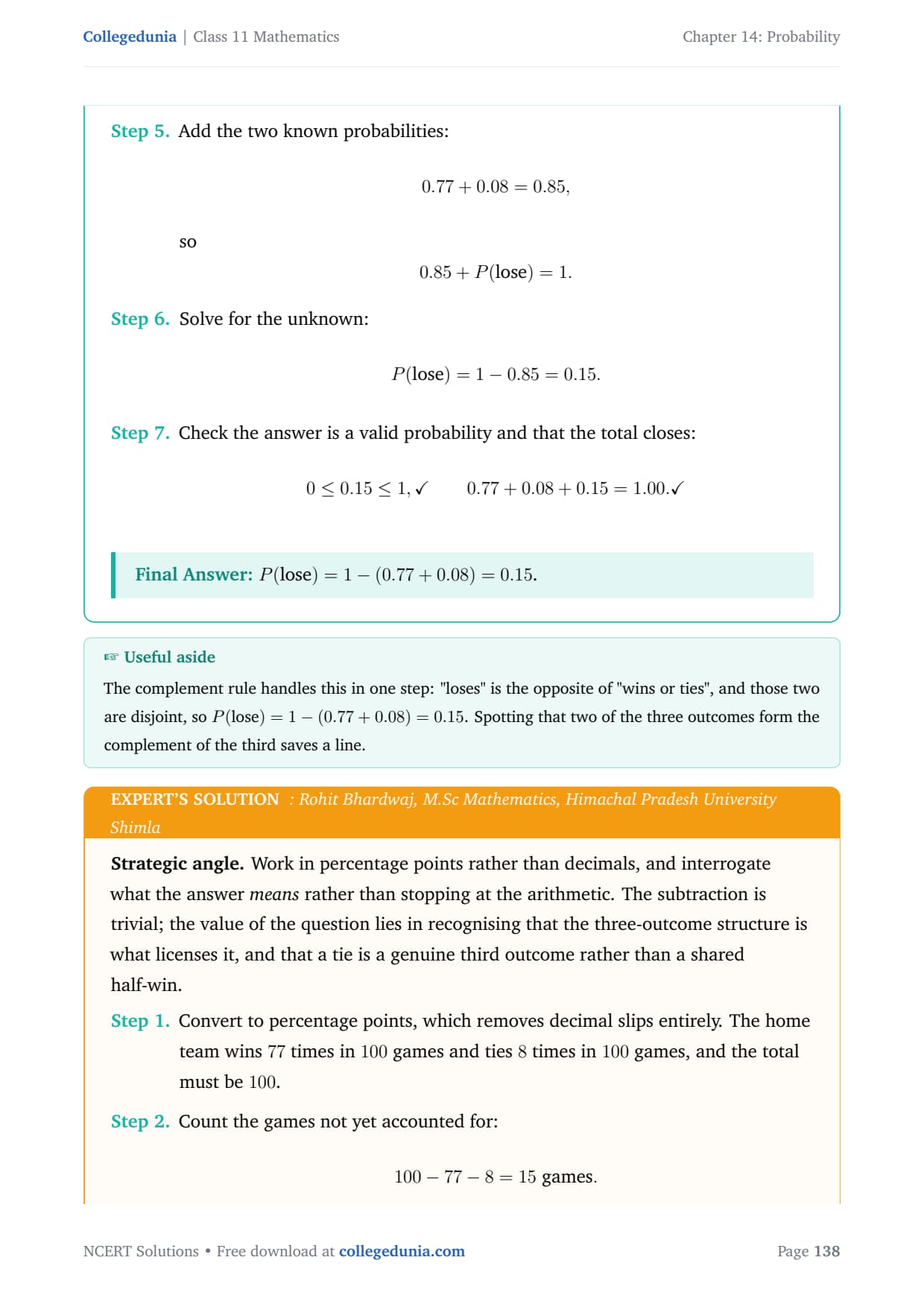
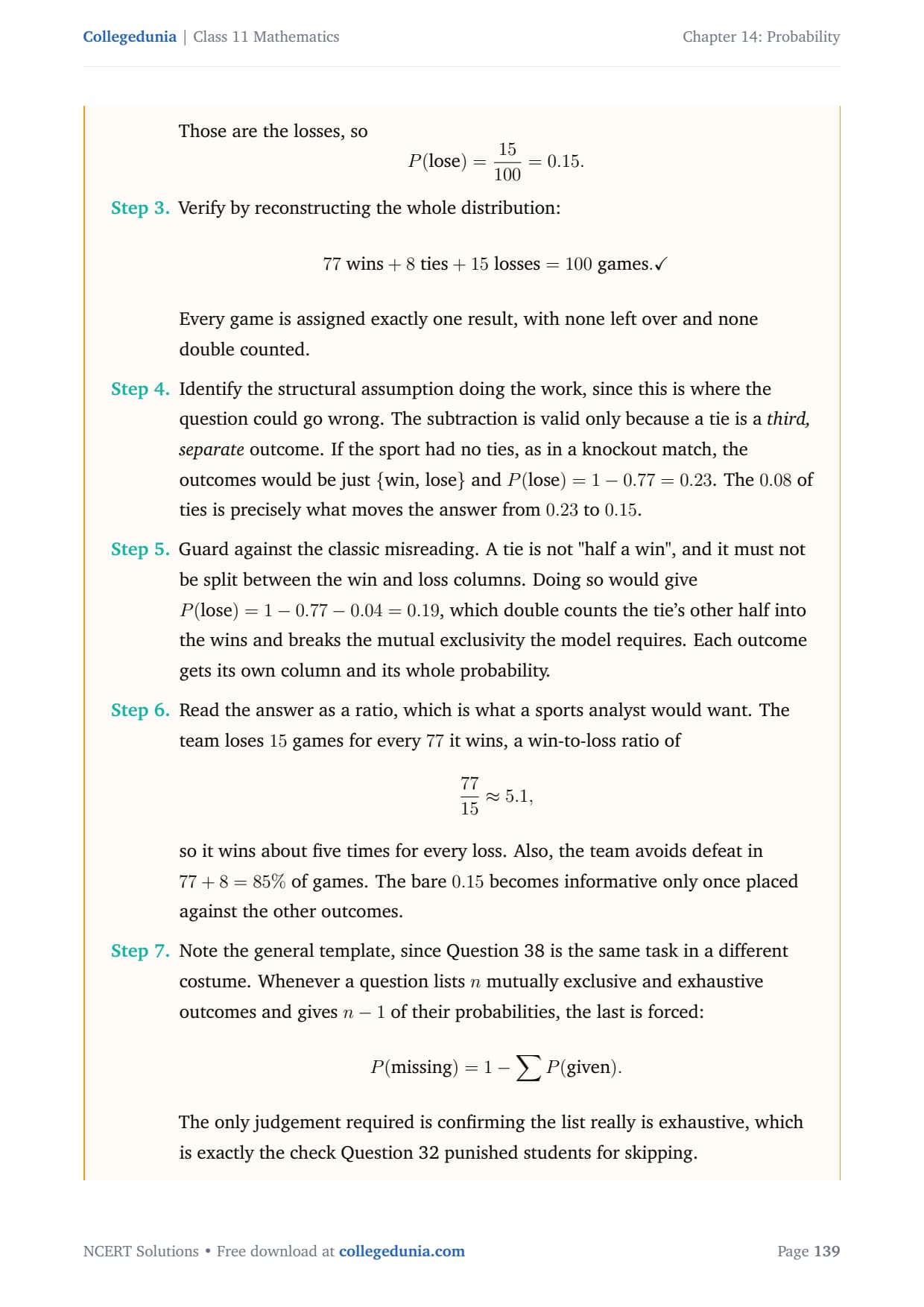
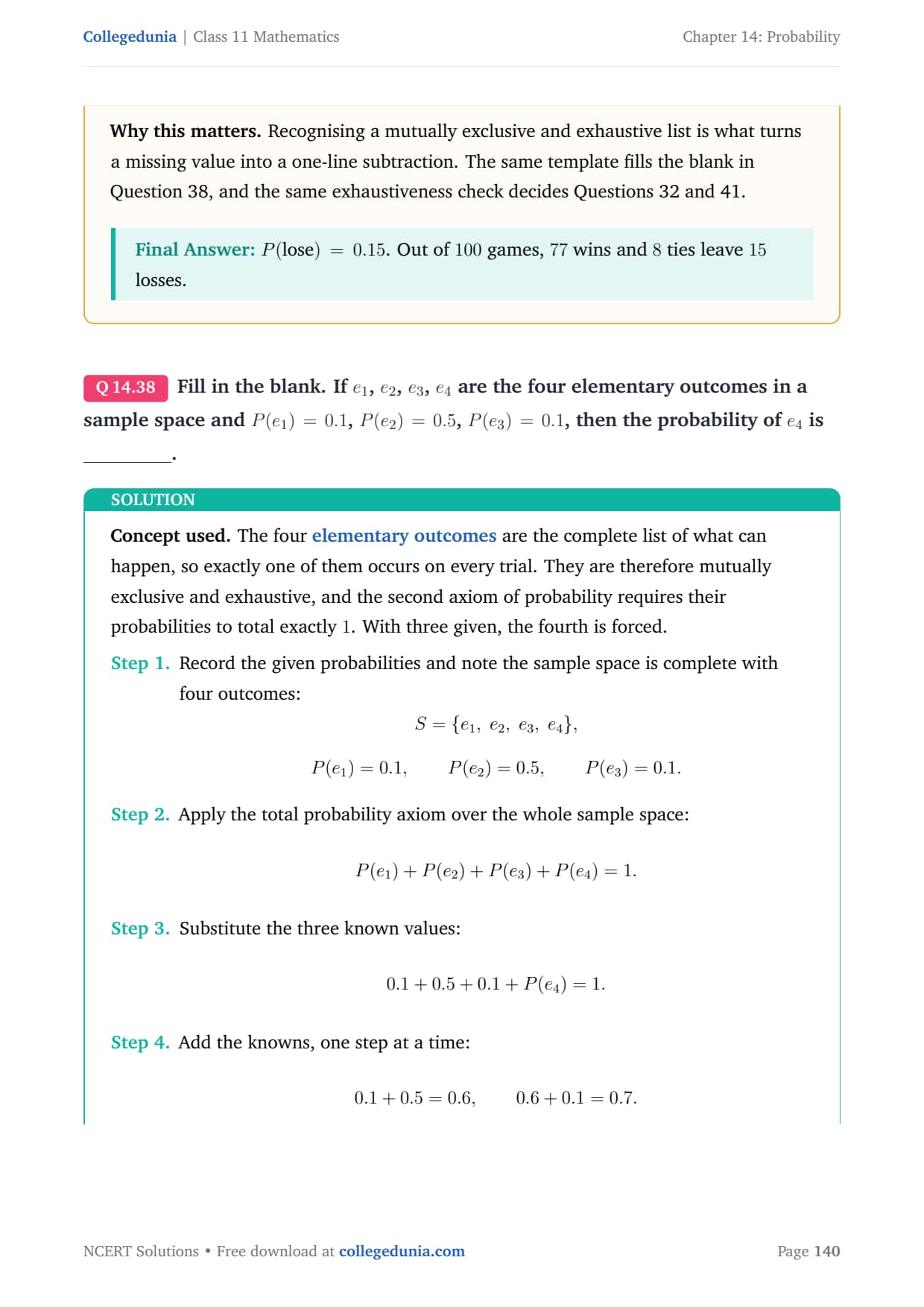
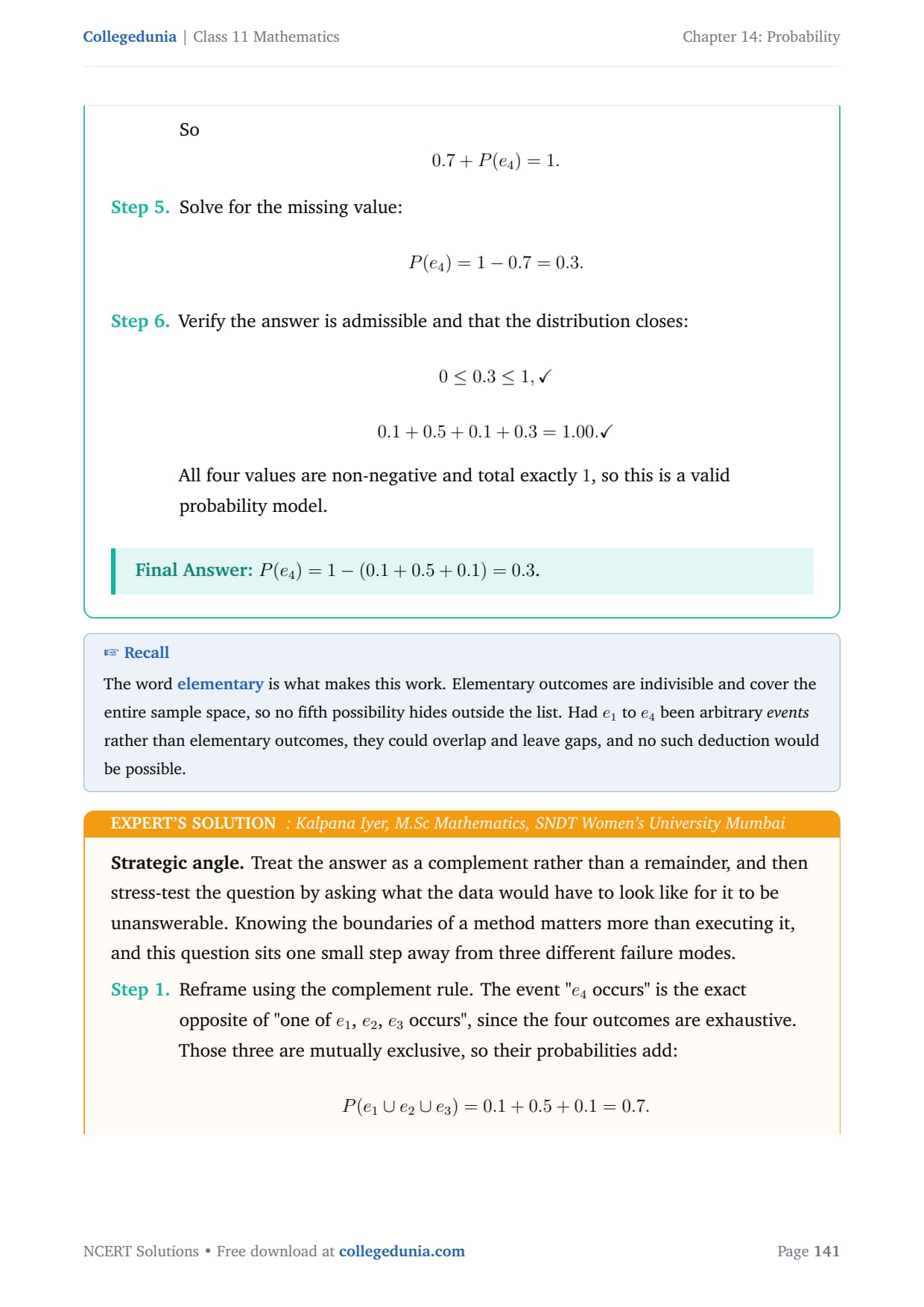
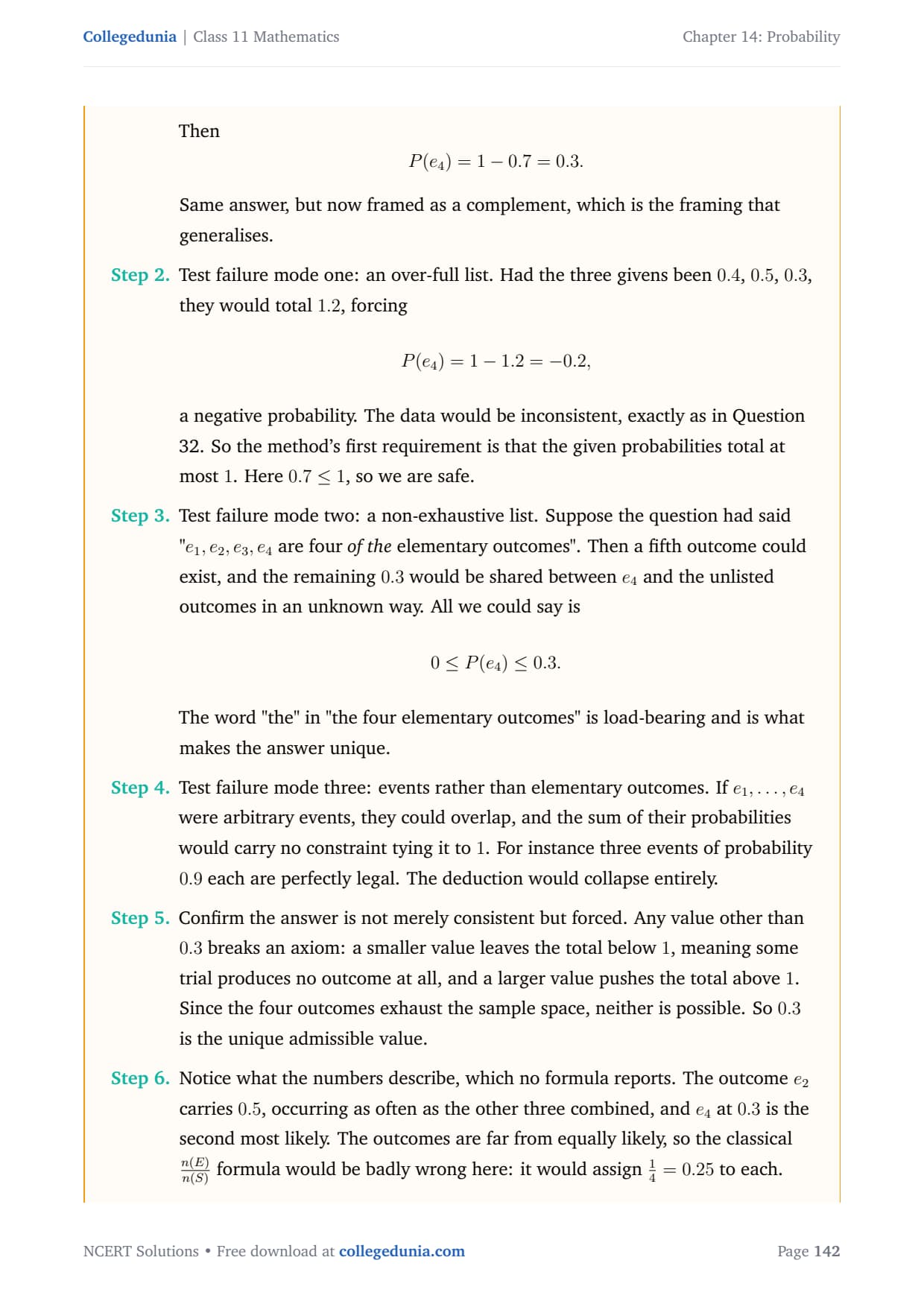
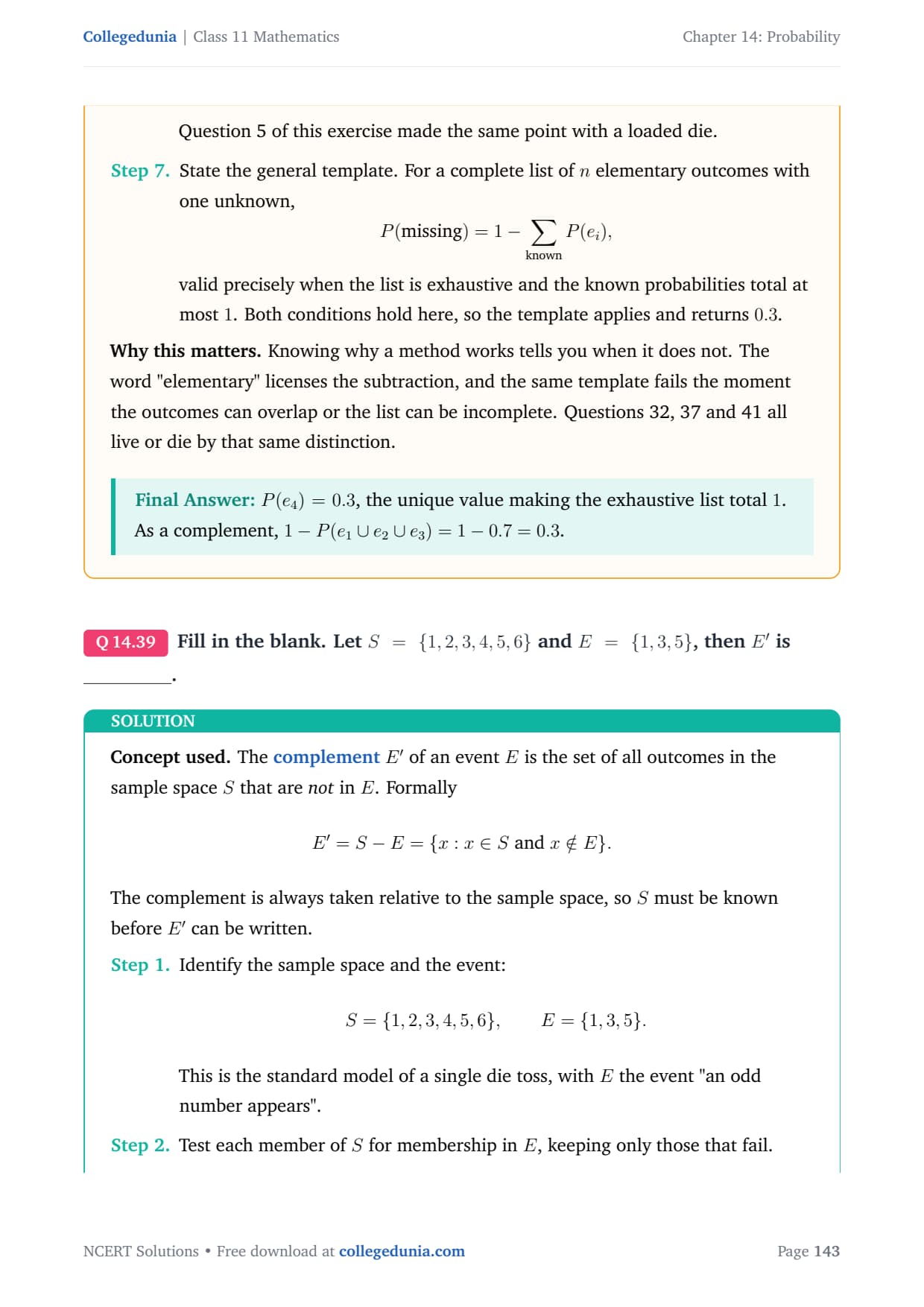
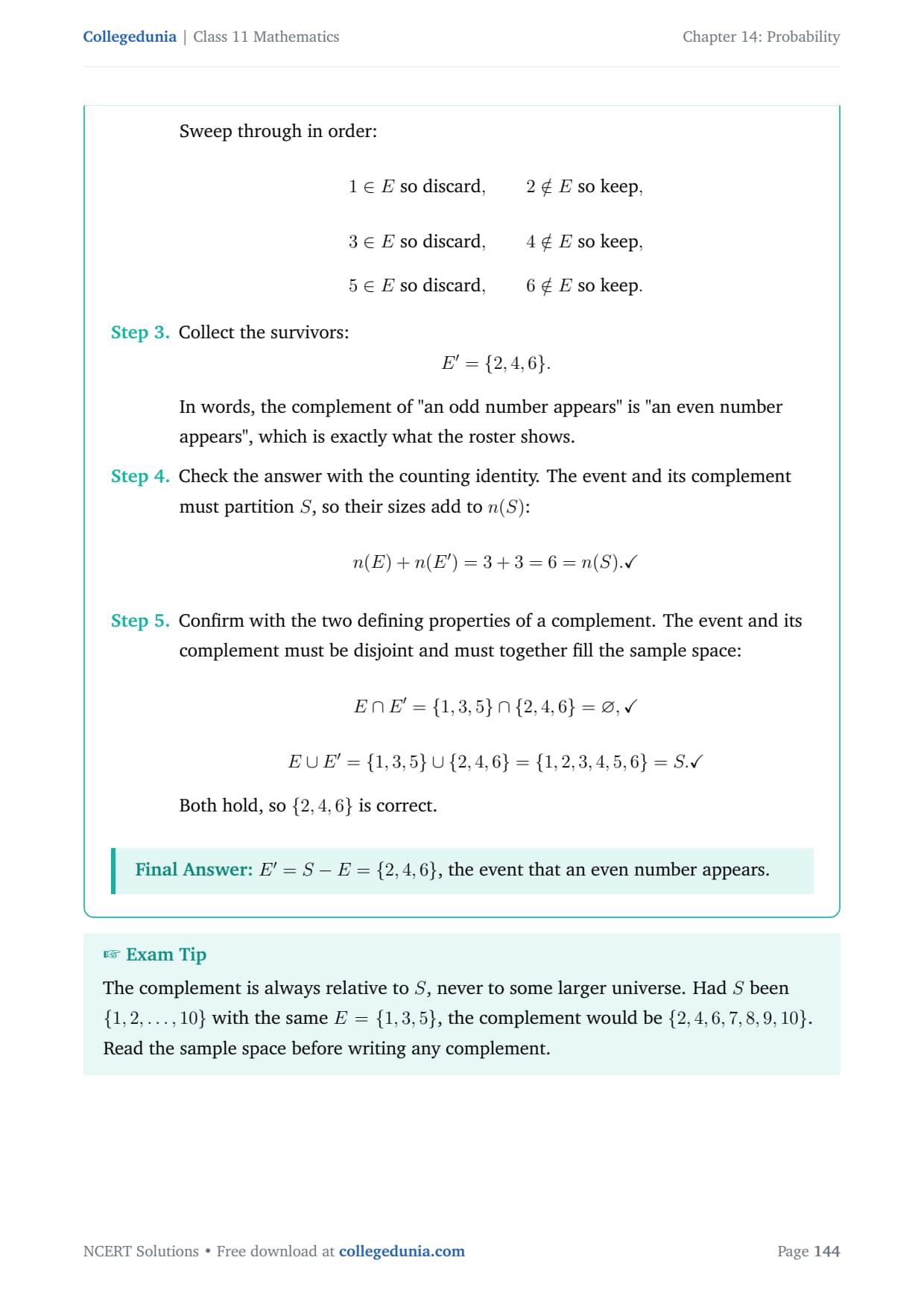
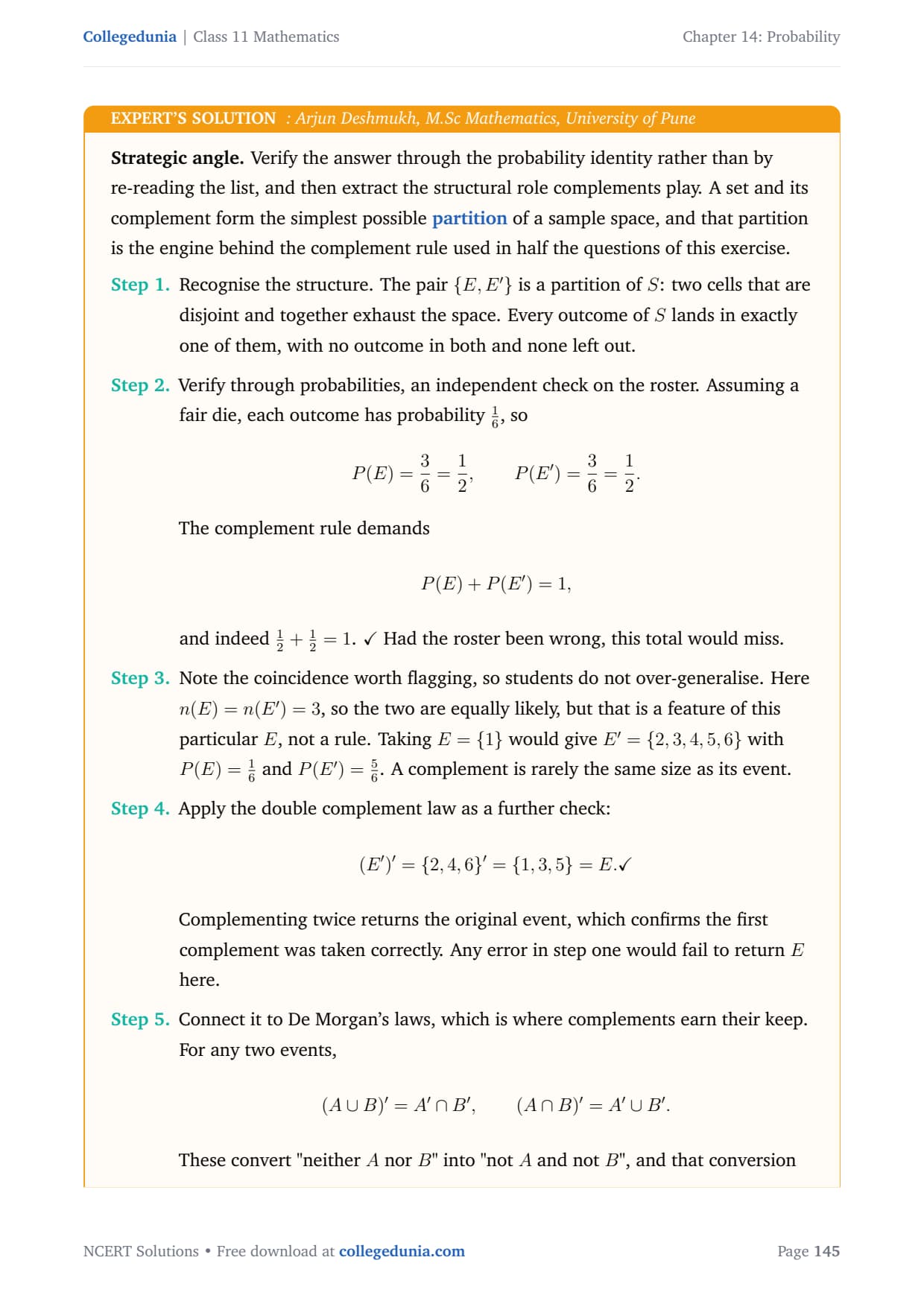
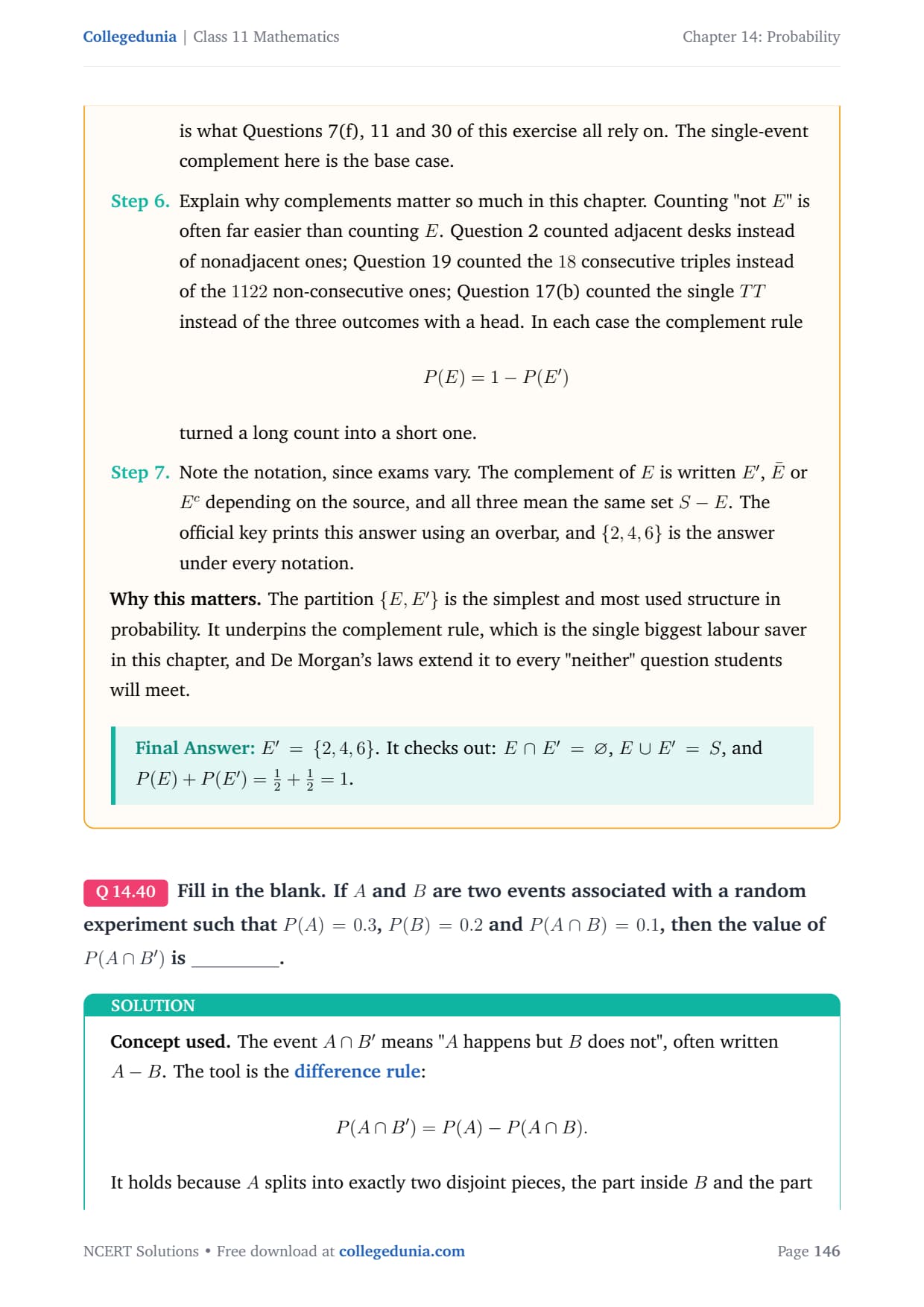
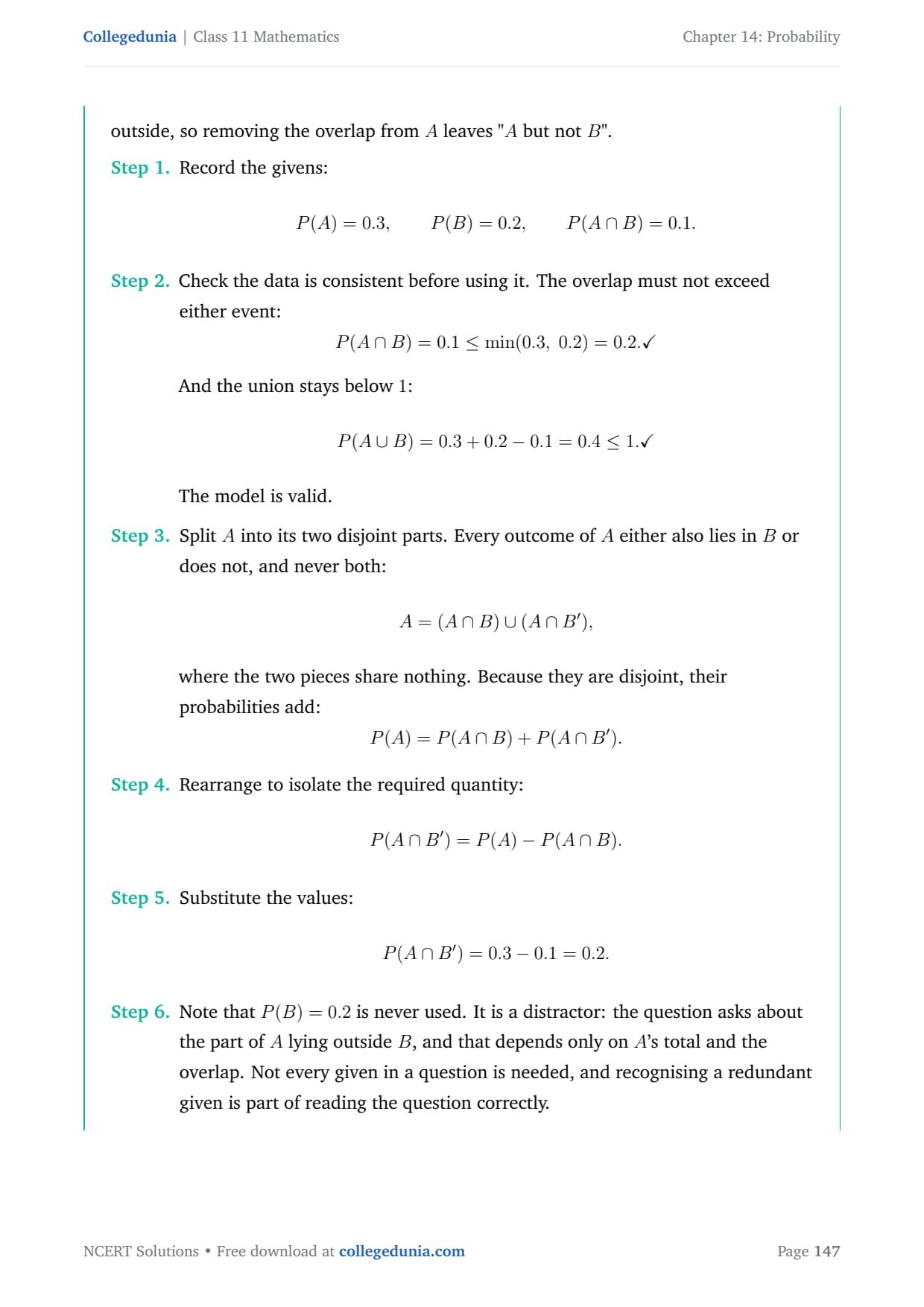
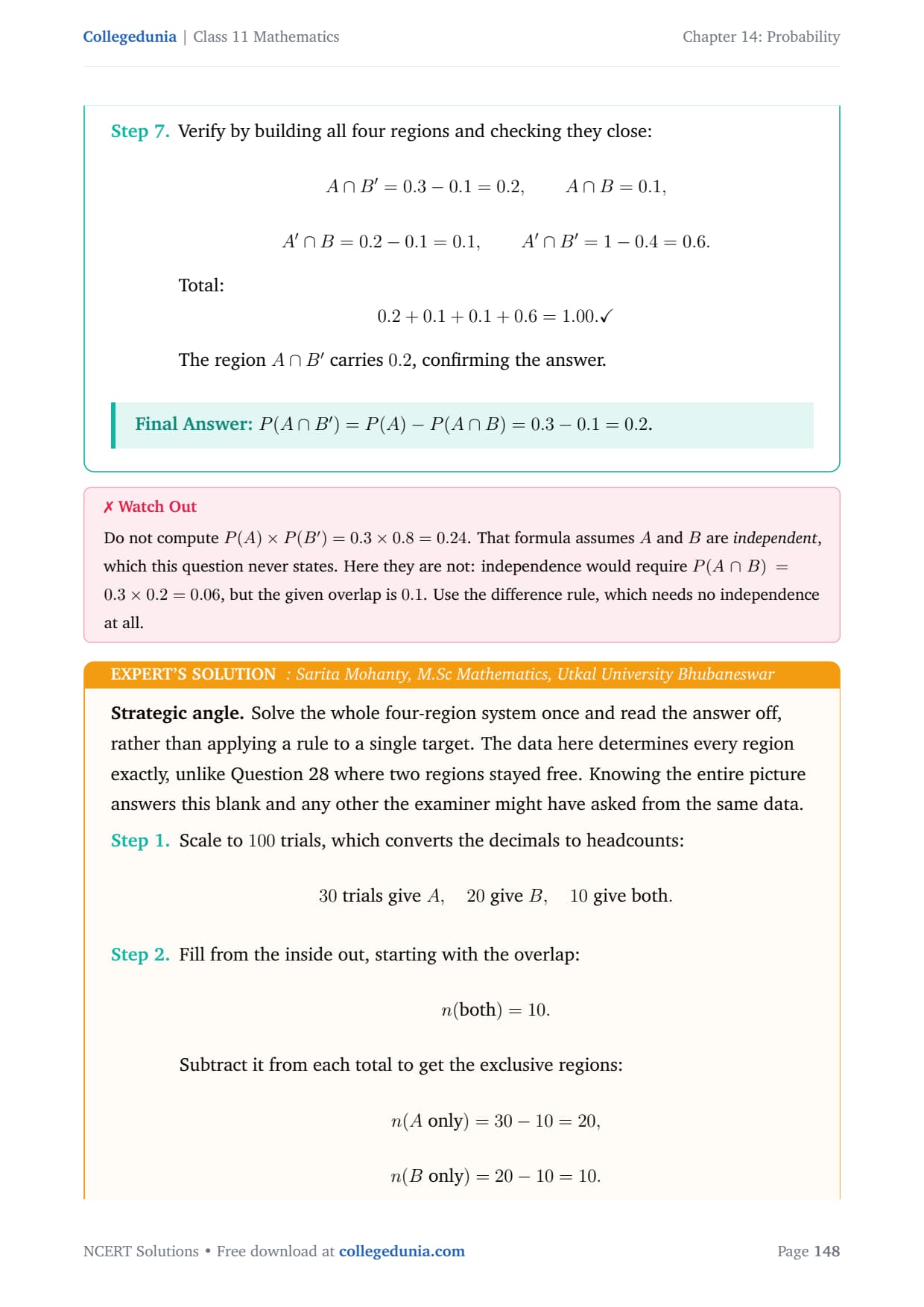
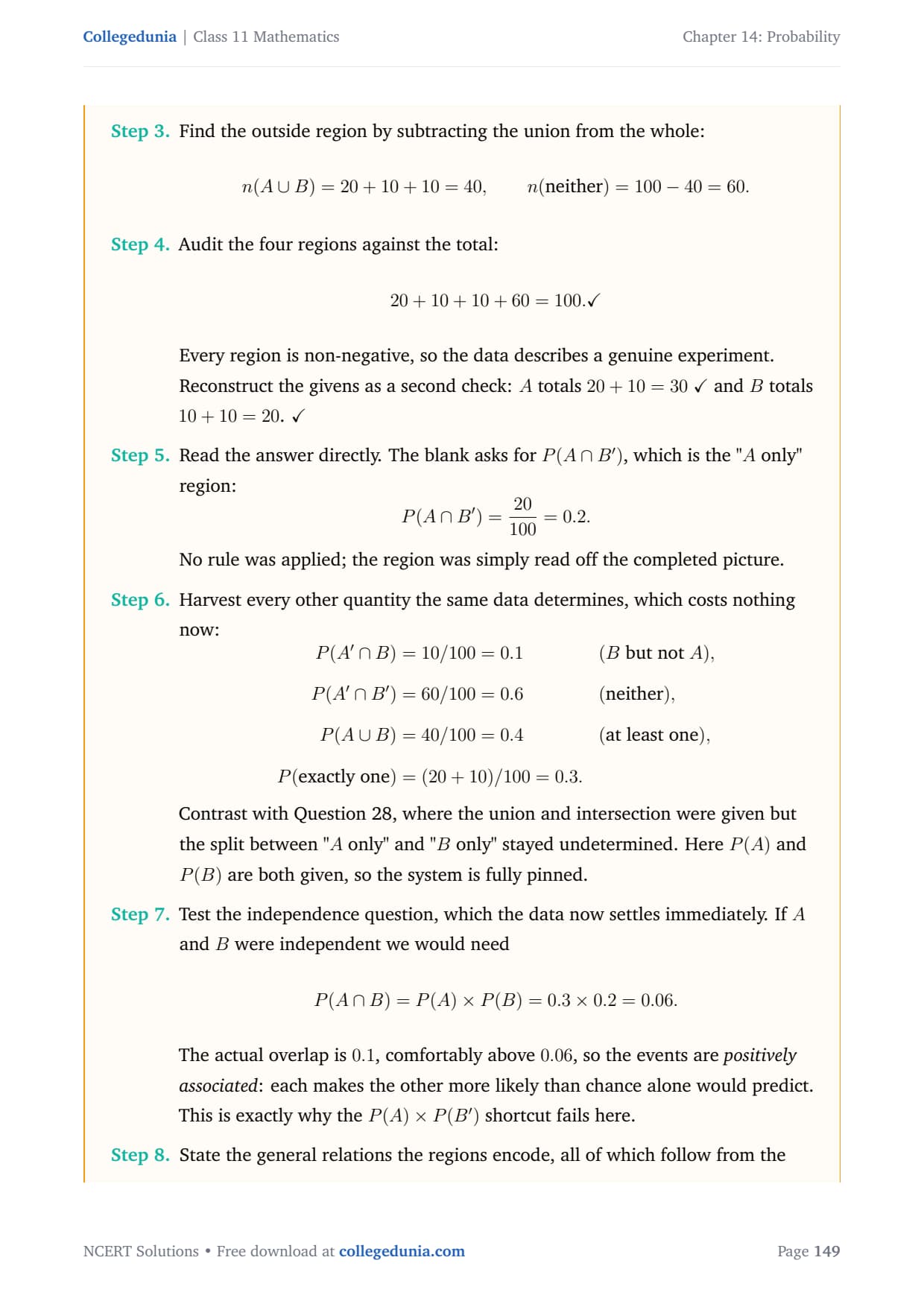
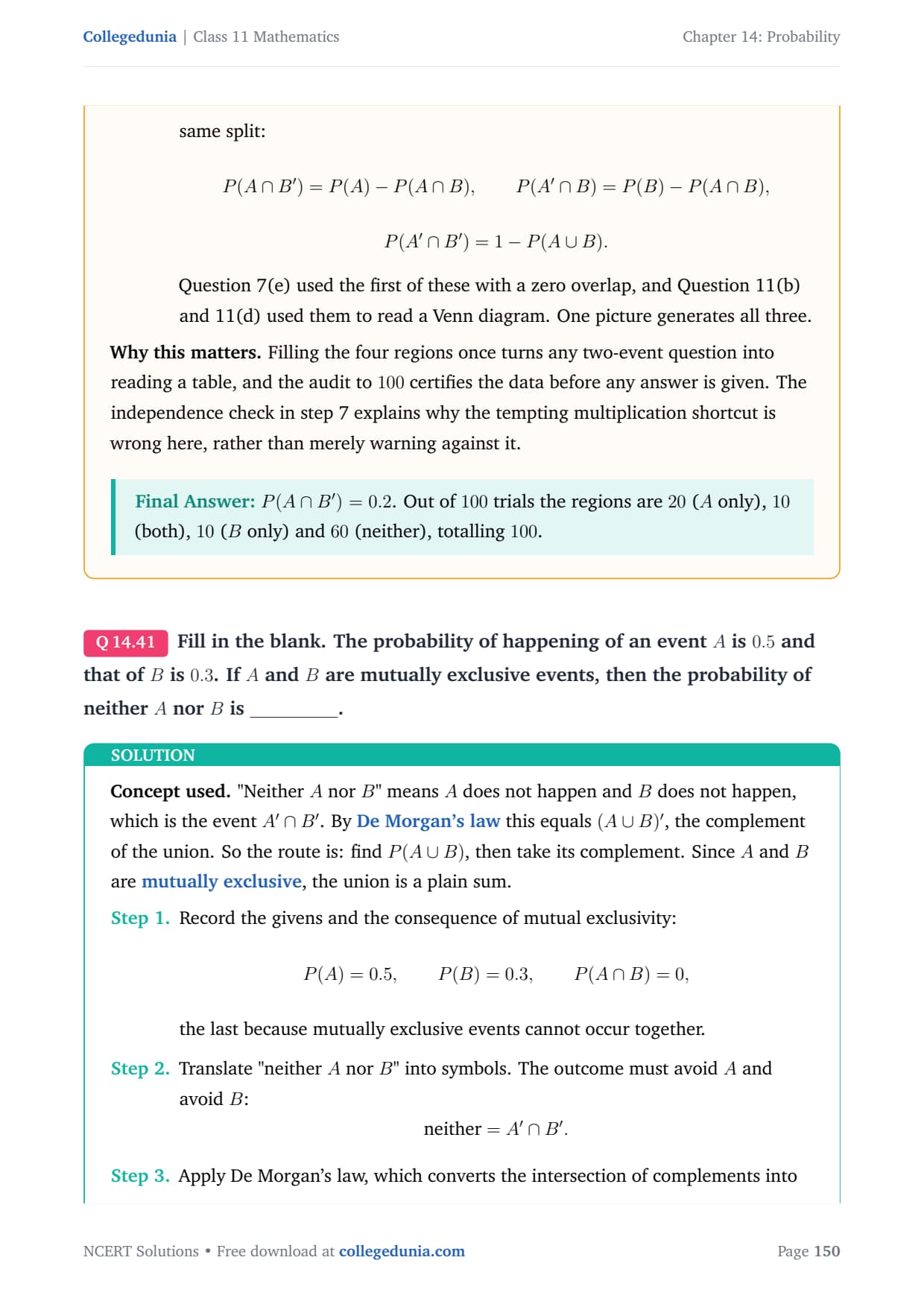
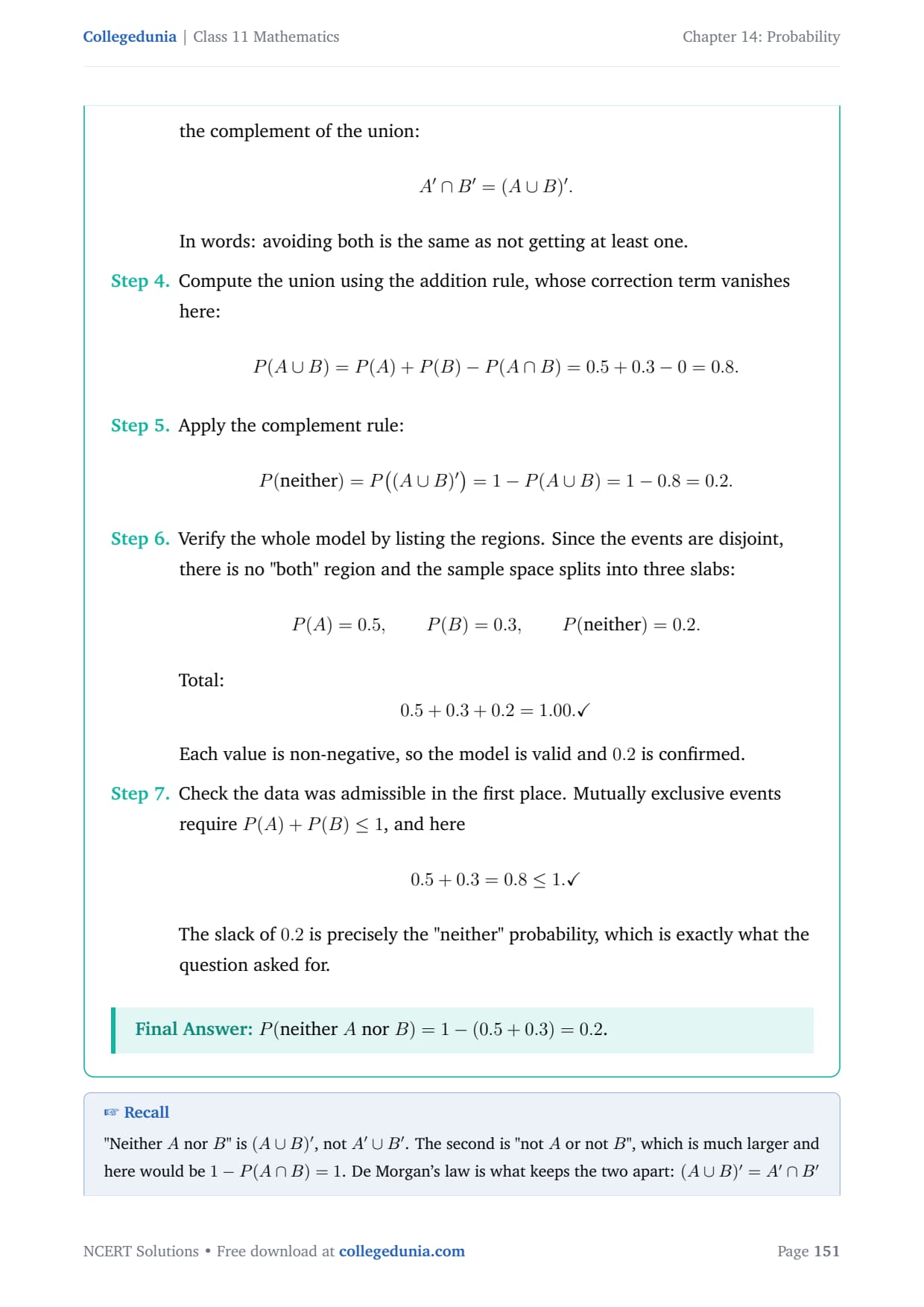
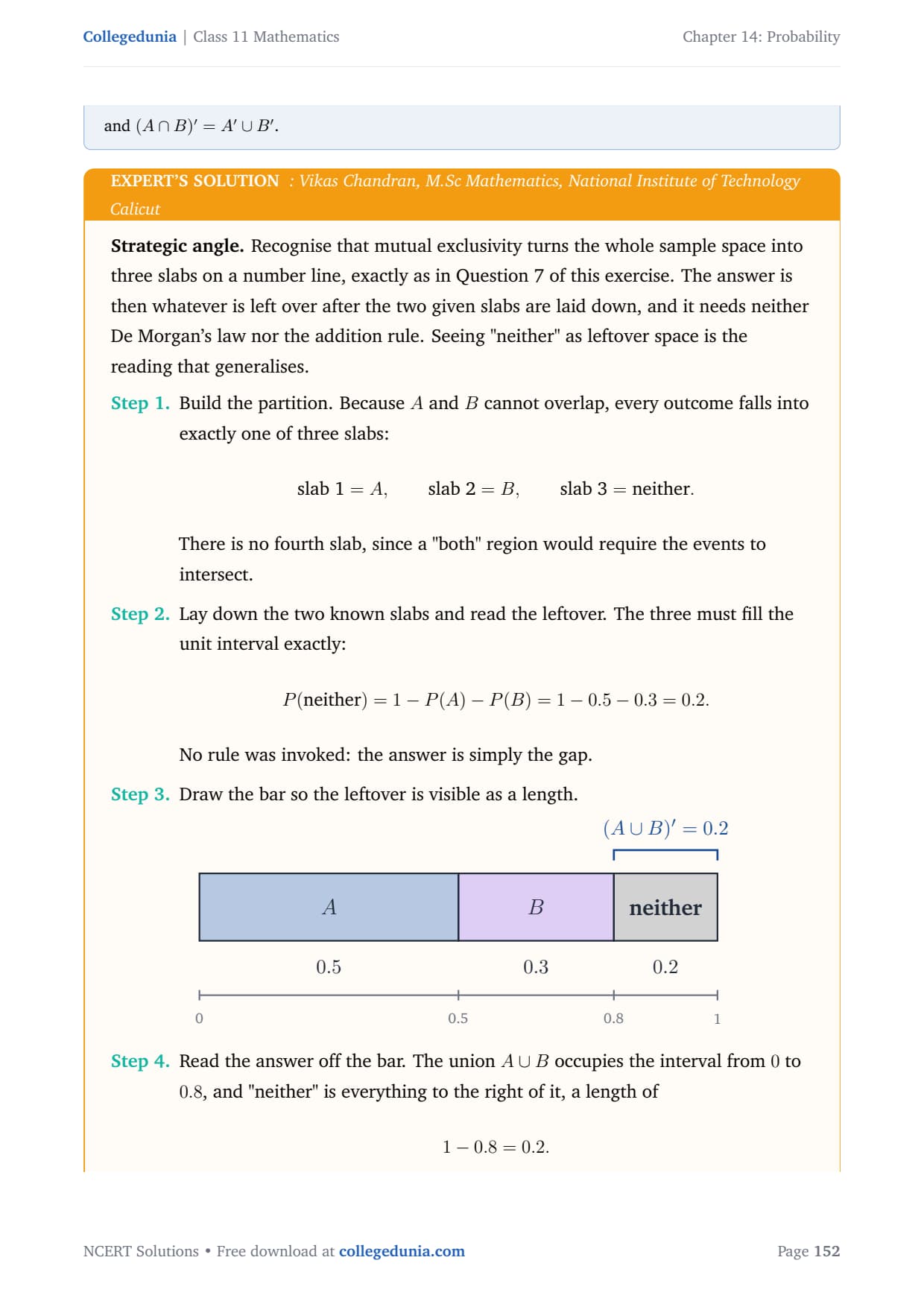
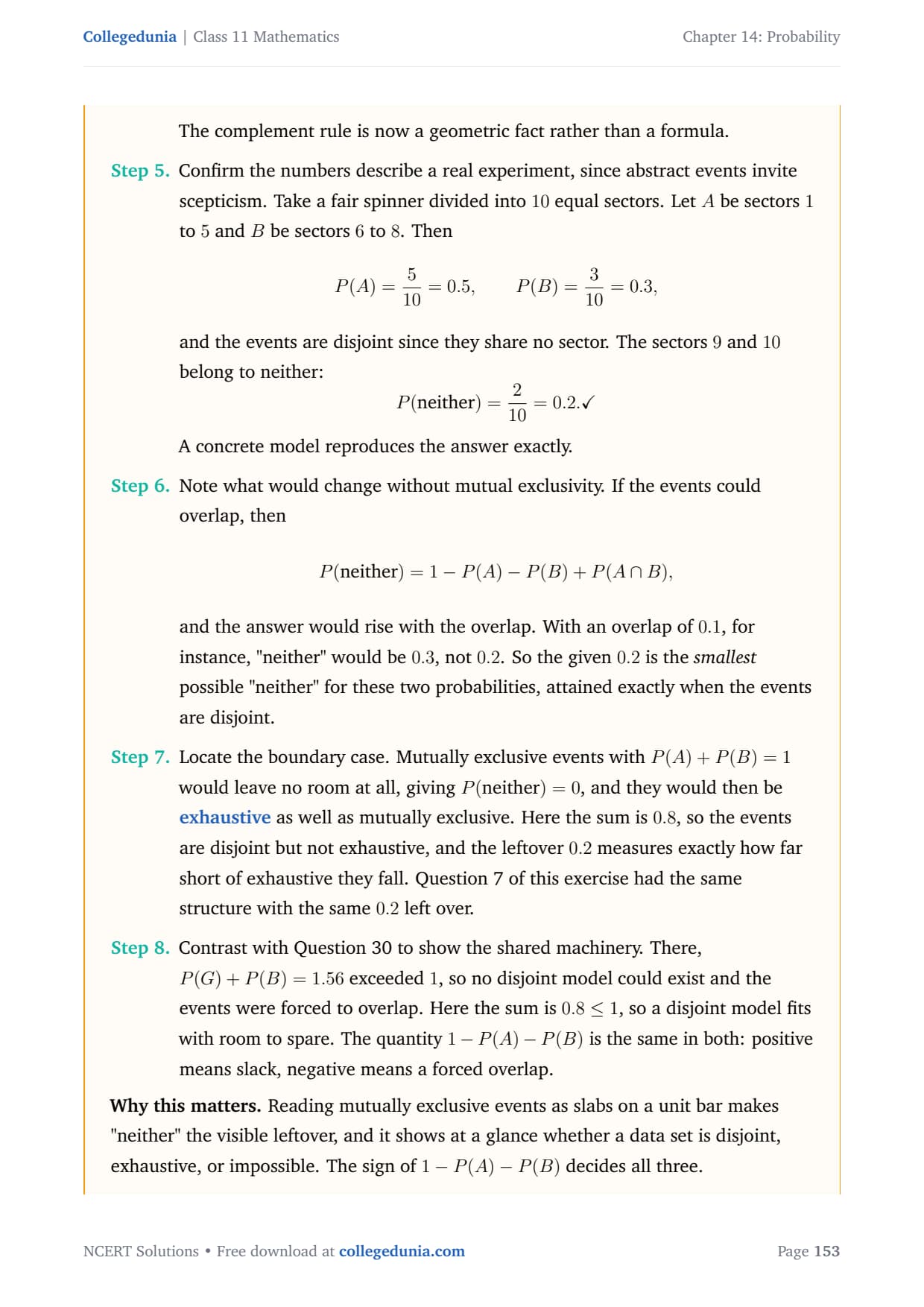
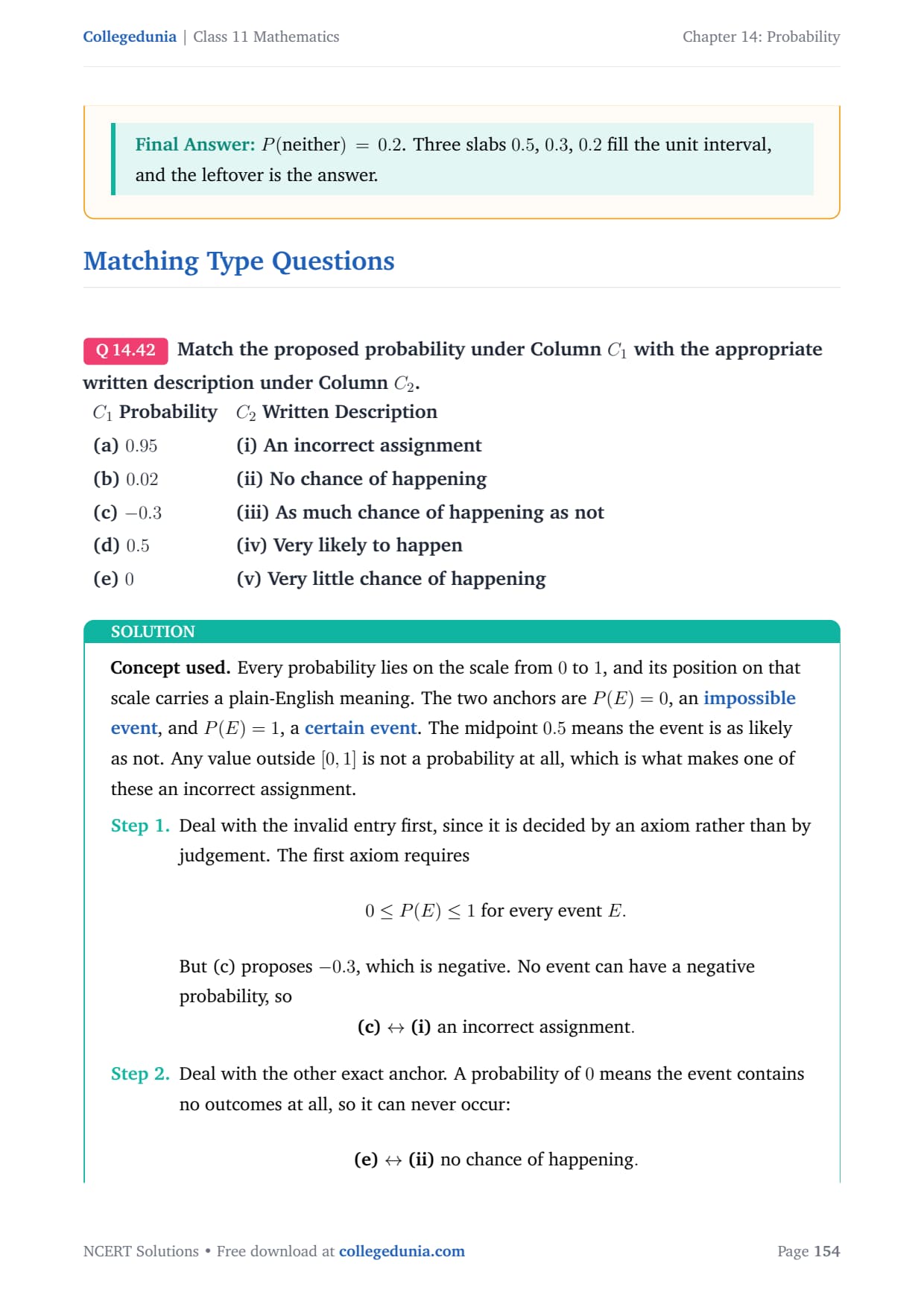
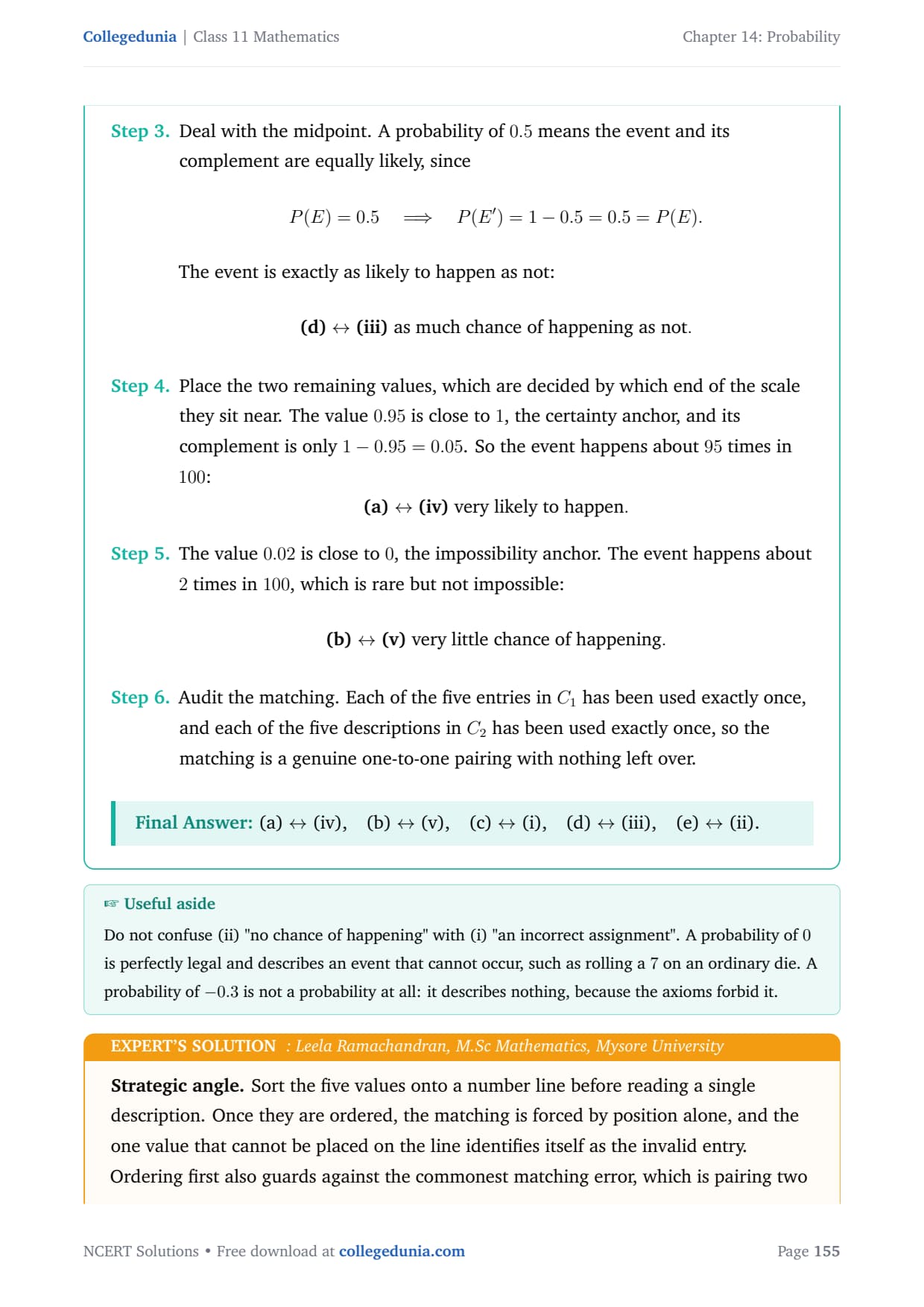
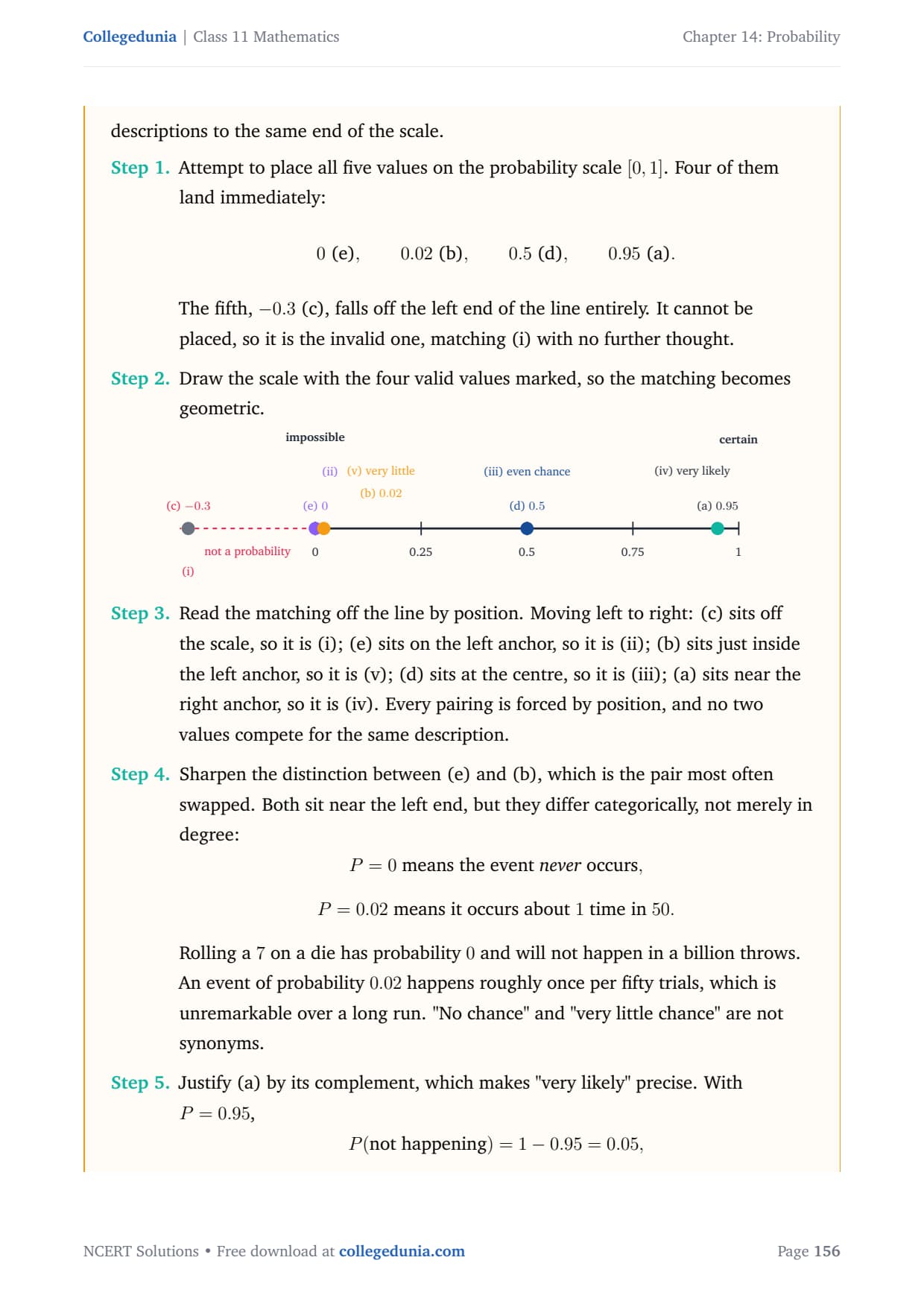
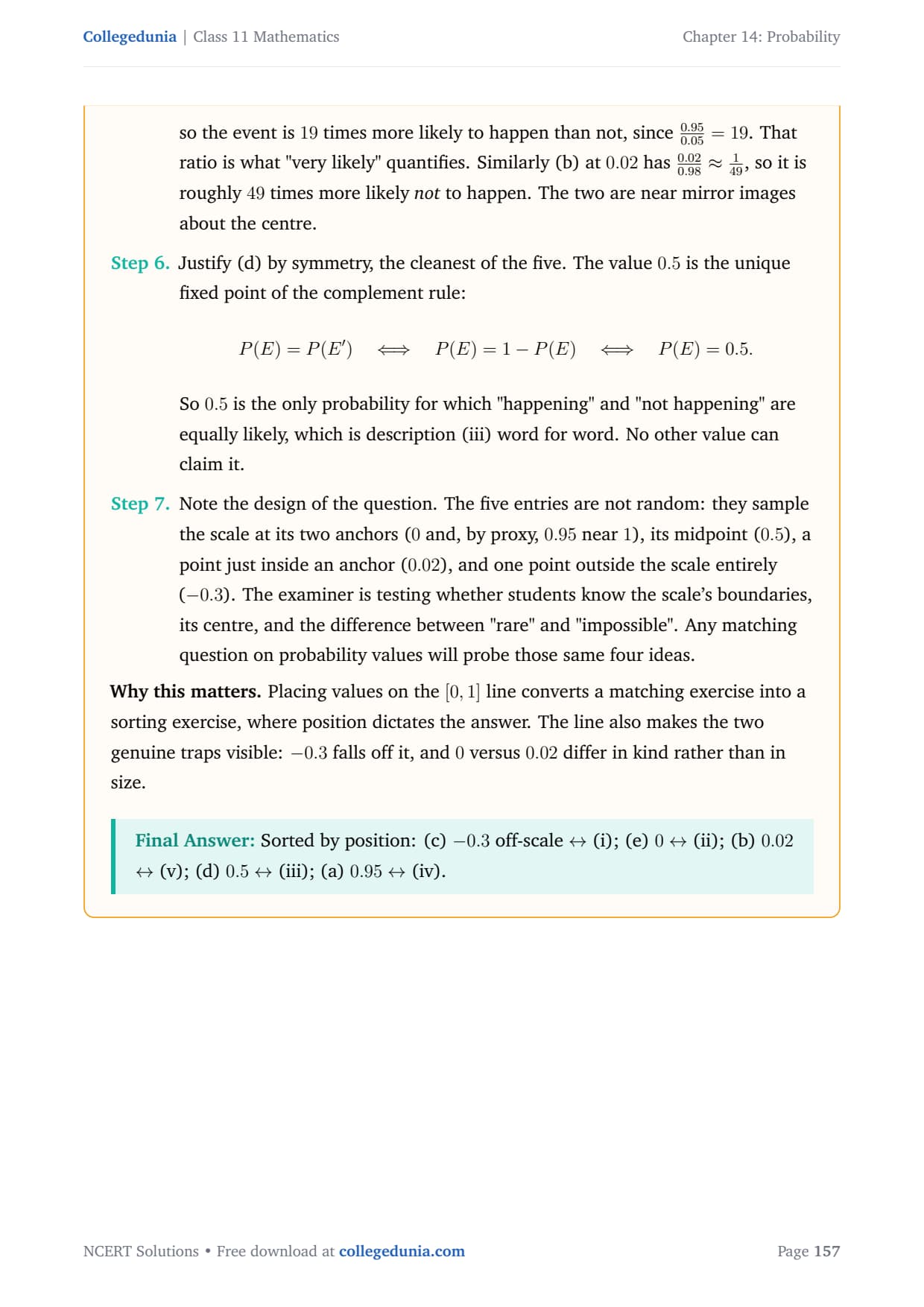
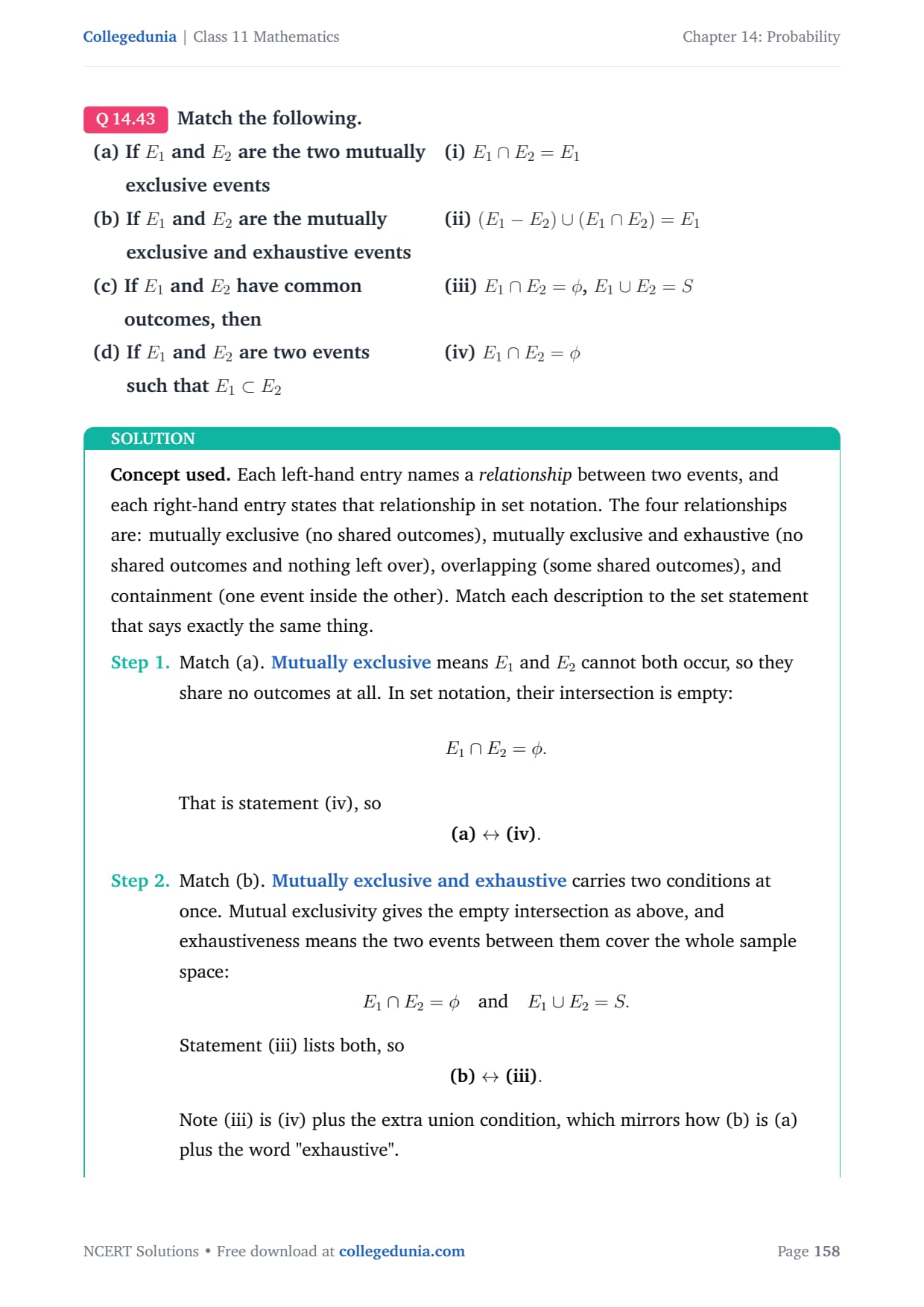
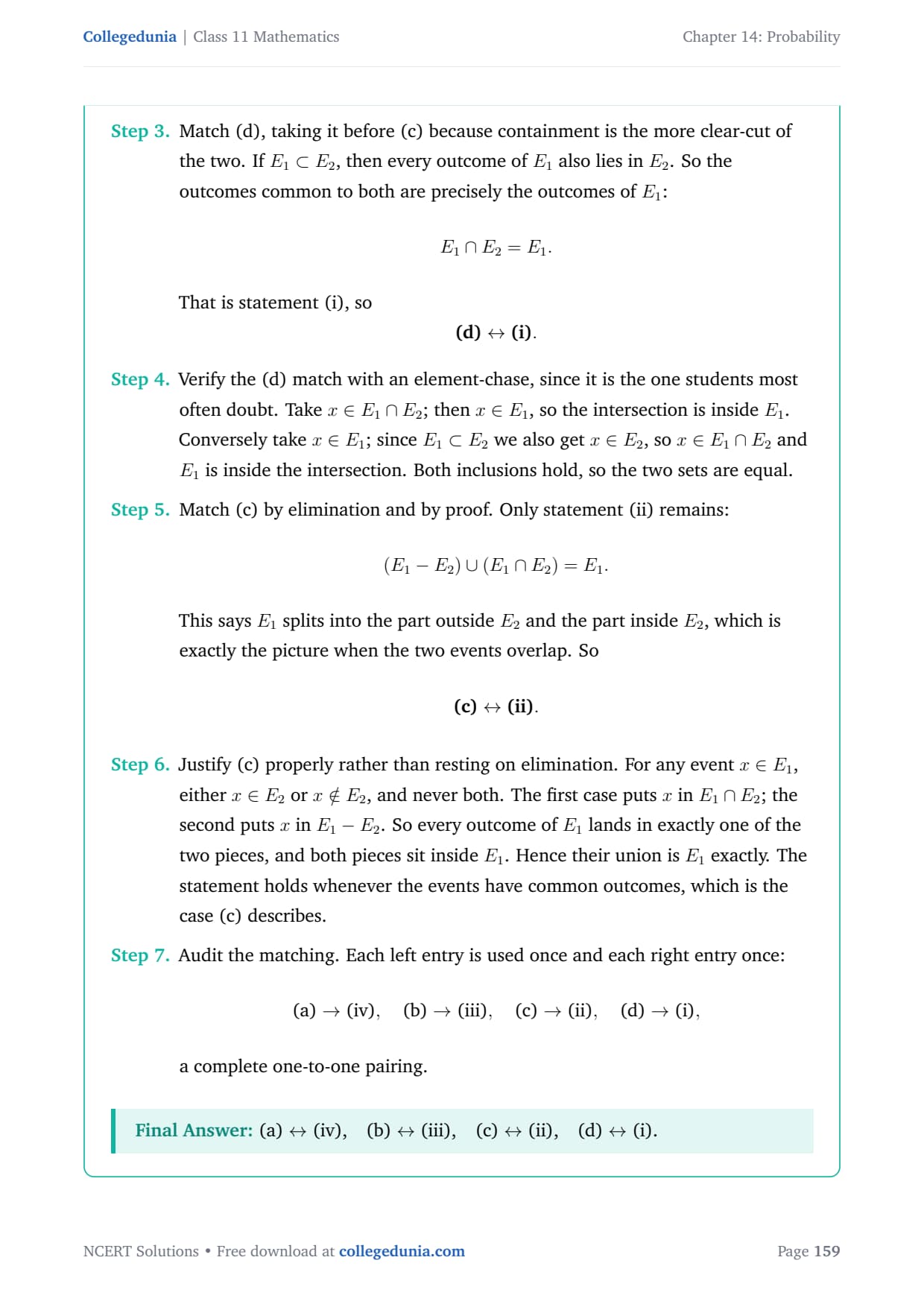
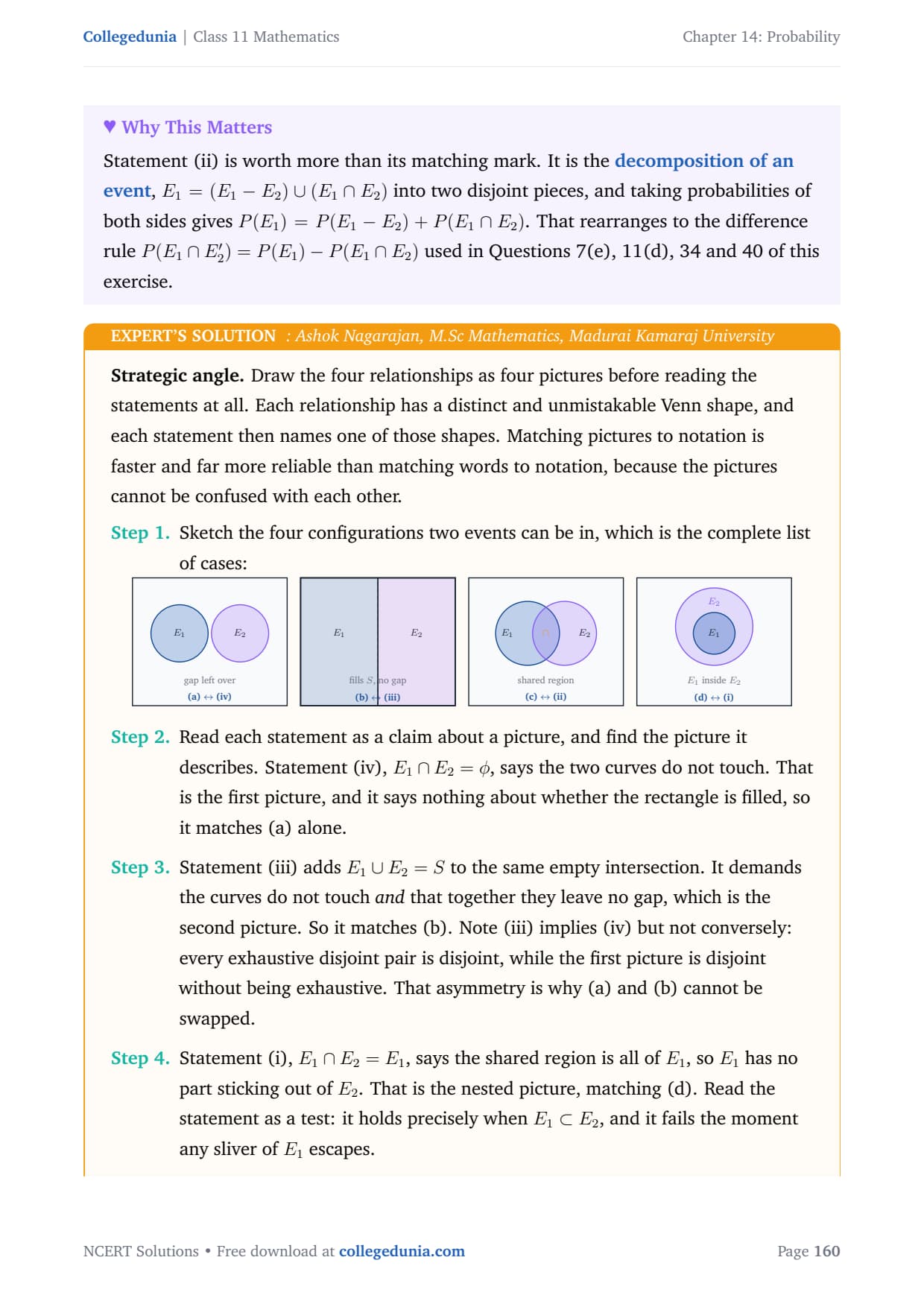
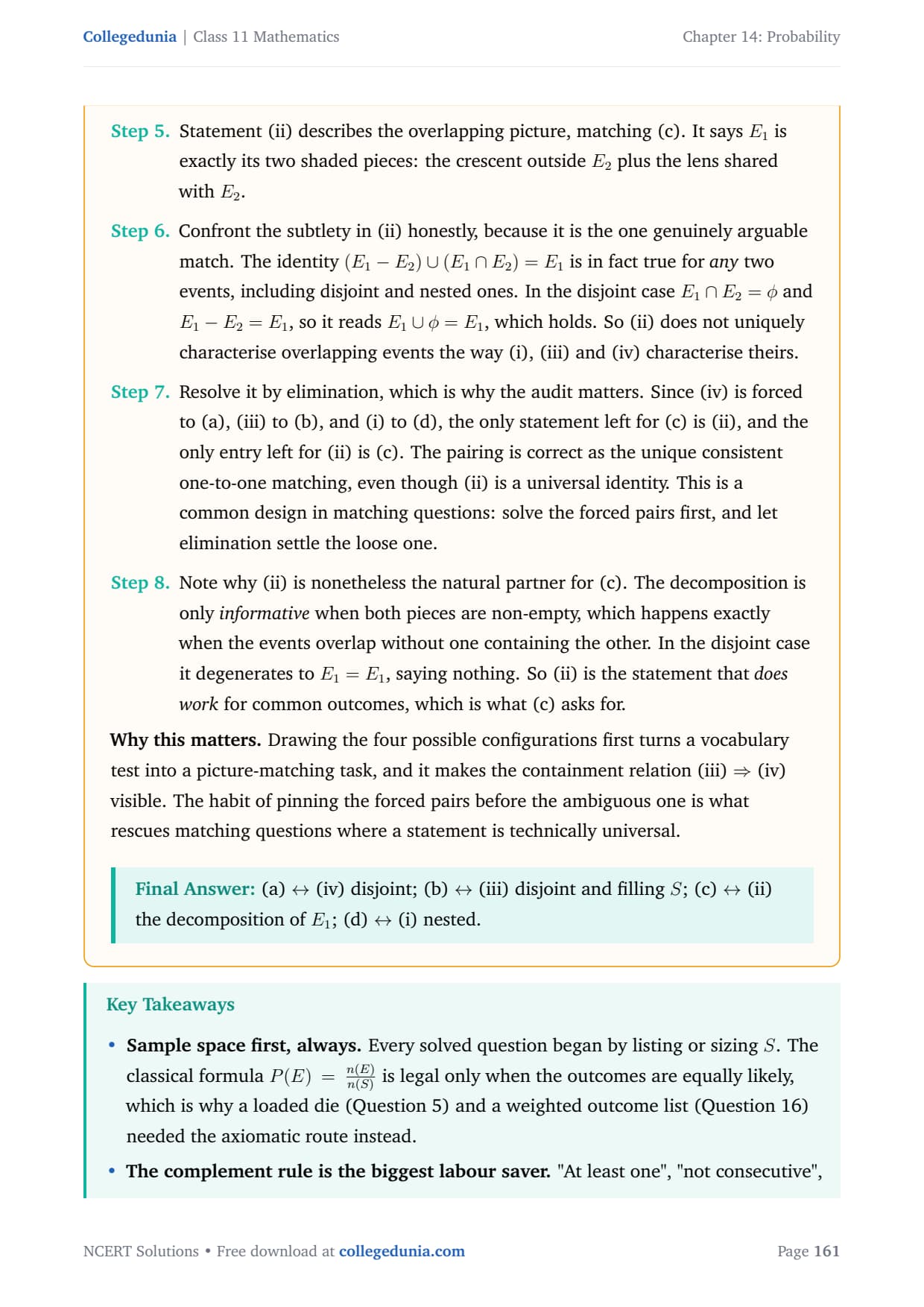
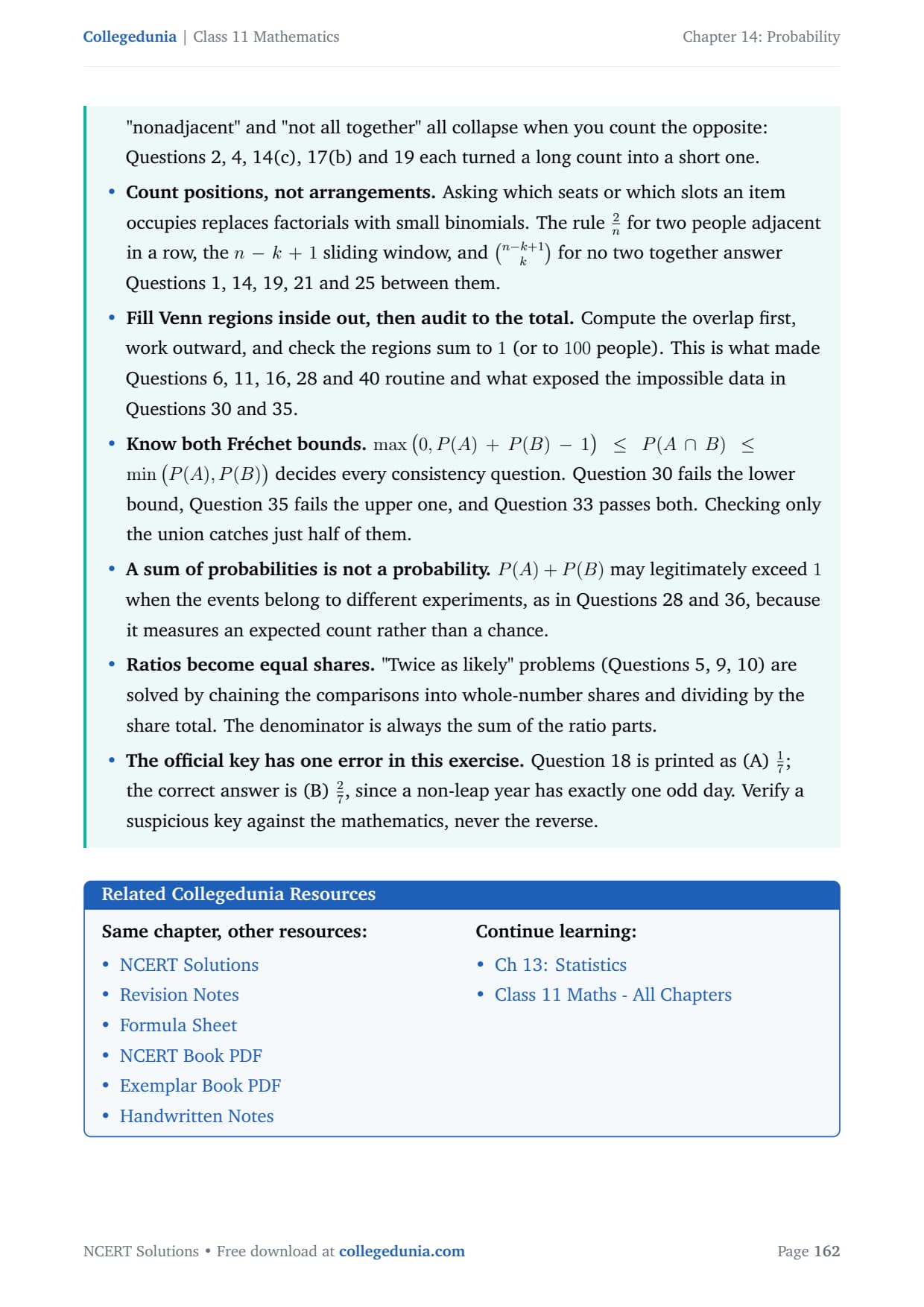
Every solution in this Collegedunia set is prepared by subject experts, based on the 2026-27 NCERT Exemplar, and checked line by line against the official answer key.
One numbering note before students start. The NCERT Exemplar book prints Probability as its Chapter 16, and the exercise is numbered Exercise 16.3. In the current NCERT textbook order it is Chapter 14, which is the number used on this page, and it is the last chapter of the Class 11 Maths Exemplar. The questions are identical. The solutions PDF runs to 162 pages.
- 43 questions solved: Short Answer, Long Answer, Objective, True/False, Fill in the Blanks and Matching.
- One answer-key error flagged: the printed key is wrong on Q18, and the correct answer is 2/7.
- Exam focus: useful for CBSE Boards, JEE Main, JEE Advanced and CUET.
Topics Covered in the Class 11 Maths Probability Exemplar
The Exemplar treats Probability as a chapter about conditions rather than formulas. Its favourite move is to hand students a situation where the classical formula looks like it applies and then remove the one assumption that makes it valid. These are the topics the 43 questions are built on.
- Classical probability: P(E) = n(E)/n(S), valid only when every outcome is equally likely. Q5 and Q17(d) are built on the case where it is not.
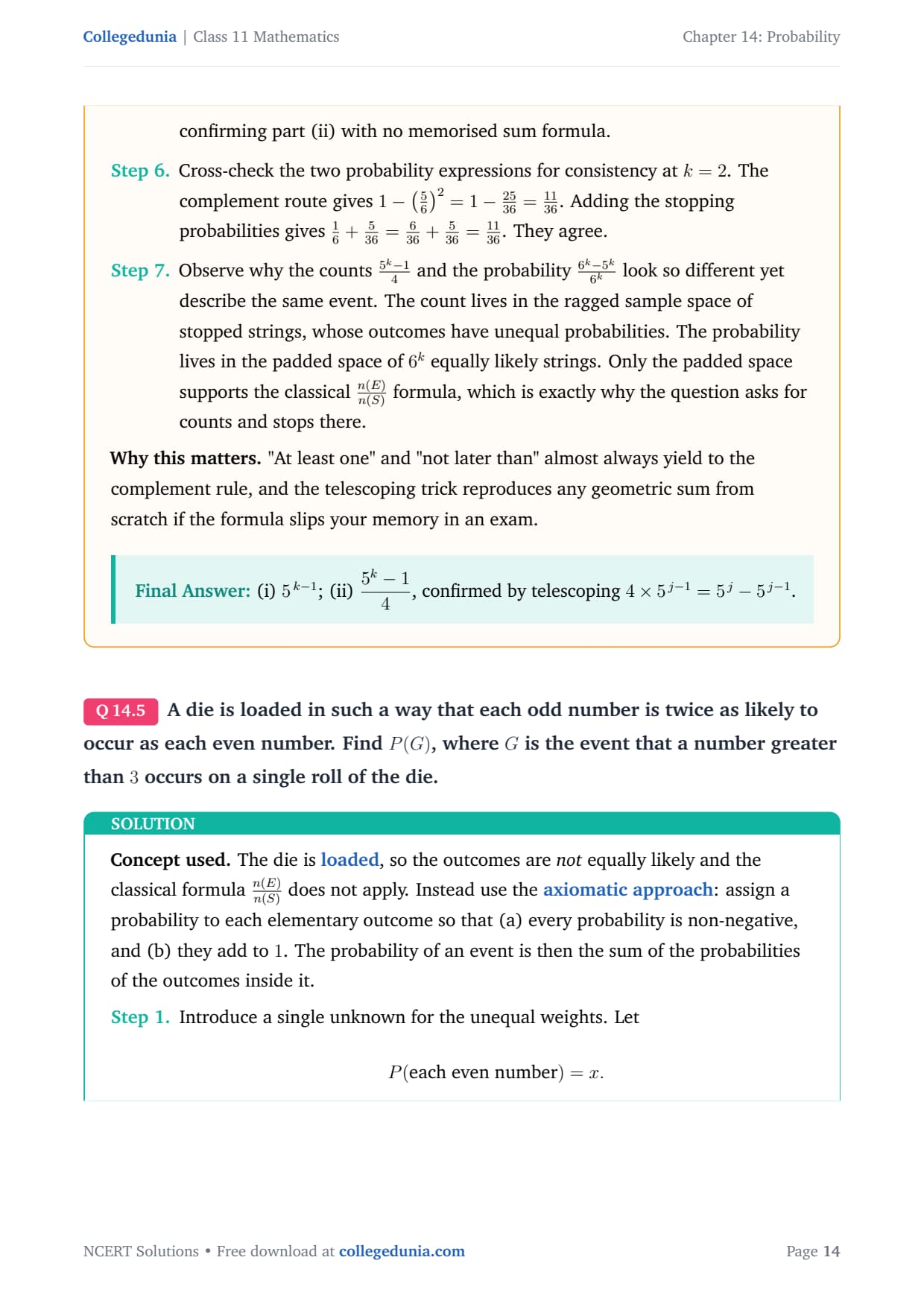
- Sample spaces: listing them properly, including the infinite one in Q4 where a die is rolled until a 2 appears.
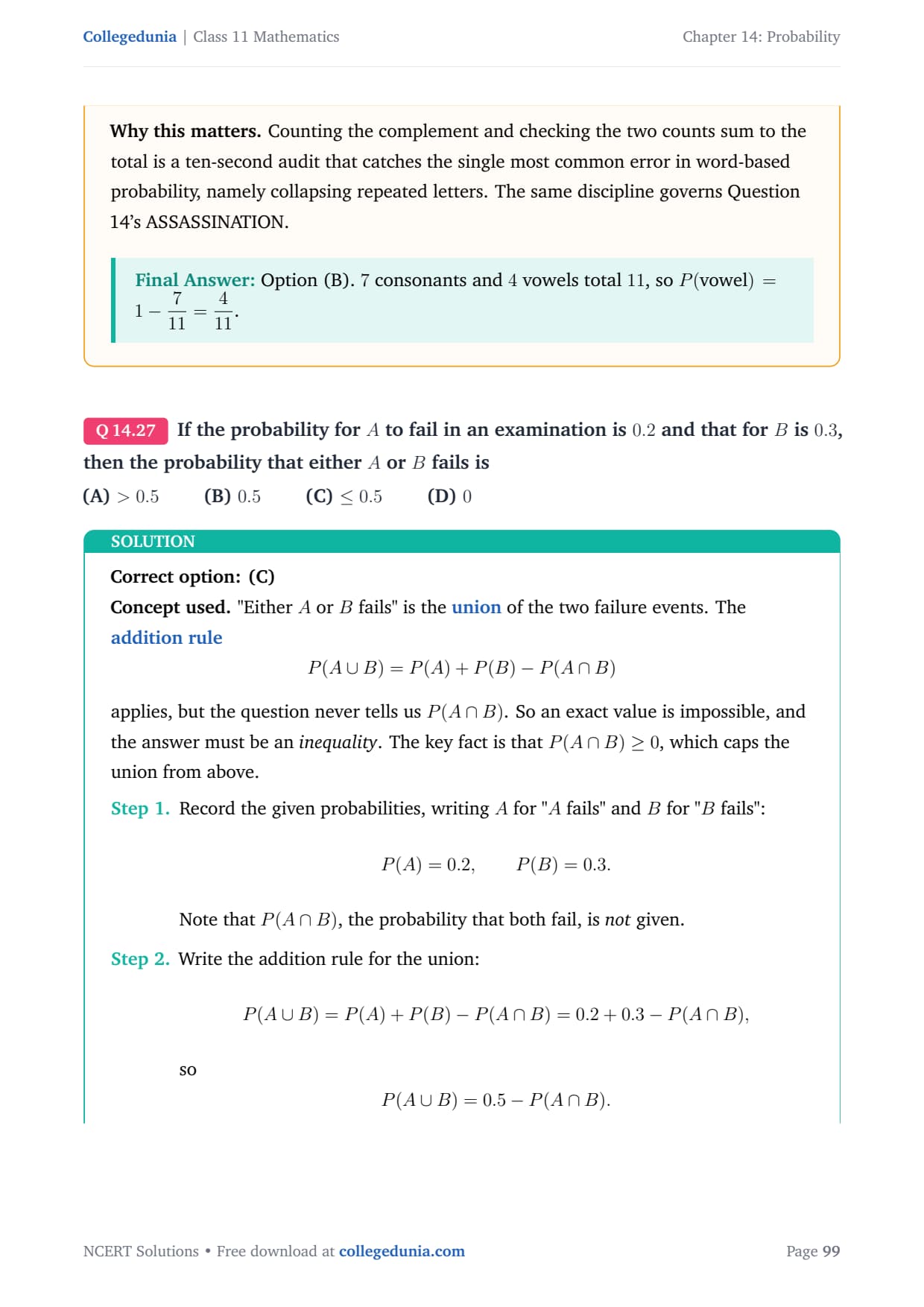
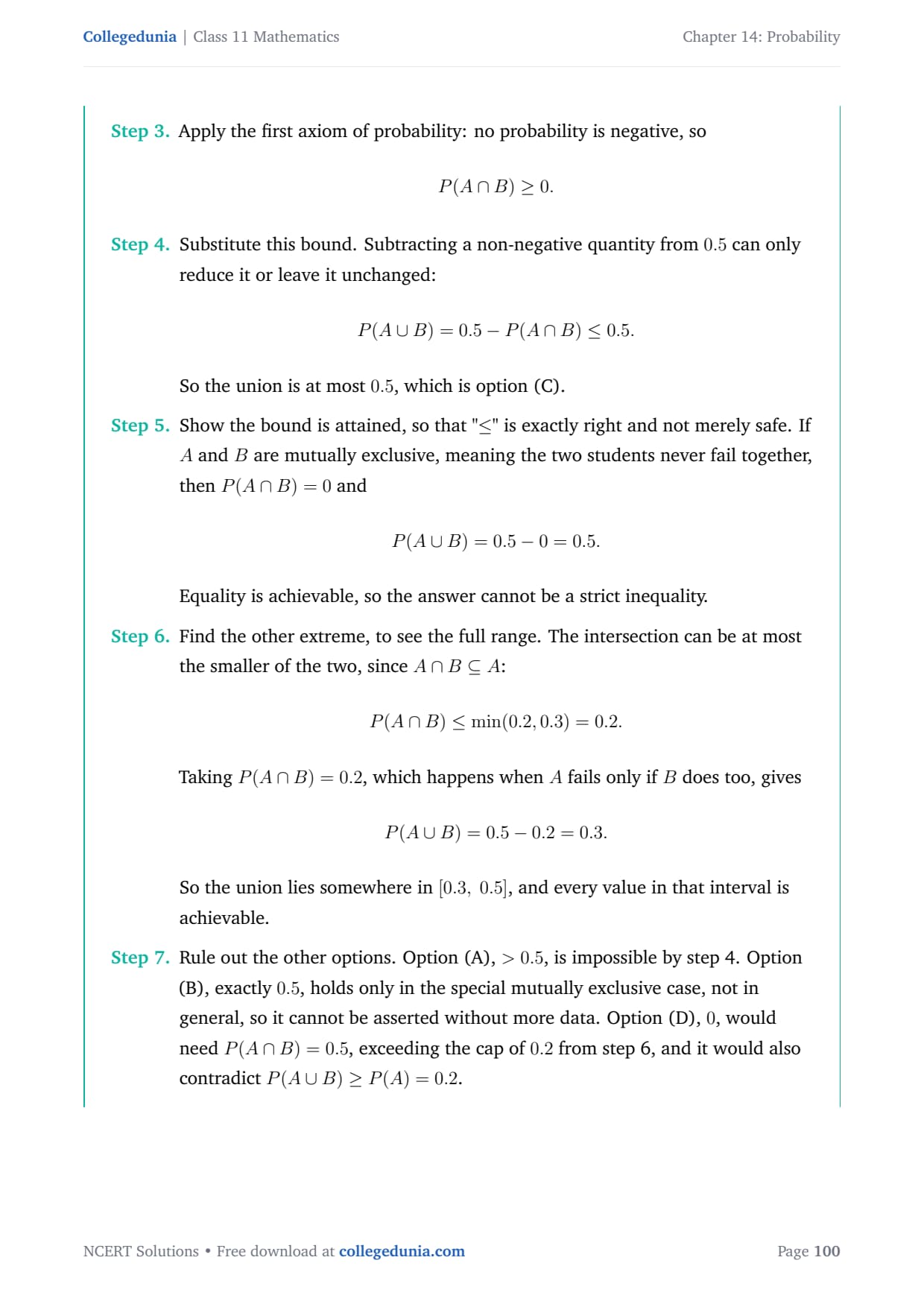
- Addition rule: P(A ∪ B) = P(A) + P(B) − P(A ∩ B), and what happens to the last term when the events are mutually exclusive.
- Complement: P(A′) = 1 − P(A), which is the fastest route through Q19 and several True/False statements.
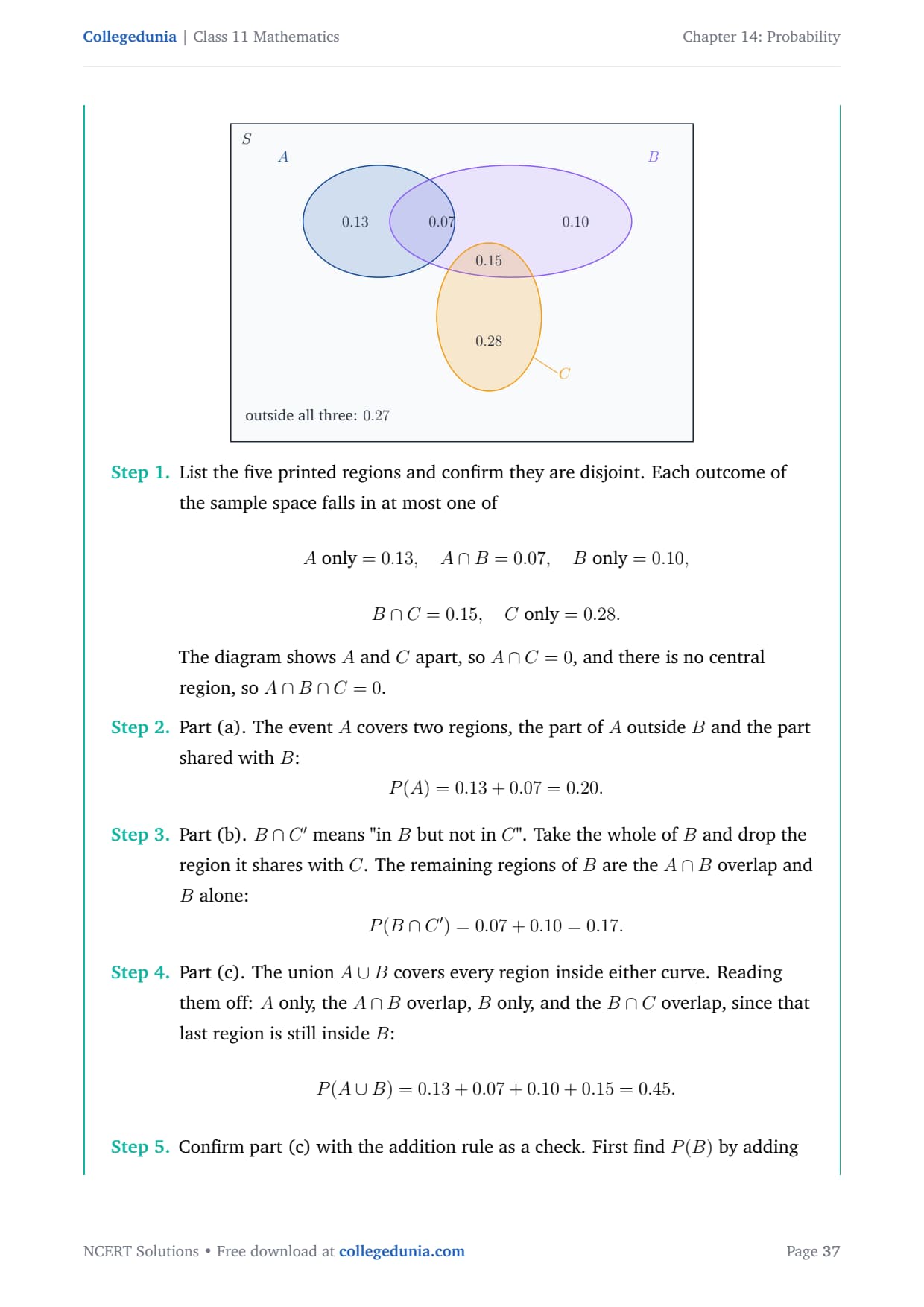
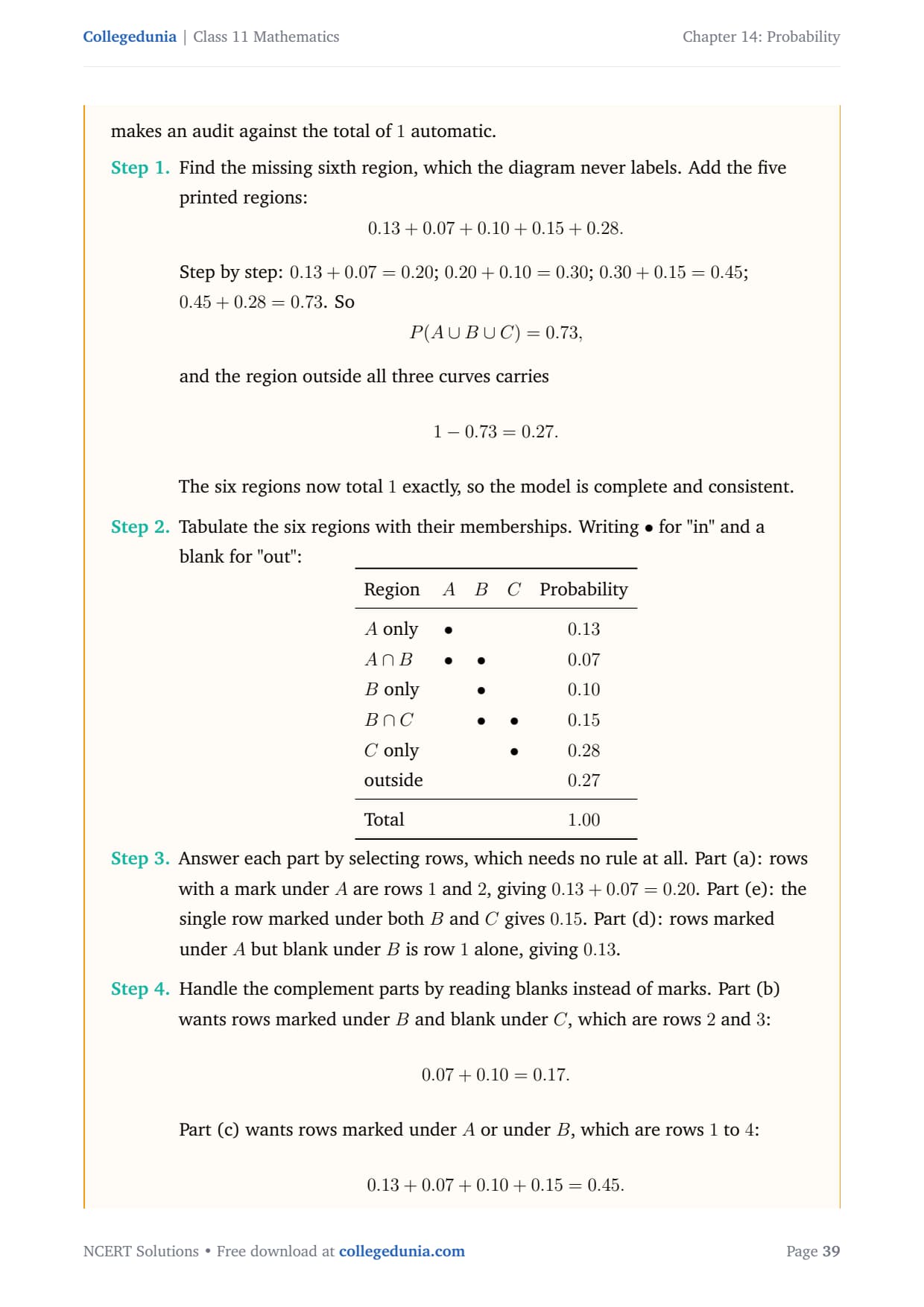
- Venn diagram regions: Q11 gives probabilities of intersections and expects each printed number to be read as its region only.
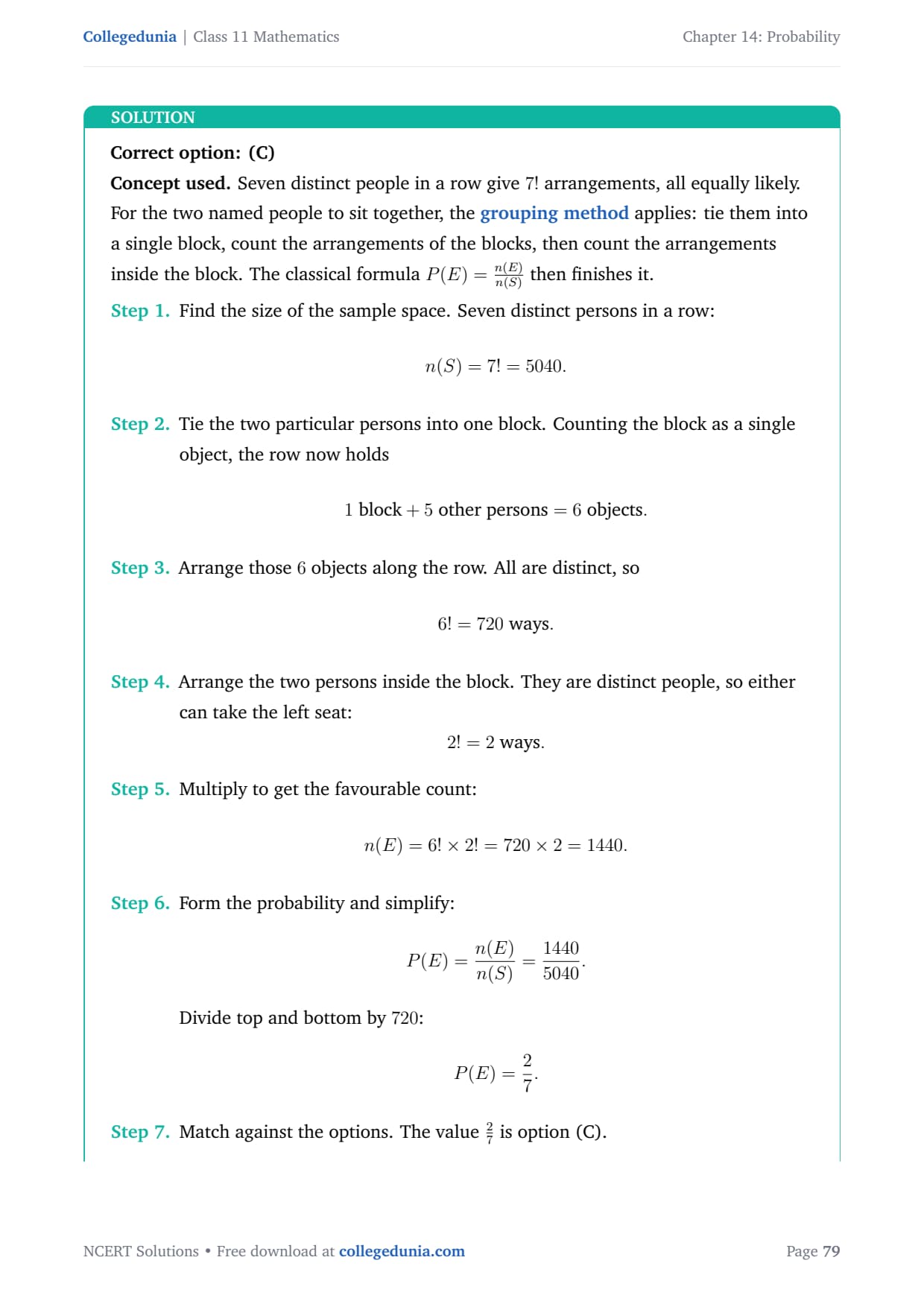
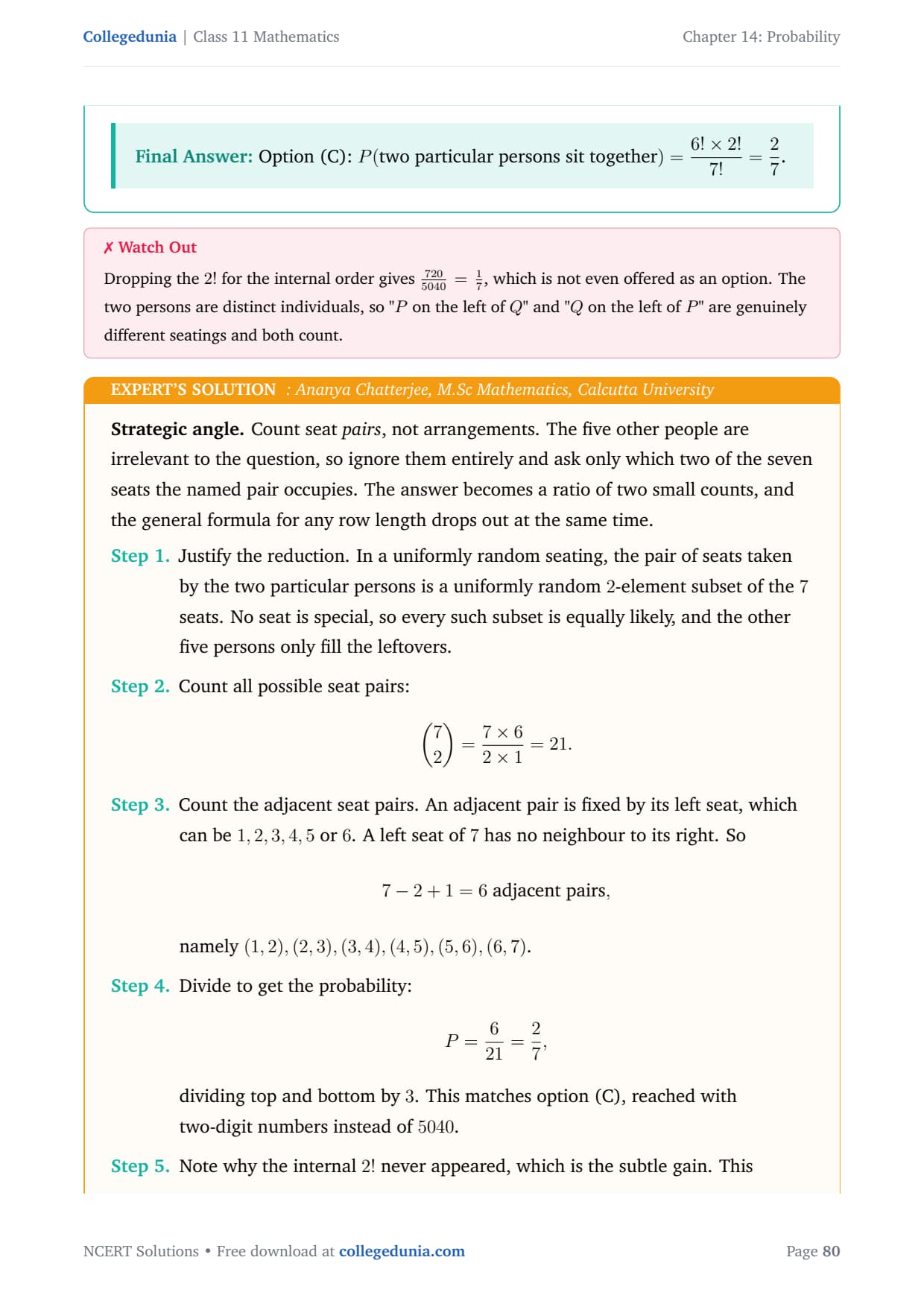
- Counting-based probability: arrangements of letters in Q1 and Q14, seating in Q21 and Q25, and card selections in Q13 and Q20.
- Odd days: Q18 turns the calendar into a seven-outcome sample space.
- Consistency of an assignment: Q30 to Q36 ask whether a set of printed probabilities is even possible, which needs both bounds on an intersection, not just one.
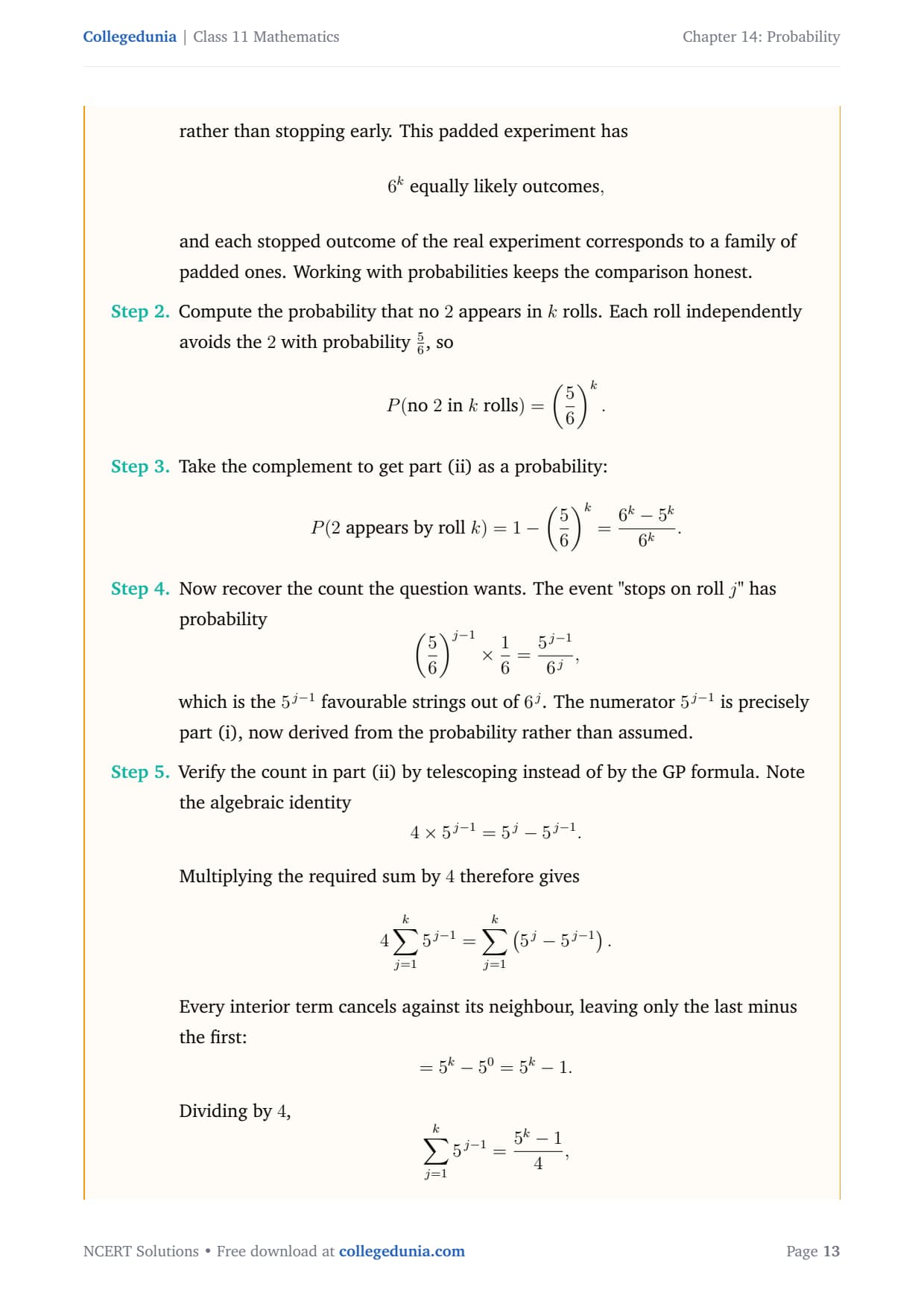
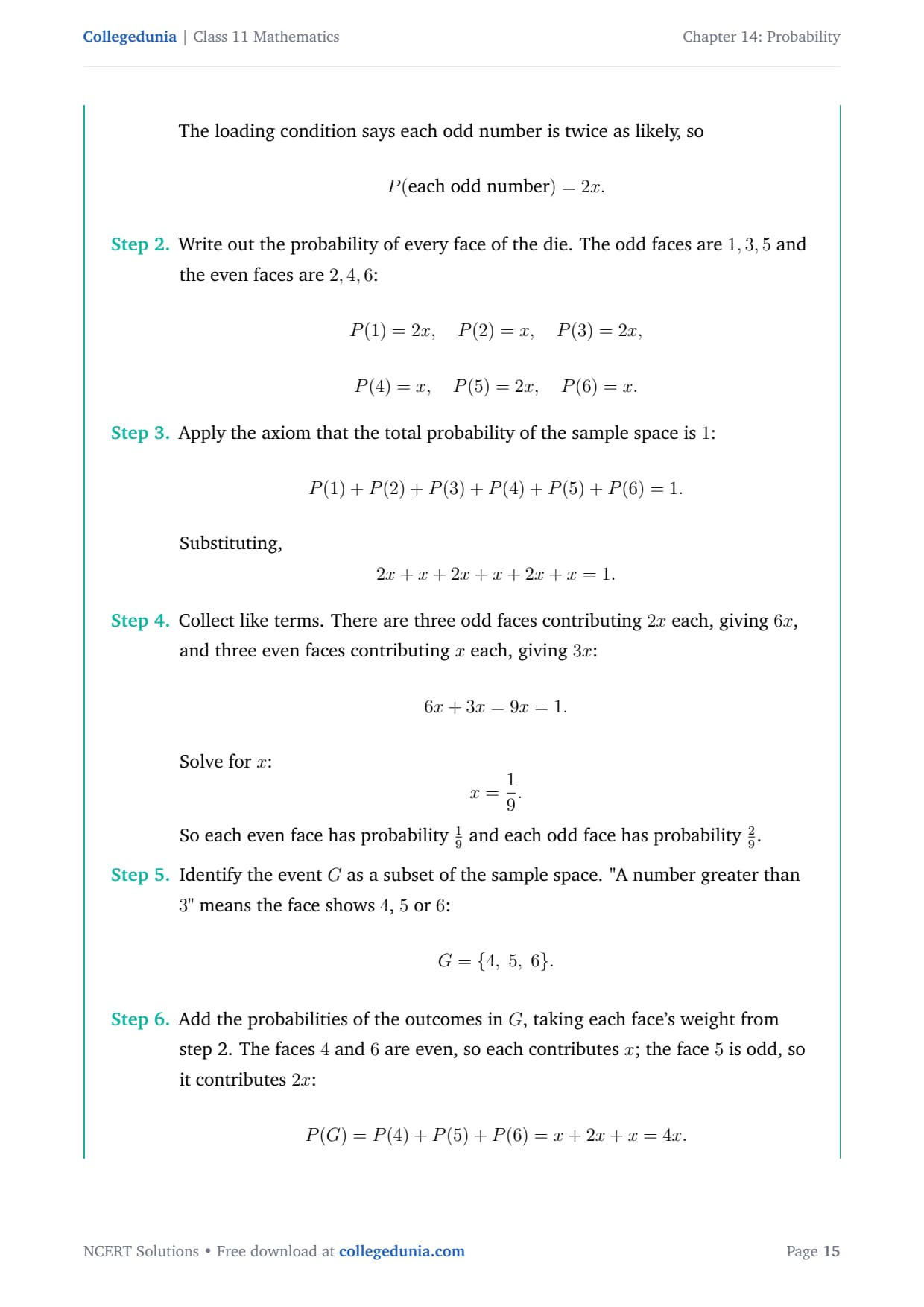
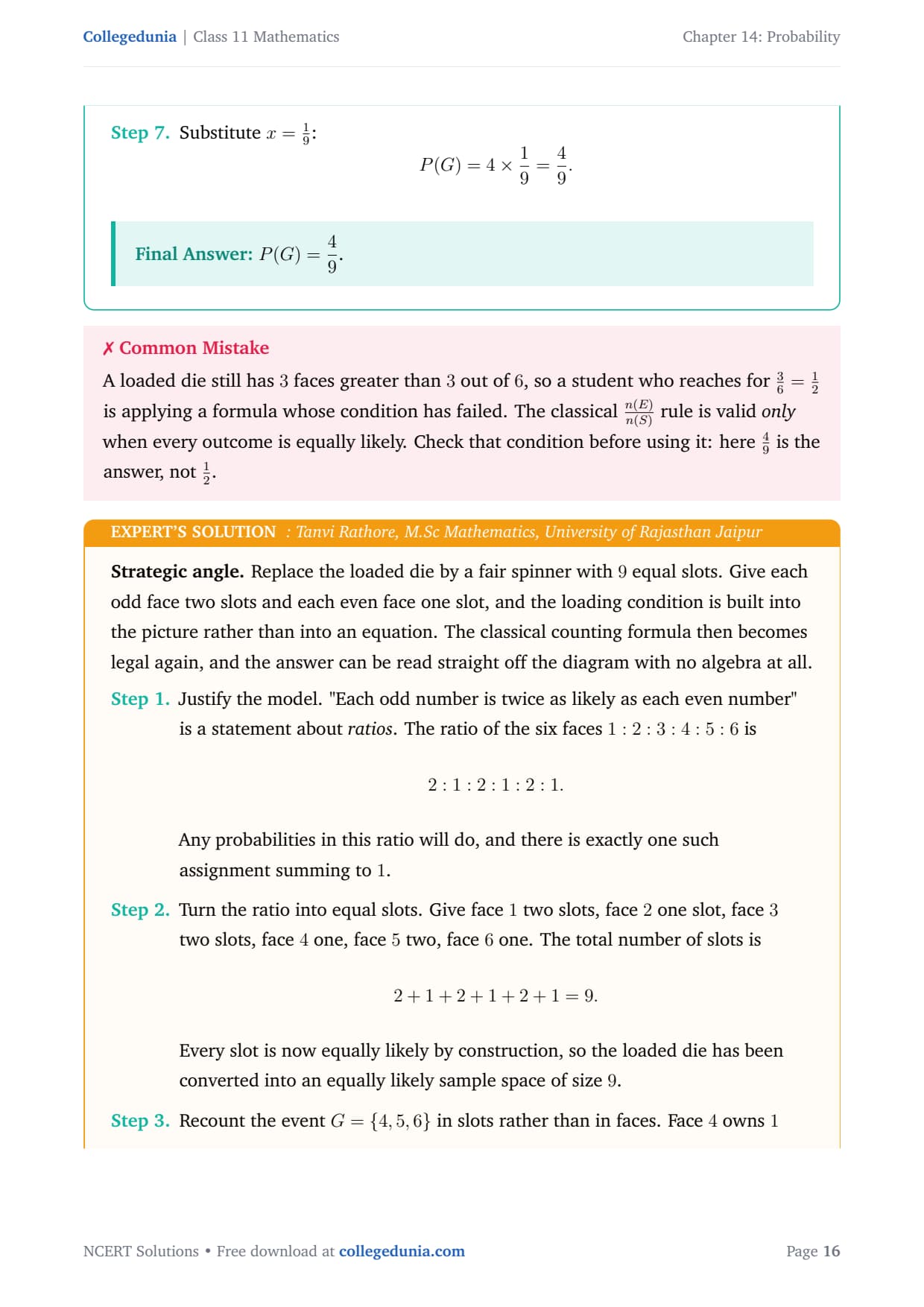
Important: the classical formula n(E)/n(S) is a theorem with a hypothesis, not a definition. Before using it, check that the outcomes really are equally likely. A loaded die in Q5 still has 3 faces above 3 out of 6, but the answer is 4/9, not 1/2.
Exercise 16.3 Question-Type Breakdown for Probability
All 43 questions sit inside the single exercise the book prints as Exercise 16.3, grouped by format. This chapter has the widest spread of question types in the Class 11 Maths Exemplar, with six formats in one exercise. The table below shows how it splits, so students can plan practice by question type rather than solving straight through.
| Question Type | Question Numbers | Count | What it tests |
|---|---|---|---|
| Short Answer | Q1 to Q11 | 11 | Sample spaces, counting arrangements, the addition rule, Venn regions |
| Long Answer | Q12 to Q17 | 6 | Multi-part urn, card and word-arrangement problems |
| Objective (MCQ) | Q18 to Q29 | 12 | One-line reasoning, calendar problems, seating and card traps |
| True/False | Q30 to Q36 | 7 | Deciding whether a printed set of probabilities is possible at all |
| Fill in the Blanks | Q37 to Q41 | 5 | Complements, elementary outcomes and the addition rule |
| Matching | Q42 to Q43 | 2 | Matching probability values and event relations to descriptions |
The Long Answer block (Q12 to Q17) carries the most marks per question, and every one of its questions has three or four parts, so a single counting slip early costs the whole question. The True/False block (Q30 to Q36) is the most distinctive group in this chapter and the one students most often skip. It is not asking for a computation at all. It asks whether a printed set of probabilities could describe any real experiment, and it rewards students who know both bounds on an intersection.
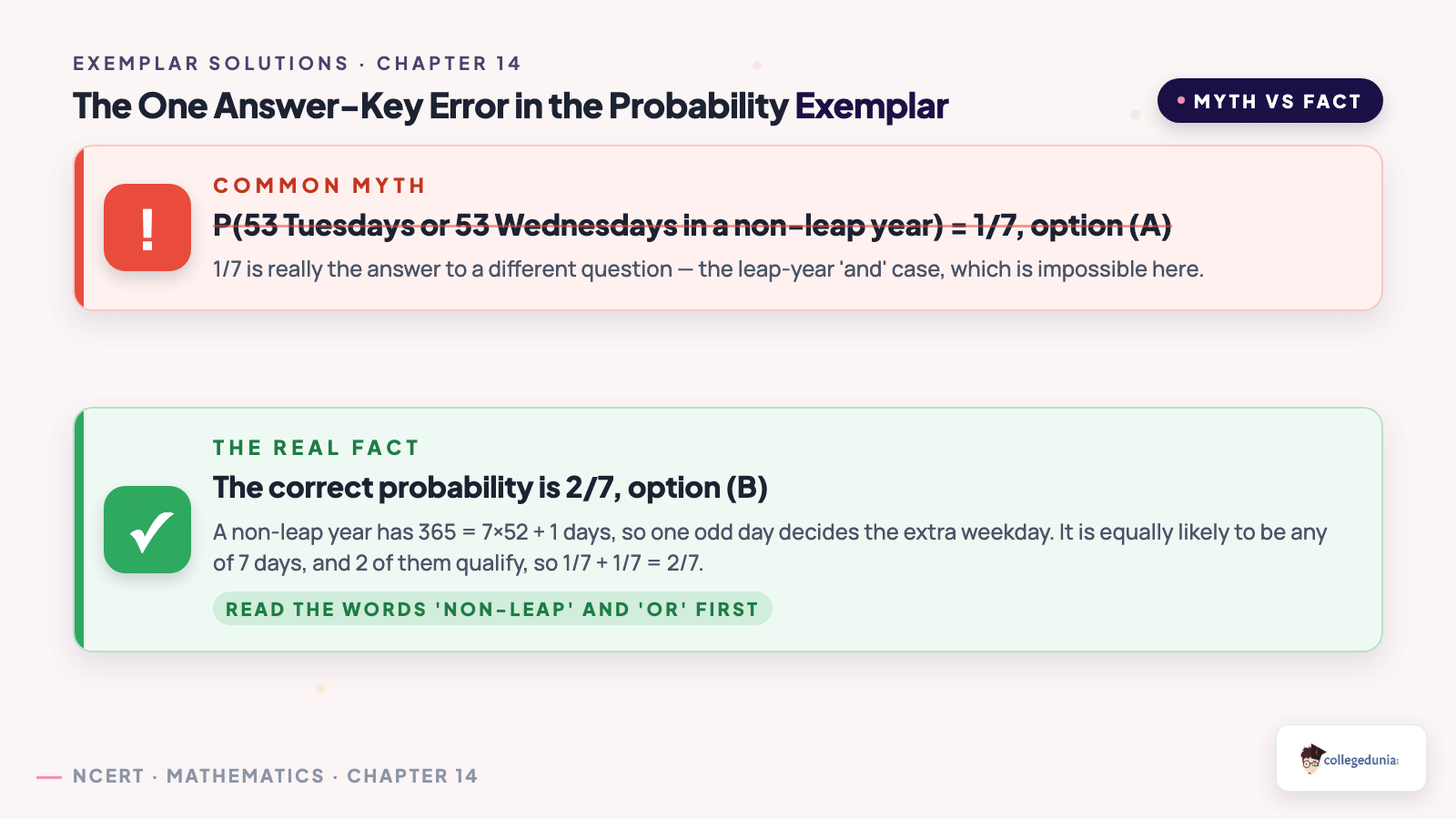
The One Answer-Key Error in the Probability Exemplar Every Student Must Know
Probability is the cleanest chapter in the Class 11 Maths Exemplar, with only one question where the printed key is wrong. That single error is worth knowing well, because the wrong answer is the right answer to a different question and is therefore very easy to accept without noticing.
| Question | Printed key | Correct answer | The check that settles it |
|---|---|---|---|
| Q18 | (A) 1/7 | (B) 2/7 | 365 = 7 × 52 + 1, so the odd day is one of 7 equally likely weekdays, and 2 of them qualify |
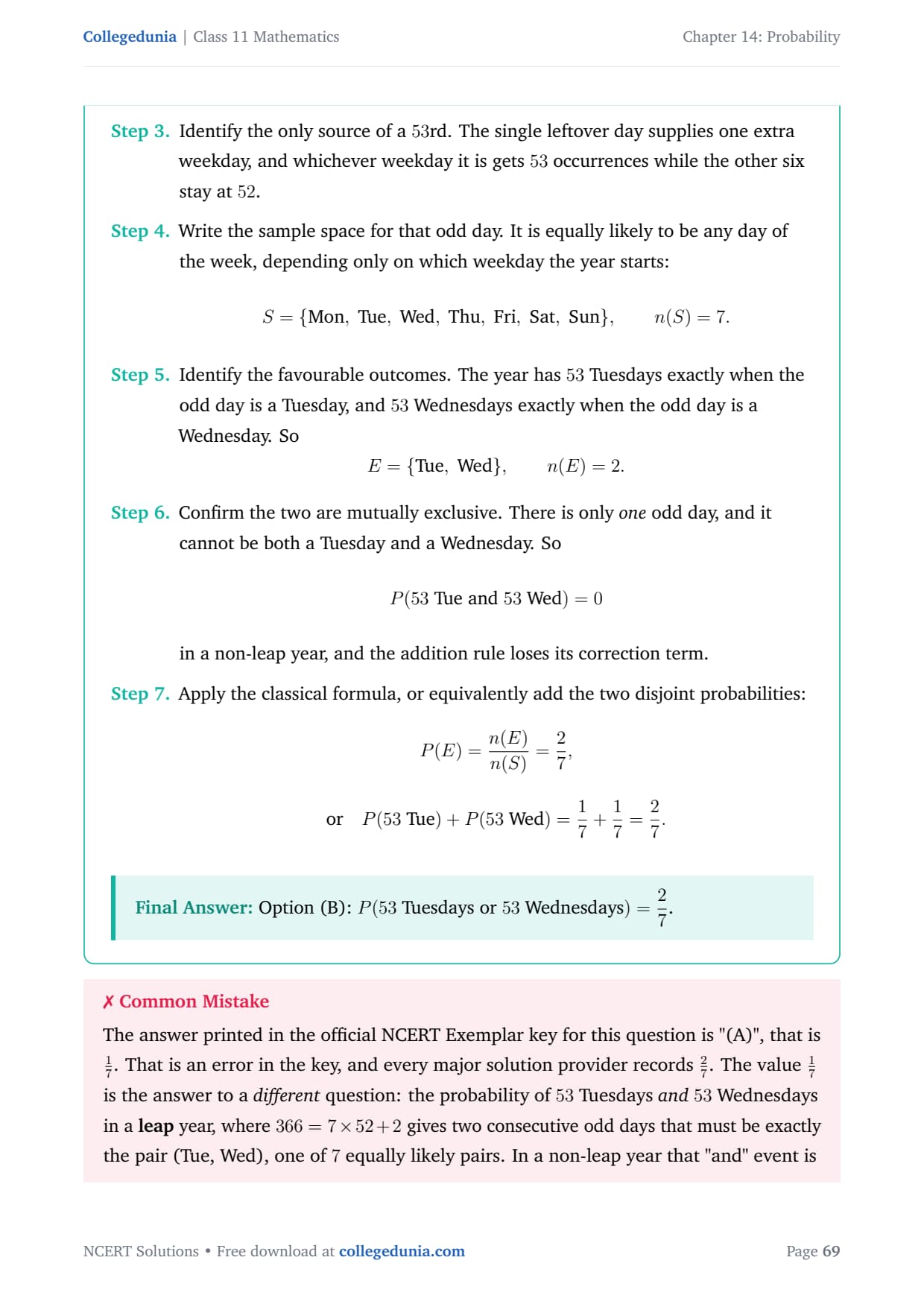
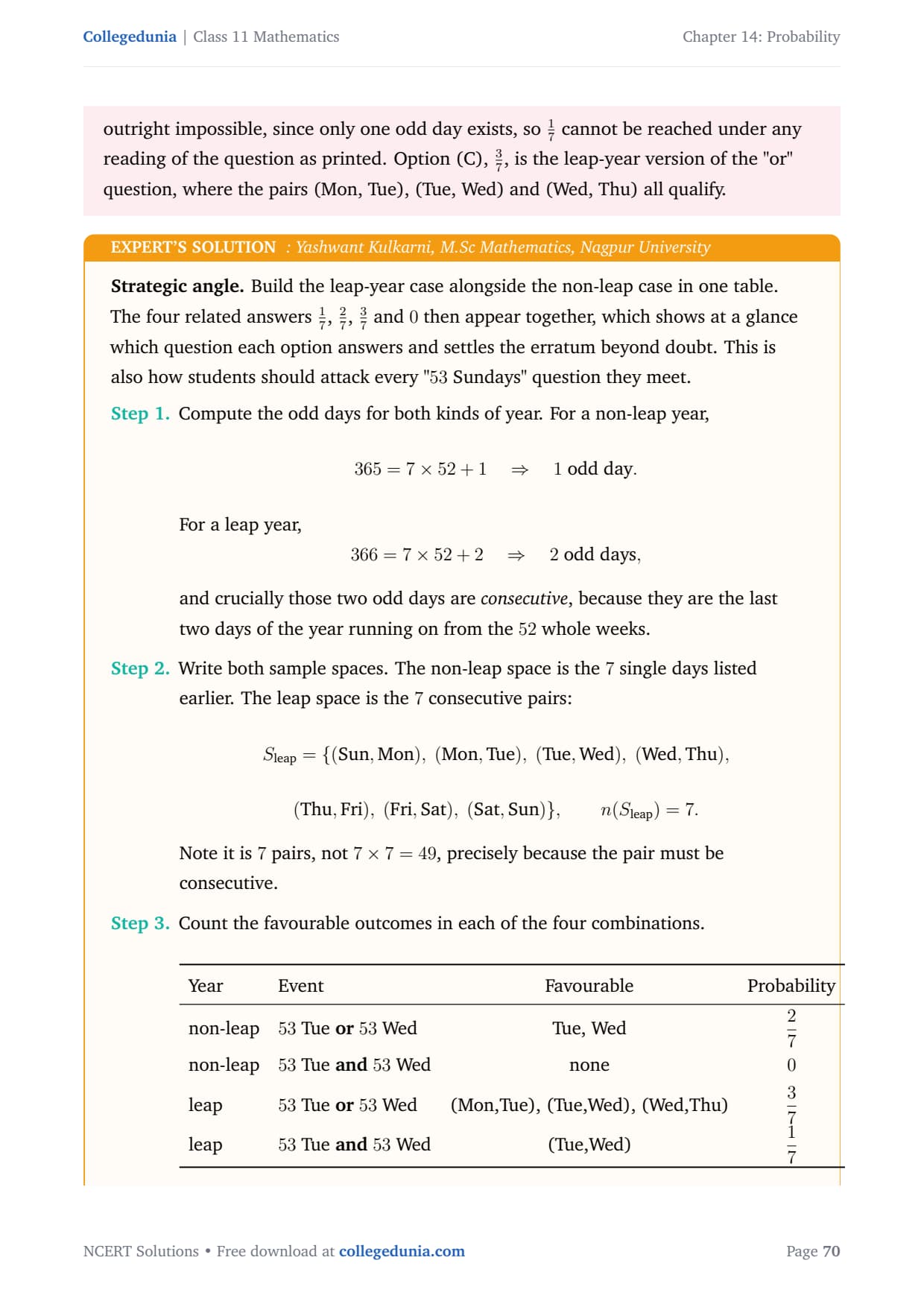
Q18 asks for the probability of 53 Tuesdays or 53 Wednesdays in a non-leap year. A non-leap year has 365 days, and 365 = 7 × 52 + 1. Those 52 complete weeks give exactly 52 of every weekday with no favouritism, so the single leftover day, called the odd day, decides which weekday occurs 53 times. That odd day is equally likely to be any of the seven weekdays, so the sample space has 7 outcomes. The year has 53 Tuesdays exactly when the odd day is a Tuesday, and 53 Wednesdays exactly when it is a Wednesday, so 2 of the 7 outcomes qualify and the answer is 2/7, option (B). Since there is only one odd day, it cannot be both a Tuesday and a Wednesday, so the two events are mutually exclusive and the addition rule loses its correction term: 1/7 + 1/7 = 2/7.
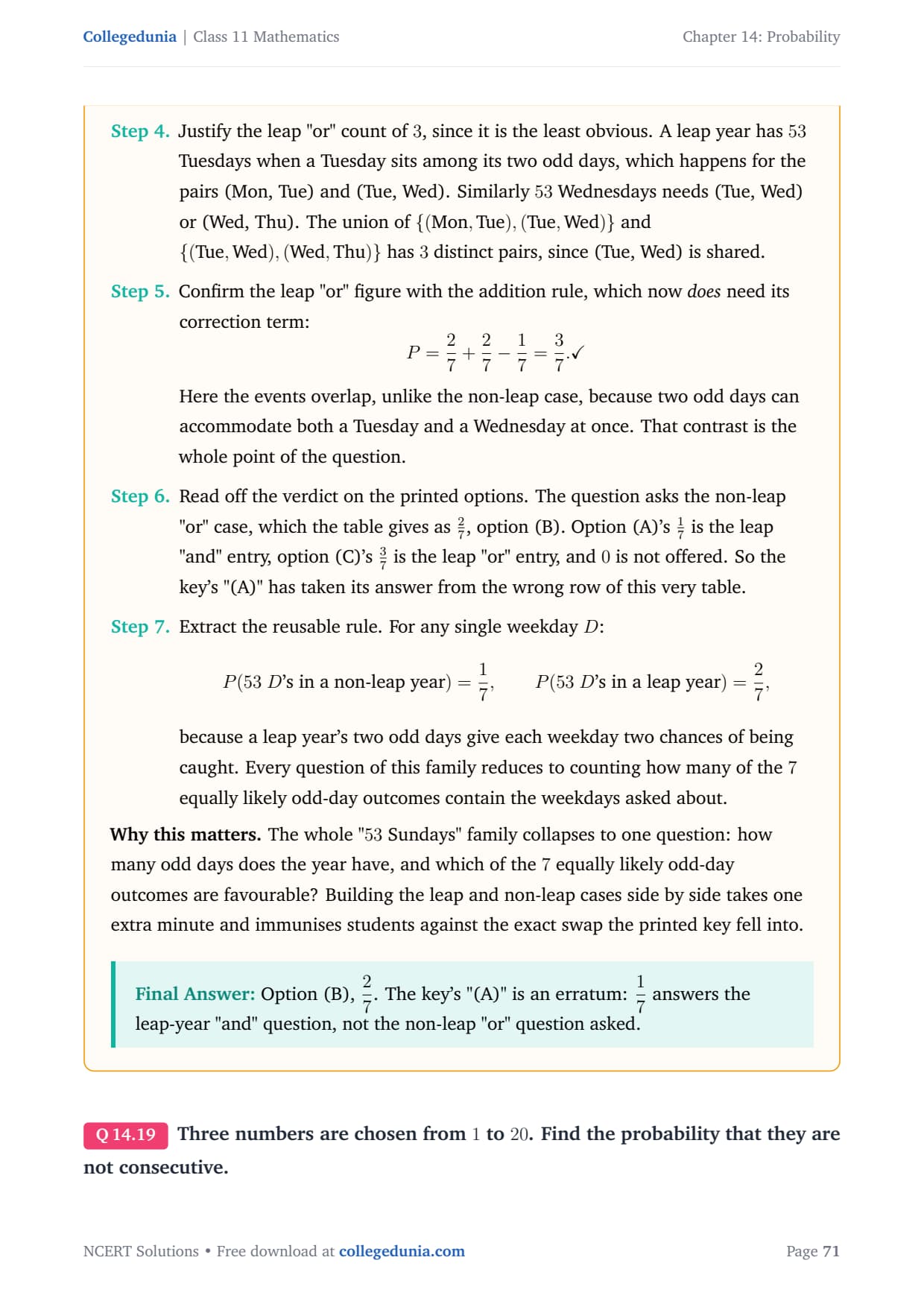
Why the key's 1/7 is the answer to a different question. The value 1/7 is what students get for the probability of 53 Tuesdays and 53 Wednesdays in a leap year, where 366 = 7 × 52 + 2 gives two consecutive odd days that must be exactly the pair (Tuesday, Wednesday), one of 7 equally likely pairs. In a non-leap year that "and" event is outright impossible, because only one odd day exists, so 1/7 cannot be reached under any reading of the question as printed. The option list is built around this confusion: option (C), 3/7, is the leap-year version of the "or" question, where the pairs (Mon, Tue), (Tue, Wed) and (Wed, Thu) all qualify. Students should read the two words that do all the work in this question, non-leap and or, before touching the arithmetic.
Key Formulas and Results Used in the Class 11 Maths Probability Exemplar
Probability has a short formula list, and the Exemplar tests the conditions attached to each one at least as hard as the formula itself. Students should know this table before starting the exercise.
| Result | Statement | Where it is used |
|---|---|---|
| Classical probability | P(E) = n(E)/n(S), valid only when all outcomes are equally likely | Q17, Q18, Q21, Q22, Q26 |
| Addition rule | P(A ∪ B) = P(A) + P(B) − P(A ∩ B) | Q3, Q6, Q15, Q27, Q29 |
| Mutually exclusive events | P(A ∩ B) = 0, so P(A ∪ B) = P(A) + P(B) | Q7, Q18, Q23, Q41 |
| Complement | P(A′) = 1 − P(A), and P(A) + P(A′) = 1 | Q19, Q28, Q37, Q39 |
| Upper bound on an intersection | P(A ∩ B) ≤ the smaller of P(A) and P(B) | Q34, Q35 |
| Lower bound on an intersection | P(A ∩ B) ≥ P(A) + P(B) − 1, which bites when the sum exceeds 1 | Q30, Q35 |
| Total probability of a sample space | The probabilities of all elementary outcomes add to exactly 1 | Q9, Q10, Q16, Q38 |
| Counting for probability | Treat a block of letters or people that must stay together as one unit | Q1, Q2, Q14, Q21, Q25 |
Tip: the two bounds on an intersection are the backbone of the whole True/False block. Together they say the overlap of two events is squeezed between P(A) + P(B) − 1 and the smaller of the two probabilities. Any printed assignment that escapes those bounds describes no experiment at all, and the statement is False.
Common Mistakes Students Make in the Probability Exemplar
The same reflexes cost marks in this chapter every year. These six are the ones the solutions flag most often.
- Using n(E)/n(S) when the outcomes are not equally likely. The loaded die in Q5 has each odd number twice as likely as each even one, so the answer is 4/9, not 3/6. Check the hypothesis before using the theorem.
- Treating unequal sums as equally likely. In Q17(d) the sums 2 to 12 are not 11 equally likely outcomes: a sum of 7 arises six ways and a sum of 2 only one way. Only the 36 ordered pairs are equally likely, so the sample space must be built from them.
- Adding when the word is "and". In Q13(c), "one red and two white" is a single selection meeting two conditions at once, so the counts multiply. Adding them answers "one red or two white", a different and much larger event.
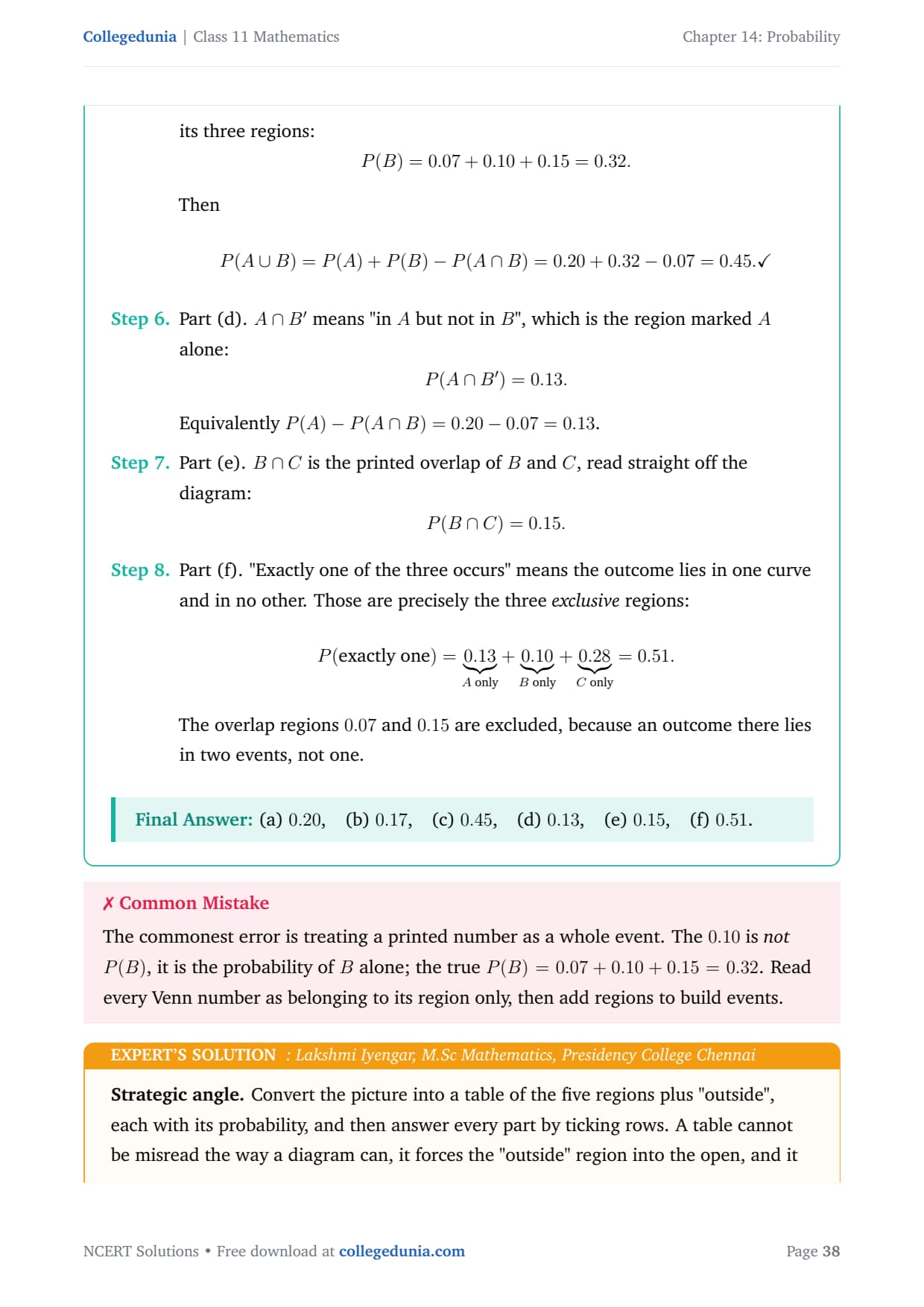
- Reading a Venn number as a whole event. In Q11 the printed 0.10 is the probability of B alone, not P(B). The true P(B) is 0.07 + 0.10 + 0.15 = 0.32. Read every number as belonging to its region only, then add regions to build an event.
- Multiplying to get an LCM. In Q3 the product of two numbers equals their LCM only when they share no common factor. For "multiple of 4 or multiple of 6" the LCM is 12, not 24, and the overlap count changes with it. Factorise before multiplying.
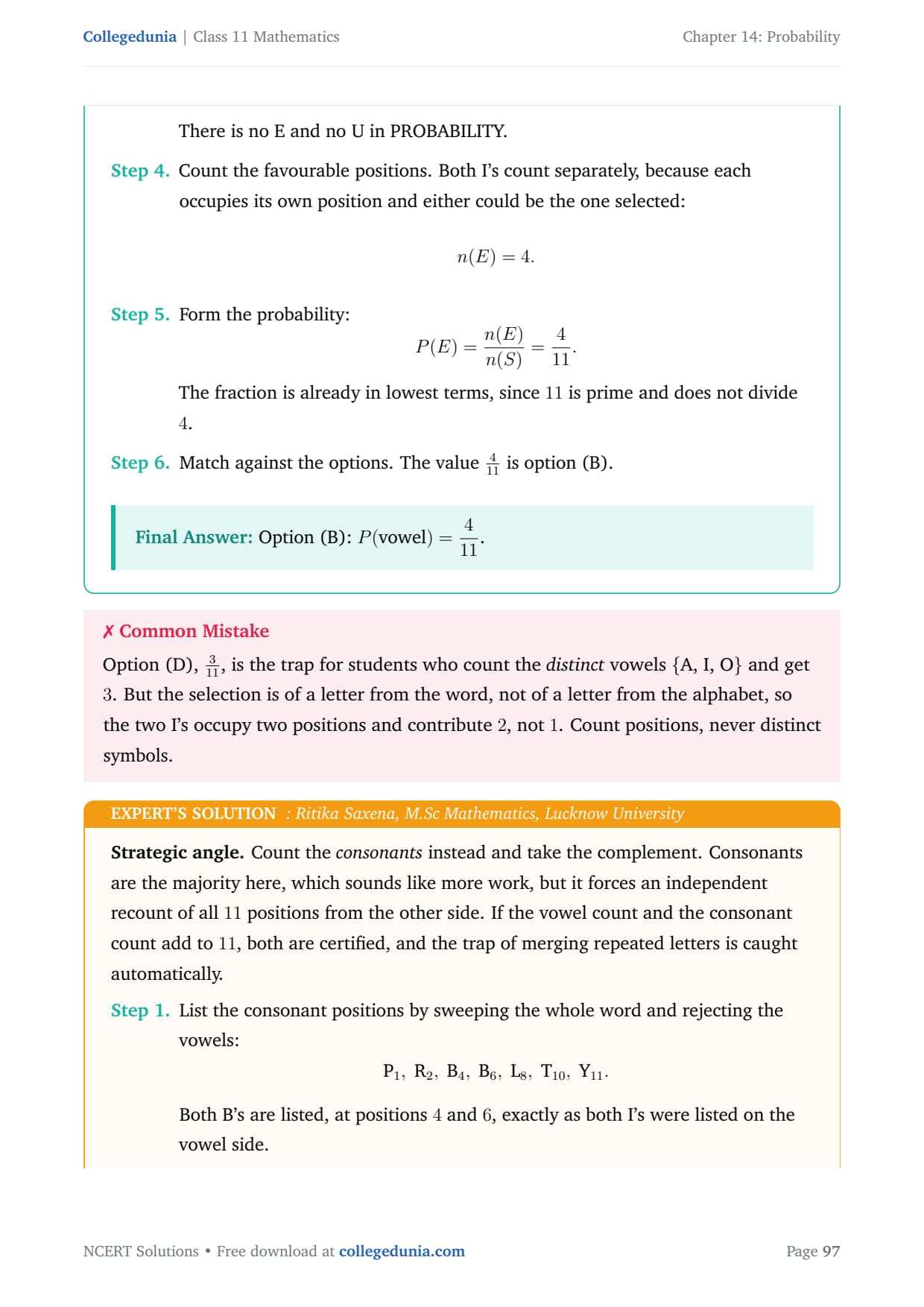
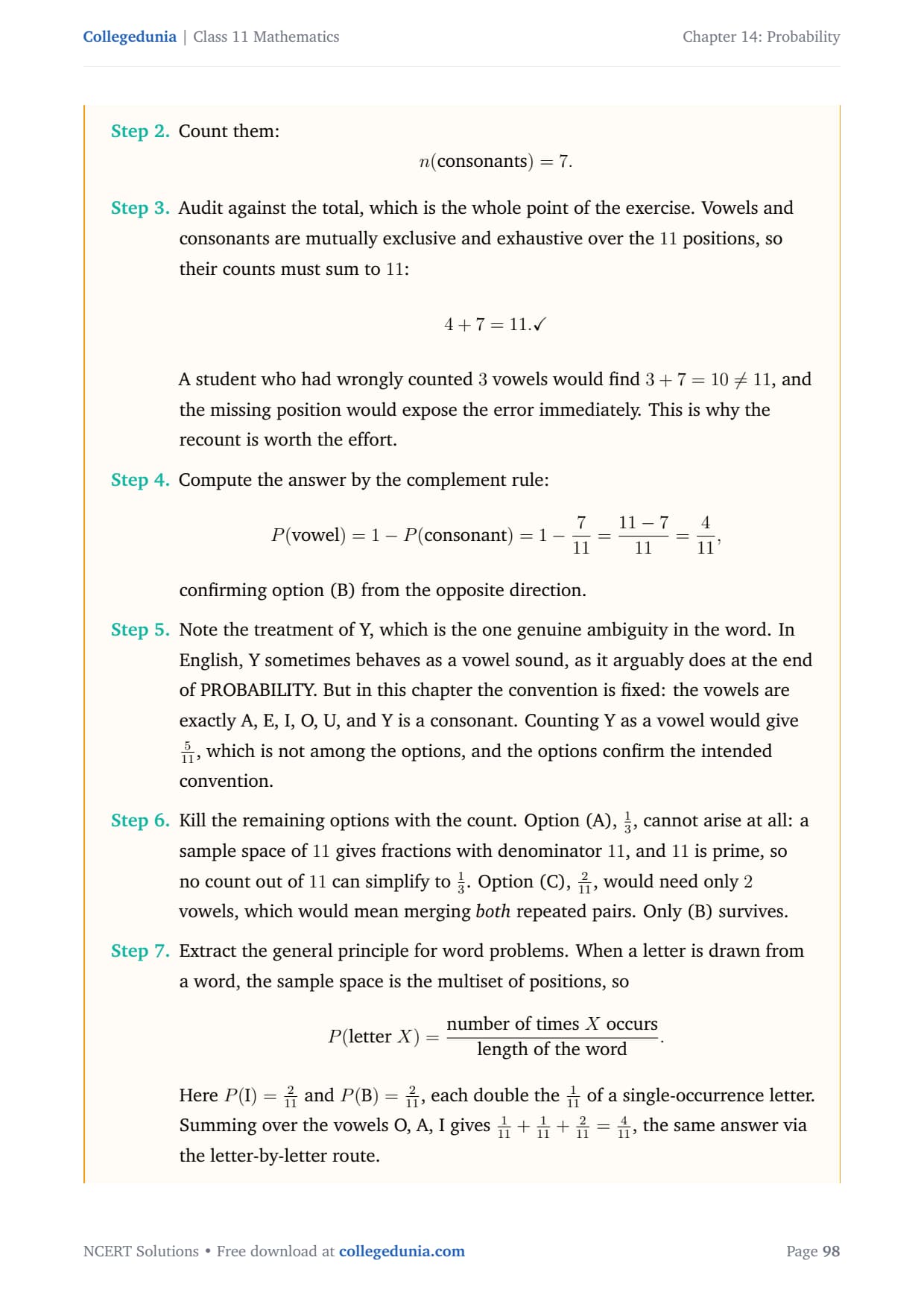
- Counting distinct symbols instead of positions. In Q26 the word PROBABILITY has two I's, and both occupy positions, so the vowels contribute 4 and not 3. Option (D), 3/11, exists for students who count the distinct vowels A, I, O.
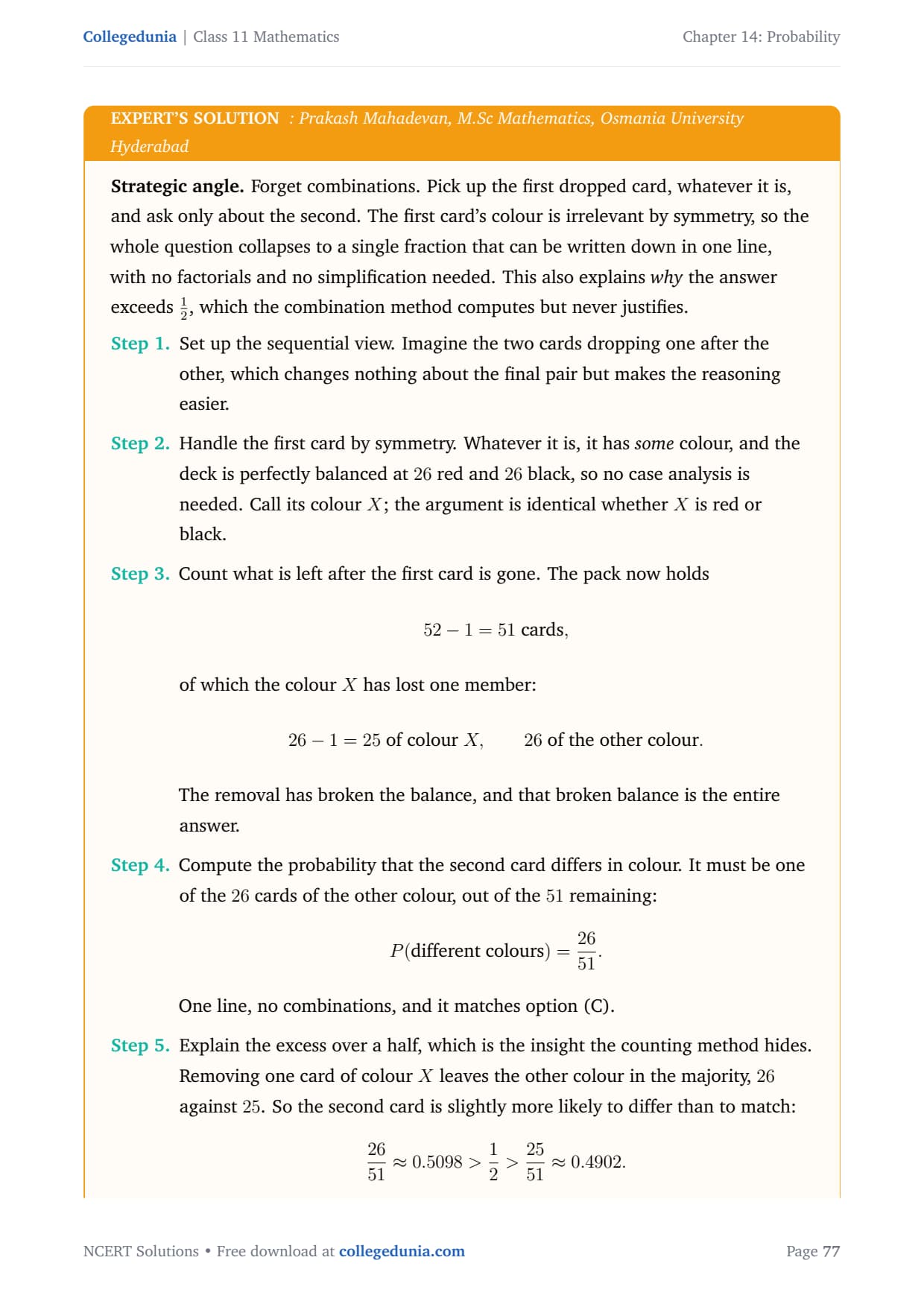
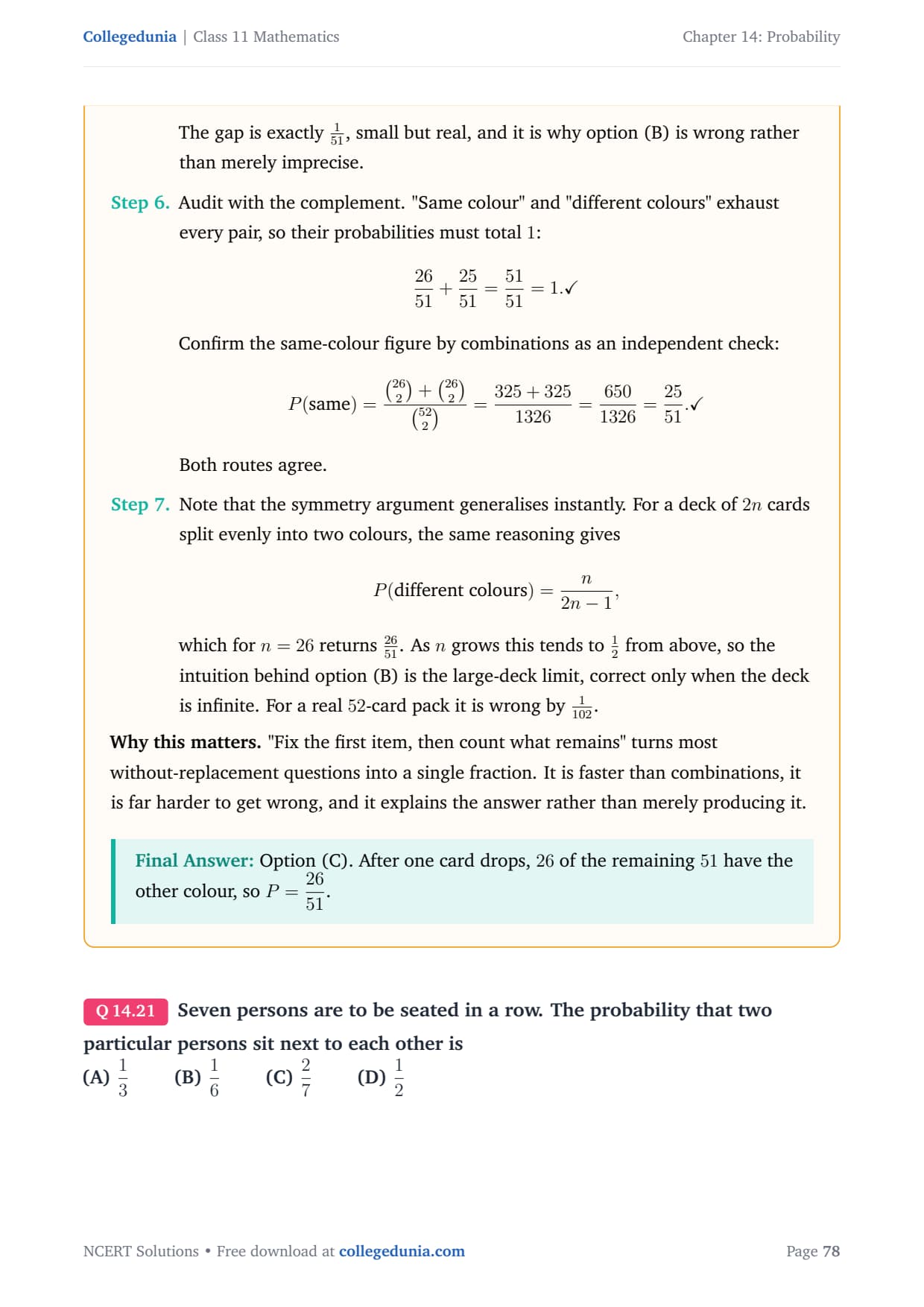
Two further traps are worth naming because both are built into option lists. In Q20, option (B) is 1/2, which catches students who reason that the second card is equally likely to match or not. Removing the first card leaves 51 cards of which 26 are the opposite colour and only 25 are the same, so the true answer 26/51 sits slightly above a half, precisely because of that imbalance. In Q22, the asymmetry between the two cases is the whole question: a four-digit number ending in 0 gives 6 arrangements, but ending in 5 gives only 4, because putting 5 at the end leaves 0 free to wander into the leading position, where it is illegal.
How the Probability Exemplar Steps Up from the NCERT Textbook
The Exemplar adds no new topics to Probability. It asks the same ideas in a harder direction, as the table shows.
| Concept | NCERT Textbook asks | NCERT Exemplar asks |
|---|---|---|
| Classical probability | Find P(E) for a fair die | Find P(E) for a loaded die where the formula does not apply |
| Sample space | List the outcomes of two coin tosses | Describe the infinite sample space of rolling until a 2 appears |
| Addition rule | Apply it to two given events | Apply it to three overlapping events such as king, heart and red card |
| Counting | Find the probability that two people sit together | Find the probability that four S's in ASSASSINATION come consecutively |
| Consistency | Check that probabilities add to 1 | Decide whether a printed assignment is possible, using both bounds |
How to Use the Probability Exemplar for Boards and JEE Preparation
Probability is the last chapter of the Class 11 Maths Exemplar and one of the shortest, so treat it as four sittings. Finish Permutations and Combinations first, because more than a third of this chapter is a counting question wearing a probability wrapper, and no amount of probability theory rescues a wrong count.
| Session | What to solve | Time |
|---|---|---|
| 1 | Short Answer Q1 to Q11 | 2 hours |
| 2 | Long Answer Q12 to Q17, every part written out in full | 2 hours |
| 3 | Objective Q18 to Q29 | 1.5 hours |
| 4 | Q30 to Q43, justifying every True/False answer, then re-solve everything marked wrong | 1.5 hours |
That is about 7 hours for the chapter. For JEE Main and JEE Advanced, the counting-heavy questions in the Long Answer and Objective blocks matter most, since Probability there is almost always a Permutations and Combinations question in disguise. For CBSE Boards and CUET, the addition rule, the complement and the True/False consistency checks are the better use of time, because they are quick to write and are set every year.
Practice Questions for Class 11 Maths Probability
After reading the solutions, students should test themselves on the same question types. The card below opens a set of solved practice questions with step-by-step answers for Probability.
Practice Card: Solved Practice Questions for Class 11 Maths Probability. Attempt each question, then check the solution.
Student Feedback
In a Collegedunia survey of 12,840 Class 11 students conducted before the 2026 exams, 64% of students said the True/False block was the part of this chapter they understood least, because it asks whether an answer is possible rather than what the answer is. Only 11% of students had noticed that the printed key marks 1/7 on Q18 when the correct answer is 2/7.
Other Resources for Class 11 Maths Probability
Pair the Exemplar Solutions with the textbook solutions and the notes for full chapter revision. All the Probability resources are linked below.
| Resource | Link |
|---|---|
| NCERT Solutions | Probability Class 11 NCERT Solutions |
| Revision Notes | Probability Class 11 Notes |
| Handwritten Notes | Probability Class 11 Handwritten Notes |
| NCERT Book PDF | Probability Class 11 NCERT Book PDF |
| Exemplar Book PDF | Probability Class 11 NCERT Exemplar Book PDF |
NCERT Exemplar Solutions for Other Class 11 Maths Chapters
The full Class 11 Maths Exemplar set covers 14 chapters, 735 questions and 2,625 pages of solutions. Use the table to jump to any other chapter.
Probability Class 11 Maths NCERT Exemplar Solutions FAQs
Ques. How many questions are there in the Class 11 Maths Probability Exemplar?
Ans. Probability has 43 questions in a single exercise, which the Exemplar book prints as Exercise 16.3. They are split into 11 Short Answer, 6 Long Answer, 12 Objective, 7 True/False, 5 Fill in the Blanks and 2 Matching questions. Every one of them is solved in the 162-page PDF on this page.
Ques. Why is Probability numbered Chapter 16 in the NCERT Exemplar book?
Ans. The NCERT Exemplar book follows an older chapter order in which Probability is Chapter 16 and its exercise is Exercise 16.3. The current NCERT textbook lists it as Chapter 14, the last chapter of the subject, which is the number used on this page. The questions and the exercise content are identical, so students can use either number to find the same set.
Ques. What is the probability of 53 Tuesdays or 53 Wednesdays in a non-leap year?
Ans. It is 2/7, which is option (B) in Q18. A non-leap year has 365 = 7 × 52 + 1 days, so there is exactly one odd day, and it is equally likely to be any of the 7 weekdays. Two of those 7 outcomes give the required result, so the probability is 2/7. The printed key marks (A) 1/7, which is wrong.
Ques. Is the printed NCERT Exemplar answer key for Probability correct?
Ans. Almost. Probability is the cleanest chapter in the Class 11 Maths Exemplar, with only one key error, on Q18. The key marks 1/7, but the correct answer is 2/7. The value 1/7 belongs to a different question, the probability of 53 Tuesdays and 53 Wednesdays in a leap year, which is impossible in a non-leap year.
Ques. Are the Class 11 Maths Probability Exemplar Solutions free to download?
Ans. Yes. The Probability NCERT Exemplar Solutions PDF is free to download from this page. It runs to 162 pages, solves all 43 questions step by step according to the 2026-27 NCERT Exemplar, and helps students prepare for CBSE Boards, JEE Main, JEE Advanced and CUET.



Comments