




Limits and Derivatives is the longest chapter in the Class 11 Maths Exemplar and the one where a single dropped modulus sign changes the answer. The NCERT Exemplar Solutions for Class 11 Maths Chapter 12 Limits and Derivatives on this page solve all 80 questions of the chapter, step by step, according to the 2026-27 NCERT Exemplar.
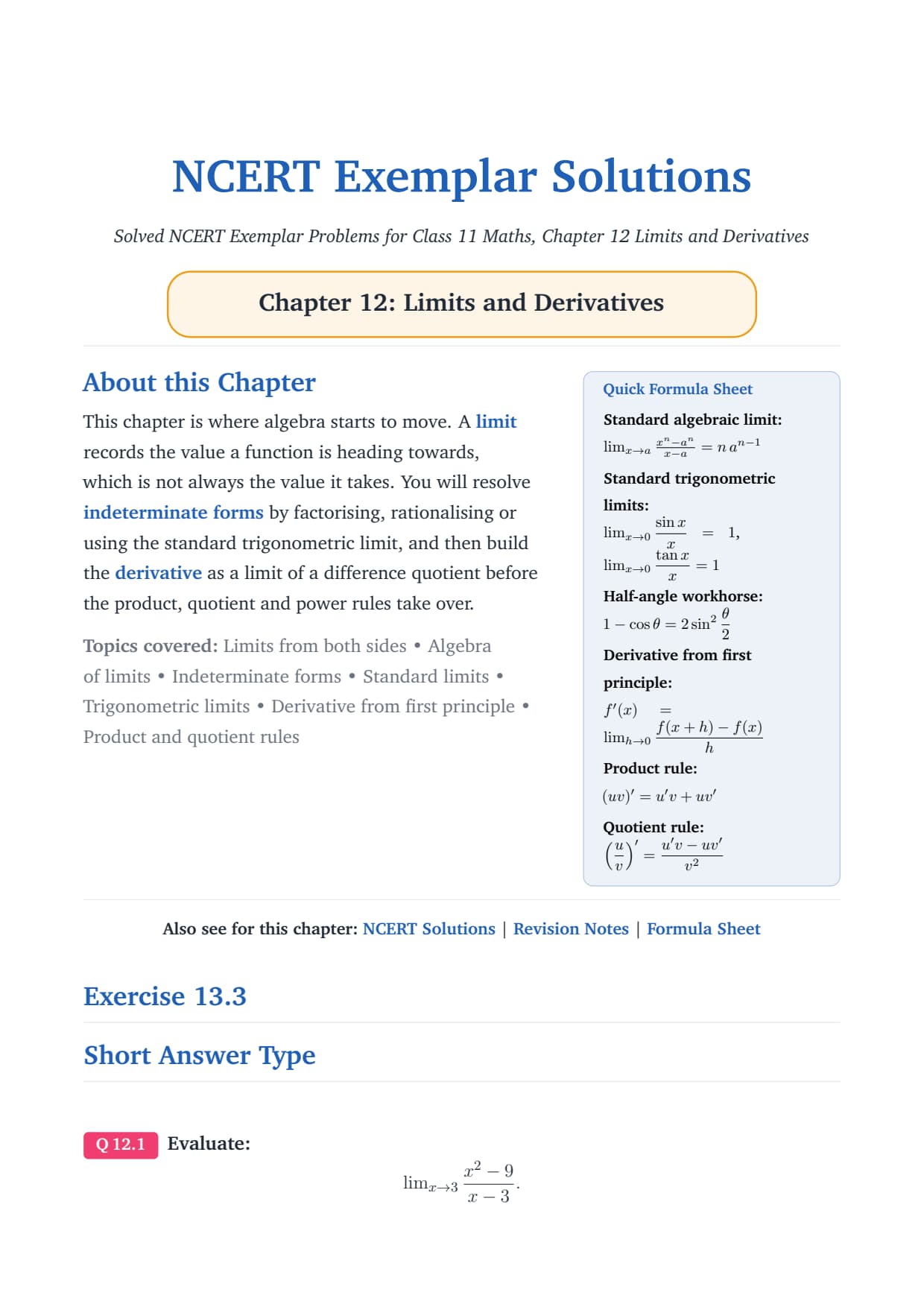
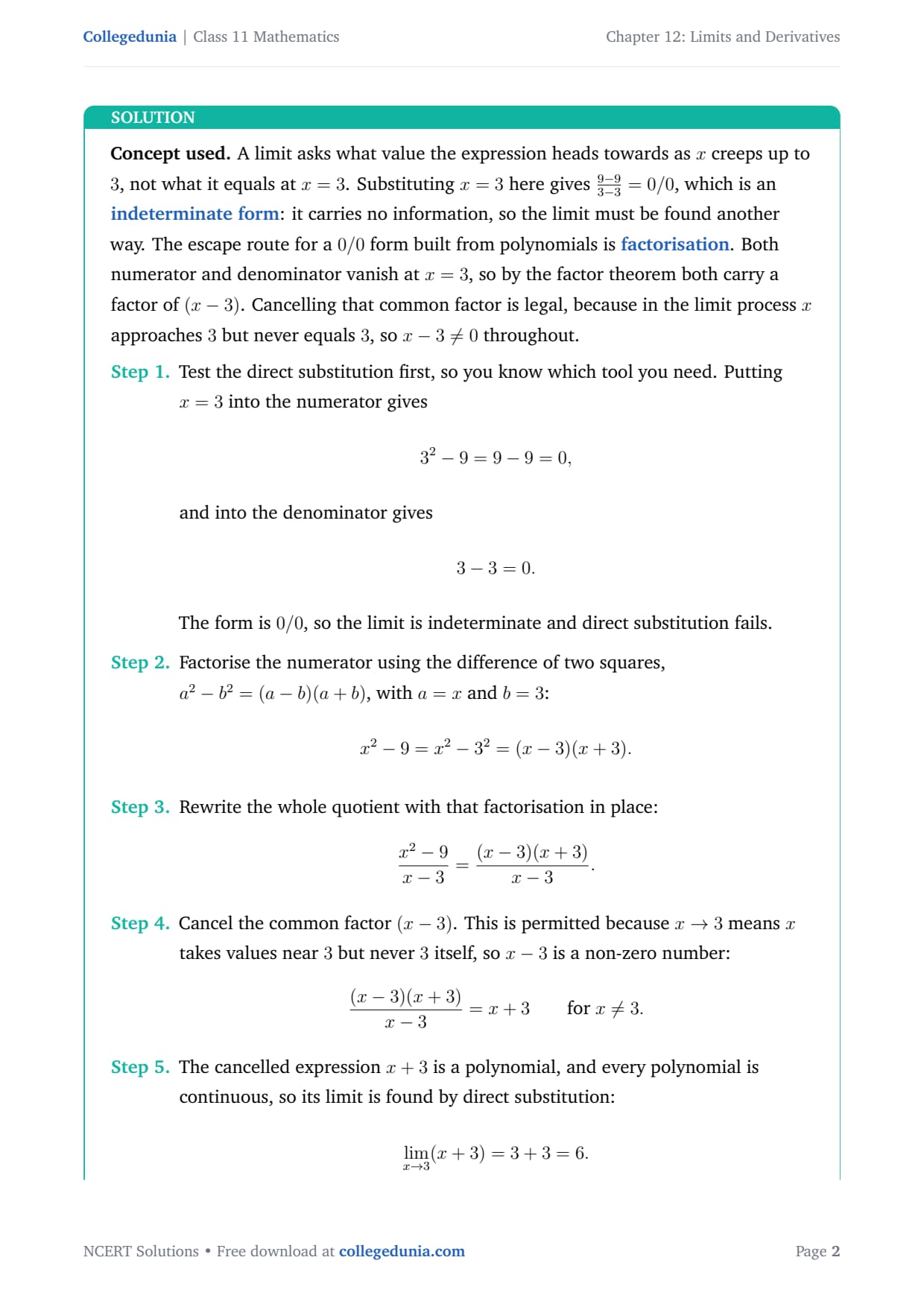
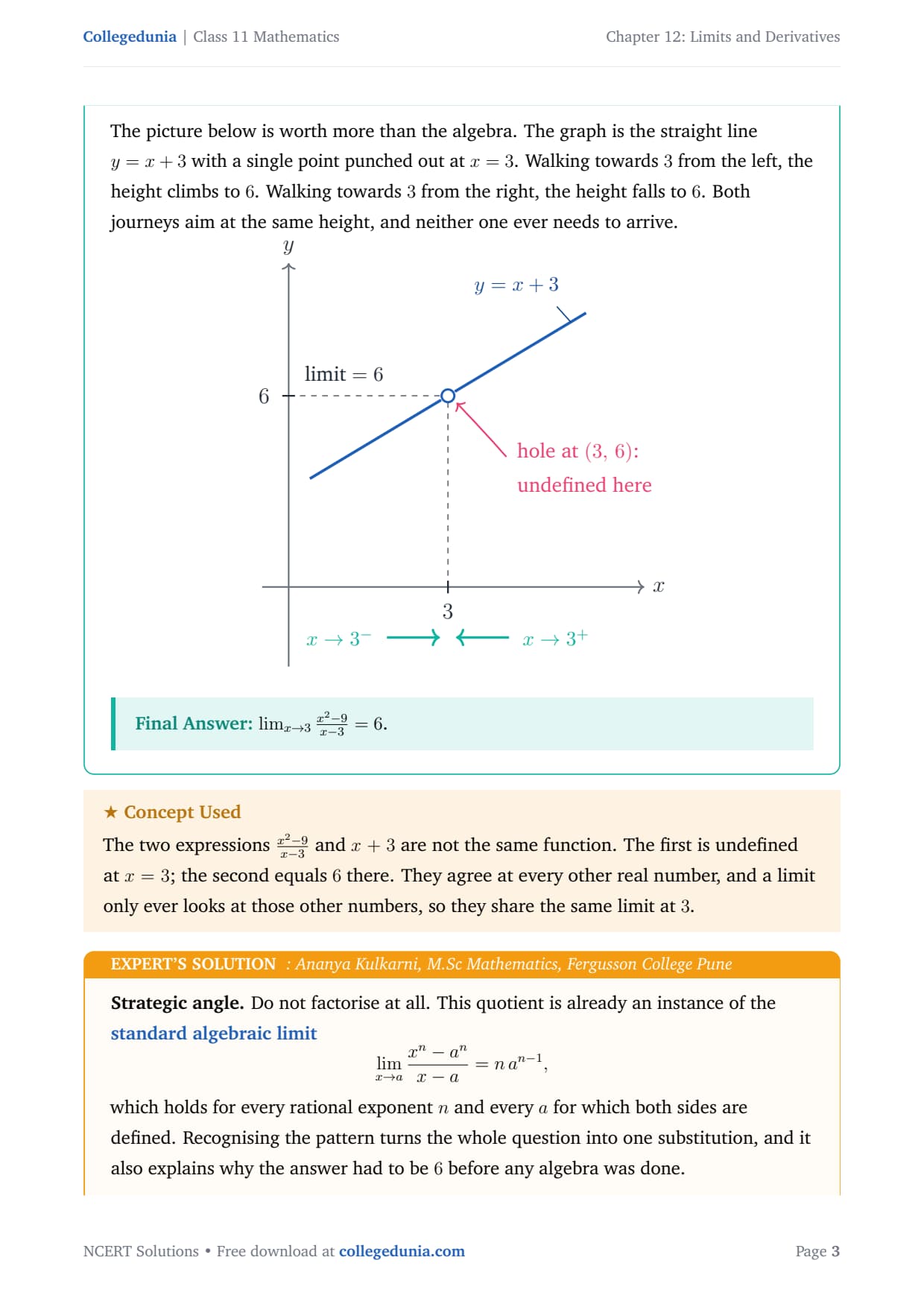
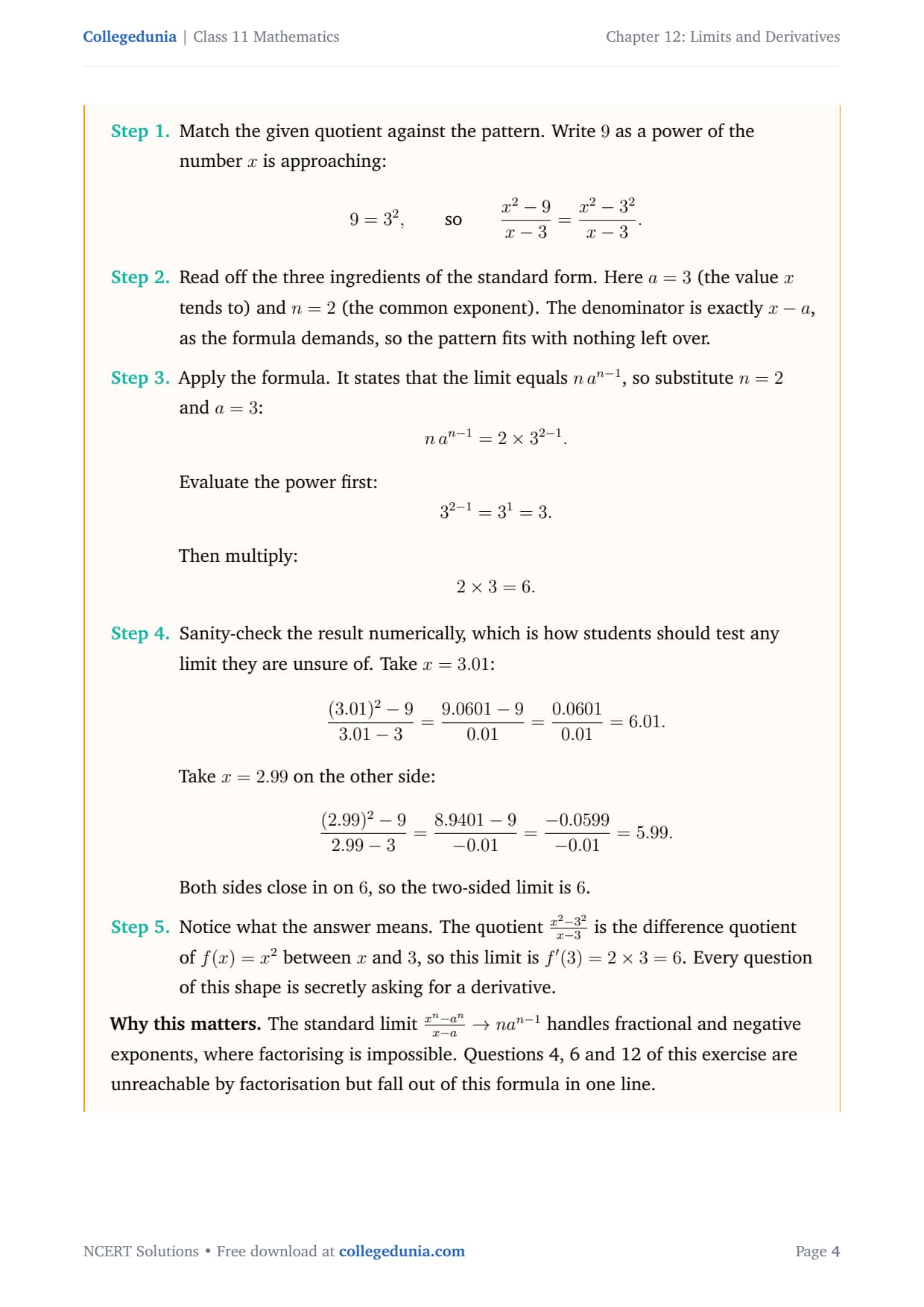
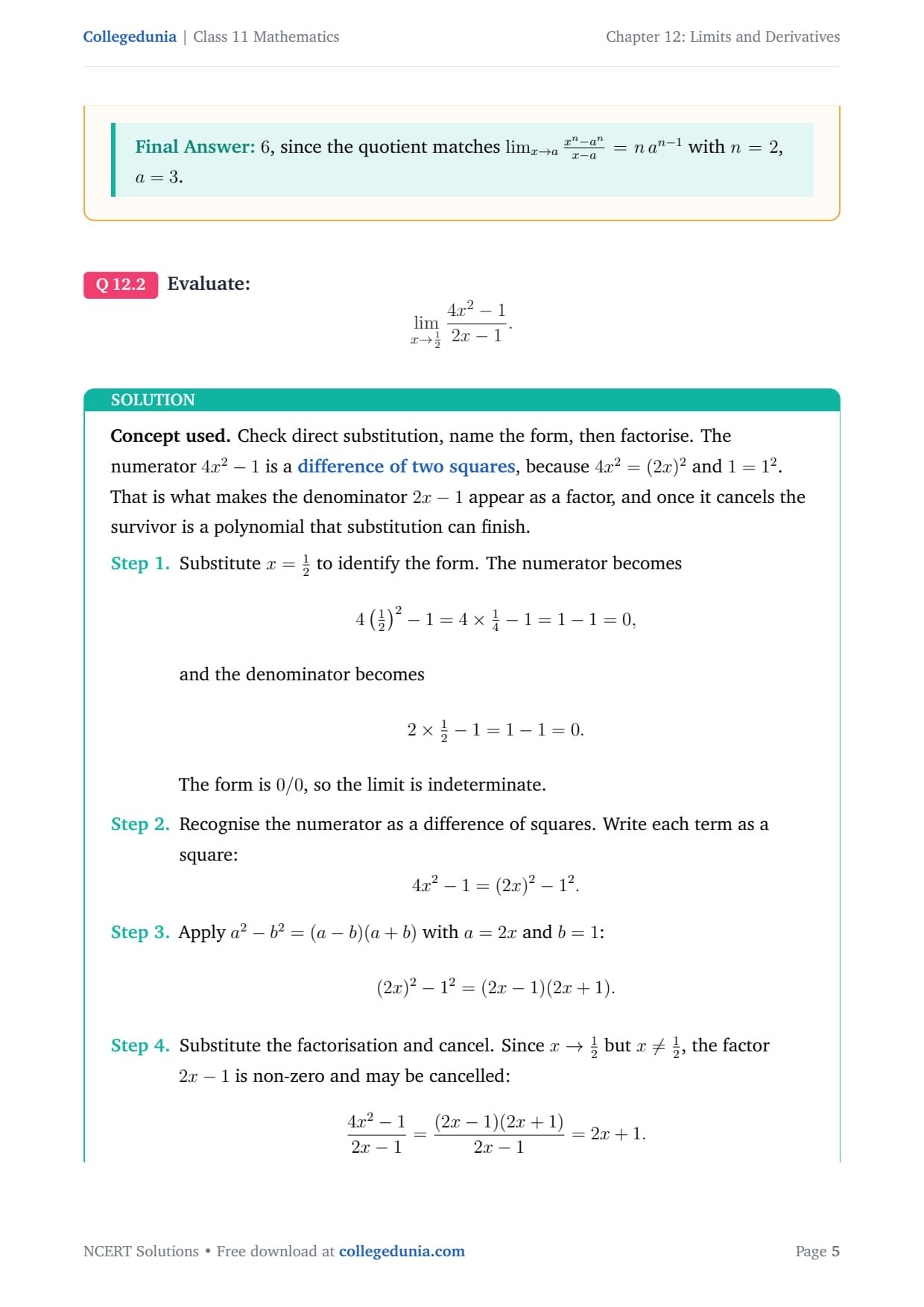
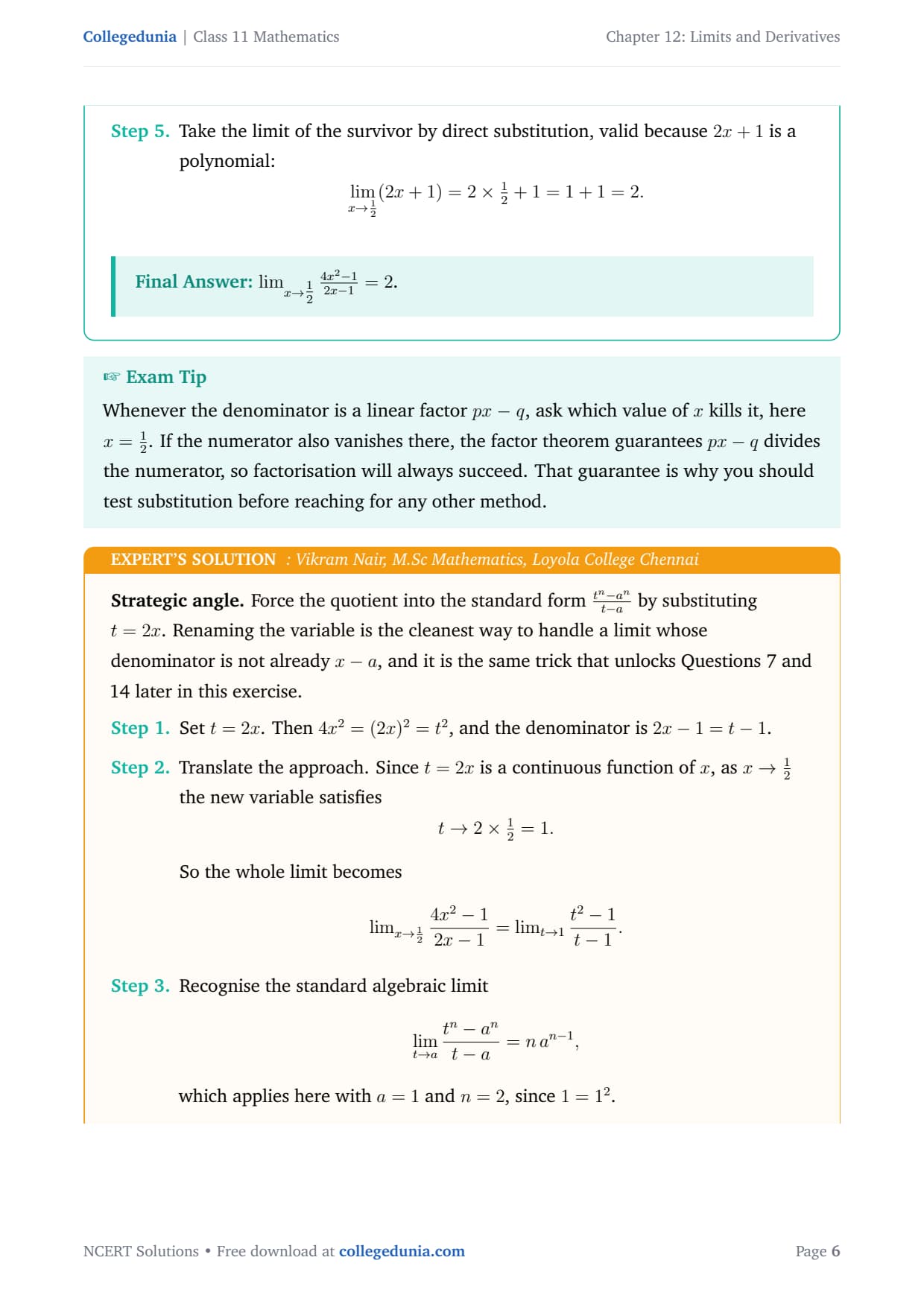
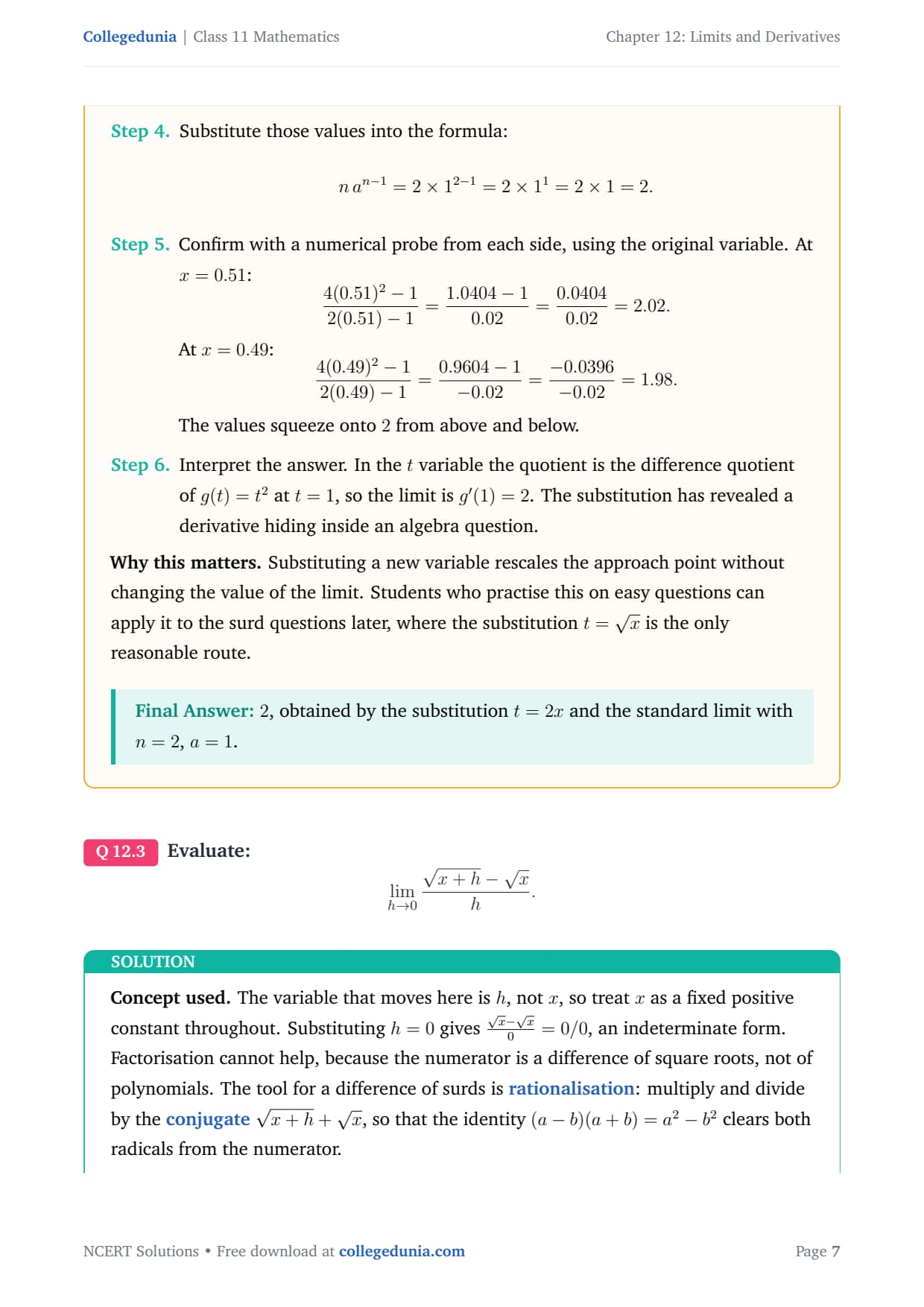
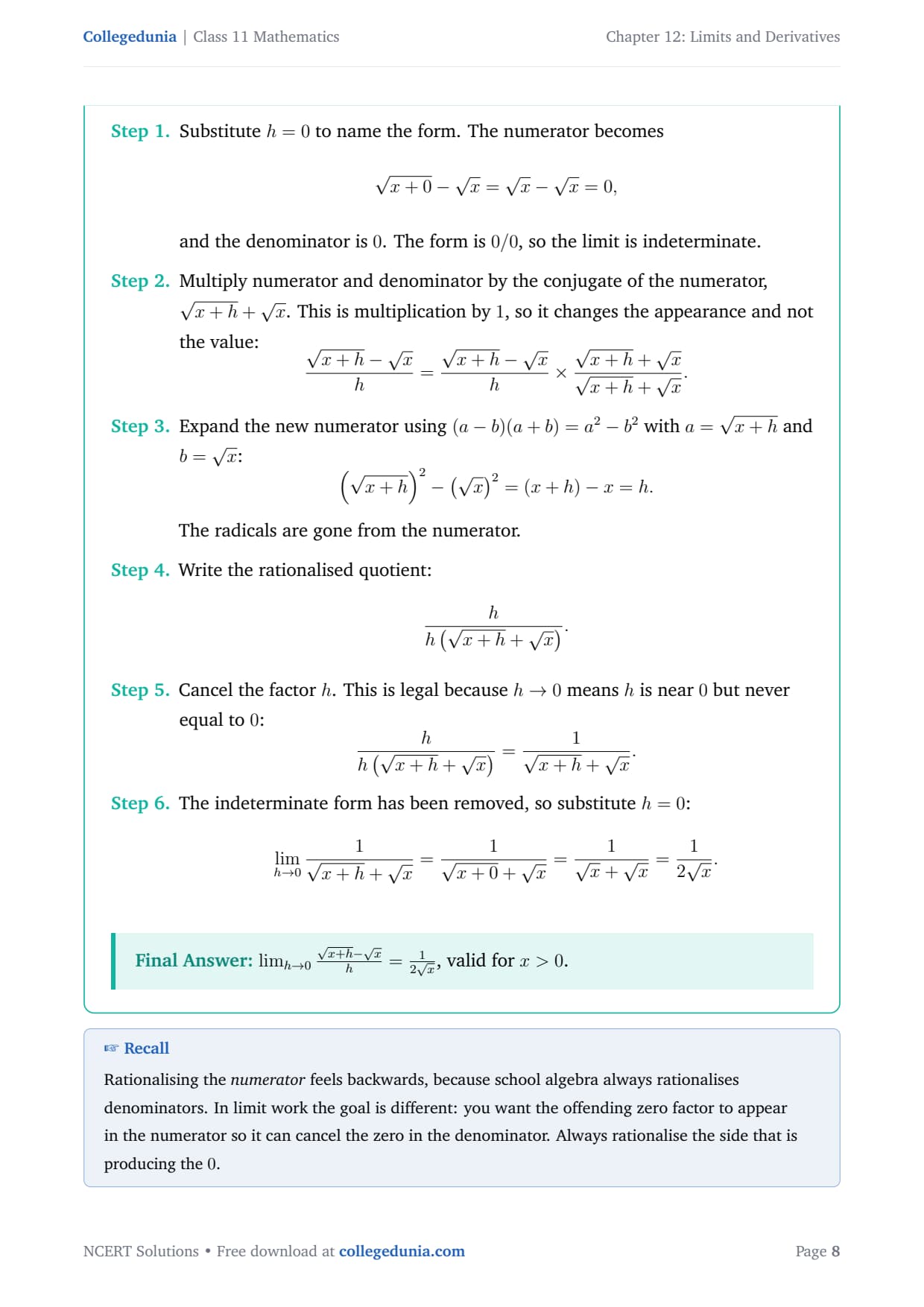
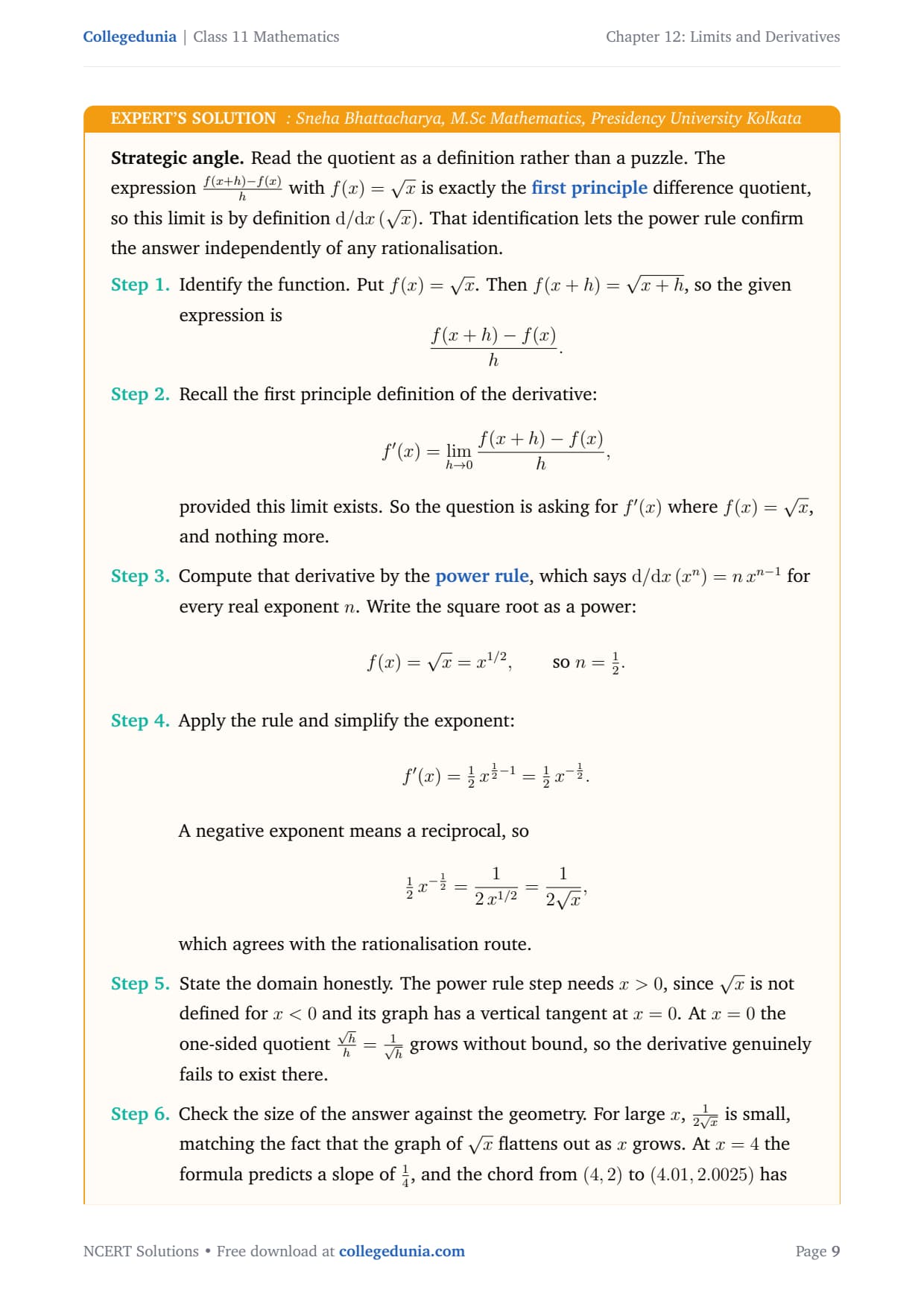
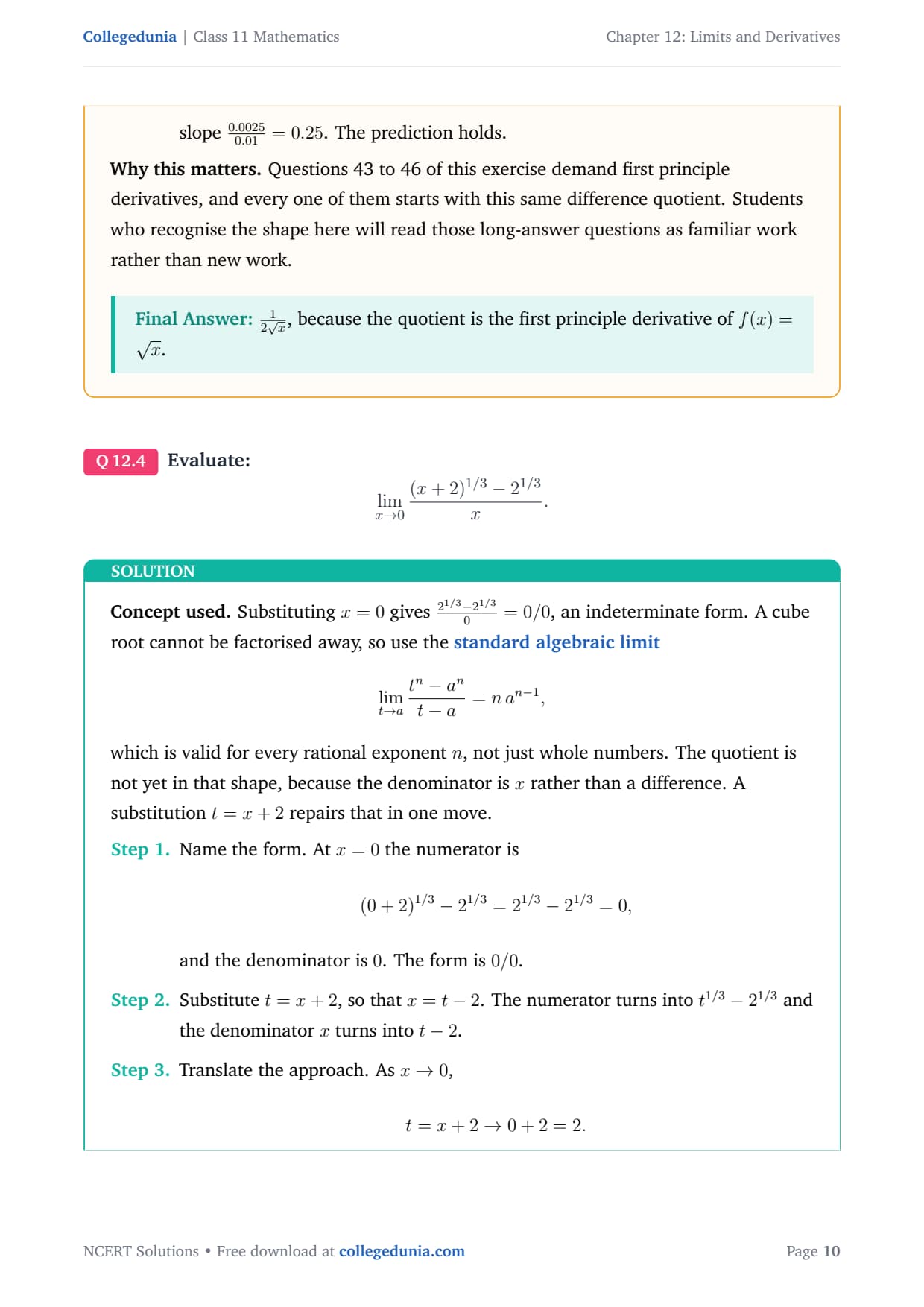
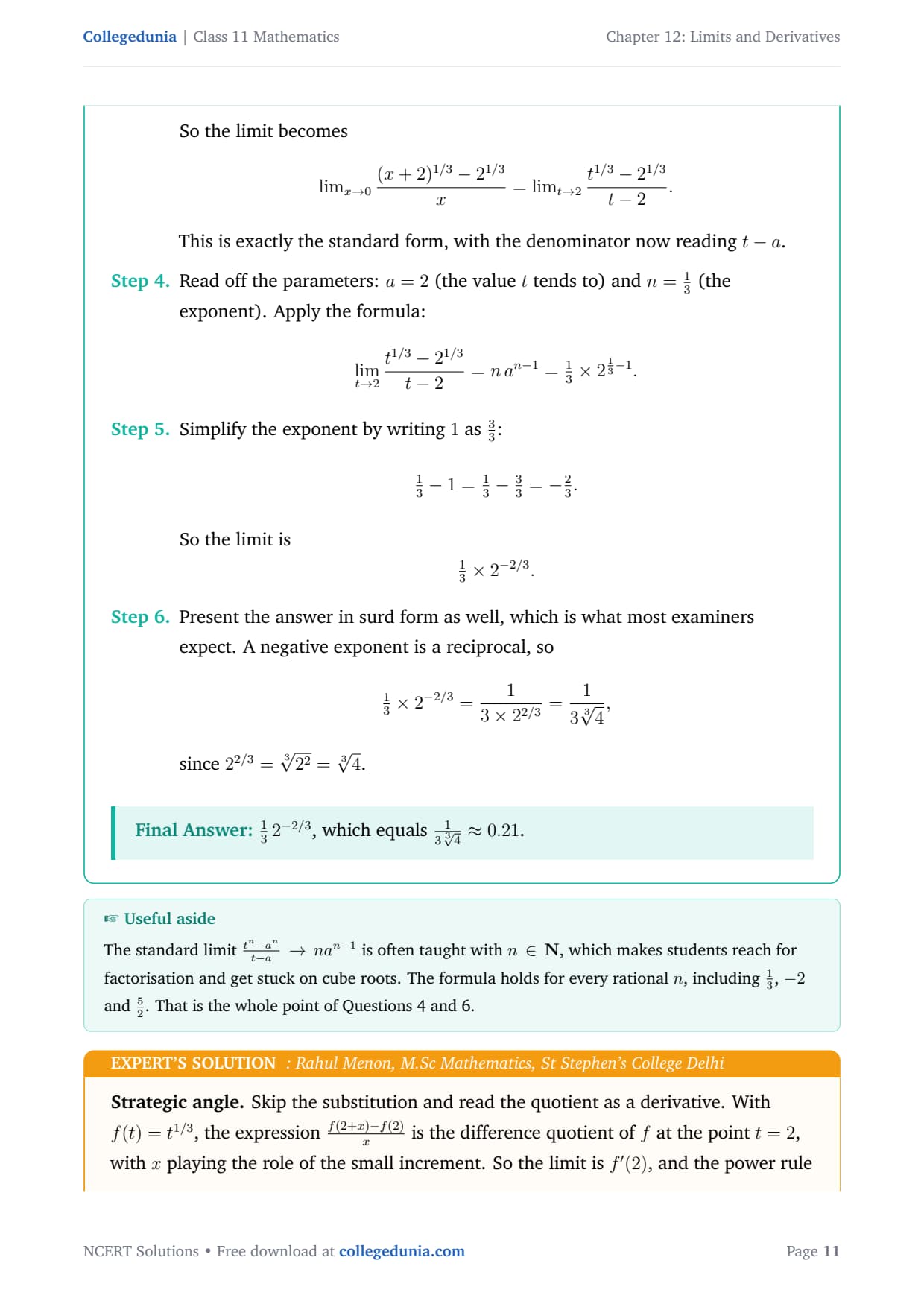
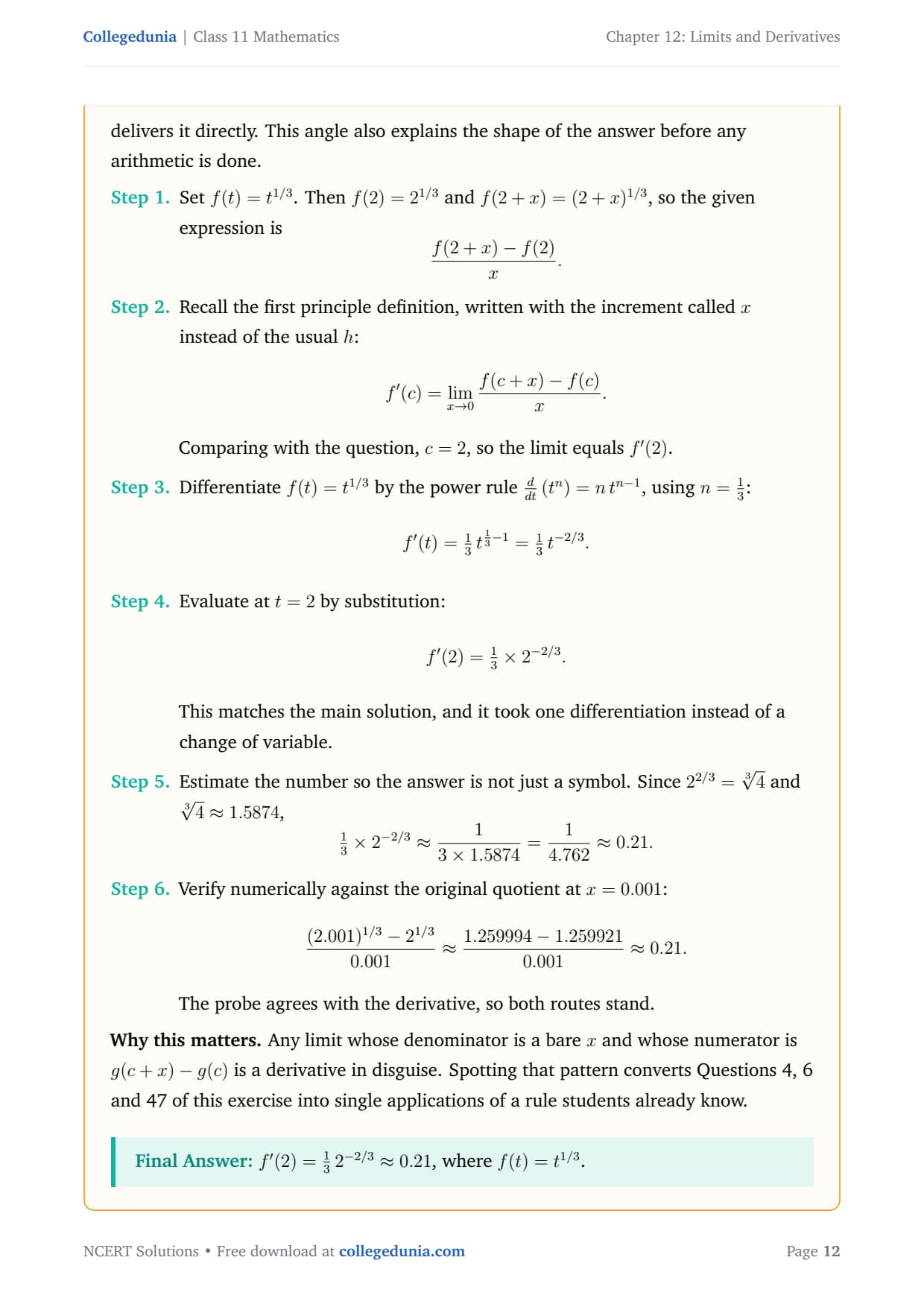
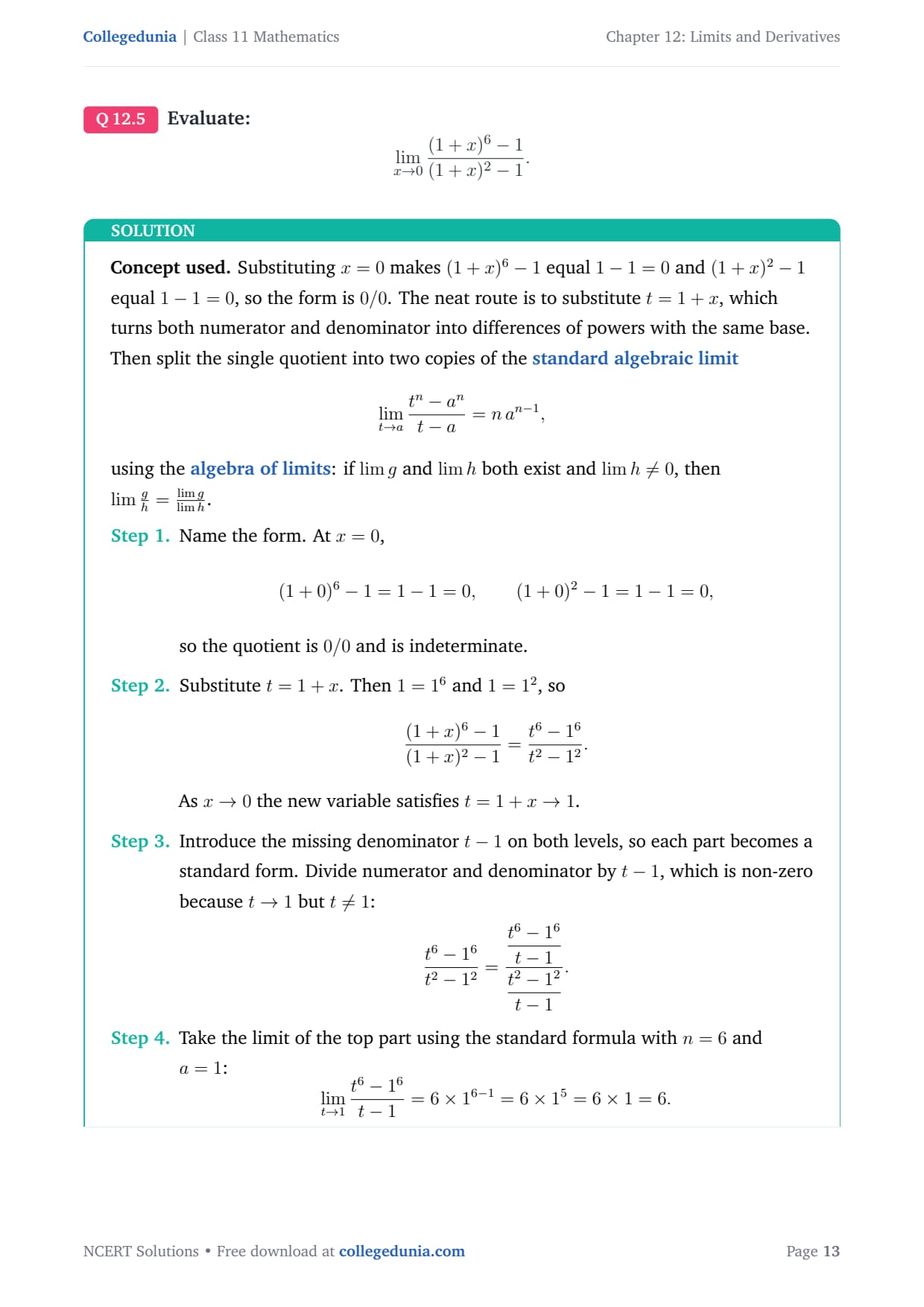
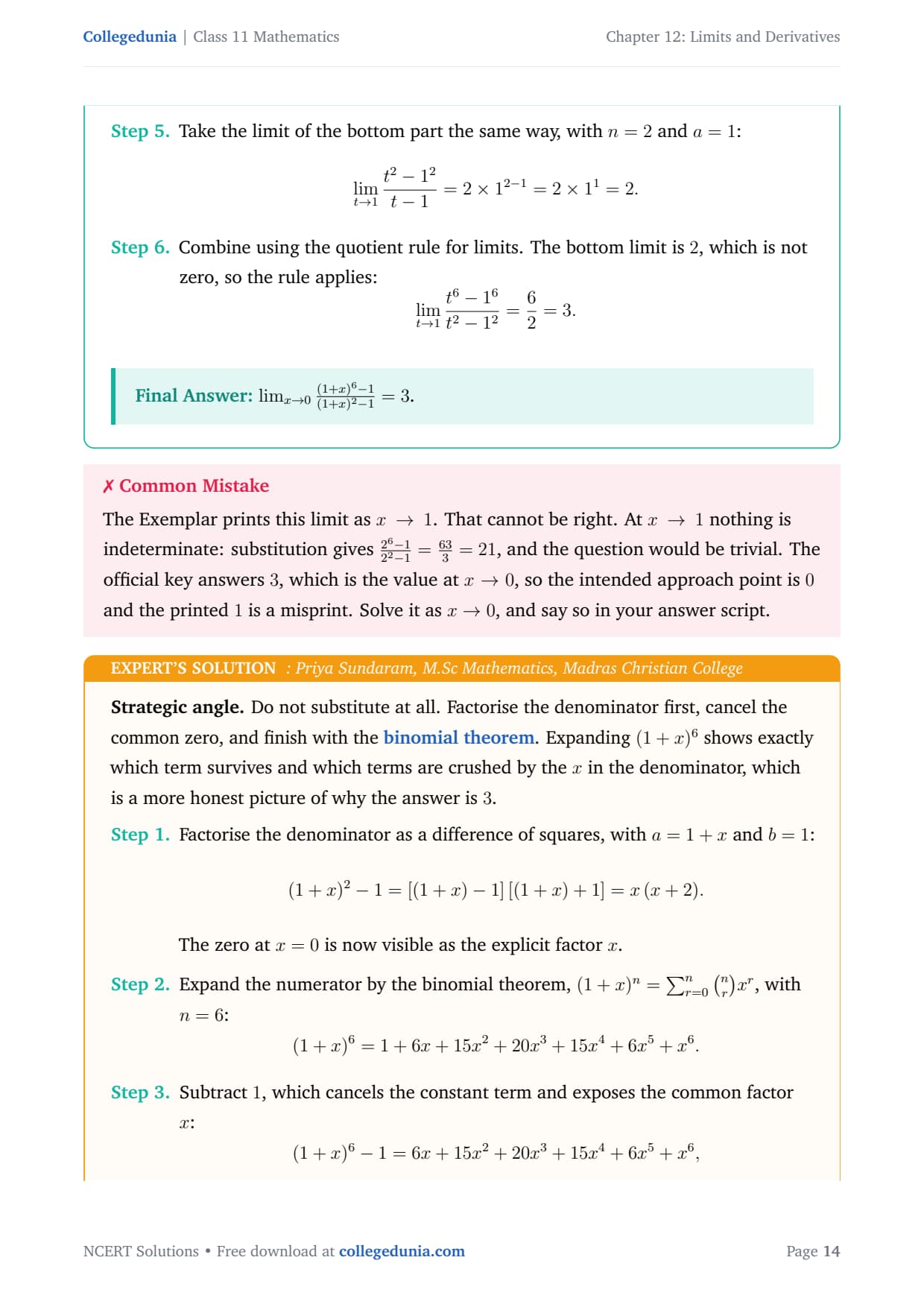
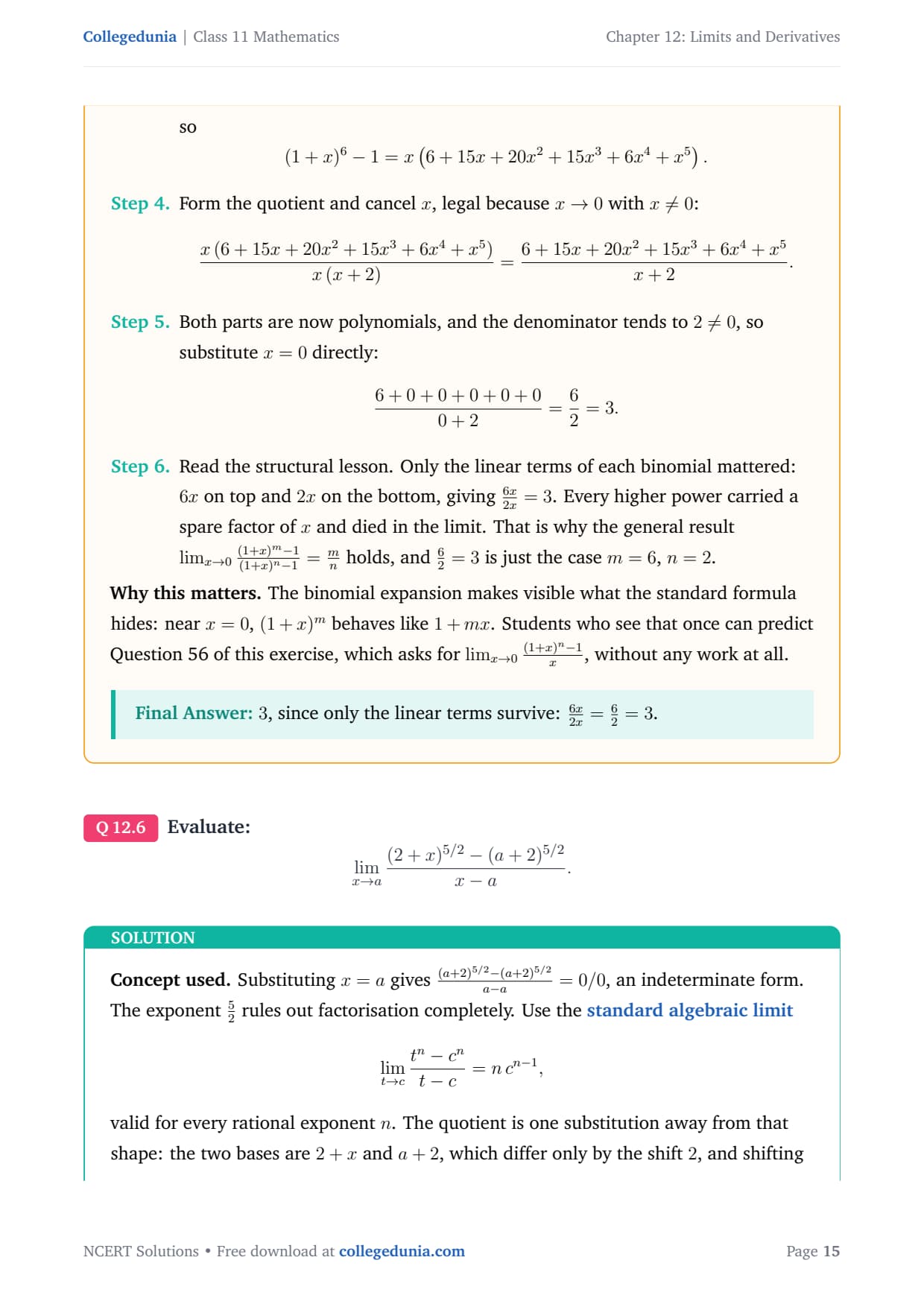
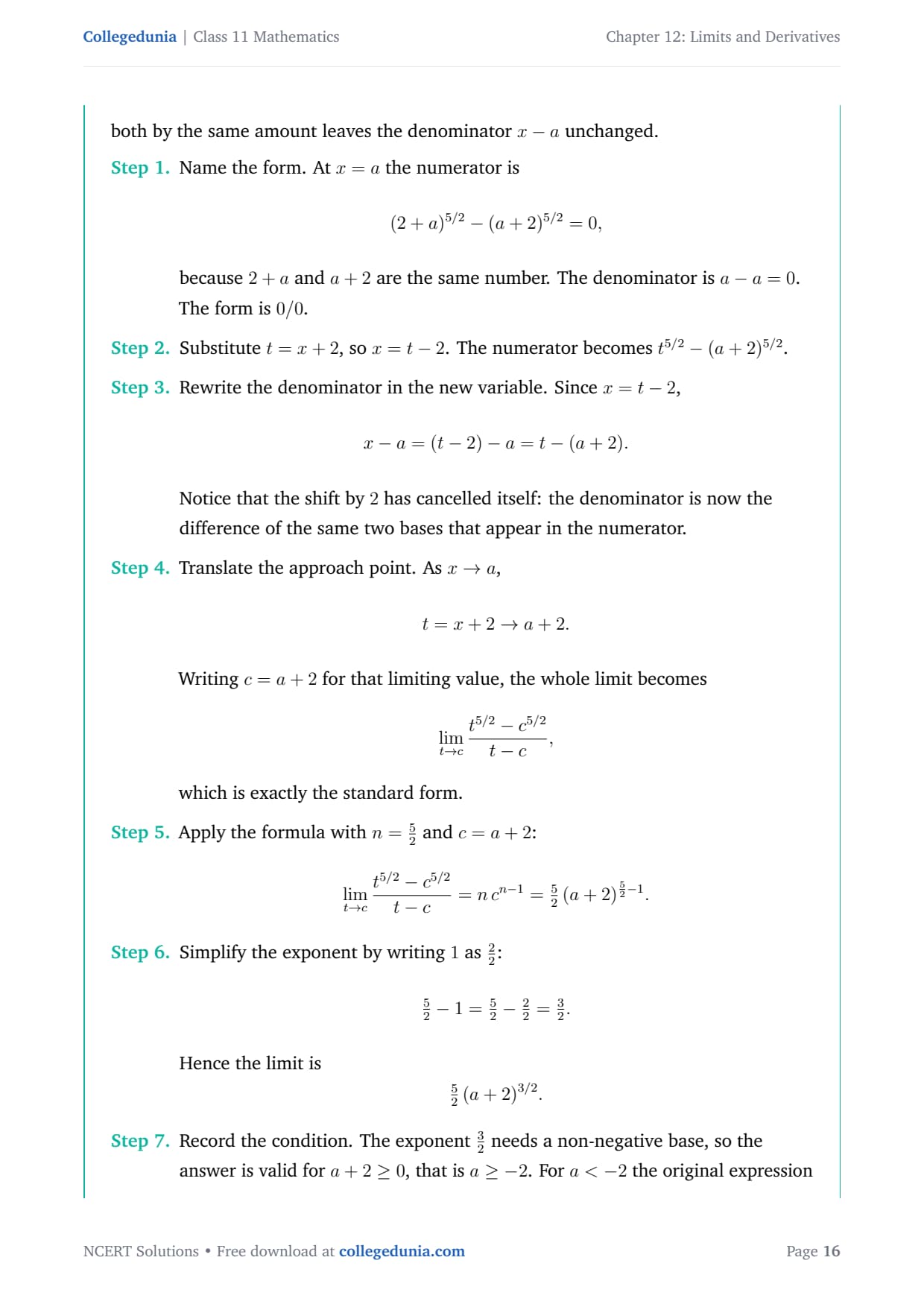
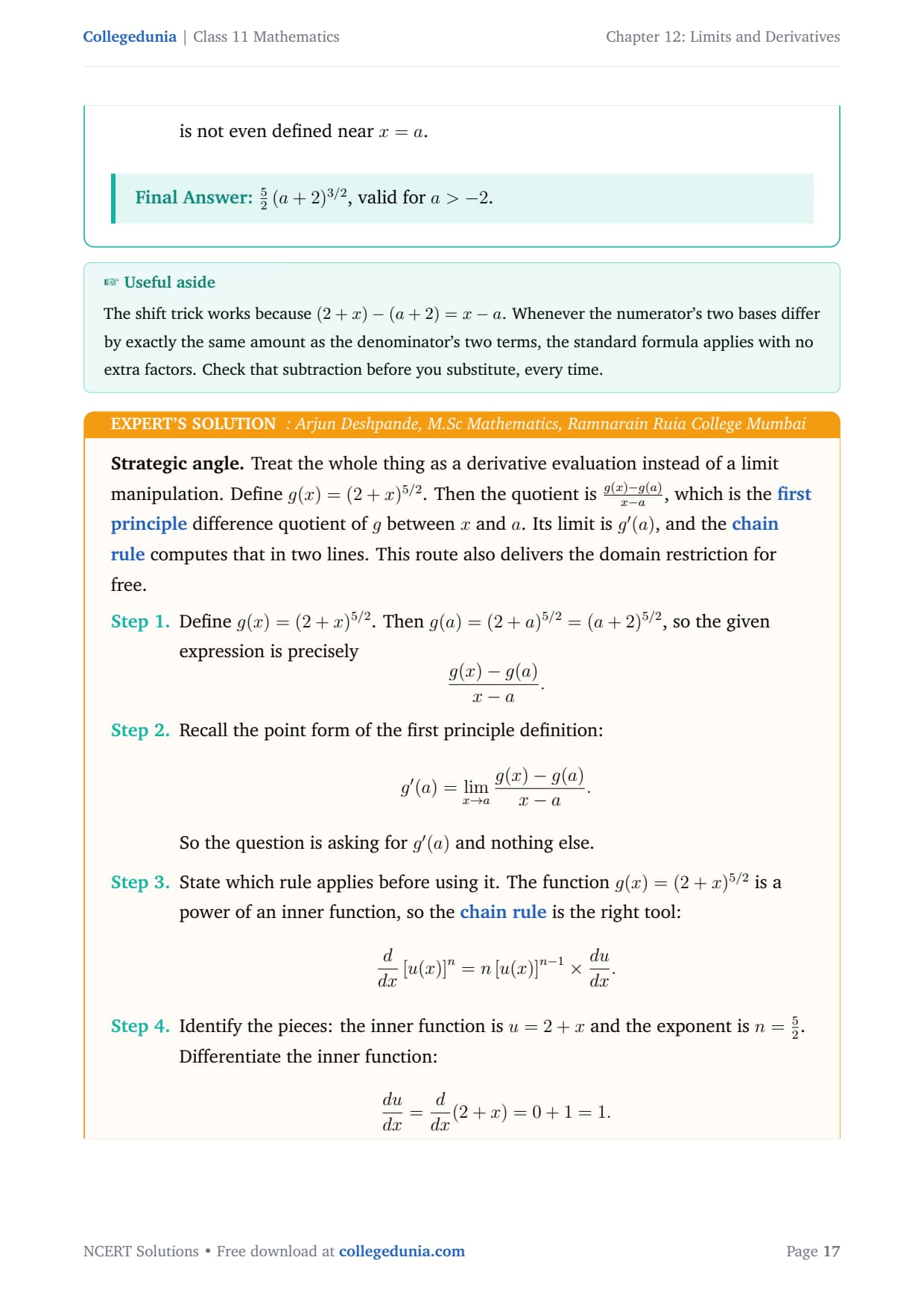
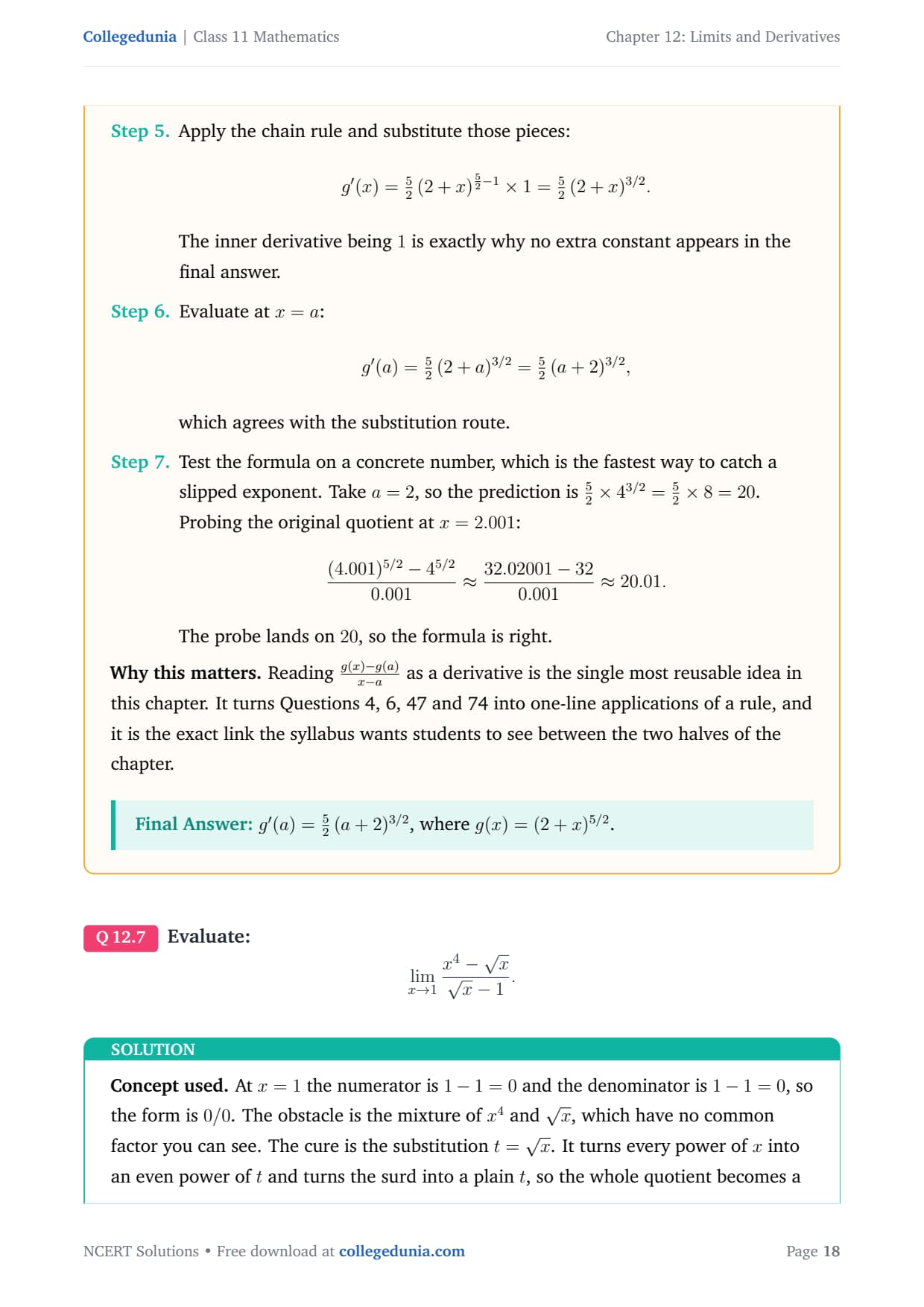
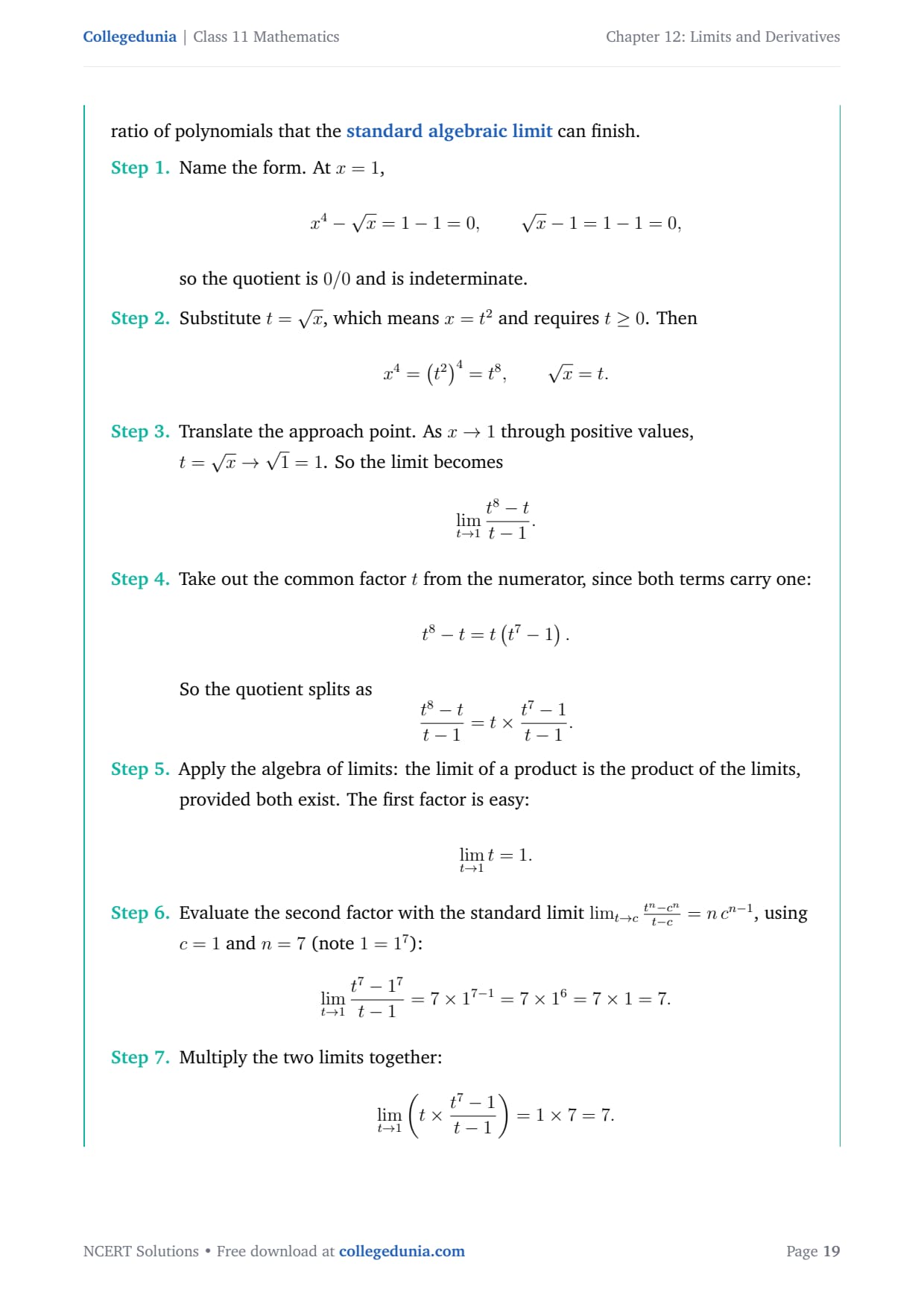
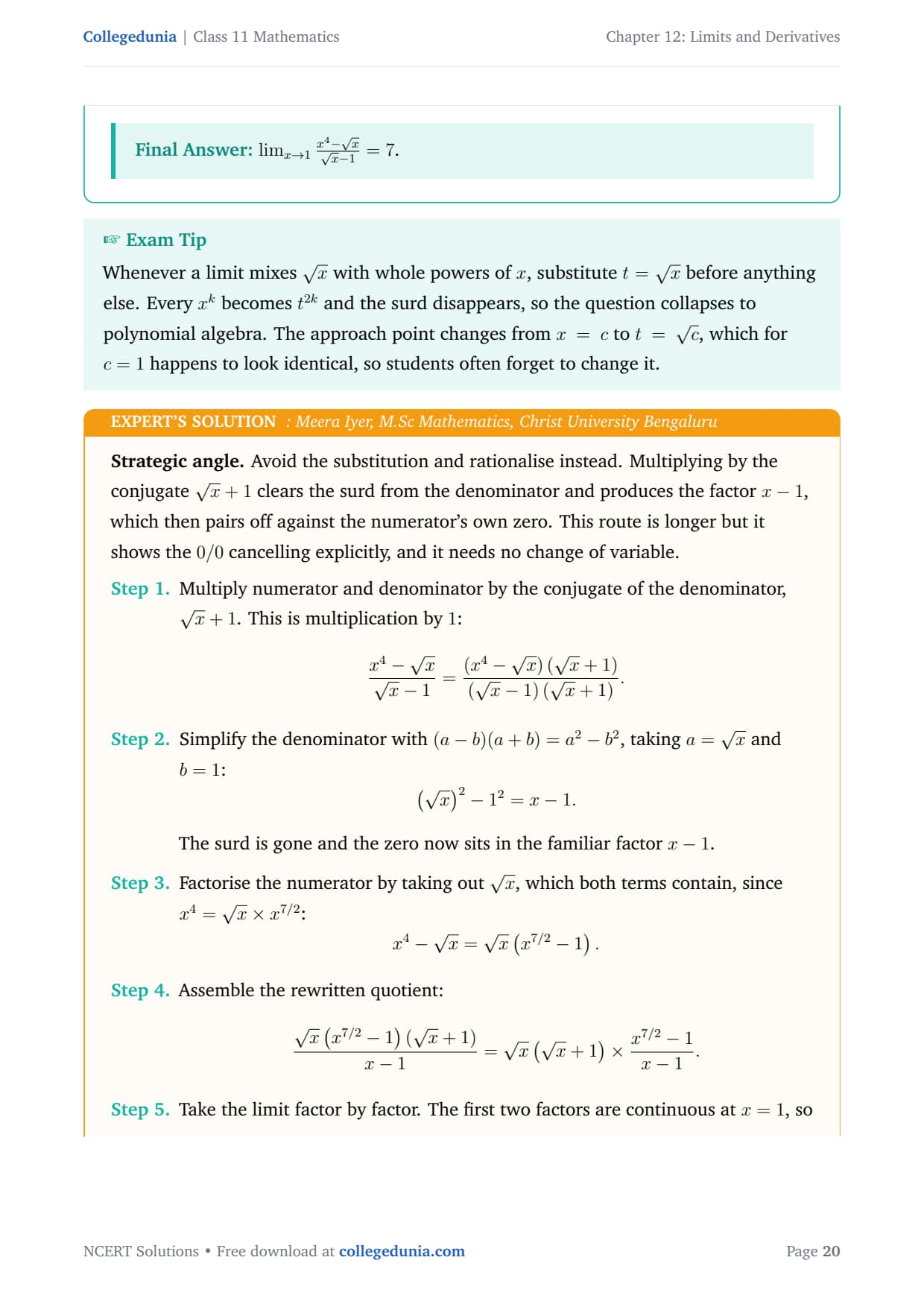
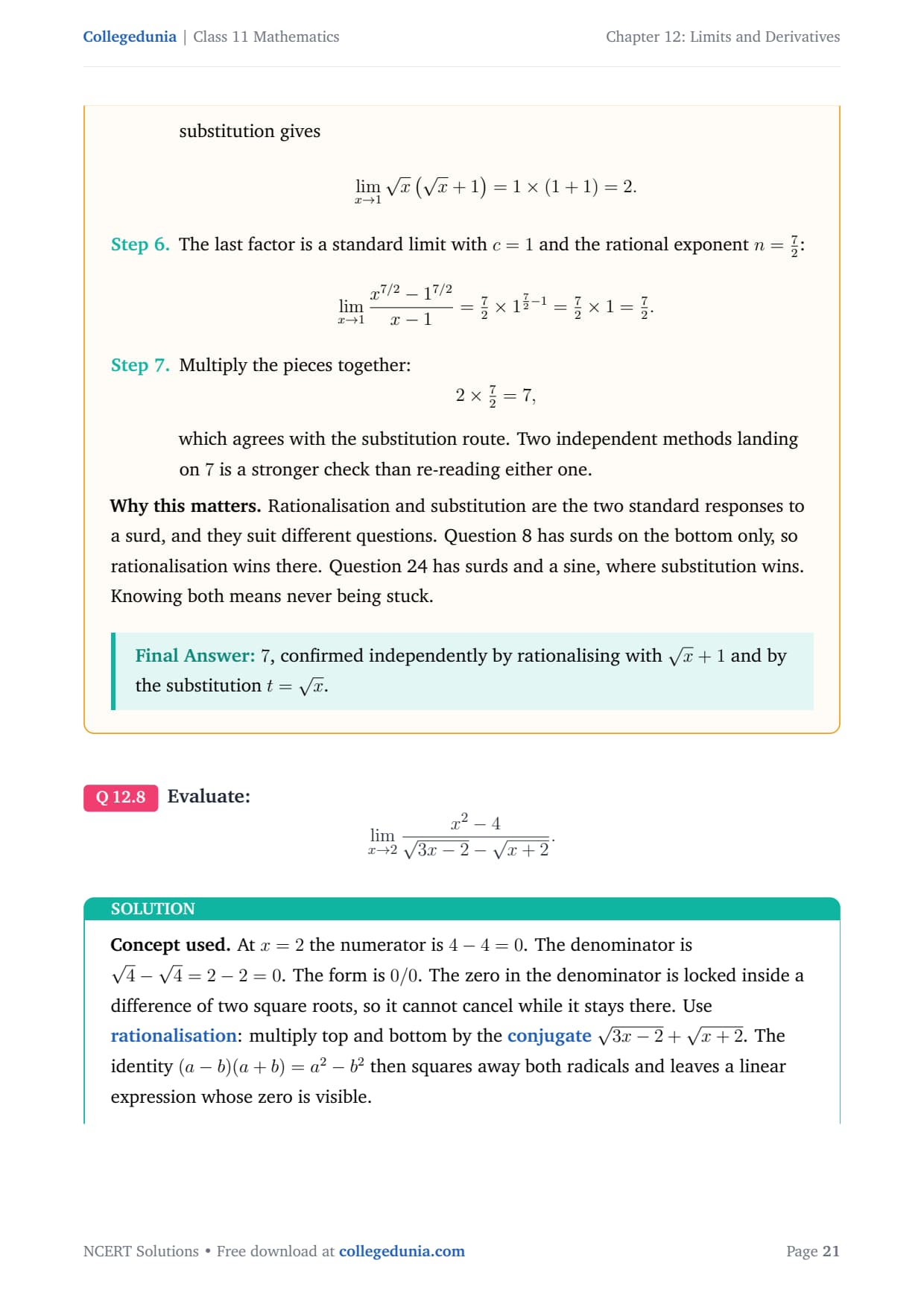
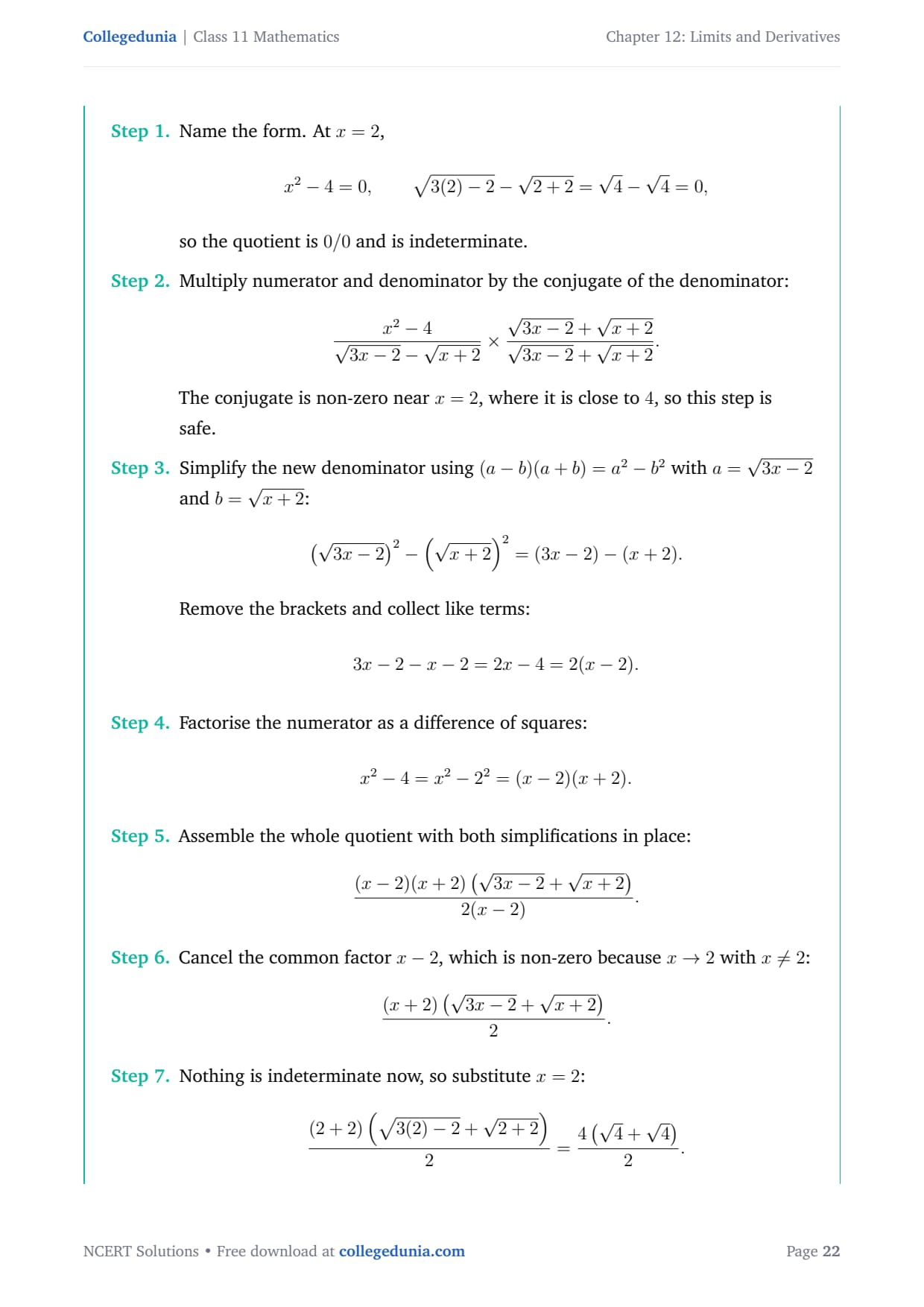
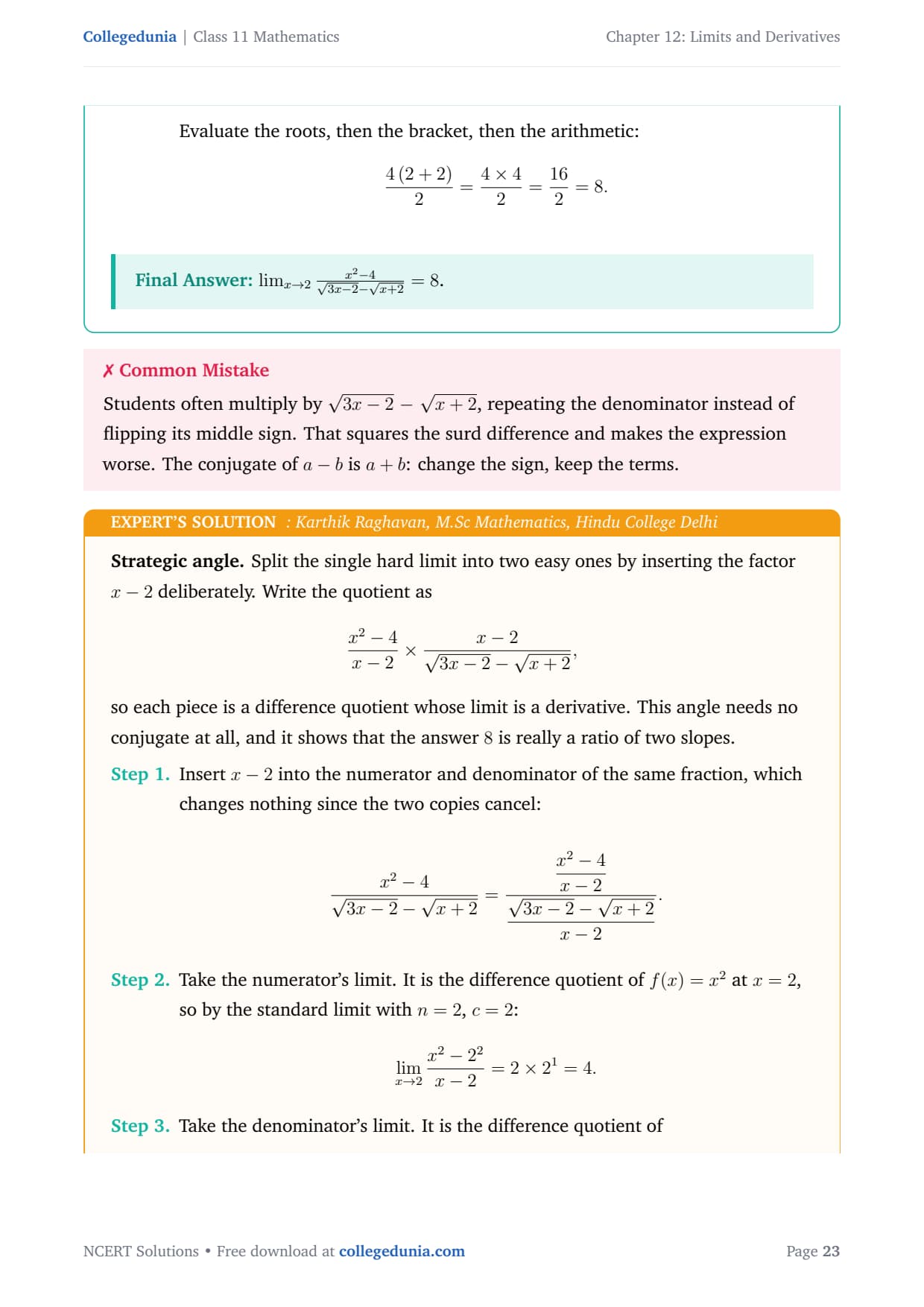
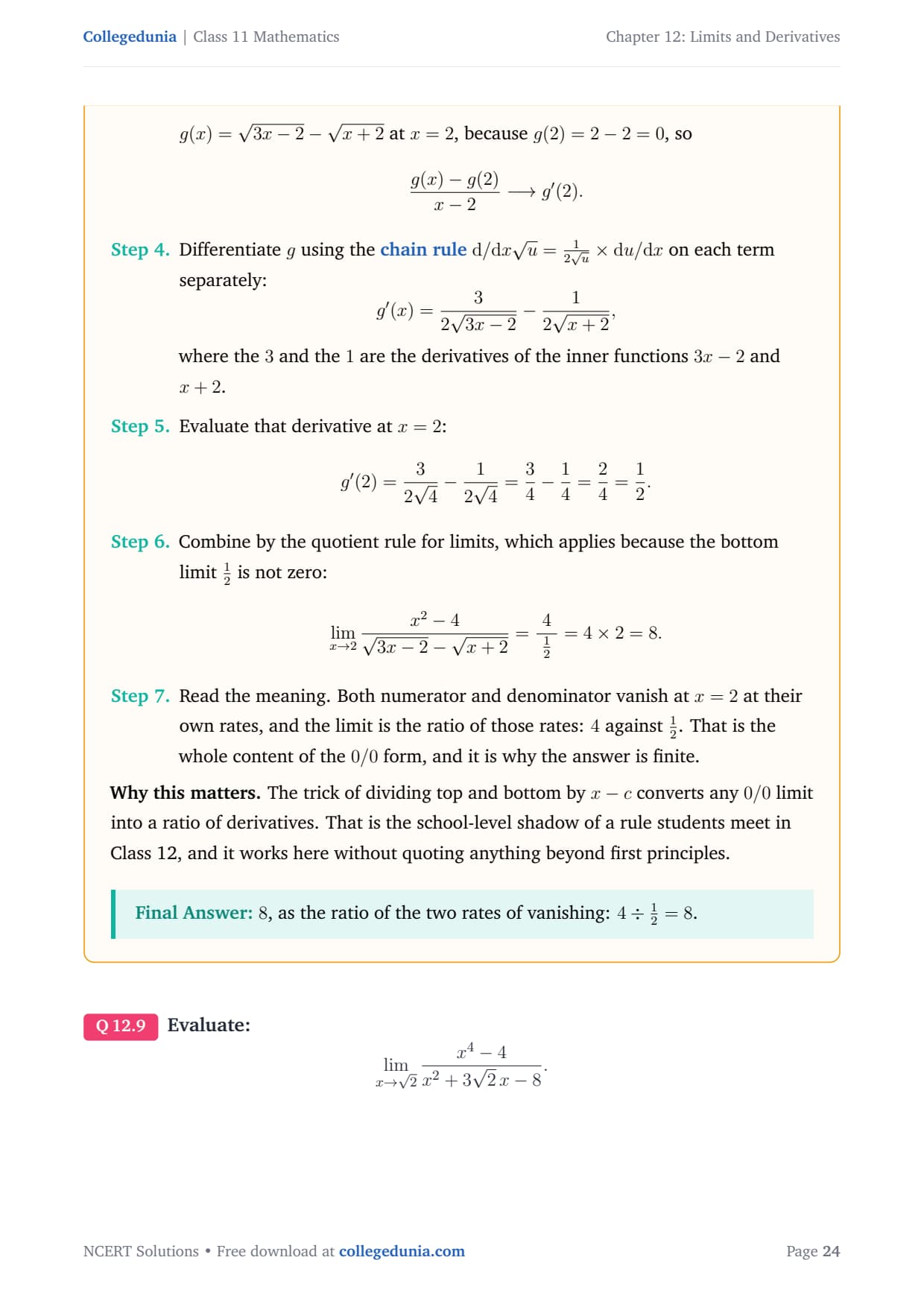
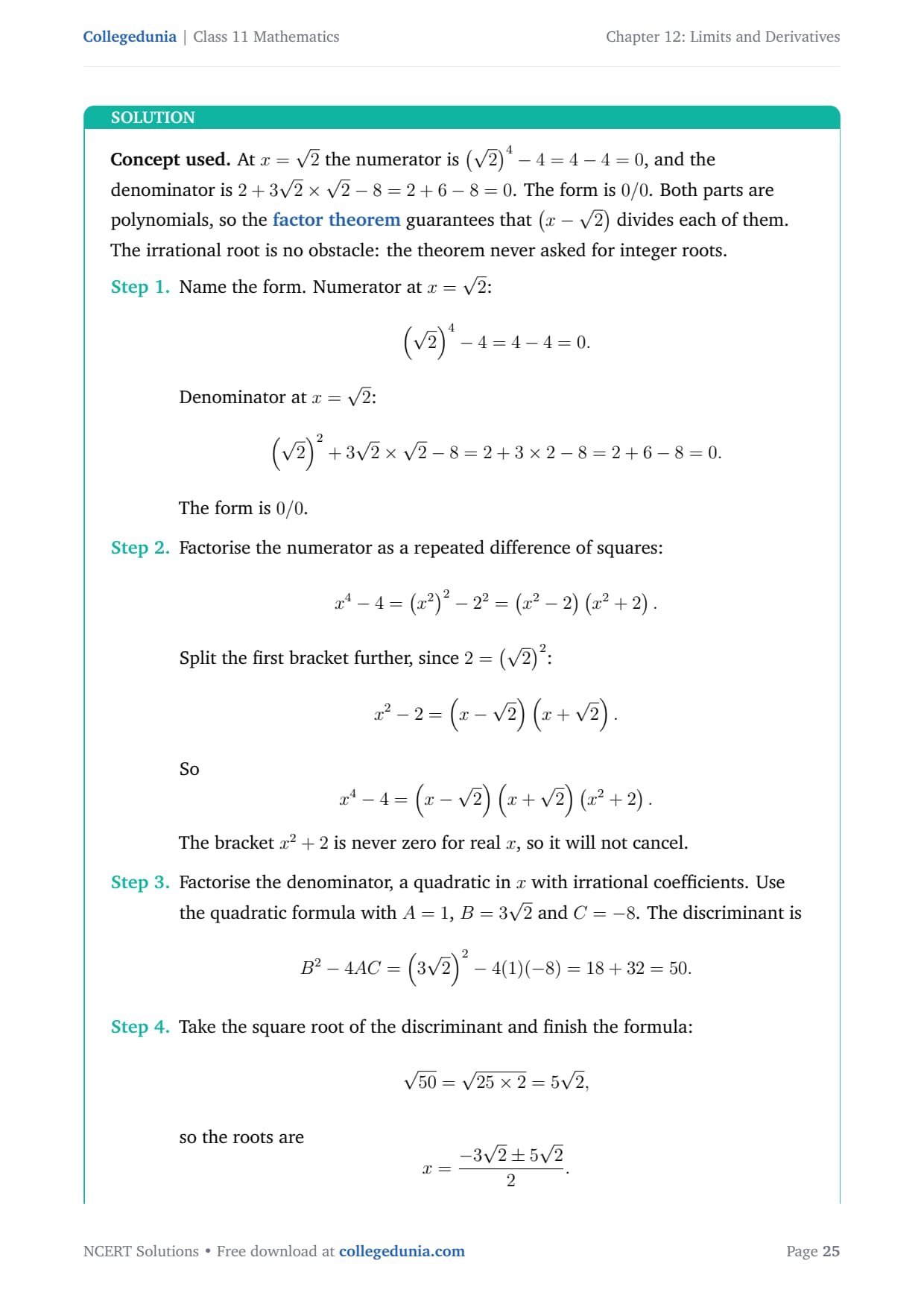
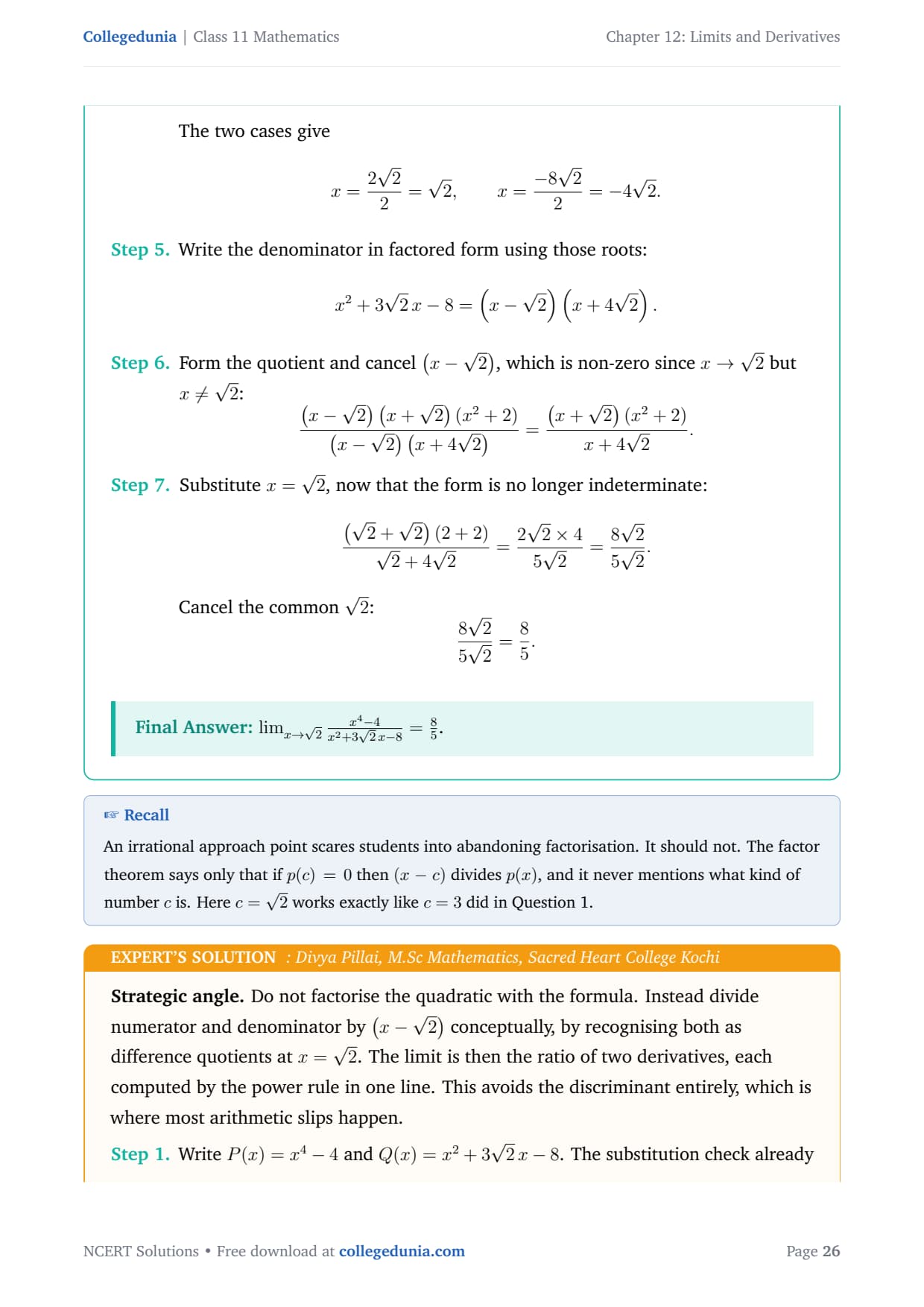
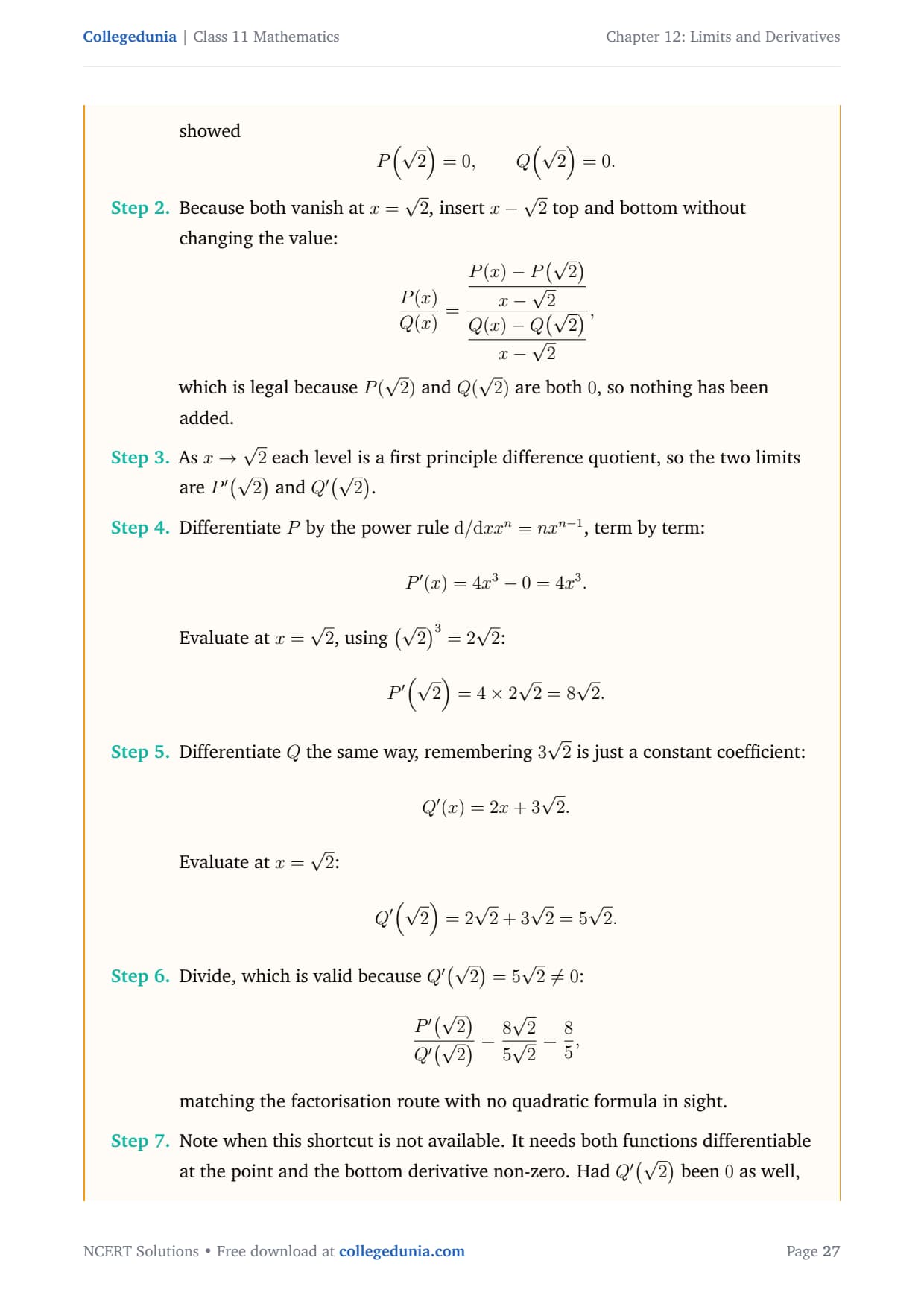
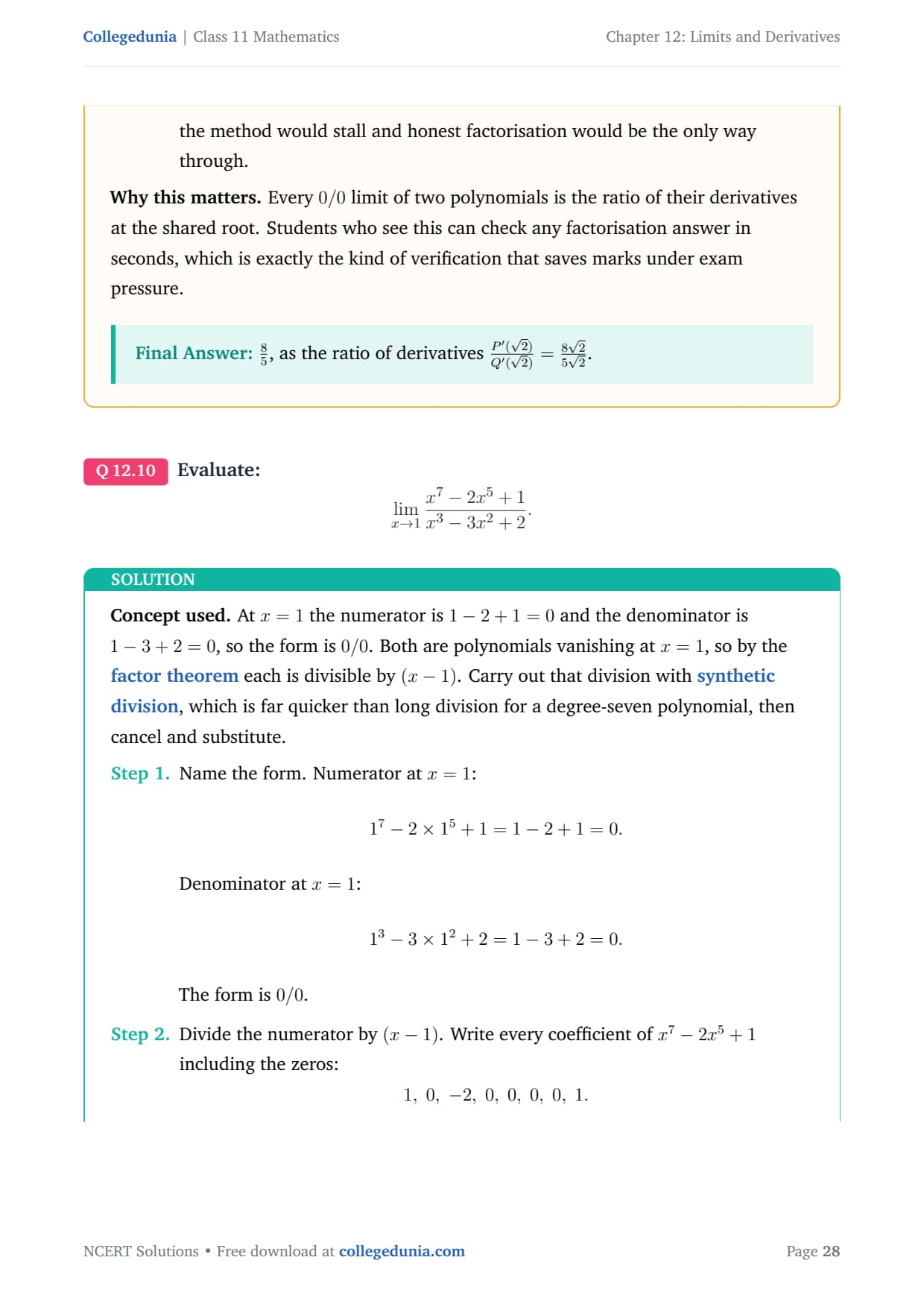
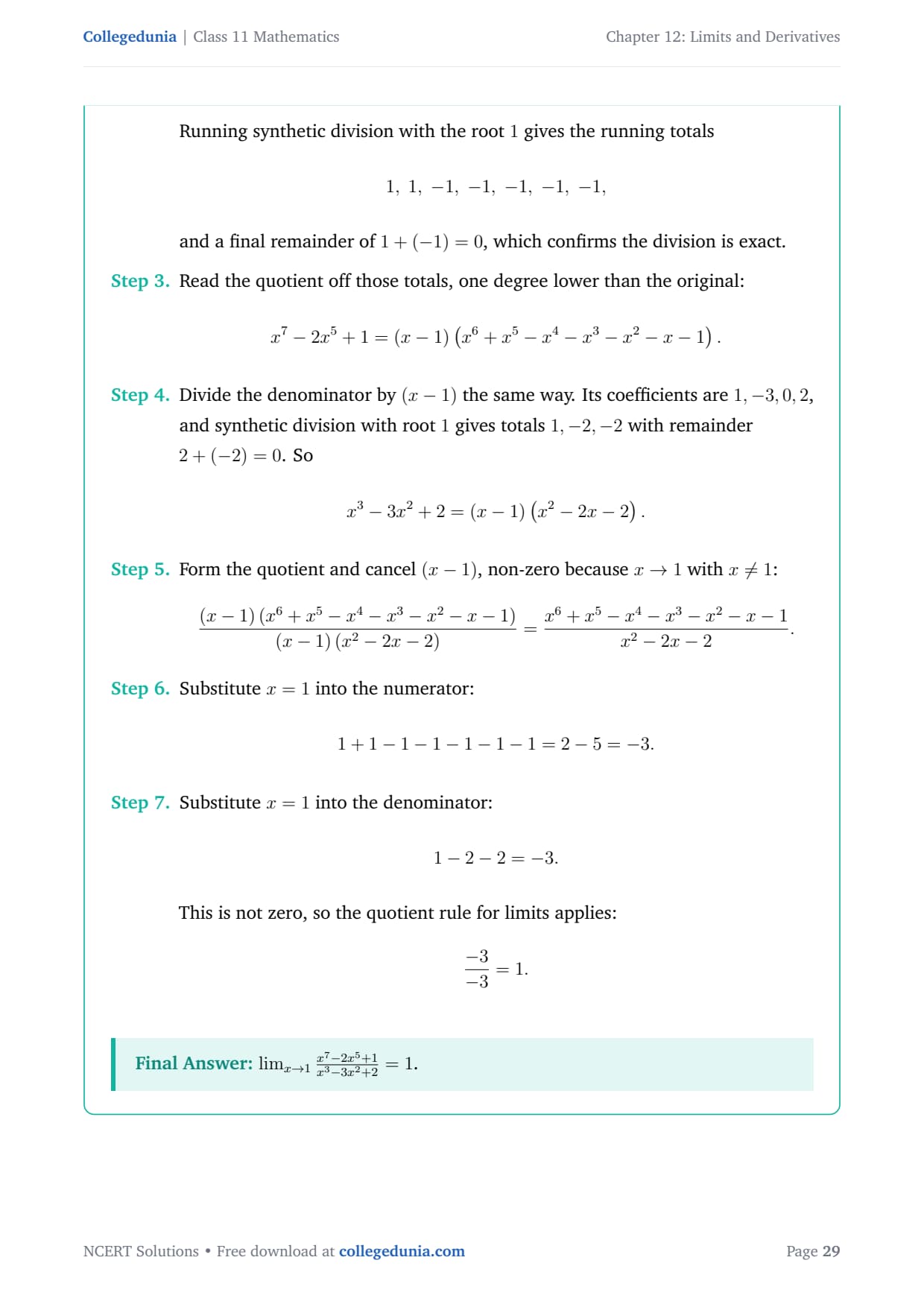
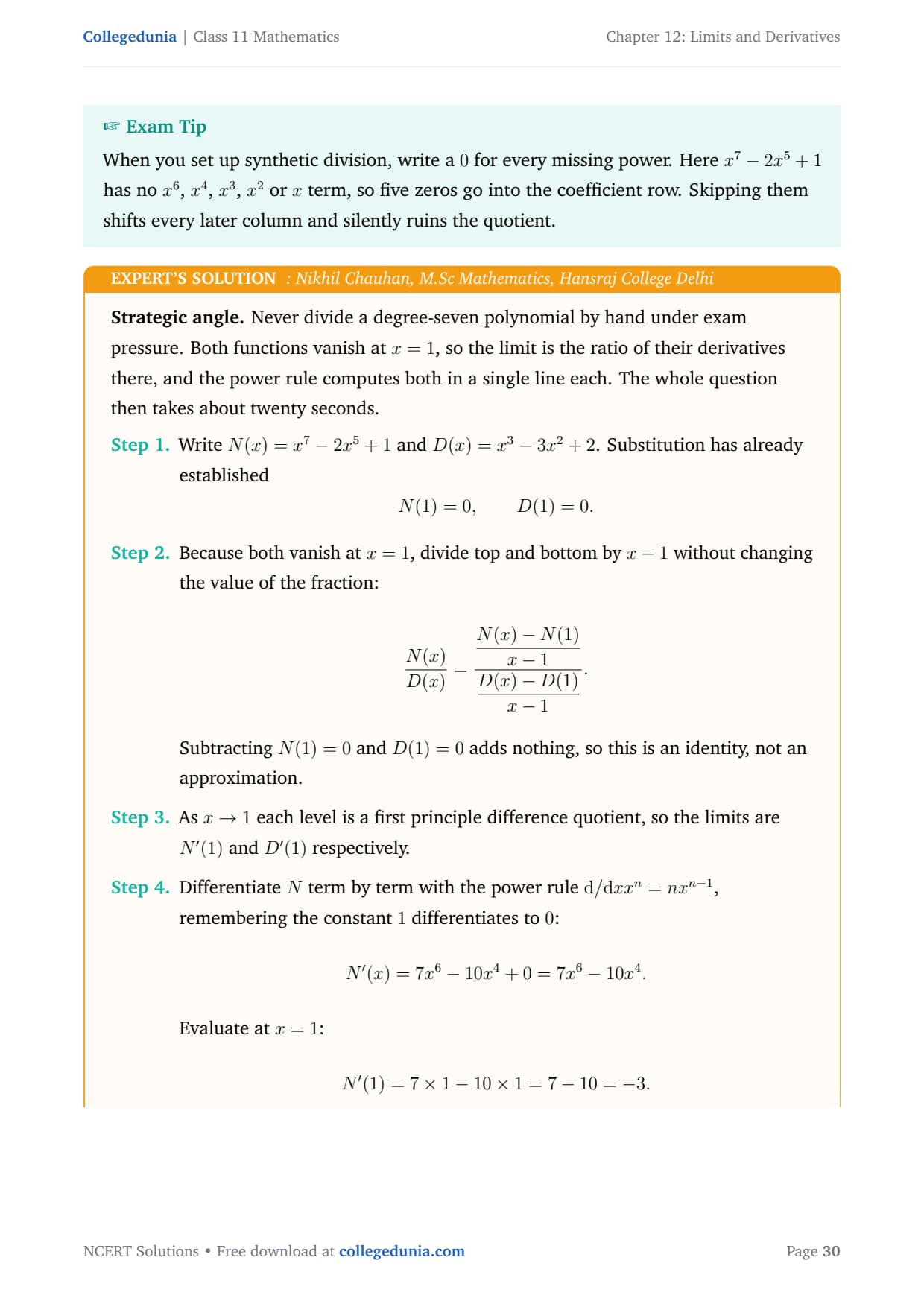
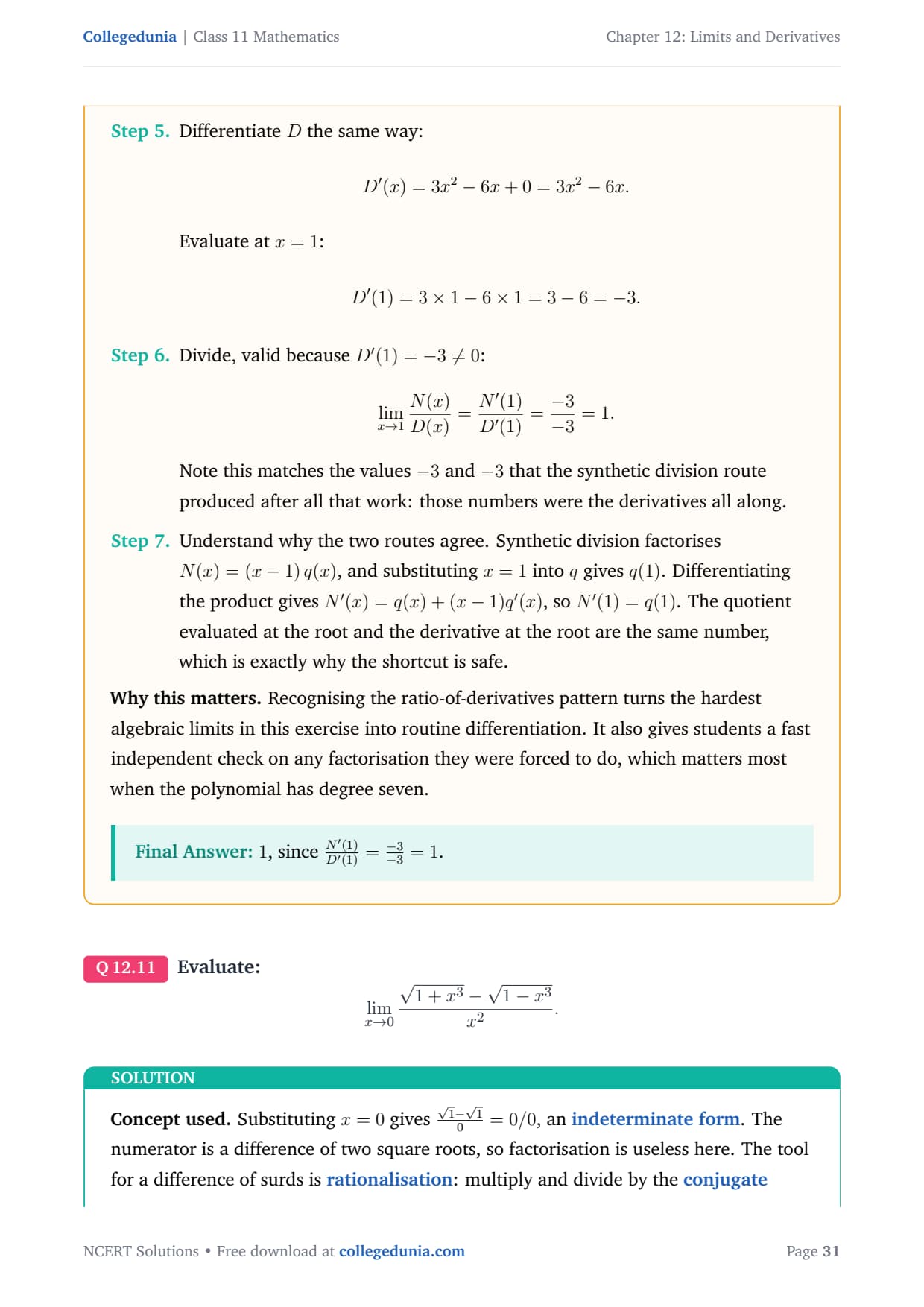
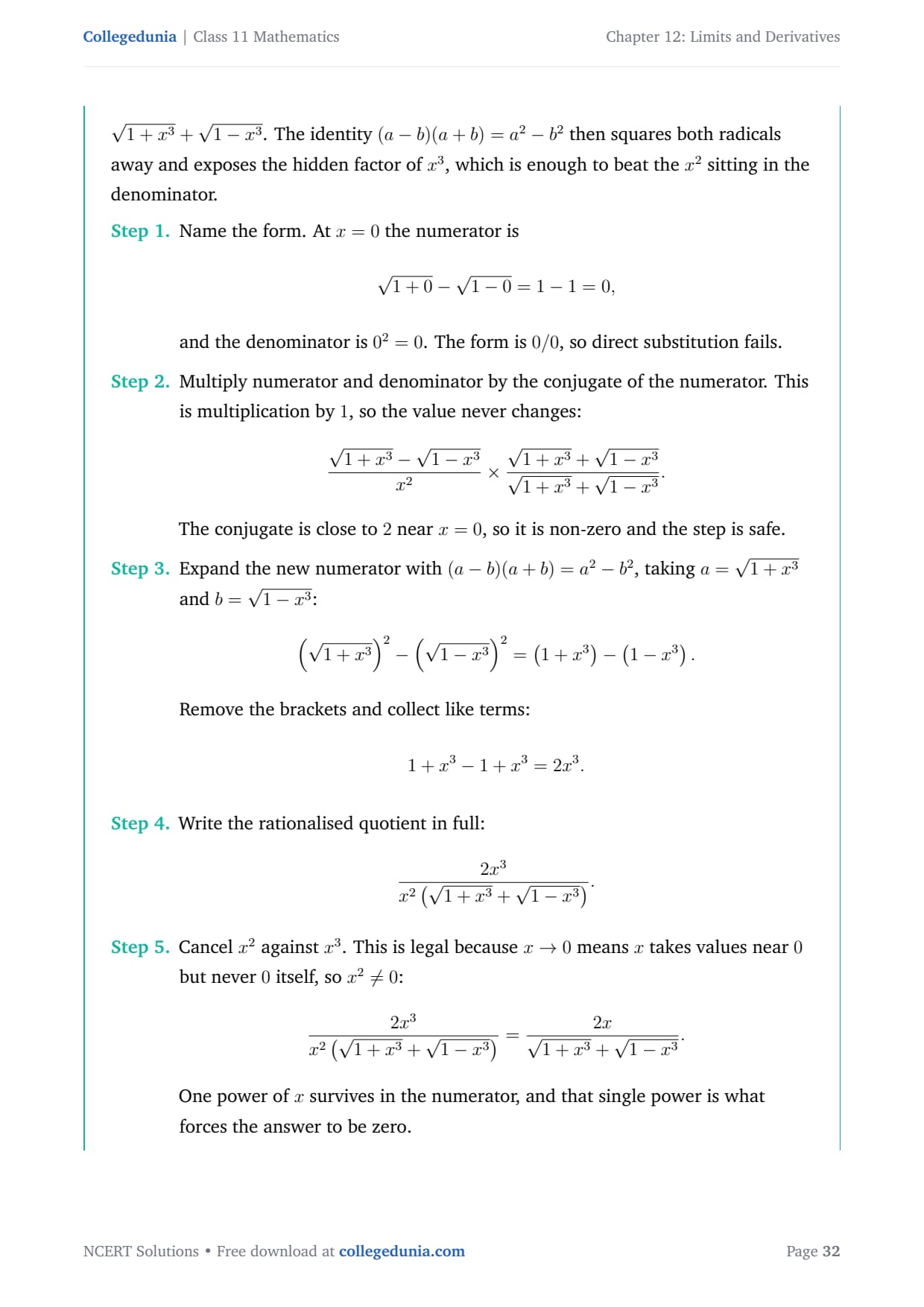
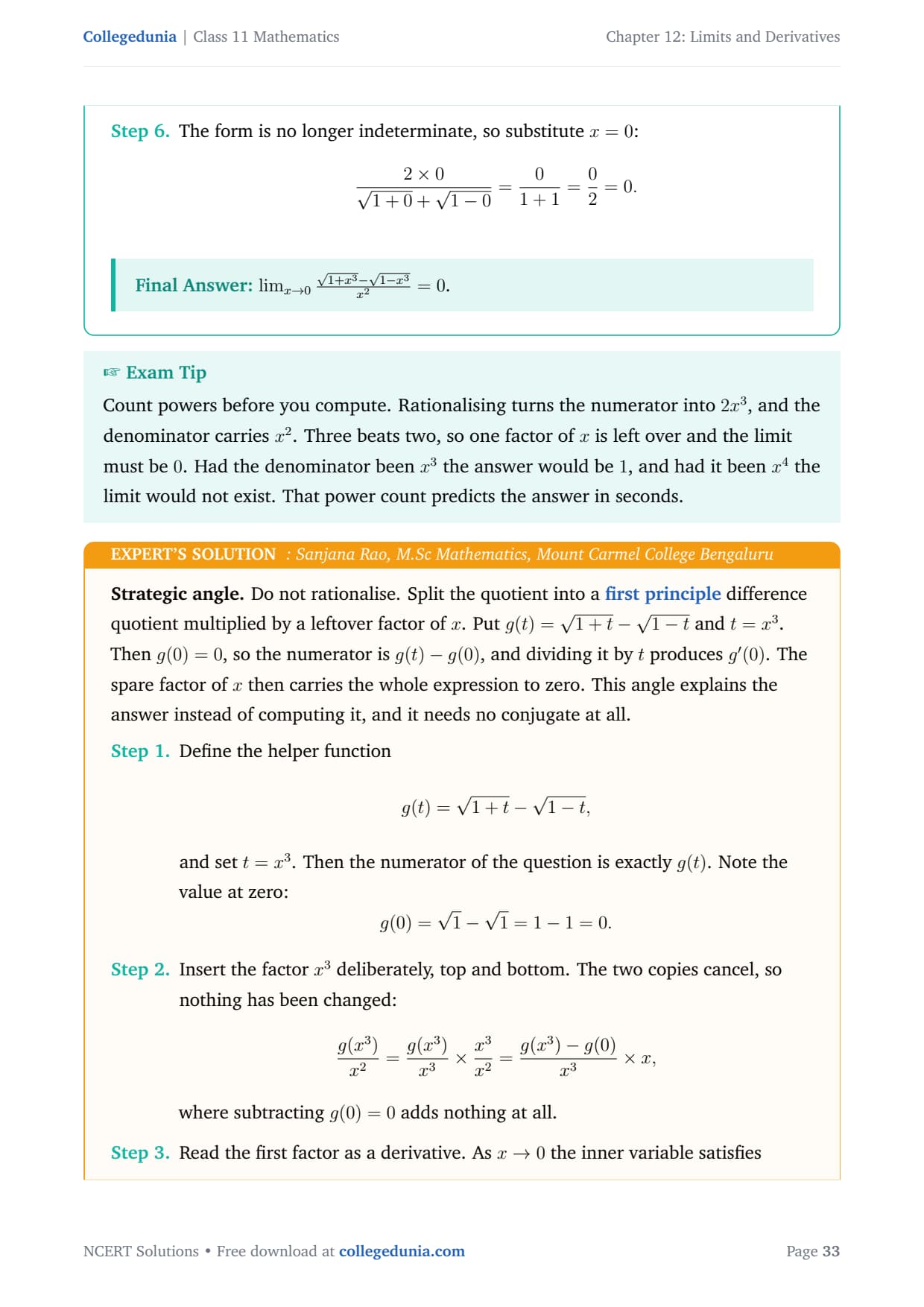
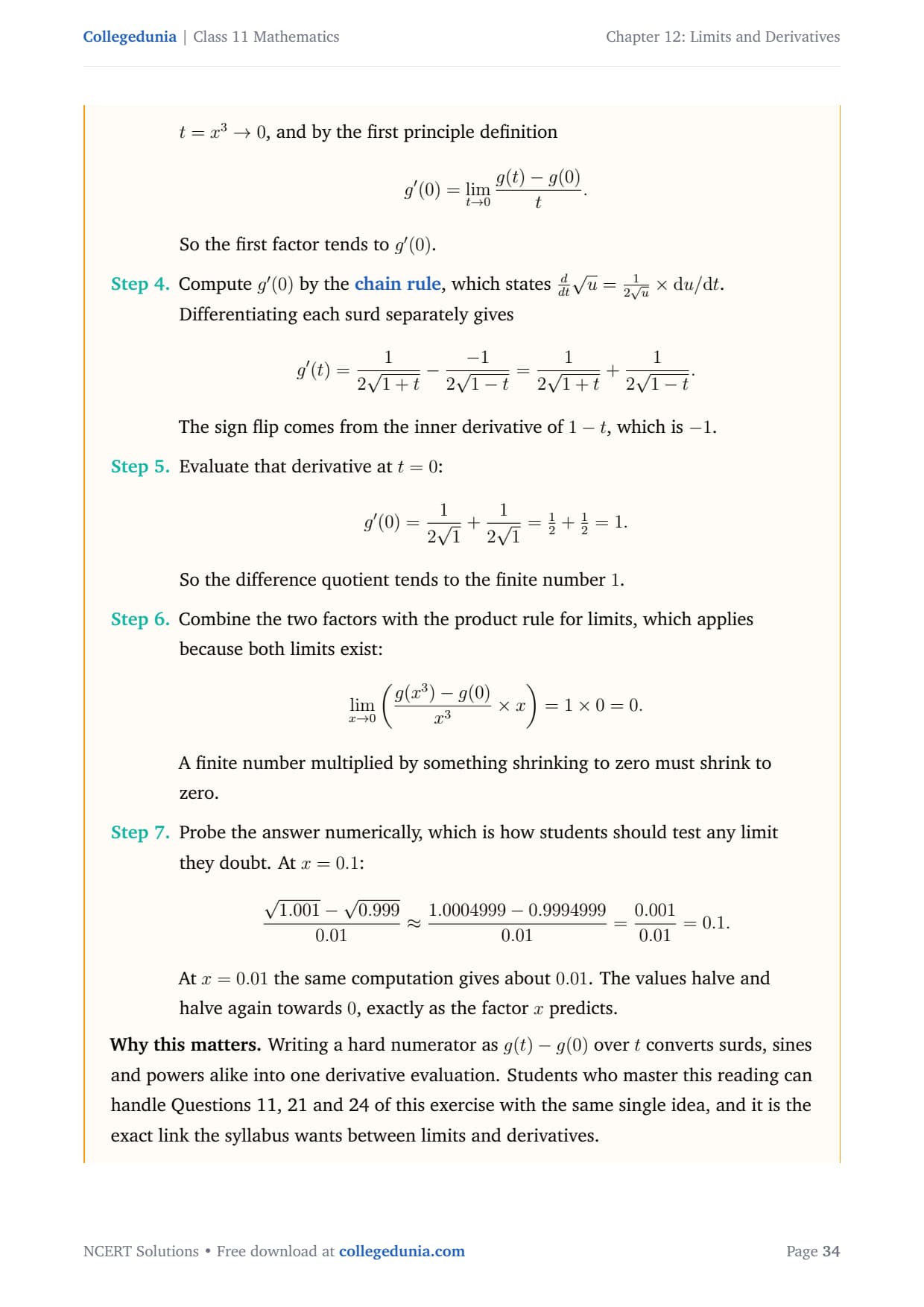
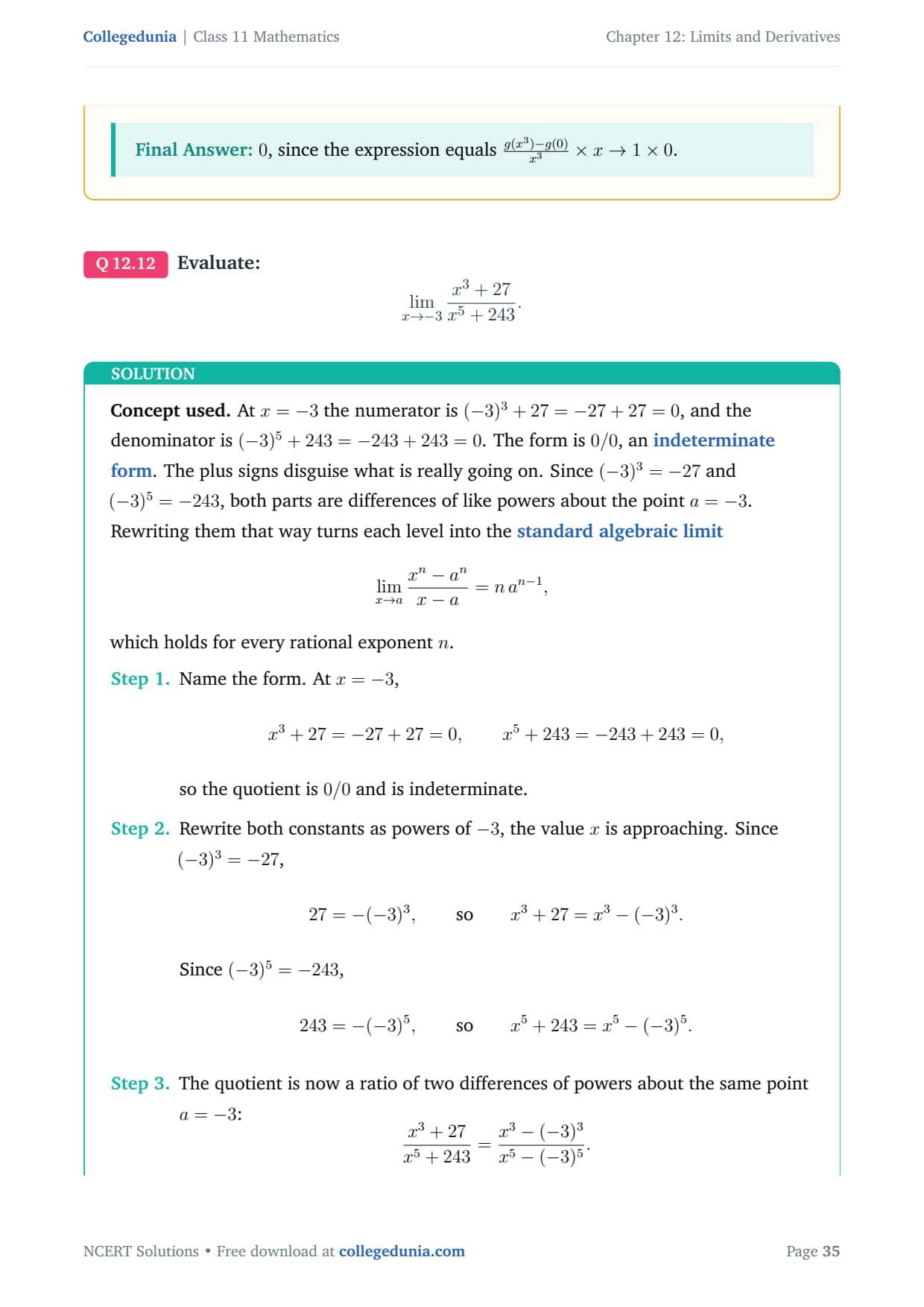
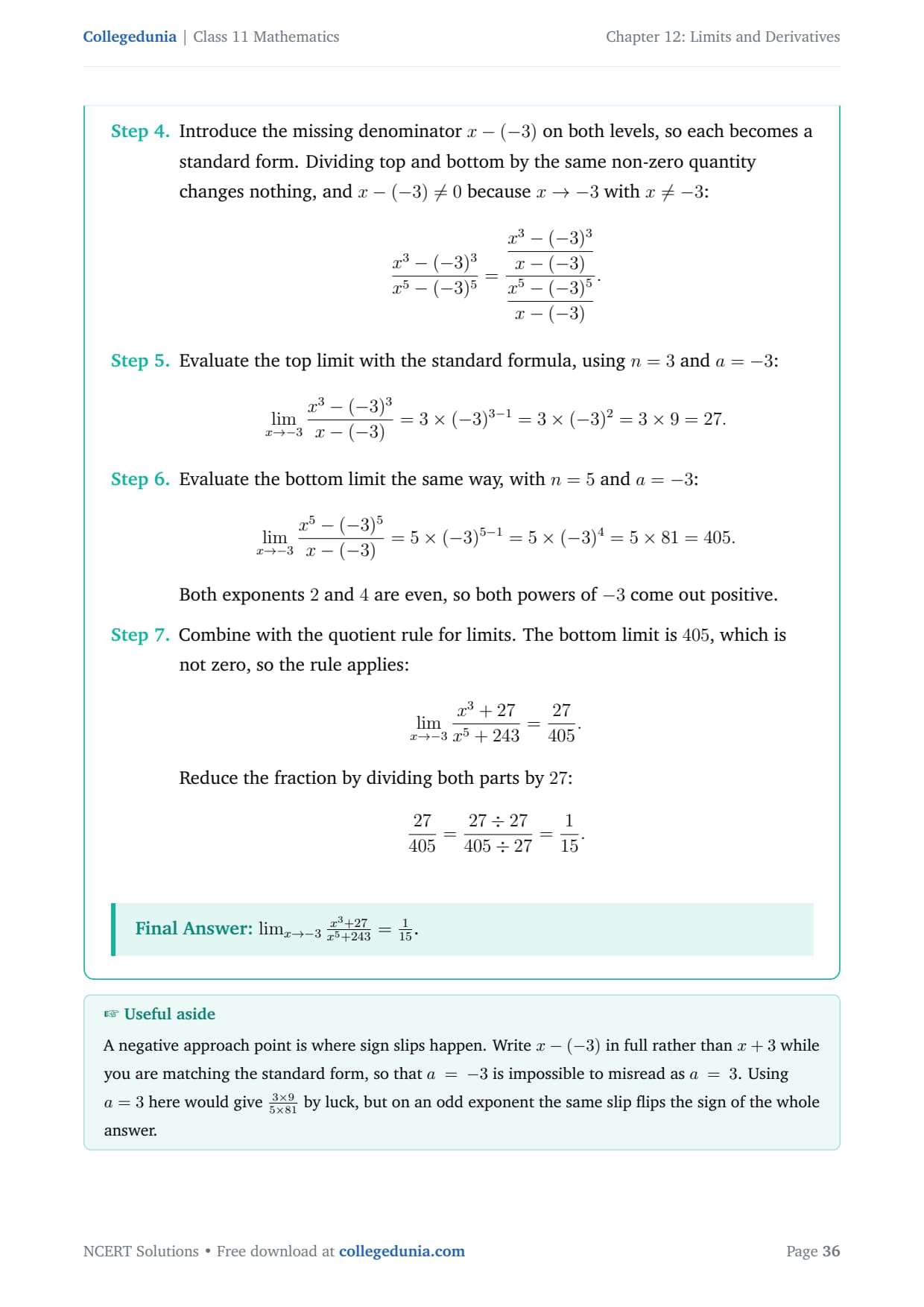
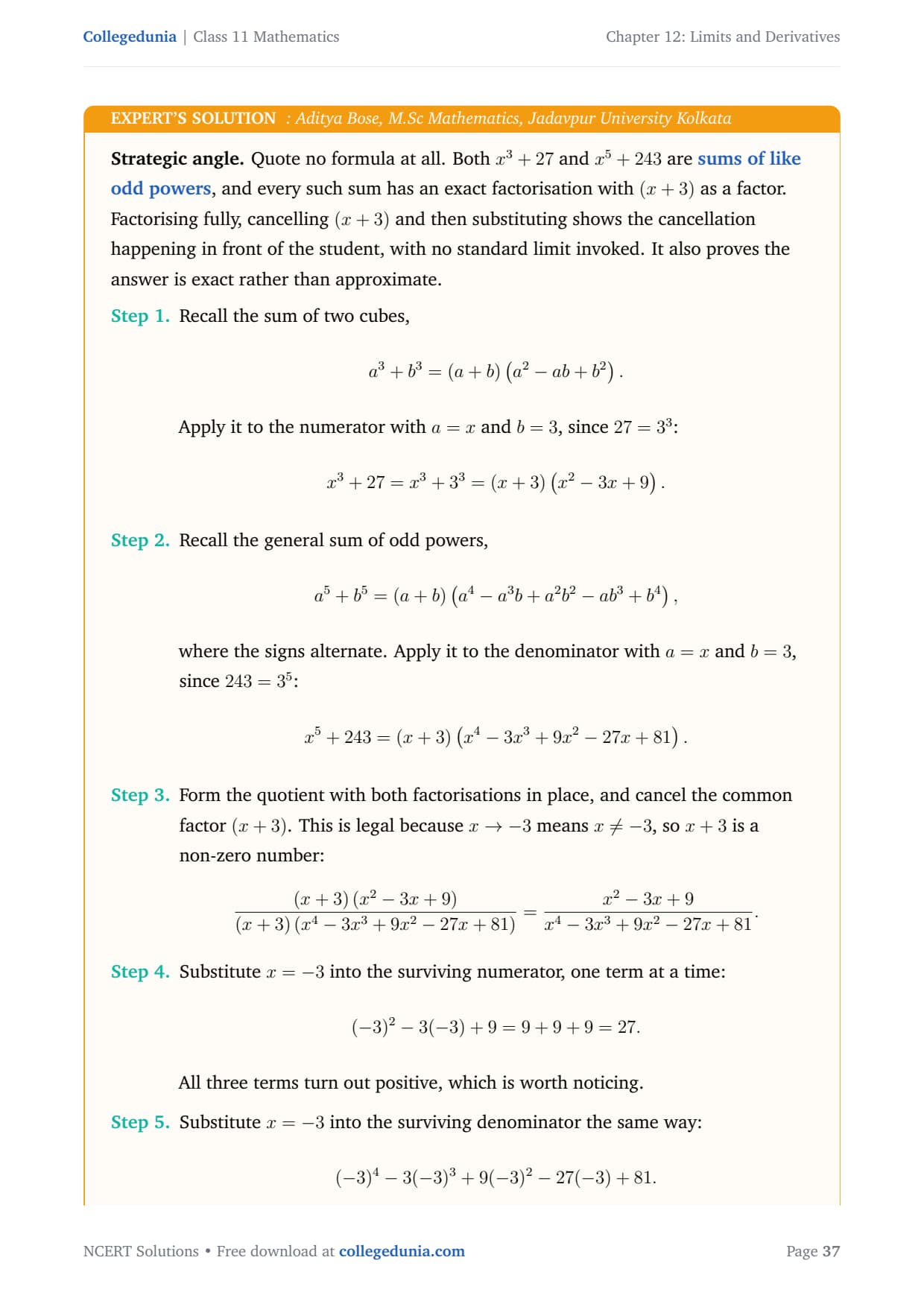
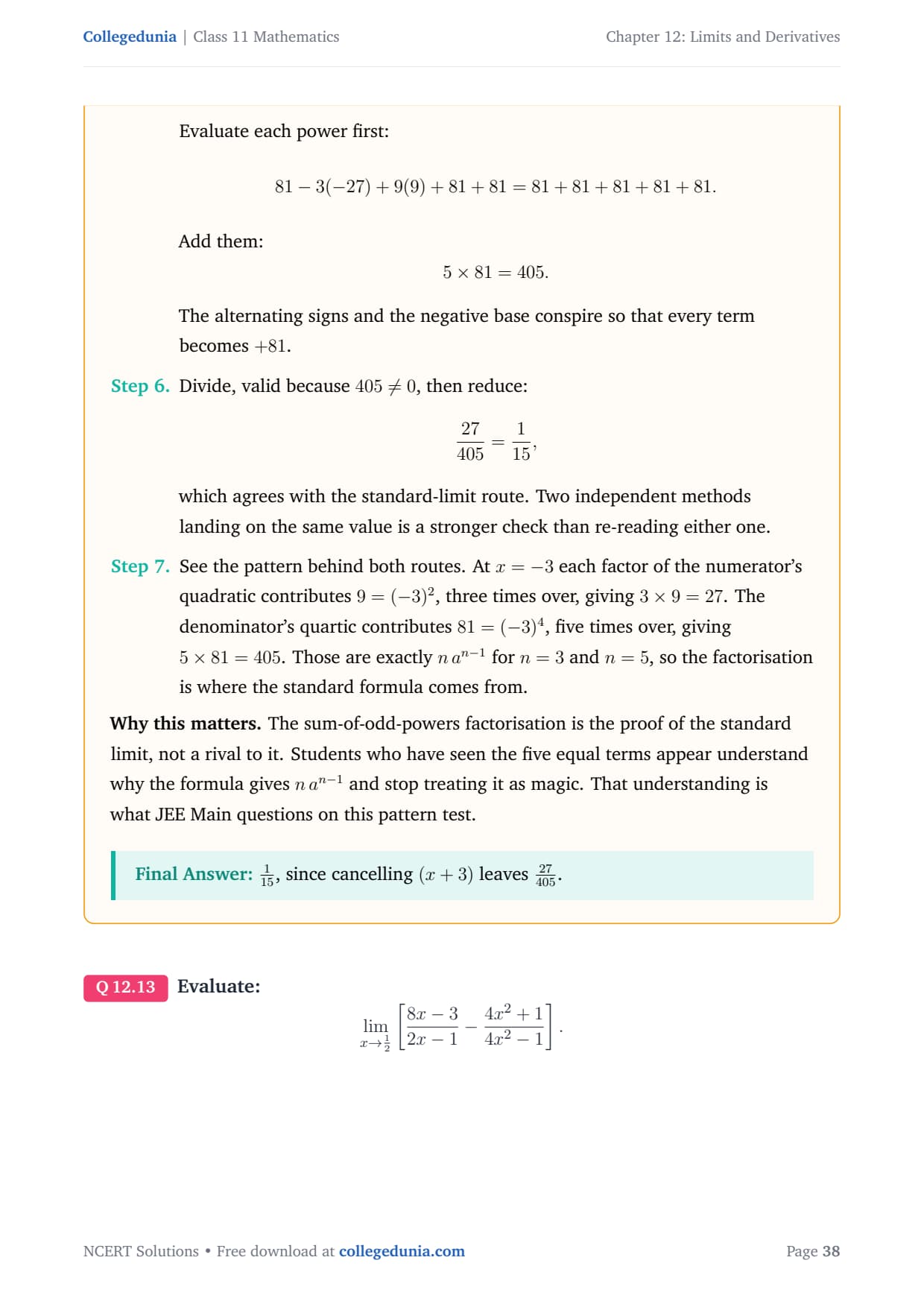
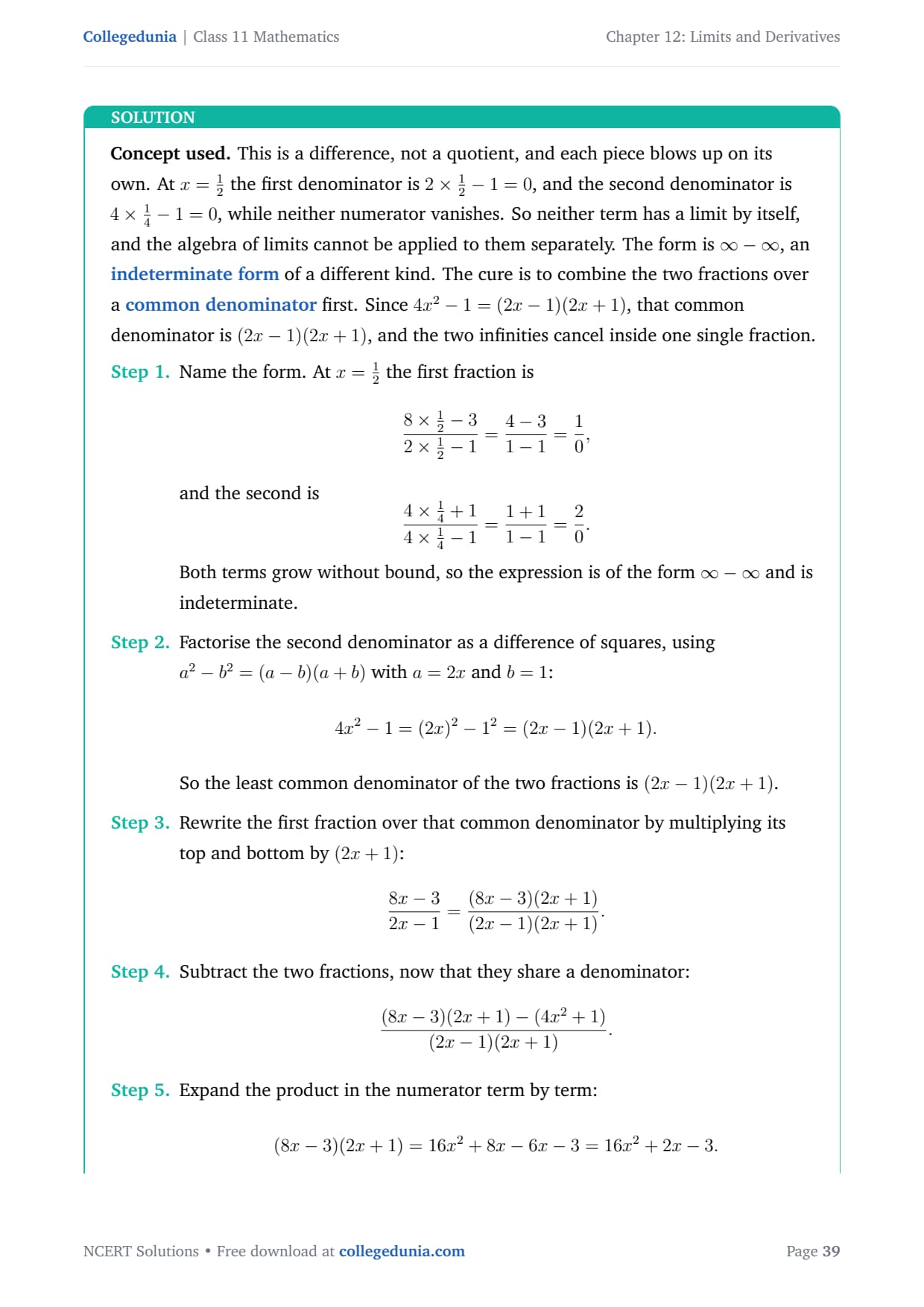
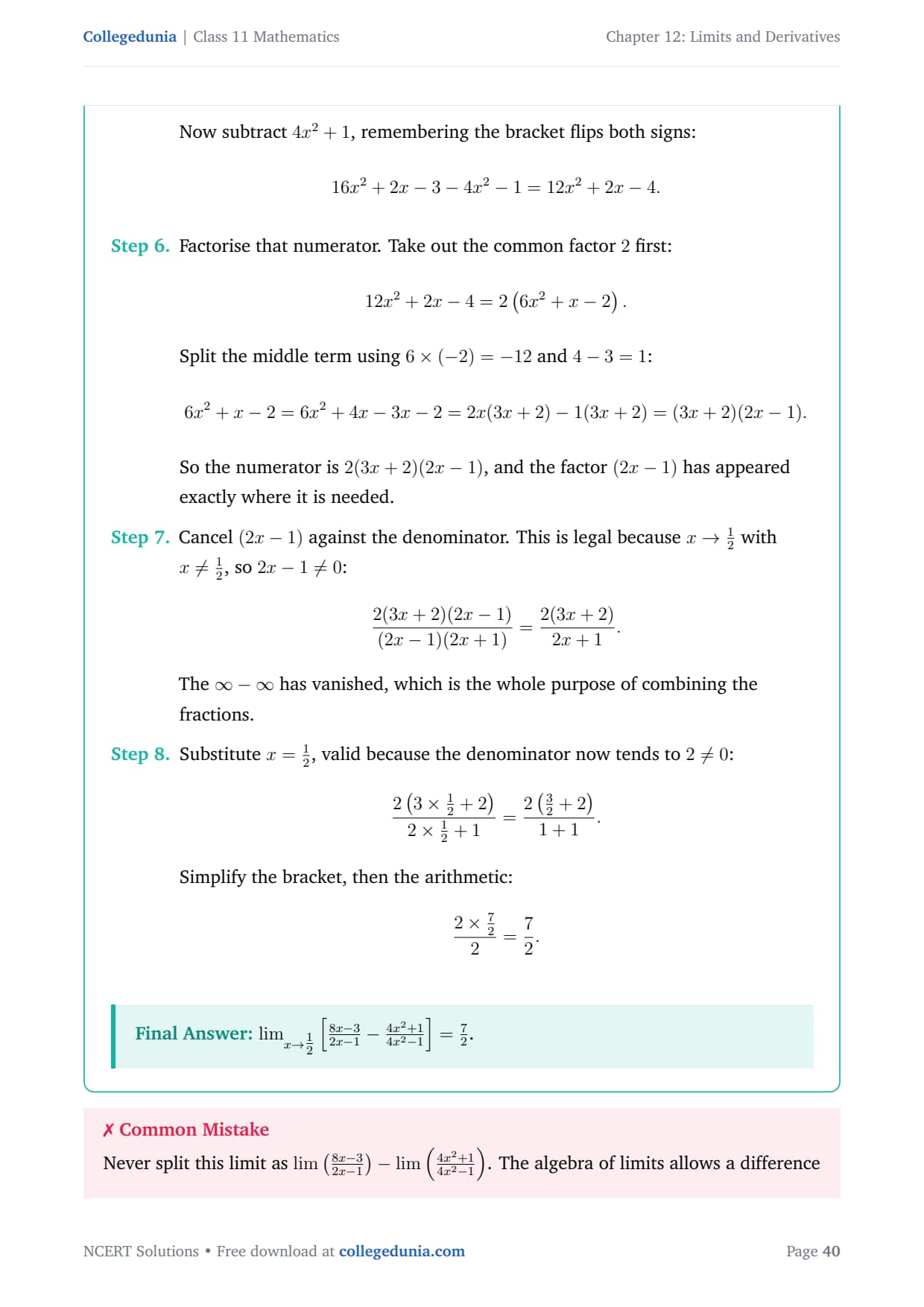
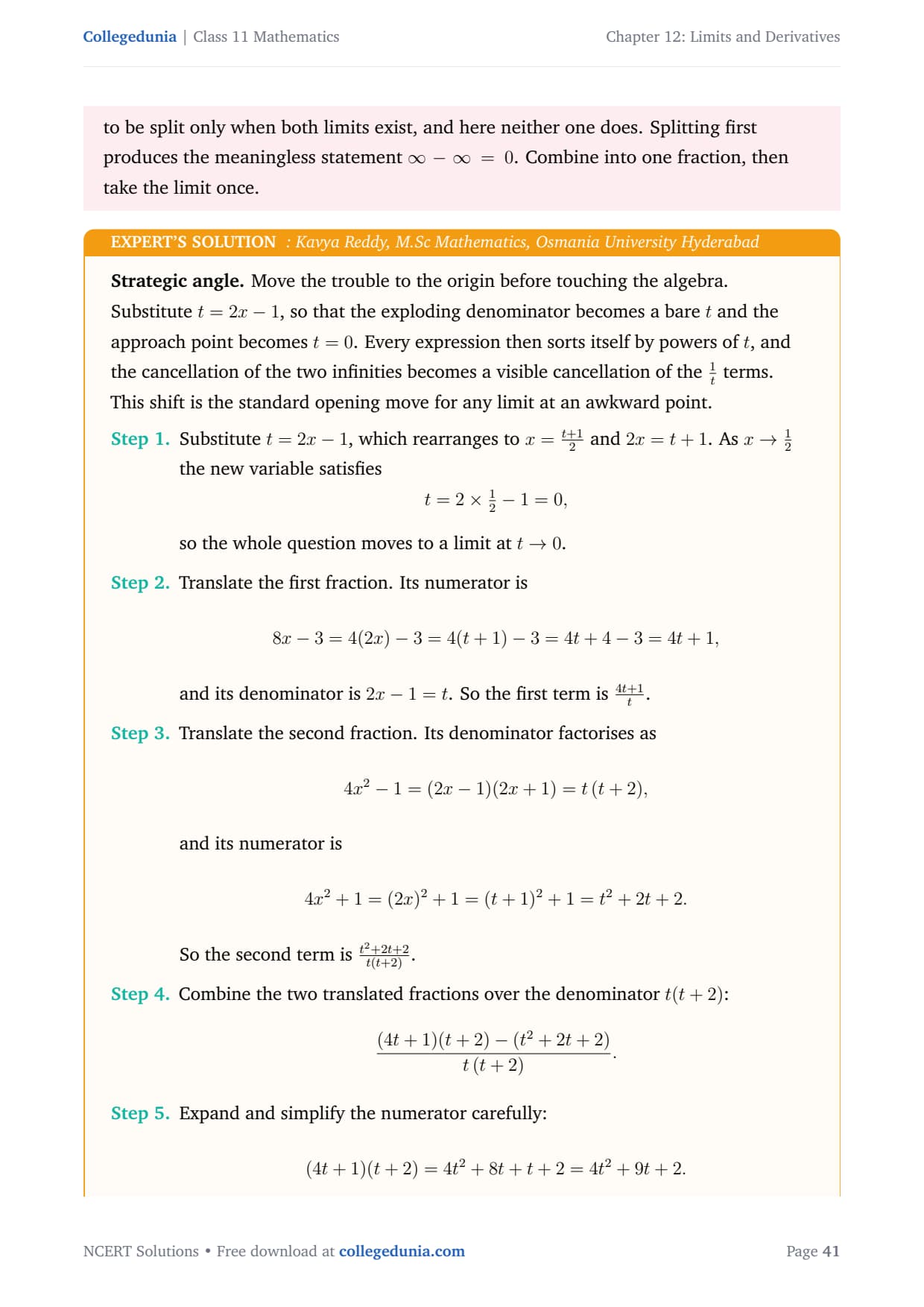
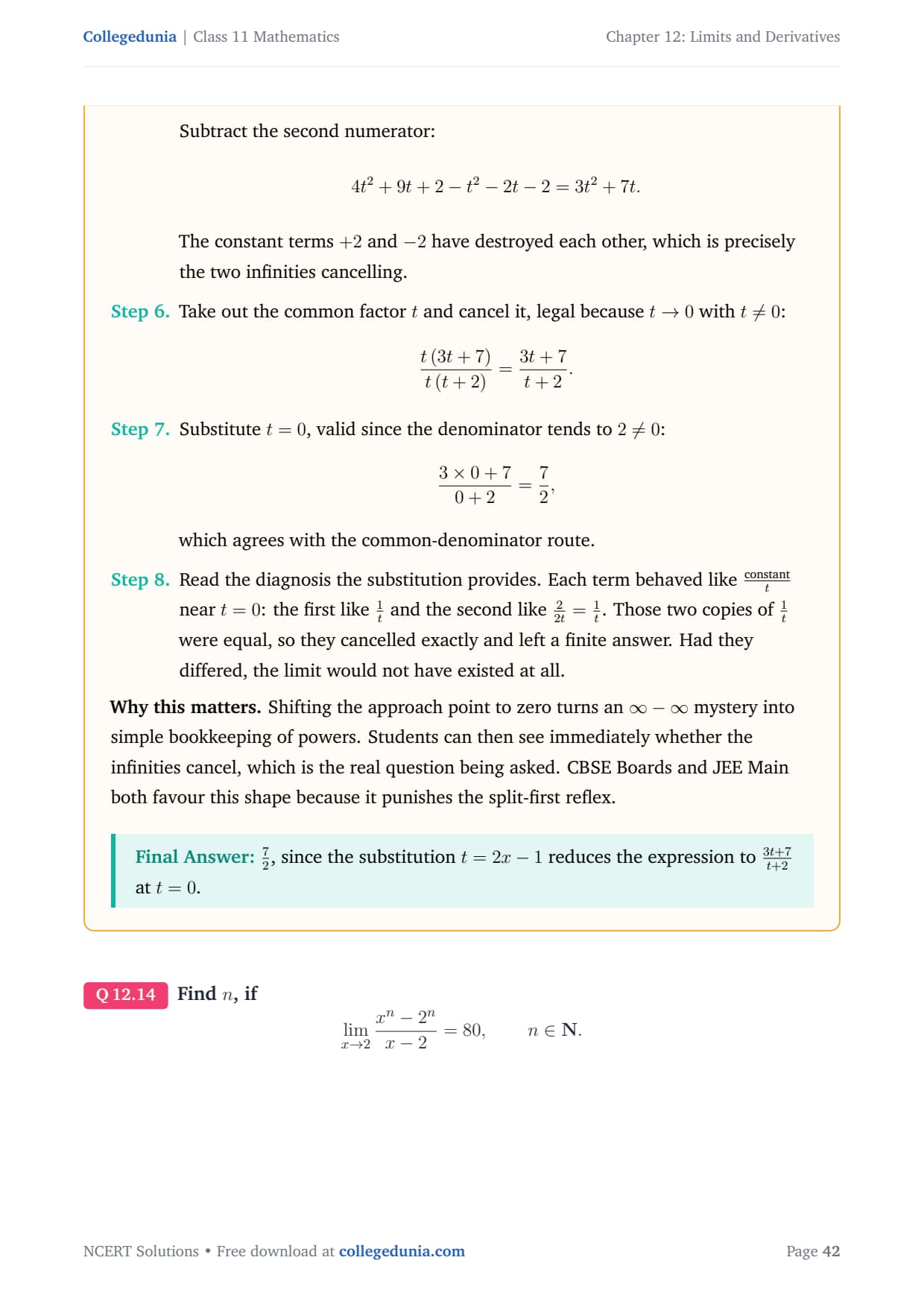
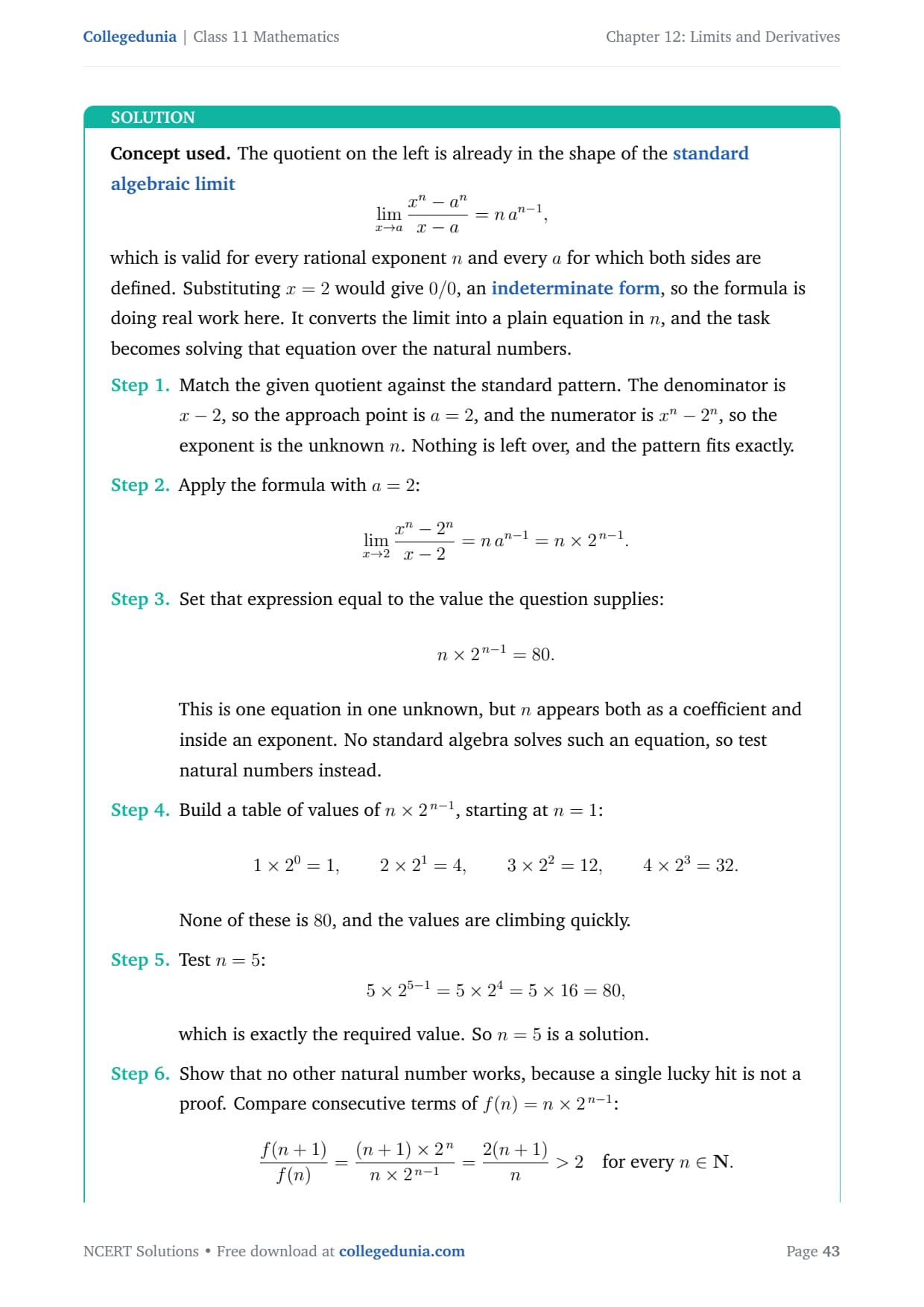
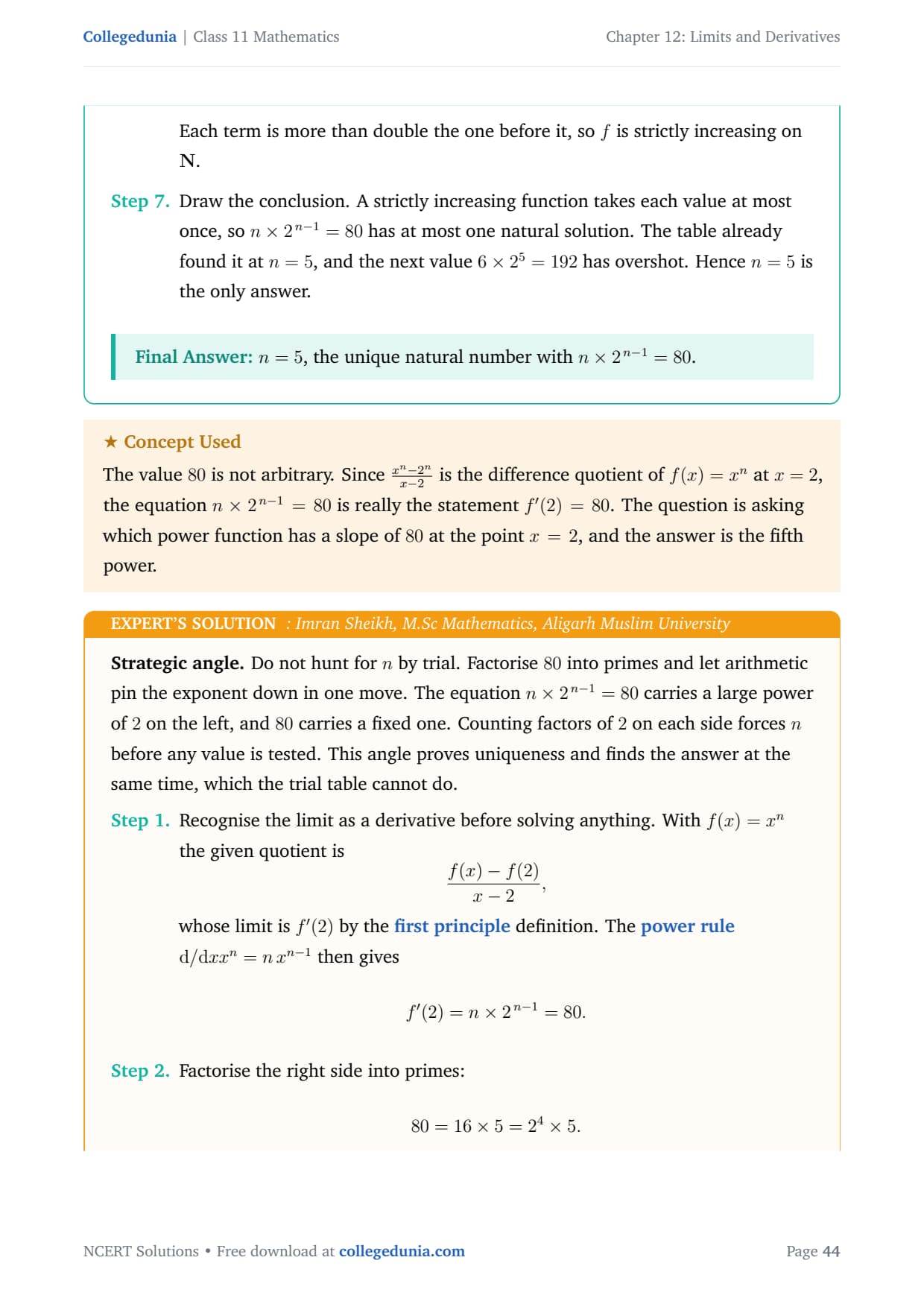
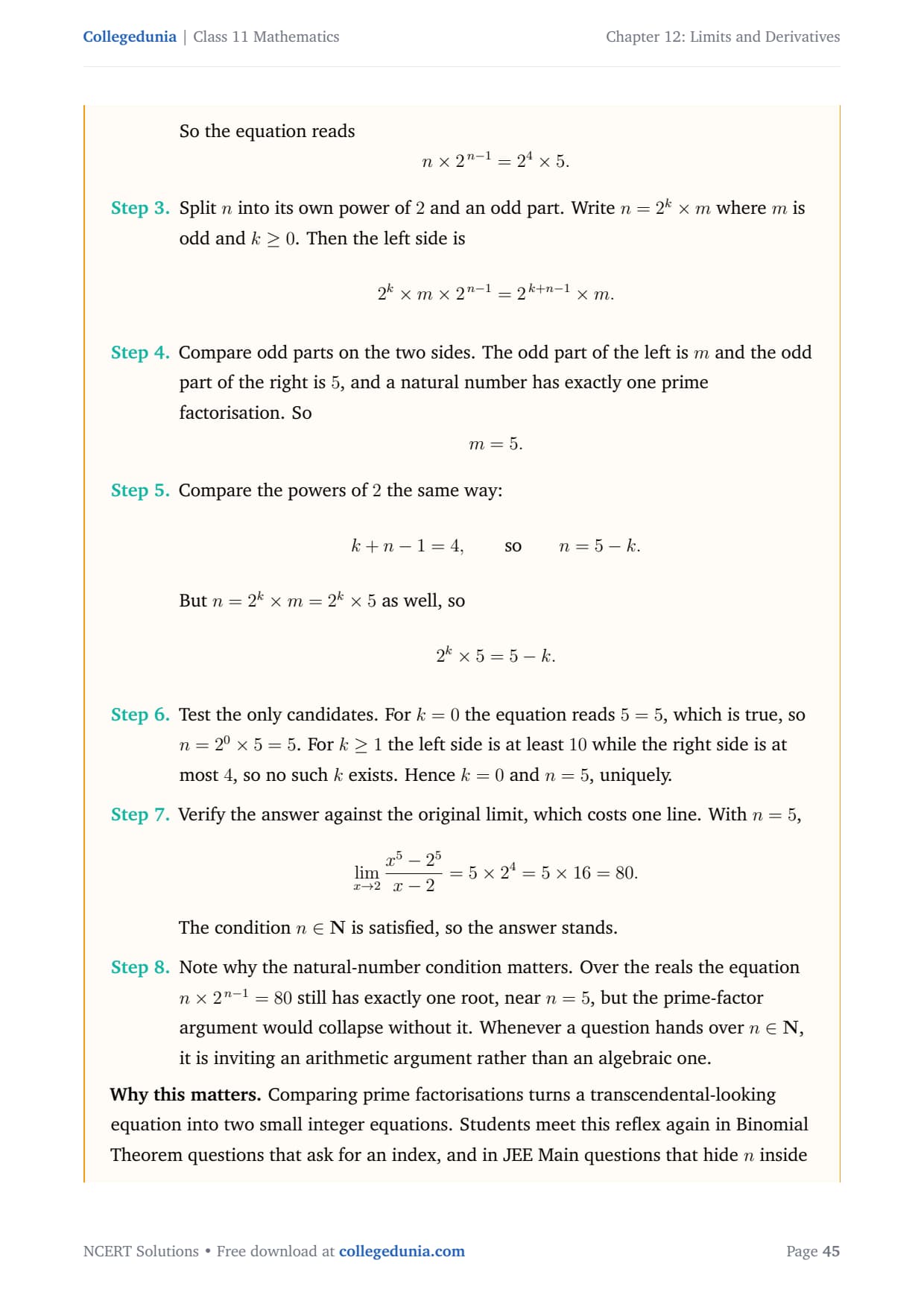
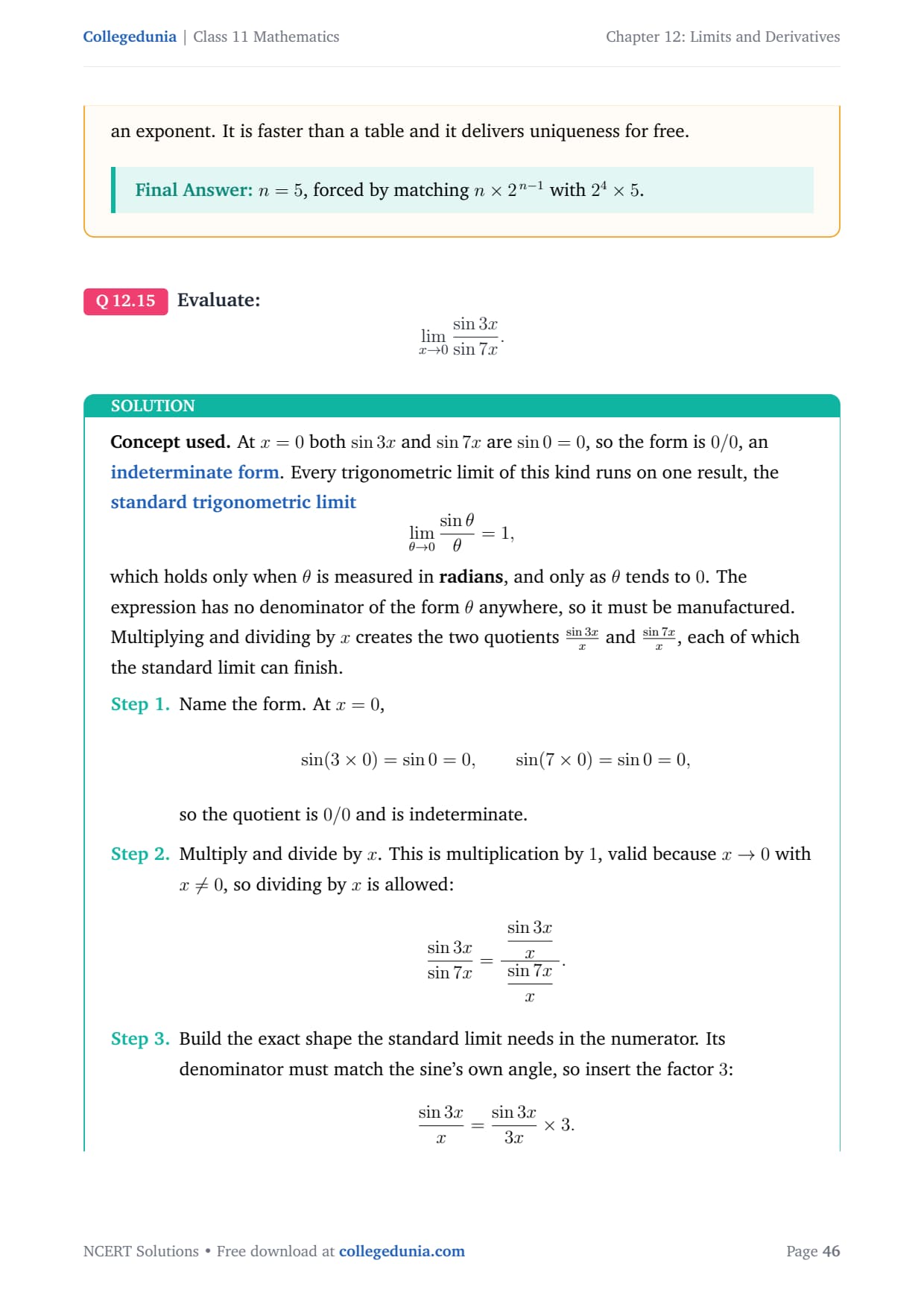
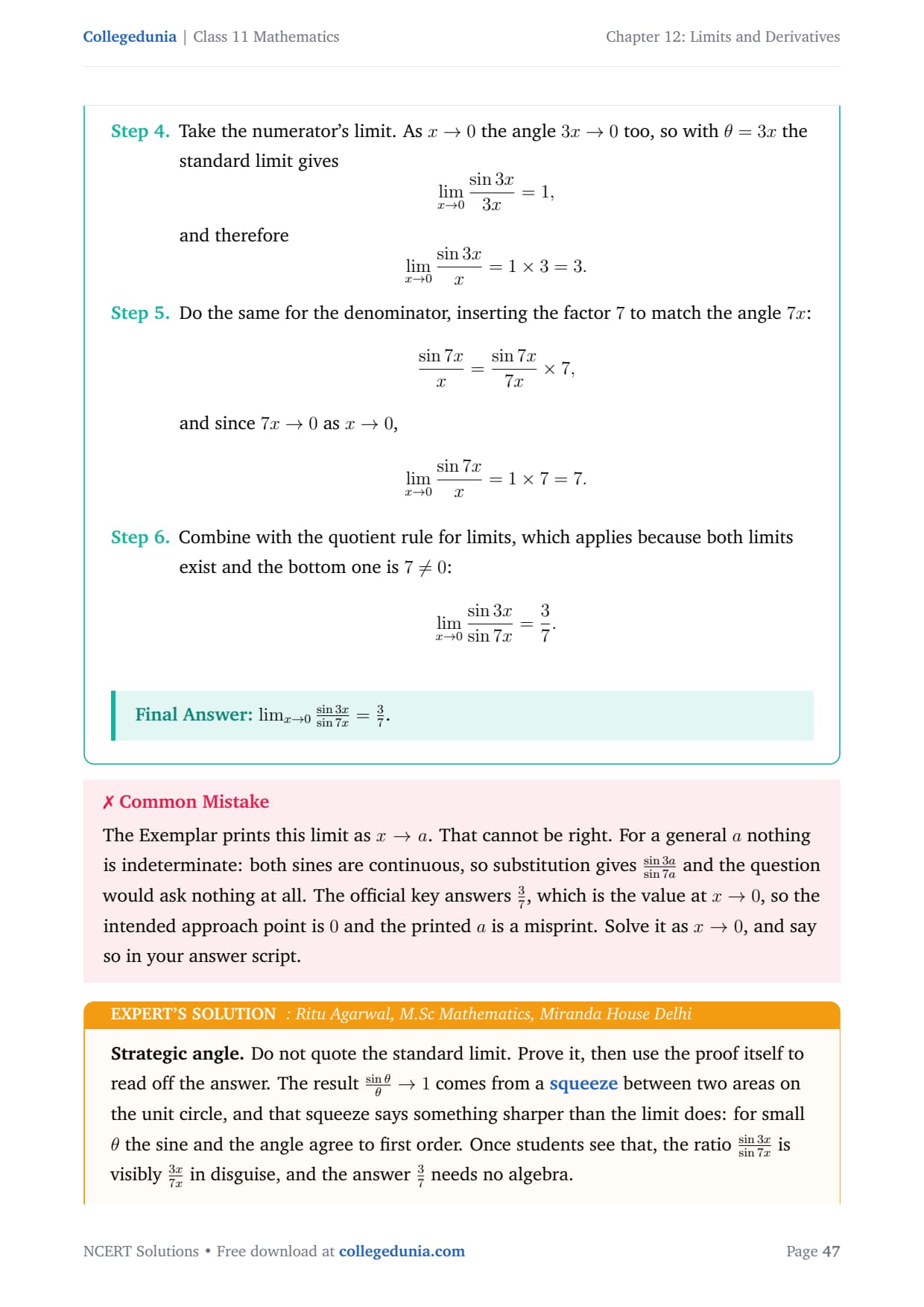
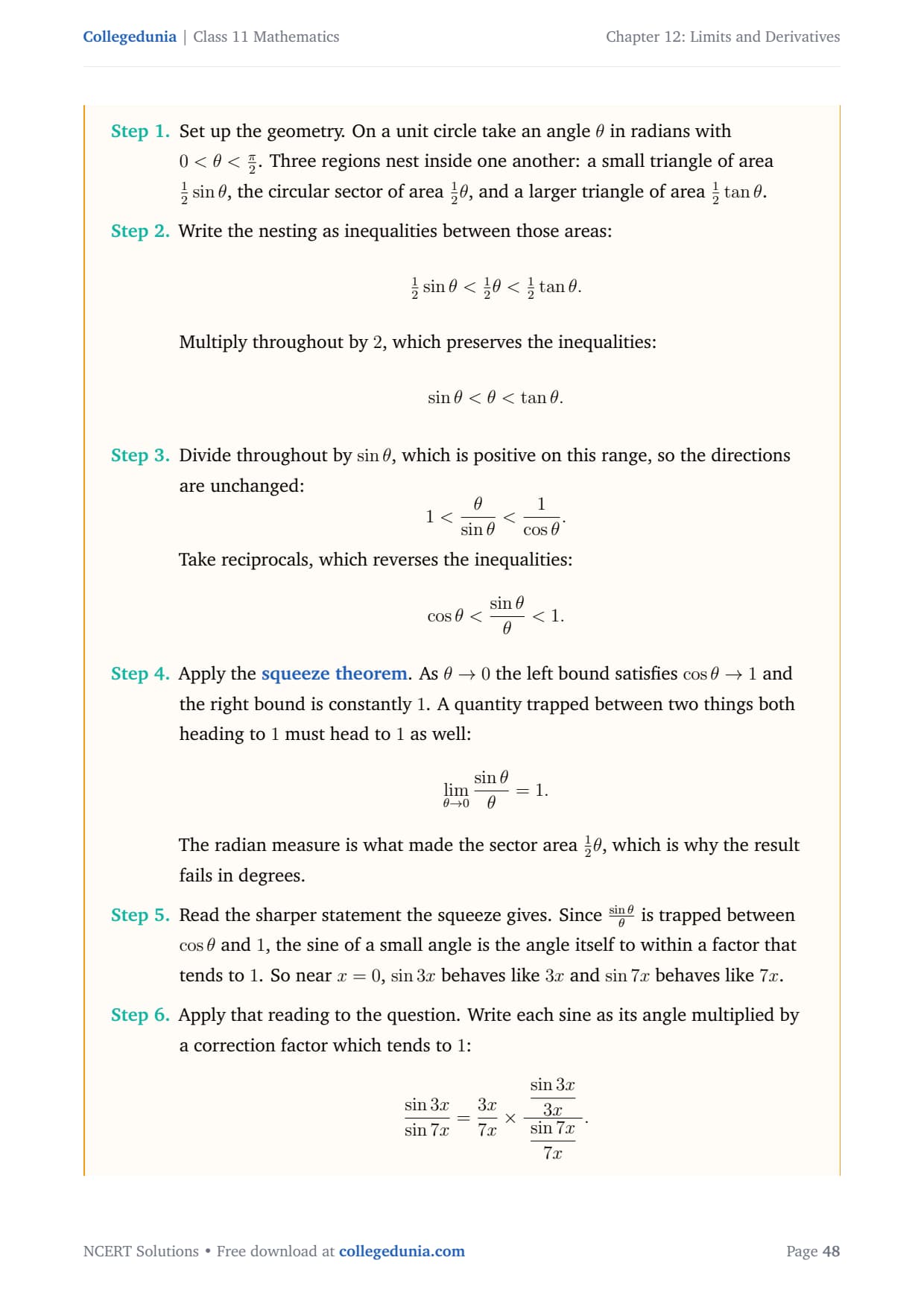
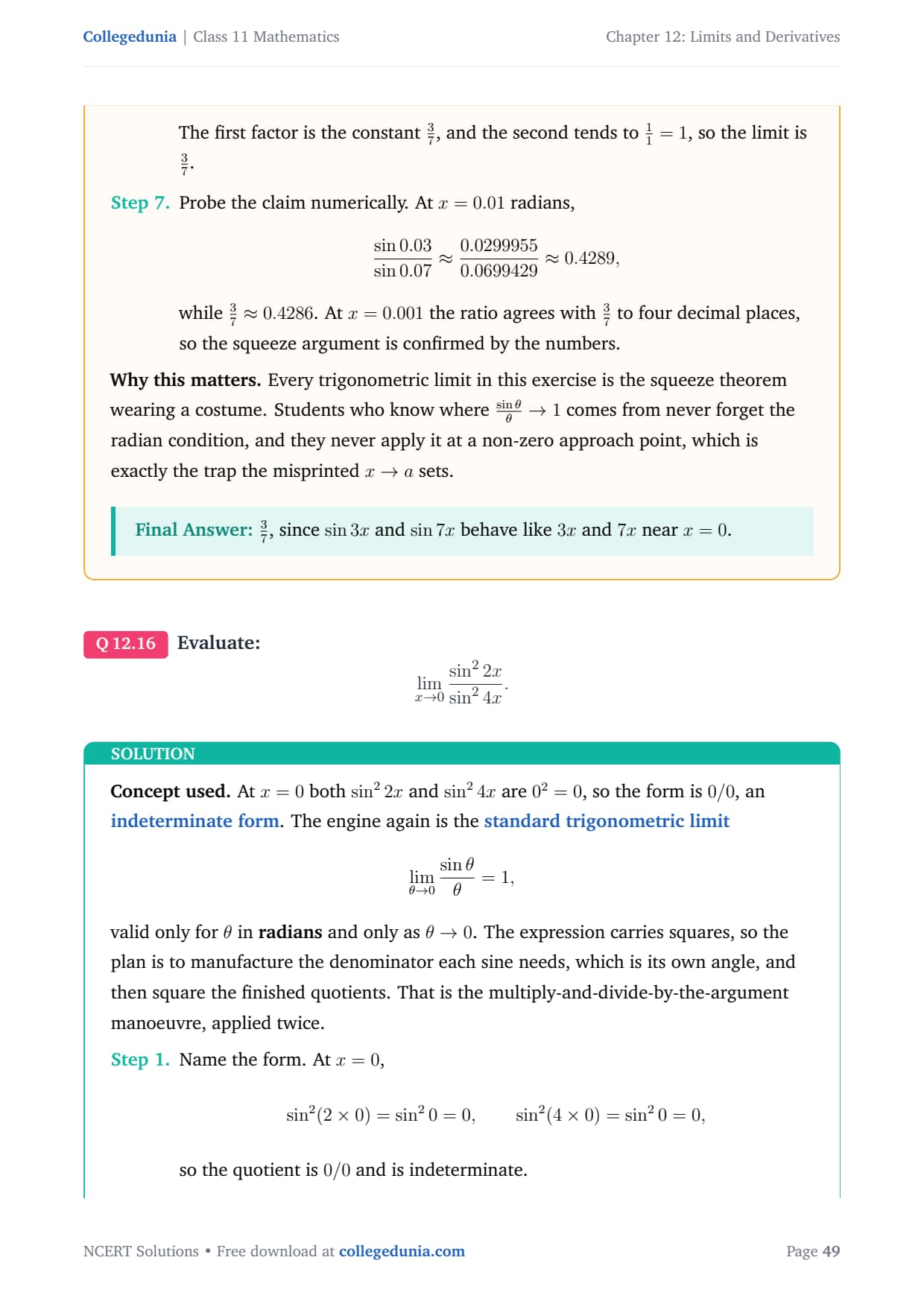
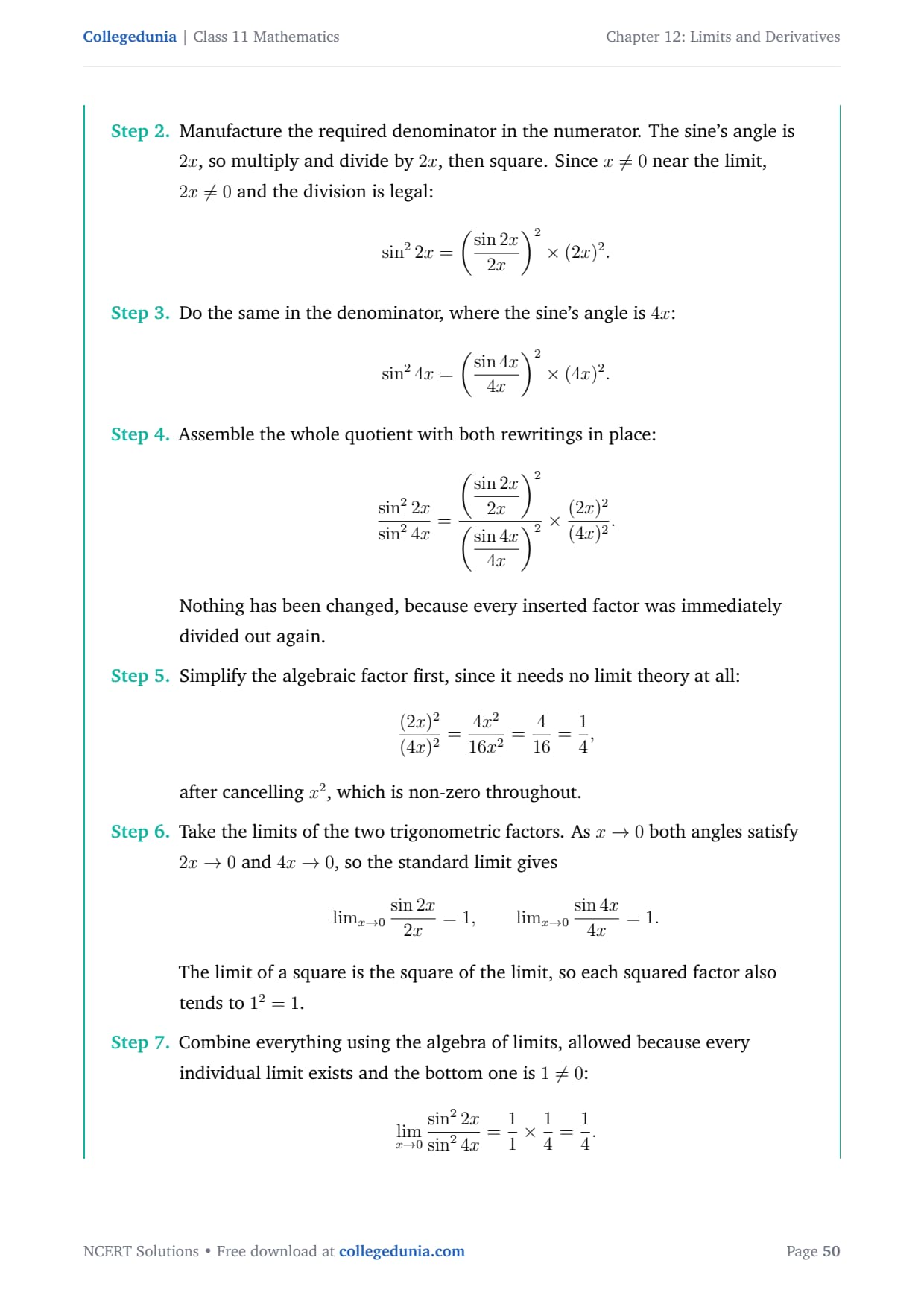
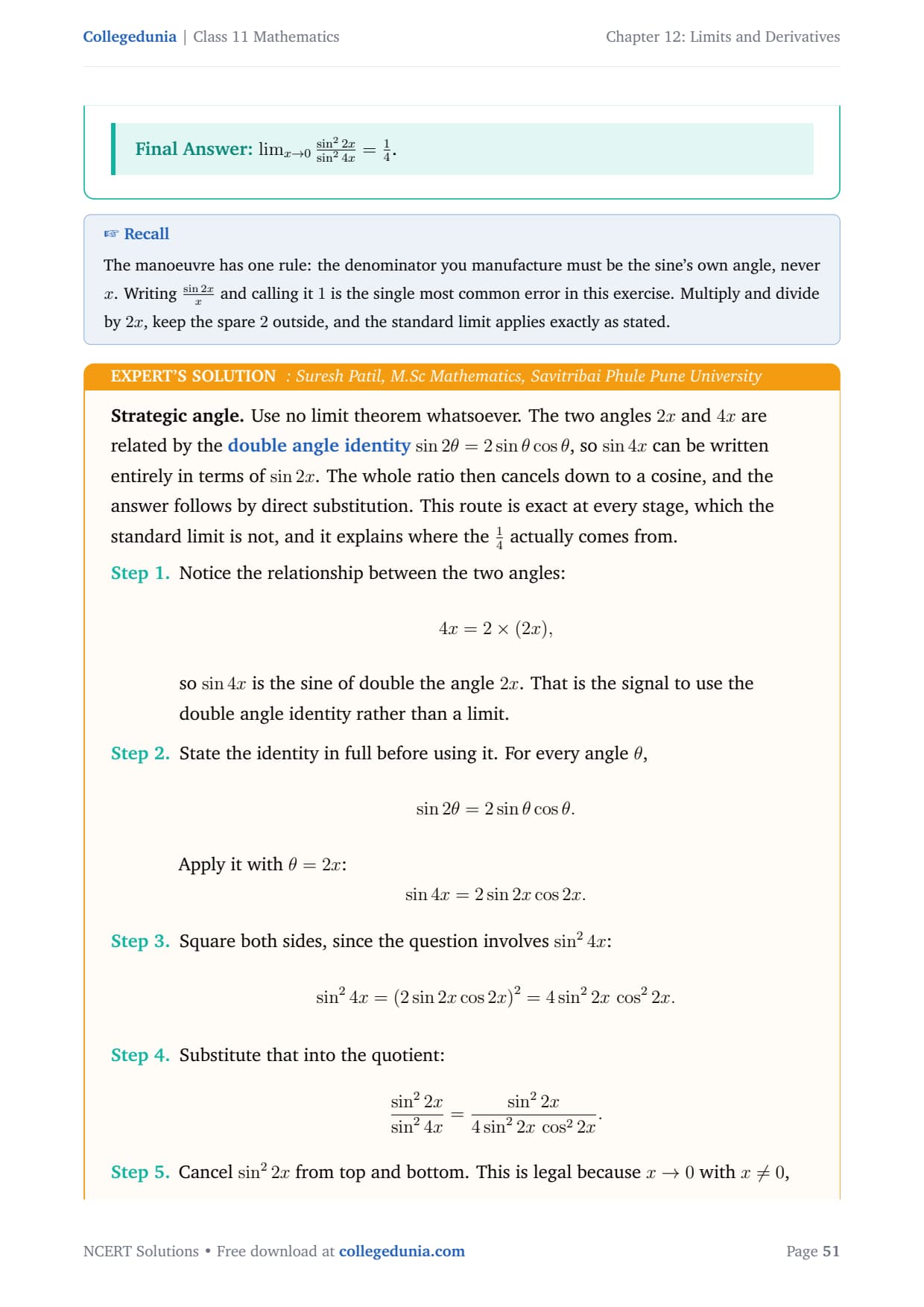
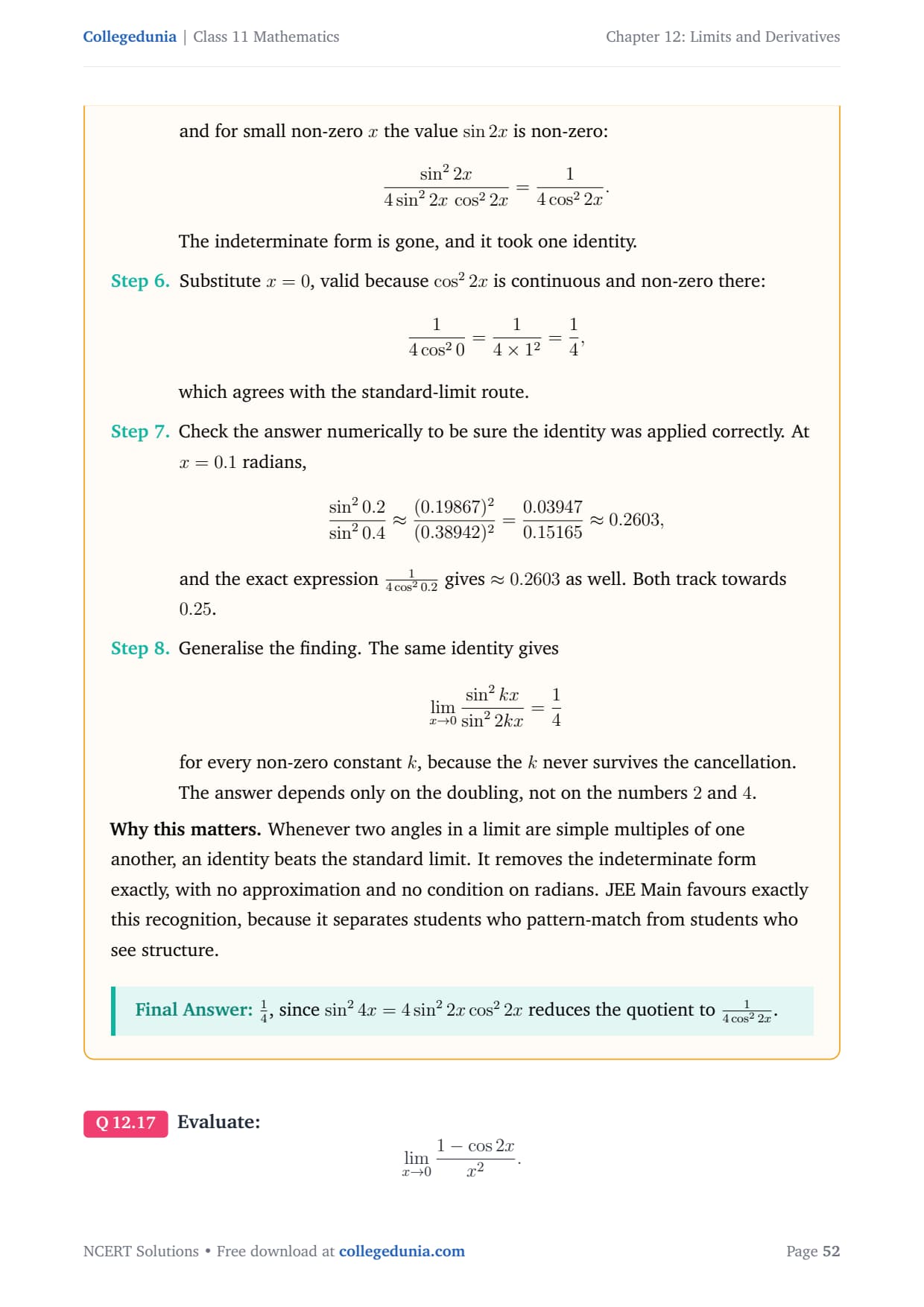
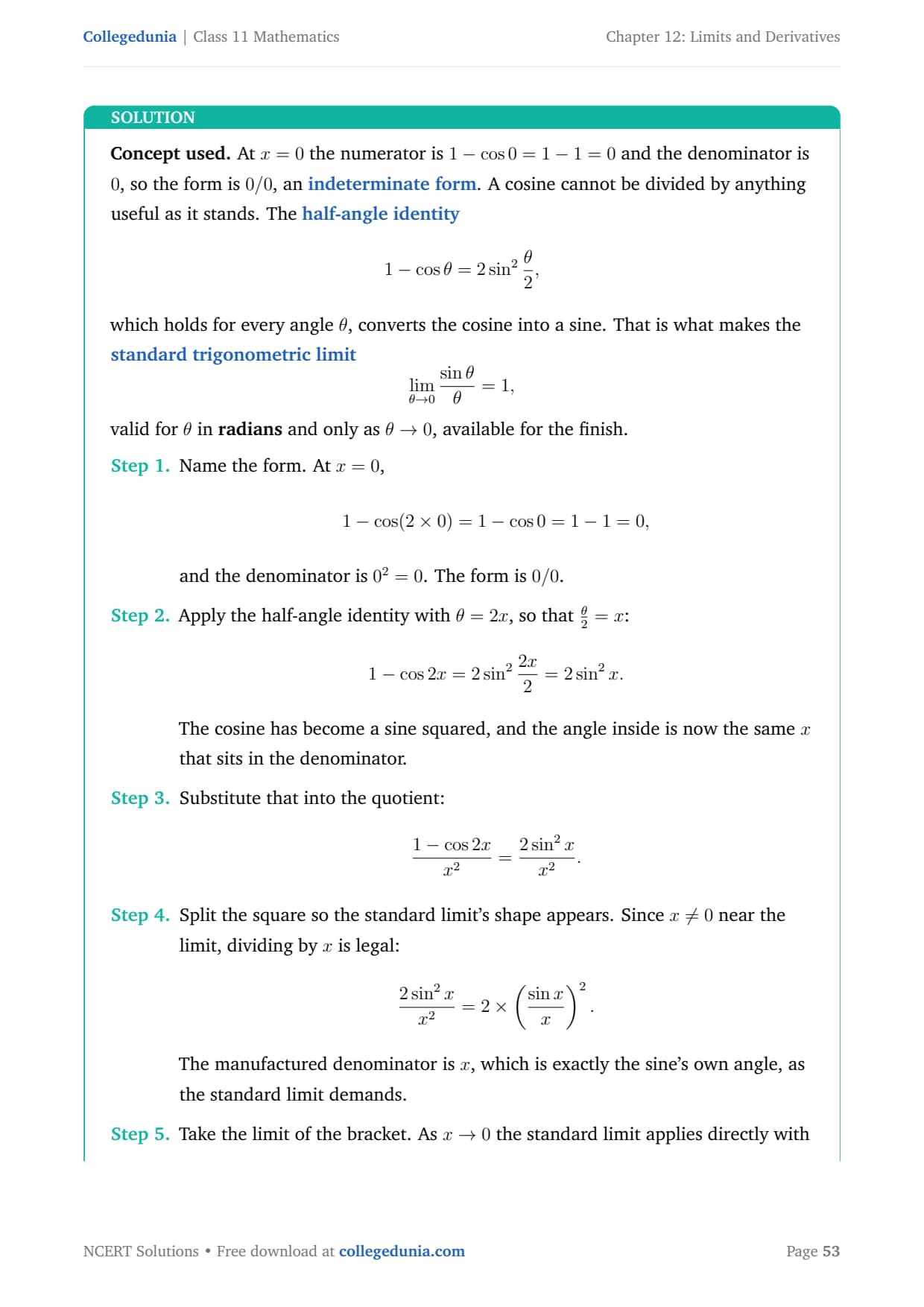
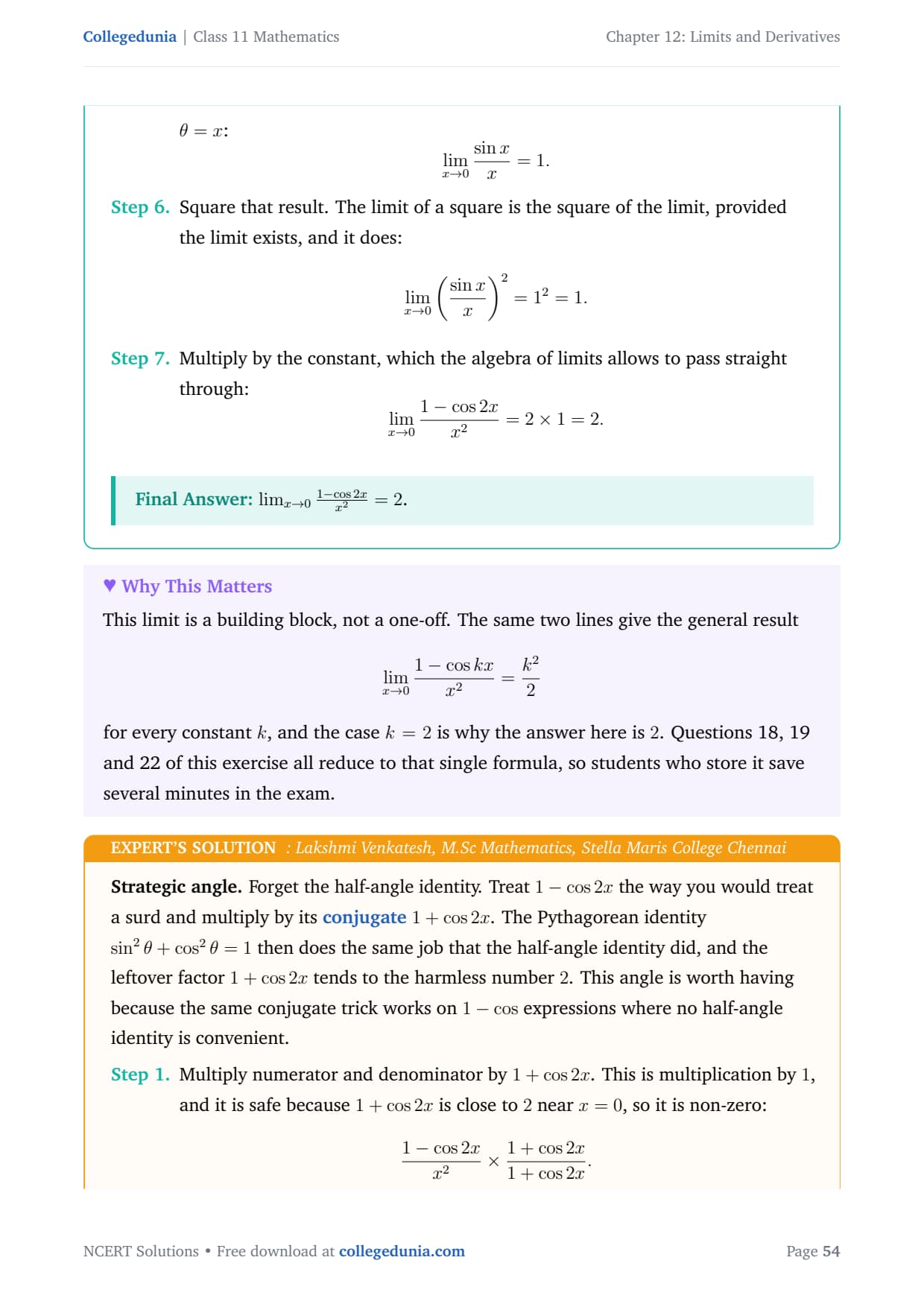
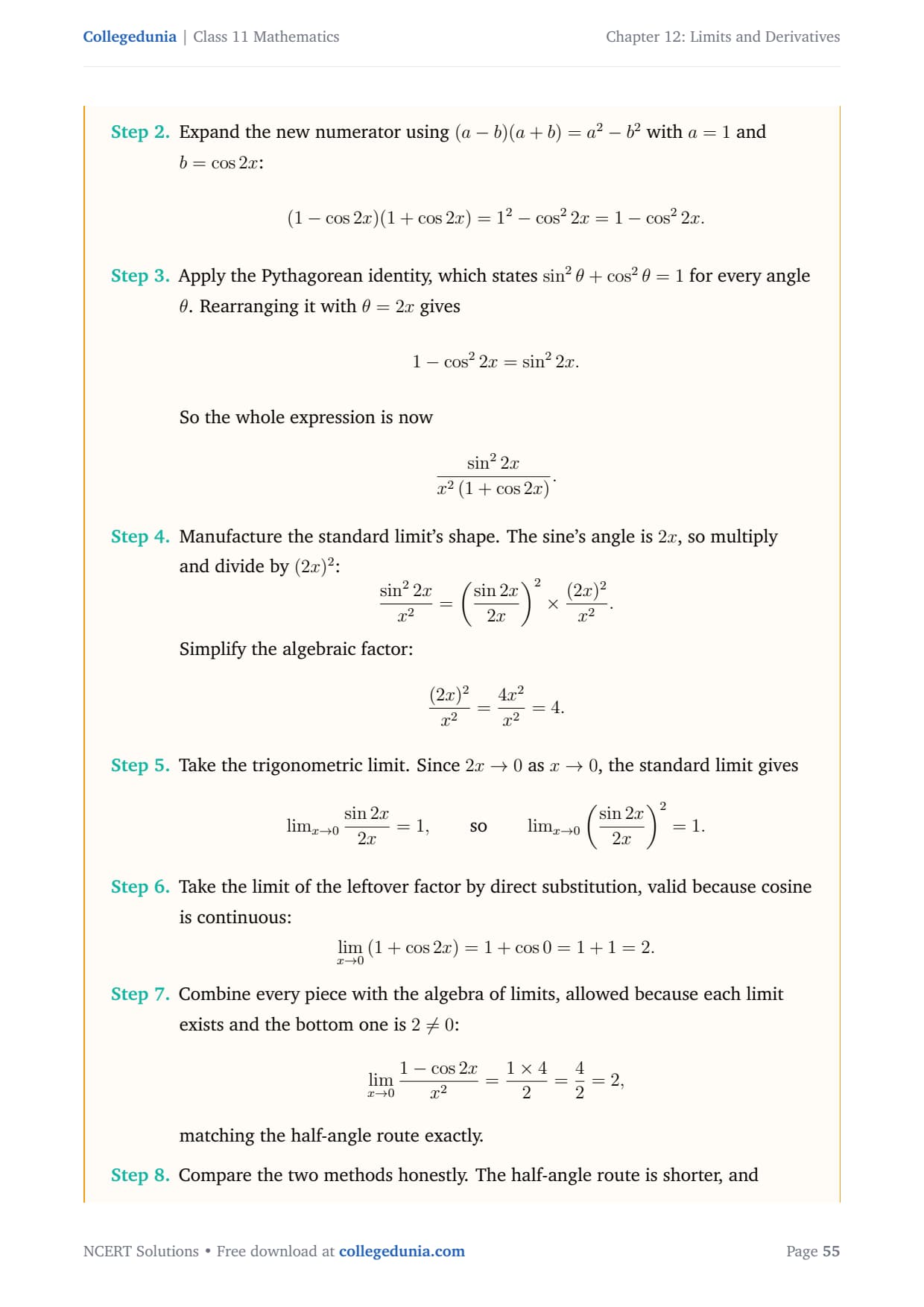
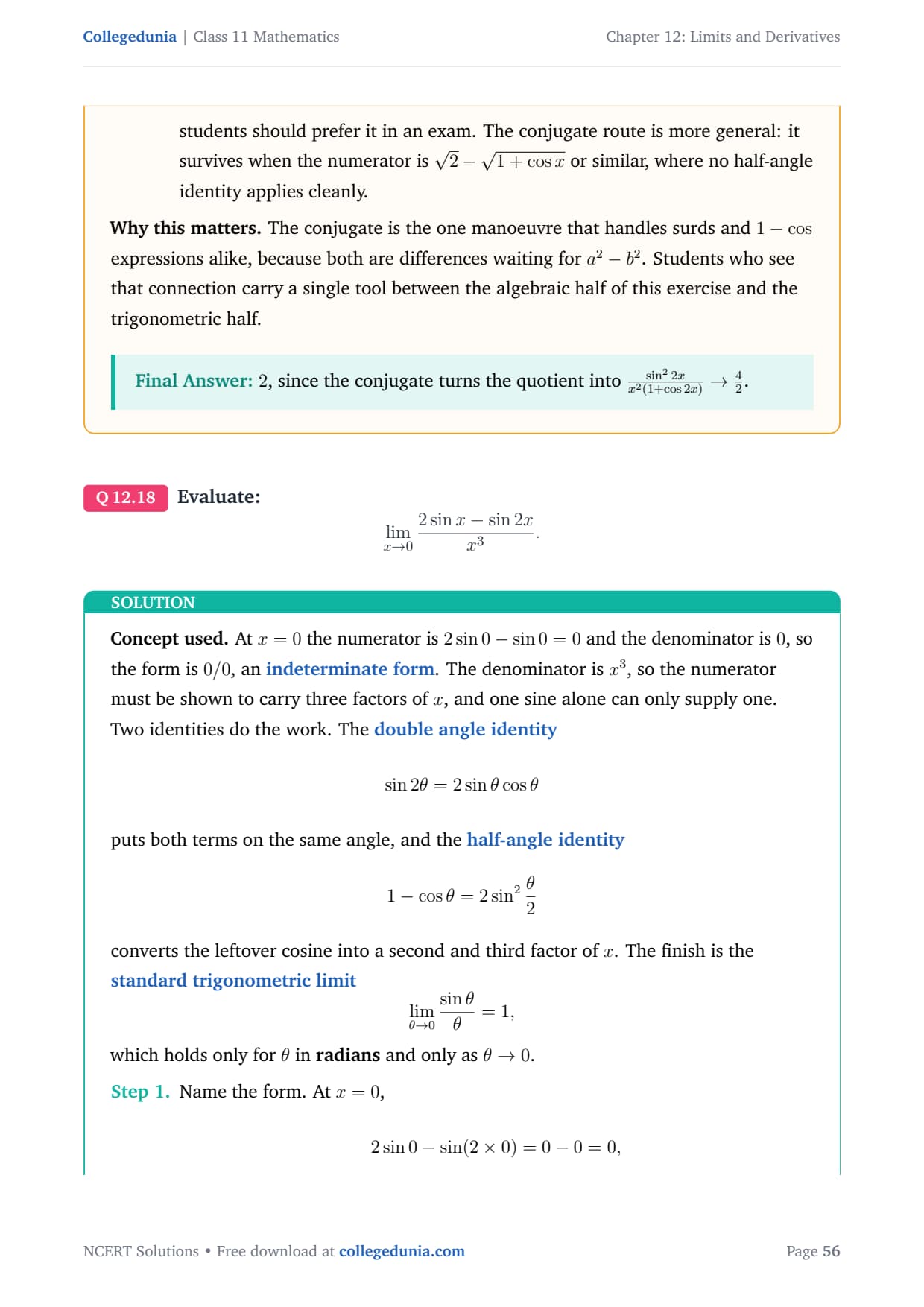
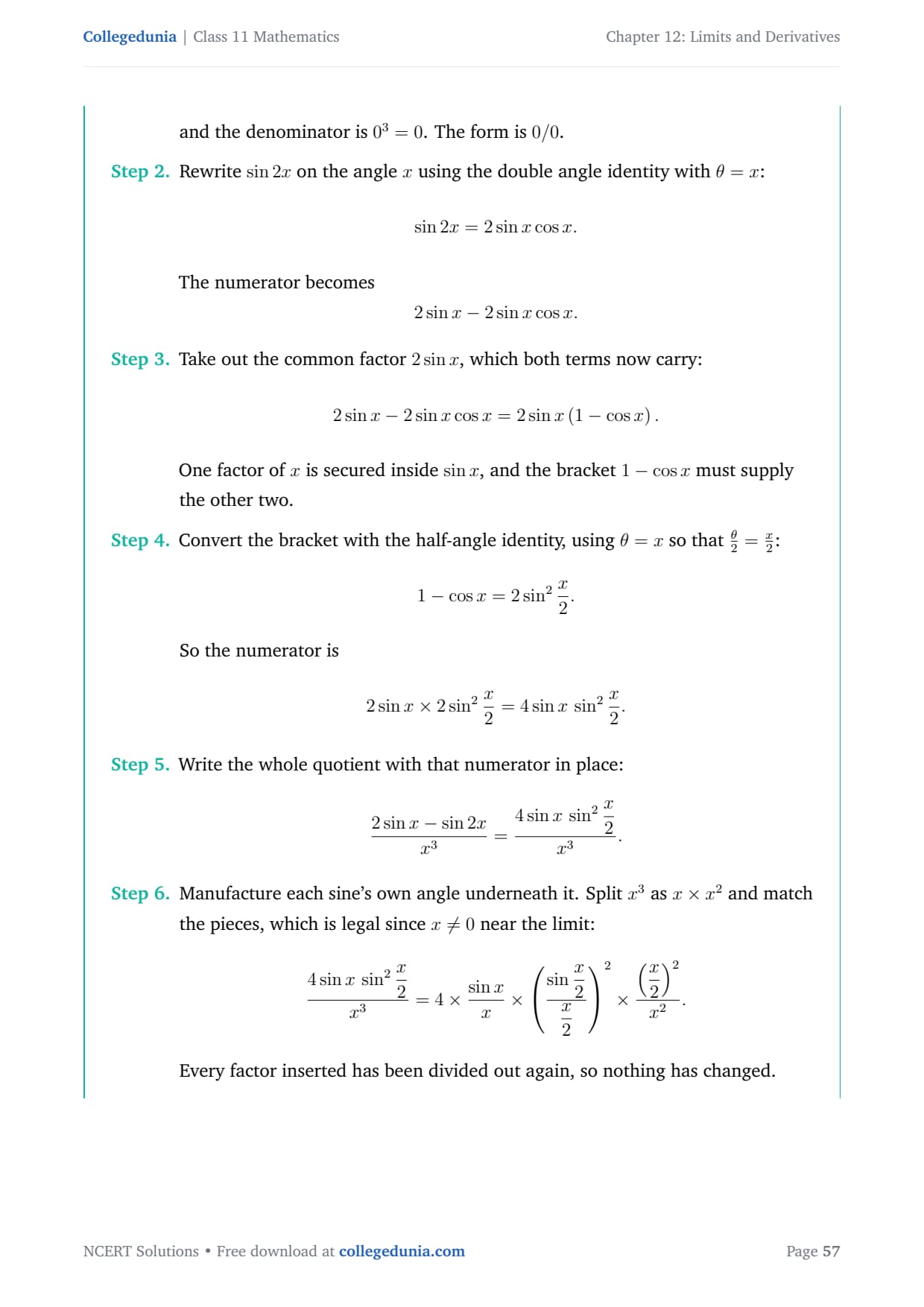
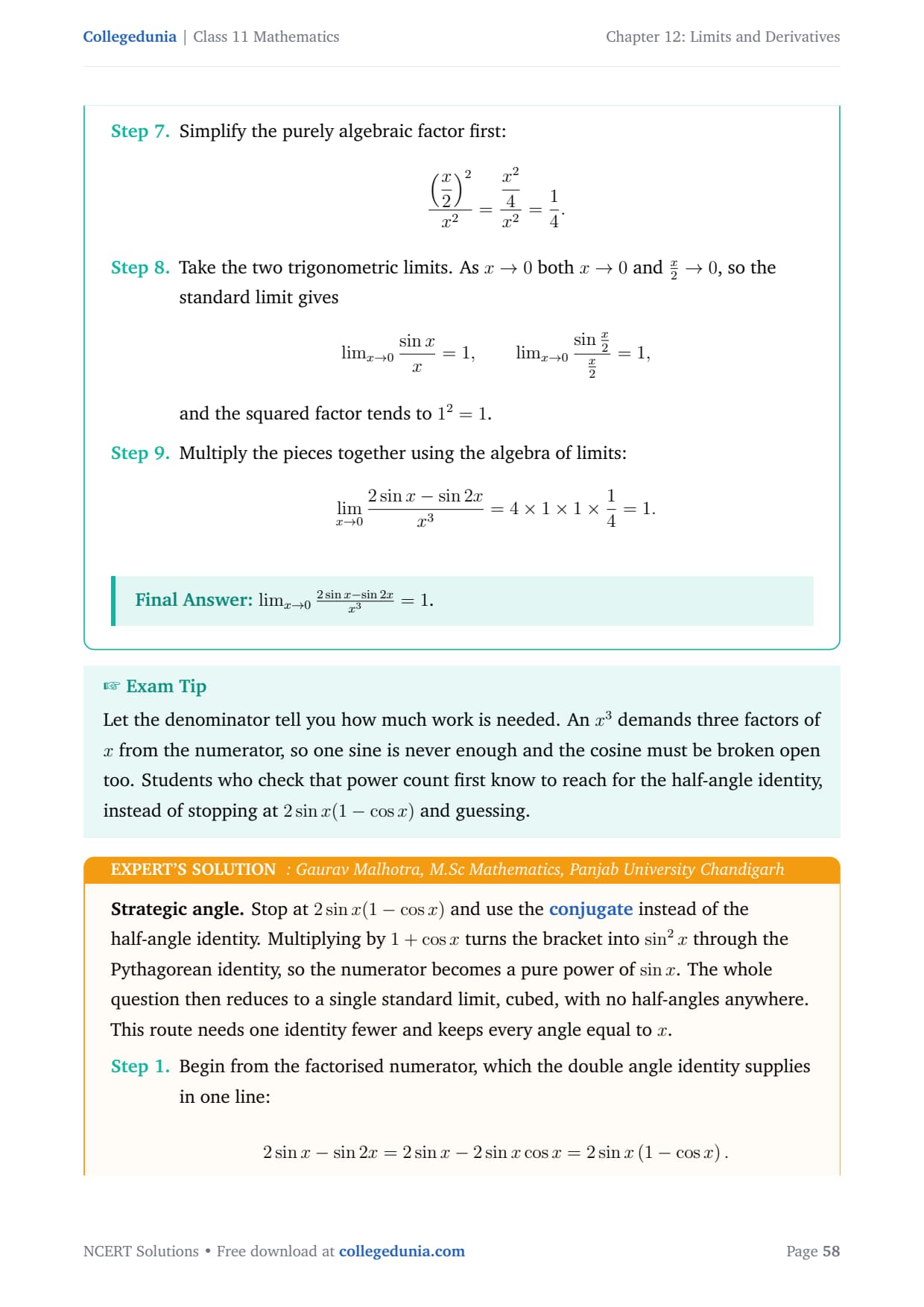
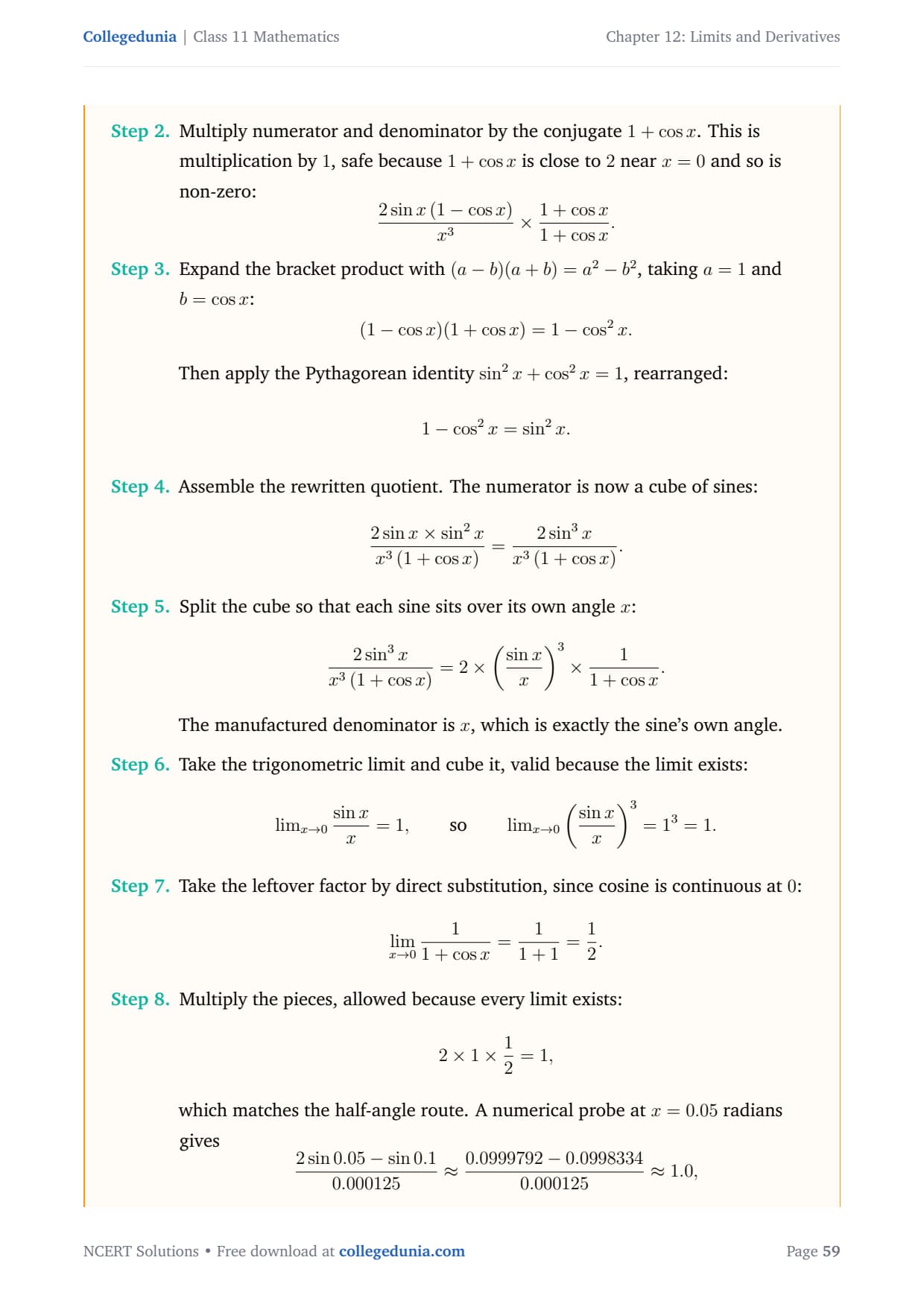
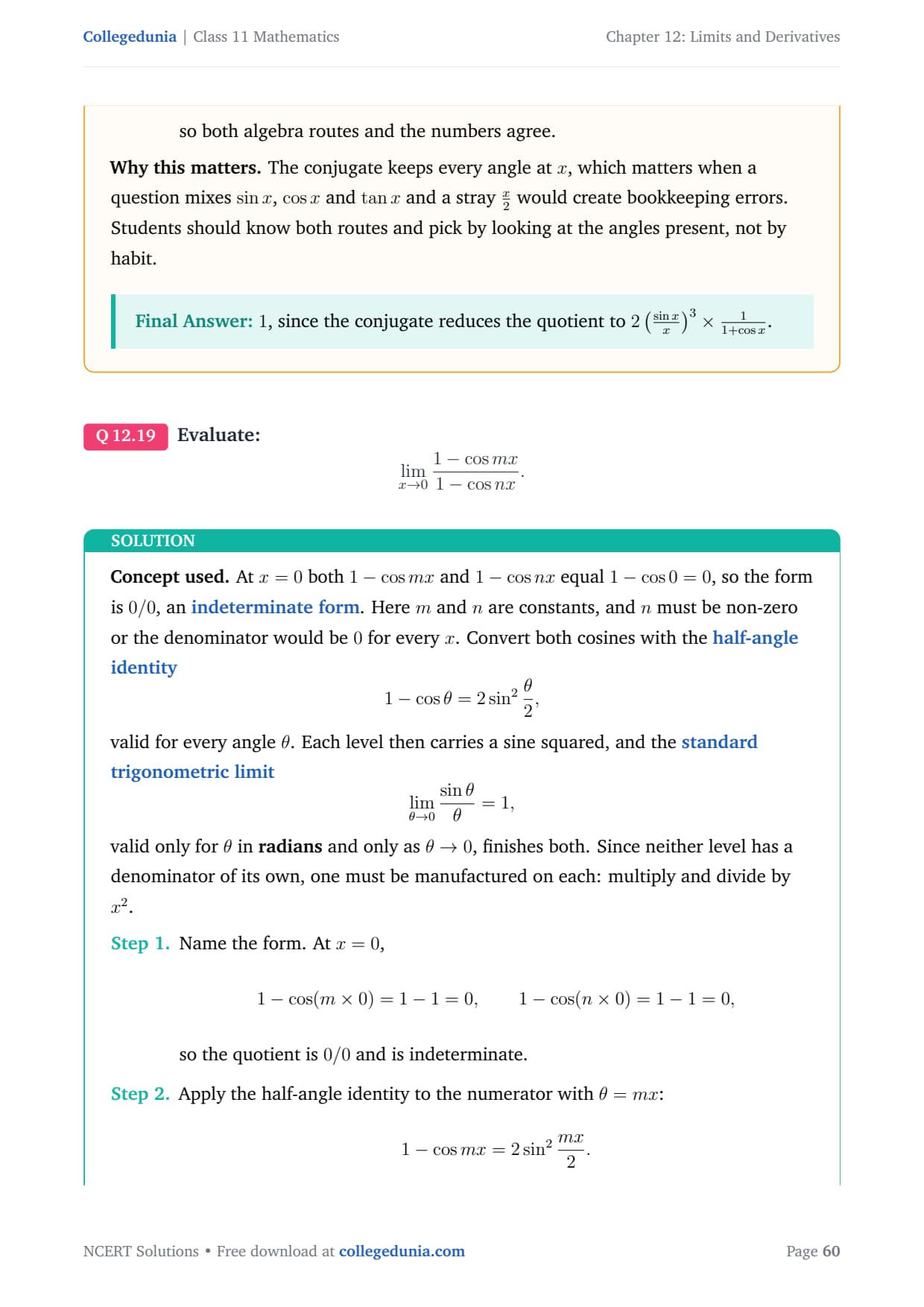
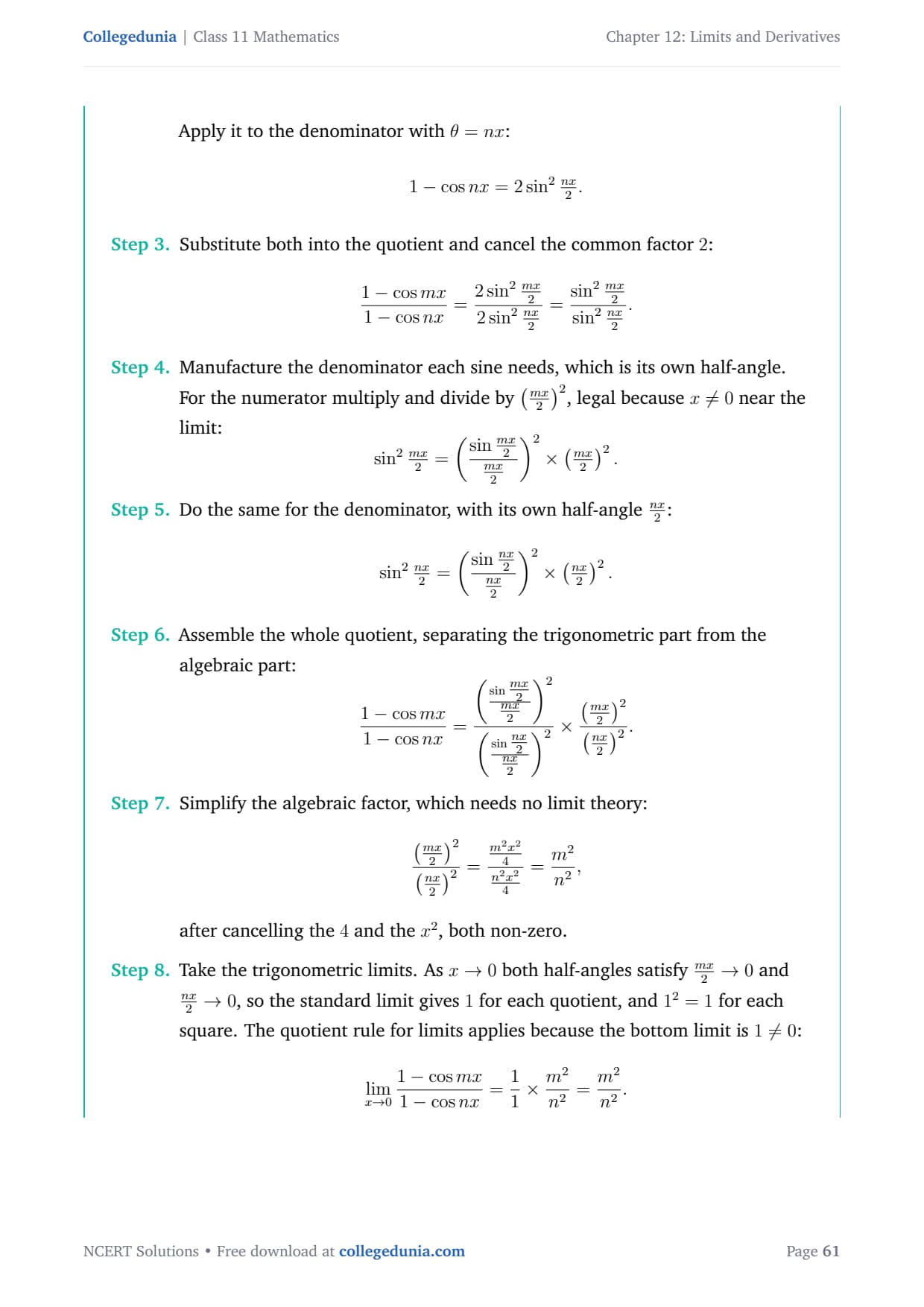
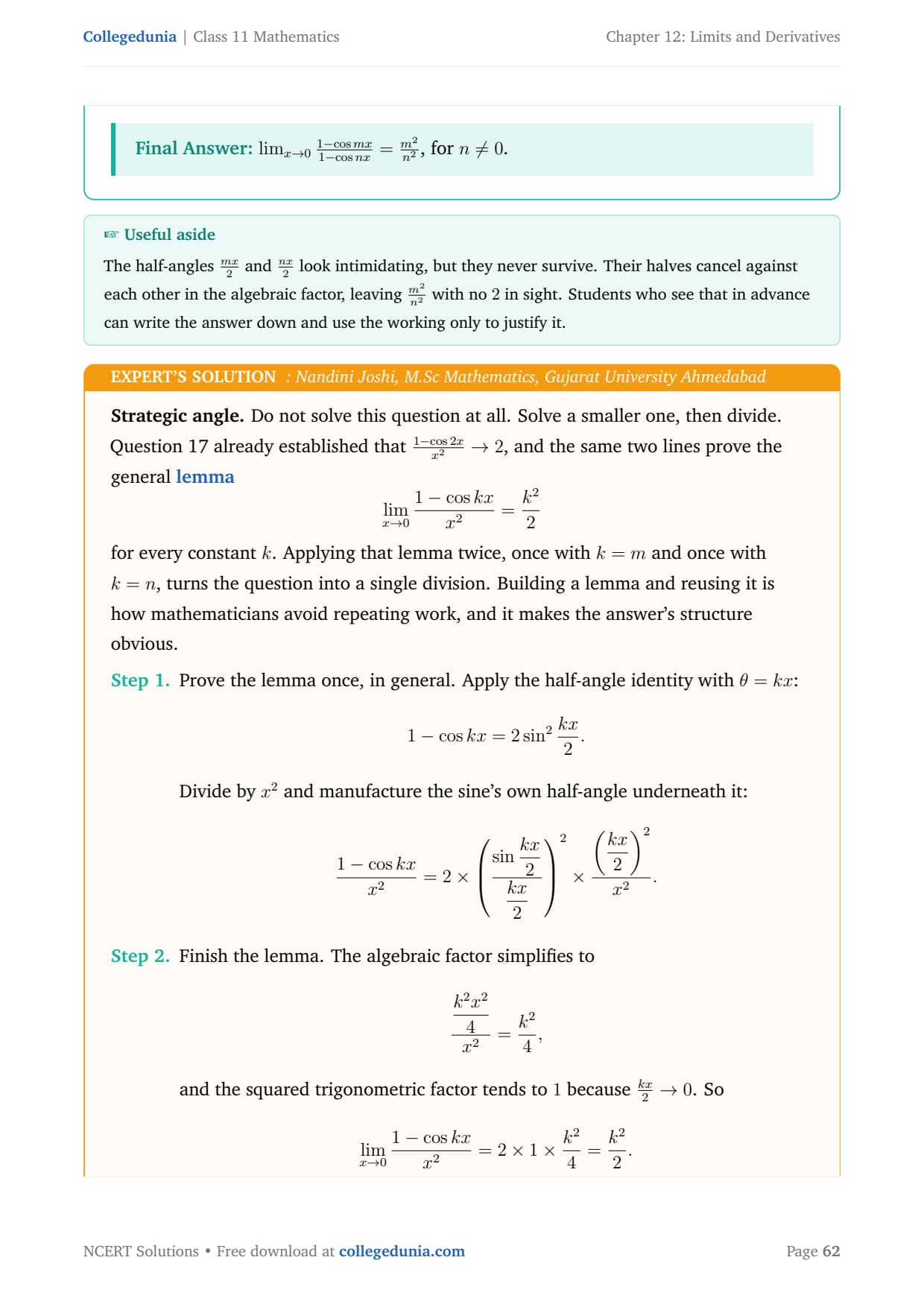
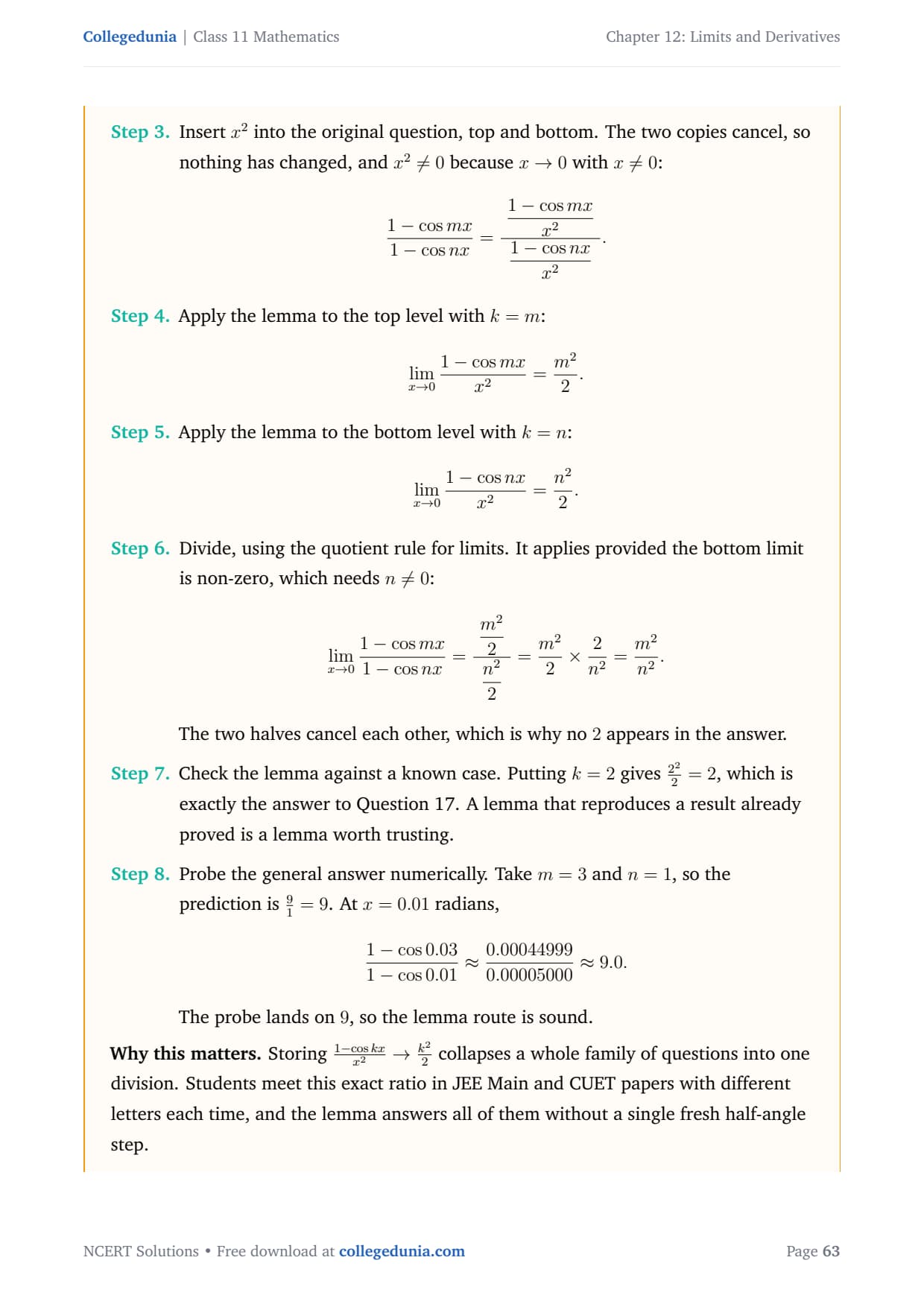
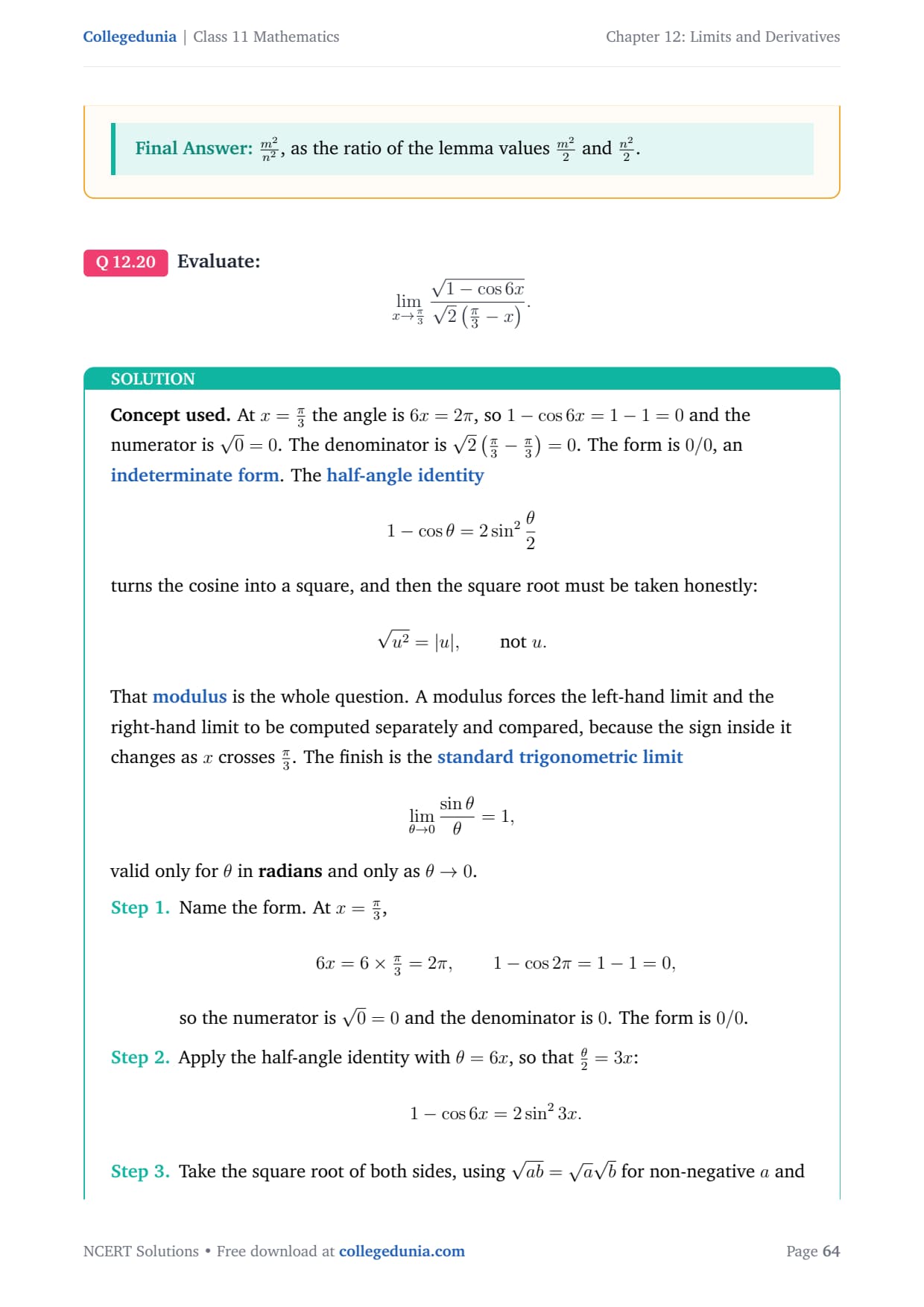
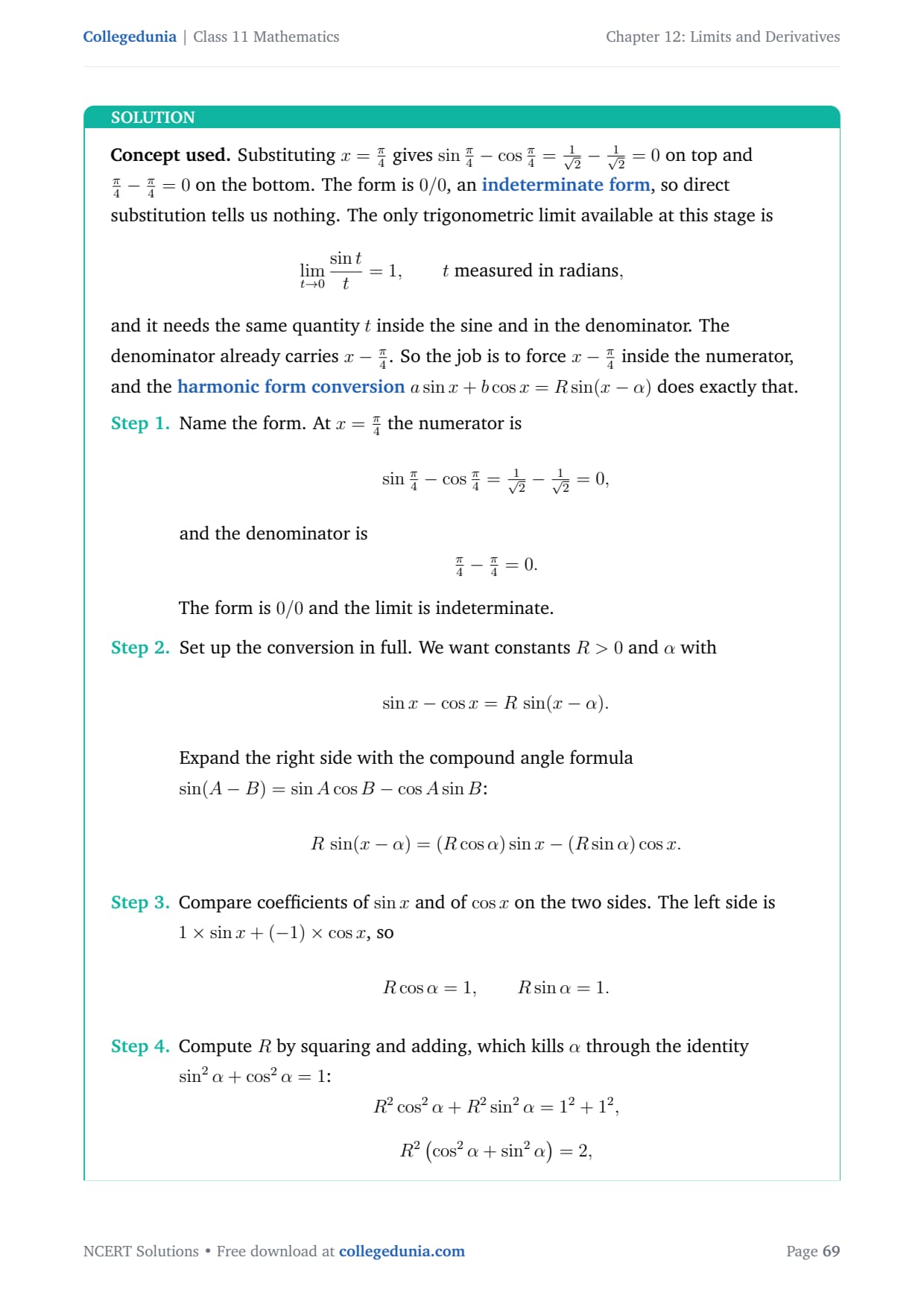
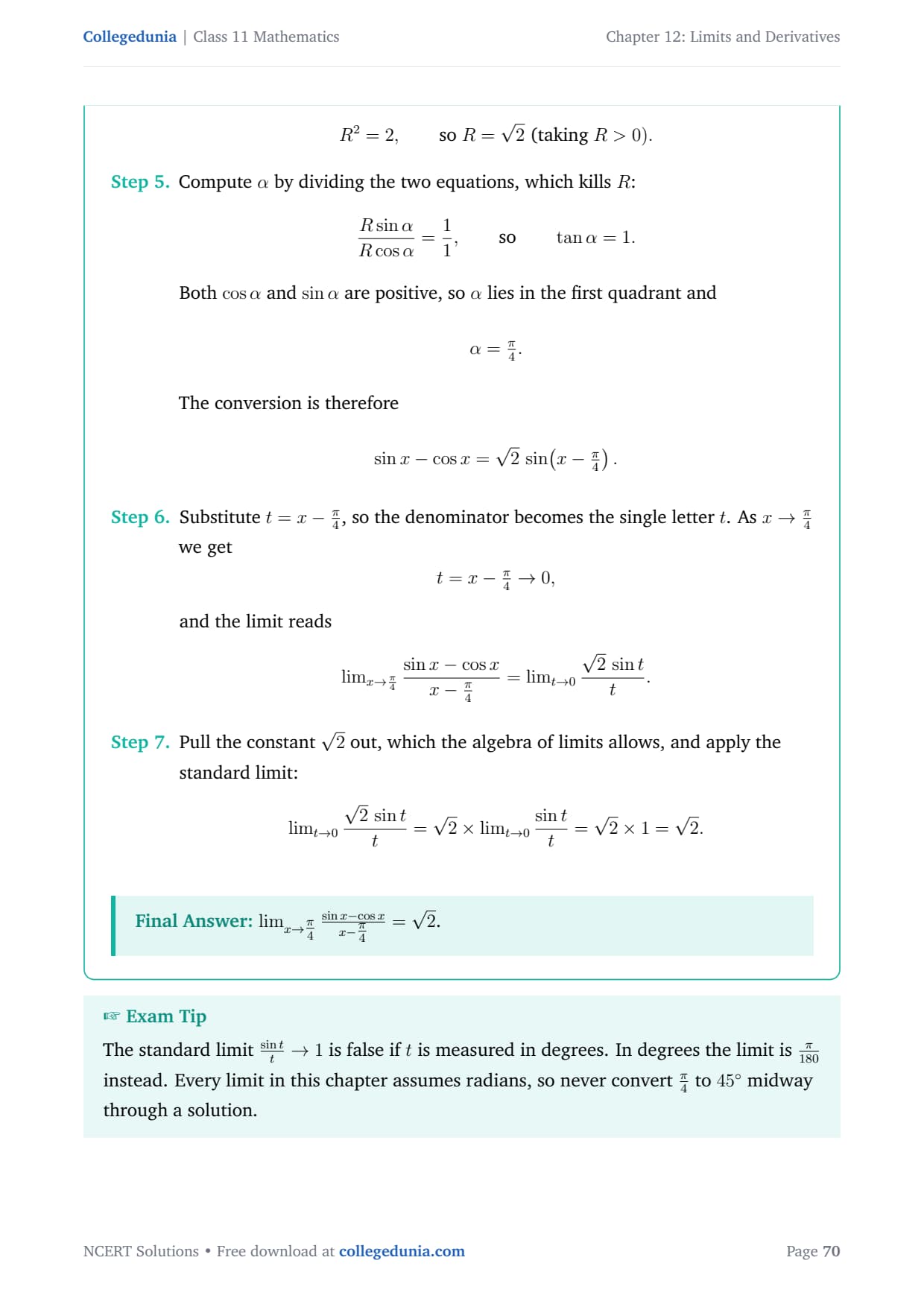
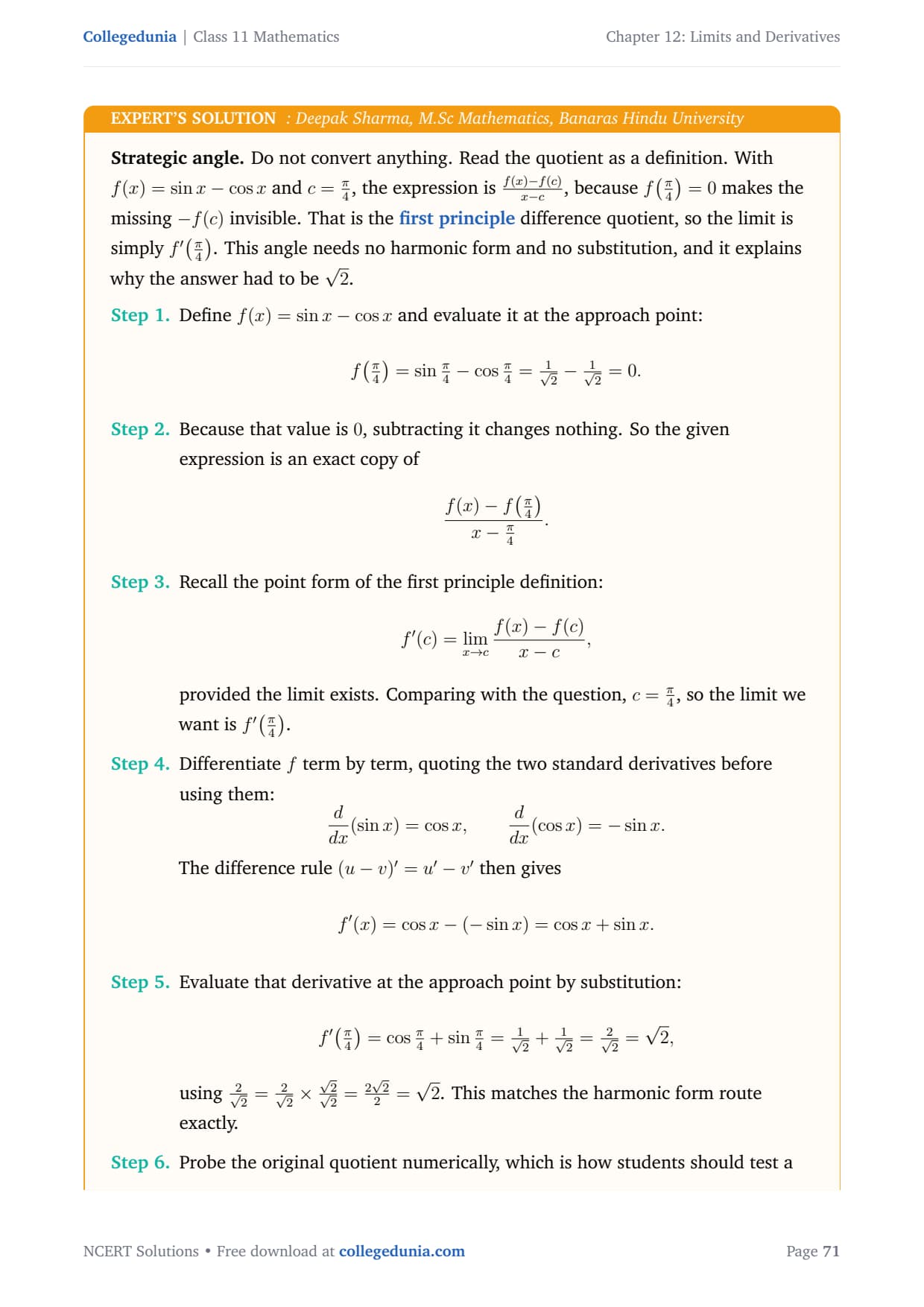
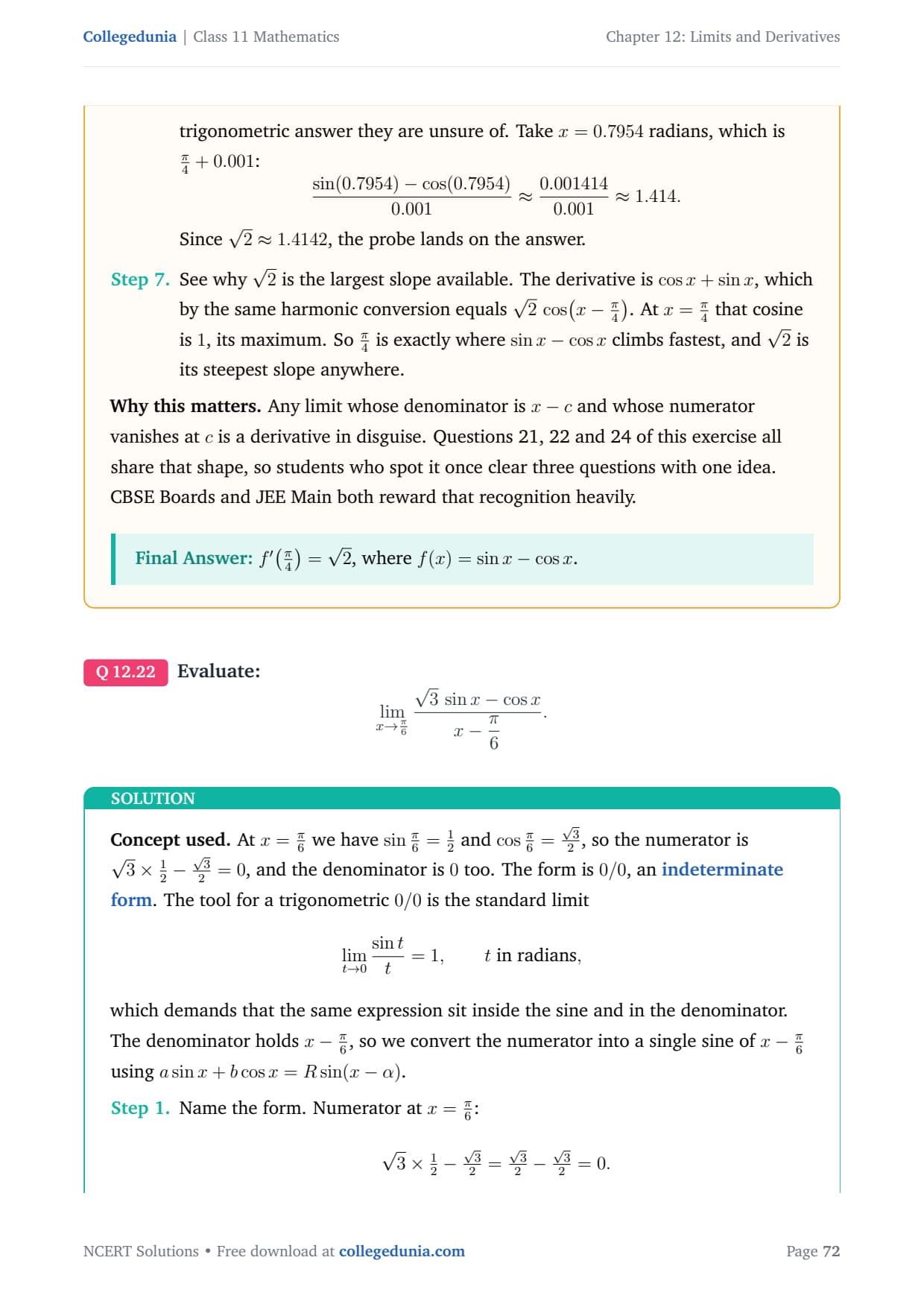
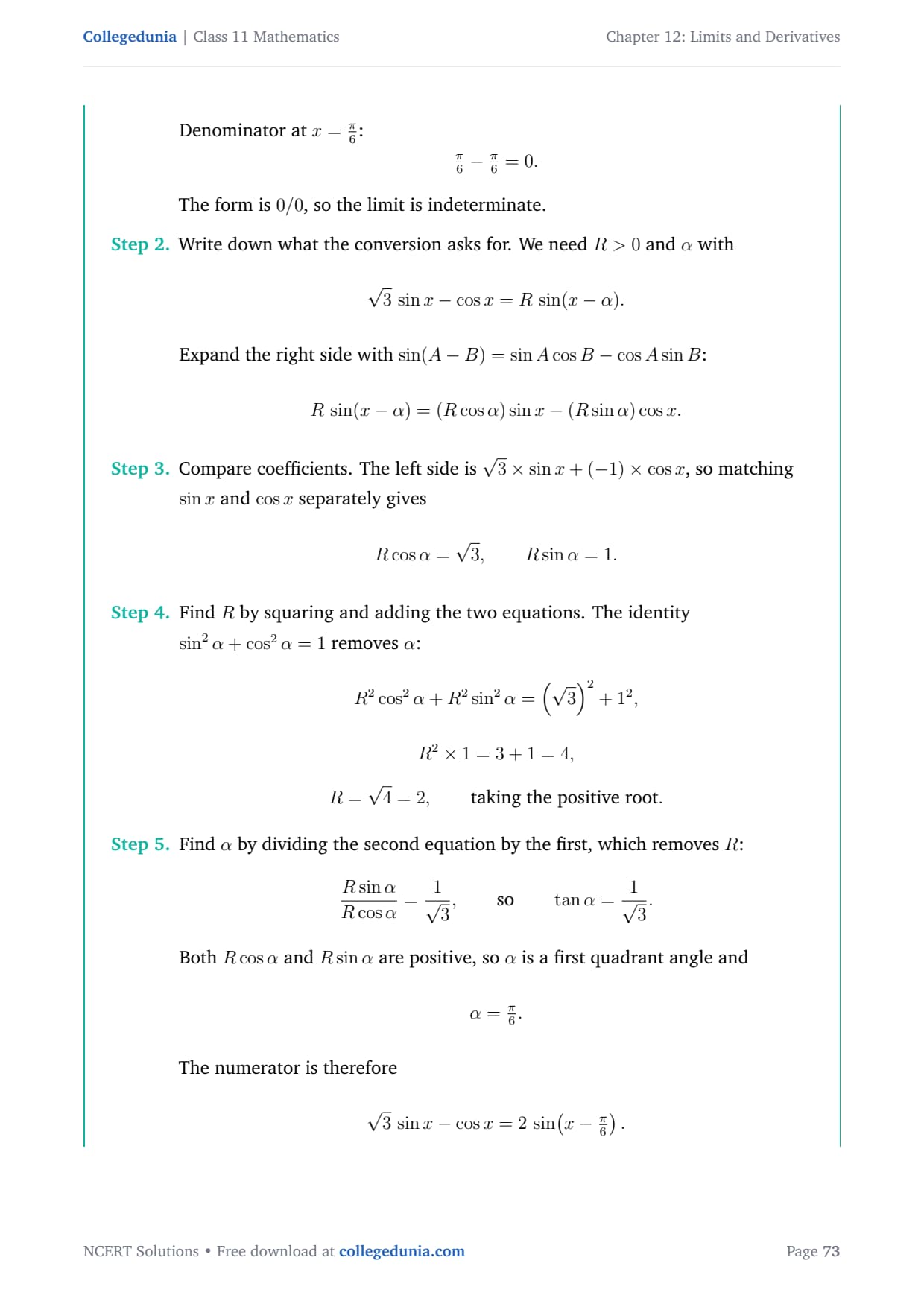
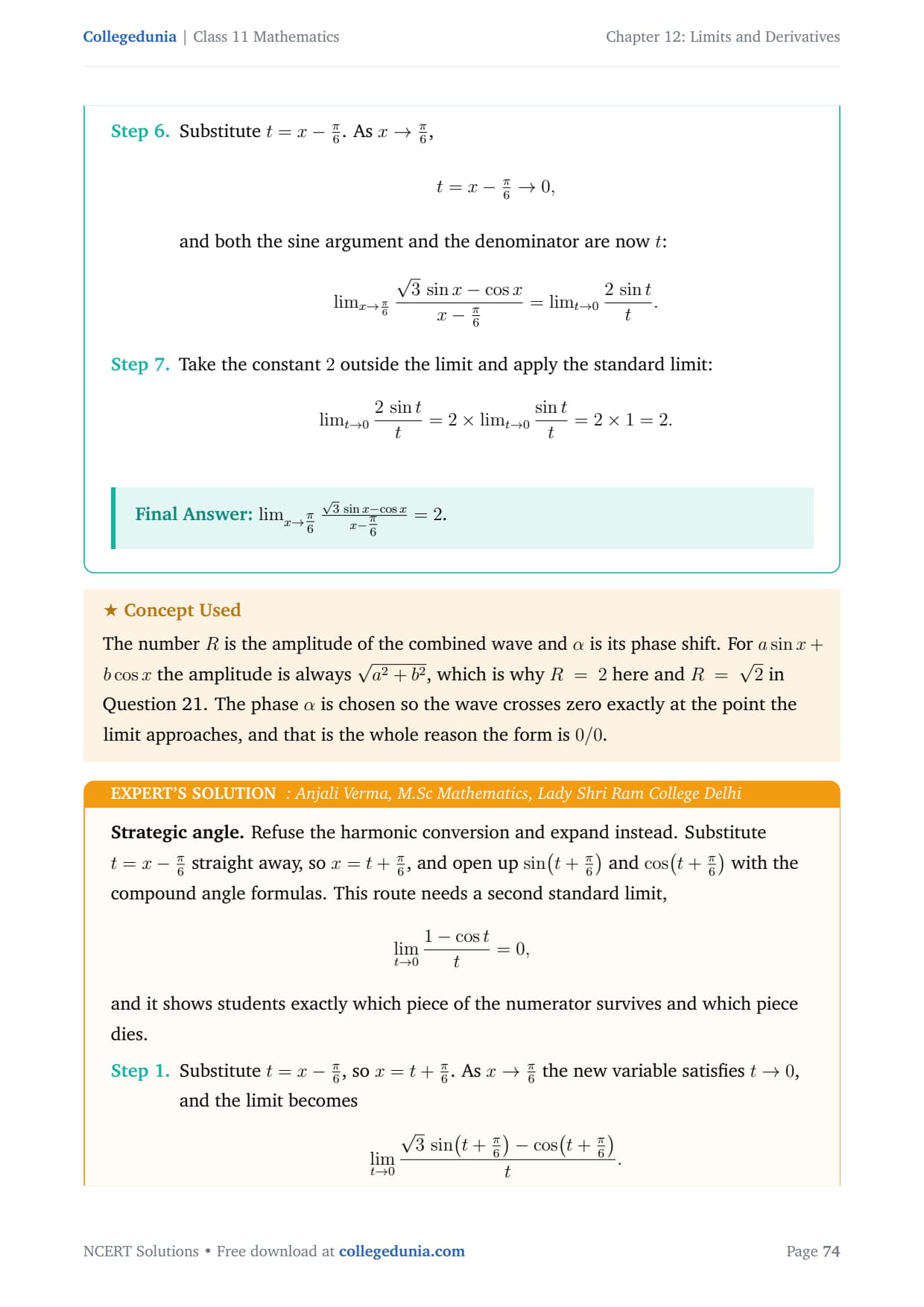
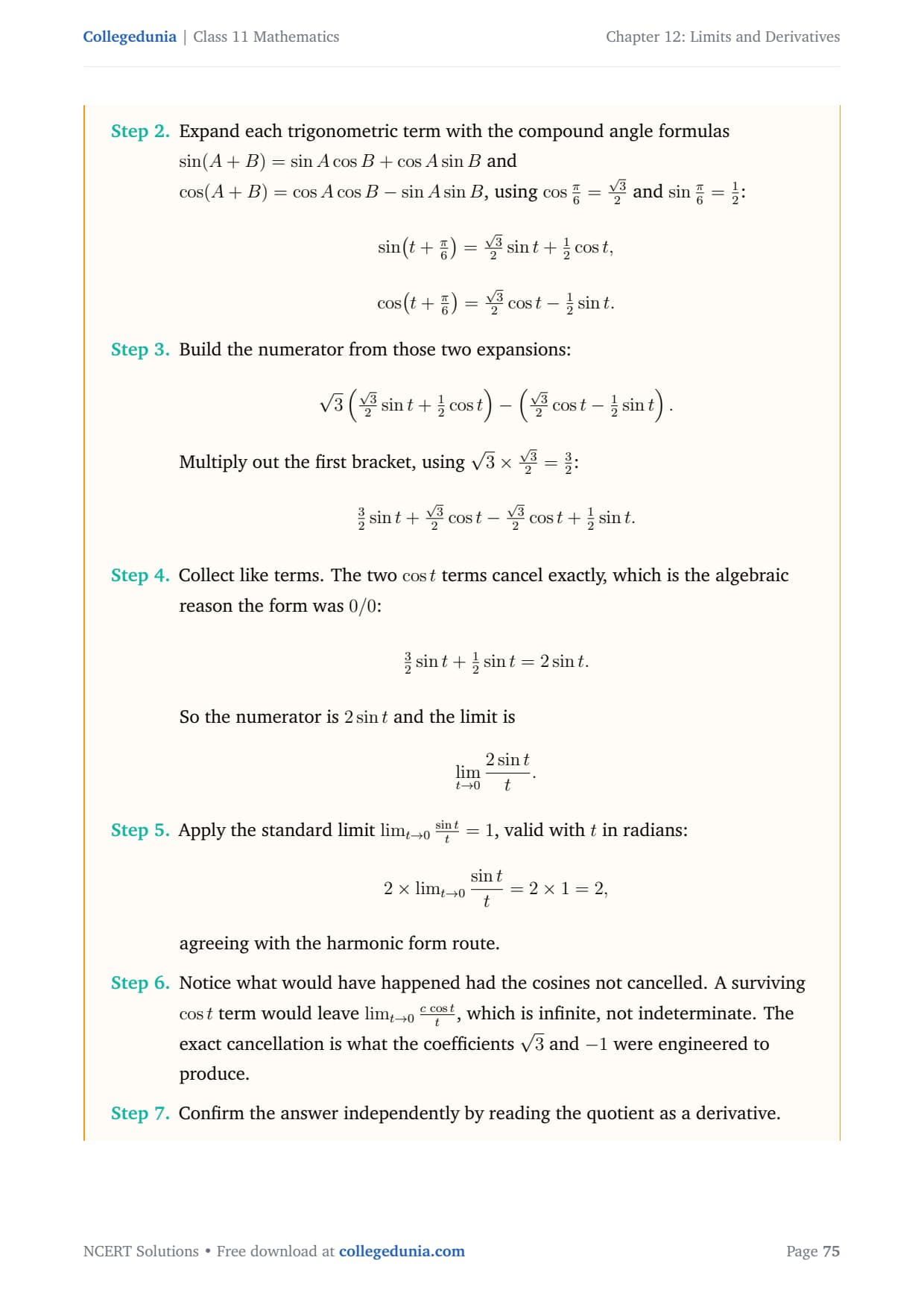
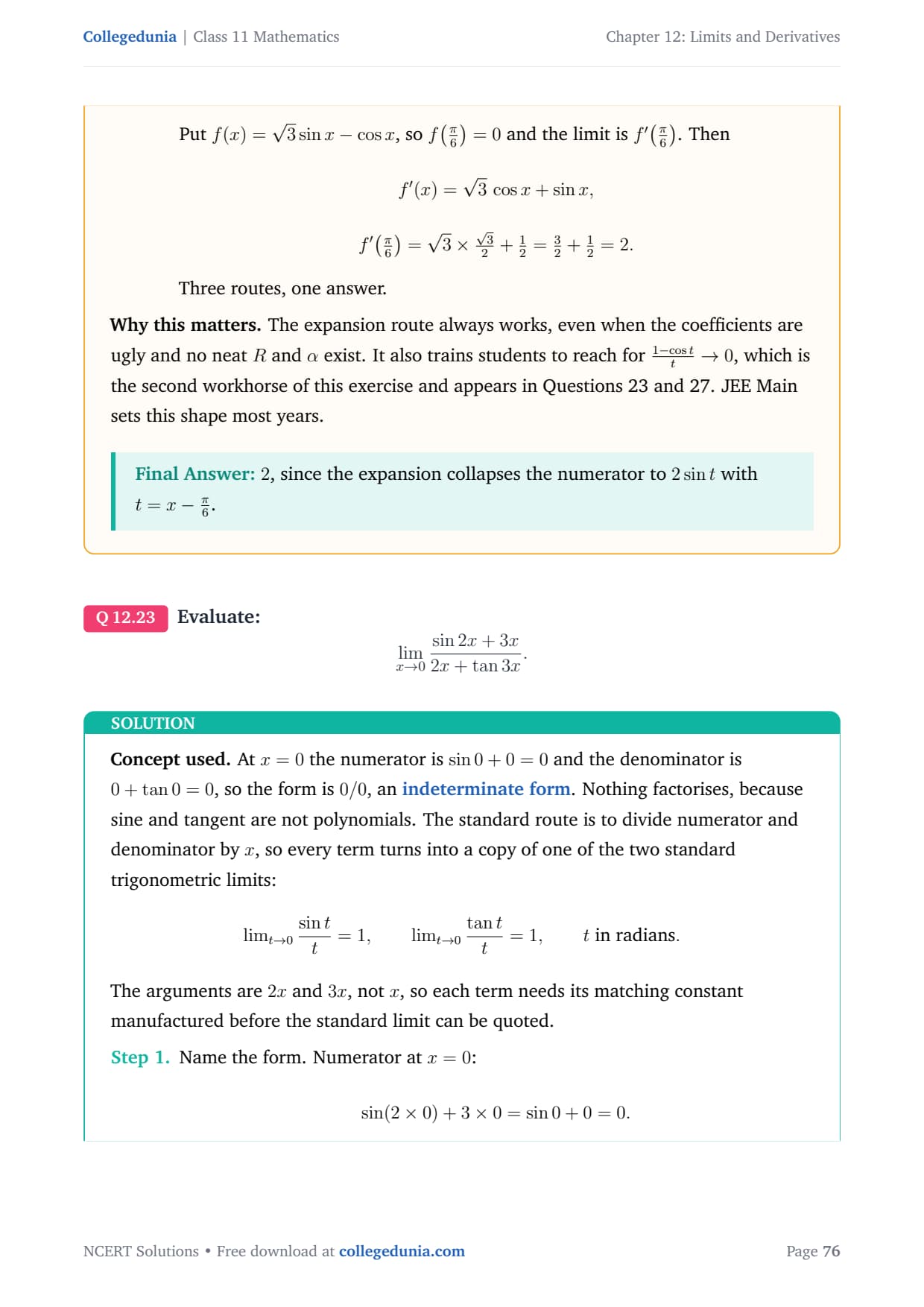
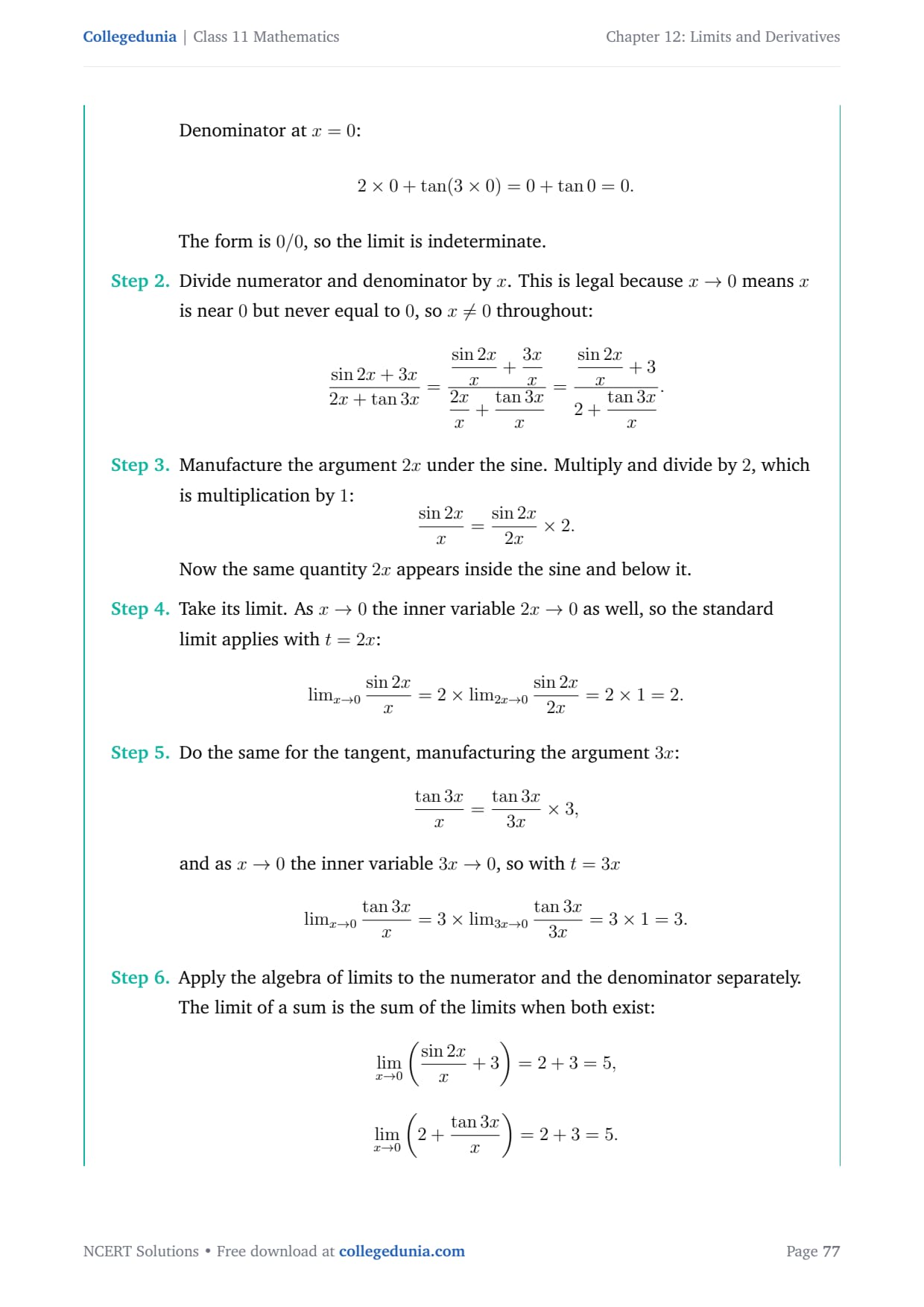
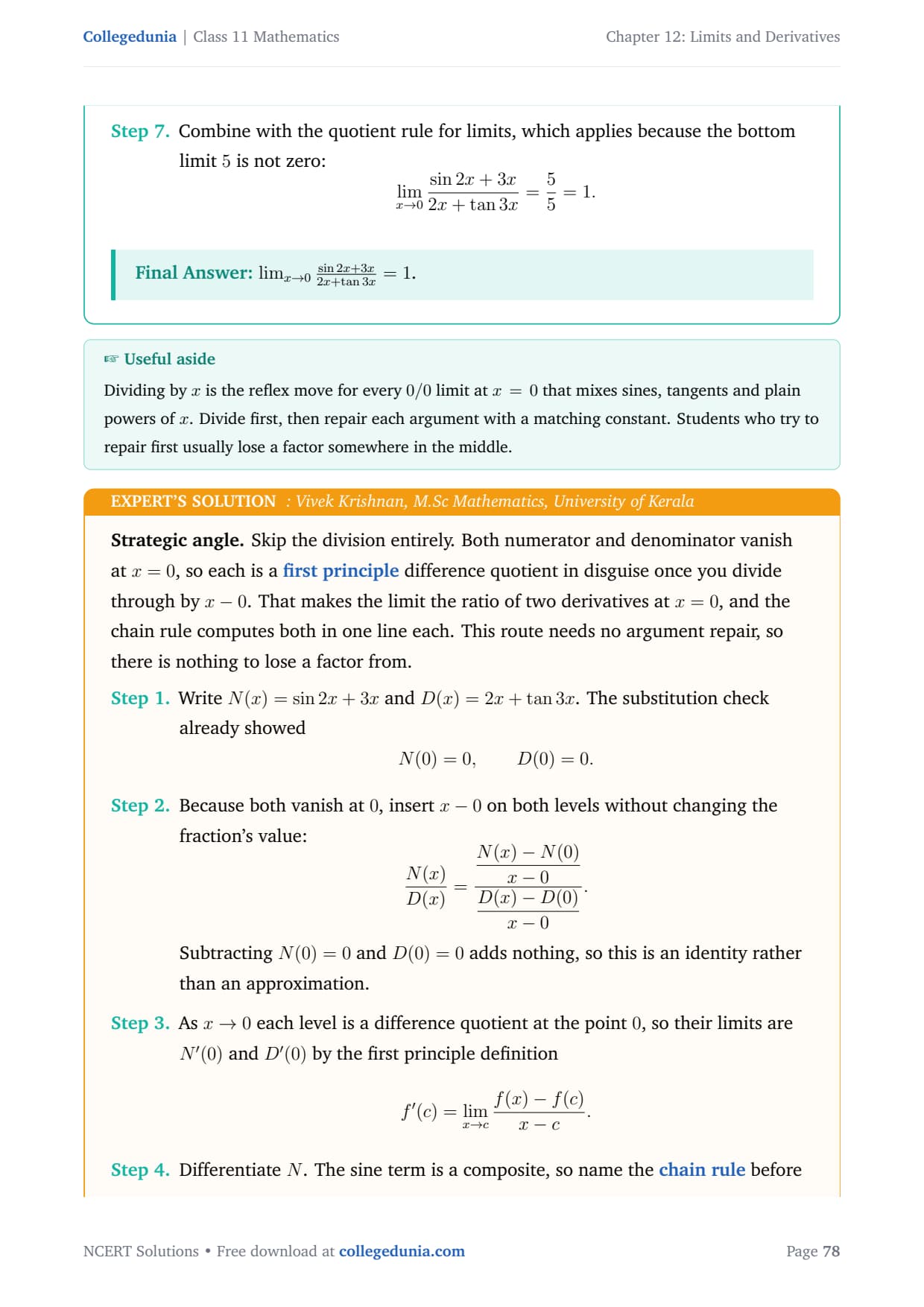
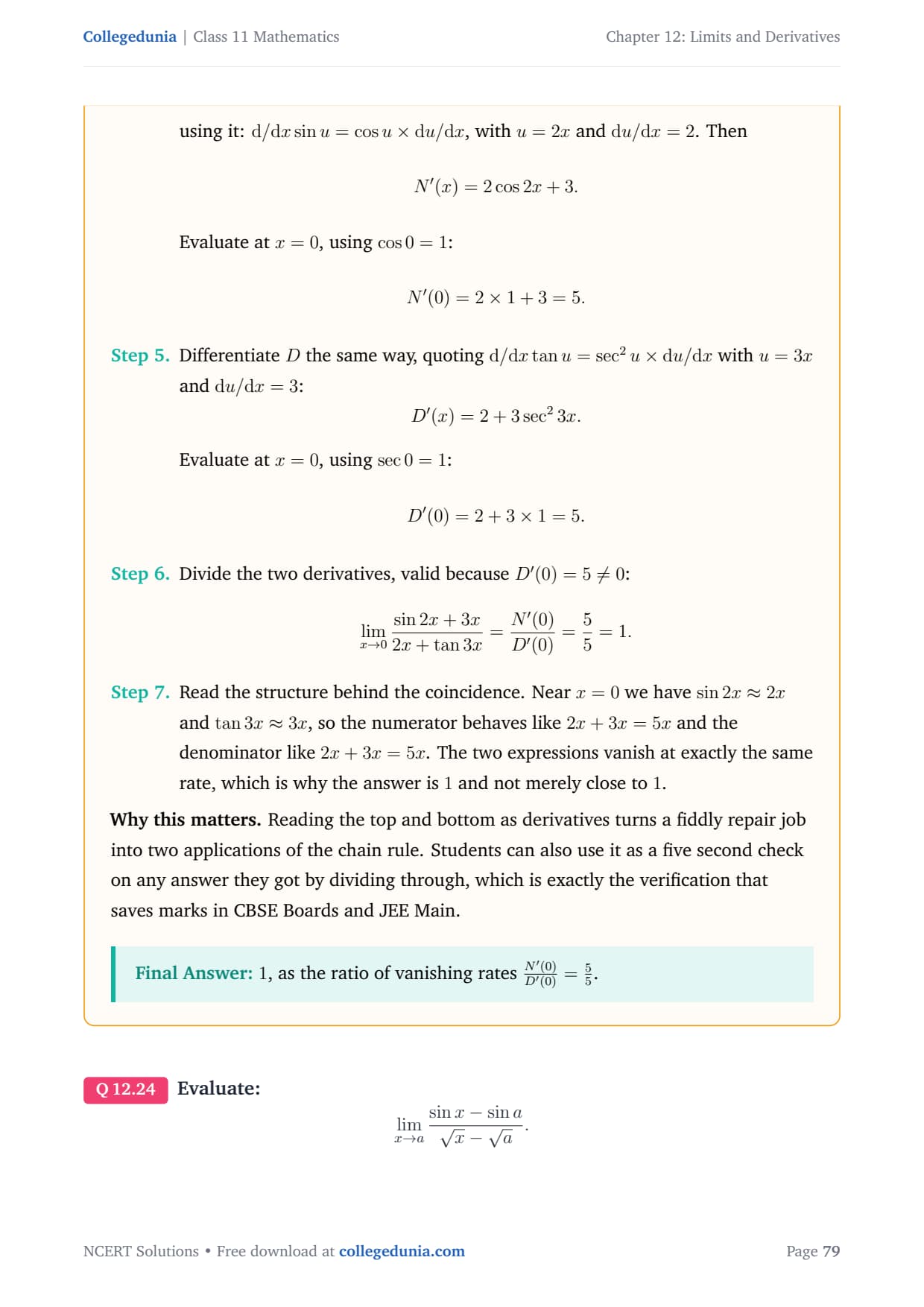
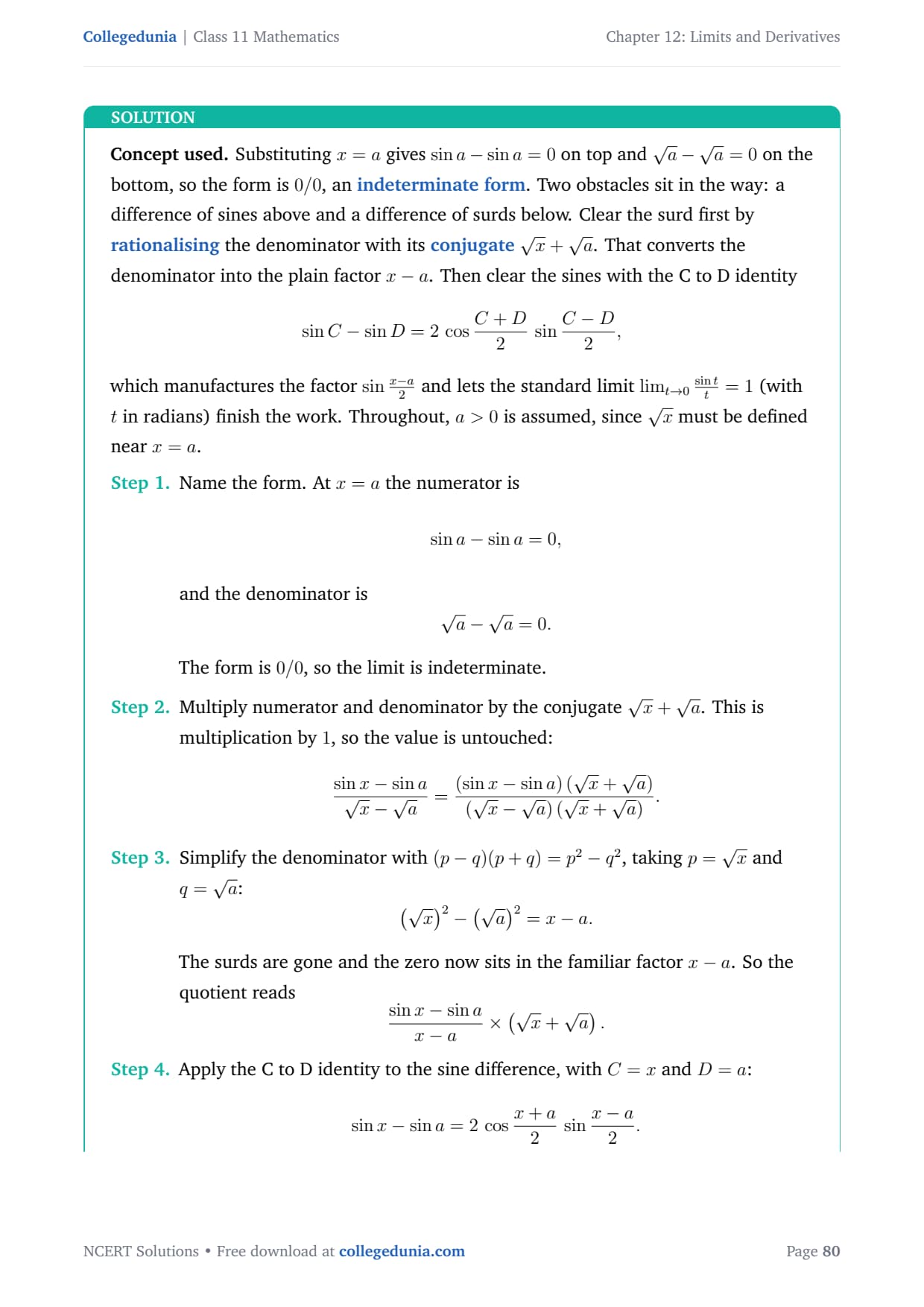
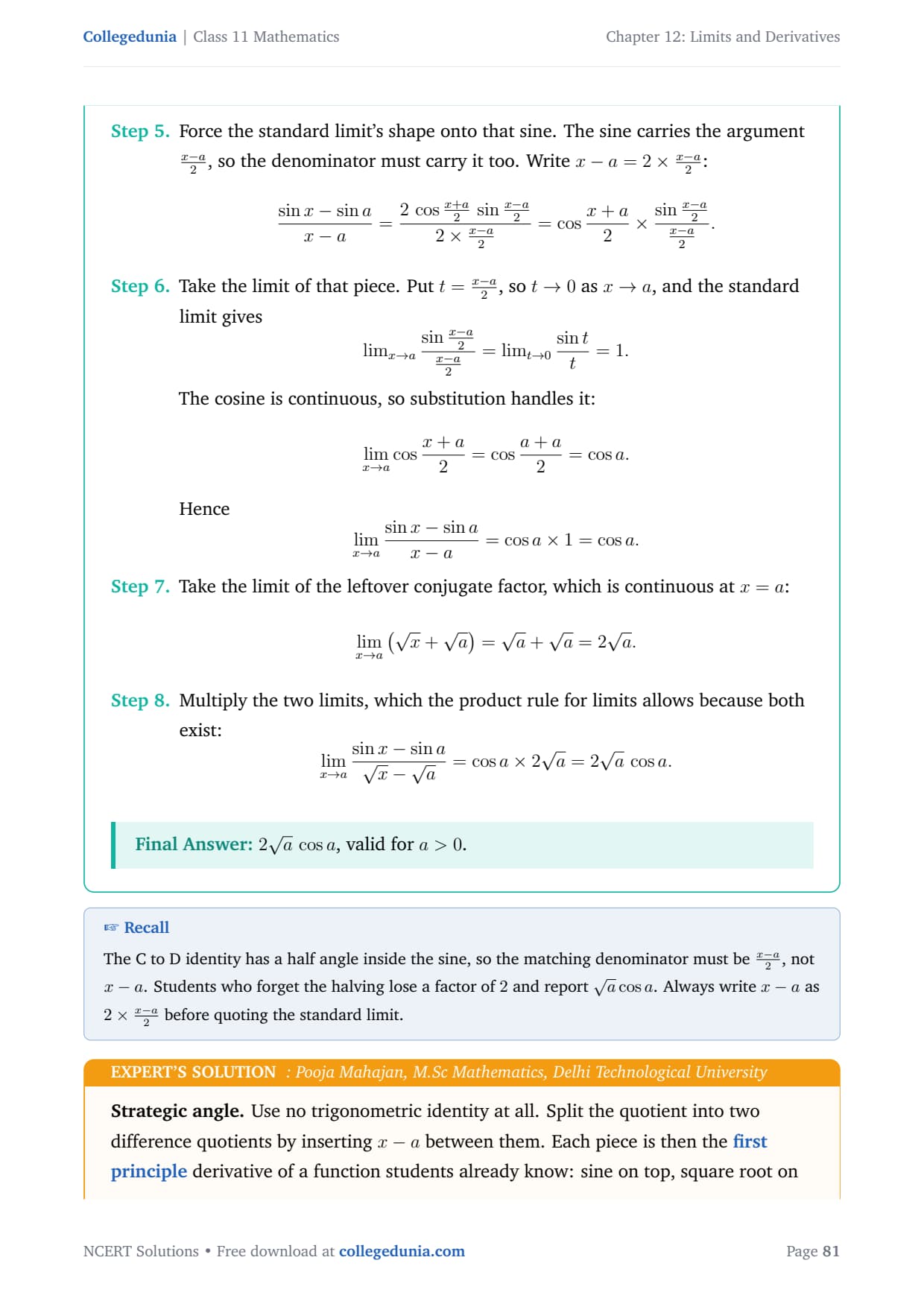
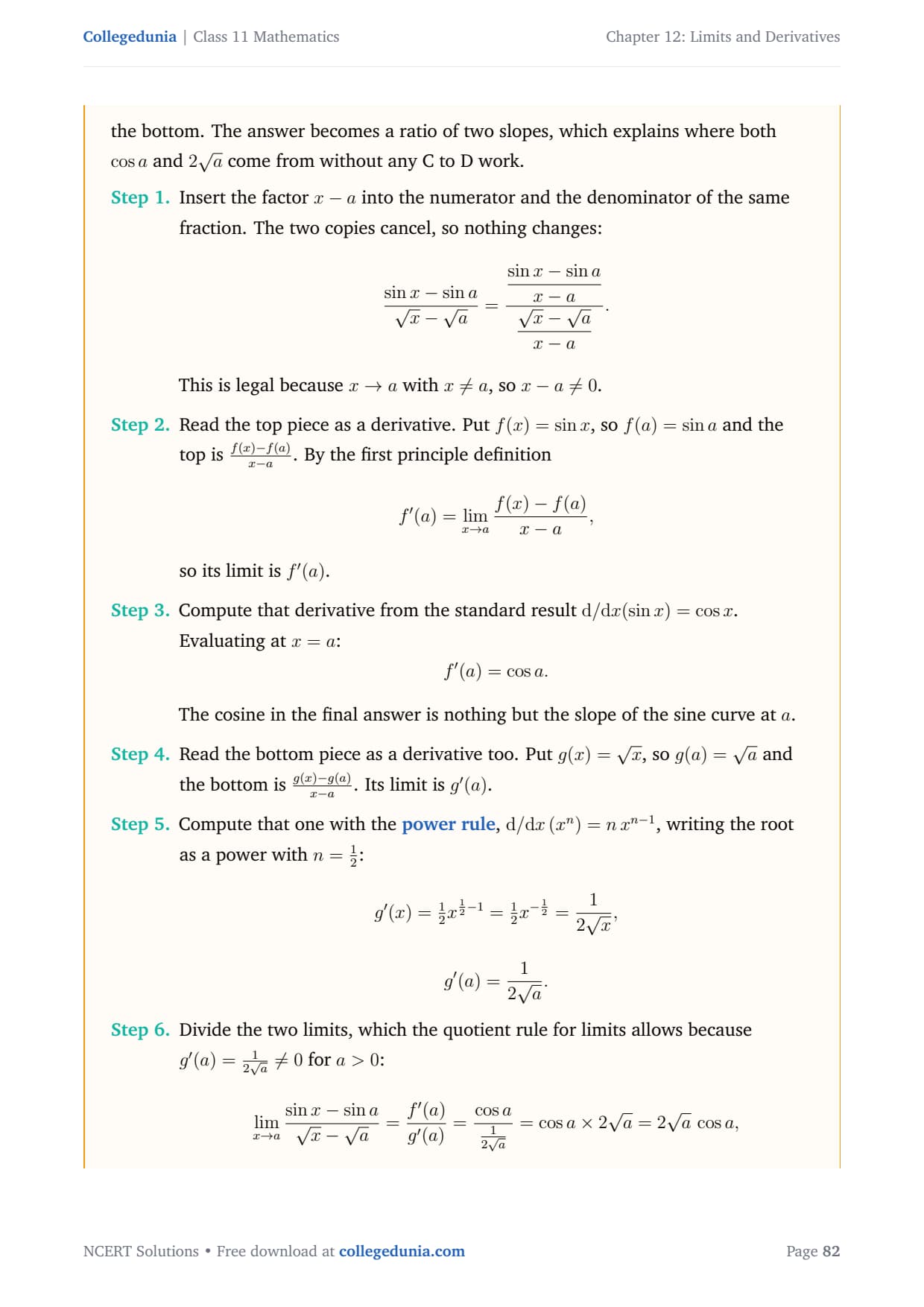
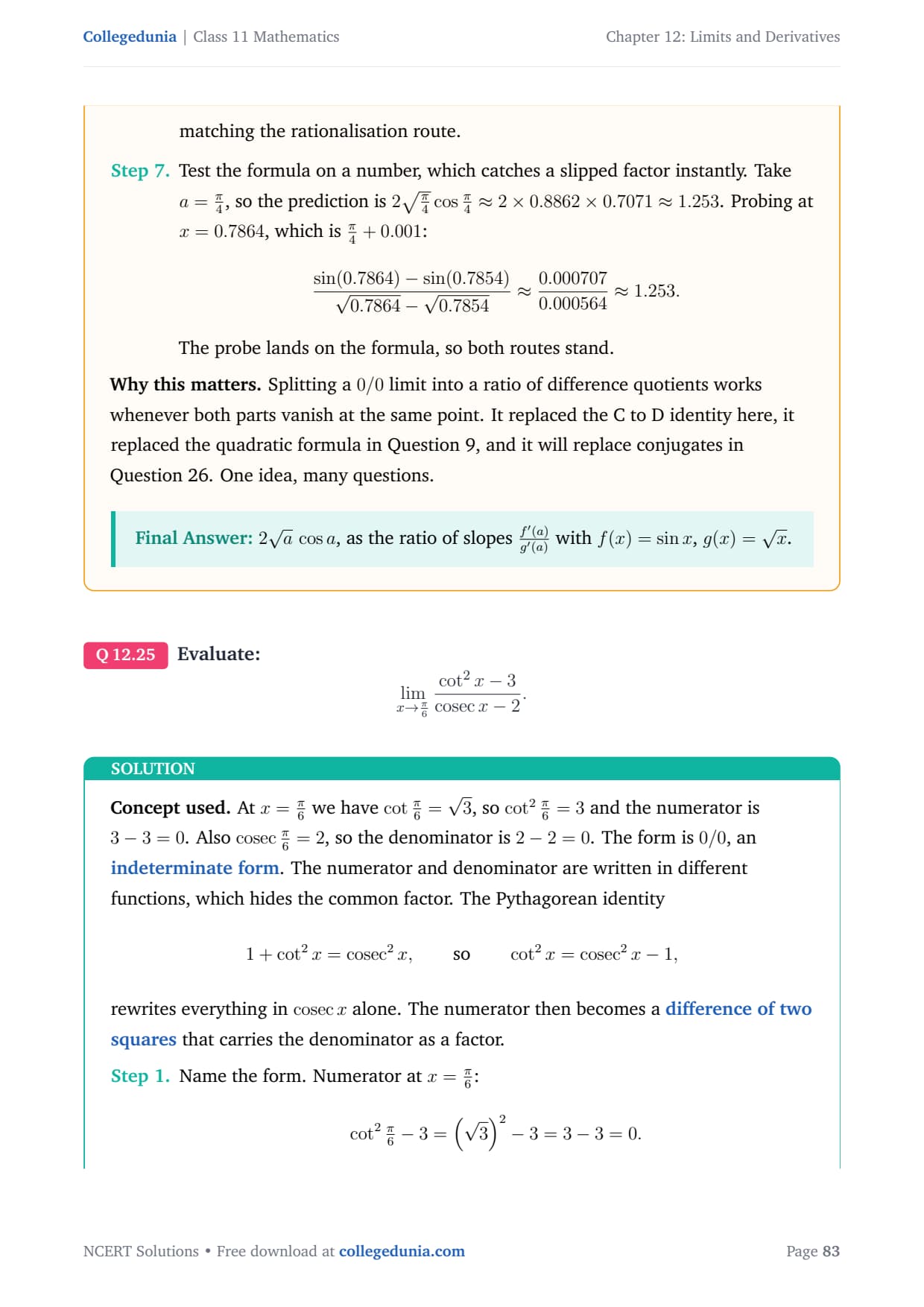
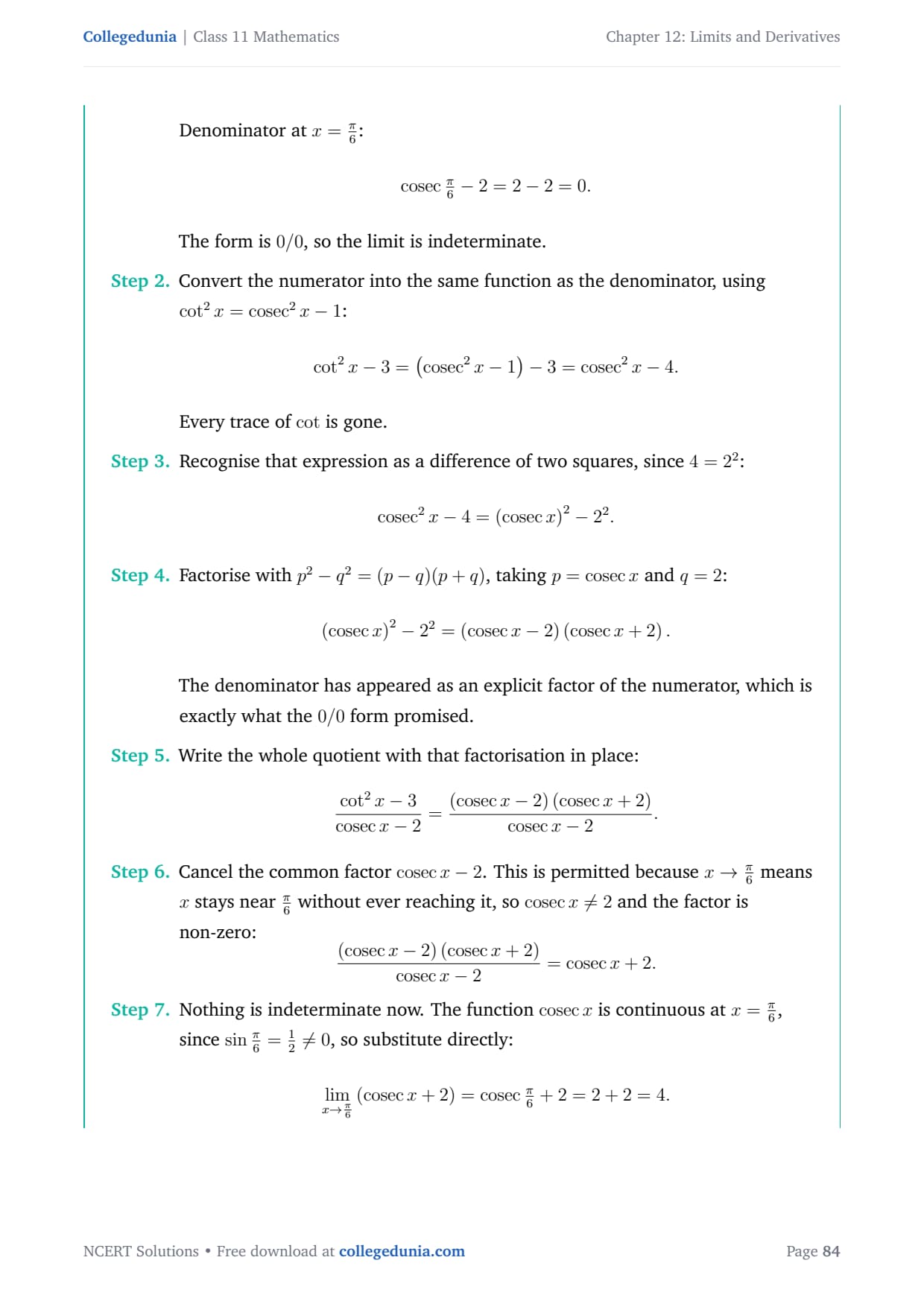
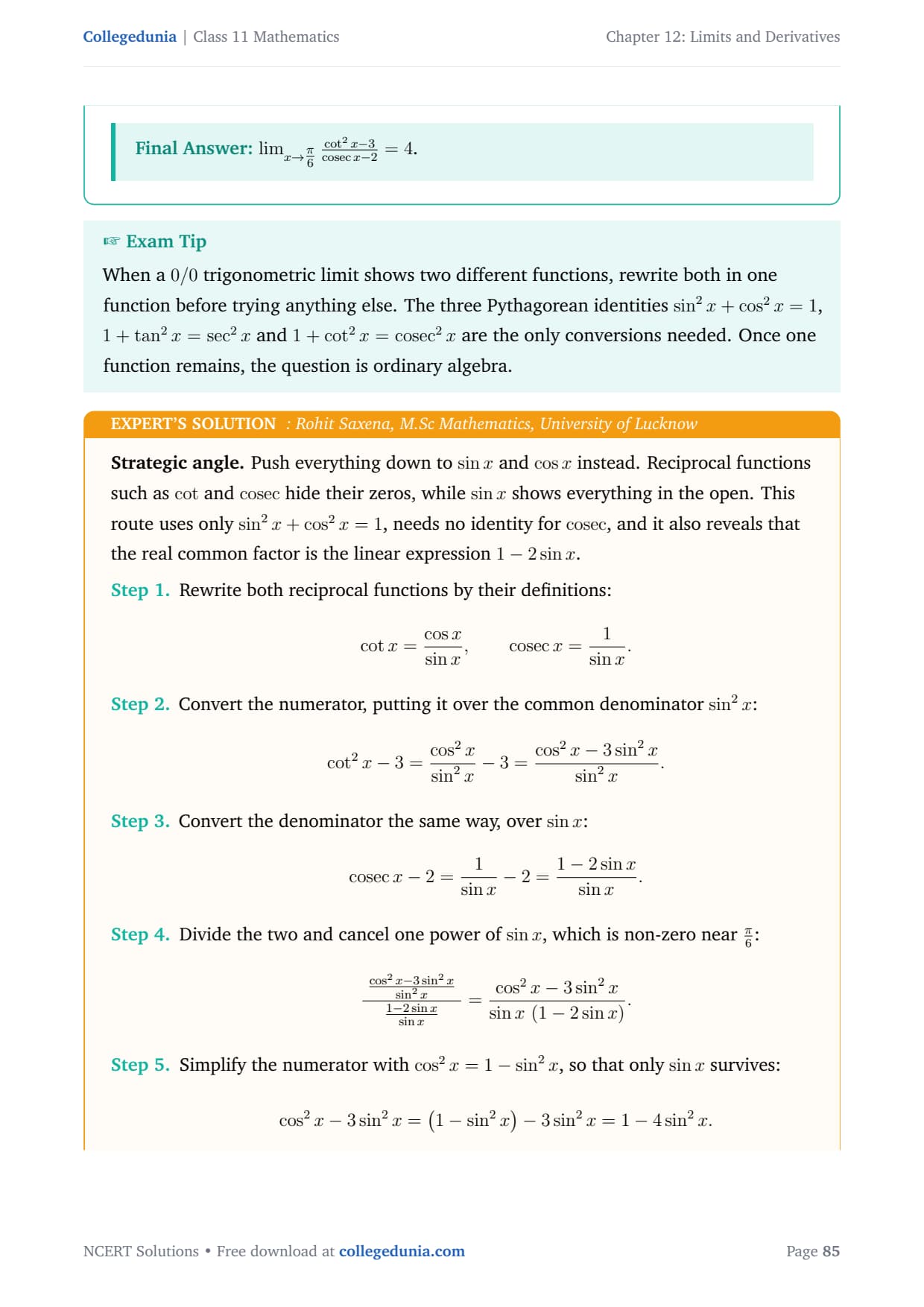
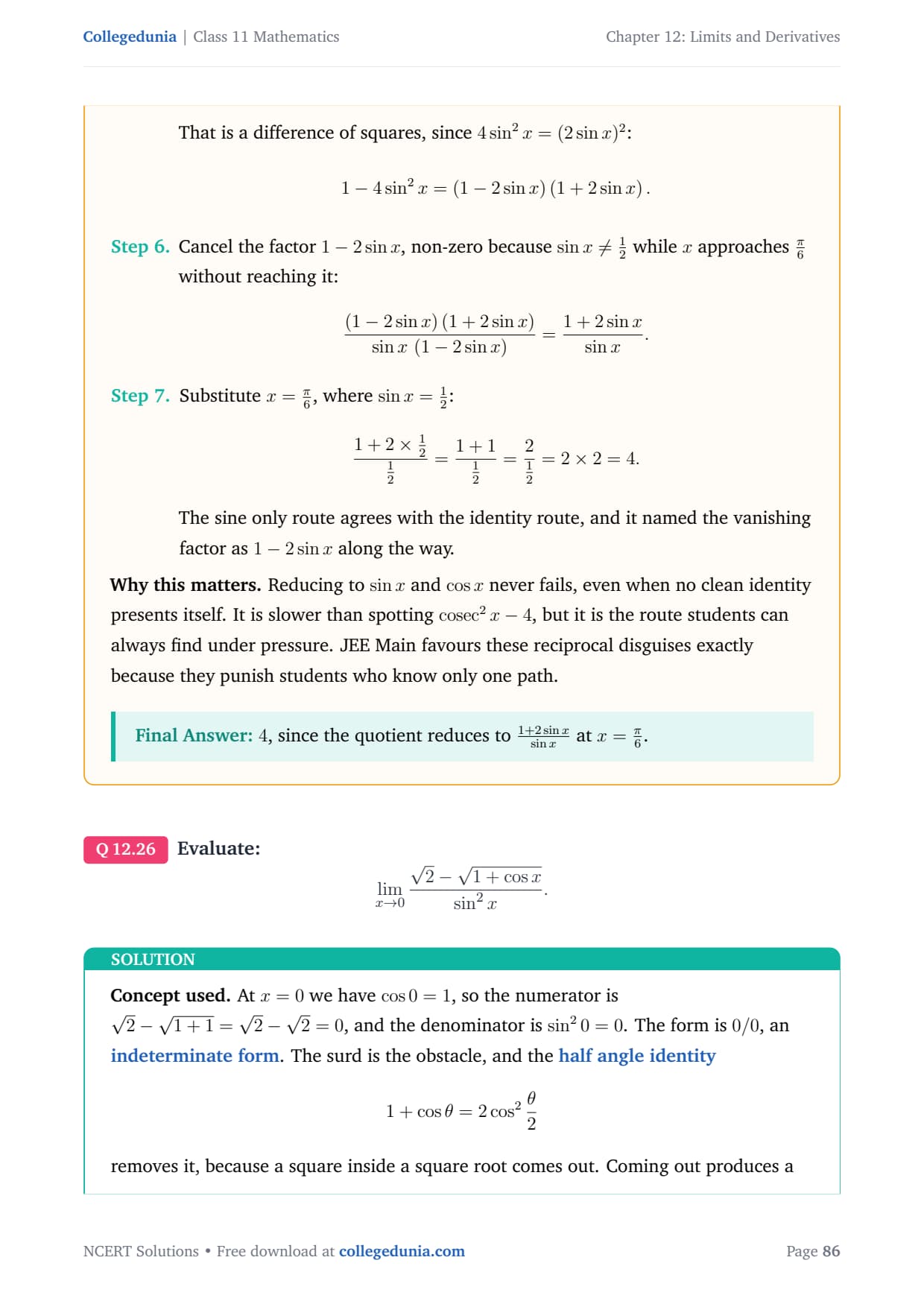
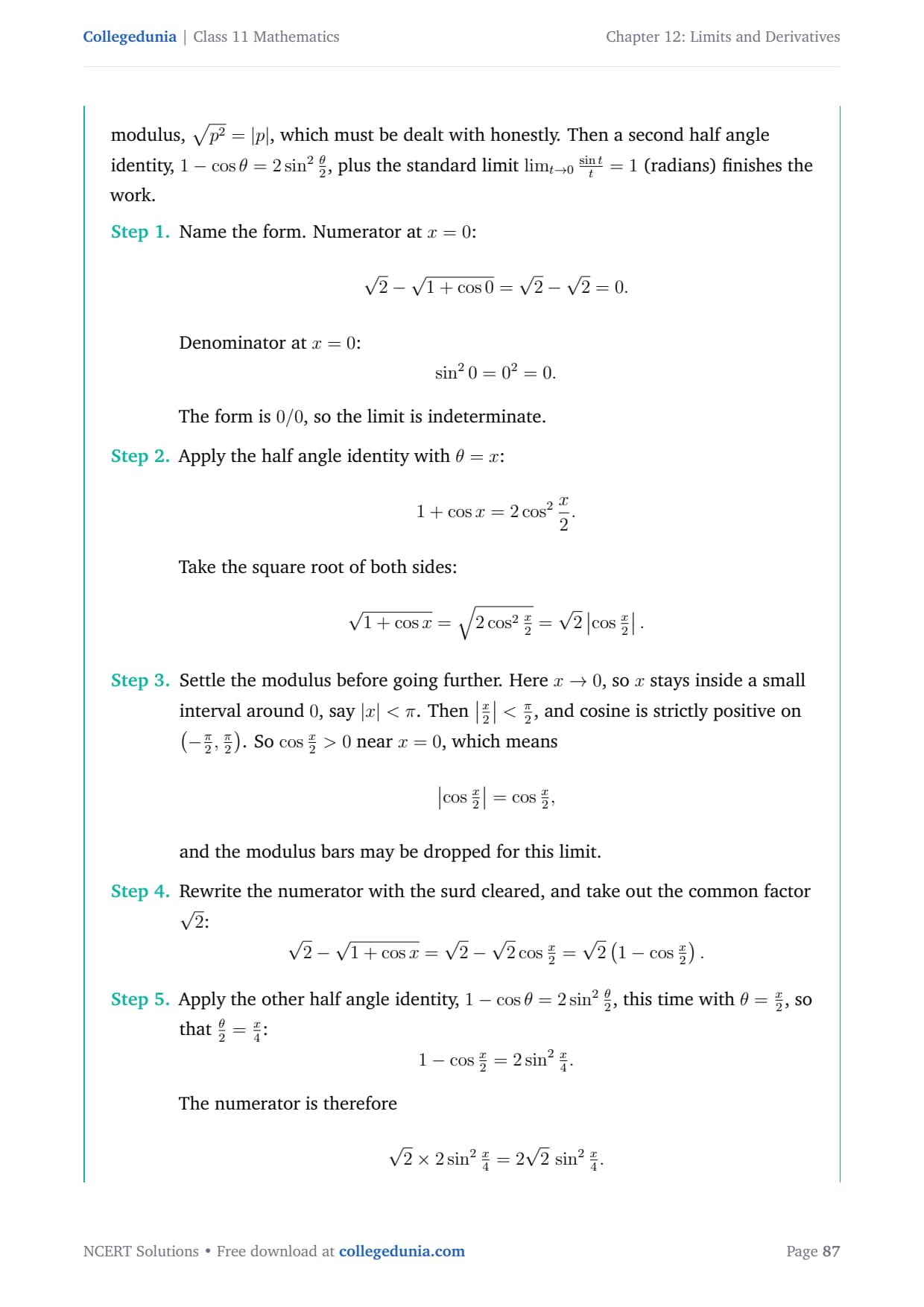
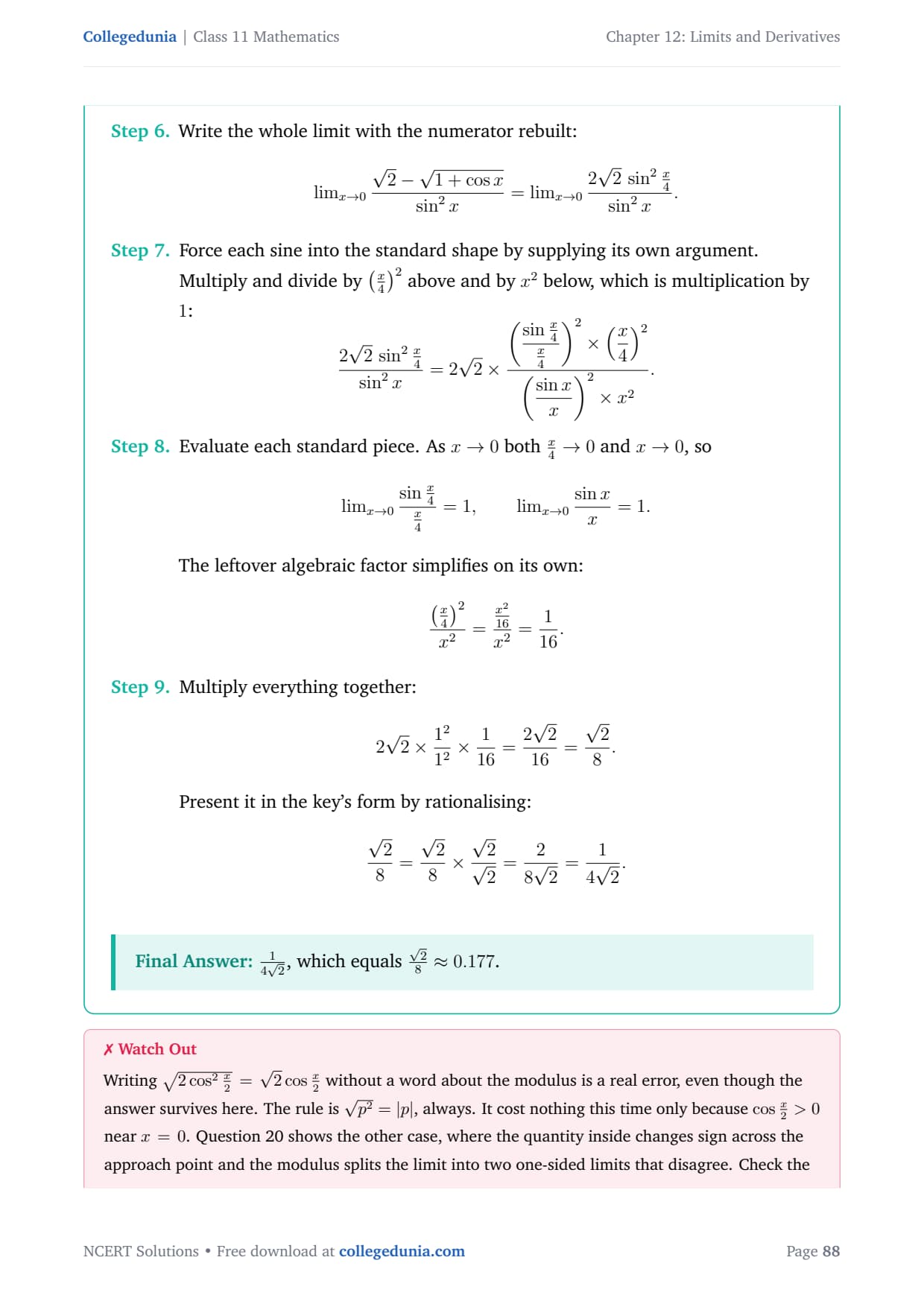
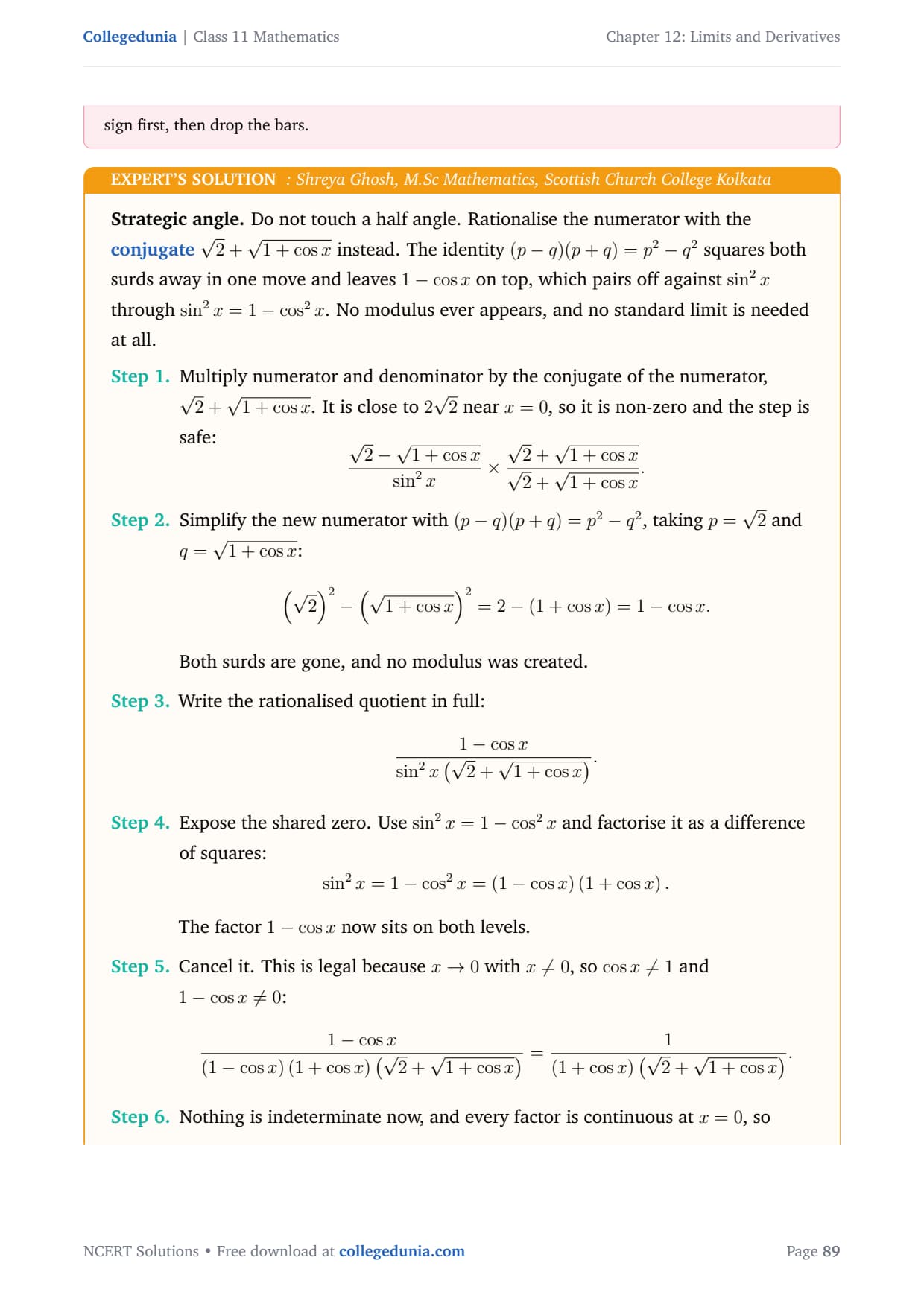
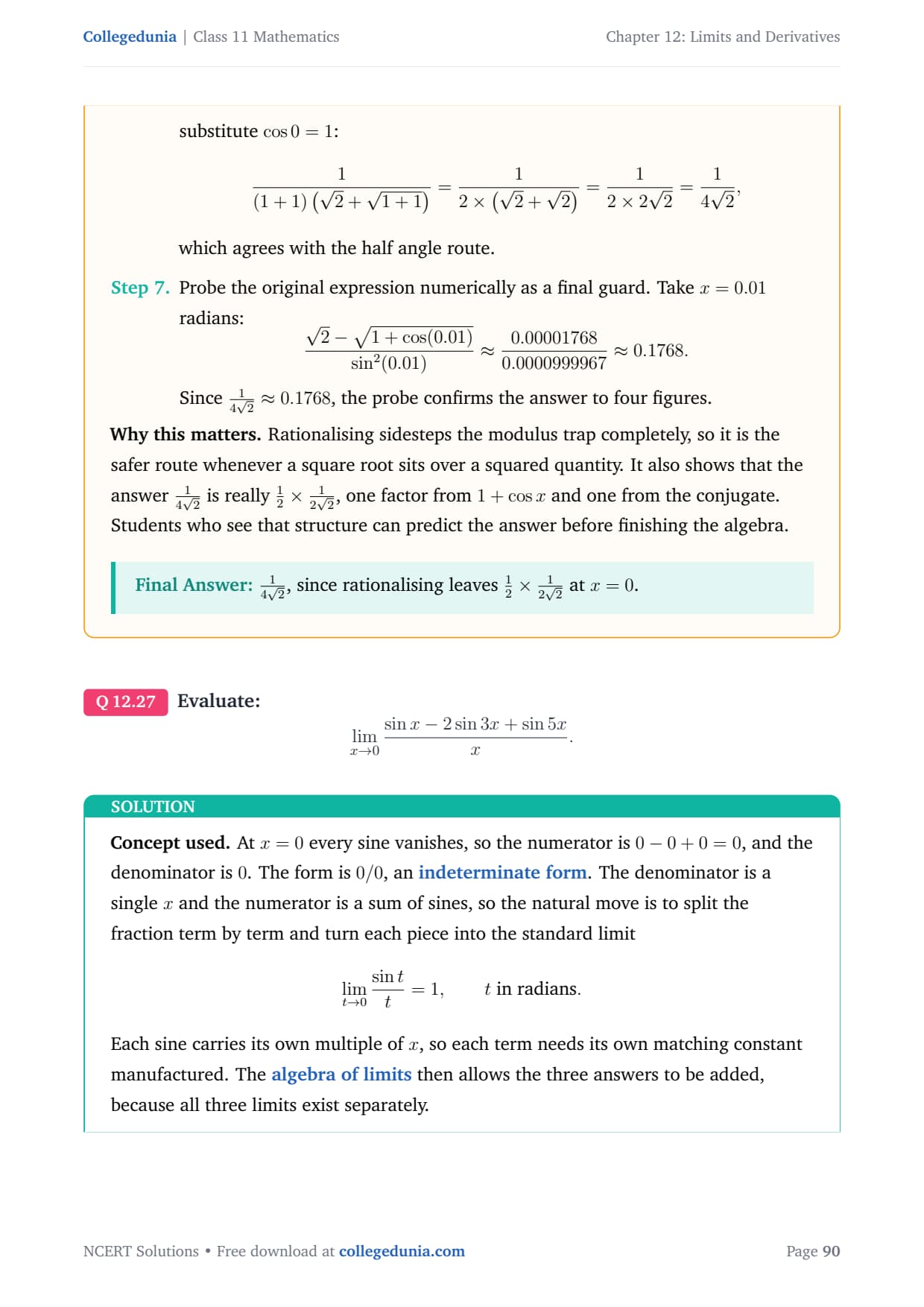
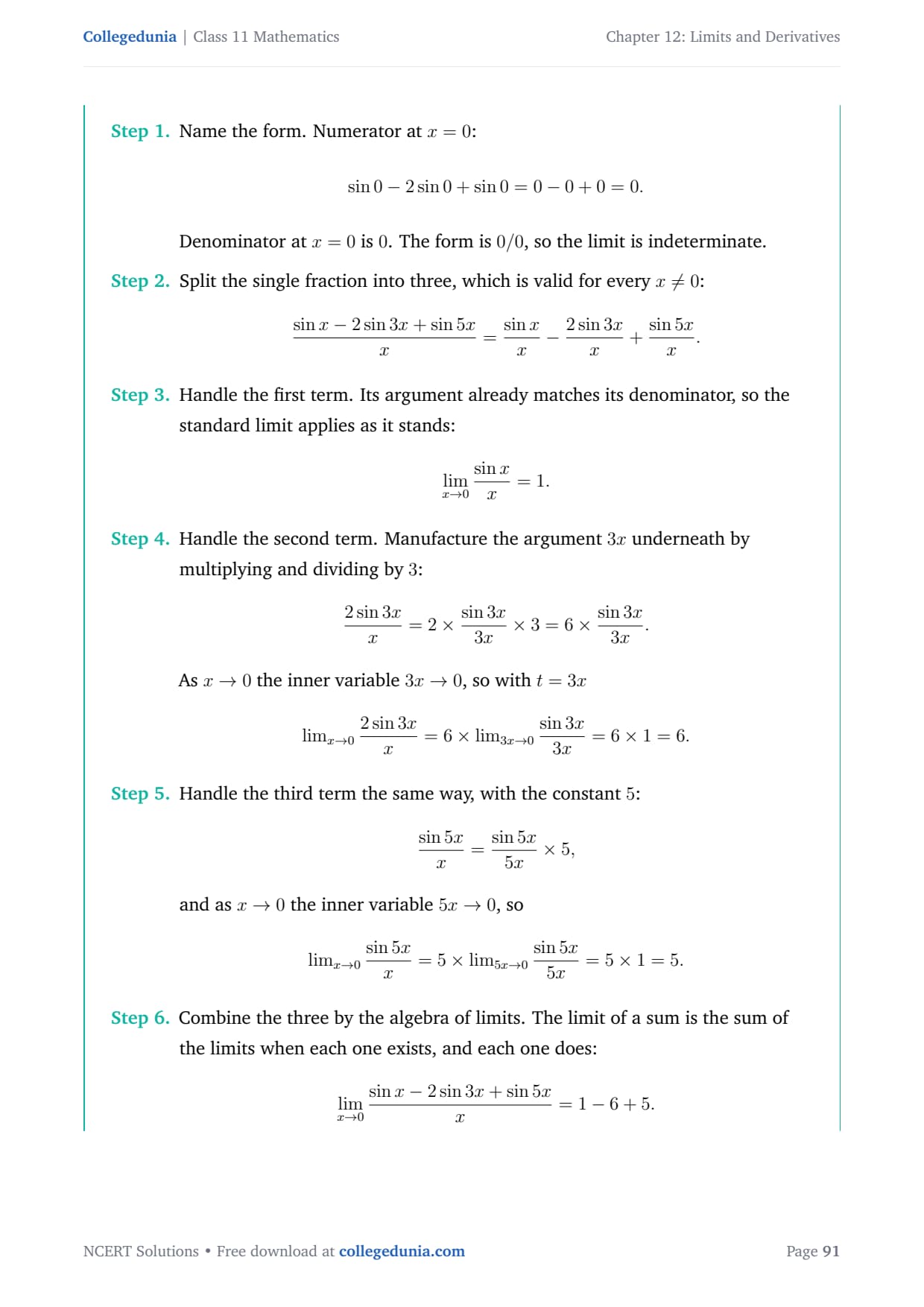
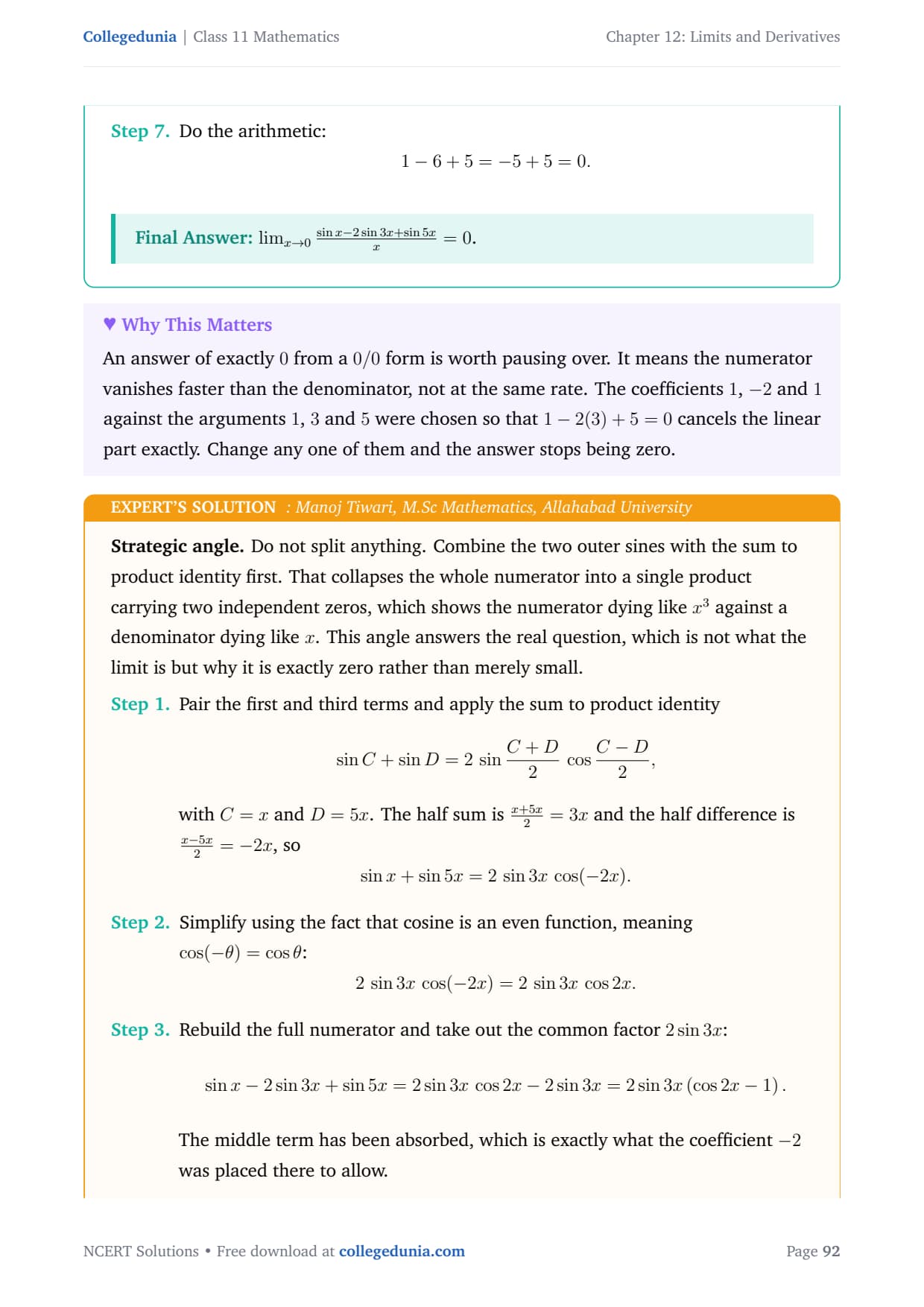
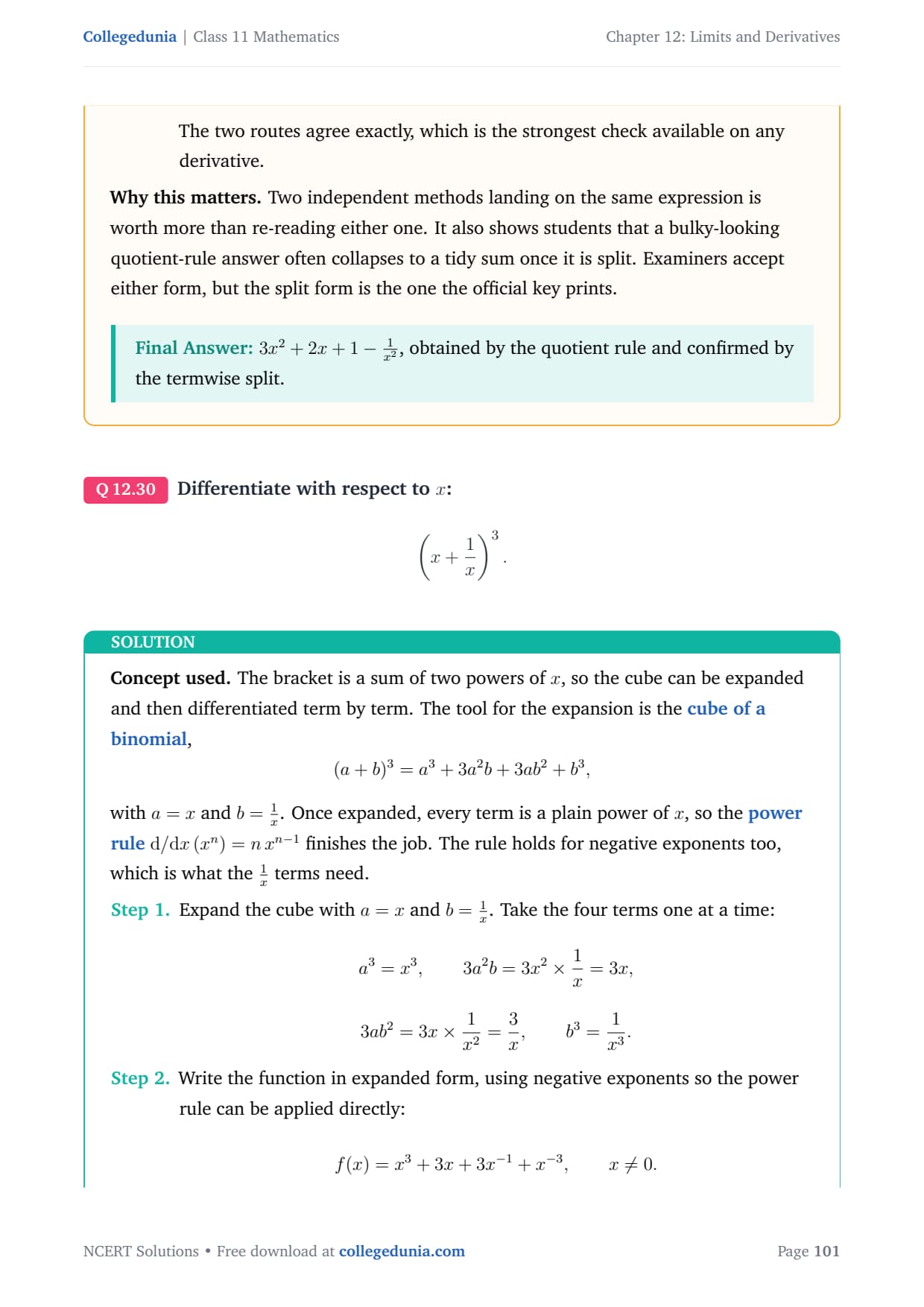
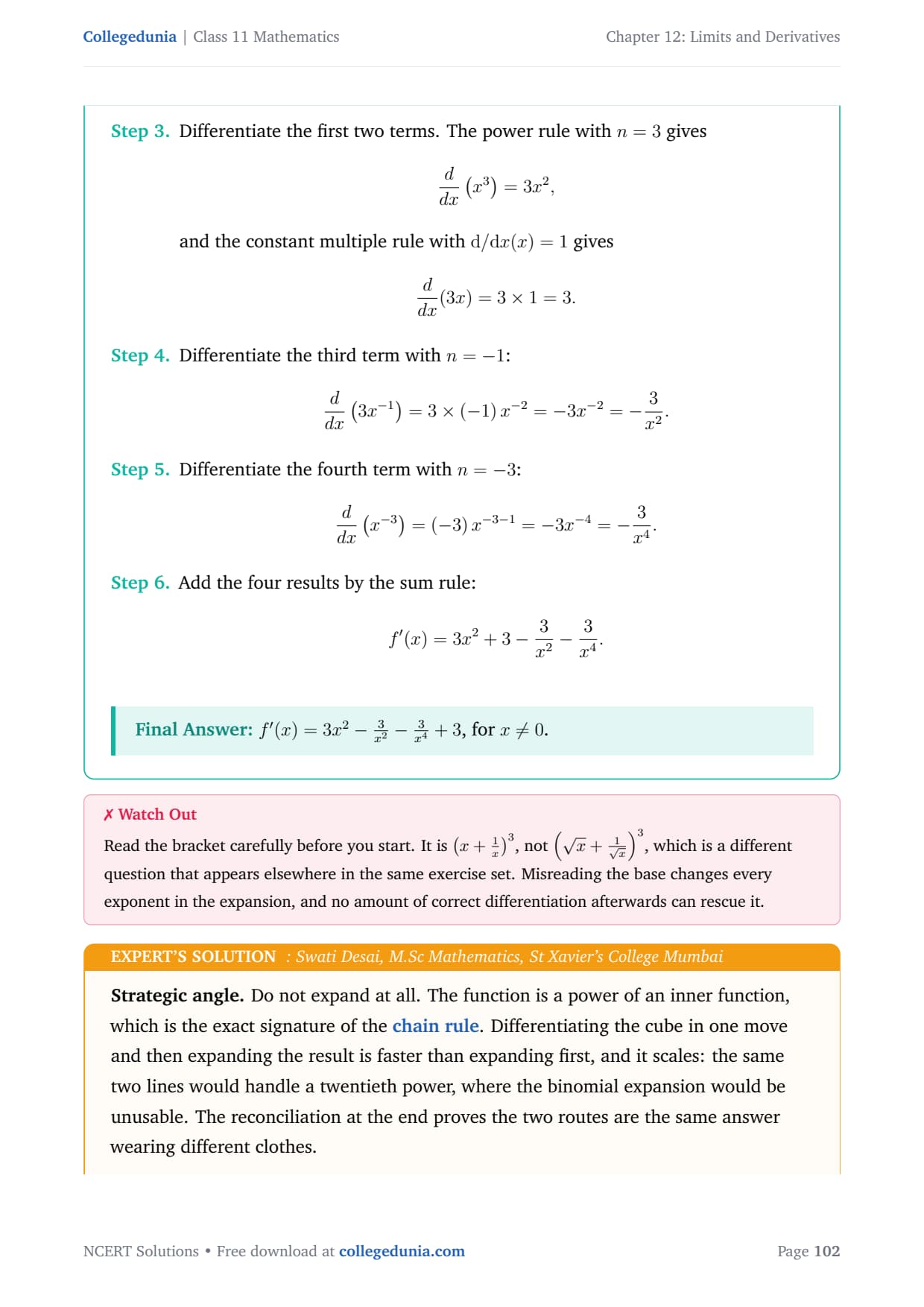
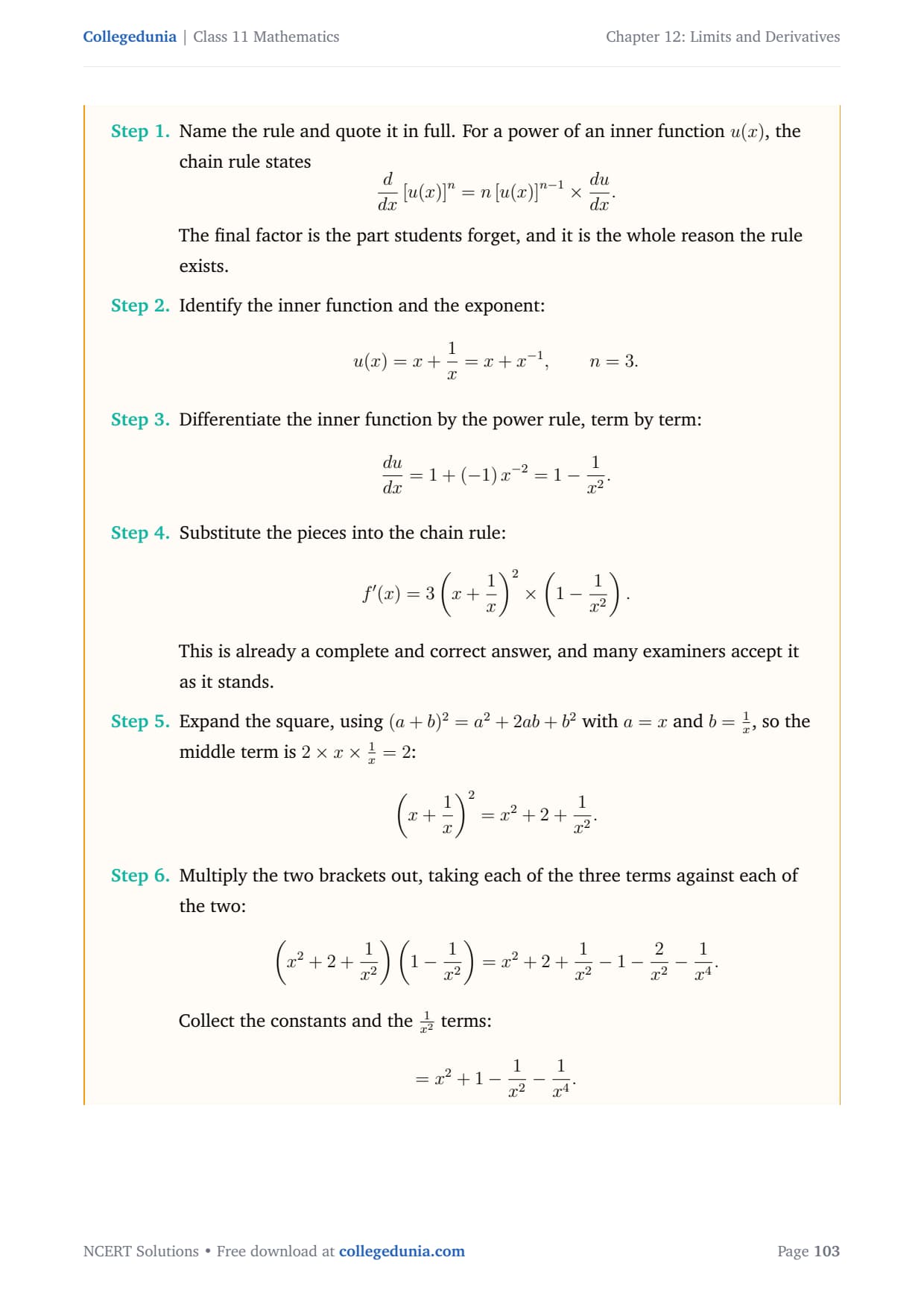
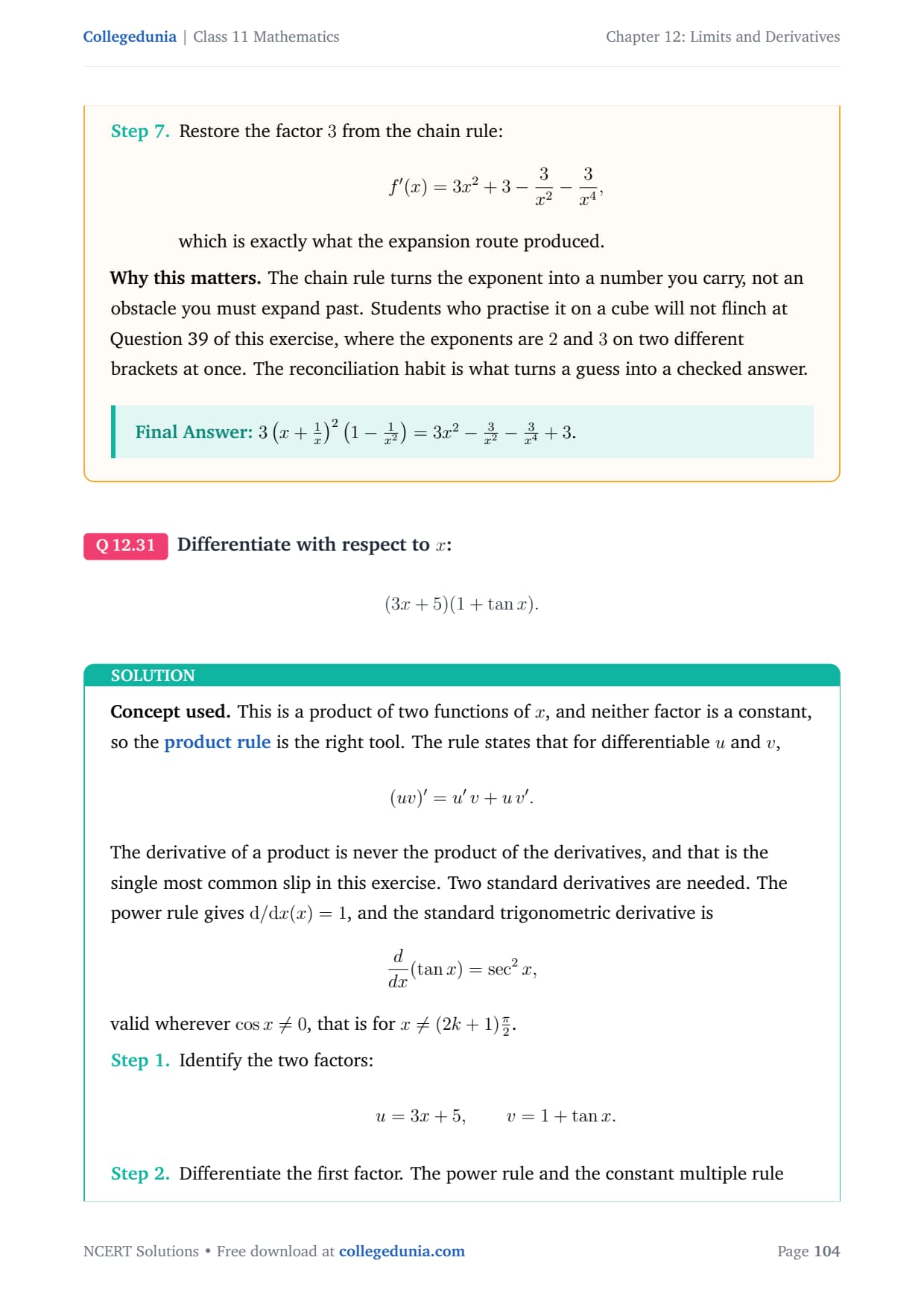
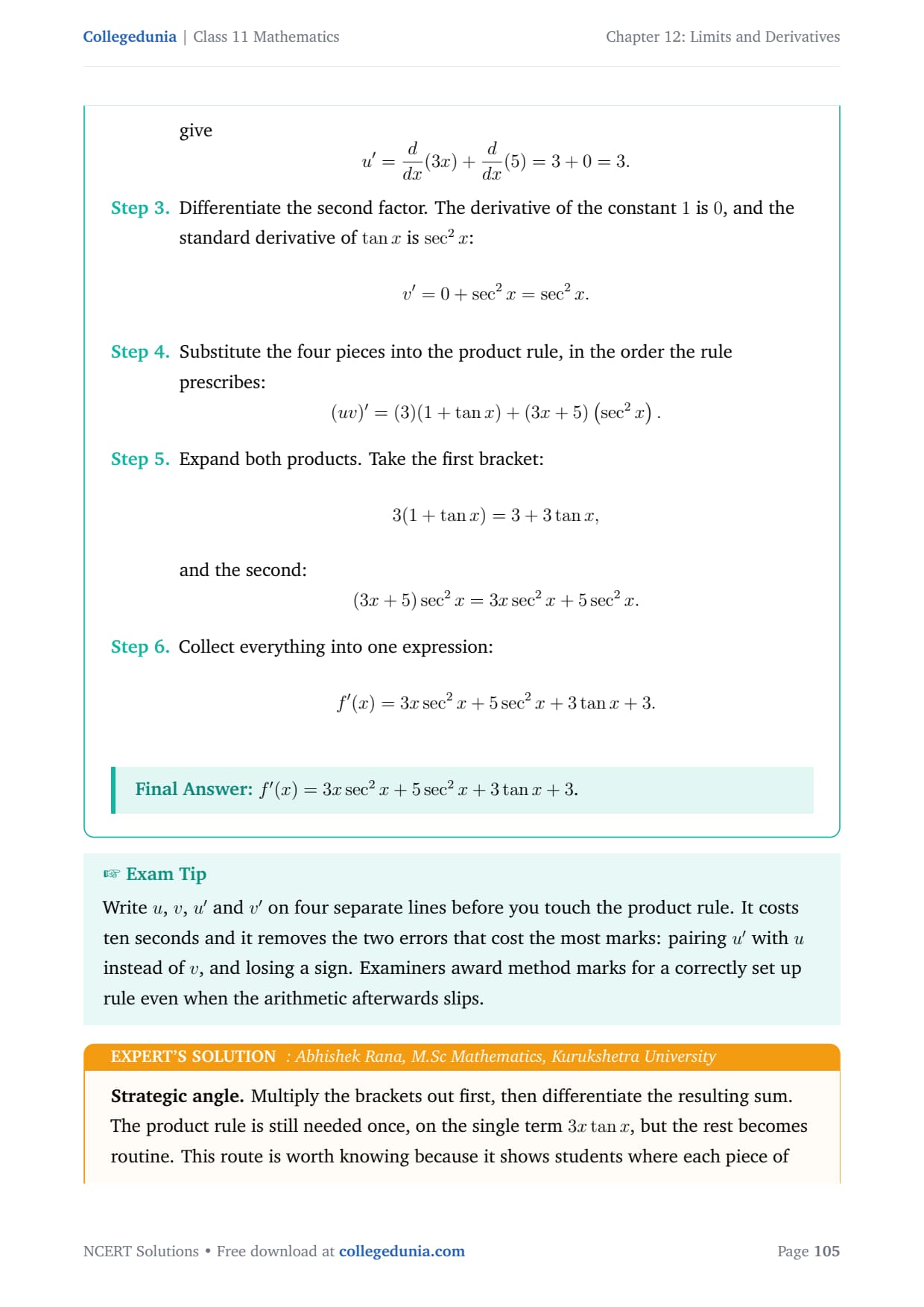
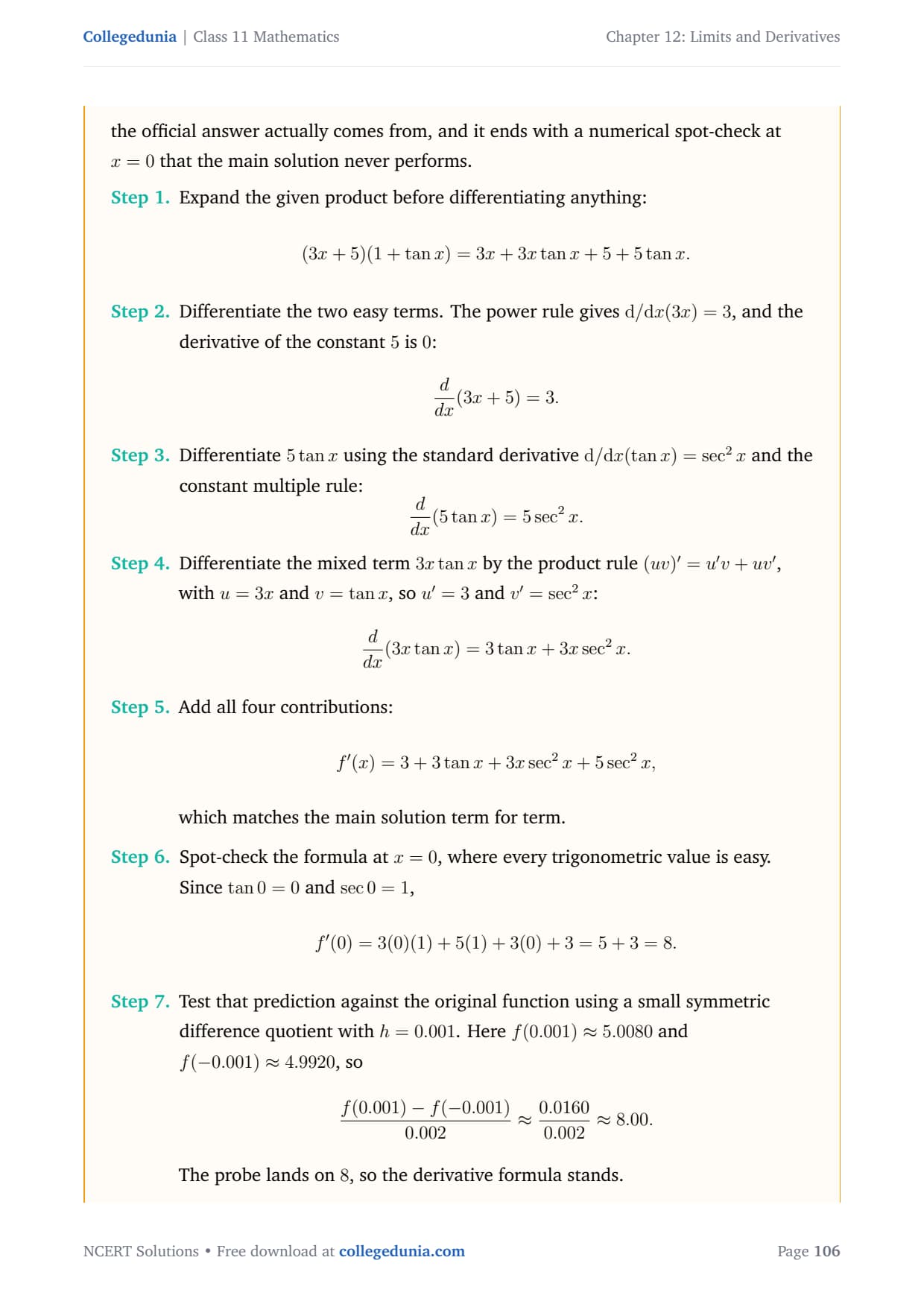
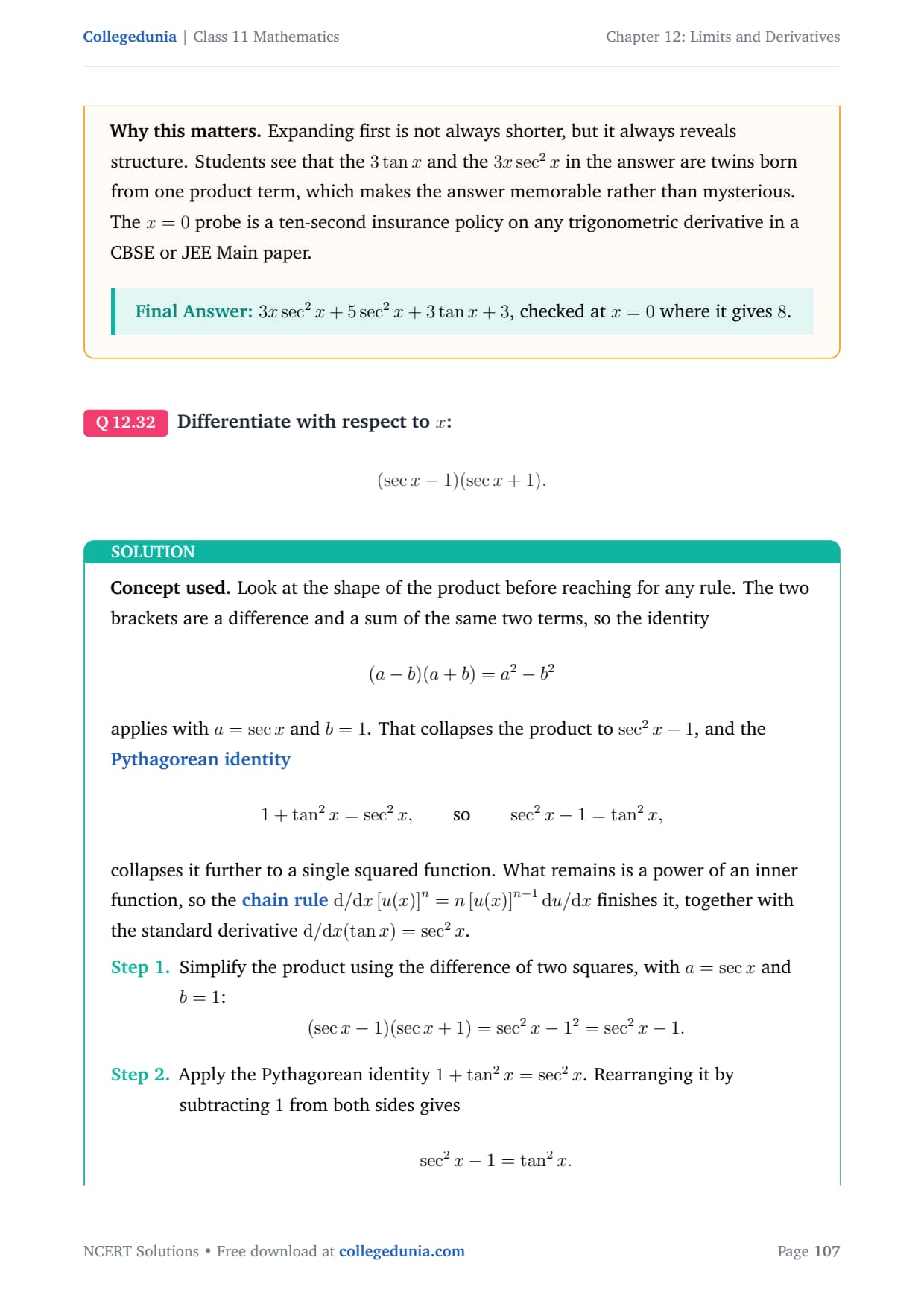
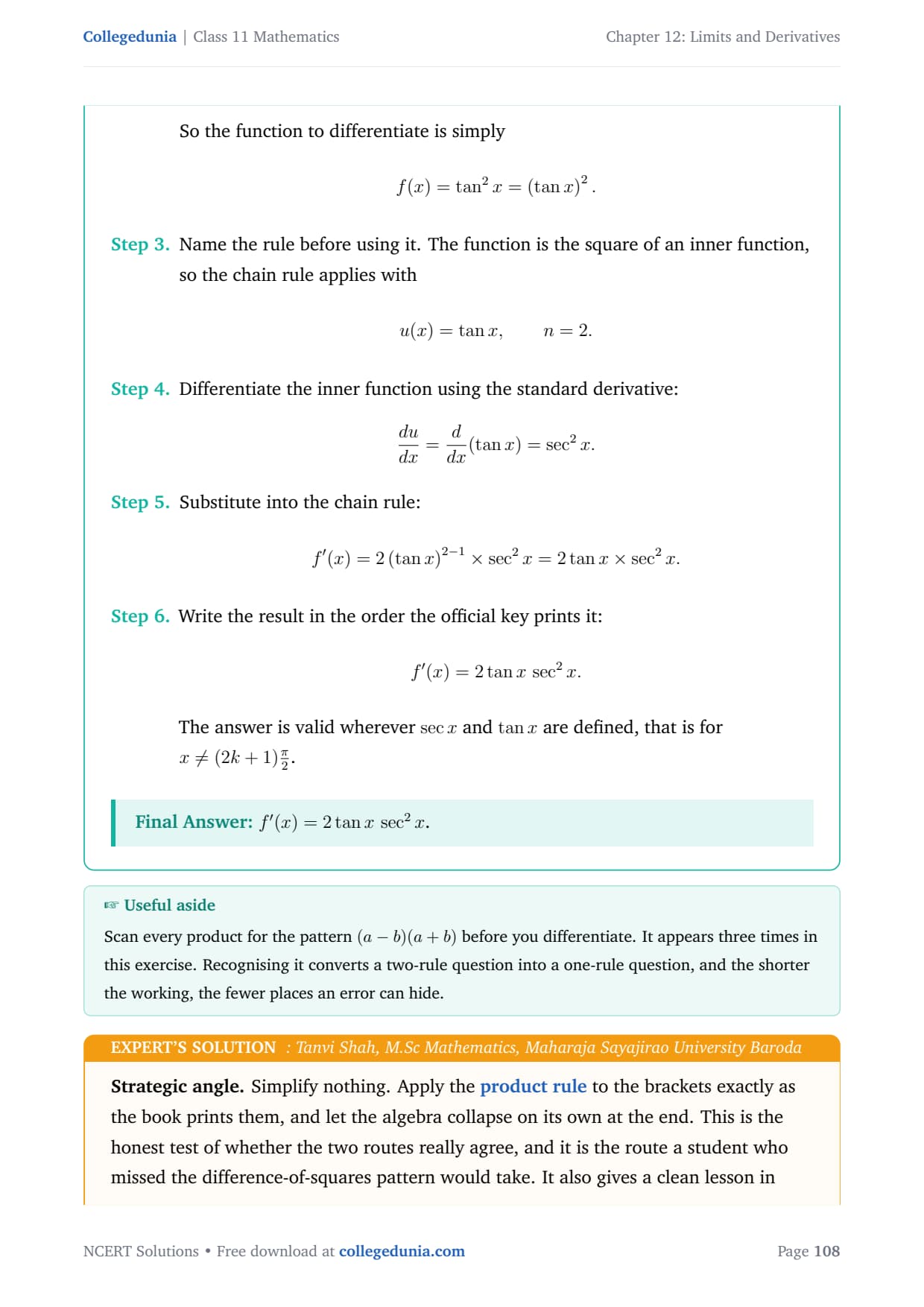
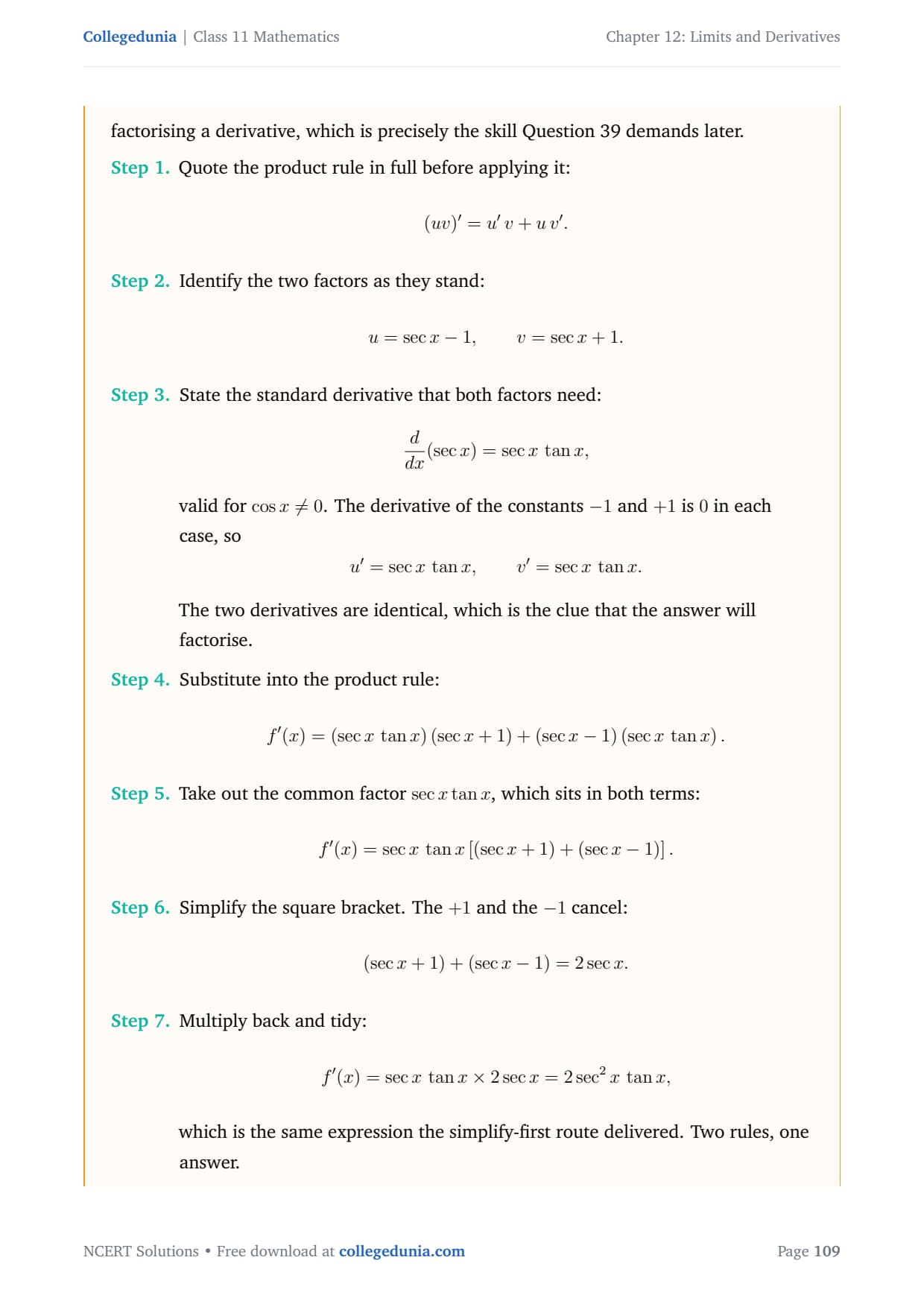
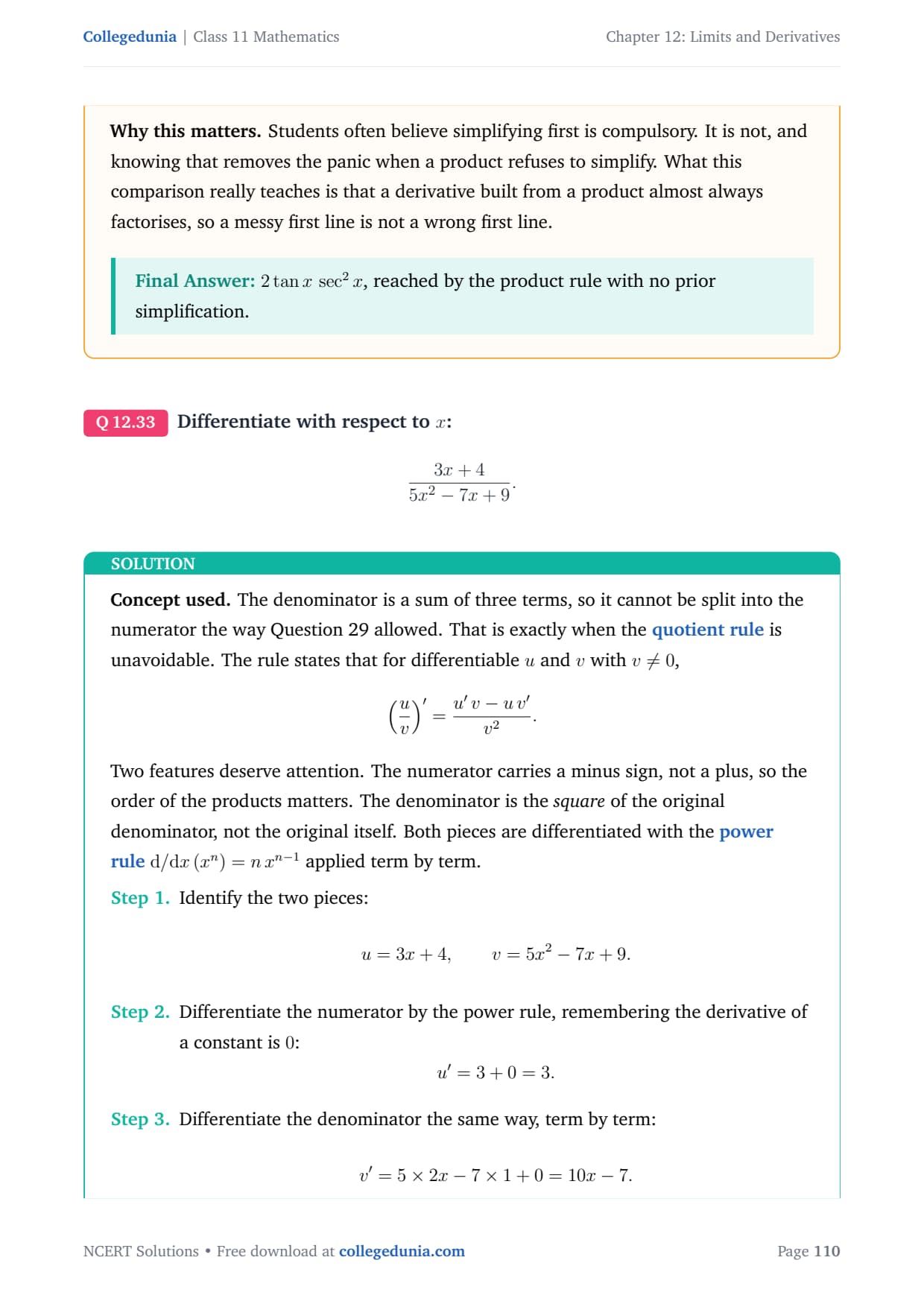
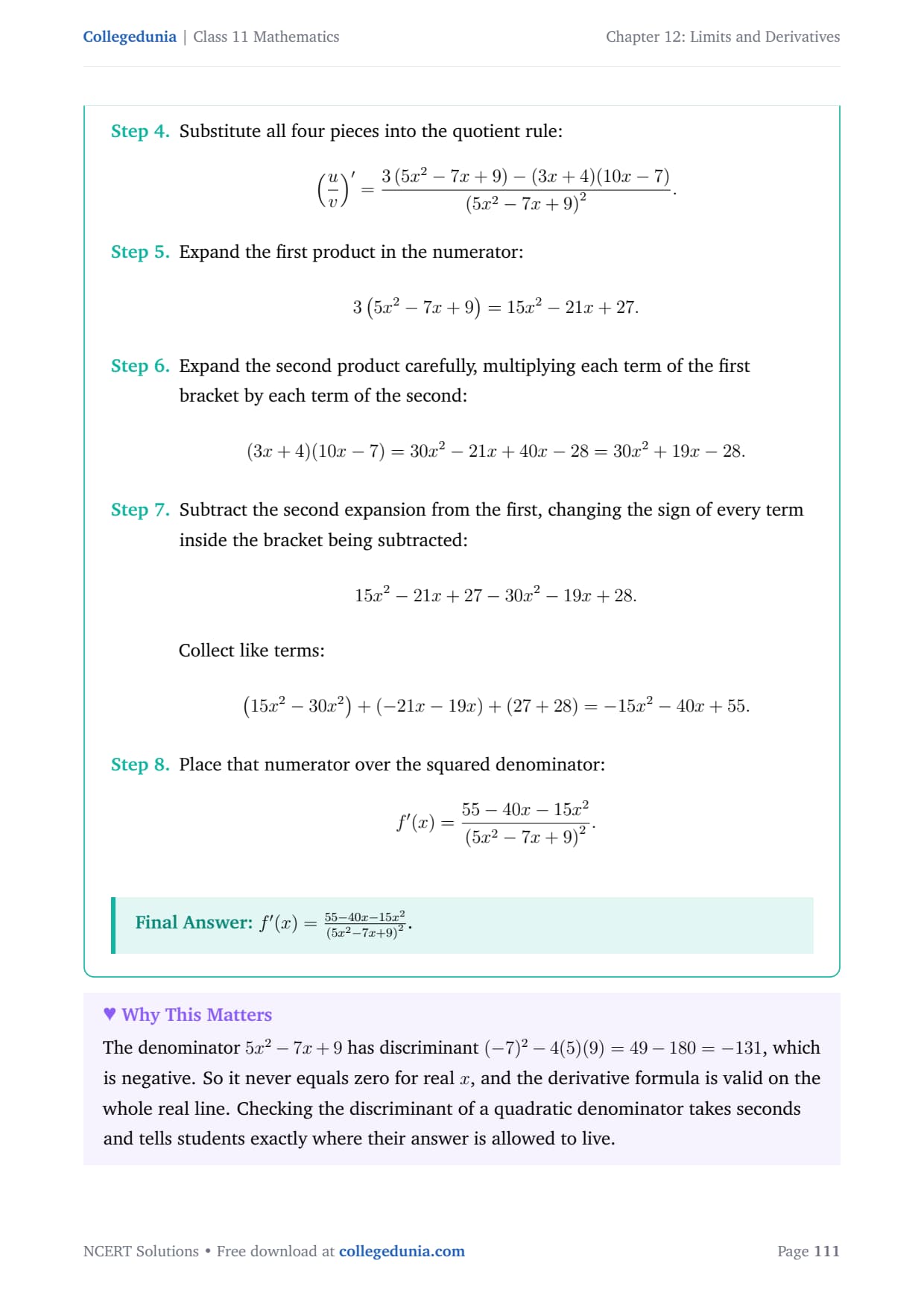
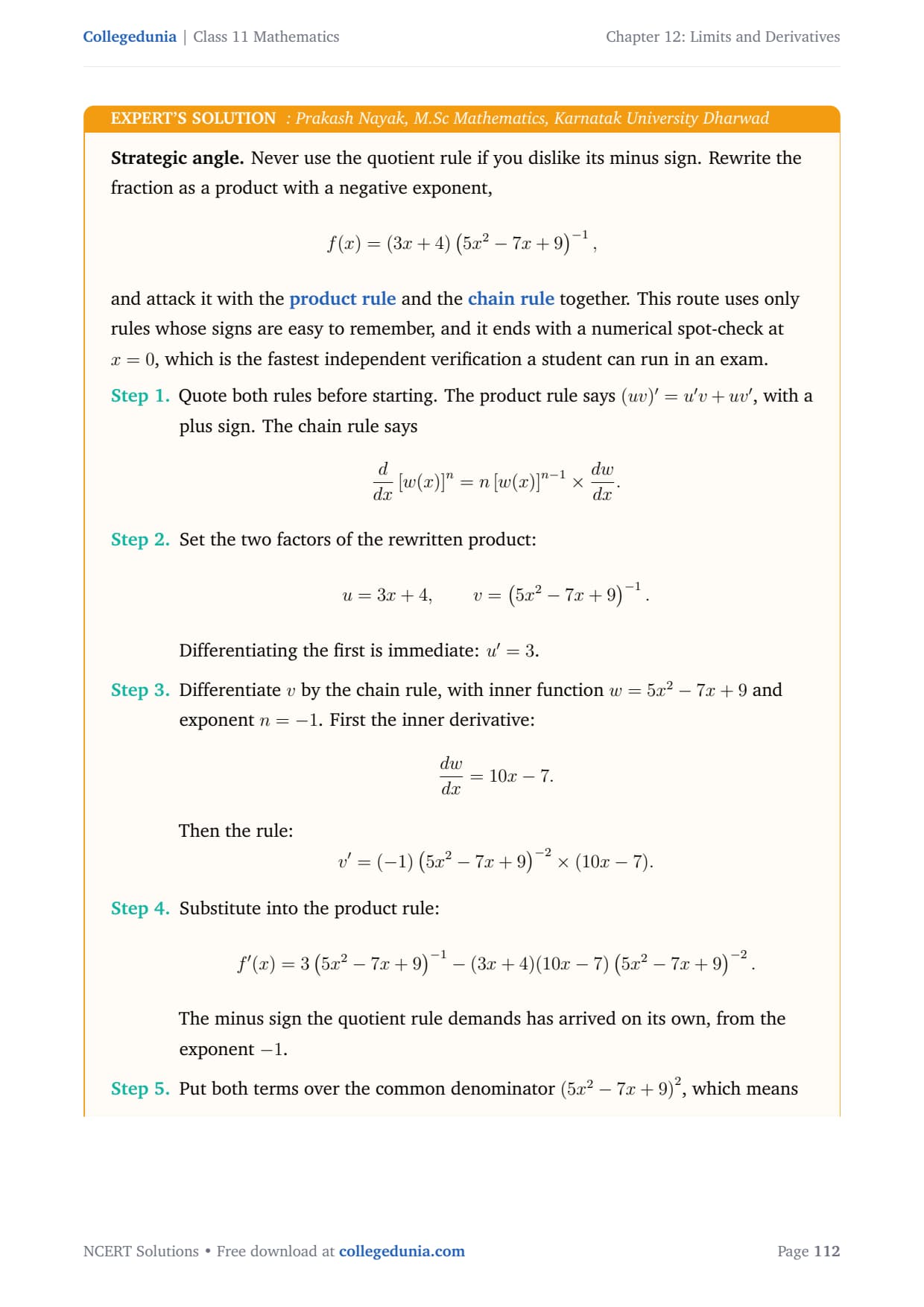
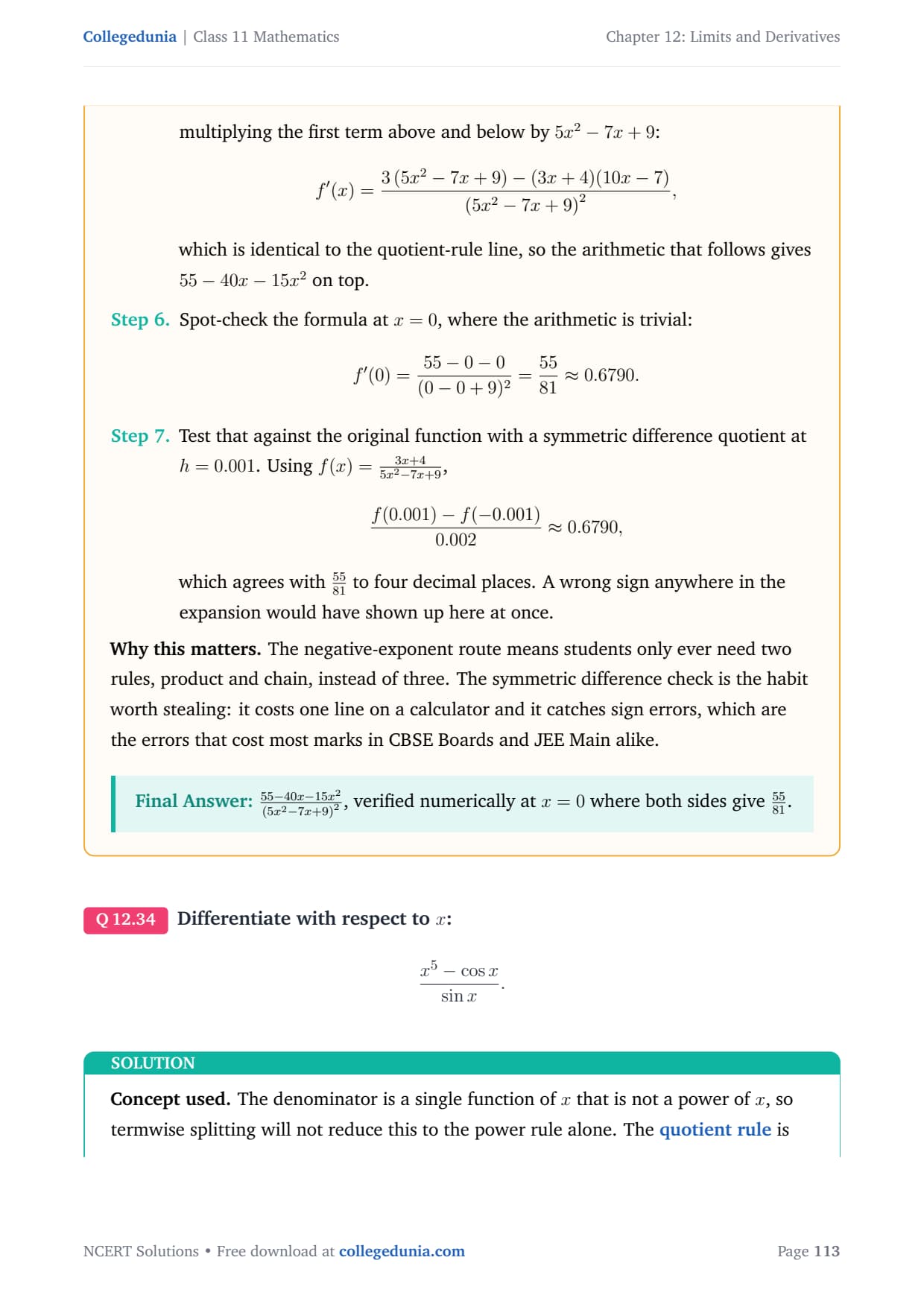
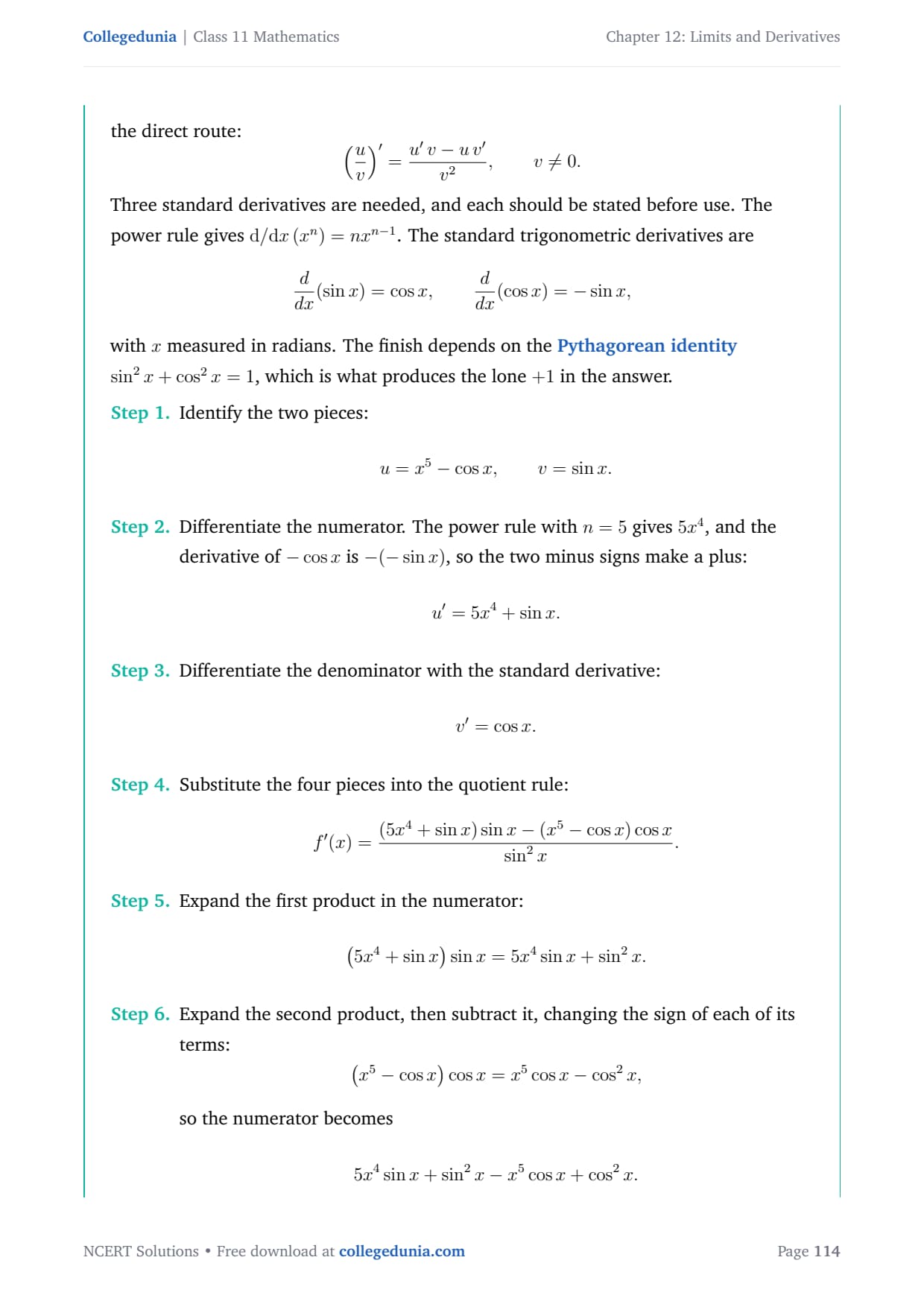
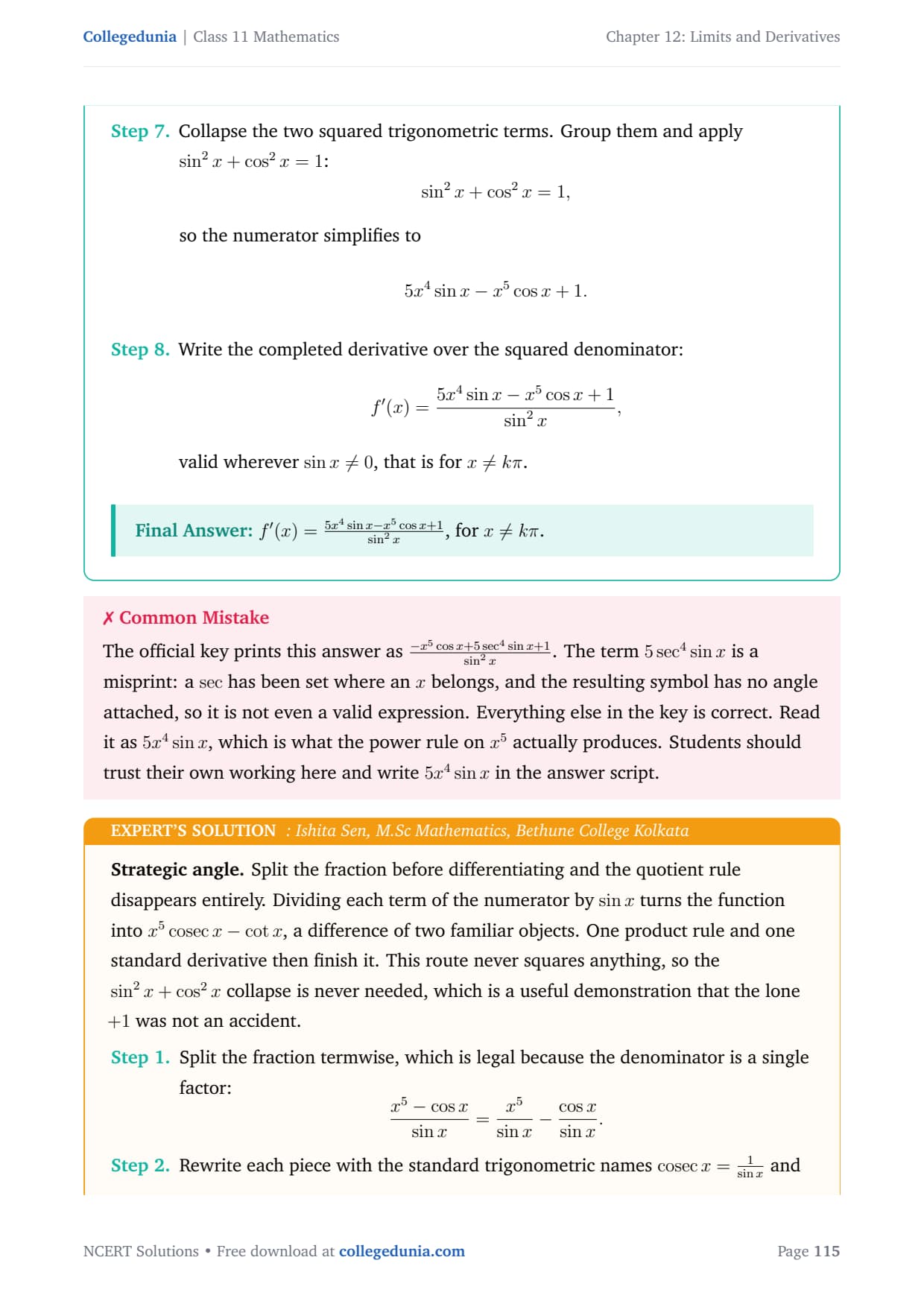
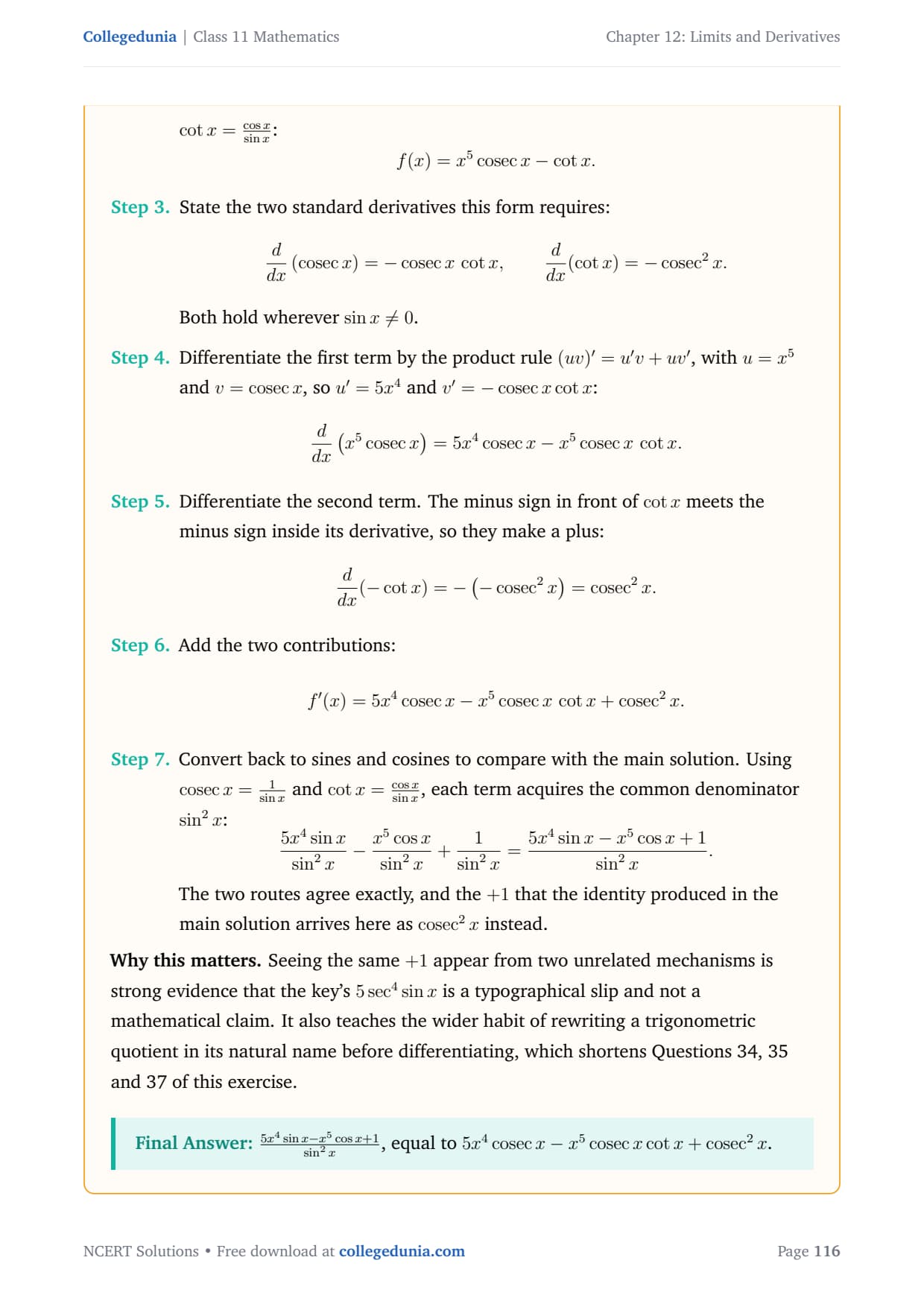
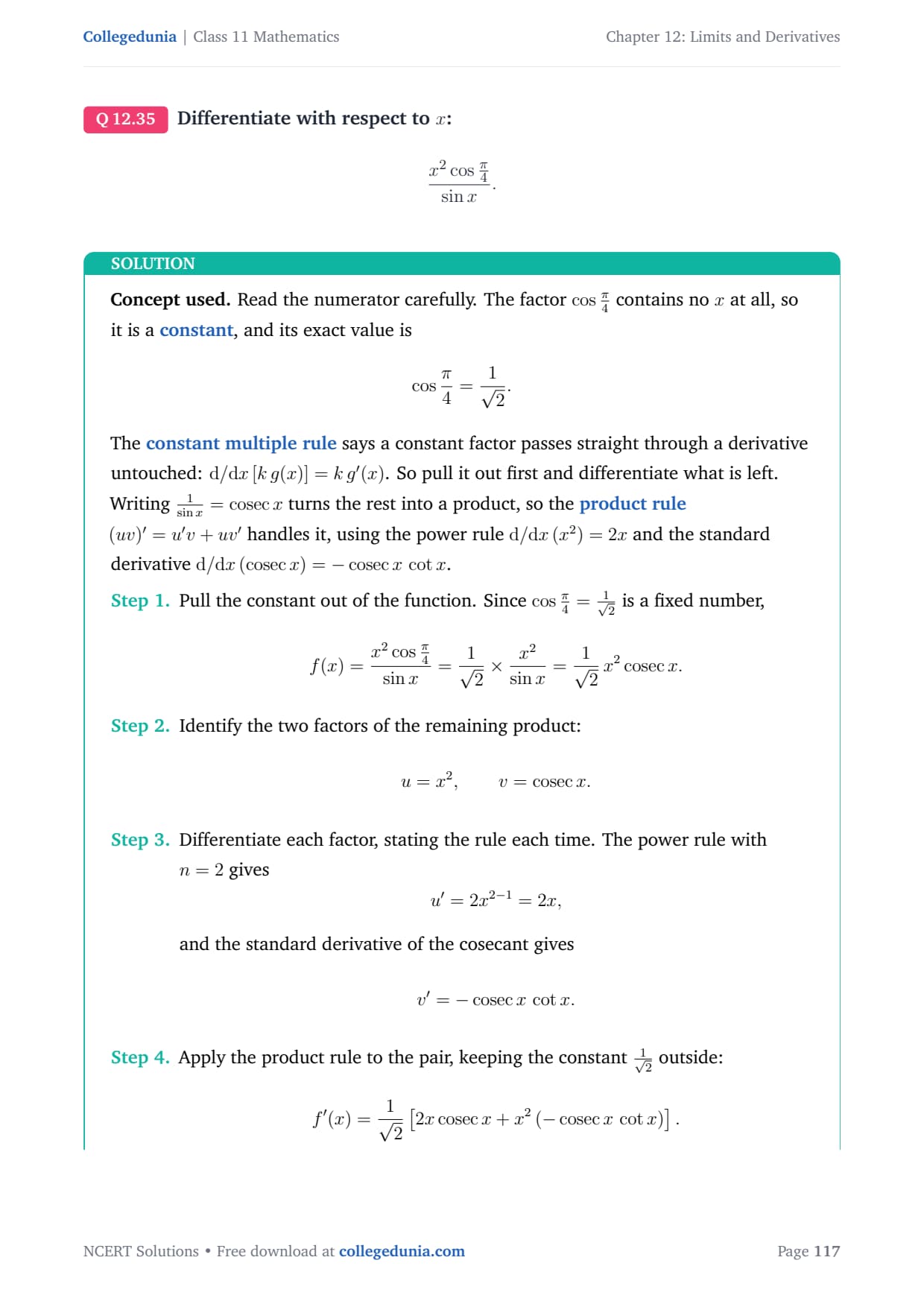
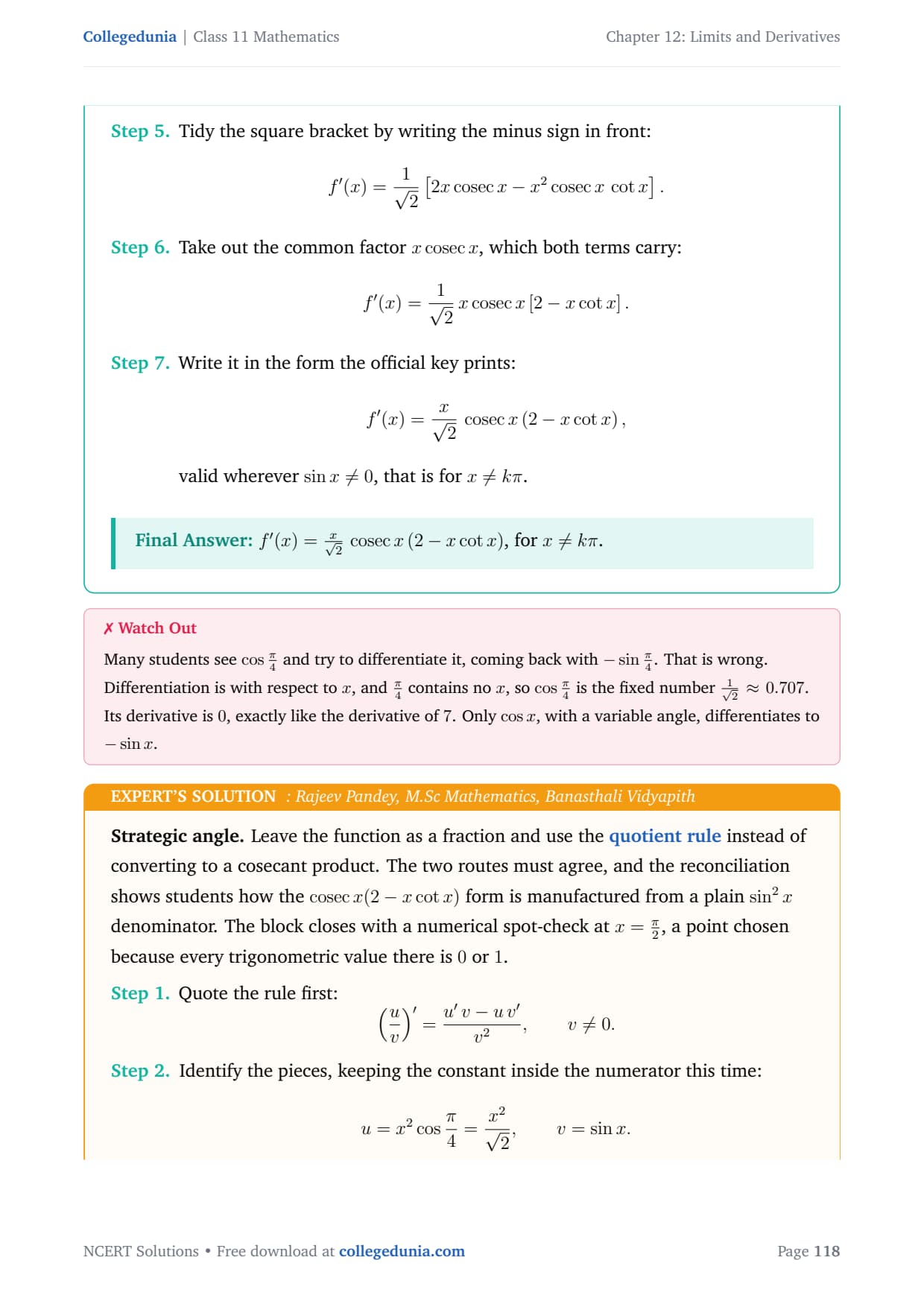
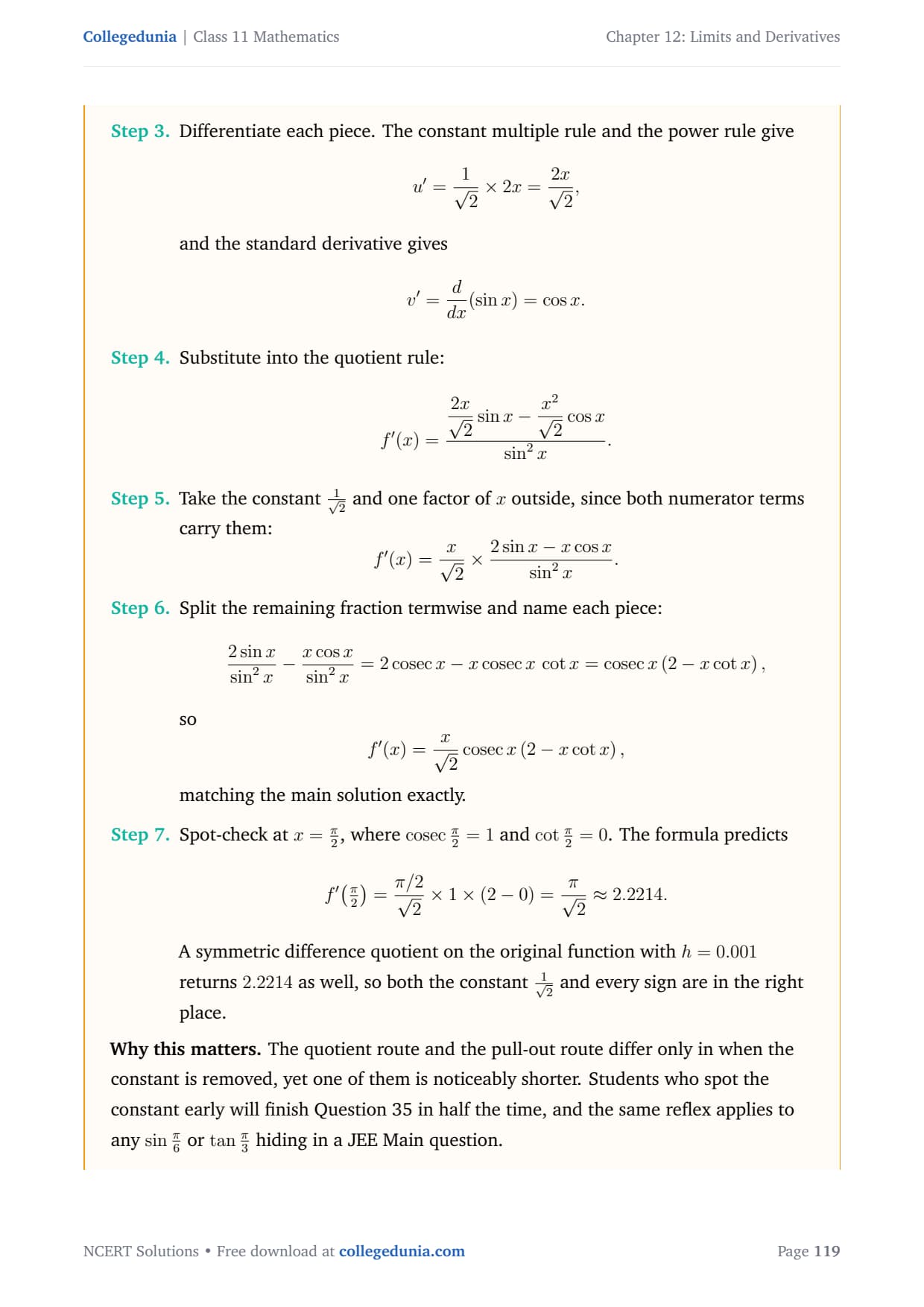
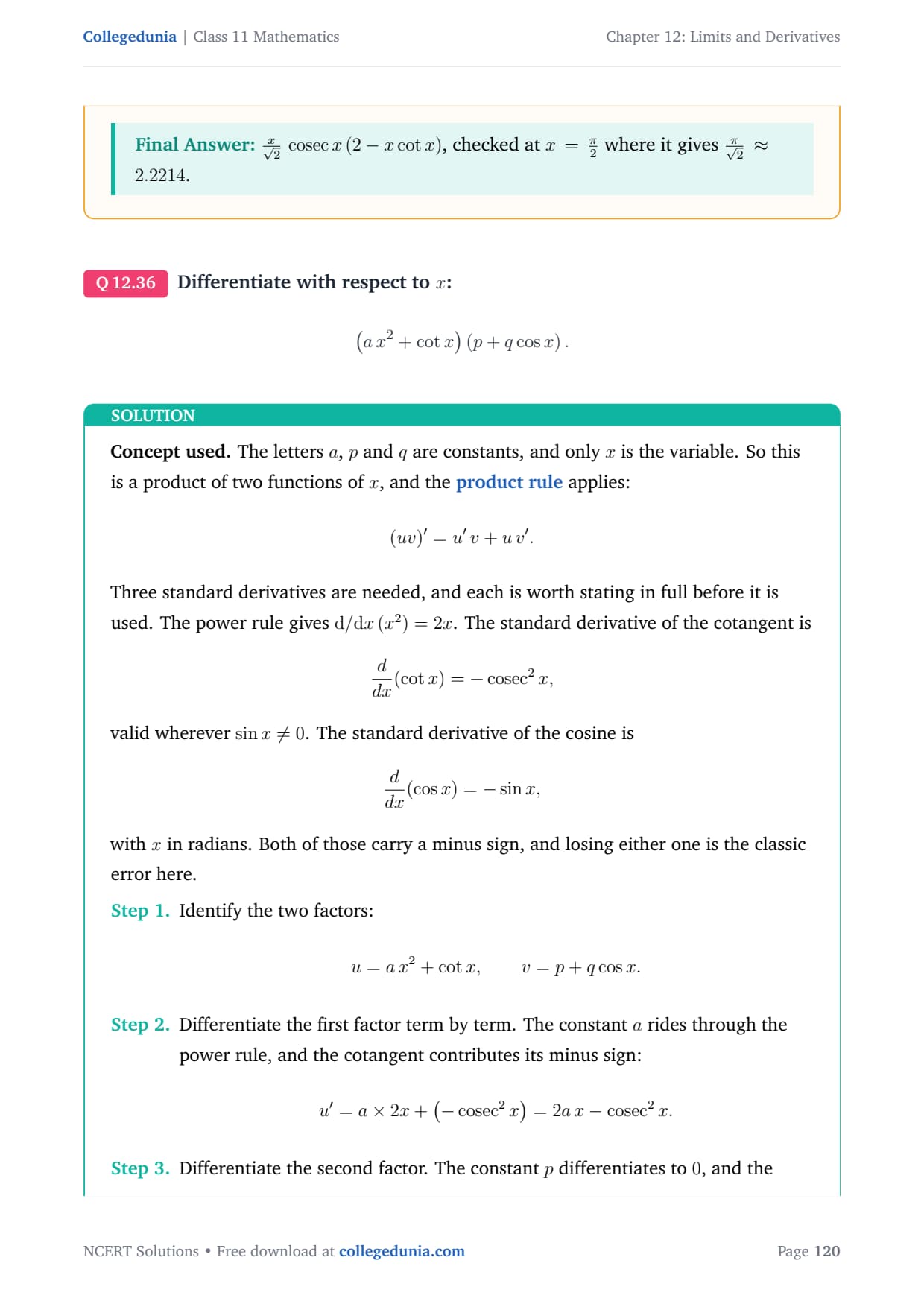
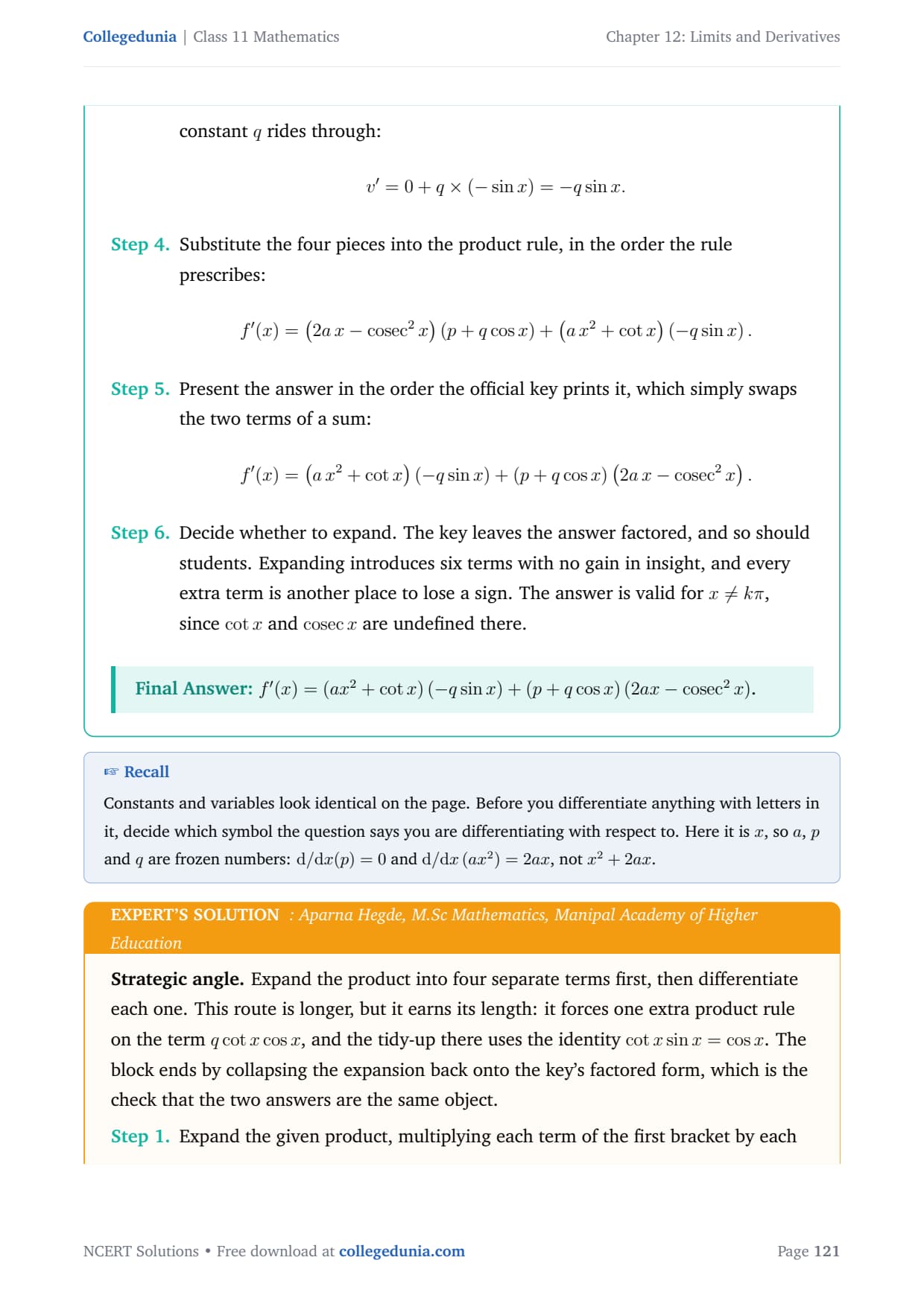
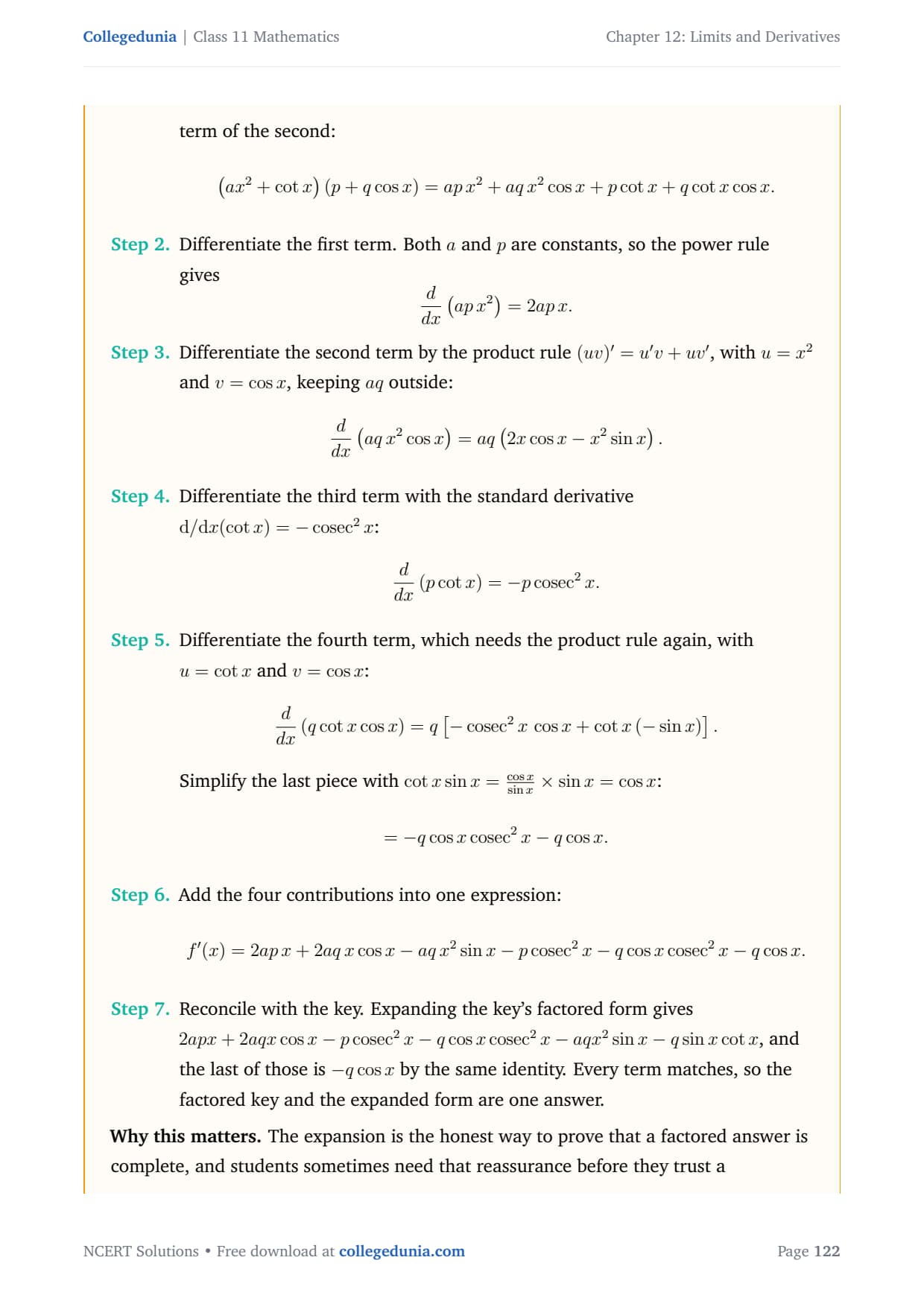
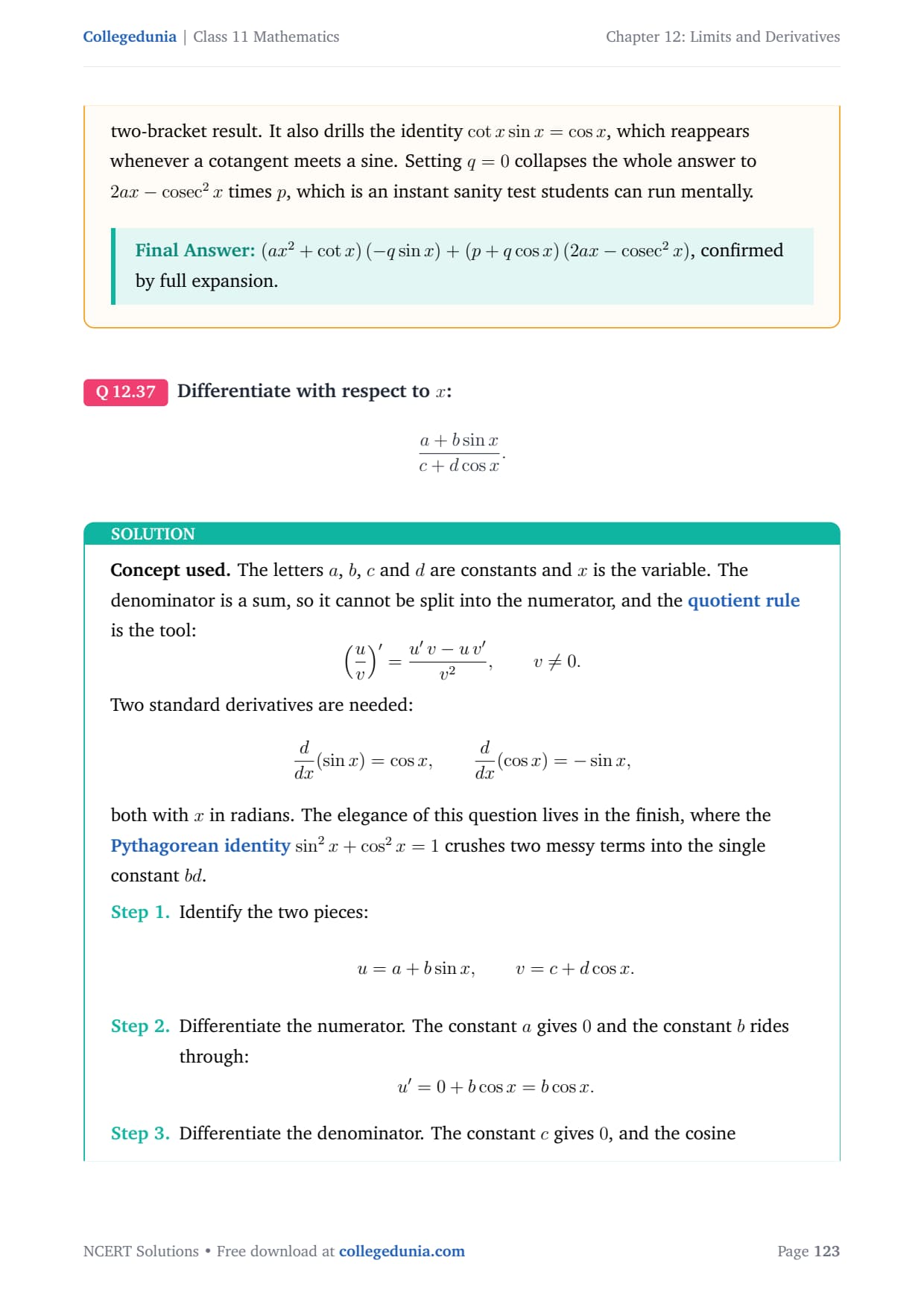
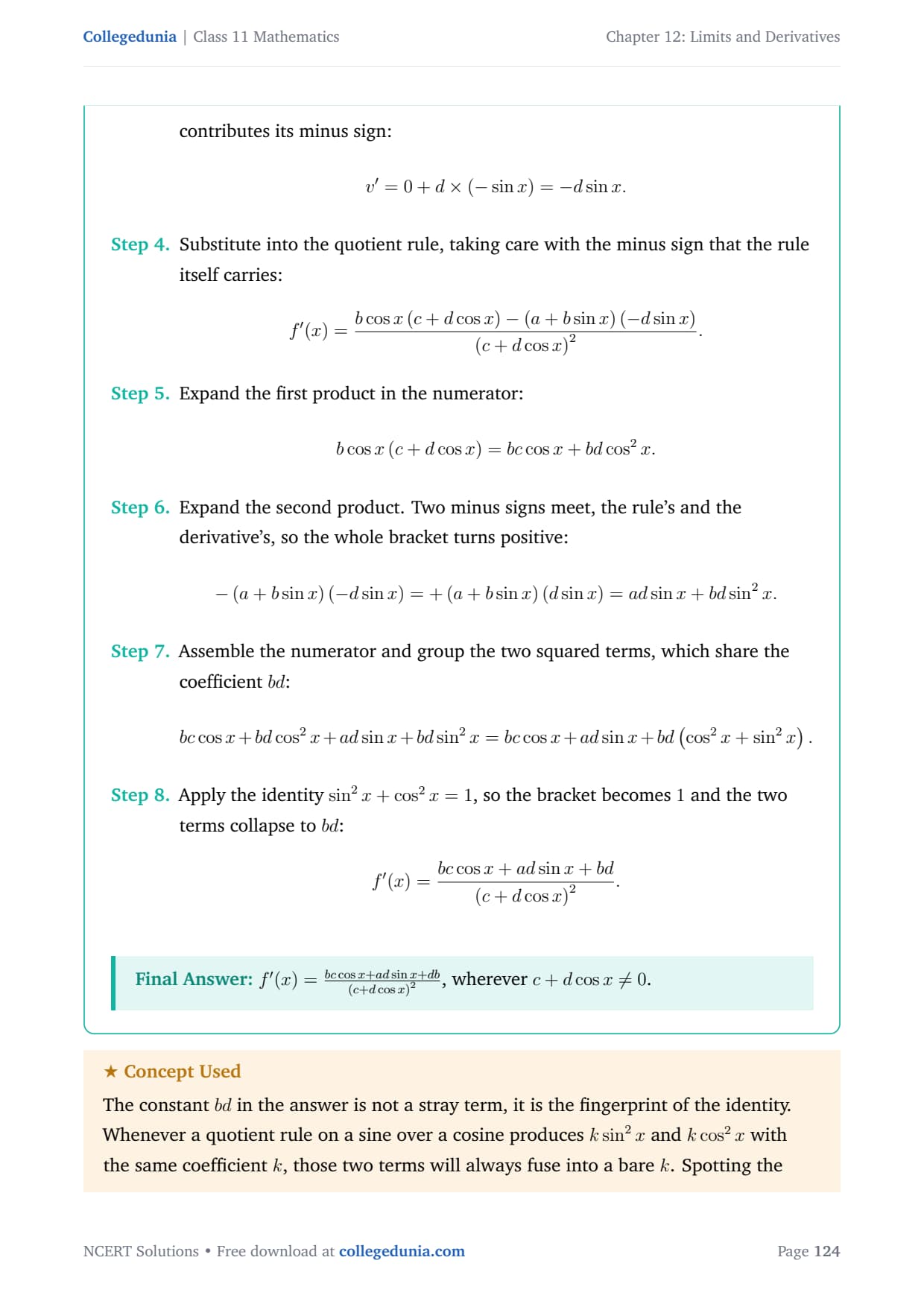
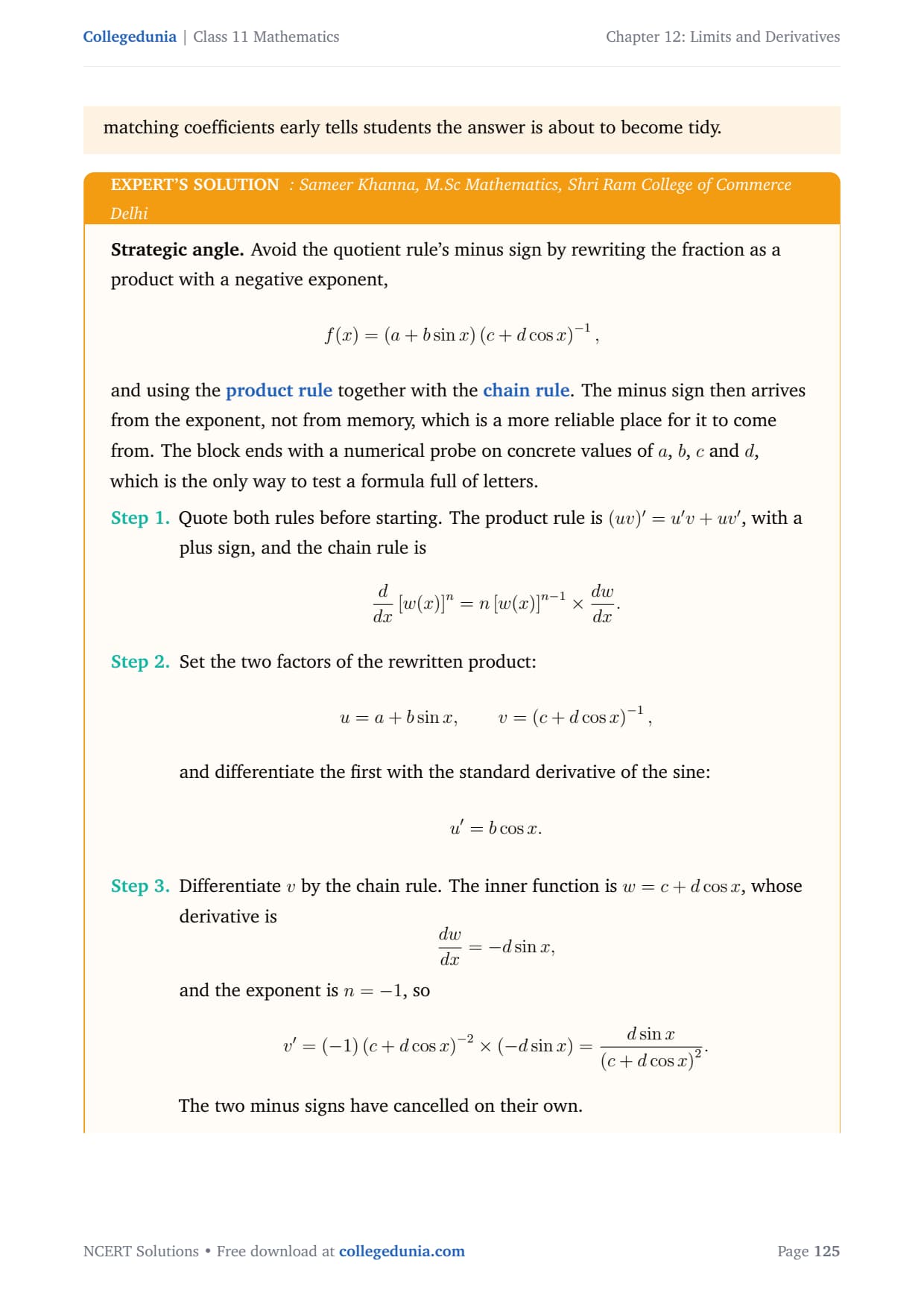
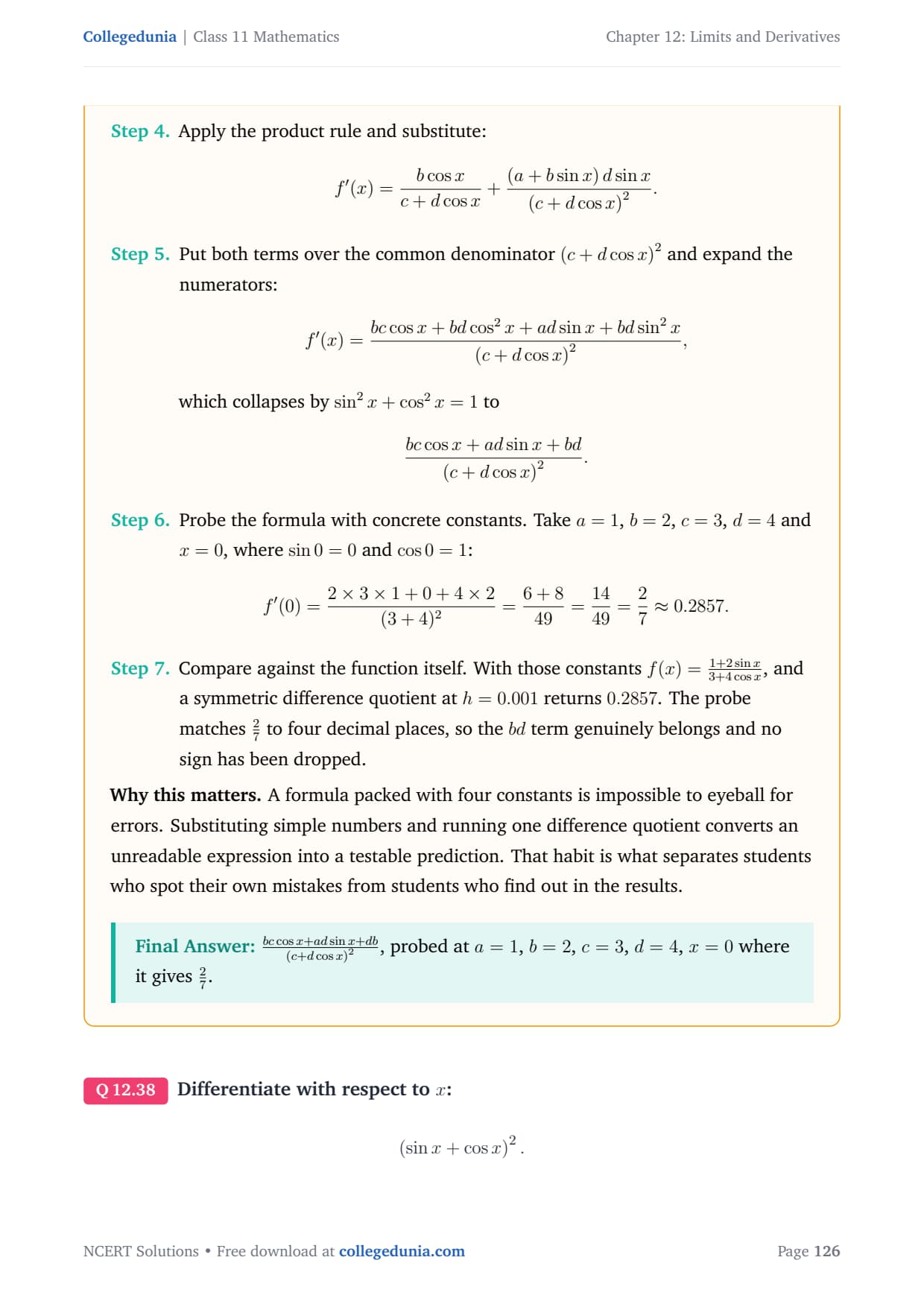
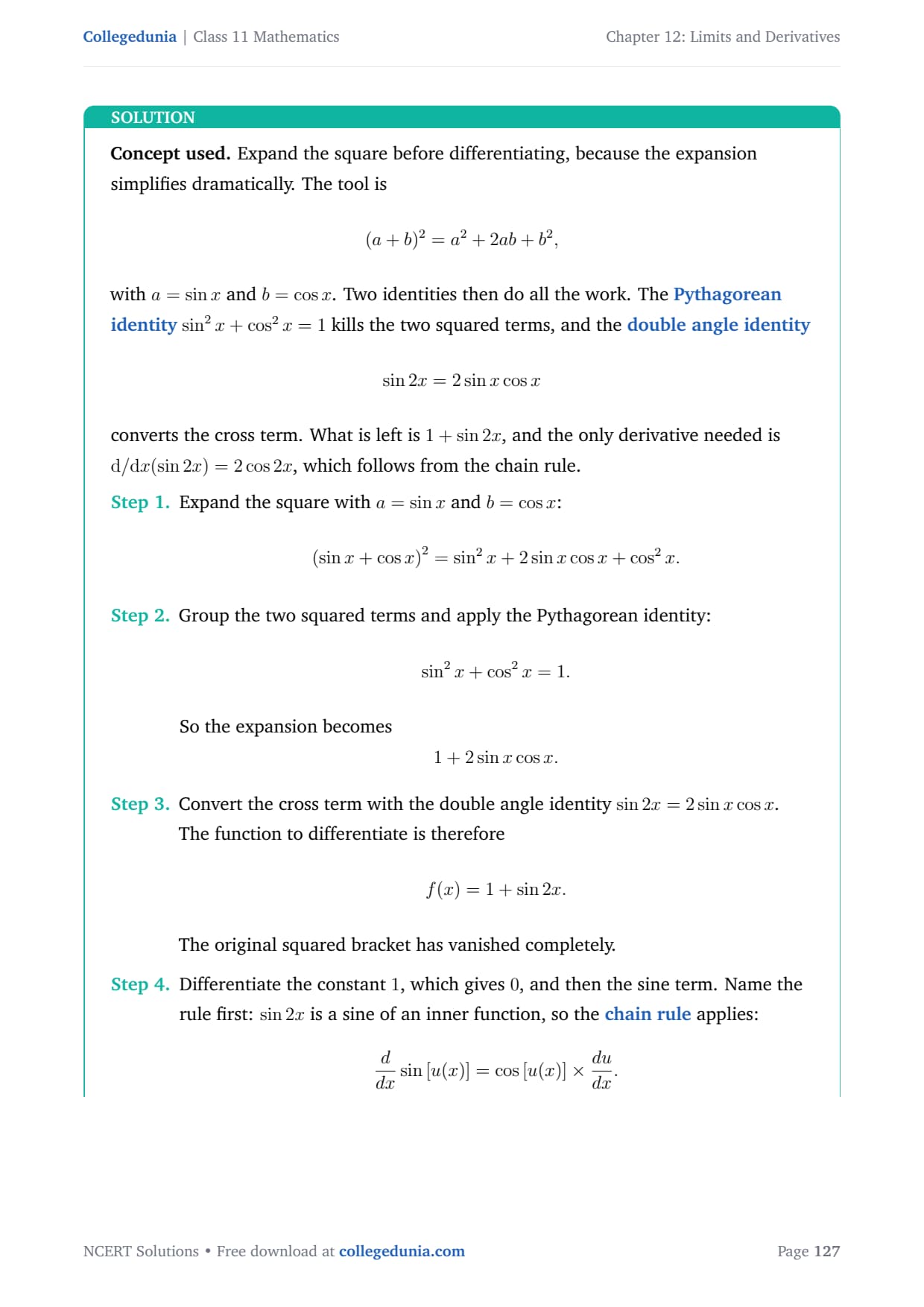
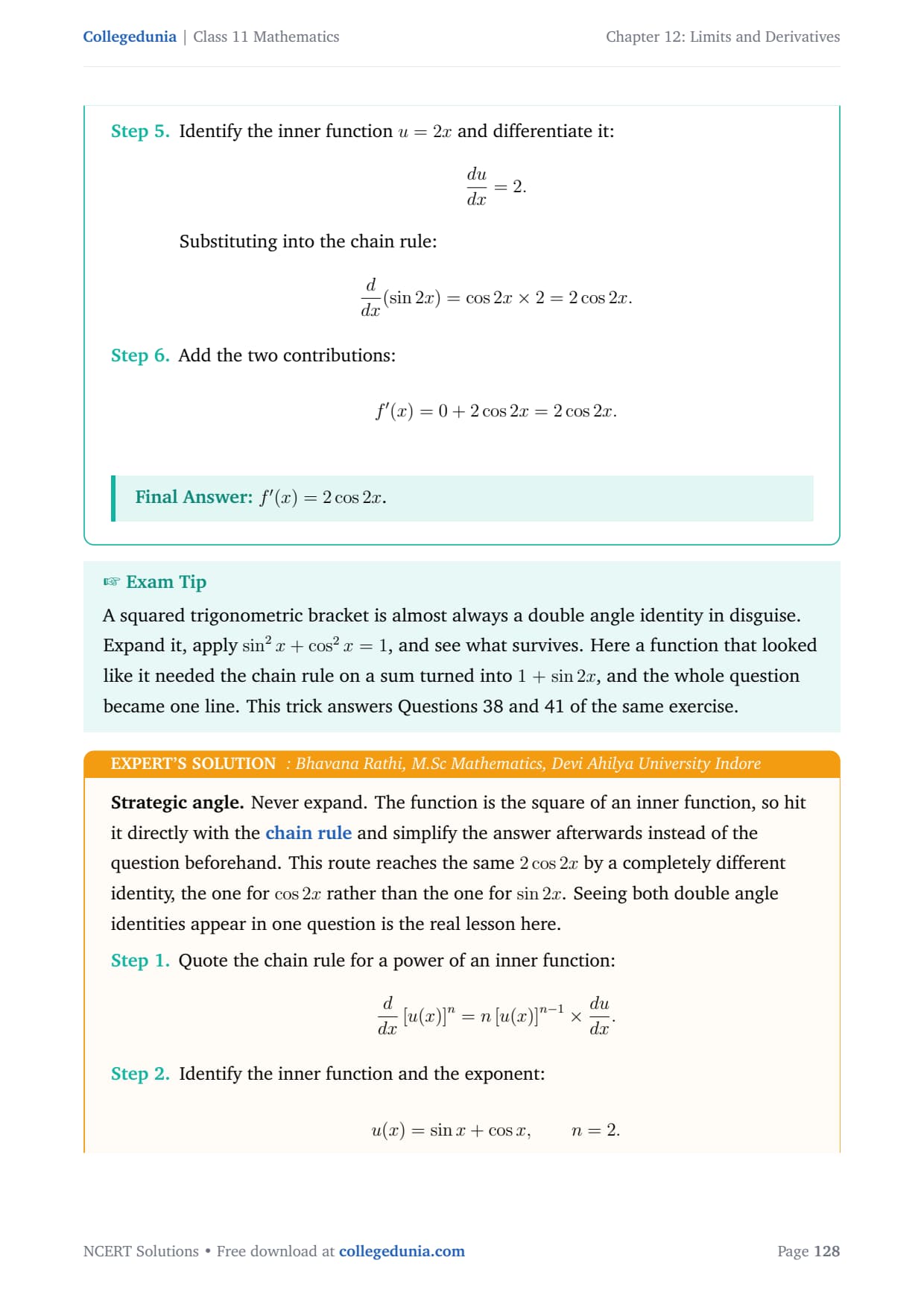
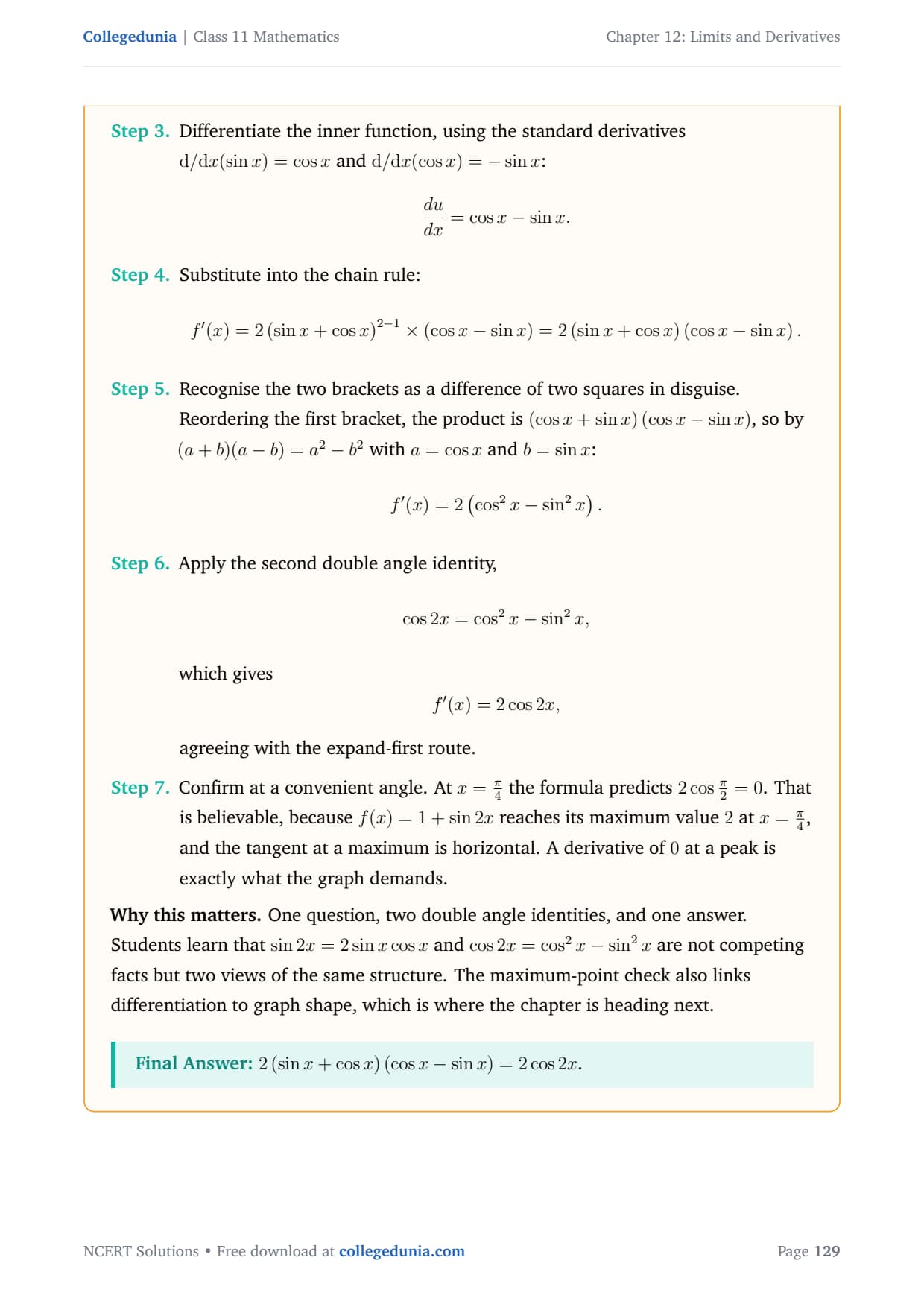
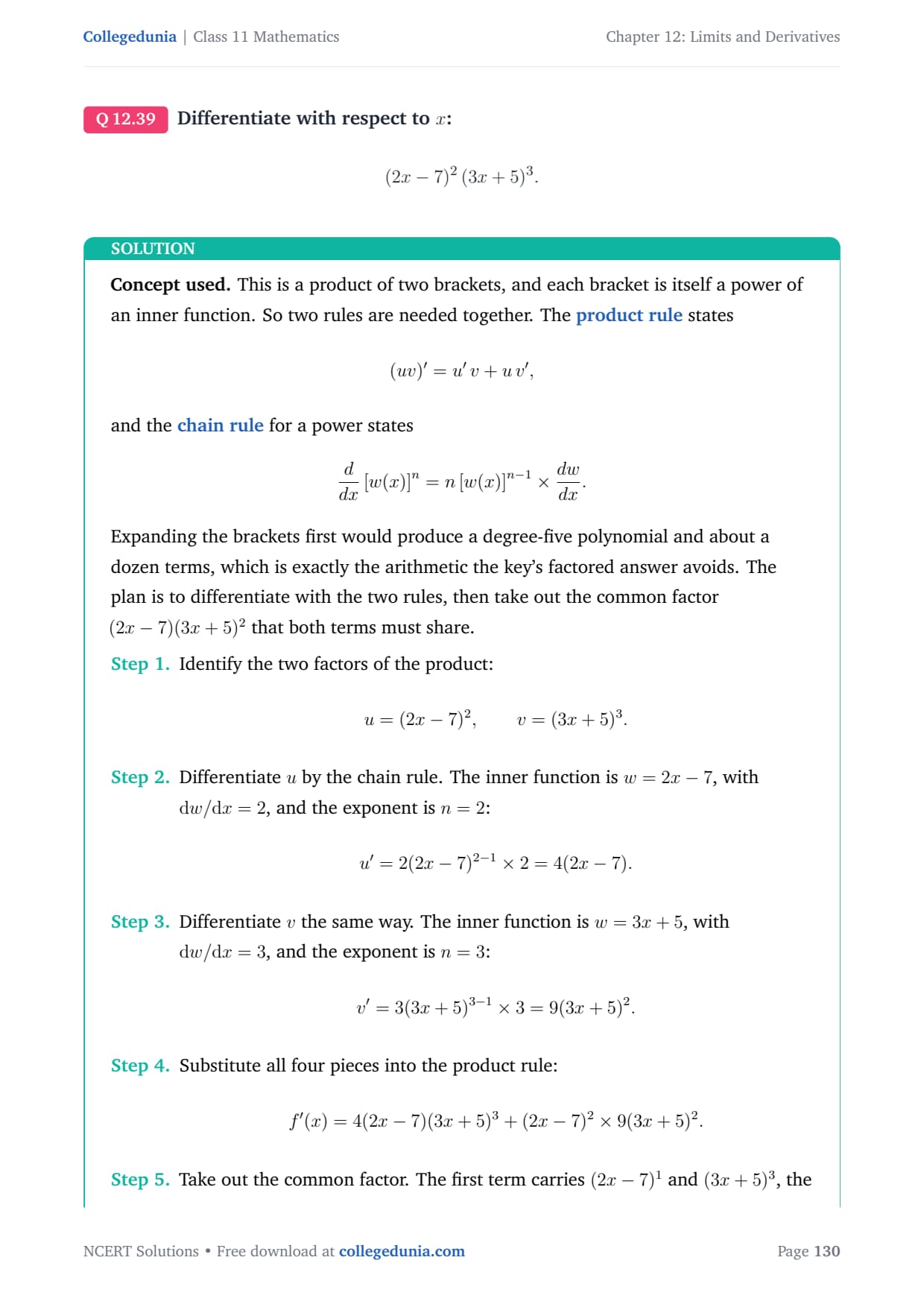
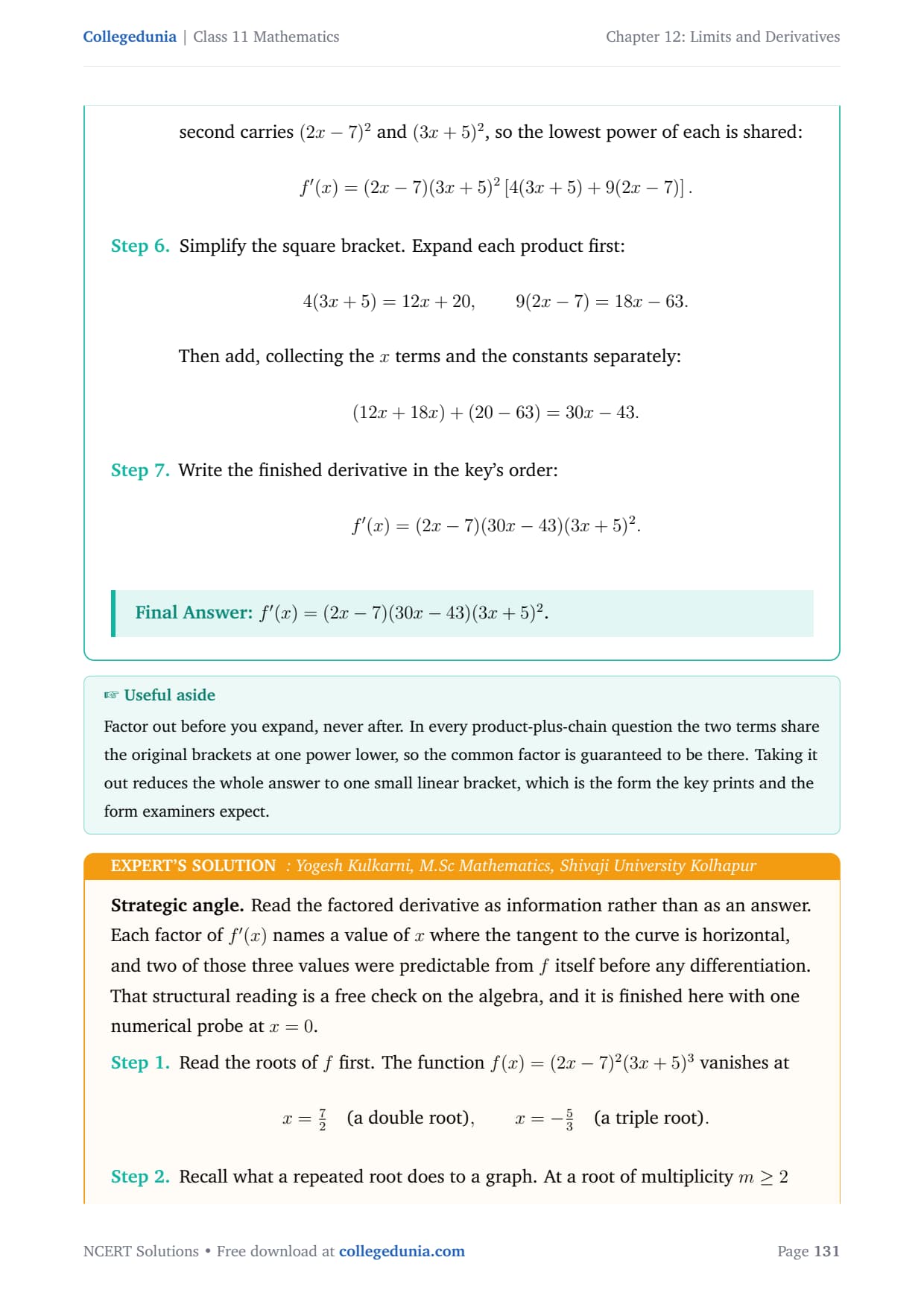
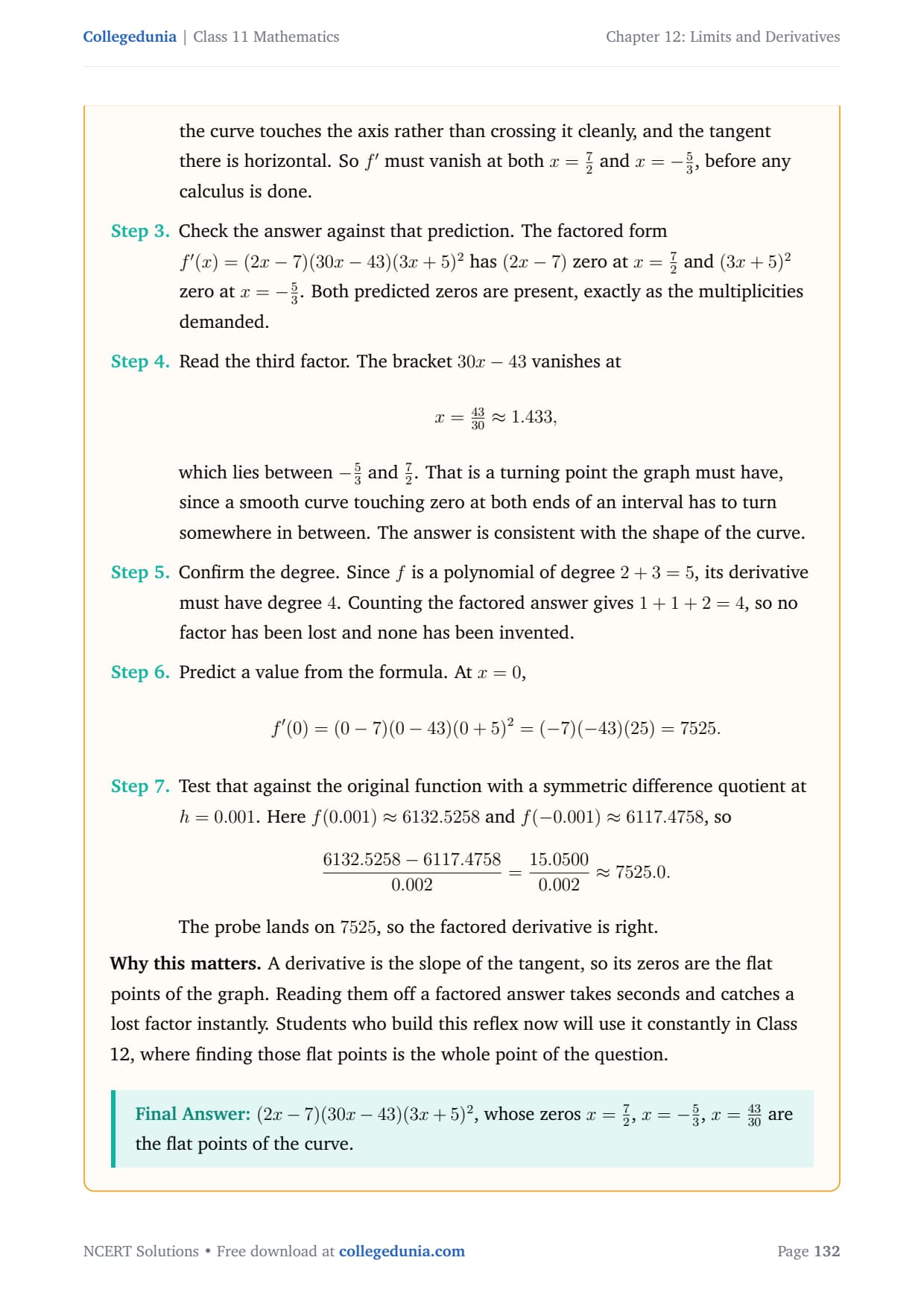
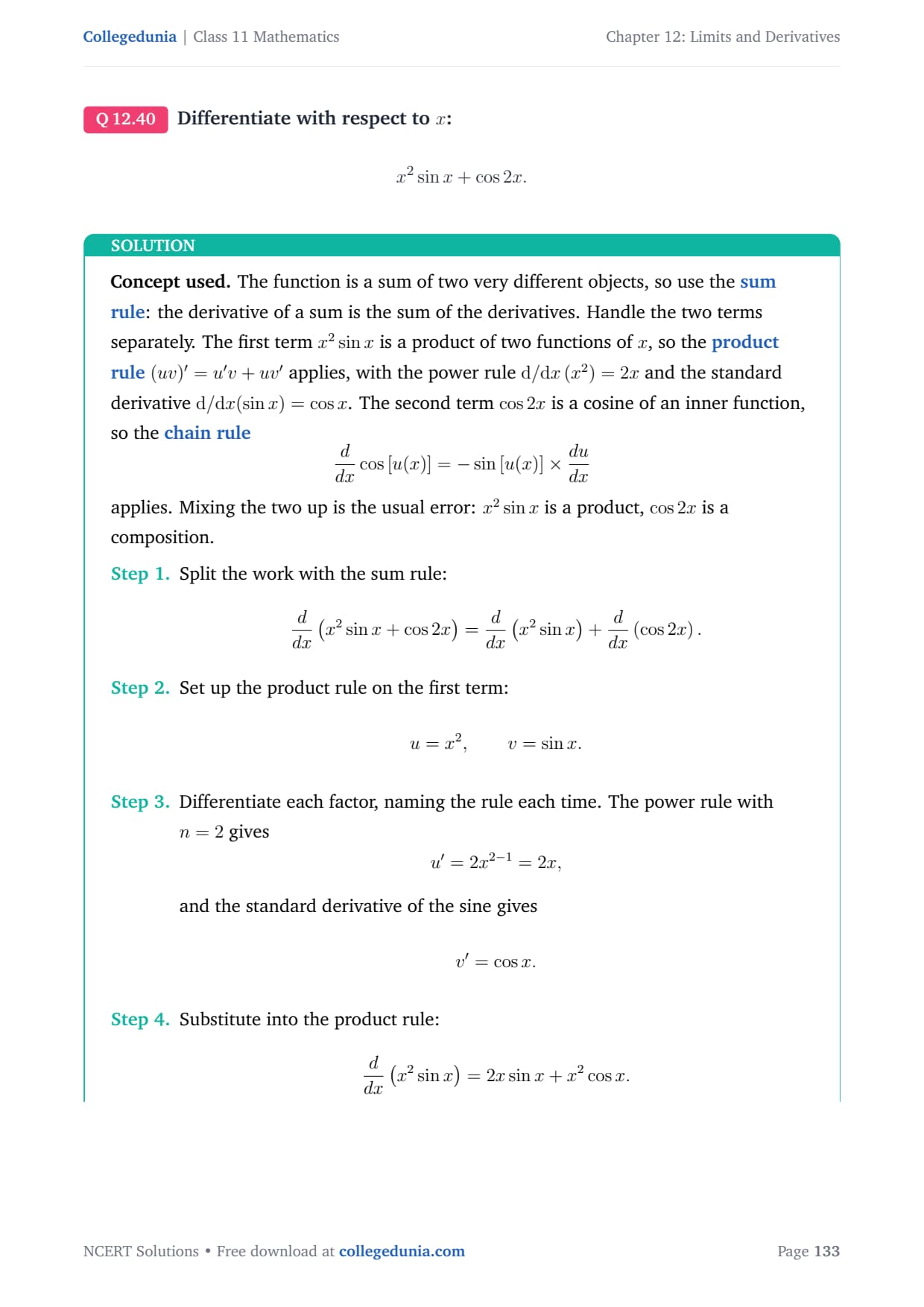
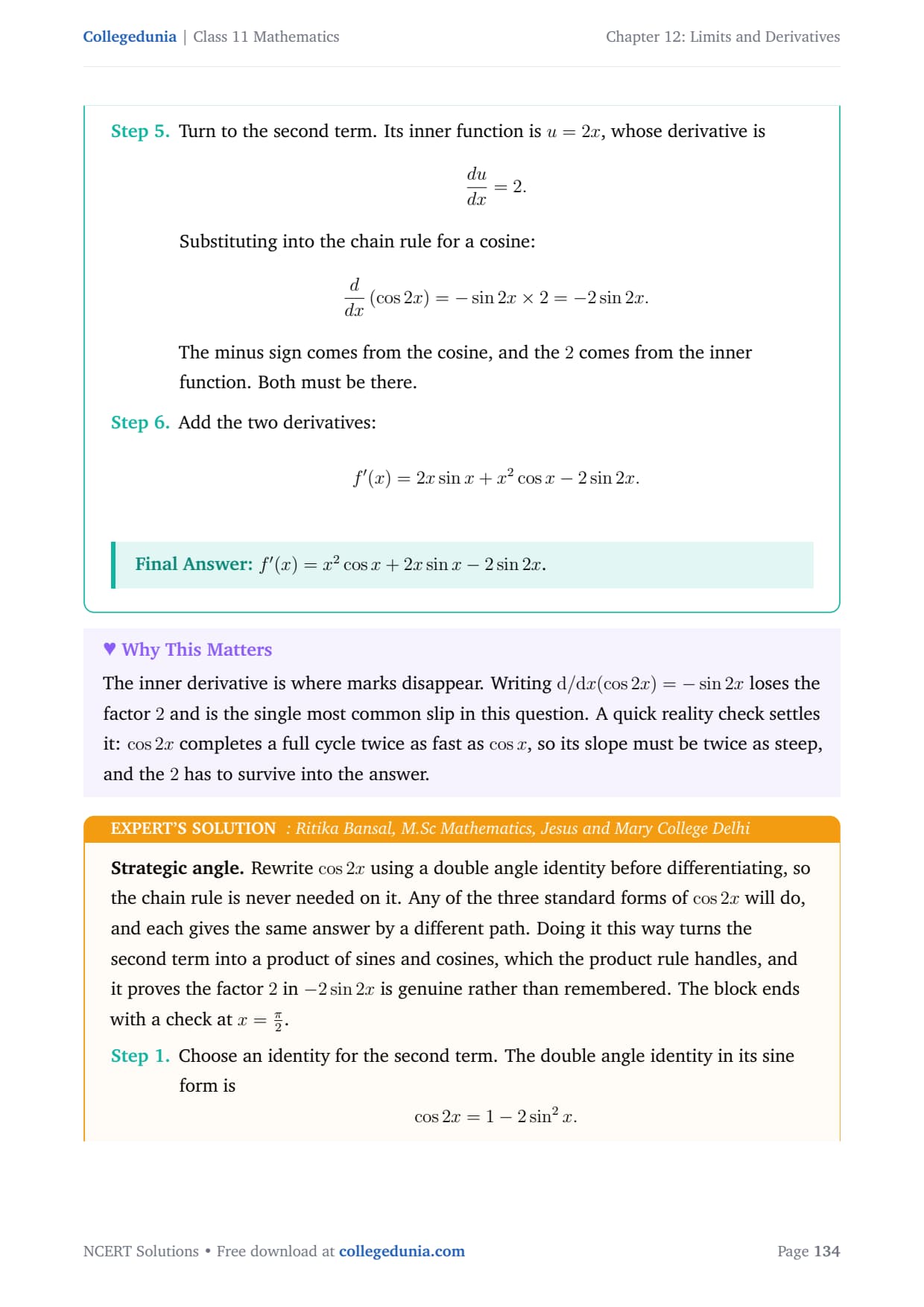
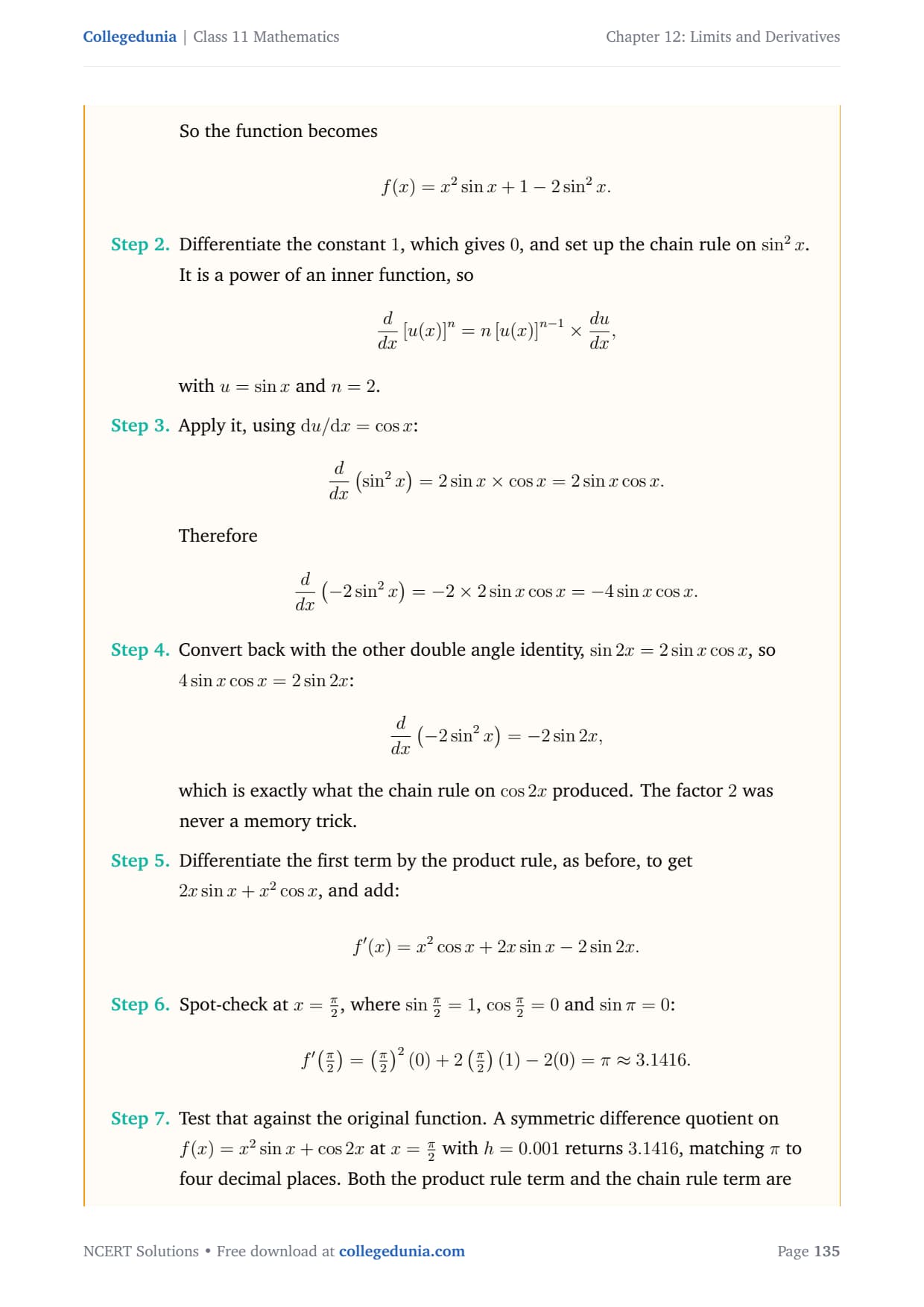
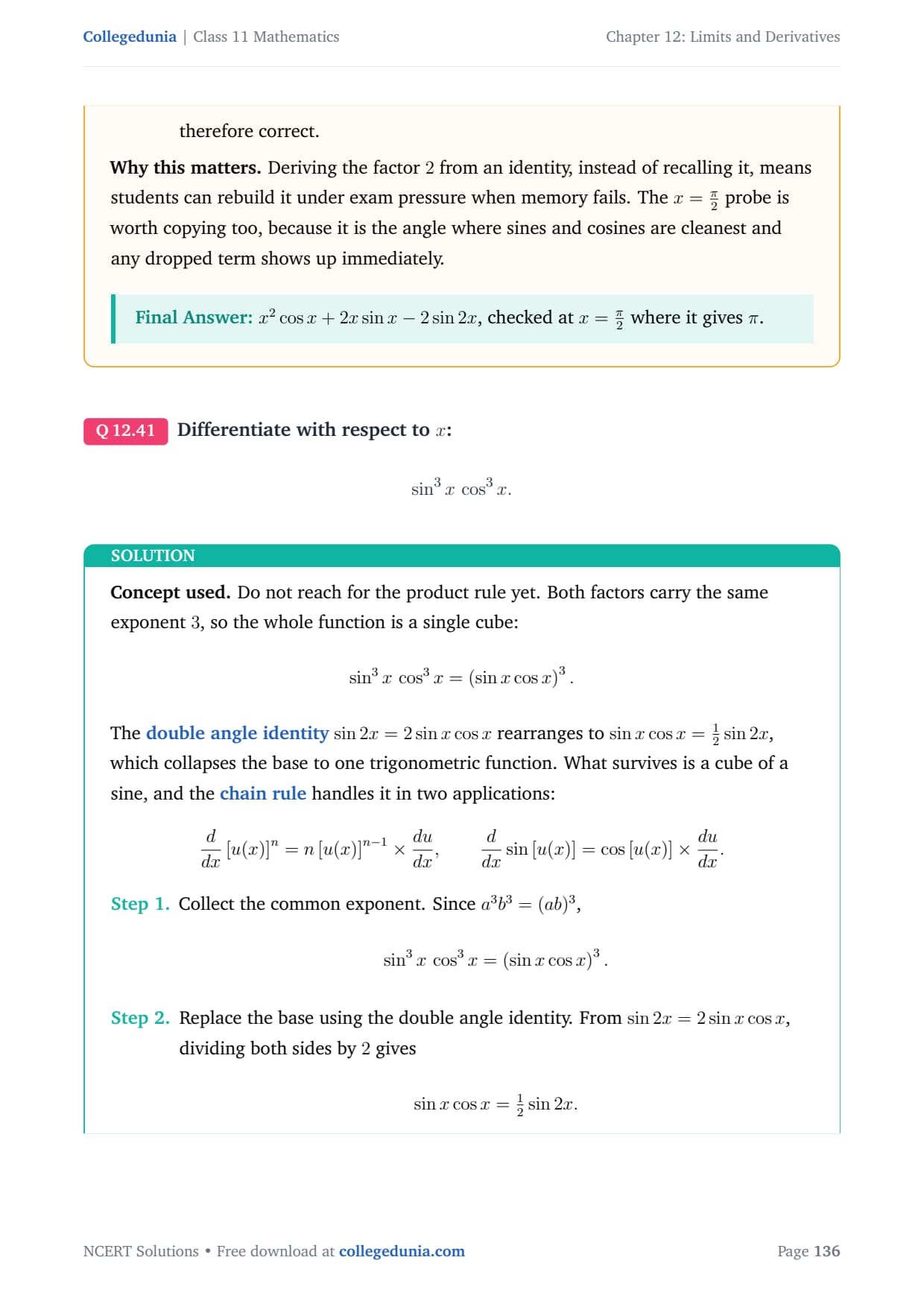
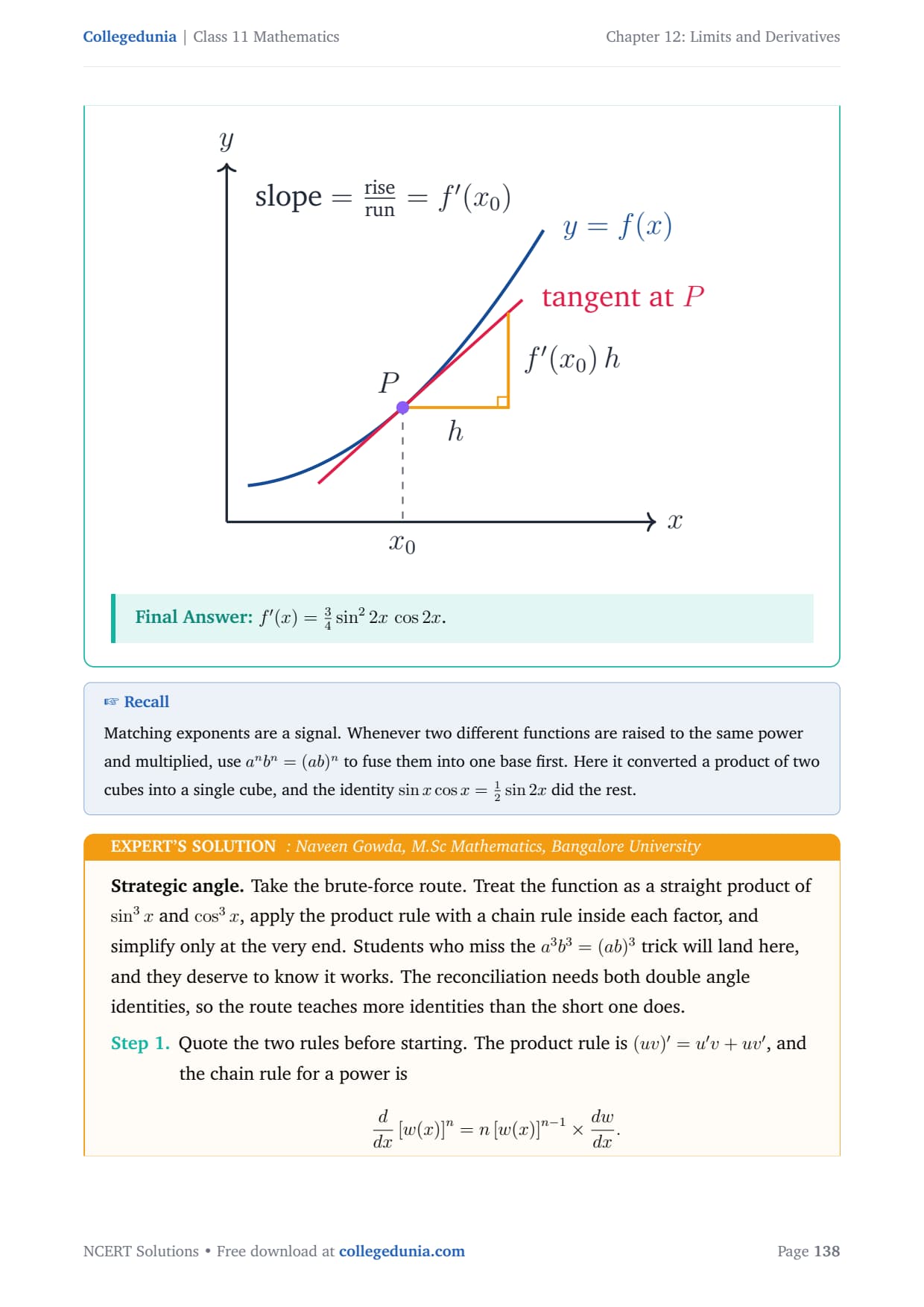
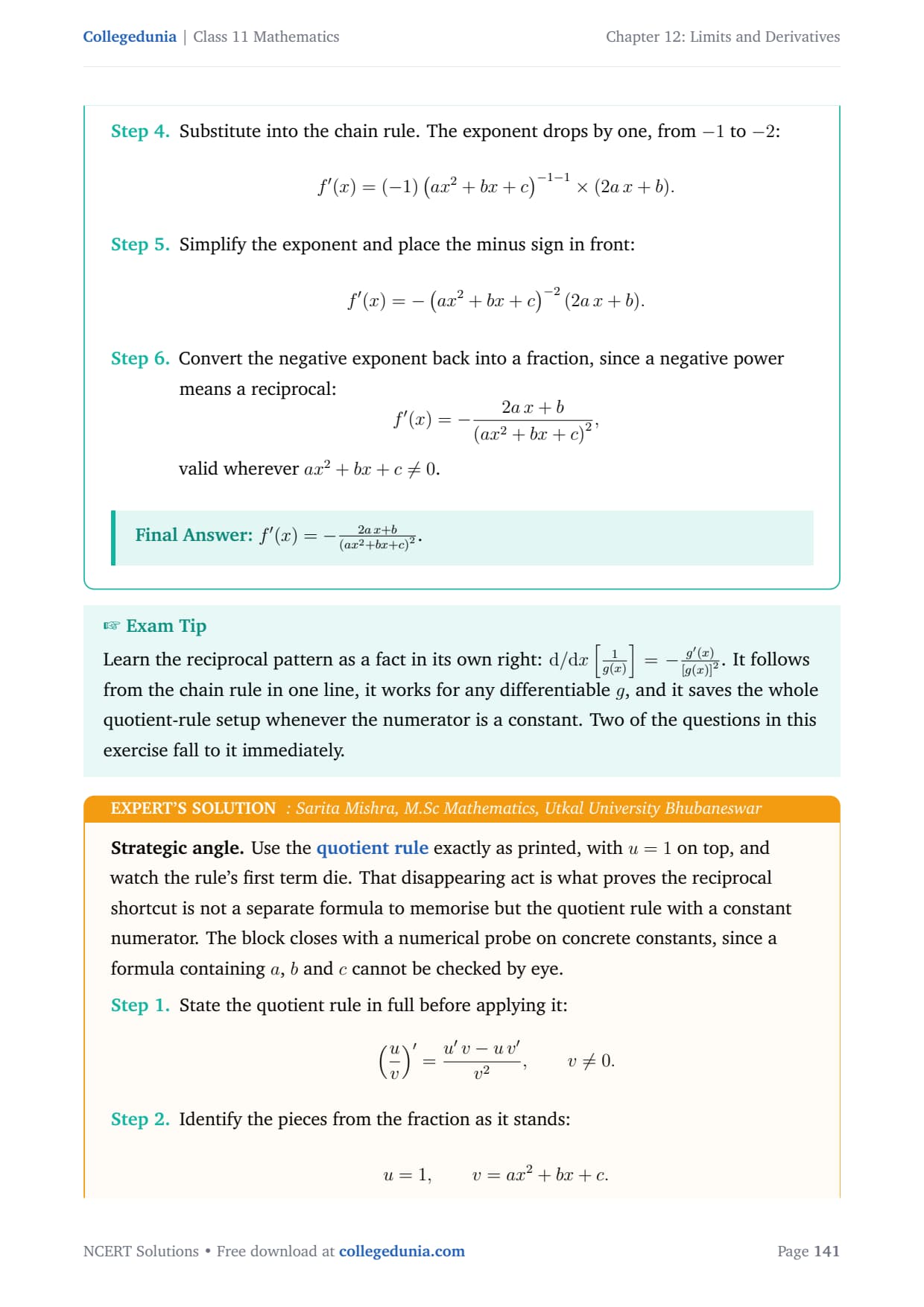
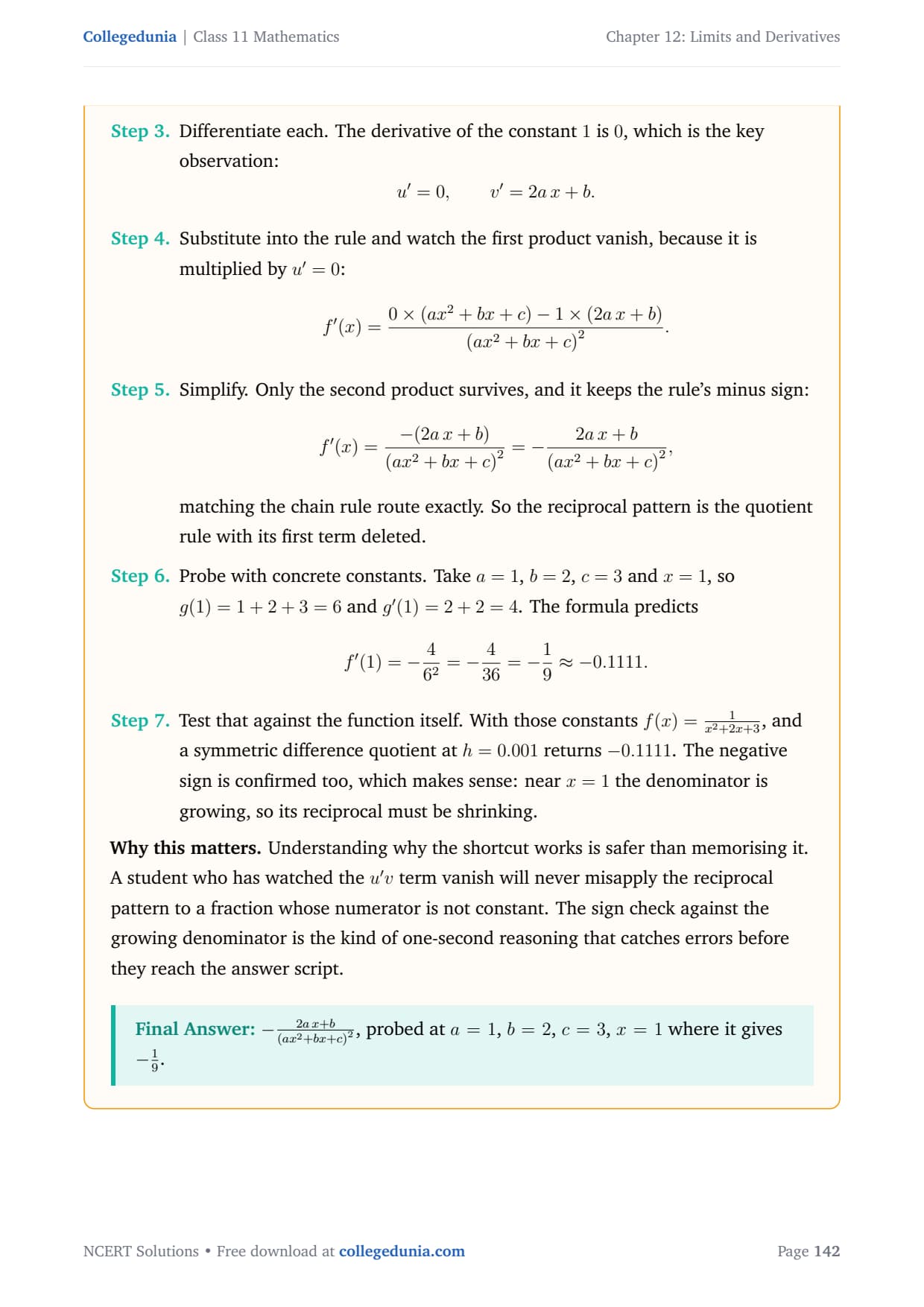
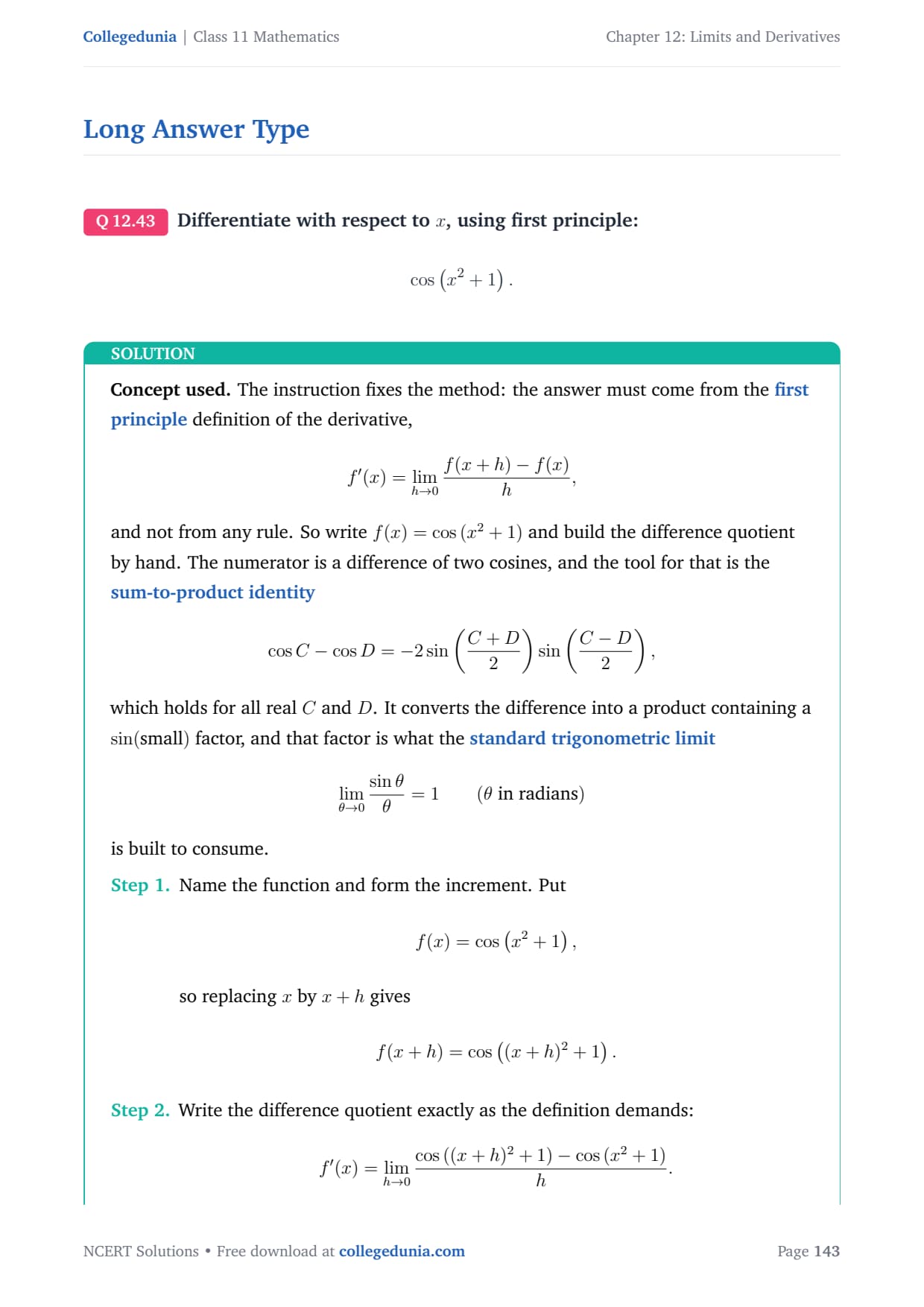
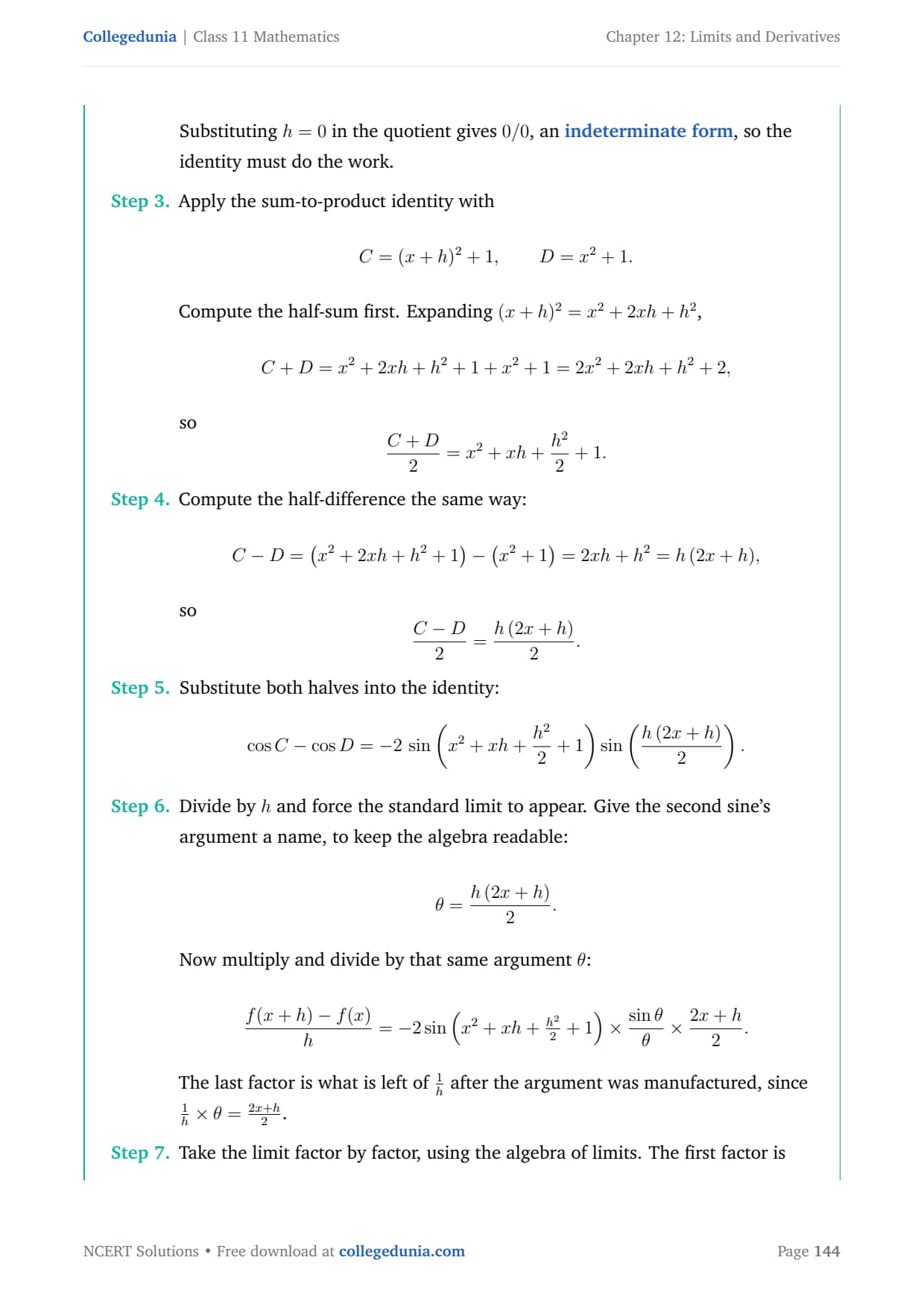
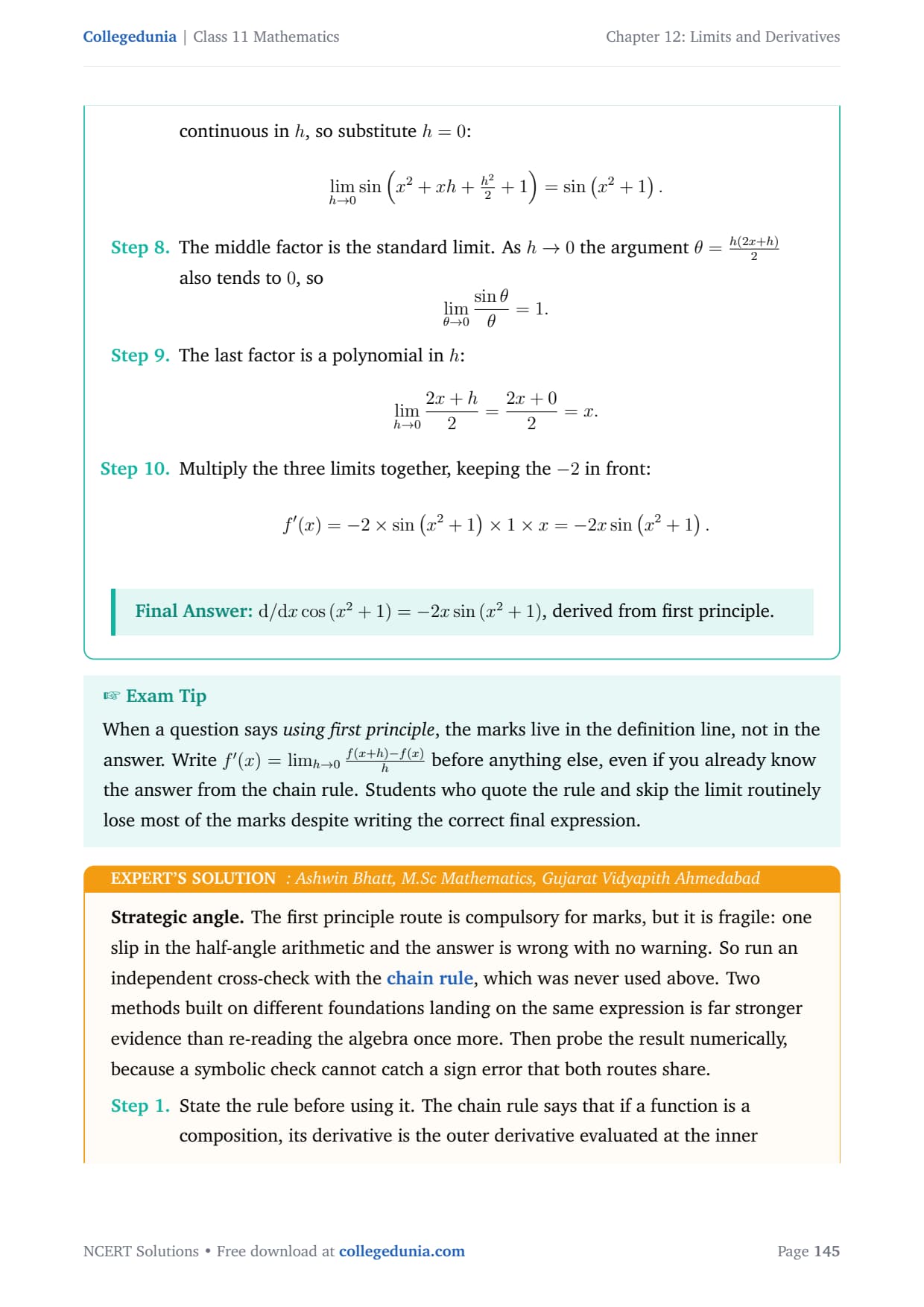
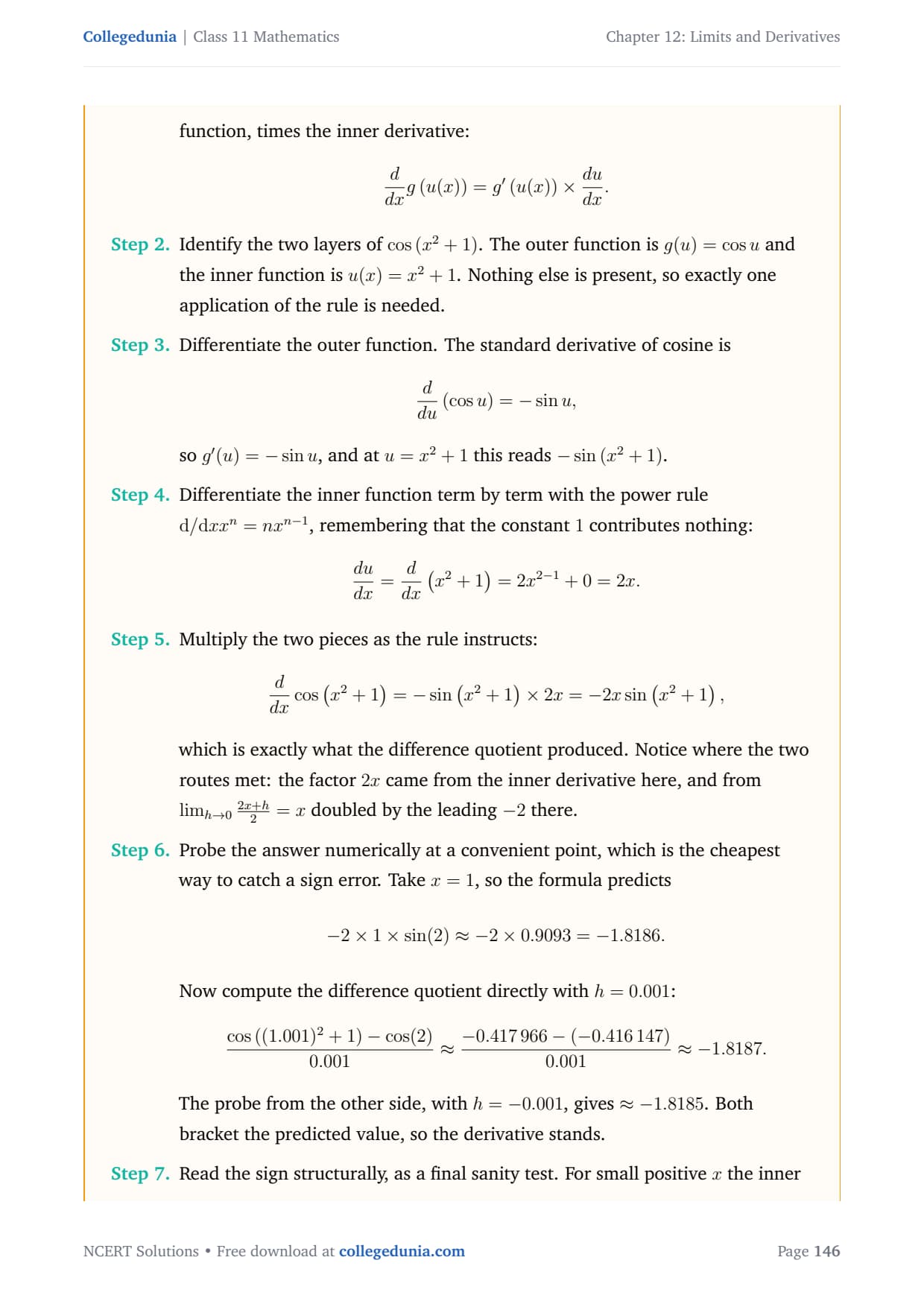
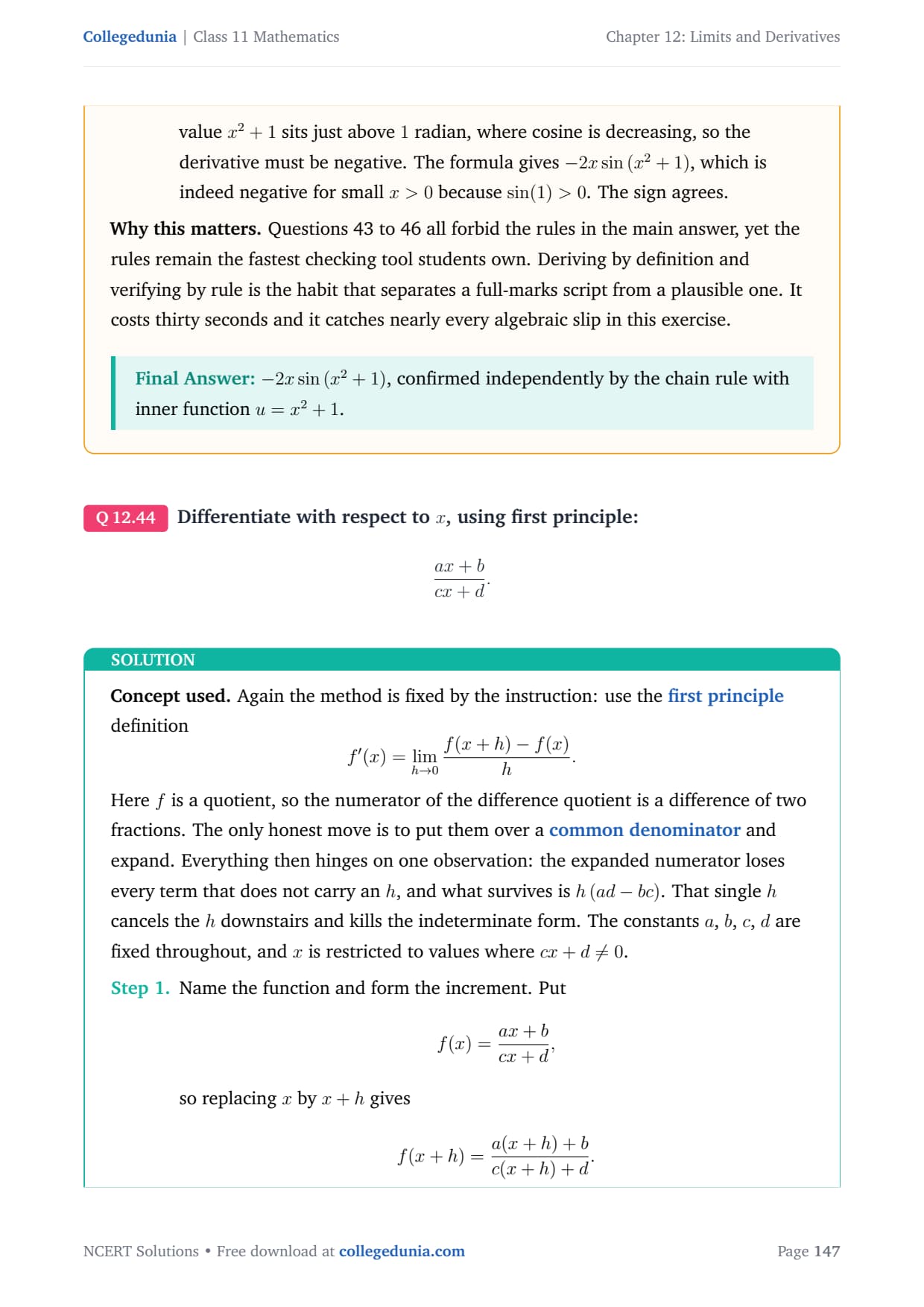
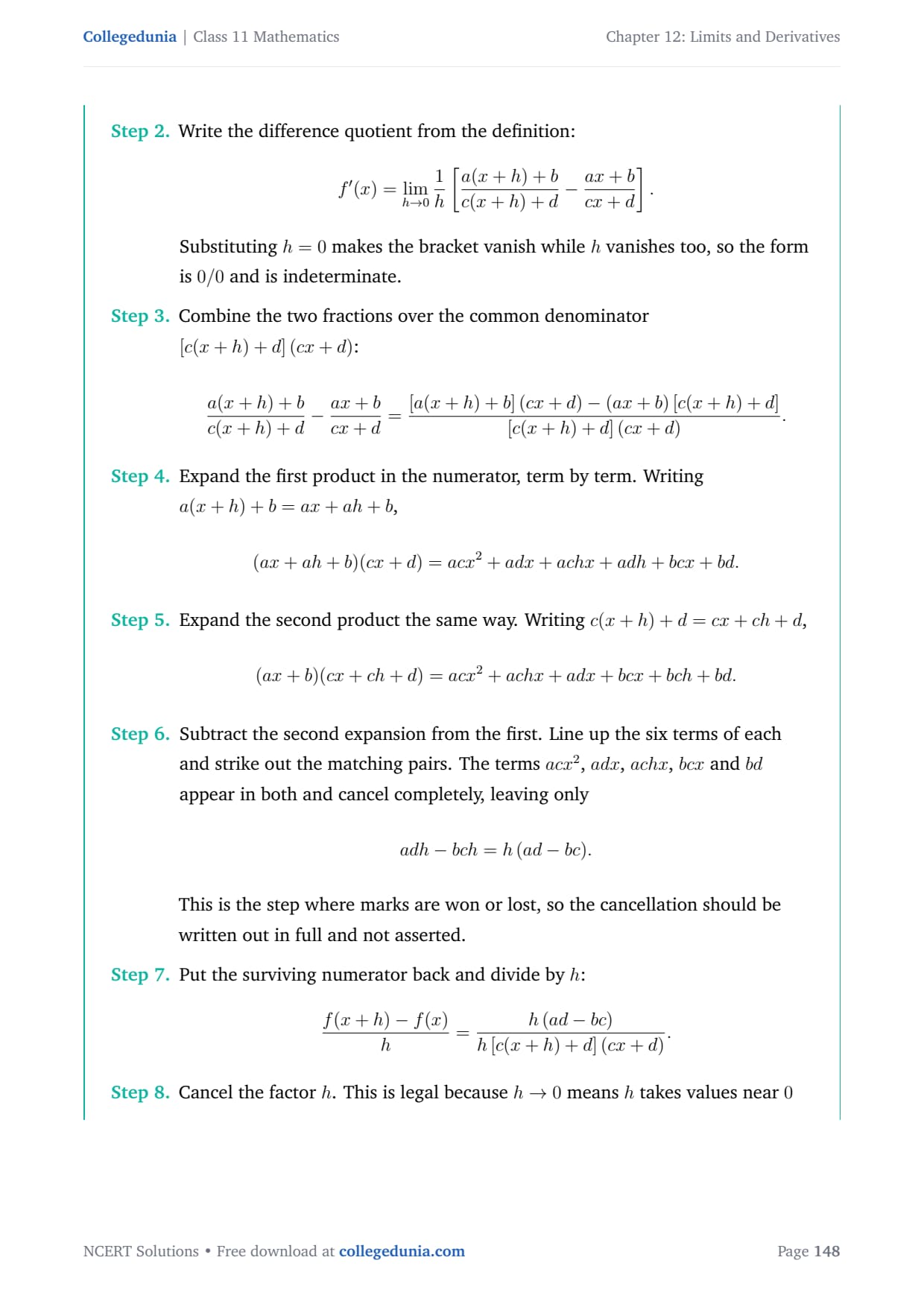
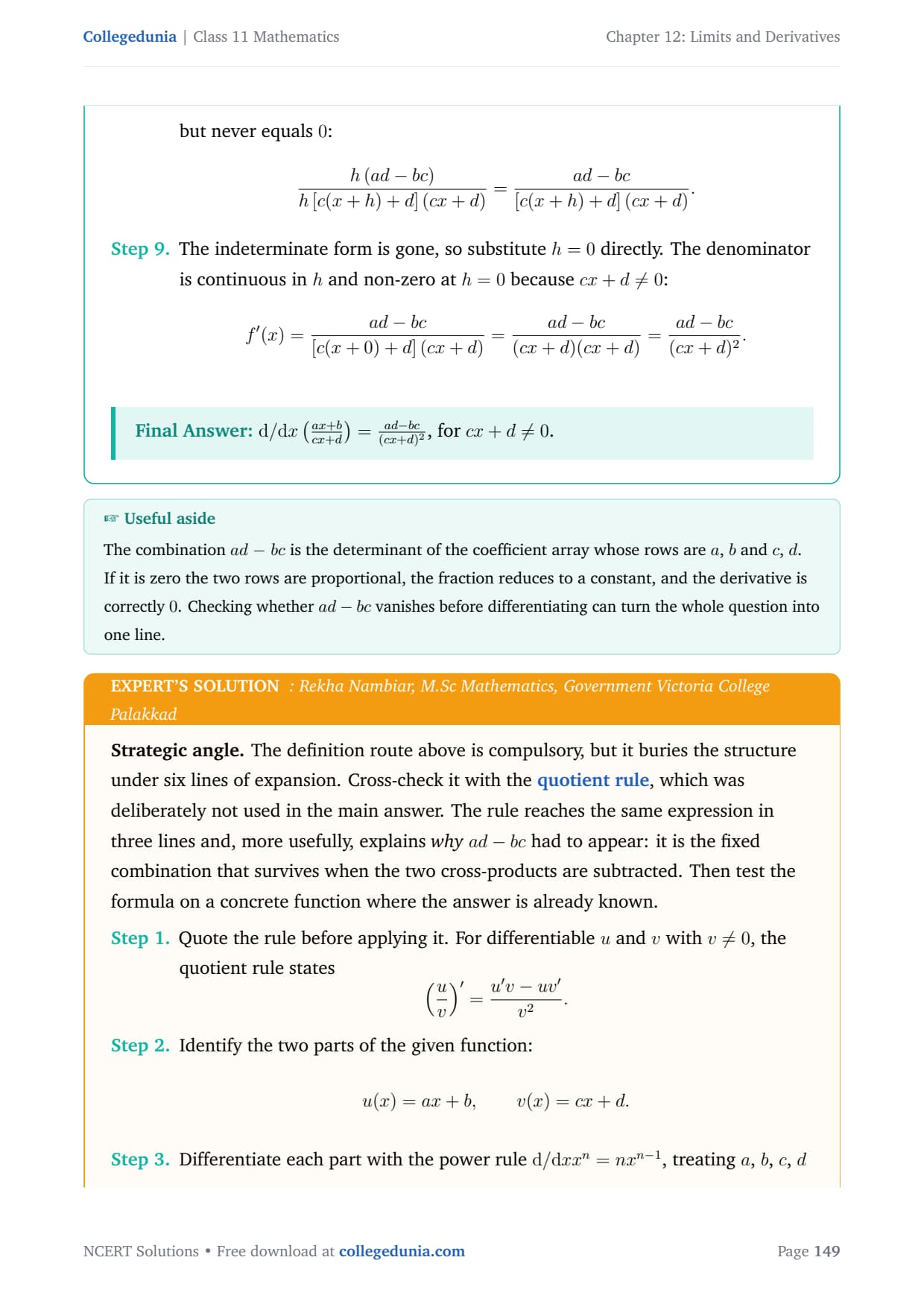
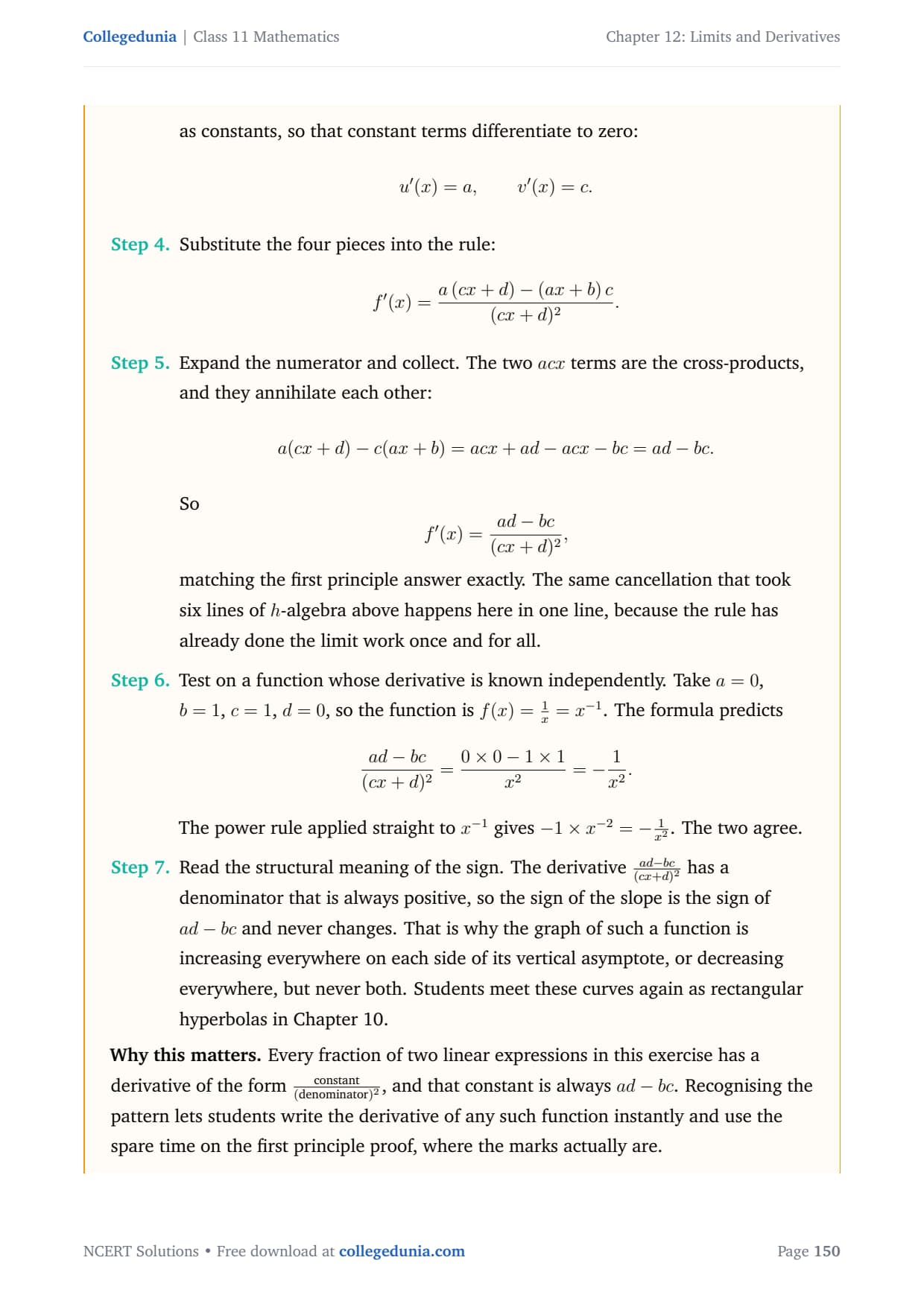
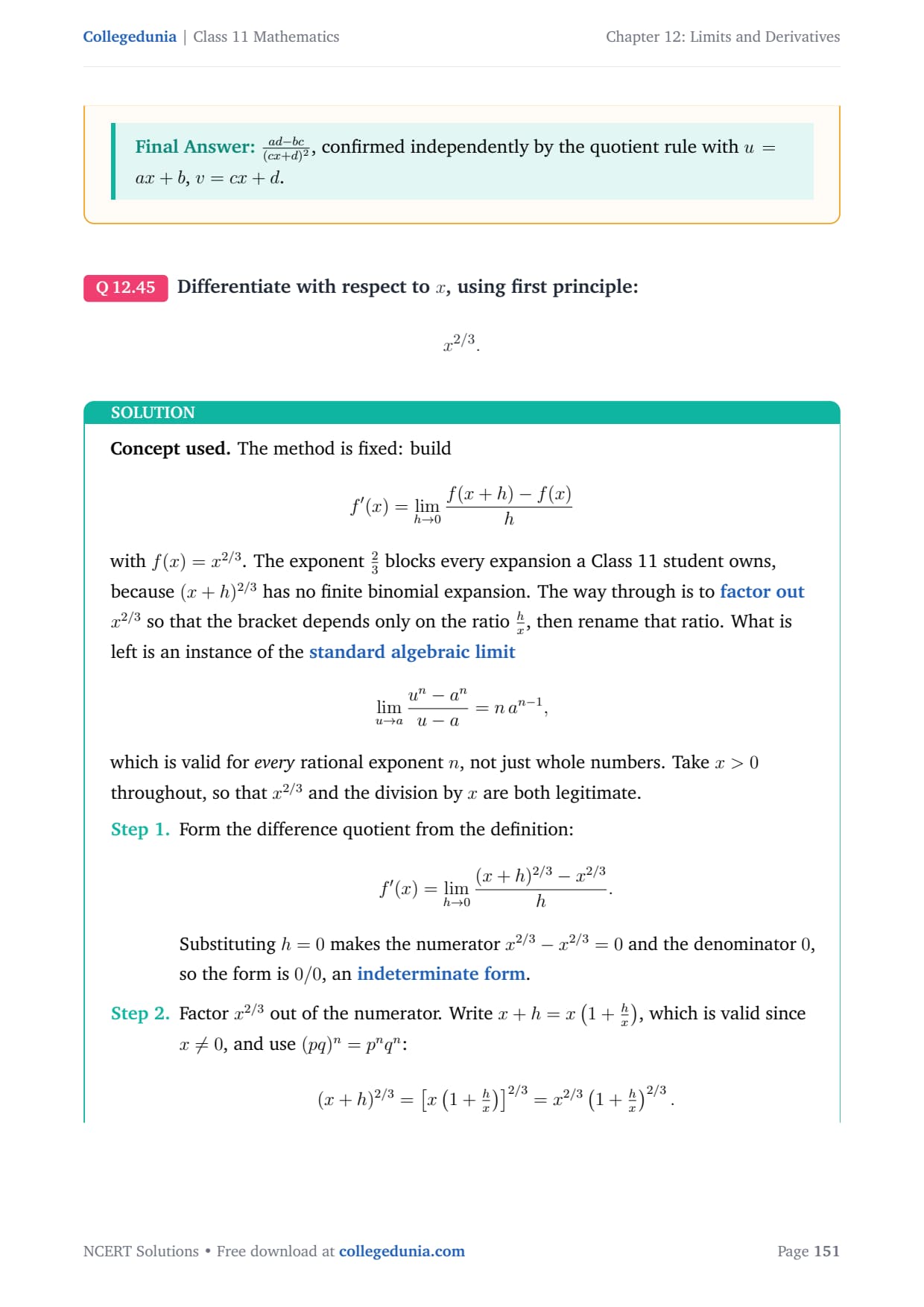
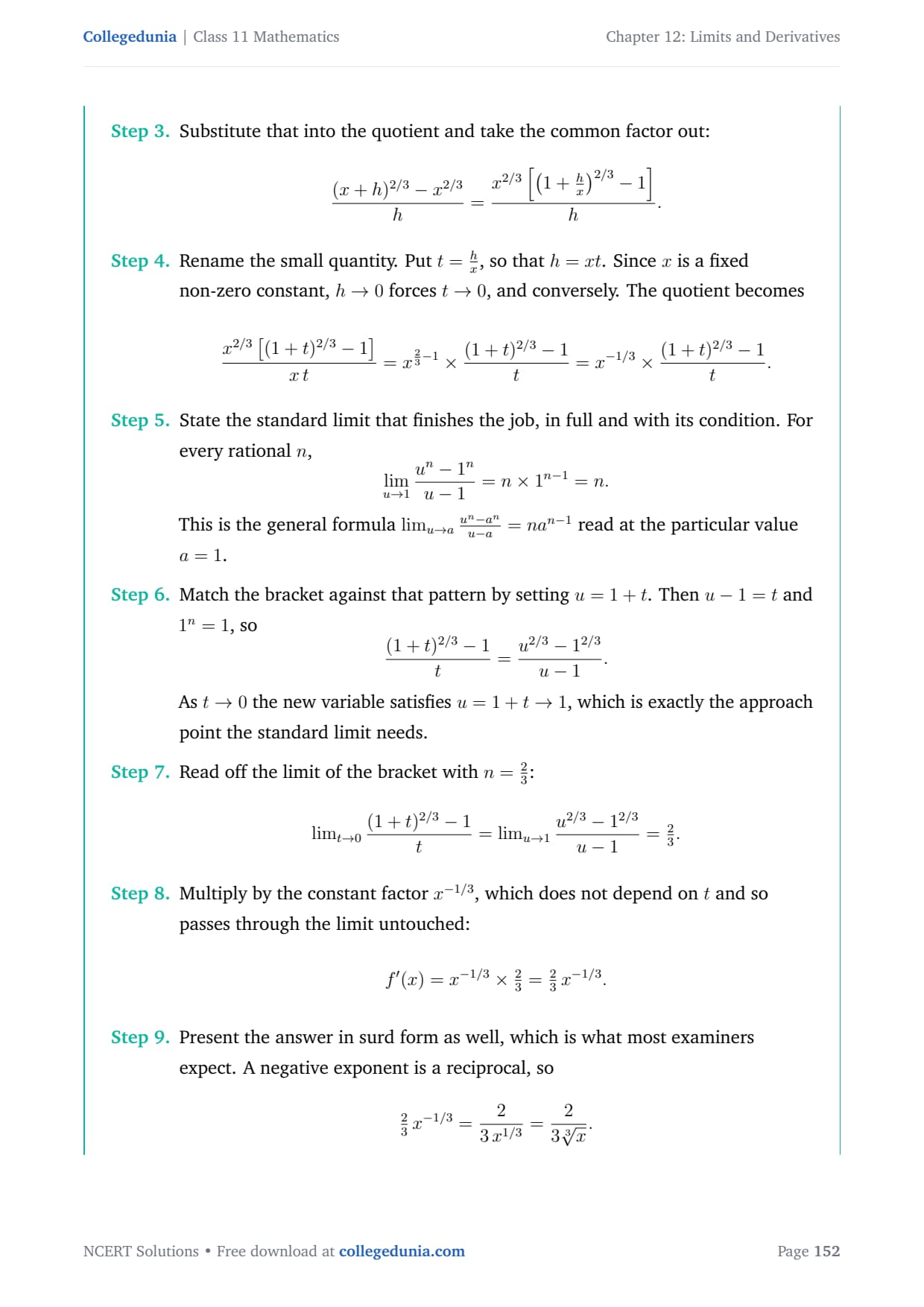
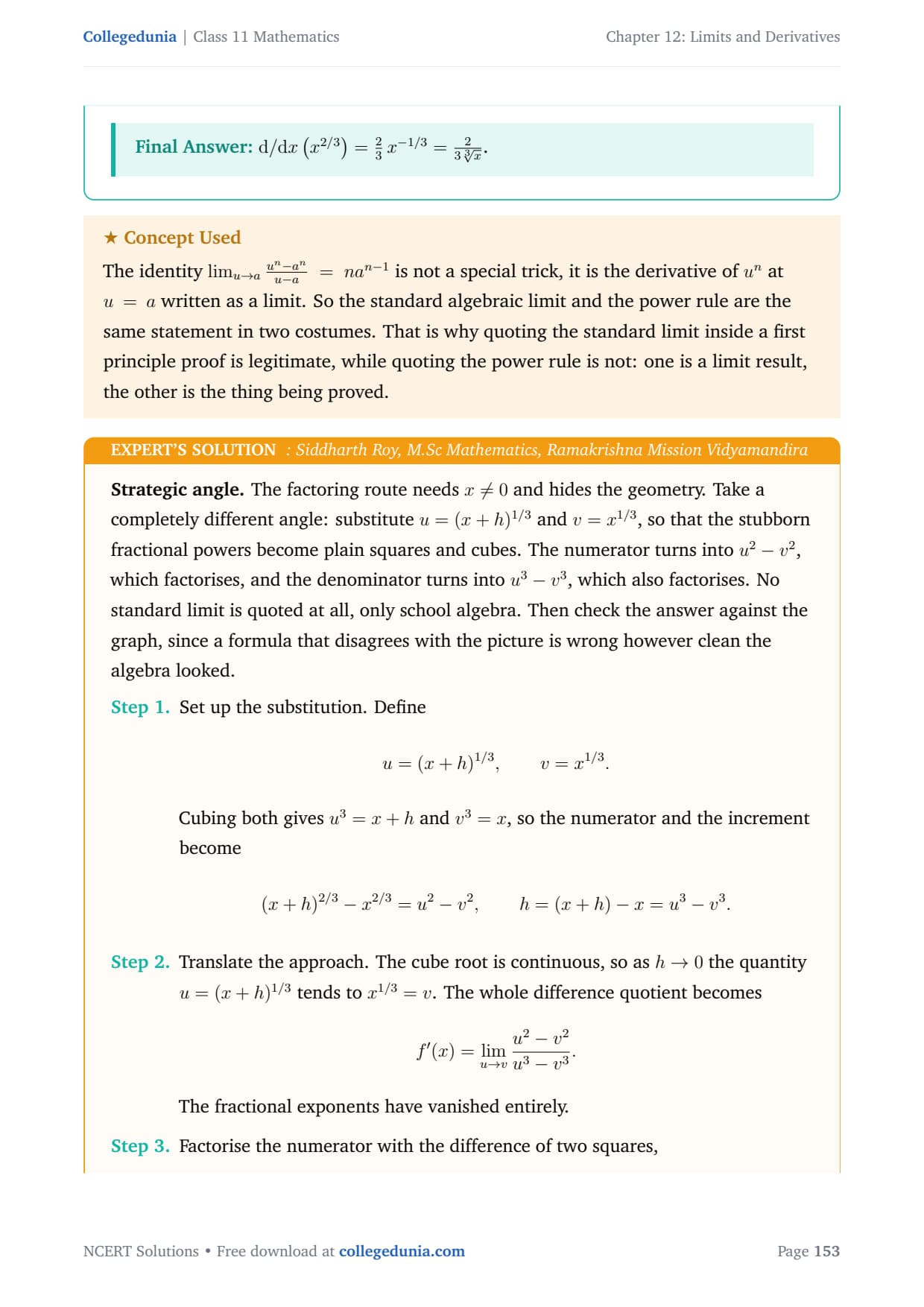
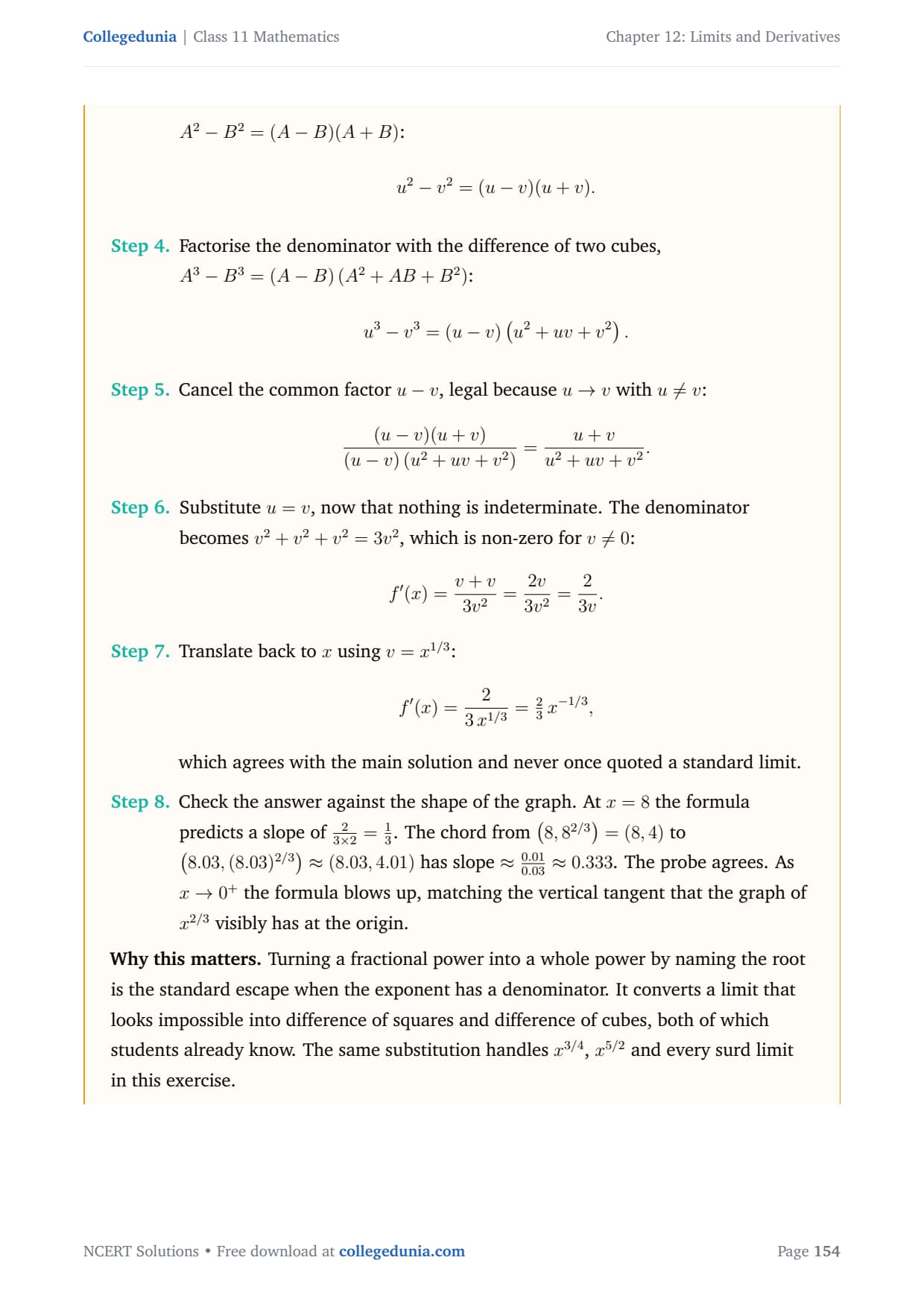
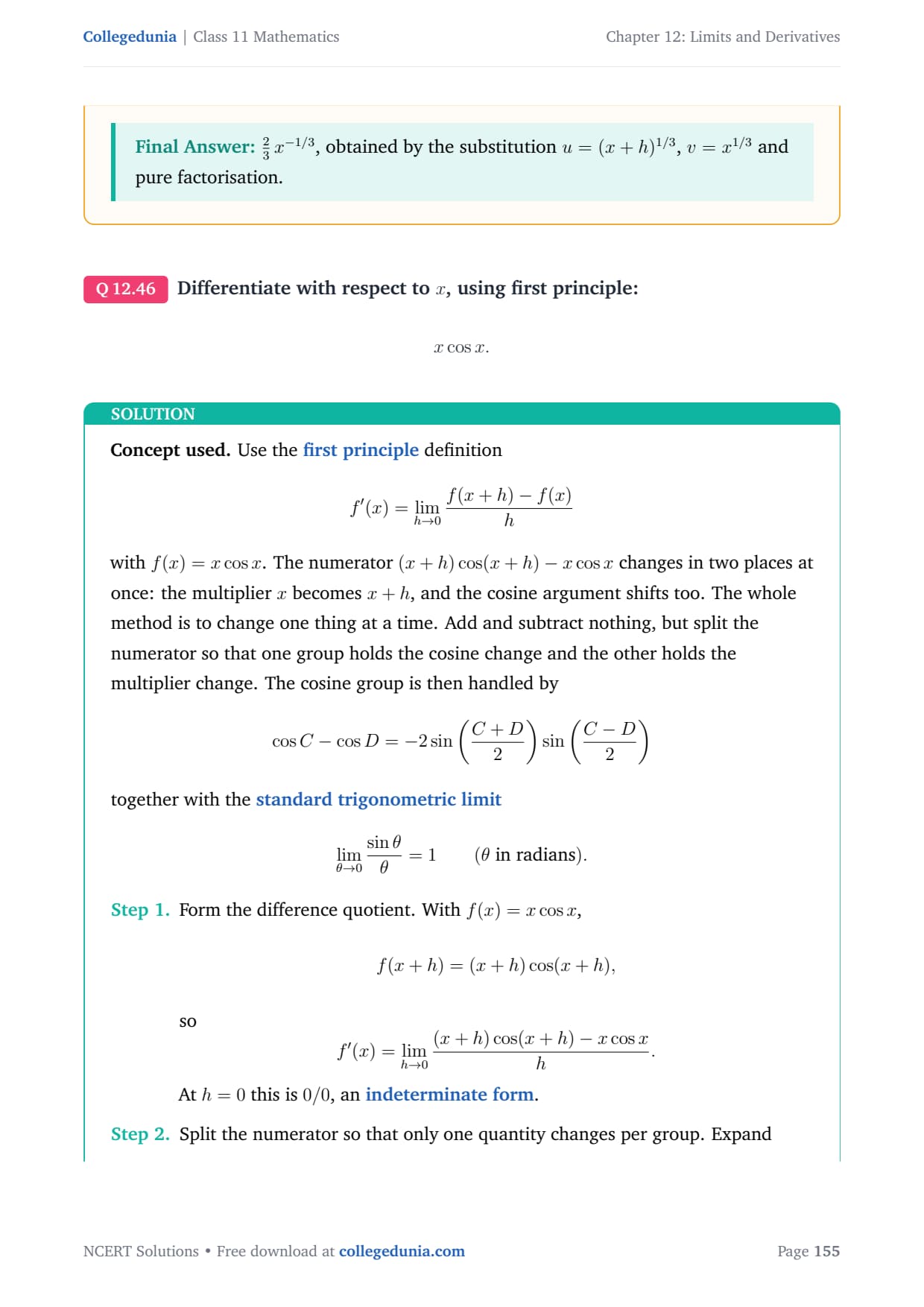
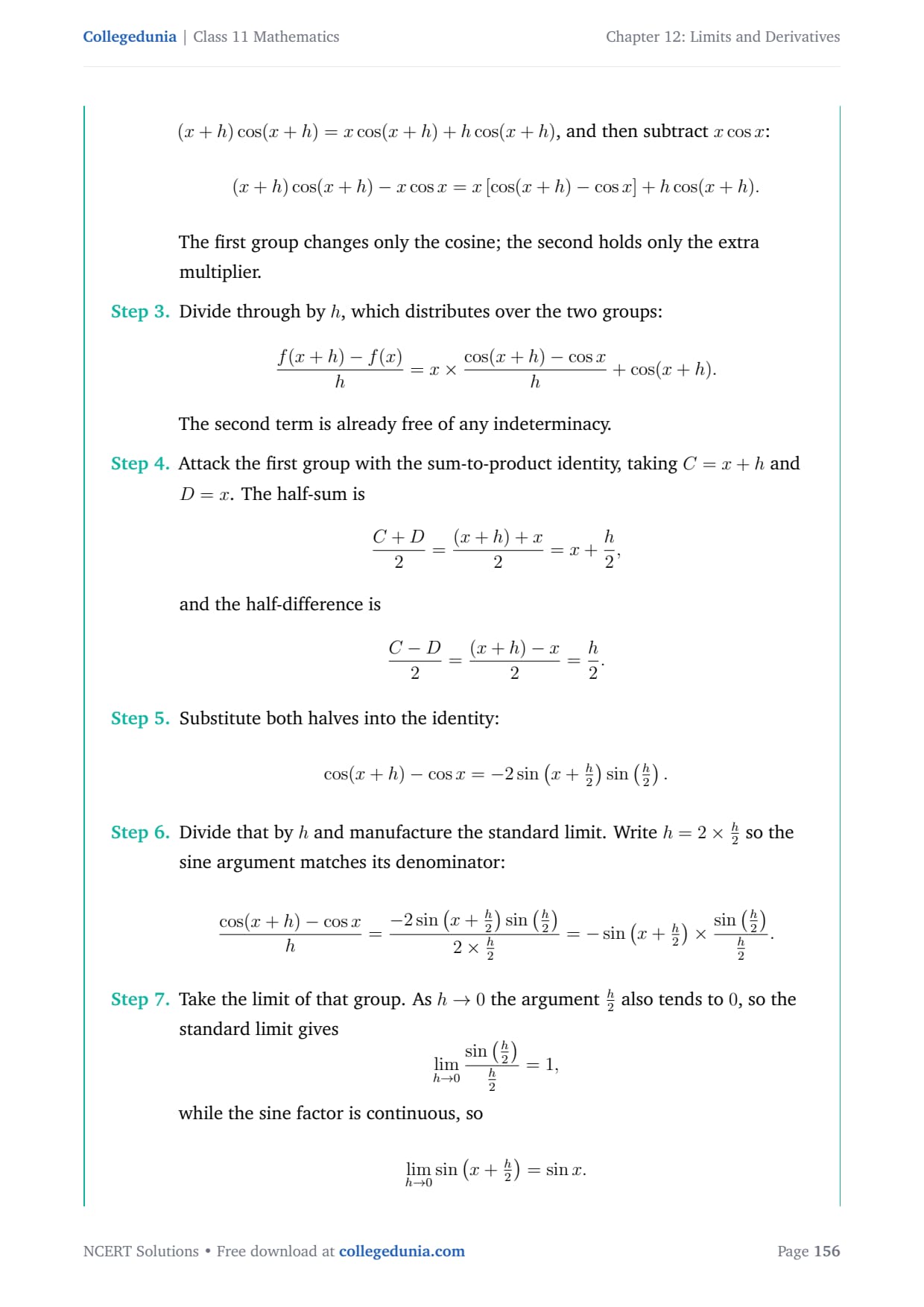
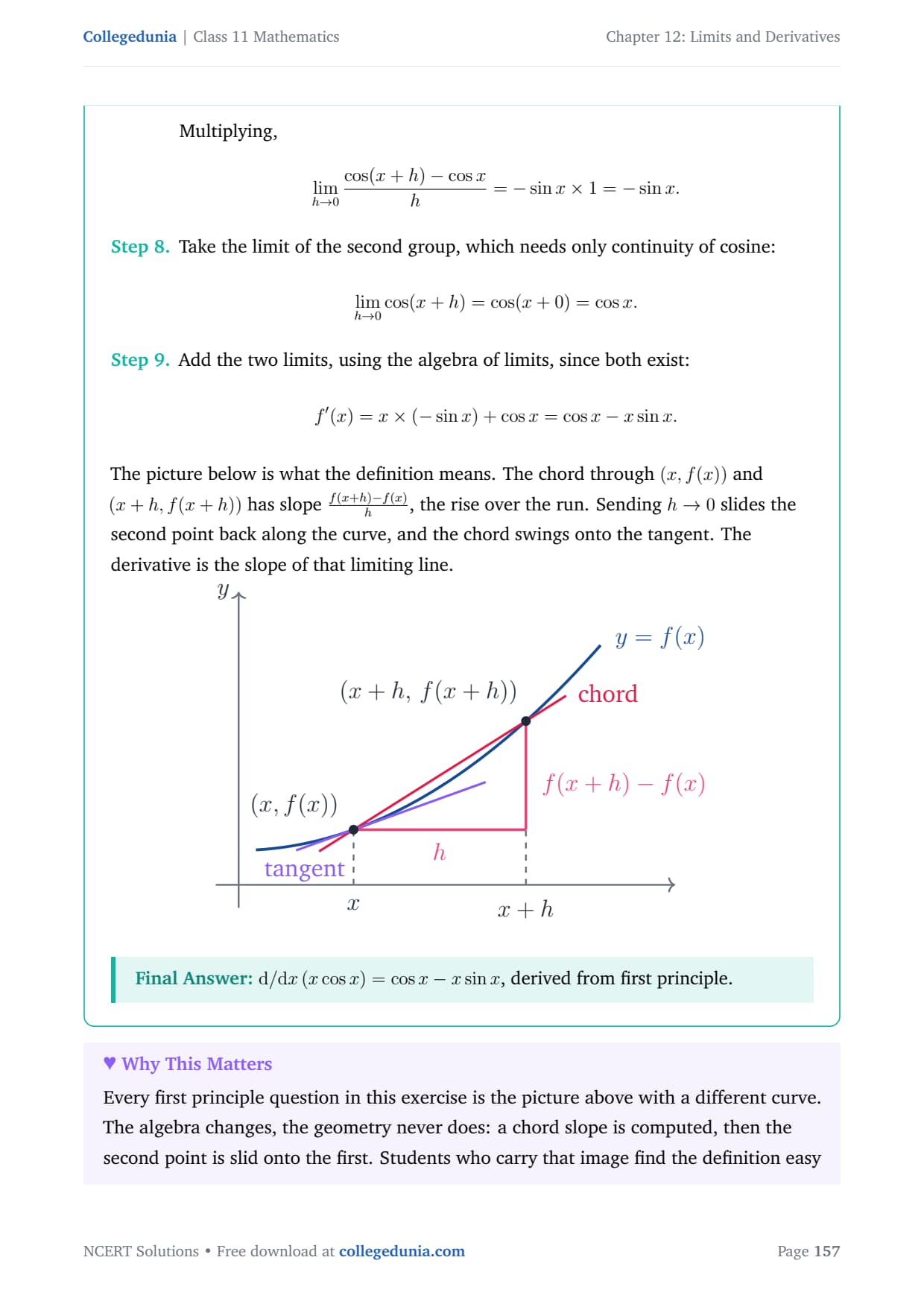
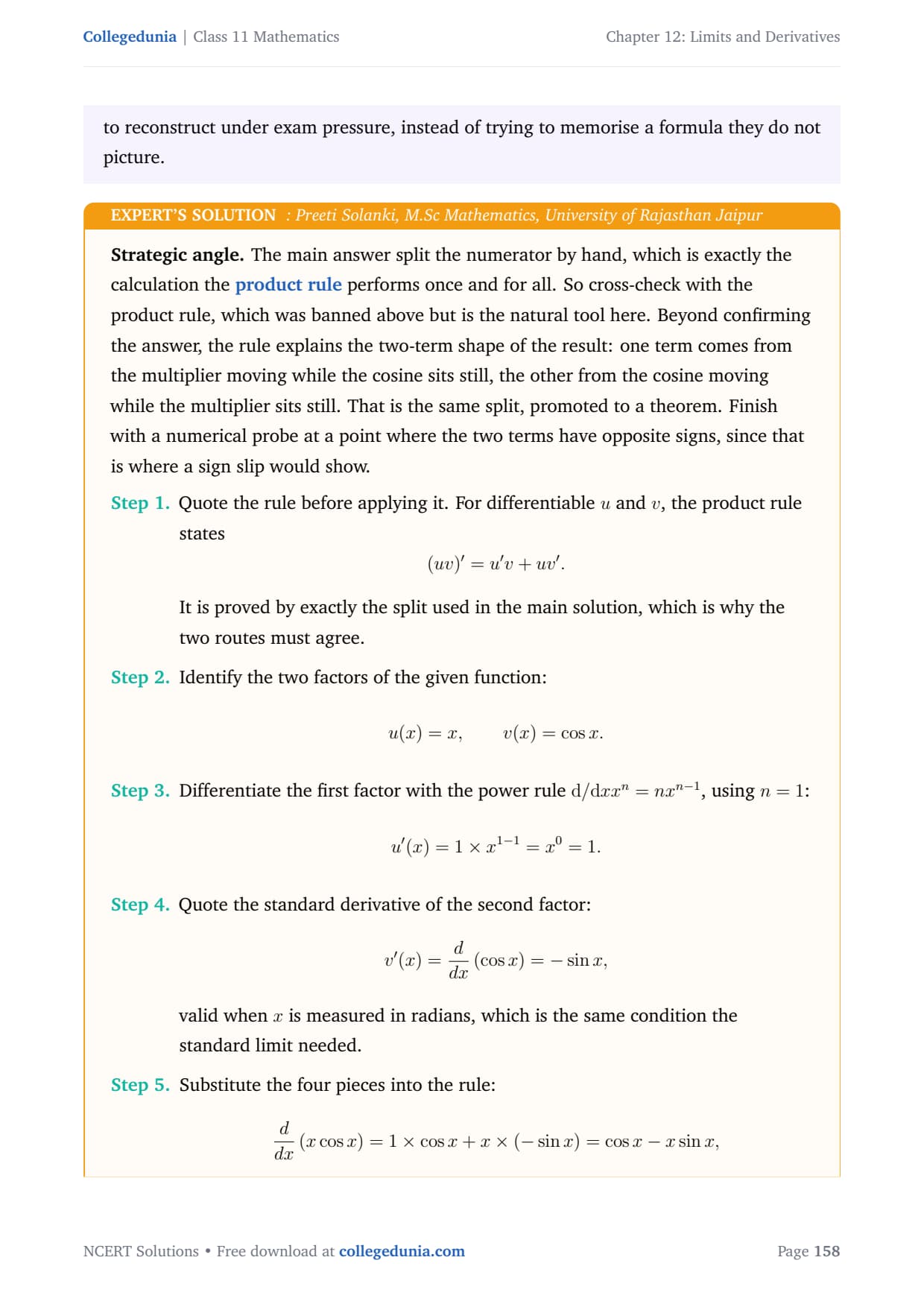
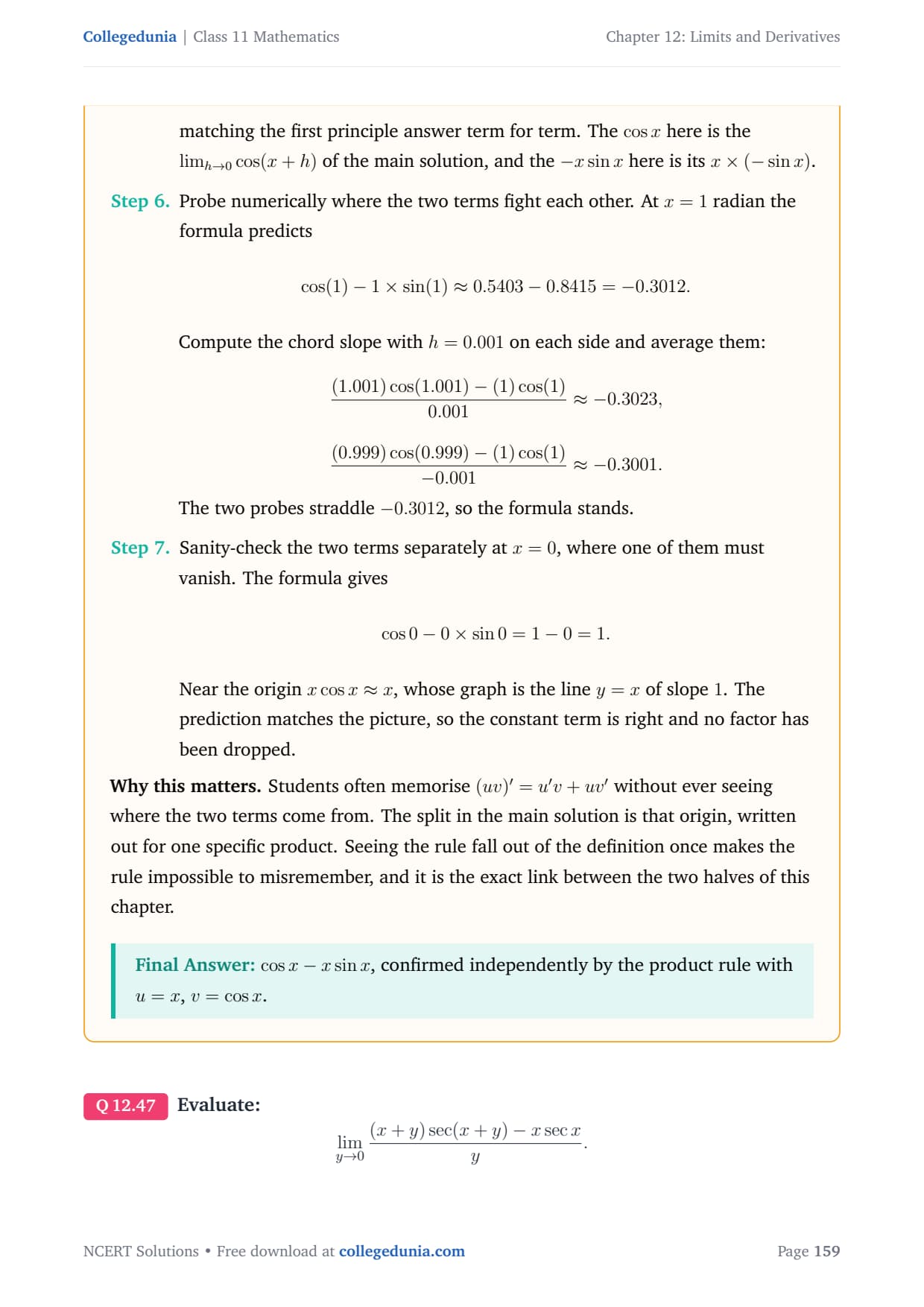
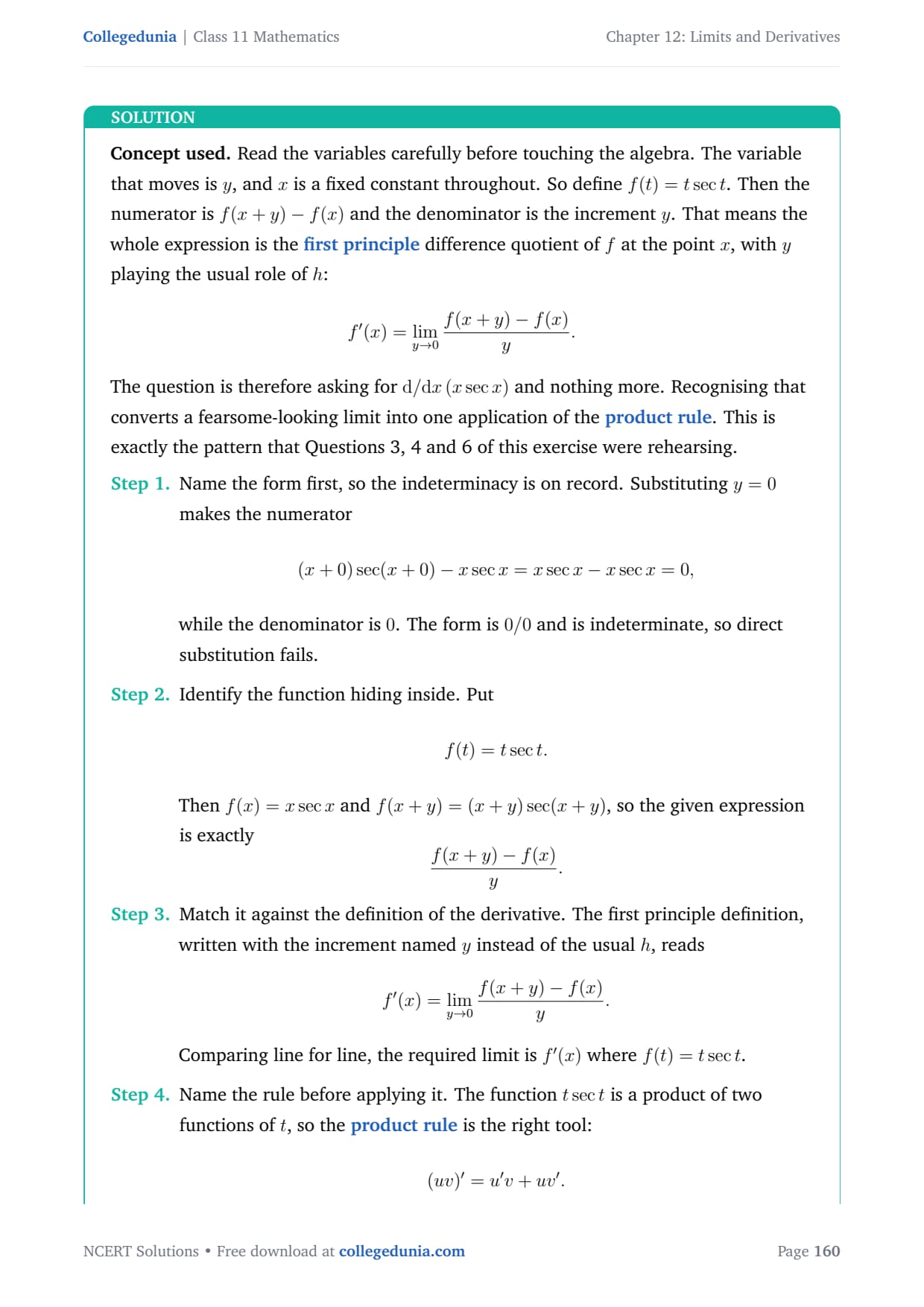
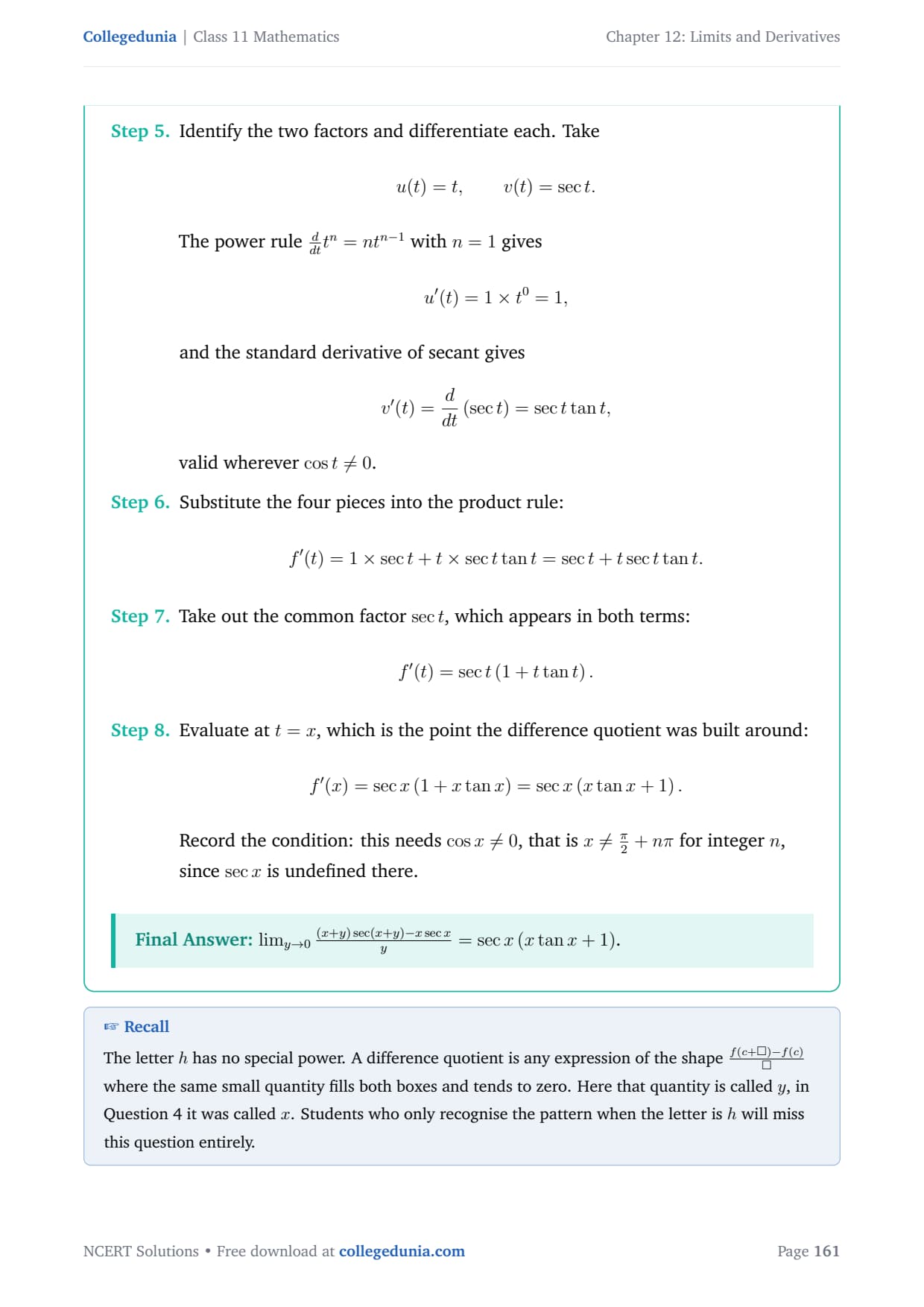
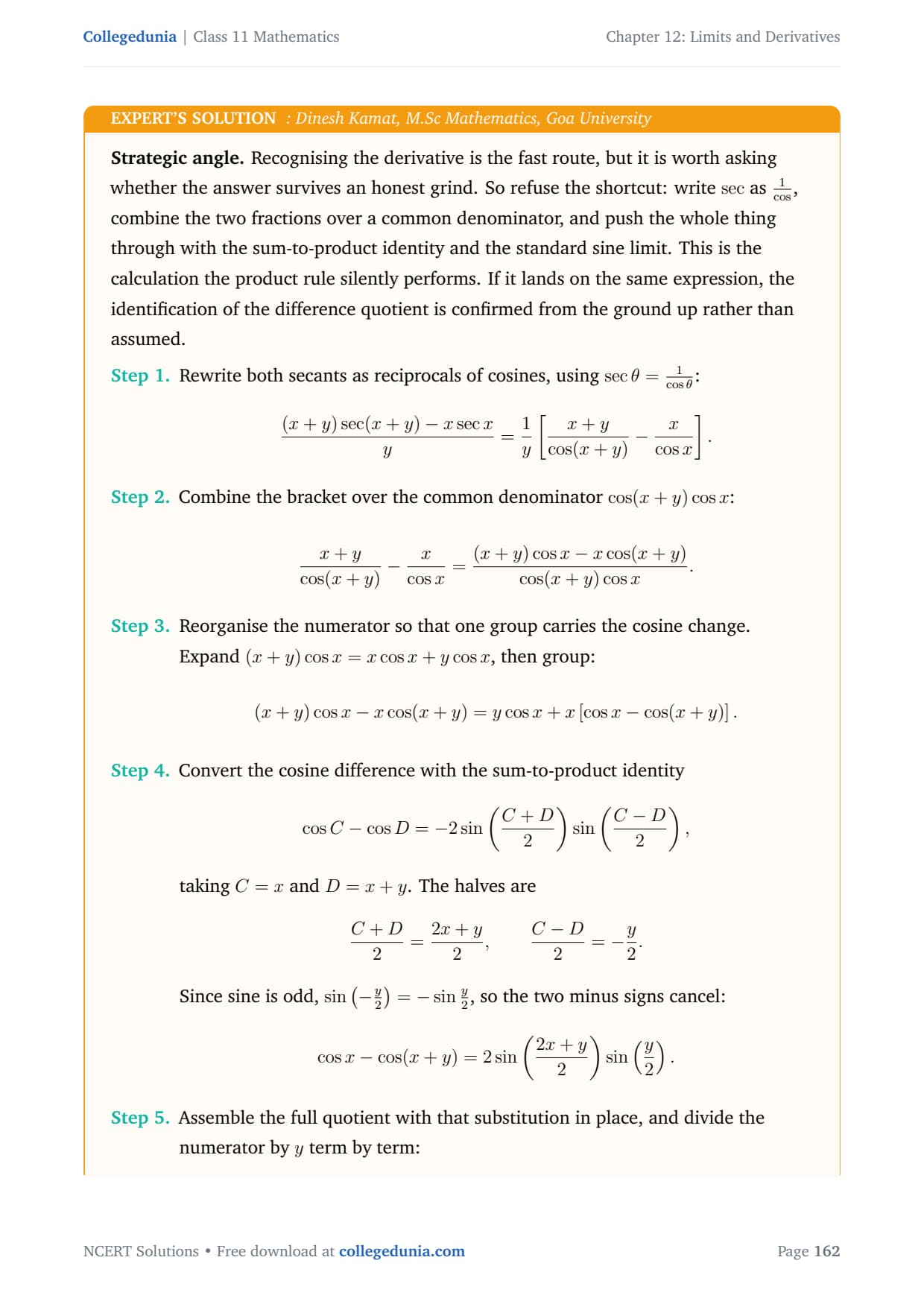
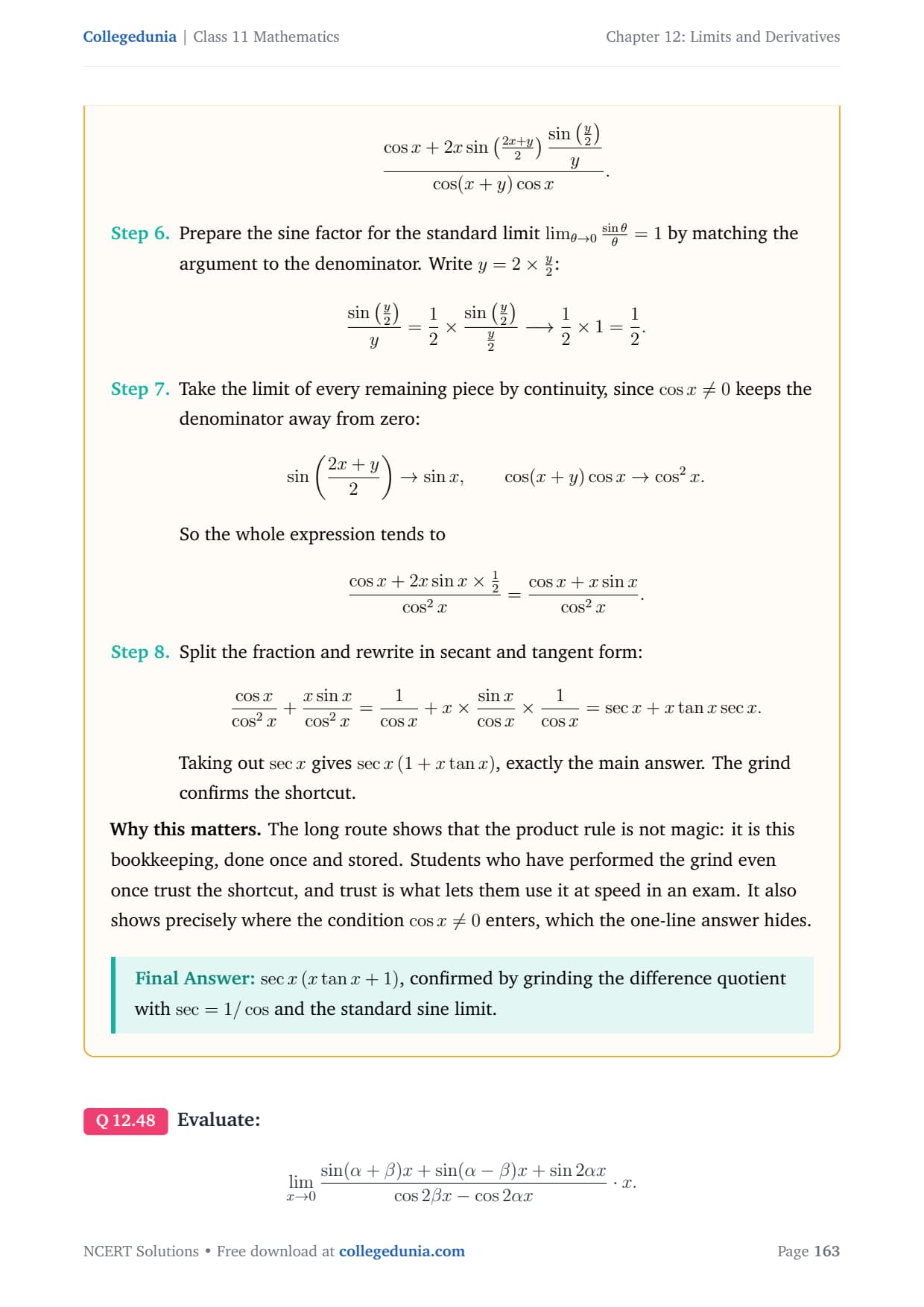
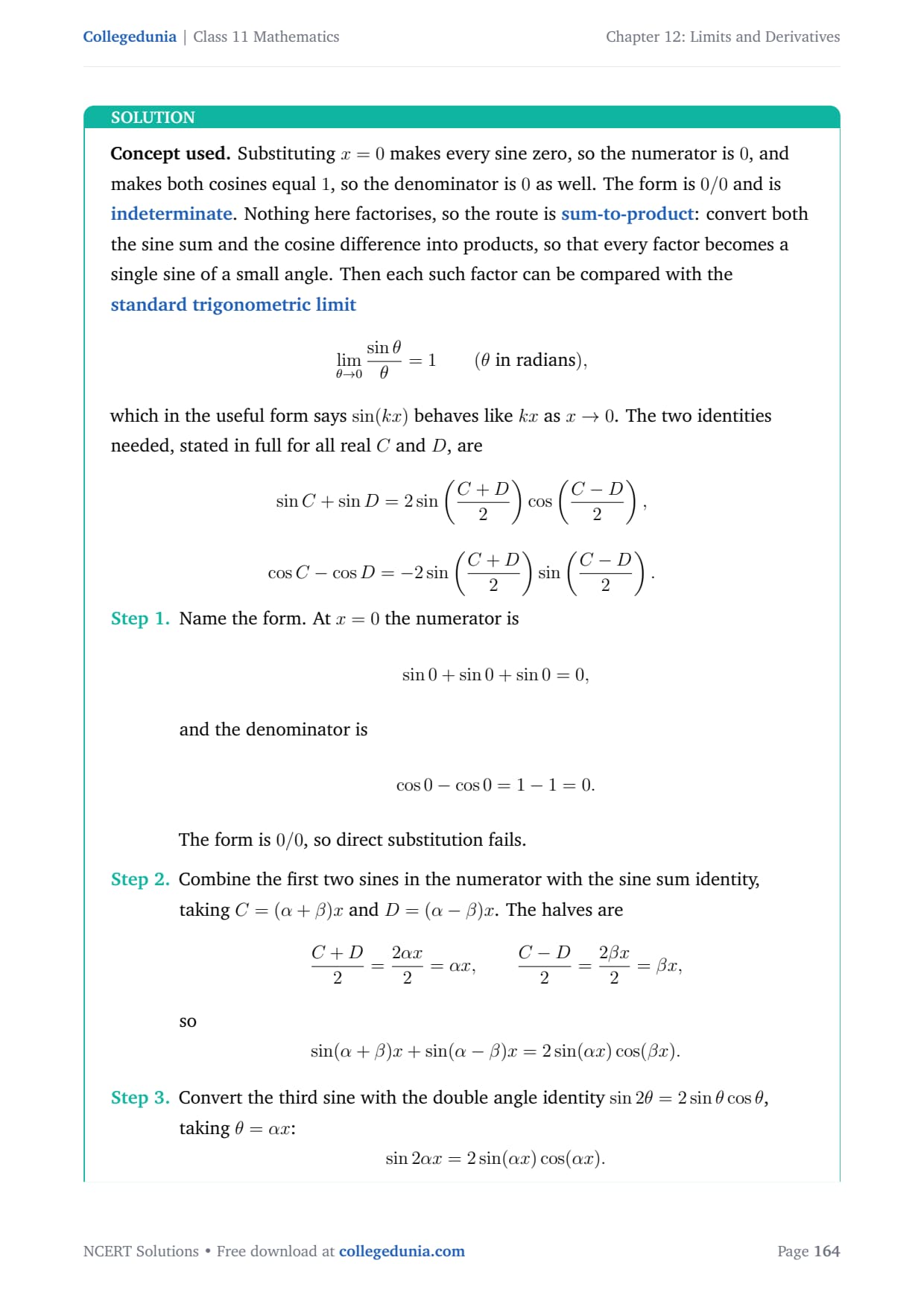
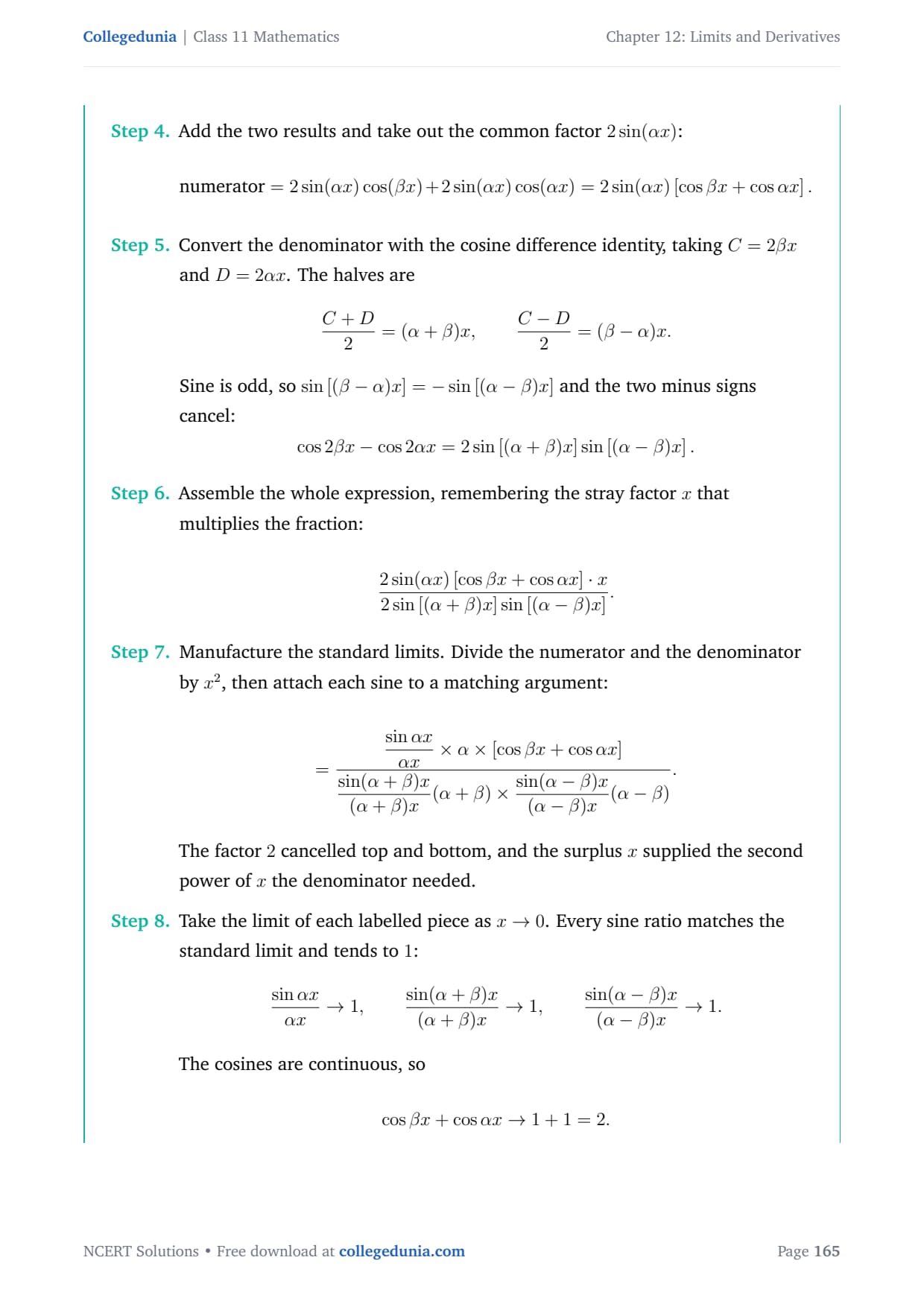
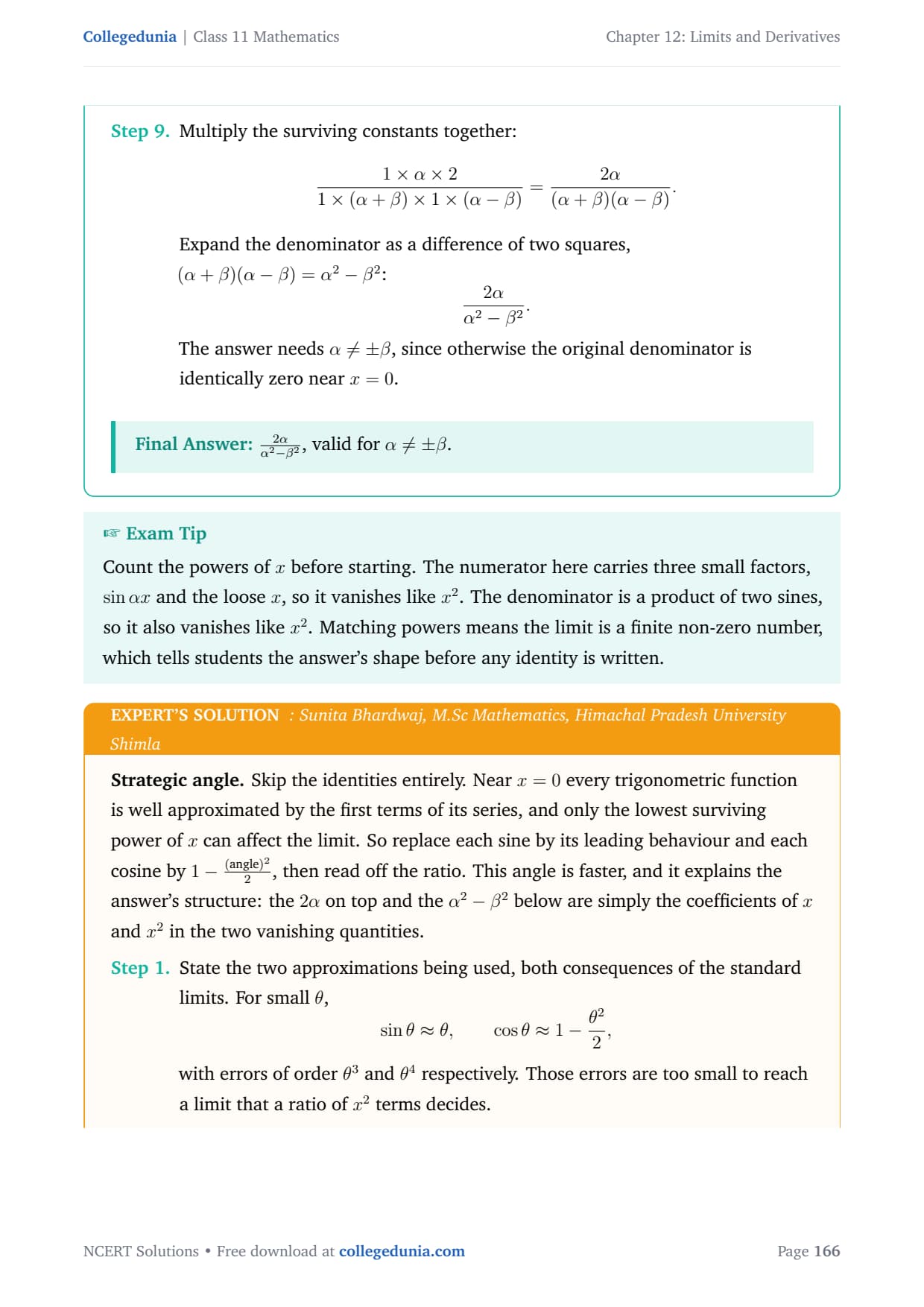
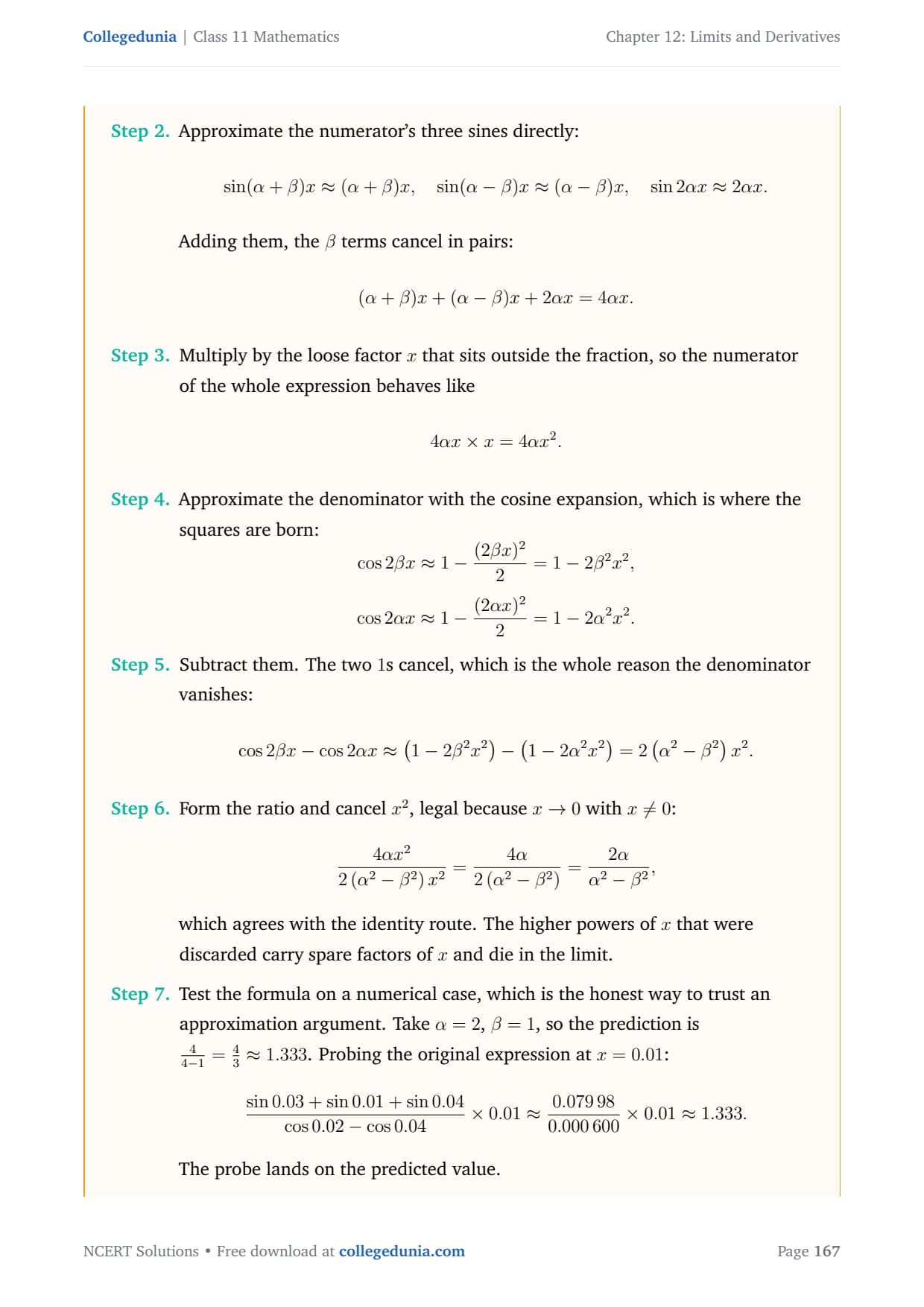
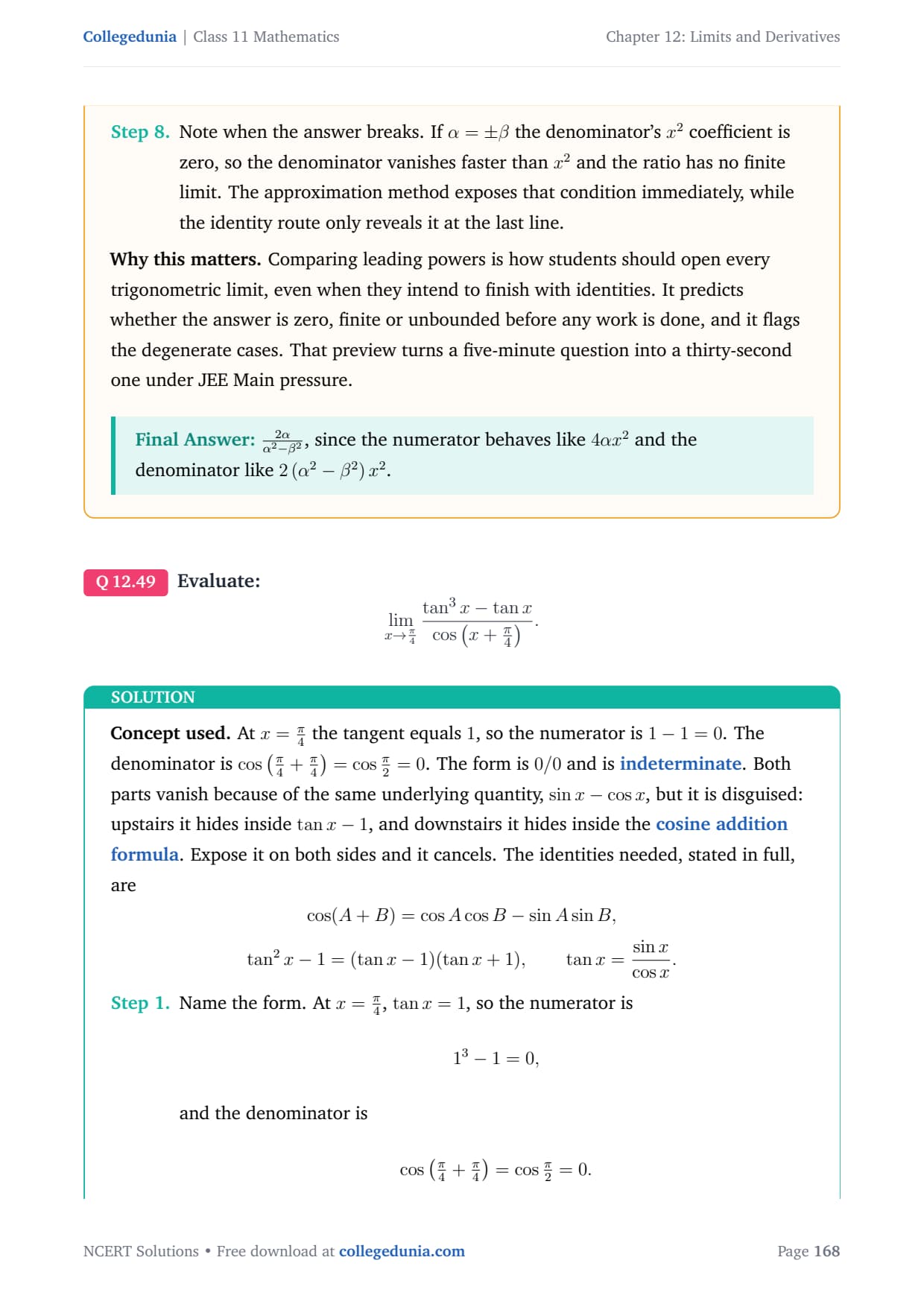
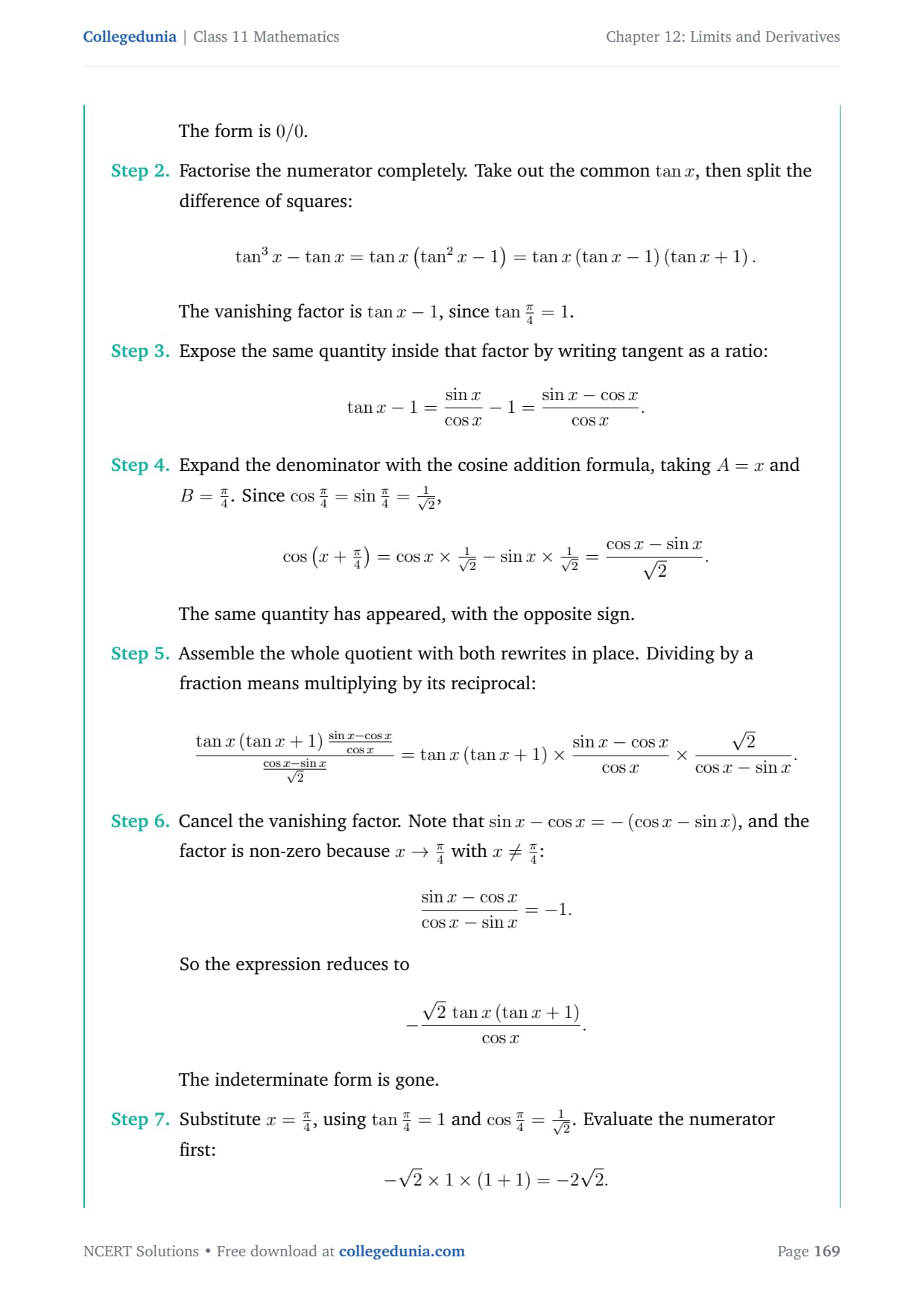
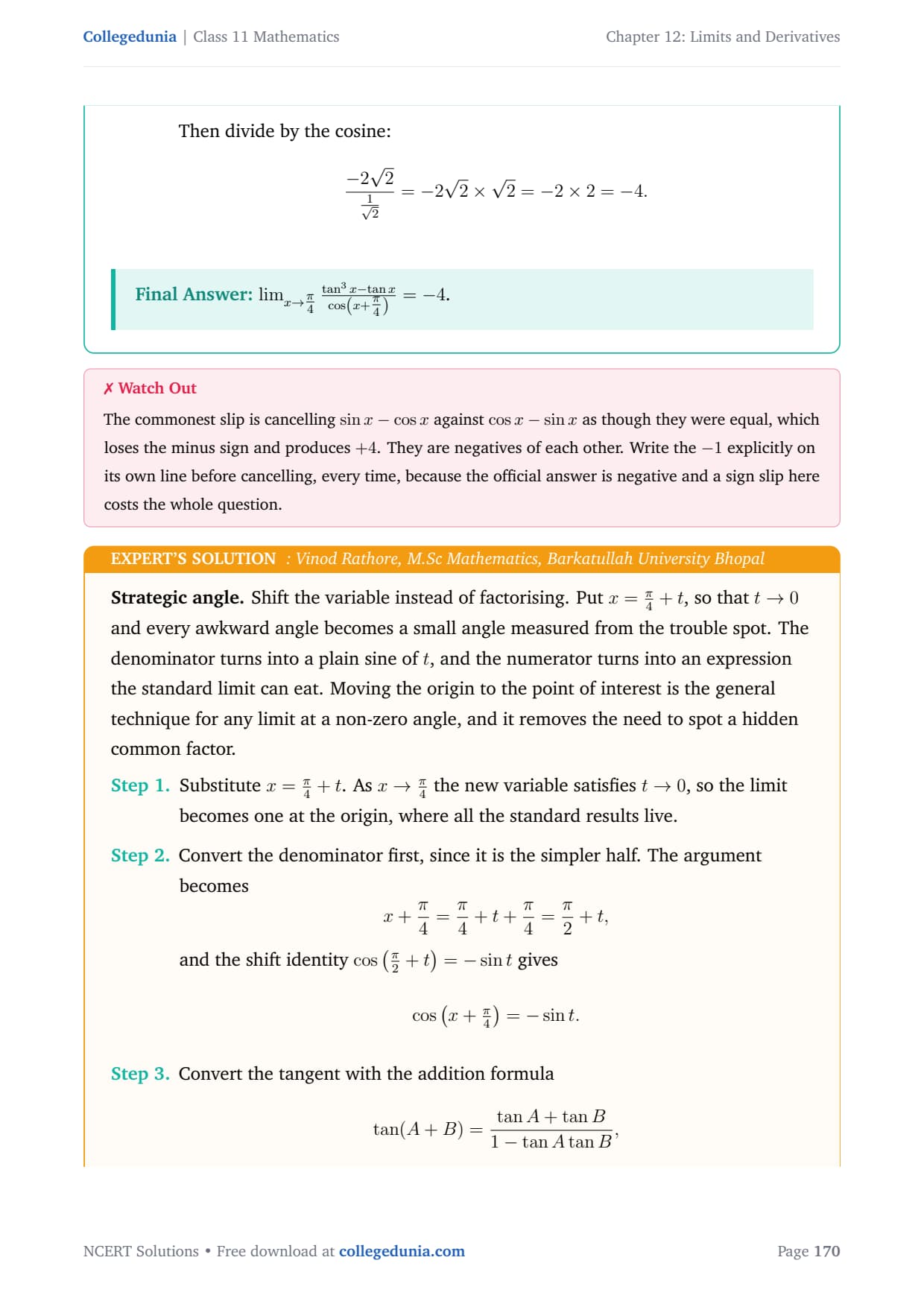
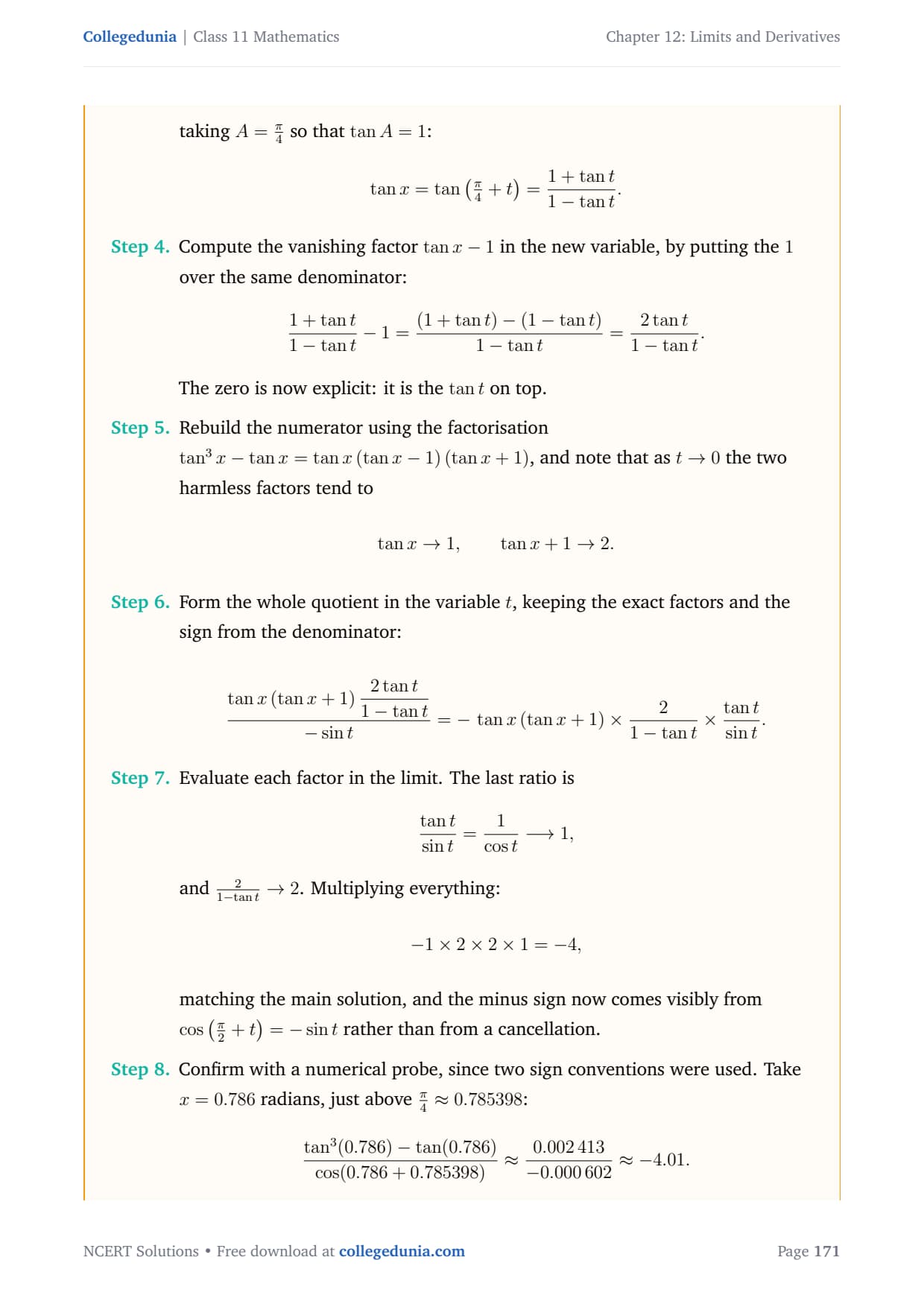
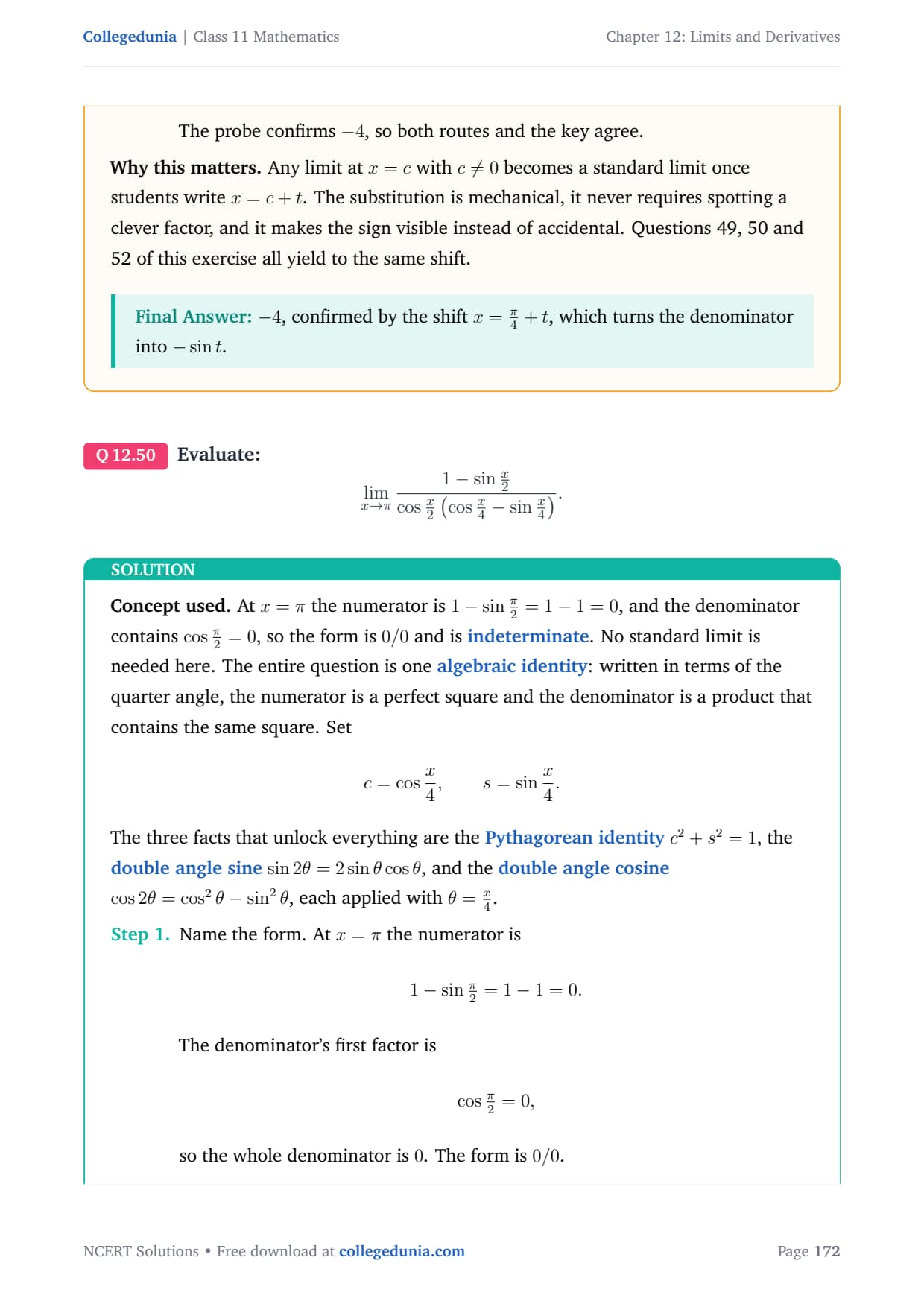
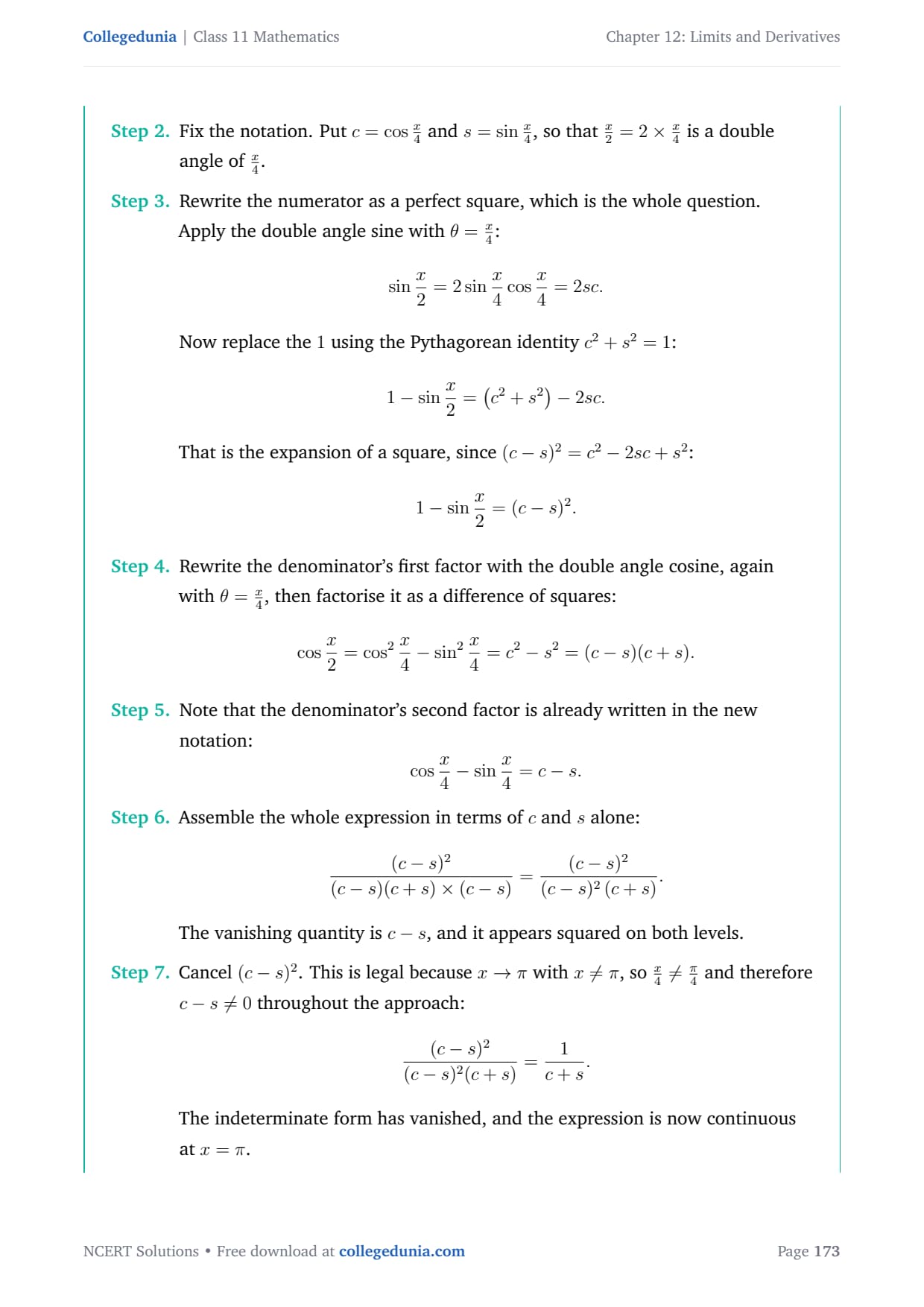
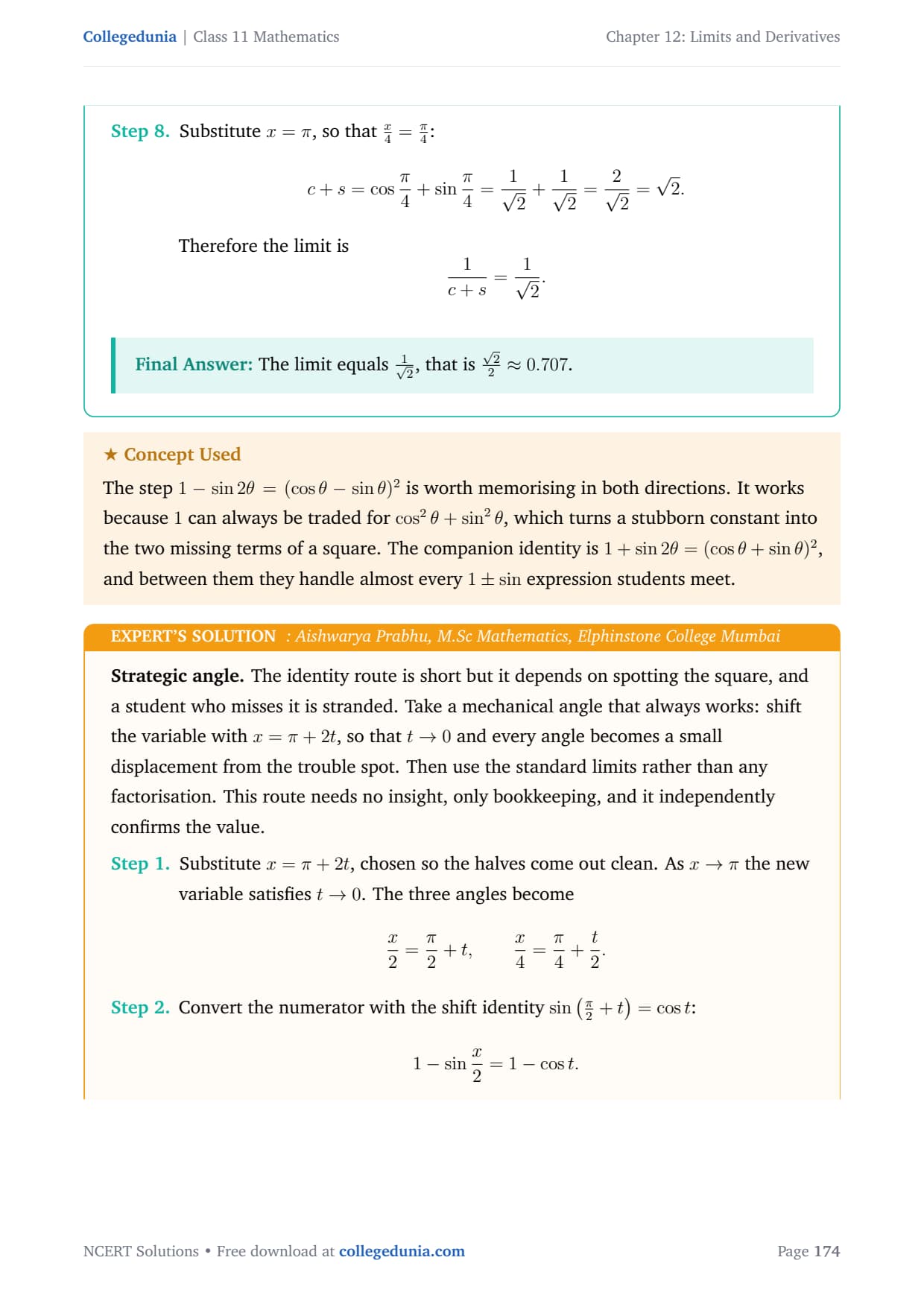
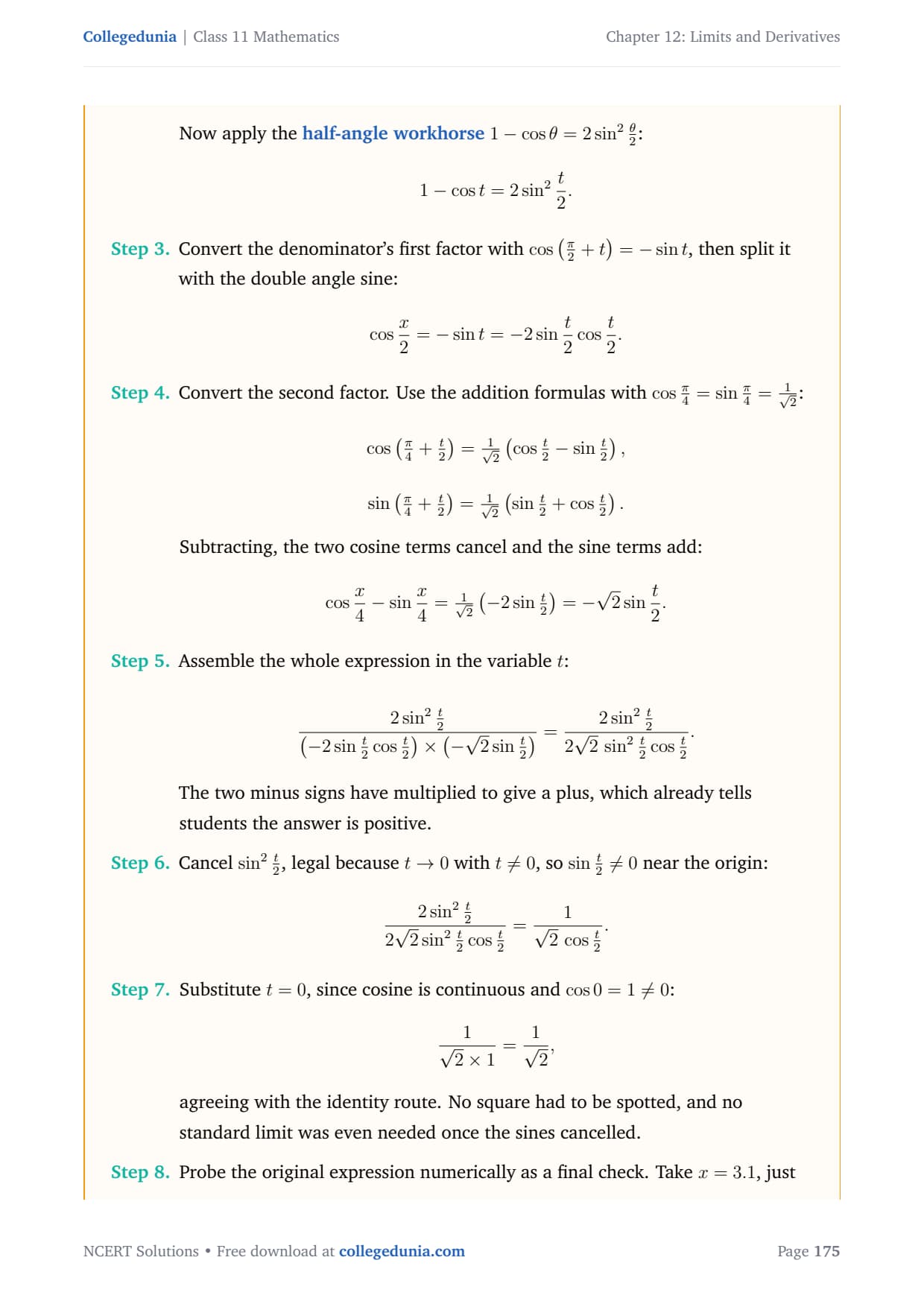
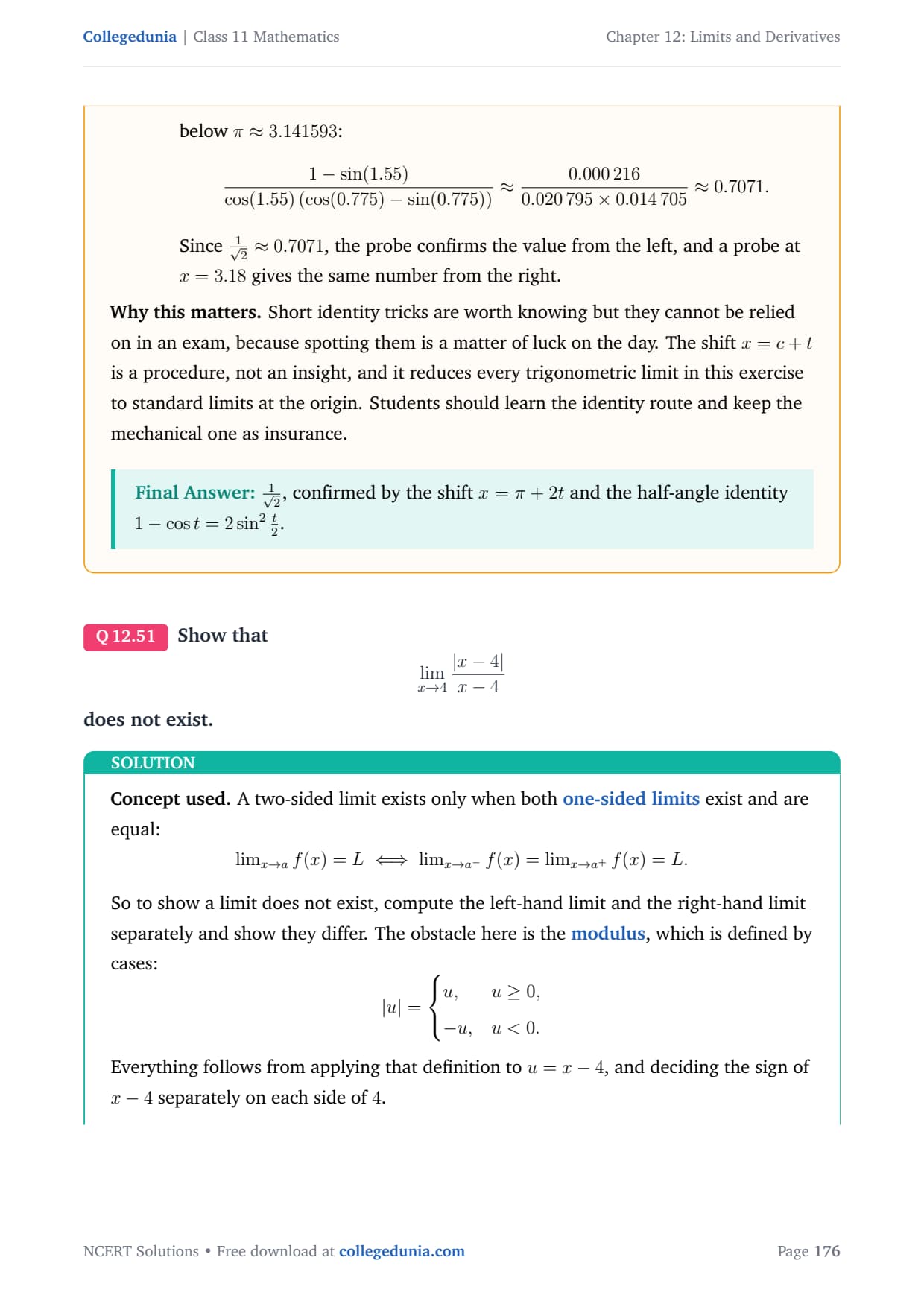
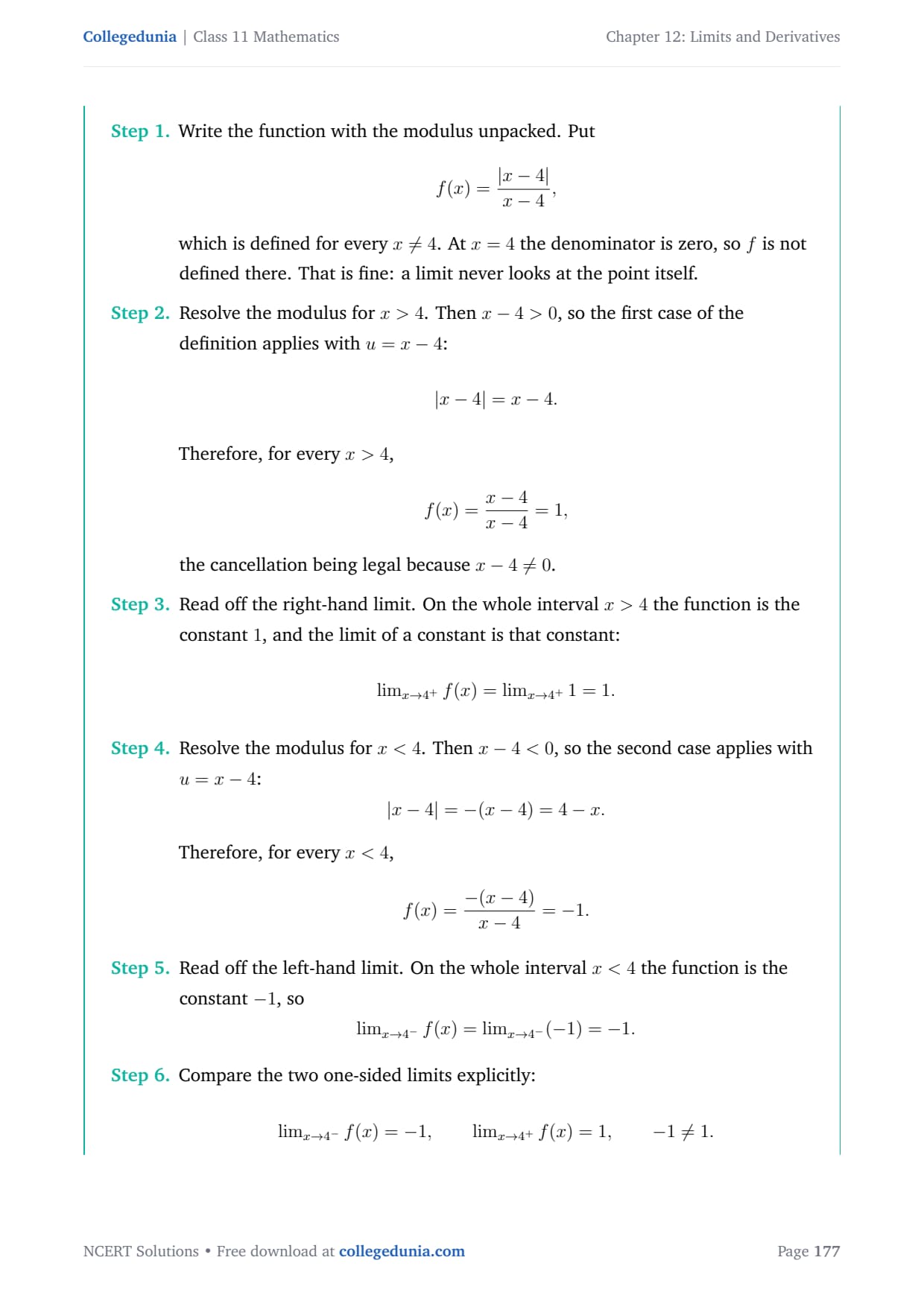
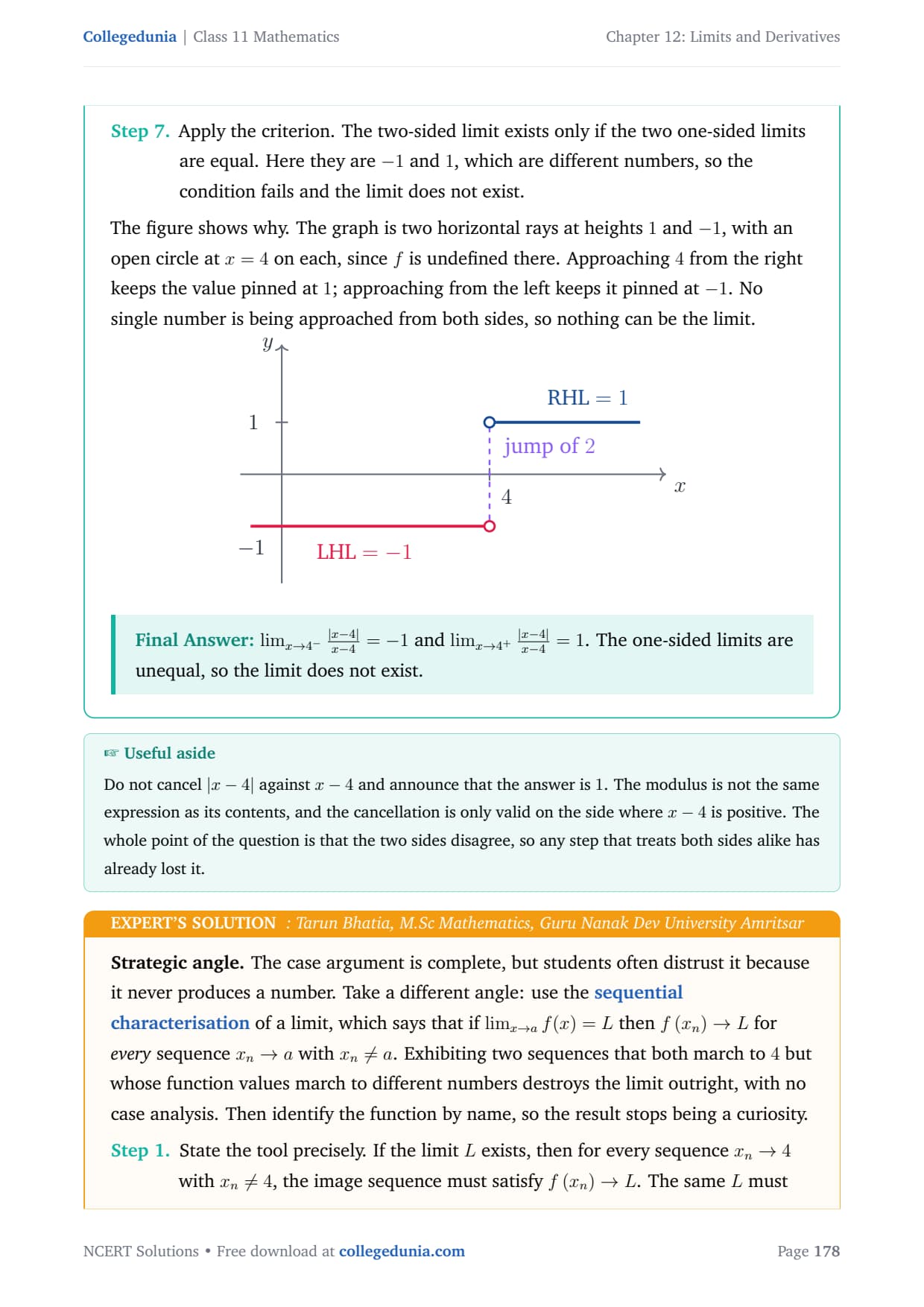
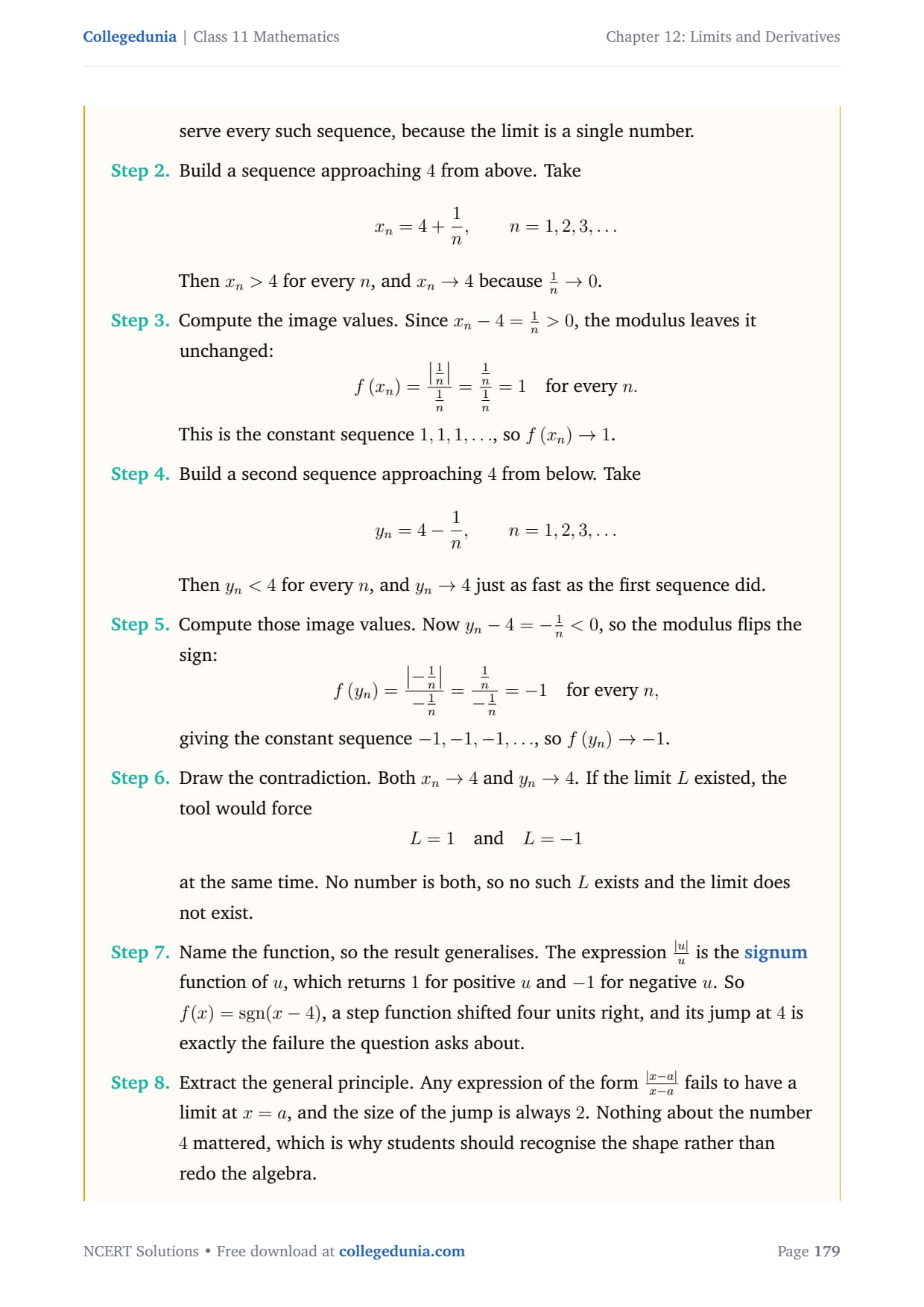
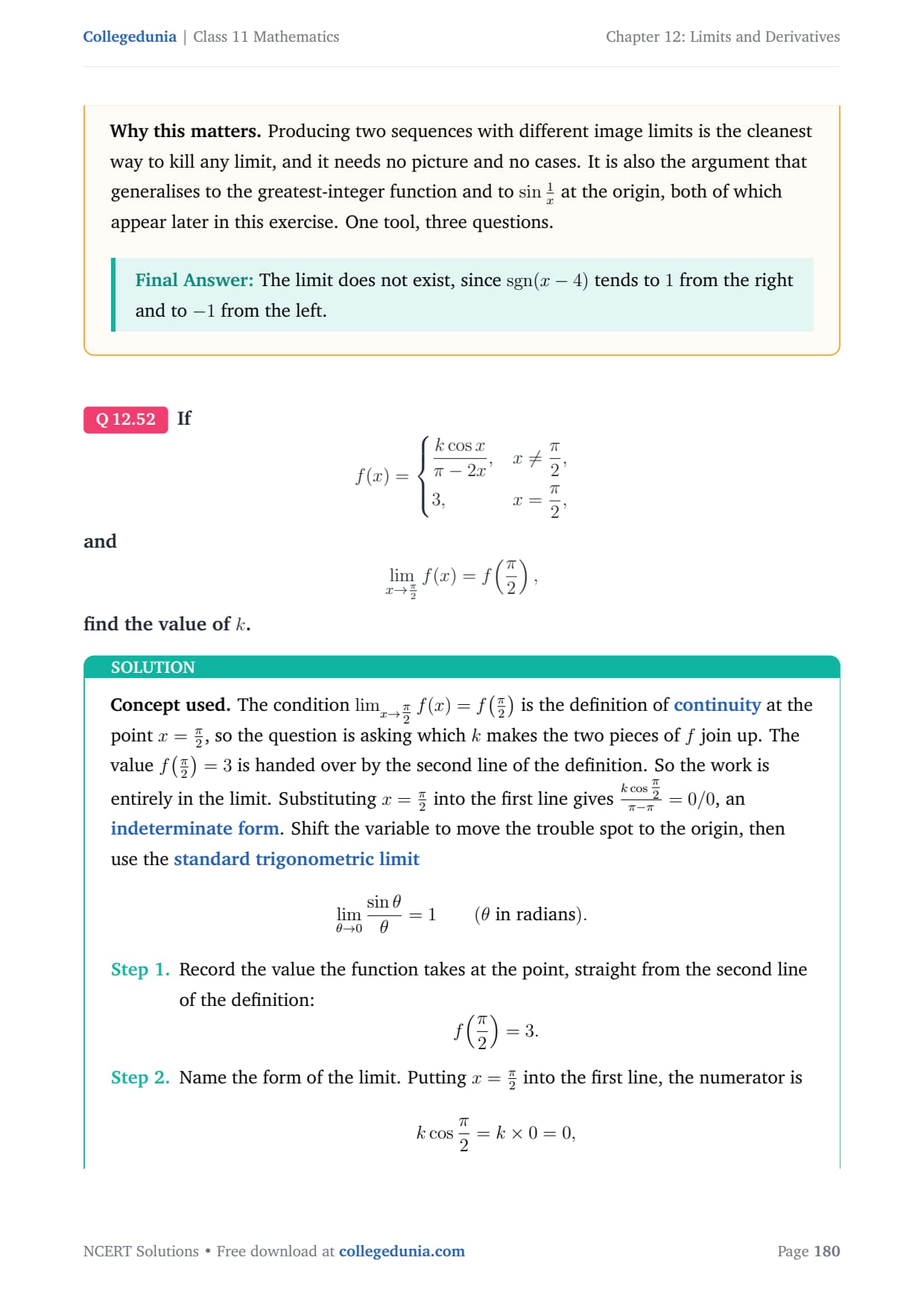
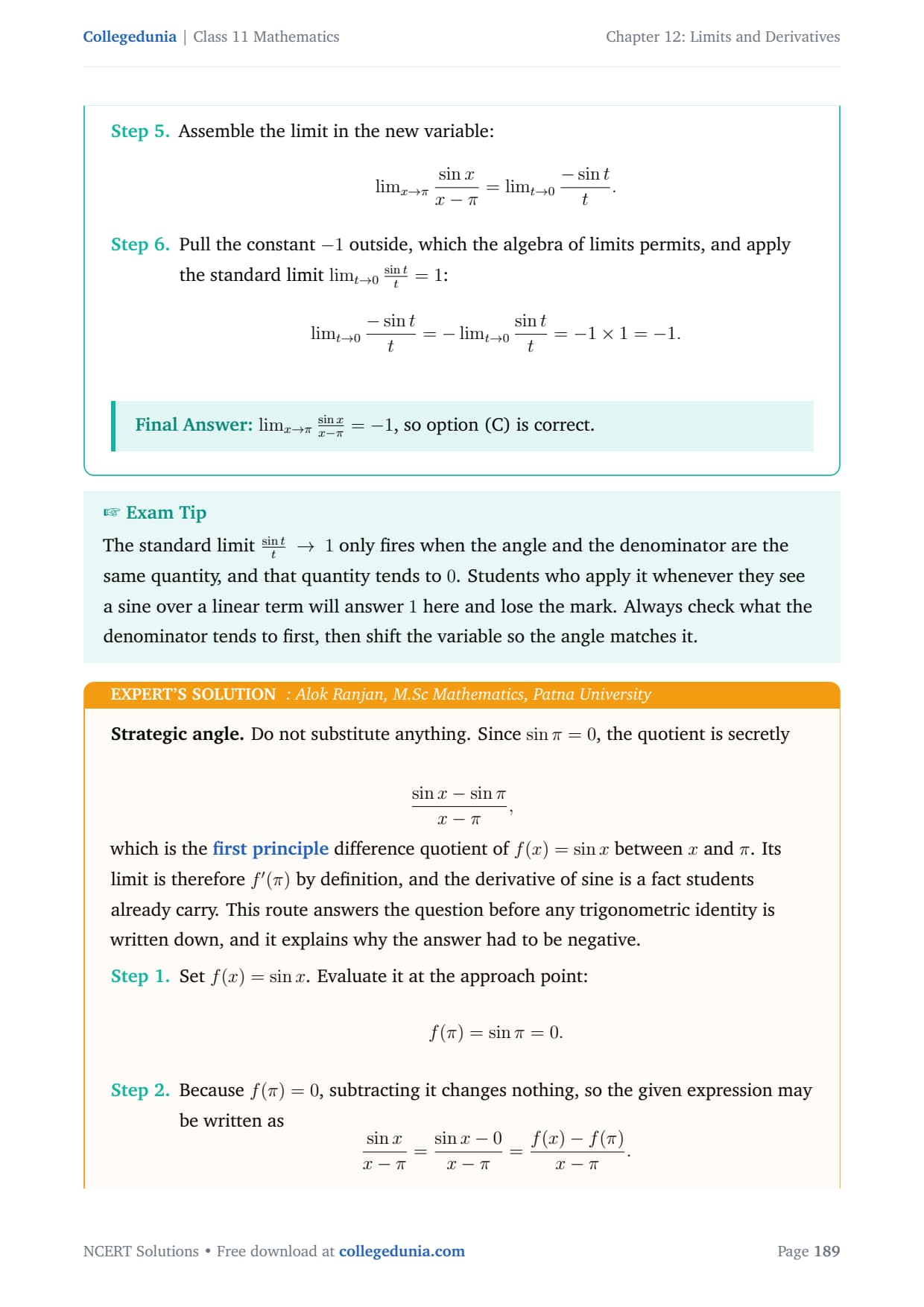
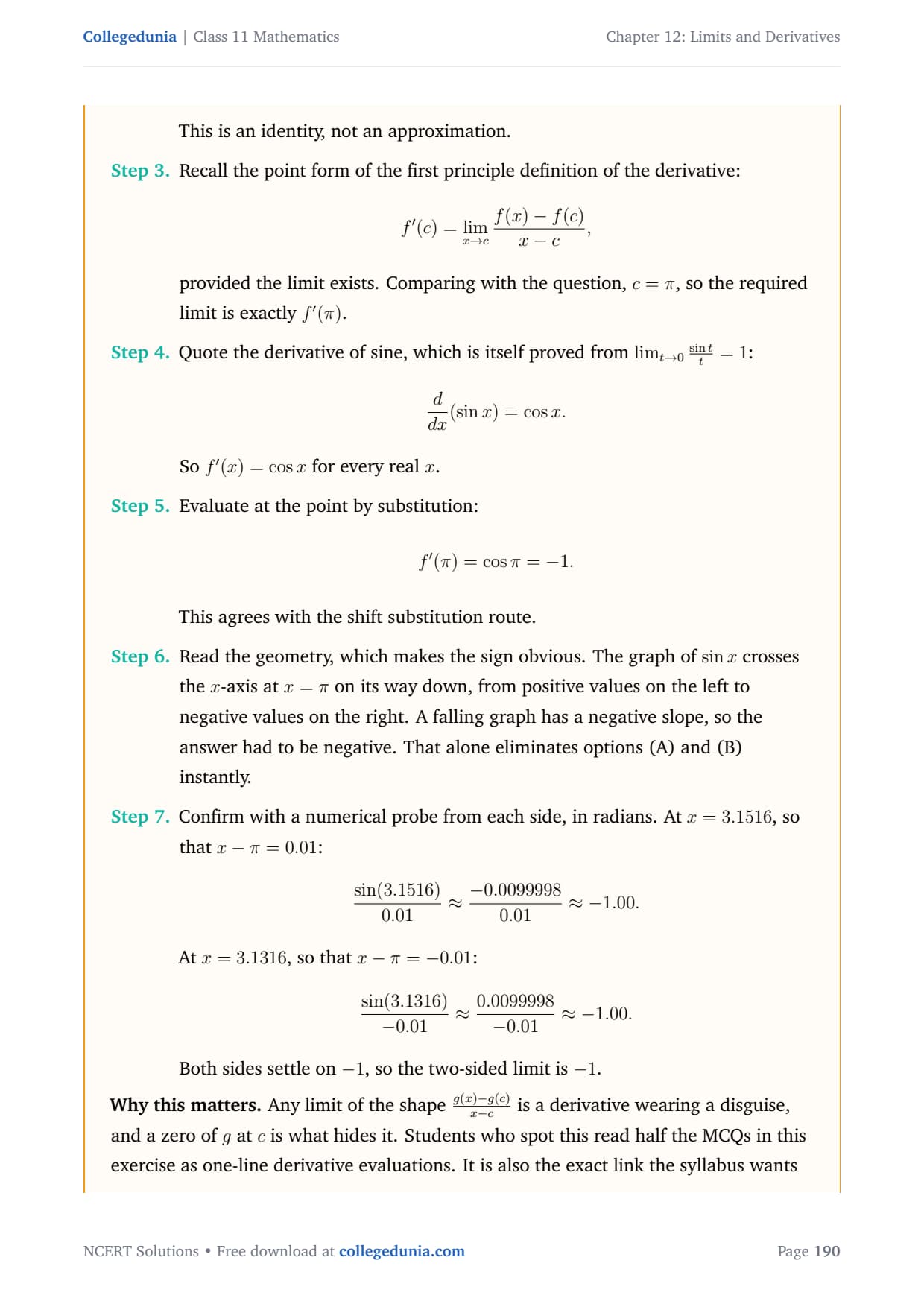
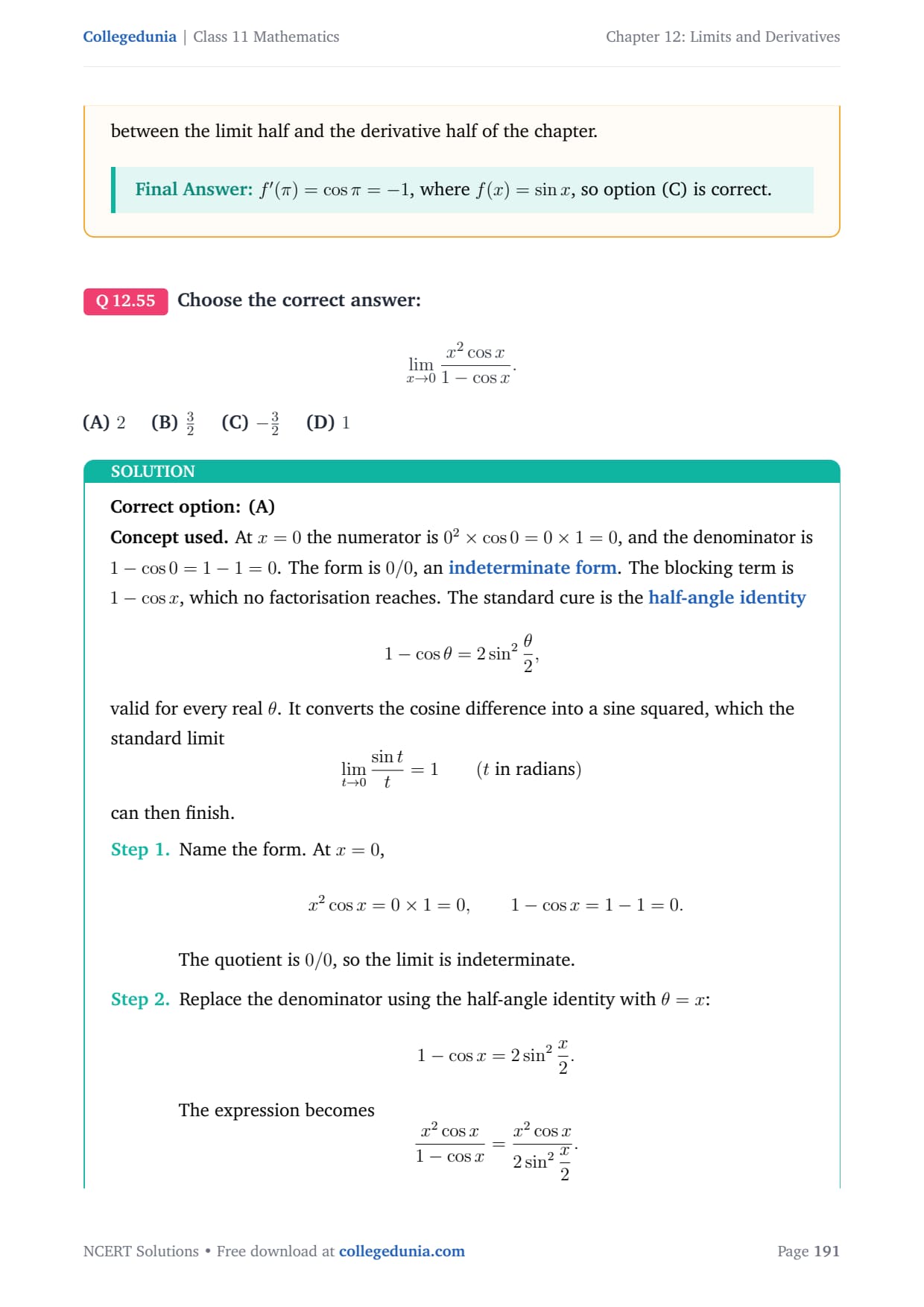
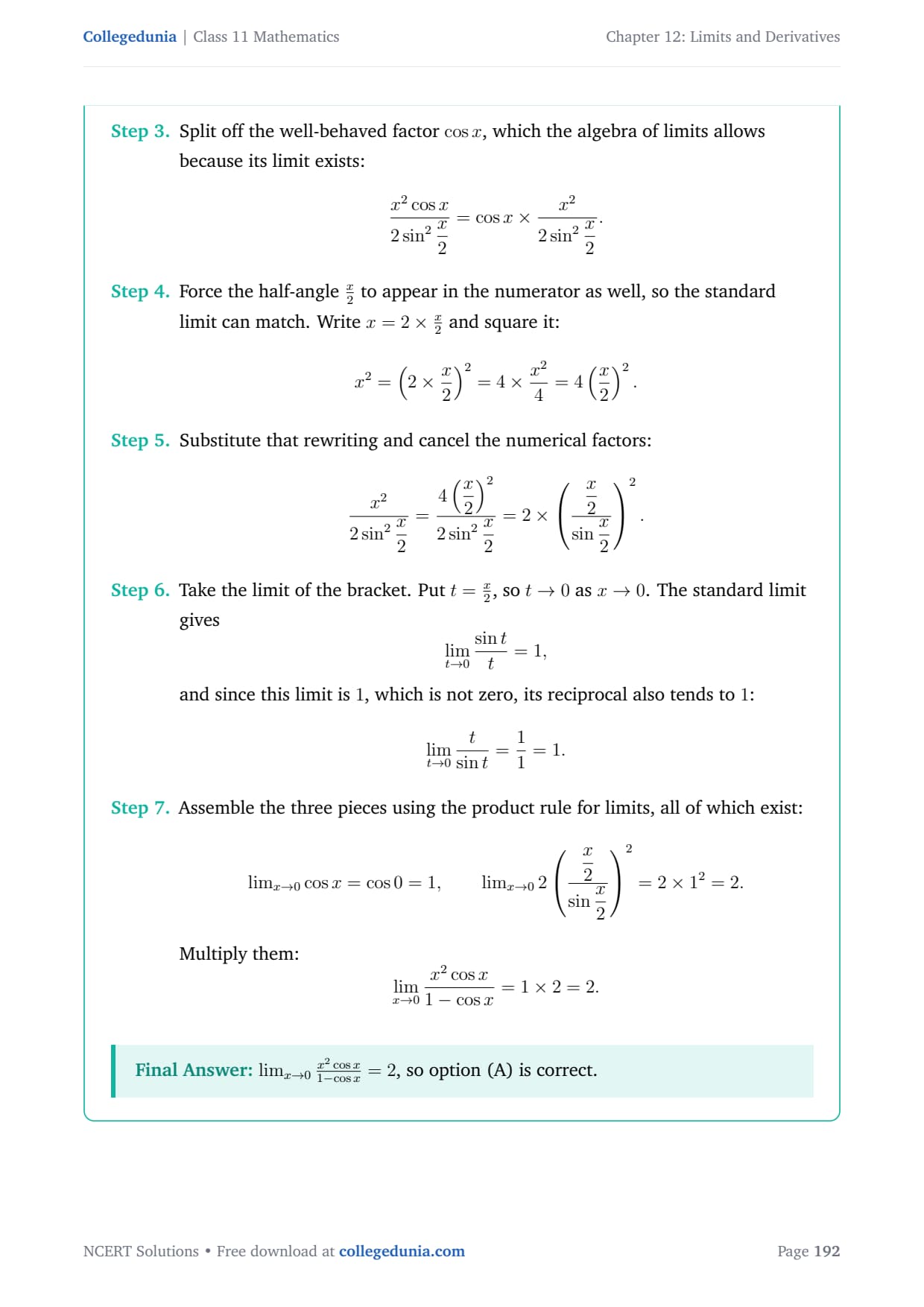
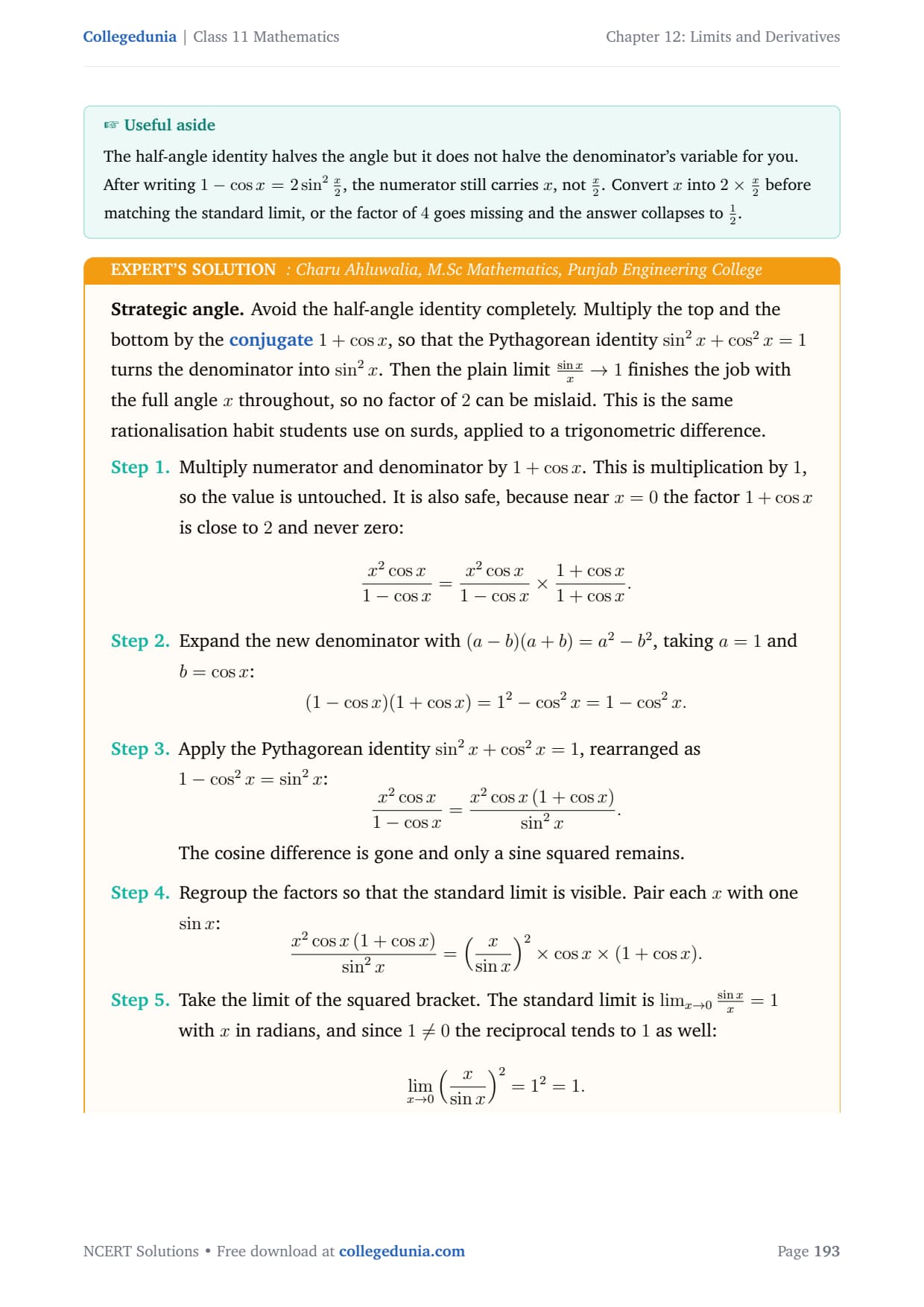
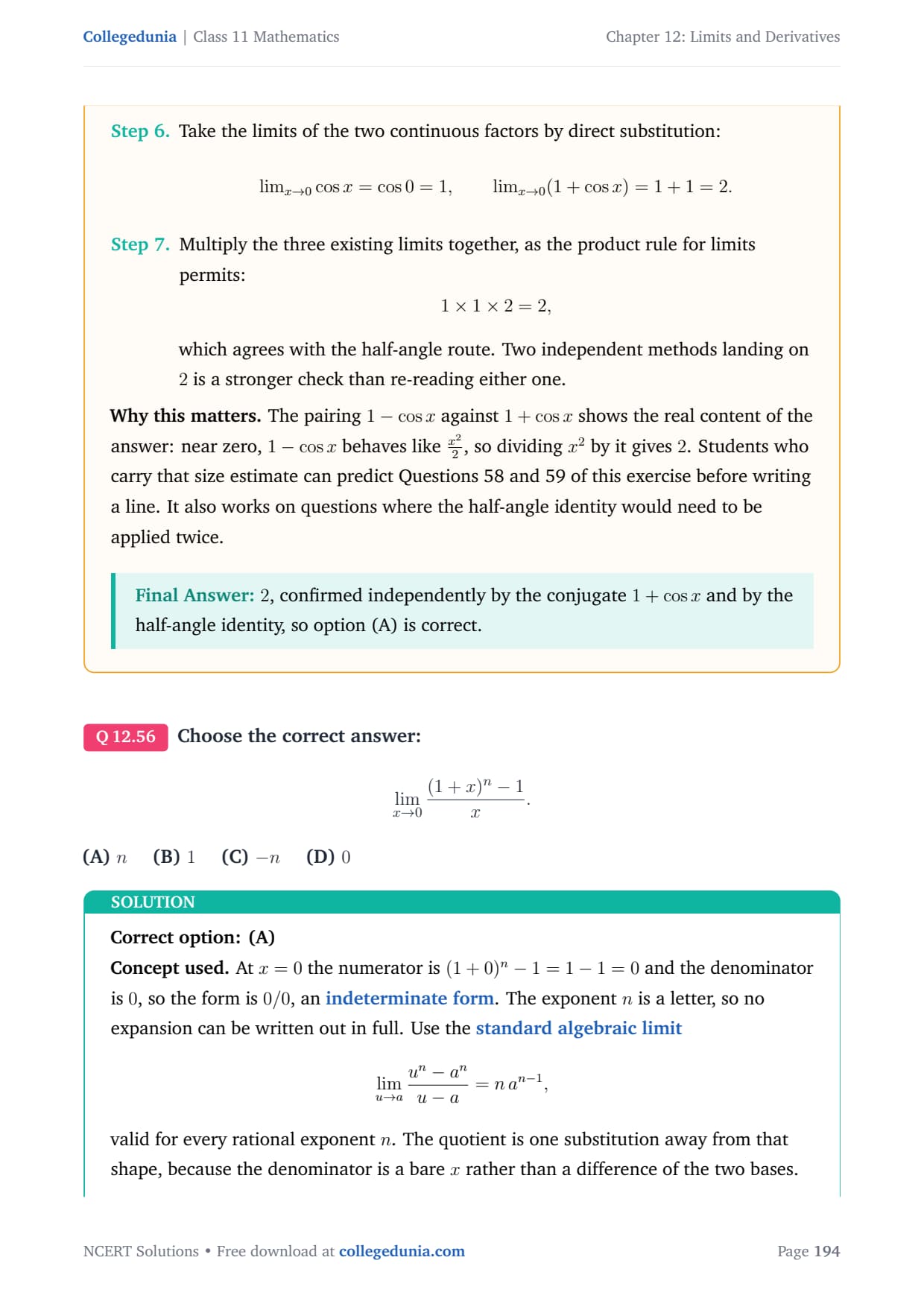
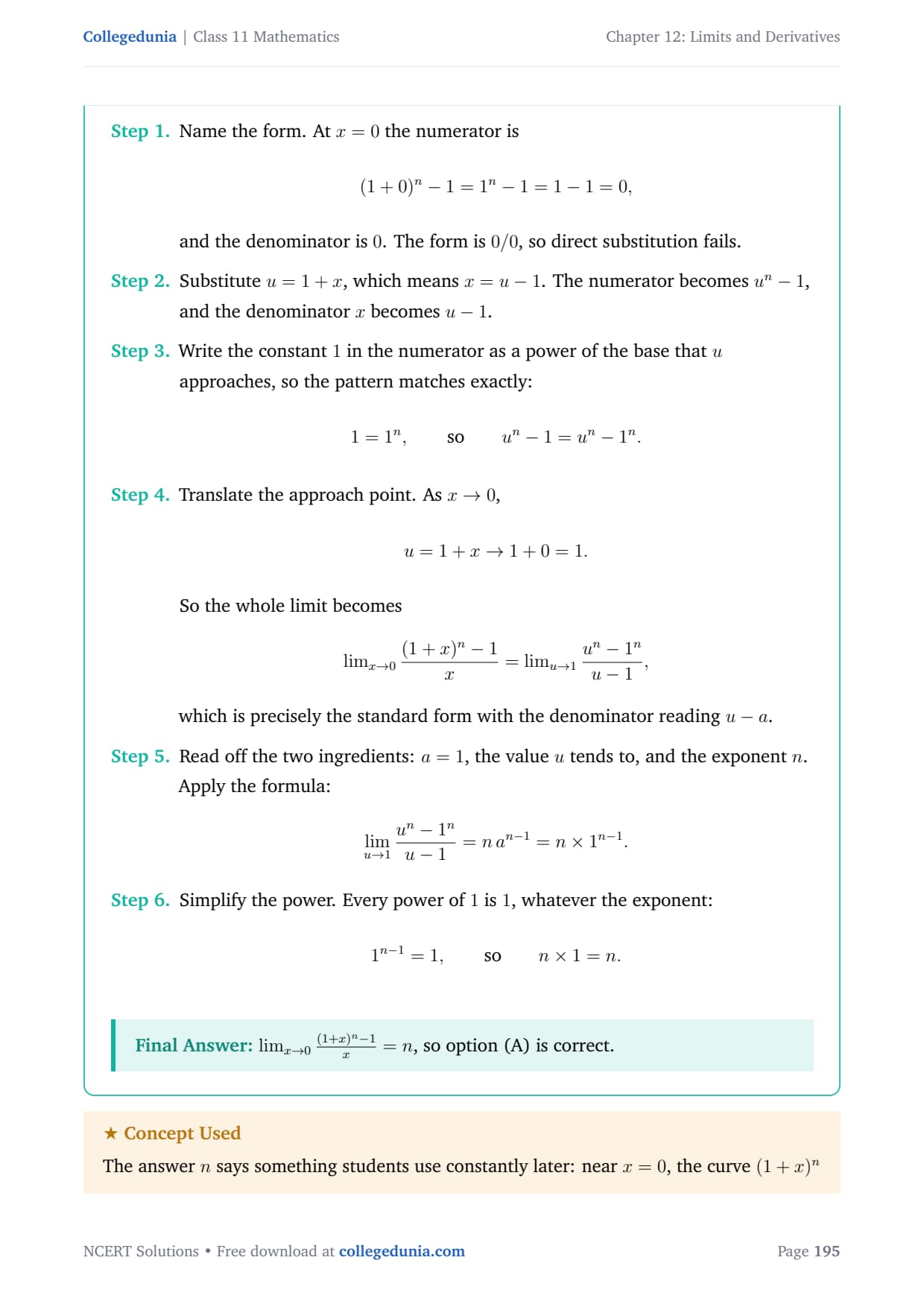
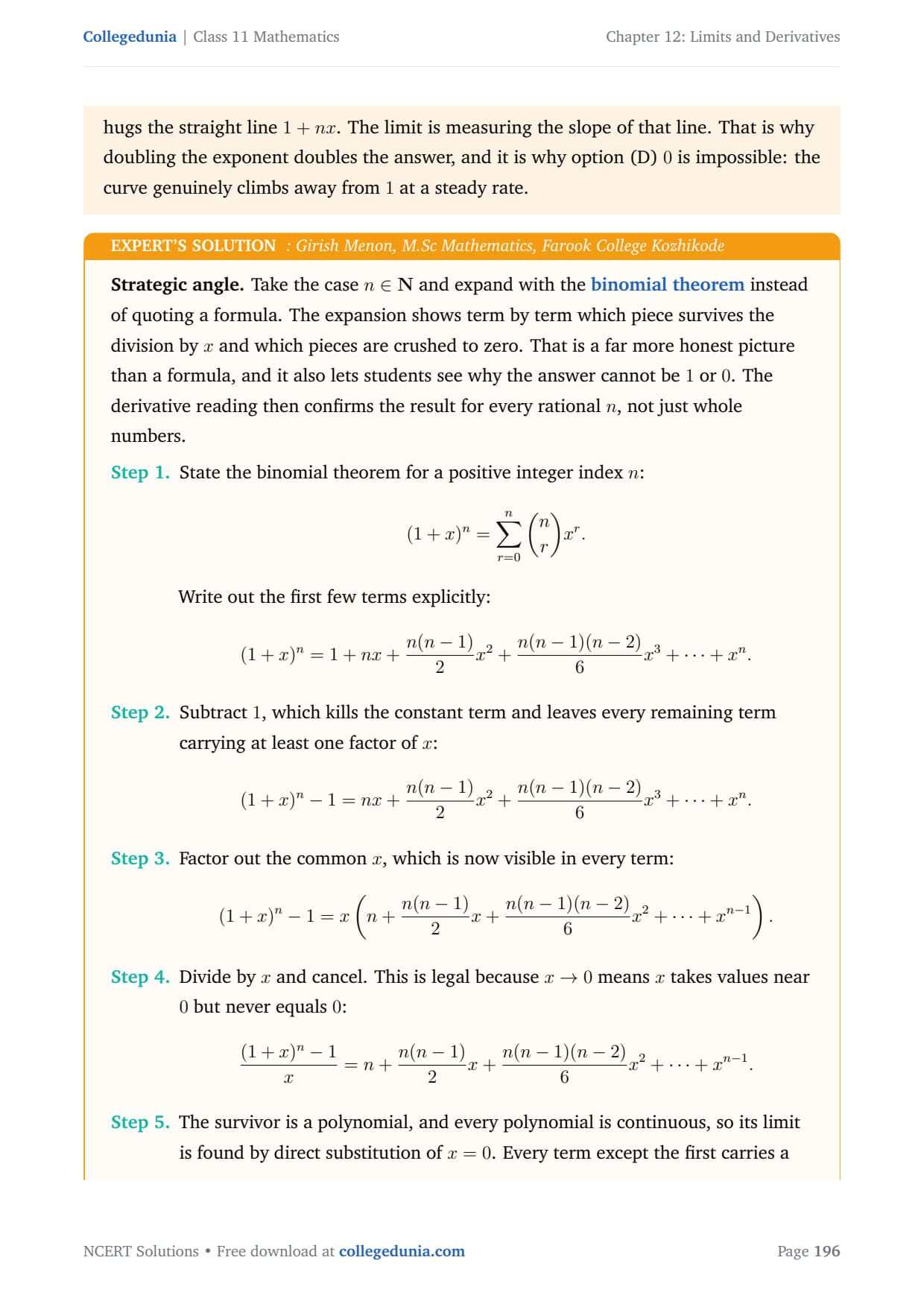
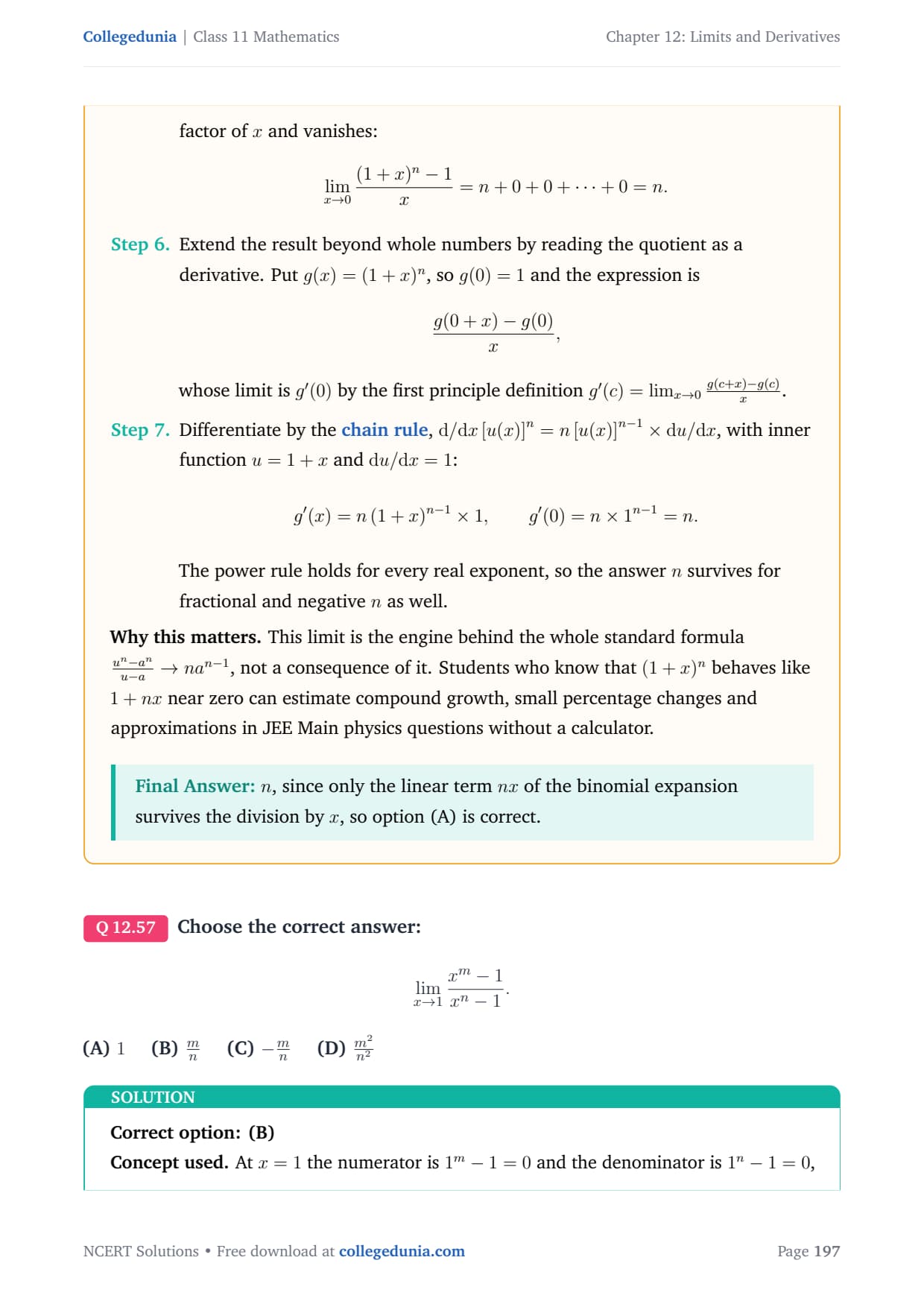
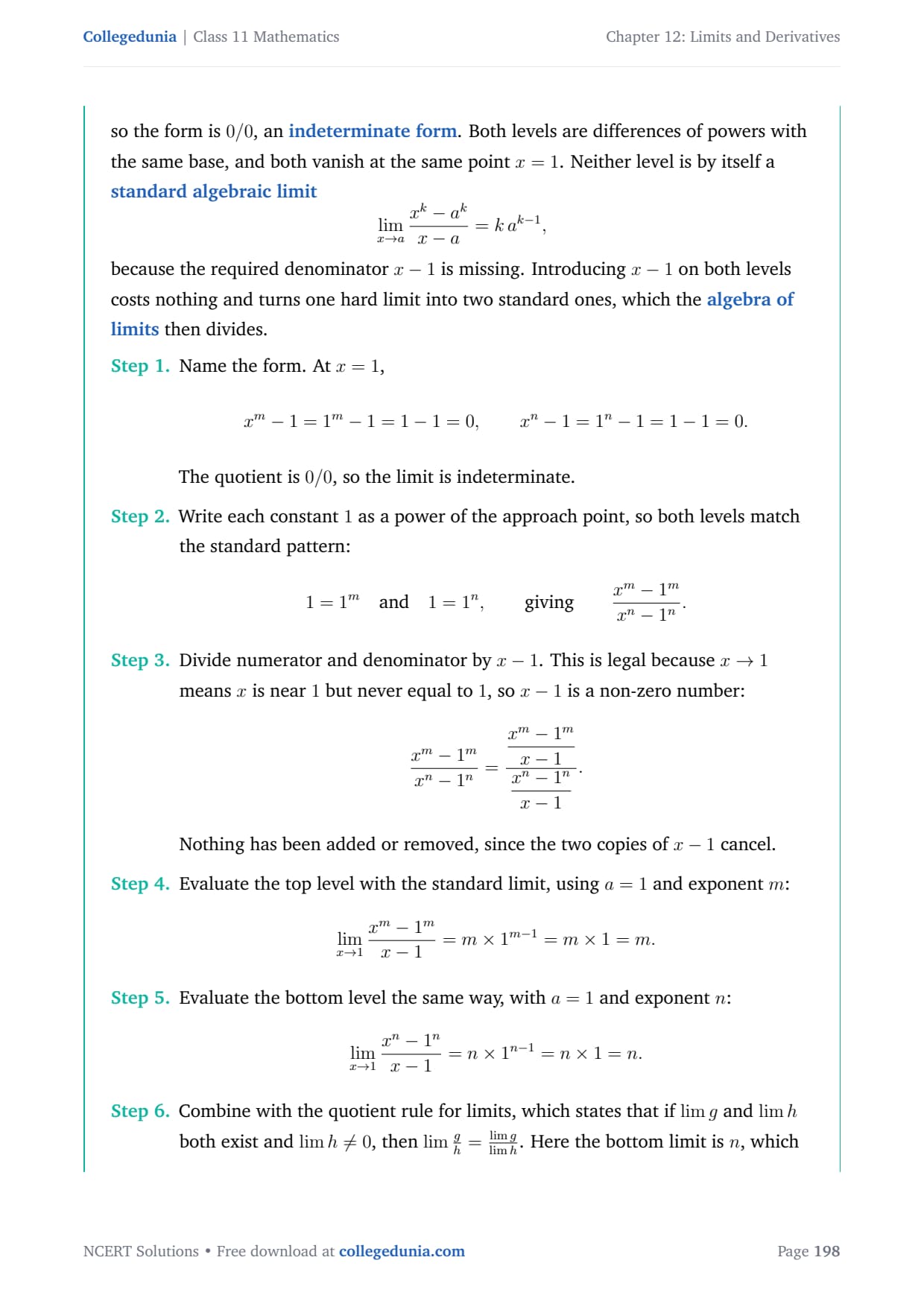
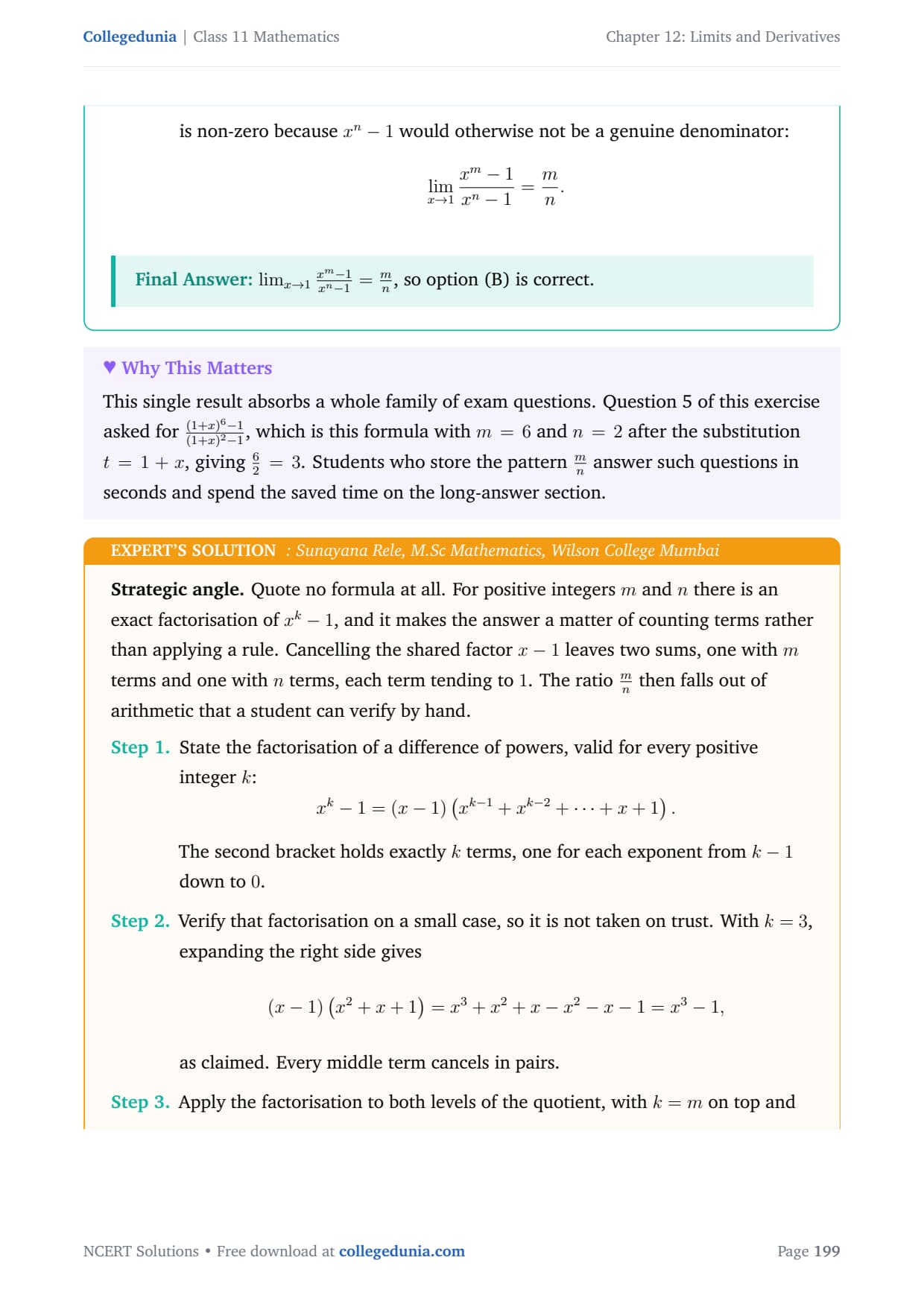
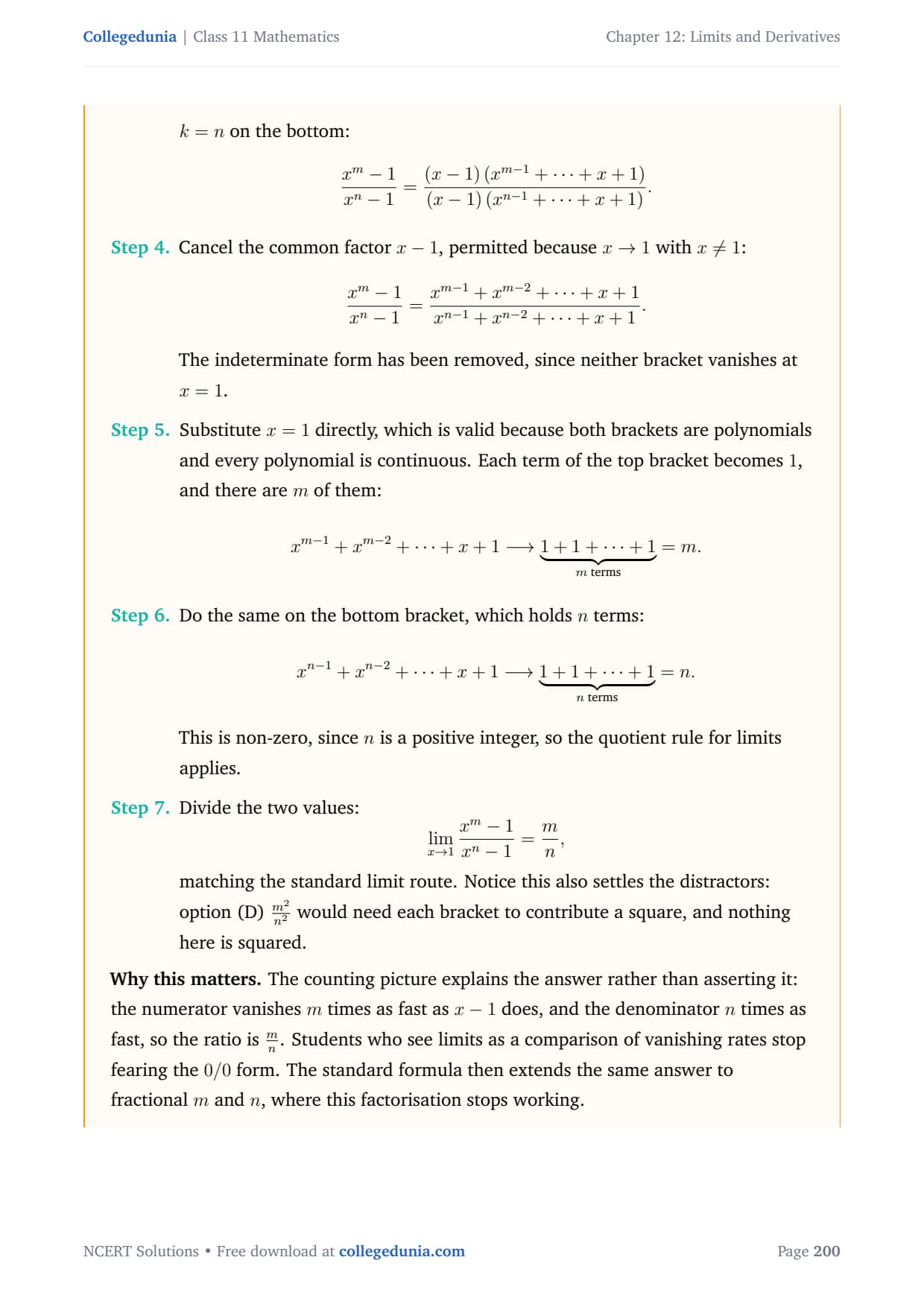
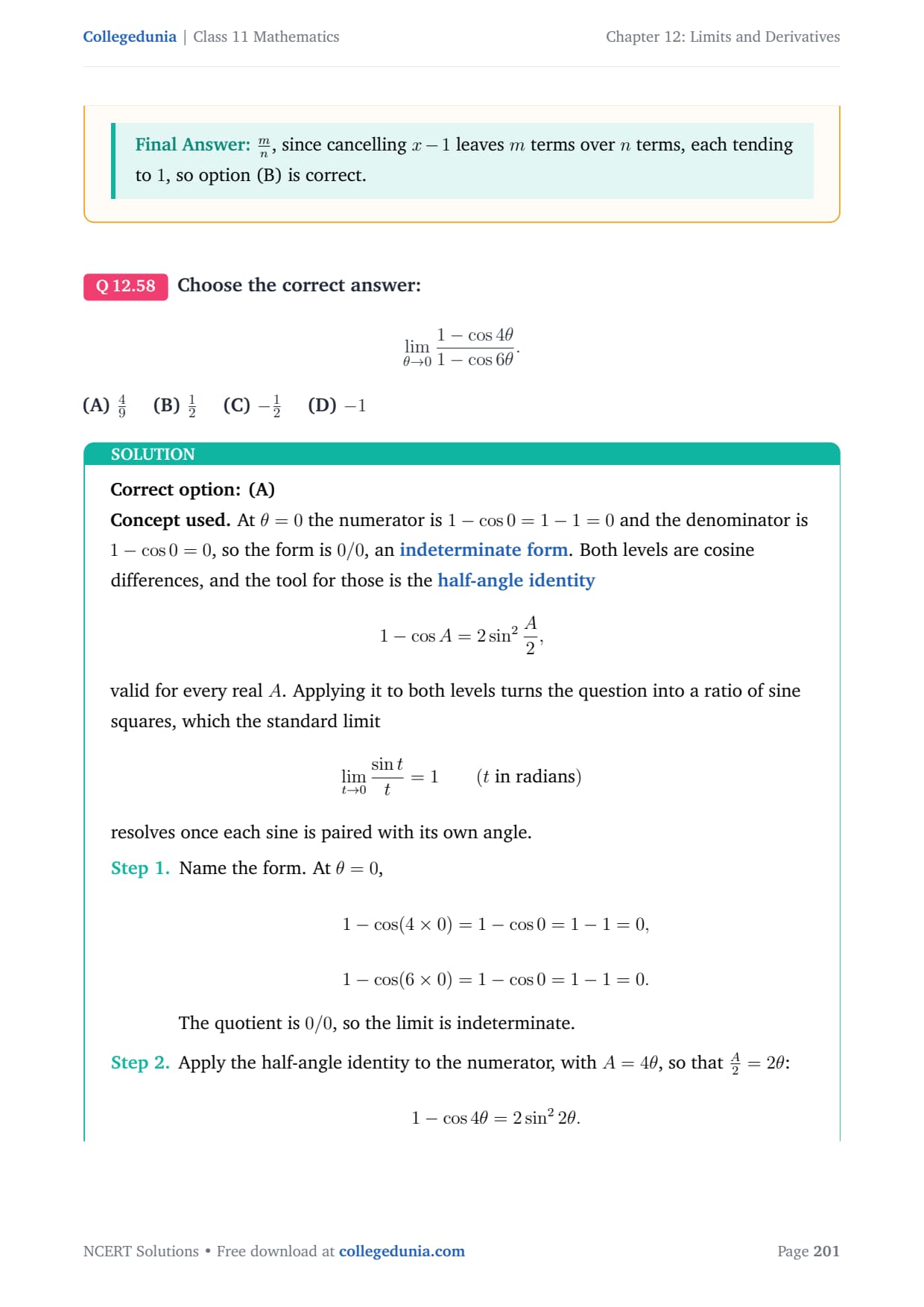
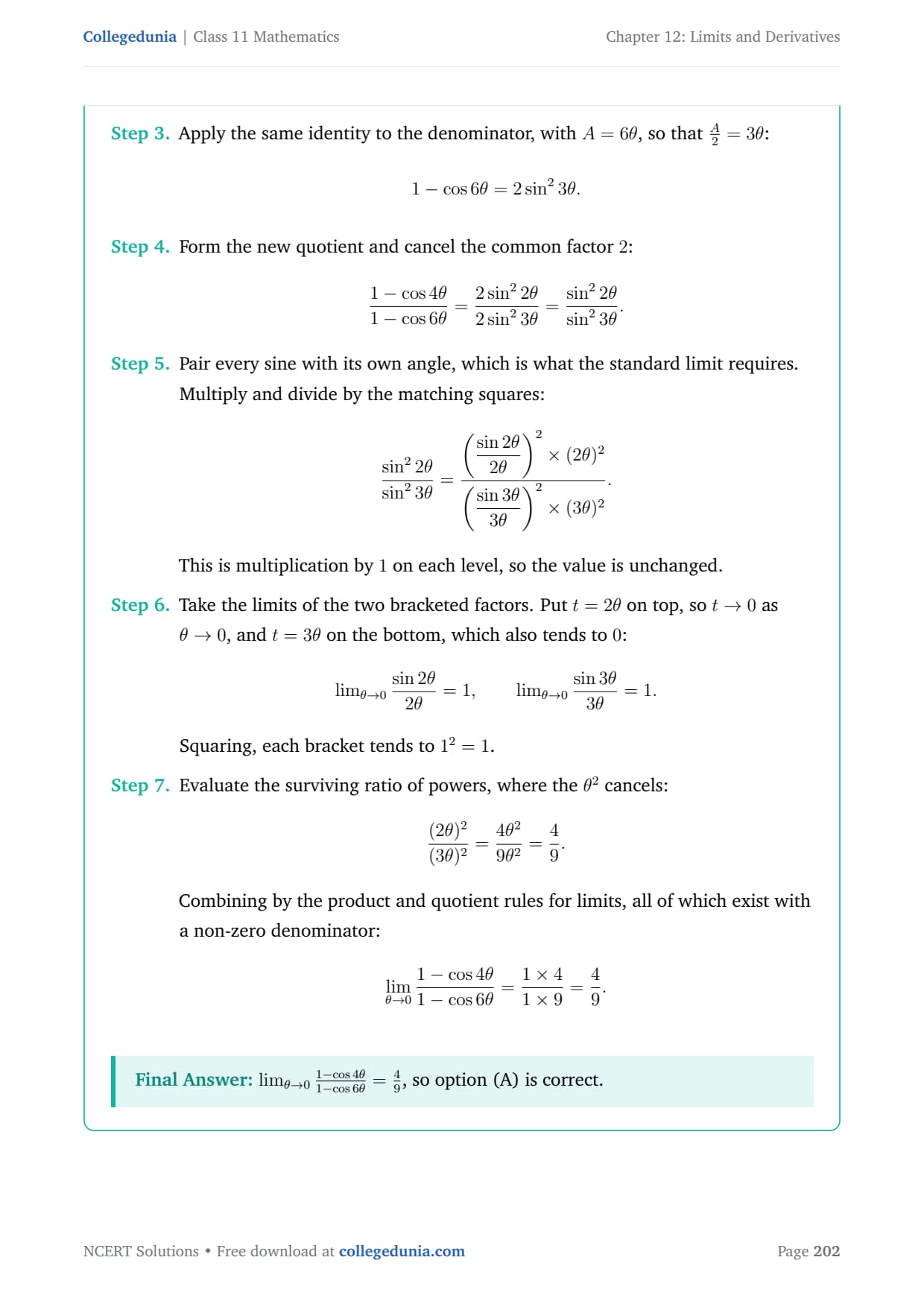
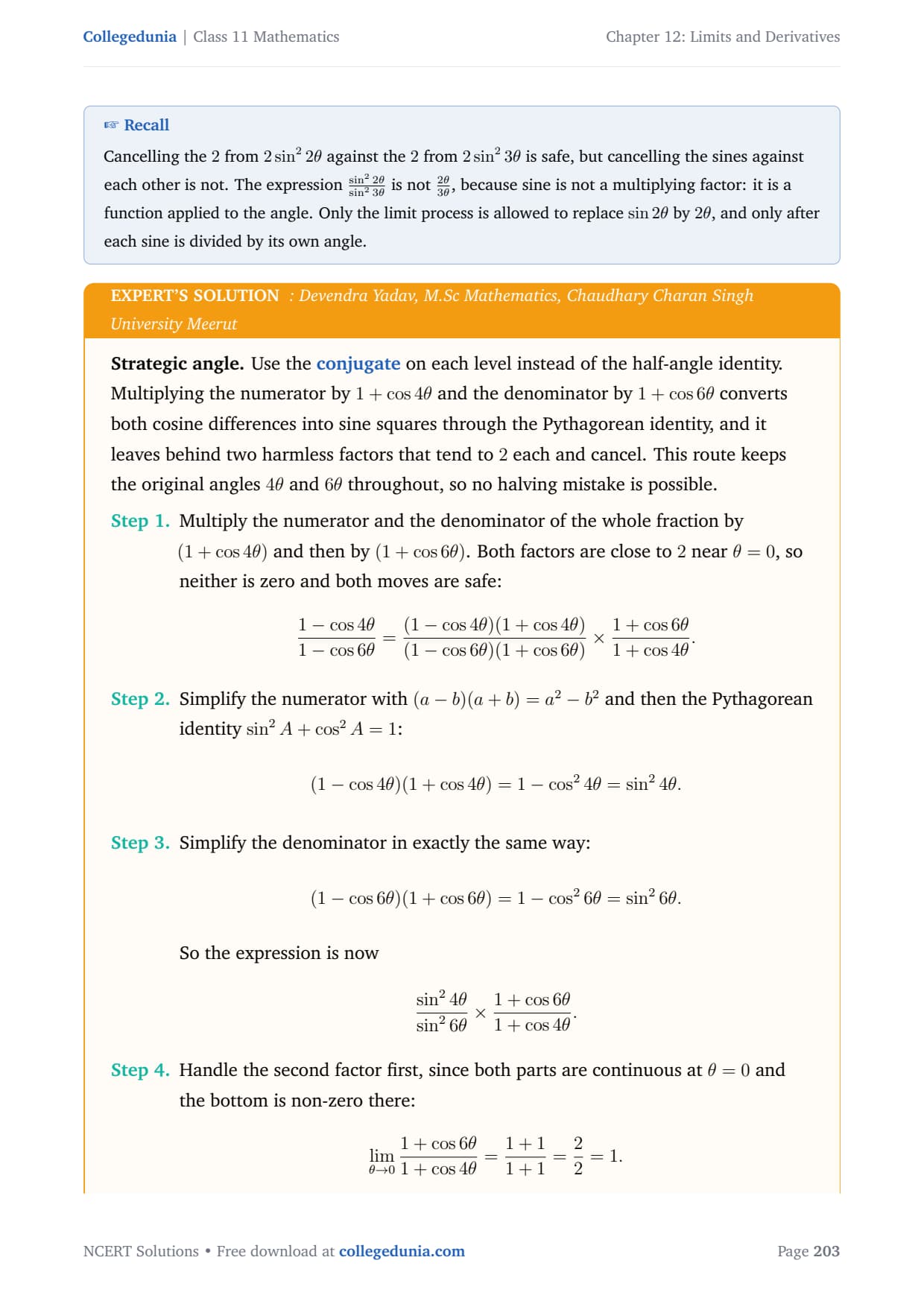
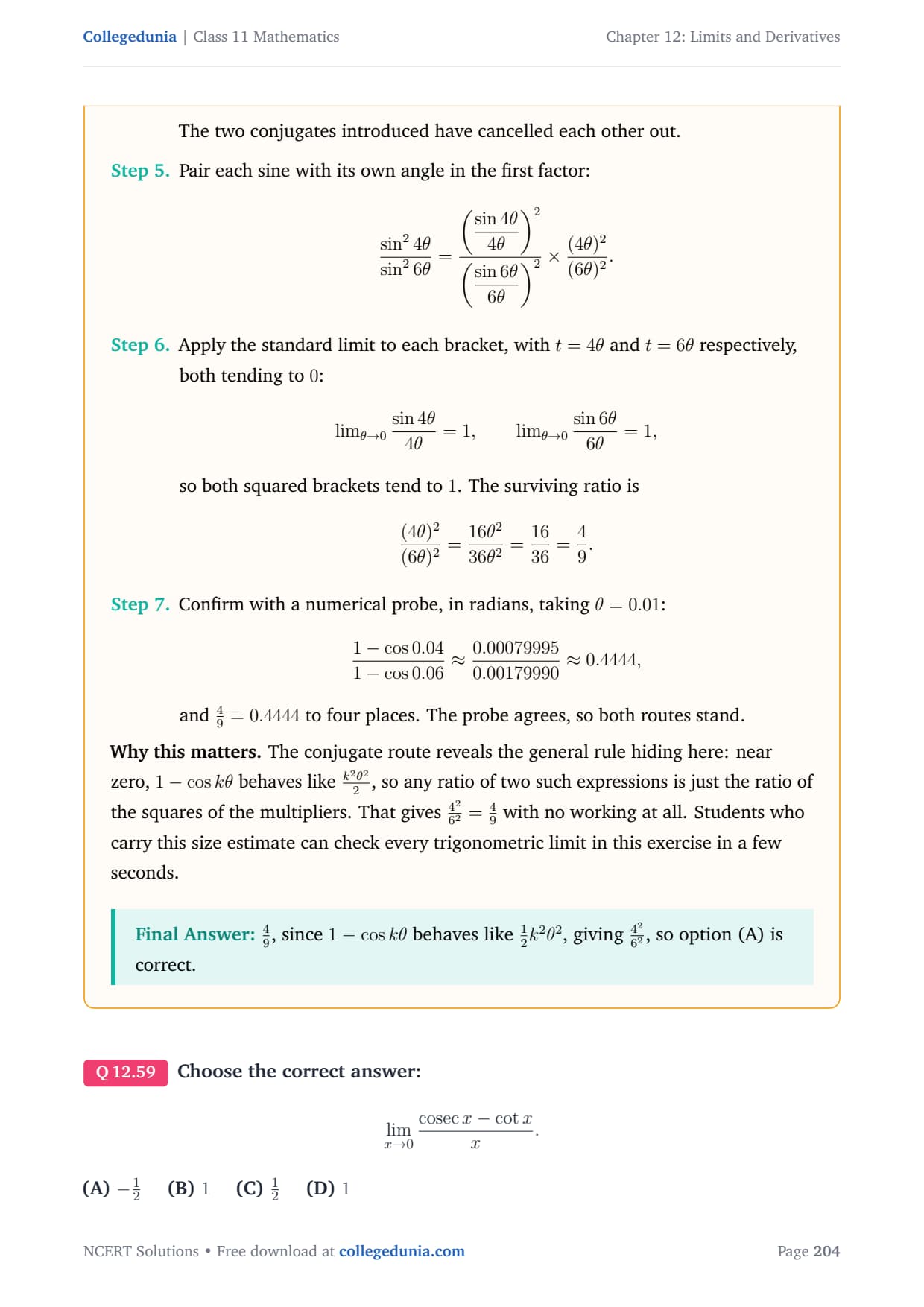
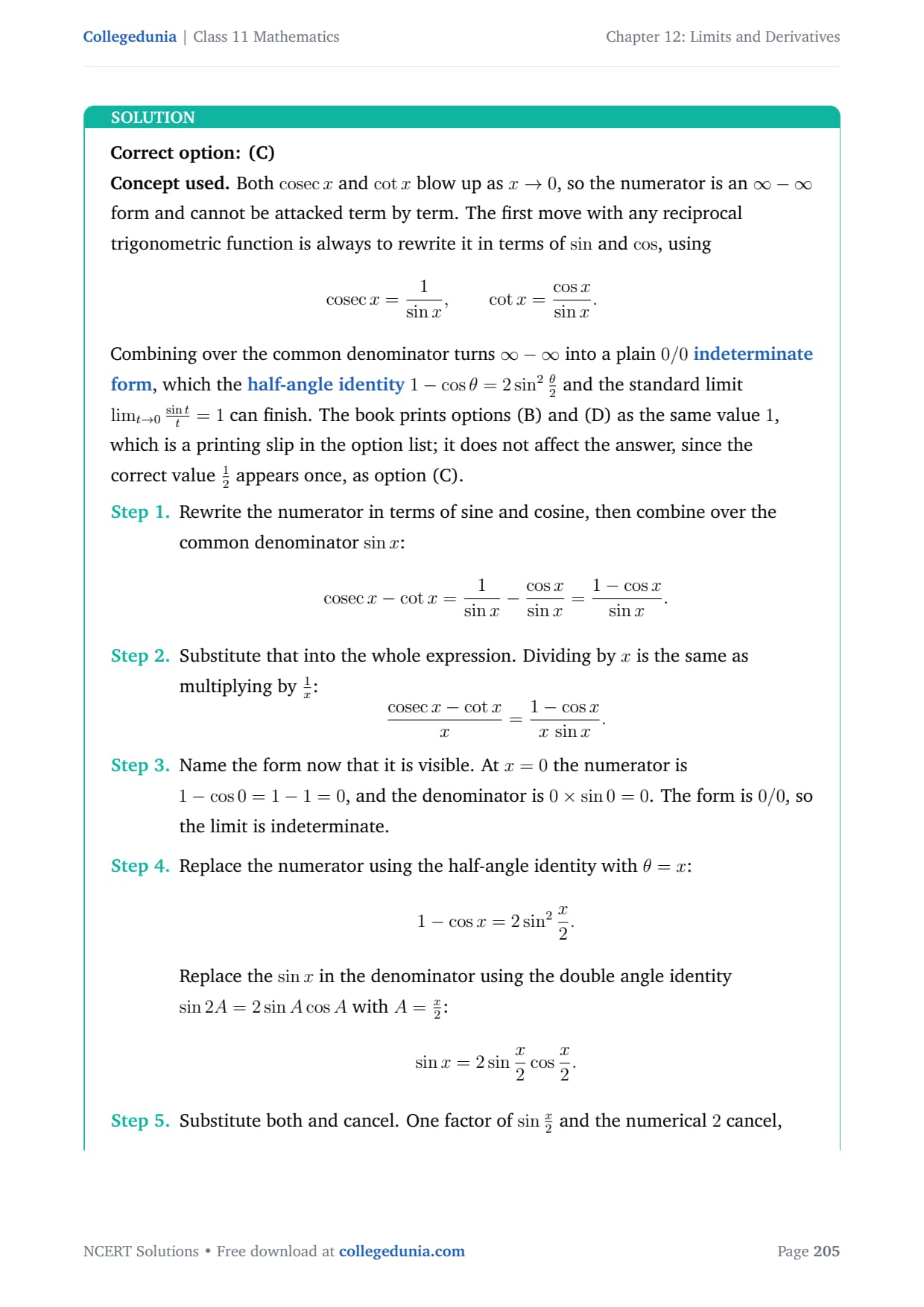
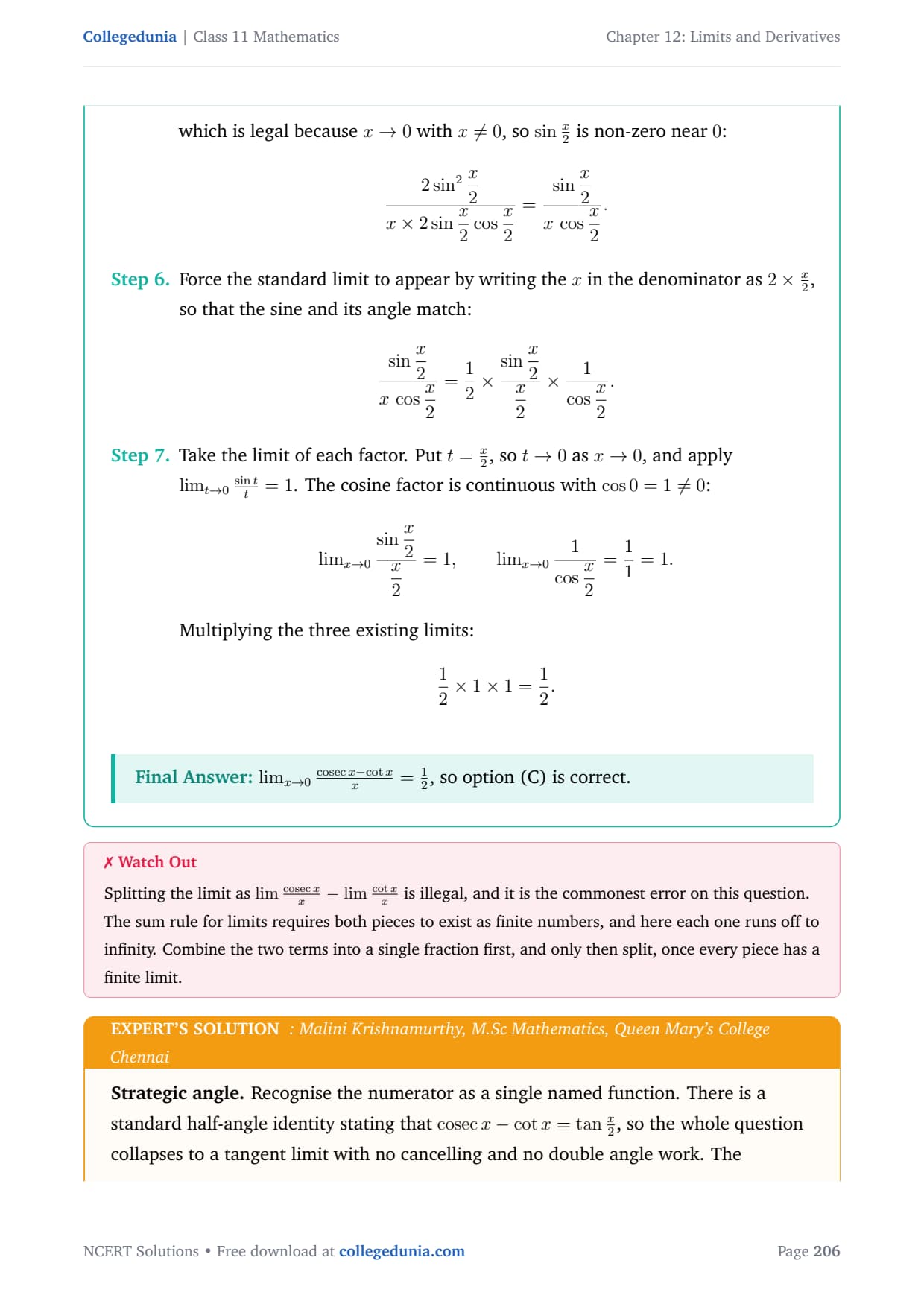
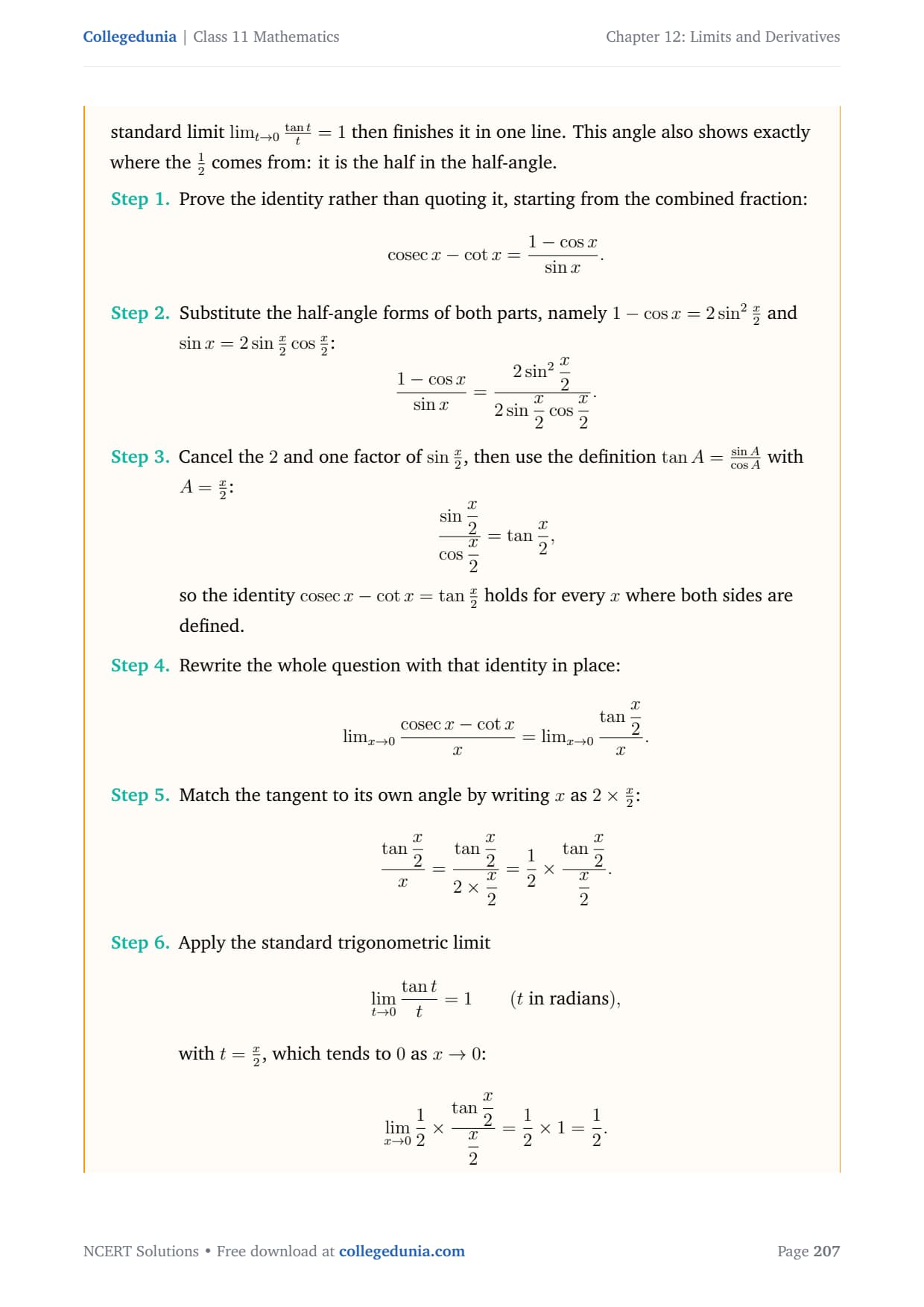
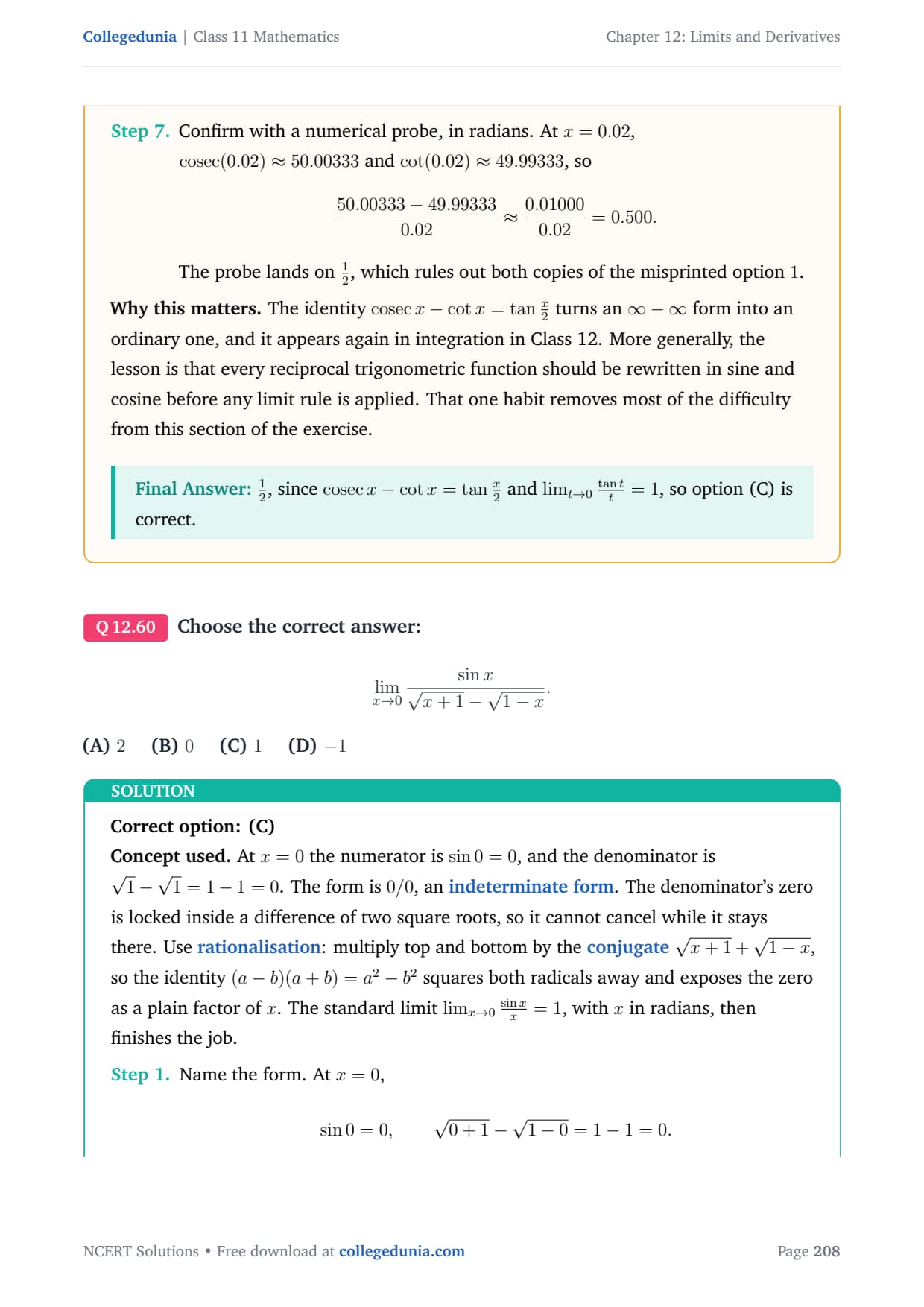
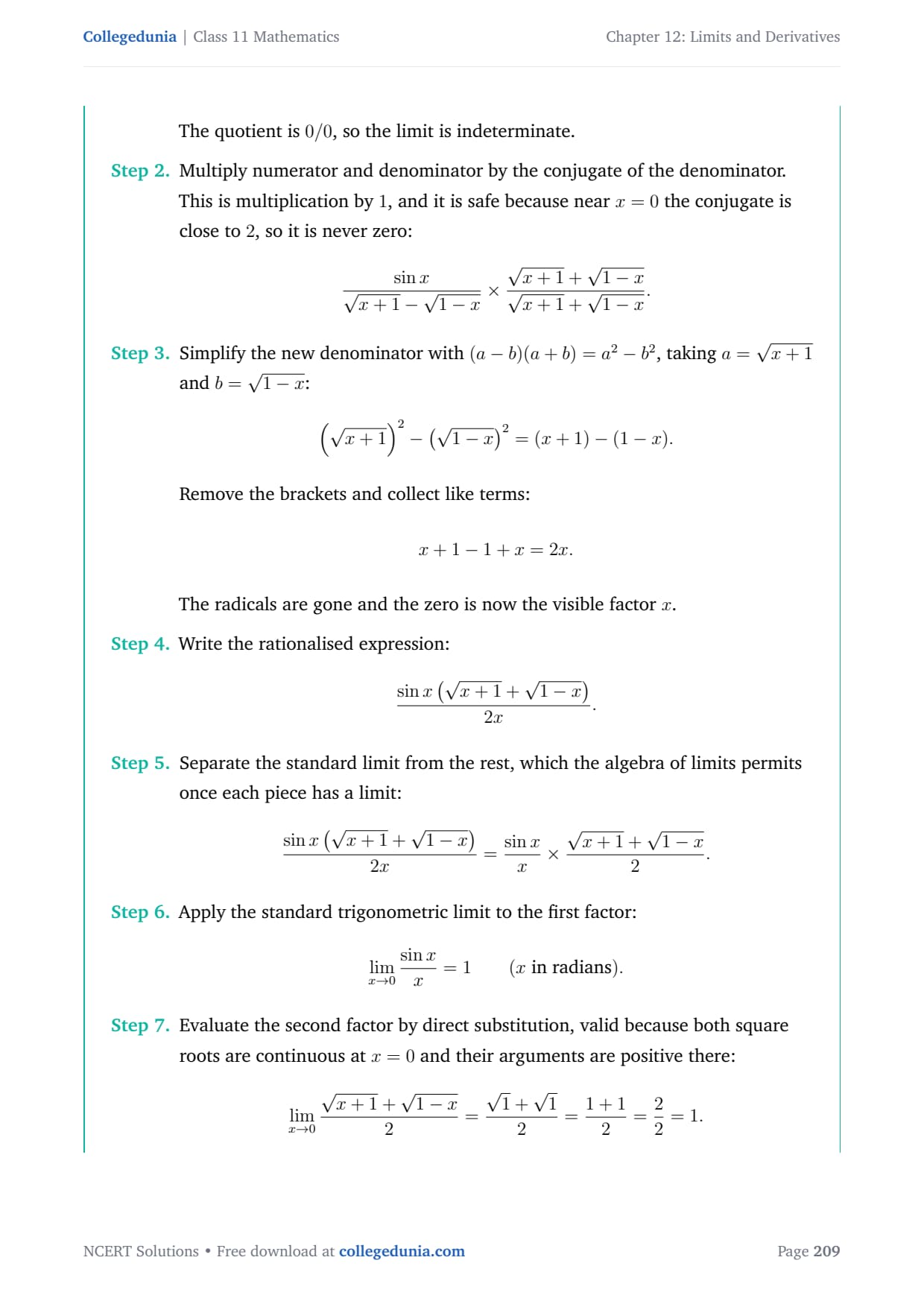
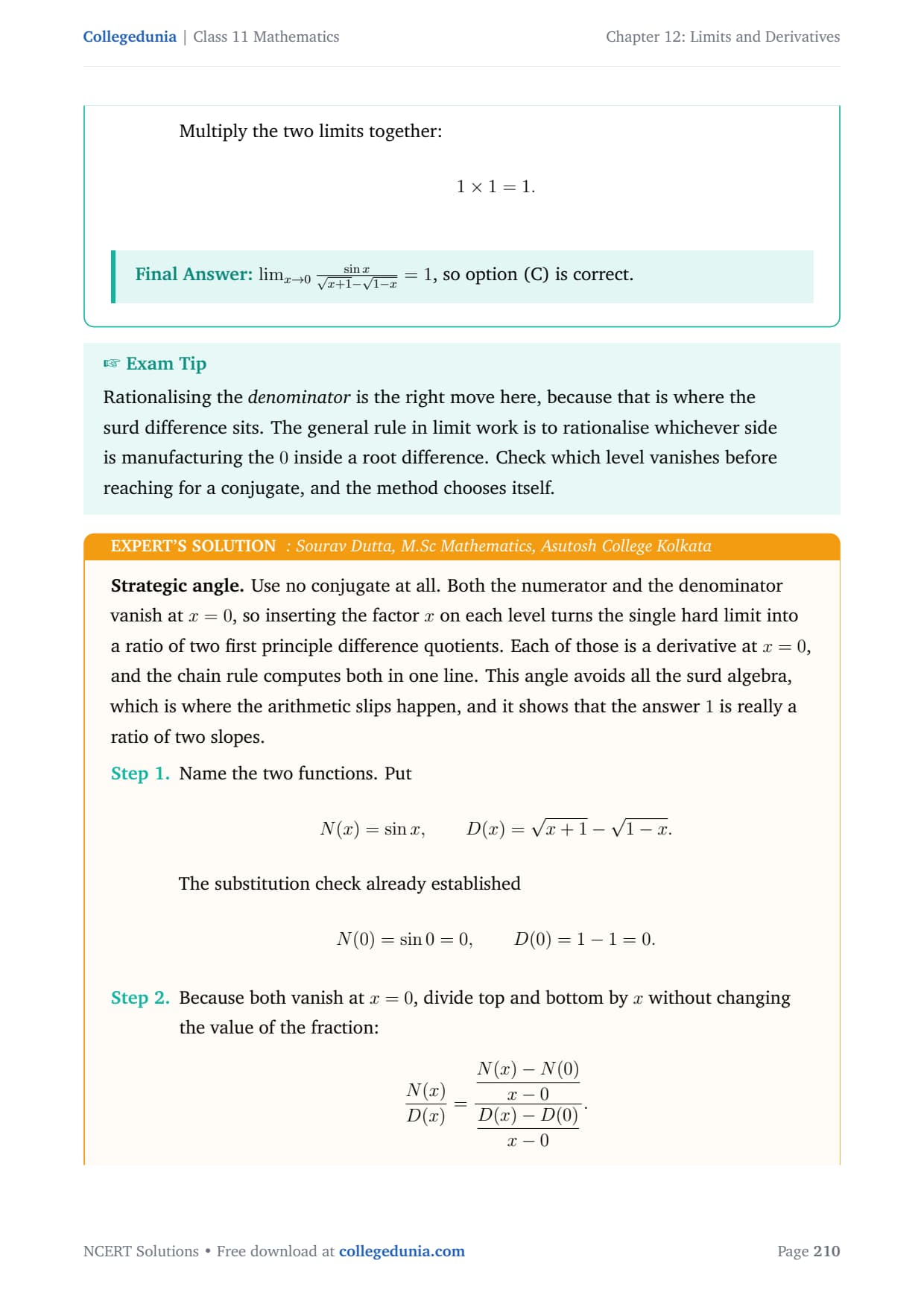
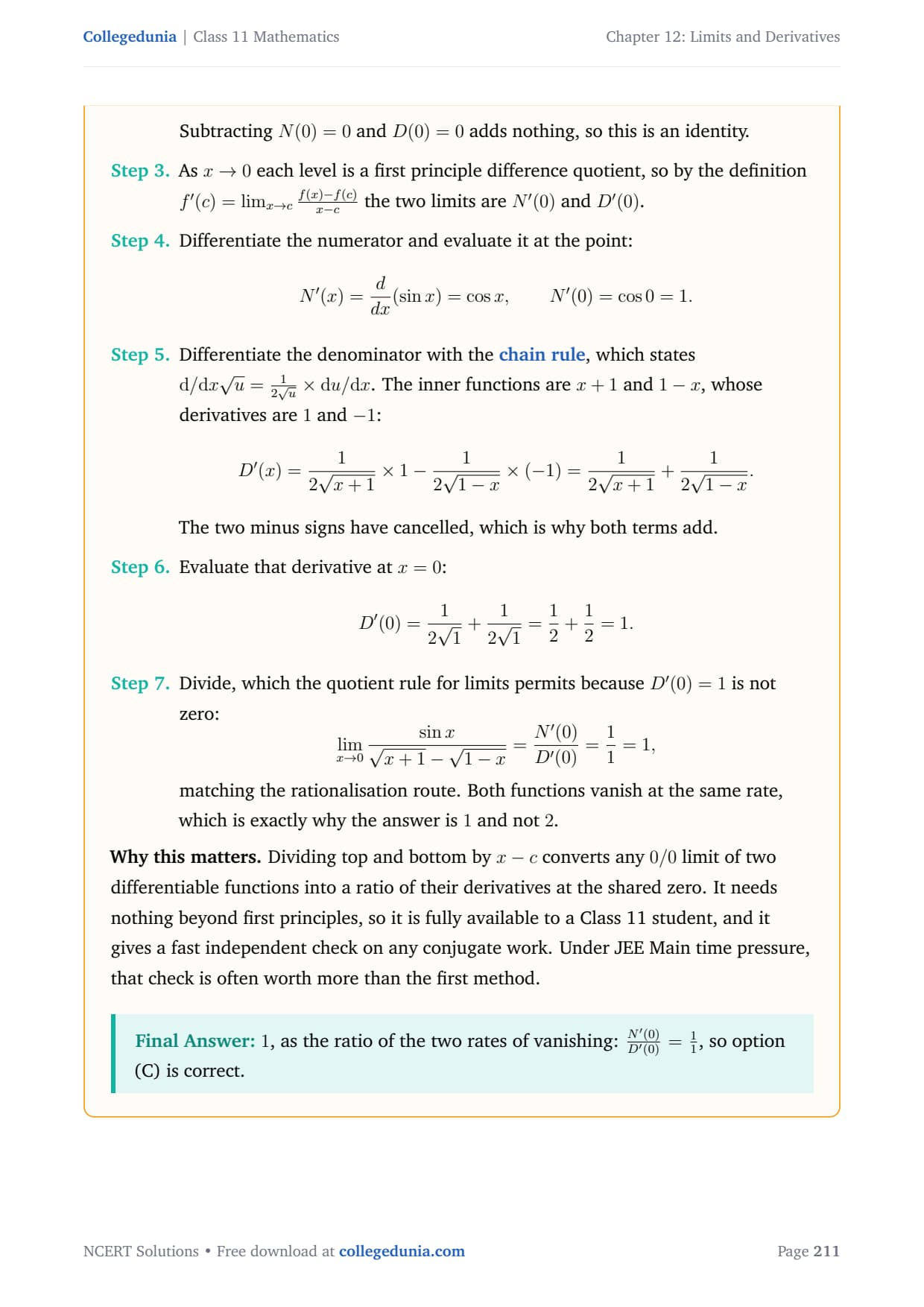
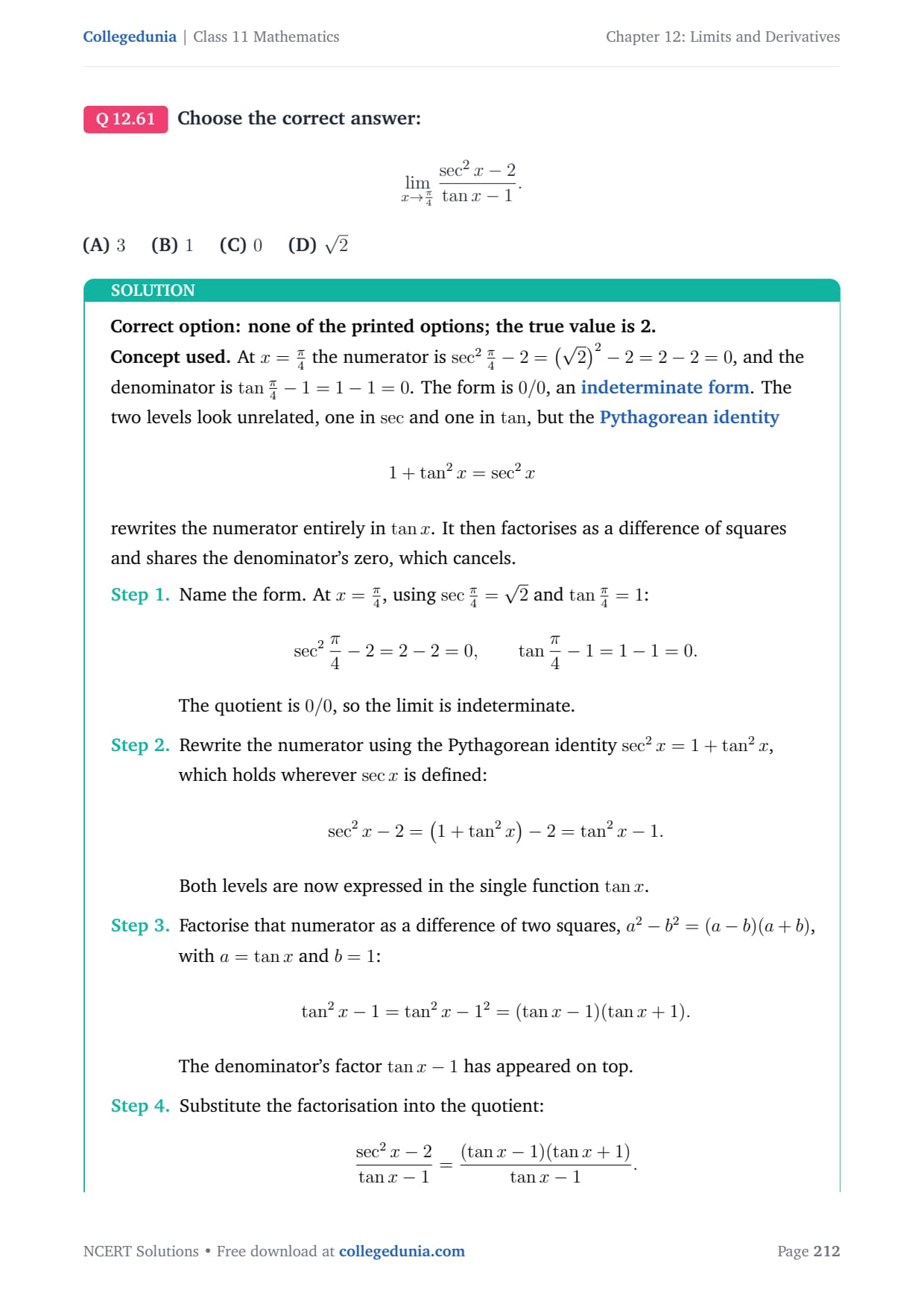
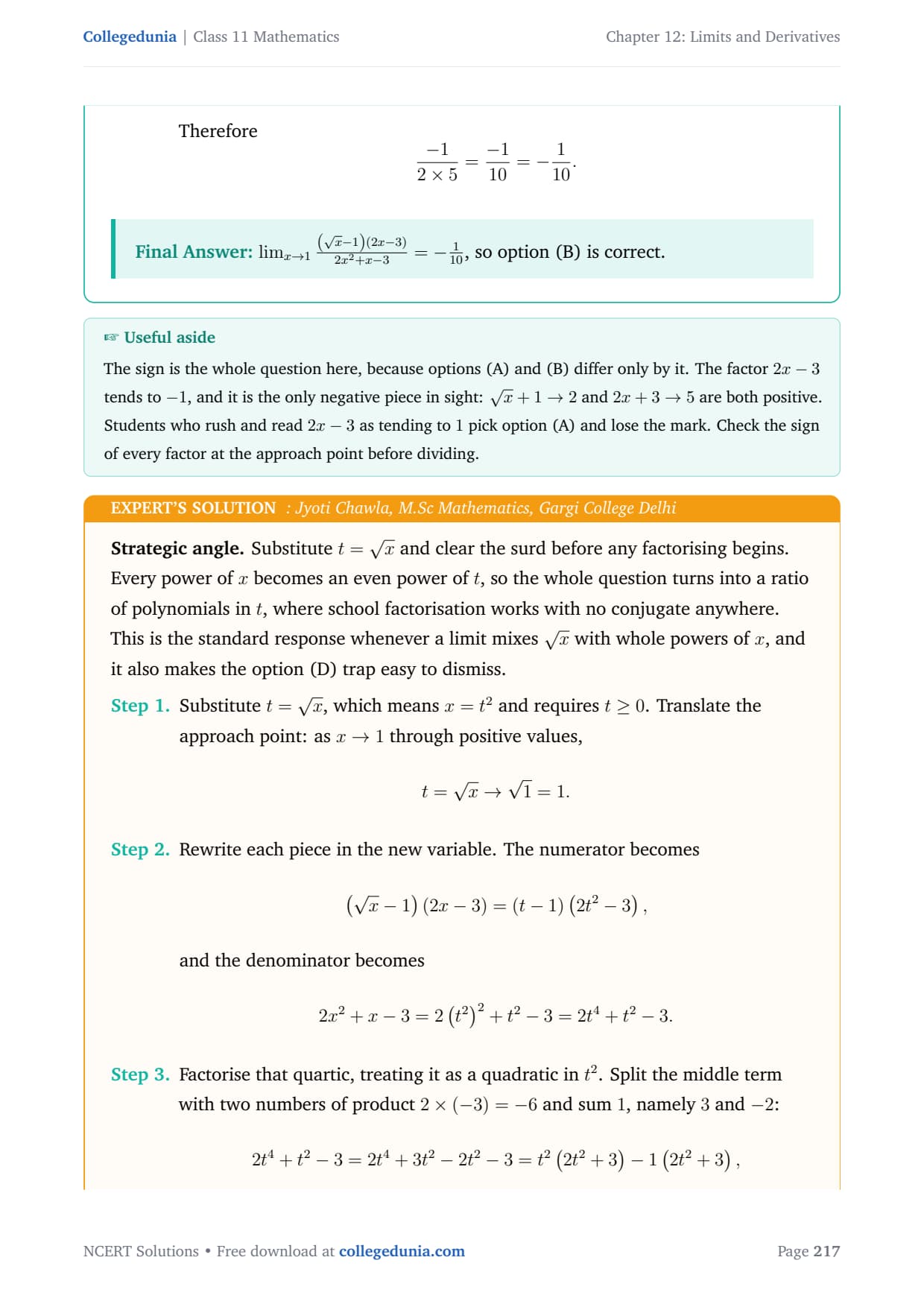
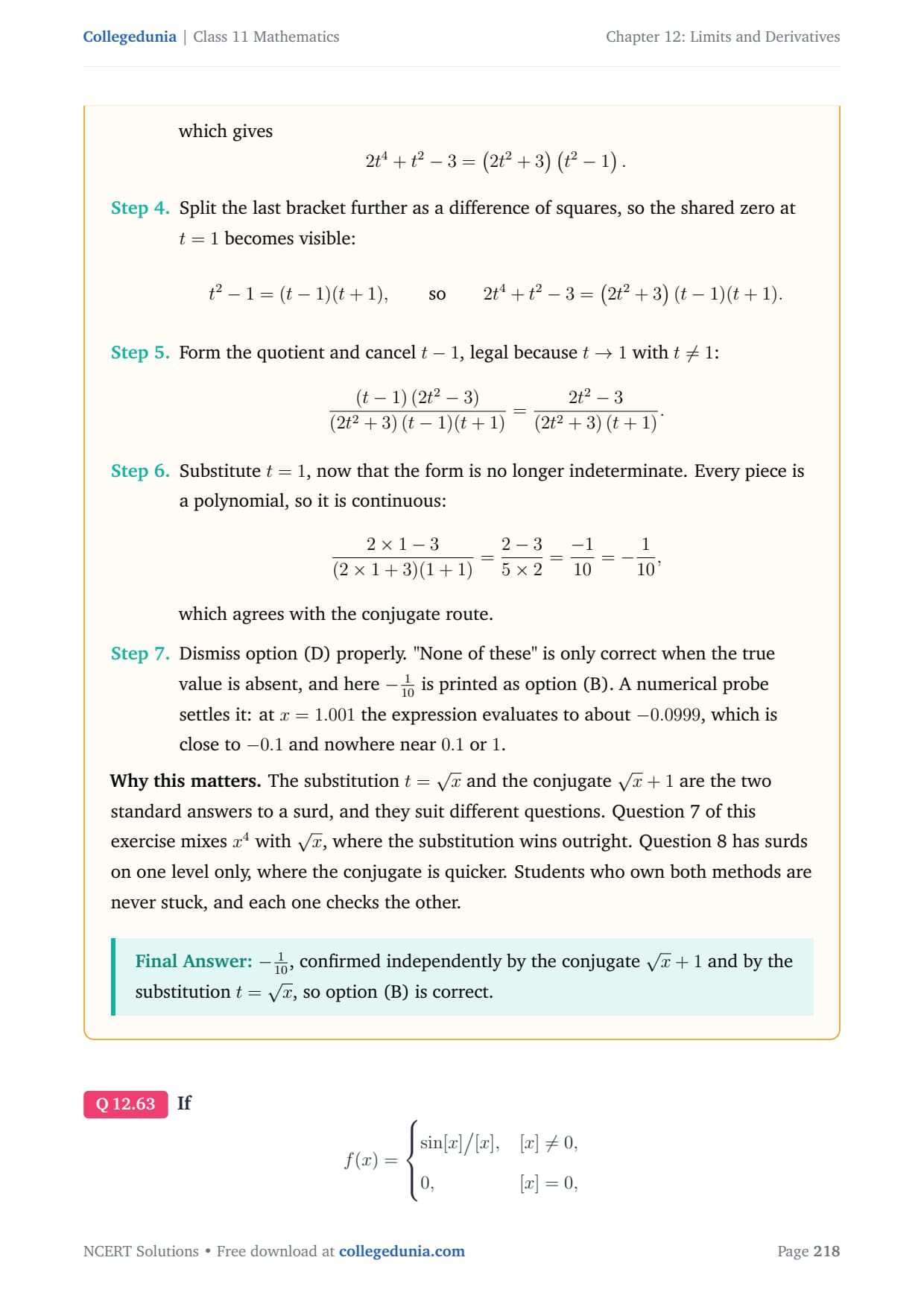
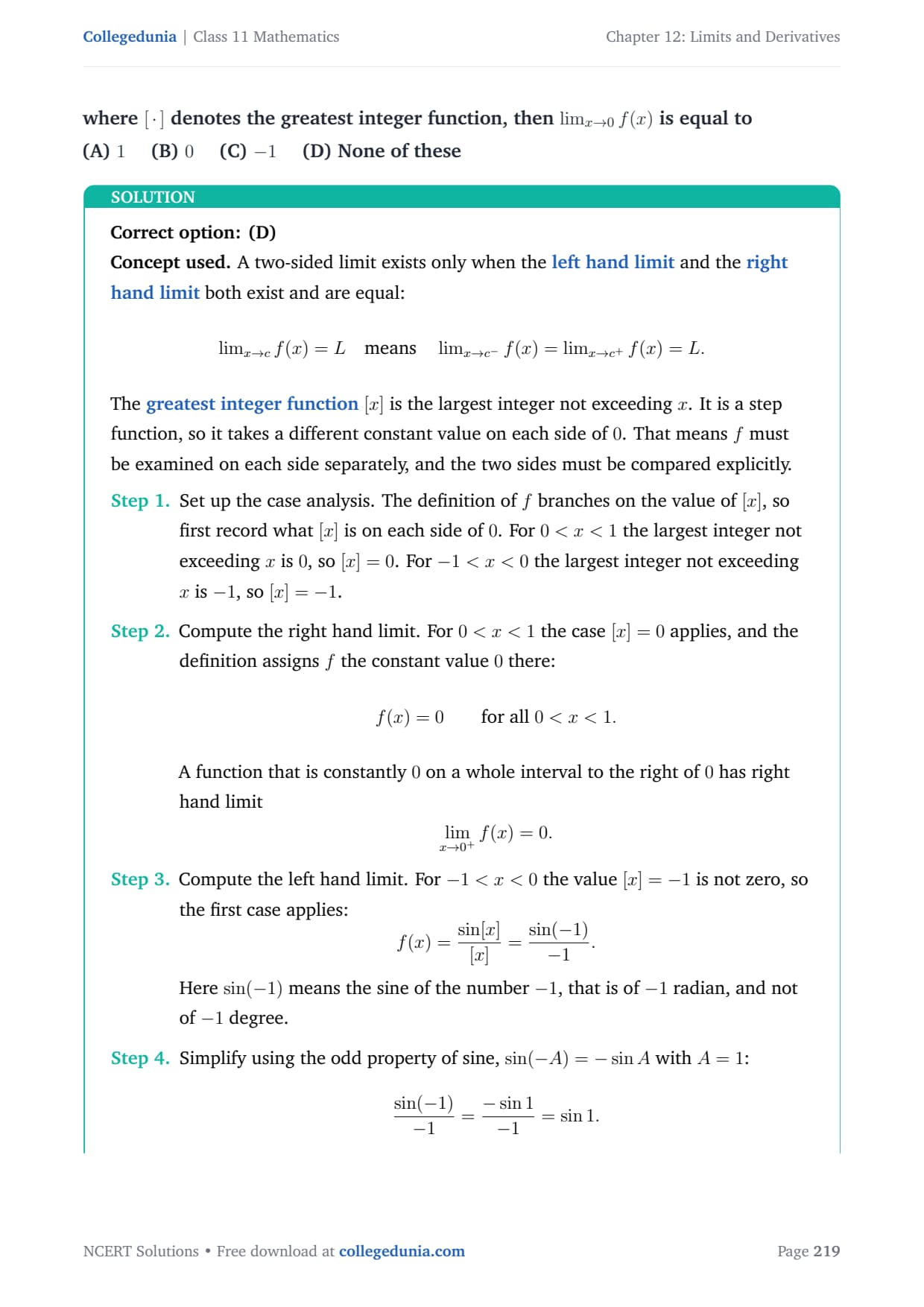
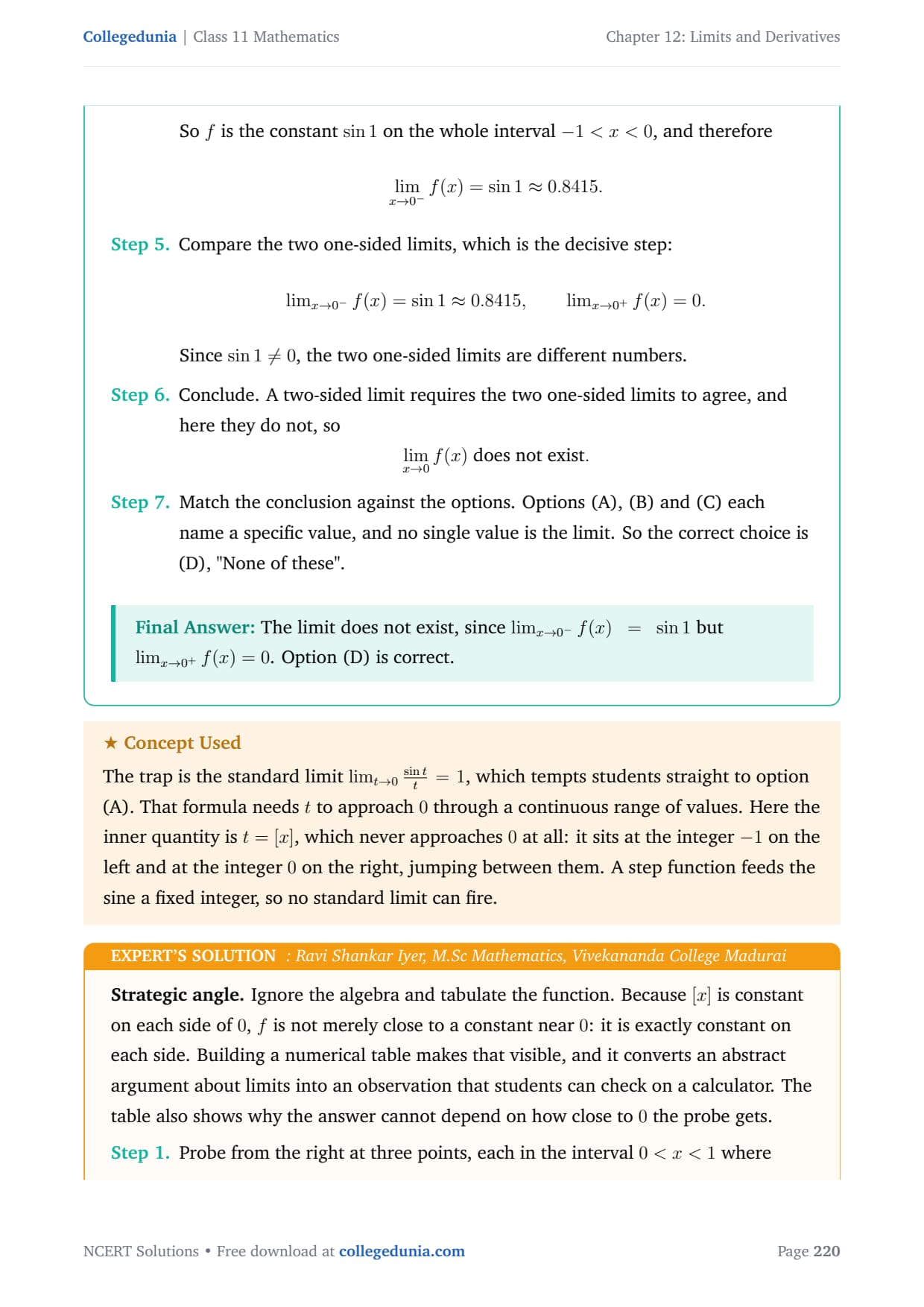
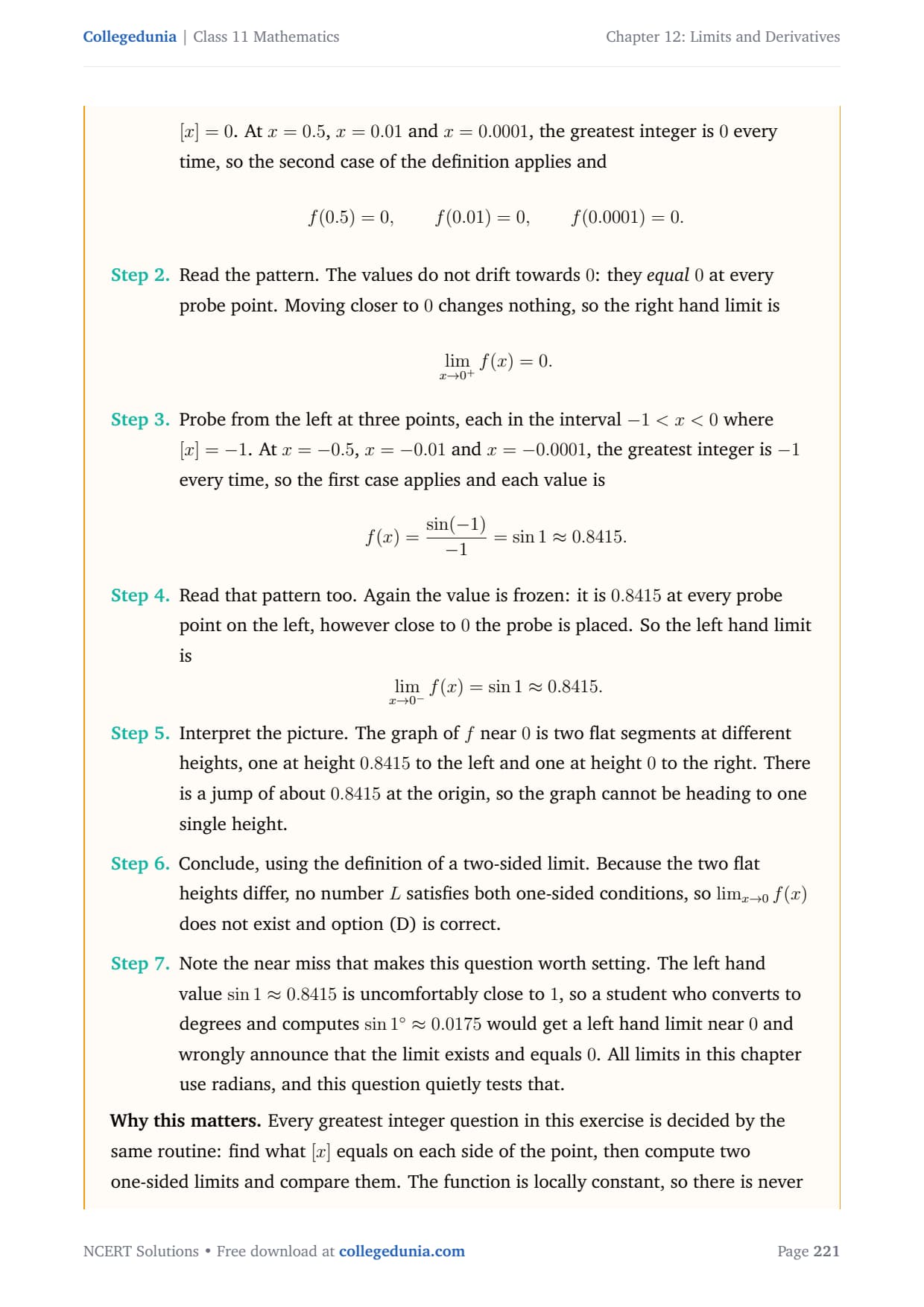
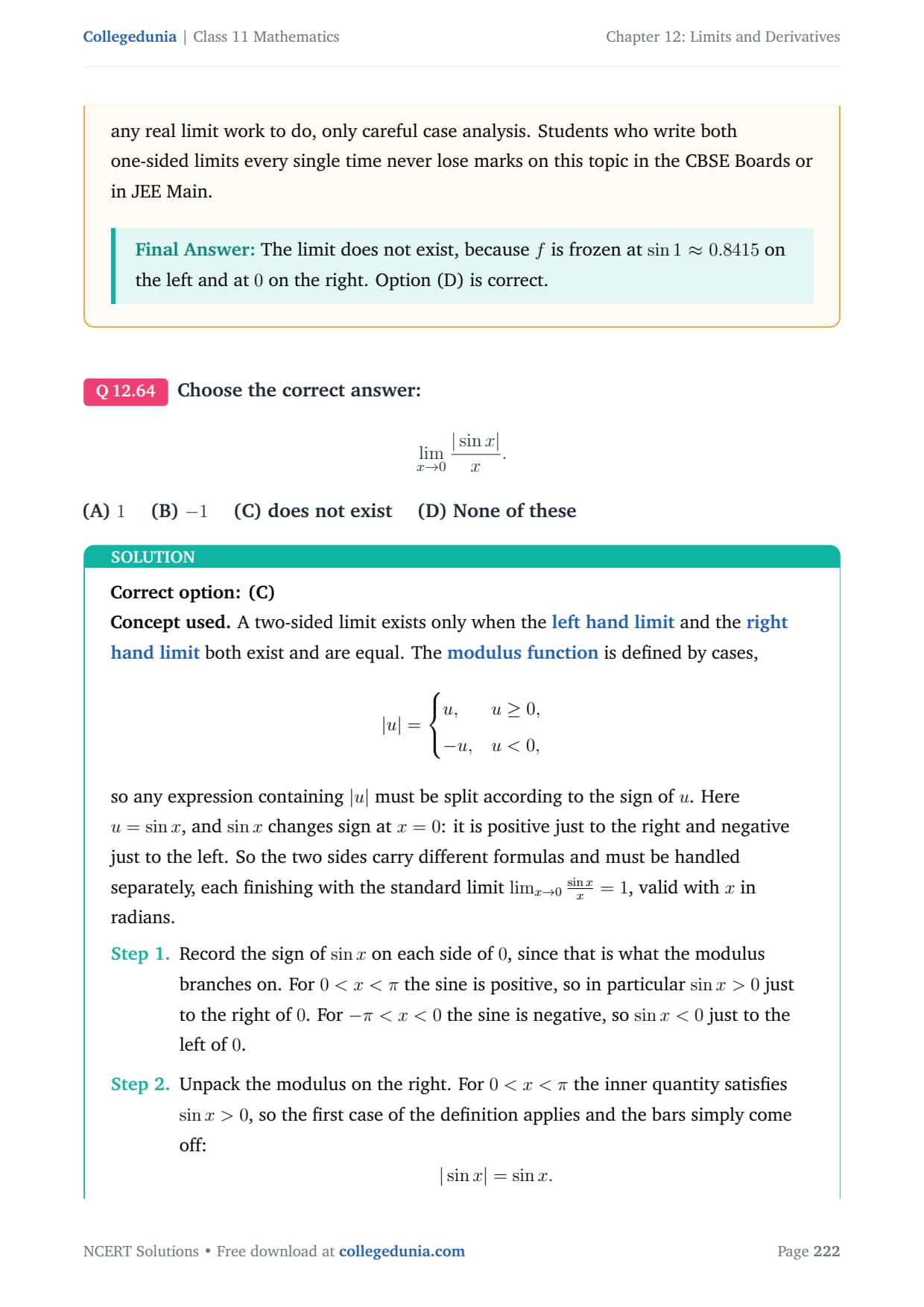
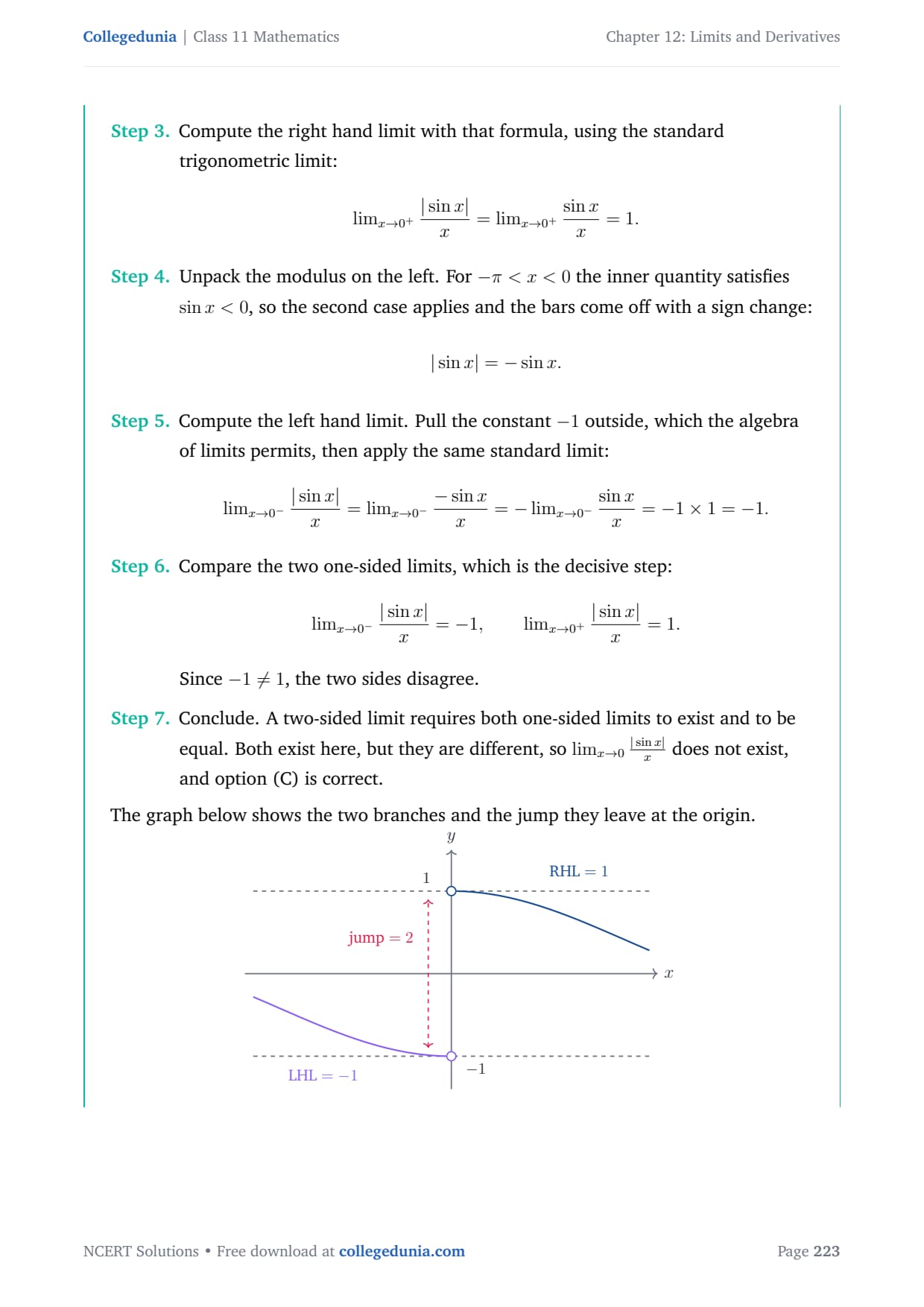
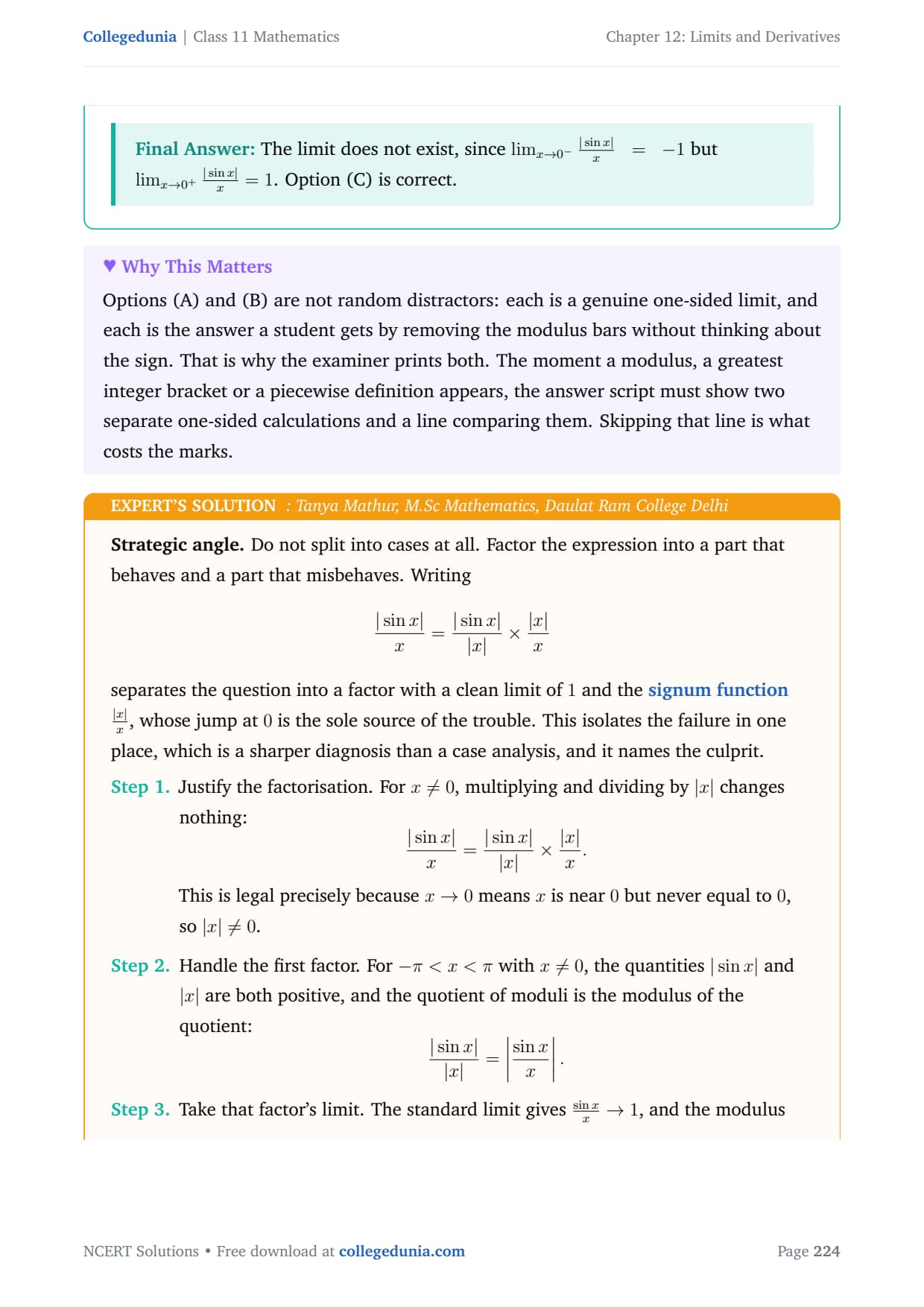
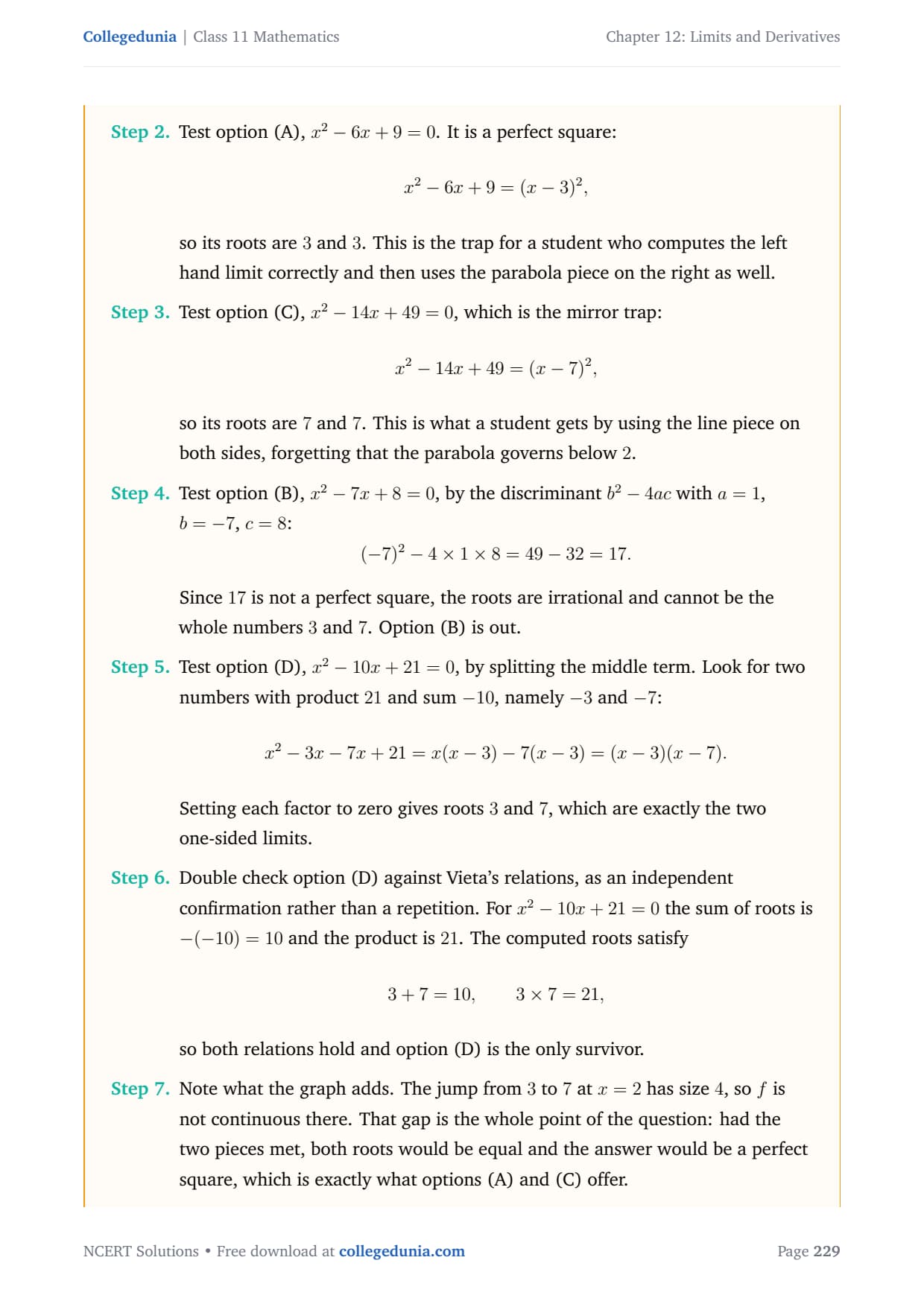
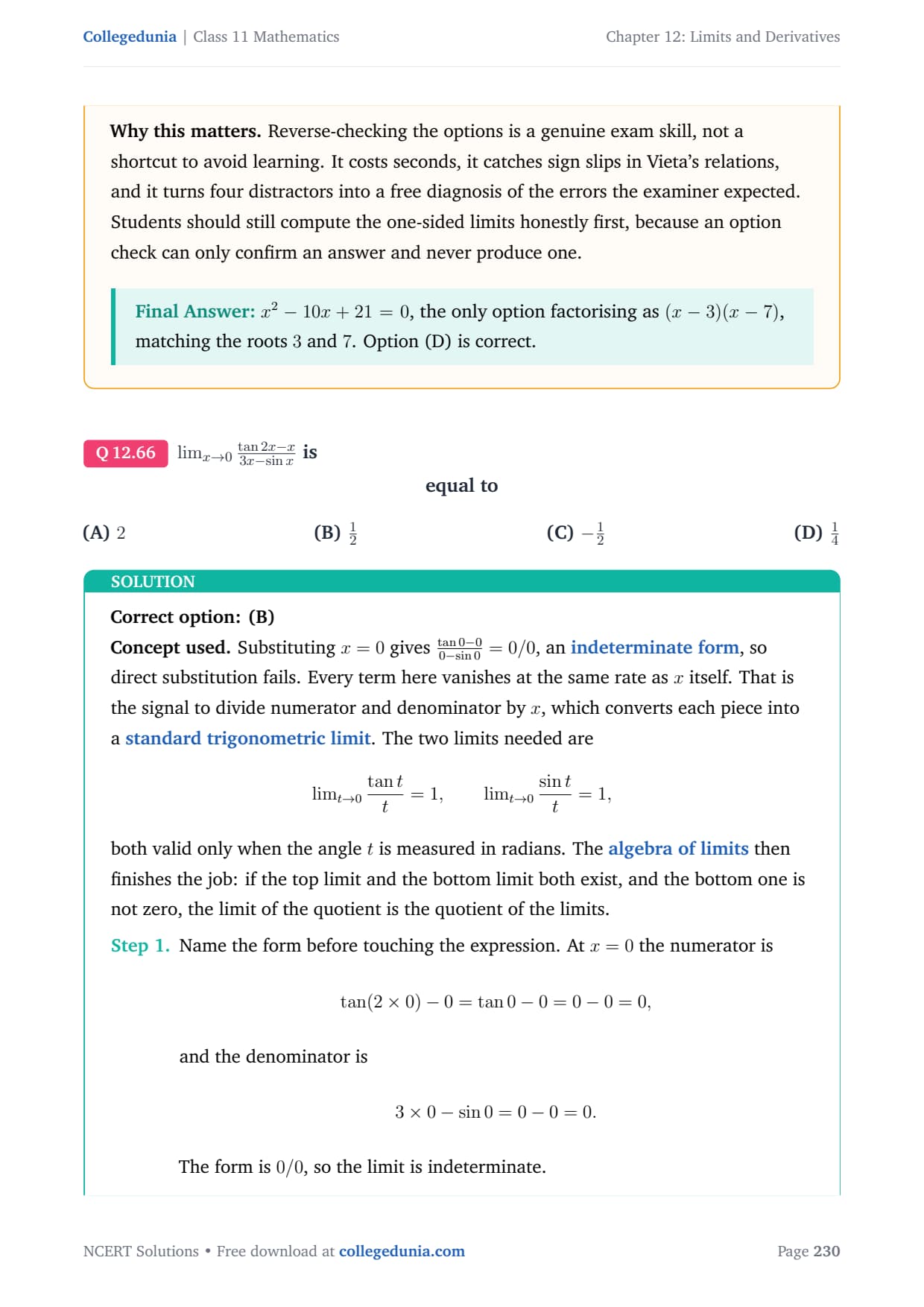
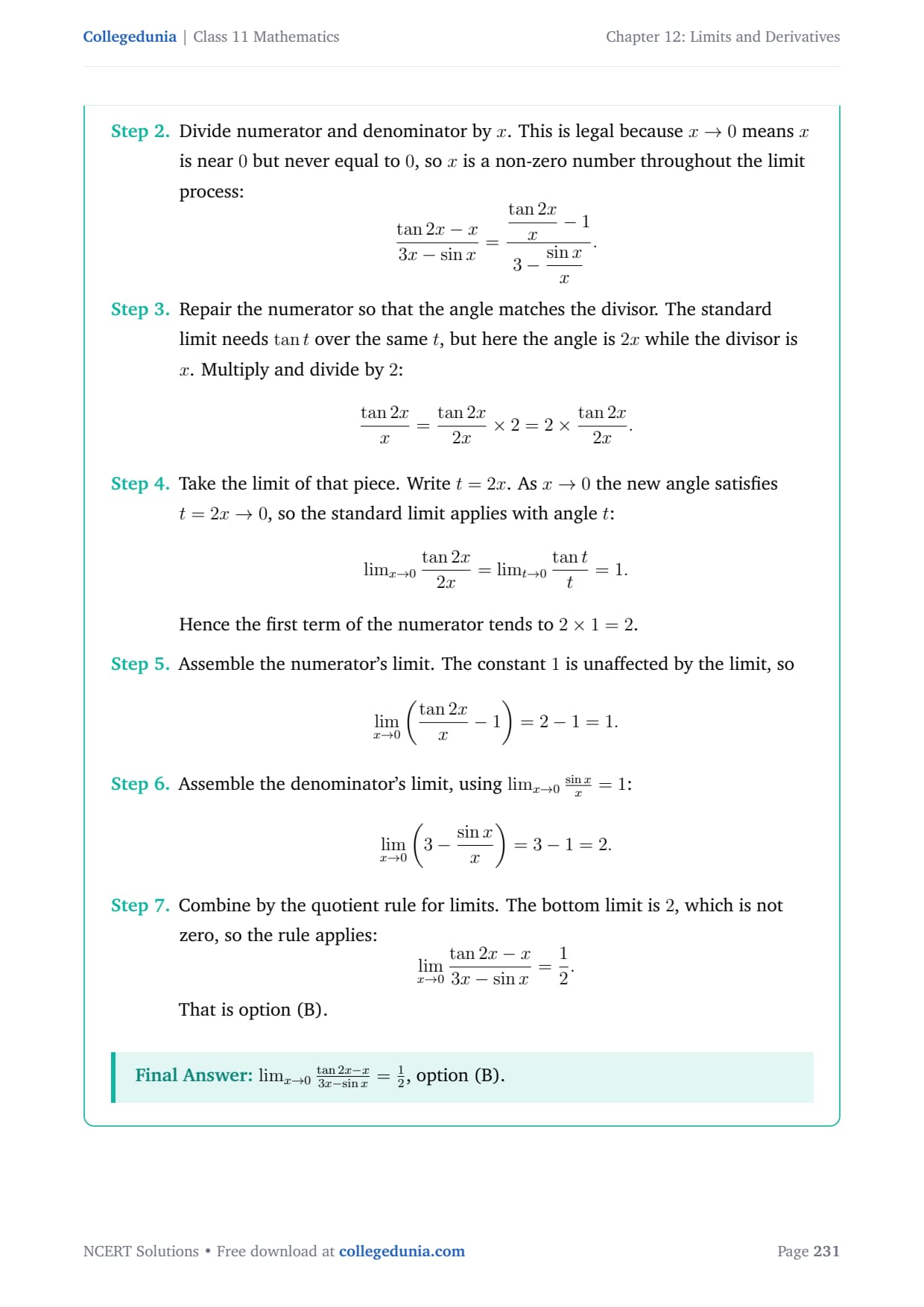
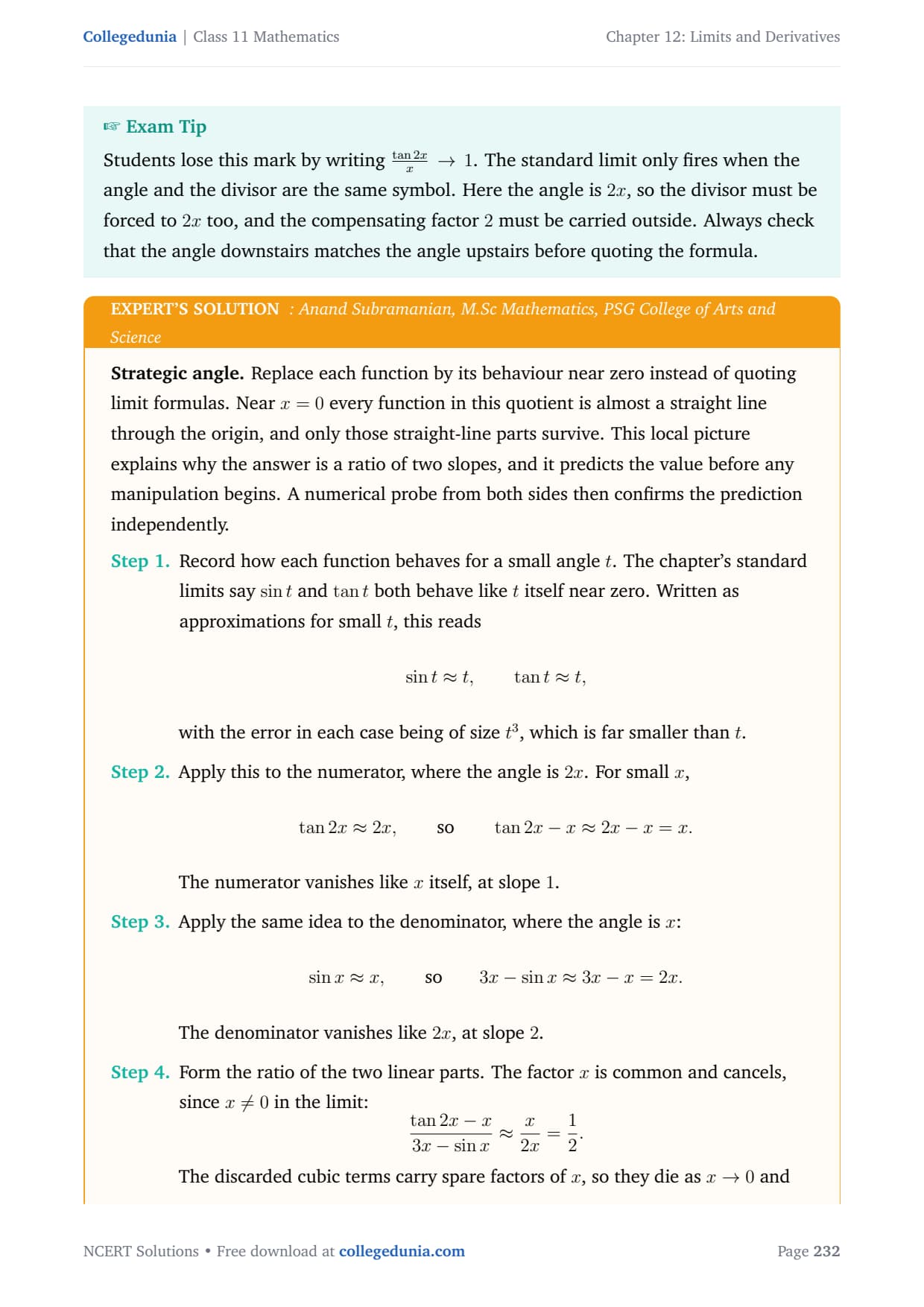
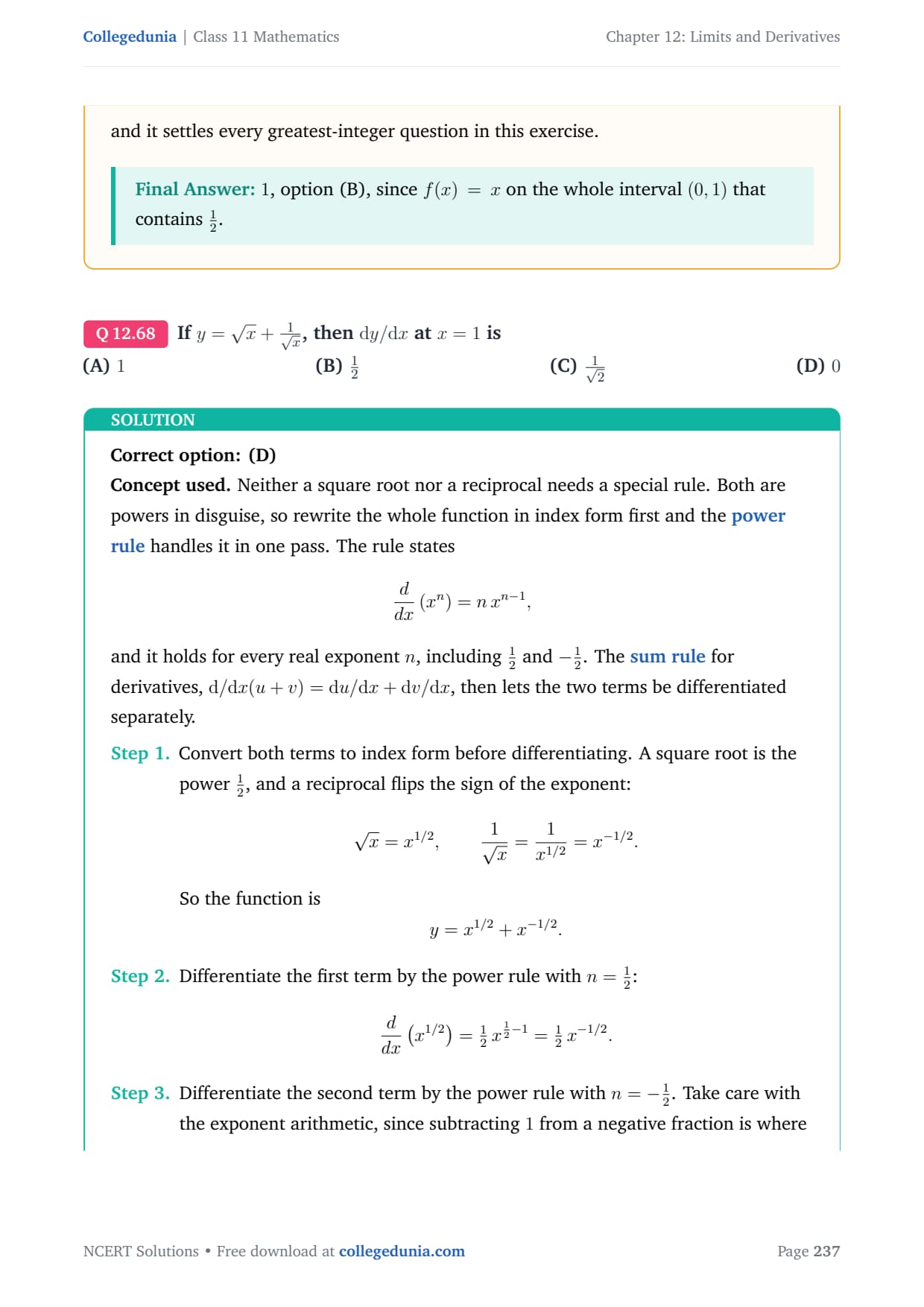
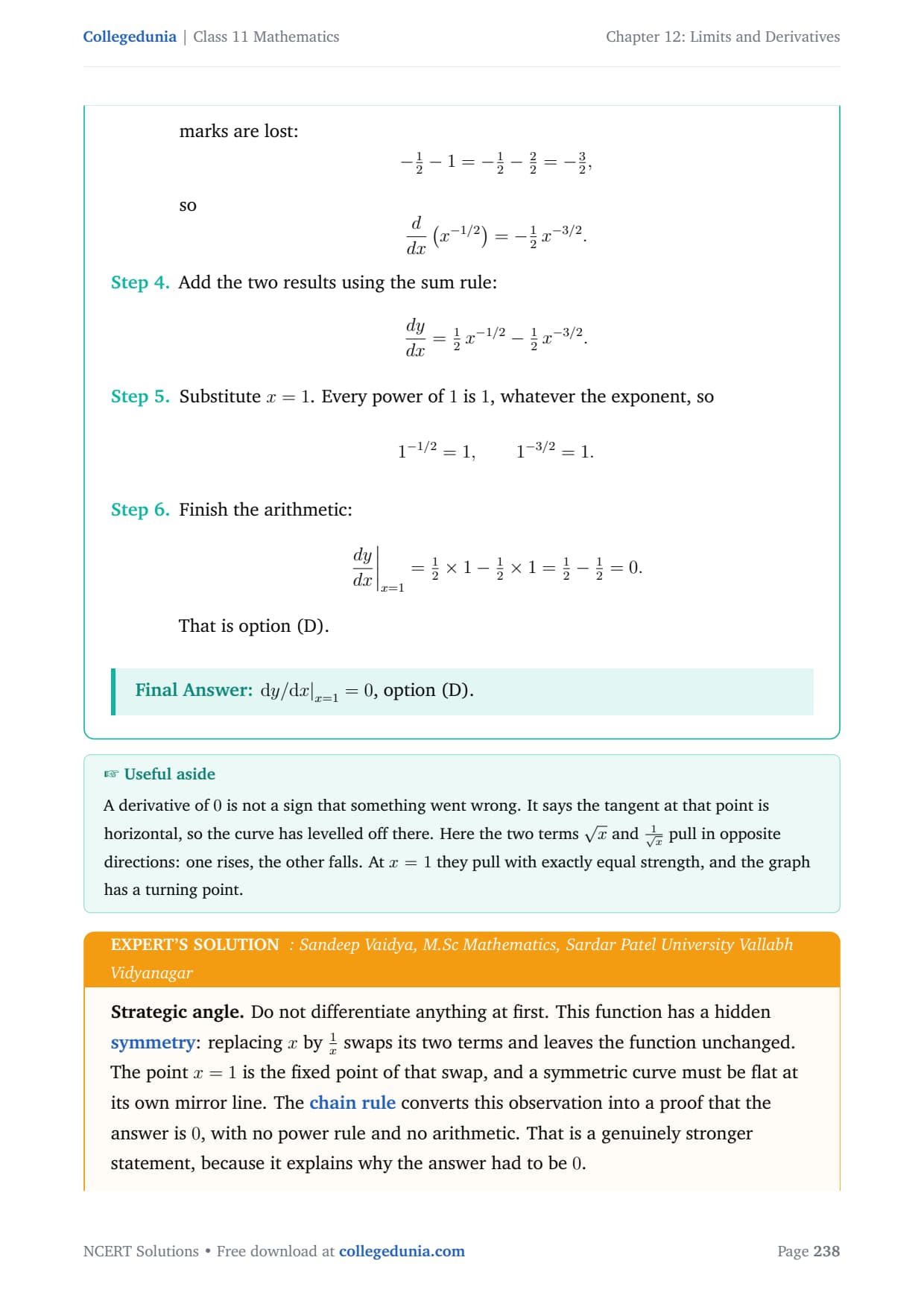
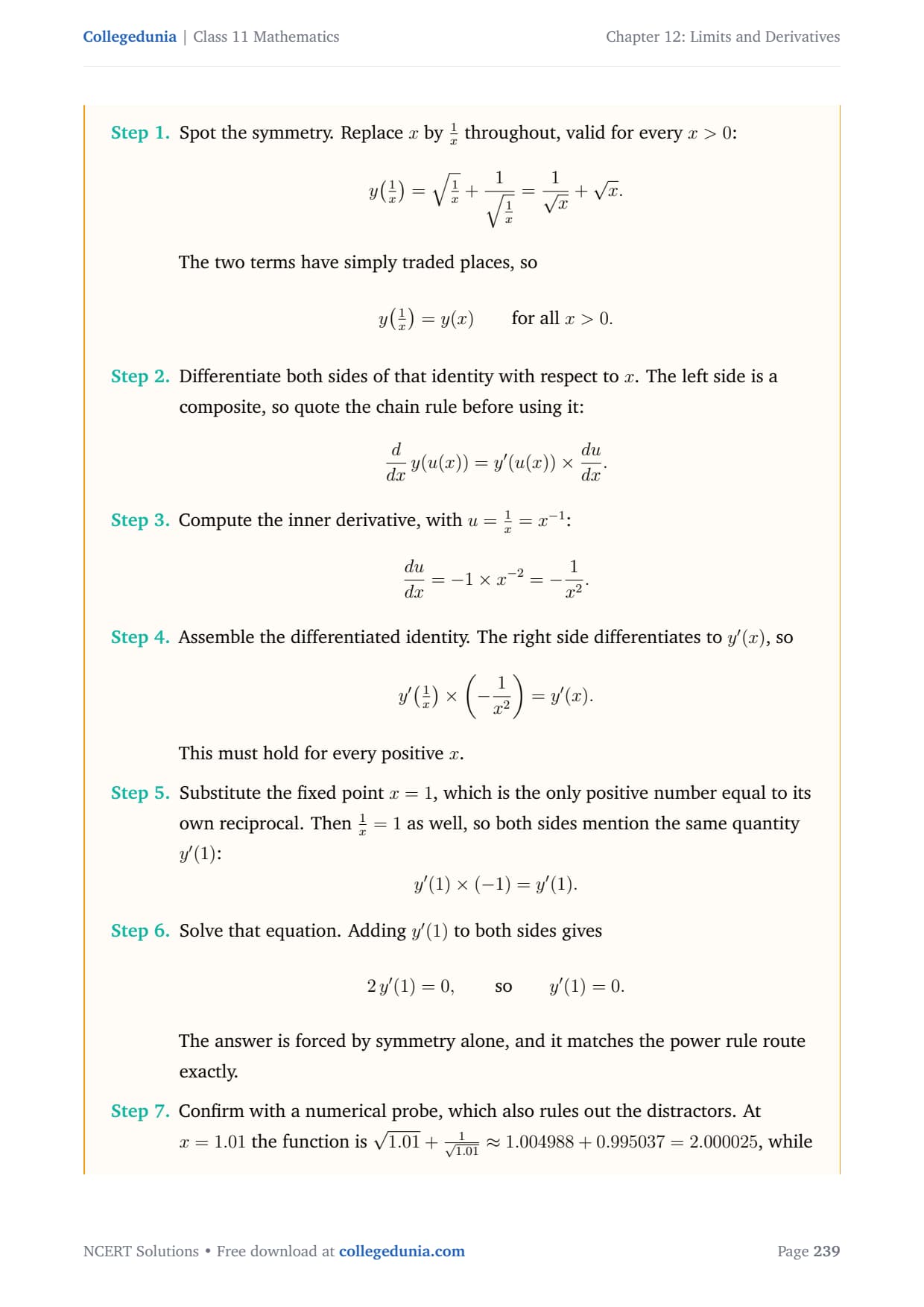
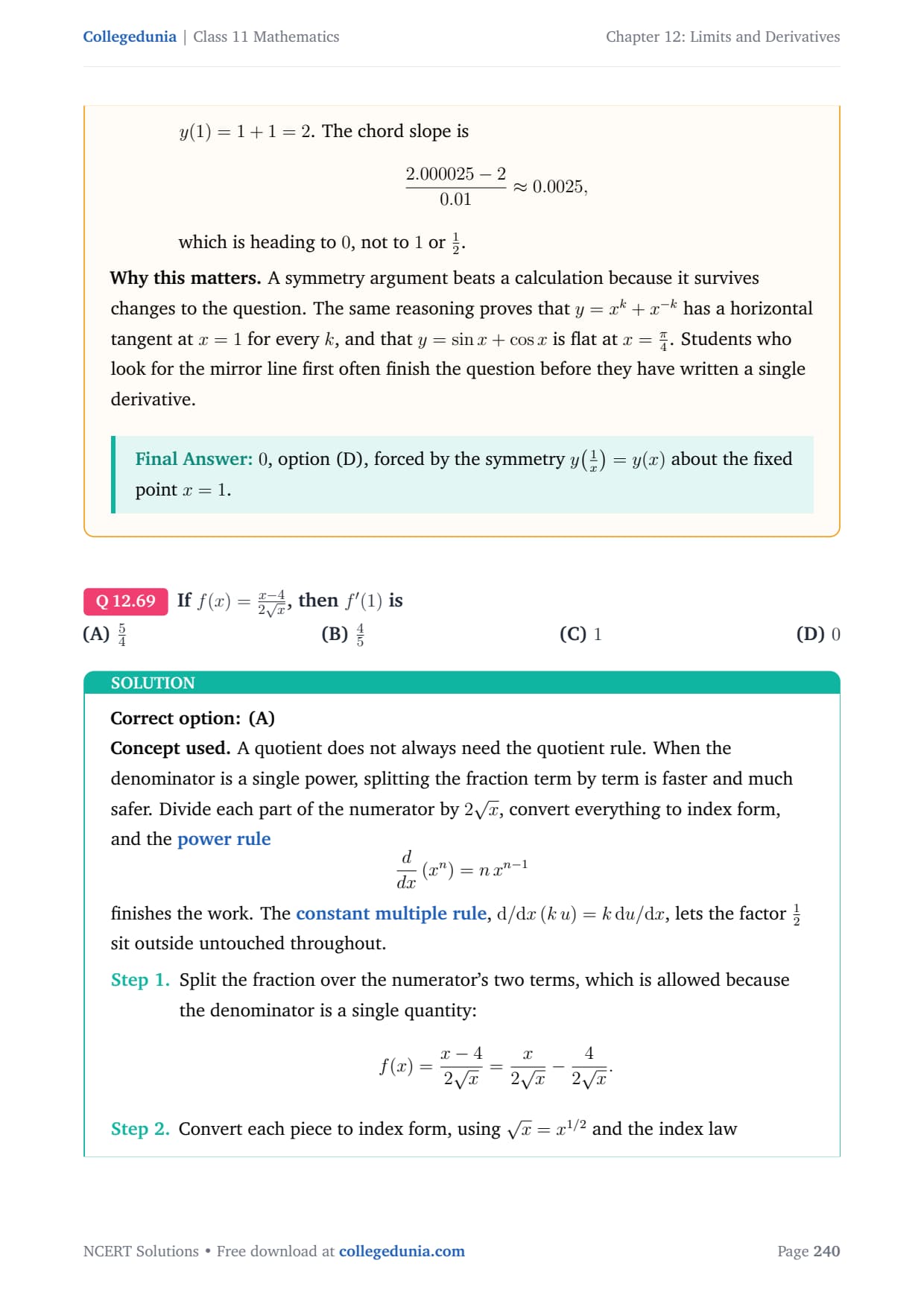
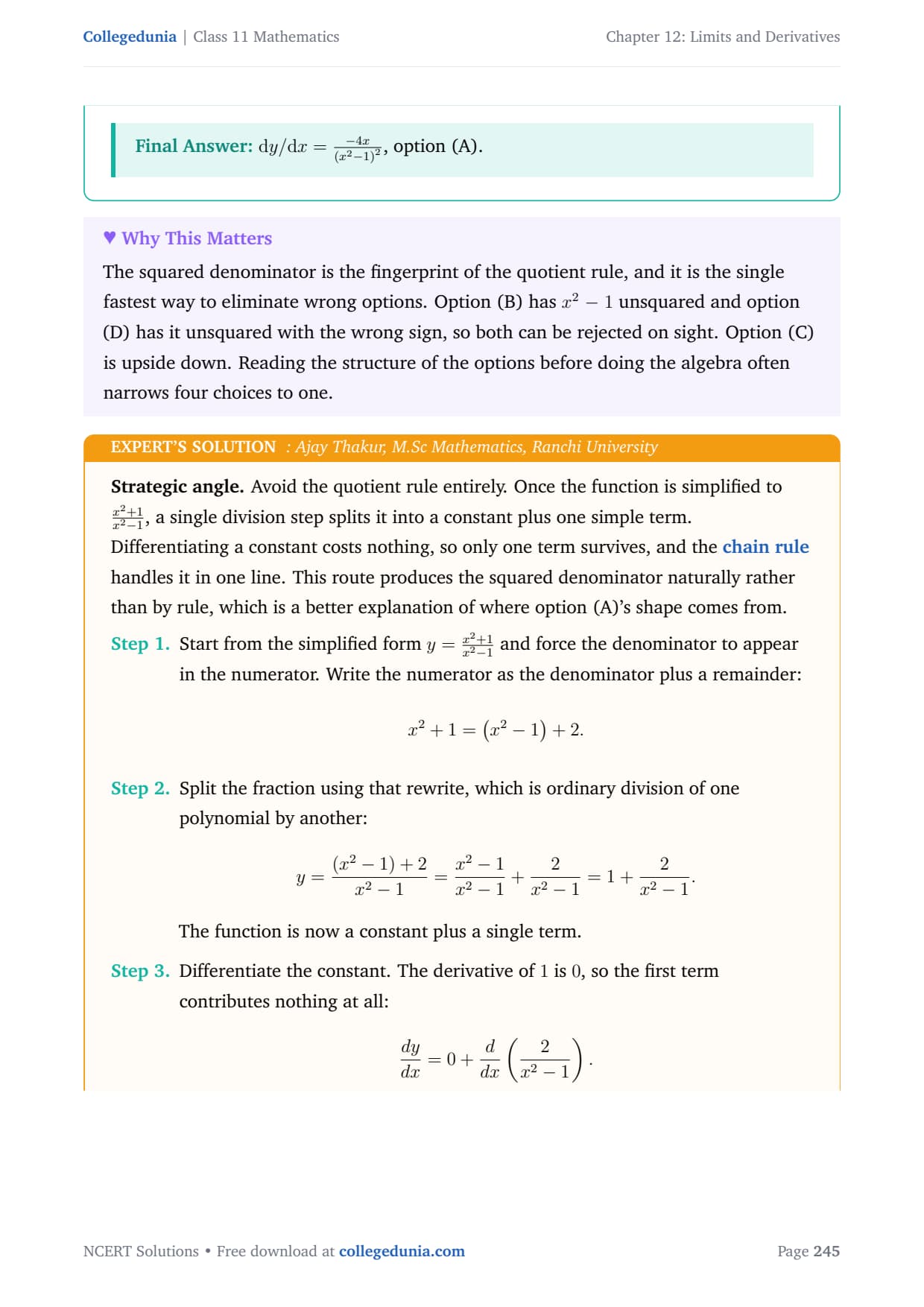
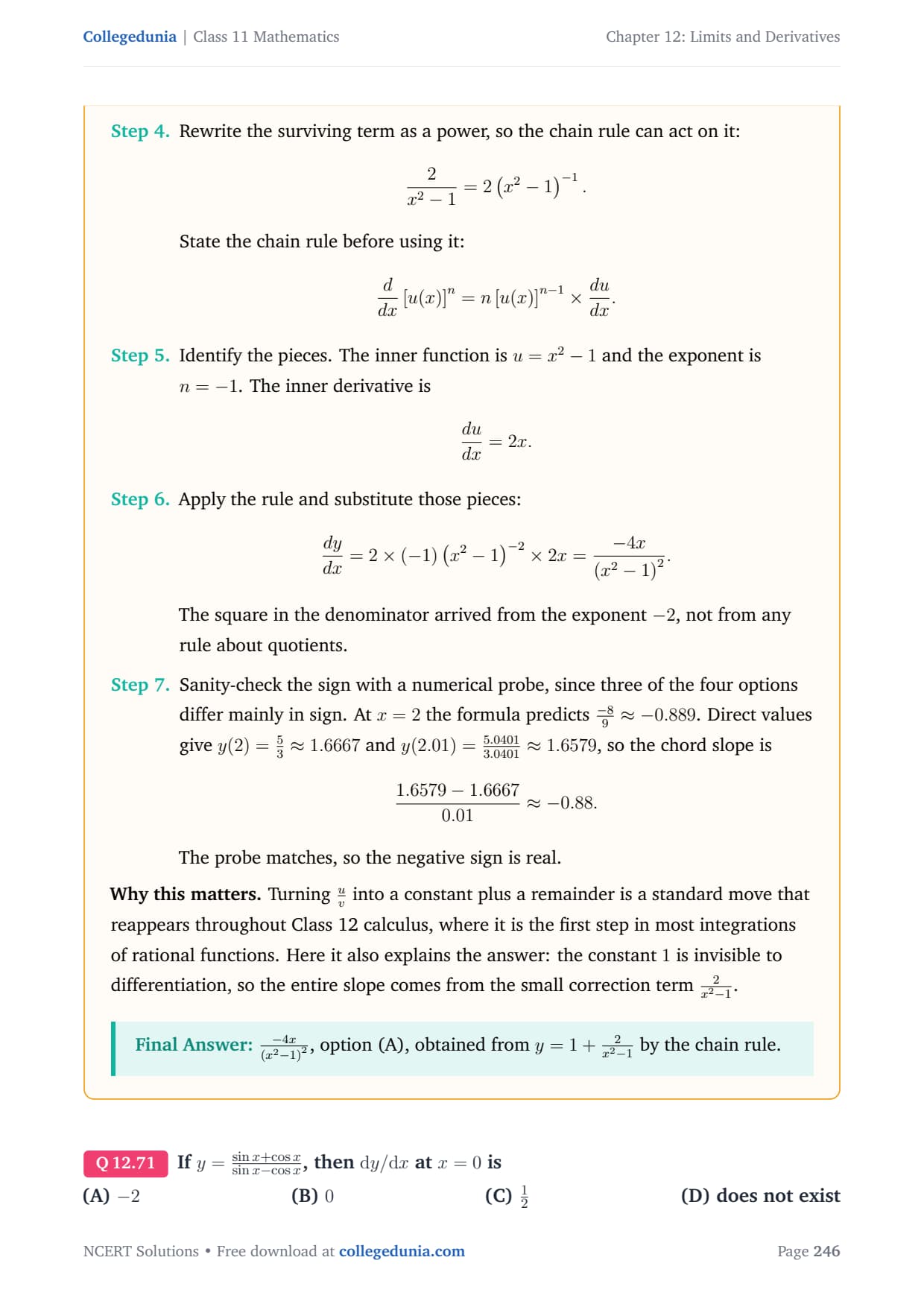
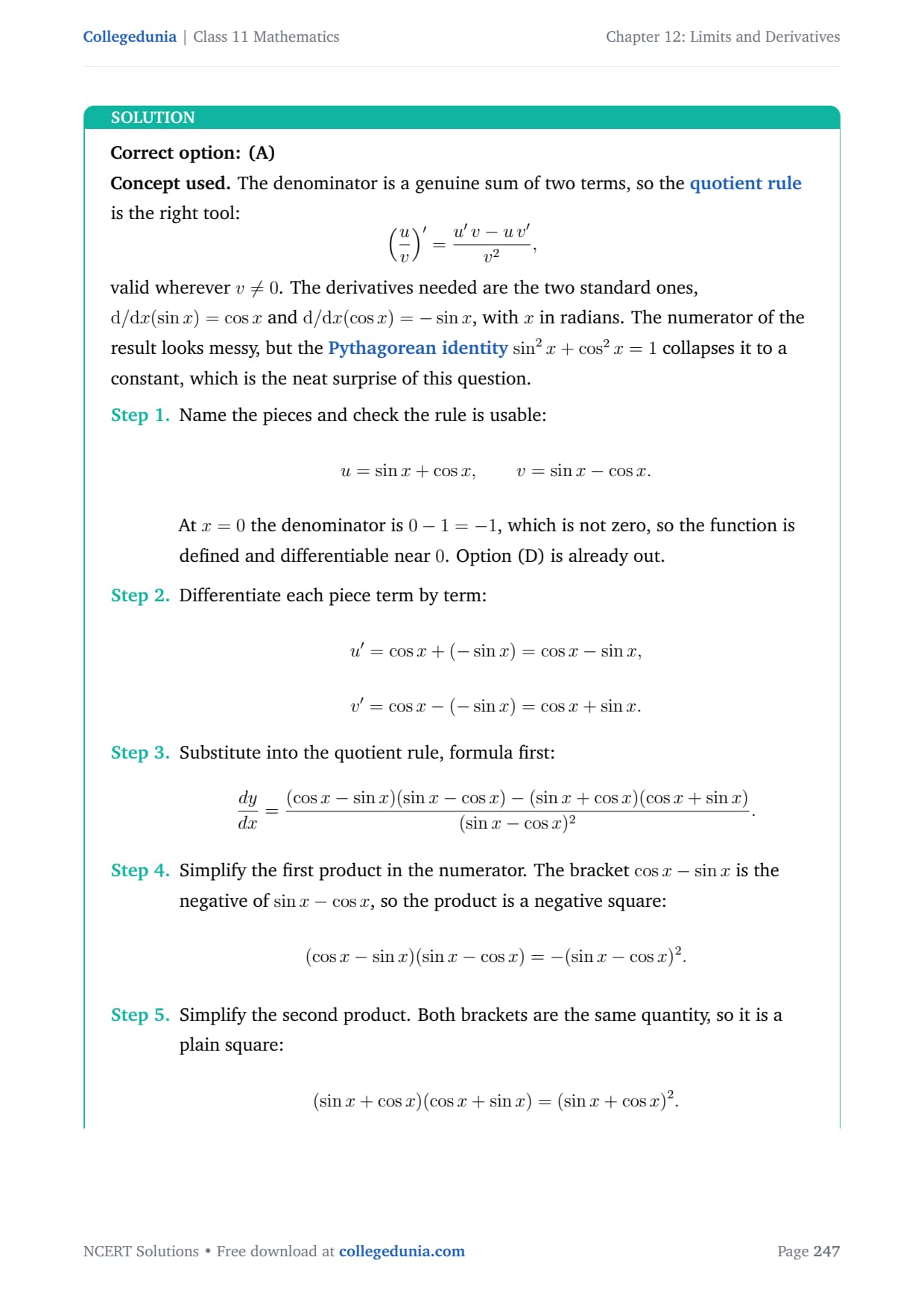
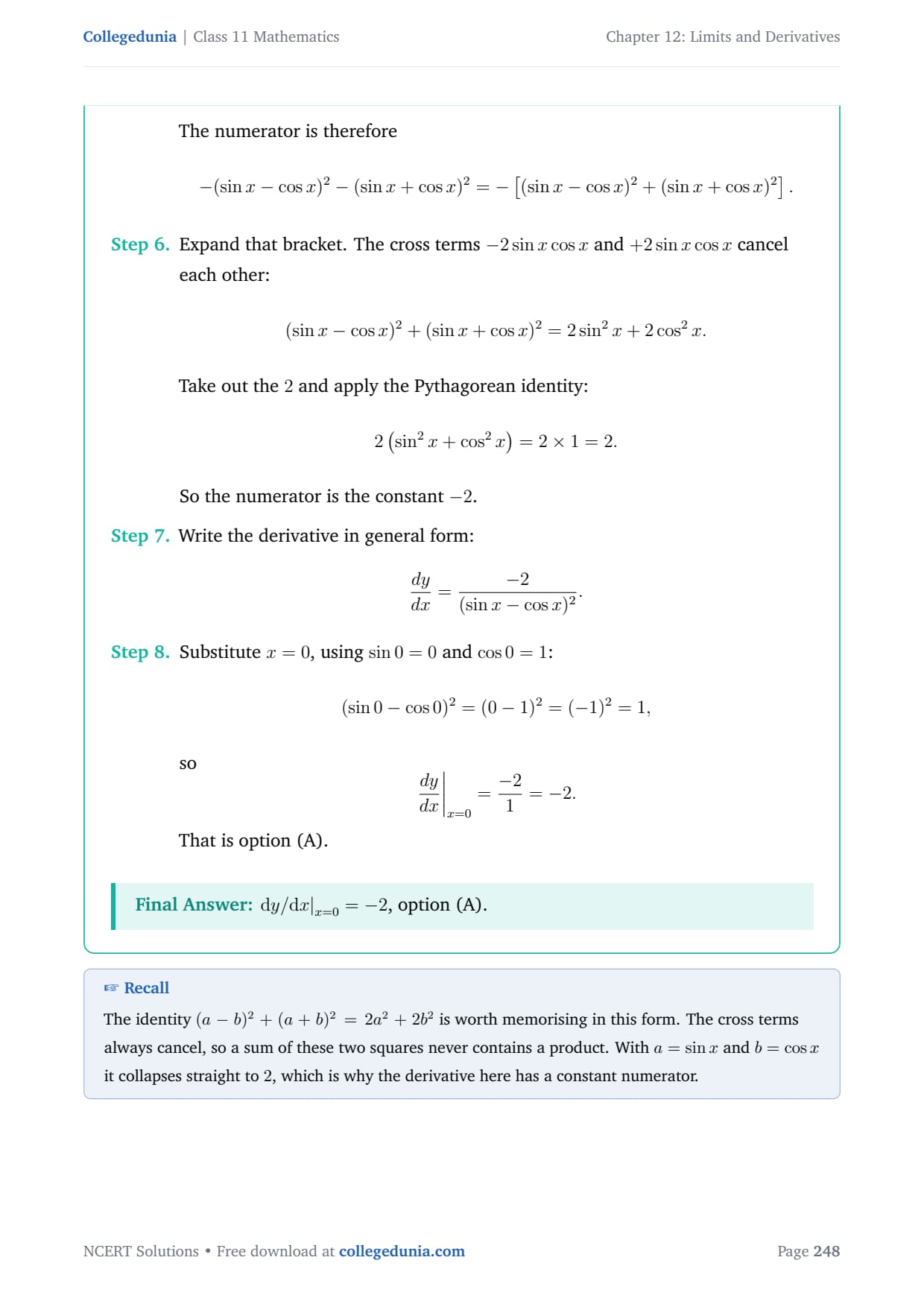
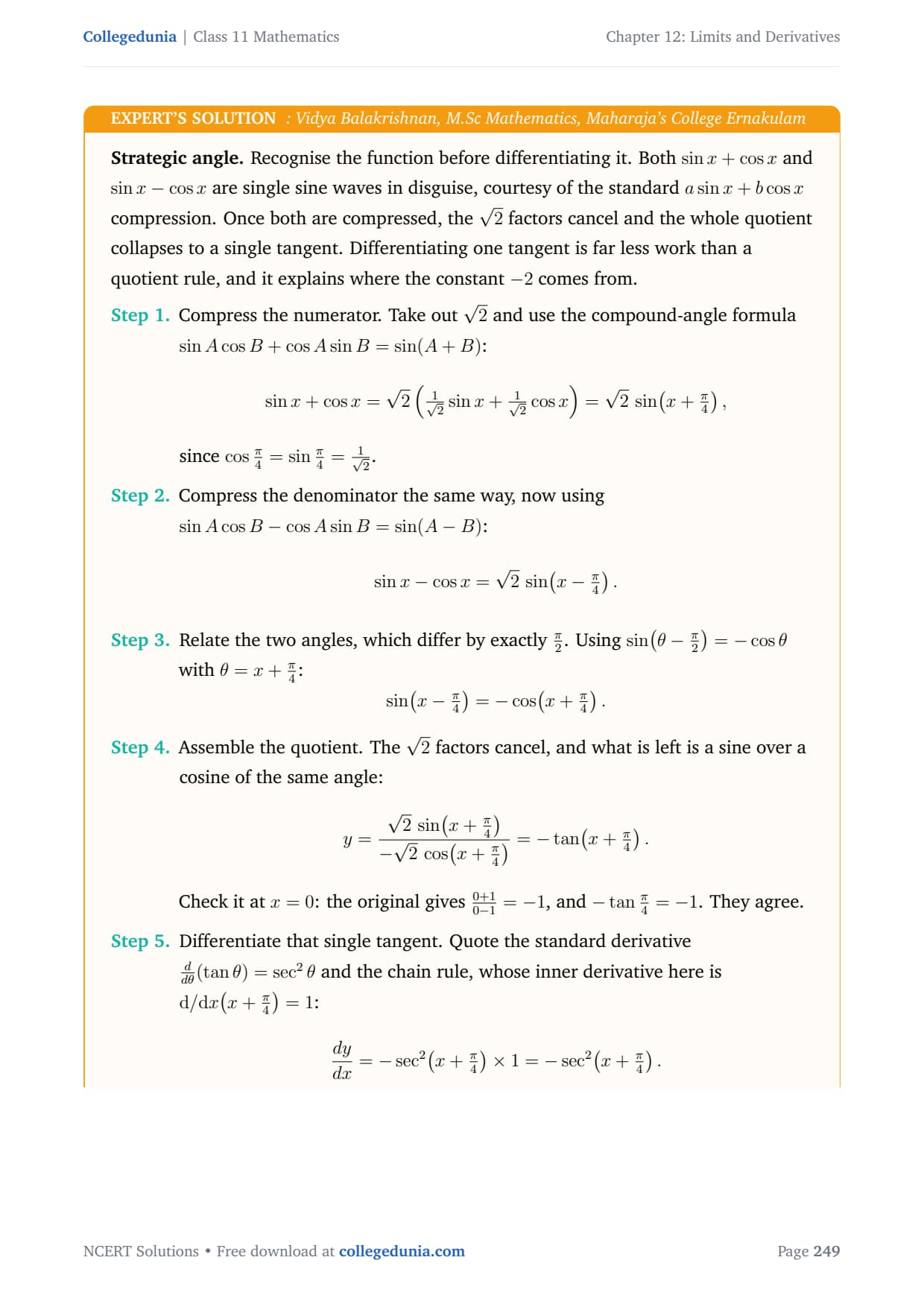
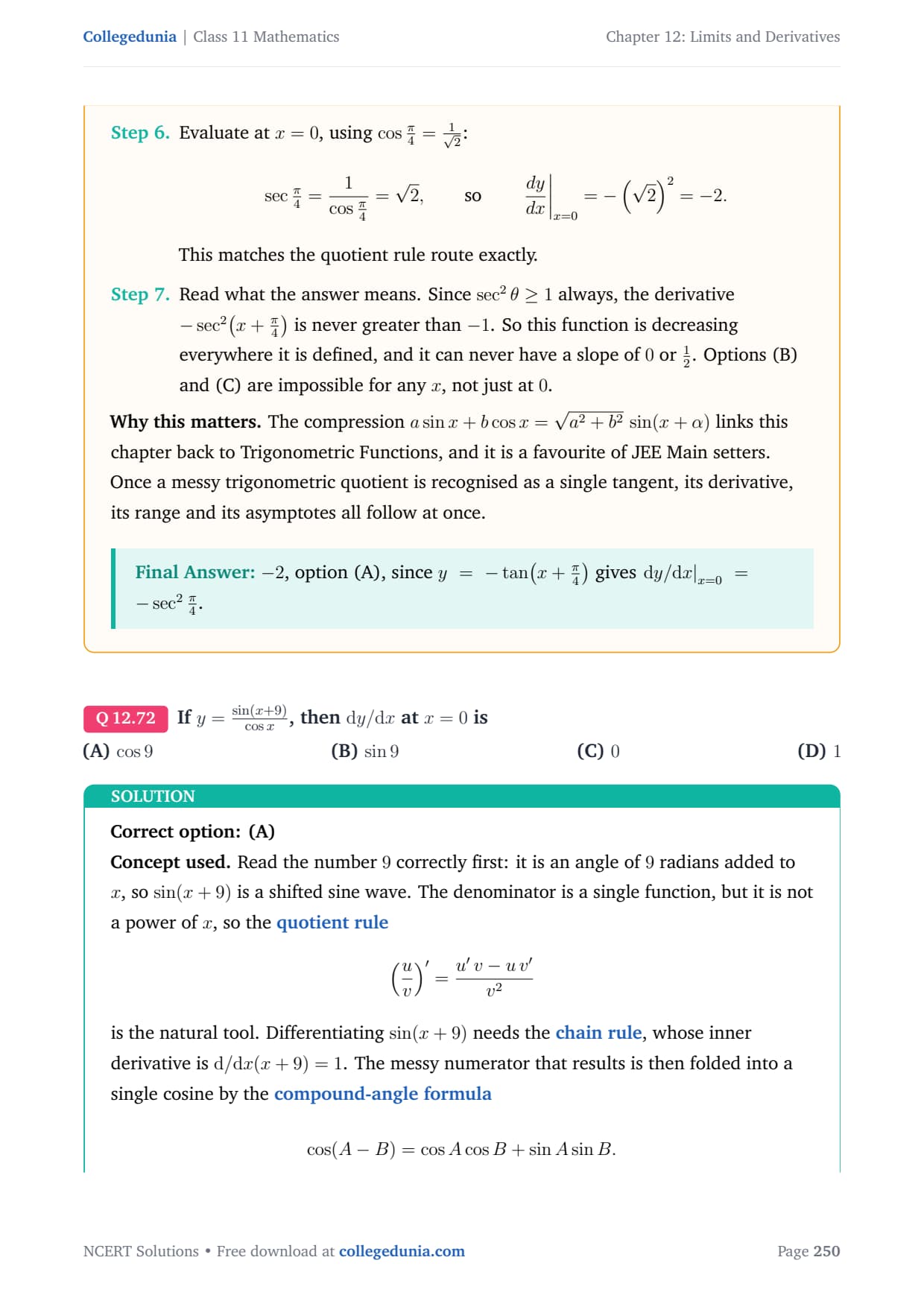
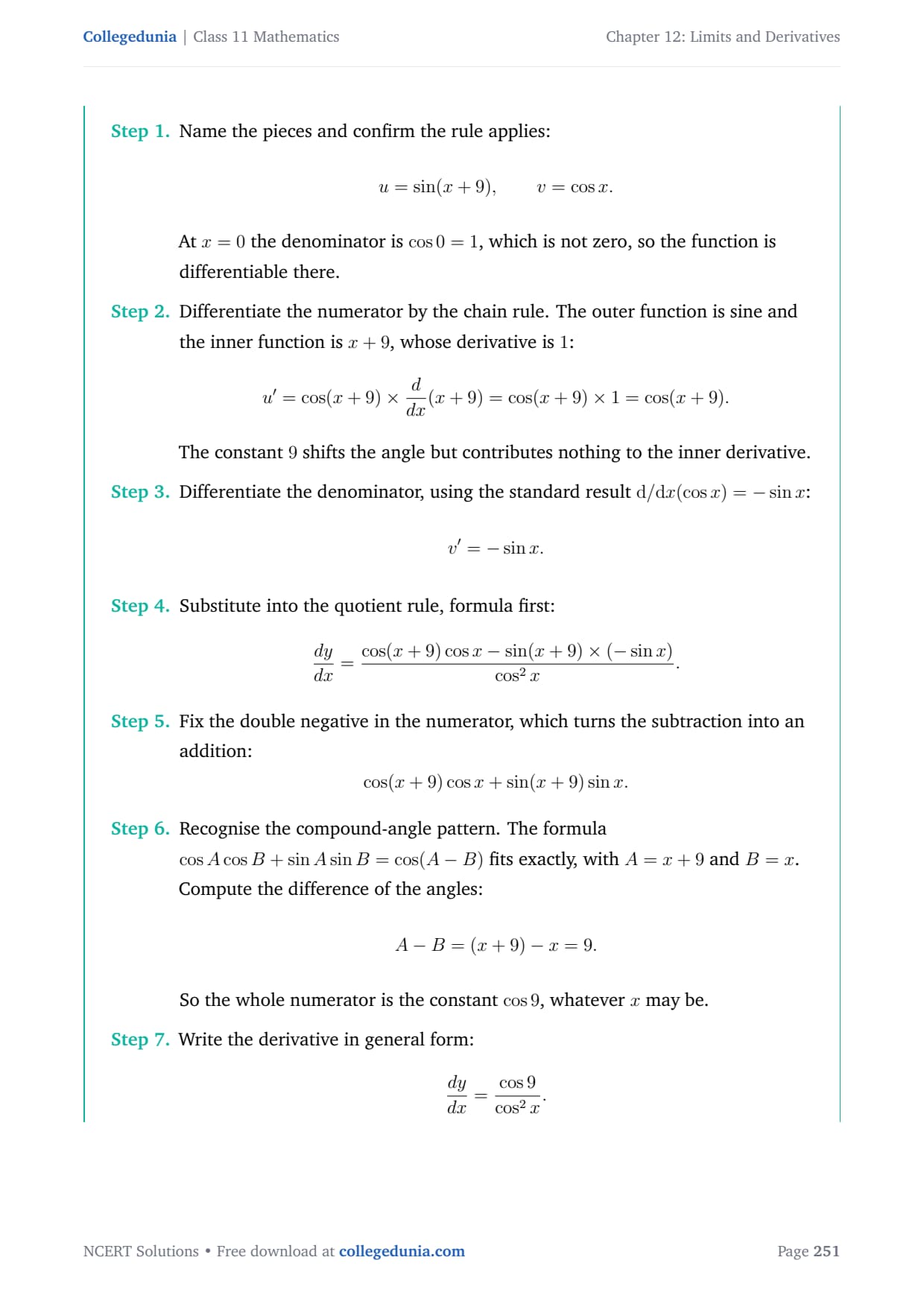
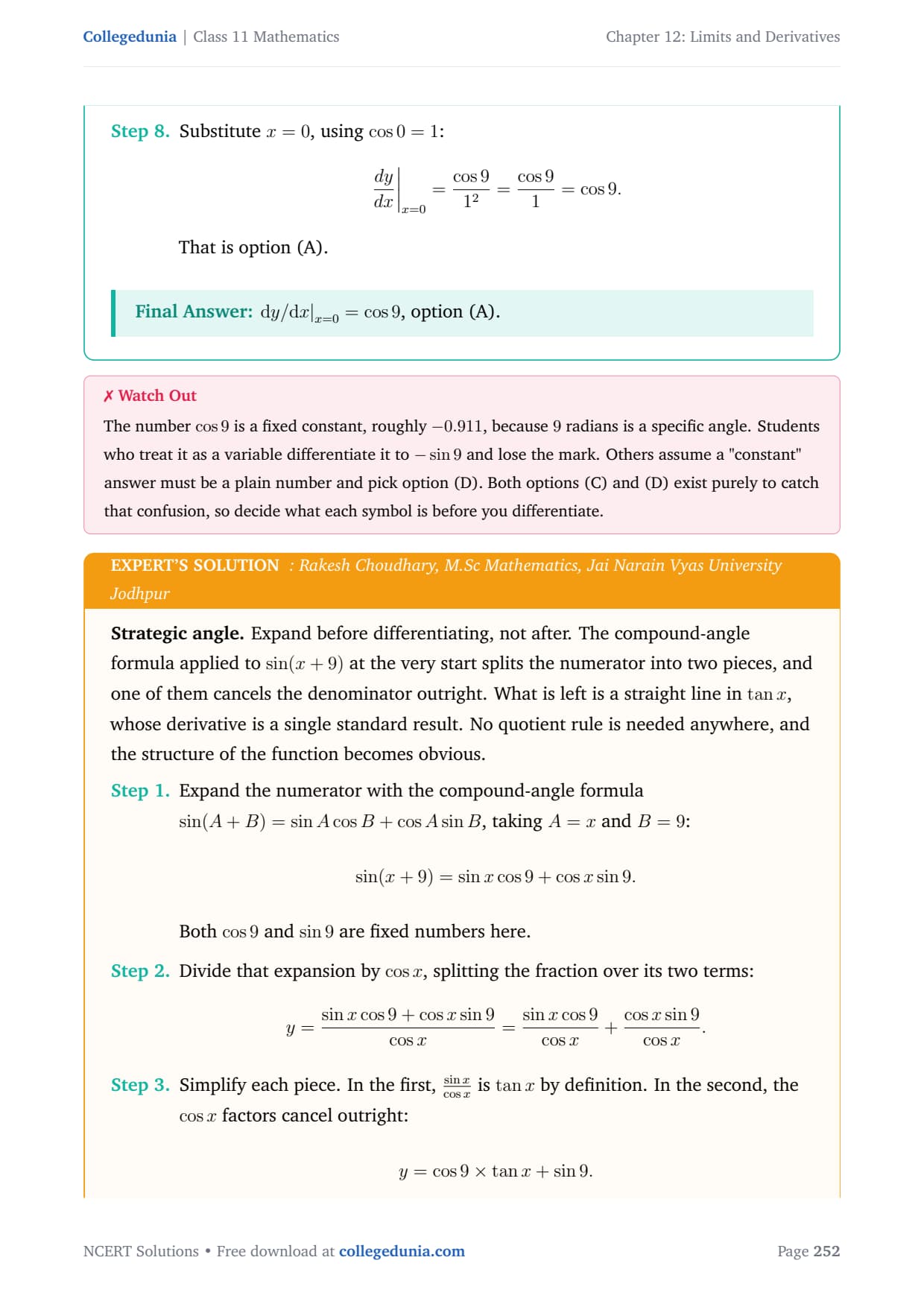
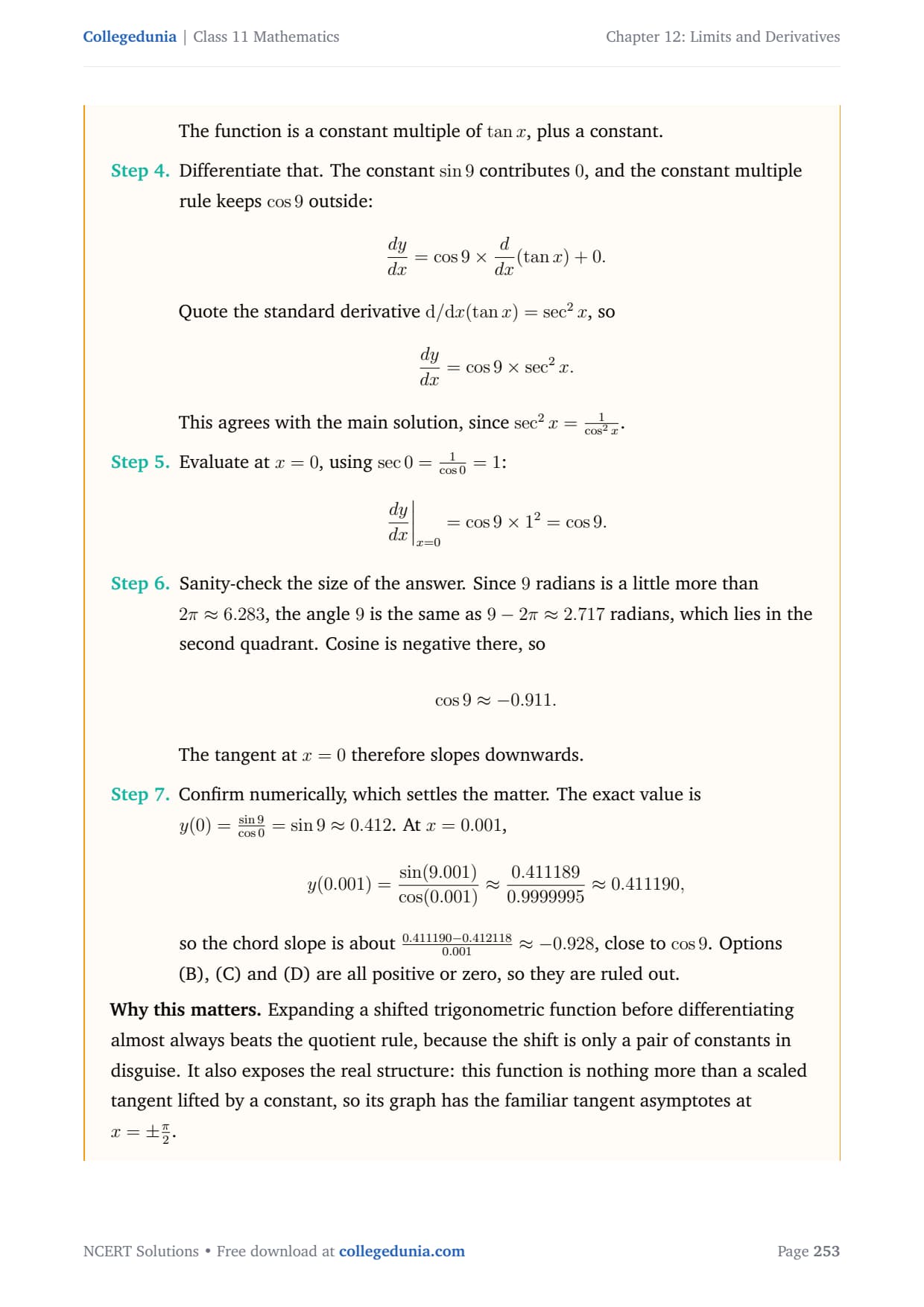
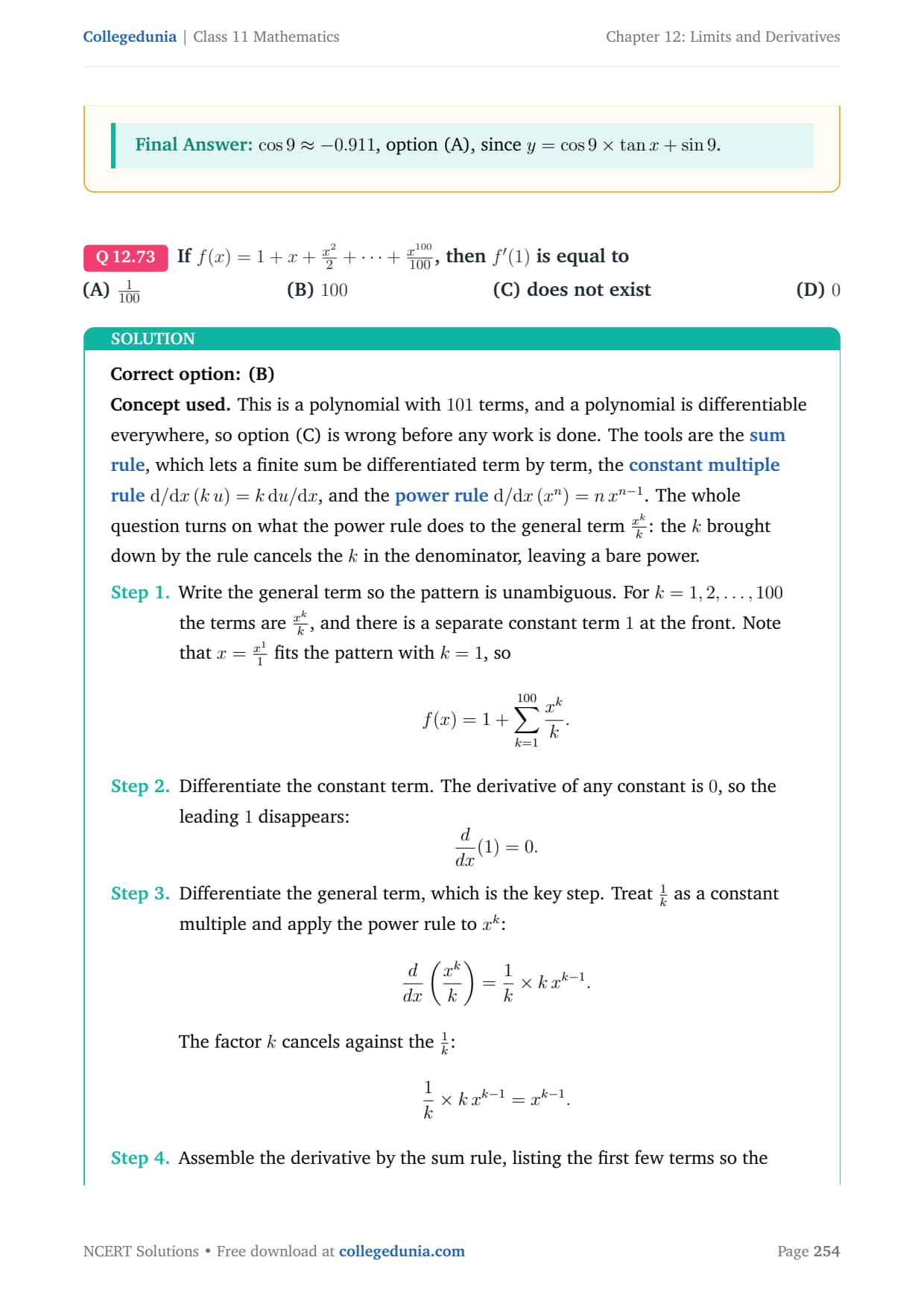
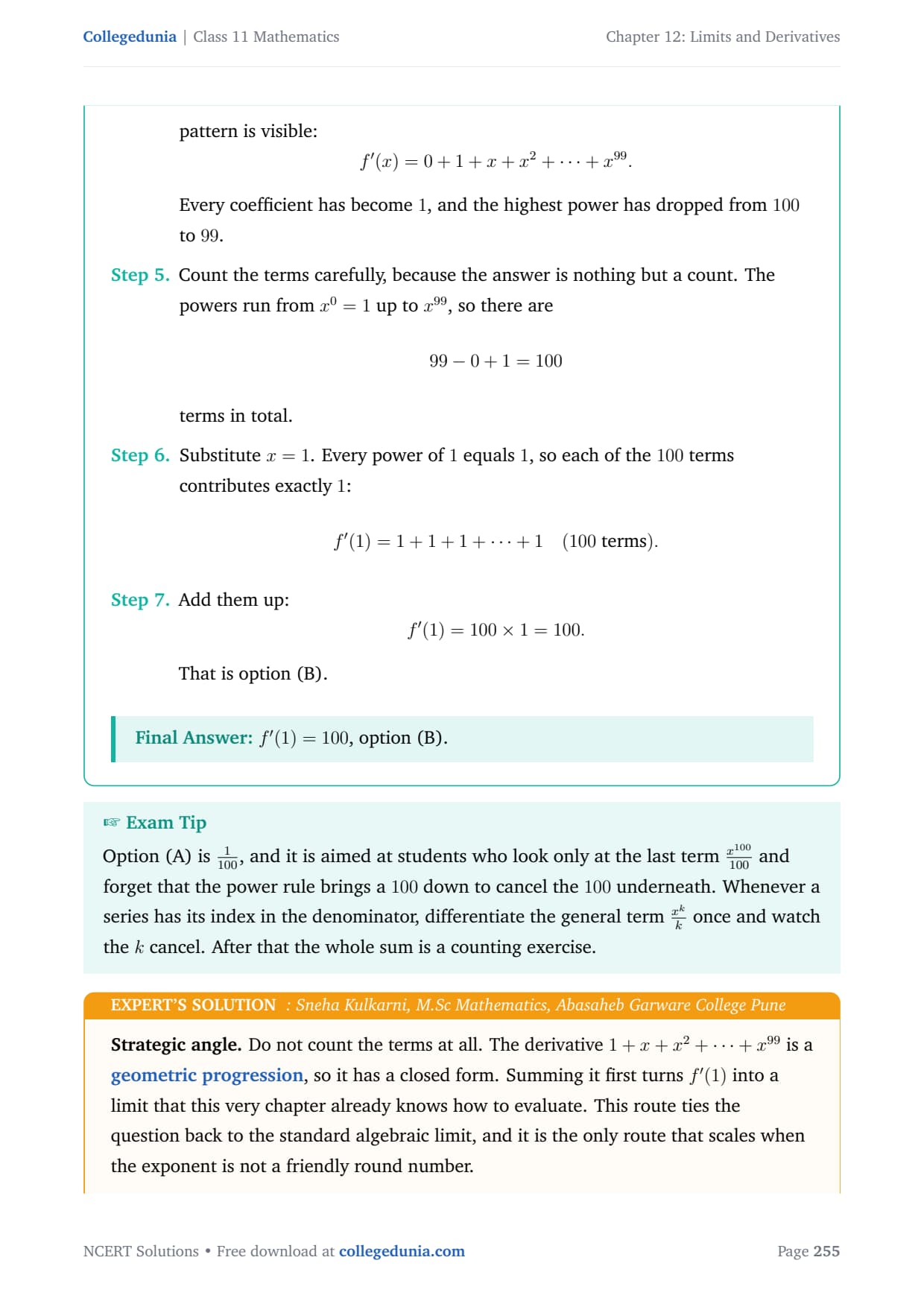
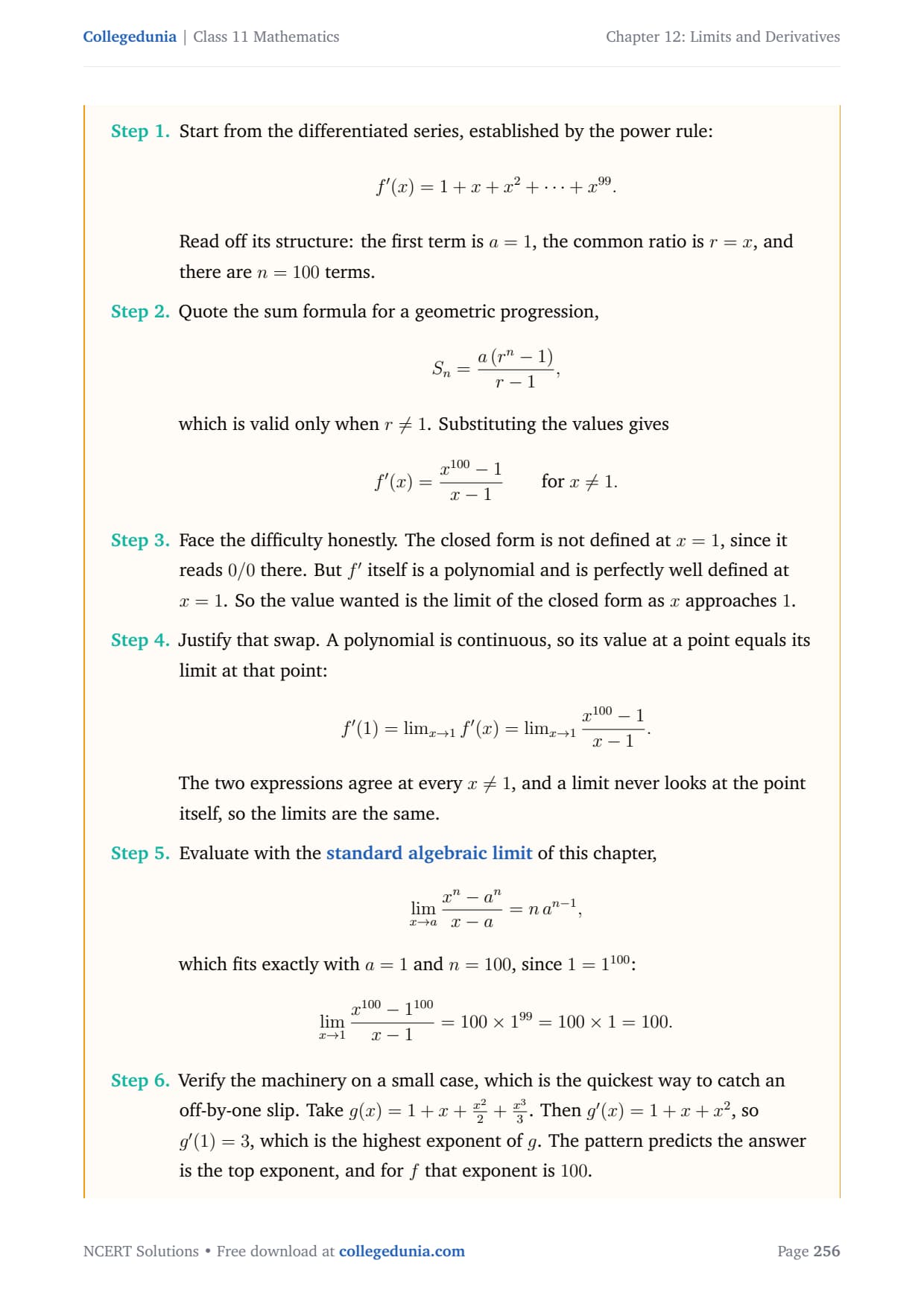
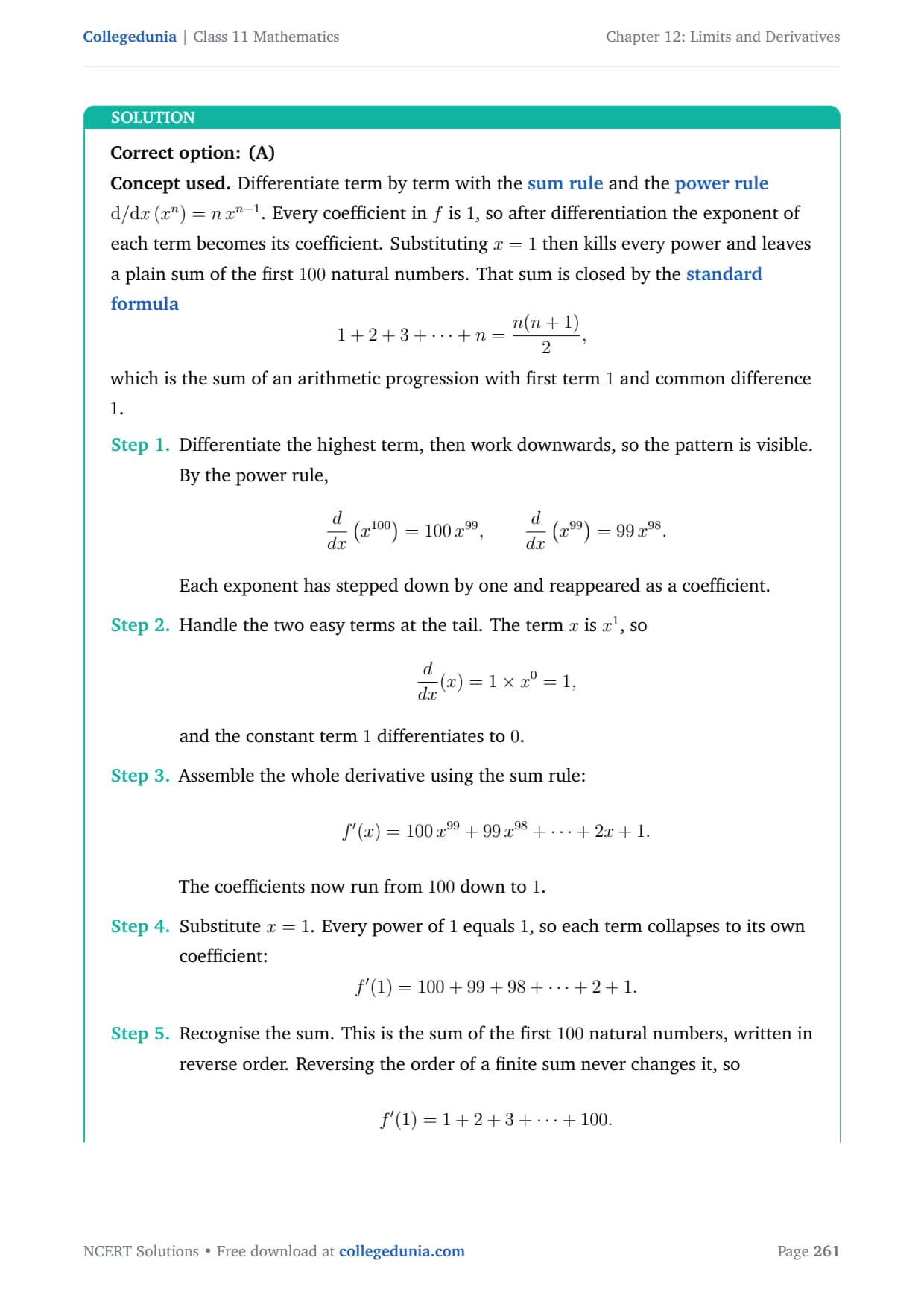
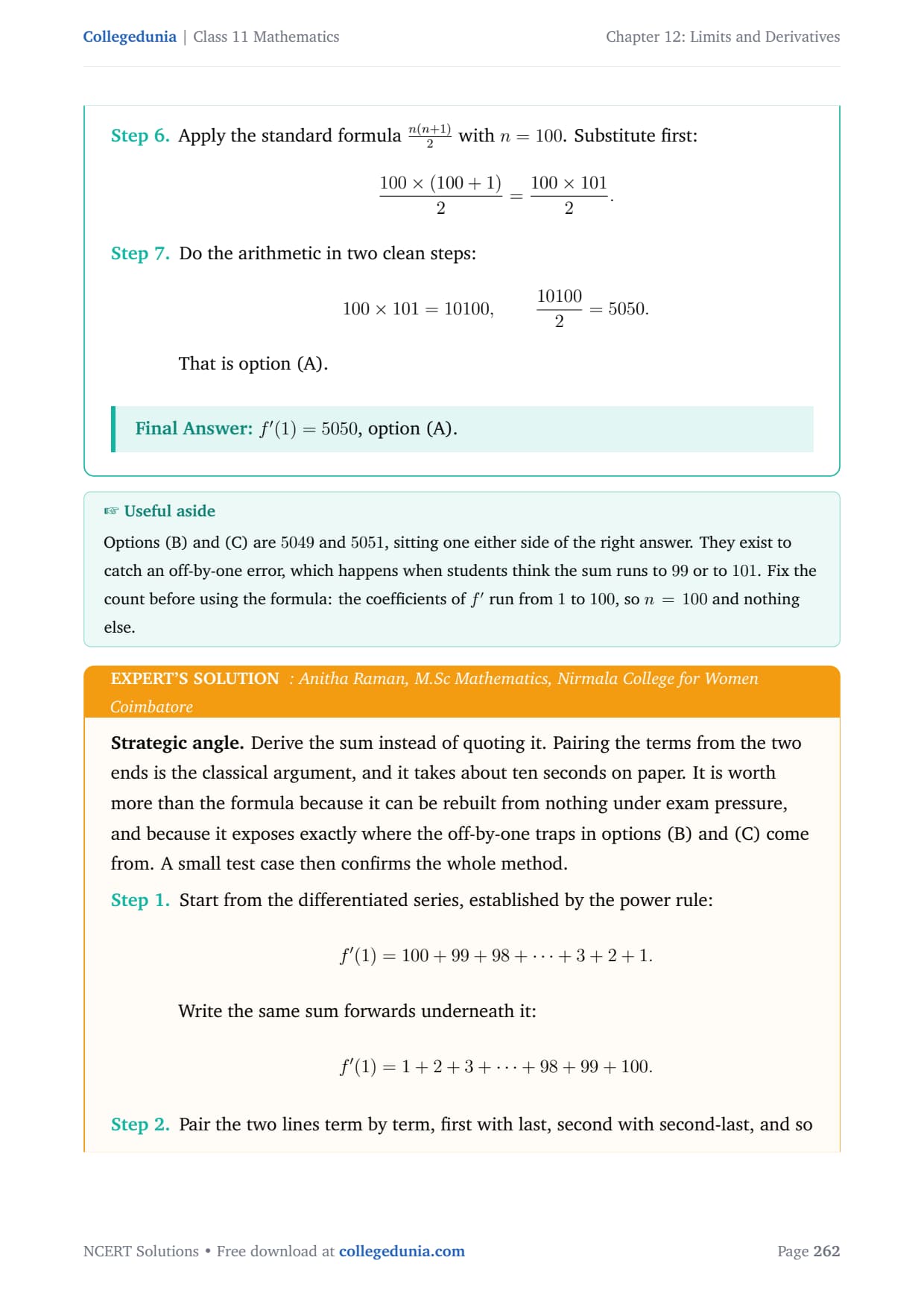
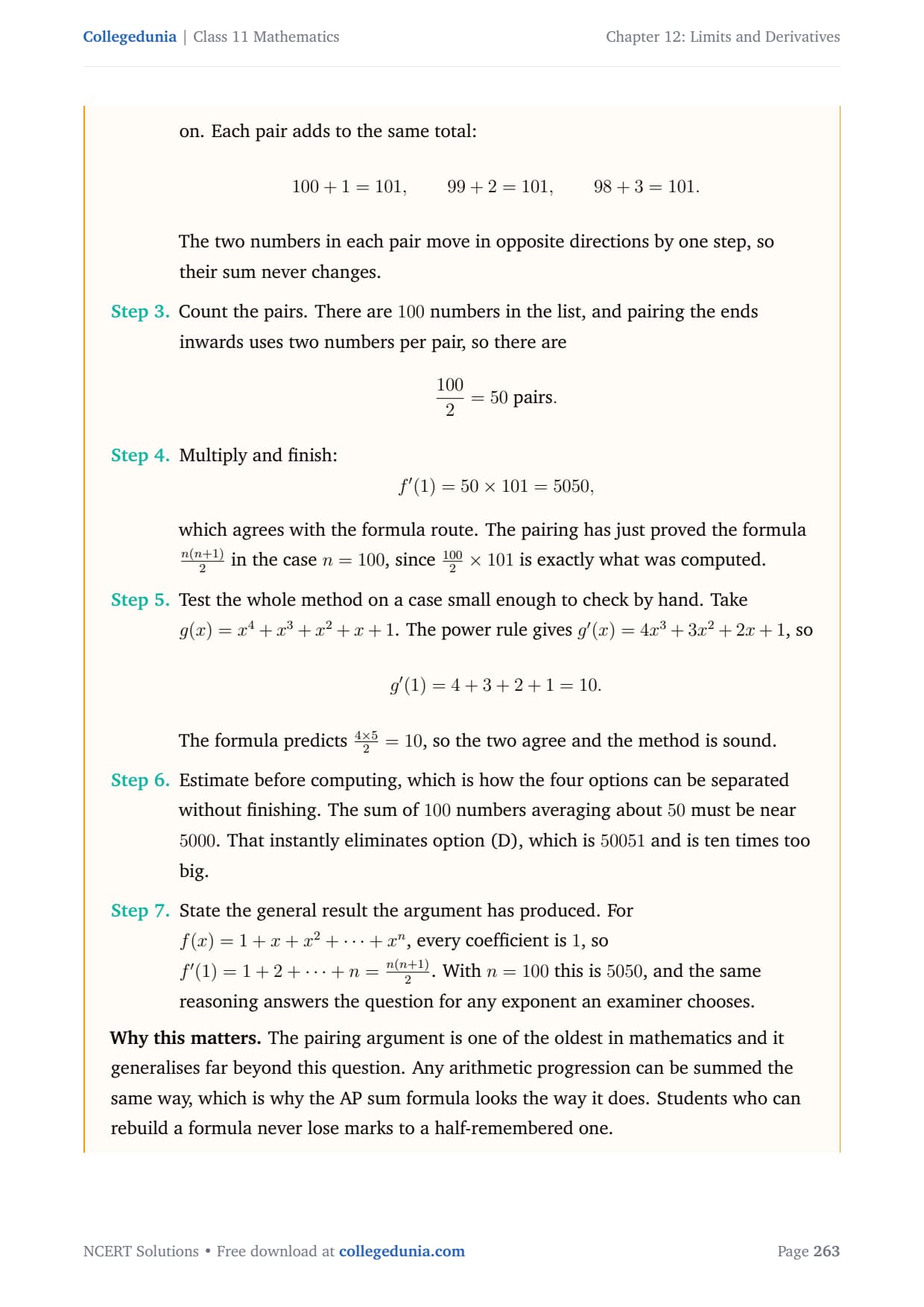
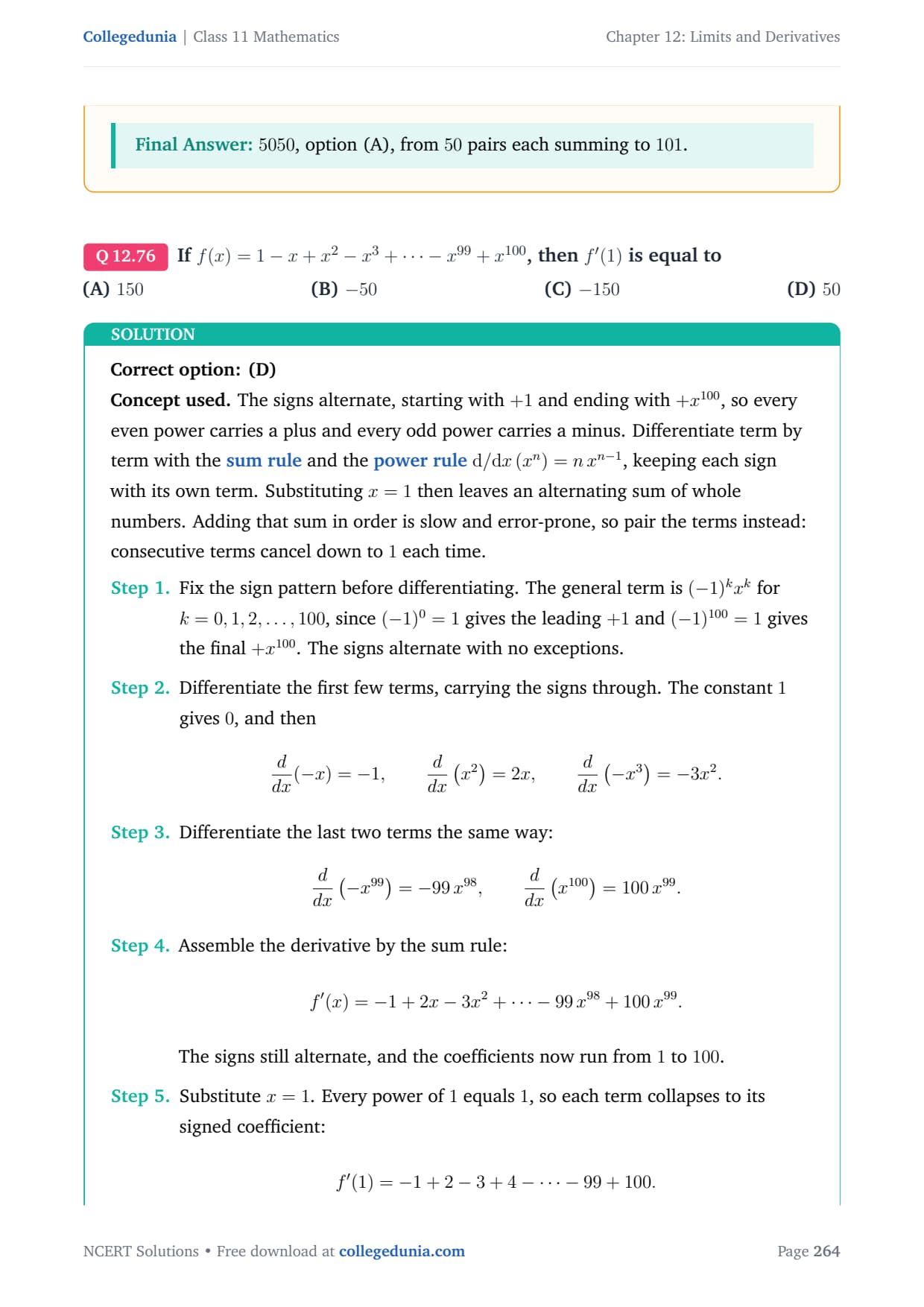
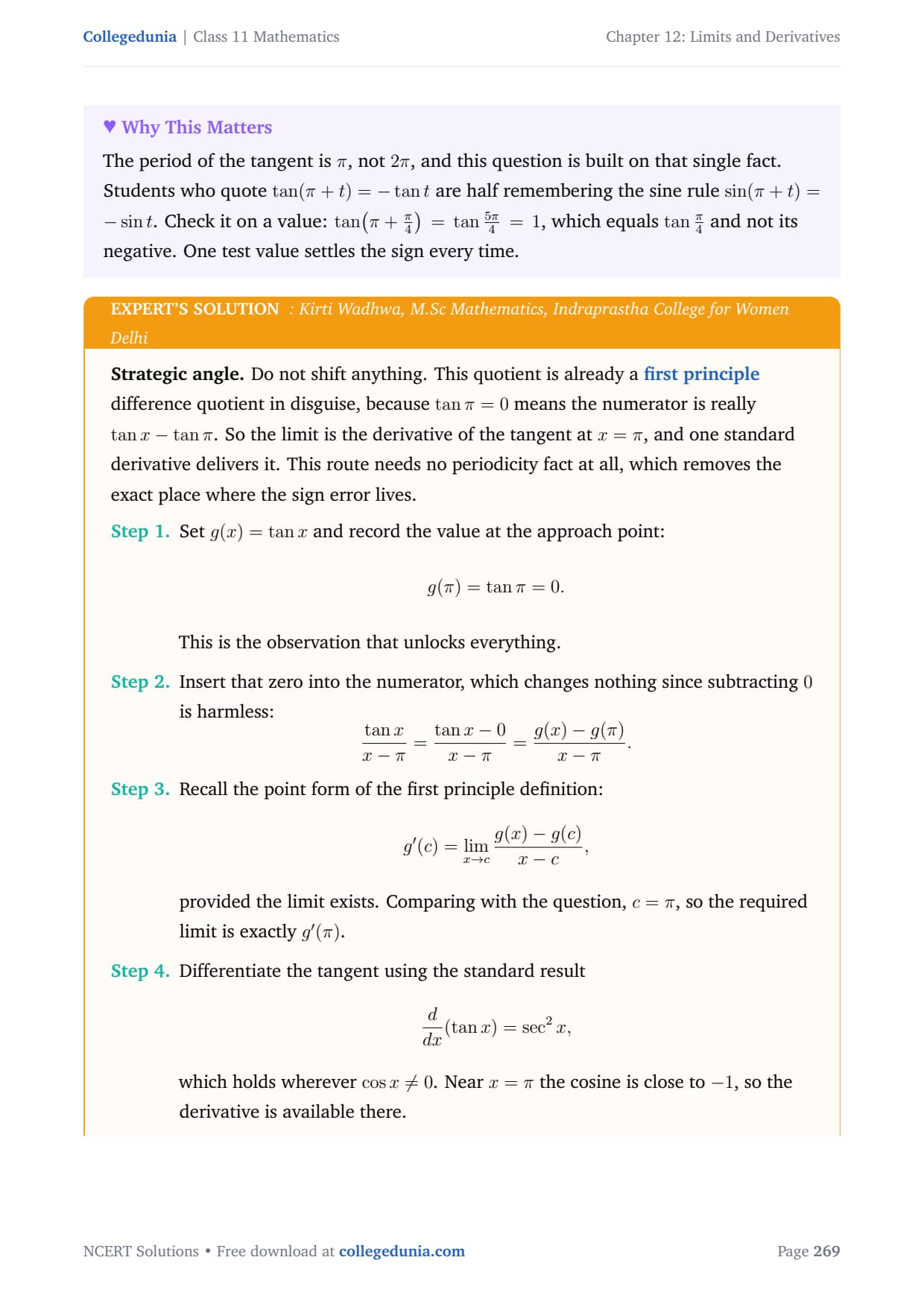
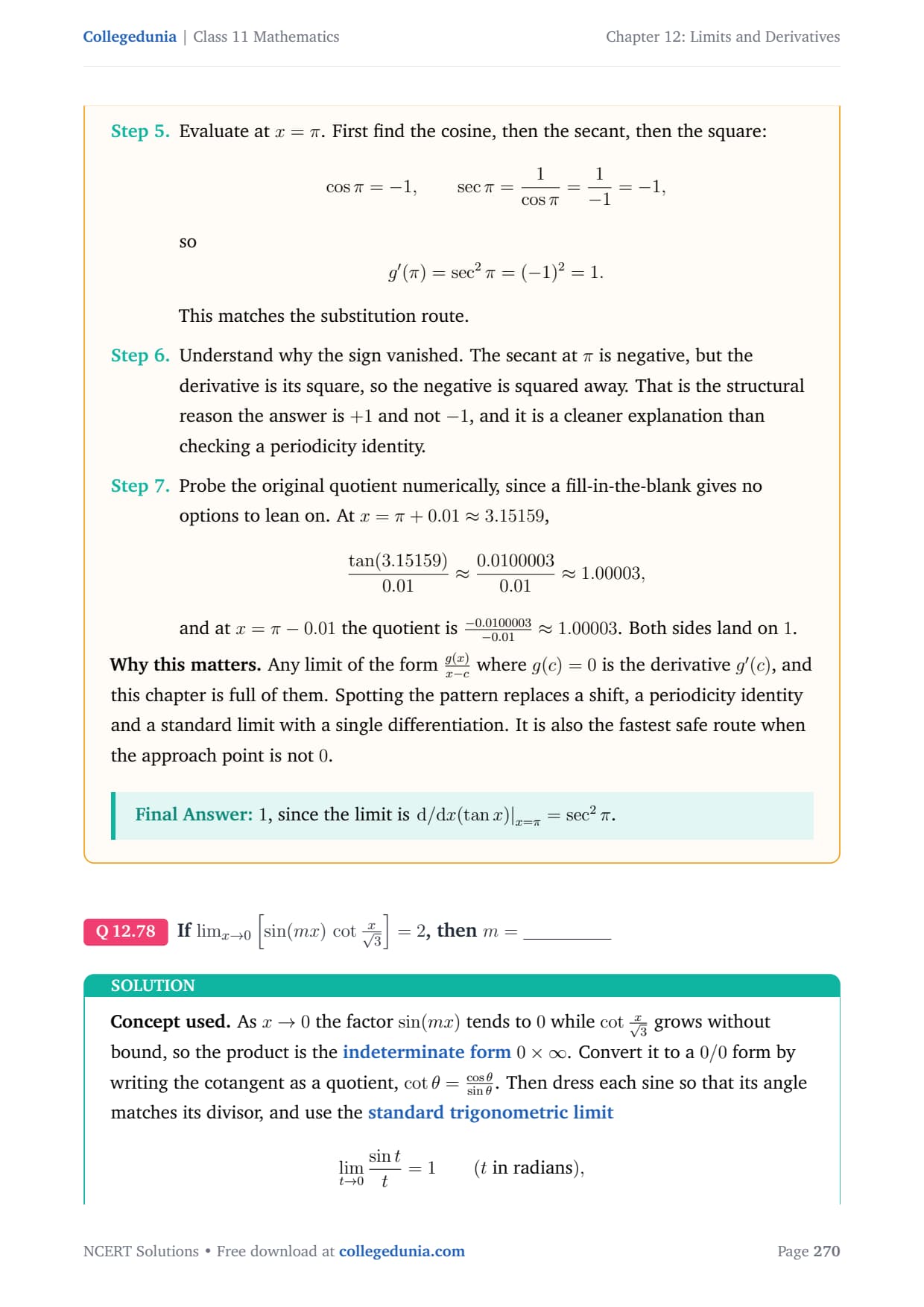
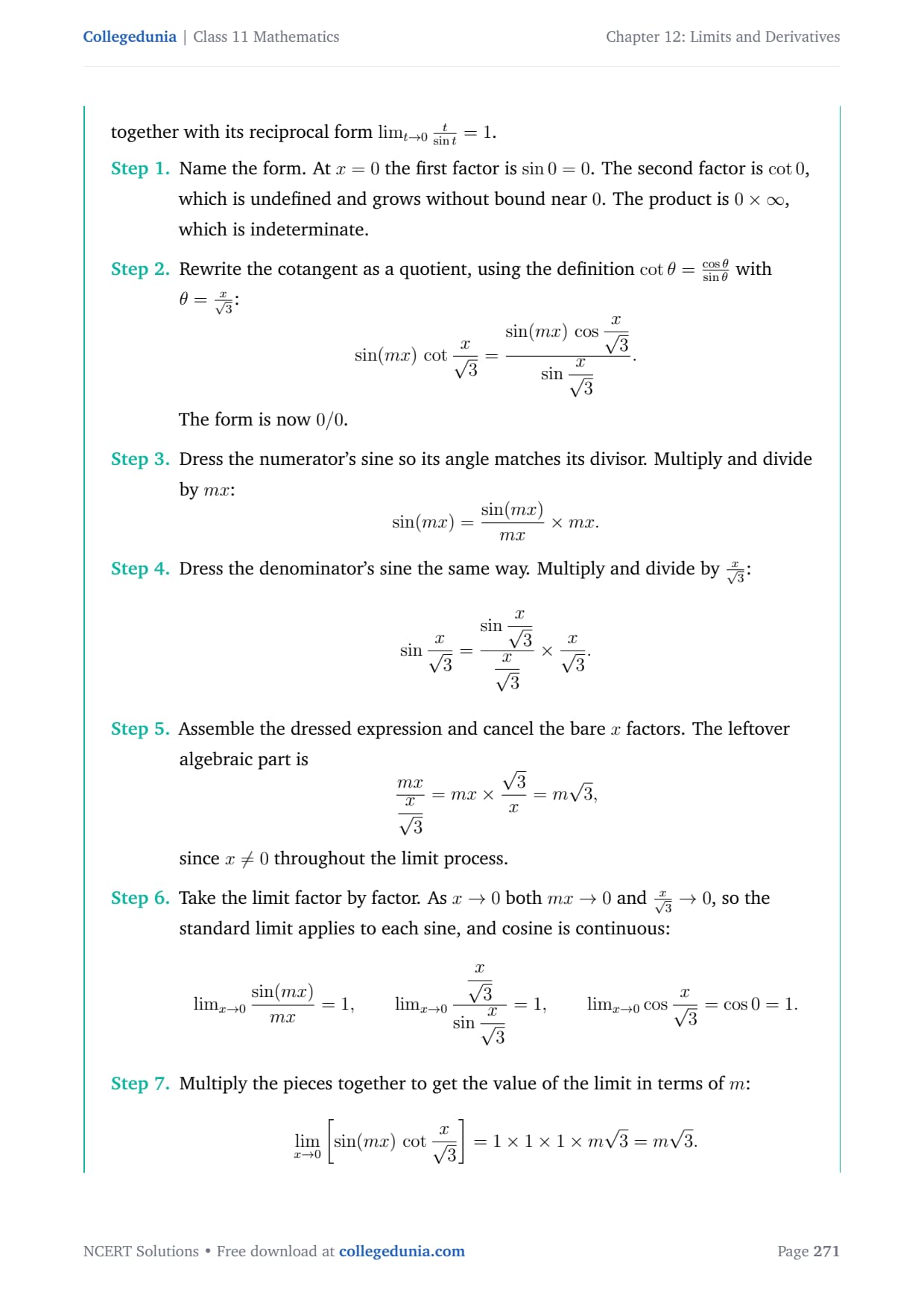
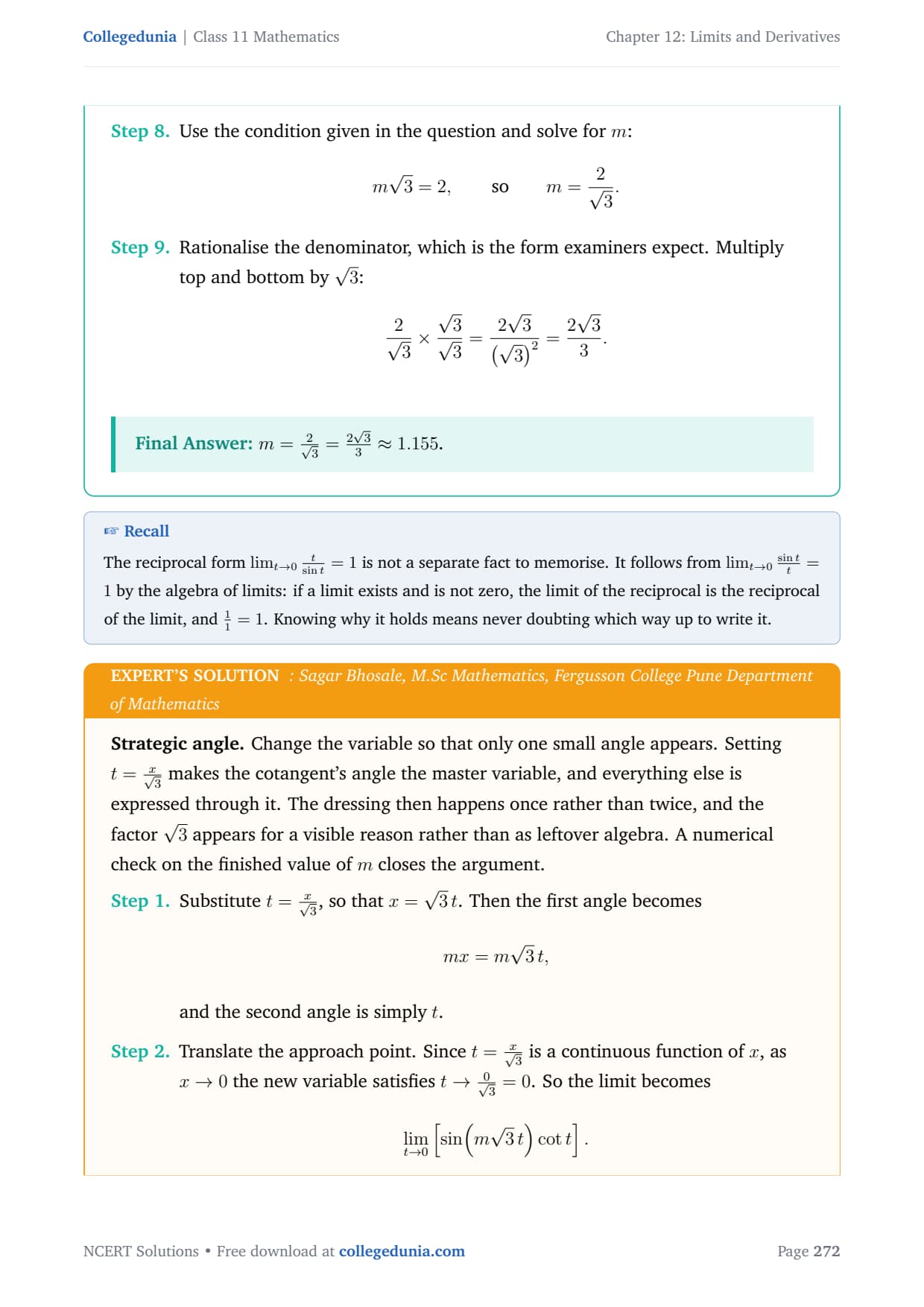
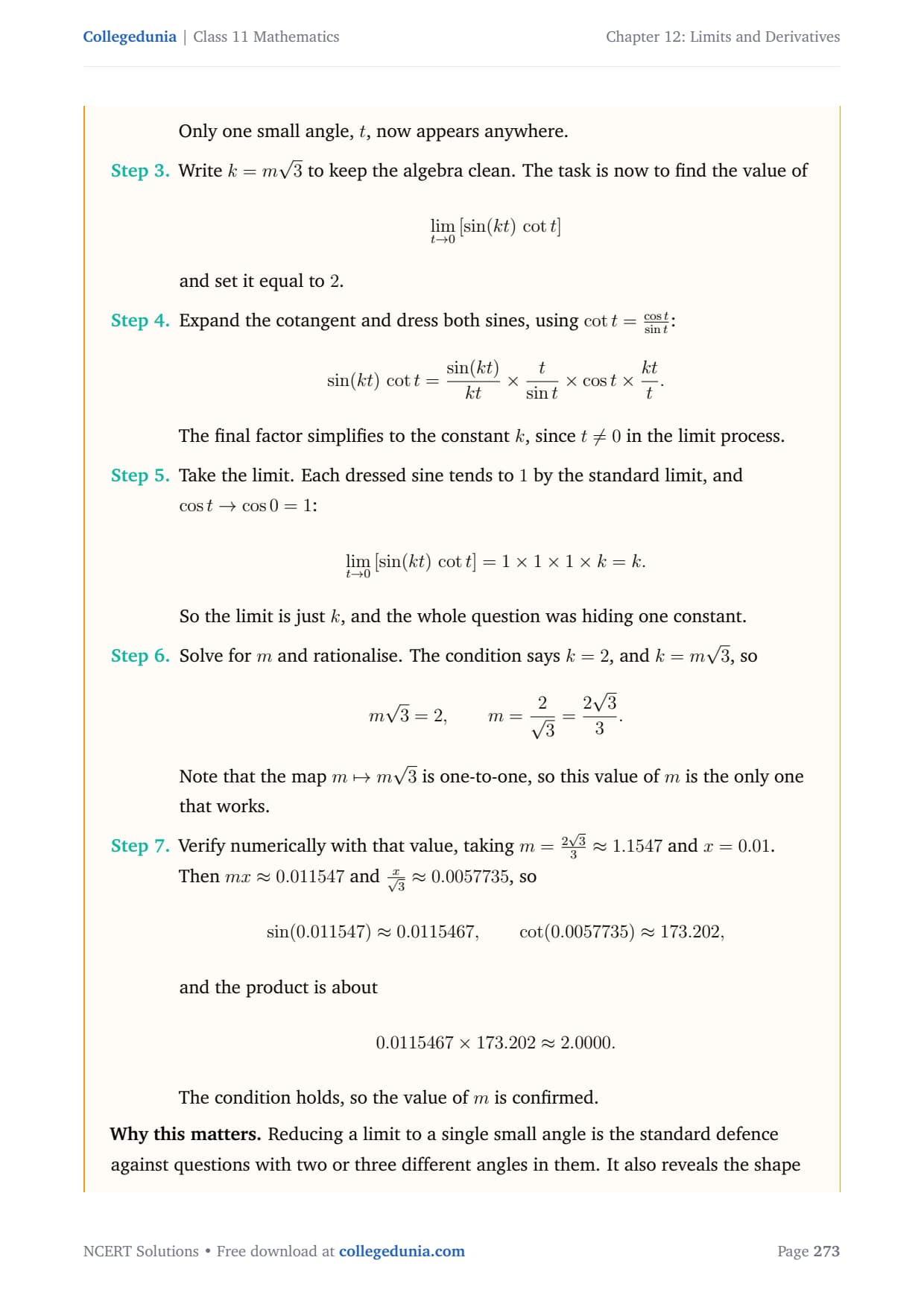
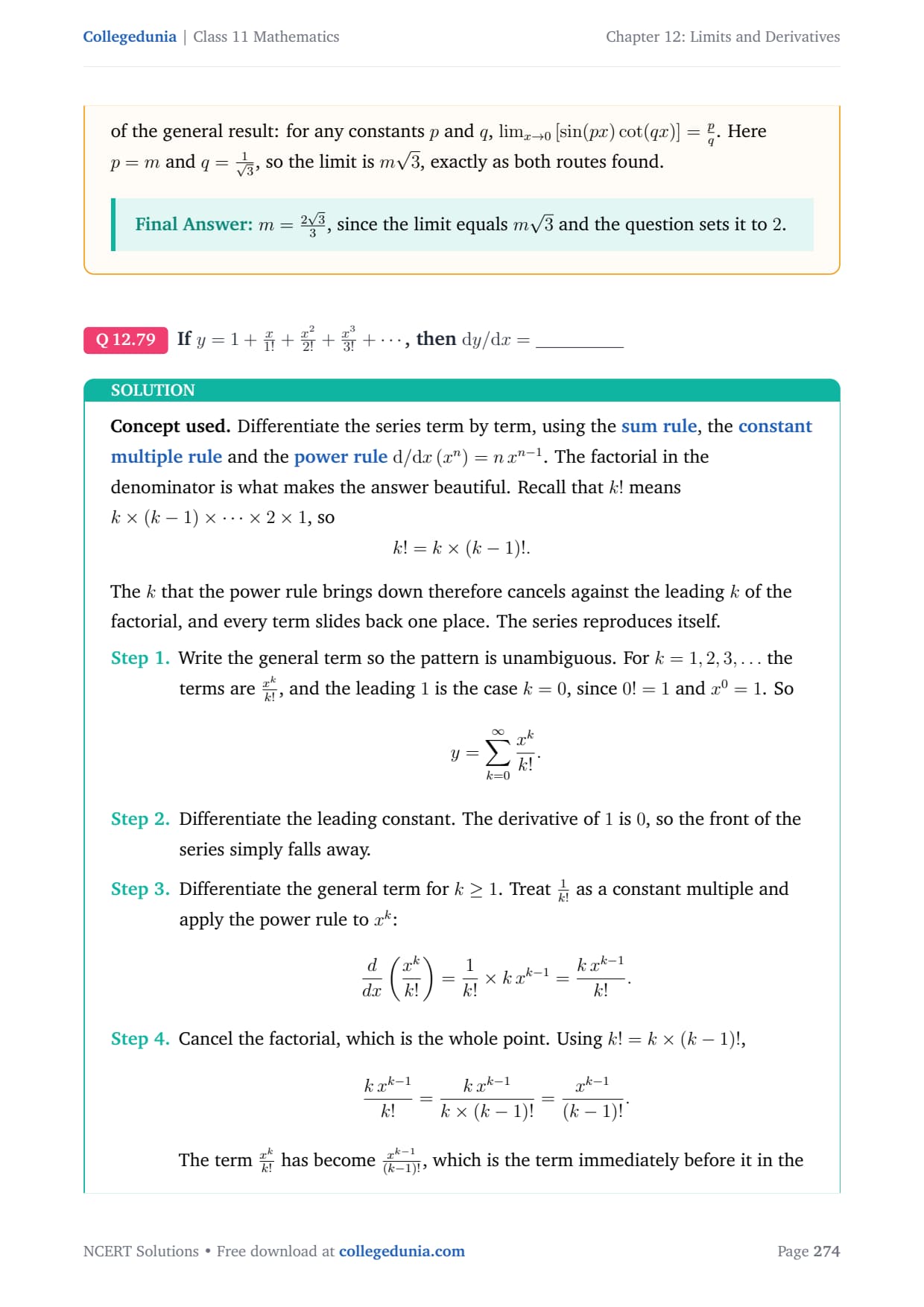
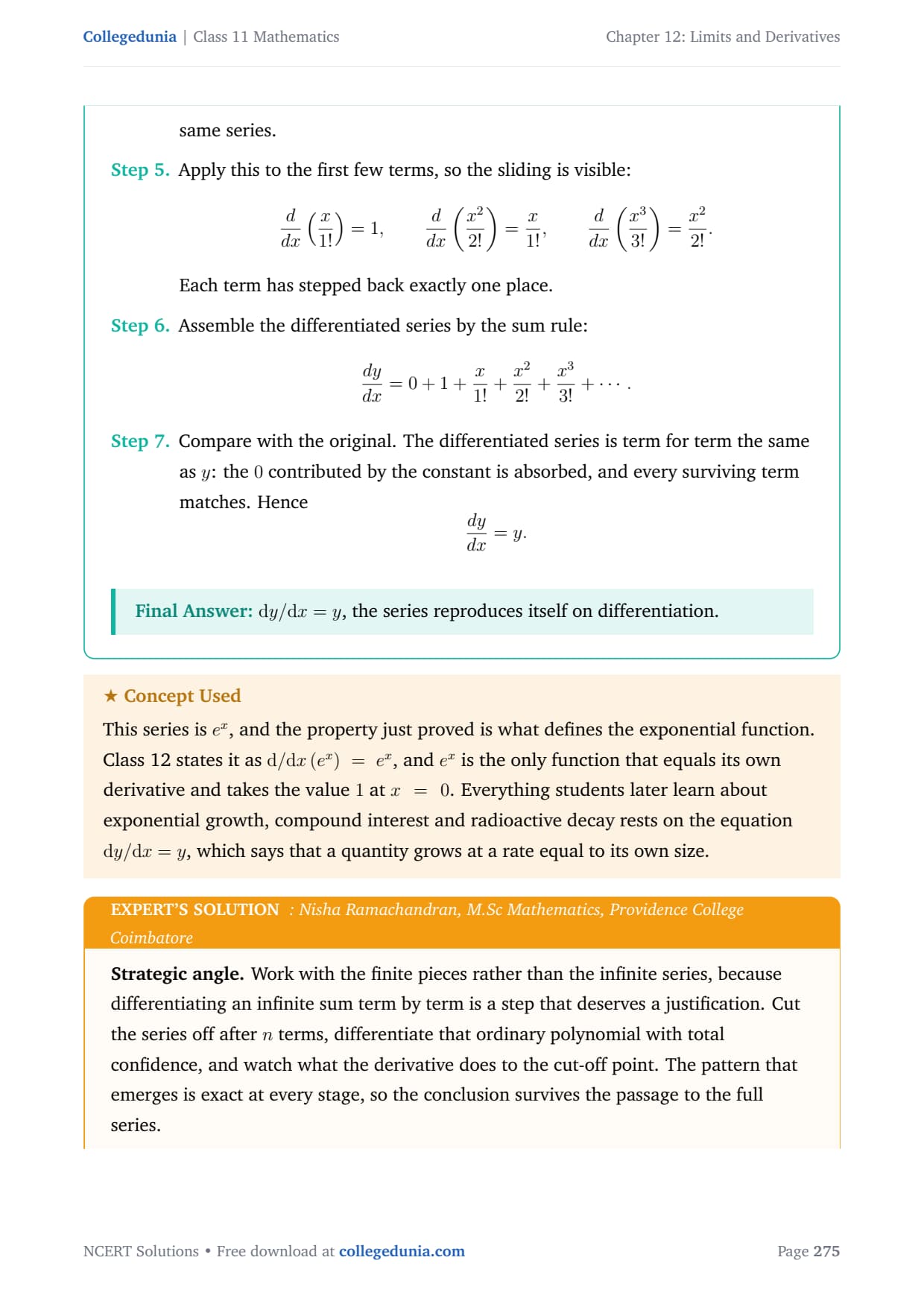
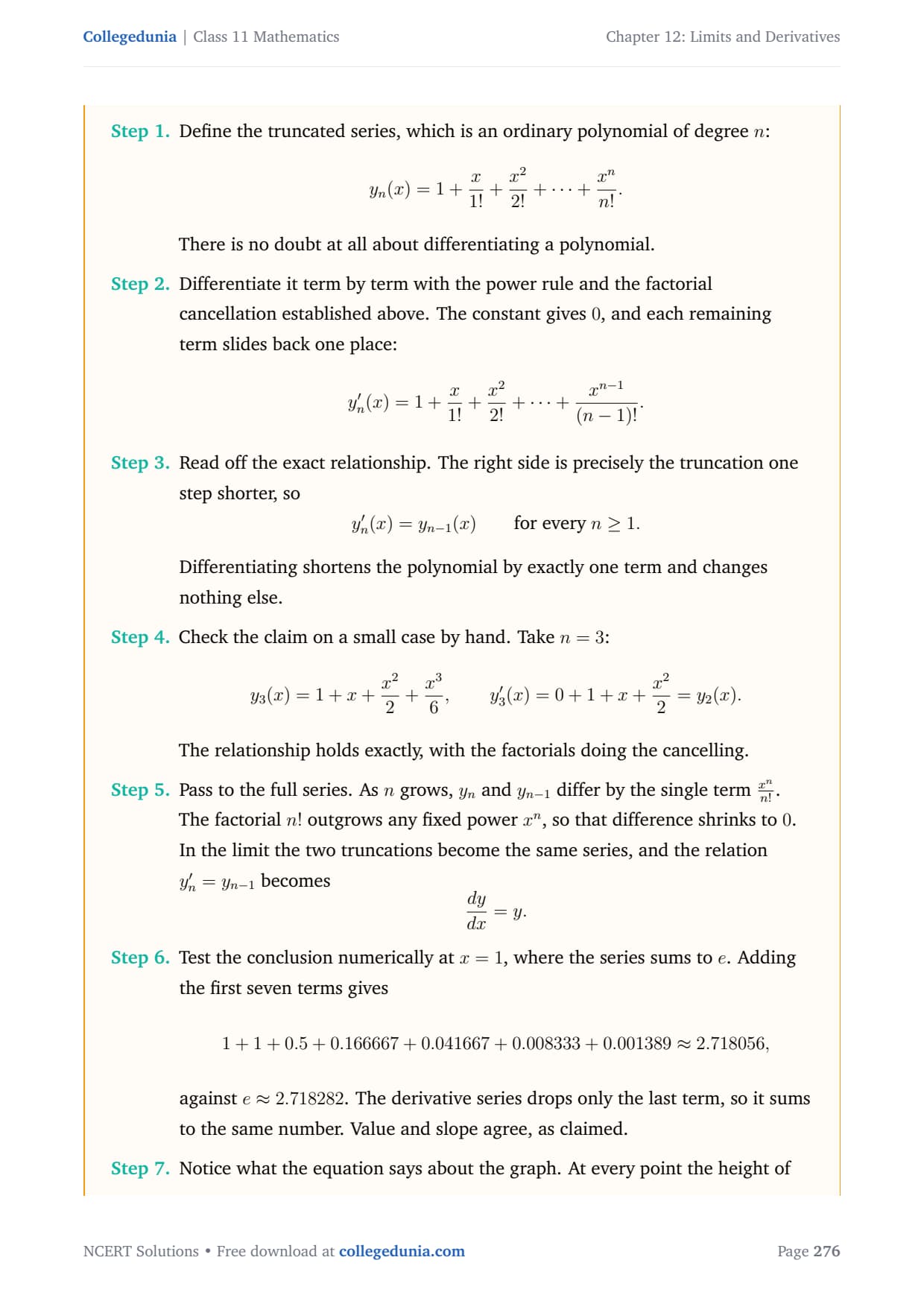
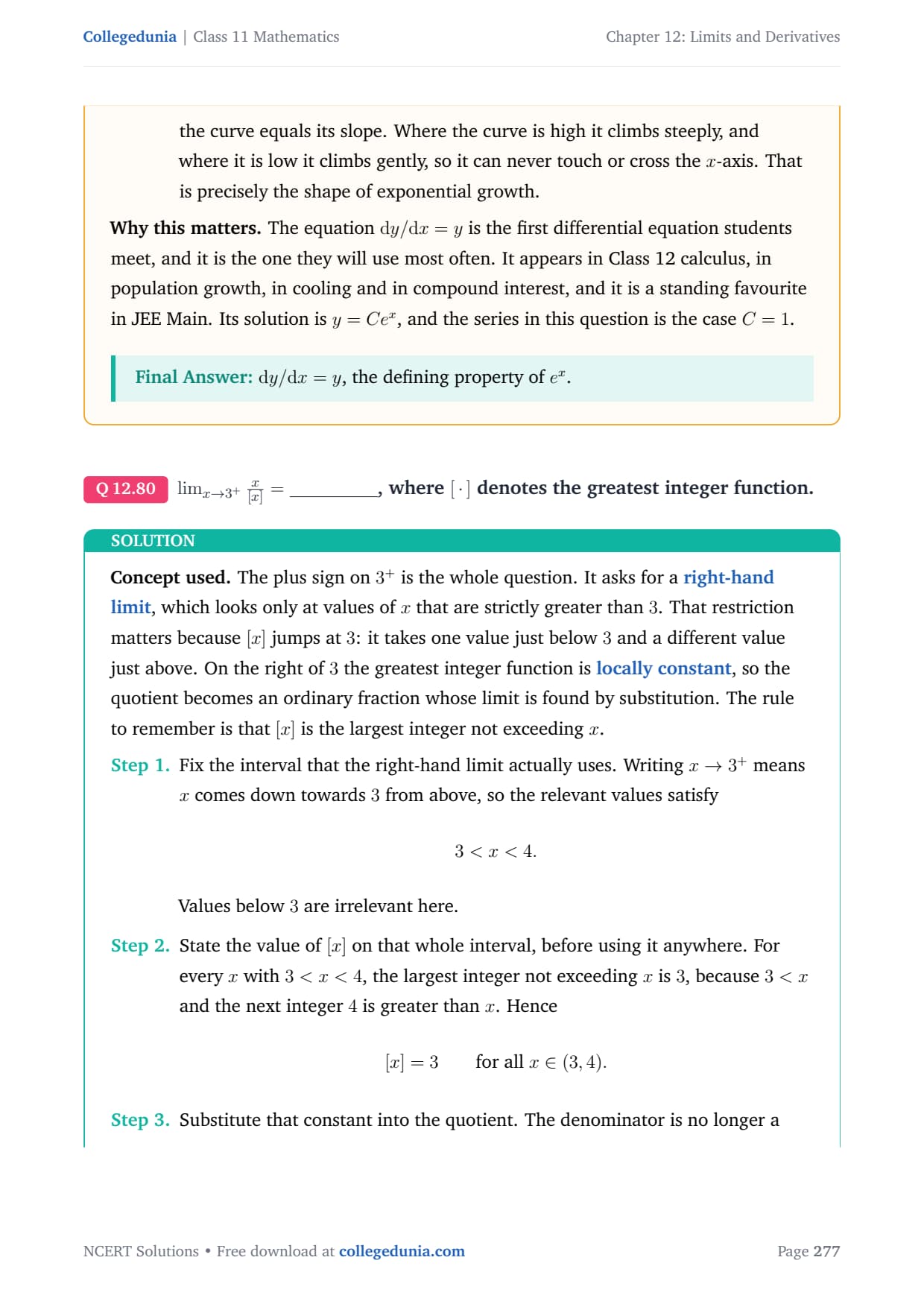
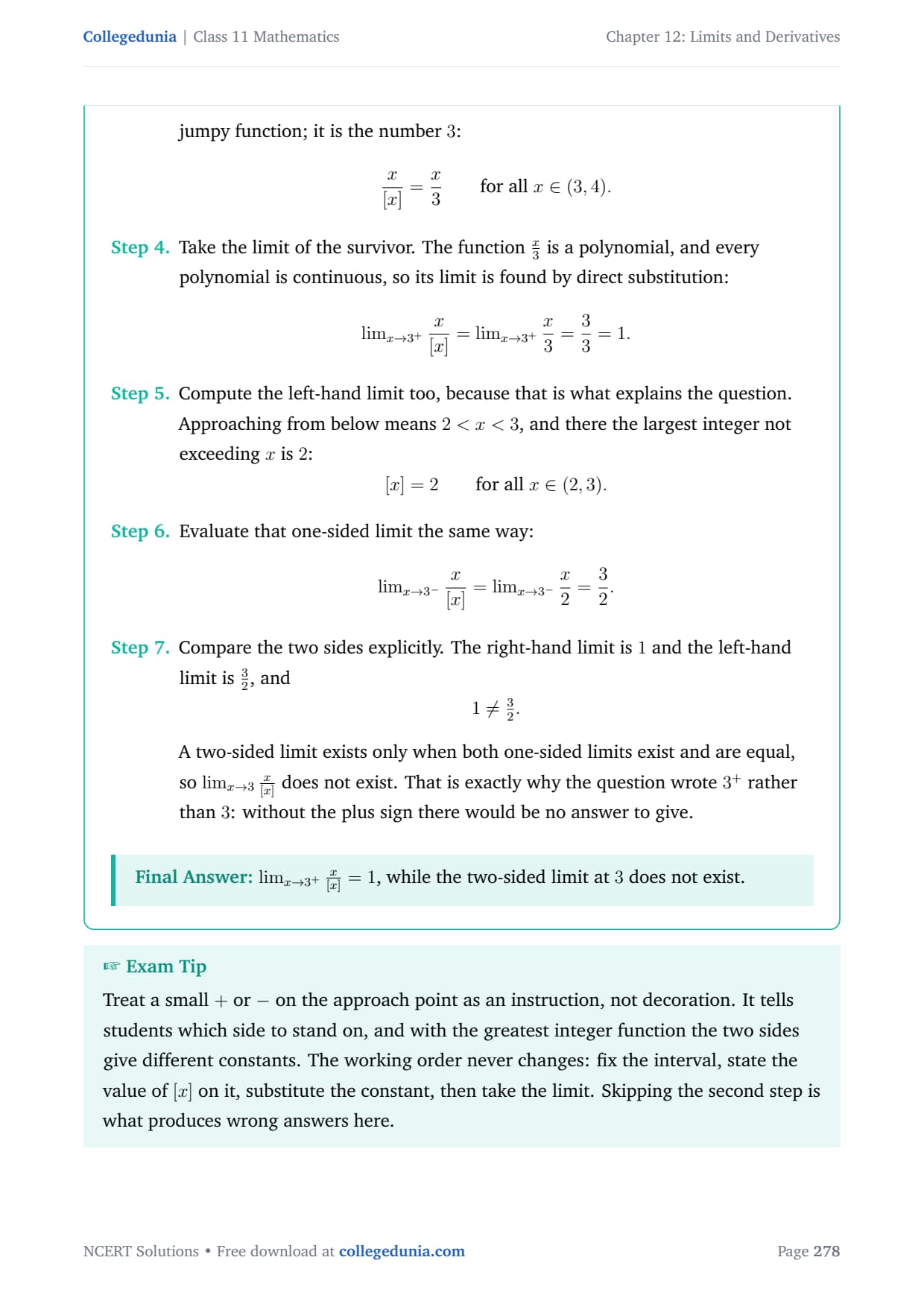
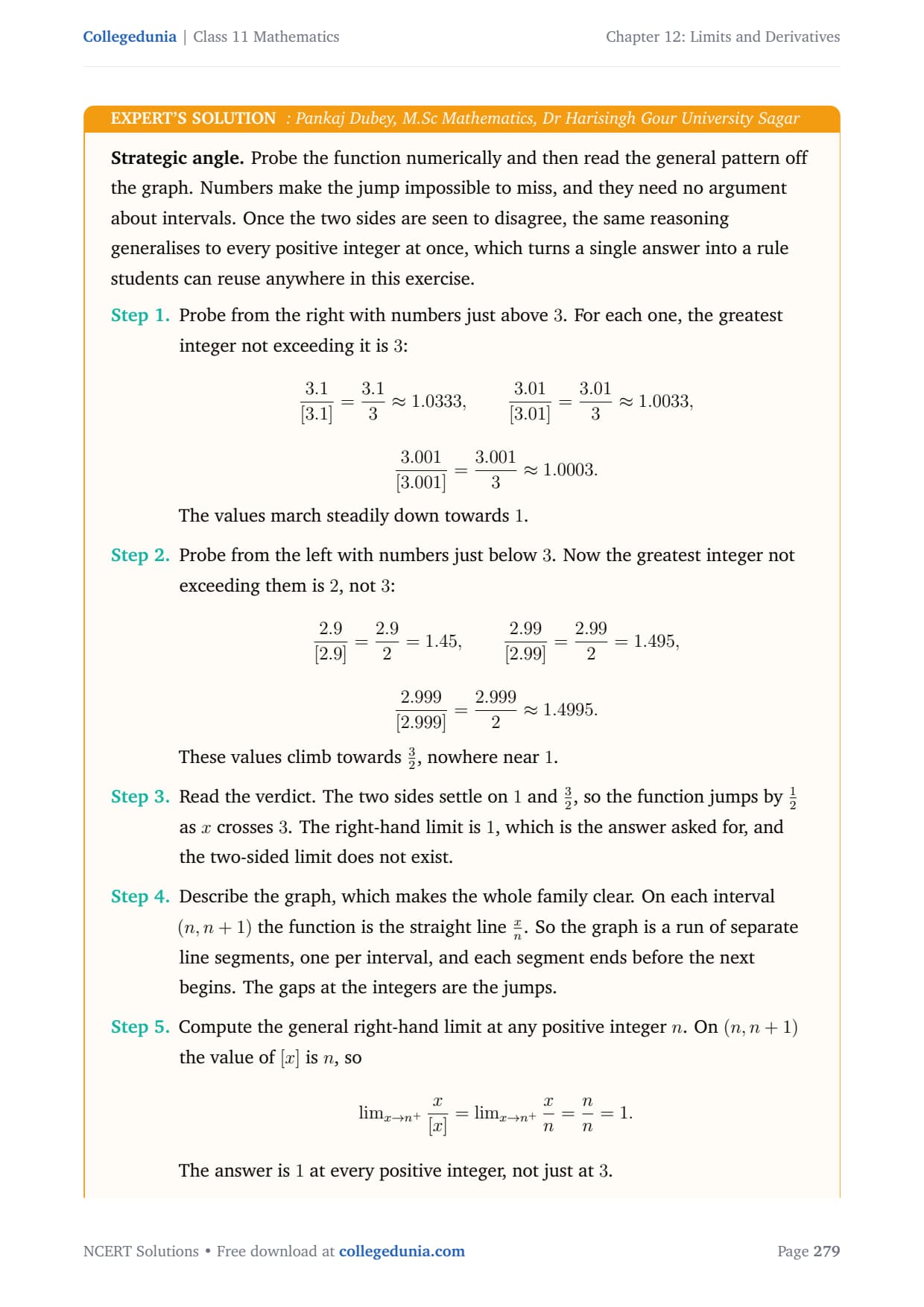
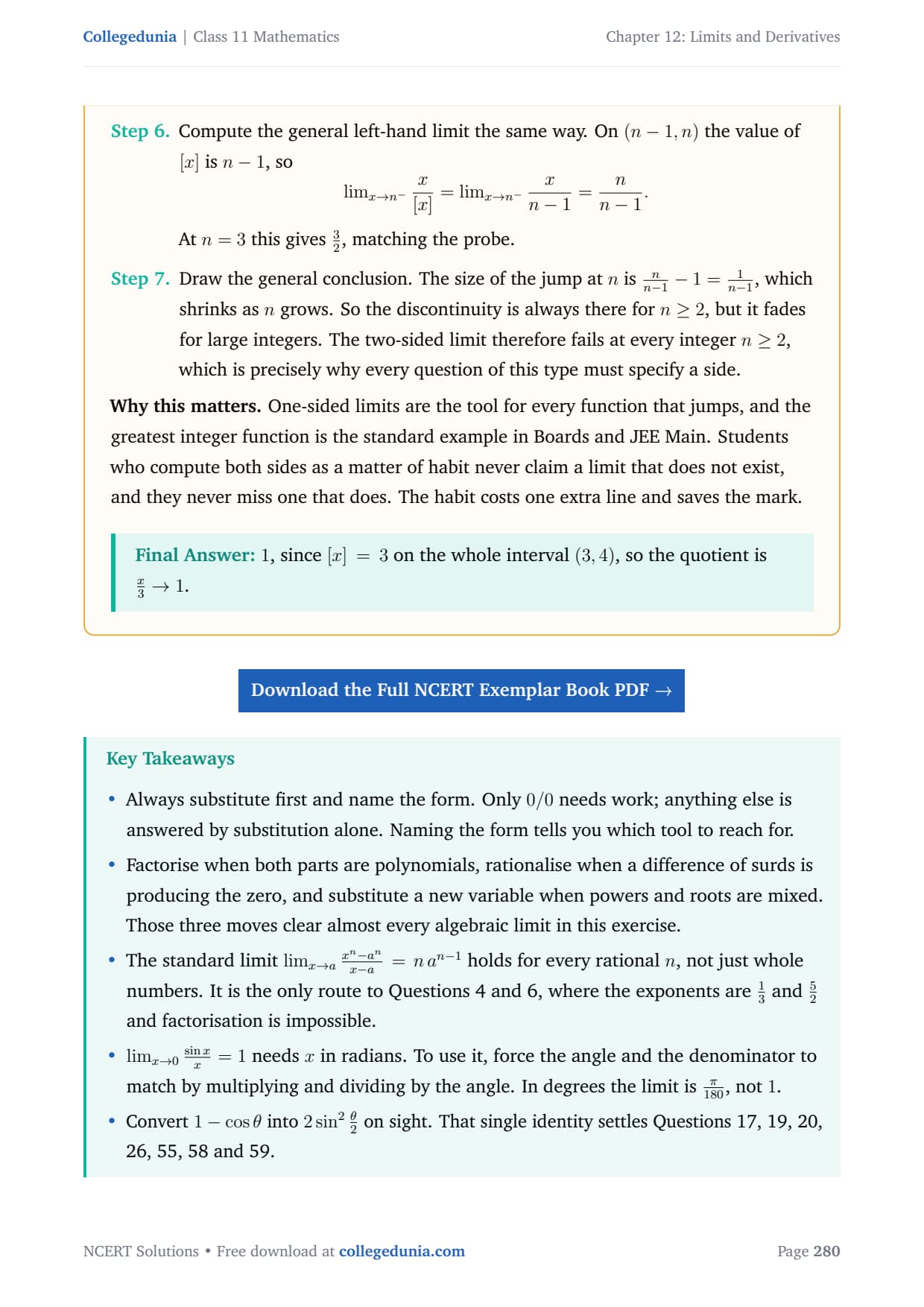
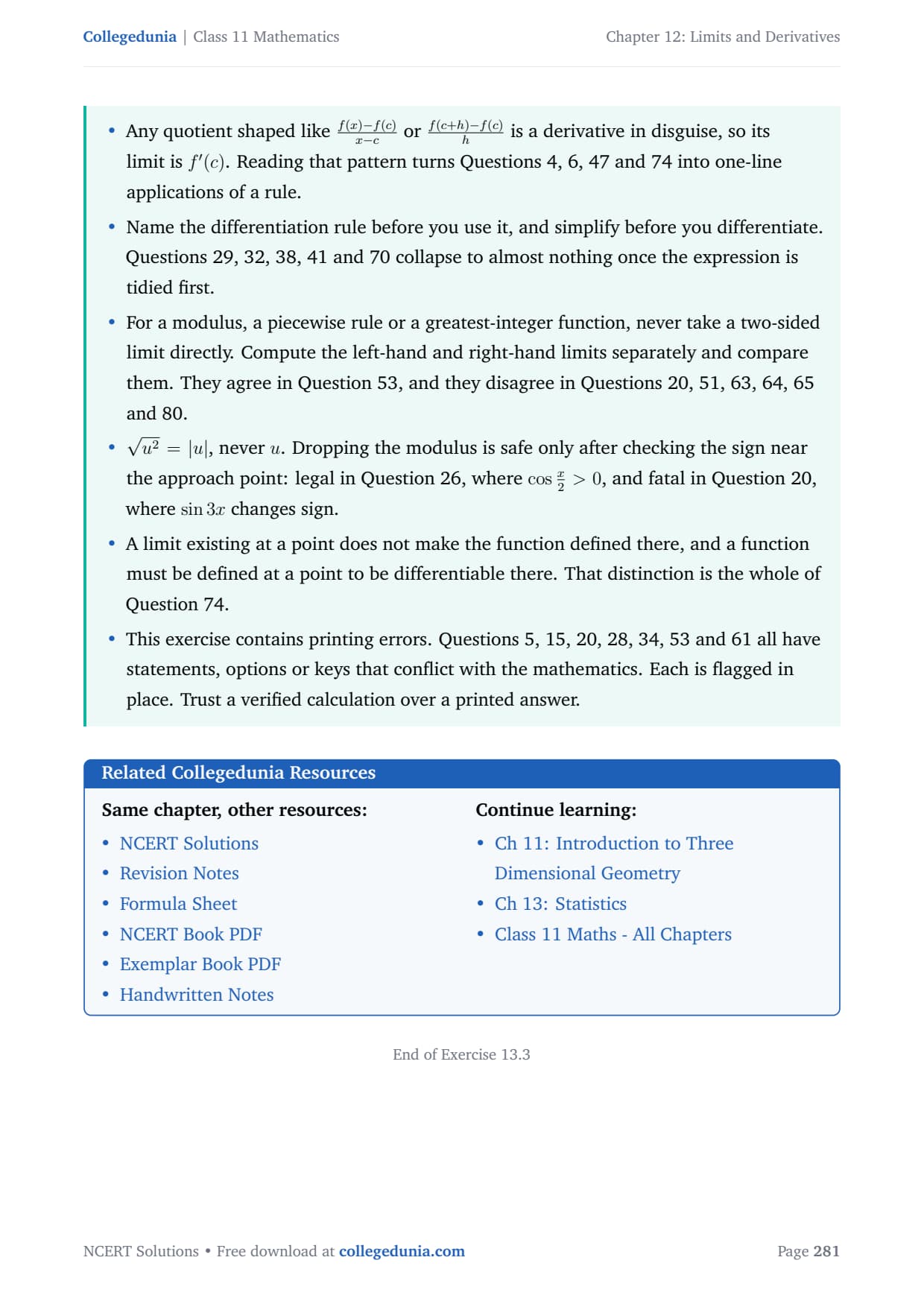
Every solution in this Collegedunia set is prepared by subject experts, based on the 2026-27 NCERT Exemplar, and checked line by line against the official answer key.
One numbering note before students start. The NCERT Exemplar book prints Limits and Derivatives as its Chapter 13, and the exercise is numbered Exercise 13.3. In the current NCERT textbook order it is Chapter 12, which is the number used on this page. The questions are identical. With 80 questions, this is the largest question set in the whole Class 11 Maths Exemplar, and the solutions PDF runs to 281 pages.
- 80 questions solved: Short Answer, Long Answer, Objective and Fill in the Blanks.
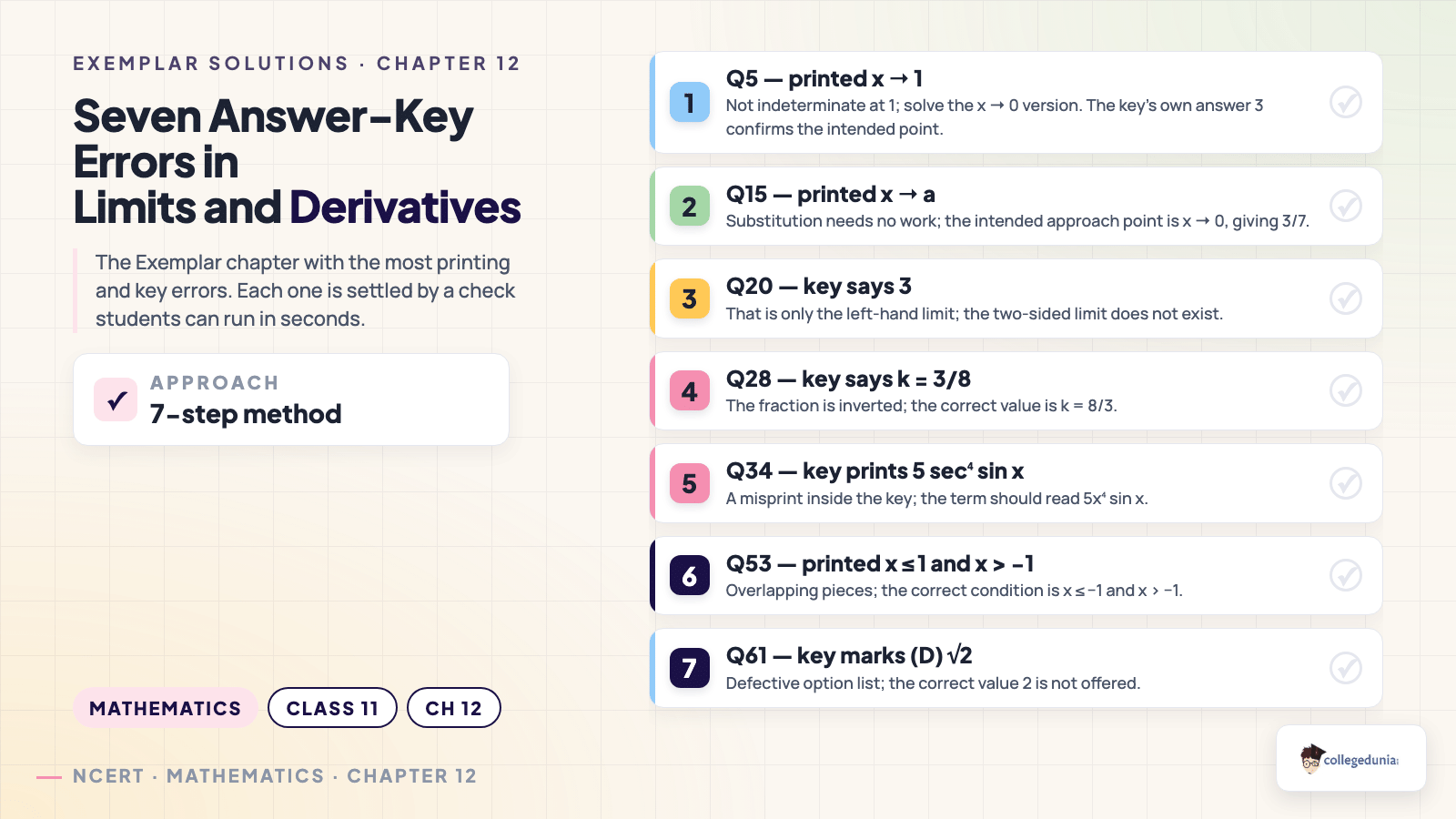
- Seven printing and key errors flagged: Q5, Q15, Q20, Q28, Q34, Q53 and Q61, each with the one-line check that settles it.
- Exam focus: useful for CBSE Boards, JEE Main, JEE Advanced and CUET.
Topics Covered in the Class 11 Maths Limits and Derivatives Exemplar
This chapter is the first place students meet calculus, and the Exemplar treats it as a chapter about careful reading rather than heavy machinery. Almost every question is an indeterminate 0/0 form, and the entire skill is choosing which of five or six standard tools removes the indeterminacy. These are the topics the 80 questions are built on.
- Algebraic limits: the standard result limx→a (xn − an)/(x − a) = nan−1, used far more often than factorisation.
- Surds and conjugates: rationalising a numerator or a denominator to expose the hidden factor, as in Q8 and Q11.
- Trigonometric limits: limθ→0 (sin θ)/θ = 1 and limθ→0 (tan θ)/θ = 1, valid only when θ is in radians.
- One-sided limits: deciding existence by comparing the left-hand and right-hand limits, which is what Q20 and Q51 are really testing.
- Limits with a modulus or a greatest-integer function: Q51 and Q80, where the function has a different rule on each side.
- Finding a constant: Q52 and Q53 hand students a piecewise function and ask for the value that makes the limit exist.
- Derivative from first principles: Q43 to Q46, where the definition must be used and no shortcut rule is allowed.
- Product, quotient and power rules: Q29 to Q42, plus the whole Objective block.
Important: a limit exists only when both one-sided limits exist and are equal. The Exemplar builds several questions on students who forget the second half of that sentence, and Q20 is the sharpest of them.
Exercise 13.3 Question-Type Breakdown for Limits and Derivatives
All 80 questions sit inside the single exercise the book prints as Exercise 13.3, grouped by format. The table below shows how the exercise splits, so students can plan practice by question type rather than solving straight through.
| Question Type | Question Numbers | Count | What it tests |
|---|---|---|---|
| Short Answer | Q1 to Q42 | 42 | Algebraic and trigonometric limits, then the differentiation rules |
| Long Answer | Q43 to Q53 | 11 | First principles, harder trigonometric limits, existence and constants |
| Objective (MCQ) | Q54 to Q76 | 23 | One-line reasoning on limits and derivatives |
| Fill in the Blanks | Q77 to Q80 | 4 | Limits at π, series derivatives and the greatest integer function |
The Short Answer block is enormous at 42 questions, so it should never be attempted in one sitting. It splits naturally into three parts: Q1 to Q14 are algebraic limits, Q15 to Q28 are trigonometric limits, and Q29 to Q42 move to differentiation. The Long Answer block (Q43 to Q53) is short but carries the four first-principles questions, which are the ones most often set in board exams because they cannot be bluffed.
Seven Printing and Key Errors in the Limits and Derivatives Exemplar Every Student Must Know
This chapter carries more printing and key problems than any other in the Class 11 Maths Exemplar. They are not all the same kind of error, so they are listed separately below. Three are misprints in the question itself, two are wrong keys, one is a misprint inside the key's expression, and one question has an option list in which the correct value does not appear. Each is settled by a check students can run in a few seconds.
| Question | What is printed | Correct reading | Type of error |
|---|---|---|---|
| Q5 | Limit as x → 1 | x → 0, giving 3 | Misprinted question (approach point) |
| Q15 | Limit as x → a | x → 0, giving 3/7 | Misprinted question (approach point) |
| Q20 | Key answers 3 | The limit does not exist | Wrong key (only the left-hand limit) |
| Q28 | Key answers k = 3/8 | k = 8/3 | Wrong key (inverted fraction) |
| Q34 | Key has the term 5 sec4 sin x | 5x4 sin x | Misprint inside the key |
| Q53 | x ≤ 1 and x > −1 | x ≤ −1 and x > −1 | Misprinted question (overlapping pieces) |
| Q61 | Key marks (D), √2 | 2 (not in the options) | Defective option list |
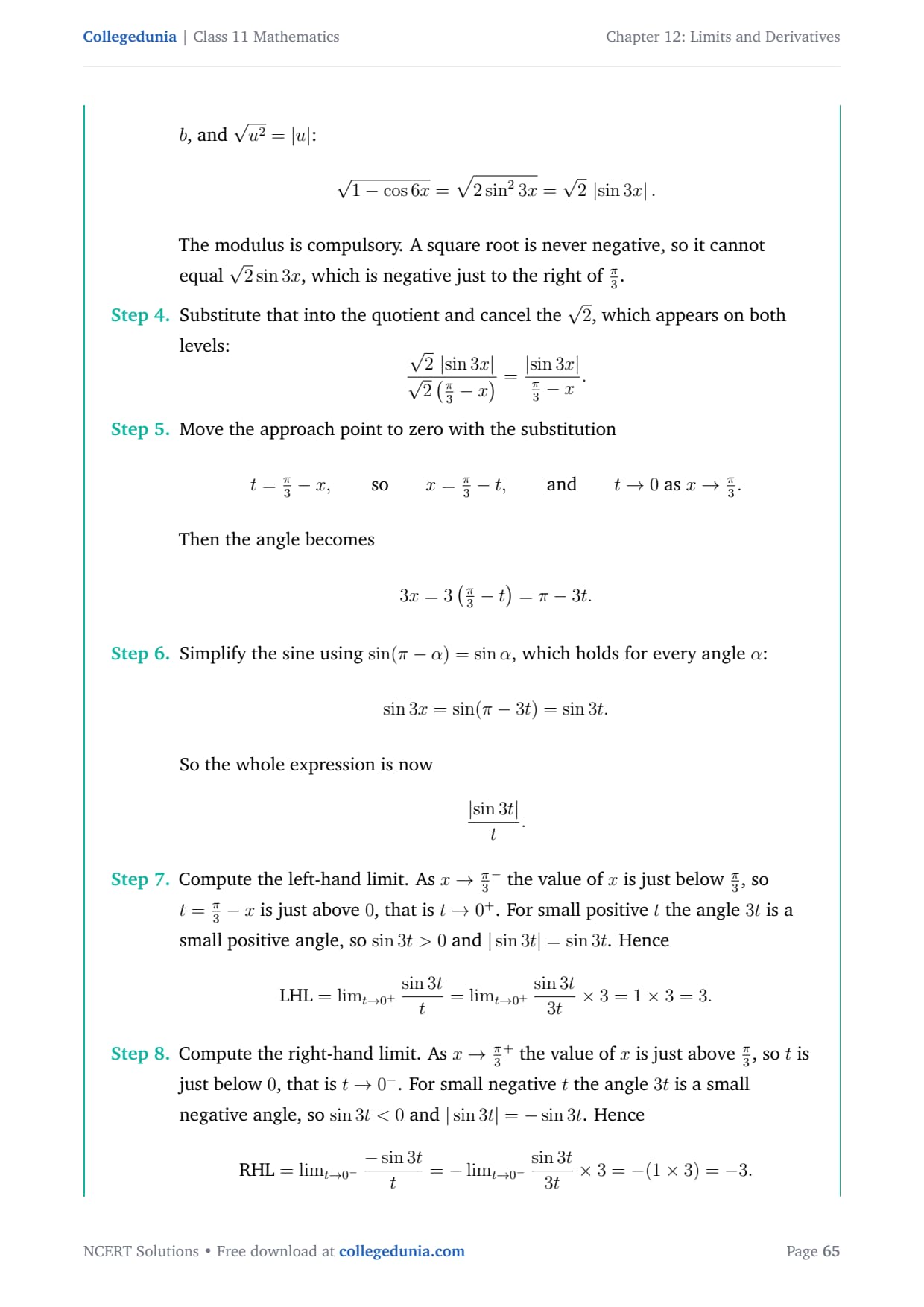
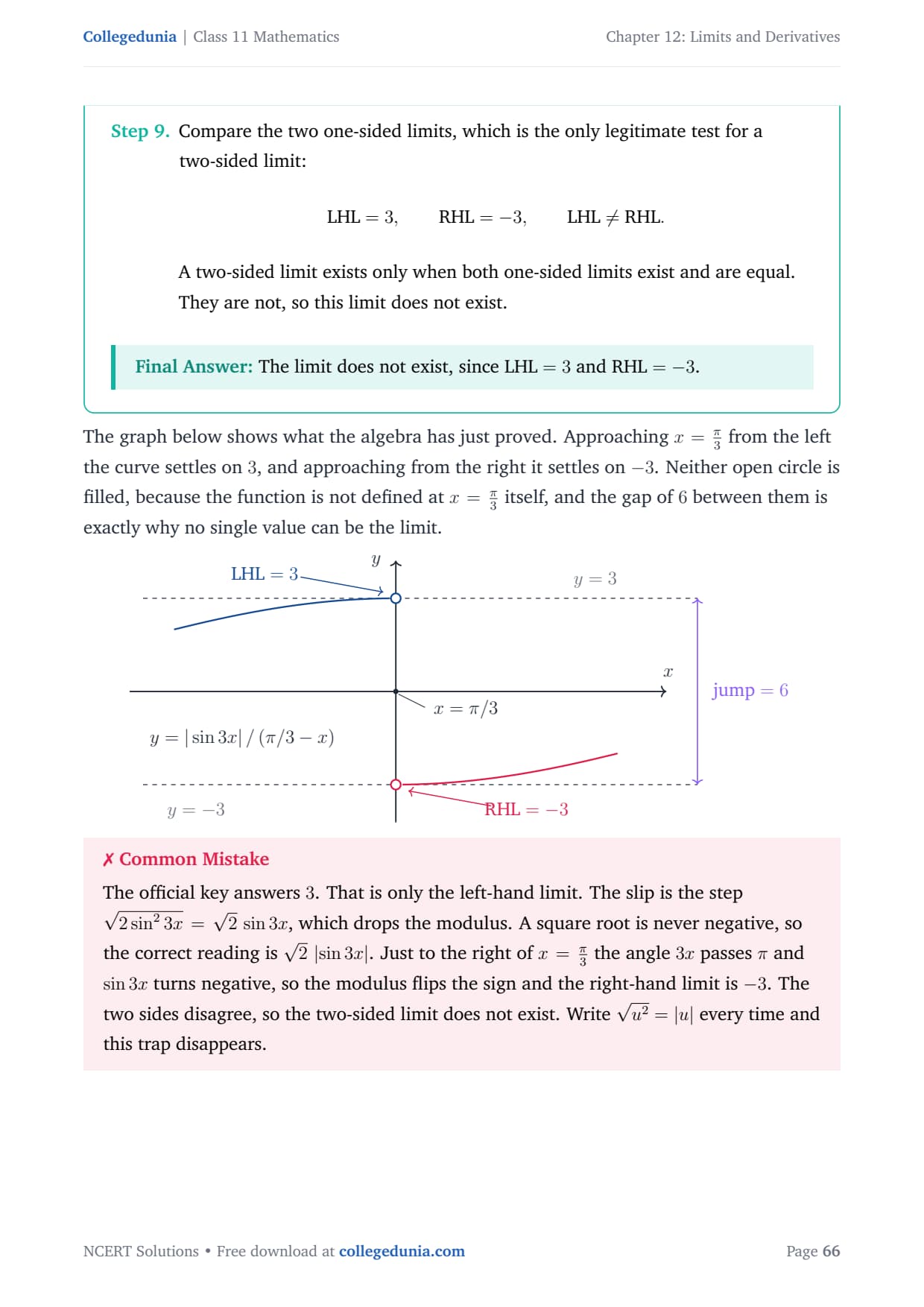
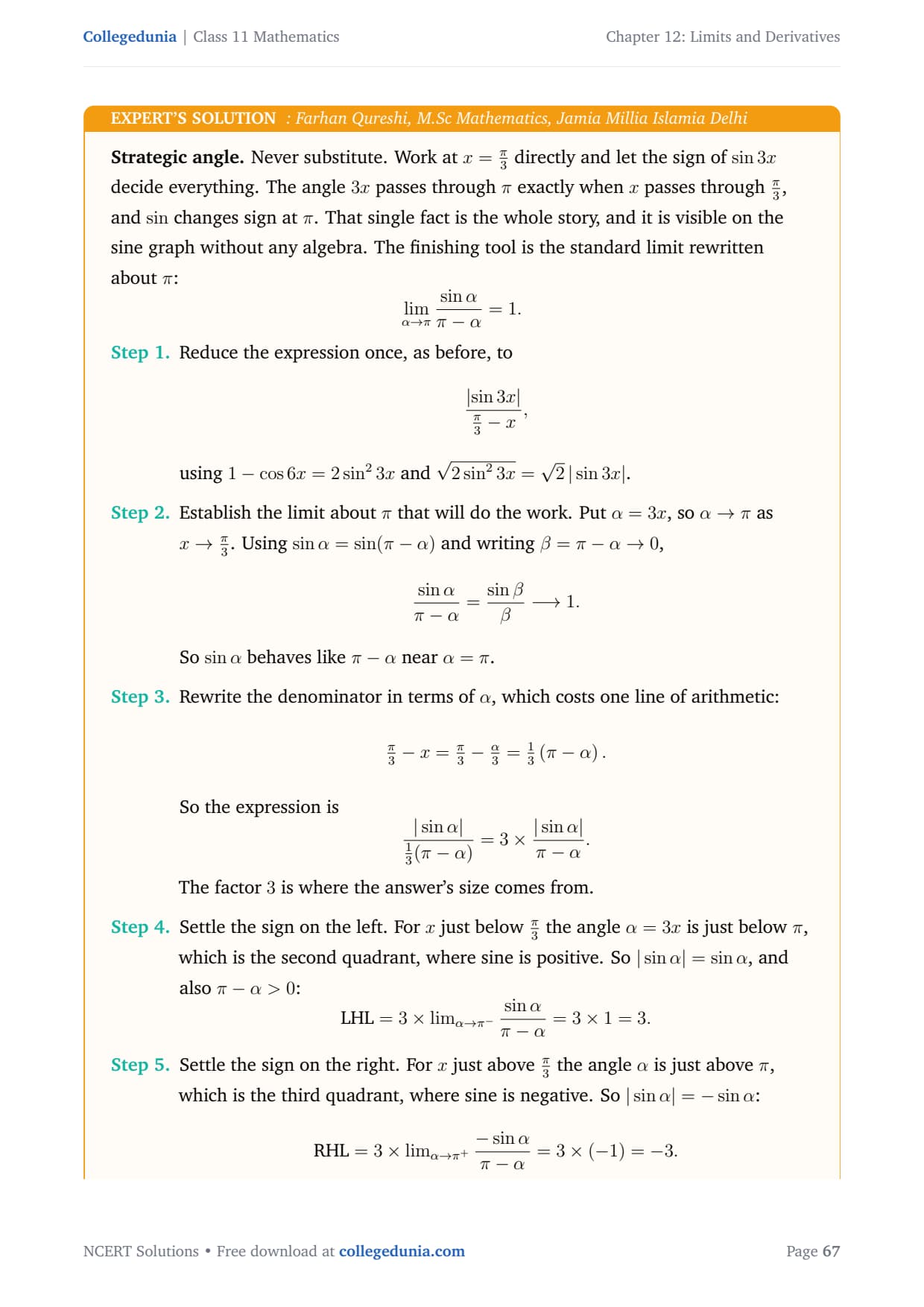
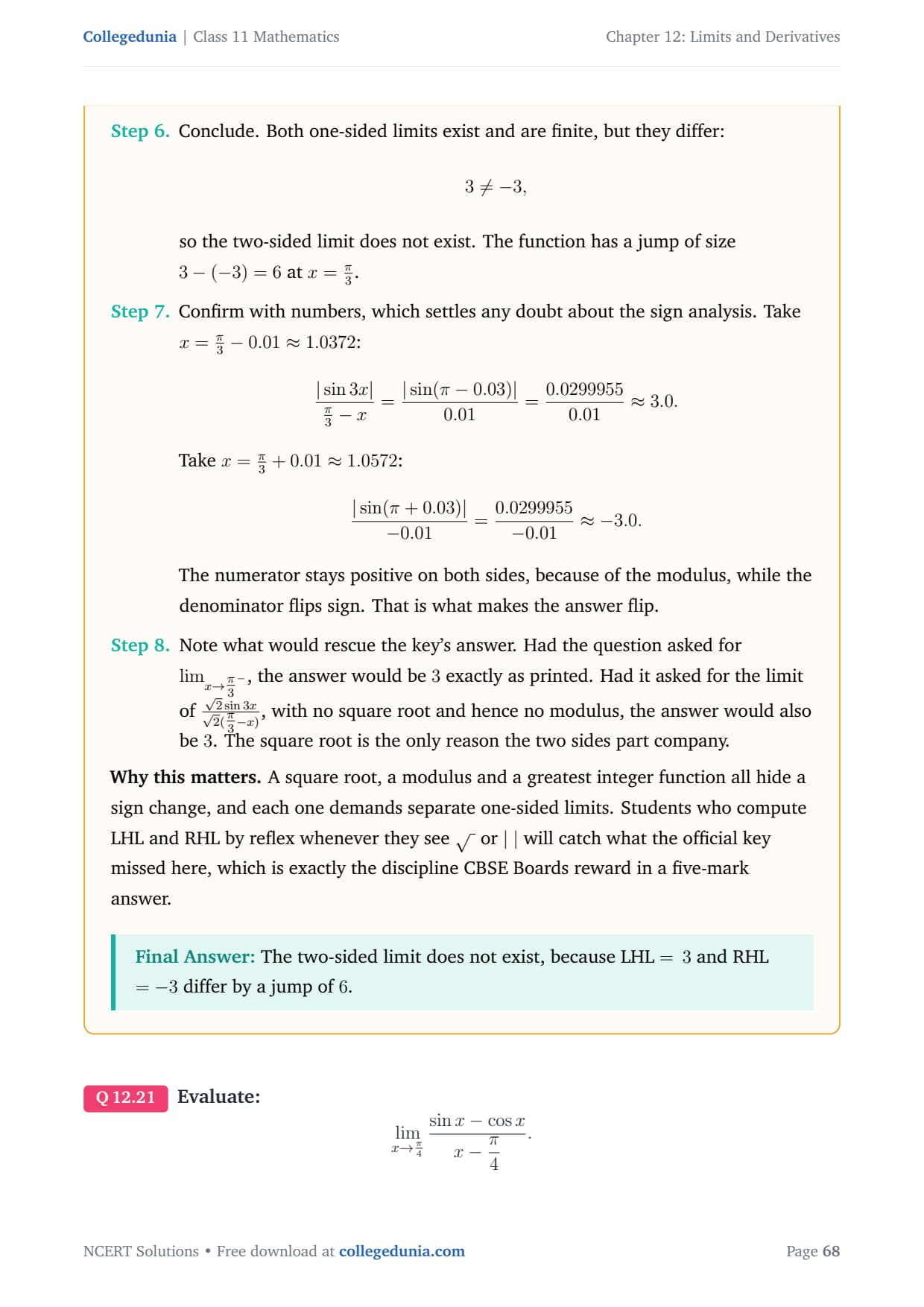
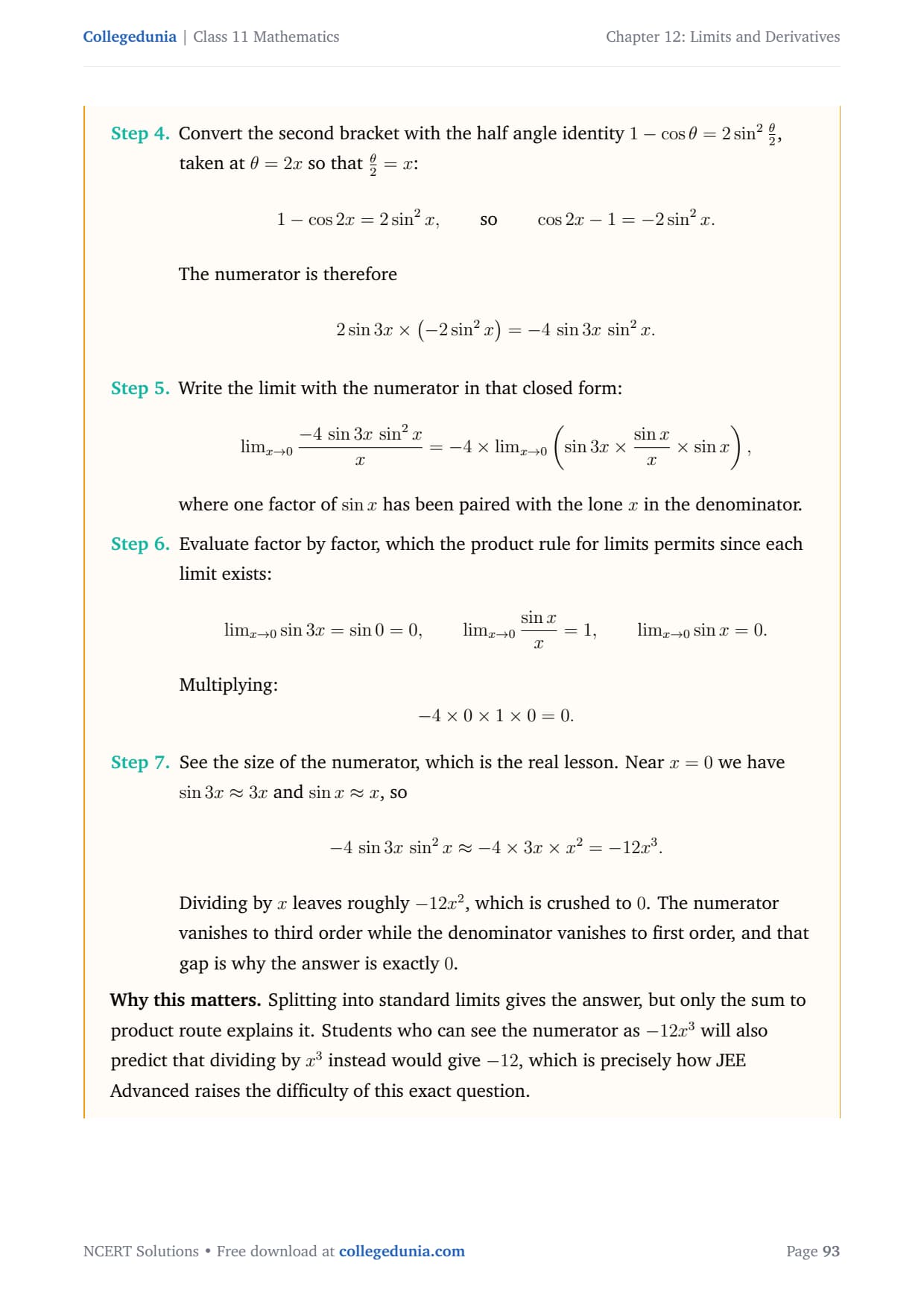
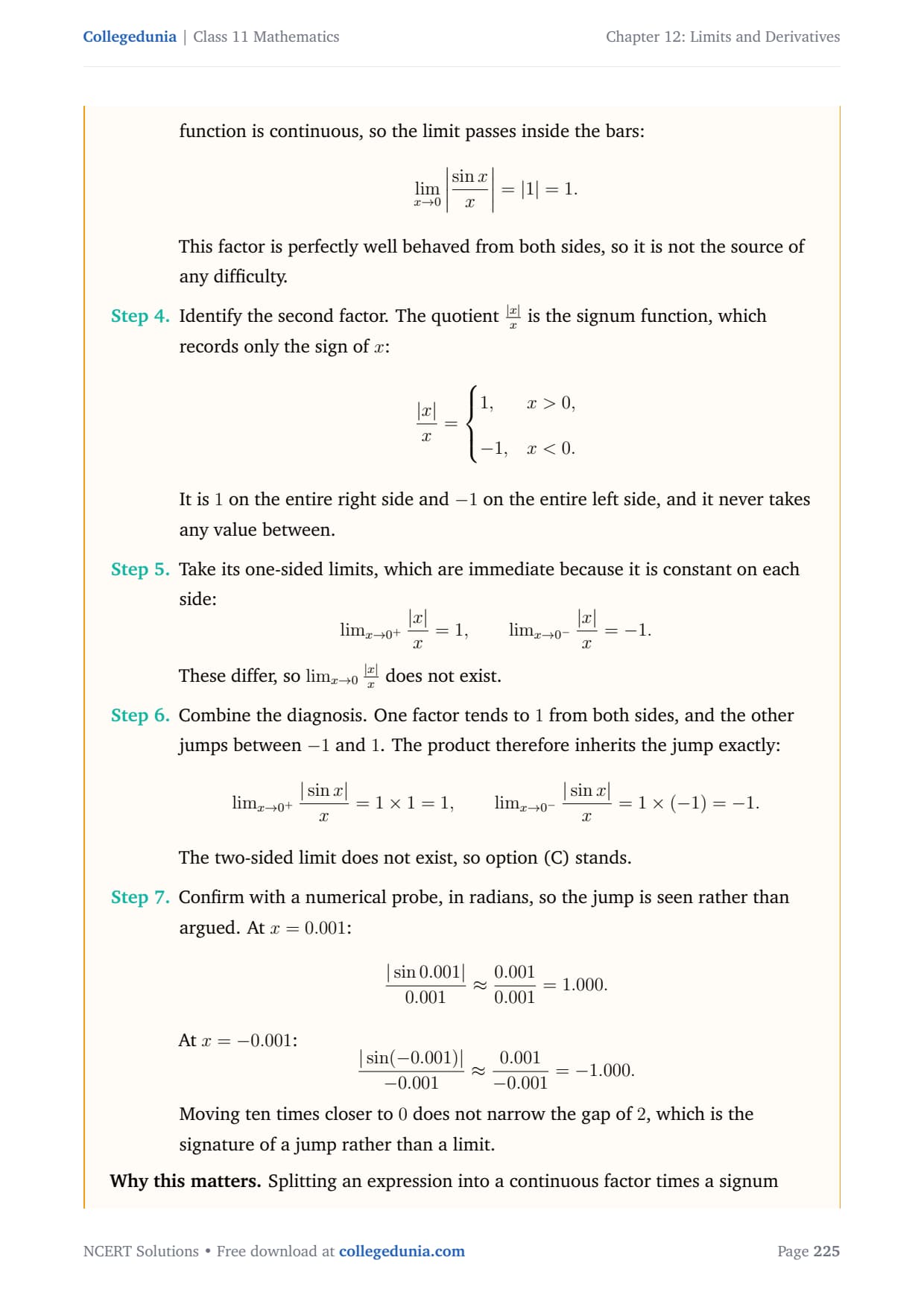
Q20 is the sharpest error in the entire Class 11 Maths Exemplar. The question asks for the limit of √(1 − cos 6x) divided by √2 (π/3 − x) as x → π/3. The key answers 3. The whole question turns on one identity: 1 − cos 6x = 2 sin2 3x, so the numerator is √(2 sin2 3x). The standard slip is to write that as √2 sin 3x. A square root is never negative, so the correct reading is √2 |sin 3x|. Just to the right of x = π/3 the angle 3x passes π and sin 3x turns negative, so the modulus flips the sign. The result is a left-hand limit of 3 and a right-hand limit of −3. The two sides disagree, so the two-sided limit does not exist, and the key's 3 is only the left-hand value. Students should write √(u2) = |u| every single time and this trap disappears.
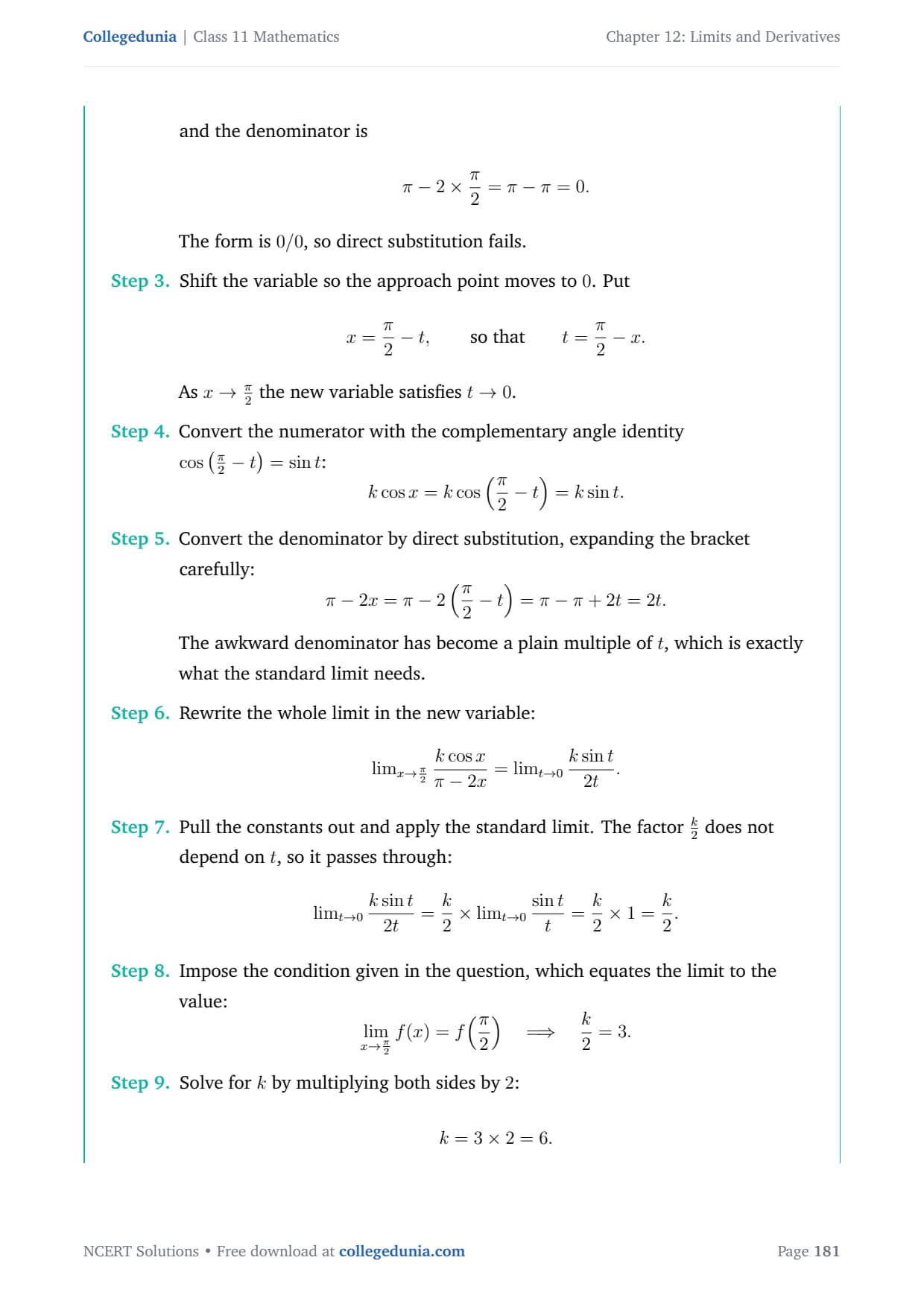
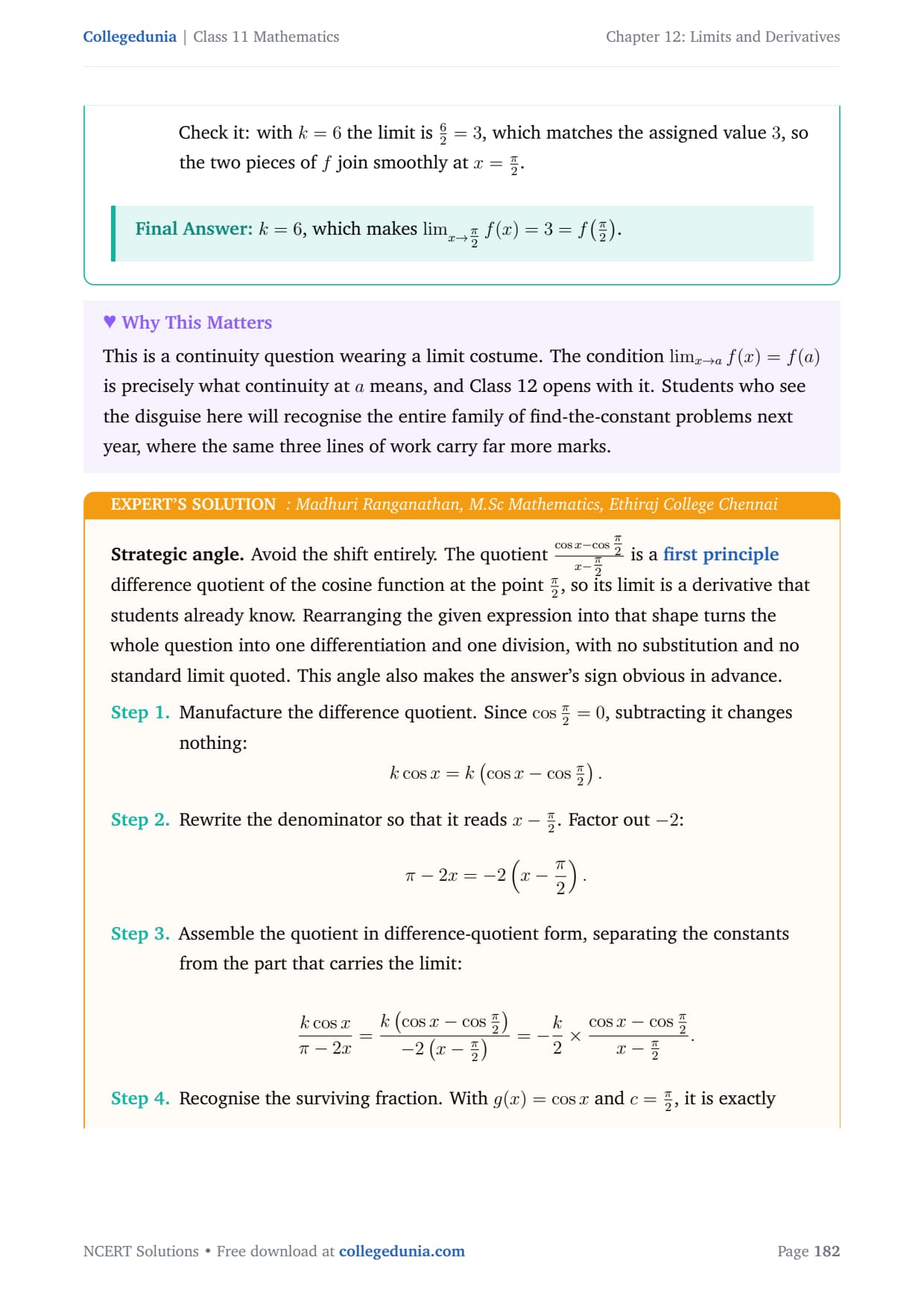
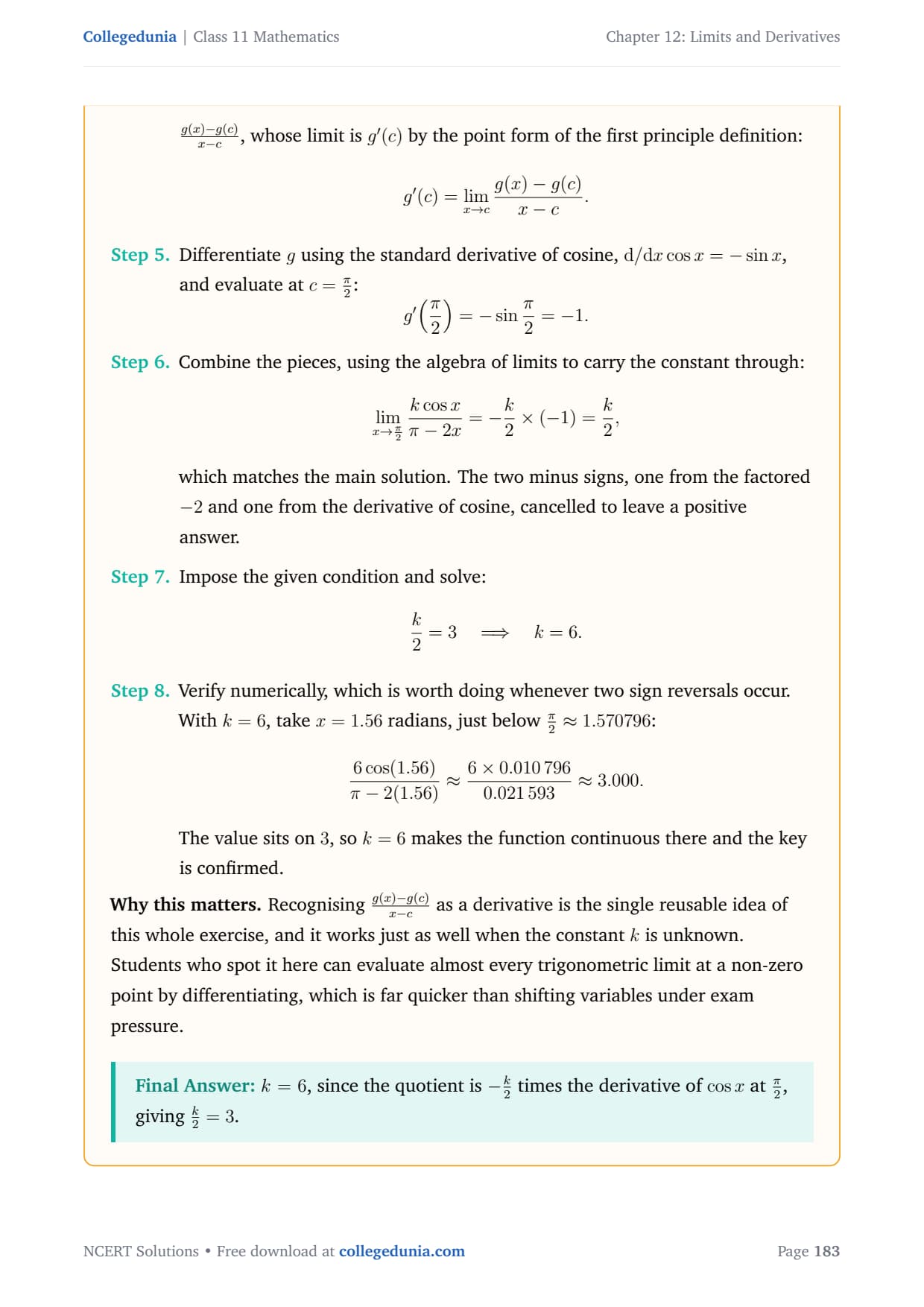
Q5 and Q15 are misprinted approach points, and the key itself proves it. Q5 prints the limit as x → 1. Nothing is indeterminate there: substituting gives (26 − 1)/(22 − 1) = 63/3 = 21, and the question would ask nothing. The key answers 3, which is the value at x → 0, so the intended approach point is 0. Q15 has the same shape. It prints x → a, but both sines are continuous, so substitution simply gives sin 3a/sin 7a and there is no work to do. The key answers 3/7, the value at x → 0. In both cases students should solve the x → 0 version and write one line in the answer script noting the misprint.
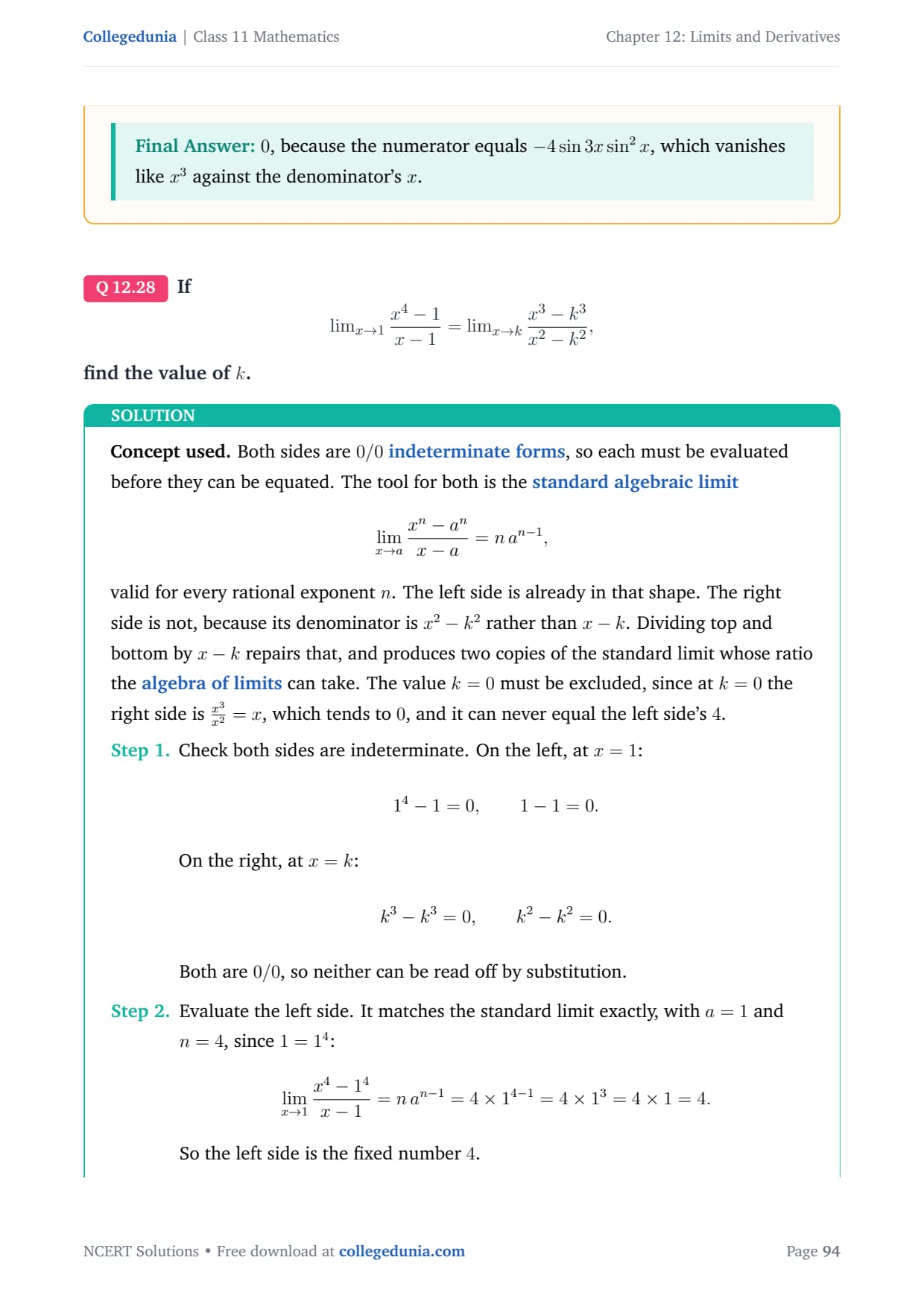
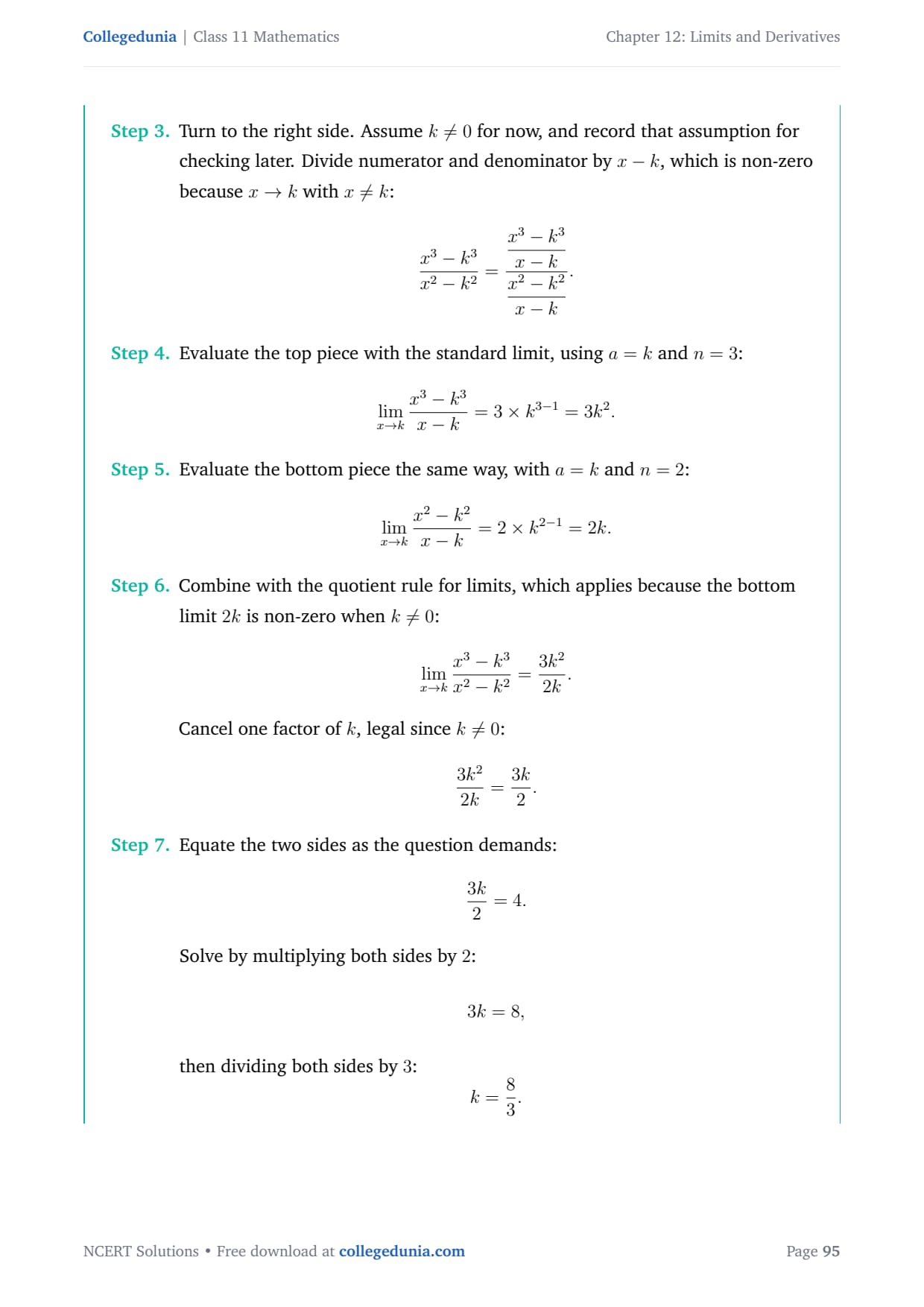
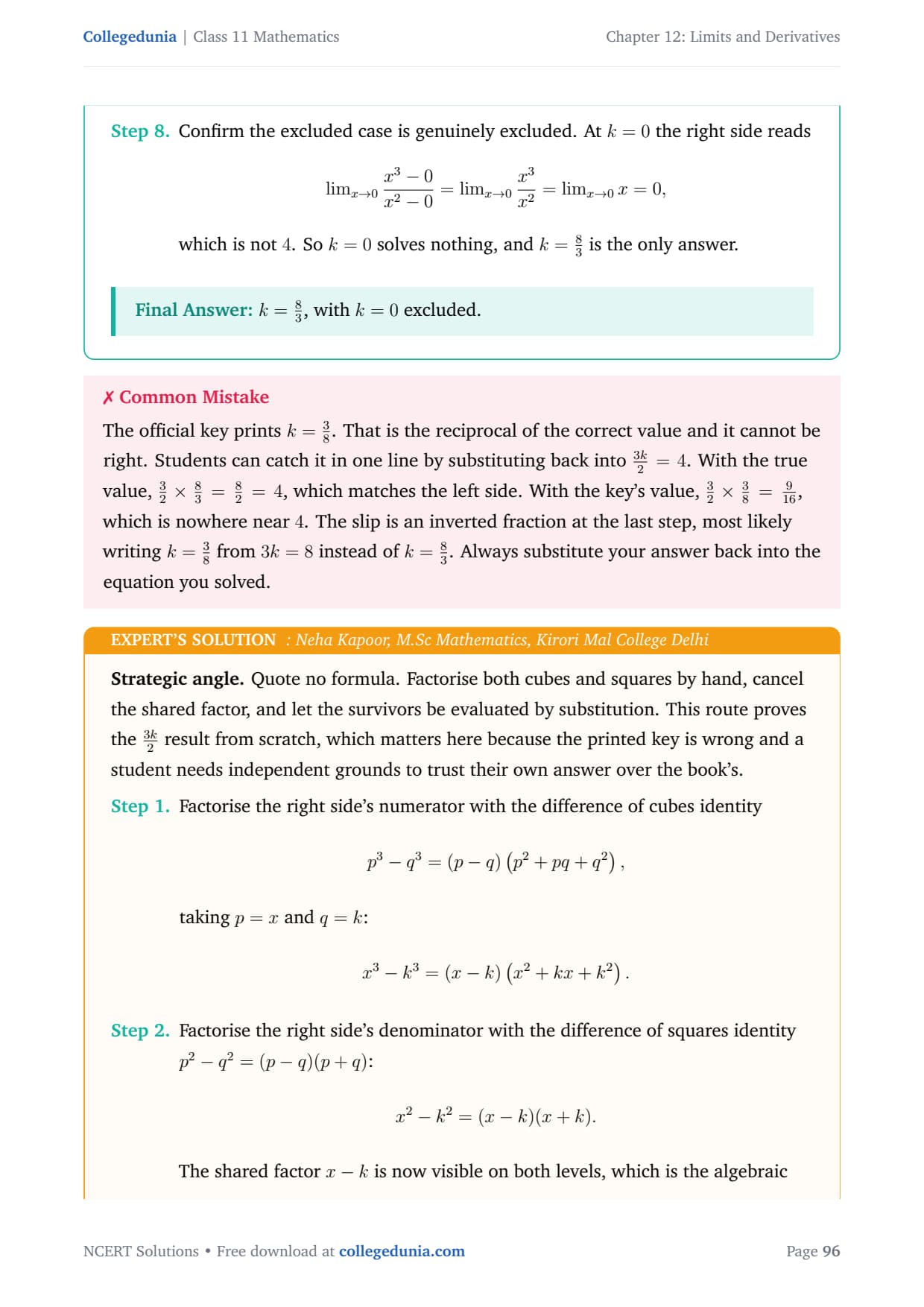
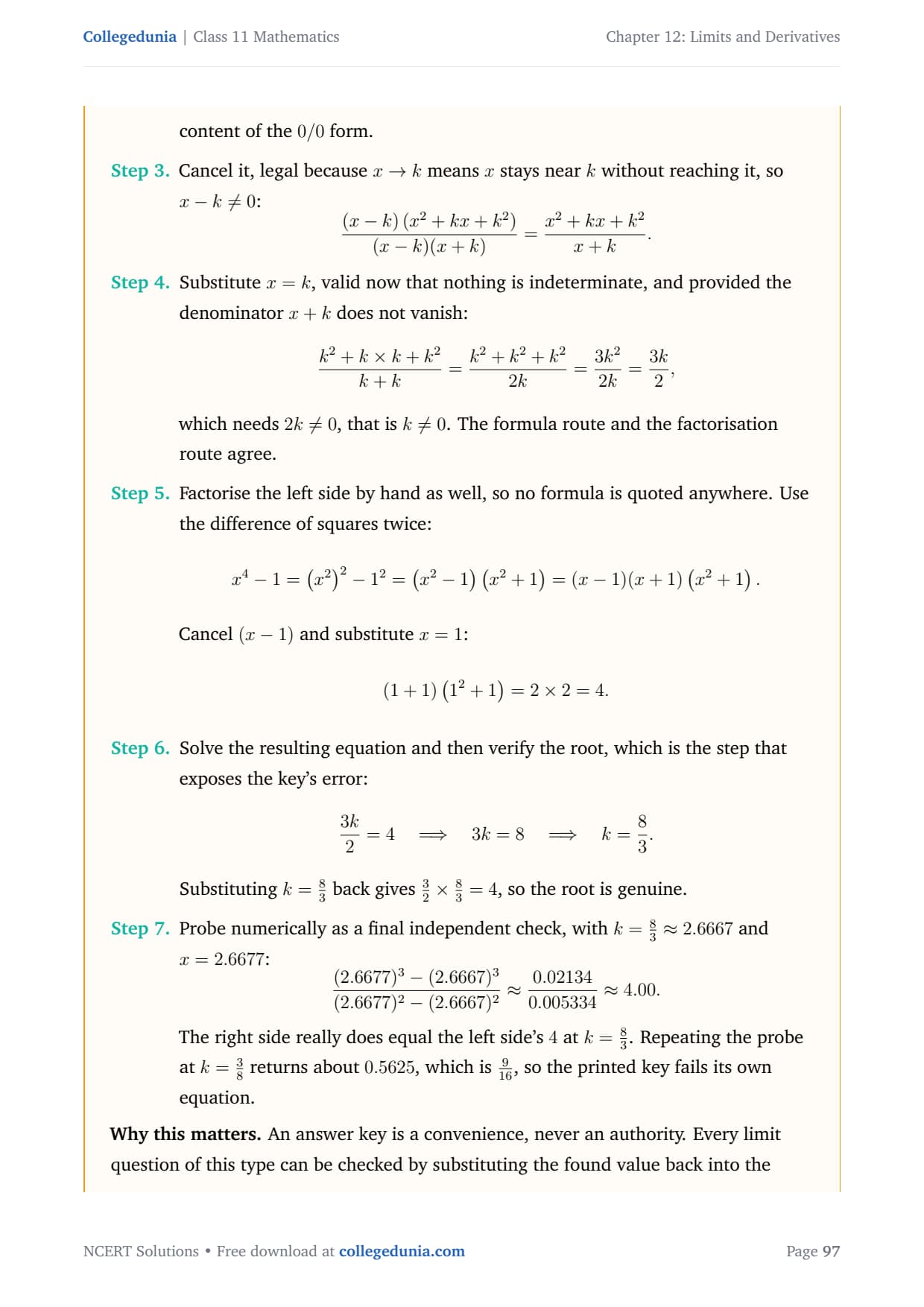
Q28 is settled by substituting the answer back. The key prints k = 3/8, which is the reciprocal of the correct value. The question reduces to 3k/2 = 4. With k = 8/3, the check is 3/2 × 8/3 = 4, which matches. With the key's 3/8, it gives 3/2 × 3/8 = 9/16, nowhere near 4. The slip is an inverted fraction at the last step, writing k = 3/8 from 3k = 8 instead of k = 8/3.
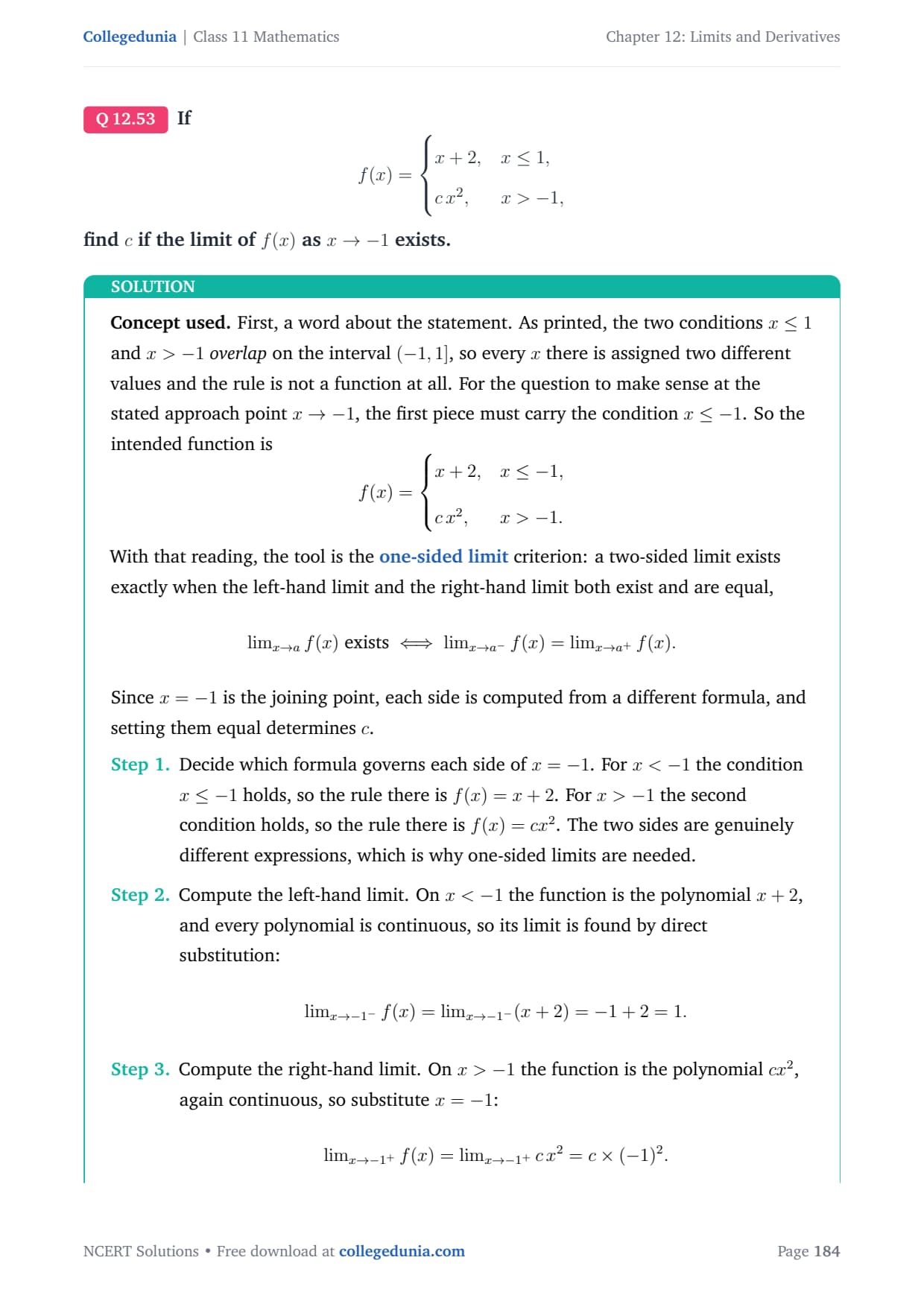
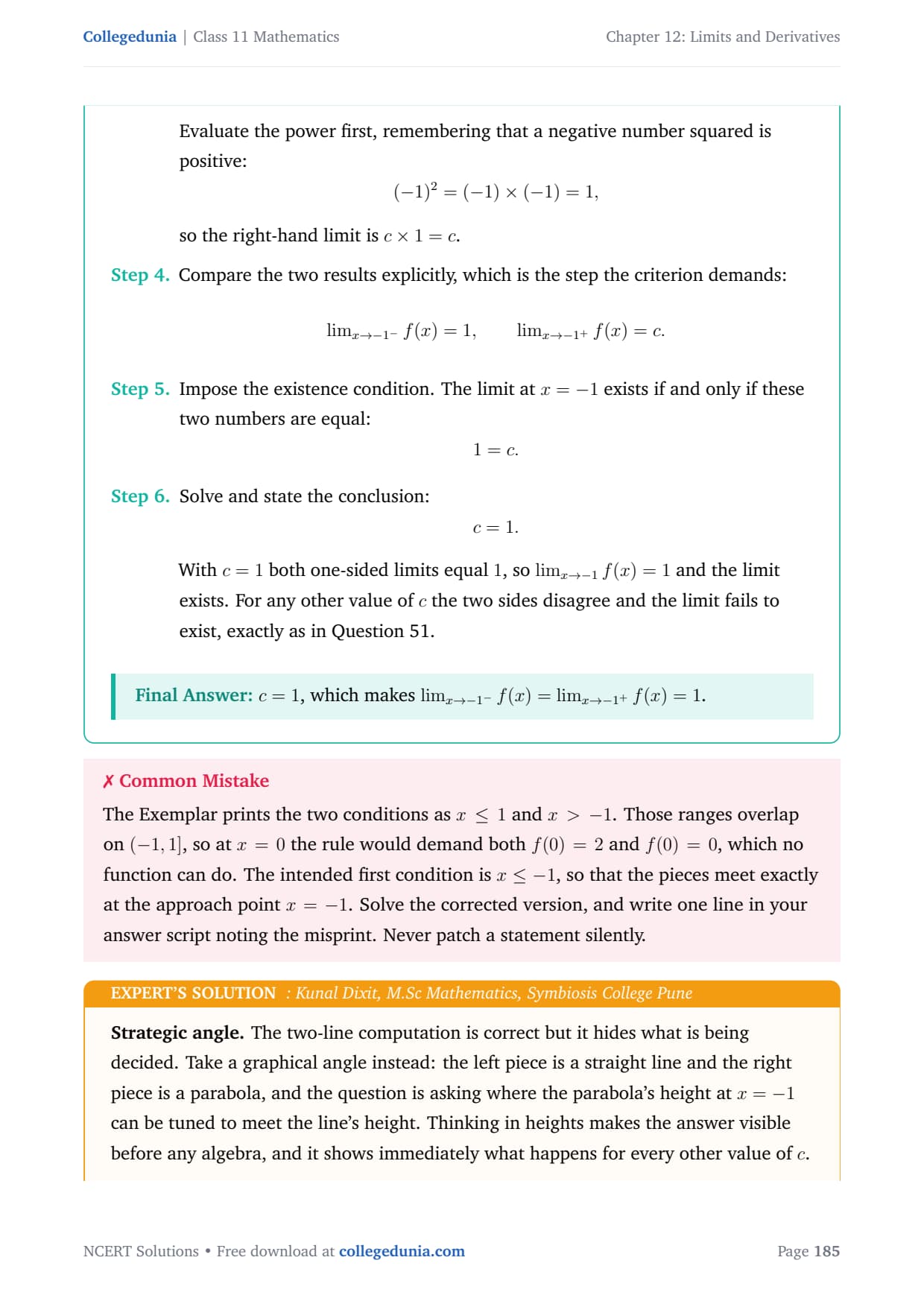
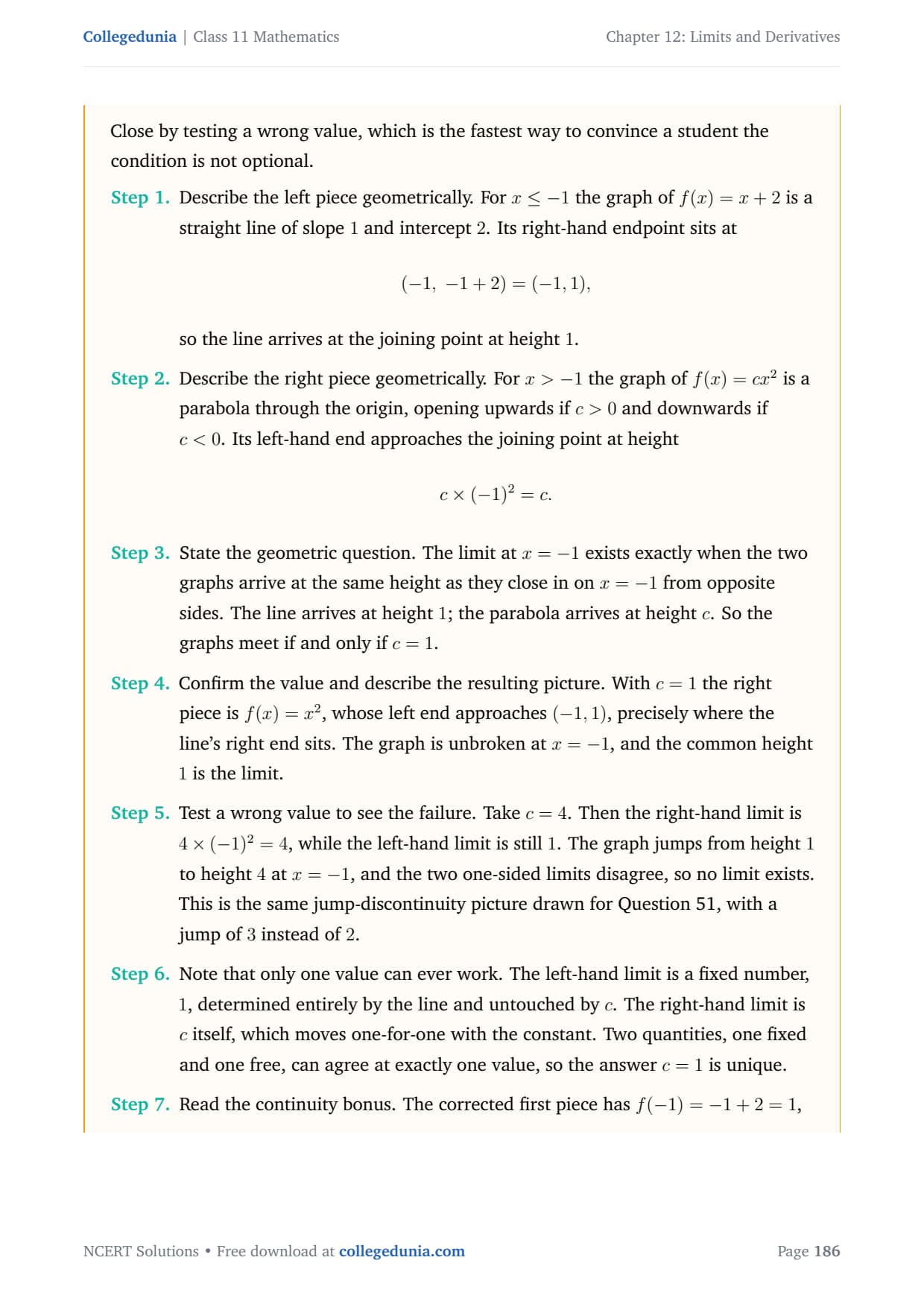
Q34 and Q53 are printing faults, not mathematics. In Q34 the key prints the term 5 sec4 sin x, in which a sec has been set where an x belongs and the resulting symbol has no angle attached, so it is not a valid expression at all. Everything else in the key is right. Read it as 5x4 sin x, which is exactly what the power rule on x5 produces. In Q53 the two printed conditions x ≤ 1 and x > −1 overlap on (−1, 1], so at x = 0 the rule would demand both f(0) = 2 and f(0) = 0, which no function can do. The intended first condition is x ≤ −1, so that the two pieces meet exactly at the approach point x = −1.
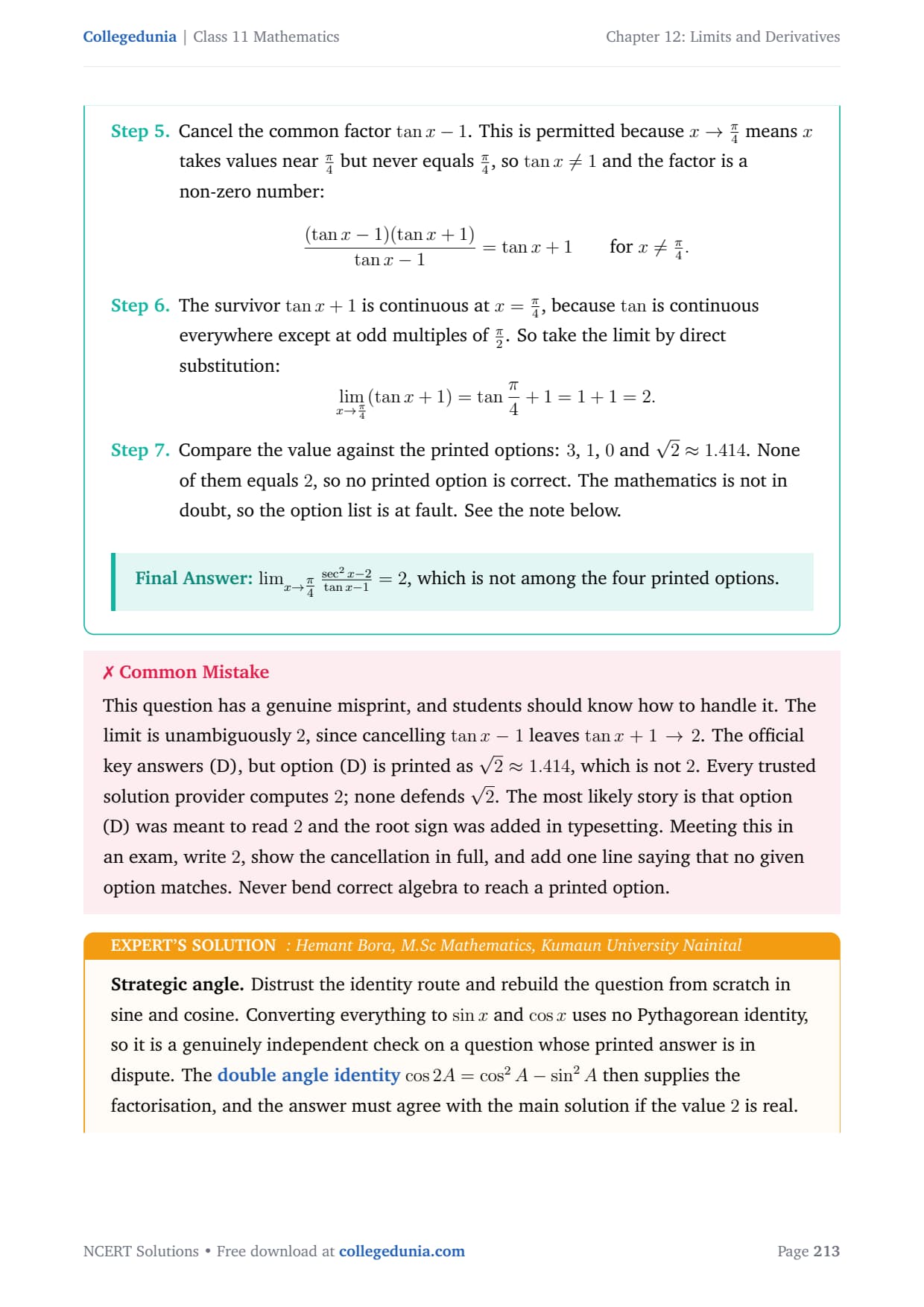
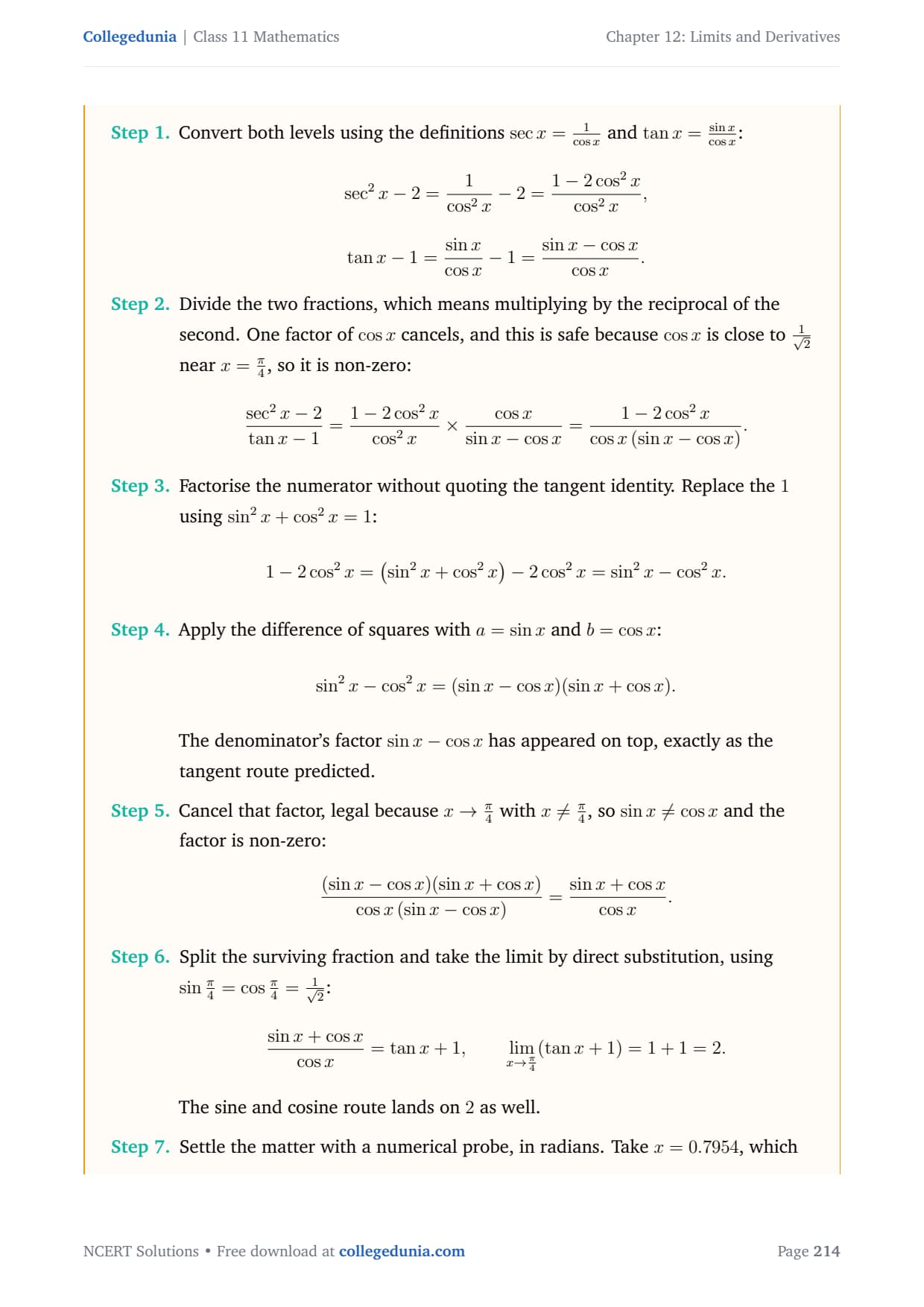
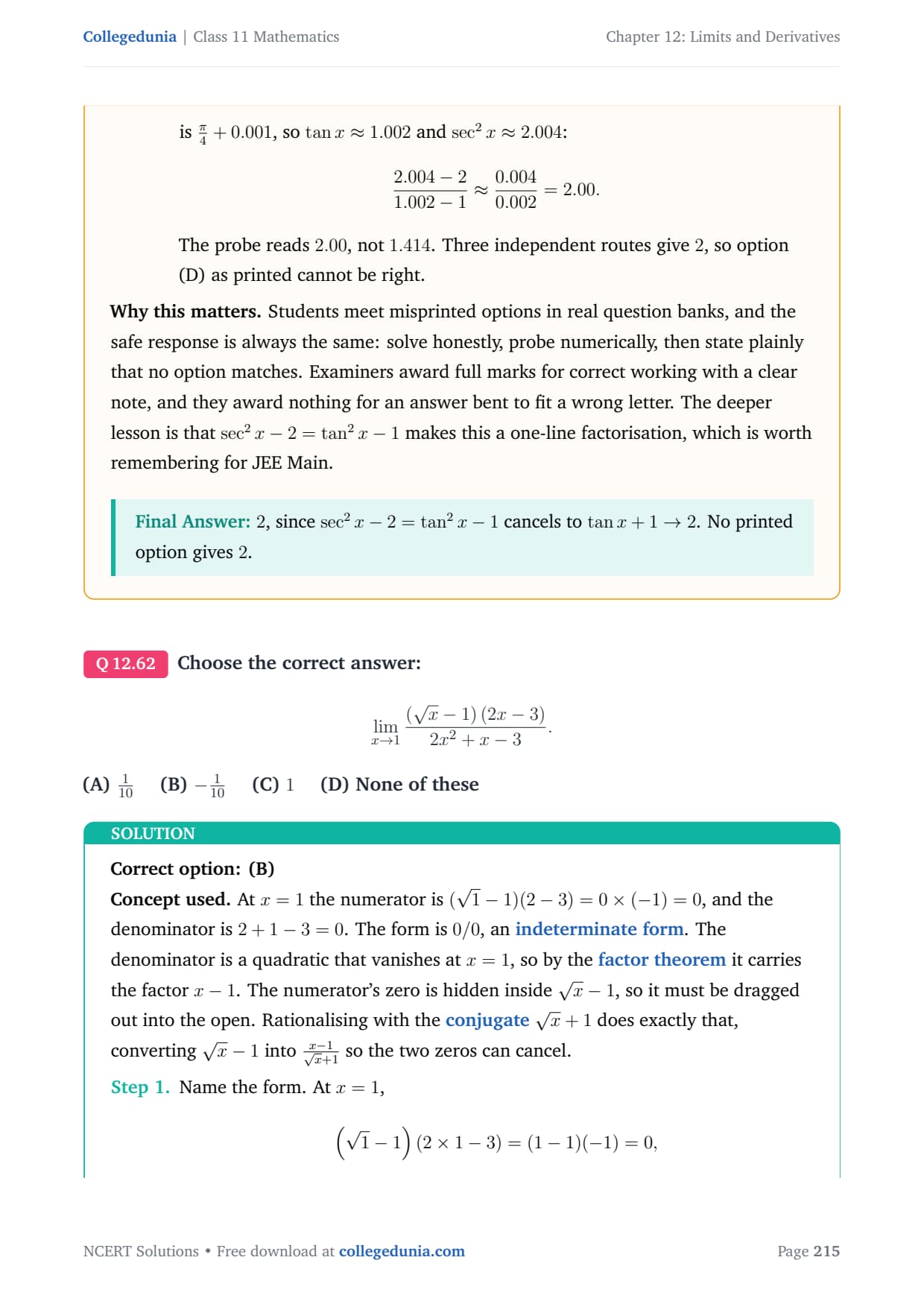
Q61 has no correct option. The question asks for the limit of (sec2 x − 2)/(tan x − 1) as x → π/4. Using sec2 x = 1 + tan2 x, the numerator becomes tan2 x − 1 = (tan x − 1)(tan x + 1). Cancelling tan x − 1 leaves tan x + 1, which tends to 2. The printed options are 3, 1, 0 and √2, and the key marks (D). But √2 is about 1.414, which is not 2. The likely story is that option (D) was meant to read 2 and the root sign was added in typesetting. Meeting this in an exam, students should write 2, show the cancellation in full, and add one line saying that no printed option matches. Never bend correct algebra to reach a printed option.
Key Formulas Used in the Class 11 Maths Limits and Derivatives Exemplar
This chapter runs on a small toolkit, and the Exemplar assumes all of it is known before Q1. Students should be able to write this table from memory before starting the exercise.
| Result | Statement | Where it is used |
|---|---|---|
| Standard algebraic limit | limx→a (xn − an)/(x − a) = nan−1, for any real n | Q1, Q4, Q5, Q6, Q12, Q28 |
| Standard trigonometric limit | limθ→0 (sin θ)/θ = 1 and limθ→0 (tan θ)/θ = 1, in radians | Q15 to Q27, Q48, Q78 |
| Half-angle identity | 1 − cos 2θ = 2 sin2 θ, so √(1 − cos 2θ) = √2 |sin θ| | Q20, Q26 |
| Existence of a limit | The limit exists only if the left-hand and right-hand limits both exist and are equal | Q20, Q51, Q52, Q53, Q80 |
| First principles | f′(x) = limh→0 [f(x+h) − f(x)]/h | Q3, Q43 to Q46 |
| Product rule | (uv)′ = u′v + uv′ | Q31, Q46 |
| Quotient rule | (u/v)′ = (u′v − uv′)/v2, for v ≠ 0 | Q33, Q34, Q44 |
| Conjugate trick | The conjugate of a − b is a + b: change the middle sign, keep the terms | Q8, Q11, Q26 |
Tip: the most useful habit in this chapter is checking whether the form really is indeterminate before reaching for a tool. Direct substitution settles a surprising number of questions in one line, and it is exactly the check that exposes the misprints in Q5 and Q15.
Common Mistakes Students Make in the Limits and Derivatives Exemplar
The same reflexes cost marks in this chapter every year. These five are the ones the solutions flag most often.
- Writing √(u2) as u instead of |u|. This single slip is what makes the whole set miss Q20. A square root is never negative, so the modulus must stay until the sign of u is known on each side.
- Splitting a difference of two limits that do not exist. The algebra of limits allows a split only when both limits exist. Splitting Q13 first produces the meaningless line ∞ − ∞ = 0. Combine into one fraction, then take the limit once.
- Repeating the denominator instead of flipping its middle sign. The conjugate of √(3x−2) − √(x+2) is √(3x−2) + √(x+2). Multiplying by the same expression squares the surd difference and makes Q8 worse, not better.
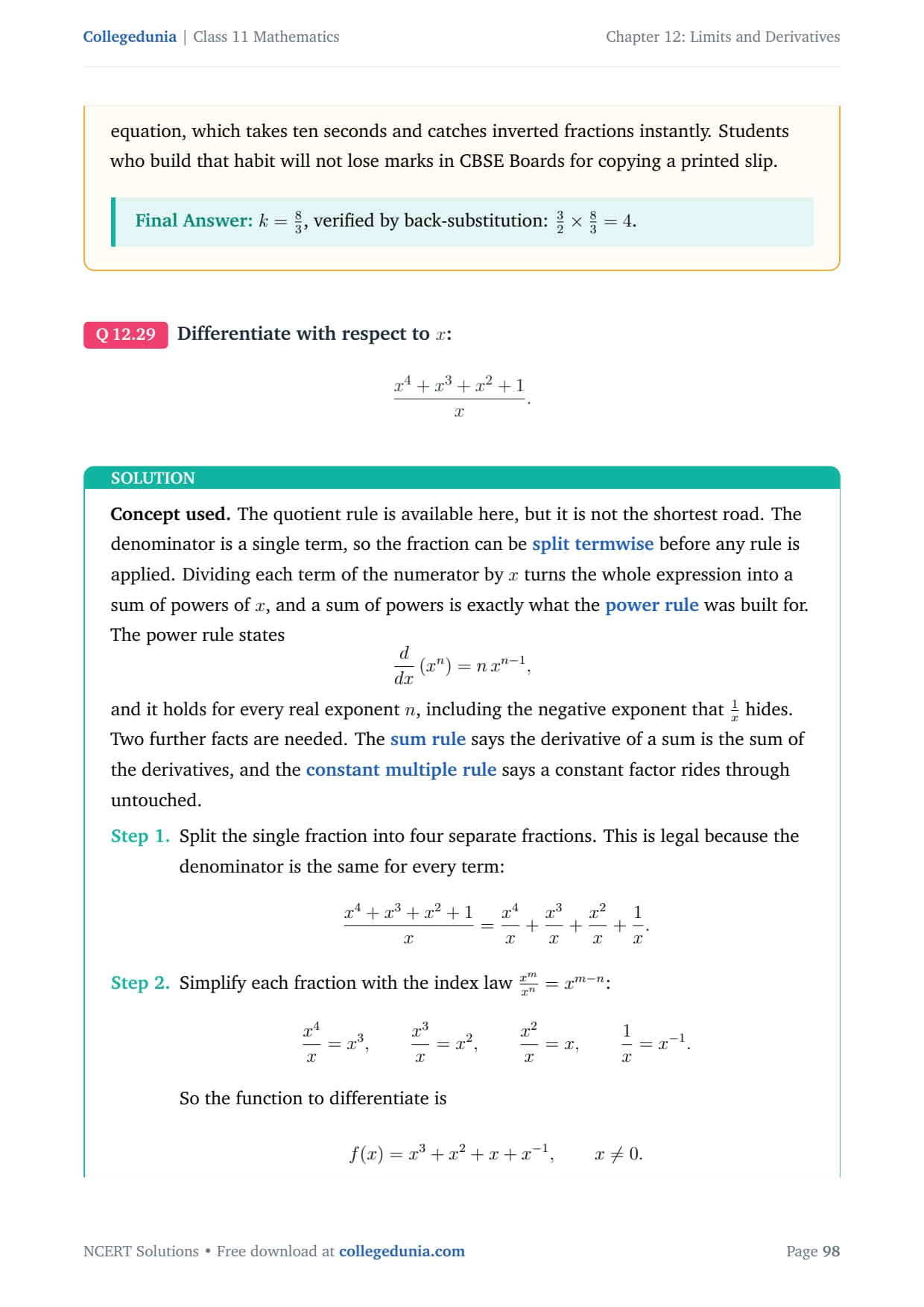
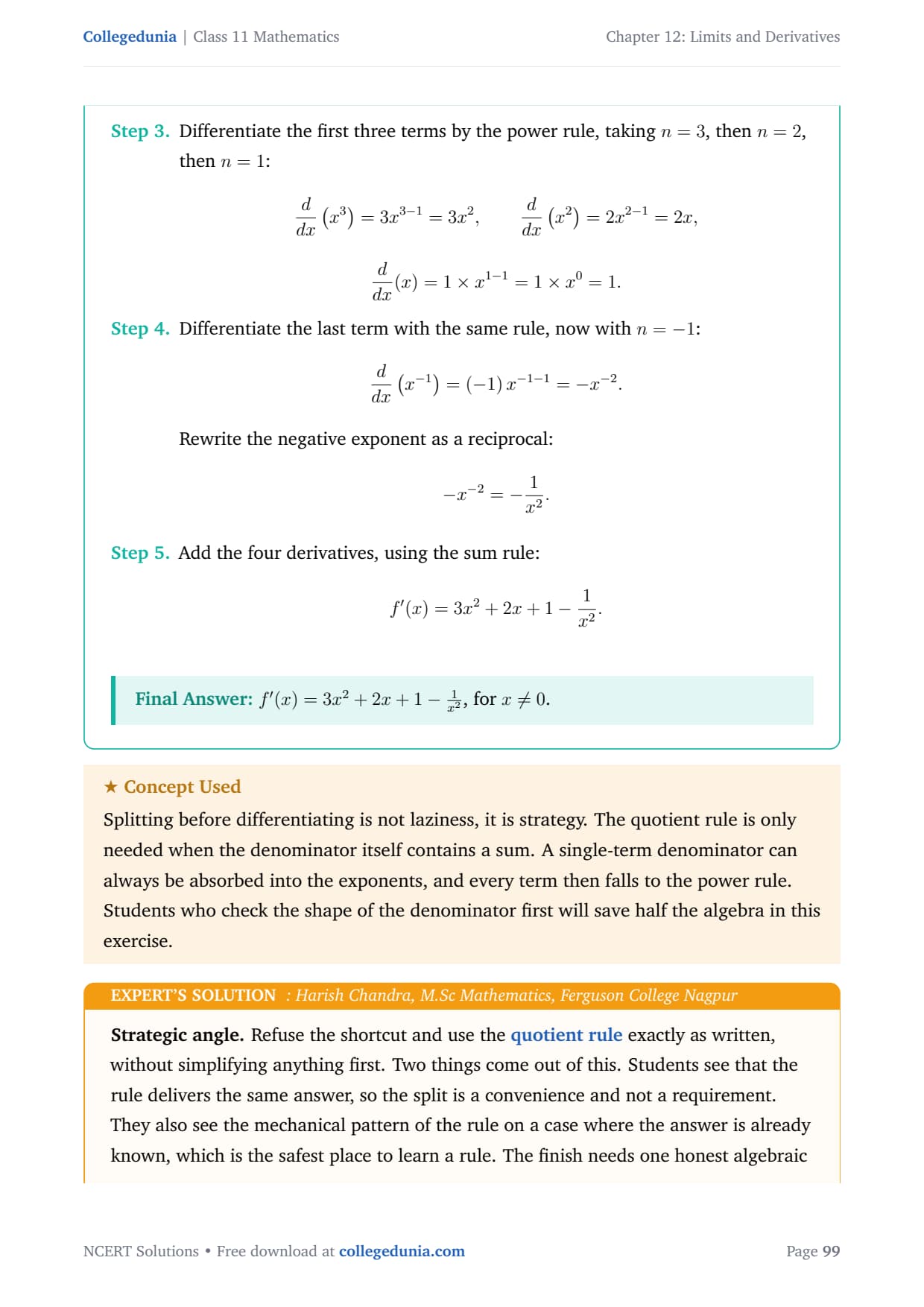
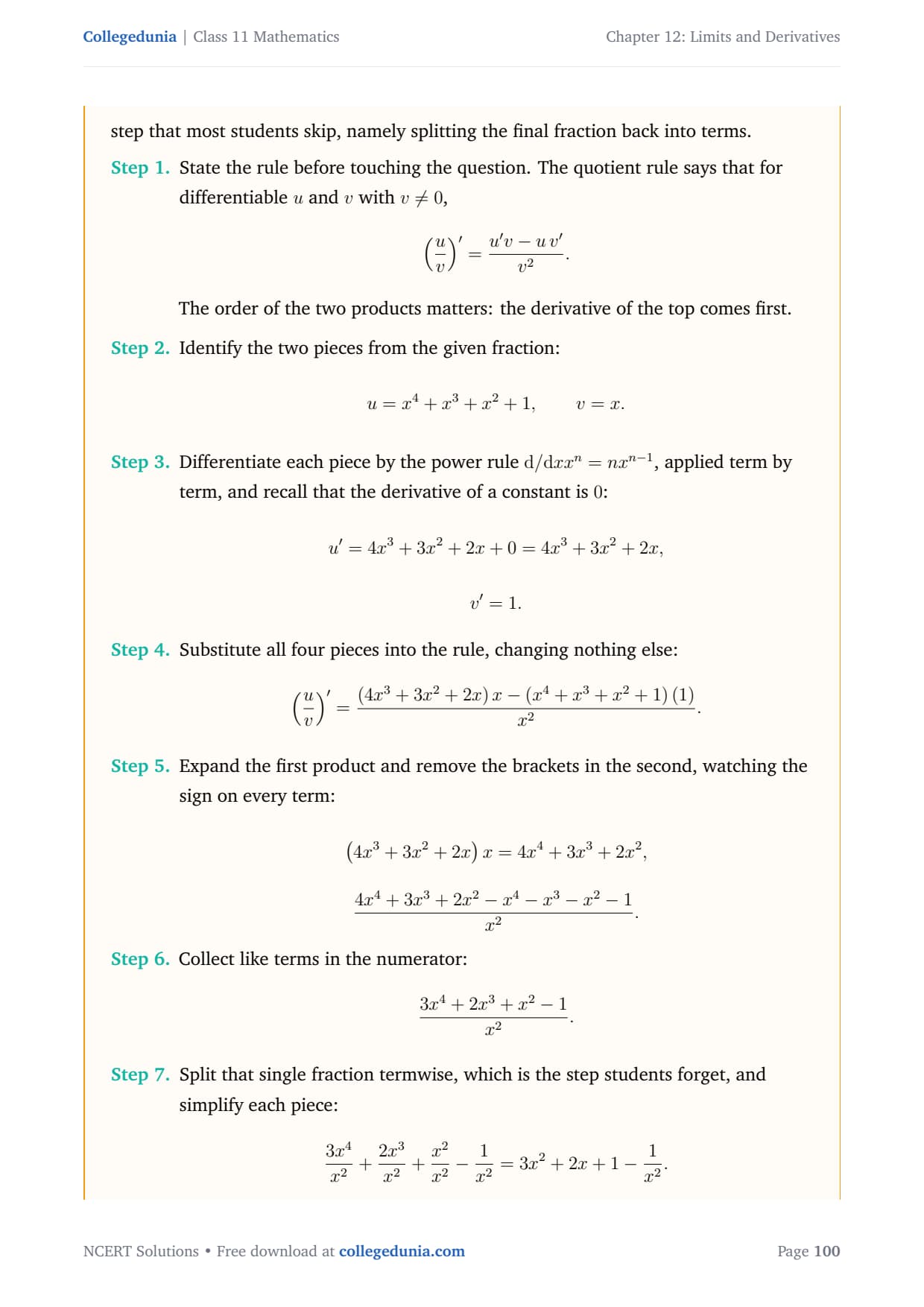
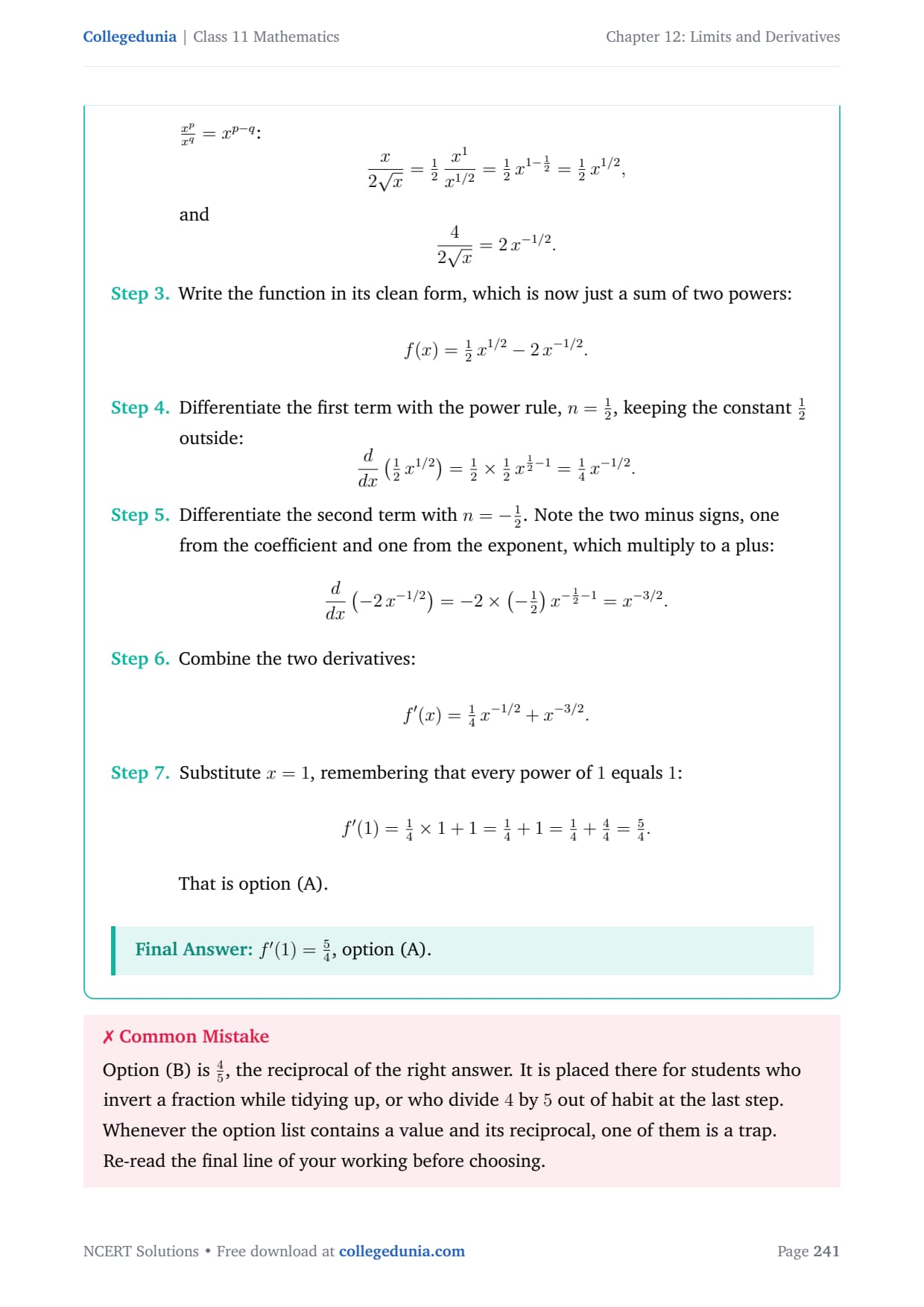
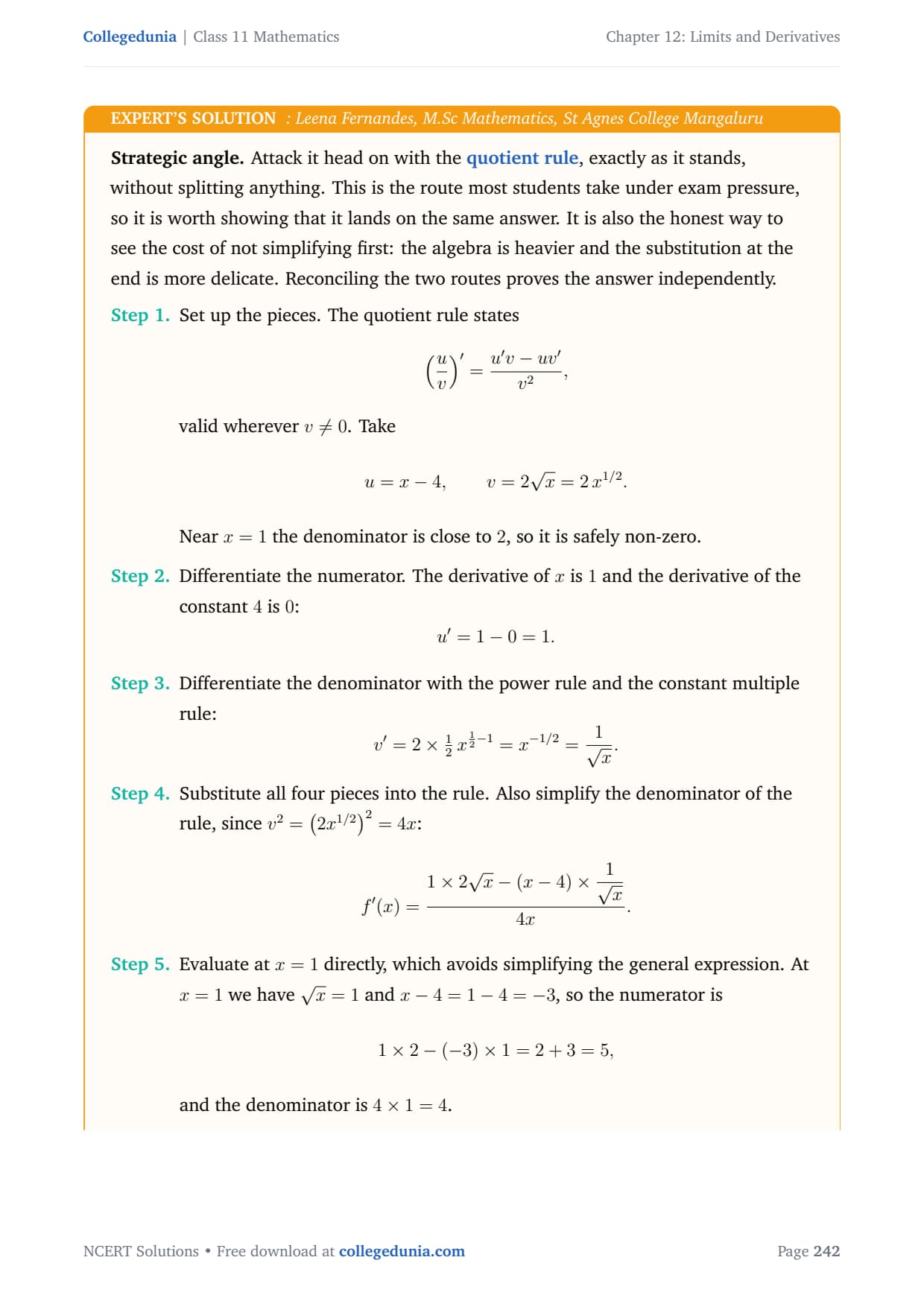
- Reaching for the quotient rule when splitting is faster. In Q69 the denominator is a single power, so dividing term by term is quicker and much safer. Option (B) there is 4/5, the reciprocal of the right answer, placed for students who invert a fraction while tidying up.
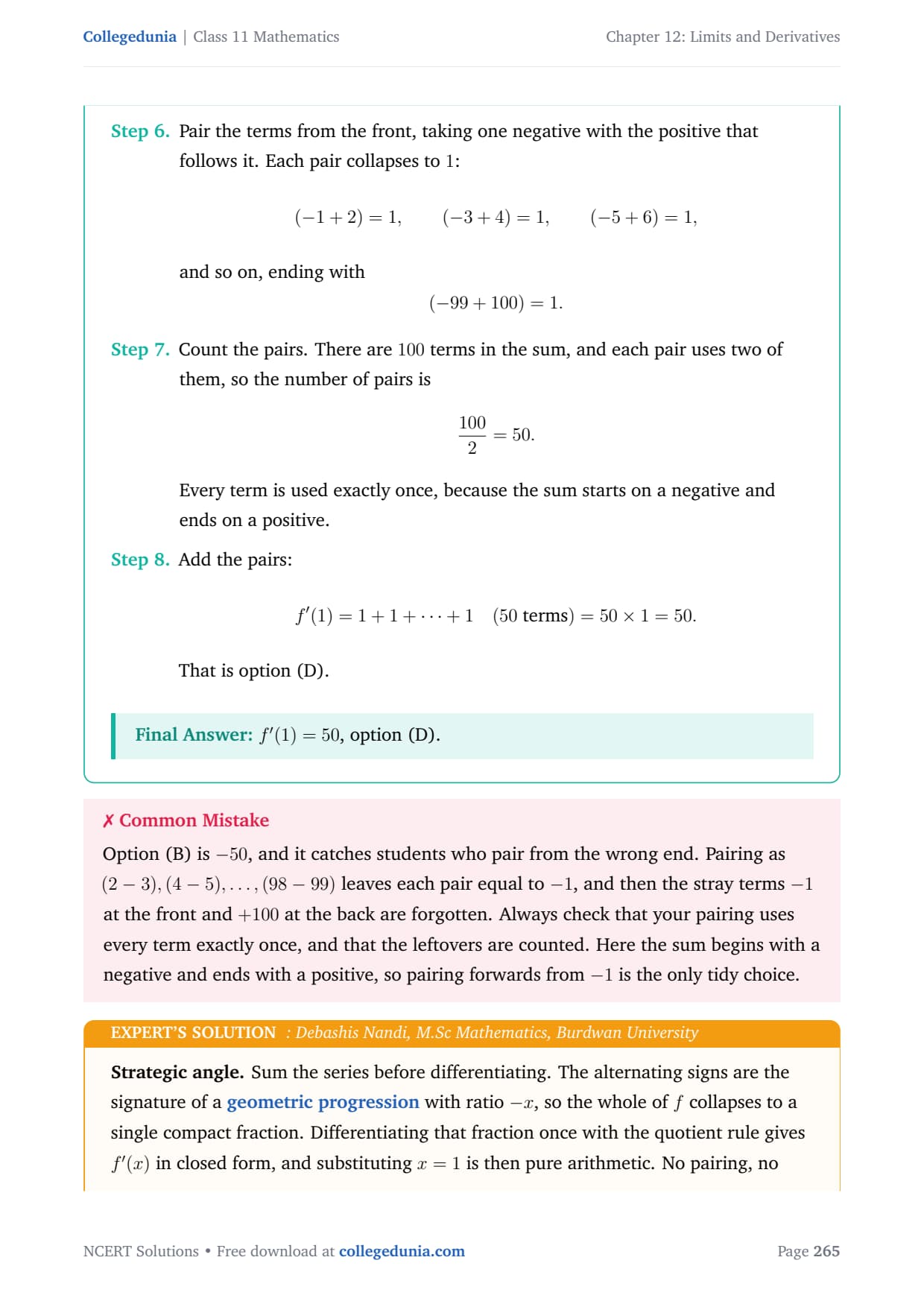
- Pairing terms from the wrong end. In Q76 the sum starts negative and ends positive, so pairing forwards from −1 is the only tidy choice. Option (B), −50, catches students who pair from the other end and then forget the stray terms.
How the Limits and Derivatives Exemplar Steps Up from the NCERT Textbook
The Exemplar adds no new topics to Limits and Derivatives. It asks the same ideas in a harder direction, as the table shows.
| Concept | NCERT Textbook asks | NCERT Exemplar asks |
|---|---|---|
| Algebraic limits | Factorise and cancel a quadratic | Apply the n-th power rule with fractional and negative n |
| Surds | Rationalise a simple denominator | Rationalise both parts of a difference of two surds |
| Trigonometric limits | Evaluate (sin 3x)/x at 0 | Convert an unfamiliar angle to a small one before the rule applies |
| Existence | State that a limit exists | Prove it does not, by computing both one-sided limits |
| Derivatives | Differentiate a polynomial by rule | Differentiate cos(x2+1) from first principles |
How to Use the Limits and Derivatives Exemplar for Boards and JEE Preparation
This is the longest exercise in the Class 11 Maths Exemplar at 80 questions, so treat it as six sittings, not one. Finish the NCERT textbook exercises first, because the Exemplar assumes students already know the standard limits cold.
| Session | What to solve | Time |
|---|---|---|
| 1 | Algebraic limits, Q1 to Q14 | 2 hours |
| 2 | Trigonometric limits, Q15 to Q28 | 2 hours |
| 3 | Differentiation rules, Q29 to Q42 | 2 hours |
| 4 | Long Answer Q43 to Q53, first principles written out in full | 2.5 hours |
| 5 | Objective Q54 to Q76 | 2 hours |
| 6 | Q77 to Q80, then re-solve everything marked wrong | 1.5 hours |
That is about 12 hours for the chapter, the largest single block in the Class 11 Maths Exemplar. For JEE Main and JEE Advanced, the Objective block and the trigonometric limits carry the most weight, and this chapter is the foundation for the whole of Class 12 calculus. For CBSE Boards and CUET, the first-principles questions in Q43 to Q46 and the product and quotient rules are the better use of time.
Practice Questions for Class 11 Maths Limits and Derivatives
After reading the solutions, students should test themselves on the same question types. The card below opens a set of solved practice questions with step-by-step answers for Limits and Derivatives.
Practice Card: Solved Practice Questions for Class 11 Maths Limits and Derivatives. Attempt each question, then check the solution.
Student Feedback
In a Collegedunia survey of 12,840 Class 11 students conducted before the 2026 exams, 79% of students said this was the chapter they ran out of time on, mainly because the 42-question Short Answer block was attempted in a single sitting. Only 4% of students had noticed that the limit in Q20 does not exist at all.
Other Resources for Class 11 Maths Limits and Derivatives
Pair the Exemplar Solutions with the textbook solutions and the notes for full chapter revision. All the Limits and Derivatives resources are linked below.
| Resource | Link |
|---|---|
| NCERT Solutions | Limits and Derivatives Class 11 NCERT Solutions |
| Revision Notes | Limits and Derivatives Class 11 Notes |
| Handwritten Notes | Limits and Derivatives Class 11 Handwritten Notes |
| NCERT Book PDF | Limits and Derivatives Class 11 NCERT Book PDF |
| Exemplar Book PDF | Limits and Derivatives Class 11 NCERT Exemplar Book PDF |
NCERT Exemplar Solutions for Other Class 11 Maths Chapters
The full Class 11 Maths Exemplar set covers 14 chapters, 735 questions and 2,625 pages of solutions. Use the table to jump to any other chapter.
Limits and Derivatives Class 11 Maths NCERT Exemplar Solutions FAQs
Ques. How many questions are there in the Class 11 Maths Limits and Derivatives Exemplar?
Ans. Limits and Derivatives has 80 questions in a single exercise, which the Exemplar book prints as Exercise 13.3. That is the largest question set of any chapter in the Class 11 Maths Exemplar. They are split into 42 Short Answer, 11 Long Answer, 23 Objective and 4 Fill in the Blanks questions. Every one of them is solved in the 281-page PDF on this page.
Ques. Why is Limits and Derivatives numbered Chapter 13 in the NCERT Exemplar book?
Ans. The NCERT Exemplar book follows an older chapter order in which Limits and Derivatives is Chapter 13 and its exercise is Exercise 13.3. The current NCERT textbook lists it as Chapter 12, which is the number used on this page. The questions and the exercise content are identical, so students can use either number to find the same set.
Ques. Why does the limit in Q20 of the Limits and Derivatives Exemplar not exist?
Ans. Because 1 − cos 6x = 2 sin2 3x, so the numerator is √2 |sin 3x|, not √2 sin 3x. Just to the right of x = π/3 the angle 3x passes π and sin 3x turns negative, so the modulus flips the sign. The left-hand limit is 3 and the right-hand limit is −3. Since the two sides disagree, the two-sided limit does not exist, and the key's answer of 3 is only the left-hand limit.
Ques. Is the printed NCERT Exemplar answer key for Limits and Derivatives correct?
Ans. Not on seven questions, which is the most of any chapter in this set. Q5, Q15 and Q53 are misprints in the question itself, Q20 and Q28 have wrong keys, Q34 has a misprint inside the key's expression, and Q61 has an option list in which the correct value 2 does not appear. Each of the seven is explained on this page with the correct answer and a one-line check.
Ques. Are the Class 11 Maths Limits and Derivatives Exemplar Solutions free to download?
Ans. Yes. The Limits and Derivatives NCERT Exemplar Solutions PDF is free to download from this page. It runs to 281 pages, solves all 80 questions step by step according to the 2026-27 NCERT Exemplar, and helps students prepare for CBSE Boards, JEE Main, JEE Advanced and CUET.



Comments