




Introduction to Three Dimensional Geometry is the chapter where a single missing minus sign moves a point to the wrong side of a plane. The NCERT Exemplar Solutions for Class 11 Maths Chapter 11 Introduction to Three Dimensional Geometry on this page solve all 50 questions of the chapter, step by step, according to the 2026-27 NCERT Exemplar.
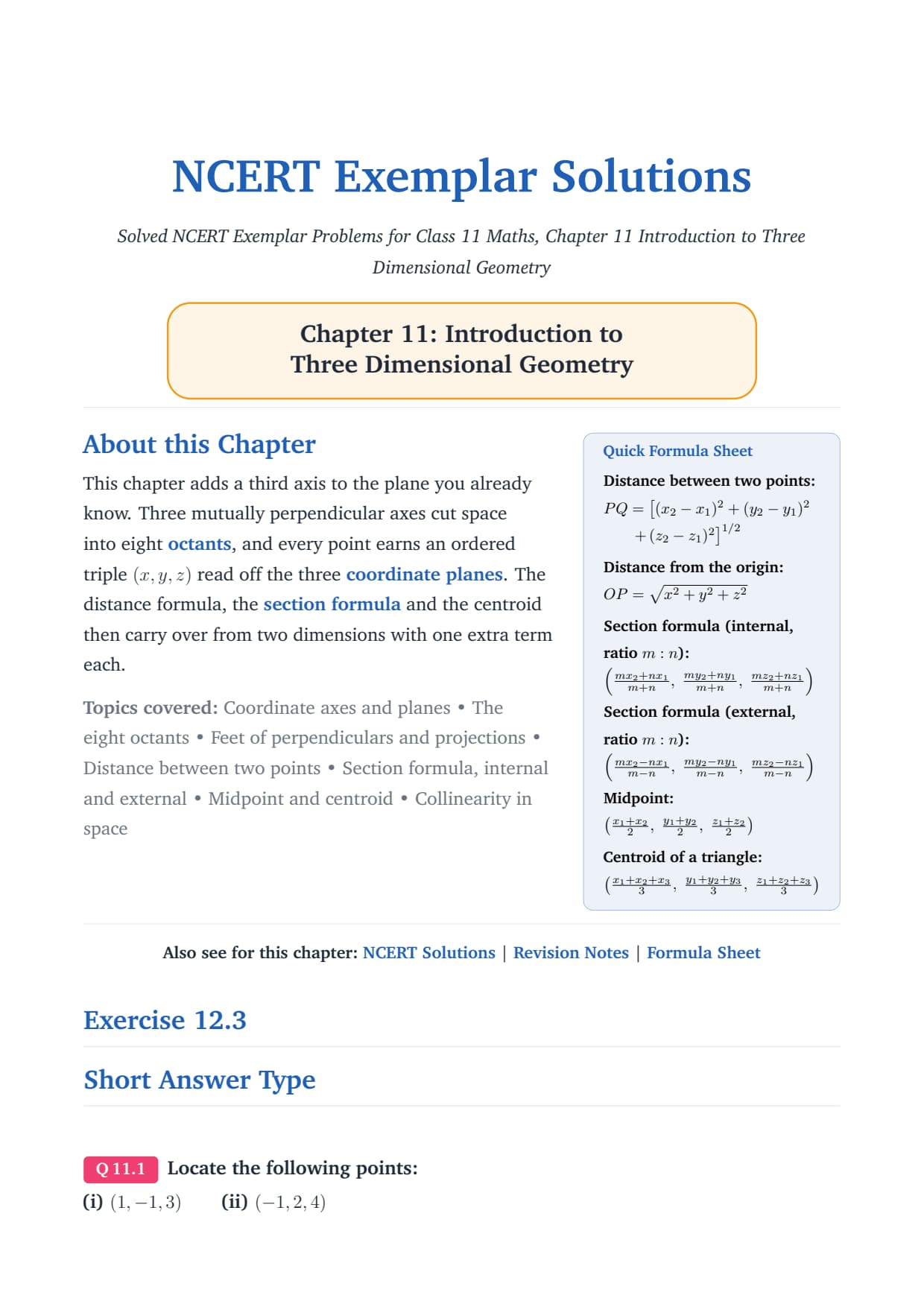
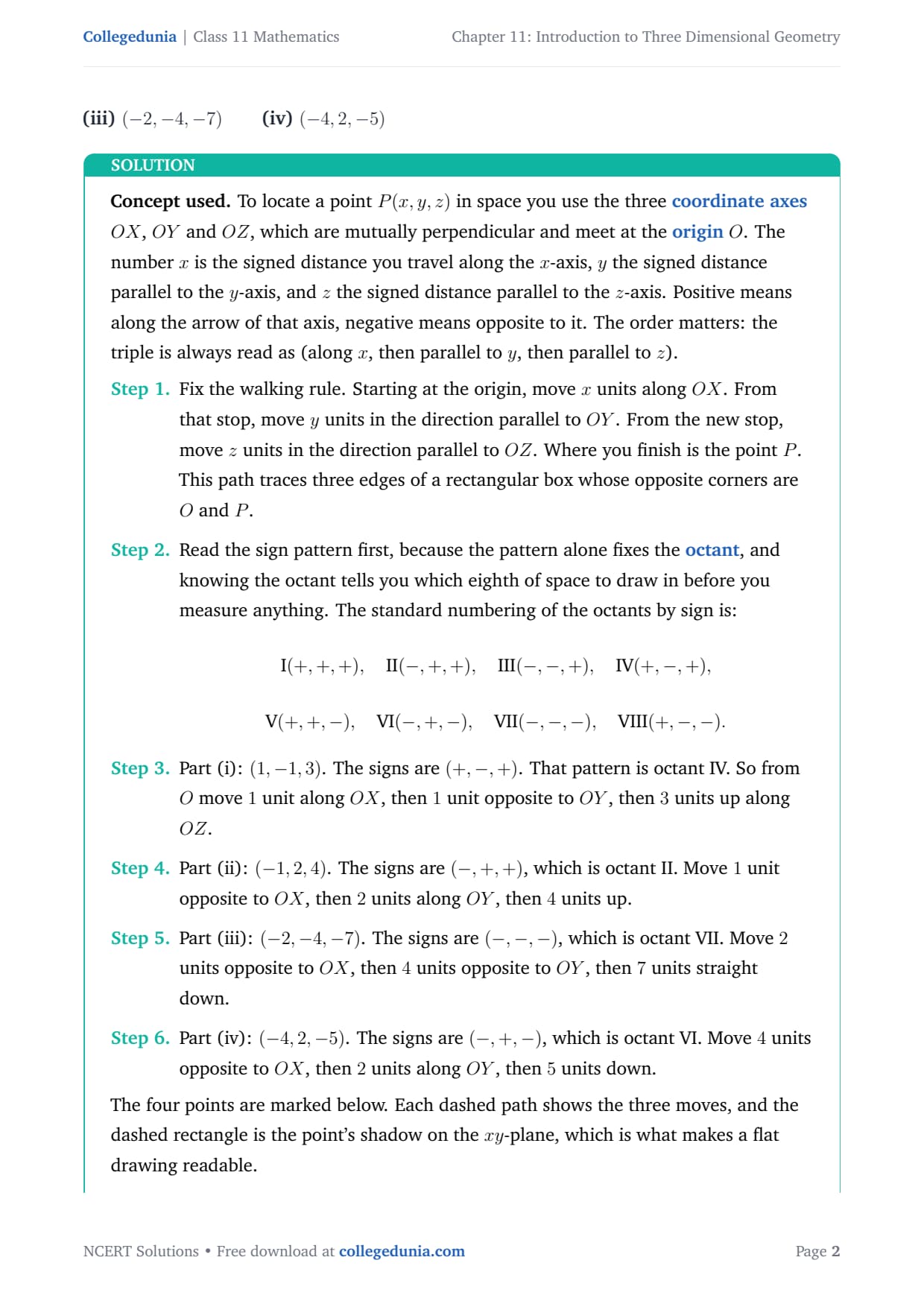
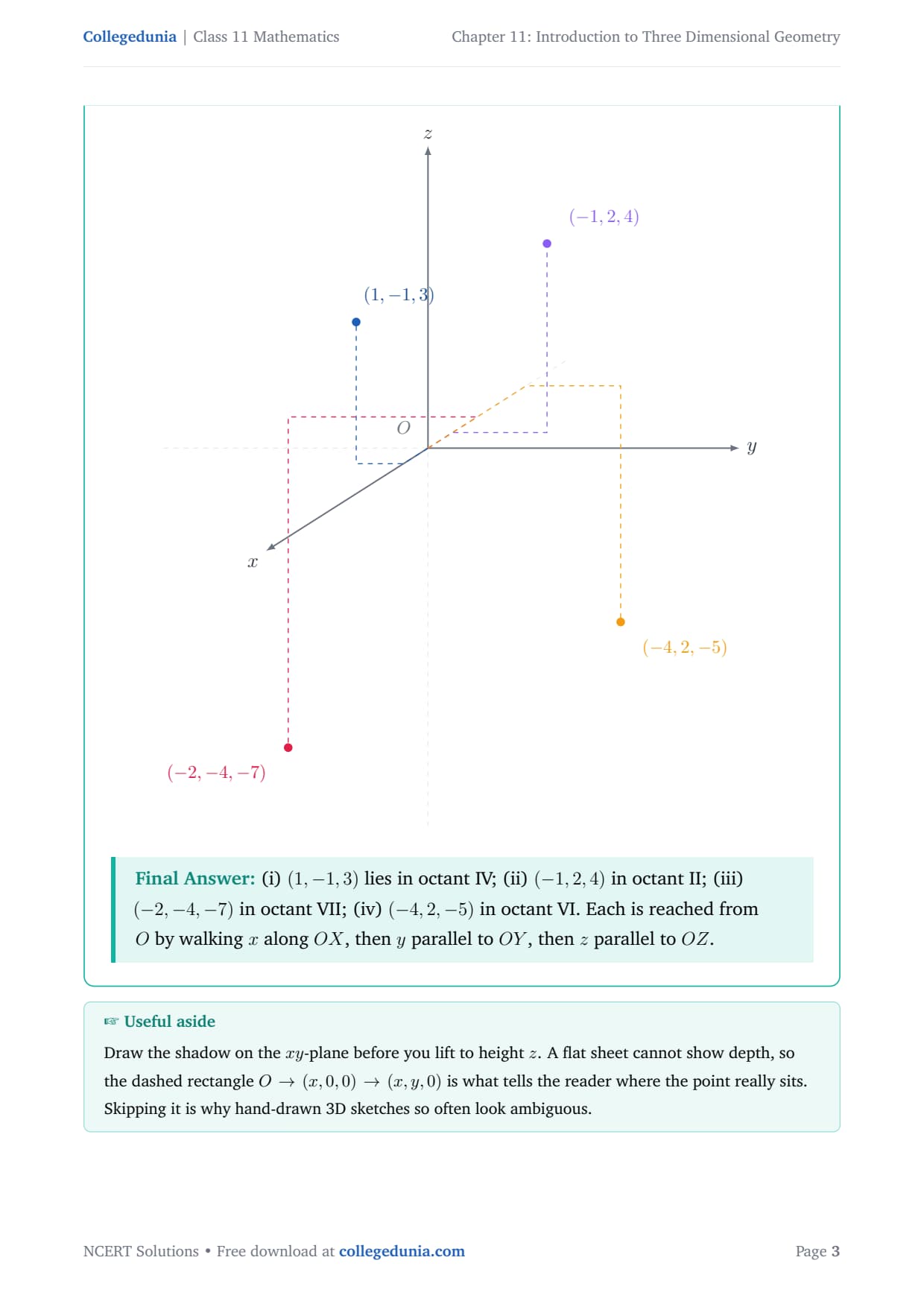
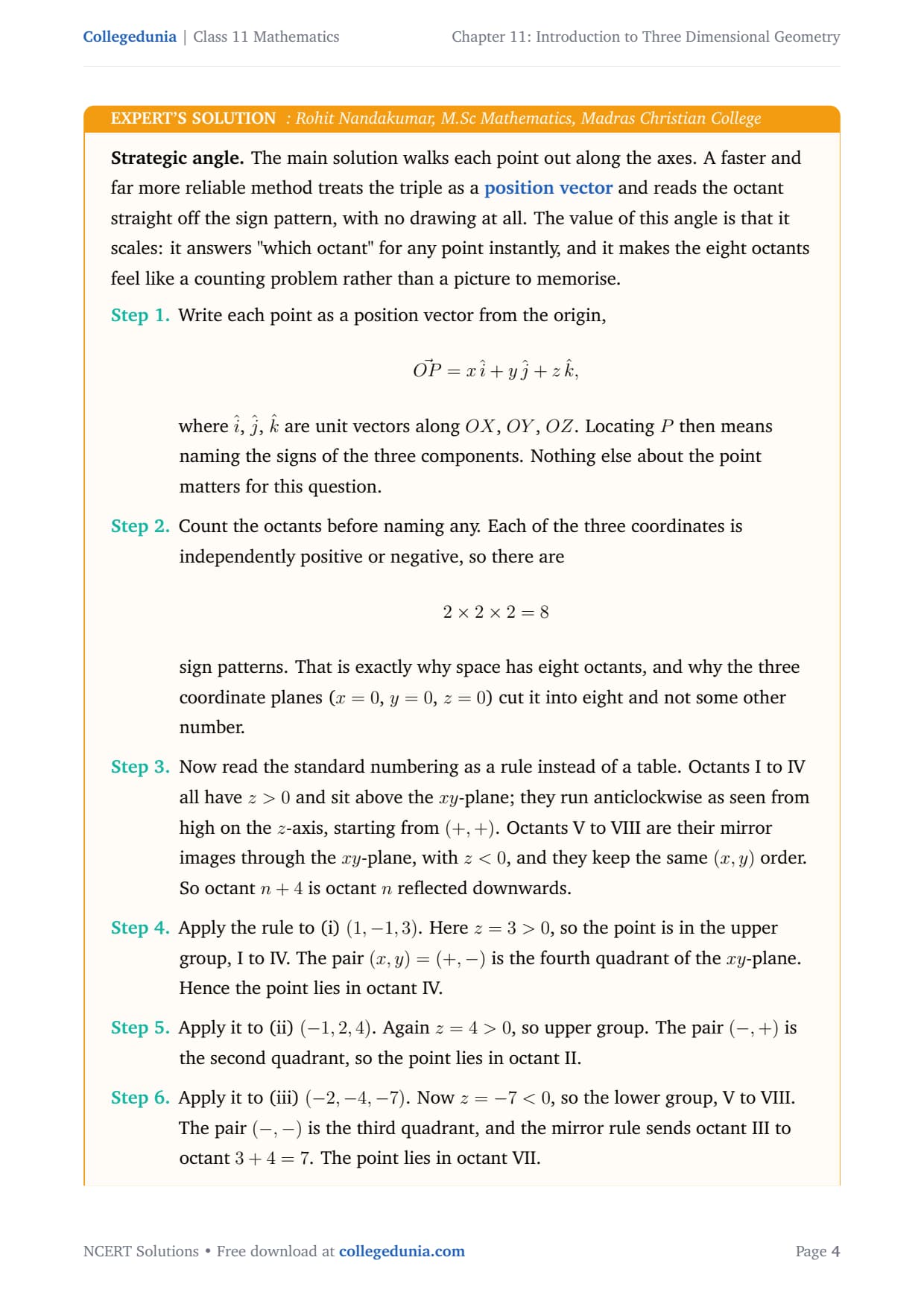
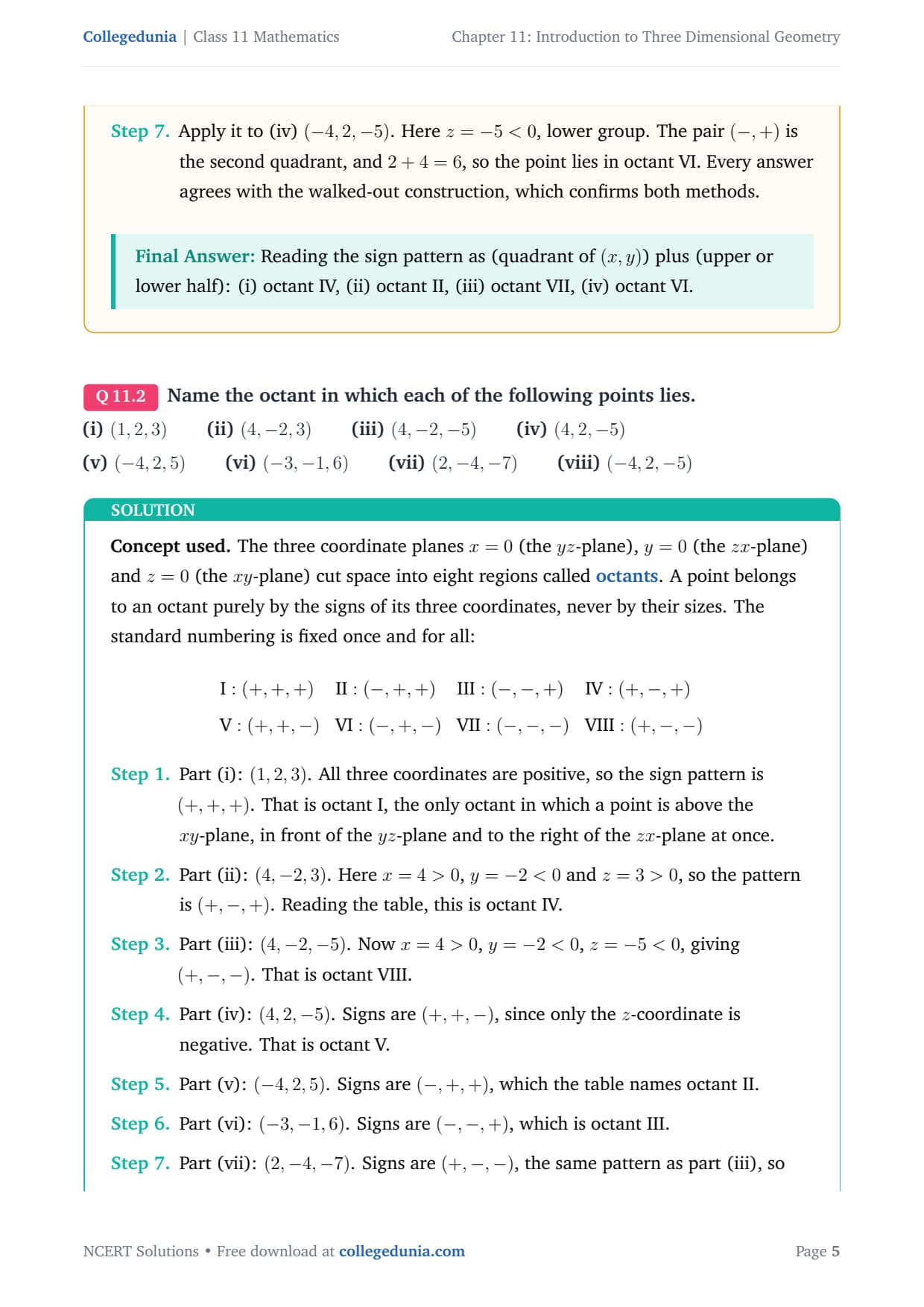
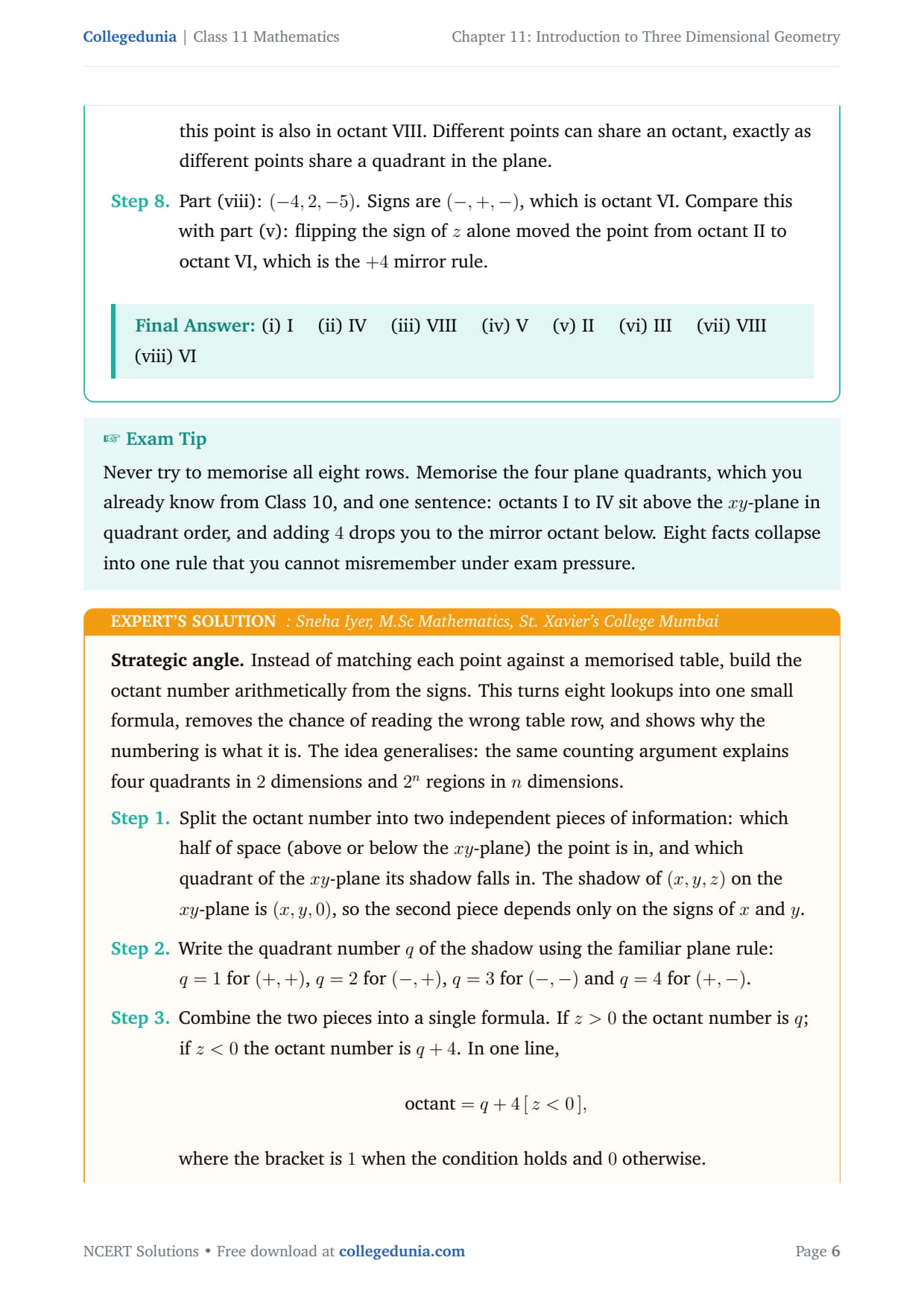
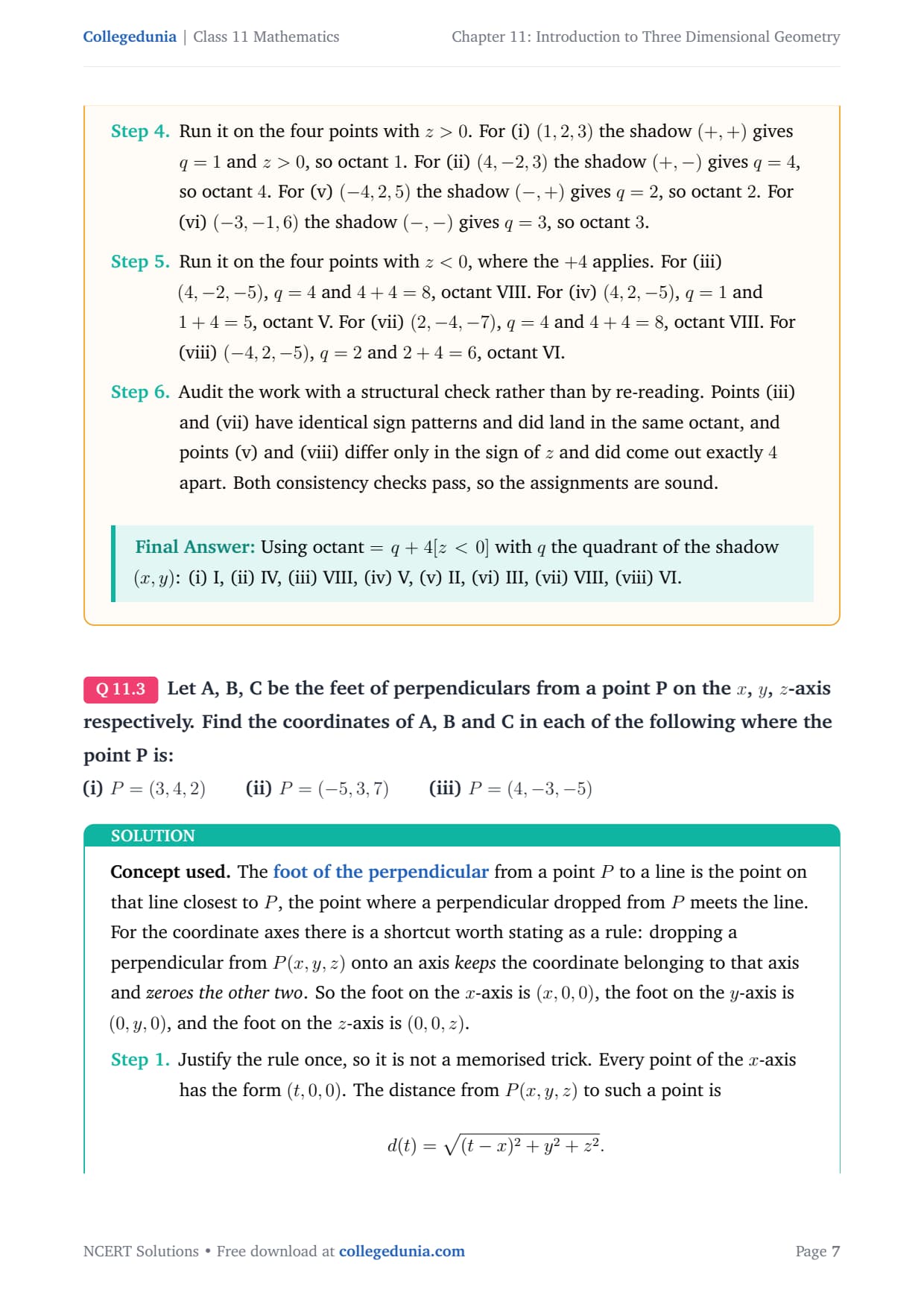
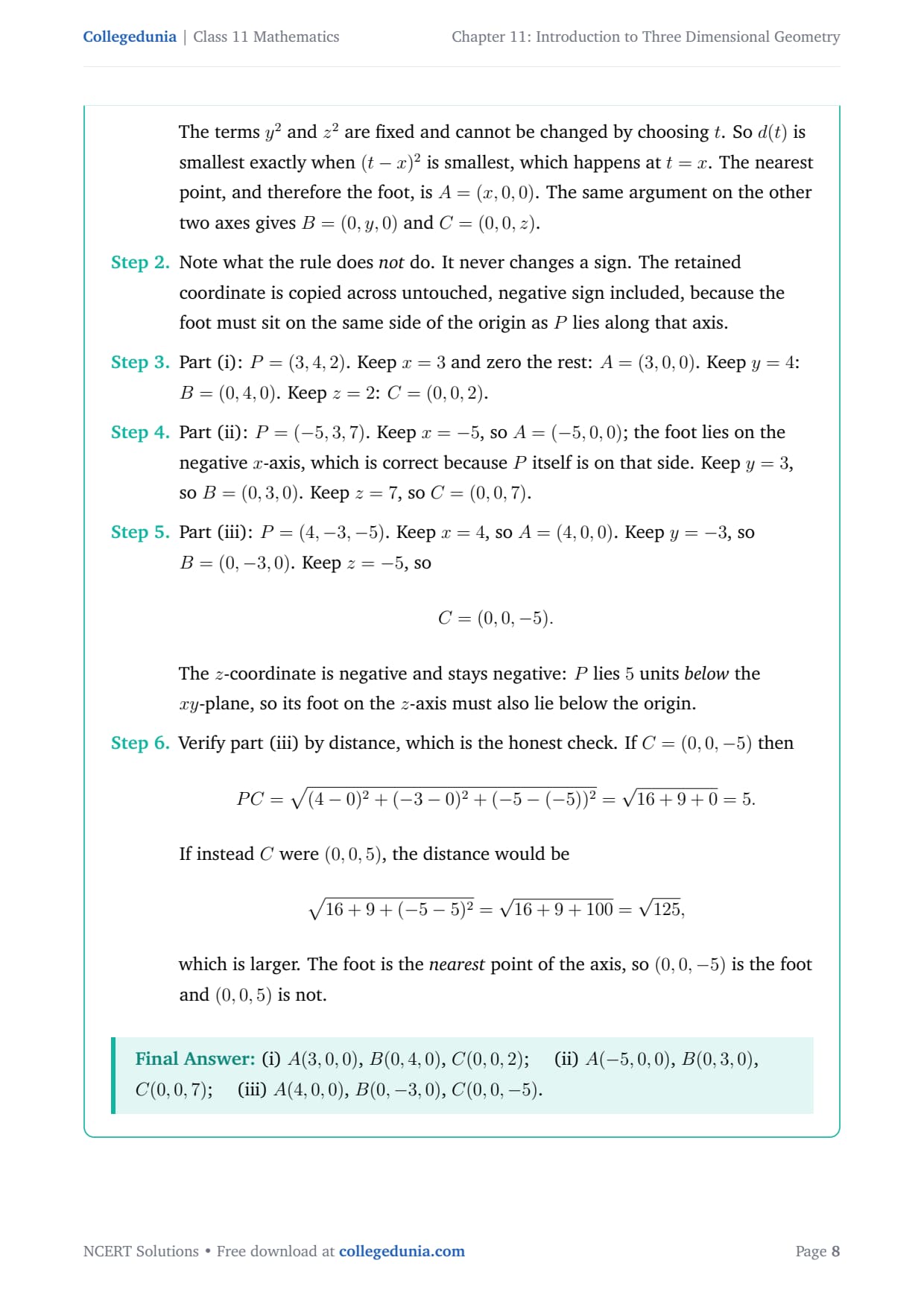
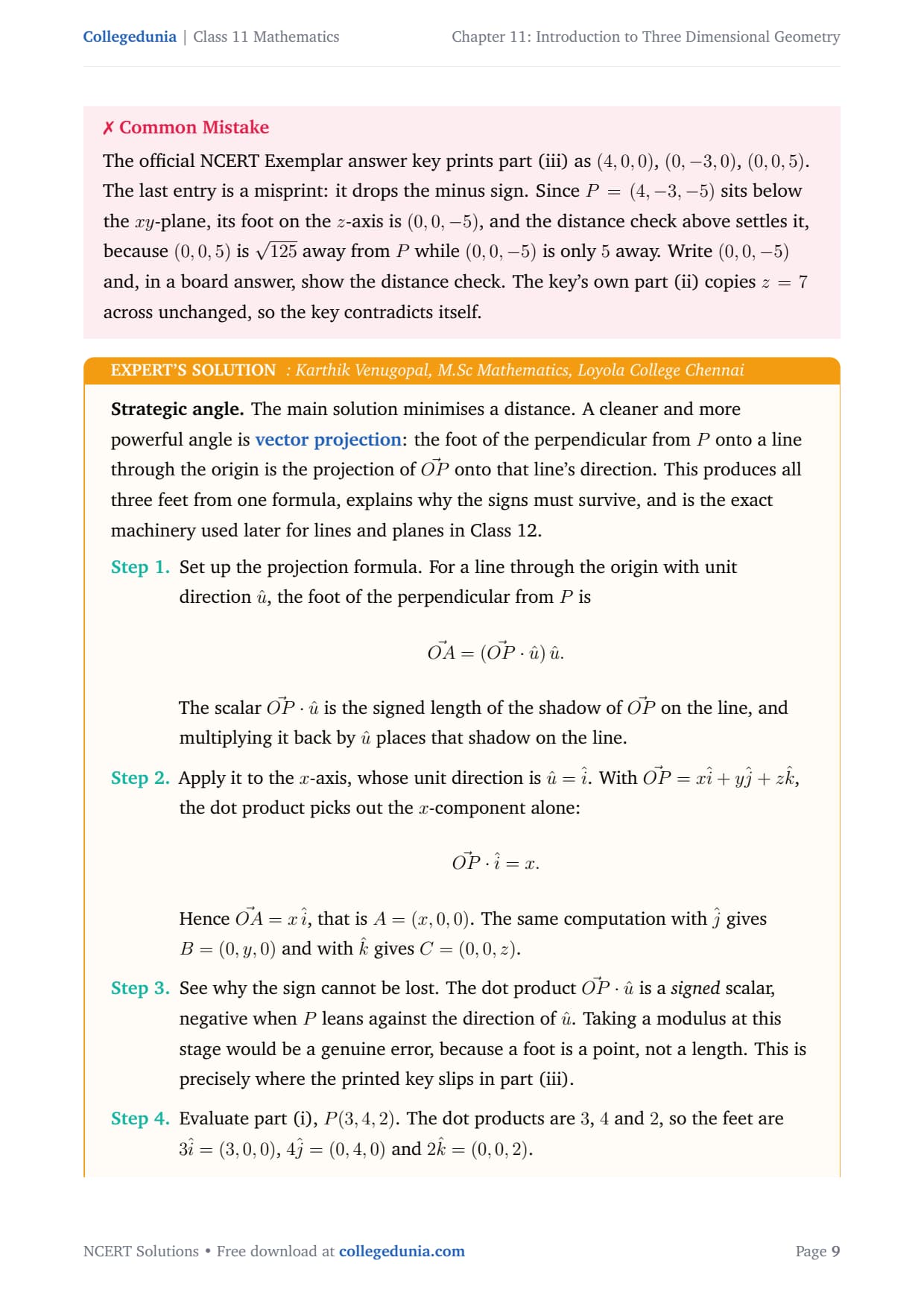
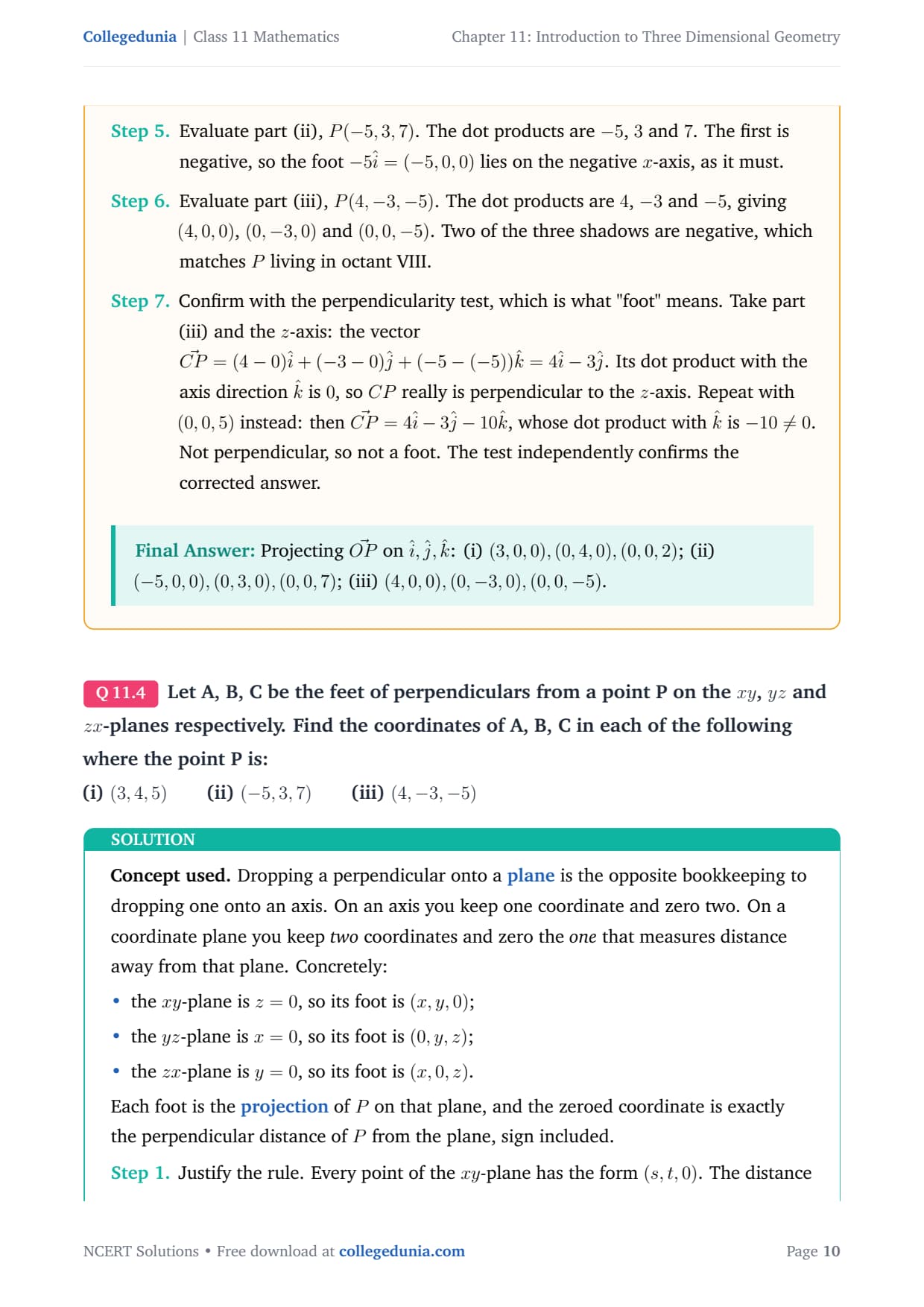
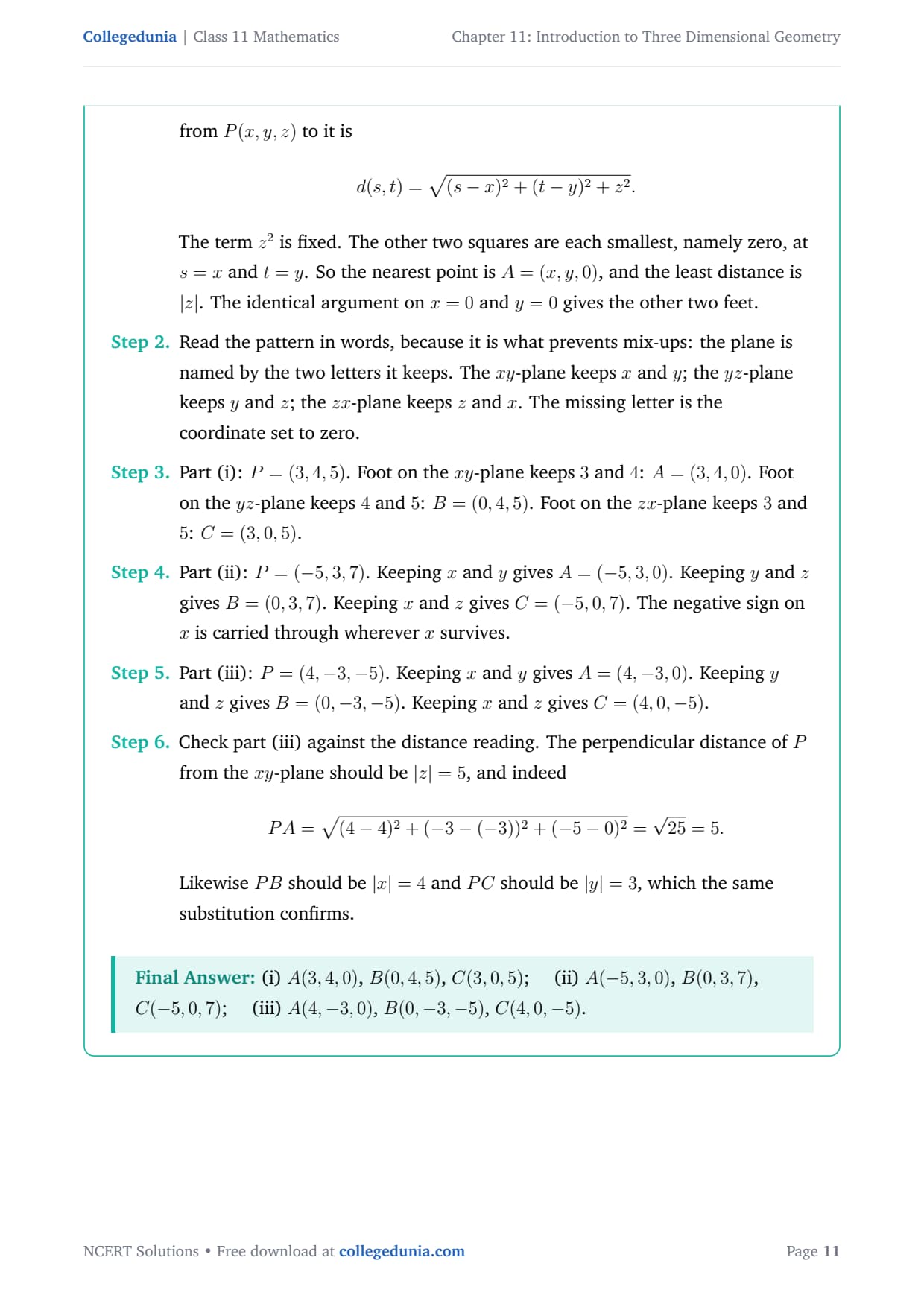
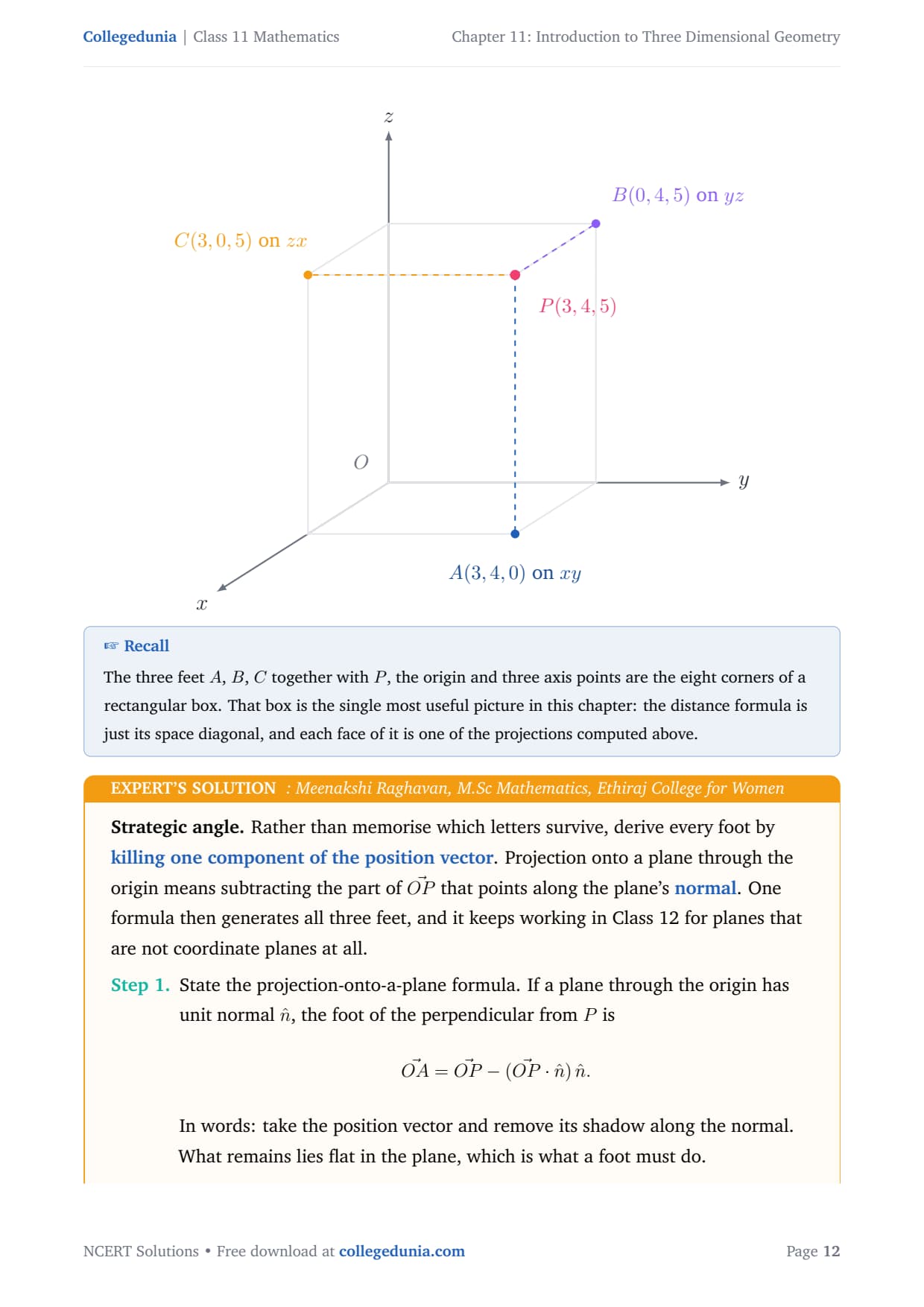
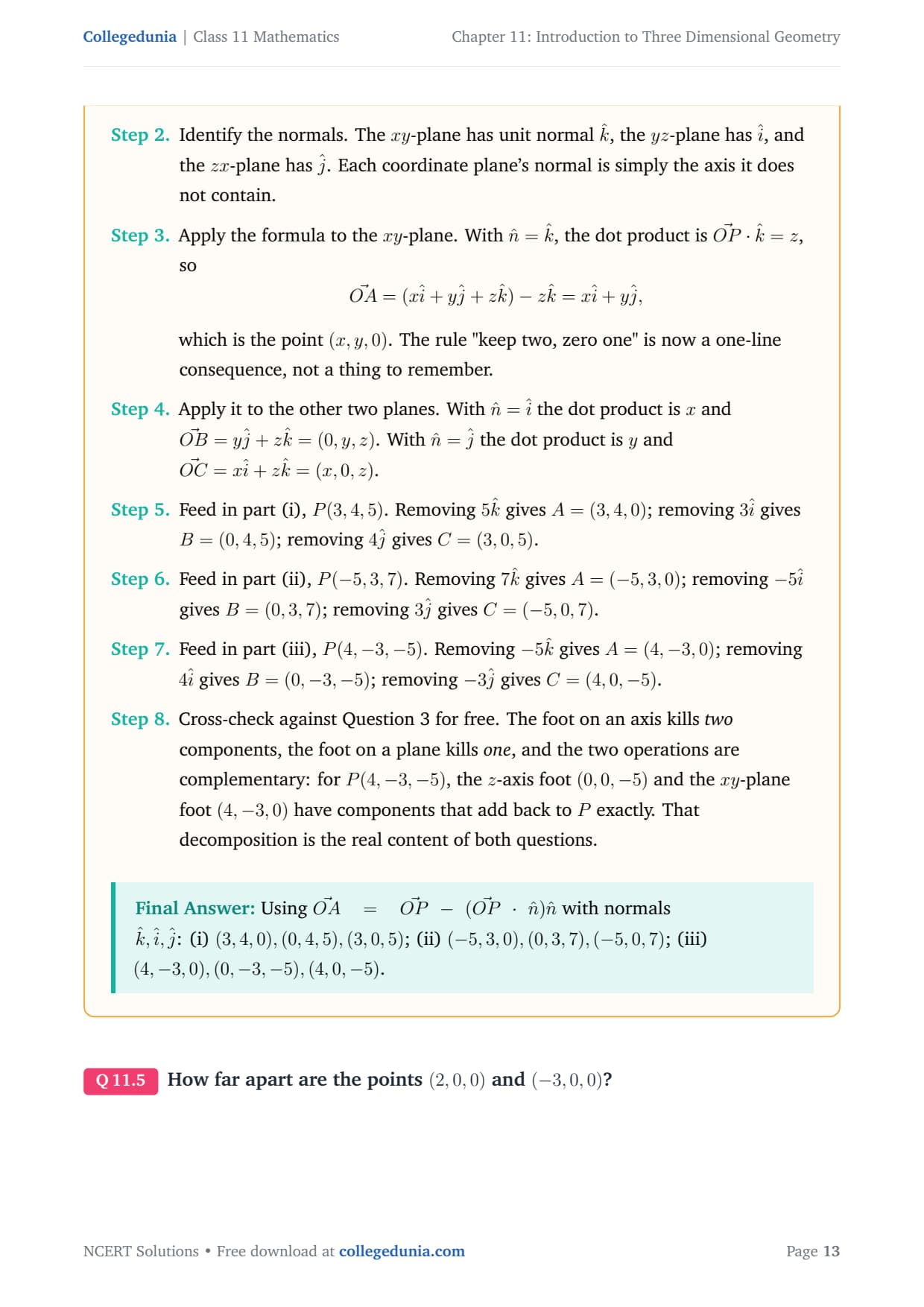
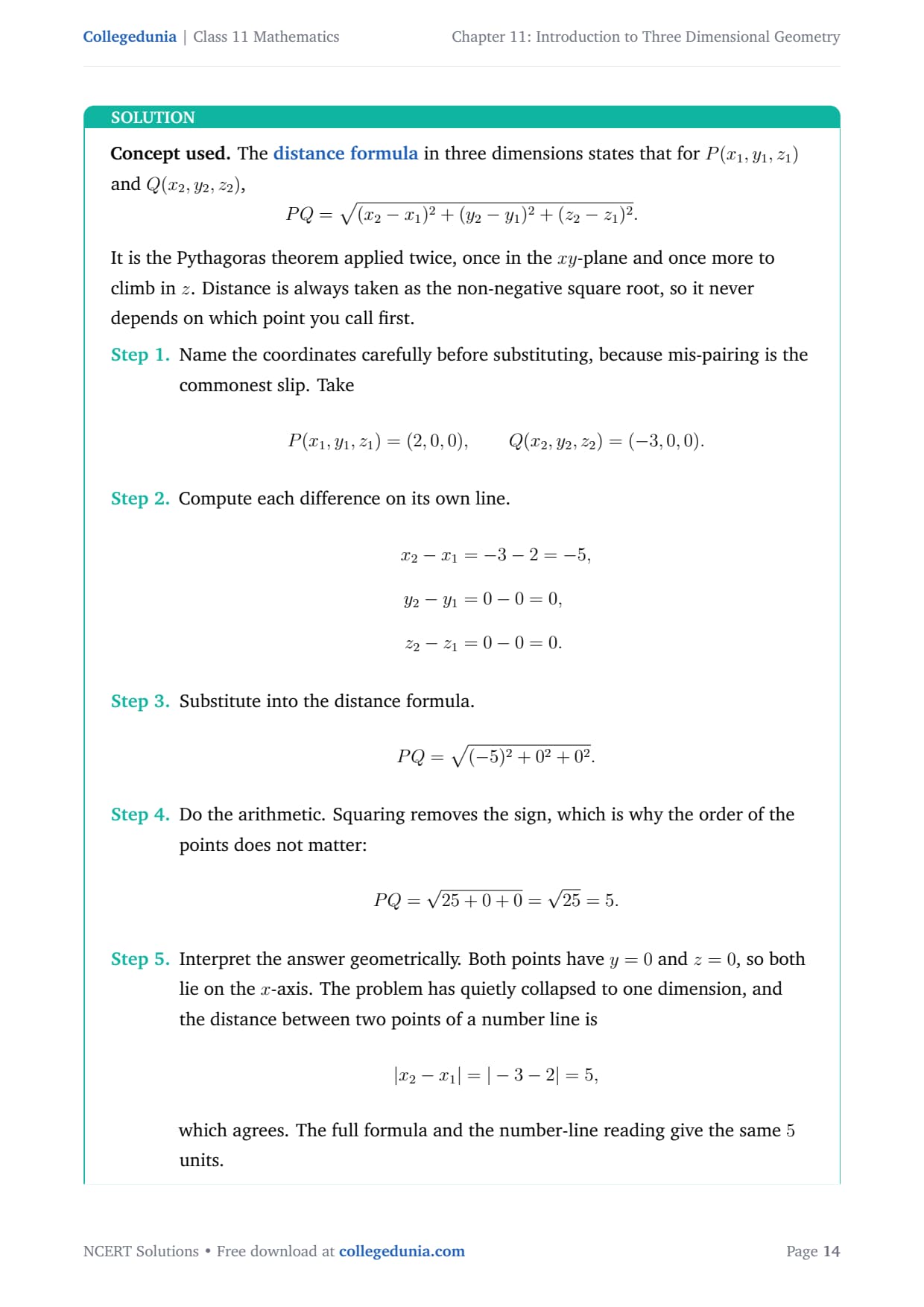
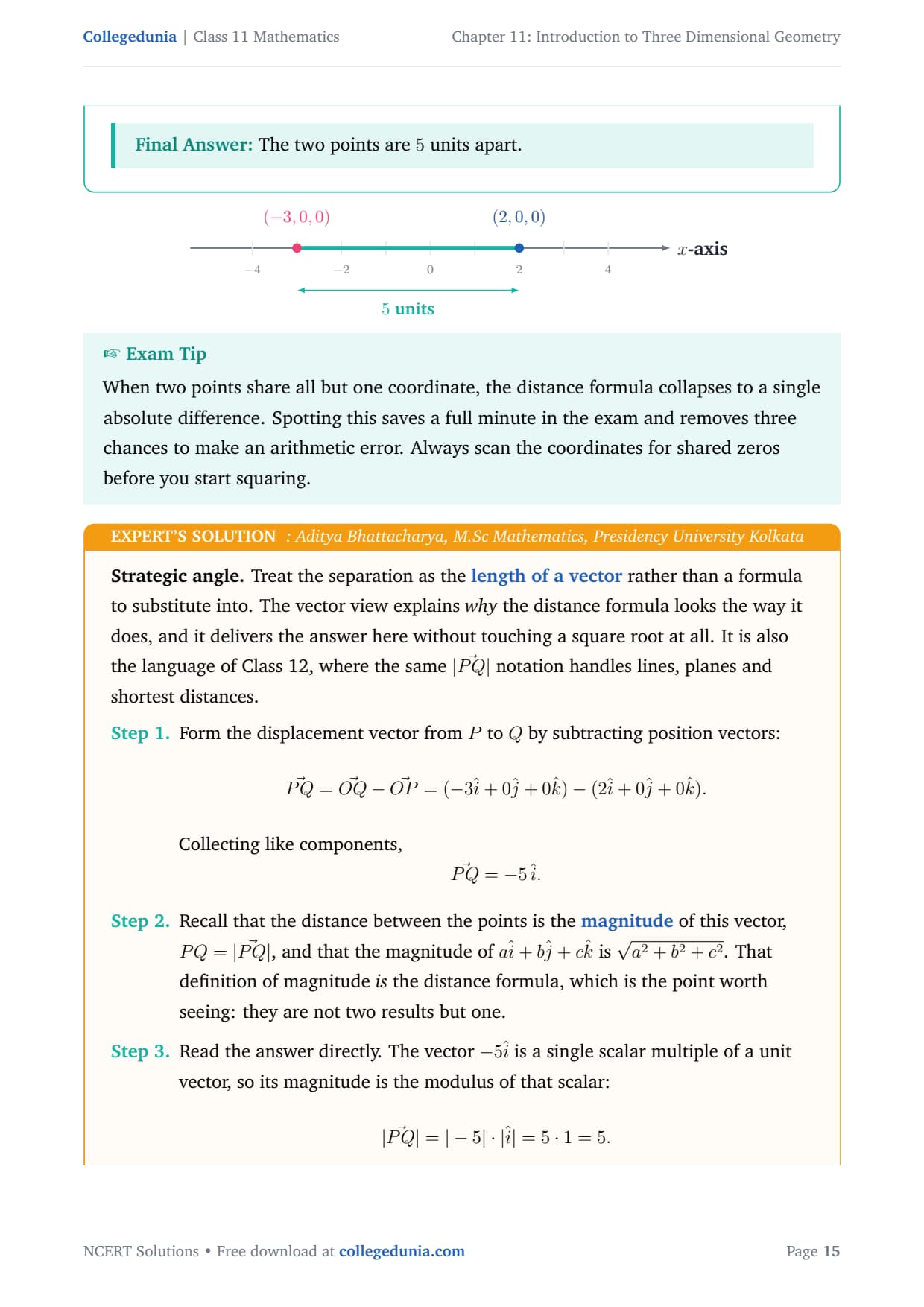
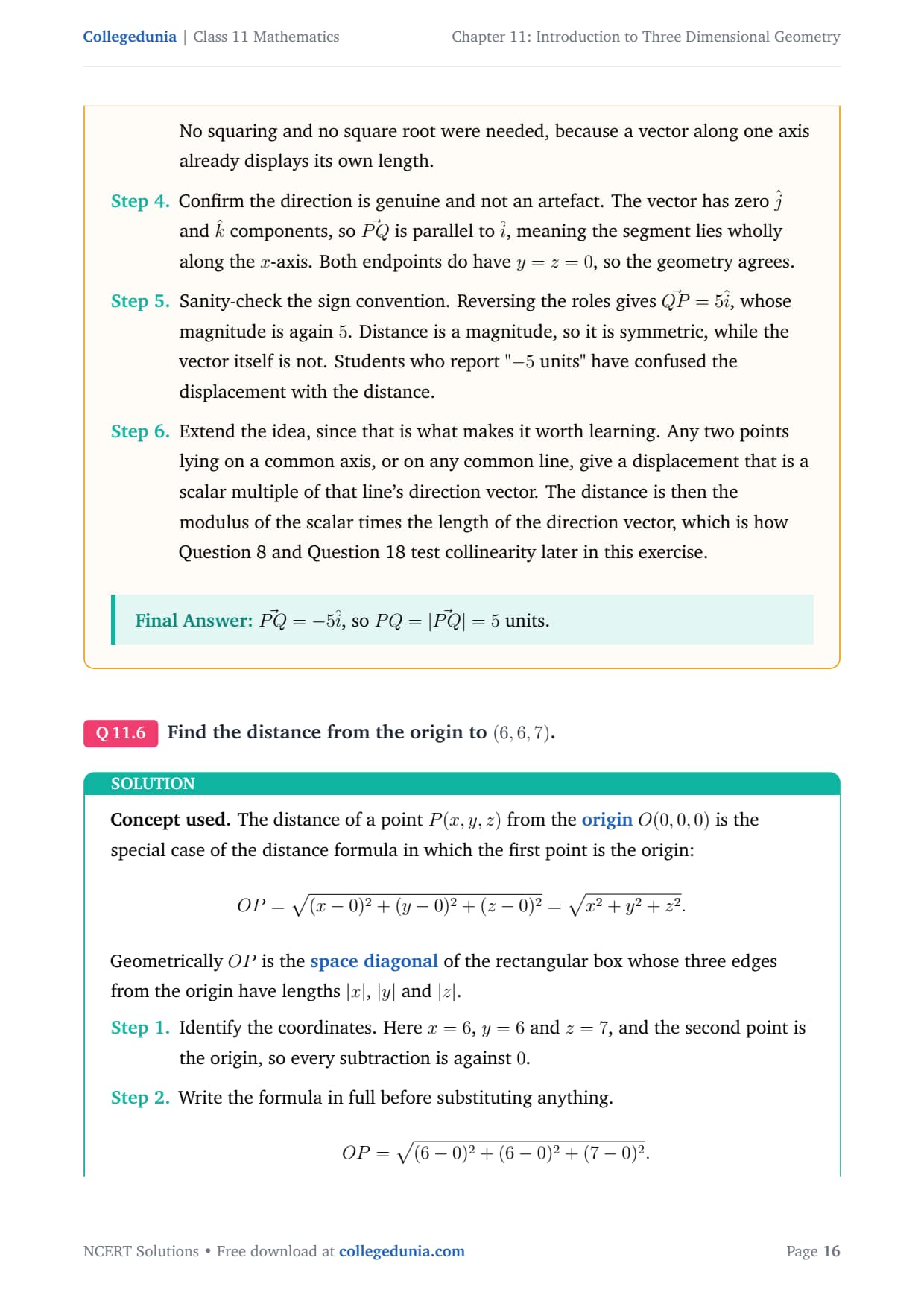
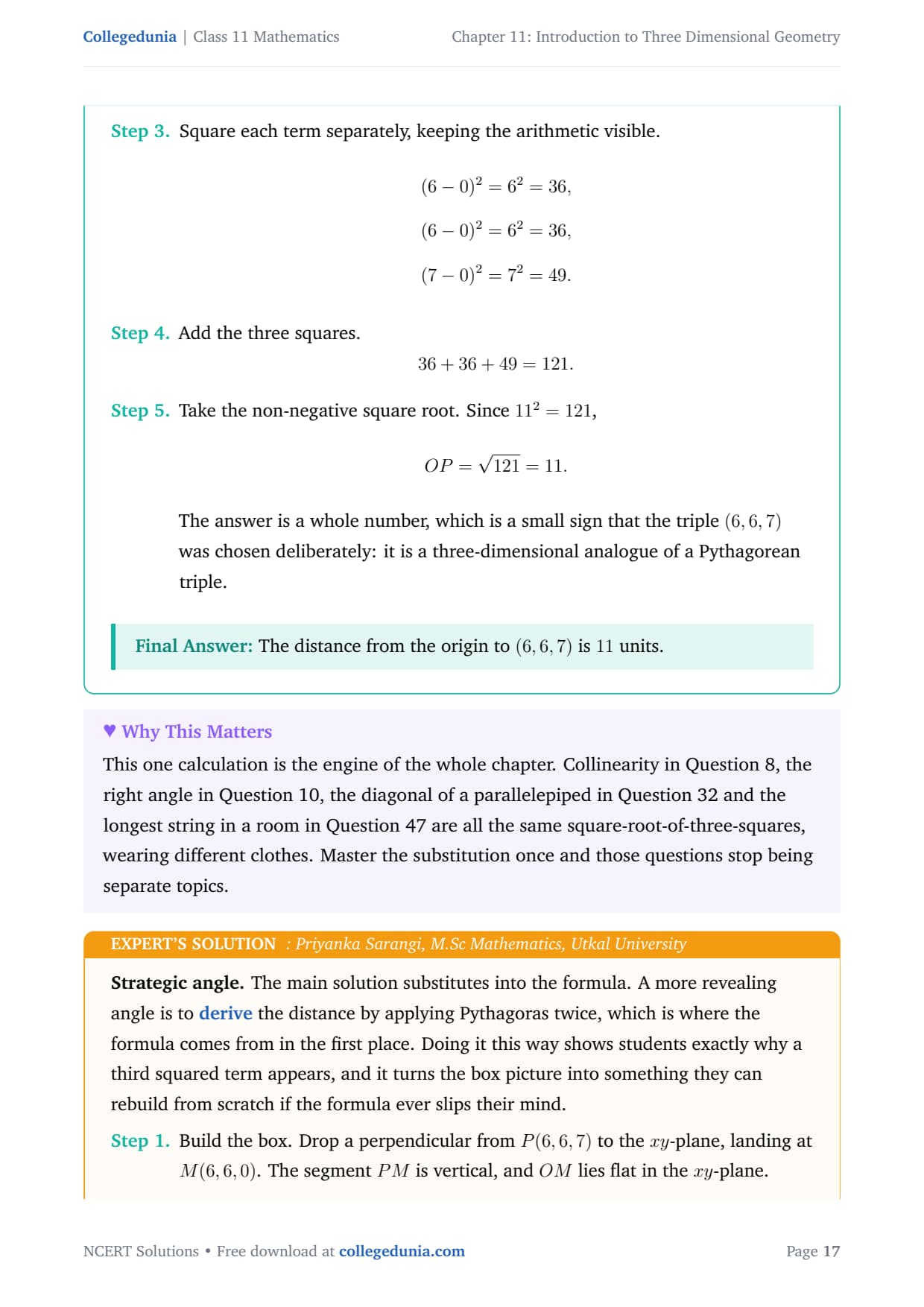
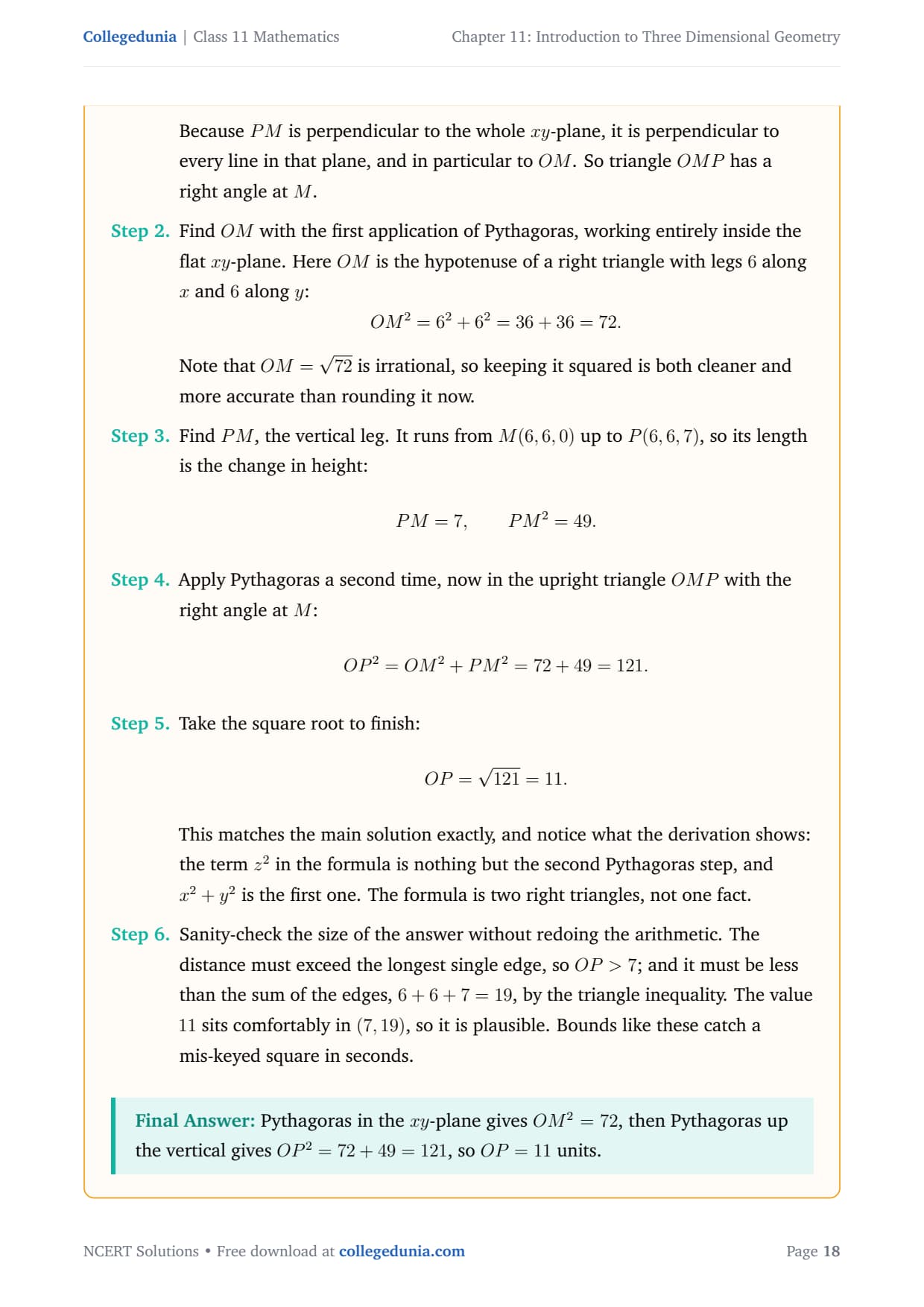
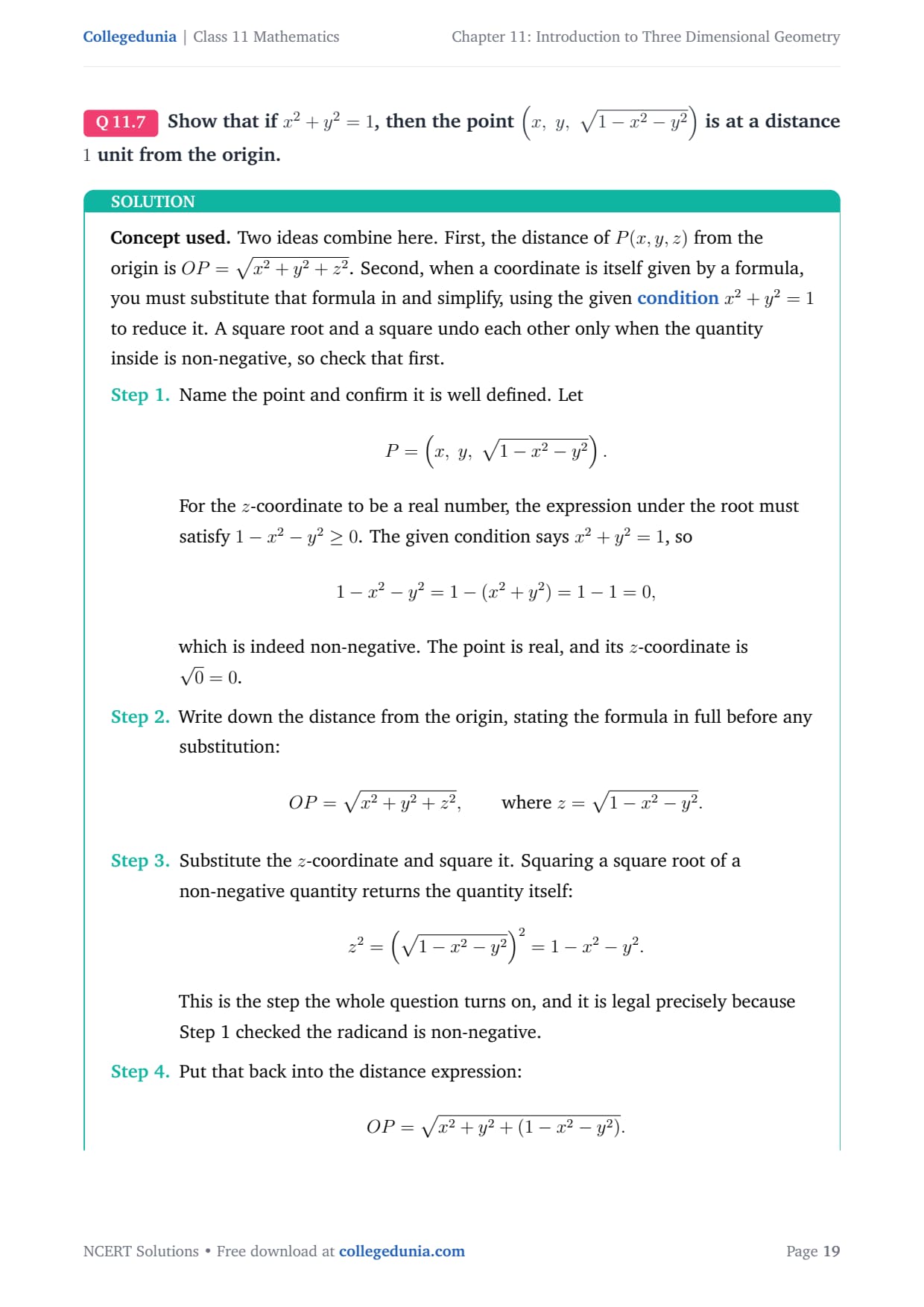
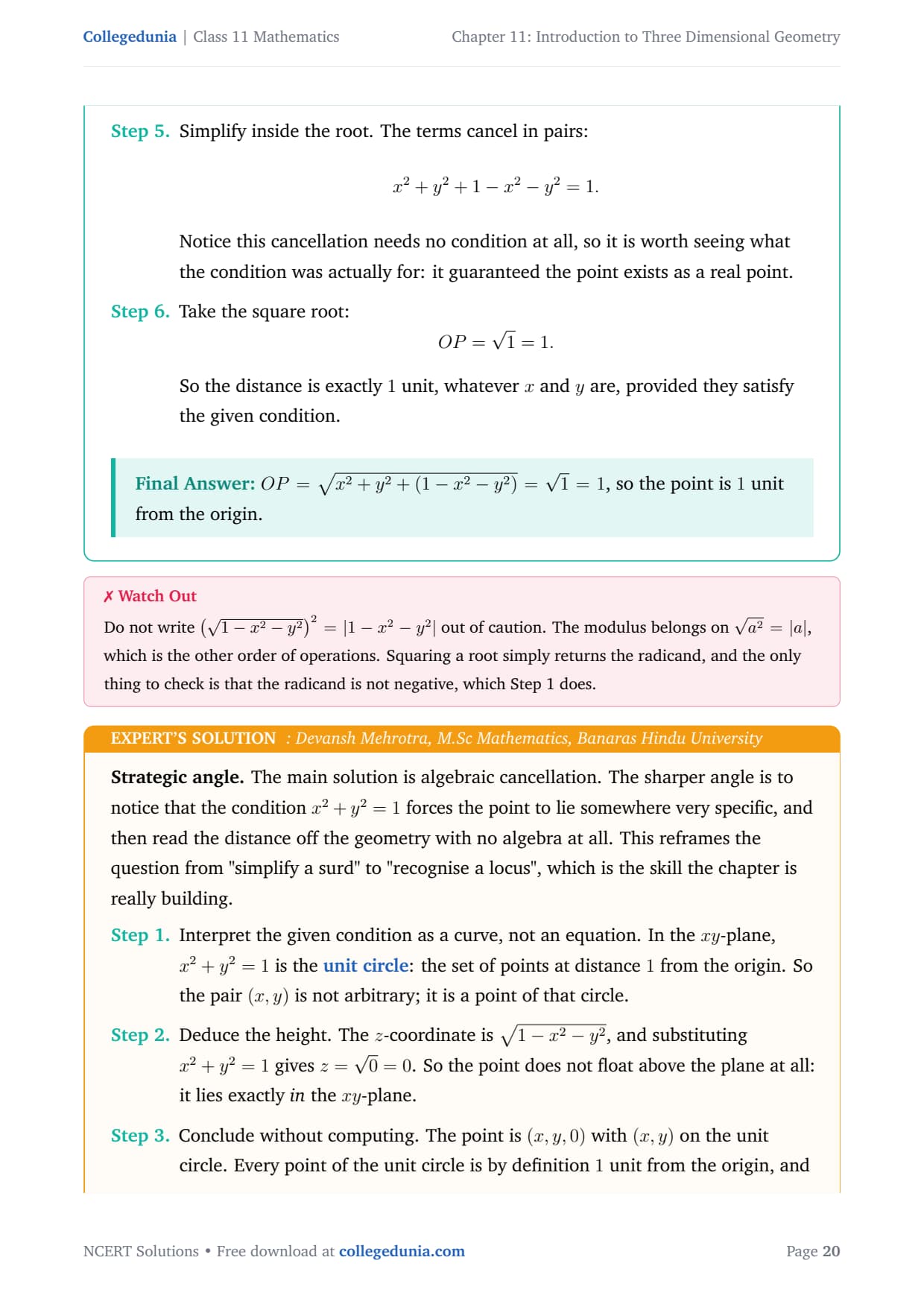
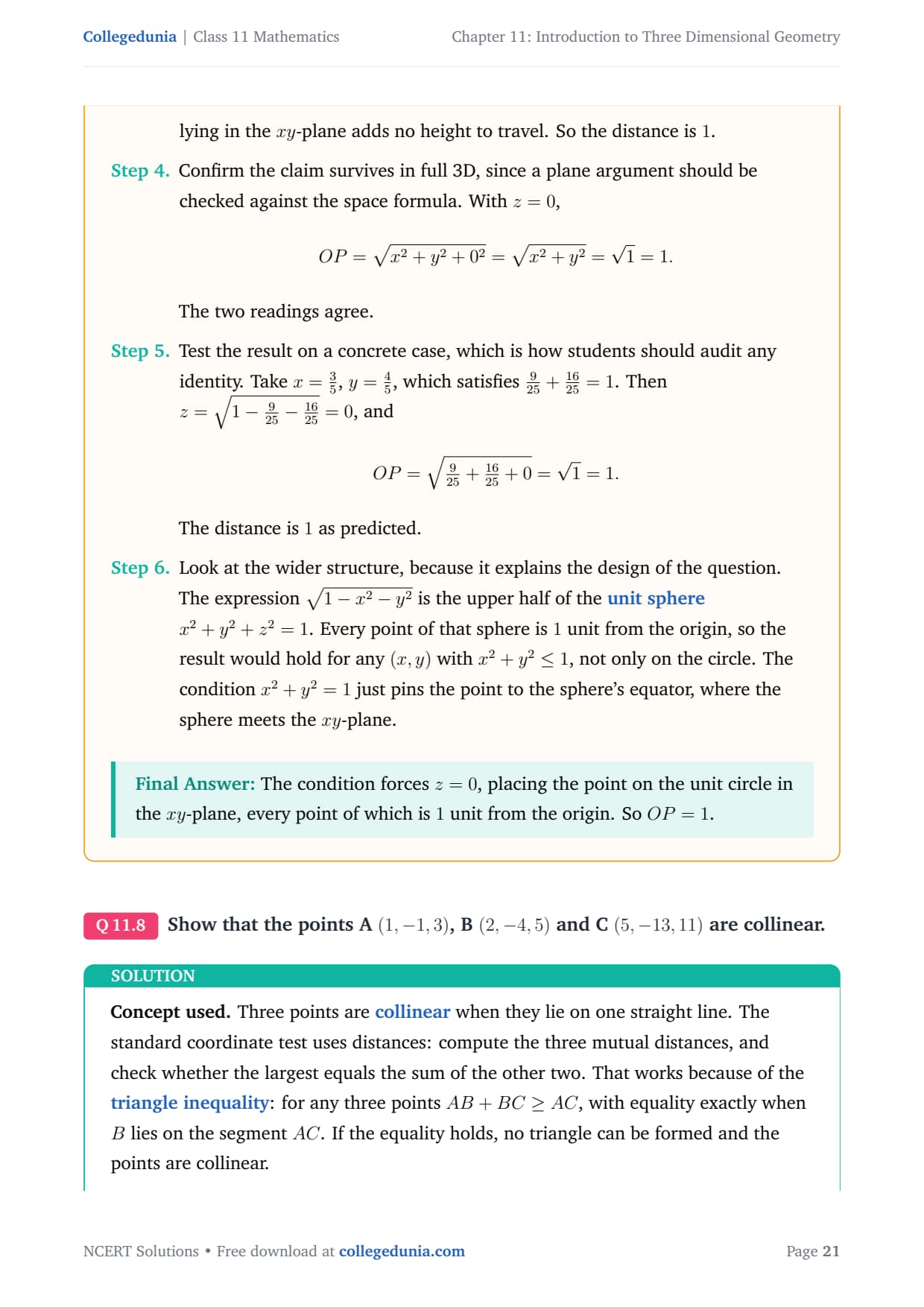
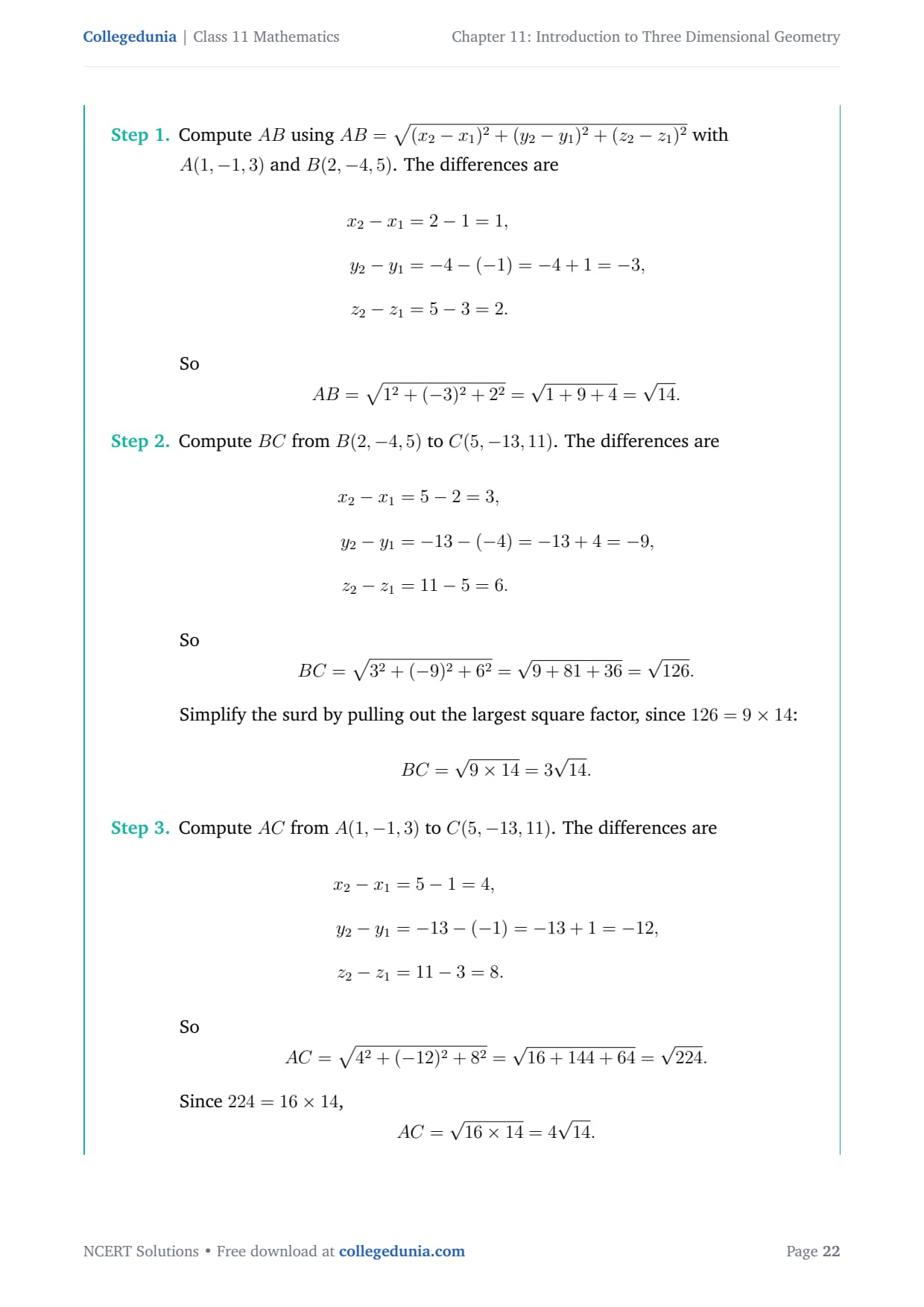
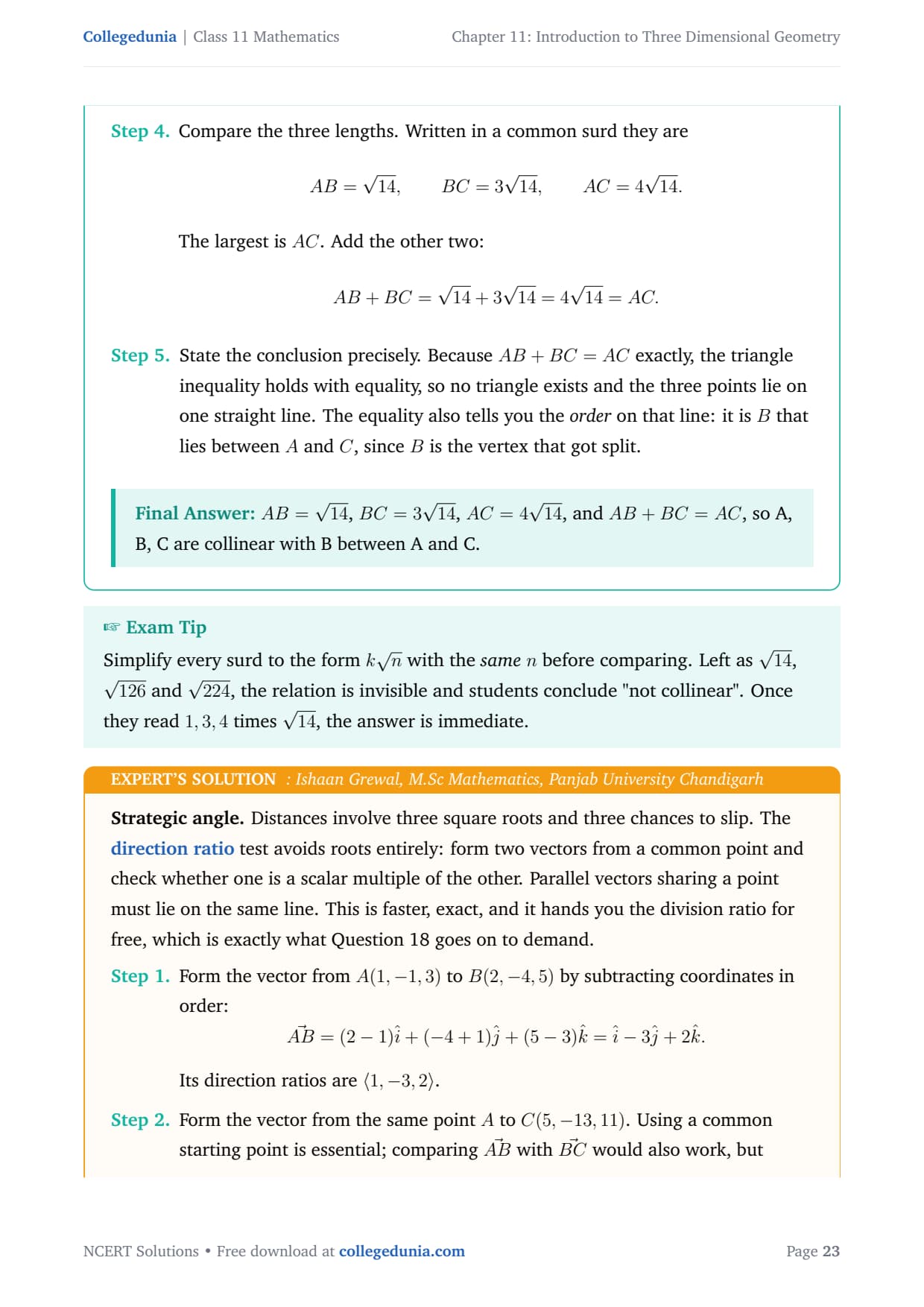
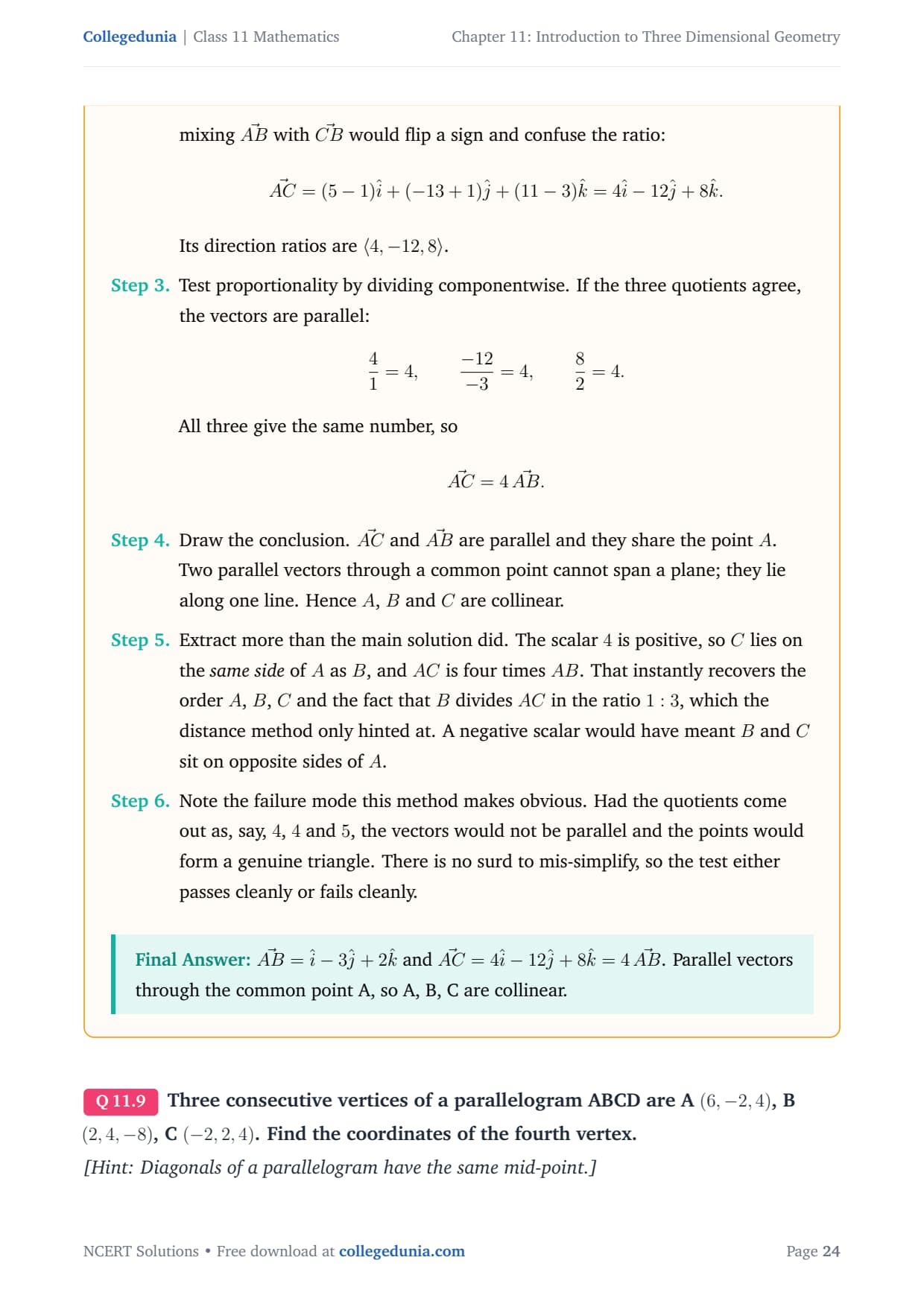
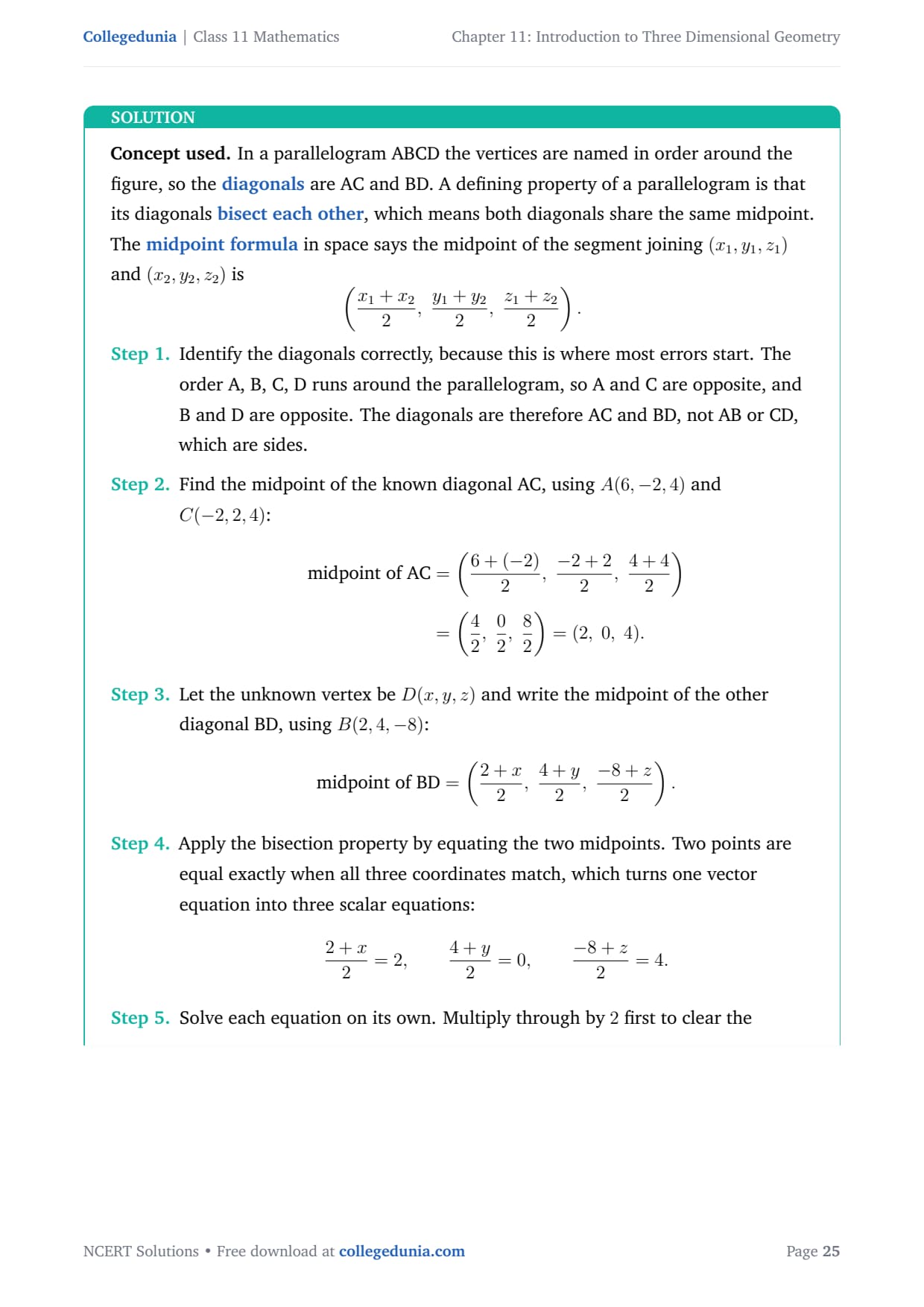
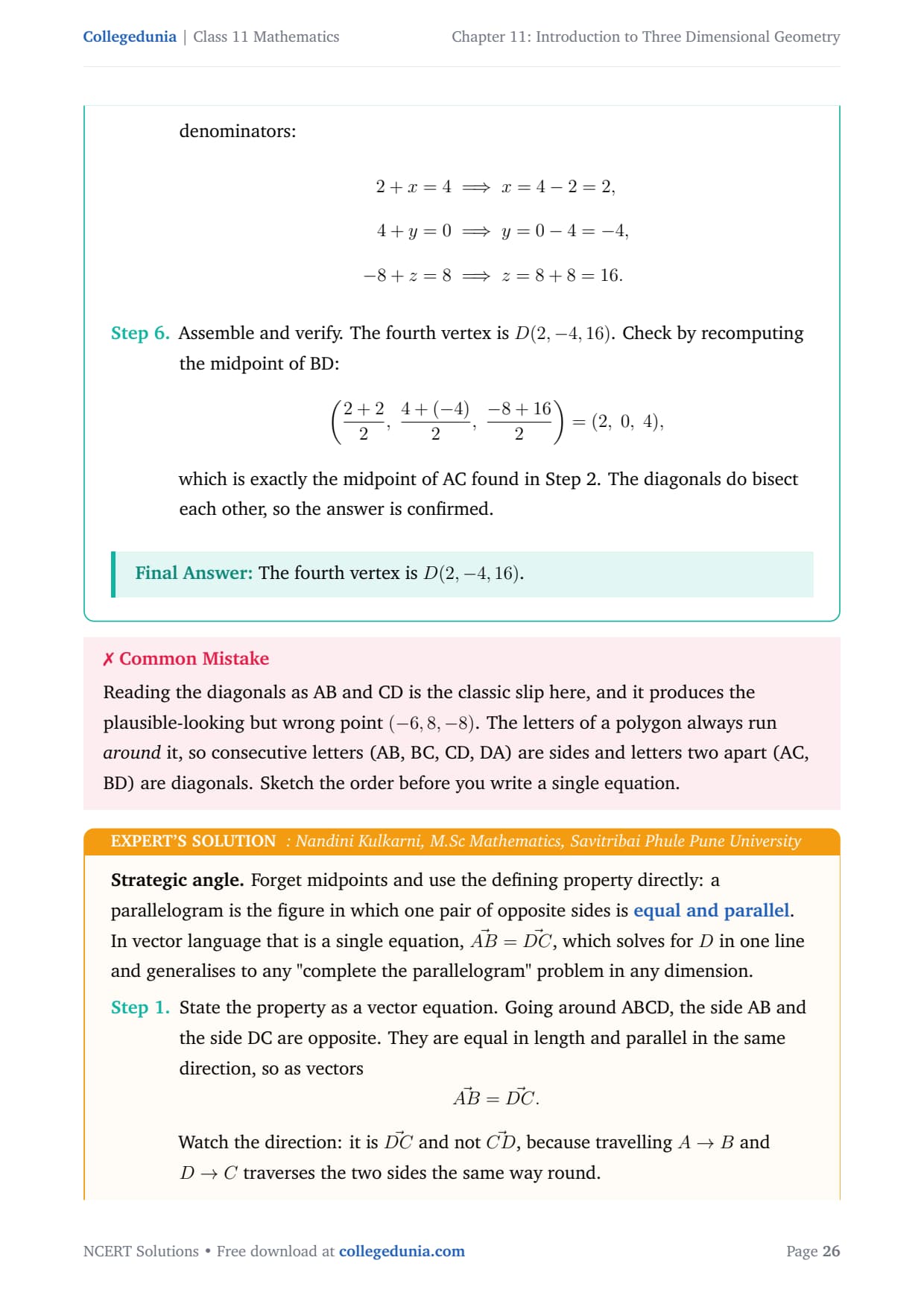
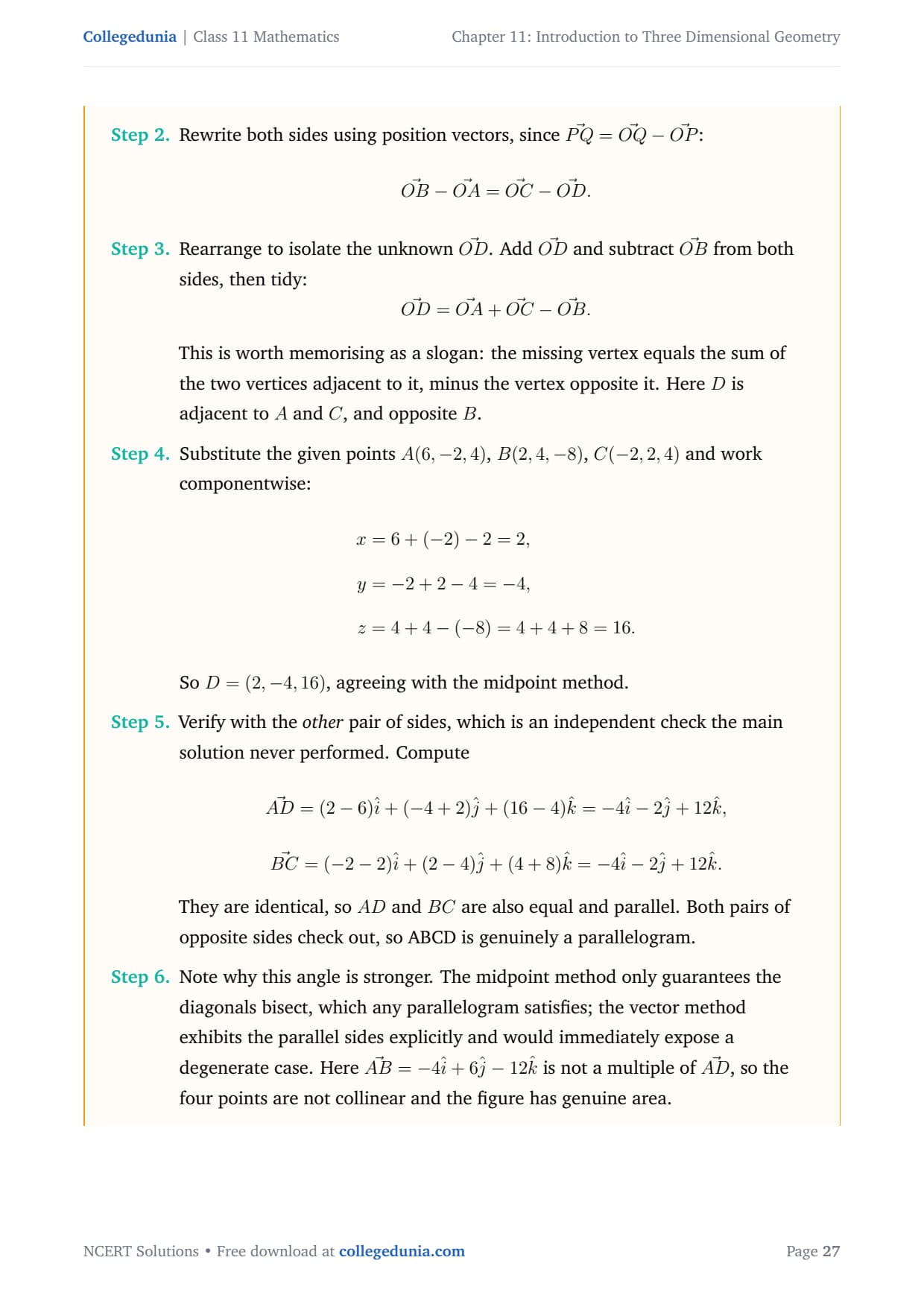
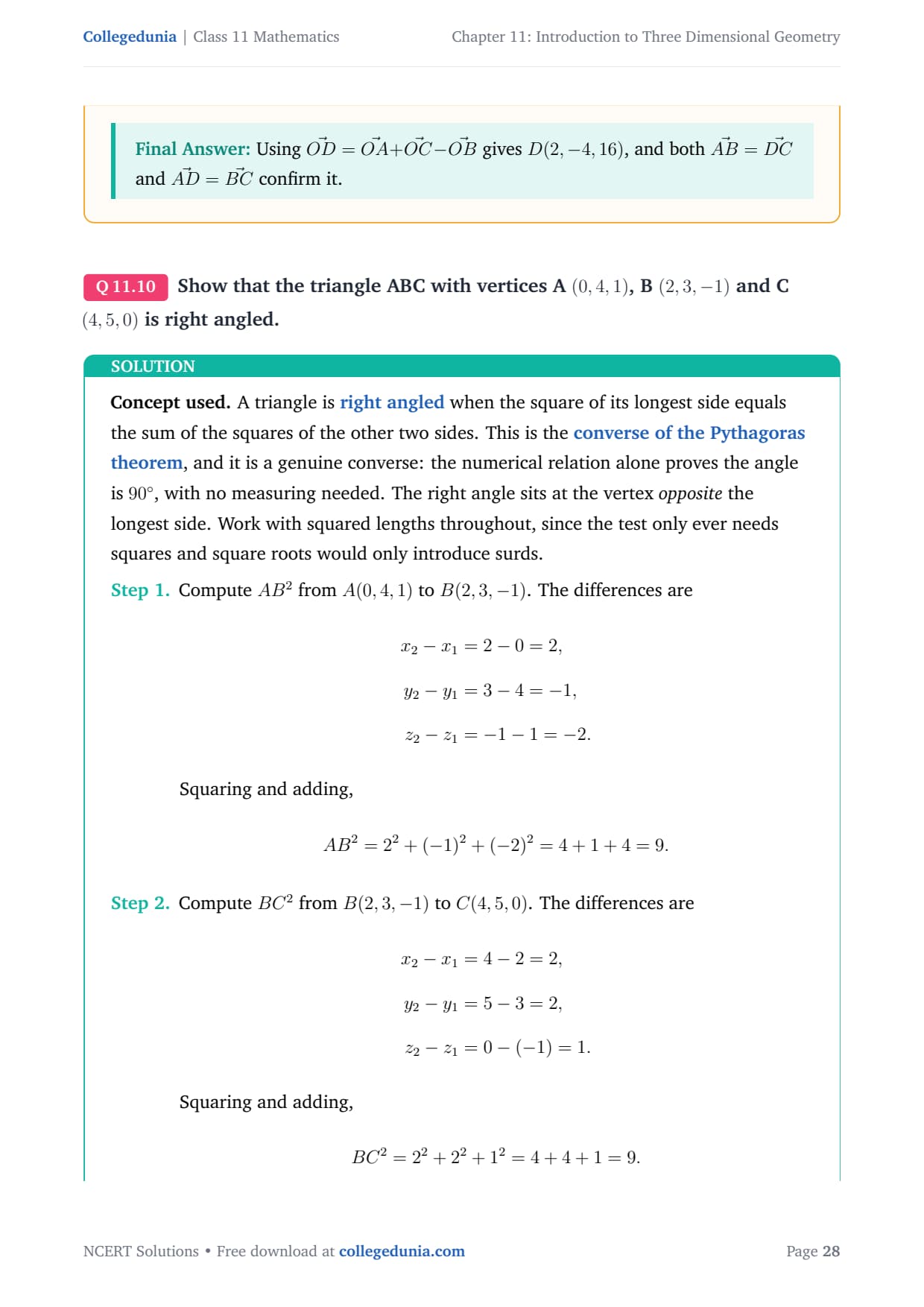
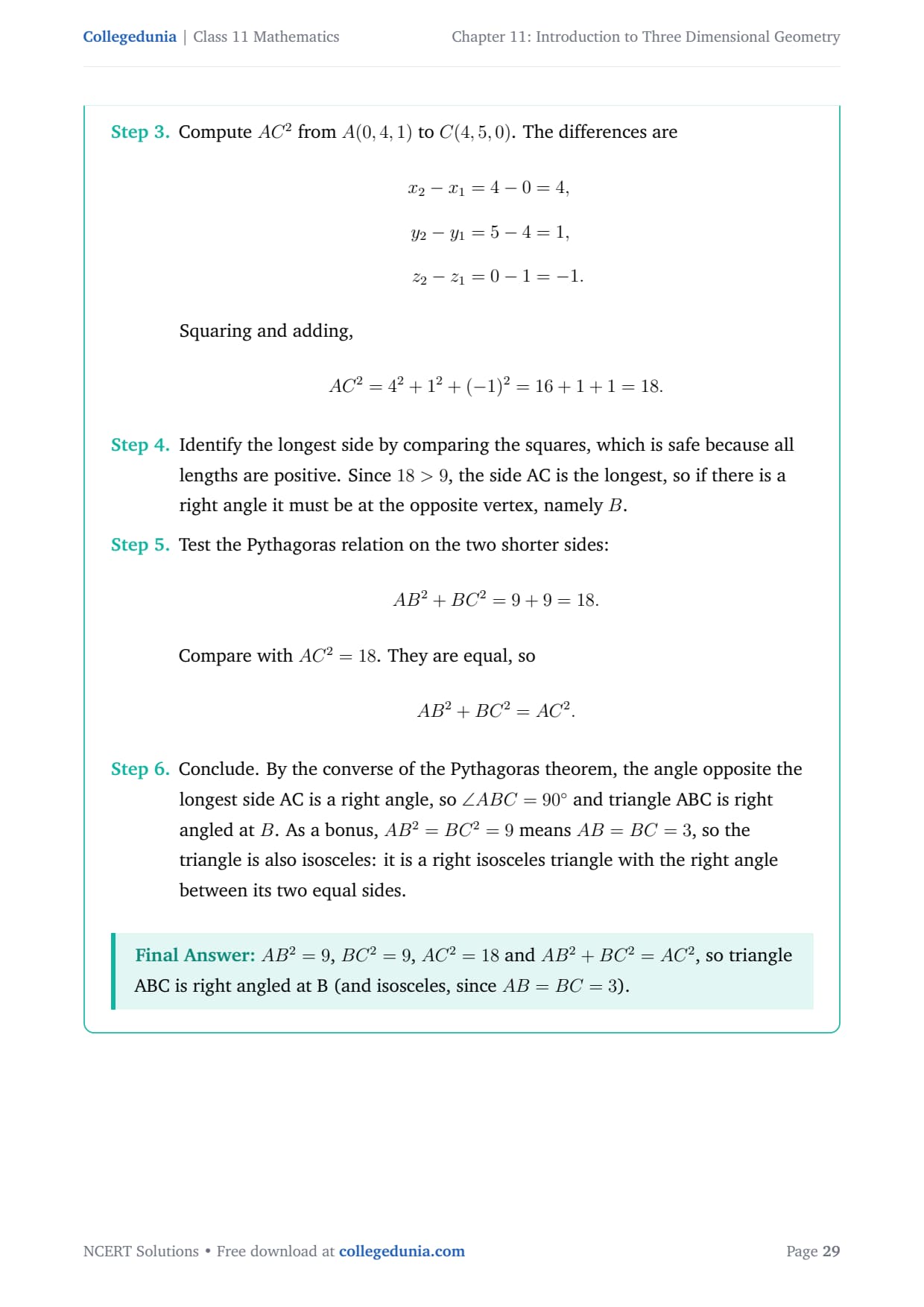
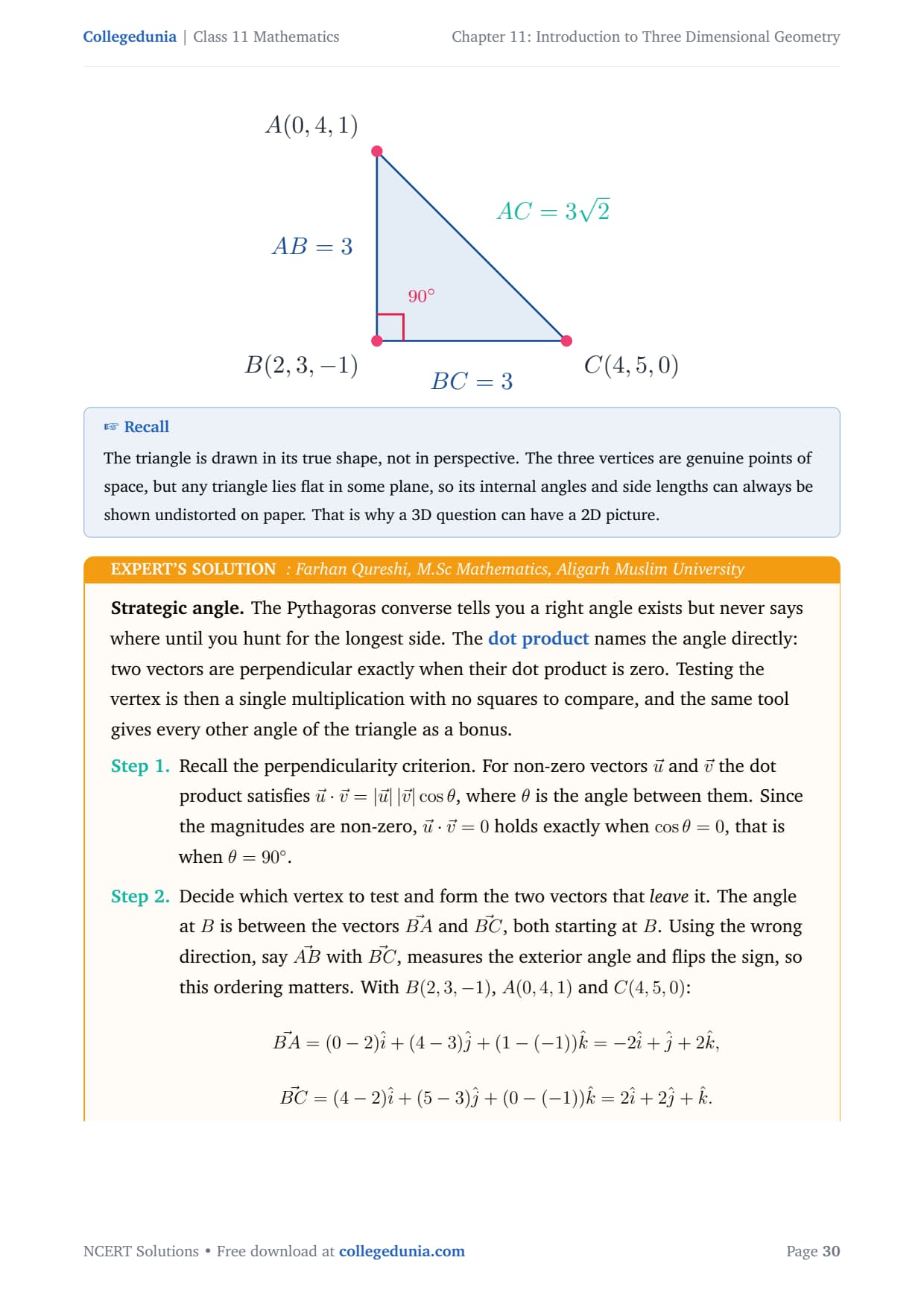
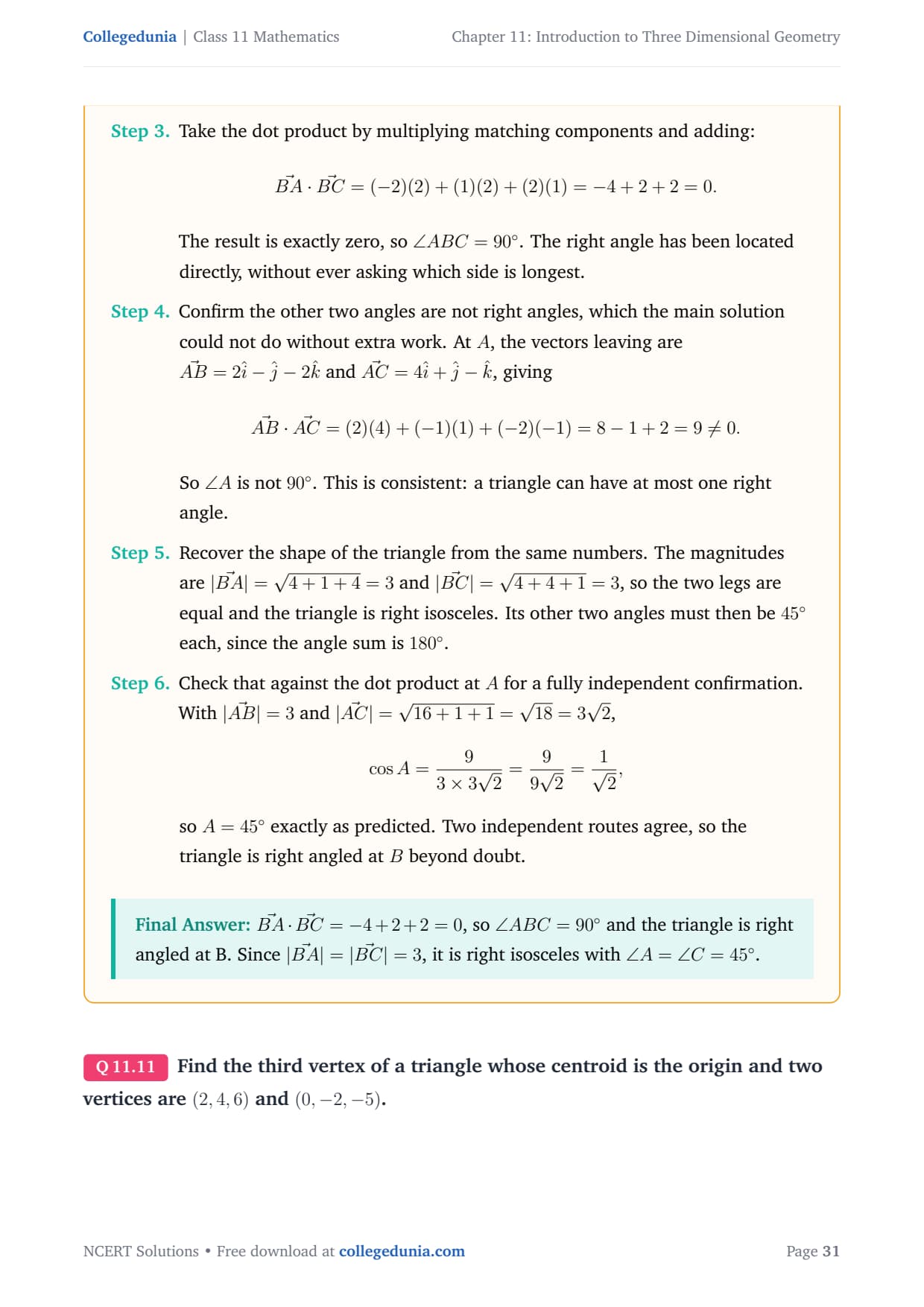
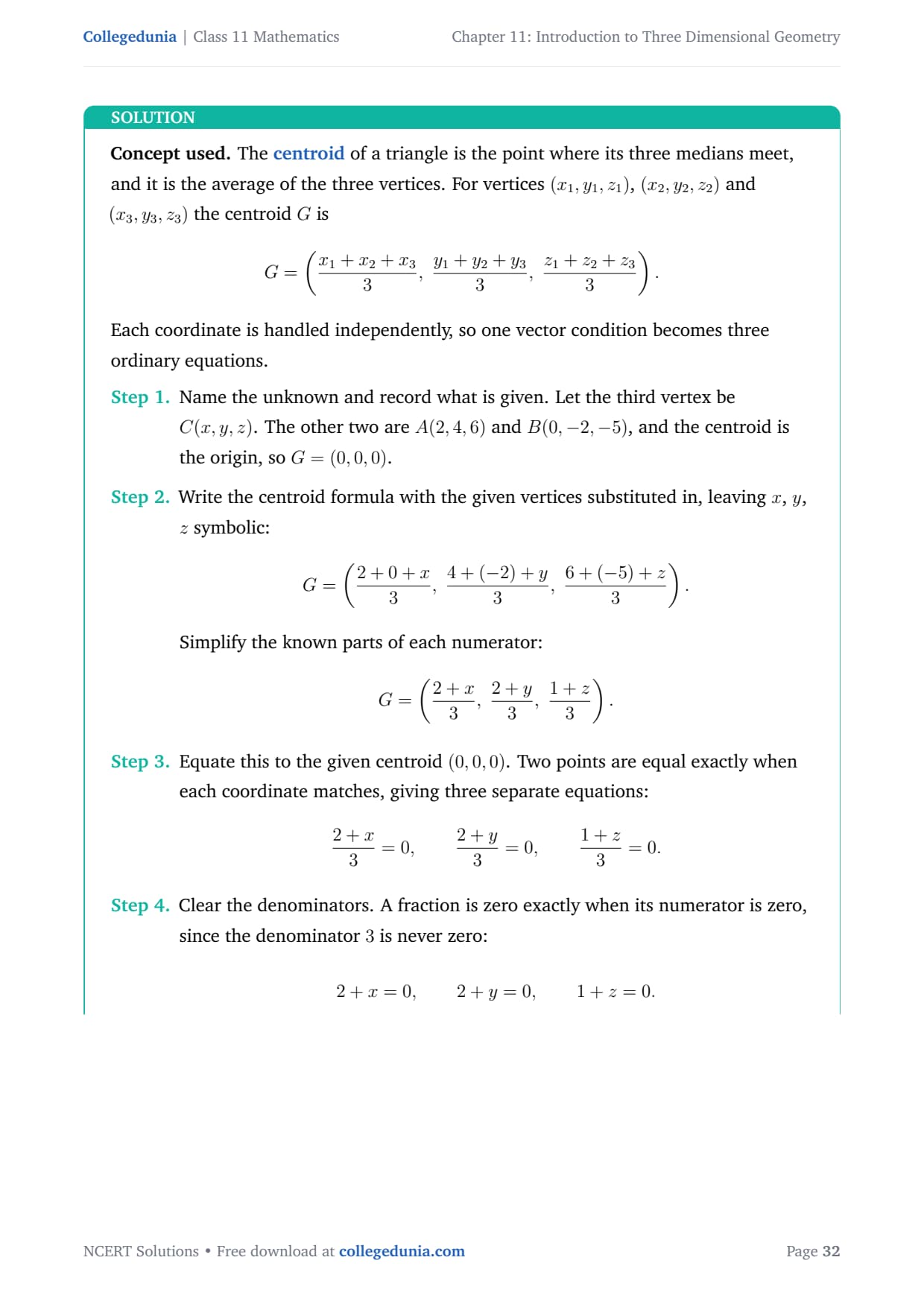
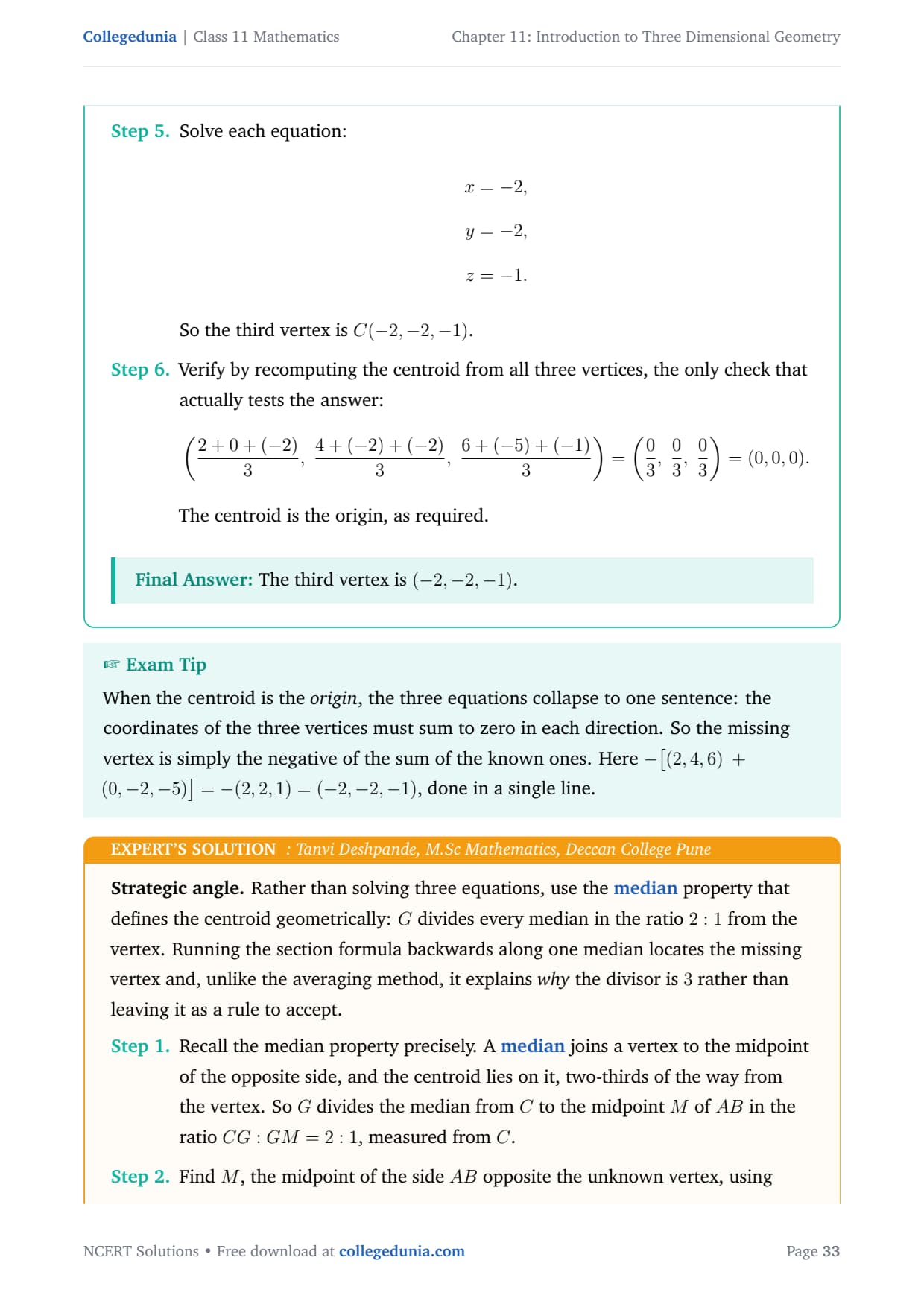
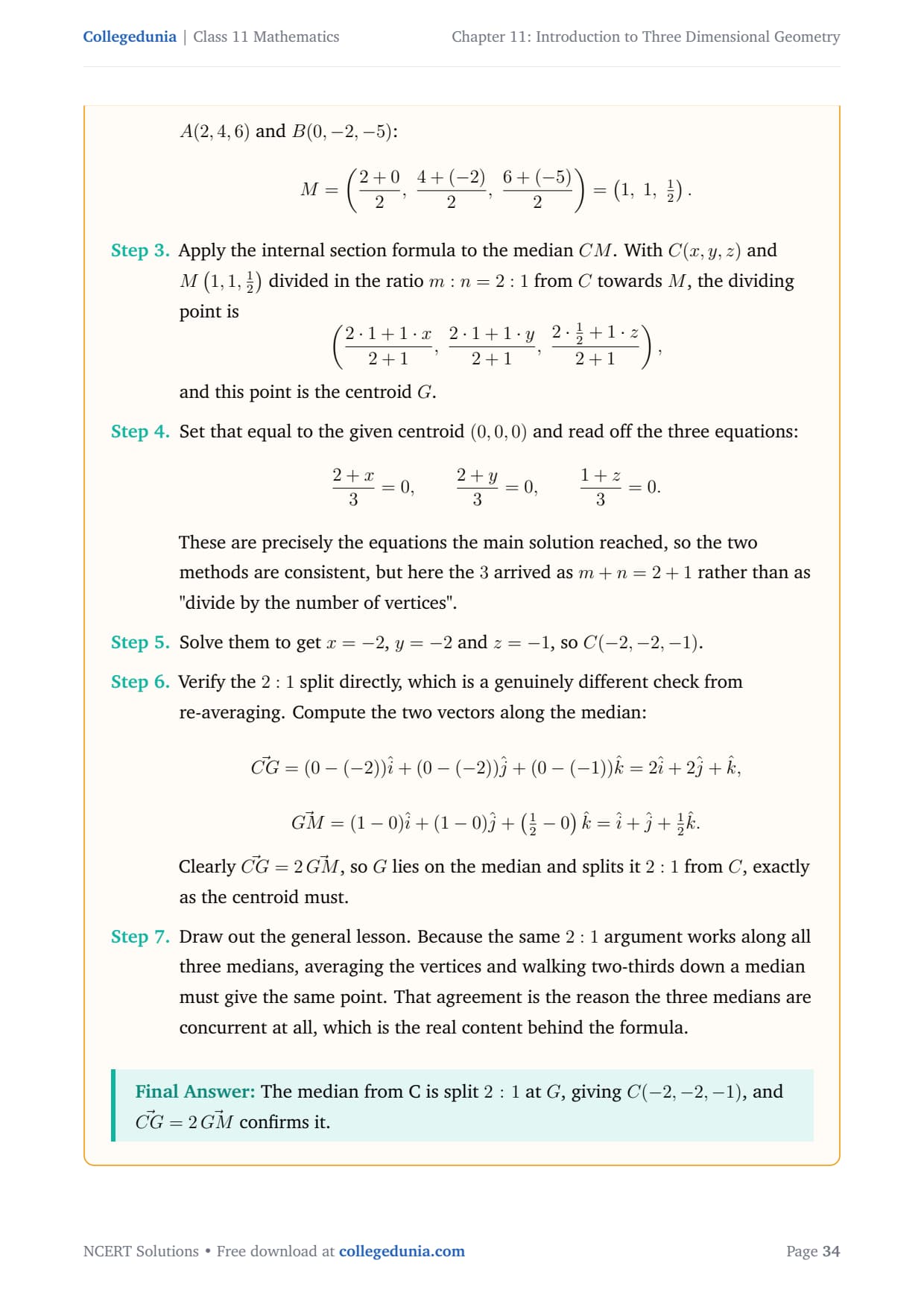
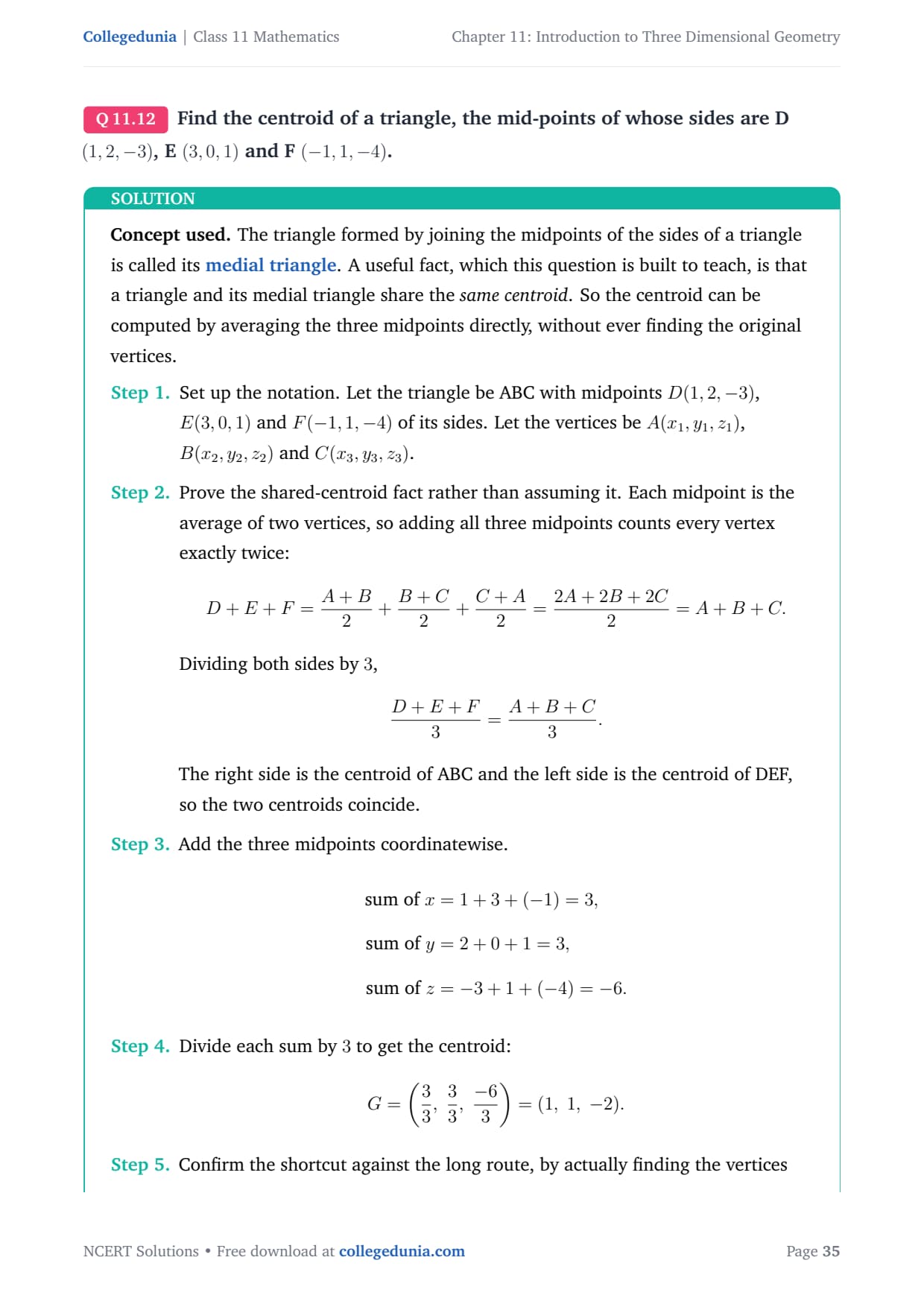
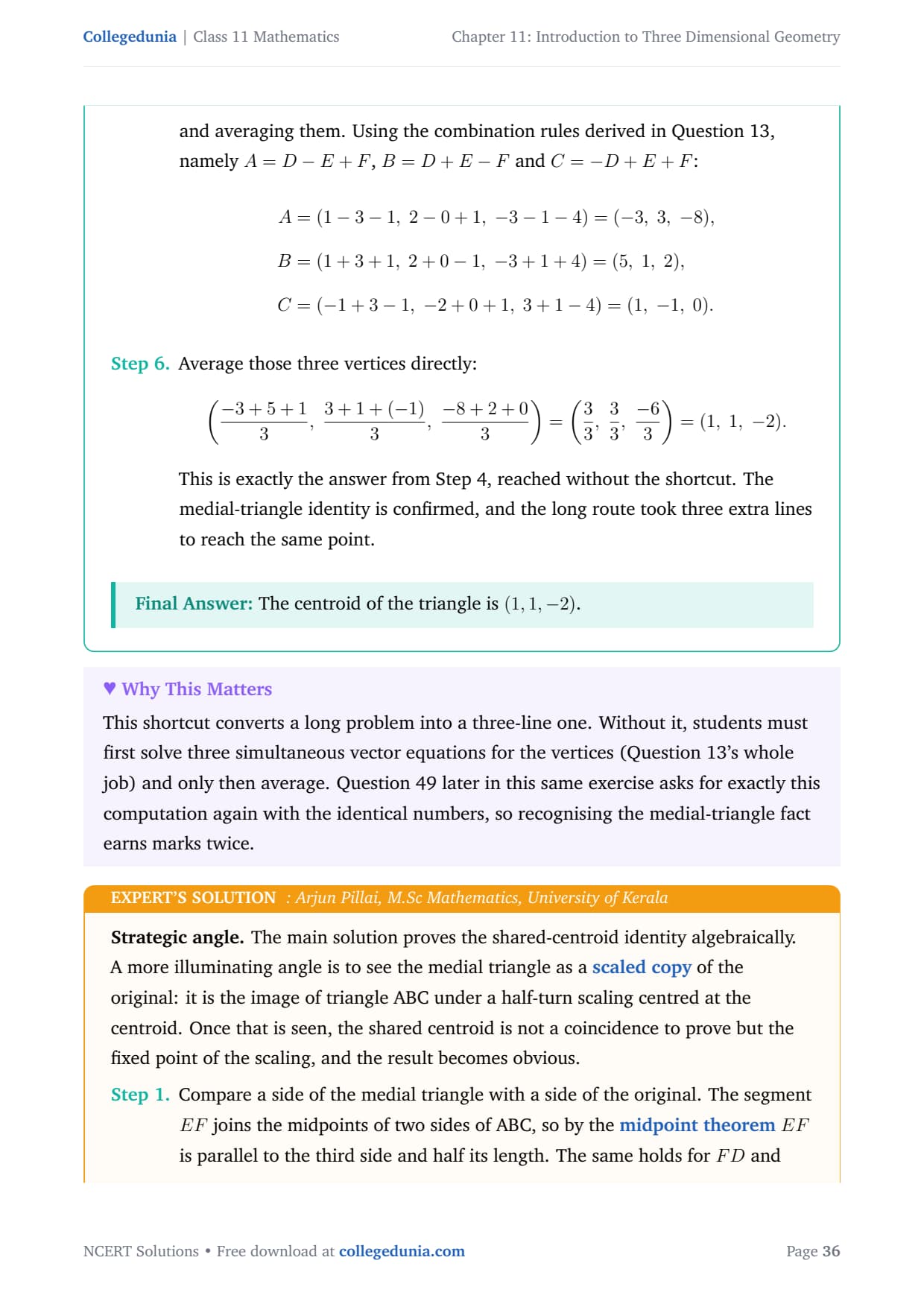
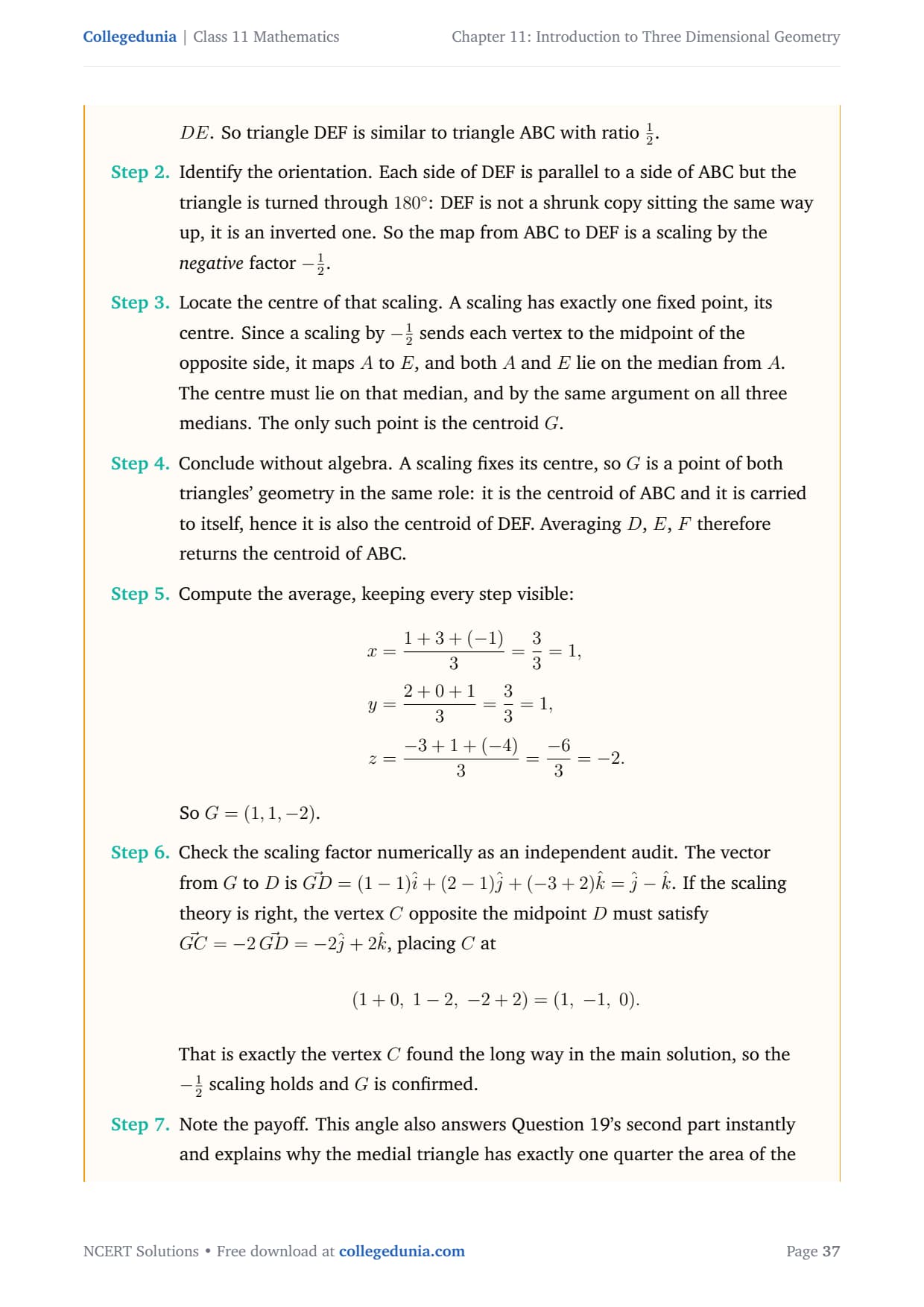
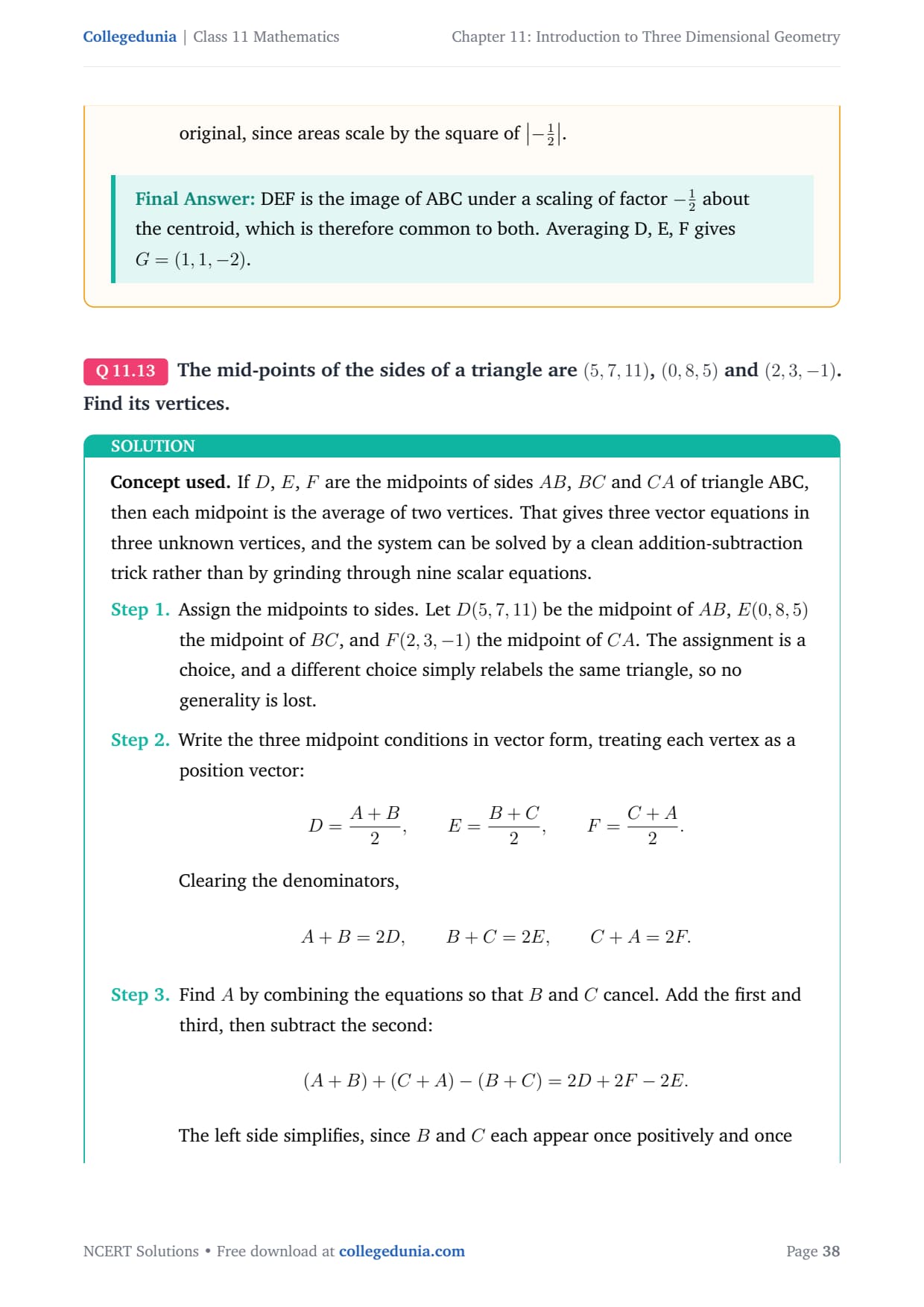
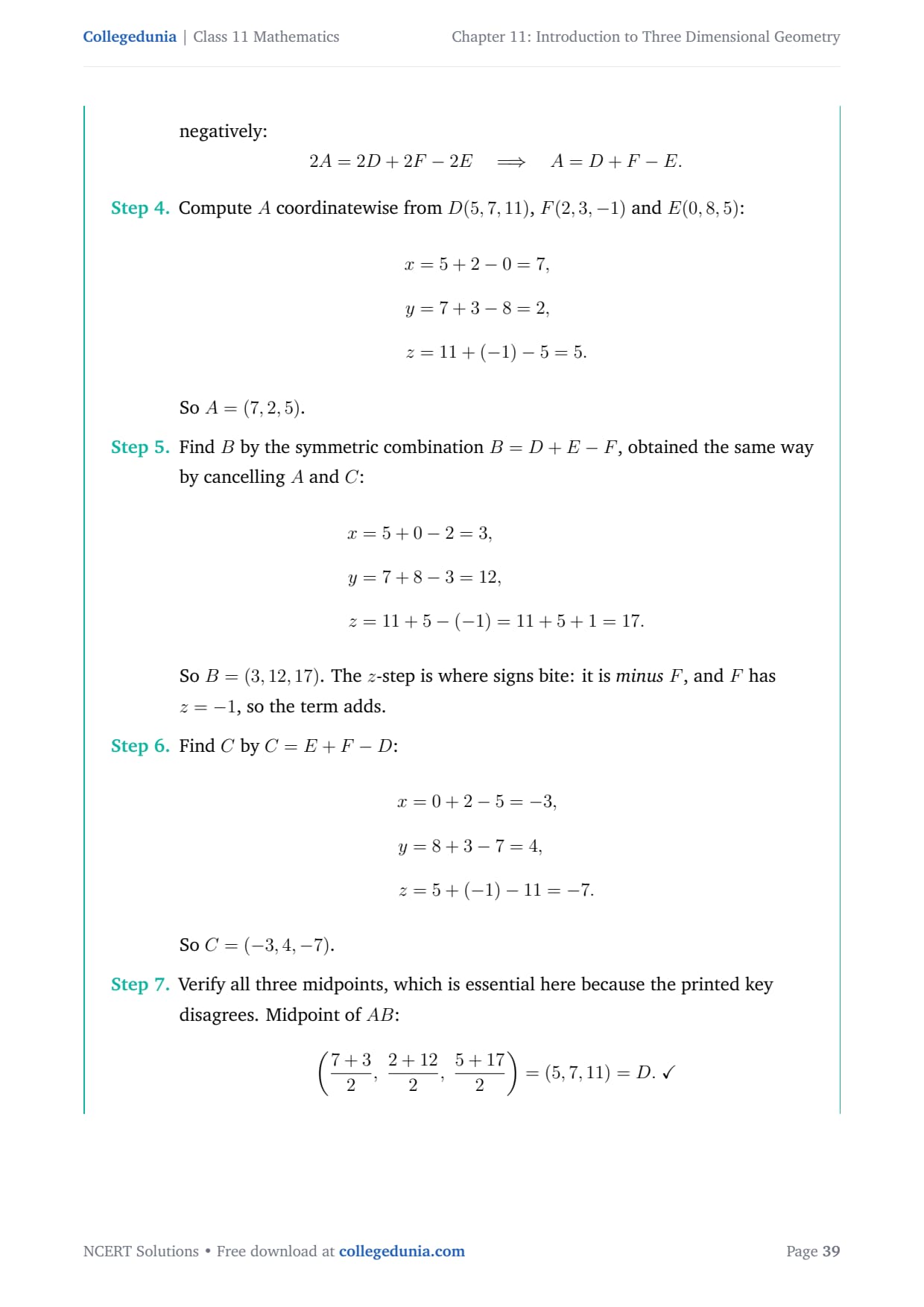
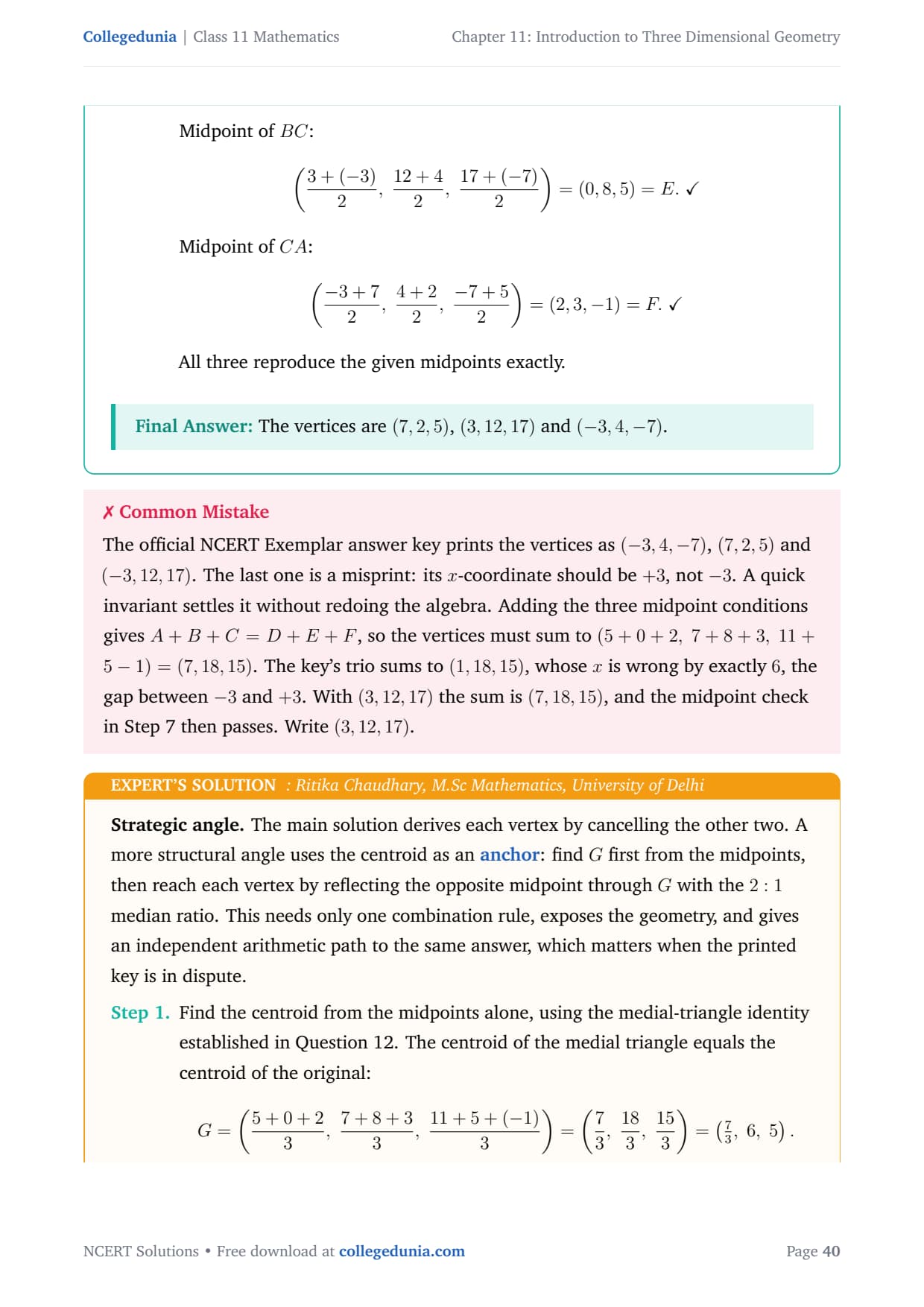
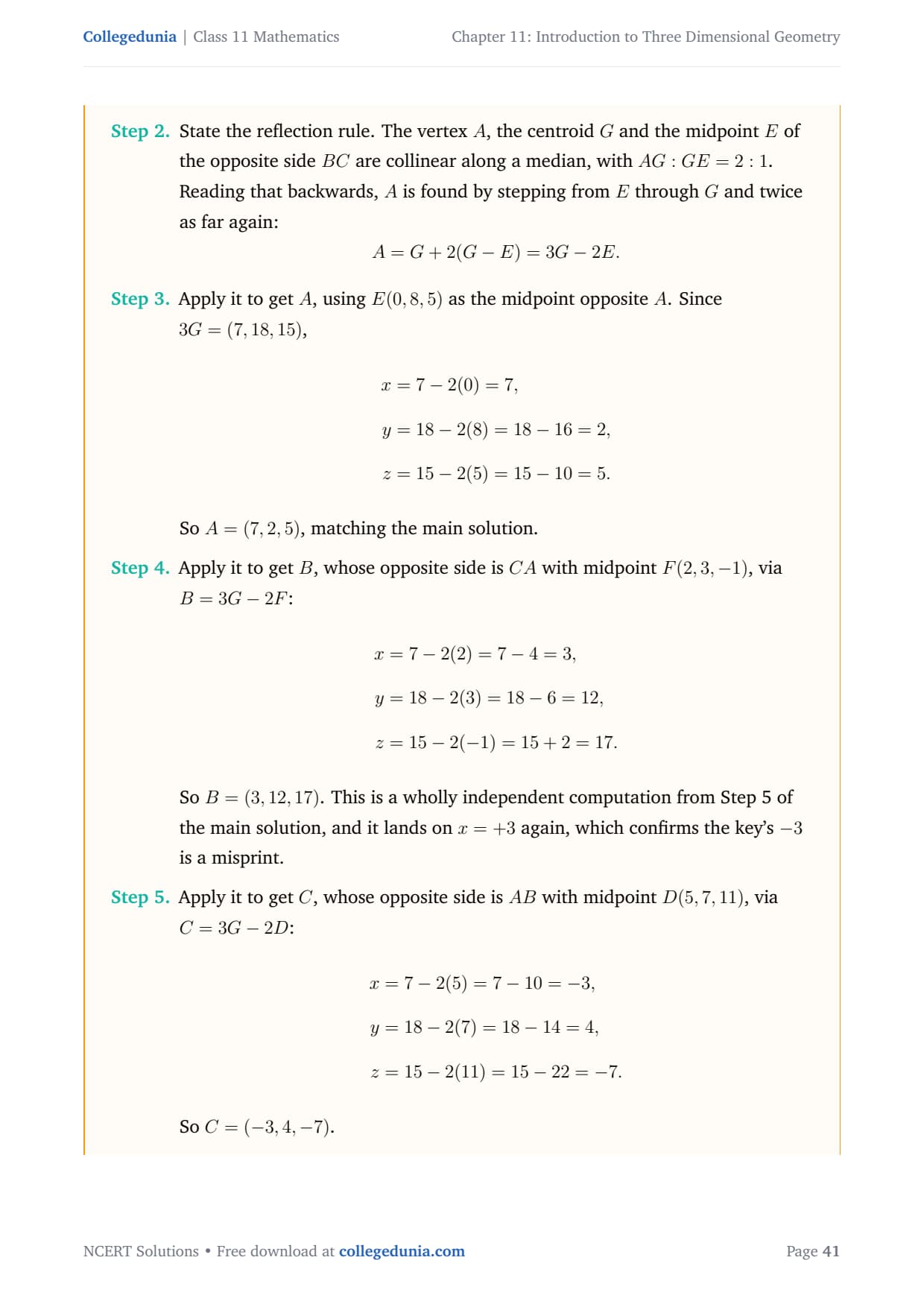
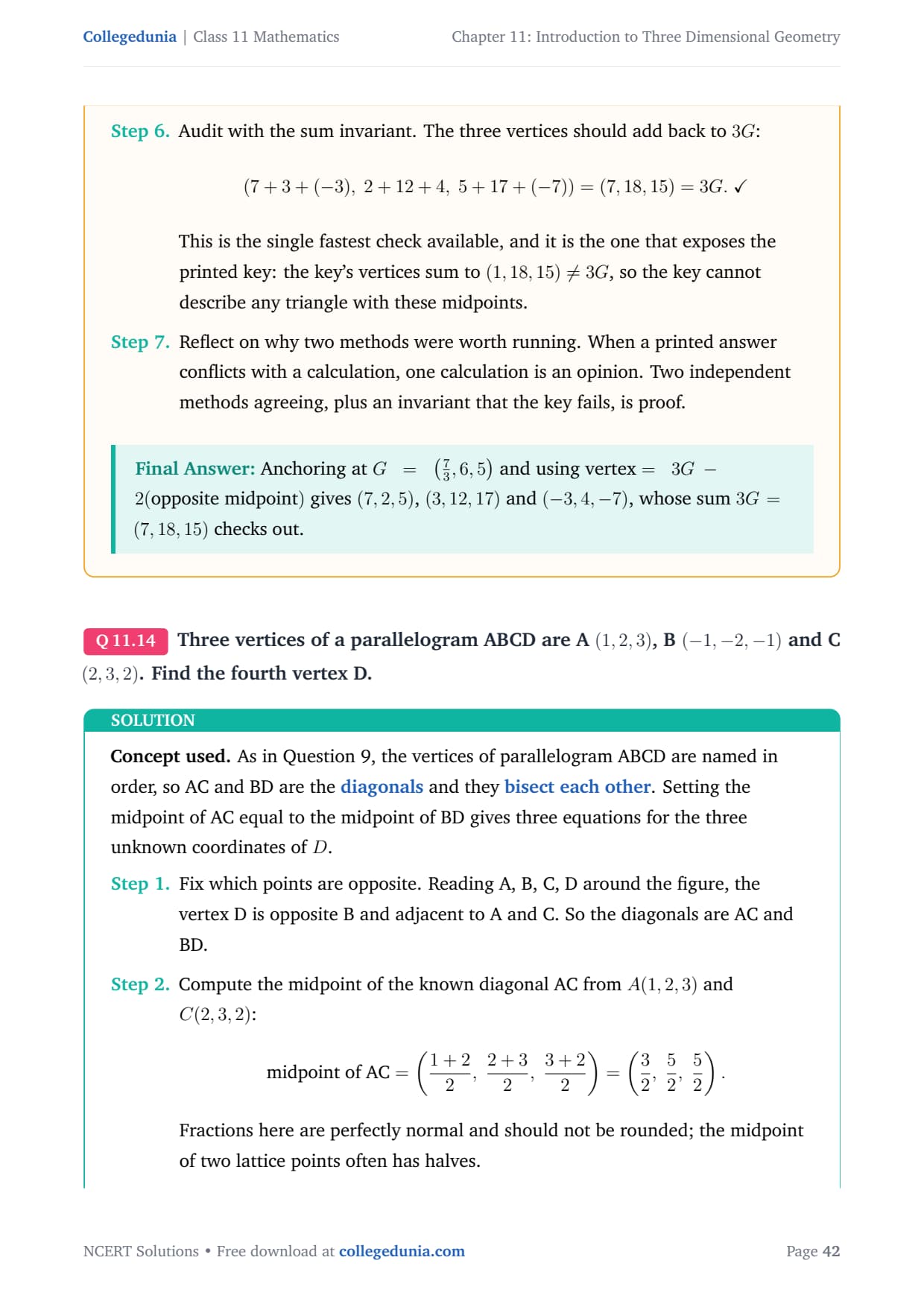
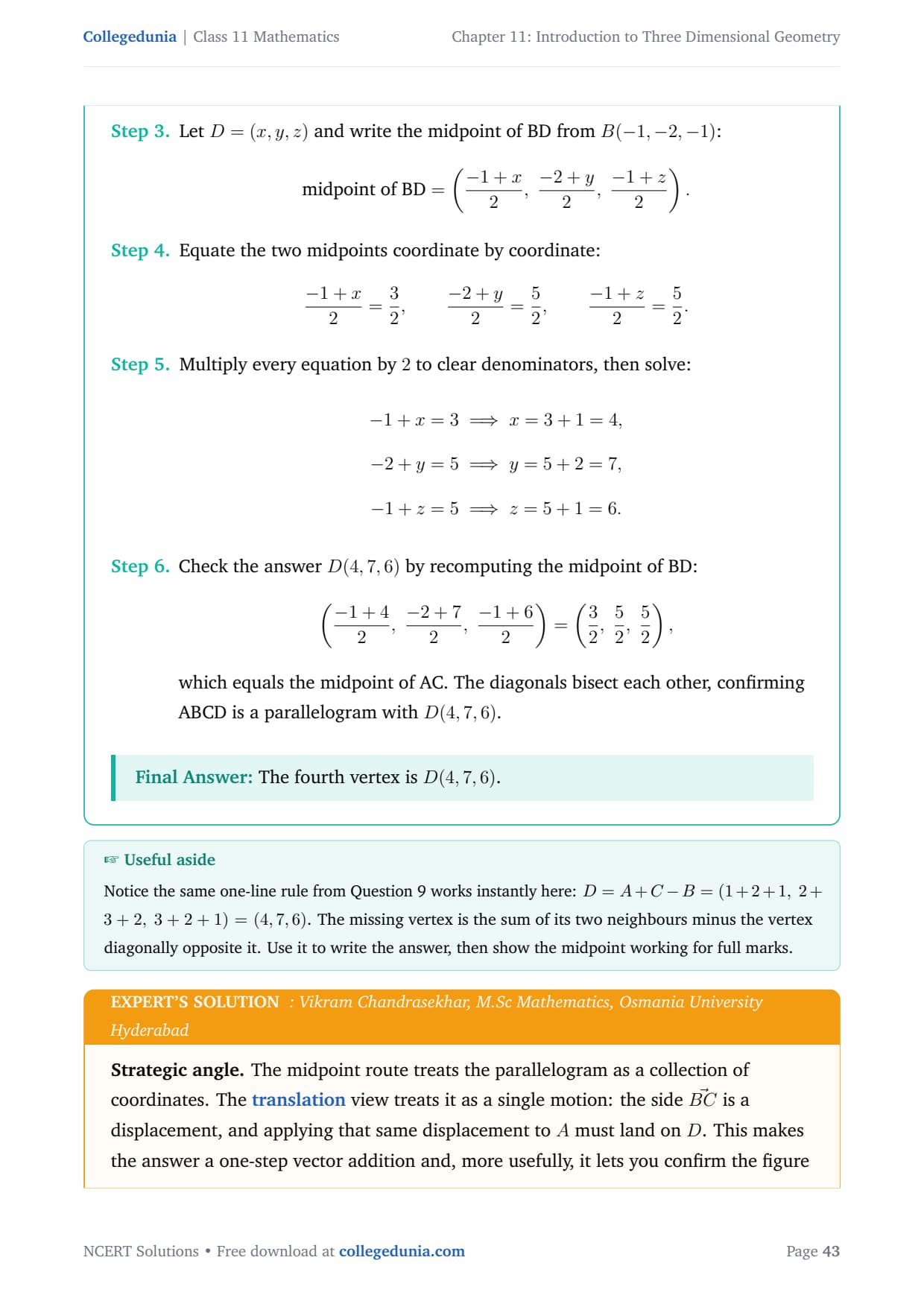
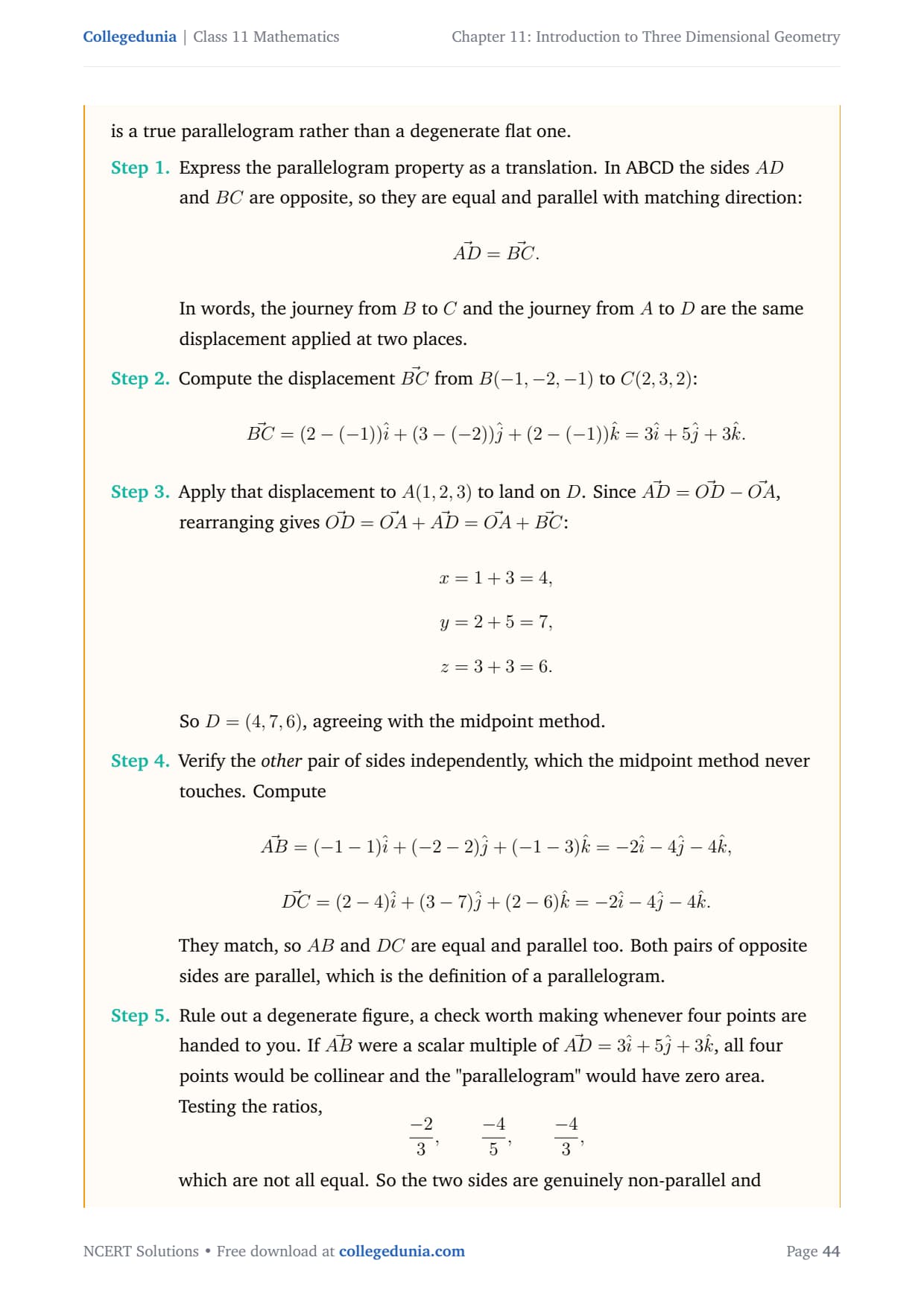
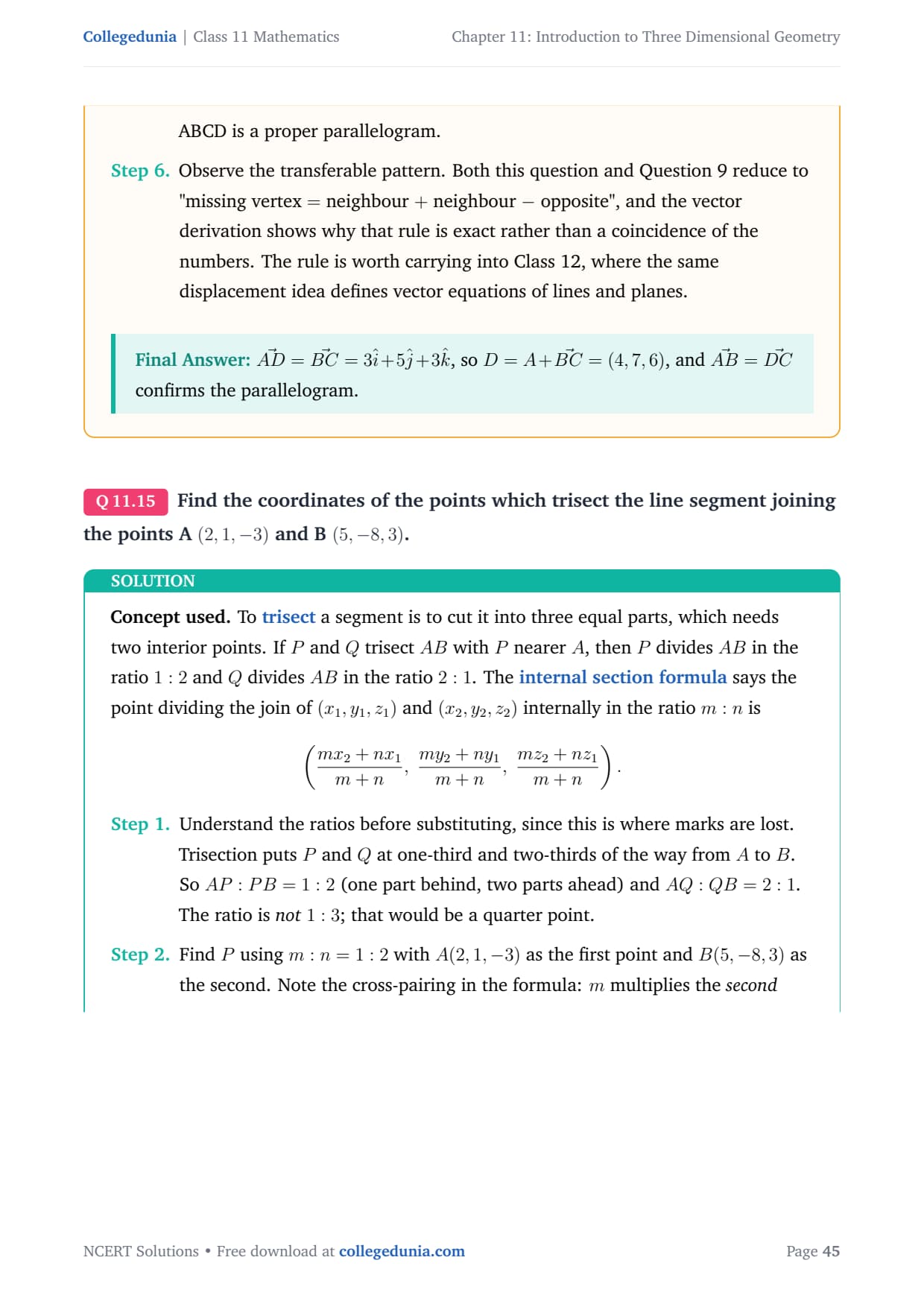
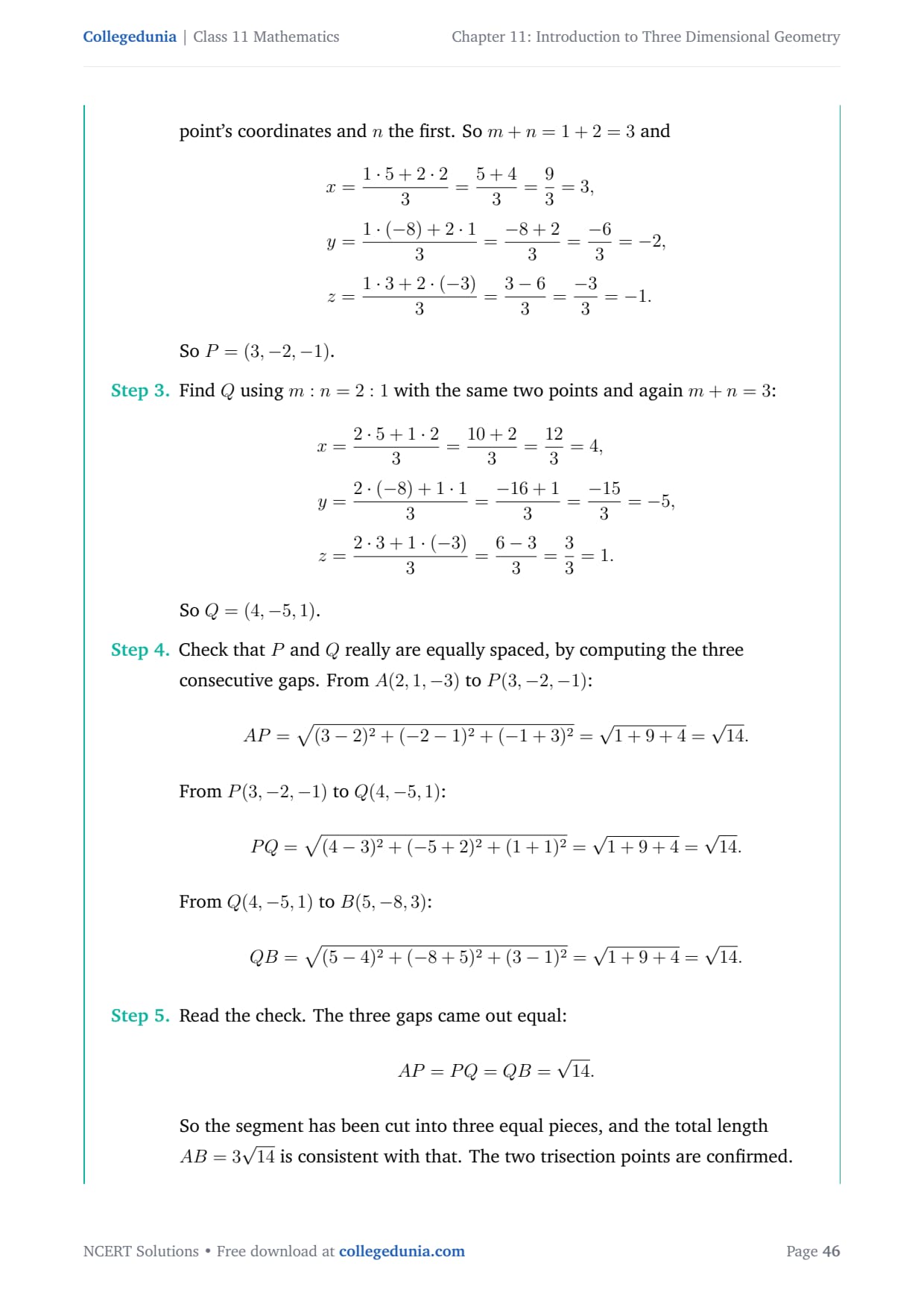
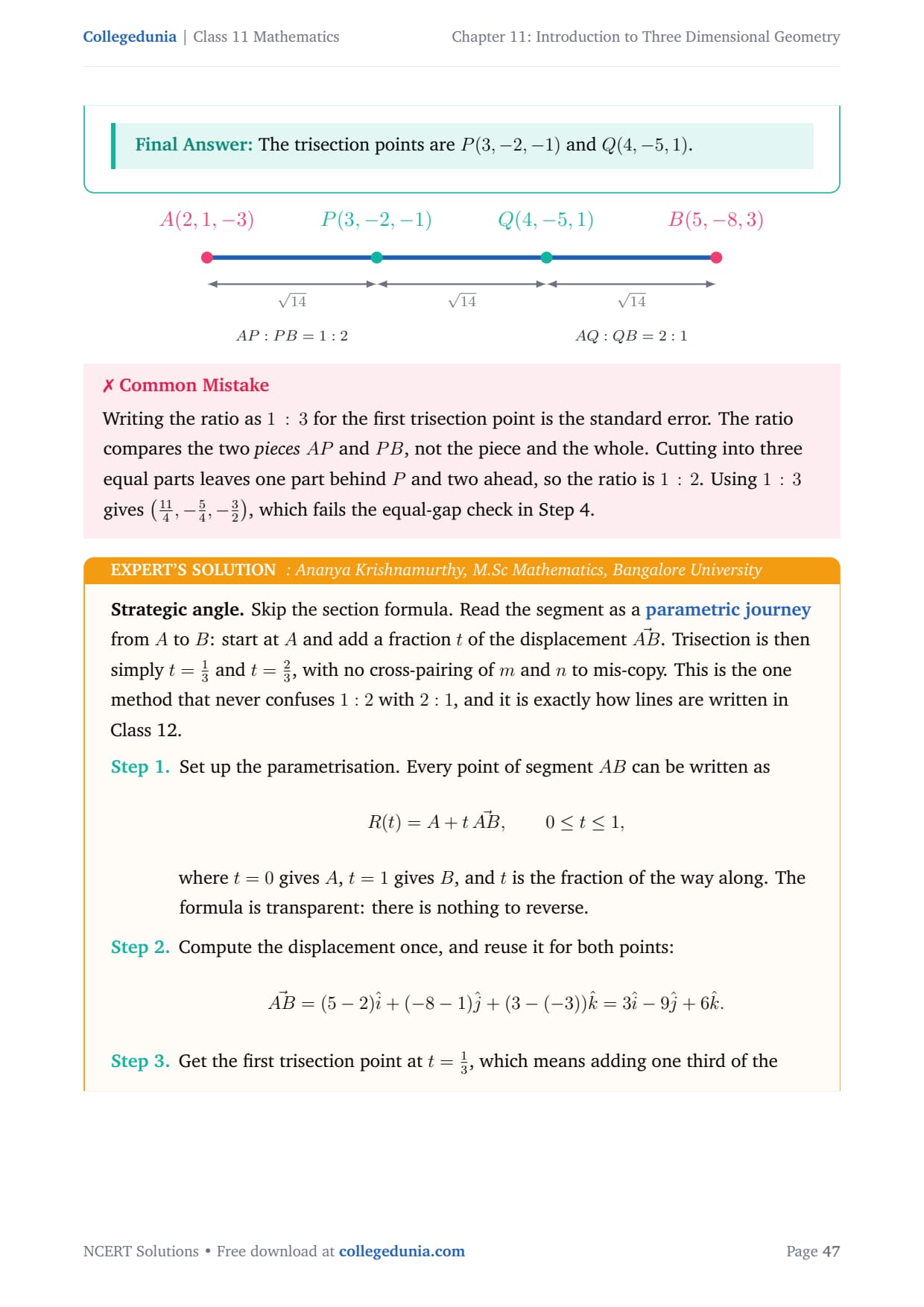
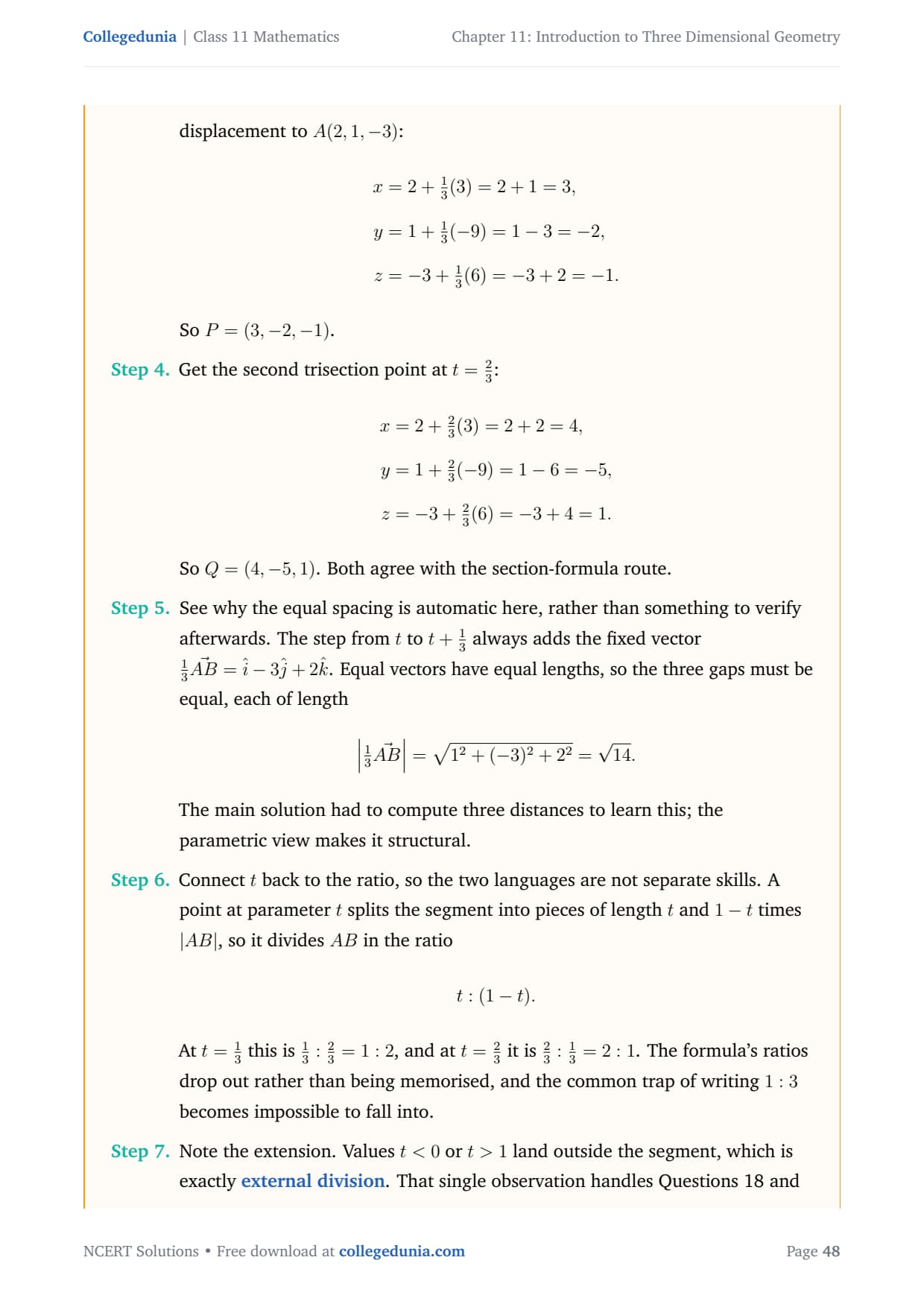
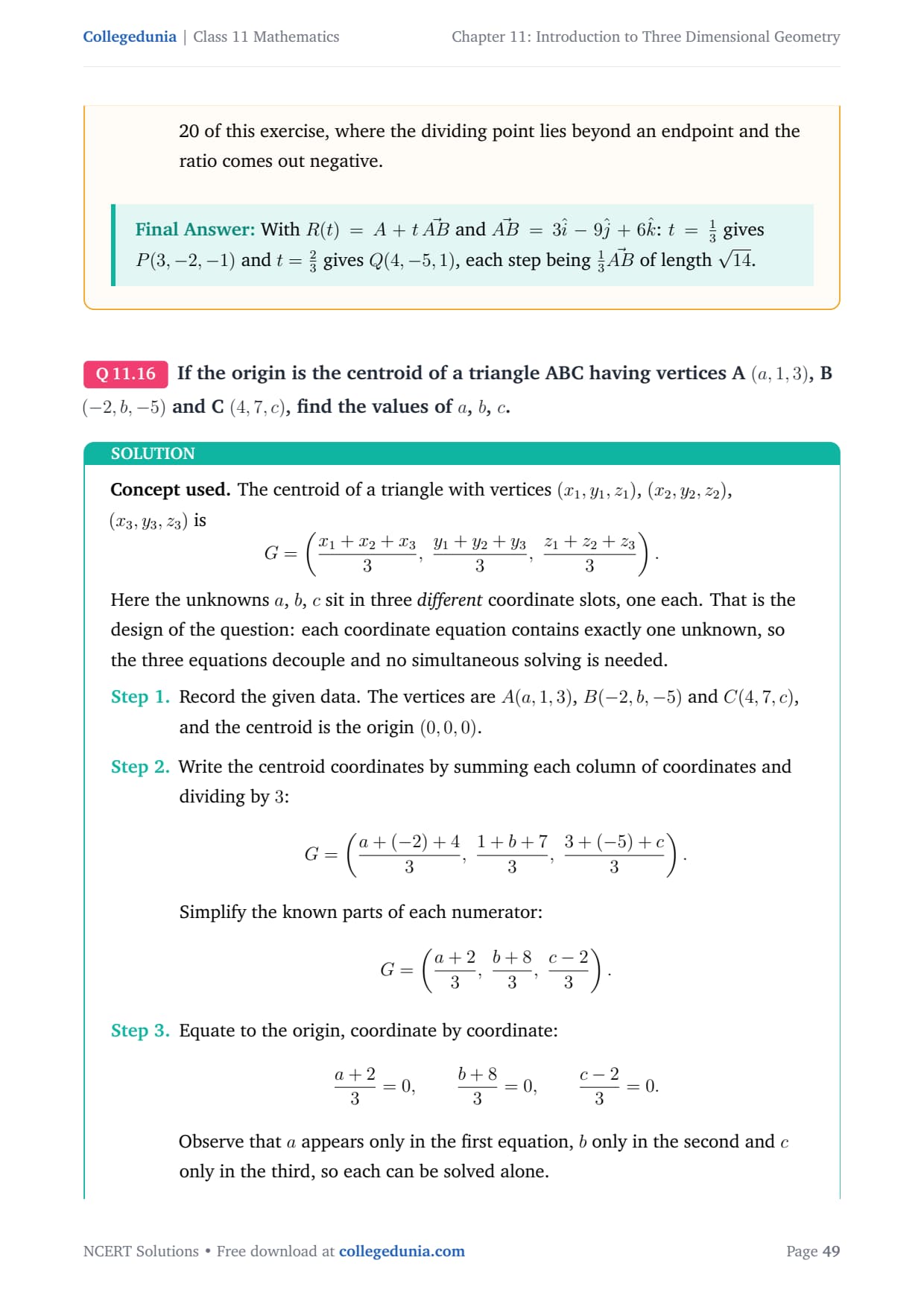
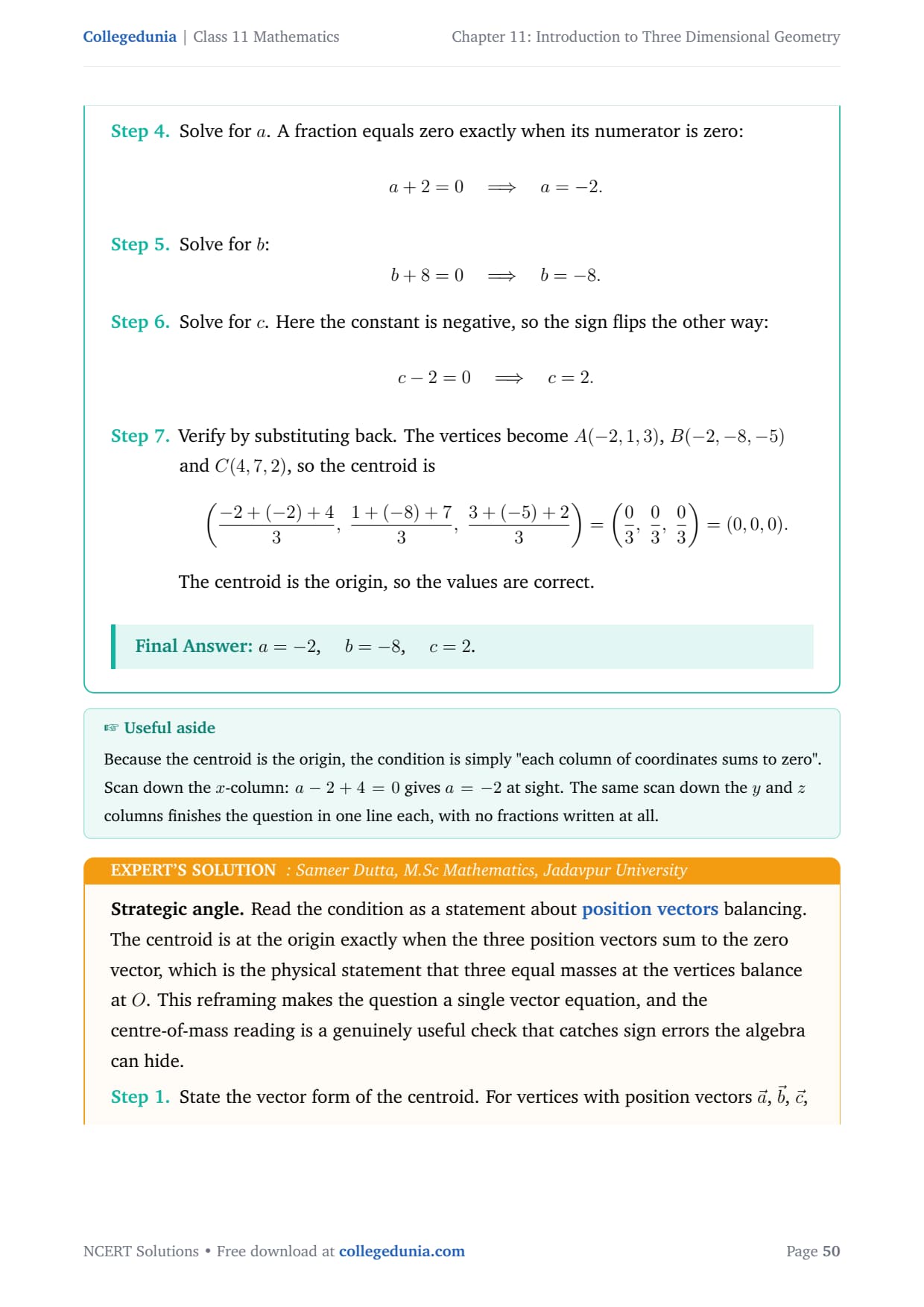
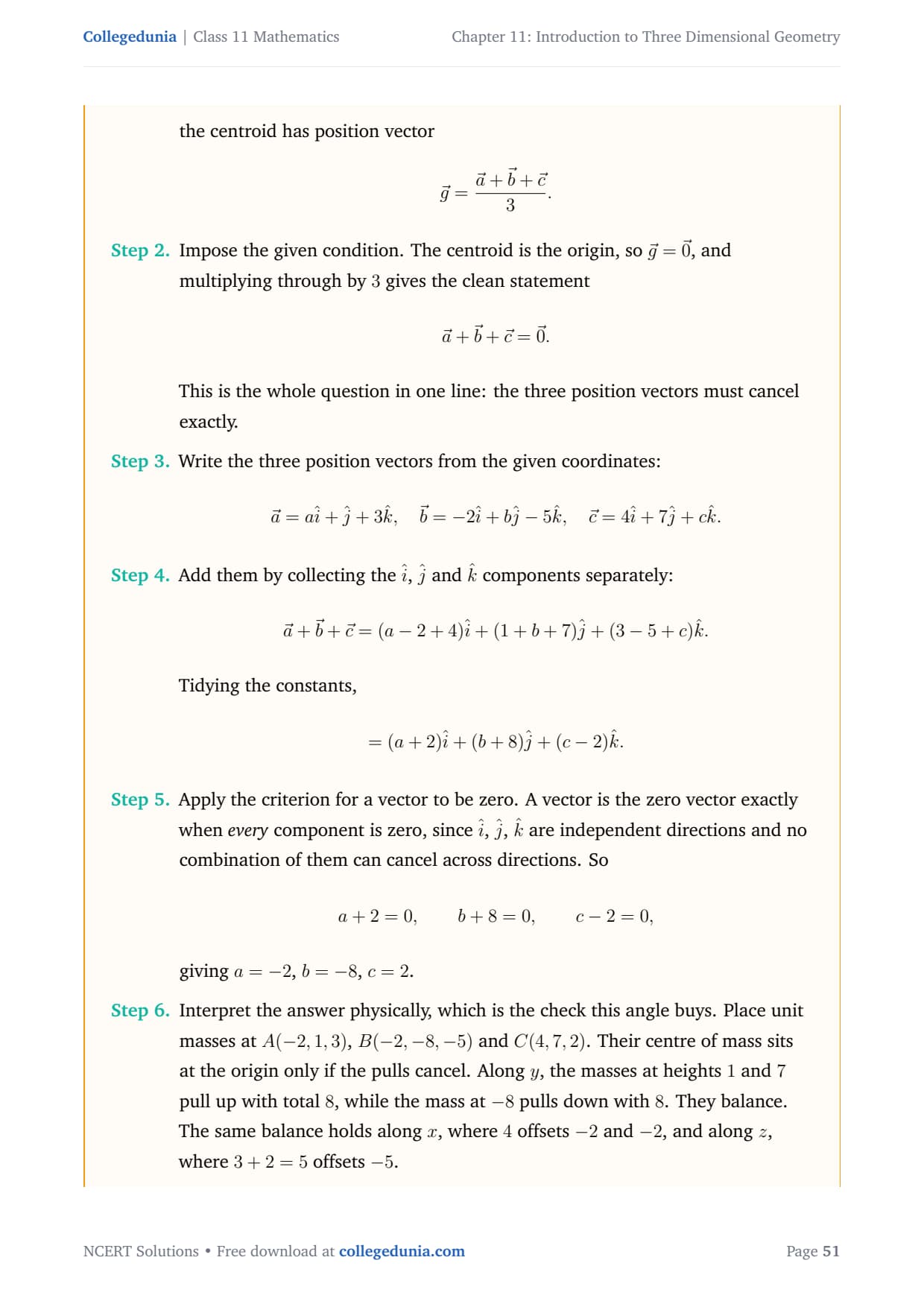
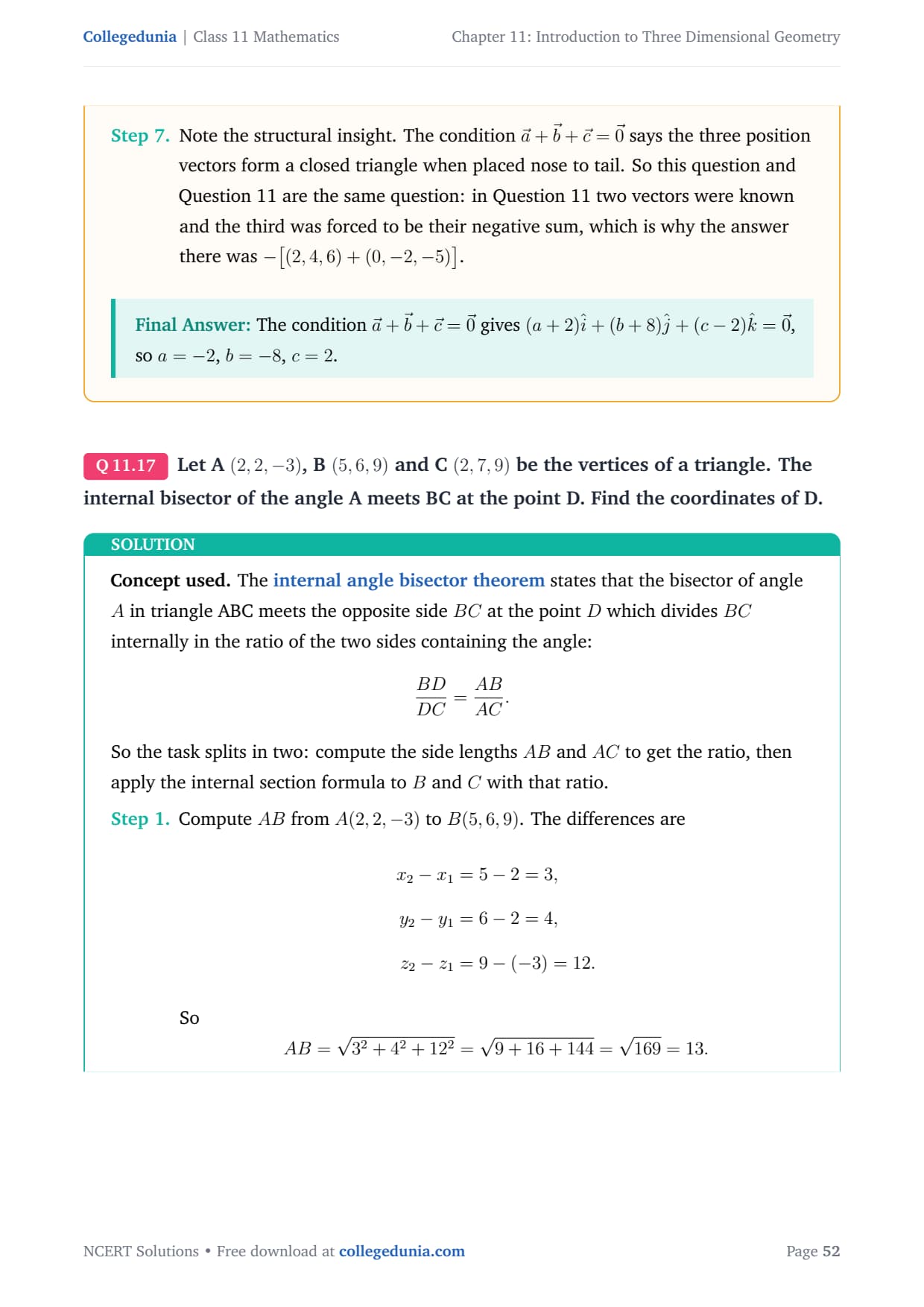
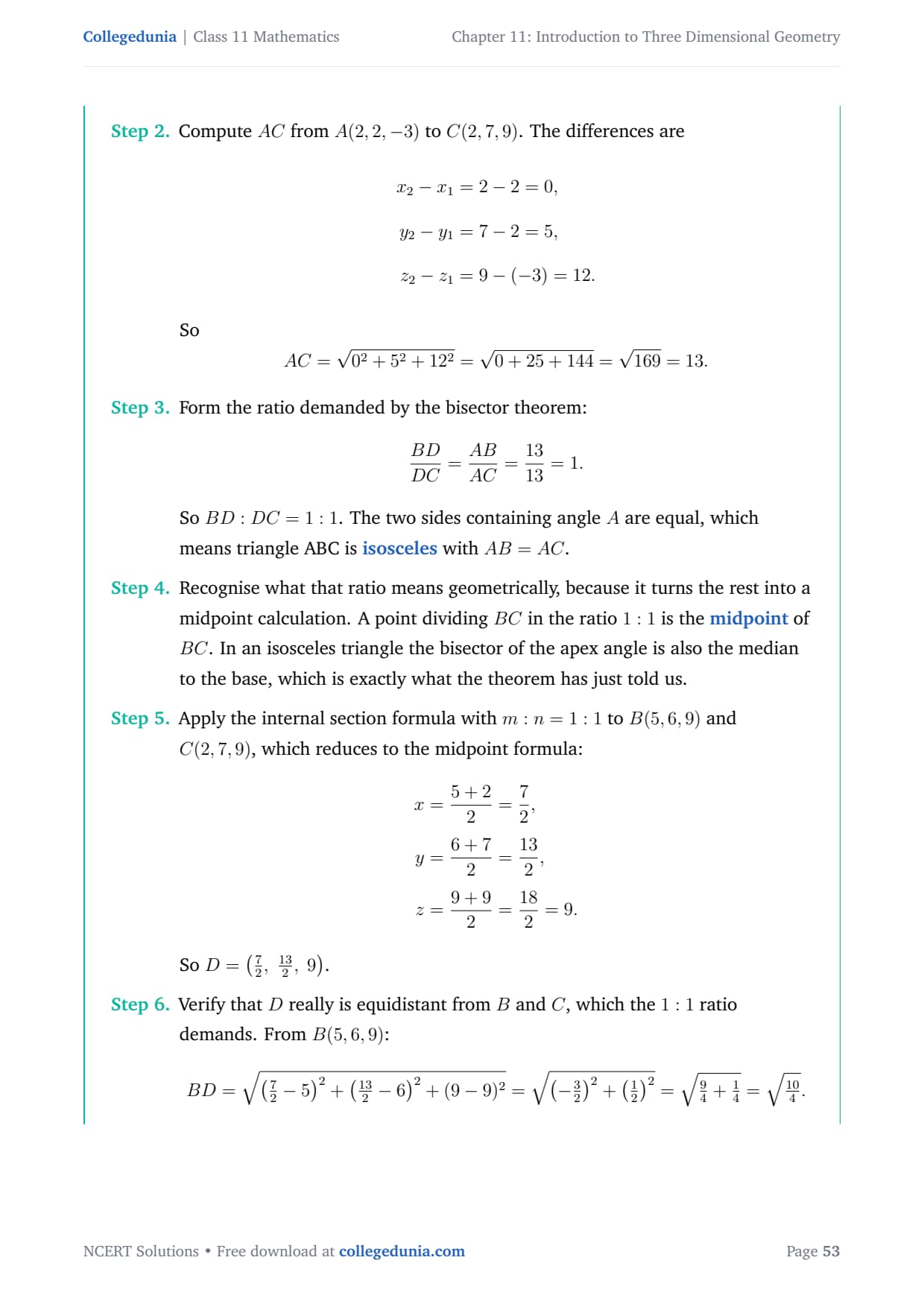
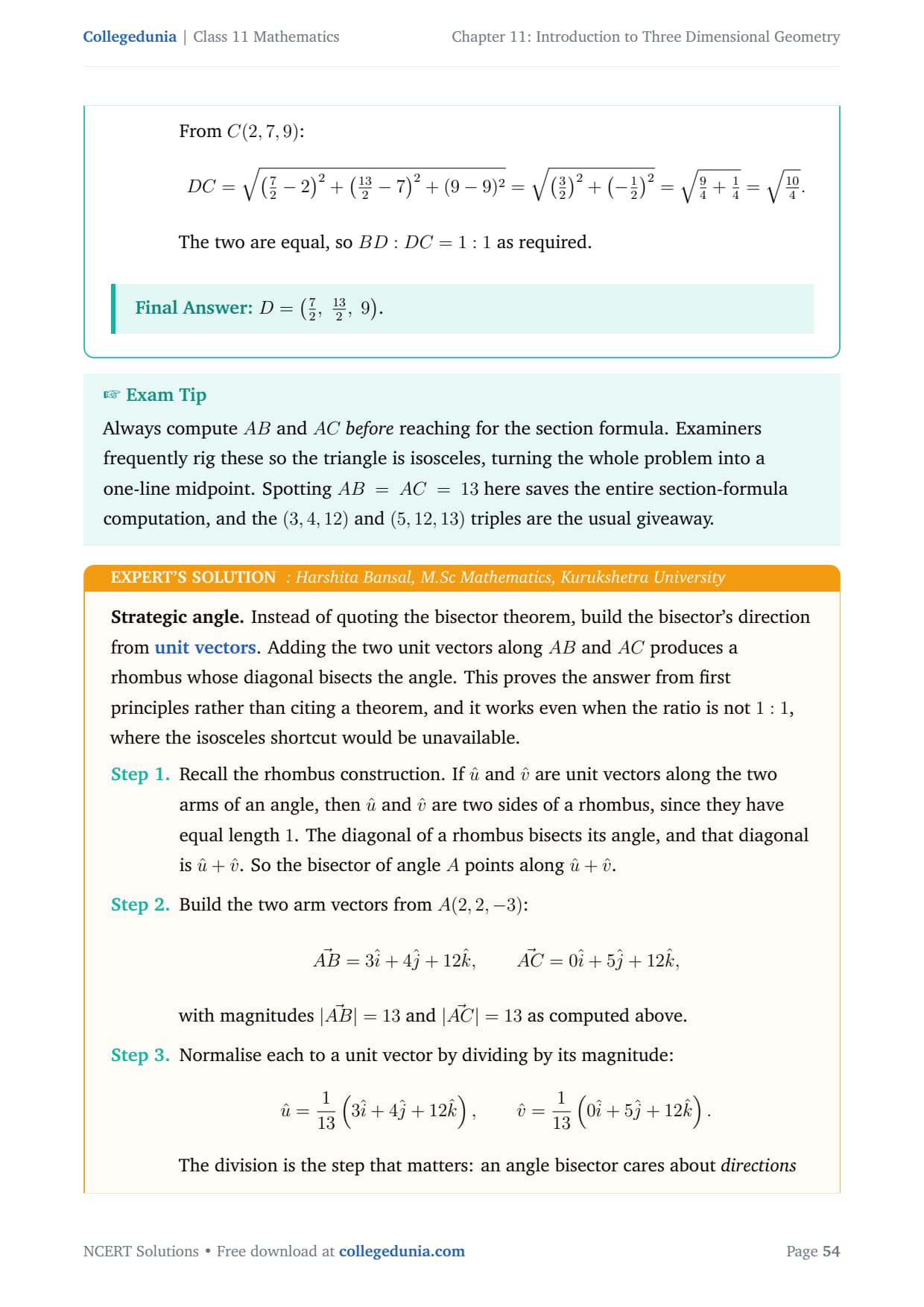
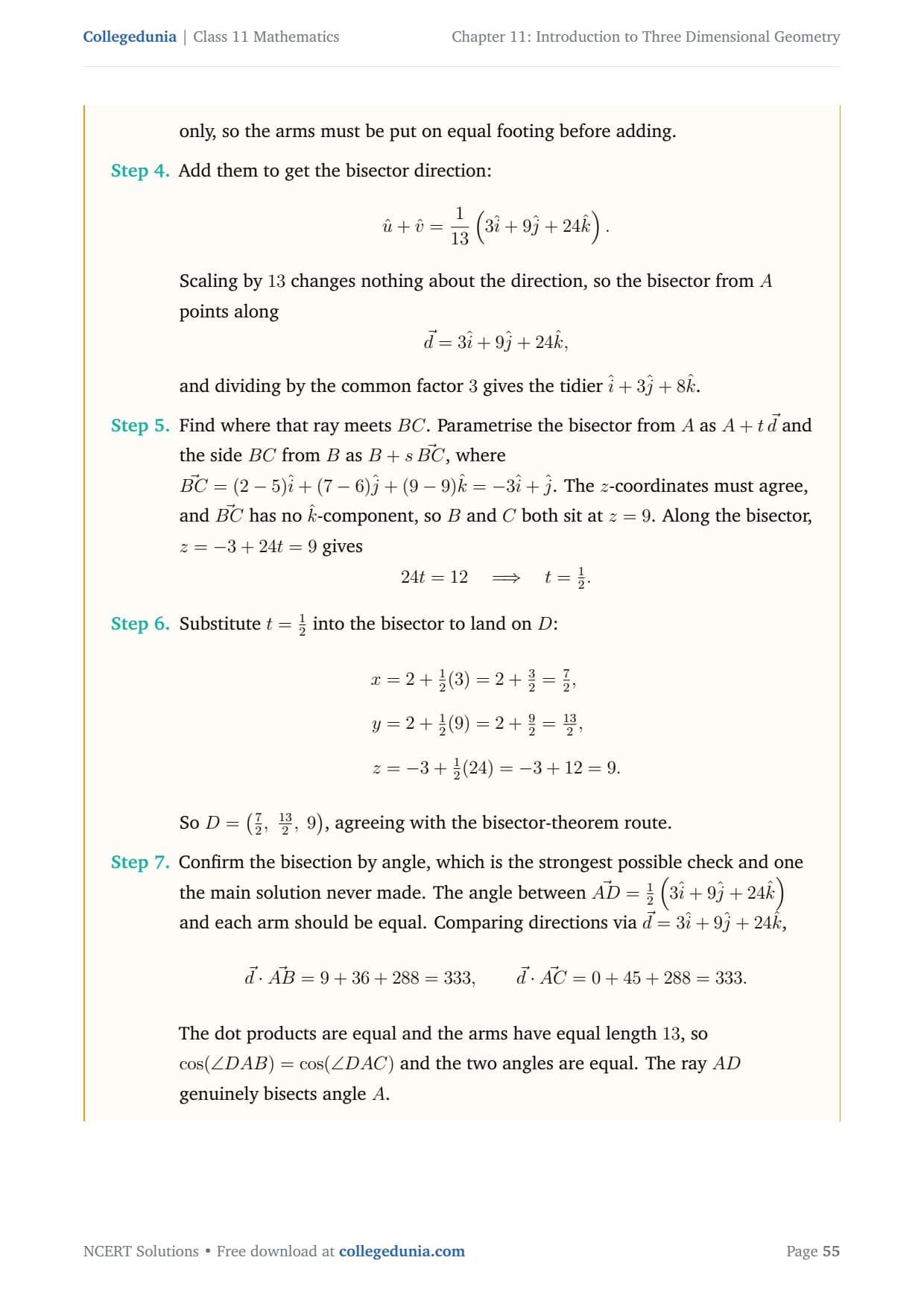
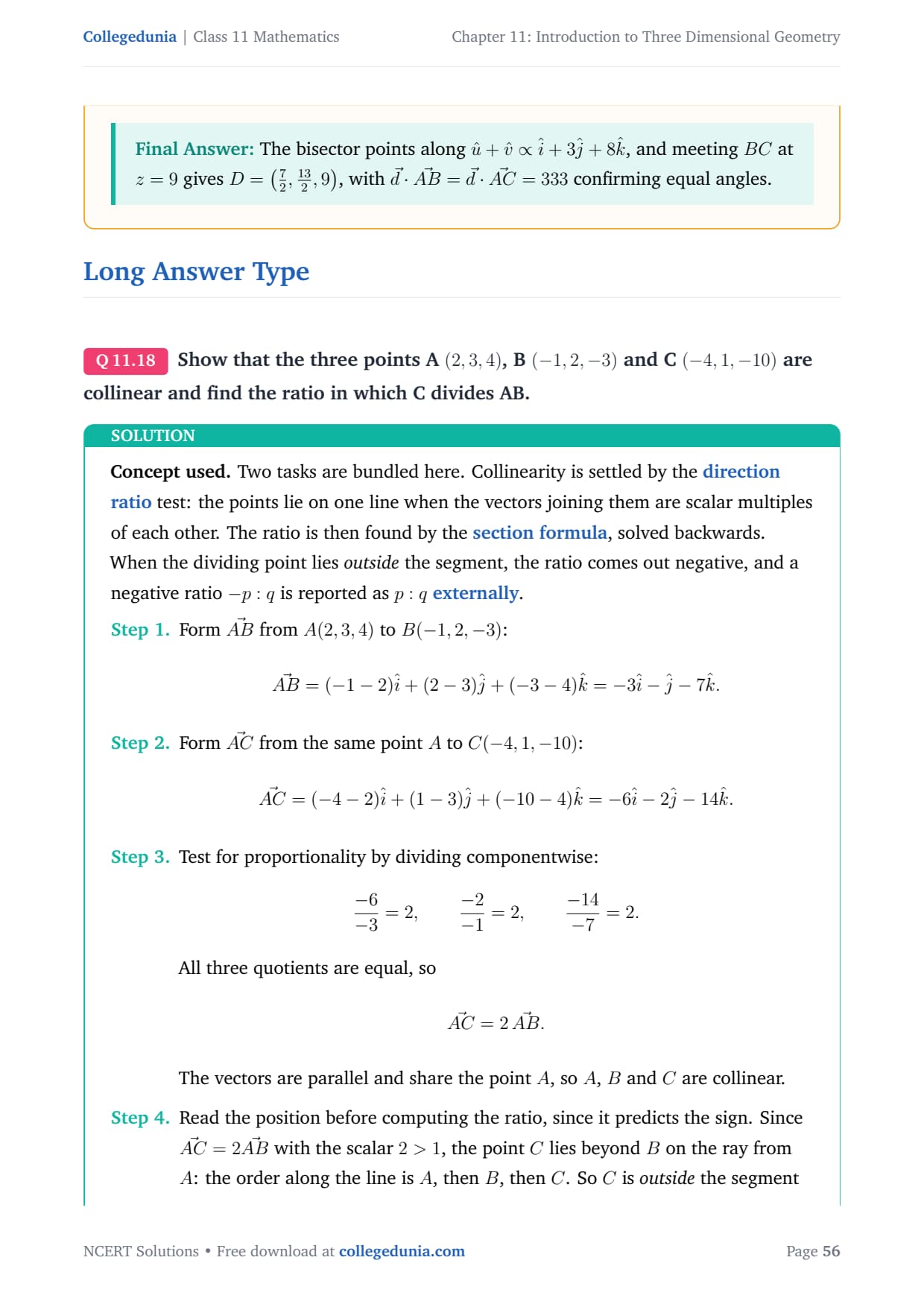
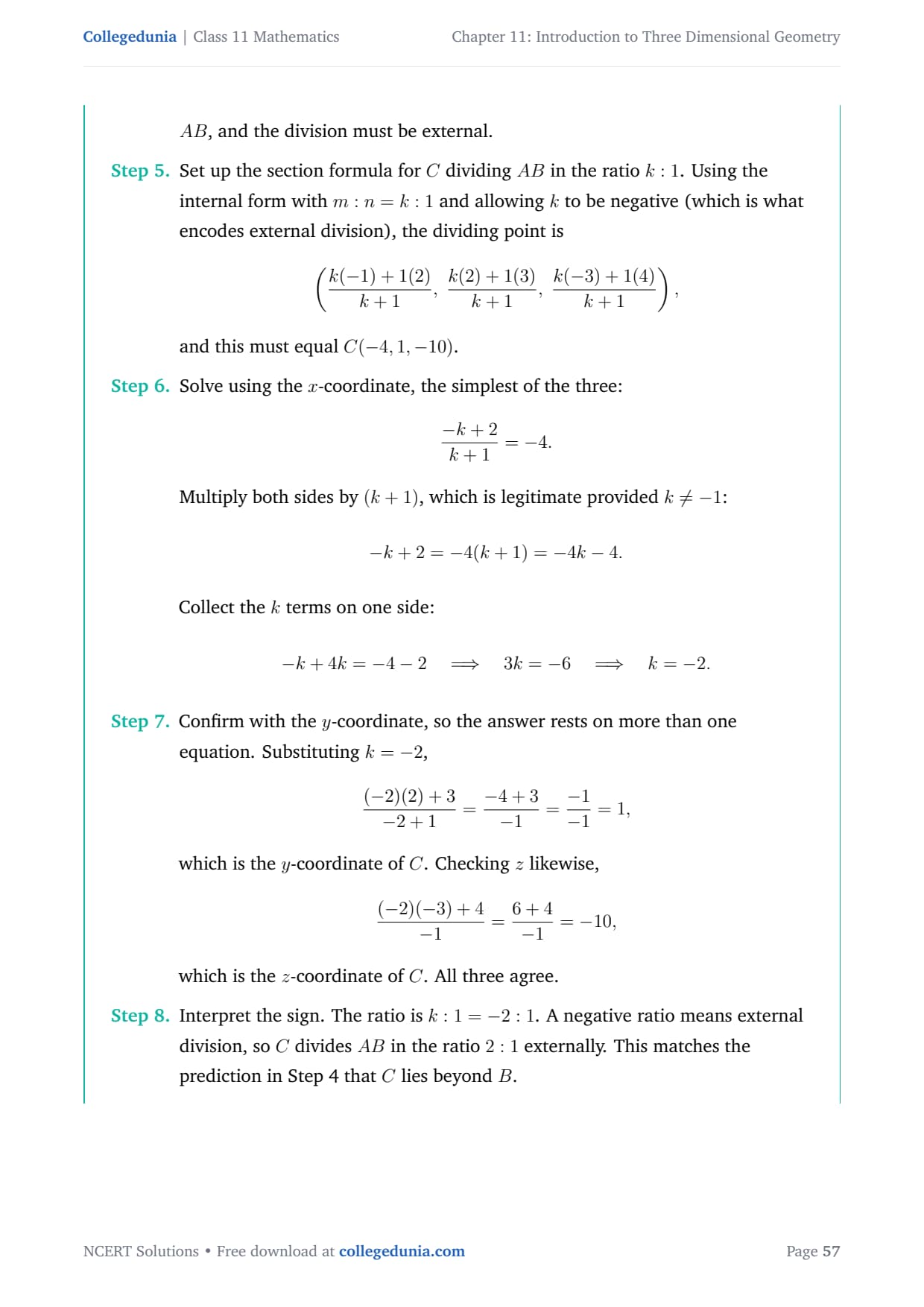
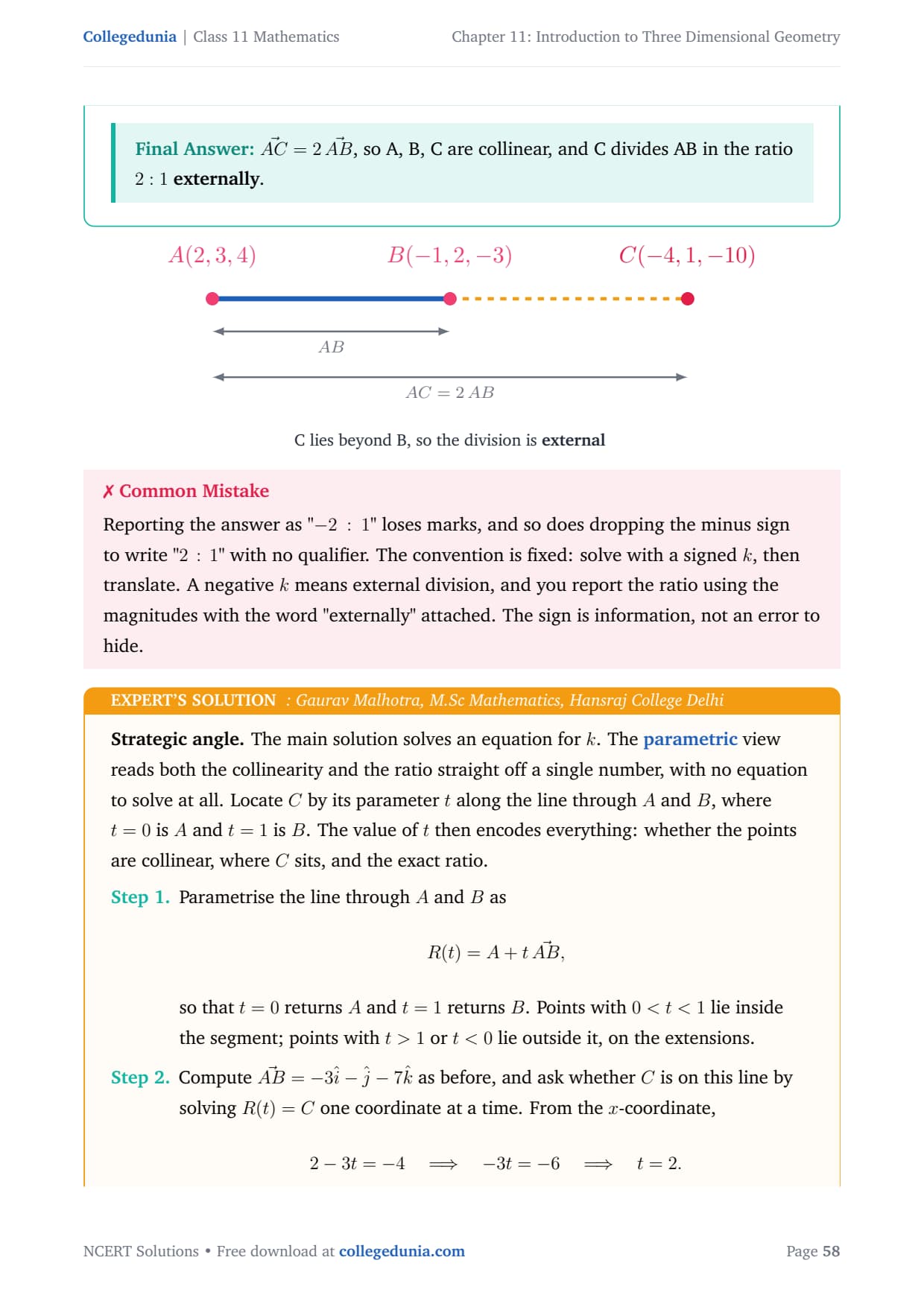
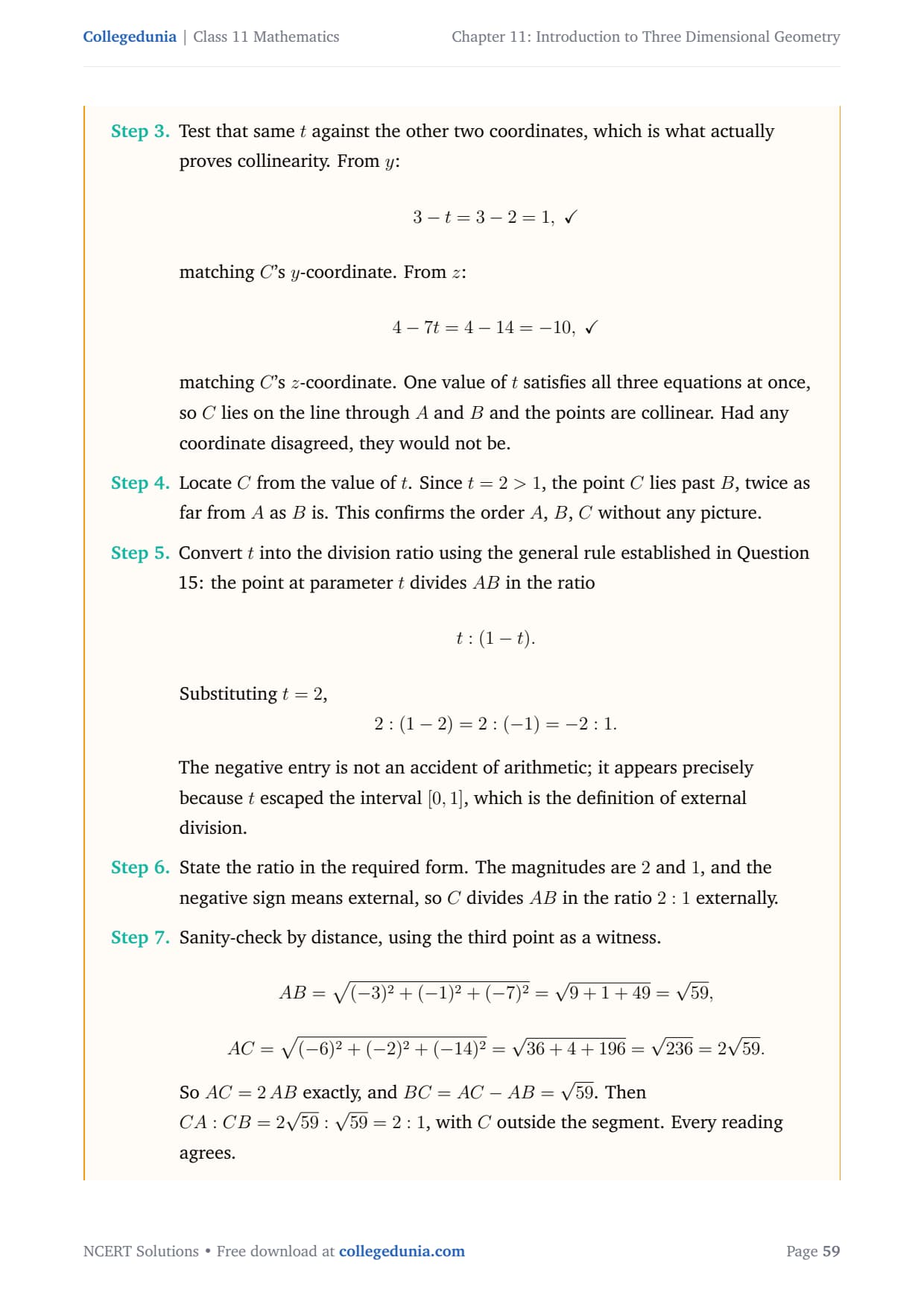
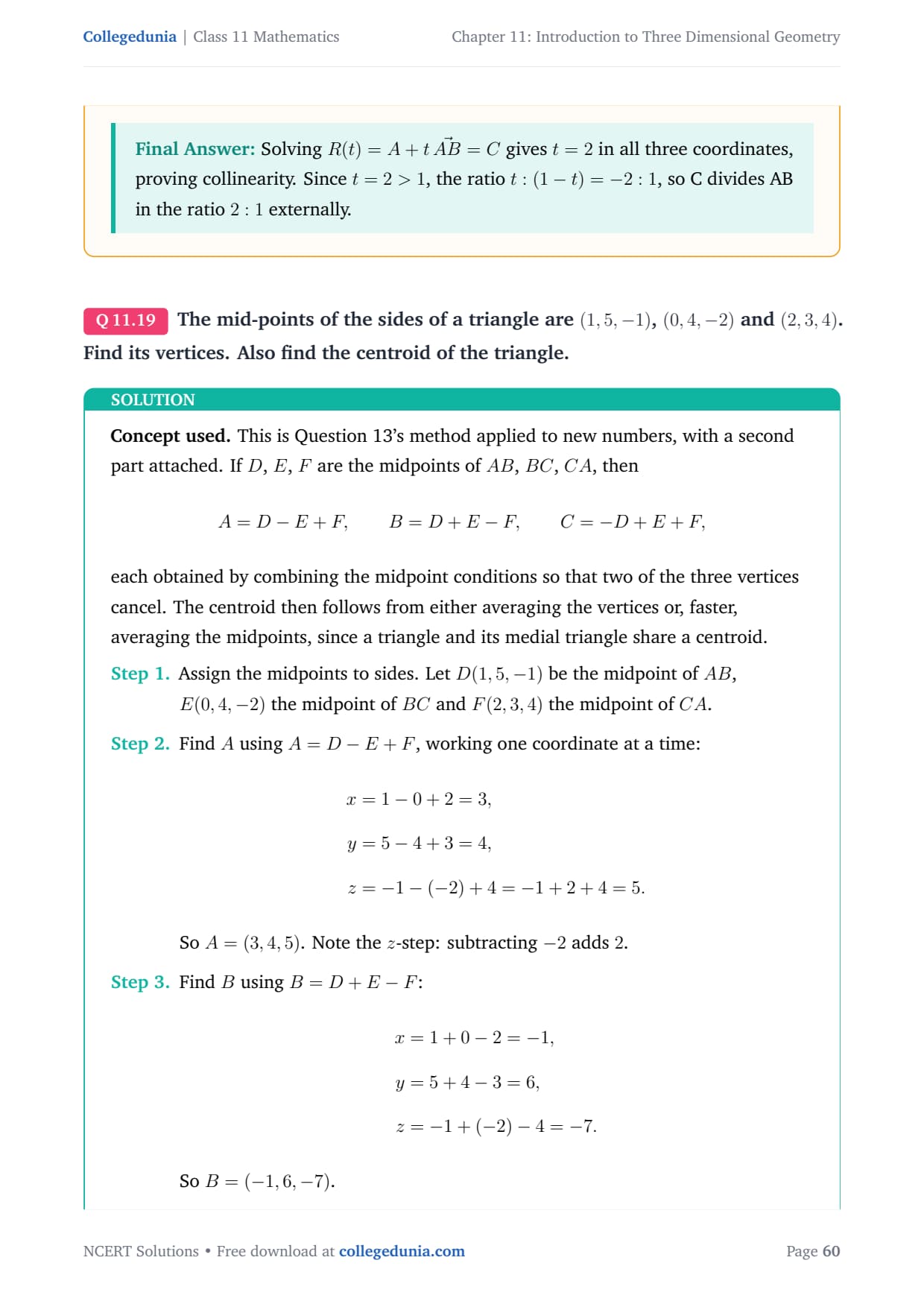
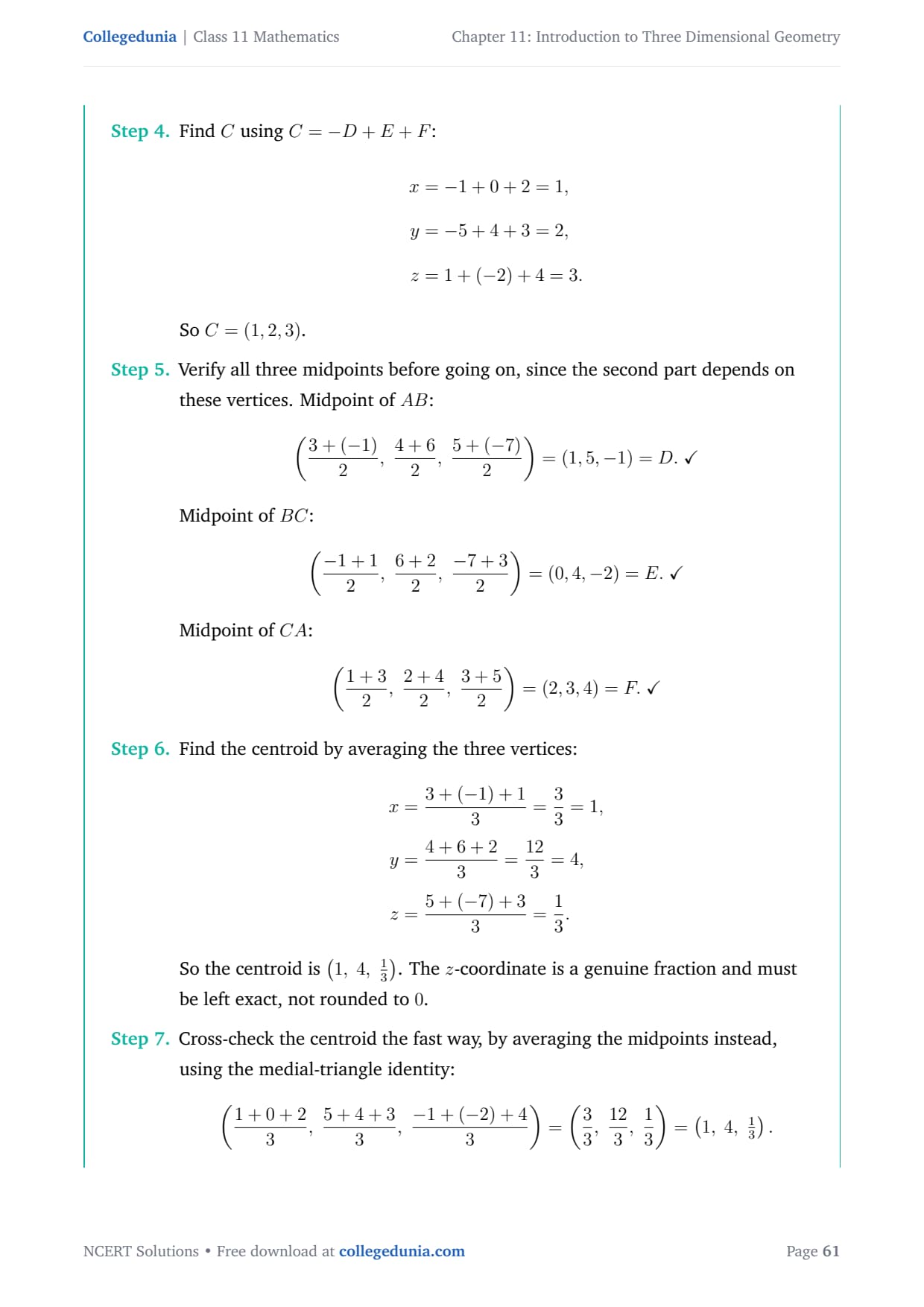
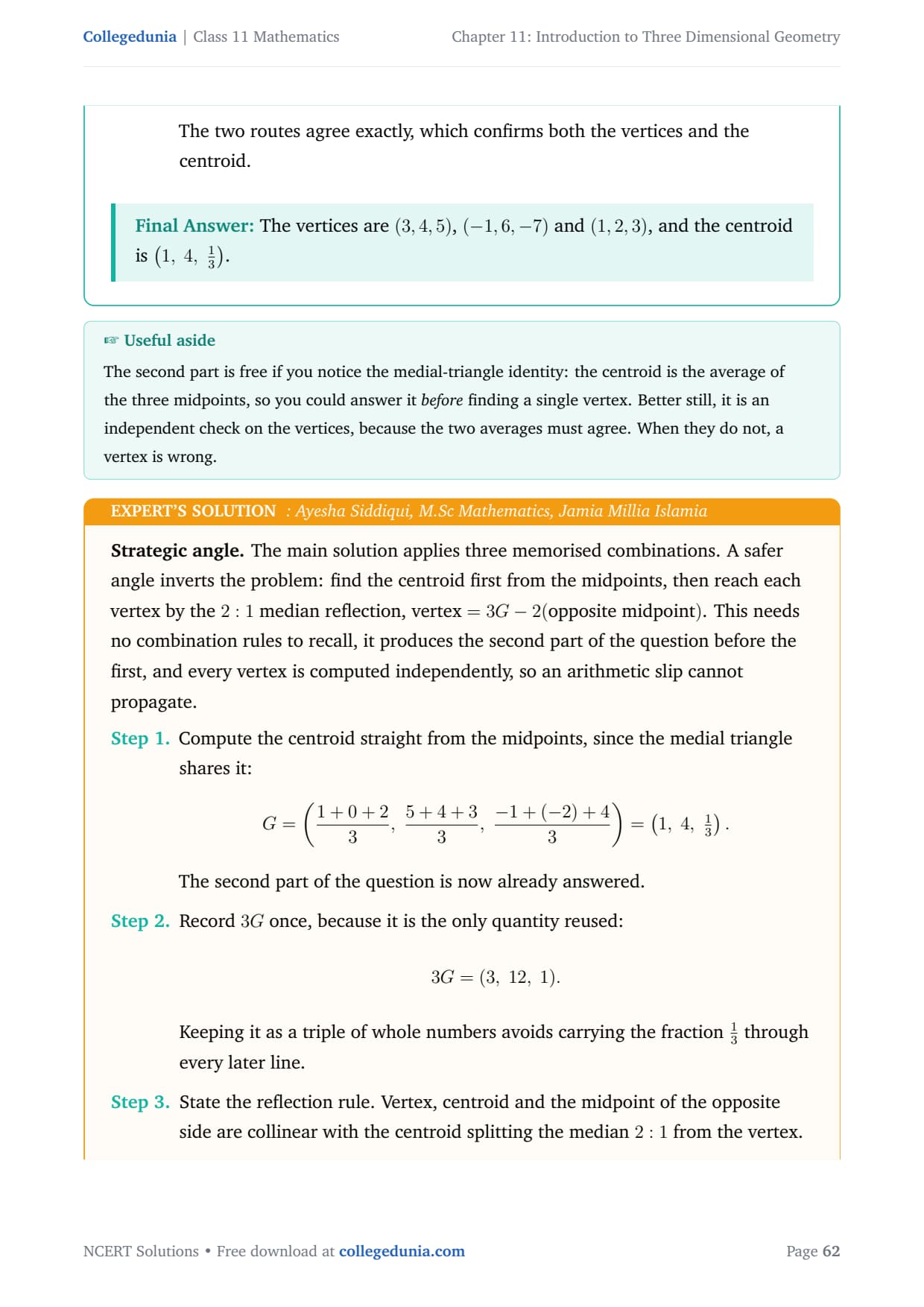
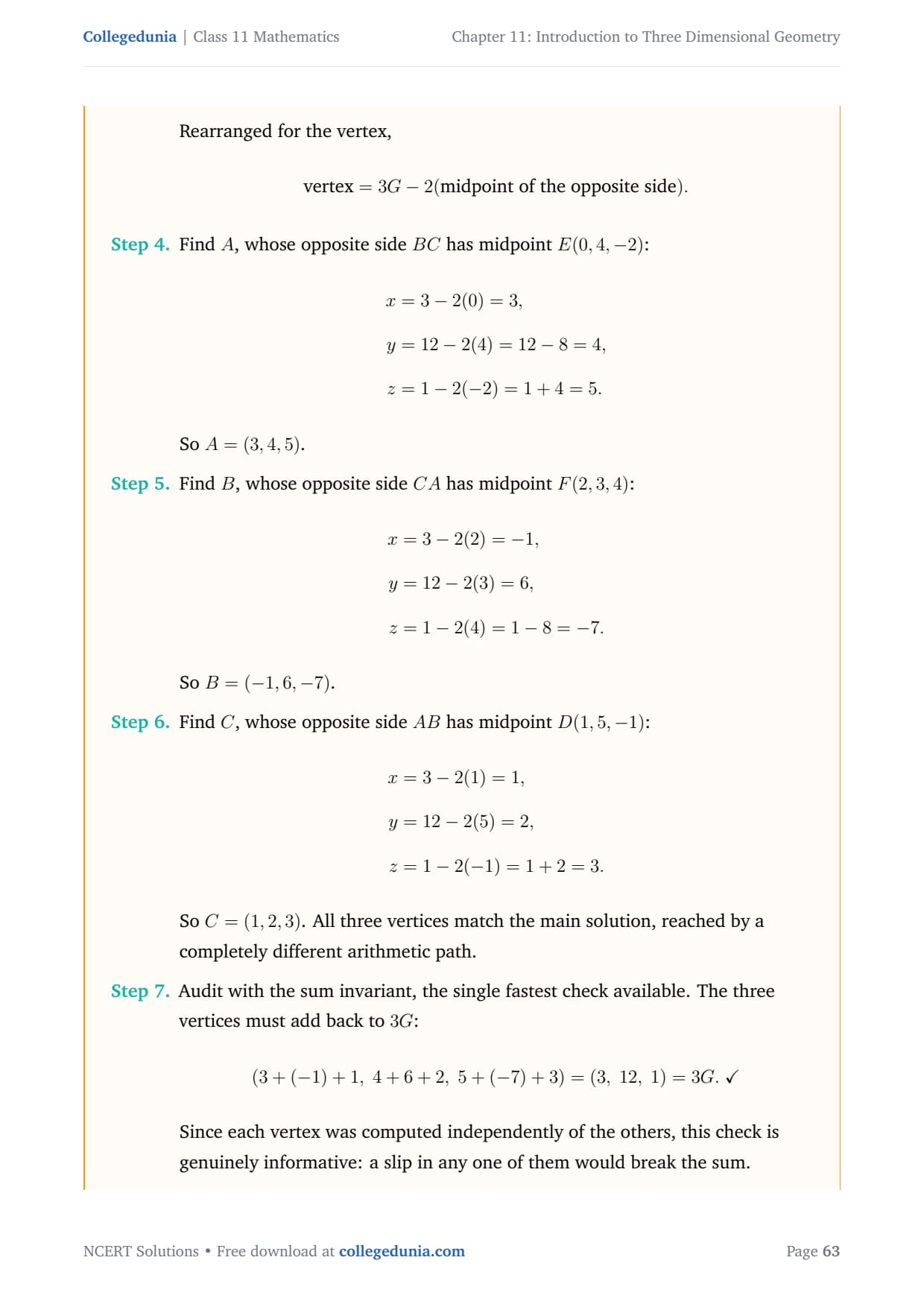
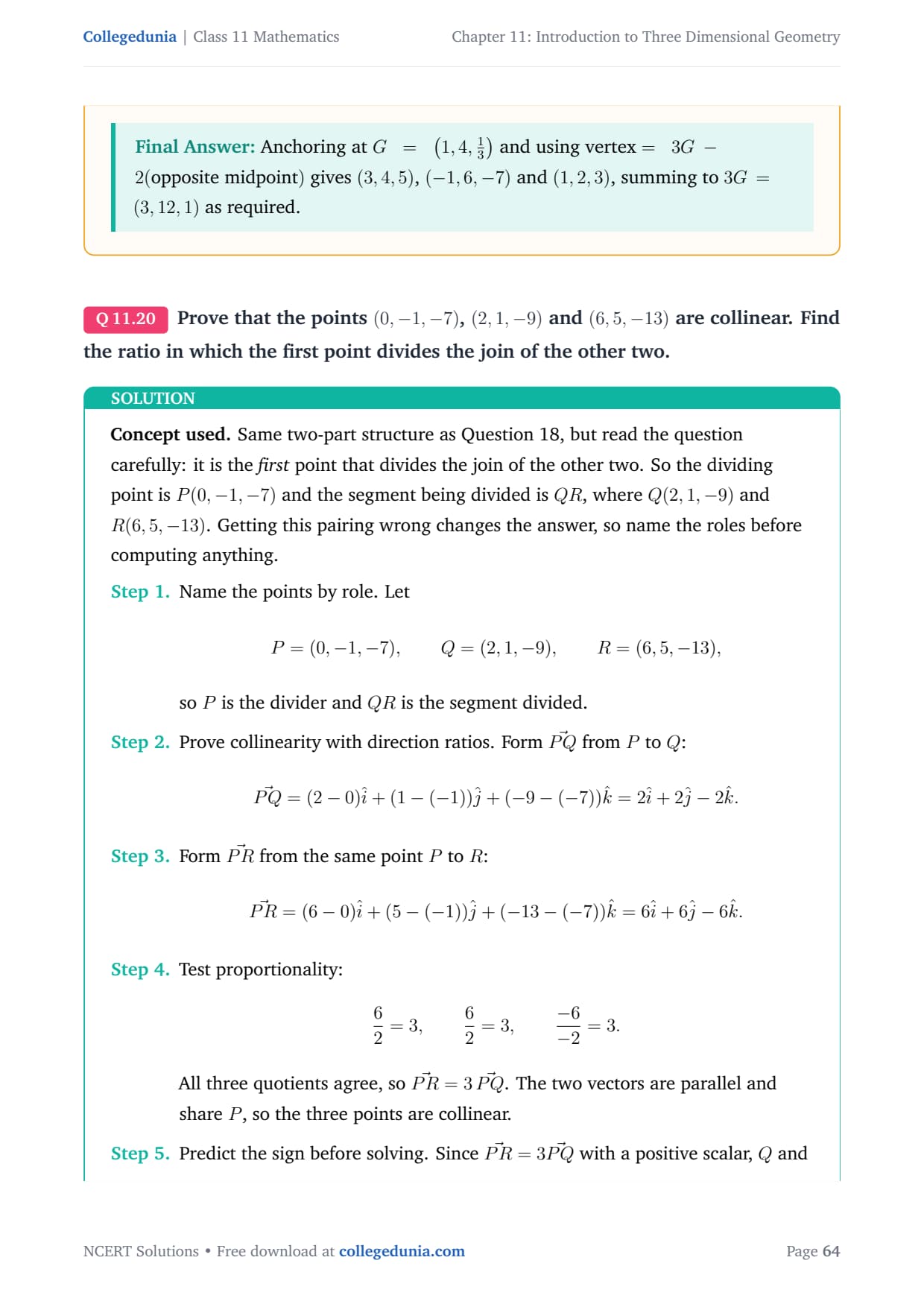
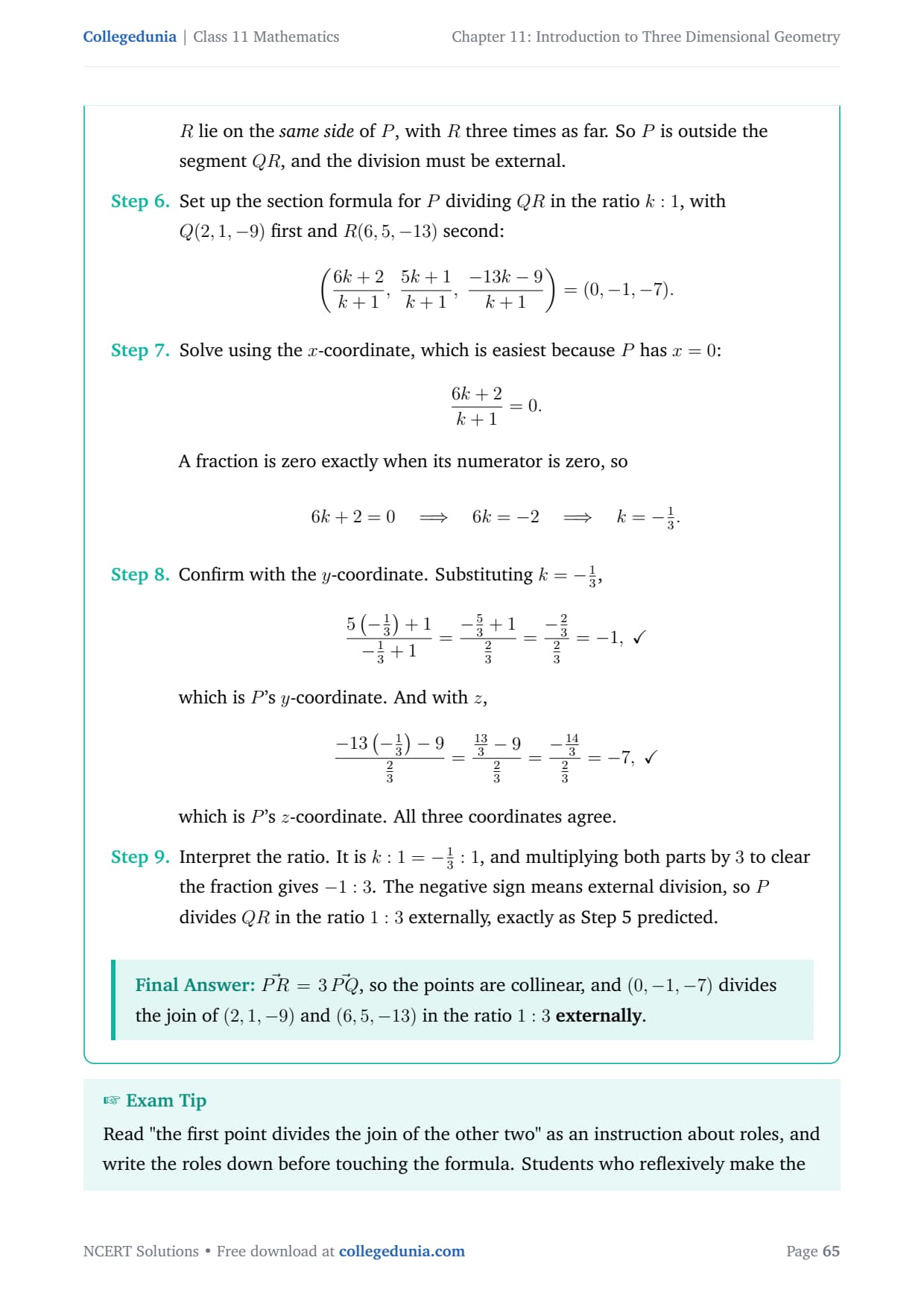
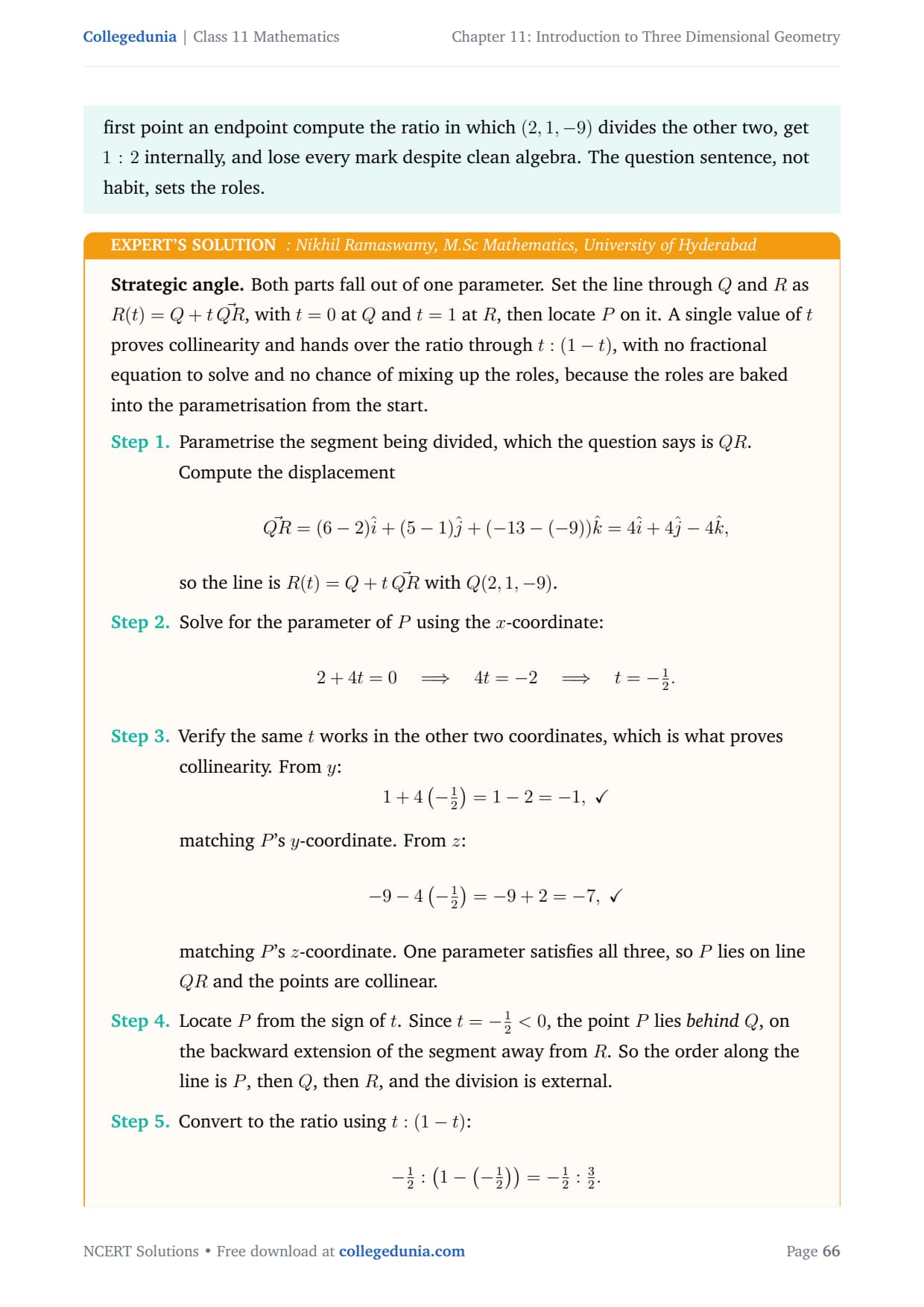
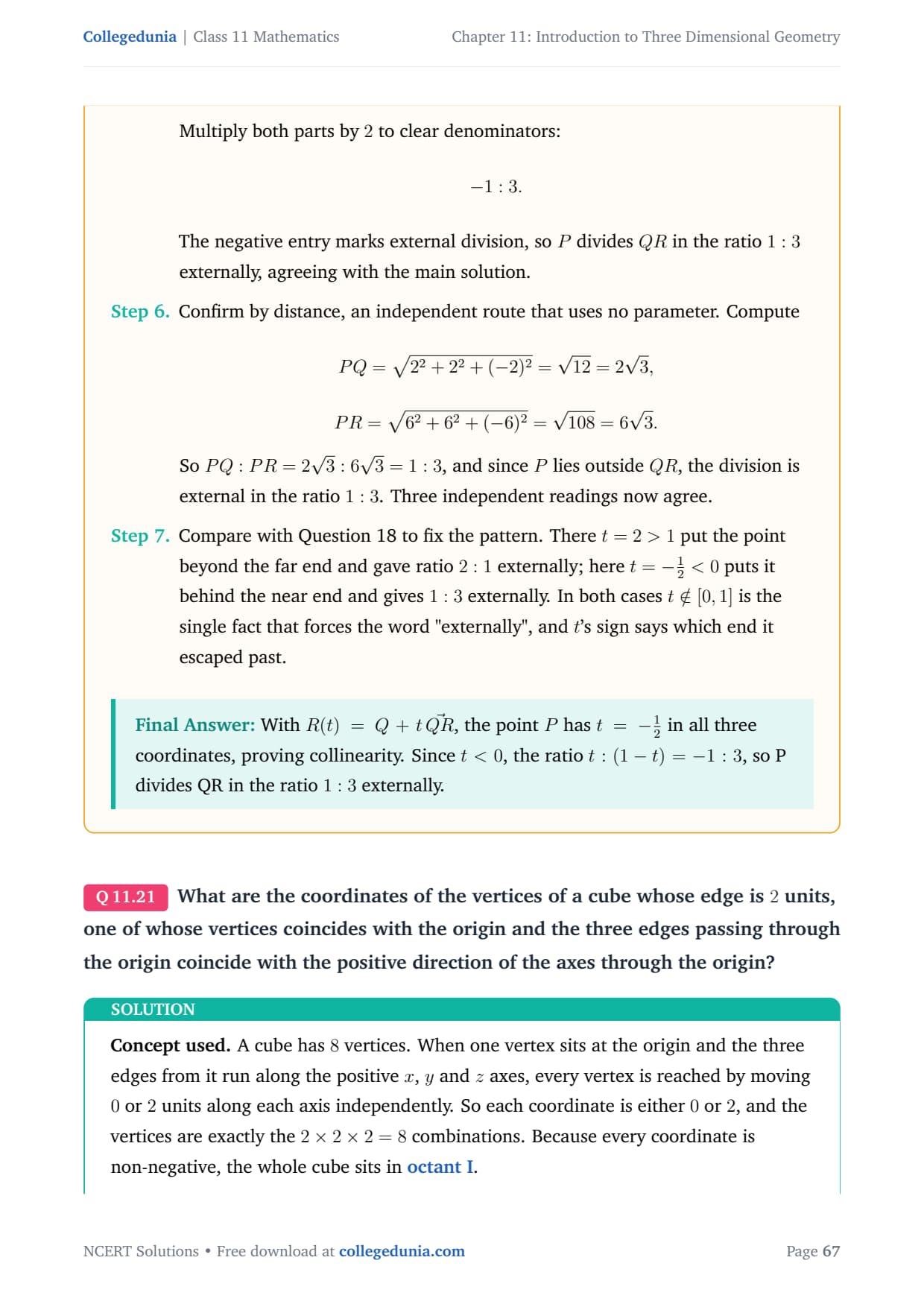
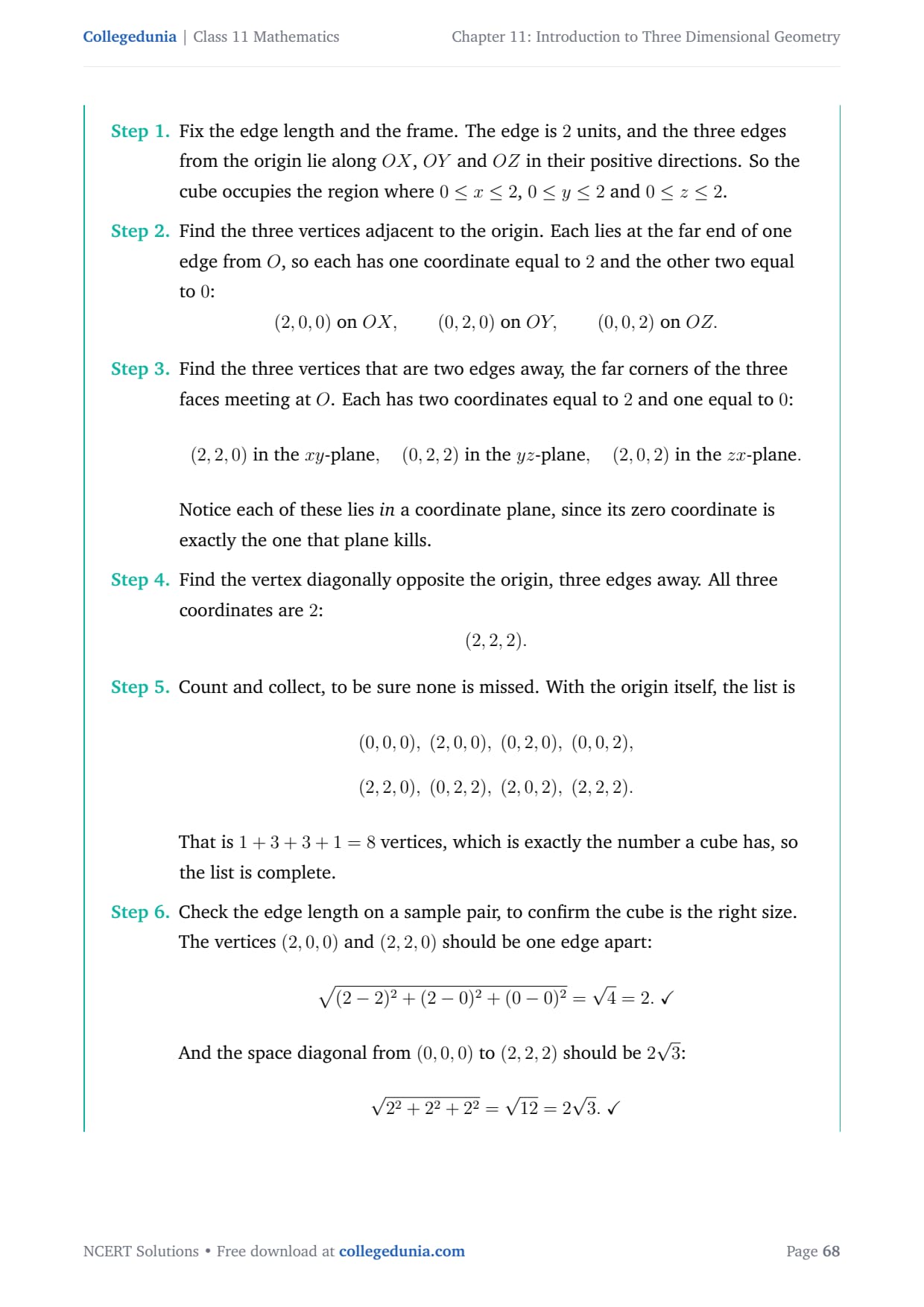
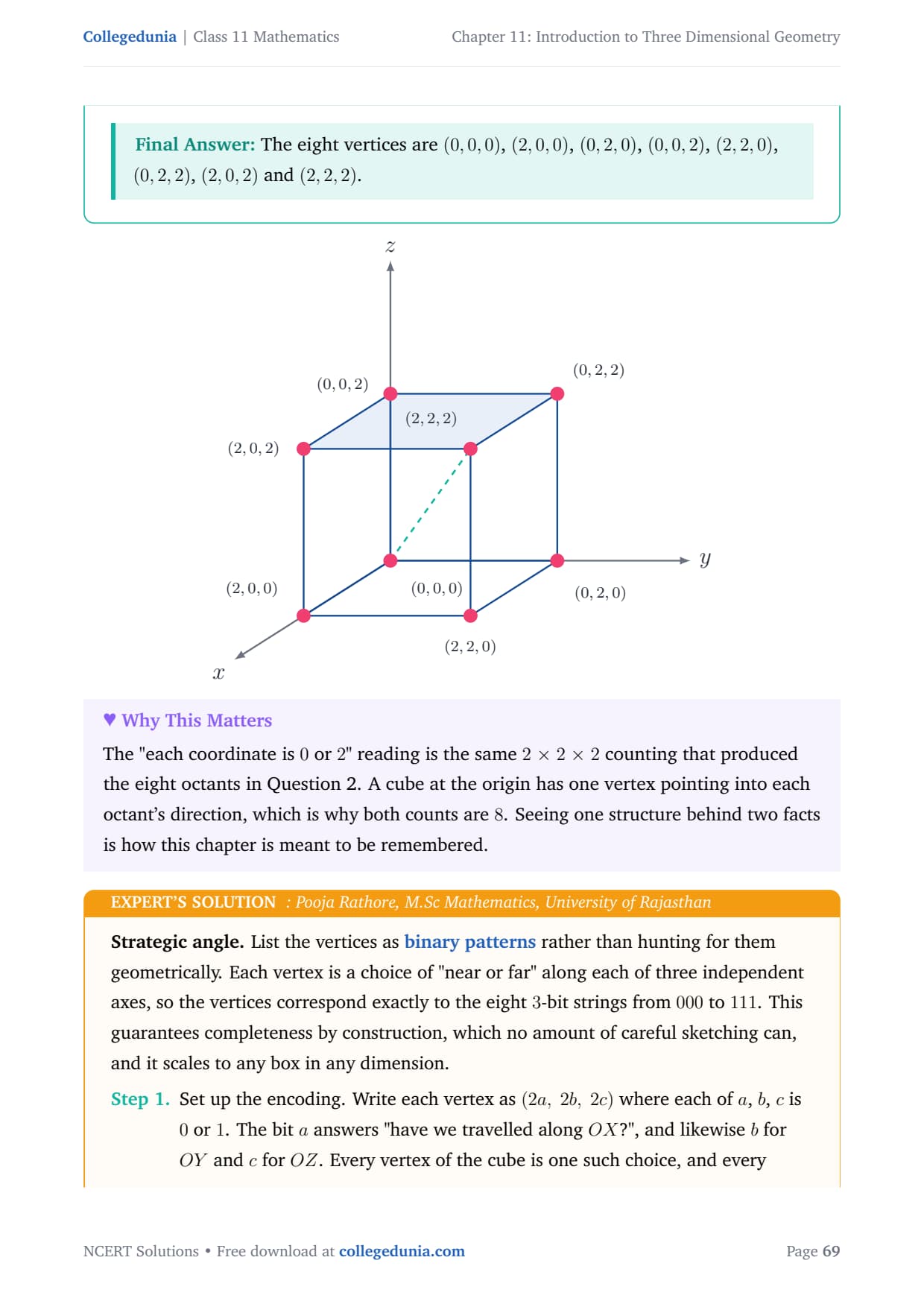
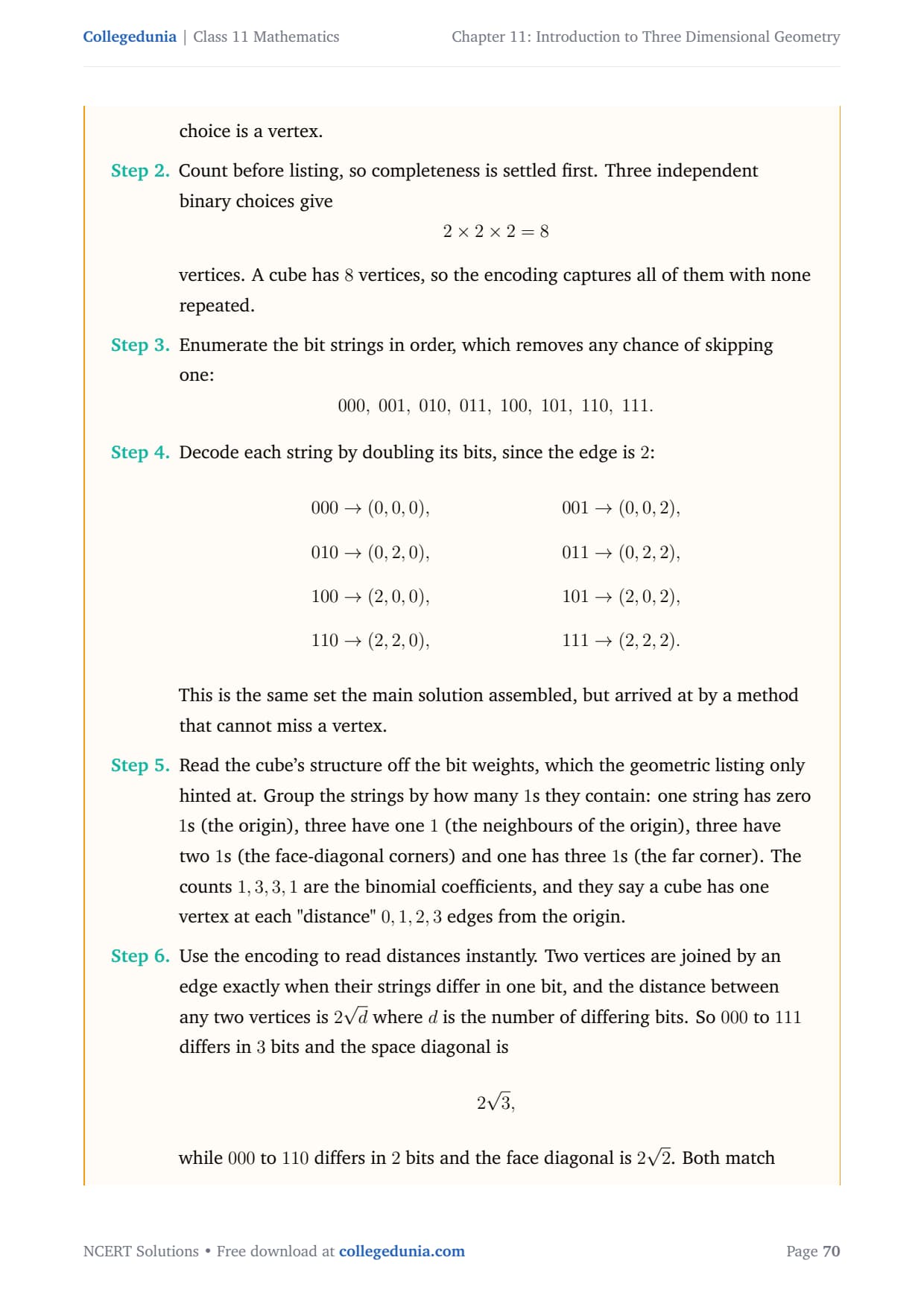
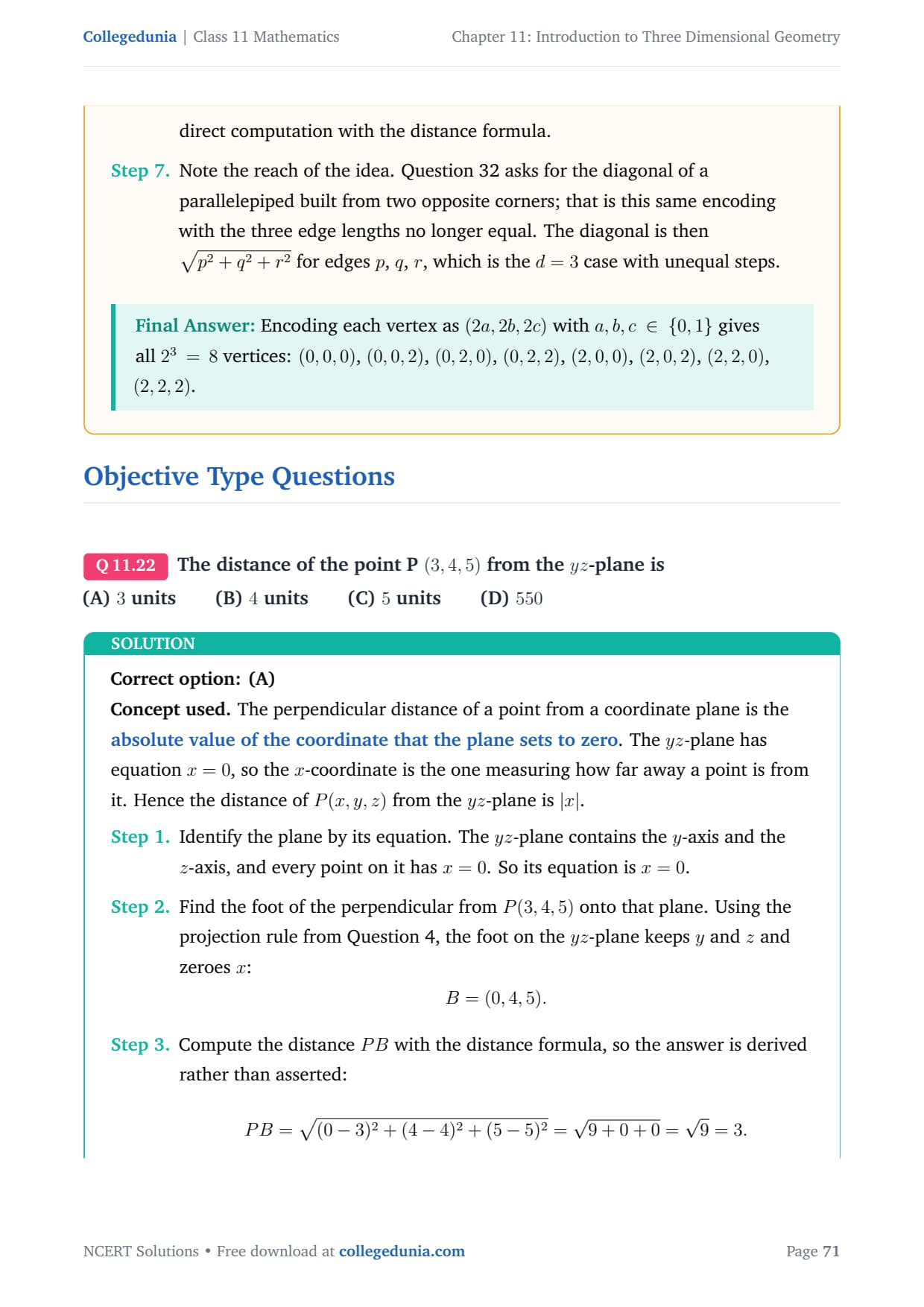
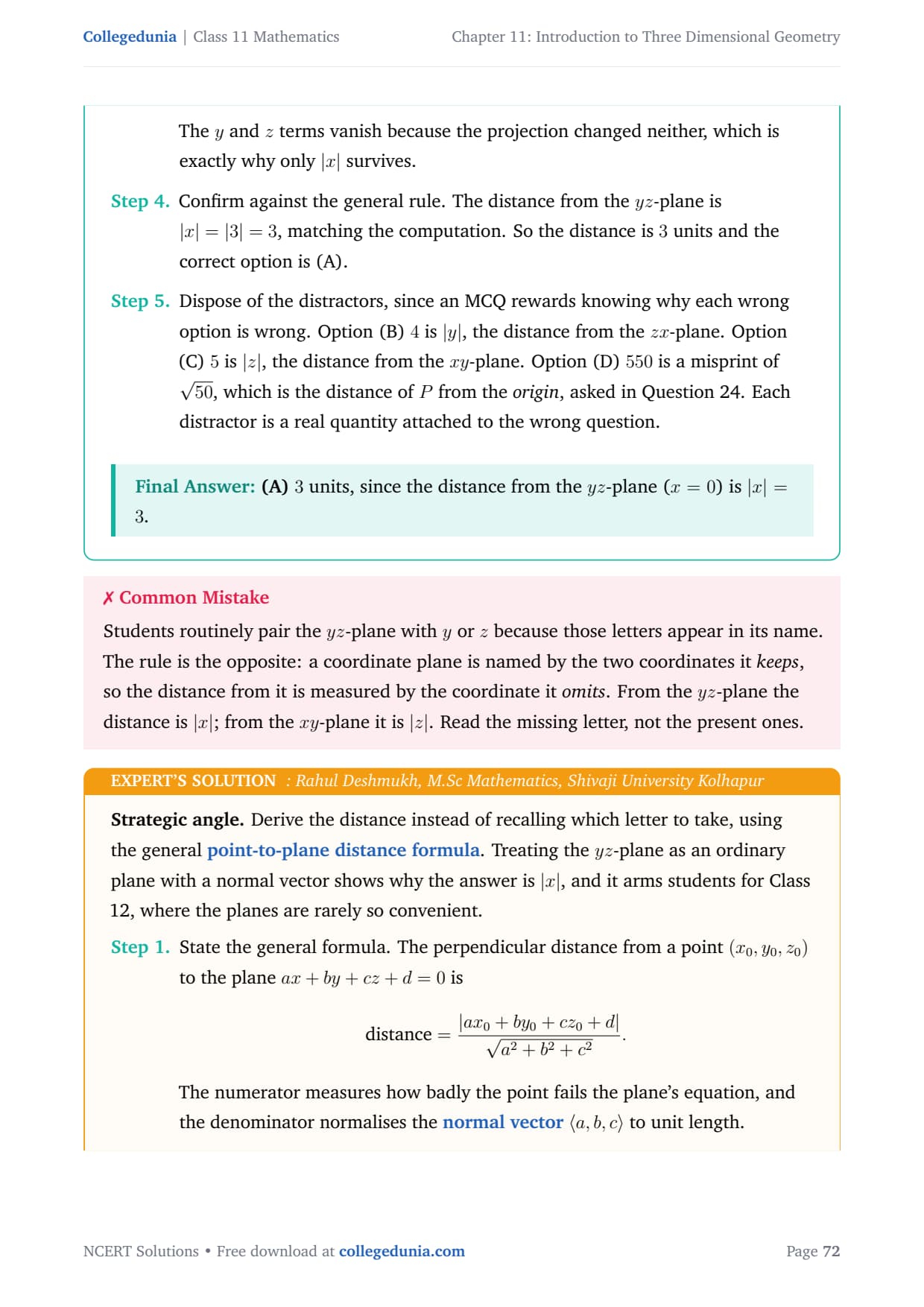
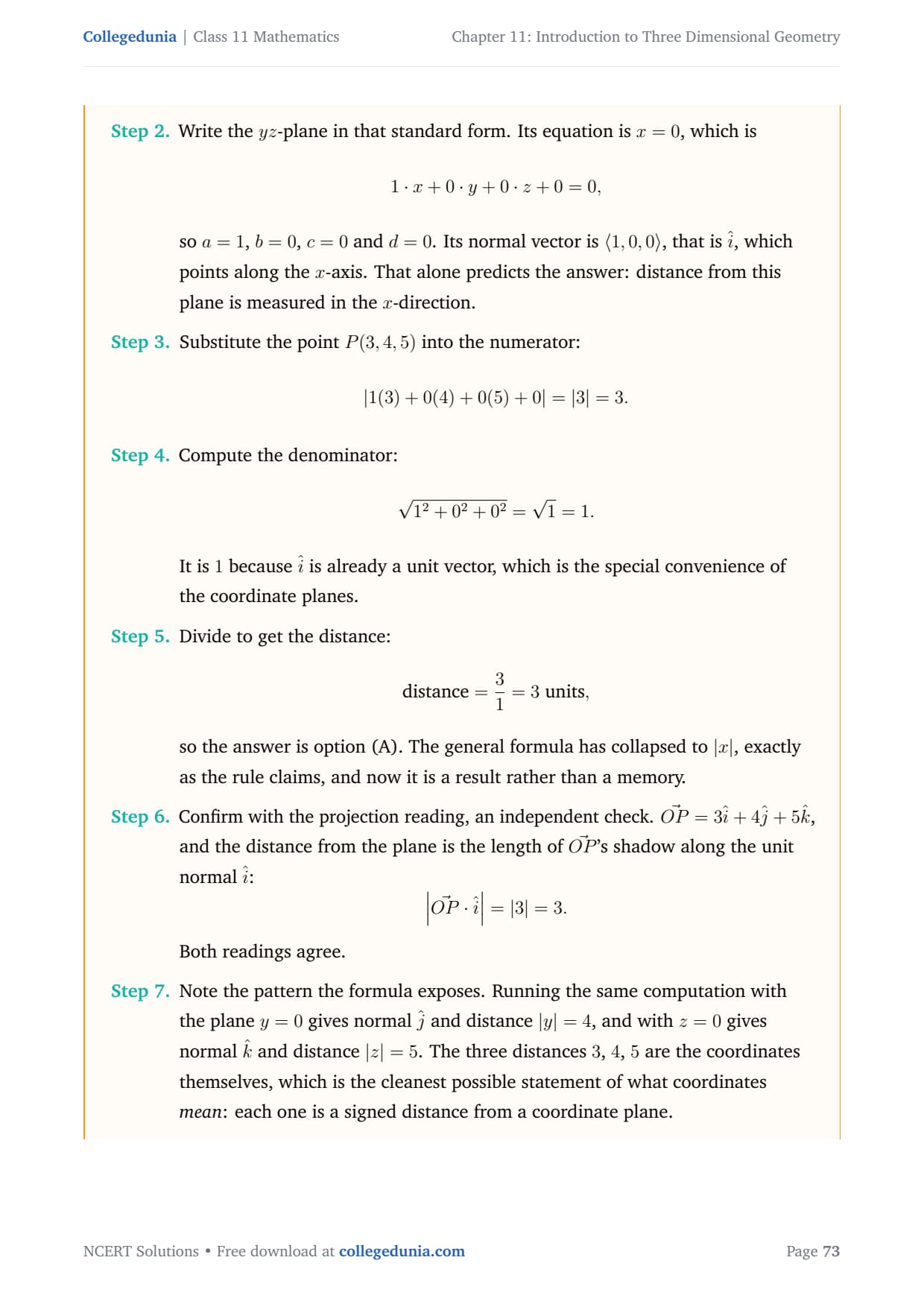
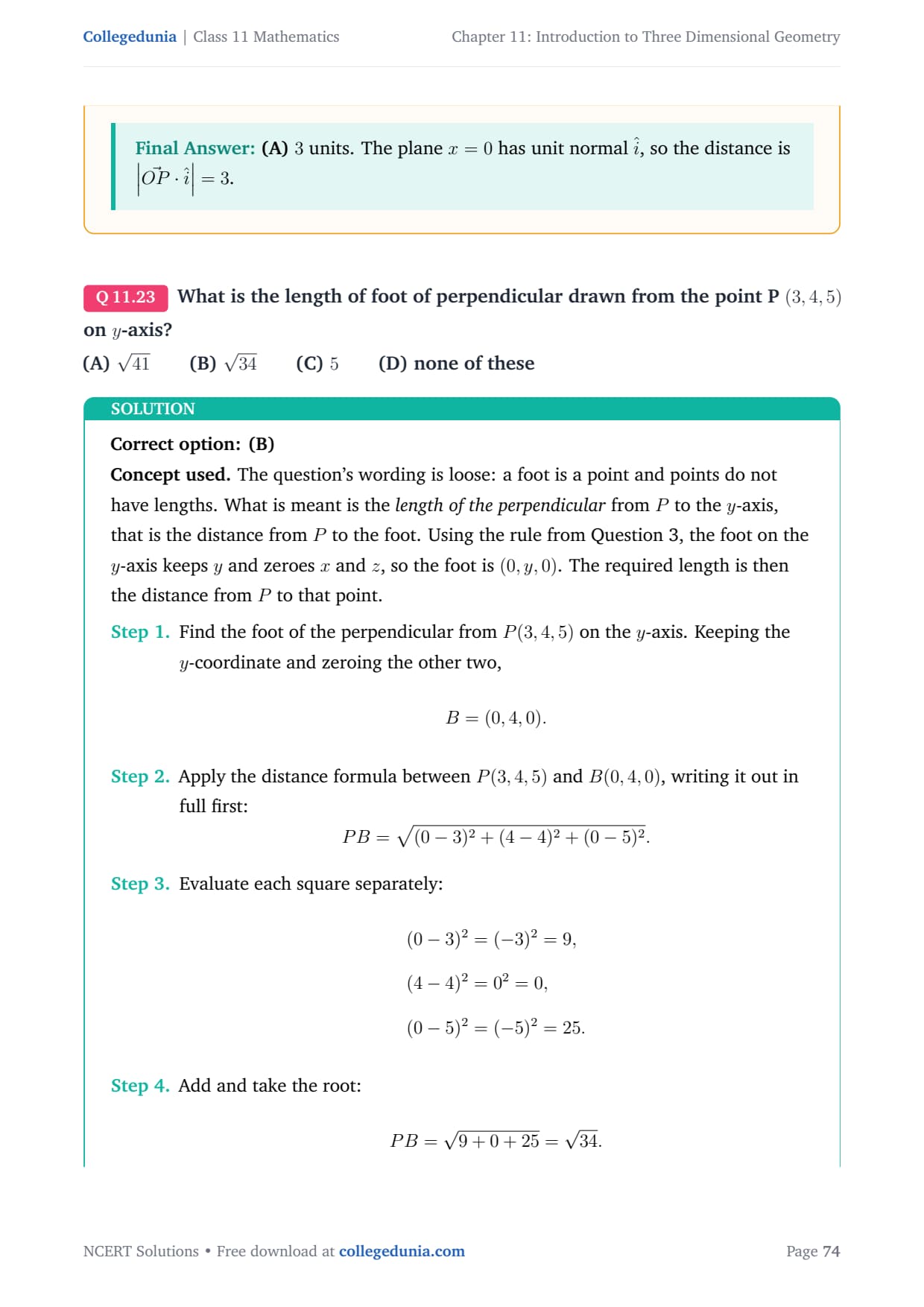
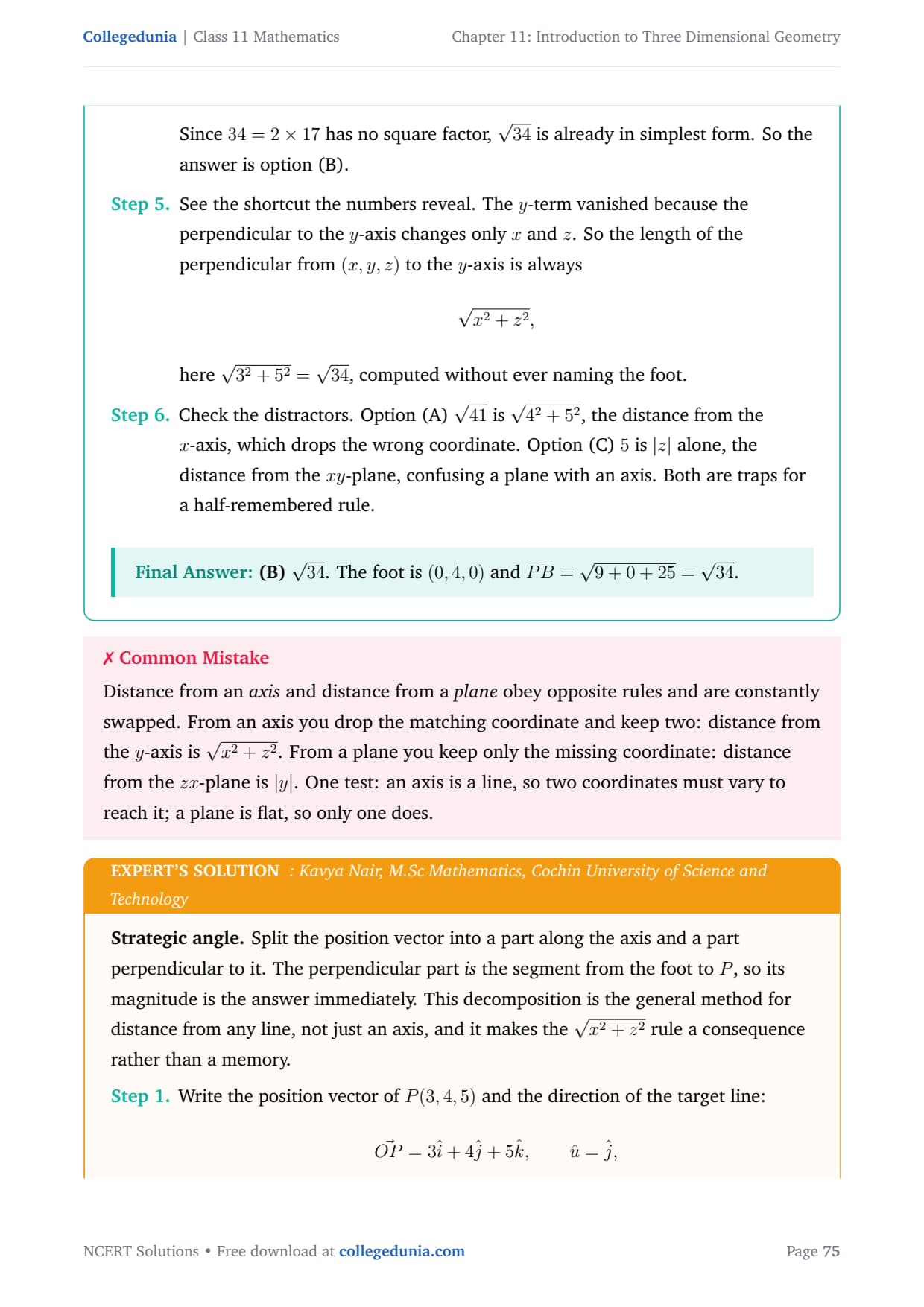
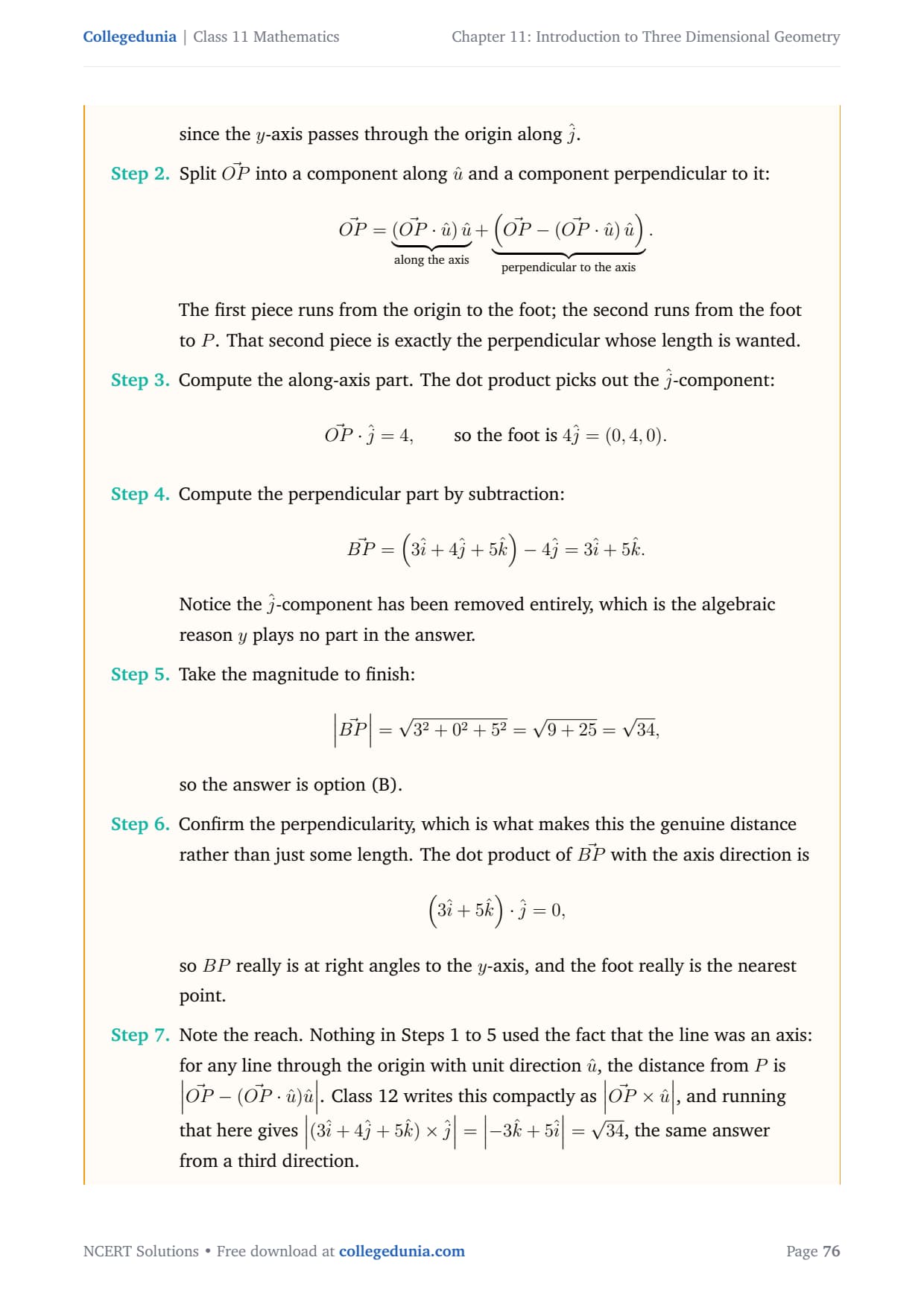
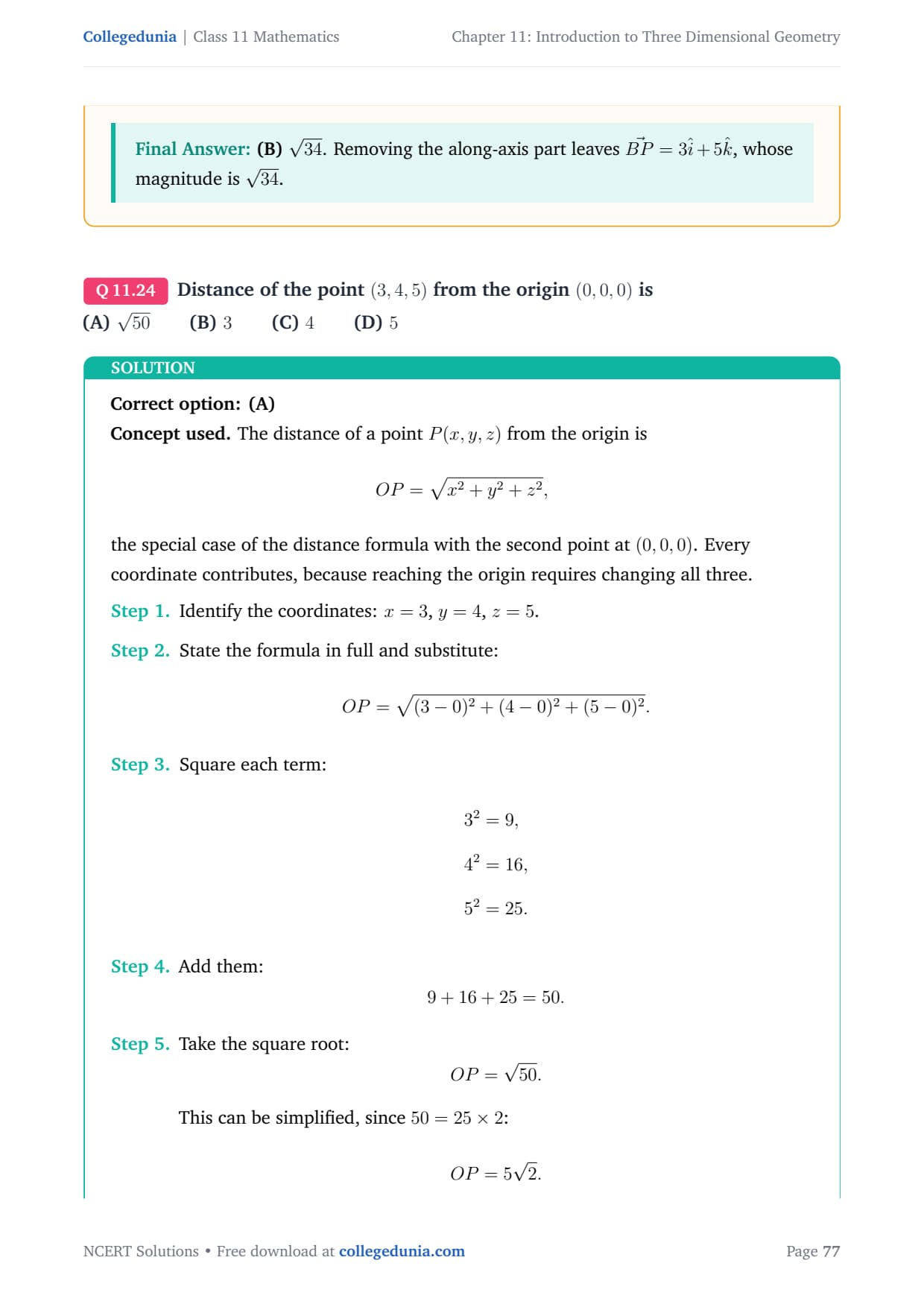
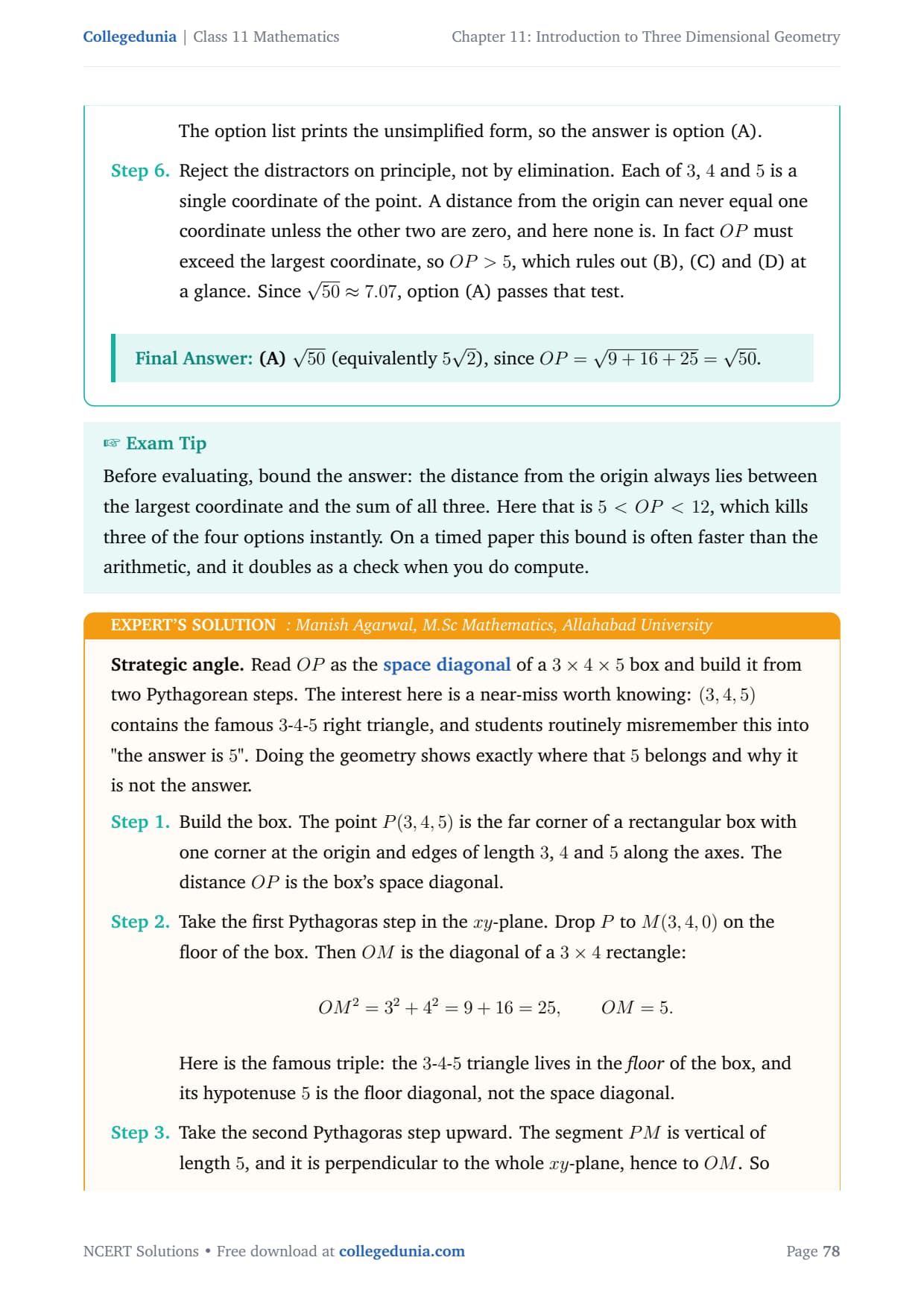
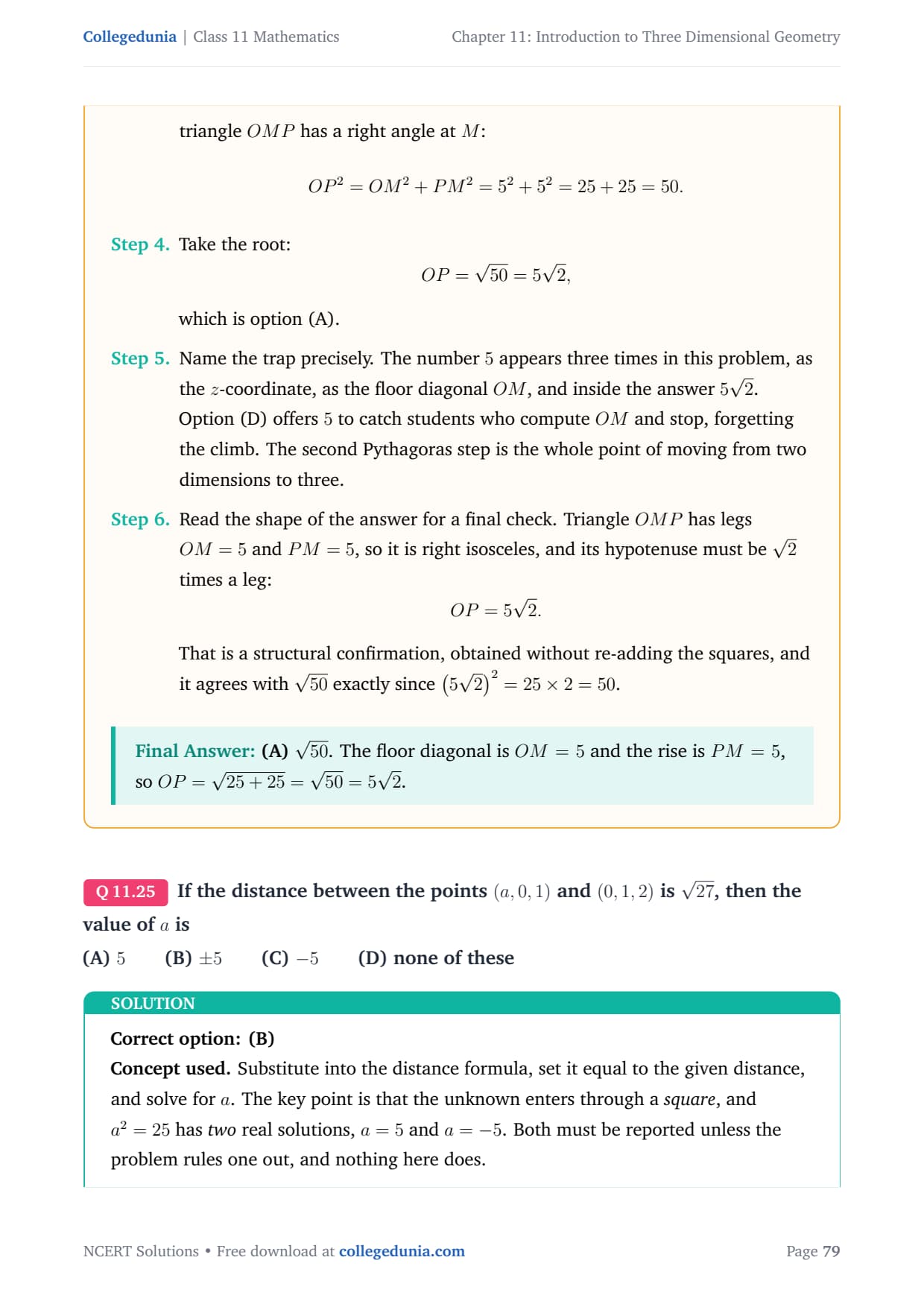
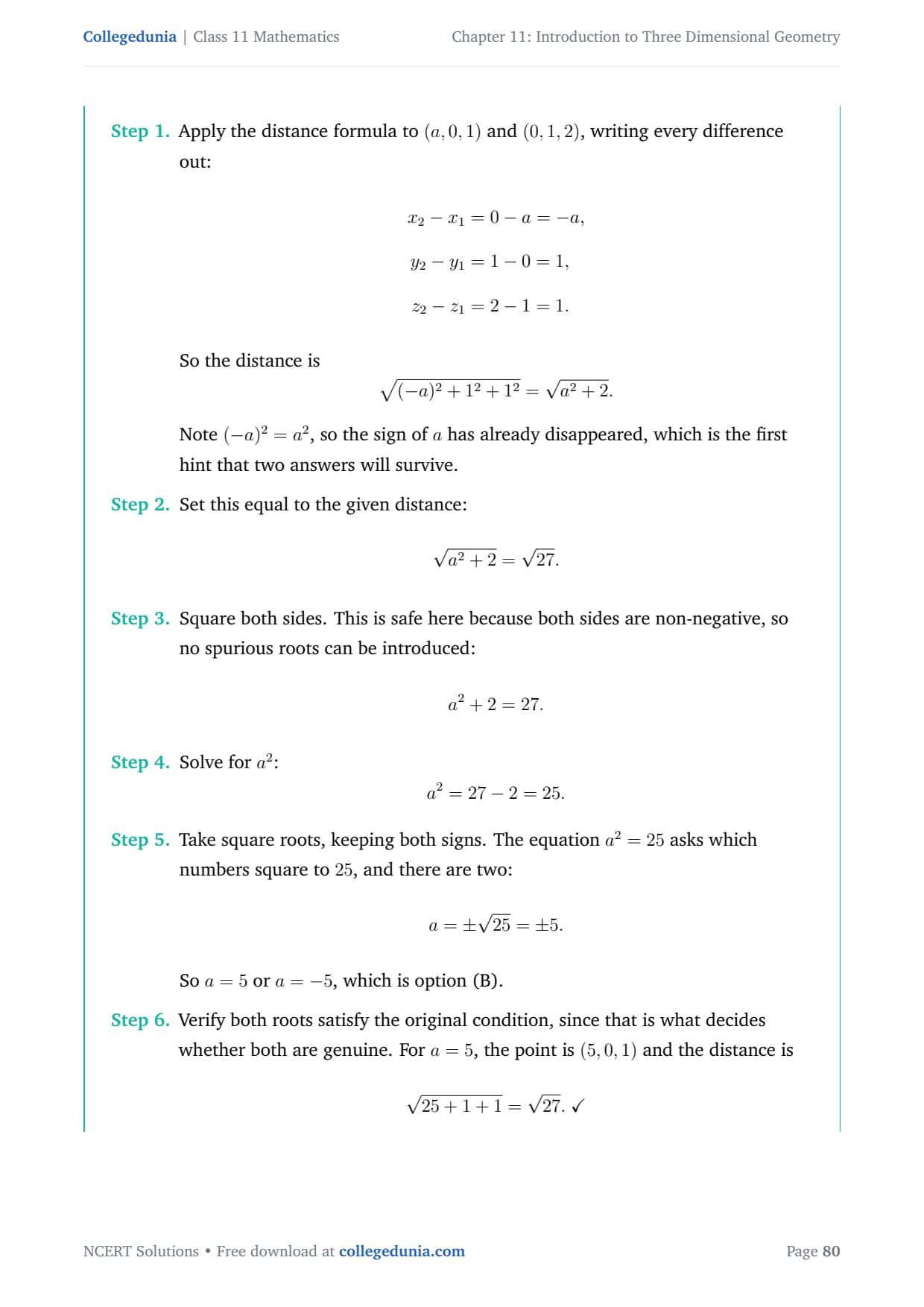
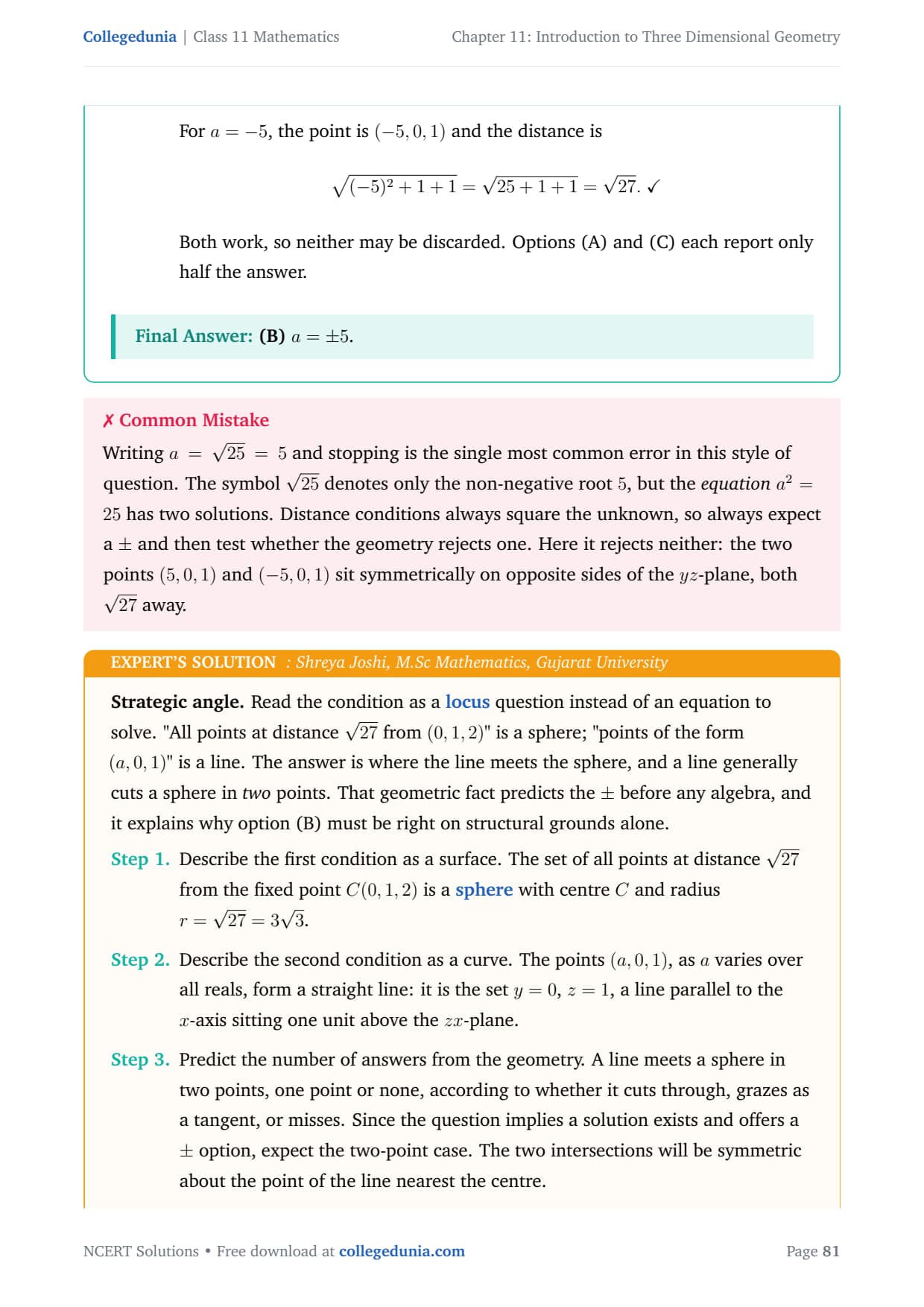
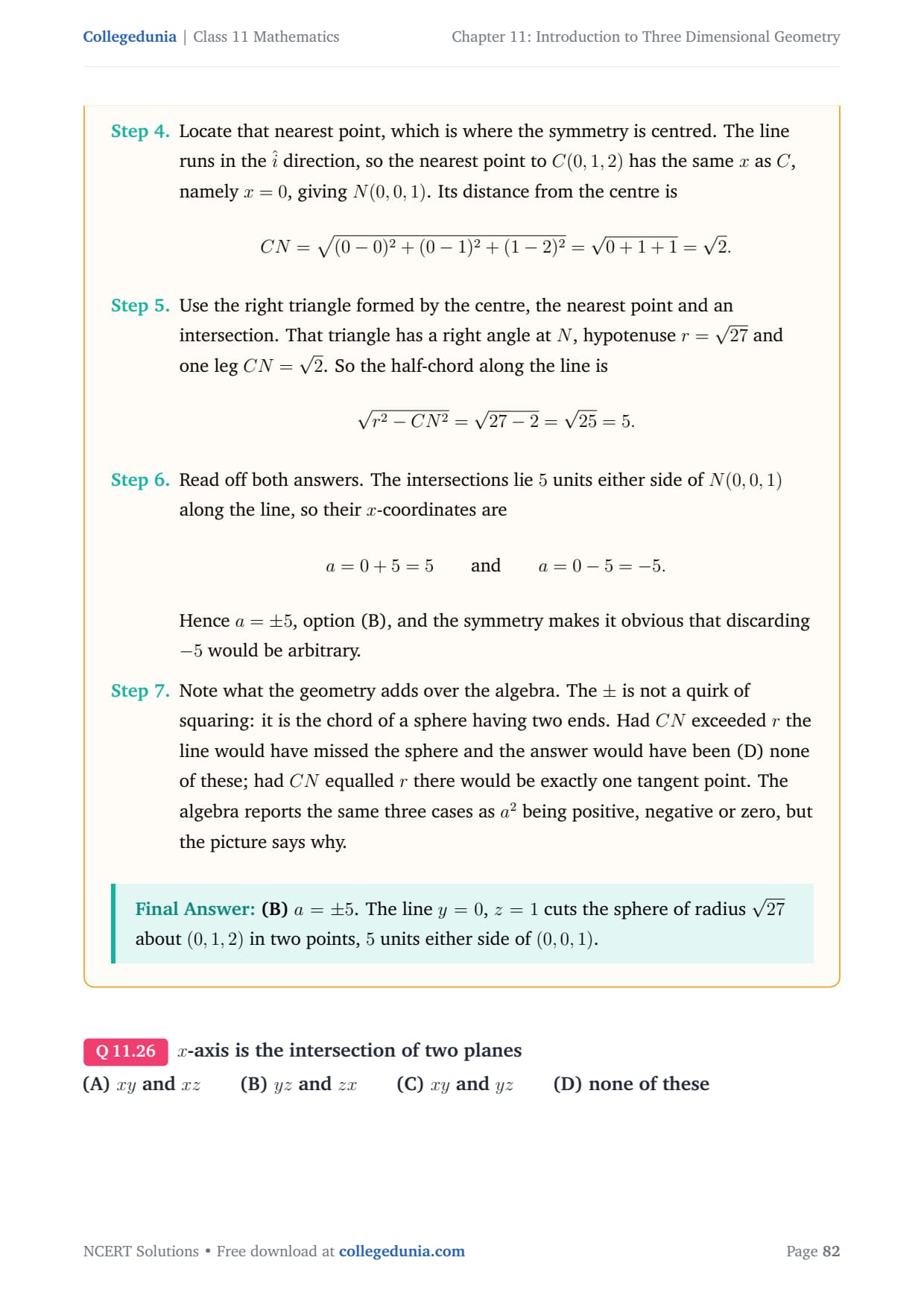
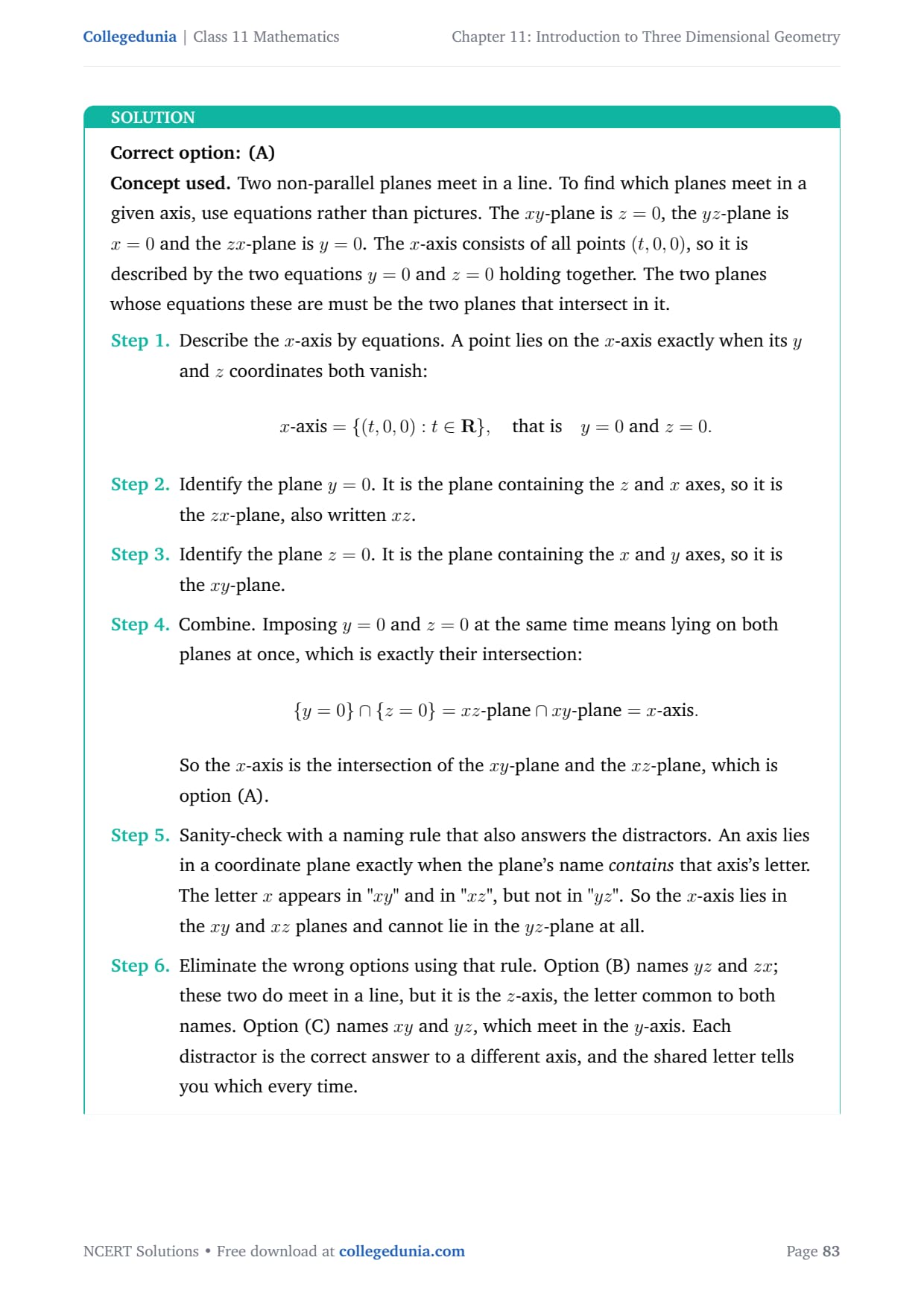
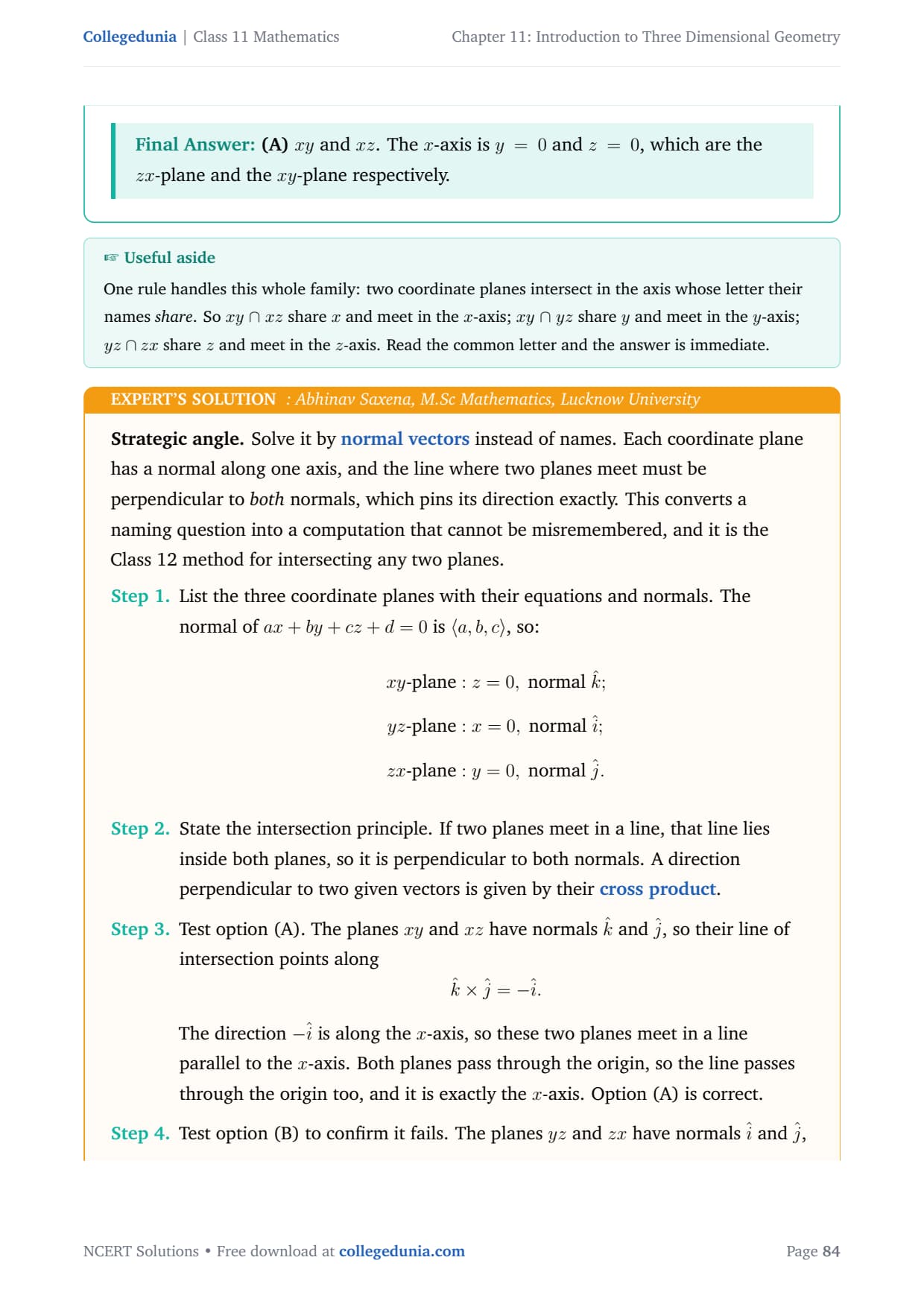
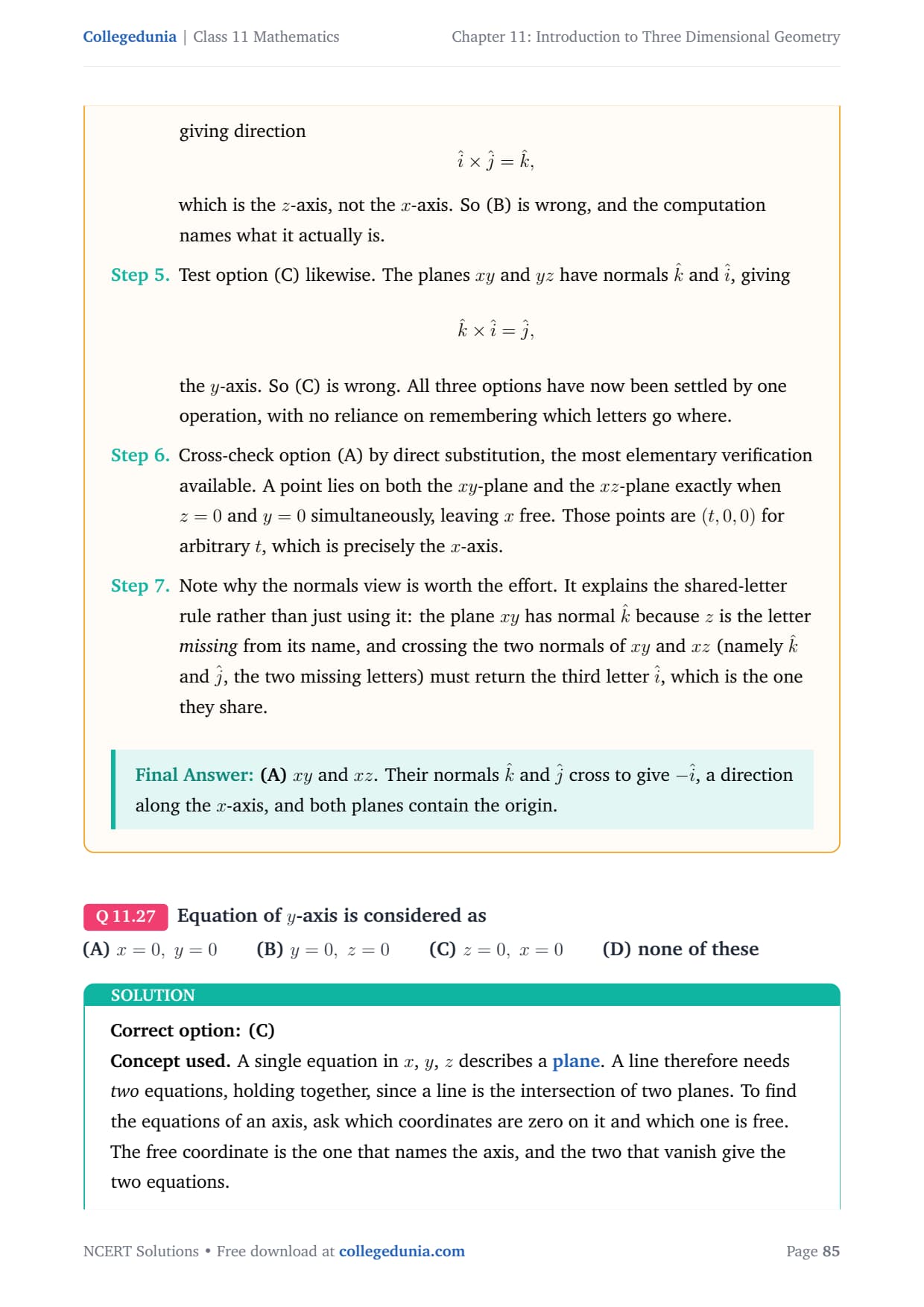
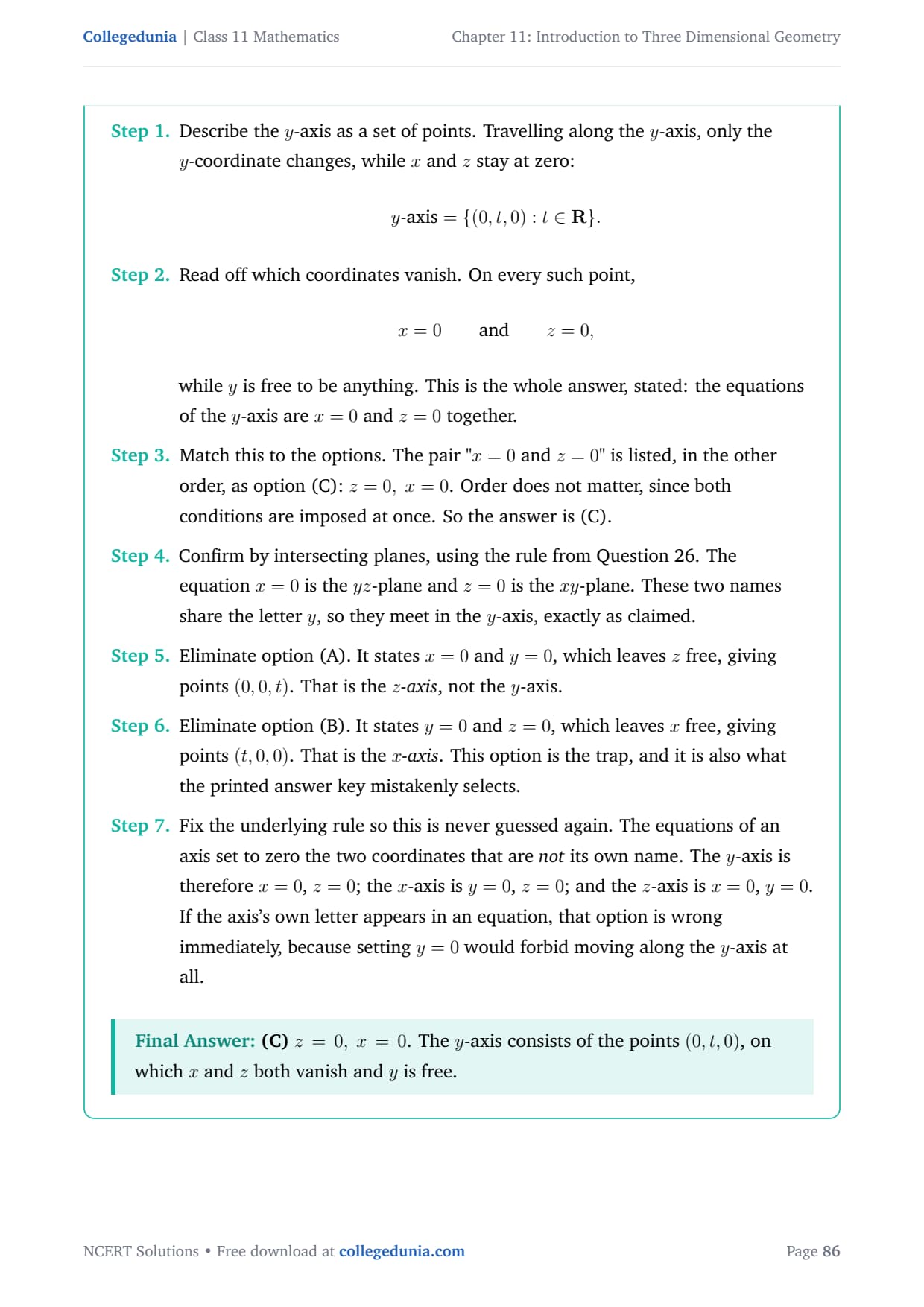
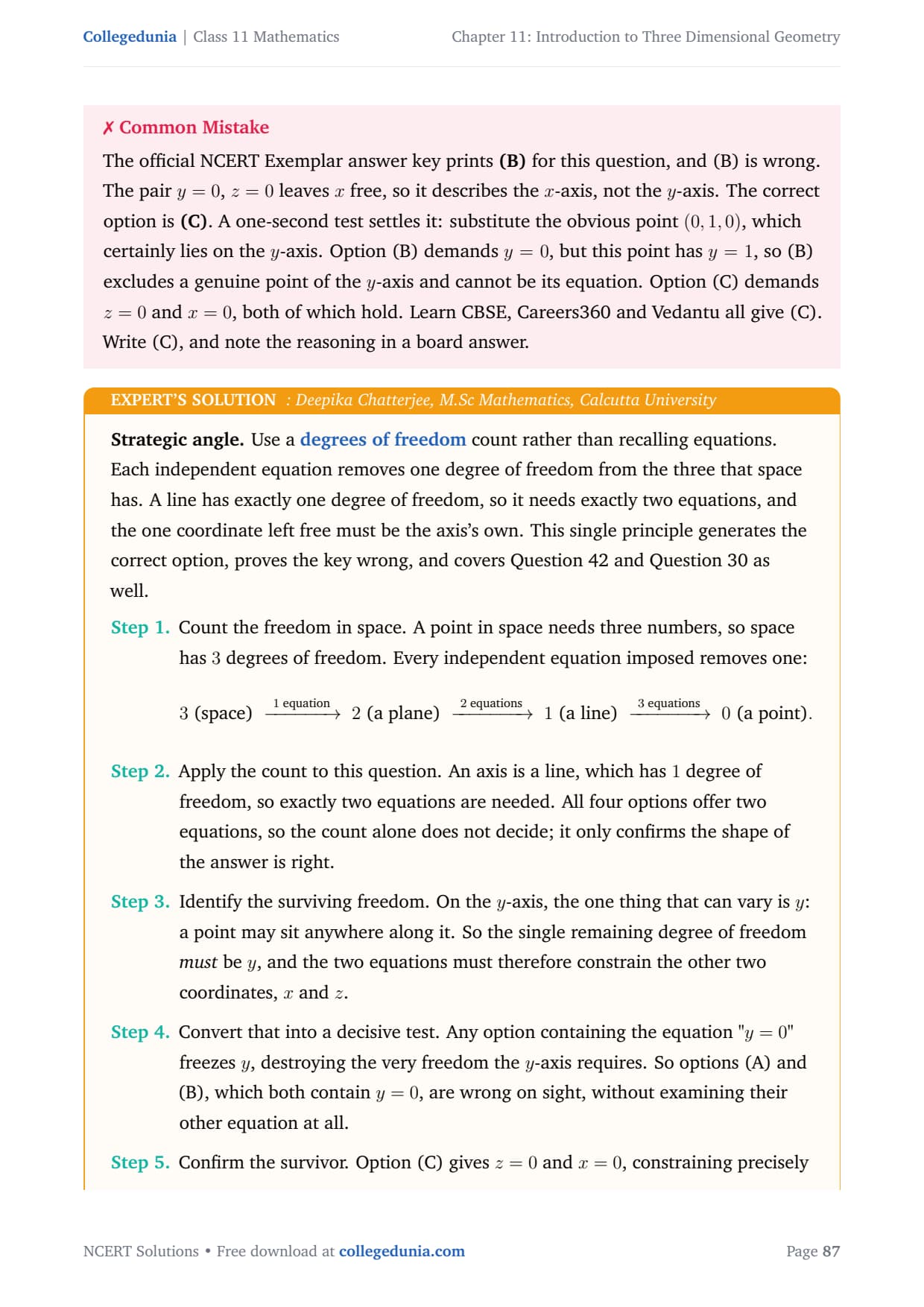
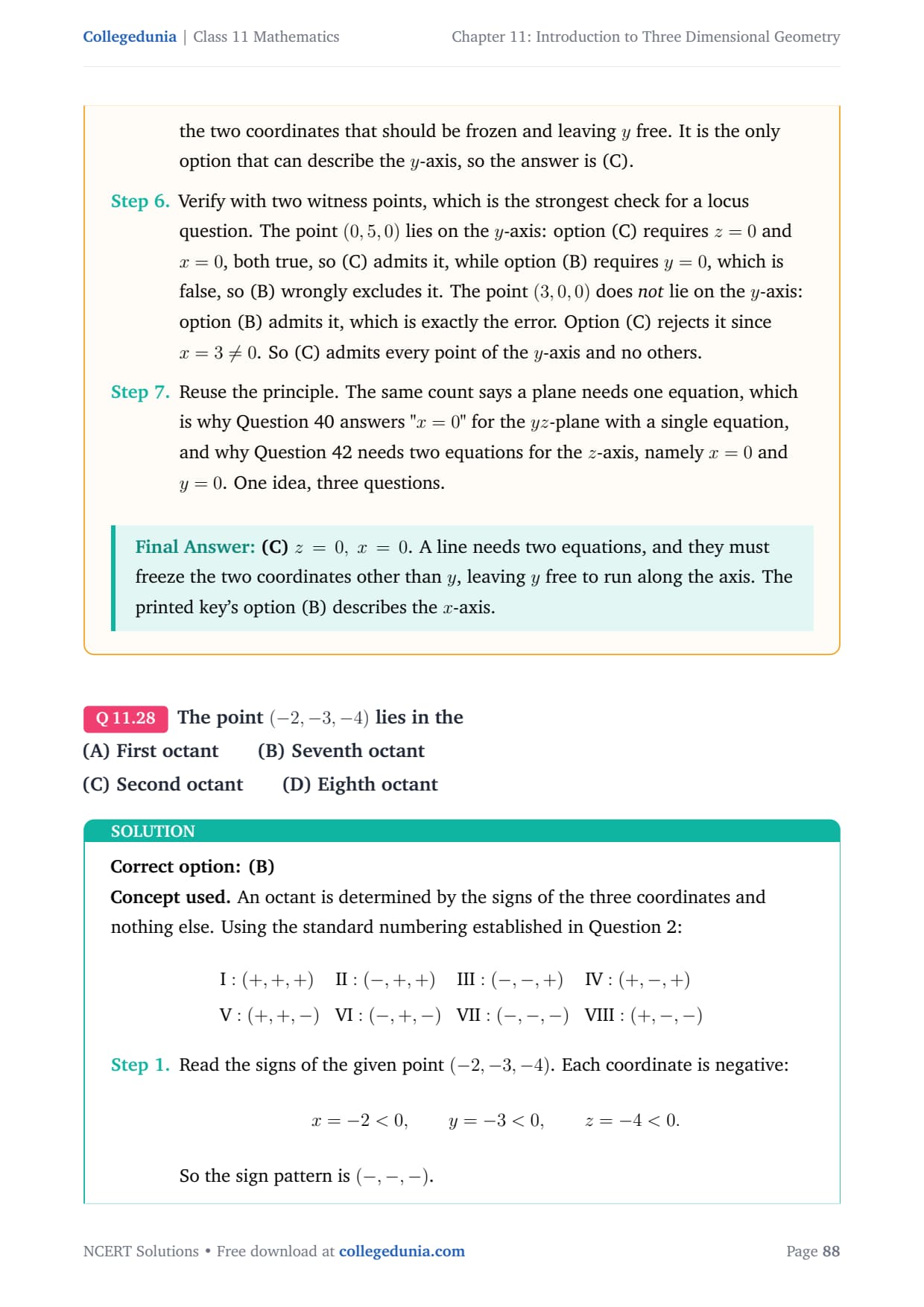
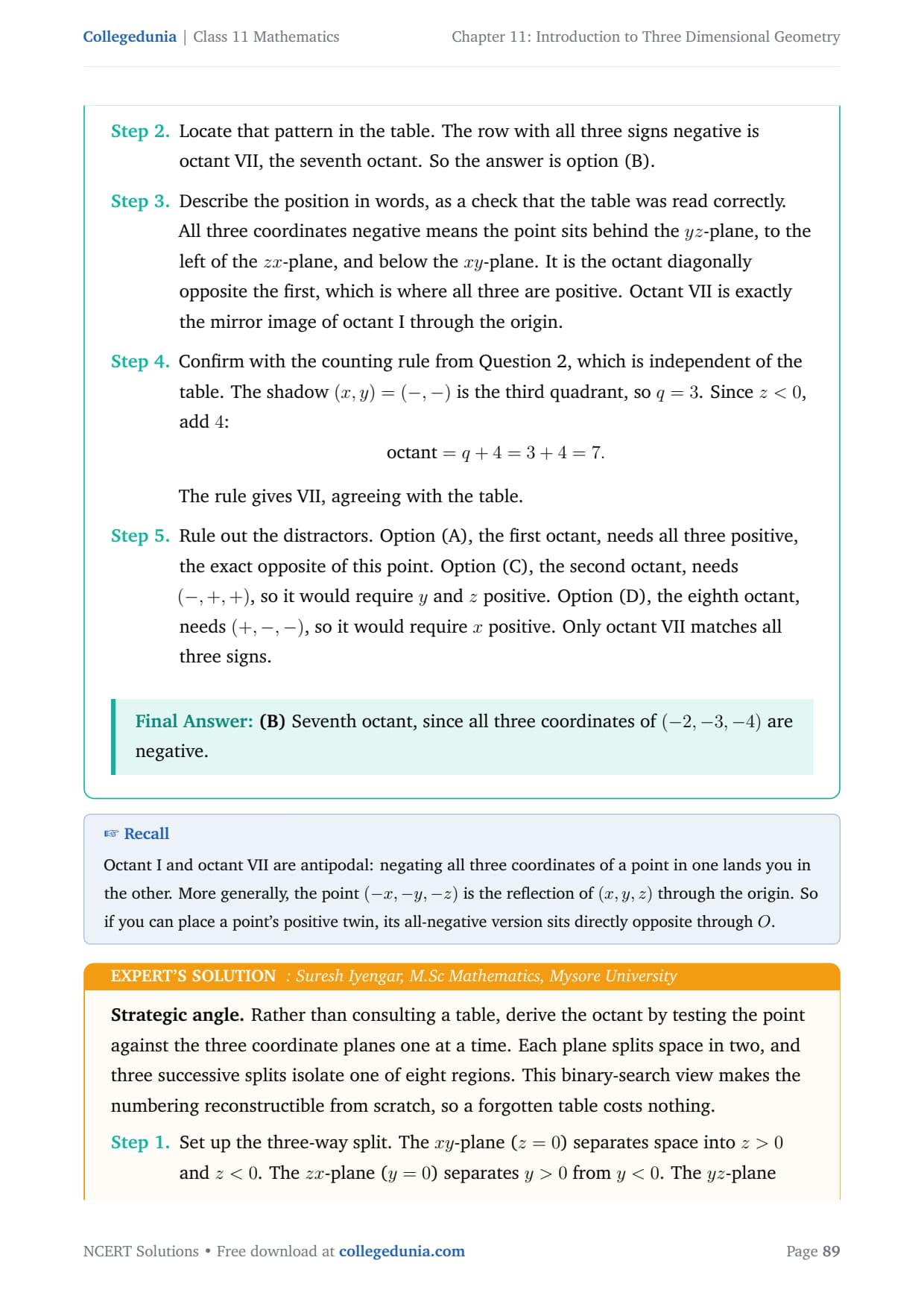
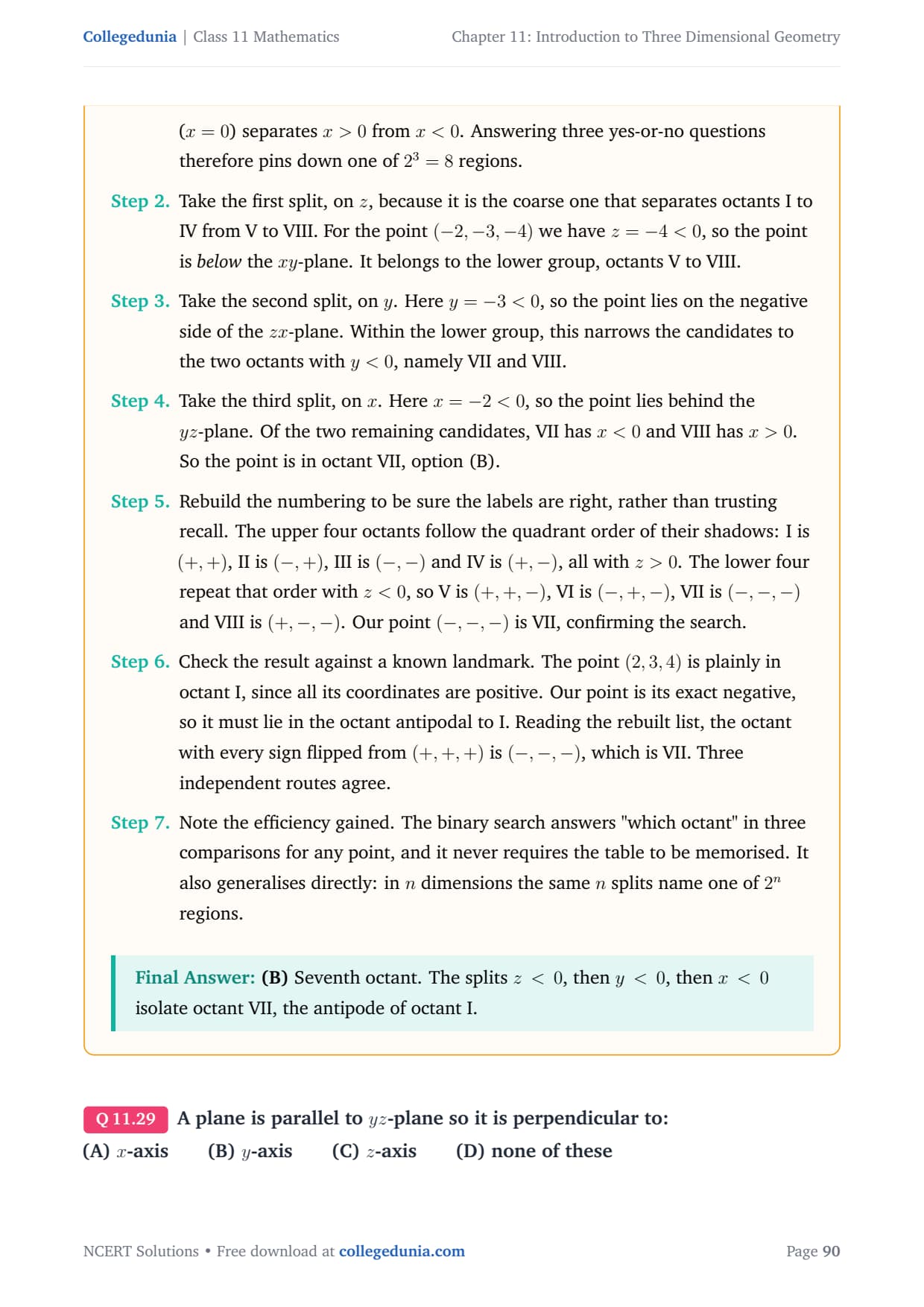
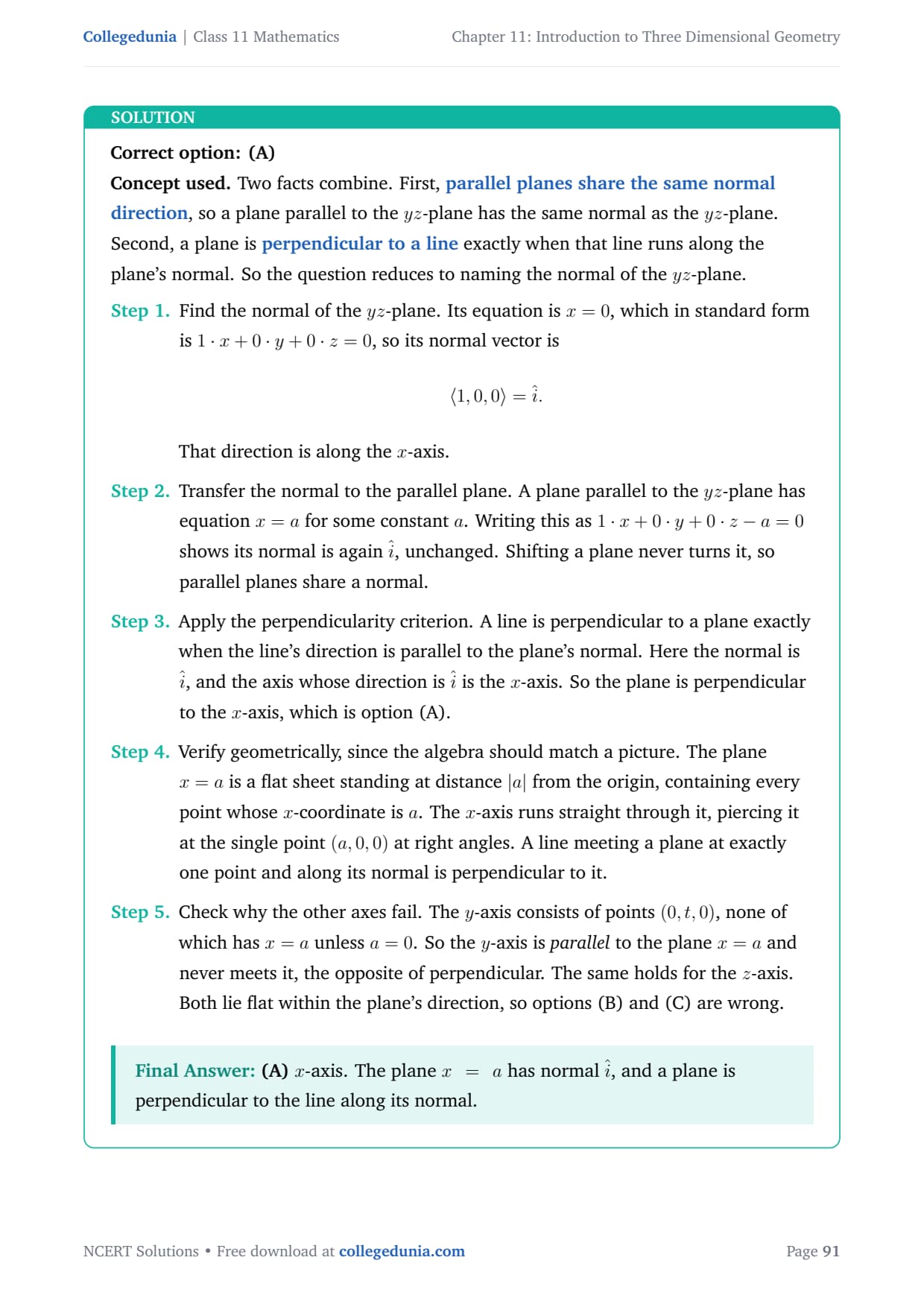
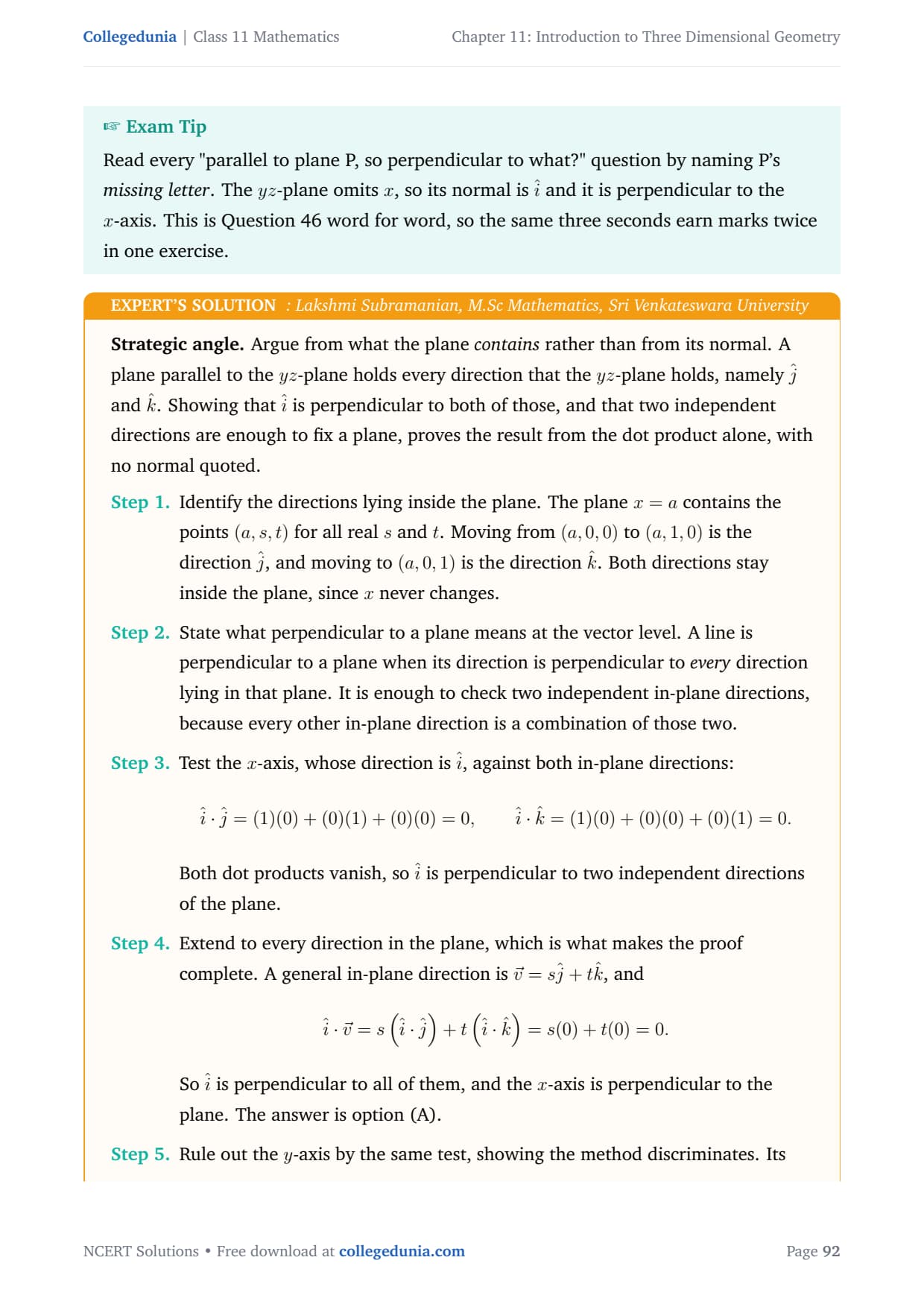
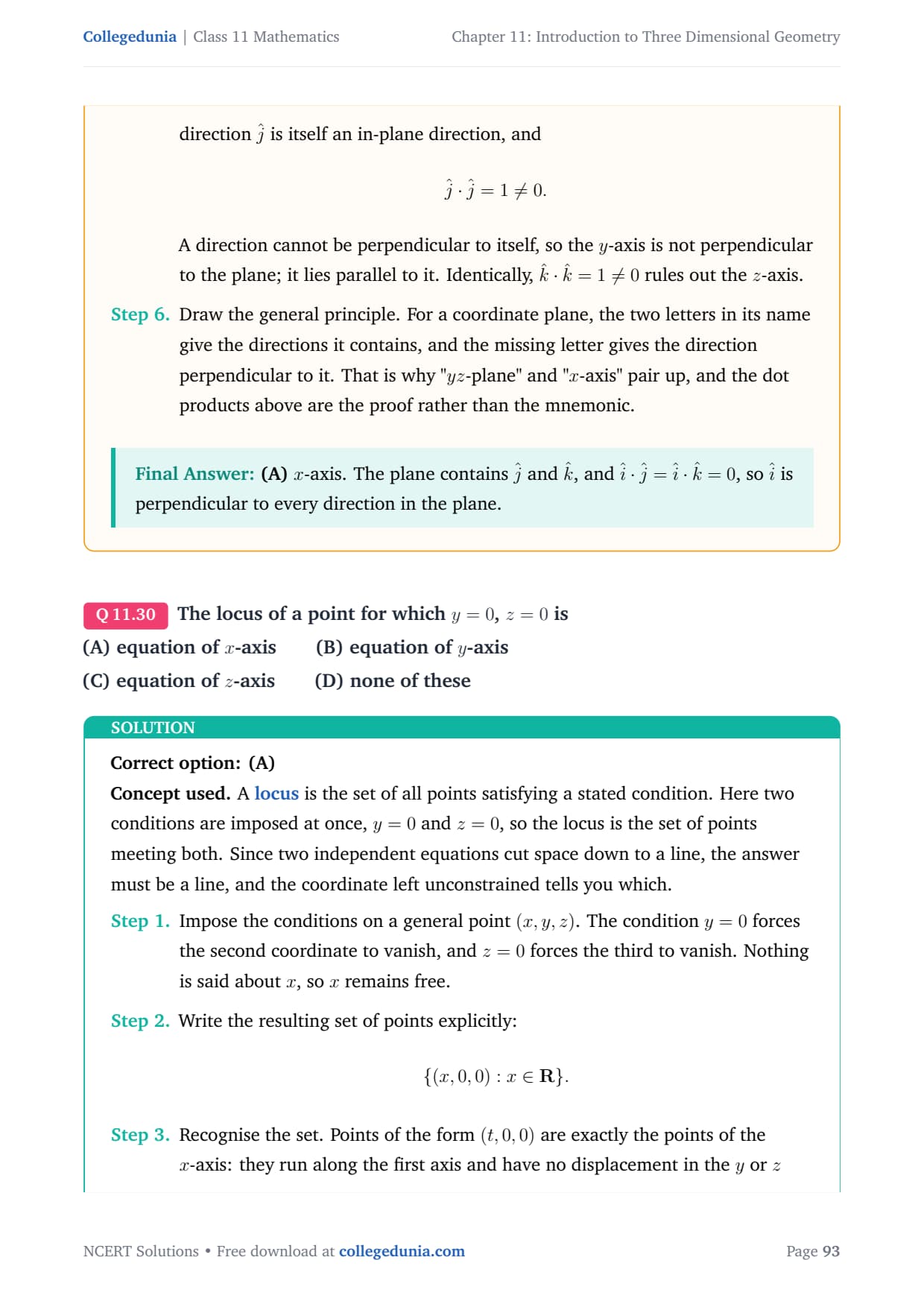
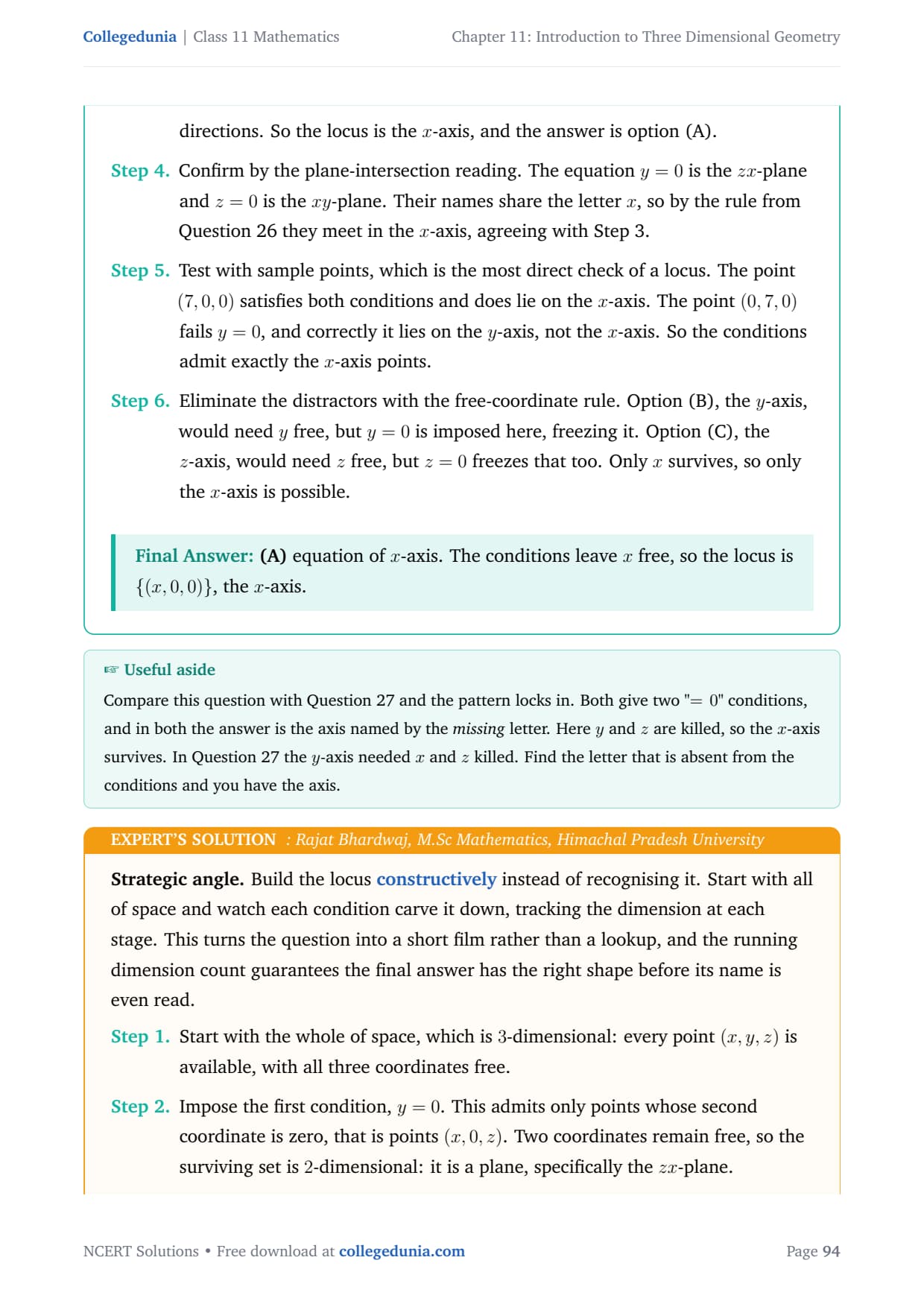
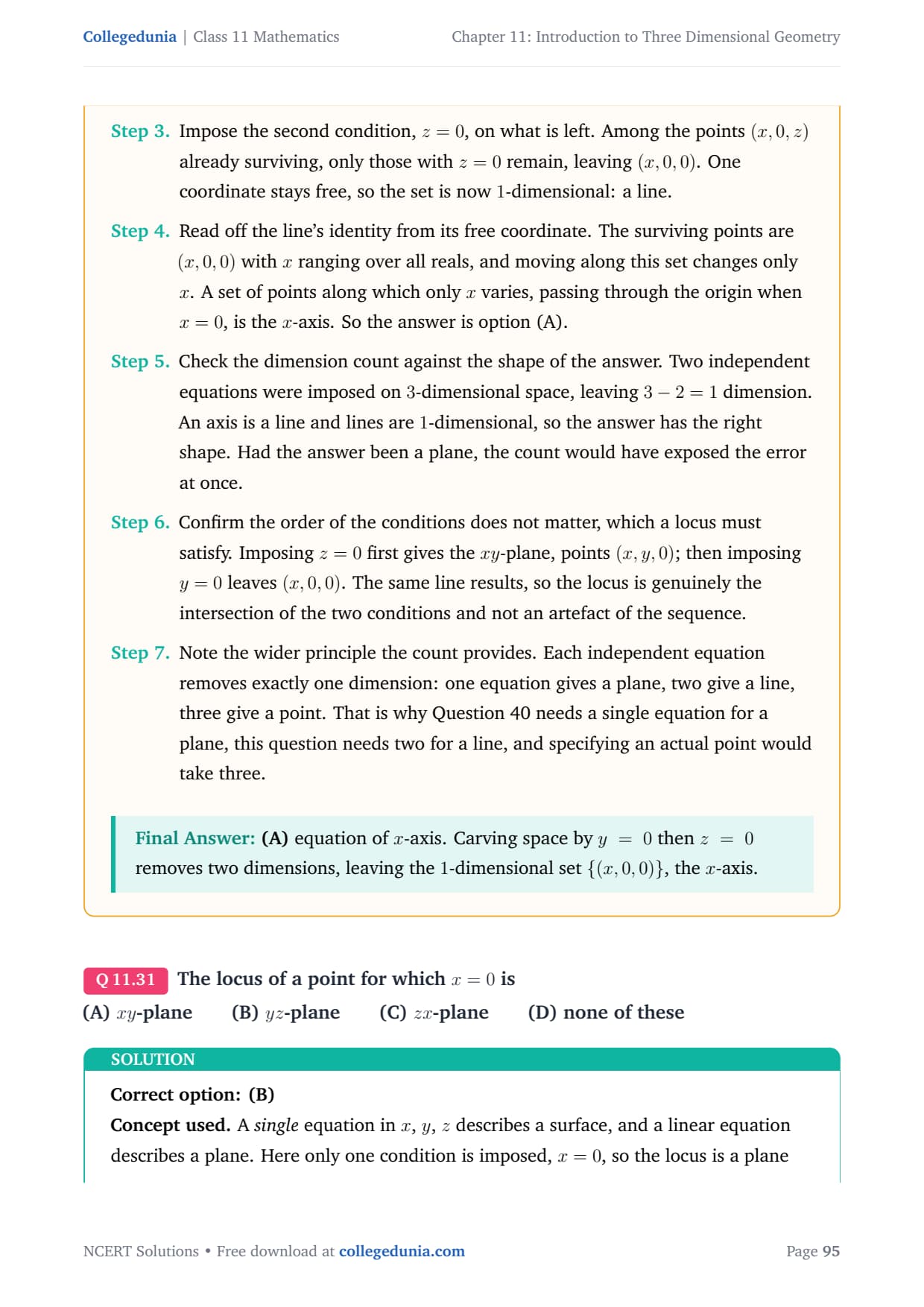
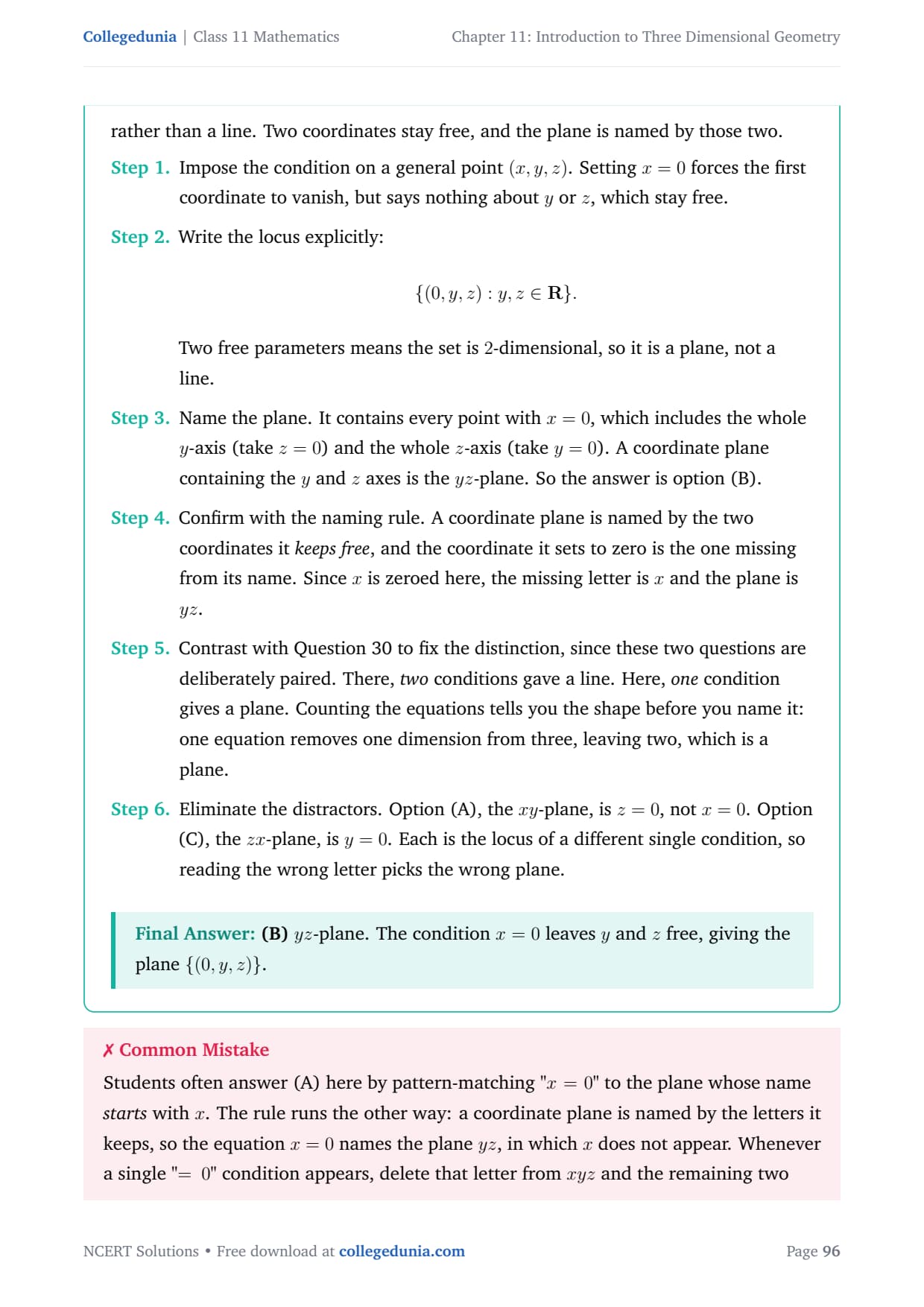
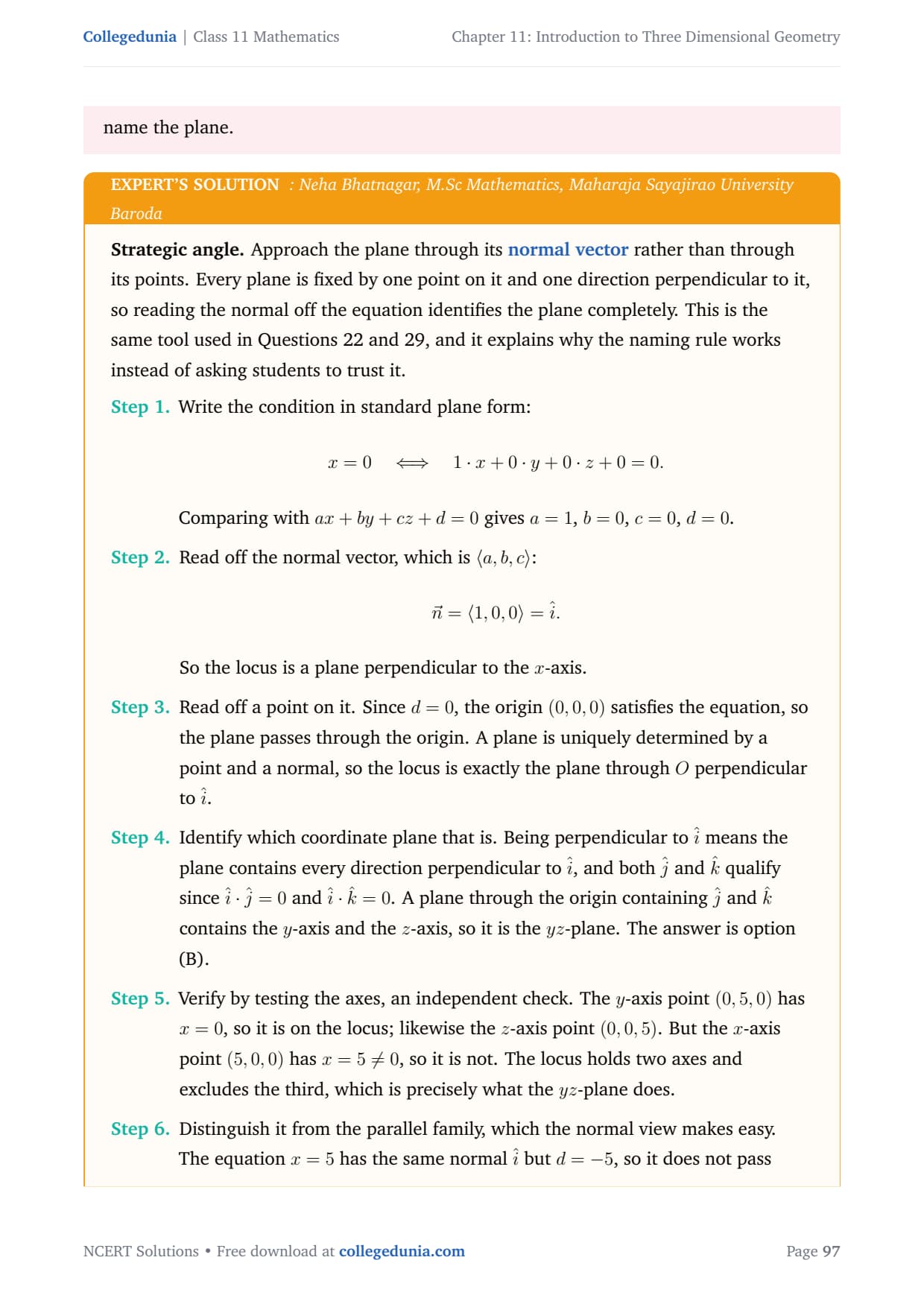
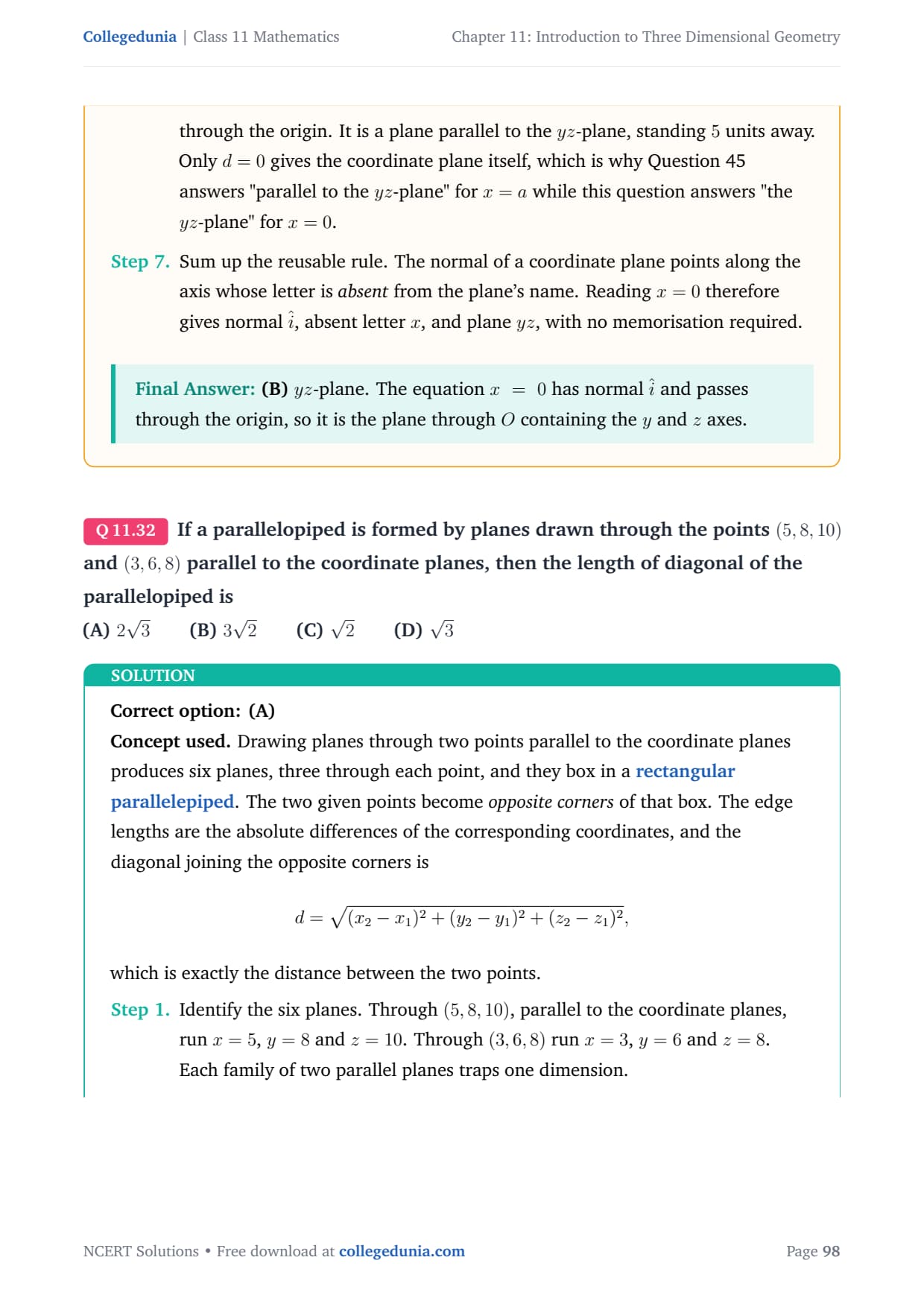
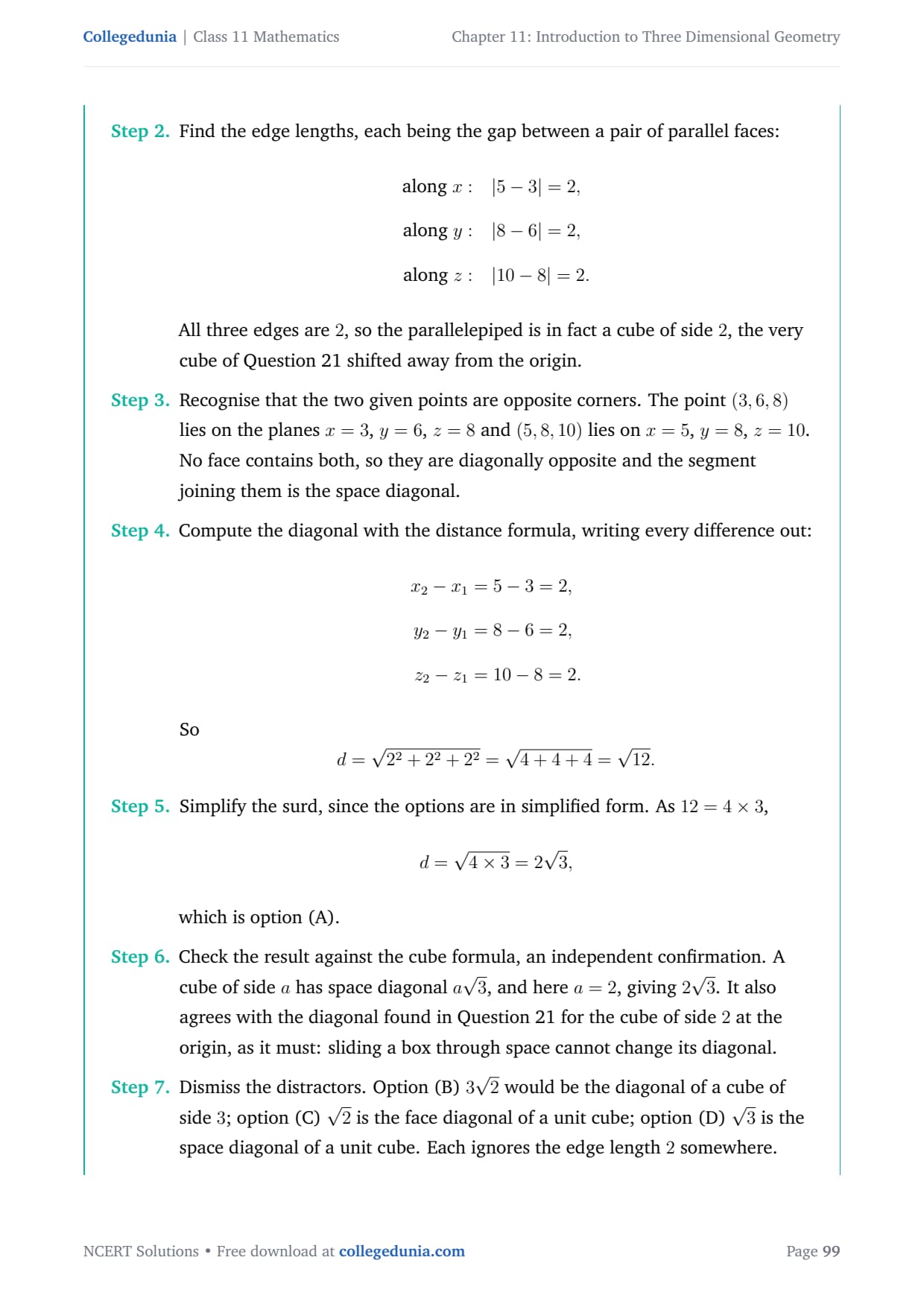
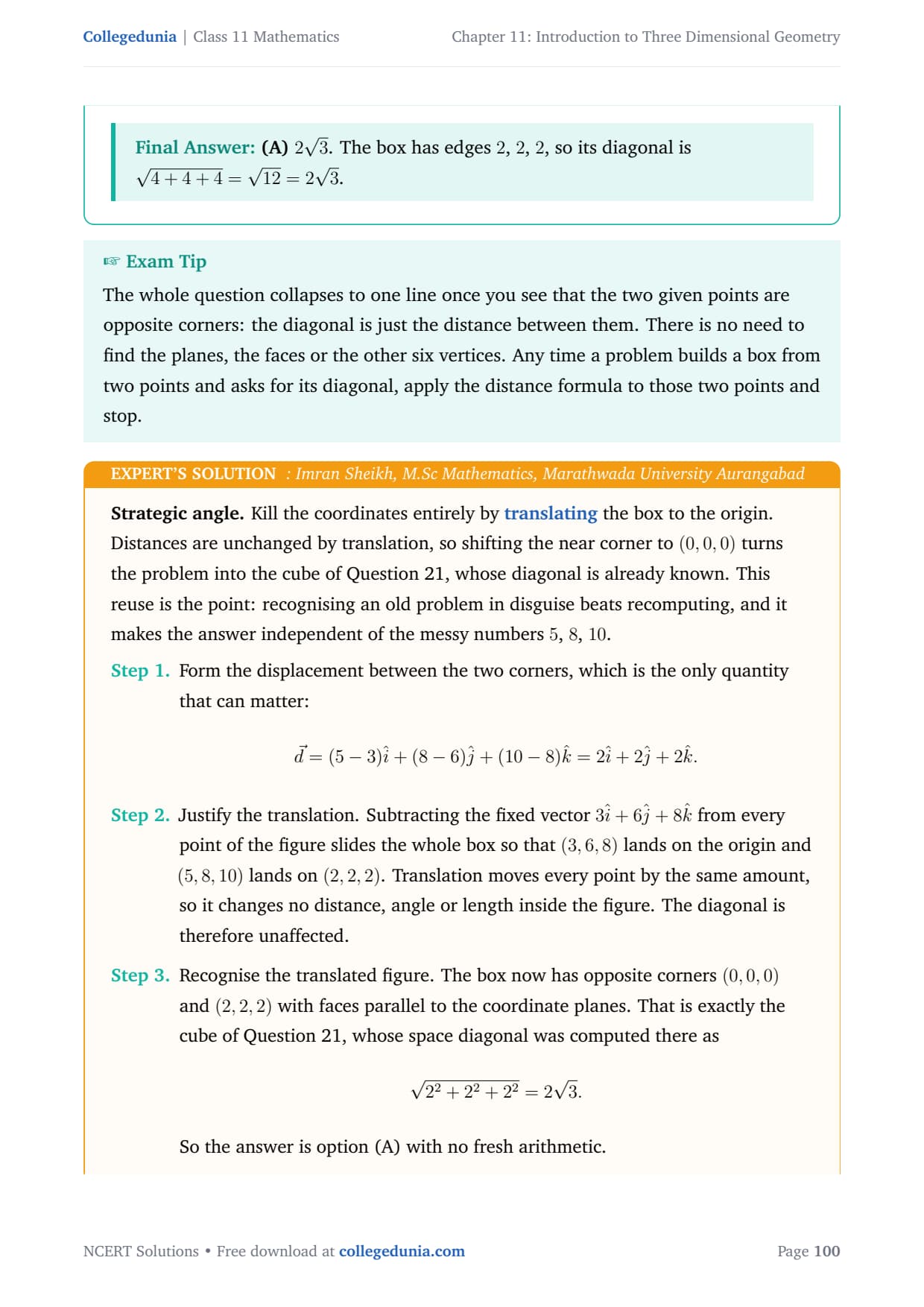
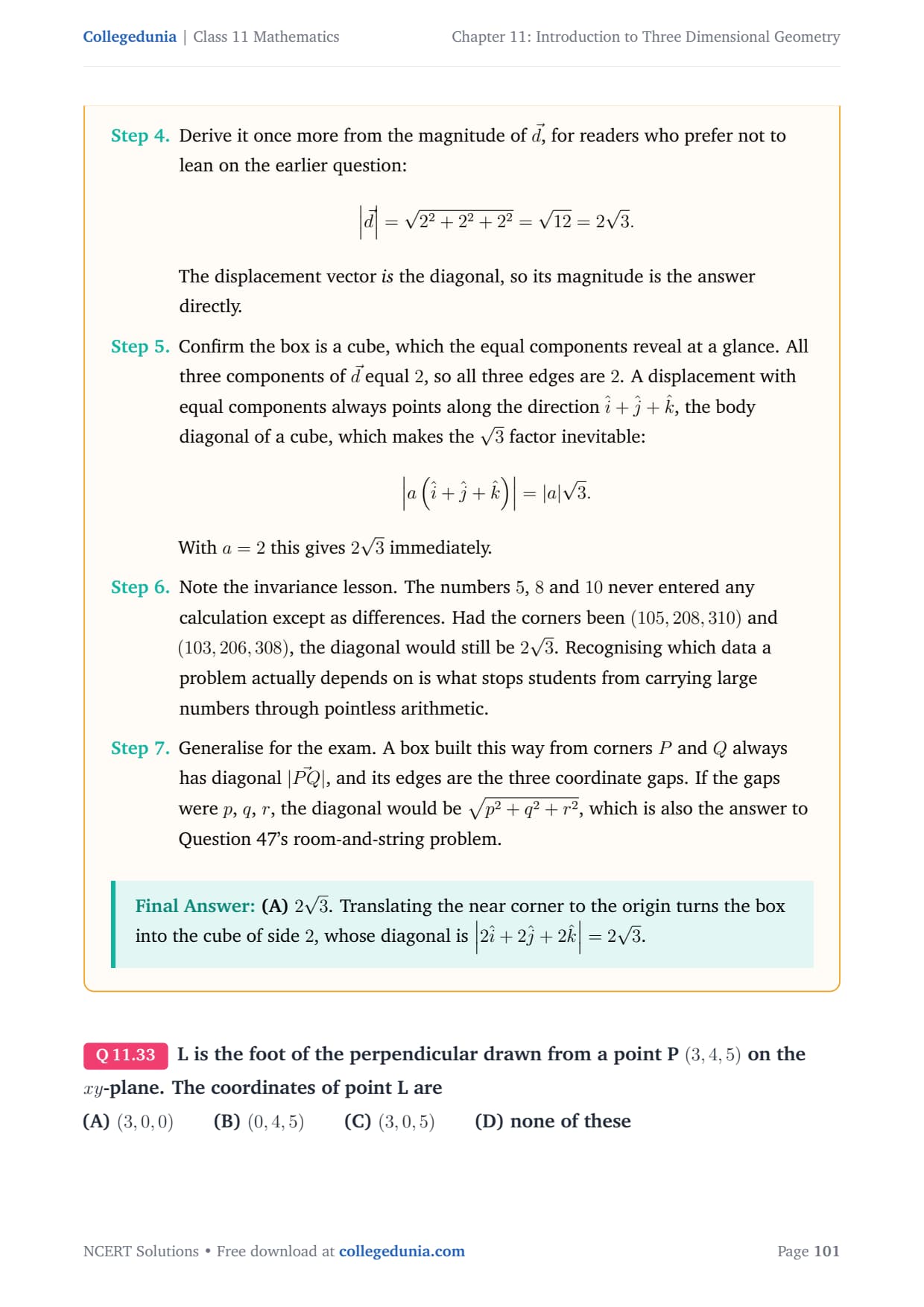
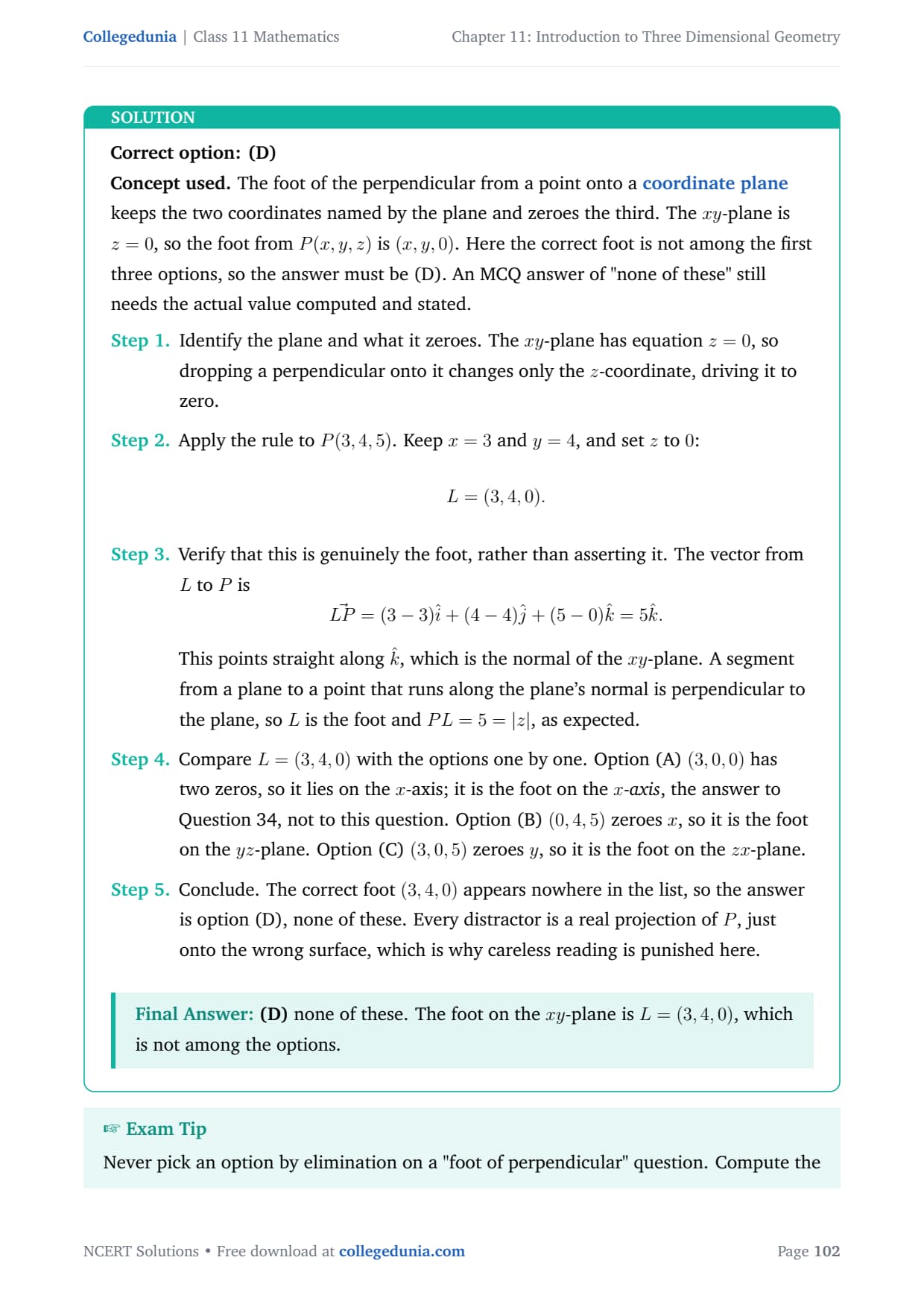
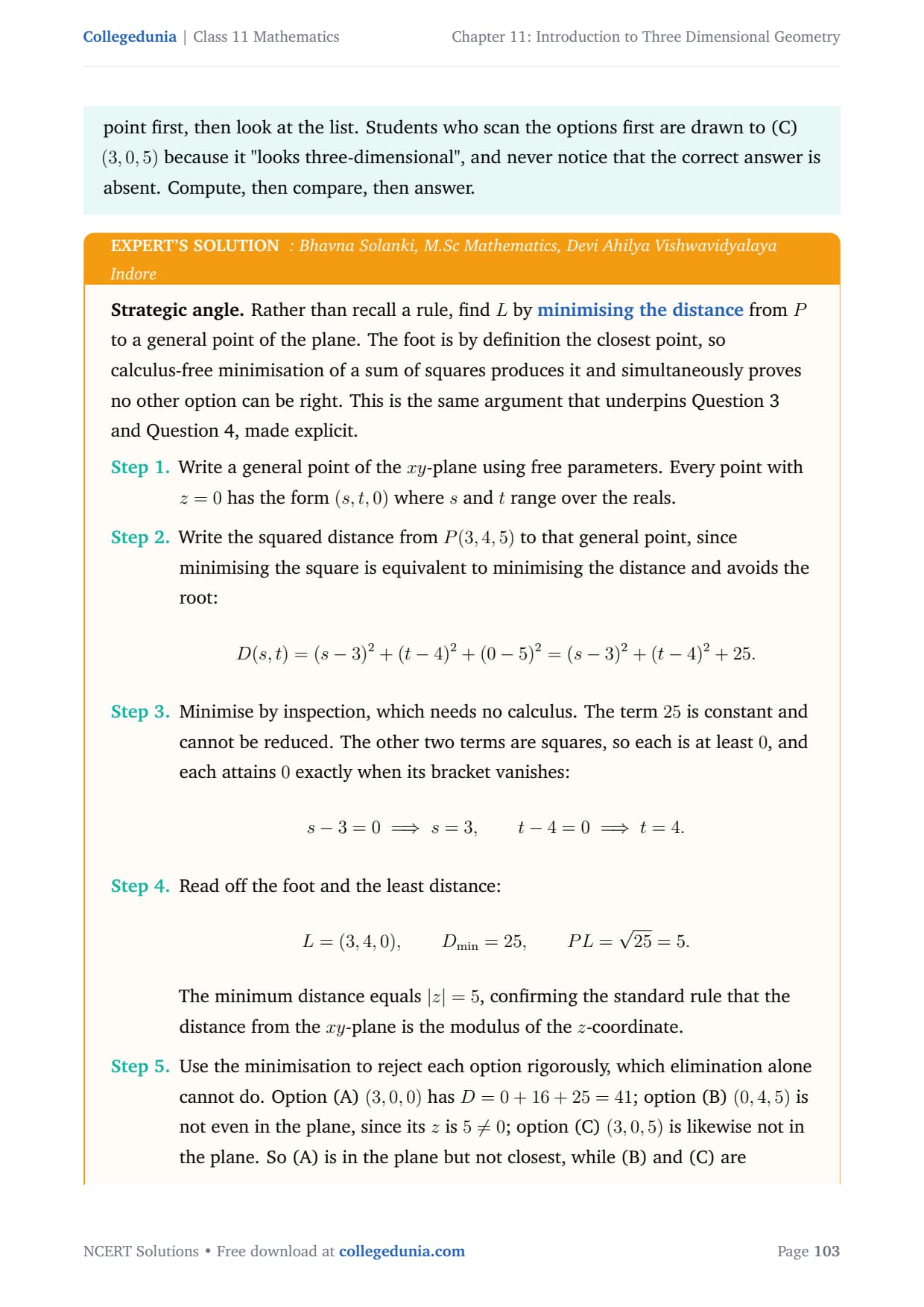
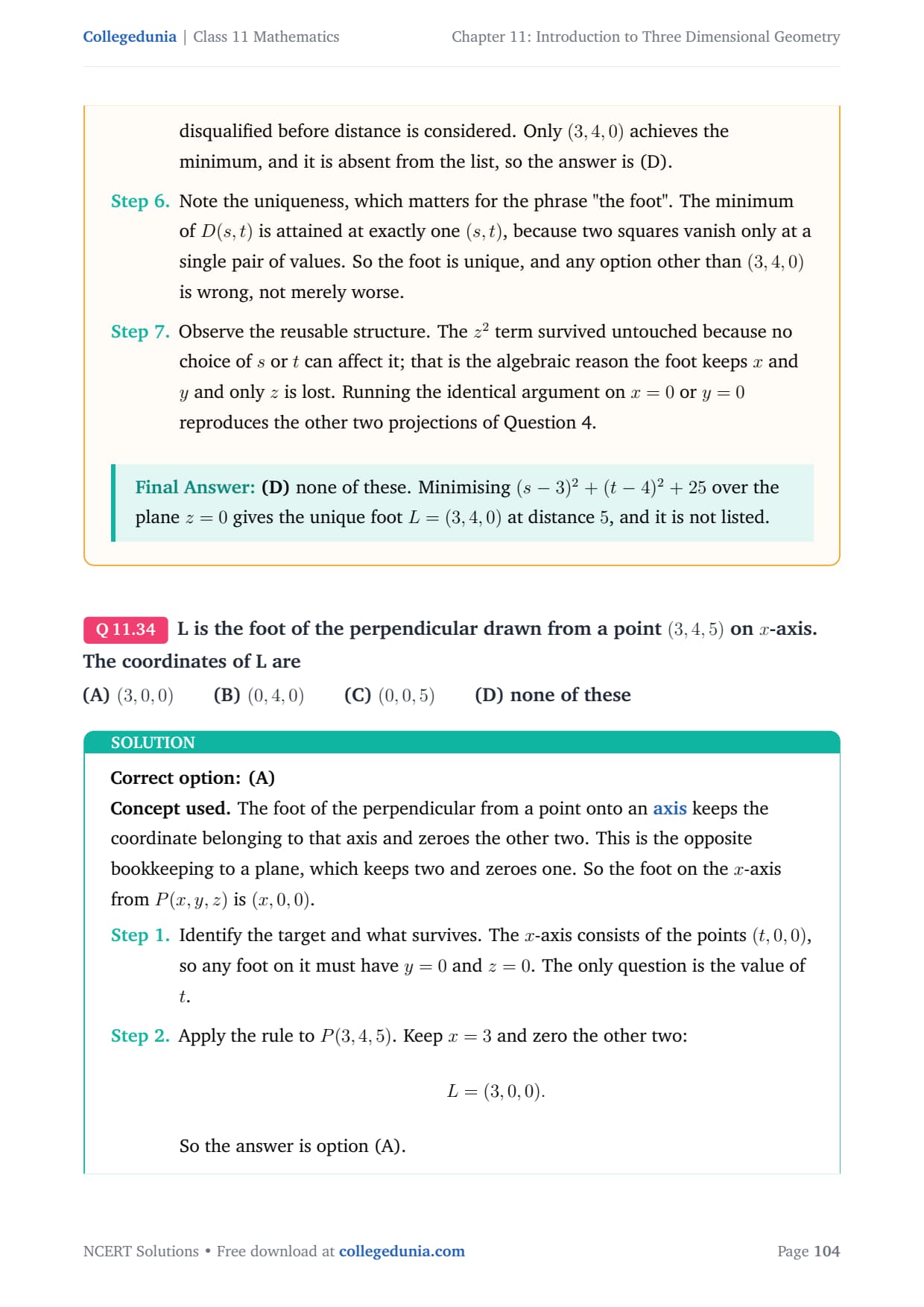
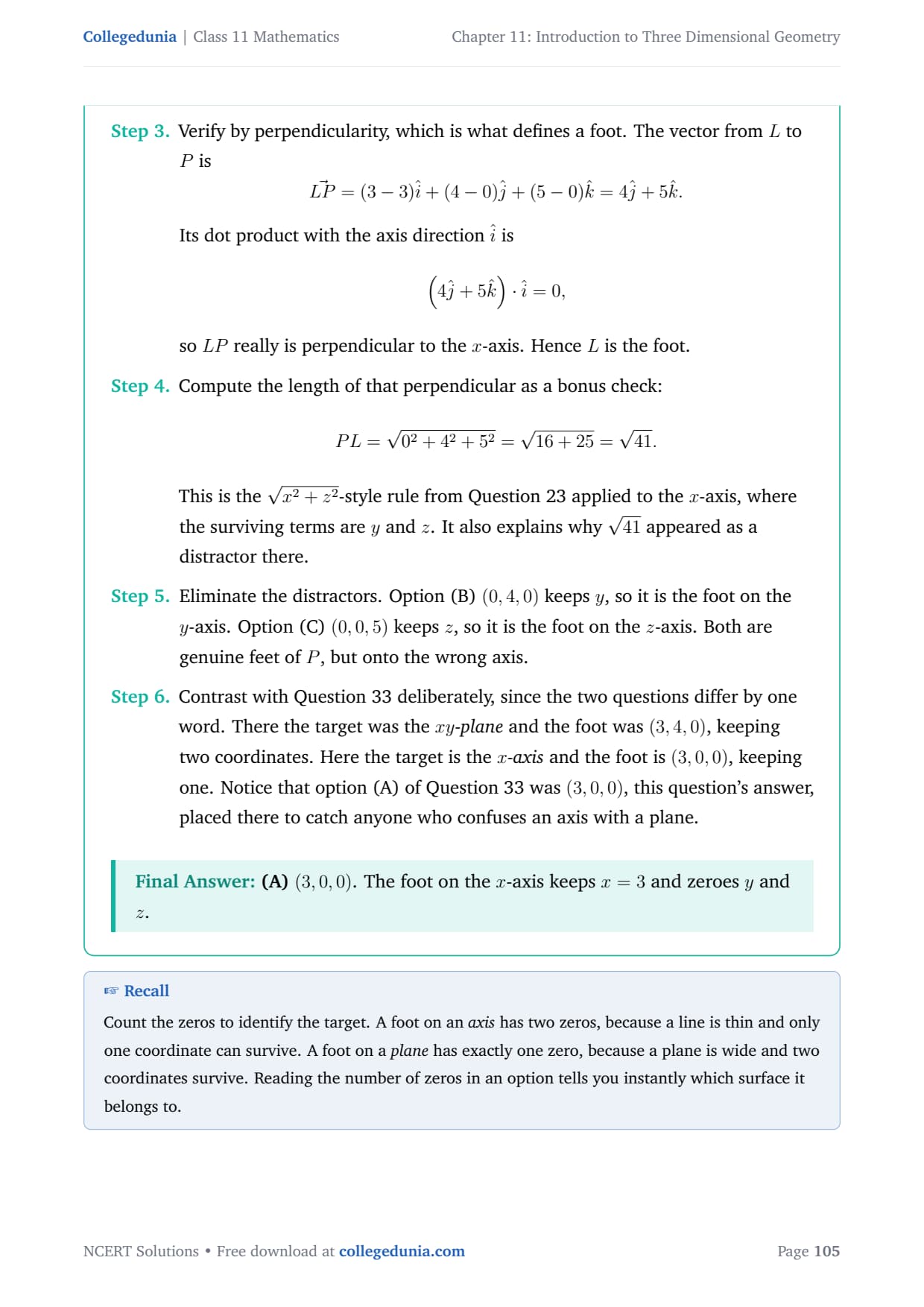
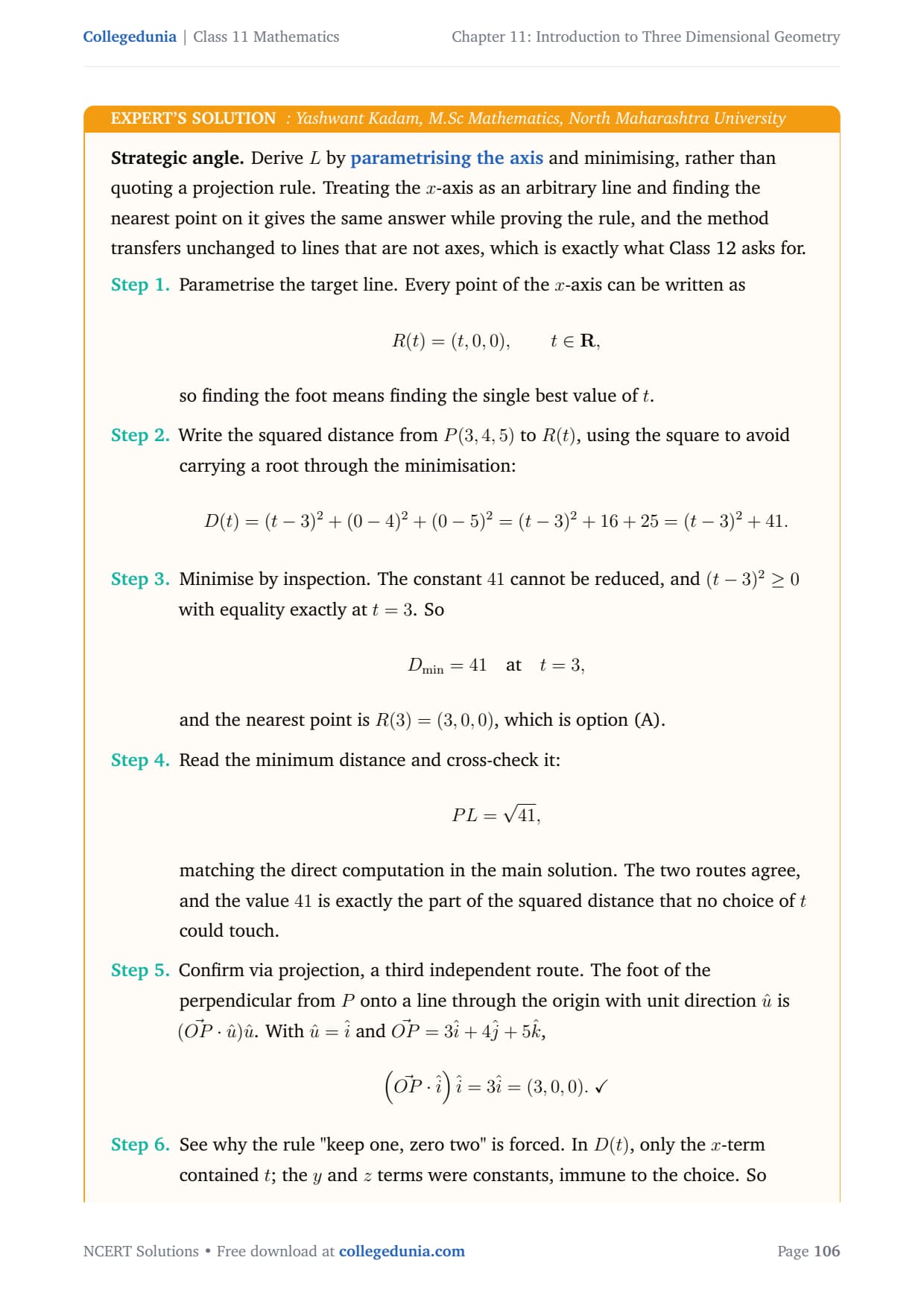
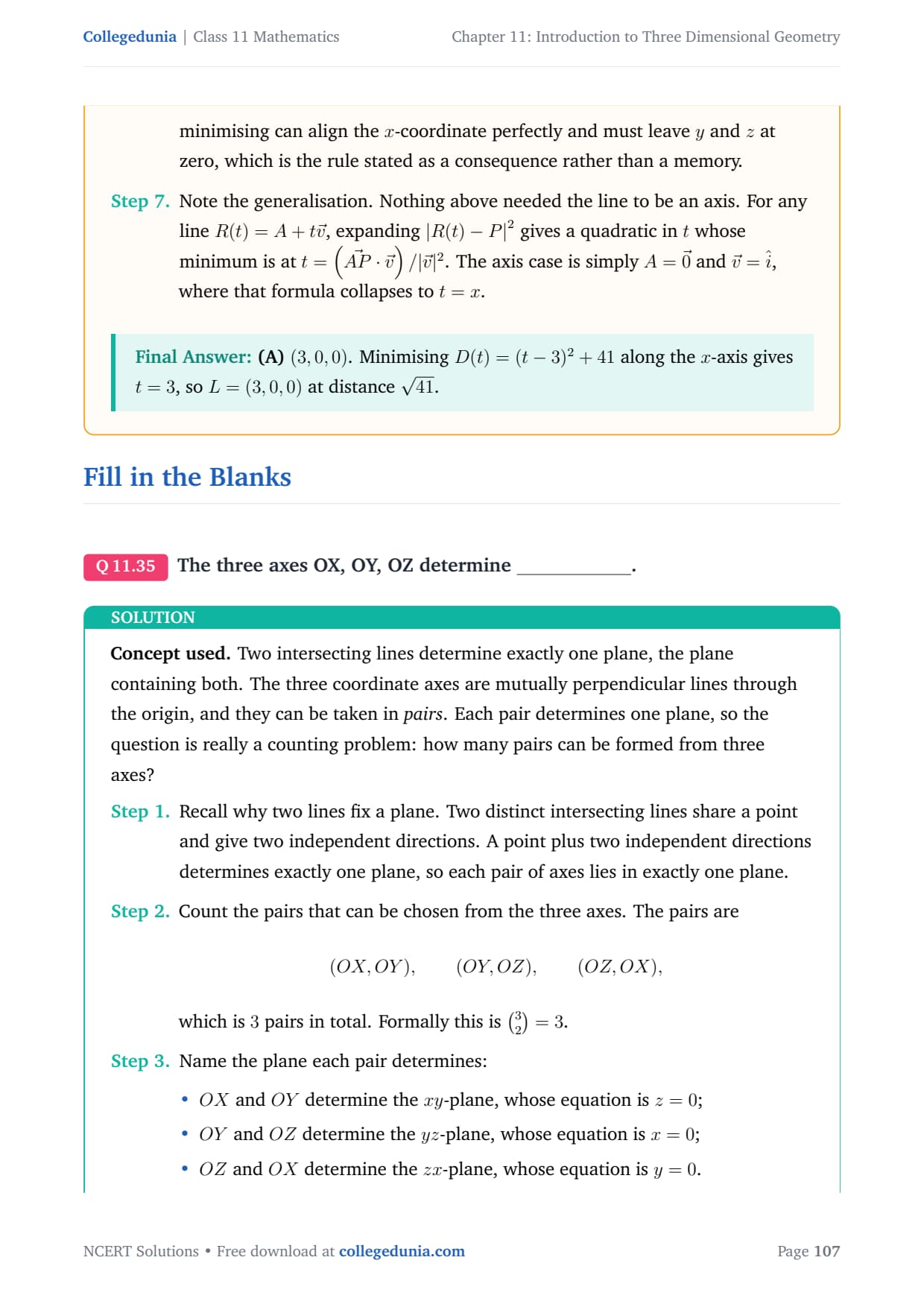
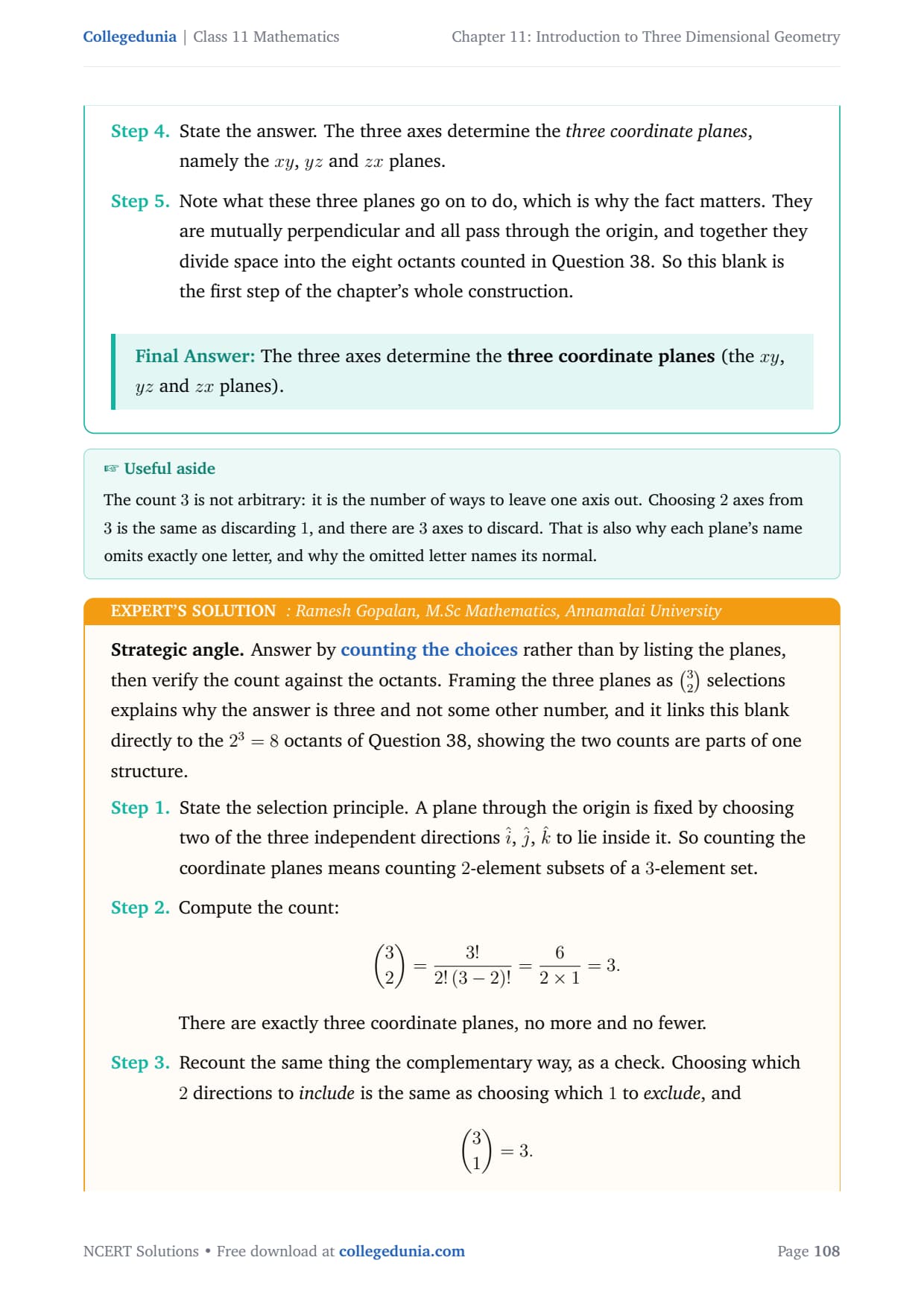
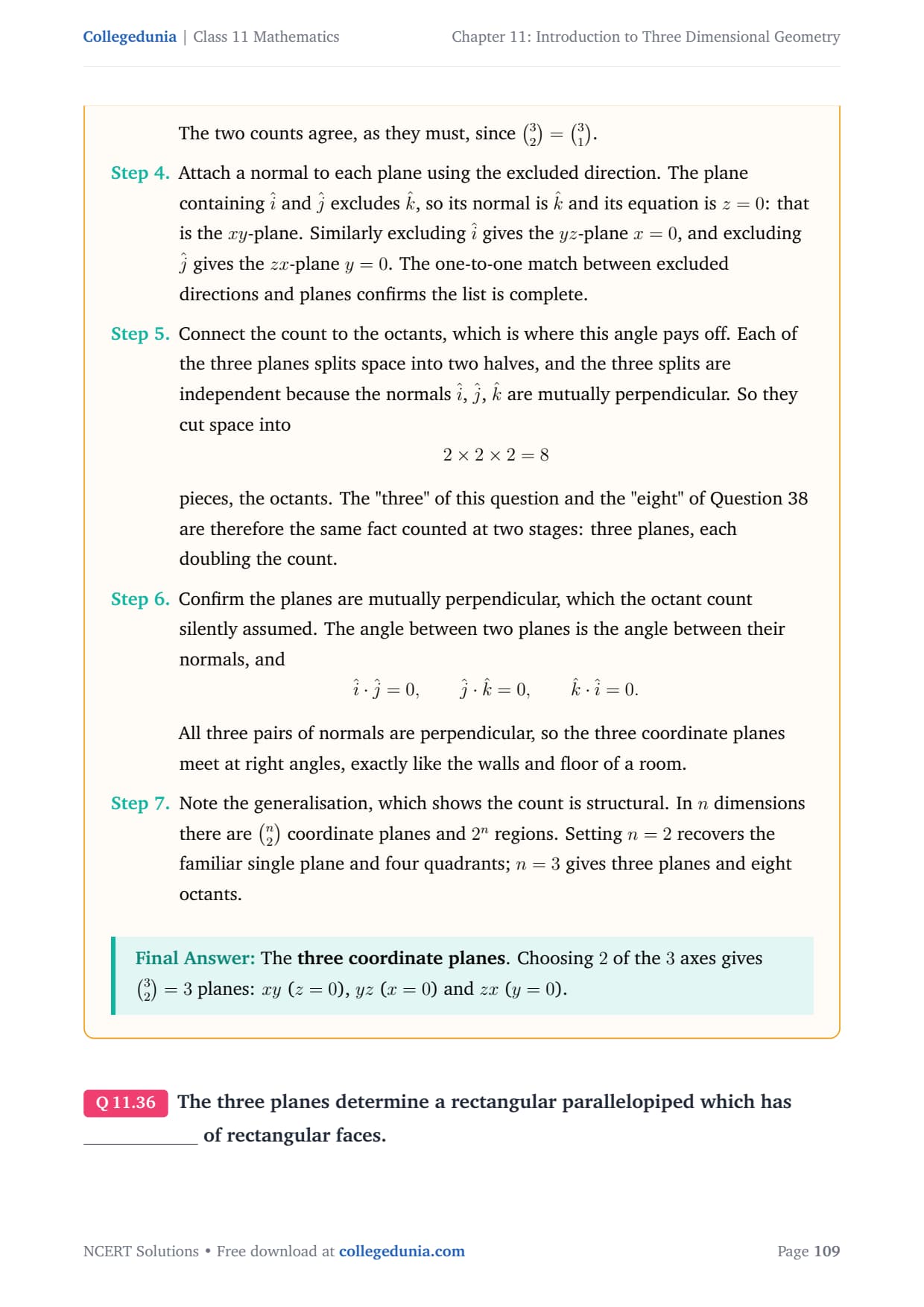
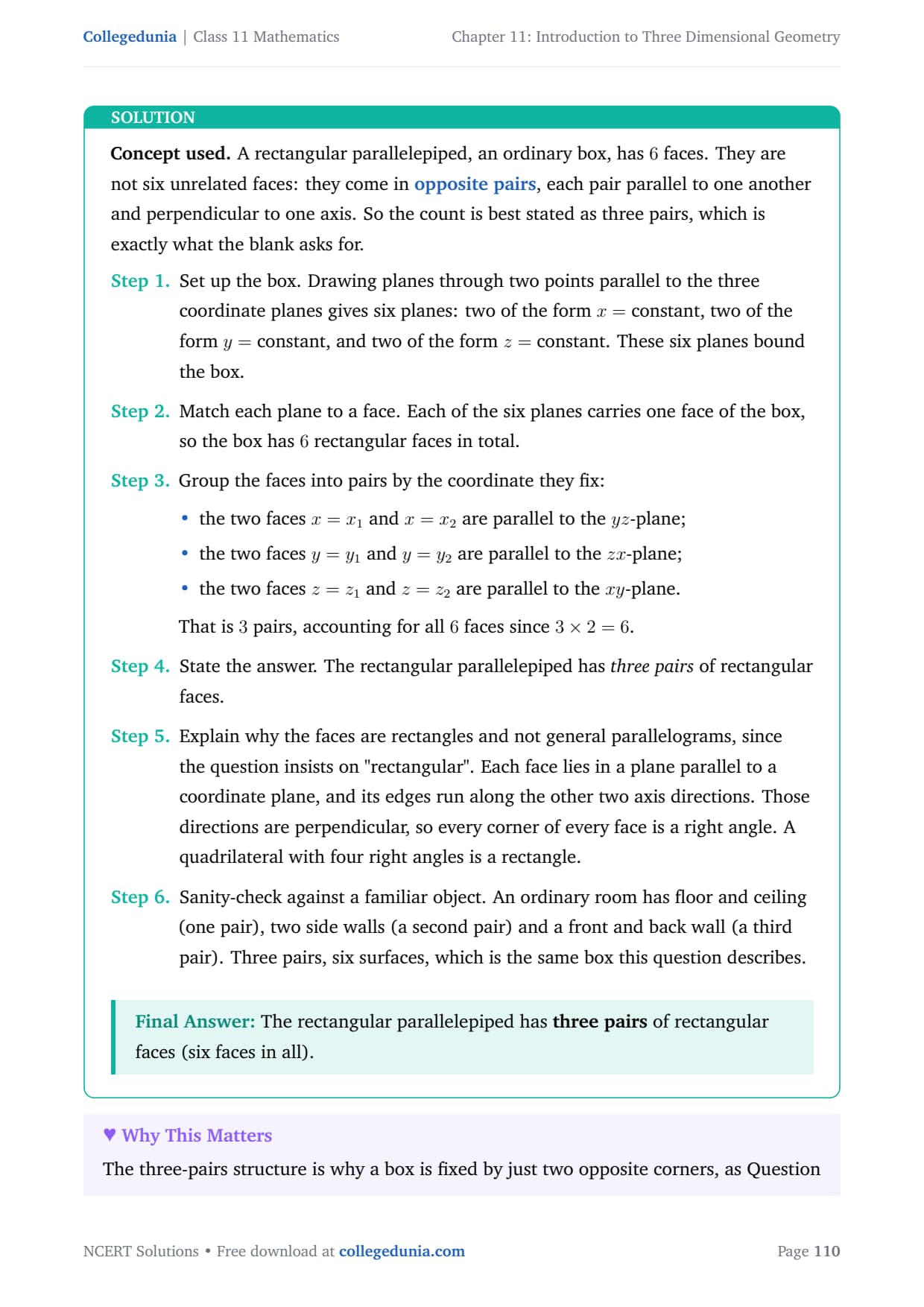
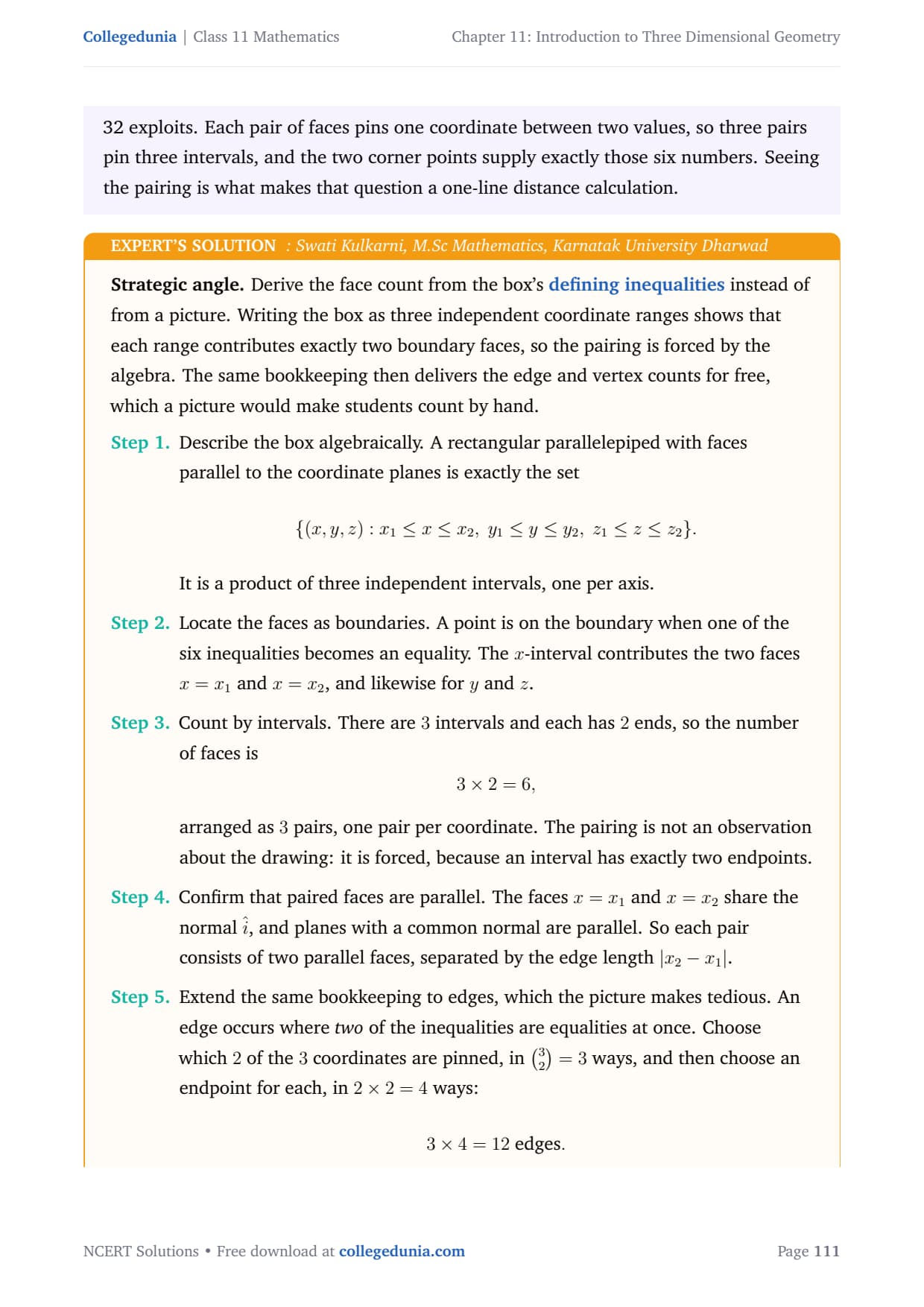
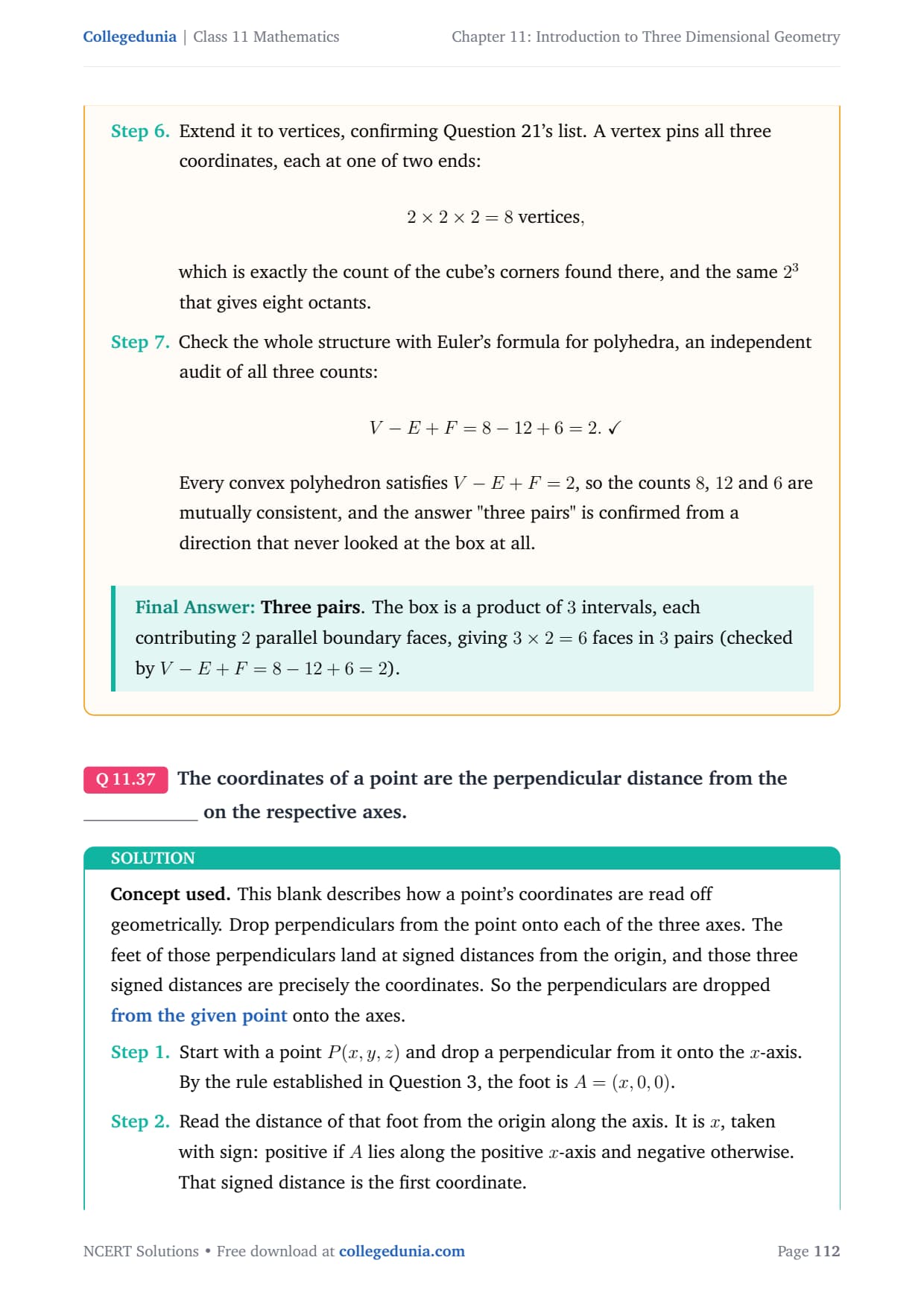
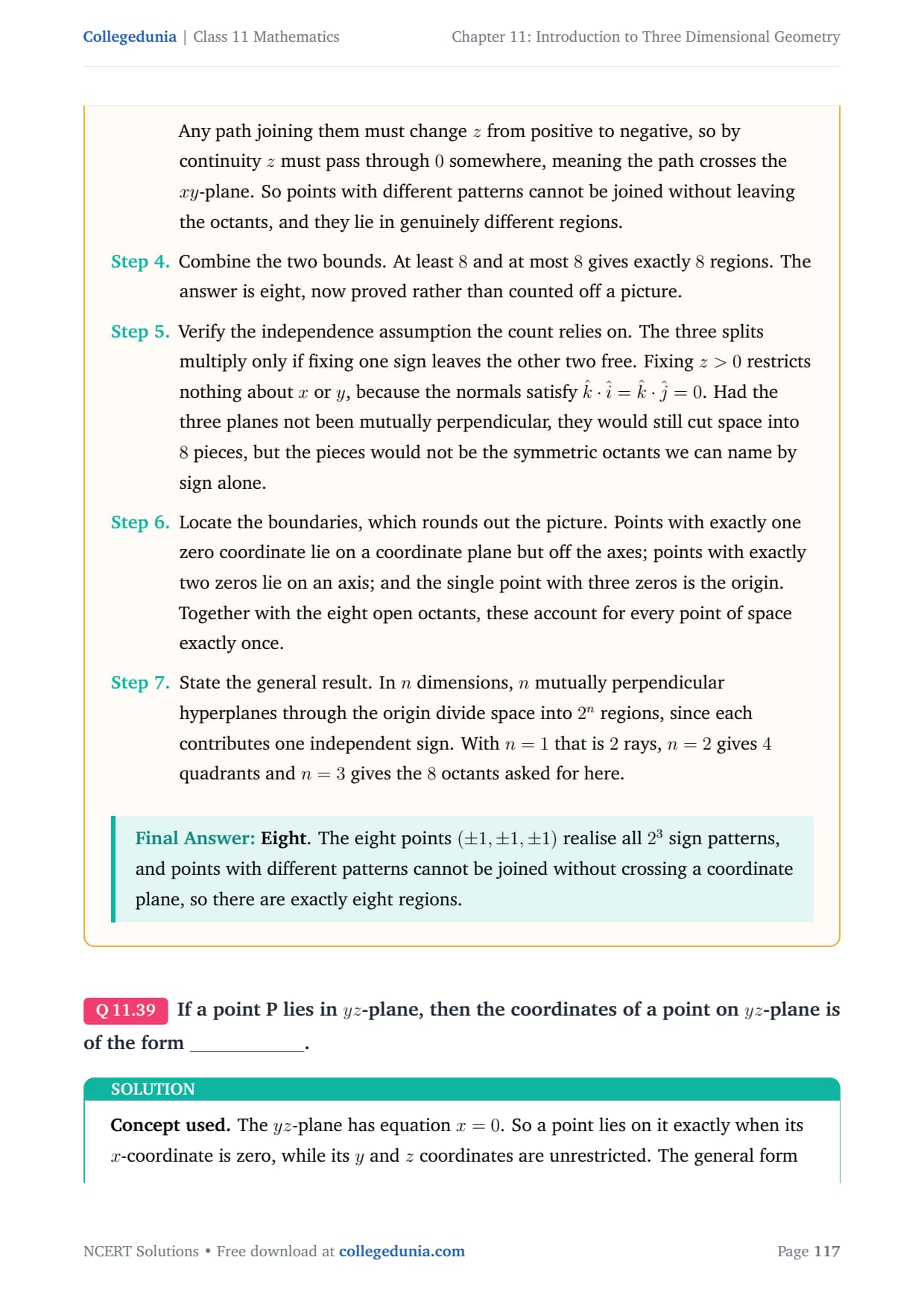
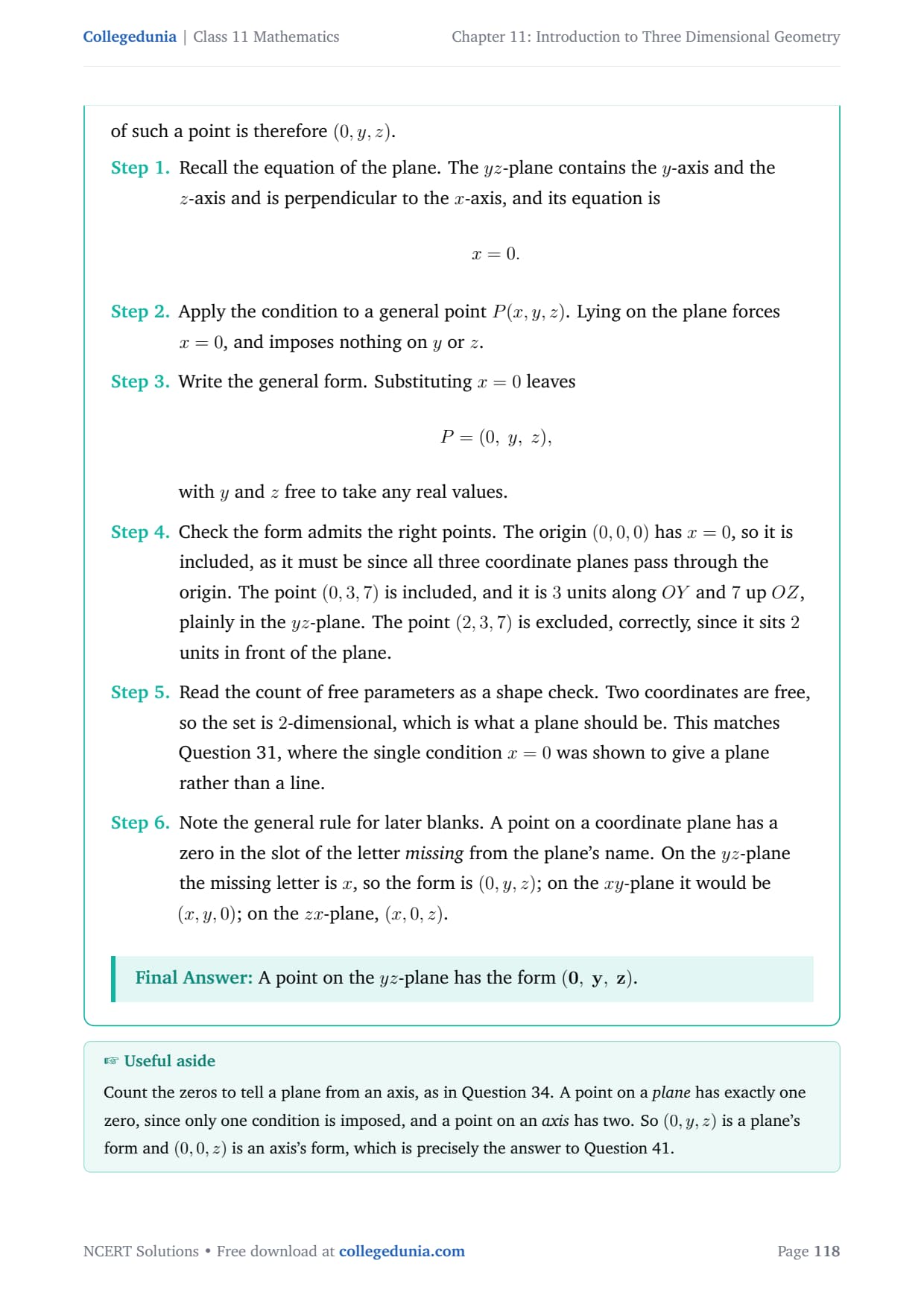
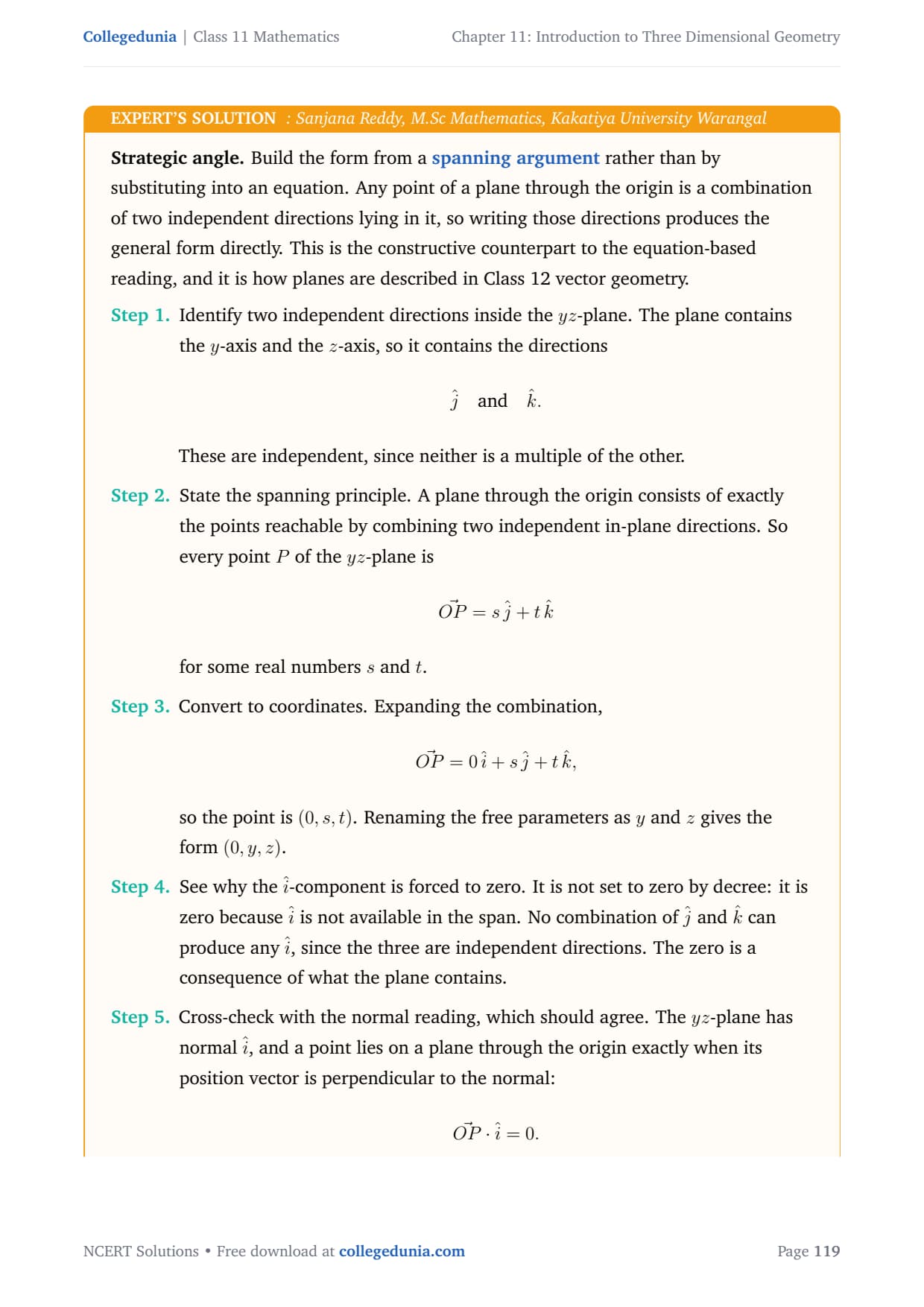
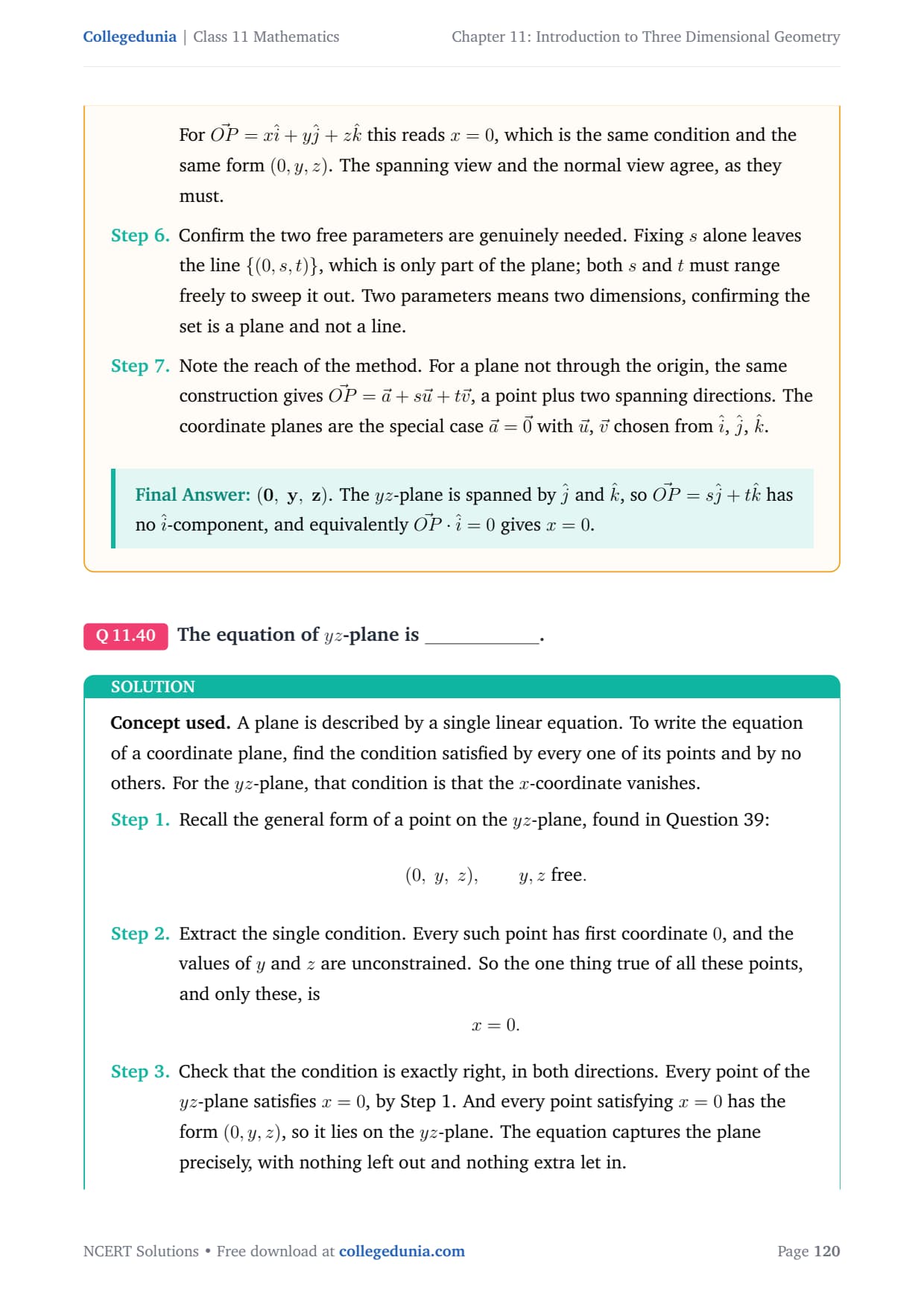
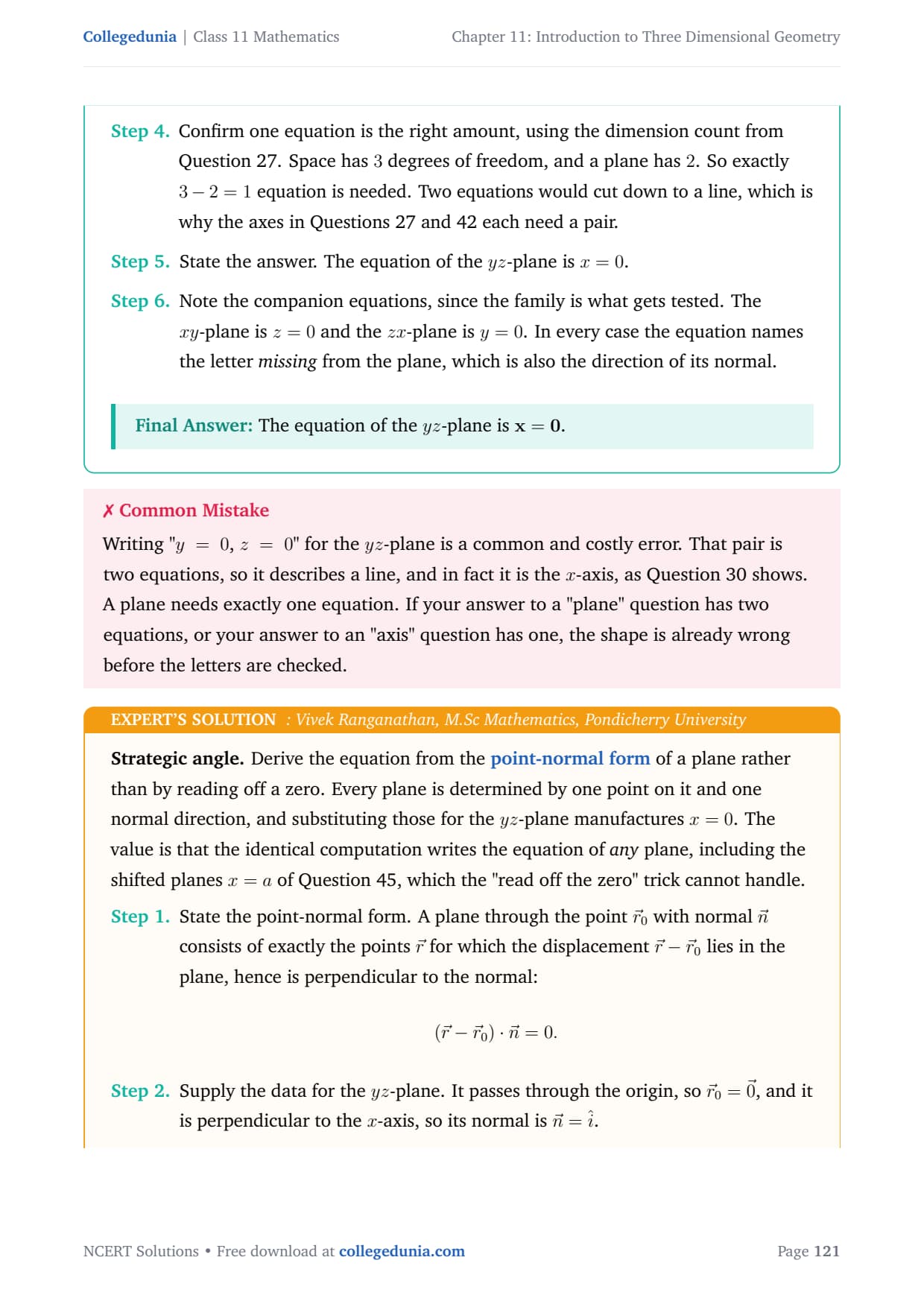
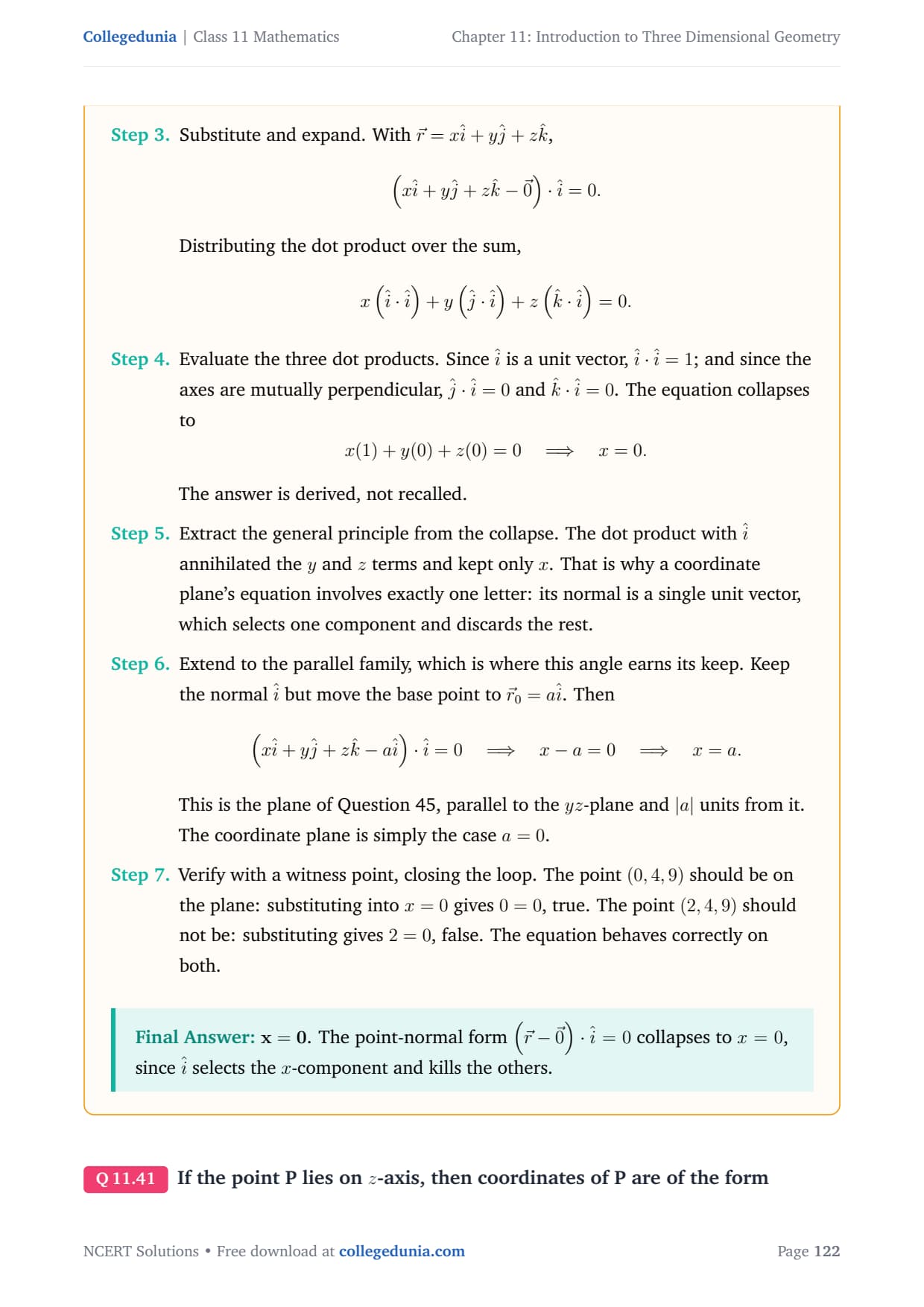
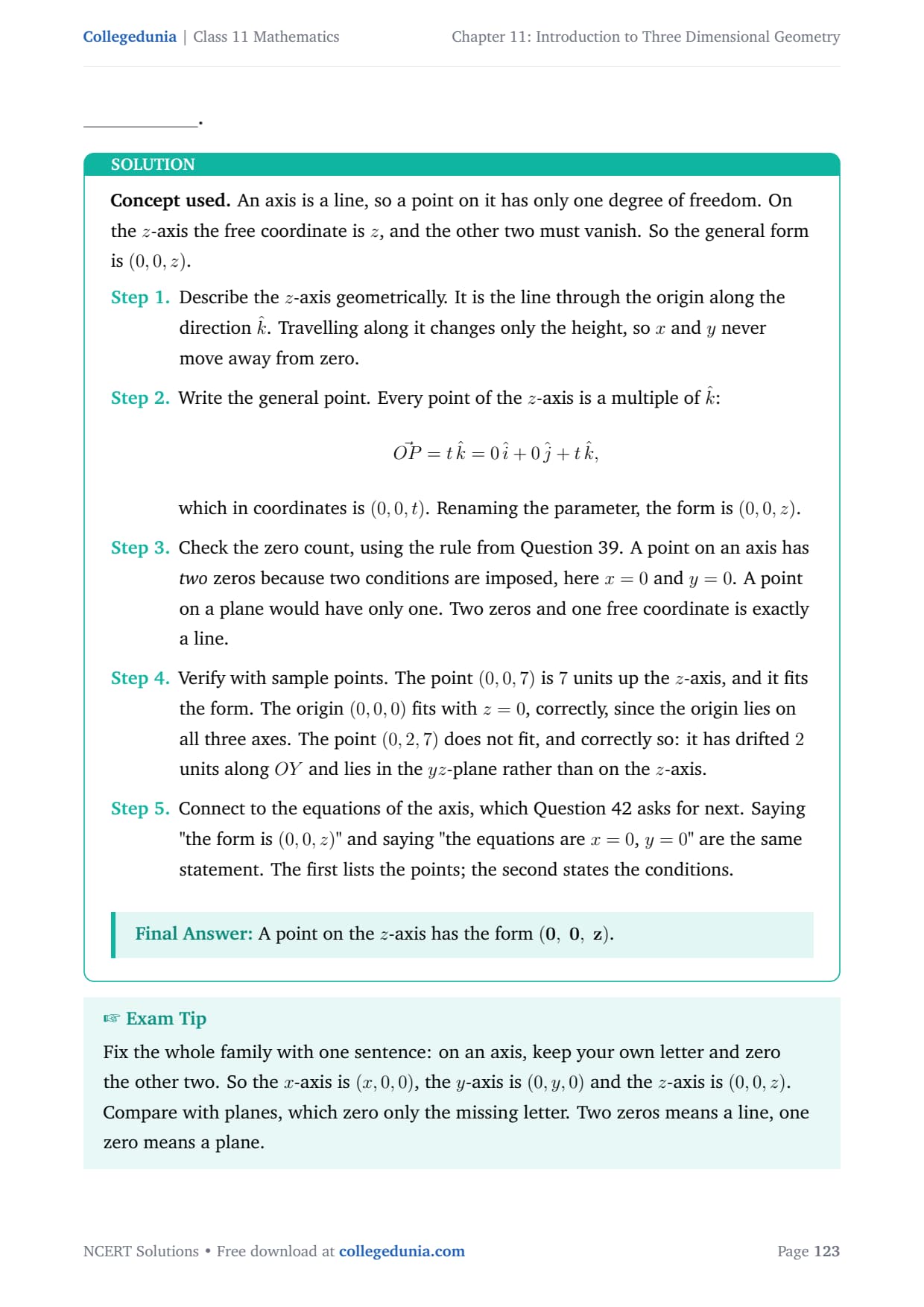
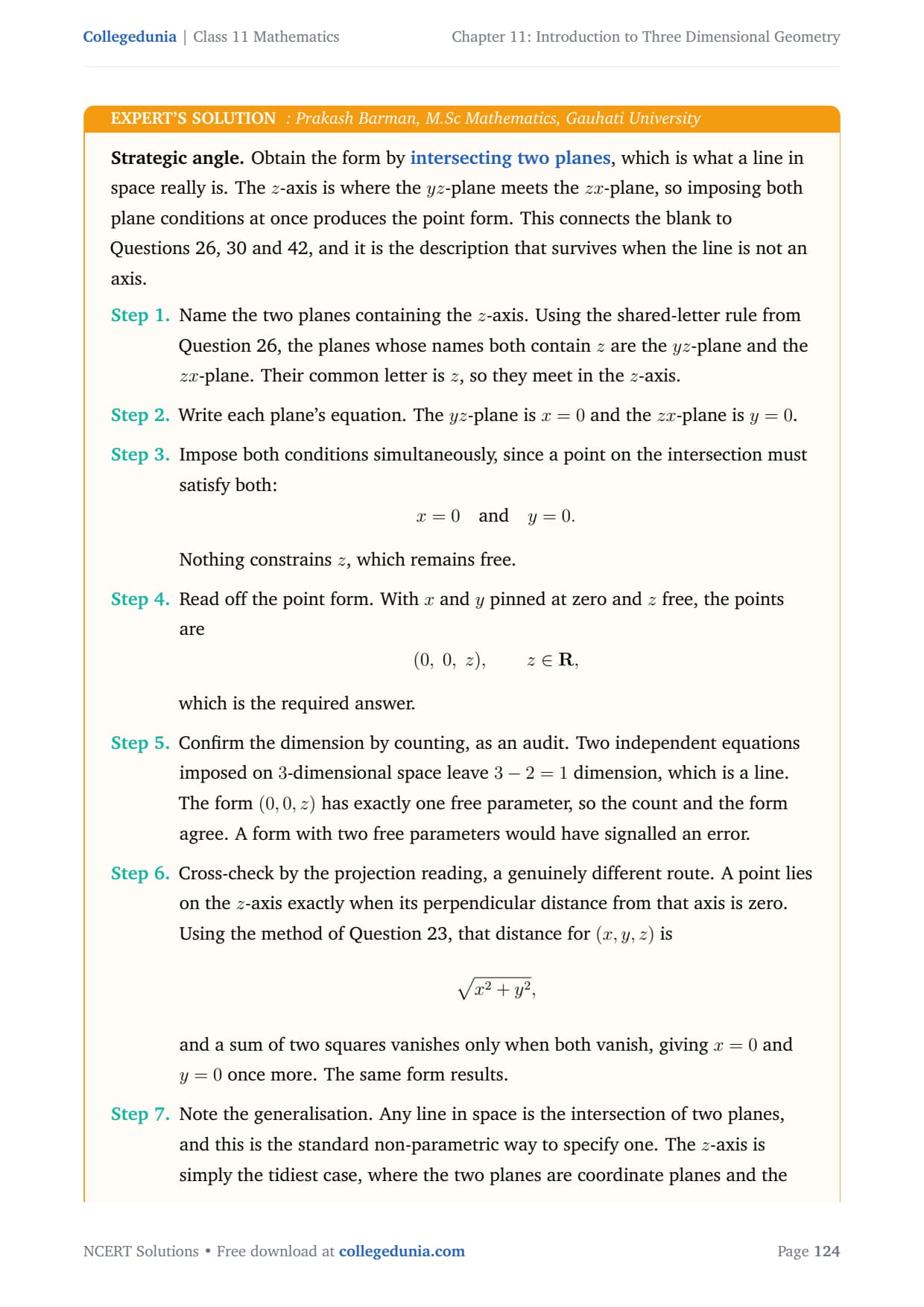
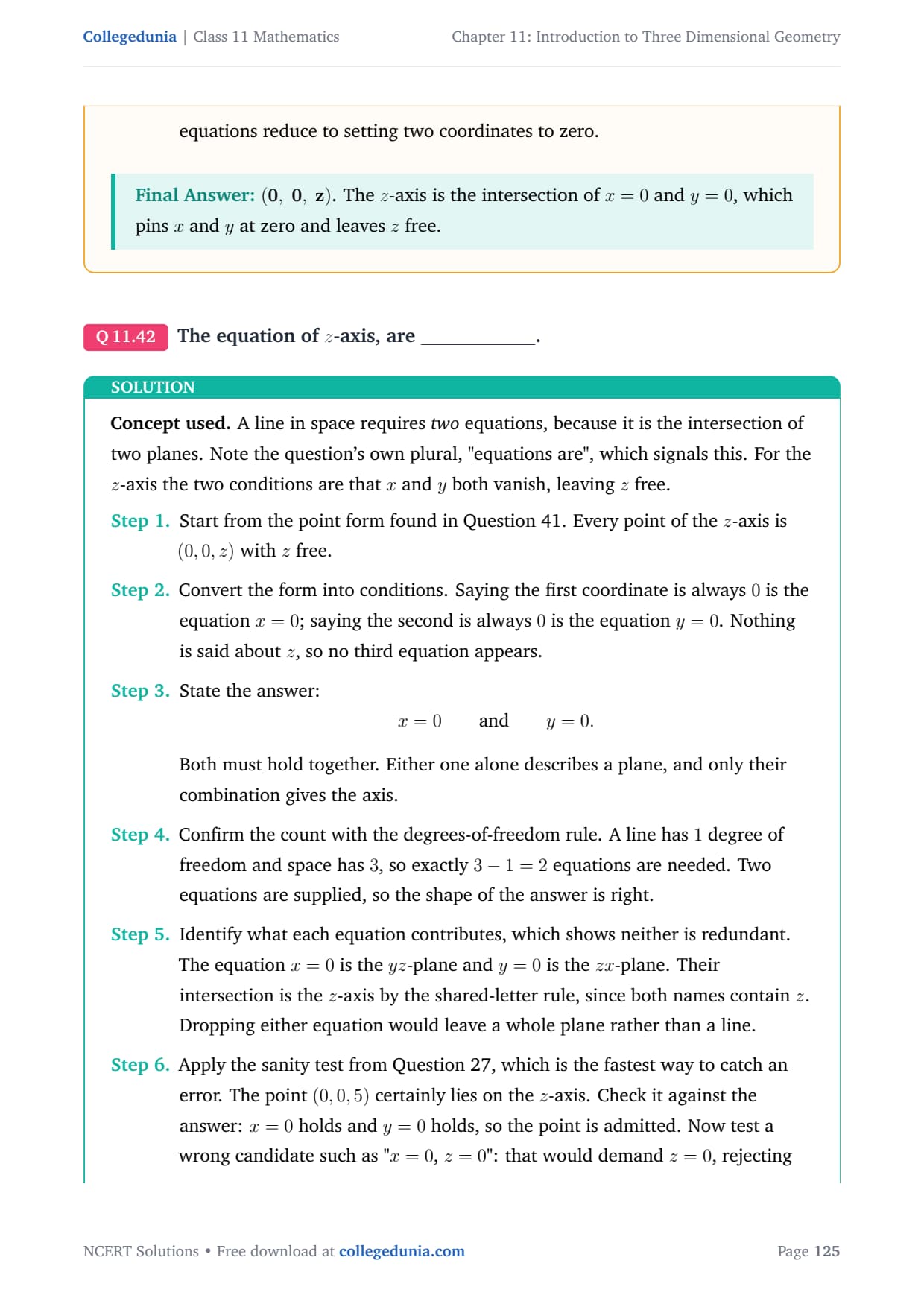
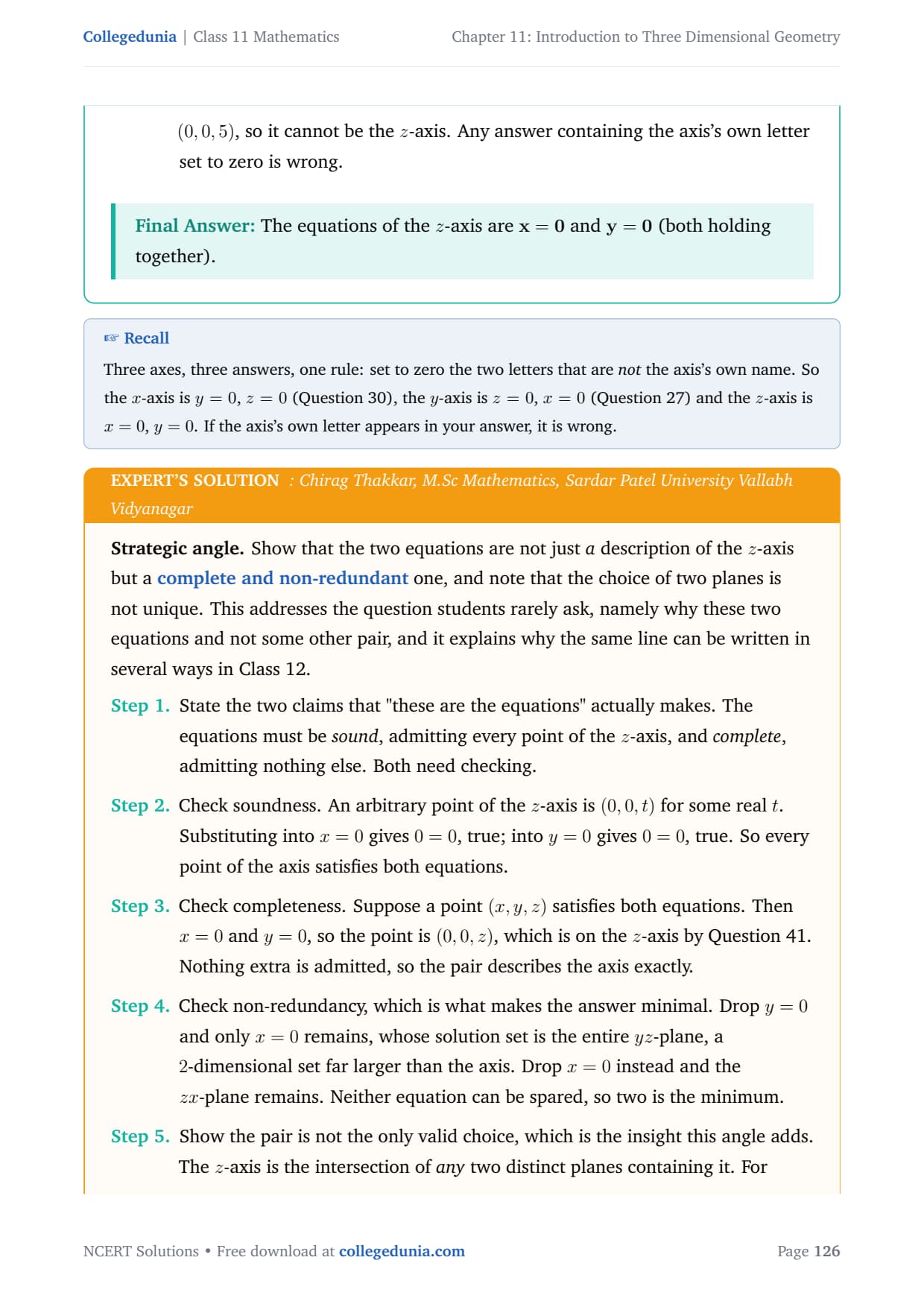
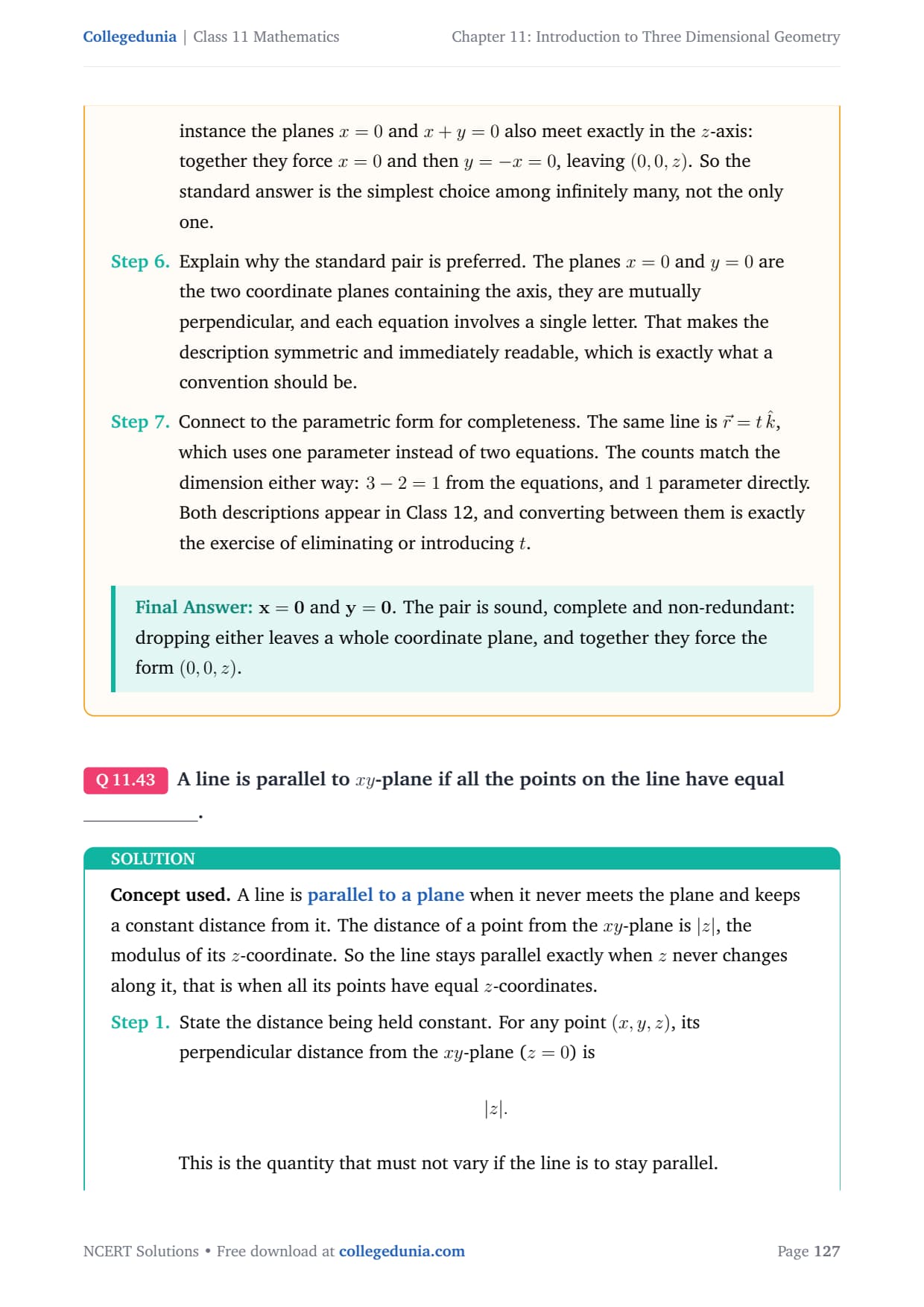
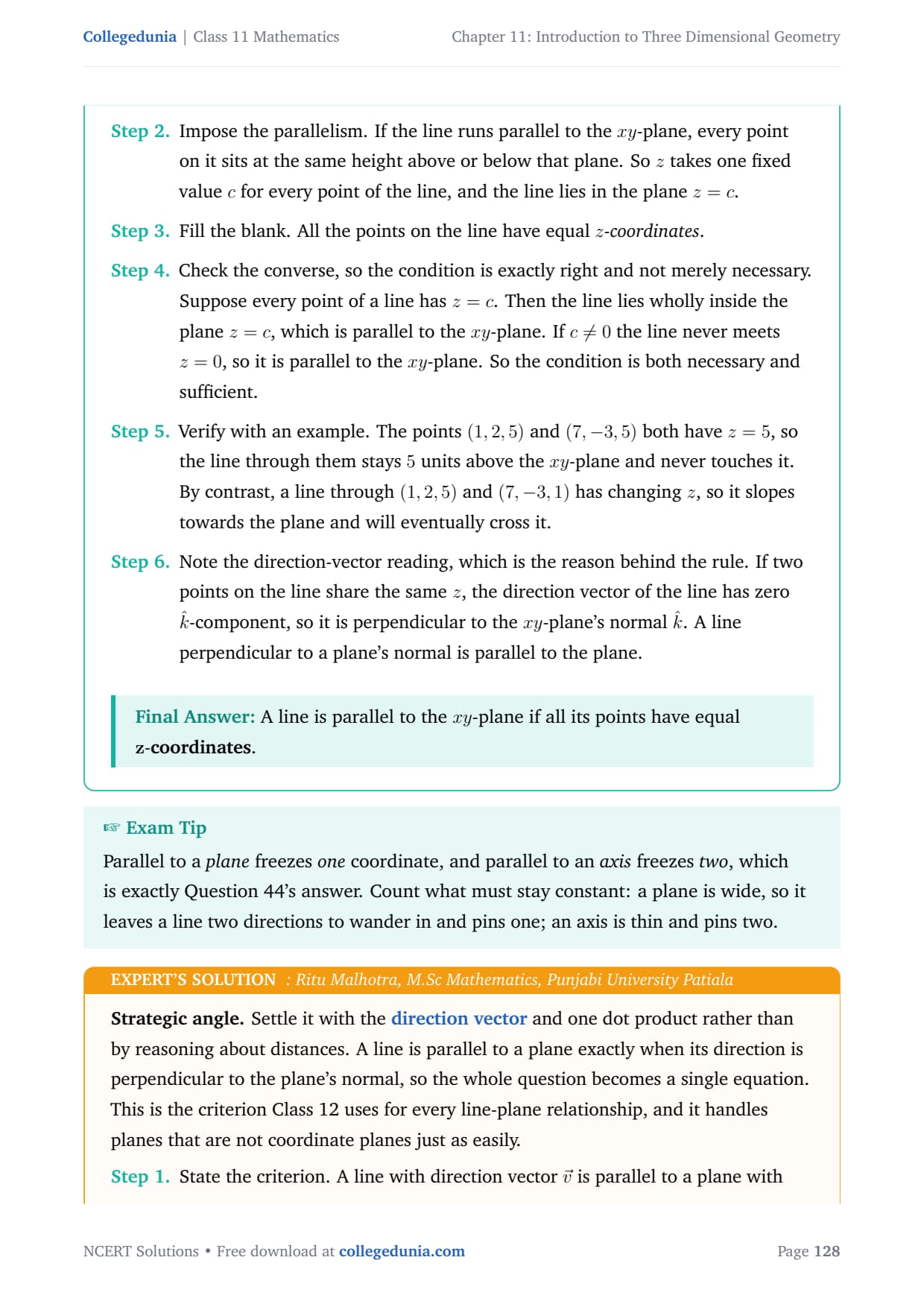
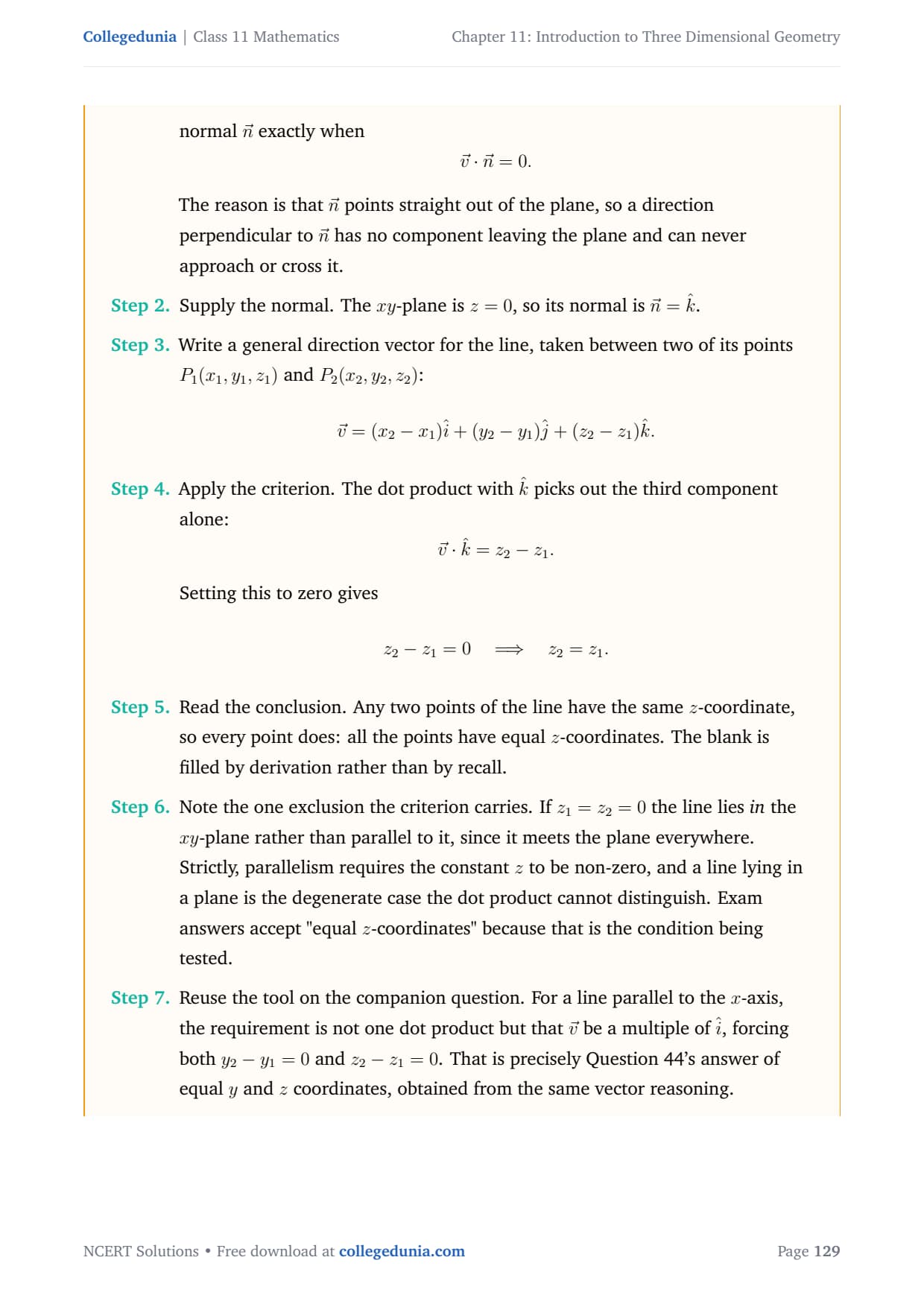
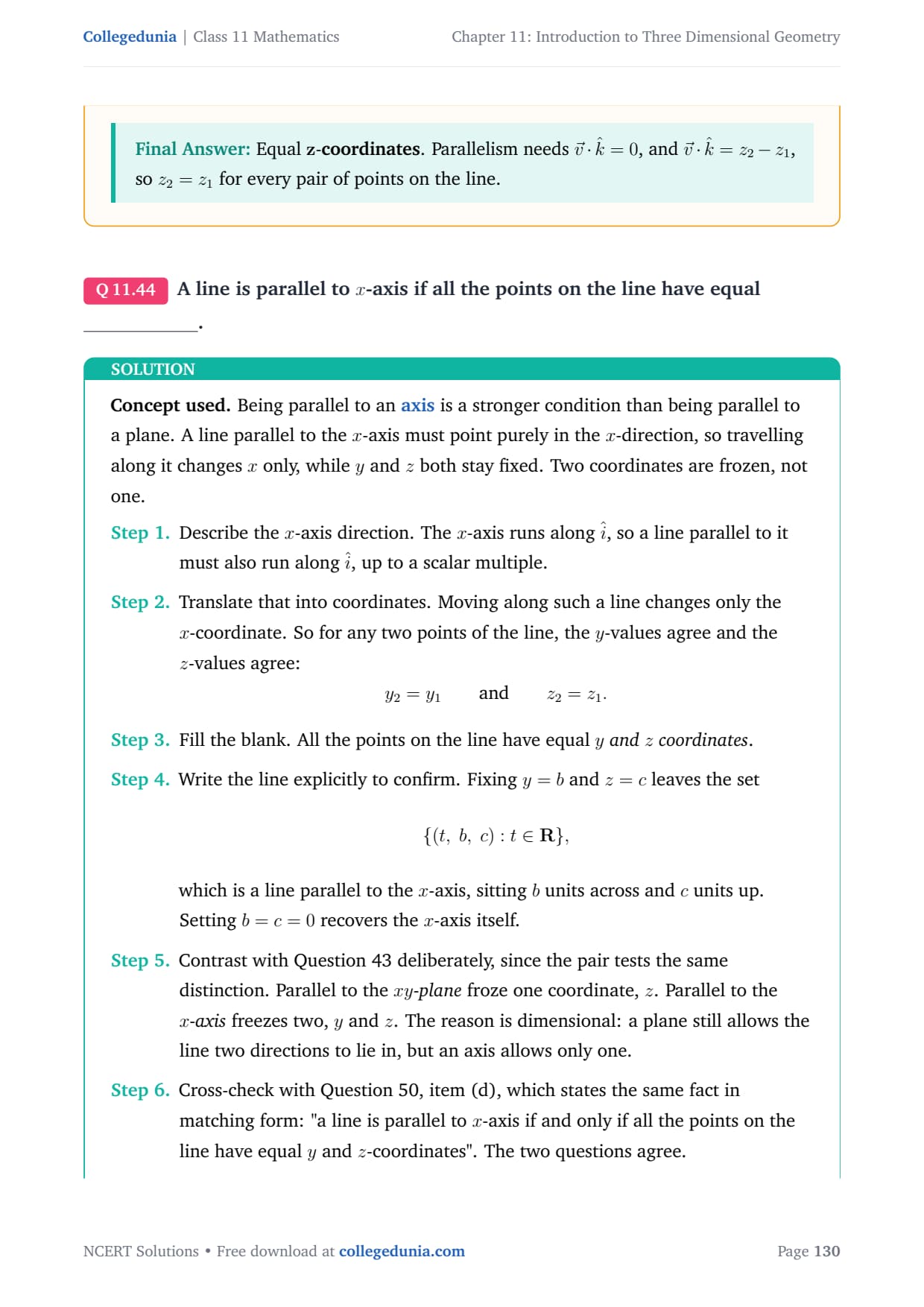
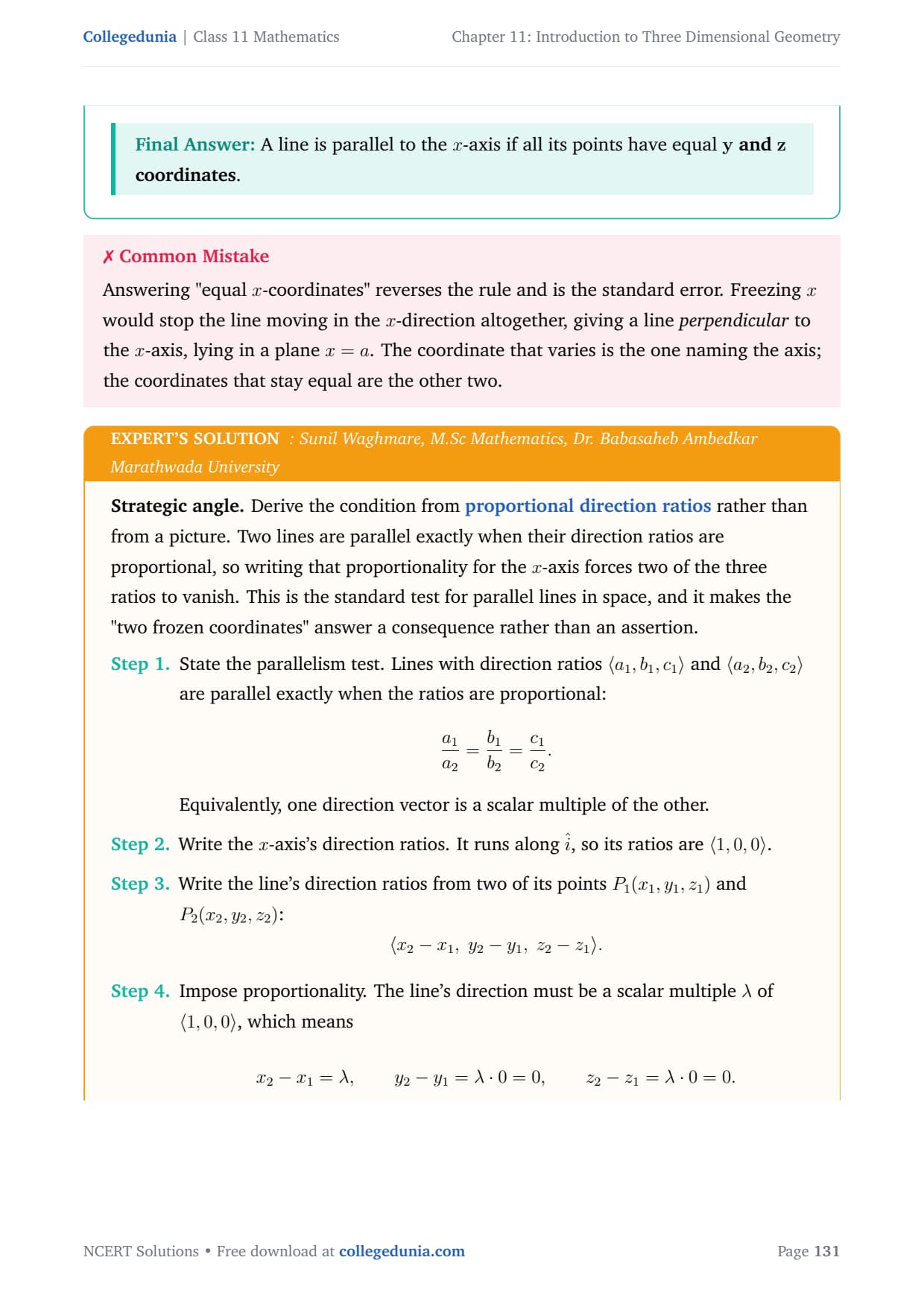
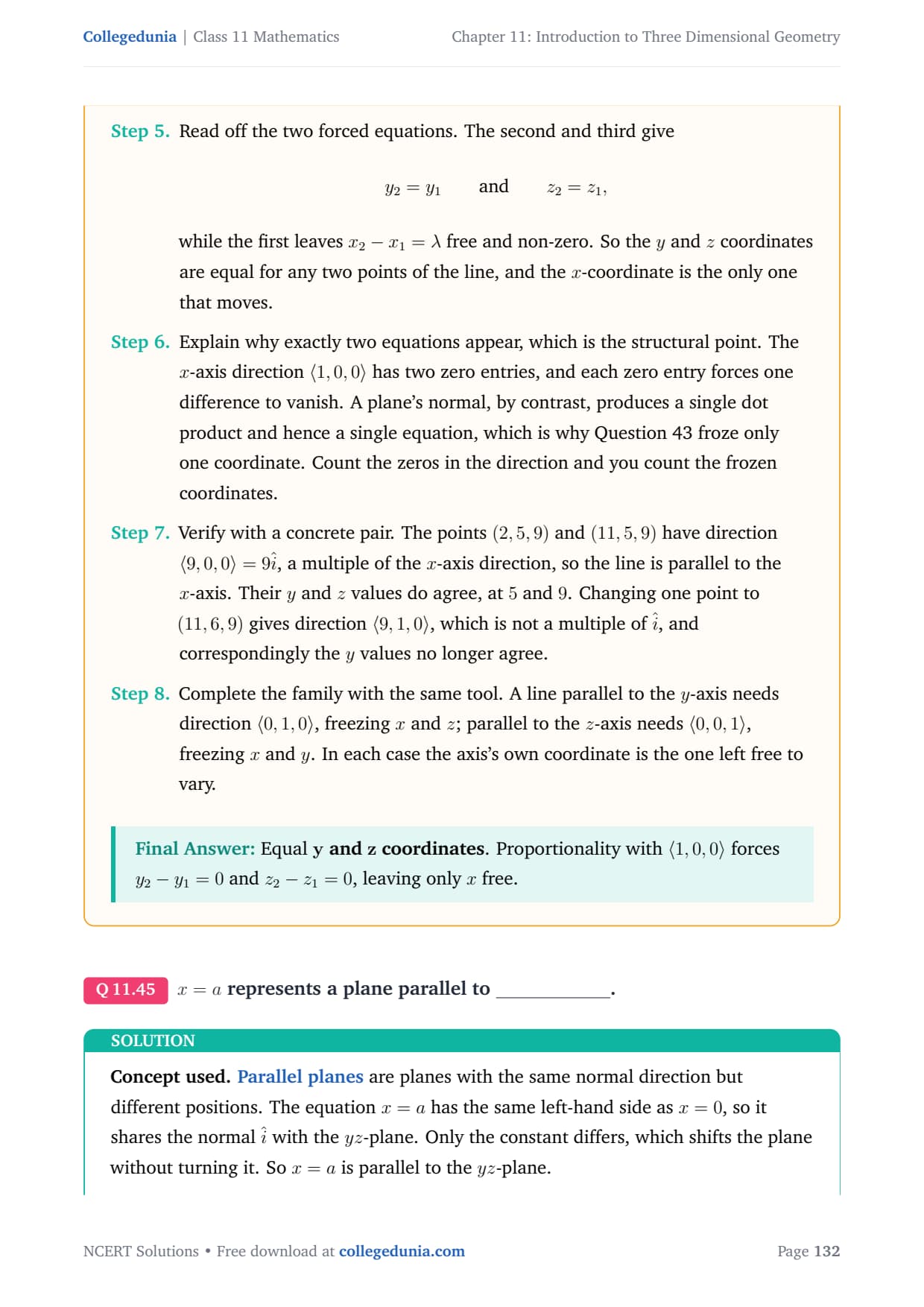
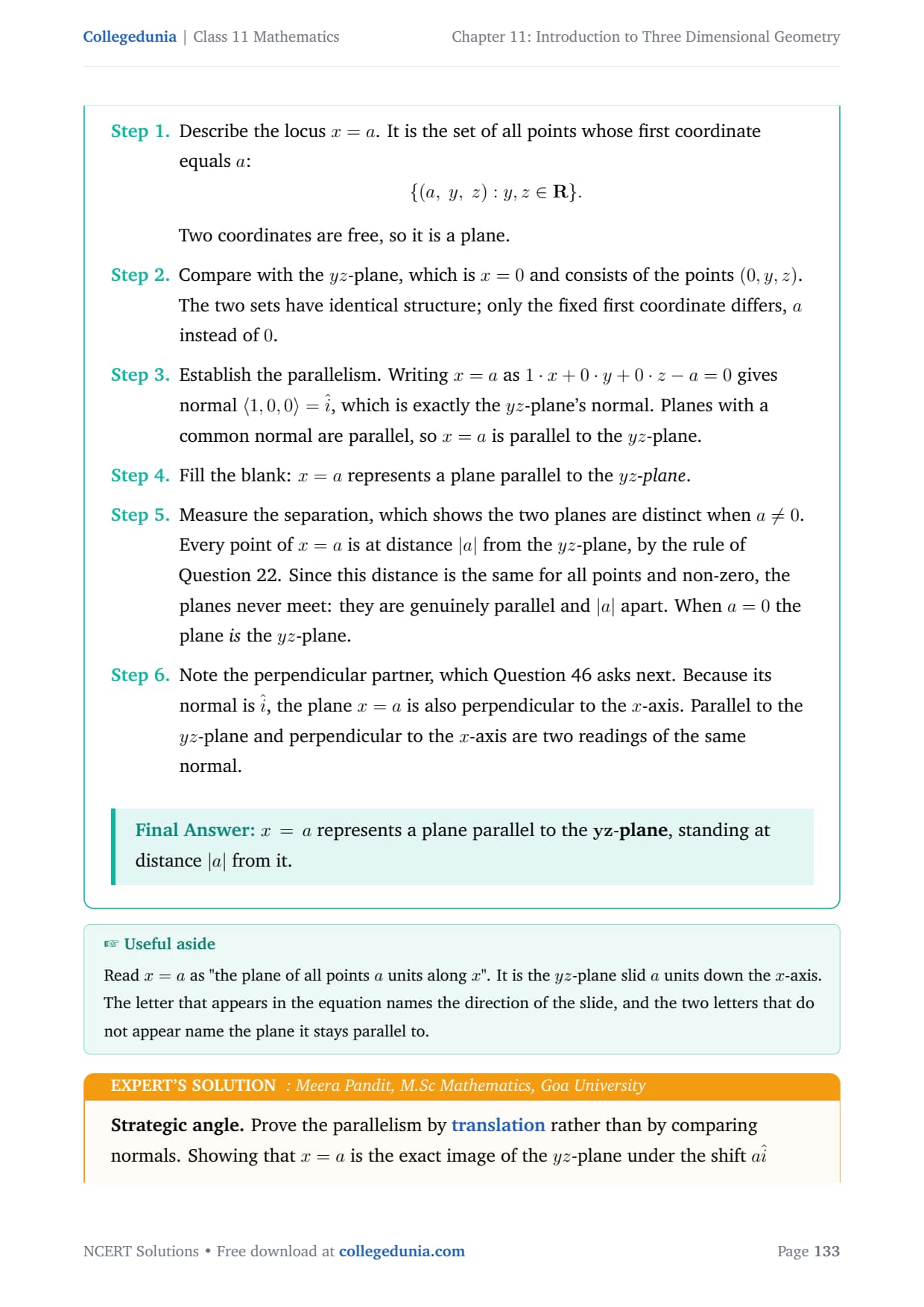
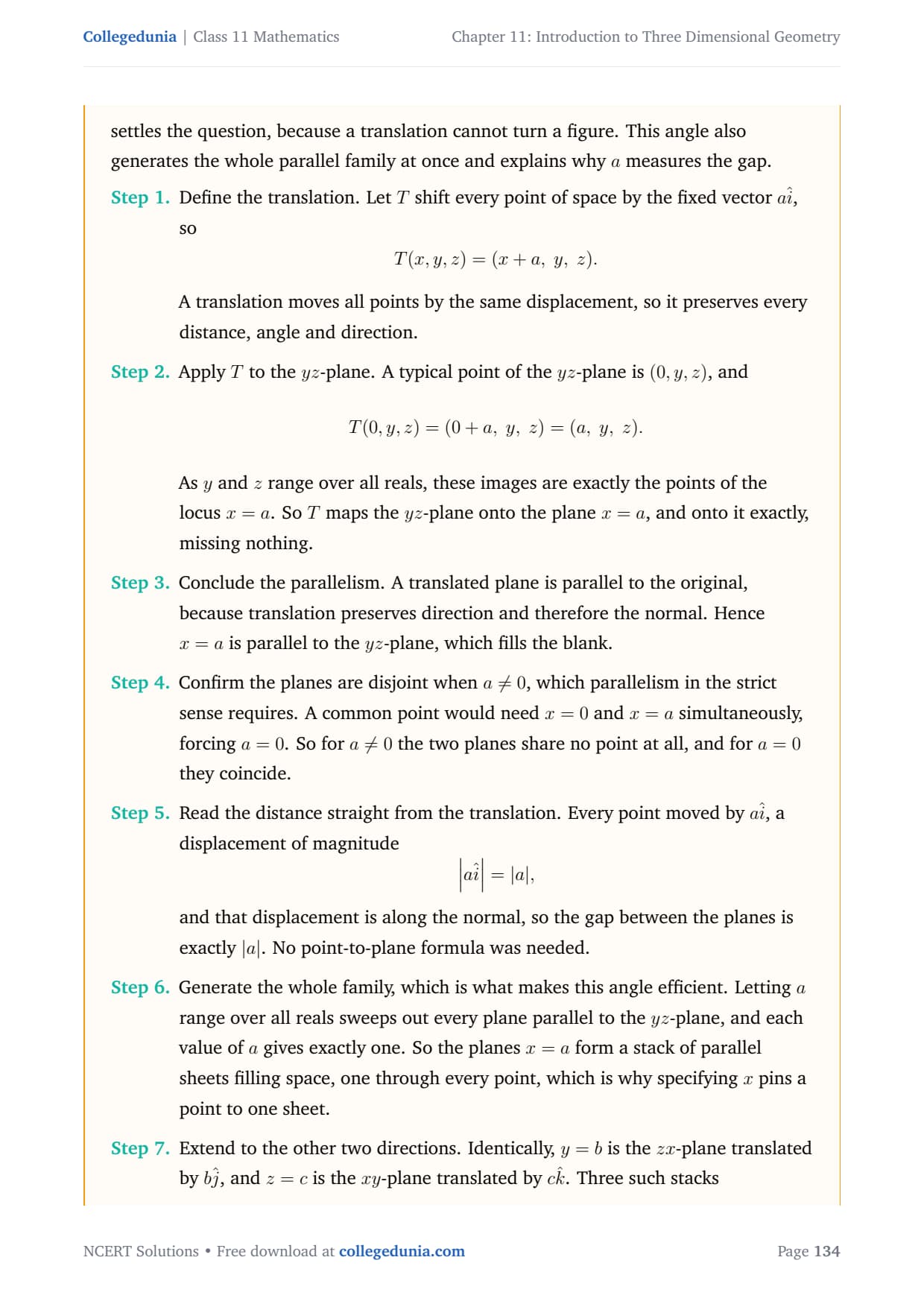
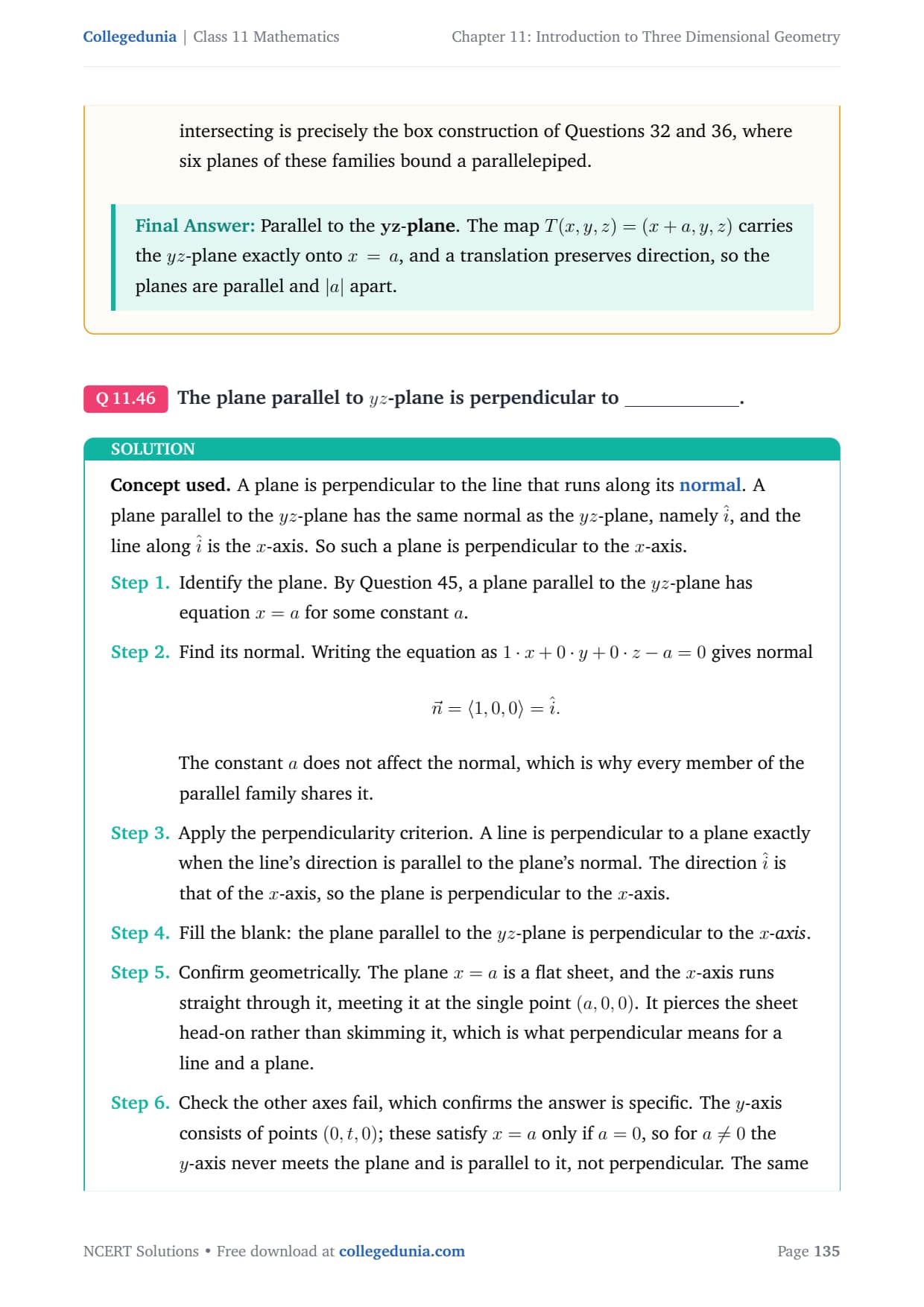
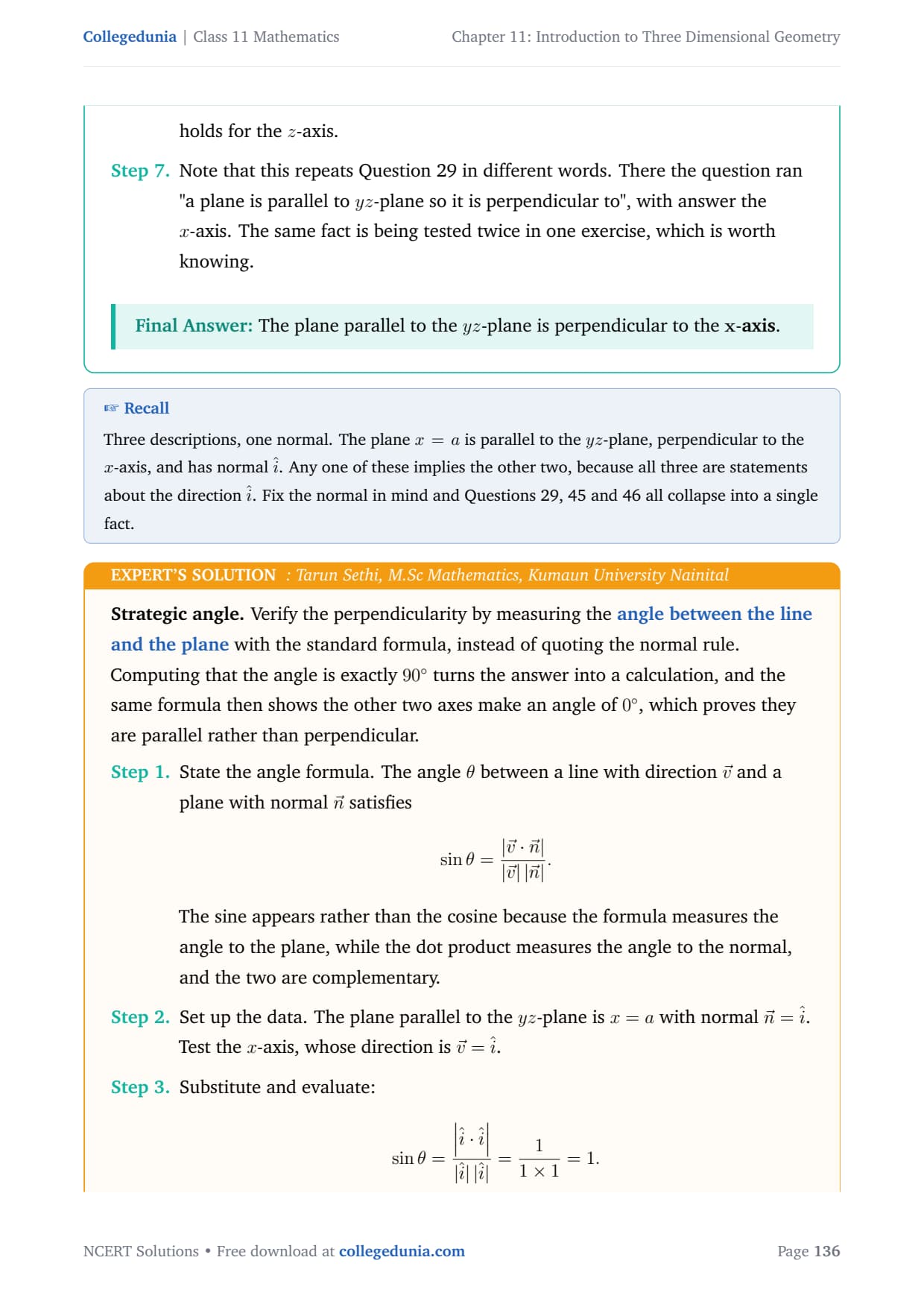
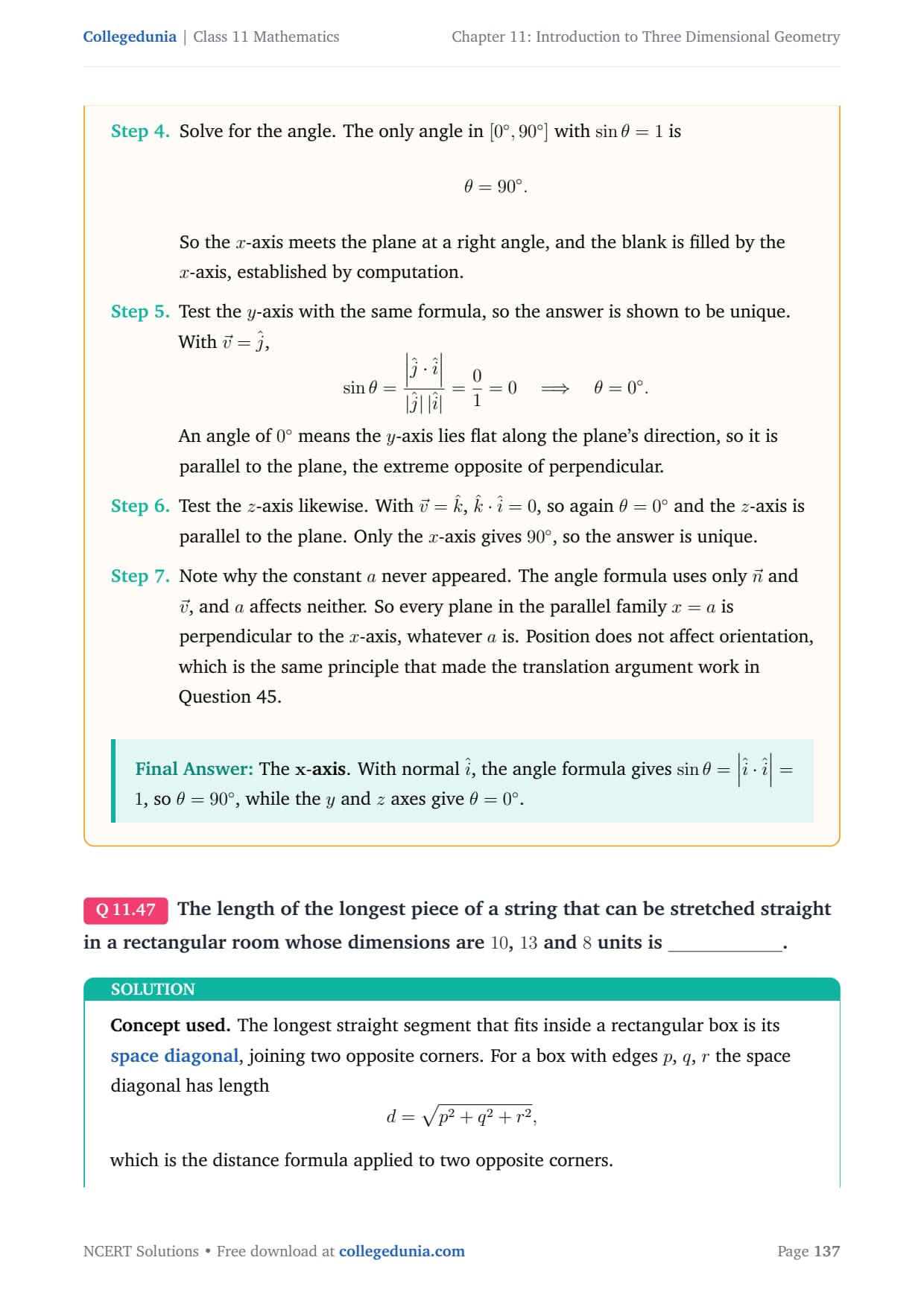
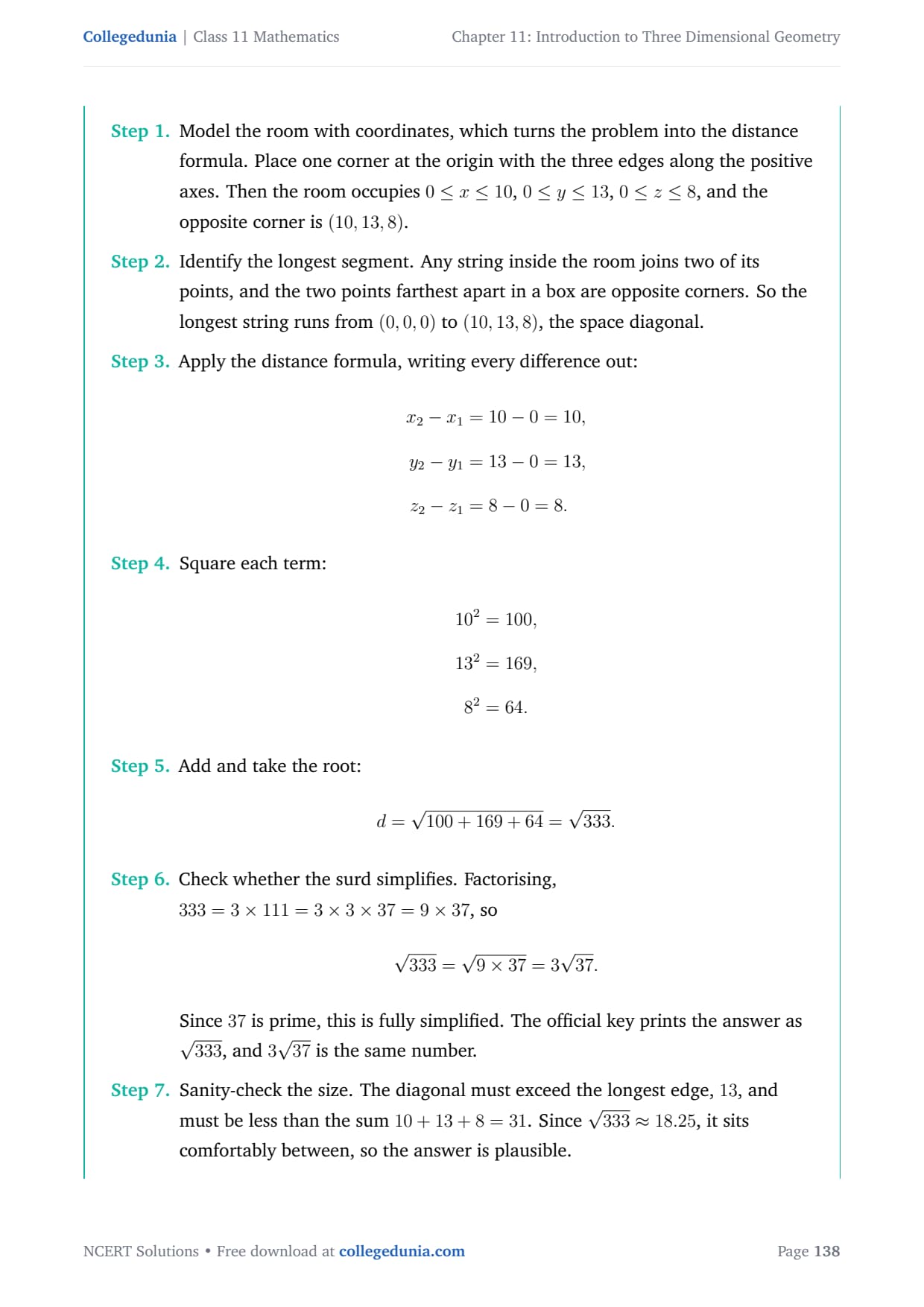
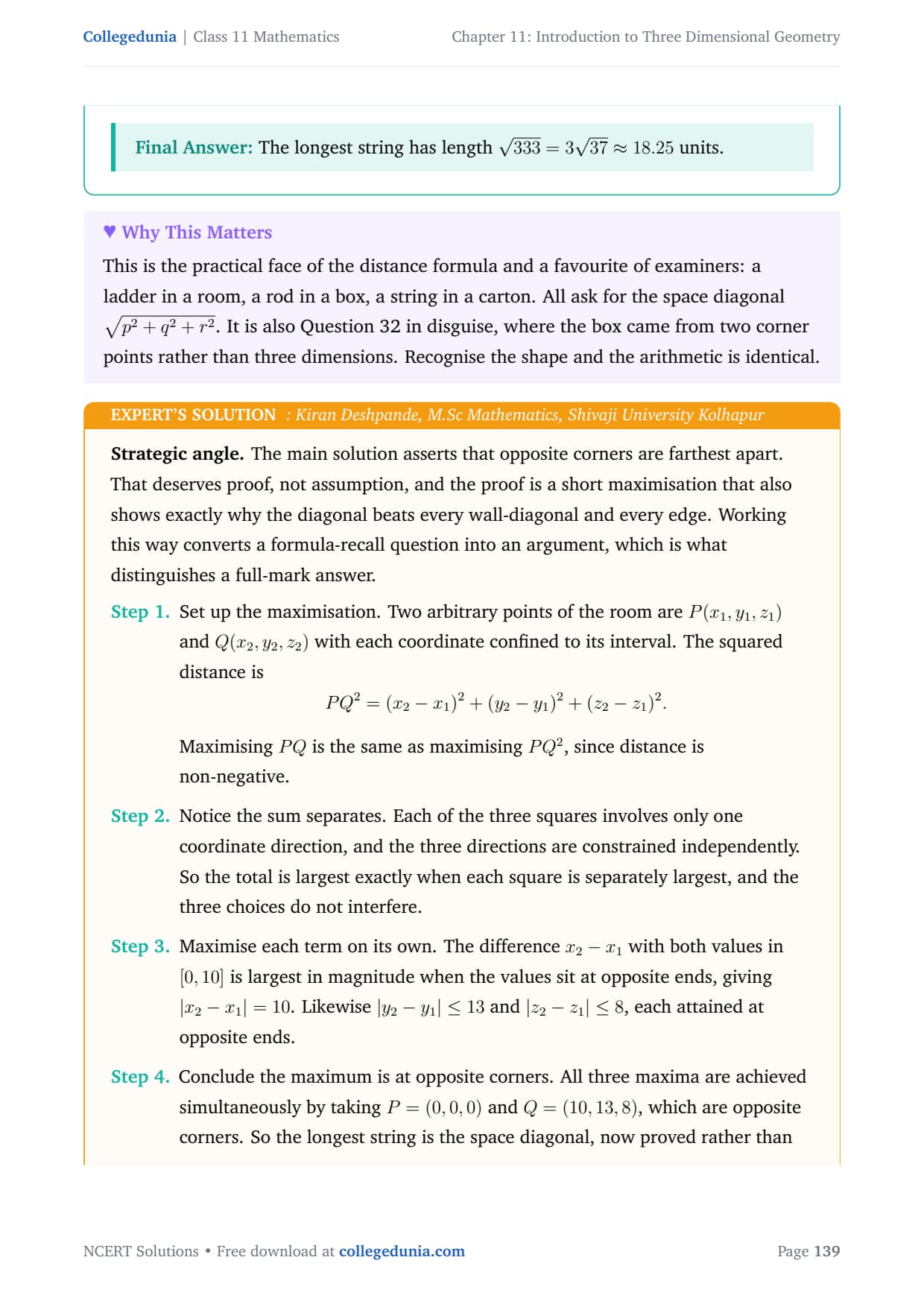
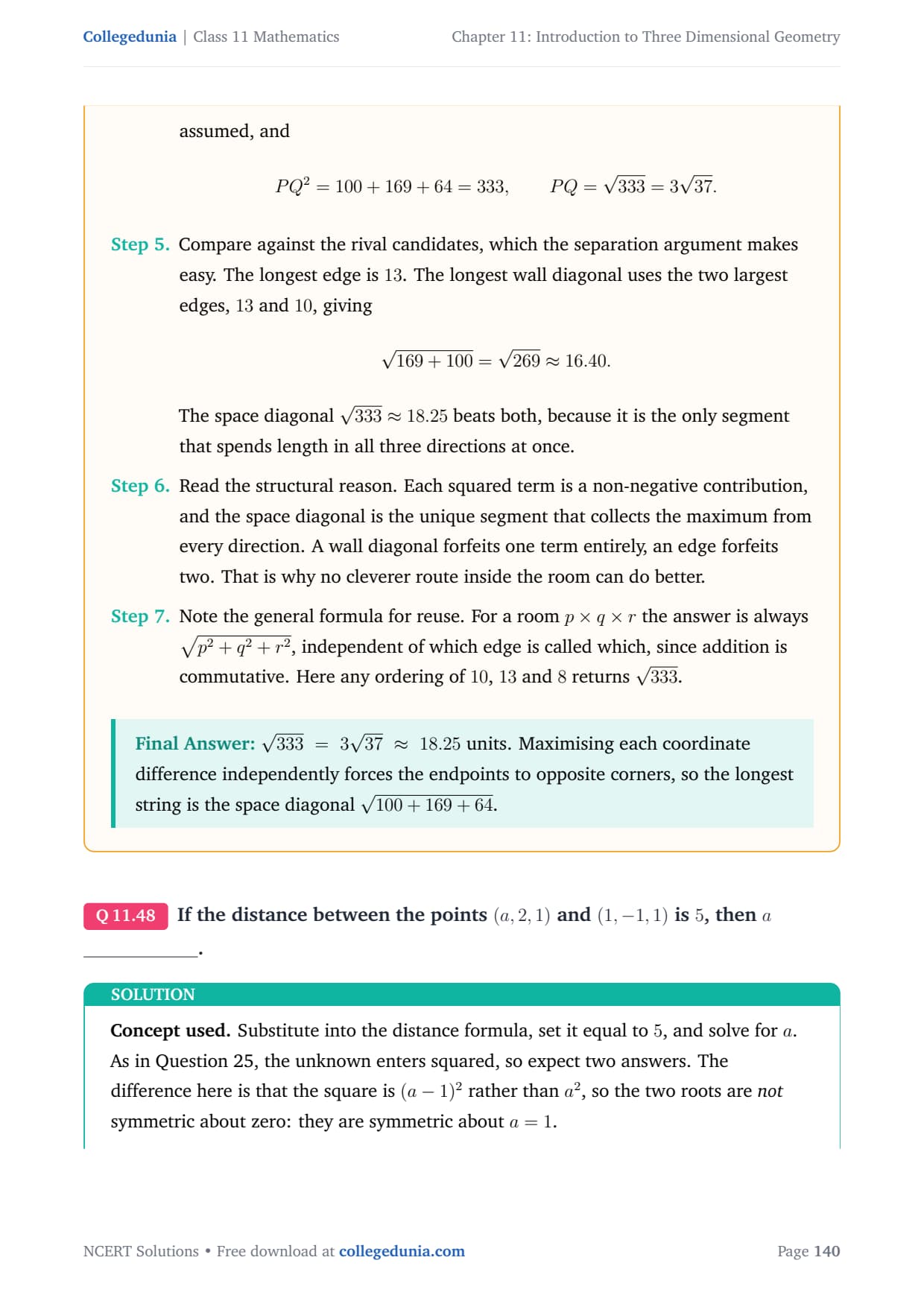
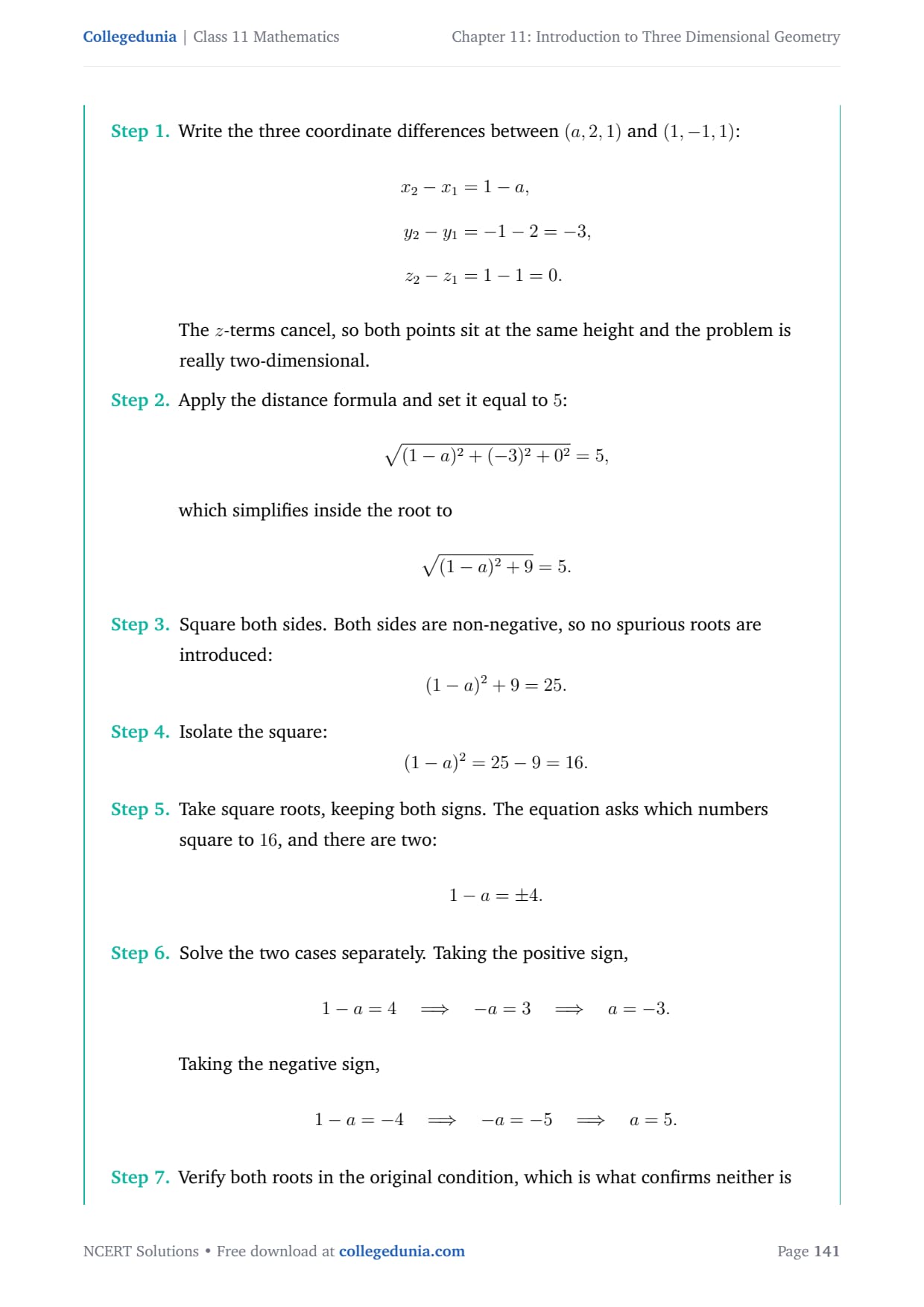
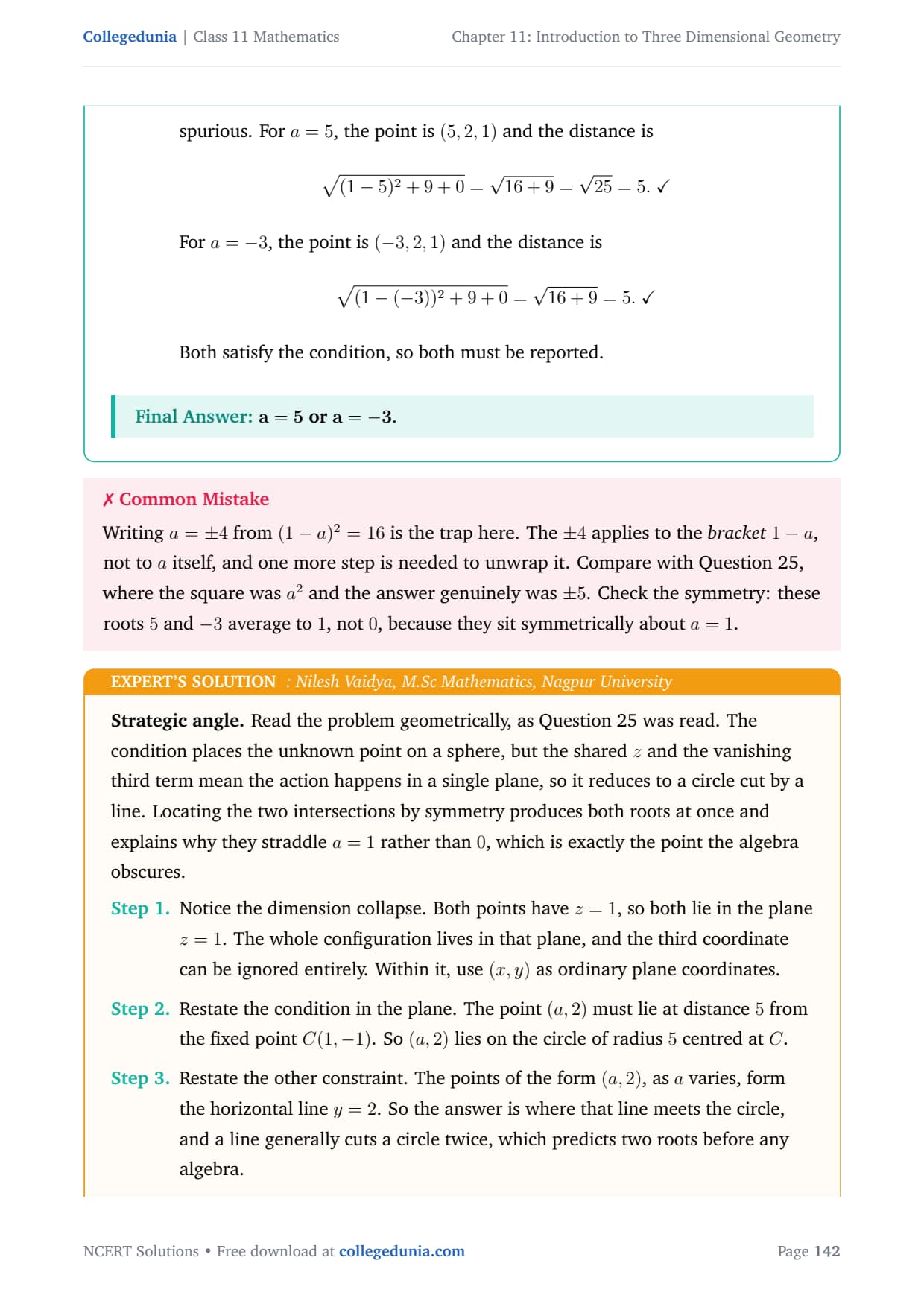
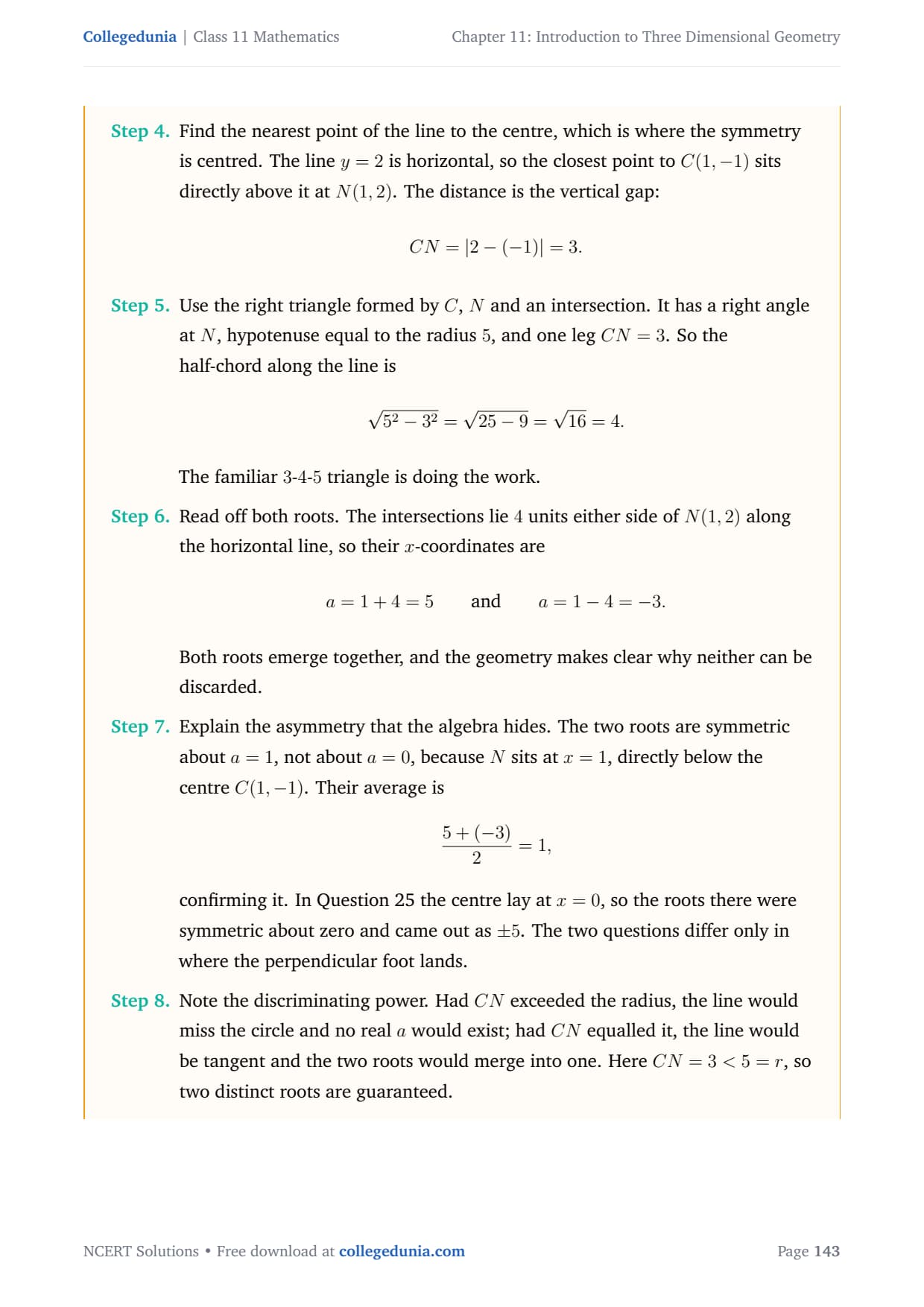
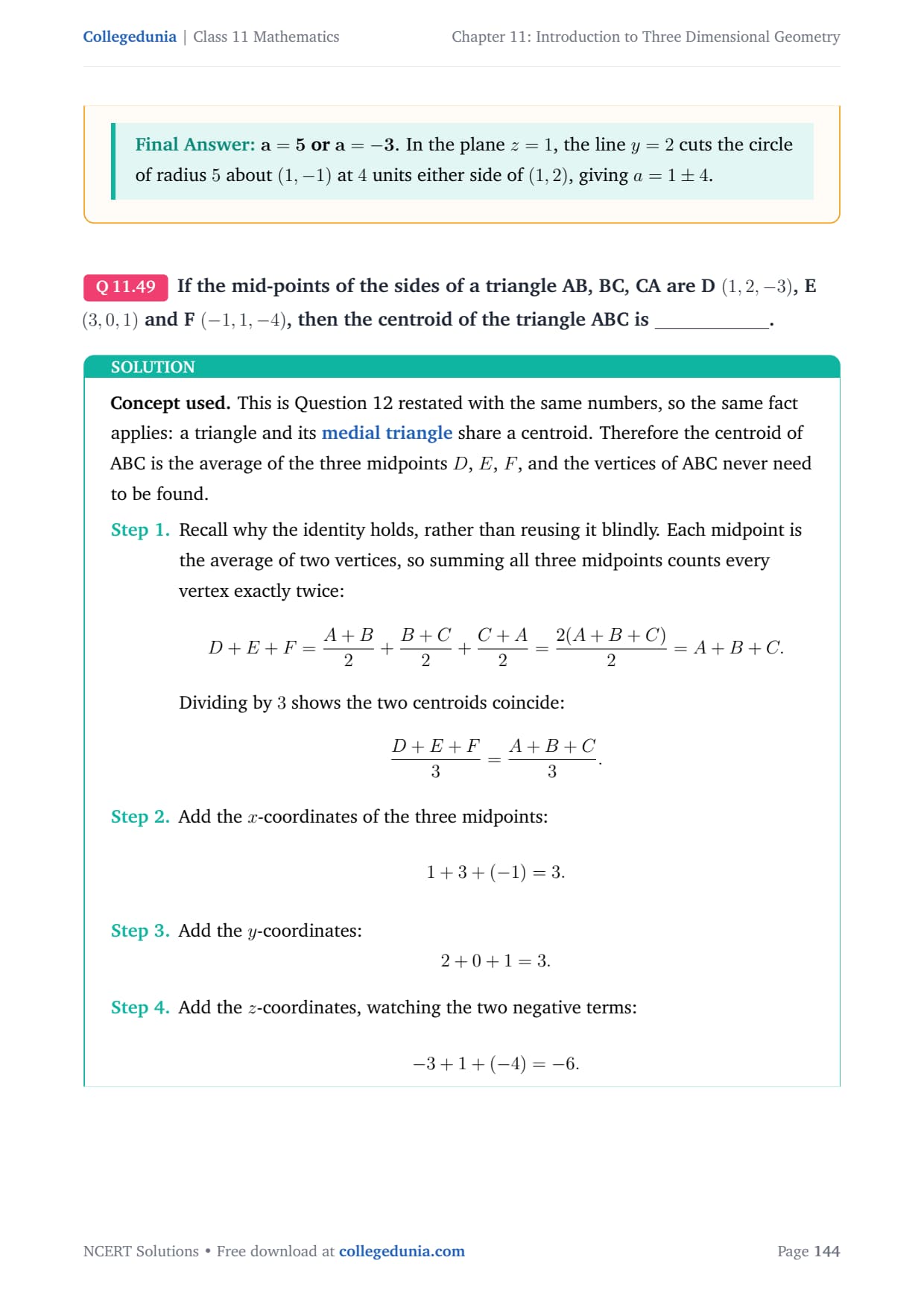
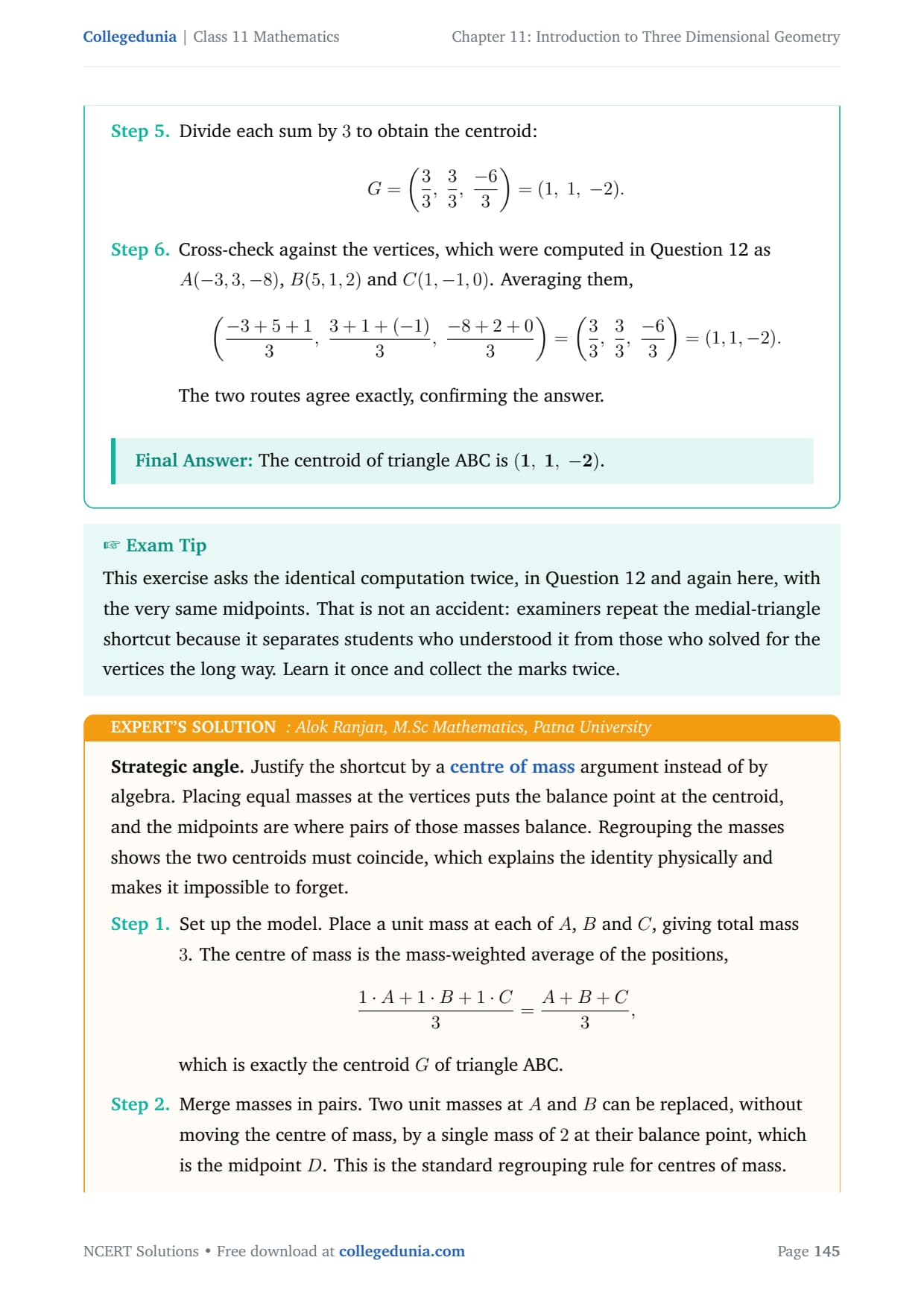
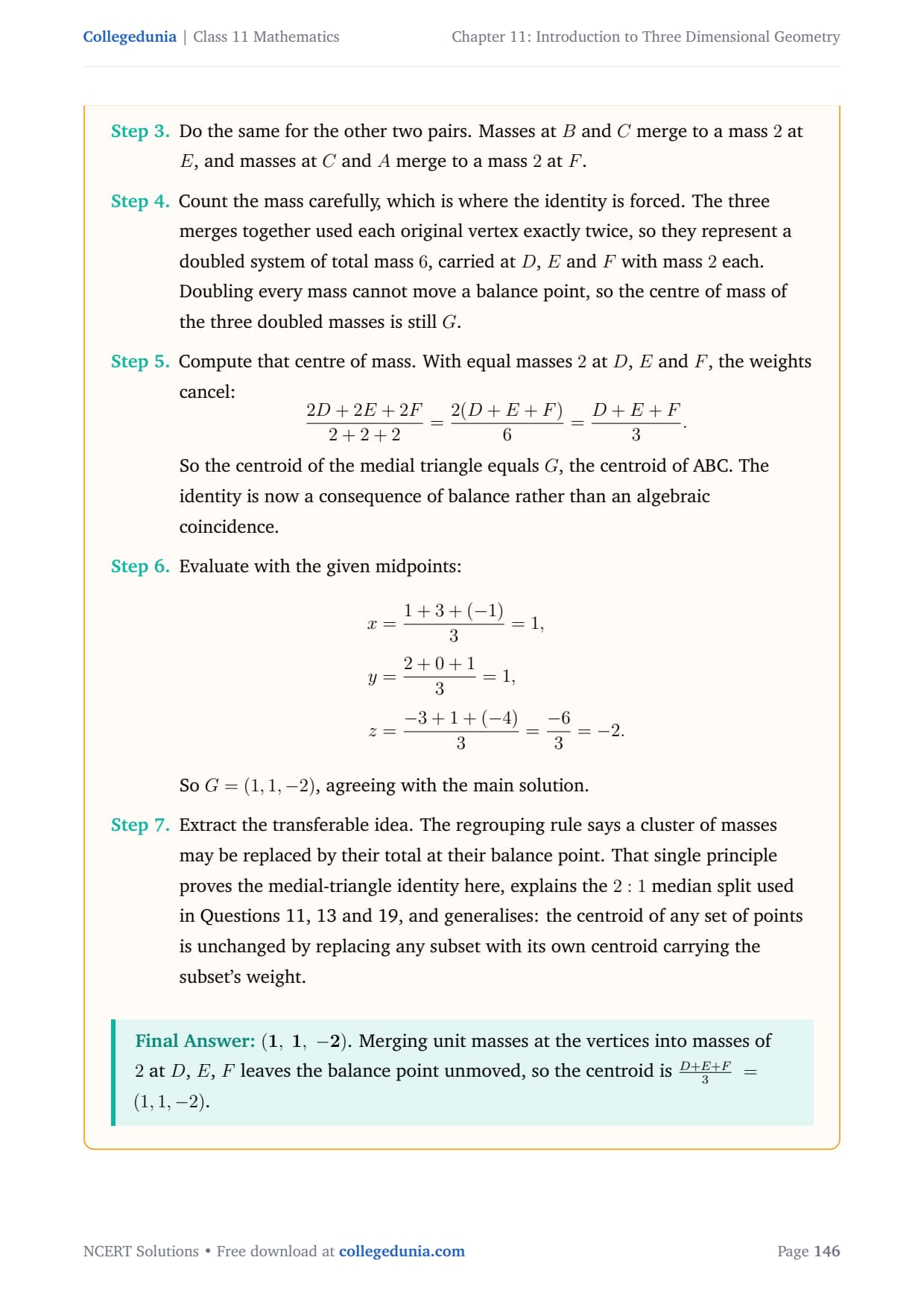
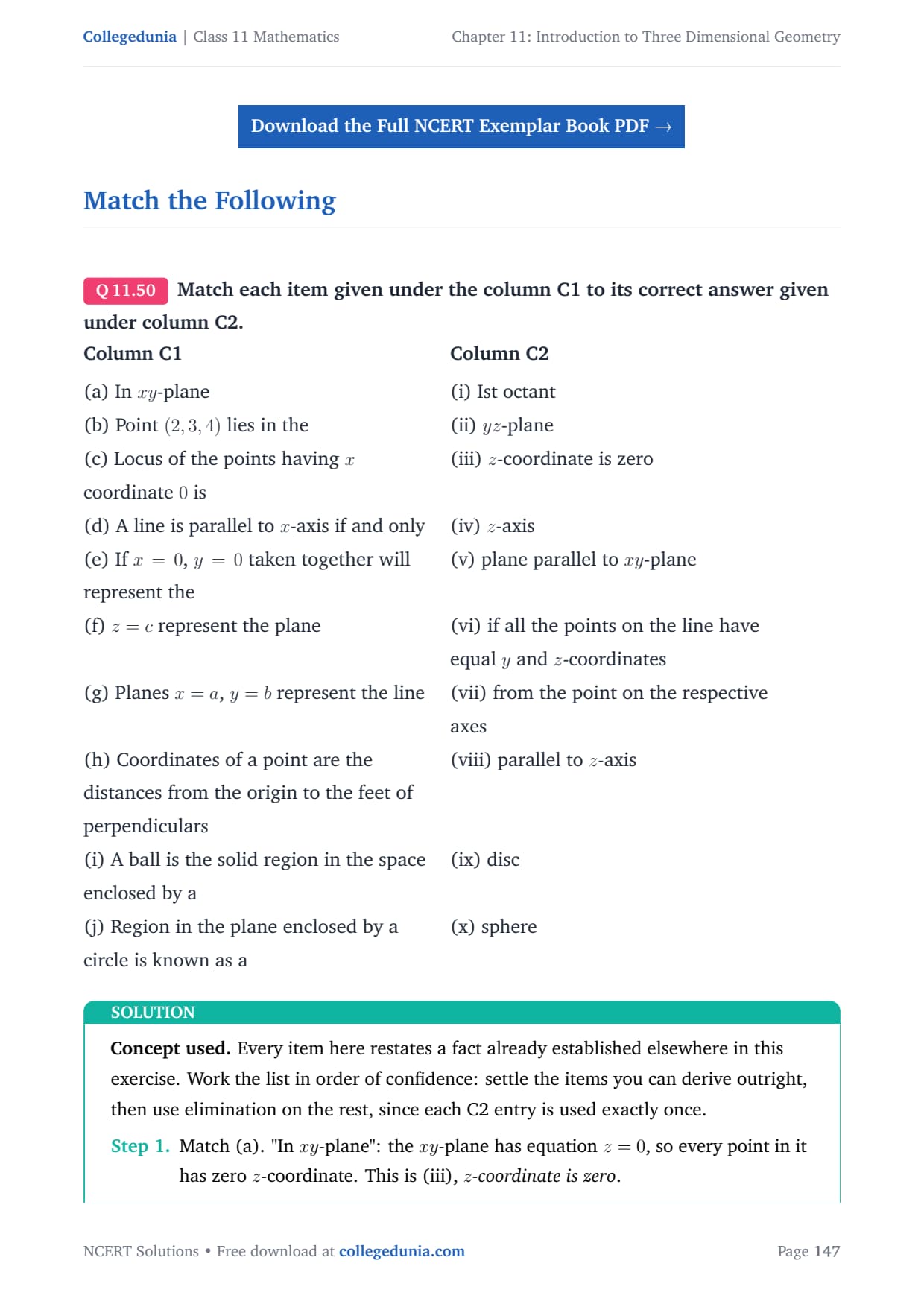
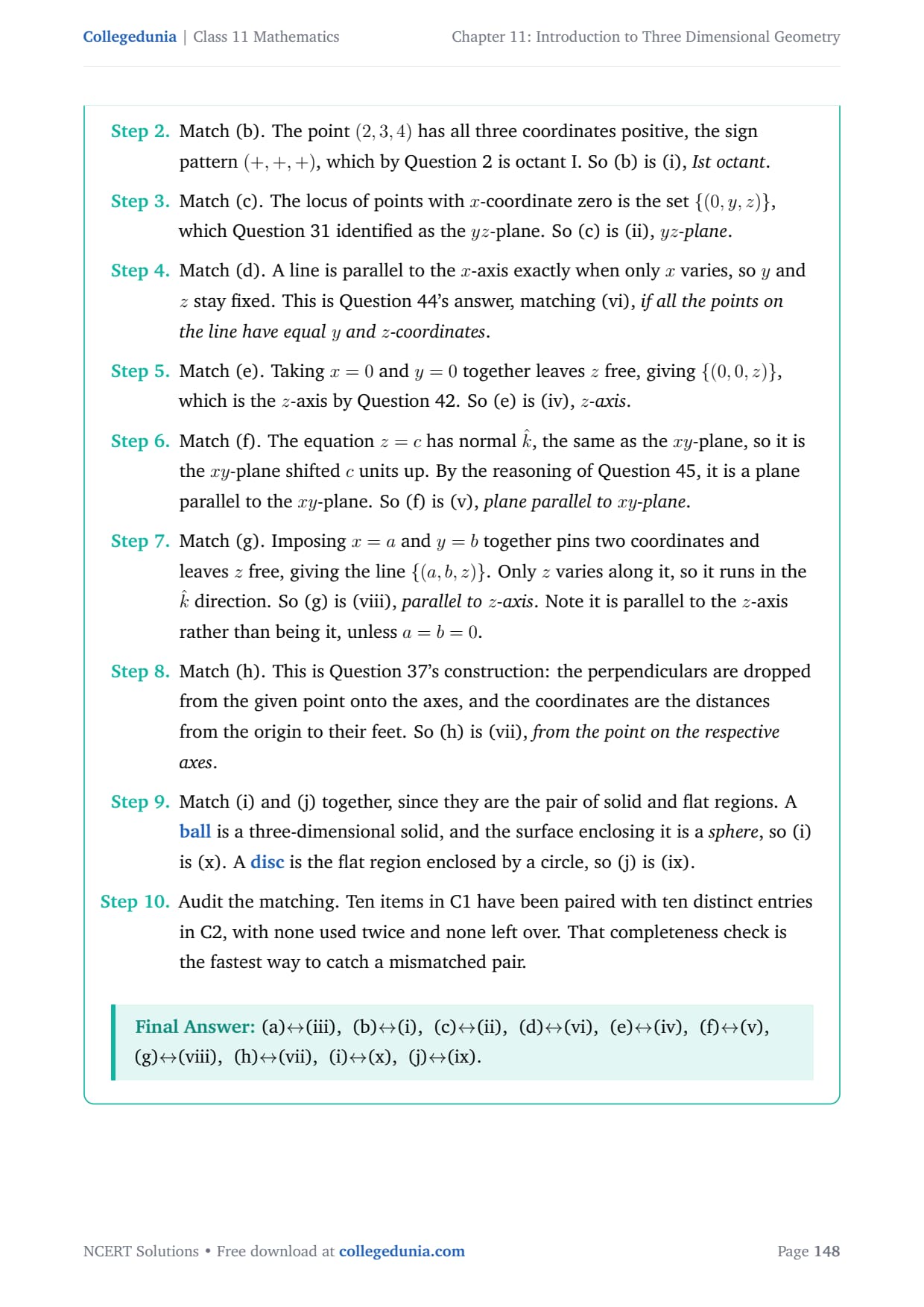
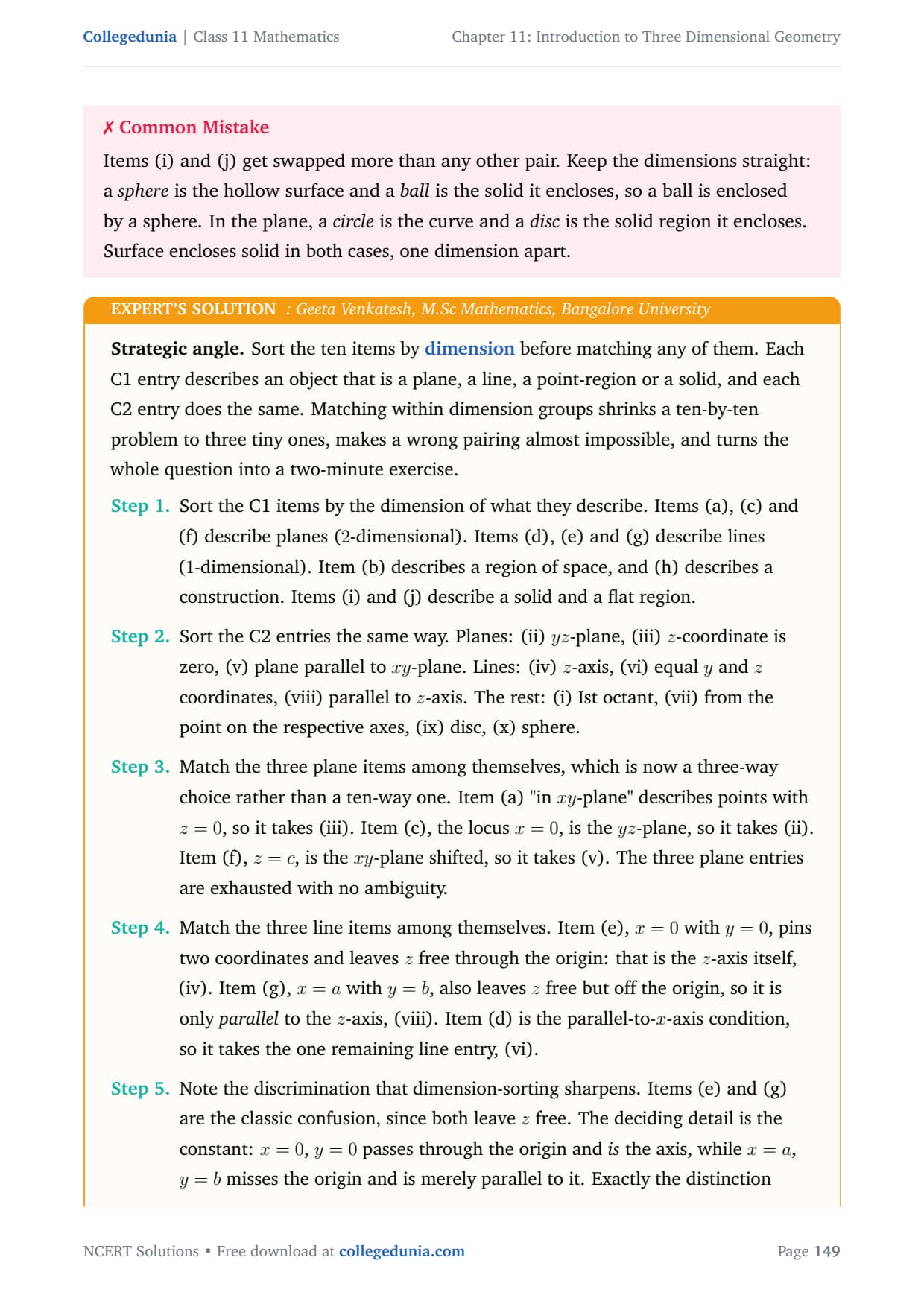
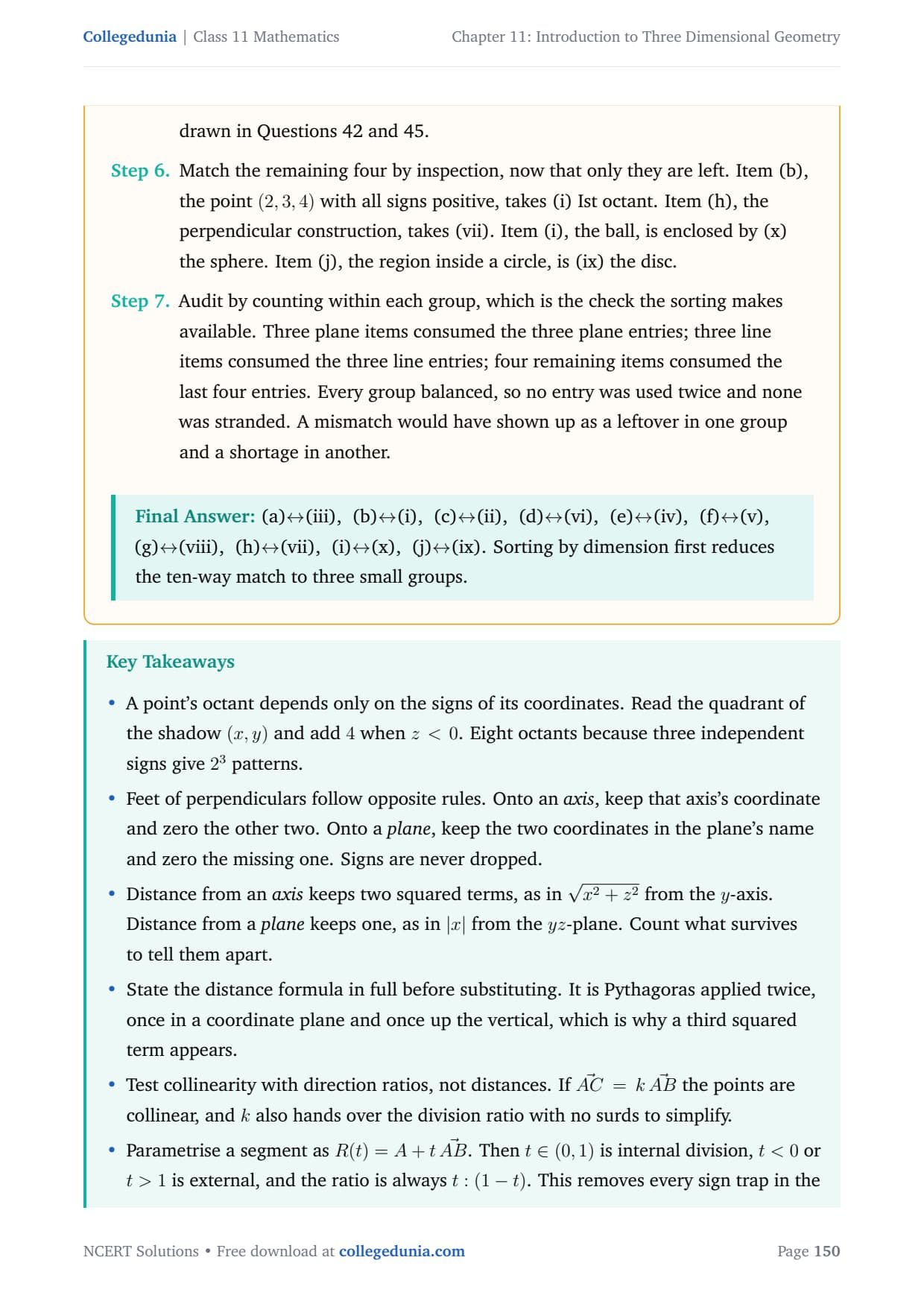
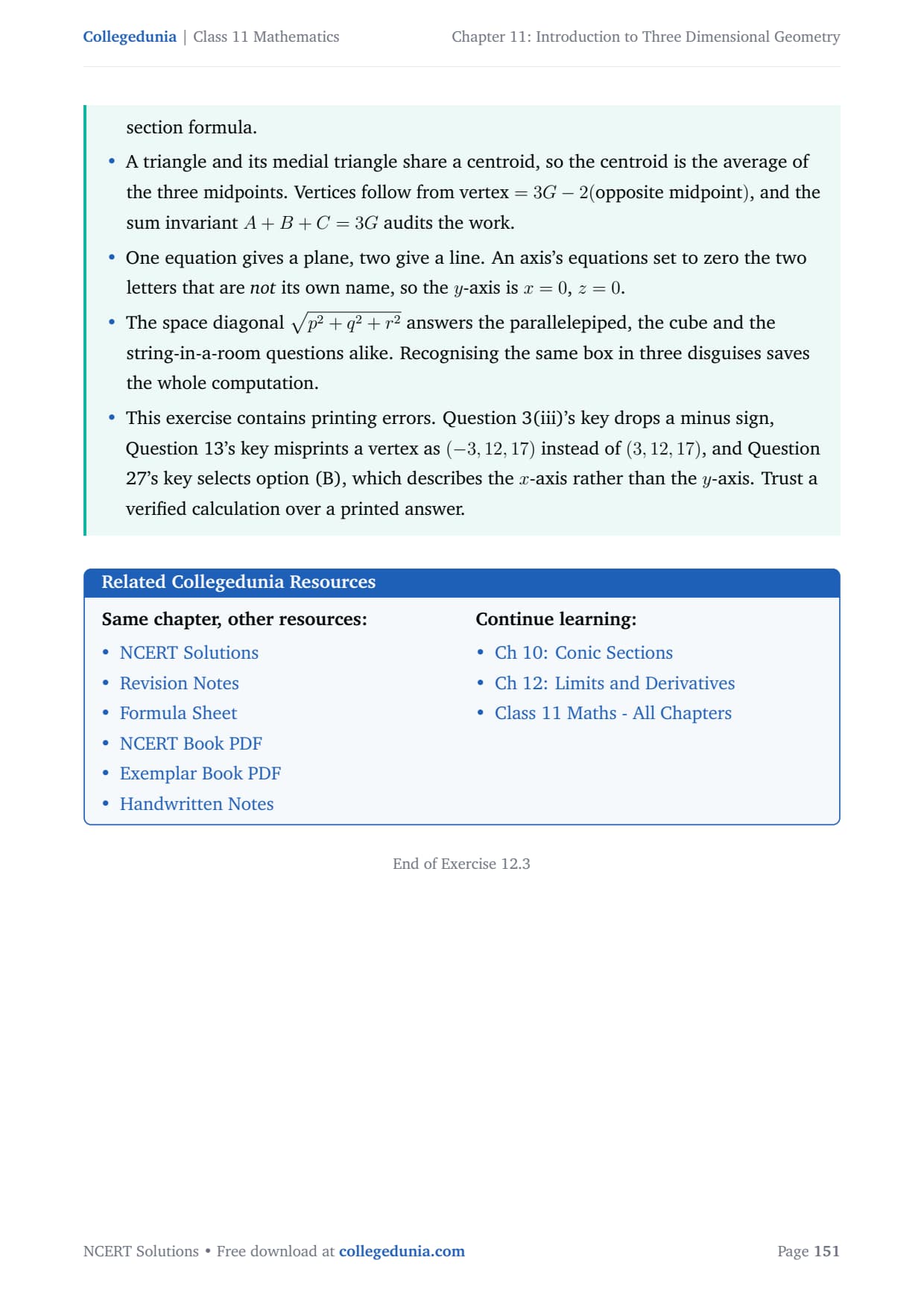
Every solution in this Collegedunia set is prepared by subject experts, based on the 2026-27 NCERT Exemplar, and checked line by line against the official answer key.
One numbering note before students start. The NCERT Exemplar book prints this chapter as its Chapter 12, and the exercise is numbered Exercise 12.3. In the current NCERT textbook order it is Chapter 11, which is the number used on this page. The questions are identical. The solutions PDF runs to 151 pages.
- 50 questions solved: Short Answer, Long Answer, Objective, Fill in the Blanks and Match the Following.
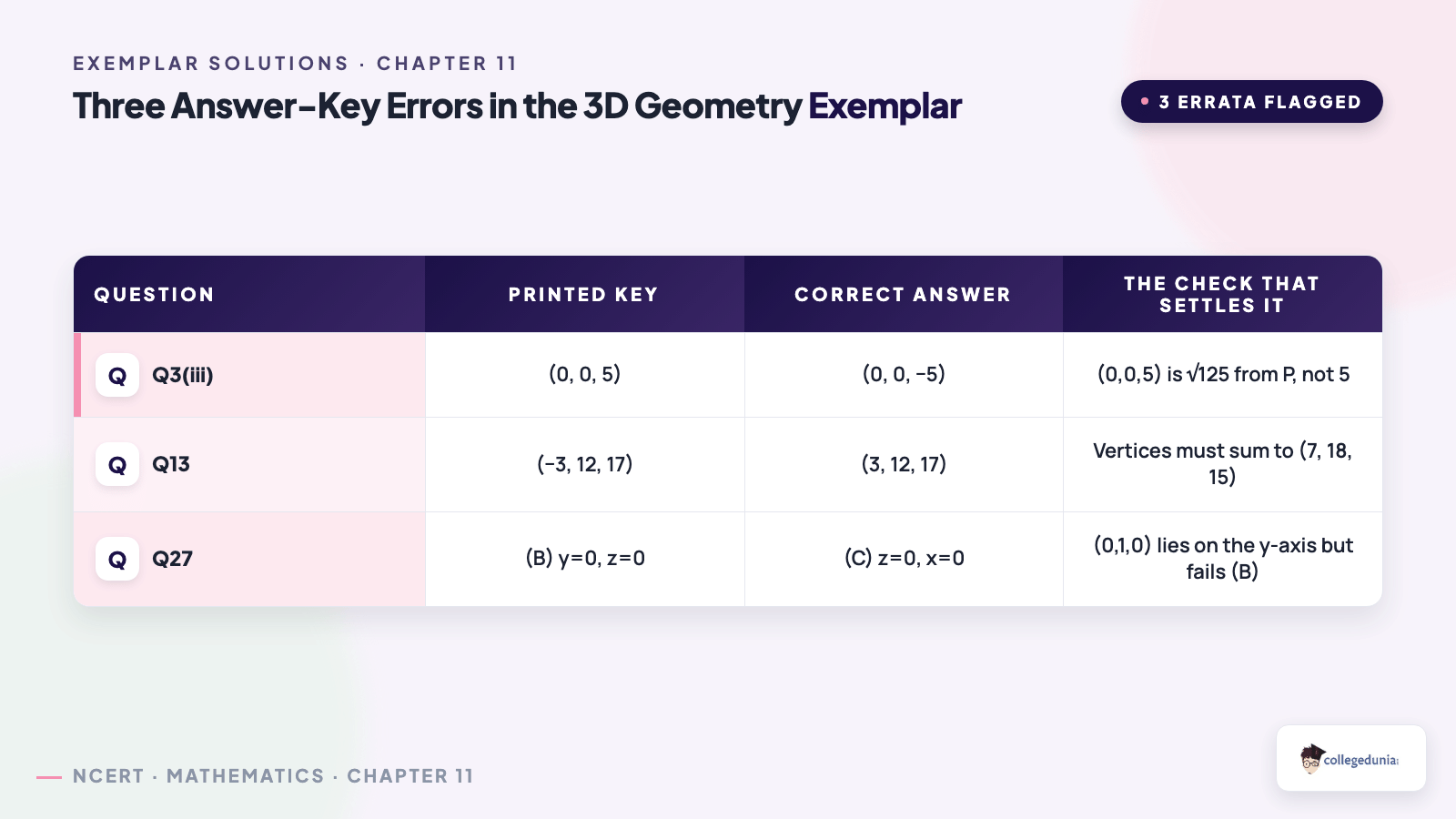
- Three answer-key errors flagged: the printed key is wrong on Q3(iii), Q13 and Q27, each with the check that settles it.
- Exam focus: useful for CBSE Boards, JEE Main, JEE Advanced and CUET.
Topics Covered in the Class 11 Maths Three Dimensional Geometry Exemplar
This is the shortest of the coordinate geometry chapters and it has only three real formulas. The Exemplar makes it harder not by adding formulas but by asking students to keep the naming rules straight: which coordinate an axis keeps, which one a plane drops, and which letters of a polygon form a side rather than a diagonal. These are the topics the 50 questions are built on.
- Octants and coordinates: naming the octant from the sign pattern of a point, and locating points such as (−2, −4, −7).
- Feet of perpendiculars: the foot of a point on an axis keeps one coordinate, the foot on a plane keeps two.
- Distance formula: the distance between two points, from the origin, from an axis and from a coordinate plane.
- Collinearity: proving three points lie on a line by showing one distance is the sum of the other two.
- Section formula: internal and external division, trisection points, and the ratio in which a point divides a segment.
- Centroid and midpoints: recovering the vertices of a triangle from the midpoints of its sides.
- Equations of axes and planes: an axis needs two equations, a plane needs exactly one.
Important: a coordinate plane is named by the two coordinates it keeps, so the distance from it is measured by the coordinate it omits. The distance from the yz-plane is |x|. From an axis the rule runs the other way: the distance from the y-axis is √(x2+z2). Read the missing letter, not the present ones.
Exercise 12.3 Question-Type Breakdown for Three Dimensional Geometry
All 50 questions sit inside the single exercise the book prints as Exercise 12.3, grouped by format. The table below shows how the exercise splits, so students can plan practice by question type rather than solving straight through.
| Question Type | Question Numbers | Count | What it tests |
|---|---|---|---|
| Short Answer | Q1 to Q17 | 17 | Octants, feet of perpendiculars, distance, section formula, centroid |
| Long Answer | Q18 to Q21 | 4 | Collinearity with a ratio, vertices from midpoints, cube coordinates |
| Objective (MCQ) | Q22 to Q34 | 13 | Distances from planes and axes, equations of axes and planes |
| Fill in the Blanks | Q35 to Q49 | 15 | Naming rules for planes, axes and parallel lines |
| Match the Following | Q50 | 1 | Matching geometric objects to their descriptions |
The Fill in the Blanks block (Q35 to Q49) is the largest single group and the most underrated. It is almost entirely definitions, so it is the fastest block to master and the one that returns the most marks per hour. The Long Answer block is only four questions, but Q19 and Q21 are the two most time-consuming questions in the chapter.
Three Answer-Key Errors in the Three Dimensional Geometry Exemplar Every Student Must Know
The printed NCERT Exemplar key for this chapter is wrong on three questions. Two are misprints in a coordinate and one is a genuinely wrong option choice. All three are settled by a check that takes seconds, and each check is given below so students can verify rather than take this page on trust.
| Question | Printed key | Correct answer | The check that settles it |
|---|---|---|---|
| Q3(iii) | (0, 0, 5) | (0, 0, −5) | (0,0,5) is √125 from P, not 5 |
| Q13 | (−3, 12, 17) | (3, 12, 17) | The vertices must sum to (7, 18, 15) |
| Q27 | (B) y = 0, z = 0 | (C) z = 0, x = 0 | (0, 1, 0) is on the y-axis but fails (B) |
Q3(iii) drops a minus sign. The question asks for the feet of the perpendiculars from P(4, −3, −5) on the three axes. The key prints (4,0,0), (0,−3,0), (0,0,5). The last entry is a misprint. P sits below the xy-plane, so its foot on the z-axis must be (0, 0, −5). The distance check settles it in one line: the foot of a perpendicular from P on the z-axis is 5 units away, and (0,0,−5) is exactly 5 away while (0,0,5) is √125 away. The key also contradicts itself, because its own part (ii) copies z = 7 across unchanged.
Q13's third vertex has the wrong sign on x. The midpoints are (5,7,11), (0,8,5) and (2,3,−1), and the key prints the vertices as (−3,4,−7), (7,2,5) and (−3,12,17). The third is a misprint: its x-coordinate should be +3. An invariant settles it without redoing the algebra. Adding the three midpoint conditions gives A + B + C = D + E + F, so the vertices must sum to (5+0+2, 7+8+3, 11+5−1) = (7, 18, 15). The key's trio sums to (1, 18, 15), which is wrong in x by exactly 6, the gap between −3 and +3. With (3, 12, 17) the sum comes out to (7, 18, 15) and the midpoint check passes.
Q27 picks an option that describes the wrong axis. The question asks for the equation of the y-axis. The key prints (B), which is y = 0, z = 0. That pair leaves x free, so it describes the x-axis, not the y-axis. The correct option is (C), z = 0 and x = 0. A one-second test settles it: the point (0, 1, 0) certainly lies on the y-axis, but option (B) demands y = 0 and this point has y = 1, so (B) excludes a genuine point of the y-axis and cannot be its equation. Option (C) demands z = 0 and x = 0, and both hold. Students should write (C) and note the reasoning in a board answer.
Key Formulas and Rules Used in the Three Dimensional Geometry Exemplar
This chapter has very few formulas, which is exactly why the Exemplar leans on the naming rules instead. Students should know this table cold before starting the exercise.
| Result | Statement | Where it is used |
|---|---|---|
| Distance formula | PQ = √[(x2−x1)2 + (y2−y1)2 + (z2−z1)2] | Q5 to Q10, Q24, Q25, Q48 |
| Distance from a plane | From the yz-plane it is |x|, from the xy-plane it is |z| | Q22, Q45, Q46 |
| Distance from an axis | From the y-axis it is √(x2+z2) | Q23, Q34 |
| Section formula (internal) | The point dividing AB in m : n is ((mx2+nx1)/(m+n), and likewise for y and z) | Q15, Q17, Q18, Q20 |
| Centroid | G = ((x1+x2+x3)/3, (y1+y2+y3)/3, (z1+z2+z3)/3) | Q11, Q12, Q16, Q49 |
| Midpoint invariant | Vertices and midpoints of a triangle have the same sum: A + B + C = D + E + F | Q13, Q19 |
| Collinearity test | A, B, C are collinear when AB + BC = AC | Q8, Q18, Q20 |
| Axis against plane | An axis needs two equations, a plane needs exactly one | Q27, Q30, Q31, Q40, Q42 |
Tip: the midpoint invariant is the most useful line in the chapter and it is not printed as a formula in the textbook. It turns Q13 and Q19 into a check students can run in ten seconds, and it is exactly what exposes the Q13 key error above.
Common Mistakes Students Make in the Three Dimensional Geometry Exemplar
The mistakes in this chapter are almost all naming mistakes, not arithmetic ones. These five cost the most marks.
- Pairing a plane with the letters in its name. The yz-plane is not y = 0, z = 0. That pair is two equations, so it is a line, and in fact it is the x-axis. The yz-plane is the single equation x = 0.
- Swapping the axis rule with the plane rule. From an axis you drop the matching coordinate and keep two. From a plane you keep only the missing one. An axis is a line, so two coordinates must vary to reach it.
- Reading AB and CD as the diagonals of a parallelogram. The letters run around the figure, so AB, BC, CD and DA are sides and AC and BD are the diagonals. Getting this wrong in Q9 produces the plausible but incorrect (−6, 8, −8).
- Writing the trisection ratio as 1 : 3. The ratio compares the two pieces AP and PB, not a piece and the whole, so cutting into three equal parts gives 1 : 2.
- Stopping at the positive root. The symbol √25 means 5 only, but the equation a2 = 25 has two solutions. Distance conditions always square the unknown, so expect a ± and then check whether the geometry rejects one. In Q25 it rejects neither.
How the Three Dimensional Geometry Exemplar Steps Up from the NCERT Textbook
The Exemplar adds no new topics here. It runs every textbook rule in reverse, as the table shows.
| Concept | NCERT Textbook asks | NCERT Exemplar asks |
|---|---|---|
| Coordinates | Name the octant of a given point | Find the feet of its perpendiculars on all three axes and planes |
| Distance | Find the distance between two points | Find an unknown coordinate from a given distance, with both roots |
| Section formula | Find the point dividing AB in a given ratio | Find the ratio from the point, including external division |
| Centroid | Find the centroid from three vertices | Recover the vertices from the midpoints of the sides |
| Planes and axes | State the equation of the xy-plane | Decide whether a given pair of equations names a plane or a line |
How to Use the Three Dimensional Geometry Exemplar for Boards and JEE Preparation
This is one of the shortest exercises in the Class 11 Maths Exemplar, so three sittings are enough. Finish the NCERT textbook exercises first, because the Exemplar assumes students can already apply the section formula without looking it up.
| Session | What to solve | Time |
|---|---|---|
| 1 | Short Answer Q1 to Q17 | 2 hours |
| 2 | Long Answer Q18 to Q21, full working written out | 1.5 hours |
| 3 | Objective Q22 to Q34 | 1 hour |
| 4 | Q35 to Q50, then re-solve everything marked wrong | 1 hour |
That is about 5.5 hours for the chapter, the smallest time investment of any chapter in this set. For JEE Main and JEE Advanced, this chapter is groundwork for the Class 12 vector and 3D geometry chapters, so the section formula and the distance rules matter most. For CBSE Boards and CUET, the Fill in the Blanks naming rules and the centroid questions are the better use of time.
Practice Questions for Class 11 Maths Three Dimensional Geometry
After reading the solutions, students should test themselves on the same question types. The card below opens a set of solved practice questions with step-by-step answers for Introduction to Three Dimensional Geometry.
Practice Card: Solved Practice Questions for Class 11 Maths Three Dimensional Geometry. Attempt each question, then check the solution.
Student Feedback
In a Collegedunia survey of 12,840 Class 11 students conducted before the 2026 exams, 68% of students said they had confused the distance-from-a-plane rule with the distance-from-an-axis rule at least once in this chapter. Only 7% of students had spotted that the printed key names the x-axis when Q27 asks for the y-axis.
Other Resources for Class 11 Maths Three Dimensional Geometry
Pair the Exemplar Solutions with the textbook solutions and the notes for full chapter revision. All the Three Dimensional Geometry resources are linked below.
| Resource | Link |
|---|---|
| NCERT Solutions | Three Dimensional Geometry Class 11 NCERT Solutions |
| Revision Notes | Three Dimensional Geometry Class 11 Notes |
| Handwritten Notes | Three Dimensional Geometry Class 11 Handwritten Notes |
| NCERT Book PDF | Three Dimensional Geometry Class 11 NCERT Book PDF |
| Exemplar Book PDF | Three Dimensional Geometry Class 11 NCERT Exemplar Book PDF |
NCERT Exemplar Solutions for Other Class 11 Maths Chapters
The full Class 11 Maths Exemplar set covers 14 chapters, 735 questions and 2,625 pages of solutions. Use the table to jump to any other chapter.
Three Dimensional Geometry Class 11 Maths NCERT Exemplar Solutions FAQs
Ques. How many questions are there in the Class 11 Maths Introduction to Three Dimensional Geometry Exemplar?
Ans. The chapter has 50 questions in a single exercise, which the Exemplar book prints as Exercise 12.3. They are split into 17 Short Answer, 4 Long Answer, 13 Objective, 15 Fill in the Blanks and 1 Match the Following question. Every one of them is solved in the 151-page PDF on this page.
Ques. Why is this chapter numbered Chapter 12 in the NCERT Exemplar book?
Ans. The NCERT Exemplar book follows an older chapter order in which Introduction to Three Dimensional Geometry is Chapter 12 and its exercise is Exercise 12.3. The current NCERT textbook lists it as Chapter 11, which is the number used on this page. The questions are identical, so either number leads to the same set.
Ques. Is the printed NCERT Exemplar answer key for Three Dimensional Geometry correct?
Ans. Not on three questions. The key is wrong on Q3(iii), Q13 and Q27. It prints the z-axis foot in Q3(iii) as (0,0,5) instead of (0,0,−5), it prints a vertex in Q13 as (−3,12,17) instead of (3,12,17), and it picks option (B) in Q27 when the correct option is (C). Each error is explained on this page with the check that settles it.
Ques. What is the equation of the y-axis in Q27 of the Three Dimensional Geometry Exemplar?
Ans. It is z = 0 and x = 0, which is option (C). An axis needs two equations, and the two that vanish are the coordinates the axis does not run along. Option (B), y = 0 and z = 0, leaves x free, so it describes the x-axis instead. Testing the point (0, 1, 0), which lies on the y-axis, rules out (B) at once.
Ques. Are the Class 11 Maths Three Dimensional Geometry Exemplar Solutions free to download?
Ans. Yes. The Introduction to Three Dimensional Geometry NCERT Exemplar Solutions PDF is free to download from this page. It runs to 151 pages, solves all 50 questions step by step according to the 2026-27 NCERT Exemplar, and helps students prepare for CBSE Boards, JEE Main, JEE Advanced and CUET.



Comments