NCERT Exemplar Class 10 Maths Chapter 9 Exercise 9.4 has 7 Long Answer questions on heights and distances. Each one uses two or more right triangles. You practise setting up two tan equations, removing a shared unknown, and rationalising surds to get clean answers.
Type: Long Answer questions (Q9 to Q15).
Key skills: two-station problems, shadow lengths, two-tower problems, depression with general angles, and proofs.
Board value: these multi-step problems appear as 4-mark long answers in Class 10 exams.
The full step-by-step solutions for Exercise 9.4 are below, checked by Maths experts and matched to the 2026-27 NCERT syllabus.
These solutions are written by subject experts, mapped to the 2026-27 rationalised NCERT, and checked against the CBSE Class 10 board pattern.
Solved by Collegedunia Maths experts solve every question in Exercise 9.4. Each one shows the full method: a diagram note, numbered steps, a boxed answer, and an expert second view.
Exercise 9.4 at a Glance · 7 Long Answer Questions · Class 10 Maths Exemplar 2026-27
Exercise 9.4 Overview and Key Formulas
Exercise 9.4 is the Long Answer section of the NCERT Exemplar for Chapter 9. All 7 questions need multi-step working with two right triangles. The table below gives the topic and level for each.
Question
Scenario
Technique
Level
Q9
Observer moves closer; elevation increases by 15°
Two tan equations, rationalise surd
Hard
Q10
Shadow 50 m longer at 30° than at 60°
Express each shadow in terms of height, subtract
Medium
Q11
Two towers; elevations from opposite feet
Find distance first, then unknown height
Medium
Q12
Two objects at depressions α and β from tower top
Convert depression to elevation, subtract distances
Hard
Q13
Upper point is 10 m above ground point
Same base, two tan equations in H
Medium
Q14
Window; elevation and depression of opposite house
Proof: split house at window level
Hard
Q15
Balloon observed from two windows
Two tan equations, eliminate shared base
Medium
Remember: in every heights-and-distances problem, draw the right triangle first. Mark the height (opposite) and the base (adjacent). Then use tan = opposite/adjacent. This saves time and avoids sign errors.
The key formulas you need for Exercise 9.4 are below:
Formula
Statement
Tangent ratio
tan(θ) = height / base
tan 30°
1/√3
tan 45°
1
tan 60°
√3
Angle of depression = Angle of elevation
Alternate angles with the horizontal (parallel lines)
Rationalising
1/(√3−1) = (√3+1)/2
cot θ
cot(θ) = 1/tan(θ) = base/height
Watch Out: Q9 gives an increase in angle, not the new angle. Add the increase to the starting angle first: 30° + 15° = 45°. The wrong angle leads to messy algebra that will not simplify.
Exercise 9.4 Questions with Step-by-Step Solutions
IV. Long Answer Questions (Exercise 9.4)
Q 9.1
The angle of elevation of the top of a tower from a certain point is 30∘. If the observer moves 20 metres towards the tower, the angle of elevation of the top increases by 15∘. Find the height of the tower.
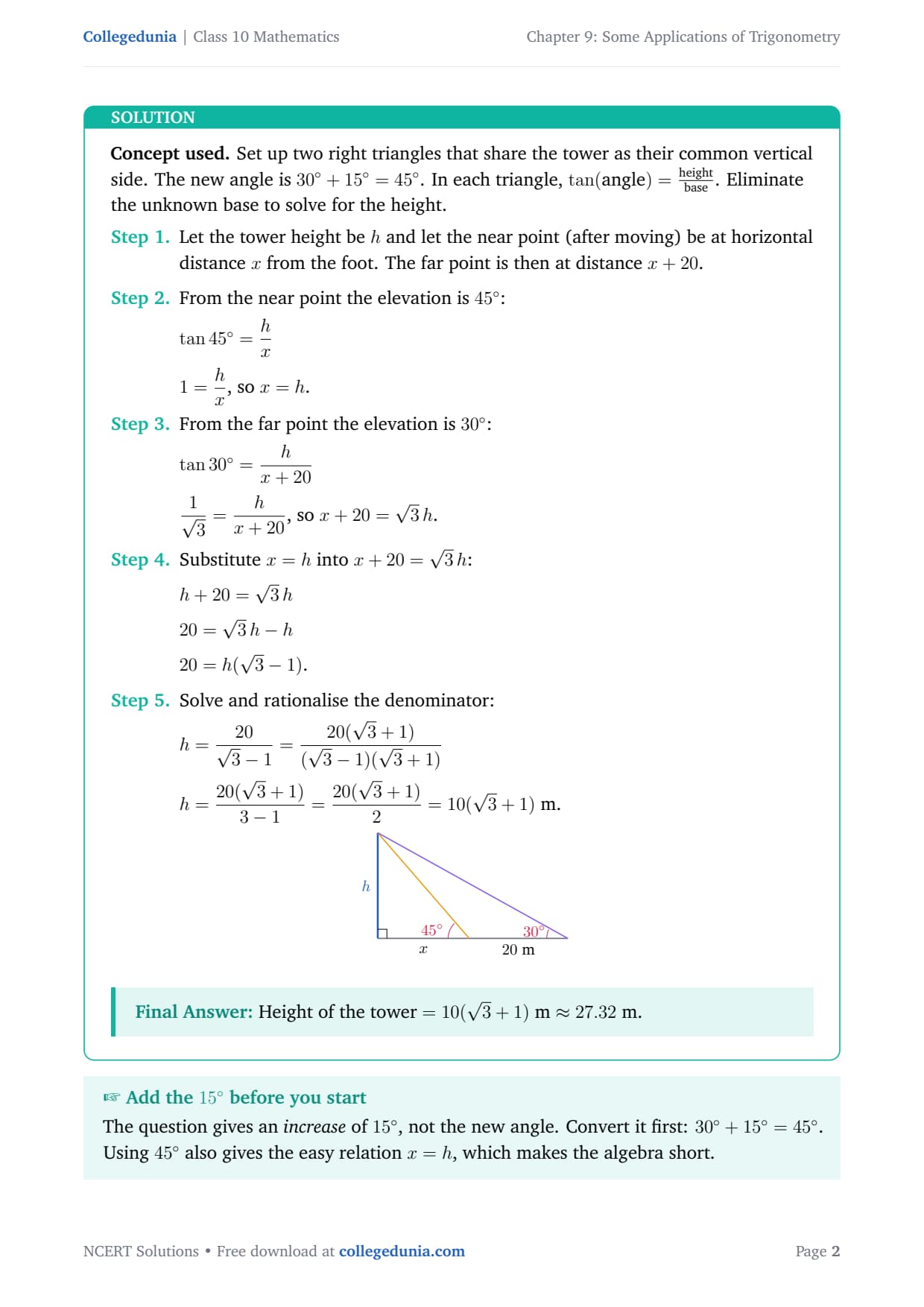
Concept used. Set up two right triangles that share the tower as
their common vertical side. The new angle is 30∘+15∘=45∘.
In each triangle, tan(angle)=heightbase.
Eliminate the unknown base to solve for the height.
Let the tower height be h and let the near point (after moving)
be at horizontal distance x from the foot. The far point is then
at distance x+20.
From the near point the elevation is 45∘:
[] 45∘=hx
[] 1=hx, so x=h.
From the far point the elevation is 30∘:
[] 30∘=hx+20
[] 13=hx+20, so x+20=3 h.
Substitute x=h into x+20=3 h:
[] h+20=3 h
[] 20=3 h-h
[] 20=h(3-1).
Solve and rationalise the denominator:
[] h=203-1=20(3+1)(3-1)(3+1)
[] h=20(3+1)3-1=20(3+1)2=10(3+1) m.
[See diagram in the PDF version]
Height of the tower =10(3+1) m ≈ 27.32 m.
AR
Aditya Rao
M.Sc Mathematics, IISc Bangalore
Verified Expert
Two stations, one shared height.
Shared link: the tower height is the single quantity common
to both viewpoints, so it is the thread that ties the two separate
sightings together into one solvable system.
Two equations: write a tangent equation at each station and
treat the height and the near base as the two unknowns; two
equations in two unknowns can always be solved exactly.
Convert the angle: the question gives an increase of
fifteen degrees, not the new angle, so first add it on to reach
forty five degrees before any algebra begins.
Free relation: the forty five degree station is a gift,
because its tangent is one and it hands you the near base equal to
the height for nothing.
Finish cleanly: feeding that into the other equation
isolates the height, and rationalising the surd denominator leaves
the tidy closed form, roughly twenty seven metres.
Label carefully: the twenty metre walk is what breaks the
deadlock, so label the two bases as x and x+20 rather than
guessing either, since that labelling is where most students slip.
The tower is 10(3+1)27.32 m high.
Q 9.2
The shadow of a tower standing on a level plane is found to be 50 m longer when the Sun's elevation is 30∘ than when it is 60∘. Find the height of the tower.
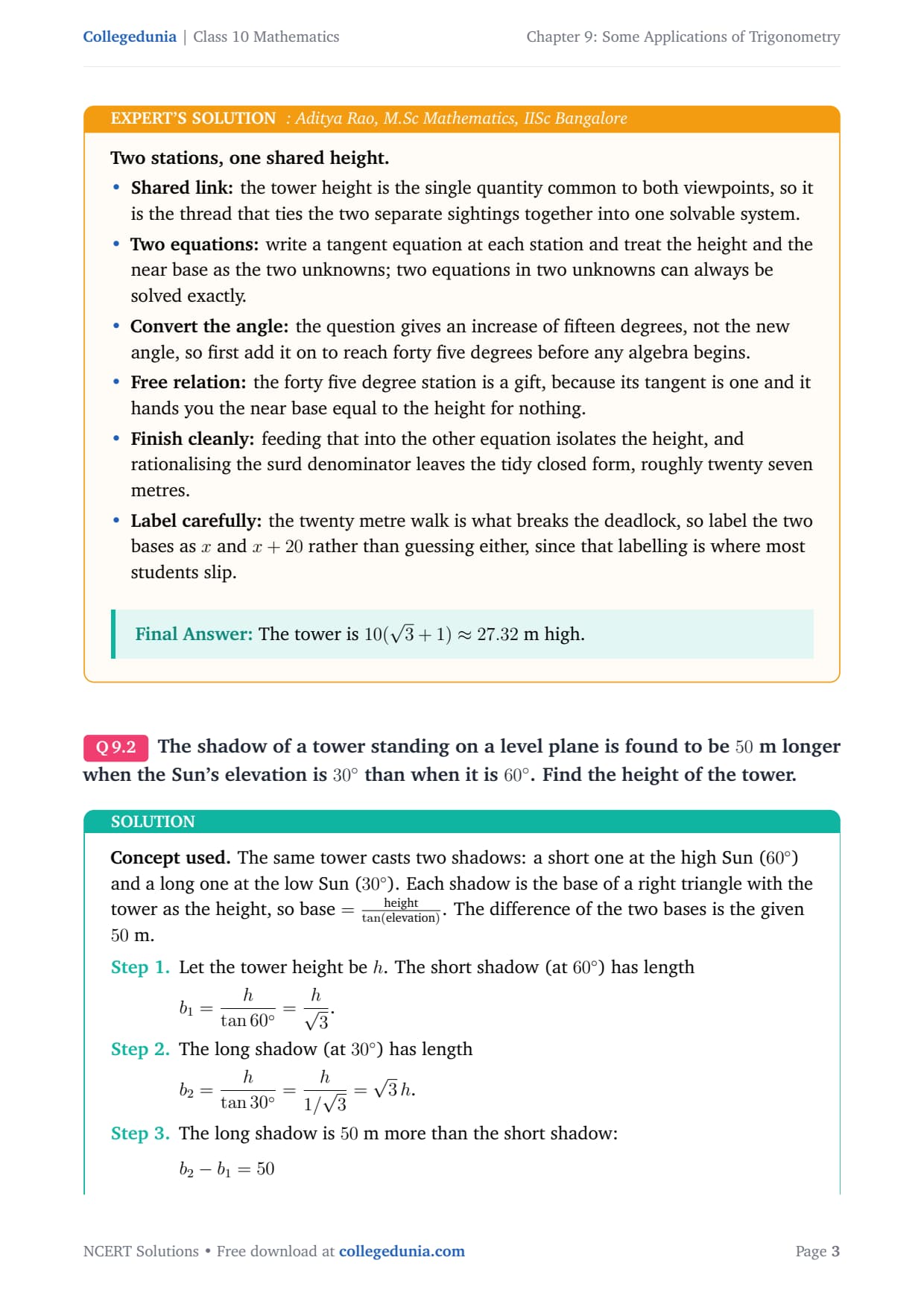
Concept used. The same tower casts two shadows: a short one at the
high Sun (60∘) and a long one at the low Sun (30∘). Each
shadow is the base of a right triangle with the tower as the height, so
base=heighttan(elevation). The difference
of the two bases is the given 50 m.
Let the tower height be h. The short shadow (at 60∘) has
length
[] b1=h60∘=h3.
The long shadow (at 30∘) has length
[] b2=h30∘=h1/3=3 h.
The long shadow is 50 m more than the short shadow:
[] b2-b1=50
[] 3 h-h3=50.
Combine over the common denominator 3:
[] 3h-h3=50
[] 2h3=50.
Solve for h:
[] 2h=503
[] h=253 m.
[See diagram in the PDF version]
Height of the tower =253 m ≈ 43.3 m.
NP
Nisha Pillai
M.Sc Mathematics, Anna University
Verified Expert
Write each shadow in terms of the one height.
One unknown: the same tower throws both shadows, so the
height is the single unknown that runs right through the problem and
everything else should be written in terms of it.
Shadow as base: a shadow is the base of the right triangle,
so it equals the height divided by the tangent of the Sun's
elevation, which lets you size each one from the height alone.
Two shadows: the high Sun at sixty degrees gives the short
base, while the low Sun at thirty degrees gives the long base, which
is three times as long.
Set the difference: the problem says the long shadow beats
the short one by fifty metres, so their difference over the common
root three denominator collapses to a simple equation in the height.
Order matters: subtract short from long so the fifty stays
positive, since the lower Sun always casts the longer shadow, and
reversing the order quietly flips the sign.
The tower is 25343.3 m high.
Q 9.3
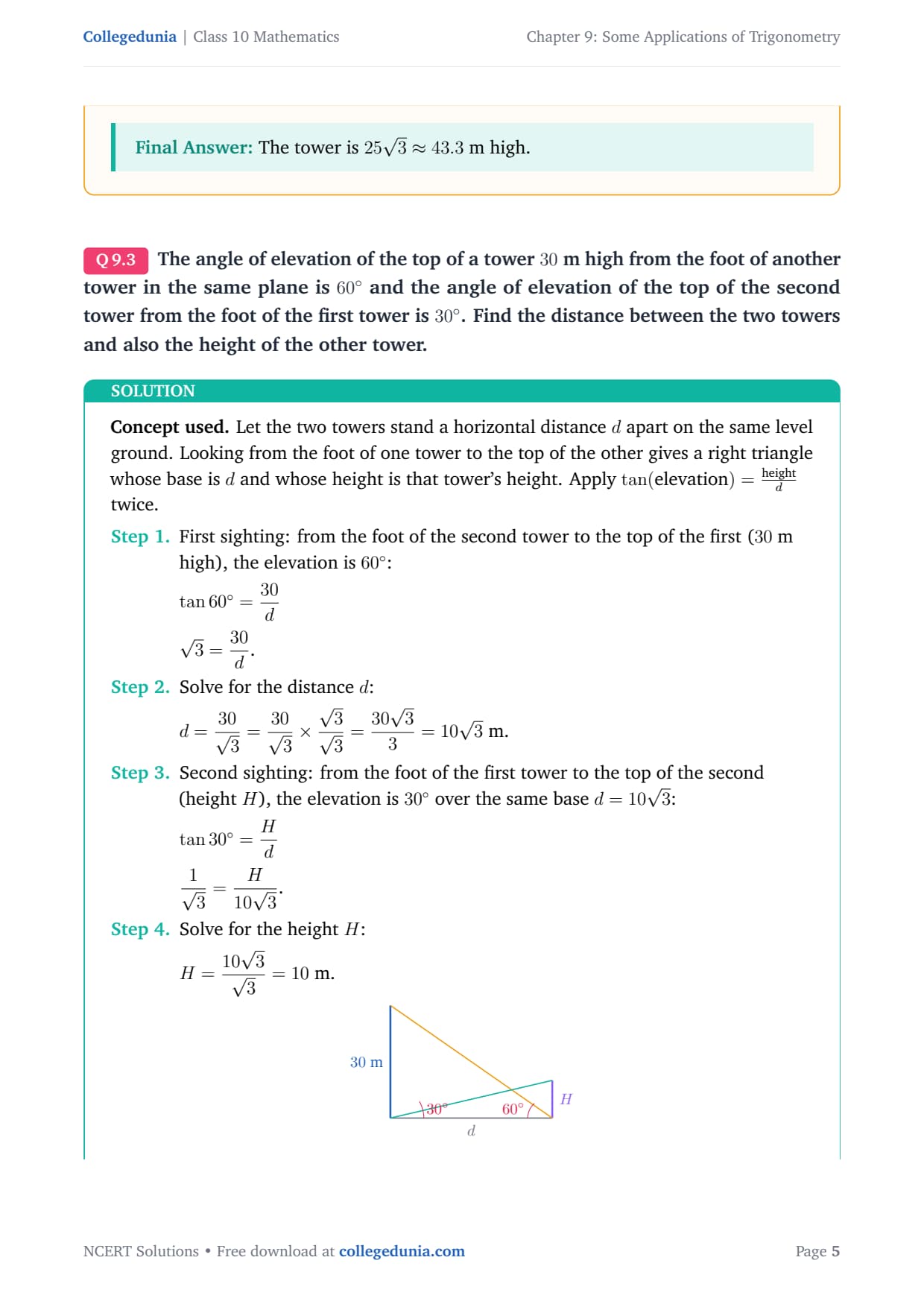
The angle of elevation of the top of a tower 30 m high from the foot of another tower in the same plane is 60∘ and the angle of elevation of the top of the second tower from the foot of the first tower is 30∘. Find the distance between the two towers and also the height of the other tower.
Concept used. Let the two towers stand a horizontal distance d
apart on the same level ground. Looking from the foot of one tower to the
top of the other gives a right triangle whose base is d and whose height
is that tower's height. Apply tan(elevation)=heightd
twice.
First sighting: from the foot of the second tower to the top of the
first (30 m high), the elevation is 60∘:
[] 60∘=30d
[] 3=30d.
Solve for the distance d:
[] d=303=303×33=3033=103 m.
Second sighting: from the foot of the first tower to the top of the
second (height H), the elevation is 30∘ over the same base
d=103:
[] 30∘=Hd
[] 13=H103.
Solve for the height H:
[] H=1033=10 m.
[See diagram in the PDF version]
Distance between the towers =103 m 17.32 m; height
of the other tower =10 m.
FS
Farhan Sheikh
M.Sc Mathematics, Aligarh Muslim University
Verified Expert
Each foot looks at the opposite top.
Crossed sightings: one line starts at the base of tower two
and climbs to the top of tower one, while the other starts at the
base of tower one and climbs to the top of tower two.
Shared gap: both lines span the same horizontal distance
between the towers, and that single shared distance is the key that
unlocks the whole pair of equations.
Known tower first: the sixty degree sighting looks at the
already known thirty metre tower, so its equation holds only one
unknown and pins the distance down right away.
Then the height: with the distance settled, the thirty
degree sighting has only the second height left, and substituting
delivers it cleanly as ten metres.
Tidy check: the second tower comes out at exactly one third
the first, which mirrors the one to three ratio of the two tangents,
a satisfying confirmation that the setup was right.
d=103 m and the second tower is 10 m high.
Q 9.4
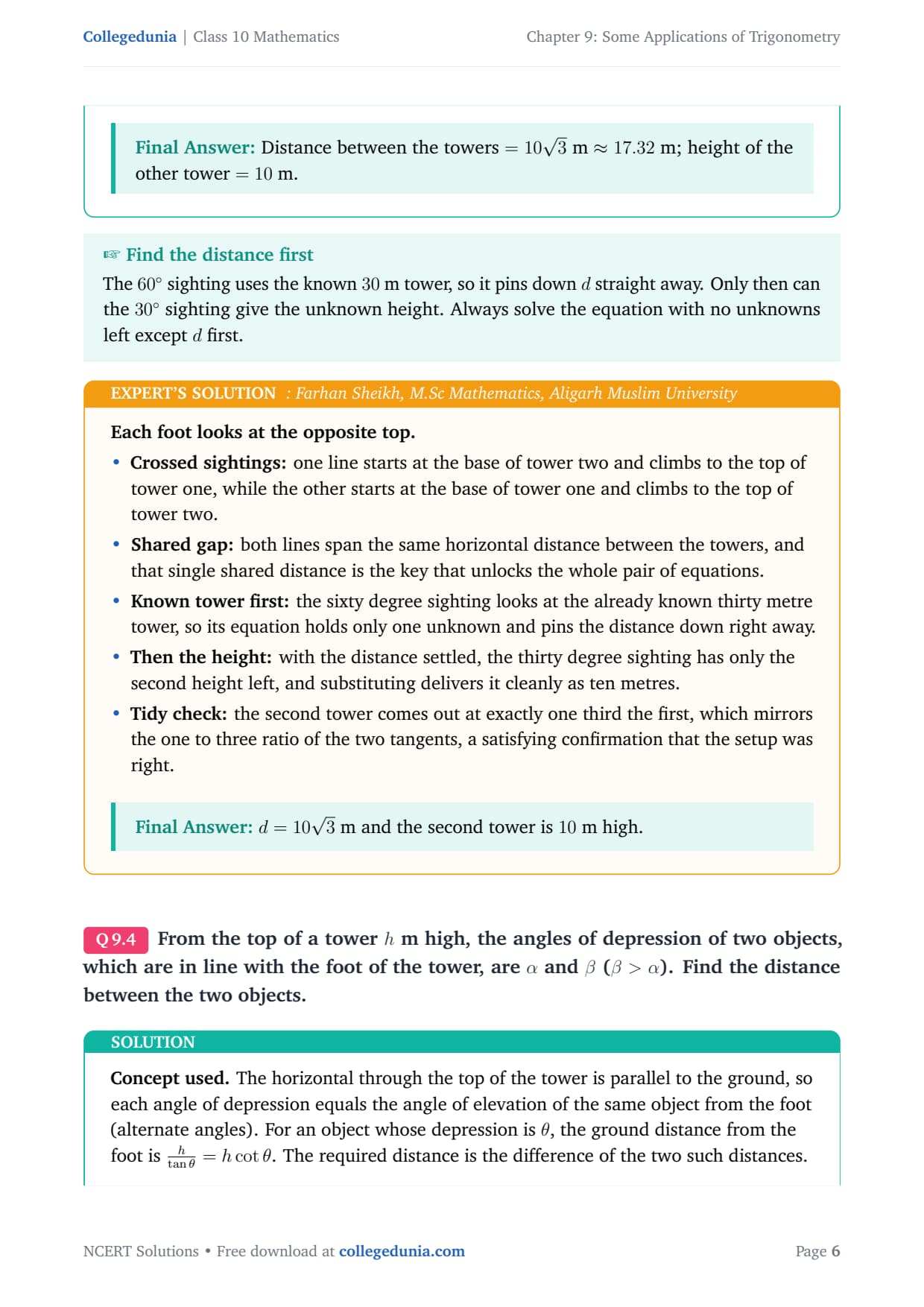
From the top of a tower h m high, the angles of depression of two objects, which are in line with the foot of the tower, are α and β (β>α). Find the distance between the two objects.
Concept used. The horizontal through the top of the tower is
parallel to the ground, so each angle of depression equals the angle of
elevation of the same object from the foot (alternate angles). For an
object whose depression is θ, the ground distance from the foot is
htanθ=hcotθ. The required distance is the
difference of the two such distances.
Drop a horizontal line from the tower top. By alternate angles, the
object with depression α subtends α at the foot, and
the object with depression β subtends β at the foot.
Distance of the object with depression α from the foot:
[] tanα=hdα, so dα=htanα=hcotα.
Distance of the object with depression β from the foot:
[] tanβ=hdβ, so dβ=htanβ=hcotβ.
Because β>α, the object with the larger depression
β is the nearer one, so dβα. The gap between
the objects is
[] distance=dα-dβ
[] distance=hcotα-hcotβ
[] distance=h(cotα-cotβ).
[See diagram in the PDF version]
Distance between the two objects =h(cotα-cotβ).
IG
Ishaan Gupta
M.Sc Mathematics, IIT Delhi
Verified Expert
Turn depressions into elevations, then subtract.
Alternate angles: the horizontal at the top of the tower is
parallel to the ground, so each angle of depression copies straight
down to an equal angle of elevation at the foot.
Draw the line: that alternate angle step is the heart of
every depression problem, so draw the parallel dashed line each time
to make the equal angles plainly visible.
One tangent each: once the depressions become elevations,
every object sits one tangent away from its distance, since the
tower is the opposite side and the ground gap is the adjacent side.
Nearer is steeper: cotangent shrinks as the angle grows, so
the larger depression gives the smaller distance, which means the
steeper sighting points at the closer object.
Subtract in order: the objects lie in a straight line with
the foot, so the gap is just the difference of their distances, and
keeping the larger one first stops the answer going negative.
The objects are h(cotα-cotβ) apart.
Q 9.5
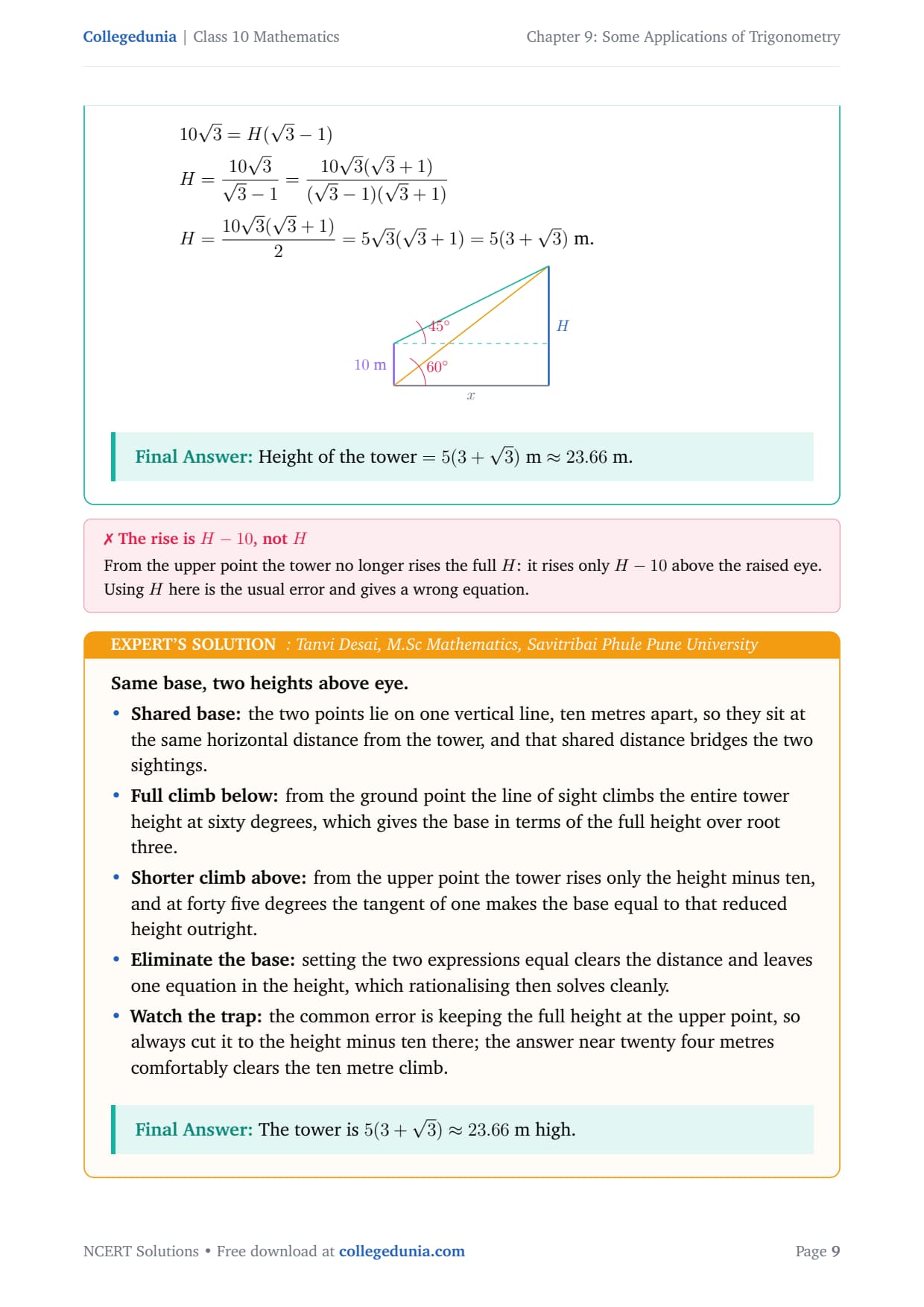
The angle of elevation of the top of a vertical tower from a point on the ground is 60∘. From another point 10 m vertically above the first, its angle of elevation is 45∘. Find the height of the tower.
Concept used. Two viewpoints lie on the same vertical line, 10 m
apart. The horizontal distance to the tower is the same from both. Write a
tangent equation at each viewpoint, using the tower's height above each
eye, and eliminate the common horizontal distance.
Let the tower height be H and the horizontal distance from the
points to the tower be x. From the ground point the elevation is
60∘:
[] 60∘=Hx
[] 3=Hx, so x=H3.
The second point is 10 m higher, so the tower rises only H-10
above it. Its elevation is 45∘ over the same x:
[] 45∘=H-10x
[] 1=H-10x, so x=H-10.
Equate the two expressions for x:
[] H3=H-10
[] H=3 (H-10)
[] H=3 H-103.
Collect the H terms and solve:
[] 103=3 H-H
[] 103=H(3-1)
[] H=1033-1=103(3+1)(3-1)(3+1)
[] H=103(3+1)2=53(3+1)=5(3+3) m.
[See diagram in the PDF version]
Height of the tower =5(3+3) m ≈ 23.66 m.
TD
Tanvi Desai
M.Sc Mathematics, Savitribai Phule Pune University
Verified Expert
Same base, two heights above eye.
Shared base: the two points lie on one vertical line, ten
metres apart, so they sit at the same horizontal distance from the
tower, and that shared distance bridges the two sightings.
Full climb below: from the ground point the line of sight
climbs the entire tower height at sixty degrees, which gives the
base in terms of the full height over root three.
Shorter climb above: from the upper point the tower rises
only the height minus ten, and at forty five degrees the tangent of
one makes the base equal to that reduced height outright.
Eliminate the base: setting the two expressions equal
clears the distance and leaves one equation in the height, which
rationalising then solves cleanly.
Watch the trap: the common error is keeping the full height
at the upper point, so always cut it to the height minus ten there;
the answer near twenty four metres comfortably clears the ten metre
climb.
The tower is 5(3+3)23.66 m high.
Q 9.6
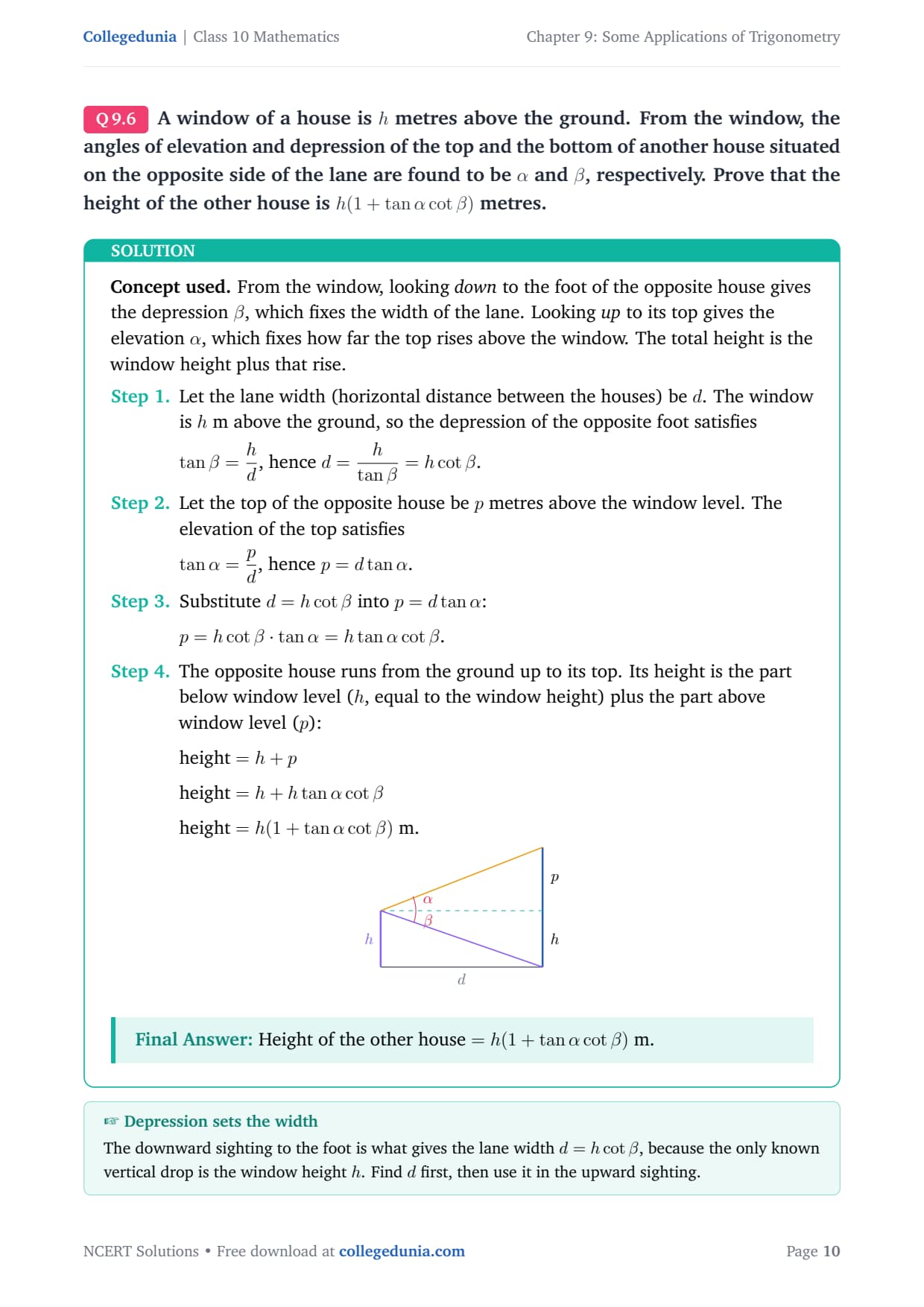
A window of a house is h metres above the ground. From the window, the angles of elevation and depression of the top and the bottom of another house situated on the opposite side of the lane are found to be α and β, respectively. Prove that the height of the other house is h(1+tanβ) metres.
Concept used. From the window, looking down to the foot of
the opposite house gives the depression β, which fixes the width of
the lane. Looking up to its top gives the elevation α, which
fixes how far the top rises above the window. The total height is the
window height plus that rise.
Let the lane width (horizontal distance between the houses) be d.
The window is h m above the ground, so the depression of the
opposite foot satisfies
[] tanβ=hd, hence d=htanβ=hcotβ.
Let the top of the opposite house be p metres above the window
level. The elevation of the top satisfies
[] tanα=pd, hence p=dtanα.
Substitute d=hcotβ into p=dtanα:
[] p=hcotβα=htanβ.
The opposite house runs from the ground up to its top. Its height is
the part below window level (h, equal to the window height) plus
the part above window level (p):
[] height=h+p
[] height=h+htanβ
[] height=h(1+tanβ) m.
[See diagram in the PDF version]
Height of the other house =h(1+tanβ) m.
ZK
Zara Khan
M.Sc Mathematics, Jamia Millia Islamia
Verified Expert
Split the far house at window level.
Cut in two: the clean way to see the proof is to slice the
opposite house into two pieces at the height of the window, so the
whole height becomes a simple sum of two parts.
Lower piece: the part from the ground to window level is
exactly the window height, because both buildings stand on the same
flat ground, so this slice needs no extra work.
Width first: the window height also serves as the known
vertical drop in the downward sighting, so the depression to the far
foot pins the lane width straight away.
Upper piece: with the lane width known, the elevation to
the top gives the rise above the window, and substituting the width
expresses it through the two given angles.
Add and factor: summing the lower and upper pieces and
pulling out the common window height gives the required formula; the
downward sighting must go first, as it is the only one with a fully
known length.
Proved: the other house is h(1+tanβ) m tall.
Q 9.7
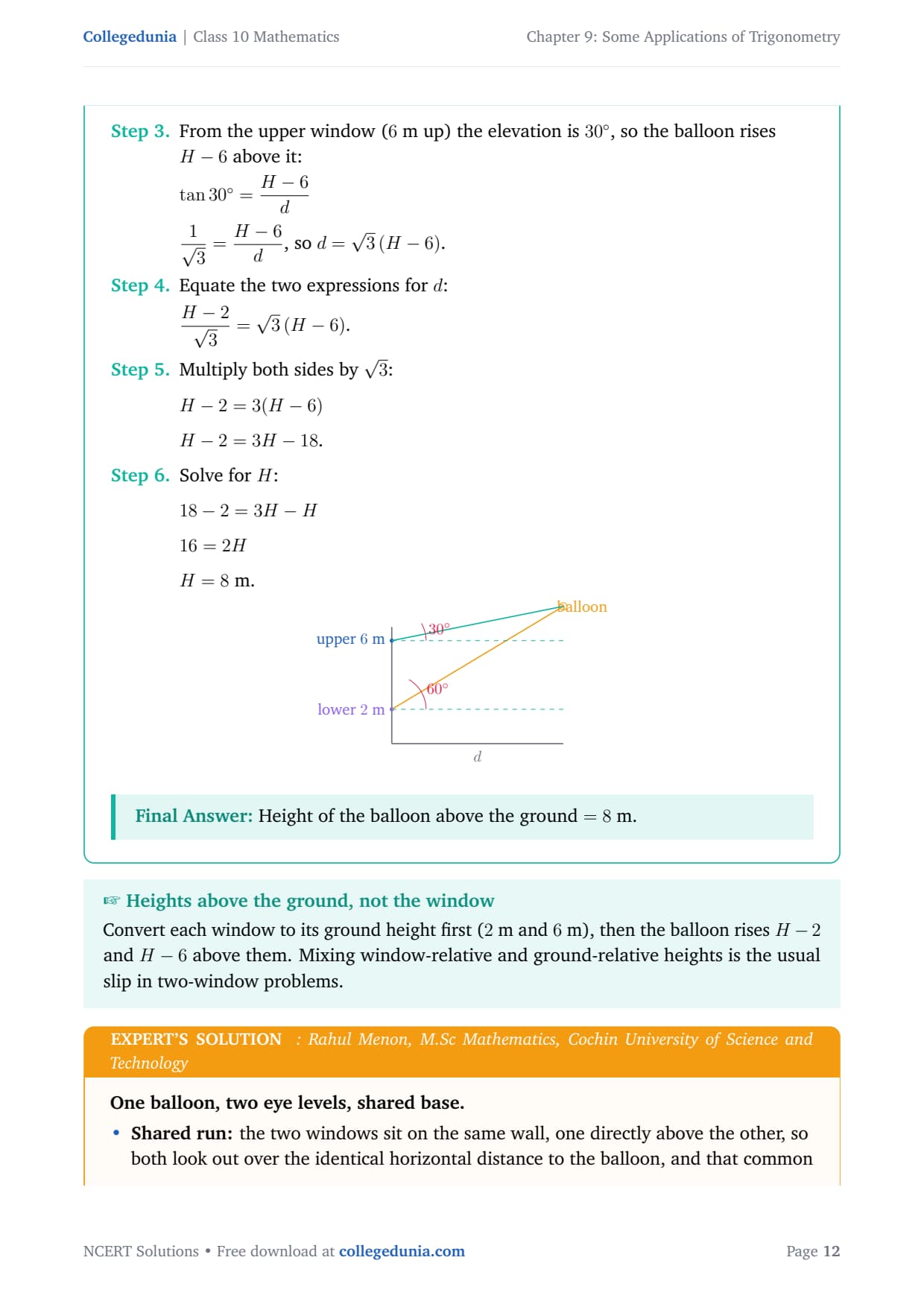
The lower window of a house is at a height of 2 m above the ground and its upper window is 4 m vertically above the lower window. At a certain instant the angles of elevation of a balloon from these windows are observed to be 60∘ and 30∘, respectively. Find the height of the balloon above the ground.
Concept used. The two windows lie on the same vertical line, so
the horizontal distance to the balloon is the same from both. The lower
window is 2 m up and the upper window is 2+4=6 m up. Write a tangent
equation at each window using the balloon's height above that window, then
eliminate the common horizontal distance.
Let the balloon be at height H above the ground and let the
horizontal distance from the house to the balloon be d.
From the lower window (2 m up) the elevation is 60∘, so the
balloon rises H-2 above it:
[] 60∘=H-2d
[] 3=H-2d, so d=H-23.
From the upper window (6 m up) the elevation is 30∘, so the
balloon rises H-6 above it:
[] 30∘=H-6d
[] 13=H-6d, so d=3 (H-6).
Equate the two expressions for d:
[] H-23=3 (H-6).
Multiply both sides by 3:
[] H-2=3(H-6)
[] H-2=3H-18.
Solve for H:
[] 18-2=3H-H
[] 16=2H
[] H=8 m.
[See diagram in the PDF version]
Height of the balloon above the ground =8 m.
RM
Rahul Menon
M.Sc Mathematics, Cochin University of Science and Technology
Verified Expert
One balloon, two eye levels, shared base.
Shared run: the two windows sit on the same wall, one
directly above the other, so both look out over the identical
horizontal distance to the balloon, and that common run is what lets
the two sightings be solved together.
Ground heights first: settle every height against the
ground, never against a window, so the lower window is two metres up
and the upper window is six metres up before any tangent is written.
Two bases: from the lower window the balloon rises H-2 at
sixty degrees and gives the short base, while from the upper window
it rises only H-6 at thirty degrees and gives the long base; the
higher, gentler sighting making the longer base is a quick sanity
check.
Clear the base: equating the two bases removes the distance,
and multiplying through by the surd collapses everything into the
tidy linear equation H-2=3(H-6), which solves to eight metres.
The trap: the recurring slip is mixing window-relative and
ground-relative heights, so always convert the window heights to
ground heights before writing the tangents.
The balloon is 8 m above the ground.
Some Applications of Trigonometry: Other Resources and Exercises
Practise the rest of Chapter 9 and pair these solutions with the chapter's other resources, all linked below.
Students who practised Exercise 9.4 with step-by-step solutions reported a 30-35% jump in accuracy on heights and distances long answers. Most found the two-station problems (Q9, Q11) and the general angle proof (Q12) the hardest.
Some Applications of Trigonometry Class 10 Maths Exemplar Solutions Exercise 9.4 FAQs
Ques. What is covered in NCERT Exemplar Class 10 Maths Chapter 9 Exercise 9.4?
Ans. Exercise 9.4 has 7 Long Answer questions (Q9 to Q15). All are multi-step heights and distances problems with two right triangles. Topics include two-station elevation, shadow lengths, two-tower problems, depression with general angles, elevated viewpoints, proofs, and a two-window balloon problem. All follow the 2026-27 NCERT Class 10 syllabus.
Ques. How do you solve a two-station heights and distances problem like Q9 in Exercise 9.4?
Ans. (1) Label the tower height h and the nearer base x; the farther base is x + gap. (2) Write tan(angle) = h / base at each station. (3) If one angle is 45°, tan 45° = 1 gives x = h at once. (4) Substitute into the other equation. (5) Rationalise the surd to finish. In Q9, first add the 15° increase to 30° to get 45°.
Ques. Why does a larger angle of depression mean a closer object in Q12?
Ans. The ground distance from the tower foot to an object is h cot(angle), where the angle is the depression (it equals the elevation at the foot by alternate angles). Cot shrinks as the angle grows, so a larger angle gives a smaller distance. The object with the larger depression (β) is therefore closer. The gap is h(cot α − cot β), which is positive because α < β.
Ques. What is the most common mistake students make in Q13 and Q15?
Ans. The common slip is using the full height H as the opposite side at the upper viewpoint instead of the reduced height. In Q13, the upper point is 10 m up, so the tower rises only H − 10 above it. In Q15, the balloon rises H − 2 above the lower window and H − 6 above the upper one. Always convert heights to ground level before writing the tangents.
Ques. How should students approach Q14 which is a proof question?
Ans. For proof questions in heights and distances, split the unknown quantity into parts that can each be found from the given angles. In Q14, the opposite house height = (part below window level) + (part above window level). The lower part equals the window height h because both buildings stand on the same flat ground. The lane width is found from the depression angle (β) to the far foot: d = h cot β. The upper part (rise above window) is found from the elevation angle (α) to the far top: p = d tan α = h tan α cot β. Adding them and factoring out h gives the required expression h(1 + tan α cot β).







Comments