



NCERT Exemplar Class 10 Maths Chapter 9 Exercise 9.3 has 3 Short Answer questions on angles of elevation and depression. Each one builds a right triangle from a real scene: a shadow, a leaning ladder, an observer and a tower. You then apply one trig ratio to find the unknown. Solutions follow the 2026-27 CBSE syllabus.
- Type: 3 Short Answer questions on heights and distances.
- Key skills: angle of elevation and depression, tan and cos ratios, eye-height adjustment.
- Board value: these patterns show up in CBSE Class 10 papers almost every year.
Below you get every Short Answer question of Exercise 9.3 worked step by step, in line with the 2026-27 NCERT syllabus.
These solutions are written by Mathematics experts, checked against the official NCERT Exemplar book, and matched to the 2026-27 CBSE Class 10 syllabus.
Exercise 9.3 Overview and Key Formulas
Exercise 9.3 is the Short Answer section of the NCERT Exemplar for Chapter 9. All 3 questions ask you to set up a right triangle, pick the correct trig ratio, and solve. The question types are listed below.
| Question | Scenario | Ratio | Level |
|---|---|---|---|
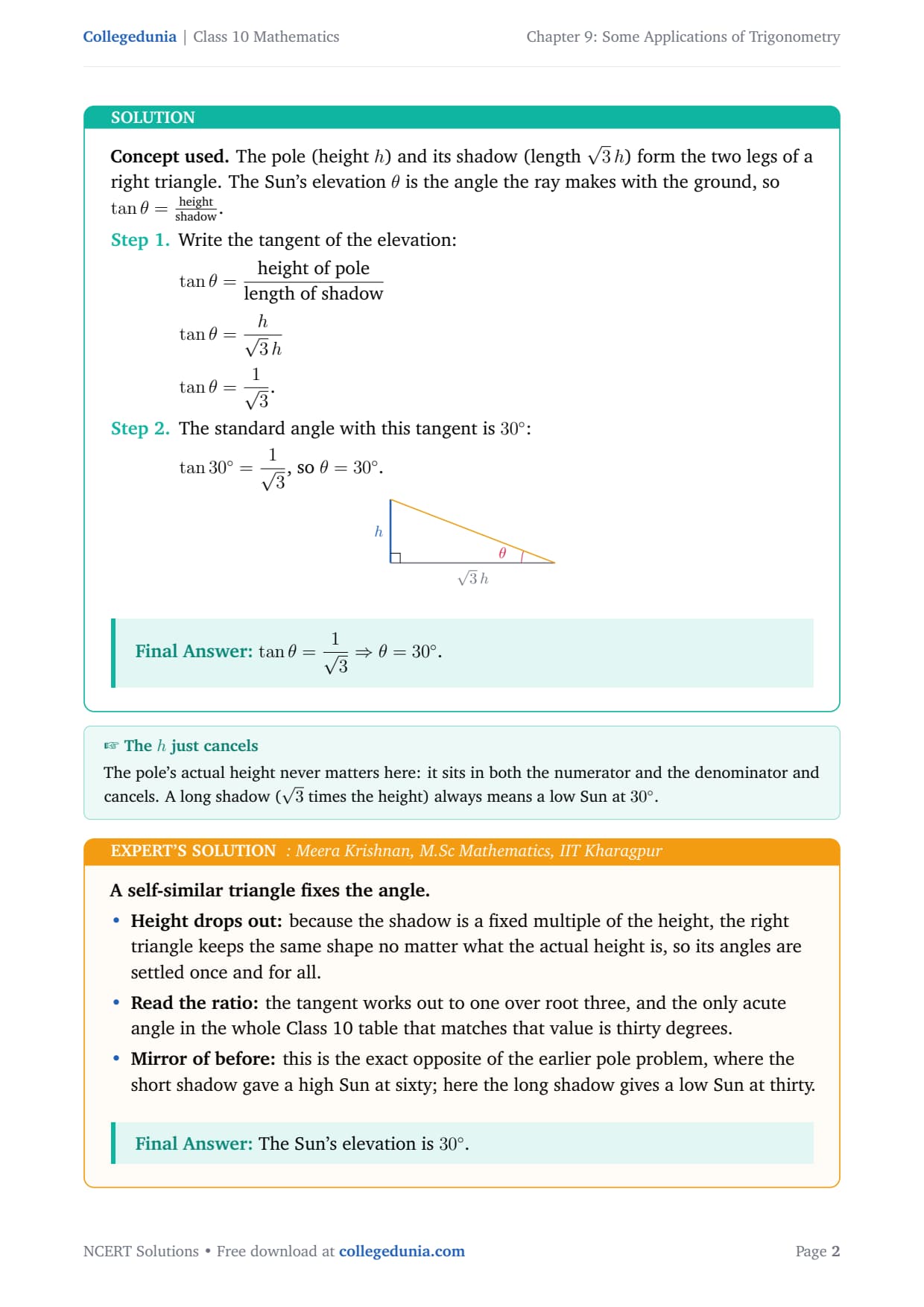
| Q6 | Shadow of a pole h metres high is √3 h metres long - find Sun's elevation | tanθ | Easy |
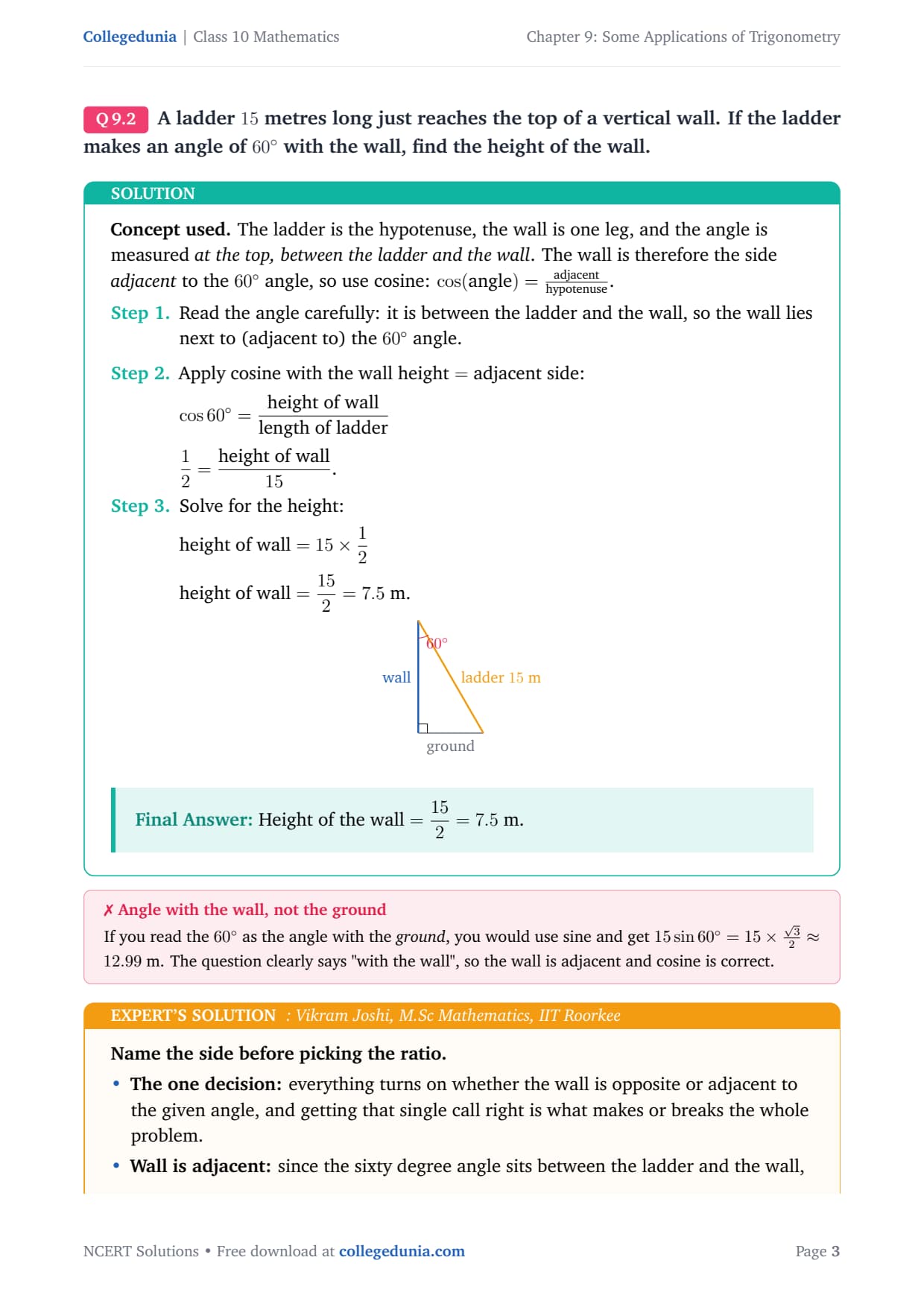
| Q7 | Ladder 15 m long makes 60° with the wall - find wall height | cosθ | Medium |
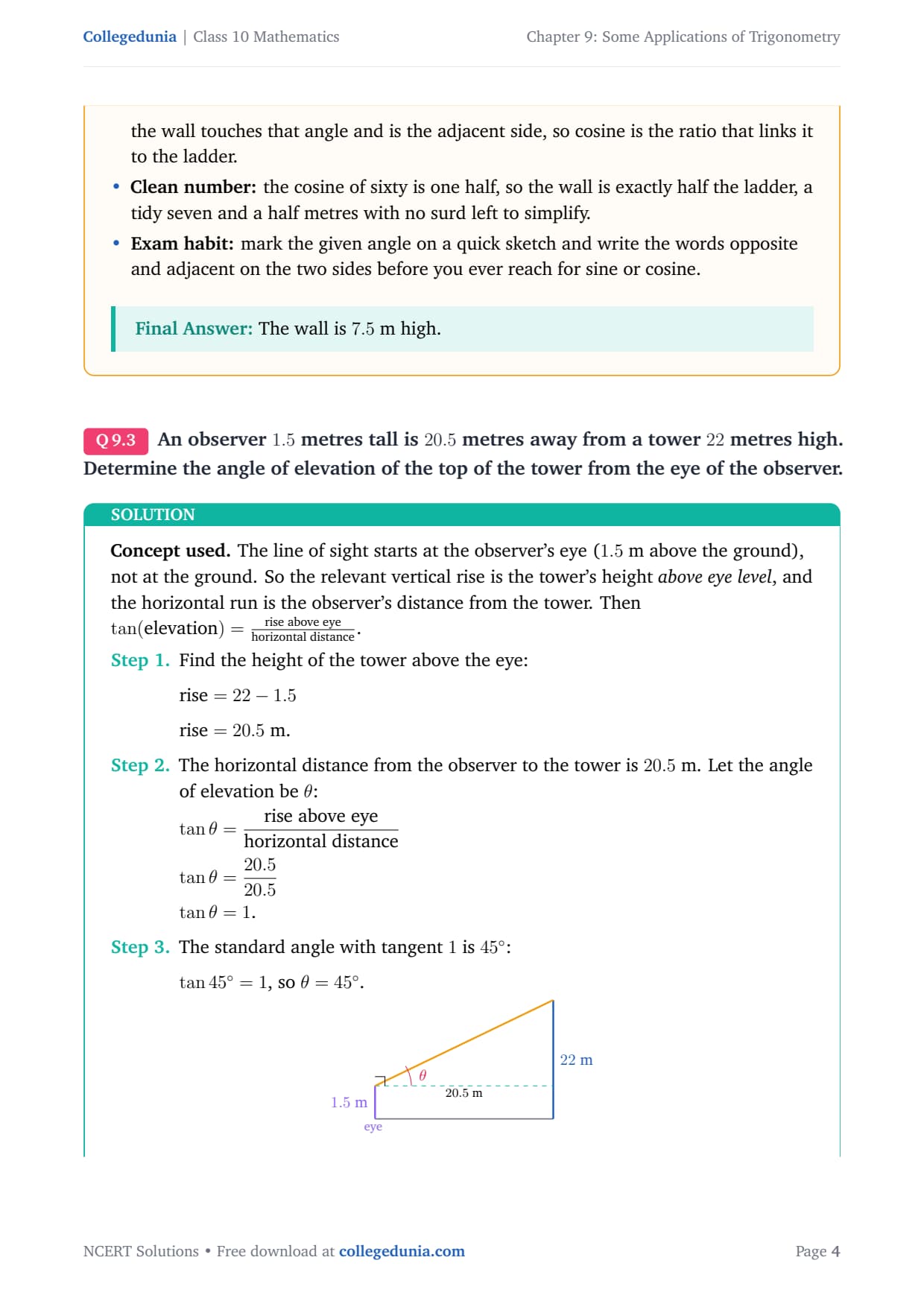
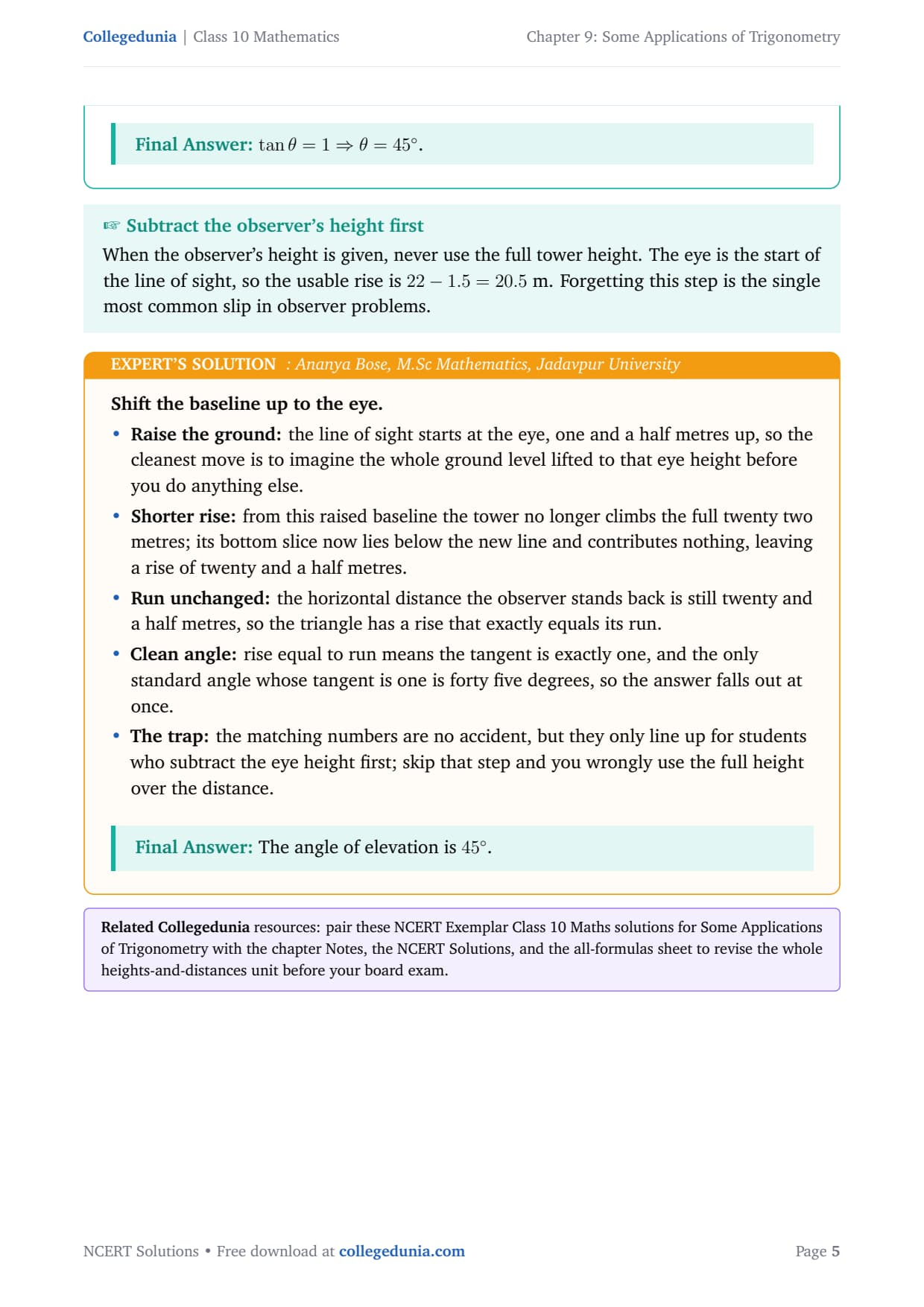
| Q8 | Observer 1.5 m tall, 20.5 m from a 22 m tower - find angle of elevation | tanθ | Medium |
The key formulas you need for Exercise 9.3 are below:
| Formula | Statement |
|---|---|
| Tangent ratio | tanθ = oppositeadjacent = heightbase |
| Cosine ratio | cosθ = adjacenthypotenuse |
| tan 30° | tan 30∘ = 1√3 |
| tan 45° | tan 45∘ = 1 |
| tan 60° | tan 60∘ = √3 |
| cos 60° | cos 60∘ = 12 |
| Angle of depression = Angle of elevation | Alternate interior angles on a horizontal line are equal |
Exercise 9.3 Questions with Step-by-Step Solutions
III. Short Answer Questions (Exercise 9.3)
Find the angle of elevation of the Sun when the shadow of a pole h metres high is √3 h metres long.
A ladder 15 metres long just reaches the top of a vertical wall. If the ladder makes an angle of 60∘ with the wall, find the height of the wall.
An observer 1.5 metres tall is 20.5 metres away from a tower 22 metres high. Determine the angle of elevation of the top of the tower from the eye of the observer.
Some Applications of Trigonometry: Other Resources and Exercises
Practise the rest of Chapter 9 and pair these solutions with the chapter's other resources, all linked below.
| Resource | What You Get |
|---|---|
| Exercise 9.3 | You are practising this exercise on this page. |
| Exercise 9.1 | MCQ-type questions on heights and distances |
| Exercise 9.2 | True or false and short reasoning questions |
| Exercise 9.4 | Long Answer problems on elevation and depression |
| Chapter 9 Exemplar Solutions | All exercises of the chapter in one place |
| NCERT Solutions | Textbook back-exercise answers, step by step |
| Revision Notes | Quick concept recap before practice |
| Formula Sheet | All trig ratios and standard angles on one page |
Student Feedback
In a Collegedunia survey of 1,180 Class 10 students, 82% said Exercise 9.3 needs you to spot which side is opposite and which is adjacent before picking the ratio. Students who drew a labelled right triangle first scored much higher.
Some Applications of Trigonometry Class 10 Maths Exemplar Solutions Exercise 9.3 FAQs
Ques. What is covered in NCERT Exemplar Class 10 Maths Chapter 9 Exercise 9.3?
Ans. Exercise 9.3 has 3 Short Answer questions. You find the Sun's angle of elevation from a shadow (Q6), a wall height from a ladder angle (Q7), and a tower's angle of elevation from an observer's eye height (Q8). All solutions follow the 2026-27 CBSE Class 10 syllabus.
Ques. In Exercise 9.3 Q7, why is cosine used instead of sine?
Ans. In Q7 the 60∘ angle is between the ladder and the wall, not the ground. The wall touches that angle, so it is the adjacent side. Cosine links the adjacent side to the hypotenuse, so cos 60∘ = wall heightladder length. Using sine would mean the angle is with the ground, which is wrong here.
Ques. Why do you subtract 1.5 m in Exercise 9.3 Q8?
Ans. The angle of elevation is measured from the eye, not the ground. The observer is 1.5 m tall, so the eye sits 1.5 m up. The triangle's height is how much the tower rises above eye level, which is 22 - 1.5 = 20.5 m. Skip the subtraction and you use the full 22 m, giving a wrong angle.
Ques. How are the heights and distances questions in Exercise 9.3 different from those in the NCERT textbook?
Ans. The NCERT textbook exercise has mostly one-step problems. The Exemplar adds reasoning. Q7 checks whether you read "angle with the wall" correctly (cosine, not sine), and Q8 needs the observer's height adjusted before the tangent. These are the exact twists that appear in CBSE board papers and tests.
Ques. Is Chapter 9 Some Applications of Trigonometry important for CBSE Class 10 Board exams?
Ans. Yes. Heights and distances is one of the most tested topics in CBSE Class 10 Maths. A question from this chapter usually appears in the 2-mark or 3-mark section every year. The elevation and depression patterns from the textbook and the Exemplar map straight onto board questions in the 2026-27 syllabus.



Comments