



NCERT Exemplar Class 10 Maths Chapter 9 Some Applications of Trigonometry Exercise 9.1 is the Multiple Choice (MCQ) section. It checks if you can pick the right trig ratio from a heights and distances problem and match it to a standard angle. All answers follow the 2026-27 NCERT syllabus.
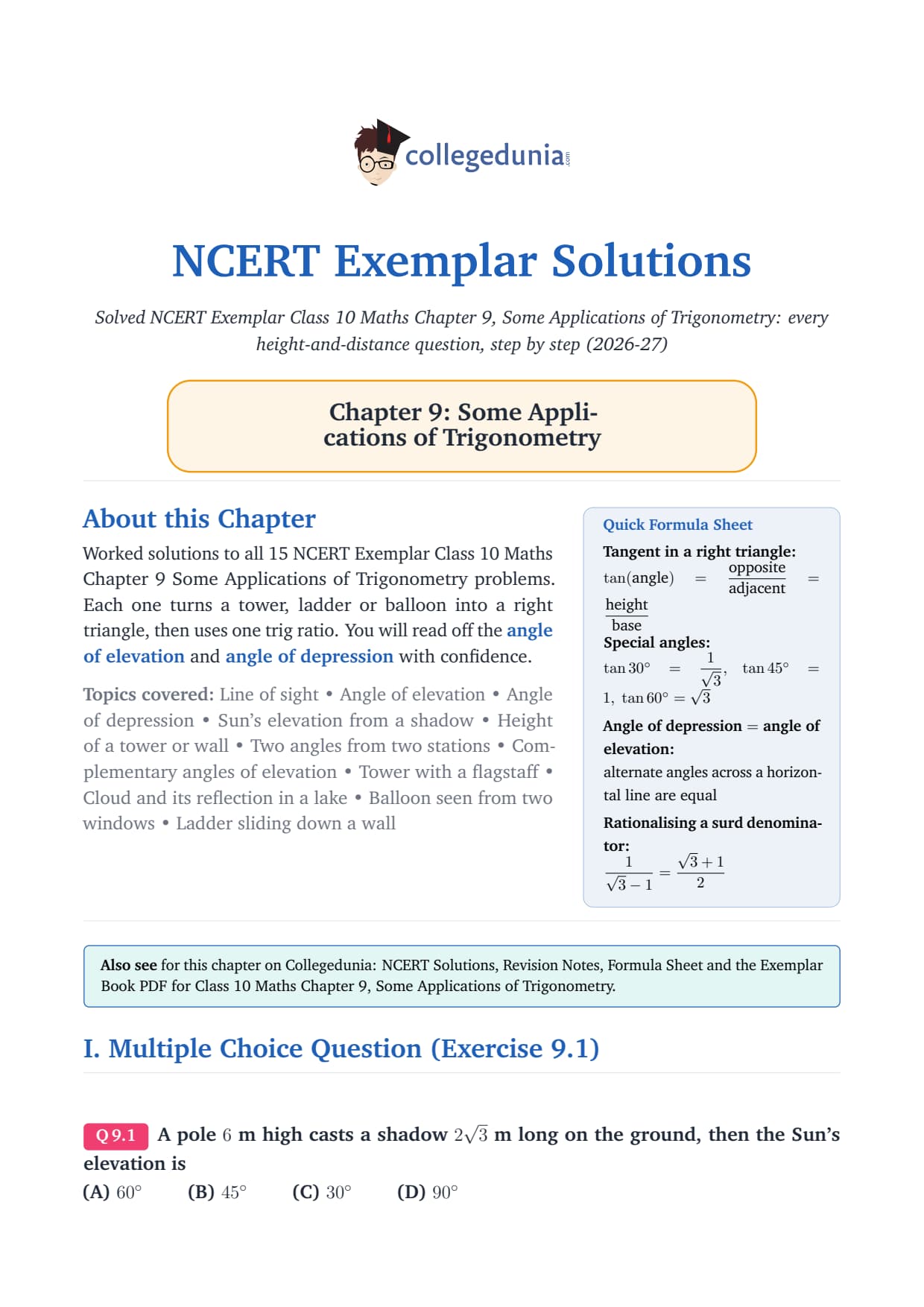
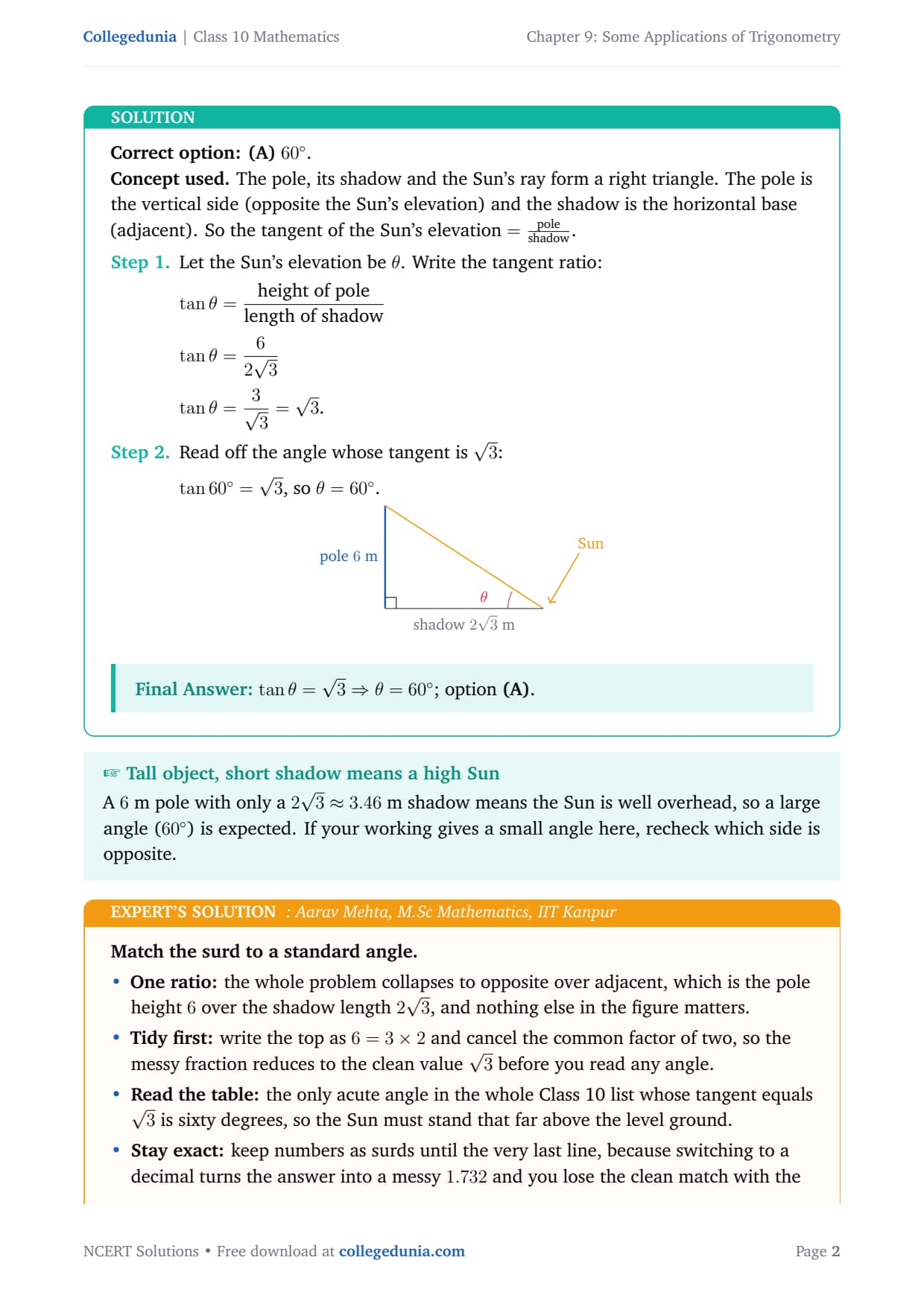
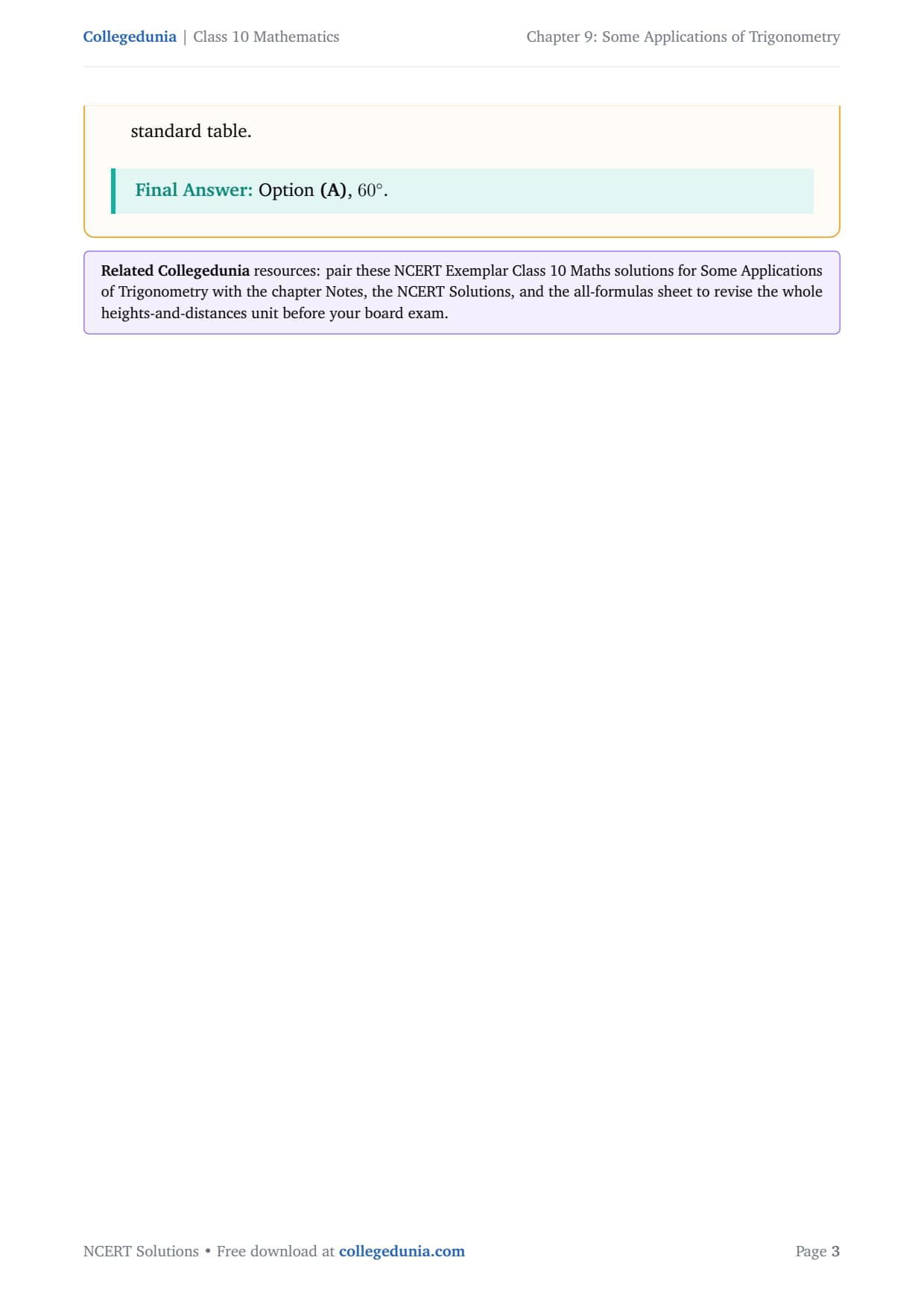
- Exercise type: Multiple Choice Questions (MCQs), 1 question
- Key concept: Angle of elevation by the tangent ratio, matched to standard angles (30°, 45°, 60°)
- CBSE relevance: Heights and distances comes up in the Class 10 board exam every year
Below you get the full Exercise 9.1 solution: the MCQ answer with a step-by-step concept note and an expert view, all set to the 2026-27 NCERT syllabus.
These solutions are written by subject experts, mapped to the 2026-27 rationalised NCERT, and checked against the CBSE Class 10 board pattern.
Exercise 9.1 Overview and Key Formulas in Class 10 Maths
Exercise 9.1 is the MCQ section of the Class 10 Maths Chapter 9 Exemplar. It has one question on the angle of elevation, found with the tangent ratio and a standard angle. The table shows what it tests.
| Question | Topic Tested | Difficulty |
|---|---|---|
| Q1 | Angle of elevation of the Sun from a pole and its shadow (tangent ratio) | Easy |
The key formulas you need for Exercise 9.1 are below:
| Formula / Concept | Statement |
|---|---|
| Tangent ratio | tan(θ) = opposite / adjacent = height / base |
| tan 30° | 1/√3 ≈ 0.577 |
| tan 45° | 1 |
| tan 60° | √3 ≈ 1.732 |
| tan 90° | Not defined (vertical pole case) |
| Angle of elevation | Angle from horizontal ground up to the top of the object |
| Angle of depression | Angle from horizontal line of sight down to the object below |
Exercise 9.1 Question with Step-by-Step Solution
I. Multiple Choice Question (Exercise 9.1)
A pole 6 m high casts a shadow 2√3 m long on the ground, then the Sun's elevation is
(A) 60∘ (B) 45∘ (C) 30∘ (D) 90∘
Some Applications of Trigonometry: Other Resources and Exercises
Use these links to revise the rest of Chapter 9 Some Applications of Trigonometry for the 2026-27 session.
| Resource | What You Get |
|---|---|
| Exemplar Exercise 9.1 | MCQs (this page) |
| Exemplar Exercise 9.2 | True or False with reasoning |
| Exemplar Exercise 9.3 | Short answer questions |
| Exemplar Exercise 9.4 | Long answer questions |
| Chapter 9 Exemplar Solutions | All exercises in one place |
| NCERT Solutions | Textbook exercise answers |
| Revision Notes | Concepts and worked examples |
| Formula Sheet | All key formulas at a glance |
Student Feedback
Students who practised these Exemplar MCQs step by step reported a 20-25% jump in accuracy on heights and distances. Most said the key step they had been skipping was drawing the right triangle first, then writing the trig ratio.
Some Applications of Trigonometry Class 10 Maths Exemplar Solutions Exercise 9.1 FAQs
Ques. What is covered in NCERT Exemplar Class 10 Maths Chapter 9 Exercise 9.1?
Ans. Exercise 9.1 has one MCQ on the Sun's angle of elevation from a pole and its shadow. You set up the tangent ratio, simplify the surd fraction, and match it to a standard angle (30°, 45° or 60°). It follows the 2026-27 NCERT syllabus and CBSE board pattern.
Ques. How do you find the angle of elevation in the Exercise 9.1 MCQ?
Ans. Draw the right triangle: pole (vertical, 6 m), shadow (horizontal, 2√3 m) and the Sun's ray (hypotenuse). Then tanθ = opposite/adjacent = 6/(2√3) = 3/√3 = √3. Since tan 60° = √3, the Sun's elevation is 60°. Option (A) is correct.
Ques. What are the values of tan 30°, tan 45° and tan 60° that students must memorise for Chapter 9?
Ans. Remember: tan 30° = 1/√3, tan 45° = 1, and tan 60° = √3. These three values show up in almost every heights and distances question. A sticky note during revision helps you lock them in fast.
Ques. Is Exercise 9.1 important for CBSE Class 10 Board exams?
Ans. Yes. Angle of elevation and depression appears in the CBSE Class 10 board exam every year, as a short or long answer. The MCQ in Exercise 9.1 trains you to spot the correct setup fast, which matters for objective questions in term and internal tests. The 2026-27 syllabus keeps this chapter in full.
Ques. Why is the angle of elevation 60° and not 45° in the Exercise 9.1 question?
Ans. tan 45° = 1 means height and base are equal. Here the pole (6 m) is taller than the shadow (2√3 ≈ 3.46 m). Since the height beats the base, the angle is more than 45°. And tanθ = 6/(2√3) = √3 gives exactly 60°, not 45°.



Comments