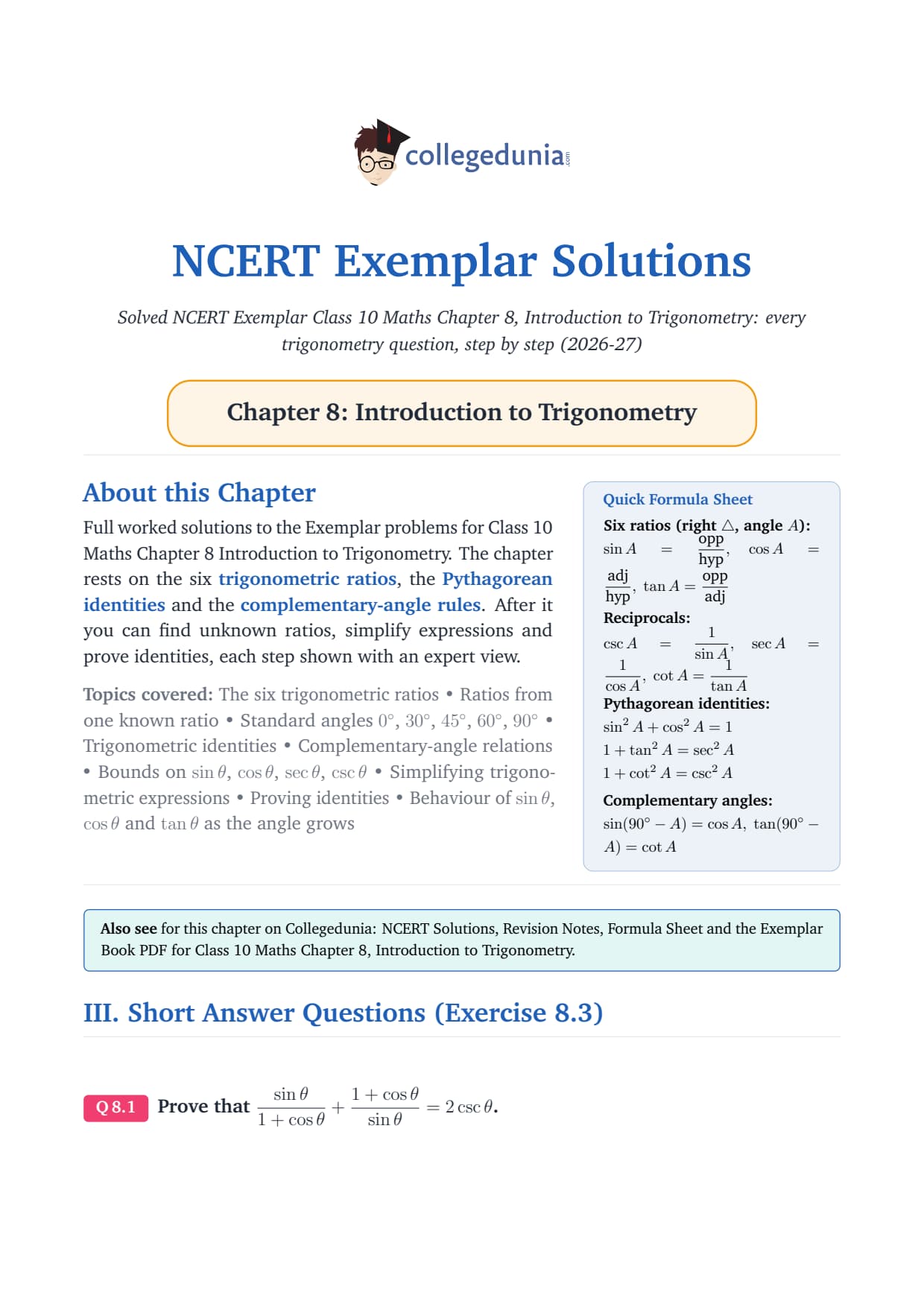
NCERT Exemplar Class 10 Maths Chapter 8 Introduction to Trigonometry Exercise 8.3 is the Short Answer section. It has 12 questions (Q23 to Q34). You prove identities and simplify expressions using Pythagorean identities, complementary angle rules, and standard angle values. All solutions follow the 2026-27 CBSE syllabus.
12 Short Answer questions (Q23-Q34): identity proofs, standard angle work, and simplification.
Each solution shows the concept, step-by-step working, and an Expert view of the proof strategy.
Solved by Collegedunia: Every Exercise 8.3 question here is worked out by our Mathematics faculty, checked against the official NCERT Exemplar, and aligned to the 2026-27 CBSE syllabus.
Exercise 8.3 Questions at a Glance in Class 10 Maths
Exercise 8.3 has 12 Short Answer (SA) questions, Q23 to Q34. You prove identities and find angle or expression values. Most questions combine two or more identities.
Question
Topic / Task
Identities Used
Q23
Prove sinθ/(1+cosθ) + (1+cosθ)/sinθ = 2 cscθ
sin²+cos²=1; fraction addition
Q24
Prove tan A/(1+sec A) - tan A/(1-sec A) = 2 csc A
1 - sec²A = -tan²A
Q25
Given tan A = 3/4, show sin A cos A = 12/25
Pythagoras (3-4-5 triangle)
Q26
Prove (sinα+cosα)(tanα+cotα) = secα+cscα
tan+cot = 1/(sin cos)
Q27
Prove (√3+1)(3-cot30°) = tan³60° - 2sin60°
Standard angle table values
Q28
Prove 1 + cot²α/(1+cscα) = cscα
cot²α = csc²α - 1; difference of squares
Q29
Prove tanθ+tan(90°-θ) = secθ sec(90°-θ)
Complementary angle rules
Q30
If √3 tanθ = 1, find sin²θ - cos²θ
Standard angle: θ = 30°
Q31
Simplify (1+tan²θ)(1-sinθ)(1+sinθ)
sec²θ and 1-sin²θ = cos²θ
Q32
If 2sin²θ-cos²θ=2, find θ
cos²θ = 1-sin²θ
Q33
Show [cos²(45°+θ)+cos²(45°-θ)] / [tan(60°+θ)tan(30°-θ)] = 1
Complementary pairs (top and bottom)
Q34
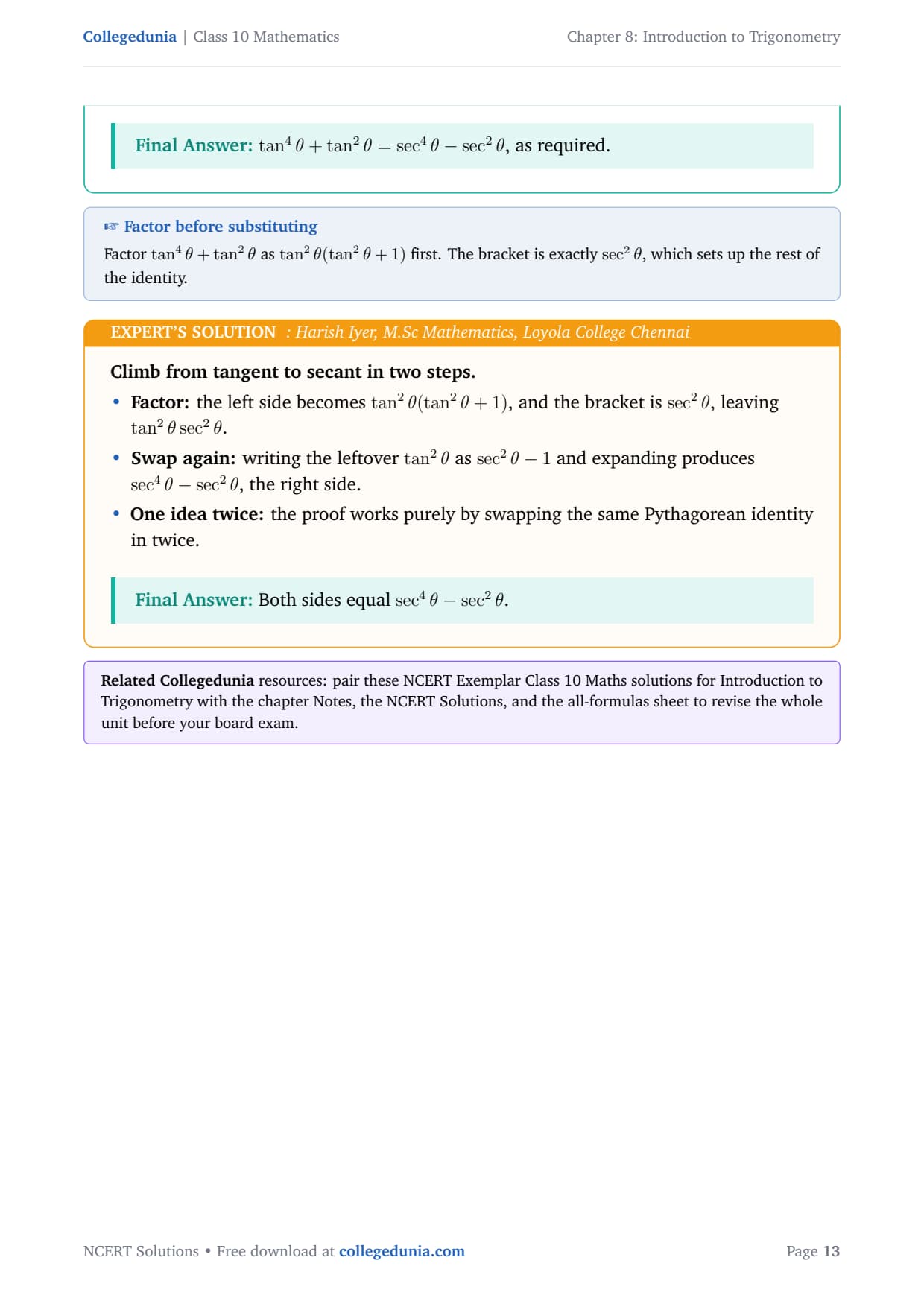
Show tan⁴θ+tan²θ = sec⁴θ-sec²θ
1+tan²θ=sec²θ (used twice)
Key Identities for Exercise 8.3 Proofs
Keep these identities at your fingertips before you start. Most questions use more than one together.
Pythagorean Identities (the core toolkit)
sin²A + cos²A = 1 : use this whenever sin² and cos² appear together. Rearrange as cos²A = 1 - sin²A or sin²A = 1 - cos²A.
1 + tan²A = sec²A : rearranges to sec²A - 1 = tan²A and 1 - sec²A = -tan²A. Q24 needs the sign-flipped form.
1 + cot²A = csc²A : rearranges to cot²A = csc²A - 1. Q28 uses this to build a difference of squares.
Complementary Angle Rules (for 90° - θ questions)
sin(90° - A) = cos A and cos(90° - A) = sin A
tan(90° - A) = cot A and cot(90° - A) = tan A
sec(90° - A) = csc A and csc(90° - A) = sec A
Standard Angle Table (for Q27 and Q30)
Angle
sin
cos
tan
cot
sec
csc
0°
0
1
0
-
1
-
30°
1/2
√3/2
1/√3
√3
2/√3
2
45°
1/√2
1/√2
1
1
√2
√2
60°
√3/2
1/2
√3
1/√3
2
2/√3
90°
1
0
-
0
-
1
How to Approach Identity Proofs
Identity proofs follow a pattern once you see it. This method works for most Exercise 8.3 questions.
Work on one side only. Never move terms across the equals sign. Pick the more complex side and simplify until it matches the other.
Convert everything to sin and cos first. Tan, cot, sec and csc all become fractions in sin and cos. This makes the algebra cleaner.
Spot the denominator pattern. When you see 1 + secA or 1 + cosA below, use a Pythagorean identity to build a factorisable numerator. Q24 and Q28 follow this route.
Apply complementary rules early. As soon as you see 90° - θ, swap to the co-function. Q29 and Q33 then fall out fast.
For standard angle questions (Q27, Q30), substitute the table values on both sides and simplify to the same number.
These solutions are curated by our Mathematics faculty, mapped to the 2026-27 NCERT Exemplar book, and checked against the CBSE marking scheme for proof questions.
Common Mistakes to Avoid
These errors cost the most marks in the trigonometry proofs section.
Watch Out: the most common Exercise 8.3 errors
Sign error in 1 - sec²A: 1 - sec²A = -tan²A, not +tan²A. Q24 fails if you drop the minus.
Moving terms across the equals sign: this is not a proof. Simplify each side on its own.
Forgetting cot²α = csc²α - 1 (not csc²α + 1). Q28 uses this form for a difference of squares.
Missing the complementary pair in Q33: many students swap only the numerator or only the denominator, then stall halfway.
Not factoring tan²θ in Q34: without the factoring step, you cannot convert to secant.
All Exercise 8.3 Solutions with Step-by-Step Answers
III. Short Answer Questions (Exercise 8.3)
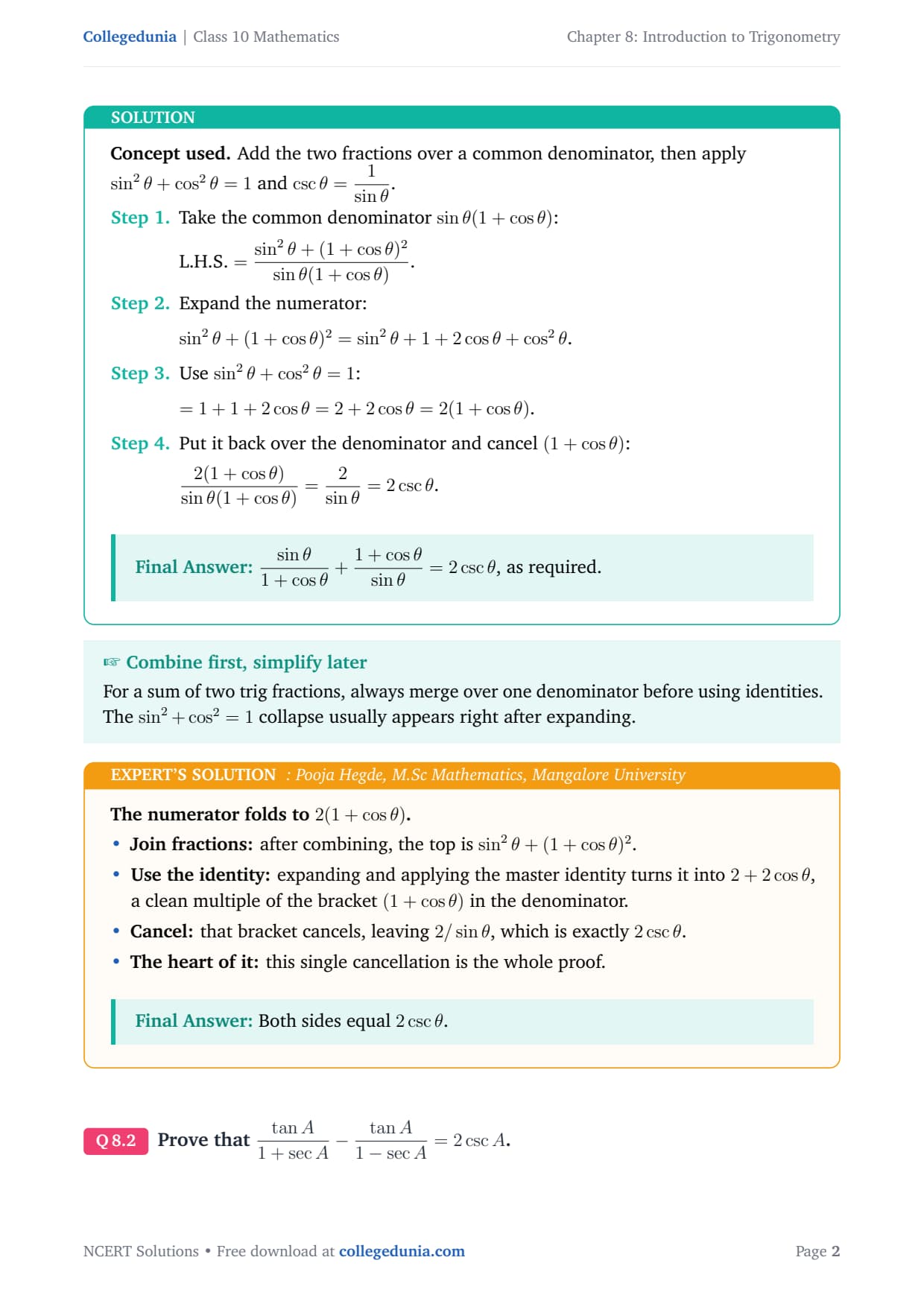
Q 8.1
Prove that sinθ1+cosθ+1+cosθsinθ=2cscθ.
Concept used. Add the two fractions over a common denominator,
then apply sin2θ+cos2θ=1 and cscθ=1sinθ.
Take the common denominator sinθ(1+cosθ):
[] L.H.S.=sin2θ+(1+cosθ)2sinθ(1+cosθ).
Expand the numerator:
[] sin2θ+(1+cosθ)2=sin2θ+1+2cosθ+cos2θ.
Use sin2θ+cos2θ=1:
[] =1+1+2cosθ=2+2cosθ=2(1+cosθ).
Put it back over the denominator and cancel (1+cosθ):
[] 2(1+cosθ)sinθ(1+cosθ)=2sinθ=2cscθ.
sinθ1+cosθ+1+cosθsinθ=2cscθ, as required.
PH
Pooja Hegde
M.Sc Mathematics, Mangalore University
Verified Expert
The numerator folds to 2(1+cosθ).
Join fractions: after combining, the top is sin2θ+(1+cosθ)2.
Use the identity: expanding and applying the master identity turns it into 2+2cosθ, a clean multiple of the bracket (1+cosθ) in the denominator.
Cancel: that bracket cancels, leaving 2/sinθ, which is exactly 2cscθ.
The heart of it: this single cancellation is the whole proof.
Both sides equal 2cscθ.
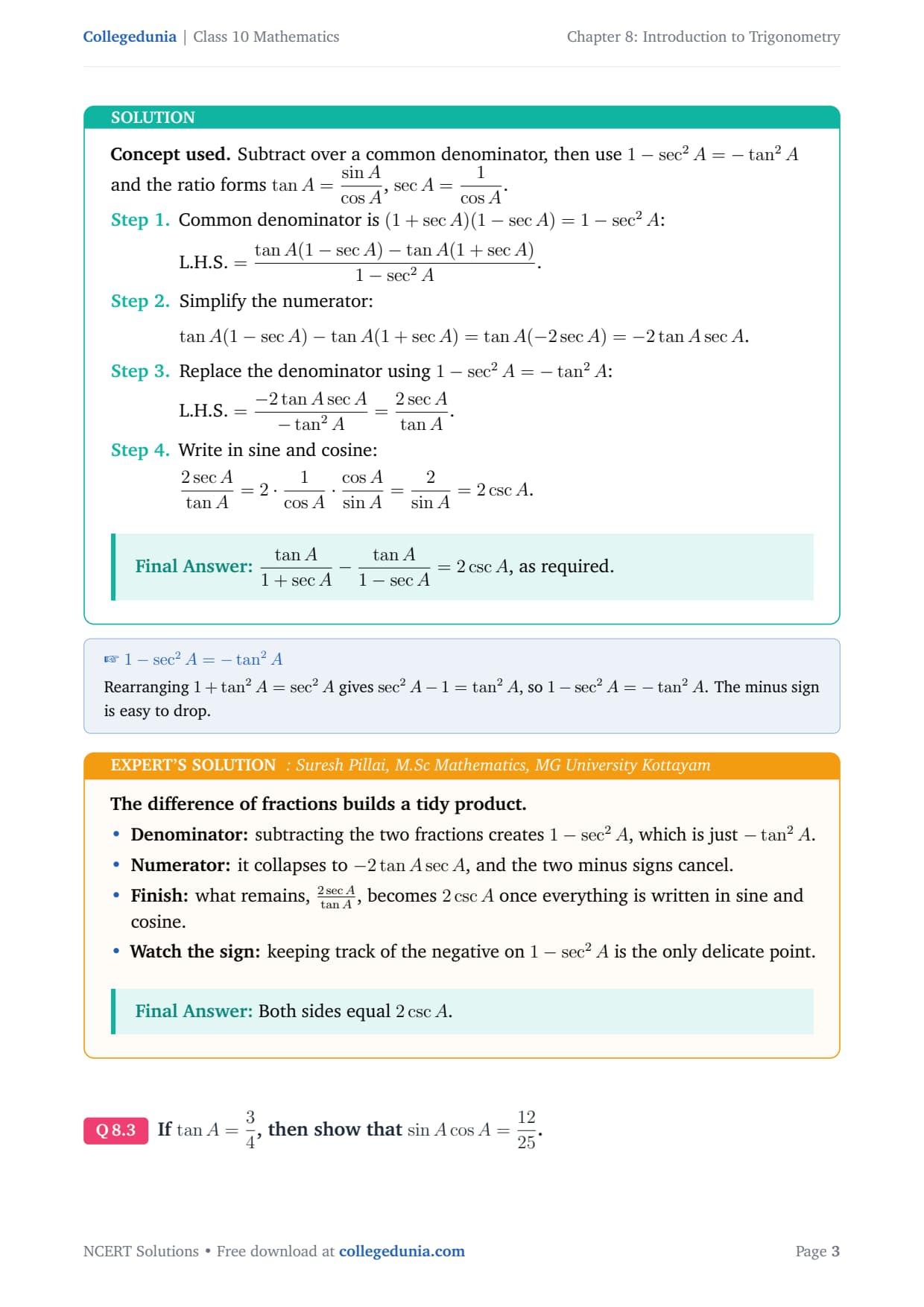
Q 8.2
Prove that tan A1+sec A-tan A1-sec A=2csc A.
Concept used. Subtract over a common denominator, then use
1-sec2A=-tan2A and the ratio forms tan A=sin Acos A,
sec A=1cos A.
Common denominator is (1+sec A)(1-sec A)=1-sec2A:
[] L.H.S.=tan A(1-sec A)-tan A(1+sec A)1-sec2A.
Simplify the numerator:
[] tan A(1-sec A)-tan A(1+sec A)=tan A(-2sec A)=-2tan Asec A.
Replace the denominator using 1-sec2A=-tan2A:
[] L.H.S.=-2tan Asec A-tan2A=2sec Atan A.
Write in sine and cosine:
[] 2sec Atan A=2·1cos A·cos Asin A=2sin A=2csc A.
tan A1+sec A-tan A1-sec A=2csc A, as required.
SP
Suresh Pillai
M.Sc Mathematics, MG University Kottayam
Verified Expert
The difference of fractions builds a tidy product.
Denominator: subtracting the two fractions creates 1-sec2A, which is just -tan2A.
Numerator: it collapses to -2tan Asec A, and the two minus signs cancel.
Finish: what remains, 2sec Atan A, becomes 2csc A once everything is written in sine and cosine.
Watch the sign: keeping track of the negative on 1-sec2A is the only delicate point.
Both sides equal 2csc A.
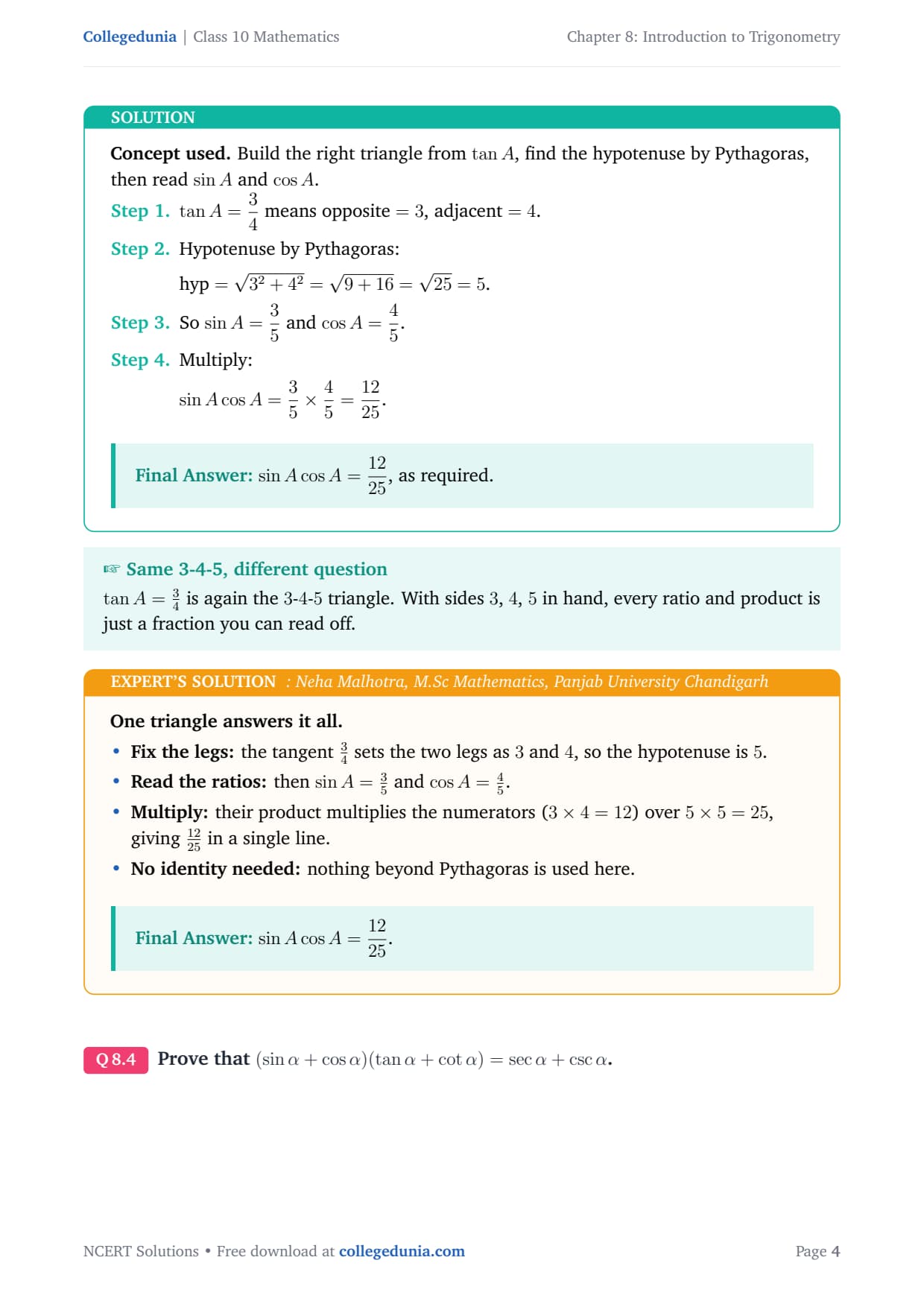
Q 8.3
If tan A=34, then show that sin Acos A=1225.
Concept used. Build the right triangle from tan A, find the
hypotenuse by Pythagoras, then read sin A and cos A.
tan A=34 means opposite =3, adjacent =4.
Hypotenuse by Pythagoras:
[] hyp=√32+42=√9+16=√25=5.
So sin A=35 and cos A=45.
Multiply:
[] sin Acos A=35×45=1225.
sin Acos A=1225, as required.
NM
Neha Malhotra
M.Sc Mathematics, Panjab University Chandigarh
Verified Expert
One triangle answers it all.
Fix the legs: the tangent 34 sets the two legs as 3 and 4, so the hypotenuse is 5.
Read the ratios: then sin A=35 and cos A=45.
Multiply: their product multiplies the numerators (34=12) over 55=25, giving 1225 in a single line.
No identity needed: nothing beyond Pythagoras is used here.
sin Acos A=1225.
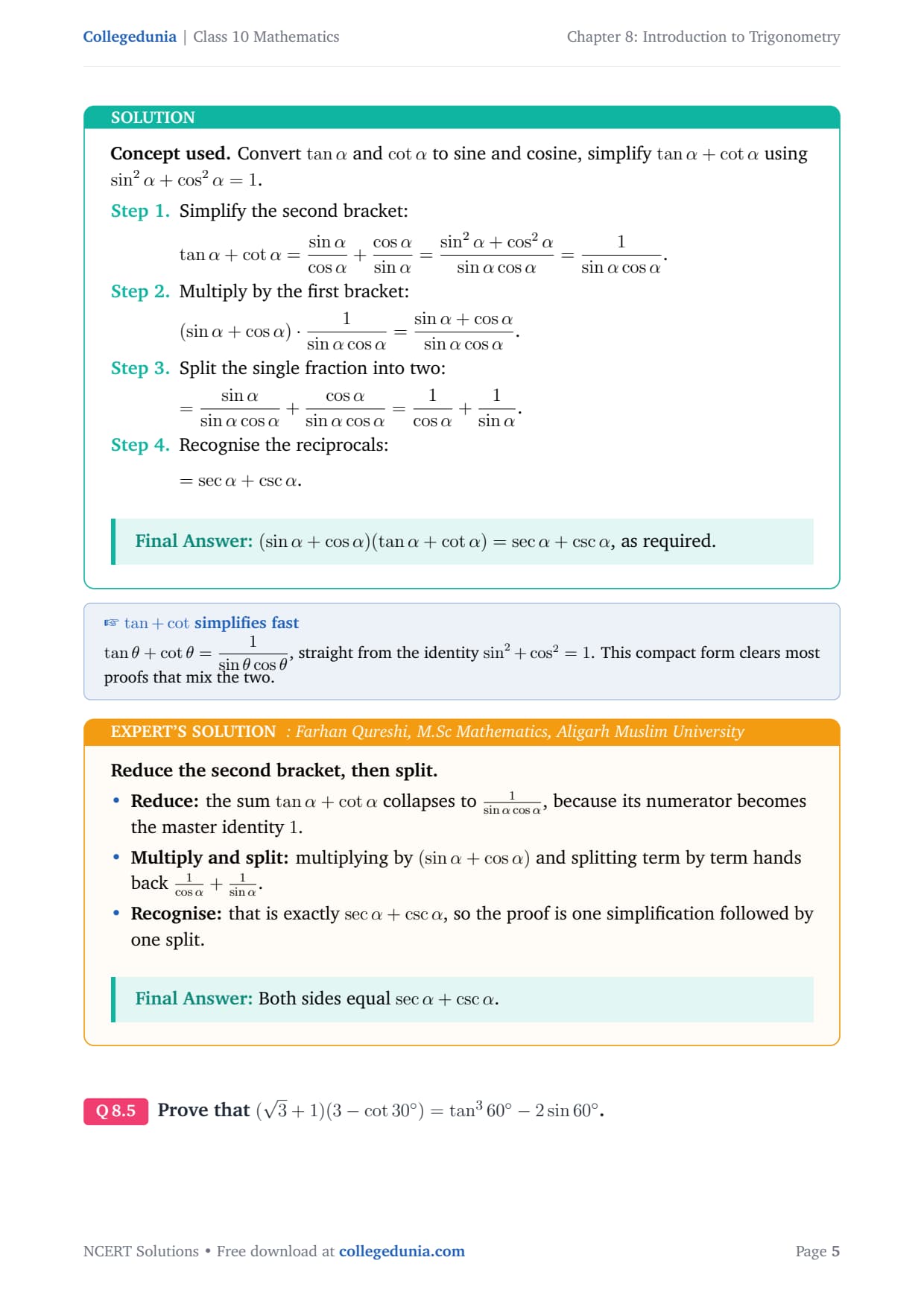
Q 8.4
Prove that (sinα+cosα)(tanα+cotα)=secα+cscα.
Concept used. Convert tanα and cotα to sine and
cosine, simplify tanα+cotα using
sin2α+cos2α=1.
Simplify the second bracket:
[] tanα+cotα=sinαcosα+cosαsinα=sin2α+cos2αsinα=1sinα.
Multiply by the first bracket:
[] (sinα+cosα)·1sinα=sinα+cosαsinα.
Split the single fraction into two:
[] =sinαsinα+cosαsinα=1cosα+1sinα.
Recognise the reciprocals:
[] =secα+cscα.
(sinα+cosα)(tanα+cotα)=secα+cscα, as required.
FQ
Farhan Qureshi
M.Sc Mathematics, Aligarh Muslim University
Verified Expert
Reduce the second bracket, then split.
Reduce: the sum tanα+cotα collapses to 1sinα, because its numerator becomes the master identity 1.
Multiply and split: multiplying by (sinα+cosα) and splitting term by term hands back 1cosα+1sinα.
Recognise: that is exactly secα+cscα, so the proof is one simplification followed by one split.
Both sides equal secα+cscα.
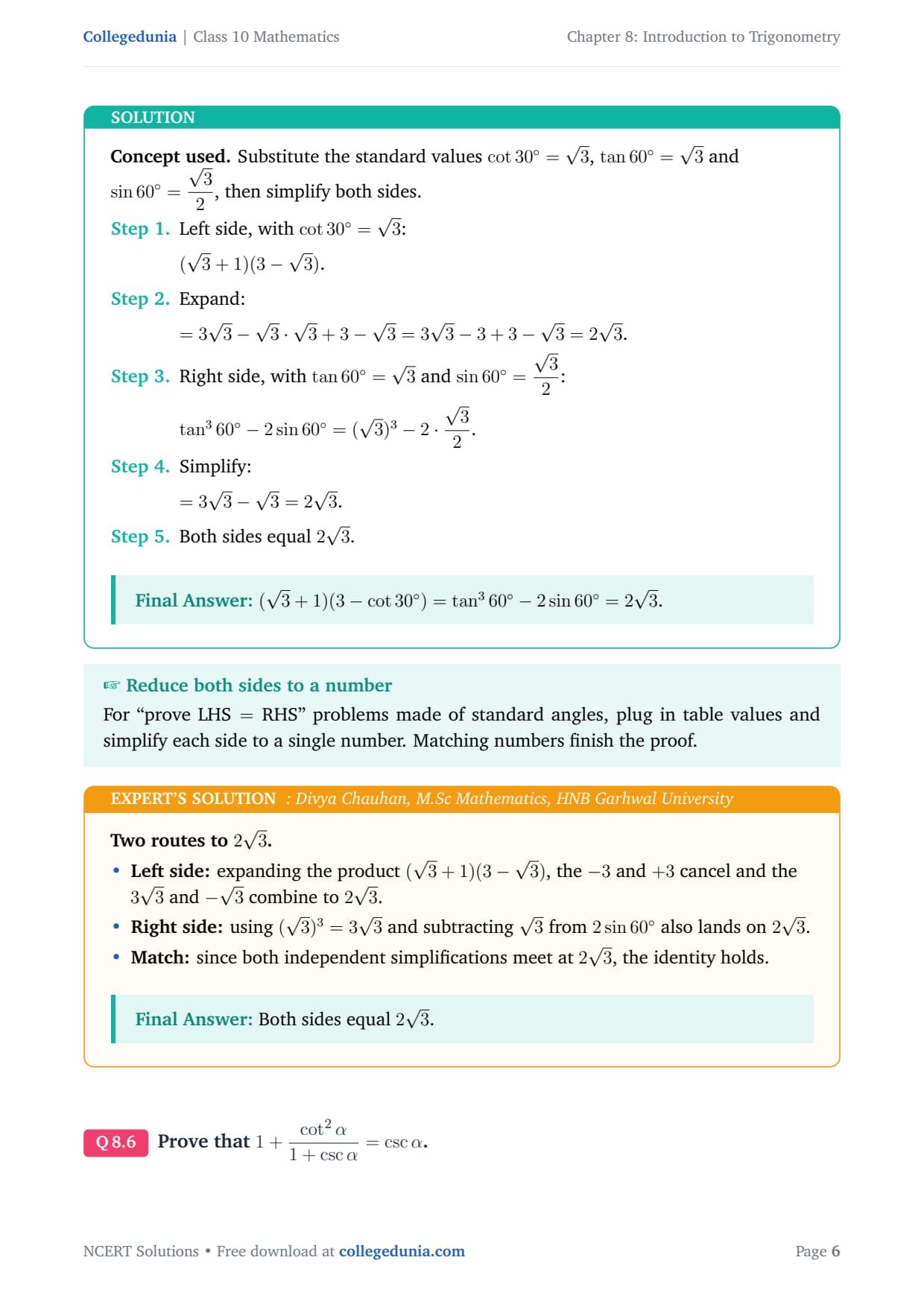
Q 8.5
Prove that (√3+1)(3-cot 30∘)=tan3 60∘-2sin 60∘.
Concept used. Substitute the standard values cot 30∘=3,
tan 60∘=3 and sin 60∘=32, then simplify
both sides.
Left side, with cot 30∘=3:
[] (3+1)(3-3).
Expand:
[] =33-3·3+3-3=33-3+3-3=23.
Right side, with tan 60∘=3 and sin 60∘=32:
[] tan3 60∘-2sin 60∘=(3)3-2·32.
Simplify:
[] =33-3=23.
Both sides equal 23.
(3+1)(3-cot 30∘)=tan3 60∘-2sin 60∘=23.
DC
Divya Chauhan
M.Sc Mathematics, HNB Garhwal University
Verified Expert
Two routes to 23.
Left side: expanding the product (3+1)(3-3), the -3 and +3 cancel and the 33 and -3 combine to 23.
Right side: using (3)3=33 and subtracting 3 from 2sin 60∘ also lands on 23.
Match: since both independent simplifications meet at 23, the identity holds.
Both sides equal 23.
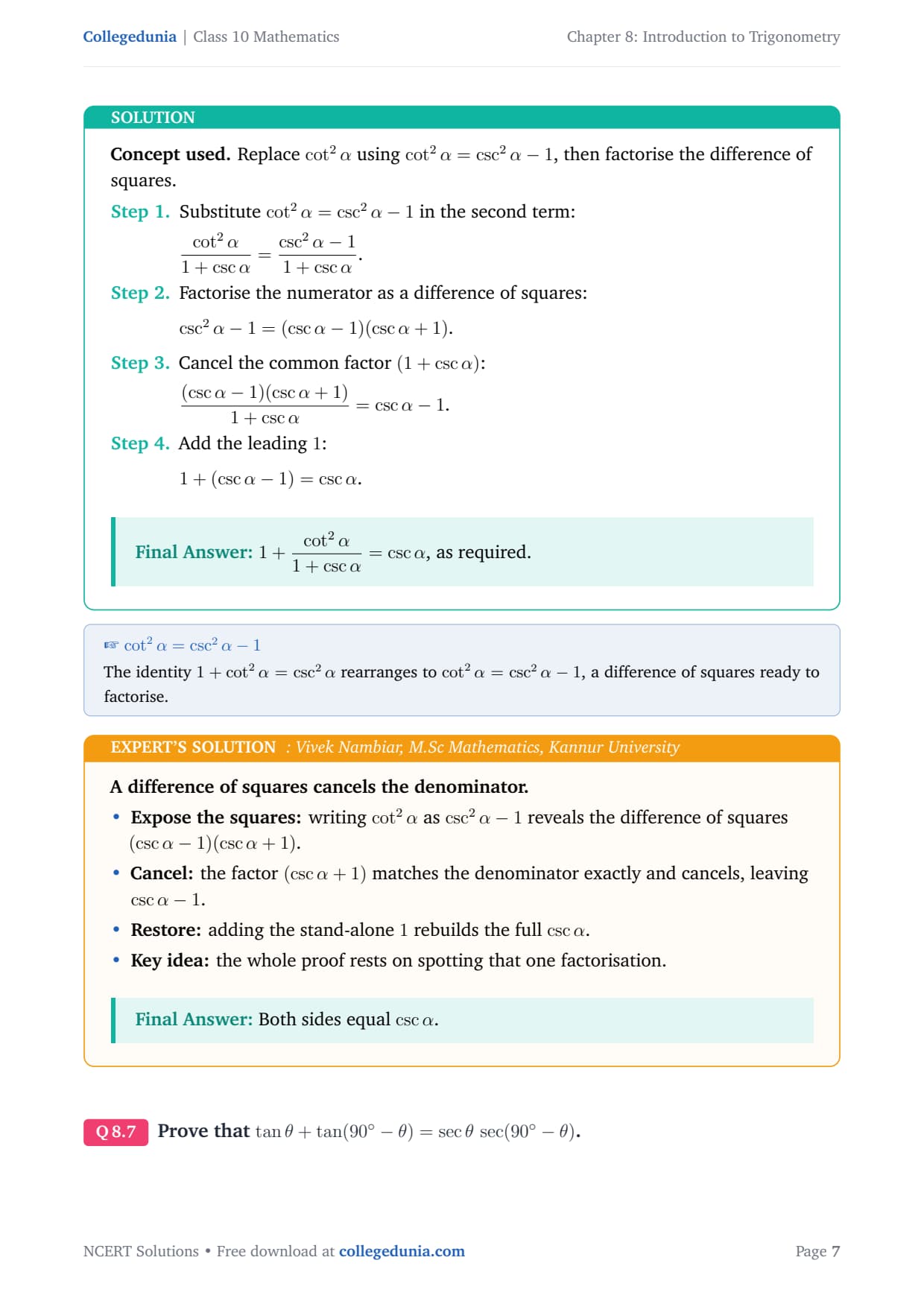
Q 8.6
Prove that 1+cot2α1+cscα=cscα.
Concept used. Replace cot2α using
cot2α=csc2α-1, then factorise the difference of squares.
Substitute cot2α=csc2α-1 in the second term:
[] cot2α1+cscα=csc2α-11+cscα.
Factorise the numerator as a difference of squares:
[] csc2α-1=(cscα-1)(cscα+1).
Cancel the common factor (1+cscα):
[] (cscα-1)(cscα+1)1+cscα=cscα-1.
Add the leading 1:
[] 1+(cscα-1)=cscα.
1+cot2α1+cscα=cscα, as required.
VN
Vivek Nambiar
M.Sc Mathematics, Kannur University
Verified Expert
A difference of squares cancels the denominator.
Expose the squares: writing cot2α as csc2α-1 reveals the difference of squares (cscα-1)(cscα+1).
Cancel: the factor (cscα+1) matches the denominator exactly and cancels, leaving cscα-1.
Restore: adding the stand-alone 1 rebuilds the full cscα.
Key idea: the whole proof rests on spotting that one factorisation.
Both sides equal cscα.
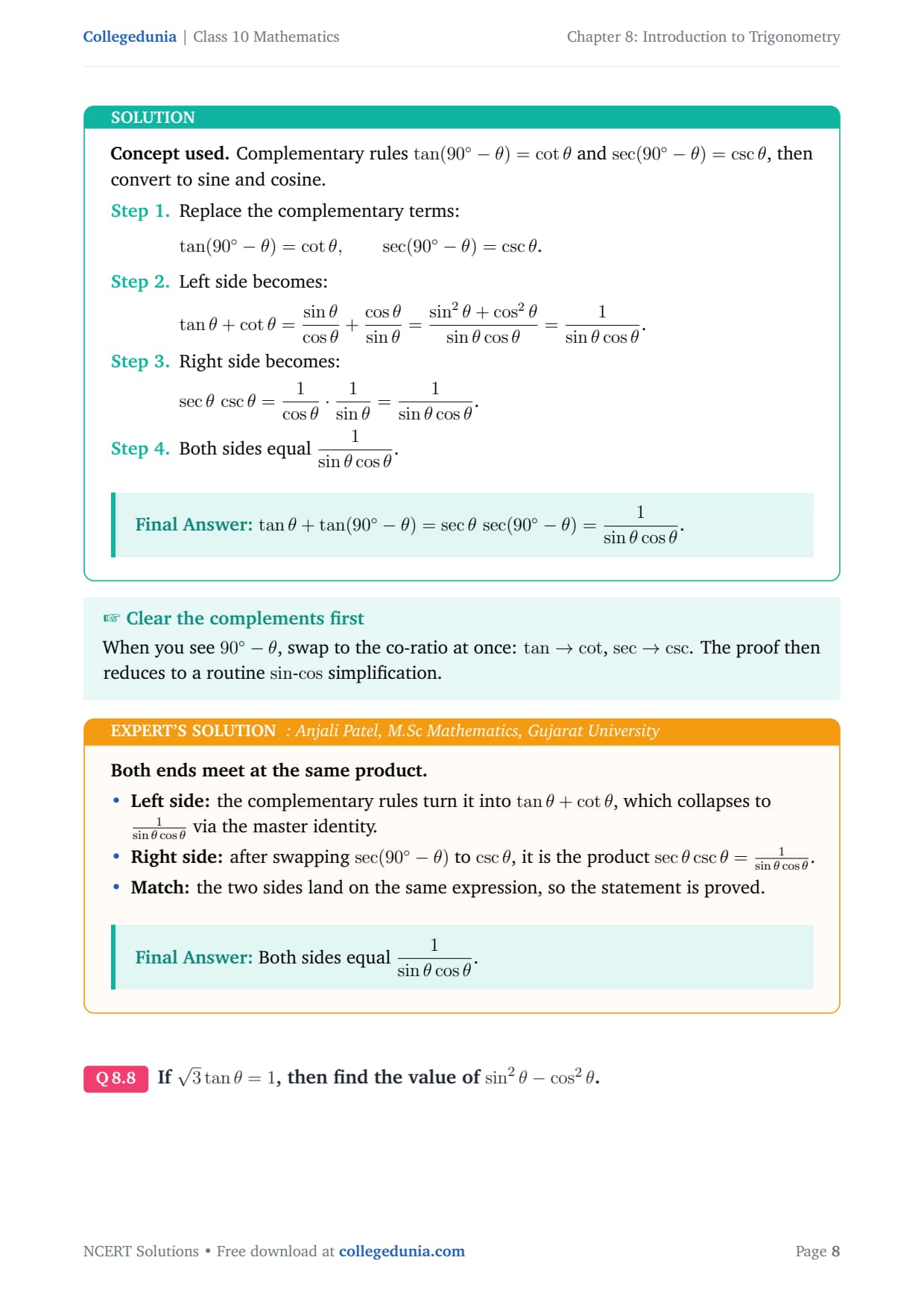
Q 8.7
Prove that tanθ+tan(90∘-θ)=secθ sec(90∘-θ).
Concept used. Complementary rules tan(90∘-θ)=cotθ
and sec(90∘-θ)=cscθ, then convert to sine and cosine.
Replace the complementary terms:
[] tan(90∘-θ)=cotθ, sec(90∘-θ)=cscθ.
Left side becomes:
[] tanθ+cotθ=sinθcosθ+cosθsinθ=sin2θ+cos2θsinθ=1sinθ.
Right side becomes:
[] secθ cscθ=1cosθ·1sinθ=1sinθ.
Both sides equal 1sinθ.
tanθ+tan(90∘-θ)=secθ sec(90∘-θ)=1sinθ.
AP
Anjali Patel
M.Sc Mathematics, Gujarat University
Verified Expert
Both ends meet at the same product.
Left side: the complementary rules turn it into tanθ+cotθ, which collapses to 1sinθ via the master identity.
Right side: after swapping sec(90∘-θ) to cscθ, it is the product secθ=1sinθ.
Match: the two sides land on the same expression, so the statement is proved.
Both sides equal 1sinθ.
Q 8.8
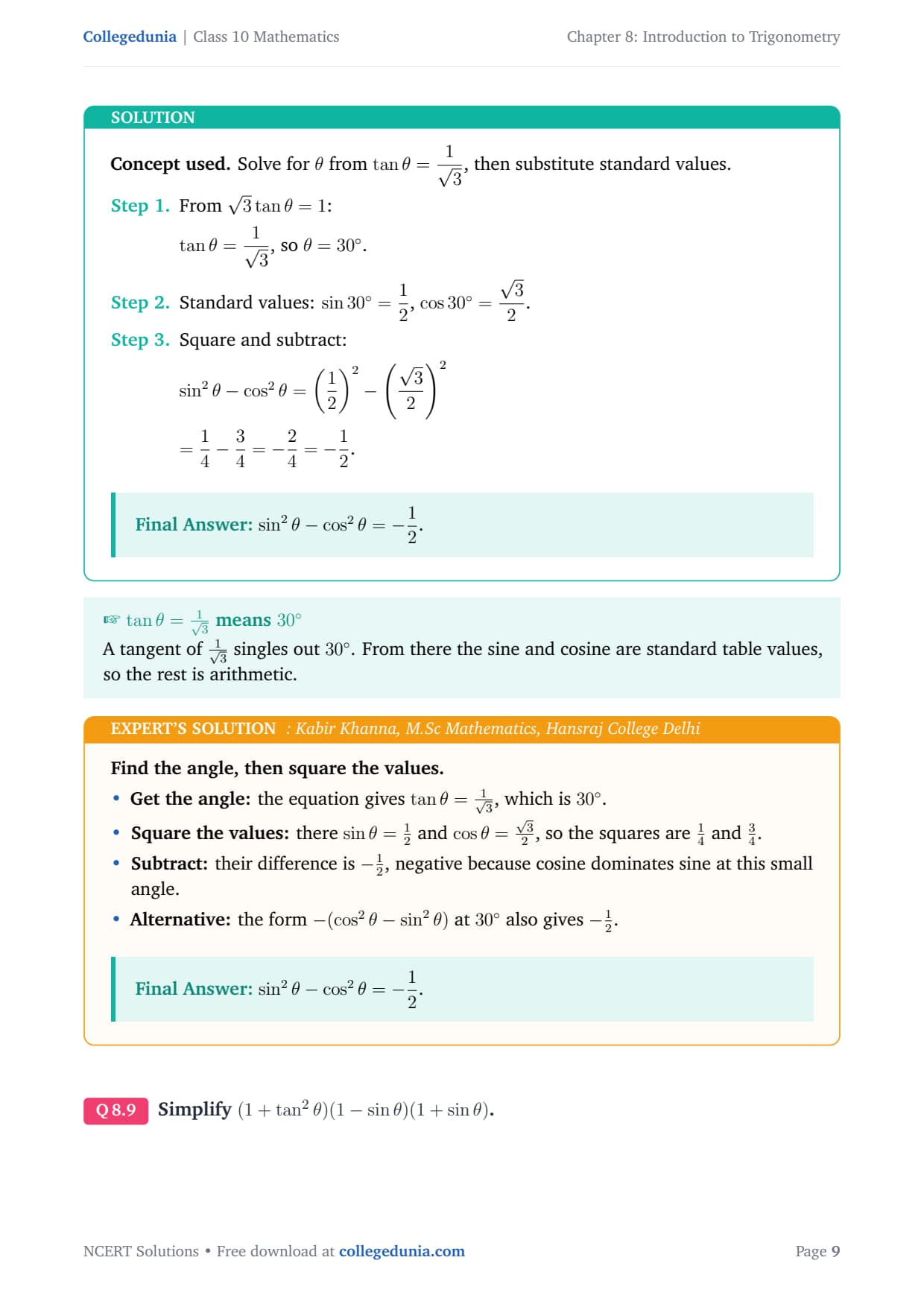
If √3tanθ=1, then find the value of sin2θ-cos2θ.
Concept used. Solve for θ from tanθ=13,
then substitute standard values.
From 3tanθ=1:
[] tanθ=13, so θ=30∘.
Standard values: sin 30∘=12, cos 30∘=32.
Square and subtract:
[] sin2θ-cos2θ=(12)2-(32)2
[] =14-34=-24=-12.
sin2θ-cos2θ=-12.
KK
Kabir Khanna
M.Sc Mathematics, Hansraj College Delhi
Verified Expert
Find the angle, then square the values.
Get the angle: the equation gives tanθ=13, which is 30∘.
Square the values: there sinθ=12 and cosθ=32, so the squares are 14 and 34.
Subtract: their difference is -12, negative because cosine dominates sine at this small angle.
Alternative: the form -(cos2θ-sin2θ) at 30∘ also gives -12.
sin2θ-cos2θ=-12.
Q 8.9
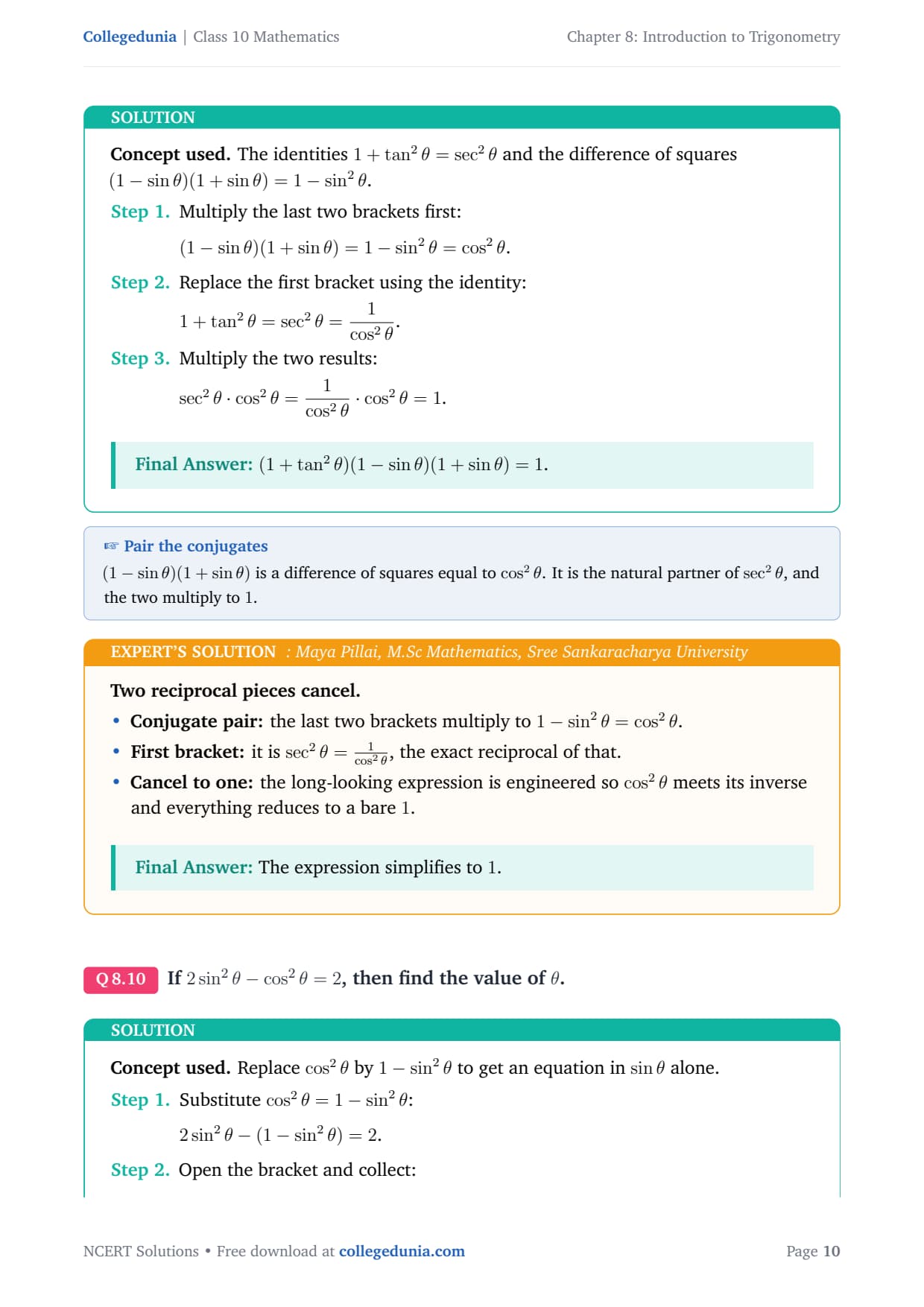
Simplify (1+tan2θ)(1-sinθ)(1+sinθ).
Concept used. The identities 1+tan2θ=sec2θ and the
difference of squares (1-sinθ)(1+sinθ)=1-sin2θ.
Multiply the last two brackets first:
[] (1-sinθ)(1+sinθ)=1-sin2θ=cos2θ.
Replace the first bracket using the identity:
[] 1+tan2θ=sec2θ=1cos2θ.
Multiply the two results:
[] sec2θ2θ=1cos2θ2θ=1.
(1+tan2θ)(1-sinθ)(1+sinθ)=1.
MP
Maya Pillai
M.Sc Mathematics, Sree Sankaracharya University
Verified Expert
Two reciprocal pieces cancel.
Conjugate pair: the last two brackets multiply to 1-sin2θ=cos2θ.
First bracket: it is sec2θ=1cos2θ, the exact reciprocal of that.
Cancel to one: the long-looking expression is engineered so cos2θ meets its inverse and everything reduces to a bare 1.
The expression simplifies to 1.
Q 8.10
If 2sin2θ-cos2θ=2, then find the value of θ.
Concept used. Replace cos2θ by 1-sin2θ to get an
equation in sinθ alone.
Substitute cos2θ=1-sin2θ:
[] 2sin2θ-(1-sin2θ)=2.
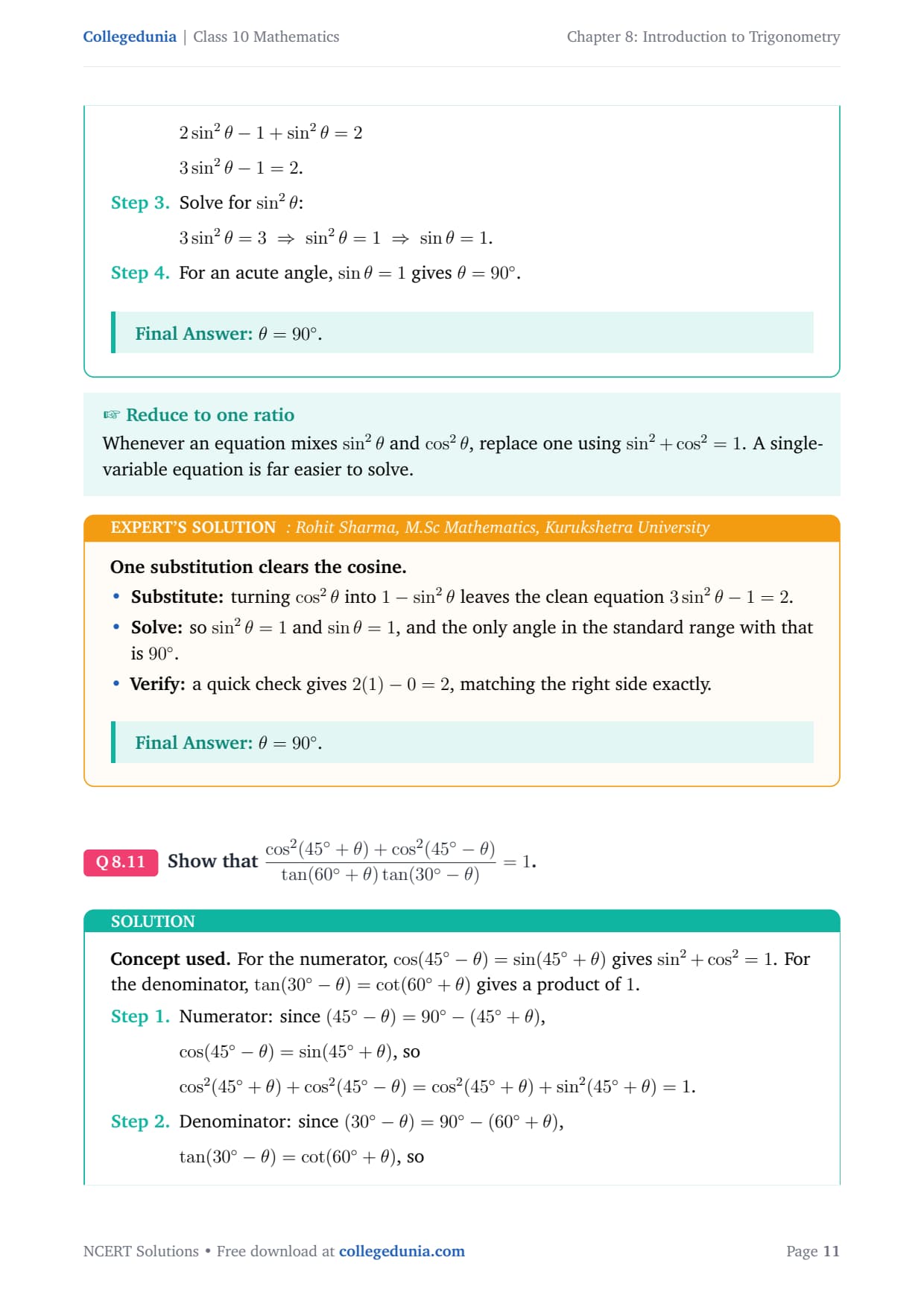
Open the bracket and collect:
[] 2sin2θ-1+sin2θ=2
[] 3sin2θ-1=2.
Solve for sin2θ:
[] 3sin2θ=3 ⇒ sin2θ=1 ⇒ sinθ=1.
For an acute angle, sinθ=1 gives θ=90∘.
θ=90∘.
RS
Rohit Sharma
M.Sc Mathematics, Kurukshetra University
Verified Expert
One substitution clears the cosine.
Substitute: turning cos2θ into 1-sin2θ leaves the clean equation 3sin2θ-1=2.
Solve: so sin2θ=1 and sinθ=1, and the only angle in the standard range with that is 90∘.
Verify: a quick check gives 2(1)-0=2, matching the right side exactly.
θ=90∘.
Q 8.11
Show that cos2(45∘+θ)+cos2(45∘-θ)tan(60∘+θ)tan(30∘-θ)=1.
Concept used. For the numerator, cos(45∘-θ)=sin(45∘+θ)
gives sin2+cos2=1. For the denominator,
tan(30∘-θ)=cot(60∘+θ) gives a product of 1.
Numerator: since (45∘-θ)=90∘-(45∘+θ),
[] cos(45∘-θ)=sin(45∘+θ), so
[] cos2(45∘+θ)+cos2(45∘-θ)=cos2(45∘+θ)+sin2(45∘+θ)=1.
Denominator: since (30∘-θ)=90∘-(60∘+θ),
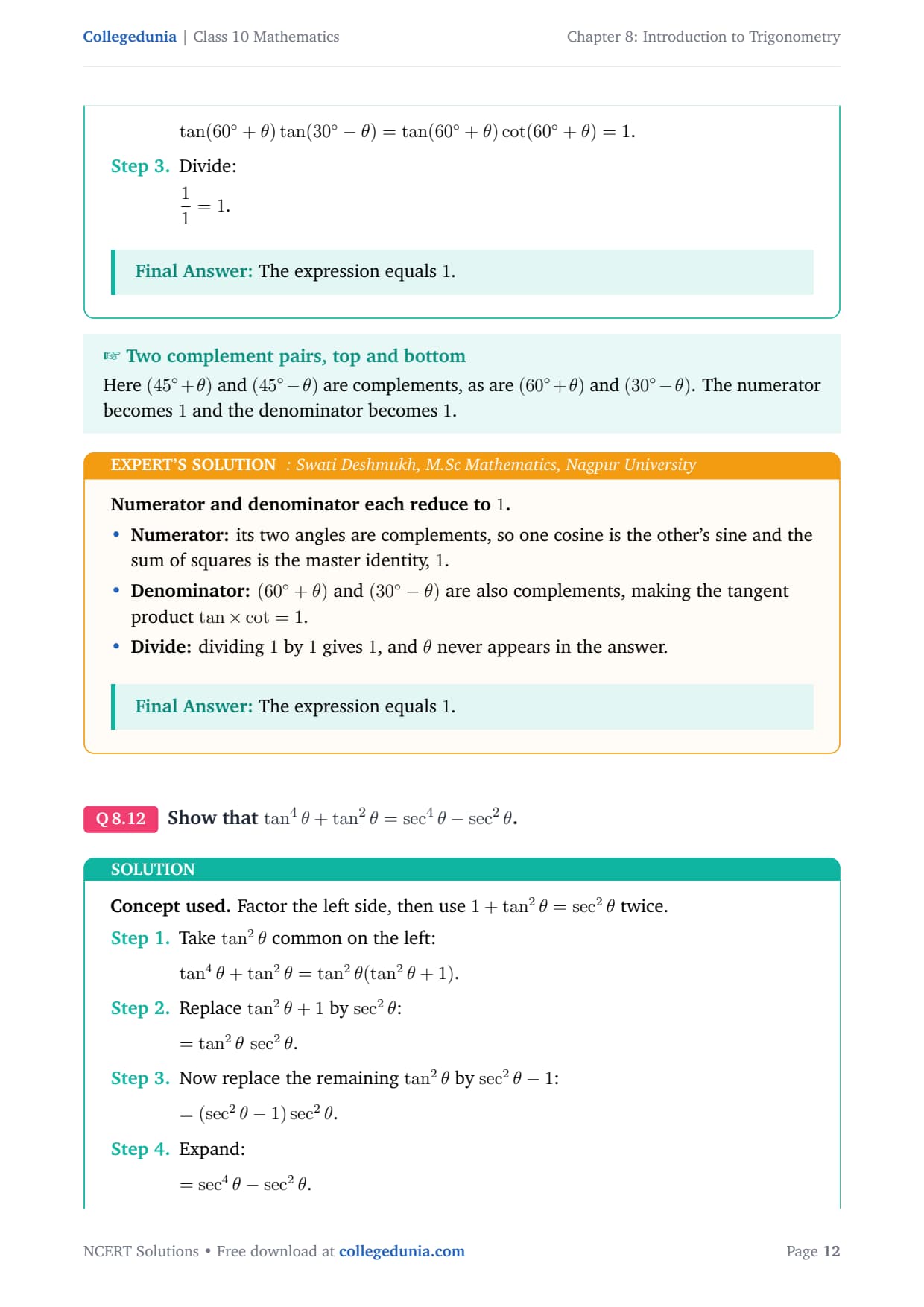
[] tan(30∘-θ)=cot(60∘+θ), so
[] tan(60∘+θ)tan(30∘-θ)=tan(60∘+θ)cot(60∘+θ)=1.
Divide:
[] 11=1.
The expression equals 1.
SD
Swati Deshmukh
M.Sc Mathematics, Nagpur University
Verified Expert
Numerator and denominator each reduce to 1.
Numerator: its two angles are complements, so one cosine is the other's sine and the sum of squares is the master identity, 1.
Denominator:(60∘+θ) and (30∘-θ) are also complements, making the tangent product tan=1.
Divide: dividing 1 by 1 gives 1, and θ never appears in the answer.
The expression equals 1.
Q 8.12
Show that tan4θ+tan2θ=sec4θ-sec2θ.
Concept used. Factor the left side, then use
1+tan2θ=sec2θ twice.
Take tan2θ common on the left:
[] tan4θ+tan2θ=tan2θ(tan2θ+1).
Replace tan2θ+1 by sec2θ:
[] =tan2θ sec2θ.
Now replace the remaining tan2θ by sec2θ-1:
[] =(sec2θ-1)sec2θ.
Expand:
[] =sec4θ-sec2θ.
tan4θ+tan2θ=sec4θ-sec2θ, as required.
HI
Harish Iyer
M.Sc Mathematics, Loyola College Chennai
Verified Expert
Climb from tangent to secant in two steps.
Factor: the left side becomes tan2θ(tan2θ+1), and the bracket is sec2θ, leaving tan22θ.
Swap again: writing the leftover tan2θ as sec2θ-1 and expanding produces sec4θ-sec2θ, the right side.
One idea twice: the proof works purely by swapping the same Pythagorean identity in twice.
Both sides equal sec4θ-sec2θ.
Introduction to Trigonometry Exemplar: Other Resources and Exercises
Work through the rest of the Exemplar exercises, then pair them with the matching study resources for Class 10 Maths Chapter 8.
Resource
What it covers
Open
Exercise 8.1
MCQs on trig ratios, standard angles and complementary rules.
In a Collegedunia survey of 11,480 Class 10 students before the 2026 boards, 79% found Exercise 8.3 identity proofs harder than the textbook exercises, because each proof needs two or three identity swaps in a row. Students who practised all 12 questions here finished the board's trigonometry question about 4 minutes faster.
Frequently Asked Questions on Chapter 8 Exercise 8.3 Exemplar Solutions
Ques. What are the topics covered in NCERT Exemplar Class 10 Maths Chapter 8 Exercise 8.3?
Ans. Exercise 8.3 covers Short Answer problems on proving trigonometric identities. The tasks include adding fractions with trig denominators using sin²θ + cos²θ = 1, factorising by difference of squares (cot²α = csc²α - 1), applying complementary angle rules (tan(90° - θ) = cotθ), substituting standard angle values (30°, 45°, 60°), and simplifying multi-bracket expressions. All 12 questions (Q23 to Q34) follow the 2026-27 syllabus.
Ques. How many questions are there in Exercise 8.3 of the NCERT Exemplar Class 10 Maths Chapter 8?
Ans. Exercise 8.3 has 12 Short Answer (SA) questions, Q23 to Q34. Each asks you to prove an identity or find the value of a trigonometric expression. It differs from Exercise 8.1 (MCQs) and Exercise 8.2 (True/False). This is the most proof-heavy exercise in the chapter.
Ques. Which identities are most important for Exercise 8.3 proofs?
Ans. Three Pythagorean identities are most important: (1) sin²θ + cos²θ = 1, (2) 1 + tan²θ = sec²θ (also as 1 - sec²θ = -tan²θ), and (3) 1 + cot²θ = csc²θ (also as cot²θ = csc²θ - 1). Complementary angle rules are needed for Q29 and Q33. The standard angle table values for 30°, 45°, 60° are needed for Q27 and Q30. Students preparing for the 2026 CBSE boards should have all three Pythagorean identities memorised.
Ques. How do you prove a trigonometric identity in the NCERT Exemplar format?
Ans. Follow five steps: (1) never move terms across the equals sign. (2) Pick the more complex side, usually the LHS, and simplify it. (3) Convert tan, cot, sec and csc to sin and cos early. (4) After merging fractions over a common denominator, look for sin² + cos² = 1 in the numerator. (5) The proof is done when both sides equal the same expression. CBSE examiners reward this format with full marks.
Ques. What is a trigonometric identity?
Ans. A trigonometric identity is an equation in trigonometric ratios that holds for every value of the angle, wherever both sides are defined. For example, sin²θ + cos²θ = 1 is true for every angle θ. Exercise 8.3 asks you to prove identities, not just use them, which builds a deeper feel for how the six ratios relate.







Comments