




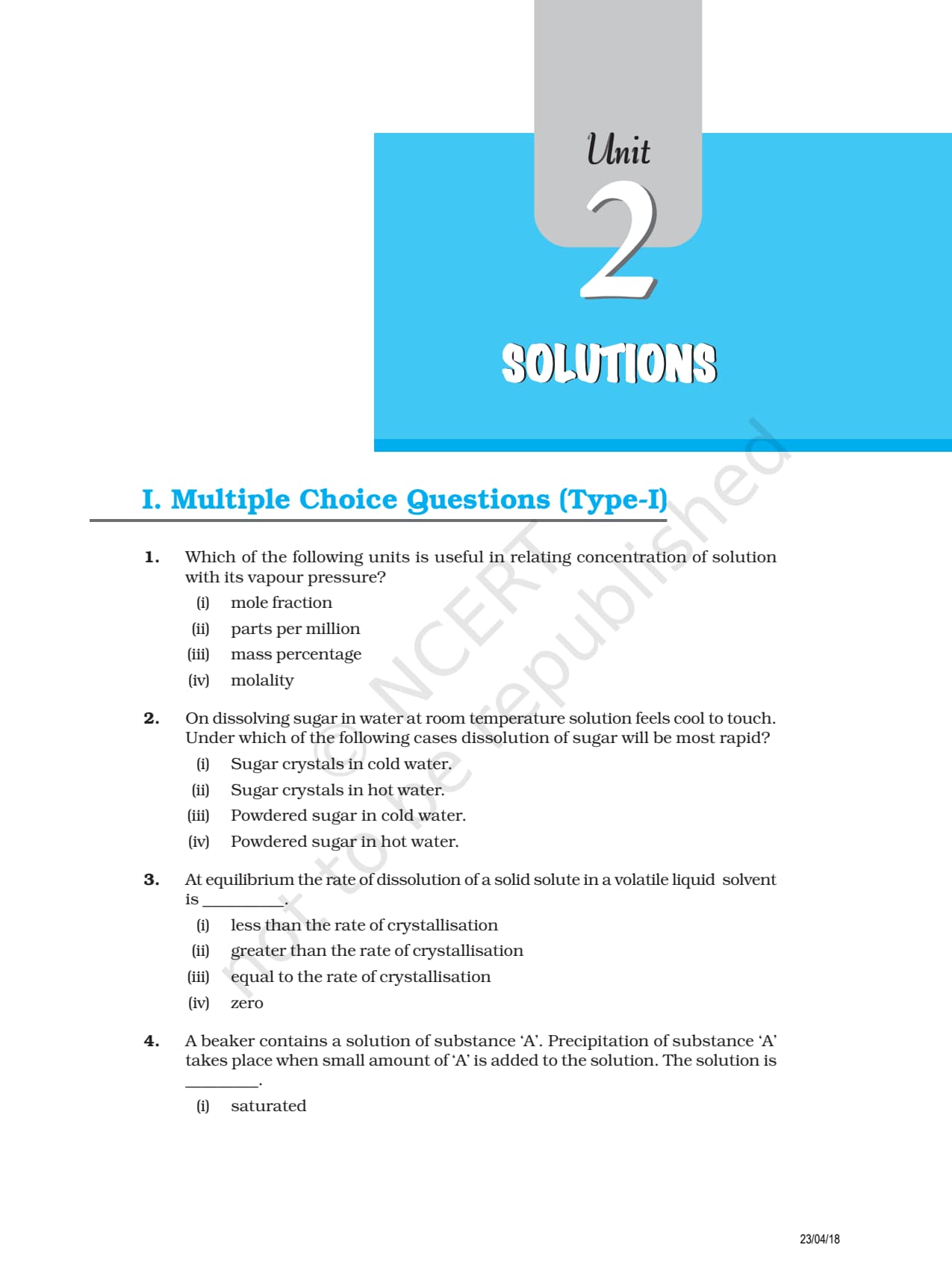
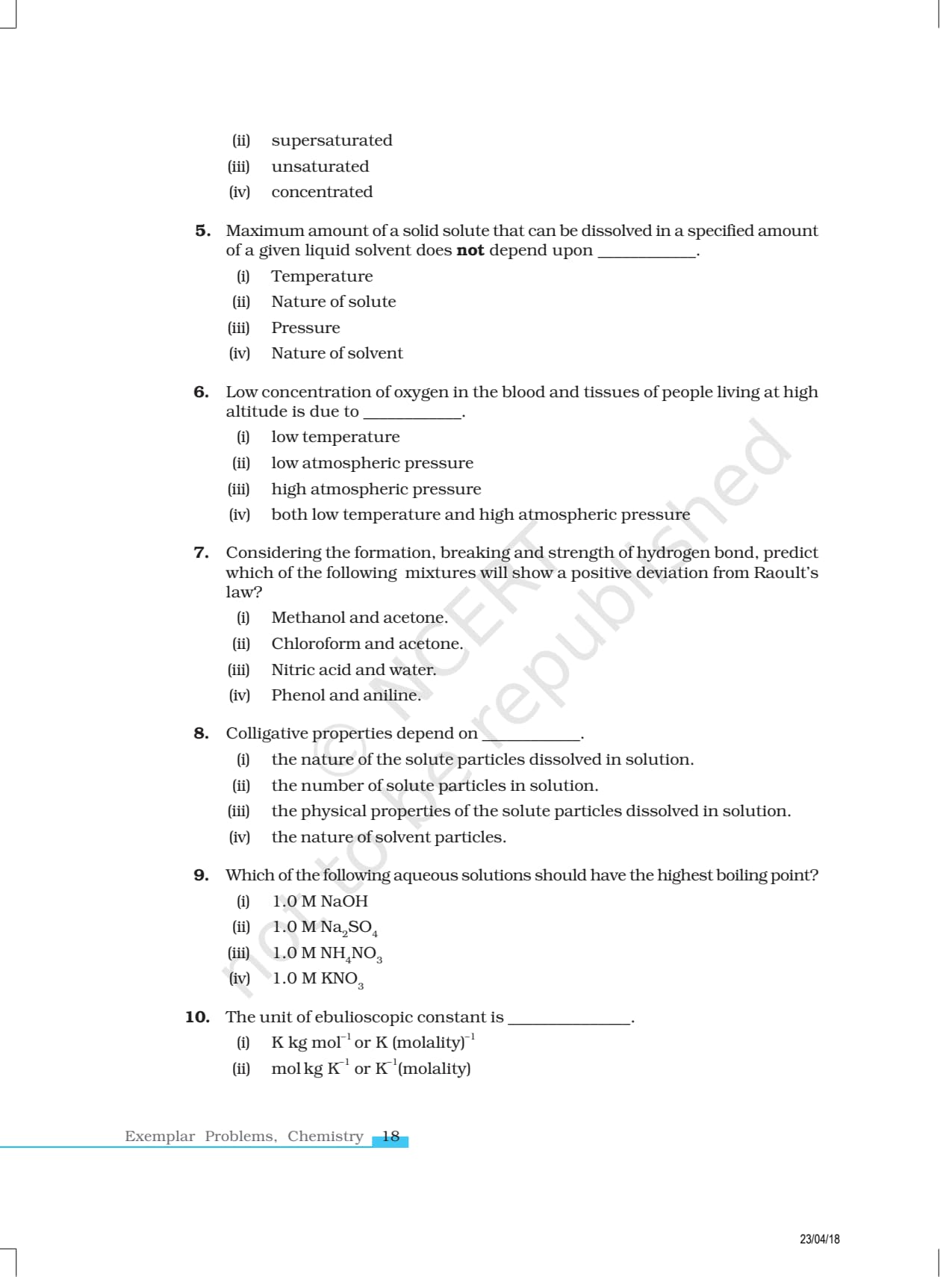
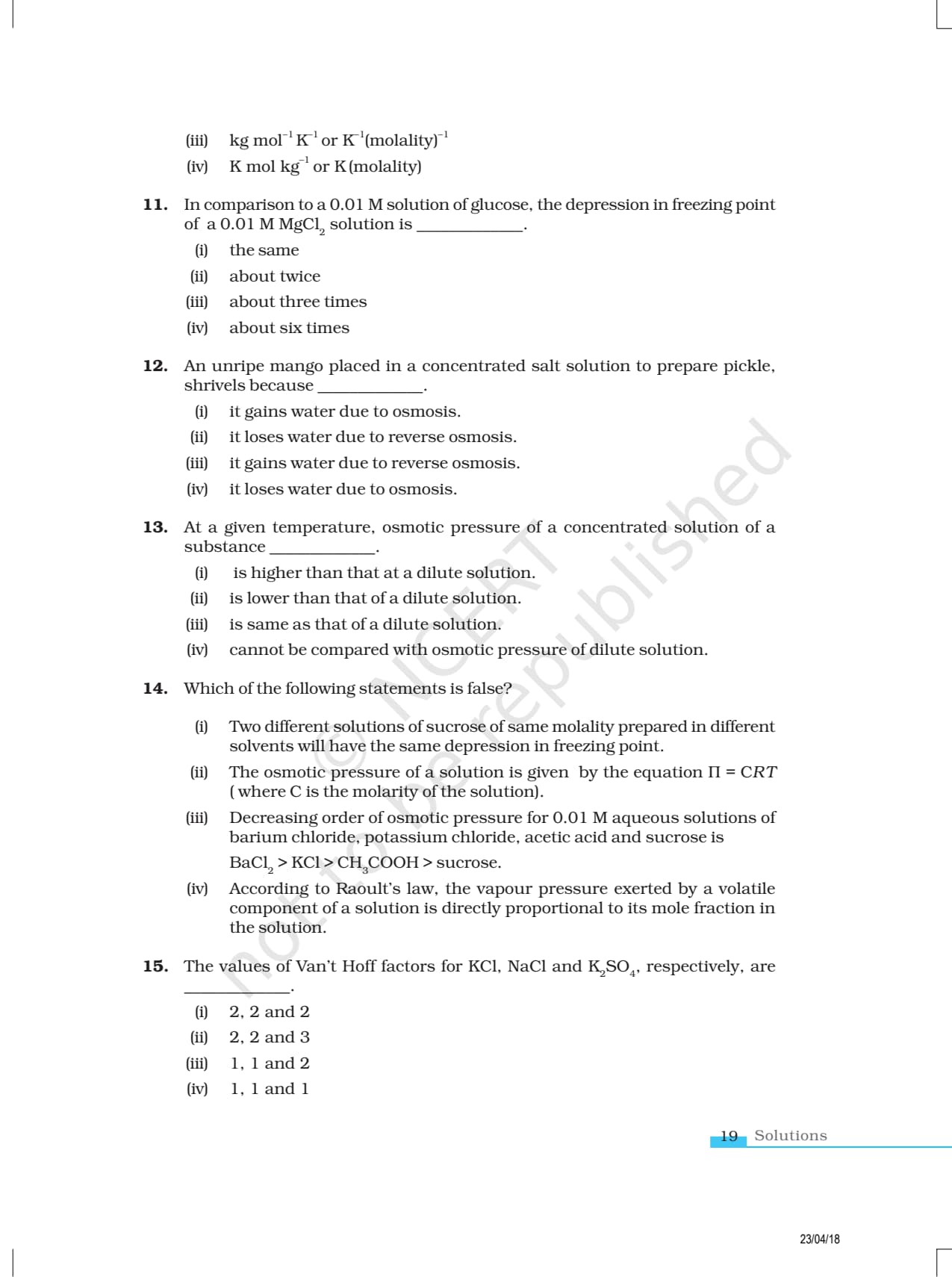
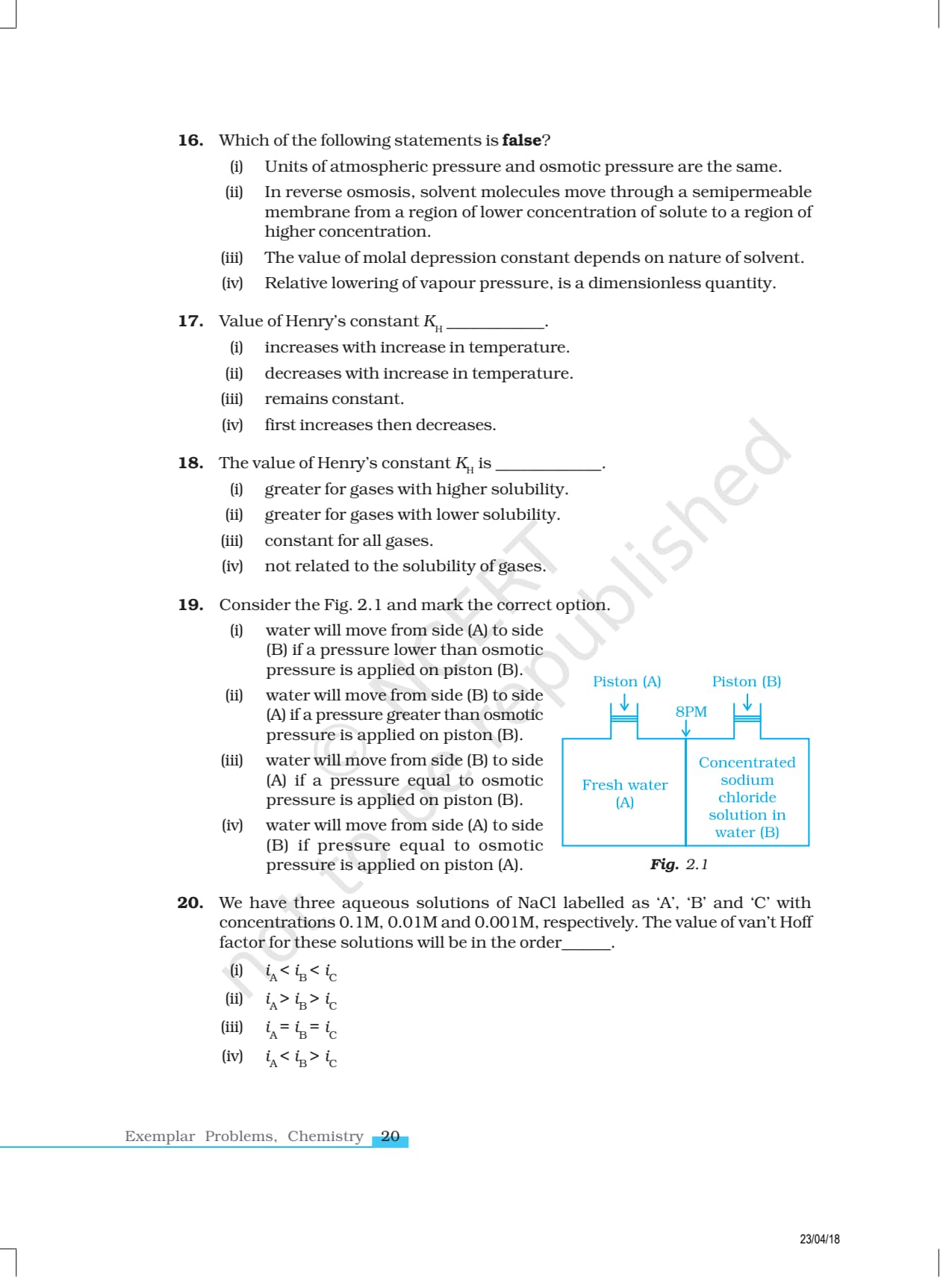
Class 12 Chemistry Chapter 1 Solutions packs nearly 60 graded problems in the official NCERT Exemplar, far more than the textbook's 41. The Collegedunia Exemplar PDF on this page mirrors that workload and adds JEE Main and NEET tagging.
- CBSE Weightage: 6 to 8 marks (one numerical plus one short-answer is the standard split)
- JEE Main Weightage: 3 to 4% (one or two questions per shift on Raoult's law, colligative properties, or van't Hoff factor)
- NEET Weightage: 2 to 3 questions per year, almost always on osmotic pressure, depression of freezing point, or abnormal molar mass
The Collegedunia NCERT Exemplar Book PDF on this page is curated by subject experts, mapped to the 2026-27 Class 12 Chemistry syllabus, and refined against the last five years of CBSE Board, JEE Main and NEET papers.
Also Check:
- Solutions Class 12 Chemistry NCERT Exemplar Solutions
- Solutions Class 12 Chemistry NCERT Solutions
- Solutions Class 12 Chemistry NCERT Book PDF
Solutions Class 12 Chemistry NCERT Exemplar Question-Type Breakdown
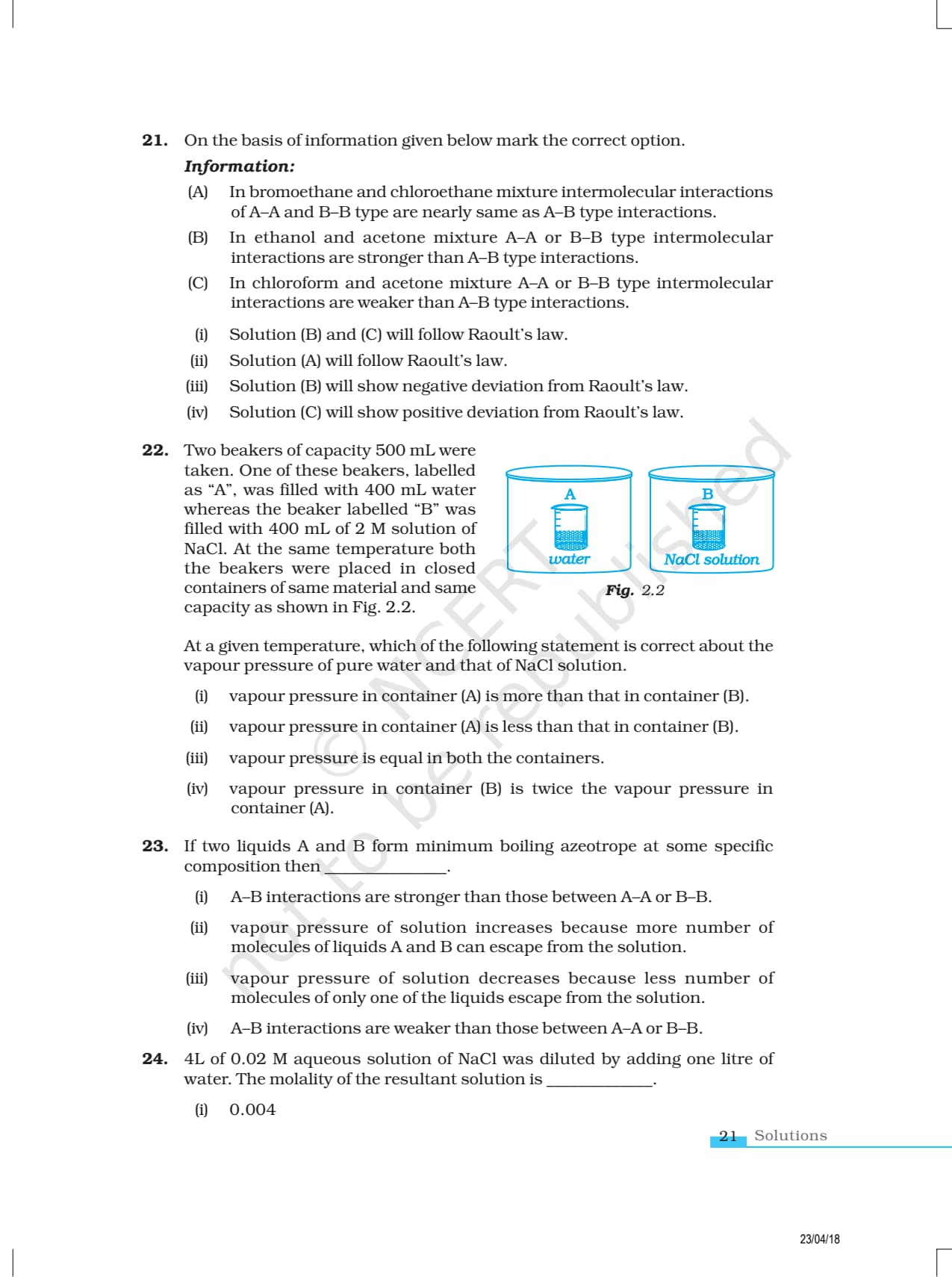
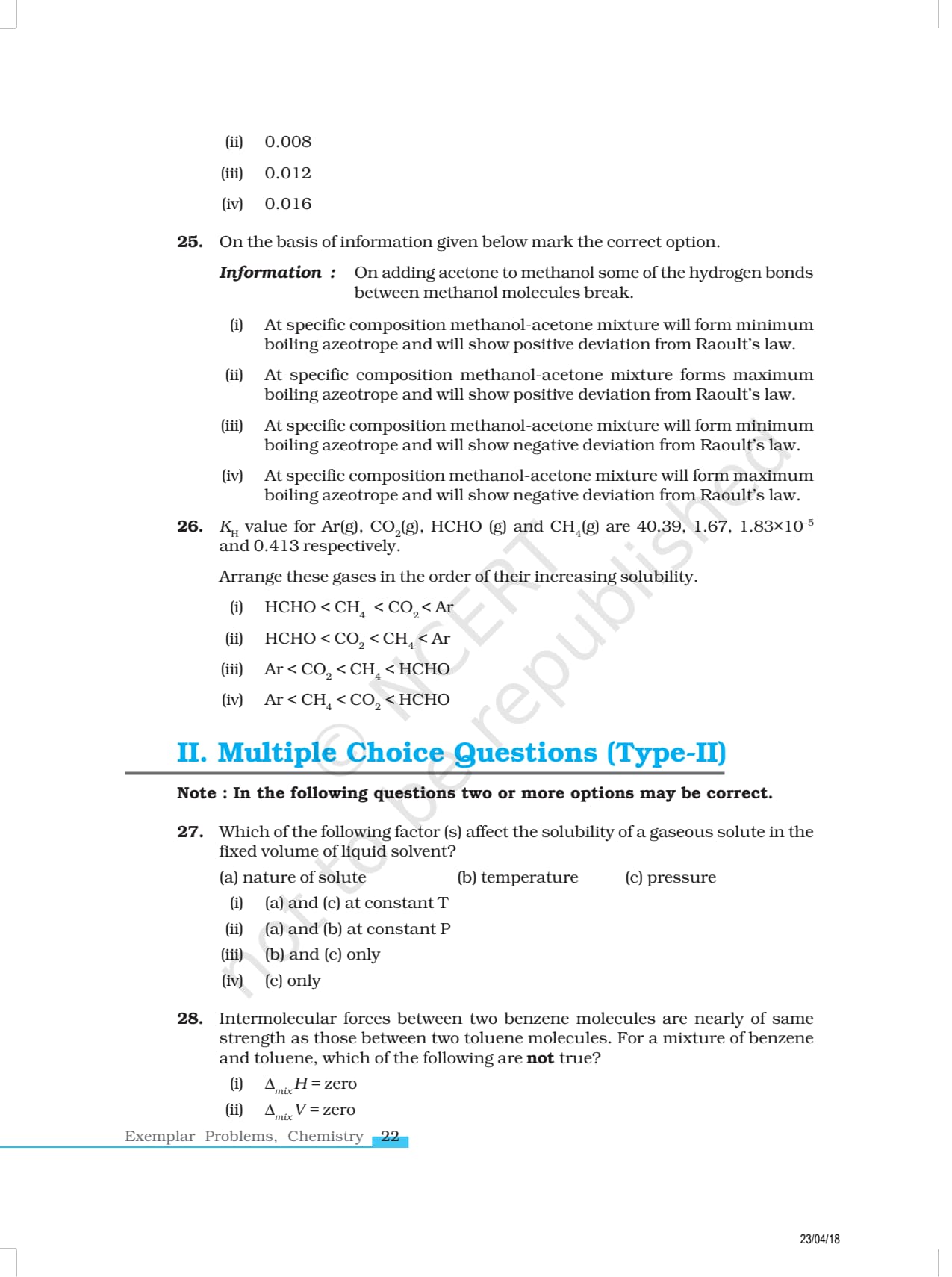
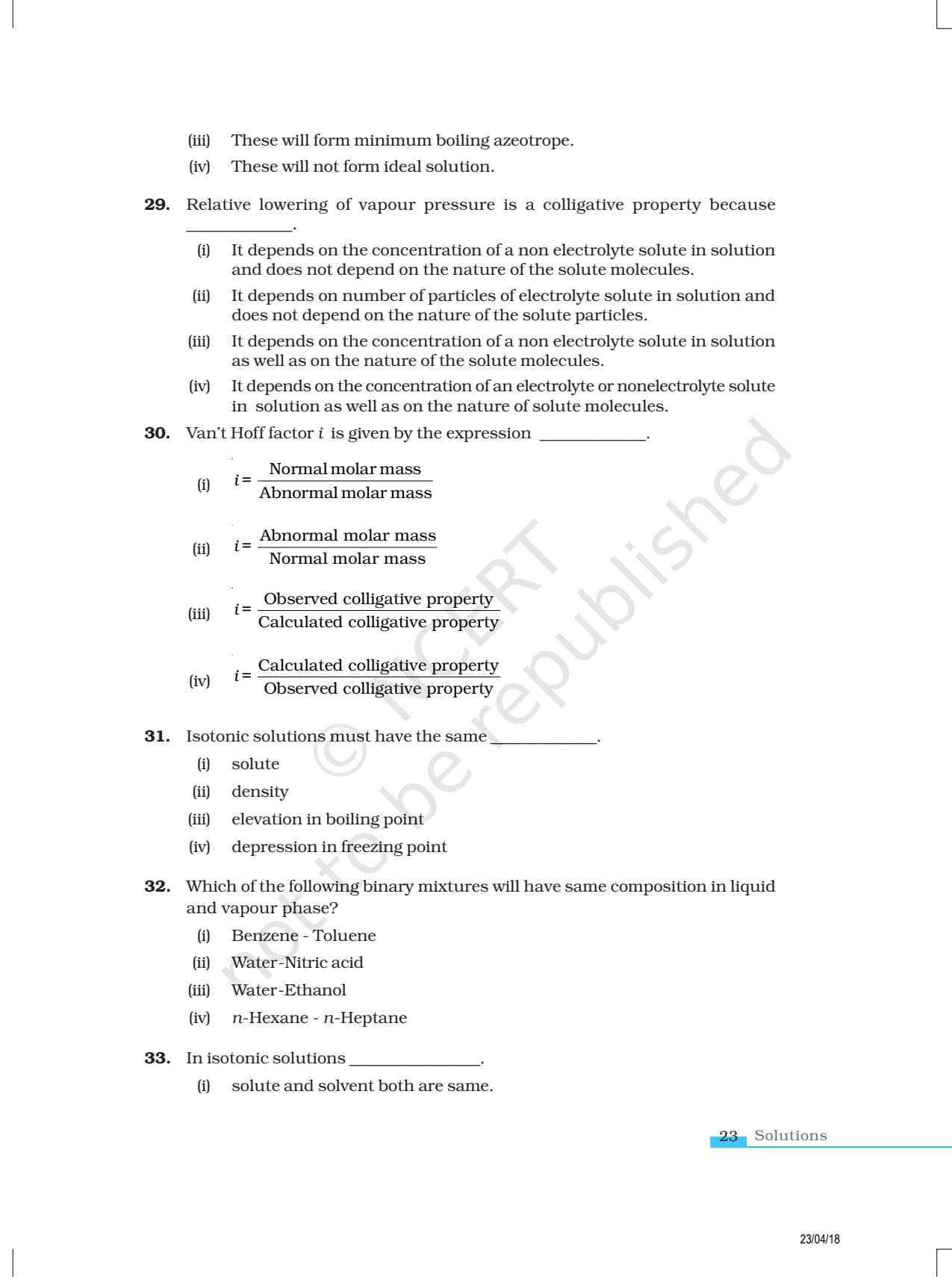
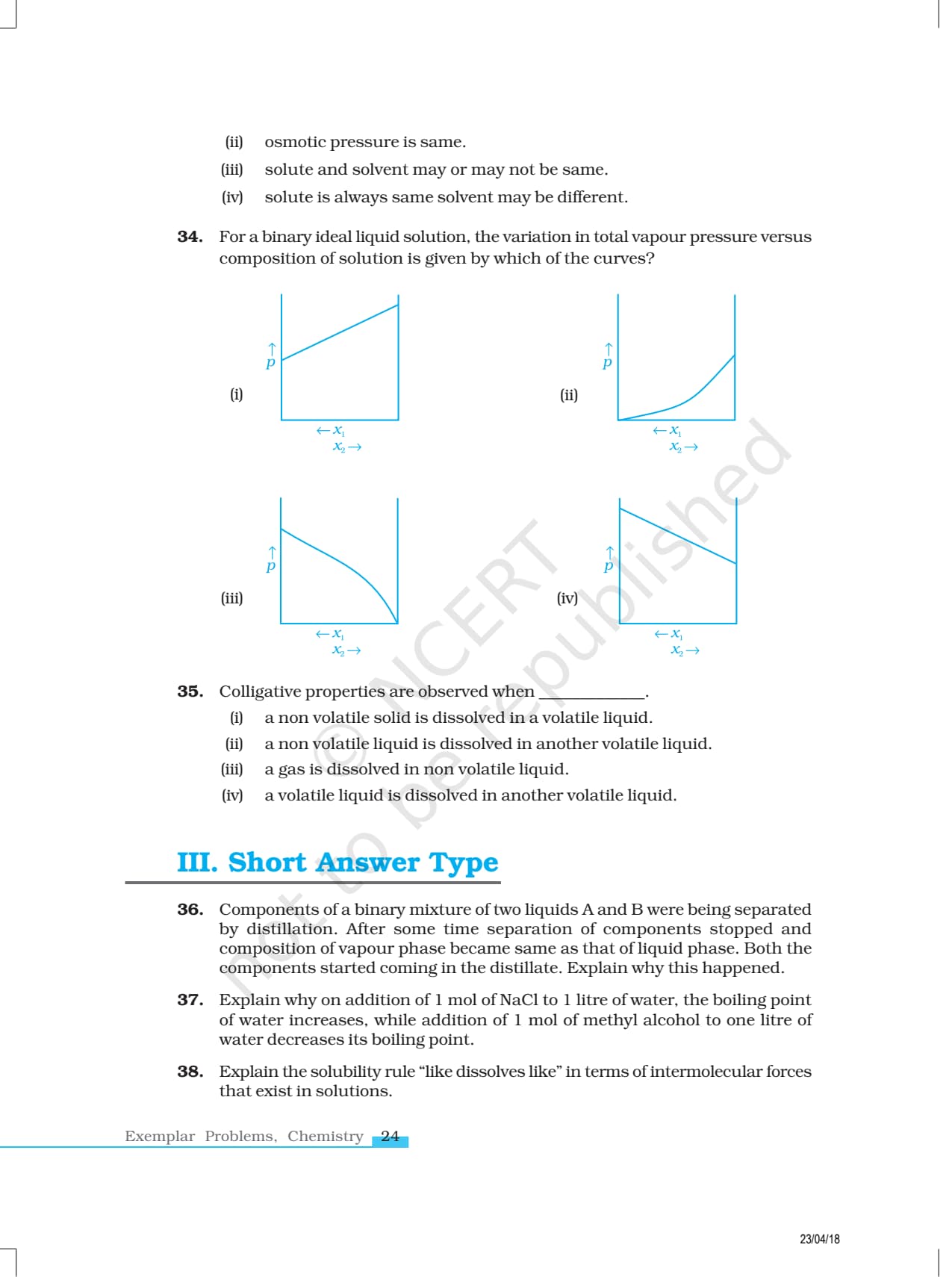
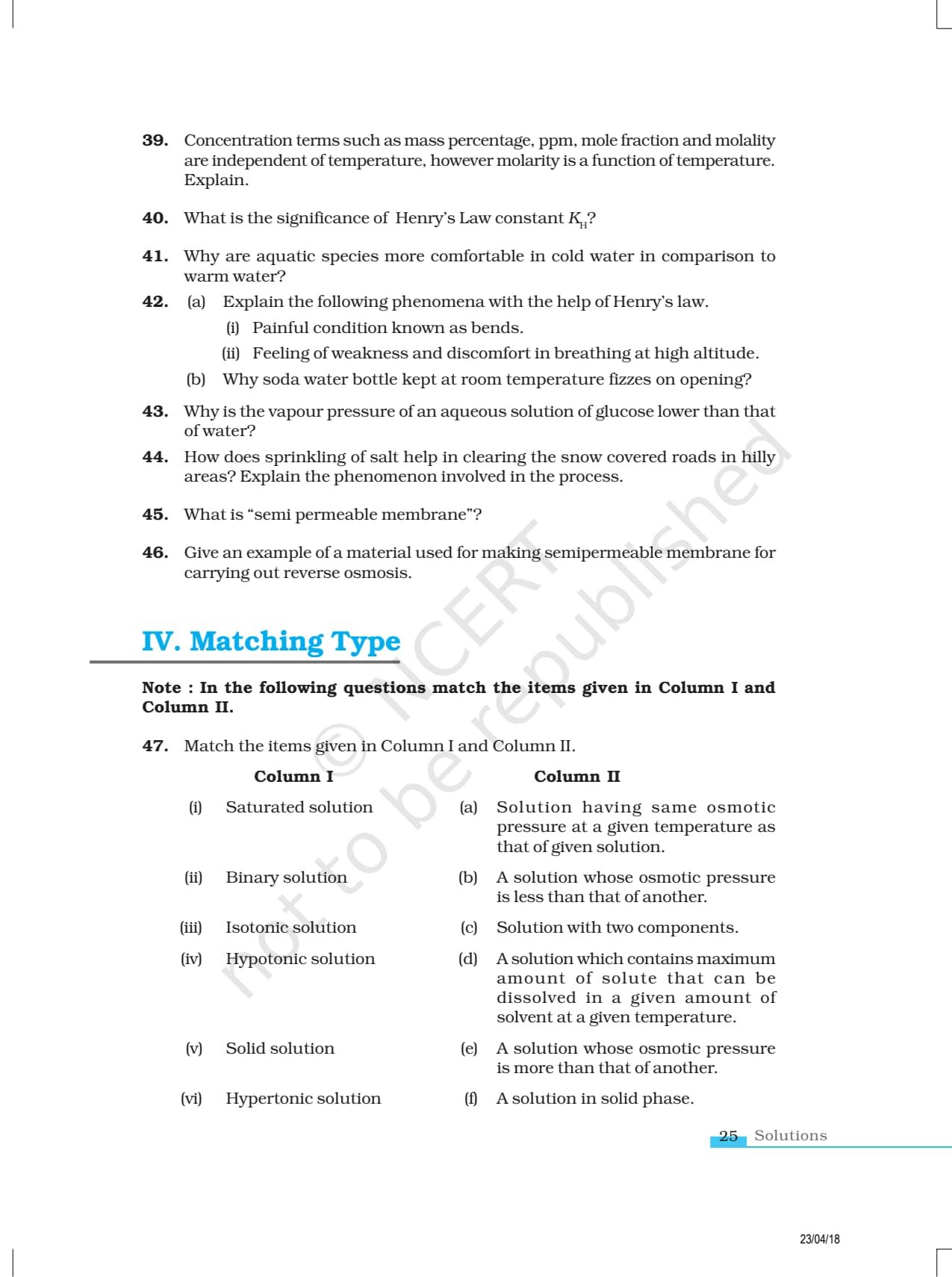
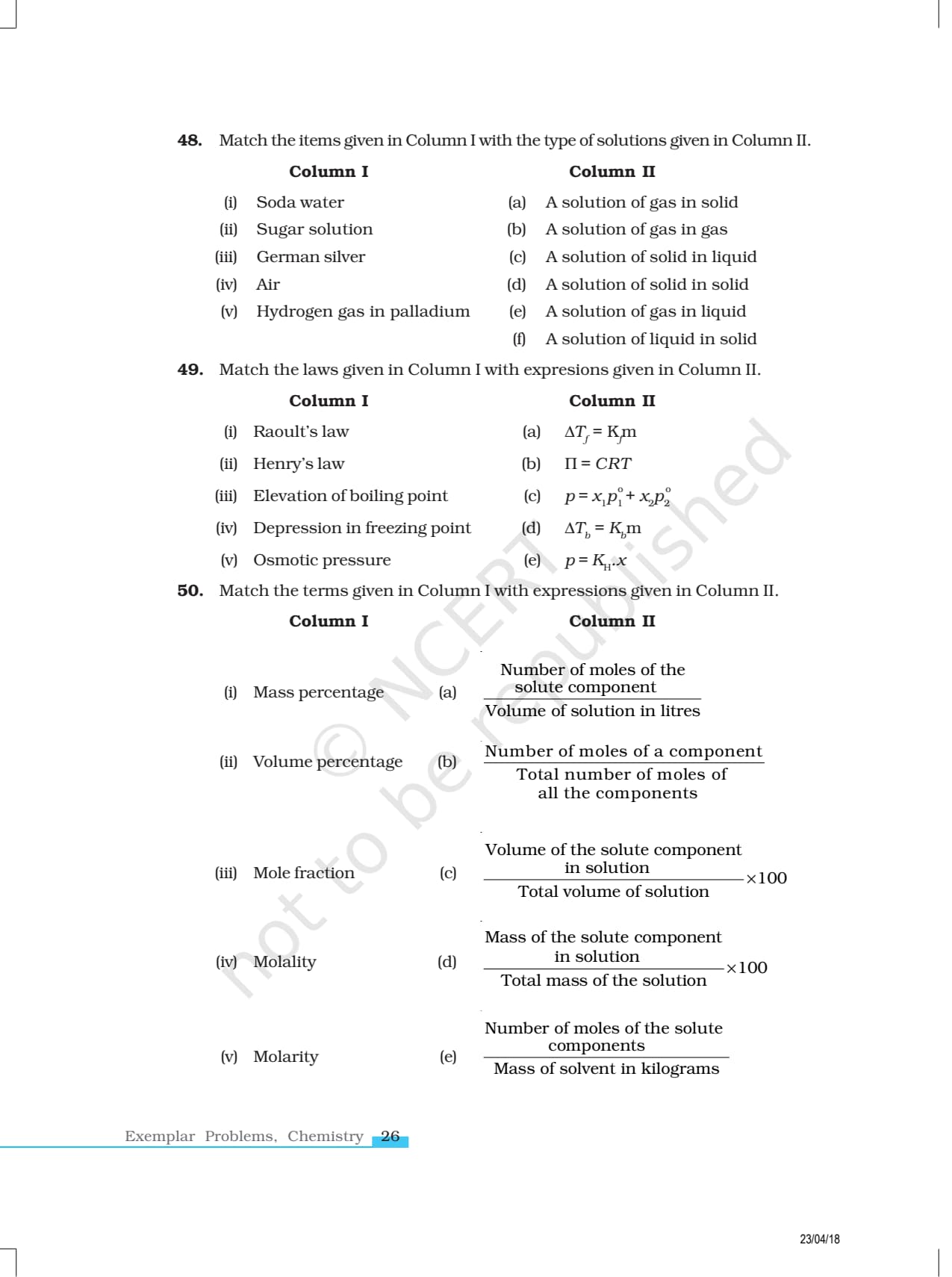
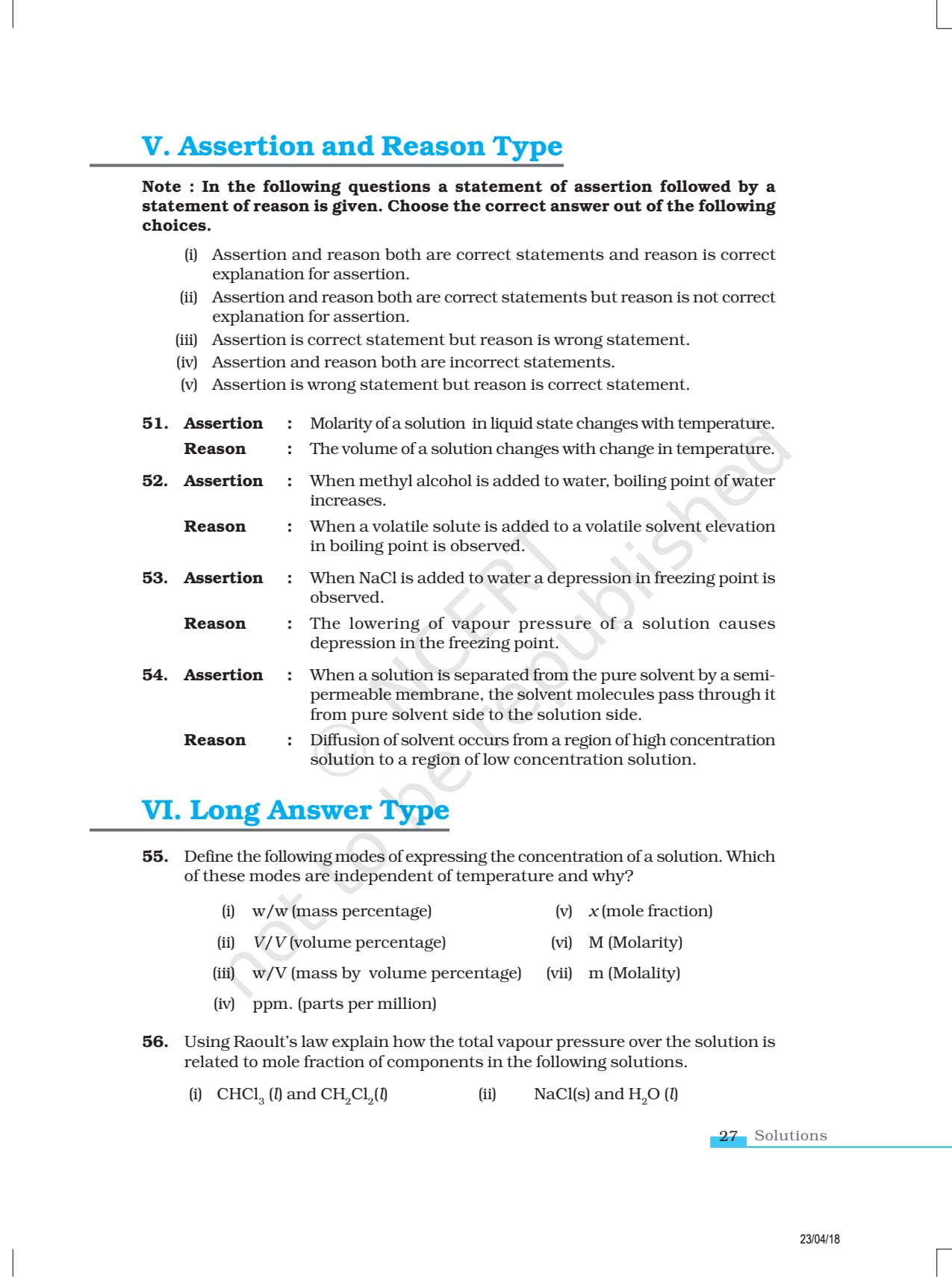
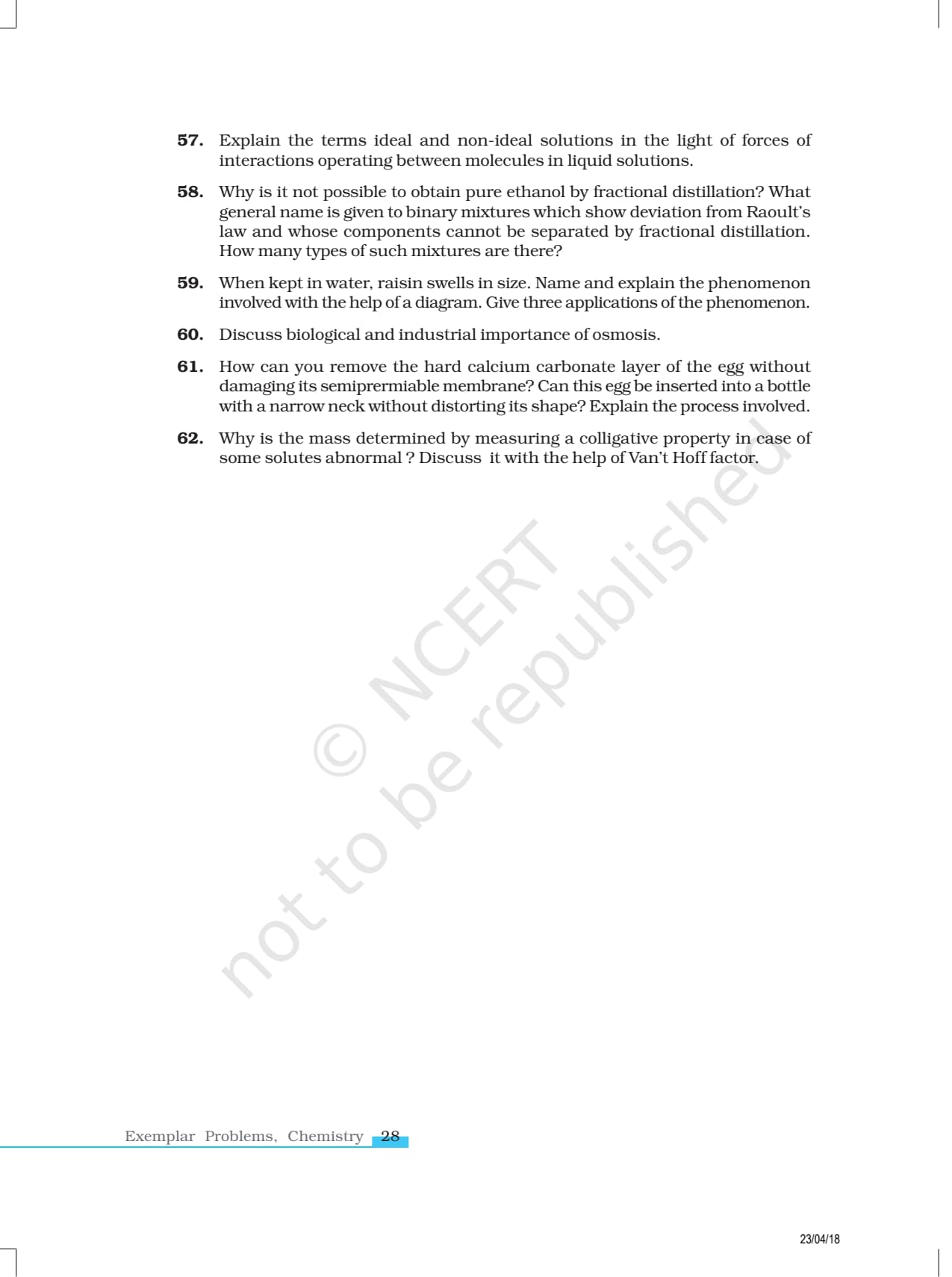
The Solutions Exemplar is one of the most balanced sets in Class 12 Chemistry: every type from one-mark MCQ-I to five-mark Long-Answer appears, with a high share of numerical Short-Answer items.
| Question Type | Count | Marks each | Typical focus |
|---|---|---|---|
| MCQ-I (single correct) | 16 | 1 | Definitions, ideal vs non-ideal, sign of i, units of concentration |
| MCQ-II (multiple correct) | 5 | 2 | Henry's-law gases, azeotrope behaviour, positive-deviation pairs |
| Very Short Answer (VSA) | 10 | 1 | One-line distinctions, formula recall, single-step calculations |
| Short Answer (SA) | 20 | 2–3 | Numericals on molarity, molality, freezing-point depression, vapour-pressure lowering |
| Long Answer (LA) | 4 | 5 | Multi-part osmotic-pressure problems, abnormal molar mass with van't Hoff factor, derivation-style proofs |
| Matching / Assertion-Reason | 3 | 1–2 | Concept-pairing, dilute-solution assumptions |
Around 60% of the marks come from Short-Answer numericals, so students fast at molality, mole-fraction and freezing-point depression lock in most of the score.
Solutions Class 12 Chemistry Explained
Source: Sourabh Raina on YouTube
What's Inside the Solutions Exemplar Book PDF
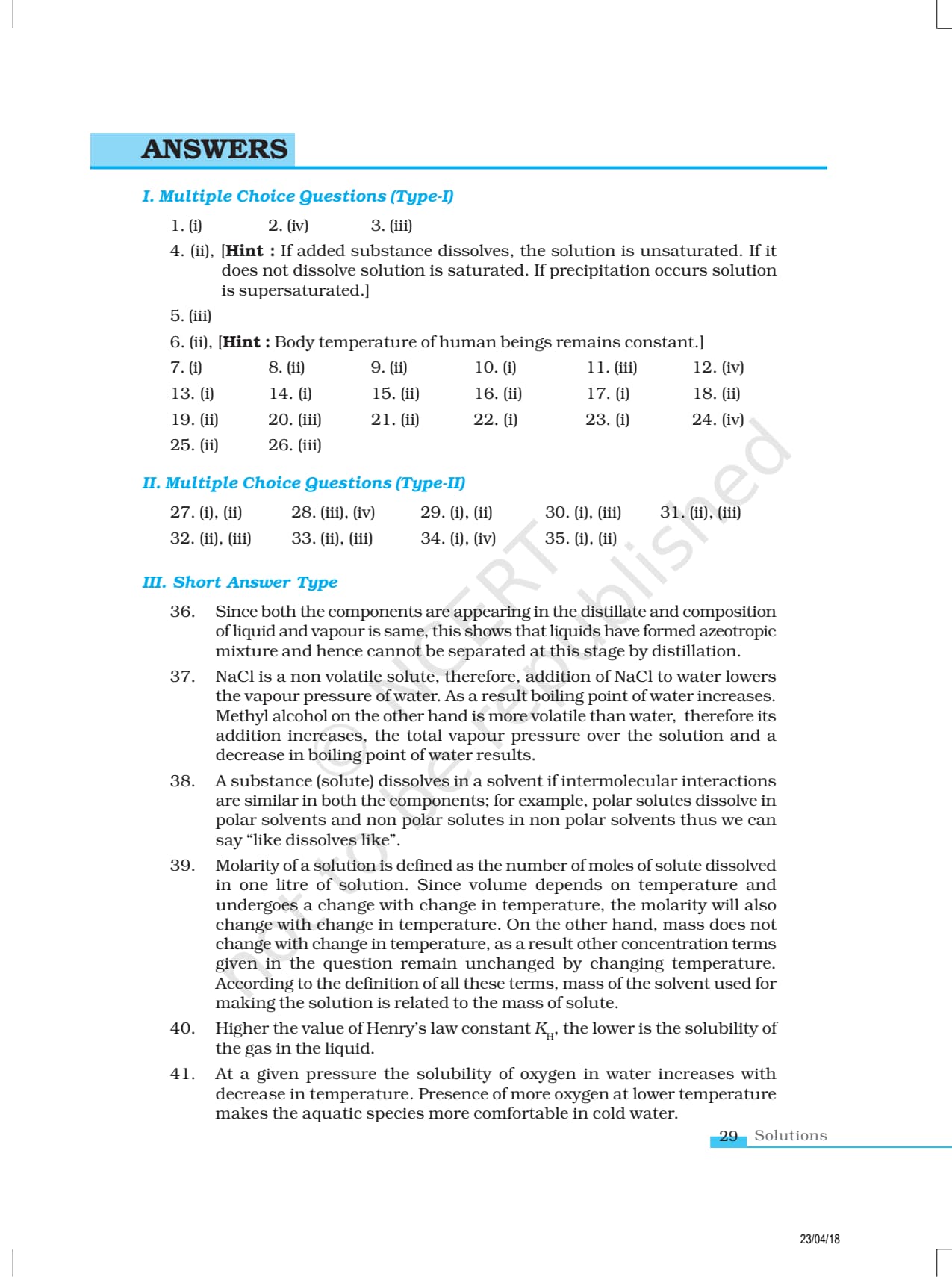
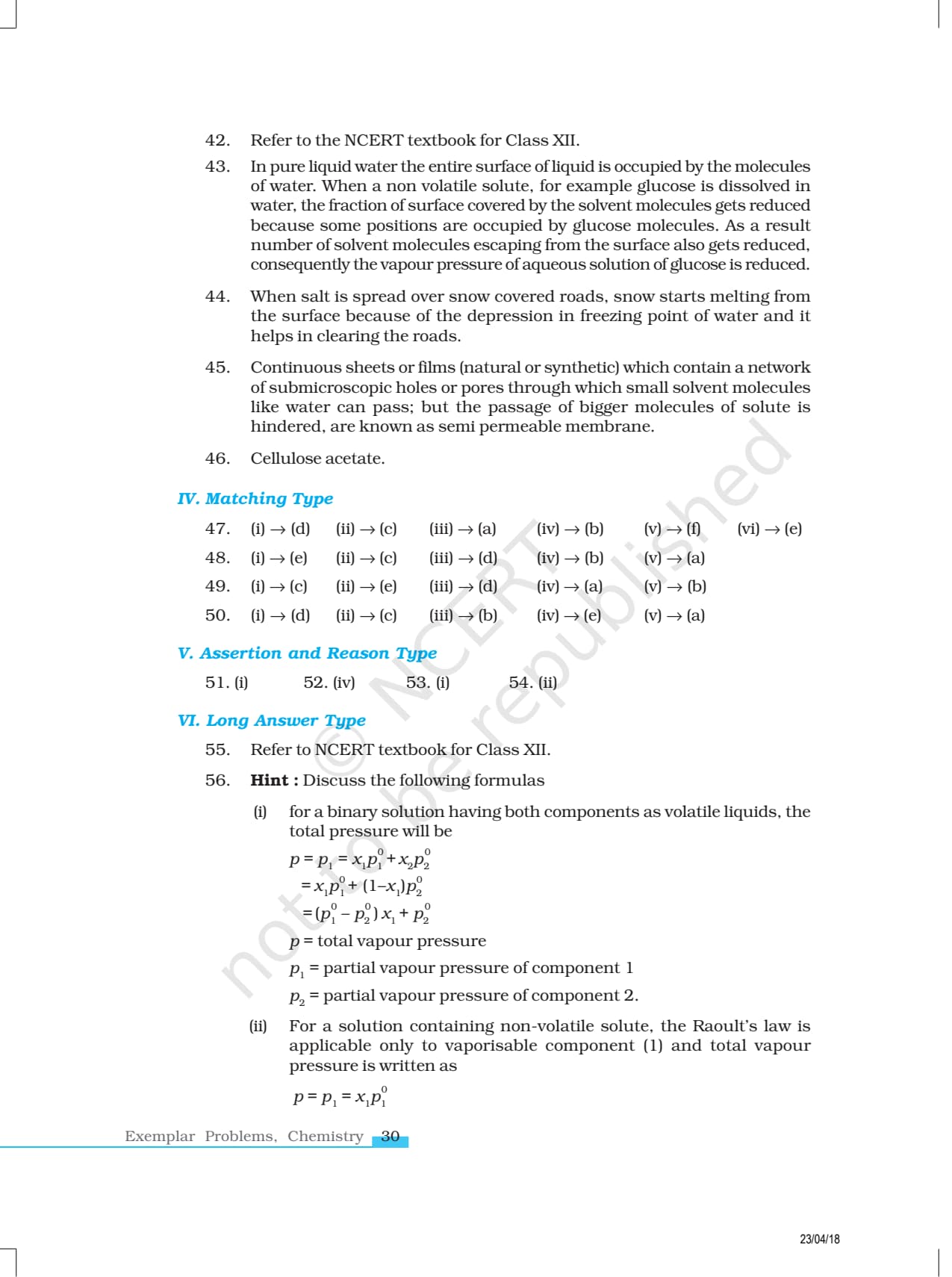
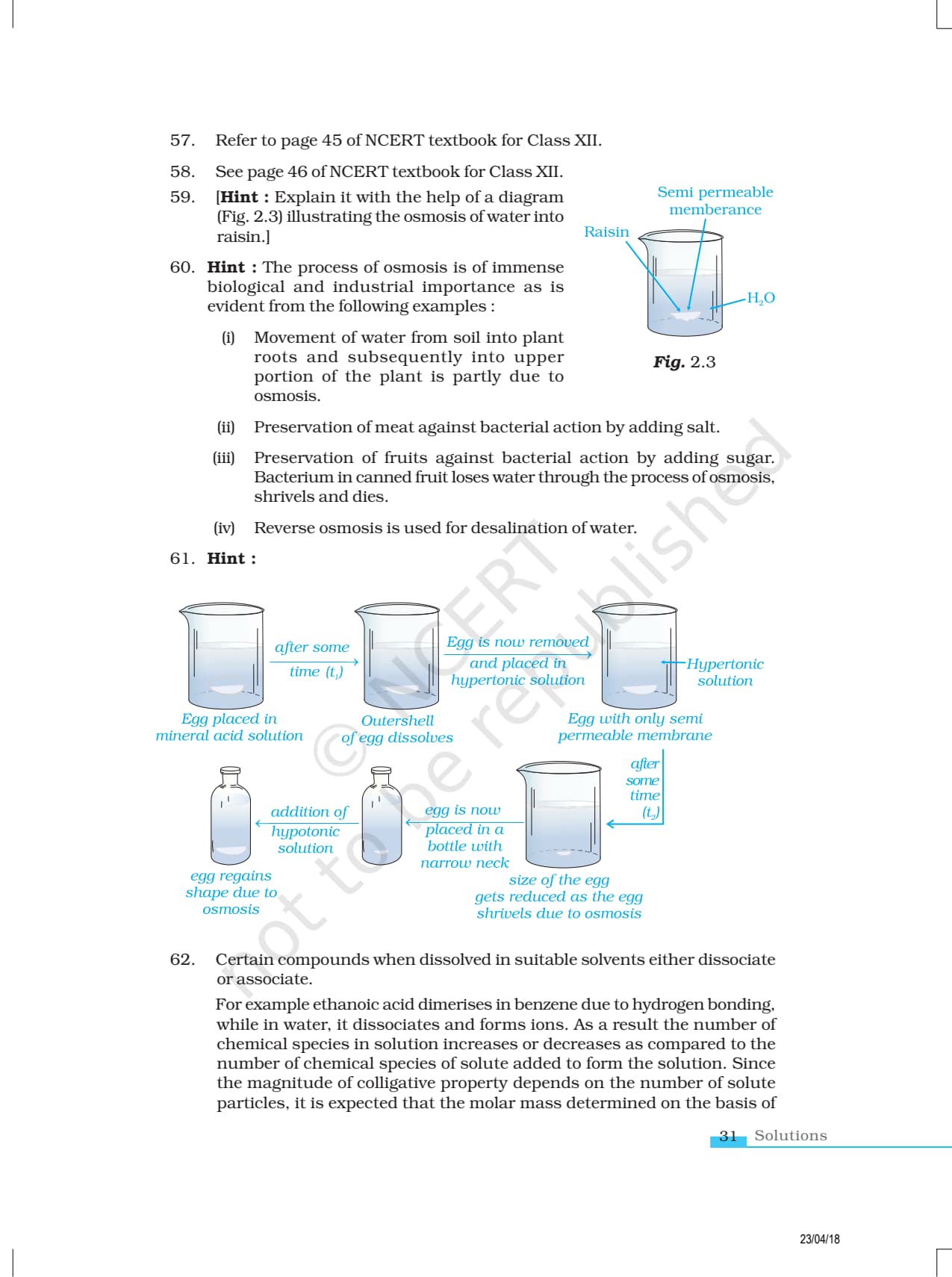
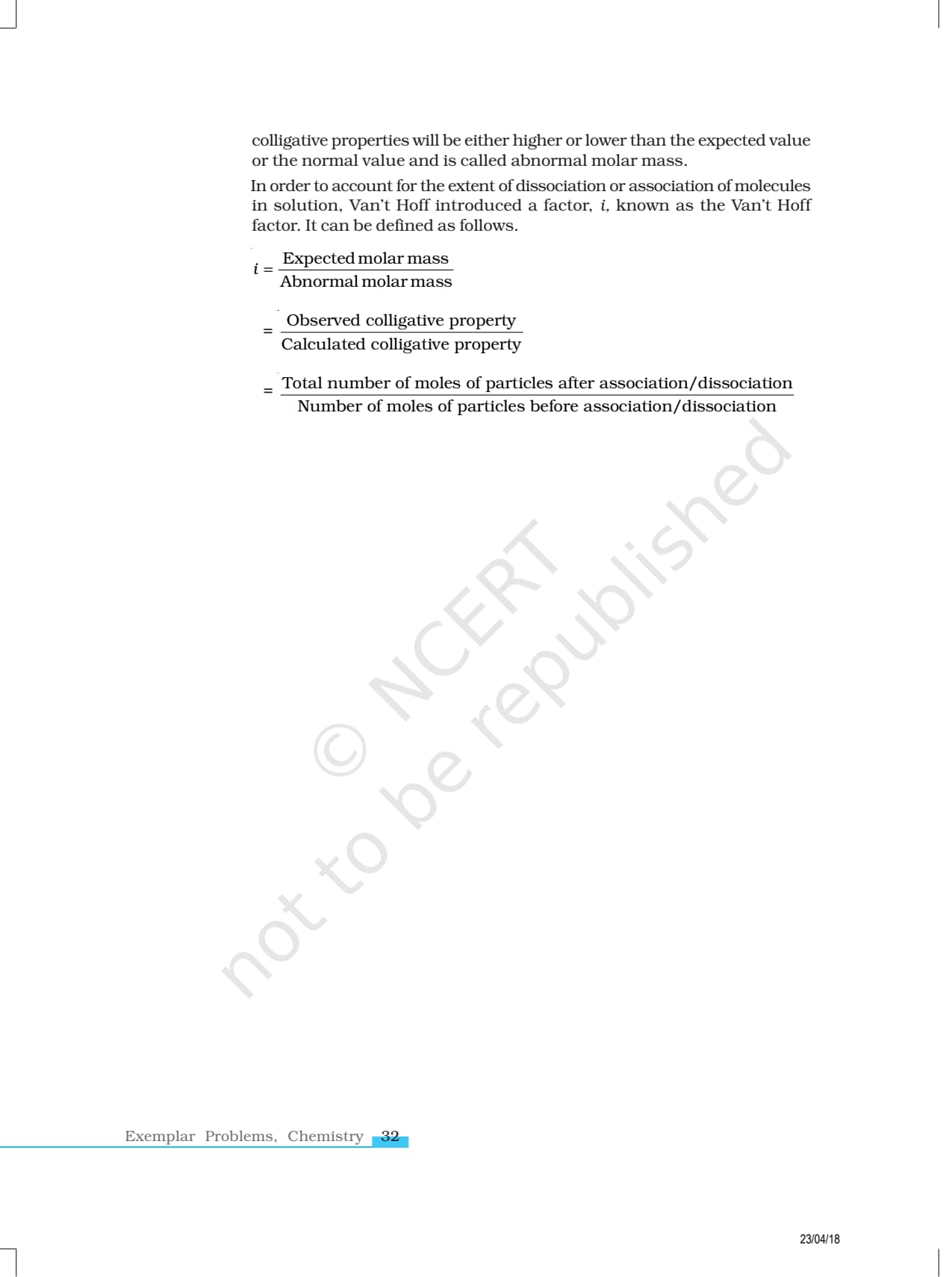
The Collegedunia Exemplar Book PDF is the official NCERT Exemplar chapter for Solutions, re-typeset with cleaner labels and one-line topic tags. The contents are:
- Section-1.1 to Section-1.9 question mapping (so you can attempt only those questions whose topic you have just revised)
- 16 MCQ-I + 5 MCQ-II + 10 VSA + 20 SA + 4 LA + 3 Match-the-Column / Assertion-Reason — 58 problems in total
- Six topic-tags used throughout: Concentration units, Solubility & Henry's law, Vapour pressure & Raoult's law, Ideal vs non-ideal, Colligative properties, Abnormal molar mass & van't Hoff factor
- Boxed formulae carried at the top of every two-page spread
- JEE Main / NEET inspiration markers next to questions that have appeared in recent entrance papers
How will Collegedunia's NCERT Exemplar Book PDF Help You with Solutions?
The Exemplar is a question paper, not a study book. The Collegedunia layered version does the orientation work for you:
- 2026-27 NCERT Alignment: Every question is labelled with its rationalised textbook section, so deleted topics stay out of revision.
- Difficulty Step-Up Markers: A one-to-three dot rating flags how far each problem sits above textbook level.
- Expert Verification: Answers and significant figures are re-checked against the official NCERT key.
- JEE / NEET Cross-References: Where a problem reappeared in JEE Main or NEET, the year is noted.
Solutions Exemplar vs NCERT Textbook: Difficulty Step-Up
The Exemplar lifts the standard NCERT setup by adding an extra unknown, a non-ideal twist, or a unit-conversion trap.
| Concept | NCERT textbook ask | Exemplar twist |
|---|---|---|
| Freezing-point depression | Find Tf given mass and Kf | Find Kf backwards, with an associating or dissociating solute requiring the van't Hoff factor |
| Raoult's law for two volatile liquids | Total vapour pressure of an ideal mixture | Predict whether the mixture is ideal, positive-deviation or negative-deviation; justify with intermolecular-force argument |
| Henry's law | Calculate solubility of a gas at given pressure | Compare KH values across four gases at a fixed temperature and rank the solubilities, then explain the physical reason |
Related Links:
Why the NCERT Exemplar Matters for JEE and NEET Solutions Prep
Solutions is one of the most reliably tested chapters in both JEE Main and NEET, and the Exemplar doubles as an entrance-prep workbook.
- Three of the last five JEE Main January shifts carried a question that maps onto an Exemplar MCQ-II from this chapter.
- NEET 2025 had two questions on osmotic pressure and freezing-point depression matching Exemplar LA-1 and SA-15.
- The matching-column items train the azeotrope and Henry's-law recognition JEE Main now uses.
- Working the LA pool builds the multi-step stamina NEET demands.
Solutions Exemplar Always-On: Old vs Rationalised Syllabus
The NCERT Exemplar Problems book was not re-published after the 2024 rationalisation, so for many chapters it still carries trimmed topics. Solutions is the lucky exception.
Detailed kept-trimmed-removed table: Solutions Class 12 Chemistry NCERT Book PDF
Solutions Exemplar JEE Main and NEET Question Mapping
The table below shows how often Solutions-chapter Exemplar problems have been adapted by recent JEE Main and NEET papers. The pattern is consistent: paper-setters lift the setup, change the numbers, and reuse the conceptual hook.
| Year | Exam | Concept lifted | Exemplar Q-type counterpart |
|---|---|---|---|
| 2025 | JEE Main (Jan, Shift 1) | Vapour-pressure lowering for non-volatile solute | SA-12 / SA-13 |
| 2025 | NEET | Osmotic pressure with van't Hoff factor | LA-2 |
| 2024 | JEE Main (April) | Henry's-law constant ranking | MCQ-II Q-3 |
| 2024 | NEET | Depression in freezing point of an electrolyte | SA-17 |
| 2023 | JEE Main | Positive-deviation pair identification | MCQ-II Q-4 |
| 2022 | NEET | Molarity-vs-molality temperature-dependence framing | VSA-6 |
Every Exemplar attempt is therefore double duty: it tightens your board answer-writing and rehearses the exact concept that an entrance paper-setter is likely to reuse the same year.
Full year-wise PYQ map: Solutions Class 12 Chemistry NCERT Solutions
Solutions Weightage Compared Across Class 12 Chemistry Chapters
The visual below maps the typical CBSE Board marks distribution across all 10 chapters of the rationalised 2026-27 Class 12 Chemistry NCERT, averaged over the last five board papers. Solutions sits comfortably in the upper band alongside Coordination Compounds.
Student Feedback
In a Collegedunia poll of 900 Class 12 students, 78% said the Solutions Exemplar's Short-Answer numericals were the fastest way to lock in board marks.
Other Resources for Solutions Class 12 Chemistry
- Solutions Class 12 Chemistry Exemplar Book PDF
- Solutions Class 12 Chemistry NCERT Solutions
- Solutions Class 12 Chemistry Notes
- Solutions Class 12 Chemistry Formula Sheet
- Solutions Class 12 Chemistry NCERT Book PDF
- Solutions Class 12 Chemistry NCERT Exemplar Solutions
- Solutions Class 12 Chemistry Handwritten Notes
NCERT Exemplar Book PDF for Class 12 Chemistry: All Chapters
The table below lists the Exemplar Book PDFs Collegedunia hosts for every chapter of the rationalised 2026-27 Class 12 Chemistry syllabus.
| Chapter | Resource |
|---|---|
| Chapter 2 | Electrochemistry Exemplar Book PDF |
| Chapter 3 | Chemical Kinetics Exemplar Book PDF |
| Chapter 4 | The d- and f-Block Elements Exemplar Book PDF |
| Chapter 5 | Coordination Compounds Exemplar Book PDF |
| Chapter 6 | Haloalkanes and Haloarenes Exemplar Book PDF |
| Chapter 7 | Alcohols, Phenols and Ethers Exemplar Book PDF |
| Chapter 8 | Aldehydes, Ketones and Carboxylic Acids Exemplar Book PDF |
| Chapter 9 | Amines Exemplar Book PDF |
| Chapter 10 | Biomolecules Exemplar Book PDF |
Solutions Class 12 Chemistry Exemplar Book PDF FAQs
Ques. Where can I download Solutions Class 12 Chemistry NCERT Exemplar Book PDF?
Ans. You can download the Solutions Class 12 Chemistry NCERT Exemplar Book PDF directly from this page. Both the Normal and HD versions are available, and both are free.
Ques. Is the Solutions Exemplar PDF aligned with the 2026-27 NCERT?
Ans. Yes. The Solutions chapter was retained almost intact in the new NCERT edition, so every Exemplar question for this chapter is still in syllabus. The only structural change is that Solutions is now Chapter 1 in the Class 12 Chemistry book (it was Chapter 2 in the old edition).
Ques. How many pages is the Class 12th Chemistry Solutions Exemplar Book PDF?
Ans. The Exemplar Book PDF for Solutions runs approximately 11 pages and carries 58 graded problems split across MCQ-I, MCQ-II, VSA, SA and LA, plus a small set of matching and assertion-reason items.
Ques. How many questions are in the Solutions chapter NCERT Exemplar?
Ans. The Solutions Exemplar contains 58 problems: 16 MCQ-I, 5 MCQ-II, 10 VSA, 20 SA, 4 LA, and 3 matching or assertion-reason items. Roughly 60% of the marks come from the Short-Answer numerical pool.
Ques. Is the NCERT Exemplar enough for JEE Main and NEET preparation for Solutions?
Ans. For the Solutions chapter, the Exemplar is unusually well-aligned with the entrance pattern. Three of the last five JEE Main shifts and the last two NEET papers have used setups that map directly onto Exemplar MCQ-II and LA items. The Exemplar is therefore a strong supplement to the NCERT textbook, though serious aspirants still pair it with a topic-tagged JEE archive.
Ques. What is the difference between the NCERT textbook problems and the NCERT Exemplar for Solutions?
Ans. The textbook problems usually test one concept per question (e.g. apply Raoult's law). The Exemplar adds a twist: an extra unknown, a non-ideal mixture, or a back-calculation step. Exemplar Long-Answer items also chain two formulas (e.g. find molar mass from freezing-point depression, then identify the organic solute).
Ques. Which topics in the Solutions Exemplar are most important for CBSE Board exams?
Ans. Three sub-topics dominate the CBSE pattern for this chapter: depression in freezing point, relative lowering of vapour pressure with Raoult's law, and osmotic pressure with van't Hoff factor for electrolytes. Exemplar SA-12 through SA-20 cover these exhaustively.



Comments