




Microbes are microscopic organisms that drive almost every useful biological process humans depend on, from curd-setting to sewage treatment. Class 12 Biology Chapter 8 Microbes in Human Welfare covers this applied chapter, and the NCERT Exemplar reinforces it with 58 problems that NEET examiners reuse year after year for the 2026-27 cycle. This page hosts the official PDF along with NEET topic maps and a parallel-track study plan.
- CBSE Weightage: 4 to 6 marks
- NEET Weightage: 2 to 4 questions per paper (around 4% of Biology)
Also Check: Microbes in Human Welfare NCERT Exemplar Solutions | Microbes in Human Welfare NCERT Book PDF
Microbes in Human Welfare Video Lecture for Class 12 Biology
Source: PW Test Series on YouTube
Why the NCERT Exemplar Matters for NEET Class 12 Biology Microbes in Human Welfare Prep
Microbes in Human Welfare is the most fact-heavy chapter in Class 12 Biology. Across NEET 2021 to 2025, Match-the-Column items on bacteria-product pairs and direct-recall MCQs on sewage treatment, biogas, and biofertilisers appeared every single year. The Exemplar mirrors that NEET MCQ style more faithfully than the NCERT textbook, which uses mostly long-answer prompts.
What's Inside the Class 12 Biology Chapter 8 Microbes in Human Welfare Exemplar PDF
The 6-page Exemplar runs as one problem set. The table below maps each block to its question type and page range so you can navigate it during revision.
| Section | Range | Pages | Covers |
|---|---|---|---|
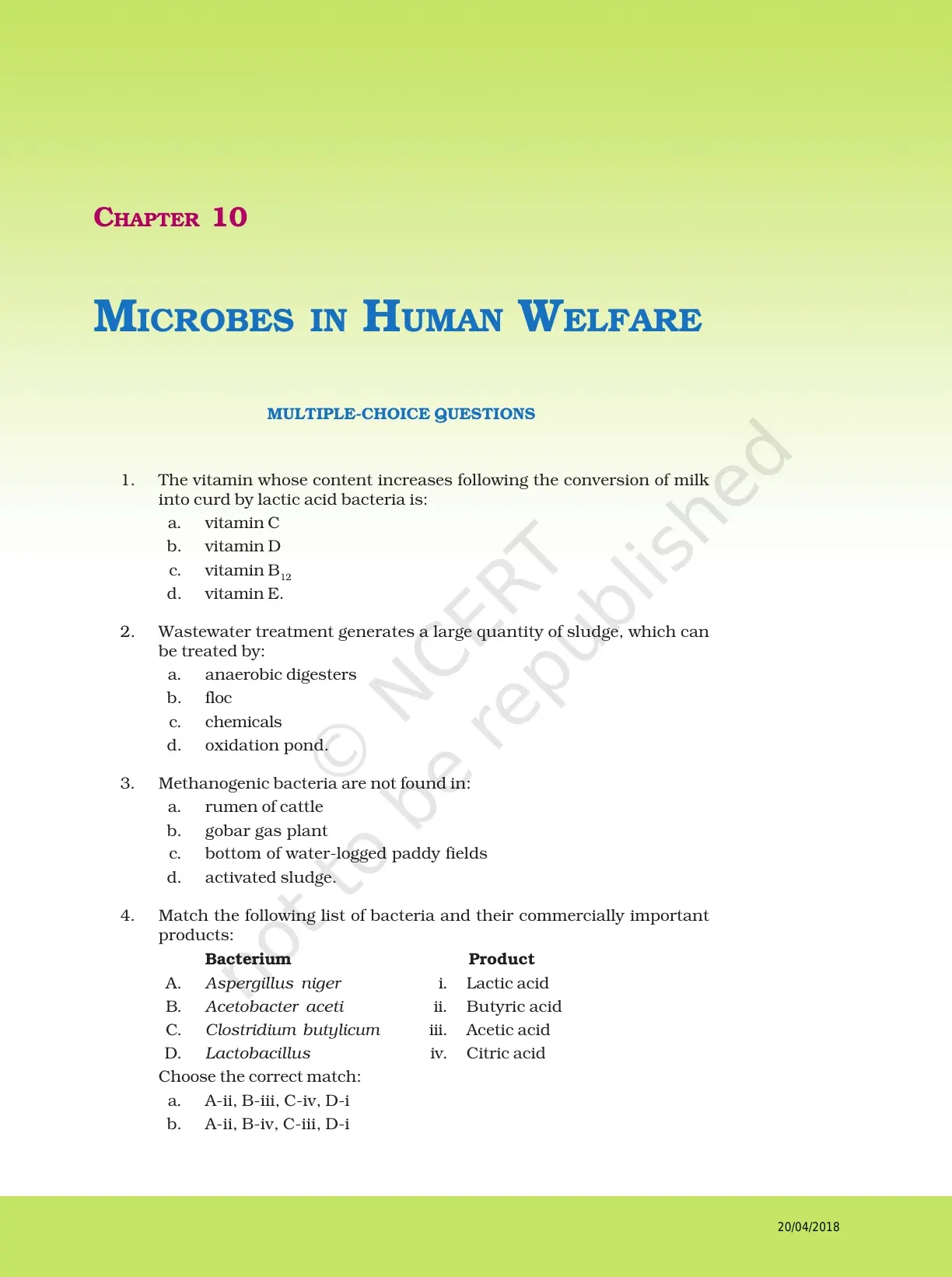
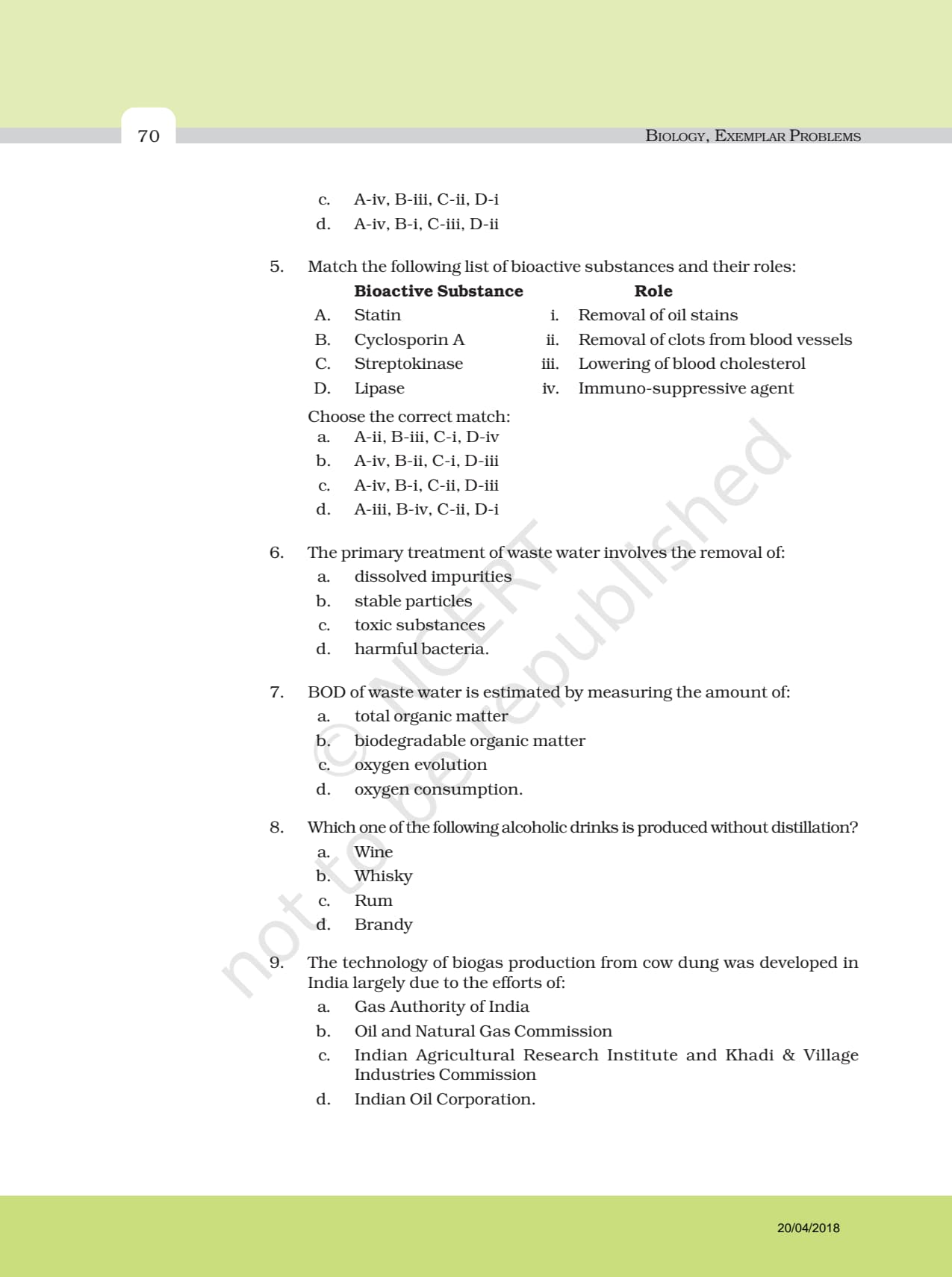
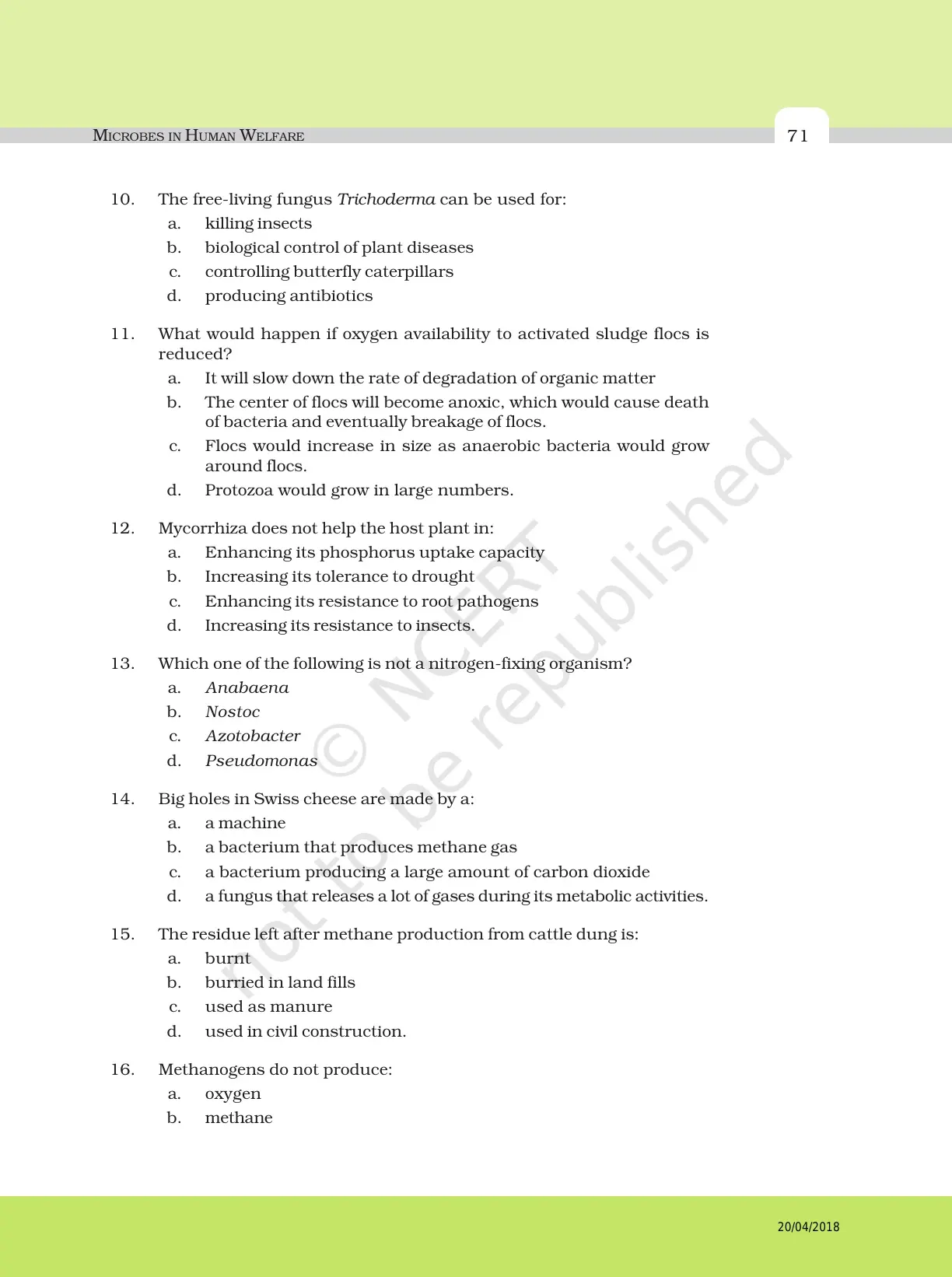
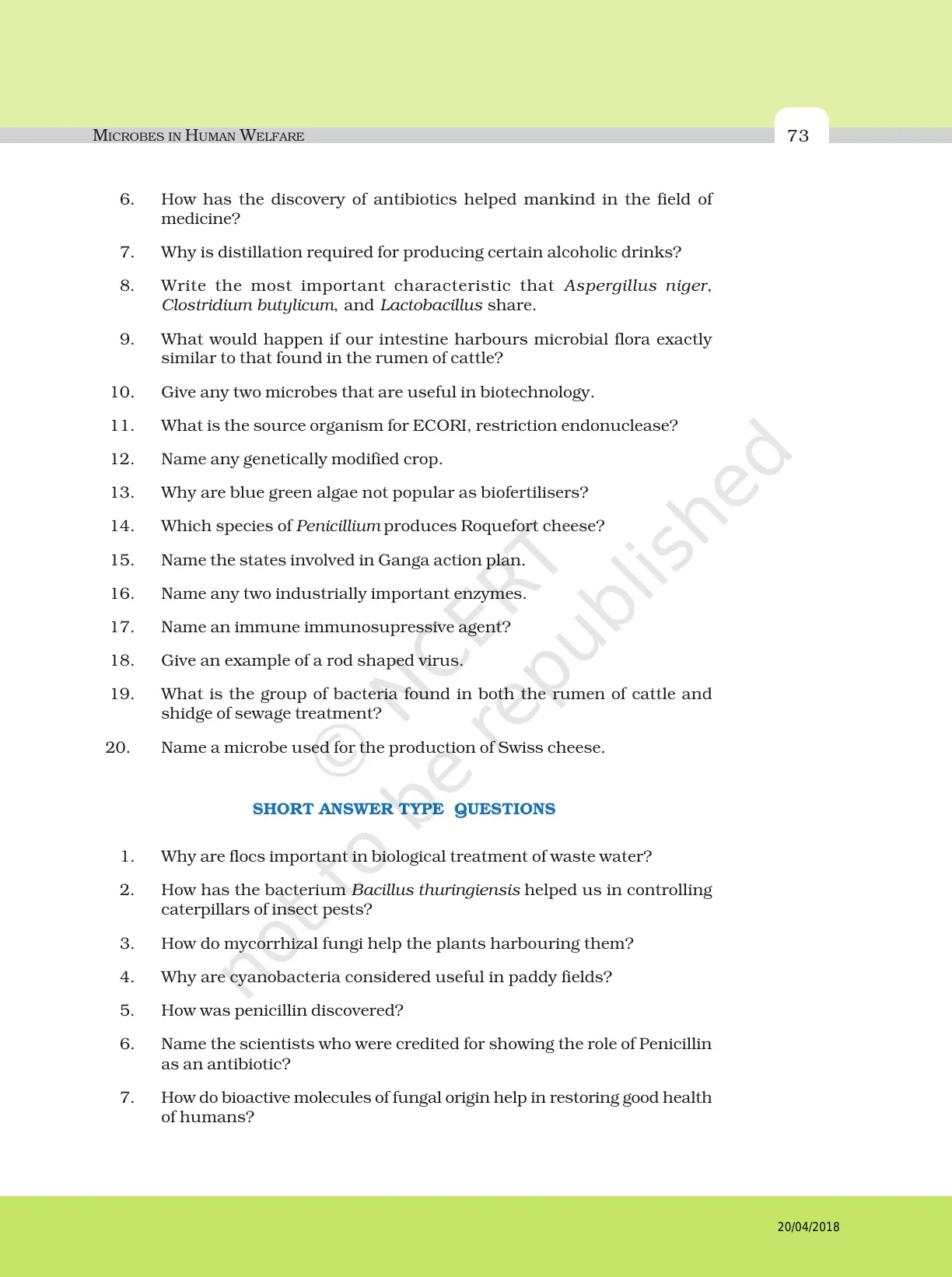
| MCQ-I and MCQ-II | 1 to 18 | 1-3 | Lactic acid bacteria, sewage, biogas, mycorrhiza, methanogens, Match-the-Column |
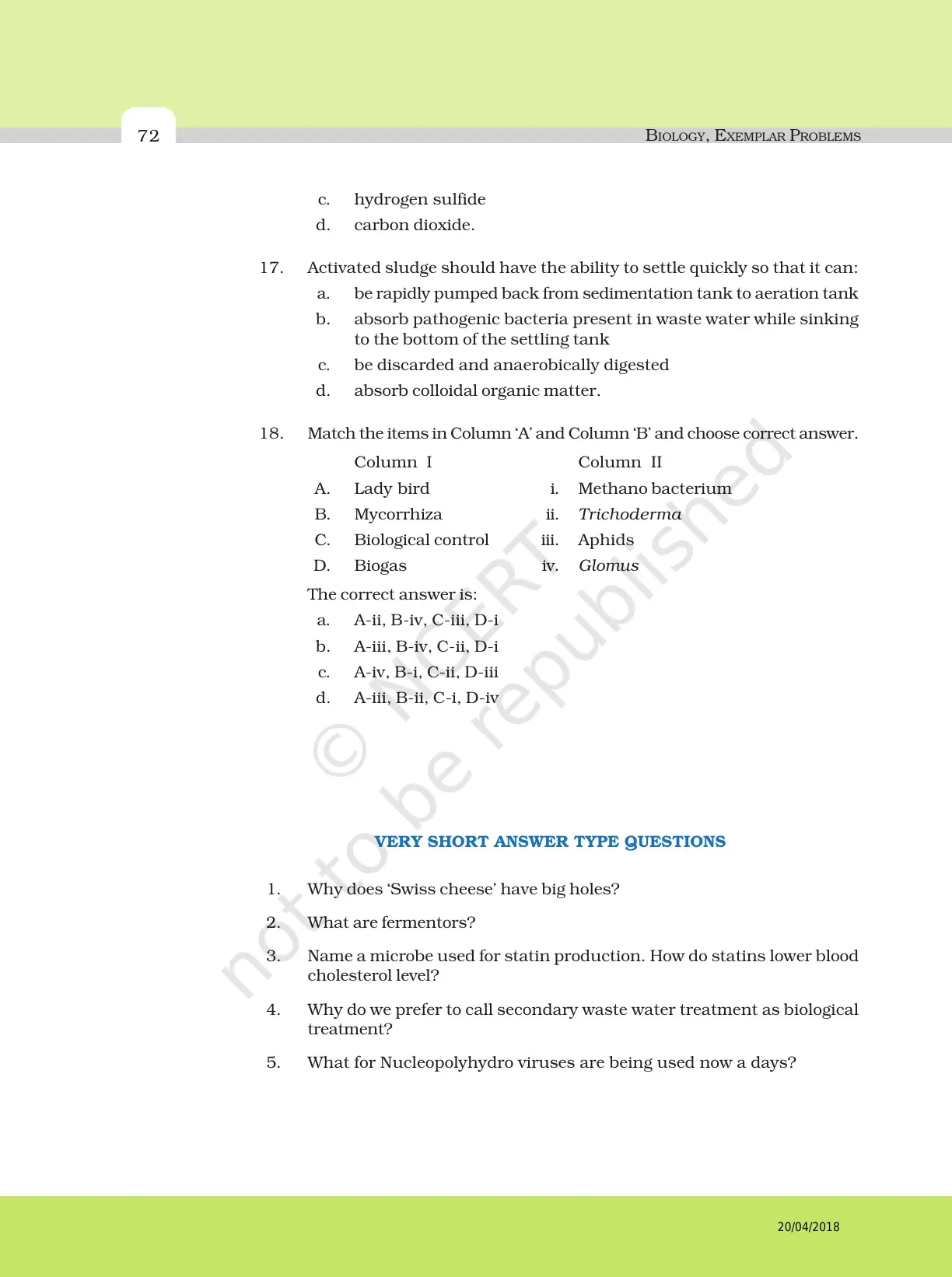
| Very Short Answer | 1 to 20 | 3-4 | Swiss cheese, fermentors, statins, Nucleopolyhydro viruses, Penicillium species |
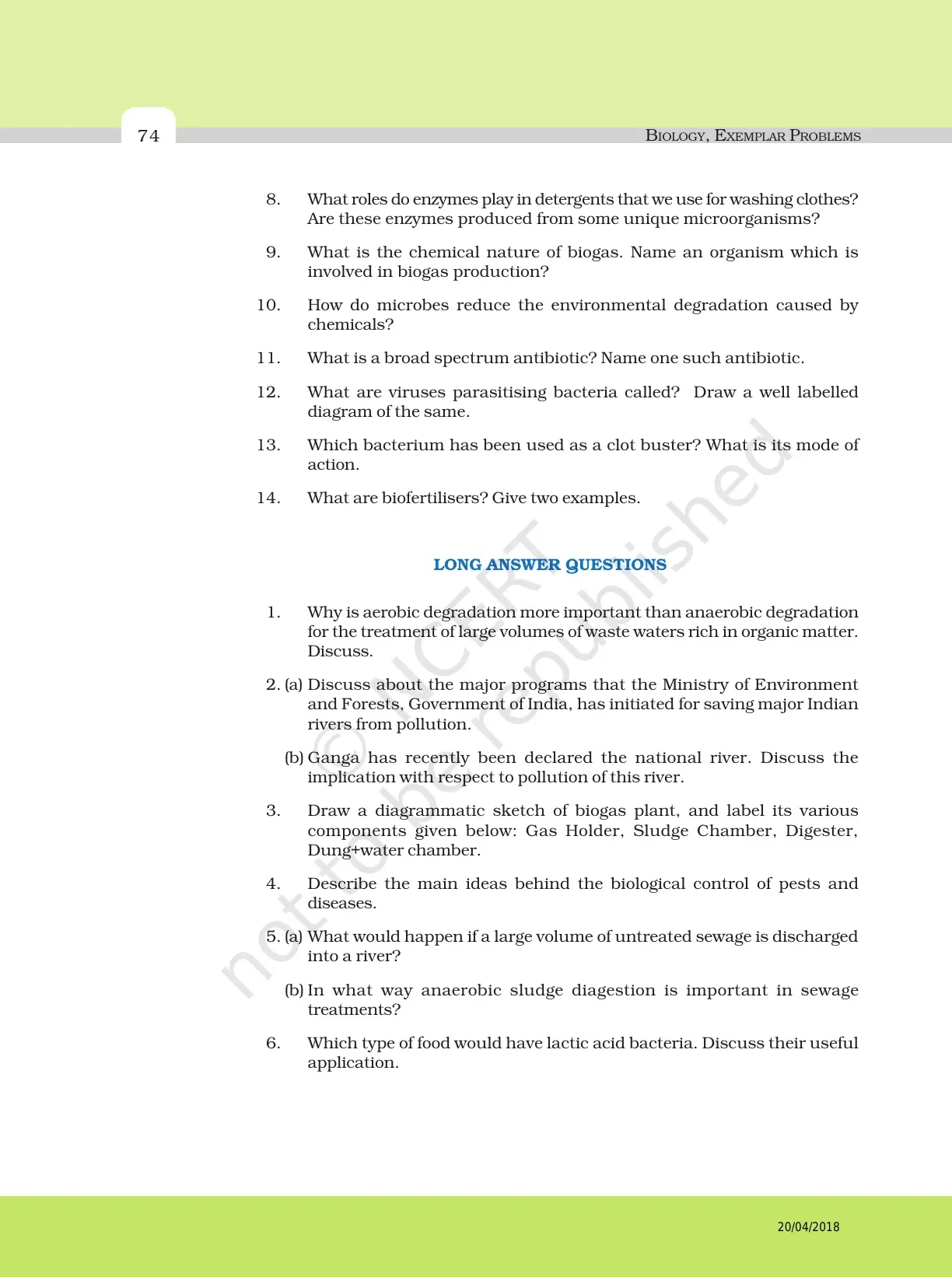
| Short Answer | 1 to 14 | 4-5 | Flocs, Bt, mycorrhiza, cyanobacteria, broad-spectrum antibiotics, bacteriophages |
| Long Answer | 1 to 6 | 5-6 | Aerobic vs anaerobic sewage, Ganga programmes, biogas plant sketch, biopesticides |
Microbes in Human Welfare NCERT Exemplar Question-Type Breakdown
58 problems split across four types. NEET aspirants should prioritise MCQs and VSAs; CBSE Board students should also work through SA and LA blocks for long-answer practice.
| Type | Count | Marks Each | Total | Best For |
|---|---|---|---|---|
| MCQ-I and MCQ-II | 18 | 1 | 18 | NEET MCQ, Match-the-Column drills |
| VSA | 20 | 1 | 20 | CBSE 1-mark, NEET single-fact base |
| SA | 14 | 2 to 3 | ~35 | CBSE 2 and 3-mark, assertion-reason base |
| LA | 6 | 5 | 30 | CBSE 5-mark long answer with diagrams |
| Total | 58 | - | ~103 | - |
The MCQ block is denser than any other applied-Biology Exemplar chapter. NEET 2025 lifted 2 questions from this set almost verbatim.
Top 5 Most-Asked Microbes in Human Welfare Topics in NEET 2021 to 2025
These five sub-topics repeated in at least three of the last five NEET papers. Use this as your priority order when attempting the Exemplar.
| Topic | NEET Years | Matching Exemplar Problems |
|---|---|---|
| Microbe to product Match-the-Column | 2025, 2024, 2023, 2022, 2021 | MCQ 4, 5, 18 |
| Sewage treatment (primary, secondary, BOD) | 2025, 2024, 2023, 2022 | MCQ 2, 6, 7, 11, 17 plus SA 1 |
| Biogas (methanogens, gobar gas residue) | 2025, 2023, 2022, 2021 | MCQ 3, 9, 15, 16 plus SA 9 |
| Biofertilisers (Rhizobium, cyanobacteria, mycorrhiza) | 2024, 2023, 2022, 2021 | MCQ 12, 13 plus VSA 13 plus SA 3, 4 |
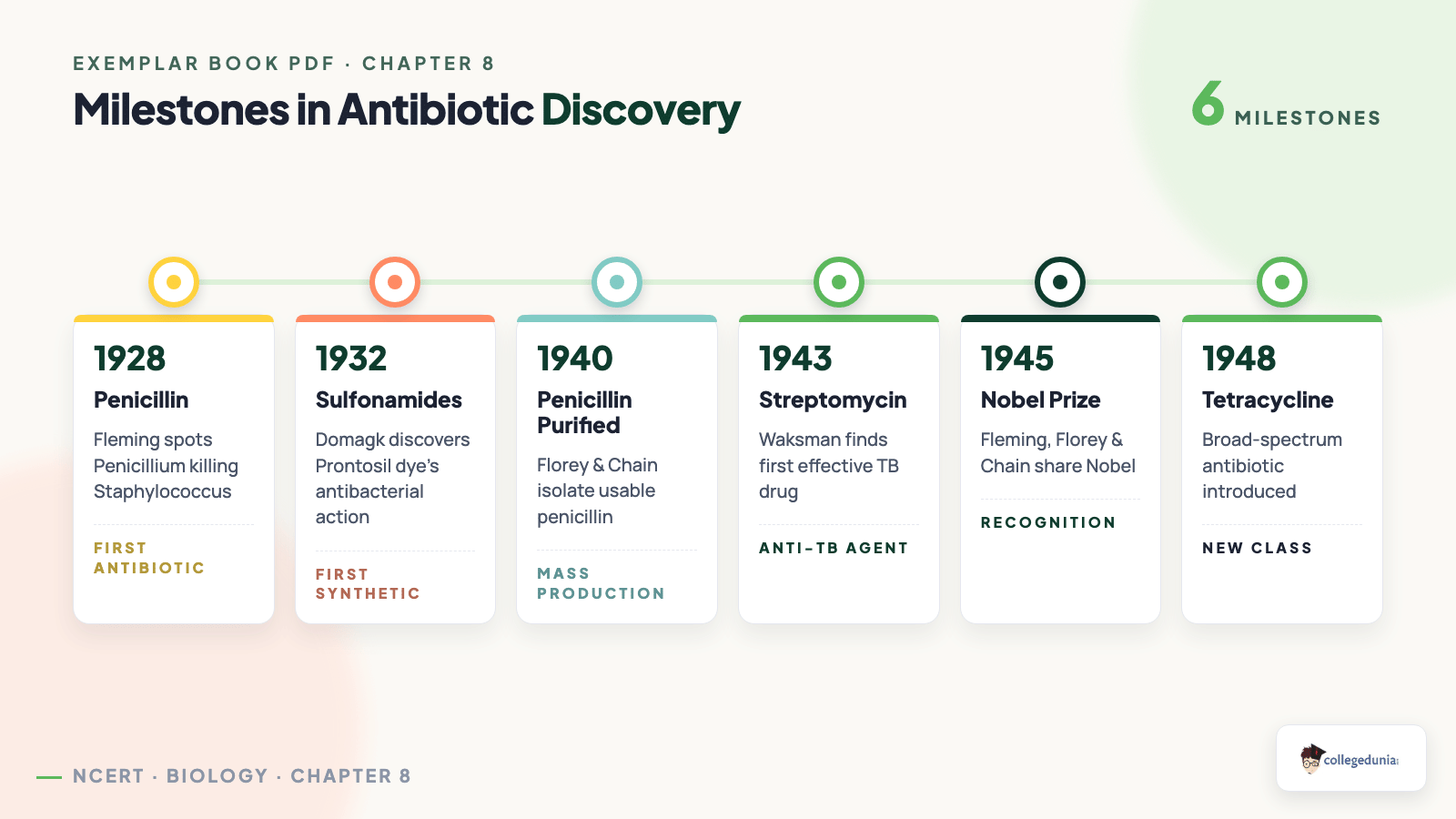
| Antibiotics and bioactive molecules | 2025, 2024, 2022 | VSA 3, 14 plus SA 5, 6, 11 |
Full year-wise PYQ map: Microbes in Human Welfare Class 12 Biology NCERT Solutions
Microbes in Human Welfare Exemplar vs NCERT Textbook Difficulty Comparison
The Exemplar turns the same biology facts into MCQ traps. Students who only work through textbook exercises often lose marks on NEET application questions because of this gap.
| Concept | Exemplar Twist | Why It Is Harder |
|---|---|---|
| Methanogens | MCQ 3 asks where methanogens are not found, with activated sludge as a trap | Negative framing plus plausible distractor doubles error rate |
| Lactic acid bacteria and vitamin B12 | MCQ 1 asks which exact vitamin increases (B12, C, D, E) | Tests exact-vitamin recall, not just the general fact |
| Statin | VSA 3 asks for source microbe and mechanism of action | Two-part recall on one mark; partial answers score zero |
| Biogas plant | LA 3 asks for a labelled diagram (gas holder, sludge chamber, digester, dung-water inlet) | Diagram answer needs visual memory plus correct positioning |
Old vs Current 2026-27 Syllabus in the Class 12 Biology Chapter 8 Exemplar
NCERT Exemplars have not been rationalised, so the PDF still has problems on sub-topics the new textbook trimmed. Chapter 8 is unusual: applied microbiology is stable and every major sub-topic is retained in 2026-27.
| Sub-topic | 2026-27 Status | Recommendation |
|---|---|---|
| Household and industrial products (curd, alcohol, enzymes, bioactive molecules) | Retained | Attempt fully, high CBSE and NEET overlap |
| Sewage treatment (primary, secondary, BOD) | Retained | Attempt fully, most-asked NEET sub-topic |
| Biogas production and methanogens | Retained | Attempt fully, diagram-based 5-marker likely |
| Biocontrol agents and biofertilisers | Retained | Attempt fully |
| Ganga Action Plan and river clean-up programmes | Retained but condensed | Skim only, low CBSE 2026-27 probability |
Detailed kept-trimmed-removed table: Microbes in Human Welfare Class 12 Biology NCERT Book PDF
How to Use the Microbes in Human Welfare Exemplar with the NCERT Textbook: A Parallel-Track Plan
A one-week schedule for a Class 12 student doing 60 minutes a day on this chapter.
| Day | Textbook Action | Exemplar Action |
|---|---|---|
| Day 1 | Sections 8.1, 8.2 (household and industrial products) | MCQ 1, 4, 5, 8, 14; VSA 1, 2, 16, 20 |
| Day 2 | Section 8.3 (sewage) plus flow-diagram sketch | MCQ 2, 6, 7, 11, 17; SA 1; LA 1, 5 |
| Day 3 | Section 8.4 (biogas) plus biogas plant sketch | MCQ 3, 9, 15, 16; SA 9; LA 3 on blank sheet |
| Day 4 | Section 8.5 (biocontrol) | MCQ 10; SA 2; LA 4 |
| Day 5 | Section 8.6 (biofertilisers) | MCQ 12, 13; VSA 5, 13; SA 3, 4 |
| Day 6 | Skim Ganga Action Plan paragraph | Skim VSA 15, LA 2; revise microbe-product table |
| Day 7 | Last 3 NEET papers' Microbes questions | Re-attempt the 12 NEET-mapped Exemplar problems |
Chapter 8 Microbes in Human Welfare Difficulty Survey from Class 12 Biology Students
Student Feedback
What 11,500 Class 12 Biology students told us about the Chapter 8 Exemplar journey:
- 71% of students rated the biogas plant labelled flowchart as the hardest sub-topic in the chapter.
- 60% lost 1-2 marks on matching fermentation products to yeast, LAB, and Penicillium.
- 4 out of 5 skipped the sewage-treatment-plant flowchart in their answer sheet.
- Average student took 4.7 hours for first read and 2 hours for a revision pass before the Board exam.
- Only 44% attempted all 10 NCERT exercise questions. Toppers attempted every question and revisited wrong attempts within 24 hours.
Source: 2025-26 Class 12 Biology survey, 11,500 students across 18 states.
Other Resources for Microbes in Human Welfare Class 12 Biology
| Resource | Link |
|---|---|
| Exemplar Book | Microbes in Human Welfare Exemplar Book |
| Exemplar Solutions | Microbes in Human Welfare NCERT Exemplar Solutions |
| NCERT Solutions | Microbes in Human Welfare NCERT Solutions |
| Notes | Microbes in Human Welfare NCERT Notes |
| NCERT Book PDF | Microbes in Human Welfare NCERT Book PDF |
| Handwritten Notes | Microbes in Human Welfare Handwritten Notes |
| Formula Sheet | Microbes in Human Welfare Formula Sheet |
NCERT Exemplar Book PDF for Class 12 Biology: All Chapters
Jump to any chapter's NCERT Exemplar Book PDF from the table below.
Microbes in Human Welfare Class 12 Biology NCERT Exemplar Book FAQs
Ques. Where can I download the Class 12 Biology Chapter 8 Microbes in Human Welfare NCERT Exemplar PDF free?
Ans. You can download the Class 12 Biology Chapter 8 Microbes in Human Welfare NCERT Exemplar PDF free from this page. Both the Normal and HD versions are available, and both are free. The PDF is the official NCERT print, not a third-party reformat.
Ques. Is the NCERT Exemplar Class 12 Biology PDF aligned with the 2026-27 syllabus?
Ans. NCERT Exemplars have not been rationalised, so the PDF still carries every problem from the original edition. For Chapter 8 Microbes in Human Welfare, that is not an issue: the new 2026-27 NCERT textbook retains all six major sub-topics covered by the Exemplar, so every problem is in scope for CBSE Board and NEET.
Ques. How many pages is the Class 12th Biology Microbes in Human Welfare Exemplar PDF?
Ans. The Microbes in Human Welfare NCERT Exemplar PDF runs 6 pages and packs 58 problems across MCQ-I, MCQ-II, VSA, SA, and LA types. The total marks coverage is approximately 103 marks if the suggested per-type weights are applied.
Ques. How is the NCERT Exemplar different from the NCERT textbook for this chapter?
Ans. The NCERT textbook explains microbiology concepts in continuous prose with end-of-chapter long-answer exercises. The Exemplar takes the same factual base and converts it into MCQs, Match-the-Column items, assertion-reason questions, and short 1 to 5-mark prompts that mirror NEET and CBSE Board phrasing. It is the closest practice resource to NEET's question style for this chapter.
Ques. Which Microbes in Human Welfare Exemplar problems should NEET aspirants prioritise?
Ans. Prioritise the 18 MCQs (especially Match-the-Column problems 4, 5, and 18 on bacteria-product pairings), the sewage-treatment MCQ cluster (2, 6, 7, 11, 17), and the biogas cluster (3, 9, 15, 16). These five sub-topic clusters cover roughly 80% of NEET 2021 to 2025 questions on this chapter.
Ques. Is the biogas plant diagram from Long Answer 3 important for CBSE Board?
Ans. Yes. The labelled biogas plant diagram (gas holder, sludge chamber, digester, dung-water inlet) has been a recurring CBSE 5-mark question. Practise drawing it on a blank A4 sheet at least twice before the Board exam, with all four components labelled clearly.
Ques. What is the difference between primary and secondary sewage treatment for this chapter?
Ans. Primary treatment is the physical removal of floating debris and grit by sedimentation. Secondary treatment is biological: aerobic microbes inside activated-sludge flocs consume organic matter and lower the BOD. Exemplar MCQs 6, 7, 11, and 17 test this distinction repeatedly, and NEET reuses the same framing every other year.



Comments