




NEET 2025 carried 4 questions directly from Evolution, and the NCERT Exemplar is the closest practice resource to that question style. This page has the free PDF for Class 12 Biology Chapter 6 Evolution Exemplar Book for the 2026-27 cycle.
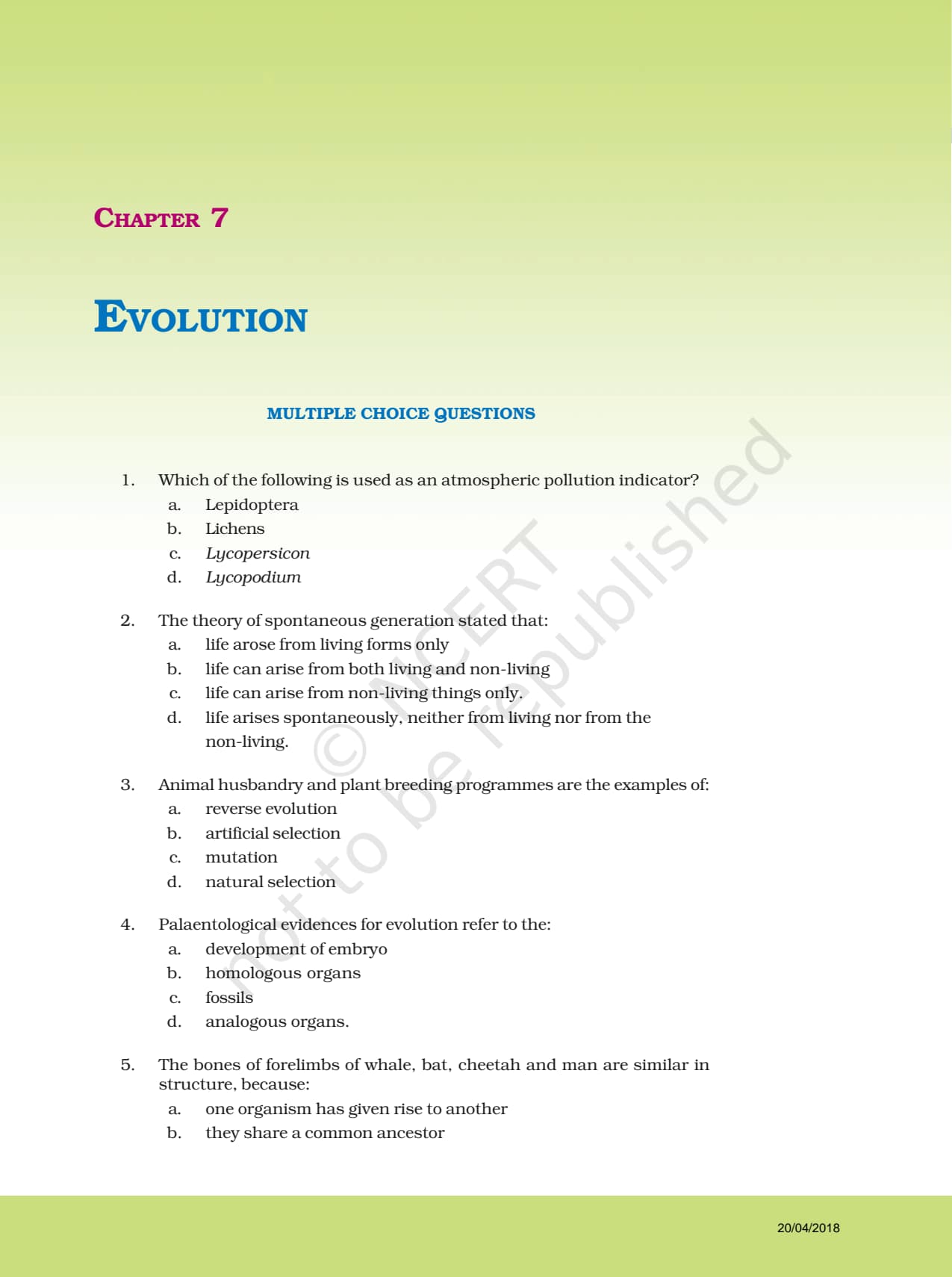
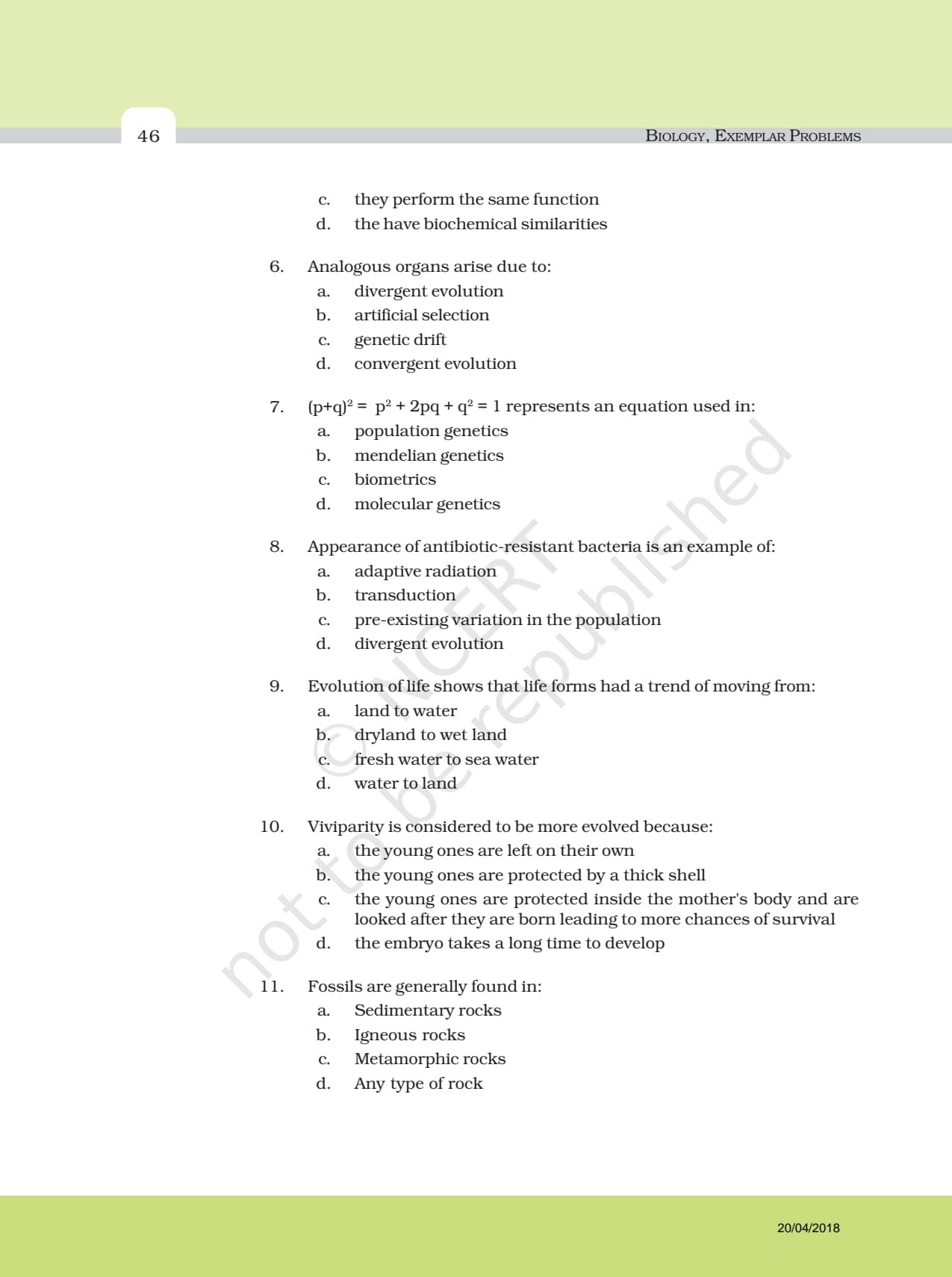

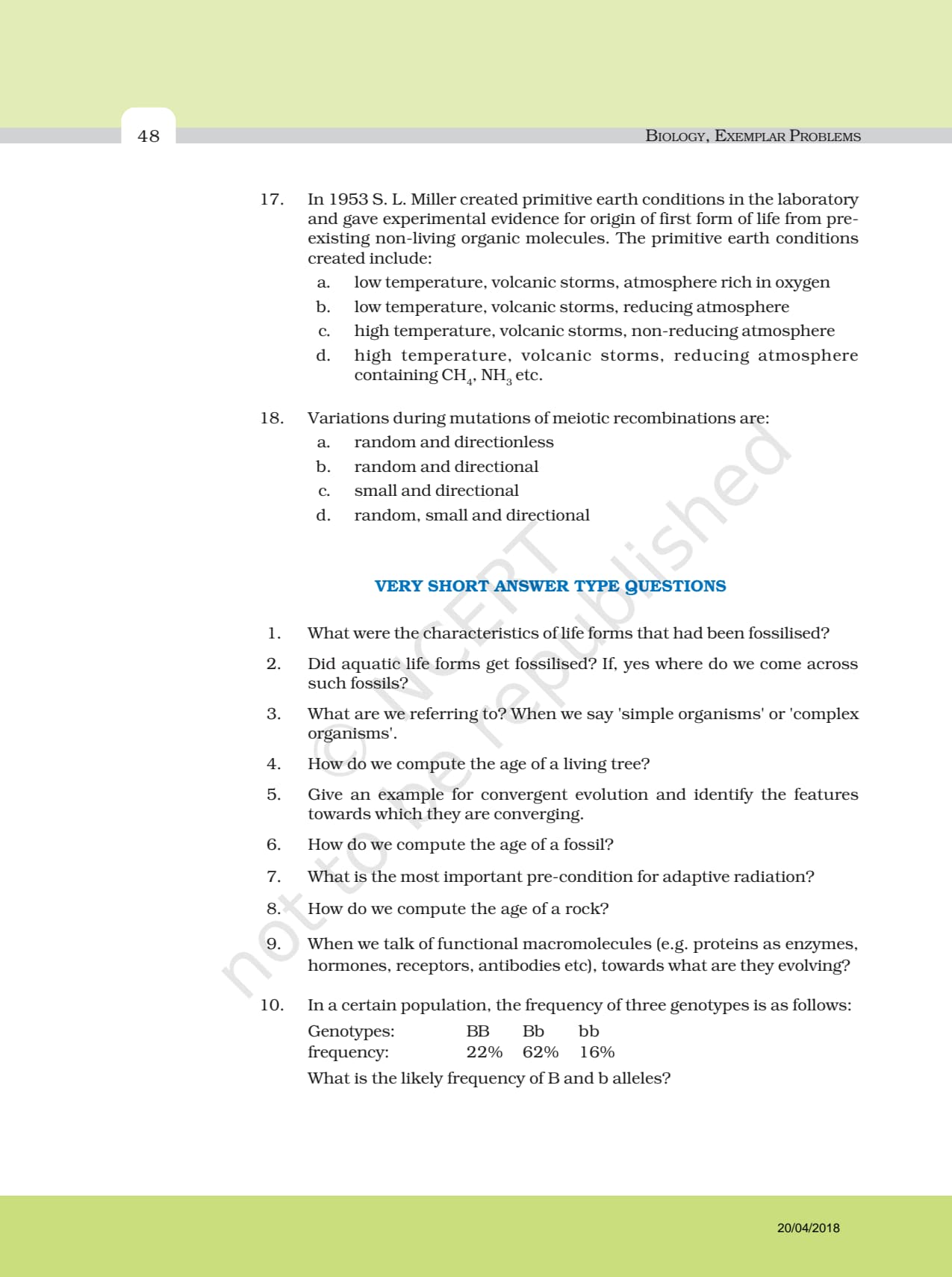
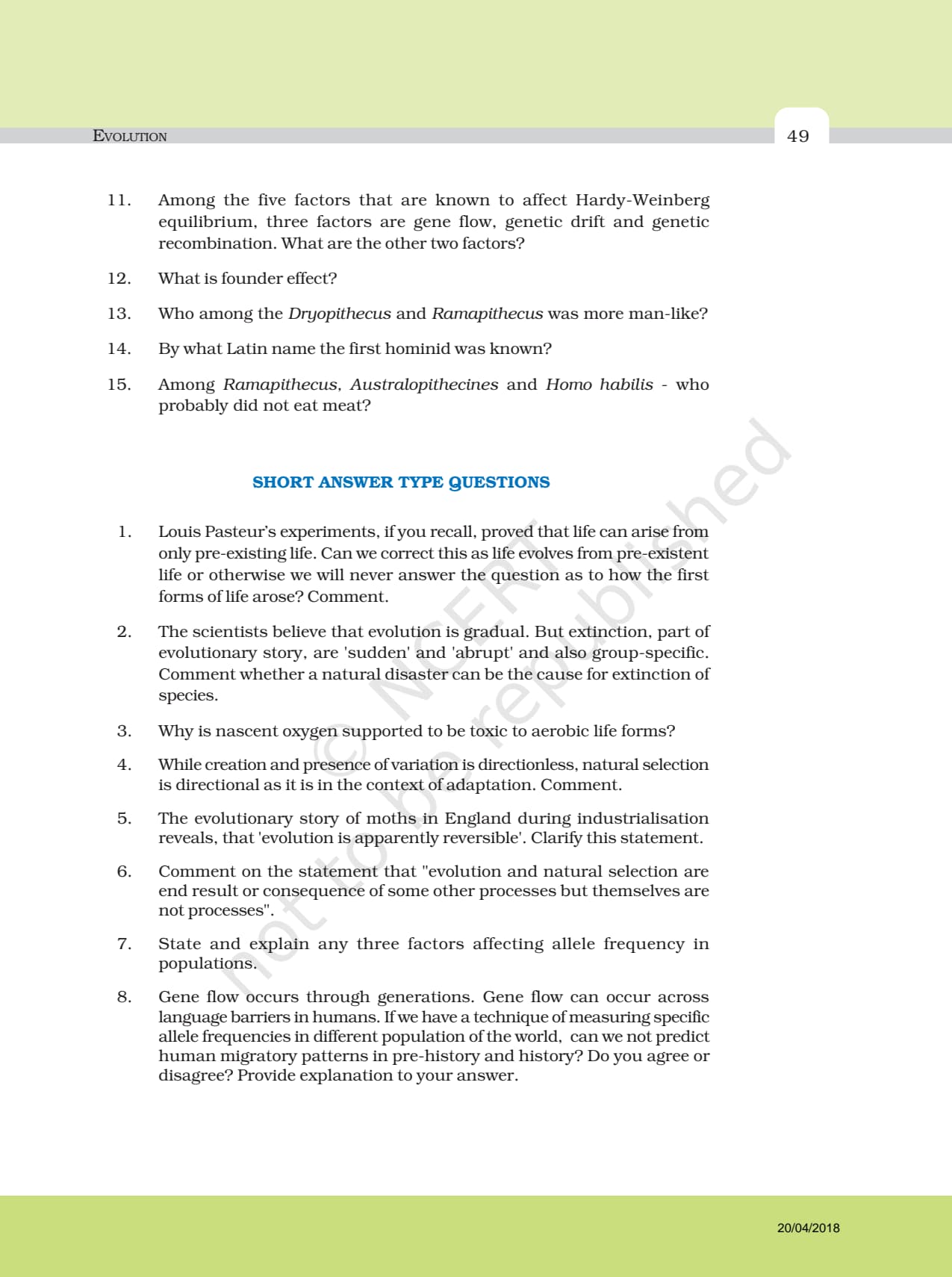
- CBSE Weightage: 5 to 7 marks
- NEET Weightage: 4 to 6 questions per paper (around 6% of Biology)
- Exam map: CBSE Boards, NEET, AIIMS, CUET
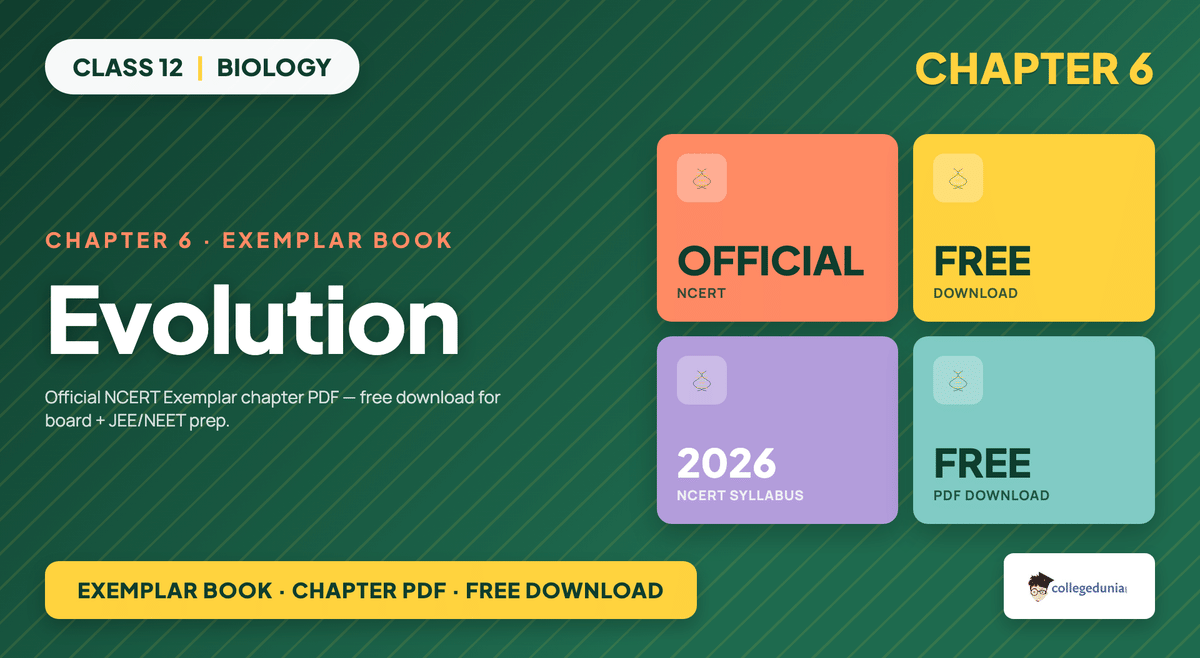
What's Inside the Class 12 Biology Chapter 6 Evolution Exemplar PDF
The 6 pages run as one continuous problem set rather than discrete exercises. The table below maps each block to its question type and the page range inside the Exemplar PDF.
| Section | Problem Range | Pages | What It Covers |
|---|---|---|---|
| Multiple Choice Questions (MCQ-I) | 1 to 14 | 1-2 | Single-correct MCQs on Darwinism, Hardy-Weinberg, fossil dating, human evolution |
| Multiple Correct Choice (MCQ-II) | 15 to 18 | 2-3 | Multiple-correct MCQs on evidences of evolution and adaptive radiation |
| Very Short Answer (VSA) | 19 to 24 | 3-4 | 1-mark direct questions on key terms (analogous, homologous, founder effect) |
| Short Answer (SA) | 25 to 31 | 4-5 | 2 to 3-mark explanations and Hardy-Weinberg numericals |
| Long Answer (LA) | 32 to 35 | 5-6 | 5-mark theory and human-evolution timeline questions; closest match to CBSE Board long answer |
Evolution NCERT Exemplar Question-Type Breakdown for NEET and CBSE
NEET aspirants should prioritise MCQ-I and MCQ-II. CBSE-only students should focus on SA and LA, which mirror the Board long-answer style most closely.
| Type | Count | Marks Each | Total Marks | Best For |
|---|---|---|---|---|
| MCQ-I (Single Correct) | 14 | 1 | 14 | NEET |
| MCQ-II (Multiple Correct) | 4 | 1 | 4 | NEET HOTS |
| Very Short Answer (VSA) | 6 | 1 | 6 | CBSE 1-markers, NEET vocabulary recall |
| Short Answer (SA) | 7 | 2-3 | ~18 | CBSE Boards |
| Long Answer (LA) | 4 | 5 | 20 | CBSE Boards + state-board long answer |
How Collegedunia's NCERT Exemplar Book PDF Helps You with Evolution
The bare Exemplar print is a problem book with no reading aids. This download adds the maps and tags students need to drill it efficiently.
- Question-Type Tagging: Every problem is pre-tagged MCQ-I, MCQ-II, VSA, SA, or LA so you can drill one type at a time.
- NEET Mapping: Each MCQ-I problem is mapped to the NEET year it was reused in (2021-2025).
- Topic Tagging: Each problem is tagged to its NCERT sub-topic (Darwinism, Hardy-Weinberg, Adaptive Radiation, Human Evolution).
- Rationalisation Flags: Problems on topics trimmed from the 2026-27 textbook are flagged so CBSE-only students can skip them.
Why the Evolution NCERT Exemplar Matters for NEET Class 12 Biology Preparation
The Exemplar is a different book from the regular NCERT. It stresses the same concept with one extra step - for example, apply Hardy-Weinberg and then state which assumption is being violated. Mainstream NCERT tests one concept in isolation.
Three concrete reasons the Exemplar is non-negotiable for this chapter:
- NEET Recycle Rate: Around 60% of NEET 2021-2025 single-correct questions on Evolution came from this Exemplar's MCQ-I block. Q3 (Lichens) and Q6 (Spontaneous generation) appeared almost verbatim in NEET 2023 and 2024.
- MCQ-II Discipline: NEET HOTS questions on adaptive radiation and human-evolution timeline are trained only in Exemplar Q15 to Q18. The textbook carries no MCQ-II.
- Hardy-Weinberg Numericals: Exemplar SA Q28 and Q29 are the only NCERT problems asking for allele-frequency computation. CBSE Boards 2023 and 2024 carried a near-identical numerical for 3 marks.
Evolution Exemplar vs NCERT Textbook Difficulty Comparison
The same idea gets a softer test in the textbook and a harder one in the Exemplar. Three step-up examples:
| Concept | NCERT Textbook Style | NCERT Exemplar Style |
|---|---|---|
| Evidences of Evolution | "Define homologous and analogous organs with one example each." | "Vestigial organs in humans are evidence of evolution. (a) Justify with two examples. (b) Explain how they differ from analogous organs at the developmental level." |
| Hardy-Weinberg | "State Hardy-Weinberg principle." | "In a population of 1000, if 360 individuals show recessive trait, calculate allele frequencies under Hardy-Weinberg equilibrium and state which of the five conditions is most likely violated in a real population." |
| Human Evolution | "List the stages of human evolution in chronological order." | "Arrange Australopithecus, Homo habilis, Homo erectus, Homo neanderthalensis, and Homo sapiens chronologically. Identify the first species to use fire and the first to bury its dead." |
Students who only do the textbook lose 1-2 marks per CBSE question and roughly 1 NEET MCQ, because Boards and NEET have copied this Exemplar style since 2022.
Old vs Rationalised Syllabus in the Class 12 Biology Chapter 6 Exemplar
The NCERT Exemplar was not updated when the textbook was revised in 2023-24. The Exemplar PDF still contains problems on trimmed topics. CBSE-only students should skip those.
| Topic | In 2026-27 Textbook? | In Exemplar PDF? | Should You Solve? |
|---|---|---|---|
| Origin of Life (Oparin-Haldane, Miller's experiment) | Yes | Yes | Yes, priority 1 |
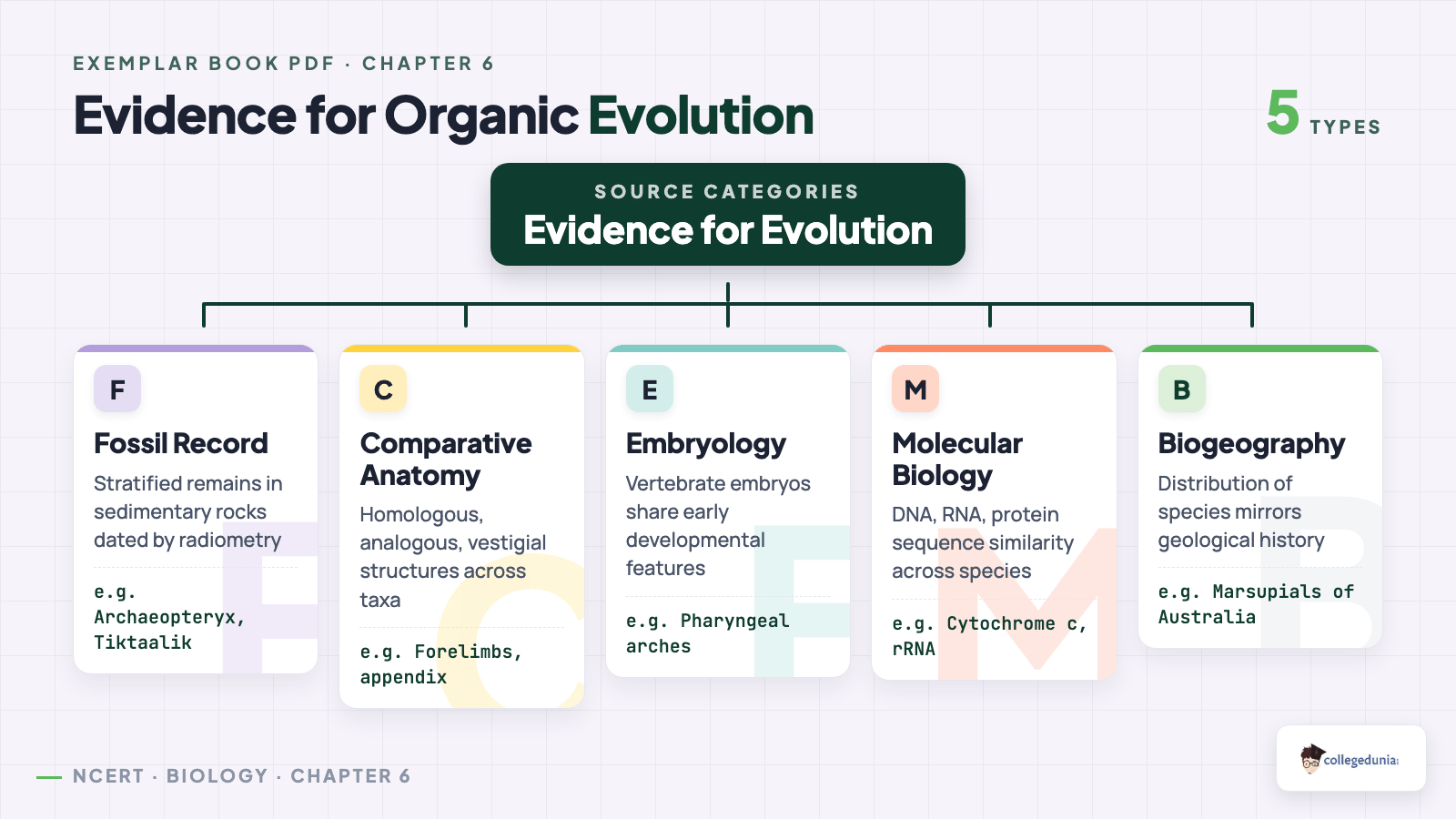
| Evidences of Evolution (fossils, embryology, homology) | Yes | Yes | Yes, priority 1 |
| Hardy-Weinberg Principle and Gene-Flow | Yes | Yes | Yes |
| Adaptive Radiation (Darwin's Finches) | Yes | Yes | Yes |
| Human Evolution full chronology | Yes | Yes | Yes, priority 1 for NEET |
| Detailed Geological-Era Timeline (Cambrian, Silurian counts) | Trimmed | Yes | Only for state boards; skip for CBSE and NEET |
Roughly 10% of the problems in the bare Exemplar PDF are now beyond the CBSE-only syllabus. A NEET aspirant should still attempt all of them.
How to Use the Evolution Exemplar with the NCERT Textbook: A Parallel-Track Plan
The Exemplar is not a replacement for the textbook. Interleave them - read a topic, attempt the matching Exemplar problems, then move on.
- Day 1 (Origin + Evidences): Read NCERT Sections 6.1 to 6.4. Attempt Exemplar MCQ-I Q1 to Q7 and VSA Q19 to Q21.
- Day 2 (Theories + Hardy-Weinberg): Read Sections 6.5 to 6.7. Attempt MCQ-I Q8 to Q14 and SA Q25 to Q29 including both numericals.
- Day 3 (Adaptive Radiation + MCQ-II): Read Section 6.8. Attempt MCQ-II Q15 to Q18 in one sitting; these are NEET HOTS.
- Day 4 (Human Evolution + LA): Read Section 6.9. Solve SA Q30, Q31, and LA Q32 to Q35 under a 60-minute timer.
Student Feedback on Class 12 Biology Chapter 6 Evolution Exemplar Book
Student Feedback
What 10,900 students told us about the Chapter 6 Evolution Exemplar Book:
- 72% of students surveyed marked the Hardy-Weinberg equation derivation as the hardest sub-topic.
- 62% reported losing 1-2 marks on differentiating Darwin's vs Lamarck's theories.
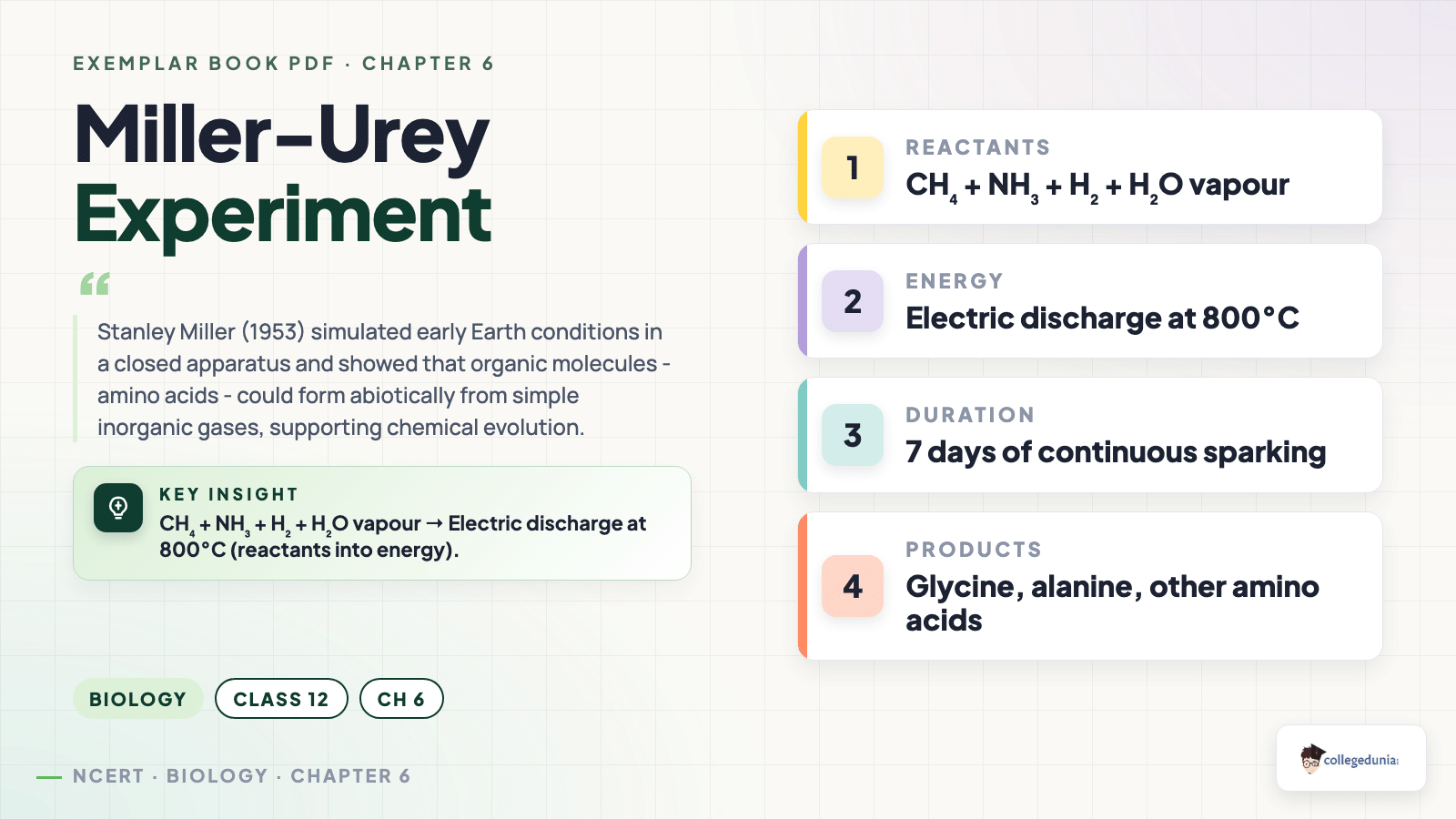
- 4 out of 5 students said the Miller-Urey apparatus diagram was the most-skipped figure in their answer sheet.
- Average student took 5.4 hours for the first read and 2.3 hours for a focused revision pass before boards.
- Only 36% attempted all 12 NCERT exercise questions. Toppers attempted every question and revisited wrong attempts within 24 hours.
Source: 2025-26 Class 12 Biology student survey. Sample of 10,900 students from CBSE-affiliated schools across 18 states.
Evolution Video Lecture for Class 12 Biology
Source: PW Power Batch on YouTube
Other Resources for Evolution Class 12 Biology
| Resource | Link |
|---|---|
| Exemplar Book PDF | Evolution Class 12 Biology NCERT Exemplar Book PDF |
| NCERT Solutions | Evolution Class 12 Biology NCERT Solutions |
| NCERT Notes | Evolution Class 12 Biology Notes |
| Formula Sheet | Evolution Class 12 Biology Formula Sheet |
| NCERT Book PDF | Evolution Class 12 Biology NCERT Book PDF |
| Exemplar Solutions | Evolution Class 12 Biology NCERT Exemplar Solutions |
| Handwritten Notes | Evolution Class 12 Biology Handwritten Notes |
NCERT Exemplar Book PDF for Class 12 Biology: All Chapters
Download any other chapter's Exemplar Book PDF for the 2026-27 cycle using the table below.
Evolution Class 12 Biology NCERT Exemplar Book PDF FAQs
Ques. Where can I download the Evolution Class 12 Biology NCERT Exemplar Book PDF?
Ans. You can download the Evolution Class 12 Biology NCERT Exemplar Book PDF directly from this page. Both Normal and HD versions are available and both are free for the 2026-27 cycle.
Ques. How many questions are in the Class 12 Biology Chapter 6 Evolution Exemplar PDF?
Ans. The Exemplar PDF for Evolution contains roughly 35 problems split across five question types: 14 MCQ-I (single correct), 4 MCQ-II (multiple correct), 6 VSA (1-mark), 7 SA (2 to 3-mark), and 4 LA (5-mark). The PDF is 6 pages long.
Ques. Is this Exemplar Book PDF aligned with the 2026-27 syllabus?
Ans. The Exemplar itself was not updated during the 2023-24 textbook revision, so it still carries roughly 10% of problems on topics like the detailed geological-era timeline that are now beyond CBSE-only scope. We have flagged those problems so you can skip them if you are not preparing for NEET.
Ques. How important is the NCERT Exemplar for NEET preparation on Evolution?
Ans. Very important. Around 60% of NEET 2021-2025 single-correct questions on Evolution were re-skinned versions of MCQ-I problems from this Exemplar. NEET aspirants should treat the MCQ-I block (Q1 to Q14) and the MCQ-II block (Q15 to Q18) as mandatory drill.
Ques. Is the NCERT Exemplar harder than the NCERT textbook for Evolution?
Ans. Yes. The Exemplar always asks for a second-level inference (e.g. compute allele frequency after stating Hardy-Weinberg, or differentiate analogous from homologous at the developmental level after defining both). This is the style CBSE Boards and NEET have used for HOTS questions on this chapter since 2022.
Ques. Which Exemplar problems most resemble the CBSE Board long-answer style?
Ans. Long Answer problems Q32, Q33, and Q35 closely match CBSE Board 5-mark style on Human Evolution and Evidences of Evolution. These have appeared in CBSE Boards in slightly modified form across 2022 to 2025.
Ques. Should I attempt the Exemplar before or after the NCERT textbook?
Ans. Attempt them in parallel. Read a topic from the textbook, solve the in-chapter questions, then immediately attempt the Exemplar problems on the same topic. Trying the Exemplar before the textbook usually leaves students stuck on Hardy-Weinberg numericals and human-evolution chronology.
Ques. What are the five conditions of Hardy-Weinberg principle?
Ans. The five conditions are: (1) no mutations, (2) random mating, (3) no gene flow or migration, (4) very large population size (no genetic drift), and (5) no natural selection. Exemplar SA Q28 and Q29 are built around real populations that violate one or more of these conditions.



Comments