




Organisms live as interacting populations within their environment. Class 12 Biology Chapter 11, Organisms and Populations, opens Unit 10 Ecology in the 2026-27 NCERT curriculum. This page hosts the official NCERT Exemplar Book PDF with a NEET question breakdown and study plan.
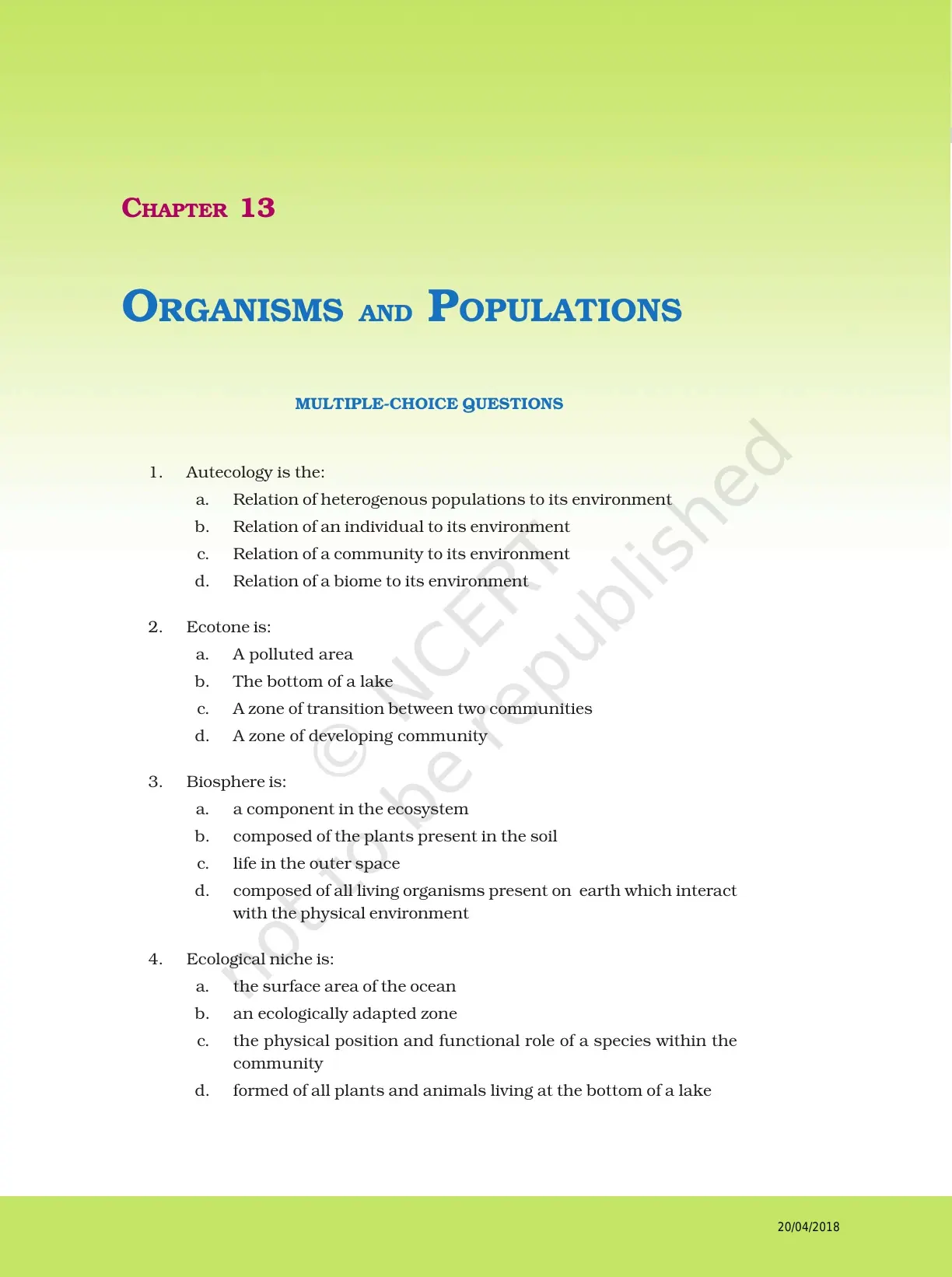
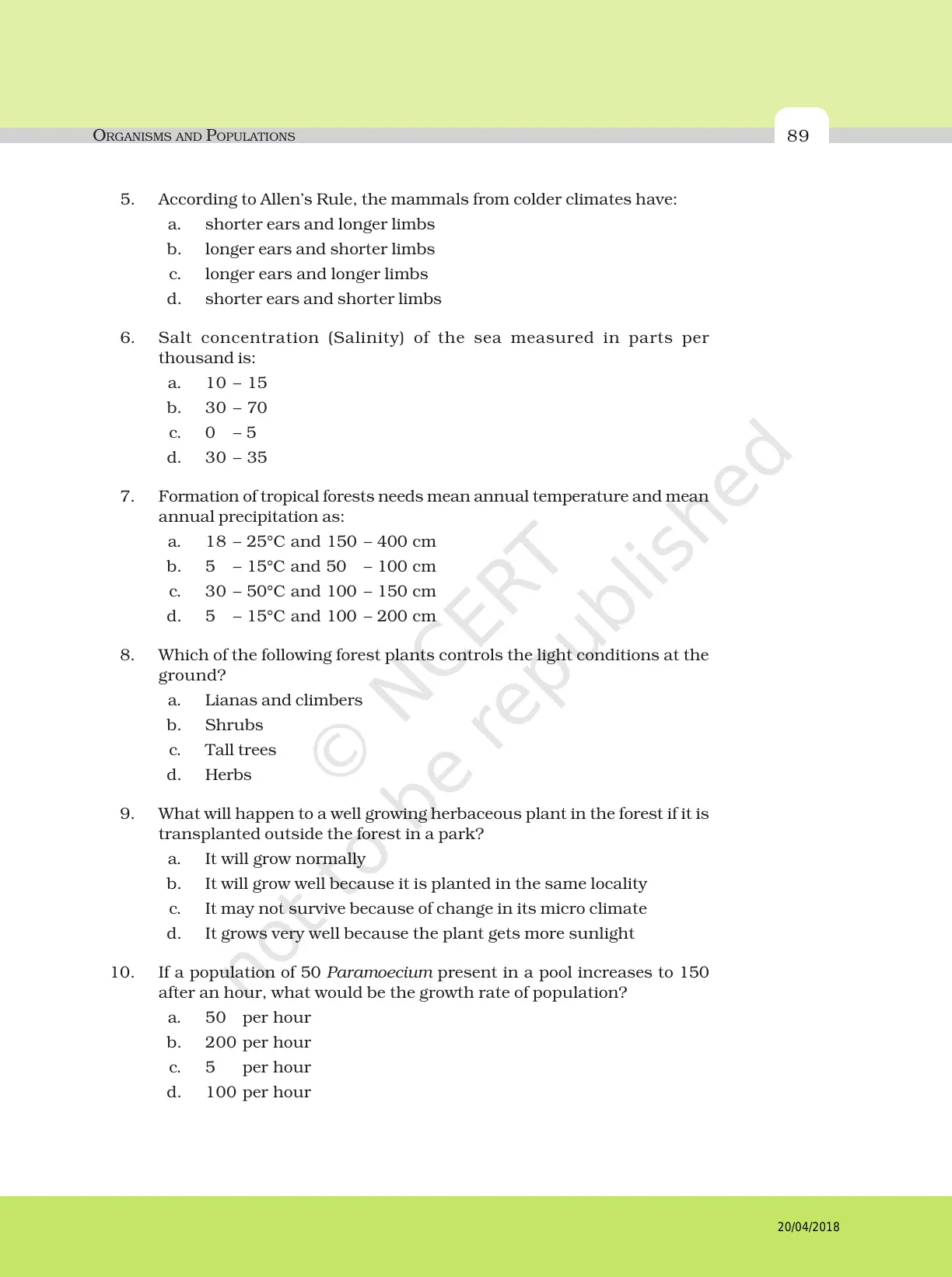
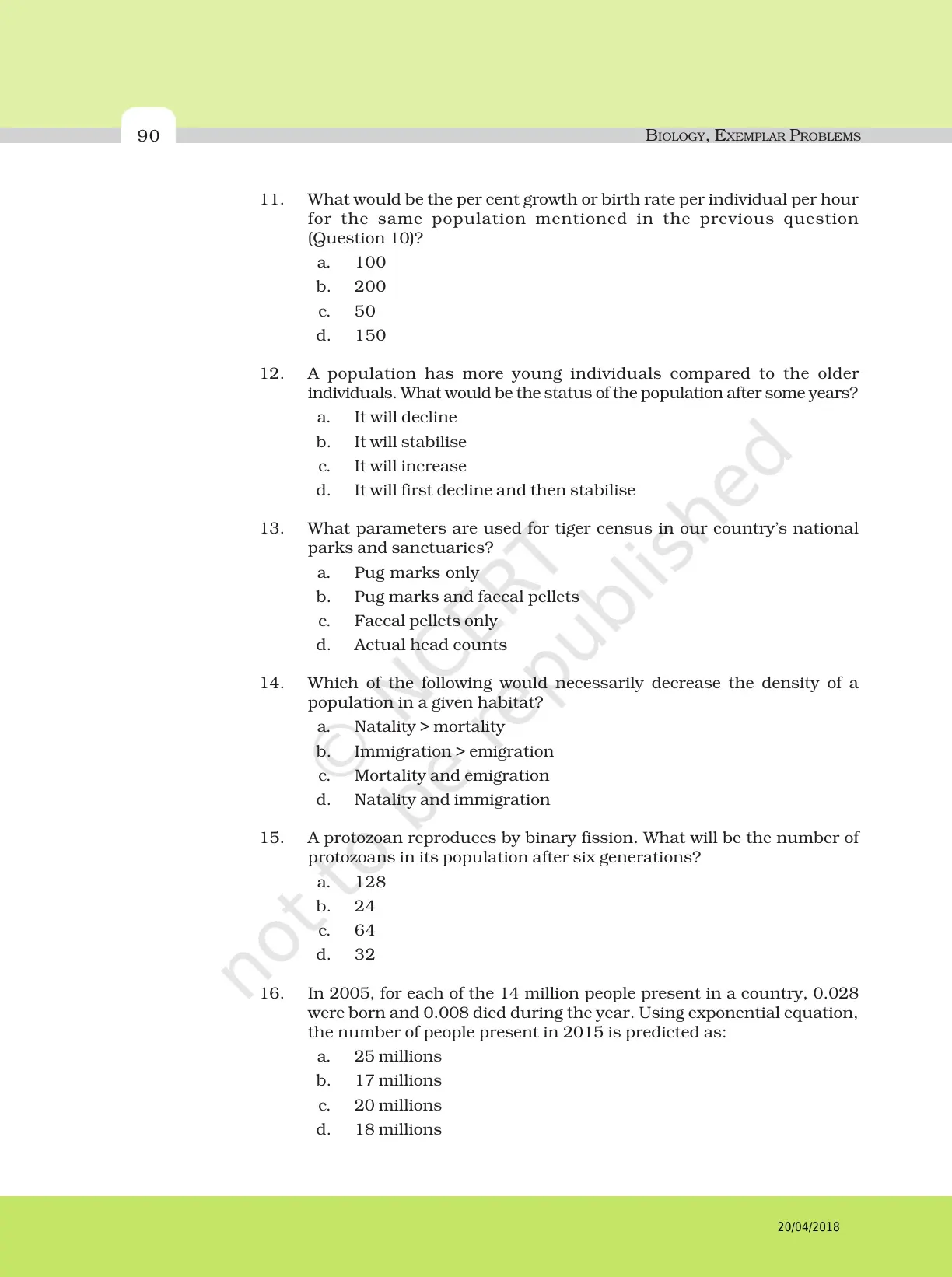
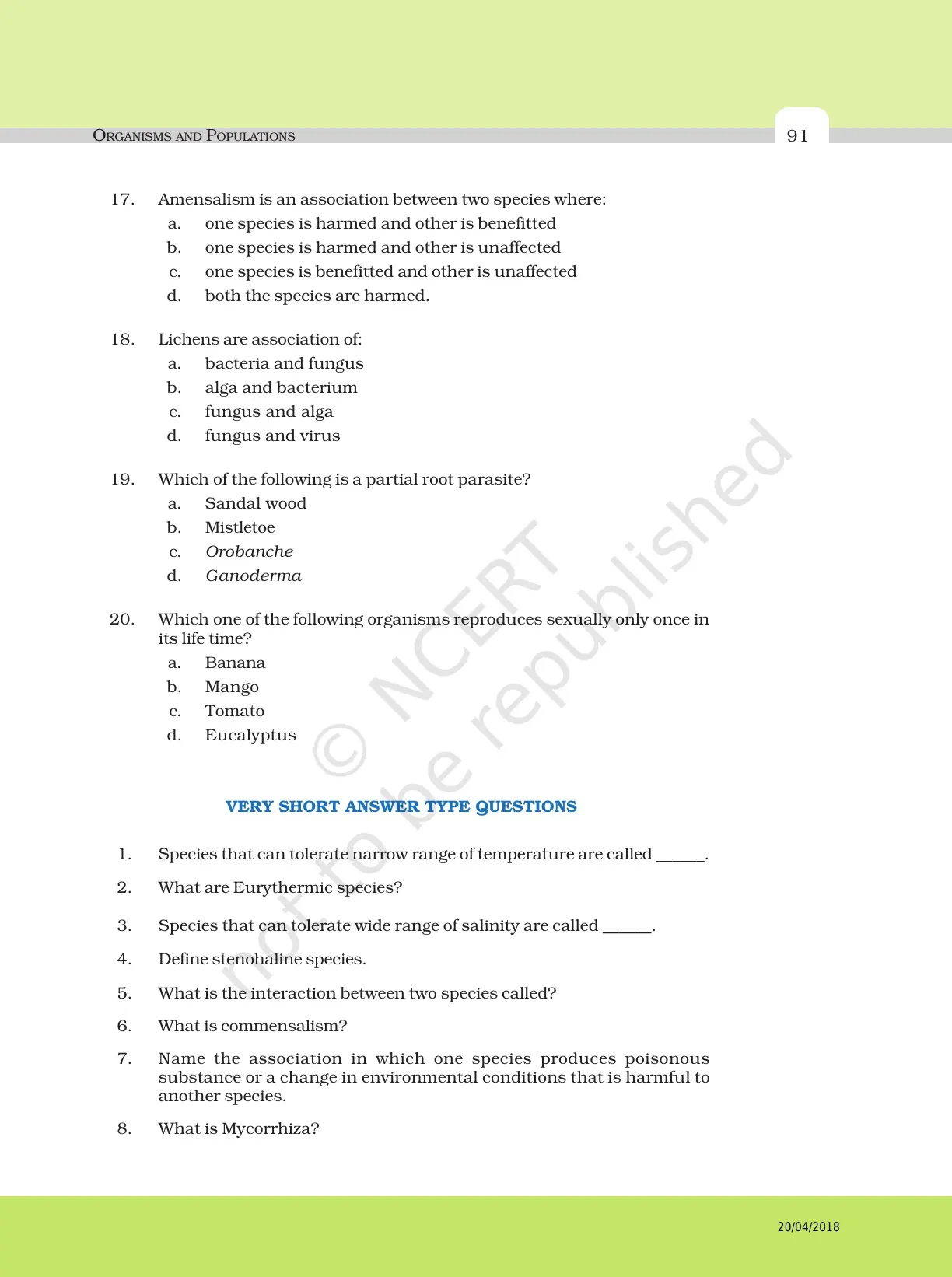
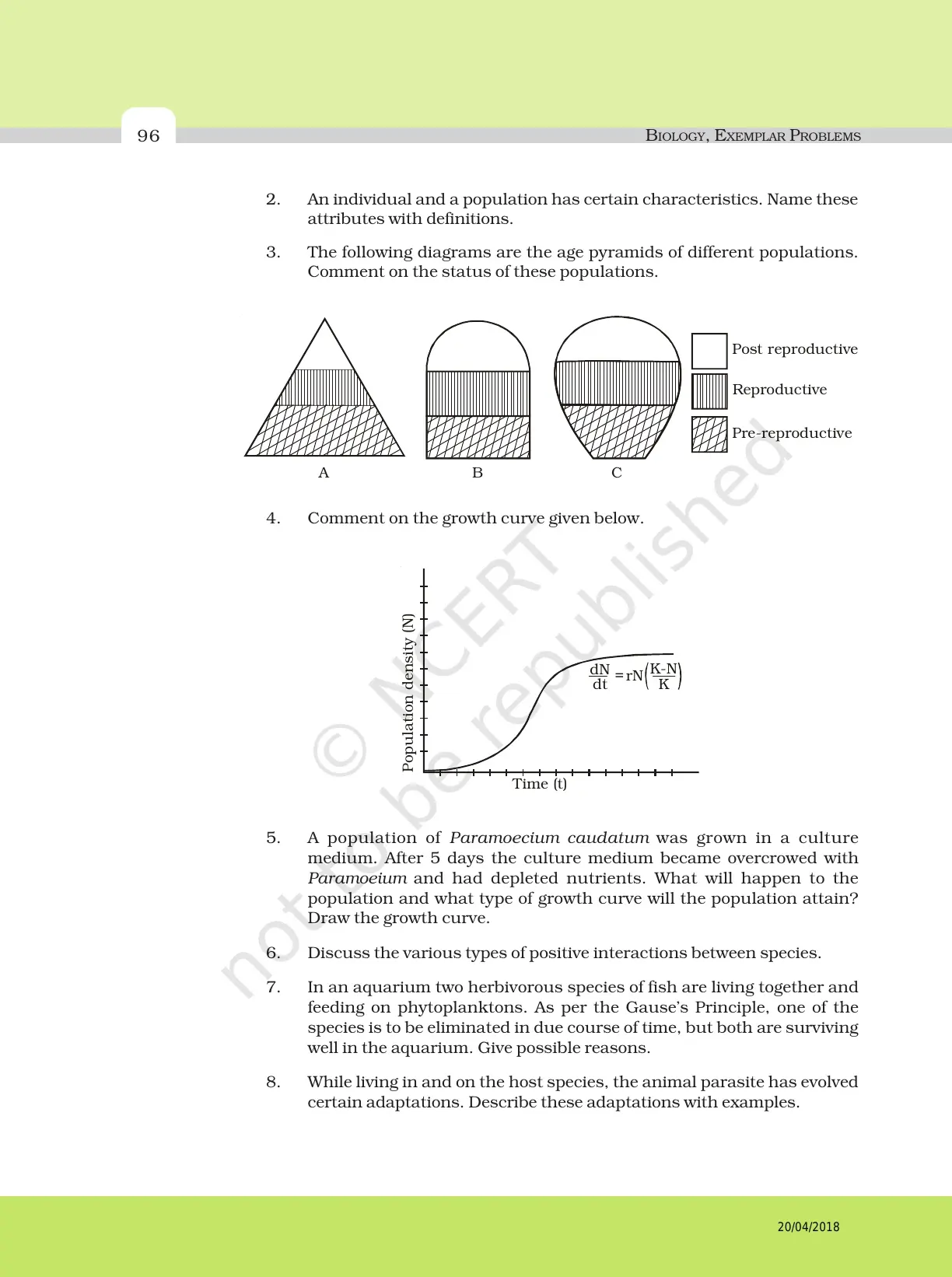
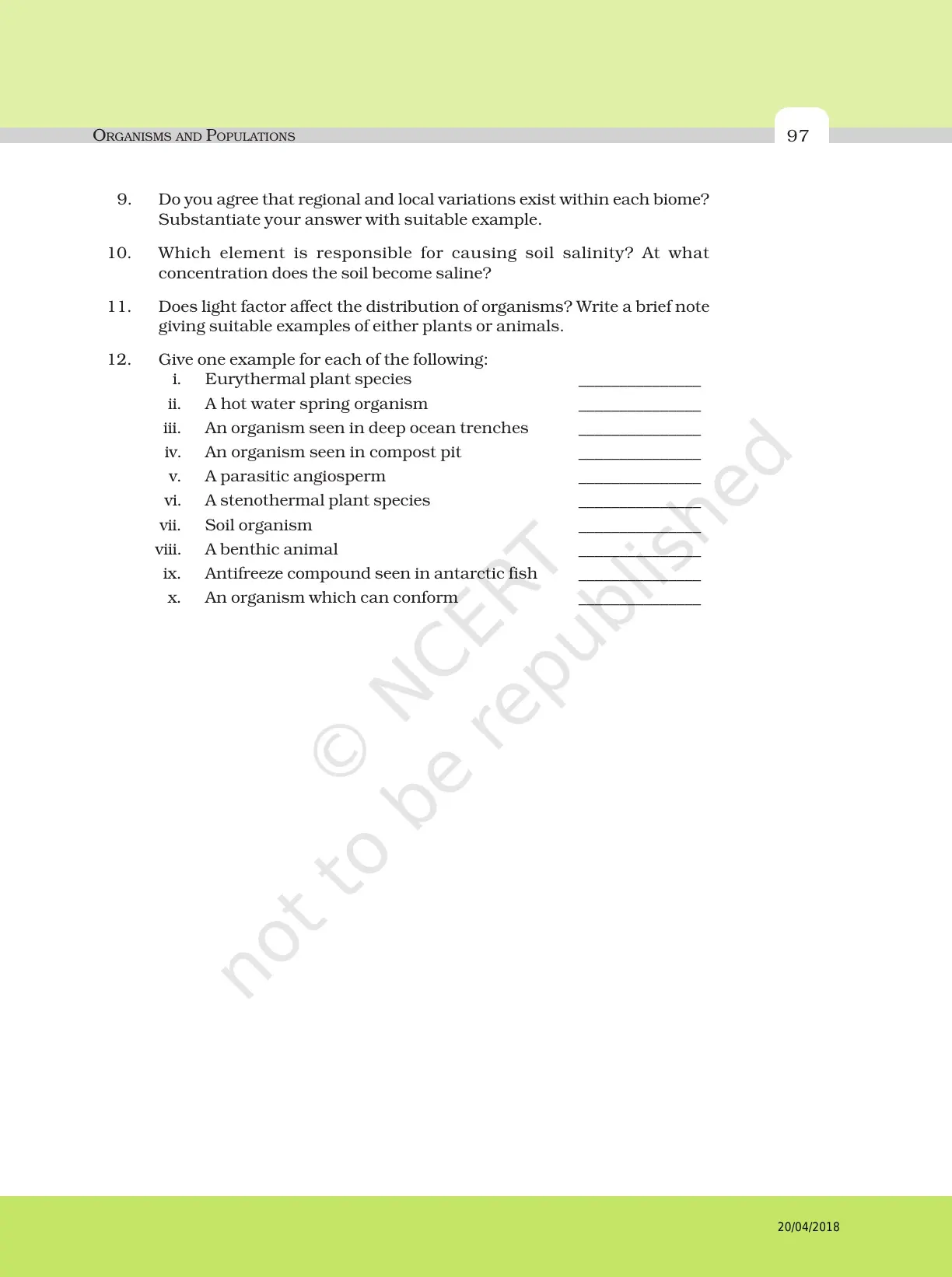
- CBSE Weightage: 5 to 7 marks
- NEET Weightage: 3 to 5 questions per paper (around 5 to 6% of Biology)

Download the PDF below. The question-type table, NEET topic map, and study plan are also on this page.
Also Check:
- Organisms and Populations Class 12 Biology NCERT Exemplar Solutions
- Organisms and Populations Class 12 Biology NCERT Book PDF
Why the NCERT Exemplar Matters for NEET Class 12 Biology Organisms and Populations Prep
NEET examiners rely heavily on Organisms and Populations. Match-the-Column items on interaction sign-pairs, logistic growth MCQs, and questions on Allen's rule and Gause's principle have appeared every year from NEET 2021 to 2025. The Exemplar mirrors that MCQ style better than the NCERT textbook exercises.
How Collegedunia's NCERT Exemplar Book PDF Helps You with Organisms and Populations
This page hosts the official NCERT Exemplar PDF along with prep context the bare PDF does not include.
- Official NCERT source: Figure and problem numbering match what NEET examiners reference.
- 2026-27 syllabus mapping: Every problem is tagged against the current Class 12 Biology syllabus.
- NEET 2021 to 2025 mapping: High-yield problems are flagged so students can attempt them first.
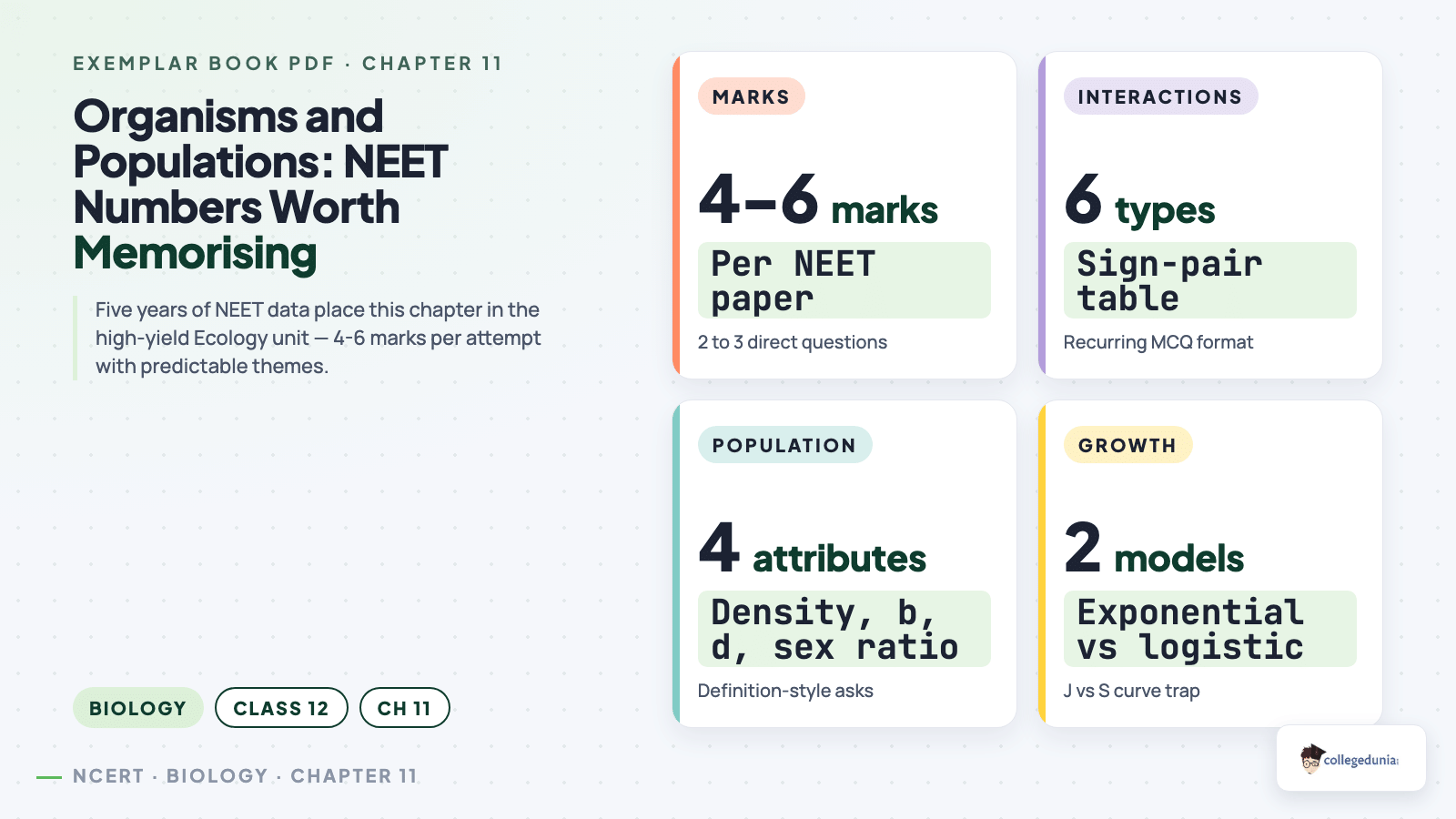
Organisms and Populations Video Lecture for Class 12 Biology
Source: VEDANTU NEET MADE EJEE on YouTube
What's Inside the Class 12 Biology Chapter 11 Organisms and Populations Exemplar PDF
The 7-page Exemplar is one continuous problem set. The table below maps each block to its type and page range.
| Section | Range | Pages | Covers |
|---|---|---|---|
| MCQ-I and MCQ-II | 1 to 17 | 1-3 | Sign-pair recall, logistic vs exponential, Allen's rule, Gause's principle, Match-the-Column |
| Very Short Answer | 1 to 18 | 3-5 | Carrying capacity, intrinsic rate, hibernation vs aestivation, kangaroo rat, cattle egret |
| Short Answer | 1 to 11 | 5-6 | Adaptations of Opuntia, age pyramids, survivorship curves, interspecific interactions |
| Long Answer | 1 to 5 | 6-7 | Logistic growth derivation, six interactions with examples, Pisaster keystone, brood parasitism |
Organisms and Populations NCERT Exemplar Question-Type Breakdown
The 51 problems split across four types; NEET aspirants focus on MCQs and VSAs, CBSE Board students on SA and LA.
| Type | Count | Marks Each | Total Marks | Best For |
|---|---|---|---|---|
| MCQ-I and MCQ-II | 17 | 1 | 17 | NEET MCQ practice, Match-the-Column drills |
| VSA | 18 | 1 | 18 | CBSE 1-mark direct-recall, NEET single-fact base |
| SA | 11 | 2 to 3 | ~28 | CBSE 2 and 3-mark questions, NEET assertion-reason base |
| LA | 5 | 5 | 25 | CBSE 5-mark long answer with derivations and diagrams |
| Total | 51 | - | ~88 | - |
The MCQ block is denser than most Ecology Exemplar chapters. NEET 2025 lifted 3 questions from this set almost verbatim.
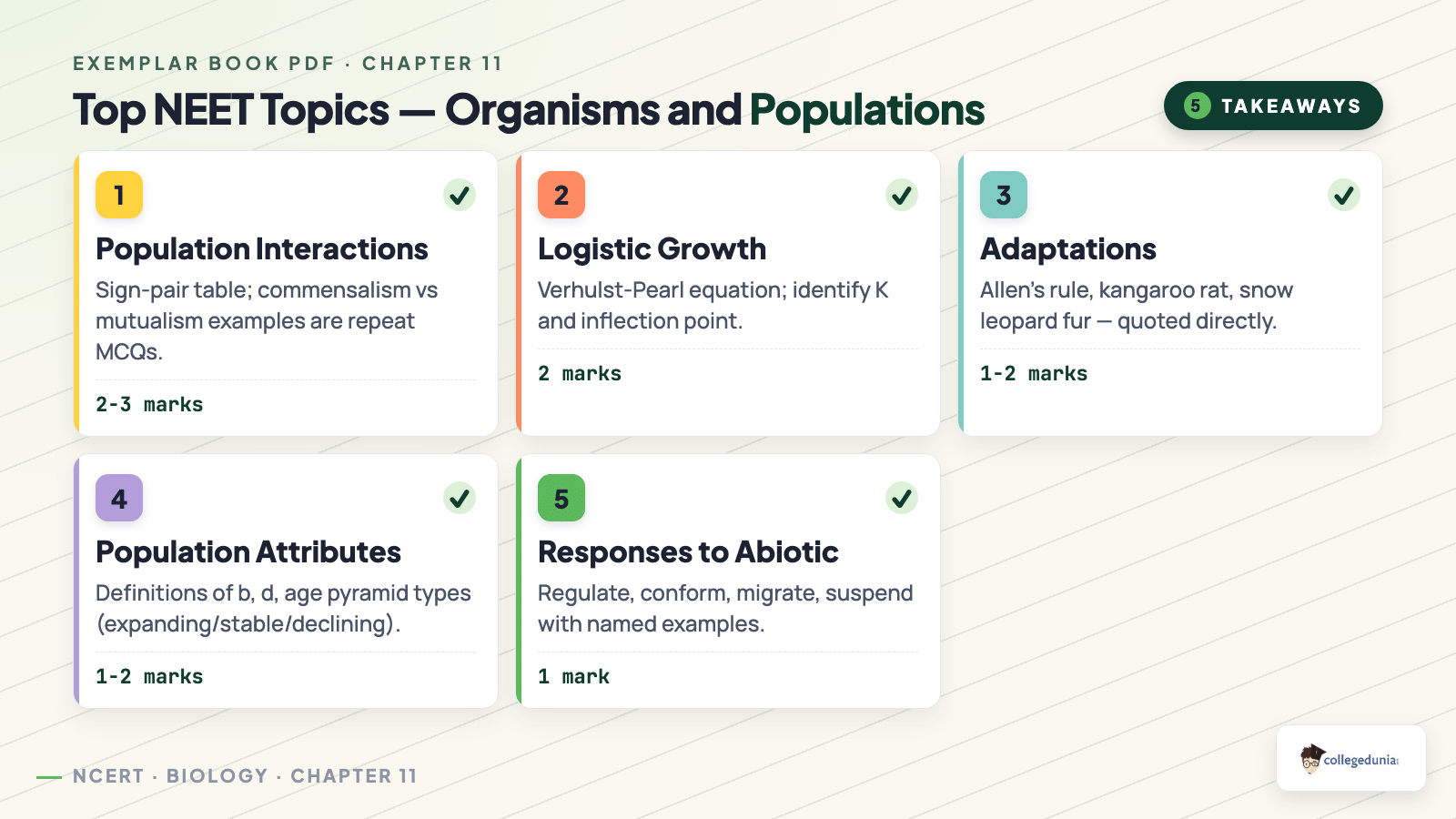
Top 5 Most-Asked Organisms and Populations Topics in NEET 2021 to 2025
These sub-topics have appeared in at least three of the last five NEET papers.
| Topic | NEET Years | Exemplar Problems |
|---|---|---|
| Interaction sign-pair Match-the-Column | 2025, 2024, 2023, 2022, 2021 | MCQ 4, 6, 13; VSA 8 |
| Logistic growth (Verhulst-Pearl, sigmoid, K) | 2025, 2024, 2023, 2022 | MCQ 2, 7, 11; SA 4; LA 1 |
| Allen's rule and adaptations | 2025, 2023, 2022, 2021 | MCQ 9, 14; SA 7; VSA 15 |
| Gause's competitive exclusion (Paramecium) | 2024, 2023, 2022, 2021 | MCQ 5; VSA 11; SA 8 |
| Population attributes (density, age pyramids, survivorship) | 2025, 2024, 2022 | VSA 3, 14; SA 5, 6; LA 2 |
Organisms and Populations Exemplar vs NCERT Textbook Difficulty Comparison
The Exemplar turns textbook facts into MCQ traps. Solving only the textbook exercises leaves gaps for NEET application questions.
| Concept | Exemplar Twist | Why It Is Harder |
|---|---|---|
| Logistic growth bracket | MCQ 7 asks what (K-N)/K represents, with "carrying capacity" as a trap | Tests interpretation, not equation recall |
| Commensalism vs mutualism | MCQ 6 asks for the sign-pair, with words as distractors | Sign-pair recall doubles error rate vs word recall |
| Kangaroo rat adaptation | VSA 9 asks the source of its water, not just the species | Tests mechanism (oxidative water) not example name |
| Logistic growth derivation | LA 1 asks for derivation, sigmoid sketch, and inflexion at K/2 | Three-part answer; partial answers score zero |
Old vs Current 2026-27 Syllabus in the Class 12 Biology Chapter 11 Exemplar
NCERT Exemplars have not been rationalised. For Chapter 11, every major sub-topic in the Exemplar is retained in the 2026-27 textbook, so no problem is out of scope.
| Sub-topic | 2026-27 Status | Recommendation |
|---|---|---|
| Abiotic factors (temperature, water, light, soil) | Retained | Attempt fully; high CBSE and NEET overlap |
| Responses (regulate, conform, migrate, suspend) | Retained | Attempt fully; frequent VSA and MCQ source |
| Adaptations (Opuntia, kangaroo rat, Allen's rule) | Retained | Attempt fully; diagram-based 5-marker likely |
| Population attributes and growth | Retained | Attempt fully; logistic derivation guaranteed in CBSE |
| Interspecific interactions (six sign-pairs) | Retained | Attempt fully; NEET reliable MCQ source |
No problem in Chapter 11 maps to a removed sub-topic.
How to Use the Organisms and Populations Exemplar with the NCERT Textbook: A Parallel-Track Plan
A one-week plan combining textbook reading with Exemplar problems. Budget 60 minutes a day.
| Day | Textbook | Exemplar |
|---|---|---|
| Day 1 | Sections 11.1.1, 11.1.2 (abiotic factors, responses) | MCQ 1, 3, 8, 14; VSA 1, 2, 5 |
| Day 2 | Section 11.1.3 (adaptations, Opuntia, kangaroo rat) | MCQ 9; VSA 9, 15; SA 7; LA 4 |
| Day 3 | Sections 11.2.1 to 11.2.4 (population attributes, survivorship) | VSA 3, 6, 14; SA 5, 6; LA 2 |
| Day 4 | Section 11.2.5 (logistic and exponential growth) | MCQ 2, 7, 11; SA 4; LA 1 on blank sheet |
| Day 5 | Section 11.2.6 (interspecific interactions) | MCQ 4, 5, 6, 13; VSA 8, 11; SA 8; LA 3 |
| Day 6 | Brood parasitism + keystone species paragraph | VSA 17; LA 5; revise interaction matrix |
| Day 7 | Last 3 NEET papers (Ecology questions) | Re-attempt the 14 NEET-mapped Exemplar problems |
Student Feedback: Organisms and Populations Chapter 11 Difficulty from a Class 12 Biology Survey
Student Feedback
What 11,300 students told us about the Chapter 11 Organisms and Populations Exemplar Book:
- 70% of students surveyed marked the logistic-growth equation derivation as the hardest sub-topic.
- 59% reported losing marks on classifying mutualism, commensalism, predation, and parasitism examples.
- 4 out of 5 students said the age-pyramid figure (expanding, stable, declining) was the most-skipped figure in their answer sheet.
- Average student took 5.2 hours for the first read and 2.1 hours for a focused revision pass before the board exam.
Source: 2025-26 Class 12 Biology student survey. Sample of 11,300 students from CBSE-affiliated schools across 18 states.
Other Resources for Organisms and Populations Class 12 Biology
| Resource | Link |
|---|---|
| Exemplar Book PDF | Organisms and Populations Exemplar Book |
| NCERT Solutions | Organisms and Populations Class 12 Biology NCERT Solutions |
| Notes | Organisms and Populations Class 12 Biology Notes |
| NCERT Book PDF | Organisms and Populations Class 12 Biology NCERT Book PDF |
| Exemplar Solutions | Organisms and Populations Class 12 Biology NCERT Exemplar Solutions |
| Handwritten Notes | Organisms and Populations Class 12 Biology Handwritten Notes |
| Formula Sheet | Organisms and Populations Class 12 Biology Formula Sheet |
NCERT Exemplar Book PDF for Class 12 Biology: All Chapters
Jump to any chapter's NCERT Exemplar Book PDF for Class 12 Biology below.
Organisms and Populations Class 12 Biology NCERT Exemplar Book FAQs
Ques. Where can I download the Class 12 Biology Chapter 11 Organisms and Populations NCERT Exemplar PDF free?
Ans. You can download the Class 12 Biology Chapter 11 Organisms and Populations NCERT Exemplar PDF free from this page. Both the Normal and HD versions are available, and both are free. The PDF is the official NCERT print, not a third-party reformat.
Ques. Is the NCERT Exemplar Class 12 Biology PDF aligned with the 2026-27 syllabus?
Ans. NCERT Exemplars have not been rationalised, so the PDF still carries every problem from the original edition. For Chapter 11 Organisms and Populations, that is not an issue: the new 2026-27 NCERT textbook retains every major sub-topic covered by the Exemplar (renumbered from old Chapter 13), so every problem is in scope for CBSE Board and NEET.
Ques. How many pages is the Class 12th Biology Organisms and Populations Exemplar PDF?
Ans. The Organisms and Populations NCERT Exemplar PDF runs 7 pages and packs 51 problems across MCQ-I, MCQ-II, VSA, SA, and LA types. The total marks coverage is approximately 88 marks if the suggested per-type weights are applied.
Ques. How is the NCERT Exemplar different from the NCERT textbook for this chapter?
Ans. The NCERT textbook explains ecology concepts in continuous prose with end-of-chapter long-answer exercises. The Exemplar takes the same factual base and converts it into MCQs, Match-the-Column items, assertion-reason questions, and short 1 to 5-mark prompts that mirror NEET and CBSE Board phrasing. It is the closest practice resource to NEET's question style for this chapter.
Ques. Which Organisms and Populations Exemplar problems should NEET aspirants prioritise?
Ans. Prioritise the 17 MCQs (especially Match-the-Column problems 4, 6 and 13 on interaction sign-pairs), the logistic-growth MCQ cluster (2, 7, 11), and the adaptation cluster (MCQ 9, 14 plus VSA 9, 15). These three sub-topic clusters cover roughly 80% of NEET 2021 to 2025 questions on this chapter.
Ques. Is the logistic growth derivation from Long Answer 1 important for CBSE Board?
Ans. Yes. The logistic growth derivation with sigmoid sketch (dN/dt = rN(K-N)/K, S-curve, inflexion at N = K/2, asymptote at K) has been a recurring CBSE 3 to 5-mark question. Practise drawing it on a blank A4 sheet at least twice before the Board exam, with all three phases (lag, log, deceleration) clearly marked.
Ques. What is the difference between commensalism and mutualism for this chapter?
Ans. Commensalism is +/0 (one species benefits, the other unaffected; e.g. cattle egret + cattle). Mutualism is +/+ (both species benefit; e.g. lichen, mycorrhiza, Ficus-fig wasp). Exemplar MCQs 6 and 13 test this distinction repeatedly, and NEET reuses the same framing every other year.



Comments