



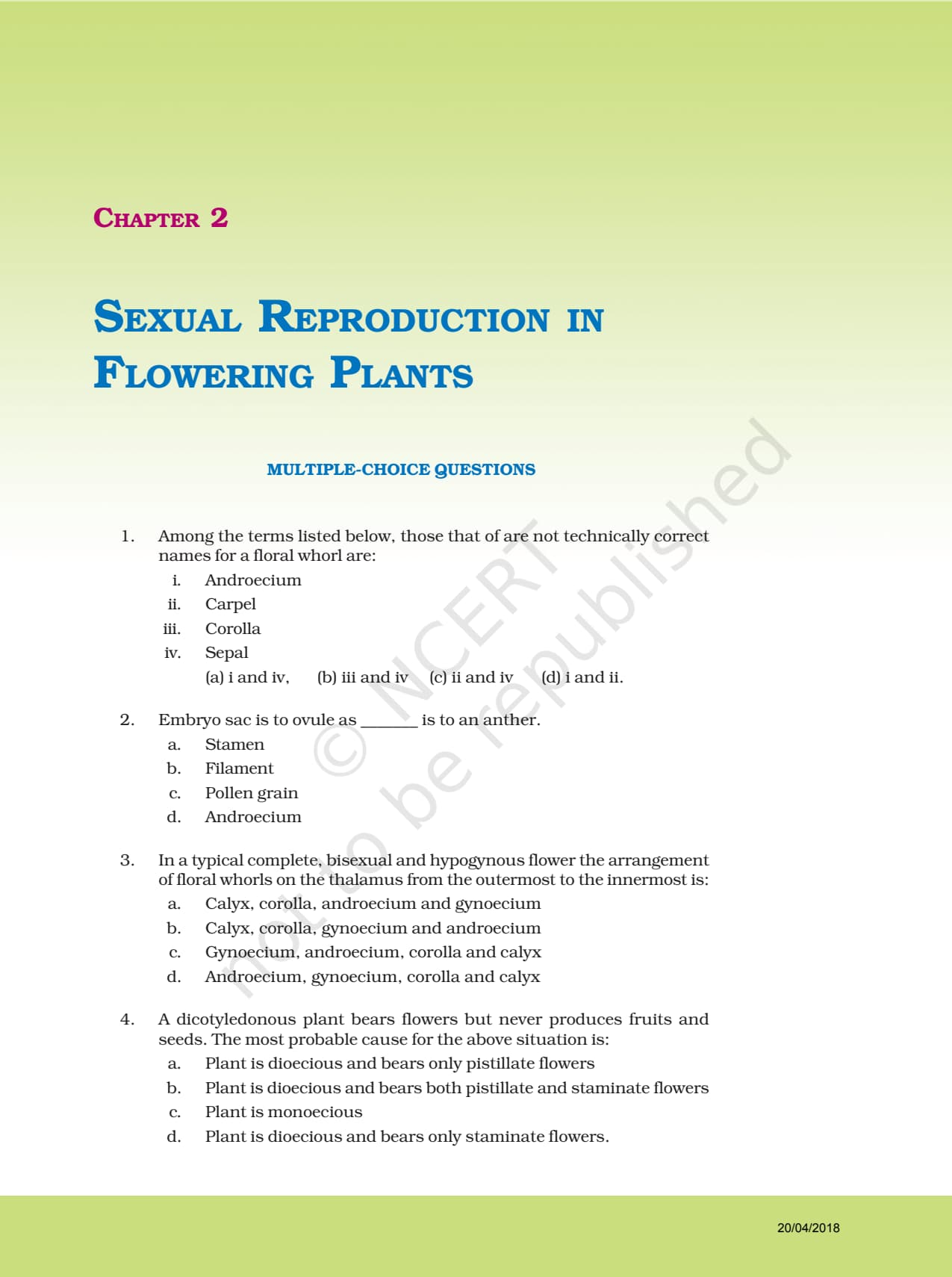
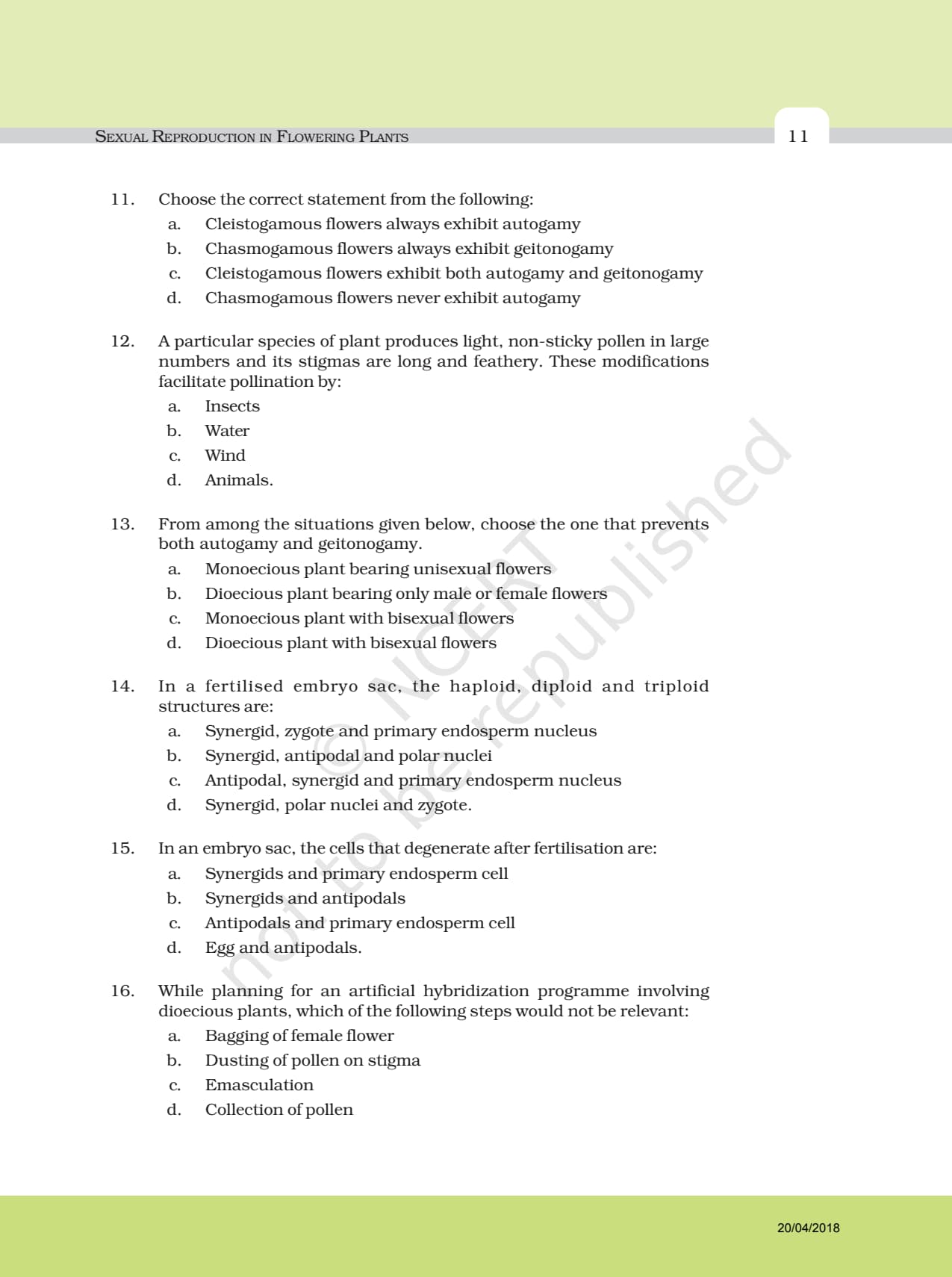
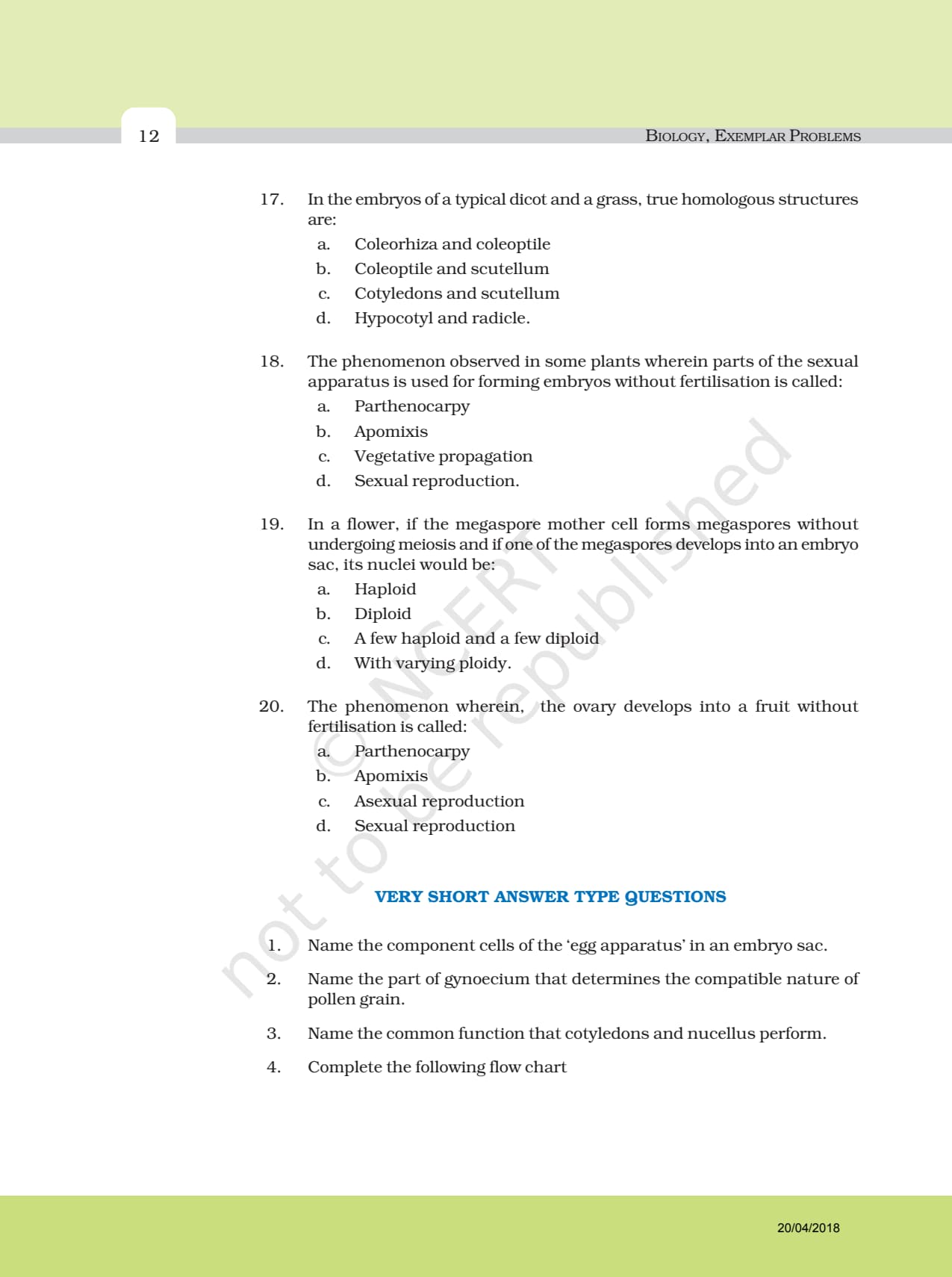
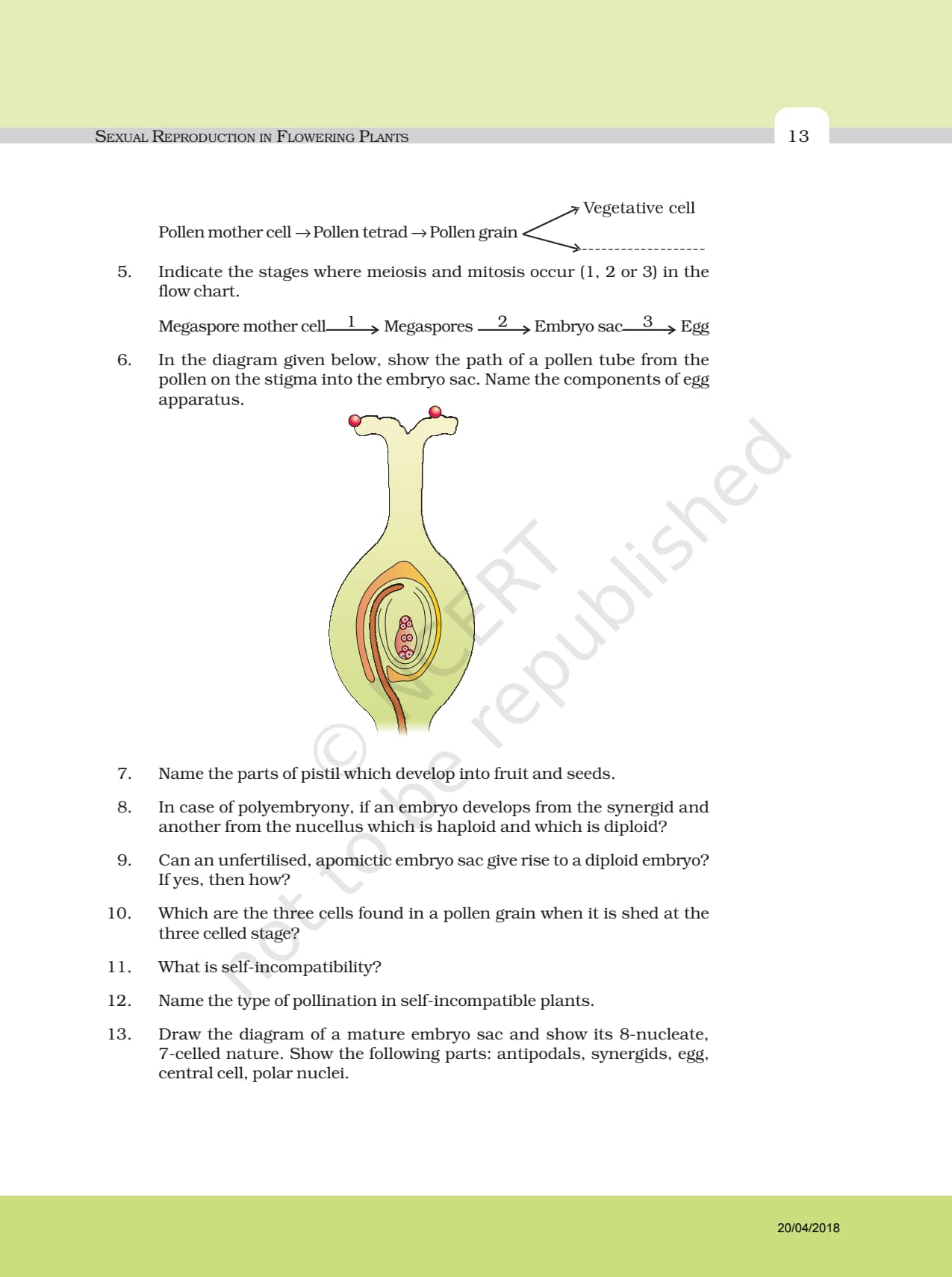
Class 12 Biology Chapter 1 covers Sexual Reproduction in Flowering Plants, the angiosperm life cycle from pre-fertilisation events to seed and fruit development. The NCERT Exemplar adds 16 pages of higher-order MCQs, multiple-correct items, and long-answer questions for 2026-27 NEET and CBSE prep. Download the free NCERT Exemplar Class 12 Biology Chapter 1 PDF from the flipbook below.

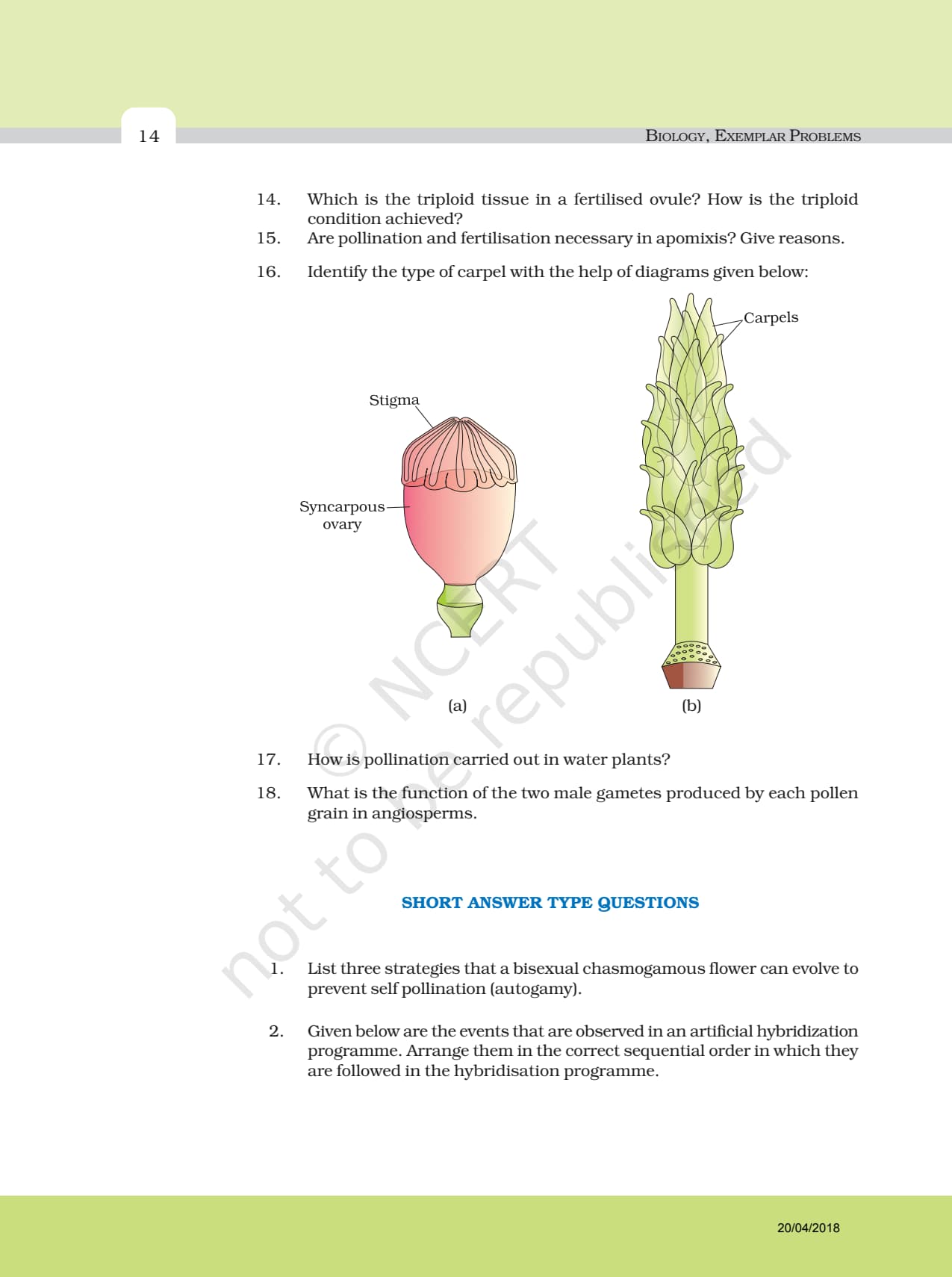
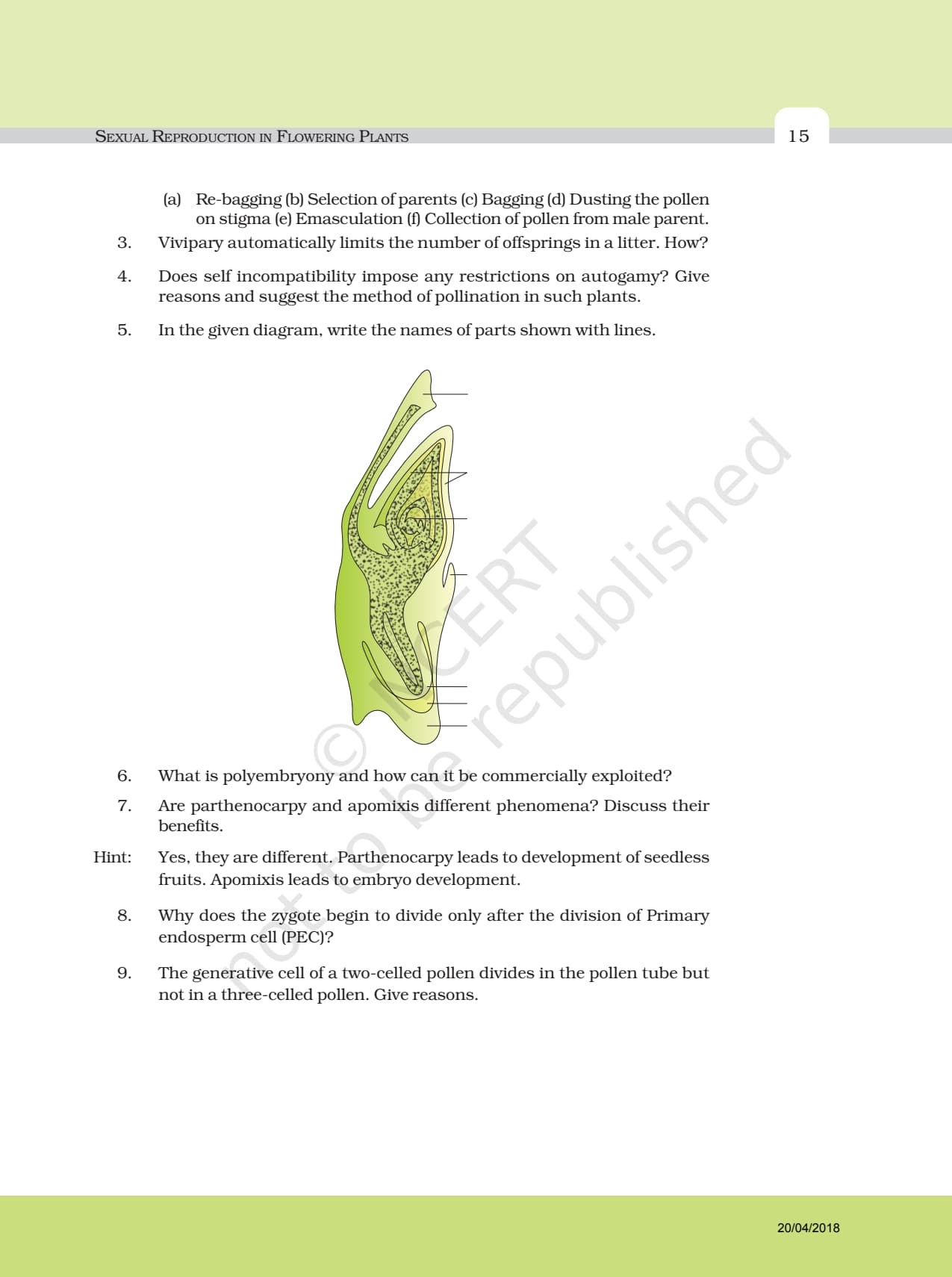
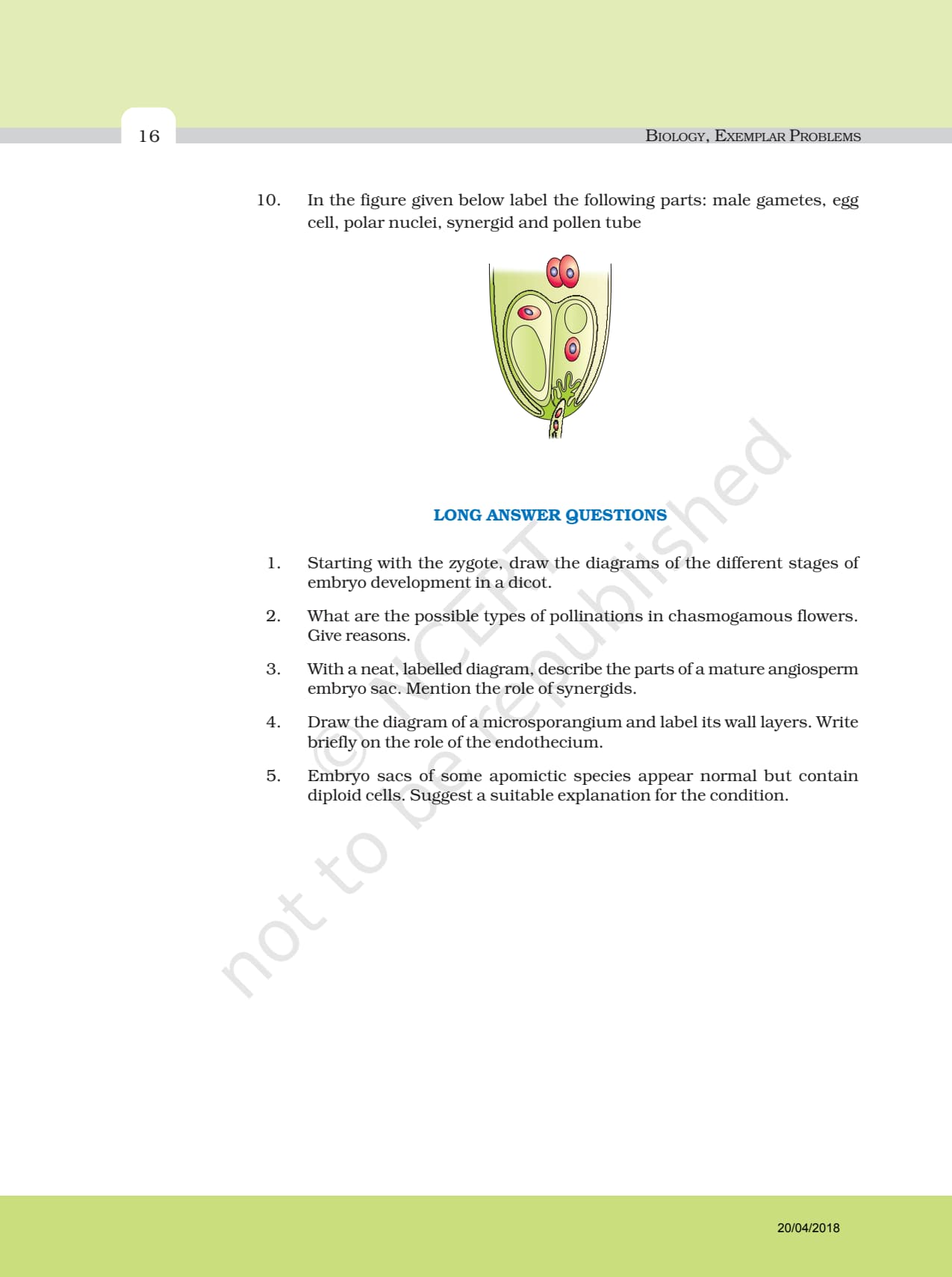
- CBSE Weightage: 6 to 8 marks (one of the highest in Unit 7: Reproduction)
- NEET Weightage: 5 to 7 questions per paper (about 8% of Biology, the biggest plant chapter)
Note on numbering: the NCERT Exemplar labels this chapter as Exemplar Chapter 2 because the original Exemplar Chapter 1 (Reproduction in Organisms) was dropped from the current NCERT textbook. The 2026-27 textbook places Sexual Reproduction in Flowering Plants at Chapter 1. Both refer to the same booklet.
Why the NCERT Exemplar Matters for NEET Class 12 Biology Sexual Reproduction in Flowering Plants Prep
NEET papers from 2021 onward have pulled 4 to 7 questions every year from this chapter. The textbook covers concepts; the Exemplar rehearses the diagram twists and multiple-correct combinations NEET actually asks.
Three patterns make this Exemplar essential for 2026-27 NEET:
- Diagram-labelling depth. NEET asks about specific cells inside the embryo sac and the male gametophyte. The Exemplar drills these labels in MCQ-II form.
- Reasoning chains. Assertion-reason on apomixis, polyembryony and parthenocarpy needs two facts in sequence; the Exemplar's MCQ-II and SA blocks build that skill.
- Chromosome-number tracing. Counting ploidy across pollen, embryo sac, endosperm (triploid) and pericarp is a recurring NEET trap the Exemplar repeats with different setups.
Full master table: year-wise NEET PYQ map for Sexual Reproduction in Flowering Plants (canonical owner: NCERT Solutions page).
How Collegedunia's NCERT Exemplar Book PDF Helps with Sexual Reproduction in Flowering Plants
This is the official NCERT print, paired with a question-type breakdown and a parallel-track plan for the 2026-27 syllabus. Four ways it shortens your prep:
- Single download for the full 16-page Exemplar. No chapter-splitting, no watermarks, mobile-readable.
- Mapped to NEET-style traps. Each block is tagged with the trap it teaches (chromosome-counting, double-fertilisation labelling, apomixis vs amphimixis).
- Flagged for outside-textbook content. The cross-reference table below tells you which problems to skip if you are CBSE-only.
- Aligned with the matching Exemplar Solutions page so you can self-check after each block.
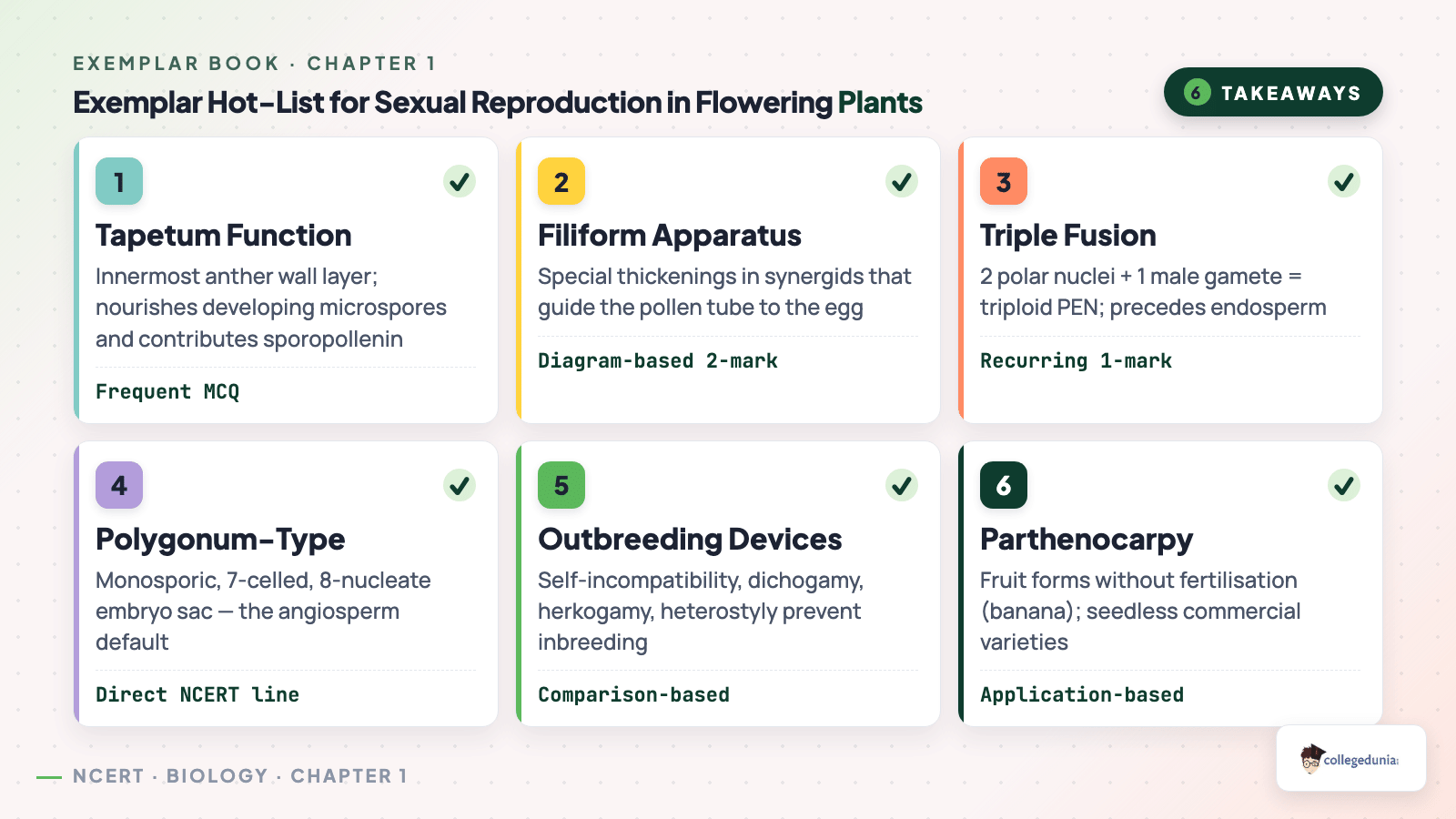
What's Inside the Class 12 Biology Chapter 1 Sexual Reproduction in Flowering Plants Exemplar PDF
The 16 pages run as one continuous problem set. The table below maps each block to its question type and page range so you can navigate it during revision.
| Section | Problem Range | Pages | What It Covers |
|---|---|---|---|
| Multiple Choice Questions (MCQ-I) | 1 to 18 | 1-4 | Single-correct MCQs on flower structure, microsporogenesis, megasporogenesis, pollination types, double fertilisation |
| Multiple Correct Choice (MCQ-II) | 19 to 23 | 4-6 | Multiple-correct items on embryo sac cells, pollen-pistil interaction, apomixis vs polyembryony |
| Very Short Answer (VSA) | 24 to 30 | 6-8 | 1-mark direct questions on key terms (chasmogamous, cleistogamous, tapetum, filiform apparatus) |
| Short Answer (SA) | 31 to 39 | 8-12 | 2 to 3-mark explanations: pollen viability, self-incompatibility, chromosome-number tracing, endosperm development |
| Long Answer (LA) | 40 to 45 | 12-16 | 5-mark theory and diagram-based questions on the angiosperm life cycle and seed development |
The MCQ-I and MCQ-II blocks together have 23 items, roughly half the Exemplar, and match the NEET attack surface for this chapter.
Sexual Reproduction in Flowering Plants NCERT Exemplar Question-Type Breakdown
The table below converts the Exemplar into a marks-and-time view. MCQ-I = 1, MCQ-II = 1 (all-or-nothing), VSA = 1, SA = 2 or 3, LA = 5.
| Type | Count | Mark Value | Total Marks | Suggested Time |
|---|---|---|---|---|
| MCQ-I | 18 | 1 | 18 | 20 min |
| MCQ-II | 5 | 1 | 5 | 10 min |
| VSA | 7 | 1 | 7 | 10 min |
| SA | 9 | 2 to 3 | 22 | 45 min |
| LA | 6 | 5 | 30 | 50 min |
| Total | 45 | - | 82 | ~135 min |
A full pass takes roughly two and a quarter hours. Most students split it: MCQ-I + VSA on day one, MCQ-II + SA on day two, LA on day three.
Sexual Reproduction in Flowering Plants Exemplar vs NCERT Textbook Difficulty Comparison
The Exemplar takes the same textbook concepts and adds just enough twist to test depth rather than recall. Three examples from this chapter:
| Concept | NCERT Textbook Asks | Exemplar Twist |
|---|---|---|
| Double fertilisation | Name the two fusion events in an angiosperm | Given a polyploid plant where male is 2n and female is 4n, find the ploidy of zygote and primary endosperm nucleus |
| Embryo sac structure | Label the seven cells of a mature embryo sac | Identify which cells degenerate before pollen-tube entry and which guide it via the filiform apparatus |
| Apomixis | Define apomixis with one example | Distinguish apomixis from polyembryony and parthenocarpy in a single assertion-reason item |
In every NEET paper since 2020, at least one question used an Exemplar-style twist rather than a textbook restatement.
Old vs Rationalised Syllabus in the Class 12 Biology Chapter 1 Exemplar
The NCERT Exemplars were not updated alongside the textbook revision, so this booklet still has content the 2026-27 NCERT textbook has trimmed. The table flags what to keep and what to skip for CBSE students.
| Topic in Exemplar | Status in 2026-27 NCERT | Action for CBSE | Action for NEET |
|---|---|---|---|
| Pre-fertilisation events (microsporogenesis, megasporogenesis) | Retained | Compulsory | Compulsory |
| Double fertilisation, endosperm formation | Retained | Compulsory | Compulsory |
| Pollen-pistil interaction, self-incompatibility | Retained | Compulsory | Compulsory |
| Apomixis and polyembryony | Retained (brief) | Compulsory | Compulsory |
| Detailed monocot vs dicot embryo development diagrams | Trimmed | Skim for context | Practise (still in NEET syllabus) |
| Extended apomixis crop examples (Citrus, Mango) | Trimmed | Skip | Read once |
Net effect: NEET aspirants attempt the full Exemplar. CBSE-only students can skip about 10% of the LA block.
How to Use the Sexual Reproduction in Flowering Plants Exemplar with the NCERT Textbook: A Parallel-Track Plan
The Exemplar works best as a feedback loop alongside the textbook. Follow this one-week plan:
- Day 1-2 (Read textbook). Cover pre-fertilisation events, flower structure, microsporogenesis and megasporogenesis. Mark the key diagrams.
- Day 3 (MCQ-I + VSA). 30 minutes timed. Self-check against the Exemplar Solutions; return to textbook for any missed concept.
- Day 4 (Read textbook). Finish pollination, pollen-pistil interaction, double fertilisation and post-fertilisation events.
- Day 5 (MCQ-II + SA). 55 minutes timed. These types punish surface reading the hardest.
- Day 6 (LA block). Write at least three LAs in full and check against the model answer.
- Day 7 (Revision card). One-page summary: chromosome counts, embryo-sac cells, and apomixis vs polyembryony vs parthenocarpy.
Sexual Reproduction in Flowering Plants Video Lecture for Class 12 Biology
Source: PW Test Series on YouTube
Student Feedback
What 12,400 students told us about studying Chapter 1 Sexual Reproduction in Flowering Plants:
- 73% of students found the double-fertilisation labelled diagram the hardest sub-topic in this chapter.
- 61% lost marks on the microsporogenesis vs megasporogenesis comparison, even when the rest of their answer was correct.
- Average study time: 5.8 hours for the first read, 2.4 hours for a focused revision pass before the board exam.
Source: 2025-26 Class 12 Biology student survey. Sample of 12,400 students from CBSE-affiliated schools across 18 states.
Other Resources for Sexual Reproduction in Flowering Plants Class 12 Biology
| Resource | Link |
|---|---|
| Exemplar Book (this page) | Sexual Reproduction in Flowering Plants Exemplar Book PDF |
| NCERT Solutions | NCERT Solutions for Class 12 Biology Chapter 1 |
| Exemplar Solutions | Class 12 Biology Chapter 1 NCERT Exemplar Solutions |
| Notes | Sexual Reproduction in Flowering Plants Class 12 Notes |
| Handwritten Notes | Sexual Reproduction in Flowering Plants Handwritten Notes |
| Formula Sheet | Sexual Reproduction in Flowering Plants Formula Sheet |
| NCERT Book PDF | Class 12 Biology Chapter 1 NCERT Book PDF |
NCERT Exemplar Book PDF for Class 12 Biology: All Chapters
Use Collegedunia's full Class 12 Biology Exemplar library to cover the entire syllabus.
Sexual Reproduction in Flowering Plants Class 12 Biology Exemplar Book FAQs
Is the NCERT Exemplar Class 12 Biology Chapter 1 Sexual Reproduction in Flowering Plants enough for NEET?
The Exemplar plus the NCERT textbook is the minimum NEET base for this chapter. It covers all five NEET question types and all the diagram-labelling traps used in recent NEET papers. Pair it with the last five years of NEET PYQs for full coverage.
Why does the NCERT Exemplar number this chapter as Chapter 2 when my textbook says Chapter 1?
The Exemplar was printed before the 2023 rationalisation, when Reproduction in Organisms sat at Chapter 1. That chapter was removed from the textbook, so Sexual Reproduction in Flowering Plants is now Chapter 1 in the 2026-27 NCERT textbook but still appears as Chapter 2 inside the Exemplar booklet. The content is identical.
Has the NCERT Exemplar been updated for the 2026-27 syllabus?
No. NCERT Exemplars have not been republished after the textbook rationalisation. Treat the Exemplar as a superset: a small slice of its problems refers to topics outside the current textbook. The kept-trimmed table on this page tells you exactly which problems to skip for CBSE.
How many marks does Sexual Reproduction in Flowering Plants carry in CBSE Class 12 Biology?
The chapter typically carries 6 to 8 marks in the CBSE Board paper, which makes it one of the highest-weighted single chapters in Unit 7: Reproduction. Long-answer questions on the angiosperm life cycle and double fertilisation are repeated regularly.
How many NEET questions come from this chapter every year?
NEET has carried 5 to 7 questions from Sexual Reproduction in Flowering Plants every year since 2020, making it the single biggest plant-biology chapter in the NEET Biology paper. Most are MCQ-style with diagram-based traps that the Exemplar drills directly.
What is the difference between apomixis, polyembryony and parthenocarpy?
Apomixis is seed formation without fertilisation; polyembryony is the presence of more than one embryo in a single seed; parthenocarpy is fruit formation without fertilisation, so the resulting fruit is seedless. The Exemplar has dedicated MCQ-II and assertion-reason items that test the boundary between these three terms.
Where can I download the Class 12 Biology Exemplar Book PDF for Chapter 1?
The full PDF is hosted at the top of this page. The download is free, mobile-readable, and identical to the official NCERT print. The companion Exemplar Solutions PDF is linked in the Other Resources table above.



Comments