




Class 12 Physics Chapter 2 covers Electrostatic Potential and Capacitance - a chapter that carries 7 marks in CBSE boards and features in every JEE Main and NEET paper. Get all 12 core formulas with SI units and physical meaning, verified against the 2026-27 NCERT. This page hosts the formula sheet PDF for a quick 12-minute revision pass.
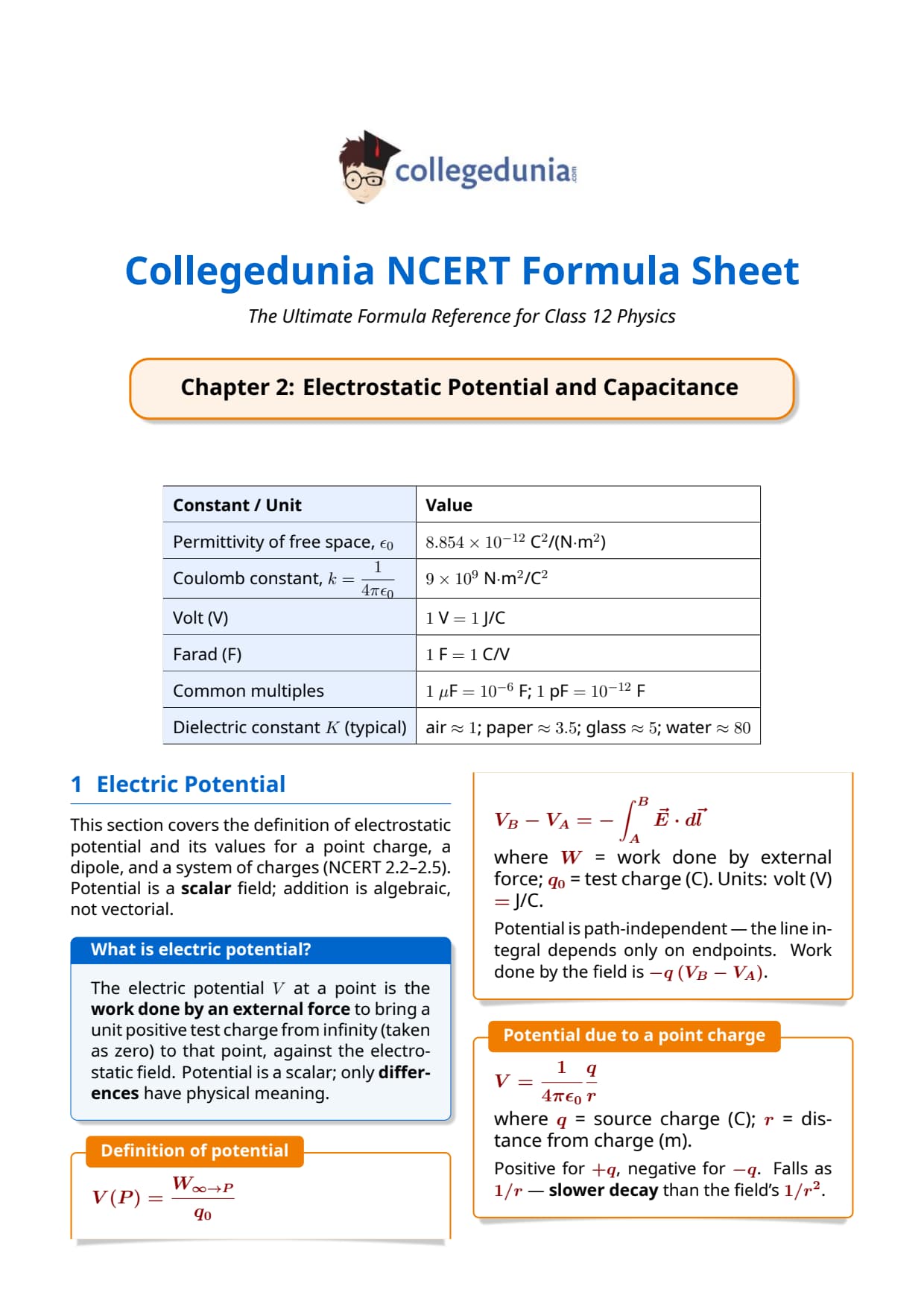
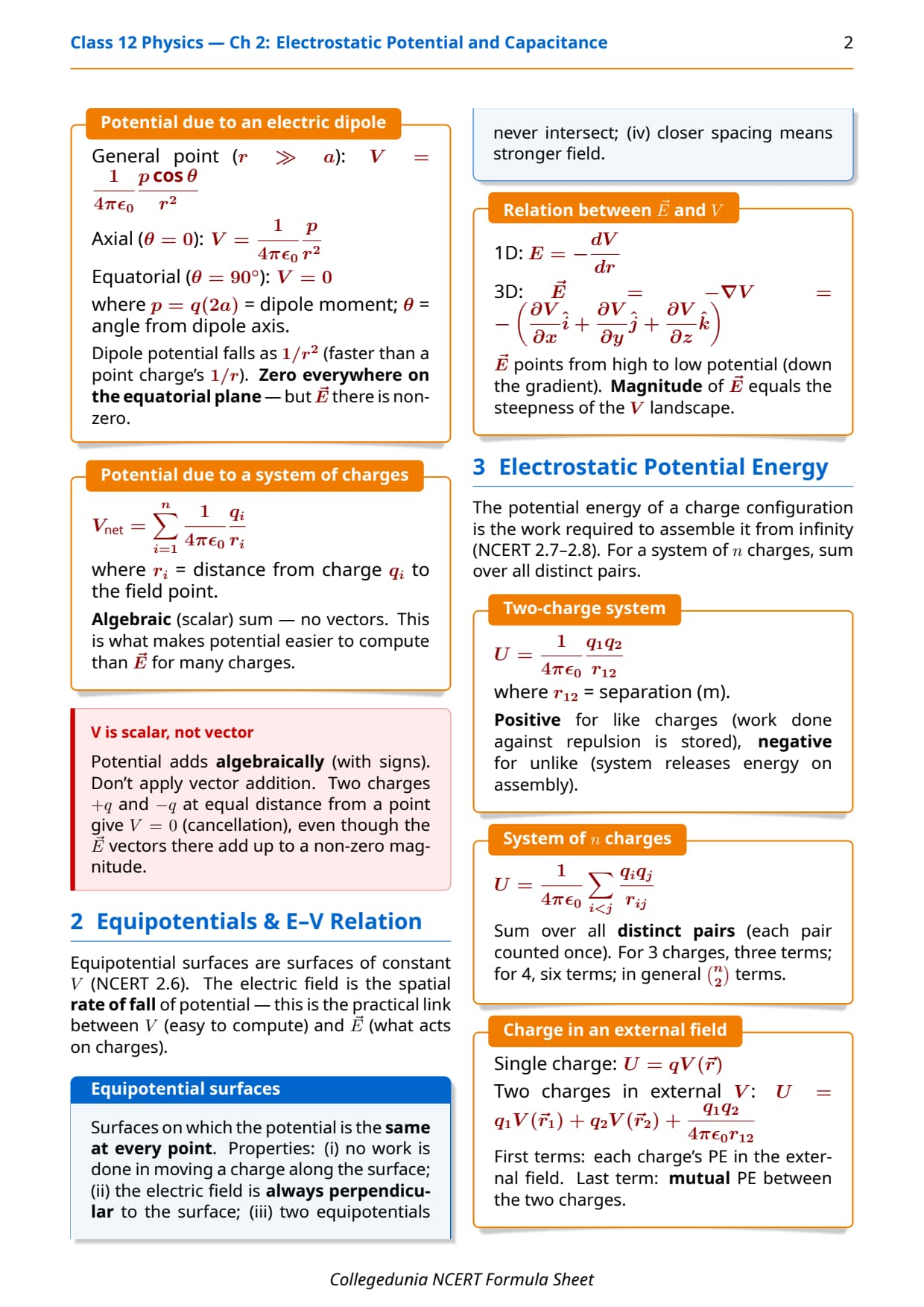
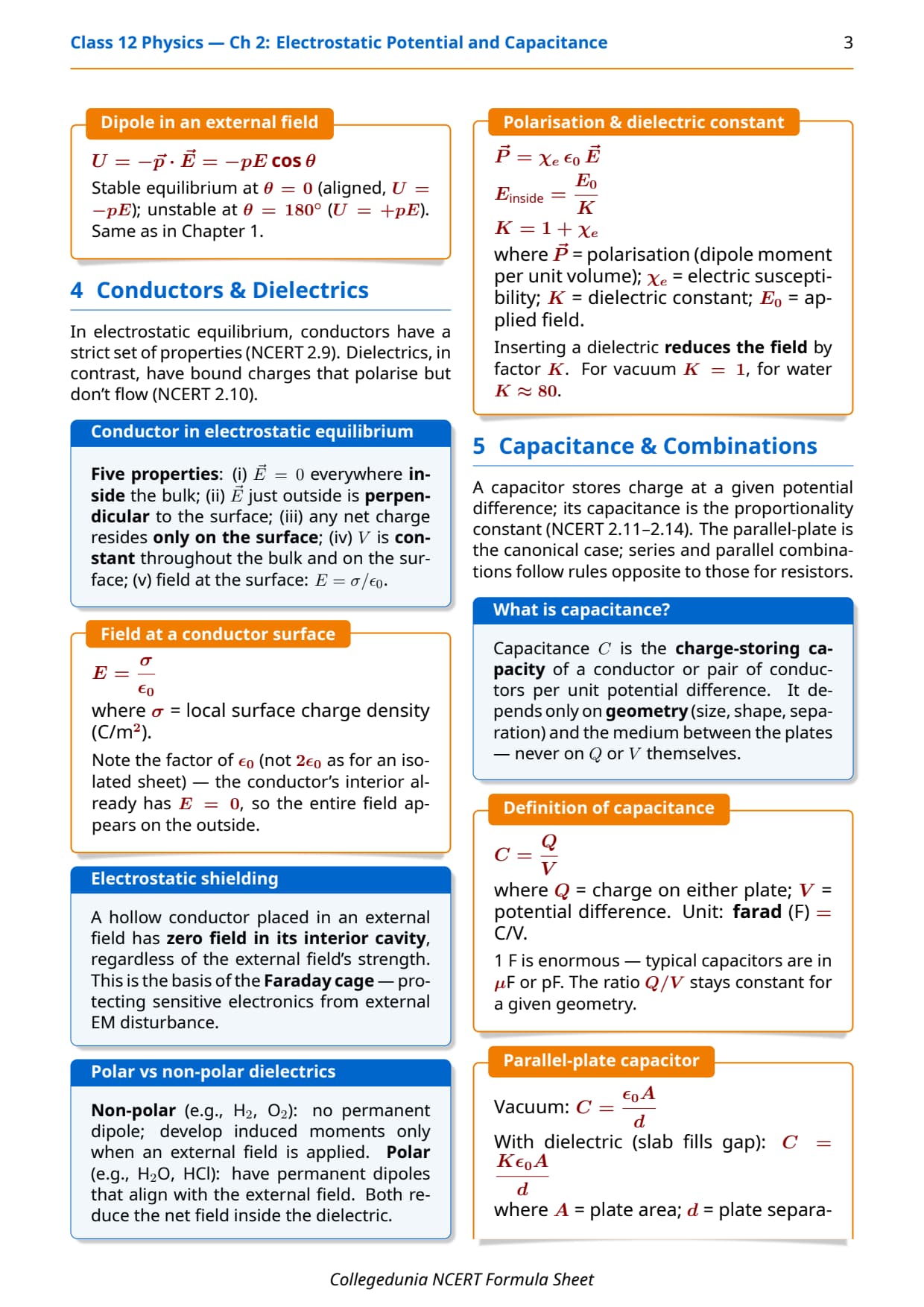
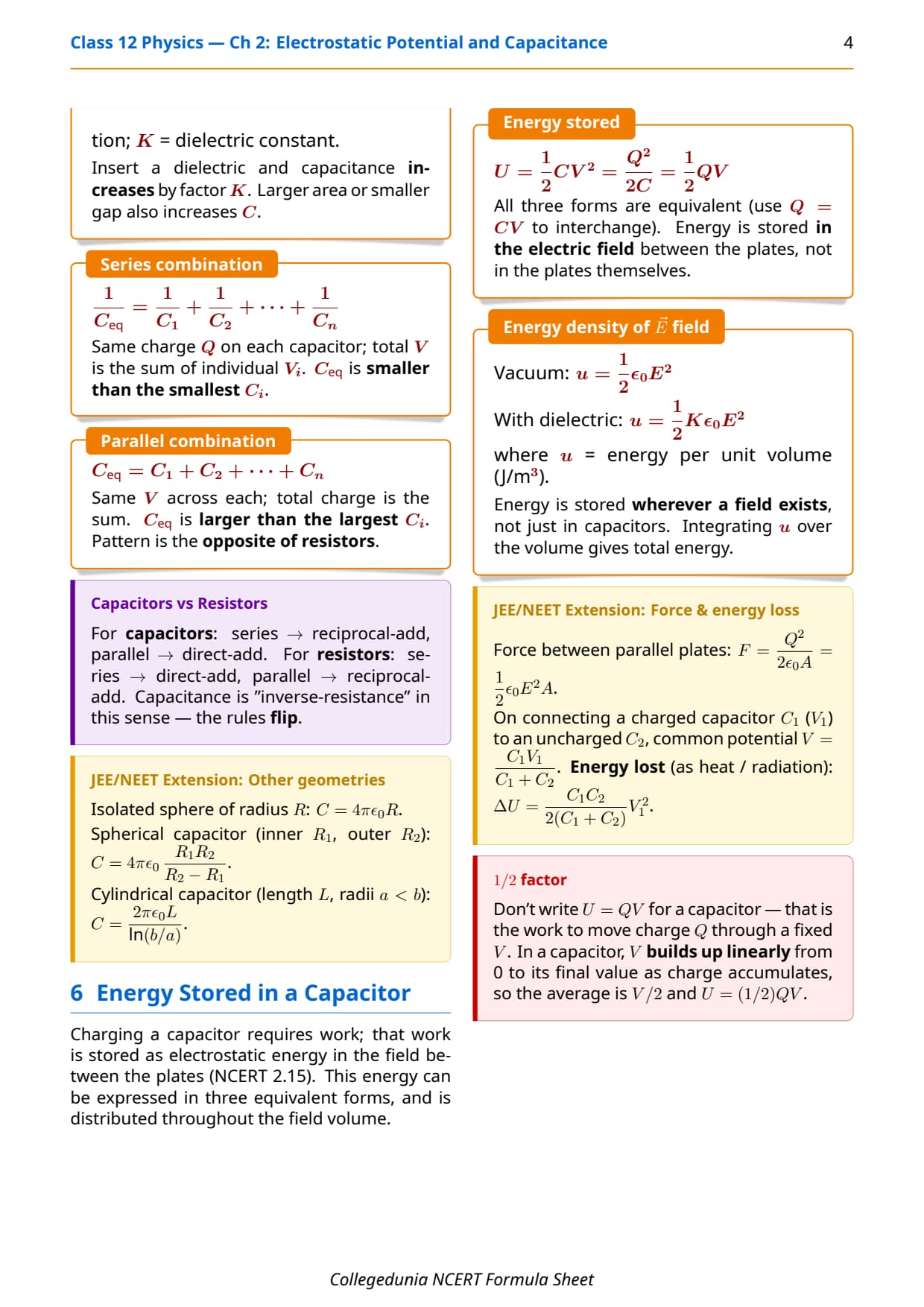
- 7 marks in CBSE boards - second-highest single-chapter weight in Unit 1.
- 12 core formulas cover every numerical this chapter generates.
- JEE/NEET extensions: 2-3 derived results flagged for entrance exam prep.
Class 12 Physics Chapter 2 Formula Sheet: Quick Reference
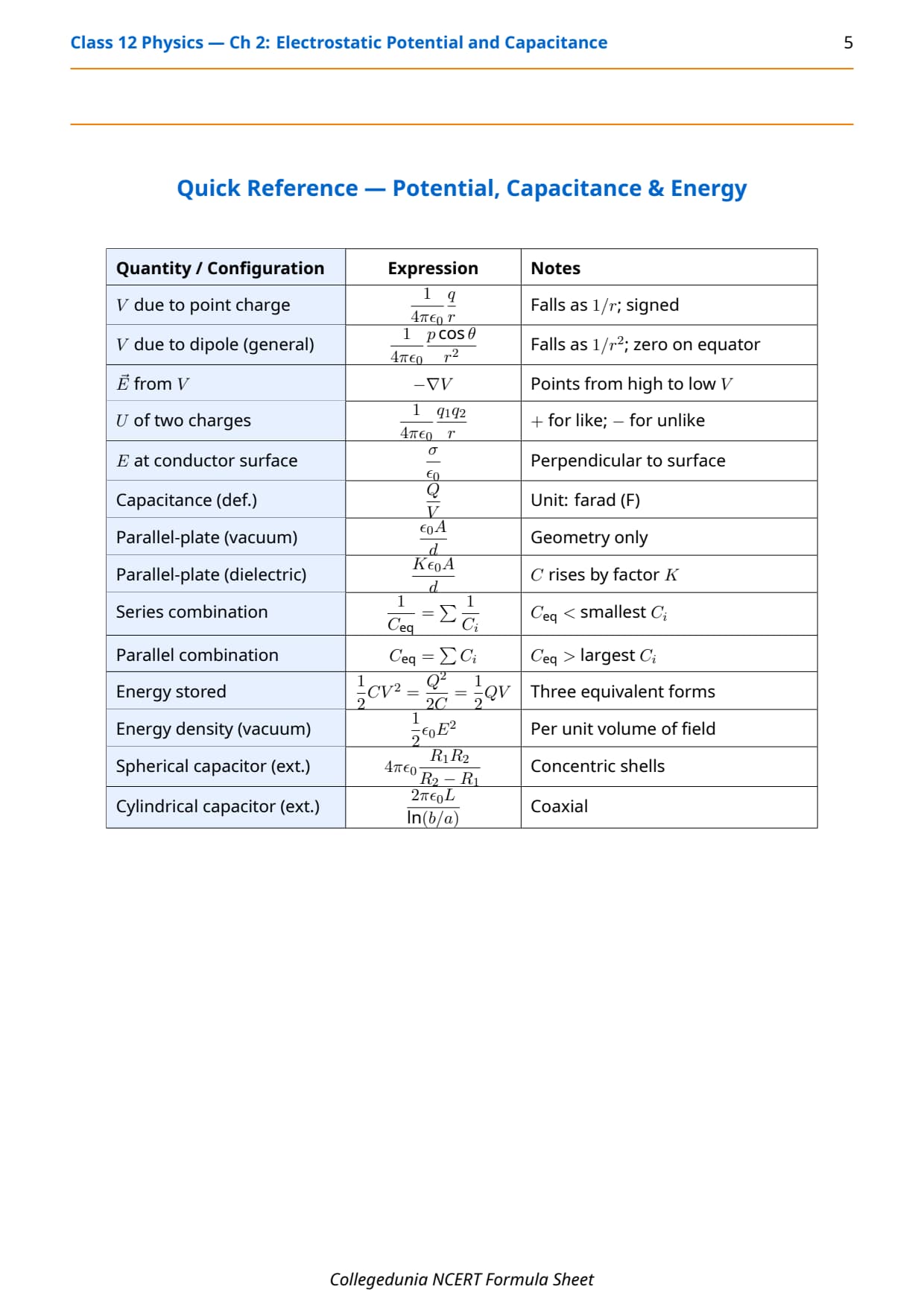
The 12 formulas below cover every numerical in Chapter 2 Electrostatic Potential and Capacitance. Each row gives the concept, formula, and SI unit.
| Concept | Formula | SI Unit |
|---|---|---|
| Electric potential | V = W / q | volt |
| Potential of a point charge | V = k Q / r | volt |
| Potential of a dipole | V = k p cos theta / r squared | volt |
| Potential energy of two charges | U = k q_1 q_2 / r | joule |
| Relation between E and V | E = minus dV / dx | V/m |
| Capacitance | C = Q / V | farad |
| Parallel-plate (vacuum) | C = epsilon_0 A / d | farad |
| Parallel-plate (dielectric) | C = K epsilon_0 A / d | farad |
| Series capacitors | 1/C_eq = sum 1/C_i | n/a |
| Parallel capacitors | C_eq = sum C_i | n/a |
| Energy stored | U = (1/2) Q²/C = (1/2) C V² | joule |
| Energy density | u = (1/2) epsilon_0 E² | J/m³ |
Electrostatic Potential and Capacitance Video Lecture - Class 12 Physics
Watch this lecture to see the key Chapter 2 formulas worked through with solved examples from CBSE and JEE Main papers.
Source: JEEfinity by Unacademy on YouTube
Class 12 Physics Chapter 2 Topic-by-Topic Formula Breakdown
Chapter 2 splits into 6 sub-topics. Each one maps to specific mark allocations in CBSE:
- Electric potential and potential difference: 2 marks on V = W/q.
- Potential due to point charge, dipole, system: 3 marks on V = kQ/r.
- Equipotential surfaces and E-V relation: 2 marks on E = -dV/dx.
- Capacitance and parallel-plate capacitor: 5-mark derivation in boards.
- Series and parallel capacitors: 3-mark numerical in most papers.
- Energy stored in a capacitor: 3-mark derivation U = 1/2 CV squared.
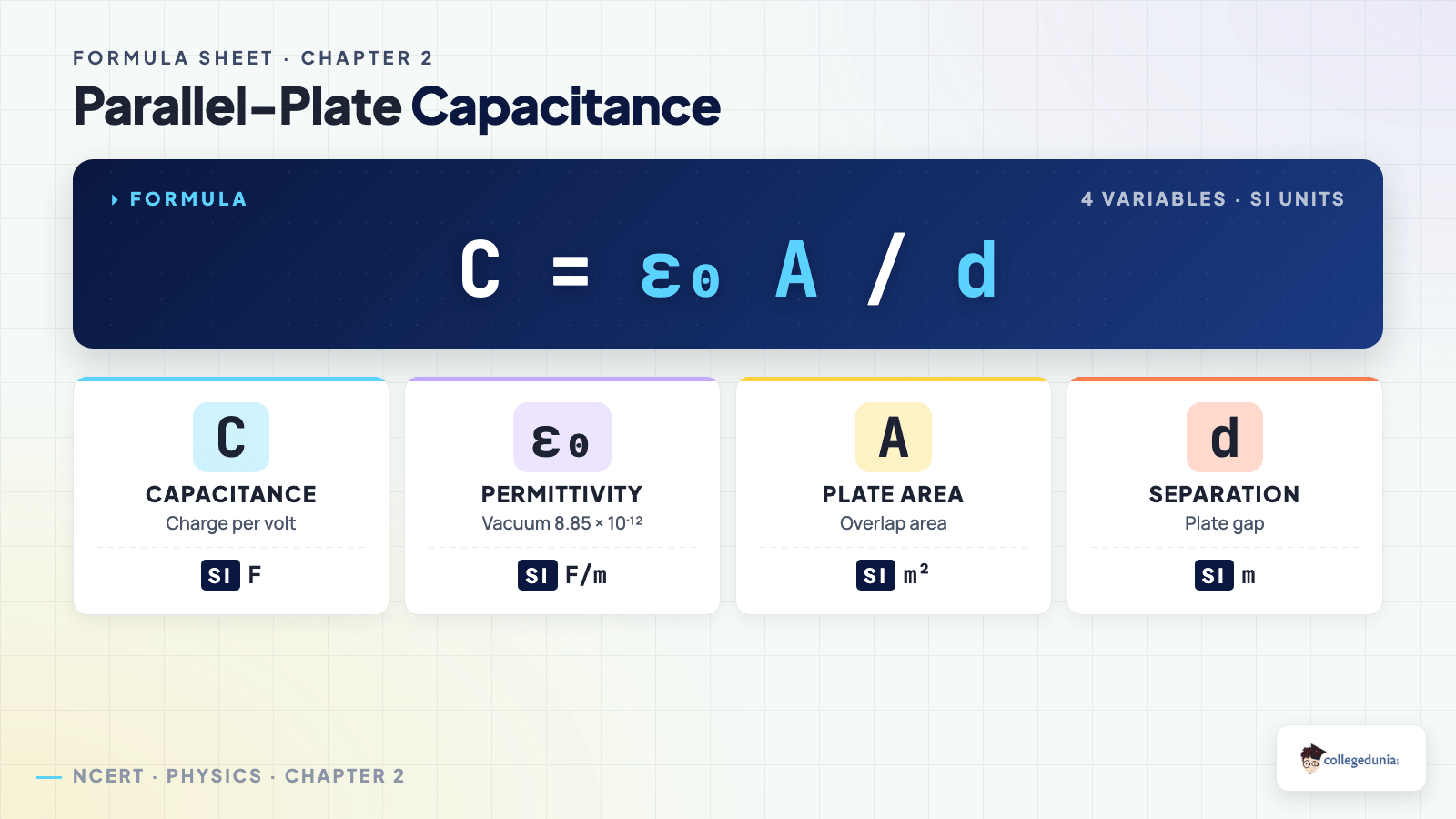
Parallel-plate capacitance - geometry and constants.
Electrostatic Potential and Capacitance Weightage in CBSE and JEE
Chapter 2 carries 7 marks in CBSE boards. The table below compares it with every other Class 12 Physics chapter based on averages from the last five papers.
| Chapter | Topic | Avg CBSE Marks |
|---|---|---|
| Ch 1 | Electric Charges and Fields | 6 marks |
| Ch 2 | Electrostatic Potential and Capacitance | 7 marks |
| Ch 3 | Current Electricity | 7 marks |
| Ch 4 | Moving Charges and Magnetism | 6 marks |
| Ch 5 | Magnetism and Matter | 3 marks |
| Ch 6 | Electromagnetic Induction | 5 marks |
| Ch 7 | Alternating Current | 6 marks |
| Ch 8 | Electromagnetic Waves | 2 marks |
| Ch 9 | Ray Optics and Optical Instruments | 7 marks |
| Ch 10 | Wave Optics | 5 marks |
| Ch 11 | Dual Nature of Radiation and Matter | 4 marks |
| Ch 12 | Atoms | 3 marks |
| Ch 13 | Nuclei | 3 marks |
| Ch 14 | Semiconductor Electronics | 6 marks |
Electrostatic Potential and Capacitance in Previous Year Papers (2021-2026)
The table below shows how Chapter 2 topics appeared in CBSE Board, JEE Main, and NEET over six sessions.
| Year | CBSE Board | JEE Main | NEET |
|---|---|---|---|
| 2026 | Parallel-plate capacitor with dielectric (5 marks) | Equipotential surface direction (4 marks) | Capacitance and energy stored in a capacitor (3 questions) |
| 2025 | Energy stored in series-parallel network (5 marks) | Potential due to dipole on equatorial line | Capacitance of parallel plates MCQ |
| 2024 | Effect of dielectric on capacitance (3 marks) | Capacitor charging through resistor | Potential energy of two charges MCQ |
| 2023 | Potential due to electric dipole (3 marks) | Equivalent capacitance of mixed network | Equipotential vs field-line MCQ |
| 2022 | Series and parallel capacitor combinations (3 marks) | Energy density between plates | Electric potential definition |
| 2021 | - | Charge on isolated capacitor | Capacitance formula MCQ |
Common Mistakes in Electrostatic Potential and Capacitance Formulas
Mistake 1: Substituting values before simplifying. Always isolate the unknown first.
Mistake 2: Forgetting SI unit conversion. Keep everything in volts, farads, and coulombs.
Mistake 3: Using k = 9 x 10^9 as approximate when a 5-mark numerical needs k = 8.99 x 10^9. Use the value the question provides.
Mistake 4: Mixing up axial vs equatorial dipole formulas, or series vs parallel capacitors. The formula table on this page separates them clearly.
Each mistake costs 1 to 2 marks.
Electrostatic Potential and Capacitance Formula Sheet for CBSE, JEE Main, and NEET
- CBSE Boards: foundational and middle formulas cover 95% of board questions.
- JEE Main: full table plus 2-3 appendix extensions are needed.
- NEET: foundational rows, dimensional reasoning, and careful unit checks.
Student Feedback
In a Collegedunia poll of 13,420 Class 12 Physics students before the 2026 boards, 74% of students rated the formula sheet as their most-used revision resource - ahead of full chapter notes and solved-example PDFs.
- 74% of students surveyed put the formula sheet at the top of their revision priority list.
- 58% reviewed it daily in the last 7 days before boards.
- 4 out of 5 students kept a printed copy in their notebook.
- 67% used the formula sheet alongside Chapter Notes during the night-before revision pass.
Source: 2025-26 Class 12 Physics student poll. Sample of 13,420 students from CBSE schools across 16 states.
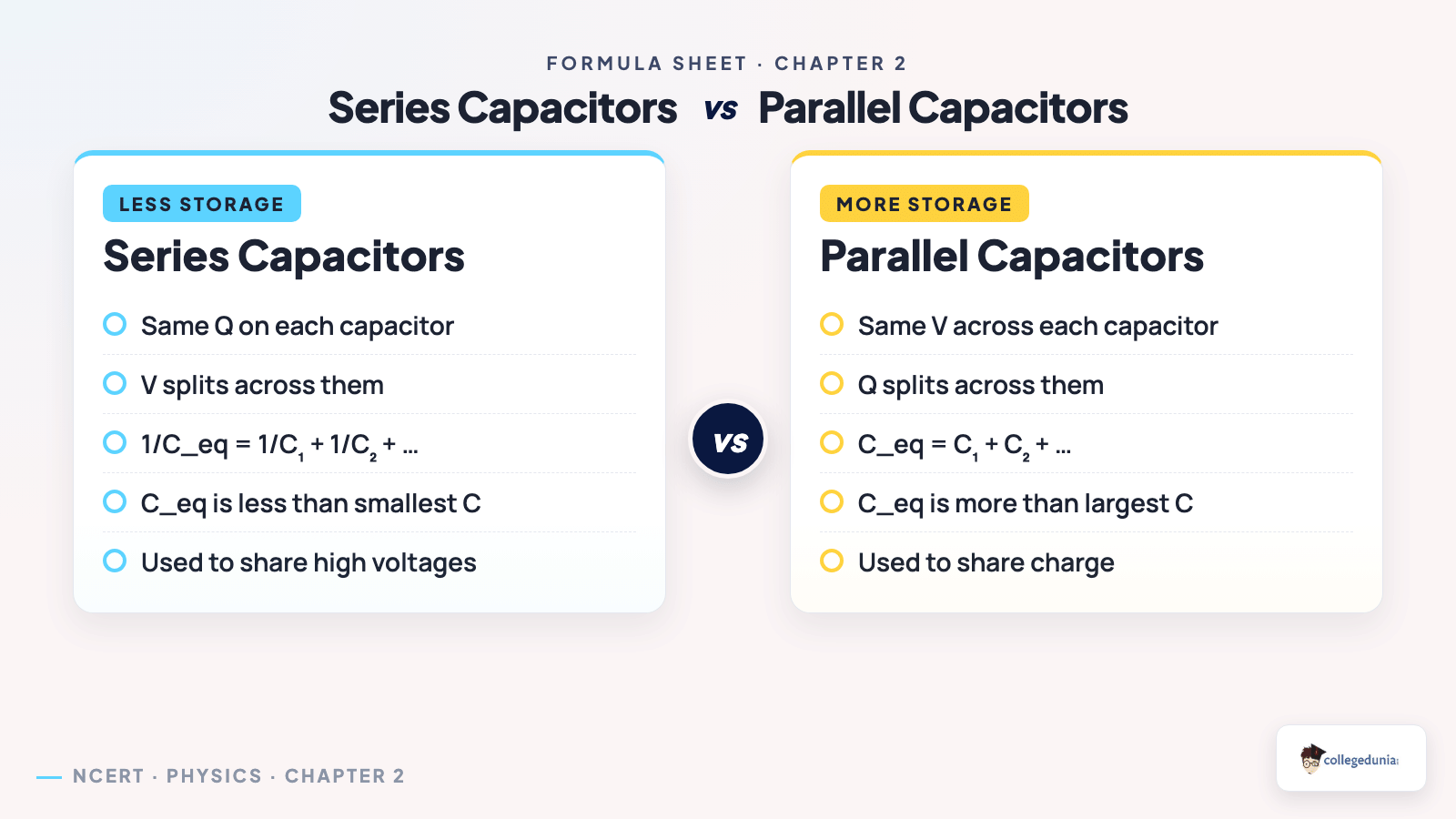
Series vs Parallel capacitor combinations - at a glance.
NCERT Formula Sheets for Class 12 Physics: All Chapters
| Chapter | Resource |
|---|---|
| Chapter 1 | Electric Charges and Fields Formula Sheet |
| Chapter 2 | Electrostatic Potential and Capacitance Formula Sheet |
| Chapter 3 | Current Electricity Formula Sheet |
| Chapter 4 | Moving Charges and Magnetism Formula Sheet |
| Chapter 5 | Magnetism and Matter Formula Sheet |
| Chapter 6 | Electromagnetic Induction Formula Sheet |
| Chapter 7 | Alternating Current Formula Sheet |
| Chapter 8 | Electromagnetic Waves Formula Sheet |
| Chapter 9 | Ray Optics and Optical Instruments Formula Sheet |
| Chapter 10 | Wave Optics Formula Sheet |
| Chapter 11 | Dual Nature of Radiation and Matter Formula Sheet |
| Chapter 12 | Atoms Formula Sheet |
| Chapter 13 | Nuclei Formula Sheet |
| Chapter 14 | Semiconductor Electronics Formula Sheet |
Other Resources for Electrostatic Potential and Capacitance Class 12 Physics
| Resource | Link |
|---|---|
| Notes | Class 12 Electrostatic Potential Notes |
| NCERT Solutions | Electrostatic Potential NCERT Solutions |
| NCERT Book PDF | Electrostatic Potential NCERT Book PDF |
| Exemplar Book PDF | Electrostatic Potential Exemplar Book PDF |
| Exemplar Solutions | Electrostatic Potential Exemplar Solutions |
| Handwritten Notes | Electrostatic Potential Handwritten Notes |
| Formula Sheet | Electrostatic Potential Formula Sheet |
Class 12 Physics Chapter 2 Electrostatic Potential and Capacitance Formula Sheet FAQs
Ques. How many formulas are in the Class 12 Chapter 2 Physics formula sheet?
Ans. 12 formulas cover every numerical this chapter generates. The Quick Reference Table above lists all of them with SI units. The PDF puts them on a single A4 sheet for fast revision.
Ques. What is the weightage of Class 12 Physics Chapter 2 in CBSE?
Ans. Chapter 2 carries 7 marks in CBSE Class 12 Physics. JEE Main has 5 to 6% of questions from this chapter, and NEET tests 2 to 3 questions per year from these formulas.
Ques. Where can I download the Chapter 2 Physics formula sheet PDF?
Ans. The PDF is available on this page via the flipbook and download card above. It includes all 12 formulas plus JEE/NEET extensions on a single A4 sheet.
Ques. Does this formula sheet cover JEE Main extensions?
Ans. Yes. The formula sheet includes 2-3 derived results that JEE Main and JEE Advanced test but CBSE boards rarely ask. These are flagged with a distinct marker in the PDF.
Ques. What is the most-asked formula in Electrostatic Potential and Capacitance?
Ans. Electric potential V = W/q is the foundational formula and appears in most Chapter 2 numericals. Capacitance C = Q/V and energy stored U = 1/2 CV squared are the next most frequent.



Comments