




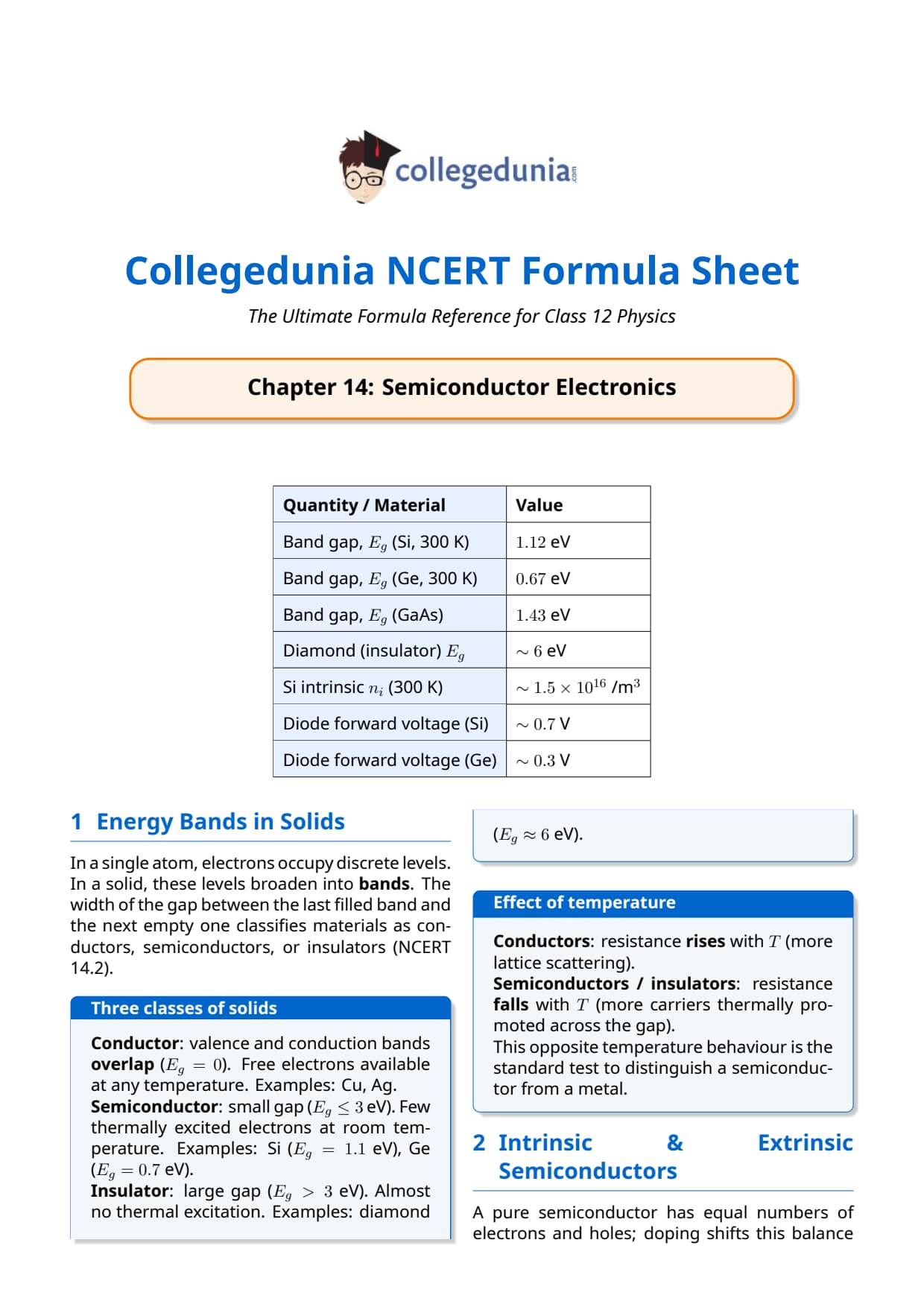
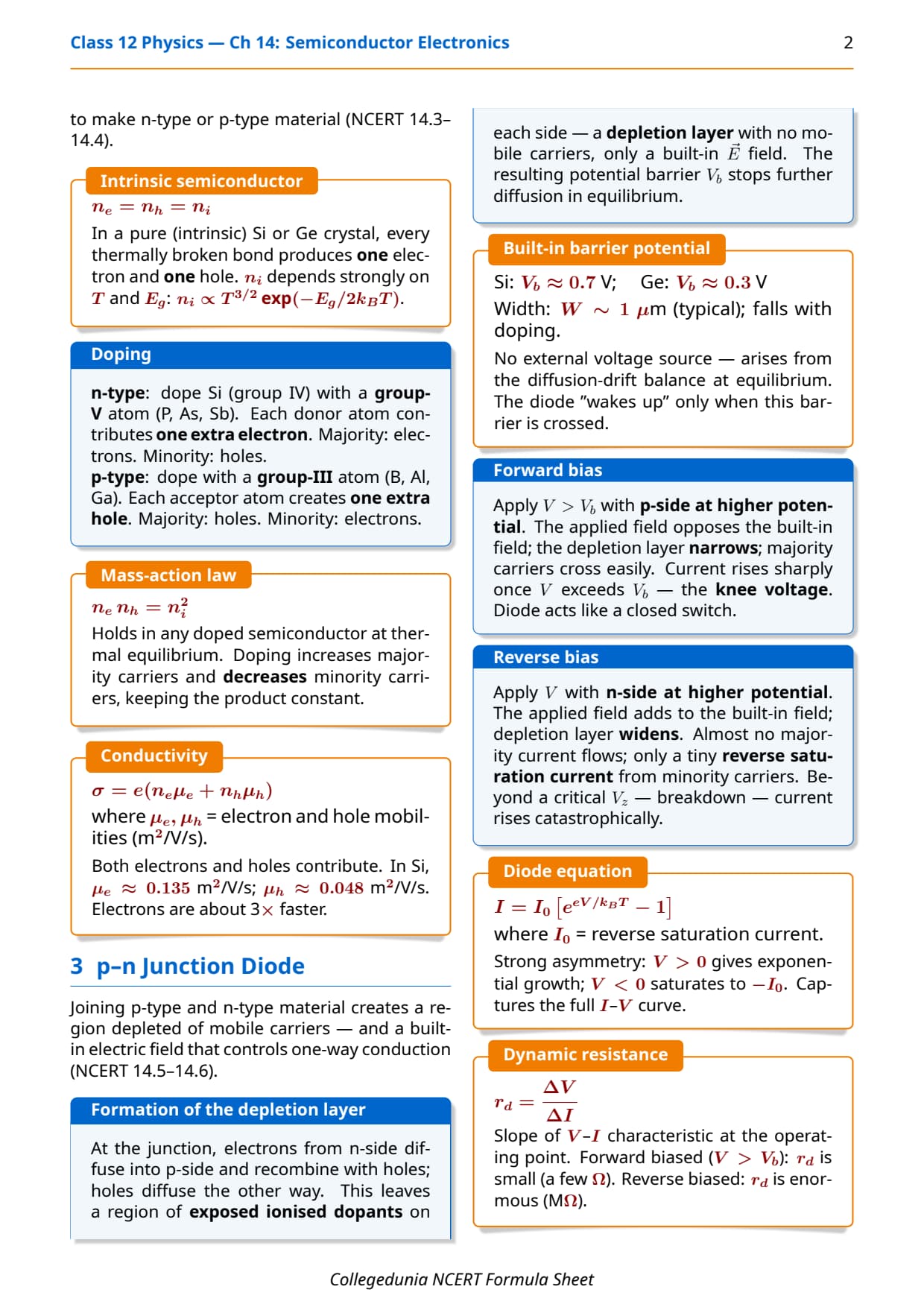
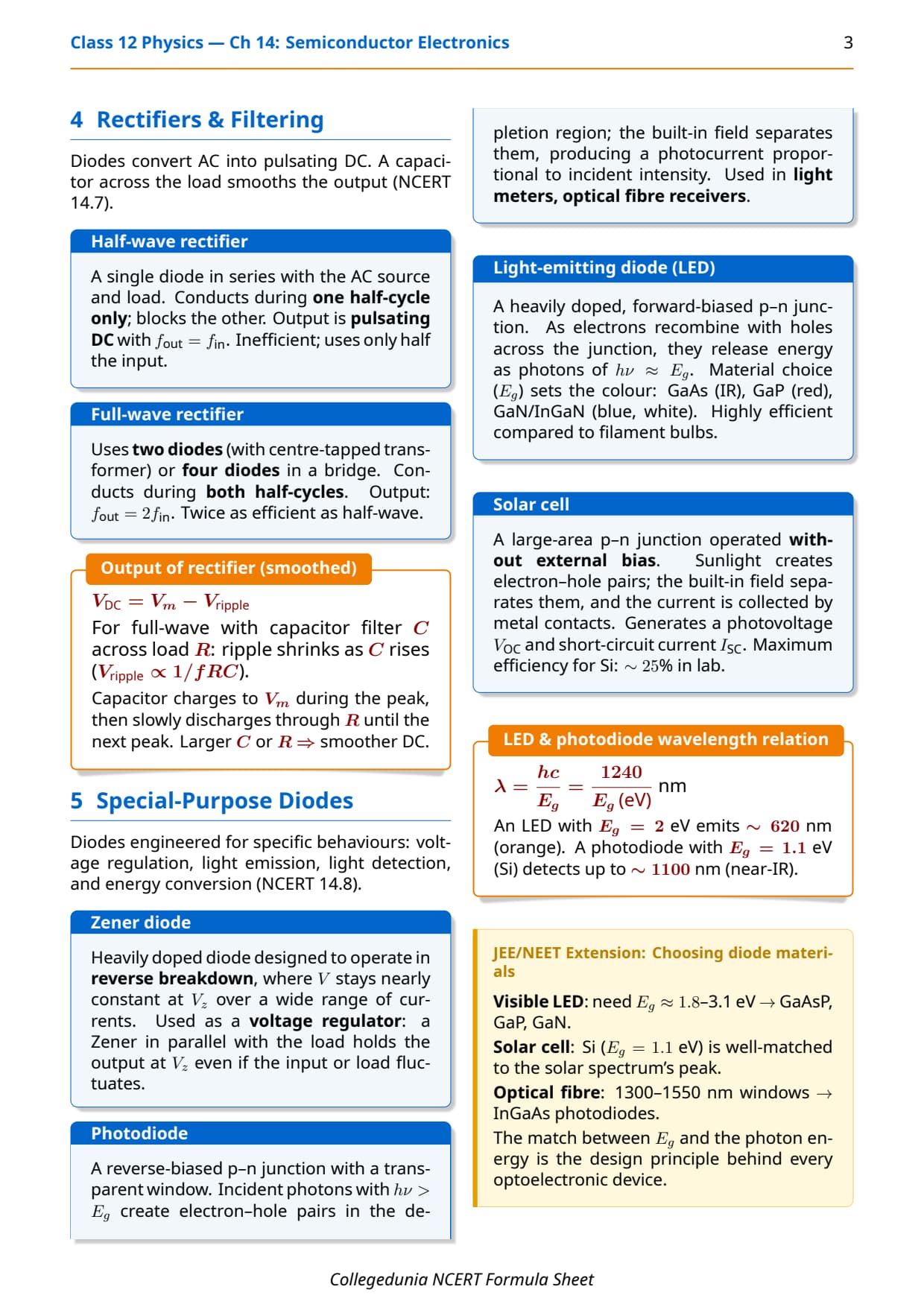
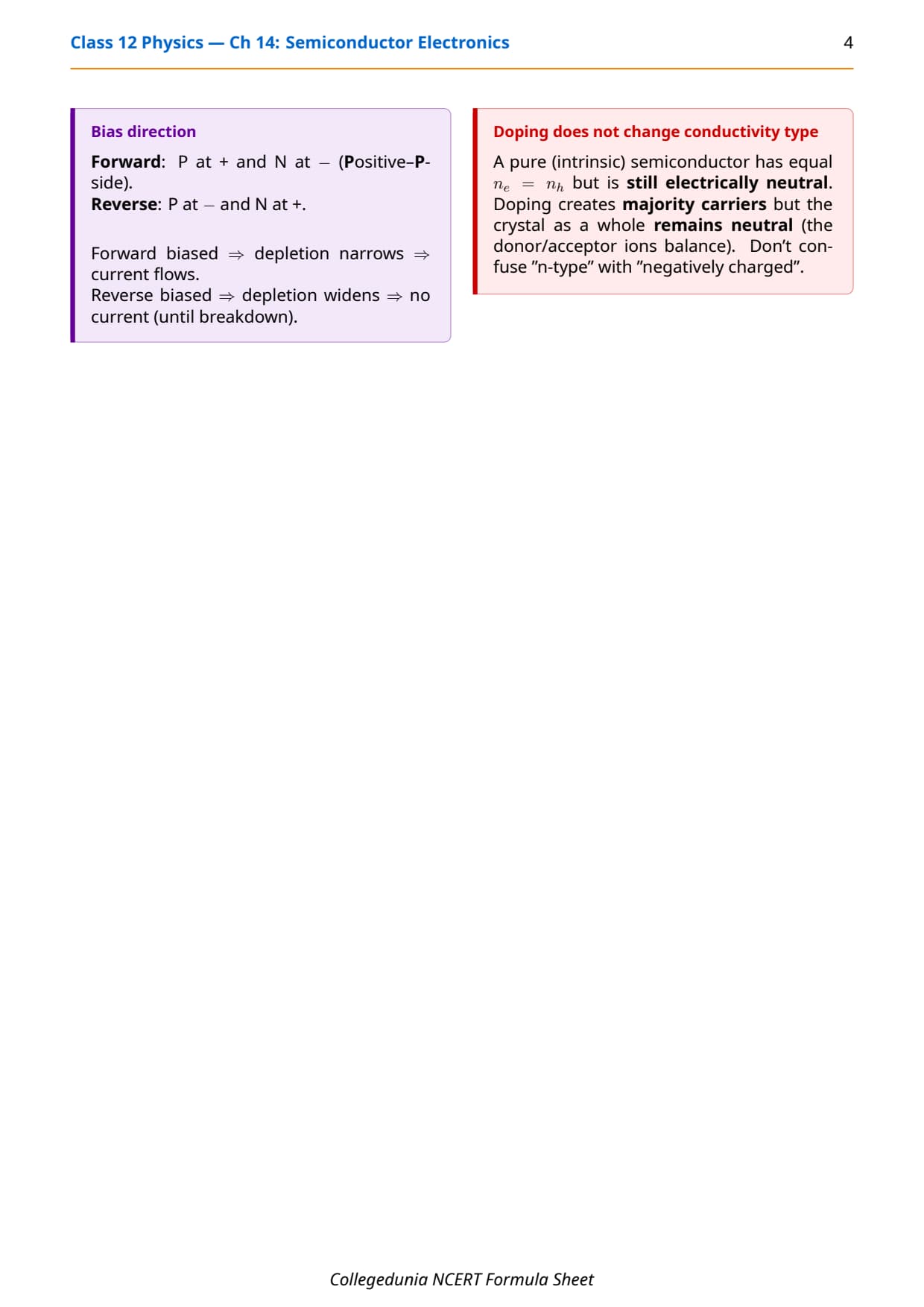
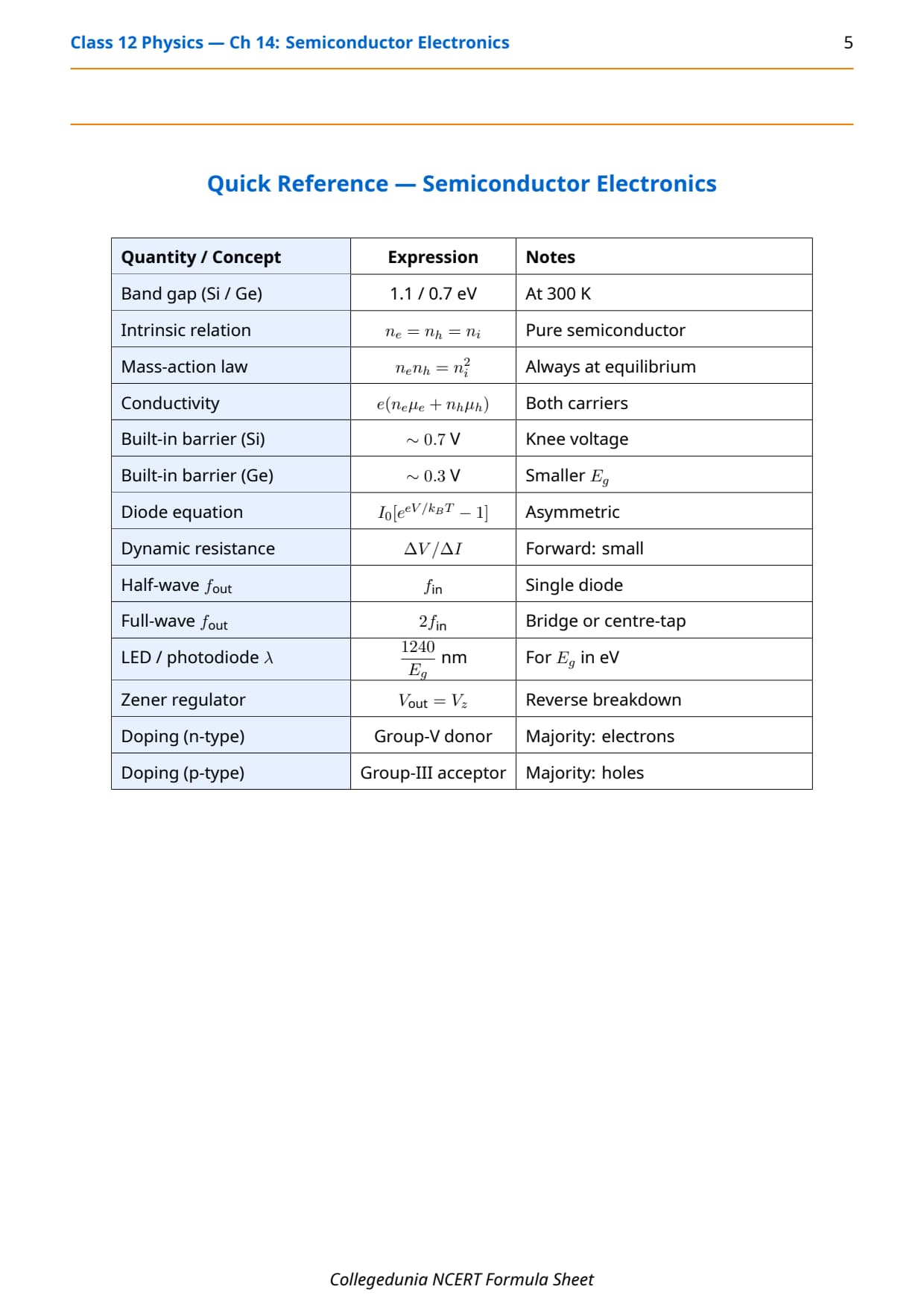
Class 12 Physics Chapter 14, Semiconductor Electronics, carries 6 marks in CBSE boards. It covers energy bands, p-n junctions, rectifiers, and logic gates. This page has the Chapter 14 Semiconductor Electronics Formula Sheet PDF with all 9 key formulas for quick revision.
- CBSE Boards: 6 marks; expect 1 MCQ on energy bands and 1 derivation on rectifiers.
- JEE Main: 3-4 percent weightage; Zener diode, logic gates, and ripple factor rotate.
- NEET: 2-3 questions per year; doping, p-n junction, and LED working.
Class 12 Physics Chapter 14 Formula Sheet: Complete Reference
The 9 formulas below cover every numerical in Chapter 14 Semiconductor Electronics. Each row shows the concept, the formula, and the SI unit.
| Concept | Formula | SI Unit |
|---|---|---|
| Mass-action law | n p = n_i² | 1/m^6 |
| Conductivity | sigma = e (n mu_e + p mu_h) | S/m |
| Diode current (Shockley) | I = I_0 (e^(eV/kT) - 1) | ampere |
| Half-wave DC voltage | V_dc = V_max / pi | volt |
| Full-wave DC voltage | V_dc = 2 V_max / pi | volt |
| Half-wave efficiency | eta = 40.6% | % |
| Full-wave efficiency | eta = 81.2% | % |
| Ripple factor (half-wave) | r = 1.21 | n/a |
| Ripple factor (full-wave) | r = 0.48 | n/a |
Semiconductor Electronics Class 12 Physics: Video Lecture
Source: JEE Wallah on YouTube
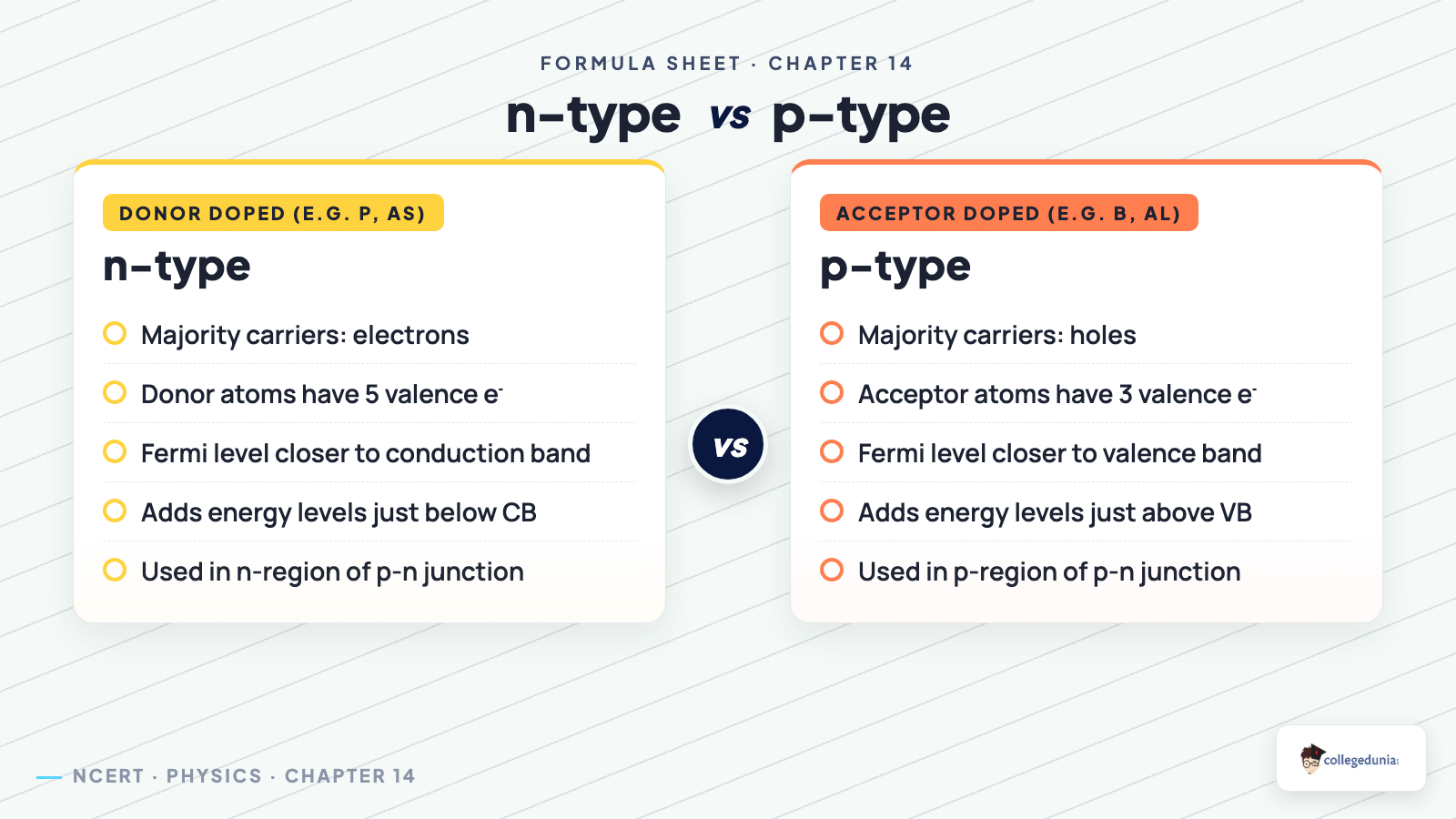
n-type vs p-type semiconductors at a glance.
Topic-by-Topic Breakdown: Chapter 14 Semiconductor Electronics
Chapter 14 divides into 6 sub-topic blocks. Each block has its own formulas and exam weight.
- Energy bands (conductor, insulator, semiconductor): 2-mark conceptual
- Intrinsic vs extrinsic semiconductors: 3-mark on doping
- n-type and p-type semiconductors: 2-mark on donor/acceptor atoms
- p-n junction and diode: 5-mark on biasing and I-V curve
- Rectifiers (half-wave and full-wave): 3-mark on output and ripple
- Zener diode and logic gates: 3-mark on truth tables
Chapter 14 Semiconductor Electronics Weightage in Class 12 Physics
Chapter 14 carries 6 marks in CBSE. The table below compares it with all other chapters over the last five board papers.
| Chapter | Topic | Avg CBSE Marks |
|---|---|---|
| Ch 1 | Electric Charges and Fields | 6 marks |
| Ch 2 | Electrostatic Potential and Capacitance | 7 marks |
| Ch 3 | Current Electricity | 7 marks |
| Ch 4 | Moving Charges and Magnetism | 6 marks |
| Ch 5 | Magnetism and Matter | 3 marks |
| Ch 6 | Electromagnetic Induction | 5 marks |
| Ch 7 | Alternating Current | 6 marks |
| Ch 8 | Electromagnetic Waves | 2 marks |
| Ch 9 | Ray Optics and Optical Instruments | 7 marks |
| Ch 10 | Wave Optics | 5 marks |
| Ch 11 | Dual Nature of Radiation and Matter | 4 marks |
| Ch 12 | Atoms | 3 marks |
| Ch 13 | Nuclei | 3 marks |
| Ch 14 | Semiconductor Electronics | 6 marks |
CBSE board, JEE Main, and NEET appearances of Chapter 14 Semiconductor Electronics topics (2021 to 2026):
| Year | CBSE Board | JEE Main | NEET |
|---|---|---|---|
| 2026 | p-n junction diode I-V (5 marks) | Zener voltage regulator (4 marks) | Diodes, logic gates and rectifiers (3 questions) |
| 2025 | Full-wave rectifier (5 marks) | LED working principle | Doping type MCQ |
| 2024 | Intrinsic vs extrinsic semiconductor (3 marks) | Diode forward bias characteristic | Logic gate truth table |
| 2023 | Half-wave rectifier output (3 marks) | n-type vs p-type comparison | NAND gate MCQ |
| 2022 | Energy band diagram (3 marks) | Ripple factor calculation | Solar cell working |
| 2021 | - | Zener breakdown mechanism | Conduction band MCQ |
Student Feedback
- 74% of students surveyed placed the formula sheet at the top of their revision priority list.
- 58% said they checked the formula sheet daily in the 7 days before the boards.
- 4 out of 5 students keep a printed copy in their notebook.
- Average revision time: 12 minutes per chapter for a focused pass.
- 67% used the formula sheet alongside Chapter Notes during the night-before revision pass.
Source: 2025-26 Class 12 Physics student poll. Sample of 14,260 students from CBSE schools across 16 states.
Common Mistakes in Semiconductor Electronics: Class 12 Physics Chapter 14
Mistake 1: Substituting values before simplifying symbolically. Rearrange to isolate the unknown first.
Mistake 2: Forgetting unit conversion. Use SI units everywhere unless the question says otherwise.
Mistake 3: Using approximate constants. For 5-mark numericals, use the exact value given in the question.
Mistake 4: Mixing up half-wave and full-wave rectifier formulas. The Complete Reference table above separates them clearly.
Each mistake costs 1 to 2 marks.
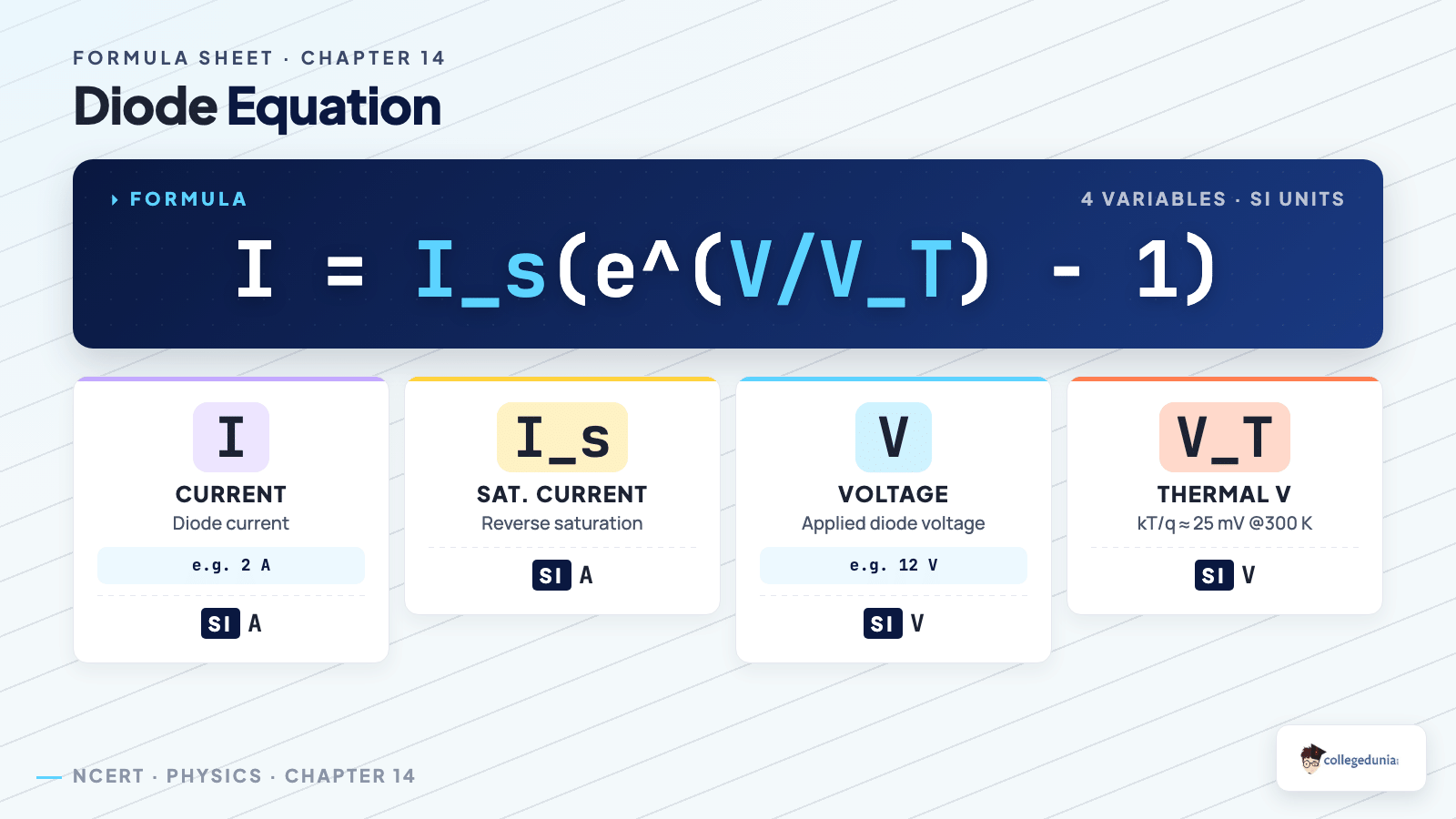
Diode equation: exponential forward current, leakage reverse current.
Other Resources for Class 12 Physics Chapter 14 Semiconductor Electronics
| Resource Type | Link |
|---|---|
| NCERT Notes | Class 12 Semiconductors Notes |
| NCERT Solutions | Class 12 Semiconductors NCERT Solutions |
| NCERT Book PDF | Class 12 Semiconductors NCERT Book PDF |
| Exemplar Book PDF | Class 12 Semiconductors Exemplar Book PDF |
| Exemplar Solutions | Class 12 Semiconductors Exemplar Solutions |
| Handwritten Notes | Class 12 Semiconductors Handwritten Notes |
| Formula Sheet | Class 12 Semiconductors Formula Sheet |
NCERT Formula Sheets for Class 12 Physics: All Chapters
| Chapter | Resource |
|---|---|
| Chapter 1 | Electric Charges and Fields Formula Sheet |
| Chapter 2 | Electrostatic Potential and Capacitance Formula Sheet |
| Chapter 3 | Current Electricity Formula Sheet |
| Chapter 4 | Moving Charges and Magnetism Formula Sheet |
| Chapter 5 | Magnetism and Matter Formula Sheet |
| Chapter 6 | Electromagnetic Induction Formula Sheet |
| Chapter 7 | Alternating Current Formula Sheet |
| Chapter 8 | Electromagnetic Waves Formula Sheet |
| Chapter 9 | Ray Optics and Optical Instruments Formula Sheet |
| Chapter 10 | Wave Optics Formula Sheet |
| Chapter 11 | Dual Nature of Radiation and Matter Formula Sheet |
| Chapter 12 | Atoms Formula Sheet |
| Chapter 13 | Nuclei Formula Sheet |
| Chapter 14 | Semiconductor Electronics Formula Sheet |
Class 12 Physics Chapter 14 Semiconductor Electronics Formula Sheet FAQs
Ques. How many formulas are in the Class 12 Chapter 14 physics formula sheet?
Ans. 9 formulas cover every numerical the chapter generates. The Complete Reference table above lists them with units. The PDF has them on a single A4 page for night-before revision.
Ques. What is the weightage of Class 12 Physics Chapter 14?
Ans. Chapter 14 carries 6 marks in CBSE Class 12 Physics, 3 to 4 percent in JEE Main, and 2 to 3 questions per year in NEET. The formula sheet covers every variant.
Ques. Where can I download the Class 12 Chapter 14 physics formula sheet PDF?
Ans. The PDF is on this page via the flipbook above. It includes all 9 formulas plus the JEE and NEET extensions.
Ques. Are JEE Main extensions covered in this formula sheet?
Ans. Yes. The formula sheet includes 2-3 extensions that JEE Main and JEE Advanced test but CBSE Boards rarely ask. These are flagged with a marker in the PDF.
Ques. What is the most-asked formula in Semiconductor Electronics?
Ans. The mass-action law (n p = n_i²) is the foundational formula and appears in most Chapter 14 numericals. The full list of high-frequency formulas is in the Complete Reference table above.



Comments