




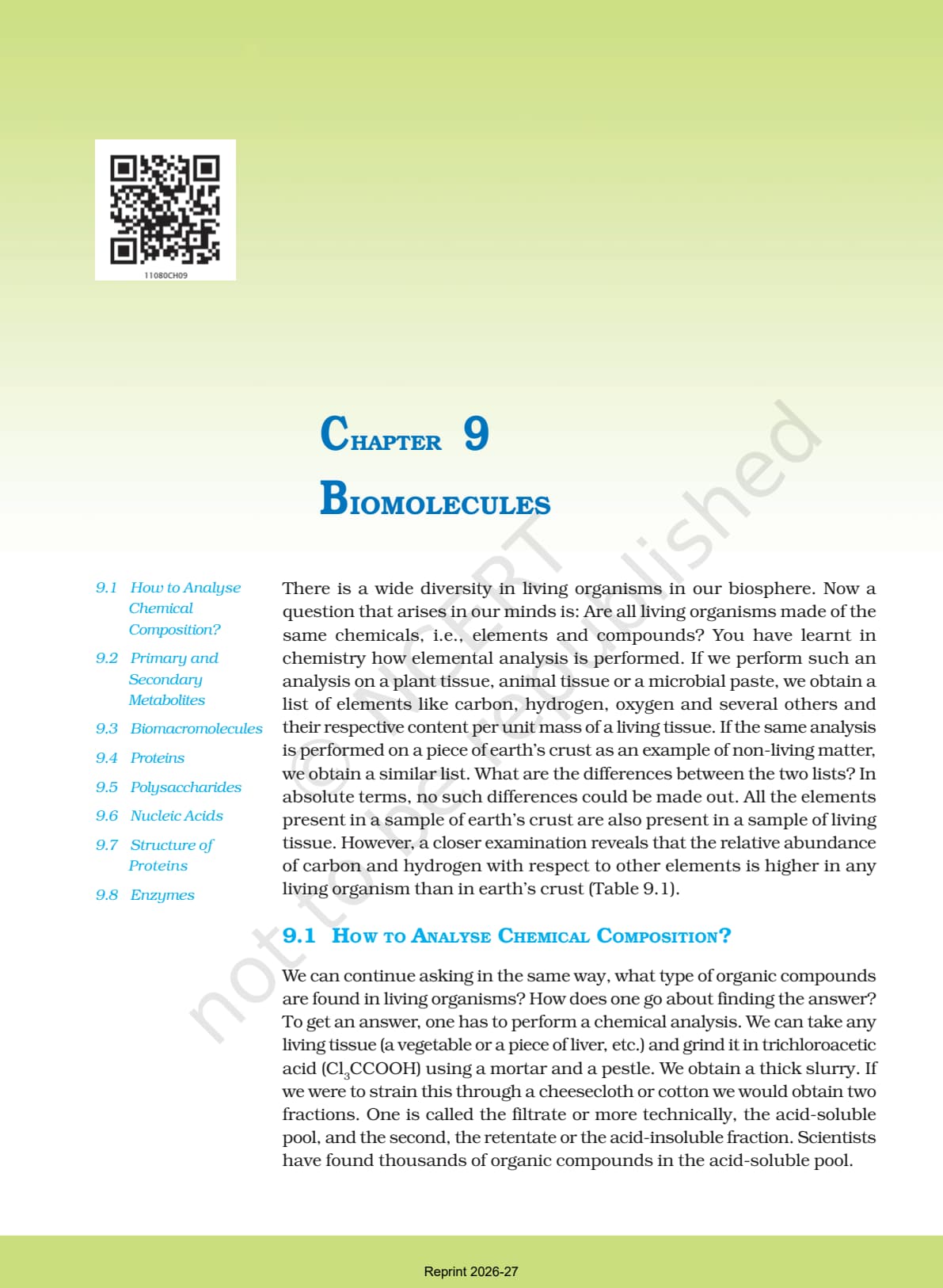
Download the Class 11 Biology Chapter 9 Biomolecules NCERT Book PDF, the official 2026-27 NCERT textbook chapter. Part of Unit 3 on cell structure and function, it explains the chemistry of life, covering how chemical composition is analysed and the structure of proteins, carbohydrates, nucleic acids and enzymes, a chapter that carries high weight in the Boards, NEET and CUET.
- Official NCERT 2026-27 chapter, clean and print-ready.
- Covers metabolites, biomacromolecules, proteins, polysaccharides, nucleic acids and enzymes.
- Read it alongside the solved exercises and the revision notes linked below.
This Class 11 Biology Chapter 9 Biomolecules NCERT Book PDF is the official 2026-27 NCERT text, checked page by page against the latest edition.
What Class 11 Biology Chapter 9 Biomolecules Covers
The chapter looks at living organisms from a chemical point of view, beginning with how the elemental and molecular composition of tissue is analysed and moving to the four major classes of biomacromolecules. It then focuses on the structure of proteins and the working of enzymes as biological catalysts. The official NCERT sections are listed below so students can see exactly what the chapter contains before they start.
| Section | Topic |
|---|---|
| 9.1 | How to Analyse Chemical Composition? |
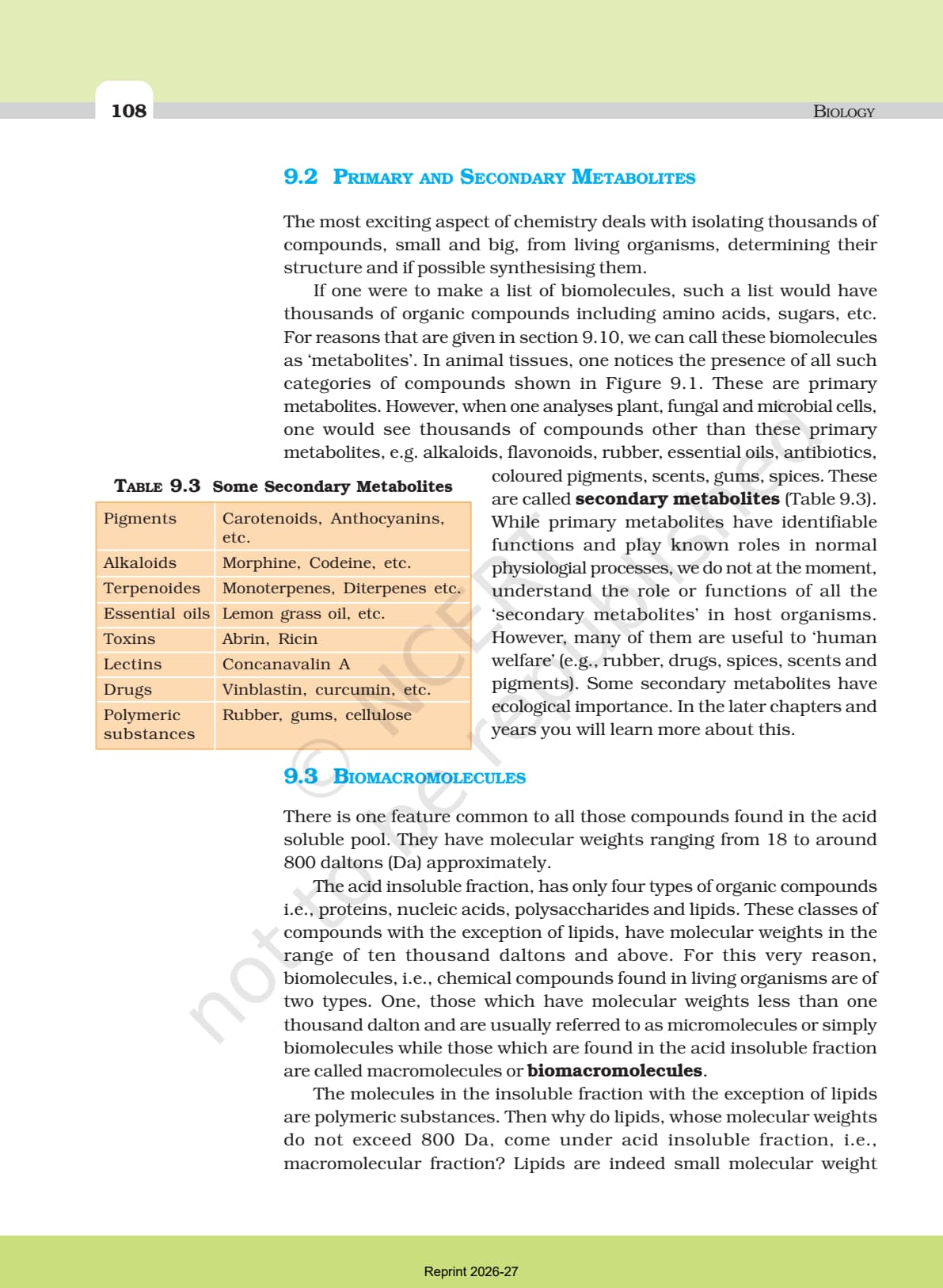
| 9.2 | Primary and Secondary Metabolites |
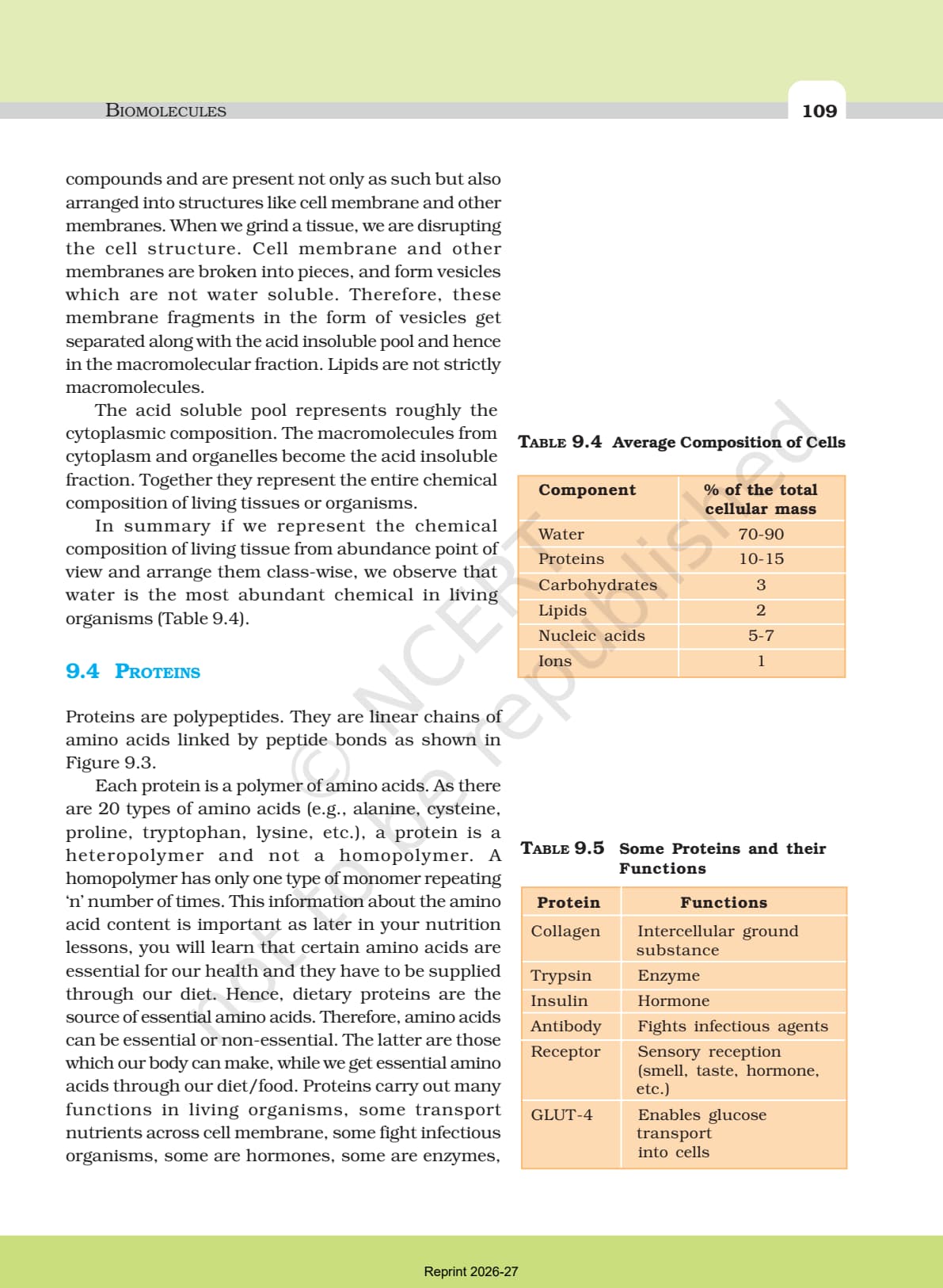
| 9.3 | Biomacromolecules |
| 9.4 | Proteins |
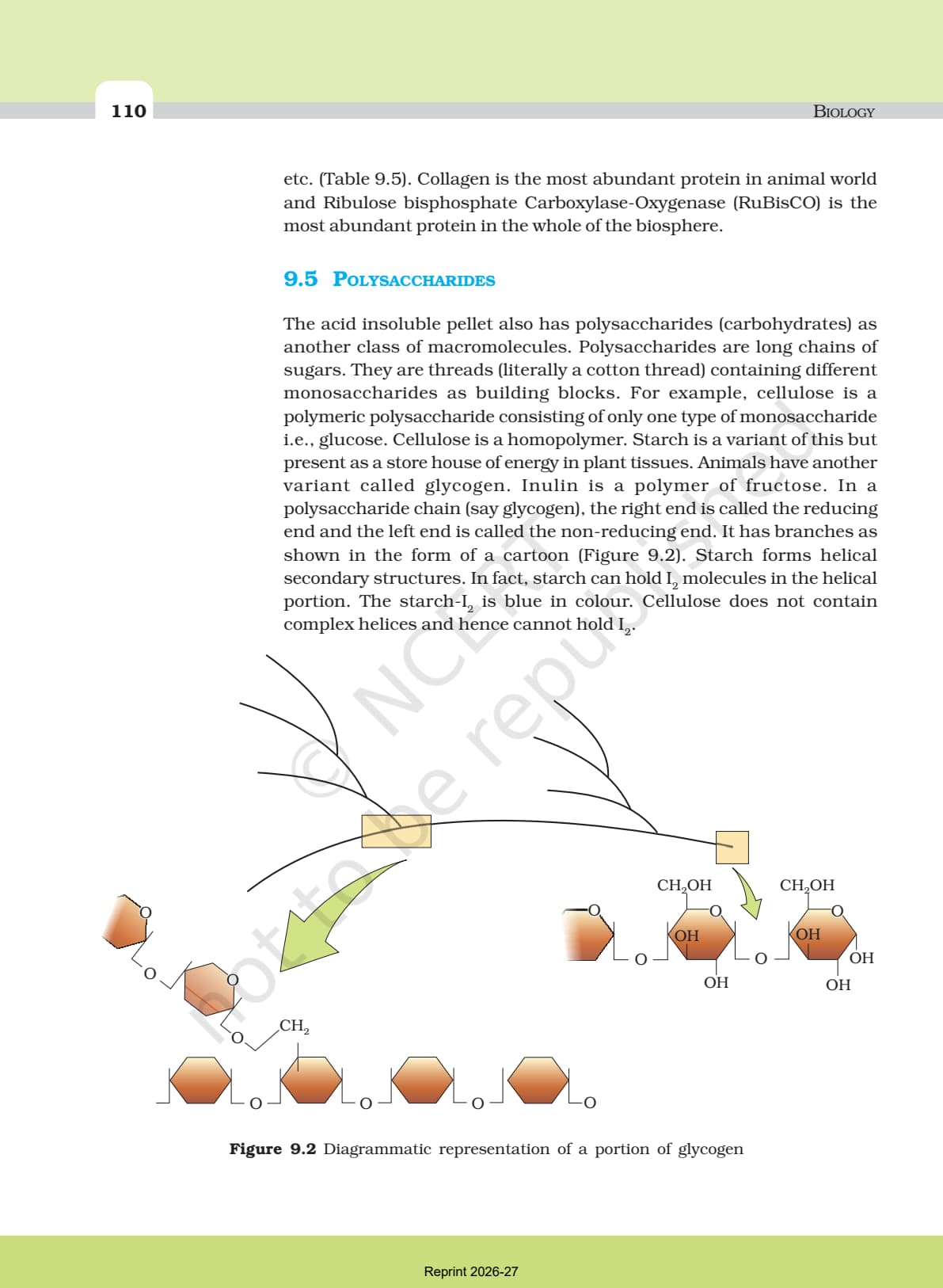
| 9.5 | Polysaccharides |
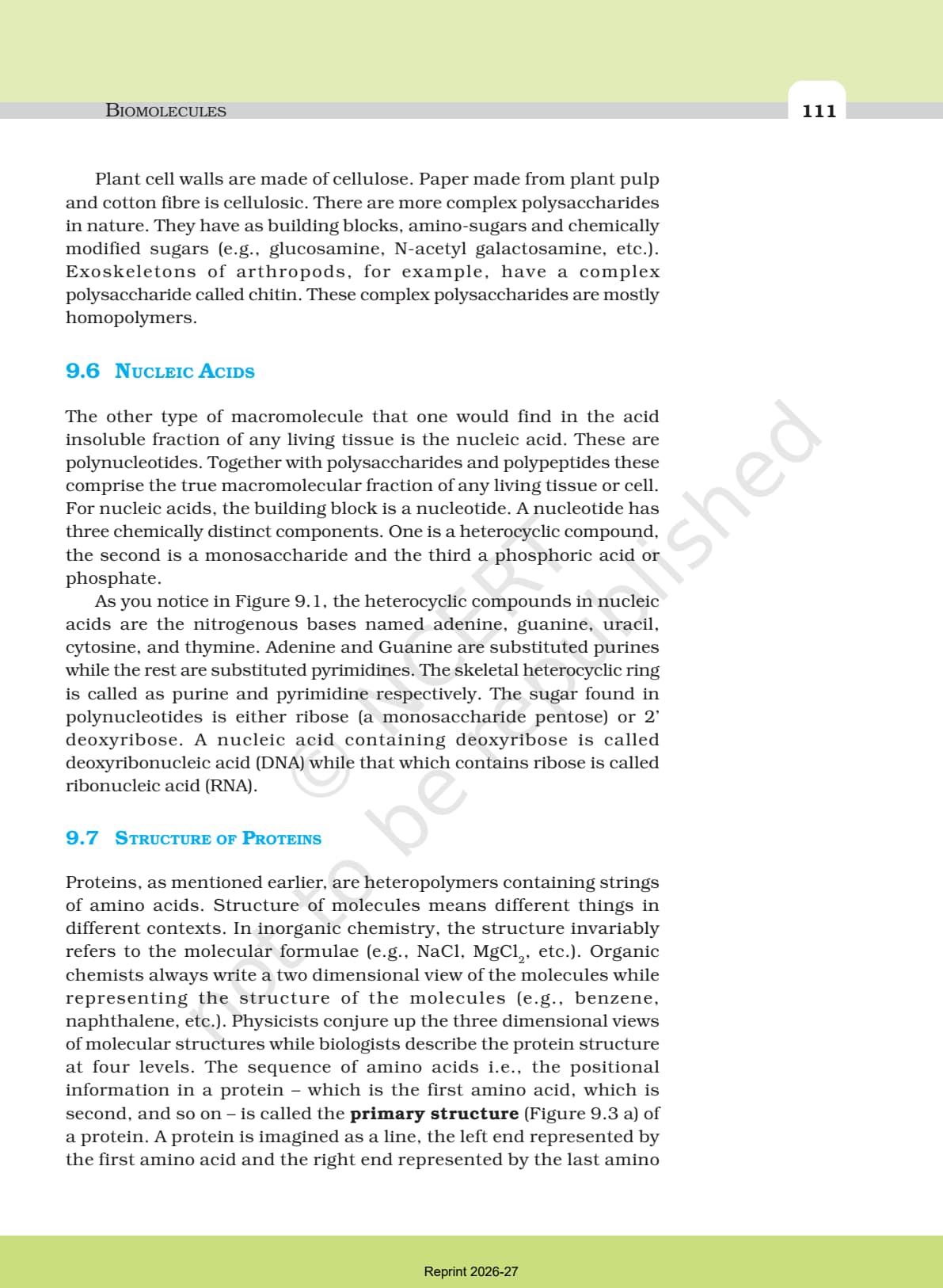
| 9.6 | Nucleic Acids |
| 9.7 | Structure of Proteins |
| 9.8 | Enzymes |
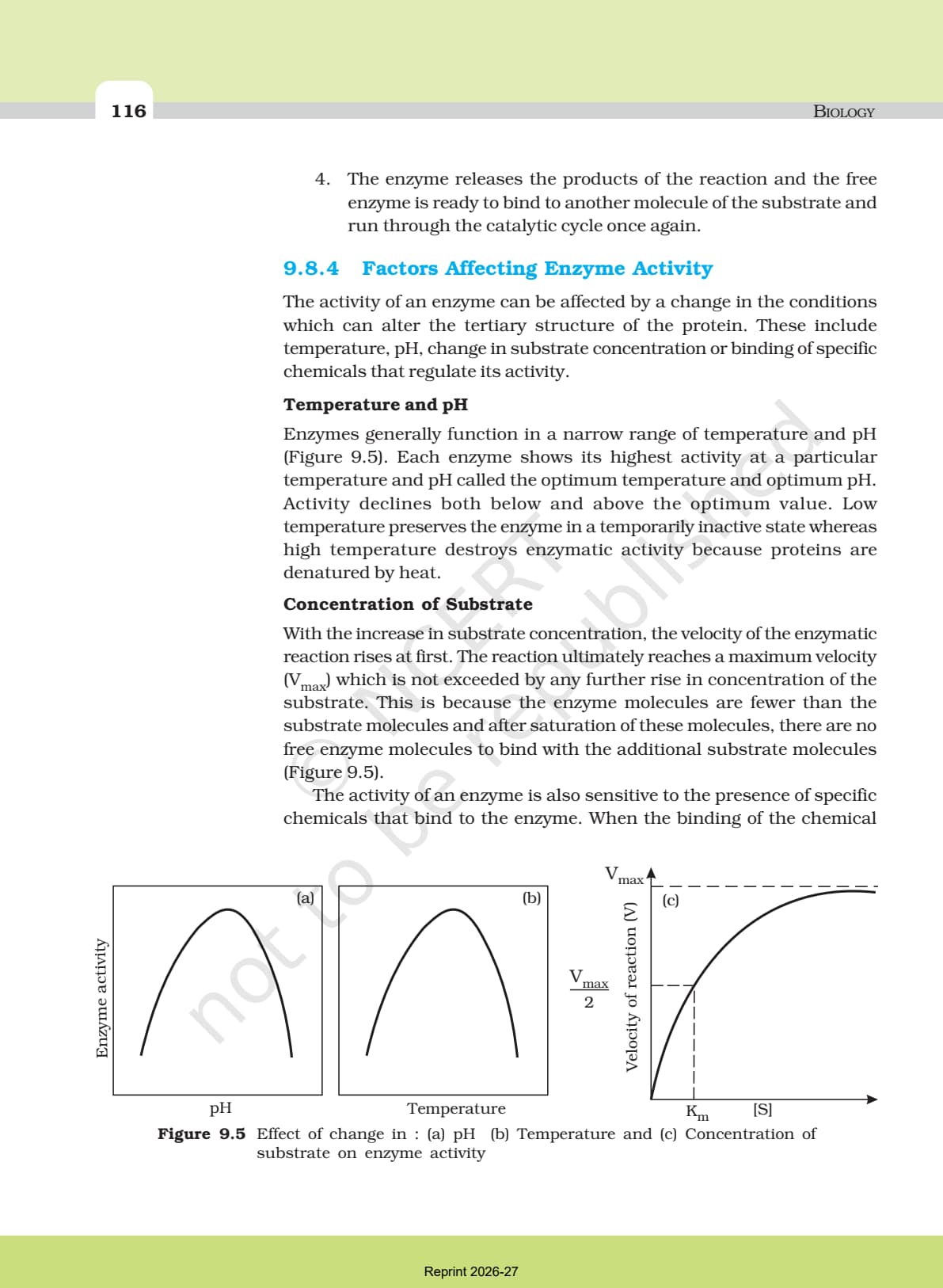
| 9.8.4 | Factors Affecting Enzyme Activity |
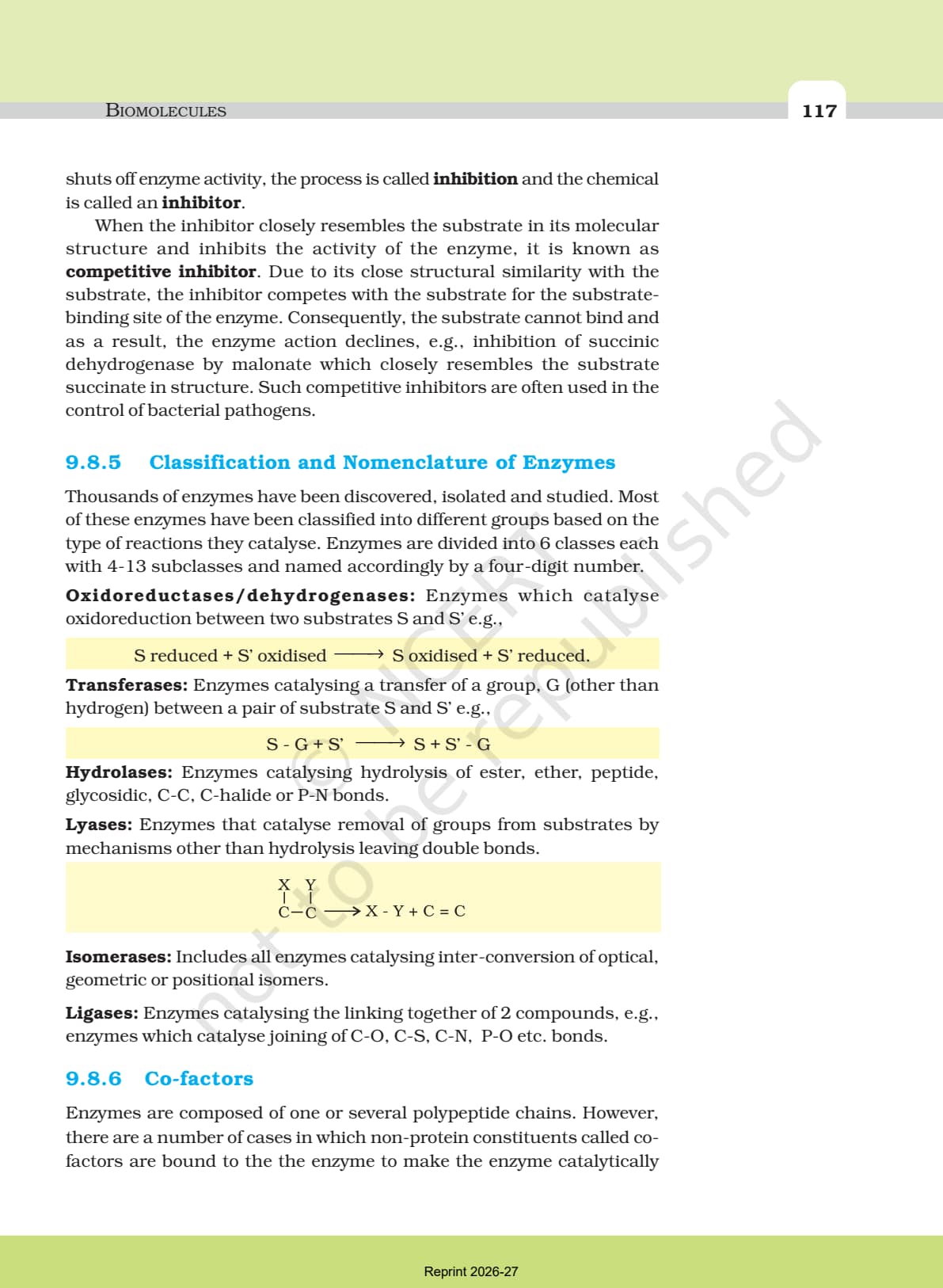
| 9.8.5 | Classification and Nomenclature of Enzymes |
Key Concepts You Will Study
Students should read this chapter with an eye on structures, since the questions test the shape and building blocks of each molecule more than any calculation. The ideas of monomers, polymers and enzyme action introduced here support molecular biology, respiration and photosynthesis later on. The main ideas to master are listed below.
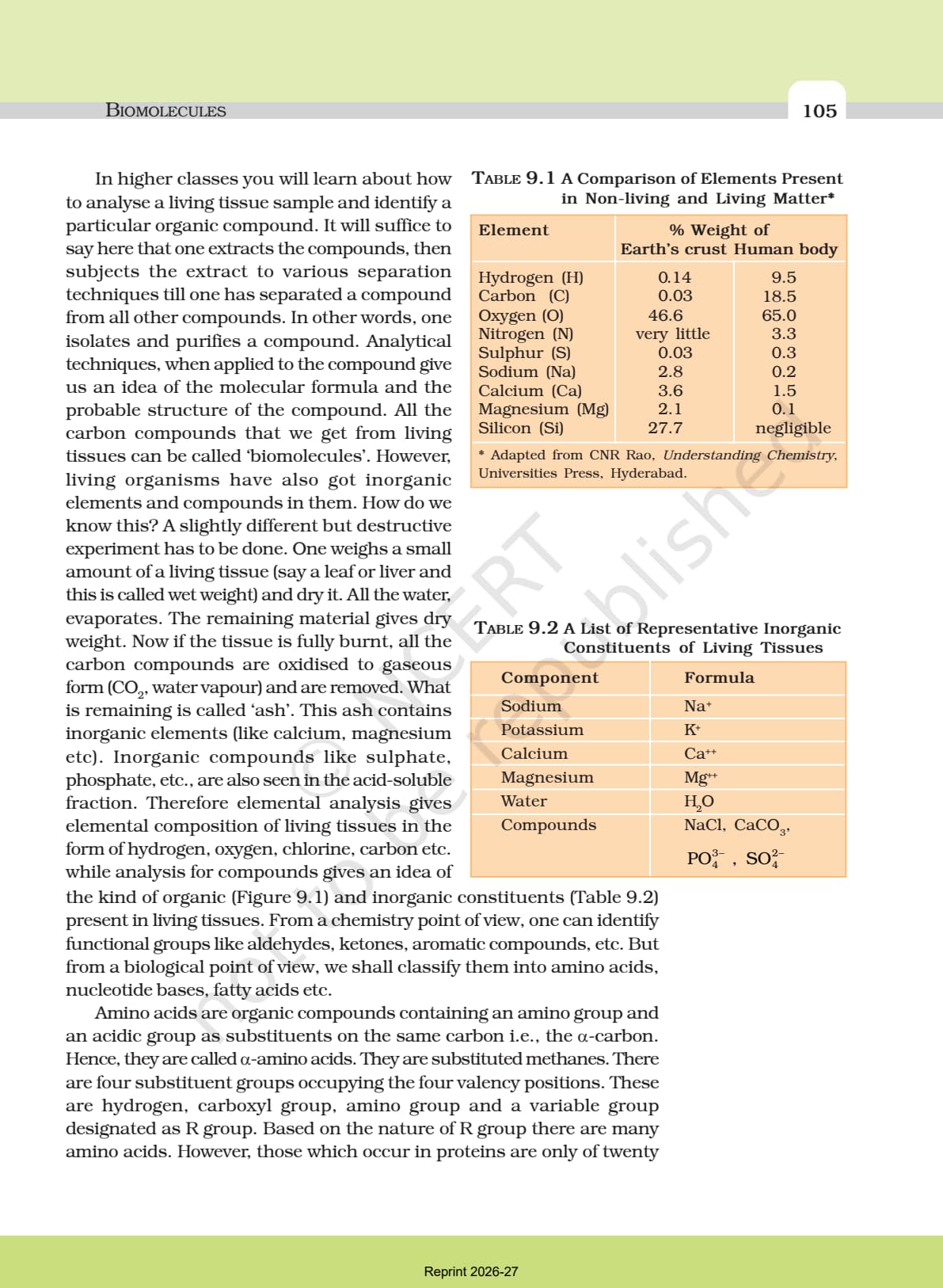
- How to analyse chemical composition and the concept of acid-soluble and acid-insoluble pools.
- Primary and secondary metabolites and the idea of biomacromolecules with an average molecular weight above 1000 Da.
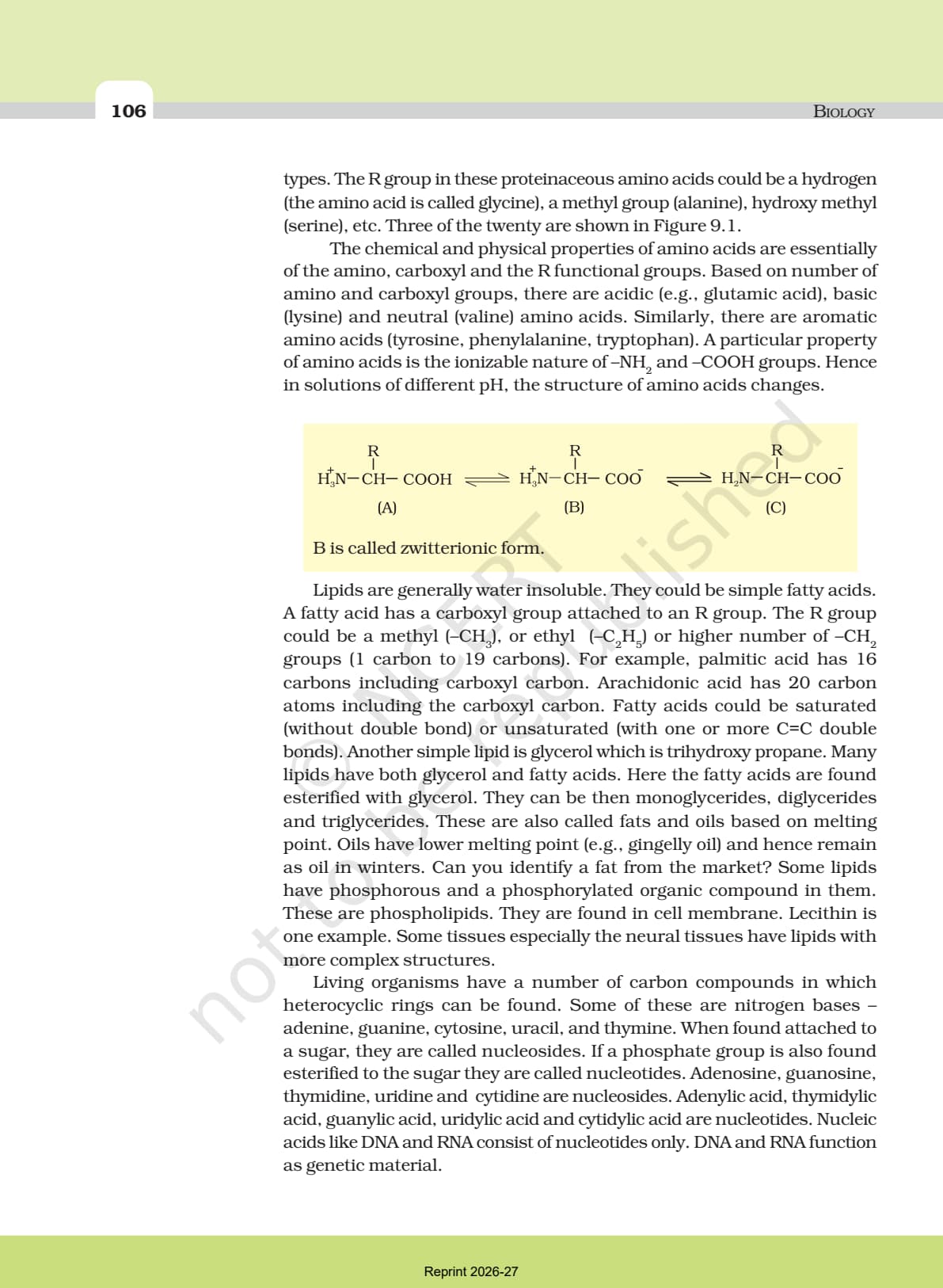
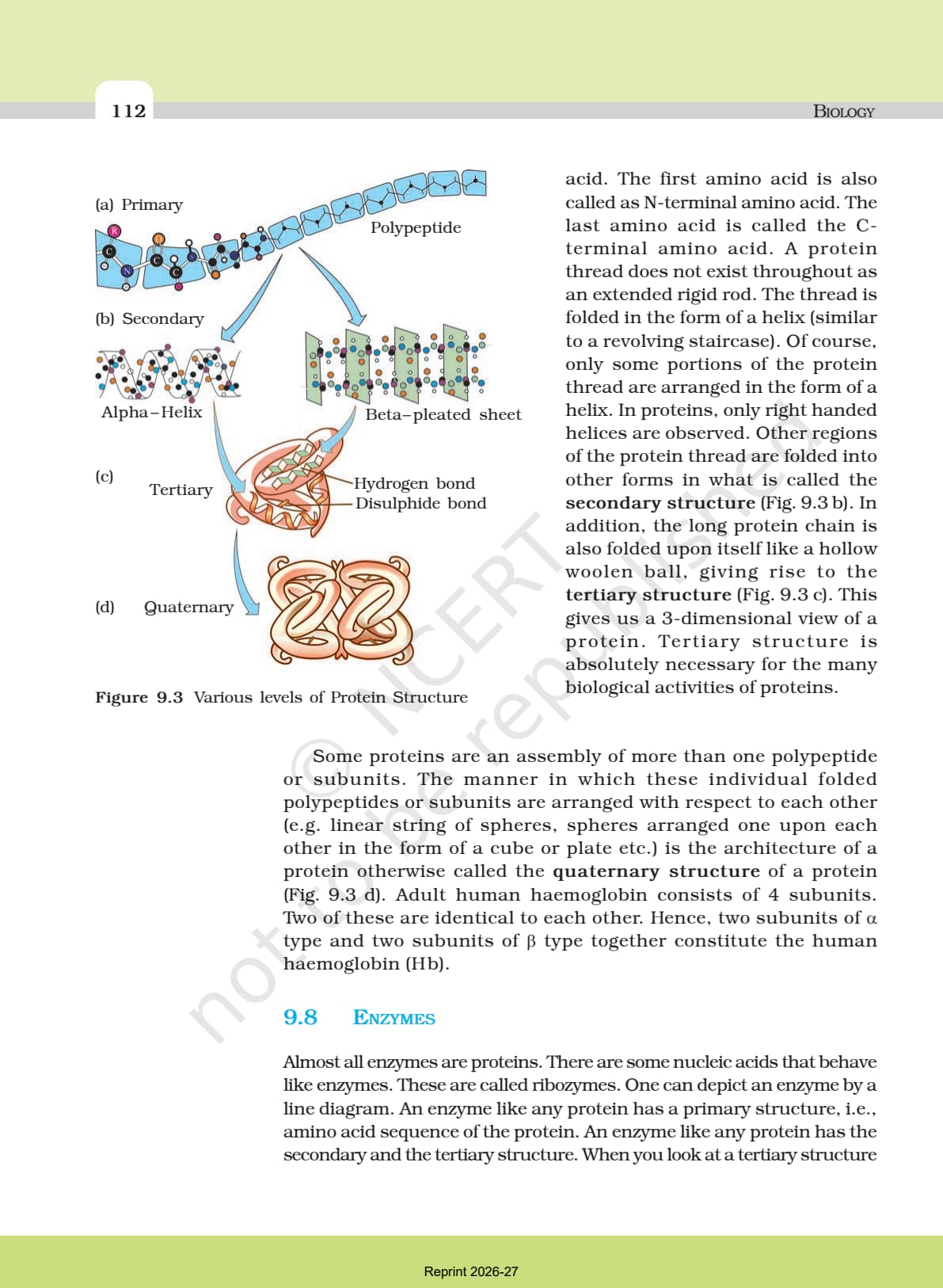
- The structure of amino acids and the four levels of protein structure (primary, secondary, tertiary and quaternary).
- Polysaccharides such as starch, glycogen and cellulose, and the structure of the nucleic acids DNA and RNA.
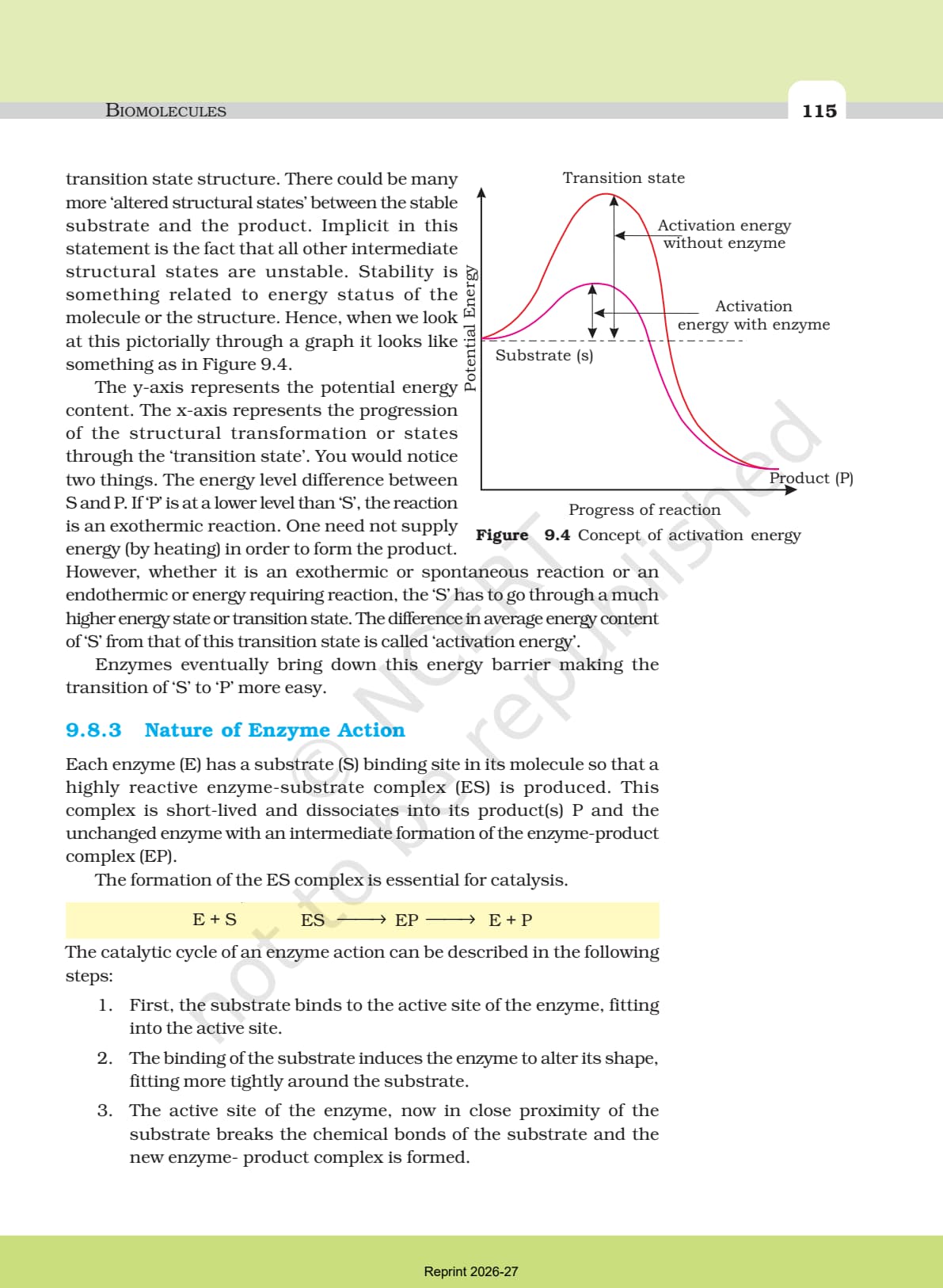
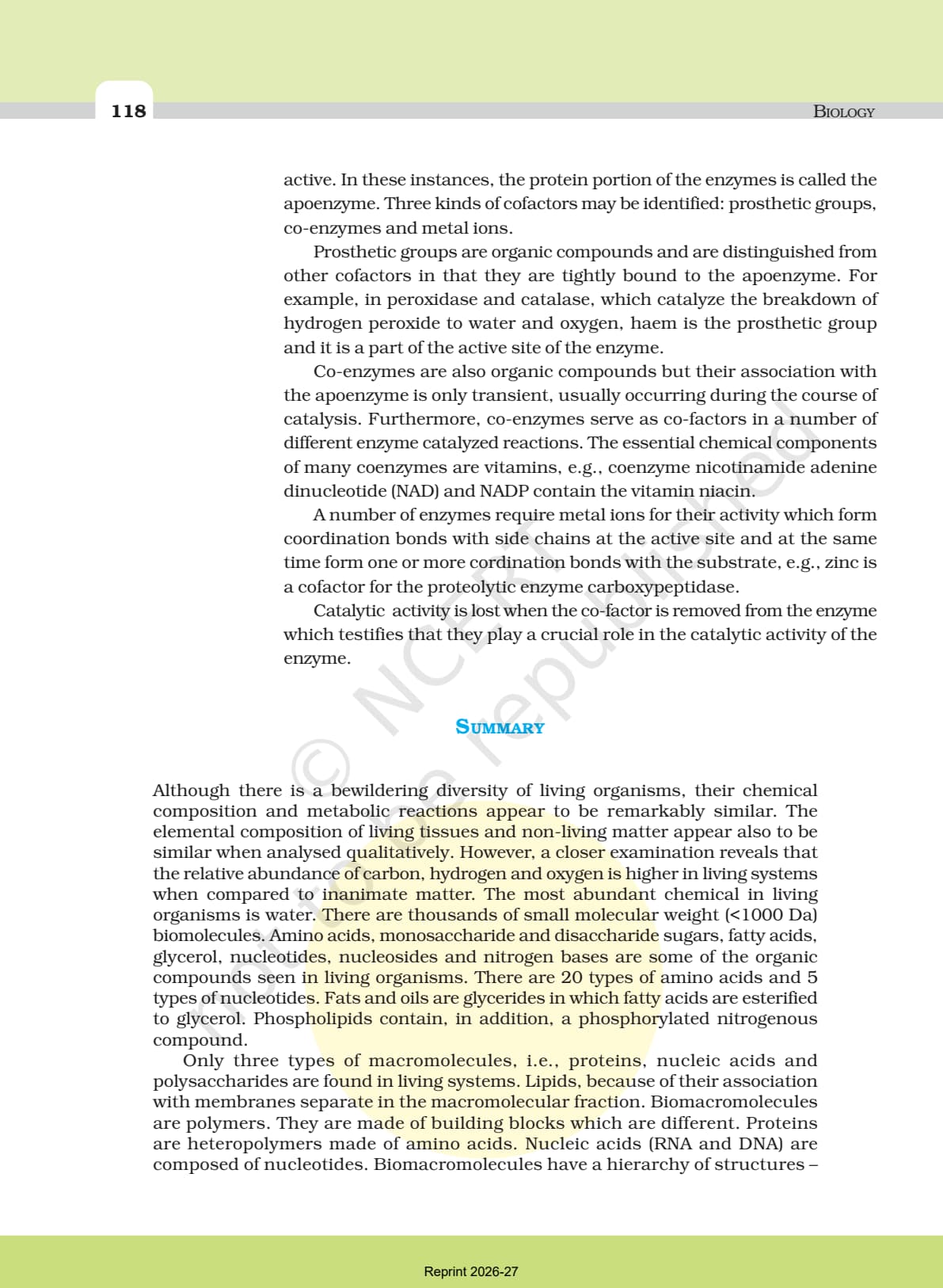
- Enzymes as biological catalysts: enzyme action, activation energy, factors affecting activity, classification and co-factors.
Why Download the NCERT Book PDF for This Chapter
Biomolecules is a heavily weighted unit for NEET, and its questions on proteins, enzymes and metabolites are drawn straight from this text. Because the chapter is dense with structures and precise terms, the exact NCERT figures and wording matter, and reading them from the official PDF keeps students from learning simplified or incorrect versions. The points below explain why the book PDF is worth keeping on your device.
- Biomolecules is a high-weight NEET unit, and its questions on proteins, enzymes and metabolites come straight from this text.
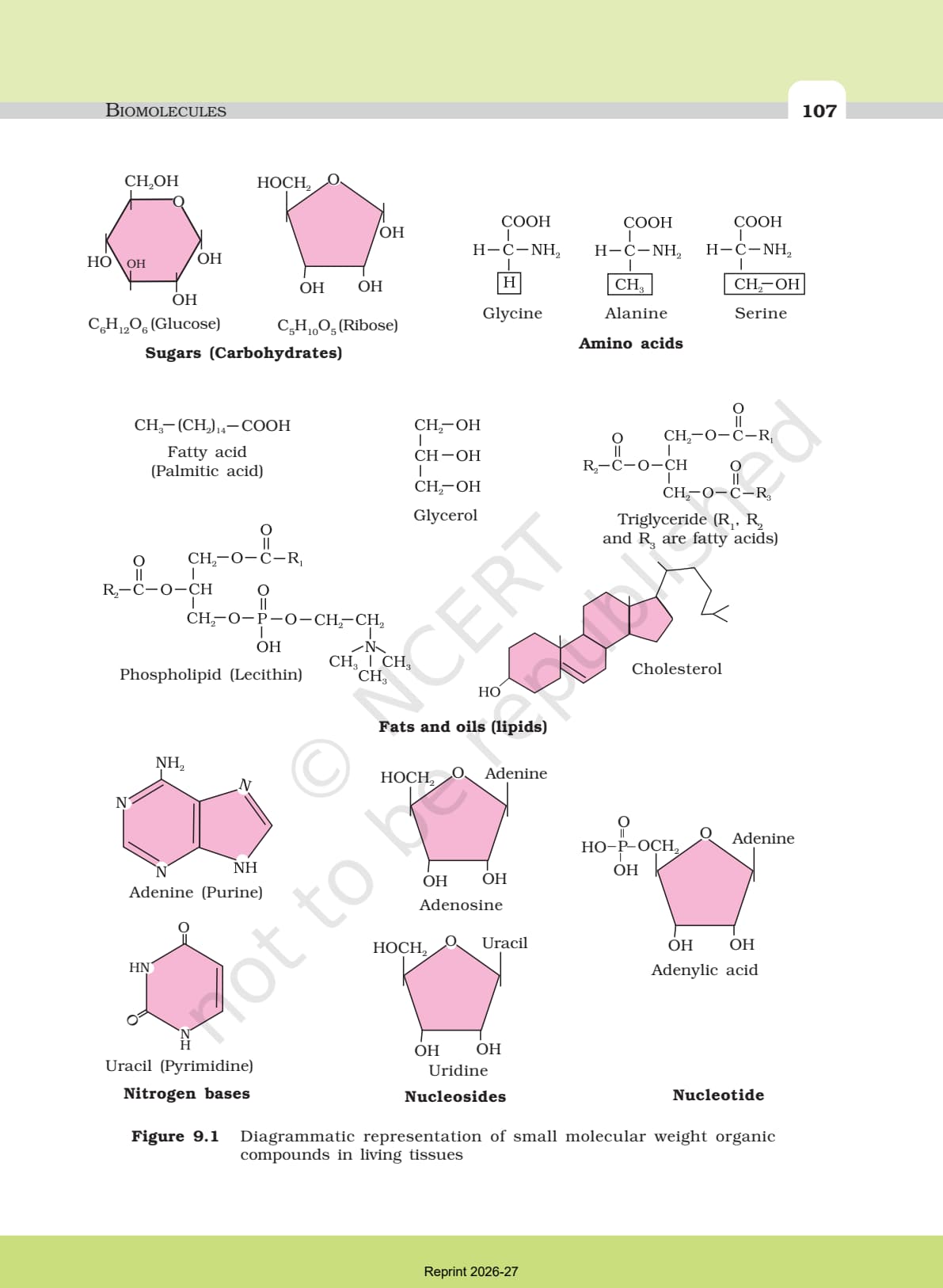
- The structures of amino acids, glucose and nucleotides are drawn exactly as shown in the NCERT figures.
- Enzyme kinetics graphs and the classification of enzymes are asked directly from the wording of this chapter.
How to Use the NCERT Book PDF for Biomolecules
Read the chapter once for the overall flow from small molecules to macromolecules, then return to draw and label the key structures so they are fixed by use rather than by memory alone. Because the chapter names many molecules, a short ordered plan keeps their structures and roles from mixing up. The routine below works well for most students preparing for the Boards and NEET.
- Read each biomolecule class, then draw and label its basic monomer and polymer.
- Make a table of the six enzyme classes with one example reaction for each.
- Attempt the back exercises, then check them against the NCERT Solutions linked below.
- Revise the four levels of protein structure and the factors affecting enzyme activity before the exam.
Other Class 11 Biology Biomolecules Resources
Pair the textbook PDF with the solved answers, revision notes, formula sheet and exemplar material for the same chapter so that reading, practice and revision all stay aligned to the same NCERT sections. The linked resources below cover Biomolecules in full and are matched to the 2026-27 syllabus.
| Resource | Link |
|---|---|
| NCERT Solutions | Biomolecules NCERT Solutions |
| Revision Notes | Biomolecules Notes |
| Formula Sheet | Biomolecules Formula Sheet |
| Exemplar Solutions | Biomolecules Exemplar Solutions |
| Exemplar Book PDF | Biomolecules Exemplar Book PDF |
Class 11 Biology Chapter 9 Student Feedback
Biomolecules is a chapter many students revise repeatedly before the Boards and NEET, and their feedback helps new students plan their reading. Across more than 10,000 students who used these Collegedunia resources for the 2026 boards, the response to the NCERT book PDF for this chapter has been strong, as the summary below shows.
- Over 9 in 10 students said the enzyme section was clearest when read from the official NCERT text.
- Students rated the four levels of protein structure as the most useful concept to revise.
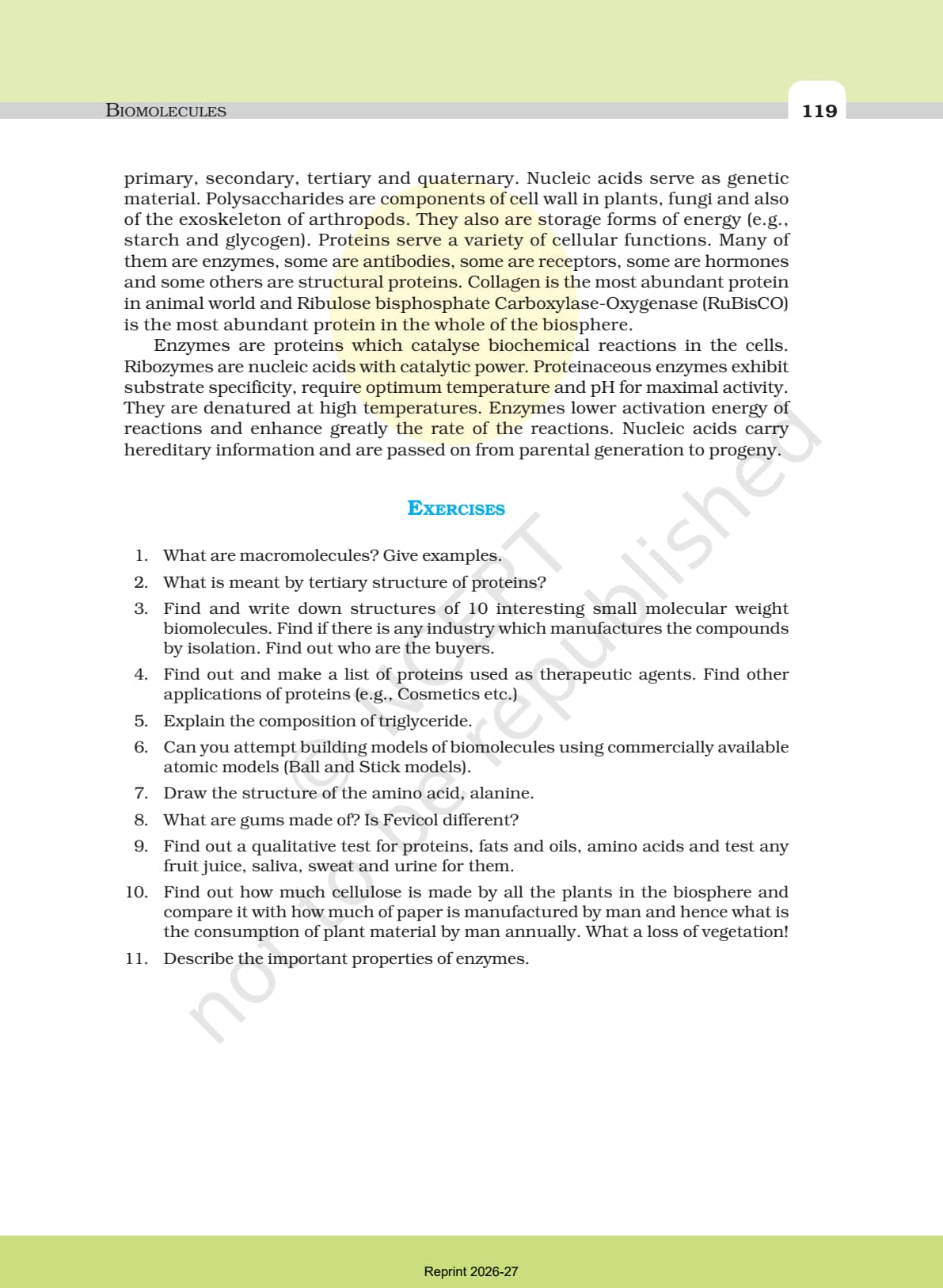
- Most reported that the metabolite and macromolecule definitions were exam-ready straight from the book.
Class 11 Biology NCERT Book PDF All Chapters
The full Class 11 Biology NCERT Book PDF is split chapter by chapter so students can download only what they need. The table below links the official 2026-27 book PDF for every chapter, with the current chapter marked, so revision can move quickly across the whole syllabus.
| Chapter | NCERT Book PDF |
|---|---|
| Chapter 1 | Chapter 1 The Living World |
| Chapter 2 | Chapter 2 Biological Classification |
| Chapter 3 | Chapter 3 Plant Kingdom |
| Chapter 4 | Chapter 4 Animal Kingdom |
| Chapter 5 | Chapter 5 Morphology of Flowering Plants |
| Chapter 6 | Chapter 6 Anatomy of Flowering Plants |
| Chapter 7 | Chapter 7 Structural Organisation in Animals |
| Chapter 8 | Chapter 8 Cell: The Unit of Life |
| Chapter 9 | Chapter 9 Biomolecules |
| Chapter 10 | Chapter 10 Cell Cycle and Cell Division |
| Chapter 11 | Chapter 11 Photosynthesis in Higher Plants |
| Chapter 12 | Chapter 12 Respiration in Plants |
| Chapter 13 | Chapter 13 Plant Growth and Development |
| Chapter 14 | Chapter 14 Breathing and Exchange of Gases |
| Chapter 15 | Chapter 15 Body Fluids and Circulation |
| Chapter 16 | Chapter 16 Excretory Products and their Elimination |
| Chapter 17 | Chapter 17 Locomotion and Movement |
| Chapter 18 | Chapter 18 Neural Control and Coordination |
| Chapter 19 | Chapter 19 Chemical Coordination and Integration |
FAQs on Class 11 Biology Chapter 9 NCERT Book PDF
Biomolecules NCERT PDF - Frequently Asked Questions
Ques. Is this the latest 2026-27 NCERT Book for Class 11 Biology Chapter 9?
Ans. Yes. This is the official NCERT 2026-27 textbook chapter for Class 11 Biology Chapter 9 Biomolecules, matched page by page against the latest rationalised edition.
Ques. What topics are in Class 11 Biology Chapter 9?
Ans. The chapter covers how to analyse chemical composition, primary and secondary metabolites, biomacromolecules, proteins and their structure, polysaccharides, nucleic acids, and enzymes including enzyme action, factors affecting activity, classification and co-factors.
Ques. Is the NCERT Book enough for this chapter in NEET and CUET?
Ans. The NCERT Book is the base for this chapter, and most NEET and CUET questions on proteins, enzymes and biomacromolecules are drawn straight from its structures and descriptions. Pair it with the Exemplar for extra higher-order practice.
Ques. Where can I download the Class 11 Biology Chapter 9 NCERT Book PDF?
Ans. You can download the Class 11 Biology Chapter 9 Biomolecules NCERT Book PDF free from the download card at the top of this page, in both standard and HD quality.



Comments