



Download the Class 11 Biology Chapter 6 Anatomy of Flowering Plants NCERT Book PDF, the official 2026-27 NCERT textbook chapter. It takes students inside the plant, moving from the three tissue systems to the internal structure of dicot and monocot roots, stems and leaves as seen under a microscope.
- Official NCERT 2026-27 chapter, clean and print-ready.
- Covers the epidermal, ground and vascular tissue systems and the anatomy of dicot and monocot roots, stems and leaves.
- Read it alongside the solved exercises and the revision notes linked below.
This Class 11 Biology Chapter 6 Anatomy of Flowering Plants NCERT Book PDF is the official 2026-27 NCERT text, checked page by page against the latest edition.
What Class 11 Biology Chapter 6 Anatomy of Flowering Plants Covers
The chapter groups plant tissues into three systems by position and function, then compares the internal anatomy of dicot and monocot organs. In the rationalised 2026-27 edition this chapter is short and focused, so every section in it carries weight. The official NCERT sections are listed below so students can see exactly what the chapter contains before they start.
| Section | Topic |
|---|---|
| 6.1 | The Tissue System |
| 6.1.1 | Epidermal Tissue System |
| 6.1.2 | The Ground Tissue System |
| 6.1.3 | The Vascular Tissue System |
| 6.2 | Anatomy of Dicotyledonous and Monocotyledonous Plants |
| 6.2.1 | Dicotyledonous Root |
| 6.2.2 | Monocotyledonous Root |
| 6.2.3 | Dicotyledonous Stem |
| 6.2.4 | Monocotyledonous Stem |
| 6.2.5 | Dorsiventral and Isobilateral Leaf |
Key Concepts You Will Study
Anatomy is read through transverse sections, so students should study this chapter with the NCERT diagrams open and learn to identify an organ from its vascular bundle alone. That single skill answers most questions the chapter sets.
- The three tissue systems: epidermal, ground and vascular.
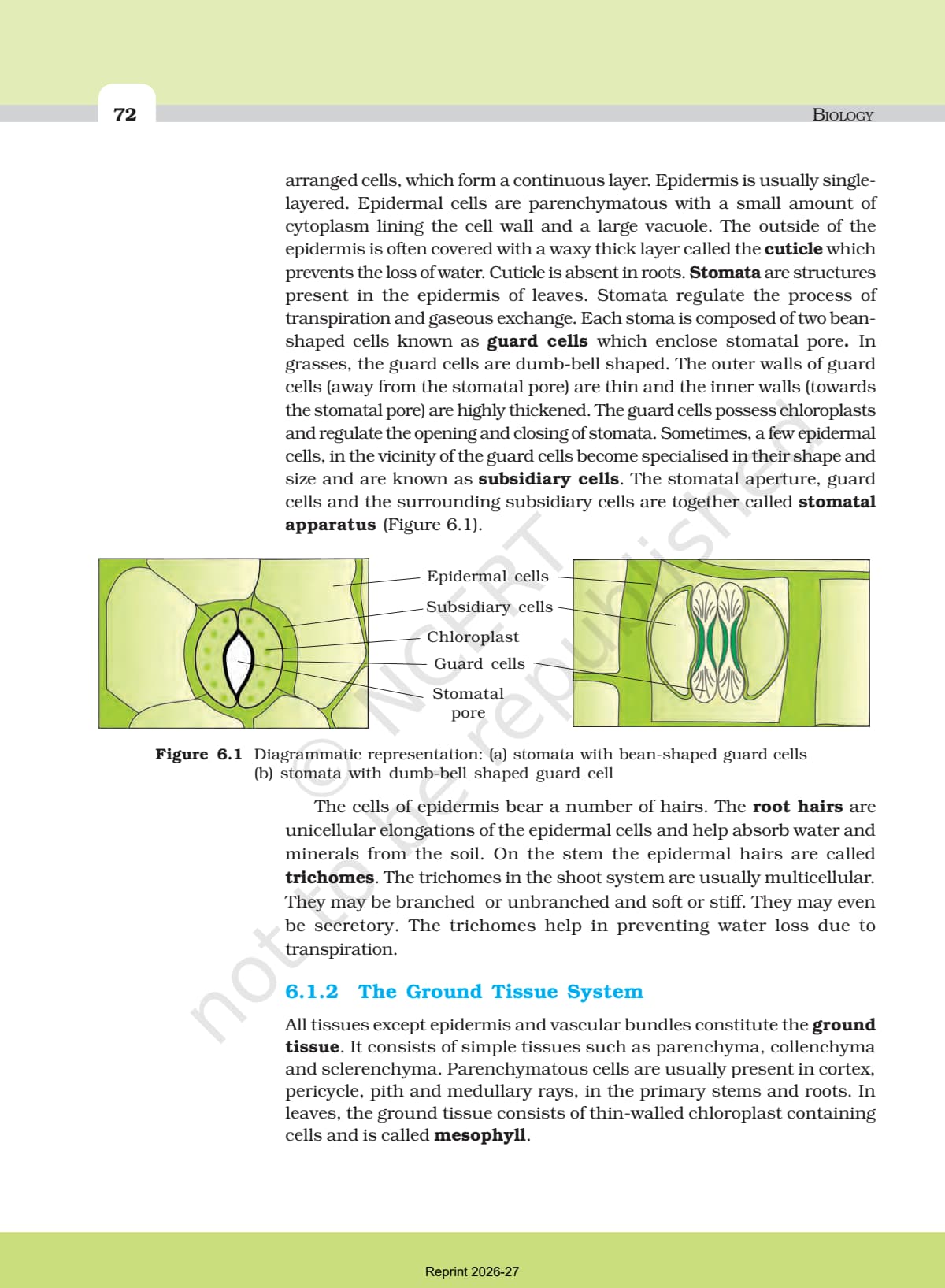
- Stomata and guard cells, and how dicot and monocot guard cells differ.
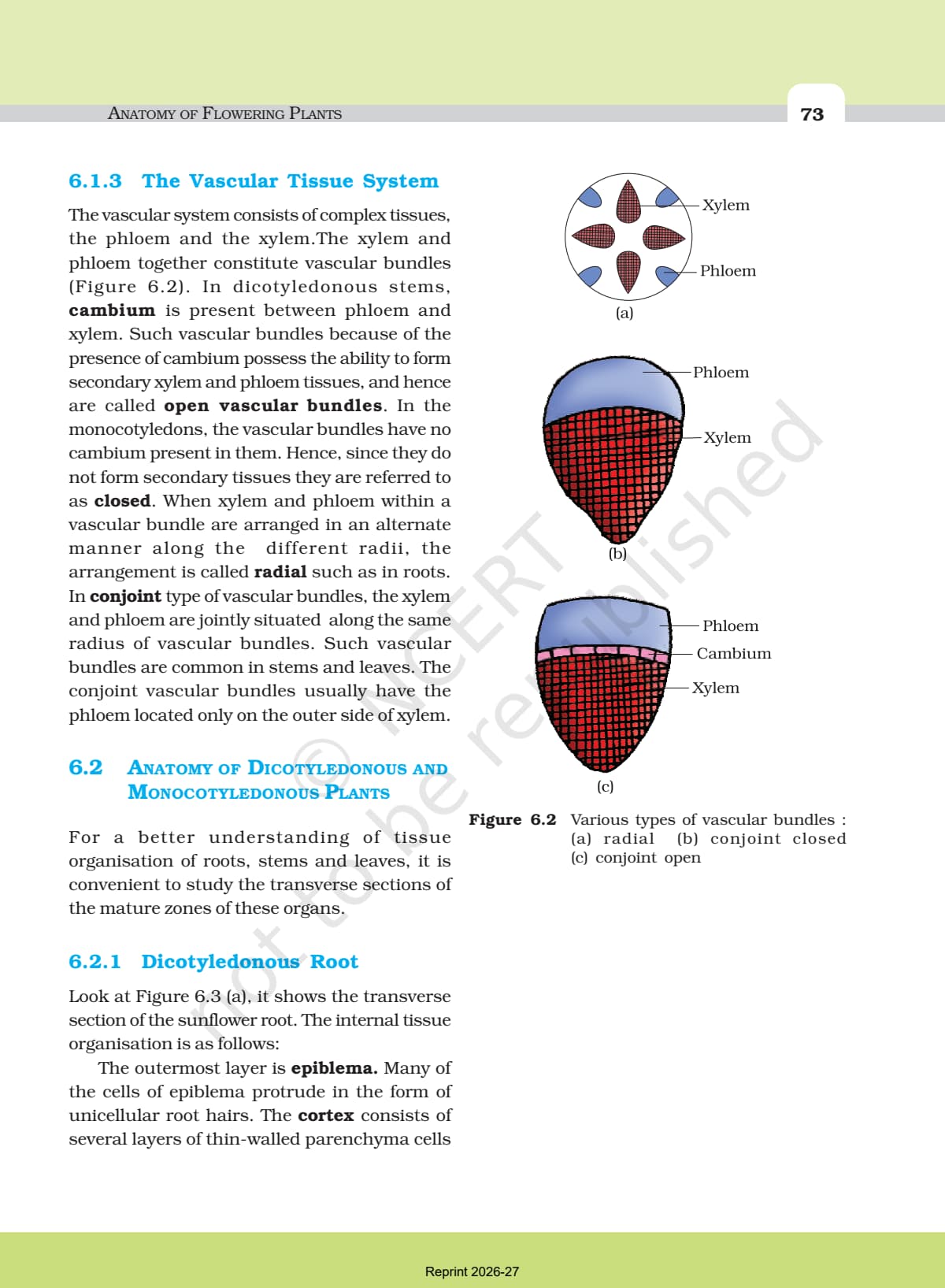
- Vascular bundle types: radial, conjoint, open and closed.
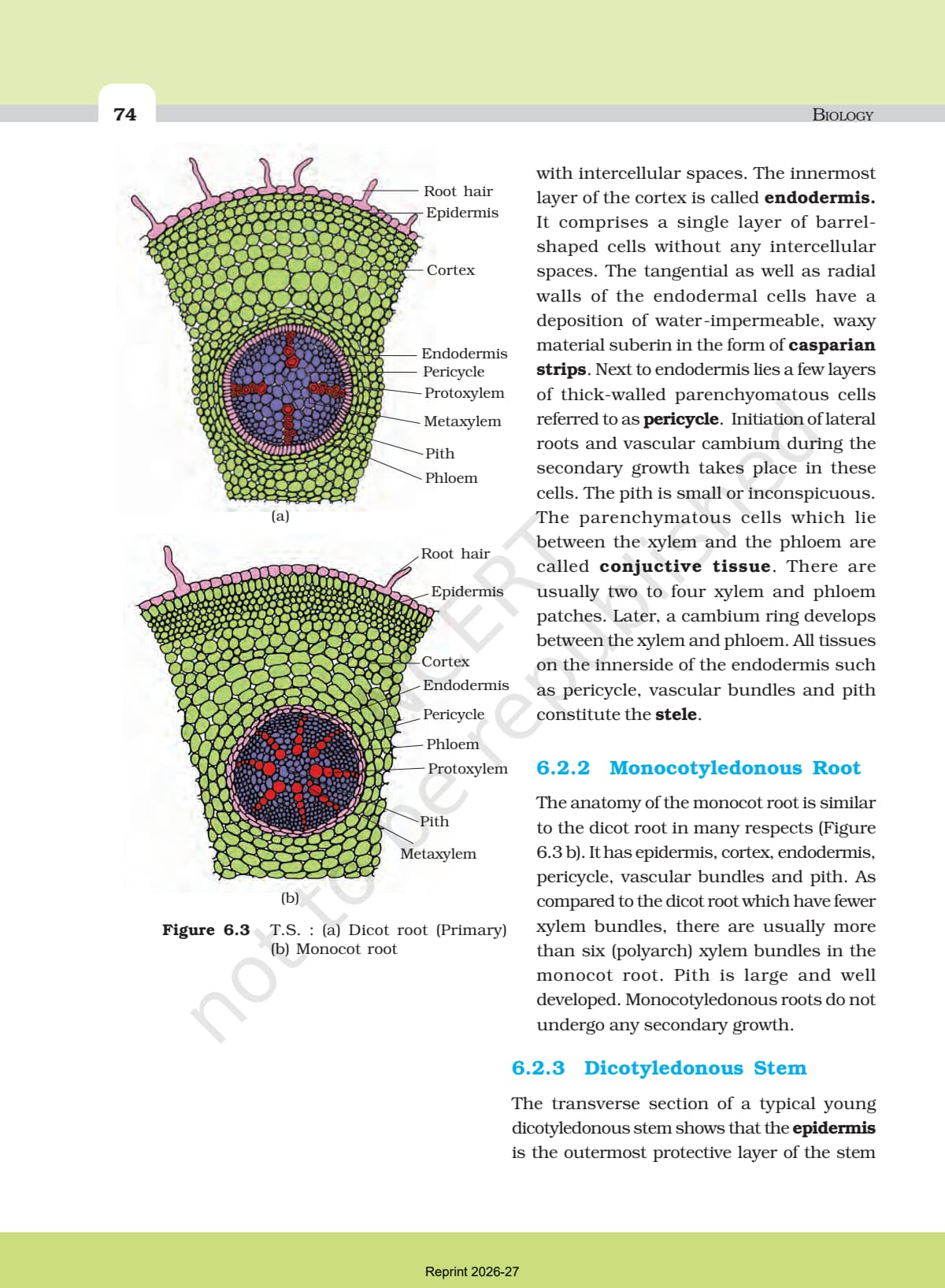
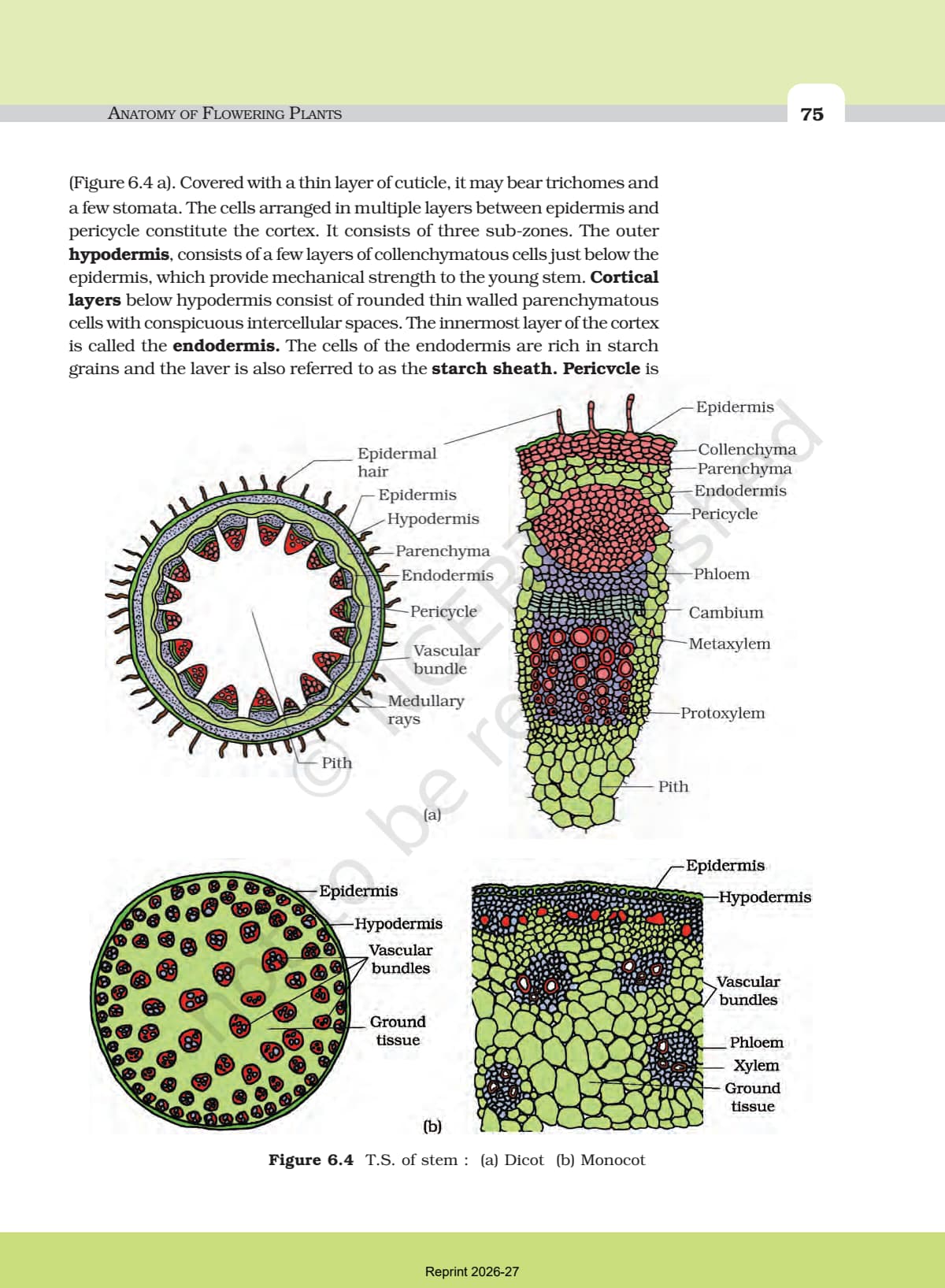
- Transverse sections of the dicot and monocot root and stem.
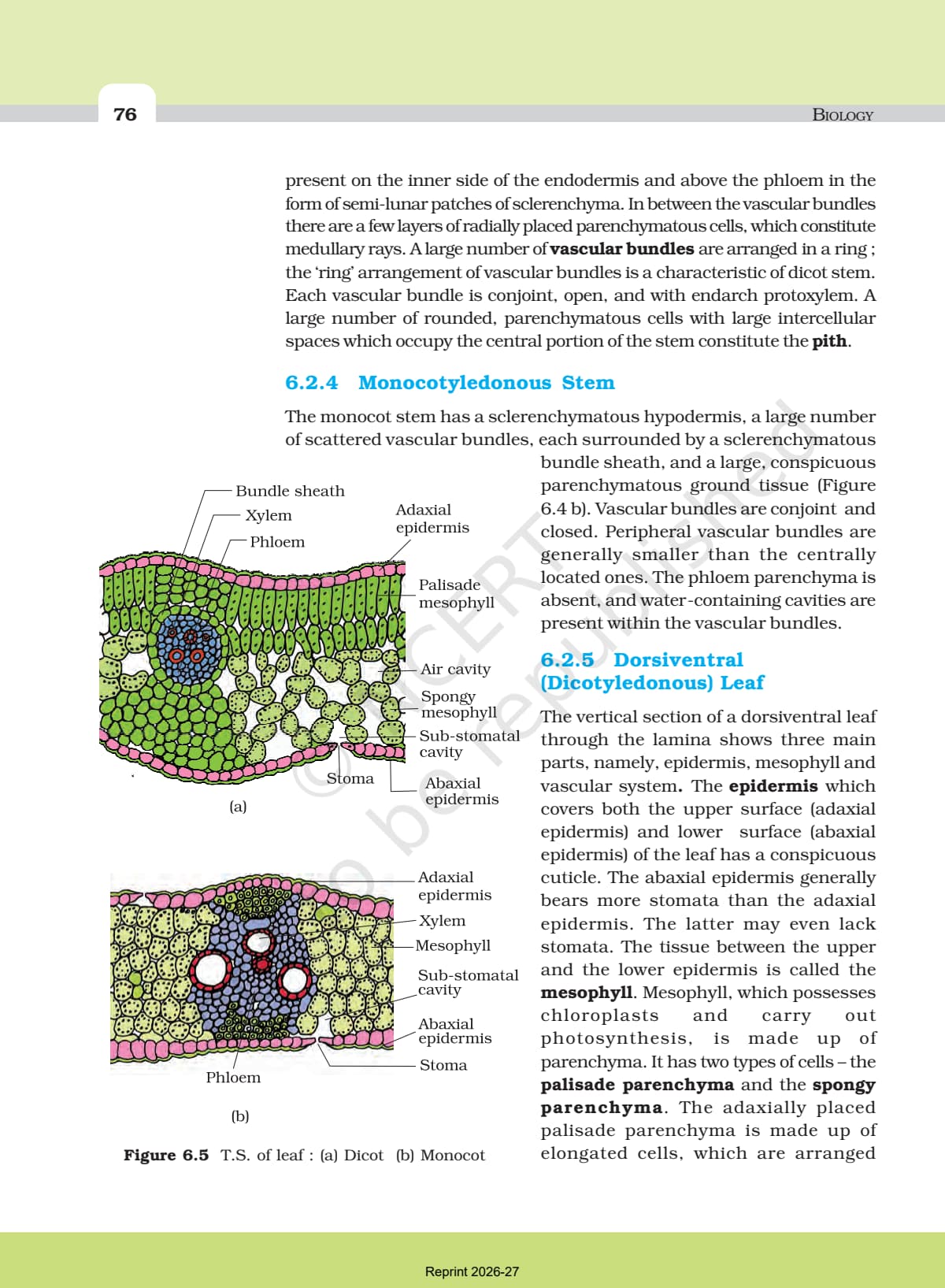
- The dorsiventral and isobilateral leaf and their mesophyll arrangement.
Why Download the NCERT Book PDF for This Chapter
Anatomy questions in NEET are nearly always diagram-based, asking students to identify a section or a bundle type. Because the chapter is short in the rationalised edition, the whole of it is examinable and the official diagrams are the reference.
- Identification of a transverse section is a standard NEET question type.
- Vascular bundle arrangement is the fastest way to tell a dicot from a monocot.
- The chapter is short after rationalisation, so nearly every section is examinable.
How to Use the NCERT Book PDF for Anatomy of Flowering Plants
Read each section against its NCERT figure and then test yourself by covering the label and naming the section from the bundle pattern alone. A compact comparison table finishes the revision.
- Learn to identify dicot versus monocot root and stem from the vascular bundle alone.
- Make one table comparing dicot and monocot root, stem and leaf anatomy.
- Note that secondary growth is not part of the rationalised 2026-27 chapter.
- Attempt the back exercises, then check them against the NCERT Solutions linked below.
Other Class 11 Biology Anatomy of Flowering Plants Resources
Pair the textbook PDF with the solved answers, revision notes, formula sheet and exemplar material for the same chapter so that reading, practice and revision all stay aligned to the same NCERT sections. The linked resources below cover Anatomy of Flowering Plants in full and are matched to the 2026-27 syllabus.
| Resource | Link |
|---|---|
| NCERT Solutions | Anatomy of Flowering Plants NCERT Solutions |
| Revision Notes | Anatomy of Flowering Plants Notes |
| Formula Sheet | Anatomy of Flowering Plants Formula Sheet |
| Exemplar Solutions | Anatomy of Flowering Plants Exemplar Solutions |
| Exemplar Book PDF | Anatomy of Flowering Plants Exemplar Book PDF |
Class 11 Biology Chapter 6 Student Feedback
Anatomy of Flowering Plants is one of the chapters students revise early for the Boards and NEET, and their feedback helps new students plan their reading. Across more than 10,000 students who used these Collegedunia resources for the 2026 boards, the response to the NCERT book PDF for this chapter has been strong, as the summary below shows.
- Over 9 in 10 students said identifying sections from diagrams was the key skill here.
- Students rated the dicot versus monocot bundle comparison as the most examined table.
- Most found the shorter rationalised chapter quick to finish in a single sitting.
Class 11 Biology NCERT Book PDF All Chapters
The full Class 11 Biology NCERT Book PDF is split chapter by chapter so students can download only what they need. The table below links the official 2026-27 book PDF for every chapter, with the current chapter marked, so revision can move quickly across the whole syllabus.
| Chapter | NCERT Book PDF |
|---|---|
| Chapter 1 | Chapter 1 The Living World |
| Chapter 2 | Chapter 2 Biological Classification |
| Chapter 3 | Chapter 3 Plant Kingdom |
| Chapter 4 | Chapter 4 Animal Kingdom |
| Chapter 5 | Chapter 5 Morphology of Flowering Plants |
| Chapter 6 | Chapter 6 Anatomy of Flowering Plants |
| Chapter 7 | Chapter 7 Structural Organisation in Animals |
| Chapter 8 | Chapter 8 Cell: The Unit of Life |
| Chapter 9 | Chapter 9 Biomolecules |
| Chapter 10 | Chapter 10 Cell Cycle and Cell Division |
| Chapter 11 | Chapter 11 Photosynthesis in Higher Plants |
| Chapter 12 | Chapter 12 Respiration in Plants |
| Chapter 13 | Chapter 13 Plant Growth and Development |
| Chapter 14 | Chapter 14 Breathing and Exchange of Gases |
| Chapter 15 | Chapter 15 Body Fluids and Circulation |
| Chapter 16 | Chapter 16 Excretory Products and their Elimination |
| Chapter 17 | Chapter 17 Locomotion and Movement |
| Chapter 18 | Chapter 18 Neural Control and Coordination |
| Chapter 19 | Chapter 19 Chemical Coordination and Integration |
FAQs on Class 11 Biology Chapter 6 NCERT Book PDF
Anatomy of Flowering Plants NCERT PDF - Frequently Asked Questions
Ques. Is this the latest 2026-27 NCERT Book for Class 11 Biology Chapter 6?
Ans. Yes. This is the official NCERT 2026-27 textbook chapter for Class 11 Biology Chapter 6 Anatomy of Flowering Plants, matched page by page against the latest rationalised edition.
Ques. What topics are in Class 11 Biology Chapter 6?
Ans. The chapter covers the tissue system, including the epidermal, ground and vascular tissue systems, and then the anatomy of dicotyledonous and monocotyledonous roots, stems and leaves. Secondary growth is not part of the rationalised 2026-27 edition.
Ques. Is the NCERT Book enough for this chapter in NEET and CUET?
Ans. The NCERT Book is the base for this chapter, and most NEET and CUET questions on Anatomy of Flowering Plants are drawn straight from its text and diagrams. Pair it with the Exemplar for extra higher-order practice.
Ques. Where can I download the Class 11 Biology Chapter 6 NCERT Book PDF?
Ans. You can download the Class 11 Biology Chapter 6 Anatomy of Flowering Plants NCERT Book PDF free from the download card at the top of this page, in both standard and HD quality.



Comments