




Class 12 Business Studies Financial Markets PYQ, free to download as a 69-page PDF. The chapter carries about 7 of the 80 marks in the board paper, and the set holds 73 solved questions from the 2006 to 2026 papers on money market versus capital market, primary versus secondary market, the functions of a stock exchange, the protective and regulatory functions of SEBI, methods of floatation such as private placement, rights issue and e-IPO, and demat and depository, and takes roughly four hours to work through, so split it across two sittings.





Financial Markets Weightage in the Class 12 Board Paper
As per Business Studies Financial Markets weightage from past years, students can expect about 7 marks from this chapter in the 80-mark board paper. Marks per chapter change from one paper to the next, so treat the figure as a guide and check the CBSE curriculum for the official unit marks.
The 73 questions in this set fall in six mark bands. The 28 one-mark MCQs are the largest group, followed by 15 questions of 3 marks. The rest are 11 questions of 4 marks, 11 of 5 marks, 7 of 2 marks and a single 6-mark case question, so 45 of the 73 need a written answer.
| Marks Each | Question Type | Questions in the Set |
|---|---|---|
| 1 mark | MCQ | 28 |
| 2 marks | Very Short Answer (VSA) | 7 |
| 3 marks | Short Answer (SA) | 15 |
| 4 marks | Long Answer | 11 |
| 5 marks | Long Answer | 11 |
| 6 marks | Long Answer | 1 |
Financial Markets Questions by Topic
The money market versus capital market comparison dominates the written section. 13 questions ask you to differentiate the two, always on a list of bases such as participants, instruments, investment outlay, duration, liquidity, safety or expected return, and the bases change from paper to paper. Another 5 ask for the difference between primary and secondary market, and a further 8 mention the two markets in MCQs or definitions.
About 17 questions name the stock exchange, covering its meaning, its features and its functions, and about 15 name SEBI. The SEBI questions split into protective functions, regulatory functions and the development function, and 3 of the 2-mark questions give one function and ask for two others of the same category. 7 questions are on demat accounts, dematerialisation and depositories, and 6 are on money market instruments such as treasury bills and commercial paper. Methods of floatation (private placement, rights issue and e-IPO) come up in 3 questions, and the contract note with the T+2 system in 1. The counts come from keyword matches, so a question on two topics is counted under both.
| Topic | Questions Naming It (approx.) |
|---|---|
| Money market versus capital market | 25 |
| Stock exchange: meaning, features and functions | 17 |
| SEBI: protective, regulatory and development functions | 15 |
| Primary versus secondary market | 13 |
| Demat account and depository | 7 |
| Money market instruments | 6 |
| Meaning and functions of financial market | 5 |
| Methods of floatation of new issues | 3 |
| Contract note and T+2 system | 1 |
The format is predictable. 23 questions ask for "any two", "any three", "any four" or "any five" points, and 10 of the 28 MCQs are built on one or two statements, where you pick the correct or incorrect one.
Financial Markets Video Lesson
Source: Next Toppers - 12th Commerce on YouTube
How to Approach the Financial Markets Set
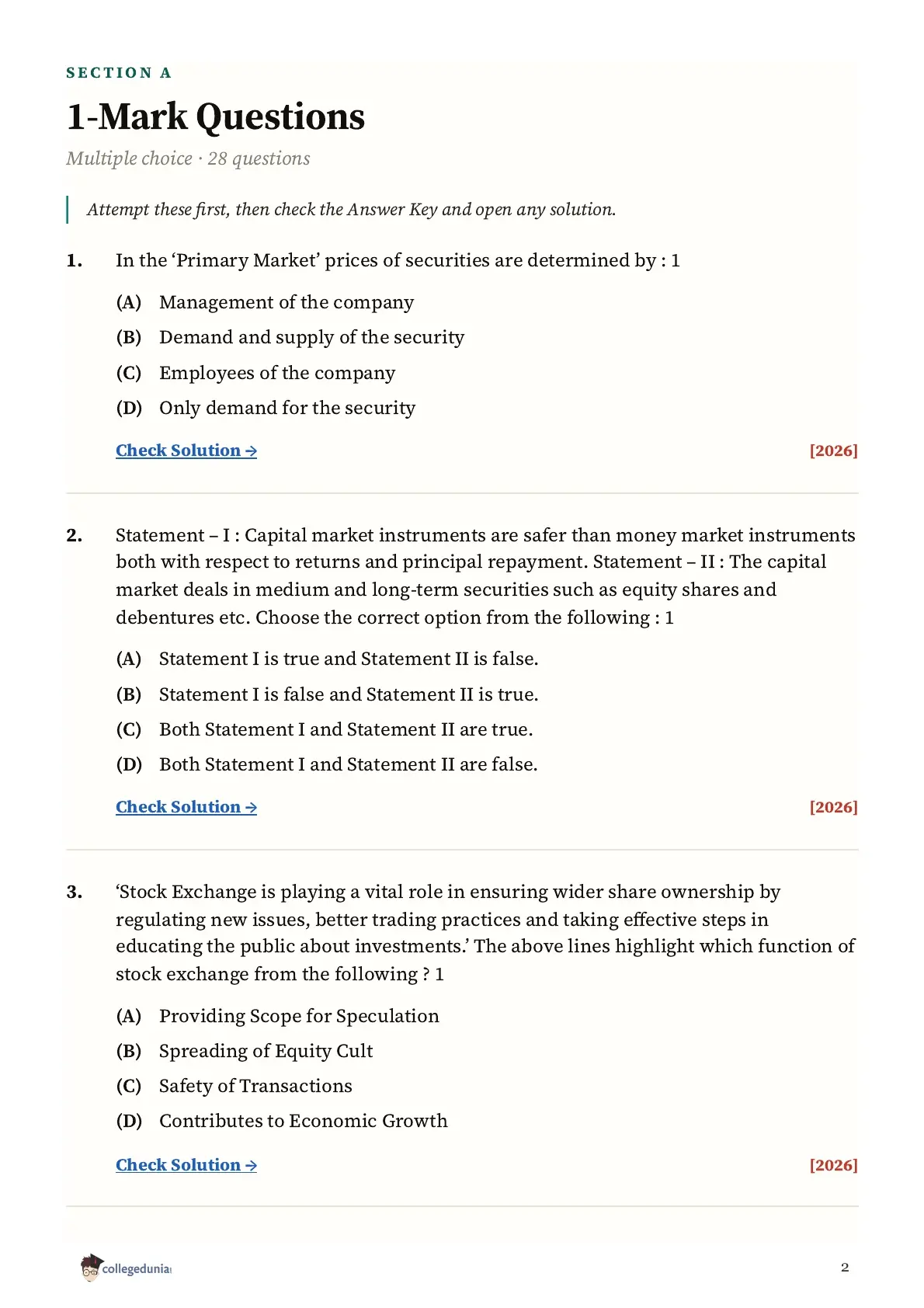
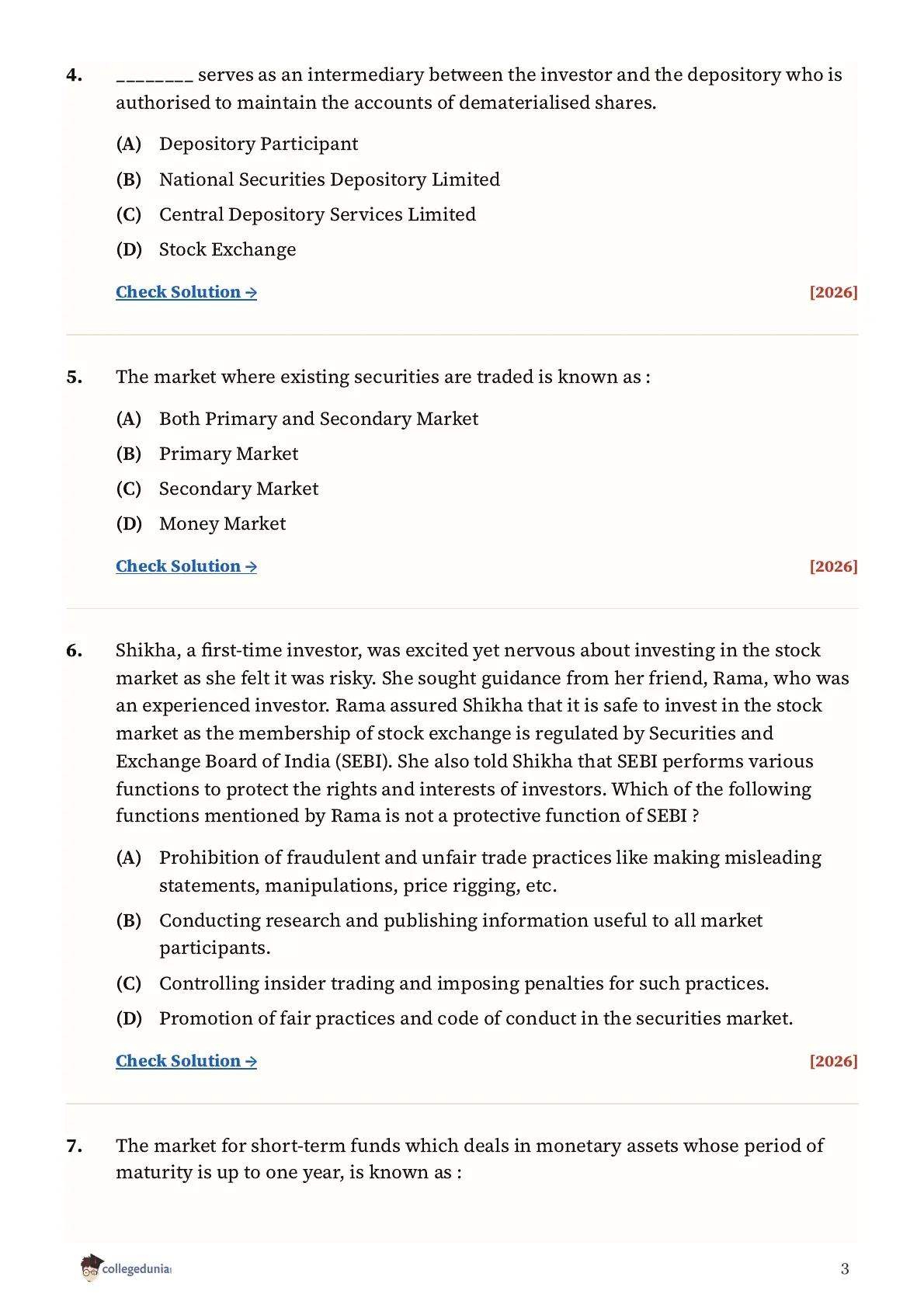
Do the 28 MCQs first, in about half an hour. Most are one-line definitions: the market for short-term funds up to one year, the process of holding securities in electronic form, the function of a stock exchange that creates a continuous market. Several ask for the incorrect statement, so read all the options before you mark one.
The 45 written answers are where the hours go. Start with the money market and capital market comparison and write it as a table with the bases in the first column, since you will meet it again in 2-, 3-, 4- and 5-mark forms. Then do primary against secondary market, then the stock exchange functions, then SEBI. For the 6-mark case question and the short case stems on SEBI and private placement, name the concept first and then link it to the line in the paragraph that shows it.
Common Mistakes in Financial Markets Questions
- Comparing the money and capital markets on a basis the stem did not ask for, or missing one of the listed bases.
- Mixing SEBI's protective functions (such as prohibiting insider trading) with its regulatory ones (such as registering brokers).
- Calling a rights issue a private placement, when a rights issue is offered to existing shareholders in proportion to their holding.
- Writing demat and depository as the same thing; the depository holds the securities and the depository participant is the link to the investor.
- Listing five functions of a stock exchange when the question asks for three.
- Stating that primary market prices are decided by the market, when they are fixed by the company.
Using the Answer Key and Solutions
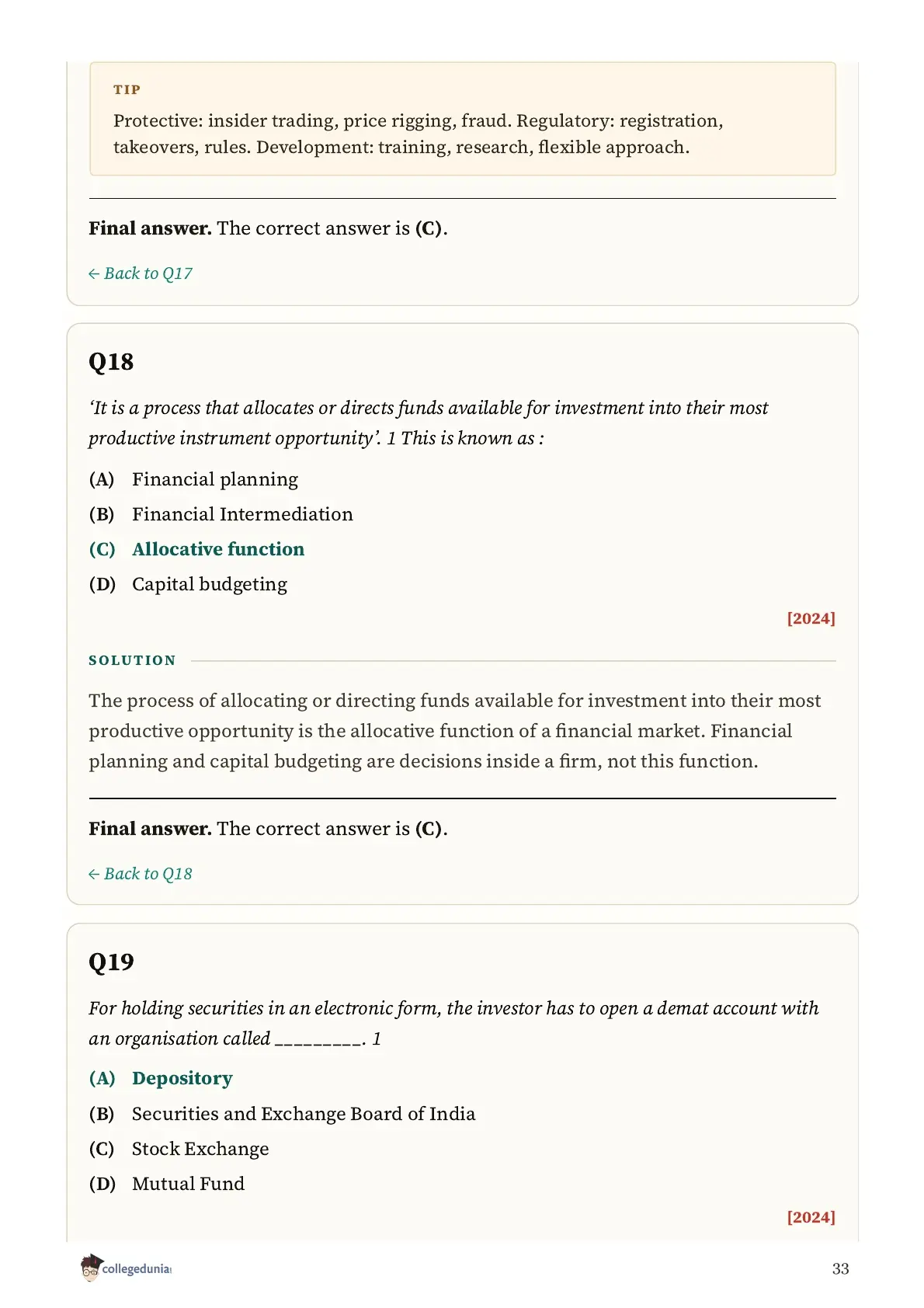
The PDF is 69 pages and free to download. Each section is sorted newest year first, the Answer Key lists every MCQ at a glance, and each question links to its worked solution and back. Attempt a section first, check the key, then read the solution and note the common mistake given with it. The solutions are written by Collegedunia's Business Studies experts and are not official CBSE marking schemes.
Class 12 Business Studies PYQs by Chapter
| Chapter | PYQ Page |
|---|---|
| Chapter 1 | Chapter 1: Nature and Significance of Management Class 12 PYQ |
| Chapter 2 | Chapter 2: Principles of Management Class 12 PYQ |
| Chapter 3 | Chapter 3: Business Environment Class 12 PYQ |
| Chapter 4 | Chapter 4: Planning Class 12 PYQ |
| Chapter 5 | Chapter 5: Organising Class 12 PYQ |
| Chapter 6 | Chapter 6: Staffing Class 12 PYQ |
| Chapter 7 | Chapter 7: Directing Class 12 PYQ |
| Chapter 8 | Chapter 8: Controlling Class 12 PYQ |
| Chapter 9 | Chapter 9: Financial Management Class 12 PYQ |
| Chapter 10 | Chapter 10: Financial Markets Class 12 PYQ |
| Chapter 11 | Chapter 11: Marketing Class 12 PYQ |
| Chapter 12 | Chapter 12: Consumer Protection Class 12 PYQ |
Financial Markets Class 12 Business Studies PYQ FAQs
Ques. How many questions are in the Financial Markets Class 12 PYQ PDF?
Ans. The PDF has 73 questions from CBSE board papers between 2006 and 2026: 28 one-mark MCQs, 7 two-mark, 15 three-mark, 11 four-mark, 11 five-mark and 1 six-mark question.
Ques. Does this PYQ PDF include solutions, or only the questions?
Ans. Yes. All 73 questions have a worked solution in the PDF, and the MCQs also have an Answer Key.
Ques. Are the solutions official?
Ans. No. They are written by Collegedunia's Business Studies experts and are not an official CBSE marking scheme.
Ques. How many marks does Financial Markets carry in the Class 12 board paper?
Ans. About 7 of the 80 marks, going by past papers. It is an estimate and changes from year to year.
Ques. What is the difference between money market and capital market?
Ans. The money market deals in short-term funds with maturity up to one year, through instruments such as treasury bills and commercial paper. The capital market deals in medium and long-term securities such as shares and debentures. The two are compared on participants, instruments, investment outlay, duration, liquidity, safety and expected return, and about 13 questions in this set ask for exactly this comparison.
Ques. What are the functions of SEBI?
Ans. SEBI has protective functions for investors, regulatory functions for intermediaries and the market, and a development function. About 15 questions in this set name SEBI, and about 9 of them ask for protective, regulatory or development functions or the objectives.
Ques. What are the functions of a stock exchange?
Ans. Providing a continuous market with liquidity and marketability, pricing of securities, safety of transactions, contributing to economic growth, spreading equity cult and providing scope for speculation. About 17 questions in this set name the stock exchange.
Ques. What is T+2 settlement?
Ans. It is the trading procedure under which a transaction is settled two working days after the trade date. The set asks it together with the contract note in 1 question.
Ques. What are the methods of floatation of new issues?
Ans. Public issue through a prospectus, offer for sale, private placement, rights issue and e-IPO. 3 questions in this set are on floatation methods: private placement, rights issue and e-IPO.



Comments