The Odisha CPET 2025 Computer Science question paper is now available with detailed solutions for free download. Odisha CPET 2025 was conducted by the Department of Higher Education, Government of Odisha (through SAMS Odisha) from May 5 to May 13, 2025, and the Computer Science paper carried 100 single-best-answer MCQs for 100 marks.

Odisha CPET 2025 Computer Science Question Paper with Solutions Download PDF Check Solutions

ODISHA CPET 2025 COMPUTER SCIENCE Questions with Solutions

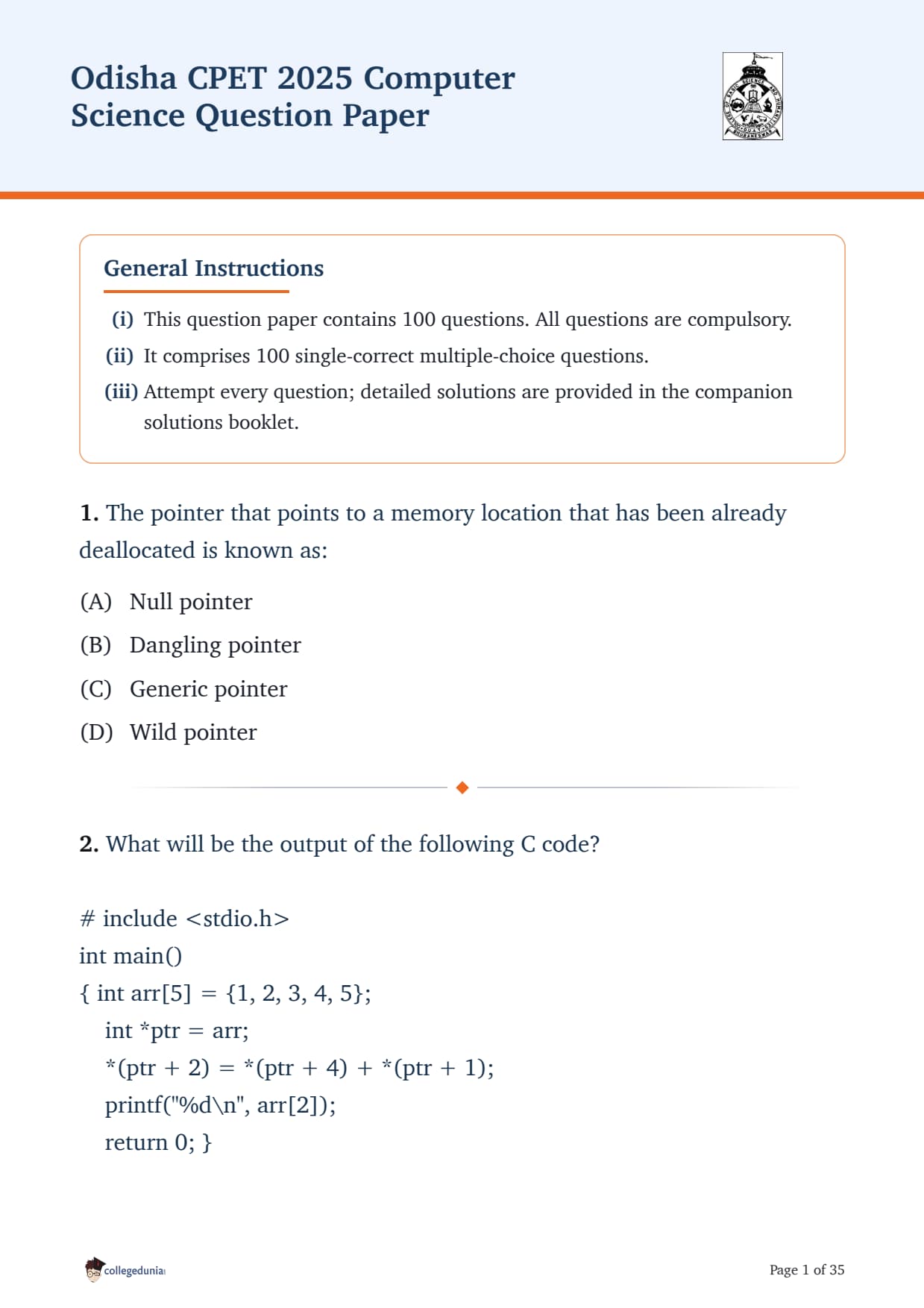
Question 1:

The pointer that points to a memory location that has been already deallocated is known as:

  • (A) Null pointer
  • (B) Dangling pointer
  • (C) Generic pointer
  • (D) Wild pointer

Question 2:

What will be the output of the following C code?

# include <stdio.h>
int main()
{ int arr[5] = {1, 2, 3, 4, 5};
  int *ptr = arr;
  *(ptr + 2) = *(ptr + 4) + *(ptr + 1);
  printf("%d\n", arr[2]);
  return 0; }

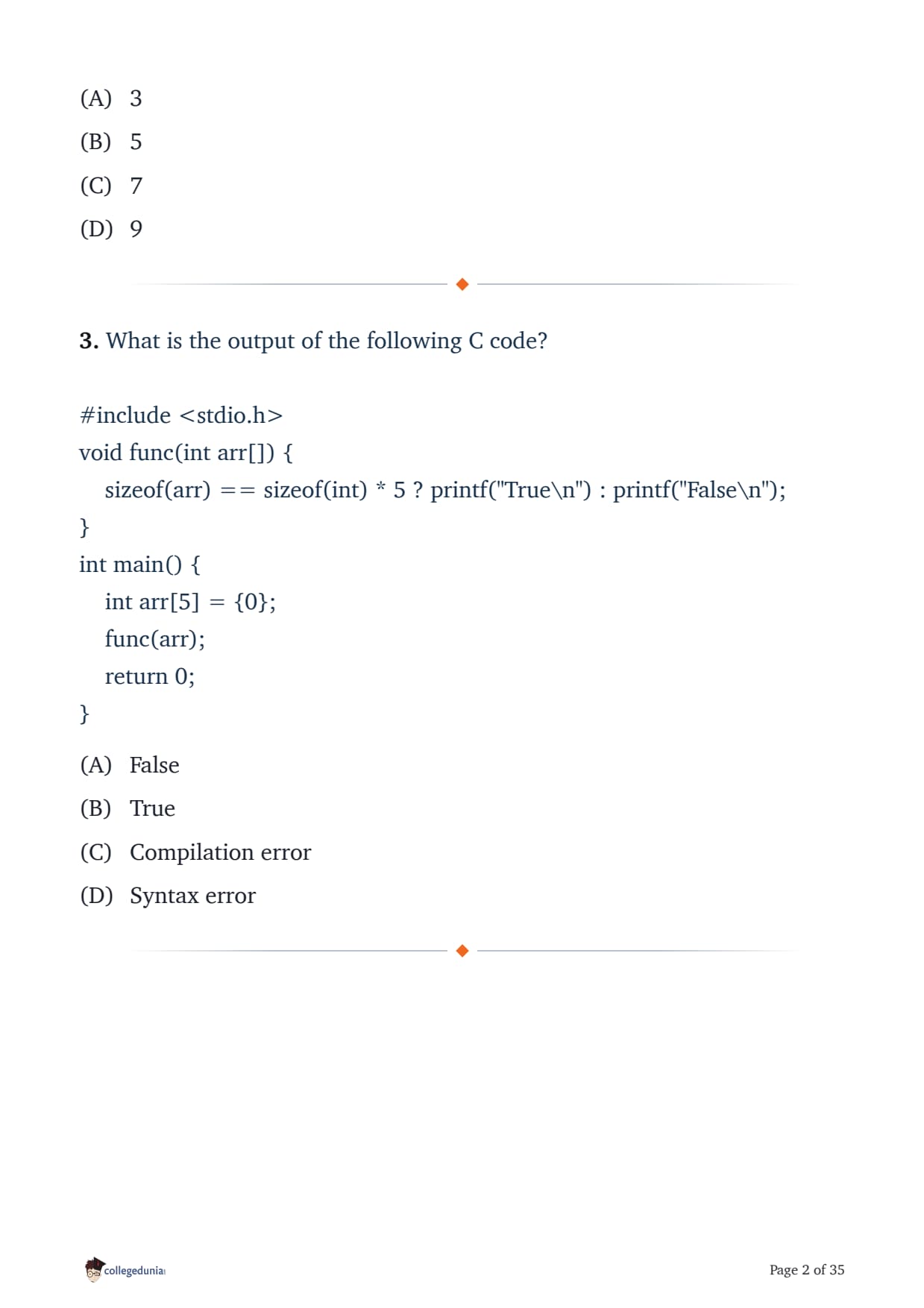
  • (A) 3
  • (B) 5
  • (C) 7
  • (D) 9

Question 3:

What is the output of the following C code?

#include <stdio.h>
void func(int arr[]) {
  sizeof(arr) == sizeof(int) * 5 ? printf("True\n") : printf("False\n");
}
int main() {
  int arr[5] = {0};
  func(arr);
  return 0;
}

  • (A) False
  • (B) True
  • (C) Compilation error
  • (D) Syntax error

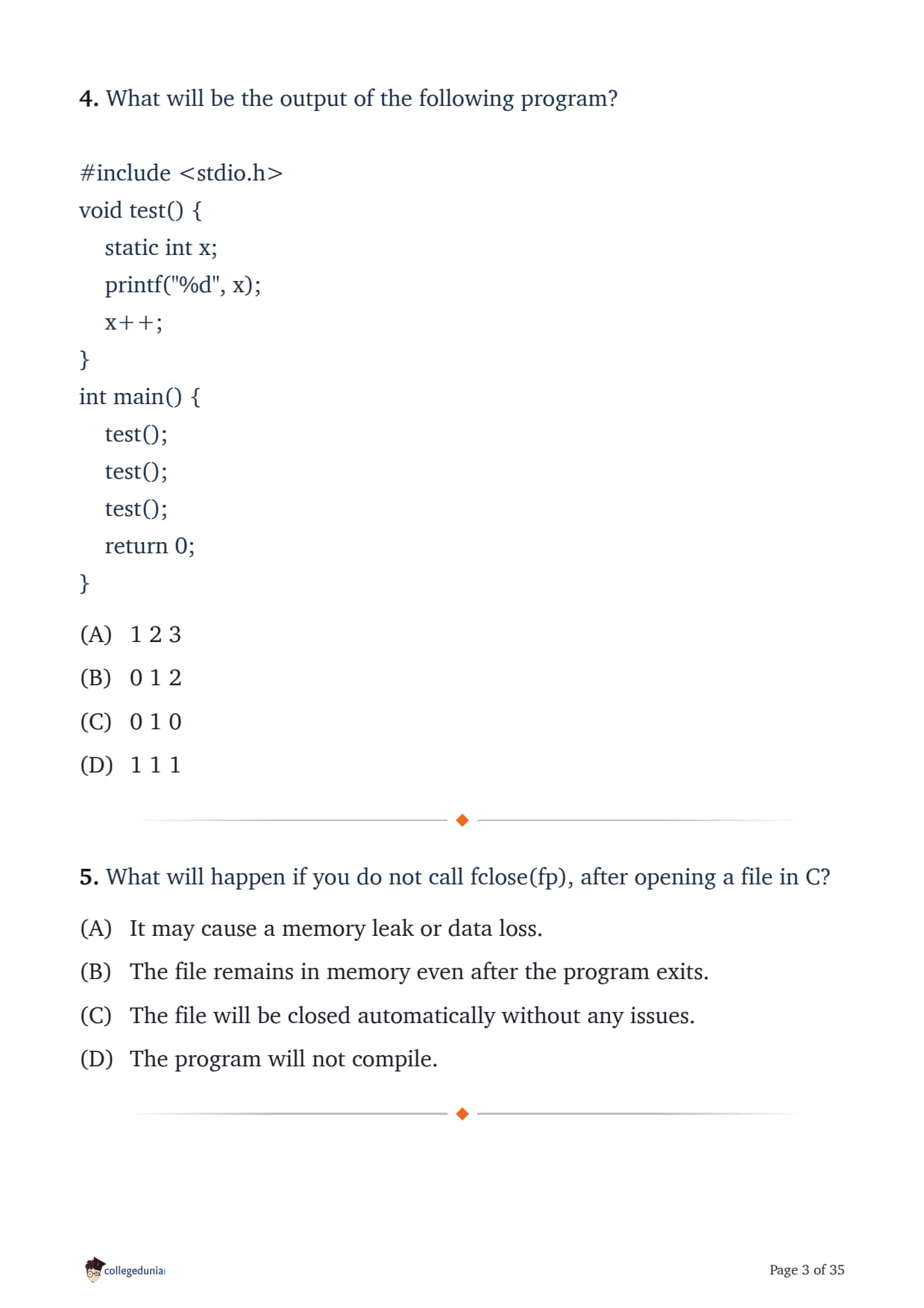
Question 4:

What will be the output of the following program?

#include <stdio.h>
void test() {
  static int x;
  printf("%d", x);
  x++;
}
int main() {
  test();
  test();
  test();
  return 0;
}

  • (A) 1 2 3
  • (B) 0 1 2
  • (C) 0 1 0
  • (D) 1 1 1

Question 5:

What will happen if you do not call fclose(fp), after opening a file in C?

  • (A) It may cause a memory leak or data loss.
  • (B) The file remains in memory even after the program exits.
  • (C) The file will be closed automatically without any issues.
  • (D) The program will not compile.

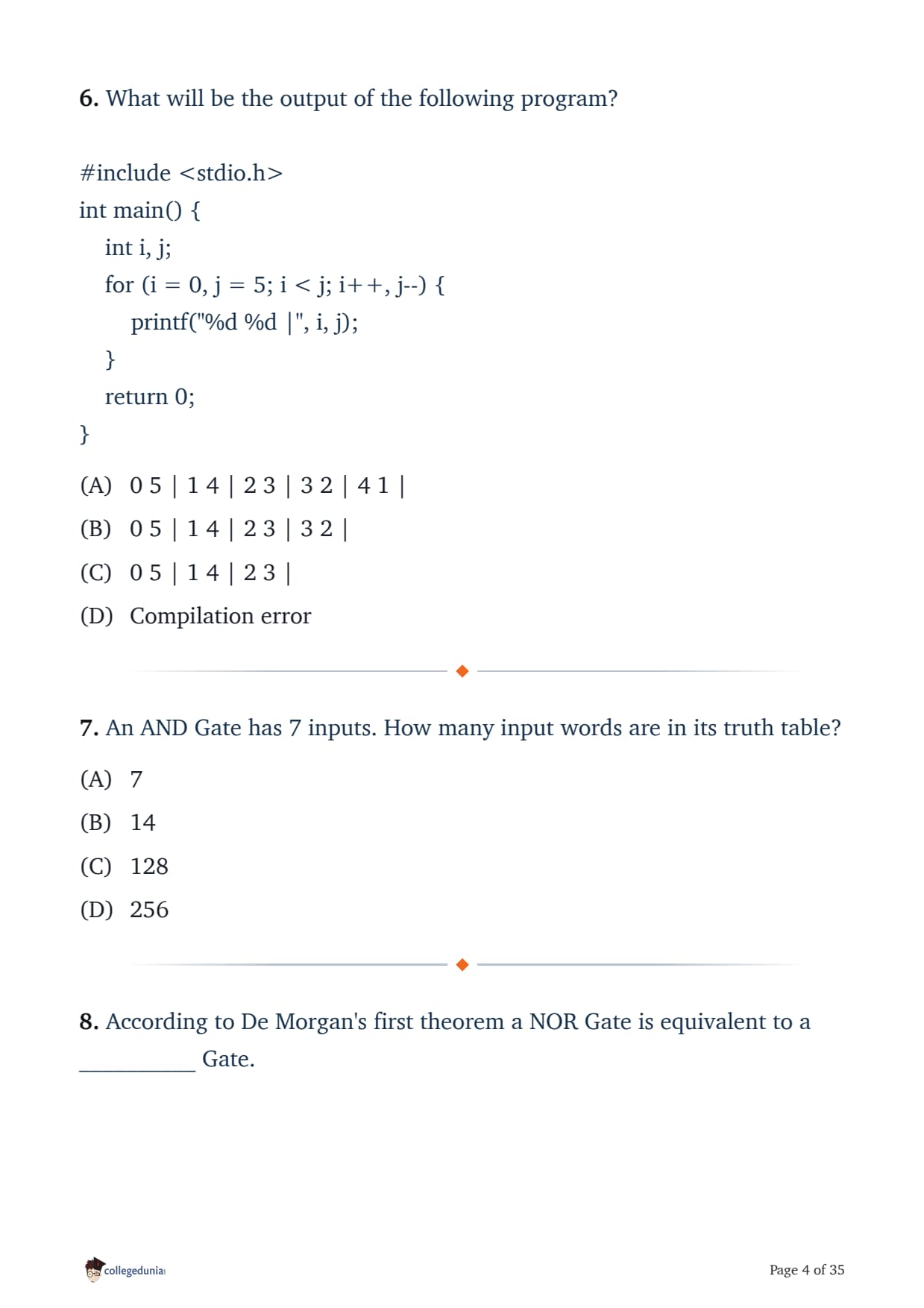
Question 6:

What will be the output of the following program?

#include <stdio.h>
int main() {
  int i, j;
  for (i = 0, j = 5; i < j; i++, j--) {
    printf("%d %d |", i, j);
  }
  return 0;
}

  • (A) 0 5 | 1 4 | 2 3 | 3 2 | 4 1 |
  • (B) 0 5 | 1 4 | 2 3 | 3 2 |
  • (C) 0 5 | 1 4 | 2 3 |
  • (D) Compilation error

Question 7:

An AND Gate has 7 inputs. How many input words are in its truth table?

  • (A) 7
  • (B) 14
  • (C) 128
  • (D) 256

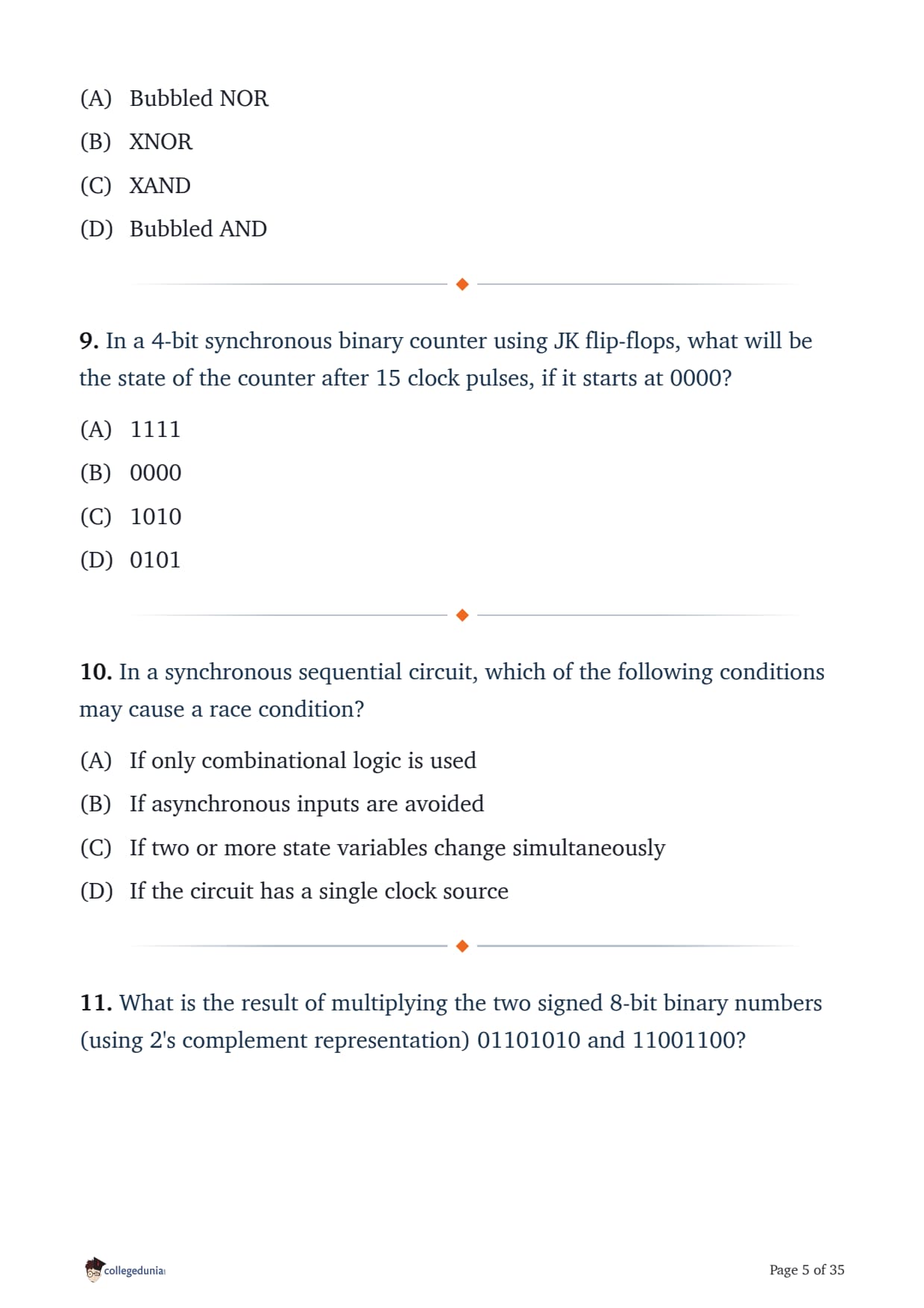
Question 8:

According to De Morgan's first theorem a NOR Gate is equivalent to a __________ Gate.

  • (A) Bubbled NOR
  • (B) XNOR
  • (C) XAND
  • (D) Bubbled AND

Question 9:

In a 4-bit synchronous binary counter using JK flip-flops, what will be the state of the counter after 15 clock pulses, if it starts at 0000?

  • (A) 1111
  • (B) 0000
  • (C) 1010
  • (D) 0101

Question 10:

In a synchronous sequential circuit, which of the following conditions may cause a race condition?

  • (A) If only combinational logic is used
  • (B) If asynchronous inputs are avoided
  • (C) If two or more state variables change simultaneously
  • (D) If the circuit has a single clock source

Question 11:

What is the result of multiplying the two signed 8-bit binary numbers (using 2's complement representation) 01101010 and 11001100?

  • (A) 0001110010111000
  • (B) 1110001100111000
  • (C) 0001110001001000
  • (D) 1110001101001000

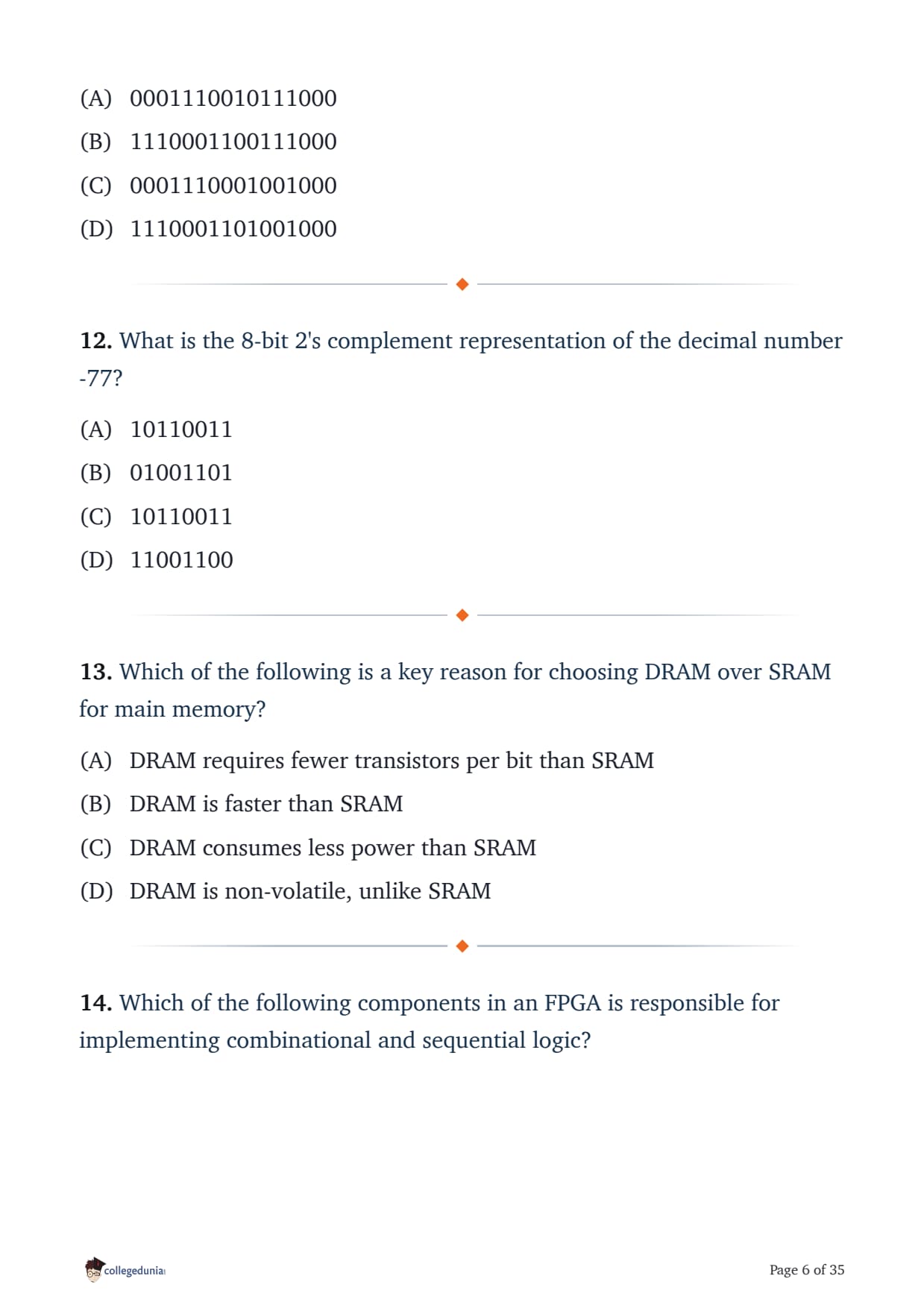
Question 12:

What is the 8-bit 2's complement representation of the decimal number -77?

  • (A) 10110011
  • (B) 01001101
  • (C) 10110011
  • (D) 11001100

Question 13:

Which of the following is a key reason for choosing DRAM over SRAM for main memory?

  • (A) DRAM requires fewer transistors per bit than SRAM
  • (B) DRAM is faster than SRAM
  • (C) DRAM consumes less power than SRAM
  • (D) DRAM is non-volatile, unlike SRAM

Question 14:

Which of the following components in an FPGA is responsible for implementing combinational and sequential logic?

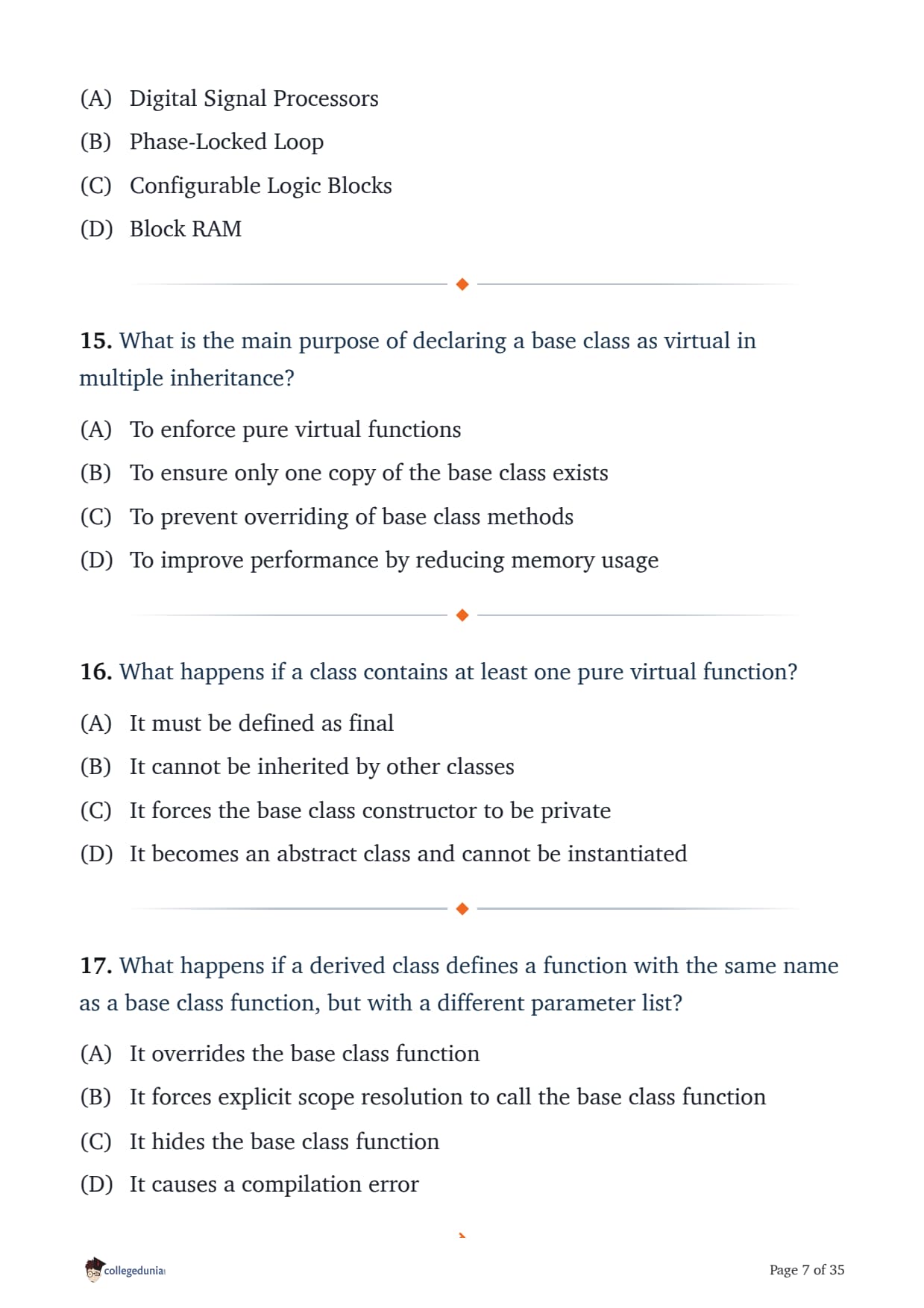
  • (A) Digital Signal Processors
  • (B) Phase-Locked Loop
  • (C) Configurable Logic Blocks
  • (D) Block RAM

Question 15:

What is the main purpose of declaring a base class as virtual in multiple inheritance?

  • (A) To enforce pure virtual functions
  • (B) To ensure only one copy of the base class exists
  • (C) To prevent overriding of base class methods
  • (D) To improve performance by reducing memory usage

Question 16:

What happens if a class contains at least one pure virtual function?

  • (A) It must be defined as final
  • (B) It cannot be inherited by other classes
  • (C) It forces the base class constructor to be private
  • (D) It becomes an abstract class and cannot be instantiated

Question 17:

What happens if a derived class defines a function with the same name as a base class function, but with a different parameter list?

  • (A) It overrides the base class function
  • (B) It forces explicit scope resolution to call the base class function
  • (C) It hides the base class function
  • (D) It causes a compilation error

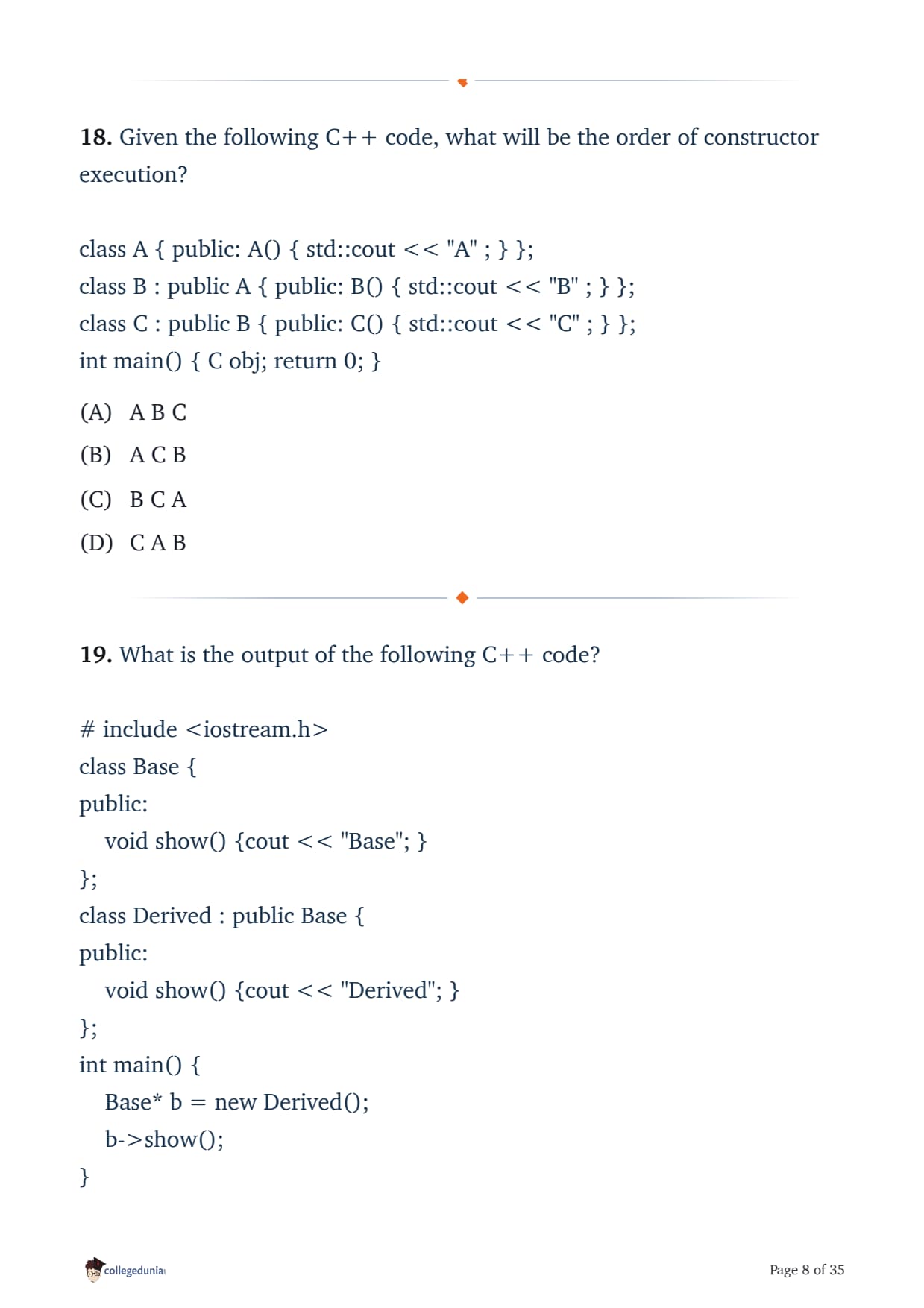
Question 18:

Given the following C++ code, what will be the order of constructor execution?

class A { public: A() { std::cout << "A" ; } };
class B : public A { public: B() { std::cout << "B" ; } };
class C : public B { public: C() { std::cout << "C" ; } };
int main() { C obj; return 0; }

  • (A) A B C
  • (B) A C B
  • (C) B C A
  • (D) C A B

Question 19:

What is the output of the following C++ code?

# include <iostream.h>
class Base {
public:
  void show() {cout << "Base"; }
};
class Derived : public Base {
public:
  void show() {cout << "Derived"; }
};
int main() {
  Base* b = new Derived();
  b->show();
}

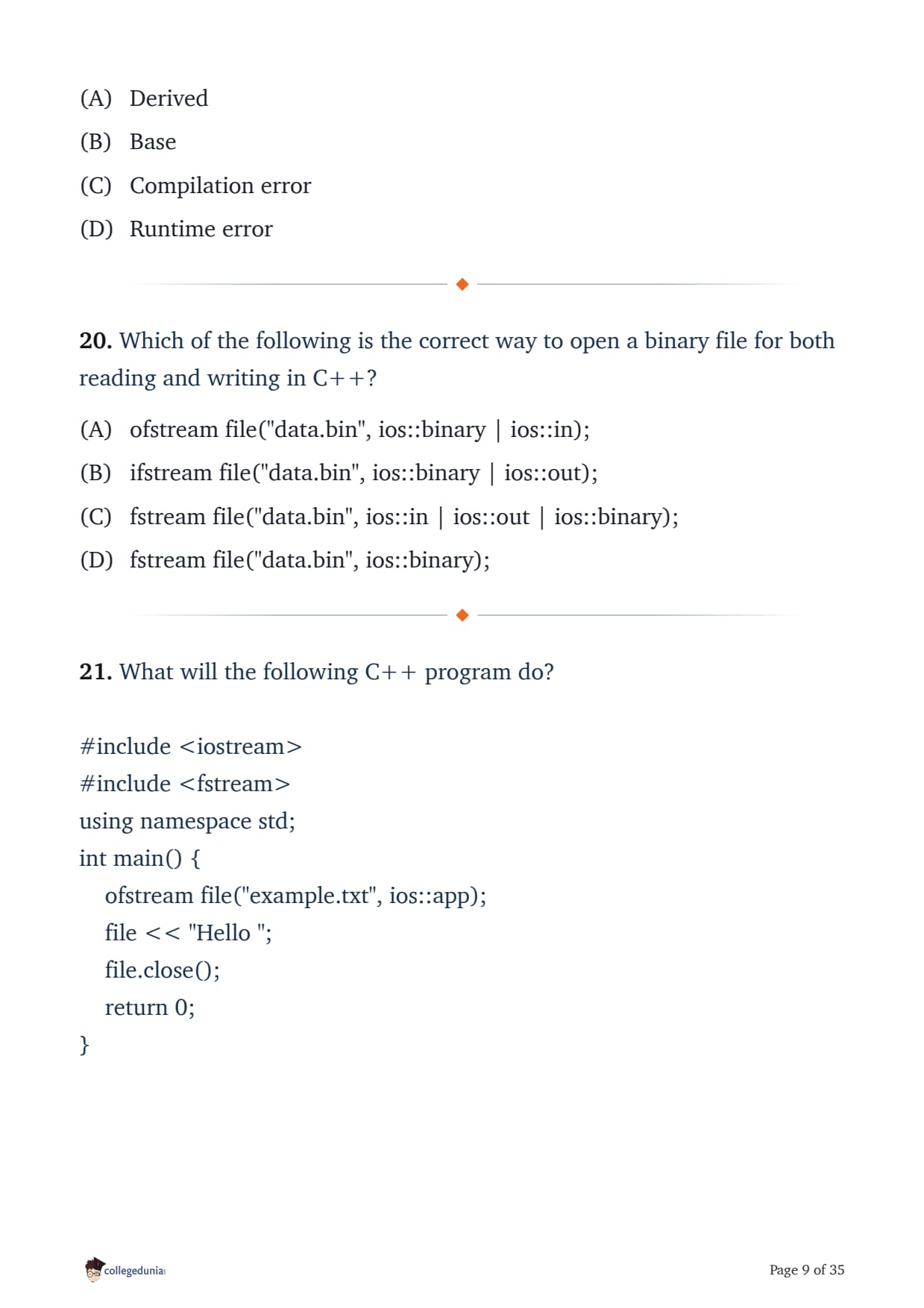
  • (A) Derived
  • (B) Base
  • (C) Compilation error
  • (D) Runtime error

Question 20:

Which of the following is the correct way to open a binary file for both reading and writing in C++?

  • (A) ofstream file("data.bin", ios::binary | ios::in);
  • (B) ifstream file("data.bin", ios::binary | ios::out);
  • (C) fstream file("data.bin", ios::in | ios::out | ios::binary);
  • (D) fstream file("data.bin", ios::binary);

Question 21:

What will the following C++ program do?

#include <iostream>
#include <fstream>
using namespace std;
int main() {
  ofstream file("example.txt", ios::app);
  file << "Hello ";
  file.close();
  return 0;
}

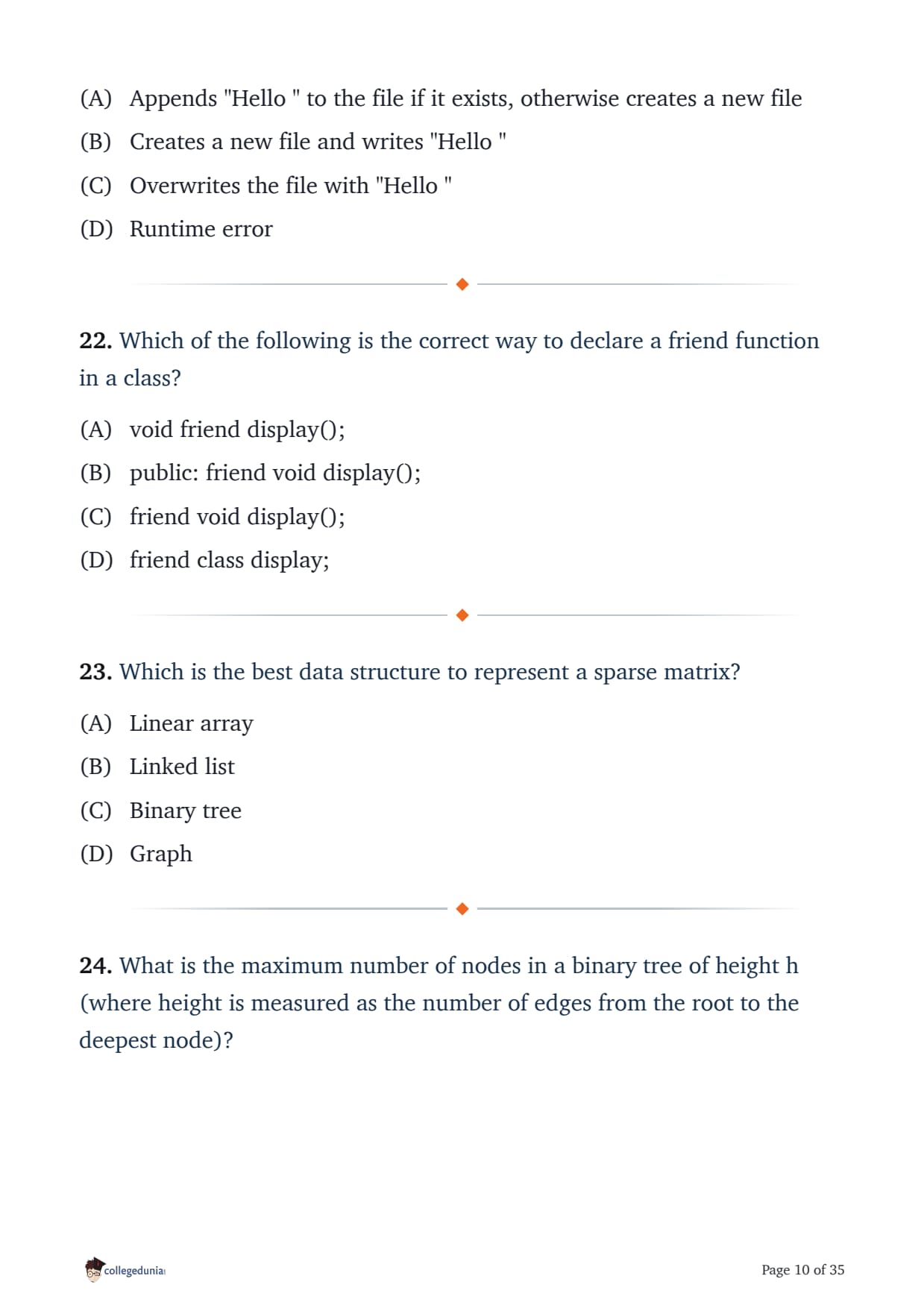
  • (A) Appends "Hello " to the file if it exists, otherwise creates a new file
  • (B) Creates a new file and writes "Hello "
  • (C) Overwrites the file with "Hello "
  • (D) Runtime error

Question 22:

Which of the following is the correct way to declare a friend function in a class?

  • (A) void friend display();
  • (B) public: friend void display();
  • (C) friend void display();
  • (D) friend class display;

Question 23:

Which is the best data structure to represent a sparse matrix?

  • (A) Linear array
  • (B) Linked list
  • (C) Binary tree
  • (D) Graph

Question 24:

What is the maximum number of nodes in a binary tree of height h (where height is measured as the number of edges from the root to the deepest node)?

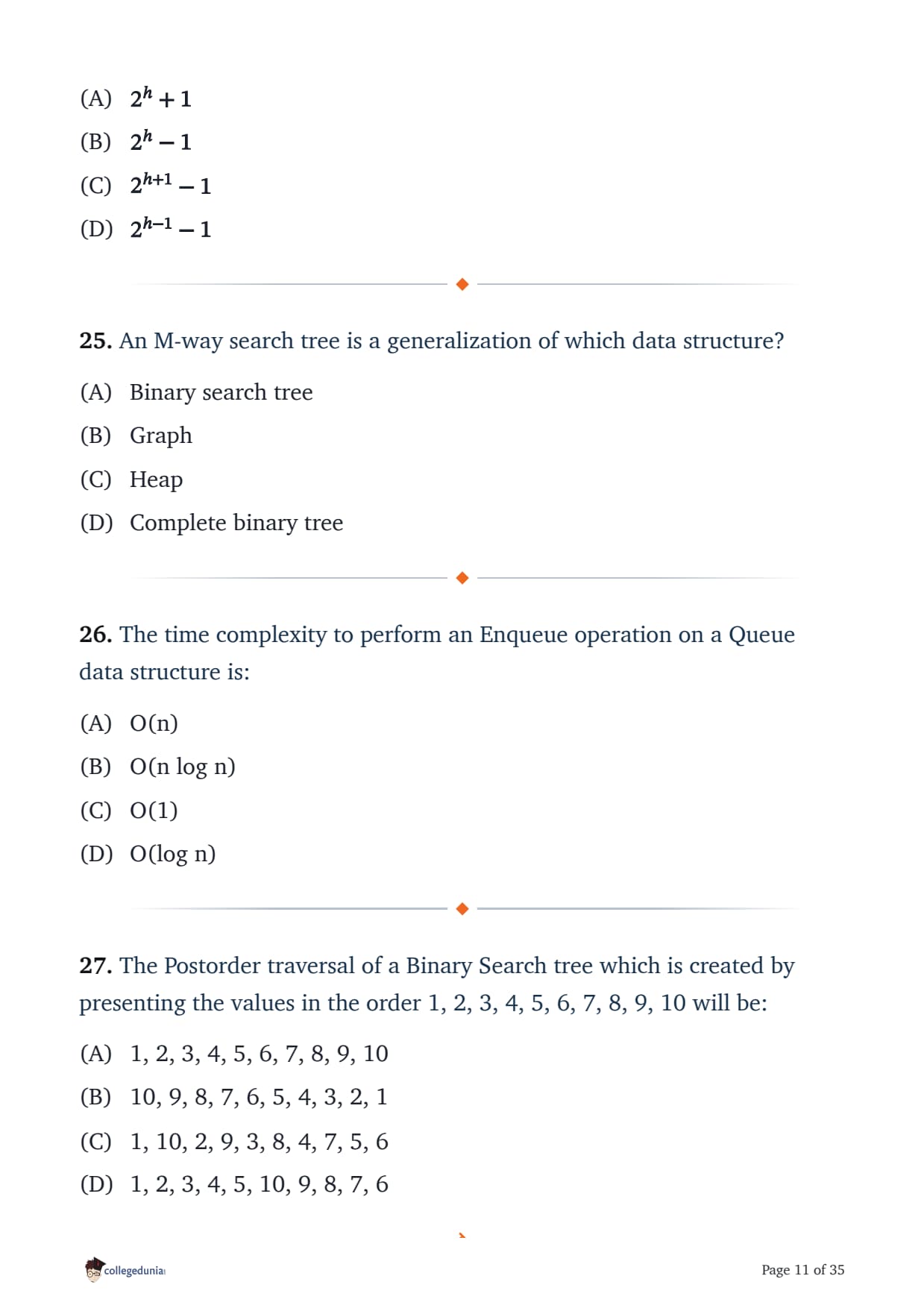
  • (A) \( 2^{h} + 1 \)
  • (B) \( 2^{h} - 1 \)
  • (C) \( 2^{h+1} - 1 \)
  • (D) \( 2^{h-1} - 1 \)

Question 25:

An M-way search tree is a generalization of which data structure?

  • (A) Binary search tree
  • (B) Graph
  • (C) Heap
  • (D) Complete binary tree

Question 26:

The time complexity to perform an Enqueue operation on a Queue data structure is:

  • (A) O(n)
  • (B) O(n log n)
  • (C) O(1)
  • (D) O(log n)

Question 27:

The Postorder traversal of a Binary Search tree which is created by presenting the values in the order 1, 2, 3, 4, 5, 6, 7, 8, 9, 10 will be:

  • (A) 1, 2, 3, 4, 5, 6, 7, 8, 9, 10
  • (B) 10, 9, 8, 7, 6, 5, 4, 3, 2, 1
  • (C) 1, 10, 2, 9, 3, 8, 4, 7, 5, 6
  • (D) 1, 2, 3, 4, 5, 10, 9, 8, 7, 6

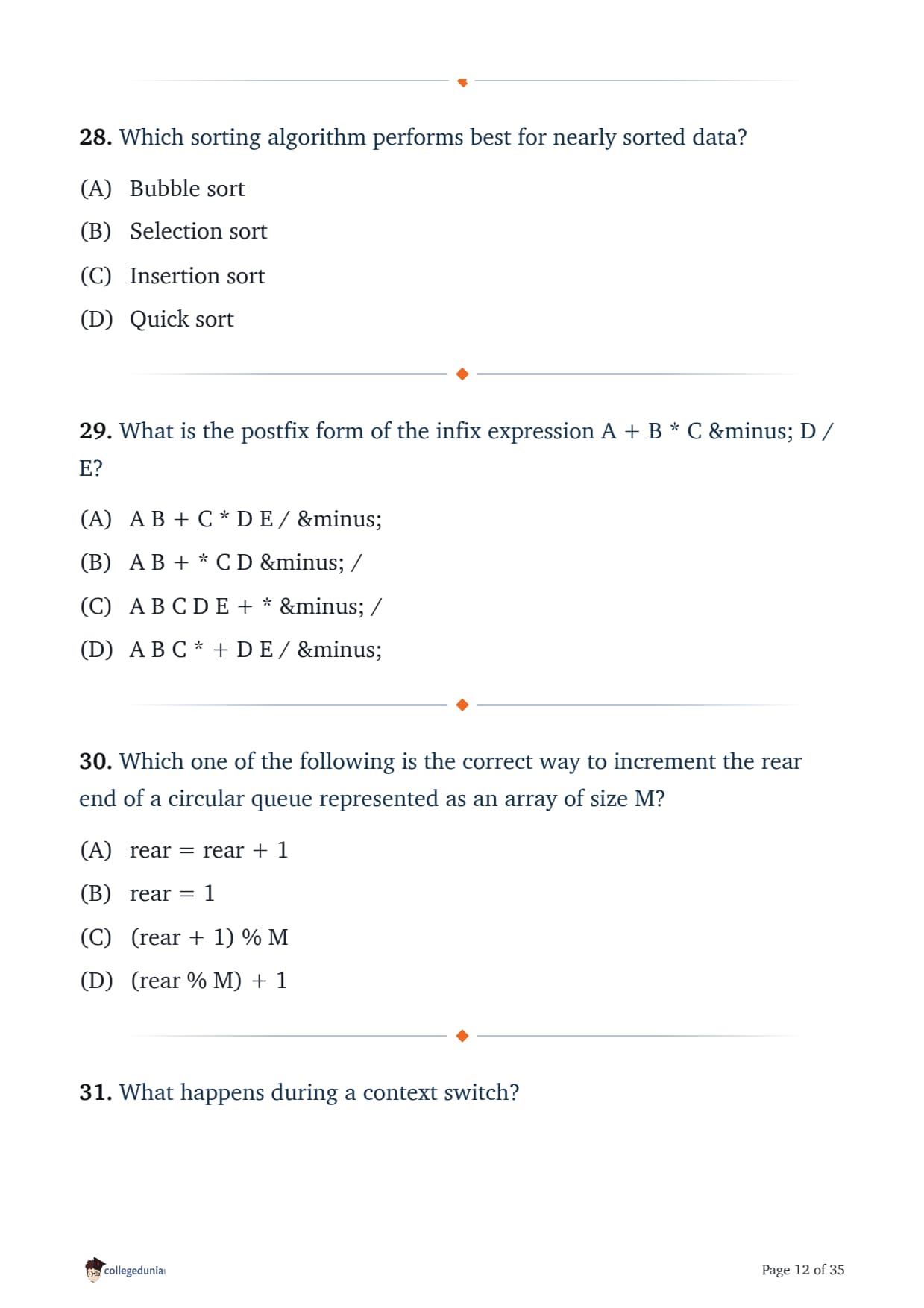
Question 28:

Which sorting algorithm performs best for nearly sorted data?

  • (A) Bubble sort
  • (B) Selection sort
  • (C) Insertion sort
  • (D) Quick sort

Question 29:

What is the postfix form of the infix expression A + B * C &minus; D / E?

  • (A) A B + C * D E / &minus;
  • (B) A B + * C D &minus; /
  • (C) A B C D E + * &minus; /
  • (D) A B C * + D E / &minus;

Question 30:

Which one of the following is the correct way to increment the rear end of a circular queue represented as an array of size M?

  • (A) rear = rear + 1
  • (B) rear = 1
  • (C) (rear + 1) % M
  • (D) (rear % M) + 1

Question 31:

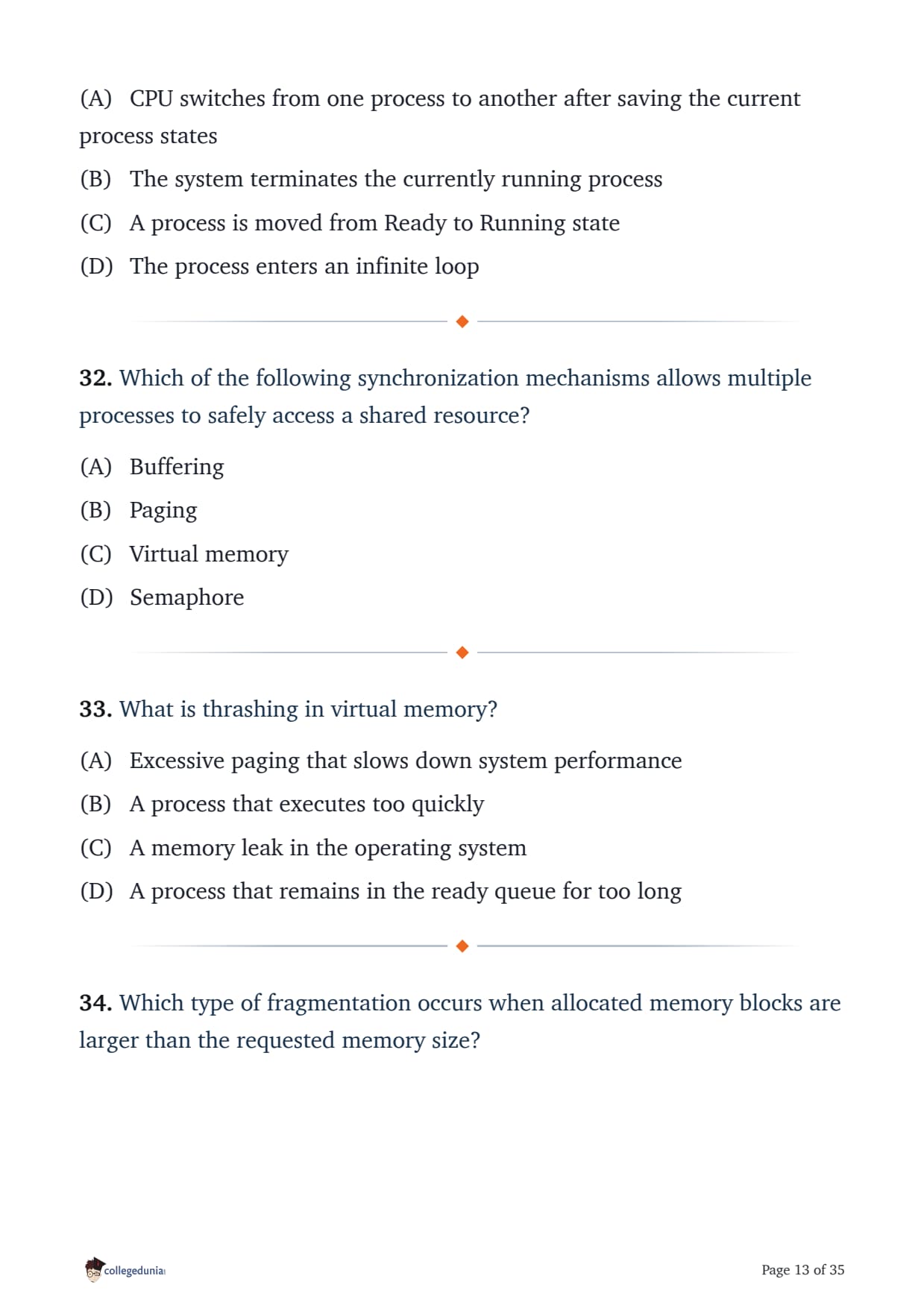
What happens during a context switch?

  • (A) CPU switches from one process to another after saving the current process states
  • (B) The system terminates the currently running process
  • (C) A process is moved from Ready to Running state
  • (D) The process enters an infinite loop

Question 32:

Which of the following synchronization mechanisms allows multiple processes to safely access a shared resource?

  • (A) Buffering
  • (B) Paging
  • (C) Virtual memory
  • (D) Semaphore

Question 33:

What is thrashing in virtual memory?

  • (A) Excessive paging that slows down system performance
  • (B) A process that executes too quickly
  • (C) A memory leak in the operating system
  • (D) A process that remains in the ready queue for too long

Question 34:

Which type of fragmentation occurs when allocated memory blocks are larger than the requested memory size?

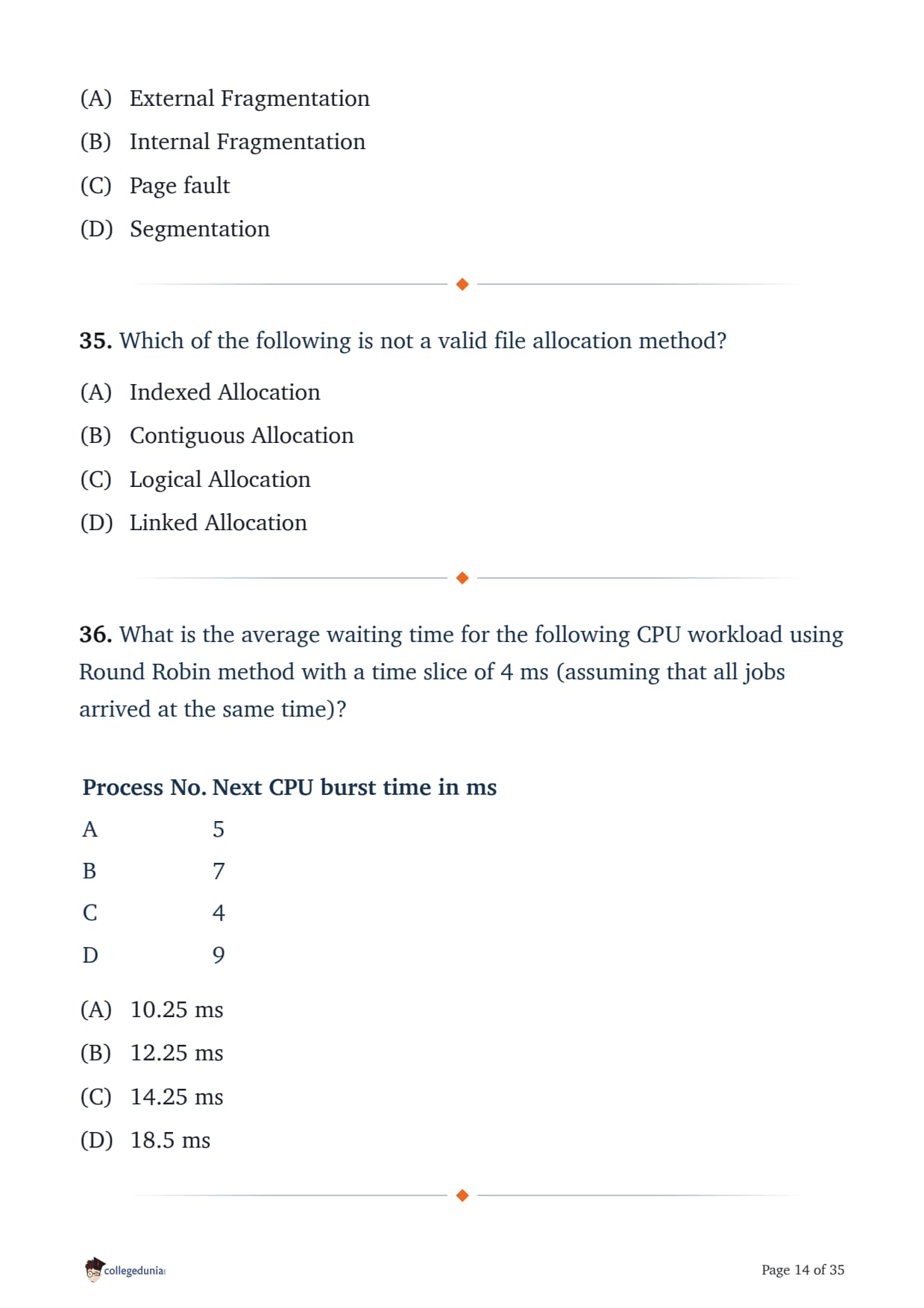
  • (A) External Fragmentation
  • (B) Internal Fragmentation
  • (C) Page fault
  • (D) Segmentation

Question 35:

Which of the following is not a valid file allocation method?

  • (A) Indexed Allocation
  • (B) Contiguous Allocation
  • (C) Logical Allocation
  • (D) Linked Allocation

Question 36:

What is the average waiting time for the following CPU workload using Round Robin method with a time slice of 4 ms (assuming that all jobs arrived at the same time)?

 
Process No. Next CPU burst time in ms
A 5
B 7
C 4
D 9
  • (A) 10.25 ms
  • (B) 12.25 ms
  • (C) 14.25 ms
  • (D) 18.5 ms

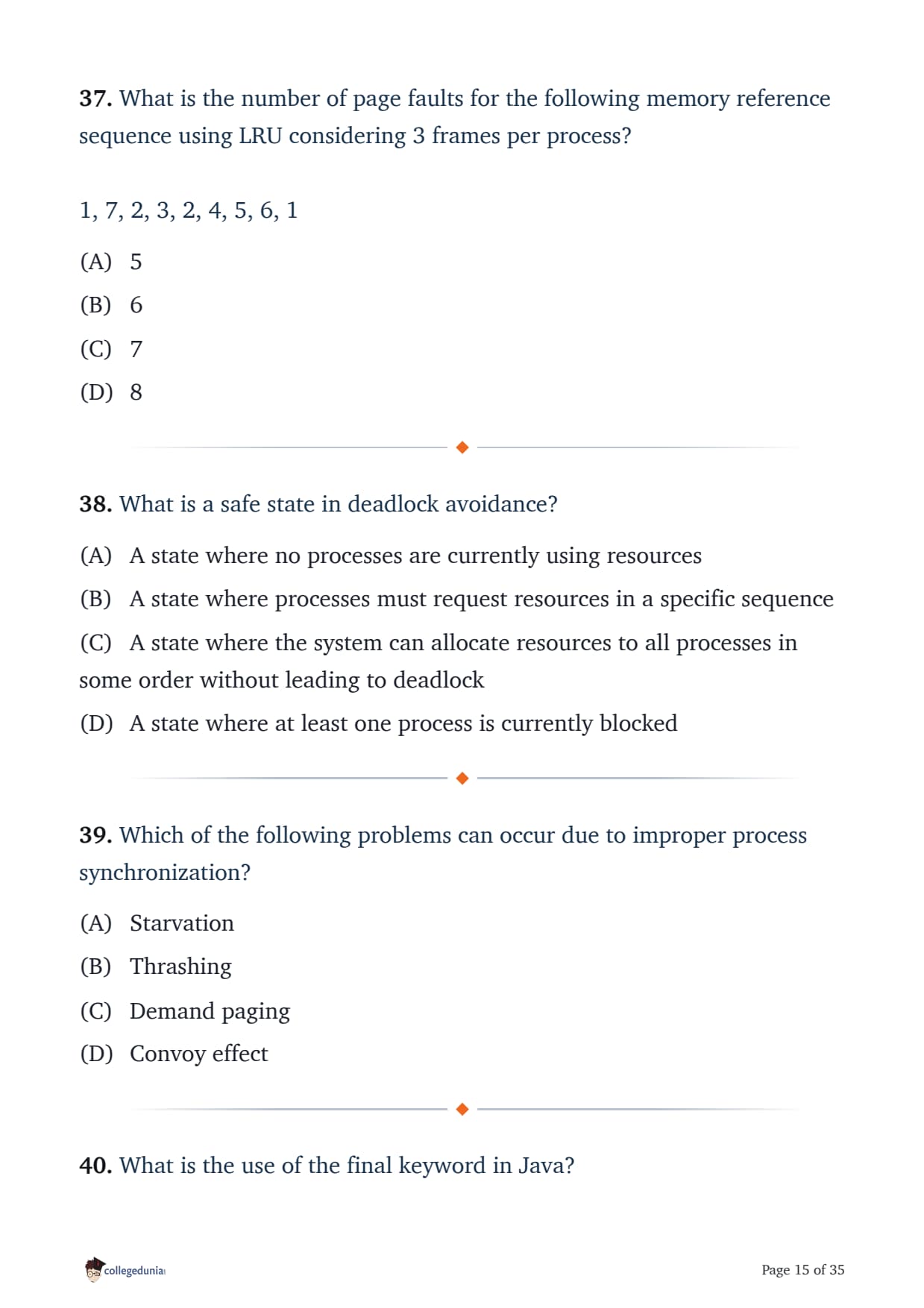
Question 37:

What is the number of page faults for the following memory reference sequence using LRU considering 3 frames per process?

1, 7, 2, 3, 2, 4, 5, 6, 1

  • (A) 5
  • (B) 6
  • (C) 7
  • (D) 8

Question 38:

What is a safe state in deadlock avoidance?

  • (A) A state where no processes are currently using resources
  • (B) A state where processes must request resources in a specific sequence
  • (C) A state where the system can allocate resources to all processes in some order without leading to deadlock
  • (D) A state where at least one process is currently blocked

Question 39:

Which of the following problems can occur due to improper process synchronization?

  • (A) Starvation
  • (B) Thrashing
  • (C) Demand paging
  • (D) Convoy effect

Question 40:

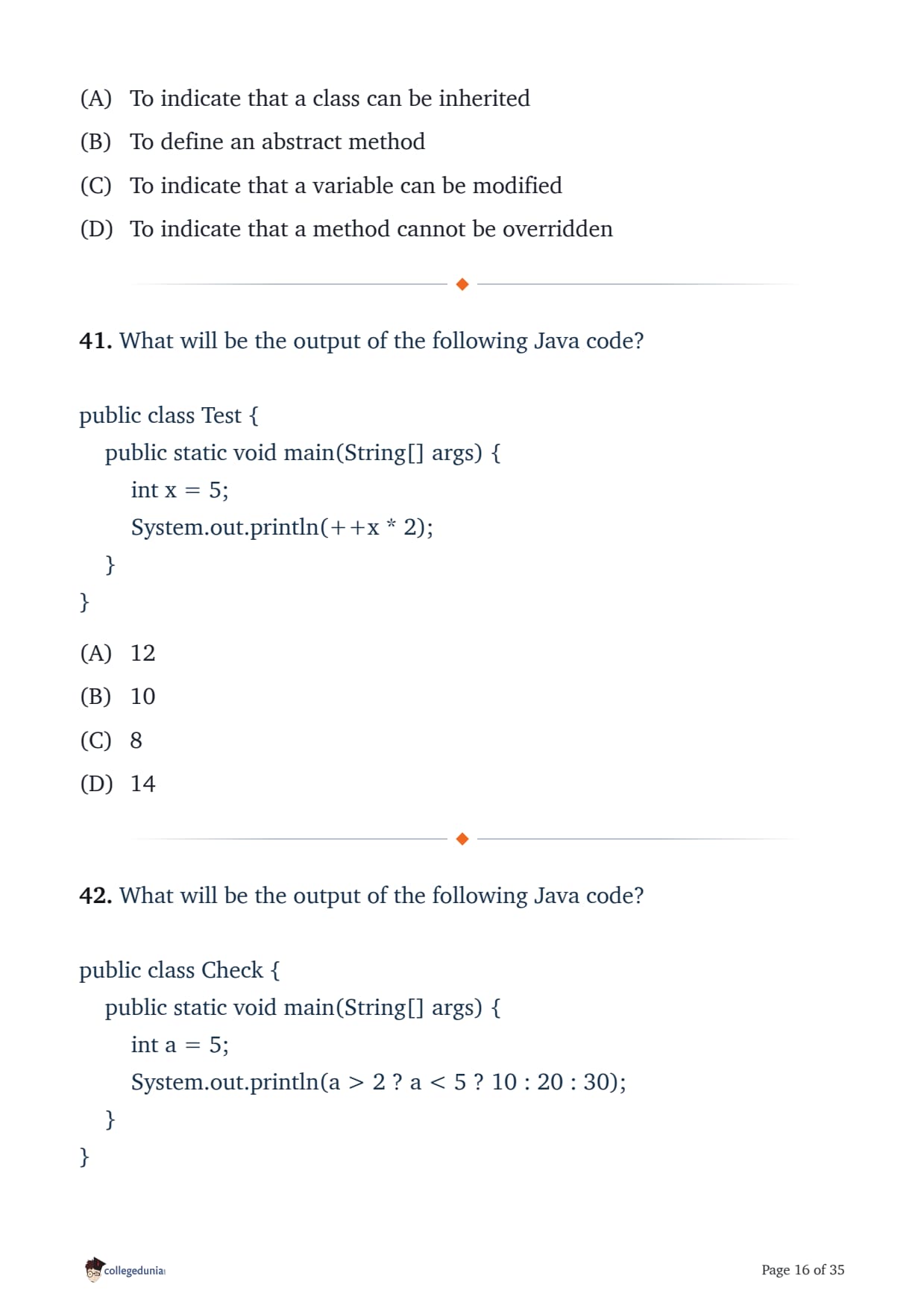
What is the use of the final keyword in Java?

  • (A) To indicate that a class can be inherited
  • (B) To define an abstract method
  • (C) To indicate that a variable can be modified
  • (D) To indicate that a method cannot be overridden

Question 41:

What will be the output of the following Java code?

public class Test {
  public static void main(String[] args) {
    int x = 5;
    System.out.println(++x * 2);
  }
}

  • (A) 12
  • (B) 10
  • (C) 8
  • (D) 14

Question 42:

What will be the output of the following Java code?

public class Check {
  public static void main(String[] args) {
    int a = 5;
    System.out.println(a > 2 ? a < 5 ? 10 : 20 : 30);
  }
}

  • (A) 5
  • (B) 10
  • (C) 20
  • (D) 30

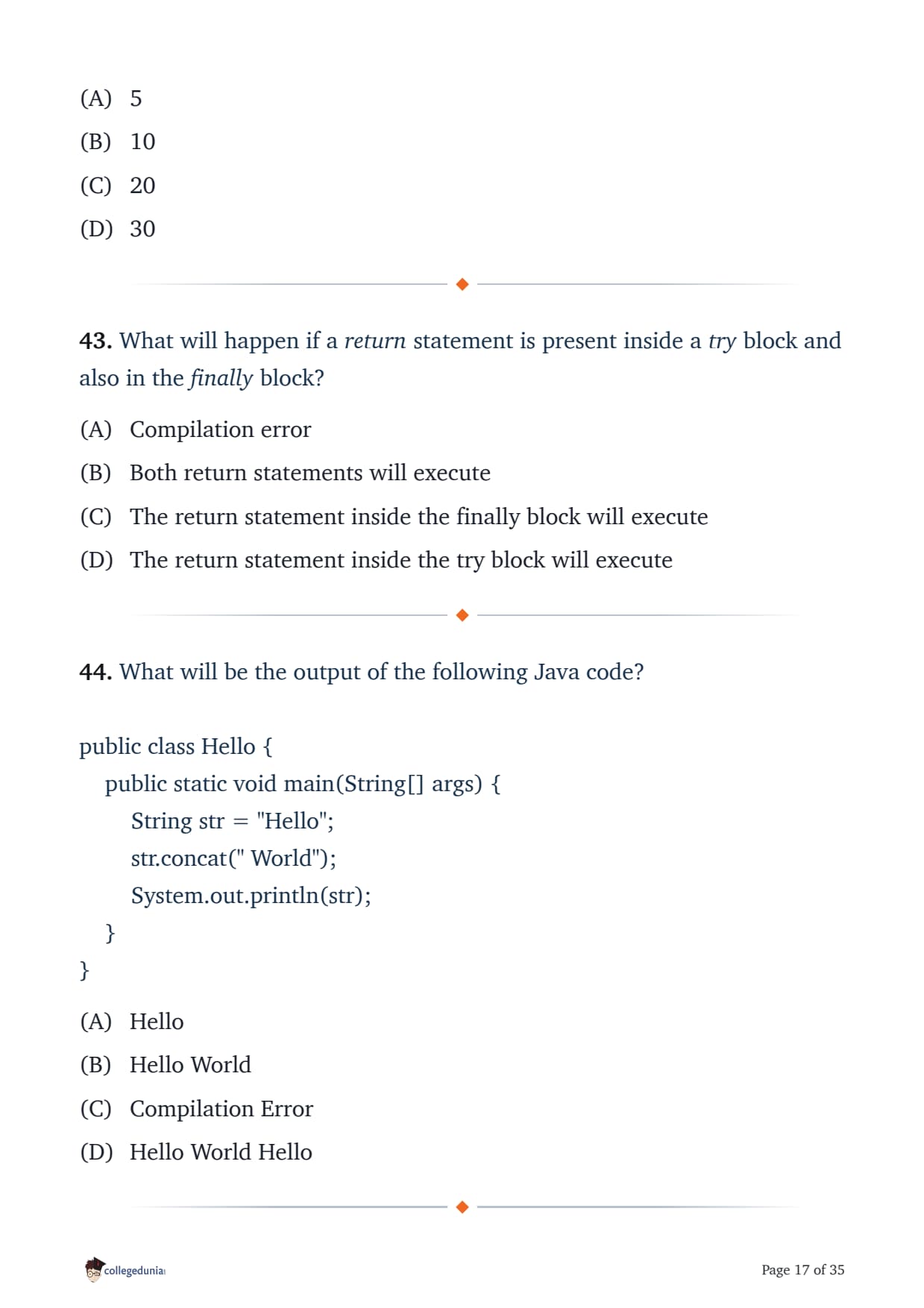
Question 43:

What will happen if a return statement is present inside a try block and also in the finally block?

  • (A) Compilation error
  • (B) Both return statements will execute
  • (C) The return statement inside the finally block will execute
  • (D) The return statement inside the try block will execute

Question 44:

What will be the output of the following Java code?

public class Hello {
  public static void main(String[] args) {
    String str = "Hello";
    str.concat(" World");
    System.out.println(str);
  }
}

  • (A) Hello
  • (B) Hello World
  • (C) Compilation Error
  • (D) Hello World Hello

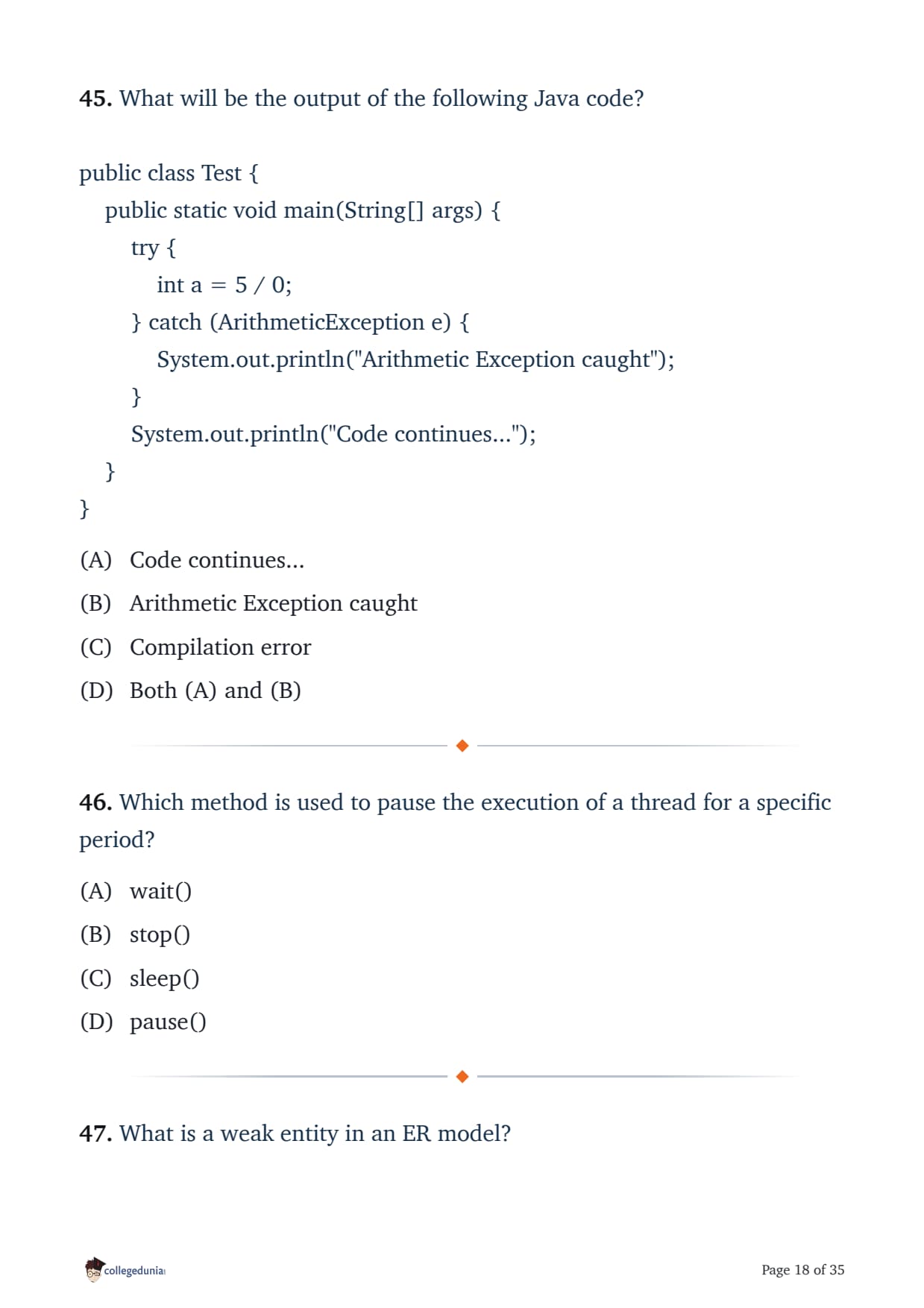
Question 45:

What will be the output of the following Java code?

public class Test {
  public static void main(String[] args) {
    try {
      int a = 5 / 0;
    } catch (ArithmeticException e) {
      System.out.println("Arithmetic Exception caught");
    }
    System.out.println("Code continues...");
  }
}

  • (A) Code continues...
  • (B) Arithmetic Exception caught
  • (C) Compilation error
  • (D) Both (A) and (B)

Question 46:

Which method is used to pause the execution of a thread for a specific period?

  • (A) wait()
  • (B) stop()
  • (C) sleep()
  • (D) pause()

Question 47:

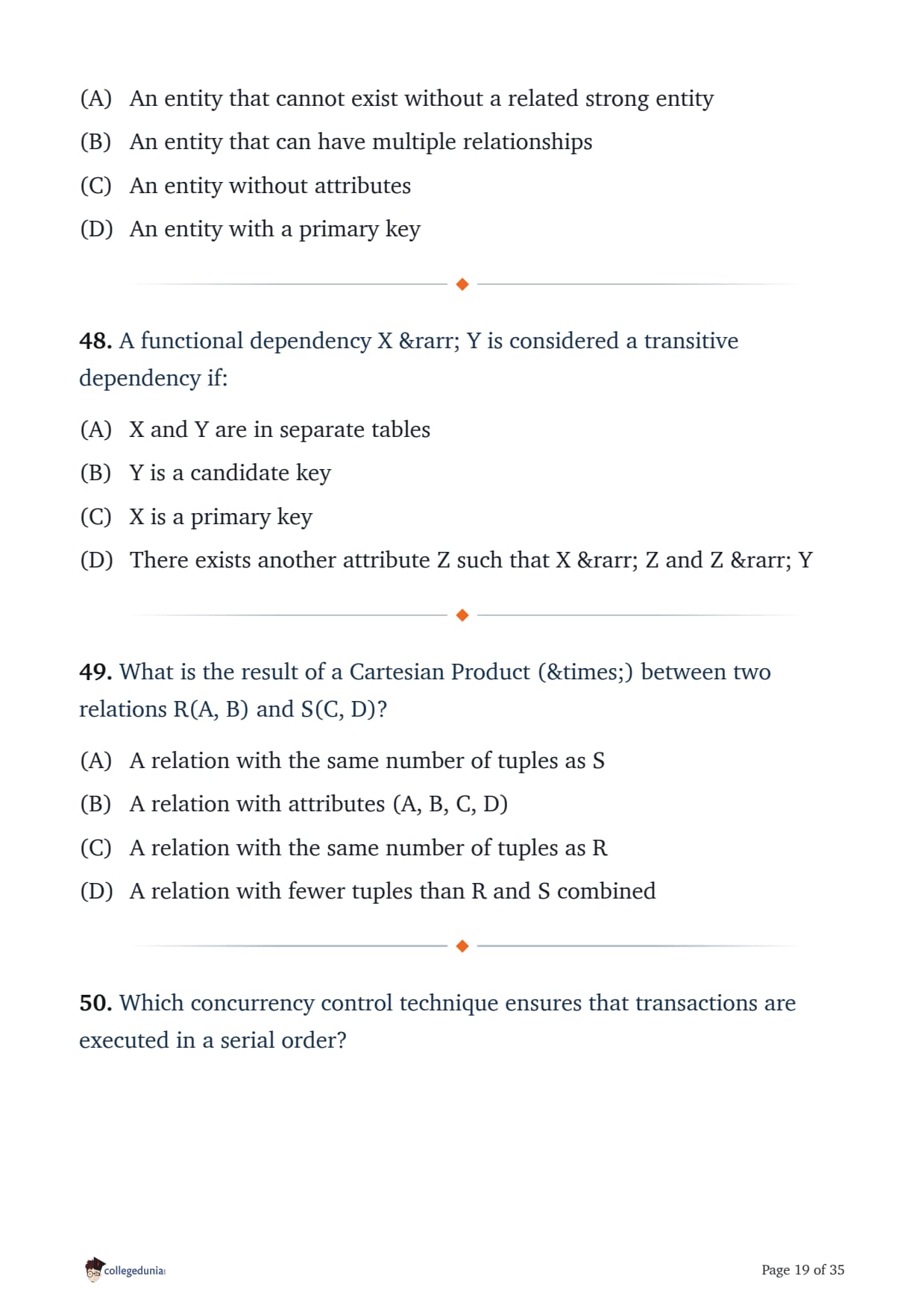
What is a weak entity in an ER model?

  • (A) An entity that cannot exist without a related strong entity
  • (B) An entity that can have multiple relationships
  • (C) An entity without attributes
  • (D) An entity with a primary key

Question 48:

A functional dependency X &rarr; Y is considered a transitive dependency if:

  • (A) X and Y are in separate tables
  • (B) Y is a candidate key
  • (C) X is a primary key
  • (D) There exists another attribute Z such that X &rarr; Z and Z &rarr; Y

Question 49:

What is the result of a Cartesian Product (&times;) between two relations R(A, B) and S(C, D)?

  • (A) A relation with the same number of tuples as S
  • (B) A relation with attributes (A, B, C, D)
  • (C) A relation with the same number of tuples as R
  • (D) A relation with fewer tuples than R and S combined

Question 50:

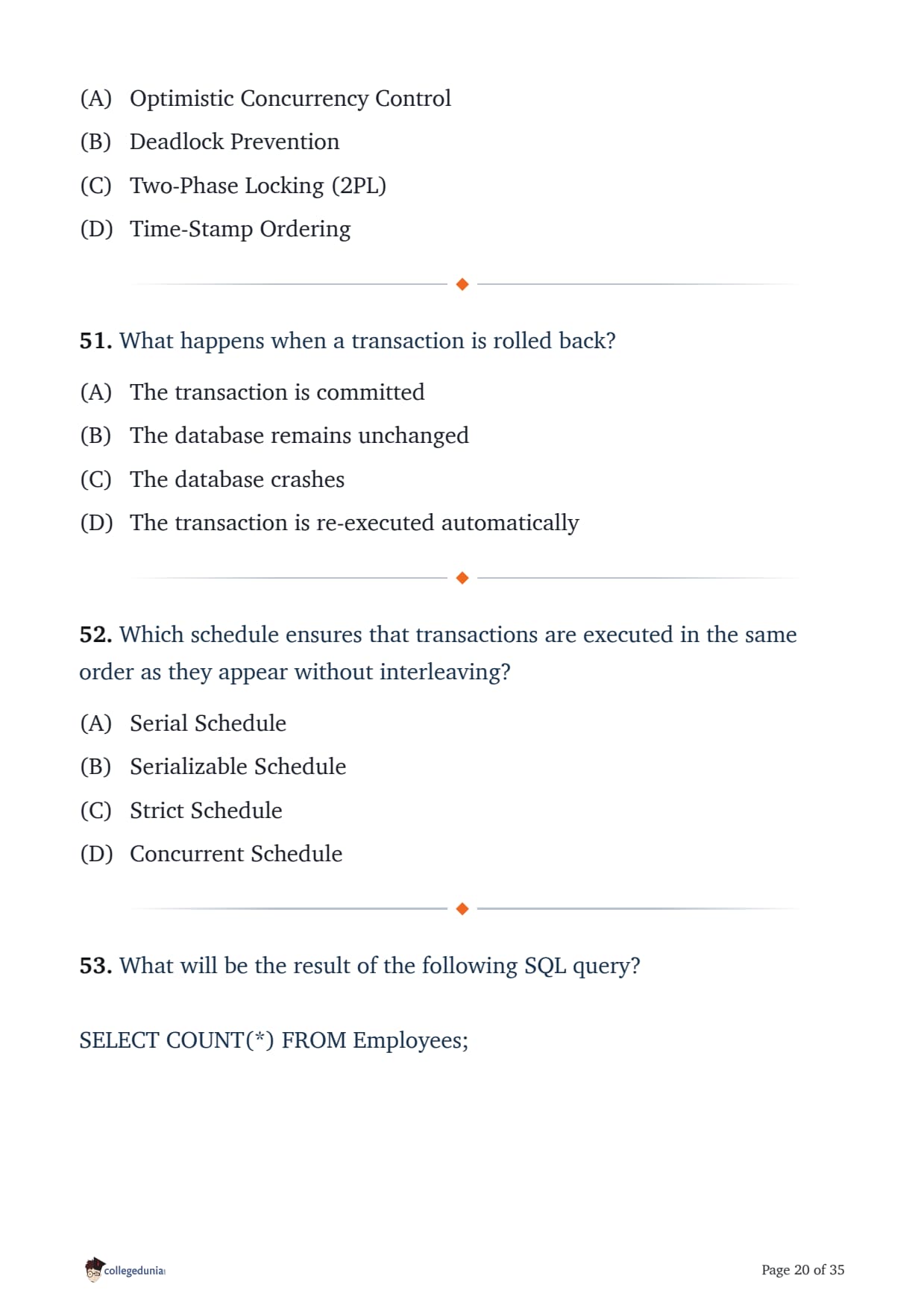
Which concurrency control technique ensures that transactions are executed in a serial order?

  • (A) Optimistic Concurrency Control
  • (B) Deadlock Prevention
  • (C) Two-Phase Locking (2PL)
  • (D) Time-Stamp Ordering

Question 51:

What happens when a transaction is rolled back?

  • (A) The transaction is committed
  • (B) The database remains unchanged
  • (C) The database crashes
  • (D) The transaction is re-executed automatically

Question 52:

Which schedule ensures that transactions are executed in the same order as they appear without interleaving?

  • (A) Serial Schedule
  • (B) Serializable Schedule
  • (C) Strict Schedule
  • (D) Concurrent Schedule

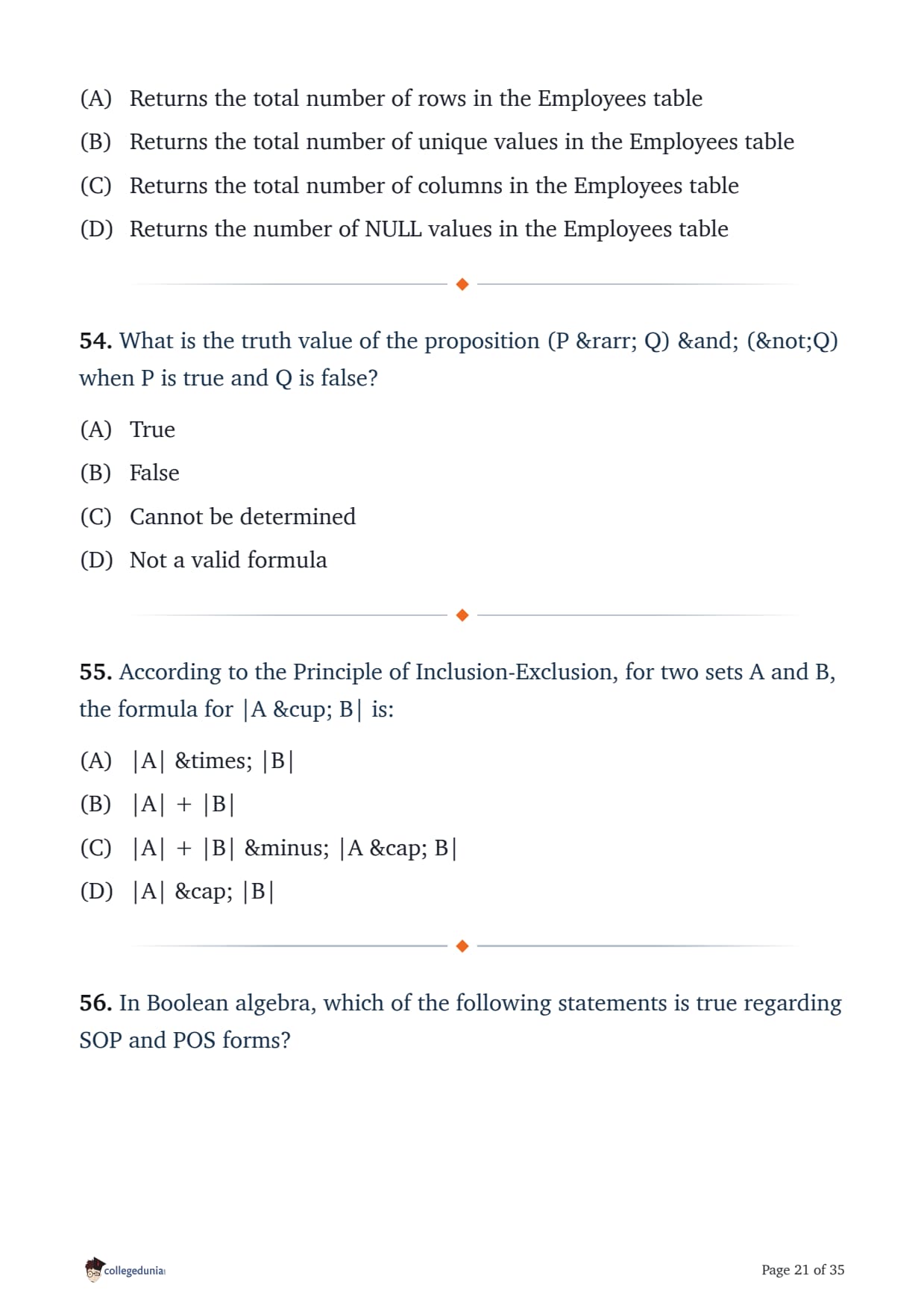
Question 53:

What will be the result of the following SQL query?

SELECT COUNT(*) FROM Employees;

  • (A) Returns the total number of rows in the Employees table
  • (B) Returns the total number of unique values in the Employees table
  • (C) Returns the total number of columns in the Employees table
  • (D) Returns the number of NULL values in the Employees table

Question 54:

What is the truth value of the proposition (P &rarr; Q) &and; (&not;Q) when P is true and Q is false?

  • (A) True
  • (B) False
  • (C) Cannot be determined
  • (D) Not a valid formula

Question 55:

According to the Principle of Inclusion-Exclusion, for two sets A and B, the formula for |A &cup; B| is:

  • (A) |A| &times; |B|
  • (B) |A| + |B|
  • (C) |A| + |B| &minus; |A &cap; B|
  • (D) |A| &cap; |B|

Question 56:

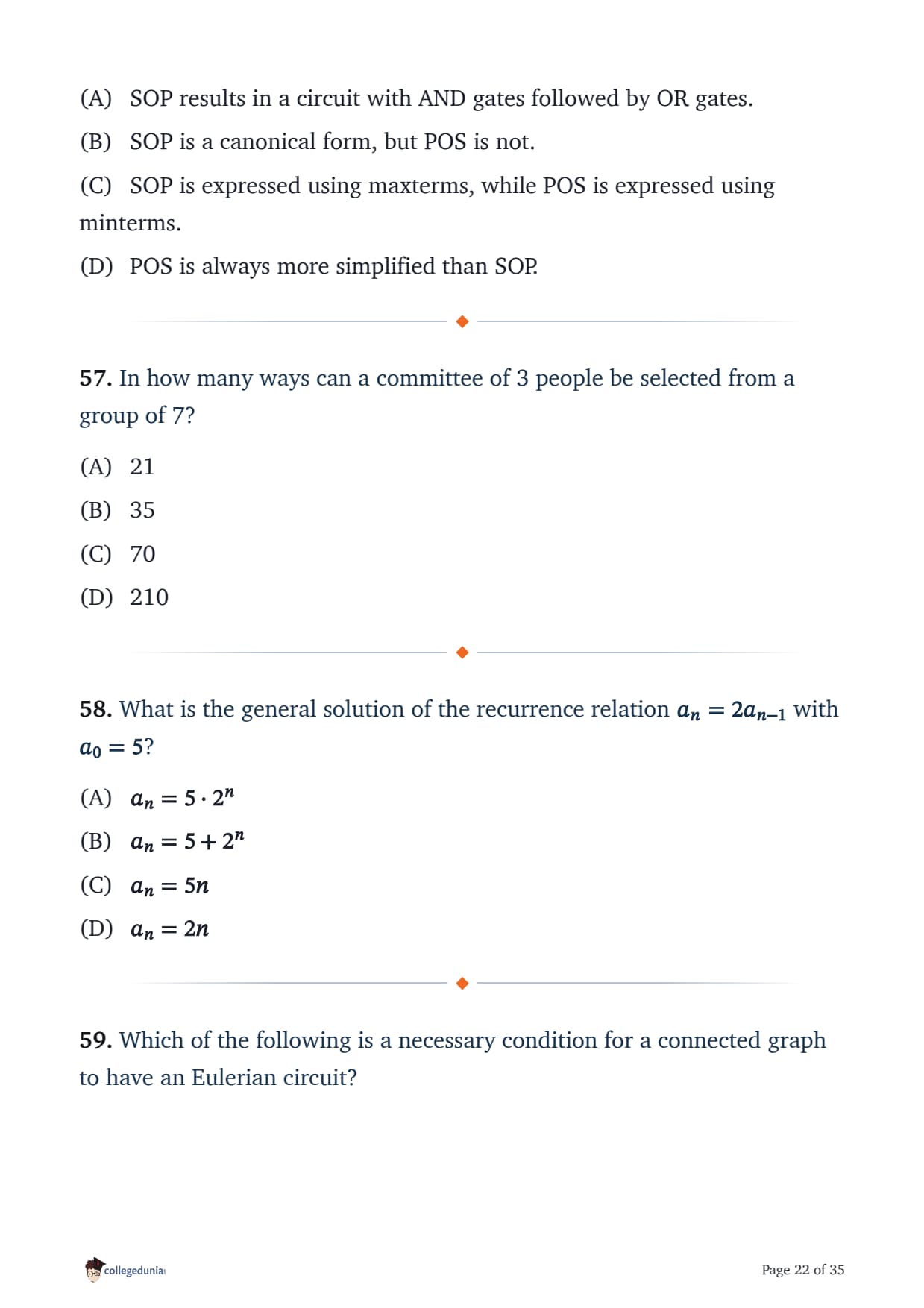
In Boolean algebra, which of the following statements is true regarding SOP and POS forms?

  • (A) SOP results in a circuit with AND gates followed by OR gates.
  • (B) SOP is a canonical form, but POS is not.
  • (C) SOP is expressed using maxterms, while POS is expressed using minterms.
  • (D) POS is always more simplified than SOP.

Question 57:

In how many ways can a committee of 3 people be selected from a group of 7?

  • (A) 21
  • (B) 35
  • (C) 70
  • (D) 210

Question 58:

What is the general solution of the recurrence relation \( a_n = 2a_{n-1} \) with \( a_0 = 5 \)?

  • (A) \( a_n = 5 \cdot 2^n \)
  • (B) \( a_n = 5 + 2^n \)
  • (C) \( a_n = 5n \)
  • (D) \( a_n = 2n \)

Question 59:

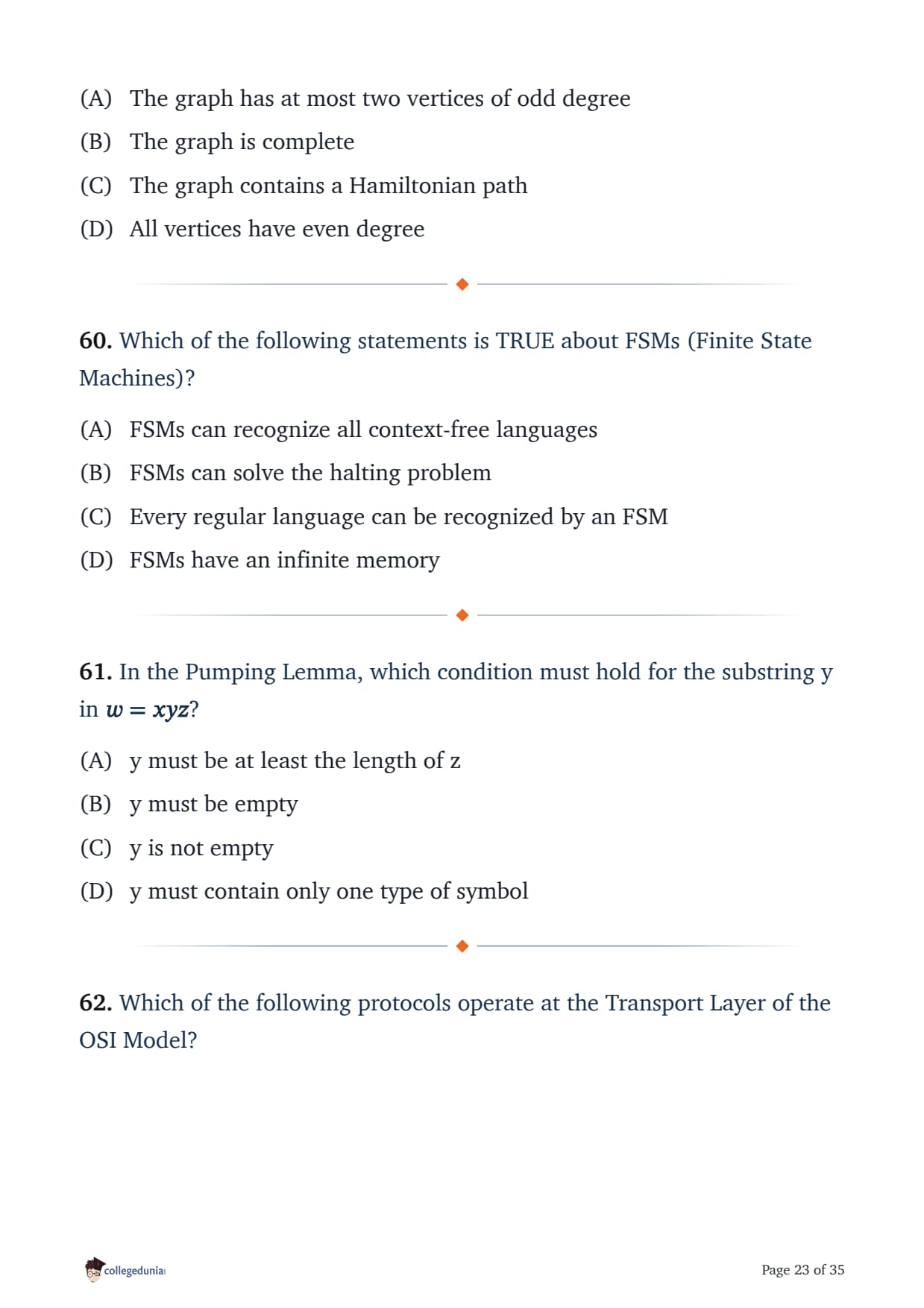
Which of the following is a necessary condition for a connected graph to have an Eulerian circuit?

  • (A) The graph has at most two vertices of odd degree
  • (B) The graph is complete
  • (C) The graph contains a Hamiltonian path
  • (D) All vertices have even degree

Question 60:

Which of the following statements is TRUE about FSMs (Finite State Machines)?

  • (A) FSMs can recognize all context-free languages
  • (B) FSMs can solve the halting problem
  • (C) Every regular language can be recognized by an FSM
  • (D) FSMs have an infinite memory

Question 61:

In the Pumping Lemma, which condition must hold for the substring y in \( w = xyz \)?

  • (A) y must be at least the length of z
  • (B) y must be empty
  • (C) y is not empty
  • (D) y must contain only one type of symbol

Question 62:

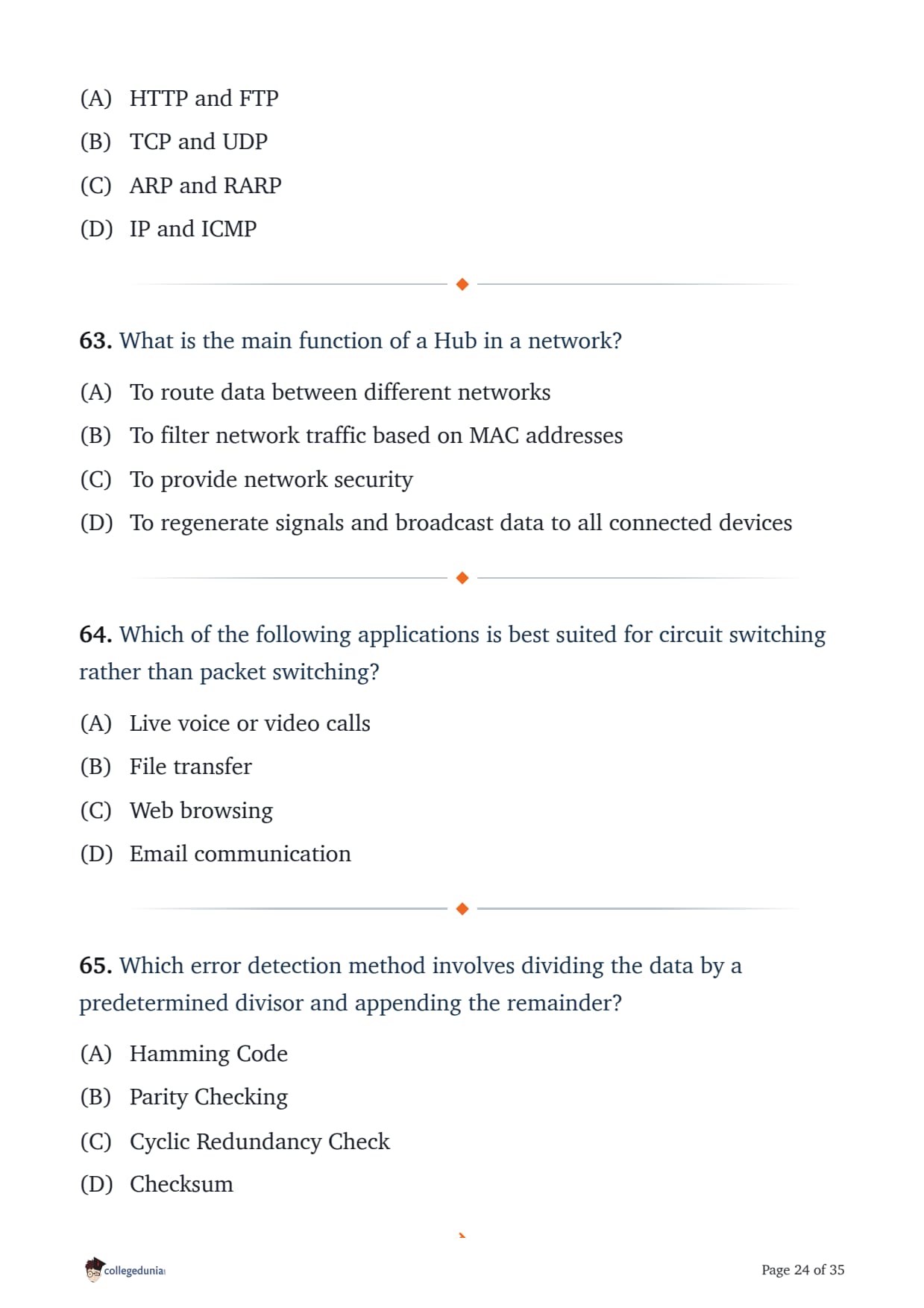
Which of the following protocols operate at the Transport Layer of the OSI Model?

  • (A) HTTP and FTP
  • (B) TCP and UDP
  • (C) ARP and RARP
  • (D) IP and ICMP

Question 63:

What is the main function of a Hub in a network?

  • (A) To route data between different networks
  • (B) To filter network traffic based on MAC addresses
  • (C) To provide network security
  • (D) To regenerate signals and broadcast data to all connected devices

Question 64:

Which of the following applications is best suited for circuit switching rather than packet switching?

  • (A) Live voice or video calls
  • (B) File transfer
  • (C) Web browsing
  • (D) Email communication

Question 65:

Which error detection method involves dividing the data by a predetermined divisor and appending the remainder?

  • (A) Hamming Code
  • (B) Parity Checking
  • (C) Cyclic Redundancy Check
  • (D) Checksum

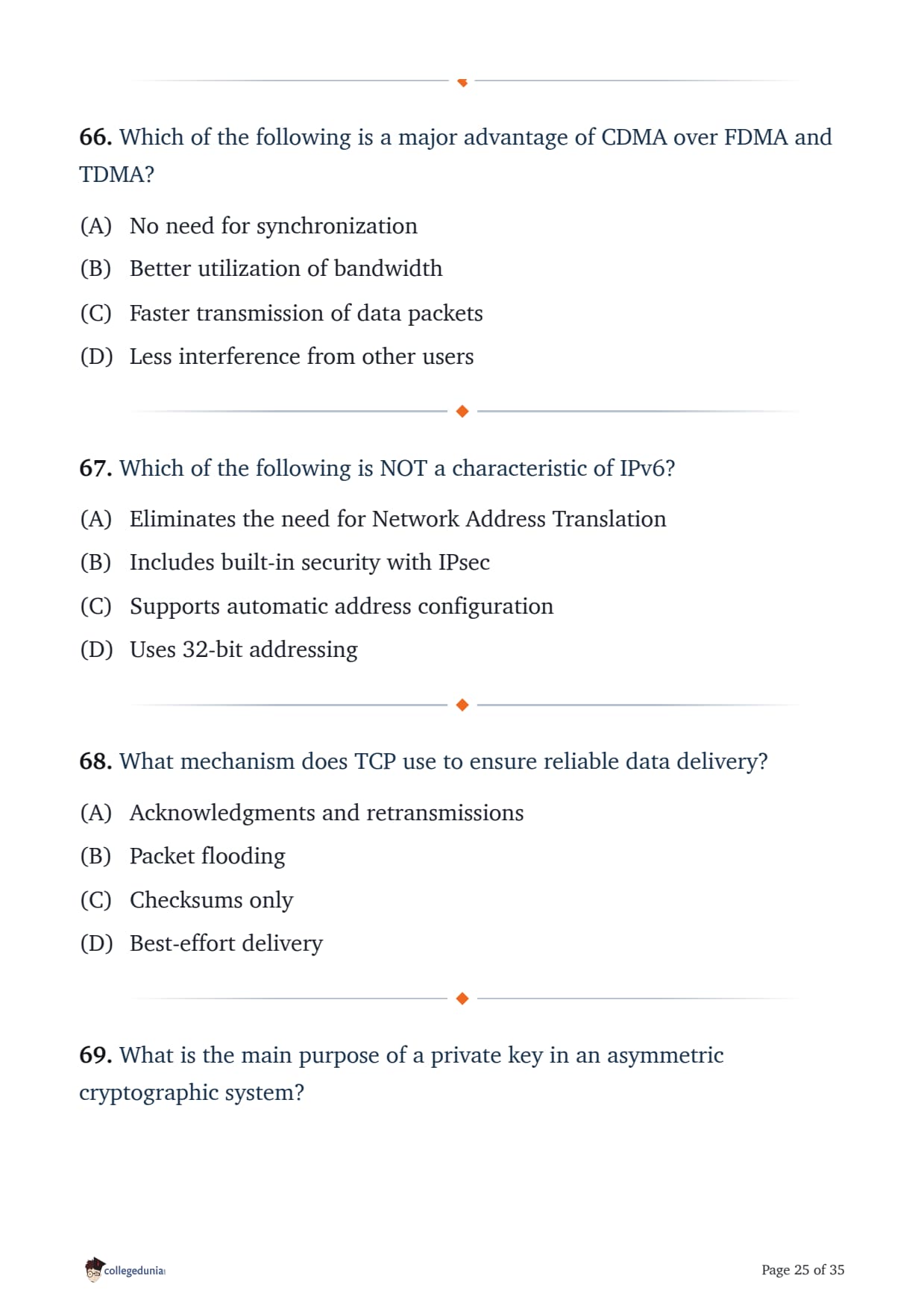
Question 66:

Which of the following is a major advantage of CDMA over FDMA and TDMA?

  • (A) No need for synchronization
  • (B) Better utilization of bandwidth
  • (C) Faster transmission of data packets
  • (D) Less interference from other users

Question 67:

Which of the following is NOT a characteristic of IPv6?

  • (A) Eliminates the need for Network Address Translation
  • (B) Includes built-in security with IPsec
  • (C) Supports automatic address configuration
  • (D) Uses 32-bit addressing

Question 68:

What mechanism does TCP use to ensure reliable data delivery?

  • (A) Acknowledgments and retransmissions
  • (B) Packet flooding
  • (C) Checksums only
  • (D) Best-effort delivery

Question 69:

What is the main purpose of a private key in an asymmetric cryptographic system?

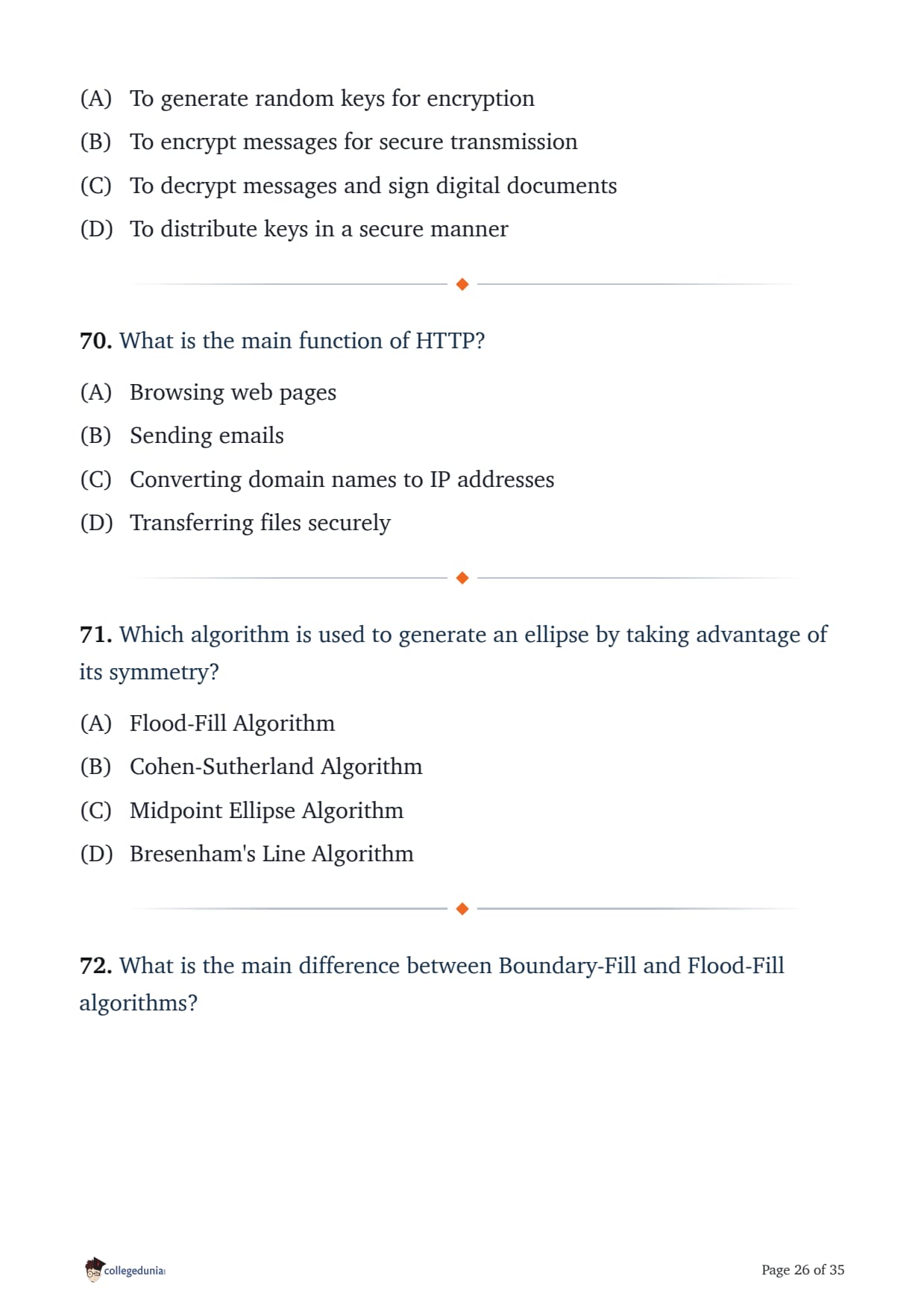
  • (A) To generate random keys for encryption
  • (B) To encrypt messages for secure transmission
  • (C) To decrypt messages and sign digital documents
  • (D) To distribute keys in a secure manner

Question 70:

What is the main function of HTTP?

  • (A) Browsing web pages
  • (B) Sending emails
  • (C) Converting domain names to IP addresses
  • (D) Transferring files securely

Question 71:

Which algorithm is used to generate an ellipse by taking advantage of its symmetry?

  • (A) Flood-Fill Algorithm
  • (B) Cohen-Sutherland Algorithm
  • (C) Midpoint Ellipse Algorithm
  • (D) Bresenham's Line Algorithm

Question 72:

What is the main difference between Boundary-Fill and Flood-Fill algorithms?

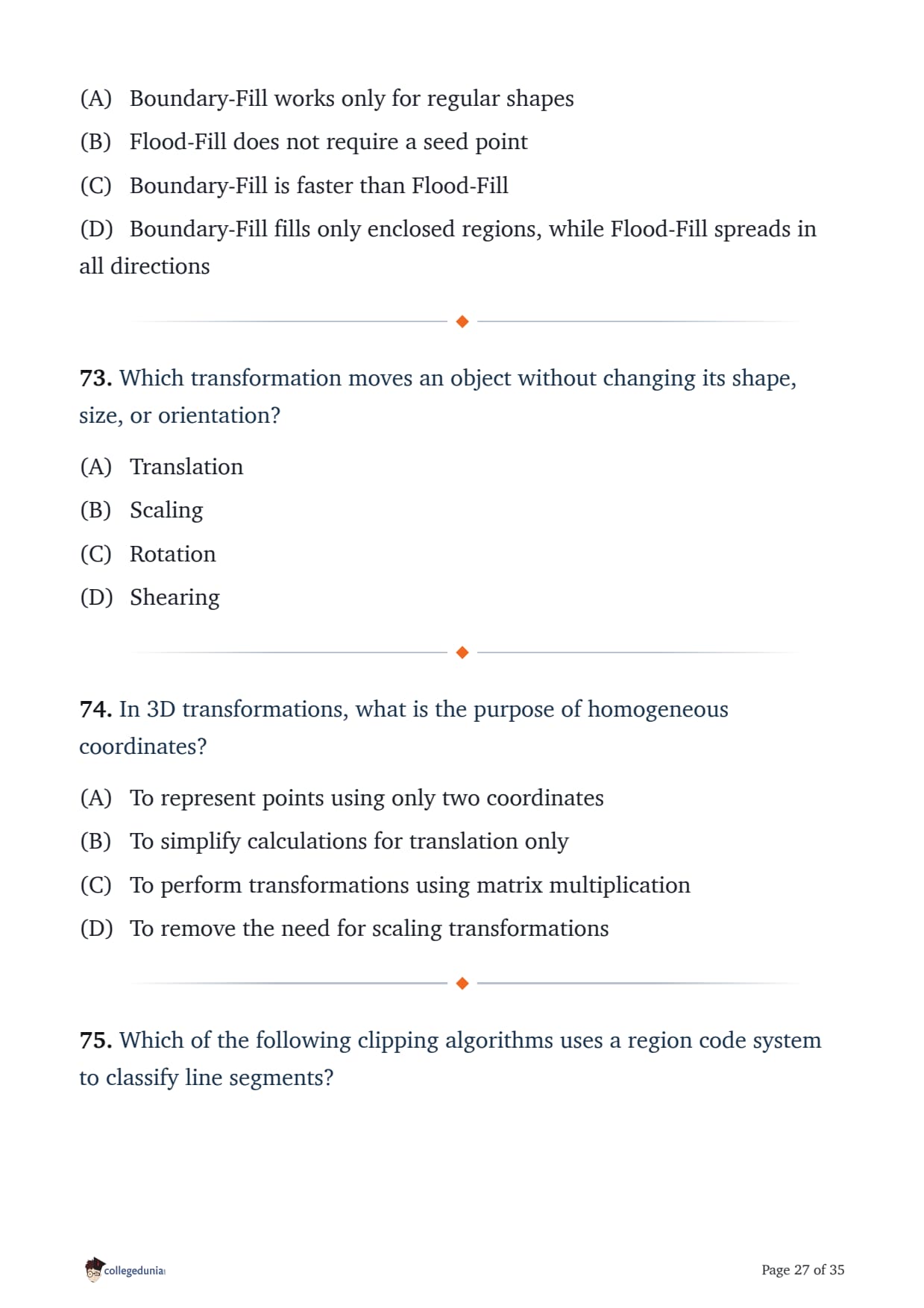
  • (A) Boundary-Fill works only for regular shapes
  • (B) Flood-Fill does not require a seed point
  • (C) Boundary-Fill is faster than Flood-Fill
  • (D) Boundary-Fill fills only enclosed regions, while Flood-Fill spreads in all directions

Question 73:

Which transformation moves an object without changing its shape, size, or orientation?

  • (A) Translation
  • (B) Scaling
  • (C) Rotation
  • (D) Shearing

Question 74:

In 3D transformations, what is the purpose of homogeneous coordinates?

  • (A) To represent points using only two coordinates
  • (B) To simplify calculations for translation only
  • (C) To perform transformations using matrix multiplication
  • (D) To remove the need for scaling transformations

Question 75:

Which of the following clipping algorithms uses a region code system to classify line segments?

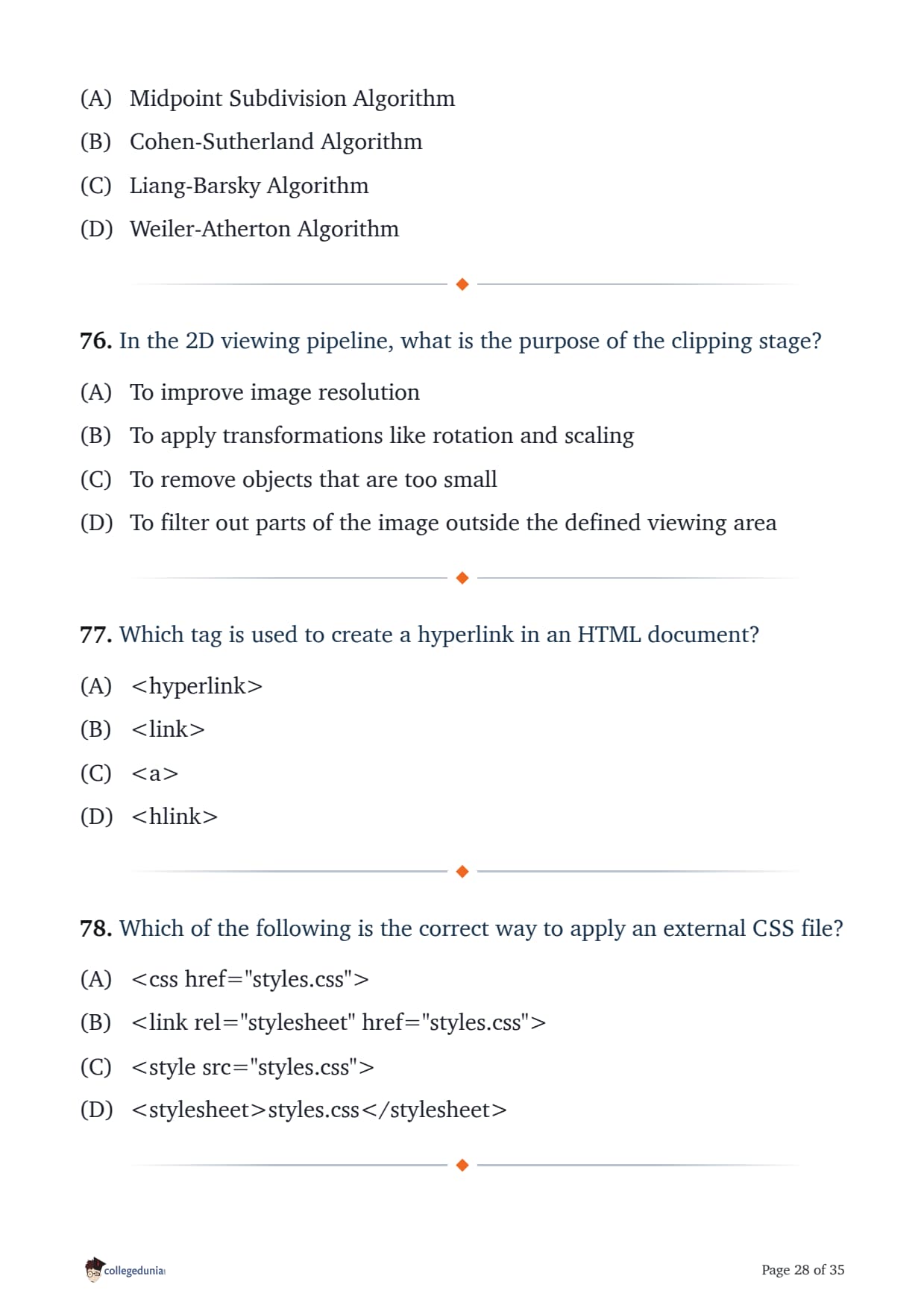
  • (A) Midpoint Subdivision Algorithm
  • (B) Cohen-Sutherland Algorithm
  • (C) Liang-Barsky Algorithm
  • (D) Weiler-Atherton Algorithm

Question 76:

In the 2D viewing pipeline, what is the purpose of the clipping stage?

  • (A) To improve image resolution
  • (B) To apply transformations like rotation and scaling
  • (C) To remove objects that are too small
  • (D) To filter out parts of the image outside the defined viewing area

Question 77:

Which tag is used to create a hyperlink in an HTML document?

  • (A) <hyperlink>
  • (B) <link>
  • (C) <a>
  • (D) <hlink>

Question 78:

Which of the following is the correct way to apply an external CSS file?

  • (A) <css href="styles.css">
  • (B) <link rel="stylesheet" href="styles.css">
  • (C) <style src="styles.css">
  • (D) <stylesheet>styles.css</stylesheet>

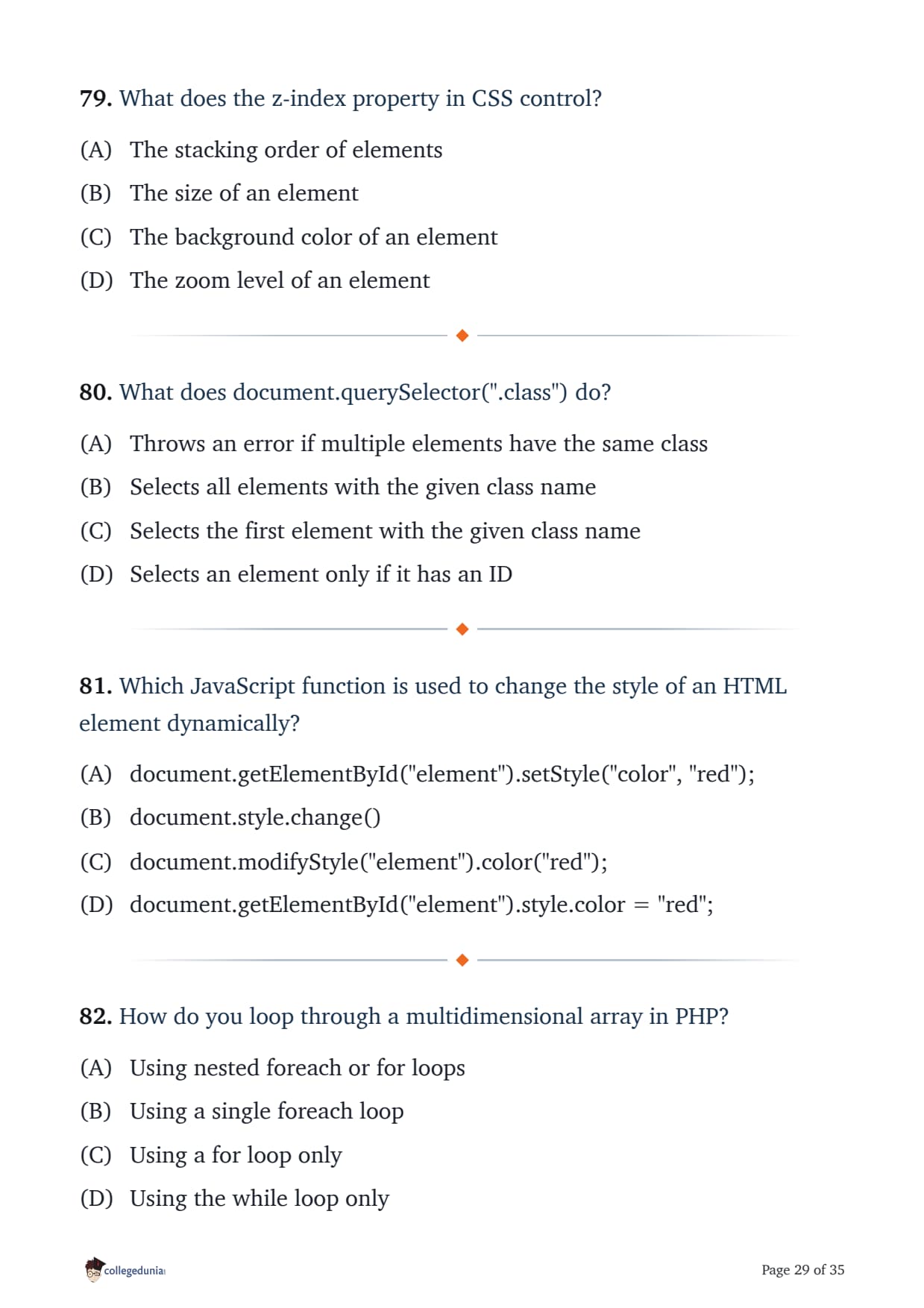
Question 79:

What does the z-index property in CSS control?

  • (A) The stacking order of elements
  • (B) The size of an element
  • (C) The background color of an element
  • (D) The zoom level of an element

Question 80:

What does document.querySelector(".class") do?

  • (A) Throws an error if multiple elements have the same class
  • (B) Selects all elements with the given class name
  • (C) Selects the first element with the given class name
  • (D) Selects an element only if it has an ID

Question 81:

Which JavaScript function is used to change the style of an HTML element dynamically?

  • (A) document.getElementById("element").setStyle("color", "red");
  • (B) document.style.change()
  • (C) document.modifyStyle("element").color("red");
  • (D) document.getElementById("element").style.color = "red";

Question 82:

How do you loop through a multidimensional array in PHP?

  • (A) Using nested foreach or for loops
  • (B) Using a single foreach loop
  • (C) Using a for loop only
  • (D) Using the while loop only

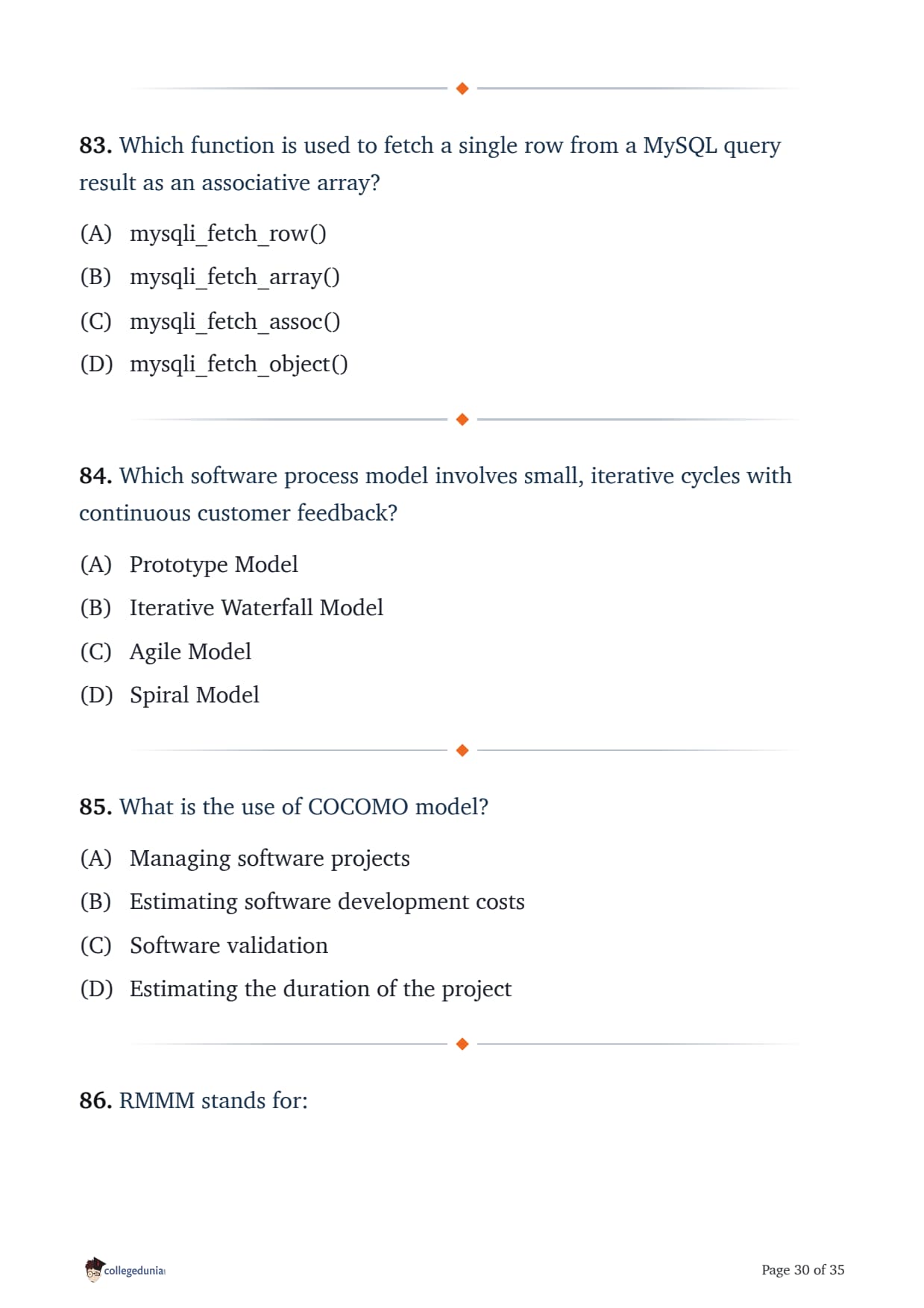
Question 83:

Which function is used to fetch a single row from a MySQL query result as an associative array?

  • (A) mysqli_fetch_row()
  • (B) mysqli_fetch_array()
  • (C) mysqli_fetch_assoc()
  • (D) mysqli_fetch_object()

Question 84:

Which software process model involves small, iterative cycles with continuous customer feedback?

  • (A) Prototype Model
  • (B) Iterative Waterfall Model
  • (C) Agile Model
  • (D) Spiral Model

Question 85:

What is the use of COCOMO model?

  • (A) Managing software projects
  • (B) Estimating software development costs
  • (C) Software validation
  • (D) Estimating the duration of the project

Question 86:

RMMM stands for:

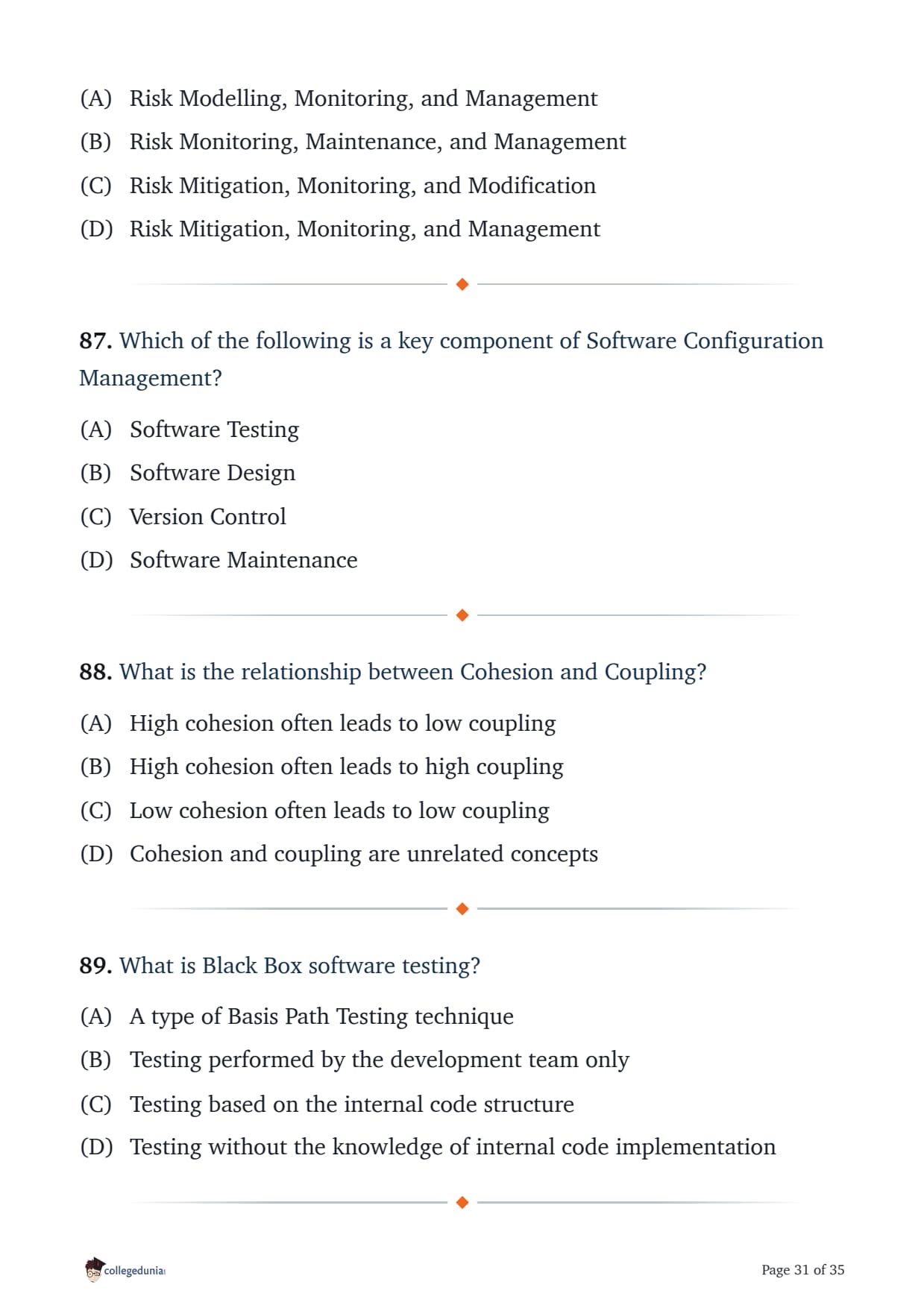
  • (A) Risk Modelling, Monitoring, and Management
  • (B) Risk Monitoring, Maintenance, and Management
  • (C) Risk Mitigation, Monitoring, and Modification
  • (D) Risk Mitigation, Monitoring, and Management

Question 87:

Which of the following is a key component of Software Configuration Management?

  • (A) Software Testing
  • (B) Software Design
  • (C) Version Control
  • (D) Software Maintenance

Question 88:

What is the relationship between Cohesion and Coupling?

  • (A) High cohesion often leads to low coupling
  • (B) High cohesion often leads to high coupling
  • (C) Low cohesion often leads to low coupling
  • (D) Cohesion and coupling are unrelated concepts

Question 89:

What is Black Box software testing?

  • (A) A type of Basis Path Testing technique
  • (B) Testing performed by the development team only
  • (C) Testing based on the internal code structure
  • (D) Testing without the knowledge of internal code implementation

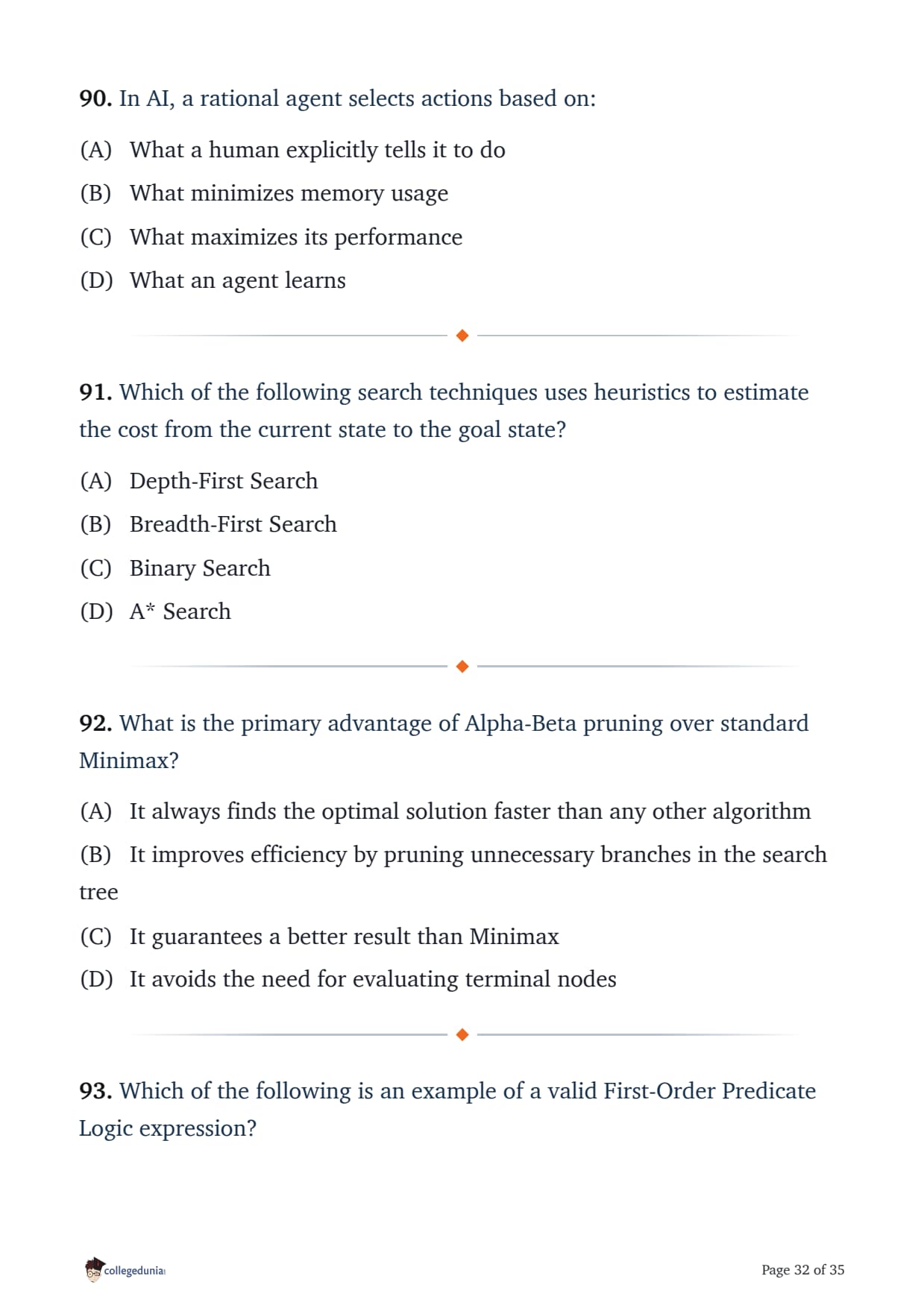
Question 90:

In AI, a rational agent selects actions based on:

  • (A) What a human explicitly tells it to do
  • (B) What minimizes memory usage
  • (C) What maximizes its performance
  • (D) What an agent learns

Question 91:

Which of the following search techniques uses heuristics to estimate the cost from the current state to the goal state?

  • (A) Depth-First Search
  • (B) Breadth-First Search
  • (C) Binary Search
  • (D) A* Search

Question 92:

What is the primary advantage of Alpha-Beta pruning over standard Minimax?

  • (A) It always finds the optimal solution faster than any other algorithm
  • (B) It improves efficiency by pruning unnecessary branches in the search tree
  • (C) It guarantees a better result than Minimax
  • (D) It avoids the need for evaluating terminal nodes

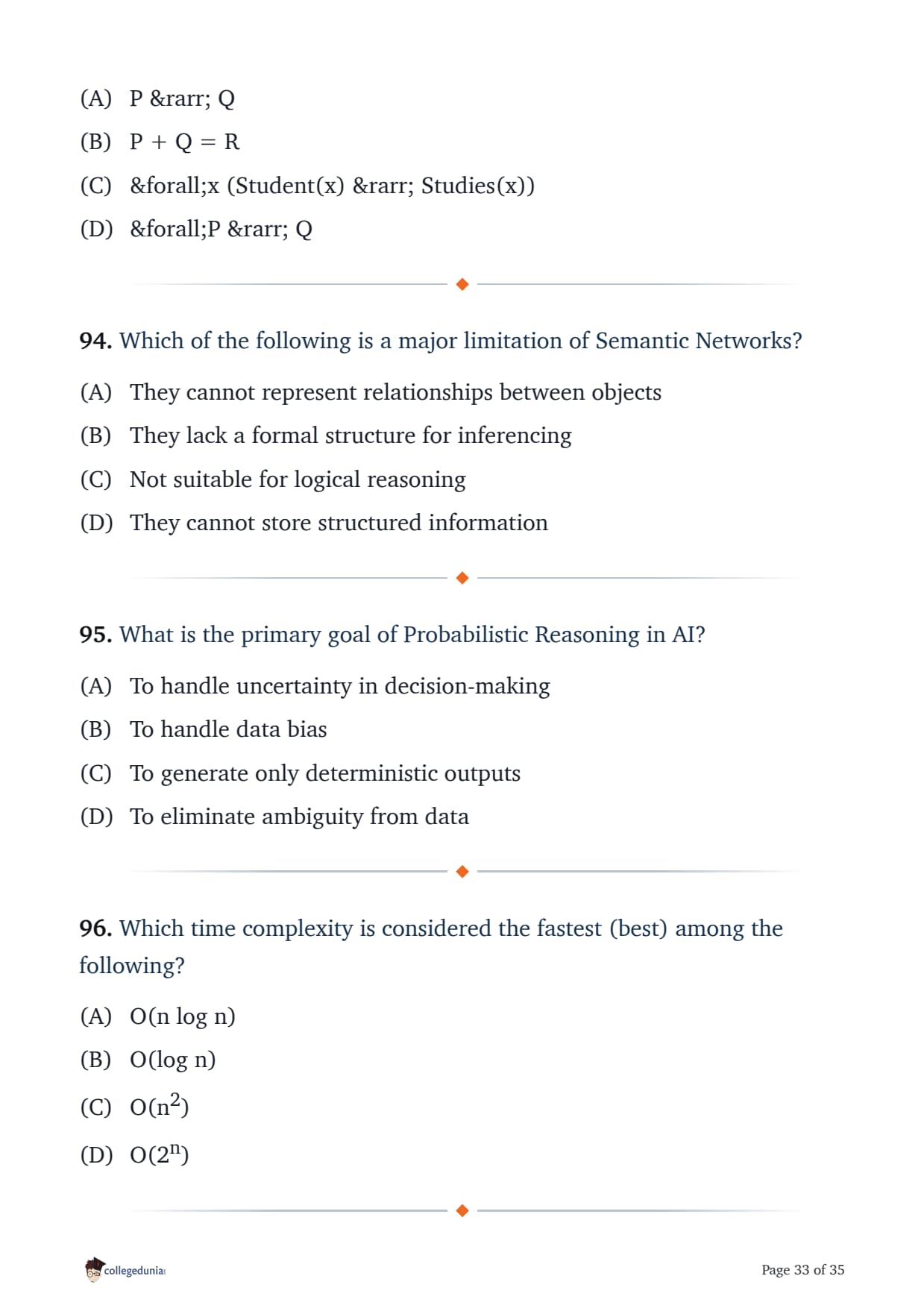
Question 93:

Which of the following is an example of a valid First-Order Predicate Logic expression?

  • (A) P &rarr; Q
  • (B) P + Q = R
  • (C) &forall;x (Student(x) &rarr; Studies(x))
  • (D) &forall;P &rarr; Q

Question 94:

Which of the following is a major limitation of Semantic Networks?

  • (A) They cannot represent relationships between objects
  • (B) They lack a formal structure for inferencing
  • (C) Not suitable for logical reasoning
  • (D) They cannot store structured information

Question 95:

What is the primary goal of Probabilistic Reasoning in AI?

  • (A) To handle uncertainty in decision-making
  • (B) To handle data bias
  • (C) To generate only deterministic outputs
  • (D) To eliminate ambiguity from data

Question 96:

Which time complexity is considered the fastest (best) among the following?

  • (A) O(n log n)
  • (B) O(log n)
  • (C) O(n2)
  • (D) O(2n)

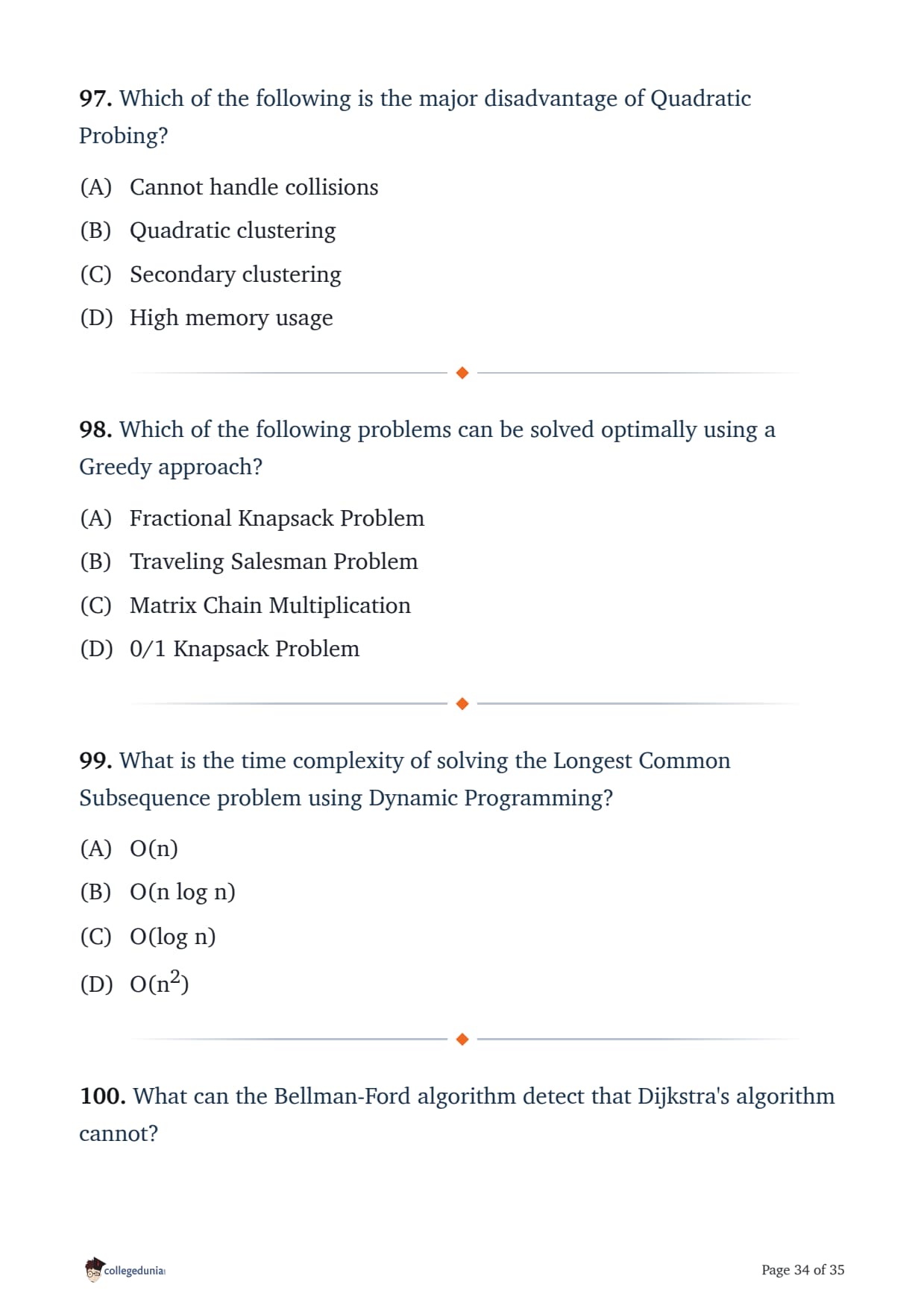
Question 97:

Which of the following is the major disadvantage of Quadratic Probing?

  • (A) Cannot handle collisions
  • (B) Quadratic clustering
  • (C) Secondary clustering
  • (D) High memory usage

Question 98:

Which of the following problems can be solved optimally using a Greedy approach?

  • (A) Fractional Knapsack Problem
  • (B) Traveling Salesman Problem
  • (C) Matrix Chain Multiplication
  • (D) 0/1 Knapsack Problem

Question 99:

What is the time complexity of solving the Longest Common Subsequence problem using Dynamic Programming?

  • (A) O(n)
  • (B) O(n log n)
  • (C) O(log n)
  • (D) O(n2)

Question 100:

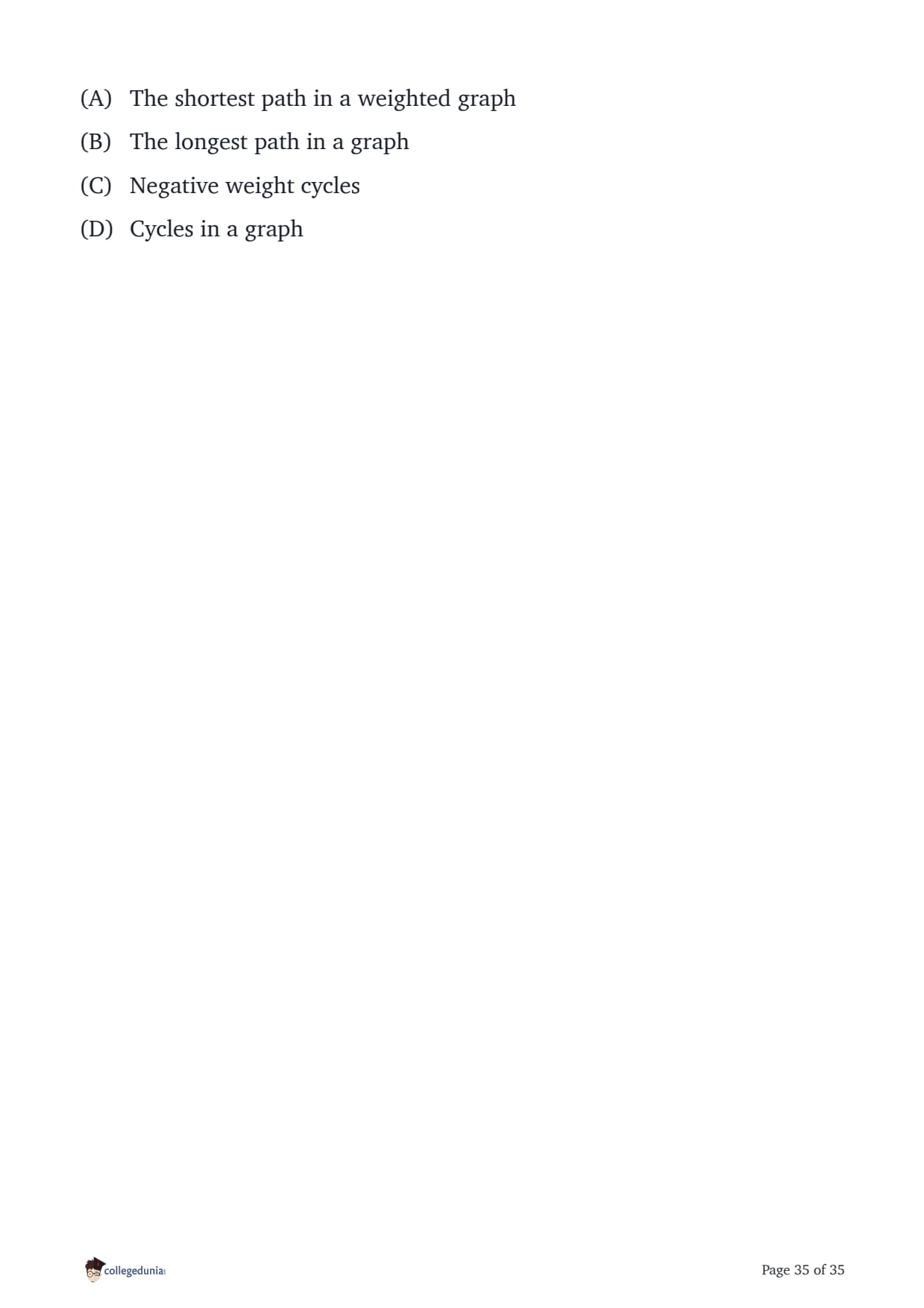
What can the Bellman-Ford algorithm detect that Dijkstra's algorithm cannot?

  • (A) The shortest path in a weighted graph
  • (B) The longest path in a graph
  • (C) Negative weight cycles
  • (D) Cycles in a graph

Odisha CPET 2025 Computer Science Exam Pattern and Marking Scheme Explained

Odisha CPET 2025 was an offline (pen-and-paper) objective test conducted by the Department of Higher Education for admission to PG Computer Science and MCA seats across Odisha's public universities and colleges, as listed on the official portal (pg.samsodisha.gov.in). The Computer Science set in this download has 100 questions worth 100 marks.

  • Total questions: 100 single-best-answer MCQs, four options each
  • Total marks: 100
  • Marking scheme: +1 for every correct answer
  • Negative marking: none - a wrong or unanswered question simply scores 0, so attempt all 100
  • Mode: offline OMR-based test at allotted centres across Odisha
  • Question types: theory recall plus applied problems - output prediction, pointer tracing, and short numericals

High-Weightage Topics in Odisha CPET 2025 Computer Science to Focus On First

The 100 questions in this paper lean heavily on core programming and data structures, so start there before touching the smaller topics. Here is how the questions actually split across subjects in this set.

  • Programming in C, C++ and Java: about 30 of the 100 questions - the single biggest block, with pointers, arrays, file handling, and output-prediction snippets
  • Data Structures and Algorithms: around 12 questions on trees, linked lists, stacks, sorting, and hashing
  • Digital Logic and Computer Arithmetic: about 10 questions on Boolean simplification, counters, and 2's complement
  • DBMS: roughly 9 questions on normalization, SQL, and the relational model
  • Computer Networks: about 8 questions on the OSI/TCP-IP stack, routing, and protocols
  • Operating Systems: around 7 questions on process scheduling, deadlock, and memory management
  • Software Engineering, Computer Organization, Web Technology and AI: the remaining 20-odd questions, useful for scoring the last few easy marks

Odisha CPET Computer Science Previous Year Question Paper Video

Source: OCS by Ranjan

How to Use the Odisha CPET Computer Science Question Paper for Practice

Because there is no negative marking, the smart play is to solve this paper as a full 100-question timed mock, then close every gap with the solution PDF. Do not leave any bubble blank.

  • Solve all 100 questions in one sitting first, then check answers against the solution PDF above
  • Clear the 30 programming questions early - they are the fastest marks and decide your rank
  • Redo the Data Structures and DBMS sets until output-prediction and normalization questions feel automatic
  • Since a correct answer is +1 with no penalty, make an educated guess on every question you are unsure about

Odisha CPET 2025 Computer Science Question Paper FAQs

Ques. Is there negative marking in the Odisha CPET 2025 Computer Science paper?

Ans. No. Each correct answer earns +1 mark and there is no deduction for a wrong answer, so you should attempt all 100 questions. An unanswered question scores 0, the same as a wrong one.

Ques. How many questions are there in the Odisha CPET Computer Science paper and what is the total mark?

Ans. This Computer Science set carries 100 single-best-answer MCQs for a total of 100 marks, with four options per question. It is an offline OMR-based test.

Ques. Which topics have the highest weightage in Odisha CPET Computer Science?

Ans. Programming in C, C++ and Java dominates with about 30 of the 100 questions, followed by Data Structures (12), Digital Logic and Computer Arithmetic (10), DBMS (9), Computer Networks (8), and Operating Systems (7).

Ques. Who conducts the Odisha CPET exam and where are the results published?

Ans. Odisha CPET is conducted by the Department of Higher Education, Government of Odisha, with the application and admission process handled through SAMS Odisha. Notifications, answer keys, and results are published on the official portal pg.samsodisha.gov.in.

Ques. When was Odisha CPET 2025 conducted?

Ans. Odisha CPET 2025 was held in offline mode across centres in Odisha between May 5 and May 13, 2025, with each subject paper scheduled on a fixed date within that window.

Ques. Where can I download the Odisha CPET 2025 Computer Science question paper with solutions PDF for free?

Ans. Use the download table at the top of this page to get the full Odisha CPET 2025 Computer Science question paper with detailed solutions for free. For the official answer key, check pg.samsodisha.gov.in.