




The Odisha CPET 2025 Physics question paper is now available with detailed solutions for free download. Odisha CPET 2025 was conducted by the Department of Higher Education, Government of Odisha (through SAMS Odisha) from May 5 to May 13, 2025, and the Physics paper (Subject Code 34) carried 100 single-best-answer MCQs for 100 marks.
| Odisha CPET 2025 Physics Question Paper with Solutions | Download PDF | Check Solutions |
Odisha CPET 2025 Physics Questions with Solutions
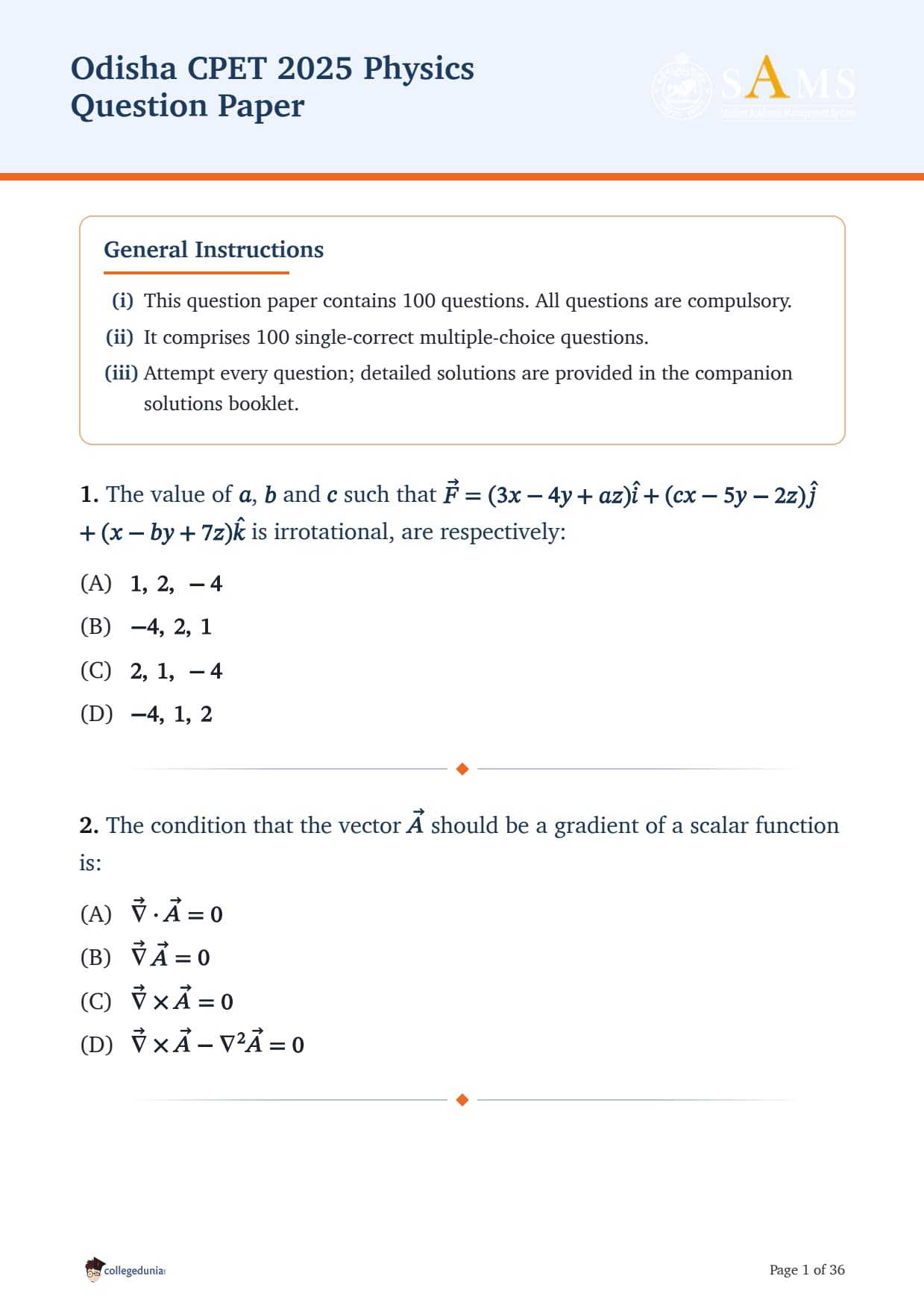
The value of \(a\), \(b\) and \(c\) such that \(\vec{F} = (3x - 4y + az)\hat{i} + (cx - 5y - 2z)\hat{j} + (x - by + 7z)\hat{k}\) is irrotational, are respectively:
The condition that the vector \(\vec{A}\) should be a gradient of a scalar function is:
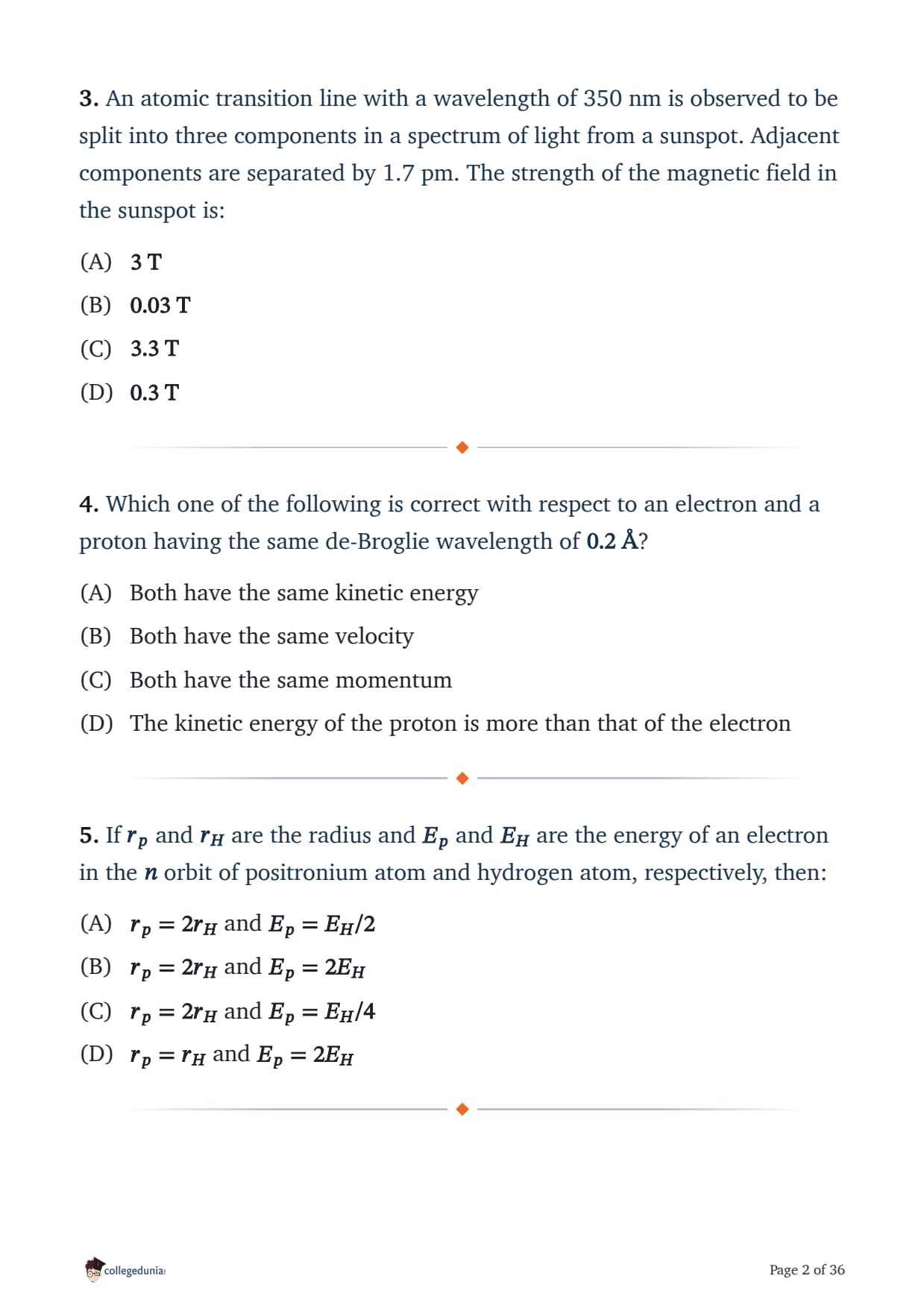
An atomic transition line with a wavelength of 350 nm is observed to be split into three components in a spectrum of light from a sunspot. Adjacent components are separated by 1.7 pm. The strength of the magnetic field in the sunspot is:
Which one of the following is correct with respect to an electron and a proton having the same de-Broglie wavelength of \(0.2\ \text{\AA}\)?
If \(r_p\) and \(r_H\) are the radius and \(E_p\) and \(E_H\) are the energy of an electron in the \(n\) orbit of positronium atom and hydrogen atom, respectively, then:
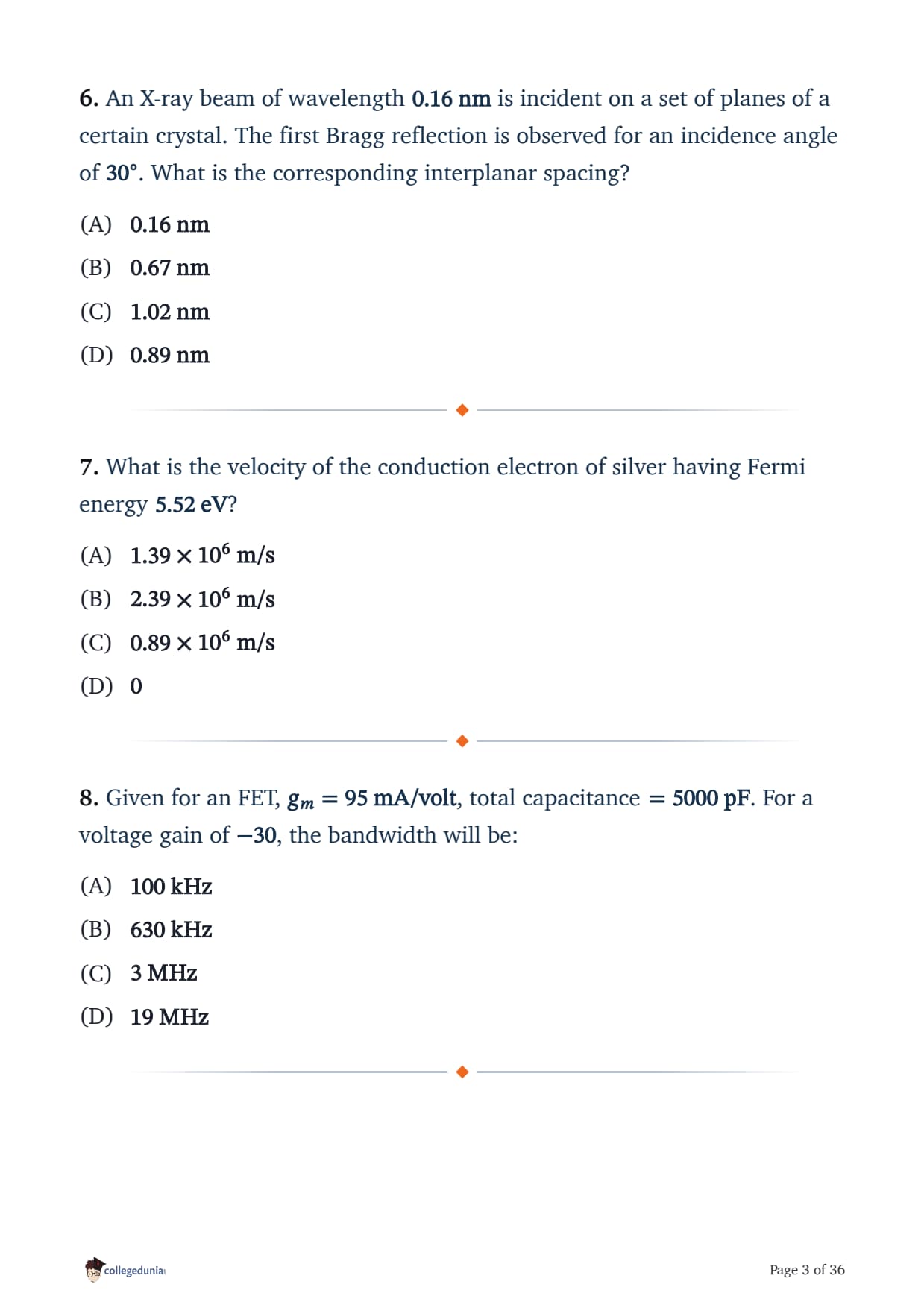
An X-ray beam of wavelength \(0.16\ \text{nm}\) is incident on a set of planes of a certain crystal. The first Bragg reflection is observed for an incidence angle of \(30^\circ\). What is the corresponding interplanar spacing?
What is the velocity of the conduction electron of silver having Fermi energy \(5.52\ \text{eV}\)?
Given for an FET, \(g_m = 95\ \text{mA/volt}\), total capacitance \(= 5000\ \text{pF}\). For a voltage gain of \(-30\), the bandwidth will be:
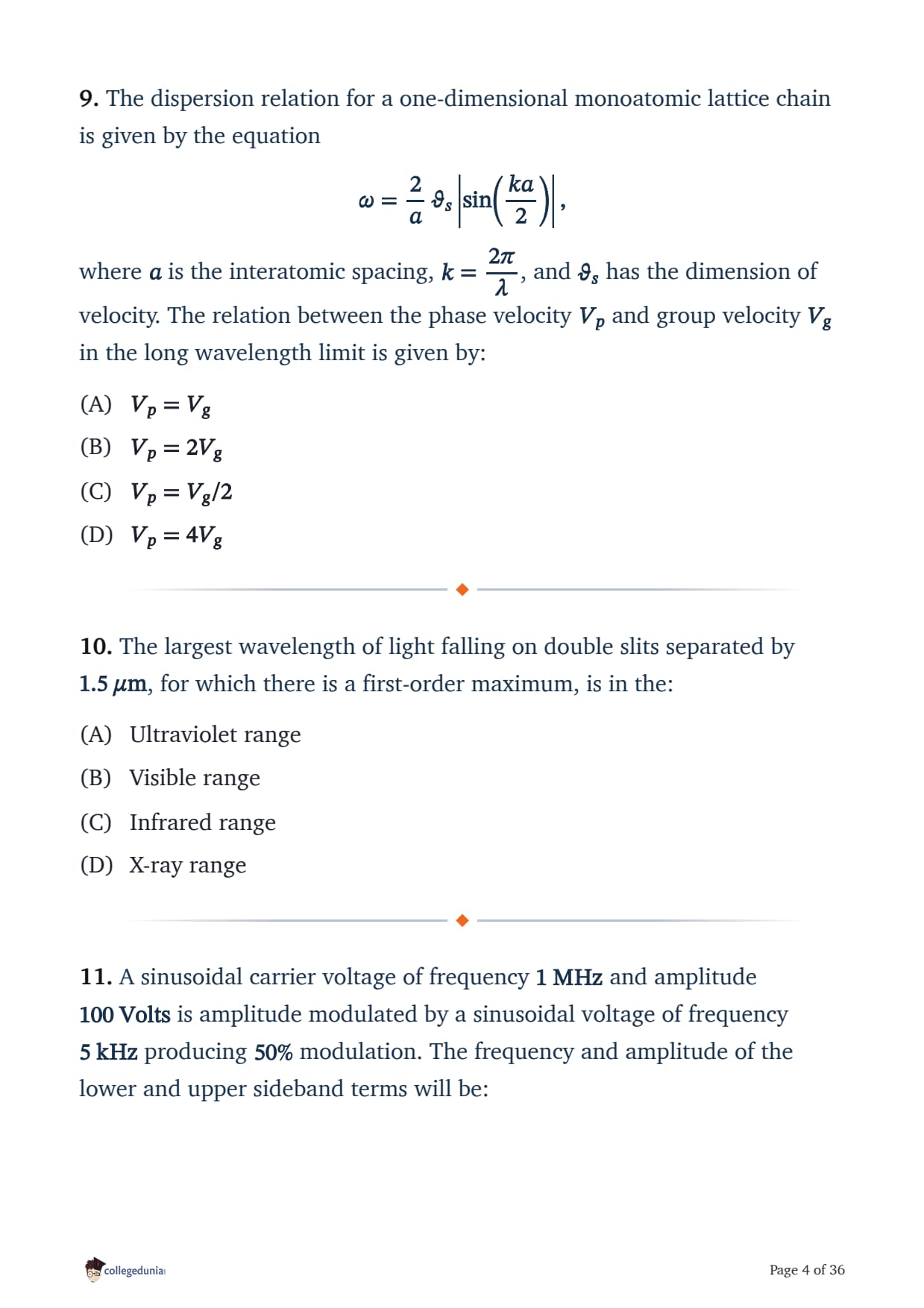
The dispersion relation for a one-dimensional monoatomic lattice chain is given by the equation \[\omega = \frac{2}{a}\,\vartheta_s\left|\sin\!\left(\frac{ka}{2}\right)\right|,\] where \(a\) is the interatomic spacing, \(k = \dfrac{2\pi}{\lambda}\), and \(\vartheta_s\) has the dimension of velocity. The relation between the phase velocity \(V_p\) and group velocity \(V_g\) in the long wavelength limit is given by:
The largest wavelength of light falling on double slits separated by \(1.5\ \mu\text{m}\), for which there is a first-order maximum, is in the:
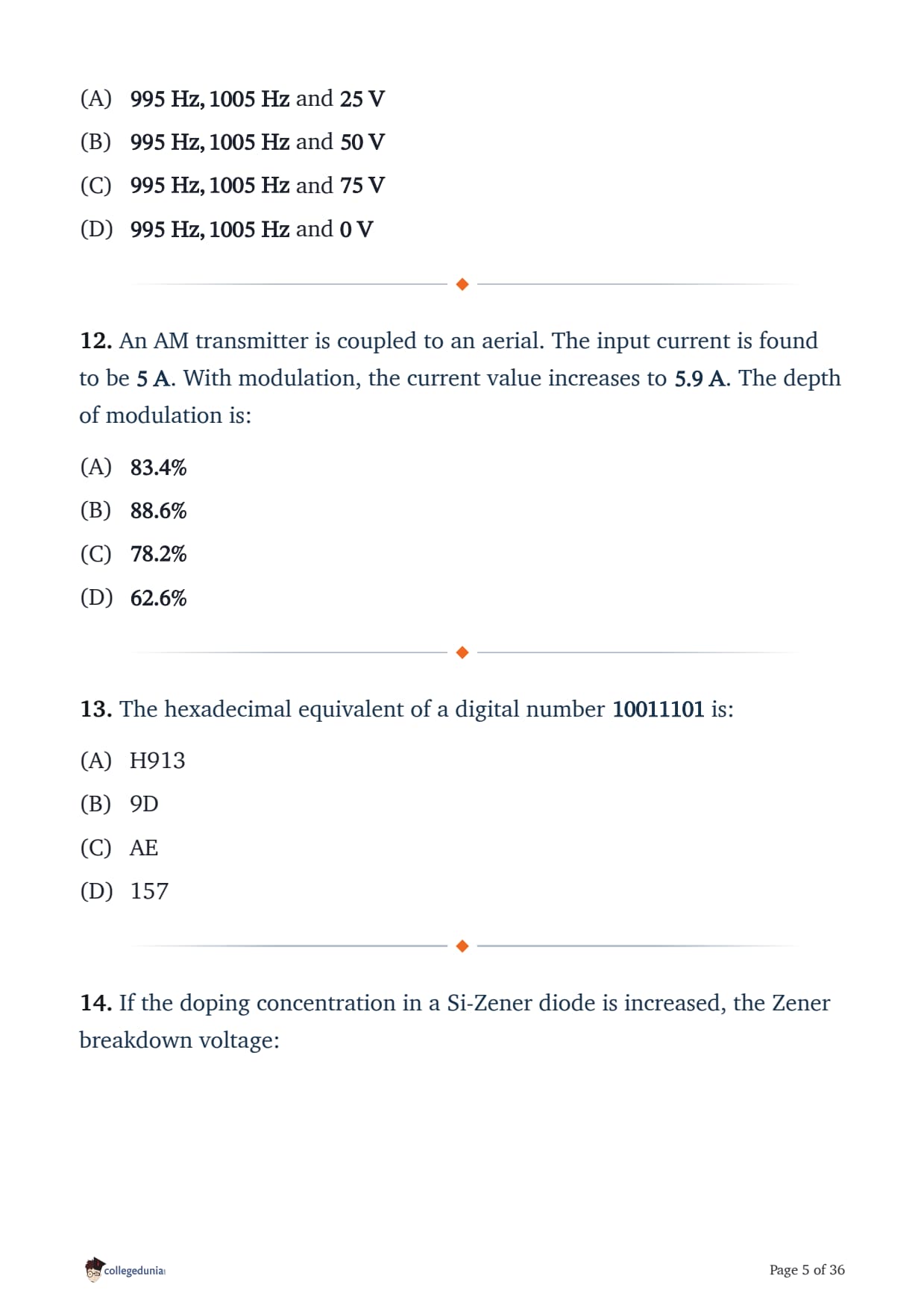
A sinusoidal carrier voltage of frequency \(1\ \text{MHz}\) and amplitude \(100\ \text{Volts}\) is amplitude modulated by a sinusoidal voltage of frequency \(5\ \text{kHz}\) producing \(50\%\) modulation. The frequency and amplitude of the lower and upper sideband terms will be:
An AM transmitter is coupled to an aerial. The input current is found to be \(5\ \text{A}\). With modulation, the current value increases to \(5.9\ \text{A}\). The depth of modulation is:
The hexadecimal equivalent of a digital number \(10011101\) is:
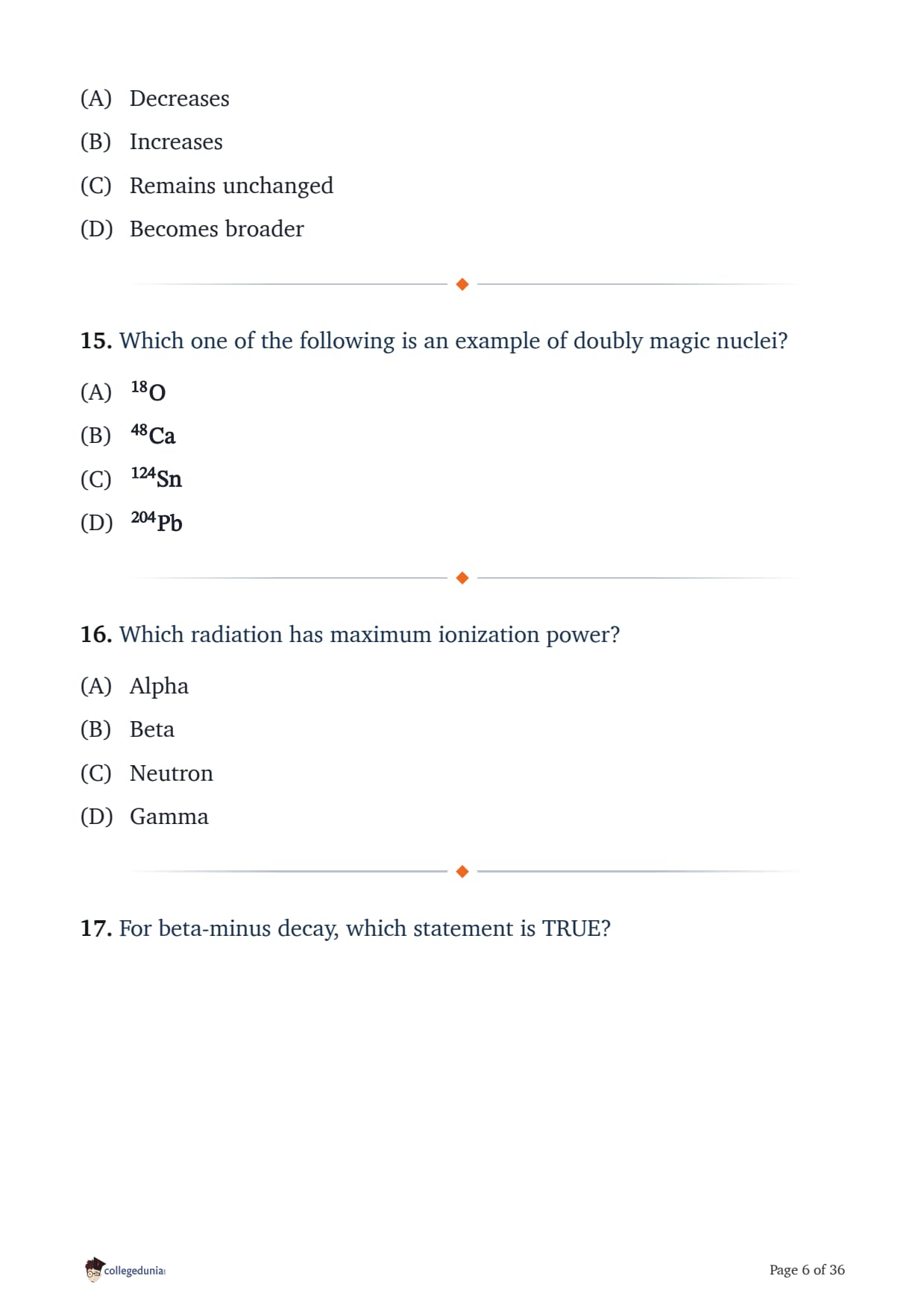
If the doping concentration in a Si-Zener diode is increased, the Zener breakdown voltage:
Which one of the following is an example of doubly magic nuclei?
Which radiation has maximum ionization power?
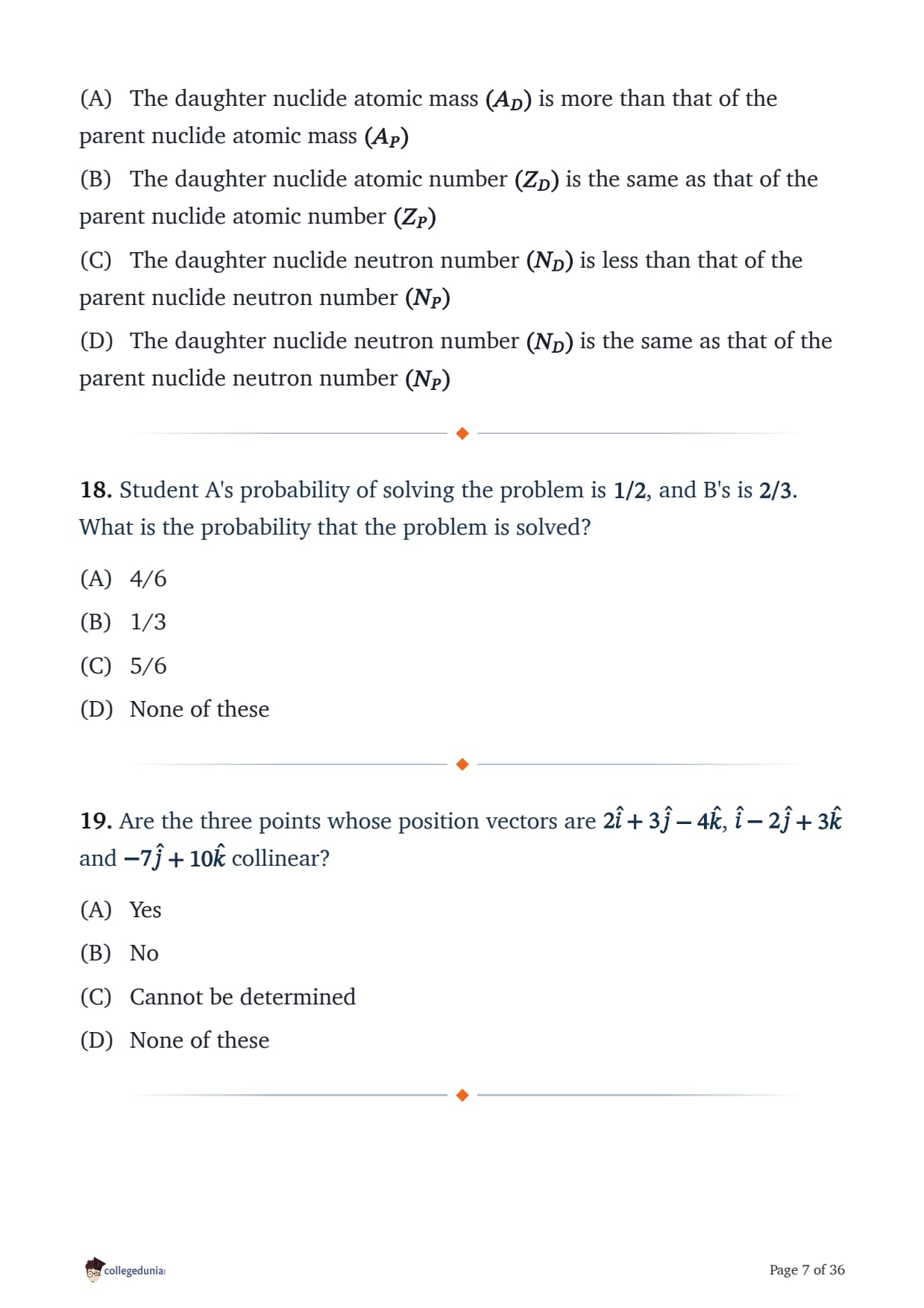
For beta-minus decay, which statement is TRUE?
Student A's probability of solving the problem is \(1/2\), and B's is \(2/3\). What is the probability that the problem is solved?
Are the three points whose position vectors are \(2\hat{i} + 3\hat{j} - 4\hat{k}\), \(\hat{i} - 2\hat{j} + 3\hat{k}\) and \(-7\hat{j} + 10\hat{k}\) collinear?
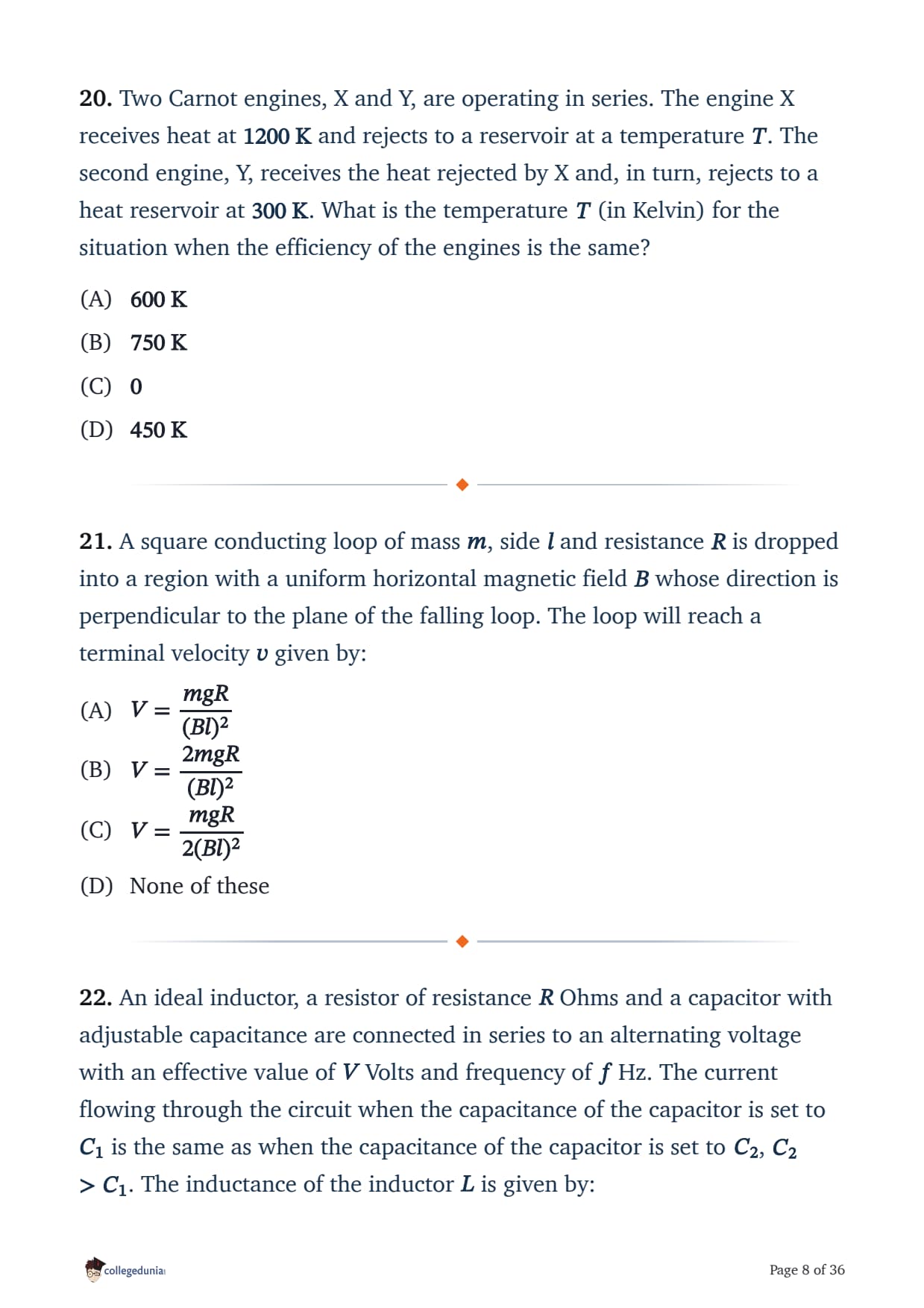
Two Carnot engines, X and Y, are operating in series. The engine X receives heat at \(1200\ \text{K}\) and rejects to a reservoir at a temperature \(T\). The second engine, Y, receives the heat rejected by X and, in turn, rejects to a heat reservoir at \(300\ \text{K}\). What is the temperature \(T\) (in Kelvin) for the situation when the efficiency of the engines is the same?
A square conducting loop of mass \(m\), side \(l\) and resistance \(R\) is dropped into a region with a uniform horizontal magnetic field \(B\) whose direction is perpendicular to the plane of the falling loop. The loop will reach a terminal velocity \(v\) given by:
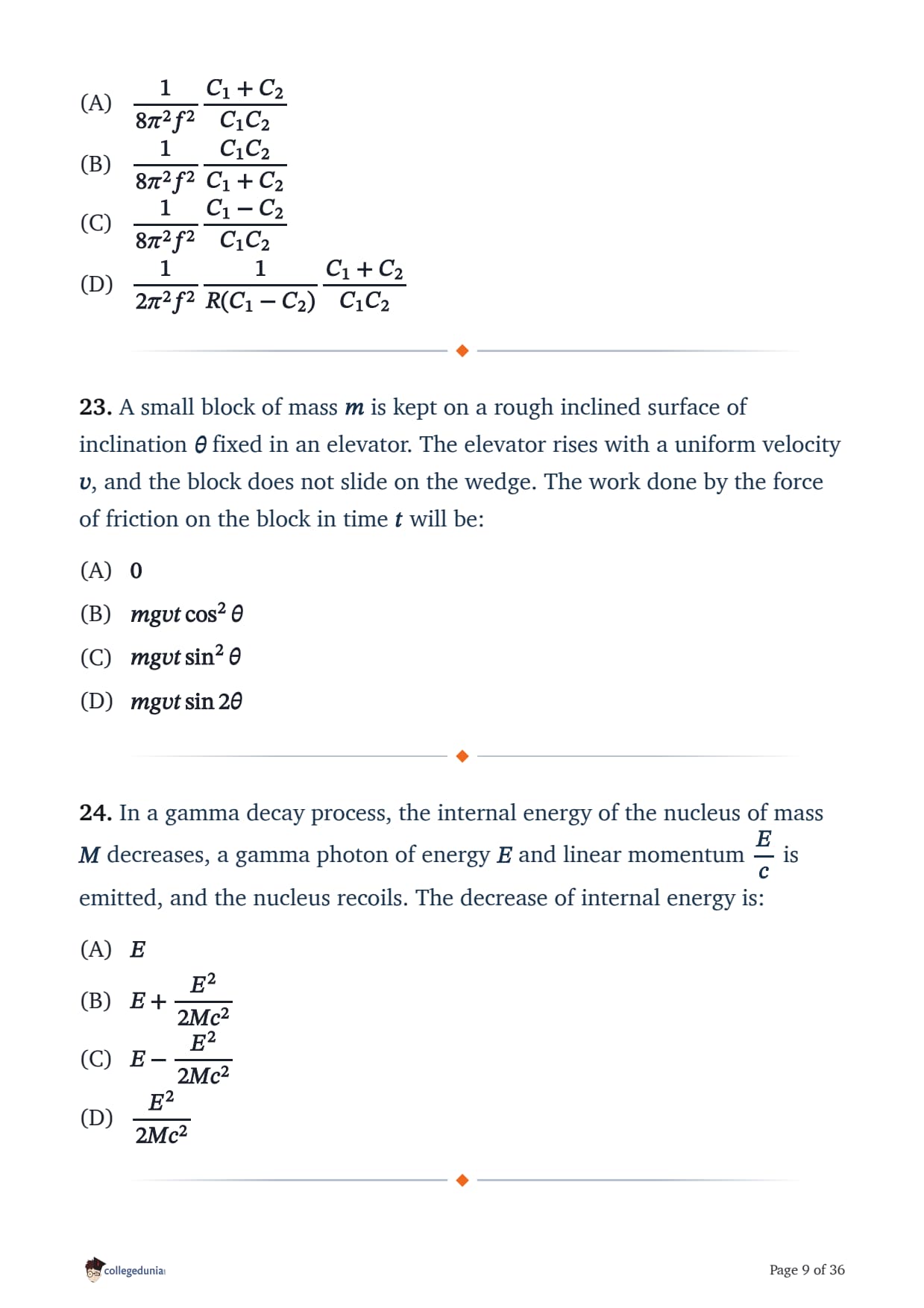
An ideal inductor, a resistor of resistance \(R\) Ohms and a capacitor with adjustable capacitance are connected in series to an alternating voltage with an effective value of \(V\) Volts and frequency of \(f\) Hz. The current flowing through the circuit when the capacitance of the capacitor is set to \(C_1\) is the same as when the capacitance of the capacitor is set to \(C_2\), \(C_2 > C_1\). The inductance of the inductor \(L\) is given by:
A small block of mass \(m\) is kept on a rough inclined surface of inclination \(\theta\) fixed in an elevator. The elevator rises with a uniform velocity \(v\), and the block does not slide on the wedge. The work done by the force of friction on the block in time \(t\) will be:
In a gamma decay process, the internal energy of the nucleus of mass \(M\) decreases, a gamma photon of energy \(E\) and linear momentum \(\dfrac{E}{c}\) is emitted, and the nucleus recoils. The decrease of internal energy is:
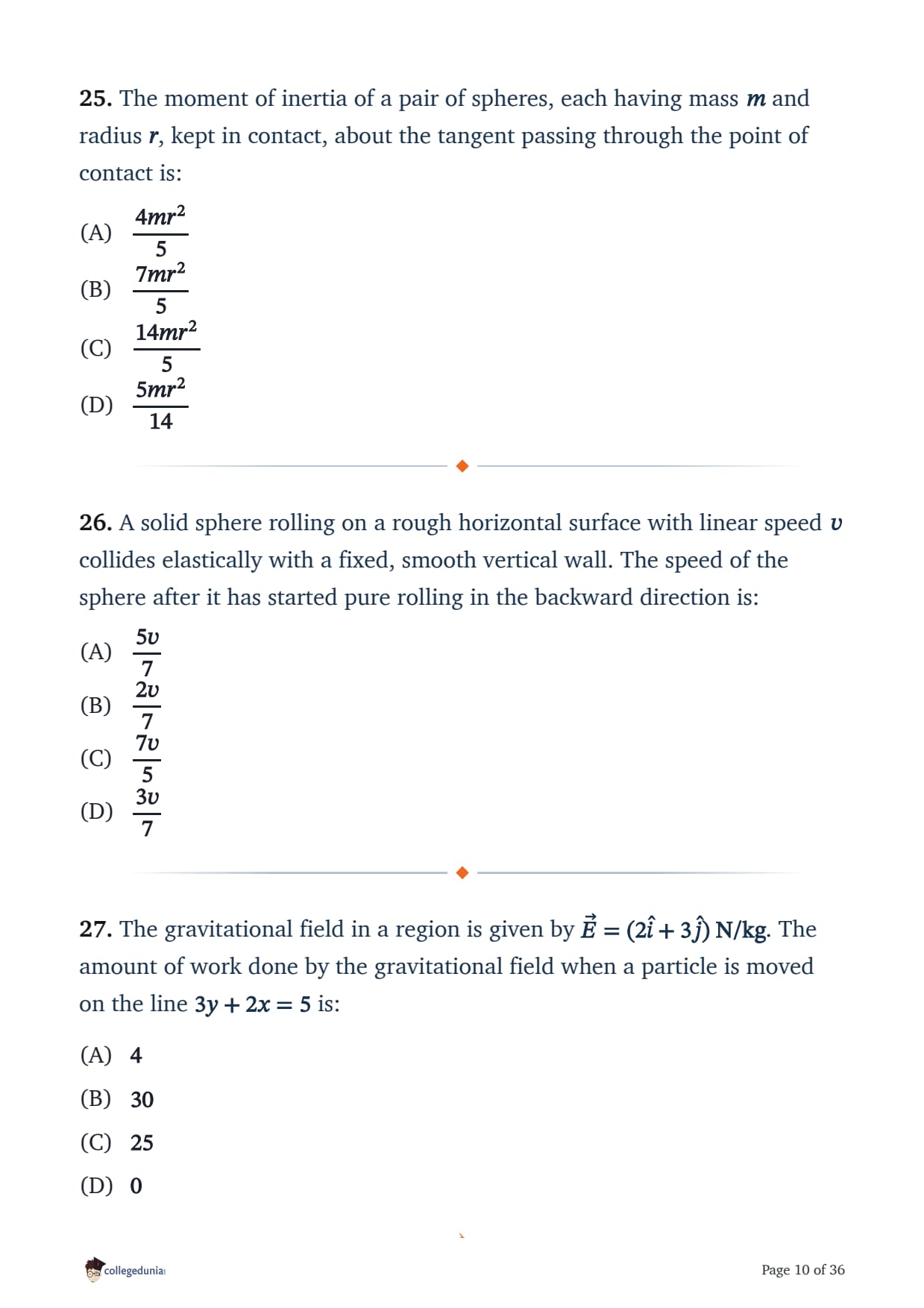
The moment of inertia of a pair of spheres, each having mass \(m\) and radius \(r\), kept in contact, about the tangent passing through the point of contact is:
A solid sphere rolling on a rough horizontal surface with linear speed \(v\) collides elastically with a fixed, smooth vertical wall. The speed of the sphere after it has started pure rolling in the backward direction is:
The gravitational field in a region is given by \(\vec{E} = (2\hat{i} + 3\hat{j})\ \text{N/kg}\). The amount of work done by the gravitational field when a particle is moved on the line \(3y + 2x = 5\) is:
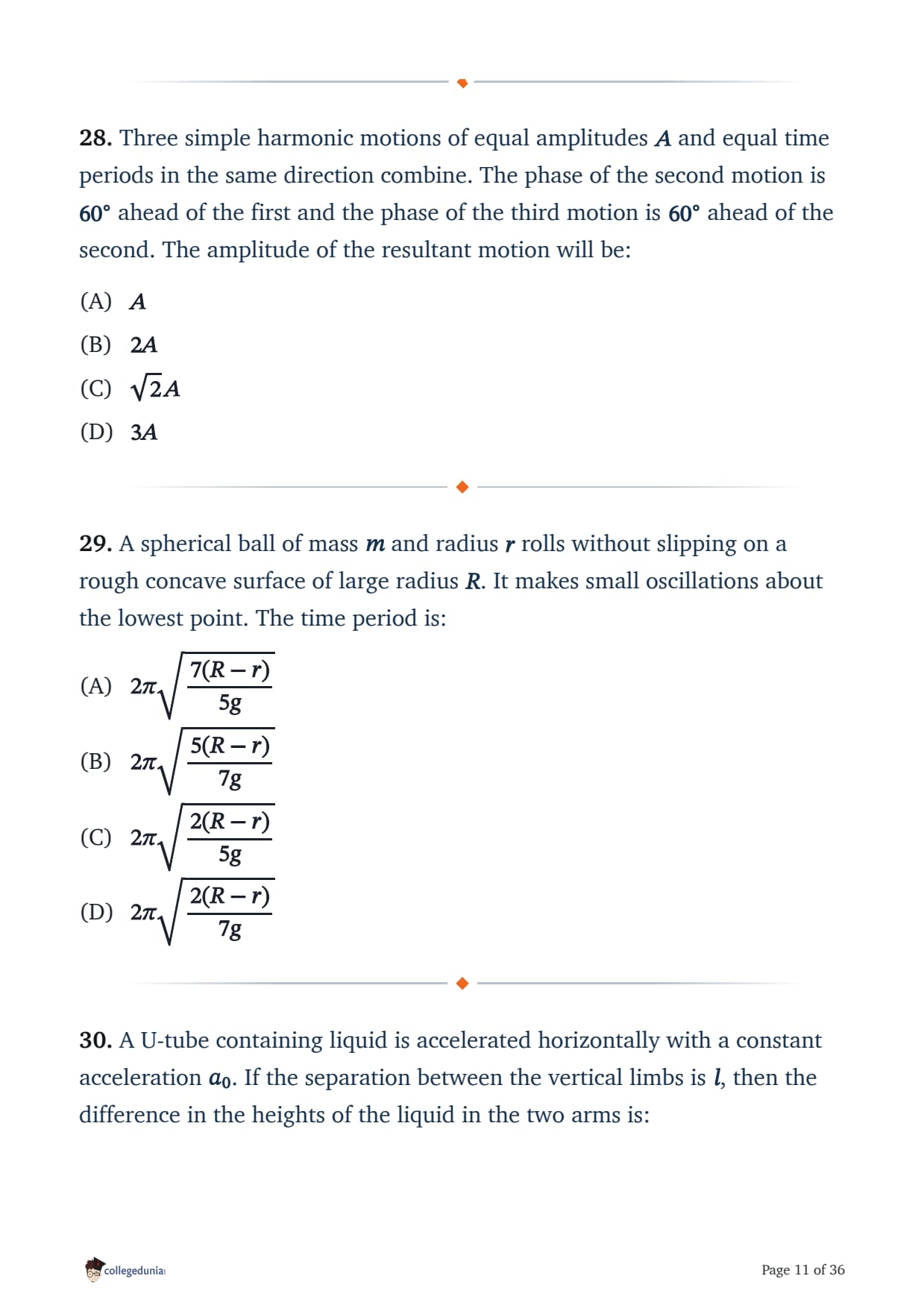
Three simple harmonic motions of equal amplitudes \(A\) and equal time periods in the same direction combine. The phase of the second motion is \(60^\circ\) ahead of the first and the phase of the third motion is \(60^\circ\) ahead of the second. The amplitude of the resultant motion will be:
A spherical ball of mass \(m\) and radius \(r\) rolls without slipping on a rough concave surface of large radius \(R\). It makes small oscillations about the lowest point. The time period is:
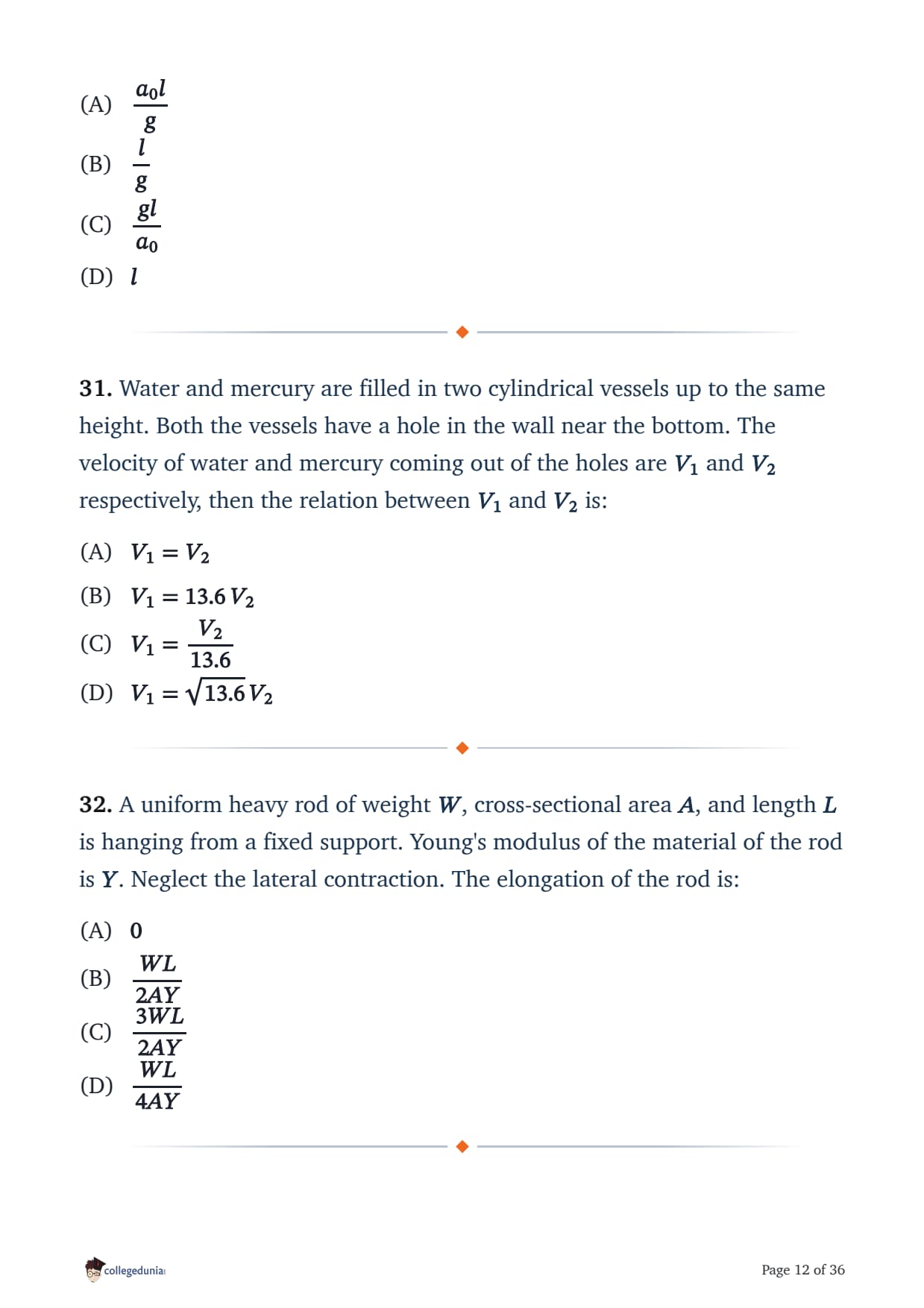
A U-tube containing liquid is accelerated horizontally with a constant acceleration \(a_0\). If the separation between the vertical limbs is \(l\), then the difference in the heights of the liquid in the two arms is:
Water and mercury are filled in two cylindrical vessels up to the same height. Both the vessels have a hole in the wall near the bottom. The velocity of water and mercury coming out of the holes are \(V_1\) and \(V_2\) respectively, then the relation between \(V_1\) and \(V_2\) is:
A uniform heavy rod of weight \(W\), cross-sectional area \(A\), and length \(L\) is hanging from a fixed support. Young's modulus of the material of the rod is \(Y\). Neglect the lateral contraction. The elongation of the rod is:
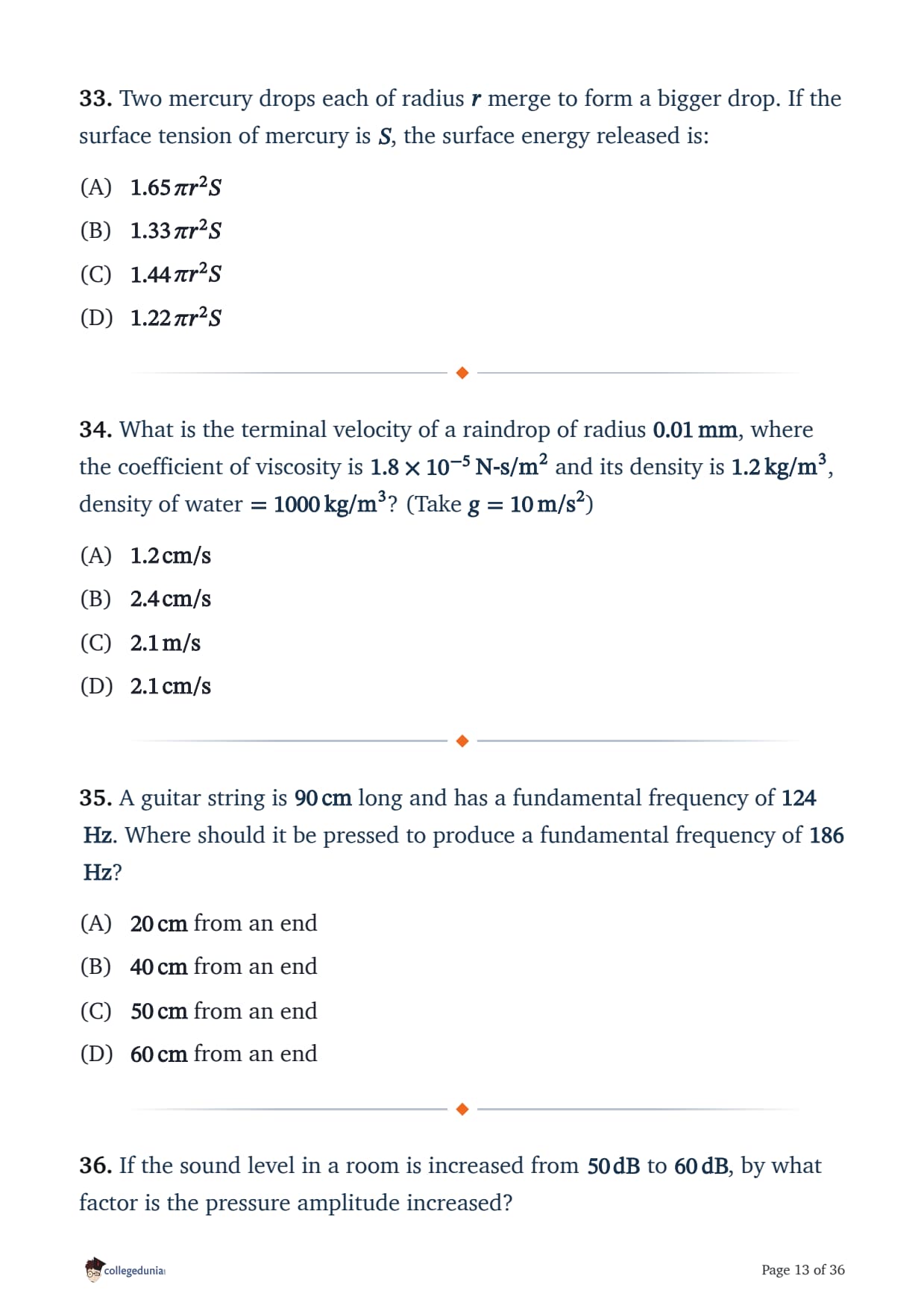
Two mercury drops each of radius \(r\) merge to form a bigger drop. If the surface tension of mercury is \(S\), the surface energy released is:
What is the terminal velocity of a raindrop of radius \(0.01\,\text{mm}\), where the coefficient of viscosity is \(1.8\times10^{-5}\,\text{N-s/m}^2\) and its density is \(1.2\,\text{kg/m}^3\), density of water \(=1000\,\text{kg/m}^3\)? (Take \(g=10\,\text{m/s}^2\))
A guitar string is \(90\,\text{cm}\) long and has a fundamental frequency of \(124\,\text{Hz}\). Where should it be pressed to produce a fundamental frequency of \(186\,\text{Hz}\)?
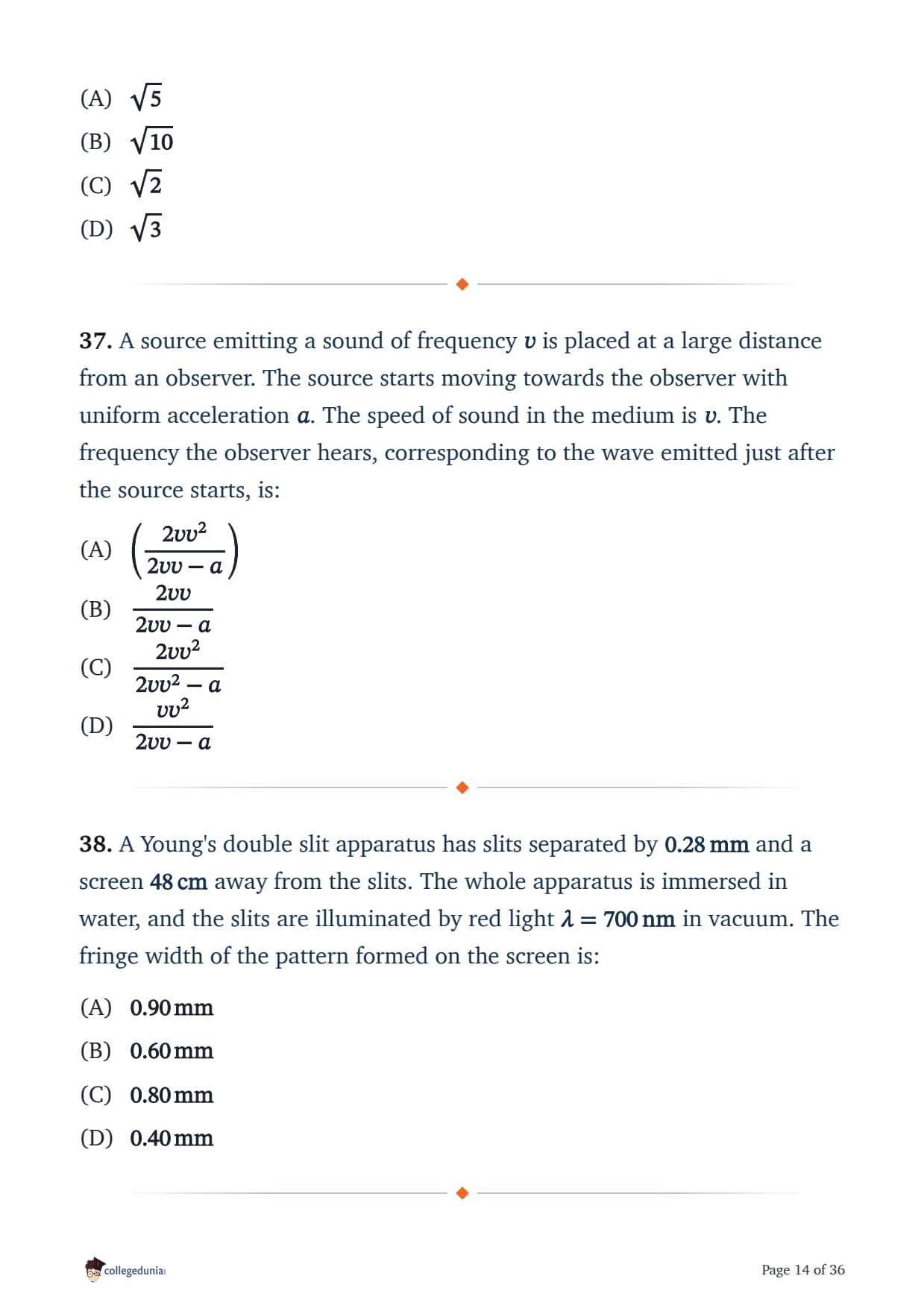
If the sound level in a room is increased from \(50\,\text{dB}\) to \(60\,\text{dB}\), by what factor is the pressure amplitude increased?
A source emitting a sound of frequency \(v\) is placed at a large distance from an observer. The source starts moving towards the observer with uniform acceleration \(a\). The speed of sound in the medium is \(v\). The frequency the observer hears, corresponding to the wave emitted just after the source starts, is:
A Young's double slit apparatus has slits separated by \(0.28\,\text{mm}\) and a screen \(48\,\text{cm}\) away from the slits. The whole apparatus is immersed in water, and the slits are illuminated by red light \(\lambda=700\,\text{nm}\) in vacuum. The fringe width of the pattern formed on the screen is:
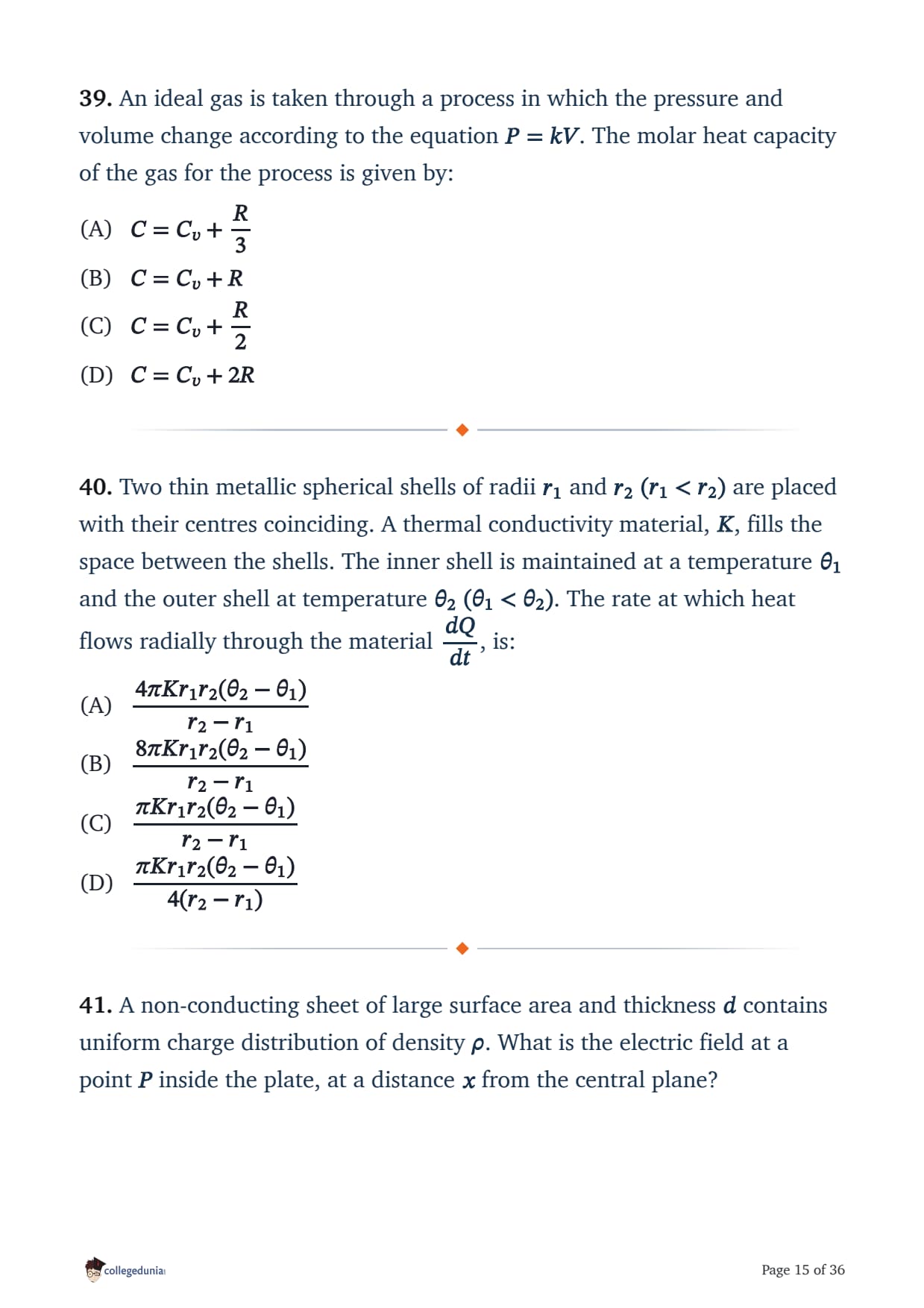
An ideal gas is taken through a process in which the pressure and volume change according to the equation \(P = kV\). The molar heat capacity of the gas for the process is given by:
Two thin metallic spherical shells of radii \(r_1\) and \(r_2\) \((r_1 < r_2)\) are placed with their centres coinciding. A thermal conductivity material, \(K\), fills the space between the shells. The inner shell is maintained at a temperature \(\theta_1\) and the outer shell at temperature \(\theta_2\) \((\theta_1 < \theta_2)\). The rate at which heat flows radially through the material \(\dfrac{dQ}{dt}\), is:
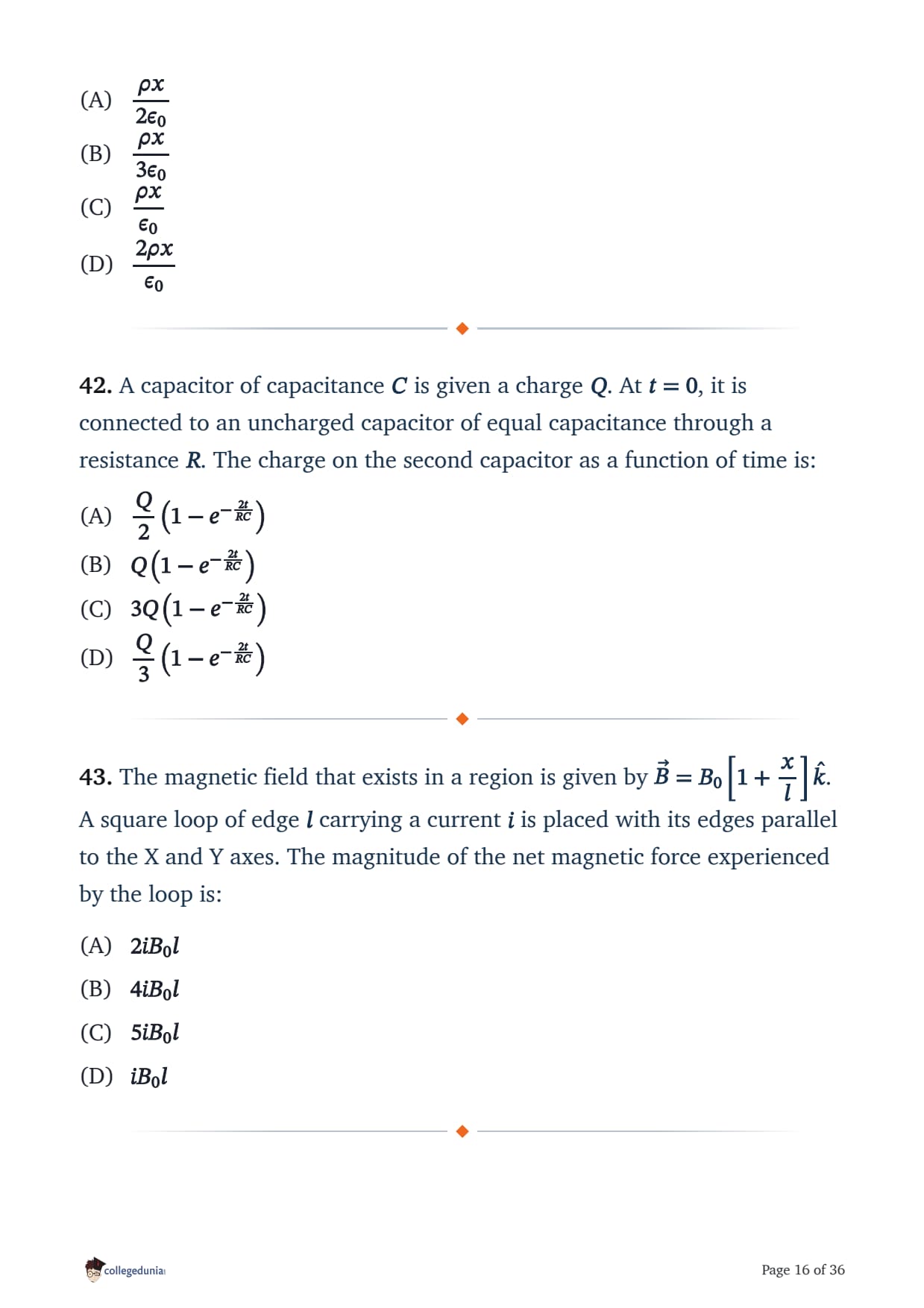
A non-conducting sheet of large surface area and thickness \(d\) contains uniform charge distribution of density \(\rho\). What is the electric field at a point \(P\) inside the plate, at a distance \(x\) from the central plane?
A capacitor of capacitance \(C\) is given a charge \(Q\). At \(t = 0\), it is connected to an uncharged capacitor of equal capacitance through a resistance \(R\). The charge on the second capacitor as a function of time is:
The magnetic field that exists in a region is given by \(\vec{B} = B_0\left[1 + \dfrac{x}{l}\right]\hat{k}\). A square loop of edge \(l\) carrying a current \(i\) is placed with its edges parallel to the X and Y axes. The magnitude of the net magnetic force experienced by the loop is:
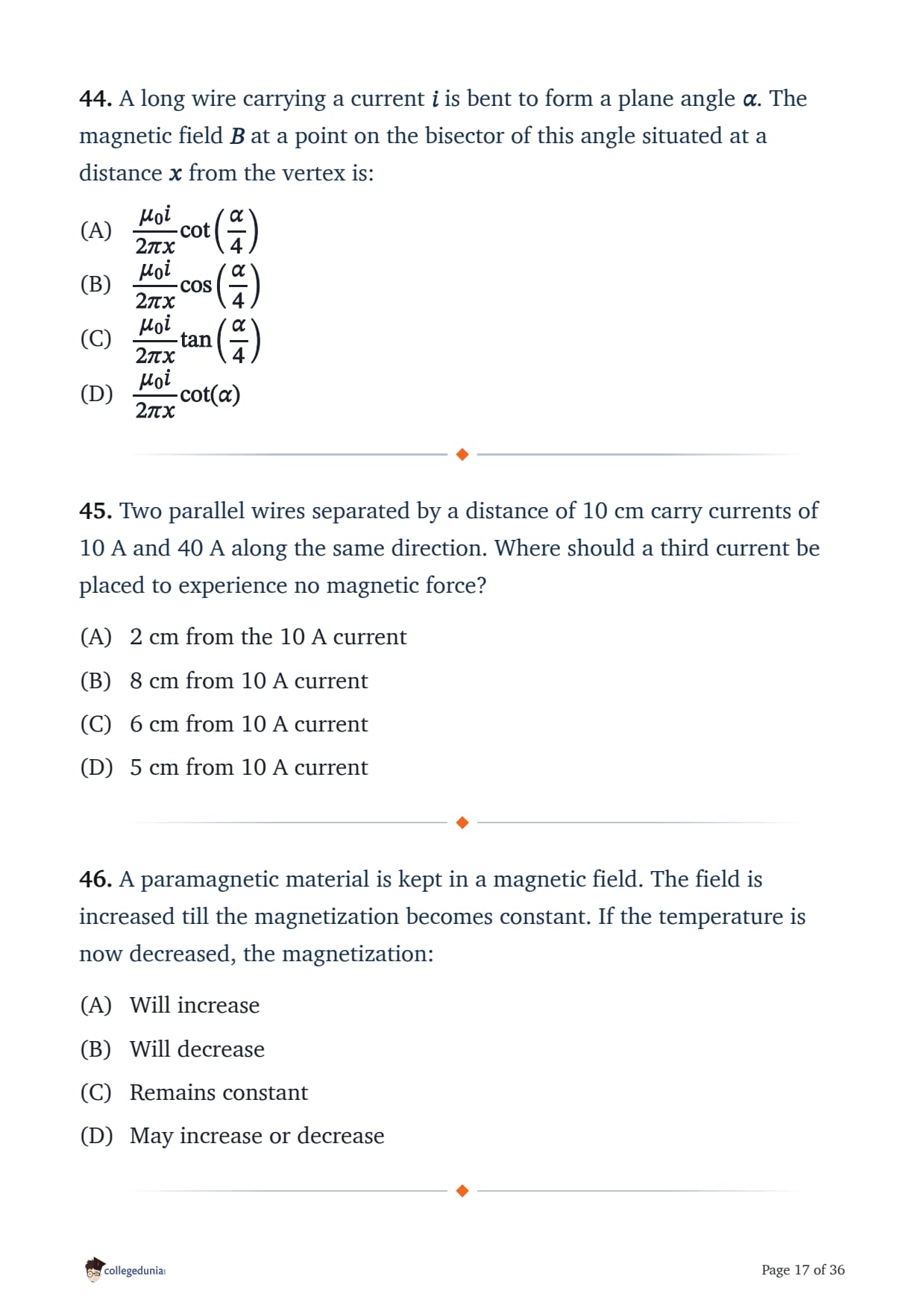
A long wire carrying a current \(i\) is bent to form a plane angle \(\alpha\). The magnetic field \(B\) at a point on the bisector of this angle situated at a distance \(x\) from the vertex is:
Two parallel wires separated by a distance of 10 cm carry currents of 10 A and 40 A along the same direction. Where should a third current be placed to experience no magnetic force?
A paramagnetic material is kept in a magnetic field. The field is increased till the magnetization becomes constant. If the temperature is now decreased, the magnetization:
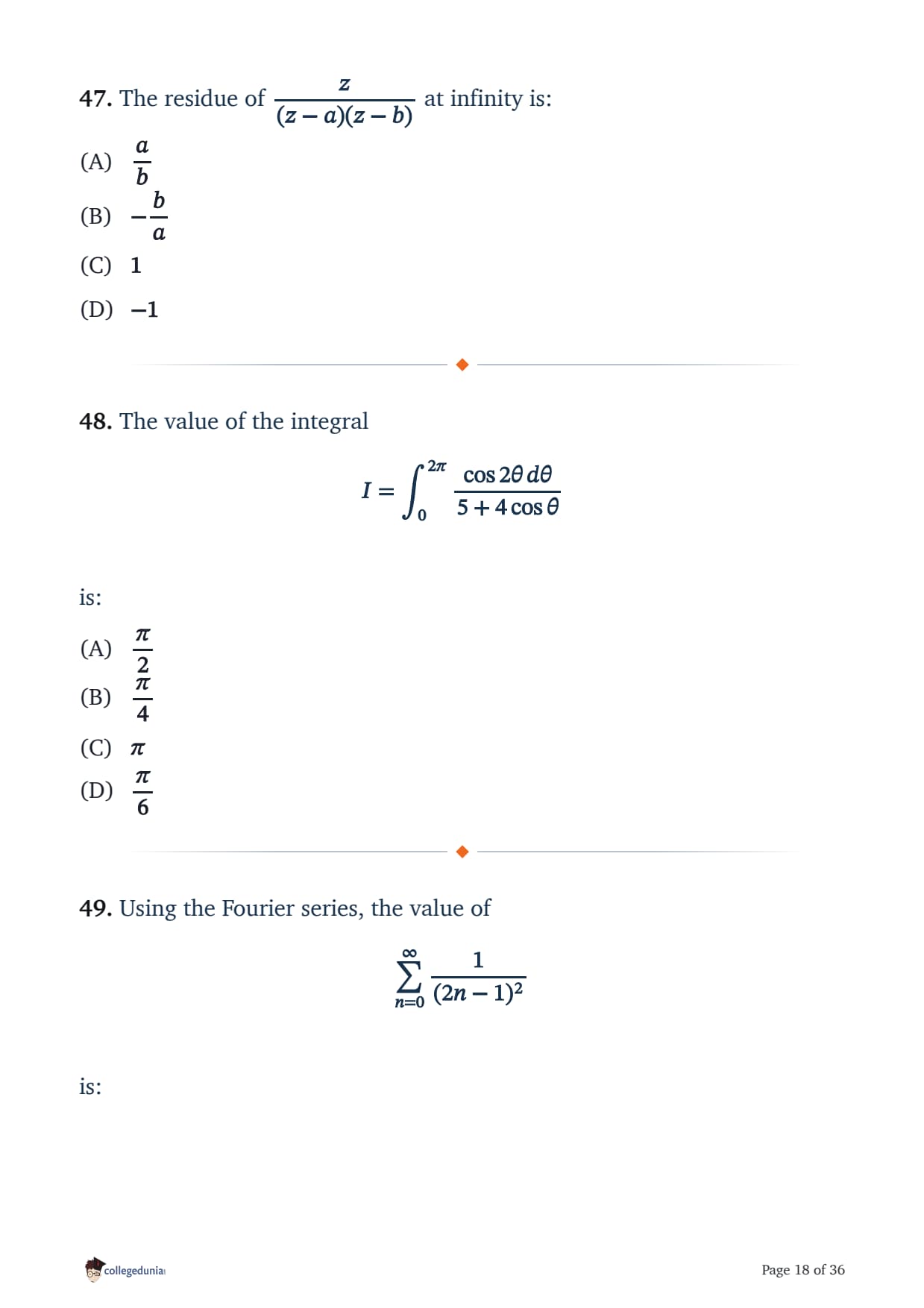
The residue of \(\dfrac{z}{(z-a)(z-b)}\) at infinity is:
The value of the integral
\[ I = \int_{0}^{2\pi} \frac{\cos 2\theta \, d\theta}{5 + 4\cos\theta} \]
is:
Using the Fourier series, the value of
\[ \sum_{n=0}^{\infty} \frac{1}{(2n-1)^{2}} \]
is:
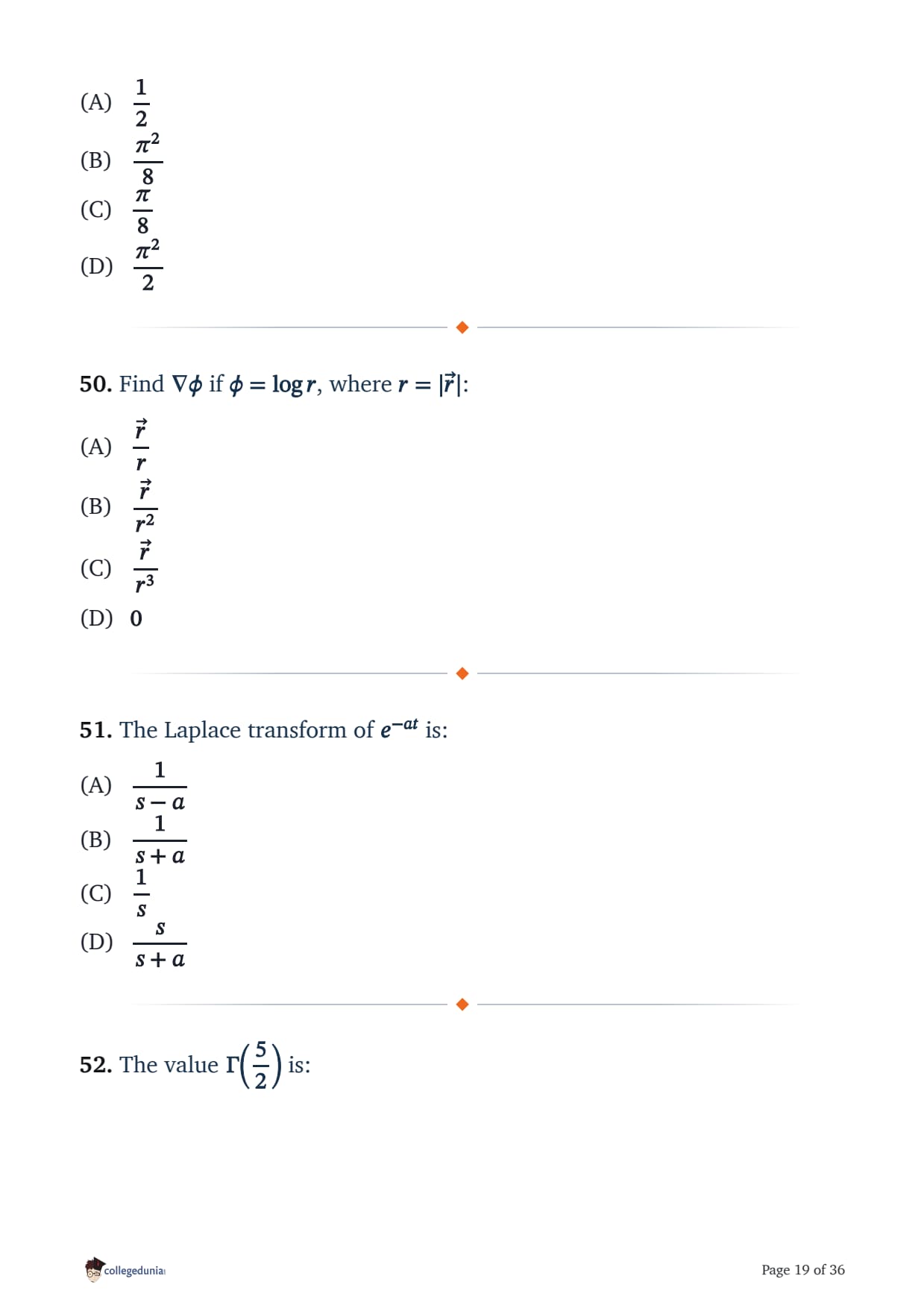
Find \( \nabla\phi \) if \( \phi = \log r \), where \( r = |\vec{r}| \):
The Laplace transform of \( e^{-at} \) is:
The value \( \Gamma\!\left(\dfrac{5}{2}\right) \) is:
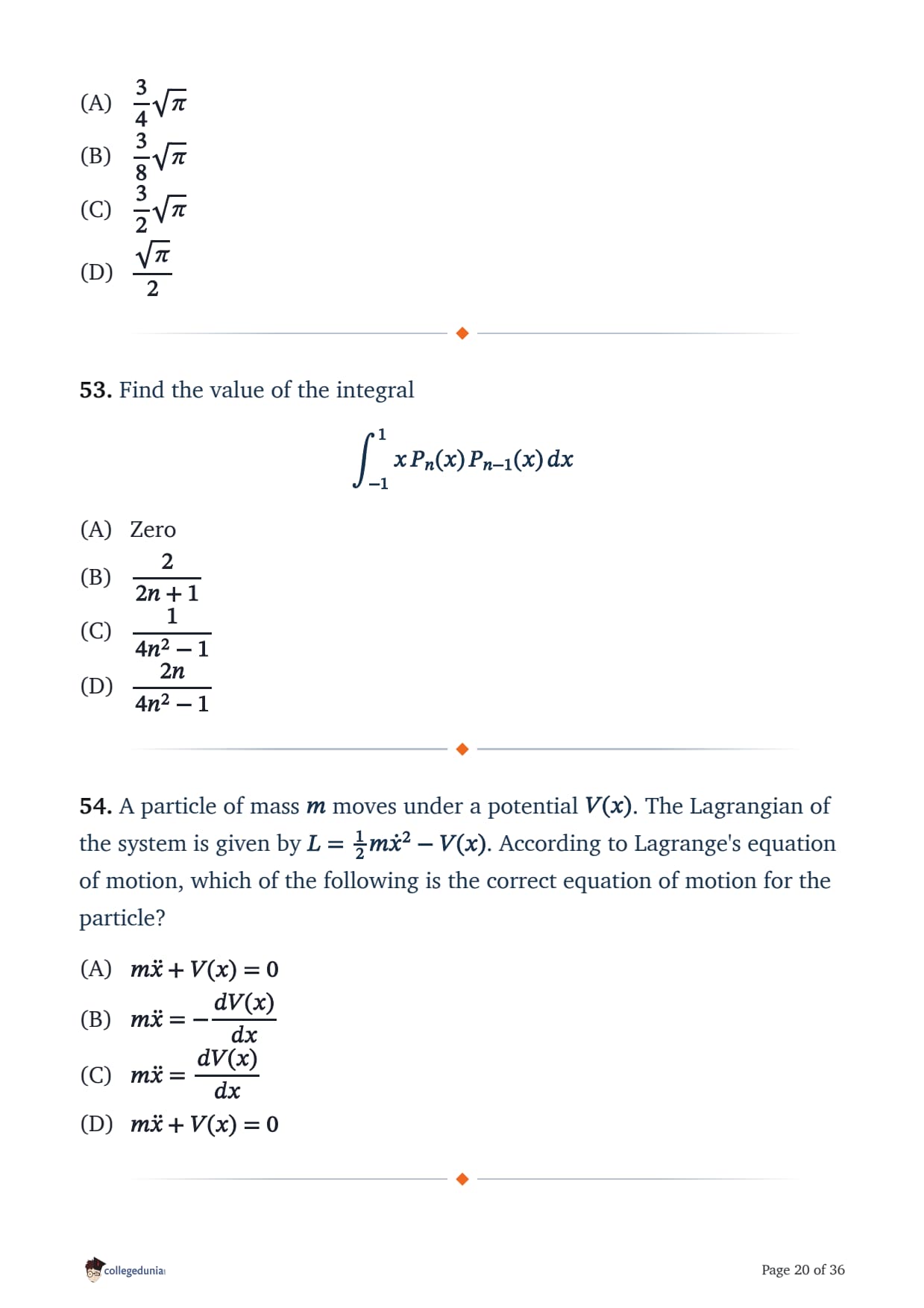
Find the value of the integral
\[\int_{-1}^{1} x\,P_n(x)\,P_{n-1}(x)\,dx\]
A particle of mass \(m\) moves under a potential \(V(x)\). The Lagrangian of the system is given by \(L = \tfrac{1}{2}m\dot{x}^2 - V(x)\). According to Lagrange's equation of motion, which of the following is the correct equation of motion for the particle?
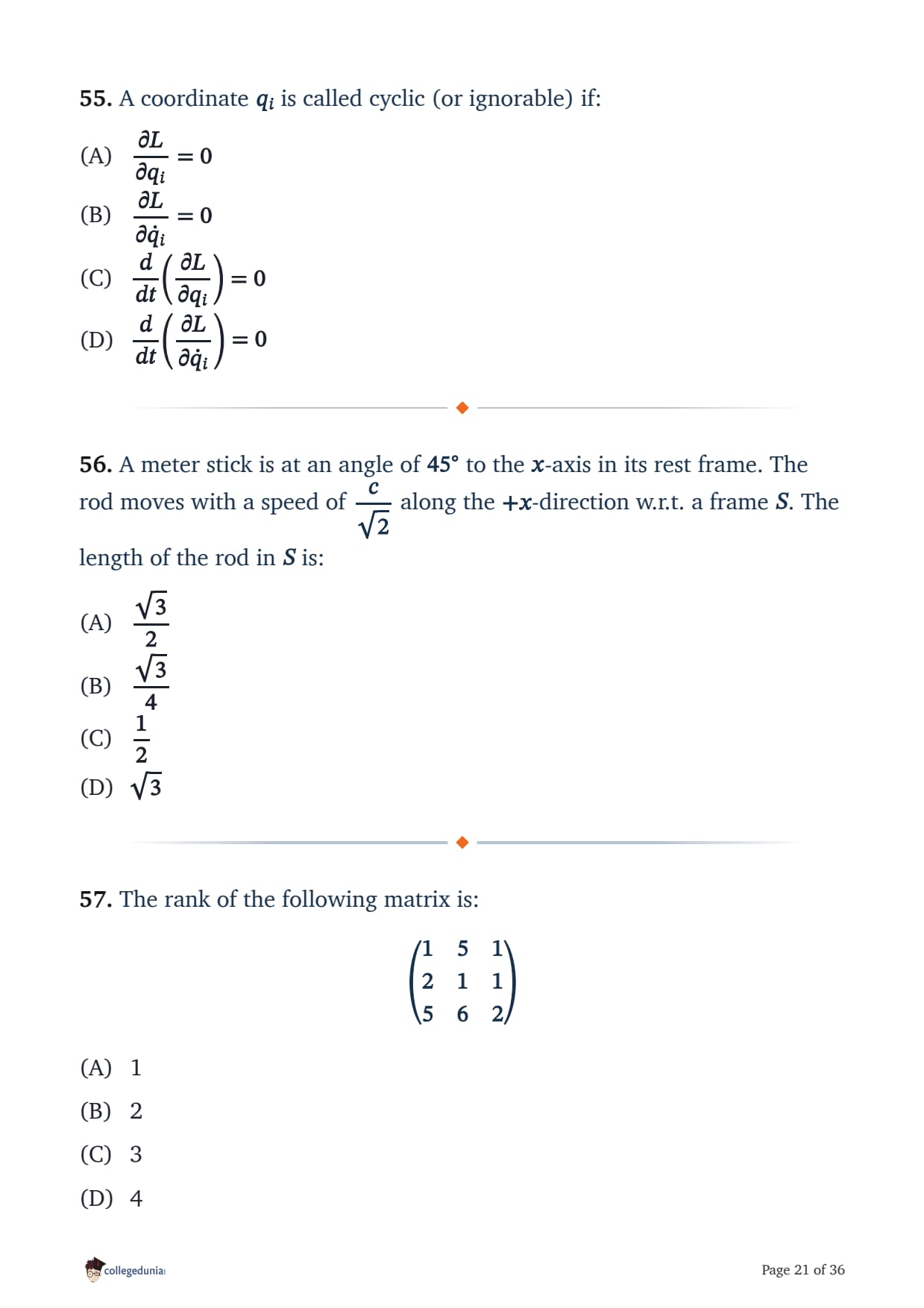
A coordinate \(q_i\) is called cyclic (or ignorable) if:
A meter stick is at an angle of \(45^\circ\) to the \(x\)-axis in its rest frame. The rod moves with a speed of \(\dfrac{c}{\sqrt{2}}\) along the \(+x\)-direction w.r.t. a frame \(S\). The length of the rod in \(S\) is:
The rank of the following matrix is:
\[\begin{pmatrix} 1 & 5 & 1 \\ 2 & 1 & 1 \\ 5 & 6 & 2 \end{pmatrix}\]
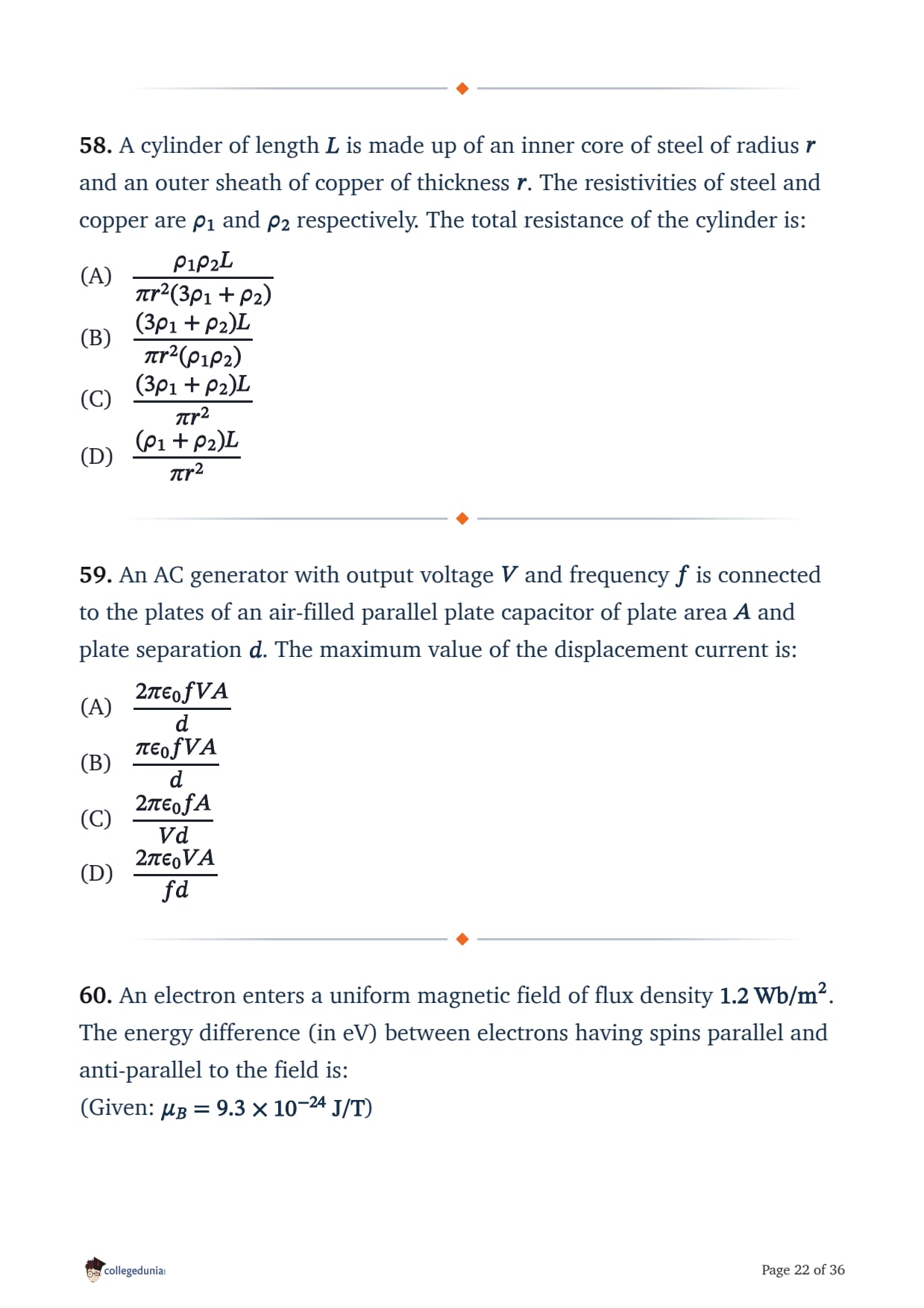
A cylinder of length \(L\) is made up of an inner core of steel of radius \(r\) and an outer sheath of copper of thickness \(r\). The resistivities of steel and copper are \(\rho_1\) and \(\rho_2\) respectively. The total resistance of the cylinder is:
An AC generator with output voltage \(V\) and frequency \(f\) is connected to the plates of an air-filled parallel plate capacitor of plate area \(A\) and plate separation \(d\). The maximum value of the displacement current is:
An electron enters a uniform magnetic field of flux density \(1.2\ \text{Wb/m}^2\). The energy difference (in eV) between electrons having spins parallel and anti-parallel to the field is:
(Given: \(\mu_B = 9.3 \times 10^{-24}\ \text{J/T}\))
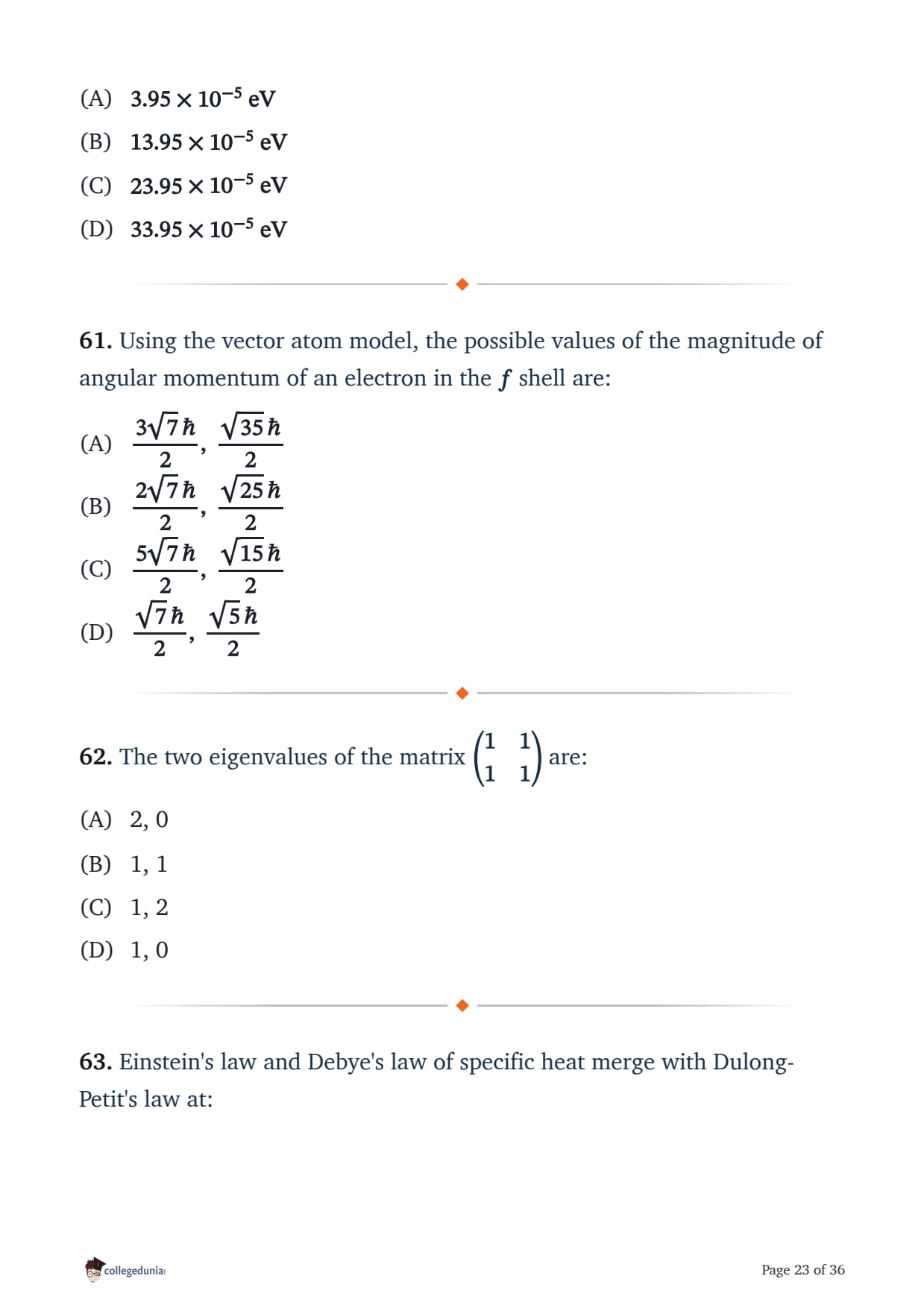
Using the vector atom model, the possible values of the magnitude of angular momentum of an electron in the \(f\) shell are:
The two eigenvalues of the matrix \(\begin{pmatrix} 1 & 1 \\ 1 & 1 \end{pmatrix}\) are:
Einstein's law and Debye's law of specific heat merge with Dulong-Petit's law at:
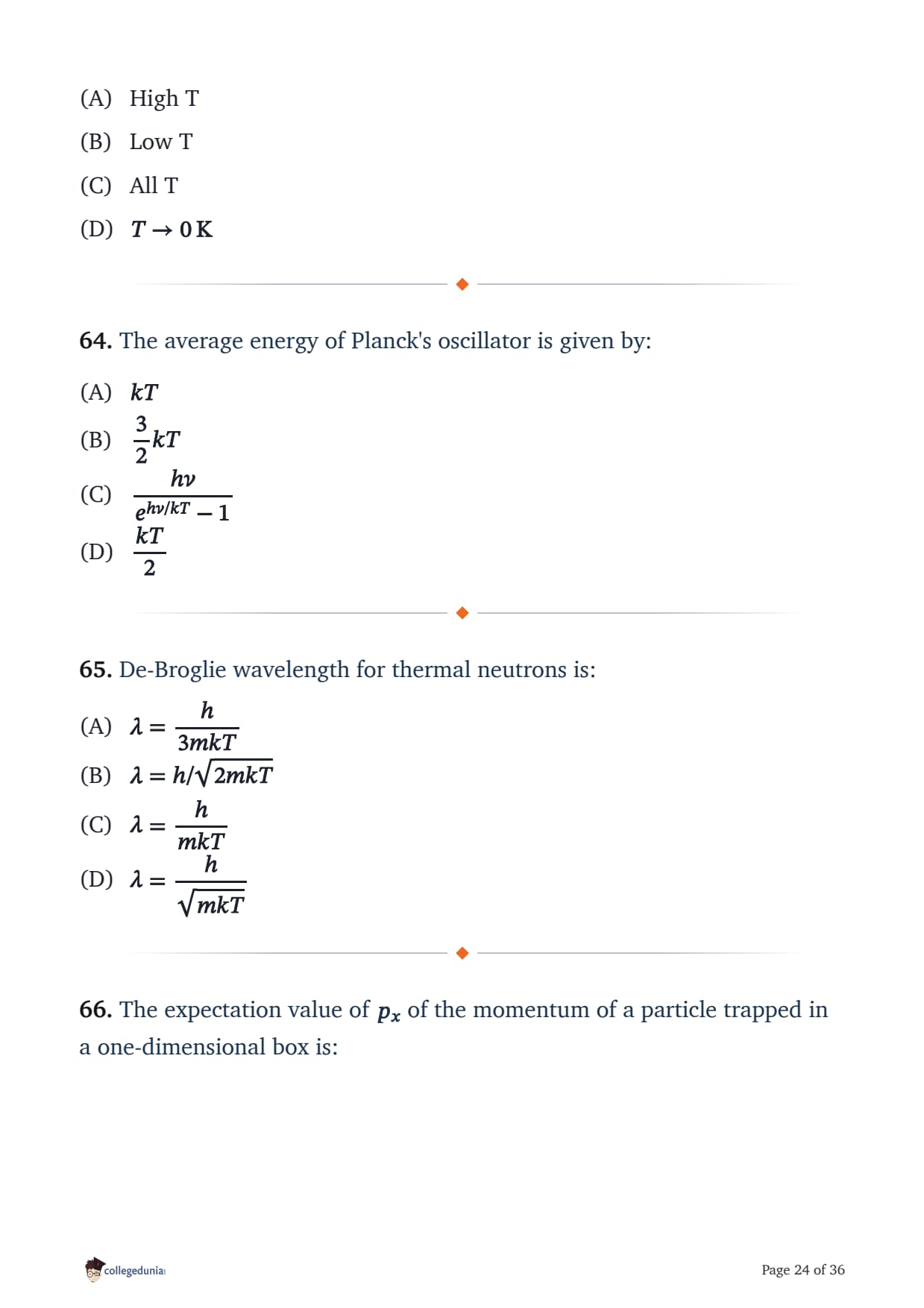
The average energy of Planck's oscillator is given by:
De-Broglie wavelength for thermal neutrons is:
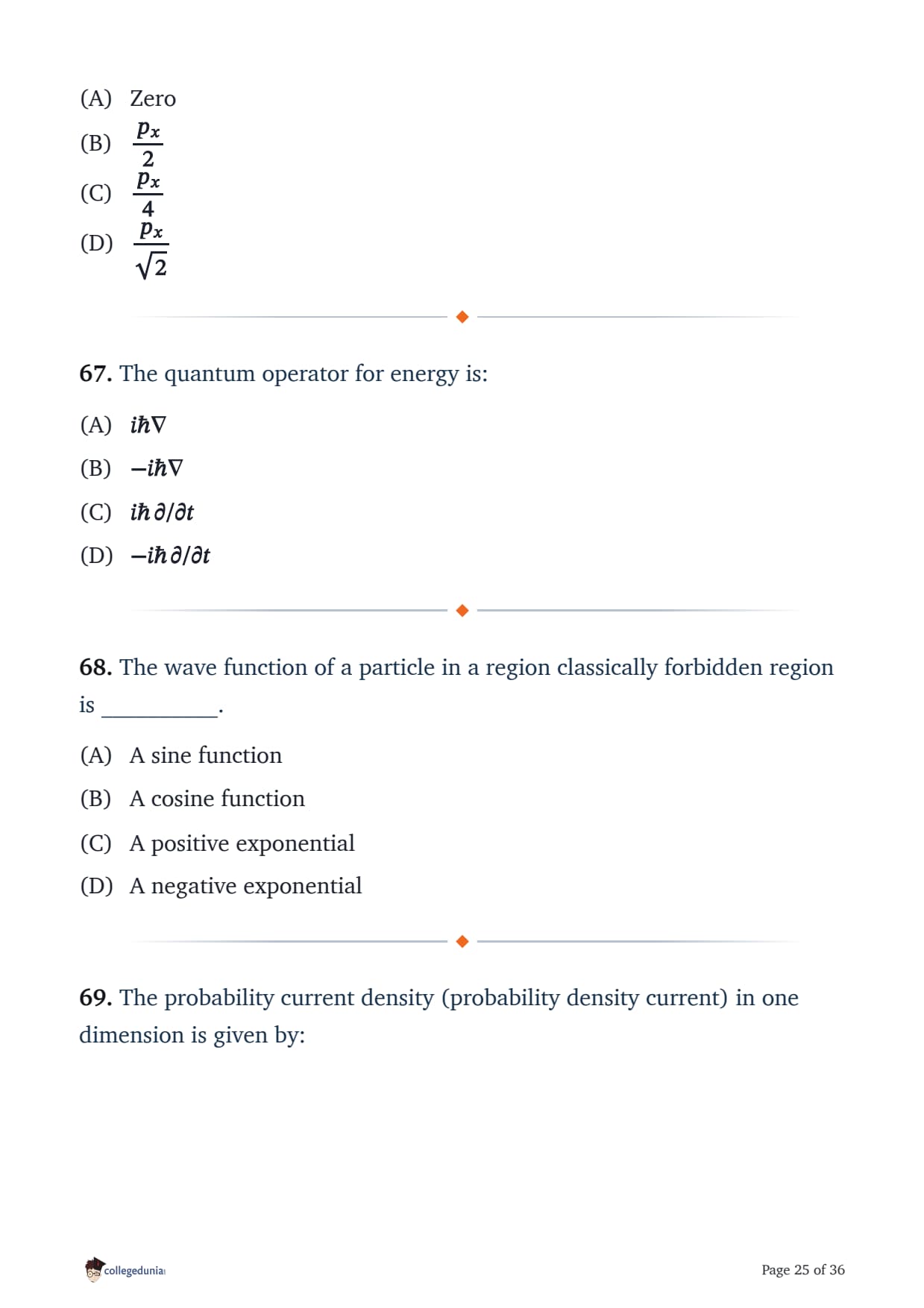
The expectation value of \(p_x\) of the momentum of a particle trapped in a one-dimensional box is:
The quantum operator for energy is:
The wave function of a particle in a region classically forbidden region is __________.
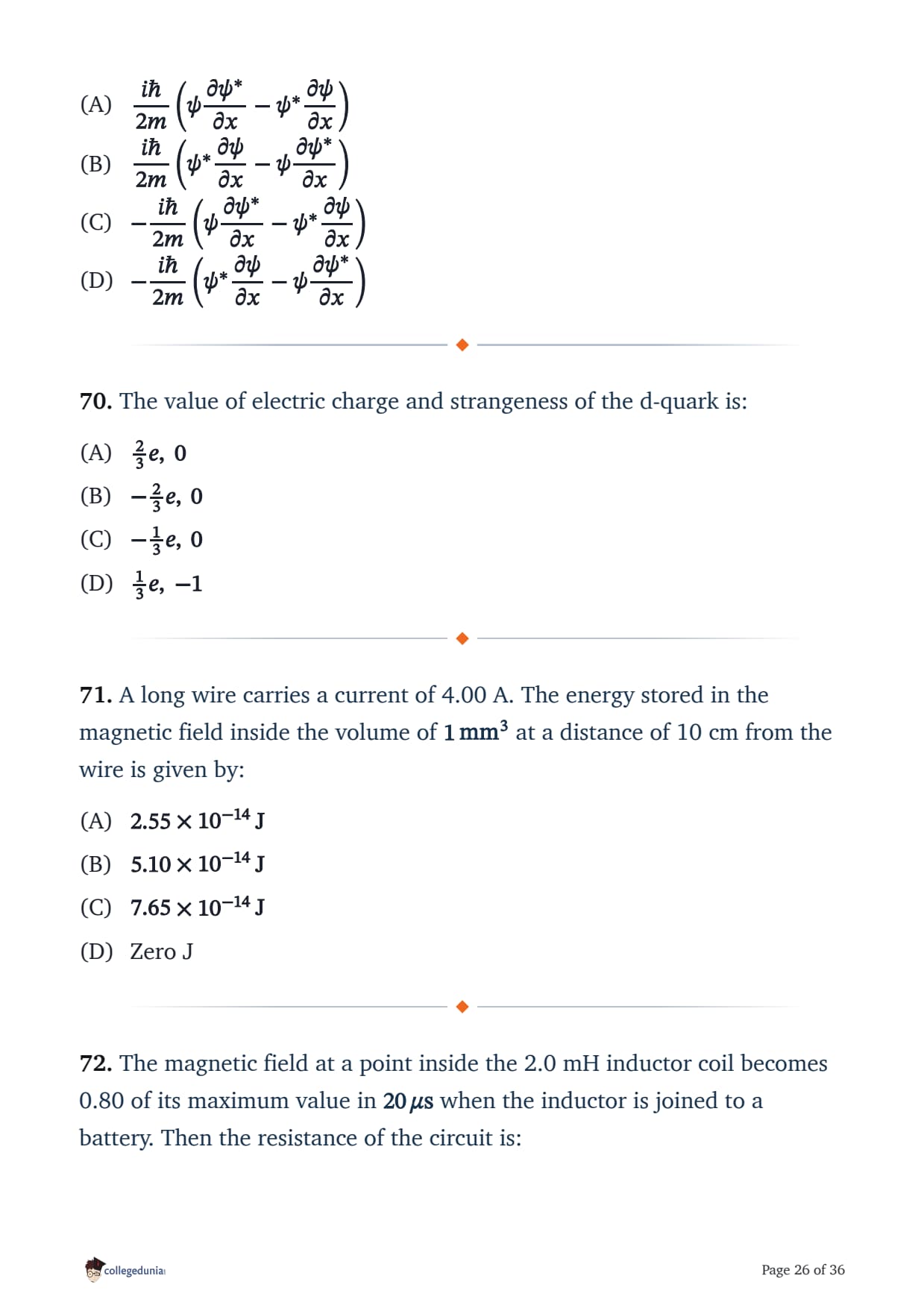
The probability current density (probability density current) in one dimension is given by:
The value of electric charge and strangeness of the d-quark is:
A long wire carries a current of 4.00 A. The energy stored in the magnetic field inside the volume of \(1\,\text{mm}^{3}\) at a distance of 10 cm from the wire is given by:
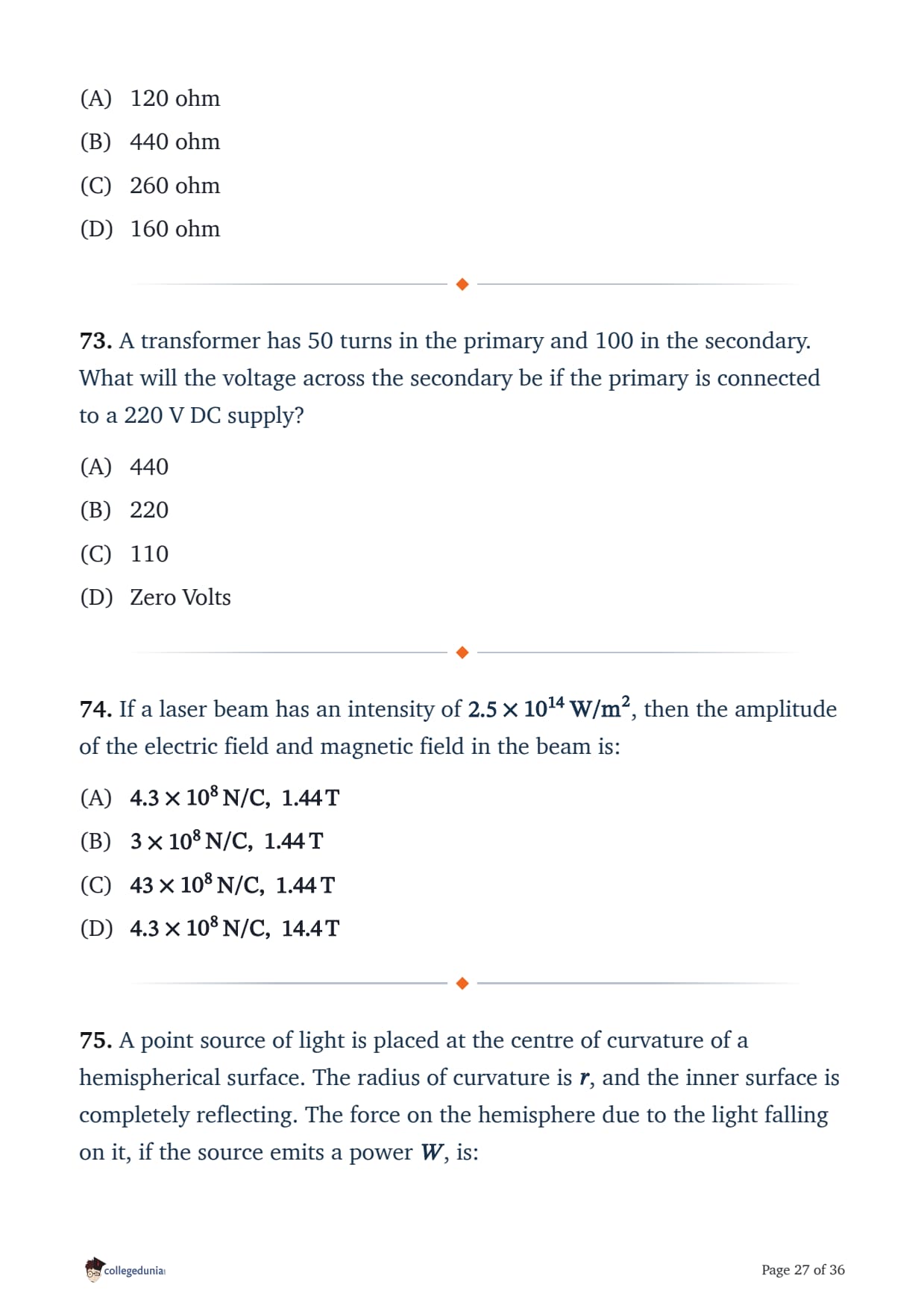
The magnetic field at a point inside the 2.0 mH inductor coil becomes 0.80 of its maximum value in \(20\,\mu\text{s}\) when the inductor is joined to a battery. Then the resistance of the circuit is:
A transformer has 50 turns in the primary and 100 in the secondary. What will the voltage across the secondary be if the primary is connected to a 220 V DC supply?
If a laser beam has an intensity of \(2.5\times10^{14}\,\text{W/m}^{2}\), then the amplitude of the electric field and magnetic field in the beam is:
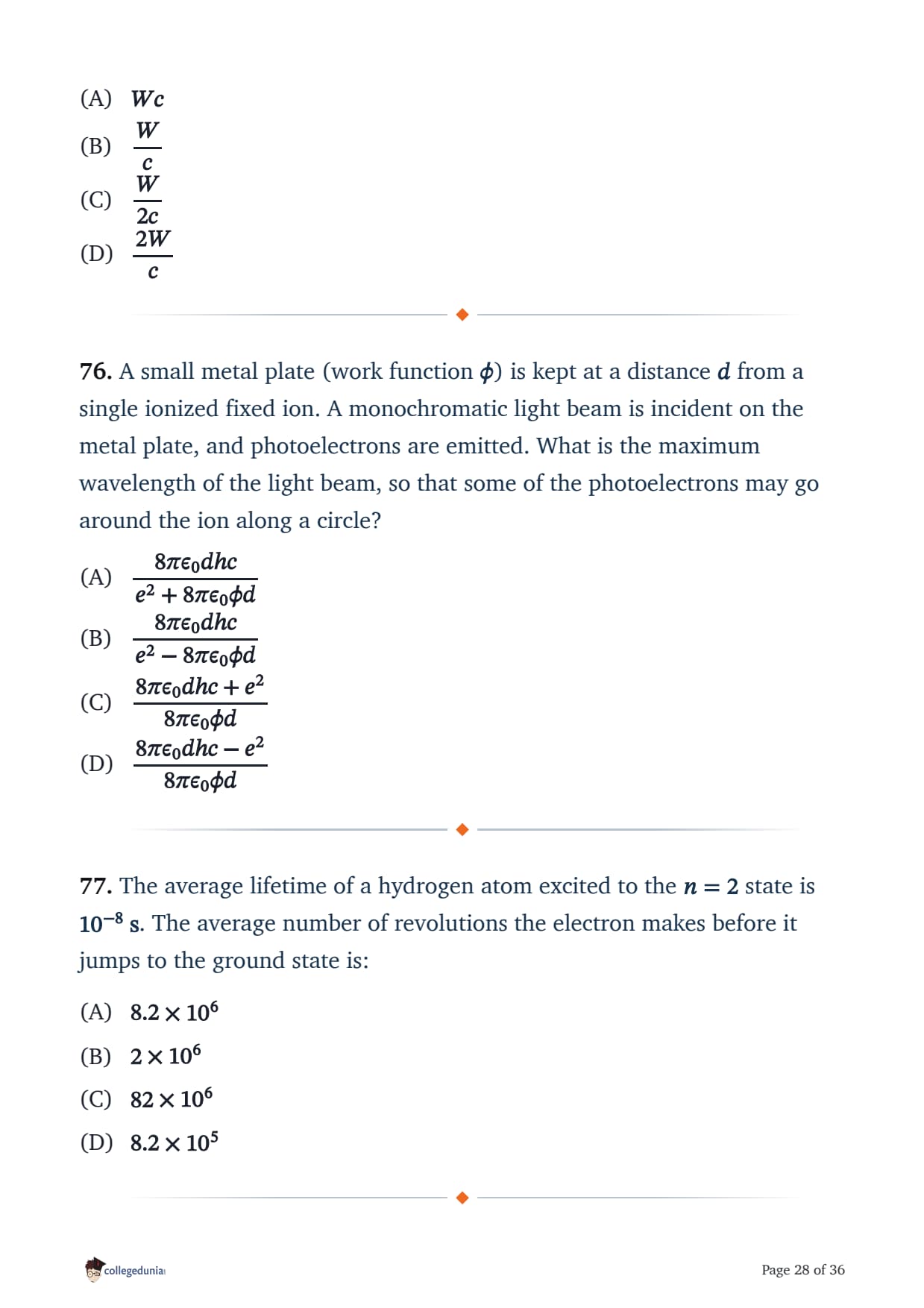
A point source of light is placed at the centre of curvature of a hemispherical surface. The radius of curvature is \(r\), and the inner surface is completely reflecting. The force on the hemisphere due to the light falling on it, if the source emits a power \(W\), is:
A small metal plate (work function \(\phi\)) is kept at a distance \(d\) from a single ionized fixed ion. A monochromatic light beam is incident on the metal plate, and photoelectrons are emitted. What is the maximum wavelength of the light beam, so that some of the photoelectrons may go around the ion along a circle?
The average lifetime of a hydrogen atom excited to the \(n = 2\) state is \(10^{-8}\ \text{s}\). The average number of revolutions the electron makes before it jumps to the ground state is:
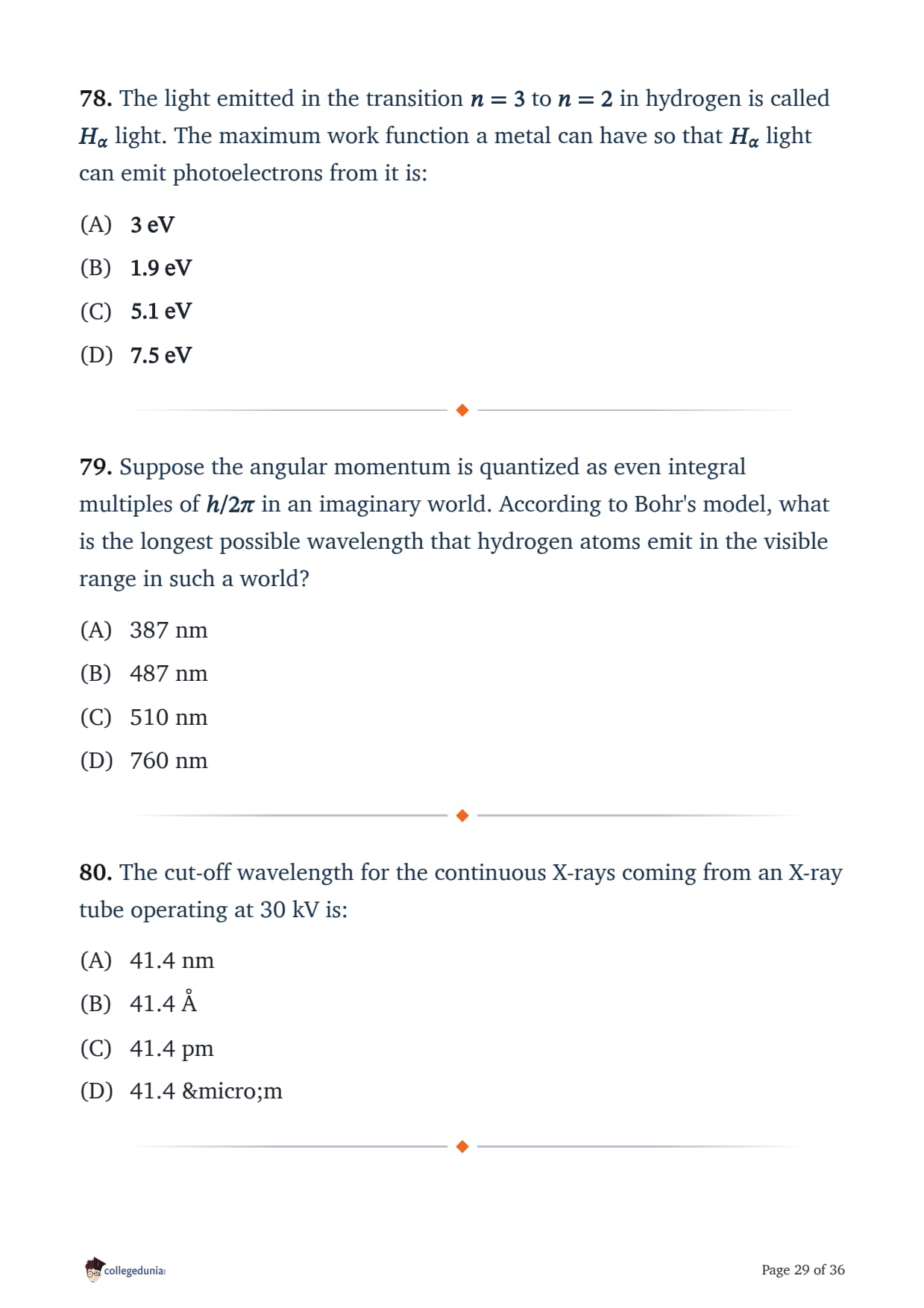
The light emitted in the transition \(n = 3\) to \(n = 2\) in hydrogen is called \(H_\alpha\) light. The maximum work function a metal can have so that \(H_\alpha\) light can emit photoelectrons from it is:
Suppose the angular momentum is quantized as even integral multiples of \(h/2\pi\) in an imaginary world. According to Bohr's model, what is the longest possible wavelength that hydrogen atoms emit in the visible range in such a world?
The cut-off wavelength for the continuous X-rays coming from an X-ray tube operating at 30 kV is:
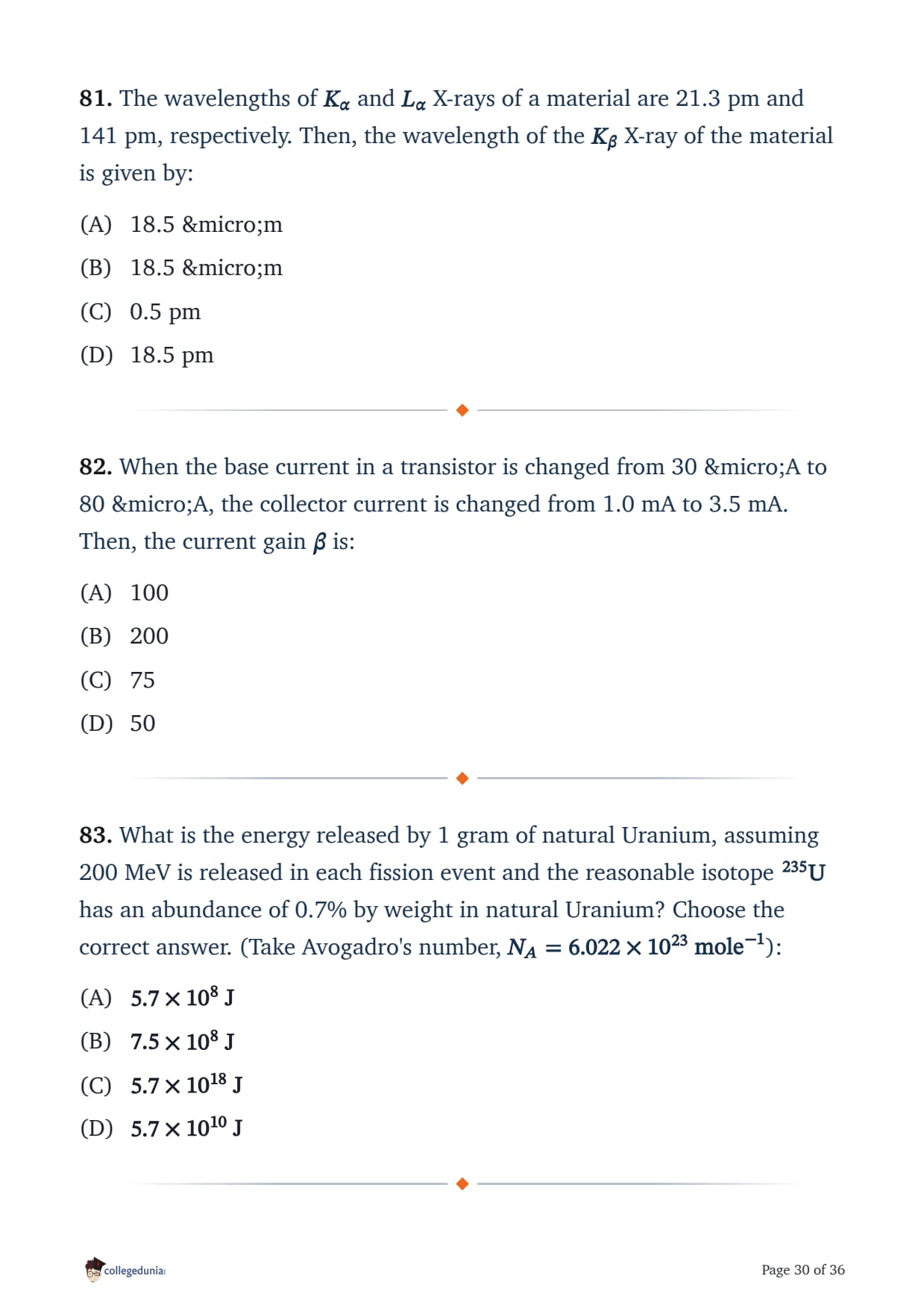
The wavelengths of \(K_\alpha\) and \(L_\alpha\) X-rays of a material are 21.3 pm and 141 pm, respectively. Then, the wavelength of the \(K_\beta\) X-ray of the material is given by:
When the base current in a transistor is changed from 30 µA to 80 µA, the collector current is changed from 1.0 mA to 3.5 mA. Then, the current gain \(\beta\) is:
What is the energy released by 1 gram of natural Uranium, assuming 200 MeV is released in each fission event and the reasonable isotope \(^{235}\mathrm{U}\) has an abundance of 0.7% by weight in natural Uranium? Choose the correct answer. (Take Avogadro's number, \(N_A = 6.022 \times 10^{23}\ \text{mole}^{-1}\)):
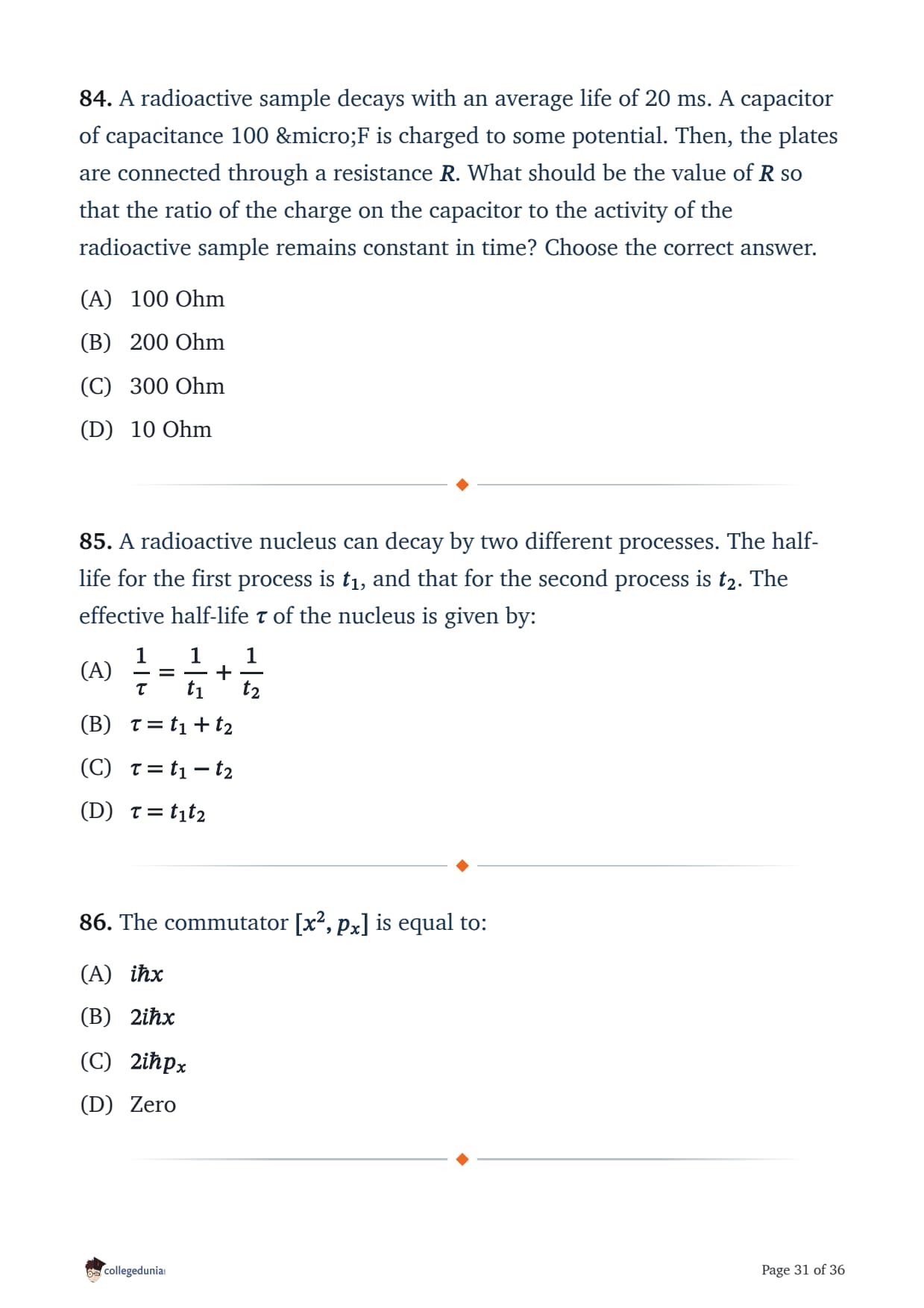
A radioactive sample decays with an average life of 20 ms. A capacitor of capacitance 100 µF is charged to some potential. Then, the plates are connected through a resistance \(R\). What should be the value of \(R\) so that the ratio of the charge on the capacitor to the activity of the radioactive sample remains constant in time? Choose the correct answer.
A radioactive nucleus can decay by two different processes. The half-life for the first process is \(t_1\), and that for the second process is \(t_2\). The effective half-life \(\tau\) of the nucleus is given by:
The commutator \([x^2, p_x]\) is equal to:
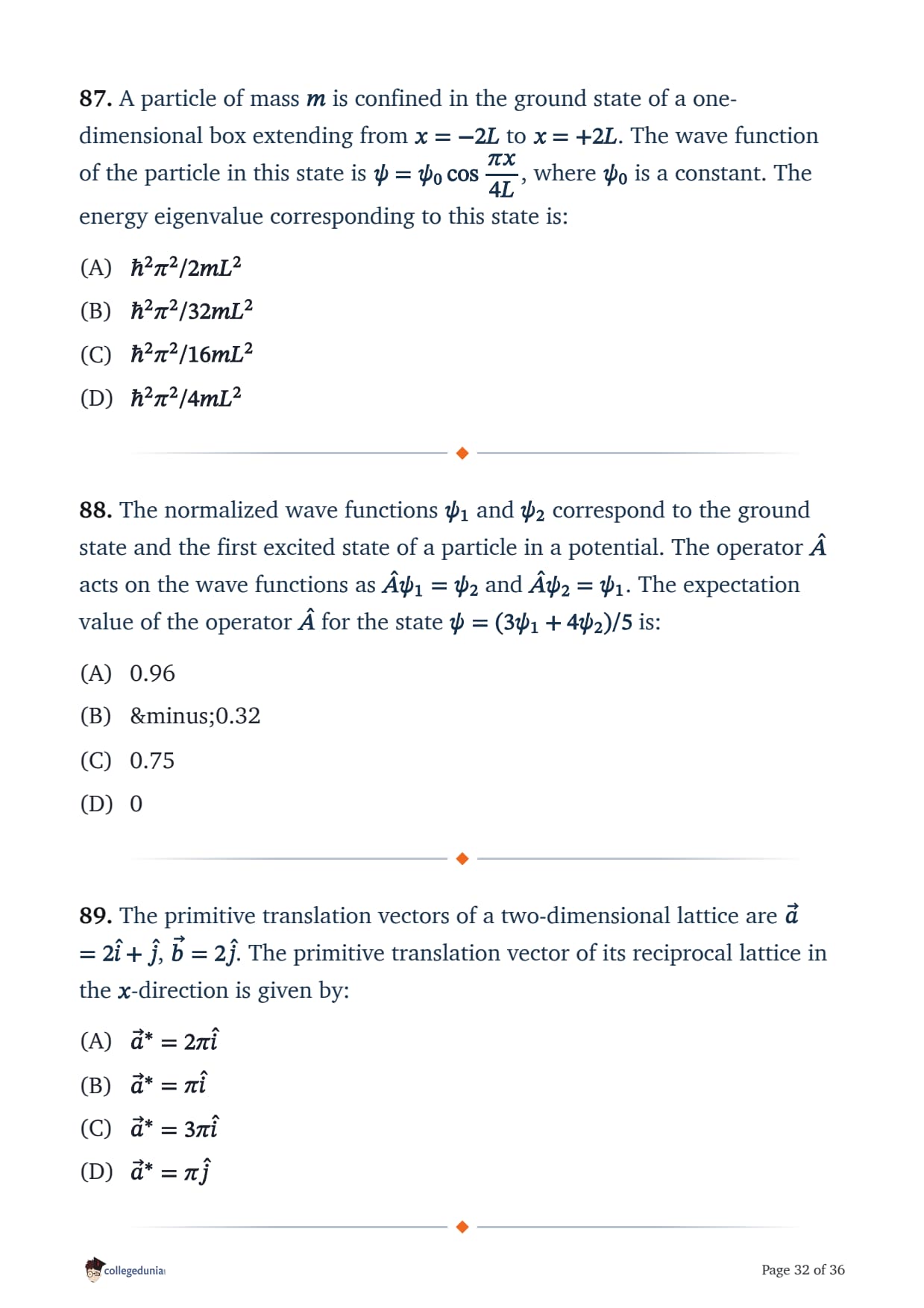
A particle of mass \(m\) is confined in the ground state of a one-dimensional box extending from \(x = -2L\) to \(x = +2L\). The wave function of the particle in this state is \(\psi = \psi_0 \cos\dfrac{\pi x}{4L}\), where \(\psi_0\) is a constant. The energy eigenvalue corresponding to this state is:
The normalized wave functions \(\psi_1\) and \(\psi_2\) correspond to the ground state and the first excited state of a particle in a potential. The operator \(\hat{A}\) acts on the wave functions as \(\hat{A}\psi_1 = \psi_2\) and \(\hat{A}\psi_2 = \psi_1\). The expectation value of the operator \(\hat{A}\) for the state \(\psi = (3\psi_1 + 4\psi_2)/5\) is:
The primitive translation vectors of a two-dimensional lattice are \(\vec{a} = 2\hat{i} + \hat{j}\), \(\vec{b} = 2\hat{j}\). The primitive translation vector of its reciprocal lattice in the \(x\)-direction is given by:
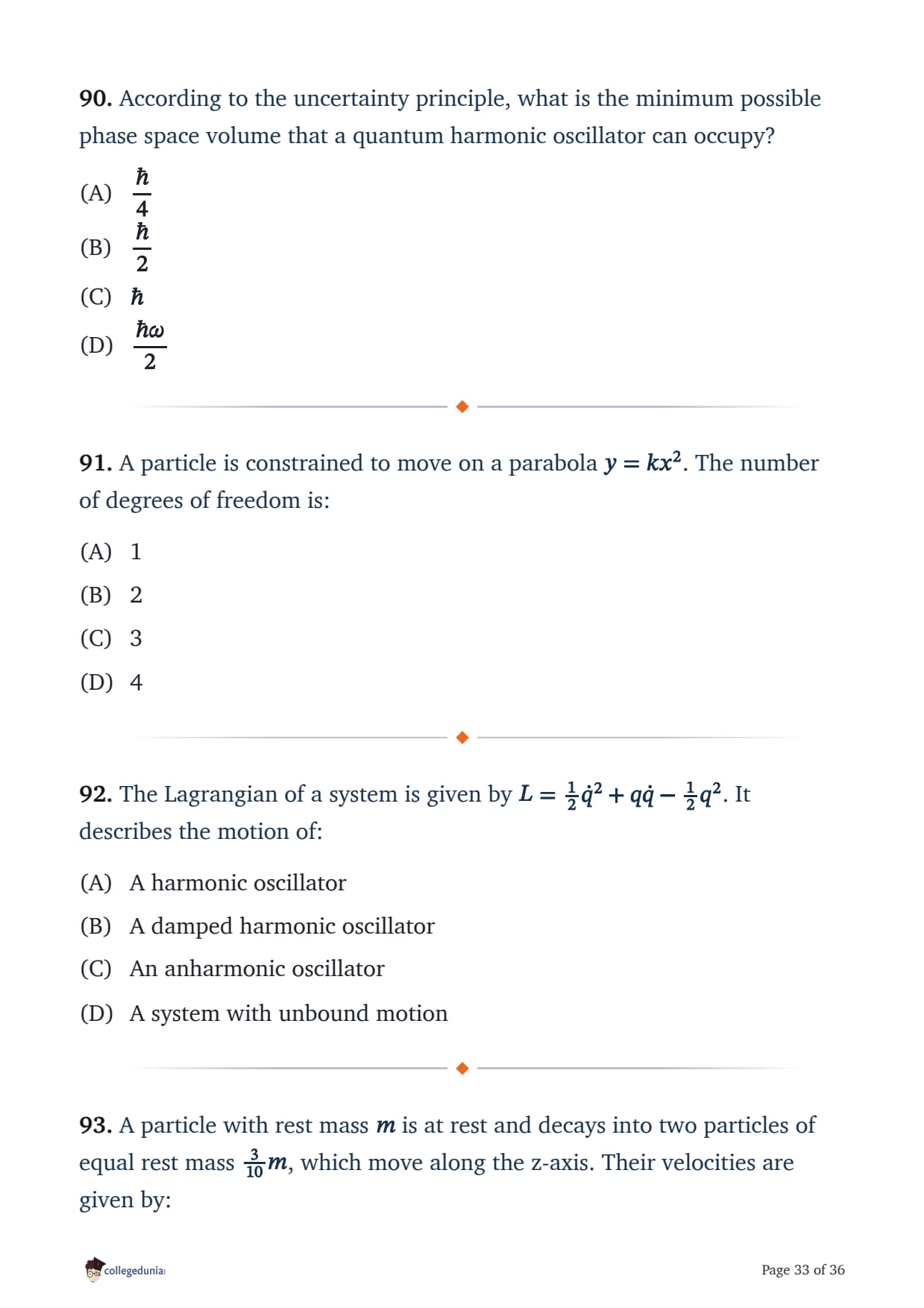
According to the uncertainty principle, what is the minimum possible phase space volume that a quantum harmonic oscillator can occupy?
A particle is constrained to move on a parabola \(y = kx^{2}\). The number of degrees of freedom is:
The Lagrangian of a system is given by \(L = \tfrac{1}{2}\dot{q}^{2} + q\dot{q} - \tfrac{1}{2}q^{2}\). It describes the motion of:
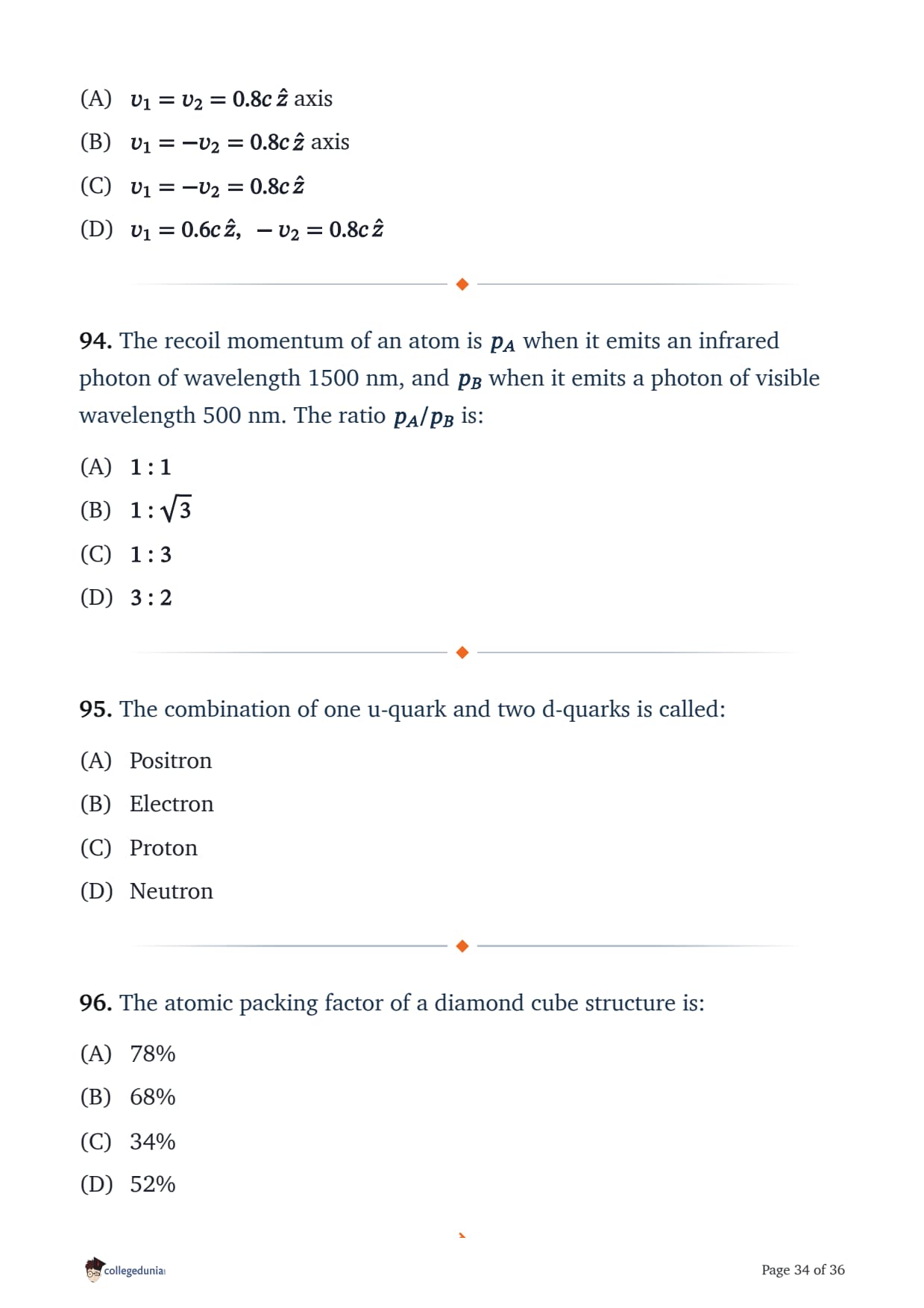
A particle with rest mass \(m\) is at rest and decays into two particles of equal rest mass \(\tfrac{3}{10}m\), which move along the z-axis. Their velocities are given by:
The recoil momentum of an atom is \(p_A\) when it emits an infrared photon of wavelength 1500 nm, and \(p_B\) when it emits a photon of visible wavelength 500 nm. The ratio \(p_A/p_B\) is:
The combination of one u-quark and two d-quarks is called:
The atomic packing factor of a diamond cube structure is:
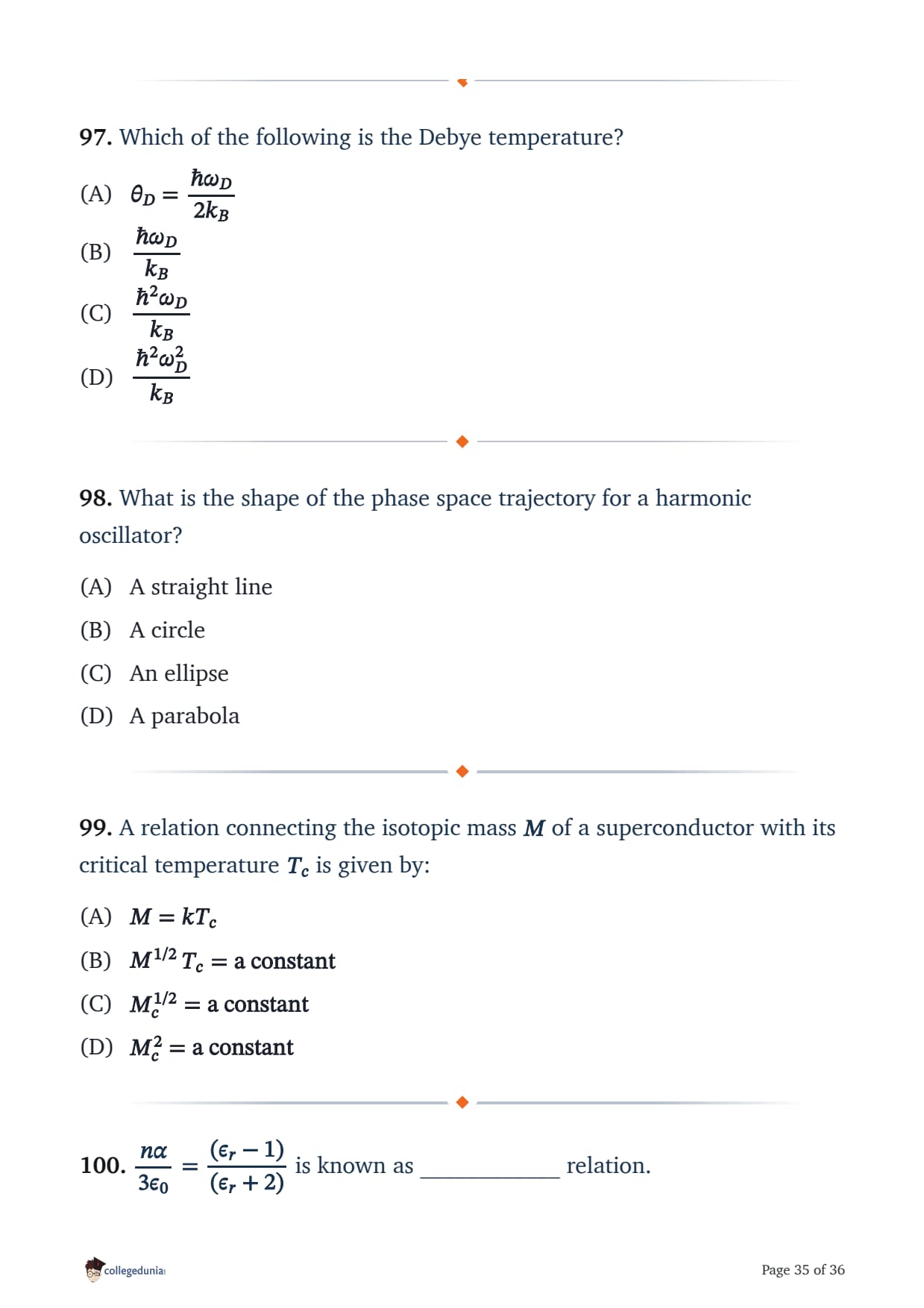
Which of the following is the Debye temperature?
What is the shape of the phase space trajectory for a harmonic oscillator?
A relation connecting the isotopic mass \(M\) of a superconductor with its critical temperature \(T_c\) is given by:
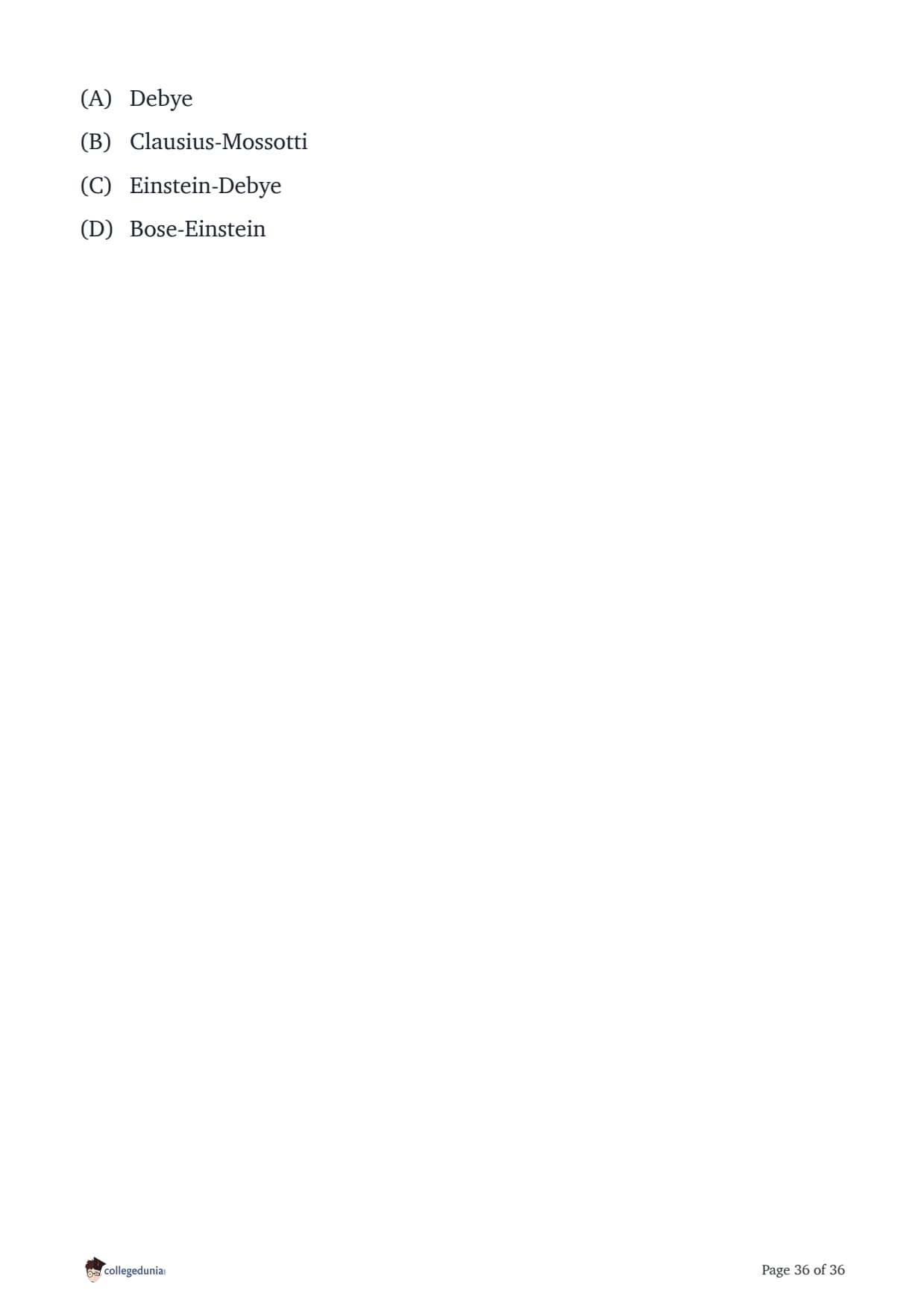
\(\dfrac{n\alpha}{3\epsilon_0} = \dfrac{(\epsilon_r - 1)}{(\epsilon_r + 2)}\) is known as ____________ relation.
Odisha CPET 2025 Physics Exam Pattern and Marking Scheme Explained
Odisha CPET 2025 was an offline (pen-and-paper) objective test conducted by the Department of Higher Education for admission to PG Physics seats across Odisha's public universities and colleges, as listed on the official portal (pg.samsodisha.gov.in). The Physics set in this download has 100 questions worth 100 marks.
- Total questions: 100 single-best-answer MCQs, four options each
- Total marks: 100
- Time allowed: 80 minutes
- Marking scheme: +1 for every correct answer
- Negative marking: yes - 0.25 is deducted for each wrong answer, so guess only when you can rule out at least two options
- Mode: offline OMR-based test at allotted centres across Odisha
- Question types: theory recall plus applied numericals across the full MSc Physics syllabus
High-Weightage Topics in Odisha CPET 2025 Physics to Focus On First
The 100 questions span the entire postgraduate Physics syllabus, but the marks cluster around a few core areas. Here is how the questions actually split across topics in this set.
- Atomic, Molecular, Optics and X-ray Physics: about 14 of the 100 questions - Zeeman effect, de Broglie waves, the Bohr model, photoelectric effect, and X-ray wavelengths
- Electromagnetism and Electrodynamics: around 13 questions on magnetostatics, electromagnetic induction, displacement current, and EM waves
- Mathematical Physics: about 12 questions on vector calculus, complex analysis, Fourier and Laplace transforms, special functions, and linear algebra
- Classical and Lagrangian Mechanics: around 11 questions on rotational motion, oscillations, and the Lagrangian formulation
- Nuclear and Particle Physics: roughly 11 questions on decay laws, magic nuclei, quarks, and fission energy
- Quantum Mechanics: about 9 questions on operators, expectation values, the particle in a box, and the uncertainty principle
- Solid State Physics: around 9 questions on lattices, specific heat, the Debye model, and superconductivity
- Fluids, Waves, Sound and Properties of Matter: about 8 questions on viscosity, surface tension, and acoustics
- Electronics, Thermodynamics and Relativity: the remaining questions on transistors, modulation, Carnot cycles, and length contraction
Odisha CPET Physics Previous Year Question Paper Video
Source: The PHYSICS Web
How to Use the Odisha CPET Physics Question Paper for Practice
Because this paper has negative marking, treat it as a full 80-minute timed mock, then close every gap with the solution PDF. Accuracy matters as much as speed here.
- Solve all 100 questions in one timed sitting first, then check answers against the solution PDF above
- Clear the mathematical physics and mechanics questions early - they are the most predictable marks
- Redo the atomic, nuclear, and solid state sets until the standard formulas feel automatic
- Since a wrong answer costs 0.25, skip a question only when you cannot eliminate at least two options
Odisha CPET 2025 Physics Question Paper FAQs
Ques. Is there negative marking in the Odisha CPET 2025 Physics paper?
Ans. Yes. Each correct answer earns +1 mark and 0.25 is deducted for every wrong answer. An unanswered question scores 0, so make an educated guess only when you can rule out at least two options.
Ques. How many questions are there in the Odisha CPET Physics paper and what is the total mark?
Ans. The Physics set carries 100 single-best-answer MCQs for a total of 100 marks, with four options per question. It is an 80-minute offline OMR-based test.
Ques. Which topics have the highest weightage in Odisha CPET Physics?
Ans. Atomic and optics physics leads with about 14 of the 100 questions, followed by Electromagnetism (13), Mathematical Physics (12), Classical Mechanics (11), Nuclear and Particle Physics (11), Quantum Mechanics (9), and Solid State Physics (9).
Ques. Who conducts the Odisha CPET exam and where are the results published?
Ans. Odisha CPET is conducted by the Department of Higher Education, Government of Odisha, with the application and admission process handled through SAMS Odisha. Notifications, answer keys, and results are published on the official portal pg.samsodisha.gov.in.
Ques. When was Odisha CPET 2025 conducted?
Ans. Odisha CPET 2025 was held in offline mode across centres in Odisha between May 5 and May 13, 2025, with each subject paper scheduled on a fixed date within that window.
Ques. Where can I download the Odisha CPET 2025 Physics question paper with solutions PDF for free?
Ans. Use the download table at the top of this page to get the full Odisha CPET 2025 Physics question paper with detailed solutions for free. For the official answer key, check pg.samsodisha.gov.in.



Comments