



Adaptability, agility, risk-taking and risk management, reasoning and analytical thinking, creativity, flexibility, and empathy are the top future skills of communication courses. Universities across the globe and within India are now crafting curriculum that are nurturing digital natives by sharpening holistic perspectives, encouraging social change through immersive learning, and driving economic growth through multimedia platforms.
The world of communication has seen powerful changes and challenges in the last decade. These include an upsurge in data-driven journalism, social media as a reportage tool, and the diversification of new-age subscription models that promise exclusive information and newsbreaks at a lightning pace.
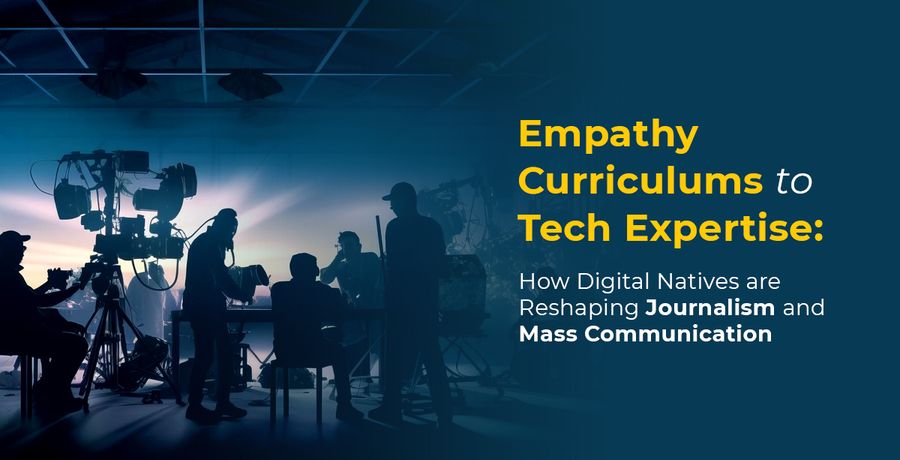
In this backdrop, universities are leaving no stone unturned to woo the future changemakers. From weaving immersive technologies AR/VR into storytelling, software for editing, production, and content generation to field exposure, students are getting deep insights into media production in special labs on the campus, digital journalism, and most importantly, being more humane.
Fast Forward: Trends in Journalism and Mass Communication
- Technological Adoption: From mapping market trends to data familiarisation, digital technology and AI are shaping how humans communicate and absorb information. From Search Engine Optimisation (SEO), website management, devising creative social media strategies, to mastering language models to data visualisation for infographics and more, technology is driving communication.
- Empathy based curriculums: In an age of blaring television screens, rapidly shifting social media trends, and fast-paced life, universities are bringing respite in the form of curriculums that focus on soft skills like adaptability, understanding, social responsibility and emotional intelligence. This approach—which is manifesting in European like Cardiff University, University of Bournemouth, and US universities like University of Michigan, University of Arizona and now, Amity University in India- is designed for coverage of disasters, human tragedies and accidents. Hence, it’s a significant departure from sensational communication to sensitive newsbreaks and respectful communication whether on reportage or even media management.
- The Rise of Citizen Journalist: Traditional reporting is now a thing of the past. With technology seeping into everyday lives, every person has morphed into being a citizen journalist whose ability to communicate can have a massive impact on an issue or a cause.
- Tripartite role: Everyone is a content creator and a journalist. The future of communication is about being a citizen journalist, a creative content creator, producer and distributor in a borderless and technologically aligned world.
- Multimedia storytelling: This is the new form of communication. From hilarious clips, GIFs, reels and digital snippets that capture an entire event in a matter of minutes or seconds, the story of life is being retold in a short-form content.
- Data driven Journalism: The new demand and consumption patterns for content have also unveiled some trends that give an indication how the future of communication could be crafted. While data journalism is the next big thing, it is already made its presence felt in national and state election news. Meanwhile, the magnetic appeal of investigative journalism will continue to be a big draw in the coming years.
Challenges and the road ahead
In today’s world, there’s always the risk of misinformation and the narrative war which can shape opinions and also have a significant impact. In this scenario, there is a need for technologies that can authenticate and verify content at speed, there is also a wide berth for tools, disruptive technologies and innovation that are more aligned.
.jpeg?h=132&w=263&mode=stretch)








Comments