





Getting into the University of Cambridge is not like cracking any other university entrance. Most students think it comes down to marks. Study hard, score high, get in. That logic works for most places — but not here.
Cambridge is hard to get into because it is built on a completely different idea of what a student should be. It does not want someone who has memorised the most. It wants someone who can think the fastest, reason the deepest, and stay curious under pressure. And it has built an admissions process specifically designed to find exactly that — and filter out everyone else.
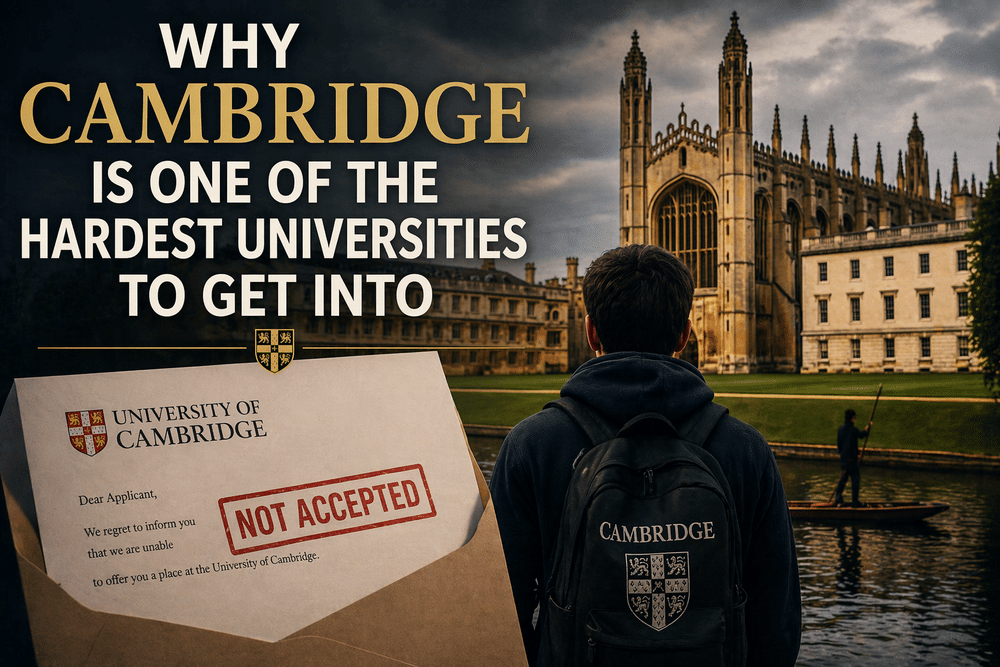
In the 2025 admissions cycle, Cambridge received 22,820 applications for undergraduate courses. Only 3,716 students were accepted — an acceptance rate of just 16.3%. For Indian students specifically, the 2024 data (the latest country-wise breakdown available) shows only 19 out of 286 Indian applicants were accepted — a success rate of 6.6%, roughly 1 in 15.
(Conversion rate used in this article: 1 GBP = ₹107 as of 22 April 2026)
- Cambridge at a Glance: Why the World Wants In
- The Numbers: How Competitive Is It Really?
2.1 Course-Wise Acceptance Rates (2024 Cycle — Latest Full Breakdown)
- Why Indian Students Specifically Struggle
- Reason 1: The Grade Bar Is Already Impossibly High — And Still Not Enough
- Reason 2: The Admissions Test Is Designed to Stump You
- Reason 3: The Interview Is Unlike Anything You've Faced Before
- Reason 4: The College System Multiplies the Complexity
- Reason 5: Cambridge Wants "Super-Curricular" Depth, Not Just Grades
- What the Application Process Looks Like — Step by Step
- Qualifications Cambridge Accepts from Indian Students
- English Language Requirements for Indian Students
- What It Costs: Fees for Indian Students
- The Grade Reality: Even Toppers Get Rejected
- FAQs
Cambridge at a Glance: Why the World Wants In
Before we get into the "why it's hard," let's understand why everyone wants to go there in the first place.
The University of Cambridge was founded in 1209 — making it over 800 years old. It is ranked #6 globally in the QS World University Rankings 2026. It holds the #1 spot in the UK in the Complete University Guide.
Here is what makes it truly extraordinary:
- 126 Nobel Prizes have been awarded to Cambridge affiliates — more than any other institution in the world
- 40 subjects ranked in the top 10 globally by QS Subject Rankings 2025
- Cambridge is ranked #1 in the world for Archaeology, English Language & Literature, Marketing, and Modern Languages
- It has 31 Colleges, each with its own admissions process
- The university has produced some of the greatest minds in history — from Isaac Newton to Stephen Hawking to Demis Hassabis (2024 Nobel Prize in Chemistry)
When a place has this kind of legacy, the competition to get in is naturally fierce.
Check out the University of Cambridge rankings for 2026
The Numbers: How Competitive Is It Really?
| Admissions Cycle | Total Applications | Total Acceptances | Acceptance Rate |
|---|---|---|---|
| 2025 | 22,820 | 3,716 | 16.3% |
| 2024 | 22,153 | 3,632 | 16.4% |
| 2023 | 21,445 | 3,557 | 16.6% |
(2025 data: Cambridge official admissions dashboard. 2024 data: Cambridge Undergraduate Admissions Statistics PDF, published June 2025)
Applications keep rising — up 3.3% from 2023 to 2024, and continuing to grow in 2025. But the number of seats barely moves. More people chasing the same spots every year — that is what makes it harder each cycle.
Cambridge receives about 6 applications per available place on average across all subjects.
Course-Wise Acceptance Rates (2024 Cycle — Latest Full Breakdown)
| Course | Applications | Acceptances | Success Rate |
|---|---|---|---|
| Computer Science | 1,863 | 141 | 7.6% |
| Psychological & Behavioural Sciences | 837 | 72 | 8.6% |
| Economics | 1,571 | 161 | 10.2% |
| Engineering | 2,654 | 321 | 12.1% |
| Architecture | 526 | 64 | 12.2% |
| Law | 1,604 | 236 | 14.7% |
| Mathematics | 1,840 | 260 | 14.1% |
| Medicine | 1,791 | 271 | 15.1% |
| Natural Sciences | 2,529 | 569 | 22.5% |
(Source: University of Cambridge Undergraduate Admissions Statistics, 2024 cycle)
Note on Data: The 2025 cycle overall figures are from Cambridge's official Power BI admissions dashboard. Course-wise and country-wise breakdowns for 2025 have not yet been published in the official PDF — the 2024 cycle PDF (published June 2025) remains the latest detailed breakdown available.
Why Indian Students Specifically Struggle
In the 2024 admissions cycle, 286 Indian students applied to Cambridge. Only 19 were accepted — a 6.6% success rate.
Compare that to Singapore's 26.5% or Japan's 27.1% success rate. The gap is not about intelligence. It is about preparation.
Most Indian students arrive at the Cambridge application with strong board exam scores but without the kind of qualifications Cambridge actually recognises. CBSE Class XII — the most common Indian qualification — was only officially accepted by Cambridge starting from 2026 entry, and even now it is accepted only for select Arts, Humanities, and Law courses at 20 specific Colleges. It is still not accepted for Engineering, Computer Science, Mathematics, Medicine, or Natural Sciences.
This means the majority of Indian students who want to apply for STEM courses still need A Levels, IB, or 5 AP Tests at Score 5 — qualifications that require years of additional preparation beyond the standard Indian school system.
The bar is not just high. For Indian students, it starts from a different place entirely.
Reason 1: The Grade Bar Is Already Impossibly High — And Still Not Enough
Let's be clear about what Cambridge's grade requirements actually mean.
The minimum offer for most courses is A*AA at A Levels or 41–42 points out of 45 in the IB (with 776 in Higher Level subjects). For CBSE students, it is A1 A1 A1 A1 A1 in all five relevant subjects.
These are not average scores. These are near-perfect scores. And yet — in the 2024 cycle — 5,617 students who achieved A*AA or better were still turned away.
Why? Because when everyone applying has near-perfect grades, grades stop being the differentiator. Cambridge has to find another way to separate the truly exceptional from the merely excellent. And that is exactly what the rest of the process is designed to do.
Reason 2: The Admissions Test Is Designed to Stump You
Before you even get to the interview, most courses require a written admissions test. And these are not tests you can cram for.
| Course | Test Required |
|---|---|
| Engineering, Natural Sciences, Veterinary Medicine, Chemical Engineering | ESAT (Engineering and Science Admissions Test) |
| Mathematics, Economics, Computer Science | TMUA (Test of Mathematics for University Admission) |
| Law | LNAT (National Admissions Test for Law) |
| Medicine | UCAT (University Clinical Aptitude Test) |
Cambridge is direct about what these tests are for. They are designed to challenge you — not to confirm what you already know. The university itself says: "Almost no one gets full marks. Some strong applicants may not even complete the paper in the time given."
Think about what that means. A test where finishing it is considered impressive. A test where getting everything right is essentially impossible. This is not a test of your syllabus knowledge — it is a test of how your mind works under pressure.
The test score is used to decide whether you get shortlisted for an interview. A weak score here ends your application before it really begins — no matter how good your grades are.
Explore University of Cambridge admissions for detailed requirements and deadlines
Reason 3: The Interview Is Unlike Anything You've Faced Before
If you clear the test, you get called for an interview. And this is where Cambridge truly separates itself from every other university in the world.
Cambridge interviews are not about what you know. They are about how you think. Trinity College's official guidance puts it plainly: "We are less interested in your conclusions than the methods you use to reach them."
You will sit across from a professor — sometimes two or three — and be asked to work through problems you have never seen before. For science and maths courses, you will be asked to show your working live. For arts and humanities, you will be asked to defend your ideas, challenge arguments, and think on your feet.
Cambridge's own guidance says the interview is a chance to assess:
- Your ability to think critically and independently
- Your curiosity and openness to new ideas
- Your readiness to study at a high academic level
- Whether you will thrive in the Cambridge learning environment
That last point is key. Cambridge is not just checking if you are smart. It is checking if you are the kind of person who will survive weekly one-on-one sessions with world-class academics — where you cannot hide behind a prepared answer.
Most applicants have 1 to 2 interviews lasting 35 minutes to 1 hour total. Some have 3 to 4, depending on the subject and College. Interviews for the 2027 entry cycle happen between 7 December and 18 December 2026.
Everyone who gets an offer has been interviewed. But not everyone who is interviewed gets an offer.
Note on the Cambridge Interview: This is the part that catches most Indian students off guard. The Indian education system rewards memorisation and correct answers. Cambridge rewards the process of thinking — even if you get the answer wrong. Professors want to see how you reason, not what you have memorised.
Reason 4: The College System Multiplies the Complexity
Cambridge is not one university. It is 31 Colleges, each operating as a semi-independent institution with its own admissions process, its own offer levels, and its own preferences.
When you apply, you apply to a specific College. And the same applicant could be accepted at one College and rejected at another — for the same course.
Here is how competitive it gets by College (2024 cycle):
| Most Competitive Colleges | Acceptance Rate |
|---|---|
| St John's | 12.42% |
| Pembroke | 12.47% |
| Trinity | 12.59% |
| Downing | 12.62% |
| Gonville & Caius | 13.46% |
| Less Competitive Colleges | Acceptance Rate |
|---|---|
| Murray Edwards | 25.91% |
| Girton | 23.19% |
| Homerton | 21.45% |
| Lucy Cavendish | 20.18% |
For Indian students, the College choice matters even more. CBSE Class XII is accepted at only 20 Colleges — not at Christ's, Corpus Christi, Gonville & Caius, Jesus, King's, Selwyn, Sidney Sussex, St Edmund's, or Trinity.
If your first-choice College rejects you, you may be placed in the Winter Pool — where other Colleges can still consider you in January. But that is a second chance, not a guarantee.
Reason 5: Cambridge Wants "Super-Curricular" Depth, Not Just Grades
Here is something most Indian students do not know. Cambridge explicitly looks for what it calls super-curricular activities — things you have done to explore your subject beyond the school syllabus.
This is not about sports or music or volunteering. Cambridge is clear: "Extra-curricular activities are unrelated to your chosen subject — these won't be taken into consideration."
What Cambridge actually wants to see:
- Books you have read beyond your textbooks
- Journals, podcasts, or lectures you have engaged with
- Academic competitions or projects in your subject area
- Independent thinking and reflection on your subject
This is a direct challenge to the way most Indian students prepare. Scoring 95% in boards is not enough if you cannot talk about what you have read, what questions you have asked, and what ideas genuinely excite you about your subject.
Cambridge is looking for students who are already thinking like academics — not students who are waiting to become one.
What the Application Process Looks Like — Step by Step
Here is the full journey for an Indian student applying to Cambridge:
- Apply through UCAS — the UK's central university application system
- Submit My Cambridge Application — a separate Cambridge-specific form (required in addition to UCAS)
- Pay the application fee — £60 (approximately ₹6,420) for most international applicants
- Register for and take your admissions test — if required for your course (before the interview)
- Attend the interview — in December, either online or in person
- Receive your decision — in January via UCAS
The UCAS application deadline for Cambridge is 15 October — earlier than most UK universities.
Qualifications Cambridge Accepts from Indian Students
| Qualification | Accepted By | Courses |
|---|---|---|
| CBSE Class XII (A1 A1 A1 A1 A1) | Yes — at 20 Colleges | Arts, Humanities, Law only |
| A Levels (A*AA minimum) | Yes — all Colleges | All courses |
| IB Diploma (41–42 points, 776 HL) | Yes — all Colleges | All courses |
| 5 AP Tests at Score 5 | Yes — with SAT/ACT | All courses |
Note on CBSE: Cambridge updated its India entry requirements in March 2026. CBSE is now accepted for select courses at 20 Colleges — but not for STEM courses. If you want to apply for Engineering, Computer Science, Mathematics, Medicine, or Natural Sciences, you still need A Levels or IB.
English Language Requirements for Indian Students
Since India is not classified as a "majority English speaking country" by the UK Home Office, Indian students must prove English proficiency at C1 standard.
| Test | Minimum Score |
|---|---|
| IELTS Academic | Overall 7.5, with at least 7.0 in each component |
| Cambridge English C2 Proficiency | Minimum overall 200, no element below 185 |
| Cambridge English C1 Advanced | Minimum overall 193, no element below 185 |
Note: TOEFL IBT is no longer accepted for Cambridge entry from January 2026 onwards.
What It Costs: Fees for Indian Students
International students (including Indians) pay significantly higher fees than UK students.
- Undergraduate tuition fees for international students: approximately £70,000 per year (≈ ₹74.9 lakh/year)
- UK home student fees: £9,535 per year (≈ ₹10.2 lakh/year)
- Application fee: £60 (≈ ₹6,420) — paid at the time of application
- Living costs in Cambridge: approximately £12,000–£15,000 per year (≈ ₹12.8 lakh–₹16 lakh) on top of tuition
Find scholarships and financial support at the University of Cambridge
The Grade Reality: Even Toppers Get Rejected
Here is a fact that puts everything in perspective.
In the 2024 admissions cycle, 5,617 students who achieved the equivalent of A*AA or better in their A Levels were still rejected by Cambridge.
This means that even if you have perfect grades, you can still not get in. Cambridge is looking for something beyond marks — genuine intellectual depth, curiosity, and the ability to thrive in a high-pressure academic environment.
The university itself states: "Academic achievement and potential remain the selection criteria for all undergraduates. No priority is given to those who pay the overseas rate of fees."
FAQs
Ques. What is Cambridge's acceptance rate in 2025?
Ans. In the 2025 admissions cycle, Cambridge accepted 3,716 students out of 22,820 applications — an acceptance rate of 16.3%.
Ques. Can I apply to Cambridge with CBSE Class 12 marks?
Ans. Yes, but only for select Arts, Humanities, and Law courses — and only at 20 specific Colleges. CBSE is not accepted for STEM courses.
Ques. What is the acceptance rate for Indian students at Cambridge?
Ans. In the 2024 cycle (latest country-wise data), only 19 out of 286 Indian applicants were accepted — a success rate of 6.6%.
Ques. Do I need to take an admissions test to apply to Cambridge?
Ans. Yes, most courses require a pre-registration test like ESAT, TMUA, LNAT, or UCAT. You must register for these in advance.
Ques. Is the Cambridge interview conducted online or in person?
Ans. Both formats are used. Whether your interview is online or in person depends on which College is assessing your application.
Ques. What IELTS score do I need for Cambridge?
Ans. A minimum overall score of 7.5, with at least 7.0 in each individual component.
Ques. Can I apply to Cambridge with IB scores from India?
Ans. Yes. IB is widely accepted. The minimum offer is 41–42 points out of 45, with 776 in Higher Level subjects.
Ques. Is getting A*AA in A Levels enough to get into Cambridge?
Ans. No. In 2024, over 5,600 students with A*AA or better were still rejected. Grades are necessary but not sufficient.
Ques. How many Colleges does Cambridge have, and does it matter which one I apply to?
Ans. Cambridge has 31 Colleges. It does matter — each College has different offer levels, and not all Colleges accept CBSE qualifications.
Ques. When is the Cambridge application deadline?
Ans. The UCAS deadline for Cambridge is 15 October — earlier than most other UK universities.
Ques. Are there scholarships available for Indian students at Cambridge?
Ans. Yes. The Cambridge Trust and Gates Cambridge Scholarship are among the most prominent. These are highly competitive and separate from the admissions process.



interested in this College ?
Follow & Share this college to get information about admission.



Comments