





Getting a Cambridge interview invite is already a big deal. It means your application stood out from over 22,000 applicants competing for around 3,600 seats every year.
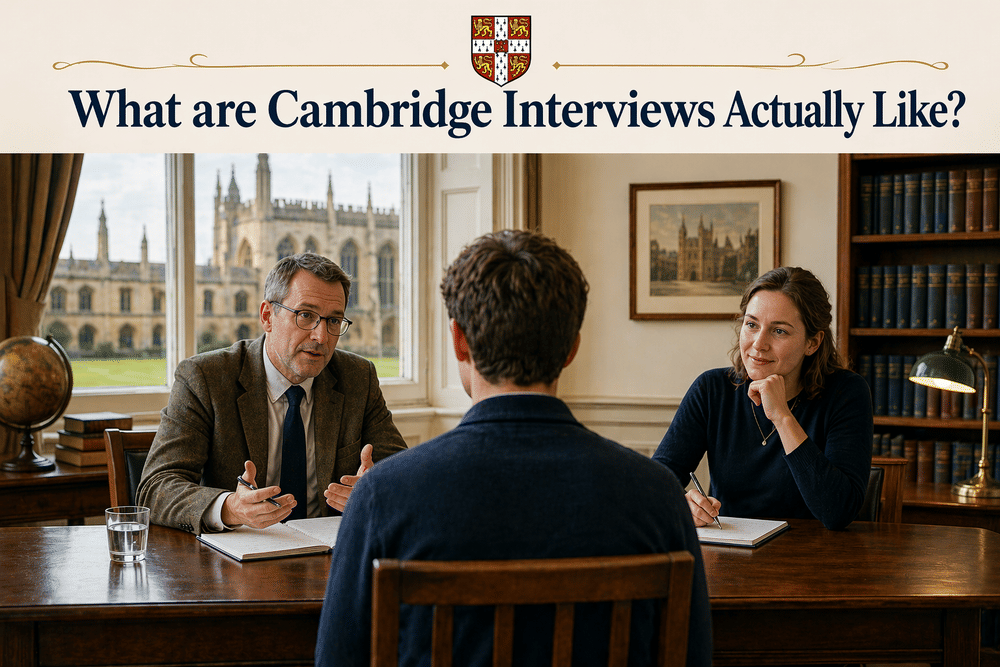
But here is the thing most students get wrong: the Cambridge interview is not a quiz. It is not about how much you know. It is a structured academic conversation where professors want to see how you think, how you handle new ideas, and whether you can work through problems you have never seen before. For Indian students dreaming of studying at one of the world's top universities, understanding exactly what happens in that room (or on that screen) can make all the difference.
Note: All fees are in GBP. £1 ≈ ₹107 (April 2026).
- When Does Cambridge Send Interview Invites?
- How Many Interviews Will You Have?
- Online or In-Person: What Format Will Yours Be?
- What Actually Happens Inside the Interview?
4.1 Subject-Specific Interview
4.2 General Academic Interview
- What Types of Questions Are Actually Asked?
- Pre-Reading Material: What Is It?
- Admissions Tests: What You Need to Know Before the Interview
- What Is Cambridge Actually Looking For?
- What the Interview Is NOT
- How to Prepare: What Cambridge Officially Recommends
- What Happens After the Interview?
- International Tuition Fees at Cambridge (2026 Entry)
- FAQs
When Does Cambridge Send Interview Invites?
Most interview invitations go out in November, though some may arrive in early December.
Getting your invite later does not mean your application is weaker. Cambridge is clear about this.
Interview dates for 2026 entry:
| Round | Dates |
|---|---|
| Main interview period | 7 December to 18 December 2026 |
| Winter Pool interviews | Mid to late January 2027 |
| Mature applicants (January round) | Mid-March to early April |
You must keep the entire interview period free. University of Cambridge does not reschedule interviews except in exceptional cases like illness, hospital appointments, religious observance, or exams.
How Many Interviews Will You Have?
This is one of the most common questions, and the answer depends on your subject and college.
- Most applicants get 1 or 2 interviews lasting a total of 35 minutes to 1 hour
- Some applicants may have 3 or 4 interviews, depending on the subject and college
- If you are placed in the Winter Pool, you may get an additional interview at a different college in January
Each interview typically lasts 20 to 30 minutes. For subjects with only one interview, it can go up to 35 to 50 minutes.
Note on "Winter Pool": This is a unique Cambridge system where strong applicants who were not offered a place by their original college are shared with other colleges that have remaining spots. It is not a rejection. In 2025, 4,375 applications were pooled, and 1,228 pooled applicants received offers. Around 1 in 5 pooled applicants got a place at a different college. Students who get in through the pool perform equally well academically as those who got direct offers.
Online or In-Person: What Format Will Yours Be?
Cambridge conducts both online and in-person interviews, depending on the college assessing your application.
- You will be told in advance which format your interview will be
- You generally cannot request a specific format
- In exceptional circumstances, an alternative format may be offered at the college's discretion
If your interview is online:
- Pick a quiet space with no disturbances
- Test your webcam, microphone, and internet connection beforehand
- Keep a pen and paper ready for working out problems
- Save the college's phone number and email in case of technical issues
If your interview is in-person:
- Check the location on a map in advance
- Plan your travel, especially if using public transport
- Arrive on time and put your phone on silent
What Actually Happens Inside the Interview?
Cambridge describes its interviews as "academic conversations", not interrogations. There are typically two types.
Subject-Specific Interview
This is the main one. Almost every applicant has at least one of these.
You will likely be asked to:
- Discuss topics with 2 to 3 interviewers
- Apply your knowledge to new situations, problems, or materials you have not seen before
- Explain your understanding of vocational aspects if applying for Medicine or Veterinary Medicine
You may also be asked about:
- Why you want to study at Cambridge and why you chose your course
- Key issues or recent developments in your subject
- Topics from your school studies or personal statement
General Academic Interview
Some applicants also have a broader interview that explores:
- Your other academic interests
- Future plans
- Overall suitability for the course
These may be conducted by academics outside your subject area, but they still assess your academic potential.
Explore University of Cambridge admissions for detailed requirements and deadlines
What Types of Questions Are Actually Asked?
This is where most students are surprised. Cambridge questions are not straightforward. They are designed to push you beyond what you have memorised.
There are broadly four types of questions you can expect:
1. Open-Ended "Tell Me About" Questions
These test your enthusiasm and depth of engagement with your subject.
| Subject | Sample Question |
|---|---|
| Maths | What was the most beautiful proof in A-Level Mathematics? |
| English | Tell me about your favourite poem |
| History | Which person from the past would you most like to interview, and why? |
| Medicine/Biology | What do you like most about the human body? |
These questions all ask the same underlying thing: Can you talk passionately and analytically about your subject?
2. Challenging Open-Ended / Analytical Questions
These test your ability to reason, argue, and think from multiple angles.
| Subject | Sample Question |
|---|---|
| History/Politics | Why are rich countries rich and poor countries poor? |
| Law | Why should justice not be retributive? |
| Biology | Is it easier for organisms to live in the sea or on land? |
| History/Politics | What makes civil wars so different from other wars? |
There is no single right answer here. The interviewers want to see how you build an argument and whether you can consider different perspectives.
3. Thought Experiment / "Quirky" Questions
These are deliberately unusual. They test whether you can apply existing knowledge to completely new situations.
| Subject | Sample Question |
|---|---|
| Law | If the punishment for parking on double yellow lines were death, and nobody did it, would it be a just and effective law? |
| Physics/Engineering | Why do aeroplanes tilt to turn corners? |
| Geography | What would be the major difference in power on Earth if plate tectonics did not exist? |
| Psychology | Is it moral to hook up a psychopath to a reality-simulating machine so he believes he is in the real world? |
These are not trick questions. They are designed to see how you think on your feet.
4. Technical / Subject-Specific Problem Questions
These require actual subject knowledge, especially for Science, Maths, and Engineering applicants.
| Subject | Sample Question |
|---|---|
| Maths | Sketch y=cos(x) and y=cos(2x), then shade the area represented by the integral of cos(x) from pi to zero |
| Chemistry | Draw ethanol and propane. What are their states at room temperature? Why do they differ? |
| Classics | How many Latin cases are there including the vocative? How many might have existed in Proto-Indo-European? |
| Computer Science | Work through a mathematical or algorithmic problem step by step |
For Science and Maths, you will often be asked to show your working on paper or a shared screen. The interviewers will give you hints if you get stuck. They are not expecting you to solve everything perfectly.
Important Note: Cambridge officially states that interviewers do not expect you to know things outside your school curriculum. They also do not expect you to fully complete all problems. What matters is how you approach the problem, not just the final answer.
Pre-Reading Material: What Is It?
Some interviews include a short text or material given to you 30 minutes before the interview starts.
- For Arts, Humanities, and Social Sciences: this could be a poem, a historical source, a legal opinion, some data, or an academic extract
- For Sciences and Maths: this could be a problem sheet, a scientific article, a diagram, or a specimen
You will then discuss this material with your interviewers. No prior knowledge of the topic is assumed. You cannot prepare for the specific content, but you can practise analysing unseen material.
Admissions Tests: What You Need to Know Before the Interview
Many subjects require a pre-interview admissions test. These are separate from the interview itself. Missing the registration deadline means your application is discontinued.
| Subject | Test Required |
|---|---|
| Computer Science | TMUA (Test of Mathematics for University Admission) |
| Economics | TMUA |
| Engineering | ESAT (Engineering and Science Admissions Test) |
| Natural Sciences | ESAT |
| Chemical Engineering | ESAT |
| Law | LNAT (National Admissions Test for Law) |
| Medicine | UCAT (University Clinical Aptitude Test) |
| Mathematics | Series of problem questions (at-interview, 60 minutes) |
| English | Essay/text response (at-interview, 90 minutes) |
| Architecture / Design | Graphic and spatial ability test (at-interview, 30 minutes) |
Note on "Pre-interview" vs "At-interview" tests: Pre-interview tests (like TMUA, ESAT, LNAT, UCAT) must be registered for independently before the interview period. At-interview assessments are automatically arranged once you are invited to interview. You will receive details by email.
What Is Cambridge Actually Looking For?
Cambridge is not looking for students who have memorised the most facts. According to the official admissions guidance, they are assessing:
- Your understanding of your chosen subject
- Your readiness to study at a high academic level
- Whether you will thrive in the Cambridge learning environment
- Your ability to think critically and independently
- Your curiosity and openness to new ideas
- Your enthusiasm for your subject
The Cambridge teaching model is built on supervisions, which are small-group or one-on-one sessions with academics. The interview is essentially a mini-supervision. They want to know if you can engage in that kind of learning.
What the Interview Is NOT
This is just as important to know.
- It is not full of trick questions with bizarre answers
- It is not a memory or knowledge test
- It is not a public speaking or debate contest
- It is not a test of how you dress, sit, or shake hands
- It is not scripted or identical for all applicants
- It is not an attempt to trip you up
How to Prepare: What Cambridge Officially Recommends
Weeks before the interview:
- Re-read your personal statement and any written work you submitted
- Explore your subject beyond school: books, podcasts, documentaries
- Think about topics in your subject that genuinely interest you
- Practise talking about your subject with friends, family, or teachers
- Have a mock interview with a teacher or someone who does not know you well
For Science and Maths applicants:
- Practise problem-solving regularly
- Think about how you would explain your working out loud
- Read beyond your syllabus and focus on what interests you
For Arts and Humanities applicants:
- Read beyond the texts set by your school
- Analyse what you read and think critically about it
On the day:
- Wear whatever you are comfortable in
- Remember: the interviewers are on your side
- If you do not understand a question, ask them to explain it
- Think out loud. Talk through your reasoning as you go
- It is completely fine to take a moment to think before answering
Cambridge's official warning: Some companies offer paid interview preparation services. Cambridge does not endorse these. They do not have access to any exclusive information. All official guidance is available free on the Cambridge website.
What Happens After the Interview?
If you applied in October, you will receive the outcome of your application from UCAS and Cambridge in January.
- Around 19% of October applications are placed in the Winter Pool
- In January 2025, 953 pooled applicants (around 1 in 5) were offered a place at a different college
- 275 pooled applicants received offers from the very college that pooled them
Getting an offer from a different college through the pool is not a lesser outcome. Cambridge is clear: pooled students perform equally well academically.
International Tuition Fees at Cambridge (2026 Entry)
As an Indian student, you will be classified as an international/overseas fee status student. Here are the annual tuition fees for 2026 entry:
| Group | Courses | Annual Fee (GBP) | Annual Fee (INR) |
|---|---|---|---|
| Group 1 | Economics, Law, History, English, Philosophy, etc. | £29,052 | ~₹31.1 lakhs |
| Group 2 | Mathematics | £32,406 | ~₹34.7 lakhs |
| Group 3 | Architecture, Design, Geography, Music | £38,010 | ~₹40.7 lakhs |
| Group 4 | Computer Science, Engineering, Natural Sciences, etc. | £44,214 | ~₹47.3 lakhs |
| Group 5 | Medicine and Veterinary Medicine | £70,554 | ~₹75.5 lakhs |
Explore University of Cambridge courses and fees for program-wise details
These fees are fixed for the duration of your course from the year you enrol. International students also pay an additional College fee on top of tuition fees, which varies by college.
FAQs
Ques. Do I have to attend the interview in person in Cambridge?
Ans. Not necessarily. Interviews can be online or in-person depending on your college. The format is confirmed in your invitation.
Ques. Does getting more interviews mean I am a stronger candidate?
Ans. No. Cambridge officially states that the number of interviews does not reflect the strength of your application.
Ques. Can I reschedule my Cambridge interview?
Ans. Only in exceptional circumstances like illness, hospital appointments, religious observance, or exams. Cambridge does not reschedule for general reasons.
Ques. Will they ask me about my personal statement?
Ans. Yes, very likely. Re-read it thoroughly before your interview. If you mentioned a book, project, or topic, be ready to discuss it in depth.
Ques. What if I do not know the answer to a question?
Ans. Say so honestly and try to work through it. Interviewers give hints and want to see your thinking process, not just the final answer.
Ques. Is the Cambridge interview conducted in English for international students?
Ans. Yes. You need to be able to describe your ideas and thinking in English. Cambridge has English language requirements that international applicants must meet.
Ques. What is the overall acceptance rate at Cambridge?
Ans. On average, Cambridge receives about 6 applications per place. Not everyone interviewed gets an offer, but every student who receives an offer has been interviewed.
Ques. Can I use paid coaching services to prepare for the Cambridge interview?
Ans. You can, but Cambridge does not endorse them. They have no exclusive information. All official preparation guidance is free on the Cambridge website.
Ques. If I get pooled, does it mean I failed my interview?
Ans. No. Being pooled means your original college was impressed but did not have space. In 2025, over 1,200 pooled applicants received offers. It is a second chance, not a rejection.
Ques. Do Indian students need to take the same admissions tests as UK students?
Ans. Yes. Tests like TMUA, ESAT, LNAT, and UCAT are required regardless of nationality. Pre-interview tests must be registered for independently before the deadline.


interested in this College ?
Follow & Share this college to get information about admission.



Comments