





Commonwealth Shared Scholarships at University of Birmingham are open for 2027 entry. Indian students must submit the online application by 8 December 2026. The award funds a one-year taught masters starting September 2027.
- This award is fully funded and built for applicants who cannot pay for a UK masters without full support.
- Selection favours a clear development impact plan for India after you finish the course.
- Only a short list of masters programmes at Birmingham is eligible, so course choice is the first real filter.
- The Commonwealth Scholarship Commission runs a two-stage check, so an early Birmingham offer makes the file stronger.
Check other fully funded UK scholarships open for Indian students
The Commonwealth Shared Scholarship is one of a handful of UK government-backed awards built for low and middle-income countries. It is the shortest path from India to a fully funded Russell Group masters in a single cycle. For an Indian student priced out of a UK degree, the award turns a 35 lakh rupee plan into a one-year, zero-tuition opportunity.
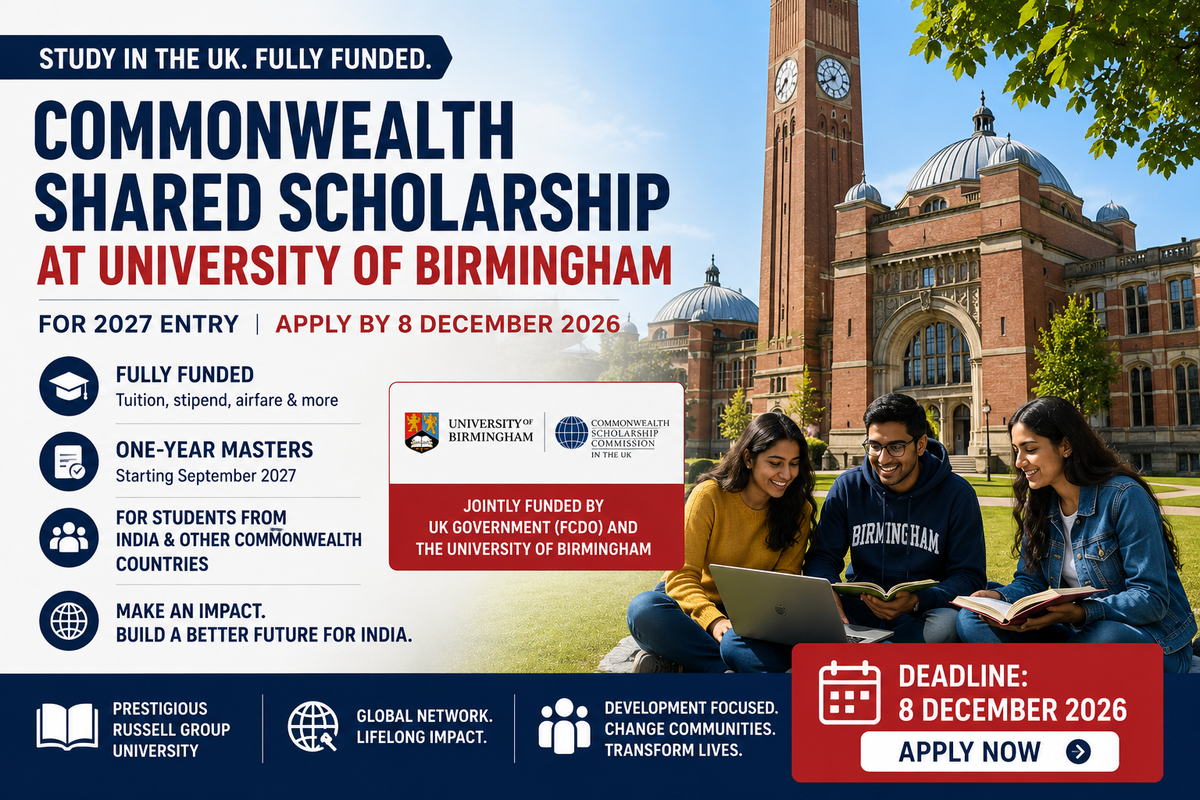
Quick facts on the Birmingham scholarship
| Parameter | Detail |
|---|---|
| Scholarship name | Commonwealth Shared Scholarship (CSS) |
| Host university | University of Birmingham |
| Funding body | FCDO (UK government) and the University of Birmingham |
| Entry cycle | September 2027 intake |
| Application deadline | 8 December 2026 (16:00 UK time) |
| Course level | One-year taught masters |
| Funding type | Full (tuition, stipend, airfare and more) |
| Eligible country for Indian passport holders | Yes, India is an eligible Commonwealth country |
Source: Commonwealth Scholarship Commission in the UK (cscuk.fcdo.gov.uk) and University of Birmingham scholarships pages.
- What is the Commonwealth Shared Scholarship
- Eligibility for Indian scholarship applicants
- Birmingham courses eligible for this scholarship
- What the Birmingham scholarship covers
- How to apply for the scholarship
- Key scholarship deadlines for 2027 entry
- How the scholarship selection works
- Tips for a strong scholarship application
What is the Commonwealth Shared Scholarship
The Commonwealth Shared Scholarship is a jointly funded UK government award for one-year masters study. It is paid for by the Foreign, Commonwealth and Development Office (FCDO) and the host UK university together. The University of Birmingham funds one half of the award, and FCDO funds the rest.
The scheme targets students from low and middle-income Commonwealth countries, including India. The core goal is to fund candidates who could not fund a UK masters on their own. That financial need test is central to who gets picked.
Shared Scholarships are run by the Commonwealth Scholarship Commission in the UK (CSC). Each year CSC fixes a list of host universities and eligible courses. Birmingham is on that list for the 2027 intake.
Key Insight: The Shared Scholarship is different from the Commonwealth Scholarship. Shared is university-linked and lets you apply directly through Birmingham. The main Commonwealth Scholarship needs a national nomination through the Indian government.
What students actually get is a one-year masters, usually MA or MSc, plus a living package built to match UK costs. Family allowances apply only in limited cases. The scheme does not cover PhD study. In short, it is a targeted aid programme. It is not a merit-first ranking of the top applicants. A strong academic record alone is not enough.
Read More: Full guide to studying in the UK as an Indian student
Eligibility for Indian scholarship applicants
Indian applicants must meet four core tests before they apply. These are set by the Commonwealth Scholarship Commission, and Birmingham cannot waive them.
- You must be a citizen of India or a refugee or British protected person, with permanent residence in India.
- You must have an honours degree of upper second class (2:1) or above, or a lower second plus a relevant postgraduate qualification.
- You must not be able to afford the UK course without this award. CSC checks this with a financial declaration.
- You must be ready to start the masters in September 2027 at Birmingham.
The financial need test is the hardest to clear. CSC looks at family income, prior funding, and whether you could study the same course through loans or savings. If you can, you are out of scope.
A few Indian profiles tend to fit well:
- First-generation masters applicants from Tier 2 or Tier 3 cities.
- Development sector workers with 2 to 5 years of field work.
- Government, NGO or public health staff with a clear return plan.
One more note. CSC prefers applicants who have not already studied in the UK or another high-income country. A prior UK degree is not a hard block but is a weak signal here.
Birmingham courses eligible for this scholarship
Only a short list of taught masters programmes at Birmingham accepts the Commonwealth Shared Scholarship. The list changes each cycle. For 2027 entry, the courses that have historically been on the Shared Scholarship list cluster in development, public policy, public health and education.
Commonly eligible subject families at Birmingham include:
- International Development, Governance and Social Policy.
- Public Administration and Public Management.
- Public Health, Health Economics and Health Management.
- Education, Teaching English to Speakers of Other Languages and International Education.
- Urban and Regional Planning, and Environment and Development.
- Human Rights, Conflict, Security and Global Ethics.
The key filter is whether the course is tied to a Sustainable Development Goal theme that CSC prioritises. STEM courses are rare on the Shared Scholarship list at most UK universities, and Birmingham follows the same pattern.
Before you apply, check the current cycle list on the Birmingham scholarships page. A course that was eligible for 2026 entry may not carry into 2027. Applying to a non-listed course cannot win you this award, even if you get a strong offer.
Key Insight: Pick the course first, then the scholarship. A strong fit with a listed masters is worth more than a weak fit with a glamorous course.
Check the full list of masters options in the UK for Indian students
What the Birmingham scholarship covers
The Commonwealth Shared Scholarship is a full funding package for one academic year. It is not a tuition waiver alone. The award is built so you can land in the UK with no personal funding and still live well. Based on recent cycles, the award covers these costs:
| Benefit | What you get (approximate, based on previous cycles) |
|---|---|
| Tuition fee | Full international tuition paid directly to Birmingham |
| Return airfare | Economy return ticket from India to the UK |
| Monthly stipend (outside London) | Around GBP 1,347 per month (approx INR 1.47 lakh) |
| Arrival allowance | One-off setup payment on arrival |
| Thesis grant | Flat grant for research or dissertation costs |
| Warm clothing allowance | One-off winter clothing grant |
| Study travel grant | Support for fieldwork or conferences, if relevant |
Conversions based on a GBP-INR rate of INR 109 as of November 17, 2026. Rates fluctuate; check the current rate before financial planning.
What the scholarship gives you:
- Zero tuition cost at a Russell Group university.
- A monthly stipend that covers Birmingham rent, food and transport.
- Covered travel, which saves another 60,000 to 90,000 rupees.
What the scholarship does not cover:
- Your UK student visa fee and Immigration Health Surcharge during the first application. You pay these up front.
- Dependant visas or travel for family members.
- Any pre-sessional English course if your IELTS is below the course cutoff.
Read More: Full cost of studying in the UK for Indian students
How to apply for the scholarship
You apply through the Commonwealth Scholarship Commission online system, not through Birmingham. The university only reviews the file after CSC shortlists you. This is a two-door process.
Here is the clean sequence to follow:
- Apply to Birmingham for your chosen masters through the standard admissions portal. Do this first, ideally by late November 2026.
- Create a CSC account on the Electronic Application System (EAS) on the cscuk.fcdo.gov.uk site.
- Select University of Birmingham as your first-choice host and list the eligible course.
- Fill in your academic record, work history, and references. You need two referees.
- Write the development impact plan. This is the most weight-bearing part of the file.
- Submit a study plan matched to the chosen Birmingham masters.
- Submit the full form before 16:00 UK time on 8 December 2026.
If X, then Y rule here. If you do not apply to Birmingham before the CSC form, then you cannot list a valid first-choice course, which means your file is likely to be screened out.
Supporting documents are uploaded inside the EAS form:
- Degree transcripts and certificates.
- Two reference letters, academic or professional.
- Proof of Indian citizenship and residence.
- English language test score, if ready. Birmingham accepts IELTS, TOEFL and PTE.
Key Note: You can submit the CSC form without a Birmingham offer in hand, but the file is weaker. An offer letter is the strongest signal of course readiness.
Check IELTS score needed for UK universities including Birmingham
Key scholarship deadlines for 2027 entry
The 2027 entry cycle for the Commonwealth Shared Scholarship runs from autumn 2026 to mid-2027. Missing any one date knocks the file out. Treat the timeline as fixed.
| Stage | Date or window |
|---|---|
| Birmingham masters application opens | Already open (standard cycle) |
| CSC Electronic Application System opens | Autumn 2026 (confirmed open) |
| Birmingham application recommended by | Late November 2026 |
| CSC Shared Scholarship deadline | 8 December 2026, 16:00 UK time |
| University shortlisting at Birmingham | January to March 2027 |
| Results communicated to applicants | Spring 2027 (typically by June) |
| UK student visa application | From June 2027 onward |
| Course start date at Birmingham | September 2027 |
If X, then Y. If your Birmingham offer takes longer than four weeks, then you risk missing the 8 December cut-off. Apply for the masters as early as possible.
Keep a copy of your final submitted form. CSC does not allow edits after submission, and you may need it to answer any follow-up questions from Birmingham.
How the scholarship selection works
CSC and Birmingham score each application against three core tests. You need to clear all three, not just one.
- Academic merit: your degree, scores and academic trajectory.
- Quality of the study plan: fit with the Birmingham masters you picked.
- Likely development impact in India: what you will do once you return home.
The third test is where most Indian applicants lose points. A vague plan to "work in the development sector" is not enough. CSC wants a concrete pathway, measured by what change you will drive and in which Indian state or sector. What the selection process gives you:
- A first screen by CSC for eligibility and financial need.
- A shortlist review by a Birmingham academic panel.
- A final panel decision by CSC in early 2027.
What it does not include:
- An interview round in most years, though CSC reserves the right to call one.
- Any direct lobbying route. Emails to Birmingham admissions do not help your scholarship chance.
Birmingham typically holds only a handful of Shared Scholarship places each year. The number is not published in advance. Treat it as a very tight pool and make every answer count.
Tips for a strong scholarship application
A strong file is specific, honest and tied to India. Vague essays are the fastest way to lose this award. Here are the levers that move the needle.
- Name one specific problem in India you want to work on. Use state, sector and real numbers.
- Match the Birmingham masters modules to that problem by name, not by theme.
- Show the return-home plan with a 2-year, 5-year and 10-year horizon.
- Use two referees who can speak to your field experience, not only your grades.
- Be blunt about your financial need. Bank balances, parental income and loan-eligibility notes all help.
Common mistakes to avoid:
- Listing a course that is not on the Birmingham Shared Scholarship list.
- Writing a generic UK-love letter instead of an India-return plan.
- Submitting on 8 December itself. The EAS portal sees heavy traffic in the last 24 hours.
- Using the same essay for Chevening, DAAD and CSS. Each scheme reads differently.
Key Insight: The Commonwealth Shared Scholarship is not a "top grades win" award. A 2:1 from a Tier 2 Indian college with real field experience beats a high-GPA profile with no development link.
Also Check:
| University of Birmingham profile | UK student visa guide | UK post-study work visa |
| Chevening Scholarship for Indian students | Russell Group universities in the UK | Education loan options for the UK |
The Commonwealth Shared Scholarship at Birmingham is a narrow path, but a real one. The 8 December 2026 deadline is fixed, and the real work is done in the three weeks before it, not the three days before it. Pick a listed course, line up two strong referees, and write an India-return plan you could defend in a room full of panel members. If you can do that, the award is in play. If you cannot, use the same work to strengthen your Chevening or DAAD file next year.
FAQs
Ques. Is the Commonwealth Shared Scholarship at Birmingham fully funded?
Ans. Yes. It covers full international tuition, a monthly stipend, return airfare and other allowances. The stipend outside London is around GBP 1,347 per month based on recent cycles. You still pay the UK student visa fee and health surcharge from your own pocket.
Ques. What is the exact deadline for 2027 entry?
Ans. The CSC online application closes on 8 December 2026 at 16:00 UK time. That is 21:30 IST on the same day. No late submissions are accepted after the system locks.
Ques. Can Indian students with a bank loan still apply?
Ans. Yes, but the financial need test gets harder. If you already have a sanctioned loan from HDFC Credila, Avanse or Prodigy Finance, explain in the form why a loan is still not workable for you. A sanction alone does not disqualify you, but it is a weak signal.
Ques. Do I need a Birmingham offer letter before the CSC deadline?
Ans. No, you do not need the offer before you submit the CSC form. You should still apply to Birmingham in parallel. A confirmed offer by January 2027 helps the file during shortlisting.
Ques. Which Birmingham courses are usually on the Shared Scholarship list?
Ans. Mostly development, public policy, public health and education masters. Specific courses change each cycle. STEM courses are rare on this scheme. Always check the live Birmingham scholarship page for the 2027 list before you pick your course.
Ques. Is the Commonwealth Shared Scholarship the same as a Chevening Scholarship?
Ans. No. Chevening is a UK government award with no university restriction. The Shared Scholarship is tied to a host university such as Birmingham and runs on different eligibility rules, especially around financial need.
Ques. What English score does Birmingham require for Indian applicants?
Ans. Most Birmingham masters need an IELTS of 6.5 overall with 6.0 in each band. Some courses ask for 7.0. Check the course page for the exact cutoff before you book the IELTS slot.
Ques. Does the scholarship cover my family in the UK?
Ans. Not in most cases. The Shared Scholarship is built for the scholar only. Dependant visas, travel and living costs for a spouse or child are your responsibility. A limited family allowance exists in rare cases but is not guaranteed.
Ques. Can I apply for both Chevening and this scholarship at the same time?
Ans. Yes. You can apply for both. If you win both, you must accept only one. Treat each application as a separate essay, because the selection criteria are different.
Ques. How many Indian students win this scholarship at Birmingham each year?
Ans. CSC does not publish a Birmingham-level India breakdown. Shared Scholarship places at any single university are usually in the single digits. Treat the pool as very tight and build the application accordingly.
Ques. What happens if I miss the 8 December 2026 deadline?
Ans. The CSC system shuts at 16:00 UK time and does not reopen. You cannot apply for the 2027 intake under this scheme. You can target the 2028 cycle, or apply for Chevening, which has a separate deadline earlier in the year.
Ques. Does winning the scholarship guarantee a UK student visa?
Ans. No. The scholarship covers the financial side of your visa file. You still need to meet UKVI rules on genuine student intent, English level and course acceptance. In practice, CSC scholars have very high visa approval rates.

interested in this College ?
Follow & Share this college to get information about admission.



Comments