



Content Writer | Updated On - May 4, 2026
The VITEEE 2026 examination is now officially over. The exam was conducted successfully over five days with seamless execution across all centers. The entire process, including registration, biometric verification, system checks, and question paper delivery, ran smoothly without any major technical glitches or disruptions.
All sections — Mathematics, Physics, Chemistry, Aptitude, and English — were delivered efficiently, maintaining consistent standards throughout the five days. Students were able to complete their exams in a calm and well-organized environment.
The exam is scheduled in two slots- Morning Shift from 9 am to 12:30 pm and Evening Shift from 2:30 pm to 5:00 pm.
Based on cumulative student feedback and expert reviews across all the sessions, the overall difficulty level of the exam has remained Moderate. However, the introduction of the new marking scheme, in which candidates earn +4 for correct answers and incur a -1 penalty for incorrect ones, remains the defining factor of this year's exam. It made students reluctant to do guesswork and randomly select answers.
VITEEE 2026 Analysis: Subject-wise Analysis
| Subject | Mathematics | Physics | Chemistry | Aptitude | English | Students Feedback |
| April 28 | Hard & lengthy | Moderate to Tough | Moderate to Easy |
Moderate |
Easy |
Maths was time-consuming. Chemistry was scoring. Balanced start. |
| April 29 | Moderate | Moderate | Moderate but lengthy |
Moderate |
Easy |
Maths felt harder today. Physics had tricky questions. Chemistry saved many. |
| April 30 | Hard to Moderate | Moderate | Moderate | Moderate | Easy |
Chemistry was the best section. Speed in Maths was key. Consistent pattern. |
| May 1 | Tough & Lengthy calculations | Moderate | Moderate to Tough | Moderate | Easy |
Similar to previous days. Chemistry continued to score. Maths remained the decider. |
| May 2 |
Hard & Time-consuming |
Moderate to Tough |
Moderate |
Moderate | Easy |
Maths had lengthy calculations and some unexpected twists. Physics was conceptual. Chemistry remained student-friendly and helped boost scores. |
| May 3 |
Moderate to Tough |
Tough |
Easy to Moderate |
Moderate | Easy |
Physics was the toughest today with more application-based questions. Maths was manageable with good practice. Chemistry was scoring as usual. |
As the exam continues through May 3, 2026, candidates appearing in upcoming slots are reminded that their VITEEE Admit Card becomes available for download on the OTBS portal exactly 48 hours before their specific exam time.
Initial reports from the April 28 shifts suggest a balanced paper, setting the tone for the remainder of the computer-based test (CBT) window.
Vellore Institute of Technology (VIT) released the admit cards on April 26, 2026, through its official Online Test Booking System (OTBS) at viteee.vit.ac.in. The computer-based entrance exams concluded on May 3, 2026.
The exam is conducted in multiple slots to accommodate all candidates. While timings can vary based on the specific slot booked by the student, the primary shifts are:
- Morning Shift: 9:30 AM to 12:00 PM (Reporting at 7:30 AM)
- Afternoon Shift: 2:30 PM to 5:00 PM (Reporting at 12:30 PM)
Some centers may also operate a third shift from 4:00 PM to 6:30 PM. Candidates are advised to check their specific slot timing and reporting instructions directly on their downloaded hall ticket.
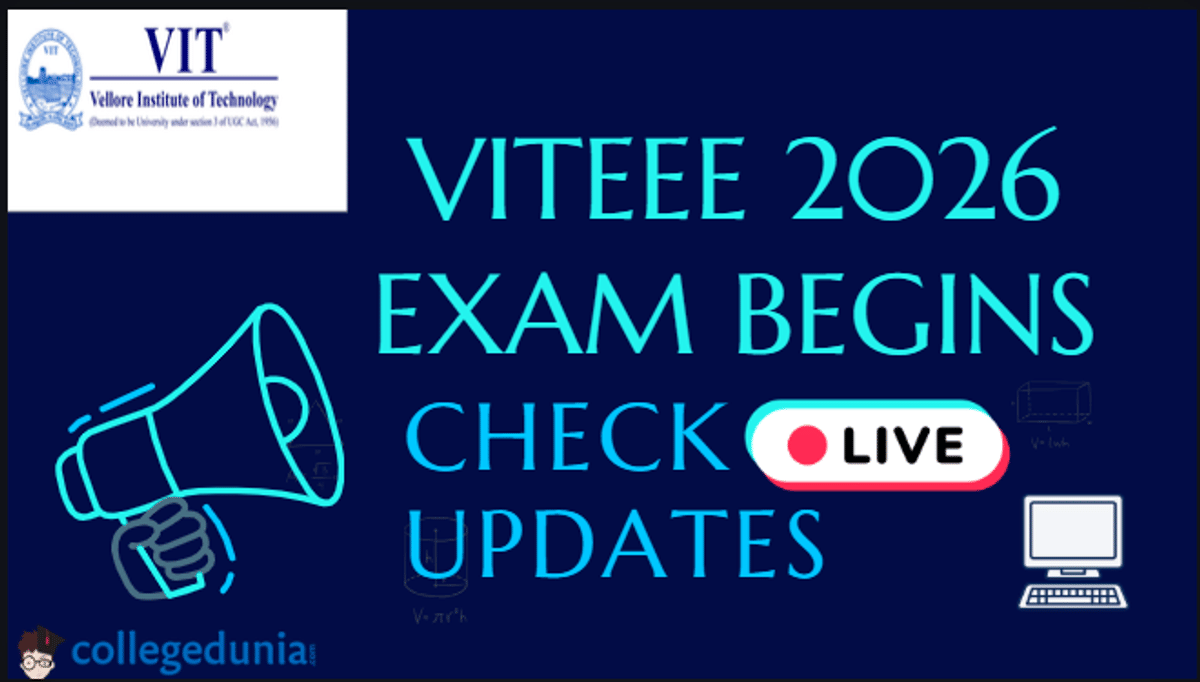
VITEEE 2026 Exam Day Guidelines
VITEEE 2026 CBT Mode Instructions
The VIT Engineering Entrance Examination (VITEEE) 2026 is conducted purely in Computer-Based Test (CBT) mode. Candidates must strictly follow the technical instructions provided during the exam to ensure their responses are recorded correctly.
| Interface Component | Description & Function |
|---|---|
| Candidate Profile | Displays your photo, name, and application number at the top left to ensure you are logged in correctly. |
| Test Information & Timer | Confirms 'VITEEE 2026' and the subjects (PCME/B). A live Time Remaining countdown is displayed in the top right. |
| Question Panel | Shows the question number, question text, and four options (A, B, C, D). |
| Question Palette | A color-coded grid on the right side shows the status of each question (125 total). |
| Navigation Bar | Buttons to move between questions: Previous, Next, Mark for Review, Clear Response |
| On-Screen Calculator | A basic calculator icon is available if the specific section allows its use. Physical calculators are banned. |
Overall Difficulty: Moderate to Tough
| Subject | Difficulty Level | Key Highlights |
| Mathematics | Moderate to Tough |
Lengthy questions with a focus on Calculus, Coordinate Geometry, and Matrices. Some tricky integrals and vector problems. Time management was important. |
|
Physics |
Tough |
Heaviest section of the shift. High weightage on application-based questions from Electromagnetism, Optics, and Modern Physics. Numericals were lengthy and conceptual. |
| Chemistry | Easy to Moderate |
Most scoring section. Balanced mix with direct questions from Organic, Inorganic, and Physical Chemistry. Students found it relatively easier. |
|
Aptitude |
Moderate |
Standard questions on reasoning, series, and data interpretation. Manageable within time. |
| English | Easy |
Simple comprehension, grammar, and vocabulary questions. Quick and straightforward. |
- Mathematics – Students found the section moderate to tough, with lengthy but solvable questions. Many said good practice helped, though some problems needed extra time.
- Physics – This was the toughest section for most students, with heavy application-based and conceptual questions. Numerical problems were tricky, especially in Electromagnetism and Modern Physics.
- Chemistry – Students described it as easy to moderate and the most scoring section of the day. Organic and Physical Chemistry questions were straightforward and student-friendly.
- Aptitude – The section was moderate with standard reasoning and quantitative questions. Most students could attempt it comfortably within the time.
- English – Students found the section very easy with simple passages and grammar-based questions. It was quick and highly scoring for almost everyone.
The VITEEE 2026 Morning Shift has officially concluded. As of today, May 3, is the final day of the exam cycle; only one afternoon session remains before the 2026 session officially wraps up nationwide.
| Category | CSE (Core) | CSE Specialization |
| Category 1 | ~8,000 | ~11,500 |
| Category 2 | ~14,000 | ~20,500 |
| Category 3 | ~25,000 | ~26,000 |
| Category 4 | ~29,000 | ~32,000 |
| Category 5 | ~34,000 | ~42,000 |
The VITEEE 2026 May 3 Afternoon Shift Exam has come to an end. And with this, the VITEEE 2026 Exam session has also ended. Now the students shall wait for the announcement of the results and further declaration of the counselling results for admissions in different VIT Campuses.
For the last time in 2026, the VITEEE 2026 Afternoon Session has begun at its scheduled time across all its designated centres in India and abroad.
| Marks (out of 125) | Expected Rank Range |
| 118+ | 1 – 250 |
| 113 – 117 | 251 – 500 |
| 100 – 112 | 501 – 1,500 |
| 90 – 99 | 1,501 – 2,500 |
| 81 – 90 | 2,501 – 5,000 |
| Category | CSE (Core) | CSE with AI/ML, Data Science, Cyber Security, etc.) | Information Technology (IT) |
| Category 1 | ~500 – 950 | ~600 – 2,800 | ~650 – 1,500 |
| Category 2 | ~3,000 – 3,500 |
~4,000–9,000 |
~4,500 |
| Category 3 | ~19,000 |
~20,000–23,000 |
~20,500 |
| Category 4 |
~22,000 |
~23,000–27,000 |
~23,500 |
| Category 5 |
~25,500 |
~26,000–31,000 |
~26,500 |
Note: CSE at VIT Vellore is the most competitive branch. In 2025, Category 1 for core CSE closed around 500–550 rank in some reports.
The curtains are finally closing on the VITEEE 2026 season! As of 9:00 AM today, May 3, the Morning Shift has officially kicked off across all designated centers.
This marks the final day of the entrance marathon that began on April 28. Since this is the last day, the atmosphere at centers is a mix of high-stakes pressure and relief as the final batch of students faces the revised 2026 format.
The evening session for Day 5 of VITEEE 2026 has officially wrapped up as of 5:00 PM today, May 2, across all its designated centres.
- Mathematics – Students found the section very tough and highly time-consuming due to lengthy calculations. Many said it had unexpected twists in Calculus and Vectors, making it the biggest challenge of the day.
- Physics – The paper was concept-heavy with tricky numericals from Optics and Modern Physics. Students felt it was moderate to tough but manageable with good understanding.
- Chemistry – Most students called it balanced and scoring, especially the Organic and Inorganic portions. They said it was student-friendly and helped compensate for tougher sections.
- Aptitude – Students described it as moderate and standard, with straightforward questions. It was considered easy to attempt within the time.
- English – Students found this section very easy, with simple grammar and comprehension. It was quick and scoring for almost everyone.
Subject-wise Difficulty Analysis of May 2 Morning Shift
| Subject | Difficulty Level | Key Highlights |
| Mathematics | Hard & Time-Consuming |
Lengthy calculations in Calculus, Matrices, and Vector Algebra. Many questions were multi-conceptual and required high accuracy. Time management was crucial. |
| Physics | Moderate to Tough |
Conceptual questions dominated, especially from Optics, Electrostatics, and Modern Physics. Numerical questions were moderate but tricky. |
| Chemistry | Moderate |
Balanced paper. Physical Chemistry had direct questions, Organic was scoring, Inorganic was straightforward. Overall student-friendly |
| Aptitude | Moderate |
Standard questions on logical reasoning, data interpretation, and basic quantitative aptitude. |
| English | Easy | Comprehension passage and grammar questions were simple and direct. |
The VITEEE 2026 Day 5 Shift 2 exam is scheduled to begin from 2:30 pm as part of the nationwide computer-based entrance test for VIT engineering programs. The exam is 2 hr 30 mins long and is being held in CBT Mode for all the courses.
The May 2 (Day 5), Shift 1 exam has concluded, and the initial feedback indicates a trend consistent with previous days: Mathematics remains the primary hurdle, while Chemistry, Aptitude & English serve as the "score-boosters."
Because 2026 marked the introduction of negative marking (+4/-1), students are notably more cautious, focusing on accuracy rather than the total number of attempts.
These are average ranges based on moderate difficulty. Actual rank also depends on overall performance across all candidates and your accuracy.
| Good Attempts | Expected Score | Expected Rank Range |
| 105 – 118+ | 400 – 460+ | Top 1,000 – 5,000 |
| 95 – 104 | 350 – 395 | 5,000 – 12,000 |
| 85 – 94 | 300 – 345 | 12,000 – 22,000 |
| 75 – 84 | 260 – 300 | 22,000 – 35,000 |
VITEEE 2026 – 1 May (Day 4) Subject-wise Good Attempts (Both Morning & Afternoon Shifts)
| Subjects | Morning Shit (Good Attempt) | Evening Shift (Good Attempt) | Total Questions |
| Mathematics |
28 – 34 |
29 – 35 | 40 |
| Physics | 24 – 29 | 23 – 28 | 35 |
| Chemistry | 28 – 32 | 27 – 32 | 35 |
| English | 5 | 5 | 5 |
| Aptitude | 9 – 10 | 9 – 10 | 10 |
Here’s a list of dominant topics that are being asked in the exam.
| Subjects | Key Topics |
| Mathematics |
Lengthy & calculative. Heavy on Calculus (Integration, Applications), Vectors, 3D Geometry, Matrices, Probability. Multi-step problems common. |
| Physics |
Balanced conceptual + numericals. Topics: Current Electricity, Electrostatics, Optics (Ray/Wave), Modern Physics, EMI. Some application-based twists. |
| Chemistry |
Strong focus on Organic Chemistry (Name reactions, GOC, Aldehydes/Ketones, Biomolecules). Physical: Electrochemistry, Kinetics, Thermodynamics. Inorganic: Coordination Compounds, p-Block. Many direct NCERT questions. |
| English |
Simple comprehension, grammar, vocabulary. |
| Aptitude |
Series, coding-decoding, logical reasoning, basic quant. |
The paper followed the established pattern: NCERT-based questions with emphasis on speed and accuracy (due to +4/-1 marking).
- Mathematics: Moderate to Tough
- Physics: Moderate
- Chemistry: Moderate
- Aptitude: Moderate
- English: Easy
VITEEEE 2026 Day 5 Morning Shift Exam has begun at its scheduled time, i.e., 9:30 am in CBT Mode across all its designated centres.
The VITEEE 2026 Exam for the afternoon shift or 2nd shift has come to an end! The exam duration is of 2 hours and 30 minutes.
The Afternoon Shift (Shift 2) for VITEEE Day 4 has officially started. While the exam typically runs from 2:30 PM to 5:00 PM, reporting and biometric verification began at 12:30 PM.
VITEEE 2026: Day 4 Shift 1 Analysis (1 May 2026)
- Overall Difficulty: Moderate (Slightly easier and more balanced compared to Day 3)
- Mathematics: Moderate to Tough
- Physics: Moderate
- Chemistry: Easy to Moderate
- English: Easy
- Aptitude: Easy to Moderate
| Subject | No. of Questions | Good Attempts |
| Mathematics | 40 | 23 – 29 |
| Physics | 35 | 24 – 29 |
| Chemistry | 35 | 26 – 32 |
| Aptitude | 10 | 9 – 10 |
| English | 5 | 5 |
- Safe Good Attempts: 88 – 102 questions (with 85%+ accuracy)
- Very Good Attempts: 103 – 112 questions (for strong performance)
- Expected Score Range: 350 – 430+ marks (depending on accuracy)
Key Student Reactions for Day 4 Shift 1
- The paper was described as more balanced and slightly easier compared to Day 1, Day 2, and Day 3
- Mathematics remained the most time-consuming section, but many students found it manageable compared to the previous tougher shifts.
- Chemistry continued to be the easiest and most scoring section.
- Due to negative marking (+4, -1), students preferred leaving doubtful questions rather than guessing, especially in Maths and Physics.
- Overall feedback: “Better time management possible today”, “Chemistry and Aptitude + English helped a lot”.
The May 1 (Day 4), Shift 1 exam has concluded, and the initial feedback indicates a trend consistent with previous days: Mathematics continues to be the primary hurdle, while Chemistry and English serve as the "score-boosters."
Because 2026 marked the introduction of negative marking (+4/-1), students are notably more cautious, focusing on accuracy rather than the total number of attempts.
Day 3 (30 April 2026) Good Attempts analysis for VITEEE 2026, based on students' and teachers' reactions from both Shift 1 and Shift 2.
| Subject | No. of Questions | Good Attempts |
| Mathematics | 40 | 22 – 28 |
| Physics | 35 | 24 – 29 |
| Chemistry | 35 | 26 – 31 |
| Aptitude | 10 | 7 – 9 |
| English | 5 | 5 |
The VITEEE 2026 exams on April 29 (Day 2) and April 30 (Day 3) showed a slight upward shift in difficulty, particularly in the Mathematics and Physics sections. While the paper structure remained consistent, Day 2 was widely regarded as the "toughest day yet," while Day 3 balanced out with a moderately difficult but extremely lengthy paper.
| Subjects | Day 2 (April 29) | Day 3 (April 30) |
| Mathematics | Tough & Tricky (JEE Main level) | Moderate but Very Lengthy |
| Physics | Tough (Tricky conceptual Qs) | Moderately Tough (Numerical heavy) |
| Chemistry | Moderate (Organic dominant) | Easy to Moderate (NCERT based) |
| Aptitude | Easy | Easy to Moderate |
| English | Easy | Easy |
The VITEEE 2026 Day 3 (April 30) Shift 2 exam concluded with an overall moderate difficulty level. However, students and experts noted that this shift was slightly tougher compared to Shift 1 of the same day.
- Overall – Moderate
- Mathematics – Moderate to Tough
- Physics – Moderately Tough
- Chemistry – Easy to Moderate
- Aptitude – Easy to Moderate
- English – Easy
VITEEEE 2026 Day 4 Morning Shift Exam has begun at its scheduled time, i.e., 9:30 am in CBT Mode across all its designated centres.
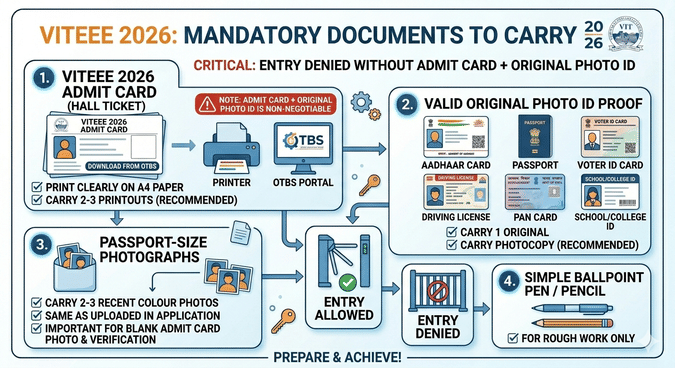
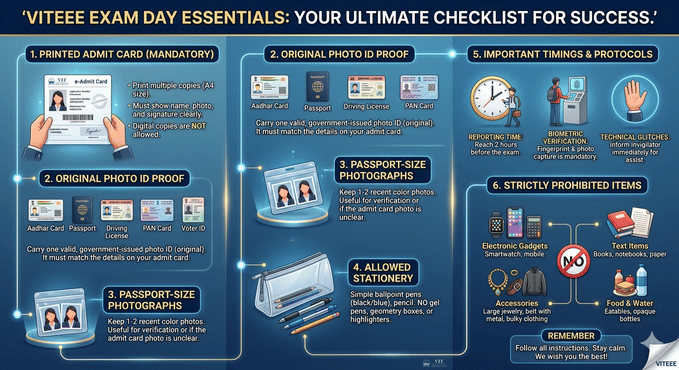
No, the Admit Card will not be sent offline or through any other link. You have to generate it through OTBS and download it. Take 2 printouts of it. And take physical copies only.
| Day | Shift | Overall Difficulty | Mathematics | Physics | Chemistry | English + Aptitude | Key Highlight |
|---|---|---|---|---|---|---|---|
| Day 1 (28 Apr) | Morning + Afternoon | Moderate | Moderate to Tough (Lengthy) | Moderate | Easy to Moderate | Very Easy | Maths was time-consuming; Paper felt balanced but competitive due to negative marking |
| Day 2 (29 Apr) | Morning + Afternoon | Moderate | Tough & Lengthy | Moderate to Tough | Easy to Moderate | Very Easy | Maths remained the toughest section; some students found Physics slightly trickier |
| Day 3 (30 Apr) | Morning (1st Shift) | Moderate | Moderate to Tough (Calculative & Lengthy) | Moderate | Easy to Moderate (Most scoring) | Very Easy | Chemistry carried the score; Speed mattered a lot |
| Day 3 (30 Apr) | 2nd Shift (Afternoon) | Moderate (Slightly easier feel than Morning) | Moderate to Tough (Lengthy but manageable) | Moderate | Easy to Moderate (Organic + Coordination heavy) | Very Easy | Best balance among Day 3 shifts; Chemistry continued to be student-friendly |
The paper remained NCERT-based with emphasis on speed and accuracy due to negative marking.
Day 3 – 2nd Shift
| Subject | Difficulty Level | No. of Questions |
Key Observations & Important Topics Asked |
| Mathematics | Moderate to Tough | 40 |
|
| Physics | Moderate | 35 |
|
| Chemistry | Easy to Moderate | 35 |
|
| Aptitude | Easy | 10 |
|
No, it is not important at all to attempt all the questions. There’s negative marking in the paper. So, it’s better that students attempt only those questions that they are sure of. There’s no point of attempting all the questions when there’s negative marking.
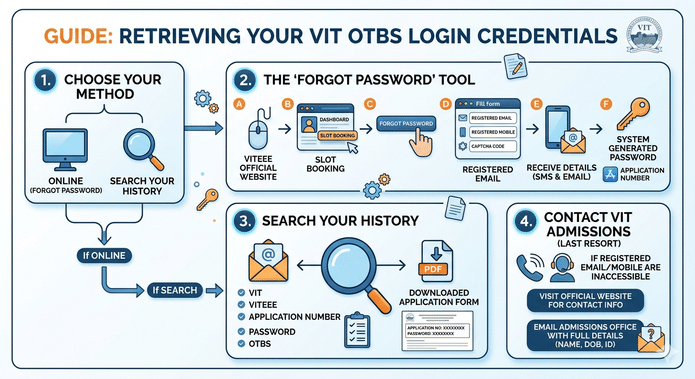
Students who appeared for the Day 3, 2nd Shift (Afternoon slot) of VITEEE 2026 described the paper as balanced but time-consuming, especially due to lengthy calculations in Mathematics.
- Mathematics: Lengthy and calculation-heavy with high weightage on Calculus, Vectors, and 3D Geometry; time management was key.
- Physics: Mostly formula-based numericals; some tricky conceptual questions from Electrodynamics and Modern Physics.
- Chemistry: Chemistry worked as saving grace. Scoring section with many direct NCERT-based questions, especially from Organic and Physical Chemistry.
- Aptitude: Very easy logical reasoning and data interpretation questions were asked in the exam.
- English: Simple comprehension and grammar questions; fastest section.
The Day 3 Afternoon Shift (Shift 2) of VITEEE 2026 concluded at 5:00 PM, marking the official end of the third day of testing.
Initial reports suggest that the "Moderate but Lengthy" trend established in the first two days has continued, with some students noting an increase in the complexity of application-based questions.
For the VITEEE 2026 academic session, candidates participating in the online counselling process are required to pay a non-refundable counselling fee.
-
Counselling Fee: ₹5,900 (Inclusive of GST). This fee is mandatory for all candidates who wish to participate in the choice-filling and seat allotment process.
-
Nature of Fee: This is a non-refundable payment and must be paid online via Net Banking, Credit/Debit Card, or UPI before the choice-filling window opens for your respective phase.
Quick Comparison: Day 1 vs Day 2
| Subject | Day 1 Difficulty | Day 2 Difficulty | Key Topics |
| Mathematics | Hard/Lengthy | Moderate to Hard | Vector 3D, Probability, Calculus |
| Physics | Moderate | Moderate | Semiconductors, Electrostatics, AC |
| Chemistry | Easy (NCERT) | Easy to Moderate | Naming Reactions, p-block, Solutions |
| Aptitude | Easy | Easy | Number Series, Data Sufficiency |
| English | Very Easy | Very Easy | Grammar, Vocab, Passages |
This is based on the Moderate difficulty level of the shift (Maths lengthy, Chemistry scoring, Physics balanced), student feedback patterns, new marking scheme (+4 for correct, -1 for incorrect), and trends from previous days + past years.
| Good Attempts | Expected Accuracy | Expected Raw Score | Expected Rank Range |
| 110 – 118+ | 90 – 95% | 410 – 460+ | 1 – 3,000 |
| 100 – 109 | 88 – 93% | 360 – 410 | 3,001 – 8,000 |
| 92 – 99 | 85 – 92% | 320 – 370 | 8,000 – 15,000 |
| 82 – 91 | 85 – 90% | 280 – 330 | 15,000 – 25,000 |
| 70 – 81 | 80 – 88% | 230 – 290 | 25,000 – 45,000 |
| Below 70 | – | Below 250 | 45,000+ |
Here's a detailed VITEEE 2026 Day 3 Morning Shift Exam Analysis (April 30, 2026 – Shift 1, 9:30 AM to 12:00 PM).
Subject-wise Analysis
| Subjects | Difficulty Level | No. of Questions | Key Observations & Topics Asked |
| Mathematics | Moderate to Tough | 40 | Lengthy & Calculative. Heavy on Calculus, Matrices, Vector & 3D Geometry. |
| Physics | Moderate | 35 |
Balanced mix of conceptual and numerical questions. |
| Chemistry | Easy to Moderate | 35 |
High weightage on Organic Chemistry |
| Aptitude | Easy | 5 |
Simple comprehension, grammar, and vocabulary. Quick to solve. |
| English | Easy | 10 |
Basic reasoning, series, coding-decoding, quantitative aptitude. Very scoring. |
VITEEEE 2026 Day 3 Afternoon or 2nd Shift Exam has begun at its scheduled time, i.e., 2:30 pm in CBT Mode across all its designated centres.
- Finish NCERT thoroughly – Almost 80–90% questions come directly or indirectly from NCERT Class 11 & 12.
- Focus on Named Reactions & Mechanisms in Organic Chemistry.
- Practice Numericals from:
- Electrochemistry (Nernst equation)
- Chemical Kinetics
- Thermodynamics & Equilibrium
- Solutions
- Revise formulas & exceptions regularly (especially Coordination compounds, p-Block, d-Block).
- Solve previous year VITEEE Chemistry questions + mock tests.
VITEEE Chemistry has 35 questions (out of 125 total). The section is generally considered the easiest and most scoring among PCM, with a good mix of:
- Physical Chemistry (~35%)
- Organic Chemistry (~40%)
- Inorganic Chemistry (~25%)
Most questions are NCERT-based, conceptual, and formula-driven. Direct questions from standard reactions, named reactions, and numericals (moderate level) are common.
Post paper, students have shared their reactions on social media platforms like Reddit and Quora.
According to some students,
- Overall Difficulty – Moderate
- Mathematics – Lengthy & Calculative
- Physics – Moderate
- Chemistry – Easy to Moderate
- English & Aptitude – Easy
Day 2 of the VITEEE 2026 (April 29, 2026) has concluded across all the centres. Students must submit their rough pad to the invigilator. You must not take it home with you.
Officially, VIT does not have a management quota, and admissions are merit-based across all its campuses. But if any consulting agency says that they can get you a seat in VIT Campuses, then it's a scam.
- The questions from Maths were difficult.
- Questions were based on multi-step problems with very close answers.
- Lengthy questions that took a lot of time to solve.
- 4 – 5 direct questions were asked about 3D Geometry and Vectors.
- Integral Calculus had less weightage.
- Expect questions on the NCERT-based pattern.
- Lengthy Mathematics questions.
- More weightage to Organic Chemistry.
- More numerical-based questions in Physics.
Day 2 Exam of the VITEEE 2026 is being reported as moderately tough by the students. Most questions were based on the NCERT pattern. However, many students found Mathematics to be the toughest & lengthiest.
- Overall Difficulty – Moderately Tough
- Physics – Moderate to Tough
- Chemistry – Easy to Moderate
- Mathematics – Moderate to Tough
- English & Aptitude – Easy
VITEEEE 2026 Day 3 Morning Shift Exam has begun at its scheduled time, i.e., 9:30 am in CBT Mode across all its designated centres.
The VITEEE 2026 Exam total duration is 2 hours and 30 mins for a total of 125 MCQs (40 Maths/Bio, 35 Physics, 35 Chemistry, 10 Aptitude, 5 English).
A score of 350 marks represents a 70% net accuracy, which is traditionally the "safe spot" for competitive engineering exams like VITEEE.
VIT Vellore generally offers better ROI and higher placement numbers due to its sheer scale, making it ideal for computer science-related fields, whereas MIT Manipal is often considered superior for overall campus experience, a less restrictive environment, and a more focused, less crowded learning environment.
B.Tech CSE (Core) is the best for placements and salaries, with its specialized AI/ML branches following closely. For those interested in research or hardware, Biotechnology and ECE are top-tier choices due to global rankings and industrial flexibility.
VIT Vellore does not guarantee 100% placement, but it consistently achieves a very high placement rate, often close to 90–99% for eligible students, especially in CSE/IT branches. The 2025 drive saw 632+ companies make over 14,000 offers with a 99.2% rate, featuring top packages up to ₹1.02 Crore.
The VITEEE 2026 result is tentatively scheduled to be published in the second week of May 2026.
Yes, VIT (Vellore Institute of Technology) is generally more expensive than IITs (Indian Institutes of Technology) for B.Tech programs. While VIT fees range from ₹8–₹16 lakhs (including tuition and hostel) for four years, IIT fees typically range from ₹8–₹12 lakhs, with lower tuition fees and, often, tuition waivers for financially disadvantaged students.
Yes, you can get CSE at VIT with a 20,000 rank, but most likely in a higher category (Category 3,4, & 5) at the Vellore Campus, or Category 1-2 at Chennai, AP, & Bhopal.
Yes, 90 marks in VITEEE (out of 125) is considered a very good score, generally placing you in the top 1,500–5,000 rank range. This score is often sufficient to secure a seat in top branches like Computer Science and Engineering (CSE) at the Vellore or Chennai campus.
Initial reaction of students has been that the paper was moderate to tough. Questions were more on a conceptual level.
- Mathematics: Rated as the hardest section. Calculations were multi-step, particularly in Calculus (Integration & Limits), Vector 3D, and Probability.
- Physics: Questions from Mechanics, Semiconductors, and Current Electricity had high weightage in the exam.
- Chemistry: The afternoon shift saw more mechanism-based Organic questions and tricky Inorganic concepts.
- Aptitude: Questions from coding-decoding, number series, and data interpretation were standard.
- English: Board-level grammar and short passages were asked in the exam.
The 2nd shift or the afternoon shift of the VITEEE 2026 Exam has eventually ended. The students are required to submit their answers and give the rough sheet back to the invigilator.
| VITEEE Exam Dates | VITEEE e-Admit Card Release Date |
| April 30 | April 28 |
| May 1 | April 29 |
| May 2 | April 30 |
| May 3 | May 1 |
Those students who have the VITEEE Exam scheduled in the upcoming days, don’t forget to download your e-Admit Card from the VITEEE OTBS. Get a printout of the e-Admit Card.
Only the physical copy of the VITEEE 2026 Admit Card is allowed at the exam centre. Students with a digital copy will not be entertained.
The VITEEE 2026 examination is being conducted across 130 cities in India, which is a record number of locations, marking its widest reach to date. And also in 9 international cities, VITEEE 2026 Exams are being held.
The VITEEE 2026 Day 2 Afternoon Shift (Shift 2) has begun at 2:30 pm.
- Reporting Time: 12:30 PM (Candidates began arriving 2 hours early for biometric verification).
- Gate Closing: 2:00 PM (Strict "no-entry" policy enforced after this time).
Summary Table: Subject Difficulty and Focus Areas
| Subject | Difficulty Level | Important Topics/Observations |
| Mathematics | Very Tough | Coordinate Geometry, Calculus, Probability |
| Physics | Very Tough | Electrostatics, Current Electricity, Mechanics, Modern Physics |
| Chemistry | Moderate | Slightly easier, not fully NCERT-based |
| Aptitude | Moderate | Questions on simple logic, coding-decoding, and series-based questions. |
| English | Moderate | Basic grammar and short comprehension passages were asked. |
The VITEEE 2026 Day 2 Morning Shift (April 29, 9:00 AM – 11:30 AM) has concluded.
- Mathematics: Students reported that heavy emphasis was placed on Calculus and 3D Geometry.
- Physics: More conceptual than Shift 1 of Day 1. Modern Physics and Electrostatics were prominent.
- Chemistry: Questions were okay but not solely from NCERT. Organic Chemistry dominated.
- Aptitude: Simple logic, coding-decoding, and series-based questions were asked, which were easy to solve.
- English: Basic comprehension passages were asked, and grammar-related questions were also asked.
The VITEEE 2026 Morning Shift Exam has come to an end. Students must submit their answers and hand over the rough pad/sheet to the invigilator. And now they can finally take a sigh of relief.
At this stage, stop trying to solve complex Mathematics or lengthy Physics numericals from scratch. Quickly scan your "Marked for Review" list. Only attempt questions where you have already done 70% of the work or just need to perform a final calculation.
Based on student recollections and memory-based reports for both Shift 1 and Shift 2, here are the names of some of the topics:
- Physics- Mechanics (Work, Power, Energy, Kinetic Energy, Gravitation, Laws of Motion), Current Electricity (Charge flow, current, resistors), Kinematics (Free fall, velocity, time of descent), Optics (Refractive index, speed of light in medium) etc,
- Chemistry- Physical Chemistry (pH calculation, Solutions, Thermodynamics, Electrochemistry, Chemical Equilibrium, Chemical Kinetics), Inorganic Chemistry (Chemical Bonding, Hybridization (e.g., XeF₄), p-Block elements, Coordination Compounds), Organic Chemistry [General Organic Chemistry (GOC), Reaction mechanisms, Isomerism, Named reactions (Aldol, Cannizzaro, etc.)]
- Mathematics- Calculus (Definite integrals, Differentiation, Application of derivatives) — Highest weightage (8–10 questions), Coordinate Geometry, Algebra (Quadratic equations, Complex numbers)
The answer is yes and no. While the VITEEE 2026 syllabus is strictly rooted in the NCERT Class 11 and 12 curriculum, the application of these topics, especially in the 2026 exam, frequently goes beyond what is covered in standard NCERT textbooks.
Because of the -1 negative marking introduced this year, "blind guessing" is your worst enemy. If you are 100% sure about 90–95 questions, it is often better to stop there rather than guessing the remaining 30 and risking 30 negative marks, which could drop your rank by thousands.
VITEEE 2026 Day 2 Exams have begun at 9:30 am sharp across all designated centres in the country. Students are advised to start their exam on time so that they don’t panic towards the end of the exam.
Yes, VIT offers several financial support programs for VITEEE 2026 students, ranging from merit-based tuition waivers to special schemes for rural and economically disadvantaged students.
The primary support comes through the GV School Development Programme (GVSDP), which provides tuition fee waivers for all four years of the B.Tech program.
Yes, VIT uses a Statistical Equating Method (a form of normalization) for the VITEEE 2026 exam.
Since the exam is conducted in multiple slots over several days, the difficulty level of the question papers can vary. This process ensures that no candidate is at a disadvantage because they received a harder set of questions compared to others.
The counselling fee for VITEEE 2026 is ₹5,900.
This fee is non-refundable and must be paid by candidates who qualify for the exam to participate in the online seat allotment process.
The fee difference between Categories 1, 2, and 3 at VIT Vellore is significant, as each jump in category increases the annual tuition to accommodate students with different VITEEE 2026 rank ranges.
-
Category 1: ₹1,95,000 (Base Merit)
-
Category 2: ₹3,04,000 (Difference of ₹1,09,000 from Cat 1)
-
Category 3: ₹4,02,000 (Difference of ₹98,000 from Cat 2)
No, you cannot get direct admission into B.Tech programs at any VIT campus without appearing for the VITEEE 2026 exam.
Admission to B.Tech is strictly based on the merit rank secured in the VITEEE.
- Scores from other exams like JEE Main or SAT are not accepted for B.Tech admissions at VIT.
- VIT does not officially offer a "Management Quota" for direct entry.
- all seats, including those in higher fee categories (Categories 2-5), are allotted only through the online counseling process based on your VITEEE rank.
The fee for B.Tech at VIT Vellore ranges from ₹1.73 Lakhs to ₹1.95 Lakhs per year for Category 1, depending on your chosen branch.
However, if you fall into higher categories (up to Category 5) based on your rank, the annual tuition can increase up to ₹4.90 Lakhs.
No, there are no such passing marks for the VITEEE 2026 Exam. Your selection is solely based on the rank you’ve secured in the cutoff & as per your category.
You must score 400+ to stay in the safe zone and to get the expected rank between 1000 and 3000.
If you are scoring more or less than 400, then the following situations might arise:
| Safe Score (Out of 500) | Expected Rank | Admission Prospect |
| 450+ | Under 1,000 | CSE Core at VIT Vellore |
| 400 – 450 | 1,000 – 3,000 | CSE/ECE at Vellore/Chennai |
| 350 – 399 | 3,001 – 10,000 | CSE at Chennai; ECE at Vellore |
No, a physical or on-screen calculator is not provided and is strictly prohibited in the VITEEE 2026 examination.
- The test center will provide a pen and rough sheets for all your calculations. You do not need to bring your own stationery.
- You must write your name and registration number on the rough sheets and hand them back to the invigilator before leaving the lab.
Predicting the "hardest shift" in VITEEE is complex because the exam is conducted across multiple days and slots.
Shifts toward the end of the exam window (e.g., the final two days) are sometimes perceived as more difficult or "trickier" as the question pool evolves.
Regardless of the shift, the Mathematics section is consistently rated as the most difficult and time-consuming part of the paper.
70 marks is considered a relatively low score, as it indicates a low net accuracy across the 125 questions.
Under the current scoring system, a score of 70 marks is expected to fetch a rank in the range of 1,20,000 to 1,50,000+.
For VITEEE 2026, the Computer Science and Engineering (CSE) branch remains the most competitive and highly sought-after program.
The total estimated intake for B.Tech programs across all campuses is approximately 12,000 to 14,000 seats.
| Campus | Estimated CSE Seats (Core+Specialization) |
| VIT Vellore | ~2,500 – 3,000 |
| VIT Chennai | ~1,500 – 2,000 |
| VIT-AP | ~1,200 – 1,500 |
| VIT Bhopal | ~1000 – 1,200 |
For the VITEEE 2026 exam, approximately 2.5 to 2.8 lakh students are estimated to have registered.
VITEEE Applicant Trends
| Year | Estimated Number of Applicants |
| 2026 (Expected) | ~2.5 – 2.8 lakh |
| 2025 | ~2.5 lakh |
| 2024 | ~2.3 lakh |
| 2023 | ~2.2 lakh |
| 2022 | ~2.0 lakh |
Based on student feedback from both the Morning (Shift 1) and Afternoon (Shift 2) sessions on April 28, 2026, a consistent pattern has emerged regarding the difficulty level of the VITEEE 2026 exam.
| Section | Difficulty Level | Student Feedback & Reaction |
| Mathematics | Hard / Lengthy | The most challenging section. Students in both shifts reported that while questions weren't "impossible," the calculations were extremely time-consuming, especially in Calculus and Vectors. |
| Physics | Moderate | Concept-heavy. Most students felt this was balanced. Shift 1 saw more direct formulas, while Shift 2 students noted a few more "tricky" conceptual questions in Electrostatics. |
| Chemistry | Easy | The high-scorer. Across both sessions, Chemistry was the favorite. It was almost entirely based on NCERT Class 12, allowing students to save time for the Math section. |
| Aptitude | Very Easy | Direct. Questions on series, coding-decoding, and data interpretation were straightforward and took very little time. |
| English | Easy | Focused on simple grammar and short comprehension passages that most completed in under 5 minutes. |
The VITEEE 2026 Shift 2 (Afternoon Session) exam, held on April 28, 2026, from 2:30 PM to 5:00 PM, has concluded. According to initial student reactions and expert analysis, the paper maintained a Moderate difficulty level, closely following the pattern of the morning shift.
The defining factor for this shift remained the newly introduced negative marking (+4/-1), which significantly altered how students approached the 125 questions.
| Section | Difficulty Level | Student Feedback & Highlights |
| Mathematics | Moderate to High | Rated as the most time-consuming section. Students reported a heavy focus on Calculus (Integration), Vectors, and 3D Geometry. |
| Physics | Moderate | Largely formula-based and conceptual. Major topics included Electrostatics, Current Electricity, and Modern Physics. |
| Chemistry | Easy to Moderate | Considered the most scoring section. Most questions were direct and sourced from NCERT Class 12, with high weightage on Organic Chemistry. |
| Aptitude | Easy | Simple logical reasoning, number series, and data interpretation. |
| English | Easy | Focused on basic grammar and short comprehension passages. |
According to initial student reactions and expert analysis, the paper maintained a Moderate difficulty level, closely following the pattern of the morning shift.
- Mathematics- The paper was said to be moderate to tough & time-consuming.
- Physics- Largely formula-based and conceptual.
- Chemistry- Considered the most scoring section. Most questions were direct and sourced from the NCERT Class 12.
- Aptitude & English- The questions asked in both these sections were easy. Focus was on basic grammar and short comprehension passages.
The VITEEE 2026 Shift 2 (Afternoon Session) has officially concluded as of 5:00 PM. With the second slot of the inaugural day complete, candidates are now exiting centers across the country.
-
Duration: 2:30 PM – 5:00 PM (150 minutes).
-
Total Questions: 125 MCQs.
-
Status: Concluded. Students are currently submitting their answers and handing over rough sheets.
The VITEEE 2026 Shift 2 entrance examination has officially commenced as of 2:30 PM. This afternoon session is being conducted in Computer-Based Test (CBT) mode across all designated centers.
The first shift of VITEEE 2026 (April 28, 9:30 AM – 12:00 PM) has concluded. Based on initial student reactions and expert reviews, the paper was rated Moderate in difficulty.
| Sections | Questions | Difficulty Level | Student Feedback |
| Mathematics | 40 | Moderate to Tough | Lengthy and Calculation-heavy: high focus on calculus. |
| Physics | 35 | Moderate | Tricky but formula-based; direct questions from NCERT. |
| Chemistry | 35 | Easy to Moderate | Most scoring section; heavily skewed towards Organic Chemistry. |
| Aptitude | 10 | Easy | Basic logical reasoning; data interpretation was simple. |
| English | 5 | Easy | Direct grammar and short reading comprehension. |
For the VITEEE 2026 Shift 2 exam (which runs from 2:30 PM to 5:00 PM), the reporting time is 12:30 PM.
It is highly recommended to reach the center by this time to ensure you have enough of a buffer for the mandatory security protocols:
- 12:30 PM: Reporting starts at the center
- Frisking & Biometrics: Candidates must undergo biometric registration and security checks before entering the lab.
-
2:00 PM: Gate Closing Time. No candidates will be allowed entry into the center after this time under any circumstances.
-
2:30 PM: Exam officially commences.
Based on the initial feedback from candidates exiting the centers after the VITEEE 2026 Shift 1 (9:30 AM – 12:00 PM), the overall consensus is that the paper was Moderate, with the new marking scheme significantly influencing how students approached the 125 questions.
- Mathematics: High weightage was seen in Definite Integration, Vector Algebra, and Probability.
- Physics: The paper was moderate and formula-based. Most questions were direct applications of NCERT concepts.
- Chemistry: As per the students, the chemistry was easy and direct. Questions were asked about p-block elements, Alcohol & Ethers, & Chemical Kinetics.
- Aptitude & English: 10 Aptitude questions (Data interpretation and series) and 5 English questions (Grammar and small comprehension) were asked.
The first shift of the VITEEE 2026 entrance exam has officially concluded as of 12:00 PM, marking the successful completion of the opening session on day one of the testing window. With the morning session now over, candidates are beginning to exit centers across the country.
Yes. You can download your hall ticket from the VIT Online Test Booking System (OTBS) up until your exam day. Remember that the admit card is usually generated 48 hours before your specific slot.
The second shift is scheduled to begin at 2:30 PM. Candidates for this slot must report by 12:30 PM to complete the frisking and biometric process before the gates close at 2:00 PM.
No. Candidates are strictly prohibited from leaving the examination hall until the exam has concluded and the invigilator grants permission to exit.
In the event of any technical issues, candidates are instructed to notify the invigilator immediately. The exam server is designed to save progress automatically, and the timer pauses, ensuring no loss of actual examination time.
The Vellore Institute of Technology (VIT) has officially commenced the first day of the VITEEE 2026 entrance examination. The inaugural morning shift has begun across various centers, marking the beginning of the computer-based testing (CBT) window for aspiring engineers.
VIT is very strict with timings. You are advised to reach the center 120 minutes before your shift for biometrics. The gates close 30 minutes before the exam starts. No candidate will be allowed entry once the gates are closed, and there is no provision for re-scheduling missed shifts.
No, you cannot book your slot on the OTBS portal anymore for VITEEE 2026.
The slot booking window (Online Test Booking System - OTBS) was open only from April 17, 2026 (around 6:00 PM) to April 19, 2026 (5:00 PM). It is now closed (as of April 27, 2026).
There is no single universal last date for downloading the VITEEE 2026 admit card.
It is released exactly 48 hours (2 days) before your booked exam slot. Once available, you can download it from the OTBS portal (Online Test Booking System) until your exam day.
Cracking VITEEE 2026 is generally considered easier than JEE Main in terms of conceptual depth, but it is often harder in terms of speed and accuracy.
For 2026, the game has changed. The introduction of negative marking means you can no longer rely on the "attempt all" strategy that worked in previous years.
VITEEE 2026 counselling is fully online and common for all VIT campuses (Vellore, Chennai, VIT-AP, and VIT-Bhopal). It is conducted in multiple phases (usually 5 phases) after the declaration of results & your All India Rank (AIR).
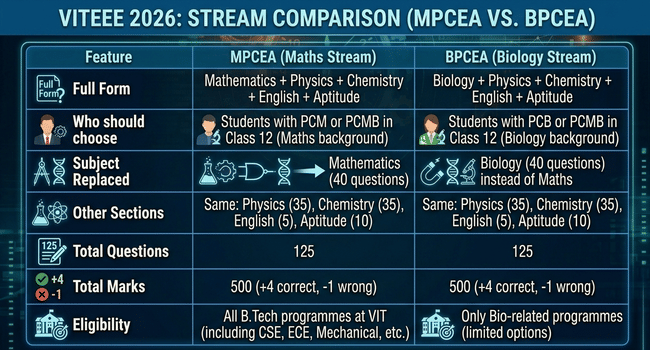
Yes, you can absolutely appear for VITEEE 2026 with Biology instead of Mathematics. In fact, VIT has a dedicated track called BPCEA specifically for students from a Biology background.
However, choosing Biology comes with specific eligibility rules regarding which engineering branches you can join.
The BPCEA Exam Pattern
When you fill out the application (or during the slot booking you've already completed), you choose the BPCEA stream. Your exam paper will consist of:
-
Biology: 40 Questions
-
Physics: 35 Questions
-
Chemistry: 35 Questions
-
Aptitude: 10 Questions
-
English: 5 Questions
-
Total: 125 Questions (500 Marks)
Yes, NIOS (National Institute of Open Schooling) and Open Board students are eligible to apply for VITEEE 2026, provided they meet certain specific conditions set by the university.
- Minimum Subjects: You must have completed your 10+2 with a minimum of five subjects.
- Core Subjects: Your subject combination must include Physics, Chemistry, and Mathematics (PCM) or Biology (PCB), along with English.
- Documentation: At the time of admission/joining, you must produce a valid Migration Cum Transfer Certificate issued by NIOS.
MPCEA vs BPCEA in VITEEE 2026 refers to the two different question paper streams (tracks) you choose during application/slot booking. It decides which subject you attempt in the 40-question section and, more importantly, which B.Tech programmes you become eligible for.
The consensus among educators and candidates for the 2026 session remains that JEE Main is significantly tougher in terms of conceptual depth, while VITEEE is more challenging in terms of speed and volume.
| Feature | VITEEE 2026 | JEE Main 2026 |
| Difficulty Level | Moderate: Questions are largely direct and formula-based. | Questions are tricky, application-based, and conceptually deep. |
| Question Volume | High: 125 questions in 150 minutes. | Lower: 75 questions in 180 minutes. |
| Syllabus Focus | Heavily leans toward NCERT and Class 12 topics. | Deep coverage of both Class 11 & 12 in equal measure. |
| Marking Scheme | +4 / -1: (New for 2026) Adds pressure on accuracy. | +4 / -1: Long-standing tradition, very high stakes. |
| Key Skill Needed | Fast Calculation | Conceptual Clarity is a must! |
For VITEEE 2026, the university has maintained the total question count at 125, but the weightage in terms of marks has been scaled up significantly due to the introduction of negative marking.
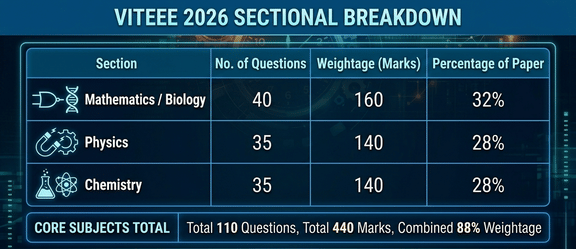

While the number of questions remains the same as in previous years, the total marks have been scaled up due to a new marking scheme:
- Total Marks: 500
- Total Questions: 125 MCQs
For 2026, the Vellore Institute of Technology (VIT) has introduced a major shift in the VITEEE exam pattern. The most significant change is the introduction of negative marking.
Revised Marking Scheme
| Response Type | Marks Awarded |
| Correct Answer | +4 marks |
| Incorrect Answer | -1 mark |
| Unattempted | 0 |
The duration of the VITEEE 2026 exam is 2 hours and 30 minutes (150 minutes).
- The exam is conducted in a single session without any breaks.
- Since it consists of 125 questions, you have an average of 1 minute and 12 seconds per question.
The VITEEE 2026 exam is primarily conducted in two daily shifts, although some reports and specific centers may accommodate a third session depending on the local candidate volume.
-
Shift 1 (Morning): 9:30 AM to 12:00 PM (Reporting time: 7:30 AM)
-
Shift 2 (Afternoon): 2:30 PM to 5:00 PM (Reporting time: 12:30 PM)
-
Shift 3 (Evening): 4:00 PM to 6:30 PM (Only available at selected high-capacity centers; check your specific admit card for this slot)



.png?h=127&w=254&mode=stretch)
.png?h=127&w=254&mode=stretch)
.png?h=127&w=254&mode=stretch)
.png?h=127&w=254&mode=stretch)
.png?h=127&w=254&mode=stretch)
.png?h=127&w=254&mode=stretch)
%20-%202026-03-25T162243.641.png?h=40&w=40&mode=stretch)
.jpeg?h=40&w=40&mode=stretch)

%20-%202026-03-25T152034.118.png?h=40&w=40&mode=stretch)
.png?h=40&w=40&mode=stretch)
%20-%202026-03-25T181032.829.png?h=40&w=40&mode=stretch)


%20-%202026-03-25T173400.303.png?h=40&w=40&mode=stretch)


.jpeg?h=40&w=40&mode=stretch)
.jpeg?h=40&w=40&mode=stretch)
.png?h=40&w=40&mode=stretch)



Comments