




The Rajasthan Board 2026 Class 12 Psychology Question Paper with Solution PDF is now available to help students evaluate their performance and prepare for future sessions. The Psychology exam was conducted during the Morning Session from 8:30 AM to 11:45 AM.
Initial feedback and paper analysis suggest the Psychology exam was moderate in difficulty. The paper effectively balanced theoretical concepts with practical applications, featuring a mix of multiple-choice, short-answer, and long-answer questions. Students who focused on the official RBSE syllabus and units such as Self and Personality, Psychological Disorders, and Therapeutic Approaches found the paper manageable.
Rajasthan Board 2026 Class 12 Psychology Question Paper with Solution PDF – Memory Based
| Rajasthan Board 2026 Class 12 Psychology Question Paper with Solution PDF | Download | Check Solutions |
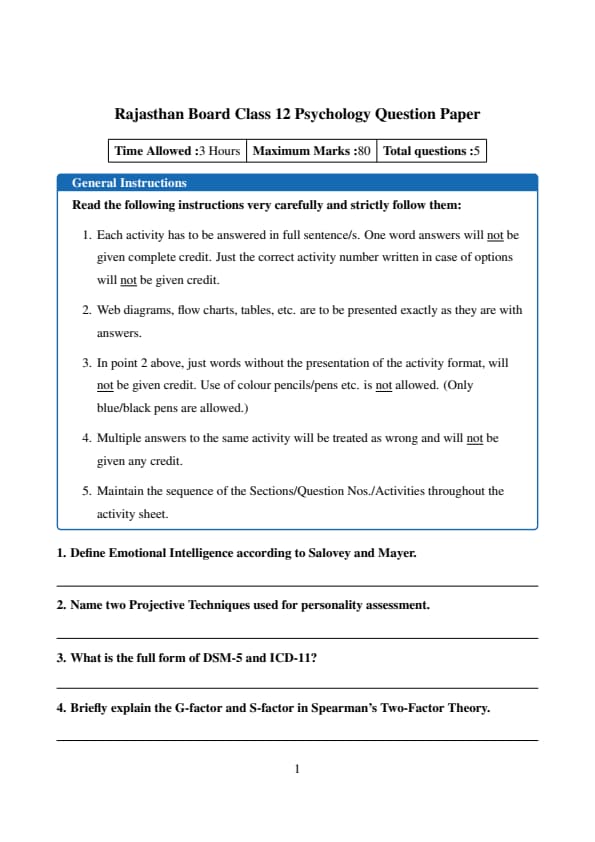
Define Emotional Intelligence according to Salovey and Mayer.
View Solution
Concept:
Peter Salovey and John D. Mayer were the first psychologists to formally introduce the concept of Emotional Intelligence (EI) in 1990.
They defined it as a set of mental abilities related to the processing of emotional information and using it effectively in everyday life.
Step 1: Perceiving Emotions —
The ability to recognize emotions in oneself and others.
It includes identifying feelings through facial expressions, tone of voice, and behavior.
Step 2: Understanding Emotions —
The ability to analyze emotions and understand their causes.
It helps in interpreting how emotions change over time.
Step 3: Managing Emotions —
The ability to regulate one’s own emotions and respond appropriately to others.
It enables a person to remain calm, positive, and balanced even in stressful situations.
Step 4: Using Emotions to Facilitate Thinking —
Emotions are used to enhance decision-making, problem-solving, and interpersonal relationships.
Emotional awareness helps guide rational thinking and constructive actions.
Conclusion —
Thus, Salovey and Mayer viewed Emotional Intelligence as a cognitive ability that integrates emotion with reasoning, enabling individuals to function effectively both personally and socially. Quick Tip: To remember Salovey and Mayer’s model, think of four key skills: Perceive → Understand → Manage → Use emotions.} These form the foundation of Emotional Intelligence.
Name two Projective Techniques used for personality assessment.
View Solution
Concept:
Projective techniques are psychological assessment methods used to explore an individual’s unconscious thoughts, feelings, motives, and personality traits.
These techniques present ambiguous stimuli to a person and analyze their responses, which are believed to reflect inner aspects of personality.
Step 1: Rorschach Inkblot Test —
Developed by Hermann Rorschach.
It consists of a series of inkblot cards shown to the individual.
The person describes what they see in each inkblot.
Responses are interpreted to understand emotional functioning, conflicts, and personality characteristics.
Step 2: Thematic Apperception Test (TAT) —
Developed by Henry Murray and Christiana Morgan.
Individuals are shown ambiguous pictures and asked to create a story about each one.
The stories reveal underlying needs, motives, relationships, and attitudes.
Conclusion —
Both techniques rely on the principle of projection, where individuals unknowingly project their inner feelings onto unclear stimuli, helping psychologists assess personality in depth. Quick Tip: Projective tests use ambiguous stimuli} to uncover hidden aspects of personality. Remember the two major ones as: Rorschach (Inkblots)} and TAT (Story-making)}.
What is the full form of DSM-5 and ICD-11?
View Solution
Concept:
DSM-5 and ICD-11 are internationally recognized classification systems used by mental health professionals to diagnose and categorize psychological and medical disorders.
Step 1: DSM-5 —
DSM-5 stands for Diagnostic and Statistical Manual of Mental Disorders, Fifth Edition.
It is published by the American Psychiatric Association (APA).
It provides standardized criteria for diagnosing mental health disorders.
It is mainly used by psychologists, psychiatrists, and clinicians for assessment and research.
Step 2: ICD-11 —
ICD-11 stands for International Classification of Diseases, Eleventh Revision.
It is published by the World Health Organization (WHO).
It classifies all medical conditions, including mental and behavioral disorders.
It is used globally for diagnosis, health records, and statistical purposes.
Conclusion —
Both DSM-5 and ICD-11 provide systematic frameworks for identifying and diagnosing disorders, ensuring consistency in clinical practice and research worldwide. Quick Tip: Remember: DSM-5 → Mental disorders manual (APA)}
ICD-11 → Global disease classification (WHO)}.
Briefly explain the G-factor and S-factor in Spearman’s Two-Factor Theory.
View Solution
Concept:
Charles Spearman proposed the Two-Factor Theory of Intelligence, stating that every intellectual activity involves two types of abilities:
A general ability common to all tasks.
A specific ability unique to a particular task.
Step 1: G-factor (General Intelligence) —
The G-factor refers to the general mental ability that influences performance in all cognitive activities.
It includes reasoning, problem-solving, memory, and understanding.
This factor is common to every individual task and represents overall intellectual capacity.
For example, logical thinking used in mathematics, language, or science comes from the G-factor.
Step 2: S-factor (Specific Ability) —
The S-factor refers to the specific skills required to perform a particular task.
These abilities vary from one activity to another.
For example, solving a mathematical equation requires numerical ability, while writing an essay requires language ability.
Step 3: Relationship Between G and S Factors —
Every task involves both G-factor and S-factor working together.
The G-factor provides the general mental energy, while the S-factor provides specialized skills.
Conclusion —
Spearman concluded that intelligence is not made up of many unrelated abilities, but is based on a single general ability supported by various specific abilities required for different tasks. Quick Tip: Remember Spearman’s formula: \[ Performance in any task = G (general ability) + S (specific ability). \] G is common to all tasks, while S is unique to each task.}
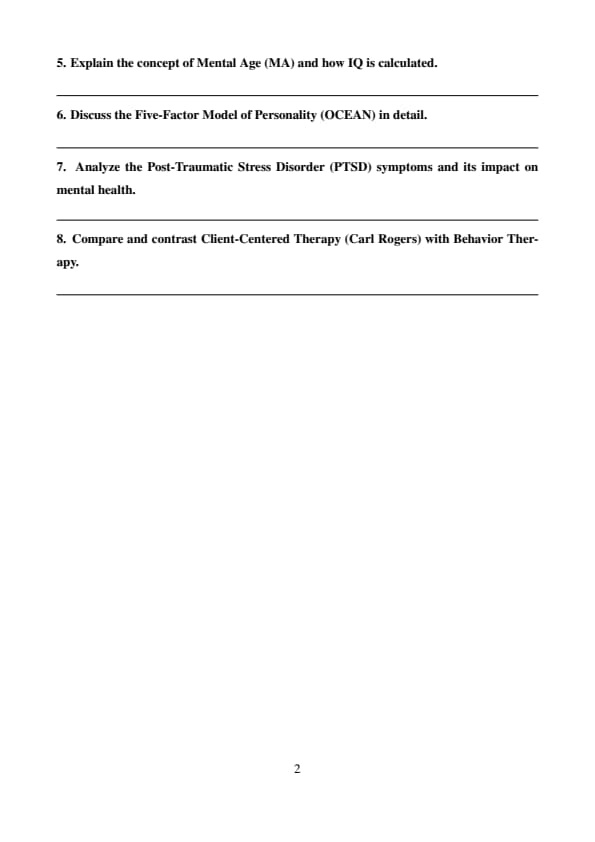
Explain the concept of Mental Age (MA) and how IQ is calculated.
View Solution
Concept:
The concept of Mental Age was introduced by Alfred Binet to measure a child’s intellectual development.
It indicates how well a person performs on tasks appropriate for a certain age level, regardless of their actual age.
Step 1: Meaning of Mental Age (MA) —
Mental Age is the age level at which a person is functioning intellectually.
It is determined through standardized intelligence tests.
For example, if a 10-year-old child performs like an average 12-year-old, the child’s Mental Age is 12.
Step 2: Chronological Age (CA) —
Chronological Age is the actual age of the individual measured in years.
It is the physical age from birth.
Step 3: Calculation of Intelligence Quotient (IQ) —
William Stern proposed that intelligence can be expressed as a ratio of Mental Age to Chronological Age. \[ IQ = \frac{Mental\ Age\ (MA)}{Chronological\ Age\ (CA)} \times 100 \]
Step 4: Example —
If a child has: \[ MA = 12 \quad and \quad CA = 10 \]
then, \[ IQ = \frac{12}{10} \times 100 = 120 \]
This indicates above-average intelligence.
Conclusion —
Mental Age helps in understanding an individual’s level of intellectual development, while IQ provides a numerical measure to compare intelligence across individuals. Quick Tip: Remember the formula: \[ IQ = \frac{MA}{CA} \times 100 \] If MA = CA, then IQ = 100 (average intelligence).
Discuss the Five-Factor Model of Personality (OCEAN) in detail.
View Solution
Concept:
The Five-Factor Model (FFM), developed by psychologists such as Paul Costa and Robert McCrae, is one of the most widely accepted theories of personality.
It proposes that human personality can be understood through five universal trait dimensions, commonly remembered by the acronym OCEAN.
Step 1: Openness to Experience (O) —
Reflects imagination, creativity, and curiosity.
Individuals high in openness enjoy new ideas, art, and novel experiences.
Low openness is associated with conventional and routine-oriented behavior.
Step 2: Conscientiousness (C) —
Refers to being organized, responsible, and goal-directed.
Highly conscientious people are disciplined, reliable, and careful in their work.
Low levels indicate carelessness and lack of planning.
Step 3: Extraversion (E) —
Characterized by sociability, assertiveness, and enthusiasm.
Extraverts are energetic, talkative, and enjoy social interactions.
Introverts prefer solitude, reflection, and quiet environments.
Step 4: Agreeableness (A) —
Indicates kindness, cooperation, and trust in others.
Highly agreeable individuals are compassionate and helpful.
Low agreeableness may involve competitiveness or lack of empathy.
Step 5: Neuroticism (N) —
Relates to emotional stability and control.
High neuroticism is associated with anxiety, moodiness, and stress.
Low neuroticism reflects calmness, resilience, and emotional balance.
Step 6: Importance of the Five-Factor Model —
Provides a comprehensive framework for understanding personality differences.
Used in psychological assessment, career counseling, and research.
Helps predict behavior, interpersonal relationships, and coping styles.
Conclusion —
The Five-Factor Model views personality as a combination of five stable traits that influence how individuals think, feel, and behave across situations. It offers a scientific and practical approach to studying personality. Quick Tip: Remember the acronym OCEAN}: O}penness, C}onscientiousness, E}xtraversion, A}greeableness, N}euroticism. These five traits together describe the structure of personality.
Analyze the Post-Traumatic Stress Disorder (PTSD) symptoms and its impact on mental health.
View Solution
Concept:
PTSD is an anxiety-related disorder that occurs following exposure to traumatic situations such as accidents, violence, natural disasters, or war.
The disorder disrupts emotional regulation, memory processing, and the individual’s sense of safety.
Step 1: Core Symptoms of PTSD —
(a) Intrusive Symptoms:
Recurrent, distressing memories or flashbacks of the traumatic event.
Nightmares and emotional distress when reminded of the trauma.
(b) Avoidance Symptoms:
Avoiding places, people, or situations associated with the trauma.
Suppressing thoughts or feelings related to the event.
(c) Negative Changes in Cognition and Mood:
Persistent fear, guilt, or shame.
Loss of interest in activities and emotional numbness.
Difficulty remembering aspects of the traumatic event.
(d) Hyperarousal and Reactivity:
Increased irritability, anger, or exaggerated startle response.
Sleep disturbances and difficulty concentrating.
Step 2: Impact on Mental Health —
Leads to chronic anxiety, depression, and emotional instability.
Affects interpersonal relationships due to withdrawal and mistrust.
Impairs occupational and social functioning.
May increase risk of substance abuse or suicidal thoughts if untreated.
Step 3: Long-Term Consequences —
Persistent stress can alter brain functioning related to memory and emotion.
Individuals may struggle with self-esteem, identity, and sense of control.
Without intervention, PTSD can become a long-term psychological condition.
Conclusion —
PTSD not only produces distressing psychological symptoms but also deeply affects emotional well-being, relationships, and quality of life. Early diagnosis, therapy, and social support are essential for recovery and restoration of mental health. Quick Tip: PTSD symptoms can be remembered using four clusters: Intrusion, Avoidance, Negative Mood, and Hyperarousal.} Recognizing these early helps in timely psychological intervention.
Compare and contrast Client-Centered Therapy (Carl Rogers) with Behavior Therapy.
View Solution
Concept:
Both Client-Centered Therapy and Behavior Therapy are important approaches in psychotherapy, but they differ in their view of human nature, goals of treatment, and methods used for change.
Step 1: Client-Centered Therapy (Carl Rogers) —
Developed by Carl Rogers, based on the humanistic approach.
Emphasizes the individual’s capacity for self-growth and self-healing.
The therapist provides empathy, genuineness, and unconditional positive regard.
Focus is on understanding the client’s subjective experience.
Therapy is non-directive; the client leads the process.
Step 2: Behavior Therapy —
Based on learning theories proposed by psychologists like Pavlov, Watson, and Skinner.
Focuses on observable behavior rather than internal feelings.
Maladaptive behaviors are modified using techniques such as reinforcement, punishment, modeling, and systematic desensitization.
Therapy is structured and directive, with specific goals for behavior change.
Step 3: Key Differences —
View of Problems:
Client-Centered Therapy sees problems as arising from blocked self-growth, while Behavior Therapy sees them as learned maladaptive behaviors.
Role of Therapist:
In Client-Centered Therapy, the therapist is a facilitator; in Behavior Therapy, the therapist is an active change agent.
Focus of Treatment:
Client-Centered Therapy focuses on emotions and self-concept, whereas Behavior Therapy focuses on changing specific behaviors.
Techniques Used:
Client-Centered Therapy uses reflective listening and empathy; Behavior Therapy uses conditioning and behavioral modification techniques.
Step 4: Similarities —
Both aim to reduce distress and improve functioning.
Both rely on a therapeutic relationship for effective outcomes.
Both are widely used in modern psychological practice.
Conclusion —
Client-Centered Therapy promotes inner growth and self-awareness, while Behavior Therapy emphasizes measurable behavior change. Together, they represent two complementary approaches to understanding and treating psychological problems. Quick Tip: Remember: Client-Centered Therapy = “Feelings and Self-Growth”}
Behavior Therapy = “Learning and Behavior Change.”}



Comments