




Manipur Board is conducting the Class 12 Business Studies Board Exam 2026 on February 24, 2026. Class 12 Business Studies Question Paper with Solution PDF is available here for download.
The official question paper of Manipur Board Class 12 Business Studies Board Exam 2026 is provided below. Students can download the official paper in PDF format for reference.
Manipur Board Class 12, 2026 Business Studies Question Paper with Solution PDF - Memory Based
| Manipur Board Class 12 Business Studies Question Paper 2026 | Download PDF | Check Solutions |

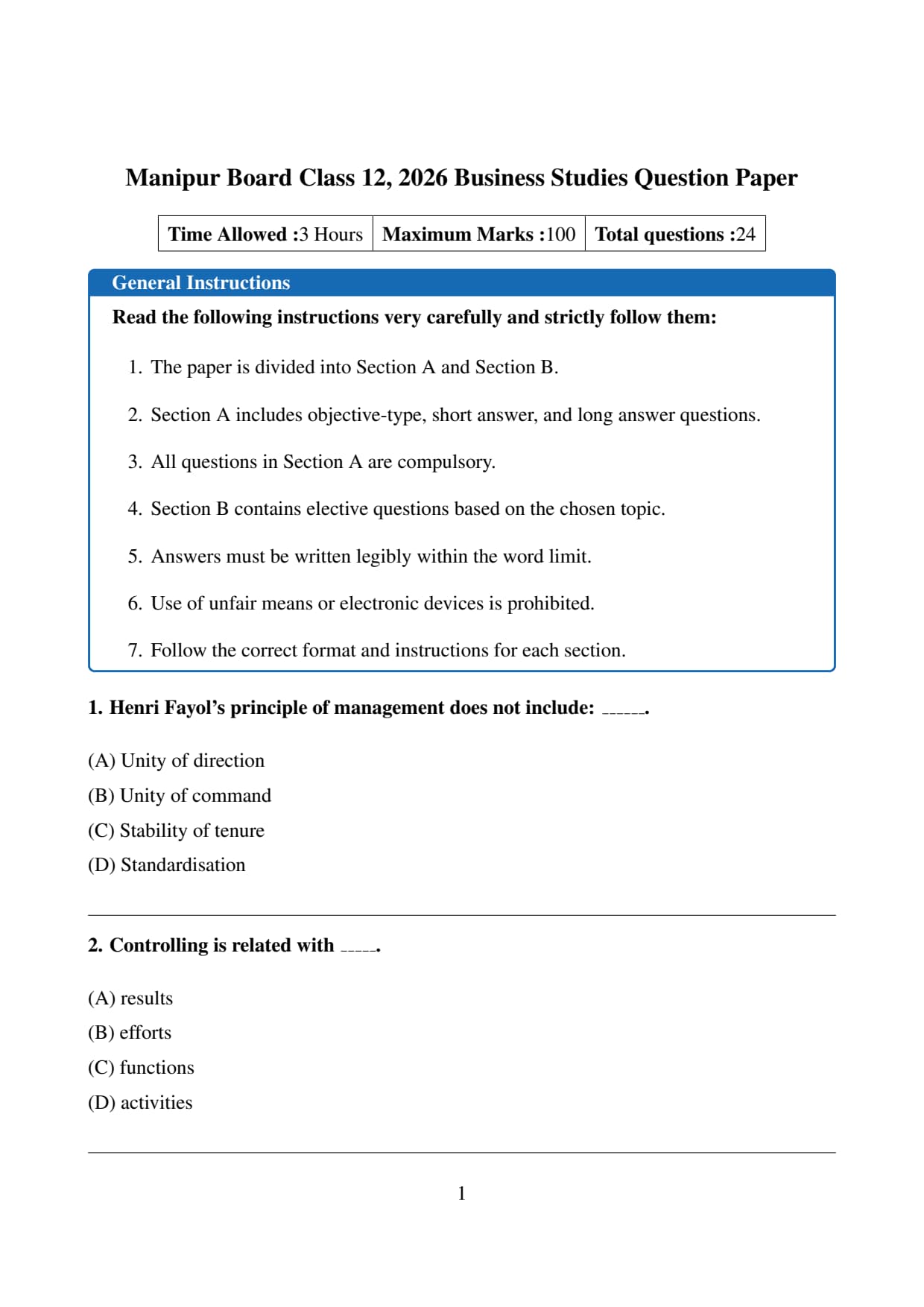
Henri Fayol's principle of management does not include: ______.
View Solution
We need to identify which of the given options is NOT a principle of management given by Henri Fayol.
Step 1: Recall Fayol's 14 Principles of Management.
Henri Fayol, a French mining engineer and management theorist, proposed 14 principles of management in his book "General and Industrial Management" (1916). These principles are:
Division of Work
Authority and Responsibility
Discipline
Unity of Command
Unity of Direction
Subordination of Individual Interest to General Interest
Remuneration of Personnel
Centralization and Decentralization
Scalar Chain (Line of Authority)
Order
Equity
Stability of Tenure of Personnel
Initiative
Esprit de Corps (Union is Strength)
Step 2: Check each option against Fayol's principles.
(A) Unity of direction:
This is Fayol's 5th principle. It means one head and one plan for a group of activities having the same objective.
It is included in Fayol's principles.
(B) Unity of command:
This is Fayol's 4th principle. It means an employee should receive orders from only one superior.
It is included in Fayol's principles.
(C) Stability of tenure:
This is Fayol's 12th principle. It means employees should be given enough time to show results and job security.
It is included in Fayol's principles.
(D) Standardisation:
Standardisation is not one of Fayol's 14 principles.
It is a concept associated with scientific management (F.W. Taylor) and refers to setting standards for work processes, tools, and outputs.
This is NOT included in Fayol's principles.
Step 3: Conclusion.
Standardisation is a principle associated with F.W. Taylor's Scientific Management, not with Henri Fayol's Administrative Management. Therefore, it is the correct answer.
Final Answer: (D) Standardisation Quick Tip: Remember the difference: Henri Fayol (Administrative Management): 14 principles including Unity of Command, Unity of Direction, Division of Work, etc. F.W. Taylor (Scientific Management): Principles like Science not Rule of Thumb, Harmony not Discord, Cooperation not Individualism, Standardisation, etc. Standardisation is Taylor's contribution, not Fayol's!
Controlling is related with _____.
View Solution
We need to identify what controlling is related to in the context of management.
Step 1: Understand the meaning of controlling in management.
Controlling is one of the key functions of management (along with Planning, Organizing, Staffing, and Directing). It involves:
Setting performance standards
Measuring actual performance
Comparing actual performance with standards
Identifying deviations
Taking corrective actions
Step 2: Focus of controlling.
The primary focus of controlling is on results. Controlling is concerned with ensuring that the actual results match the planned results. It evaluates whether the desired outcomes have been achieved.
Efforts are related to the process of working, but controlling measures the outcome of those efforts.
Functions are broader categories of management activities; controlling itself is a function.
Activities are the specific tasks performed; controlling evaluates the results of those activities.
Step 3: Analyze each option.
(A) results:
✓ Correct. Controlling is fundamentally about evaluating results against standards.
It answers the question: "Have we achieved what we planned?"
(B) efforts:
Incorrect. While efforts are important, controlling focuses on the outcomes of those efforts, not the efforts themselves.
(C) functions:
Incorrect. Controlling is itself a function of management; it is not "related to functions" in a way that defines it.
(D) activities:
Incorrect. Controlling evaluates the results of activities, but it is not directly defined by activities.
Step 4: Supporting quotes from management theory.
Management experts define controlling as:
"Controlling is the measurement and correction of performance in order to make sure that enterprise objectives and the plans devised to attain them are accomplished." – Harold Koontz & Heinz Weihrich
"Control is the process of ensuring that actual activities conform to planned activities." – Ricky Griffin
The common theme is that controlling is about ensuring that results align with plans.
Final Answer: (A) results Quick Tip: Controlling is the final step in the management process. It is results-oriented because: It compares actual performance with standards It identifies deviations from plans It ensures achievement of organizational goals Remember: Planning sets the goals, Organizing arranges resources, Staffing places people, Directing leads them, and Controlling checks the RESULTS!
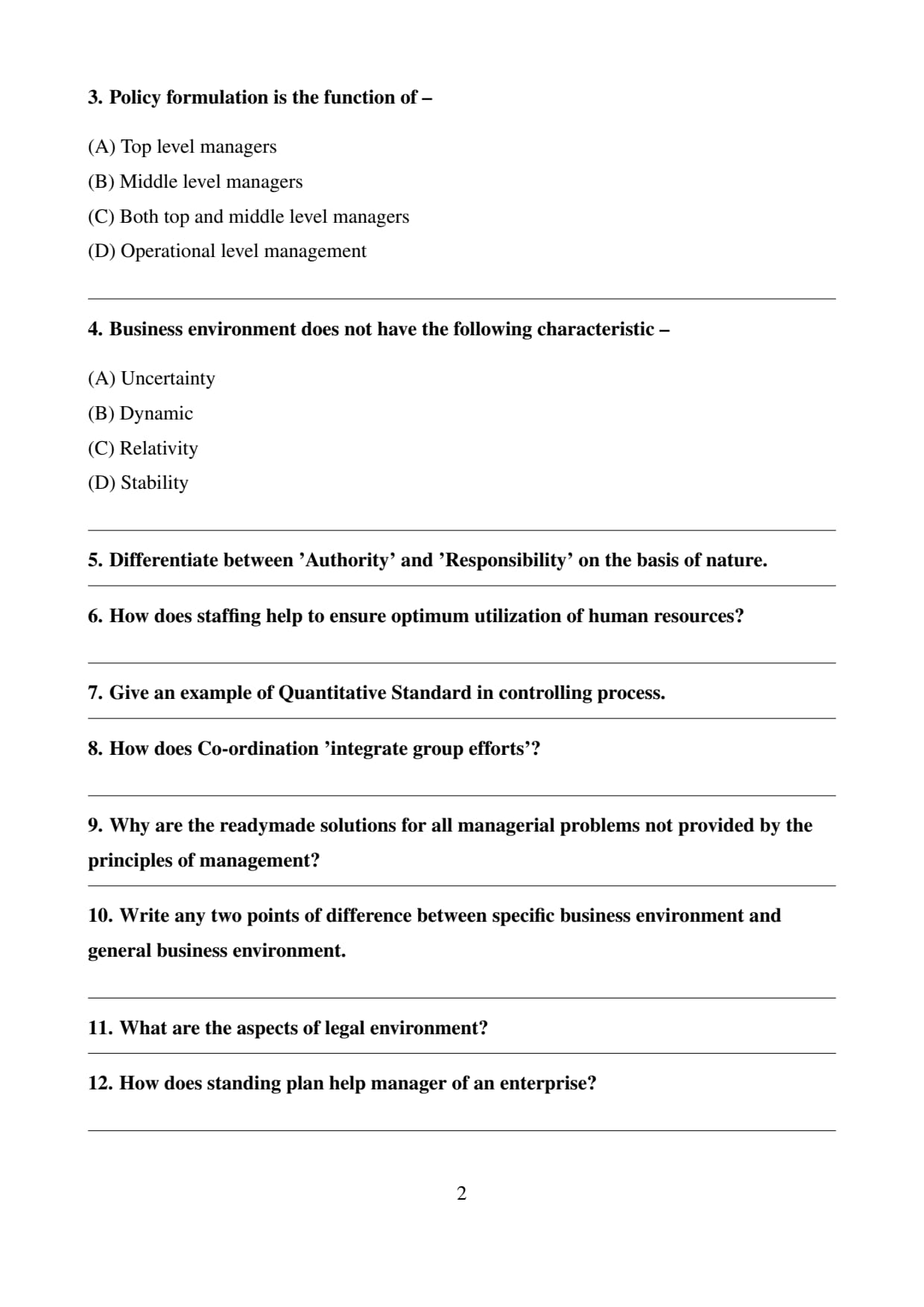
Policy formulation is the function of –
View Solution
We need to identify which level of management is responsible for policy formulation.
Step 1: Understand the three levels of management.
In any organization, management is typically divided into three levels:
Top Level Management: Consists of Board of Directors, Chief Executive Officer (CEO), Chief Financial Officer (CFO), President, Vice-President, etc.
They are responsible for strategic decisions.
They formulate policies, set objectives, and plan for the long-term.
They determine the overall direction of the organization.
Middle Level Management: Consists of Department Heads, Divisional Managers, Branch Managers, etc.
They are responsible for tactical decisions.
They implement the policies formulated by top management.
They coordinate activities between top and lower levels.
They interpret policies to lower management.
Lower Level Management (Operational/Supervisory Level): Consists of Supervisors, Foremen, Team Leaders, etc.
They are responsible for operational decisions.
They oversee day-to-day activities.
They ensure that work is carried out according to plans and policies.
Step 2: Define policy formulation.
Policy formulation refers to the process of developing broad guidelines, rules, and principles that guide the organization's actions and decisions. Policies provide a framework within which decisions are made.
Policies are long-term in nature.
They affect the entire organization.
They require a broad perspective and understanding of the external environment.
They are made at the highest level of authority.
Step 3: Assign responsibility for policy formulation.
Based on the nature of policies (long-term, organization-wide, strategic), the responsibility for policy formulation lies with Top Level Management. Reasons:
Top managers have the broadest perspective of the organization.
They have access to information about the external environment.
They have the authority to commit organizational resources.
They are accountable for the overall success of the organization.
Middle and lower levels focus on implementation, not formulation.
Step 4: Analyze each option.
(A) Top level managers:
✓ Correct. Policy formulation is primarily the function of top management.
(B) Middle level managers:
Incorrect. Middle managers implement policies, not formulate them.
(C) Both top and middle level managers:
Incorrect. While middle managers may provide input, formulation is exclusively top management's role.
(D) Operational level management:
Incorrect. Operational managers execute tasks and follow policies; they do not formulate them.
Final Answer: (A) Top level managers Quick Tip: Levels of Management and Their Functions: Top Level: Policy formulation, strategic planning, goal setting Middle Level: Policy implementation, departmental planning, coordination Lower Level: Supervision, execution, day-to-day operations Remember: Policies are made at the top, implemented in the middle, and executed at the bottom!
Business environment does not have the following characteristic –
View Solution
We need to identify which characteristic is NOT associated with the business environment.
Step 1: Understand the concept of business environment.
The business environment refers to the sum total of all individuals, institutions, and forces that are outside the control of a business but affect its functioning. It includes economic, social, political, technological, and legal factors.
Step 2: Recall the characteristics of business environment.
The main characteristics of business environment are:
Dynamic: The business environment is constantly changing. It is not static. Changes in technology, government policies, consumer preferences, etc., keep occurring.
Uncertainty: It is difficult to predict future changes in the environment accurately. Businesses cannot be completely sure about what will happen next.
Complex: The environment consists of many interrelated factors that are difficult to understand separately.
Relativity: The business environment is relative in nature. It differs from country to country, region to region, and even from time to time. What is a threat in one place may be an opportunity elsewhere.
Interrelatedness: Different elements of the environment are interconnected. Change in one factor affects others.
Multi-faceted: The same environmental change can be perceived differently by different observers.
Step 3: Analyze each option.
(A) Uncertainty:
This IS a characteristic of business environment.
Future changes cannot be predicted with complete accuracy.
(B) Dynamic:
This IS a characteristic of business environment.
The environment is constantly changing.
(C) Relativity:
This IS a characteristic of business environment.
The same environmental factor may affect different businesses differently, and it varies across regions.
(D) Stability:
This is NOT a characteristic of business environment.
The business environment is constantly changing and is unstable.
Stability implies no change, which is contrary to the dynamic nature of the environment.
Step 4: Conclusion.
Stability is not a characteristic of the business environment. In fact, the environment is characterized by change, dynamism, and uncertainty.
Final Answer: (D) Stability Quick Tip: Key Characteristics of Business Environment: Dynamic (always changing) Uncertain (difficult to predict) Relative (differs across contexts) Complex (many interrelated factors) Multi-faceted (can be viewed differently) Stability is NOT a characteristic because the environment is constantly evolving!
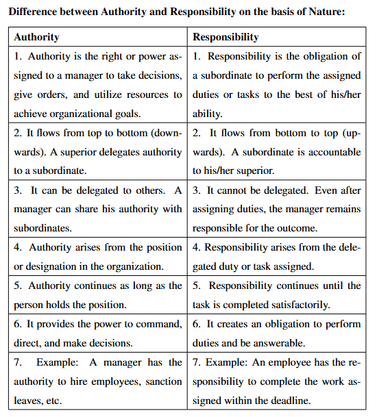
Differentiate between 'Authority' and 'Responsibility' on the basis of nature.
View Solution
How does staffing help to ensure optimum utilization of human resources?
View Solution
Staffing is the management function concerned with filling the organizational positions and keeping them filled with the right people at the right place. It helps in ensuring optimum utilization of human resources in the following ways:
1. Proper Recruitment and Selection:
Staffing ensures that the right person is selected for the right job through a systematic recruitment and selection process. When a person's skills, qualifications, and interests match the job requirements, they perform better, leading to optimum utilization of their potential.
2. Training and Development:
Staffing includes training and development programs that enhance the skills and abilities of employees. Well-trained employees work efficiently, make fewer mistakes, and utilize resources effectively, contributing to higher productivity.
3. Performance Appraisal:
Regular performance appraisal helps in identifying the strengths and weaknesses of employees. Based on this feedback, employees can improve their performance, and management can assign tasks that align with their capabilities, ensuring better utilization of human resources.
4. Placement and Orientation:
Proper placement of employees in suitable positions ensures that their talents are fully utilized. Orientation programs help new employees understand their roles and responsibilities, enabling them to contribute effectively from the beginning.
5. Motivation and Career Growth:
Staffing includes providing motivation through promotions, incentives, and career planning. Motivated employees work with dedication and commitment, leading to maximum utilization of their potential. Clear career paths encourage employees to perform at their best.
6. Reducing Employee Turnover:
Effective staffing reduces employee turnover by ensuring job satisfaction. When employees are satisfied with their jobs, they stay longer, reducing the cost of hiring and training new employees, and ensuring continuity and stability in the organization.
7. Proper Work Distribution:
Staffing ensures that work is distributed evenly among employees according to their capabilities. This prevents overloading of some employees while others remain underutilized, ensuring balanced and efficient use of human resources.
8. Creating Healthy Work Environment:
Staffing promotes a healthy work environment by ensuring that employees work in teams where their skills complement each other. This leads to better coordination, cooperation, and overall productivity.
Thus, staffing is not just about hiring people but about ensuring that every individual's potential is fully utilized for achieving organizational goals while also satisfying their personal needs and aspirations. Quick Tip: Staffing ensures optimum utilization of human resources through: right person for right job, training, performance appraisal, proper placement, motivation, and creating a healthy work environment.
Give an example of Quantitative Standard in controlling process.
View Solution
Quantitative standards are those standards which can be expressed in numerical terms or
units. These standards are measurable and can be easily compared with actual performance.
Examples of Quantitative Standards in Controlling Process:
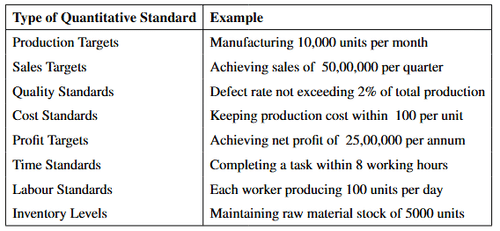
Detailed Example:
A manufacturing company sets a production target of 5,000 units per month as a
quantitative standard. At the end of the month, the actual production is 4,500 units. The
manager can easily measure the deviation of 500 units (10% shortfall) and take corrective
action to improve production in the next month.
Another Example:
A sales department sets a sales target of 20,00,000 per month. If the actual sales are
18,00,000, the deviation of 2,00,000 is clearly measurable, and corrective measures like
increasing promotional activities can be taken.
How does Co-ordination 'integrate group efforts'?
View Solution
Coordination is the process of integrating the activities of different departments and individuals in an organization to achieve common goals. It ensures that all efforts are directed towards the organizational objectives without conflicts or duplication.
Coordination integrates group efforts in the following ways:
1. Unity of Action:
Coordination brings unity of action among various departments and individuals. It ensures that all members work towards the same organizational goals rather than pursuing their individual interests. For example, the production department produces goods according to the sales department's forecasts, ensuring that what is produced can be sold.
2. Harmonizing Individual Goals with Organizational Goals:
Coordination helps in aligning individual goals with organizational goals. It ensures that employees understand how their work contributes to the overall success of the organization. When individuals see their role in the bigger picture, they work more cohesively.
3. Avoiding Duplication of Work:
Coordination prevents overlapping and duplication of efforts. When different departments coordinate, they know what others are doing, which prevents wastage of time and resources on the same task by multiple departments.
4. Resolving Conflicts:
Coordination helps in resolving conflicts between departments or individuals. For example, the sales department may promise quick delivery, but the production department may have capacity constraints. Coordination between them ensures realistic promises and smooth workflow.
5. Synchronization of Activities:
Coordination ensures that all activities are synchronized in a timely manner. For example, in a manufacturing unit, raw materials must be available when production starts, and finished goods must be ready when the sales department needs them. Coordination ensures this timing matches perfectly.
6. Team Spirit:
Coordination fosters team spirit and mutual cooperation among members. When people work together in a coordinated manner, they develop a sense of belonging and shared responsibility, which enhances group efforts.
7. Optimum Utilization of Resources:
By integrating efforts, coordination ensures that resources (men, money, materials, machines) are used optimally. There is no wastage, and every resource contributes to the organizational goals.
8. Direction to Efforts:
Coordination provides a common direction to all efforts. Just as a conductor in an orchestra ensures that all musicians play in harmony, coordination ensures that all departments and individuals work in harmony towards common objectives.
Example:
In a cricket team, coordination integrates the efforts of batsmen, bowlers, fielders, and the captain. Each player has a specific role, but they all work together to win the match. Without coordination, even talented players cannot perform as a team. Similarly, in an organization, coordination integrates the efforts of different departments like production, marketing, finance, and human resources to achieve organizational success. Quick Tip: Coordination integrates group efforts by ensuring unity of action, harmonizing goals, avoiding duplication, resolving conflicts, synchronizing activities, fostering team spirit, and providing common direction to all efforts.
Why are the readymade solutions for all managerial problems not provided by the principles of management?
View Solution
The principles of management do not provide readymated solutions for all managerial
problems because of the following reasons:
1. Situational Nature:
Management principles are situational and flexible. They provide general guidelines for
decision-making, but every business situation is unique. Managers need to apply these
principles according to the specific circumstances, rather than using them as fixed formulas.
2. Dynamic Environment:
The business environment is constantly changing due to technological, social, economic, and
political factors. Principles of management are based on past experiences and observations,
but they cannot predict future changes. Managers must adapt these principles to current
situations.
3. Human Element:
Management deals with human beings who have complex and unpredictable behavior. No
two individuals or groups react in the same way to a given situation. Therefore, principles
cannot provide readymade solutions for human-related problems.
4. Contingent Application:
Management principles are contingent upon the situation. What works in one organization
may not work in another due to differences in size, culture, resources, or industry. Managers
must use their judgment and experience to apply principles appropriately.
5. Not Rigid Rules:
Management principles are not rigid laws like those in pure sciences. They are merely
guidelines that provide a framework for decision-making. Managers have the freedom to
modify, adapt, or even ignore them based on the situation.
6. Complexity of Business Problems:
Modern business problems are complex and multi-dimensional. They involve various factors
like technology, competition, government policies, and social trends. No single principle or
set of principles can provide a complete solution to such complex problems.
Thus, management principles serve as a foundation for decision-making, but managers must
use their creativity, experience, and judgment to find solutions to specific problems.
Write any two points of difference between specific business environment and general business environment.
View Solution
Difference between Specific Business Environment and General Business Environment:
Specific Business Environment & General Business Environment
1. It includes factors that directly affect the day-to-day operations and decision-making of a particular business firm. & 1. It includes broader factors that affect all business firms in an economy or industry indirectly.
2. These factors are unique to a particular industry or organization and vary from firm to firm. & 2. These factors are common to all businesses and affect the entire business community.
3. Examples: Customers, suppliers, competitors, creditors, employees, pressure groups, etc. & 3. Examples: Economic conditions (GDP, inflation), social trends, political stability, technological advancements, legal framework, etc.
4. Changes in specific environment have immediate and direct impact on the business. & 4. Changes in general environment have gradual and indirect impact on the business.
5. Managers have greater control or influence over specific environmental factors (e.g., choosing suppliers, dealing with customers). & 5. Managers have little or no control over general environmental factors. They can only adapt to them.
6. It is also known as Micro Environment or Task Environment. & 6. It is also known as Macro Environment or Remote Environment.
Example to Illustrate:
Specific Environment: A strike by employees in a factory directly affects that company's production.
General Environment: An increase in the national inflation rate affects purchasing power of all consumers, indirectly affecting all businesses. Quick Tip: Specific environment = Direct, Immediate, Controllable factors (Customers, Suppliers, Competitors).
General environment = Indirect, Gradual, Uncontrollable factors (Economic, Social, Political, Technological).
What are the aspects of legal environment?
View Solution
The legal environment refers to the framework of laws, regulations, and legal provisions
within which businesses have to operate. It includes various aspects that affect business
decisions and activities.
The main aspects of legal environment are as follows:
1. Constitutional Framework:
The Constitution of a country provides the basic legal structure within which businesses
operate. It defines the fundamental rights and duties of citizens and organizations, and
establishes the legal system.
2. Government Laws and Regulations:
Various laws passed by the government regulate business activities. These include:
• Company Law (Companies Act) - governs formation and functioning of companies
• Industrial Laws - regulate industrial relations, factories, etc.
• Labour Laws - govern wages, working conditions, trade unions
• Taxation Laws - Income Tax, GST, Customs, Excise
• Foreign Trade Laws - regulate imports and exports
• Environmental Laws - protect environment from industrial pollution
3. Judicial Decisions and Precedents:
Court judgments and legal precedents interpret laws and influence how they are applied.
These decisions become part of the legal environment and guide future business conduct.
4. Regulatory Bodies and Authorities:
Various government agencies and regulatory bodies enforce laws and regulations, such as:
• SEBI (Securities and Exchange Board of India) - regulates capital markets
• RBI (Reserve Bank of India) - regulates banking and financial system
• TRAI (Telecom Regulatory Authority of India) - regulates telecommunications
• CCI (Competition Commission of India) - prevents anti-competitive practices
• Consumer Courts - protect consumer rights
5. Contracts and Agreements:
The legal framework governing contracts (Indian Contract Act) affects business transactions,
partnerships, and agreements with suppliers, customers, and employees.
6. Intellectual Property Laws:
Laws related to patents, trademarks, copyrights, and designs protect business innovations and
brand identity.
7. International Legal Framework:
For businesses engaged in international trade, aspects like WTO agreements, international
trade laws, and bilateral treaties form part of the legal environment.
Importance of Legal Environment:
• Ensures fair competition and prevents monopolies
• Protects consumer rights and interests
• Provides stability and predictability for business planning
• Ensures compliance with social and ethical standards
• Protects investors and shareholders
• Maintains industrial harmony and labor welfare
How does standing plan help manager of an enterprise?
View Solution
Standing plans are pre-developed plans designed for situations that occur repeatedly over a period of time. They provide ready-made solutions for routine and recurring problems. Standing plans include policies, procedures, rules, and methods that guide managerial decisions and actions.
Standing plans help managers in the following ways:
1. Provides Guidance and Direction:
Standing plans provide clear guidelines to managers for handling routine situations. For example, company policies on leave, overtime, or purchase procedures help managers make consistent decisions without consulting higher authorities every time.
2. Saves Time and Effort:
Since standing plans are pre-defined, managers do not need to develop new solutions for recurring problems. This saves valuable time and effort, allowing managers to focus on more important and non-routine issues.
3. Ensures Consistency and Uniformity:
Standing plans ensure that similar situations are handled in a consistent manner throughout the organization. For example, a uniform recruitment policy ensures that all candidates are evaluated using the same criteria, promoting fairness and transparency.
4. Facilitates Delegation of Authority:
With standing plans in place, managers can confidently delegate authority to subordinates because they know that decisions will be made within the established framework. This empowers employees and reduces the manager's workload.
5. Promotes Efficiency and Standardization:
Standard procedures and methods (standing plans) ensure that work is done in the most efficient way. For example, a standard operating procedure for quality control ensures consistent product quality.
6. Helps in Training New Employees:
Standing plans serve as training tools for new employees. They can refer to policy manuals, procedure handbooks, and rule books to understand how work is done in the organization, reducing the need for constant supervision
7. Reduces Errors and Risks:
Since standing plans are based on past experience and careful analysis, following them reduces the chances of errors and minimizes business risks.
8. Provides Stability:
Standing plans provide stability to the organization by ensuring that activities continue smoothly even when managers change or are absent. They create a framework that outlasts individual managers.
9. Simplifies Decision-Making:
When faced with a recurring situation, managers can simply refer to the relevant standing plan rather than analyzing the situation from scratch. This simplifies and speeds up decision-making.
Examples of Standing Plans:
Policies: Company policy on recruitment, pricing, credit sales
Procedures: Procedure for placing an order, handling customer complaints
Rules: No smoking in factory premises, dress code for employees
Methods: Standard method for operating a machine, quality testing method
Thus, standing plans are essential tools that help managers handle routine situations efficiently, consistently, and with minimal effort. Quick Tip: Standing plans are for recurring situations - they save time, ensure consistency, guide decisions, and help in delegation and training. Examples: Policies, Procedures, Rules, Methods.



Comments