




The Board of Secondary Education Manipur (BSEM) successfully conducted the Class 10 Science Exam 2026 on March 17, 2026. The Manipur Board Class 10 Science Question Paper with Solution PDF is now available for download.
The Manipur Board Class 10 Science paper covered key topics from physics, chemistry, biology, and environmental science. Students should focus on understanding scientific concepts, solving numerical problems, and practicing diagram-based questions. The exam is marked out of 100, with 80 marks for the theory paper and 20 for internal assessment.
Manipur Board Class 10 2026 Science Question Paper with Solution PDF
| Manipur Board Class 10 Science Question Paper 2026 | Download PDF | Check Solution |
Sodium atom loses an electron to form Sodium ion. Identify the compound formed by Sodium ion and another ion having same number of electrons. Predict the solubility of the compound in water.
View Solution
Step 1: Identify the compound.
When Sodium (Na) loses an electron, it forms Na\(^+\) ion. An ion with the same number of electrons as Na\(^+\) would be the chloride ion (Cl\(^-\)), since both Na\(^+\) and Cl\(^-\) have the same electron configuration (that of neon, Ne).
Step 2: Solubility in water.
The compound formed is Sodium chloride (NaCl). Sodium chloride is highly soluble in water due to the strong electrostatic interactions between the Na\(^+\) and Cl\(^-\) ions, which are easily broken by the polar water molecules. Quick Tip: Remember: Sodium chloride (NaCl) is highly soluble in water due to its ionic nature and the ability of water to separate the ions.
Draw a labelled diagram of an experimental setup of Froth Flotation technique of metal are concentration.
View Solution
Step 1: Understanding Froth Flotation.
Froth flotation is a process for selectively separating hydrophobic materials from hydrophilic ones. It is commonly used to concentrate metal ores by utilizing the differences in the wetting properties of the materials.
Step 2: Diagram and Labeling.
A typical setup includes a flotation tank with water, a frothing agent, air bubbles, and a mixture of the ore. The hydrophobic particles attach to the air bubbles and float to the surface, while hydrophilic particles sink.
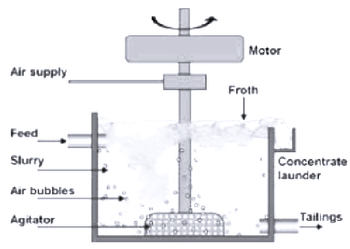
Quick Tip: Remember: Froth flotation works based on the selective attachment of hydrophobic particles to air bubbles.
The photochemical decomposition of silver chloride is a redox reaction. Justify it.
View Solution
Step 1: Define Redox Reaction.
A redox (reduction-oxidation) reaction involves the transfer of electrons between substances. One substance undergoes oxidation (loses electrons), while the other undergoes reduction (gains electrons).
Step 2: Explanation of Decomposition.
The photochemical decomposition of silver chloride (AgCl) is a redox reaction because silver (Ag) is reduced (gains electrons) and chlorine (Cl) is oxidized (loses electrons). The reaction can be written as: \[ 2AgCl (solid) \xrightarrow{light} 2Ag (solid) + Cl_2 (gas) \]
Here, Ag\(^+\) is reduced to Ag, and Cl\(^-\) is oxidized to form Cl\(_2\). Quick Tip: Remember: In photochemical reactions, the transfer of electrons between substances results in redox processes like the decomposition of silver chloride.
Define water of Crystallization.
View Solution
Step 1: Definition of water of crystallization.
Water of crystallization refers to the water molecules that are chemically bound within the crystal structure of certain salts. These water molecules are an integral part of the crystalline solid and are typically not easily removed.
Step 2: Example of salts with water of crystallization.
Common examples of salts that contain water of crystallization include copper sulfate (\( CuSO_4 \cdot 5H_2O \)) and sodium carbonate (\( Na_2CO_3 \cdot 10H_2O \)).
Step 3: Removal of water of crystallization.
Water of crystallization can be removed by heating the substance, causing it to lose the bound water and often converting it into an anhydrous form. Quick Tip: Remember: Water of crystallization is essential to the crystal structure of certain salts and is removed by heating.
Write the structural formula of saturated isomer of 2-butene.
View Solution
Step 1: Identify the isomers of butene.
Butene (\( C_4H_8 \)) has two possible structural isomers, 1-butene and 2-butene, based on the position of the double bond. Saturated isomers refer to compounds that contain single bonds between carbon atoms.
Step 2: Saturated isomer of 2-butene.
The saturated isomer of 2-butene would be butane (\( C_4H_{10} \)), as it is a fully saturated hydrocarbon with no double bonds. The structural formula for butane is: \[ CH_3CH_2CH_2CH_3 \] Quick Tip: Remember: The saturated isomer of 2-butene is butane, as it contains only single bonds between carbon atoms.
Give the common name of sodium hydrogen carbonate. What happens when it is subjected to calcinations?
View Solution
Step 1: Common Name.
Sodium hydrogen carbonate is commonly known as **baking soda**.
Step 2: Effects of Calcination.
When sodium hydrogen carbonate (NaHCO₃) is subjected to calcination (heating), it decomposes into sodium carbonate (Na₂CO₃), water (H₂O), and carbon dioxide (CO₂) gas: \[ 2NaHCO_3 \xrightarrow{heat} Na_2CO_3 + H_2O + CO_2 \]
This reaction is commonly used in the production of sodium carbonate. Quick Tip: Remember: Heating sodium hydrogen carbonate leads to its decomposition into sodium carbonate, water, and carbon dioxide.
Two solutions, Hydrochloric acid solution and sodium hydroxide solution are found to have pH values of 6 and 8 respectively. How will the pH values change when the solutions are diluted with water? Give reason.
View Solution
Step 1: Understand pH and its Relationship with Concentration.
pH is a measure of the hydrogen ion concentration (\([H^+]\)) in a solution. Lower pH indicates a higher concentration of hydrogen ions (acidic solution), while higher pH indicates a lower concentration of hydrogen ions (basic solution).
Step 2: Effect of Dilution on pH.
When an acidic or basic solution is diluted with water, the concentration of hydrogen ions (for acid) or hydroxide ions (for base) decreases, which results in a change in the pH value. Diluting an acidic solution like HCl with water will decrease the concentration of \(H^+\) ions, thus increasing the pH. Similarly, diluting a basic solution like NaOH will decrease the concentration of \(OH^-\) ions, causing the pH to decrease.
Step 3: Predict the pH Change.
- The pH of the hydrochloric acid solution (initially 6) will increase upon dilution, as the \(H^+\) ion concentration decreases.
- The pH of the sodium hydroxide solution (initially 8) will decrease upon dilution, as the \(OH^-\) ion concentration decreases. Quick Tip: Remember: Diluting an acid increases its pH, while diluting a base decreases its pH, due to the change in ion concentration.
Describe with an example how low reactive metals are extracted.
View Solution
Step 1: Define Low Reactive Metals.
Low reactive metals are those metals that do not readily react with acids or oxygen, such as gold, platinum, and silver. These metals are often found in their native or pure form in nature.
Step 2: Describe Extraction Process.
Low reactive metals are generally extracted through **reduction** reactions. For example, gold is extracted from its ore, **gold ore (Au)**, by using a simple method like panning or cyanidation, where the metal is dissolved in cyanide solution and then recovered by reduction.
Step 3: Example of Extraction of Gold.
In cyanidation, gold is treated with a cyanide solution, which forms a soluble complex with gold ions. The gold is then reduced from this complex by adding zinc or carbon, which causes the gold to precipitate out. Quick Tip: Remember: Low reactive metals like gold are often extracted using reduction reactions, such as cyanidation for gold.
What is a homologous series? Write the structural formula of the first two homologues of alkynes.
View Solution
Step 1: Define Homologous Series.
A homologous series is a group of organic compounds that have the same functional group and similar chemical properties, but differ by a constant structural unit, usually a CH₂ group. These compounds show a regular gradation in physical properties and reactivity.
Step 2: Example of Homologous Series of Alkynes.
Alkynes are hydrocarbons that contain a triple bond between two carbon atoms. The first two members of the alkyne homologous series are:
- **Ethyne (C₂H₂)**: The simplest alkyne, also known as acetylene.
- **Butyne (C₄H₆)**: The next homolog, which has four carbon atoms and a triple bond.
Step 3: Structural Formulas.
- **Ethyne (C₂H₂)**: The structural formula is: \[ CH≡CH \]
- **Butyne (C₄H₆)**: The structural formula is: \[ CH₃-C≡C-CH₃ \] Quick Tip: Remember: Homologous series differ by a CH₂ group, and alkynes contain a triple bond between carbon atoms.
Consider a current flows along a horizontal copper wire in south to north direction. What will be the direction of magnetic field at a point directly above it?
View Solution
Step 1: Use the right-hand rule.
According to Ampère's right-hand rule, if you hold the current-carrying wire in your right hand with your thumb pointing in the direction of the current (from south to north), the curl of your fingers will show the direction of the magnetic field.
Step 2: Apply the rule.
For a point directly above the wire, your fingers will curl in a direction such that the magnetic field at that point will be directed towards the east. Quick Tip: Remember: The magnetic field created by a current-carrying wire can be determined using the right-hand rule.
Who discovered electromagnetic induction?
View Solution
Step 1: Identify the scientist.
Electromagnetic induction was discovered by Michael Faraday in 1831. He demonstrated that a changing magnetic field can induce an electric current in a conductor.
Step 2: Importance of the discovery.
This discovery is the foundation of many modern electrical technologies, such as transformers and electric generators. Quick Tip: Remember: Michael Faraday’s discovery of electromagnetic induction paved the way for the development of electrical engineering.
Define pole of a spherical mirror.
View Solution
Step 1: Definition of pole.
The pole of a spherical mirror is the geometric center of the mirror’s surface. It is the point where the principal axis intersects the mirror surface.
Step 2: Role of the pole.
The pole serves as the reference point for measuring distances, such as the focal length and object distance, in the mirror. Quick Tip: Remember: The pole is the central point on the spherical mirror's surface, serving as the origin for measurements.
A 10 Ω thick wire is stretched so that its length becomes three times. Assuming that there is no change in its density on stretching, calculate the resistance of the new wire.
View Solution
Step 1: Understand the relationship between resistance and dimensions.
The resistance of a wire is given by the formula: \[ R = \rho \frac{L}{A} \]
where \( \rho \) is the resistivity, \( L \) is the length, and \( A \) is the cross-sectional area.
Step 2: Apply the formula after stretching.
When the wire is stretched, its length increases by a factor of 3, and its cross-sectional area decreases by a factor of 3 to maintain the same volume. Therefore, the resistance increases by a factor of \( 3^2 = 9 \).
Step 3: Calculate the new resistance.
The new resistance is: \[ R_{new} = 9 \times R = 9 \times 10 \, \Omega = 90 \, \Omega \] Quick Tip: Remember: When a wire is stretched, its length increases, and its cross-sectional area decreases, which increases its resistance by the square of the length increase factor.
State Fleming’s Right Hand rule.
View Solution
Step 1: Fleming’s Right Hand Rule.
Fleming’s Right Hand Rule is used to determine the direction of the induced current when a conductor moves through a magnetic field. According to this rule:
- The thumb represents the direction of motion of the conductor.
- The index finger represents the direction of the magnetic field.
- The middle finger represents the direction of the induced current.
Step 2: How to apply the rule.
To use the rule, extend your right hand with the thumb, index finger, and middle finger perpendicular to each other. Position the thumb in the direction of motion of the conductor and the index finger in the direction of the magnetic field. The middle finger will then point in the direction of the induced current in the conductor.
Quick Tip: Remember: Fleming's Right Hand Rule helps in determining the direction of induced current in a conductor moving through a magnetic field.
What are induced current and e.m.f.?
View Solution
Step 1: Induced current.
Induced current is the current that is generated in a conductor when it is exposed to a changing magnetic field. This phenomenon is a direct consequence of Faraday's Law of Electromagnetic Induction, which states that a change in the magnetic field within a closed loop of wire induces an electromotive force (e.m.f.) in the wire, causing current to flow if the circuit is complete.
Step 2: Electromotive Force (e.m.f.).
Electromotive force (e.m.f.) is the energy supplied per unit charge to move the charge around a circuit. It is not a force but a potential difference that drives the flow of current in an electrical circuit. When the magnetic field through a conductor changes, the e.m.f. is induced, which results in current flow in the circuit. The magnitude of the induced e.m.f. depends on the rate of change of the magnetic field, the area of the conductor, and the orientation of the conductor relative to the magnetic field.
Quick Tip: Remember: Induced current is a result of a change in magnetic field, and e.m.f. is the driving force behind the current.
Draw the image formation ray diagram of a point object placed at the focus of a concave lens.
View Solution
Step 1: Ray Diagram for a Concave Lens.
For a point object placed at the focus of a concave lens, the rays coming from the object diverge after passing through the lens. However, when extended backward, the rays appear to meet at a point on the same side of the lens as the object. This point is the image formed by the concave lens. The image is formed behind the lens, and it is virtual, erect, and diminished in size compared to the object.
Step 2: Properties of the Image.
The key properties of the image formed by a concave lens when the object is at the focus include:
- The image is virtual, which means it cannot be projected on a screen.
- The image is upright (erect), meaning it is oriented in the same direction as the object.
- The image is diminished, meaning it is smaller in size compared to the object.
Quick Tip: Remember: For a concave lens, the image is always virtual, erect, and diminished, no matter where the object is placed.
Give any three properties of a magnet.
View Solution
Step 1: Property 1 - Poles.
A magnet has two poles: a north pole and a south pole. Like poles repel each other, while opposite poles attract each other. This property is a fundamental characteristic of magnets.
Step 2: Property 2 - Attraction.
A magnet can attract ferromagnetic materials such as iron, nickel, and cobalt. These materials become temporarily magnetized when exposed to a magnetic field and are drawn toward the magnet.
Step 3: Property 3 - Magnetic Field.
A magnet produces a magnetic field around it, which is responsible for the forces it exerts on other magnets and magnetic materials. The magnetic field lines emerge from the north pole and curve back towards the south pole.
Quick Tip: Remember: A magnet has two poles, attracts ferromagnetic materials, and produces a magnetic field.
Write any three different points between a bar magnet and an electromagnet.
View Solution
Step 1: Point 1 - Nature of Magnetism.
A bar magnet produces a constant magnetic field, while an electromagnet produces a magnetic field only when an electric current flows through it. An electromagnet can be turned on or off by controlling the current, whereas a bar magnet’s magnetism is permanent.
Step 2: Point 2 - Strength of Magnetic Field.
The strength of a bar magnet’s magnetic field is fixed, while the strength of an electromagnet can be varied by adjusting the current flowing through it. Electromagnets can be made stronger by increasing the number of coils or the current.
Step 3: Point 3 - Reversibility.
The polarity of a bar magnet is permanent and cannot be changed. In contrast, the polarity of an electromagnet can be reversed by changing the direction of the current flowing through the wire coil.
Quick Tip: Remember: Bar magnets have fixed magnetic fields, while electromagnets offer adjustable strength and reversible polarity.
An object is placed at a distance of 10 cm from a convex lens of focal length 15 cm. Find
(i) Position of the image
(ii) Nature of the image
(iii) Magnification
View Solution
Step 1: Use the lens formula.
The lens formula is given by: \[ \frac{1}{f} = \frac{1}{v} - \frac{1}{u} \]
where \( f \) is the focal length, \( v \) is the image distance, and \( u \) is the object distance.
Step 2: Substitute the known values.
Given: \( u = -10 \, cm \) (object distance is negative as it is on the same side as the light source), \( f = 15 \, cm \), and we need to find \( v \). Substituting in the lens formula: \[ \frac{1}{15} = \frac{1}{v} - \frac{1}{-10} \]
Solving for \( v \), we get: \[ \frac{1}{v} = \frac{1}{15} + \frac{1}{10} = \frac{2 + 3}{30} = \frac{5}{30} \]
Thus, \[ v = 6 \, cm \]
Step 3: Determine the nature of the image.
Since \( v \) is positive, the image is formed on the opposite side of the object and is real and inverted.
Step 4: Calculate the magnification.
The magnification \( m \) is given by: \[ m = -\frac{v}{u} \]
Substituting the values, we get: \[ m = -\frac{6}{-10} = 0.6 \]
Thus, the image is diminished in size.
Quick Tip: Remember: For a convex lens, the image is real and inverted if the object is placed outside the focal point, and virtual and upright if inside.
If \( R_1, R_2, R_3 \) and \( R_4 \) are connected in parallel, obtain the relation of their resultant resistance \( R_p \). Three resistors of resistances 2 \( \Omega \), 4 \( \Omega \), and 6 \( \Omega \) are connected in parallel across a battery of 12 V. Calculate the total current flowing through the combination.
View Solution
Step 1: Parallel resistance formula.
The formula for the equivalent resistance \( R_p \) for resistors in parallel is: \[ \frac{1}{R_p} = \frac{1}{R_1} + \frac{1}{R_2} + \frac{1}{R_3} + \frac{1}{R_4} \]
Substitute the given values for \( R_1 = 2 \, \Omega \), \( R_2 = 4 \, \Omega \), and \( R_3 = 6 \, \Omega \). Since there is no \( R_4 \) mentioned, we will only consider these three resistors. The equation becomes: \[ \frac{1}{R_p} = \frac{1}{2} + \frac{1}{4} + \frac{1}{6} \]
To calculate \( R_p \), first find a common denominator: \[ \frac{1}{R_p} = \frac{6}{12} + \frac{3}{12} + \frac{2}{12} = \frac{11}{12} \]
Thus, \[ R_p = \frac{12}{11} \, \Omega \approx 1.09 \, \Omega \]
Step 2: Calculate the total current.
To find the total current flowing through the combination, we use Ohm's Law: \[ I = \frac{V}{R_p} \]
Given the voltage \( V = 12 \, V \) and \( R_p \approx 1.09 \, \Omega \), we calculate: \[ I = \frac{12}{1.09} \approx 11.01 \, A \]
Thus, the total current flowing through the combination is approximately 11.01 A.
Quick Tip: Remember: In parallel, the equivalent resistance is always smaller than the smallest resistor, and the total current is the sum of individual currents.
Define food chain.
View Solution
Step 1: Define food chain.
A food chain is a linear sequence of organisms through which nutrients and energy pass as one organism eats another. It starts with primary producers (plants) and moves up through various levels of consumers (herbivores, carnivores, etc.).
Step 2: Example of a food chain.
An example of a simple food chain is: \[ Sun \rightarrow Grass (Producer) \rightarrow Rabbit (Primary Consumer) \rightarrow Fox (Secondary Consumer) \] Quick Tip: Remember: A food chain shows the flow of energy from one organism to another in an ecosystem.
Write the full form of CNC.
View Solution
Step 1: Define CNC.
The full form of CNC is **Computer Numerical Control**. It refers to a computer-based control system that manages the operations of machine tools such as drills, lathes, and mills.
Step 2: Importance of CNC.
CNC systems allow for precise and automated control of machinery, improving accuracy, efficiency, and repeatability in manufacturing processes. Quick Tip: Remember: CNC systems are commonly used in modern manufacturing to automate the control of machines and tools.
Why are humans regarded as omnivores?
View Solution
Step 1: Define omnivore.
An omnivore is an organism that eats both plants and animals. Humans are considered omnivores because their diet includes both plant-based foods (fruits, vegetables) and animal-based foods (meat, dairy).
Step 2: Adaptation of humans.
Humans have evolved to consume a wide range of foods, with teeth and digestive systems adapted for processing both plant and animal matter, making them naturally suited to an omnivorous diet. Quick Tip: Remember: Humans are classified as omnivores due to their ability to digest and consume both plant and animal foods.
What is organic evolution? Who proposed the theory of natural selection?
View Solution
Step 1: Define organic evolution.
Organic evolution refers to the process by which living organisms change over successive generations through variations, inheritance, and natural selection, leading to the adaptation of species over time.
Step 2: Natural selection.
The theory of natural selection, proposed by Charles Darwin, suggests that organisms with traits better suited to their environment are more likely to survive and reproduce, passing those traits on to the next generation.
Step 3: Impact of Darwin’s Theory.
Darwin's theory revolutionized the understanding of how species evolve, providing the foundation for modern evolutionary biology. Quick Tip: Remember: Organic evolution is driven by natural selection, where advantageous traits become more common in a population over time.
Describe photosynthesis in three steps.
View Solution
Step 1: Absorption of light.
Photosynthesis begins when plants absorb light energy from the sun through chlorophyll, the green pigment in the chloroplasts. The light energy is converted into chemical energy.
Step 2: Conversion of light energy into chemical energy.
The absorbed light energy splits water molecules into oxygen and hydrogen. The energy is then used to convert ADP and inorganic phosphate into ATP (adenosine triphosphate), which stores energy.
Step 3: Production of glucose.
The ATP and NADPH produced in the light-dependent reactions are used in the Calvin Cycle (light-independent reactions) to convert carbon dioxide into glucose, which is stored as chemical energy. Quick Tip: Remember: Photosynthesis consists of light-dependent and light-independent reactions, where light energy is converted into glucose.
Why did Mendel select garden Pea plant for his experiment? Explain in three points.
View Solution
Step 1: Short generation time.
Mendel selected the garden pea plant because it has a short generation time, meaning it can complete its life cycle quickly, allowing for multiple generations to be studied.
Step 2: Distinct traits.
The pea plant exhibits clear and easily distinguishable traits (such as flower color, seed shape, and pod color), making it easier to track inheritance patterns.
Step 3: Self-pollination.
The pea plant can self-pollinate, which allows Mendel to control the mating of plants and ensure the purity of the traits being studied. Quick Tip: Remember: Mendel chose the pea plant due to its short life cycle, distinct traits, and ability to self-pollinate, making it ideal for his experiments.
Identify three major consequences of deforestation.
View Solution
Step 1: Loss of biodiversity.
Deforestation leads to habitat destruction, causing the loss of plant and animal species that depend on forests for survival.
Step 2: Climate change.
Forests act as carbon sinks, absorbing carbon dioxide from the atmosphere. When trees are cut down, this carbon is released, contributing to global warming and climate change.
Step 3: Soil erosion.
Without the roots of trees to hold the soil in place, deforestation increases the risk of soil erosion, which can lead to land degradation and loss of fertile soil. Quick Tip: Remember: Deforestation affects biodiversity, contributes to climate change, and leads to soil erosion, causing long-term environmental damage.
How does our body respond when adrenaline is secreted into the blood?
View Solution
Step 1: Adrenaline secretion.
Adrenaline, also known as epinephrine, is a hormone secreted by the adrenal glands, which are located above the kidneys. When a person experiences stress, fear, or excitement, the sympathetic nervous system signals the adrenal glands to release adrenaline into the bloodstream. This is part of the “fight or flight” response, a natural reaction designed to prepare the body for quick action.
Step 2: Physiological effects of adrenaline.
Adrenaline causes several physiological changes in the body to enable quick response to stressful situations:
- Increased heart rate: The heart beats faster to pump more blood, carrying oxygen and nutrients to muscles and other vital organs, preparing the body for action.
- Dilation of airways: The bronchi and bronchioles in the lungs expand, allowing more oxygen to be taken in with each breath.
- Increased blood pressure: Adrenaline causes blood vessels to constrict in some areas and dilate in others, increasing the pressure to ensure blood is directed to essential organs and muscles.
- Enhanced glucose release: Adrenaline stimulates the liver to release stored glucose (glycogen), providing the body with immediate energy for action.
- Increased alertness and focus: The secretion of adrenaline also increases mental sharpness, allowing the body to respond more quickly and effectively.
Step 3: Long-term effects of sustained adrenaline.
While short bursts of adrenaline are useful, chronic or prolonged release due to continuous stress can lead to health issues, including hypertension, anxiety, and a weakened immune system. The body, over time, may become less responsive to the effects of adrenaline, leading to long-term fatigue or burnout.
Quick Tip: Remember: Adrenaline helps the body react quickly to stressful situations by preparing both the body and mind for immediate action.
Construction of big dams is a key factor for the change in the regional environment. Still, India has a large number of such dams. Write two points to justify in the Indian scenario.
View Solution
Step 1: Role of dams in water conservation and irrigation.
In India, agriculture is the backbone of the economy, and water management plays a critical role in agricultural productivity. Big dams store large volumes of water during the monsoon season and help regulate the supply of water during the dry months. This stored water can be used for irrigation, ensuring that crops get the required water throughout the year, even in drought conditions. The dam system helps improve food security and supports rural livelihoods by providing a reliable water source.
Step 2: Power generation and industrial development.
In addition to irrigation, big dams are also used for hydroelectric power generation. The stored water is used to generate electricity, which is essential for industrial development and urbanization in India. Power generated from dams like the Bhakra Nangal Dam and Sardar Sarovar Dam contributes to the energy supply of vast regions of the country, providing electricity to homes, factories, and businesses. This supports economic growth and development in both rural and urban areas.
Quick Tip: Remember: Dams in India serve multiple purposes, including irrigation for agriculture, power generation, and controlling water flow for regional development.
Draw a neat diagram of the human nephron and label Bowman’s capsule and tubular part of nephron.
View Solution
Step 1: Nephron structure.
The nephron is the functional unit of the kidney that is responsible for the filtration of blood and formation of urine. The nephron is composed of two main parts: the renal corpuscle (which includes Bowman’s capsule and the glomerulus) and the renal tubule (which includes the proximal convoluted tubule, loop of Henle, distal convoluted tubule, and collecting duct). The nephron filters blood, reabsorbs essential substances, and excretes waste products.
Step 2: Bowman’s Capsule.
Bowman’s capsule is a cup-shaped structure that surrounds the glomerulus. It is responsible for collecting the filtrate from the blood. The glomerulus is a network of capillaries where blood is filtered, and the Bowman’s capsule collects the filtrate (water, glucose, ions, and waste products) for further processing in the renal tubule.
Step 3: Tubular part of the nephron.
The tubular part of the nephron consists of:
- Proximal Convoluted Tubule (PCT): This is the first part of the tubule where most of the reabsorption of water, ions, and nutrients occurs.
- Loop of Henle: This part helps in concentrating the urine by reabsorbing water and salts.
- Distal Convoluted Tubule (DCT): The DCT further adjusts the composition of urine by reabsorbing more ions and secreting waste products.
- Collecting Duct: The collecting duct carries urine from multiple nephrons to the renal pelvis for excretion.
Quick Tip: Remember: The nephron filters blood, reabsorbs essential substances, and excretes waste through its specialized structure and processes.
Give five points of difference between asexual and sexual reproduction.
View Solution
Step 1: Number of parents.
- Asexual reproduction involves only one parent, while sexual reproduction requires two parents.
Step 2: Genetic variation.
- Asexual reproduction produces offspring that are genetically identical to the parent (clones), while sexual reproduction leads to offspring with genetic variation due to the combination of genes from both parents.
Step 3: Time and energy.
- Asexual reproduction is generally quicker and requires less energy, while sexual reproduction typically requires more time and energy due to the involvement of two parents.
Step 4: Offspring number.
- Asexual reproduction usually produces many offspring at once, while sexual reproduction generally produces fewer offspring.
Step 5: Adaptation.
- Asexual reproduction is less adaptable to environmental changes, while sexual reproduction provides greater adaptability and evolutionary potential due to genetic diversity. Quick Tip: Remember: Asexual reproduction involves one parent and produces identical offspring, while sexual reproduction involves two parents and produces genetically diverse offspring.

Class 10 Science (Physics) Chapter : Electricity



Comments