




The Karnataka Board 2026 Class 12 English Question Paper with Solution PDF is available here. The KSEAB 2nd PUC English exam was conducted on March 3, 2026, during the morning session.
The paper was relatively easy, with a balanced focus on Literature (Prose and Poetry), Writing Skills, Comprehension, Grammar, and Story Writing. While the objective questions on poem extracts and basic grammar rules were straightforward, the descriptive sections on character analysis and story writing required creative expression and a clear narrative flow. Candidates aiming for top-tier results should target a score between 90–95 marks, ensuring they provide structured answers with correct punctuation and relevant references from the prescribed Karnataka syllabus.
Karnataka Board 2026 Class 12 English Question Paper with Solution PDF
| Karnataka Board 2026 Class 12 English Question Paper with Solution PDF | Download PDF | Check Solutions |

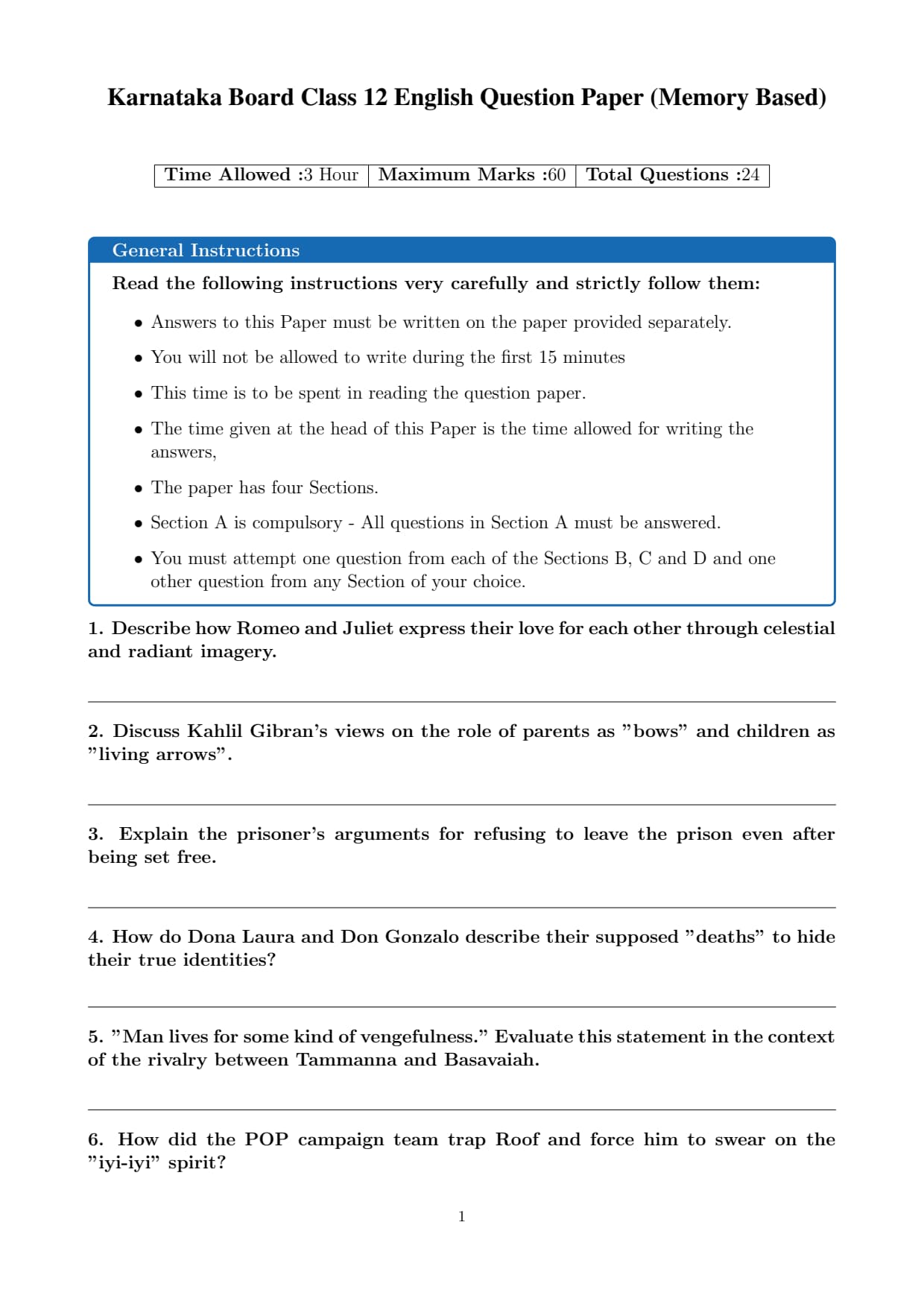
Describe how Romeo and Juliet express their love for each other through celestial and radiant imagery.
View Solution
Concept:
In Romeo and Juliet by William Shakespeare, celestial and radiant imagery—such as references to the sun, moon, stars, and light—is used to elevate the lovers’ feelings. This imagery suggests purity, intensity, beauty, and a love that transcends earthly limits.
Step 1: Romeo’s comparison of Juliet to light and the sun.
When Romeo first sees Juliet at the Capulet ball, he describes her as a source of light in darkness. He compares her beauty to a bright torch that teaches the torches to burn more brilliantly. Later, in the famous balcony scene, he calls her “the sun,” suggesting that she brings warmth, life, and brightness into his world. By portraying her as the sun rising and banishing the envious moon, Romeo presents Juliet as the center of his universe.
\medskip
Step 2: Juliet’s use of star imagery.
Juliet also uses celestial imagery to express her deep affection. She imagines Romeo as shining like a star in the night sky. She says that if Romeo were cut into little stars, they would make the face of heaven so beautiful that the world would fall in love with night. Through this image, Juliet shows that her love is vast, eternal, and heavenly.
\medskip
Step 3: Symbolism of light and radiance.
Throughout the play, light symbolizes hope, beauty, and passionate love. Even though their love exists in the darkness of secrecy and family conflict, Shakespeare repeatedly uses radiant imagery to suggest that their love is pure and powerful. The contrast between light (their love) and darkness (the feud and tragedy) intensifies the emotional depth of the play.
\medskip
Final Answer:
Romeo and Juliet express their love through celestial and radiant imagery by comparing each other to the sun, moon, and stars. Romeo sees Juliet as a bright light that overcomes darkness, while Juliet imagines Romeo as shining among the stars. These heavenly images emphasize the beauty, intensity, and eternal nature of their love. Quick Tip: When analyzing imagery, identify repeated symbols (like sun, moon, stars, and light) and explain how they deepen the meaning of the characters’ emotions.
Discuss Kahlil Gibran’s views on the role of parents as "bows" and children as "living arrows".
View Solution
Concept:
In the poem “On Children” by Kahlil Gibran, the poet presents a philosophical view of parenthood. He emphasizes that children are independent souls who come through parents but do not belong to them. The metaphor of parents as “bows” and children as “living arrows” beautifully explains this idea.
Step 1: Children as “living arrows”.
Gibran describes children as “living arrows” that are sent forth into the future. An arrow moves forward toward a distant target, symbolizing growth, progress, and destiny. This suggests that children have their own paths, purposes, and futures. They are full of life and potential, and they must move ahead independently.
\medskip
Step 2: Parents as “bows”.
Parents are compared to bows that provide direction and support. Just as a bow gives strength and guidance to an arrow before releasing it, parents nurture, protect, and guide their children during their early years. However, the bow does not control the arrow after it is released. This symbolizes that parents should guide their children but not impose their own desires upon them.
\medskip
Step 3: The role of God as the Archer.
Gibran further explains that God is the Archer who aims the arrow toward an infinite goal. This means that a higher power guides the ultimate destiny of children. Parents must accept that they are instruments in this divine process and should joyfully allow their children to grow and move forward.
\medskip
Final Answer:
Kahlil Gibran views parents as “bows” who provide love, support, and direction, while children are “living arrows” destined to move forward toward their own future. Parents should guide and strengthen their children but must not try to control their lives. Through this metaphor, Gibran highlights the importance of freedom, individuality, and trust in the journey of life. Quick Tip: While explaining a metaphor, clearly interpret each symbol and connect it to the central message of the poem.
Explain the prisoner’s arguments for refusing to leave the prison even after being set free.
View Solution
Concept:
This question is based on the play “The Bishop’s Candlesticks” by Norman McKinnel (adapted from Victor Hugo’s work). The character of the convict undergoes a moral transformation after experiencing the Bishop’s kindness.
Step 1: The prisoner’s fear and distrust of society.
The convict argues that society has always treated him cruelly. He was imprisoned for stealing a loaf of bread and was sentenced to many years of harsh punishment. Even after his release, people treated him with suspicion and hatred. Because of this, he believes that society will never accept him.
\medskip
Step 2: His belief that prison is his only home.
The prisoner feels that prison has become his true home. After spending many years behind bars, he has become accustomed to chains and hard labor. Outside prison, he sees no hope, dignity, or acceptance. Therefore, he initially prefers to return to prison rather than face rejection and suffering again.
\medskip
Step 3: Inner conflict and transformation.
Although he claims that prison is better, his refusal also reveals his inner pain and loss of faith in humanity. However, the Bishop’s compassion and forgiveness eventually change his outlook. The Bishop’s kindness restores his faith and gives him hope for a new life.
\medskip
Final Answer:
The prisoner refuses to leave because he feels rejected and mistreated by society. He believes that prison is the only place where he belongs and that he will never be accepted outside. His arguments reflect his bitterness and despair, but the Bishop’s kindness ultimately transforms his heart and gives him the courage to begin a new life. Quick Tip: When answering character-based questions, explain both the character’s emotions and the deeper moral message of the story.
How do Dona Laura and Don Gonzalo describe their supposed "deaths" to hide their true identities?
View Solution
Concept:
This question is based on the one–act play “A Sunny Morning” by Serafin and Joaquin Alvarez Quintero. The play revolves around mistaken identities, romantic memories, and the gentle irony of old age. Dona Laura and Don Gonzalo pretend that their youthful lovers are dead in order to conceal their true identities from each other.
Step 1: Dona Laura’s description of Gonzalo’s “death”.
Dona Laura tells Don Gonzalo that her youthful lover died a heroic death. She says he was killed in a duel while defending her honor. By describing him as brave and noble, she preserves the romantic image of her past love and avoids revealing that Don Gonzalo himself is that very man.
\medskip
Step 2: Don Gonzalo’s description of Laura’s “death”.
Similarly, Don Gonzalo claims that his beloved Laura passed away long ago. He says she died of sorrow, heartbroken after her lover’s tragic death. Through this emotional story, he hides the fact that Dona Laura sitting before him is the same woman he once loved.
\medskip
Step 3: Purpose of their pretence.
Both characters recognize each other but choose to protect their pride and cherished memories. By inventing these romantic “deaths,” they avoid embarrassment and preserve the idealized image of their youthful love. Their stories add humor, irony, and tenderness to the play.
\medskip
Final Answer:
Dona Laura describes Gonzalo as having died heroically in a duel, while Don Gonzalo says that Laura died of sorrow after losing her lover. Through these fictional accounts, they conceal their true identities and maintain the dignity and romance of their past. Quick Tip: In dramatic irony, characters often hide the truth to protect pride or emotions. Explain both the action and its deeper purpose.
"Man lives for some kind of vengefulness." Evaluate this statement in the context of the rivalry between Tammanna and Basavaiah.
View Solution
Concept:
This question is based on the story “The Gardener” by P. Lankesh. The story explores human ego, jealousy, and revenge through the intense rivalry between Tammanna and Basavaiah. The statement highlights how the desire for superiority and retaliation can dominate a person’s life.
Step 1: Beginning of the rivalry.
The conflict between Tammanna and Basavaiah begins as a simple competition over land and social status. Whenever Tammanna prospers by buying more land, Basavaiah tries to outdo him by purchasing even more. Their lives gradually revolve around defeating each other rather than living peacefully.
\medskip
Step 2: Growth of jealousy and vengefulness.
Basavaiah becomes obsessed with surpassing Tammanna in wealth and influence. His desire is not merely to succeed but to humiliate his rival. Similarly, Tammanna responds by composing songs that mock Basavaiah and elevate his own status. Their actions show that personal pride and revenge drive their ambitions.
\medskip
Step 3: Consequences of revenge.
The rivalry grows so intense that it consumes their happiness. Tammanna eventually realizes that Basavaiah’s power depends on opposition. To defeat him completely, Tammanna renounces his property and disappears, leaving Basavaiah without a rival. This act reveals the destructive nature of revenge and ego.
\medskip
Final Answer:
The statement “Man lives for some kind of vengefulness” is reflected in the lives of Tammanna and Basavaiah, whose rivalry is fueled by jealousy and the desire to outdo each other. Their obsession with revenge shapes their actions and decisions. However, the story ultimately suggests that such vengefulness leads to inner emptiness and destruction rather than true fulfillment. Quick Tip: When evaluating a statement, connect it clearly to the events of the story and explain whether the characters’ actions support or challenge the idea.
How did the POP campaign team trap Roof and force him to swear on the "iyi-iyi" spirit?
View Solution
Concept:
This question is based on the story “The Voter” by Chinua Achebe. The story highlights political corruption, bribery, and the moral dilemma faced by Roof, a local campaign agent.
Step 1: Roof’s role and temptation.
Roof works as a campaign agent for Marcus Ibe of the People’s Alliance Party (PAP). Although he is loyal to Marcus, he is tempted by money when the Progressive Organization Party (POP) approaches him secretly before the election.
\medskip
Step 2: The trap set by the POP team.
The POP campaign team visits Roof at night and offers him five pounds to vote for their candidate. To ensure that he does not betray them, they bring a small idol representing the feared “iyi-iyi” spirit. They place the idol before him and demand that he swear an oath that he will vote for the POP candidate. Afraid of the supernatural consequences and the power of the spirit, Roof feels compelled to take the oath.
\medskip
Step 3: Roof’s dilemma.
By making him swear on the “iyi-iyi” spirit, the POP team traps Roof between fear and loyalty. He now faces a moral and practical dilemma—either betray his employer or risk angering the spirit. This situation reflects the theme of corruption and the conflict between traditional beliefs and modern politics.
\medskip
Final Answer:
The POP campaign team trapped Roof by offering him money and making him swear on the feared “iyi-iyi” spirit to ensure his loyalty. They placed the idol before him and forced him to take an oath. Out of fear of supernatural punishment, Roof agreed, which left him caught between loyalty to his party and his promise to POP. Quick Tip: In story-based answers, explain both the event and its impact on the character’s moral conflict.
Discuss the socio-economic impact of cycling on rural women in Pudukkottai.
View Solution
Concept:
Cycling in rural contexts is more than a transport mode — it becomes a tool for mobility, dignity, economic activity and social change. The large women’s cycling movement in Pudukkottai transformed everyday lives by reducing travel time, widening access to markets, schools and services, and challenging gender norms.
Step 1: Improved physical mobility and time-use.
Bicycles shortened journey times for chores, water collection, market trips and work, so women could do more productive tasks in the same day (selling produce, wage work, attending meetings). Reduced travel time also lowered fatigue and the cost of hiring transport. Empirical and journalistic accounts from Pudukkottai report widespread uptake and large time-savings for women who learnt to cycle.
\medskip
Step 2: Economic benefits and livelihood opportunities.
With bicycles women could carry goods to markets, fetch inputs, attend wage-earning sites and link to self-help group (SHG) activities — increasing household income and economic autonomy. Research on bicycle interventions in India shows gains in women’s earnings, market access and micro-enterprise potential, effects that match reports from the Pudukkottai movement.{index=3
\medskip
Step 3: Educational and health access.
Cycling raised school attendance where girls used bicycles to reach secondary schools; similarly, women used bikes to access health centres and outreach services more reliably. Broader studies of bicycle programmes in India document improved school retention and better healthcare reach when reliable two-wheeled transport is available.
\medskip
Step 4: Social empowerment and gender norms.
Learning to cycle became symbolic — it built confidence, public presence and collective identity. Public rides, rallies and training camps in Pudukkottai helped women claim space in public life, reduced mobility-related harassment by enabling women to travel in groups, and altered male perceptions over time. Accounts of the Pudukkottai movement emphasise the pride and social mobility associated with cycling.
\medskip
Step 5: Limitations and challenges.
Impact was not uniform: access to durable bikes, safe roads, cultural resistance, and ongoing maintenance costs limited benefits for some women. Programmes that combined cycling training with finance, community mobilisation and supportive infrastructure produced stronger and more sustainable outcomes. Comparative research notes that complementary measures (training, subsidies, safety campaigns) are important to maximise socio-economic gains.
\medskip
Final Answer:
Cycling in Pudukkottai produced a multi-dimensional socio-economic impact: it increased physical mobility and time availability; opened income-earning and market access opportunities; improved access to education and health; and fostered social empowerment by challenging restrictive gender norms. These gains, widely documented in local accounts and broader research, were strongest where cycling initiatives were combined with collective organisation, training and supportive services — and they were moderated by infrastructural and cultural constraints. Quick Tip: When evaluating an intervention (like cycling), separate direct effects (time, travel, income) from enabling conditions (training, infrastructure, community support) — both determine the scale and durability of socio-economic impact.




Comments