




The Maharashtra Board (MSBSHSE) has successfully conducted the Class 10 English (Third Language) exam today, February 27, 2026. Students can review their performance and can access the SSC board English Question Paper 2026 with Solutions PDF directly on this page.
Collegedunia ,has provided a detailed analysis of the Grammar, Writing Skills, and Textual Passages to help you estimate your scores accurately.
Maharashtra SSC Class 10 English Question Paper 2026 with Solution PDF
| Maharashtra SSC Class10 English Question Paper 2026 | Download PDF | Check Solutions |

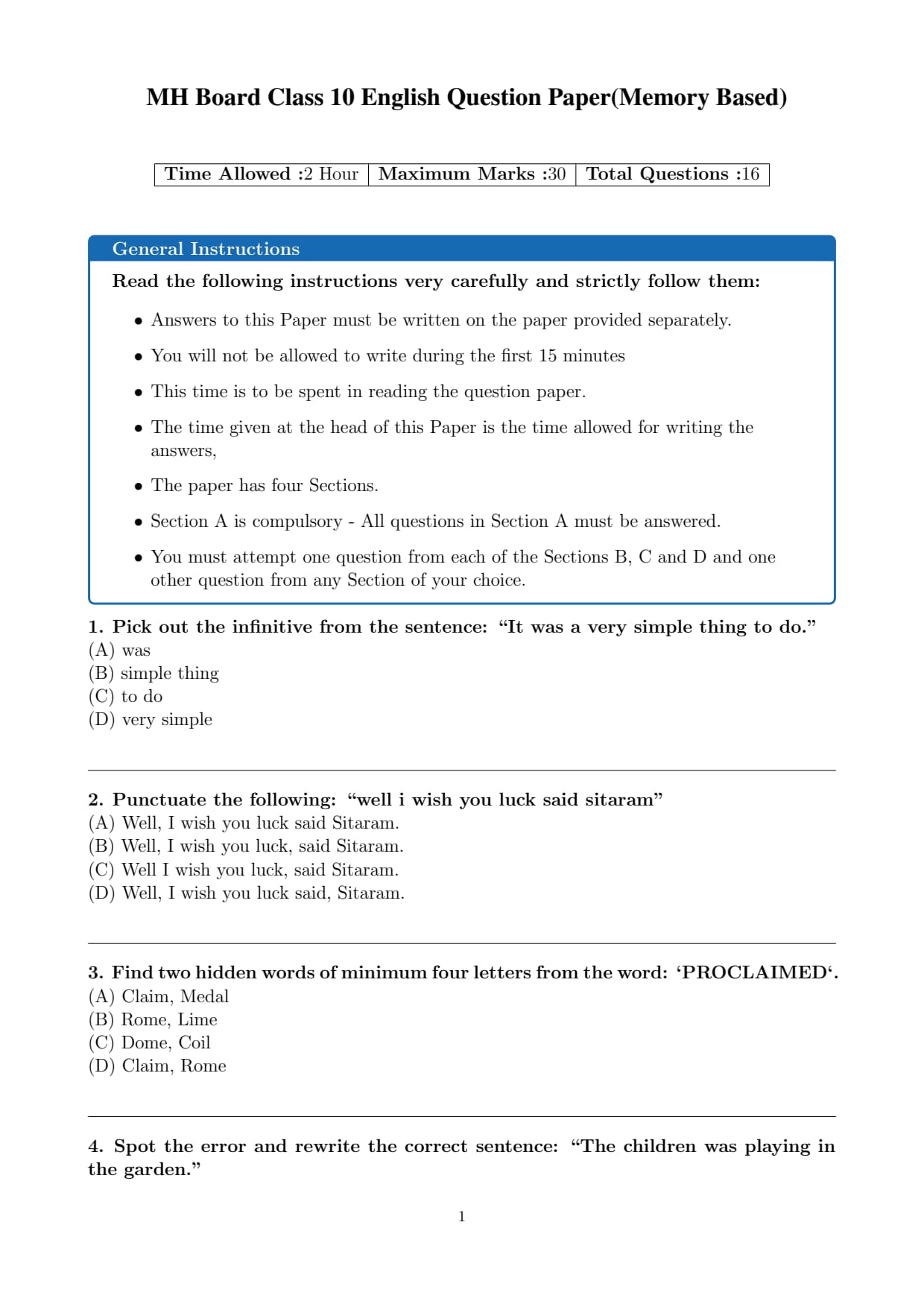
Pick out the infinitive from the sentence: ``It was a very simple thing to do.''
View Solution
Concept:
An infinitive is the base form of a verb usually preceded by ``to'', such as: \[ to eat, to run, to read, to write \]
It can function as a noun, adjective, or adverb in a sentence.
Step 1: Identify the structure of the sentence.
The sentence is: \[ It was a very simple thing to do. \]
Step 2: Look for ``to + verb'' form.
The phrase ``to do'' contains:
``to'' + base verb ``do''
Hence, it forms an infinitive.
Step 3: Verify its role.
Here, ``to do'' describes the noun ``thing'', so it acts as an adjective infinitive. Quick Tip: To find an infinitive quickly, scan the sentence for \textbf{``to + verb''}. If it expresses an action in base form, it is an infinitive.
Punctuate the following: ``well i wish you luck said sitaram''
View Solution
Concept:
Punctuation in direct speech follows these rules:
The first word of a sentence begins with a capital letter.
Proper nouns (names) are capitalized.
A comma is used before and after reporting verbs like said.
Interjections such as Well are followed by a comma.
Step 1: Capitalization.
``well'' \(\rightarrow\) Well
``i'' \(\rightarrow\) I
``sitaram'' \(\rightarrow\) Sitaram (proper noun)
Step 2: Add comma after interjection.
The word Well is an interjection, so it takes a comma: \[ Well, \]
Step 3: Comma before reporting clause.
When direct speech is followed by a reporting clause, a comma is placed before it: \[ Well, I wish you luck, said Sitaram. \] Quick Tip: In direct speech: Capitalize names and sentence beginnings. Use commas to separate spoken words from reporting verbs like \textbf{said, asked, replied}.
Find two hidden words of minimum four letters from the word: `PROCLAIMED`.
View Solution
Concept:
Hidden word questions require forming meaningful English words using the letters of a given word.
Conditions:
Letters must come from the original word.
No extra letters allowed.
Words must be meaningful.
Minimum length = 4 letters.
Step 1: Write down the letters of the word. \[ PROCLAIMED \Rightarrow P, R, O, C, L, A, I, M, E, D \]
Step 2: Form possible meaningful words (4+ letters).
Some valid combinations:
CLAIM (C, L, A, I, M) \(\rightarrow\) valid 5-letter word
MEDAL (M, E, D, A, L) \(\rightarrow\) valid 5-letter word
Step 3: Verify correctness.
Both words:
Use only letters from PROCLAIMED
Contain 4 or more letters
Are standard English words
Hence, the correct pair is: \[ \textbf{Claim, Medal} \] Quick Tip: To find hidden words easily: Rearrange letters mentally. Look for common endings like \textbf{-AL, -ED, -IM}. Check for familiar root words (e.g., CLAIM, MEDAL, ROME).
Spot the error and rewrite the correct sentence: ``The children was playing in the garden.''
View Solution
Concept:
This question tests subject-verb agreement.
A verb must agree with its subject in number:
Singular subject \(\rightarrow\) singular verb
Plural subject \(\rightarrow\) plural verb
Step 1: Identify the subject.
The subject of the sentence is: \[ \textbf{children} \]
The word children is the plural form of child.
Step 2: Identify the verb.
The verb given is: \[ \textbf{was playing} \]
The word was is a singular verb (used with he, she, it).
Step 3: Correct the error.
Since children is plural, the correct auxiliary verb should be: \[ \textbf{were} \]
Corrected sentence: \[ \textbf{The children were playing in the garden.} \] Quick Tip: Remember: \textbf{Was} \(\rightarrow\) singular (he, she, it) \textbf{Were} \(\rightarrow\) plural (we, you, they, children)
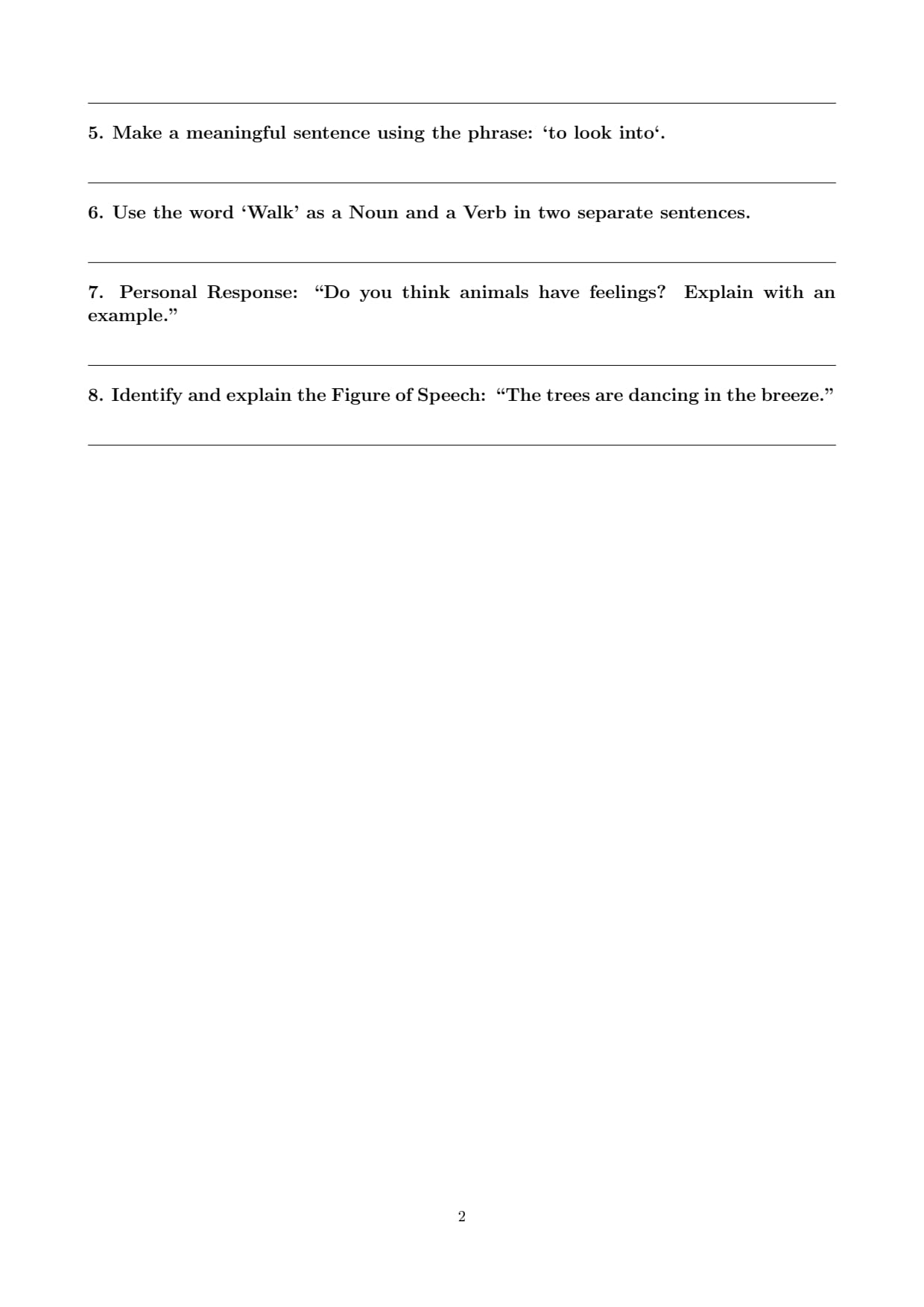
Make a meaningful sentence using the phrase: `to look into`.
View Solution
Concept:
The phrase ``to look into'' is an idiomatic expression.
It means:
To investigate something
To examine a matter carefully
Step 1: Understand the meaning.
Before forming a sentence, identify the correct sense of the phrase: \[ to look into = to investigate or examine \]
Step 2: Use it in a proper context.
It is commonly used in formal or semi-formal situations involving:
Complaints
Problems
Official inquiries
Step 3: Form a meaningful sentence.
A correct example: \[ \textbf{The manager promised to look into the matter immediately.} \]
This sentence:
Uses the phrase correctly
Is grammatically sound
Clearly conveys the meaning of investigation Quick Tip: Common phrases using \textbf{look}: Look after = take care of Look for = search Look into = investigate Look up = search for information
Use the word `Walk' as a Noun and a Verb in two separate sentences.
View Solution
Concept:
Some English words can function as both nouns and verbs depending on their usage in a sentence.
The word walk is one such word.
Step 1: Use `walk' as a noun.
As a noun, walk refers to:
A short journey on foot
An act of walking
Example: \[ \textbf{We went for a walk in the park after dinner.} \]
Here, walk names an activity, so it is used as a noun.
Step 2: Use `walk' as a verb.
As a verb, walk means:
To move on foot
Example: \[ \textbf{I walk to school every morning.} \]
Here, walk shows an action, so it is used as a verb. Quick Tip: To identify noun vs verb: If it names something \(\rightarrow\) noun If it shows action \(\rightarrow\) verb
Personal Response: ``Do you think animals have feelings? Explain with an example.''
View Solution
Concept:
A personal response question requires:
A clear opinion (Yes/No)
A short explanation
A relevant example
The answer should be simple, meaningful, and grammatically correct.
Step 1: State your opinion.
Begin with a clear response such as: \[ Yes, I believe animals have feelings. \]
Step 2: Give a logical explanation.
Mention that animals show emotions through behavior:
Happiness
Fear
Sadness
Attachment
Step 3: Provide a real-life example.
A common and relatable example is a pet dog:
Dogs wag their tails when happy
They become sad when their owners leave
Final Answer: \[ \textbf{Yes, I believe animals have feelings just like humans. For example, a dog shows happiness by wagging its tail and becomes sad when separated from its owner.} \] Quick Tip: In personal response questions: Write in simple language Give one clear example Keep the answer short and meaningful
Identify and explain the Figure of Speech: ``The trees are dancing in the breeze.''
View Solution
Concept:
A figure of speech adds beauty and imagination to language.
Personification is a figure of speech in which:
Non-living things are given human qualities
Nature is described as if it can act like a person
Step 1: Identify the subject.
The subject of the sentence is: \[ \textbf{trees} \]
Trees are non-living objects (they are living organisms but not human and cannot perform human actions).
Step 2: Identify the human action.
The action used is: \[ \textbf{dancing} \]
Dancing is a human activity.
Step 3: Analyze the meaning.
The sentence suggests that trees are moving gently due to the wind, but instead of saying it directly, it describes them as dancing.
This gives human qualities to trees.
Conclusion:
Since a non-human object (trees) is given a human action (dancing), the figure of speech is: \[ \textbf{Personification} \] Quick Tip: Look for personification when: Nature is doing human actions (smiling sun, crying clouds) Objects behave like people



Comments