



Osnabruck University Fees & Courses 2026


Osnabruck University fees for Indian students in 2026 come to just €788.60 (₹ 85,957) per year, with zero tuition at both Bachelor’s and Master’s level and only a semester contribution covering administration, semester ticket, and student services. Popular Master’s fields for Indian students include Cognitive Science, Environmental Systems, and International Business Studies.
Applications for the Summer 2027 intake, starting April 2027, are open for Master’s programmes only. Bachelor’s applicants target the Winter 2027 intake, starting October 2027, since Osnabruck does not accept Bachelor’s applications for the summer semester.
- Semester contribution: €394.30 (₹ 42,979) per semester
- Annual contribution (two semesters): €788.60 (₹ 85,957)
- Full 2-year Master’s fee total: €1,577.20 (₹ 1.72 Lakhs)
- Deutschlandstipendium merit scholarship: €300/month (₹ 32,700/month), €3,600 (₹ 3.92 Lakhs) per year
- Blocked account (Sperrkonto) for the student visa: €11,904 (₹ 12.98 Lakhs) per year
A two-year Master’s at Osnabruck totals roughly €25,400 (₹ 27.69 Lakhs) all-in when living costs are included at the German blocked account minimum, of which tuition is €0 and semester contributions come to €1,577.20 (₹ 1.72 Lakhs). Blocked account balance and monthly rent, not tuition, are the real cost drivers.
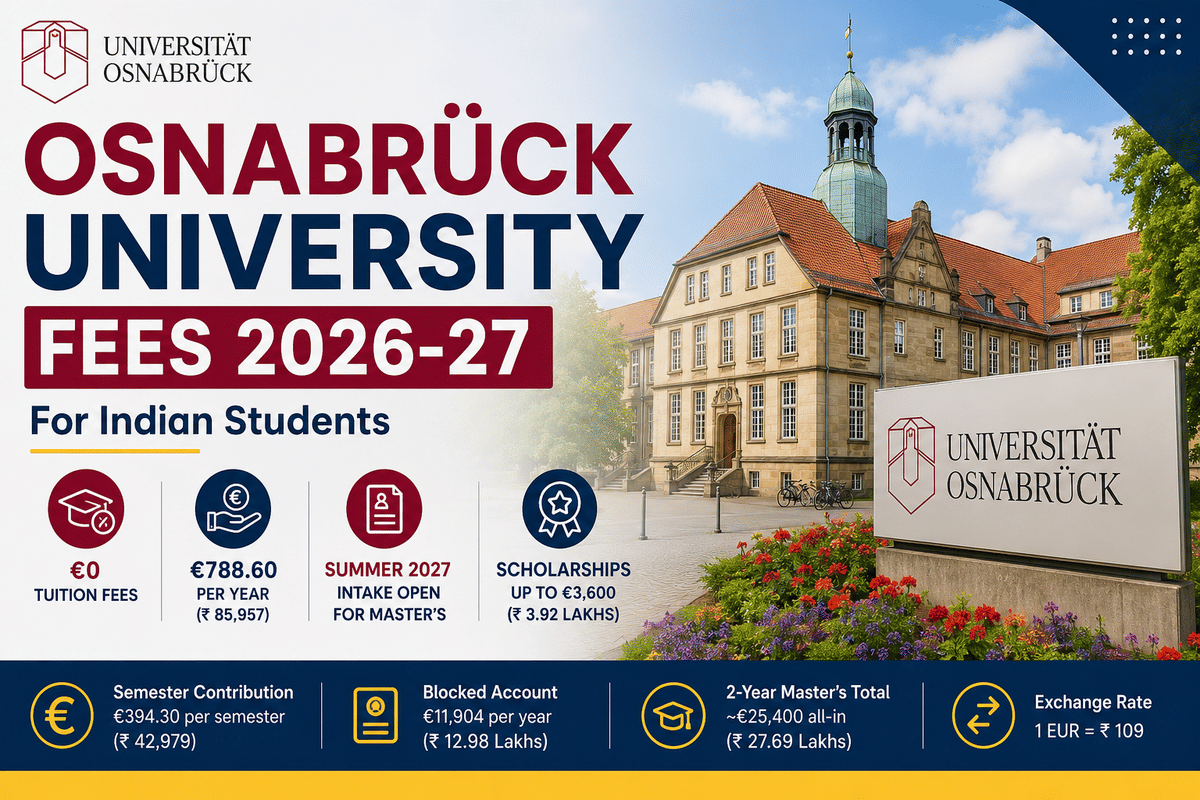
Exchange rate: 1 EUR = ₹ 109.
Summer 2027 Intake: Master’s Applications Open, Winter 2027 Follows for UG and PG
Intake: Summer 2027 (starts April 2027) is open for Master’s programmes only. Winter 2027 (starts October 2027) accepts both Bachelor’s and Master’s. Given 6-12 week German student visa processing from India, both cycles are realistic to plan for now.
Fee update: Zero tuition holds under Lower Saxony state law; the current semester contribution is €394.30 (₹ 42,979). A full Master’s degree costs €1,577.20 (₹ 1.72 Lakhs) in semester fees over two years.
When to pay: The semester contribution is due at matriculation, roughly two weeks before the semester begins. No advance tuition deposit exists; the blocked account, however, must be funded before the visa interview.
Scholarships: Deutschlandstipendium (€300/month) accepts applications from students already enrolled. DAAD Study Scholarship applications for the 2027/28 academic year open around October 2026. External Indian awards (Inlaks, JN Tata Endowment) release 2027 cycles between October 2026 and February 2027.
Also Read: Osnabruck University Admission Process, Deadlines and Eligibility for Indian Students
Table of Contents
- Osnabruck University Tuition Fees by Programme
- Osnabruck University Semester Contribution Breakdown and Fee Stability
- Cost of Living in Osnabruck for Indian Students at Osnabruck University
- Total Cost of Studying at Osnabruck University
- Osnabruck University Scholarships for Indian Students
- Osnabruck University Payment Options and Blocked Account for Indian Students
- Hidden Costs of Studying at Osnabruck University
- Fee Saving Strategies for Indian Students at Osnabruck University
- Is Osnabruck University Worth the Cost for Indian Students
- FAQs
Osnabruck University Tuition Fees by Programme
Tuition at Osnabruck University is €0 across every Bachelor’s, Master’s, and doctoral programme. Under Lower Saxony state law, all public universities in the state are prohibited from charging tuition to enrolled students, including international students from India. The only mandatory payment is the semester contribution of €394.30 (₹ 42,979), which every enrolled student pays regardless of programme or nationality.
| Programme Level | Duration | Semester Contribution | Annual Contribution | Total Programme Cost |
|---|---|---|---|---|
| Bachelor’s degree | 3 years (6 semesters) | €394.30 (₹ 42,979) |
€788.60 (₹ 85,957) |
€2,365.80 (₹ 2.58 Lakhs) |
| Master’s degree | 2 years (4 semesters) | €394.30 (₹ 42,979) |
€788.60 (₹ 85,957) |
€1,577.20 (₹ 1.72 Lakhs) |
| Doctoral (PhD) | 3 to 4 years | €394.30 (₹ 42,979) |
€788.60 (₹ 85,957) |
€2,365.80 to €3,154.40 (₹ 2.58 to ₹ 3.44 Lakhs) |
Source: Osnabruck University official semester fee schedule, 2026/27.
Tuition is €0 for every programme in the table. Every course, whether taught in German or English, attracts only the semester contribution. There is no differential fee band for international students or STEM subjects. Osnabruck offers around eight English-medium Master’s programmes and roughly 90 German-medium degrees across humanities, sciences, business, and law.
Note: The €394.30 is a semester contribution, not tuition. It bundles the administrative fee, a semester transport ticket usable across Lower Saxony regional rail and Osnabruck city buses, and a Studentenwerk student services contribution. If you have a Deutschland-Ticket already, you still pay the full amount, the transport component is non-refundable.
Osnabruck University Semester Contribution Breakdown and Fee Stability
The €394.30 semester contribution has stayed within a €385 to €400 band for several years, because it is set by statute rather than driven by inflation. Every enrolled student pays the same amount. The table below unpacks what the fee actually funds.
| Component | Per Semester (EUR) | Per Semester (INR) | What It Covers |
|---|---|---|---|
| Semester transport ticket | €215.00 | ₹ 23,435 | Unlimited local Osnabruck buses and Lower Saxony regional rail (2nd class) |
| Studentenwerk contribution | €93.00 | ₹ 10,137 | Subsidised Mensa canteen prices, student halls, counselling services |
| Administrative fee | €75.00 | ₹ 8,175 | Enrolment, matriculation, student ID card, registrar services |
| AStA student union | €11.30 | ₹ 1,232 | Elected student representation, legal advice, cultural funds |
| Total contribution | €394.30 | ₹ 42,979 | Payable at matriculation each semester |
Source: Osnabruck University semester fee statement; component splits reviewed each summer semester by the Registrar.
The semester ticket is the largest single component, and it is the most valuable. A comparable regional rail pass bought privately in Lower Saxony would cost over €90 per month, so the €215 semester equivalent is heavily subsidised. Students who commute to Bremen, Hamburg suburbs, or Hannover on weekends recover the transport component several times over during one term.
Key Insight: Your Summer 2027 or Winter 2027 intake will be billed at the current €394.30 rate. Even if the contribution is revised upward for 2027/28, historical increases have run €5 to €10 per semester, roughly ₹ 545 to ₹ 1,090. The tuition-free structure itself is protected by Lower Saxony state law, so the €0 tuition line will not change with a single semester’s policy tweak.
Cost of Living in Osnabruck for Indian Students at Osnabruck University
Osnabruck is a small university city in northwestern Germany with rents 40 to 50% lower than Munich or Frankfurt and around 25 to 30% lower than Berlin. A student living in a shared flat (Wohngemeinschaft or WG) with home cooking and a semester ticket can live comfortably on €800 to €990 (₹ 87,200 to ₹ 1,07,910) per month.
| Expense | Monthly (EUR) | Monthly (INR) | Annual (INR) | Notes for Indian Students |
|---|---|---|---|---|
| Rent (WG shared flat) | €300 to €400 | ₹ 32,700 to ₹ 43,600 | ₹ 3.92 to ₹ 5.23 Lakhs | Shared apartments are the norm; Studentenwerk halls cheapest but waitlisted |
| Groceries and cooking | €200 to €260 | ₹ 21,800 to ₹ 28,340 | ₹ 2.62 to ₹ 3.40 Lakhs | Aldi, Lidl, Penny for lowest prices; Asian shops for Indian spices and lentils |
| Statutory health insurance | €120 | ₹ 13,080 | ₹ 1.57 Lakhs | Mandatory public plan; TK, AOK, and Barmer are common student insurers |
| Utilities, internet, mobile | €60 to €90 | ₹ 6,540 to ₹ 9,810 | ₹ 78,480 to ₹ 1.18 Lakhs | Warm rent (Warmmiete) often includes electricity and heating |
| Local and regional transport | €0 | ₹ 0 | ₹ 0 | Semester ticket already covers Osnabruck buses and Lower Saxony regional rail |
| Books, printing, personal | €120 to €170 | ₹ 13,080 to ₹ 18,530 | ₹ 1.57 to ₹ 2.22 Lakhs | Library covers most reading; second-hand book market is active on campus |
| Total monthly range | €800 to €990 | ₹ 87,200 to ₹ 1,07,910 | ₹ 10.46 to ₹ 12.95 Lakhs | Below the blocked account minimum of €992 per month |
Source: German Federal Foreign Office blocked account requirement (auswaertiges-amt.de) at €11,904 per year, €992 per month, applied to Osnabruck as visa-minimum anchor. Actual student spend in Osnabruck typically runs at or below this floor.
Note: The €992 per month is a visa-immigration figure, not an actual spending target. Once you land, most Osnabruck students live comfortably on €800 to €900 (₹ 87,200 to ₹ 98,100), which frees €90 to €190 per month to save or send home. The gap between the blocked account minimum and real monthly spend is one of the biggest under-appreciated advantages of choosing Osnabruck over Berlin or Munich.
Rent is the largest variable. A Studentenwerk hall room costs €250 to €320 (₹ 27,250 to ₹ 34,880) per month, but the waitlist runs 6 to 12 months, so most Indian students start in a private WG at €350 to €450 and switch to a hall room in the second semester. Applying to Studentenwerk Osnabrueck as soon as your admission letter arrives is the single highest-value housing action.
Currency Tip: Your blocked account of €11,904 (₹ 12.98 Lakhs) should be funded through a specialist provider such as Fintiba, Expatrio, or Coracle, not through a raw wire transfer. These providers cost €150 to €200 in fees but process the visa-compliant certificate in three to five business days. A direct SEPA transfer to Deutsche Bank still works but takes three to four weeks and adds 2 to 3% currency spread.
Total Cost of Studying at Osnabruck University
The total first-year budget for an Indian student at Osnabruck comes to €13,500 to €14,000 (₹ 14.72 to ₹ 15.26 Lakhs), of which the semester contribution is under 6% of the total. Living costs and the mandatory blocked account dominate every scenario, not tuition.
| Scenario | Semester Contribution | Living Costs (12 months) | Health Insurance and Mandatory Fees | Total Year 1 |
|---|---|---|---|---|
| Bachelor’s (10-month term basis) | €788.60 (₹ 85,957) |
€9,920 (₹ 10.81 Lakhs) |
€1,440 (₹ 1.57 Lakhs) |
€12,149 (₹ 13.24 Lakhs) |
| Master’s (12-month basis) | €788.60 (₹ 85,957) |
€11,904 (₹ 12.98 Lakhs) |
€1,440 (₹ 1.57 Lakhs) |
€14,133 (₹ 15.40 Lakhs) |
| Master’s with Deutschlandstipendium | €788.60 (₹ 85,957) |
€11,904 (₹ 12.98 Lakhs) |
€1,440 (₹ 1.57 Lakhs) |
€10,533 (₹ 11.48 Lakhs) after €3,600 award |
Living costs at the German visa-minimum figure of €992 per month for 12-month calculations; Bachelor’s row assumes 10 months and self-funded summer months at home. Health insurance at €120 per month, statutory student rate.
A full two-year Master’s therefore lands at approximately €25,400 (₹ 27.69 Lakhs) with no scholarship, or €21,800 (₹ 23.76 Lakhs) if you win the Deutschlandstipendium in year one. This is the total out-of-pocket for the degree, blocked account funds count as your own money and return to you as monthly withdrawals in Germany.
Because there is no tuition, most Indian students do not need a full education loan. A ₹ 15 to ₹ 20 Lakh loan to fund the blocked account and the first semester’s buffer, however, is common. At 10.5% over 10 years, ₹ 15 Lakh works out to about ₹ 20,200 per month EMI, and ₹ 20 Lakh to about ₹ 27,000 per month.
Key Insight: Winning the Deutschlandstipendium in year one of your Master’s cuts your total two-year outlay by €3,600 (₹ 3.92 Lakhs). Combined with the €500 (₹ 54,500) Niedersachsen-Stipendium one-off award, the controllable saving is up to ₹ 4.46 Lakhs, roughly one full semester of living costs at Osnabruck. Applications open only after enrolment, so submit within the first four weeks of the semester starting.
Osnabruck University Scholarships for Indian Students
Two scholarships are administered directly by Osnabruck University and open to Indian students already enrolled. Applications for both open after matriculation, so you must first accept your admission and pay the semester contribution before applying.
| Scholarship | Type | Amount (EUR) | Amount (INR) | Eligibility |
|---|---|---|---|---|
| Deutschlandstipendium | Merit-based, 12 months renewable | €300 per month, €3,600 per year | ₹ 32,700 per month, ₹ 3.92 Lakhs per year | All enrolled students including Indians; based on academic record and social engagement |
| Niedersachsen-Stipendium (Lower Saxony Scholarship) | One-off award | €500 lump sum | ₹ 54,500 | International students in Lower Saxony universities; academic and financial need considered |
Source: Osnabruck University Student Advice Centre; scholarship pages reviewed each academic year.
External scholarships from India and Germany can be applied for before you fly out. The DAAD Study Scholarship in particular covers a full Master’s programme at Osnabruck and is one of the highest-value awards available to Indian applicants.
| Scholarship | Award Value | Coverage | Approximate Application Window |
|---|---|---|---|
| DAAD Study Scholarship for Master’s | €992 per month (₹ 1,08,128) + travel + insurance | 10 to 24 months, full Master’s coverage | September to October, one year before intake |
| Inlaks Shivdasani Scholarship | Up to USD 100,000 (₹ 83.35 Lakhs at ₹ 83.35 per USD) total | Full Master’s tuition and living, worldwide | December to February for 2027 intake |
| JN Tata Endowment Loan Scholarship | ₹ 10 Lakhs loan + ₹ 7.50 Lakhs gift component | Higher studies abroad, any subject | January to March annually |
| KC Mahindra Scholarship for Postgraduate Studies Abroad | Up to ₹ 10 Lakhs | Master’s programmes abroad; interview based | March to April for the following academic year |
| Narotam Sekhsaria Foundation Scholarship | Up to ₹ 20 Lakhs interest-free loan | Master’s or PhD abroad; broad subject coverage | January to April annually |
Source: Award sponsors’ official portals; application windows quoted from the most recent full cycle and are typically stable year to year.
Tip for Indian Students: For a Summer 2027 or Winter 2027 intake, prioritise these three actions in order. First, DAAD applications for the 2027/28 academic year open in October 2026, so shortlist Osnabruck programmes now and prepare a research statement. Second, apply to Inlaks between December 2026 and February 2027, decisions come by May 2027. Third, once enrolled at Osnabruck, apply for the Deutschlandstipendium within the first four weeks of your first semester, since selection is annual and delayed applications carry over to the next year.
Also Read: Osnabruck University Rankings, QS Sustainability Position and Subject Strengths
Osnabruck University Payment Options and Blocked Account for Indian Students
Osnabruck does not charge a tuition deposit because tuition itself is €0. The two payments an Indian student must plan for are the semester contribution of €394.30 (₹ 42,979) paid at matriculation, and the blocked account (Sperrkonto) of €11,904 (₹ 12.98 Lakhs) funded before the visa interview.
The blocked account is your own money, deposited into a German student bank account before you arrive, then released to you at €992 per month once you land. It is a visa-compliance requirement, not a fee to the university, and remains fully your funds. Health insurance of around €120 per month must also be paid before enrolment, either through a German public insurer or via an approved travel plan for the first six weeks.
Methods of payment for the semester contribution:
- SEPA bank transfer from a German bank account (most common once you arrive)
- International wire transfer from an Indian bank (add €10 to €25 in intermediary fees)
- Forex card with EUR loaded (saves 2 to 3% versus a raw wire)
- Payment providers such as Wise or Flywire for the first pre-arrival transfer
Steps to pay tuition and set up finances as an international student:
- Accept the admission offer through uni-assist or HISinOne within the deadline in your letter.
- Open a blocked account with Fintiba, Expatrio, Coracle, or Deutsche Bank and transfer €11,904 (₹ 12.98 Lakhs).
- Pay the German student visa fee of €75 (₹ 8,175) at VFS Global in India and attend the interview.
- On arrival, register at the Bürgeramt in Osnabruck within two weeks, open a giro (current) account, and activate the blocked account for monthly release.
- Pay the €394.30 semester contribution to the university’s account by SEPA transfer, then matriculate to receive your student ID and semester ticket.
- Keep every payment receipt and blocked account statement; you will need them for annual visa renewal.
Source: Osnabruck University International Office matriculation guidance and German Federal Foreign Office visa information.
Tip for Indian Students: For a Summer 2027 intake starting April 2027, aim to have your blocked account funded by January 2027 and your visa interview slot booked by February 2027. VFS Global slots for the German consulate in New Delhi, Mumbai, Bengaluru, Chennai, and Kolkata get scarce eight to ten weeks before intake. A late blocked account deposit is the single most common reason Indian students miss the Summer semester start and defer to Winter.
Hidden Costs of Studying at Osnabruck University
Because Osnabruck’s headline tuition is €0, families often underestimate the ancillary costs of getting there and settling in. The visible fee is small, but the setup outlay in the first three to four months adds up to ₹ 1.5 to ₹ 2 Lakhs beyond the blocked account.
- APS certificate (Academic Evaluation Centre, New Delhi): €30 (₹ 3,270), mandatory for all Indian applicants applying to German universities, processing takes 3 to 4 weeks
- Uni-assist application fee: €75 (₹ 8,175) for the first application, €30 (₹ 3,270) for each additional university in the same semester
- German student visa fee: €75 (₹ 8,175), paid at VFS Global at the visa interview
- Blocked account setup fee: €150 to €200 (₹ 16,350 to ₹ 21,800) one-off charge from Fintiba, Expatrio, or Coracle
- Health insurance top-up: €120 per month (₹ 13,080) statutory plan is essential; private travel plans for the arrival gap cost €50 to €80 (₹ 5,450 to ₹ 8,720)
- Anmeldung and residence permit: €100 to €110 (₹ 10,900 to ₹ 11,990) for the residence permit issued at Osnabruck’s Bürgeramt after arrival
- Language test fees: IELTS €215 to €230 (₹ 17,000 in India); DSH €150 (₹ 16,350) or TestDaF €195 (₹ 21,255) if the programme is German-taught
- One-way flight from India to Germany: €500 to €700 (₹ 54,500 to ₹ 76,300) depending on timing and airline
- Warm clothing and initial setup: €300 to €500 (₹ 32,700 to ₹ 54,500) for winter jacket, thermals, kitchen supplies, bedding
All told, budget approximately ₹ 1.75 to ₹ 2.25 Lakhs for these first-year hidden costs on top of the blocked account and semester contribution.
Note: Families most often forget the APS certificate. Every Indian applicant to any German university must have a valid APS certificate before uni-assist accepts the file, and the certificate takes 3 to 4 weeks to process at the German Embassy in New Delhi. Missing this step is the top cause of Indian applicants missing the 15 December (uni-assist) deadline for Summer intake.
Fee Saving Strategies for Indian Students at Osnabruck University
Since tuition is €0, saving strategies at Osnabruck focus on living costs, scholarships, and blocked account structure rather than on tuition bands. For a Summer 2027 or Winter 2027 intake, the fastest ways to reduce your total outlay are all controllable now.
- Apply for a Studentenwerk Osnabrueck hall room the day your offer arrives. Hall rooms at €250 to €320 (₹ 27,250 to ₹ 34,880) per month save ₹ 8,000 to ₹ 12,000 per month over private WGs.
- Win the Deutschlandstipendium in year one of your Master’s. The €3,600 (₹ 3.92 Lakhs) award per year is renewable and effectively pays for four months of living.
- Work up to 120 full days or 240 half days per year on your student visa. Working student (Werkstudent) roles pay €12 to €16 per hour (₹ 1,308 to ₹ 1,744), a 20-hour week during term earns roughly €900 to €1,200 per month (₹ 98,100 to ₹ 1.31 Lakhs), which fully covers monthly living.
- Claim Section 80E tax deduction on any Indian education loan interest. The entire interest paid on your education loan is deductible from your parents’ Indian taxable income for up to 8 years.
- Use the 18-month post-study work visa to stay on and earn in EUR after graduating. Osnabruck Master’s graduates in Cognitive Science, Environmental Systems, and Business qualify for the 18-month job-search residence permit, giving realistic time to convert to a full work visa.
- Enrol in a public statutory health plan (TK, AOK, Barmer) rather than private insurance. Student rate of €120 per month is capped by law; private plans look cheaper initially but rise sharply once you cross 30 or start earning.
Tip for Indian Students: The single highest-value lever for this intake cycle is a Werkstudent role from your second semester onward. A 20-hour term-time role at €14 per hour yields roughly €10,000 (₹ 10.90 Lakhs) over a full Master’s degree, which alone offsets 40% of your two-year living cost. Osnabruck’s local employers, especially in logistics and IT, actively recruit English-speaking Master’s students from campus job fairs held every October and April.
Is Osnabruck University Worth the Cost for Indian Students
Yes. A two-year Master’s at Osnabruck costs approximately ₹ 27.69 Lakhs all-in, of which zero is tuition, against an 18-month post-study work visa in one of Europe’s strongest labour markets. The cost-to-outcome ratio is materially better than a comparably-ranked UK or US Master’s, which run ₹ 55 Lakhs to ₹ 90 Lakhs for the same qualification level.
Osnabruck is listed in the QS World University Rankings, the Times Higher Education World University Rankings, and US News Best Global Universities. In the QS Sustainability 2026 ranking, it sits in the 1401 to 1500 band, reflecting a strong environmental and social sciences research base, which matches Osnabruck’s academic strengths in Environmental Systems, Cognitive Science, and Democratic Governance.
Under the current German policy in force in July 2026, Indian graduates receive an 18-month residence permit after finishing their degree to search for work, and can convert to an EU Blue Card once they secure a qualifying salary. This 18-month runway is longer than the UK Graduate Route for Master’s holders and is the single most valuable non-fee benefit of choosing Germany.
On loan payback maths, a ₹ 20 Lakh education loan to fund the blocked account and first-year buffer works out to about ₹ 27,000 per month EMI over 10 years at 10.5%. A Werkstudent role during study, followed by a full-time engineering or business role in Germany, comfortably services this EMI while allowing repatriation of savings.
Key Insight: The single number that makes Osnabruck a sound financial decision is the ₹ 1.72 Lakhs total semester-contribution outlay for a full two-year Master’s degree, roughly 3% of what the same credential costs at a US public research university. Combine that with the Deutschlandstipendium and Werkstudent earnings, and it is realistic to graduate net-positive over the two years of study.
Osnabruck University offers Indian students one of the lowest-fee, highest-runway routes into a German public research degree, at ₹ 27.69 Lakhs total for a Master’s including living costs. Winning the Deutschlandstipendium adds another ₹ 3.92 Lakhs offset per year, and a term-time Werkstudent role can cover 40% of two-year living costs. For a Summer 2027 intake, start the APS certificate and DAAD application by October 2026; for a Winter 2027 intake, target uni-assist submission by May 2027 and blocked account funding by July 2027.
FAQs
Ques. What is the total tuition fee at Osnabruck University for Indian students?
Ans. Tuition is €0 for all programmes at Osnabruck University, including for Indian students. The only mandatory payment is the semester contribution of €394.30 (₹ 42,979) per semester or €788.60 (₹ 85,957) per year, which covers administration, semester transport ticket, and student services.
Ques. How much does a two-year Master’s at Osnabruck University cost all-in for an Indian student?
Ans. Approximately €25,400 (₹ 27.69 Lakhs) over two years, including €1,577.20 in semester contributions and €23,808 in living costs at the German blocked account minimum. Winning the Deutschlandstipendium in year one reduces this by €3,600 (₹ 3.92 Lakhs).
Ques. What is the blocked account requirement for the German student visa in 2026?
Ans. The blocked account (Sperrkonto) requirement is €11,904 (₹ 12.98 Lakhs) per year, or €992 (₹ 1,08,128) per month. This is your own money, deposited before the visa interview through providers like Fintiba, Expatrio, or Coracle, and released to you monthly once you land in Germany.
Ques. Does Osnabruck University charge an application fee for Indian applicants?
Ans. Osnabruck itself does not charge an application fee, but uni-assist (the central application portal for international applications) charges €75 (₹ 8,175) for the first application and €30 (₹ 3,270) for each additional university in the same semester. Applications submitted directly through HISinOne carry no fee.
Ques. Which scholarships are available for Indian students at Osnabruck University?
Ans. The Deutschlandstipendium at €300 per month (₹ 32,700), the Niedersachsen-Stipendium at €500 (₹ 54,500) one-off, and the externally-funded DAAD Study Scholarship at €992 per month plus travel and insurance. Indian students can also apply for Inlaks Shivdasani, JN Tata Endowment, KC Mahindra, and Narotam Sekhsaria awards for the 2027 cycle.
Ques. Can Indian students at Osnabruck work part-time to cover living costs?
Ans. Yes. The German student visa allows up to 120 full days or 240 half days of work per year. Werkstudent (working student) roles pay €12 to €16 per hour (₹ 1,308 to ₹ 1,744), and a 20-hour term-time role earns €900 to €1,200 per month (₹ 98,100 to ₹ 1.31 Lakhs), enough to cover monthly living costs in Osnabruck.
Ques. When is the semester contribution due at Osnabruck University?
Ans. The €394.30 (₹ 42,979) semester contribution is due at matriculation, roughly two weeks before the semester begins. For a Summer 2027 intake starting April 2027, payment falls due in mid-March 2027; for a Winter 2027 intake starting October 2027, payment falls due in mid-September 2027.
Ques. Does the semester contribution at Osnabruck University include health insurance?
Ans. No. Health insurance is a separate mandatory cost of around €120 per month (₹ 13,080) via a public statutory plan such as TK, AOK, or Barmer. The semester contribution covers only administration, the semester transport ticket, and the Studentenwerk student services fee.
Ques. Are there any hidden costs Indian students should budget for beyond tuition and living?
Ans. Yes. Budget an additional ₹ 1.75 to ₹ 2.25 Lakhs for the APS certificate (€30), uni-assist fees (€75), German visa fee (€75), blocked account setup (€150 to €200), residence permit (€100 to €110), language tests, one-way flight, and initial winter clothing and setup.
Ques. How long does the post-study work visa last for Osnabruck University graduates?
Ans. 18 months. Indian Master’s graduates from Osnabruck receive an 18-month residence permit to search for a graduate-level job in Germany. Once you secure a qualifying salary, you can convert to an EU Blue Card, which is a route to permanent residence within 21 to 33 months of employment.
Popular Programs and Important Dates
| Program | Important Dates | Fees |
|---|---|---|
M.S Computer Science 2 years | INR 78,272/Yr EUR 723 /Yr | |
| INR 78,272/Yr EUR 723 /Yr | ||
M.S Business Administration 2 years | INR 78,272/Yr EUR 723 /Yr | |
M.S Cognitive Science 2 years | INR 78,272/Yr EUR 723 /Yr | |
| INR 78,272/Yr EUR 723 /Yr | ||
M.A Art and Communication 2 years | INR 78,272/Yr EUR 723 /Yr | |
| INR 78,272/Yr EUR 723 /Yr | ||
| INR 78,272/Yr EUR 723 /Yr | ||
B.S Cognitive Science 3 years | INR 78,272/Yr EUR 723 /Yr | |
| INR 78,272/Yr EUR 723 /Yr |
Do you think the Dates are wrong ? Report Here
Do you think the fees are wrong ? Report Here
Course Finder - Search from 50K+ courses
Popular Streams:
SUBSCRIBE TO OUR NEWS LETTER



Comments