





Osnabruck University admissions run centrally through uni-assist for Indian applicants. Bachelor’s applicants need a school qualification recognised as equivalent to the German Abitur, and Master’s applicants need a completed Bachelor’s in the same or a closely related field.
- Next live deadline: 15 June 2027 (Winter 2027/28 primary intake) via uni-assist.
- No tuition, semester fee €394.30 (₹43,014), plus uni-assist application fee €75 (₹8,182).
- Eligibility floor: Class XII with APS for UG. Related Bachelor’s for PG. IELTS 6.0 for English-taught programs.
- Acceptance rate: around 80% per third-party estimates. The university publishes no official institutional figure.
Indian students most often pick the M.Sc. in Cognitive Science, the M.Sc. in Environmental Systems and Resource Management, and the M.Sc. in Business Administration at Osnabruck University. Applicants flag the paperwork-heavy uni-assist step as the main friction, offset by zero tuition and clear semester windows.
Explore: Study in Germany for international Students
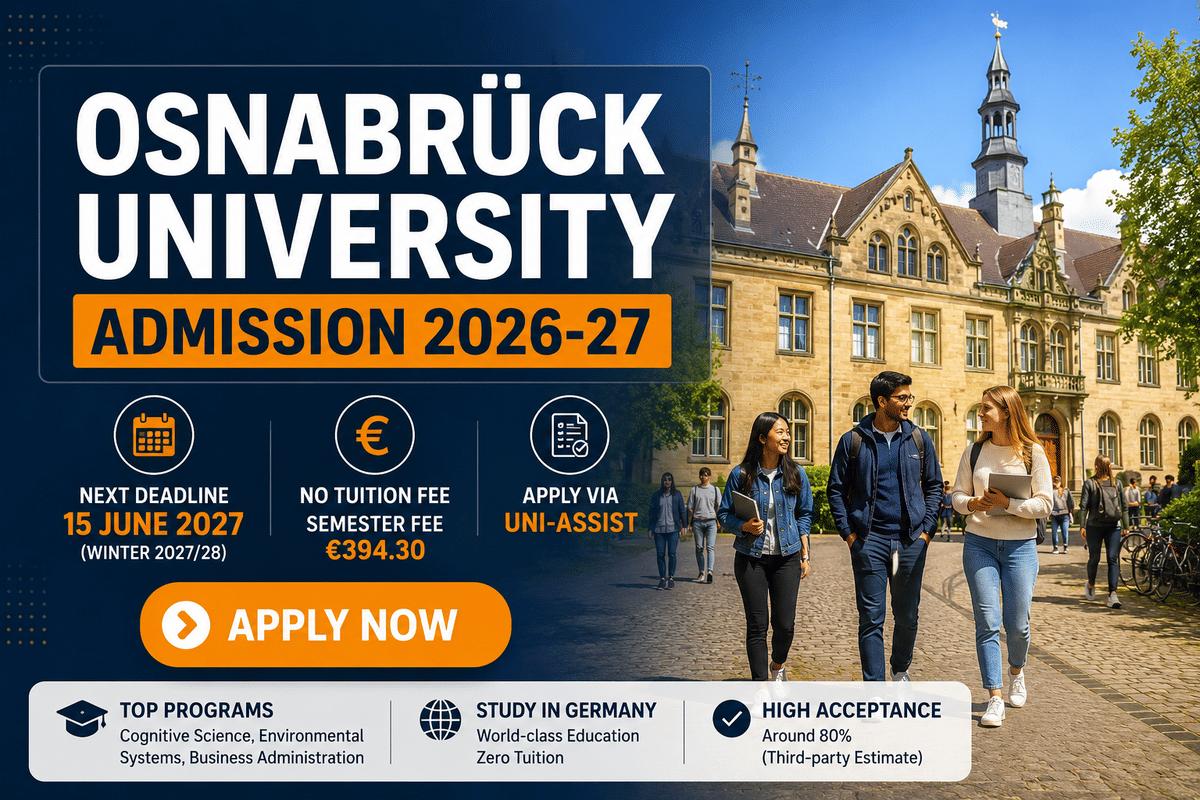
Table of Content
- Osnabruck University Application Deadlines
- Osnabruck University Eligibility Criteria
- Osnabruck University PG Programs
- Osnabruck University UG Programs and Bachelor’s Entry
- Osnabruck University PhD Admission Pathway
- Osnabruck University Application Process for Indian Students
- Osnabruck University Admission Decisions and Offer Timeline
- Osnabruck University Documents Required
- Osnabruck University Acceptance Rate for Indian Students
- Germany Student Visa Process for Osnabruck University
- Tips for Osnabruck University Admissions
- Osnabruck University Admissions Checklist
- Frequently Asked Questions
Osnabruck University Application Deadlines for Indian Students
Osnabruck University runs on the two-semester German calendar. Winter semester starts in October and Summer semester starts in April. Winter is the primary intake, with the broader program menu open and a larger cohort. Indian applicants must file through uni-assist, Germany’s central clearing house that pre-checks foreign credentials before the university sees the file.
Osnabruck University’s primary intake for Indian students is Winter semester (October) — most programs open here.
| Intake | Level | Applications Open | Uni-assist Deadline | App Fee | Portal |
|---|---|---|---|---|---|
| Winter 2026/27 (October 2026) | UG + PG | (Closed) | 15 June 2026 (Closed) | €75 (₹8,182) | uni-assist |
| Summer 2027 (April 2027) | UG + PG (limited menu) | Open | 15 December 2026 | €75 (₹8,182) | uni-assist |
| Primary intake - Winter 2027/28 (October 2027) | UG + PG | Around April 2027 | 15 June 2027 | €75 (₹8,182) | uni-assist |
The uni-assist window sits a month earlier than the direct portal window because uni-assist itself needs 4 to 6 weeks to review foreign documents. Missing the uni-assist date is treated as missing the intake. The Summer semester opens a smaller program menu at Osnabruck — Cognitive Science and Environmental Systems and Resource Management accept summer entry, while many Business, Economics, and teacher-track masters do not.
Planning note: Add a 4-to-6-week buffer to the deadline on your calendar. That is uni-assist’s own processing time. The university only sees your file after uni-assist finishes its checks.
Osnabruck University Eligibility Criteria for Indian Applicants
Osnabruck University’s eligibility gate has two parts: an academic equivalence check and a language proof check. Uni-assist runs the equivalence check against Germany’s Anabin database. Indian applicants must also carry an APS certificate (Akademische Prüfstelle, the German Embassy’s academic-document verification office in New Delhi) for the visa stage.
Bachelor’s Level Eligibility
Indian Class XII on its own is not automatically recognised as equivalent to the German Abitur (Germany’s school-leaving qualification for university entry). Depending on the board and stream, applicants use one of the following pathways.
- Direct admission: One completed year at a recognised Indian university, aggregate around 60 percent.
- Studienkolleg route: A one-year German preparatory college plus the Feststellungsprüfung entrance exam.
- APS certificate compulsory before the visa can be issued.
Master’s Level Eligibility
A completed Bachelor’s degree in the same or a closely related subject is mandatory. Osnabruck’s Master’s programs are consecutive — the review board checks that your Bachelor’s covered the target Master’s core content. A three-year Indian Bachelor’s is typically accepted where credit load and subject match. A four-year Bachelor’s is rarely required but usually smooths the equivalence check.
Language Requirements
Language proof is mandatory at the application stage. Osnabruck runs no in-house German pathway courses, so competency must be documented independently before applying.
- English-taught programs such as M.Sc. Cognitive Science: minimum B2 CEFR English, roughly IELTS 6.0, TOEFL 80 iBT, or PTE 55.
- German-taught programs (the majority): C1 German at enrolment - DSH-2, TestDaF 16 points, Goethe C2, or telc C1.
- B2 German may earn provisional admission, but the C1 certificate must be submitted before enrolment.
- Language certificates must be less than two years old on the application date.
Osnabruck’s published English proof list names IELTS, TOEFL, and TOEIC. The university has not published a blanket medium-of-instruction waiver for Indian applicants, so Indian students with English-medium Bachelor’s degrees should still budget for a formal English test result unless a program coordinator confirms otherwise in writing.
Also Check: How to Study in Germany for Free
Osnabruck University Popular PG Programs
Osnabruck’s Master’s menu is heavier on German-taught programs than on English-taught, so English-track Indian applicants have a shorter shortlist. Tuition is nil across all programs — students pay only the semester fee of €394.30 (₹43,014). For a full course-wise fees breakdown, refer to the Fees page.
| Programme | Duration | Minimum Eligibility | English Req. Min. |
|---|---|---|---|
| M.Sc. Cognitive Science | 4 semesters | Bachelor’s in Cognitive Science or related discipline (neuroscience, CS, linguistics, philosophy) | B2 CEFR (IELTS 6.0) |
| M.Sc. Environmental Systems and Resource Management | 4 semesters | Bachelor’s in environmental or natural sciences, quantitative background | Not required (German C1) |
| M.Sc. Business Administration | 4 semesters | Bachelor’s in Business Administration and Economics, with 60%+ preferred | Not required (German C1) |
| M.Sc. Economics | 4 semesters | Bachelor’s in Economics, strong quantitative and statistics grounding | Not required (German C1) |
| M.Sc. Computer Science | 4 semesters | Bachelor’s in Computer Science or closely related field | Not required (German C1) |
| M.A. English and American Studies | 4 semesters | Bachelor’s in English or American Studies with adequate ECTS in the field | C1 CEFR English + B1 German |
| M.A. Nursing Science Teaching Post | 4 semesters | Bachelor’s in Nursing Science with a teaching path | Not required (German C1) |
| M.Ed. Business Administration and Economics (Vocational Teacher Education) | 4 semesters | Bachelor’s on the vocational teacher-education pathway | Not required (German C1) |
Business Administration offers three specialisations from semester one: Accounting, Finance and Taxation; Information Systems; and Management. Economics offers two: Empirical Economics, and Sustainability, Behaviour and Environmental Policy. Cognitive Science streams into four focus areas covering AI and machine learning, computational neuroscience, philosophy and ethics of mind, and psychology and language. Application must be filed via uni-assist by the intake’s stated deadline.
Note: Program-specific entry requirements, fees, and intake availability may differ from the institution-wide minimums shown above. Always confirm on the official Osnabrück Master’s degree programs page for your chosen program before applying.
Osnabruck University Popular UG Programs
Bachelor’s programs at Osnabruck are mostly German-taught. Indian applicants without a Studienkolleg pass or a completed year at an Indian university generally cannot enter directly at first-year level.
| Programme | Duration | Minimum Eligibility | English Req. Min. |
|---|---|---|---|
| B.Sc. Cognitive Science | 6 semesters | Class XII equivalent to German Abitur, Studienkolleg or 1-year Indian UG | B2 CEFR (IELTS 6.0) |
| B.Sc. Environmental Systems Science | 6 semesters | Class XII with Mathematics and at least one science studied through Class XII | Not required (German C1) |
| B.Sc. Business Administration and Economics | 6 semesters | Class XII with Mathematics studied through Class XII | Not required (German C1) |
| B.A. History | 6 semesters | Class XII, humanities preferred, plus Latin or Latinum for some tracks | Not required (German C1) |
| B.A. Nursing Science Teaching Post | 8 semesters | Class XII plus nursing training or clinical exposure | Not required (German C1) |
B.Sc. Cognitive Science is the flagship English-taught option at UG level, drawing most non-German-speaking applicants. All other bachelor’s tracks assume classroom fluency in German. Indian applicants targeting Osnabruck for UG usually pair a Studienkolleg year with a strong German course before applying.
Osnabruck University PhD Admission Pathway for Indian Students
Osnabruck runs its PhD track under the classic German model — direct doctoral admission by supervisor agreement, not by a centrally-administered cohort. Structured graduate schools exist in Cognitive Science, Migration Studies, and Environmental Systems, but the entry gate in each case is a signed supervisor letter. There is no fixed institutional deadline. Applications flow year-round.
Osnabruck PhD Entry Steps
- Identify a supervisor whose research programme matches your Master’s specialisation.
- Send a research proposal, transcripts, CV, and a 500-word statement to the supervisor’s office.
- Get supervision acceptance in writing, then apply for formal enrolment through the doctoral office of your faculty.
- Register the thesis with the faculty PhD board within six months of enrolment.
Osnabruck PhD Funding
Funded positions typically follow the German public-service pay scale TV-L E13, with 65% to 100% part-time contracts common in humanities and social sciences and full-time in STEM. For an overview of Indian-eligible funding routes such as DAAD scholarships and the Helmut-Schmidt-Programme, see the Scholarships page’s funding for Indian students section.
Insider note: The Cognitive Science and Environmental Systems research groups at Osnabruck actively recruit international PhD candidates. Cold-emailing supervisors with a 1-page proposal in October to November tends to land better than in the summer.
Check Out: Study in Germany For Indian Students After 12th
Osnabruck University Application Process for Indian Students
The end-to-end process for Indian applicants runs through uni-assist first and Osnabruck second. Uni-assist reviews foreign documents, then forwards the file to the university’s admissions office.
- Pick your program from the Osnabruck A-Z catalogue and note the intake, language, and any subject-specific ECTS floor.
- Book the APS interview at the German Embassy in New Delhi. Turnaround is 3 to 5 weeks in busy months.
- Create a uni-assist account at my.uni-assist.de and start the online application for Osnabruck as your chosen university.
- Upload documents — transcripts, degree certificate, APS, English or German test result, passport bio-page, and CV.
- Post certified paper copies to uni-assist’s Berlin office. Only certified copies count, not e-copies.
- Pay the application fee of €75 (₹8,182) for the first choice and €30 (₹3,273) for each additional program in the same intake.
- Track the review in your uni-assist dashboard. Expect 4 to 6 weeks for the preliminary review notice.
- Await the admission decision from Osnabruck’s admissions office once uni-assist forwards a preliminary review meeting requirements.
Osnabruck itself charges no application fee. The €75 paid to uni-assist covers the credential-check service, not the university’s own review.
Osnabruck University Admission Decisions and Offer Timeline
Osnabruck communicates decisions in two stages. Uni-assist first issues the Vorprüfungsdokumentation or VPD — a preliminary review confirming your Indian qualification meets German entry standards. The university then issues the formal admission letter, called the Zulassungsbescheid, once its own admissions office has assessed your file.
- VPD from uni-assist: 4 to 6 weeks after complete-file submission.
- University decision (Zulassung or Ablehnung): 4 to 8 weeks after uni-assist forwarding, usually by July to August for Winter intake.
- Acceptance response window: Typically 4 weeks from the date on the Zulassungsbescheid to confirm enrolment and pay the semester fee.
- Deferral: Rarely granted. Most rejected or deferred candidates reapply in the next intake with an updated file.
Conditional offers pointing to a missing C1 German certificate are common when candidates applied on a B2 basis. The C1 certificate must be shown at enrolment counter — no exceptions.
Osnabruck University Documents Required for Indian Applicants
The document checklist below is what uni-assist expects for the Osnabruck file, drawing on the application, admission and enrolment page. All non-English, non-German documents need a sworn translation.
- Passport bio-page — valid at least six months beyond intended stay.
- Class X and Class XII mark sheets and certificates — board-attested copies.
- Bachelor’s degree certificate and consolidated transcript — university-attested.
- APS certificate from the German Embassy in New Delhi — mandatory before visa.
- Language test score report — IELTS, TOEFL, or TOEIC for English-taught programs; DSH, TestDaF, Goethe, or telc for German-taught programs.
- Statement of Purpose or motivation letter — 500 to 800 words, program-specific.
- CV in tabular German or English format — reverse chronological, dates in DD.MM.YYYY.
- Letters of recommendation — typically two academic references (program-dependent).
- Work-experience letters where the program lists a work-experience preference.
- Certified paper copies for the postal submission to uni-assist’s Berlin office.
Note the paper-copy step. Uni-assist accepts online uploads for the initial review but wants postal originals or notarised copies before forwarding to the university.
Explore: Benefits of Studying in Germany for Indian Students 2026
Osnabruck University Acceptance Rate for Indian Students
Osnabruck University does not publish an official institutional acceptance rate. A widely used third-party estimate places the overall rate at roughly 80 percent, based on the fact that around 83 percent of Osnabruck’s programs run without a Numerus Clausus (the German grade-cap system that filters applicants when demand exceeds seats). For Indian applicants the effective acceptance rate turns on whether uni-assist’s credential check clears, not on ranked competition.
Which Osnabruck Programs Are Competitive?
Programs listed as admission-free take every applicant who clears the eligibility gate. Programs listed as admission-restricted apply a grade cut-off, but even here Osnabruck’s cut-offs are lower than the top-tier German universities. Cognitive Science M.Sc. tends to see the strongest international competition — a strong Bachelor’s GPA is expected. Compare Osnabruck’s ranking band to peer German universities before deciding.
What Does This Mean for Indian Applicants?
A completed and accurate uni-assist file is the single largest determinant of admission at Osnabruck. Most Indian rejections trace to incomplete transcripts, uncertified translations, or a missing APS certificate rather than to grade filters.
Insider note: Indian applicants who arrive with a full uni-assist file and confirmed C1 German (or B2 CEFR English for Cognitive Science) rarely see a rejection. The paperwork bar is the real bar.
Germany Student Visa Process for Osnabruck University Students
Indian students admitted to Osnabruck need a Germany National Visa (Type D) — the long-stay category for study of more than 90 days, not a short Schengen visa. Applications go to the German Missions in India via the Consular Services Portal at digital.diplo.de. The visa fee is approximately €75 (₹8,182), and biometrics are captured at appointment. Blocked-account proof of €11,904 (₹12.98 Lakhs) for one year is the financial-means standard for 2026. Coverage must include German-recognised health insurance from arrival. On landing, students register their residence at the Bürgeramt within two weeks and apply for the residence permit at the Osnabruck Ausländerbehörde.
2026 update: The blocked-account minimum rose to €11,904 from €11,208, and the APS certificate is now compulsory for all Indian degree-seeking applicants at the visa stage. Book APS in New Delhi as soon as your transcripts stabilise.
Tips for Osnabruck University Admissions for Indian Applicants
The following tips are drawn from Indian-applicant patterns at Osnabruck University and reflect the friction points most Indian students report.
- Start APS 4 months early — the New Delhi APS office queue swells in March to May before the Winter uni-assist deadline.
- Pay for one German course early — a B1 certificate opens conditional admission on many German-taught tracks.
- Attach ECTS mapping in your uni-assist file for M.Sc. Cognitive Science and M.Sc. Business Administration, showing subject coverage.
- Certify translations at a sworn translator, not a notary — uni-assist rejects notary-only translations.
- Reuse the €75 uni-assist file to apply to up to 4 other German universities the same semester at €30 (₹3,273) each.
- Do not post originals — send officially-certified copies to uni-assist. Originals stay with you for the visa file.
- Confirm the semester ticket coverage at enrolment. The €394.30 fee already covers regional trains under the Deutschlandsemesterticket.
Check Out: Popular Scholarships to Study in Germany
Osnabruck University Admissions Checklist for Indian Students
The following steps cover what Indian applicants typically complete on a timeline for a Winter-semester start at Osnabruck.
- October to November (11 months before intake): Shortlist programs and check ECTS overlap with your Bachelor’s.
- December to February: Book APS interview at the German Embassy in New Delhi.
- January to March: Sit IELTS or TOEFL for English-taught programs, or TestDaF or DSH for German-taught programs.
- March to April: Request university transcripts and get sworn translations of Class X, Class XII, and Bachelor’s documents.
- April to May: Open uni-assist account, upload documents, pay €75 (₹8,182), and post certified copies to Berlin.
- By 15 June: Ensure uni-assist has marked your file complete for Winter-semester consideration.
- July to August: Await Zulassungsbescheid, then book visa slot and open blocked account of €11,904 (₹12.98 Lakhs).
Osnabruck University’s admission gate is administrative, not competitive — a clean uni-assist file, an APS certificate, and the right language proof clear the way. For Indian applicants missing the Winter 2026/27 window, the 15 December 2026 Summer 2027 deadline is the next live shot, and Winter 2027/28 with a 15 June 2027 deadline offers the fullest program menu.
Frequently Asked Questions
Ques. Is the Winter 2026/27 intake still open at Osnabruck University for Indian students?
Ans. No. The uni-assist deadline of 15 June 2026 has passed. The next live Osnabruck intake for Indian applicants is Summer 2027, with an uni-assist deadline of 15 December 2026.
Ques. What is Osnabruck University’s application fee for Indian applicants?
Ans. Osnabruck itself charges no application fee. The mandatory uni-assist handling fee is €75 (₹8,182) for the first program and €30 (₹3,273) for each further program in the same intake.
Ques. What are the tuition fees at Osnabruck University?
Ans. Osnabruck is a public university and charges no tuition. Students pay only a semester fee of €394.30 (₹43,014), which includes the student services contribution and the Deutschlandsemesterticket for regional and bus travel.
Ques. Does Osnabruck accept a three-year Indian Bachelor’s for Master’s admission?
Ans. Yes, when the Bachelor’s is from a recognised Indian university and covers the same or a closely related subject as the target Master’s, with adequate ECTS mapping. The equivalence check happens at uni-assist against the Anabin database.
Ques. What IELTS score is needed for Osnabruck’s English-taught programs?
Ans. B2 CEFR minimum, roughly IELTS 6.0 or TOEFL 80 iBT. M.Sc. Cognitive Science and B.Sc. Cognitive Science are the flagship English-taught tracks.
Ques. Is German language proof compulsory for Osnabruck?
Ans. Yes for German-taught programs — C1 German (DSH-2, TestDaF 16, Goethe C2, or telc C1) is required at enrolment. B2 German can earn provisional admission, but the C1 must follow before enrolment. English-taught programs need no German.
Ques. Do I need an APS certificate to apply to Osnabruck University?
Ans. The APS certificate from the German Embassy in New Delhi is compulsory before the student visa is issued. Apply well in advance — the New Delhi APS office runs 3 to 5 week turnarounds during peak season.
Ques. Can I apply to Osnabruck without going through uni-assist?
Ans. Not as an Indian degree-seeking applicant. Indian passport holders without a German Abitur or prior German enrolment must file through uni-assist for both Bachelor’s and Master’s programs. Direct portal applications are for German and EU applicants.
Ques. What is Osnabruck University’s acceptance rate?
Ans. Osnabruck publishes no official acceptance rate. Third-party estimates place it near 80 percent because roughly 83 percent of programs are admission-free (no Numerus Clausus grade filter). For Indian applicants the file-completeness bar matters more than a grade competition.
Ques. Which Osnabruck Master’s programs are taught in English?
Ans. M.Sc. Cognitive Science is fully English-taught at Master’s level. Most other Master’s programs use German as primary language of instruction, with English elective components in some faculties.
Ques. When should I start my Osnabruck application to make the Winter 2027/28 uni-assist deadline?
Ans. Begin in October to November 2026 — around 8 months ahead. This buffers APS certification, language testing, sworn translations, and the 4-to-6-week uni-assist review before the 15 June 2027 deadline.
Ques. How much money do I need in a blocked account for the Osnabruck student visa?
Ans. The 2026 blocked-account requirement for the Germany National Visa is €11,904 (₹12.98 Lakhs) for one year, or €992 (₹1.08 Lakhs) per month. Providers such as Expatrio, Fintiba, and Coracle are widely used by Indian applicants.
College Student Profiles

Osnabruck University Program Fees & Deadlines
| Program | Important Dates | Fees |
|---|---|---|
M.S Computer Science 2 years | Summer Semester 2025-26 Start And End Dates (30th Sep 2026) | INR 80,354/Yr EUR 723 /Yr |
Summer Semester 2025-26 Start And End Dates (30th Sep 2026) | INR 80,354/Yr EUR 723 /Yr | |
M.S Business Administration 2 years | Summer Semester 2025-26 Start And End Dates (30th Sep 2026) | INR 80,354/Yr EUR 723 /Yr |
Summer Semester 2025-26 Start And End Dates (30th Sep 2026) | INR 80,354/Yr EUR 723 /Yr | |
M.S Cognitive Science 2 years | Summer Semester 2025-26 Start And End Dates (30th Sep 2026) | INR 80,354/Yr EUR 723 /Yr |
Summer Semester 2025-26 Start And End Dates (30th Sep 2026) | INR 80,354/Yr EUR 723 /Yr | |
B.S Sports / Sports Science 3 years | Summer Semester 2025-26 Start And End Dates (30th Sep 2026) | INR 80,354/Yr EUR 723 /Yr |
Summer Semester 2025-26 Start And End Dates (30th Sep 2026) | INR 80,354/Yr EUR 723 /Yr | |
B.S Cognitive Science 3 years | Summer Semester 2025-26 Start And End Dates (30th Sep 2026) | INR 80,354/Yr EUR 723 /Yr |
Summer Semester 2025-26 Start And End Dates (30th Sep 2026) | INR 80,354/Yr EUR 723 /Yr |
Do you think the Dates are wrong ? Report Here
Important Alerts
| Events | Dates |
|---|---|
| Computer Science Summer Semester 2025-26 Start And End Dates | Closing in 11 days |
| Business Administration Summer Semester 2025-26 Start And End Dates | Closing in 11 days |
| Psychology - Focus on Clinical Psychology Summer Semester 2025-26 Start And End Dates | Closing in 11 days |



Comments