



Education Journalist | Study Abroad Lead | Updated On - Jun 15, 2026
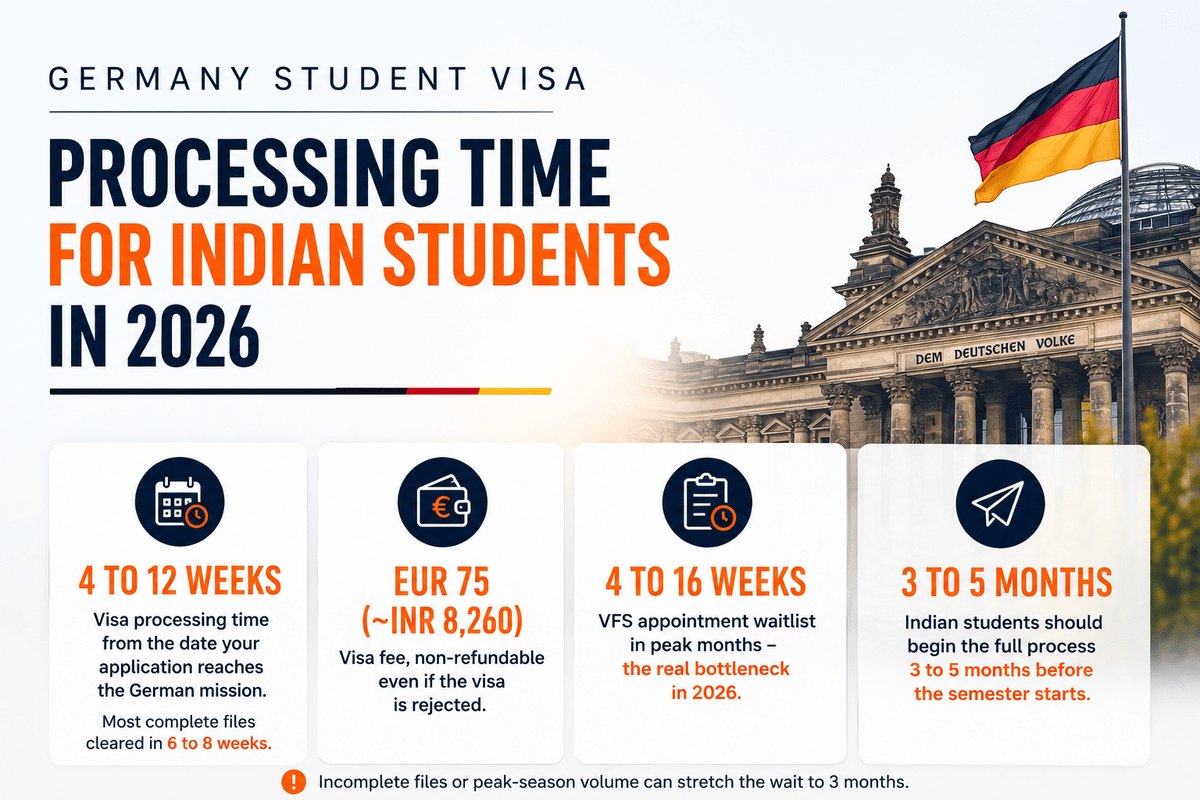
The Germany student visa processing time for Indian students in 2026 is 4 to 12 weeks from the date the application reaches the German mission, with most complete files cleared in 6 to 8 weeks. A small number of well-documented cases now clear in as few as 6 working days, while incomplete files or peak-season volume can stretch the wait to 3 months.
- National Visa (Type D) files take 4 to 12 weeks, counted from submission at the German mission, not from the day you start the CSP form
- The visa fee is EUR 75 (around INR 8,260), non-refundable even if the visa is rejected
- The real bottleneck in 2026 is the VFS appointment waitlist, which runs 4 to 16 weeks in peak months, not the decision itself
- Indian students should begin the full process 3 to 5 months before the semester starts
Read More: Germany Study Visa Requirements 2026 for Indian Students
Most students panic about the decision wait. The honest problem in 2026 is getting a slot in the first place: students report watching the Consular Services Portal for weeks before a Mumbai or Delhi appointment opens, then getting the visa itself in under two weeks once biometrics are done.
Get the timeline right and you reach campus before orientation. Get it wrong and you forfeit a confirmed seat over a missed deadline.
Quick Facts on Germany Visa Processing Time
| Parameter | Detail |
|---|---|
| Visa type for degree study | National Visa (Type D) |
| Average processing time | 4 to 12 weeks (most files 6 to 8 weeks) |
| Fastest reported clearance | As few as 6 working days |
| Application gateway | Consular Services Portal (CSP) at digital.diplo.de |
| Biometrics partner | VFS Global (5 missions in India) |
| Visa fee | EUR 75 (around INR 8,260), non-refundable |
| Recommended start point | 3 to 5 months before semester start |
| Success rate | 90 to 95% for complete applications |
- How Long Does the Germany Visa Take
- CSP Stages and Where Time Goes
- VFS Appointment Wait Is the Real Delay
- When to Apply for the Germany Visa
- Factors Affecting Processing Time
- Peak Season Versus Off-Season Waits
- How to Speed Up Visa Processing
- Common Causes of Delays and Rejections
- Visa Fee and Cost Timeline
- After Approval and Residence Permit
How Long Does the Germany Visa Take
The Germany student visa processing time is officially 4 to 12 weeks, and German missions in India advise planning for the full 12 weeks to be safe. The clock starts when your application reaches the consulate after the CSP pre-check, not when you first open the portal.
The decision window depends on the visa category. Degree students need the long-stay National Visa (Type D), which is the slowest category because it requires full document verification.
| Visa Type | Who It Is For | Processing Time |
|---|---|---|
| Student Visa (Type D) | Confirmed admission to a degree program | 4 to 12 weeks |
| Student Applicant Visa | Admission pending or entrance test required | 6 to 12 weeks |
| Language Course Visa | German language course before study | 6 to 8 weeks |
| Schengen Visa (Type C) | Short courses under 90 days | 15 calendar days, up to 45 in some cases |
Most Indian degree applicants fall under the Student Visa or Student Applicant Visa. In 2026, complete files are typically cleared in 6 to 8 weeks, with the fastest reported approvals in roughly a week when every document is in order.
Key Insight: The advertised "as few as 6 days" figure is real but rare. It applies to flawless files at low-volume missions. Plan for 8 to 12 weeks and treat anything faster as a bonus.
CSP Stages and Where Time Goes
Since the Consular Services Portal became mandatory, the Germany visa runs in three stages: online submission, digital pre-check, then biometrics and decision. Knowing which stage eats time helps you plan instead of guess.
All Indian applicants now start online at the Consular Services Portal, where you fill the form and upload PDFs. Officers review the upload digitally before any in-person visit.
- Stage 1, CSP submission: register at digital.diplo.de, complete the VIDEX form and upload documents. Takes a few days of your own prep time
- Stage 2, digital pre-check: consular officers verify uploads online and flag missing files through the portal. Usually 1 to 3 weeks
- Stage 3, VFS biometrics and decision: after pre-approval you book a VFS slot for fingerprints, then wait for the decision. This is where most of the 4 to 12 weeks sits
The portal change matters because it front-loads document checks. If something is missing, you hear about it during the pre-check rather than after weeks of waiting, which removes one of the old causes of delay.
VFS Appointment Wait Is the Real Delay
In 2026 the biggest delay in the Germany student visa timeline is the VFS appointment wait, not the decision itself. Student visa waitlists run from 4 to 16 weeks depending on the mission, driven by high demand and limited slots.
German missions work on a strict first-come, first-served basis. Once your CSP documents pass the digital review, the system sends a booking prompt, and slots are released in batches that fill within minutes at busy hubs like Mumbai and Delhi.
- Register on the CSP waitlist early so your place in the queue is secured before the rush
- Confirm every 60 days: the portal emails an automated link, and missing it can drop you from the queue
- Enable notifications so you can book the moment a slot opens, since they vanish quickly
This is why two students applying in the same week can have very different total timelines. The one who got an early biometrics slot may reach Germany a month before the one still refreshing the portal for an appointment.
What students actually say on Reddit: "The visa decision was fast once I gave biometrics. The painful part was waiting weeks for a slot to even open in Mumbai."
When to Apply for the Germany Visa
Indian students should start the full Germany visa process 3 to 5 months before the semester begins, working backwards from the intake date. For a Winter Semester (October) start, the APS process should begin no later than May.
The visa is the last link in a chain. Before you can even apply, you need the APS certificate, admission, and a funded blocked account, each of which adds weeks to the front of the timeline.
| Time Before Semester | Action |
|---|---|
| 6 to 9 months | Apply for APS certificate (3 to 4 weeks, up to 3 months in peak season) and university admission |
| 4 to 6 months | Receive admission, open the blocked account and arrange health insurance |
| 3 to 4 months | Submit the CSP application and join the VFS waitlist |
| 2 to 3 months | Attend biometrics, then wait for the decision |
The blocked account (Sperrkonto) for 2026 must hold EUR 11,904 (around INR 13.11 lakh), roughly EUR 992 per month. Funding it is a prerequisite for the visa, so build that into your timeline rather than treating it as a last step.
Factors Affecting Processing Time
Germany visa processing time swings on four things: document completeness, the mission you apply to, the season, and whether extra checks are triggered. Control the first and the rest become manageable.
The single biggest lever is a clean file. Missing or mismatched documents force the consulate to request more, and each request resets days onto your wait. A complete document set is the difference between a 6-week and a 12-week outcome.
- Document completeness: the top cause of delay. An incomplete CSP upload pushes a 25-day file toward the 12-week ceiling
- Choice of mission: Delhi handles the highest volume and tends to be slower than smaller consulates
- Application season: July to September peak intake months are the slowest
- Additional verification: queries about funds or academic records add time on a case-by-case basis
You apply at the German mission covering your state of residence, not your home state. Getting this wrong means the application is not processed at all, which is a delay entirely within your control to avoid.
Peak Season Versus Off-Season Waits
Peak-season Germany visa processing in India runs noticeably slower because Winter Semester demand concentrates between June and September. Off-season files for Summer Semester intake generally move faster with shorter appointment queues.
Germany's two intakes shape the rush. Winter Semester starts in October and draws the largest applicant pool, so the months before it are the most congested for both appointments and decisions.
- Winter Semester (October intake): apply June to August, the busiest and slowest window
- Summer Semester (April intake): apply December to February, quieter with faster slots
If your program offers both intakes and your timeline is tight, a Summer Semester start can mean a smoother visa run. The trade-off is fewer program options, since many courses admit only for Winter Semester.
Key Insight: Two students with identical files can see a month's difference in total wait purely from when they applied. Off-season timing is an underrated way to cut the queue.
How to Speed Up Visa Processing
You cannot pay to fast-track a Germany student visa, but you can compress your own timeline by preparing early and submitting a flawless file. Most lost time comes from avoidable gaps, not the consulate.
- Finish the APS early: it gates everything downstream, so start it 6 to 9 months out
- Pre-build your document set before admission arrives, so you can submit the day the CSP slot opens
- Join the VFS waitlist immediately after the pre-check and set alerts for slot releases
- Upload clean, correctly formatted PDFs: rejected uploads waste a full review cycle
- Apply at the correct mission for your state of residence to avoid an automatic non-processing
Students with a scholarship from a German public body such as DAAD are exempt from the visa processing fee, though this does not speed up the decision itself.
Common Causes of Delays and Rejections
The Germany student visa success rate sits at 90 to 95% for complete applications, so most rejections trace back to fixable mistakes. Knowing the common triggers keeps you out of the 5 to 10% that get refused.
- Applying too late and missing the enrolment deadline before the visa clears
- Insufficient or unclear proof of funds in the blocked account
- Missing APS certificate, which makes the file incomplete from the start
- Weak language proof for the language of instruction
- Inconsistent answers at the interview versus the documents
Germany abolished the remonstration (appeal) procedure for visa rejections from July 1, 2025, so a refused applicant now has to file a fresh application rather than contest the old one. That makes getting it right the first time more important than before.
Visa Fee and Cost Timeline
The Germany student visa fee is EUR 75 (around INR 8,260) for adults and EUR 37.50 (around INR 4,130) for minors, paid at the VFS appointment. It is non-refundable under all circumstances, including rejection.
| Cost Item | Amount (EUR) | Amount (INR) |
|---|---|---|
| Visa fee (adult) | 75 | around 8,260 |
| Visa fee (minor) | 37.50 | around 4,130 |
| Blocked account (annual) | 11,904 | around 13,11,000 |
| Residence permit on arrival | up to 110 | around 12,110 |
The fee is payable at any of the five German missions in India: the Embassy in New Delhi and the Consulates General in Mumbai, Chennai, Bengaluru and Kolkata. Payment is accepted in Indian Rupees at the day's exchange rate.
Conversions based on a EUR-INR rate of INR 110.13 as of June 13, 2026. Rates fluctuate; check the current rate before financial planning.
After Approval and Residence Permit
The entry visa is valid for 3 months (6 months in some cases), during which you must convert it to a residence permit in Germany. The processing time does not end at approval; the residence permit is a separate step on arrival.
Within 90 days of arriving, register your address and apply for a residence permit at your local Ausländerbehörde. The permit itself can take 8 to 12 weeks to be issued, so apply as soon as you land.
- Register your address at the local Bürgeramt within two weeks of arrival
- Open a German bank account and confirm health insurance
- Apply for the residence permit early, since issuance can take 8 to 12 weeks
Indian students on a German student visa may work 140 full days or 280 half-days per year, useful context as you plan part-time work alongside study once settled.
Also Check
| Germany Blocked Account 2026 | Germany Visa Success Rate | Cost of Living in Germany |
| Best Universities in Germany | Part-Time Jobs in Germany | Study in Germany Guide |
The Germany student visa processing time in 2026 is a planning problem more than a paperwork one. The decision itself can come in as little as a week for a clean file, but the route to it runs through APS, admission, a funded blocked account, and a scarce VFS slot, each of which adds weeks at the front. Indian students who start 3 to 5 months out and submit a complete CSP application give themselves the full buffer to reach campus before the semester begins. The students who struggle are almost always the ones who treated the visa as a last-minute step rather than the end of a longer chain.
FAQs on Germany Student Visa Processing Time
Ques. How long does the Germany student visa take to process in 2026?
Ans. The Germany student visa processing time is 4 to 12 weeks, with most complete files cleared in 6 to 8 weeks. The clock starts when the application reaches the German mission after the CSP pre-check, not when you begin the online form.
Ques. Can a Germany student visa really be issued in 6 days?
Ans. Yes, but it is rare. German consulates in India have issued student visas in as few as 6 working days for flawless, fully documented files. Most applicants should still plan for 8 to 12 weeks.
Ques. What is the biggest delay in the Germany visa timeline?
Ans. The VFS appointment waitlist, which runs 4 to 16 weeks in peak months. The decision after biometrics is often fast, so the real bottleneck is getting a slot, not the visa stamp itself.
Ques. When should Indian students apply for the Germany visa?
Ans. Start the full process 3 to 5 months before the semester. For a Winter Semester (October) start, begin the APS process by May at the latest, since APS, admission and the blocked account all precede the visa.
Ques. How much is the Germany student visa fee in 2026?
Ans. The fee is EUR 75 (around INR 8,260) for adults and EUR 37.50 for minors, paid at the VFS appointment. It is non-refundable even if the visa is rejected. DAAD scholarship holders are exempt from the fee.
Ques. What is the Germany student visa success rate?
Ans. The success rate is 90 to 95% for complete applications. Most rejections trace back to late applications, weak proof of funds, a missing APS certificate or inconsistent interview answers.
Ques. Does the CSP portal speed up processing?
Ans. The Consular Services Portal front-loads document checks, so missing files are flagged during the digital pre-check instead of weeks later. It removes a common cause of delay, though the formal decision still takes 4 to 12 weeks.
Ques. Is processing faster for the Summer Semester intake?
Ans. Generally yes. Summer Semester (April intake) applications submitted between December and February face shorter appointment queues than the June to September Winter Semester rush. The trade-off is fewer program options.
Ques. Does the residence permit count in the processing time?
Ans. No, it is separate. The entry visa is valid for 3 months, during which you apply for a residence permit at your local Ausländerbehörde. That permit can take a further 8 to 12 weeks to issue, so apply soon after arrival.
Ques. Can I apply with a conditional admission letter?
Ans. Yes. With a conditional or preparatory admission letter you can apply for a Student Applicant Visa instead of waiting for final admission, which keeps your timeline on track.



Comments