





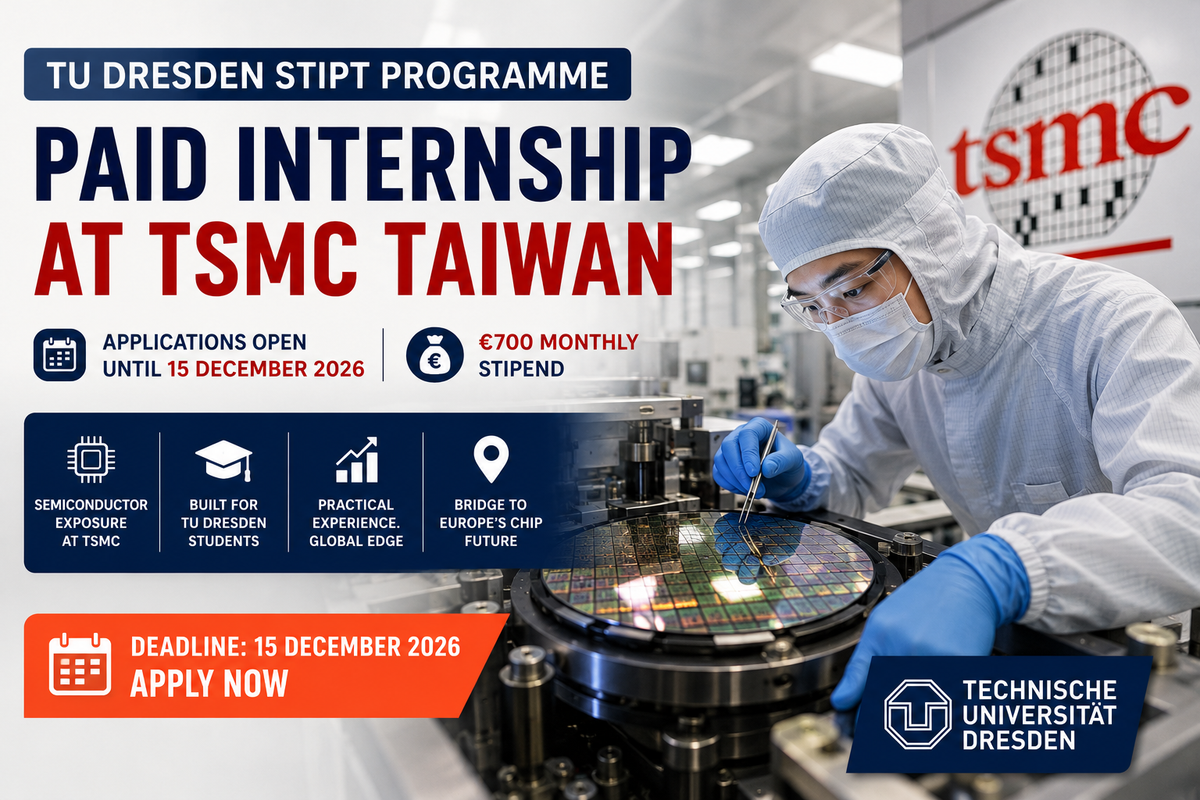
TU Dresden STIPT programme applications are open until 15 December 2026. The scheme funds a paid TSMC Taiwan internship with a €700 monthly stipend. It is built for TU Dresden students in semiconductor and microelectronics fields.
- STIPT is a bridge route, not a direct entry from India. You must first enrol at TU Dresden.
- The TSMC exposure is the real draw. It feeds straight into Dresden’s new European chip fab.
- A paid placement sits well above most unpaid semester-abroad options Indian students find in Germany.
- Semiconductor hiring in Silicon Saxony is rising, which makes this a career-ready choice.
Check MS in Germany fees, scholarships and intake dates
The TSMC Dresden fab starts production in late 2027. A short Taiwan internship becomes direct pipeline experience for roles opening right in Germany. Indian engineering students rarely get a paid Taiwan placement tied to a German MS. STIPT is that rare combination.
Quick Facts on TU Dresden STIPT Programme
| Parameter | Detail |
|---|---|
| Programme name | STIPT (Semiconductor Taiwan Internship Programme) |
| Host university | TU Dresden, Germany |
| Industry partner | TSMC (Taiwan Semiconductor Manufacturing Company) |
| Placement country | Taiwan |
| Monthly stipend | €700 (INR 65,100) |
| Application deadline | 15 December 2026 |
| Target fields | Microelectronics, nanoelectronics, electrical engineering |
| Required status | Active TU Dresden enrolment |
Conversions based on a EUR-INR rate of INR 93 as of November 17, 2026. Rates fluctuate; check the current rate before financial planning.
- Quick Facts on TU Dresden STIPT Programme
- What TU Dresden STIPT Programme Covers
- STIPT Eligibility Rules for Indian Students
- How to Apply for STIPT Before 15 December
- Inside the TSMC Taiwan Internship Experience
- STIPT Stipend and Living Costs in Taiwan
- Why STIPT Matters for Semiconductor Careers
- Taiwan Visa Steps for STIPT Interns
- STIPT vs Other Paid Semiconductor Programmes
- FAQs on TU Dresden STIPT Programme
What TU Dresden STIPT Programme Covers
STIPT stands for the Semiconductor Taiwan Internship Programme at TU Dresden. It combines a semester of chip-focused coursework with a paid internship in Taiwan. TSMC is the main industry host. The programme sits inside TU Dresden’s Faculty of Electrical and Computer Engineering. It targets students who want factory-floor exposure to how modern chips are actually made.
Three parts make up the full offer:
- Taught module: advanced semiconductor process and device courses at TU Dresden.
- Industry placement: an internship at TSMC or a partner firm in Taiwan.
- Stipend: €700 per month during the Taiwan placement to help cover living costs.
Participants earn academic credit that counts toward their TU Dresden degree. The internship period is usually three to six months, timed to the summer or winter semester break.
Key Insight: STIPT is not a scholarship for degree study. It is a top-up for existing TU Dresden students who already have an MS or BS seat.
Read More: TU Dresden courses, fees and rankings for Indian students
STIPT Eligibility Rules for Indian Students
Indian students must first hold a valid TU Dresden enrolment to apply for STIPT. The programme does not accept direct applications from outside the university. Standard TU Dresden mobility programmes set the baseline eligibility below:
- Current enrolment in a TU Dresden BS or MS programme in a relevant field.
- Completion of at least one full semester before the placement starts.
- Grade average in the upper half of the cohort, typically a 2.5 German grade or better.
- English proficiency equivalent to IELTS 6.5 or TOEFL iBT 90, if not already proven at admission.
- A clear interest in chip manufacturing, shown through coursework or a personal statement.
Relevant fields usually include Nanoelectronic Systems, Information Systems Engineering, Materials Science and the Microelectronics track inside Electrical Engineering.
Students on a German student visa do not need a fresh residence permit for the Taiwan placement. The TU Dresden enrolment stays active during the internship.
How to Apply for STIPT Before 15 December
Applications close on 15 December 2026 at 23:59 CET. Submissions go through the TU Dresden international office portal, not a paper form.The required documents are standard for TU Dresden mobility:
- Motivation letter in English, one page, focused on your chip-industry goals.
- Current TU Dresden transcript, printed through the Selma student portal.
- CV with any lab, project or internship work in electronics listed first.
- Faculty recommendation, usually from a semiconductor or microelectronics professor.
- Language proof if English was not your prior degree language.
Shortlisted applicants face a short technical interview. Questions cover the basics of CMOS fabrication, device physics and process control.
Key Insight: The interview is not a research viva. Panels want to see you can hold a conversation with an engineer in a cleanroom.
Final decisions are usually confirmed in February 2027. The placement typically begins in the summer term, between April and September 2027.
Source: TU Dresden Faculty of Electrical and Computer Engineering international office.
Inside the TSMC Taiwan Internship Experience
TSMC runs the world’s largest chip foundry network, with core fabs in Hsinchu and Tainan. STIPT interns usually join the Hsinchu Science Park sites. Internship work falls into one of three tracks:
- Process engineering: support work on a specific step like lithography or etching.
- Device design: help with test structures and electrical characterisation.
- Yield and metrology: analyse process data from live production lines.
Day-to-day work is gated by strict confidentiality rules. Interns sign TSMC’s standard non-disclosure agreement before touching any production floor. Working hours are a 40-hour week plus the odd Saturday. Teams run in English for international staff, though Mandarin helps outside the office.
What the internship gives you:
- Hands-on exposure to a working 3nm or 5nm production line.
- A named line manager from TSMC on your CV.
- A thesis-ready data set for a final-year project.
What the internship does not cover:
- Flight tickets from Germany to Taiwan.
- Housing deposits or long-stay rental guarantees.
- A guaranteed graduate offer at TSMC Dresden.
STIPT Stipend and Living Costs in Taiwan
The €700 stipend (around INR 65,100) covers basic living costs in Hsinchu but leaves a thin margin. Dorms and shared flats take the biggest bite. Typical monthly outgoings for an intern in Hsinchu look like this:
| Expense | Range in NTD | In EUR | In INR |
|---|---|---|---|
| Shared flat or dorm | 7,000 to 12,000 | €200 to €345 | INR 18,600 to 32,000 |
| Food, groceries, meals out | 7,000 to 10,000 | €200 to €290 | INR 18,600 to 27,000 |
| Transport on MRT and bus | 1,500 to 2,500 | €45 to €70 | INR 4,200 to 6,500 |
| Mobile and internet | 500 to 900 | €15 to €25 | INR 1,400 to 2,300 |
| Other, laundry, personal | 2,000 to 3,500 | €55 to €100 | INR 5,100 to 9,300 |
Total rough monthly spend lands between €515 and €830 depending on lifestyle. That means the stipend covers the low end comfortably but not the upper end.
Key Insight: Keep a buffer of around INR 50,000 for the first month. Rent deposits and SIM setup usually land before the first stipend credit.
Taiwan does not allow second paid jobs on an intern residence permit. Any budget gap must come from personal savings, parents or an education loan top-up.
Why STIPT Matters for Semiconductor Careers
STIPT is one of a very small set of paid chip-industry placements open to Indian students in Europe. It builds a direct line to the hottest hiring region in German engineering.
Three forces make the timing strong:
- The TSMC ESMC fab in Dresden starts production in late 2027, with a €10 billion investment.
- The EU Chips Act targets a 20% share of global chip production by 2030.
- The Silicon Saxony cluster already hosts over 70,000 chip-industry jobs around Dresden.
What this means for an Indian student:
- A TSMC line on your CV signals cleanroom experience, which is rare in Europe.
- Recruiters at Infineon, GlobalFoundries, Bosch and Intel scan the same CV pool.
- Entry-level process engineer salaries in Dresden range from €55,000 to €65,000 per year.
Pay-back maths is straightforward. TU Dresden tuition for Indian students is around €350 per semester. Even one chip-industry offer covers two years of study inside the first six months of work.
Key Insight: STIPT does not grant a full-time offer. It gets you into the shortlist that is already shortened.
Source: European Commission Chips Act briefing and Silicon Saxony cluster data, 2026.
Taiwan Visa Steps for STIPT Interns
Indian students on a German residence permit apply for a Taiwan resident visa before travel. The route runs through the Taipei Economic and Cultural Office in Berlin or Munich.
Core document set:
- Valid Indian passport with at least six months beyond the internship end.
- Valid German residence permit, with TU Dresden enrolment proof.
- Invitation letter from TSMC Taiwan listing dates and the host site.
- Proof of funds, usually a blocked account or sponsorship letter.
- Health insurance that is valid in Taiwan for the full stay.
Processing time is around 10 to 15 working days. Some Indian students on shorter stays use the e-visa option. A resident visa is safer for stipend-based placements.
Source: Bureau of Consular Affairs, Ministry of Foreign Affairs, Republic of China (Taiwan).
STIPT vs Other Paid Semiconductor Programmes
STIPT is not the only path for Indian students into the chip industry from Europe. A short list of comparable options keeps the choice honest.
| Programme | Host country | Industry partner | Monthly stipend |
|---|---|---|---|
| TU Dresden STIPT | Germany to Taiwan | TSMC | €700 |
| IMEC Masters, KU Leuven | Belgium | IMEC consortium | Varies, often €800 to €1,000 |
| Erasmus Mundus EMIMEO | France, Belgium, Germany | ST Microelectronics | Grant up to €1,400 |
| EIT Deep Tech Talent | EU-wide | Infineon, NXP, Bosch | Role-based |
STIPT stands out because of the direct TSMC link. The others offer broader academic breadth but softer industry-specific brand pull.
What STIPT gives you that most others do not:
- A named placement at the world’s largest chip foundry.
- Low tuition under the German public university system.
- A clear bridge to the Dresden fab opening in 2027.
What STIPT does not give you:
- A direct entry path from India without TU Dresden admission first.
- A stipend at the level of Erasmus Mundus full scholarships.
- Guaranteed Taipei to Dresden rotation after the internship.
Also Check:
| Germany student visa guide | Scholarships in Germany | Cost of studying in Germany |
| MS programmes in Germany | IELTS exam pattern and dates | Germany university intakes |
TU Dresden STIPT programme matters because it closes two tough gaps. The first is between classroom and fab. The second is between a German MS and a paid industry placement. The 15 December 2026 deadline is tight. Anyone already enrolled at TU Dresden should prepare documents this week. For students still in India, the better 2026 move is different. Target a Nanoelectronic Systems MS seat first. Then enter STIPT from inside. Chip hiring in Dresden only grows from 2027.
FAQs
Ques. What is the TU Dresden STIPT programme?
Ans. STIPT is the Semiconductor Taiwan Internship Programme at TU Dresden. It gives TU Dresden students a paid internship at TSMC in Taiwan with a €700 monthly stipend. The placement runs three to six months.
Ques. What is the STIPT application deadline?
Ans. The deadline is 15 December 2026 at 23:59 CET. Applications go through the TU Dresden international office portal. Decisions are usually out by February 2027.
Ques. Can Indian students apply to STIPT directly from India?
Ans. No. You must first be enrolled in a TU Dresden BS or MS programme. The best entry route is a Nanoelectronic Systems MS admission at TU Dresden.
Ques. How much is the STIPT stipend worth in Indian rupees?
Ans. The €700 stipend is about INR 65,100 per month at a rate of INR 93 per euro. Taiwan living costs in Hsinchu usually range from €515 to €830 per month. The stipend covers the lower end only.
Ques. Does STIPT guarantee a job at TSMC or the TSMC Dresden fab?
Ans. No. STIPT does not include a graduate offer. It builds a strong shortlist entry for jobs at TSMC Dresden, Infineon, GlobalFoundries and Bosch.
Ques. What English score do I need for STIPT?
Ans. Around IELTS 6.5 or TOEFL iBT 90 is the usual bar. If TU Dresden already accepted your English score at admission, you do not need to retake. German proficiency is not required.
Ques. Do I need a new visa for the Taiwan internship?
Ans. Yes. Indian students on a German residence permit apply for a Taiwan resident visa in Berlin or Munich. Processing takes 10 to 15 working days.
Ques. What are the typical fields eligible for STIPT?
Ans. Microelectronics, nanoelectronics, electrical engineering, materials science and information systems engineering. Students from software-only backgrounds are a weaker fit. Hardware and cleanroom exposure is the priority.
Ques. How does STIPT compare to Erasmus Mundus in semiconductors?
Ans. Erasmus Mundus pays more, often up to €1,400 per month. STIPT pays less but offers a direct TSMC placement. For chip-industry entry, the TSMC name on a CV outweighs the stipend gap.
Ques. What is TU Dresden’s tuition for Indian students?
Ans. TU Dresden charges only a semester contribution of around €350, not full tuition. Living costs in Dresden run about €900 to €1,100 per month. The total cost of an MS at TU Dresden is far below UK or US options.
Ques. When does the Taiwan internship actually start?
Ans. The placement usually begins between April and September 2027. The exact dates depend on the TSMC host team and the TU Dresden academic calendar. Interns are expected to be in Taiwan by the first working day.
Ques. Is TU Dresden a good university for chip engineering?
Ans. Yes. TU Dresden sits in the Silicon Saxony cluster, Europe’s largest chip hub. It ranks in the global top 200 for electrical engineering and leads Germany in nanoelectronics research.


interested in this College ?
Follow & Share this college to get information about admission.



Comments