




ILICAT 2026 (Indian Law Institute Common Admission Test) is the national-level entrance exam conducted by the Indian Law Institute (ILI), New Delhi, for admission to its prestigious one-year LLM (Master of Laws) program. The ILICAT 2026 written exam was held on May 31, 2026, and candidates who appeared are now awaiting the answer key, viva voce shortlist, and final merit list.
Answer Key: The ILICAT 2026 official answer key has been released on 9 June 2026. Candidates should visit ili.ac.in to confirm whether it has been released and to submit objections, if any, within the stipulated window.
- Viva Voce: ILICAT 2026 viva voce is expected in the first week of July 2026. In 2025, it was conducted on July 2–4 at ILI New Delhi. Only candidates shortlisted based on their written test scores will be called for the viva voce.
- First Merit List: The ILICAT 2026 first merit list is expected on July 15, 2026. In 2025, the first merit list was released on July 8. ILI will release a second merit list on July 21 and a final merit list on July 27, 2026, to fill all 53 LLM seats.
- Fee Payment Deadline: Candidates shortlisted in the first merit list must pay the admission fee by July 20, 2026. Missing this deadline leads to forfeiture of the seat. In 2025, the fee payment deadline was July 14.
What is ILICAT 2026?
ILICAT stands for Indian Law Institute Common Admission Test. It is the gateway to the Indian Law Institute’s highly competitive one-year LLM program. The Indian Law Institute (ILI), New Delhi was established in 1956 as an autonomous body under the Ministry of Law and Justice, Government of India. ILI is located at Bhagwan Das Road, New Delhi, adjacent to the Supreme Court of India — giving students unmatched access to India’s apex court, the Bar Council of India, and the capital’s wider legal ecosystem.
ILICAT is conducted once a year, usually in May. The exam tests candidates on English language skills, general knowledge, and legal knowledge across core law subjects. Shortlisted candidates then appear for a viva voce at ILI New Delhi. The final merit list is based on a composite score combining the written test, legal writing (Part III), and viva voce marks. More than 1,000 candidates appear for ILICAT each year to compete for 53 LLM seats — making it one of the most competitive postgraduate law entrance exams in India.
Beyond the LLM, ILI also offers PhD programs in Law, postgraduate diploma programs in Cyber Law, Intellectual Property Rights, Alternative Dispute Resolution, and Corporate Law & Management, and online certificate courses. These programs have separate admission processes and are not covered by ILICAT. ILI has also published the Journal of the Indian Law Institute (JILI), one of India’s oldest and most respected law journals, since 1959.
ILICAT 2026: Key Details at a Glance
| Particulars | Details |
|---|---|
| Exam Name | ILICAT 2026 |
| Full Form | Indian Law Institute Common Admission Test |
| Conducting Body | Indian Law Institute (ILI), New Delhi |
| Under Ministry | Ministry of Law and Justice, Government of India |
| Exam Level | National Level |
| Program Offered | LLM (Master of Laws) – One Year |
| Total LLM Seats | 53 Seats |
| Exam Mode | Offline (Pen and Paper) |
| Exam Duration | 2 Hours 30 Minutes |
| Total Marks | 200 Marks |
| Negative Marking | Yes, –0.25 per wrong answer (Objective Parts I & II) |
| Application Fee | Rs. 2,500 (Non-Refundable) |
| ILICAT 2026 Exam Date | May 31, 2026 |
| Admissions Portal | iliadm.samarth.edu.in |
| Official Website | ili.ac.in |
ILICAT 2026 Important Dates
The ILICAT 2026 written exam is over. The next important steps are the viva voce and merit list, both expected in July 2026. The table below lists all upcoming events first, followed by past events, so you can track exactly where the admission cycle stands today.
| Event | ILICAT 2026 Date | ILICAT 2025 Date (Reference) |
|---|---|---|
| Viva Voce | First week of July 2026 (Expected) | July 2–4, 2025 |
| First Merit List | July 15, 2026 (Expected) | July 8, 2025 |
| Fee Payment Deadline (1st Merit List) | July 20, 2026 (Expected) | July 14, 2025 |
| Second Merit List | July 21, 2026 (Expected) | — |
| Final Merit List | July 27, 2026 (Expected) | — |
| Application Window | March 30 – April 30, 2026 | (Over) |
| ILICAT 2026 Written Exam | May 31, 2026 | (Over) |
| Answer Key Release | June 9 2026 | (Out) |
Dates for viva voce, merit lists, and fee payment are based on the previous year’s schedule. ILI publishes the confirmed schedule on its official website — always verify at ili.ac.in before acting on expected dates.
Source: ili.ac.in
ILICAT 2026 Final Answer Key
Based on the Final Answer Key (after considering objections/representations) for the All India Admission Test (AIAT) for LL.M. Programme 2026, the exam consisted of 140 questions, with 2 questions deleted after the objection review process.
| Particular | Data |
|---|---|
| Total Questions | 140 |
| Deleted Questions | 2 |
| Valid Questions for Evaluation | 138 |
| Deleted Question Numbers | 9 and 134 |
| Final Answer Key Release | After considering representations |
| Exam Date | 31 May 2026 |
ILICAT 2026 Distribution of Correct Answers
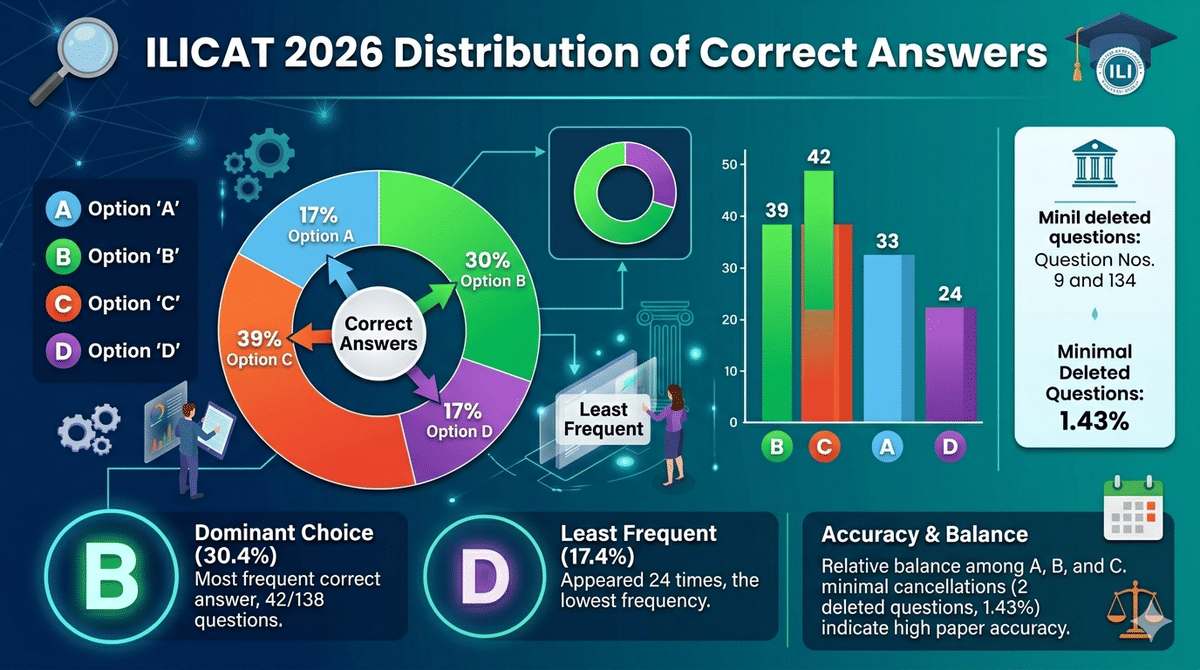
The final answer key shows a balanced distribution of answer options, reducing the possibility of any answer-choice bias.
- Option 'B' is the most frequent correct answer, accounting for 42 out of 138 evaluated questions (30.4%), making it the dominant answer choice in the final key.
- Option 'C' appears 39 times (28.3%), followed by Option 'A' with 33 occurrences (23.9%), indicating a relatively balanced distribution among the first three options.
- Option 'D' is the least frequent correct answer, appearing only 24 times (17.4%), nearly 6 percentage points lower than Option 'A'.
- Only 2 questions (Question Nos. 9 and 134) were deleted, representing 1.43% of the total paper, which suggests that the objection review process led to minimal cancellations and a high level of accuracy in the original question paper.
| Option | Frequency | Percentage |
| A | 33 | 23.9% |
| B | 42 | 30.4% |
| C | 39 | 28.3% |
| D | 24 | 17.4% |
| Deleted | 2 | — |
ILICAT 2026 Section-wise Pattern Analysis
- Questions 1–30: Option C appears most frequently, while one question (Q9) was deleted.
- Questions 31–60: The distribution is balanced across all four options, with no deleted questions.
- Questions 61–90: Option A dominates this section, indicating a noticeable shift in answer pattern.
- Questions 91–120: Option B is the most common correct answer, accounting for a significant share of the section.
- Questions 121–140: Option C appears frequently, while Question 134 was deleted, reducing the evaluated questions in the final segment.
ILICAT 2026 Eligibility Criteria
You must meet the ILICAT eligibility requirements before applying. ILI sets specific academic qualifications for the LLM program. The eligibility criteria for ILICAT 2026 are as follows:
For LLM (One Year) Program
- You must hold a Bachelor of Laws (LLB) degree from a university recognized by the Bar Council of India (BCI).
- You need at least 50% aggregate marks in LLB. Candidates from reserved categories (SC/ST) may be eligible with a lower percentage as per ILI norms.
- Holders of a foreign law degree equivalent to LLB, recognized by the Association of Indian Universities (AIU), with 50% marks are also eligible.
- Candidates who are appearing in the final year of LLB at the time of the exam can also apply. If selected, admission is provisional and will be confirmed only after they submit mark sheets showing the required aggregate.
- There is no upper age limit for ILICAT 2026.
For PhD in Law (Separate Process — Not Covered by ILICAT)
- You must hold an LLM degree from a recognized university with a minimum of 55% aggregate marks.
- PhD admission at ILI involves a separate written test and interview conducted by ILI and is not part of the ILICAT process.
Important: Candidates admitted provisionally on the basis of appearing in the final year of LLB must submit proof of qualifying marks before enrollment. Admission is cancelled if the required percentage is not achieved in the final result.
ILICAT 2026 Seat Reservation (LLM Program)
| Category | Reservation |
|---|---|
| Scheduled Caste (SC) | 15% of total seats |
| Scheduled Tribe (ST) | 7.5% of total seats |
| Other Backward Classes – Non-Creamy Layer (OBC-NCL) | 27% of total seats |
| Economically Weaker Section (EWS) | 10% of total seats |
| Persons with Disability (PwD) | 5% horizontal reservation |
| General (Unreserved) | Remaining seats |
Reservation percentages follow the Government of India policy for central autonomous institutions. Exact seat distribution is notified by ILI in the official admission brochure.
ILICAT 2026 Application Process
The ILICAT 2026 application window was open from March 30 to April 30, 2026. Registration was completed entirely online via ILI’s admissions portal. The non-refundable application fee was Rs. 2,500. The window for 2026 is closed. For candidates planning to apply in future cycles, here is how the ILICAT application process works:
Steps to Apply for ILICAT (For Future Reference)
- Step 1 – Register on the Portal: Visit iliadm.samarth.edu.in and create a new account using your email ID and mobile number.
- Step 2 – Fill the Application Form: Enter your personal details, academic information (LLB university name, aggregate marks, year of passing), and category details accurately.
- Step 3 – Upload Documents: Upload scanned copies of your LLB degree or enrollment proof, mark sheets, a government-issued photo ID (Aadhaar or passport), passport-size photograph, and signature as per the format and file size specified.
- Step 4 – Pay the Application Fee: Pay Rs. 2,500 online via net banking, debit card, credit card, or UPI.
- Step 5 – Submit and Save Confirmation: Review all entries before final submission. Download and save the confirmation page as your proof of application.
Documents Needed for ILICAT Application
- LLB degree certificate or proof of enrollment in the final year
- Mark sheets of all semesters or years of LLB
- Government-issued photo ID (Aadhaar Card, Passport, or Voter ID)
- Recent passport-size photograph (white background)
- Scanned signature
- Category certificate, if applicable (SC/ST/OBC-NCL/EWS/PwD)
The ILICAT 2026 application window closed on April 30, 2026. Candidates who did not register cannot appear for the 2026 exam cycle. The next ILICAT application window is expected to open in early 2027.
ILICAT 2026 Exam Pattern
ILICAT 2026 is an offline exam (pen and paper) held in a single session starting at 10:00 AM. The test has three parts: an objective English and general knowledge section, an objective law section, and a subjective legal writing section. Shortlisted candidates also appear for a viva voce interview after the written test. The total marks are 200.
ILICAT 2026: Section-Wise Exam Pattern
| Part | Section | Questions | Marks | Type |
|---|---|---|---|---|
| Part I | English Language & General Knowledge | 40 | 40 | Objective (MCQ) |
| Part II | Law (Legal Aptitude & Subjects) | 100 | 100 | Objective (MCQ) |
| Part III | Legal Writing / Short Essay | 4 | 40 | Subjective (up to 150 words each) |
| Viva Voce | Personal Interview (Shortlisted Candidates Only) | — | 20 | Interview |
| Total | 144 (Written) + Viva | 200 | — | |
Key Points on the ILICAT Exam Pattern
- Mode: Offline (Pen and Paper)
- Duration: 2 Hours 30 Minutes for the written exam (Parts I, II, and III)
- Language: English
- Negative Marking: –0.25 marks for each wrong answer in Parts I and II only
- No negative marking applies to Part III (subjective legal writing)
- Each answer in Part III must not exceed 150 words
- The viva voce is a separate round held at ILI New Delhi after written test shortlisting
Law (Part II) carries the highest weightage at 100 out of 200 marks. You should direct most of your preparation time to legal subjects. Part III and the viva voce together add up to 60 marks (30% of total) — strong legal writing and clarity in the interview can meaningfully lift your final rank.
Note: The –0.25 negative marking in Parts I and II means an unanswered question costs nothing, while a wrong answer reduces your score. Attempt MCQ questions only when you are reasonably confident of the answer.
ILICAT 2026 Syllabus
The ILICAT 2026 syllabus covers three broad areas: English language and general knowledge, core law subjects, and legal writing. All three parts carry significant marks and need focused preparation. Here is a subject-wise breakdown.
Part I: English Language and General Knowledge (40 Marks)
This section tests language proficiency and general awareness:
- English Language: Grammar (subject-verb agreement, tenses, prepositions, articles), Vocabulary (synonyms, antonyms, word usage, fill-in-the-blanks), Reading Comprehension, and inference-based questions
- General Knowledge: Current Affairs (national and international, especially legal and constitutional developments), History of India, Indian and World Geography, Science and Technology basics, Environmental Issues
Part II: Legal Aptitude and Law Subjects (100 Marks)
Part II is the most heavily weighted section and covers the following subjects:
- Constitutional Law: Fundamental Rights and Duties, Directive Principles, Amendment procedures, Judicial Review, Federal Structure, Emergency Provisions, landmark judgments
- Jurisprudence: Schools of Law (Natural Law, Legal Positivism, Sociological School, Realism), concepts of Rights, Duties, Liability, Possession, Ownership, Theories of Punishment
- Criminal Law (BNS / IPC): Bharatiya Nyaya Sanhita 2023 (BNS) provisions — General Exceptions, Offences against the Body, Offences against Property, Criminal Conspiracy, Abetment
- Law of Torts: General Principles, Negligence, Nuisance, Defamation, Strict and Absolute Liability (Rylands v Fletcher, M.C. Mehta)
- Commercial Law: Indian Contract Act (Offer, Acceptance, Consideration, Void Agreements), Sale of Goods Act, Negotiable Instruments Act, basics of Company Law
- Public International Law: Sources, State Recognition, Treaties, UN Charter, International Human Rights Law
- Environmental Law: Environment Protection Act, Water and Air Pollution Acts, National Green Tribunal, Environmental Impact Assessment
- Family Law: Hindu Marriage Act, Hindu Succession Act, Muslim Personal Law, Christian Law basics, Uniform Civil Code debates
- Criminal Procedure: Bharatiya Nagarik Suraksha Sanhita (BNSS) / CrPC — FIR, Bail, Trial Procedure
- Law of Evidence: Bharatiya Sakshya Adhiniyam (BSA) / Evidence Act — Admissibility, Relevancy, Burden of Proof
- Administrative Law: Delegated Legislation, Natural Justice, Judicial Review of Administrative Action
- Law of Limitation: Limitation Act provisions, Adverse Possession, Acknowledgement, Computation of Limitation Period
Part III: Legal Writing / Short Essay (40 Marks)
Part III has 4 questions, each requiring a structured written answer of up to 150 words. Topics are drawn from:
- Crime, punishment, and law enforcement
- Constitutional issues and current legal controversies
- Family law, education law, and children’s rights
- Recent Supreme Court judgments and their policy implications
- Emerging legal areas such as data privacy, cyber law, and environmental justice
Each answer must state the legal issue, apply the relevant principle, and reach a conclusion — all within 150 words. ILICAT Part III rewards analytical thinking and legal reasoning, not just factual recall.
ILICAT 2026 Answer Key
The ILICAT 2026 official answer key was expected to be released between June 1–4, 2026. Candidates should visit ili.ac.in to check whether it has been published. ILI releases the answer key only for the objective sections — Part I (English & GK) and Part II (Law MCQs). Part III (legal writing / subjective) is evaluated internally and no public answer key is released for it.
How to Download the ILICAT 2026 Answer Key
- Go to ili.ac.in
- Navigate to the Admissions or ILICAT 2026 section on the homepage
- Click on the "Answer Key" or "ILICAT 2026 Answer Key" link
- Download the PDF and compare your responses question-by-question
- Note every question where your answer differs and gather the supporting legal reference before raising an objection
Raising Objections Against the ILICAT Answer Key
If you believe an answer in the official key is incorrect, you can raise an objection during the window ILI notifies. To raise a valid objection:
- Identify the question number and your proposed correct answer
- Provide a reference to a standard legal textbook, a bare act provision, or a Supreme Court or High Court judgment that supports your answer
- Submit the objection through the channel notified by ILI — usually email or through the online portal
ILI reviews all valid objections and may revise the key before computing final scores. A revised answer key, if issued, is also published on ili.ac.in before results are declared.
ILICAT 2026 Result
The ILICAT 2026 result is not a standalone score announcement. The final admission result takes the form of a merit list published on ili.ac.in, built on a composite score from all three evaluation stages: Parts I, II, and III of the written test plus the viva voce. The scoring structure is as follows:
| Component | Maximum Marks | Share of Total Score |
|---|---|---|
| Part I: English & GK (Objective) | 40 | 20% |
| Part II: Law MCQs (Objective) | 100 | 50% |
| Part III: Legal Writing (Subjective) | 40 | 20% |
| Viva Voce | 20 | 10% |
| Total | 200 | 100% |
After the written exam and answer key, ILI shortlists candidates for viva voce based on their written test performance. The viva voce — expected first week of July 2026 — carries 20 marks and contributes to the final composite score, potentially separating closely ranked candidates. Once the viva is complete, ILI computes composite scores and releases the merit list in three rounds, starting July 15, 2026.
How to Check the ILICAT 2026 Result
- Visit ili.ac.in
- Go to the Admissions or ILICAT 2026 section
- Click on the "Merit List" or "Result" link for the relevant round
- Find your roll number and check your rank and seat allotment status
The ILICAT 2026 result (merit list) has not been declared as of June 6, 2026. The first merit list is expected only after the viva voce, which is scheduled for the first week of July 2026.
ILICAT 2026 Merit List
ILI releases the ILICAT 2026 merit list in three rounds to ensure all 53 LLM seats are filled. Each round fills vacancies left by candidates from the previous round who did not pay the fee or declined the offer.
ILICAT 2026 Merit List Schedule (Expected)
| Merit List Round | Expected Date (2026) | 2025 Date (Reference) |
|---|---|---|
| First Merit List | July 15, 2026 | July 8, 2025 |
| Fee Payment Deadline (1st List Candidates) | July 20, 2026 | July 14, 2025 |
| Second Merit List | July 21, 2026 | — |
| Final Merit List | July 27, 2026 | — |
Key Points about the ILICAT 2026 Merit List
- The merit list ranks all viva voce-cleared candidates by their composite ILICAT 2026 score out of 200
- Candidates on the first merit list must pay the admission fee by July 20, 2026 to confirm their seat
- If a first-list candidate does not pay the fee by the deadline, their seat moves to the second merit list
- The second merit list (July 21) fills seats vacated by first-list candidates who did not confirm admission
- The final merit list (July 27) covers any remaining vacancies after the second round
- All selected candidates must carry original documents to ILI New Delhi for verification during the admission process
Candidates selected in any merit list round must confirm their seat by paying the fee within the notified deadline. ILI does not grant fee payment extensions.
ILICAT 2026 Cutoff
The ILICAT cutoff is the minimum composite score (out of 200) needed for admission to ILI’s LLM program. The cutoff is set after the viva voce and published alongside the merit list. The ILICAT 2026 cutoff will be released in July 2026 and is not available as of June 6, 2026.
ILICAT Previous Year Cutoff Scores (General Category)
| Year | General Category Cutoff | Total Marks |
|---|---|---|
| 2022 | 96 Marks | 200 |
| 2021 | 75 Marks | 200 |
Note: Official ILICAT cutoff data for 2023, 2024, and 2025 was not publicly available at the time of writing. The 2021 and 2022 figures are the most recently verified data points.
Factors That Determine the ILICAT Cutoff
- Exam difficulty: A harder paper typically drops the cutoff, as fewer candidates score high on Part II (Law MCQs, 100 marks)
- Number of applicants: Higher applicant volume increases competition and can push cutoffs up
- Total seats: With only 53 LLM seats available at ILI, the effective cutoff stays relatively high
- Category: Cutoff scores for SC, ST, OBC-NCL, and EWS candidates are lower than the General category cutoff
- Viva voce performance: Since viva carries 20 marks and is part of the composite score, a strong interview can push a borderline candidate’s composite score above the cutoff
Based on 2021 (75 marks) and 2022 (96 marks) trends, General category candidates should aim for at least 90+ marks out of 200 to have a strong chance of admission. Scoring well in Part II (Law MCQs, 100 marks) is the most reliable path to clearing the ILICAT cutoff — it accounts for 50% of the composite score.
The ILICAT 2026 cutoff has not been released as of June 6, 2026. It will be published alongside the first merit list in July 2026.
ILICAT 2026 Viva Voce
The viva voce is the second and final evaluation stage of the ILICAT selection process. Only candidates shortlisted on the basis of their written test performance are called for the viva voce at ILI New Delhi. It carries 20 marks — 10% of the 200-mark total — and can separate closely ranked candidates whose written scores are nearly identical.
The ILICAT 2026 viva voce is expected in the first week of July 2026. In 2025, it was conducted on July 2–4 at ILI New Delhi. The viva is held in person at the ILI campus — ILI does not offer a remote or online alternative.
What the ILICAT Viva Voce Tests
- Depth of knowledge in the core law subjects covered in Part II, especially the areas you listed as your research interest
- Awareness of recent developments in Indian law — major Supreme Court judgments, new legislation (BNS, BNSS, BSA), and pending constitutional matters
- Ability to articulate legal arguments clearly, logically, and concisely in English
- Communication skills and professional presentation
- Your motivation for pursuing LLM from ILI and your intended area of specialization or research
ILICAT 2026 Viva Voce: What You Need to Know
- Conducted at ILI campus, Bhagwan Das Road, New Delhi — in-person attendance is mandatory
- The interview panel typically includes ILI faculty and senior legal experts
- The interview is conducted in English
- Bring all original documents for verification on the day of the viva voce
- Shortlisted candidates will be notified about the viva schedule via the official ILI website — check ili.ac.in from the last week of June 2026 onwards
To prepare for the viva, revise major constitutional judgments (Kesavananda Bharati, Puttaswamy on privacy, Navtej Singh Johar, Indra Sawhney on reservations, Maneka Gandhi on personal liberty), be clear on the three new criminal codes (BNS, BNSS, BSA enacted in 2023), and stay updated on significant matters currently before the Supreme Court. Know ILI’s institutional history and the JILI — familiarity with the institution strengthens your interview.
ILICAT 2026 Counselling and Admission
ILI does not conduct a separate online counselling process like CLAT or AILET. Admission to the LLM program is directly based on the ILICAT merit list. Candidates are offered seats in merit rank order across three rounds. Here is the step-by-step ILICAT 2026 admission process after the merit list is released:
Step-by-Step ILICAT 2026 Admission Process
- Step 1 – First Merit List (July 15, 2026): Check your name, rank, and seat category on the first merit list at ili.ac.in.
- Step 2 – Pay the Admission Fee (by July 20, 2026): If you are on the first merit list, pay the admission fee online through the ILI portal within the deadline. The exact fee amount is notified in the admission brochure.
- Step 3 – Document Verification at ILI: Visit ILI New Delhi with original documents and photocopies for physical verification. This step confirms your eligibility and academic credentials.
- Step 4 – Second and Final Merit Lists (July 21 and July 27): If you are not on the first list, track subsequent rounds. Seats vacated by non-confirming first-list candidates are offered to the next eligible candidates.
- Step 5 – Enrollment: Complete enrollment formalities and report for the LLM academic session, which typically begins in August at ILI New Delhi.
Documents Required for ILICAT 2026 Admission
- LLB degree certificate (original) and all semester or year mark sheets (originals + self-attested photocopies)
- Category or caste certificate (SC/ST/OBC-NCL/EWS) — original issued by competent authority
- PwD certificate, if applicable
- Government-issued photo ID (Aadhaar Card, Passport, or Voter ID)
- Passport-size photographs (at least 6 recent copies)
- Migration certificate from the LLB-awarding university
- ILICAT 2026 admit card or registration confirmation printout
Original documents are mandatory for verification at the time of admission. Admission will not be confirmed if originals are missing or if any document is found invalid or misrepresented.
ILI New Delhi: Courses, Seats and Specializations
The Indian Law Institute, New Delhi offers a range of postgraduate law programs. ILICAT covers only the one-year LLM program, but ILI’s other offerings are equally well-regarded in the legal field. Here is an overview:
LLM and PhD at ILI New Delhi
| Program | Duration | Seats | Admission Process |
|---|---|---|---|
| LLM (Master of Laws) | One Year (Two Semesters) | 53 | ILICAT 2026 |
| PhD in Law | Minimum 3 Years | Limited (notified separately) | Separate Written Test + Interview by ILI |
Postgraduate Diploma Programs at ILI (Separate Admission Process)
| Diploma Program | Duration | Mode |
|---|---|---|
| PG Diploma in Cyber Law | One Year | Classroom / Distance |
| PG Diploma in Intellectual Property Rights (IPR) | One Year | Classroom / Distance |
| PG Diploma in Alternative Dispute Resolution (ADR) | One Year | Classroom / Distance |
| PG Diploma in Corporate Law & Management | One Year | Classroom / Distance |
Why Choose ILI New Delhi for LLM?
- Location advantage: ILI is adjacent to the Supreme Court of India. Students can attend court proceedings, interact with senior advocates and law officers, and engage with the national legal establishment from their first semester.
- Academic reputation: ILI has been publishing the Journal of the Indian Law Institute (JILI) since 1959 — one of India’s oldest law journals, referenced in academic and judicial circles. LLM students contribute to this culture of legal research.
- Small, focused batch: With just 53 LLM seats, ILI offers close interaction with faculty and a research-focused environment that larger universities cannot replicate.
- Government of India affiliation: As an autonomous body under the Ministry of Law and Justice, ILI has strong institutional ties with the judiciary, central government legal offices, and the Bar Council of India — valuable for careers in legal academia, government legal services, or law reform.
- Research-oriented curriculum: The ILI LLM emphasizes legal theory, constitutional law, comparative law, and original dissertation work — well suited for candidates targeting judicial services, academic careers, or policy roles.
How to Prepare for ILICAT
With ILICAT 2026 concluded, this section serves as a preparation guide for ILICAT 2027 aspirants. The strategy below maps directly to the ILICAT exam pattern (Parts I, II, III plus Viva Voce).
Part I: English Language and General Knowledge
- Read an English newspaper daily (The Hindu or Indian Express) to build reading speed, vocabulary, and awareness of current legal and constitutional affairs
- Revise grammar from a standard textbook — common question types include fill-in-the-blanks, error detection, and sentence completion
- For general knowledge, focus on legal developments: new laws passed in Parliament, major Supreme Court judgments, India’s international commitments, and environmental news
- Refer to Manorama Yearbook or a similar annual publication for quick GK capsule revision
Part II: Legal Subjects (Core Focus Area)
- Constitutional Law (50% of Part II marks, highest single-subject importance): Read M.P. Jain’s Indian Constitutional Law or D.D. Basu’s Introduction to the Constitution of India. Revise landmark judgments: Kesavananda Bharati, Minerva Mills, Puttaswamy, Indra Sawhney, and Navtej Singh Johar.
- Bharatiya Nyaya Sanhita (BNS) / IPC: The BNS (2023) replaced the IPC. Alongside it, study the Bharatiya Nagarik Suraksha Sanhita (BNSS) and Bharatiya Sakshya Adhiniyam (BSA). These three new codes are now core ILICAT content.
- Jurisprudence: Study V.D. Mahajan or N.V. Paranjape. Understand Natural Law, Legal Positivism (Austin, Hart), Sociological School (Roscoe Pound), and the Realist School.
- Negative marking strategy: With –0.25 for wrong MCQ answers, accuracy is more valuable than attempting every question. Skip questions where you are uncertain — a blank costs nothing; a wrong answer costs a quarter mark.
- Solve previous year ILICAT papers and LLM entrance test MCQ books to get used to question phrasing and pacing within the 2.5-hour window.
Part III: Legal Writing
- Practice writing legal answers in the IRAC method: Issue → Rule (legal principle) → Application → Conclusion — within 150 words per question
- Read recent Supreme Court judgments and practice summarizing their legal reasoning concisely
- Topics frequently come from constitutional law, criminal law reform, environmental justice, and emerging areas like data privacy — follow these through legal news platforms
Viva Voce Preparation
- Be thoroughly prepared on the areas you mention in your application’s statement of purpose — viva panels often probe your declared research interest
- Stay current on significant matters before the Supreme Court and any landmark judgments delivered in the year preceding ILICAT
- Practice speaking about legal topics in English — structured, clear thinking impresses panels more than verbose answers
- Know ILI’s institutional history and JILI — demonstrating familiarity with the institution signals genuine intent
Recommended Books for ILICAT Preparation
| Subject | Recommended Reference |
|---|---|
| Constitutional Law | M.P. Jain’s Indian Constitutional Law; D.D. Basu’s Introduction to the Constitution of India |
| Jurisprudence | V.D. Mahajan; N.V. Paranjape’s Studies in Jurisprudence and Legal Theory |
| Criminal Law (BNS) | Bharatiya Nyaya Sanhita 2023 (Bare Act); R.V. Kelkar’s Criminal Procedure |
| Law of Torts | Ratanlal & Dhirajlal; R.K. Bangia’s Law of Torts |
| International Law | S.K. Kapoor’s International Law; J.G. Starke’s Introduction to International Law |
| English & Legal GK | Current legal news (Bar & Bench, LiveLaw for recent judgments); Manorama Yearbook for GK |
FAQs on ILICAT 2026
Ques. What is ILICAT full form?
Ans. ILICAT stands for Indian Law Institute Common Admission Test. It is the entrance exam conducted by the Indian Law Institute (ILI), New Delhi — an autonomous body under the Ministry of Law and Justice — for admission to its one-year LLM program.
Ques. When is the ILICAT 2026 result date?
Ans. The ILICAT 2026 final result will be published as a merit list. The first merit list is expected on July 15, 2026. The result is based on the composite score from the written test (Parts I, II, III) and the viva voce. As of June 6, 2026, the result has not been declared — it will be released only after the viva voce, expected in the first week of July 2026.
Ques. What is the eligibility for ILICAT 2026?
Ans. You need an LLB degree from a Bar Council of India (BCI) recognized university with at least 50% aggregate marks. Final year LLB candidates are also eligible to apply provisionally. There is no upper age limit for ILICAT 2026. Foreign law degree holders with an AIU-recognized equivalent and 50% marks may also apply.
Ques. How many seats are there in ILI LLM 2026?
Ans. The Indian Law Institute offers 53 seats in its one-year LLM program through ILICAT 2026. Seats are allocated across General and reserved categories (SC, ST, OBC-NCL, EWS, PwD) as per the Government of India reservation policy for central autonomous institutions.
Ques. Is there negative marking in ILICAT 2026?
Ans. Yes. ILICAT 2026 has a negative marking of –0.25 marks for every wrong answer in Parts I and II (the objective MCQ sections). Part III (subjective legal writing) has no negative marking. You should attempt MCQ questions only when you are reasonably confident of the answer to protect your score.
Ques. When was the ILICAT 2026 exam held?
Ans. The ILICAT 2026 written exam was held on May 31, 2026, starting at 10:00 AM in offline mode (pen and paper) at the ILI campus, New Delhi. The application window for ILICAT 2026 was open from March 30 to April 30, 2026, with an application fee of Rs. 2,500.
Ques. What is the ILICAT 2026 exam pattern?
Ans. ILICAT 2026 has three written parts: Part I (English & GK — 40 MCQs, 40 marks), Part II (Law MCQs — 100 questions, 100 marks), and Part III (Legal Writing — 4 subjective questions, 40 marks, up to 150 words each). A viva voce carries 20 marks. Total is 200 marks; written exam duration is 2 hours 30 minutes.
Ques. What is the expected ILICAT 2026 cutoff?
Ans. The ILICAT 2026 cutoff will be released with the merit list in July 2026. Based on previous years, the General category cutoff is expected in the range of 70–100 marks out of 200. In 2022, the cutoff was 96 marks; in 2021, it was 75 marks. Aiming for 90+ marks gives General category candidates a strong chance given ILI’s 53-seat intake.
Ques. How is the ILICAT viva voce conducted?
Ans. The ILICAT viva voce is an in-person interview at the ILI campus, New Delhi. It carries 20 marks and is conducted by a panel of ILI faculty and legal experts. Candidates shortlisted based on written test performance are called for the viva. The interview tests legal knowledge, communication skills, and motivation for the program. The 2026 viva voce is expected in the first week of July 2026.
Ques. Can final year LLB students apply for ILICAT?
Ans. Yes. Candidates appearing in the final year of LLB can apply for ILICAT 2026. If selected, admission is provisional. They must submit the final mark sheet and degree certificate showing at least 50% aggregate to confirm admission. Failure to meet the percentage requirement results in cancellation of provisional admission.
Ques. What is the application fee for ILICAT, and when is the next cycle?
Ans. The application fee for ILICAT 2026 was Rs. 2,500 (non-refundable), paid online through the ILI admissions portal (iliadm.samarth.edu.in). The 2026 application window closed on April 30, 2026. The next ILICAT cycle (2027) is expected to open for applications in early 2027 — check ili.ac.in for the official notification.
Disclaimer: All information on ILICAT 2026 provided in this article — including dates for the viva voce, merit lists, and fee payment — is based on data from the official Indian Law Institute website and the previous year’s admission schedule. These dates are expected timelines and subject to change at ILI’s discretion. Candidates are strongly advised to check ili.ac.in regularly for officially confirmed dates and updates on ILICAT 2026.



Comments