




ATMA 2026 (AIMS Test for Management Admissions) is a computer-based test (CBT) spanning 180 minutes across 6 sections for a total of 180 marks. Conducted by the Association of Indian Management Schools (AIMS), it tests Analytical Reasoning, Verbal Skills, and Quantitative Skills through 180 MCQ questions, each carrying 1 mark. AIMS schedules ATMA multiple times a year; the next session is on July 12, 2026.
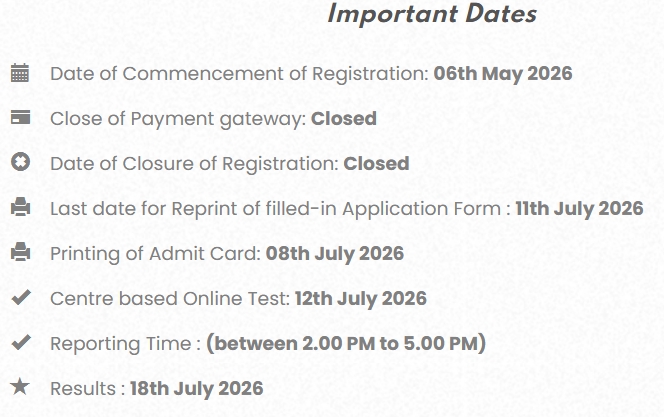
Source: atmaaims.com/
| Particulars | Details |
|---|---|
| Exam Full Name | AIMS Test for Management Admissions (ATMA) |
| Conducting Body | Association of Indian Management Schools (AIMS) |
| Exam Mode | Computer-Based Test (CBT) |
| Total Sections | 6 |
| Total Questions | 180 |
| Total Marks | 180 |
| Duration | 180 minutes (3 hours) |
| Negative Marking | Yes (–0.25 per wrong answer) |
- ATMA 2026 is a 3-hour (180-minute) computer-based test with 180 questions carrying 180 marks.
- The exam has 6 sections: Analytical Reasoning Skills I & II, Verbal Skills I & II, and Quantitative Skills I & II.
- Each section has exactly 30 questions and a strict time limit of 30 minutes.
- A correct answer earns +1 mark; a wrong answer deducts 0.25 marks.
- Section-switching is not allowed — once a section ends, you cannot return to it.
- ATMA 2026 is conducted multiple times per year; the exam pattern is identical across all sessions.
- The next session on July 12, 2026 is scheduled from 2:00 PM to 5:00 PM in CBT mode.
| Direct Link | Access |
|---|---|
| Direct Link to ATMA Official Website 2026 | atmaaims.com |
| Table of Contents |
ATMA Exam Pattern 2026: Overview
The ATMA 2026 exam follows a fixed CBT structure that AIMS has maintained consistently across sessions and years. The pattern allocates equal weight to all three skill areas and enforces strict per-section time limits. There is no overall flexible time pool — each of the 6 sections runs independently for exactly 30 minutes, totalling 180 minutes.
| Parameter | Details |
|---|---|
| Full Exam Name | AIMS Test for Management Admissions (ATMA) |
| Conducting Body | Association of Indian Management Schools (AIMS) |
| Exam Level | National |
| Exam Mode | Computer-Based Test (CBT) |
| Medium of Exam | English |
| Total Number of Sections | 6 |
| Total Number of Questions | 180 |
| Total Marks | 180 |
| Total Duration | 180 minutes (3 hours) |
| Time per Section | 30 minutes |
| Questions per Section | 30 |
| Marks per Section | 30 |
| Question Type | MCQ (Single Correct Answer) |
| Negative Marking | Yes (–0.25 marks per wrong answer) |
| Exam Frequency | Multiple sessions per year |
| Official Website | atmaaims.com |
ATMA 2026 is a 180-minute computer-based test with 180 MCQ questions across 6 sections, each carrying equal weight of 30 questions for 30 marks.
ATMA Exam Pattern 2026: Important Dates
AIMS conducts ATMA multiple times per year. The July 12, 2026 session is the next scheduled exam. As of July 7, 2026, registration for the July session is closed and the admit card is scheduled for release on July 8. Key dates for the July 2026 session are listed below.
| Event | Date | Status |
|---|---|---|
| ATMA July 2026 Admit Card Release | July 8, 2026 (5:00 PM onwards) | Upcoming |
| ATMA July 2026 Exam Date | July 12, 2026 (2:00 PM – 5:00 PM) | Upcoming |
| ATMA May 2026 Result Declaration | July 18, 2026 | Upcoming |
| ATMA July 2026 Registration | May 6 – June 30, 2026 | (Over) |
Note: Students must report to the exam centre before 1:00 PM on July 12, 2026. Gate entry closes at 1:40 PM — students arriving after that will not be admitted.
ATMA 2026: Detailed Exam Pattern
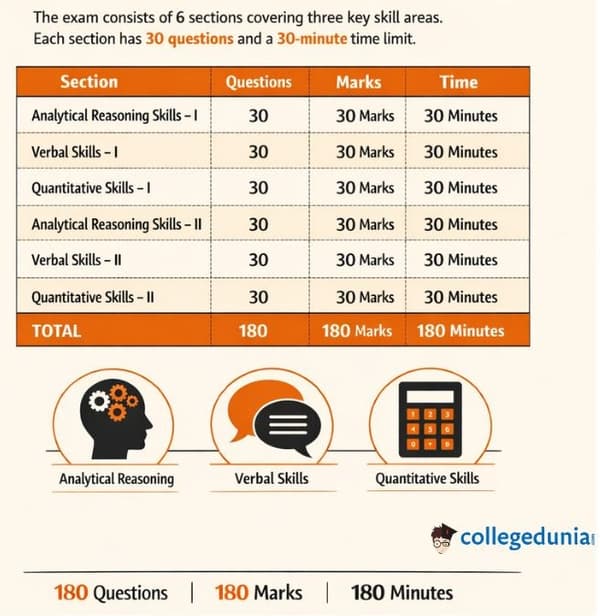
ATMA 2026 tests three skill areas across six sections. Each skill area appears twice in the exam as separate sections (Part I and Part II). Each of the six sections has 30 questions and a fixed 30-minute limit — the structure is fully symmetric, with no section carrying more weight than another.
| Section No. | Section Name | No. of Questions | Marks per Question | Total Marks | Duration |
|---|---|---|---|---|---|
| 1 | Analytical Reasoning Skills – I | 30 | 1 | 30 | 30 minutes |
| 2 | Verbal Skills – I | 30 | 1 | 30 | 30 minutes |
| 3 | Quantitative Skills – I | 30 | 1 | 30 | 30 minutes |
| 4 | Analytical Reasoning Skills – II | 30 | 1 | 30 | 30 minutes |
| 5 | Verbal Skills – II | 30 | 1 | 30 | 30 minutes |
| 6 | Quantitative Skills – II | 30 | 1 | 30 | 30 minutes |
| Total | – | 180 | – | 180 marks | 180 minutes |
Note: Navigating back to a completed section is not permitted. Once the 30-minute timer for a section ends, the system locks that section and moves you forward automatically.
Source: AIMS Test for Management Admissions – Official Website
ATMA Marking Scheme 2026
The ATMA 2026 marking scheme is uniform across all six sections. Every correct MCQ answer earns +1 mark. An incorrect choice costs –0.25 marks. Unattempted questions carry no mark and no penalty. With 180 questions at 1 mark each, the maximum possible score is 180.
| Question Type | Marks for Correct Answer | Marks for Wrong Answer | Marks for Unattempted |
|---|---|---|---|
| MCQ (Single Correct Answer) | +1 | –0.25 | 0 |
Negative marking of –0.25 applies to every wrong answer in ATMA 2026 — four wrong answers cancel one correct answer’s marks, so avoid guessing when you are not confident.
The score you receive at the end of ATMA 2026 is your raw composite score out of 180. AIMS converts this into a percentile for reporting to participating management institutes. Skipping uncertain questions is a better strategy than guessing, as the penalty directly reduces your net score.
ATMA Subject-Wise Exam Pattern 2026
ATMA 2026 tests three core skill areas: Analytical Reasoning, Verbal Skills, and Quantitative Skills. Each skill area spans two sections (Part I and Part II), contributing 60 questions and 60 marks per skill. All three areas carry equal weight in the final score.
Analytical Reasoning Skills (Sections I and II)
Analytical Reasoning is tested across two separate 30-minute sections. Together they account for 60 questions and 60 marks. This skill area tests logical pattern recognition, argument evaluation, and deductive reasoning ability.
| Section | Key Topics | No. of Questions | Marks |
|---|---|---|---|
| Analytical Reasoning Skills – I | Coding-Decoding, Blood Relations, Seating Arrangements, Data Sufficiency, Critical Reasoning | 30 | 30 |
| Analytical Reasoning Skills – II | Statement-Inference, Statement-Conclusion, Strong/Weak Arguments, Syllogisms, Analogy | 30 | 30 |
| Total (Analytical Reasoning) | – | 60 | 60 |
Verbal Skills (Sections I and II)
Verbal Skills covers English language proficiency, comprehension, and vocabulary. Both Verbal sections together contribute 60 questions and 60 marks. Students who read regularly will find this skill area more manageable within the 30-minute window.
| Section | Key Topics | No. of Questions | Marks |
|---|---|---|---|
| Verbal Skills – I | Reading Comprehension, Para Jumbles, Sentence Correction, Grammar and Usage | 30 | 30 |
| Verbal Skills – II | Fill in the Blanks, Synonyms and Antonyms, Vocabulary, Verbal Reasoning, Jumbled Sentences | 30 | 30 |
| Total (Verbal Skills) | – | 60 | 60 |
Quantitative Skills (Sections I and II)
Quantitative Skills tests numerical ability and mathematical reasoning. Both Quantitative sections together carry 60 questions and 60 marks. Topics span arithmetic, algebra, and applied mathematics.
| Section | Key Topics | No. of Questions | Marks |
|---|---|---|---|
| Quantitative Skills – I | Number System, Profit/Loss/Discount, Percentages, Speed–Time–Distance, Time & Work | 30 | 30 |
| Quantitative Skills – II | Algebra, Quadratic Equations, Ratio & Proportion, Permutation & Combination, Probability, Geometry | 30 | 30 |
| Total (Quantitative Skills) | – | 60 | 60 |
ATMA Question Types 2026
ATMA 2026 consists entirely of MCQs (Multiple Choice Questions) with a single correct answer. Every question has four answer options. There are no numerical-entry, assertion-reason, or multi-select type questions. The uniform question type means the –0.25 negative marking rule applies to every question across all six sections.
| Question Type | Description | Applicable Sections | Negative Marking |
|---|---|---|---|
| MCQ – Single Correct Answer | 4 options; select 1 correct answer | All 6 sections (180 questions total) | Yes (–0.25 per wrong answer) |
Since ATMA 2026 is an entirely MCQ-based test, your preparation strategy should emphasise accuracy over blind speed in the final minutes of each section. Rushing through the last 5–7 questions with random guesses can reduce your net score more than leaving them unattempted.
ATMA Exam Pattern: Changes in 2026 vs Previous Year
The ATMA 2026 exam pattern is unchanged from 2025. AIMS has kept the six-section, 180-question CBT format stable for multiple consecutive years. No official notification from AIMS announces any revision to the pattern, marking scheme, or duration for 2026.
| Parameter | ATMA 2025 | ATMA 2026 |
|---|---|---|
| Exam Mode | CBT | CBT (No change) |
| Total Sections | 6 | 6 (No change) |
| Total Questions | 180 | 180 (No change) |
| Total Marks | 180 | 180 (No change) |
| Duration | 180 minutes | 180 minutes (No change) |
| Questions per Section | 30 | 30 (No change) |
| Time per Section | 30 minutes | 30 minutes (No change) |
| Marks per Correct Answer | +1 | +1 (No change) |
| Marks per Wrong Answer | –0.25 | –0.25 (No change) |
| Question Type | MCQ only | MCQ only (No change) |
The ATMA 2026 exam pattern is stable and unchanged from 2025 — students who prepared based on last year’s structure do not need to revise their study plan for the 2026 sessions.
How to Prepare Based on ATMA Exam Pattern
The ATMA 2026 pattern provides clear preparation signals: equal weight across three skill areas, strict 30-minute section clocks, and a penalty for wrong answers. These tips come directly from the pattern structure.
- Calibrate your pace to 1 minute per question: With 30 questions and 30 minutes per section, your target is exactly 60 seconds per question. Build this reflex through timed practice sets well before the exam date.
- Prepare all three skill areas equally: Analytical Reasoning, Verbal Skills, and Quantitative Skills each contribute 60 marks. A weak area directly limits your total score. Allocate preparation time in equal thirds across the three skill areas.
- Simulate strict no-section-switch conditions from day one: ATMA locks each section after 30 minutes. Practice mock tests where you commit to moving forward and never revisit a section — this trains the mental discipline the actual CBT requires.
- Apply a skip-and-return strategy within each section: If a question takes more than 90 seconds, mark it and continue. Return to marked questions in the remaining time. This maximises your attempt count per section without burning time on a single hard question.
- Target accuracy over blind guessing: Four incorrect answers cancel one correct answer under the –0.25 rule. Skip questions you cannot narrow down to two options. Guessing from two options gives a positive expected value; guessing from all four does not.
- Build Analytical Reasoning speed with daily drills: Seating arrangements and coding problems take longer than vocabulary or basic arithmetic questions. Dedicate 20–30 minutes daily to Analytical Reasoning to reach the speed needed within the 30-minute window.
- Take full-length six-section mock tests under exam conditions: Analyse your section-wise accuracy and time usage separately — not just the total score. Identify and improve the weakest section first, since all three areas carry equal marks.
ATMA Exam Pattern FAQs
Ques. How many questions are asked in ATMA 2026?
Ans. ATMA 2026 has 180 questions in total, with 30 questions in each of the 6 sections. All questions are MCQs with a single correct answer.
Ques. What is the total duration of ATMA 2026?
Ans. ATMA 2026 lasts 180 minutes (3 hours). Each of the 6 sections has a fixed 30-minute window, and you cannot borrow time from one section for another.
Ques. Is there negative marking in ATMA 2026?
Ans. Yes. ATMA 2026 deducts 0.25 marks for every wrong MCQ answer. Unattempted questions carry no penalty. The negative marking rule applies equally across all six sections.
Ques. What are the six sections in ATMA 2026?
Ans. The six sections in ATMA 2026 are: Analytical Reasoning Skills – I, Verbal Skills – I, Quantitative Skills – I, Analytical Reasoning Skills – II, Verbal Skills – II, and Quantitative Skills – II. Each section has 30 questions and 30 minutes.
Ques. How many marks does each section carry in ATMA 2026?
Ans. Each of the 6 sections carries 30 marks. Every section has 30 questions at 1 mark each. The total across all 6 sections is 180 marks.
Ques. What is the marking scheme for ATMA 2026?
Ans. ATMA 2026 awards +1 mark for every correct answer and deducts –0.25 marks for every wrong answer. Unattempted questions receive zero marks. The scheme is uniform across all six sections.
Ques. Can students switch between sections in ATMA 2026?
Ans. No. ATMA 2026 does not allow section-switching. Once the 30-minute timer for a section ends, the system moves you to the next section automatically. You cannot return to a completed section.
Ques. Is ATMA 2026 conducted online or offline?
Ans. ATMA 2026 is conducted in online CBT (Computer-Based Test) mode at designated test centres across India. The July 12, 2026 session is scheduled from 2:00 PM to 5:00 PM.
Ques. How many times is ATMA conducted in a year?
Ans. AIMS typically conducts ATMA 5 to 6 times per year. The exam pattern is identical across all sessions. Students can appear in multiple sessions and use their best score for admissions to participating institutes.
Ques. What is the maximum score in ATMA 2026?
Ans. The maximum score in ATMA 2026 is 180 marks, achieved by answering all 180 questions correctly. AIMS converts the raw score into a percentile for reporting to participating management institutes.
Ques. Has the ATMA exam pattern changed in 2026?
Ans. No. The ATMA 2026 exam pattern is unchanged from 2025. The six-section, 180-question, 3-hour CBT structure with –0.25 negative marking has remained stable across multiple consecutive years.
Ques. What type of questions appear in ATMA 2026?
Ans. ATMA 2026 contains only MCQs (Multiple Choice Questions) with a single correct answer and four options. There are no numerical-entry, subjective, or multi-correct type questions in the exam.
*The article might have information for the previous academic years, which will be updated soon subject to the notification issued by the University/College.



Comments