




ACT exam pattern in 2026 consists of 3 core sections (English, Math, Reading) plus 2 optional sections (Science and Writing). The core test runs 125 minutes with 131 questions. Adding Science extends the test to 165 minutes and 171 questions. The Enhanced ACT replaces the older 175-minute format with fewer questions and more time per question.
- ACT exam pattern 2026: 3 core sections in 125 minutes (English, Math, Reading), plus optional Science and Writing.
- ACT total questions: 131 core multiple-choice questions, 171 with optional Science.
- ACT marking scheme: Each section is scored 1 to 36. Composite is the average of English, Math and Reading, rounded.
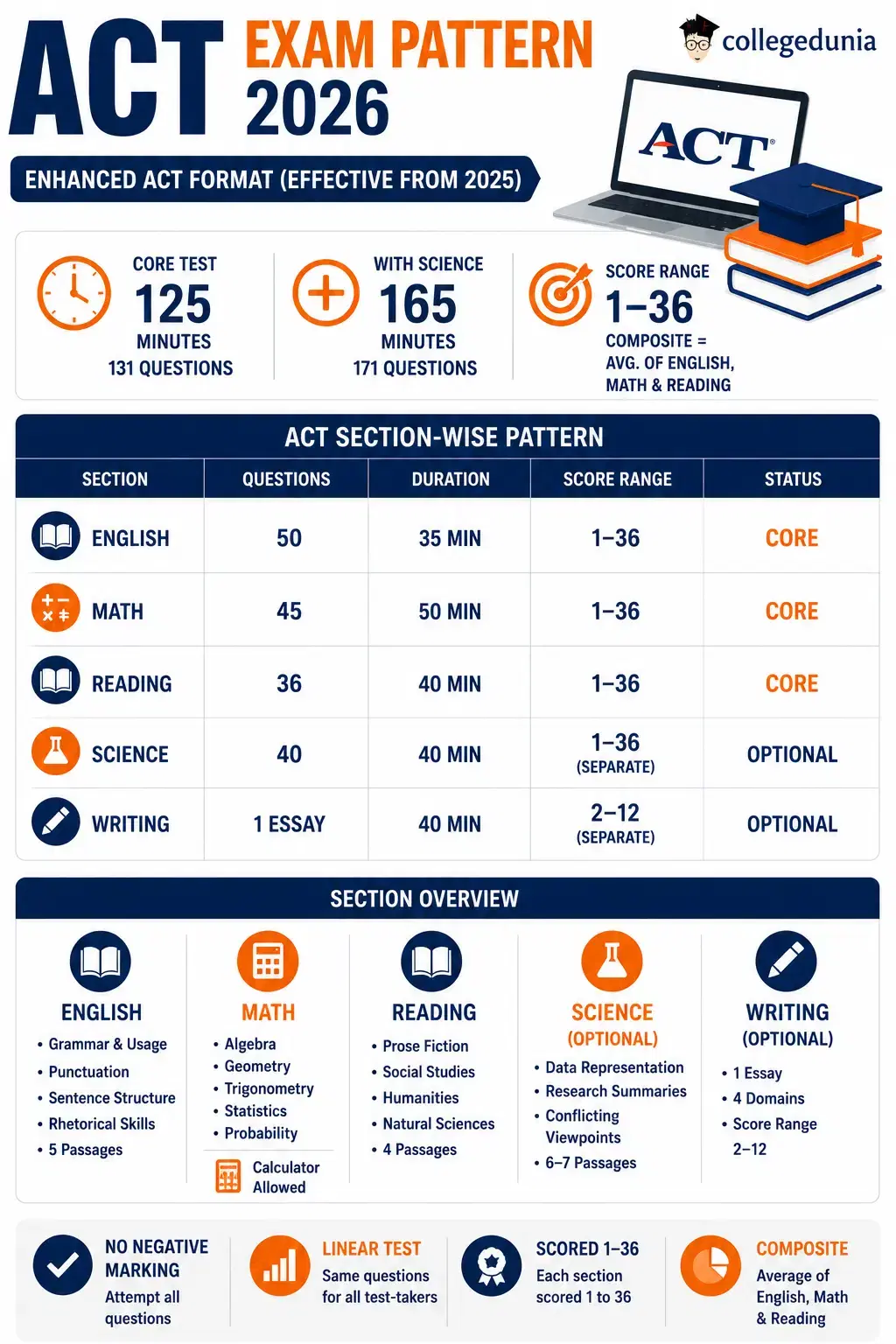
- ACT Exam Pattern 2026
- ACT English Section: Format and Question Types
- ACT Math Section: Format and Question Types
- ACT Reading Section: Format and Question Types
- ACT Science Section: Optional Format and Question Types
- ACT Marking Scheme and Scoring
- ACT Syllabus 2026
- Recent Changes to ACT Pattern
- ACT Pattern Compared to SAT
- ACT Pattern and Syllabus FAQs
ACT Exam Pattern 2026
The ACT follows the Enhanced ACT format from 2025 onwards. Indian students taking ACT in 2026 must prepare for the new structure. The Science section is now optional and the test is 75 minutes shorter than the older version.
The ACT is a paper-based or computer-based test depending on the test centre. Both formats follow the same pattern. There is no negative marking on the ACT, so attempting every question is recommended. The base ACT fee covers only the core 3 sections. Optional Science and Writing carry small add-on charges.
| Section | Questions | Duration | Score Range | Status |
|---|---|---|---|---|
| English | 50 | 35 minutes | 1 to 36 | Core |
| Math | 45 | 50 minutes | 1 to 36 | Core |
| Reading | 36 | 40 minutes | 1 to 36 | Core |
| Science | 40 | 40 minutes | 1 to 36 (separate) | Optional |
| Writing | 1 essay | 40 minutes | 2 to 12 | Optional |
Source: ACT Official Test Structure
How long is the ACT exam in 2026?
The core ACT takes 125 minutes. Adding Science extends it to 165 minutes. Adding Writing adds another 40 minutes. Breaks are scheduled between core sections and the optional sections.
ACT English Section: Format and Question Types
The ACT English section has 50 multiple-choice questions to be answered in 35 minutes. This averages 42 seconds per question. The section tests grammar, punctuation, sentence structure, and rhetorical skills.
Questions are based on 5 passages with usage and rhetorical errors. You read short essays and decide whether underlined portions need editing.
- Conventions of Standard English: Grammar, usage, sentence structure, punctuation rules. Around 51 to 56 percent of questions.
- Production of Writing: Topic development, organisation, unity, cohesion. Around 29 to 32 percent of questions.
- Knowledge of Language: Word choice, style, tone, syntax. Around 13 to 19 percent of questions.
The English section is the fastest-paced part of the test. Students who score well typically practise with timed passages 8 to 12 weeks before the exam. See ACT preparation tips for section-wise study strategy.
ACT Math Section: Format and Question Types
The Math section has 45 multiple-choice questions to be answered in 50 minutes. That gives 67 seconds per question. Math questions have 4 answer choices in the Enhanced ACT, down from 5 in the older format.
A calculator is allowed for the entire Math section. ACT permits most graphing calculators, but TI-89 and certain advanced models are banned. Check the ACT calculator policy before test day.
- Pre-Algebra and Elementary Algebra: Whole numbers, decimals, fractions, exponents, square roots, linear equations, ratios, proportions. Around 24 percent of questions.
- Intermediate Algebra and Coordinate Geometry: Quadratics, inequalities, functions, conics, lines, parabolas. Around 26 percent of questions.
- Plane Geometry: Triangles, circles, polygons, perimeter, area, volume, transformations. Around 23 percent of questions.
- Trigonometry: Right triangle trig, identities, equations, graphs of trig functions. Around 12 to 15 percent of questions.
- Statistics and Probability: Data interpretation, mean, median, mode, basic probability. Around 8 to 12 percent of questions.
Are calculators allowed in ACT Math?
Yes. You can use a permitted calculator for the entire Math section. TI-83 and TI-84 series are standard. TI-89, TI-92 and calculators with QWERTY keyboards are not allowed. Bring spare batteries.
ACT Reading Section: Format and Question Types
The Reading section has 36 multiple-choice questions to be answered in 40 minutes. That gives 67 seconds per question. The section has 3 long passages and 1 paired passage, with 9 questions each.
- Prose Fiction / Literary Narrative: Excerpts from novels, short stories, memoirs, personal essays. One passage per test.
- Social Studies: Passages from anthropology, archaeology, psychology, history, sociology, geography, political science. One passage per test.
- Humanities: Art, literature, philosophy, music, theatre, architecture, dance. One passage per test.
- Natural Sciences: Biology, chemistry, physics, geology, astronomy, meteorology. One passage per test.
Question types include main idea, supporting details, inference, vocabulary in context, author's purpose and comparing two passages. The Enhanced ACT gives 27 percent more time per Reading question than the older format. Indian students whose first language is not English should also consider taking IELTS or TOEFL for English proficiency proof, since the ACT Reading section alone does not certify English fluency for university visas.
Planning to study abroad? Get free counselling
ACT Science Section: Optional Format and Question Types
The Science section has 40 multiple-choice questions in 40 minutes. It is optional from 2025 onwards. Many US universities still recommend taking Science, especially for STEM majors. The Science score is reported separately and does not affect the composite.
The section is split across 6 to 7 passages from physics, chemistry, biology, and earth sciences. Science tests reasoning and interpretation, not factual recall.
- Data Representation: Reading graphs, tables, and scatter plots. Around 30 to 40 percent of questions.
- Research Summaries: Understanding experiments, hypotheses, methods and results. Around 45 to 55 percent of questions.
- Conflicting Viewpoints: Comparing scientific arguments and identifying differences. Around 15 to 20 percent of questions.
If you skip Science you can leave the test centre after the 3 core sections. If you take Science, you also receive a STEM score that combines Math and Science.
Should Indian students take the optional ACT Science section?
Yes, if you are applying to STEM majors or universities that recommend Science. Engineering, medicine, computer science and physical science applicants benefit from a Science score. US universities publish Science requirements on admissions pages.
ACT Marking Scheme and Scoring
Each section is scored on a scale of 1 to 36. The composite score is the average of English, Math and Reading scores rounded to the nearest whole number. Science is reported as a separate score and does not affect the composite from 2025 onwards.
| Score Component | Range | How It Is Calculated |
|---|---|---|
| Section Score | 1 to 36 | Raw correct answers converted to scaled score using ACT curve |
| Composite Score | 1 to 36 | (English + Math + Reading) divided by 3, rounded |
| STEM Score | 1 to 36 | Average of Math and Science, if Science taken |
| ELA Score | 1 to 36 | Average of English, Reading and Writing, if Writing taken |
| Writing Score | 2 to 12 | Sum of 4 domain scores (Ideas, Development, Organisation, Language) |
The ACT has no negative marking. Every correct answer adds 1 to the raw score. Wrong answers and blanks count as zero. Always attempt every question.
ACT Computer-Adaptive vs Linear Format
The ACT is a linear test, not adaptive. Every test-taker sees the same set of questions in the same order. This is different from the GRE and SAT, which adapt difficulty based on early performance.
ACT Superscoring for Indian Students
ACT introduced official superscoring on score reports. If you take the ACT multiple times, ACT calculates a Superscore Composite using your highest English, Math and Reading scores across attempts. Most US universities accept the superscore, but some still require all attempts to be reported.
Indian students retaking the ACT to improve scores should plan attempts at least 2 months apart. This gives time to receive results and target weak sections in the next attempt. Check the ACT result release timeline before scheduling consecutive attempts.
ACT Syllabus 2026
The ACT 2026 syllabus mirrors a high-school curriculum. The Enhanced ACT covers the same content as the older format. Format changes are about structure, not subject matter.
ACT English Syllabus 2026
- Sentence structure and grammar rules
- Subject-verb agreement and pronoun-antecedent agreement
- Punctuation (commas, semicolons, apostrophes, dashes)
- Verb tense and verb form
- Modifiers and parallel structure
- Word choice and idiomatic expression
- Sentence boundaries and run-on sentences
- Transitions between sentences and paragraphs
- Author's purpose and rhetorical strategy
- Adding, deleting, and rearranging text for clarity
ACT Math Syllabus 2026
- Pre-algebra: integers, fractions, decimals, percentages, exponents, square roots, scientific notation
- Elementary algebra: linear equations, inequalities, simple polynomials, absolute value
- Intermediate algebra: quadratic equations, functions, systems of equations, complex numbers, sequences
- Coordinate geometry: slopes, lines, parabolas, circles, conics, transformations
- Plane geometry: triangles, quadrilaterals, circles, polygons, congruence, similarity, volume, area
- Trigonometry: right-triangle ratios, identities, equations, graphs of sine and cosine
- Statistics: mean, median, mode, range, standard deviation, data interpretation
- Probability: basic probability, independent and dependent events
ACT Reading Syllabus 2026
- Identifying main ideas and supporting details
- Drawing inferences and conclusions
- Determining word meaning from context
- Identifying author's tone, purpose, and point of view
- Comparing and contrasting two paired passages
- Analysing cause and effect relationships
- Following sequence of events in narratives
- Distinguishing between fact and opinion
ACT Science Syllabus 2026 (Optional)
- Interpreting scientific data from tables, graphs, and diagrams
- Understanding experimental design (hypotheses, variables, controls)
- Analysing research summaries and methods
- Evaluating conflicting viewpoints in scientific debates
- Drawing conclusions from experiments
- Topics span physics, chemistry, biology, earth and space sciences
Also Check:
Recent Changes to ACT Pattern
The ACT redesign called the Enhanced ACT began rolling out in April 2025. By September 2025, all national Saturday tests (online and paper) followed the new format. School-day and state administrations transitioned in spring 2026. The Enhanced ACT is now the only format available globally including India.
Important: The Enhanced ACT is 75 minutes shorter than the older ACT. Science is optional. Composite score is calculated from only English, Math, and Reading. Indian students preparing from older books or mock tests must update their study materials.
| Change | Old ACT | Enhanced ACT |
|---|---|---|
| Total core time | 175 minutes | 125 minutes |
| Total questions (core) | 175 | 131 |
| English questions | 75 in 45 min | 50 in 35 min |
| Math questions | 60 in 60 min | 45 in 50 min |
| Math answer choices | 5 | 4 |
| Reading questions | 40 in 35 min | 36 in 40 min |
| Science section | Mandatory, 40 questions in 35 min | Optional, 40 questions in 40 min |
| Composite calculation | (E + M + R + S) divided by 4 | (E + M + R) divided by 3 |
ACT On-Screen Tools and Test-Day Mechanics
- Calculator policy: Allowed in Math only. TI-83, TI-84 standard. TI-89 and QWERTY-keyboard calculators not allowed.
- Scratch work: Permitted on the test booklet for paper-based ACT. The online ACT provides an on-screen scratchpad.
- Break structure: Short break after Math. Longer break between core sections and optional Science or Writing.
- Navigation: You can skip questions within a section and return to them. You cannot return to earlier sections once a section ends.
- No flag-for-review tool on paper-based ACT. Online ACT has a flag-and-review feature.
Section-Wise Time Strategy for Enhanced ACT
Pacing is the single biggest difference between students who score 30+ and those who plateau in the mid-20s. Each section has its own time-per-question rhythm. Knowing the rhythm helps you skip and return without panic.
| Section | Time per Question | Suggested Pace |
|---|---|---|
| English | 42 seconds | 10 passages, ~3.5 min each. Skip and flag long sentence rewrites. |
| Math | 67 seconds | First 30 questions in 30 min, last 15 in 20 min. Hardest at the end. |
| Reading | 67 seconds | 9 min per passage including questions. Read fast, skim if needed. |
| Science | 60 seconds | 5 to 6 min per passage. Focus on data, ignore deep theory. |
The Enhanced ACT gives 17 percent more time per English question, 11 percent more per Math, and 27 percent more per Reading compared to the older format. Use the extra seconds to verify answers, not to slow down. Mock-test pacing should be tighter than real-test pacing to build buffer.
ACT Score Planning and Country-Wise Targets
ACT Pattern Compared to SAT
Indian students often pick between ACT and SAT for undergraduate admissions to the USA. Both are accepted by all US universities. The choice depends on test-taking style, content strengths, and university preference. See the full SAT pattern and syllabus for direct comparison.
| Aspect | ACT (Enhanced) | Digital SAT |
|---|---|---|
| Total Duration | 125 min core, up to 245 min with all options | 134 min (2 hr 14 min) |
| Total Questions | 131 core, 171 with Science | 98 questions |
| Score Range | 1 to 36 (composite) | 400 to 1600 (total) |
| Adaptive | Linear (same questions for all) | Module-adaptive |
| Science Section | Optional separate section | None |
| Calculator | Math section only | Allowed throughout Math |
| Negative Marking | None | None |
| Frequency in India | 7 dates a year | 5 to 6 dates a year |
The ACT has a faster pace but more straightforward questions. The SAT has fewer questions and more time per question but uses adaptive scoring. Most US universities superscore both tests, so you can submit your best section scores across multiple attempts.
The ACT exam pattern in 2026 reflects the Enhanced ACT format with shorter core time, optional Science, and a 3-section composite. Indian students should focus on English, Math and Reading for the composite score and add Science only if their target universities recommend it. The syllabus remains aligned with a standard high-school curriculum, so school-based study material continues to be relevant. Plan your ACT test date 8 to 12 weeks ahead of preparation to give yourself enough practice time on each section.
ACT Pattern and Syllabus FAQs
Ques. What is the ACT pattern in 2026?
Ans. The ACT has 3 core sections (English, Math, Reading) in 125 minutes with 131 questions, plus optional Science (40 questions, 40 min) and optional Writing (1 essay, 40 min).
Ques. How many sections does the ACT have?
Ans. The ACT has 3 mandatory sections (English, Math, Reading) and 2 optional sections (Science, Writing). The composite score is calculated only from the 3 mandatory sections.
Ques. How long is the ACT test?
Ans. Core ACT takes 125 minutes. With optional Science, it extends to 165 minutes. With both Science and Writing, the total is 245 minutes including breaks.
Ques. Is ACT computer-adaptive or linear?
Ans. The ACT is a linear test. All test-takers see the same questions in the same order. This is different from the GRE and digital SAT, which are adaptive.
Ques. What is the marking scheme for ACT?
Ans. Each section is scored 1 to 36. Composite is the average of English, Math, and Reading rounded to the nearest whole number. Science is reported separately. There is no negative marking.
Ques. Is there negative marking in ACT?
Ans. No. The ACT has no negative marking. Every correct answer adds 1 to the raw score. Wrong answers and blanks count as zero. Always attempt every question.
Ques. Are calculators allowed in ACT?
Ans. Yes, in the Math section only. TI-83 and TI-84 series are standard. TI-89, TI-92, and calculators with QWERTY keyboards are banned. Bring spare batteries.
Ques. Can I skip questions and come back to them in ACT?
Ans. Yes, within the same section. You can skip and return to any question in the current section before time runs out. You cannot return to earlier sections once you move on.
Ques. Has the ACT pattern changed recently?
Ans. Yes. The Enhanced ACT rolled out in April 2025 (online) and September 2025 (paper). The test is 75 minutes shorter, Science is optional, and the composite is calculated from only English, Math and Reading.
Ques. How does ACT compare to similar tests?
Ans. ACT is similar to the SAT in scope (US undergraduate admissions). ACT has a faster pace but more straightforward questions. SAT has fewer questions and is adaptive. Most US universities accept either.
Ques. What is the syllabus for ACT 2026?
Ans. ACT 2026 syllabus covers English (grammar, punctuation, rhetoric), Math (algebra, geometry, trigonometry, statistics), Reading (4 passage types), and optional Science (data, research, viewpoints). It mirrors a high-school curriculum.
Information accurate as of 22 May 2026. Pattern based on Enhanced ACT format effective from April 2025.
*The article might have information for the previous academic years, which will be updated soon subject to the notification issued by the University/College.



Comments