




ACT 2026 is the Enhanced ACT, a standardised test conducted by ACT Inc. for undergraduate admissions to US and Canadian universities. It is accepted by all 4-year US universities and most Canadian universities. The ACT exam tests English, Math and Reading as core sections. Science and Writing are now optional in the 2026 Enhanced ACT format.
- ACT exam fee in India 2026: USD $188.50 for Core (English + Math + Reading), including the $118.50 international testing surcharge. The Core + Science version costs USD $193.50 and Core + Writing costs USD $213.50. Total cost in India is around ₹18,000 to ₹20,000.
- ACT score validity: 5 years from the test date. The ACT Composite score uses a 1 to 36 scale. Most US universities accept ACT scores within 3 to 5 years of your application.
- Science section now optional: The Enhanced ACT removed Science from the Composite score in 2025. Only 4 US universities (Georgetown, Boston University, Pomona, Duke) currently require or strongly recommend the Science section. Most Indian students can skip it.
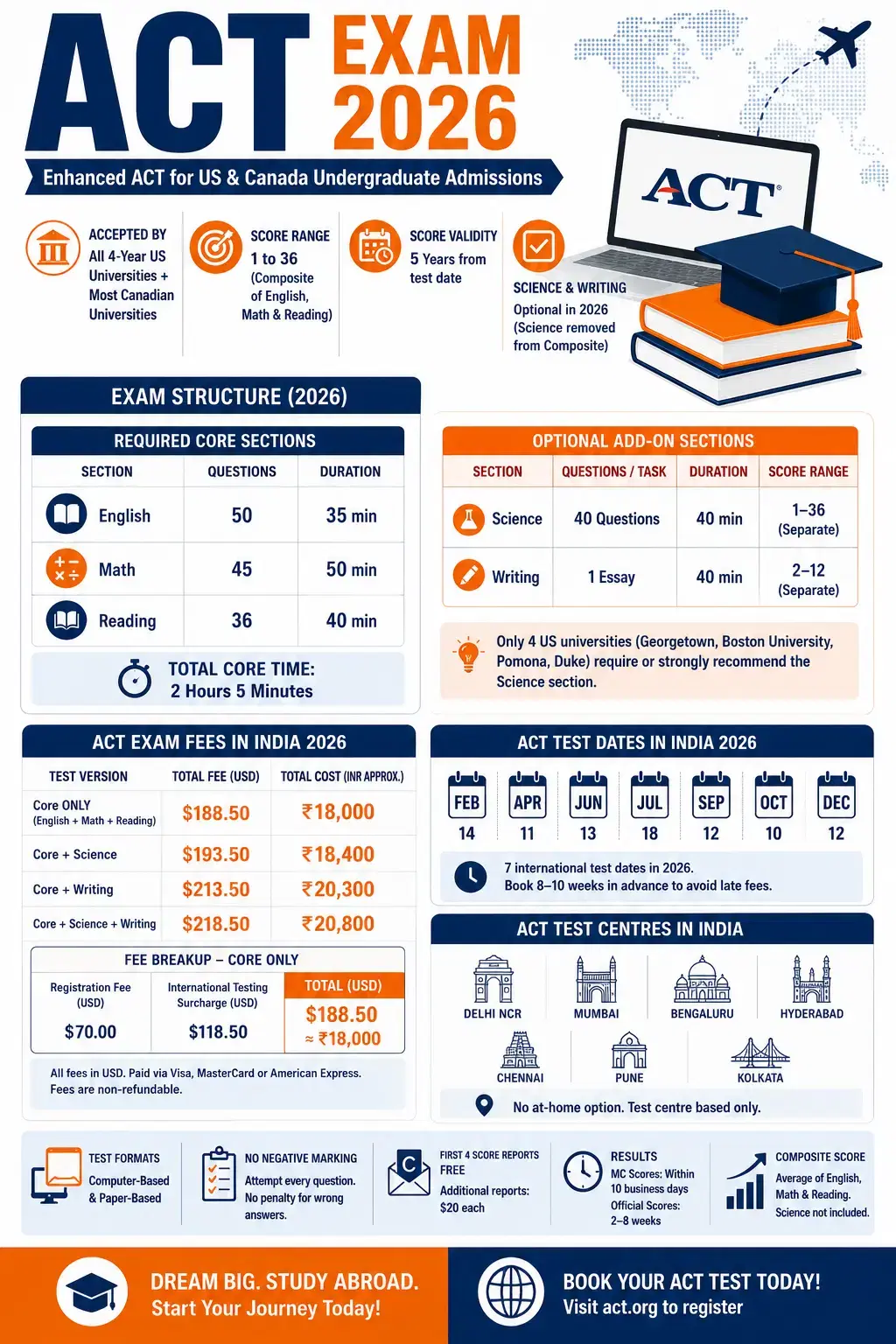
Table of Contents
- ACT Exam Highlights 2026
- Free ACT Practice Papers 2026
- ACT Exam Fees in India 2026
- ACT Fee Waiver 2026
- ACT Exam Registration Process 2026
- ACT Exam Eligibility 2026
- ACT Exam Dates in India 2026
- ACT Test Centres in India
- ACT Exam Pattern and Syllabus 2026
- How to Check Your ACT Results 2026
- ACT Score Validity
- ACT Score Reporting to Universities
- ACT Score Requirements for Top US Universities 2026
- ACT Retake Policy
- ACT Exam Challenges Faced by Indian Students
- ACT Exam Tips for Indian Students 2026
- ACT Exam FAQs
ACT Exam Highlights 2026
The table below gives everything you need to know about the ACT exam.
| Particulars | Details |
|---|---|
| Exam Name | ACT (Enhanced ACT) |
| ACT Full Form | American College Testing |
| Official Website | act.org |
| Conducting Body | ACT Inc. |
| Conducted in India by | Prometric and ACT international partners |
| Purpose | Undergraduate admissions to US and Canadian universities |
| Accepted by | All 4-year US universities and most Canadian universities |
| Test Sections | Required: English, Math, Reading. Optional: Science, Writing |
| Total Duration | 2 hours 5 minutes for Core; plus 40 minutes each for Science and Writing if opted |
| Total Core Questions | 131 (English 50, Math 45, Reading 36) |
| Test Formats | Paper-based and Computer-based, both at test centre |
| ACT Exam Fee in India 2026 | USD $188.50 Core (around ₹18,000 with conversion) |
| Available Dates | 7 international test dates per year |
| Results Time | 2 to 8 weeks for official scores; Multiple-Choice scores within 10 business days |
| Score Range | 1 to 36 (each section and Composite) |
| Composite Score | Average of English, Math and Reading (Science not included) |
| Score Validity | 5 years |
Insider Tip: The Enhanced ACT is a different test from 2025
ACT Inc. rolled out the Enhanced ACT format in April 2025 for online testing and September 2025 for paper-based national testing. The test is 50 minutes shorter and has 44 fewer questions. International students (including Indian test-takers) take the Enhanced ACT for all 7 test dates in 2026. The classic ACT format is no longer offered.
Free ACT Practice Papers 2026
Practice with free ACT practice papers below. Download the PDFs and solve them under timed conditions. The Enhanced ACT format has fewer questions, so adapt older practice tests by skipping the deleted questions.
| Download Free ACT Practice Tests 2026 | |
|---|---|
| ACT Official Practice Test 1 (English + Math + Reading) | ACT English Practice Tests |
You should also download The Official ACT Prep Guide 2025-2026. It contains 4 new practice tests designed for the Enhanced ACT format. ACT also offers one digital practice test free on the official website.
ACT Exam Fees in India 2026
The ACT exam fee in India 2026 depends on which sections you take. Indian students pay an additional USD $118.50 international testing fee on top of the base section fee. All ACT fees are paid in USD through the MyACT portal.
| ACT Test Version | Base Fee (USD) | India Total (USD) | India Total (INR approx.) |
|---|---|---|---|
| Core only (English + Math + Reading) | $70 | $188.50 | ₹18,000 |
| Core + Science | $75 | $193.50 | ₹18,400 |
| Core + Writing | $95 | $213.50 | ₹20,300 |
| Core + Science + Writing | $100 | $218.50 | ₹20,800 |
Source: Official ACT Fees Page. FX rate: 1 USD = ₹93.
Apart from the registration fee, ACT charges add-on fees for late registration, rescheduling, score reports and other services. The table below shows the full ACT fee structure for India 2026.
| Fee Type | Cost (USD) | Cost (INR approx.) |
|---|---|---|
| Late Registration Fee (after deadline) | $42 | ₹4,000 |
| Test Date Change Fee | $49 | ₹4,700 |
| Test Centre Change Fee | $49 | ₹4,700 |
| Standby Testing | $75 | ₹7,125 |
| Additional Score Report (per university, after 4 free) | $20 | ₹1,900 |
| Score Verification Service | $67 | ₹6,400 |
| Test Information Release (TIR) | $36 | ₹3,420 |
ACT fees are non-refundable. Both the base registration fee and any add-on service fees stay forfeited if you cancel. It is always better to reschedule than to cancel the ACT exam.
What is the ACT exam fee in Mumbai for 2026?
The ACT exam fee in Mumbai is USD $188.50 for the Core test. The ACT fee in India is the same across all cities. What you pay in Mumbai is identical to Delhi, Bengaluru or Hyderabad.
What are the ACT fee payment methods available in India?
ACT accepts only Visa, MasterCard and American Express cards through the MyACT portal. UPI, net banking and bank transfers are not accepted. You must enable cross-border online payments on your Indian card before registering. Forex cards from HDFC, ICICI or Axis Bank reduce currency conversion losses.
Heads up: ACT exam fee in India is just the start
Budget realistically for the total ACT cost. The ₹18,000 Core fee is the visible cost. Add ₹8,000 to ₹15,000 for prep materials (Official ACT Guide, Prep books, online courses). Most Indian students retake the ACT once to improve their score, which adds another ₹18,000. A realistic ACT budget across one retake is ₹50,000 to ₹70,000.
ACT Fee Waiver 2026
ACT Inc. offers fee waivers only to US-domiciled students from low-income families. International students from India are not eligible for ACT fee waivers.
- ACT fee waivers cover the Core test fee plus 1 optional add-on (Science or Writing).
- Waivers also include 4 free score reports.
- Eligibility requires US residency and family income below specified thresholds.
- Indian students applying as international applicants must pay the full ACT fee.
If you are an Indian-American or have US permanent residency, you may qualify for the ACT fee waiver. Check the official ACT Inc. fee waiver page for current eligibility rules.
ACT Exam Registration Process 2026
You can register for ACT only online. ACT Inc. handles the entire ACT registration through the official MyACT portal.
ACT Online Registration Steps
- Visit my.act.org and create your MyACT account.
- Enter your full name exactly as it appears on your passport.
- Verify your email and complete your profile with school details.
- Choose your test version: Core, Core + Science, Core + Writing or all four.
- Select your test date and India test centre.
- Upload a recent passport-size photo that meets ACT photo guidelines.
- Pay the USD $188.50 (Core) fee using Visa, MasterCard or American Express.
- You will receive a confirmation email with your admission ticket.
What documents do you need to register for the ACT?
You need a valid Indian passport at registration and on test day. The name on your passport must exactly match the name on your ACT registration. Aadhaar, PAN card and other Indian IDs are not accepted for the ACT.
Print your admission ticket and carry it on test day along with your passport. The test centre will not allow entry without both documents. There is no exception to this rule.
Insider Tip: ACT photo upload is non-negotiable
ACT photo rules are stricter than other exams. You need a clear, recent, in-focus headshot with a plain background. Selfies, group photos, sunglasses, hats and old photos are rejected. ACT verifies the photo against your passport and admission ticket on test day. A photo mismatch leads to test cancellation with no refund.
ACT Exam Eligibility 2026
ACT exam eligibility is explained in the table below.
| Criteria | Requirement |
|---|---|
| Minimum Age | 13 years to register for the ACT |
| Ages 12 and below | Not permitted to take the ACT |
| Education | No formal qualification required. Typically taken by Class 11 or Class 12 students |
| ID Required | Indian passport (no exceptions for Indian test-takers) |
| Number of Attempts | Maximum 12 ACT attempts in your lifetime |
| Cooldown | No mandatory waiting period between attempts |
For Class 11 Indian students aiming for US Fall 2027 admissions, take the ACT in Spring 2026 (February or April). This gives time for one retake before September application deadlines.
Can I take ACT if I do not have a passport?
No. A valid Indian passport is mandatory for the ACT. The name on your passport must match the name on your MyACT account registration. Other Indian IDs are not accepted.
ACT Exam Dates in India 2026
You can check upcoming ACT exam dates in India on the official ACT website. The ACT is offered 7 times a year at India test centres. The standard 2026 international test dates are February, April, June, July, September, October and December.
ACT exam dates vary by test centre. The international dates apply to all Indian test centres. You should book at least 8 to 10 weeks before the test date to avoid the $42 late registration fee.
Apply early for the April or June ACT test dates if you target Fall 2027 admissions. October slots in Delhi, Mumbai and Bengaluru fill up first because they align with Round 1 application deadlines.
How do I check the availability of ACT test dates in my city?
Log in to your MyACT account on the official ACT website. Click Register, choose your test version, then search by city. The system shows all available dates and test centres in real time.
ACT Test Centres in India 2026
ACT Inc. runs ACT test centres in 7 Indian metro cities through Prometric and certified international test partners. You can find a full list of ACT test centres in India on Collegedunia.
- Delhi NCR: Multiple Prometric centres in Connaught Place, Gurugram and Noida.
- Mumbai: Andheri and Bandra centres.
- Bengaluru: Whitefield and MG Road centres.
- Hyderabad: HITEC City and Banjara Hills centres.
- Chennai: Anna Salai and OMR centres.
- Pune: Hinjewadi and Pune Camp centres.
- Kolkata: Salt Lake and Park Street centres.
The ACT fee is the same across all Indian cities. Each test centre offers limited seats per date, so book early.
Tier-2 Indian cities do not have ACT test centres. If you live in Indore, Lucknow or Coimbatore, you must travel to one of the 7 metro cities. Plan for 1 to 2 extra days of travel for the test.
India-Specific: ACT has no at-home option
Unlike the GRE, TOEFL and GMAT, the ACT does not offer an at-home or remote-proctored version for Indian students. You must travel to one of the 7 ACT metro test centres. Plan your travel and stay 1 to 2 days in advance to avoid test-day logistics stress. Book a hotel near the test centre if you are travelling from outside the metro.
ACT Exam Pattern and Syllabus 2026
The Enhanced ACT exam pattern 2026 has 3 required core sections plus 2 optional add-on sections. The Core test duration is 2 hours 5 minutes. Adding Science or Writing extends the test by 40 minutes each.
| Section | Duration | Questions | Score Range | Required? |
|---|---|---|---|---|
| English | 35 minutes | 50 questions | 1-36 | Yes (Core) |
| Math | 50 minutes | 45 questions | 1-36 | Yes (Core) |
| Reading | 40 minutes | 36 questions | 1-36 | Yes (Core) |
| Science | 40 minutes | 40 questions | 1-36 (separate) | Optional |
| Writing | 40 minutes | 1 essay | 2-12 (separate) | Optional |
ACT English syllabus: Grammar, usage, punctuation and sentence structure carry 40-45% weight. Production of writing and Knowledge of language carry 35-45% weight. Conventions of standard English carry 15-20% weight. Passages cover narrative, expository and argumentative writing.
ACT Math syllabus:
- Preparing for Higher Math: Number and quantity, algebra, functions, geometry, statistics and probability.
- Integrating Essential Skills: Word problems combining multiple math topics.
- Modeling: Real-world problem solving with equations and inequalities.
- Math questions now have 4 answer choices (down from 5 in the classic ACT).
- Calculators are permitted throughout the section.
ACT Reading syllabus:
- Literary narrative: Fiction or memoir passages.
- Social studies: History, anthropology, economics, sociology.
- Humanities: Architecture, art, ethics, language, philosophy.
- Natural sciences: Biology, chemistry, physics, anatomy.
ACT Science syllabus (optional): Data representation, research summaries and conflicting viewpoints. Topics cover biology, chemistry, Earth/space sciences and physics. The Science section now gets 40 minutes (up from 35 in the classic ACT).
ACT Writing syllabus (optional): One essay prompt asking you to evaluate three perspectives on a complex contemporary issue. You write your own perspective with supporting reasoning.
Is there negative marking in the ACT?
No. The ACT has no negative marking. You should attempt every question, even if you have to guess. There is no penalty for a wrong answer.
Does the Enhanced ACT have an experimental section?
No. ACT Inc. removed the separate experimental (5th) section in the Enhanced ACT. Field-test questions are now sprinkled within the required sections. These do not affect your final score.
Key Insight: Skip the ACT Science section in 2026
Only 4 US universities (Georgetown, Boston University, Pomona, Duke) currently require or strongly recommend the ACT Science section. Around 95% of US universities have dropped the Science requirement after the Enhanced ACT launched. Skip Science unless your target school explicitly requires it. You save 40 minutes of test fatigue and USD $5. The Composite score uses only English, Math and Reading anyway.
How to Check Your ACT Results 2026
ACT results are released in stages. Multiple-Choice (MC) scores arrive within 10 business days of your test. Writing scores arrive in 2 to 8 weeks because they are hand-graded by ACT scorers.
- Log in to your MyACT account using your registered credentials.
- Go to the My Tests section.
- Click View Scores next to your most recent ACT test.
- You see your section scores and your Composite score.
- Download your official PDF score report once available.
Your Composite score is the average of English, Math and Reading scores. Science and Writing scores appear separately if you took those optional sections.
Three times a year (April, June and December test dates), you can purchase the Test Information Release service for USD $36. It shows your test questions, your answers and the correct answers. Use this for analysing your weak areas before a retake.
ACT Score Validity
Your ACT score validity is 5 years from the test date. This is the same as the GRE and GMAT, and longer than IELTS or TOEFL (both 2 years).
How universities treat ACT validity:
- US universities: Accept ACT scores within 5 years. Most prefer scores within 3 years for competitive admissions.
- Canadian universities: Accept ACT scores within 5 years for undergraduate admissions.
- UK and European universities: A few accept ACT as an alternative to A-levels. Validity varies by institution.
- Indian universities: Some private universities (Ashoka, FLAME, Krea) accept ACT for international-focused programmes.
ACT Score Reporting to Universities
You send your ACT scores to universities through your MyACT account.
- First 4 universities: Free. You must nominate them at registration or within 9 days of your test.
- From the 5th university onwards: USD $20 (around ₹1,900) per university.
- Delivery time: Electronic score reports reach universities in 1 to 2 weeks.
- Score Choice: ACT does not force you to send all scores. You choose which test date to send.
- Superscoring: Many US universities now superscore the ACT. They use your highest section scores across multiple tests.
Send your ACT scores at least 4 to 6 weeks before your application deadline.
ACT Score Requirements for Top US Universities 2026
ACT score requirements for some of the top US universities in 2026 are listed in the table below.
| University | QS World Rank 2026 | Middle 50% ACT Composite |
|---|---|---|
| Massachusetts Institute of Technology | #=1 | 34 to 36 |
| Stanford University | #=3 | 32 to 35 |
| Harvard University | #=5 | 33 to 35 |
| California Institute of Technology | #=10 | 35 to 36 |
| Princeton University | #=25 | 33 to 35 |
| UC Berkeley | #=17 | 30 to 35 |
| Yale University | #=21 | 33 to 35 |
| Johns Hopkins University | #=24 | 33 to 35 |
| Cornell University, Ithaca | #=16 | 32 to 34 |
| Columbia University | #=20 | 33 to 35 |
| University of Chicago | #=21 | 33 to 35 |
| Duke University | #=50 | 33 to 35 |
| Northwestern University | #=43 | 33 to 35 |
| University of Pennsylvania | #=15 | 33 to 35 |
| University of Toronto | #=29 | 30 to 33 |
The scores above show the middle 50% ACT Composite range of admitted students at each university. To be competitive, aim for the upper end of this range or higher. Top US universities also weigh GPA, essays, extracurriculars, recommendations and your overall profile heavily.
ACT Score vs University Tier Mapping
| ACT Composite Score | Percentile (approx.) | Typical University Tier |
|---|---|---|
| 34 to 36 | 99 percentile | MIT, Caltech, Harvard, Stanford, Princeton, Ivy League |
| 30 to 33 | 93-98 percentile | Top 20-50 US universities, UC Berkeley, Cornell, Carnegie Mellon |
| 26 to 29 | 75-92 percentile | Top 50-100 US universities, mid-tier state flagships |
| 22 to 25 | 50-74 percentile | Most state universities, regional private universities |
| 18 to 21 | 25-49 percentile | Less selective state universities, community colleges |
| Below 18 | Below 25 percentile | Limited admissions; retake recommended |
Can I apply without an ACT score in 2026?
Yes. Many US universities are test-optional after 2020. You can apply without an ACT or SAT score. But Indian students benefit from submitting a strong ACT score. It demonstrates academic readiness when the admissions committee may be unfamiliar with your Indian board exams.
Confused about which ACT score you need for your dream US university? Get a free profile evaluation from Collegedunia Study Abroad counsellors. Find the right score target, application timeline and shortlist for your profile.
ACT Retake Policy
ACT Inc. has clear rules on how often you can retake the ACT.
- Lifetime limit: 12 total ACT attempts. This is the highest lifetime cap among major standardised tests.
- Cooldown: No mandatory waiting period. Take the next available test date.
- Pay the full fee each time: Every ACT retake costs USD $188.50 from India.
- Score Choice: Send only your best test date scores.
- Superscoring: Many universities calculate your highest section scores across multiple tests.
Realistic improvement expectations on retake:
- 4 to 6 weeks of targeted prep between attempts: 1 to 2 point Composite gain.
- 2 to 3 months of structured prep: 2 to 4 point Composite gain if you address your weakest section.
- Same-month retake without targeted prep: Likely 0 to 1 point change due to natural variance.
Most US universities allow up to 3 ACT attempts without admissions penalty. More than 3 attempts may signal weak preparation to admissions officers. Plan your retake strategy carefully.
ACT Exam Challenges Faced by Indian Students
Common challenges Indian students face in the ACT:
- ACT English pace: 50 questions in 35 minutes is the fastest-paced ACT section at 42 seconds per question. Indian students often run out of time on the last 10 passages.
- US-style English grammar: ACT tests American English conventions. Indian students raised on British English in CBSE or ICSE need to adjust for spelling (color vs colour), punctuation (Oxford comma rules) and idiom usage.
- Reading speed: The Reading section needs you to read 4 passages and answer 36 questions in 40 minutes. This is faster than most Indian board exams.
- Math content gaps: Some Math topics (statistics, probability, trigonometry) get less attention in Class 11-12 Indian boards. The ACT tests these as core math skills.
- Test centre travel: Only 7 Indian cities have ACT test centres. Students from tier-2 cities pay extra for travel and hotel stays.
- No at-home option: Unlike GRE, GMAT and TOEFL, the ACT requires you to be physically present at a test centre.
ACT Exam Tips for Indian Students 2026
Use these section-wise tips to improve your ACT score. The tips follow ACT's official scoring criteria.
- ACT English: Read American English style guides like The Associated Press Stylebook. Practice grammar drills daily. Aim for 40 seconds per question pacing.
- ACT Math: Cover the entire Class 11 and 12 Maths NCERT plus statistics and probability from Class 10. Use the official ACT Prep Guide for question style.
- ACT Reading: Practice with The New York Times, The Atlantic and Aeon to build US-style reading stamina. Take 1 full Reading section weekly.
- ACT Science (if taking): Read scientific charts and graphs daily. Practice interpreting research summaries. Subject knowledge matters less than data interpretation skills.
- ACT Writing (if taking): Practice the 4-paragraph essay template: introduction with thesis, 2 body paragraphs analysing perspectives and conclusion with your view.
- Mock test strategy: Take at least 4 full-length Enhanced ACT mock tests. Mock 1 for diagnosis, Mocks 2-3 for skill-building, Mock 4 in the final week.
- Best books and resources: The Official ACT Prep Guide 2025-2026, Princeton Review Cracking the ACT, ACT Math by Steve Warner, Magoosh ACT, Khan Academy (free).
- Time management: The English section is the biggest pacing trap. Practice in 7-minute chunks of 10 questions to build sustained speed.
Reality Check: ACT vs SAT for Indian students in 2026
Indian students often pick the SAT over the ACT because it has wider coaching availability in India. But the ACT may suit you better if you are strong in Math and Reading speed. The ACT has more questions per minute. The SAT gives more time per question but tests harder content. Take a free diagnostic of both tests before deciding which one to focus on for 6 months of prep.
Must read about ACT preparation strategies and city-wise coaching options:
ACT is a standardised test accepted by all 4-year US universities and most Canadian universities for undergraduate admissions. The Enhanced ACT format (since 2025) is shorter, has fewer questions and makes Science optional. The exam covers English, Math and Reading as core sections through both paper and computer-based formats at Indian test centres. Plan early and practise regularly to achieve the ACT score required by your target US or Canadian university.
ACT Exam FAQs
Ques. What is the ACT exam fee in India for 2026?
Ans. The ACT exam fee in India for 2026 is USD $188.50 for the Core test (English + Math + Reading). The Core + Science version costs USD $193.50. The Core + Writing version costs USD $213.50. Indian students pay an additional USD $118.50 international testing fee on top of the base ACT fee.
Ques. How long is the ACT score valid?
Ans. Your ACT score is valid for 5 years from the test date. This matches the GRE and GMAT, and is longer than IELTS or TOEFL (both 2 years). Most US universities prefer ACT scores within the last 3 years for competitive admissions.
Ques. What is a good ACT score?
Ans. A good ACT score depends on your target university. 30+ Composite is competitive for top 50 US universities. 33+ is needed for Ivy League and equivalent. 22 is the US national average. 36 is the highest possible Composite score.
Ques. Is the ACT Science section required in 2026?
Ans. The ACT Science section is now optional. Only 4 US universities (Georgetown, Boston University, Pomona, Duke) currently require or strongly recommend it. Around 95% of US universities have dropped the Science requirement. Most Indian students can skip Science.
Ques. Can I take the ACT at home in India?
Ans. No. The ACT has no at-home option for Indian students. You must travel to one of the 7 ACT test centres in India: Delhi NCR, Mumbai, Bengaluru, Hyderabad, Chennai, Pune or Kolkata. This is different from the GRE, GMAT and TOEFL which all offer at-home formats.
Ques. How many times can I take the ACT?
Ans. You can take the ACT up to 12 times in your lifetime. There is no mandatory cooldown between attempts. You pay the full fee each time. Most US universities allow up to 3 attempts without admissions penalty.
Ques. Is the ACT harder than the SAT?
Ans. The ACT and SAT test different skills. The ACT has more questions per minute and includes a Science section. The SAT gives more time per question but tests harder content per question. Most Indian students find the SAT slightly easier in pacing but the ACT easier in content. Take diagnostic tests of both before deciding.
Ques. Does the ACT have negative marking?
Ans. No. The ACT has no negative marking. Attempt every question, even if you have to guess. There is no penalty for a wrong answer.
Ques. Can I reschedule my ACT test?
Ans. Yes. You can reschedule your ACT test date for USD $49 (around ₹4,700). You can also change your test centre for USD $49. Log in to your MyACT account to reschedule. Both fees are non-refundable if you cancel after rescheduling.
Ques. What is the Enhanced ACT format?
Ans. The Enhanced ACT is the new format launched in April 2025 (online) and September 2025 (paper). It is 50 minutes shorter and has 44 fewer questions than the classic ACT. Science is now optional. The Composite score uses only English, Math and Reading. All Indian test-takers in 2026 take the Enhanced ACT.
Ques. Is the ACT accepted by Canadian universities?
Ans. Yes. Most Canadian universities accept ACT scores for undergraduate admissions, including the University of Toronto, McGill, University of British Columbia and Waterloo. Check each programme's requirements for the minimum Composite score.
Ques. What is ACT superscoring?
Ans. ACT superscoring combines your highest section scores across multiple test dates. Many US universities calculate your superscore automatically. For example, if you score English 32 on Test 1 and Math 34 on Test 2, the superscore takes both. Check your target university's superscoring policy.
*The article might have information for the previous academic years, which will be updated soon subject to the notification issued by the University/College.





Comments