

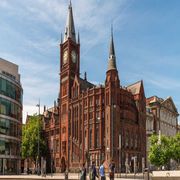
University of Liverpool is a well-known public institution in Liverpool, England in the Merseyside region. It is a large university with 22,000 undergraduate students. University of Liverpool admissions are competitively moderate as the acceptance rate is around 14%. The offered majors are Business, Engineering, Medicine, Social Sciences, and Computer Science. The six-year graduation rate is 88%, and the median starting salary for University of Liverpool graduates is about INR 34,65,000 (after ten years of graduation, converted from £32,700 median earnings).
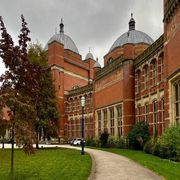
University of Birmingham is a highly ranked public university located in Birmingham, England in the West Midlands metropolitan region. It is a very large institution with 23,000 undergraduate students. Admissions are selective since the University of Birmingham acceptance rate is approximately 13.8%. Popular fields of study include Business, Law, Engineering, Medicine, and Social Sciences. The six-year graduation rate stands at 90%, and University of Birmingham alumni continue to have a median starting salary of about INR 36,91,000 (equivalent of £34,800 median earnings after ten years of graduation).
| University of Liverpool | University of Birmingham | |
|---|---|---|
| Collegedunia Score | 5.6 Out of 10 | 6.1 Out of 10 |
| ranking (overall) | # 139 QS World University 2027 # 21 The Guardian 2026 # 96 Collegedunia Study Abroad 2026 | # 68 QS World University 2027 # 28 The Guardian 2026 # 54 Collegedunia Study Abroad 2026 |
| Subject Strength | # 105 for Engineering by Collegedunia Study Abroad 2026 # 58 for Medicine by Collegedunia Study Abroad 2026 # 27 for Law by The Guardian 2026 | # 63 for Engineering by Collegedunia Study Abroad 2026 # 53 for Medicine by Collegedunia Study Abroad 2026 # 41 for Law by The Guardian 2026 |
| Programs | UG Programs -29 PG Programs -36 | UG Programs -57 PG Programs -144 Doctorate Programs -54 |
| Acceptance Rate | 14.0 % | 13.0 % |
| Cost to Study | Average Tuition Fees 41600 [For UG Program] Average Tuition Fees 43600 [For PG Program] Hostel + Meal - 667 Per Year | Average Tuition Fees 21780 [For UG Program] Average Tuition Fees 26640 [For PG Program] Hostel + Meal - 17136 Per Year |
| placement (average package) | QS Graduate Employablity #161- 170; Highest paying degrees: Ph.D. (101,000 USD); Doctorate (96,000 USD); MBA (89,000 USD); Masters in Science (69,000 USD); Bachelor of Science (67,000 USD). | Graduate employability ranking #86; Annual average salary 57,100 USD; Top recruiters: IBM, Capgemini, Peter Brett Associates, WSP Global Inc., Barclays Bank, etc.; Highest paid degrees: Executive MBA (127,000 USD), MBA (104,000 USD), Bachelor (101,000 USD), LLM (85,000 USD), Masters in Finance (76,000 USD). |
| application requirements | Submit English language proficiency test scores Check program specific requirements | Academic transcripts; 2 reference letters; personal statement; essay; research proposal (for research programs); Proof of English language proficiency |
| CollegeDunia Reviews | 8.4/10 Read 28 reviews | 8.0/10 Read 28 reviews |
Top Courses Comparison
| ranking | # 31 for Computer Science by The Guardian 2026 # 119 for Computer Science by Collegedunia.com 2026 # 158 for Computer Science by QS World University 2026 | # 5 for Computer Science by The Guardian 2026 # 108 for Computer Science by Collegedunia.com 2026 # 127 for Computer Science by QS World University 2026 |
| exam scores | Duolingo - 125/160IELTS - 6.5/9PTE - 61/90TOEFL - 4.5/6 | IELTS - 6.5/9PTE - 67/90TOEFL - 4.5/6 |
| documents required | #Letter of Recommendation + Statement of Purpose | #Letter of Recommendation + Statement of Purpose |
| application dates | Aug 21, 2026 (Fall 2026 intake application deadline) | Jul 3, 2026 (Application Deadline for September 2026 Intake) Oct 30, 2026 (Application Deadline for January 2027 Intake) |
Other Popular Comparisons





| General Facts | University of Liverpool | University of Birmingham |
|---|---|---|
| Type of University | University | University |
| Established | 1881 | 1900 |
| Student:Faculty Ratio | 14:1 | 12:1:1 |
| Male:Female | 45% Male, 55% Female | 42% Male, 58% Female |
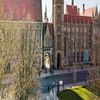
| Location Facts | Based in the city of Liverpool, England; 5 minutes' walk from Liverpool City Centre; Occupying 100 acres of land. | 2 campuses- Edgbaston and Selly Oak located in Edgbaston, Birmingham, UK; centered around Chancellor’s Court and Old Joe. |
| Library | Open 24 hours during term; Houses 2 million books; 40,000 electronic journals; Also houses the Special Collections & Archives. | 7 libraries and resource center; 2.7 million books and scholarly periodicals, over 16,000 electronic resources; 1.8 million print; 500,000 online books; over 85,000 print & online journals. |
| Campus Life | 51 student-led sports clubs; 25 m swimming pool; fitness center; squash courts; sports halls; 13 grass pitches; 2 synthetic hockey pitches; 3G rugby training area; On-campus cafes: Victoria Gallery & Museum, Augustus John Public House, Vine Court and Guild of Students Food Court; Victoria Gallery & Museum; Garstang Museum of Archaeology; Liverpool Confucius Institute. | 250 clubs & societies; Houses the Barber Institute of Fine Arts, Shakespeare Institute, Mingana Collection of Middle Eastern manuscripts, Lapworth Museum of Geology, Joseph Chamberlain Memorial Clock Tower; UoB Sport & Fitness club (consisting of 50m swimming pool, multi-sports arena, 6 glass-backed squash courts, 200-station gym, 10m climbing wall, Performance Centre, 5 activity studios, etc.); 9 Costas, 2 Starbucks; other university cafes; etc. |
| Hostel | #Premier Room(Per Week) - $199 #Premier Studio(Per week) - $221 #Premier Studio Apartment(Per Week) - $247 | #Accommodation (Catered) - $8442 #Accommodation (Self Catered) - $8694 |
| Famous Alumni | 10 Nobel Prize laureates; Edward Stringer (Deputy Chief Defence, Royal Air Force); Gwen Alston (Aerodynamicist & educationalist); Brian Hall (Footballer); Sanjay Jha (Co-CEO Motorola, Inc.); Martin Smith (Vehicle designer); Sir James Stirling (Architect); Sir Ronald Ross (Nobel Prize winner in Medicine); Wade Barrett (professional wrestler). | 11 Nobel laureates; Neville Chamberlain & Stanley Baldwin (Former British PM); Sir Edward Elgar (British composer); Baroness Amos (UN Under-Secretary-General); Lord Roll of Ipsden (Director of the Bank of England); Isaac Hempstead Wright (Actor); Rodolfo Neri Vela (Mexican scientist & astronaut); Tim Curry (Actor) |
| City Life | Liverpool is a city in Merseyside, England; Projected 15% growth in the knowledge economy by 2022; 54 million visitors annually; 2nd highest number of museums and galleries; Popular attractions include: The Beatles Story; Albert Dock; Tate Gallery; Merseyside Maritime Museum; St. George's Hall; Museum of Liverpool | A city in West Midlands, England; 2nd largest city in England; Economy dominated by the service sector; 2nd largest metropolitan economy in UK with a GDP of 121.1 billion USD; Top tourist attractions include Victoria Square, Birmingham Museum and Art Gallery, Thinktank- Birmingham Science Museum, National SEA LIFE Centre, St. Philip's Cathedral, Cadbury World |
| Weather |
University of Liverpool vs University of Birmingham
Subject Strength & Global Rankings (2025/2026)
University of Liverpool ranks #147 in QS and 160th in Times Higher Education whereas University of Birmingham ranks #76 QS and 93 in Times Higher Education. The University of Liverpool and the University of Birmingham are both well-known research universities within the United Kingdom. In subject fields, Birmingham University is specifically top-notch in Engineering, Medicine, Life Sciences, and Business, always ranking in the top 100 internationally. Liverpool University is also well-reputed in Veterinary Science, Engineering, Life Sciences, and Medicine, but tends to rank a bit lower than Birmingham in general.
General Information
The University of Liverpool, established in 1881, is situated in Liverpool, England, and has a student base of about 33,000. It is a research-driven university with historic strengths in science, health, and engineering, in addition to an increasing emphasis on social sciences and business.The University of Birmingham, founded in 1900, is in Birmingham, England, and has approximately 35,000 students. It is a Russell Group institution with a diverse academic range, extensive research influence, and widespread professional and international connections.
Acceptance Rate & Admissions
Both universities are competitive, but requirements for admission are relatively open compared to the most competitive Russell Group universities.The University of Liverpool assesses candidates against academic attainment, personal statement, and appropriate qualifications, with specific selectivity in Engineering, Veterinary Science, and Medicine.The University of Birmingham focuses significantly on academic success and program requirements, particularly for Medicine, Law, and Engineering, but tends to have marginally higher entry requirements than Liverpool.
Research Impact & Facilities
The University of Liverpool has an excellent research profile in veterinary medicine, engineering, and health sciences through its world-class research facilities, the Liverpool Medical School, and global research partnerships.The University of Birmingham enjoys international reputation for research in social sciences, life sciences, engineering, and medicine through its world-class facilities such as the Institute of Translational Medicine, the Medical School, and large science and engineering laboratories.
Cost & Financial Aid
Both are public UK universities, but they charge international tuition fees typically ranging from £16,000–£25,000 per annum depending on the course.The University of Liverpool has scholarships and bursaries available to international students, including merit-based awards and subject-specific awards.The University of Birmingham has a broad range of financial assistance available to students, including international scholarships, merit awards, and research grants, often marginally broader than Liverpool's.
Career Outcomes & Alumni Success
University of Liverpool graduates excel in engineering, medicine, veterinary science, business, and research with excellent industry links in the United Kingdom and worldwide.University of Birmingham graduates have high employability in medicine, business, law, engineering, and research with access to the university's worldwide alumni network and extensive industry collaborations.Generally speaking, the University of Birmingham offers wider international recognition and excellent career prospects in many fields, whereas the University of Liverpool provides a solid academic and research environment with a special emphasis on health sciences, veterinary medicine, and engineering.


