










SPJIMR Post Graduate Program FAQs
Ques. How is PGPFMB different from a regular MBA, and when should a family business heir choose it over a two-year programme?
Ans. A regular MBA prepares you for corporate employment across any company. PGPFMB is designed for someone who already has a business to return to and wants to modernise it, not build a career from scratch. The curriculum, case studies, and elective tracks all use family business scenarios. The mentor model means your own business is the live project throughout. If you are joining the family business within one to two years, PGPFMB is the more focused investment. If your career path is still open, a two-year MBA gives more optionality.
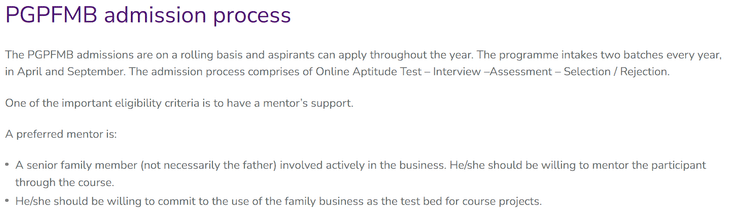
Ques. What exactly is the mentor’s role in PGPFMB, and why is their participation mandatory?
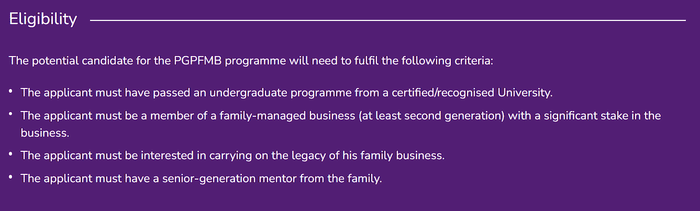
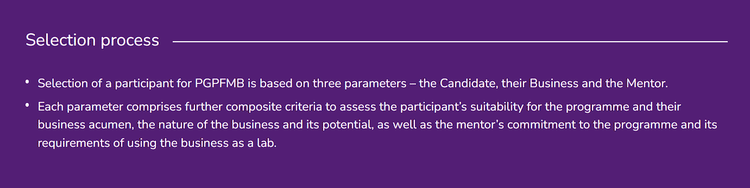
Ans. The designated mentor must be a senior family member actively involved in the business, such as a parent or uncle who knows operations well. SPJIMR treats the mentor as a co-learner. They attend interviews as part of the selection process and participate in intergenerational knowledge-transfer sessions during the programme. The model treats effective family business succession as a two-generational process. A participant without a committed mentor cannot be admitted because the pedagogy depends on this pairing.
Ques. How does the six-day monthly format work for someone actively managing business operations?
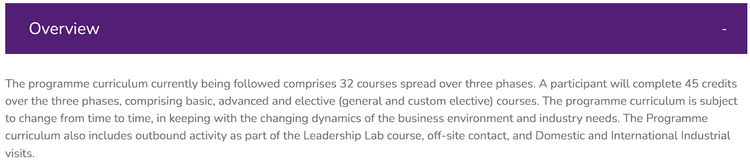
Ans. The programme runs for six contact days per month on the Mumbai campus. Over 12 months, this totals 72 days of campus time, spread as one week per month. Sessions are designed to minimise business disruption, and you return to your operations for the remaining three weeks each month. This structure specifically assumes participants hold active business roles. If your business is in a city far from Mumbai, factor in monthly travel cost and time as an additional recurring expense.
Ques. What are the four sector elective tracks, and how should a participant choose among them?
Ans. The four tracks are Manufacturing, Retail, Real Estate and Infrastructure, and Services. Manufacturing covers process efficiency and supply chain, Retail covers market evolution and omnichannel operations, Real Estate covers project finance and regulatory navigation, and Services covers client management and scalability. Choose the track that aligns with your family business’s primary sector. If your business spans multiple sectors, SPJIMR’s admission team can guide you toward the track with the most strategic relevance to your growth priorities.
Ques. Since PGPFMB has no campus placements, what does SPJIMR consider a successful outcome for graduates?
Ans. The programme does not offer placement services because the expected outcome is business leadership, not job placement. A successful graduate returns with a fully developed Business Role Plan (presented in months 13 and 15 of the programme) and a concrete growth strategy for the family enterprise. The 4,000-plus alumni network, access to Family Fridays events, and ongoing Samagam expert sessions constitute the post-programme value, supporting business decisions long after the degree is complete.
![MBA/PGDM | admission | 2024 | Narsee Monjee Institute of Management Studies - [NMIMS Deemed to be University]](https://img.collegedunia.com/public/college_data/images/logos/1506323004Logo.jpg?h=72&w=72&mode=stretch)


![MBA/PGDM | admission | 2024 | Indian Institute of Management - [IIMC]](https://img.collegedunia.com/public/college_data/images/logos/1488950580d2.png?h=72&w=72&mode=stretch)



Comments