DY Patil M.Sc. Cyber Security FAQs
Ques. Is the M.Sc. Cyber Security at Dr. D.Y. Patil ACS College Pimpri a 2-year or 4-year programme?
Ans. The M.Sc. Cyber Security at Dr. D.Y. Patil ACS College, Pimpri is a 4-year full-time programme under the National Education Policy (NEP 2024 pattern) as per the official college website. This is different from the traditional 2-year M.Sc. structure. The 4-year programme is structured across 8 semesters and includes a Full-Time Industrial Training component in Semester IV, along with a Research Project in Semesters III and IV. Students should note this distinction when comparing with M.Sc. Cyber Security programmes at other colleges, which may still follow the 2-year structure.
Ques. What is the total fee for M.Sc. Cyber Security at Dr. D.Y. Patil ACS College Pimpri?
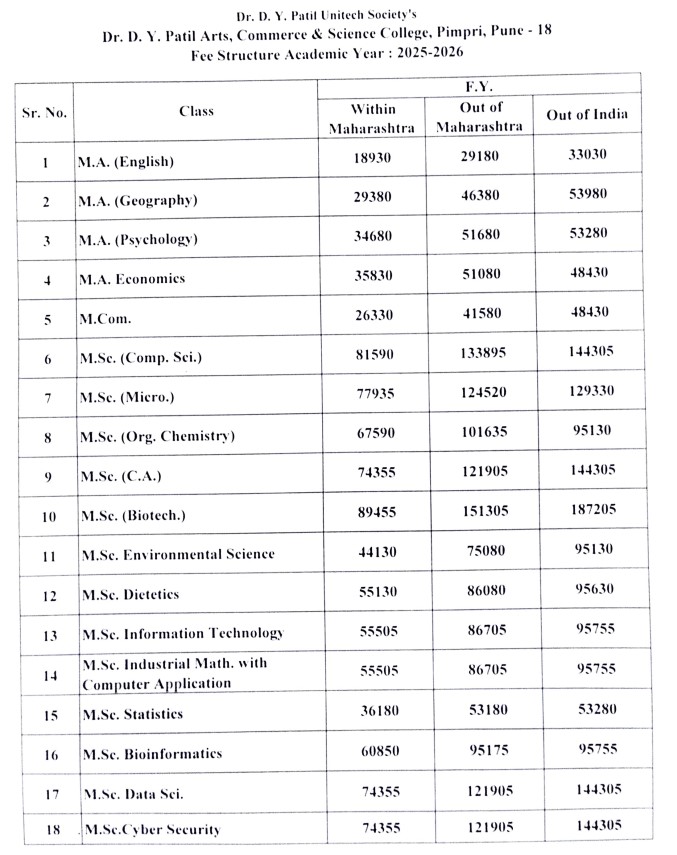
Ans. As per the official fee structure for 2026-27, the annual fee for M.Sc. Cyber Security for students from within Maharashtra is Rs. 74,355. Over the 4-year duration, the total fee amounts to approximately Rs. 2,97,420. Students from outside Maharashtra are charged Rs. 1,21,905 per year (total Rs. 4,87,620 over 4 years). These fees cover tuition and academic charges; examination fees (approximately Rs. 800-1,000 per semester) are charged separately by SPPU. Fees can be paid in installments of 10%, 50%, or 100% as per the college's payment policy.
Ques. What are the career prospects after completing M.Sc. Cyber Security from this college?
Ans. Graduates of M.Sc. Cyber Security can pursue careers as Cyber Security Analysts, Ethical Hackers/Penetration Testers, Security Operations Center (SOC) Analysts, Digital Forensics Investigators, Cloud Security Engineers, Information Security Managers, and Cyber Security Consultants. The programme's curriculum - covering penetration testing, cloud security, mobile forensics, malware analysis, and DevSecOps - aligns well with industry requirements. The college's placement record for M.Sc. programmes shows packages ranging from Rs. 3 lakh to over Rs. 15 lakh per annum, with placement rates above 75% for computer science-related courses.
Ques. Does the college require an entrance exam for admission to M.Sc. Cyber Security?
Ans. No, Dr. D.Y. Patil ACS College does not conduct a separate entrance exam for admission to M.Sc. Cyber Security. Admission is merit-based on the marks obtained in the qualifying degree (B.Sc./B.E./B.C.A. or equivalent). Students need to apply directly through the college portal at admissions.dypvp.edu.in. The SPPU Online Entrance Examination (OEE) is conducted only for programmes offered by SPPU University Departments and does not apply to affiliated college programmes like this one. Students with 60% or above in their qualifying degree (direct admission on provisional basis) can apply immediately.
Ques. What is the difference between M.Sc. Cyber Security and M.Sc. Computer Science at Dr. D.Y. Patil ACS College?
Ans. M.Sc. Cyber Security is a specialized 4-year programme focused exclusively on cyber security domains such as malware analysis, intrusion detection, digital forensics, cloud security, penetration testing, and cyber security architecture. M.Sc. Computer Science, on the other hand, is a 2-year programme with a broader curriculum covering general computer science topics. The Cyber Security programme is better suited for students who want to specialize in information security and ethical hacking, while Computer Science offers a wider range of career options in software development, data science, and IT management. The fee for M.Sc. Cyber Security (Rs. 74,355/year for Maharashtra students) is the same as M.Sc. Computer Applications and M.Sc. Data Science at the college.
Ques. Is there any industrial training or internship component in the M.Sc. Cyber Security programme?
Ans. Yes, the M.Sc. Cyber Security programme includes a mandatory Full-Time Industrial Training (IT) component in Semester IV (the final semester of the second year). This is a credit-bearing component (MCS-651-MJP) where students work with industry partners to gain real-world experience in cyber security operations. Additionally, Semester II includes an On-the-Job Training (OJT) component. The programme also includes a Research Project component in Semesters III and IV (totalling 300 hours), which can be done in collaboration with industry or academic research labs. These components significantly enhance employability and practical skills.


Comments