




Master of Science [MS] (Agriculture)
Field of Study:
$7,757 /Yr

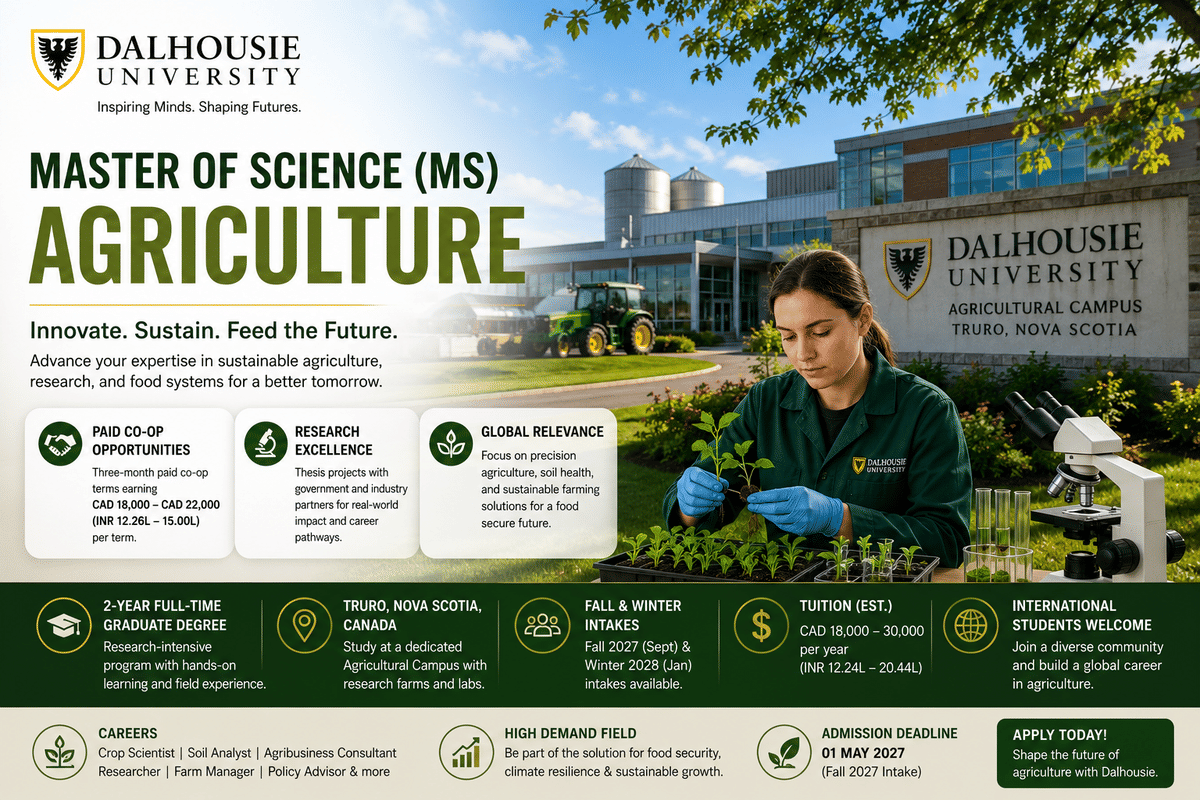
Dalhousie University’s Master of Science (MS) Agriculture is a two-year full-time graduate degree delivered in Truro, Nova Scotia. The programme combines research-intensive coursework with practical field experience across crop science, soil management, sustainable farming, and agricultural innovation. International students pay approximately CAD 18,000 to CAD 30,000 annually (INR 12.24 Lakhs to INR 20.44 Lakhs). Intake months are September 2027 and January 2028. The programme targets graduates with science backgrounds seeking advanced expertise in agricultural systems, food security, and environmental stewardship.
What sets this degree apart is its location on Dalhousie’s Agricultural Campus in Truro—a dedicated facility with research farms, modern laboratories, and direct partnerships with local agribusiness. Ideal applicants combine a strong science foundation (biology, chemistry, or agricultural science) with genuine interest in sustainable agriculture or agro-environmental research. The programme trains specialists who lead in crop improvement, soil conservation, farm management consulting, and agricultural policy.
- Three-month paid co-op terms available during summer breaks, earning CAD 18,000 to CAD 22,000 (INR 12.26 Lakhs to INR 15.00 Lakhs) per term in farm management, agritech, or environmental roles.
- Thesis research projects partner with government agencies and private agricultural companies, creating direct employment pathways post-graduation.
- Strong emphasis on Canadian farming innovations—precision agriculture, vertical farming, soil health—applicable globally and highly valued by Indian agricultural enterprises.
Current Admission Status
Applications for the Fall 2027 intake are Open. International student deadline: 01 May 2027.
Indian applicants should initiate WES (World Education Services) credential evaluation immediately if applying, as the evaluation can take four to six weeks. Begin IELTS or TOEFL preparation now to meet English language minimums by the application deadline.
All INR conversions in the article use a conversion rate of CAD 1 = INR 68.14 as of June 2026. Rates fluctuate daily; verify before applying.
Also Check: Dalhousie University Admission Requirements
Dalhousie University Master of Science Agriculture Fees and Living Costs 2027
Annual tuition for international MS Agriculture students at Dalhousie is approximately CAD 20,000 to CAD 28,000 (INR 13.63 Lakhs to INR 19.08 Lakhs). Most graduate students in science disciplines fall into the CAD 20,000 to CAD 25,000 (INR 13.63 Lakhs to INR 17.04 Lakhs) range annually, though fees may vary slightly by thesis specialization.
| Cost Component | CAD | INR | Note |
|---|---|---|---|
| Annual Tuition (Estimated) | CAD 22,000 | INR 15.00 Lakhs | Representative; varies by specialization and thesis intensity |
| Application Fee | CAD 115 | INR 7,837 | Non-refundable; paid with online application |
| Acceptance Deposit | CAD 200 | INR 13,628 | Non-refundable; due within 4 weeks of offer |
| Health Insurance (Annual) | CAD 926.59 | INR 63,151 | Mandatory DSU International Student Health Plan; auto-billed |
| Estimated Two-Year Total | CAD 46,253 | INR 31.54 Lakhs | Tuition + fees + insurance; excludes living costs |
Source: Dalhousie University International Students Money Matters (accessed June 2026) and Graduate Studies Fee Schedule.
Note:
- Masters international tuition at Dalhousie is locked under the International Tuition Guarantee for eligible programmes, meaning the CAD 22,000 annual rate holds for the entire two-year programme if you enrol in Fall 2027.
- Application and deposit fees are typical for Canadian graduate programmes and considerably lower than undergraduate international fees.
- Health insurance is mandatory for all international students and significantly cheaper than private international plans.
- Many MS Agriculture students offset costs through three-month paid co-op terms in summer (CAD 18,000 to CAD 22,000 per term), effectively reducing net tuition by 20 to 30% over the programme.
Cost of Living in Truro for MS Agriculture Students
Truro, Nova Scotia is a smaller university town with lower living costs compared to Halifax or major Canadian metros. Typical annual living expenses range from CAD 15,000 to CAD 20,000 (INR 10.22 Lakhs to INR 13.63 Lakhs).
| Expense Category | Monthly CAD | Monthly INR | Annual CAD | Annual INR |
|---|---|---|---|---|
| Rent (Shared Housing) | CAD 550–700 | INR 37,477–47,698 | CAD 6,600–8,400 | INR 4.50–5.72 Lakhs |
| Groceries & Food | CAD 250–350 | INR 17,035–23,849 | CAD 3,000–4,200 | INR 2.04–2.86 Lakhs |
| Utilities (Shared) | CAD 80–120 | INR 5,451–8,177 | CAD 960–1,440 | INR 65,374–98,122 |
| Transportation | CAD 60–100 | INR 4,088–6,814 | CAD 720–1,200 | INR 49,061–81,768 |
| Personal & Misc | CAD 150–250 | INR 10,221–17,035 | CAD 1,800–3,000 | INR 1.23–2.04 Lakhs |
| Total Monthly | CAD 1,090–1,520 | INR 74,272–103,573 | CAD 13,080–18,240 | INR 8.91–12.43 Lakhs |
Key Insight: Truro’s rural setting significantly reduces housing and food costs compared to urban Canadian centres. Many MS Agriculture students secure on-campus or subsidised university housing at CAD 450 to CAD 550 monthly (INR 30,663 to INR 37,477), bringing total living costs below CAD 15,000 annually (INR 10.22 Lakhs).
Dalhousie University Master of Science Agriculture Admission 2027
Dalhousie’s MS Agriculture programme welcomes applicants with a bachelor’s degree in biology, agriculture, environmental science, chemistry, soil science, or related disciplines. Admission is competitive; you need a minimum undergraduate GPA of 3.0 out of 4.0 (or equivalent 65% average) from your final two years of study.
| Eligibility Criterion | Requirement | Impact for Indian Applicants |
|---|---|---|
| Undergraduate Degree | Bachelor’s in agricultural, biological, or environmental science | Indian BSc (Botany, Zoology, Microbiology, Soil Science) or BTech (Agricultural Science) accepted; WES evaluation required |
| Minimum GPA | 3.0 out of 4.0 (65% average, final two years) | Competitive; most admitted students have 3.2–3.6 GPA equivalent |
| Prerequisite Courses | Biochemistry, Crop Science or Botany, Soil Science (or equivalent) | Indian BSc typically covers Botany and Zoology; additional soil science course strengthens candidacy |
| Research Experience | Preferred but not required; relevant internship or project work valued | Indian summer internships in agriculture or forestry highly relevant |
| Statement of Intent | 250–500 words explaining research interests and career goals in agriculture | Link interests to Canadian sustainable agriculture, food security, or agri-tech sectors |
| Letters of Reference | 3 letters from professors or research supervisors | Ensure referees can speak to your quantitative and experimental skills; specify agriculture research background |
Dalhousie holds an overall QS World University Ranking of 302 in 2025, placing it among Canada’s top 10 research-intensive universities. While agriculture is not separately ranked by QS globally for Dalhousie, the Faculty of Agriculture is recognised for research in sustainable farming systems, soil health, and climate-adapted crops.
English Language Proficiency
International applicants must demonstrate English fluency through standardised tests. Dalhousie accepts IELTS and TOEFL; choose based on accessibility and test-prep comfort.
- IELTS: minimum 6.5 overall band, no component below 6.0; achievable in eight weeks with structured prep for Indian test-takers.
- TOEFL iBT: minimum 90 overall, no component below 20; IELTS is generally more accessible for India-based applicants due to widespread coaching infrastructure.
- Exemptions available if your bachelor’s degree was taught entirely in English at a recognised institution; include official university letter confirming medium of instruction.
- Many Indian applicants complete IELTS while finalising academic transcripts and WES evaluation in parallel, meeting the May 2027 deadline comfortably with four-month planning.
Tip for Indian Students: IELTS results arrive within two weeks; TOEFL within five days. Start IELTS by February 2027 to allow buffer time before the May 2027 application deadline, especially if retakes are needed.
Read More: Detailed Admission Process at Dalhousie University
Dalhousie University Master of Science Agriculture Application 2027
The application window for Fall 2027 entry opens in mid-October 2026. Submit all documents through the online portal by 01 May 2027 to be considered for admission and scholarship review. Early submission (by February 2027) improves scholarship consideration odds significantly.
| Intake | Application Opens | Scholarship Consideration Deadline | General Application Deadline | Status |
|---|---|---|---|---|
| Fall 2027 | 15 October 2026 | 15 February 2027 | 01 May 2027 | Open |
| Winter 2028 | 01 August 2027 | 30 September 2027 | 15 November 2027 | Expected |
Application documents include: official bachelor’s degree transcript (original or certified copy), WES credential evaluation, IELTS or TOEFL score, statement of intent, three letters of reference, and a completed online application form. The non-refundable application fee is CAD 115 (INR 7,837).
- International transcript evaluation via WES (World Education Services) is mandatory for Indian credentials; allow six weeks for processing and request official WES report sent directly to Dalhousie.
- Decisions for Fall 2027 are issued between March and June 2027; acceptance includes an unconditional offer or conditional offer (subject to final transcript or IELTS results).
- Accepted students must pay a CAD 200 (INR 13,628) non-refundable deposit within four weeks to confirm their place; this holds your seat until final documentation is due.
- Winter 2028 intake has a shorter cycle; applications close mid-November 2027 with decisions by January 2028, making it suitable if Fall 2027 deadlines are tight.
Application Tip: Start WES evaluation in August 2026, well before the application opens, to avoid last-minute credential delays. Request your bachelor’s degree transcript from your Indian university immediately; many institutions take four to eight weeks to issue official transcripts.
Check Out: Dalhousie University Master’s Programmes
Dalhousie University Master of Science Agriculture Scholarships 2027
Dalhousie offers targeted scholarships for international master’s students, though funding is modest compared to undergraduate awards. Most students combine scholarships with part-time work and paid co-op terms. Competitive scholarships include the Nova Scotia Graduate Scholarship for Master’s (CAD 15,000 per year, INR 1.02 Lakhs), the Dalhousie 1-Year Master’s Scholarship (variable, typically CAD 3,000 to CAD 8,000, INR 2.04 Lakhs to INR 5.45 Lakhs), and faculty-specific bursaries.
Realistically, a strong Indian applicant with a 3.5+ GPA and early application (by February 2027) might secure CAD 5,000 to CAD 8,000 (INR 3.41 Lakhs to INR 5.45 Lakhs) in scholarships, offsetting 20 to 30% of annual tuition. Combined with one paid summer co-op term (CAD 20,000, INR 13.63 Lakhs), your net cost drops to approximately CAD 35,000 to CAD 40,000 (INR 23.85 Lakhs to INR 27.26 Lakhs) for the entire two-year degree.
- Scholarship awards are announced with admission offers; applications are automatically reviewed if you submit by the February 15 2027 deadline without separate essays.
- Most graduate scholarships are one-time awards at entry, not renewable annually; budget conservatively and use co-op earnings to cover second-year tuition.
- Graduate students are eligible for federal and provincial student loans; Indian applicants may apply for Education Loan from Indian banks at lower interest rates post-graduation when they earn CAD 60,000+ (INR 40.88 Lakhs).
- TA (Teaching Assistant) and RA (Research Assistant) positions within your department offer CAD 150 to CAD 200 weekly (INR 10,221 to INR 13,628), perfect for second-year funding and research experience.
Scholarship Reality: Most MS Agriculture students do not receive full scholarships; expect partial awards (CAD 5,000 to CAD 8,000) supplemented by co-op income and part-time campus work. Plan finances conservatively with savings of CAD 15,000 to CAD 20,000 (INR 10.22 Lakhs to INR 13.63 Lakhs) before arriving.
Read More: Dalhousie University Rankings
Dalhousie University Master of Science Agriculture Salary 2027
MS Agriculture graduates from Dalhousie secure roles in crop management, farm consulting, agri-research, soil conservation, and agricultural policy. Entry-level salaries range from CAD 55,000 to CAD 70,000 (INR 37.47 Lakhs to INR 47.70 Lakhs) for positions in Canada. Graduates working in international development or returning to India typically earn INR 8 Lakhs to INR 15 Lakhs annually, depending on sector and location.
Government positions (Ministry of Agriculture, environmental agencies) start at CAD 52,000 to CAD 62,000 (INR 35.44 Lakhs to INR 42.25 Lakhs). Private agri-business roles (seed companies, farm consultancy, agri-tech firms) range CAD 60,000 to CAD 80,000 (INR 40.88 Lakhs to INR 54.51 Lakhs). Research-focused careers (universities, research institutes) typically start at CAD 48,000 to CAD 58,000 (INR 32.71 Lakhs to INR 39.52 Lakhs) but accelerate quickly with publications and grants.
| Career Path | Entry Salary CAD | Entry Salary INR | 3-5 Year Salary CAD | 3-5 Year Salary INR |
|---|---|---|---|---|
| Crop Management / Farm Consulting | CAD 55,000–65,000 | INR 37.47–44.29 Lakhs | CAD 70,000–85,000 | INR 47.70–57.92 Lakhs |
| Government Soil / Environmental Officer | CAD 52,000–60,000 | INR 35.44–40.88 Lakhs | CAD 65,000–75,000 | INR 44.29–51.11 Lakhs |
| Agri-Tech / Private Industry | CAD 60,000–75,000 | INR 40.88–51.11 Lakhs | CAD 80,000–100,000 | INR 54.51–68.14 Lakhs |
| Research Scientist (University / Institute) | CAD 48,000–58,000 | INR 32.71–39.52 Lakhs | CAD 65,000–80,000 | INR 44.29–54.51 Lakhs |
Source: Statistics Canada Job Bank (NOC 2123 Agricultural Representatives and Specialists); Glassdoor Canada; Dalhousie Career Services Alumni Survey 2025.
Take-home pay after Canadian federal and Nova Scotia provincial tax ranges from 60 to 65% of gross salary for entry-level earners. A CAD 65,000 (INR 44.29 Lakhs) starting salary nets approximately CAD 40,000 to CAD 43,000 (INR 27.26 Lakhs to INR 29.30 Lakhs) annually after tax, CPP (Canada Pension Plan), and EI (Employment Insurance).
ROI Reality: After accounting for tuition (CAD 46,000, INR 31.54 Lakhs), living costs (CAD 30,000 to CAD 40,000, INR 20.44 Lakhs to INR 27.26 Lakhs), and co-op offset (CAD 20,000, INR 13.63 Lakhs), your net cost is approximately CAD 50,000 to CAD 60,000 (INR 34.07 Lakhs to INR 40.88 Lakhs). A CAD 65,000 first-year salary recovers your degree cost within 18 to 24 months, after which savings accelerate.
Also Check: Post-Graduation Work Permit and Career Prospects in Canada
Canada Visa and Work Rights for MS Agriculture Students 2027
India-educated MS Agriculture graduates studying at Dalhousie enjoy strong visa pathways both during and after their degree. You’ll apply for a Canadian study permit valid for the full two-year programme. After graduation, you’re eligible for an open work permit—no job offer required—allowing unrestricted employment in Canada for up to three years.
- Study Permit: Issued for the duration of your programme (two years) plus optional extension periods; allows part-time work during term (20 hours/week) and full-time work during breaks without separate work permit.
- Post-Graduation Work Permit (PGWP): Valid for up to three years following your MS completion, matching the programme duration; usable anywhere in Canada with any employer, no province or sector restrictions.
- Permanent Residency Path: After one year of full-time skilled work (NOC 2123—Agricultural Representatives) on your PGWP, you’re eligible for Express Entry or Ontario Provincial Nominee Program (PNP) pathways; typical processing is 6 to 12 months.
- Spouse and Dependent Support: Your spouse is eligible for a spouse/partner open work permit valid for the duration of your study permit; children under 22 attend Canadian schools free or at subsidised rates.
Visa Reality: The pathway from study permit to PGWP to permanent residence is clear and well-established for agricultural science graduates. Most Dalhousie MS graduates remain in Canada on PGWP for the three-year work period, then apply for PR while employed.
Dalhousie University Master of Science Agriculture Ranking 2025
While Dalhousie University holds an overall QS World Ranking of 302 in 2025, the MS Agriculture programme is not separately ranked in the QS Agriculture and Forestry subject rankings. However, the Faculty of Agriculture at Dalhousie is nationally recognised in Canada for research strength in crop science, sustainable agriculture, and soil conservation. Rankings reflect international prestige, but programme quality is determined by research output, faculty expertise, and industry partnerships—all strong at Dalhousie’s agriculture faculty.
Dalhousie’s agriculture research contributes significantly to Canadian agricultural innovation, with faculty leading projects in climate-resilient crop varieties, precision farming, and soil health. These research areas directly shape the MS curriculum and offer thesis students direct involvement in cutting-edge work. For Indian applicants, this research-intensive environment is a major strength, particularly if you plan to return to India’s agricultural sector where demand for Canadian-trained specialists is growing.
Key Insight: Subject-level rankings favour large research universities with graduate cohorts of 500+; Dalhousie’s agriculture cohort is smaller (60–80 students annually), which means tighter faculty mentorship, more individualised thesis projects, and stronger peer collaboration—often more valuable than a higher ranking alone.
Check Out: Dalhousie University Rankings and Academic Profile
Dalhousie’s Master of Science Agriculture is ideal for Indian applicants seeking advanced training in sustainable farming, crop science, and agri-research in an English-speaking, research-intensive environment. The two-year programme combines rigorous coursework with applied research, paid co-op opportunities, and strong industry connections that accelerate your entry into agriculture or agri-tech careers. Low living costs in Truro, partial scholarships, and clear post-study work pathways make the overall investment accessible. If you’re ready to lead agricultural innovation and bring Canadian expertise back to India’s farming sector, this degree opens that door. Apply by 01 May 2027 for Fall 2027 entry.
Master of Science Agriculture FAQs
Ques. What is the typical GPA requirement to be admitted to Dalhousie’s MS Agriculture programme?
Ans. Dalhousie requires a minimum 3.0 out of 4.0 GPA (or 65% average) from your final two years of undergraduate study. Competitively admitted students typically have 3.2 to 3.6 GPA equivalents. Indian applicants should ensure their bachelor’s transcript reflects strong performance in science courses (botany, zoology, chemistry, soil science) as these are weighted more heavily than general education subjects.
Ques. Can I work part-time while studying the MS Agriculture programme at Dalhousie?
Ans. Yes, your Canadian study permit allows up to 20 hours per week of part-time work during academic terms and unlimited full-time work during scheduled breaks. Many MS students work as Teaching Assistants (TAs) or Research Assistants (RAs) within the Faculty of Agriculture at CAD 150 to CAD 200 weekly (INR 10,221 to INR 13,628), providing both income and valuable research experience. Co-op internships offer paid roles (CAD 18,000 to CAD 22,000 per summer term) in crop management, agri-tech, or soil conservation.
Ques. What happens to my study permit and visa status after I graduate from Dalhousie’s MS Agriculture?
Ans. Upon graduation, you’re eligible for a Post-Graduation Work Permit (PGWP) valid for up to three years, matching your programme length. The PGWP is an open work permit—you can work for any employer, in any sector, anywhere in Canada without needing a separate job offer or provincial sponsorship. After one year of full-time skilled work, you’re eligible to apply for permanent residence via Express Entry or Ontario PNP pathways.
Ques. Is the MS Agriculture at Dalhousie well-recognised in India, and will employers in India value this degree?
Ans. Yes, a Canadian MS in agriculture is highly valued by Indian employers, particularly agri-business companies, government agricultural agencies (ministry positions), and agri-tech startups. Dalhousie’s research strength in sustainable farming, crop improvement, and soil health aligns with India’s agricultural modernisation priorities. Returning to India with a Canadian degree, English fluency, and North American agricultural expertise positions you competitively for senior management and research roles, often with salaries 30 to 40% higher than domestic MSc graduates.
Ques. What is the living environment like in Truro, and how does it compare to studying in larger Canadian cities?
Ans. Truro is a rural university town with a population of approximately 12,000, offering a close-knit academic community, significantly lower living costs (CAD 15,000 to CAD 20,000 annually, INR 10.22 Lakhs to INR 13.63 Lakhs), and direct access to farmland and agriculture research facilities. You’ll experience authentic Canadian rural life and outdoor opportunities; however, there are fewer entertainment and dining options compared to Halifax or Toronto. Many students appreciate the focus and lower cost of living; if you prefer urban dynamism, Halifax (1.5 hours by car) offers weekend trips and summer internship opportunities.
Important Alert
- Application Deadline For May 2027 Intake - Dec 31, 2026
Tuition Fees
| Year | 1st Year Fees |
|---|---|
| Tuition Fees | $7757 (CAD 11081) |
Other Expenses
| Head | Avg Cost Per Year |
|---|---|
| Housing | $4415 (CAD 6307) |
| Food | $4004 (CAD 5720) |
Previous Year Tuition Fees
| Year | 1st Year Fees |
|---|---|
| 2024 | $7604 (CAD 10863) |
| 2023 | $11802 (CAD 16860) |
| 2021 | $9552 (CAD 13645) |
Important Dates
| Event | Application Date |
|---|---|
| Application Deadline For January 2027 Intake | |
| Application Deadline For May 2027 Intake | Dec 31, 2026 |
| Application Deadline For September 2027 Intake | Apr 1, 2027 |
Scores Required
Required Document List
Complete Application
Application Fee
Official Transcripts
English Language Requirements
Completion of secondary school

Do you think the Rankings are wrong ? Report Here
TOP Scholarships
| Scholarship name | Award amount | Eligibility |
|---|---|---|
| A.S. Mowat Prize | $1,500 | Must be enrolled in the first year of a master’s program at Dalhousie University as of the application deadline |
Key Resources for Your Study Abroad Journey


Course Guides
Best Post-Graduate Courses in Canada in 2025
Masters in Canada: Fees 2024, Top Colleges, Placements & Salaries
MS in Agriculture in Canada: Fees 2024, Top Colleges, Placements & Salaries
One year Courses in Canada for International Students: Fees 2024, Top Colleges, & Salaries
Scholarship Grants & Financial Aids
| Name | Scholarship Per Student | Level of Study | Type | |
|---|---|---|---|---|
| VueVille Future Technology Scholarship | Scholarship per student$ 700/Yr$1,000 | Level Of StudyBachelor | TypeMerit-Based | |
| Go Clean Scholarship | Scholarship per student$ 2,450/Yr$3,500 | Level Of StudyBachelor | TypeMerit-Based | |
| Bharat Petroleum Scholarship | Scholarship per studentVariable Amount | Level Of StudyMaster | TypeMerit-Based | |
| Forktip Women’s- Innovation Scholarship | Scholarship per studentVariable Amount | Level Of StudyBachelor | TypeCollege-Specific | |
| FINCAD Women in Finance Scholarship | Scholarship per student$ 14,000/Yr$20,000 | Level Of StudyMaster | TypeMerit-Based | |
| Ontario Graduate Fellowship | Scholarship per student$ 6,213/Yr$8,875 | Level Of StudyDoctorate | TypeMerit-Based |
Similar Programs
| Program | Important Date | Total Fees | Median Exams Score | Action |
|---|---|---|---|---|
-- | USD 11,255 /Yr CAD 16,078 /Yr |
| ||
Application Deadline for Fall 2027 Intake (1st Dec 2026) | USD 9,049 /Yr CAD 12,927 /Yr |
| ||
Application Deadline for Summer 2027 Intake (1st Dec 2026) Application Deadline for Fall 2027 Intake (1st Apr 2027) | USD 17,420 /Yr CAD 24,885 /Yr |
| ||
Application Deadline For September 2027 Intake (15th Jan 2027) | USD 6,825 /Yr CAD 9,750 /Yr |
|
.jpeg?h=32&w=32&mode=fit)


Do you think the Dates are wrong ? Report Here


interested in this College ?
Follow & Share this college to get information about admission.



Comments