



Jasmine Grover Study Abroad Expert
Study Abroad Expert | Updated On - Jan 13, 2026
Canada introduced a series of major policy changes in 2025 that reshaped the landscape for international students and recent graduates, as the government continued efforts to reduce its temporary resident population and tighten oversight of the international education system.
The changes affect study permits, school transfers, family work rights, financial requirements and Post-Graduation Work Permit (PGWP) eligibility, with implications for students planning to study in Canada in 2026 and beyond.
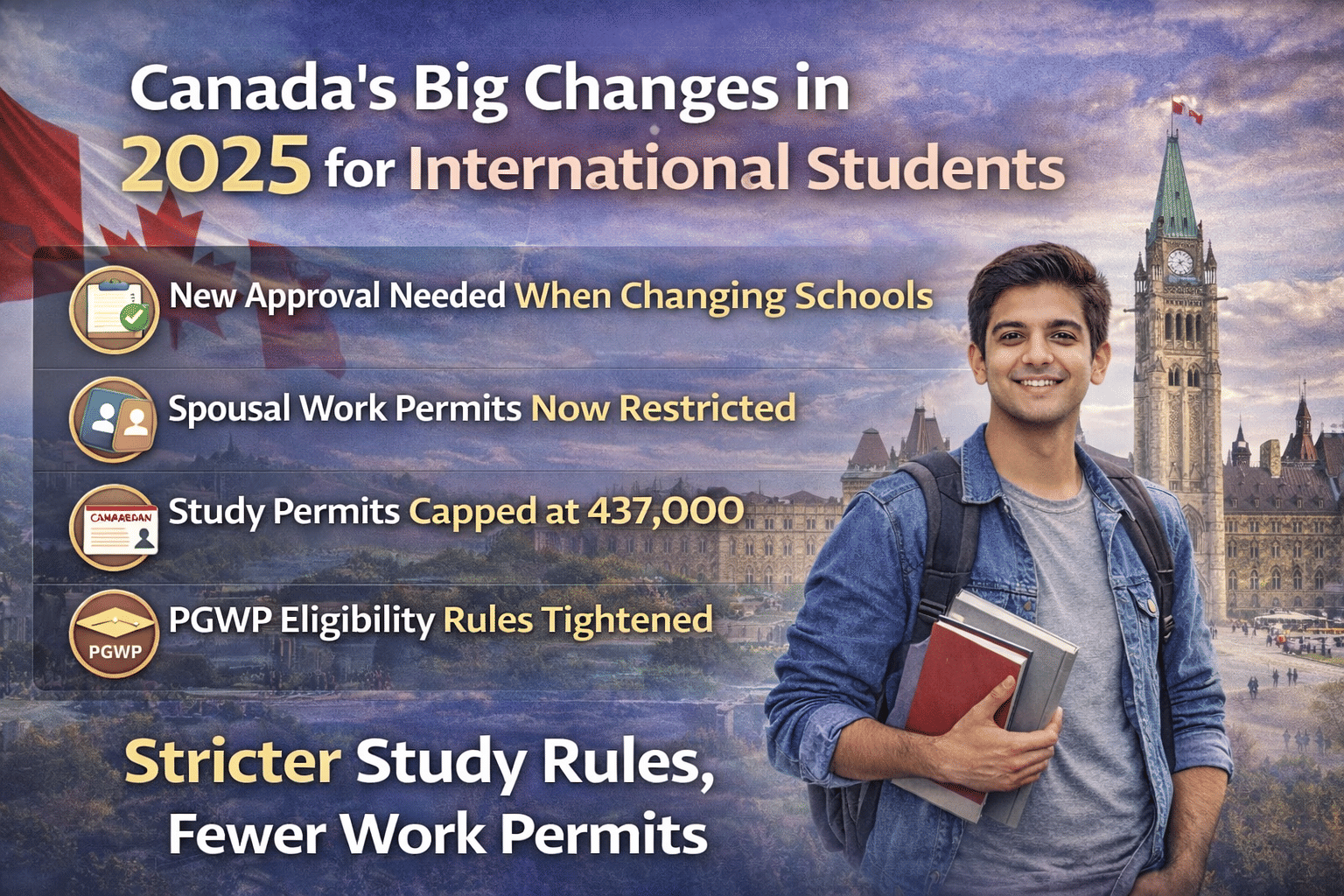
Switching Schools Now Requires Fresh Approval
From late 2024, international students have been required to apply for and receive approval for a new study permit before changing their designated learning institution (DLI). This replaced the earlier system where students could switch institutions by simply updating IRCC online.
- In January 2025, the rules were tightened further, making a new Provincial or Territorial Attestation Letter (PAL/TAL) mandatory when applying for a study permit extension after changing schools.
- Temporary transition measures allowing students to begin studies while applications were in process applied only until May 1, 2025.
- Since then, students must factor full processing timelines into any transfer decision.
Importantly, students who applied for their initial study permit before November 1, 2024 may lose certain PGWP exemptions if they apply for a new permit.
Spousal Open Work Permits Restricted
From January 21, 2025, Canada restricted eligibility for spousal open work permits linked to international students.
Spouses or common-law partners now qualify only if the student is enrolled in:
- A Master’s programme of at least 16 months
- A Doctoral programme
- Select professional programmes in healthcare, education or engineering
This marked a departure from earlier rules that allowed spousal work permits even for shorter master’s degrees.
Study Permit Cap Reduced Again
Canada continued to scale back student intake in 2025. The federal government planned to issue 437,000 study permits, a 10% drop from 2024, with 305,900 permits earmarked for new arrivals.
By August 2025, only 89,430 new study permits had been issued—less than one-third of the annual target.
For 2026, IRCC has announced a further reduction to 408,000 study permits, signalling continued restraint.
Relief for Master’s and Doctoral Students From 2026
In a significant shift, Canada announced that from January 1, 2026, Master’s and PhD students at public institutions will be exempt from the study permit cap.
These students will:
- No longer need a PAL/TAL
- Be allowed to apply even after caps are reached
- Face fewer upfront financial commitments linked to institutional deposits
Fast-Track Processing for Doctoral Applicants
From November 6, 2025, eligible doctoral students applying from outside Canada can receive study permit decisions in as little as two weeks.
Expedited processing may also apply to eligible accompanying family members when applications are submitted together.
PGWP Eligibility Rules Overhauled
Canada’s field-of-study requirement, introduced in 2024, linked PGWP eligibility to labour-market shortages.
In June 2025, IRCC revised the list of eligible programmes, adding some and removing others, including the entire transport category. However, implementation of removals was postponed to early 2026, keeping 178 programmes temporarily eligible.
Degree-level programmes (bachelor’s, master’s, doctoral) remain exempt from field-of-study restrictions.
Students are advised to confirm PGWP eligibility before accepting offers for 2026 intakes.
Cost of Living Proof Raised
From September 1, 2025, Canada increased the minimum living-expense requirement for study permit applicants outside Quebec.
For a single applicant, required funds rose to $22,895, excluding tuition and travel. The threshold increases further for students with dependents and is reviewed annually.
New Student Intake Slashed for 2026
Under the 2026–2028 Immigration Levels Plan, Canada has set a target of 155,000 new international students in 2026—nearly half of 2025 levels—reinforcing the government’s intention to reduce temporary migration.
PGWP Application Errors Addressed
In December 2025, IRCC clarified how applicants must submit language test results and field-of-study documents for PGWP applications.
Due to system limitations, applicants must now merge required documents into a single file at the time of submission to avoid refusals—addressing a common cause of rejection in 2024 and early 2025.
What This Means for Students?
Canada remains open to international students, but entry, mobility and work pathways are now more selective and structured. Degree level, programme length, field of study and compliance history increasingly determine outcomes.
For students planning 2026 admissions, early planning, programme verification and compliance with updated rules are critical to securing study and post-study opportunities in Canada.




1768031645.png?tr=w-305,h-145,c-force?h=40&w=40&mode=stretch)





Comments