



Study Abroad Content Specialist | Updated On - Aug 26, 2026
MBBS in Australia — officially called the Doctor of Medicine (MD) — is a 4 to 6-year AMC-accredited medical degree offered at 10 top universities including University of Melbourne (QS Medicine #20). Australia does not award an "MBBS" degree. The MD is fully equivalent to MBBS for all practical purposes. It is recognised by India's NMC and listed in the World Directory of Medical Schools (WDOMS). MBBS in Australia fees range from AUD 91,200 (INR 61.15 lakh)/year at Flinders University to AUD 1,22,976 (INR 82.44 lakh)/year at University of Melbourne. MBBS in Australia requirements include a Bachelor's degree (for graduate entry) or Class 12 results (for direct entry), GAMSAT or ISAT, and IELTS 6.5 to 7.0. No NEET is required. Low cost MBBS in Australia options include Flinders University (AUD 91,200 / INR 61.15 lakh/year), University of Newcastle (AUD 92,695 / INR 62.15 lakh/year), and University of Western Australia (AUD 92,900 / INR 62.29 lakh/year).
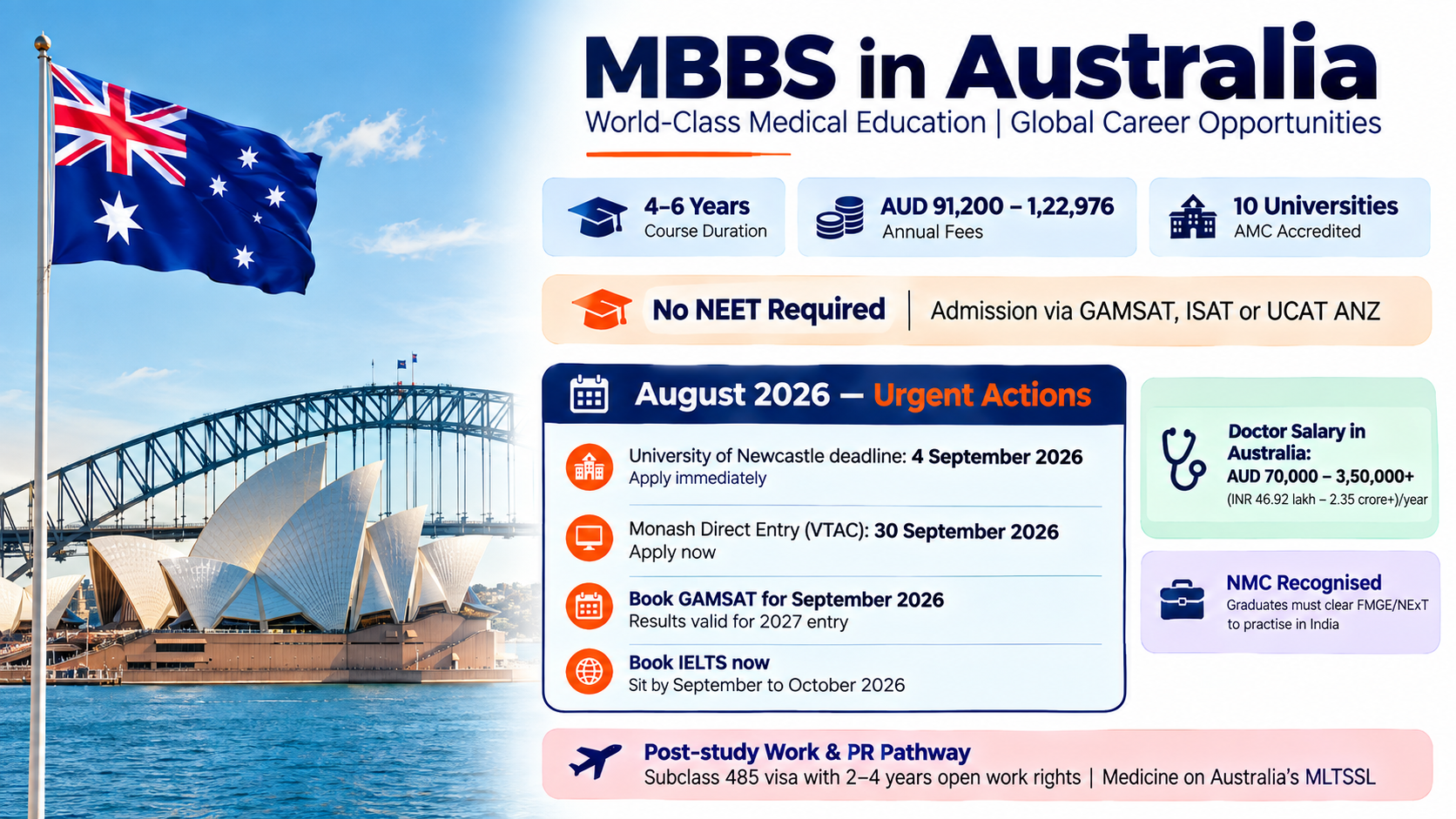
Key facts at a glance:
- 10 universities offer AMC-accredited MD degrees open to Indian students
- Fees: AUD 91,200 (INR 61.15 lakh)/year (Flinders) to AUD 1,22,976 (INR 82.44 lakh)/year (Melbourne)
- Duration: 4 years (graduate entry) or 5 to 6 years (direct entry from Class 12)
- No NEET required — admission via GAMSAT, ISAT, or UCAT ANZ
- GAMSAT can be sat in India — Mumbai, Delhi, Bengaluru, Chennai, Hyderabad, Kolkata
- IELTS minimum: 6.5 (UQ) to 7.0 (most universities)
- NMC recognised — graduates must clear FMGE/NExT to practise in India
- Post-graduation: Subclass 485 Temporary Graduate Visa — 2 to 4 years open work rights
- Medicine is on Australia's MLTSSL — structured PR pathway available
- Doctor salary in Australia: AUD 70,000 to AUD 3,50,000+ (INR 46.92 lakh to INR 2.35 crore+)/year
- February 2027 intake — University of Newcastle deadline: 4 September 2026
August 2026 — Urgent Actions:
- University of Newcastle deadline: 4 September 2026 — apply immediately
- Monash Direct Entry (VTAC): 30 September 2026 — apply now
- Book GAMSAT for September 2026 at gamsat.acer.org — results valid for 2027 entry
- Book IELTS now — sit by September to October 2026
- Apply for Australia Student Visa financial proof — show AUD 29,710 (INR 19.92 lakh) minimum
All conversions use AUD 1 = INR 67.03 (August 2026).
- Top Universities for MBBS (Doctor of Medicine) in Australia
- MBBS in Australia Requirements for Indian Students
- MBBS in Australia Fees for Indian Students
- Cost of Living in Australia for Medical Students
- Scholarships for MBBS in Australia
- Jobs and Salary After MBBS (MD) in Australia
- Application Deadlines and Action Plan
- FAQs
Top Universities for MBBS (Doctor of Medicine) in Australia
The universities listed below are among the well-known options for MBBS (MD) in Australia. All offer AMC-accredited medical degrees open to Indian students. Many other universities in Australia also offer health sciences programs — explore all options before applying.
| QS Medicine Ranking | University | Location |
|---|---|---|
| #20 | University of Melbourne | Melbourne, VIC |
| #26 | University of Sydney | Sydney, NSW |
| #33 | Monash University | Melbourne, VIC |
| #62 | UNSW Sydney | Sydney, NSW |
| #68 | University of Queensland | Brisbane, QLD |
| #129 | University of Adelaide | Adelaide, SA |
| #133 | University of Western Australia | Perth, WA |
| #176 | Australian National University | Canberra, ACT |
| #177 | University of Newcastle | Newcastle, NSW |
| #251 to 300 | Flinders University | Adelaide, SA |
Note: 8 of 10 universities are Group of Eight (Go8) members — Australia's equivalent of the Ivy League. Go8 universities produce 70% of Australia's medical research output.
Student Insights:
Indian students on Reddit note that Monash's no-GAMSAT graduate entry is the most popular pathway for Indian B.Sc. and B.Pharm graduates. Students on Quora highlight that Flinders and Newcastle offer the best combination of affordability and AMC accreditation.
Also Read: Medical Colleges in Australia | Go8 Universities in Australia
MBBS in Australia Requirements for Indian Students
All 10 universities require either a Bachelor's degree (graduate entry) or strong Class 12 results (direct entry). GAMSAT can be sat in India. No NEET is required at any Australian university.
| University | Entry Pathway | Academic Eligibility | Admission Test | Min. IELTS |
|---|---|---|---|---|
| University of Melbourne | Graduate Entry (4 yrs) | Any Bachelor's; GPA min. 3.0/4.0 | GAMSAT (min. 50 each section) or MCAT + MMI | 7.0 (Writing 7.0) |
| University of Sydney | Graduate Entry (4 yrs) | Any Bachelor's (3+ yrs); GPA min. 5.0/7.0 | GAMSAT or MCAT (min. 500) + MMI | 7.0 (no band below 7.0) |
| Monash University | Direct Entry (5 yrs) — Class 12 | CBSE: 90%; Chemistry + English required | ISAT (min. 170) + MMI | 7.0 (no band below 6.5) |
| Monash University | Graduate Entry (4 yrs) | Any Bachelor's; GPA min. 6.0/7.0; No GAMSAT | GPA (40%) + MMI (60%) only | 7.0 (no band below 6.5) |
| UNSW Sydney | Undergraduate (6 yrs) — Class 12 | CBSE: ATAR equivalent 96+ | ISAT or UCAT ANZ + MMI | 7.0 |
| University of Queensland | Graduate Entry (4 yrs) | Any Bachelor's; GPA min. 5.0/7.0 | GAMSAT (min. 50) or MCAT (min. 504) + MMI | 6.5 (no band below 6.0) |
| University of Adelaide | Undergraduate (3+3 yrs) — Class 12 | CBSE: 90%; Chemistry/Biology/Maths required | ISAT + MMI | 7.0 (all bands 7.0) |
| University of Western Australia | Graduate Entry (4 yrs) | Any Bachelor's; GPA min. 5.0/7.0 | GAMSAT or MCAT (min. 500) + MMI | 7.0 (no band below 7.0) |
| ANU | Graduate Entry (4 yrs) | Any Bachelor's; GPA min. 5.0/7.0 | GAMSAT (min. 50) or MCAT (min. 125 each section) + MMI | 7.0 |
| University of Newcastle | Undergraduate (5 yrs) — Class 12 | International school leaver; competitive | ISAT + MMI | 7.0 (no band below 7.0) |
| Flinders University | Graduate Entry (4 yrs) | Any Bachelor's; GPA min. 5.0/7.0 | GAMSAT (min. 50) + MMI | 7.0 (no band below 6.5) |
Key tips for Indian applicants:
- GAMSAT in India: Can be sat at ACER test centres in Mumbai, Delhi, Bengaluru, Chennai, Hyderabad, and Kolkata. Register at gamsat.acer.org. Cost: approximately AUD 385 (INR 25,807). September 2026 results are valid for 2027 entry
- Monash Graduate Entry — No GAMSAT: The only top-10 program that does not require GAMSAT. Selection is purely GPA (min. 6.0/7.0) plus MMI. Ideal for Indian B.Sc., B.Pharm, and B.Tech graduates with strong GPAs. Note: Closed for 2027 — apply for 2028
- MMI (Multiple Mini Interview): A series of short stations testing communication, ethics, and empathy. Indian students with strong patient-centred values perform well. Prepare with mock MMI practice
- No NEET required at any Australian university — a major advantage over Indian medical admissions
- NMC Recognition: Australian MD is listed in WDOMS and recognised by India's NMC. Graduates must clear FMGE/NExT to practise in India. Pass rate for Australian-trained graduates is estimated at 60 to 75% — significantly higher than China, Russia, or Ukraine
- OSHC (Overseas Student Health Cover): Mandatory for all international students. Approximately AUD 700 to AUD 900 (INR 46,921 to INR 60,327)/year
Student Insights:
Indian students on Reddit note that the MMI interview is the most important differentiator in Australian medical admissions — strong GAMSAT scores alone are not sufficient. Students on Quora highlight that UQ's IELTS 6.5 requirement is the most accessible among all 10 universities.
MBBS in Australia Fees for Indian Students
MBBS in Australia fees range from AUD 91,200 (INR 61.15 lakh)/year at Flinders to AUD 1,22,976 (INR 82.44 lakh)/year at Melbourne. Since most graduate entry programs are 4 years, the total tuition cost ranges from approximately INR 2.45 crore to INR 3.30 crore.
| University | Program | Duration | Annual Tuition (AUD) | Annual Tuition (INR) |
|---|---|---|---|---|
| University of Melbourne | Doctor of Medicine (MD) | 4 years | AUD 1,22,976 | INR 82.44 lakh |
| University of Sydney | Doctor of Medicine (MD) | 4 years | AUD 1,00,500 | INR 67.37 lakh |
| Monash University | Doctor of Medicine (MD) | 5 years (direct) | AUD 1,07,600 | INR 72.14 lakh |
| UNSW Sydney | BMS + MD | 6 years | AUD 95,500 | INR 64.04 lakh |
| University of Queensland | Doctor of Medicine (MD) | 4 years | AUD 1,09,328 | INR 73.29 lakh |
| University of Adelaide | BMS + MD (3+3 pathway) | 6 years | AUD 99,000 | INR 66.36 lakh |
| University of Western Australia | Doctor of Medicine (MD) | 4 years | AUD 92,900 | INR 62.29 lakh |
| ANU | Doctor of Medicine and Surgery (MChD) | 4 years | AUD 99,650 | INR 66.80 lakh |
| University of Newcastle | BMedSci/MD (Joint Medical Program) | 5 years | AUD 92,695 | INR 62.15 lakh |
| Flinders University | Doctor of Medicine (MD) | 4 years | AUD 91,200 | INR 61.15 lakh |
Additional costs to budget for:
- Australia Student Visa (Subclass 500): AUD 2,500 (INR 1.68 lakh) — from 1 July 2026
- OSHC (health cover): AUD 700 to AUD 900 (INR 46,921 to INR 60,327)/year — mandatory
- Financial proof for visa: AUD 29,710 (INR 19.92 lakh)/year minimum
- GAMSAT registration: AUD 385 (INR 25,807)
- Education loans: Indian banks (SBI, HDFC Credila, Axis Bank) offer up to INR 1.5 to 2 crore for Australian MD programs
Student Insights:
Indian students on Reddit note that Flinders and UWA offer the best combination of affordability and AMC accreditation. Students on Quora highlight that the 4-year graduate entry at UWA (total INR 2.49 crore) is the most cost-effective pathway among all top-10 universities.
Cost of Living in Australia for Medical Students
Monthly costs range from AUD 1,600 (INR 1.07 lakh)/month in Adelaide and Flinders to AUD 4,200 (INR 2.82 lakh)/month in Sydney. Adelaide and Newcastle are the most affordable cities for Indian medical students.
| University | City | Monthly Cost (AUD) | Monthly Cost (INR) |
|---|---|---|---|
| University of Melbourne | Melbourne, VIC | AUD 2,100 to AUD 3,500 | INR 1.41 lakh to INR 2.35 lakh |
| University of Sydney | Sydney, NSW | AUD 2,500 to AUD 4,200 | INR 1.68 lakh to INR 2.82 lakh |
| Monash University | Melbourne, VIC | AUD 2,100 to AUD 3,500 | INR 1.41 lakh to INR 2.35 lakh |
| UNSW Sydney | Sydney, NSW | AUD 2,500 to AUD 4,200 | INR 1.68 lakh to INR 2.82 lakh |
| University of Queensland | Brisbane, QLD | AUD 1,900 to AUD 3,000 | INR 1.27 lakh to INR 2.01 lakh |
| University of Adelaide | Adelaide, SA | AUD 1,600 to AUD 2,400 | INR 1.07 lakh to INR 1.61 lakh |
| University of Western Australia | Perth, WA | AUD 1,800 to AUD 2,800 | INR 1.21 lakh to INR 1.88 lakh |
| ANU | Canberra, ACT | AUD 1,800 to AUD 2,800 | INR 1.21 lakh to INR 1.88 lakh |
| University of Newcastle | Newcastle, NSW | AUD 1,700 to AUD 2,600 | INR 1.14 lakh to INR 1.74 lakh |
| Flinders University | Adelaide, SA | AUD 1,600 to AUD 2,400 | INR 1.07 lakh to INR 1.61 lakh |
Monthly cost breakdown (Australia average — student):
| Expense | Monthly Cost (AUD) | Monthly Cost (INR) |
|---|---|---|
| Rent (shared accommodation) | AUD 700 to AUD 1,936 | INR 46,921 to INR 1.30 lakh |
| Food and groceries | AUD 300 to AUD 500 | INR 20,109 to INR 33,515 |
| Transport | AUD 100 to AUD 200 | INR 6,703 to INR 13,406 |
| Health insurance (OSHC) | AUD 60 to AUD 75 | INR 4,022 to INR 5,027 |
| Personal and leisure | AUD 150 to AUD 300 | INR 10,055 to INR 20,109 |
| Total | AUD 1,310 to AUD 3,011 | INR 87,869 to INR 2.02 lakh |
Key points:
- Student Visa (Subclass 500) allows 48 hours/fortnight during semester and unlimited hours during breaks.
- At Australia's minimum wage of AUD 24.10/hour (2026), 24 hours/week generates AUD 2,000 (INR 1.34 lakh)/month.
- Note: Clinical placement years (Years 3 to 5) leave very limited time for part-time work.
- Adelaide (Flinders and Adelaide University) is the most affordable city — AUD 600 to AUD 1,000/month cheaper than Sydney.
- Australia has a large Indian community — Indian grocery stores, temples, and restaurants are available in Melbourne, Sydney, Brisbane, Perth, and Adelaide.
- Financial proof for Student Visa: AUD 29,710 (INR 19.92 lakh)/year minimum.
Student Insights:
Indian students on Reddit consistently recommend Adelaide and Newcastle over Sydney and Melbourne for significantly lower living costs. Students on Quora note that part-time work during clinical years is very limited — plan finances accordingly.
Scholarships for MBBS in Australia
Full scholarships for international medical students in Australia are rare. Most scholarships cover partial tuition or a living allowance. The Australia Awards Scholarship is the most valuable fully-funded option.
| Scholarship | University | Award (AUD) | Award (INR) | Eligibility | Deadline |
|---|---|---|---|---|---|
| Australia Awards Scholarships | Australian Government | Full tuition plus living allowance plus airfare | INR 1.5 to 2 crore+ (full program) | Indian citizens; highly competitive; medicine qualifies | 30 April 2027 |
| ANU Chancellor's International Scholarship | ANU | 50% tuition reduction | INR 33.40 lakh/year saving | Top-ranked international students; highly competitive | Rolling — with admission |
| Califole Melbourne Medical School Scholarship | University of Melbourne | AUD 15,000/year × 4 years = AUD 60,000 total | INR 40.22 lakh total | International MD students; merit-based | Rolling — with admission |
| Sydney International Student Award (Medicine) | University of Sydney | Up to AUD 1,00,000 total | INR 67.03 lakh | Commencing international postgraduate students from India | Rolling — with admission |
| UQ International Excellence Scholarship | University of Queensland | 25% tuition fee reduction | INR 18.32 lakh/year saving | High-achieving international students; automatic consideration | Automatic on application |
| University of Newcastle International Tuition Fee Waiver | University of Newcastle | Up to 30% tuition fee waiver | INR 18.65 lakh/year saving | High-achieving international students; merit-based | Rolling — with admission |
| Narotam Sekhsaria Foundation | India-based | Up to INR 20 lakh | INR 20 lakh | Indian students; merit plus need-based | Jan to Mar 2027 |
| KC Mahindra Scholarship | India-based | Up to INR 8 lakh | INR 8 lakh | Indian nationals; postgraduate abroad | Jan to Mar 2027 |
| Inlaks Shivdasani Foundation | India-based | Up to USD 1,00,000 total | INR 83.70 lakh | Indian students under 30; highly competitive | Apr 2027 |
Key points:
- Australia Awards Scholarship deadline: 30 April 2027 — apply after receiving admission offer
- ANU Chancellor's Scholarship (50% off) is the highest-value university scholarship — highly competitive
- UQ International Excellence Scholarship is automatic — no separate application needed
- Sydney International Student Award (up to AUD 1,00,000 / INR 67.03 lakh) is the most valuable university-specific award for Indian students
- Most scholarships are partial — they reduce but do not eliminate tuition costs
- Apply for Narotam Sekhsaria, KC Mahindra, and Inlaks in January to April 2027 after receiving admission offers
- Education loans: SBI, HDFC Credila, and Axis Bank offer up to INR 1.5 to 2 crore for Australian MD programs at 9.5 to 12% per annum
Student Insights:
Indian students on Reddit note that the ANU Chancellor's Scholarship combined with Inlaks Foundation can significantly reduce the total cost at ANU. Students on Quora recommend applying for the UQ International Excellence Scholarship — it is automatic and requires no extra effort.
Jobs and Salary After MBBS (MD) in Australia
Doctors in Australia earn AUD 70,000 to AUD 3,50,000+ (INR 46.92 lakh to INR 2.35 crore+)/year depending on specialisation and experience. Australia faces a projected shortage of 10,600 doctors by 2030 — creating strong demand for Indian medical graduates.
| Job Role | Annual Salary (AUD) | Annual Salary (INR) |
|---|---|---|
| Intern / Junior Medical Officer (PGY1) | AUD 70,000 to AUD 85,000 | INR 46.92 lakh to INR 57.00 lakh |
| Resident Medical Officer (PGY2 to PGY3) | AUD 85,000 to AUD 1,10,000 | INR 57.00 lakh to INR 73.73 lakh |
| General Practitioner (GP) — Registrar | AUD 1,20,000 to AUD 1,80,000 | INR 80.44 lakh to INR 1.21 crore |
| General Practitioner (GP) — Qualified | AUD 1,50,000 to AUD 3,50,000 | INR 1.01 crore to INR 2.35 crore |
| Specialist (Cardiology, Surgery, Psychiatry) | AUD 2,50,000 to AUD 7,50,000+ | INR 1.68 crore to INR 5.03 crore+ |
| Medical Researcher and Academic | AUD 90,000 to AUD 1,40,000 | INR 60.33 lakh to INR 93.84 lakh |
Two career pathways for Indian MD graduates:
Pathway 1 — Practise in Australia:
- Complete MD → Apply for Provisional Registration with AHPRA
- Complete 1-year hospital internship (PGY1)
- Receive General Registration → Work as Resident Medical Officer (RMO)
- Pursue specialist Fellowship training (RACGP, RANZCP, ACEM, etc.)
- Apply for Subclass 485 Temporary Graduate Visa — 2 to 4 years open work rights
- Work in rural/regional area (MM2 to MM7) → Apply for Subclass 491 (5-year provisional visa)
- Apply for Permanent Residency (Subclass 191) — fastest PR pathway for Indian medical graduates
Important: Australian universities do not guarantee internship places to international graduates. Rural and regional areas have significantly better internship availability. Medicine is on Australia's MLTSSL — PR pathways are actively supported by the government.
Pathway 2 — Return to India:
- Complete MD in Australia
- Clear FMGE/NExT (National Exit Test) — pass rate for Australian-trained graduates estimated at 60 to 75%
- Register with India's NMC
- Practise in India — Australian MD graduates are highly valued by private hospitals (Apollo, Fortis, Max)
Top employers for Indian medical graduates in Australia:
- Public hospitals: Royal Melbourne Hospital, Royal Prince Alfred Hospital, Princess Alexandra Hospital, Royal Adelaide Hospital
- General Practice: RACGP-accredited GP clinics across Australia — highest demand in rural areas
- Research: CSIRO, Walter and Eliza Hall Institute, Garvan Institute, QIMR Berghofer
Key points:
- Subclass 485 visa fee: AUD 5,750 (INR 3.86 lakh) — from 1 July 2026
- Rural area incentive: Doctors working in MM2 to MM7 areas qualify for Subclass 491 → Subclass 191 PR — the fastest PR route for Indian medical graduates
- GP shortage: Australia faces a critical GP shortage — Indian graduates willing to work in regional areas have the best internship and PR prospects
- Indian graduates with Australian MD training are highly valued by Indian private hospitals for their English-medium, evidence-based clinical training
Student Insights:
Indian graduates on Reddit note that rural GP practice is the fastest route to Australian PR for medical graduates. Students on Quora highlight that the FMGE/NExT pass rate for Australian-trained graduates is significantly higher than for graduates from China or Russia — making the return-to-India pathway more viable.
Also Read: PR in Australia | Part-Time Jobs in Australia for Indian Students
Application Deadlines and Action Plan
Several deadlines for February 2027 intake are closing in the next few weeks. Act immediately. Most applications are submitted directly to universities or via GEMSAS/VTAC.
| University | Program | Feb 2027 Deadline |
|---|---|---|
| University of Newcastle | Joint Medical Program (5 yrs) | 4 Sep 2026 |
| Monash University | Direct Entry — Class 12 (5 yrs) | 30 Sep 2026 |
| University of Melbourne | Graduate Entry (4 yrs) | Sep 2026 |
| University of Queensland | Graduate Entry (4 yrs) | Sep to Oct 2026 |
| University of Adelaide | Direct Entry — Class 12 (6 yrs) | Sep to Oct 2026 |
| University of Sydney | Graduate Entry (4 yrs) | 31 Oct 2026 |
| UNSW Sydney | Undergraduate (6 yrs) | Oct 2026 |
| University of Western Australia | Graduate Entry (4 yrs) | Open — apply ASAP |
| ANU | Graduate Entry (4 yrs) | Oct 2026 |
| Flinders University | Graduate Entry (4 yrs) | Oct 2026 |
Note: Apply to 3 to 5 universities simultaneously. Include Flinders or Newcastle (most affordable) as your anchor application. Apply to Melbourne and Sydney for best global ranking.
Student Insights:
Indian students on Reddit strongly recommend applying to Newcastle first — the 4 September 2026 deadline is the most urgent. Students on Quora note that GEMSAS (used by Melbourne and several other universities) has a single portal for multiple applications — check it immediately.
For Indian students targeting February 2027, apply to University of Newcastle by 4 September 2026 — the most urgent deadline. Register for GAMSAT September 2026 immediately. Apply to Flinders and UWA for the most affordable 4-year graduate entry options.
FAQs
Ques: What is MBBS in Australia?
Ans: Australia does not award an "MBBS" degree. The equivalent is the Doctor of Medicine (MD) — a 4 to 6-year AMC-accredited medical degree. It is fully recognised by India's NMC and listed in the World Directory of Medical Schools (WDOMS). Graduates must clear FMGE/NExT to practise in India.
Ques: What is MBBS in Australia fees for Indian students?
Ans: MBBS (MD) fees in Australia range from AUD 91,200 (INR 61.15 lakh)/year at Flinders University to AUD 1,22,976 (INR 82.44 lakh)/year at University of Melbourne. Total 4-year program cost ranges from AUD 3,64,800 (INR 2.45 crore) at Flinders to AUD 4,91,904 (INR 3.30 crore) at Melbourne. Add AUD 1,600 to AUD 4,200 (INR 1.07 lakh to INR 2.82 lakh)/month for living costs.
Ques: What are MBBS in Australia requirements for Indian students?
Ans: Graduate entry requires any Bachelor's degree with a minimum GPA of 5.0 to 6.0/7.0, GAMSAT (min. 50 each section) or MCAT, and IELTS 6.5 to 7.0. Direct entry from Class 12 requires 90% in CBSE (most universities), ISAT or UCAT ANZ, and IELTS 7.0. No NEET is required. GAMSAT can be sat in India at 6 cities.
Ques: Is NEET required for MBBS in Australia?
Ans: No. NEET is not required at any Australian university. Admission is based on GAMSAT or ISAT scores, undergraduate GPA, and MMI interview performance. This is a major advantage for Indian students who did not qualify in NEET. The GAMSAT can be sat in India at test centres in Mumbai, Delhi, Bengaluru, Chennai, Hyderabad, and Kolkata.
Ques: What is the cheapest MBBS in Australia for Indian students?
Ans: The most affordable options are Flinders University (AUD 91,200 / INR 61.15 lakh/year, total AUD 3,64,800 / INR 2.45 crore), University of Newcastle (AUD 92,695 / INR 62.15 lakh/year), and University of Western Australia (AUD 92,900 / INR 62.29 lakh/year). All three are AMC-accredited and NMC-recognised. Flinders and Adelaide are in Adelaide — the most affordable city in Australia.
Ques: Is Australian MD recognised by NMC India?
Ans: Yes. Australian MD degrees from all 10 universities in this guide are AMC-accredited and listed in the World Directory of Medical Schools (WDOMS). They are recognised by India's National Medical Commission (NMC). Graduates must clear the FMGE/NExT to practise in India. The estimated pass rate for Australian-trained graduates is 60 to 75% — significantly higher than graduates from China, Russia, or Ukraine.
Ques: What is the salary after MBBS (MD) in Australia?
Ans: Junior Medical Officers (PGY1) earn AUD 70,000 to AUD 85,000 (INR 46.92 lakh to INR 57.00 lakh)/year. Qualified GPs earn AUD 1,50,000 to AUD 3,50,000 (INR 1.01 crore to INR 2.35 crore)/year. Specialists in cardiology, surgery, and psychiatry earn AUD 2,50,000 to AUD 7,50,000+ (INR 1.68 crore to INR 5.03 crore+)/year.
Ques: What is the PR pathway after MBBS in Australia?
Ans: Complete MD → Subclass 485 Temporary Graduate Visa (2 to 4 years) → work in rural/regional area (MM2 to MM7) → Subclass 491 (5-year provisional visa) → Subclass 191 Permanent Residency. Medicine is on Australia's MLTSSL — PR pathways are actively supported by the government. Rural GP practice is the fastest PR route for Indian medical graduates.
Ques: When should Indian students apply for February 2027 MBBS intake in Australia?
Ans: Apply to University of Newcastle by 4 September 2026 — the most urgent deadline. Apply to Monash Direct Entry via VTAC by 30 September 2026. Check GEMSAS for University of Melbourne deadline immediately. Apply to UQ, Adelaide, and UWA by September to October 2026. Apply to Sydney, UNSW, ANU, and Flinders by October 2026.
Ques: Is MBBS in Australia worth it for Indian students?
Ans: Yes — for the right goals. Australia offers AMC-accredited, English-medium training with an estimated FMGE/NExT pass rate of 60 to 75% — far higher than China or Russia. The Subclass 485 visa gives 2 to 4 years of open work rights. Medicine is on Australia's MLTSSL with a structured PR pathway. Graduate salaries start at AUD 70,000 to AUD 85,000 (INR 46.92 lakh to INR 57.00 lakh)/year.



Comments
Found 4 Comments
For MBBS (or MD) programs in Australia, you'll typically need to take the UMAT (Undergraduate Medicine and Health Sciences Admission Test), not the MCAT. Specifically designed for entry into undergraduate medicine, dentistry, and some other health science programs in Australia.
In Australia, the distinction between MBBS and MD programs for aspiring doctors is not as significant as in other countries. MBBS (Bachelor of Medicine, Bachelor of Surgery): This was the traditional medical degree awarded in Australia. MD (Doctor of Medicine): Most Australian universities have transitioned to awarding MD degrees. This reflects the increased focus on research and a more comprehensive curriculum compared to the traditional MBBS.
Neither the UMAT (Undergraduate Medicine and Health Sciences Admission Test) nor the MCAT (Medical College Admission Test) is a mandatory requirement for MBBS programs in Australia for all applicants. The specific test requirement can vary depending on the university and your situation.
In Australia, MBBS programs are offered as 4-7 year courses, including Doctor of Medicine and Surgery (MChD), Doctor of Medicine (MD), and a joint Bachelor of Medical Science and Doctor of Medicine (integrated program). Depending on the program, exam scores like UMAT, UCAT, MCAT, or NEET may be required.